
IRRESPUB BLOG
How to Email a Professor for a PhD Position (+ Templates)
Introduction
Knowing how to email a professor for a PhD position is one of the most valuable skills you can learn as a prospective doctoral student. Your first message is often your only chance to make a strong, professional impression and to show clear fit with a lab’s research priorities and funding constraints.
This guide is for students, researchers, and working professionals considering a PhD—especially those planning to approach supervisors directly. It’s also useful for master’s and final-year undergraduate students, research assistants preparing to transition to a doctorate, and postgraduates seeking co-supervision or cross-institutional collaborations.
Common mistakes include sending overly long emails, attaching bloated portfolios, failing to personalize the message, ignoring funding realities, and writing at the wrong time relative to application or grant cycles. Many applicants also overlook cultural and institutional differences, such as US programs with cohort-based admissions versus UK/EU/Australia models that expect students to match with a supervisor before applying.
In this article, you’ll learn how to research a professor’s work and funding status, timing considerations by country, proven subject lines, a crisp email structure, what to attach, how to follow up, and what to do if you don’t hear back. You’ll find templates you can copy, along with outlines for a CV, SOP, and research proposal, plus expert tips and a detailed list of common pitfalls to avoid.
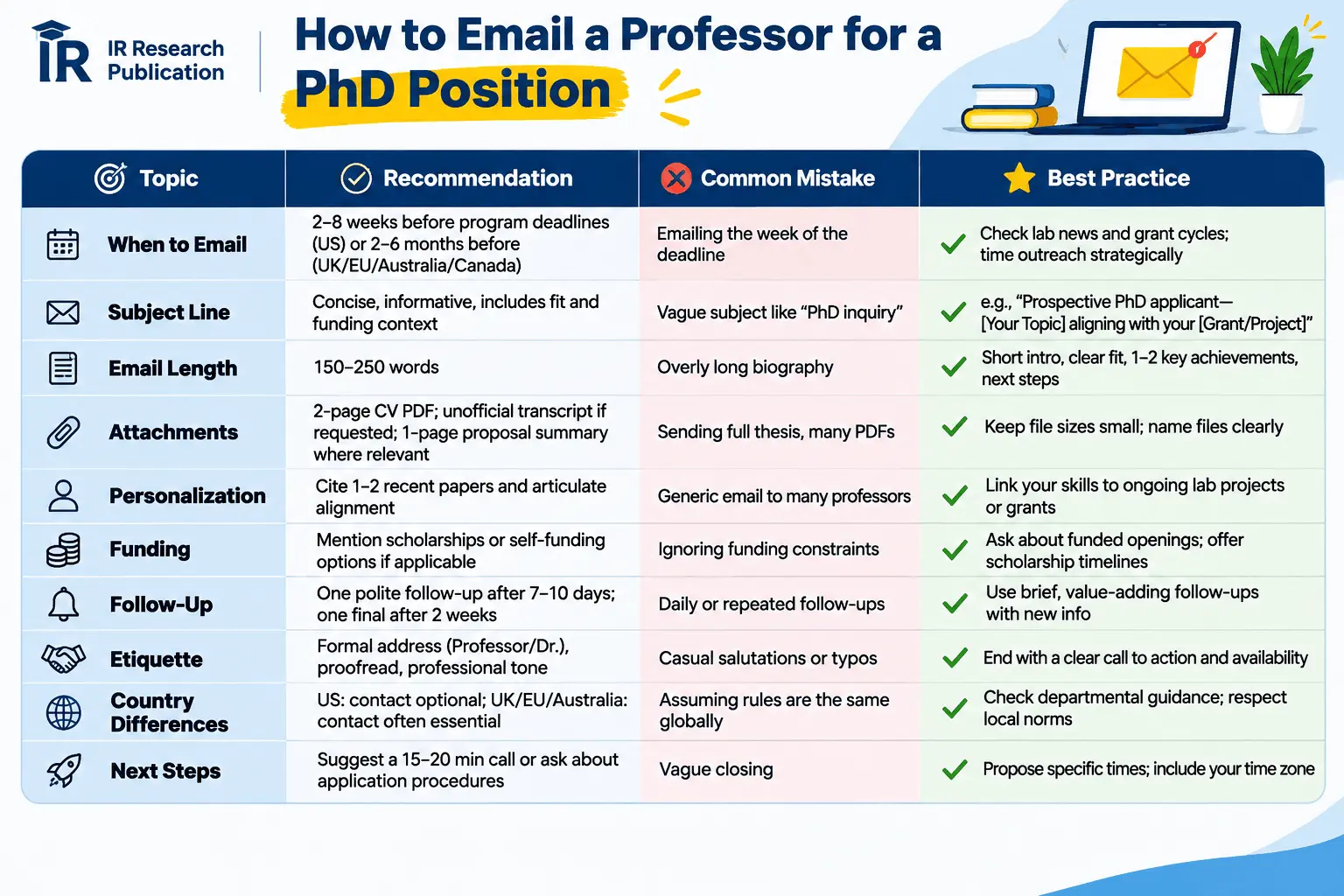
Quick Summary Table: How to Email a Professor for a PhD Position
| Topic | Recommendation | Common Mistake | Best Practice |
|---|---|---|---|
| When to Email | 2–8 weeks before program deadlines (US) or 2–6 months before (UK/EU/Australia/Canada) | Emailing the week of the deadline | Check lab news and grant cycles; time outreach strategically |
| Subject Line | Concise, informative, includes fit and funding context | Vague subject like “PhD inquiry” | e.g., “Prospective PhD applicant—[Your Topic] aligning with your [Grant/Project]” |
| Email Length | 150–250 words | Overly long biography | Short intro, clear fit, 1–2 key achievements, next steps |
| Attachments | 2-page CV PDF; unofficial transcript if requested; 1-page proposal summary where relevant | Sending full thesis, many PDFs | Keep file sizes small; name files clearly |
| Personalization | Cite 1–2 recent papers and articulate alignment | Generic email to many professors | Link your skills to ongoing lab projects or grants |
| Funding | Mention scholarships or self-funding options if applicable | Ignoring funding constraints | Ask about funded openings; offer scholarship timelines |
| Follow-Up | One polite follow-up after 7–10 days; one final after 2 weeks | Daily or repeated follow-ups | Use brief, value-adding follow-ups with new info |
| Etiquette | Formal address (Professor/Dr.), proofread, professional tone | Casual salutations or typos | End with a clear call to action and availability |
| Country Differences | US: contact optional; UK/EU/Australia: contact often essential | Assuming rules are the same globally | Check departmental guidance; respect local norms |
| Next Steps | Suggest a 15–20 min call or ask about application procedures | Vague closing | Propose specific times; include your time zone |
How to Email a Professor for a PhD Position: A Step-by-Step Guide
Step 1: Identify the right professor and lab
Target supervisors whose current and recent research strongly overlaps with your interests and skills. Start from department pages, lab websites, Google Scholar profiles, and recent grants or projects.
- Scan the last 2–3 years of publications. Look for recurring methods or domains you can contribute to (e.g., fMRI preprocessing, econometric modeling, qualitative fieldwork, synthetic chemistry techniques).
- Review lab webpages for “Open positions,” “Join us,” or “Funding” sections.
- Check whether the group takes PhD students through a program-wide admissions process or via direct supervisor match.
- Note grant acknowledgments in papers (e.g., NIH R01, ERC Starting/Consolidator, UKRI, NSERC). Funding acknowledgments hint at resources and themes likely to continue.
Step 2: Understand country and program differences
- United States: Many programs admit to a department or program first, with supervisor selection after rotations or during the first year. Emailing can still help, but some faculty will defer conversations until after you apply.
- UK, Europe, Australia: Supervisor matching before applying is common. You may need an expression of support or to apply directly to a funded project listed by the PI or department.
- Canada: Mixed; some programs are PI-driven, others program-driven. Contacting a prospective supervisor is often encouraged.
- Germany/Netherlands/Scandinavia: Many PhD positions are advertised as paid jobs with a defined project. In such cases, follow the job posting instructions first; email is still useful for clarifying fit.
- China Scholarship Council (CSC): Applicants often need a supervisor’s acceptance letter. If you pursue CSC, explicitly mention timelines and requirements.
Always check the department’s official guidance on contacting supervisors—some explicitly recommend it while others discourage pre-application commitments.
Step 3: Time your outreach
- For US cohort-based admissions: Email 2–8 weeks before the application deadline. Professors are busy; too close to the deadline reduces their ability to advise you.
- For UK/EU/Australia/Canada: Email 2–6 months prior to your intended start date or scholarship deadlines. This allows time to refine a proposal and apply for internal or external funding.
- Avoid peak teaching and grading periods when possible (end of term, early semester). Summer months can be mixed—some faculty are more available; others are on leave.
Step 4: Craft a concise, targeted subject line
Convey who you are, your topic, and your funding context in ~10 words.
- Prospective PhD—[Your Topic/Method] aligned with your [Lab/Grant]
- PhD inquiry: [Technique/Area] fit with your [Project Name]
- Applicant for [Term/Year]—[Scholarship/Funding] + experience in [Skill]
- PhD interest in [Specific Subfield]—recent paper [Short Title]
Step 5: Structure your email for clarity
Target 150–250 words. Aim for four parts: greeting, fit, evidence, and ask.
- Salutation: “Dear Professor [Surname],” (use Dr. if they are not a full professor but hold a PhD).
- Opening line: Who you are, degree, institution, and your research focus aligned with their lab.
- Alignment: Cite 1–2 recent papers or an ongoing project and connect your skills to them.
- Evidence: 1–2 concise achievements (e.g., publication, dataset, demonstrable skill).
- Funding: Briefly note scholarships you plan to apply for or ask about funded openings.
- Call to action: Propose a short call or ask about the best next step.
- Attachments: Mention attached 2-page CV and, if requested, a short proposal summary.
- Signature: Full name, degree, university, location/time zone, website/Google Scholar (optional).
Step 6: Personalize intelligently
- Mention a specific method, dataset, instrument, or theoretical lens the lab uses (e.g., “Your 2023 paper using transformer-based models for clinical text inspired my capstone project”).
- Do not flatter excessively; demonstrate substance by linking your skills to their needs.
- Customize no more than 2–3 sentences; keep overall length tight.
Step 7: Prepare clean attachments and links
- CV: 1–2 pages, PDF, filename: Lastname_Firstname_CV.pdf. Keep it scannable with sections for Education, Research Experience, Publications/Preprints, Skills, Awards.
- Transcript: Unofficial is often fine at this stage unless otherwise requested.
- Proposal summary: 1 page with background, question, method, expected contribution. Only include if the system expects a proposal-based application or the PI requests it.
- Links: If you include links (Google Scholar, portfolio, GitHub), ensure they are up to date and professional.
Step 8: Address funding proactively
- If you have or will apply for scholarships (e.g., Fulbright, Rhodes, Chevening, CSC, DAAD, ERC-funded studentships), state this briefly: “I am applying for [Scholarship], which funds tuition and stipend from [year].”
- For PI-funded projects, ask if there are current or upcoming funded openings.
- For self-funding: Be cautious; some departments limit self-funded admissions. Ask about policies rather than promising payment upfront.
Step 9: Propose a specific next step
Suggest a 15–20 minute call and provide 2–3 time windows with your time zone. Alternatively, ask whether they recommend you apply first to the program or prepare a proposal draft.
Step 10: Follow up respectfully
- Wait 7–10 days before the first follow-up. Keep it to 3–5 sentences. Add value (e.g., a one-paragraph proposal summary) rather than just “bumping.”
- If no response, send one final follow-up 10–14 days later. After that, move on.
- It is normal for busy faculty to miss emails; polite persistence is acceptable within limits.
Email Templates You Can Adapt
Template 1: Cold email for a funded or advertised project
Subject: Prospective PhD — Bayesian geostatistics for groundwater (aligns with your NERC grant)
Dear Professor [Surname],
I am a final-year MSc student in Environmental Data Science at [University], focusing on spatial modeling and uncertainty quantification. I’m writing to express interest in pursuing a PhD in your group, particularly the groundwater quality project described on your lab website and recent paper in [Journal, 2023].
My thesis applies Bayesian hierarchical models to well contamination data, and I have experience in Stan/PyMC, spatial interpolation, and reproducible workflows. I co-authored a preprint on sensor calibration (arXiv:xxxx.xxxxx).
I noticed your NERC grant on groundwater risk. If there is a funded opening for [Year/Term], I’d welcome the chance to discuss how my skills could support the project. I’ve attached a 2-page CV; happy to share a one-page proposal if useful.
Would a brief 15–20 minute call be possible next week? I’m available Tue/Thu 10:00–12:00 (UTC+1).
Best regards,
[Full Name], MSc Candidate, [University]
[City, Country] | UTC+1
[Email] | [Google Scholar/Website/LinkedIn]
Template 2: Inquiry with scholarship/fellowship funding
Subject: PhD interest in protein design — applying for [Scholarship Name] (2026)
Dear Dr. [Surname],
I plan to apply for the [Scholarship Name], which funds a 3–4 year PhD starting in 2026. Your recent work on de novo protein design (e.g., [Short Paper Title], 2024) aligns closely with my MRes research on structure prediction with AlphaFold2 and Rosetta.
I’m interested in a project on [brief 1–2 line idea], building on your lab’s approach to [specific technique]. If you are open to supervising a scholarship-funded student, I would value your feedback on fit and timeline. I can share a one-page proposal draft this week.
Thank you for considering. I’ve attached my CV and an unofficial transcript for context.
Sincerely,
[Full Name]
[Current Position/Program], [Institution] | Time zone [UTC±x]
[Email] | [Portfolio/Scholar/ORCID]
Template 3: Short follow-up (7–10 days)
Subject: Follow-up: PhD inquiry in [Field]
Dear Professor [Surname],
I’m writing to follow up on my message from [date] about potential PhD opportunities in [topic]. I’ve attached a one-page summary outlining a possible project that connects with your [paper/project].
If helpful, I can adjust the focus based on current lab priorities. Would a brief call next week be possible?
Thank you for your time.
[Name]
Template 4: After a positive reply or meeting
Subject: Next steps for PhD application — [Your Name]
Dear Dr. [Surname],
Thank you for the helpful discussion today. Per your advice, I will [action items — e.g., draft a 1-page proposal, contact the program administrator, and prepare materials for the [Term/Year] deadline].
As agreed, I’ll send the draft by [date]. Please let me know if there are specific points or datasets I should address.
Best regards,
[Name]
Template 5: If you are told to apply first
Subject: Thank you — will apply to [Program Name] (Fall 2026)
Dear Professor [Surname],
Thank you for clarifying the process. I will submit my application to the [Program Name] by [deadline] and mention my interest in your lab. If you have any suggestions to strengthen my application, I’d be grateful.
With thanks,
[Name]
CV Snapshot Example (2 pages max)
- Header: Full Name | Email | City, Country | Website/Google Scholar | ORCID
- Education: Degree, Institution, Year; thesis title; GPA (if strong and customary for your region)
- Research Experience: Role, project, supervisor, dates; 2–3 bullet points on methods/results
- Publications/Preprints: Full citations; indicate submitted/under review honestly
- Presentations/Posters: Conference name, year, title
- Technical/Methodological Skills: Grouped (e.g., wet lab, computational, field methods)
- Awards/Scholarships: Name, year, brief context
- Teaching/Service: If relevant
Statement of Purpose (SOP) Outline
- Motivation: The specific intellectual problem or theme driving you
- Background: Coursework, prior research, key skills
- Research Fit: Why this supervisor/program; cite 1–2 recent papers
- Proposed Direction: A feasible question and approach (brief)
- Future Goals: Academic/industry research trajectories
- Conclusion: Synthesis and readiness
Research Proposal Outline (1–3 pages when requested)
- Title and 2–3 sentence summary
- Background and gap (with 5–8 key references)
- Research questions/hypotheses
- Methods/design and feasibility (data, instruments, analysis plan)
- Expected contributions and risks/mitigations
- Timeline and resources
Sample Interview Questions to Prepare For
- What specific aspect of our recent paper attracted you, and how would you extend it?
- Describe a research setback and how you overcame it.
- Which methods are you most comfortable with, and where do you need mentorship?
- What is your preferred supervision style and how do you manage deadlines?
- How do you envision the first 6–12 months of your PhD?
Cover Letter Template (if the position is advertised like a job)
Dear Professor [Surname] and Search Committee,
I am applying for the PhD position in [Project Title/Code] at [Department/University]. My recent work in [Your Area] aligns with your group’s focus on [Specific Themes], particularly [brief link to posting].
In [X] project, I [concise, quantified achievement]. I bring [methods/tools], experience with [datasets/instruments], and a strong record of [publication/presentation/award if any].
I am motivated to contribute to [project aim] and develop [skills/impact] under your supervision. Please find my CV, transcripts, and a short proposal attached. I would welcome the opportunity to discuss my fit.
Sincerely,
[Name]
Expert Tips
- Use a professional email address (ideally your university address) and clear display name (First Last).
- Send during the professor’s local business hours when possible; avoid late-night sends in their time zone.
- Ensure every link you include works and is up to date (test in a private window).
- If English is not your first language, consider a brief grammar check and have a colleague review the draft.
- Attach PDFs only, under ~2 MB total. Rename files clearly (Lastname_Firstname_CV.pdf).
- If the professor runs a large lab, consider copying the lab manager/administrator if their contact is listed for inquiries.
- Track outreach in a spreadsheet: professor name, group, date emailed, follow-up dates, outcome, notes.
- Limit your initial ask; do not request extensive feedback before any commitment is made.
- If you have a unique resource (dataset, language skill, instrument access), mention it succinctly.
- Respect no-reply signals: if the lab page says “Apply via portal only,” do that first.
Common Mistakes to Avoid
- Vague subject lines: Generic subjects are easily overlooked. Be specific about topic and funding context.
- Overlong emails: Professors scan. Keep it 150–250 words with clear structure.
- No personalization: Failing to mention a recent paper or project shows lack of research.
- Attaching excessive files: Multiple PDFs or a full thesis creates friction. Keep it to a CV and only essential items.
- Ignoring funding: Not addressing how the position would be funded can stall the conversation.
- Misaddressing titles or names: Using the wrong title or misspelling names is avoidable and undermines professionalism.
- Copy-paste blasts: Mass emails are often filtered or ignored; tailor each message.
- Weak call to action: End with a clear next step—brief call or application guidance.
- Poor formatting: Dense blocks of text without paragraphs reduce readability; use short paragraphs.
- Implied entitlement: Avoid language that assumes acceptance; express interest and openness to guidance.
- Unclear availability: Not stating time zone or availability complicates scheduling.
- Claims without evidence: Mention achievements you can substantiate (e.g., links to preprints, code, or posters).
Useful Resources (Official)
- US National Science Foundation (NSF) funding
- US National Institutes of Health (NIH) grants
- European Research Council (ERC) grants
- UKRI funding opportunities
- FindAPhD (search PhD positions)
- DAAD scholarships (Germany)
- Marie Skłodowska-Curie Actions (MSCA) fellowships
- Chevening Scholarships (UK)
- Fulbright Foreign Student Program
- China Scholarship Council (CSC) information
- NSERC Postgraduate Scholarships (Canada)
- Scholarships for Development (aggregator)
- ORCID iD
- Google Scholar
Internal Links for Deeper Reading
- How to plan and structure a strong research paper
- Crafting an impactful Statement of Purpose
- Academic writing and publishing guides
- Scholarship and funding updates
- IR Research Publication home
Frequently Asked Questions
1) When is the best time to email a professor for a PhD position?
For US programs with fixed deadlines, 2–8 weeks before the application deadline is reasonable. For UK/EU/Australia/Canada, contact 2–6 months in advance to allow for proposal refinement and funding applications. Always check local cycles and posted guidance.
2) How long should the email be?
About 150–250 words. Keep it concise: introduce yourself, show fit with 1–2 specific references to their work, share 1–2 key achievements, and propose a brief call or ask for the best next step.
3) What should I attach?
A 1–2 page CV in PDF. Attach an unofficial transcript and a one-page proposal summary only if the program expects proposal-driven applications or the PI requests it. Avoid sending many files or very large attachments.
4) Do I need to propose a topic?
It depends. In proposal-driven systems (e.g., many UK/EU/Australia cases), a short, feasible idea helps. In US cohort-based programs with rotations, it’s fine to express interests without a detailed proposal.
5) What if I don’t have publications?
That’s normal for many applicants. Emphasize rigorous coursework, research experiences, concrete skills, and evidence of research potential (e.g., a poster, code repository, or capstone).
6) How many professors should I contact?
Usually 5–12 targeted emails across different institutions and a few within the same department if appropriate. Do not send the same generic email to multiple faculty; tailor each message.
7) What if I don’t get a reply?
Send one follow-up after 7–10 days and a final after 10–14 more days. If still no response, move on. Consider reaching out to current lab members for insights, but respect boundaries and do not pressure anyone.
8) How formal should the tone be?
Use a professional, respectful tone: “Dear Professor/Dr. [Surname]” and “Best regards.” Avoid slang, emojis, and overly casual language.
9) Should I mention funding explicitly?
Yes. If you’re applying for scholarships or have your own funding, say so. If you’re unsure, ask whether there are funded openings or recommended scholarships based on your eligibility.
10) Is it okay to email multiple professors in the same department?
Often yes, but avoid conflicts. If you are in active conversation with one professor about a specific project, be transparent before contacting direct collaborators to prevent misunderstandings.
Conclusion
Mastering how to email a professor for a PhD position can transform your application outcomes. Keep your message short and specific, demonstrate fit with the lab’s recent work, attach a clean CV, and be explicit about funding and next steps. Time your outreach around local cycles, follow up politely, and maintain a professional tone. With the templates and checklists above, you can confidently contact potential supervisors and move efficiently toward a strong application. Start now: shortlist labs, customize your first two emails today, and set calendar reminders for follow-ups.
About IR Research Publication
IR Research Publication is dedicated to advancing research communication and academic success through practical, high-quality resources. We share evidence-based guidance on research methods, academic writing, publishing, and funding to help students, early-career researchers, and faculty thrive. Explore our articles, tools, and updates to strengthen your applications, proposals, and scholarly output.