
IRRESPUB BLOG
Fully Funded Postdoctoral Fellowships in Sweden 2027: Funding, Eligibility & Deadlines
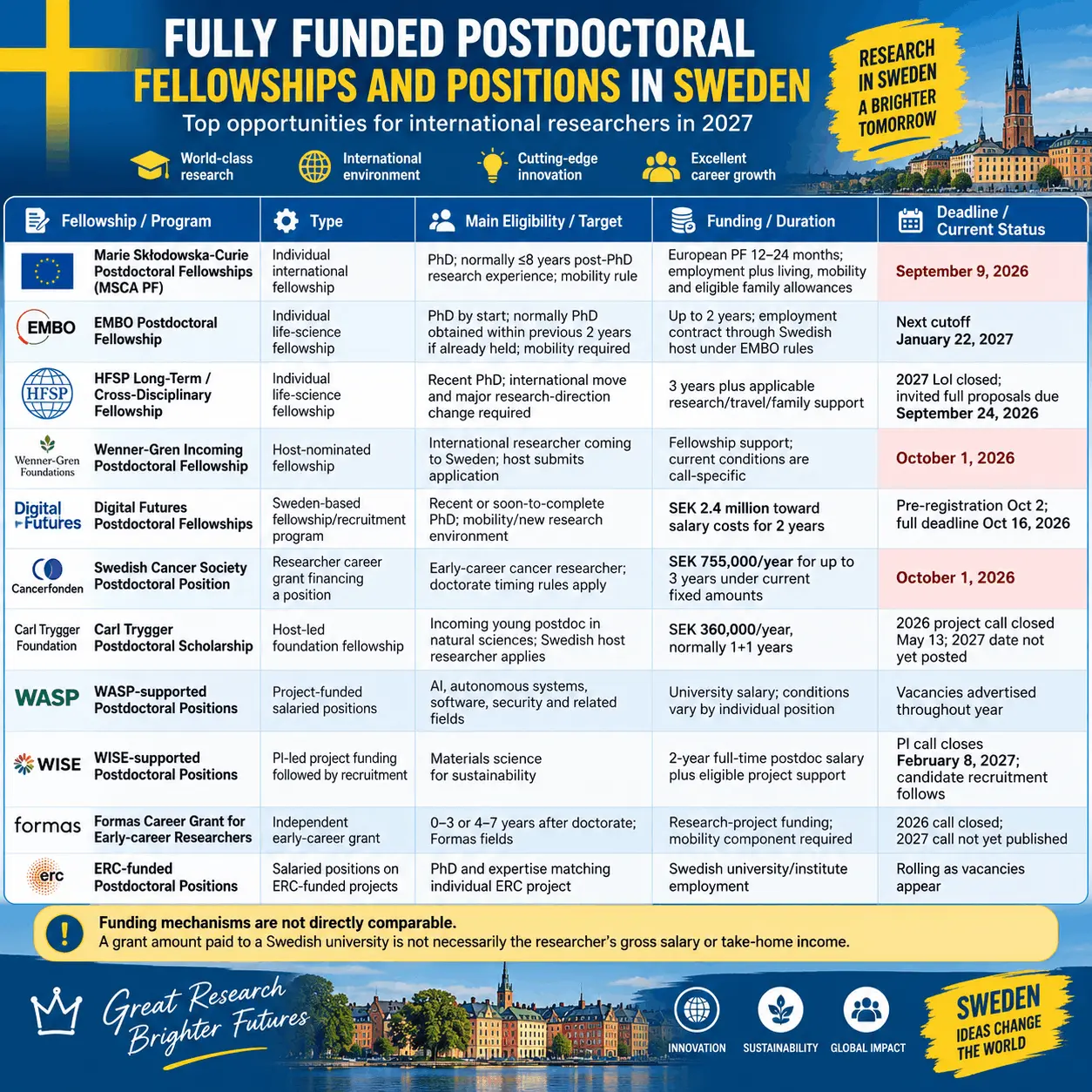
Fully Funded Postdoctoral Fellowships in Sweden 2027
Sweden is one of Europe’s strongest destinations for postdoctoral research, with globally recognized universities, major national research programs, advanced research infrastructure, and extensive international collaboration.
Researchers can pursue postdoctoral opportunities at institutions such as Karolinska Institutet, KTH Royal Institute of Technology, Lund University, Uppsala University, Chalmers University of Technology, Stockholm University, Linköping University, and Umeå University, as well as research environments connected to SciLifeLab, MAX IV, WASP, WISE, and other national initiatives.
However, there is an important distinction applicants should understand.
Important: This guide includes both individual postdoctoral fellowships and fully funded salaried postdoctoral positions supported by Swedish universities, foundations, European programs, and major research initiatives.
A program such as MSCA, EMBO, HFSP, or Wenner-Gren functions as a fellowship or fellowship-based funding route. By contrast, many WASP-, WISE-, ERC-, or foundation-supported positions are research projects through which a Swedish university later recruits and employs a postdoctoral researcher.
Both can provide excellent postdoctoral funding, but the application process is different.
Researchers comparing Sweden with other European destinations can also explore IR Research Publication’s guides to fully funded postdoctoral fellowships in Germany for 2027, postdoctoral fellowships in France for 2027, and postdoctoral fellowships in the Netherlands for 2027.
Postdoctoral Fellowships in Sweden Currently Open for 2027 Starts
Applicants targeting a 2027 start should not wait until 2027. Several major competitions are closing during September and October 2026.
| Program | Current Status | Key Deadline | Funding / Duration | 2027 Relevance |
|---|---|---|---|---|
| MSCA Postdoctoral Fellowships | Open | September 9, 2026 | European PF: 12–24 months; employment through host plus MSCA allowances | First projects expected from May 2027 |
| HFSP Postdoctoral Fellowships | LOI closed; invited applicants only | September 24, 2026 full proposal | 3-year fellowship | Successful fellowships may begin from April 2027 |
| Wenner-Gren Incoming Postdoctoral Fellowship | Current 2026 call | October 1, 2026 | Fellowship for international researchers moving to Sweden | Relevant for 2027 research stays |
| Swedish Cancer Society Postdoctoral Position | Open | October 1, 2026, 15:00 | Up to 3 years; grant funds postdoctoral salary | Current competition can support upcoming postdoctoral appointment |
| Digital Futures Postdoctoral Fellowships | Open | Pre-registration October 2, 2026; full application October 16, 2026 | SEK 2.4 million toward salary costs over 2 years | Project start June 1, 2027 |
| EMBO Postdoctoral Fellowship | Applications accepted year-round | Next hard cutoff January 22, 2027, 14:00 CET | Up to 2 years | Direct 2027 application opportunity |
The MSCA 2026 call closes September 9 and expects its first funded projects to start around May 2027. Digital Futures currently has a specifically advertised 2027-start competition, while the Swedish Cancer Society and Wenner-Gren both have October 1, 2026 deadlines.
Summary: Fully Funded Postdoctoral Fellowships and Positions in Sweden
| Fellowship / Program | Type | Main Eligibility / Target | Funding / Duration | Deadline / Current Status | Official Information |
|---|---|---|---|---|---|
| Marie Skłodowska-Curie Postdoctoral Fellowships (MSCA PF) | Individual international fellowship | PhD; normally ≤8 years post-PhD research experience; mobility rule | European PF 12–24 months; employment plus living, mobility and eligible family allowances | September 9, 2026 | MSCA Postdoctoral Fellowships |
| EMBO Postdoctoral Fellowship | Individual life-science fellowship | PhD by start; normally PhD obtained within previous 2 years if already held; mobility required | Up to 2 years; employment contract through Swedish host under EMBO rules | Next cutoff January 22, 2027 | EMBO Postdoctoral Fellowships |
| HFSP Long-Term / Cross-Disciplinary Fellowship | Individual life-science fellowship | Recent PhD; international move and major research-direction change required | 3 years plus applicable research/travel/family support | 2027 LOI closed; invited full proposals due September 24, 2026 | HFSP Postdoctoral Fellowships |
| Wenner-Gren Incoming Postdoctoral Fellowship | Host-nominated fellowship | International researcher coming to Sweden; host submits application | Fellowship support; current conditions are call-specific | October 1, 2026 | Wenner-Gren Foundations |
| Digital Futures Postdoctoral Fellowships | Sweden-based fellowship/recruitment program | Recent or soon-to-complete PhD; mobility/new research environment | SEK 2.4 million toward salary costs for 2 years | Pre-registration Oct 2; full deadline Oct 16, 2026 | Digital Futures Postdoctoral Fellowship |
| Swedish Cancer Society Postdoctoral Position | Researcher career grant financing a position | Early-career cancer researcher; doctorate timing rules apply | SEK 755,000/year for up to 3 years under current fixed amounts | October 1, 2026 | Cancerfonden Postdoctoral Position |
| Carl Trygger Postdoctoral Scholarship | Host-led foundation fellowship | Incoming young postdoc in natural sciences; Swedish host researcher applies | SEK 360,000/year, normally 1+1 years | 2026 project call closed May 13; 2027 date not yet posted | Carl Trygger Foundation |
| WASP-supported Postdoctoral Positions | Project-funded salaried positions | AI, autonomous systems, software, security and related fields | University salary; conditions vary by individual position | Vacancies advertised throughout year | WASP Open Positions |
| WISE-supported Postdoctoral Positions | PI-led project funding followed by recruitment | Materials science for sustainability | 2-year full-time postdoc salary plus eligible project support | PI call closes February 8, 2027; candidate recruitment follows | WISE Academic Projects 2026–2027 |
| Formas Career Grant for Early-career Researchers | Independent early-career grant | 0–3 or 4–7 years after doctorate; Formas fields | Research-project funding; mobility component required | 2026 call closed; 2027 call not yet published | Formas Career Grant |
| ERC-funded Postdoctoral Positions | Salaried positions on ERC-funded projects | PhD and expertise matching individual ERC project | Swedish university/institute employment | Rolling as vacancies appear | EURAXESS Research Jobs |
Funding mechanisms are not directly comparable. A grant amount paid to a Swedish university is not necessarily the researcher’s gross salary or take-home income.
1. Marie Skłodowska-Curie Postdoctoral Fellowships in Sweden
The Marie Skłodowska-Curie Actions Postdoctoral Fellowship (MSCA PF) is one of the strongest options for international researchers who want to conduct postdoctoral research at a Swedish university or research organization.
European Postdoctoral Fellowships are open across disciplines and can be hosted by eligible academic or non-academic institutions in Sweden.
Funding and Duration
European Postdoctoral Fellowships normally last 12–24 months.
MSCA funding supports the recruited researcher through:
- living allowance;
- mobility allowance;
- family allowance when applicable;
- long-term-leave and special-needs support where applicable.
The host also receives funding for research, training, networking, management, and indirect costs.
The host beneficiary recruits the successful researcher for the fellowship period.
Eligibility
Applicants must generally:
- hold a PhD by the call deadline or have successfully defended the doctoral thesis;
- have no more than eight years of research experience after the PhD, subject to specified exclusions;
- satisfy the MSCA mobility rule.
For an MSCA European Fellowship with a Swedish host, applicants must not have resided or carried out their main activity in Sweden for more than 12 months during the 36 months immediately before the application deadline.
2026–2027 Timeline
- Call opened: April 9, 2026
- Application deadline: September 9, 2026
- Expected results: February 2027
- First projects expected to start: approximately May 2027
Official MSCA Postdoctoral Fellowship information
2. EMBO Postdoctoral Fellowships in Sweden
The EMBO Postdoctoral Fellowship is a prestigious option for researchers in molecular biology and related life-science fields who want to move to a Swedish research environment.
Sweden is part of the European Molecular Biology Conference framework, making Swedish life-science laboratories attractive potential hosts.
Eligibility
Important current eligibility requirements include:
- applicants must hold a doctorate or equivalent by the fellowship start;
- researchers who already hold a PhD when applying normally must have obtained it within the two years before application;
- researchers who have already joined the proposed host laboratory generally must have been living in the host country for less than six months at application;
- the proposed project cannot simply be a direct continuation of the PhD research.
Funding
For fellows hosted in EMBC Member States such as Sweden, EMBO provides funding to the host institution so it can issue an employment contract to the fellow.
Eligible relocation and childcare-related support may also be available under EMBO rules.
Deadline
Applications are accepted throughout the year.
The next current hard cutoff is:
January 22, 2027 at 14:00 CET.
3. HFSP Postdoctoral Fellowships
The Human Frontier Science Program (HFSP) supports highly innovative and potentially transformative basic life-science research.
It offers:
- Long-Term Fellowships (LTF) for applicants trained primarily in biological disciplines;
- Cross-Disciplinary Fellowships (CDF) for researchers trained in areas such as physics, chemistry, mathematics, engineering, or computer science who are moving into life-science research.
Duration
HFSP fellowships provide three years of support.
Funding includes a living allowance and additional support under applicable rules for research, travel, relocation, and family circumstances.
Strict Eligibility and Mobility Rules
HFSP is considerably more restrictive than a normal international postdoc vacancy.
For the 2027 cycle, the doctoral degree generally must not have been conferred more than three years before the September 24, 2026 full-proposal deadline, subject to eligible career-interruption exceptions.
HFSP also emphasizes:
- an international move;
- a significant change in research direction;
- frontier biological questions;
- independence from previous supervisors and research environments.
2027 Application Status
The Letter of Intent stage for the 2027 cycle has already closed.
Only applicants invited after the LOI review can submit the full proposal.
Invited full-proposal deadline: September 24, 2026.
Successful candidates may begin their fellowship from April 2027.
4. Wenner-Gren Postdoctoral Fellowships for Researchers Coming to Sweden
The Wenner-Gren Foundations provide an important Sweden-specific route for bringing international postdoctoral researchers into Swedish research environments.
The current call is specifically listed by Uppsala University as providing postdoctoral grants for incoming fellows, with a deadline of October 1, 2026.
How the Application Works
Unlike MSCA, where the researcher and host develop an application together within an EU funding framework, Wenner-Gren applications for incoming postdoctoral fellows are normally submitted by the Swedish host researcher for a selected international candidate.
Applicants should therefore identify and contact a Swedish PI well ahead of the foundation deadline.
Current call information indicates that the scheme is intended to bring researchers from outside Sweden into Swedish research environments.
Who Should Consider Wenner-Gren?
It is particularly relevant if you:
- currently work outside Sweden;
- want to join a Swedish research group;
- have recently completed your PhD;
- have already identified a potential Swedish host;
- are seeking a fellowship route rather than waiting for an advertised salaried vacancy.
Wenner-Gren Foundations official website
5. Digital Futures Postdoctoral Fellowships
The Digital Futures Postdoctoral Fellowship is one of the best currently open opportunities specifically targeting researchers who can begin a fellowship in Sweden in 2027.
Digital Futures is a cross-disciplinary research center established by KTH Royal Institute of Technology, Stockholm University, and RISE Research Institutes of Sweden, with additional academic, industry, public-sector, and healthcare partners.
Research Areas
Projects can address digital transformation in areas such as:
- artificial intelligence;
- trustworthy digital systems;
- digitalized industry;
- smart society;
- health and life;
- education;
- cooperation and learning;
- emerging digital technologies.
Funding
The current call offers:
SEK 2.4 million toward salary costs for two years for each employed postdoctoral fellow.
This amount is transferred to the main supervisor responsible for employing the fellow—it should not be interpreted as the researcher’s take-home salary.
The fellowship also provides access to:
- research infrastructure;
- academic and industrial networks;
- mentorship;
- career development;
- research-leadership training.
Eligibility
Applicants must hold a doctoral degree before starting the fellowship.
The program emphasizes mobility and researchers moving into a new research group and institution.
Applications require both a main supervisor and co-supervisor within the eligible Digital Futures environment.
2026–2027 Dates
- Call opened: August 18, 2026
- Mandatory pre-registration: October 2, 2026
- Full application deadline: October 16, 2026
- Decision: December 2026
- Project start: June 1, 2027
Digital Futures Postdoctoral Fellowship call
6. Swedish Cancer Society Postdoctoral Position
Researchers working in cancer biology, oncology, cancer immunology, epidemiology, therapeutics, prevention, or related areas should strongly consider the Swedish Cancer Society (Cancerfonden) Postdoctoral Position.
Current Eligibility
For the current 2026 competition, applicants generally must have completed their doctorate on or after July 1, 2023, but no later than December 31, 2026, subject to eligible deductions for circumstances such as parental or qualifying medical leave.
The Swedish Cancer Society particularly values:
- mobility;
- scientific excellence;
- cancer relevance;
- development of an independent research direction.
Duration and Funding
The grant can support a postdoctoral position for a maximum of three years.
Current fixed grant amounts list:
- SEK 755,000 per year
- SEK 2,265,000 total over three years
The funding is paid to a Swedish university, and the actual salary is determined by the employer. The grant must be used to finance the postdoctoral position.
Can the Research Be Done Abroad?
Yes.
The fellowship can support a postdoctoral period in Sweden or abroad.
However, when the postdoctoral period is conducted abroad, the third and final year must be completed at the Swedish host institution in Sweden.
Deadline
October 1, 2026 at 15:00.
Swedish Cancer Society Postdoctoral Position
7. Carl Trygger Foundation Postdoctoral Scholarships
The Carl Trygger Foundation for Scientific Research supports research in broad natural-science fields including:
- physics;
- chemistry;
- engineering;
- biology;
- ecology;
- geology;
- forestry;
- agricultural sciences.
Importantly, medical research falls outside the foundation’s scope.
Postdoctoral Funding
From 2026, the foundation states that its postdoctoral scholarship normally provides:
SEK 360,000 per year, usually for two years (1+1 years).
Who Applies?
The postdoctoral researcher does not normally submit the grant directly.
A researcher at the Swedish host institution applies for funding for the incoming postdoc.
The candidate should normally:
- hold a doctorate;
- be an early-career researcher;
- have obtained the doctorate at an institution different from the host;
- not already be established at the proposed Swedish host institution.
The doctorate generally should not be older than six years at admission unless special circumstances apply.
Deadline
The foundation states that research-project applications are accepted in May each year.
The 2026 project deadline was May 13, 2026. The specific 2027 deadline has not yet been posted.
8. WASP-Supported Postdoctoral Positions in Sweden
The Wallenberg AI, Autonomous Systems and Software Program (WASP) is Sweden’s largest individual research program in artificial intelligence, autonomous systems, and software.
Postdoctoral researchers can join WASP-funded research through salaried university positions across participating Swedish institutions.
Important Distinction
There is not one generic “WASP Postdoctoral Fellowship in Sweden” with a single eligibility rule and deadline.
Instead, WASP supports:
- specific research projects;
- individual postdoctoral vacancies;
- industrial research initiatives;
- targeted research calls.
WASP’s positions page currently lists individual salaried postdoctoral vacancies with their own deadlines.
Fields
Relevant areas include:
- artificial intelligence;
- machine learning;
- robotics;
- autonomous systems;
- cybersecurity;
- software engineering;
- mathematical foundations of AI;
- optimization;
- computer vision.
Important Note About the WASP International Postdoctoral Scholarship
WASP also operates an International Postdoctoral Scholarship, but this is designed specifically for researchers who completed their PhD within WASP and want to undertake postdoctoral study at leading universities outside Sweden.
It should therefore not be confused with WASP-funded postdoctoral positions based in Sweden.
Current WASP research positions
9. WISE-Supported Postdoctoral Positions
The Wallenberg Initiative Materials Science for Sustainability (WISE) is a major Swedish investment in materials science.
WISE supports research addressing areas such as:
- sustainable materials;
- energy technologies;
- advanced manufacturing;
- recycling;
- resource efficiency;
- chemistry;
- physics;
- engineering;
- environmentally responsible materials design.
Current 2026–2027 Call
WISE’s Academic Projects 3 call will fund:
- up to 29 academic postdoctoral researcher positions;
- up to 29 PhD positions.
However, the researchers applying to this current funding call are principal investigators, not prospective postdoctoral candidates.
Once projects receive funding, the relevant Swedish universities can recruit the postdocs.
Postdoctoral Funding
The current call funds:
- salary for a postdoc for two years full-time;
- possible extension to 2.5 years if research is conducted at 80%;
- mentorship;
- eligible travel to WISE events;
- specified consumables and sustainability-expertise contributions.
Timeline
- Application portal opens: December 1, 2026
- PI application deadline: February 8, 2027
- Funding decisions: approximately May 2027
- Candidates expected to be ready to start by: August 1, 2028
Therefore, this particular WISE call should not be advertised as a direct 2027 postdoc application for individual researchers.
Researchers seeking a 2027 start should instead monitor vacancies arising from already funded WISE projects.
WISE Academic Projects 2026–2027
10. Formas Career Grant for Early-Career Researchers
Formas is the Swedish Research Council for Sustainable Development.
Its current early-career scheme is called:
Career Grant for Early-career Researchers
This replaces older terminology that may still appear online referring to Formas mobility grants.
The scheme supports researchers who want to develop an independent project within Formas’s areas:
- environment;
- agricultural sciences;
- spatial planning;
- sustainability-related research.
Career Tracks
The current scheme has two tracks:
- 0–3 years after the doctorate
- 4–7 years after the doctorate
A mobility component is built into the funding model.
Is It a Postdoctoral Fellowship?
Not exactly.
This is an independent early-career research grant, so it is better suited to researchers who are transitioning toward scientific independence rather than simply seeking a standard supervised postdoctoral position.
Current Status
The 2026 competition ran from January 20 to March 4, 2026.
The program is recurring and normally opens near the beginning of the year, but the detailed 2027 call has not yet been published.
Formas Career Grant for Early-career Researchers
11. ERC-Funded Postdoctoral Positions in Sweden
The European Research Council (ERC) does not operate a general postdoctoral fellowship for individual candidates.
Instead, ERC awards major grants to principal investigators.
Those ERC-funded research groups frequently recruit:
- postdoctoral researchers;
- research scientists;
- research engineers;
- data scientists;
- technical specialists.
A Swedish ERC-funded postdoc is therefore usually a salaried university or institute position, rather than an ERC fellowship awarded directly to the candidate.
How to Find Them
Search:
- individual Swedish university vacancy pages;
- research-group websites;
- EURAXESS;
- academic job portals.
Search research jobs on EURAXESS
IR Research Publication also maintains a regularly updated research jobs and postdoctoral opportunities page.
What About the MIMS “Excellence by Choice” Postdoctoral Programme?
Older fellowship lists may include the Excellence by Choice Postdoctoral Programme at Umeå University/MIMS.
It is an excellent program—but it should not currently be advertised as an open 2027 fellowship.
The program was designed to fund 17 international postdoctoral fellows during its 2021–2026 cycle. Umeå University’s current information indicates that the fellows have been recruited, and earlier program material identified the later recruitment round as the final call.
As of this review, no new 2027 Excellence by Choice competition has been confirmed.
Researchers interested in Umeå should instead monitor Umeå University and MIMS vacancies for new postdoctoral opportunities.
How Much Do Postdocs Earn in Sweden?
There is no single national “Sweden postdoc salary.”
For ordinary salaried university postdoctoral positions, compensation depends on factors such as:
- host university;
- collective and local salary agreements;
- discipline;
- relevant experience;
- funding source;
- individual salary negotiation.
For externally funded programs, the amount published by the funder may represent the total employment cost paid to the university, not the researcher’s gross salary.
For example:
- Digital Futures provides SEK 2.4 million toward salary costs over two years;
- Cancerfonden currently allocates SEK 755,000 annually for its postdoctoral-position grant;
- these figures should not be interpreted as annual take-home salary.
Researchers comparing fellowship compensation internationally may find IR Research Publication’s guide to the highest-paying postdoctoral fellowships worldwide useful.
Are Postdocs in Sweden Employees?
Many ordinary university postdoctoral researchers are employed under fixed-term university contracts and receive Swedish employment benefits.
Depending on the employer and funding arrangement, these can include:
- paid annual leave;
- pension contributions;
- parental-leave protections;
- sick-leave provisions;
- social-security coverage.
However, this does not apply identically to every fellowship.
A tax-free scholarship or fellowship can have different legal, pension, insurance, and social-security consequences compared with salaried employment.
Before accepting an offer, always determine whether you will be:
- a university employee;
- a scholarship recipient;
- employed through an externally financed position; or
- funded through another arrangement.
Can International Researchers Apply for Postdocs in Sweden?
Yes.
Swedish universities and many major fellowship programs recruit researchers internationally.
Programs such as:
- MSCA;
- EMBO;
- HFSP;
- Wenner-Gren;
- Digital Futures;
are specifically designed to support international mobility or strongly welcome international applicants.
However, each program has its own rules regarding:
- time since PhD;
- nationality;
- residence history;
- previous time in Sweden;
- relationship with the host;
- previous research topic;
- research mobility.
Never assume that being an international applicant automatically makes you eligible.
Do You Need to Speak Swedish?
For many internationally recruited research postdocs—particularly in STEM, engineering, data science, and biomedical research—English is commonly the working language.
Swedish is therefore often not required for research-focused positions.
However, Swedish proficiency may be necessary or advantageous when a position involves:
- clinical work;
- teaching in Swedish;
- patient communication;
- Swedish-language interviews or datasets;
- significant public engagement.
Always check the individual vacancy.
How to Find a Postdoctoral Host in Sweden
For fellowship applications such as MSCA, EMBO, HFSP, and Wenner-Gren, finding the right supervisor is one of the most important steps.
Major research environments include:
Life Sciences and Medicine
- Karolinska Institutet
- Uppsala University
- Lund University
- Umeå University
- University of Gothenburg
- SciLifeLab
Engineering, AI and Technology
- KTH Royal Institute of Technology
- Chalmers University of Technology
- Linköping University
- Lund University
- Uppsala University
- Umeå University
Materials and Sustainability
- KTH
- Chalmers
- Linköping
- Lund
- Uppsala
- Stockholm University
- Luleå University of Technology
- WISE-associated environments
Researchers who are not sure where to begin can use our detailed guide on how to find postdoctoral fellowship opportunities around the world.
How to Contact a Swedish Professor for a Fellowship
Do not send a generic message saying:
“I am looking for any postdoctoral position in your laboratory.”
Instead, briefly explain:
- your current research area;
- major techniques or expertise;
- your strongest research accomplishment;
- why the professor’s work specifically interests you;
- the fellowship you want to target;
- a potential research direction;
- how your expertise complements the host laboratory.
For host-nominated programs such as Wenner-Gren or Carl Trygger, contacting the PI early is particularly important because the host may need to select one candidate and formally submit the funding application.
How to Make Your Sweden Postdoc Application Competitive
1. Check Eligibility Before Writing the Proposal
Verify:
- date of PhD;
- mobility requirements;
- residence history;
- nationality restrictions;
- previous work at the host;
- previous collaborations;
- field restrictions.
HFSP, MSCA, EMBO, Cancerfonden, and Wenner-Gren all contain eligibility rules capable of disqualifying an otherwise excellent application.
2. Explain Why You Need the Swedish Host
Do not rely on the university’s reputation alone.
Explain the specific:
- expertise;
- technology;
- datasets;
- research infrastructure;
- patient cohorts;
- collaborators;
- computational resources;
- methodologies;
that make the host essential to your project.
3. Demonstrate Scientific Independence
A strong postdoctoral proposal should show how your project develops beyond your PhD.
Reviewers should understand:
- what expertise you already bring;
- what you will learn;
- which research questions are yours;
- how the fellowship advances your independent research identity.
4. Build a Strong Training Plan
This is especially important for MSCA.
Consider:
- technical training;
- leadership development;
- grant writing;
- teaching;
- data science;
- industry exposure;
- secondments;
- entrepreneurship;
- science communication.
5. Apply to Multiple Funding Routes
A life-science researcher seeking a Swedish host might simultaneously evaluate:
MSCA + EMBO + HFSP + Wenner-Gren + discipline-specific foundations + advertised university postdoc positions.
A computational researcher could consider:
MSCA + Digital Futures + WASP-funded vacancies + ERC-funded postdocs.
A materials scientist might consider:
MSCA + Carl Trygger + WISE-supported vacancies + ERC-funded positions.
When Should You Apply for a 2027 Postdoc in Sweden?
A useful planning timeline is:
September–October 2026
Apply immediately to relevant active programs such as:
- MSCA
- invited HFSP full proposals
- Wenner-Gren
- Swedish Cancer Society
- Digital Futures
November 2026–January 2027
- prepare EMBO applications;
- monitor new Swedish university vacancies;
- follow WASP positions;
- identify newly funded research projects;
- contact potential hosts.
Early 2027
Monitor:
- new university postdoc advertisements;
- Formas’s next Career Grant competition;
- foundation funding rounds;
- ERC-funded laboratories;
- WISE-related future recruitment.
Because many salaried postdoc positions are advertised throughout the year, researchers should continue monitoring Swedish university vacancy pages even after fellowship deadlines pass.
Frequently Asked Questions
Are postdoctoral fellowships in Sweden fully funded?
Many are.
However, “fully funded” can mean different things.
Some programs provide:
- an employment contract and salary;
while others provide:
- a fellowship or stipend;
- a grant to the host university that finances the postdoctoral position.
Travel, research, relocation, childcare, and family support differ by scheme.
Which Sweden postdoctoral fellowships are currently open for 2027?
As of September 5, 2026, major relevant opportunities include:
- MSCA Postdoctoral Fellowships — deadline September 9, 2026
- Swedish Cancer Society Postdoctoral Position — October 1, 2026
- Wenner-Gren incoming postdoc funding — October 1, 2026
- Digital Futures — pre-registration October 2 and full application October 16, 2026
- EMBO — next hard cutoff January 22, 2027
HFSP’s initial 2027 application stage has already closed; only invited applicants can submit a full proposal.
Can Indian researchers apply for postdocs in Sweden?
Yes, Indian researchers can apply for many Swedish and European fellowship programs if they satisfy the individual eligibility rules.
Potential options include:
- MSCA;
- EMBO;
- HFSP;
- Wenner-Gren;
- Digital Futures;
- advertised salaried Swedish university positions.
Eligibility should still be checked individually because mobility and post-PhD timing rules vary substantially.
Do I need a Swedish host before applying?
For many fellowships, yes.
Programs such as MSCA, HFSP, Wenner-Gren, and host-led Carl Trygger funding require a Swedish research environment to be identified before the application is completed.
Digital Futures also requires eligible supervisors.
By contrast, ordinary salaried postdoctoral vacancies involve applying directly to an already defined research position.
Is EMBO available for postdoctoral research in Sweden?
Yes.
Swedish life-science research institutions can host eligible EMBO fellows.
International mobility and the timing of the applicant’s PhD are particularly important eligibility considerations.
Is Swedish required for a postdoc?
Usually not for internationally recruited research-focused positions, but some clinical, teaching, or public-facing roles may require Swedish.
What is the best fellowship for an international postdoc in Sweden?
There is no single best option.
For broad international mobility:
MSCA is one of the strongest.
For molecular and life sciences:
EMBO is highly attractive.
For frontier interdisciplinary biology:
HFSP is exceptionally prestigious.
For international researchers specifically moving into Sweden:
Wenner-Gren is particularly relevant.
For digital technologies and AI:
Digital Futures and WASP-supported positions are strong options.
For cancer researchers:
Cancerfonden deserves close consideration.
Final Application Checklist
Before applying for a postdoctoral fellowship in Sweden, confirm:
- I satisfy the PhD-date requirement.
- I meet the mobility rule.
- I meet any nationality requirements.
- My Swedish host is eligible.
- My previous residence in Sweden does not make me ineligible.
- My relationship with the proposed supervisor complies with the program rules.
- My proposal clearly differs from my PhD work where required.
- I understand whether the funding is salary, stipend, or host-administered grant.
- I understand the tax and social-security implications of the funding model.
- My CV is tailored to the fellowship.
- My research proposal demonstrates independence.
- My host has reviewed the proposal.
- Recommendation letters have been requested early.
- I have checked the exact official deadline and time zone.
- I have identified at least one alternative funding route.
Conclusion: Fully Funded Postdoctoral Fellowships in Sweden 2027
Sweden offers an excellent range of opportunities for researchers seeking fully funded postdoctoral fellowships in Sweden for 2027, but applicants should distinguish carefully between true individual fellowships and project-funded salaried postdoctoral jobs.
For researchers targeting a 2027 start, several important opportunities are already active in 2026.
The MSCA Postdoctoral Fellowship closes on September 9, 2026. The Swedish Cancer Society and Wenner-Gren have October 1 deadlines, while Digital Futures has a mandatory October 2 pre-registration followed by an October 16 application deadline. EMBO accepts applications throughout the year, with its next hard cutoff on January 22, 2027.
HFSP remains one of the world’s most prestigious life-science fellowships, but its initial 2027 application stage has already closed.
Researchers should also monitor WASP, WISE, ERC-funded laboratories, Carl Trygger-supported projects, Formas, and individual Swedish universities for additional funded postdoctoral positions.
Start early, verify mobility and PhD-date rules before preparing the application, identify a strong Swedish host, and apply across several suitable funding routes rather than depending on one fellowship.
For additional guidance, explore IR Research Publication’s global guide to finding postdoctoral fellowships and our latest research jobs and postdoctoral opportunities.
Related Articles
- Top Fully Funded Postdoctoral Fellowships in the Netherlands for 2027
- Fully Funded Postdoctoral Fellowships in France 2027
- Fully Funded Postdoctoral Fellowships in Germany 2027
- Highest-Paying Postdoctoral Fellowships Worldwide
- How to Find Postdoctoral Fellowship Opportunities Around the World
- Fully Funded PhD Scholarships in Sweden 2027
- Latest PhD, Postdoc and Research Job Opportunities
About IR Research Publication
IR Research Publication is a research and academic-career platform supporting students, scientists, and scholars with practical information on research funding, postdoctoral fellowships, PhD opportunities, academic publishing, and career development.
Our fellowship guides focus on credible opportunities and emphasize verification of eligibility, funding, mobility requirements, deadlines, and host conditions through current official sources.
Last reviewed: September 5, 2026
Disclaimer: Fellowship rules, deadlines, grant amounts, employment conditions, and eligibility requirements may change. Applicants should always confirm the latest call documentation on the official funder’s or host institution’s website before applying.