
IRRESPUB BLOG
Top Fully Funded Postdoctoral Fellowships in the Netherlands for 2027
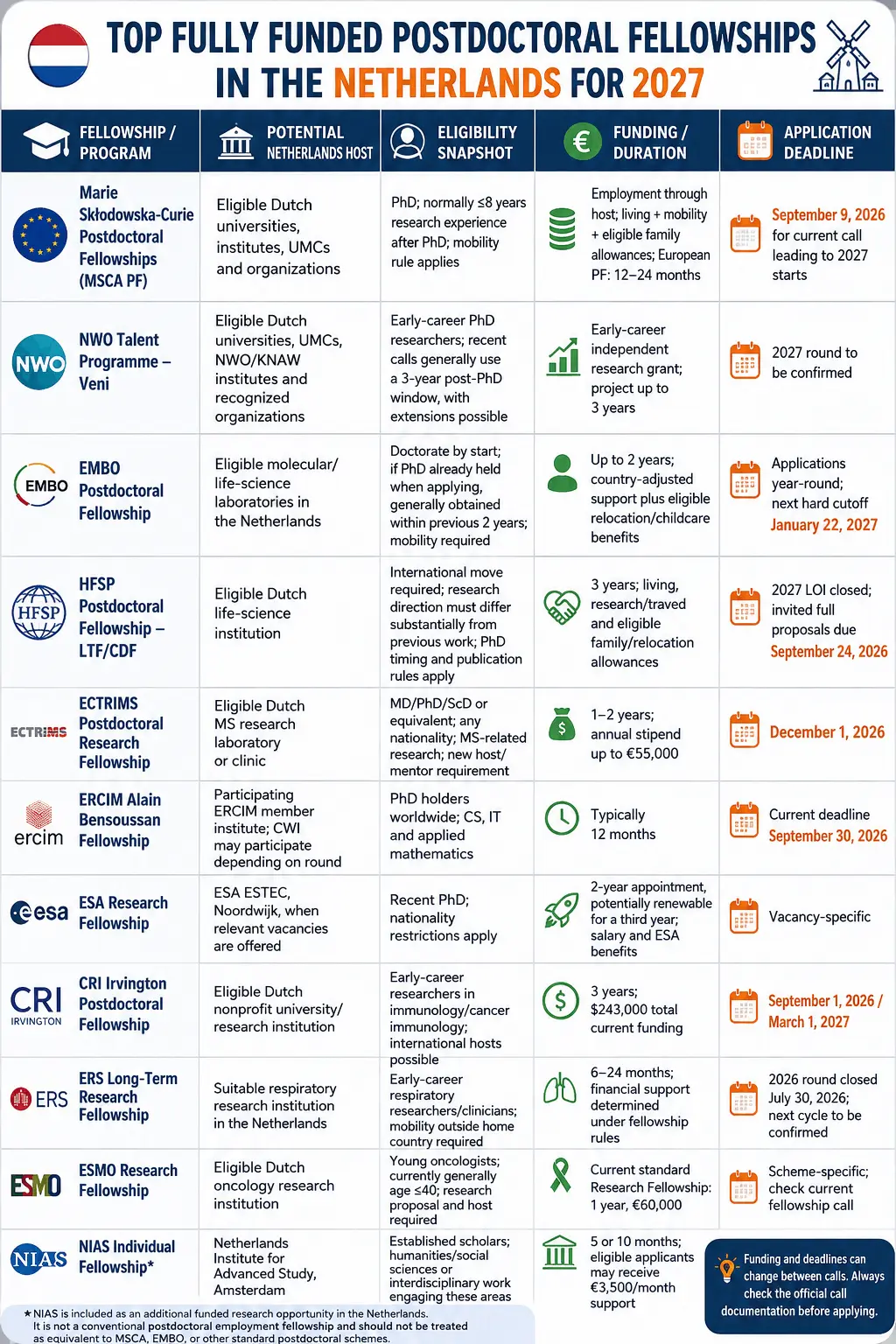
Introduction: Fully Funded Postdoctoral Fellowships in the Netherlands 2027
The Netherlands is one of Europe’s leading destinations for postdoctoral research, offering internationally recognized universities, university medical centers, national research institutes, and a strong culture of interdisciplinary and collaborative science.
Researchers planning to start a postdoctoral position in the Netherlands in 2027 can access funding through several routes. Some opportunities, such as the Marie Skłodowska-Curie Postdoctoral Fellowship, EMBO Fellowship, HFSP Fellowship, ECTRIMS Fellowship, and CRI Irvington Fellowship, are international programs that can potentially be held at an eligible Dutch host institution. Others, particularly the NWO Talent Programme – Veni, are Netherlands-based early-career research grants.
Importantly, not every opportunity in this guide is structured in exactly the same way. Some provide an employment contract through the host institution, others provide a fellowship stipend or grant, and some are designed primarily for mobility or specialist research training.
Important for 2027 applicants: Do not wait until 2027 to begin applying. Several fellowships that can fund research beginning in 2027 have application deadlines during 2026.
For example, the 2026 MSCA Postdoctoral Fellowship call closes on September 9, 2026, with successful projects expected to begin from May 2027. HFSP’s 2027 fellowship cycle began even earlier, while ECTRIMS has a December 1, 2026 deadline for its 2027 fellowship cycle.
Researchers still exploring different countries may also find our guides to fully funded postdoctoral fellowships in Germany for 2027 and fully funded postdoctoral fellowships in France for 2027 useful for comparison.
Top Fully Funded Postdoctoral Fellowships in the Netherlands for 2027
| Fellowship / Program | Potential Netherlands Host | Eligibility Snapshot | Funding / Duration | Application Deadline | Official Link |
|---|---|---|---|---|---|
| Marie Skłodowska-Curie Postdoctoral Fellowships (MSCA PF) | Eligible Dutch universities, institutes, UMCs and organizations | PhD; normally ≤8 years research experience after PhD; mobility rule applies | Employment through host; living + mobility + eligible family allowances; European PF: 12–24 months | September 9, 2026 for current call leading to 2027 starts | Official Website |
| NWO Talent Programme – Veni | Eligible Dutch universities, UMCs, NWO/KNAW institutes and recognized organizations | Early-career PhD researchers; recent calls generally use a 3-year post-PhD window, with extensions possible | Early-career independent research grant; project up to 3 years | 2027 round to be confirmed | Official Website |
| EMBO Postdoctoral Fellowship | Eligible molecular/life-science laboratories in the Netherlands | Doctorate by start; if PhD already held when applying, generally obtained within previous 2 years; mobility required | Up to 2 years; country-adjusted support plus eligible relocation/childcare benefits | Applications year-round; next hard cutoff January 22, 2027 | Official Website |
| HFSP Postdoctoral Fellowship – LTF/CDF | Eligible Dutch life-science institution | International move required; research direction must differ substantially from previous work; PhD timing and publication rules apply | 3 years; living, research/travel and eligible family/relocation allowances | 2027 LOI closed; invited full proposals due September 24, 2026 | Official Website |
| ECTRIMS Postdoctoral Research Fellowship | Eligible Dutch MS research laboratory or clinic | MD/PhD/ScD or equivalent; any nationality; MS-related research; new host/mentor requirement | 1–2 years; annual stipend up to €55,000 | December 1, 2026 | Official Website |
| ERCIM Alain Bensoussan Fellowship | Participating ERCIM member institute; CWI may participate depending on round | PhD holders worldwide; CS, IT and applied mathematics | Typically 12 months | Current deadline September 30, 2026 | Official Website |
| ESA Research Fellowship | ESA ESTEC, Noordwijk, when relevant vacancies are offered | Recent PhD; nationality restrictions apply | 2-year appointment, potentially renewable for a third year; salary and ESA benefits | Vacancy-specific | Official Website |
| CRI Irvington Postdoctoral Fellowship | Eligible Dutch nonprofit university/research institution | Early-career researchers in immunology/cancer immunology; international hosts possible | 3 years; $243,000 total current funding | September 1, 2026 / March 1, 2027 | Official Website |
| ERS Long-Term Research Fellowship | Suitable respiratory research institution in the Netherlands | Early-career respiratory researchers/clinicians; mobility outside home country required | 6–24 months; financial support determined under fellowship rules | 2026 round closed July 30, 2026; next cycle to be confirmed | Official Website |
| ESMO Research Fellowship | Eligible Dutch oncology research institution | Young oncologists; currently generally age ≤40; research proposal and host required | Current standard Research Fellowship: 1 year, €60,000 | Scheme-specific; check current fellowship call | Official Website |
| NIAS Individual Fellowship* | Netherlands Institute for Advanced Study, Amsterdam | Established scholars; humanities/social sciences or interdisciplinary work engaging these areas | 5 or 10 months; eligible applicants may receive €3,500/month support | Annual call | Official Website |
*NIAS is included as an additional funded research opportunity in the Netherlands. It is not a conventional postdoctoral employment fellowship and should not be treated as equivalent to MSCA, EMBO, or other standard postdoctoral schemes.
Funding and deadlines can change between calls. Always check the official call documentation before applying.
1. Marie Skłodowska-Curie Postdoctoral Fellowships (MSCA PF)
Overview
The Marie Skłodowska-Curie Postdoctoral Fellowship is one of the most prestigious mobility-based postdoctoral programs available to researchers who want to conduct research in the Netherlands.
European Postdoctoral Fellowships can be hosted by eligible academic or non-academic organizations in the Netherlands and are open to researchers of any nationality. They support research, advanced training, career development, networking, and international or intersectoral mobility.
Funding and Benefits
MSCA funding provides support for:
- Living allowance
- Mobility allowance
- Family allowance when eligible
- Long-term leave and special-needs support where applicable
- Research, training and networking costs paid to the host organization
- Institutional management and indirect costs
The researcher is normally recruited by the beneficiary organization for the fellowship period.
Duration
A European Postdoctoral Fellowship normally lasts 12–24 months. Global Postdoctoral Fellowships have a different structure and include an outgoing phase followed by a mandatory European return phase.
Eligibility
Applicants must hold a PhD by the call deadline or have successfully defended their doctoral thesis, subject to the call rules.
Applicants generally must have no more than eight years of full-time-equivalent research experience after obtaining the PhD, with certain career-break and other exclusions permitted.
For a researcher applying with a Dutch host under a European Postdoctoral Fellowship, the key mobility rule is particularly important:
The applicant must not have resided or carried out their main activity in the Netherlands for more than 12 months during the 36 months immediately preceding the call deadline.
2026–2027 Timeline
The current MSCA Postdoctoral Fellowship call:
- Opened: April 9, 2026
- Deadline: September 9, 2026
- Expected results: February 2027
- Earliest projects expected to begin: around May 2027
Therefore, researchers who want to begin an MSCA-funded postdoc in the Netherlands in 2027 should be preparing their application now, rather than waiting for a 2027 call.
MSCA Postdoctoral Fellowships – Official Website
2. NWO Talent Programme – Veni
Overview
The NWO Talent Programme – Veni is different from a conventional postdoctoral fellowship.
Veni is an early-career independent research grant designed to help promising researchers develop their own research line at an eligible institution in the Netherlands.
This makes Veni particularly attractive to researchers who are beginning to transition from a traditional supervised postdoctoral position toward research independence.
Eligibility
Recent Veni calls have generally allowed researchers whose PhD was obtained within approximately three years before the specified reference date, although extensions may be available for eligible circumstances.
The 2025 Veni call, for example, allowed applications from researchers who had obtained a doctorate within the three years preceding its reference date, with specific extension provisions.
Because rules are call-specific, researchers planning for 2027 should check the new call once released rather than assuming the same dates will automatically apply.
Eligible Hosts
Research can be conducted at participating organizations such as:
- Dutch universities
- University medical centers
- NWO Institutes
- KNAW institutes
- Netherlands Cancer Institute
- Selected nationally recognized research organizations
The researcher must generally be employed by the host institution during the project.
Funding
Veni funding supports an independent research project for up to approximately three years, subject to the budget and conditions specified in the relevant call.
This is therefore better described as an early-career investigator grant rather than simply a postdoctoral scholarship.
NWO Talent Programme – Official Website
3. EMBO Postdoctoral Fellowships
Overview
The EMBO Postdoctoral Fellowship is one of the strongest options for researchers in molecular biology and related life-science disciplines who want to move to a laboratory in the Netherlands.
Dutch universities, university medical centers, and research institutes contain many laboratories working in areas covered by EMBO.
Funding and Benefits
Depending on the host country and administrative arrangement, EMBO provides country-adjusted financial support as well as eligible benefits such as:
- Relocation support
- Childcare-related support
- Access to EMBO networking and professional development
- International mobility and career development
Eligibility
Several eligibility requirements deserve close attention.
Applicants must hold a doctorate or equivalent by the start of the fellowship.
If an applicant already holds a PhD at the time of application, the doctorate generally must have been obtained within the two years preceding submission.
Applicants who have already started working at their proposed host laboratory generally must have been in the host country for less than six months when applying.
Projects that are simply a direct continuation of the applicant’s doctoral work are not eligible.
Deadline
Applications are accepted throughout the year.
The next currently listed hard cutoff is:
January 22, 2027 at 14:00 CET.
Researchers considering EMBO and other global programs can also compare funding structures in our guide to the highest-paying postdoctoral fellowships worldwide.
EMBO Postdoctoral Fellowships – Official Website
4. HFSP Postdoctoral Fellowships
Overview
The Human Frontier Science Program (HFSP) supports highly innovative, frontier research addressing fundamental biological questions.
Two major postdoctoral fellowship tracks are offered:
- Long-Term Fellowships (LTF) – primarily for researchers with biological-science doctoral training
- Cross-Disciplinary Fellowships (CDF) – for researchers trained in fields such as physics, chemistry, mathematics, engineering, or computer science who are moving into life sciences
Duration and Funding
HFSP fellowships are awarded for three years (36 months).
Funding includes:
- Living allowance
- Research and travel allowance
- Relocation allowance when eligible
- Child allowance when eligible
- Parental leave support under applicable circumstances
The amount depends partly on the host country.
Major Mobility Requirements
HFSP has substantially stronger mobility rules than many standard fellowships.
Applicants must:
- Propose a change in country
- Normally conduct the fellowship in a country of which they are not a national
- Not conduct the fellowship in the country where they obtained their PhD
- Generally not have studied or worked in the proposed host country for more than 12 months by fellowship activation
- Propose research that is distinctly different from their PhD or previous postdoctoral research
Applicants also cannot simply continue working with a former research supervisor or established collaborator under the fellowship.
2027 Cycle
For the 2027 fellowship cycle:
- LOI initiation deadline: May 5, 2026
- LOI submission deadline: May 12, 2026
- Invited full proposal deadline: September 24, 2026
- Fellowship activation: between April 1, 2027 and January 1, 2028
The LOI stage has already closed, so only candidates invited after the first stage can proceed with the current 2027 competition.
HFSP Postdoctoral Fellowships – Official Website
5. ECTRIMS Postdoctoral Research Fellowship
Overview
The European Committee for Treatment and Research in Multiple Sclerosis (ECTRIMS) Postdoctoral Research Fellowship supports scientists and physicians conducting research related to multiple sclerosis.
A fellowship can potentially be hosted at an appropriate Dutch university medical center, research institute, laboratory, or clinic specializing in MS.
Eligibility
Applicants may hold:
- PhD
- MD
- ScD
- Equivalent doctoral qualification
Researchers of any nationality can apply.
The research must be conducted at a European laboratory or clinic and must relate to multiple sclerosis.
A particularly important eligibility rule is that, at the time of application, the applicant should not already have worked at the proposed host institution and/or under the proposed mentor.
Funding
ECTRIMS currently states that its fellowships provide an annual stipend of up to €55,000.
Postdoctoral Research Fellowships are offered for one or two years.
2027 Deadline
Application deadline: December 1, 2026.
This makes ECTRIMS one of the clearest currently confirmed opportunities for researchers specifically targeting a fellowship beginning in 2027.
ECTRIMS Postdoctoral Research Fellowship – Official Website
6. ERCIM Alain Bensoussan Fellowship Programme
Overview
The ERCIM Alain Bensoussan Fellowship Programme supports postdoctoral researchers in areas including:
- Computer science
- Information technology
- Applied mathematics
- Data science and related computational disciplines
Fellows are hosted by participating ERCIM member institutions across Europe.
In the Netherlands, researchers should check whether CWI in Amsterdam or another appropriate participating ERCIM institution is available during the relevant fellowship round.
Eligibility
The programme is open to PhD holders from around the world.
Applicants should review the list of participating hosts for each specific round because not every ERCIM institution necessarily participates in every competition.
Duration
The standard fellowship duration is 12 months at an ERCIM member institute.
Deadline
The next currently advertised application deadline is:
September 30, 2026.
ERCIM Alain Bensoussan Fellowship – Official Website
7. ESA Research Fellowships at ESTEC, Netherlands
Overview
The European Space Agency Research Fellowship Programme offers postdoctoral researchers opportunities in space science, engineering, space applications, Earth observation, planetary science, astrophysics, technology, and related fields.
Some positions are based at ESTEC in Noordwijk, the Netherlands.
Duration and Benefits
ESA Research Fellowships typically provide:
- A two-year appointment
- Possible renewal for a third year
- Monthly salary
- ESA social-security benefits
- Paid leave
- Travel reimbursement
- Potential expatriation and installation allowances
Critical Nationality Requirement
ESA Research Fellowships are not open to all nationalities.
Applicants generally must be citizens of:
- ESA Member States
- ESA Associate Members
- European Cooperating States, where applicable to Internal Research Fellowships
- Canada as a Cooperating State
Applicants should always check the eligible nationality list attached to the individual vacancy.
Therefore, international researchers should not assume that holding a PhD alone makes them eligible.
Eligibility
Applicants should have recently completed a relevant PhD. ESA states that preference is generally given to candidates applying within five years of obtaining their doctorate.
ESA Research Fellowship Programme – Official Website
8. CRI Irvington Postdoctoral Fellowship
Overview
The Cancer Research Institute Irvington Postdoctoral Fellowship supports early-career scientists working in:
- Immunology
- Fundamental immune biology
- Cancer immunology
- Cancer immunotherapy-related research
The fellowship supports researchers at leading research institutions globally, making an eligible Dutch nonprofit university, university medical center, or research institute a potential host.
Funding
CRI currently lists total fellowship funding of $243,000 over three years.
The award provides sustained postdoctoral support and professional development intended to help researchers transition toward independent careers.
Deadlines
CRI currently lists two upcoming deadlines:
- September 1, 2026
- March 1, 2027
The program normally operates with March 1 and September 1 deadlines each year, adjusted when these dates fall on holidays or weekends.
This is therefore one of the few programs in this guide with a confirmed application deadline actually occurring in 2027.
CRI Irvington Postdoctoral Fellowship – Official Website
9. ERS Long-Term Research Fellowships
Overview
The European Respiratory Society Long-Term Research Fellowship (LTRF) supports early-career researchers and clinicians conducting basic, translational, or clinical research in respiratory medicine.
Researchers may potentially choose a suitable host center in the Netherlands provided they comply with the relevant mobility requirements.
Duration
ERS Long-Term Research Fellowships now support projects lasting 6–24 months.
This is an important update because earlier versions of the programme were often described as providing only 6–12 months of support.
Eligibility and Mobility
Applicants generally must conduct their fellowship at an institution outside their home country.
The ERS portfolio includes different routes for:
- European researchers
- International researchers
- Researchers from scientifically developing countries
- Certain jointly supported fellowship schemes
The exact conditions depend on the route under which the candidate applies.
Current Deadline Status
The 2026 Long-Term Research Fellowship cycle:
- Opened: May 30, 2026
- Closed: July 30, 2026
- Decision expected: mid-December 2026
The next annual call should be monitored for researchers seeking later 2027 starts.
ERS Long-Term Research Fellowship – Official Website
10. ESMO Research Fellowships
Overview
The European Society for Medical Oncology (ESMO) operates several fellowship schemes for oncology professionals.
The standard ESMO Research Fellowship is particularly relevant to young oncologists who want to conduct clinical or translational research at an international host institution.
A suitable cancer center or university medical center in the Netherlands may therefore serve as a host.
Funding and Duration
Under ESMO’s current general fellowship conditions, the standard Research Fellowship is:
- 1 year
- €60,000
The fellowship may be carried out at an institution worldwide.
This replaces older information commonly found online describing the fellowship as €40,000.
ESMO also operates other programs with different funding structures, including longer clinician-scientist and specialist fellowship schemes.
Eligibility
The standard research fellowship is aimed at young oncologists and currently generally requires applicants to be 40 years old or younger at the time of application, subject to the detailed fellowship rules and any applicable exceptions.
Candidates need to identify a host institution and develop a research project with that institution.
Because ESMO operates several different fellowship categories, researchers should always confirm which current scheme best fits their career stage and proposed project.
ESMO Fellowships – Official Website
Additional Funded Research Opportunity: NIAS Individual Fellowships
NIAS Individual Fellowship
The Netherlands Institute for Advanced Study (NIAS) offers prestigious residential fellowships primarily to scholars in the humanities and social sciences, as well as researchers from other disciplines whose work strongly engages with those fields.
However, NIAS should not be considered a conventional postdoctoral fellowship or salaried postdoctoral position.
Individual fellowships usually provide scholars with five or ten months of dedicated research time in Amsterdam.
Eligible applicants may apply for financial support. Current NIAS documentation lists personal stipends and Dutch University Grants at €3,500 per month.
Researchers considering NIAS should therefore evaluate it as a funded residential research fellowship, rather than a direct alternative to MSCA, EMBO, or HFSP.
NIAS Fellowships – Official Website
Which Fellowship Should You Choose?
Your strongest option depends heavily on your discipline, post-PhD experience, nationality, mobility history, and career goals.
Choose MSCA if:
You want a prestigious European fellowship, strong career-development component, flexibility across disciplines, and an eligible Dutch host.
Choose EMBO if:
You are an early-stage postdoctoral researcher in molecular or life sciences and can satisfy the strict PhD timing and international mobility requirements.
Choose HFSP if:
You are proposing high-risk, frontier life-science research and are making both a significant international move and a substantial change in research direction.
Choose NWO Veni if:
You are ready to begin developing an independent research line in the Netherlands rather than simply continuing in a traditional supervised postdoctoral role.
Choose ECTRIMS if:
Your research focuses specifically on multiple sclerosis or related neuroscience and you have identified a new European host and mentor.
Choose ERCIM if:
Your expertise lies in computer science, mathematics, artificial intelligence, computational science, or related fields.
Choose CRI Irvington if:
Your research focuses on immunology, cancer immunology, or immunotherapy.
Choose ERS if:
You are building a career in respiratory science or medicine and need international mobility-based research training.
Choose ESMO if:
You are a young oncologist pursuing clinical or translational cancer research.
Choose ESA if:
Your research aligns with space science or technology and your nationality meets ESA eligibility rules.
For a broader international comparison, see our guide to the highest-paying postdoctoral fellowships worldwide.
How to Find a Postdoctoral Host in the Netherlands
For fellowships such as MSCA, EMBO, HFSP, CRI, ECTRIMS, ESMO, and ERS, securing the right host laboratory can be as important as selecting the fellowship itself.
Major Dutch research universities and institutions include:
- Delft University of Technology
- University of Amsterdam
- Utrecht University
- Leiden University
- University of Groningen
- Radboud University
- Vrije Universiteit Amsterdam
- Erasmus University Rotterdam
- Maastricht University
- Eindhoven University of Technology
- University of Twente
- Wageningen University & Research
- Amsterdam UMC
- Erasmus MC
- Leiden University Medical Center
- University Medical Center Utrecht
- Radboudumc
- University Medical Center Groningen
National and specialist institutes include:
- CWI
- AMOLF
- Nikhef
- DIFFER
- NIOZ
- ARCNL
- Netherlands Cancer Institute
Researchers can also use EURAXESS to identify Dutch postdoctoral vacancies and potential host laboratories.
You can also review our practical guide on how to find postdoctoral fellowship opportunities around the world, which includes major fellowship portals, job boards, and strategies for identifying potential supervisors.
IR Research Publication also maintains a weekly research jobs and opportunities page covering PhD, postdoctoral, faculty, and research positions.
How to Maximize Your Chances of Winning a Fellowship
1. Start With Eligibility, Not Prestige
Before spending weeks developing a proposal, verify:
- PhD-date restriction
- Mobility requirement
- Nationality requirement
- Host-country restrictions
- Previous time spent at the host
- Previous relationship with the proposed supervisor
- Field-specific eligibility
This is particularly important for HFSP, EMBO, ESA, MSCA, and ECTRIMS, where one eligibility condition can make an otherwise excellent application inadmissible.
2. Contact Potential Hosts Early
Strong fellowships are rarely assembled at the last minute.
When contacting a potential PI:
- Explain your research background briefly
- Show why their laboratory is specifically relevant
- Propose a research direction rather than sending a generic request
- Mention the fellowship you intend to target
- Explain what expertise you bring to the host laboratory
3. Build the Proposal Around the Fellowship Criteria
Do not use the same proposal unchanged for every fellowship.
MSCA places significant emphasis on training, impact, mobility, and career development.
HFSP prioritizes frontier science and a major shift from previous research.
EMBO emphasizes scientific quality and international postdoctoral training.
ECTRIMS requires clear relevance to multiple sclerosis.
CRI focuses on high-quality immunology and cancer immunology.
4. Demonstrate Independence
Reviewers should understand what you bring to the proposed project.
Your proposal should demonstrate:
- Original ideas
- Technical expertise
- Intellectual ownership
- Clear career progression
- A logical reason for choosing the new host
5. Show Why the Host Is Essential
Avoid simply stating that the university is prestigious.
Explain:
- What technique exists there that you need
- Which mentor expertise complements your background
- Which datasets, patient cohorts, facilities, or technologies are available
- What collaborations become possible
- What new skills you will take away from the fellowship
6. Apply to More Than One Suitable Program
Postdoctoral fellowships are highly competitive.
Instead of relying on one fellowship, build a portfolio of well-matched applications.
For example, an eligible molecular life-science researcher targeting the Netherlands might consider some combination of:
MSCA + EMBO + HFSP + discipline-specific fellowship + host-funded postdoc positions.
Our comparison of Germany vs the Netherlands for PhD and research careers may also help researchers who are still deciding between the two major European research destinations.
Frequently Asked Questions
1. Are these Netherlands postdoctoral fellowships truly fully funded?
Most major programs listed here provide substantial financial support intended to fund the researcher’s fellowship period, but the financial mechanism varies.
Some involve employment through the host institution, while others provide a stipend, fellowship allowance, or grant.
You should therefore evaluate the complete package, including salary/stipend, taxes, social security, relocation, research expenses, childcare or family allowances, and institutional supplementation.
2. Can international researchers apply for postdoctoral fellowships in the Netherlands?
Yes. Many of the major programs in this guide accept international researchers.
However, not every fellowship is open to every nationality.
MSCA European Postdoctoral Fellowships are broadly international, whereas ESA has specific nationality restrictions. HFSP also imposes rules based on nationality, host country, and where the applicant completed their PhD.
Always check the individual fellowship.
3. Can Indian researchers apply for postdoctoral fellowships in the Netherlands?
Yes. Indian researchers can potentially apply for several of the major programs listed here, including MSCA, EMBO, HFSP, ECTRIMS, CRI Irvington, and some ERS opportunities, provided the individual eligibility and mobility conditions are met.
However, eligibility should never be assumed solely based on nationality.
For example, ESA Research Fellowships generally do not accept applicants solely on the basis of Indian citizenship, because ESA nationality restrictions apply.
4. Do I need a Dutch supervisor before applying?
For most fellowships in this guide, yes.
Programs such as MSCA, EMBO, HFSP, ECTRIMS, ESMO, and many ERS routes require applicants to identify and coordinate with an appropriate host institution and supervisor.
In competitive schemes, you should begin contacting hosts several months before the deadline.
5. Can I apply while finishing my PhD?
It depends on the fellowship.
Some programs allow candidates to apply before the formal degree has been awarded provided all doctoral requirements are completed by a specified stage.
Others impose stricter requirements at submission.
For example, HFSP does not require the doctoral degree to be completed at the initial application stage, but it must be completed before fellowship activation within the program’s stated deadline. EMBO requires the doctorate or equivalent by fellowship start.
Always check the current call.
6. What are the typical fellowship durations?
They vary considerably:
- MSCA European PF: 12–24 months
- EMBO: up to 2 years
- HFSP: 3 years
- ECTRIMS: 1–2 years
- ERCIM: typically 12 months
- ESA: 2 years, potentially renewable for a third
- CRI Irvington: 3 years
- ERS LTRF: 6–24 months
- ESMO standard Research Fellowship: 1 year
- NIAS: 5 or 10 months
7. Which fellowship is best for life-science researchers?
For broadly defined life sciences, MSCA, EMBO, and HFSP are among the strongest programs.
Researchers in specialized disciplines should also consider field-specific opportunities such as:
- ECTRIMS for multiple sclerosis
- ERS for respiratory research
- CRI Irvington for immunology/cancer immunology
- ESMO for oncology
8. Which Netherlands fellowship is best for becoming an independent investigator?
The NWO Veni is particularly attractive because it is structured as an early-career research grant intended to help researchers develop their own independent research direction.
MSCA can also substantially strengthen independence when the proposed research and training plan clearly establishes an individual scientific identity.
9. When should I start applying for a 2027 postdoc?
Ideally, 6–12 months before your desired fellowship start date, and sometimes even earlier.
Several programs funding 2027 positions require applications in 2026.
For example:
- MSCA: September 9, 2026
- HFSP full proposal for invited 2027 candidates: September 24, 2026
- ERCIM current round: September 30, 2026
- ECTRIMS: December 1, 2026
- EMBO next hard cutoff: January 22, 2027
- CRI Irvington: March 1, 2027
This is why applicants should plan around the application year, not simply the year they want the fellowship to begin.
Final Application Checklist
Before submitting any fellowship application, confirm the following:
- I meet the PhD-date requirement.
- I satisfy the mobility rule.
- My nationality is eligible.
- My proposed Dutch host is eligible.
- My previous residence in the Netherlands does not violate the fellowship rules.
- I meet any restrictions concerning previous work with my host supervisor.
- My project fits the scientific scope of the fellowship.
- My CV clearly demonstrates my relevant accomplishments.
- My research proposal has a clear hypothesis, objectives, methods, risks, and expected outcomes.
- My proposal explains why the Dutch host is uniquely suited to the project.
- My training plan supports my long-term career goals.
- I have requested recommendation letters well before the deadline.
- I have checked the current official call rather than relying on an older fellowship webpage.
- I have identified at least one backup fellowship or host-funded postdoctoral position.
Conclusion
The Netherlands offers an exceptional research environment for postdoctoral researchers planning their careers in 2027. However, the phrase “fully funded postdoctoral fellowship in the Netherlands” covers several different funding models.
For researchers across disciplines, the Marie Skłodowska-Curie Postdoctoral Fellowship remains one of the strongest options. Life-science researchers should also closely consider EMBO and HFSP, while specialized researchers can target programs such as ECTRIMS, CRI Irvington, ERS, and ESMO.
Researchers approaching independence should evaluate the NWO Veni, while computer scientists and mathematicians may consider ERCIM. Space-science researchers can explore ESA Research Fellowships at ESTEC, but must pay close attention to ESA nationality restrictions.
Most importantly, researchers hoping to start in 2027 should begin applying in 2026. Some of the most important deadlines occur many months before the fellowship actually begins.
Start by confirming your eligibility, identify the right Dutch host, contact prospective supervisors early, and build a fellowship portfolio rather than relying on a single application.
For additional opportunities, explore IR Research Publication’s guide on how to find postdoctoral fellowships worldwide and our weekly research jobs and postdoctoral opportunities.
Related Articles
- Fully Funded Postdoctoral Fellowships in Germany 2027
- Fully Funded Postdoctoral Fellowships in France 2027
- Highest-Paying Postdoctoral Fellowships Worldwide 2026
- How to Find Postdoctoral Fellowship Opportunities Around the World
- Germany vs Netherlands for PhD: Costs, Funding, Language and Jobs
- Latest PhD, Postdoc and Faculty Research Opportunities
About IR Research Publication
IR Research Publication is a knowledge and publishing platform supporting researchers, academicians, and students with practical guidance on research careers, funding opportunities, scientific publishing, and academic development.
Our fellowship guides are designed to help researchers identify credible opportunities and understand important eligibility, funding, mobility, and application requirements.
Because fellowship requirements and deadlines may change between funding cycles, applicants should always verify the latest information on the official funding organization’s website before submitting an application.