
Fully Funded PhD Scholarships in Denmark 2027
Denmark is one of Europe’s most attractive destinations for doctoral researchers. Its universities combine high-quality research infrastructure, internationally recognized supervisors, close collaboration with industry, and strong employment protections.
For international applicants, one feature is particularly important:
What applicants often search for as a “fully funded PhD scholarship in Denmark” is frequently a salaried employment position rather than a traditional student scholarship.
Many advertised Danish PhD fellows are employed on fixed-term university contracts, receive a monthly salary, and participate in pension and employment-benefit systems governed by applicable collective agreements.
At the University of Copenhagen, for example, current 2026 PhD vacancies typically describe employment under Danish academic collective agreements and include employer-paid pension contributions.
Funding models can nevertheless vary. A candidate may be:
- directly employed by a university;
- employed by a company through an Industrial PhD;
- supported by an external fellowship administered through a Danish university;
- recruited through an EU-funded Doctoral Network;
- enrolled through an integrated master’s/PhD structure.
Applicants should therefore check the exact funding and employment arrangement specified in each vacancy.
Researchers comparing European destinations may also find our guides to fully funded PhD scholarships in Sweden for 2027, fully funded PhD scholarships in the Netherlands for 2027, fully funded PhD scholarships in France for 2027, and fully funded PhD scholarships in Germany for 2027 useful.
Are These Really “2027 PhD Scholarships”?
There is no single national 2027 PhD scholarship deadline in Denmark.
Danish universities recruit doctoral fellows throughout the year as funded projects, faculty competitions, graduate-school calls, and external grants become available.
Therefore, most university entries in this guide are best understood as major sources of fully funded and salaried PhD positions for applicants targeting a 2027 start, rather than already-confirmed annual “2027 scholarships.”
Some 2027-start positions will be advertised during late 2026, while others will appear throughout 2027.
2027 application tip: Start monitoring vacancies during the second half of 2026 rather than waiting until 2027.
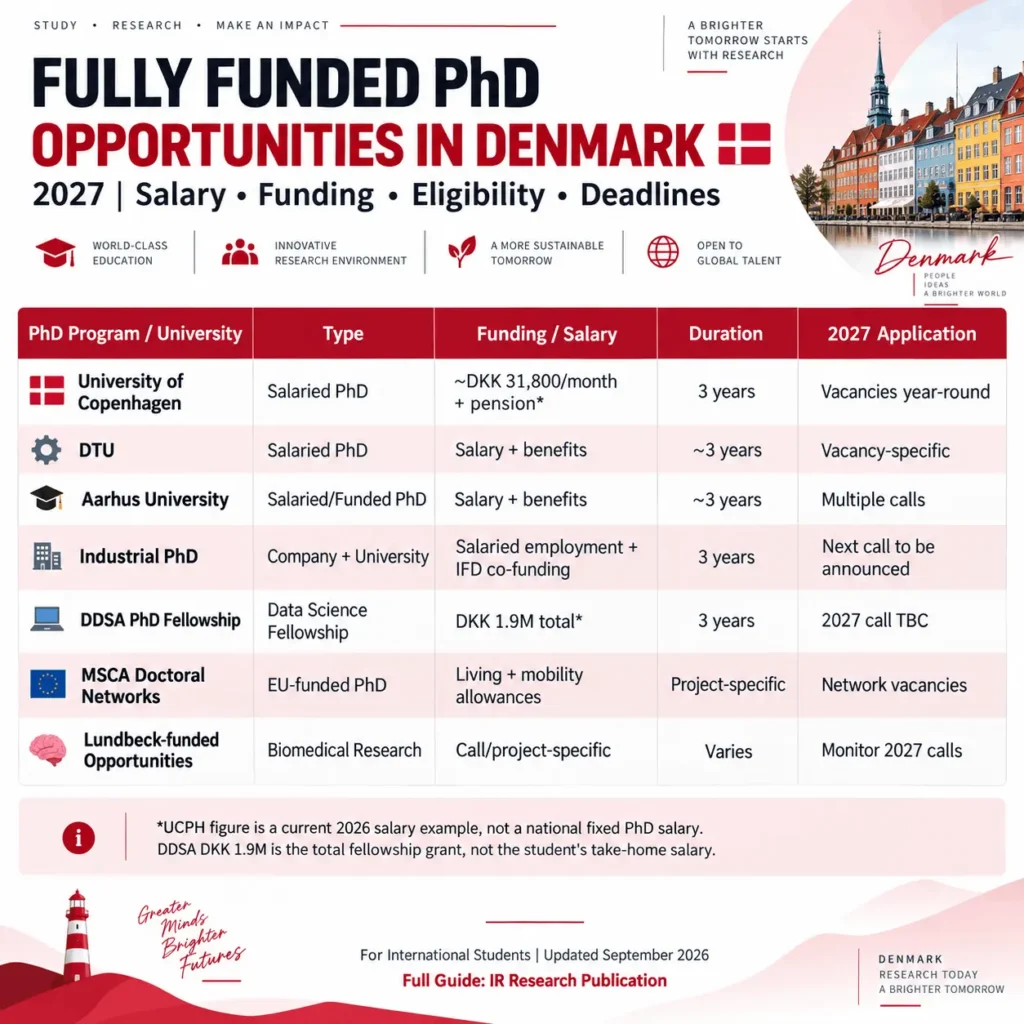
At-a-Glance: Salaried PhD Positions at Danish Universities
| University / Program | Typical Eligibility | Funding Model | Application Timeline | Official Link |
|---|---|---|---|---|
| University of Copenhagen PhD Positions | Relevant master’s or equivalent; project/faculty-specific requirements | Salaried PhD employment; pension and benefits under applicable agreement | Vacancies throughout the year | UCPH PhD Vacancies |
| DTU PhD Positions | Relevant master’s; strong fit with technical/research project | PhD employment with salary and benefits according to applicable terms | Vacancy-specific | DTU PhD |
| Aarhus University PhD Positions | Master’s or applicable integrated route; graduate-school-specific requirements | Funded PhD employment or fellowship depending on faculty/call | Graduate-school rounds and individual vacancies | Aarhus University PhD |
| University of Southern Denmark PhD Positions | Relevant master’s/equivalent; faculty-specific eligibility | Salaried PhD positions where advertised | Throughout the year | SDU PhD |
| Aalborg University PhD Positions | Relevant master’s and research/project fit | Salaried doctoral employment for funded positions | Vacancy-specific | AAU PhD |
| Copenhagen Business School PhD Positions | Relevant master’s; strong academic record; proposal where required | Salaried PhD scholarship/employment | Faculty and project-specific calls | CBS PhD |
| Roskilde University PhD Positions | Master’s/equivalent; project and interdisciplinary fit | Funded PhD employment depending on vacancy | Calls throughout year | RUC PhD |
| IT University of Copenhagen PhD Positions | Relevant master’s; computing, digital, design or information-related fit | Salaried PhD employment where advertised | Vacancy/call-specific | ITU PhD Programme |
Competitive National and International PhD Funding Routes
| Program | Main Eligibility / Model | Current Verified Funding | 2027 Status | Official Link |
|---|---|---|---|---|
| Innovation Fund Denmark – Industrial PhD | Master’s; company/public organization + university + candidate partnership; current grade requirements apply | Up to DKK 17,000/month salary subsidy + up to DKK 100,000 travel/course costs + DKK 360,000 to university | Autumn 2026 round closed September 8; monitor next calls | Industrial Researcher Programme |
| Danish Data Science Academy PhD Fellowship | Candidate eligible for Danish PhD; own data-science project + Danish supervisor/host | 2026 call: DKK 1.9M over 3 years + 5% administrative costs | 2026 call closed March 4; 2027 call not yet confirmed | DDSA Fellowship |
| MSCA Doctoral Networks | Must not already hold PhD; any nationality; mobility rule; recruited by funded network | EU living + mobility + eligible family/leave/special-needs allowances | 2026 consortium call closes Nov. 24; individual PhD vacancies appear later | MSCA Doctoral Networks |
| Lundbeck Foundation-supported PhD Opportunities | Depends on specific biomedical/neuroscience funding call | Call-specific | No single generic 2027 PhD fellowship should be assumed; monitor current grant portfolio | Lundbeck Foundation Grants |
Important: Grant totals, university funding and salary subsidies are not necessarily equivalent to the researcher’s gross salary or take-home pay.
How Much Do PhD Students Earn in Denmark?
There is no single fixed national PhD salary that applies identically to every researcher.
Salary depends on factors including:
- university;
- applicable collective agreement;
- prior relevant experience;
- faculty or department;
- type of appointment;
- supplements;
- funding arrangement.
University of Copenhagen Salary Example
As a current reference point, a University of Copenhagen PhD vacancy at the Faculty of Science in August 2026 listed a starting salary of approximately:
DKK 31,800 per month before tax
plus an additional:
18.07% employer-paid pension contribution
Depending on qualifications and the specific employment agreement, supplements may also apply.
This should be treated as a University of Copenhagen example, not as a fixed nationwide Danish PhD salary.
Other UCPH faculties and Danish universities may use somewhat different salary steps or arrangements.
Current Verified Funding Examples
| Opportunity | Current Verified Funding Example |
|---|---|
| University of Copenhagen PhD | Approximately DKK 31,800/month before tax in a current SCIENCE vacancy + 18.07% employer-paid pension |
| DDSA PhD Fellowship 2026 | DKK 1.9 million over 3 years + 5% administrative costs |
| Industrial PhD | Up to DKK 17,000/month salary subsidy + up to DKK 100,000 travel/course support + DKK 360,000 to university |
| MSCA Doctoral Networks | Living allowance + mobility allowance + eligible family, long-term-leave and special-needs allowances |
These amounts use different funding models and should not be compared as if they were personal annual salaries.
1. University of Copenhagen PhD Fellowships
Overview
The University of Copenhagen (UCPH) is Denmark’s largest university and offers doctoral research across:
- health and medical sciences;
- natural and life sciences;
- humanities;
- law;
- social sciences;
- theology.
The university advertises numerous PhD fellowships throughout the year.
Employment and Funding
Standard funded positions are commonly offered as fixed-term employment.
Current university vacancies state that salary, pension and employment conditions are governed by agreements between the relevant Danish authorities and academic professional organizations.
Depending on the faculty and position, PhD fellows may receive:
- monthly salary;
- employer-paid pension;
- paid annual leave;
- employee protections;
- research training;
- PhD coursework;
- international research stays;
- access to university research infrastructure.
Eligibility
Requirements vary by faculty, but applicants generally need a qualification equivalent to a relevant Danish master’s degree for a standard three-year PhD route.
Some faculties also operate integrated master’s/PhD structures.
Application
There is no single UCPH annual PhD deadline.
Candidates apply directly to advertised vacancies.
View University of Copenhagen PhD positions
2. Technical University of Denmark (DTU) PhD Positions
Overview
The Technical University of Denmark (DTU) is a major European technical university with PhD opportunities in areas such as:
- engineering;
- biotechnology;
- computer science;
- artificial intelligence;
- chemistry;
- physics;
- energy;
- sustainability;
- transport;
- food science;
- environmental engineering;
- space research;
- life science.
Funding
Funded DTU doctoral positions generally involve employment under the terms specified in the vacancy and relevant Danish employment framework.
Eligibility
Applicants normally need a relevant master’s-level qualification or equivalent academic preparation.
Technical knowledge, research experience and specific methodological skills are determined by the project.
Application
PhD positions are advertised individually.
3. Aarhus University PhD Fellowships
Overview
Aarhus University (AU) offers PhD education across several graduate-school environments spanning:
- Arts;
- Health;
- Natural Sciences;
- Technical Sciences;
- Aarhus BSS.
Recruitment structures differ across faculties.
Some opportunities are tied to predefined funded projects, while others are offered through graduate-school application rounds.
Funding and Employment
Funding arrangements depend on the specific call, but fully funded doctoral appointments commonly provide salary and employment benefits.
Application
Always apply through the relevant AU graduate school or vacancy portal rather than assuming a university-wide deadline.
4. University of Southern Denmark PhD Positions
The University of Southern Denmark (SDU) offers doctoral research across:
- engineering;
- health sciences;
- science;
- humanities;
- business;
- social sciences.
Many positions are linked to research grants and individual projects.
Requirements and deadlines therefore differ considerably between faculties.
5. Aalborg University PhD Positions
Aalborg University (AAU) is well known for interdisciplinary and problem-oriented research and for collaboration with industry and public-sector organizations.
Research strengths include:
- engineering;
- energy;
- digital technologies;
- health;
- social sciences;
- sustainability;
- communication and IT.
Funded positions are advertised individually, with eligibility and employment terms stated in each vacancy.
Aalborg University PhD Studies
6. Copenhagen Business School PhD Scholarships
The term “PhD scholarship” is commonly used at Copenhagen Business School (CBS), but funded positions are typically structured within Denmark’s doctoral employment and training system rather than functioning like a conventional tuition scholarship.
Research areas include:
- economics;
- finance;
- management;
- organization;
- strategy;
- marketing;
- entrepreneurship;
- digitalization;
- business and society.
Applicants may need a detailed research proposal depending on the call.
7. Roskilde University PhD Positions
Roskilde University (RUC) emphasizes interdisciplinary and problem-oriented research.
Doctoral opportunities span areas such as:
- social sciences;
- humanities;
- communication;
- environmental science;
- natural science.
PhD opportunities are advertised according to available funded projects and institutional calls.
8. IT University of Copenhagen PhD Programme
The IT University of Copenhagen (ITU) specializes in digital research, including:
- computer science;
- artificial intelligence;
- software;
- algorithms;
- data science;
- human-computer interaction;
- digital design;
- information studies;
- digital society.
Funded PhD positions are normally advertised around defined research areas or projects.
9. Innovation Fund Denmark Industrial PhD
The Industrial PhD is one of Denmark’s most distinctive doctoral funding routes.
It combines doctoral research with employment in a private company or public organization.
A typical Industrial PhD involves:
- an Industrial PhD candidate;
- a company or public organization;
- a university.
The project normally lasts three years.
Who Employs the PhD Candidate?
The company or public organization employs the PhD candidate.
Innovation Fund Denmark provides co-financing—it does not simply replace the employer or pay the candidate’s entire salary directly.
Current Funding
Under the current Industrial Researcher framework, Innovation Fund Denmark can contribute:
- up to DKK 17,000 per month toward the candidate’s salary;
- up to DKK 100,000 toward travel and course participation;
- a fixed DKK 360,000 including overhead to the university.
The employer remains responsible for the employment relationship and salary.
Important Eligibility Requirements
The candidate normally needs a master’s degree or equivalent.
Current 2026 Industrial PhD requirements for Danish-equivalent grading include:
- at least 10 for the master’s thesis/final project; and
- either a weighted average of at least 8.2 across bachelor’s and master’s studies;
- or at least 9.5 for a two-year master’s degree alone.
These figures use the Danish 7-point grading scale.
Rules exist for foreign qualifications and possible exemptions, so international applicants should consult the current Industrial PhD guidelines rather than trying to convert grades themselves.
Current Application Status
The autumn 2026 round:
- opened August 4, 2026;
- closed September 8, 2026 at 12:00.
Applicants targeting a 2027 project should monitor Innovation Fund Denmark for the next Industrial Researcher calls.
Innovation Fund Denmark – Industrial Researcher
10. Danish Data Science Academy PhD Fellowships
The Danish Data Science Academy (DDSA) is particularly attractive for researchers interested in:
- data science;
- machine learning;
- artificial intelligence;
- statistics;
- computational science;
- bioinformatics;
- data-driven research applications.
2026 Fellowship Funding
The latest DDSA PhD Fellowship Call offered:
10 three-year PhD fellowships
worth:
DKK 1.9 million each
plus:
5% administrative costs
The total fellowship is intended to contribute to expenses such as salary, tuition, external research stays, travel and relevant operational costs.
The DKK 1.9 million therefore should not be interpreted as the student’s personal salary.
If the total PhD project cost exceeds the fellowship amount, the host institution is expected to cover the additional costs.
Eligibility
Applicants must be eligible for admission to a Danish PhD programme.
The 2026 call accepted candidates under Danish structures including:
- 3+5;
- 4+4;
- 5+3 models.
Applicants needed:
- their own defined research project;
- an agreement with a principal supervisor at a Danish university;
- a project within theoretical or applied data science aligned with the DDSA funding scope.
Current Status
The 2026 call closed:
March 4, 2026 at 23:59 CET.
A 2027 fellowship call has not yet been confirmed, so applicants should monitor DDSA rather than assuming the same deadline or amount will automatically apply next year.
11. Marie Skłodowska-Curie Doctoral Networks in Denmark
Marie Skłodowska-Curie Actions (MSCA) Doctoral Networks fund international doctoral-training consortia across Europe.
Danish universities, research institutes, companies and other organizations can participate as recruiting hosts.
Important Eligibility Rules for PhD Candidates
Candidates recruited by an MSCA Doctoral Network:
- must not already hold a doctoral degree at the date of recruitment;
- can be of any nationality;
- must be enrolled in a doctoral programme during the project;
- must comply with the MSCA mobility rule.
The standard mobility rule means that the candidate normally must not have resided or carried out their main activity in Denmark for more than 12 months during the 36 months immediately before recruitment if the recruiting organization is in Denmark.
Funding
MSCA support for recruited doctoral candidates can include:
- living allowance;
- mobility allowance;
- family allowance where applicable;
- long-term-leave support where applicable;
- special-needs allowance where applicable.
Funding is also provided to the participating institutions for research, training, networking, management and indirect costs.
Important: Candidates Do Not Apply to the Consortium Call
The 2026 MSCA Doctoral Networks call closes November 24, 2026, but that deadline is for universities, research institutions, companies and other organizations creating the Doctoral Networks.
It is not a direct PhD-student application deadline.
After networks receive funding, the individual doctoral vacancies are advertised internationally, including through EURAXESS and participating institutions.
Candidates then apply to the individual PhD vacancies.
12. Lundbeck Foundation-Supported PhD Opportunities
The Lundbeck Foundation is a major Danish research funder, particularly in biomedical and health-related research.
However, applicants should be cautious with generic online lists describing a permanent annual “Lundbeck Foundation PhD Fellowship.”
The Foundation operates multiple funding programs, and the availability, eligibility and structure of PhD support depend on the specific current grant call.
Therefore, rather than assuming a standard annual 2027 PhD fellowship, applicants should monitor the Foundation’s official grants portfolio for relevant:
- biomedical research grants;
- neuroscience opportunities;
- investigator-led projects that may recruit PhD students;
- call-specific early-career or education funding.
How Long Is a PhD in Denmark?
A standard Danish PhD following a completed master’s degree typically corresponds to approximately three years of full-time doctoral study.
However, Denmark also has integrated pathways in which students begin doctoral training before completing the master’s degree.
Terms such as:
- 5+3
- 4+4
- 3+5
refer to different points at which the researcher enters the overall university/doctoral education pathway.
The exact structure varies by university and graduate school.
Do PhD Students Pay Tuition in Denmark?
For standard fully funded doctoral positions, the candidate generally does not personally pay conventional tuition in the same way as an unfunded bachelor’s or master’s student.
There are nevertheless real tuition and institutional education costs associated with doctoral enrollment.
Depending on the funding model, these costs may be paid by:
- the host university;
- the research grant;
- an external fellowship;
- the company/university arrangement;
- the doctoral network.
This is why “tuition covered” is more accurate than claiming doctoral training has no institutional costs at all.
Can International Students Apply for PhDs in Denmark?
Yes.
Danish universities regularly recruit researchers internationally, and many PhD vacancies are advertised in English.
Selection normally focuses on:
- academic qualifications;
- research experience;
- project fit;
- technical or methodological expertise;
- master’s thesis quality;
- language requirements;
- the specific eligibility criteria of the position.
Non-EU/EEA applicants will also need the appropriate Danish residence and work authorization after receiving an eligible offer.
Is Danish Language Required?
For many laboratory, engineering, data-science and internationally oriented research positions, English is sufficient.
However, Danish may be required or strongly preferred for projects involving:
- clinical patient interaction;
- Danish schools;
- public-sector research;
- qualitative interviews conducted in Danish;
- Danish-language archives or datasets;
- teaching or outreach requiring Danish.
Always check the individual vacancy.
Where to Find PhD Positions in Denmark
Because many Danish doctoral opportunities are advertised like jobs, candidates should monitor university vacancy pages regularly rather than waiting for one annual scholarship cycle.
Strong starting points include:
- University of Copenhagen
- DTU
- Aarhus University
- SDU
- Aalborg University
- Copenhagen Business School
- Roskilde University
- IT University of Copenhagen
- EURAXESS
IR Research Publication also maintains a regularly updated research jobs page covering PhD, postdoc and faculty opportunities.
For a broader funding strategy, see our PhD Scholarship Guide: How to Find, Win, and Fund a Fully Funded PhD.
How to Make Your Denmark PhD Application Competitive
1. Treat the Application Like a Research Job Application
For project-specific vacancies, your application should explain exactly how your background fits the proposed research.
Avoid sending the same generic statement to every university.
2. Match Your Skills to the Project
Highlight relevant:
- research methods;
- laboratory techniques;
- statistical expertise;
- programming languages;
- datasets;
- master’s-thesis experience;
- publications;
- internships;
- industry experience.
3. Read the Research Group’s Recent Work
Before applying, review recent publications from:
- the principal investigator;
- the department;
- the specific research center.
This will strengthen both your motivation letter and interview preparation.
4. Prepare a Strong Research Proposal When Required
Some opportunities—particularly candidate-driven fellowships and Industrial PhD applications—require a substantial proposal.
A strong research plan should explain:
- the research problem;
- knowledge gap;
- hypothesis or research question;
- methodology;
- feasibility;
- timeline;
- expected outcomes;
- risks and alternatives;
- scientific or societal significance.
5. Contact Supervisors Early for Candidate-Driven Funding
Supervisor contact is particularly important for:
- DDSA;
- Industrial PhD;
- candidate-driven graduate-school applications;
- external foundation opportunities.
By contrast, for an advertised project-defined PhD job, follow the vacancy instructions before sending unsolicited materials.
6. Check Funding Before Accepting an Offer
Determine whether the position provides:
- an employment contract;
- pension;
- salary;
- tuition coverage;
- relocation support;
- travel support;
- health/social benefits;
- teaching obligations.
Do not assume every “scholarship” has the same legal or financial structure.
Documents Commonly Required for a Denmark PhD Application
Depending on the university and program, applicants may need:
- academic CV;
- motivation or cover letter;
- bachelor’s transcript;
- master’s transcript;
- degree certificates;
- master’s thesis;
- research proposal;
- publication list;
- writing samples;
- recommendation letters or referee details;
- proof of English proficiency;
- documentation of relevant technical skills.
Industrial PhD and candidate-driven fellowship applications can require additional project, supervisor and host-organization documentation.
When Should You Apply for a 2027 PhD in Denmark?
September–December 2026
This is an excellent period to:
- monitor Danish university vacancy portals;
- apply to project-funded positions with 2027 start dates;
- identify prospective supervisors;
- prepare transcripts and references;
- monitor new national funding calls;
- follow MSCA Doctoral Network projects and future recruitment.
January–June 2027
Continue checking:
- university job portals;
- Innovation Fund Denmark;
- DDSA;
- EURAXESS;
- Danish foundations;
- newly funded EU networks.
Throughout 2027
New vacancies can appear at any time because Danish PhD recruitment is often tied to the start of individual funded projects rather than one national admission cycle.
Frequently Asked Questions
Are PhD positions in Denmark fully funded?
Many advertised Danish PhD positions are fully funded through salaried university employment.
Other doctoral routes may use external fellowships, company employment, EU funding or other grant structures.
Always confirm the funding model in the individual call.
Is a PhD in Denmark a job?
Many standard Danish PhD positions function as fixed-term employment combined with doctoral education.
The researcher carries out an original research project while completing doctoral training requirements.
What is the PhD salary in Denmark?
There is no single national figure that applies identically to every appointment.
As one current example, a 2026 University of Copenhagen PhD vacancy lists a starting salary of approximately DKK 31,800 per month before tax, with an additional 18.07% employer-paid pension contribution.
Exact salary varies by employer, experience, agreement and appointment.
How long is a PhD in Denmark?
A standard PhD following a completed master’s degree is normally approximately three years full-time.
Integrated master’s/PhD pathways can have longer overall structures.
Do I need a master’s degree?
For a standard 5+3-style doctoral route, applicants generally need a relevant master’s-level qualification.
Some universities also offer integrated structures allowing researchers to begin PhD training earlier in their master’s education.
Can Indian students apply for fully funded PhDs in Denmark?
Yes.
Indian and other international applicants can apply to many Danish university PhD vacancies provided they meet the academic and project-specific requirements.
Industrial PhD, DDSA and MSCA opportunities have additional scheme-specific eligibility conditions.
Can I apply for MSCA Doctoral Networks if I already have a PhD?
No.
Researchers recruited as doctoral candidates under MSCA Doctoral Networks must not already hold a doctoral degree at the date of recruitment.
How does the MSCA mobility rule work?
For a Danish host, applicants generally must not have lived, worked or carried out their main activity in Denmark for more than 12 months during the 36 months immediately before recruitment.
Specific exceptions in MSCA rules should always be checked.
Is the November 24, 2026 MSCA Doctoral Networks deadline for PhD students?
No.
That is the deadline for consortia submitting proposals to establish Doctoral Networks.
Prospective PhD candidates apply later to individual positions advertised by funded networks.
How much does the Industrial PhD pay?
The student’s actual salary is paid by the employing company or public organization.
Innovation Fund Denmark currently provides co-financing, including up to DKK 17,000 per month toward salary costs, rather than setting the candidate’s total salary at DKK 17,000.
Is the DDSA DKK 1.9 million fellowship the student’s salary?
No.
The DKK 1.9 million is the three-year fellowship grant amount, intended to cover several project costs including salary, tuition, research stay, travel and operational expenses.
It is not equivalent to personal take-home income.
Do I need Danish?
Usually not for many internationally recruited STEM and research positions, but specific clinical, educational, public-facing or Danish-language projects may require it.
Final Application Checklist
Before submitting a Denmark PhD application, confirm:
- I meet the degree requirements.
- I meet the project’s specific academic criteria.
- My CV is tailored to the vacancy.
- My motivation letter explains research fit.
- I understand whether a research proposal is required.
- I have checked the funding model.
- I know whether I will be an employee or fellowship recipient.
- I have confirmed salary and pension arrangements.
- Tuition or enrollment costs are covered.
- My transcripts and degree certificates are ready.
- My referees are prepared.
- I meet the English-language requirements.
- I meet any mobility rules.
- I have verified the exact deadline and time zone.
- I have checked the official webpage immediately before submission.
Conclusion: Fully Funded PhD Scholarships in Denmark 2027
Denmark offers an excellent environment for international researchers seeking fully funded PhD scholarships in Denmark for 2027, but the Danish funding model is different from the traditional scholarship systems used in many countries.
At major universities such as the University of Copenhagen, DTU, Aarhus University, SDU, Aalborg University, CBS, Roskilde University and IT University of Copenhagen, many doctoral opportunities are advertised as salaried research positions.
Additional competitive routes include the Innovation Fund Denmark Industrial PhD, the Danish Data Science Academy PhD Fellowship, and Marie Skłodowska-Curie Doctoral Networks involving Danish research institutions.
Applicants should remember that there is no single national 2027 deadline. Positions will continue to appear from late 2026 throughout 2027.
The strongest strategy is to begin monitoring vacancies early, understand the difference between salary and grant funding, tailor every application to the specific research project, and verify eligibility directly from the official call before applying.
For additional opportunities and application guidance, explore the IR Research Publication PhD Scholarship Guide and our latest PhD, postdoctoral and faculty research opportunities.
Related Articles
- Fully Funded PhD Scholarships in Sweden 2027
- Fully Funded PhD Scholarships in the Netherlands 2027
- Fully Funded PhD Scholarships in France 2027
- Fully Funded PhD Scholarships in Germany 2027
- PhD Scholarship Guide 2026: How to Find, Win, and Fund a Fully Funded PhD
- Latest PhD, Postdoc and Research Job Opportunities
About IR Research Publication
IR Research Publication is a research and academic-career platform supporting students, researchers and scholars with practical guidance on PhD funding, postdoctoral fellowships, academic careers, scientific publishing and research development.
Our funding guides are designed to help researchers identify credible opportunities while emphasizing the importance of confirming eligibility, salaries, funding structures and deadlines directly from official sources.
Last reviewed: September 12, 2026
Disclaimer: Salary levels, pension rates, funding amounts, eligibility requirements and deadlines may change between calls. Always verify the latest information on the official university or funder’s website before applying.