
IRRESPUB BLOG
Fully Funded PhD Scholarships in Germany 2027 | Apply Now
Introduction
Germany offers a robust ecosystem of fully funded doctoral opportunities across universities, Max Planck Institutes, Helmholtz Centers, Leibniz Institutes, and DFG-funded research schools. If you are seeking fully funded PhD scholarships in Germany 2027, this guide outlines trusted programs that typically provide a monthly stipend or an employment contract (often according to TV-L pay scales), health insurance, and research allowances. These opportunities suit strong master’s graduates (or equivalent) across STEM, life sciences, social sciences, and humanities who aim to conduct original research within cutting-edge teams.
Why Germany? Public universities generally charge no tuition for doctoral studies, research infrastructure is outstanding, and most structured PhD schools run international cohorts with English as the working language. Prestigious funders like DAAD, DFG, Max Planck, Helmholtz, and leading political foundations ensure competitive support and professional development. Below you will find a quick-apply checklist, a summary table with at least 10 opportunities, and detailed sections for each program with verified official links. Always confirm the latest details and deadlines on the official websites, as 2027 calls may publish in late 2026 or in 2027 depending on the program.
Quick-Apply Checklist (Featured Snippet)
- Identify your research area and shortlist suitable programs/universities.
- Confirm eligibility (degree equivalence, grades, language requirements).
- Prepare a targeted research proposal aligned with the host’s expertise.
- Contact potential supervisors with a concise email and CV.
- Arrange certified transcripts, recommendation letters, and language proofs.
- Check funding model (stipend vs. contract) and required documents.
- Apply before the program-specific deadline and follow all instructions.
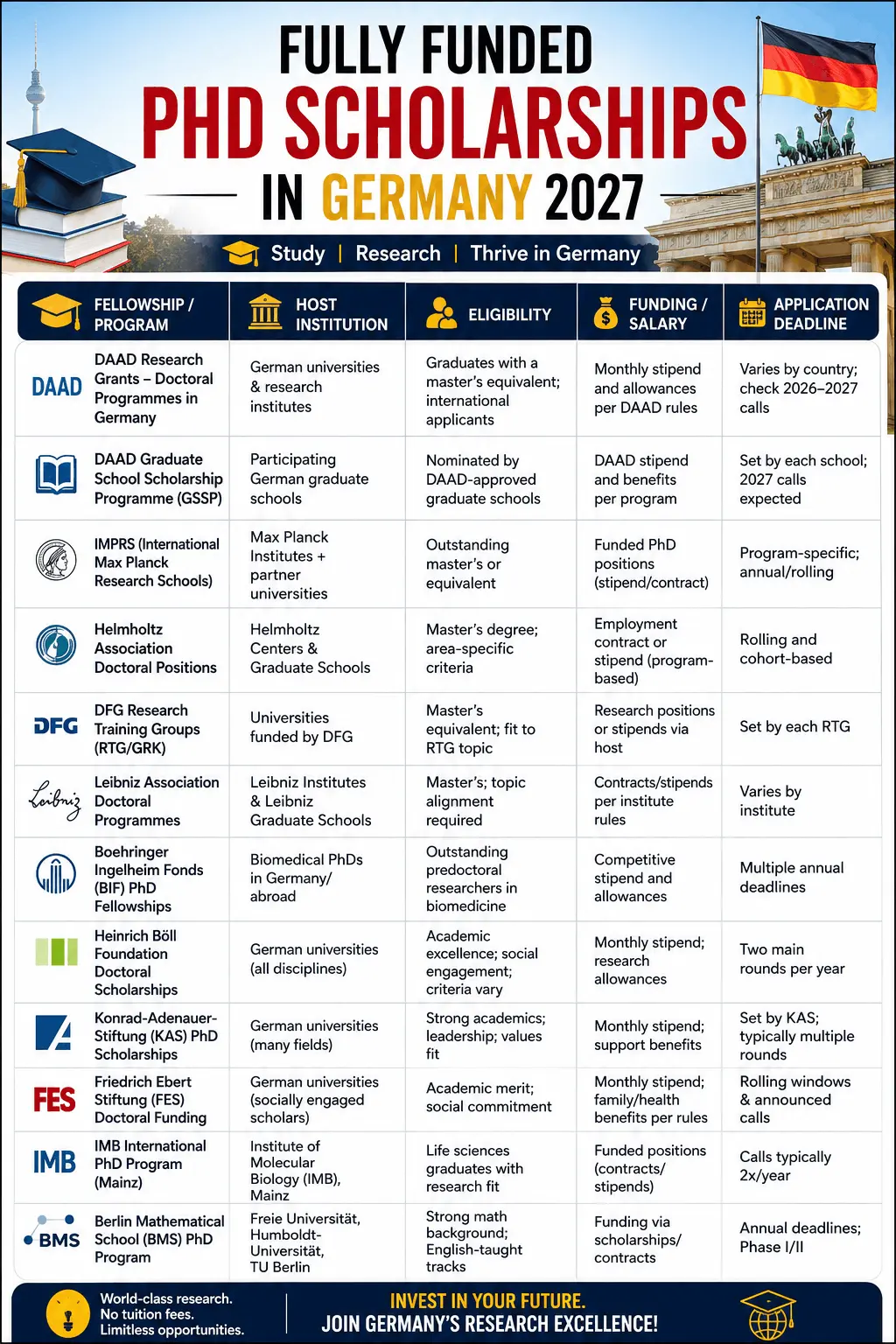
Fellowship Summary Table: Fully Funded PhD Scholarships in Germany 2027
| Fellowship / Program | Host Institution | Eligibility | Funding / Salary | Application Deadline | Official Link |
|---|---|---|---|---|---|
| DAAD Research Grants – Doctoral Programmes in Germany | German universities & research institutes | Graduates with a master’s equivalent; international applicants | Monthly stipend and allowances per DAAD rules | Varies by country; check 2026–2027 calls | Official |
| DAAD Graduate School Scholarship Programme (GSSP) | Participating German graduate schools | Nominated by DAAD-approved graduate schools | DAAD stipend and benefits per program | Set by each school; 2027 calls expected | Official |
| IMPRS (International Max Planck Research Schools) | Max Planck Institutes + partner universities | Outstanding master’s or equivalent | Funded PhD positions (stipend/contract) | Program-specific; annual/rolling | Official |
| Helmholtz Association Doctoral Positions | Helmholtz Centers & Graduate Schools | Master’s degree; area-specific criteria | Employment contract or stipend (program-based) | Rolling and cohort-based | Official |
| DFG Research Training Groups (RTG/GRK) | Universities funded by DFG | Master’s equivalent; fit to RTG topic | Research positions or stipends via host | Set by each RTG | Official |
| Leibniz Association Doctoral Programmes | Leibniz Institutes & Leibniz Graduate Schools | Master’s; topic alignment required | Contracts/stipends per institute rules | Varies by institute | Official |
| Boehringer Ingelheim Fonds (BIF) PhD Fellowships | Biomedical PhDs in Germany/abroad | Outstanding predoctoral researchers in biomedicine | Competitive stipend and allowances | Multiple annual deadlines | Official |
| Heinrich Böll Foundation Doctoral Scholarships | German universities (all disciplines) | Academic excellence; social engagement; criteria vary | Monthly stipend; research allowances | Two main rounds per year | Official |
| Konrad-Adenauer-Stiftung (KAS) PhD Scholarships | German universities (many fields) | Strong academics; leadership; values fit | Monthly stipend; support benefits | Set by KAS; typically multiple rounds | Official |
| Friedrich Ebert Stiftung (FES) Doctoral Funding | German universities (socially engaged scholars) | Academic merit; social commitment | Monthly stipend; family/health benefits per rules | Rolling windows & announced calls | Official |
| IMB International PhD Program (Mainz) | Institute of Molecular Biology (IMB), Mainz | Life sciences graduates with research fit | Funded positions (contracts/stipends) | Calls typically 2x/year | Official |
| Berlin Mathematical School (BMS) PhD Program | Freie Universität, Humboldt-Universität, TU Berlin | Strong math background; English-taught tracks | Funding via scholarships/contracts | Annual deadlines; Phase I/II | Official |
DAAD Research Grants – Doctoral Programmes in Germany
Overview: A flagship DAAD scheme supporting full doctoral studies at German universities and research institutes across disciplines. It is open to international applicants with a strong academic record and a compelling research plan.
Funding and Benefits: Monthly stipend and additional allowances (e.g., travel, insurance) according to DAAD regulations. Exact rates and durations vary by country and academic profile; consult the official page for current figures.
Eligibility: A master’s degree or equivalent; adequate language proficiency; acceptance by a host supervisor/program in Germany.
Application Process: Prepare a research proposal, secure a host supervisor/letter of supervision, compile transcripts, recommendation letters, and language proof, then submit via the DAAD portal for your country.
DAAD Graduate School Scholarship Programme (GSSP)
Overview: The GSSP funds doctoral candidates who are nominated by participating German graduate schools. It supports structured PhD training in international cohorts.
Funding and Benefits: DAAD stipend and program-specific benefits; possible travel, insurance, and research allowances as per DAAD rules.
Eligibility: Nomination by a DAAD-approved graduate school and fulfillment of DAAD criteria (degree, language, timelines).
Application Process: First apply to a participating graduate school. If selected, the school nominates you for DAAD funding and you complete the DAAD formalities.
International Max Planck Research Schools (IMPRS)
Overview: IMPRS units are elite, topic-focused doctoral schools run by Max Planck Institutes with partner universities. They offer rigorous training in fields like biology, chemistry, physics, computer science, cognitive science, and beyond.
Funding and Benefits: Fully funded PhD positions via stipend or employment contract; excellent training, mentoring, and access to top-tier facilities.
Eligibility: Outstanding academic record, research fit, and English proficiency; a master’s degree or equivalent.
Application Process: Apply directly to the IMPRS of interest. Calls are typically annual or rolling; interviews may include scientific presentations.
Helmholtz Association Doctoral Positions
Overview: Germany’s largest research organization offers PhD positions at Helmholtz Centers and international graduate schools, spanning energy, health, environment, AI, and more.
Funding and Benefits: Typically employment contracts (e.g., TV-L/TVöD based) or stipends with social benefits according to center policies; advanced training and industry links.
Eligibility: Master’s degree in a relevant field and research alignment with the hosting group.
Application Process: Apply to doctoral calls on Helmholtz or center websites. Prepare a focused research statement and contact PIs early.
DFG Research Training Groups (RTG/GRK)
Overview: The German Research Foundation (DFG) funds Research Training Groups hosted at universities to provide structured doctoral training on a defined theme. Positions are generally paid research posts offered by the host institutions.
Funding and Benefits: Employment contracts or stipends administered by the university; training modules, workshops, international collaboration.
Eligibility: Master’s or equivalent aligned with the RTG topic; competitive selection by the RTG admissions committee.
Application Process: Identify active RTGs in your field and apply directly through their calls; prepare a proposal tailored to the RTG theme.
Leibniz Association Doctoral Programmes
Overview: The Leibniz Association comprises research institutes across disciplines offering doctoral positions and running Leibniz Graduate Schools with university partners.
Funding and Benefits: Funded positions (contracts/stipends), interdisciplinary training, and strong institute-university supervision models.
Eligibility: Master’s degree; research match with the institute/group; English or German proficiency as required.
Application Process: Apply to institute-level calls or graduate school cohorts; confirm deadlines and selection steps on the institute’s page.
Boehringer Ingelheim Fonds (BIF) PhD Fellowships
Overview: Prestigious fellowships supporting exceptional junior scientists in basic biomedical research in Germany or abroad.
Funding and Benefits: Competitive monthly stipend and allowances; independent, portable funding with networking and alumni support.
Eligibility: Outstanding academic record; early-stage doctoral candidates in basic biomedicine; application typically before or at the start of the PhD.
Application Process: Submit a detailed research plan, CV, references, and host information by the published deadlines (several cycles per year).
Heinrich Böll Foundation Doctoral Scholarships
Overview: Scholarships for doctoral candidates from Germany and abroad, focusing on academic excellence, social engagement, and alignment with the foundation’s values.
Funding and Benefits: Monthly stipend and research allowances; mentoring and events.
Eligibility: Strong academics, social and civic engagement, and an eligible host university in Germany; specific criteria apply.
Application Process: Two annual intakes typically; submit academic documents, research outline, and references via the foundation’s portal.
Konrad-Adenauer-Stiftung (KAS) PhD Scholarships
Overview: KAS supports international and German doctoral candidates who demonstrate leadership potential and a commitment to civic values.
Funding and Benefits: Monthly stipend, potential research and family benefits, seminars, and networking.
Eligibility: Very good academic performance, social/political engagement, and admission to a German university for doctoral studies.
Application Process: Apply online with project description, academic credentials, and references. Selection involves interviews.
Friedrich Ebert Stiftung (FES) Doctoral Funding
Overview: FES supports socially engaged doctoral candidates with strong academic potential across many fields.
Funding and Benefits: Monthly stipend and benefits as per FES rules; participation in seminars and networks.
Eligibility: Strong academic performance and evidence of social commitment; admission to a German university required.
Application Process: Submit via FES portal with project outline, transcripts, references; deadlines announced on the website.
IMB International PhD Program (Institute of Molecular Biology, Mainz)
Overview: An internationally renowned life sciences PhD program focusing on gene regulation, epigenetics, genome stability, and DNA repair.
Funding and Benefits: Fully funded positions with competitive support, state-of-the-art facilities, and structured training.
Eligibility: Relevant master’s degree; strong research interest in molecular biology; English language proficiency.
Application Process: Calls typically open twice per year. Submit online application, references, and research interests; shortlisted candidates interview.
Berlin Mathematical School (BMS) PhD Program
Overview: BMS is a joint graduate school of FU, HU, and TU Berlin, offering an English-language PhD program in mathematics with two phases (MSc/fast-track and PhD).
Funding and Benefits: Funding via BMS scholarships or contracts at partner departments; excellent coursework and supervision.
Eligibility: Strong mathematics background; applicants to Phase II should typically have a master’s-level preparation.
Application Process: Apply online to Phase I/II within annual deadlines; merit-based scholarships are available.
How to Choose the Right Program
- Match your research topic with the host’s active projects and publications.
- Clarify funding type: stipend vs. employment contract (implications for taxes and social security).
- Check language requirements: many programs accept English; some require or prefer German.
- Assess supervision capacity, lab facilities, coursework, and career development support.
- Verify 2027 call timelines on official pages before preparing your application.
Application Tips for 2027
- Start 10–12 months early: contact potential supervisors and refine your proposal with their input.
- Use institutional email for outreach and keep messages concise with an attached CV and brief summary of your research idea.
- Secure strong references; guide your referees with bullet points covering your research strengths and achievements.
- Proofread documents and ensure formatting follows program checklists.
- If unsure about current stipend figures or exact deadlines, consult official websites or contact program coordinators directly.
Frequently Asked Questions
- Are PhD programs in Germany paid?
Yes. Many doctoral candidates receive either a monthly stipend or an employment contract (often TV-L/TVöD-based). Exact amounts and benefits vary by program and host; always check the official call.
- Do public universities in Germany charge PhD tuition?
Public universities typically do not charge tuition for doctoral studies. Students may pay a semester contribution (for services/transport). Confirm with your host university.
- What are typical deadlines for 2027 entry?
Deadlines vary widely. DAAD and foundations have multiple annual windows; IMPRS/Helmholtz/RTG cohorts may recruit in late 2026 or early-to-mid 2027. Always verify the current call on the official website.
- Is German language required?
Many structured PhD programs run entirely in English. Some fields and positions may require or prefer German, especially in clinical or humanities contexts. Check program requirements.
- What visa do I need?
Non-EU/EEA students typically apply for a national visa/residence permit for study or research. Requirements depend on whether you hold a stipend or employment contract. Consult the German embassy/consulate in your country.
- How competitive are these scholarships?
Highly competitive. A strong academic record, a clear research proposal, relevant experience, and supervisor alignment significantly improve your chances.
- Where can I verify funding amounts?
On the official pages: DAAD, Max Planck, Helmholtz, DFG RTGs, and foundation websites publish current rates and conditions. If details are unclear, email the program office.
About IR Research Publication
IR Research Publication empowers researchers and students with credible, timely, and practical information on scholarships, fellowships, publishing, and academic careers worldwide. Our mission is to make high-quality opportunities more accessible, helping scholars plan, prepare, and succeed with reliable resources and expert guidance across disciplines.
Related Articles
- Fully Funded PhD Opportunities in New Zealand 2026
- QS World University Rankings 2027 Released: MIT’s Historic Streak, Asia’s Rise, and the Global Top 20
- Fully Funded Postdoc Positions in Switzerland for Indian Researchers: 2026 Opportunities and Application Guide
- Fully Funded PhD Scholarships in Singapore: 2026 Guide for International Students
- Fully Funded Postdoctoral Fellowships in Japan: Stipends, Eligibility, and 2026 Deadlines
- Fully Funded PhD in Japan in 2026: Top Scholarships for International Students
Conclusion: Fully Funded PhD Scholarships in Germany 2027
With DAAD, IMPRS, Helmholtz, DFG RTGs, Leibniz, and leading foundations, fully funded PhD scholarships in Germany 2027 offer world-class training across disciplines. Begin early, align with the right supervisor, and verify current funding terms and deadlines on the official websites before applying. Use the table and program sections above to shortlist opportunities, then tailor your documents to each call. Germany’s combination of excellent research infrastructure, international graduate schools, and comprehensive funding makes it an exceptional destination for your doctoral journey.