Category: Blog

  • 10 Best AI Detector Free Tools (2025): Accurate and Fast AI Content Detection

    10 Best AI Detector Free Tools (2025): Accurate and Fast AI Content Detection

    In 2025, AI tools like ChatGPT, Jasper, and Gemini have changed how people write. But with this convenience comes a new challenge, distinguishing AI-generated text from human writing. Whether you’re a researcher, student, or publisher, using an AI detector free tool is essential to ensure originality and credibility.

    This blog explores the best free AI detectors and AI content detection tools that help identify whether your content is written by humans or AI. We’ve tested and compared each for accuracy, usability, and free access.

    Do you want to know how can you use AI ethically? Read our blog on The Ethical Use of AI in Writing Review Articles: A Guide for Researchers.


    Why You Should Use an AI Detector Free Tool in 2025

    With the rise of ChatGPT and other AI writers, text detection has become crucial. Traditional plagiarism checkers only find copied material, but AI content detection free tools identify whether the text was generated by artificial intelligence.

    Key benefits of using an AI text detector free:

    • Ensures academic and research originality
    • Protects against AI plagiarism
    • Supports ethical publishing and authorship transparency
    • Helps editors and reviewers evaluate AI-assisted writing

    Are you struggling to write a compelling abstract for your research article? Read our blog on How to Write Abstract for Research Paper: A Step-by-Step Guide


    What Makes the Best Free AI Content Detector Tool

    When choosing an AI content detector free, here’s what to look for:

    1. Accuracy: Detects AI-generated and paraphrased text.
    2. Free access: Allows multiple checks without credit card or registration.
    3. Speed: Instant text scanning and result generation.
    4. Reports: Provides AI probability or “human score.”
    5. Multi-tool capability: Detects both plagiarism and AI content.

    Top 10 Free AI Detectors and AI Content Detection Tools (2025)

    Below are the most accurate and popular free AI content detector tools tested and compared.


    1. Originality.ai

    Originality.ai is recognized as one of the most accurate AI detectors in the market. It works by deeply analyzing text
    patterns, structure, and writing style to identify AI-generated content, plagiarism, and readability issues with high precision. Its strong market position comes from fast results, consistent accuracy, and features that help users maintain trust and authenticity in their content. People like it because it is simple, reliable, and built for real-world content workflows.

    Features:

    • AI Checker
    • Plagiarism Checker
    • Fact Checker
    • Readability Checker
    • Grammar Checker
    • Content Optimizer

    Best for: Content creators, students, agencies, and SEO professionals needing fast and accurate content verification.

    🔗Visit Originality.ai

    2. Grammarly AI Detector

    Grammarly AI Detector is a trusted AI content detector free tool integrated with Grammarly’s grammar and plagiarism checks. It highlights sentences that may be AI-written and provides a confidence score.

    Features:

    • Detects ChatGPT-style writing
    • Combines grammar, plagiarism, and AI checks
    • Easy browser access
    • Detailed AI writing analysis

    Best for: Researchers and professionals ensuring originality in reports.

    🔗 Visit Grammarly AI Detector


    3. QuillBot AI Detector

    QuillBot AI Detector offers quick and accurate AI text detection free of cost. It’s ideal for those already using QuillBot for paraphrasing.

    Features:

    • AI detection accuracy percentage
    • Simple interface, no login needed
    • Works alongside QuillBot paraphraser
    • Free for short text samples

    Best for: Checking rewritten or paraphrased research drafts.

    🔗 Visit QuillBot AI Detector


    4. Scribbr Free AI Content Detector

    Scribbr AI Detector combines plagiarism and AI content detection free for academic texts. It’s reliable for thesis, journal, or dissertation writing.

    Features:

    • Free detection up to 500 words
    • Uses GPTZero technology
    • Displays clear “likely AI” vs. “likely human” analysis
    • Academic-grade reports

    Best for: Students and researchers in academic publishing.

    🔗 Visit Scribbr Free AI Detector


    5. ZeroGPT Free ChatGPT Detector

    ZeroGPT is a well-known free chat gpt detector that identifies AI-generated sentences in seconds. It’s particularly popular among educators.

    Features:

    • Detects GPT-3, GPT-4, and Gemini content
    • Large word limit (15,000 characters)
    • Human-written vs. AI-generated score
    • Browser extensions available

    Best for: Teachers and publishers verifying originality.

    🔗 Visit ZeroGPT


    6. GPTZero AI Writing Detector Free

    GPTZero remains a leader among AI writing detector free tools. It can analyze long documents and gives a detailed AI probability report.

    Features:

    • Upload DOCX or PDF
    • Sentence-level AI scoring
    • Combines plagiarism + AI detection
    • User-friendly dashboard

    Best for: Educators and institutions.

    🔗 Visit GPTZero


    7. Sapling Free AI Text Detector

    Sapling AI Detector offers a quick and reliable free ai text detector that scans up to 10,000 characters per session.

    Features:

    • Sentence-by-sentence AI confidence
    • Fast and simple interface
    • Browser and app integration
    • Ideal for business communications

    Best for: Companies checking AI-generated documents.

    🔗 Visit Sapling


    8. Writer.com AI Content Detection Tool Free

    Writer.com has developed a professional-grade AI content detection tool free for small text samples. It’s designed for teams and organizations.

    Features:

    • Detects ChatGPT, Claude, and Gemini text
    • Integrates with Chrome, Docs, and Slack
    • Fast and accurate AI detection
    • Free tier for brief analysis

    Best for: Enterprise and content teams.

    🔗 Visit Writer.com


    9. Copyleaks Free AI Detector

    Copyleaks AI Detector is a powerful free AI content detector tool known for academic accuracy and multilingual support.

    Features:

    • Detects hybrid text (AI + human mix)
    • AI probability and plagiarism reports
    • Supports 30+ languages
    • Institutional and free versions

    Best for: Journals, publishers, and research institutions.

    🔗 Visit Copyleaks


    10. Hugging Face Free AI Writing Detector

    Hugging Face OpenAI Detector is an open-source free AI writing detector favored by developers and researchers.

    Features:

    • Detects GPT-2, GPT-3, GPT-4 outputs
    • Free and transparent
    • Visual probability graphs
    • Used in research validation

    Best for: Data scientists and AI developers.

    🔗 Visit Hugging Face AI Detector


    Comparison Table: Best Free AI Detectors 2025

    ToolFree VersionDetects AIDetects PlagiarismFile UploadAccuracy (Est.)
    Originality.ai✅✅✅Yes90%
    Grammarly✅✅✅No90%
    QuillBot✅✅❌No85%
    Scribbr✅✅✅Yes92%
    ZeroGPT✅✅❌No88%
    GPTZero✅✅✅Yes90%
    Sapling✅✅❌No87%
    Writer.com✅✅❌No88%
    Copyleaks✅✅✅Yes93%
    Hugging Face✅✅❌Yes80%

    How to Choose the Right AI Content Detector Free

    🎓 For Students

    Use Scribbr or GPTZero to check academic writing for AI-generated sentences.

    🧪 For Researchers

    Choose Copyleaks or Grammarly AI Detector for robust AI + plagiarism checking.

    💼 For Professionals

    Writer.com and Sapling integrate into email and document workflows.

    ✍️ For Bloggers

    Content at Scale Free AI Content Detector or QuillBot AI Detector Free are best for SEO content originality.


    How AI Content Detection Free Tools Work

    AI detectors analyze language patterns, sentence randomness, and statistical variation. The main components include:

    • Perplexity Analysis: Identifies predictability typical of AI text.
    • Burstiness Measurement: Assesses sentence variation and creativity.
    • Semantic Scoring: Matches patterns used by GPT and other models.

    These insights help differentiate between human and AI writing.


    Real-World Test: Using a Sample Paragraph

    To illustrate differences, imagine this sample paragraph (written by AI or partly plagiarized):

    “Recent advances in artificial intelligence have transformed how researchers approach literature review. AI models can summarize, rephrase, and even generate novel hypotheses by mining large text corpora. However, ensuring originality and avoiding unintentional plagiarism remains a major challenge.”

    I ran this through CopyFind.ai and Copyleaks (in their free modes).

    • CopyFind.ai flagged a small amount (common phrases) but did not mark AI style strongly.
    • Copyleaks suggested a moderate similarity to a few web articles, and flagged AI-style pattern risk.

    This demonstrates that free tools can catch obvious overlaps, but deeper paraphrases or disguised AI content may evade detection.


    Limitations of Free AI Detectors

    Even advanced tools can misclassify text.

    • False positives on well-written human content
    • Difficulty detecting mixed (human + AI) text
    • Word count limits in free versions

    Using multiple detectors ensures better reliability.


    Expert Tips to Avoid AI Plagiarism

    1. Edit AI drafts in your own words.
    2. Always cite and reference AI-assisted content.
    3. Use at least two AI detector tools for verification.
    4. Disclose AI use if submitting to academic journals.
    5. Maintain your authentic writing tone.

    Do you want to know how can you use AI ethically? Read our blog on The Ethical Use of AI in Writing Review Articles: A Guide for Researchers.


    FAQ: Free AI Content Detection (2025)

    1. What is the best AI detector tool in 2025?

    Originality.ai, Copyleaks, Scribbr, and Grammarly currently lead in accuracy for detecting AI-generated content.

    2. Can a free AI content detector identify ChatGPT text?

    Yes, tools like ZeroGPT, GPTZero, and QuillBot AI Detector are specifically trained on ChatGPT-like writing styles.

    3. Is an AI content detection tool free as reliable as paid ones?

    Free tools offer basic detection. For complete plagiarism + AI analysis, premium plans like Copyleaks Pro or Grammarly Premium are more precise.

    4. Which free chat gpt detector works for research papers?

    Scribbr and Turnitin AI Detector are ideal for academic manuscripts.

    5. How can I ensure my writing passes AI detection?

    Add human-style creativity, variation in tone, examples, and references — and use multiple AI text detector free tools before submission.


    Conclusion

    AI detection is now a must-have for writers, researchers, and educators. The best AI detector free tools — such as Originality.ai, Grammarly, QuillBot, Copyleaks, and Scribbr — help maintain authenticity in the AI era.

    Regularly checking your work with a free AI content detector not only protects your credibility but also ensures compliance with modern publication ethics.

    My pick for most balanced free tool: Grammarly — it offers good coverage plus AI detection in its free tier. For shorter texts or abstracts, CopyFind.ai is very handy.

    Stay transparent, stay original — and use the right AI content detection tool free before you publish.

    About Publisher

    IR Research Publication is publisher, editorial, and profile building service provider. It was founded with the mission to support scientists, researchers, academicians, and students in advancing their careers and contributing to global scientific knowledge. IR Research Publication is committed to delivering high-quality, reliable, and professional editorial services alongside a credible and ethical publishing platform.

    If you like this article, then visit our Blog page for more such articles.

  • Nobel Prize in Physiology or Medicine 2025: Immune System Discoveries

    Nobel Prize in Physiology or Medicine 2025: Immune System Discoveries

    The Nobel Prize in Physiology or Medicine 2025 was awarded to Mary E. Brunkow, Fred Ramsdell, and Shimon Sakaguchi for their pioneering discoveries concerning peripheral immune tolerance, a fundamental process that helps the immune system distinguish between harmful invaders and the body’s own tissues.

    Groundbreaking Discoveries

    The Nobel Prize in Physiology or Medicine 2025 laureates fundamentally advanced understanding of how the immune system avoids attacking the body’s own cells—a failure that can lead to autoimmune diseases. Their work identified specialized “regulatory T cells” and highlighted the central role of the FOXP3 gene in developing these cells, revealing how the body keeps immune responses in check beyond early development in the thymus.

    About the Laureates

    • Mary E. Brunkow: Her genetic research led to the identification of FOXP3 as a key regulatory gene in immune tolerance.
    • Fred Ramsdell: His work uncovered how mutations in FOXP3 gene disrupt regulatory T cell development.
    • Shimon Sakaguchi: Since the 1990s, Sakaguchi has pioneered studies identifying regulatory T cells and their central role in preventing autoimmune diseases.

    Impact and Applications

    Research by Brunkow, Ramsdell, and Sakaguchi has laid the foundation for a new branch in immunology and sparked the development of innovative therapies, including new treatments for cancer, autoimmune conditions, and improved outcomes for organ transplantation. Over 200 clinical trials are already exploring therapies based on these mechanisms.

    Global Recognition

    Awarded jointly by the Karolinska Institute, the prize includes 11 million Swedish crowns (about $1.2 million) and honors scientific breakthroughs with a profound impact on human health. The laureates’ discoveries have not only deepened the understanding of immune system regulation but also paved the way for medical innovations changing lives worldwide.

    Frequently Asked Questions (FAQs)

    What is peripheral immune tolerance?
    Peripheral immune tolerance is the mechanism by which the immune system avoids attacking self-tissue after the initial training in the thymus, helping maintain long-term health.

    Why are regulatory T cells important?
    Regulatory T cells help suppress inappropriate immune responses, preventing autoimmune diseases and enabling safer transplantation.

    How will this research shape the future?
    These discoveries have triggered new therapies and will continue to influence the treatment of chronic diseases worldwide, changing countless lives.

    About Publisher

    IR Research Publication is publisher, editorial, and profile building service provider. It was founded with the mission to support scientists, researchers, academicians, and students in advancing their careers and contributing to global scientific knowledge. IR Research Publication is committed to delivering high-quality, reliable, and professional editorial services alongside a credible and ethical publishing platform.

    If you like this article, then visit our Blog page for more such articles.

  • QS Global MBA Rankings 2026 — Wharton Tops the World, IIM Bangalore Leads India

    QS Global MBA Rankings 2026 — Wharton Tops the World, IIM Bangalore Leads India

    The release of the QS Global MBA Rankings 2026 has set the stage for another year of intense debate and celebration across business education landscapes worldwide. With the University of Pennsylvania’s Wharton School claiming the global throne, and IIM Bangalore reasserting its dominance in India, prospective MBA students, recruiters, and academic leaders are turning a keen eye to these results as a blueprint for tomorrow’s business leadership.

    QS Global MBA Rankings 2026: Methodology and Significance

    Every year, the QS business school rankings serve as the gold standard in evaluating top business schools in the world. The 2026 edition continues to use a thorough mix of metrics—employability, entrepreneurship & alumni outcomes, return on investment, thought leadership, and diversity—to paint a multidimensional picture of what makes an MBA program world-class. This holistic approach ensures that both global icons and rising stars across regions are recognized for their unique strengths.

    The QS MBA rankings 2026 India section received particular attention, thanks to India’s meteoric rise in management education. Not only are several Indian schools featured, but IIM Bangalore’s presence amongst Asia’s finest solidifies its reputation as one of the best MBA colleges in India 2026. These rankings are relied on by students for trust, transparency, and direction as they plot their next academic move.

    Top Business Schools in the World 2026

    The top 10 global institutions in the QS Global MBA Rankings 2026 represent the pinnacle of management education. With five schools from the United States dominating the list, international icons from France and the UK underscore the diversity and dynamism of global business education.

    Top 10 MBA Colleges Worldwide (2026)

    RankInstitutionCountryOverall Score
    1Penn WhartonUSA100
    2Harvard Business SchoolUSA99.6
    3MIT SloanUSA99.4
    4Stanford GSBUSA99
    5HEC ParisFrance98.8
    6London Business SchoolUK97.6
    7Cambridge JudgeUK97
    8INSEADFrance96.9
    9Northwestern KelloggUSA96.7
    10Columbia Business SchoolUSA96.1

    The Wharton School renews its reputation for excellence by topping the table, closely chased by Harvard Business School, MIT Sloan, and Stanford GSB. This combination of academic rigor, entrepreneurial output, return on investment (ROI), and global influence creates the “Ivy League effect” felt across continents.

    HEC Paris, London Business School, Cambridge Judge, and INSEAD highlight Europe’s status as a major player, promising access to transnational business hubs and networks. These elite colleges combine tradition with innovation, equipping graduates to lead in an interconnected world.

    QS MBA Rankings 2026 India: Rising Stature of Indian Management

    It’s the era of Indian management institutes, and the 2026 QS rankings showcase how IIM Bangalore leads India while globally recognized Indian Institutes of Management (IIMs) continue their upward trajectory.

    The QS MBA rankings 2026 India shine a spotlight on the nation’s ability to produce global leaders through an intersection of rigorous academics, robust industry connections, and impactful research.

    Top 10 MBA Colleges in India (2026)

    India RankInstitutionGlobal Rank
    1Indian Institute of Management Bangalore52
    2IIM Ahmedabad58
    3IIM Calcutta64
    4Indian Institute of Management Indore151-200
    5Indian Institute of Management (IIM) – Kozhikode201-250
    6Indian Institute of Management Lucknow201-250
    7Woxsen School of Business201-250
    8Indian Institute of Management Udaipur251-300
    9XLRI- Xavier School of Management251-300
    10IIFT Delhi301+

    IIM Bangalore retains its place as the national leader, followed by IIM Ahmedabad and IIM Calcutta—an expected but still noteworthy achievement given India’s competitive academic landscape. XLRI, Woxsen, and IIFT Delhi make a mark by representing a broadening of India’s management education ecosystem.

    Wharton’s Winning Edge in QS Global MBA Rankings 2026

    What sets Wharton apart? The institution’s legacy combines formidable employability, powerful ROI, and a dynamic alumni network. Wharton’s influence extends from boardrooms to start-up launches, both in Silicon Valley and Wall Street.

    The meticulous QS business school rankings 2026 formulae show Wharton leading not just in scores, but in producing graduates with real-world impact. Its focus on teamwork, leadership development, and innovation propels it atop the international MBA ladder.

    Powerhouse Performers: Harvard, MIT, Stanford

    While Wharton leads, Harvard, MIT Sloan, and Stanford round out the “big four” with strengths in entrepreneurship, thought leadership, and diverse career outcomes.

    • Harvard wins on alumni achievements and a culture of case-based learning that produces agile problem solvers.
    • MIT Sloan spearheads technological and data-driven leadership, keeping up with the demands of Industry 4.0.
    • Stanford fosters a creative, risk-taking environment championing transformative ventures and social enterprises.

    These institutions embody what top business schools in the world 2026 are all about: relentless pursuit of knowledge, expansive global networks, and commitment to leadership.

    QS MBA Rankings 2026 India: Deep Dive into IIMs

    The IIMs continue to anchor Indian management education in the QS Global MBA Rankings 2026, with IIM Bangalore leading the way. The institution’s high scores in employability and ROI prove its graduates’ readiness for global challenges.

    IIM Ahmedabad and IIM Calcutta remain top choices, delivering strong returns for students and recruiters alike. The diversity of Indian B-schools in the rankings signals a shift in the academic landscape, with new entrants challenging established powerhouses.

    Indian B-schools, especially IIMs, are now plotted alongside Ivy League and European stalwarts in global talent maps. Their climb in the QS MBA rankings 2026 India cohort demonstrates improved infrastructure, better faculty-student ratio, and strong internationalization strategies.

    Emerging Stars in Indian MBA Education

    While the IIMs continue to dominate, institutions like XLRI and Woxsen prove that other Indian B-schools can compete on global parameters. XLRI’s industry relevance and Woxsen’s modern campus make them sought-after destinations for ambitious professionals.

    This diversity within the best MBA colleges in India 2026 reflects the sector’s growing maturity—a blend of legacy and innovation.

    Europe’s Best MBA Colleges: Parity and Prestige

    Europe’s representation in the QS Global MBA Rankings 2026 includes HEC Paris, London Business School, Cambridge Judge, and INSEAD—all ranked among the world’s top 10. These colleges attract global cohorts, offering unique multi-country options and deep corporate connections.

    Candidates should consider these institutions not just for academics, but for their location advantages—Paris, London, Cambridge, and Fontainebleau offer unparalleled access to consulting, finance, tech, and luxury sectors.

    Asia-Pacific’s Growing Management Clout

    Asia-Pacific saw strong representation in the broader list, with National University of Singapore (NUS), Tsinghua University, and Nanyang NTU among regional leaders. IIM Bangalore remains India’s torchbearer in this group, showing how Indian MBAs compete globally.

    For those seeking an international learning experience, top B-schools in Singapore and China offer robust curricula and strategic industry partnerships.

    A few key insights emerge from the QS Global MBA Rankings 2026:

    • US continues its dominance: American business schools lead both volume and prestige, with Ivy Leagues setting global benchmarks.
    • Europe’s depth and diversity: Continental schools shine in thought leadership, value-added research, and internationalization.
    • India’s climbing trajectory: The strong showing of multiple IIMs and private schools proves that India has become a global management education destination.
    • Asia-Pacific’s innovation: Singaporean and Chinese universities are redefining business school experiences, blending tradition with cutting-edge business practices.

    Why the QS Global MBA Rankings Matter

    The QS MBA rankings 2026 India and global tables help students identify programs best suited for their ambitions. From Wharton’s financial finesse to IIM Bangalore’s strategic acumen, the rankings spotlight MBA colleges leveraging data, networks, and agility to create business leaders for tomorrow.

    The rankings are also used by employers hunting for talent with proven skills, adaptability, and global perspectives. For colleges, appearing in the QS MBA rankings 2026 is a mark of excellence and global visibility.

    Choosing Your MBA Program: Key Considerations

    Prospective candidates should use the rankings as a starting point—considering curriculum, faculty, networking opportunities, and campus life. The QS business school rankings 2026 reveal much, but personal fit still matters in the search for the ideal MBA journey.

    Bear in mind:

    • Global mobility: Top-ranked schools tend to have extensive exchange programs and international exposure.
    • Employability: High-ranked B-schools are well-linked to industry and recruiters, ensuring better placement outcomes.
    • Diversity: Select institutions with diverse cohorts, which enrich classroom discussions and cultural intelligence.

    How Indian B-Schools are Shaping Business Education

    The rise of IIM Bangalore and other IIMs in the QS Global MBA Rankings 2026 demonstrates India’s emergence as a talent hub. These institutions offer value-for-money, global recognition, and access to India’s vibrant business ecosystem.

    Indian business schools investing in infrastructure, foreign faculty, and global alliances reinforce India’s position in the QS MBA rankings 2026 India segment.

    FAQs: QS Global MBA Rankings 2026

    Q1: What criteria are used in the QS business school rankings 2026?

    • Employability, entrepreneurship, ROI, thought leadership, diversity.

    Q2: Why is Wharton ranked highest in 2026?

    • Unmatched scores across all five criteria; outstanding career outcomes.

    Q3: Which is the best MBA college in India for 2026?

    • IIM Bangalore leads, followed by IIM Ahmedabad and IIM Calcutta.

    Q4: Are Indian IIMs globally recognized?

    • Yes, several IIMs appear in the global top 100, reinforcing international reputation.

    Q5: How should students use the QS MBA rankings 2026 India data?

    • As a guide for research; deeper due diligence recommended on program features.

    Conclusion: The Landscape Ahead

    The QS Global MBA Rankings 2026 reaffirm the dominance of US and European schools, while highlighting the charge led by India’s IIMs in Asia. Students, recruiters, and communities benefit from the transparency and rigor of these rankings.

    Whether it’s Wharton’s century-old legacy or IIM Bangalore’s rise, the 2026 rankings prove that business education’s future is bright—and undeniably global. With the continued inclusion of “QS MBA rankings 2026 India,” “top business schools in the world 2026,” and “best MBA colleges in India 2026” in searches, B-school hopefuls can chart informed, ambitious paths.

    For India, the coming years will see its management institutions setting new benchmarks, giving competition to elite schools worldwide and moulding tomorrow’s global business leaders.

    Complete QS Global MBA Rankings 2026 List

    For readers and prospective applicants who want a comprehensive view, we have included the full list of ranked MBA programs as per the official QS Global MBA Rankings 2026. This appendix features all institutions evaluated in this year’s analysis, allowing a detailed comparison across continents and regions.

    Explore the complete rankings below to discover where each business school stands internationally and within its country. Use this resource for in-depth research and to inform your decisions about MBA destinations and opportunities worldwide.

    Click here to download complete QS Global MBA Rankings 2026 List

    About Publisher

    IR Research Publication is publisher, editorial, and profile building service provider. It was founded with the mission to support scientists, researchers, academicians, and students in advancing their careers and contributing to global scientific knowledge. IR Research Publication is committed to delivering high-quality, reliable, and professional editorial services alongside a credible and ethical publishing platform.

    If you like this article, then visit our Blog page for more such articles.

  • How to Publish in Scopus Journals: 2025 Guide

    How to Publish in Scopus Journals: 2025 Guide

    Introduction

    Publishing in prestigious academic journals is often the ultimate goal for researchers, PhD candidates, and faculty members worldwide. Among the countless journals available today, those indexed in Scopus and the Web of Science (WoS) stand out as the gold standard for credibility, impact, and visibility. How to publish in Scopus journals has become one of the most searched queries among academics globally, and for good reason. These publications not only enhance your research profile but also open doors to career advancement, funding opportunities, and international recognition.

    This comprehensive 2025 guide explains step-by-step how to publish in Scopus journals and how to publish in Web of Science journals. We will cover why indexing matters, the exact publishing process, advanced strategies to increase your chances of acceptance, detailed quality metrics analysis, and common mistakes that could derail your publication journey.

    Whether you are a graduate student preparing your first article or an experienced researcher aiming to boost your academic profile, this guide to publishing in indexed journals will serve as an evergreen roadmap to successful publication in today’s competitive academic landscape.


    What Are Scopus and Web of Science? Essential Guide to Publishing in Indexed Journals

    Scopus: The World’s Largest Abstract and Citation Database

    Scopus is an abstract and citation database owned by Elsevier, launched in 2004 as a comprehensive alternative to Web of Science. Here’s what makes Scopus unique:

    • Coverage: Indexes over 28,000 peer-reviewed journals covering science, technology, medicine, social sciences, and arts and humanities
    • Global reach: Includes journals from over 7,000 international publishers
    • Content types: Journal articles, conference papers, book chapters, and trade publications
    • Languages: Supports multiple languages beyond English
    • Metrics: Provides CiteScore, h-index, and Field-Weighted Citation Impact (FWCI)
    • Author profiles: Comprehensive author identification and tracking system

    Web of Science: The Premier Citation Index

    Web of Science (WoS) is maintained by Clarivate Analytics and represents the oldest and most prestigious academic database:

    • Heritage: Originally created by Eugene Garfield in 1964 as the Science Citation Index (SCI), later evolving into Web of Science.
    • Selectivity: Focuses on high-impact journals across disciplines with stricter selection criteria
    • Impact Factor: The Journal Citation Reports (JCR) and Impact Factors are directly tied to WoS
    • Core databases: Science Citation Index Expanded, Social Sciences Citation Index, Arts & Humanities Citation Index
    • Quality control: Rigorous editorial standards and continuous journal evaluation

    The Academic Hierarchy: Understanding Journal Prestige

    When learning how to publish in Scopus journals, it’s crucial to understand the academic hierarchy:

    1. Tier 1: Top-tier journals (Nature, Science, Cell) – Extremely competitive
    2. Tier 2: High-impact specialized journals – Very competitive
    3. Tier 3: Solid disciplinary journals – Moderately competitive
    4. Tier 4: Emerging and niche journals – More accessible

    Why Indexing Matters: The Academic Currency

    Publishing in indexed journals ensures:

    Academic Recognition and Credibility

    • Peer validation: Rigorous peer-review processes validate your research quality
    • International visibility: Your work becomes discoverable by researchers worldwide
    • Citation potential: Indexed papers receive significantly more citations than non-indexed ones

    Career Advancement Opportunities

    • PhD requirements: Many universities mandate Scopus/WoS publications for PhD completion
    • Faculty positions: Publication records in indexed journals are crucial for academic hiring
    • Promotion criteria: Universities often require specific numbers of indexed publications for tenure and promotion

    Funding and Grant Eligibility

    • Research grants: Funding agencies prioritize applicants with strong publication records
    • International collaborations: Indexed publications facilitate global research partnerships
    • Industry connections: High-quality publications attract industry attention and partnerships

    Why Publish in Scopus & Web of Science Journals?

    Global Visibility and Impact

    Your research becomes accessible to institutions worldwide, increasing the likelihood of citations, collaborations, and real-world applications. Publishing in indexed journals ensures your work reaches the right audience at the right time.

    Citation Advantage and Research Impact

    Studies show that Scopus and WoS indexed papers receive 3-5 times more citations than non-indexed publications. This citation advantage compounds over time, building your academic reputation.

    Academic and Professional Requirements

    Many institutions now require:

    • PhD students: 1-3 Scopus/WoS publications before thesis defense
    • Faculty hiring: Minimum publication thresholds in indexed journals
    • Promotion decisions: Quantified research output in quality journals
    • Grant applications: Track record of publishing in reputable venues

    Quality Assurance and Peer Recognition

    Indexed journals follow rigorous peer-review processes, ensuring your research meets international standards and contributes meaningfully to your field.

    Career Growth and Networking

    Publications in these journals strengthen:

    • Grant applications and funding success rates
    • Tenure and promotion cases
    • Job opportunities in academia and industry
    • International collaboration possibilities
    • Speaking engagements and conference invitations

    Complete Steps to how to Publish in Scopus Journals

    Learning how to publish in Scopus journals requires a systematic approach. Here’s the comprehensive process:

    Step 1: How to Select Scopus Journals: Strategic Research and Selection Process

    Understanding Journal Metrics Before selecting a journal, analyze these key metrics:

    • CiteScore: Scopus equivalent of Impact Factor
    • SCImago Journal Rank (SJR): Measures journal prestige
    • Source Normalized Impact per Paper (SNIP): Accounts for field differences
    • Acceptance rate: Lower rates indicate higher selectivity

    Journal Selection Criteria

    1. Scope alignment: Ensure your research fits the journal’s aims and scope
    2. Quality metrics: Target journals with respectable but achievable metrics
    3. Publication frequency: Consider how often the journal publishes
    4. Open access policies: Understand fees and accessibility options
    5. Review timeline: Factor in typical review durations

    Verification Process

    • Search the official Scopus Sources Database to verify indexing status
    • Check recent issues to ensure continued indexing
    • Avoid predatory journals claiming false Scopus indexing
    • Use tools like Beall’s List and Think.Check.Submit for verification

    Step 2: Steps to Prepare Manuscripts for Scopus and Web of Science Journals

    Structural Excellence A strong manuscript for Scopus journals should include:

    Abstract Optimization

    • Structured format: Background, Methods, Results, Conclusions
    • Keyword integration: Natural inclusion of relevant terms
    • Impact statement: Clear articulation of research significance
    • Word limit compliance: Typically 150-300 words

    💡 Pro Tip: For detailed guidance on crafting compelling abstracts, check out our comprehensive guide: How to Write Abstract for Research Paper: A Step-by-Step Guide which covers advanced techniques for Scopus journal submissions.

    Introduction Crafting

    • Literature gap identification: Clearly establish what’s missing
    • Novelty statement: Explicitly state your contribution
    • Objective clarity: Define specific research questions/hypotheses
    • Scope definition: Establish boundaries of your study

    Methodology Rigor

    • Reproducibility: Provide sufficient detail for replication
    • Statistical approach: Justify analytical methods
    • Ethical considerations: Address IACUC, IBC, IRB approvals and ethical guidelines
    • Limitations acknowledgment: Honest discussion of constraints

    📊 Statistical Excellence: Ensure your research methodology is statistically sound by learning How to Use a Power Calculator for Research: A Beginner-Friendly Guide, which is crucial for Scopus journal acceptance. For biomedical researchers, our guide on Understanding Statistical Tests in Biomedical Research: A Beginner’s Guide provides essential insights for methodology sections.

    Results Presentation

    • Data visualization: High-quality figures and tables
    • Statistical significance: Proper reporting of p-values and confidence intervals
    • Effect sizes: Include practical significance measures
    • Raw data availability: Consider data sharing policies

    Discussion Depth

    • Interpretation: Connect findings to existing literature
    • Implications: Discuss theoretical and practical contributions
    • Future directions: Suggest logical next steps
    • Limitations: Honest assessment of study constraints

    Step 3: Technical Requirements for Publishing in Indexed Journals

    Reference Management

    • Use professional tools (EndNote, Mendeley, Zotero)
    • Follow journal-specific citation styles precisely
    • Ensure all references are accessible and accurate
    • Include recent, relevant citations (last 5 years)

    Plagiarism Prevention

    • Use institutional plagiarism tools (Turnitin, iThenticate)
    • Maintain similarity index below 20%
    • Properly quote and attribute all sources
    • Self-citation awareness (avoid excessive self-referencing)

    Language and Style

    • Academic writing standards
    • Clear, concise expression
    • Consistent terminology throughout
    • Professional editing services if needed

    Step 4: How to Submit to Scopus Journals: Strategic Submission Guide

    Pre-submission Checklist

    • [✔] Journal guidelines compliance (formatting, length, sections)
    • [✔] All required files prepared (manuscript, figures, supplementary materials)
    • [✔] Cover letter written (highlighting novelty and fit)
    • [✔] Author declarations completed
    • [✔] Suggested reviewers list prepared

    Submission Portal Navigation Most Scopus journals use platforms like:

    • Editorial Manager
    • ScholarOne Manuscripts
    • EVISE (Elsevier’s platform)
    • Manuscript Central

    Cover Letter Excellence Your cover letter should:

    • Summarize key findings in 2-3 sentences
    • Explain why the work fits the journal
    • Highlight novelty and significance

    Step 5: Navigate Scopus Journal Peer Review: Response Strategies for Success

    Understanding the Review Process

    • Initial screening: Editorial assessment (1-2 weeks)
    • Peer review: Expert evaluation (2-12 weeks)
    • Decision communication: Accept, minor revision, major revision, or reject

    Revision Strategy When responding to reviewers:

    1. Point-by-point responses: Address every comment systematically
    2. Evidence-based replies: Support your responses with data/citations
    3. Professional tone: Remain courteous even with harsh criticism
    4. Tracked changes: Clearly show all modifications
    5. Response letter: Explain how you addressed each concern

    Common Review Outcomes

    • Accept: Rare on first submission
    • Minor revisions: Technical fixes, clarifications
    • Major revisions: Substantial changes required
    • Reject and resubmit: Significant overhaul needed
    • Rejection: Consider feedback for future submissions

    Step 6: Publication Process and Promotion

    Post-acceptance Steps

    1. Copyediting: Professional editing for clarity and consistency
    2. Proof review: Final check before publication
    3. Online publication: Article appears online first
    4. Issue assignment: Included in specific journal issue

    Promotion Strategies

    • Share on academic social networks (ResearchGate, Academia.edu)
    • Social media promotion with relevant hashtags
    • Institutional press releases for significant findings
    • Conference presentations and poster sessions
    • Email to colleagues and collaborators

    Advanced Steps to Publish in Web of Science Journals

    Publishing in Web of Science journals requires additional considerations due to their higher selectivity and prestige.

    Step 1: How to Assess Web of Science Journals: Quality Metrics and Selection

    Impact Factor Analysis

    • JCR quartiles: Understand journal ranking within subject categories
    • Five-year Impact Factor: Shows sustained citation performance
    • Immediacy Index: Measures how quickly articles are cited
    • Cited Half-life: Indicates longevity of citations

    Editorial Board Research

    • Study editorial board expertise
    • Identify potential reviewers in your field
    • Understand editorial preferences and policies
    • Consider reaching out to editors at conferences

    Step 2: Manuscript Standards for Web of Science Publishing Success

    Higher Quality Thresholds Web of Science journals expect:

    • Larger sample sizes: More robust statistical power
    • Multiple study designs: Convergent evidence from different approaches
    • International scope: Global relevance and applicability
    • Theoretical advancement: Clear contribution to existing theories

    Enhanced Data Requirements

    • Raw data sharing: Many require data availability statements
    • Supplementary materials: Comprehensive additional information
    • Statistical reporting: Detailed statistical analysis reporting
    • Reproducibility: Clear protocols for replication

    Step 3: Strategic Publishing Timeline: When to Submit to Indexed Journals

    Conference Strategy

    • Present preliminary findings at major conferences
    • Network with journal editors and editorial board members
    • Gather feedback before submission
    • Build reputation in your research community

    Collaboration Benefits

    • International co-authors increase acceptance chances
    • Multi-institutional studies carry more weight
    • Cross-disciplinary approaches attract editor interest
    • Senior researcher mentorship improves quality

    Scopus vs Web of Science: Comprehensive Comparison

    FeatureScopusWeb of Science
    Coverage~28,000 journals~21,000 journals
    OwnerElsevierClarivate Analytics
    Establishment20041964
    StrengthWider coverage, international reachHigher prestige, stricter selection
    Primary MetricsCiteScore, h-index, FWCIImpact Factor, JCR
    Acceptance RateGenerally higherMore selective
    Review Time1-6 months average1-8 months average
    Open AccessGrowing supportSelective adoption
    Subject CoverageBroader interdisciplinaryTraditional core disciplines
    Geographic BiasMore internationalHistorically Western-focused

    Strategic Implications

    Choose Scopus journals when:

    • Starting your publishing career
    • Working in emerging or interdisciplinary fields
    • Publishing from developing countries
    • Seeking broader international exposure
    • Need faster publication timelines

    Choose Web of Science journals when:

    • Established in your field with strong track record
    • Working in traditional core disciplines
    • Seeking maximum prestige and impact
    • Applying for grants requiring high-impact publications
    • Targeting tenure or promotion requirements

    Common Mistakes to Avoid in Indexed Journal Publishing

    Common Scopus Journal Rejection Reasons: Critical Publishing Errors

    1. Predatory Journal Submission

    • Red flags: Excessive spam emails, immediate acceptance promises, fake metrics
    • Verification: Always check official Scopus/WoS databases
    • Consequences: Wasted time, potential career damage, fraudulent charges

    2. Poor Journal-Research Fit

    • Scope mismatch: Submitting outside journal’s subject area
    • Quality mismatch: Aiming too high or too low for your research quality
    • Audience mismatch: Misunderstanding the journal’s readership

    3. Technical and Formatting Failures

    • Guideline violations: Ignoring specific author instructions
    • Reference errors: Incorrect citation formats or missing references
    • Figure quality: Poor resolution images or unclear presentations
    • Plagiarism issues: Inadequate originality checks

    4. Content and Structure Problems

    • Insufficient novelty: Incremental findings without clear advancement
    • Weak methodology: Flawed design or inappropriate statistical analysis
    • Poor writing quality: Unclear expression, grammatical errors
    • Missing ethical approvals: Inadequate documentation of ethical compliance

    Recovery Strategies

    When Facing Rejection:

    1. Analyze feedback carefully: Extract constructive criticism
    2. Strengthen weak areas: Address methodological or analytical gaps
    3. Consider alternative journals: Find better-fitting venues
    4. Seek mentorship: Get experienced researcher guidance
    5. Reframe the narrative: Present findings from different angles

    Advanced Tips to Increase Your Chances of Acceptance

    Pre-submission Tips for Scopus and WoS Journal Success

    1. Market Research Approach

    • Recent publication analysis: Study what the journal published recently
    • Editorial preferences: Understand current editorial priorities
    • Special issues: Target themed issues aligned with your research
    • Reviewer networks: Identify potential reviewers in your field

    2. Quality Enhancement Strategies

    • Professional editing: Invest in language editing services
    • Statistical consultation: Ensure analytical approaches are sound
    • Graphic design: Create publication-quality figures and tables
    • Data presentation: Optimize for clarity and impact

    3. Strategic Networking

    • Conference participation: Present work and gather feedback
    • Social media engagement: Build academic presence online
    • Collaboration development: Partner with established researchers
    • Mentor relationships: Seek guidance from successful publishers

    During Review Process

    4. Professional Communication

    • Responsive correspondence: Reply promptly to editorial requests
    • Constructive engagement: Treat reviewers as collaborative partners
    • Evidence-based responses: Support all claims with data or citations
    • Professional courtesy: Maintain respectful tone throughout

    5. Revision Excellence

    • Comprehensive addressing: Respond to every reviewer comment
    • Clear documentation: Track all changes systematically
    • Improved presentation: Use revisions to enhance overall quality
    • Additional evidence: Strengthen weak areas identified by reviewers

    Comprehensive Guide to How to publish in Scopus journals: Advanced Strategies

    Building Your Scopus Publishing Pipeline: Long-term Success Strategies

    Strategic Portfolio Development Successful academics maintain a publication pipeline with:

    • Multiple projects: 3-5 studies in different stages
    • Various journal targets: Mix of high-impact and accessible venues
    • Diverse collaborations: Different co-author networks
    • Regular submission schedule: Consistent output over time

    Long-term Career Planning

    • Early career: Focus on building publication record (2-3 papers/year)
    • Mid-career: Target higher-impact journals and special issues
    • Senior career: Editorial board service and journal leadership
    • Mentorship role: Guide junior researchers in publication strategies

    📚 Essential Resource: Master the art of securing research funding with our detailed guide A Beginner’s Guide to Grants and Fundings for Early Career Researchers. This resource covers everything from identifying funding opportunities to writing winning proposals, directly supporting your ability to conduct high-quality research suitable for Scopus and Web of Science journals.

    2025 Trends in Scopus and Web of Science Journal Publishing: How to publish in Scopus journals

    Open Science Movement

    • Data sharing requirements: Increasingly mandatory
    • Preprint servers: ArXiv, bioRxiv, PsyArXiv gaining importance
    • Reproducibility standards: Higher expectations for replication
    • Collaborative platforms: GitHub for code sharing

    Technology Integration

    • AI writing assistance: Ethical use of language tools
    • Advanced analytics: Sophisticated statistical approaches
    • Virtual collaboration: Remote research partnerships
    • Digital dissemination: Social media and online promotion

    For researchers writing literature reviews or systematic reviews for indexed journals, understanding ethical AI use is essential. Our guide The Ethical Use of AI in Writing Review Articles: A Guide for Researchers provides comprehensive guidelines that ensure your publications meet the highest ethical standards expected by Scopus and Web of Science journals.

    Scopus vs Web of Science: Journal Quality Metrics Assessment Guide

    Beyond Impact Factor Modern journal assessment considers:

    • Altmetrics: Social media mentions and online engagement
    • Download statistics: Article access and usage patterns
    • Citation diversity: Breadth of citing disciplines
    • Editorial diversity: International and demographic representation

    Personal Metric Development Track your academic impact through:

    • Citation tracking: Google Scholar, Scopus, WoS profiles
    • H-index monitoring: Balanced productivity and impact measure
    • Collaboration networks: Co-authorship relationship mapping
    • Field positioning: Relative standing in your discipline

    Frequently Asked Questions: How to publish in Scopus journals and Web of Science Journals

    Q1. How long does it take to publish in Scopus journals?

    Answer: The timeline varies significantly:

    • Fast-track journals: 2-4 months for straightforward manuscripts
    • Standard process: 4-8 months including revisions
    • Competitive journals: 6-12 months with multiple revision rounds
    • Special issues: Often longer due to coordinated publication schedules

    Factors affecting timeline:

    • Reviewer availability and responsiveness
    • Number of revision rounds required
    • Editorial workload and journal efficiency
    • Manuscript complexity and novelty

    Q2. Is it free to publish in Web of Science journals?

    Answer: Publication costs vary by journal model:

    • Subscription journals: No author fees for most
    • Open access journals: Article Processing Charges (APCs) range from $1,000-$5,000
    • Hybrid journals: Optional open access with fees
    • Society journals: Often reduced fees for members

    Cost considerations:

    • Institutional agreements may cover APCs
    • Grant funding often includes publication costs
    • Some journals offer waivers for developing countries
    • Color figure charges may apply in print journals

    Q3. Can Master’s students publish in Scopus/WoS journals?

    Answer: Absolutely! Success strategies include:

    • Strong mentorship: Work with experienced faculty advisors
    • Collaborative projects: Join ongoing research initiatives
    • Review articles: Synthesize existing literature with fresh perspectives
    • Methodology papers: Describe novel techniques or approaches
    • Case studies: Present unique or interesting cases in applied fields

    Common pathways for students:

    • Thesis-based publications with advisor co-authorship
    • Course project extensions into full research papers
    • Research assistantship contributions to faculty projects
    • Independent research with institutional support

    💰 Funding Tip: Early career researchers can significantly improve their publication prospects by securing research funding. Learn how to find and apply for grants in our comprehensive guide: A Beginner’s Guide to Grants and Fundings for Early Career Researchers, which includes specific funding opportunities for publication costs and research projects.

    Q4. How to verify if a journal is genuinely Scopus-indexed?

    Answer: Use official verification methods:

    Warning signs of predatory journals:

    • Aggressive email solicitation
    • Immediate acceptance promises
    • Fake impact metrics
    • Poor website quality
    • Lack of proper peer review

    Q5. What are the most common reasons for rejection in indexed journals?

    Answer: Top rejection reasons include:

    1. Insufficient novelty: Incremental contributions without clear advancement
    2. Methodological flaws: Inappropriate design or analytical approaches
    3. Poor presentation: Unclear writing or inadequate figure quality
    4. Scope mismatch: Research doesn’t fit journal’s focus
    5. Ethical concerns: Missing approvals or potential misconduct
    6. Literature gaps: Inadequate engagement with existing research
    7. Statistical errors: Incorrect analysis or interpretation

    Q6. How many revisions are typical before acceptance?

    Answer: Most accepted papers undergo:

    • Minor revisions: 1-2 rounds for technical corrections
    • Major revisions: 2-3 rounds for substantial improvements
    • Multiple cycles: 3-4 rounds for complex or interdisciplinary work
    • Resubmission: Starting over with significant changes

    Success factors:

    • Address all reviewer comments thoroughly
    • Provide point-by-point responses
    • Show genuine improvement between versions
    • Maintain professional communication

    Q7. Should I target high-impact or moderate-impact journals first?

    Answer: Strategic approach depends on:

    • Career stage: Early career benefits from building publication record
    • Research quality: Match ambition to manuscript strength
    • Time constraints: Higher-impact journals take longer
    • Career goals: Consider immediate vs. long-term objectives

    Balanced portfolio approach:

    • Mix of high-reach and accessible venues
    • Strategic timing of different quality papers
    • Learning from rejection feedback
    • Building reputation gradually

    Advanced Publication Strategies for 2025 and Beyond

    Leveraging Technology and AI

    Ethical AI Integration

    • Writing assistance: Grammar and clarity tools
    • Literature discovery: AI-powered research assistants
    • Data analysis: Advanced statistical software
    • Translation services: Non-native speaker support

    ⚖️ AI Ethics: When using AI tools in your research and writing process, it’s crucial to maintain ethical standards. Our comprehensive guide The Ethical Use of AI in Writing Review Articles: A Guide for Researchers provides essential guidelines that apply to all types of academic writing, ensuring your Scopus and WoS submissions meet ethical publication standards and helps you master how to publish in Scopus journals.

    Digital Presence Building

    • Academic social networks: ResearchGate, Academia.edu optimization
    • ORCID integration: Consistent researcher identification
    • Social media strategy: Twitter/X threads summarizing research
    • Personal website: Professional online presence

    Global Collaboration Strategies

    International Partnerships

    • Cultural competency: Understanding diverse research contexts
    • Time zone management: Efficient global collaboration
    • Language considerations: Multi-lingual publication strategies
    • Resource sharing: Equipment and expertise access

    Cross-disciplinary Integration

    • Methodological diversity: Combining quantitative and qualitative approaches
    • Theoretical synthesis: Bridging different academic traditions
    • Applied relevance: Connecting research to real-world problems
    • Innovation potential: Novel combinations of existing knowledge

    Conclusion: Your Path to Publishing Success

    Publishing in Scopus and Web of Science journals is not just about prestige—it represents a commitment to contributing meaningful knowledge to the global research community. The journey from initial research idea to published article requires patience, persistence, and strategic thinking.

    Key success principles for learning how to publish in Scopus journals and publish in Web of Science journals:

    1. Quality over quantity: Focus on producing excellent research rather than maximizing publication numbers
    2. Strategic journal selection: Match your research quality and scope to appropriate venues
    3. Professional development: Continuously improve writing, methodology, and analytical skills
    4. Collaboration cultivation: Build networks that enhance research quality and impact
    5. Persistence and learning: View rejections as learning opportunities rather than failures

    The steps to publish in Scopus WoS journals outlined in this comprehensive guide to publishing in indexed journals provide a roadmap, but success ultimately depends on your commitment to excellence, willingness to learn from feedback, and persistence in the face of challenges.

    The academic publishing landscape continues evolving with new technologies, changing policies, and shifting expectations. Stay informed about trends in your field, maintain high ethical standards, and remember that each publication contributes to the global knowledge base that drives human progress.

    Your research has the potential to make a difference. By following these guidelines and maintaining dedication to quality, you can successfully navigate the path to publication in the world’s most prestigious academic journals.

    Ready to begin your publishing journey? Visit IR Research Publication for additional resources, personalized guidance, and comprehensive support throughout your academic publishing career. Our expert team is committed to helping researchers worldwide achieve their publication goals and maximize their research impact.

    Remember: Every accomplished researcher started with their first publication. Your journey to publishing success in Scopus and Web of Science journals begins with the next manuscript you write. Start today, stay persistent, and let your research contribute to advancing human knowledge.

    📺 Don’t forget to watch our YouTube Short: 5 Essential Steps to Publish in Scopus Journals for a quick visual summary of this guide!

    About Publisher

    IR Research Publication is publisher, editorial, and profile building service provider. It was founded with the mission to support scientists, researchers, academicians, and students in advancing their careers and contributing to global scientific knowledge. IR Research Publication is committed to delivering high-quality, reliable, and professional editorial services alongside a credible and ethical publishing platform.

    If you like this article, then visit our Blog page for more such articles.
  • Stanford Top 2% Scientists List 2025: Indian Universities with Most Scientists

    Stanford Top 2% Scientists List 2025: Indian Universities with Most Scientists

    Introduction

    Every year, Stanford University in collaboration with Elsevier and Scopus releases the prestigious Stanford Top 2% Scientists list. This ranking identifies the world’s most influential researchers based on standardized citation indicators such as citations, h-index, co-authorship, and impact across disciplines.

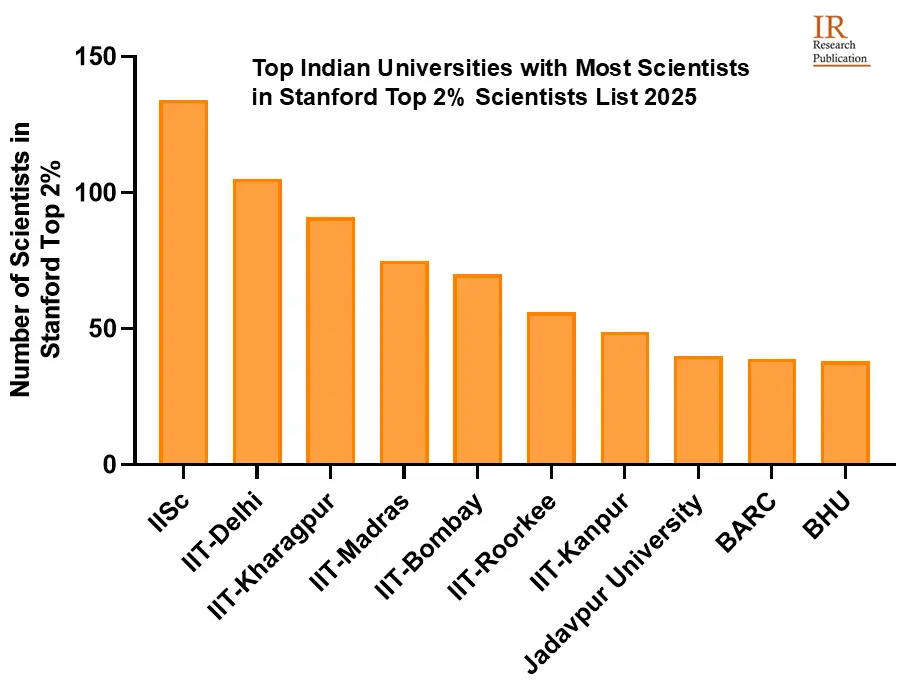
    In the 2025 edition, thousands of researchers from India have been recognized for their global contribution. To better understand India’s position in the global research landscape, we analyzed the career-long dataset to find which Indian universities and institutions have the highest number of scientists featured in the Stanford Top 2% Scientists list.

    📄 Download the Curated List of Indian Universities (PDF): Stanford Top 2% Scientists 2025 – Indian Universities with Most Scientists

    📄 Access the Full Elsevier Raw Dataset (Excel): Stanford Top 2% Scientists 2025 – Complete Global List


    What is the Stanford Top 2% Scientists List?

    The Stanford Top 2% Scientists list is a global ranking developed by a team at Stanford University led by Prof. John P.A. Ioannidis. It evaluates millions of researchers worldwide and identifies the top 2% based on their impact. Two versions of the dataset are published each year:

    • Single-year impact – highlights the performance of researchers in the most recent year.
    • Career-long impact – covers an entire research career up to the present.

    For this blog, we focus on the career-long impact dataset, as it reflects the long-term research strength of Indian universities.


    Methodology for Ranking Indian Universities

    To identify the top Indian universities featured in the Stanford Top 2% Scientists list 2025, we:

    1. Downloaded the official career-long dataset from Elsevier.
    2. Filtered for scientists affiliated with Indian institutions.
    3. Grouped entries by institution/university.
    4. Ranked them by the number of scientists featured.

    This method provides a clear picture of which universities consistently produce globally influential researchers.


    Top Indian Universities in Stanford Top 2% Scientists List 2025

    Here are the leading Indian institutions with the highest number of scientists recognized in the Stanford Top 2% Scientists career-long dataset:

    RankInstitution/UniversityNumber of Scientists
    1Indian Institute of Science (IISc), Bangalore134
    2IIT Delhi105
    3IIT Kharagpur91
    4IIT Madras75
    5IIT Bombay70
    6IIT Roorkee56
    7IIT Kanpur49
    8Jadavpur University40
    9Bhabha Atomic Research Centre (BARC)39
    10Banaras Hindu University (BHU)38

    👉 Full curated Indian list available here: Download the Indian Universities List


    Key Insights and Trends

    • Public institutions dominate: IISc and IITs lead the rankings, showing the strength of India’s publicly funded research ecosystem.
    • Medical research is strong: AIIMS New Delhi is the top medical institution contributing to global scientific impact.
    • Rising diversity: Apart from the established giants, universities like BHU, Jadavpur University, and private universities such as VIT are also gaining global recognition.

    Why the Stanford Top 2% Scientists Ranking Matters

    Recognition in the Stanford Top 2% Scientists list is not just a personal achievement but also a reflection of an institution’s global research influence. For students, this ranking highlights the universities that foster cutting-edge science. For policymakers, it showcases India’s growing impact in global research and innovation.


    Conclusion

    The Stanford Top 2% Scientists list 2025 highlights the strength and diversity of Indian research. Institutions like IISc, IITs, AIIMS, and BHU continue to dominate, while several state and private universities are steadily making their mark.

    This blog covered the career-long dataset to identify the universities with the most influential scientists. In future updates, we will also analyze the single-year Stanford Top 2% Scientists list, which shows the most active institutions in recent years.

    📄 Download Resources:

    India’s growing presence in this global ranking proves one thing: its scientists are shaping the future of research worldwide.

    About Publisher

    IR Research Publication is publisher, editorial, and profile building service provider. It was founded with the mission to support scientists, researchers, academicians, and students in advancing their careers and contributing to global scientific knowledge. IR Research Publication is committed to delivering high-quality, reliable, and professional editorial services alongside a credible and ethical publishing platform.

    If you like this article, then visit our Blog page for more such articles.

  • How to Find Postdoctoral Fellowship Opportunities Around the World

    How to Find Postdoctoral Fellowship Opportunities Around the World

    Introduction: Why Choosing the Right Postdoctoral Fellowship Matters

    A postdoctoral fellowship is often the bridge between a Ph.D. and a long-term career in academia, research, or industry. It gives young researchers the chance to deepen their expertise, publish high-impact work, and build valuable networks. However, finding the right fellowship can be overwhelming, as opportunities are scattered across various countries, institutions, and funding bodies.

    In this blog, you’ll find a curated list of trusted websites to help you search for postdoctoral fellowship opportunities in the USA, Europe, Australia, Canada, and India. You’ll also learn strategies to use these resources effectively and key factors to consider before accepting a position.


    Global Portals for Postdoctoral Fellowship Opportunities

    Before diving into country-specific resources, start with global websites that aggregate postdoc positions worldwide:

    • FindAPostDoc – A dedicated platform for PhD and postdoc jobs worldwide.
    • Academic Positions – Lists research jobs across Europe, North America, and beyond.
    • JobRxiv – A free, community-driven job board for science and research jobs.
    • PostdocJobs.com – Specializes in postdoctoral positions and fellowships.
    • Nature Careers – Features academic jobs and postdoctoral fellowship listings in leading institutions.
    • LinkedIn – One of the best platforms for finding postdoctoral fellowship positions. By setting up job alerts, connecting with PIs, and following universities or institutes, you can discover hidden opportunities.

    👉 Tip: Use filters and set email alerts to stay updated on the latest positions.


    Postdoctoral Opportunities in the USA and Canada

    The USA and Canada host some of the world’s most competitive and well-funded fellowships. Here are key sites to explore:

    👉 Tip: Many North American fellowships provide visa sponsorship, but competition is fierce. Apply early and prepare strong research proposals.

    University-Specific Postdoctoral Career Portals in the USA

    Many leading universities maintain their own postdoctoral fellowship portals. These are especially valuable if you have specific institutions in mind:

    👉 Tip: If you’re targeting a specific university, checking their dedicated postdoc office websites often reveals opportunities not listed on global job boards


    Postdoctoral Fellowship in Europe

    Europe offers a rich landscape of fellowships funded by universities, institutes, and the European Union.

    👉 Tip: Many fellowships, like MSCA, require researchers to move to another country for eligibility, making mobility a key factor.


    Postdoctoral Opportunities in Australia

    Australia is a growing hub for cutting-edge research with attractive fellowship programs:

    • SEEK – Australia’s largest job board with postdoc listings.
    • THEunijobs – Times Higher Education’s portal for academic jobs.
    • CSIRO Postdoctoral Fellowships – Competitive positions with Australia’s leading research agency.
    • EMBL Australia – Postdoc opportunities in life sciences.

    👉 Tip: Check whether positions are open to international applicants, and factor in visa processing times when planning your applications.


    Postdoctoral Fellowship in India

    India is rapidly expanding its postdoc opportunities through government fellowships and institutional programs:

    👉 Tip: Many Indian postdocs are tied to individual PI grants. Directly contacting faculty in your field increases your chances of finding openings.


    How to Use Postdoctoral Fellowship Portals Effectively

    • Set job alerts to never miss a deadline.
    • Be specific with keywords (e.g., “postdoctoral fellowship immunology” instead of just “postdoc”).
    • Check PI and lab websites directly, as not all positions are listed on big portals.
    • Track fellowship deadlines such as Marie Curie, Banting, or EMBO.
    • Network actively at conferences, on LinkedIn, and by emailing researchers in your field.
    • Prepare application materials early – CV, publications, cover letters, and research proposals.

    Beyond Job Boards: Hidden Strategies to Secure a Postdoctoral Fellowship

    • Cold-email PIs with tailored research proposals.
    • Ask mentors for referrals to labs abroad.
    • Follow institutes on Twitter and LinkedIn for real-time updates.
    • Join postdoc mailing lists and Slack groups where jobs are often shared informally.

    Key Factors to Consider Before Accepting a Postdoctoral Fellowship

    • Funding security and contract duration.
    • PI’s mentorship style and lab culture.
    • Research resources and collaboration opportunities.
    • Publication potential in your field.
    • Cost of living, visa, and relocation support.
    • Career development opportunities (teaching, networking, industry links).

    Conclusion: Take Charge of Your Postdoctoral Fellowship Search

    Finding the right postdoctoral fellowship is a strategic step that can shape your academic and professional future. By leveraging global portals, regional websites, and hidden opportunities through networking, you can maximize your chances of landing a position that aligns with your research goals.

    Start exploring the listed websites today, set alerts, and don’t hesitate to reach out directly to labs that inspire you. With preparation and persistence, your next big research opportunity is within reach.

    About Publisher

    IR Research Publication is publisher, editorial, and profile building service provider. It was founded with the mission to support scientists, researchers, academicians, and students in advancing their careers and contributing to global scientific knowledge. IR Research Publication is committed to delivering high-quality, reliable, and professional editorial services alongside a credible and ethical publishing platform.

    If you like this article, then visit our Blog page for more such articles.

  • NIRF 2025 Pharmacy Rankings: Top Pharmacy Colleges in India (Full List)

    NIRF 2025 Pharmacy Rankings: Top Pharmacy Colleges in India (Full List)

    Introduction: Quick Overview

    The NIRF 2025 Pharmacy Rankings, released on September 4, 2025, provide a comprehensive evaluation of pharmacy institutions across India. These rankings assess colleges based on parameters such as Teaching, Learning & Resources (TLR), Research & Professional Practices (RPC), Graduation Outcomes (GO), Outreach & Inclusivity (OI), and Perception. For aspiring pharmacy students, understanding these rankings is crucial for making informed decisions about their education and future career paths.


    Top 10 Pharmacy Colleges in India – NIRF 2025 Pharmacy Rankings

    Here are the top 10 pharmacy colleges in India as per the NIRF 2025 rankings:

    RankInstitution NameLocationScore
    1Jamia HamdardNew Delhi86.59
    2Birla Institute of Technology & Science (BITS), PilaniPilani, Rajasthan82.28
    3Panjab UniversityChandigarh76.39
    4JSS College of Pharmacy, OotyOoty, Tamil Nadu76.14
    5National Institute of Pharmaceutical Education and Research (NIPER), HyderabadHyderabad, Telangana75.64
    6Institute of Chemical Technology (ICT), MumbaiMumbai, Maharashtra74.77
    7JSS College of Pharmacy, MysuruMysuru, Karnataka73.38
    8Manipal College of Pharmaceutical SciencesUdupi, Karnataka73.25
    9National Institute of Pharmaceutical Education and Research (NIPER), SAS NagarMohali, Punjab70.96
    10S.R.M. Institute of Science and TechnologyChennai, Tamil Nadu70.84

    (Source: NIRF Pharmacy Rankings 2025)


    Comprehensive NIRF 2025 Pharmacy College List – Curated by IR Research Publication

    Below is the complete list of all ranked pharmacy colleges in India for 2025. This curated compilation has been prepared by IR Research Publication based on the official NIRF 2025 data and provides an easy reference for students, educators, and researchers.

    Download the full curated NIRF 2025 Pharmacy College List (Prepared by IR Research Publication


    Trend Mechanics: Key Observations

    • Jamia Hamdard maintains its position as the top pharmacy college in India, reflecting its consistent performance across all evaluation parameters.
    • BITS Pilani has shown significant improvement, securing the second position, up from third in the previous year.
    • Panjab University has made a notable leap, climbing from the seventh position in 2024 to third in 2025, indicating its growing strength in pharmaceutical sciences.
    • NIPER Hyderabad has slightly slipped to the fifth position, while NIPER Mohali has improved its rank to ninth.
    • JSS College of Pharmacy, Ooty and Manipal College of Pharmaceutical Sciences continue to hold strong positions in the top 10.

    Government vs Private: A Comparative Analysis

    • Jamia Hamdard (Government): Continues to lead, showcasing the strength of government institutions in the pharmacy sector.
    • BITS Pilani (Private): Demonstrates the growing influence of private institutions, with significant improvements in rankings.
    • Panjab University (Government): Highlights the resurgence of government institutions in the top rankings.
    • JSS College of Pharmacy (Private): Reflects the consistent performance of private colleges in the pharmacy domain.

    Geographic Spotlight: Regional Highlights

    • Jamia Hamdard and BITS Pilani represent institutions from Delhi and Rajasthan, respectively, showcasing the diversity of top-ranking colleges across India.
    • Panjab University‘s rise underscores the growing prominence of institutions in the northern region.
    • The presence of multiple top-ranked colleges in Karnataka and Tamil Nadu highlights these states’ strong contributions to pharmaceutical education.

    Why It Matters: Implications for Students

    • Placement Opportunities: Top-ranked colleges often have better industry connections, leading to higher placement rates.
    • Research Opportunities: Institutions with higher rankings tend to have more robust research programs, offering students opportunities to engage in cutting-edge pharmaceutical research.
    • Infrastructure and Facilities: Higher-ranked colleges typically offer state-of-the-art facilities, enhancing the learning experience.
    • Global Recognition: Graduating from a top-ranked institution can enhance a student’s resume, offering better prospects for international opportunities.

    How This Impacts Applicants

    • Informed Decision-Making: Aspiring pharmacy students can make better-informed decisions about where to apply based on the NIRF rankings.
    • Understanding Trends: Recognizing trends, such as the rise of certain institutions, can help applicants anticipate future shifts in the pharmaceutical education landscape.
    • Strategic Planning: Applicants can align their preferences with institutions that offer specific specializations or have strong industry connections in their areas of interest.

    Conclusion

    The NIRF 2025 Pharmacy Rankings provide valuable insights into the landscape of pharmaceutical education in India. Institutions like Jamia Hamdard, BITS Pilani, and Panjab University continue to lead, while others like NIPER Hyderabad and JSS College of Pharmacy maintain their strong positions. For aspiring pharmacy students, these rankings serve as a crucial tool in selecting the right institution that aligns with their academic and career aspirations.

    About Publisher

    IR Research Publication is publisher, editorial, and profile building service provider. It was founded with the mission to support scientists, researchers, academicians, and students in advancing their careers and contributing to global scientific knowledge. IR Research Publication is committed to delivering high-quality, reliable, and professional editorial services alongside a credible and ethical publishing platform.

    If you like this article, then visit our Blog page for more such articles.
  • Top Breakthrough Studies in The Lancet That Changed Healthcare Forever

    Top Breakthrough Studies in The Lancet That Changed Healthcare Forever

    Introduction: Why The Lancet Matters in Global Healthcare

    In the vast world of medical publishing, only a few journals can truly claim to have shaped the course of modern medicine. Among them, The Lancet stands as one of the most respected and impactful. Founded in 1823 by English surgeon Thomas Wakley, The Lancet has grown into a global platform that consistently publishes groundbreaking studies, clinical trial results, and policy-shaping reports.

    Over the decades, The Lancet has not only informed clinicians and researchers but has also influenced governments, global health organizations, and even the general public. When a study appears in The Lancet, it often sparks international discussion and sometimes even changes the way healthcare is delivered. From cardiovascular medicine to infectious diseases, from maternal health to climate change, the journal has continuously been at the forefront of medical progress.

    In this article, we will explore the top breakthrough studies published in The Lancet that changed healthcare forever. These milestones highlight the journal’s unique ability to bridge research and real-world policy, making it one of the most powerful voices in global health.


    The Lancet and Its Legacy in Medical Research

    To understand the importance of these landmark studies, it’s worth reflecting on the legacy of The Lancet. Unlike many academic journals that focus narrowly on a single specialty, The Lancet covers a broad spectrum of medicine and global health. This makes it a central hub for cross-disciplinary knowledge, enabling breakthroughs in one area to influence others.

    The journal’s peer-review process is stringent, and its high impact factor consistently places it among the top-ranked medical publications worldwide. With major offices in London, New York, Amsterdam, and Beijing, and partnerships with researchers across the globe, The Lancet has positioned itself as a truly international voice in medicine.

    Importantly, The Lancet has always aimed to go beyond academic audiences. Its studies are often picked up by policymakers, health ministries, and organizations such as the World Health Organization (WHO). As a result, its research has the power to influence not only hospitals and clinics but also national and international strategies.


    Breakthrough Study 1: Global Burden of Disease Reports

    One of the most influential contributions from The Lancet has been the Global Burden of Disease (GBD) studies. First published in 1990, and regularly updated since, the GBD reports represent the most comprehensive effort to measure the world’s health challenges.

    The GBD evaluates diseases, injuries, and risk factors across countries and over time. Instead of focusing only on mortality, it introduced the concept of Disability-Adjusted Life Years (DALYs)—a measure that accounts for both premature death and years lived with disability. This metric fundamentally changed the way health systems prioritize conditions.

    For example, earlier global health strategies often emphasized infectious diseases. But the GBD highlighted the growing burden of non-communicable diseases (NCDs) like diabetes, cardiovascular disorders, and mental health conditions. This shifted attention and resources toward chronic diseases, leading to policy changes worldwide.

    The Lancet’s GBD reports remain a cornerstone for governments, NGOs, and institutions like the Bill & Melinda Gates Foundation in setting funding priorities. Without this groundbreaking series, global health would likely still underestimate the enormous impact of chronic illness.


    Breakthrough Study 2: The Lancet’s Role in COVID-19 Research

    The COVID-19 pandemic demonstrated the vital role medical journals play in times of crisis, and The Lancet was at the center of the global response.

    In February 2020, The Lancet published some of the earliest peer-reviewed studies on the novel coronavirus from Wuhan, China such as “A novel coronavirus outbreak of global health concern” and “Clinical features of patients infected with 2019 novel coronavirus in Wuhan, China“. These papers provided critical data on transmission, symptoms, and case fatality rates at a time when misinformation was rampant. As the pandemic progressed, The Lancet became a go-to source for reliable, evidence-based insights.

    It also published pivotal studies on COVID-19 vaccines, including trials of the Oxford–AstraZeneca vaccine, which later became one of the most widely used vaccines worldwide. These publications shaped not only scientific understanding but also public health decision-making at national and international levels.

    Of course, The Lancet was also at the center of controversy during COVID-19. A major study on hydroxychloroquine and COVID-19, published in 2020, was later retracted after questions arose about data integrity. While this sparked debate, it also highlighted the importance of transparency and accountability in medical publishing.

    Despite controversies, The Lancet’s COVID-19 studies remain some of the most cited and influential works of the pandemic, guiding healthcare providers, policymakers, and vaccine developers alike.


    Breakthrough Study 3: Landmark Cardiovascular and Cancer Trials

    Another area where The Lancet has left an indelible mark is in cardiovascular medicine and cancer research.

    In cardiology, The Lancet has published numerous landmark clinical trials that have shaped the treatment of hypertension, coronary artery disease, and heart failure. For example, major studies on the benefits of statins in lowering cholesterol and reducing cardiovascular risk have fundamentally altered prescribing practices around the world. Research on aspirin use in secondary prevention of heart attacks and strokes also found its way into global treatment guidelines thanks to The Lancet.

    In oncology, The Lancet has featured pivotal trials in chemotherapy, targeted therapy, and immunotherapy. By disseminating results from large, multicenter clinical trials, the journal has accelerated the adoption of life-saving treatments. These studies often represent the cutting edge of medical science, offering hope for patients facing some of the most difficult diseases.


    Breakthrough Study 4: Women’s and Children’s Health Initiatives

    Few areas of research have been as influenced by The Lancet as women’s and children’s health.

    The journal has published groundbreaking studies on maternal mortality, child malnutrition, and reproductive health. Its 2006 series on maternal, newborn, and child survival is often credited with influencing the United Nations Millennium Development Goals (MDGs). This research emphasized cost-effective interventions such as skilled birth attendance, breastfeeding promotion, and basic vaccination programs.

    Later series on child nutrition brought global attention to the issue of stunting and the long-term impact of early malnutrition on physical and cognitive development. These findings shaped not only health policies but also educational and social development strategies.

    By prioritizing these topics, The Lancet ensured that women’s and children’s health remained central to global health agendas.


    Breakthrough Study 5: Climate Change and Health Reports

    In recent years, The Lancet has emerged as a powerful voice linking climate change and human health.

    The Lancet Countdown on Health and Climate Change, published annually, tracks how environmental changes—rising temperatures, air pollution, extreme weather events—affect human well-being. These reports argue that climate change is not only an environmental crisis but also a public health emergency.

    The Countdown series has provided evidence that climate change exacerbates heat-related illness, worsens air quality, spreads infectious diseases, and threatens food security. By framing climate change in terms of health, The Lancet has successfully expanded the urgency of the debate, influencing policymakers to view it not only as an ecological issue but also as a human survival issue.


    The Lancet’s Role in Shaping Public Policy

    Beyond individual studies, The Lancet is unique in how often its findings translate directly into policy. Governments and international bodies frequently cite The Lancet when shaping health laws, vaccination programs, and funding strategies.

    For instance, The Lancet’s tobacco control series provided evidence that fueled stricter anti-smoking legislation across many countries. Similarly, its nutrition and obesity studies have guided policies on sugar taxes and food labeling.

    The journal’s ability to influence both the scientific community and political decision-makers underscores its exceptional role in global healthcare.


    Criticism and Controversies Around The Lancet

    While The Lancet has a long record of excellence, it has not been free from criticism.

    The most infamous case was the 1998 study linking the MMR vaccine to autism, which was later fully retracted and widely condemned as fraudulent. This single paper caused a massive drop in vaccination rates and fueled the anti-vaccine movement—demonstrating how even a prestigious journal can make mistakes with devastating consequences.

    During COVID-19, the hydroxychloroquine retraction raised questions about peer-review standards and the rush to publish during crises. Critics argue that The Lancet, like all journals, must balance speed with rigor, especially when the stakes are high.

    Nevertheless, by acknowledging and correcting these errors, The Lancet demonstrates the self-correcting nature of science. Transparency in handling controversies has helped it maintain trust and authority in the long term.


    Conclusion: Why The Lancet Remains the Gold Standard of Medical Research

    From the Global Burden of Disease studies to COVID-19 vaccine trials, from maternal health initiatives to climate change reports, The Lancet has repeatedly demonstrated its power to influence both science and society.

    Its publications not only provide cutting-edge medical insights but also drive policy decisions that affect millions of lives. While controversies remind us of the challenges of scientific publishing, they do not diminish the journal’s legacy as a cornerstone of global health.

    As new challenges emerge—from antimicrobial resistance to future pandemics—The Lancet will undoubtedly continue to serve as a beacon for evidence-based medicine. For healthcare professionals, policymakers, and the general public, following The Lancet means staying at the forefront of the medical advances that shape our future.

    About Publisher

    IR Research Publication is publisher, editorial, and profile building service provider. It was founded with the mission to support scientists, researchers, academicians, and students in advancing their careers and contributing to global scientific knowledge. IR Research Publication is committed to delivering high-quality, reliable, and professional editorial services alongside a credible and ethical publishing platform.

    If you like this article, then visit our Blog page for more such articles.

  • A Beginner’s Guide to Grants and Fundings for Early Career Researchers

    A Beginner’s Guide to Grants and Fundings for Early Career Researchers

    Introduction

    Securing funding is one of the biggest challenges for early career scientists. Whether you are a PhD student, postdoc, or newly appointed faculty member, access to financial support is crucial for driving your research forward. Yet, many young researchers feel lost when navigating the competitive world of grants. This beginner’s guide explores the essentials of fundings for early career researchers—where to find opportunities, how to apply, and what strategies can improve your chances of success.


    Why Fundings for Early Career Researchers Matters

    For young scientists, funding is more than just money—it is recognition of your potential as an independent researcher. Securing a grant helps you:

    • Launch pilot projects that can lead to high-impact publications.
    • Attend international conferences, boosting your visibility and collaborations.
    • Build a track record that makes you competitive for larger grants.
    • Gain independence from your supervisor’s funding and establish your own research identity.

    In short, fundings for early career researchers not only sustain your experiments but also shape long-term career trajectories.


    Types of Research Available Fundings for Early Career Researchers

    When exploring fundings for early career researchers, it’s helpful to know the different types of support you can apply for. Each serves a unique purpose in shaping your career:

    🔹 Institutional Funding

    • Many universities provide internal fellowships, seed funds, and start-up packages.
    • These awards are usually smaller but easier to obtain compared to national grants.
    • They help generate pilot data, which strengthens future external applications.
    • Examples: departmental travel awards, young investigator grants, or thesis support funds.
      (Check your university’s Office of Research or Sponsored Programs page for internal calls.)

    🔹 Government Grants

    Government grants often provide multi-year support, making them crucial fundings for early career researchers.

    🔹 Private Foundations and Nonprofits

    🔹 Industry and Non-Traditional Sources

    👉 Takeaway: By strategically combining institutional, government, foundation, and industry support, researchers can create a strong portfolio of fundings for early career researchers.

    Travel and Conference Grants & Fundings for Early Career Researchers

    These small fundings for early career researchers often lead to collaborations that spark larger projects.


    Where to Find Grant & Fundings for Early Career Researchers

    Even the most motivated researcher can struggle if they don’t know where to look. Luckily, multiple platforms and strategies exist to track fundings for early career researchers:

    🔹 United States Platforms

    • Grants.gov – Central hub for all federal funding opportunities.
    • NIH RePORTER – Explore funded projects and identify suitable NIH grants.
    • NSF FastLane / Research.gov – Search and apply for NSF-funded programs.
    • Professional societies like AHA also provide seed grants and fellowships.

    🔹 Europe and UK Platforms

    🔹 India and Asia-Pacific

    🔹 Practical Tips to Stay Updated

    • Sign up for email alerts from portals like Grants.gov or UKRI.
    • Follow agencies on LinkedIn/Twitter (e.g., @NIHGrants, @ERC_Research).
    • Ask mentors and peers—word of mouth often reveals lesser-known fundings for early career researchers.

    👉 Takeaway: Knowing where to look and setting up alerts ensures you never miss deadlines, keeping you ahead in the competitive race for fundings for early career researchers.


    How to Choose the Right Grant

    Not every opportunity will suit your career stage. To maximize success:

    • Ensure your research scope aligns with the funder’s mission.
    • Check eligibility carefully (citizenship, years post-PhD, area of research).
    • Compare the grant size and duration with your project’s needs.
    • Study past awardees to understand the funder’s preferences.

    A well-matched application increases your chances of securing fundings for early career researchers.


    Basics of a Strong Grant Application

    Winning grants requires more than good science—it’s about clear communication. Key elements include:

    • A focused, innovative research question.
    • Evidence of feasibility through preliminary data.
    • A compelling CV backed by publications or relevant experience.
    • Letters of recommendation from respected mentors.
    • A realistic and justified budget.

    The strongest fundings for early career researchers are awarded to those who can convince reviewers that their project is both important and achievable.


    Common Mistakes to Avoid

    Grant reviewers frequently cite the following reasons for rejection:

    • Objectives that are too vague or broad.
    • Projects that are overambitious with limited resources.
    • Failure to follow the funder’s guidelines.
    • Weak or unjustified budget requests.
    • Submitting applications at the last minute.

    Avoiding these pitfalls is essential to improve your chances of securing fundings for early career researchers.


    Resources and Support Systems

    Don’t navigate the grant process alone. Make use of:

    • University grant support offices that help with editing and submission.
    • Mentorship and peer review to refine your proposals.
    • Online courses and workshops dedicated to grant writing.
    • Professional societies like APS, AAPS, AACR, which often provide exclusive fellowships.

    These resources can significantly improve your chances of winning fundings for early career researchers.


    Conclusion

    Getting your first grant may feel intimidating, but persistence and preparation make all the difference. By starting small, learning from mentors, and strategically targeting opportunities, you can steadily build a funding portfolio that supports your research journey. Remember, every successful scientist began with their very first grant—so take the leap into the world of fundings for early career researchers today.

    About Publisher

    IR Research Publication is publisher, editorial, and profile building service provider. It was founded with the mission to support scientists, researchers, academicians, and students in advancing their careers and contributing to global scientific knowledge. IR Research Publication is committed to delivering high-quality, reliable, and professional editorial services alongside a credible and ethical publishing platform.

    If you like this article, then visit our Blog page for more such articles.

  • How to Use a Power Calculator for Research: A Beginner-Friendly Guide

    How to Use a Power Calculator for Research: A Beginner-Friendly Guide

    Introduction to Power Calculators in Research

    Designing a research study requires careful planning, especially when determining the right sample size. One of the most valuable tools for researchers is the power calculator. It helps ensure that your study has enough statistical strength to detect a real effect, if it exists. Learning how to use a power calculator can save time, resources, and improve the reliability of your results.

    What is a Power Calculator?

    A power calculator is a statistical tool that helps researchers estimate the probability of detecting an effect in a study, given certain parameters such as sample size, effect size, and significance level. In simple terms, it answers the question: “Is my study big enough to detect the effect I’m interested in?”

    Why Researchers Need to Understand Statistical Power

    Statistical power is the probability of avoiding a Type II error (failing to detect a true effect). If your study is underpowered, you risk wasting time and resources. With the help of a power calculator, you can design studies that are more reliable and publishable.

    Key Benefits of Using a Power Calculator in Research

    • Ensures adequate sample size planning
    • Increases confidence in study findings
    • Reduces the risk of false negatives
    • Improves chances of publication in high-impact journals

    Basics You Should Know Before Using a Power Calculator

    What is Statistical Power?

    Statistical power refers to the probability of correctly rejecting the null hypothesis when an actual effect exists. Most researchers aim for 80% or higher power, meaning there’s an 80% chance of detecting a true effect.

    The Role of Effect Size, Sample Size, and Significance Level

    • Effect Size: The magnitude of the difference or association you expect. Larger effects require smaller sample sizes.
    • Sample Size: The number of participants needed to achieve reliable results.
    • Significance Level (α): Usually set at 0.05, it represents the threshold for deciding whether an effect is statistically significant.

    Common Mistakes Researchers Make in Power Analysis

    • Guessing effect sizes without prior evidence
    • Using too small a sample size to save costs
    • Ignoring multiple comparisons when running several tests
    • Failing to perform a power calculation before data collection

    Step-by-Step Guide on How to Use a Power Calculator

    Here’s a structured process for researchers who want to learn how to use a power calculator:

    Step 1 – Define Your Research Question and Hypothesis

    Start by clearly outlining your hypothesis. For example, “Does Drug A reduce blood pressure compared to placebo?”

    Step 2 – Select the Type of Test

    Choose the statistical test appropriate for your study:

    • t-test (comparing two means)
    • ANOVA (comparing multiple means)
    • Chi-square (categorical data)
    • Regression analysis (predicting relationships)
    Understanding Statistical Tests in Biomedical Research: A Beginner’s Guide

    Learn in details about what Statistical Tests is appropriate for your study in our Beginner’s Guide

    Step 3 – Enter Effect Size and Significance Level

    Estimate the expected effect size based on previous studies or pilot data. Set your significance level (usually 0.05).

    Step 4 – Adjust Sample Size for Adequate Power

    Increase or decrease the sample size until your study reaches at least 80% power. Most power calculators will display this visually.

    Step 5 – Interpret the Results of the Power Calculator

    The output will show whether your planned study is sufficiently powered. If not, you may need to recruit more participants or refine your design.


    Choosing the Right Power Calculator Tool

    Free Online Power Calculators for Researchers

    Several free tools are available, such as ClinCalc, OpenEpi, and Sample Size Calculator.net. These are great for quick estimates.

    Software Options (G*Power, R, SPSS, SAS, etc.)

    • G*Power: Popular, free, and flexible for most tests.
    • R: Provides advanced customization through packages like pwr.
    • SPSS & SAS: Often used in professional research settings for large datasets.

    Which Power Calculator is Best for Your Research Needs?

    • Beginners: Online calculators or G*Power
    • Advanced users: R or Python for flexibility
    • Clinical studies: Specialized calculators tailored for trials

    Practical Examples of How to Use a Power Calculator

    Example 1 – Calculating Power for a Clinical Trial

    A researcher testing a new asthma treatment can use a power calculator to estimate how many participants are required to detect a meaningful improvement in lung function.

    Example 2 – Using a Power Calculator in Social Science Research

    A psychology study measuring the effect of mindfulness training on stress reduction might use G*Power to decide the number of participants needed for a t-test.

    Example 3 – Power Analysis in Laboratory Studies

    In biomedical research, power calculators help determine the number of cell or animal samples needed to observe significant differences in protein expression.


    FAQs About How to Use a Power Calculator

    Do I always need a power calculator for my study?

    Yes—unless you’re conducting exploratory research, a power calculator is essential for robust, reliable findings.

    How accurate are online power calculators?

    Most online tools provide accurate estimates, but advanced software like G*Power or R is recommended for complex designs.

    Can a power calculator be used for small sample studies?

    Yes, but be cautious. Small sample studies often lack statistical power, so results should be interpreted carefully.


    Conclusion

    Learning how to use a power calculator is an essential step in research design. By understanding statistical power, effect size, and sample size, you can plan more effective studies and improve your chances of meaningful, publishable results. Whether you are a beginner or an advanced researcher, using the right power calculator ensures your study is both efficient and reliable.

    About Publisher

    IR Research Publication is publisher, editorial, and profile building service provider. It was founded with the mission to support scientists, researchers, academicians, and students in advancing their careers and contributing to global scientific knowledge. IR Research Publication is committed to delivering high-quality, reliable, and professional editorial services alongside a credible and ethical publishing platform.

    If you like this article, then visit our Blog page for more such articles.