Author: admin

  • Fully Funded Postdoctoral Fellowships in Finland 2027: Funding, Salaries, Eligibility & Deadlines

    Fully Funded Postdoctoral Fellowships in Finland 2027: Funding, Salaries, Eligibility & Deadlines


    Introduction

    Are you searching for fully funded postdoctoral fellowships in Finland for 2027? Finland offers competitive opportunities for international researchers across life sciences, medicine, artificial intelligence, engineering, environmental sciences, humanities, and social sciences.

    From independent research grants worth up to €700,000 to salaried university fellowships and internationally funded research positions, Finland provides multiple pathways for postdoctoral career development.

    However, there is one important distinction applicants should understand:

    Not every postdoctoral funding opportunity in Finland is a traditional fellowship.

    Some schemes provide independent research grants administered by a Finnish research organization. Others offer fixed-term employment contracts with monthly salaries and employee benefits. International programs may provide stipends, salary contributions, relocation support, and additional allowances.

    Understanding these differences is essential when comparing funding and preparing applications.

    This guide covers major opportunities, including:

    • Research Council of Finland – 2027 Academy Research Fellowships
    • Turku Institute for Advanced Studies (TIAS)
    • TIES2 Marie SkĹ‚odowska-Curie COFUND Fellowships
    • Helsinki Collegium for Advanced Studies (HCAS)
    • Tampere Institute for Advanced Study
    • Helsinki Institute for Information Technology (HIIT)
    • Marie SkĹ‚odowska-Curie Postdoctoral Fellowships
    • EMBO Postdoctoral Fellowships
    • Human Frontier Science Program (HFSP)
    • Fulbright U.S. Scholar Awards to Finland
    • Finnish Center for Artificial Intelligence (FCAI)
    • Other university-based postdoctoral research positions

    We also explain salaries, eligibility, immigration considerations, application strategies, and verified deadlines.

    Last verified: October 10, 2026. Deadlines and grant conditions may change, so always consult the official funding announcement before applying.

    For researchers comparing Nordic and European destinations, see our guides to fully funded postdoctoral fellowships in Sweden for 2027 and postdoctoral fellowships in the Netherlands for 2027.


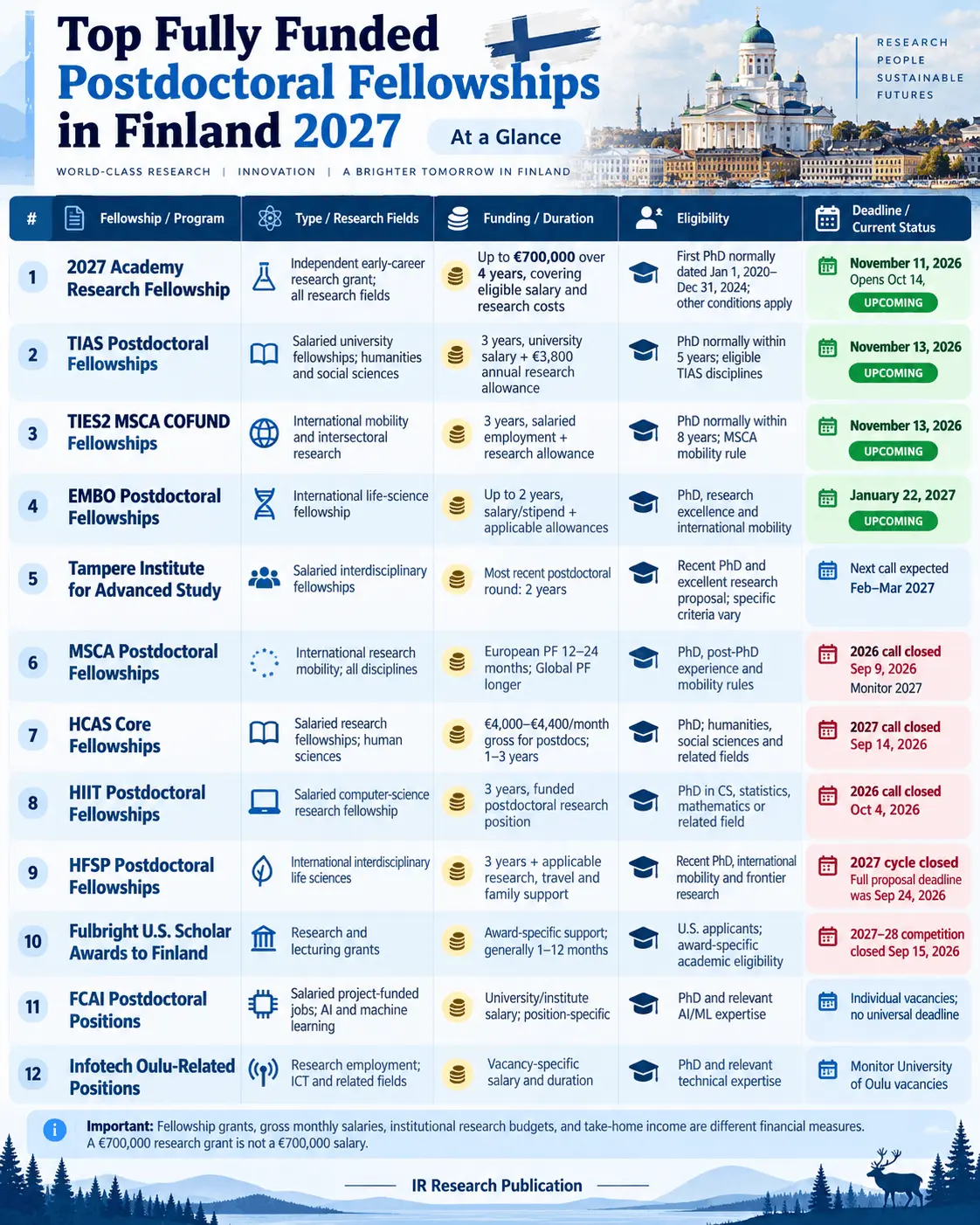
    Top Fully Funded Postdoctoral Fellowships in Finland 2027: At a Glance

    The following comparison table summarizes the major research fellowships, funding mechanisms, and salaried positions relevant to researchers planning a 2027 start.

    Fellowship / ProgramType / Research FieldsFunding / DurationEligibilityDeadline / Current StatusOfficial Link
    2027 Academy Research FellowshipIndependent early-career research grant; all research fieldsUp to €700,000 over 4 years, covering eligible salary and research costsFirst PhD normally dated Jan 1, 2020–Dec 31, 2024; other conditions applyNovember 11, 2026; opens Oct 14Research Council of Finland
    TIAS Postdoctoral FellowshipsSalaried university fellowships; humanities and social sciences3 years, university salary + €3,800 annual research allowancePhD normally within 5 years; eligible TIAS disciplinesNovember 13, 2026TIAS Vacancies
    TIES2 MSCA COFUND FellowshipsInternational mobility and intersectoral research3 years, salaried employment + research allowancePhD normally within 8 years; MSCA mobility ruleNovember 13, 2026TIES2 Fellowships
    EMBO Postdoctoral FellowshipsInternational life-science fellowshipUp to 2 years, salary/stipend + applicable allowancesPhD, research excellence and international mobilityNext cutoff: January 22, 2027EMBO
    Tampere Institute for Advanced StudySalaried interdisciplinary fellowshipsMost recent postdoctoral round: 2 yearsRecent PhD and excellent research proposal; specific criteria varyNext call expected Feb–Mar 2027Tampere IAS
    MSCA Postdoctoral FellowshipsInternational research mobility; all disciplinesEuropean PF 12–24 months; Global PF longerPhD, post-PhD experience and mobility rules2026 call closed Sep 9; monitor 2027MSCA
    HCAS Core FellowshipsSalaried research fellowships; human sciences€4,000–€4,400/month gross for postdocs; 1–3 yearsPhD; humanities, social sciences and related fields2027 call closed Sep 14, 2026HCAS
    HIIT Postdoctoral FellowshipsSalaried computer-science research fellowship3 years, funded postdoctoral research positionPhD in CS, statistics, mathematics or related field2026 call closed Oct 4, 2026HIIT
    HFSP Postdoctoral FellowshipsInternational interdisciplinary life sciences3 years + applicable research, travel and family supportRecent PhD, international mobility and frontier research2027 cycle closed; full proposal deadline was Sep 24, 2026HFSP
    Fulbright U.S. Scholar Awards to FinlandResearch and lecturing grantsAward-specific support; generally 1–12 monthsU.S. applicants; award-specific academic eligibility2027–28 competition closed Sep 15, 2026Fulbright Finland
    FCAI Postdoctoral PositionsSalaried project-funded jobs; AI and machine learningUniversity/institute salary; position-specificPhD and relevant AI/ML expertiseIndividual vacancies; no universal deadlineFCAI
    Infotech Oulu-Related PositionsResearch employment; ICT and related fieldsVacancy-specific salary and durationPhD and relevant technical expertiseMonitor University of Oulu vacanciesUniversity of Oulu

    Important: Fellowship grants, gross monthly salaries, institutional research budgets, and take-home income are different financial measures. A €700,000 research grant is not a €700,000 salary.


    Fellowships with Confirmed 2027 Application Deadlines

    1. Research Council of Finland – 2027 Academy Research Fellowships

    Application deadline: November 11, 2026

    The Academy Research Fellowship is one of Finland’s leading funding instruments for promising early-career researchers working toward scientific independence.

    The program is administered by the Research Council of Finland, formerly the Academy of Finland.

    Older funding guides may refer to the former Postdoctoral Researcher Funding scheme. That scheme has been discontinued and should not be presented as an active annual fellowship.

    The Academy Research Fellowship is the relevant current early-career funding opportunity.

    Funding and Duration

    The 2027 call offers:

    • Maximum grant of €700,000
    • Four-year funding period
    • Start date: September 1, 2027
    • End date: August 31, 2031

    The research grant can cover eligible costs including the applicant’s salary, possible research-team salary expenses, and other research costs.

    It is intended to support the researcher’s progression toward an established and independent scientific career.

    The maximum amount is a total research grant, not a personal annual salary or stipend.

    Eligibility

    For the 2027 call, applicants must normally have received their first doctoral degree between:

    January 1, 2020 and December 31, 2024.

    The program targets researchers who have not yet attained a permanent senior research position.

    Other requirements concerning employment status, research organization commitment, career interruptions, application limits, and funding conditions are specified in the official call.

    Application Timeline

    • Call opens: October 14, 2026
    • Deadline: November 11, 2026, at 23:59 Finnish time
    • Funding starts: September 1, 2027

    Applicants submit through the Research Council’s electronic funding system.

    The application typically involves a research plan, budget, CV, publication information, institutional commitment and other materials required by the call.

    Official application page: 2027 Academy Research Fellowships

    Best suited for: Early-career researchers who have established a promising research record and want to develop an independent project at a Finnish research organization.


    2. Turku Institute for Advanced Studies (TIAS) Postdoctoral Fellowships

    Application deadline: November 13, 2026

    The Turku Institute for Advanced Studies (TIAS) at the University of Turku supports innovative and interdisciplinary research.

    For the 2027 recruitment round, TIAS is offering:

    • 4 Postdoctoral Fellow positions
    • 4 Collegium Fellow positions
    • 7 TIES2 MSCA COFUND Fellow positions

    All advertised appointments are scheduled to begin in September 2027.

    The standard TIAS Postdoctoral Fellowship is especially attractive to researchers in the humanities and social sciences who want dedicated time to undertake independent research.

    Research Fields

    Eligible disciplines fall within the institute’s constituent faculties:

    • Economics
    • Education
    • Humanities
    • Law
    • Social Sciences

    Applicants from unrelated fields should not assume eligibility merely because TIAS welcomes interdisciplinary research.

    Funding and Duration

    TIAS Postdoctoral Fellows receive:

    • A three-year salaried appointment
    • University employment benefits
    • An additional €3,800 annual research allowance
    • Opportunities for interdisciplinary collaboration and academic networking

    The salary is determined through the relevant university employment framework rather than one universal international fellowship stipend.

    Eligibility

    For the regular TIAS Postdoctoral Fellow category, applicants should normally be within five years of completing their PhD, subject to the current call’s detailed provisions.

    Selection emphasizes research excellence and the quality of the proposed project.

    Application Dates

    • Applications opened: September 18, 2026
    • Deadline: November 13, 2026
    • Fellowships begin: September 2027

    TIAS reports that its previous fellowship competitions have typically been extremely competitive, with success rates around 2%.

    Official application page: TIAS Open Vacancies


    3. TIES2 Marie Skłodowska-Curie COFUND Fellowships

    Application deadline: November 13, 2026

    The Turku Intersectoral Excellence Scheme 2 (TIES2) is a separate fellowship opportunity operated by the University of Turku and co-funded through the European Union’s MSCA COFUND program.

    For the 2027 recruitment round, seven TIES2 fellowships are available.

    Funding and Duration

    • Three-year salaried fellowship
    • Start date: September 1, 2027
    • Annual research allowance
    • Structured interdisciplinary and intersectoral career development
    • Required secondment of 3–12 months in an organization outside the higher education sector

    The intersectoral secondment is a distinguishing feature of this program.

    Eligibility

    Applicants normally must be within eight years of completing their PhD, subject to the detailed call rules.

    The MSCA mobility rule also applies:

    Applicants must not have resided or carried out their main activity in Finland for more than 12 months during the 36 months immediately before the application deadline.

    Other detailed eligibility and application requirements are provided in the TIES2 call instructions.

    Application Timeline

    • Call opened: September 18, 2026
    • Deadline: November 13, 2026
    • Fellowships begin: September 1, 2027

    Official application page: TIES2 MSCA COFUND Fellowships

    Best suited for: Internationally mobile postdoctoral researchers interested in combining academic research with experience in the non-academic sector.


    4. EMBO Postdoctoral Fellowships – Finland as a Host Destination

    Next application cutoff: January 22, 2027

    The European Molecular Biology Organization (EMBO) supports internationally mobile postdoctoral researchers in the life sciences.

    Finnish universities and research institutes can serve as eligible host environments when the proposed fellowship satisfies EMBO’s geographic and mobility requirements.

    Research Fields

    Projects can involve areas such as:

    • Molecular biology
    • Cell biology
    • Genetics
    • Biochemistry
    • Neuroscience
    • Developmental biology
    • Molecular microbiology
    • Computational and interdisciplinary life sciences

    Funding and Duration

    EMBO Postdoctoral Fellowships support research for up to two years.

    Benefits include:

    • Salary or stipend depending on host-country arrangements
    • Relocation allowance
    • Applicable support for fellows with children
    • Access to training and networking opportunities

    Eligibility

    Applicants must satisfy the current PhD timing and international mobility requirements.

    The fellowship is designed for researchers moving into a new research environment rather than simply continuing their previous work.

    EMBO also limits host laboratories to supporting one candidate per selection round under its current rules.

    Application Deadline

    Applications are accepted throughout the year, with evaluation rounds.

    The next hard cutoff is:

    January 22, 2027, at 14:00 CET.

    Applicants should also review EMBO’s revised reapplication policy, which applies to later selection rounds.

    Official application page: EMBO Postdoctoral Fellowships

    Best suited for: Recent life-science PhD graduates seeking international mobility and advanced research training.


    Additional Postdoctoral Fellowships to Monitor for 2027

    5. Tampere Institute for Advanced Study Postdoctoral Fellowships

    Next call expected: February–March 2027

    The Tampere Institute for Advanced Study (Tampere IAS) supports outstanding researchers across disciplines represented at Tampere University.

    Its research environment brings together expertise in technology, health and society.

    Funding and Duration

    The most recent 2026 competition offered:

    • 9 Postdoctoral Research Fellowships
    • 2-year appointments for postdoctoral researchers
    • 6 Senior Research Fellowships of 3 years

    Successful postdoctoral applicants receive salaried appointments under university employment conditions.

    Eligibility

    Applicants need a doctoral degree and a research proposal demonstrating originality, scientific quality and feasibility.

    In the 2026 round, postdoctoral eligibility required a doctorate dated between March 2, 2021 and March 2, 2026.

    The 2027 eligibility window must be confirmed from the new announcement.

    Current Status

    Tampere University expects the next call to take place in February–March 2027.

    The exact 2027 deadline, position count and funding terms have not yet been confirmed.

    Official information: Tampere Institute for Advanced Study


    6. Marie Skłodowska-Curie Postdoctoral Fellowships (MSCA PF)

    2027 call: Monitor the official EU funding announcement

    The Marie SkĹ‚odowska-Curie Actions Postdoctoral Fellowships are among Europe’s most competitive international research fellowships.

    Applicants can pursue research at eligible Finnish universities, institutes or other organizations.

    MSCA Postdoctoral Fellowships support researcher mobility, advanced training and career development across disciplines.

    Fellowship Types

    European Postdoctoral Fellowships

    • Typically 12–24 months
    • Hosted in an eligible EU Member State or Horizon Europe Associated Country
    • Finland is an eligible host destination

    Global Postdoctoral Fellowships

    • Include an outgoing research phase in a non-associated third country
    • Include a mandatory return phase to an eligible European host
    • Finland may serve as the European host under applicable conditions

    A Global Fellowship does not necessarily mean conducting the entire fellowship in Finland.

    Funding

    The funding model supports:

    • Living allowance
    • Mobility allowance
    • Family allowance where applicable
    • Research, training and networking costs
    • Management and indirect costs for the host

    The EU’s institutional funding contributions should not be confused with the fellow’s net salary.

    Eligibility

    Applicants normally must:

    • Hold a doctoral degree by the application deadline
    • Have no more than eight years of qualifying postdoctoral research experience, subject to permitted exclusions
    • Satisfy the applicable mobility rule

    For a European Postdoctoral Fellowship hosted in Finland, the applicant generally must not have lived or carried out their main activity in Finland for more than 12 months during the 36 months before the call deadline.

    Application Status

    The 2026 call closed on September 9, 2026.

    Researchers targeting the next competition should monitor the official 2027 call and begin identifying Finnish supervisors and host laboratories early.

    Official application page: MSCA Postdoctoral Fellowships


    7. Helsinki Collegium for Advanced Studies (HCAS) Core Fellowships

    2027 application cycle closed: September 14, 2026

    The Helsinki Collegium for Advanced Studies (HCAS) is an independent institute at the University of Helsinki.

    It provides opportunities for researchers to pursue high-quality independent scholarship in humanities, social sciences and related fields.

    Eligible Research Fields

    The institute welcomes research in:

    • Humanities
    • Social sciences
    • Educational sciences
    • Theology
    • Law
    • Related human-science disciplines

    Researchers in other fields may be eligible where their project substantially engages with human-science questions.

    Funding and Duration

    For the 2027 Core Fellowship competition, the university advertised:

    • €4,000–€4,400 per month gross for postdoctoral fellows
    • €4,000 annual personal research allowance
    • 1–3-year appointments for postdoctoral researchers
    • Access to HCAS research infrastructure and interdisciplinary activities

    These are salaried positions rather than personal tax-free scholarships.

    Application Status

    The 2027 application window ran from August 17 to September 14, 2026.

    Appointments are expected to begin in August–September 2027.

    The application window is now closed.

    Applicants interested in later recruitment should monitor future calls.

    Official application page: HCAS Core Fellowship


    8. Helsinki Institute for Information Technology (HIIT) Postdoctoral Fellowships

    Most recent deadline: October 4, 2026 — Closed

    The Helsinki Institute for Information Technology (HIIT) is a joint research institute of Aalto University and the University of Helsinki.

    HIIT supports research in computer science and related fields, combining basic research with applications in society and industry.

    Research Areas

    Relevant areas include:

    • Artificial intelligence
    • Algorithms
    • Computer science
    • Data science
    • Computational methods
    • Statistics
    • Mathematics
    • Human-centered computing

    Funding and Duration

    HIIT’s recent postdoctoral fellowship recruitment offered three-year funded research positions.

    These are salaried employment opportunities with terms determined by the participating university and vacancy.

    Eligibility

    Applicants generally need a PhD, or to be close to completing one, in computer science, statistics, mathematics or a related field.

    Scientific publications, technical expertise, independent research ability and English proficiency are important selection criteria.

    Current Status

    The latest advertised application deadline was October 4, 2026.

    This round is closed. A new 2027 deadline has not been confirmed.

    Official information: HIIT Postdoctoral Fellow Positions


    9. Human Frontier Science Program (HFSP) Postdoctoral Fellowships

    2027 application cycle closed

    The Human Frontier Science Program (HFSP) funds ambitious, high-risk and interdisciplinary research addressing fundamental questions in the life sciences.

    Finnish research laboratories can serve as host institutions when all eligibility conditions are satisfied.

    Fellowship Categories

    HFSP offers two major fellowship routes:

    Long-Term Fellowships (LTF)

    For researchers with doctoral training in the life sciences who want to move into new scientific directions.

    Cross-Disciplinary Fellowships (CDF)

    For researchers trained in non-biological disciplines who want to move into fundamental life-science research.

    Funding

    Fellowships generally last three years, with support that may include:

    • Living allowance
    • Research and travel allowance
    • Relocation support
    • Child-related and family support under applicable rules

    Award amounts depend on the host country and fellowship conditions.

    Eligibility

    HFSP emphasizes:

    • International relocation
    • Research independence
    • Significant changes in research direction
    • Innovative and interdisciplinary scientific questions

    Applicants should carefully review restrictions involving nationality, previous research locations, doctoral institution and host-country residence.

    2027 Application Status

    The 2027 fellowship competition had the following deadlines:

    • Letter-of-intent initiation: May 5, 2026
    • Letter-of-intent submission: May 12, 2026
    • Invited full proposal: September 24, 2026

    All these deadlines have passed.

    Researchers who did not participate in the 2027 competition should monitor the next fellowship cycle.

    Official information: HFSP Postdoctoral Fellowships


    10. Fulbright U.S. Scholar Awards to Finland

    2027–2028 competition closed: September 15, 2026

    The Fulbright Finland Foundation administers research and academic exchange opportunities between Finland and the United States.

    For U.S.-based applicants, Fulbright U.S. Scholar Awards can support temporary research and lecturing visits to Finnish institutions.

    These awards should not be confused with conventional multi-year Finnish university postdoctoral employment.

    Duration and Funding

    Research and lecturing grants generally support visits of 1–12 months, depending on the specific award.

    Benefits may include:

    • Grant-based financial support
    • Travel-related benefits
    • Academic affiliation and networking
    • Orientation and advisory services
    • Additional award-specific benefits

    The exact funding package varies.

    Eligibility

    These awards generally target eligible U.S. scholars, including researchers at different career stages depending on the award.

    Applicants should check whether their selected award permits postdoctoral researchers and requires a host invitation.

    Current Status

    The 2027–2028 U.S. Scholar competition closed on September 15, 2026.

    The earliest grant terms are expected to begin in August 2027.

    Official information: Fulbright Research and Lecturing Grants to Finland

    Important: Fulbright Finland also operates programs supporting researchers moving from Finland to the United States. Those outgoing awards are not equivalent to fellowships for international researchers seeking to relocate to Finland.


    Salaried Postdoctoral Research Positions in Finland

    In addition to competitive individual fellowships, Finland offers salaried postdoctoral jobs supported by institutional, national and international research grants.

    These are often among the most practical routes for researchers who do not meet restrictive fellowship mobility or PhD-age requirements.

    11. Finnish Center for Artificial Intelligence (FCAI)

    The Finnish Center for Artificial Intelligence (FCAI) is a research network involving Aalto University, the University of Helsinki and VTT Technical Research Centre of Finland.

    Researchers work on AI-related topics such as:

    • Machine learning
    • Probabilistic modeling
    • Human-centered artificial intelligence
    • Data-driven science
    • AI applications in healthcare and industry
    • Computational methods

    FCAI-associated research groups may recruit postdoctoral researchers through project-specific vacancies.

    Employment terms, salary, duration and eligibility depend on the actual hiring institution and project.

    FCAI should therefore be described as a source of research opportunities, not as a guaranteed annual individual postdoctoral fellowship.

    Official website: Finnish Center for Artificial Intelligence


    12. Infotech Oulu and University of Oulu Postdoctoral Opportunities

    The University of Oulu provides research opportunities in fields including:

    • Information and communication technology
    • Computer engineering
    • Wireless communications
    • Electronics
    • Biomedical engineering
    • Signal processing
    • Artificial intelligence
    • Multidisciplinary technology research

    Infotech Oulu is associated with the university’s technology-oriented research environment.

    Postdoctoral positions may be supported by individual research projects and institutional funding.

    However, applicants should not assume that an annual Infotech Oulu fellowship competition exists unless a current official call confirms it.

    Where to apply: University of Oulu Careers


    What About the Sigrid Jusélius Foundation?

    The Sigrid Jusélius Foundation supports medical research and researchers connected to the Finnish research system.

    However, its postdoctoral fellowship supporting research abroad should not be advertised as a standard incoming fellowship for international researchers seeking to relocate to Finland.

    That particular mechanism supports eligible researchers undertaking postdoctoral work outside Finland.

    Some research grants administered by the Foundation may indirectly support postdoctoral employment or research projects in Finland, but eligibility must be verified under each specific funding instrument.

    For that reason, it is not included in the main table of incoming Finland-based fellowships.


    How Much Do Postdoctoral Researchers Earn in Finland?

    Postdoctoral salaries in Finland are not determined by one fixed national fellowship amount.

    For salaried researchers, compensation depends on:

    • University or research institution
    • Job requirements
    • Research experience
    • Applicable salary system
    • Individual performance component
    • Contract and funding source
    • Additional responsibilities

    For example, the 2027 HCAS Core Fellowship advertises a postdoctoral gross salary of €4,000–€4,400 per month, plus a separate annual research allowance of €4,000.

    Other universities and projects may offer different salary levels.

    Salary vs. Research Grant vs. Stipend

    Funding TypeWhat It MeansExample
    Gross salaryEmployment income before tax and applicable contributionsHCAS: €4,000–€4,400/month gross
    Research grantTotal funding allocated to an approved research projectAcademy Research Fellowship: up to €700,000 over 4 years
    Research allowanceAdditional funding for approved research-related expensesTIAS: €3,800/year
    Fellowship stipendPersonal financial support under a grant arrangementDepends on the applicable international or foundation scheme
    University project-funded positionSalary paid through an institution’s funded research projectFCAI or University of Oulu vacancies

    A research grant is not necessarily the fellow’s personal income.

    When comparing opportunities, review gross salary, estimated taxation, pension treatment, employment benefits, relocation costs and living expenses in the destination city.

    For broader comparisons, see Highest-Paying Postdoctoral Fellowships Worldwide.


    Can International Researchers Apply for Postdocs in Finland?

    Yes.

    Many Finnish universities and institutes recruit postdoctoral researchers from around the world.

    Eligibility depends on the program rather than nationality alone.

    Some opportunities welcome researchers of any nationality but impose mobility restrictions. Others prioritize applicants at defined stages of their postdoctoral careers.

    International applicants should pay particular attention to:

    1. PhD completion date: Some programs restrict eligibility to researchers who obtained their doctorate within a defined period.
    2. International mobility: MSCA and TIES2 impose specific residence and activity restrictions.
    3. Research field: TIAS focuses on humanities and social sciences, while EMBO and HFSP focus on life sciences.
    4. Host arrangements: Some funding schemes require a host institution’s formal commitment or joint proposal development.
    5. Employment status: A research fellowship, university job and grant-funded visit may have different legal and immigration implications.

    Researchers from India and other non-EU countries may be eligible for many of these opportunities, provided the relevant program conditions are met.


    Residence Permits, Employment and Taxes in Finland

    Residence Permits

    Non-EU/EEA researchers moving to Finland for extended research appointments generally need appropriate residence authorization.

    The correct permit depends on factors including whether the applicant has an employment contract, a hosting agreement or a grant-supported research arrangement.

    Applicants should consult the Finnish Immigration Service – Researcher Residence Permit guidance before finalizing relocation plans.

    Employment and Social Benefits

    Salaried university postdoctoral researchers typically receive benefits according to their employment contracts and applicable Finnish legislation.

    These may include:

    • Annual leave
    • Occupational healthcare
    • Pension contributions
    • Employee insurance arrangements
    • Other applicable statutory protections

    Grant-funded fellows may be subject to different rules, particularly regarding social security, taxation and insurance.

    Taxation

    University salaries are generally subject to Finnish income taxation.

    Research grants and scholarships may be treated differently depending on their source, amount and legal classification.

    Applicants should verify their individual situation through the Finnish Tax Administration and the host institution’s HR office.


    How to Find Postdoctoral Jobs at Finnish Universities

    Researchers should not limit themselves to fellowship competitions.

    Many postdoctoral opportunities are advertised as salaried employment positions linked to specific research projects.

    Useful official recruitment destinations include:

    Institution / PortalResearch OpportunitiesOfficial Website
    University of HelsinkiLife sciences, medicine, humanities, social sciences, AI and moreUniversity of Helsinki Jobs
    Aalto UniversityEngineering, AI, design, technology and interdisciplinary researchAalto University
    University of TurkuBiomedical sciences, humanities, social sciences and interdisciplinary researchUniversity of Turku
    Tampere UniversityTechnology, health, medicine and societyTampere University
    University of OuluICT, engineering, health, biosciences and sustainabilityUniversity of Oulu Careers
    University of JyväskyläNatural sciences, psychology, education and interdisciplinary researchUniversity of Jyväskylä
    EURAXESSEuropean research jobs and fellowship vacanciesEURAXESS Jobs

    Search tip: Use both “postdoctoral researcher” and “postdoctoral fellow” when searching Finnish university portals, because many fully funded opportunities appear as employment vacancies rather than under scholarship listings.

    You can also explore IR Research Publication’s Research Jobs page and our guide on how to find postdoctoral fellowships worldwide.


    How to Apply Successfully for Postdoctoral Fellowships in Finland

    A successful postdoctoral application requires more than a strong publication record.

    Different programs assess research independence, feasibility, international mobility, career development and the quality of the host environment.

    Step 1: Identify the Right Funding Mechanism

    First, determine whether the opportunity is:

    • An individual research grant
    • A salaried research fellowship
    • A university employment vacancy
    • A mobility fellowship
    • A short-term research exchange

    This affects eligibility, the application process and the required documents.

    Step 2: Find a Suitable Finnish Host

    For fellowships requiring institutional support, identify research groups aligned with your scientific interests.

    Review recent publications, funded projects, laboratory infrastructure and the principal investigator’s expertise.

    A strong application should explain why the Finnish host is essential to the proposed project.

    For independently advertised fellowships, follow the particular program’s host-affiliation rules rather than assuming advance supervisor sponsorship is mandatory.

    Step 3: Prepare a Competitive Research Proposal

    A convincing proposal should address:

    • Scientific background
    • Research gap
    • Central question or hypothesis
    • Specific objectives
    • Research methodology
    • Feasibility and preliminary evidence
    • Timeline and milestones
    • Research risks and alternative approaches
    • Expected scientific impact
    • Career development and training
    • Open science, ethics and data management where applicable

    Step 4: Demonstrate Research Independence

    Reviewers may assess whether your proposed work moves beyond your PhD research and demonstrates intellectual originality.

    Highlight evidence such as:

    • First-author publications
    • Independent research contributions
    • New methodologies
    • Interdisciplinary experience
    • Previous grants and awards
    • International collaborations
    • Scientific leadership

    Step 5: Tailor the Application to the Fellowship

    Different programs emphasize different strengths.

    FellowshipApplication Priority
    Academy Research FellowshipResearch independence and career progression
    TIASAcademic excellence, originality and interdisciplinary research
    TIES2Mobility, intersectoral experience and research impact
    MSCA Postdoctoral FellowshipsExcellence, career development, impact and implementation
    EMBOScientific excellence, mobility and advanced life-science training
    HFSPFrontier research, substantial scientific change and interdisciplinary innovation
    University research positionsTechnical fit, project experience and demonstrated research skills

    Step 6: Prepare Supporting Documents

    Commonly required documents include:

    • Academic CV
    • Publication list
    • Research proposal
    • Cover letter or motivation statement
    • PhD certificate
    • Reference letters or referee information
    • Host commitment where required
    • Research ethics and data-management statements
    • Budget justification for grant applications

    Requirements vary by program.

    Step 7: Apply Before the Deadline

    Do not assume every call closes at midnight in your local time zone.

    Finnish institutional deadlines generally follow Finland’s local time, while European and international programs may use CET, CEST or another specified time zone.

    Verify the exact closing time on the official application page.


    Suggested Application Timeline for a 2027 Postdoc in Finland

    PeriodRecommended Action
    October 2026Prepare Academy Research Fellowship and TIAS/TIES2 applications; review eligibility immediately
    November 2026Submit Academy Research Fellowship by Nov 11 and TIAS/TIES2 by Nov 13
    December 2026–January 2027Prepare EMBO application for Jan 22 cutoff; monitor university vacancies
    February–March 2027Monitor Tampere IAS 2027 recruitment and other newly announced calls
    Spring–Summer 2027Prepare next MSCA Postdoctoral Fellowship application and contact Finnish host laboratories
    Throughout 2027Apply for individual project-funded postdoctoral vacancies as advertised

    This schedule does not imply that applications submitted in 2027 necessarily lead to a 2027 start. Fellowship decisions, recruitment dates and start windows depend on each program.


    Frequently Asked Questions

    1. Are postdoctoral fellowships in Finland fully funded?

    Many provide substantial financial support, but the funding structure differs.

    Salaried university postdoctoral fellowships generally provide employment income and applicable benefits.

    Independent research grants fund eligible research costs, including salary where permitted.

    Short-term mobility grants may offer allowances rather than full university employment.

    Always verify what is covered before accepting an award.

    2. What is the best postdoctoral fellowship in Finland for 2027?

    The strongest option depends on your field and career stage.

    The 2027 Academy Research Fellowship is especially relevant for eligible researchers developing independent research careers.

    TIAS and TIES2 are attractive for eligible humanities and social-science researchers.

    EMBO and HFSP are particularly relevant to eligible internationally mobile life scientists.

    MSCA Postdoctoral Fellowships provide opportunities across many disciplines.

    3. How much do postdoctoral researchers earn in Finland?

    There is no universal fixed salary.

    As a verified example, the HCAS 2027 recruitment advertised €4,000–€4,400 gross per month for postdoctoral researchers.

    Other universities and fellowships have different financial arrangements.

    4. Can Indian researchers apply for postdocs in Finland?

    Yes. Many Finnish research institutions welcome applications from qualified Indian and other international researchers.

    However, eligibility may depend on the doctoral degree date, nationality, current country of residence, host institution and mobility rules.

    Applicants should also verify the appropriate residence-permit process.

    5. Is Finnish language proficiency required?

    Not usually for many internationally recruited research positions.

    English is widely used in Finnish universities and research groups.

    Some clinical, teaching, public-facing or language-specific research positions may require Finnish or Swedish.

    6. Do I need a Finnish host supervisor?

    For host-dependent programs such as MSCA Postdoctoral Fellowships, advance coordination with the host is generally essential.

    Other fellowships, such as certain institutes for advanced study, allow applicants to propose independent research within a host institution’s research community without requiring a conventional laboratory supervisor.

    Always follow the specific call’s host requirements.

    7. What is the deadline for the 2027 Academy Research Fellowship?

    The application deadline is November 11, 2026, at 23:59 Finnish time.

    The four-year funding period begins September 1, 2027.

    8. What is the TIAS Postdoctoral Fellowship deadline?

    The 2027 TIAS and TIES2 recruitment deadline is November 13, 2026.

    The advertised fellowships begin in September 2027.

    9. When is the next EMBO Postdoctoral Fellowship deadline?

    The next cutoff is January 22, 2027, at 14:00 CET.

    EMBO accepts applications throughout the year, with evaluation rounds.

    10. Is the 2027 HFSP Postdoctoral Fellowship still open?

    No.

    The 2027 competition’s initial submission stage closed in May 2026, and the invited full proposal deadline passed on September 24, 2026.

    New applicants should monitor the next competition.

    11. Are research grants tax-free in Finland?

    Not necessarily.

    Tax treatment depends on the type of payment, its source, the amount and Finnish tax law.

    An employment salary and a research grant may be treated differently.

    Consult the Finnish Tax Administration and the host institution.

    12. Can family members accompany international postdoctoral researchers?

    Family members may qualify to apply for residence permits under Finnish immigration rules, depending on the researcher’s circumstances.

    Some fellowship programs also provide family-related allowances, but eligibility and amounts differ.

    Applicants should check current Finnish Immigration Service guidance.


    Conclusion: Fully Funded Postdoctoral Fellowships in Finland 2027

    Finland offers a strong range of opportunities for researchers seeking fully funded postdoctoral fellowships and salaried research positions in 2027.

    The most important confirmed opportunities include the 2027 Academy Research Fellowships, offering up to €700,000 over four years, and the TIAS and TIES2 fellowships, with November 2026 deadlines for appointments beginning in September 2027.

    International programs such as EMBO, MSCA and HFSP provide additional pathways for eligible researchers, while Finnish universities and research institutes recruit postdoctoral employees through individual funded projects.

    The best approach is to identify the right funding mechanism, verify eligibility, secure any necessary host support, prepare a strong research proposal and monitor official announcements.

    Researchers should also remember that grant funding, research allowances and personal salaries are not directly comparable.

    Starting early and applying strategically can substantially improve your ability to identify suitable research opportunities and submit competitive applications.

    For more resources, explore the IR Research Publication research jobs page and our practical guide to finding postdoctoral fellowships worldwide.


    Related Articles


    About IR Research Publication

    IR Research Publication is an academic publishing and research-career platform dedicated to supporting scholars, students and researchers through reliable funding information, academic opportunities, research resources and practical career guidance.

    Our fellowship and scholarship guides aim to help international researchers understand eligibility conditions, funding structures, application timelines and official recruitment procedures.

    Last updated: October 10, 2026

    Disclaimer: Fellowship dates, award amounts, university salary scales, immigration requirements and eligibility rules may change. The information in this guide is based on official program announcements available at the time of review. Always consult the relevant funder or university’s latest official announcement before applying.
  • Fully Funded PhD Scholarships in Denmark 2027: Salaries, Universities & Deadlines

    Fully Funded PhD Scholarships in Denmark 2027: Salaries, Universities & Deadlines


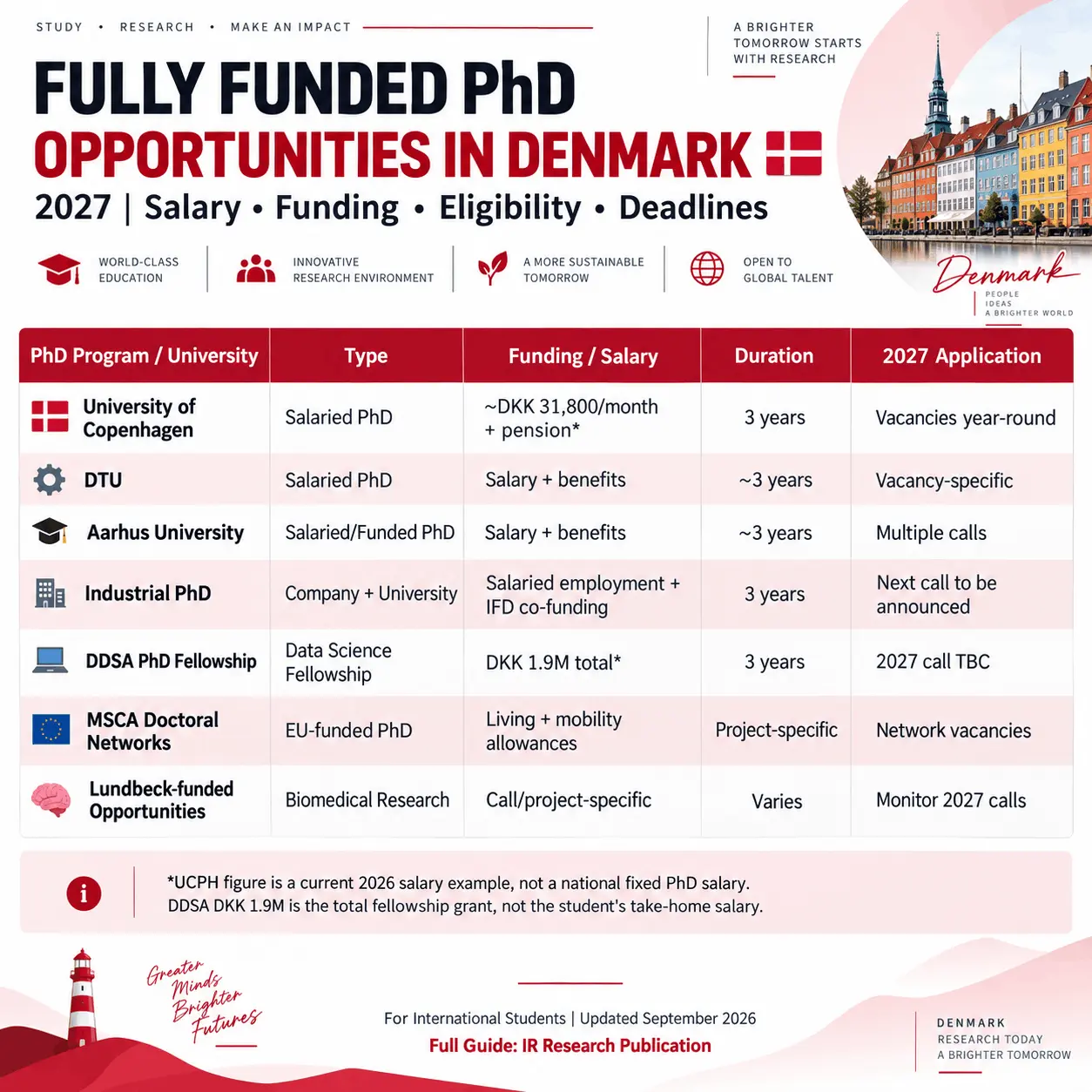
    Fully Funded PhD Scholarships in Denmark 2027

    Denmark is one of Europe’s most attractive destinations for doctoral researchers. Its universities combine high-quality research infrastructure, internationally recognized supervisors, close collaboration with industry, and strong employment protections.

    For international applicants, one feature is particularly important:

    What applicants often search for as a “fully funded PhD scholarship in Denmark” is frequently a salaried employment position rather than a traditional student scholarship.

    Many advertised Danish PhD fellows are employed on fixed-term university contracts, receive a monthly salary, and participate in pension and employment-benefit systems governed by applicable collective agreements.

    At the University of Copenhagen, for example, current 2026 PhD vacancies typically describe employment under Danish academic collective agreements and include employer-paid pension contributions.

    Funding models can nevertheless vary. A candidate may be:

    • directly employed by a university;
    • employed by a company through an Industrial PhD;
    • supported by an external fellowship administered through a Danish university;
    • recruited through an EU-funded Doctoral Network;
    • enrolled through an integrated master’s/PhD structure.

    Applicants should therefore check the exact funding and employment arrangement specified in each vacancy.

    Researchers comparing European destinations may also find our guides to fully funded PhD scholarships in Sweden for 2027, fully funded PhD scholarships in the Netherlands for 2027, fully funded PhD scholarships in France for 2027, and fully funded PhD scholarships in Germany for 2027 useful.


    Are These Really “2027 PhD Scholarships”?

    There is no single national 2027 PhD scholarship deadline in Denmark.

    Danish universities recruit doctoral fellows throughout the year as funded projects, faculty competitions, graduate-school calls, and external grants become available.

    Therefore, most university entries in this guide are best understood as major sources of fully funded and salaried PhD positions for applicants targeting a 2027 start, rather than already-confirmed annual “2027 scholarships.”

    Some 2027-start positions will be advertised during late 2026, while others will appear throughout 2027.

    2027 application tip: Start monitoring vacancies during the second half of 2026 rather than waiting until 2027.


    At-a-Glance: Salaried PhD Positions at Danish Universities

    University / ProgramTypical EligibilityFunding ModelApplication TimelineOfficial Link
    University of Copenhagen PhD PositionsRelevant master’s or equivalent; project/faculty-specific requirementsSalaried PhD employment; pension and benefits under applicable agreementVacancies throughout the yearUCPH PhD Vacancies
    DTU PhD PositionsRelevant master’s; strong fit with technical/research projectPhD employment with salary and benefits according to applicable termsVacancy-specificDTU PhD
    Aarhus University PhD PositionsMaster’s or applicable integrated route; graduate-school-specific requirementsFunded PhD employment or fellowship depending on faculty/callGraduate-school rounds and individual vacanciesAarhus University PhD
    University of Southern Denmark PhD PositionsRelevant master’s/equivalent; faculty-specific eligibilitySalaried PhD positions where advertisedThroughout the yearSDU PhD
    Aalborg University PhD PositionsRelevant master’s and research/project fitSalaried doctoral employment for funded positionsVacancy-specificAAU PhD
    Copenhagen Business School PhD PositionsRelevant master’s; strong academic record; proposal where requiredSalaried PhD scholarship/employmentFaculty and project-specific callsCBS PhD
    Roskilde University PhD PositionsMaster’s/equivalent; project and interdisciplinary fitFunded PhD employment depending on vacancyCalls throughout yearRUC PhD
    IT University of Copenhagen PhD PositionsRelevant master’s; computing, digital, design or information-related fitSalaried PhD employment where advertisedVacancy/call-specificITU PhD Programme

    Competitive National and International PhD Funding Routes

    ProgramMain Eligibility / ModelCurrent Verified Funding2027 StatusOfficial Link
    Innovation Fund Denmark – Industrial PhDMaster’s; company/public organization + university + candidate partnership; current grade requirements applyUp to DKK 17,000/month salary subsidy + up to DKK 100,000 travel/course costs + DKK 360,000 to universityAutumn 2026 round closed September 8; monitor next callsIndustrial Researcher Programme
    Danish Data Science Academy PhD FellowshipCandidate eligible for Danish PhD; own data-science project + Danish supervisor/host2026 call: DKK 1.9M over 3 years + 5% administrative costs2026 call closed March 4; 2027 call not yet confirmedDDSA Fellowship
    MSCA Doctoral NetworksMust not already hold PhD; any nationality; mobility rule; recruited by funded networkEU living + mobility + eligible family/leave/special-needs allowances2026 consortium call closes Nov. 24; individual PhD vacancies appear laterMSCA Doctoral Networks
    Lundbeck Foundation-supported PhD OpportunitiesDepends on specific biomedical/neuroscience funding callCall-specificNo single generic 2027 PhD fellowship should be assumed; monitor current grant portfolioLundbeck Foundation Grants

    Important: Grant totals, university funding and salary subsidies are not necessarily equivalent to the researcher’s gross salary or take-home pay.


    How Much Do PhD Students Earn in Denmark?

    There is no single fixed national PhD salary that applies identically to every researcher.

    Salary depends on factors including:

    • university;
    • applicable collective agreement;
    • prior relevant experience;
    • faculty or department;
    • type of appointment;
    • supplements;
    • funding arrangement.

    University of Copenhagen Salary Example

    As a current reference point, a University of Copenhagen PhD vacancy at the Faculty of Science in August 2026 listed a starting salary of approximately:

    DKK 31,800 per month before tax

    plus an additional:

    18.07% employer-paid pension contribution

    Depending on qualifications and the specific employment agreement, supplements may also apply.

    This should be treated as a University of Copenhagen example, not as a fixed nationwide Danish PhD salary.

    Other UCPH faculties and Danish universities may use somewhat different salary steps or arrangements.


    Current Verified Funding Examples

    OpportunityCurrent Verified Funding Example
    University of Copenhagen PhDApproximately DKK 31,800/month before tax in a current SCIENCE vacancy + 18.07% employer-paid pension
    DDSA PhD Fellowship 2026DKK 1.9 million over 3 years + 5% administrative costs
    Industrial PhDUp to DKK 17,000/month salary subsidy + up to DKK 100,000 travel/course support + DKK 360,000 to university
    MSCA Doctoral NetworksLiving allowance + mobility allowance + eligible family, long-term-leave and special-needs allowances

    These amounts use different funding models and should not be compared as if they were personal annual salaries.


    1. University of Copenhagen PhD Fellowships

    Overview

    The University of Copenhagen (UCPH) is Denmark’s largest university and offers doctoral research across:

    • health and medical sciences;
    • natural and life sciences;
    • humanities;
    • law;
    • social sciences;
    • theology.

    The university advertises numerous PhD fellowships throughout the year.

    Employment and Funding

    Standard funded positions are commonly offered as fixed-term employment.

    Current university vacancies state that salary, pension and employment conditions are governed by agreements between the relevant Danish authorities and academic professional organizations.

    Depending on the faculty and position, PhD fellows may receive:

    • monthly salary;
    • employer-paid pension;
    • paid annual leave;
    • employee protections;
    • research training;
    • PhD coursework;
    • international research stays;
    • access to university research infrastructure.

    Eligibility

    Requirements vary by faculty, but applicants generally need a qualification equivalent to a relevant Danish master’s degree for a standard three-year PhD route.

    Some faculties also operate integrated master’s/PhD structures.

    Application

    There is no single UCPH annual PhD deadline.

    Candidates apply directly to advertised vacancies.

    View University of Copenhagen PhD positions


    2. Technical University of Denmark (DTU) PhD Positions

    Overview

    The Technical University of Denmark (DTU) is a major European technical university with PhD opportunities in areas such as:

    • engineering;
    • biotechnology;
    • computer science;
    • artificial intelligence;
    • chemistry;
    • physics;
    • energy;
    • sustainability;
    • transport;
    • food science;
    • environmental engineering;
    • space research;
    • life science.

    Funding

    Funded DTU doctoral positions generally involve employment under the terms specified in the vacancy and relevant Danish employment framework.

    Eligibility

    Applicants normally need a relevant master’s-level qualification or equivalent academic preparation.

    Technical knowledge, research experience and specific methodological skills are determined by the project.

    Application

    PhD positions are advertised individually.

    DTU PhD Education


    3. Aarhus University PhD Fellowships

    Overview

    Aarhus University (AU) offers PhD education across several graduate-school environments spanning:

    • Arts;
    • Health;
    • Natural Sciences;
    • Technical Sciences;
    • Aarhus BSS.

    Recruitment structures differ across faculties.

    Some opportunities are tied to predefined funded projects, while others are offered through graduate-school application rounds.

    Funding and Employment

    Funding arrangements depend on the specific call, but fully funded doctoral appointments commonly provide salary and employment benefits.

    Application

    Always apply through the relevant AU graduate school or vacancy portal rather than assuming a university-wide deadline.

    Aarhus University PhD Studies


    4. University of Southern Denmark PhD Positions

    The University of Southern Denmark (SDU) offers doctoral research across:

    • engineering;
    • health sciences;
    • science;
    • humanities;
    • business;
    • social sciences.

    Many positions are linked to research grants and individual projects.

    Requirements and deadlines therefore differ considerably between faculties.

    SDU PhD Programmes


    5. Aalborg University PhD Positions

    Aalborg University (AAU) is well known for interdisciplinary and problem-oriented research and for collaboration with industry and public-sector organizations.

    Research strengths include:

    • engineering;
    • energy;
    • digital technologies;
    • health;
    • social sciences;
    • sustainability;
    • communication and IT.

    Funded positions are advertised individually, with eligibility and employment terms stated in each vacancy.

    Aalborg University PhD Studies


    6. Copenhagen Business School PhD Scholarships

    The term “PhD scholarship” is commonly used at Copenhagen Business School (CBS), but funded positions are typically structured within Denmark’s doctoral employment and training system rather than functioning like a conventional tuition scholarship.

    Research areas include:

    • economics;
    • finance;
    • management;
    • organization;
    • strategy;
    • marketing;
    • entrepreneurship;
    • digitalization;
    • business and society.

    Applicants may need a detailed research proposal depending on the call.

    CBS PhD


    7. Roskilde University PhD Positions

    Roskilde University (RUC) emphasizes interdisciplinary and problem-oriented research.

    Doctoral opportunities span areas such as:

    • social sciences;
    • humanities;
    • communication;
    • environmental science;
    • natural science.

    PhD opportunities are advertised according to available funded projects and institutional calls.

    Roskilde University PhD


    8. IT University of Copenhagen PhD Programme

    The IT University of Copenhagen (ITU) specializes in digital research, including:

    • computer science;
    • artificial intelligence;
    • software;
    • algorithms;
    • data science;
    • human-computer interaction;
    • digital design;
    • information studies;
    • digital society.

    Funded PhD positions are normally advertised around defined research areas or projects.

    ITU PhD Programme


    9. Innovation Fund Denmark Industrial PhD

    The Industrial PhD is one of Denmark’s most distinctive doctoral funding routes.

    It combines doctoral research with employment in a private company or public organization.

    A typical Industrial PhD involves:

    1. an Industrial PhD candidate;
    2. a company or public organization;
    3. a university.

    The project normally lasts three years.

    Who Employs the PhD Candidate?

    The company or public organization employs the PhD candidate.

    Innovation Fund Denmark provides co-financing—it does not simply replace the employer or pay the candidate’s entire salary directly.

    Current Funding

    Under the current Industrial Researcher framework, Innovation Fund Denmark can contribute:

    • up to DKK 17,000 per month toward the candidate’s salary;
    • up to DKK 100,000 toward travel and course participation;
    • a fixed DKK 360,000 including overhead to the university.

    The employer remains responsible for the employment relationship and salary.

    Important Eligibility Requirements

    The candidate normally needs a master’s degree or equivalent.

    Current 2026 Industrial PhD requirements for Danish-equivalent grading include:

    • at least 10 for the master’s thesis/final project; and
    • either a weighted average of at least 8.2 across bachelor’s and master’s studies;
    • or at least 9.5 for a two-year master’s degree alone.

    These figures use the Danish 7-point grading scale.

    Rules exist for foreign qualifications and possible exemptions, so international applicants should consult the current Industrial PhD guidelines rather than trying to convert grades themselves.

    Current Application Status

    The autumn 2026 round:

    • opened August 4, 2026;
    • closed September 8, 2026 at 12:00.

    Applicants targeting a 2027 project should monitor Innovation Fund Denmark for the next Industrial Researcher calls.

    Innovation Fund Denmark – Industrial Researcher


    10. Danish Data Science Academy PhD Fellowships

    The Danish Data Science Academy (DDSA) is particularly attractive for researchers interested in:

    • data science;
    • machine learning;
    • artificial intelligence;
    • statistics;
    • computational science;
    • bioinformatics;
    • data-driven research applications.

    2026 Fellowship Funding

    The latest DDSA PhD Fellowship Call offered:

    10 three-year PhD fellowships

    worth:

    DKK 1.9 million each

    plus:

    5% administrative costs

    The total fellowship is intended to contribute to expenses such as salary, tuition, external research stays, travel and relevant operational costs.

    The DKK 1.9 million therefore should not be interpreted as the student’s personal salary.

    If the total PhD project cost exceeds the fellowship amount, the host institution is expected to cover the additional costs.

    Eligibility

    Applicants must be eligible for admission to a Danish PhD programme.

    The 2026 call accepted candidates under Danish structures including:

    • 3+5;
    • 4+4;
    • 5+3 models.

    Applicants needed:

    • their own defined research project;
    • an agreement with a principal supervisor at a Danish university;
    • a project within theoretical or applied data science aligned with the DDSA funding scope.

    Current Status

    The 2026 call closed:

    March 4, 2026 at 23:59 CET.

    A 2027 fellowship call has not yet been confirmed, so applicants should monitor DDSA rather than assuming the same deadline or amount will automatically apply next year.

    DDSA PhD Fellowship Call


    11. Marie Skłodowska-Curie Doctoral Networks in Denmark

    Marie Skłodowska-Curie Actions (MSCA) Doctoral Networks fund international doctoral-training consortia across Europe.

    Danish universities, research institutes, companies and other organizations can participate as recruiting hosts.

    Important Eligibility Rules for PhD Candidates

    Candidates recruited by an MSCA Doctoral Network:

    • must not already hold a doctoral degree at the date of recruitment;
    • can be of any nationality;
    • must be enrolled in a doctoral programme during the project;
    • must comply with the MSCA mobility rule.

    The standard mobility rule means that the candidate normally must not have resided or carried out their main activity in Denmark for more than 12 months during the 36 months immediately before recruitment if the recruiting organization is in Denmark.

    Funding

    MSCA support for recruited doctoral candidates can include:

    • living allowance;
    • mobility allowance;
    • family allowance where applicable;
    • long-term-leave support where applicable;
    • special-needs allowance where applicable.

    Funding is also provided to the participating institutions for research, training, networking, management and indirect costs.

    Important: Candidates Do Not Apply to the Consortium Call

    The 2026 MSCA Doctoral Networks call closes November 24, 2026, but that deadline is for universities, research institutions, companies and other organizations creating the Doctoral Networks.

    It is not a direct PhD-student application deadline.

    After networks receive funding, the individual doctoral vacancies are advertised internationally, including through EURAXESS and participating institutions.

    Candidates then apply to the individual PhD vacancies.

    MSCA Doctoral Networks

    EURAXESS Research Jobs


    12. Lundbeck Foundation-Supported PhD Opportunities

    The Lundbeck Foundation is a major Danish research funder, particularly in biomedical and health-related research.

    However, applicants should be cautious with generic online lists describing a permanent annual “Lundbeck Foundation PhD Fellowship.”

    The Foundation operates multiple funding programs, and the availability, eligibility and structure of PhD support depend on the specific current grant call.

    Therefore, rather than assuming a standard annual 2027 PhD fellowship, applicants should monitor the Foundation’s official grants portfolio for relevant:

    • biomedical research grants;
    • neuroscience opportunities;
    • investigator-led projects that may recruit PhD students;
    • call-specific early-career or education funding.

    Lundbeck Foundation Grants


    How Long Is a PhD in Denmark?

    A standard Danish PhD following a completed master’s degree typically corresponds to approximately three years of full-time doctoral study.

    However, Denmark also has integrated pathways in which students begin doctoral training before completing the master’s degree.

    Terms such as:

    • 5+3
    • 4+4
    • 3+5

    refer to different points at which the researcher enters the overall university/doctoral education pathway.

    The exact structure varies by university and graduate school.


    Do PhD Students Pay Tuition in Denmark?

    For standard fully funded doctoral positions, the candidate generally does not personally pay conventional tuition in the same way as an unfunded bachelor’s or master’s student.

    There are nevertheless real tuition and institutional education costs associated with doctoral enrollment.

    Depending on the funding model, these costs may be paid by:

    • the host university;
    • the research grant;
    • an external fellowship;
    • the company/university arrangement;
    • the doctoral network.

    This is why “tuition covered” is more accurate than claiming doctoral training has no institutional costs at all.


    Can International Students Apply for PhDs in Denmark?

    Yes.

    Danish universities regularly recruit researchers internationally, and many PhD vacancies are advertised in English.

    Selection normally focuses on:

    • academic qualifications;
    • research experience;
    • project fit;
    • technical or methodological expertise;
    • master’s thesis quality;
    • language requirements;
    • the specific eligibility criteria of the position.

    Non-EU/EEA applicants will also need the appropriate Danish residence and work authorization after receiving an eligible offer.


    Is Danish Language Required?

    For many laboratory, engineering, data-science and internationally oriented research positions, English is sufficient.

    However, Danish may be required or strongly preferred for projects involving:

    • clinical patient interaction;
    • Danish schools;
    • public-sector research;
    • qualitative interviews conducted in Danish;
    • Danish-language archives or datasets;
    • teaching or outreach requiring Danish.

    Always check the individual vacancy.


    Where to Find PhD Positions in Denmark

    Because many Danish doctoral opportunities are advertised like jobs, candidates should monitor university vacancy pages regularly rather than waiting for one annual scholarship cycle.

    Strong starting points include:

    • University of Copenhagen
    • DTU
    • Aarhus University
    • SDU
    • Aalborg University
    • Copenhagen Business School
    • Roskilde University
    • IT University of Copenhagen
    • EURAXESS

    IR Research Publication also maintains a regularly updated research jobs page covering PhD, postdoc and faculty opportunities.

    For a broader funding strategy, see our PhD Scholarship Guide: How to Find, Win, and Fund a Fully Funded PhD.


    How to Make Your Denmark PhD Application Competitive

    1. Treat the Application Like a Research Job Application

    For project-specific vacancies, your application should explain exactly how your background fits the proposed research.

    Avoid sending the same generic statement to every university.

    2. Match Your Skills to the Project

    Highlight relevant:

    • research methods;
    • laboratory techniques;
    • statistical expertise;
    • programming languages;
    • datasets;
    • master’s-thesis experience;
    • publications;
    • internships;
    • industry experience.

    3. Read the Research Group’s Recent Work

    Before applying, review recent publications from:

    • the principal investigator;
    • the department;
    • the specific research center.

    This will strengthen both your motivation letter and interview preparation.

    4. Prepare a Strong Research Proposal When Required

    Some opportunities—particularly candidate-driven fellowships and Industrial PhD applications—require a substantial proposal.

    A strong research plan should explain:

    • the research problem;
    • knowledge gap;
    • hypothesis or research question;
    • methodology;
    • feasibility;
    • timeline;
    • expected outcomes;
    • risks and alternatives;
    • scientific or societal significance.

    5. Contact Supervisors Early for Candidate-Driven Funding

    Supervisor contact is particularly important for:

    • DDSA;
    • Industrial PhD;
    • candidate-driven graduate-school applications;
    • external foundation opportunities.

    By contrast, for an advertised project-defined PhD job, follow the vacancy instructions before sending unsolicited materials.

    6. Check Funding Before Accepting an Offer

    Determine whether the position provides:

    • an employment contract;
    • pension;
    • salary;
    • tuition coverage;
    • relocation support;
    • travel support;
    • health/social benefits;
    • teaching obligations.

    Do not assume every “scholarship” has the same legal or financial structure.


    Documents Commonly Required for a Denmark PhD Application

    Depending on the university and program, applicants may need:

    • academic CV;
    • motivation or cover letter;
    • bachelor’s transcript;
    • master’s transcript;
    • degree certificates;
    • master’s thesis;
    • research proposal;
    • publication list;
    • writing samples;
    • recommendation letters or referee details;
    • proof of English proficiency;
    • documentation of relevant technical skills.

    Industrial PhD and candidate-driven fellowship applications can require additional project, supervisor and host-organization documentation.


    When Should You Apply for a 2027 PhD in Denmark?

    September–December 2026

    This is an excellent period to:

    • monitor Danish university vacancy portals;
    • apply to project-funded positions with 2027 start dates;
    • identify prospective supervisors;
    • prepare transcripts and references;
    • monitor new national funding calls;
    • follow MSCA Doctoral Network projects and future recruitment.

    January–June 2027

    Continue checking:

    • university job portals;
    • Innovation Fund Denmark;
    • DDSA;
    • EURAXESS;
    • Danish foundations;
    • newly funded EU networks.

    Throughout 2027

    New vacancies can appear at any time because Danish PhD recruitment is often tied to the start of individual funded projects rather than one national admission cycle.


    Frequently Asked Questions

    Are PhD positions in Denmark fully funded?

    Many advertised Danish PhD positions are fully funded through salaried university employment.

    Other doctoral routes may use external fellowships, company employment, EU funding or other grant structures.

    Always confirm the funding model in the individual call.


    Is a PhD in Denmark a job?

    Many standard Danish PhD positions function as fixed-term employment combined with doctoral education.

    The researcher carries out an original research project while completing doctoral training requirements.


    What is the PhD salary in Denmark?

    There is no single national figure that applies identically to every appointment.

    As one current example, a 2026 University of Copenhagen PhD vacancy lists a starting salary of approximately DKK 31,800 per month before tax, with an additional 18.07% employer-paid pension contribution.

    Exact salary varies by employer, experience, agreement and appointment.


    How long is a PhD in Denmark?

    A standard PhD following a completed master’s degree is normally approximately three years full-time.

    Integrated master’s/PhD pathways can have longer overall structures.


    Do I need a master’s degree?

    For a standard 5+3-style doctoral route, applicants generally need a relevant master’s-level qualification.

    Some universities also offer integrated structures allowing researchers to begin PhD training earlier in their master’s education.


    Can Indian students apply for fully funded PhDs in Denmark?

    Yes.

    Indian and other international applicants can apply to many Danish university PhD vacancies provided they meet the academic and project-specific requirements.

    Industrial PhD, DDSA and MSCA opportunities have additional scheme-specific eligibility conditions.


    Can I apply for MSCA Doctoral Networks if I already have a PhD?

    No.

    Researchers recruited as doctoral candidates under MSCA Doctoral Networks must not already hold a doctoral degree at the date of recruitment.


    How does the MSCA mobility rule work?

    For a Danish host, applicants generally must not have lived, worked or carried out their main activity in Denmark for more than 12 months during the 36 months immediately before recruitment.

    Specific exceptions in MSCA rules should always be checked.


    Is the November 24, 2026 MSCA Doctoral Networks deadline for PhD students?

    No.

    That is the deadline for consortia submitting proposals to establish Doctoral Networks.

    Prospective PhD candidates apply later to individual positions advertised by funded networks.


    How much does the Industrial PhD pay?

    The student’s actual salary is paid by the employing company or public organization.

    Innovation Fund Denmark currently provides co-financing, including up to DKK 17,000 per month toward salary costs, rather than setting the candidate’s total salary at DKK 17,000.


    Is the DDSA DKK 1.9 million fellowship the student’s salary?

    No.

    The DKK 1.9 million is the three-year fellowship grant amount, intended to cover several project costs including salary, tuition, research stay, travel and operational expenses.

    It is not equivalent to personal take-home income.


    Do I need Danish?

    Usually not for many internationally recruited STEM and research positions, but specific clinical, educational, public-facing or Danish-language projects may require it.


    Final Application Checklist

    Before submitting a Denmark PhD application, confirm:

    • I meet the degree requirements.
    • I meet the project’s specific academic criteria.
    • My CV is tailored to the vacancy.
    • My motivation letter explains research fit.
    • I understand whether a research proposal is required.
    • I have checked the funding model.
    • I know whether I will be an employee or fellowship recipient.
    • I have confirmed salary and pension arrangements.
    • Tuition or enrollment costs are covered.
    • My transcripts and degree certificates are ready.
    • My referees are prepared.
    • I meet the English-language requirements.
    • I meet any mobility rules.
    • I have verified the exact deadline and time zone.
    • I have checked the official webpage immediately before submission.

    Conclusion: Fully Funded PhD Scholarships in Denmark 2027

    Denmark offers an excellent environment for international researchers seeking fully funded PhD scholarships in Denmark for 2027, but the Danish funding model is different from the traditional scholarship systems used in many countries.

    At major universities such as the University of Copenhagen, DTU, Aarhus University, SDU, Aalborg University, CBS, Roskilde University and IT University of Copenhagen, many doctoral opportunities are advertised as salaried research positions.

    Additional competitive routes include the Innovation Fund Denmark Industrial PhD, the Danish Data Science Academy PhD Fellowship, and Marie Skłodowska-Curie Doctoral Networks involving Danish research institutions.

    Applicants should remember that there is no single national 2027 deadline. Positions will continue to appear from late 2026 throughout 2027.

    The strongest strategy is to begin monitoring vacancies early, understand the difference between salary and grant funding, tailor every application to the specific research project, and verify eligibility directly from the official call before applying.

    For additional opportunities and application guidance, explore the IR Research Publication PhD Scholarship Guide and our latest PhD, postdoctoral and faculty research opportunities.


    Related Articles


    About IR Research Publication

    IR Research Publication is a research and academic-career platform supporting students, researchers and scholars with practical guidance on PhD funding, postdoctoral fellowships, academic careers, scientific publishing and research development.

    Our funding guides are designed to help researchers identify credible opportunities while emphasizing the importance of confirming eligibility, salaries, funding structures and deadlines directly from official sources.

    Visit IR Research Publication


    Last reviewed: September 12, 2026

    Disclaimer: Salary levels, pension rates, funding amounts, eligibility requirements and deadlines may change between calls. Always verify the latest information on the official university or funder’s website before applying.

  • Fully Funded Postdoctoral Fellowships in Sweden 2027: Funding, Eligibility & Deadlines

    Fully Funded Postdoctoral Fellowships in Sweden 2027: Funding, Eligibility & Deadlines


    Fully Funded Postdoctoral Fellowships in Sweden 2027

    Sweden is one of Europe’s strongest destinations for postdoctoral research, with globally recognized universities, major national research programs, advanced research infrastructure, and extensive international collaboration.

    Researchers can pursue postdoctoral opportunities at institutions such as Karolinska Institutet, KTH Royal Institute of Technology, Lund University, Uppsala University, Chalmers University of Technology, Stockholm University, Linköping University, and Umeå University, as well as research environments connected to SciLifeLab, MAX IV, WASP, WISE, and other national initiatives.

    However, there is an important distinction applicants should understand.

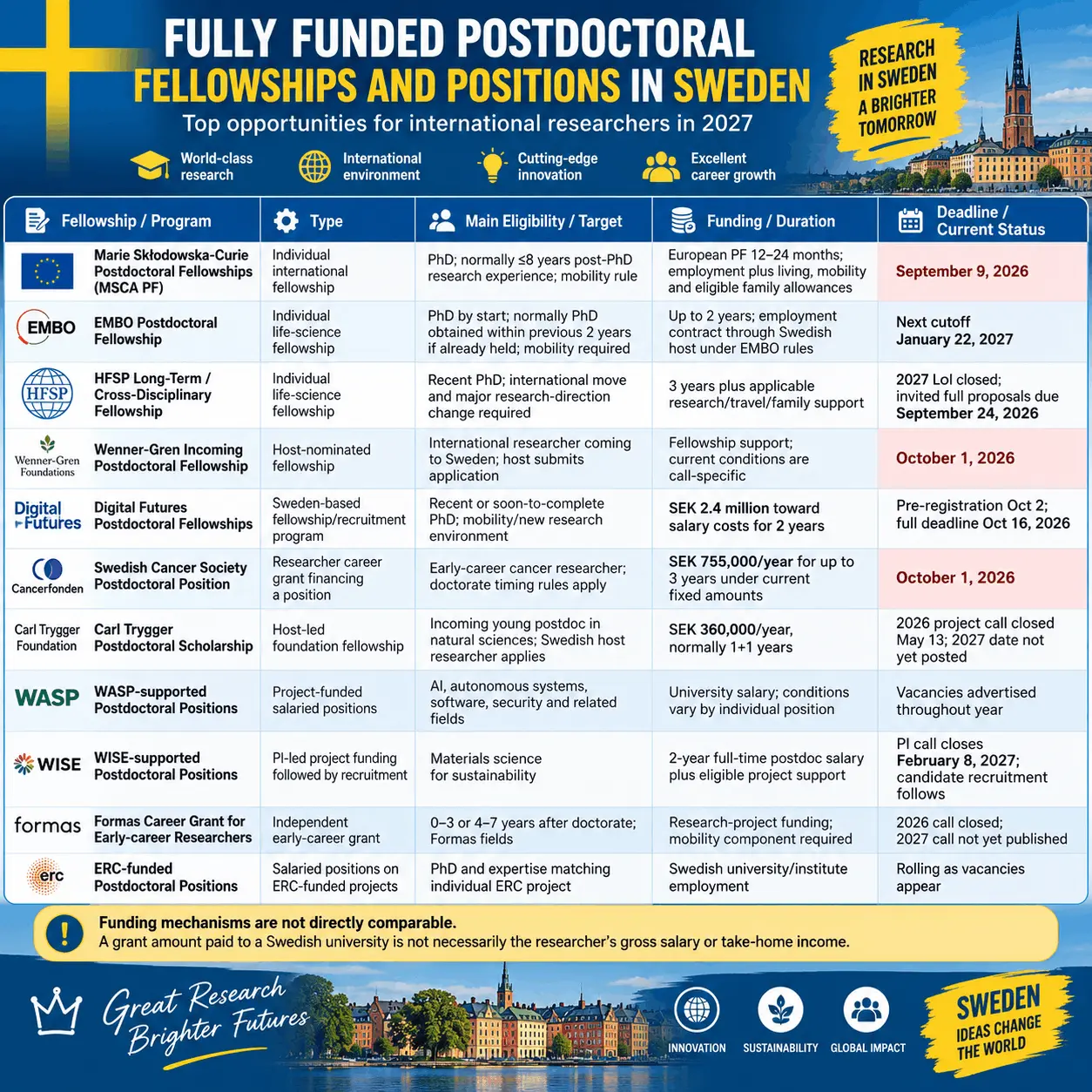
    Important: This guide includes both individual postdoctoral fellowships and fully funded salaried postdoctoral positions supported by Swedish universities, foundations, European programs, and major research initiatives.

    A program such as MSCA, EMBO, HFSP, or Wenner-Gren functions as a fellowship or fellowship-based funding route. By contrast, many WASP-, WISE-, ERC-, or foundation-supported positions are research projects through which a Swedish university later recruits and employs a postdoctoral researcher.

    Both can provide excellent postdoctoral funding, but the application process is different.

    Researchers comparing Sweden with other European destinations can also explore IR Research Publication’s guides to fully funded postdoctoral fellowships in Germany for 2027, postdoctoral fellowships in France for 2027, and postdoctoral fellowships in the Netherlands for 2027.


    Postdoctoral Fellowships in Sweden Currently Open for 2027 Starts

    Applicants targeting a 2027 start should not wait until 2027. Several major competitions are closing during September and October 2026.

    ProgramCurrent StatusKey DeadlineFunding / Duration2027 Relevance
    MSCA Postdoctoral FellowshipsOpenSeptember 9, 2026European PF: 12–24 months; employment through host plus MSCA allowancesFirst projects expected from May 2027
    HFSP Postdoctoral FellowshipsLOI closed; invited applicants onlySeptember 24, 2026 full proposal3-year fellowshipSuccessful fellowships may begin from April 2027
    Wenner-Gren Incoming Postdoctoral FellowshipCurrent 2026 callOctober 1, 2026Fellowship for international researchers moving to SwedenRelevant for 2027 research stays
    Swedish Cancer Society Postdoctoral PositionOpenOctober 1, 2026, 15:00Up to 3 years; grant funds postdoctoral salaryCurrent competition can support upcoming postdoctoral appointment
    Digital Futures Postdoctoral FellowshipsOpenPre-registration October 2, 2026; full application October 16, 2026SEK 2.4 million toward salary costs over 2 yearsProject start June 1, 2027
    EMBO Postdoctoral FellowshipApplications accepted year-roundNext hard cutoff January 22, 2027, 14:00 CETUp to 2 yearsDirect 2027 application opportunity

    The MSCA 2026 call closes September 9 and expects its first funded projects to start around May 2027. Digital Futures currently has a specifically advertised 2027-start competition, while the Swedish Cancer Society and Wenner-Gren both have October 1, 2026 deadlines.


    Summary: Fully Funded Postdoctoral Fellowships and Positions in Sweden

    Fellowship / ProgramTypeMain Eligibility / TargetFunding / DurationDeadline / Current StatusOfficial Information
    Marie Skłodowska-Curie Postdoctoral Fellowships (MSCA PF)Individual international fellowshipPhD; normally ≤8 years post-PhD research experience; mobility ruleEuropean PF 12–24 months; employment plus living, mobility and eligible family allowancesSeptember 9, 2026MSCA Postdoctoral Fellowships
    EMBO Postdoctoral FellowshipIndividual life-science fellowshipPhD by start; normally PhD obtained within previous 2 years if already held; mobility requiredUp to 2 years; employment contract through Swedish host under EMBO rulesNext cutoff January 22, 2027EMBO Postdoctoral Fellowships
    HFSP Long-Term / Cross-Disciplinary FellowshipIndividual life-science fellowshipRecent PhD; international move and major research-direction change required3 years plus applicable research/travel/family support2027 LOI closed; invited full proposals due September 24, 2026HFSP Postdoctoral Fellowships
    Wenner-Gren Incoming Postdoctoral FellowshipHost-nominated fellowshipInternational researcher coming to Sweden; host submits applicationFellowship support; current conditions are call-specificOctober 1, 2026Wenner-Gren Foundations
    Digital Futures Postdoctoral FellowshipsSweden-based fellowship/recruitment programRecent or soon-to-complete PhD; mobility/new research environmentSEK 2.4 million toward salary costs for 2 yearsPre-registration Oct 2; full deadline Oct 16, 2026Digital Futures Postdoctoral Fellowship
    Swedish Cancer Society Postdoctoral PositionResearcher career grant financing a positionEarly-career cancer researcher; doctorate timing rules applySEK 755,000/year for up to 3 years under current fixed amountsOctober 1, 2026Cancerfonden Postdoctoral Position
    Carl Trygger Postdoctoral ScholarshipHost-led foundation fellowshipIncoming young postdoc in natural sciences; Swedish host researcher appliesSEK 360,000/year, normally 1+1 years2026 project call closed May 13; 2027 date not yet postedCarl Trygger Foundation
    WASP-supported Postdoctoral PositionsProject-funded salaried positionsAI, autonomous systems, software, security and related fieldsUniversity salary; conditions vary by individual positionVacancies advertised throughout yearWASP Open Positions
    WISE-supported Postdoctoral PositionsPI-led project funding followed by recruitmentMaterials science for sustainability2-year full-time postdoc salary plus eligible project supportPI call closes February 8, 2027; candidate recruitment followsWISE Academic Projects 2026–2027
    Formas Career Grant for Early-career ResearchersIndependent early-career grant0–3 or 4–7 years after doctorate; Formas fieldsResearch-project funding; mobility component required2026 call closed; 2027 call not yet publishedFormas Career Grant
    ERC-funded Postdoctoral PositionsSalaried positions on ERC-funded projectsPhD and expertise matching individual ERC projectSwedish university/institute employmentRolling as vacancies appearEURAXESS Research Jobs

    Funding mechanisms are not directly comparable. A grant amount paid to a Swedish university is not necessarily the researcher’s gross salary or take-home income.


    1. Marie Skłodowska-Curie Postdoctoral Fellowships in Sweden

    The Marie Skłodowska-Curie Actions Postdoctoral Fellowship (MSCA PF) is one of the strongest options for international researchers who want to conduct postdoctoral research at a Swedish university or research organization.

    European Postdoctoral Fellowships are open across disciplines and can be hosted by eligible academic or non-academic institutions in Sweden.

    Funding and Duration

    European Postdoctoral Fellowships normally last 12–24 months.

    MSCA funding supports the recruited researcher through:

    • living allowance;
    • mobility allowance;
    • family allowance when applicable;
    • long-term-leave and special-needs support where applicable.

    The host also receives funding for research, training, networking, management, and indirect costs.

    The host beneficiary recruits the successful researcher for the fellowship period.

    Eligibility

    Applicants must generally:

    • hold a PhD by the call deadline or have successfully defended the doctoral thesis;
    • have no more than eight years of research experience after the PhD, subject to specified exclusions;
    • satisfy the MSCA mobility rule.

    For an MSCA European Fellowship with a Swedish host, applicants must not have resided or carried out their main activity in Sweden for more than 12 months during the 36 months immediately before the application deadline.

    2026–2027 Timeline

    • Call opened: April 9, 2026
    • Application deadline: September 9, 2026
    • Expected results: February 2027
    • First projects expected to start: approximately May 2027

    Official MSCA Postdoctoral Fellowship information


    2. EMBO Postdoctoral Fellowships in Sweden

    The EMBO Postdoctoral Fellowship is a prestigious option for researchers in molecular biology and related life-science fields who want to move to a Swedish research environment.

    Sweden is part of the European Molecular Biology Conference framework, making Swedish life-science laboratories attractive potential hosts.

    Eligibility

    Important current eligibility requirements include:

    • applicants must hold a doctorate or equivalent by the fellowship start;
    • researchers who already hold a PhD when applying normally must have obtained it within the two years before application;
    • researchers who have already joined the proposed host laboratory generally must have been living in the host country for less than six months at application;
    • the proposed project cannot simply be a direct continuation of the PhD research.

    Funding

    For fellows hosted in EMBC Member States such as Sweden, EMBO provides funding to the host institution so it can issue an employment contract to the fellow.

    Eligible relocation and childcare-related support may also be available under EMBO rules.

    Deadline

    Applications are accepted throughout the year.

    The next current hard cutoff is:

    January 22, 2027 at 14:00 CET.

    EMBO Postdoctoral Fellowships


    3. HFSP Postdoctoral Fellowships

    The Human Frontier Science Program (HFSP) supports highly innovative and potentially transformative basic life-science research.

    It offers:

    • Long-Term Fellowships (LTF) for applicants trained primarily in biological disciplines;
    • Cross-Disciplinary Fellowships (CDF) for researchers trained in areas such as physics, chemistry, mathematics, engineering, or computer science who are moving into life-science research.

    Duration

    HFSP fellowships provide three years of support.

    Funding includes a living allowance and additional support under applicable rules for research, travel, relocation, and family circumstances.

    Strict Eligibility and Mobility Rules

    HFSP is considerably more restrictive than a normal international postdoc vacancy.

    For the 2027 cycle, the doctoral degree generally must not have been conferred more than three years before the September 24, 2026 full-proposal deadline, subject to eligible career-interruption exceptions.

    HFSP also emphasizes:

    • an international move;
    • a significant change in research direction;
    • frontier biological questions;
    • independence from previous supervisors and research environments.

    2027 Application Status

    The Letter of Intent stage for the 2027 cycle has already closed.

    Only applicants invited after the LOI review can submit the full proposal.

    Invited full-proposal deadline: September 24, 2026.

    Successful candidates may begin their fellowship from April 2027.

    HFSP Postdoctoral Fellowships


    4. Wenner-Gren Postdoctoral Fellowships for Researchers Coming to Sweden

    The Wenner-Gren Foundations provide an important Sweden-specific route for bringing international postdoctoral researchers into Swedish research environments.

    The current call is specifically listed by Uppsala University as providing postdoctoral grants for incoming fellows, with a deadline of October 1, 2026.

    How the Application Works

    Unlike MSCA, where the researcher and host develop an application together within an EU funding framework, Wenner-Gren applications for incoming postdoctoral fellows are normally submitted by the Swedish host researcher for a selected international candidate.

    Applicants should therefore identify and contact a Swedish PI well ahead of the foundation deadline.

    Current call information indicates that the scheme is intended to bring researchers from outside Sweden into Swedish research environments.

    Who Should Consider Wenner-Gren?

    It is particularly relevant if you:

    • currently work outside Sweden;
    • want to join a Swedish research group;
    • have recently completed your PhD;
    • have already identified a potential Swedish host;
    • are seeking a fellowship route rather than waiting for an advertised salaried vacancy.

    Wenner-Gren Foundations official website


    5. Digital Futures Postdoctoral Fellowships

    The Digital Futures Postdoctoral Fellowship is one of the best currently open opportunities specifically targeting researchers who can begin a fellowship in Sweden in 2027.

    Digital Futures is a cross-disciplinary research center established by KTH Royal Institute of Technology, Stockholm University, and RISE Research Institutes of Sweden, with additional academic, industry, public-sector, and healthcare partners.

    Research Areas

    Projects can address digital transformation in areas such as:

    • artificial intelligence;
    • trustworthy digital systems;
    • digitalized industry;
    • smart society;
    • health and life;
    • education;
    • cooperation and learning;
    • emerging digital technologies.

    Funding

    The current call offers:

    SEK 2.4 million toward salary costs for two years for each employed postdoctoral fellow.

    This amount is transferred to the main supervisor responsible for employing the fellow—it should not be interpreted as the researcher’s take-home salary.

    The fellowship also provides access to:

    • research infrastructure;
    • academic and industrial networks;
    • mentorship;
    • career development;
    • research-leadership training.

    Eligibility

    Applicants must hold a doctoral degree before starting the fellowship.

    The program emphasizes mobility and researchers moving into a new research group and institution.

    Applications require both a main supervisor and co-supervisor within the eligible Digital Futures environment.

    2026–2027 Dates

    • Call opened: August 18, 2026
    • Mandatory pre-registration: October 2, 2026
    • Full application deadline: October 16, 2026
    • Decision: December 2026
    • Project start: June 1, 2027

    Digital Futures Postdoctoral Fellowship call


    6. Swedish Cancer Society Postdoctoral Position

    Researchers working in cancer biology, oncology, cancer immunology, epidemiology, therapeutics, prevention, or related areas should strongly consider the Swedish Cancer Society (Cancerfonden) Postdoctoral Position.

    Current Eligibility

    For the current 2026 competition, applicants generally must have completed their doctorate on or after July 1, 2023, but no later than December 31, 2026, subject to eligible deductions for circumstances such as parental or qualifying medical leave.

    The Swedish Cancer Society particularly values:

    • mobility;
    • scientific excellence;
    • cancer relevance;
    • development of an independent research direction.

    Duration and Funding

    The grant can support a postdoctoral position for a maximum of three years.

    Current fixed grant amounts list:

    • SEK 755,000 per year
    • SEK 2,265,000 total over three years

    The funding is paid to a Swedish university, and the actual salary is determined by the employer. The grant must be used to finance the postdoctoral position.

    Can the Research Be Done Abroad?

    Yes.

    The fellowship can support a postdoctoral period in Sweden or abroad.

    However, when the postdoctoral period is conducted abroad, the third and final year must be completed at the Swedish host institution in Sweden.

    Deadline

    October 1, 2026 at 15:00.

    Swedish Cancer Society Postdoctoral Position


    7. Carl Trygger Foundation Postdoctoral Scholarships

    The Carl Trygger Foundation for Scientific Research supports research in broad natural-science fields including:

    • physics;
    • chemistry;
    • engineering;
    • biology;
    • ecology;
    • geology;
    • forestry;
    • agricultural sciences.

    Importantly, medical research falls outside the foundation’s scope.

    Postdoctoral Funding

    From 2026, the foundation states that its postdoctoral scholarship normally provides:

    SEK 360,000 per year, usually for two years (1+1 years).

    Who Applies?

    The postdoctoral researcher does not normally submit the grant directly.

    A researcher at the Swedish host institution applies for funding for the incoming postdoc.

    The candidate should normally:

    • hold a doctorate;
    • be an early-career researcher;
    • have obtained the doctorate at an institution different from the host;
    • not already be established at the proposed Swedish host institution.

    The doctorate generally should not be older than six years at admission unless special circumstances apply.

    Deadline

    The foundation states that research-project applications are accepted in May each year.

    The 2026 project deadline was May 13, 2026. The specific 2027 deadline has not yet been posted.

    Carl Trygger Foundation


    8. WASP-Supported Postdoctoral Positions in Sweden

    The Wallenberg AI, Autonomous Systems and Software Program (WASP) is Sweden’s largest individual research program in artificial intelligence, autonomous systems, and software.

    Postdoctoral researchers can join WASP-funded research through salaried university positions across participating Swedish institutions.

    Important Distinction

    There is not one generic “WASP Postdoctoral Fellowship in Sweden” with a single eligibility rule and deadline.

    Instead, WASP supports:

    • specific research projects;
    • individual postdoctoral vacancies;
    • industrial research initiatives;
    • targeted research calls.

    WASP’s positions page currently lists individual salaried postdoctoral vacancies with their own deadlines.

    Fields

    Relevant areas include:

    • artificial intelligence;
    • machine learning;
    • robotics;
    • autonomous systems;
    • cybersecurity;
    • software engineering;
    • mathematical foundations of AI;
    • optimization;
    • computer vision.

    Important Note About the WASP International Postdoctoral Scholarship

    WASP also operates an International Postdoctoral Scholarship, but this is designed specifically for researchers who completed their PhD within WASP and want to undertake postdoctoral study at leading universities outside Sweden.

    It should therefore not be confused with WASP-funded postdoctoral positions based in Sweden.

    Current WASP research positions


    9. WISE-Supported Postdoctoral Positions

    The Wallenberg Initiative Materials Science for Sustainability (WISE) is a major Swedish investment in materials science.

    WISE supports research addressing areas such as:

    • sustainable materials;
    • energy technologies;
    • advanced manufacturing;
    • recycling;
    • resource efficiency;
    • chemistry;
    • physics;
    • engineering;
    • environmentally responsible materials design.

    Current 2026–2027 Call

    WISE’s Academic Projects 3 call will fund:

    • up to 29 academic postdoctoral researcher positions;
    • up to 29 PhD positions.

    However, the researchers applying to this current funding call are principal investigators, not prospective postdoctoral candidates.

    Once projects receive funding, the relevant Swedish universities can recruit the postdocs.

    Postdoctoral Funding

    The current call funds:

    • salary for a postdoc for two years full-time;
    • possible extension to 2.5 years if research is conducted at 80%;
    • mentorship;
    • eligible travel to WISE events;
    • specified consumables and sustainability-expertise contributions.

    Timeline

    • Application portal opens: December 1, 2026
    • PI application deadline: February 8, 2027
    • Funding decisions: approximately May 2027
    • Candidates expected to be ready to start by: August 1, 2028

    Therefore, this particular WISE call should not be advertised as a direct 2027 postdoc application for individual researchers.

    Researchers seeking a 2027 start should instead monitor vacancies arising from already funded WISE projects.

    WISE Academic Projects 2026–2027


    10. Formas Career Grant for Early-Career Researchers

    Formas is the Swedish Research Council for Sustainable Development.

    Its current early-career scheme is called:

    Career Grant for Early-career Researchers

    This replaces older terminology that may still appear online referring to Formas mobility grants.

    The scheme supports researchers who want to develop an independent project within Formas’s areas:

    • environment;
    • agricultural sciences;
    • spatial planning;
    • sustainability-related research.

    Career Tracks

    The current scheme has two tracks:

    • 0–3 years after the doctorate
    • 4–7 years after the doctorate

    A mobility component is built into the funding model.

    Is It a Postdoctoral Fellowship?

    Not exactly.

    This is an independent early-career research grant, so it is better suited to researchers who are transitioning toward scientific independence rather than simply seeking a standard supervised postdoctoral position.

    Current Status

    The 2026 competition ran from January 20 to March 4, 2026.

    The program is recurring and normally opens near the beginning of the year, but the detailed 2027 call has not yet been published.

    Formas Career Grant for Early-career Researchers


    11. ERC-Funded Postdoctoral Positions in Sweden

    The European Research Council (ERC) does not operate a general postdoctoral fellowship for individual candidates.

    Instead, ERC awards major grants to principal investigators.

    Those ERC-funded research groups frequently recruit:

    • postdoctoral researchers;
    • research scientists;
    • research engineers;
    • data scientists;
    • technical specialists.

    A Swedish ERC-funded postdoc is therefore usually a salaried university or institute position, rather than an ERC fellowship awarded directly to the candidate.

    How to Find Them

    Search:

    • individual Swedish university vacancy pages;
    • research-group websites;
    • EURAXESS;
    • academic job portals.

    Search research jobs on EURAXESS

    IR Research Publication also maintains a regularly updated research jobs and postdoctoral opportunities page.


    What About the MIMS “Excellence by Choice” Postdoctoral Programme?

    Older fellowship lists may include the Excellence by Choice Postdoctoral Programme at UmeĂĄ University/MIMS.

    It is an excellent program—but it should not currently be advertised as an open 2027 fellowship.

    The program was designed to fund 17 international postdoctoral fellows during its 2021–2026 cycle. UmeĂĄ University’s current information indicates that the fellows have been recruited, and earlier program material identified the later recruitment round as the final call.

    As of this review, no new 2027 Excellence by Choice competition has been confirmed.

    Researchers interested in UmeĂĄ should instead monitor UmeĂĄ University and MIMS vacancies for new postdoctoral opportunities.


    How Much Do Postdocs Earn in Sweden?

    There is no single national “Sweden postdoc salary.”

    For ordinary salaried university postdoctoral positions, compensation depends on factors such as:

    • host university;
    • collective and local salary agreements;
    • discipline;
    • relevant experience;
    • funding source;
    • individual salary negotiation.

    For externally funded programs, the amount published by the funder may represent the total employment cost paid to the university, not the researcher’s gross salary.

    For example:

    • Digital Futures provides SEK 2.4 million toward salary costs over two years;
    • Cancerfonden currently allocates SEK 755,000 annually for its postdoctoral-position grant;
    • these figures should not be interpreted as annual take-home salary.

    Researchers comparing fellowship compensation internationally may find IR Research Publication’s guide to the highest-paying postdoctoral fellowships worldwide useful.


    Are Postdocs in Sweden Employees?

    Many ordinary university postdoctoral researchers are employed under fixed-term university contracts and receive Swedish employment benefits.

    Depending on the employer and funding arrangement, these can include:

    • paid annual leave;
    • pension contributions;
    • parental-leave protections;
    • sick-leave provisions;
    • social-security coverage.

    However, this does not apply identically to every fellowship.

    A tax-free scholarship or fellowship can have different legal, pension, insurance, and social-security consequences compared with salaried employment.

    Before accepting an offer, always determine whether you will be:

    1. a university employee;
    2. a scholarship recipient;
    3. employed through an externally financed position; or
    4. funded through another arrangement.

    Can International Researchers Apply for Postdocs in Sweden?

    Yes.

    Swedish universities and many major fellowship programs recruit researchers internationally.

    Programs such as:

    • MSCA;
    • EMBO;
    • HFSP;
    • Wenner-Gren;
    • Digital Futures;

    are specifically designed to support international mobility or strongly welcome international applicants.

    However, each program has its own rules regarding:

    • time since PhD;
    • nationality;
    • residence history;
    • previous time in Sweden;
    • relationship with the host;
    • previous research topic;
    • research mobility.

    Never assume that being an international applicant automatically makes you eligible.


    Do You Need to Speak Swedish?

    For many internationally recruited research postdocs—particularly in STEM, engineering, data science, and biomedical research—English is commonly the working language.

    Swedish is therefore often not required for research-focused positions.

    However, Swedish proficiency may be necessary or advantageous when a position involves:

    • clinical work;
    • teaching in Swedish;
    • patient communication;
    • Swedish-language interviews or datasets;
    • significant public engagement.

    Always check the individual vacancy.


    How to Find a Postdoctoral Host in Sweden

    For fellowship applications such as MSCA, EMBO, HFSP, and Wenner-Gren, finding the right supervisor is one of the most important steps.

    Major research environments include:

    Life Sciences and Medicine

    • Karolinska Institutet
    • Uppsala University
    • Lund University
    • UmeĂĄ University
    • University of Gothenburg
    • SciLifeLab

    Engineering, AI and Technology

    • KTH Royal Institute of Technology
    • Chalmers University of Technology
    • Linköping University
    • Lund University
    • Uppsala University
    • UmeĂĄ University

    Materials and Sustainability

    • KTH
    • Chalmers
    • Linköping
    • Lund
    • Uppsala
    • Stockholm University
    • LuleĂĄ University of Technology
    • WISE-associated environments

    Researchers who are not sure where to begin can use our detailed guide on how to find postdoctoral fellowship opportunities around the world.


    How to Contact a Swedish Professor for a Fellowship

    Do not send a generic message saying:

    “I am looking for any postdoctoral position in your laboratory.”

    Instead, briefly explain:

    • your current research area;
    • major techniques or expertise;
    • your strongest research accomplishment;
    • why the professor’s work specifically interests you;
    • the fellowship you want to target;
    • a potential research direction;
    • how your expertise complements the host laboratory.

    For host-nominated programs such as Wenner-Gren or Carl Trygger, contacting the PI early is particularly important because the host may need to select one candidate and formally submit the funding application.


    How to Make Your Sweden Postdoc Application Competitive

    1. Check Eligibility Before Writing the Proposal

    Verify:

    • date of PhD;
    • mobility requirements;
    • residence history;
    • nationality restrictions;
    • previous work at the host;
    • previous collaborations;
    • field restrictions.

    HFSP, MSCA, EMBO, Cancerfonden, and Wenner-Gren all contain eligibility rules capable of disqualifying an otherwise excellent application.

    2. Explain Why You Need the Swedish Host

    Do not rely on the university’s reputation alone.

    Explain the specific:

    • expertise;
    • technology;
    • datasets;
    • research infrastructure;
    • patient cohorts;
    • collaborators;
    • computational resources;
    • methodologies;

    that make the host essential to your project.

    3. Demonstrate Scientific Independence

    A strong postdoctoral proposal should show how your project develops beyond your PhD.

    Reviewers should understand:

    • what expertise you already bring;
    • what you will learn;
    • which research questions are yours;
    • how the fellowship advances your independent research identity.

    4. Build a Strong Training Plan

    This is especially important for MSCA.

    Consider:

    • technical training;
    • leadership development;
    • grant writing;
    • teaching;
    • data science;
    • industry exposure;
    • secondments;
    • entrepreneurship;
    • science communication.

    5. Apply to Multiple Funding Routes

    A life-science researcher seeking a Swedish host might simultaneously evaluate:

    MSCA + EMBO + HFSP + Wenner-Gren + discipline-specific foundations + advertised university postdoc positions.

    A computational researcher could consider:

    MSCA + Digital Futures + WASP-funded vacancies + ERC-funded postdocs.

    A materials scientist might consider:

    MSCA + Carl Trygger + WISE-supported vacancies + ERC-funded positions.


    When Should You Apply for a 2027 Postdoc in Sweden?

    A useful planning timeline is:

    September–October 2026

    Apply immediately to relevant active programs such as:

    • MSCA
    • invited HFSP full proposals
    • Wenner-Gren
    • Swedish Cancer Society
    • Digital Futures

    November 2026–January 2027

    • prepare EMBO applications;
    • monitor new Swedish university vacancies;
    • follow WASP positions;
    • identify newly funded research projects;
    • contact potential hosts.

    Early 2027

    Monitor:

    • new university postdoc advertisements;
    • Formas’s next Career Grant competition;
    • foundation funding rounds;
    • ERC-funded laboratories;
    • WISE-related future recruitment.

    Because many salaried postdoc positions are advertised throughout the year, researchers should continue monitoring Swedish university vacancy pages even after fellowship deadlines pass.


    Frequently Asked Questions

    Are postdoctoral fellowships in Sweden fully funded?

    Many are.

    However, “fully funded” can mean different things.

    Some programs provide:

    • an employment contract and salary;

    while others provide:

    • a fellowship or stipend;
    • a grant to the host university that finances the postdoctoral position.

    Travel, research, relocation, childcare, and family support differ by scheme.


    Which Sweden postdoctoral fellowships are currently open for 2027?

    As of September 5, 2026, major relevant opportunities include:

    • MSCA Postdoctoral Fellowships — deadline September 9, 2026
    • Swedish Cancer Society Postdoctoral Position — October 1, 2026
    • Wenner-Gren incoming postdoc funding — October 1, 2026
    • Digital Futures — pre-registration October 2 and full application October 16, 2026
    • EMBO — next hard cutoff January 22, 2027

    HFSP’s initial 2027 application stage has already closed; only invited applicants can submit a full proposal.


    Can Indian researchers apply for postdocs in Sweden?

    Yes, Indian researchers can apply for many Swedish and European fellowship programs if they satisfy the individual eligibility rules.

    Potential options include:

    • MSCA;
    • EMBO;
    • HFSP;
    • Wenner-Gren;
    • Digital Futures;
    • advertised salaried Swedish university positions.

    Eligibility should still be checked individually because mobility and post-PhD timing rules vary substantially.


    Do I need a Swedish host before applying?

    For many fellowships, yes.

    Programs such as MSCA, HFSP, Wenner-Gren, and host-led Carl Trygger funding require a Swedish research environment to be identified before the application is completed.

    Digital Futures also requires eligible supervisors.

    By contrast, ordinary salaried postdoctoral vacancies involve applying directly to an already defined research position.


    Is EMBO available for postdoctoral research in Sweden?

    Yes.

    Swedish life-science research institutions can host eligible EMBO fellows.

    International mobility and the timing of the applicant’s PhD are particularly important eligibility considerations.


    Is Swedish required for a postdoc?

    Usually not for internationally recruited research-focused positions, but some clinical, teaching, or public-facing roles may require Swedish.


    What is the best fellowship for an international postdoc in Sweden?

    There is no single best option.

    For broad international mobility:

    MSCA is one of the strongest.

    For molecular and life sciences:

    EMBO is highly attractive.

    For frontier interdisciplinary biology:

    HFSP is exceptionally prestigious.

    For international researchers specifically moving into Sweden:

    Wenner-Gren is particularly relevant.

    For digital technologies and AI:

    Digital Futures and WASP-supported positions are strong options.

    For cancer researchers:

    Cancerfonden deserves close consideration.


    Final Application Checklist

    Before applying for a postdoctoral fellowship in Sweden, confirm:

    • I satisfy the PhD-date requirement.
    • I meet the mobility rule.
    • I meet any nationality requirements.
    • My Swedish host is eligible.
    • My previous residence in Sweden does not make me ineligible.
    • My relationship with the proposed supervisor complies with the program rules.
    • My proposal clearly differs from my PhD work where required.
    • I understand whether the funding is salary, stipend, or host-administered grant.
    • I understand the tax and social-security implications of the funding model.
    • My CV is tailored to the fellowship.
    • My research proposal demonstrates independence.
    • My host has reviewed the proposal.
    • Recommendation letters have been requested early.
    • I have checked the exact official deadline and time zone.
    • I have identified at least one alternative funding route.

    Conclusion: Fully Funded Postdoctoral Fellowships in Sweden 2027

    Sweden offers an excellent range of opportunities for researchers seeking fully funded postdoctoral fellowships in Sweden for 2027, but applicants should distinguish carefully between true individual fellowships and project-funded salaried postdoctoral jobs.

    For researchers targeting a 2027 start, several important opportunities are already active in 2026.

    The MSCA Postdoctoral Fellowship closes on September 9, 2026. The Swedish Cancer Society and Wenner-Gren have October 1 deadlines, while Digital Futures has a mandatory October 2 pre-registration followed by an October 16 application deadline. EMBO accepts applications throughout the year, with its next hard cutoff on January 22, 2027.

    HFSP remains one of the world’s most prestigious life-science fellowships, but its initial 2027 application stage has already closed.

    Researchers should also monitor WASP, WISE, ERC-funded laboratories, Carl Trygger-supported projects, Formas, and individual Swedish universities for additional funded postdoctoral positions.

    Start early, verify mobility and PhD-date rules before preparing the application, identify a strong Swedish host, and apply across several suitable funding routes rather than depending on one fellowship.

    For additional guidance, explore IR Research Publication’s global guide to finding postdoctoral fellowships and our latest research jobs and postdoctoral opportunities.


    Related Articles


    About IR Research Publication

    IR Research Publication is a research and academic-career platform supporting students, scientists, and scholars with practical information on research funding, postdoctoral fellowships, PhD opportunities, academic publishing, and career development.

    Our fellowship guides focus on credible opportunities and emphasize verification of eligibility, funding, mobility requirements, deadlines, and host conditions through current official sources.


    Last reviewed: September 5, 2026

    Disclaimer: Fellowship rules, deadlines, grant amounts, employment conditions, and eligibility requirements may change. Applicants should always confirm the latest call documentation on the official funder’s or host institution’s website before applying.

  • Fully Funded PhD Scholarships in Sweden 2027: Salaried PhD Positions at Top Universities

    Fully Funded PhD Scholarships in Sweden 2027: Salaried PhD Positions at Top Universities


    Fully Funded PhD Scholarships in Sweden 2027: What Applicants Need to Know

    Sweden is one of Europe’s most attractive destinations for international PhD applicants. Its doctoral education model differs significantly from countries where students pay tuition and depend mainly on scholarships.

    In Sweden, most funded PhD candidates are employed as doctoral students by their university. Instead of receiving only a scholarship or stipend, they typically receive a monthly salary, paid leave, pension contributions, parental benefits, and other employment-related benefits according to Swedish law and applicable university agreements.

    That makes Sweden particularly attractive for international researchers looking for financially secure doctoral training.

    However, there is one important terminology issue.

    Important: What international applicants often search for as a “fully funded PhD scholarship in Sweden” is usually a salaried doctoral student position rather than a conventional scholarship.

    Some doctoral candidates may instead be externally employed, industry-funded, or supported through approved scholarship arrangements, so applicants should always check the funding model specified in each vacancy.

    KTH, for example, states that most of its doctoral students are salaried employees, although industrial doctoral students and scholarship-funded doctoral students also exist.

    Why Choose Sweden for a PhD?

    Sweden offers:

    • Salaried doctoral positions at many universities
    • No tuition fees for doctoral education
    • International and English-friendly research environments
    • Strong employee protections
    • Excellent research infrastructure
    • Generous parental and annual-leave systems
    • Strong collaboration between academia and industry
    • Major national investments in AI, sustainability, materials science, life sciences, and data-driven research
    • Globally recognized universities and research institutes

    Researchers comparing European destinations may also find our guide on how to find fully funded PhD positions in Europe useful.


    Are These Really “2027 PhD Scholarships”?

    Most Swedish universities do not operate a single annual competition called a “2027 PhD scholarship.”

    Instead, funded doctoral vacancies are usually advertised individually throughout the year when departments, supervisors, research programs, or external grants have funding available.

    Therefore, the universities and initiatives below should be viewed primarily as major sources of salaried and fully funded PhD opportunities for applicants targeting a 2027 start.

    Some positions beginning in 2027 may be advertised during late 2026, while others may appear throughout 2027.

    Tip: Do not wait until 2027 to begin searching. Applicants targeting a 2027 PhD should start monitoring vacancies during late 2026.


    Top Fully Funded PhD Scholarships and Salaried PhD Positions in Sweden 2027

    Major Swedish Universities

    University / ProgramHost InstitutionTypical EligibilityFunding / Salary2027 Application TimelineOfficial Link
    KTH Doctoral PositionsKTH Royal Institute of TechnologySecond-cycle qualification or equivalent; project-specific requirementsMost doctoral candidates are salaried university employees; current KTH doctoral salary ladder starts at SEK 33,700/month before taxVaries by vacancyOfficial Website
    Lund University PhD PositionsLund UniversityRelevant second-cycle qualification; project-specific academic and language requirementsMost advertised funded doctoral positions provide employment and salaryVaries by vacancyOfficial Vacancies
    Uppsala University Doctoral StudiesUppsala UniversitySecond-cycle qualification or equivalent plus subject-specific eligibilityFunded doctoral positions normally involve employment as a doctoral studentVaries by vacancyOfficial Website
    Karolinska Institutet Doctoral EducationKarolinska InstitutetRelevant advanced/second-cycle education; English and project-specific requirementsFunding arrangement depends on the doctoral position; university employment and other approved funding routes existVaries by projectOfficial Website
    Chalmers PhD PositionsChalmers University of TechnologyRelevant master’s/second-cycle education; project-specific requirementsDoctoral positions are generally salaried employmentVaries by vacancyOfficial Vacancies
    Stockholm University PhD PositionsStockholm UniversityGeneral and subject-specific third-cycle eligibility requirementsAdvertised doctoral positions generally include employment and salaryVaries by departmentOfficial Website
    Linköping University Doctoral PositionsLinköping UniversityRelevant master’s/second-cycle qualification; project fitDoctoral student employment with salary where specified in the vacancyVaries by vacancyOfficial Vacancies
    UmeĂĄ University Doctoral StudiesUmeĂĄ UniversityRelevant second-cycle qualification and subject-specific eligibilityMost funded positions provide doctoral student employmentVaries by vacancyOfficial Website
    SLU Doctoral PositionsSwedish University of Agricultural SciencesRelevant academic background; subject-specific requirementsFunded doctoral employment depending on positionVaries by vacancyOfficial Doctoral Studies
    University of Gothenburg PhD PositionsUniversity of GothenburgRelevant second-cycle qualification and project-specific eligibilityDoctoral student employment with salary for advertised positionsVaries by vacancyOfficial Vacancies

    National Research Initiatives Supporting PhD Positions

    Research InitiativeMain FieldsParticipating InstitutionsFunding Model2027 Status / TimelineOfficial Link
    WASP Graduate SchoolAI, autonomous systems, software, mathematicsChalmers, KTH, Linköping, Lund, Umeå, Uppsala and affiliated institutionsPhD candidate generally employed by host university; WASP supports graduate training and research networkAssociated vacancies appear through participating universities and projectsOfficial Website
    WISE Graduate SchoolMaterials science for sustainabilityMultiple Swedish universitiesFunded doctoral projects at partner universities plus WISE graduate trainingCurrent academic project call closes in 2027, but resulting candidates may begin as late as 2028Official Website
    DDLS Research SchoolData-driven life science, AI, bioinformatics, precision medicineSwedish universities within SciLifeLab/DDLS networkAcademic and industrial PhD positions recruited by participating universitiesMultiple funded projects are moving through individual university recruitmentOfficial PhD Projects

    Funding, salaries, eligibility rules, and deadlines may change. Always verify the current vacancy and official university documentation before applying.


    Eligibility for a PhD in Sweden

    Applicants often assume that every Swedish PhD strictly requires a master’s degree. A master’s degree is indeed the most common route, but Sweden’s official national rules are slightly broader.

    Under the Swedish Higher Education Ordinance, a person generally meets the entry requirements for third-cycle doctoral education if they have:

    1. been awarded a second-cycle qualification, or
    2. completed at least 240 higher-education credits, including at least 60 credits at second-cycle level, or
    3. acquired substantially equivalent knowledge in another way in Sweden or abroad.

    Individual universities and doctoral subjects can impose additional specific eligibility requirements.

    These may include:

    • particular master’s-level courses;
    • subject-specific credits;
    • laboratory or research experience;
    • programming or statistical skills;
    • thesis experience;
    • English proficiency;
    • professional qualifications;
    • project-specific technical skills.

    International applicants should therefore evaluate both general eligibility and the specific requirements stated in the PhD vacancy.


    How Much Do PhD Students Earn in Sweden?

    One of the most searched questions about doctoral study in Sweden is the PhD salary.

    There is no single national salary that applies identically to every Swedish university. Salary structures are negotiated under applicable agreements and may differ between universities.

    Many institutions use a progression-based doctoral salary system where salary increases as the researcher completes milestones toward the PhD.

    KTH PhD Salary Example

    At KTH Royal Institute of Technology, the doctoral student salary ladder effective from October 1, 2025 is:

    Doctoral ProgressMonthly Salary Before Tax
    Initial salarySEK 33,700
    30% progressSEK 34,700
    50% progressSEK 36,700
    80% progressSEK 38,500

    These are KTH-specific figures, not a universal Swedish PhD salary.

    Applicants should check the individual university’s doctoral salary agreement before accepting an offer.

    PhD salaries are generally taxable in Sweden.


    1. KTH Royal Institute of Technology Doctoral Positions

    Overview

    KTH Royal Institute of Technology in Stockholm is one of Sweden’s leading universities for engineering, technology, computer science, energy, materials, sustainability, and applied sciences.

    Doctoral positions are normally connected to specific research projects or research groups and are advertised as job vacancies.

    Funding and Benefits

    KTH states that most doctoral students are salaried university employees.

    Employment can provide access to benefits such as:

    • Monthly salary
    • Occupational pension
    • Paid annual leave
    • Parental benefits
    • Sickness-related benefits
    • Swedish social-security protections
    • Research and training resources

    Some doctoral candidates may instead be industrial doctoral students or receive other approved forms of funding.

    Eligibility

    General Swedish third-cycle eligibility applies, together with specific requirements for the advertised doctoral position.

    Applicants may need expertise in areas such as:

    • Engineering
    • Computer science
    • Mathematics
    • AI
    • Physics
    • Chemistry
    • Biotechnology
    • Energy
    • Materials science

    Application

    Candidates apply directly to advertised doctoral positions rather than submitting one general annual PhD application.

    KTH Doctoral Studies


    2. Lund University PhD Positions

    Overview

    Lund University is one of Scandinavia’s major comprehensive research universities, with strengths in:

    • Life sciences
    • Medicine
    • Engineering
    • Physics
    • Chemistry
    • Environmental sciences
    • Humanities
    • Social sciences

    The university also benefits from proximity to major research infrastructures such as MAX IV and the European Spallation Source (ESS).

    Funding

    Funded doctoral opportunities are typically advertised as positions with employment conditions stated in the individual vacancy.

    Eligibility

    Candidates generally need a relevant second-cycle qualification or equivalent and must meet subject-specific eligibility requirements.

    Application

    Search Lund University’s official vacancies portal and apply to each relevant doctoral position individually.

    Lund University Vacancies


    3. Uppsala University Doctoral Studies

    Overview

    Founded in 1477, Uppsala University is one of Europe’s oldest universities and a major Swedish research institution.

    Its strengths include:

    • Medicine
    • Pharmacy
    • Biology
    • Chemistry
    • Physics
    • Technology
    • Humanities
    • Social sciences
    • Data science

    Funding

    Doctoral positions are commonly advertised as paid employment opportunities.

    Eligibility

    Applicants need to satisfy general Swedish doctoral entry requirements together with the requirements of the relevant faculty or research subject.

    Important WASP Update

    In February 2026, Uppsala University became a full partner university in the Wallenberg AI, Autonomous Systems and Software Program (WASP), strengthening opportunities in AI, machine learning, mathematics, autonomous systems, and software research.

    Uppsala University PhD Studies


    4. Karolinska Institutet Doctoral Education

    Overview

    Karolinska Institutet is one of Europe’s leading medical research universities and an excellent destination for doctoral candidates interested in:

    • Molecular medicine
    • Cancer
    • Neuroscience
    • Pharmacology
    • Epidemiology
    • Public health
    • Immunology
    • Translational medicine
    • Clinical sciences

    Funding

    Applicants should pay particular attention to the funding arrangement specified for each project.

    Doctoral financing can involve doctoral student employment or other approved arrangements depending on the project and employer.

    Therefore, applicants should not automatically assume every KI doctoral candidate has an identical KI employment contract.

    Application

    Doctoral projects and positions are advertised through KI and individual research environments.

    Karolinska Institutet Doctoral Education

    Researchers in biomedical science may also want to monitor IR Research Publication’s research jobs page for regularly curated PhD, postdoctoral, and research opportunities.


    5. Chalmers University of Technology PhD Positions

    Overview

    Chalmers University of Technology in Gothenburg is particularly strong in:

    • Engineering
    • Materials
    • Nanoscience
    • AI
    • Energy
    • Sustainability
    • Chemistry
    • Mobility and transportation
    • Maritime research

    Doctoral students frequently work in interdisciplinary academic-industrial collaborations.

    Funding

    PhD candidates recruited to funded doctoral positions are generally employed and receive salary according to relevant employment arrangements.

    Application

    Candidates apply directly to advertised doctoral vacancies.

    Chalmers Vacancies


    6. Stockholm University PhD Studies

    Overview

    Stockholm University offers doctoral education across a broad range of fields, including:

    • Environmental science
    • Biology
    • Chemistry
    • Physics
    • Mathematics
    • Computer science
    • Economics
    • Social sciences
    • Humanities

    Funding

    Doctoral positions are typically advertised through departments and the university recruitment system.

    Eligibility

    Candidates must meet general Swedish third-cycle eligibility requirements and any additional subject-specific criteria.

    Stockholm University PhD Studies


    7. Linköping University Doctoral Positions

    Overview

    Linköping University is particularly known for interdisciplinary research in:

    • Artificial intelligence
    • Computer vision
    • Autonomous systems
    • Biomedical engineering
    • Materials science
    • Visualization
    • Medicine
    • Engineering

    LiU is also a major participant in national research initiatives such as WASP.

    Funding

    Funded doctoral candidates are commonly employed as doctoral students.

    Application

    Search and apply through the official LiU vacancies portal.

    Linköping University Vacancies


    8. UmeĂĄ University Doctoral Positions

    Overview

    UmeĂĄ University has strong research environments in:

    • Molecular biology
    • Medicine
    • Plant sciences
    • Ecology
    • Artificial intelligence
    • Computing
    • Arctic research
    • Public health

    UmeĂĄ University is also a full partner in WASP.

    Funding

    Funded doctoral vacancies commonly offer employment as doctoral students.

    Application

    Positions are advertised individually.

    UmeĂĄ University Doctoral Studies


    9. Swedish University of Agricultural Sciences (SLU) PhD Positions

    Overview

    SLU is an excellent destination for researchers interested in:

    • Agriculture
    • Veterinary medicine
    • Forestry
    • Ecology
    • Biodiversity
    • Climate change
    • Food systems
    • Environmental sciences
    • Sustainable development

    Funding

    Most publicly advertised funded doctoral positions specify the relevant employment and funding terms.

    Application

    Applicants should monitor SLU’s doctoral education and vacancies pages for relevant positions.

    SLU Doctoral Studies


    10. University of Gothenburg PhD Positions

    Overview

    The University of Gothenburg offers doctoral training across a wide range of fields, including:

    • Medicine
    • Marine science
    • Biology
    • Environmental science
    • Social sciences
    • Business
    • Education
    • Humanities

    The university collaborates extensively with healthcare institutions, Chalmers, industry, and national research infrastructures.

    Application

    PhD vacancies are advertised through the university recruitment system.

    University of Gothenburg Vacancies


    11. WASP Graduate School: AI PhD Opportunities in Sweden

    What Is WASP?

    The Wallenberg AI, Autonomous Systems and Software Program (WASP) is Sweden’s major research initiative in artificial intelligence, autonomous systems, software, and related mathematics.

    WASP-associated doctoral candidates benefit from a national graduate-school environment that may include:

    • Advanced courses
    • International study trips
    • Networking
    • Research exchanges
    • Conferences
    • Collaboration across Swedish universities
    • Connections with international research environments

    WASP Partner Universities

    As of 2026, WASP’s full partner universities include:

    • Chalmers University of Technology
    • KTH Royal Institute of Technology
    • Linköping University
    • Lund University
    • UmeĂĄ University
    • Uppsala University

    Uppsala became a full WASP partner in February 2026.

    WASP also has affiliated research groups at additional Swedish institutions.

    How Funding Works

    International applicants should understand that WASP is not simply one annual scholarship application for students.

    Funding can be awarded through research projects and supervisors, after which doctoral candidates are recruited through the relevant host university.

    There are also affiliated PhD routes where salary and research costs may be provided by another institution or employer while the candidate participates in WASP’s graduate-school activities.

    Therefore, applicants should monitor both the WASP website and vacancies at participating universities.

    WASP Graduate School


    12. WISE Graduate School: Materials Science for Sustainability

    What Is WISE?

    The Wallenberg Initiative Materials Science for Sustainability (WISE) is a major Swedish research initiative focused on developing sustainable materials and technologies.

    Relevant disciplines include:

    • Materials science
    • Chemistry
    • Physics
    • Engineering
    • Energy
    • Nanoscience
    • Sustainable manufacturing

    Important 2027 Timing

    WISE project calls and actual student vacancies should not be confused.

    The current WISE Academic Project Call 2026–2027 is primarily a funding competition for research projects and investigators.

    The application portal is scheduled to open on December 1, 2026, with the call closing in February 2027.

    This does not mean that applicants can necessarily apply for those PhD positions during that same period.

    Projects must first receive funding, after which universities recruit doctoral candidates.

    For the current call, resulting recruitment can extend later, with candidates expected to be ready to start by August 1, 2028.

    Therefore, applicants specifically seeking a 2027 PhD start should monitor existing WISE-funded vacancies rather than assuming the 2026–2027 project call itself is a student scholarship.

    WISE Graduate School

    WISE Project Calls


    13. DDLS Research School: Data-Driven Life Science PhD Positions

    What Is DDLS?

    The SciLifeLab and Wallenberg National Program for Data-Driven Life Science (DDLS) is a major Swedish initiative combining data science, artificial intelligence, computational biology, and life sciences.

    The DDLS Research School covers areas including:

    • Cell and molecular biology
    • Precision medicine and diagnostics
    • Epidemiology and biology of infection
    • Evolution and biodiversity
    • AI and machine learning for biology
    • Bioinformatics
    • Computational biology

    Current PhD Opportunities

    In March 2026, DDLS announced that 25 academic and 7 industrial PhD projects from its 2025 call had been selected for funding.

    These projects are being translated into individual PhD recruitment processes across participating Swedish universities and industry collaborations.

    How to Apply

    Applicants do not generally submit one universal application to SciLifeLab for all DDLS PhD positions.

    Instead:

    1. A DDLS-supported project is approved.
    2. The host university conducts recruitment according to its own rules.
    3. Candidates apply to the specific doctoral vacancy.
    4. The selected candidate joins the DDLS Research School after approval.

    SciLifeLab maintains a dedicated page listing DDLS Research School PhD projects and opportunities.

    DDLS Research School PhD Projects


    How Long Is a PhD in Sweden?

    A Swedish doctoral degree normally corresponds to four years of full-time doctoral education, equivalent to 240 ECTS credits.

    However, four years of doctoral education does not always mean exactly four calendar years of employment.

    The appointment may be extended when the doctoral candidate undertakes approved activities such as:

    • Teaching
    • Departmental administration
    • Parental leave
    • Sick leave
    • Student-representative duties
    • Other permitted responsibilities

    At some universities, doctoral students may spend up to approximately 20% of their time on departmental duties, potentially extending the calendar duration of the appointment.


    Do PhD Students Pay Tuition Fees in Sweden?

    Doctoral education in Sweden generally does not charge tuition fees.

    This applies differently from bachelor’s and master’s study, where non-EU/EEA students may be liable for tuition fees.

    For funded doctoral candidates, the major financial consideration is therefore normally salary, taxation, living costs, and employment conditions—not tuition.


    Can International Students Apply for PhDs in Sweden?

    Yes.

    Swedish universities recruit international doctoral researchers across many disciplines.

    Eligibility is usually based on:

    • Academic qualifications
    • Research experience
    • Project fit
    • Technical expertise
    • English proficiency
    • Subject-specific requirements

    Citizenship is generally not the primary selection criterion for ordinary university PhD vacancies, although immigration and residence-permit requirements apply to researchers from outside the EU/EEA.

    Applicants considering multiple European destinations can compare Sweden with other options through our guides to fully funded PhD scholarships in the Netherlands 2027, fully funded PhD scholarships in France 2027, and fully funded PhD scholarships in Germany 2027.


    English Requirements for a PhD in Sweden

    English-language requirements vary by university, doctoral subject, and individual vacancy.

    Applicants should not assume that IELTS or TOEFL is universally required.

    Depending on the institution, evidence of English proficiency may include:

    • Previous university education completed in English
    • Formal qualifications equivalent to the required Swedish English level
    • IELTS
    • TOEFL
    • Other accepted documentation

    Always follow the requirements listed in the specific doctoral vacancy.


    How to Find Fully Funded PhD Positions in Sweden for 2027

    Because Sweden mainly recruits PhD candidates through individual job advertisements, a systematic search strategy is essential.

    1. Monitor University Vacancy Pages

    Create a shortlist of universities that match your discipline and check their job portals regularly.

    Good starting points include:

    • KTH
    • Lund
    • Uppsala
    • Karolinska Institutet
    • Chalmers
    • Stockholm University
    • Linköping University
    • UmeĂĄ University
    • SLU
    • University of Gothenburg

    2. Monitor National Research Programs

    Applicants in specialized fields should also follow:

    • WASP for AI, software, autonomous systems and mathematics
    • WISE for sustainable materials
    • DDLS for data-driven life sciences

    3. Use European Research Portals

    Many Swedish doctoral vacancies also appear on EURAXESS, the European Commission’s research-career portal.

    EURAXESS Jobs

    For a broader strategy, see our detailed guide on how to find fully funded PhD positions in Europe.

    4. Follow Research Groups Before Vacancies Open

    Identify professors and research groups whose work closely matches your background.

    Review:

    • Recent publications
    • Research grants
    • Laboratory websites
    • Current PhD students
    • New projects
    • National research initiatives

    A newly awarded grant often precedes new doctoral recruitment.


    How to Make Your Swedish PhD Application Competitive

    Swedish PhD recruitment often resembles applying for a research job more than applying for a traditional university course.

    Your application should demonstrate that you can contribute to the advertised research project.

    1. Tailor Your CV to the Position

    Highlight:

    • Master’s thesis
    • Research projects
    • Publications
    • Conference presentations
    • Laboratory techniques
    • Programming languages
    • Statistical skills
    • Relevant internships
    • Research assistant experience

    Do not send exactly the same generic CV to every position.

    2. Demonstrate Research Fit

    Explain why your background is relevant to the specific project.

    Instead of writing:

    “I am passionate about research and interested in your university.”

    show concrete alignment:

    • techniques you already know;
    • research questions you have studied;
    • datasets you have analyzed;
    • instruments you have used;
    • programming languages you know;
    • publications or thesis work relevant to the advertised project.

    3. Read the Supervisor’s Recent Publications

    Before applying, read several recent papers from the group.

    This will help you:

    • understand the laboratory’s direction;
    • write a stronger motivation letter;
    • prepare for the interview;
    • demonstrate genuine research interest.

    4. Prepare Strong References

    Contact potential referees early.

    Strong referees should be able to comment on your:

    • research ability;
    • independence;
    • technical competence;
    • analytical skills;
    • writing;
    • reliability;
    • potential for doctoral research.

    5. Apply to Multiple Suitable Positions

    Swedish PhD positions can be highly competitive.

    Do not depend on a single application.

    A stronger approach is to build a portfolio of carefully targeted applications across several universities and related research programs.

    For a broader funding strategy, see our PhD Scholarship Guide: How to Find, Win, and Fund a Fully Funded PhD.


    Documents Commonly Required for Swedish PhD Applications

    Requirements vary, but applicants may be asked to provide:

    • Academic CV
    • Cover letter or motivation letter
    • Bachelor’s transcripts
    • Master’s transcripts
    • Degree certificates
    • Master’s thesis
    • Research statement
    • Publications or manuscripts
    • References or referee details
    • Proof of English proficiency
    • Research proposal, where requested
    • Portfolio or GitHub repository for relevant technical positions

    Always follow the individual vacancy instructions precisely.


    When Should You Apply for a 2027 PhD in Sweden?

    There is no single national deadline.

    A practical timeline for candidates targeting 2027 is:

    August–October 2026

    • Identify target universities
    • Update academic CV
    • Organize transcripts and certificates
    • Contact referees
    • Identify research groups
    • Set vacancy alerts

    October–December 2026

    • Monitor positions for early 2027 starts
    • Begin submitting targeted applications
    • Follow WASP, WISE, DDLS, and university recruitment announcements

    January–June 2027

    • Continue monitoring university vacancies
    • Apply to newly advertised positions
    • Attend interviews
    • Complete additional tests or assignments if requested

    Throughout 2027

    New doctoral positions can continue appearing because recruitment follows research funding and project schedules rather than a single national intake.


    Frequently Asked Questions

    Are PhD programs in Sweden fully funded?

    Many Swedish PhD opportunities are fully funded through salaried doctoral employment. Most doctoral candidates recruited to ordinary funded university positions receive a monthly salary rather than paying tuition.

    However, funding arrangements can vary, and some doctoral candidates may be externally employed or supported through other approved funding routes.

    Always verify the vacancy.


    Is a PhD in Sweden a job?

    For many doctoral candidates, yes.

    Most funded PhD candidates at major Swedish universities are employed as doctoral students, making the arrangement closer to a research job combined with doctoral education than to a conventional scholarship.


    Do PhD students receive a salary in Sweden?

    Most employed doctoral students receive a monthly salary.

    The amount differs between universities and may increase as the candidate progresses through the PhD.

    At KTH, for example, the doctoral salary ladder effective October 2025 ranges from SEK 33,700 to SEK 38,500 per month before tax, depending on progress.


    Is a master’s degree required for a PhD in Sweden?

    A master’s or other second-cycle qualification is the most common route, but Sweden’s national general eligibility rule is broader.

    Applicants may meet general eligibility through:

    • a second-cycle qualification;
    • at least 240 higher-education credits, including 60 credits at second-cycle level; or
    • substantially equivalent knowledge obtained in Sweden or abroad.

    Individual doctoral programs can impose additional requirements.


    Can international students apply for Swedish PhD positions?

    Yes.

    Swedish universities recruit international doctoral candidates extensively. Applicants must satisfy academic, language, project-specific, and immigration requirements.


    Do international PhD students pay tuition in Sweden?

    Doctoral education generally does not charge tuition fees.

    This is one reason Sweden is particularly attractive for international PhD researchers.


    Is IELTS mandatory for a PhD in Sweden?

    Not necessarily.

    English-language requirements vary between universities and vacancies. Some candidates can demonstrate proficiency through previous English-medium education or other approved documentation.

    Follow the specific vacancy requirements.


    How long does a PhD take in Sweden?

    A doctoral degree corresponds to approximately four years of full-time doctoral study (240 ECTS).

    The employment period may extend beyond four calendar years when teaching, parental leave, departmental work, illness, or other approved activities are included.


    Are WASP PhD positions fully funded?

    WASP-associated doctoral positions are typically linked to participating universities or externally funded arrangements.

    Candidates should apply to the specific doctoral vacancy and verify its salary and funding structure.

    WASP itself provides a major graduate-school and research environment rather than functioning simply as one universal student scholarship competition.


    Are WISE PhD positions available for 2027?

    WISE supports funded PhD projects, but project-funding calls should not be confused with open student vacancies.

    The current 2026–2027 academic project call will award project funding first, after which universities recruit candidates. Some resulting positions may therefore begin later than 2027.

    Applicants wanting a 2027 start should monitor existing WISE-funded vacancies.


    How do I apply for a DDLS PhD?

    DDLS-supported PhD candidates are generally recruited by participating Swedish universities or approved industry-linked projects.

    Candidates apply to individual advertised positions rather than submitting one universal DDLS student application.


    Which Swedish universities are best for PhD research?

    The best university depends on your field.

    Strong options include:

    • KTH — engineering, AI, technology, energy
    • Karolinska Institutet — medicine and biomedical research
    • Lund University — broad multidisciplinary research
    • Uppsala University — medicine, science, humanities, technology
    • Chalmers — engineering, materials, sustainability
    • Stockholm University — science, environment, humanities, social sciences
    • Linköping University — AI, engineering, visualization, medicine
    • UmeĂĄ University — life science, computing, Arctic research
    • SLU — agriculture, forestry, environment, veterinary sciences
    • University of Gothenburg — medicine, marine science, social sciences and humanities

    Final Application Checklist for Sweden PhD Positions

    Before applying, confirm:

    • I meet Sweden’s general third-cycle entry requirements.
    • I meet the specific academic requirements of the vacancy.
    • My CV is tailored to the project.
    • My motivation letter explains specific research fit.
    • I have reviewed the supervisor’s recent research.
    • My transcripts and degree certificates are ready.
    • My master’s thesis or research samples are available if requested.
    • My referees have agreed to provide references.
    • I understand whether the position is salaried employment, external employment, or another funding arrangement.
    • I have checked the monthly salary or funding amount.
    • I understand any teaching or departmental responsibilities.
    • I have checked the expected starting date.
    • I meet the English-language requirements.
    • I have checked residence-permit requirements if applicable.
    • I have applied to multiple suitable positions rather than relying on one opportunity.

    Conclusion: Fully Funded PhD Scholarships in Sweden 2027

    Sweden offers one of the most attractive doctoral funding models in Europe.

    For most applicants, the key point is that fully funded PhD scholarships in Sweden for 2027 will primarily appear as salaried doctoral job vacancies rather than conventional scholarships.

    Leading destinations include KTH Royal Institute of Technology, Lund University, Uppsala University, Karolinska Institutet, Chalmers University of Technology, Stockholm University, Linköping University, Umeå University, SLU, and the University of Gothenburg.

    National initiatives such as WASP, WISE, and DDLS create additional opportunities in high-priority research areas including artificial intelligence, autonomous systems, sustainable materials, bioinformatics, and data-driven life science.

    Applicants targeting a 2027 start should begin monitoring vacancies in late 2026, but continue searching throughout 2027 because Sweden does not operate one national PhD application cycle.

    Focus on research fit, tailor every application, prepare strong references, and verify salary, eligibility, funding, and immigration requirements directly on the official vacancy page before applying.

    For additional opportunities, explore IR Research Publication’s research jobs and PhD opportunities and our comprehensive guide on how to find fully funded PhD positions in Europe.


    Related Articles


    About IR Research Publication

    IR Research Publication is a research and academic career platform supporting students, researchers, and scholars with practical information on research funding, doctoral opportunities, postdoctoral fellowships, scientific publishing, academic careers, and research development.

    Our scholarship and fellowship guides aim to help researchers identify credible opportunities while emphasizing the importance of verifying eligibility, funding, salaries, deadlines, and application requirements directly from official sources.

    Explore more guides and research opportunities at IR Research Publication.


    Last reviewed: August 2026

    Disclaimer: Funding amounts, salary agreements, eligibility requirements, university policies, and recruitment timelines can change. Always verify the latest information on the official university or program website before applying.

  • Top Fully Funded Postdoctoral Fellowships in the Netherlands for 2027

    Top Fully Funded Postdoctoral Fellowships in the Netherlands for 2027


    Introduction: Fully Funded Postdoctoral Fellowships in the Netherlands 2027

    The Netherlands is one of Europe’s leading destinations for postdoctoral research, offering internationally recognized universities, university medical centers, national research institutes, and a strong culture of interdisciplinary and collaborative science.

    Researchers planning to start a postdoctoral position in the Netherlands in 2027 can access funding through several routes. Some opportunities, such as the Marie Skłodowska-Curie Postdoctoral Fellowship, EMBO Fellowship, HFSP Fellowship, ECTRIMS Fellowship, and CRI Irvington Fellowship, are international programs that can potentially be held at an eligible Dutch host institution. Others, particularly the NWO Talent Programme – Veni, are Netherlands-based early-career research grants.

    Importantly, not every opportunity in this guide is structured in exactly the same way. Some provide an employment contract through the host institution, others provide a fellowship stipend or grant, and some are designed primarily for mobility or specialist research training.

    Important for 2027 applicants: Do not wait until 2027 to begin applying. Several fellowships that can fund research beginning in 2027 have application deadlines during 2026.

    For example, the 2026 MSCA Postdoctoral Fellowship call closes on September 9, 2026, with successful projects expected to begin from May 2027. HFSP’s 2027 fellowship cycle began even earlier, while ECTRIMS has a December 1, 2026 deadline for its 2027 fellowship cycle.

    Researchers still exploring different countries may also find our guides to fully funded postdoctoral fellowships in Germany for 2027 and fully funded postdoctoral fellowships in France for 2027 useful for comparison.


    Top Fully Funded Postdoctoral Fellowships in the Netherlands for 2027

    Fellowship / ProgramPotential Netherlands HostEligibility SnapshotFunding / DurationApplication DeadlineOfficial Link
    Marie Skłodowska-Curie Postdoctoral Fellowships (MSCA PF)Eligible Dutch universities, institutes, UMCs and organizationsPhD; normally ≤8 years research experience after PhD; mobility rule appliesEmployment through host; living + mobility + eligible family allowances; European PF: 12–24 monthsSeptember 9, 2026 for current call leading to 2027 startsOfficial Website
    NWO Talent Programme – VeniEligible Dutch universities, UMCs, NWO/KNAW institutes and recognized organizationsEarly-career PhD researchers; recent calls generally use a 3-year post-PhD window, with extensions possibleEarly-career independent research grant; project up to 3 years2027 round to be confirmedOfficial Website
    EMBO Postdoctoral FellowshipEligible molecular/life-science laboratories in the NetherlandsDoctorate by start; if PhD already held when applying, generally obtained within previous 2 years; mobility requiredUp to 2 years; country-adjusted support plus eligible relocation/childcare benefitsApplications year-round; next hard cutoff January 22, 2027Official Website
    HFSP Postdoctoral Fellowship – LTF/CDFEligible Dutch life-science institutionInternational move required; research direction must differ substantially from previous work; PhD timing and publication rules apply3 years; living, research/travel and eligible family/relocation allowances2027 LOI closed; invited full proposals due September 24, 2026Official Website
    ECTRIMS Postdoctoral Research FellowshipEligible Dutch MS research laboratory or clinicMD/PhD/ScD or equivalent; any nationality; MS-related research; new host/mentor requirement1–2 years; annual stipend up to €55,000December 1, 2026Official Website
    ERCIM Alain Bensoussan FellowshipParticipating ERCIM member institute; CWI may participate depending on roundPhD holders worldwide; CS, IT and applied mathematicsTypically 12 monthsCurrent deadline September 30, 2026Official Website
    ESA Research FellowshipESA ESTEC, Noordwijk, when relevant vacancies are offeredRecent PhD; nationality restrictions apply2-year appointment, potentially renewable for a third year; salary and ESA benefitsVacancy-specificOfficial Website
    CRI Irvington Postdoctoral FellowshipEligible Dutch nonprofit university/research institutionEarly-career researchers in immunology/cancer immunology; international hosts possible3 years; $243,000 total current fundingSeptember 1, 2026 / March 1, 2027Official Website
    ERS Long-Term Research FellowshipSuitable respiratory research institution in the NetherlandsEarly-career respiratory researchers/clinicians; mobility outside home country required6–24 months; financial support determined under fellowship rules2026 round closed July 30, 2026; next cycle to be confirmedOfficial Website
    ESMO Research FellowshipEligible Dutch oncology research institutionYoung oncologists; currently generally age ≤40; research proposal and host requiredCurrent standard Research Fellowship: 1 year, €60,000Scheme-specific; check current fellowship callOfficial Website
    NIAS Individual Fellowship*Netherlands Institute for Advanced Study, AmsterdamEstablished scholars; humanities/social sciences or interdisciplinary work engaging these areas5 or 10 months; eligible applicants may receive €3,500/month supportAnnual callOfficial Website

    *NIAS is included as an additional funded research opportunity in the Netherlands. It is not a conventional postdoctoral employment fellowship and should not be treated as equivalent to MSCA, EMBO, or other standard postdoctoral schemes.

    Funding and deadlines can change between calls. Always check the official call documentation before applying.


    1. Marie Skłodowska-Curie Postdoctoral Fellowships (MSCA PF)

    Overview

    The Marie Skłodowska-Curie Postdoctoral Fellowship is one of the most prestigious mobility-based postdoctoral programs available to researchers who want to conduct research in the Netherlands.

    European Postdoctoral Fellowships can be hosted by eligible academic or non-academic organizations in the Netherlands and are open to researchers of any nationality. They support research, advanced training, career development, networking, and international or intersectoral mobility.

    Funding and Benefits

    MSCA funding provides support for:

    • Living allowance
    • Mobility allowance
    • Family allowance when eligible
    • Long-term leave and special-needs support where applicable
    • Research, training and networking costs paid to the host organization
    • Institutional management and indirect costs

    The researcher is normally recruited by the beneficiary organization for the fellowship period.

    Duration

    A European Postdoctoral Fellowship normally lasts 12–24 months. Global Postdoctoral Fellowships have a different structure and include an outgoing phase followed by a mandatory European return phase.

    Eligibility

    Applicants must hold a PhD by the call deadline or have successfully defended their doctoral thesis, subject to the call rules.

    Applicants generally must have no more than eight years of full-time-equivalent research experience after obtaining the PhD, with certain career-break and other exclusions permitted.

    For a researcher applying with a Dutch host under a European Postdoctoral Fellowship, the key mobility rule is particularly important:

    The applicant must not have resided or carried out their main activity in the Netherlands for more than 12 months during the 36 months immediately preceding the call deadline.

    2026–2027 Timeline

    The current MSCA Postdoctoral Fellowship call:

    • Opened: April 9, 2026
    • Deadline: September 9, 2026
    • Expected results: February 2027
    • Earliest projects expected to begin: around May 2027

    Therefore, researchers who want to begin an MSCA-funded postdoc in the Netherlands in 2027 should be preparing their application now, rather than waiting for a 2027 call.

    MSCA Postdoctoral Fellowships – Official Website


    2. NWO Talent Programme – Veni

    Overview

    The NWO Talent Programme – Veni is different from a conventional postdoctoral fellowship.

    Veni is an early-career independent research grant designed to help promising researchers develop their own research line at an eligible institution in the Netherlands.

    This makes Veni particularly attractive to researchers who are beginning to transition from a traditional supervised postdoctoral position toward research independence.

    Eligibility

    Recent Veni calls have generally allowed researchers whose PhD was obtained within approximately three years before the specified reference date, although extensions may be available for eligible circumstances.

    The 2025 Veni call, for example, allowed applications from researchers who had obtained a doctorate within the three years preceding its reference date, with specific extension provisions.

    Because rules are call-specific, researchers planning for 2027 should check the new call once released rather than assuming the same dates will automatically apply.

    Eligible Hosts

    Research can be conducted at participating organizations such as:

    • Dutch universities
    • University medical centers
    • NWO Institutes
    • KNAW institutes
    • Netherlands Cancer Institute
    • Selected nationally recognized research organizations

    The researcher must generally be employed by the host institution during the project.

    Funding

    Veni funding supports an independent research project for up to approximately three years, subject to the budget and conditions specified in the relevant call.

    This is therefore better described as an early-career investigator grant rather than simply a postdoctoral scholarship.

    NWO Talent Programme – Official Website


    3. EMBO Postdoctoral Fellowships

    Overview

    The EMBO Postdoctoral Fellowship is one of the strongest options for researchers in molecular biology and related life-science disciplines who want to move to a laboratory in the Netherlands.

    Dutch universities, university medical centers, and research institutes contain many laboratories working in areas covered by EMBO.

    Funding and Benefits

    Depending on the host country and administrative arrangement, EMBO provides country-adjusted financial support as well as eligible benefits such as:

    • Relocation support
    • Childcare-related support
    • Access to EMBO networking and professional development
    • International mobility and career development

    Eligibility

    Several eligibility requirements deserve close attention.

    Applicants must hold a doctorate or equivalent by the start of the fellowship.

    If an applicant already holds a PhD at the time of application, the doctorate generally must have been obtained within the two years preceding submission.

    Applicants who have already started working at their proposed host laboratory generally must have been in the host country for less than six months when applying.

    Projects that are simply a direct continuation of the applicant’s doctoral work are not eligible.

    Deadline

    Applications are accepted throughout the year.

    The next currently listed hard cutoff is:

    January 22, 2027 at 14:00 CET.

    Researchers considering EMBO and other global programs can also compare funding structures in our guide to the highest-paying postdoctoral fellowships worldwide.

    EMBO Postdoctoral Fellowships – Official Website


    4. HFSP Postdoctoral Fellowships

    Overview

    The Human Frontier Science Program (HFSP) supports highly innovative, frontier research addressing fundamental biological questions.

    Two major postdoctoral fellowship tracks are offered:

    • Long-Term Fellowships (LTF) – primarily for researchers with biological-science doctoral training
    • Cross-Disciplinary Fellowships (CDF) – for researchers trained in fields such as physics, chemistry, mathematics, engineering, or computer science who are moving into life sciences

    Duration and Funding

    HFSP fellowships are awarded for three years (36 months).

    Funding includes:

    • Living allowance
    • Research and travel allowance
    • Relocation allowance when eligible
    • Child allowance when eligible
    • Parental leave support under applicable circumstances

    The amount depends partly on the host country.

    Major Mobility Requirements

    HFSP has substantially stronger mobility rules than many standard fellowships.

    Applicants must:

    • Propose a change in country
    • Normally conduct the fellowship in a country of which they are not a national
    • Not conduct the fellowship in the country where they obtained their PhD
    • Generally not have studied or worked in the proposed host country for more than 12 months by fellowship activation
    • Propose research that is distinctly different from their PhD or previous postdoctoral research

    Applicants also cannot simply continue working with a former research supervisor or established collaborator under the fellowship.

    2027 Cycle

    For the 2027 fellowship cycle:

    • LOI initiation deadline: May 5, 2026
    • LOI submission deadline: May 12, 2026
    • Invited full proposal deadline: September 24, 2026
    • Fellowship activation: between April 1, 2027 and January 1, 2028

    The LOI stage has already closed, so only candidates invited after the first stage can proceed with the current 2027 competition.

    HFSP Postdoctoral Fellowships – Official Website


    5. ECTRIMS Postdoctoral Research Fellowship

    Overview

    The European Committee for Treatment and Research in Multiple Sclerosis (ECTRIMS) Postdoctoral Research Fellowship supports scientists and physicians conducting research related to multiple sclerosis.

    A fellowship can potentially be hosted at an appropriate Dutch university medical center, research institute, laboratory, or clinic specializing in MS.

    Eligibility

    Applicants may hold:

    • PhD
    • MD
    • ScD
    • Equivalent doctoral qualification

    Researchers of any nationality can apply.

    The research must be conducted at a European laboratory or clinic and must relate to multiple sclerosis.

    A particularly important eligibility rule is that, at the time of application, the applicant should not already have worked at the proposed host institution and/or under the proposed mentor.

    Funding

    ECTRIMS currently states that its fellowships provide an annual stipend of up to €55,000.

    Postdoctoral Research Fellowships are offered for one or two years.

    2027 Deadline

    Application deadline: December 1, 2026.

    This makes ECTRIMS one of the clearest currently confirmed opportunities for researchers specifically targeting a fellowship beginning in 2027.

    ECTRIMS Postdoctoral Research Fellowship – Official Website


    6. ERCIM Alain Bensoussan Fellowship Programme

    Overview

    The ERCIM Alain Bensoussan Fellowship Programme supports postdoctoral researchers in areas including:

    • Computer science
    • Information technology
    • Applied mathematics
    • Data science and related computational disciplines

    Fellows are hosted by participating ERCIM member institutions across Europe.

    In the Netherlands, researchers should check whether CWI in Amsterdam or another appropriate participating ERCIM institution is available during the relevant fellowship round.

    Eligibility

    The programme is open to PhD holders from around the world.

    Applicants should review the list of participating hosts for each specific round because not every ERCIM institution necessarily participates in every competition.

    Duration

    The standard fellowship duration is 12 months at an ERCIM member institute.

    Deadline

    The next currently advertised application deadline is:

    September 30, 2026.

    ERCIM Alain Bensoussan Fellowship – Official Website


    7. ESA Research Fellowships at ESTEC, Netherlands

    Overview

    The European Space Agency Research Fellowship Programme offers postdoctoral researchers opportunities in space science, engineering, space applications, Earth observation, planetary science, astrophysics, technology, and related fields.

    Some positions are based at ESTEC in Noordwijk, the Netherlands.

    Duration and Benefits

    ESA Research Fellowships typically provide:

    • A two-year appointment
    • Possible renewal for a third year
    • Monthly salary
    • ESA social-security benefits
    • Paid leave
    • Travel reimbursement
    • Potential expatriation and installation allowances

    Critical Nationality Requirement

    ESA Research Fellowships are not open to all nationalities.

    Applicants generally must be citizens of:

    • ESA Member States
    • ESA Associate Members
    • European Cooperating States, where applicable to Internal Research Fellowships
    • Canada as a Cooperating State

    Applicants should always check the eligible nationality list attached to the individual vacancy.

    Therefore, international researchers should not assume that holding a PhD alone makes them eligible.

    Eligibility

    Applicants should have recently completed a relevant PhD. ESA states that preference is generally given to candidates applying within five years of obtaining their doctorate.

    ESA Research Fellowship Programme – Official Website


    8. CRI Irvington Postdoctoral Fellowship

    Overview

    The Cancer Research Institute Irvington Postdoctoral Fellowship supports early-career scientists working in:

    • Immunology
    • Fundamental immune biology
    • Cancer immunology
    • Cancer immunotherapy-related research

    The fellowship supports researchers at leading research institutions globally, making an eligible Dutch nonprofit university, university medical center, or research institute a potential host.

    Funding

    CRI currently lists total fellowship funding of $243,000 over three years.

    The award provides sustained postdoctoral support and professional development intended to help researchers transition toward independent careers.

    Deadlines

    CRI currently lists two upcoming deadlines:

    • September 1, 2026
    • March 1, 2027

    The program normally operates with March 1 and September 1 deadlines each year, adjusted when these dates fall on holidays or weekends.

    This is therefore one of the few programs in this guide with a confirmed application deadline actually occurring in 2027.

    CRI Irvington Postdoctoral Fellowship – Official Website


    9. ERS Long-Term Research Fellowships

    Overview

    The European Respiratory Society Long-Term Research Fellowship (LTRF) supports early-career researchers and clinicians conducting basic, translational, or clinical research in respiratory medicine.

    Researchers may potentially choose a suitable host center in the Netherlands provided they comply with the relevant mobility requirements.

    Duration

    ERS Long-Term Research Fellowships now support projects lasting 6–24 months.

    This is an important update because earlier versions of the programme were often described as providing only 6–12 months of support.

    Eligibility and Mobility

    Applicants generally must conduct their fellowship at an institution outside their home country.

    The ERS portfolio includes different routes for:

    • European researchers
    • International researchers
    • Researchers from scientifically developing countries
    • Certain jointly supported fellowship schemes

    The exact conditions depend on the route under which the candidate applies.

    Current Deadline Status

    The 2026 Long-Term Research Fellowship cycle:

    • Opened: May 30, 2026
    • Closed: July 30, 2026
    • Decision expected: mid-December 2026

    The next annual call should be monitored for researchers seeking later 2027 starts.

    ERS Long-Term Research Fellowship – Official Website


    10. ESMO Research Fellowships

    Overview

    The European Society for Medical Oncology (ESMO) operates several fellowship schemes for oncology professionals.

    The standard ESMO Research Fellowship is particularly relevant to young oncologists who want to conduct clinical or translational research at an international host institution.

    A suitable cancer center or university medical center in the Netherlands may therefore serve as a host.

    Funding and Duration

    Under ESMO’s current general fellowship conditions, the standard Research Fellowship is:

    • 1 year
    • €60,000

    The fellowship may be carried out at an institution worldwide.

    This replaces older information commonly found online describing the fellowship as €40,000.

    ESMO also operates other programs with different funding structures, including longer clinician-scientist and specialist fellowship schemes.

    Eligibility

    The standard research fellowship is aimed at young oncologists and currently generally requires applicants to be 40 years old or younger at the time of application, subject to the detailed fellowship rules and any applicable exceptions.

    Candidates need to identify a host institution and develop a research project with that institution.

    Because ESMO operates several different fellowship categories, researchers should always confirm which current scheme best fits their career stage and proposed project.

    ESMO Fellowships – Official Website


    Additional Funded Research Opportunity: NIAS Individual Fellowships

    NIAS Individual Fellowship

    The Netherlands Institute for Advanced Study (NIAS) offers prestigious residential fellowships primarily to scholars in the humanities and social sciences, as well as researchers from other disciplines whose work strongly engages with those fields.

    However, NIAS should not be considered a conventional postdoctoral fellowship or salaried postdoctoral position.

    Individual fellowships usually provide scholars with five or ten months of dedicated research time in Amsterdam.

    Eligible applicants may apply for financial support. Current NIAS documentation lists personal stipends and Dutch University Grants at €3,500 per month.

    Researchers considering NIAS should therefore evaluate it as a funded residential research fellowship, rather than a direct alternative to MSCA, EMBO, or HFSP.

    NIAS Fellowships – Official Website


    Which Fellowship Should You Choose?

    Your strongest option depends heavily on your discipline, post-PhD experience, nationality, mobility history, and career goals.

    Choose MSCA if:

    You want a prestigious European fellowship, strong career-development component, flexibility across disciplines, and an eligible Dutch host.

    Choose EMBO if:

    You are an early-stage postdoctoral researcher in molecular or life sciences and can satisfy the strict PhD timing and international mobility requirements.

    Choose HFSP if:

    You are proposing high-risk, frontier life-science research and are making both a significant international move and a substantial change in research direction.

    Choose NWO Veni if:

    You are ready to begin developing an independent research line in the Netherlands rather than simply continuing in a traditional supervised postdoctoral role.

    Choose ECTRIMS if:

    Your research focuses specifically on multiple sclerosis or related neuroscience and you have identified a new European host and mentor.

    Choose ERCIM if:

    Your expertise lies in computer science, mathematics, artificial intelligence, computational science, or related fields.

    Choose CRI Irvington if:

    Your research focuses on immunology, cancer immunology, or immunotherapy.

    Choose ERS if:

    You are building a career in respiratory science or medicine and need international mobility-based research training.

    Choose ESMO if:

    You are a young oncologist pursuing clinical or translational cancer research.

    Choose ESA if:

    Your research aligns with space science or technology and your nationality meets ESA eligibility rules.

    For a broader international comparison, see our guide to the highest-paying postdoctoral fellowships worldwide.


    How to Find a Postdoctoral Host in the Netherlands

    For fellowships such as MSCA, EMBO, HFSP, CRI, ECTRIMS, ESMO, and ERS, securing the right host laboratory can be as important as selecting the fellowship itself.

    Major Dutch research universities and institutions include:

    • Delft University of Technology
    • University of Amsterdam
    • Utrecht University
    • Leiden University
    • University of Groningen
    • Radboud University
    • Vrije Universiteit Amsterdam
    • Erasmus University Rotterdam
    • Maastricht University
    • Eindhoven University of Technology
    • University of Twente
    • Wageningen University & Research
    • Amsterdam UMC
    • Erasmus MC
    • Leiden University Medical Center
    • University Medical Center Utrecht
    • Radboudumc
    • University Medical Center Groningen

    National and specialist institutes include:

    • CWI
    • AMOLF
    • Nikhef
    • DIFFER
    • NIOZ
    • ARCNL
    • Netherlands Cancer Institute

    Researchers can also use EURAXESS to identify Dutch postdoctoral vacancies and potential host laboratories.

    EURAXESS Netherlands

    You can also review our practical guide on how to find postdoctoral fellowship opportunities around the world, which includes major fellowship portals, job boards, and strategies for identifying potential supervisors.

    IR Research Publication also maintains a weekly research jobs and opportunities page covering PhD, postdoctoral, faculty, and research positions.


    How to Maximize Your Chances of Winning a Fellowship

    1. Start With Eligibility, Not Prestige

    Before spending weeks developing a proposal, verify:

    • PhD-date restriction
    • Mobility requirement
    • Nationality requirement
    • Host-country restrictions
    • Previous time spent at the host
    • Previous relationship with the proposed supervisor
    • Field-specific eligibility

    This is particularly important for HFSP, EMBO, ESA, MSCA, and ECTRIMS, where one eligibility condition can make an otherwise excellent application inadmissible.

    2. Contact Potential Hosts Early

    Strong fellowships are rarely assembled at the last minute.

    When contacting a potential PI:

    • Explain your research background briefly
    • Show why their laboratory is specifically relevant
    • Propose a research direction rather than sending a generic request
    • Mention the fellowship you intend to target
    • Explain what expertise you bring to the host laboratory

    3. Build the Proposal Around the Fellowship Criteria

    Do not use the same proposal unchanged for every fellowship.

    MSCA places significant emphasis on training, impact, mobility, and career development.

    HFSP prioritizes frontier science and a major shift from previous research.

    EMBO emphasizes scientific quality and international postdoctoral training.

    ECTRIMS requires clear relevance to multiple sclerosis.

    CRI focuses on high-quality immunology and cancer immunology.

    4. Demonstrate Independence

    Reviewers should understand what you bring to the proposed project.

    Your proposal should demonstrate:

    • Original ideas
    • Technical expertise
    • Intellectual ownership
    • Clear career progression
    • A logical reason for choosing the new host

    5. Show Why the Host Is Essential

    Avoid simply stating that the university is prestigious.

    Explain:

    • What technique exists there that you need
    • Which mentor expertise complements your background
    • Which datasets, patient cohorts, facilities, or technologies are available
    • What collaborations become possible
    • What new skills you will take away from the fellowship

    6. Apply to More Than One Suitable Program

    Postdoctoral fellowships are highly competitive.

    Instead of relying on one fellowship, build a portfolio of well-matched applications.

    For example, an eligible molecular life-science researcher targeting the Netherlands might consider some combination of:

    MSCA + EMBO + HFSP + discipline-specific fellowship + host-funded postdoc positions.

    Our comparison of Germany vs the Netherlands for PhD and research careers may also help researchers who are still deciding between the two major European research destinations.


    Frequently Asked Questions

    1. Are these Netherlands postdoctoral fellowships truly fully funded?

    Most major programs listed here provide substantial financial support intended to fund the researcher’s fellowship period, but the financial mechanism varies.

    Some involve employment through the host institution, while others provide a stipend, fellowship allowance, or grant.

    You should therefore evaluate the complete package, including salary/stipend, taxes, social security, relocation, research expenses, childcare or family allowances, and institutional supplementation.


    2. Can international researchers apply for postdoctoral fellowships in the Netherlands?

    Yes. Many of the major programs in this guide accept international researchers.

    However, not every fellowship is open to every nationality.

    MSCA European Postdoctoral Fellowships are broadly international, whereas ESA has specific nationality restrictions. HFSP also imposes rules based on nationality, host country, and where the applicant completed their PhD.

    Always check the individual fellowship.


    3. Can Indian researchers apply for postdoctoral fellowships in the Netherlands?

    Yes. Indian researchers can potentially apply for several of the major programs listed here, including MSCA, EMBO, HFSP, ECTRIMS, CRI Irvington, and some ERS opportunities, provided the individual eligibility and mobility conditions are met.

    However, eligibility should never be assumed solely based on nationality.

    For example, ESA Research Fellowships generally do not accept applicants solely on the basis of Indian citizenship, because ESA nationality restrictions apply.


    4. Do I need a Dutch supervisor before applying?

    For most fellowships in this guide, yes.

    Programs such as MSCA, EMBO, HFSP, ECTRIMS, ESMO, and many ERS routes require applicants to identify and coordinate with an appropriate host institution and supervisor.

    In competitive schemes, you should begin contacting hosts several months before the deadline.


    5. Can I apply while finishing my PhD?

    It depends on the fellowship.

    Some programs allow candidates to apply before the formal degree has been awarded provided all doctoral requirements are completed by a specified stage.

    Others impose stricter requirements at submission.

    For example, HFSP does not require the doctoral degree to be completed at the initial application stage, but it must be completed before fellowship activation within the program’s stated deadline. EMBO requires the doctorate or equivalent by fellowship start.

    Always check the current call.


    6. What are the typical fellowship durations?

    They vary considerably:

    • MSCA European PF: 12–24 months
    • EMBO: up to 2 years
    • HFSP: 3 years
    • ECTRIMS: 1–2 years
    • ERCIM: typically 12 months
    • ESA: 2 years, potentially renewable for a third
    • CRI Irvington: 3 years
    • ERS LTRF: 6–24 months
    • ESMO standard Research Fellowship: 1 year
    • NIAS: 5 or 10 months

    7. Which fellowship is best for life-science researchers?

    For broadly defined life sciences, MSCA, EMBO, and HFSP are among the strongest programs.

    Researchers in specialized disciplines should also consider field-specific opportunities such as:

    • ECTRIMS for multiple sclerosis
    • ERS for respiratory research
    • CRI Irvington for immunology/cancer immunology
    • ESMO for oncology

    8. Which Netherlands fellowship is best for becoming an independent investigator?

    The NWO Veni is particularly attractive because it is structured as an early-career research grant intended to help researchers develop their own independent research direction.

    MSCA can also substantially strengthen independence when the proposed research and training plan clearly establishes an individual scientific identity.


    9. When should I start applying for a 2027 postdoc?

    Ideally, 6–12 months before your desired fellowship start date, and sometimes even earlier.

    Several programs funding 2027 positions require applications in 2026.

    For example:

    • MSCA: September 9, 2026
    • HFSP full proposal for invited 2027 candidates: September 24, 2026
    • ERCIM current round: September 30, 2026
    • ECTRIMS: December 1, 2026
    • EMBO next hard cutoff: January 22, 2027
    • CRI Irvington: March 1, 2027

    This is why applicants should plan around the application year, not simply the year they want the fellowship to begin.


    Final Application Checklist

    Before submitting any fellowship application, confirm the following:

    • I meet the PhD-date requirement.
    • I satisfy the mobility rule.
    • My nationality is eligible.
    • My proposed Dutch host is eligible.
    • My previous residence in the Netherlands does not violate the fellowship rules.
    • I meet any restrictions concerning previous work with my host supervisor.
    • My project fits the scientific scope of the fellowship.
    • My CV clearly demonstrates my relevant accomplishments.
    • My research proposal has a clear hypothesis, objectives, methods, risks, and expected outcomes.
    • My proposal explains why the Dutch host is uniquely suited to the project.
    • My training plan supports my long-term career goals.
    • I have requested recommendation letters well before the deadline.
    • I have checked the current official call rather than relying on an older fellowship webpage.
    • I have identified at least one backup fellowship or host-funded postdoctoral position.

    Conclusion

    The Netherlands offers an exceptional research environment for postdoctoral researchers planning their careers in 2027. However, the phrase “fully funded postdoctoral fellowship in the Netherlands” covers several different funding models.

    For researchers across disciplines, the Marie Skłodowska-Curie Postdoctoral Fellowship remains one of the strongest options. Life-science researchers should also closely consider EMBO and HFSP, while specialized researchers can target programs such as ECTRIMS, CRI Irvington, ERS, and ESMO.

    Researchers approaching independence should evaluate the NWO Veni, while computer scientists and mathematicians may consider ERCIM. Space-science researchers can explore ESA Research Fellowships at ESTEC, but must pay close attention to ESA nationality restrictions.

    Most importantly, researchers hoping to start in 2027 should begin applying in 2026. Some of the most important deadlines occur many months before the fellowship actually begins.

    Start by confirming your eligibility, identify the right Dutch host, contact prospective supervisors early, and build a fellowship portfolio rather than relying on a single application.

    For additional opportunities, explore IR Research Publication’s guide on how to find postdoctoral fellowships worldwide and our weekly research jobs and postdoctoral opportunities.


    Related Articles


    About IR Research Publication

    IR Research Publication is a knowledge and publishing platform supporting researchers, academicians, and students with practical guidance on research careers, funding opportunities, scientific publishing, and academic development.

    Our fellowship guides are designed to help researchers identify credible opportunities and understand important eligibility, funding, mobility, and application requirements.

    Because fellowship requirements and deadlines may change between funding cycles, applicants should always verify the latest information on the official funding organization’s website before submitting an application.

    Visit IR Research Publication

  • Fully Funded PhD Scholarships in the Netherlands 2027

    Fully Funded PhD Scholarships in the Netherlands 2027

    Why the Netherlands is a top destination for fully funded PhDs

    The Netherlands combines world-class research, modern laboratories, and an English-friendly research culture with a unique funding model: many PhD candidates are hired as employees on a full-time contract. That means a monthly salary, employee benefits, and waived tuition, making Dutch doctoral training among the most accessible in Europe.

    Who should apply:

    • Master’s graduates (or equivalent) seeking a research-intensive PhD with stable funding.
    • STEM, social sciences, arts & humanities, and interdisciplinary scholars ready to join funded projects.
    • International applicants looking for English-taught supervision and vibrant, multicultural campuses.

    Why it stands out:

    • Most positions are fully funded employment (CAO-NU), with a gross salary that typically increases annually, plus an 8% holiday allowance and an 8.3% year-end bonus (amounts are periodically updated; check each vacancy).
    • State-of-the-art research infrastructure and strong industry partnerships.
    • Internationally oriented doctoral schools and excellent career development support.
    • Potential eligibility for the Dutch 30% ruling for scientific researchers recruited from abroad (subject to the Dutch Tax and Customs Administration’s approval).

    Top Fully Funded PhD Scholarships in the Netherlands 2027 — Summary Table

    Important: Funding amounts, benefits, and deadlines vary by vacancy and are updated regularly. Always verify details on the official website before applying.

    Fellowship / ProgramHost InstitutionEligibilityFunding / SalaryApplication DeadlineOfficial Link
    PhD Positions (Paid Employment)Delft University of Technology (TU Delft)Master’s in relevant field; English proficiencyFull-time employment per CAO-NU; salary increases annually; benefits + tuition waivedVaries by vacancy (rolling)Official Link
    PhD VacanciesUniversity of Amsterdam (UvA)Master’s/equivalent; project-fit; English proficiencyEmployee contract (CAO-NU); holiday allowance + year-end bonus; tuition waivedVaries by vacancyOfficial Link
    PhD PositionsVrije Universiteit Amsterdam (VU Amsterdam)Master’s; research fit; EnglishCAO-NU salary & benefits; tuition waivedVariesOfficial Link
    PhD VacanciesLeiden UniversityMaster’s; strong academic record; EnglishEmployment per CAO-NU; benefits; tuition waivedVariesOfficial Link
    PhD PositionsUtrecht UniversityMaster’s; research alignment; EnglishCAO-NU contract; benefits; tuition waivedVariesOfficial Link
    PhD VacanciesWageningen University & Research (WUR)Master’s; domain-specific requirements; EnglishCAO-NU employment; benefits; tuition waivedVariesOfficial Link
    PhD PositionsEindhoven University of Technology (TU/e)Master’s; STEM focus; EnglishCAO-NU salary & benefits; tuition waivedVariesOfficial Link
    PhD VacanciesUniversity of TwenteMaster’s; engineering/science/social science; EnglishCAO-NU contract; benefits; tuition waivedVariesOfficial Link
    PhD PositionsRadboud UniversityMaster’s; project fit; EnglishCAO-NU salary & benefits; tuition waivedVariesOfficial Link
    PhD VacanciesMaastricht UniversityMaster’s; English; research alignmentCAO-NU employment; benefits; tuition waivedVariesOfficial Link
    PhD PositionsUniversity of Groningen (UG)Master’s; project fit; EnglishPrimarily employee contracts (CAO-NU) for project-funded PhDs; verify per vacancyVariesOfficial Link
    PhD at NWO Institutes (AMOLF, CWI, Nikhef, etc.)Dutch Research Council (NWO-I) InstitutesMaster’s; STEM; EnglishCollective Labour Agreement for Research InstitutionsVariesOfficial Link
    Marie Skłodowska-Curie Doctoral Networks (Hosted in NL)Various Dutch universities & institutesEarly-stage researchers (0–4 years research exp.); mobility ruleMSCA monthly living + mobility (and family, if eligible); tuition/fees coveredVaries per network; check each callOfficial Link

    Delft University of Technology (TU Delft) — PhD Positions (Paid Employment)

    Overview: TU Delft is a global leader in engineering, architecture, AI, and sustainability. PhD candidates are typically hired on fully funded contracts attached to funded projects or open calls within faculties.

    Funding and Benefits:

    • Full-time employment per CAO-NU with a gross monthly salary that increases annually (exact figures are updated periodically; check each vacancy).
    • 8% holiday allowance, 8.3% year-end bonus, pension, and professional development.
    • Tuition waived; conference/training budgets per project.

    Fully Funded Postdoctoral Fellowships in France 2027

    Eligibility: Master’s degree in a relevant field; strong research fit; English proficiency (institutional or faculty requirements apply).

    Application Process: Apply through the official vacancy; upload CV, motivation, transcripts, references, and, if requested, a brief research statement or portfolio.

    Official Website

    University of Amsterdam (UvA) — PhD Vacancies

    Overview: UvA hosts cutting-edge programs in data science, humanities, law, and social sciences. Most PhDs are employed on research grants or faculty funds.

    Funding and Benefits: CAO-NU salary with annual steps; holiday and year-end bonuses; tuition waived; staff training.

    Eligibility: Master’s degree; English proficiency; project-specific skills.

    Application Process: Submit via the vacancies portal; follow faculty instructions for writing samples and research ideas.

    Official Website

    Vrije Universiteit Amsterdam (VU Amsterdam) — PhD Positions

    Overview: VU offers interdisciplinary research across business, life sciences, computer science, and social impact, with fully funded PhD contracts tied to projects.

    How to Find Fully Funded PhD Positions in Europe (2026)

    Funding and Benefits: Employment per CAO-NU; benefits; travel/conference funding as per project.

    Eligibility: Master’s; English proficiency; alignment with the research group.

    Application Process: Apply through VU’s portal; prepare a tailored motivation letter and referee contacts.

    Official Website

    Leiden University — PhD Vacancies

    Overview: Leiden excels in law, humanities, life sciences, and security studies. Doctoral candidates are commonly contracted employees.

    Funding and Benefits: CAO-NU salary and benefits; tuition waived; faculty-specific training.

    Eligibility: Master’s/equivalent; English proficiency; research match.

    Application Process: Online application per vacancy; some programs may request a research proposal.

    Official Website

    Utrecht University — PhD Positions

    Overview: Known for interdisciplinary strengths in climate, sustainability, and open science, Utrecht regularly advertises fully funded PhD roles.

    Funding and Benefits: CAO-NU contract; salary progression; allowances; tuition waived.

    Eligibility: Master’s; excellent fit to project and group; English requirements apply.

    Application Process: Use the vacancy portal; include CV, motivation, research experience, and references.

    Official Website

    Wageningen University & Research (WUR) — PhD Vacancies

    Overview: WUR leads in agriculture, food sciences, ecology, and environmental research. Most PhDs are funded employment positions within research projects.

    Funding and Benefits: CAO-NU salary and benefits; training via the Wageningen Graduate Schools; tuition waived.

    Australia vs New Zealand for PhD: Costs, Visas, Jobs

    Eligibility: Master’s in a related discipline; English proficiency; lab/field readiness where applicable.

    Application Process: Apply to posted positions or contact supervisors with a focused proposal if a group invites expressions of interest.

    Official Website

    Eindhoven University of Technology (TU/e) — PhD Positions

    Overview: TU/e specializes in engineering, photonics, nano, AI, and high-tech systems. PhD candidates are employees engaged in industry-connected labs.

    Funding and Benefits: CAO-NU employment; benefits; career development; tuition waived.

    Eligibility: Master’s in relevant field; programming/experimental skills as required; English proficiency.

    Application Process: Submit via TU/e portal; prepare a motivation letter targeting the research group.

    Official Website

    University of Twente — PhD Vacancies

    Overview: A hub for mechatronics, materials, ICT, and public policy, Twente offers funded PhD employment with entrepreneurial links.

    Funding and Benefits: CAO-NU salary and allowances; 4-year contracts are common; tuition waived.

    Eligibility: Master’s; strong technical or methodological profile; English proficiency.

    Application Process: Online application; some calls request a short research plan.

    Official Website

    Radboud University — PhD Positions

    Overview: Radboud hosts high-impact research in neuroscience, linguistics, philosophy, and natural sciences, with funded PhD roles across faculties.

    Germany vs Netherlands for PhD in 2026: Costs, Funding, Language, Jobs

    Funding and Benefits: CAO-NU contract; salary progression; benefits; tuition waived.

    Eligibility: Master’s; fit with advertised project; English proficiency.

    Application Process: Apply via vacancies; include CV, letter, transcripts, and references.

    Official Website

    Maastricht University — PhD Vacancies

    Overview: UM is known for problem-based learning and strengths in data science, health, law, and European studies. PhD candidates are employed on projects.

    Funding and Benefits: CAO-NU employment; benefits; tuition waived; international office support.

    Eligibility: Master’s; English; topic alignment.

    Application Process: Use UM Job Board; prepare tailored documents and references.

    Official Website

    University of Groningen (UG) — PhD Positions

    Overview: UG offers funded PhD employment across sciences, engineering, and social sciences. Note: UG also has a separate PhD scholarship track in certain units; verify the funding model in each vacancy.

    Funding and Benefits: For employed PhDs: CAO-NU salary and benefits; tuition waived.

    Eligibility: Master’s; English; research fit.

    Application Process: Apply through the UG portal; follow faculty instructions for proposals or writing samples.

    Official Website

    Dutch Research Council (NWO-I) Institutes — PhD Positions (AMOLF, CWI, Nikhef, etc.)

    Overview: National research institutes offer fully funded PhD employment in physics, photonics (AMOLF), mathematics and computer science (CWI), and particle physics (Nikhef), among others.

    Fully Funded Postdoctoral Fellowships in Germany 2027

    Funding and Benefits: Employment under NWO-I/CAO terms comparable to CAO-NU; salary progression, benefits; tuition/fees covered via partner universities.

    Eligibility: Master’s in a relevant STEM field; strong quantitative skills; English proficiency.

    Application Process: Apply directly to the institute’s vacancy; shortlisted candidates may be matched with university supervisors for enrollment.

    Official Website

    Marie Skłodowska-Curie Doctoral Networks (MSCA-DN) — Hosted in the Netherlands

    Overview: MSCA Doctoral Networks fund international, multi-institution PhD cohorts. Many networks include Dutch universities and institutes as beneficiaries or partners.

    Funding and Benefits:

    • Monthly living allowance plus mobility allowance (and family allowance when applicable), per MSCA rules.
    • Enrollment at host universities; training schools, secondments, and network-wide development.

    Eligibility: Early-stage researchers (0–4 years of research experience at recruitment), not holding a doctoral degree; mobility rule applies (you must not have resided or carried out your main activity in the host country for more than 12 months in the 36 months before recruitment).

    Application Process: Apply to individual network vacancies advertised on EURAXESS or institutional sites; follow project-specific instructions.

    Official Website | MSCA Information

    How to prepare a competitive application

    • Target fit: Tailor your CV and motivation letter to the project’s methods and aims.
    • Evidence of readiness: Highlight publications, theses, code repos, datasets, posters, or lab skills.
    • Contact potential supervisors: If appropriate, email with a concise research pitch and CV.
    • References: Choose referees who can speak to your research independence and technical rigor.
    • Language: Provide IELTS/TOEFL only when explicitly required by the faculty or graduate school.

    Best Countries for PhD After MSc for Indian Students

    Key notes on funding, salaries, and visas

    • Employment and salary: Most Dutch PhD candidates are employees. Salary scales and benefits are set by the Collective Labour Agreement for Dutch Universities (CAO-NU) and are periodically updated. Always check the specific vacancy for current gross monthly salary.
    • Tuition/fees: For employed PhD candidates, tuition is typically waived by the host university.
    • 30% ruling: International scientific researchers recruited from abroad may be eligible for the Dutch 30% tax ruling, subject to conditions and approval by the Dutch Tax and Customs Administration. Consult your HR department.
    • Visas/residence permits: Universities provide immigration support for non-EU candidates. Requirements vary by nationality and employment type; follow official university HR guidance.

    Frequently Asked Questions

    1. Are PhD programs in the Netherlands really fully funded?

      Yes—most PhD candidates are hired as employees on a salary with benefits, and tuition is typically waived. Always verify the specific funding model in each vacancy.

    2. What are typical salaries for PhD candidates?

      Salaries are set by CAO-NU scales and generally increase each year of the contract. Exact gross amounts change over time; consult the vacancy and university HR pages for current figures.

    3. Do I need to contact a supervisor before applying?

      For project-funded positions, you usually apply directly to the posted vacancy. Some open-topic calls or scholarship tracks may encourage contacting a prospective supervisor first.

    4. Is IELTS/TOEFL required?

      Requirements differ by faculty and program. Many positions accept prior degrees taught in English as proof; check the vacancy page.

    5. Can I bring my family?

      Yes, many employed PhD candidates can bring dependents. The university’s HR and immigration teams can advise on procedures and documents.

    6. When do applications open for 2027?

      Vacancies are advertised year-round. Some projects follow grant timelines (spring–autumn). Set alerts on each university’s vacancy portal and EURAXESS.

    7. Are there tuition-based PhD options?

      The Dutch model is predominantly funded employment. If you see scholarship-track or external fellowship-based options, verify funding, social benefits, and supervision structure on the official page.

    Conclusion: Fully Funded PhD Scholarships in the Netherlands 2027

    The opportunities above show why fully funded PhD scholarships in the Netherlands 2027 remain an exceptional path for ambitious researchers. With salaried positions, comprehensive benefits, and internationally recognized research groups, Dutch doctoral training offers both financial stability and academic excellence. Monitor official vacancy portals, tailor your materials to each project, and apply early to maximize your chances.

    About IR Research Publication

    IR Research Publication is a global education and research platform dedicated to helping students, scholars, and professionals discover credible funding opportunities and evidence-based application guidance. We curate up-to-date scholarships, fellowships, and research resources, and share practical writing tips for proposals, SOPs, and academic CVs—so you can focus on advancing impactful research and building your career.

    Related Articles

    Disclaimer: Funding amounts, benefits, eligibility, and deadlines can change. Always verify details on the official university or program website before applying.

  • Fully Funded Postdoctoral Fellowships in France 2027

    Fully Funded Postdoctoral Fellowships in France 2027

    Introduction

    France offers a mix of European schemes, national initiatives, and institution-run programs for postdoctoral researchers. Most provide a salary or stipend plus specified allowances (for relocation, family, or training, depending on the scheme) — but exact take-home funding depends on the call terms, applicable taxes, the host city’s cost of living, and personal circumstances, so always check the current call before assuming a figure covers your full living costs.

    Who should apply? Highly motivated researchers with a completed PhD (or equivalent) by the call deadline, a strong publication record for their career stage, and a project aligned with a French host team’s strengths. Why France? The country combines leading public research bodies (CNRS, Inserm, Inria, INRAE, CEA), top-ranked universities and institutes, and competitive European frameworks built around international mobility and training.

    Fully Funded PhD Scholarships in France 2027 | Apply Now

    A note on accuracy: fellowship programs change their calls, deadlines, and even whether they’re running at all from year to year. Some of the programs long associated with France — including a few in earlier versions of lists like this one — do not currently have a confirmed 2027 call. We’ve flagged those clearly below. Always confirm eligibility, funding, and deadlines directly on the official page before applying.

    For application strategy and proposal development, see resources on IR Research Publication, including guides on proposal writing and funding strategies: IR Research Publication, MSCA Postdoctoral Fellowships Guide, and Research Funding in France.

    UK vs Ireland for PhD: Costs, Funding, Visas & Careers

    Top Postdoctoral Fellowships in France 2027: Summary

    Fellowship / ProgramHost / ScopeEligibilityFunding / Benefits2027 Status & DeadlineOfficial Link
    Marie Skłodowska-Curie Actions (MSCA) Postdoctoral FellowshipsAny eligible French host (universities, CNRS units, etc.)PhD at deadline; mobility rule; capped post-PhD experience (exceptions apply)Salaried contract; living + mobility (+family if eligible) allowances per MSCA Work ProgrammeConfirmed. Opens 7 April 2027, closes 8 September 2027Horizon Europe France
    FIAS — French Institutes for Advanced Study Fellowship ProgrammeSeven Institutes: Aix-Marseille, Cergy, Loire Valley, Lyon, Montpellier, Nantes, ParisPhD + 2 years’ research experience; all career stages (postdoc to senior); SSH and SSH-interfacing fields~€2,200/month living allowance, social security, accommodation, research/training budget, travel costs2027/2028 cycle opened, application window now closed (deadline was 25 June 2026); results ~March 2027 — watch for next cyclefias-fp.eu
    France Excellence MOPGA Postdoctoral ProgrammeHost labs in France; coordinated by Campus FranceNon-French nationals only; PhD held ≤5 years; climate/environment/One Health themed projects onlyRecent call: €2,500/month allowance + €500 installation grant + health coverage2027 call not yet announced; most recent call ran Sept–Dec 2025Campus France / Institut Français
    EMBO Postdoctoral FellowshipsHost institutions in EMBO Member States (incl. France)PhD; strong track record; life sciences fields within EMBO’s remitSalary/stipend paid to host institution; relocation and dependent allowances per EMBO rulesRolling submissions (spring/autumn cycles); verify current eligibility rules, which have changed recentlyEMBO
    HFSP Postdoctoral FellowshipsInternational; can be hosted in FrancePhD; interdisciplinary/life science project; must move to a new country (not country of nationality)Competitive stipend and research/travel allowances per HFSP guidelinesAnnual two-stage competition; check current award-year guidelinesHFSP
    Institut Pasteur — Pasteur-Roux-Cantarini Postdoctoral FellowshipsInstitut Pasteur Paris (+ New Caledonia, French Guiana, Guadeloupe on recent calls)PhD within set window of deadline; must have an accepted host labSalaried contract (18–24 months); health insurance and retirement; no funding for consumables/travelPeriodic spring/autumn calls; check current session datesresearch.pasteur.fr
    ERCIM “Alain Bensoussan” Fellowship ProgrammeERCIM institutes (incl. Inria in France)PhD within ~8 years, or final year of PhD12-month fully funded fellowship (renewable); salary set by hosting instituteTwo calls/year, historically ~30 April and ~30 September; confirm current-year deadlinesfellowship.ercim.eu
    Inria — postdoctoral job vacanciesInria centers across FranceVaries by posting; PhD in relevant fieldSalaried contract, 12–24 months; terms vary by specific vacancyNot a fellowship scheme — rolling individual job postings, not a single annual callInria job offers
    INRAE — postdoctoral job vacanciesINRAE units nationwideVaries by posting; PhD in relevant fieldSalaried contract, 12–24 months; terms vary by specific vacancyNot a fellowship scheme — rolling individual job postings, not a single annual callINRAE Jobs
    Paris Region Fellowship Programme, EUTOPIA-SIF, AXA Research Fund Postdoctoral FellowshipsĂŽle-de-France / EUTOPIA universities / AXA-approved hostsVaries (see notes below)Varies (see notes below)Status unconfirmed for 2027 — no active call verified. Do not treat as a guaranteed annual opportunitySee “Programs With Unconfirmed or Outdated Status” below

    Institut Curie’s EuReCa programme has been removed from this table: it was a PhD-level (not postdoctoral) MSCA COFUND scheme, and its final call has already closed.

    How to Find Fully Funded PhD Positions in Europe (2026)

    Confirmed and Active Programs for 2027

    Marie Skłodowska-Curie Actions (MSCA) Postdoctoral Fellowships

    Status: Confirmed for 2027. This is the clearest confirmed 2027 opportunity on this list. The call opens on 7 April 2027 and closes on 8 September 2027.

    Overview: MSCA Postdoctoral Fellowships are the EU’s flagship scheme for training and international mobility of postdoctoral researchers. Candidates propose a research project with a host institution in an EU Member State or Associated Country — France is an eligible and popular host destination across all disciplines.

    Funding and benefits: A fully salaried employment contract with a living allowance, mobility allowance, and, where applicable, a family allowance, set by the MSCA Work Programme and adjusted by a country correction coefficient for France.

    Eligibility: Applicants must hold a PhD by the call deadline. There’s typically a cap on years of post-PhD research experience (with allowable deductions for circumstances like parental leave), and a mobility rule requiring that candidates have not resided or carried out their main activity in France for more than 12 months in the 36 months before the deadline. Final eligibility rules are set by the official 2027 call text.

    Application process: Develop a joint proposal with a French host team and submit via the EU Funding & Tenders portal.

    Official link: MSCA Postdoctoral Fellowships 2027 — Horizon Europe France

    FIAS — French Institutes for Advanced Study Fellowship Programme

    Status: 2027/2028 cycle already opened (application window has since closed — watch for the next round).

    Overview: FIAS offers 10-month fellowships across seven French Institutes for Advanced Study: Aix-Marseille, Cergy, Loire Valley (Orléans-Tours), Lyon, Montpellier, Nantes, and Paris. For the 2027/2028 academic year, FIAS made 29 positions available across these seven sites. The programme is open to all disciplines in the Social Sciences and Humanities (SSH) and to other research fields that meaningfully interface with the SSH.

    Funding and benefits: A living allowance (recent cycle: €2,200/month), social security coverage, accommodation, a research and training budget, and travel expense coverage — common standards agreed across all seven institutes.

    Eligibility: FIAS welcomes researchers at all career stages, from postdoctoral to senior, with a minimum of a PhD plus 2 years of research experience at the time of application. Applicants from any country are eligible, provided they have spent no more than 12 months in France during the three years before the application deadline.

    Application process: The 2027/2028 call had a deadline of 25 June 2026, with results expected around March 2027. If you’re reading this after that window, check the official site for the next call cycle rather than assuming this round is still open.

    Official link: FIAS Fellowship Programme

    Programs to Verify Against the Current Official Call

    The following are well-established, reputable programs that have supported postdocs in France in past years. Their general structure is unlikely to disappear, but their 2027 terms, funding amounts, and deadlines are not yet confirmed (or, in MOPGA’s case, apply to a specific applicant profile). Treat the details below as indicative of how each programme has typically run, and check the official page before you build an application timeline around them.

    France Excellence MOPGA Postdoctoral Programme

    Important: MOPGA is not a general postdoctoral fellowship open to all applicants. It is specifically for non-French, early-career researchers who have held a PhD for five years or less, proposing a project in one of MOPGA’s designated themes (Earth system sciences, climate change and sustainability, energy transition, environment-related societal challenges, or One Health). If your project or career stage doesn’t fit that profile, this program isn’t for you.

    Funding and benefits (based on the most recent call): A monthly allowance of €2,500, a one-time €500 installation grant, and health coverage. These figures apply to the most recent completed call and should be reconfirmed for any future round.

    Timeline: Coordinated by Campus France on behalf of the French Ministry for Europe and Foreign Affairs. The most recent call ran from September to December 2025; a 2027 call has not yet been announced, so treat past timing as indicative only.

    Official link: MOPGA Visiting Fellowship Programme — Campus France / Institut Français

    EMBO Postdoctoral Fellowships

    Overview: EMBO supports postdoctoral researchers in the life sciences working in EMBO Member States and cooperating countries, France included.

    Australia vs New Zealand for PhD: Costs, Visas, Jobs

    Funding and benefits: A salary or stipend paid to the host institution to cover the awardee’s employment costs, plus relocation support and additional allowances for fellows with children where applicable. Fellowships run up to two years.

    Eligibility: A doctorate (or equivalent) in a life sciences field, generally within a set number of years of the PhD, and a strong publication record for career stage. Confirm the current eligibility window and any recent rule changes (EMBO has adjusted re-application and host-lab rules for recent selection rounds) on the official page.

    Application process: Rolling submissions that feed into two evaluation cycles per year (spring and autumn).

    Official link: EMBO Postdoctoral Fellowships

    HFSP Postdoctoral Fellowships

    Overview: The Human Frontier Science Program funds frontier, interdisciplinary research in the life sciences, generally requiring a move to a new country and often a new field. France is a regular host destination.

    Funding and benefits: A competitive stipend plus research and travel allowances, with exact terms set for each award year.

    Eligibility: A PhD and an internationally mobile, interdisciplinary project; applicants cannot hold the fellowship in their country of nationality.

    Application process: A two-stage competition — a letter of intent followed by a full proposal for those shortlisted.

    Official link: HFSP Postdoctoral Fellowships

    Institut Pasteur — Pasteur-Roux-Cantarini Postdoctoral Fellowships

    Overview: Competitive fellowships for postdocs joining Institut Pasteur laboratories — historically the Paris campus, with recent calls extended to Institut Pasteur New Caledonia, French Guiana, and Guadeloupe.

    Funding and benefits: A salaried contract (typically 18–24 months) covering health insurance and retirement contributions. No funding is provided for consumables, equipment, or travel costs.

    Eligibility: A completed PhD (or a scheduled defense) within a set number of years before the deadline, and acceptance by a host laboratory — the program does not consider unsolicited applications.

    Application process: Calls have historically run in spring and/or autumn sessions; check the current cycle’s dates before applying.

    Official link: Institut Pasteur — Research Calls

    ERCIM “Alain Bensoussan” Fellowship Programme

    Overview: Postdoctoral fellowships in computer science and applied mathematics, hosted across ERCIM member institutes — including Inria in France.

    Funding and benefits: A 12-month, salaried fellowship (renewable, with fellows able to apply for a second year at a different institute), with the salary set by the hosting institute.

    Eligibility: A PhD obtained within roughly the last 8 years before the deadline, or being in the final year of doctoral work.

    Application process: Two calls per year, historically with deadlines around 30 April and 30 September.

    Official link: ERCIM Alain Bensoussan Fellowship Programme

    Programs With Unconfirmed or Outdated Status — Don’t Rely on These Without a Current Call

    A few programs that circulate in older “postdoc in France” round-ups are no longer accurate to include as active, recurring 2027 opportunities:

    • Institut Curie — EuReCa Programme: This has been removed from this guide. EuReCa was a PhD-level (not postdoctoral) MSCA COFUND programme, and its final call has already closed.
    • Paris Region Fellowship Programme (ParisRegionFP): Past cycles ran through the MSCA COFUND framework into 2025–2026. No new call has been confirmed for 2027. Check the program’s official page directly before assuming it’s currently open — do not treat it as an active annual fellowship.
    • EUTOPIA-SIF Postdoctoral Fellowships: Also an MSCA COFUND scheme, hosted in France through CY Cergy Paris University. No confirmed 2027 call as of this writing; verify current status on the EUTOPIA alliance site before including it in your application plan.
    • AXA Research Fund Post-Doctoral Fellowships: This program depends on host-institution nomination rather than a standard open annual call, and recent activity has been inconsistent. Don’t treat it as a guaranteed yearly opportunity — check the AXA Research Fund site for any current call before pursuing it.

    Salaried Postdoctoral Job Vacancies (Not Named Fellowship Schemes)

    Inria and INRAE are sometimes listed alongside named fellowship programs, but they’re better understood as major French research institutes that regularly post individually funded, project-specific postdoctoral job vacancies — not standing fellowship schemes with a single unified call, deadline, or funding structure. If you want to work with either institute, the right approach is to monitor their job boards and, ideally, contact a specific research team directly.

    • Inria (computer science, mathematics, AI, robotics) posts postdoctoral vacancies on a rolling basis, typically salaried 12–24 month contracts tied to a specific team and project. Browse current postdoc listings: Inria job offers
    • INRAE (agriculture, food, environment, biodiversity, data sciences) similarly posts individual postdoctoral vacancies tied to specific units and projects, generally 12–24 months. Browse current listings: INRAE Jobs

    Because these are individual job postings rather than a fellowship “round,” funding amounts, contract lengths, and eligibility vary by posting — there’s no single figure to quote here.

    Germany vs Netherlands for PhD in 2026: Costs, Funding, Language, Jobs

    How to Choose and Apply Strategically

    • Match your project to the host’s expertise and infrastructure; contact potential supervisors early to co-develop a compelling proposal.
    • Check mobility rules carefully — this is especially critical for MSCA and any COFUND-style scheme.
    • Confirm you actually meet each program’s specific applicant profile (MOPGA’s climate/environment and non-French-national requirements are a good example of criteria that are easy to overlook).
    • Don’t assume a stipend or salary figure covers all your living costs in a given host city — verify net amounts, tax treatment, and any allowances in the current official call.
    • Start early on letters, host-lab acceptance, and ethics approvals; small administrative delays can derail competitive calls.

    For detailed proposal tips, see How to Write a Competitive Research Proposal.

    Frequently Asked Questions

    Are the postdoctoral fellowships in France 2027 already open? Only some are. The MSCA Postdoctoral Fellowship 2027 call has confirmed dates (opening 7 April 2027, closing 8 September 2027), and FIAS opened its 2027/2028 cycle earlier in 2026. Other programs listed here have not yet announced 2027 terms — always check the official page for the current status before planning around a specific date.

    Do these fellowships cover full salary and living costs? Most provide a salaried contract or stipend intended for full-time research in France, along with specified allowances (for example, relocation or family support, depending on the program). Whether that fully covers your living costs depends on the call’s exact terms, applicable taxes, your host city, and your personal circumstances — confirm net, take-home figures with each program rather than assuming the headline amount is what you’ll receive.

    Can non-EU citizens apply? Generally yes. MSCA, FIAS, EMBO, HFSP, and the institutional fellowships listed here are open to international candidates, though a few (like MOPGA) exclude French nationals specifically because the program targets inbound international researchers.

    What is the typical duration? It varies by program — MOPGA and ERCIM fellowships run around 12 months, FIAS runs 10 months, Pasteur-Roux-Cantarini runs 18–24 months, and MSCA and HFSP fellowships can run up to 2–3 years. Always confirm the duration in the specific call.

    How competitive are these fellowships? Highly competitive. Strong publications, an original and feasible project, a strong host team, and a clear training plan matter across the board. Consider applying to more than one program or cycle.

    What about language requirements in France? English is commonly used in research labs, especially in STEM and life sciences. Basic French can help with daily life and integration but generally isn’t required for the research itself.

    Conclusion

    If you plan ahead and confirm details directly against each program’s current official call, there are several credible pathways to postdoctoral funding in France for 2027 — starting with the confirmed MSCA 2027 call and the newly opened FIAS cycle, alongside established programs like MOPGA (for eligible non-French, early-career climate and environment researchers), EMBO, HFSP, Institut Pasteur, and ERCIM. Treat older program names you may have seen elsewhere — including Institut Curie’s EuReCa, ParisRegionFP, EUTOPIA-SIF, and AXA’s postdoctoral fellowships — with caution unless you can find a live, current call, and consider Inria and INRAE as job-board destinations rather than named fellowship schemes.

    About IR Research Publication

    IR Research Publication is an independent platform dedicated to advancing researchers’ careers through practical funding intelligence, proposal-writing resources, and curated opportunities. Explore our latest funding guides and how-to articles at irrespub.com.

    Related Articles

  • UK vs Ireland for PhD: Costs, Funding, Visas & Careers

    UK vs Ireland for PhD: Costs, Funding, Visas & Careers

    Introduction

    Choosing between the UK vs Ireland for PhD is a common dilemma for international applicants who want world-class research, English-language programs, and strong post-study work options. Both countries offer excellent supervision, global research networks, and clear pathways into academia or industry. Yet they differ in important ways: costs, funding structures, visa rules, and how research is organized and funded across disciplines.

    Who should read this guide? Prospective PhD applicants weighing the UK against Ireland; master’s students seeking fully funded doctoral places; professionals returning to academia; and anyone prioritizing post-PhD employability, immigration pathways, or specific research strengths (for example, AI, biotech, materials, fintech, or medtech).

    What matters most? Realistic total costs (tuition + fees + living + healthcare), the likelihood of securing full funding, program length, supervisor fit, visa timelines, and post-PhD career routes (Graduate Route vs Stamp 1G, Skilled Worker vs Critical Skills). In this guide you will learn how these variables compare, where each country excels, and how to choose the best fit for your goals.

    How to Find Fully Funded PhD Positions in Europe (2026)

    UK vs Ireland for PhD: Quick Comparison

    Decision factorUnited KingdomIrelandBest fit
    Typical duration3–4 years; traditional PhDs can be 3–3.5 years3–4 years; many structured PhDs run for 4 yearsUK for a potentially shorter, research-first route
    International tuition£20,000–£35,000+ per year; lab/clinical fees and bench fees may apply€13,000–€20,000+ per year; research/material costs may applyIreland for lower headline tuition
    Fully funded optionsBroad range: UKRI DTPs/CDTs, universities, charities and projectsStrong but more targeted: IRC, SFI Centres/CRTs, HRB and industry-linked projectsUK for volume; Ireland for strategic funded fields
    Typical PhD stipendAbout £18,000–£22,000 per year, often tax-freeAbout €18,000–€25,000 per year, often tax-freeCompare stipend against the specific city’s cost of living
    Monthly living costsAbout £900–£1,800; London is the most expensiveAbout €1,100–€2,000; Dublin is the most expensiveSimilar at capital-city level; lower-cost cities matter most
    Healthcare costsStudent visa plus Immigration Health Surcharge (IHS)Private health insurance plus Irish Residence Permit registrationCheck total visa and healthcare costs before deciding
    During-study visaStudent Route; ATAS may be required in selected subjectsLong Stay D visa, followed by Stamp 2 registrationDepends on your subject and personal circumstances
    Part-time workUsually up to 20 hours/week during termUp to 20 hours/week during term; 40 hours in designated holiday periodsBroadly similar
    Post-study workGraduate Route: up to 3 years after a PhDStamp 1G: up to 24 months after a PhDUK for longer job-search flexibility
    Long-term residence routeSkilled Worker commonly leads to ILR after 5 years; Global Talent can be fasterCritical Skills permit can lead to Stamp 4 after 2 yearsIreland for a faster route after securing a qualifying role
    Research strengthsLarger and broader ecosystem across disciplines; strong CDTs and global research networksHigh industry engagement in pharma, biopharma, medtech, ICT, data/AI and materialsUK for breadth; Ireland for industry-linked priority sectors
    Career outlookLarge academic market and diverse industry clustersSmaller market but strong pharma, medtech and multinational tech presenceUK for range; Ireland for targeted sectors

    Bottom line: Choose the UK for the widest choice of supervisors, funded studentships and a 3-year post-study work route. Choose Ireland for lower headline tuition, structured industry-linked PhDs, and a potentially faster transition to long-term residence through Critical Skills employment.

    Important: Figures vary by university, field, and year. Always verify tuition, stipend amounts, fees, and visa rules on official websites before applying.

    Tuition Fees and Total Cost of Study

    United Kingdom

    • International PhD tuition typically ranges from about ÂŁ20,000 to ÂŁ35,000+ per year. Laboratory-intensive or clinical programs can be higher.
    • Some departments charge additional bench fees for lab consumables, equipment, or fieldwork. These can add several thousand pounds annually; always confirm with your department.
    • Home (UK) fees are much lower but only apply to eligible students (settled/pre-settled status, or other specific categories).
    • You must also budget for the UK’s Immigration Health Surcharge (IHS) at the discounted student rate (payable per year of visa), plus the visa application fee and potential ATAS clearance for certain sensitive subjects.

    Australia vs New Zealand for PhD: Costs, Visas, Jobs

    Ireland

    • International PhD tuition generally ranges from about €13,000 to €20,000+ per year, with some variation by institution and discipline. Laboratory/clinical fields can be higher.
    • Structured PhDs may include research training modules; check for any additional research costs, materials, or travel.
    • Non-EEA students typically must purchase private medical insurance and pay a registration fee to obtain the Irish Residence Permit (IRP).

    Which is more affordable? Ireland’s headline international tuition can be lower on average, but Dublin’s living costs and private health insurance can offset savings. The UK’s tuition often runs higher, especially at prestigious institutions; however, if you secure a funded studentship covering fees+stipend, your out-of-pocket cost may be minimal in either country. The decisive factor is whether you win full funding.

    Funding Opportunities

    United Kingdom

    • UKRI Studentships: Doctoral Training Partnerships (DTPs) and Centres for Doctoral Training (CDTs) funded by UKRI councils (e.g., EPSRC, MRC, BBSRC, NERC, ESRC, AHRC, STFC). Many now accept international applicants, though competition is strong and quotas may apply.
    • University/Departmental Scholarships: Examples include Clarendon (Oxford), Gates Cambridge (University of Cambridge), and numerous institutional or faculty awards.
    • Charitable/Trust Funding: Cancer Research UK, Wellcome-funded PhD programmes (in participating universities), Leverhulme Trust co-funding, and others.
    • EU and International: Horizon Europe projects and Marie SkĹ‚odowska-Curie Doctoral Networks (the UK is associated from 2024), plus country-specific scholarships.
    • Stipends: UKRI minimum stipends change annually; typical stipends are around ÂŁ18,000–£22,000 per year, with possible London weighting. Stipends are generally tax-free.

    Ireland

    • Irish Research Council (IRC) – Government of Ireland Postgraduate Scholarship: Competitive national award that typically covers fees (often at EU rate; check institutional policy for non-EU fee coverage) plus a stipend. Stipend levels have been increasing in recent budgets; check current IRC call documentation.
    • Science Foundation Ireland (SFI): PhD funding through SFI Centres, Centres for Research Training (CRTs), and investigator-led grants; strong industry-linked themes in ICT, data/AI, materials, and medtech.
    • Health Research Board (HRB), Teagasc, Marine Institute, and other agencies fund domain-specific doctorates.
    • EU and International: Horizon Europe and Marie SkĹ‚odowska-Curie Actions (MSCA) remain significant sources; Ireland is an EU member state with full access.
    • Stipends: Commonly ~€18,000–€25,000, depending on funder and discipline. Many awards are tax-free scholarships.

    Which is better? The UK offers a larger volume of studentships across many disciplines, but they are highly competitive. Ireland has fewer positions overall, yet many are fully funded within strategic research areas and can be attractive if your interests align with SFI/IRC priorities. For applicants in AI/data, medtech, and pharma, Ireland’s industry-connected funding can be especially compelling.

    Cost of Living

    United Kingdom

    • London: Typically the most expensive; a single student might budget ~ÂŁ1,400–£1,800 per month for housing, food, local transport, and incidentals. University accommodations can ease planning but may cost more.
    • Other cities (e.g., Manchester, Glasgow, Leeds, Nottingham): Often ~ÂŁ900–£1,400 per month, strongly dependent on rent and lifestyle.
    • Official financial requirement for visas (subject to change): Generally around ÂŁ1,334/month in London and ÂŁ1,023/month outside London (for up to 9 months of the course) to demonstrate maintenance funds. Verify current figures on gov.uk before applying.

    Ireland

    • Dublin: High rents and living costs. A single student commonly budgets ~€1,500–€2,000 per month inclusive of rent, food, and transport.
    • Other cities (e.g., Cork, Galway, Limerick): Often ~€1,100–€1,600 per month, depending on accommodation and lifestyle.
    • Official financial requirement for visas (subject to change): Non-EEA students are generally asked to show at least €10,000 in living expenses for one academic year, along with proof of paid tuition and private health insurance. Verify current guidance on Irish Immigration Service Delivery (ISD) pages.

    Bottom line: Dublin vs London costs are broadly comparable at the high end; many UK and Irish cities outside the capitals are more affordable. Securing university housing, sharing accommodation, and choosing lower-cost areas can substantially reduce expenses.

    Visa and Immigration Pathways

    United Kingdom

    • Student Route Visa: Requires a Confirmation of Acceptance for Studies (CAS), meeting English and financial requirements, paying the visa fee and the discounted student-rate Immigration Health Surcharge (IHS). Some STEM/dual-use subjects require ATAS clearance before the visa.
    • Dependants: Postgraduate research students (PhD) can generally bring dependants if eligibility criteria are met; check the latest gov.uk rules.
    • Post-Study Work: The Graduate Route provides up to 3 years’ permission after PhD completion; it does not require a sponsoring employer and is not extendable. Time on the Graduate Route typically does not count towards settlement.
    • Long-Term Options: Skilled Worker visa (sponsorship + salary threshold; time counts towards settlement, typically 5 years). Global Talent for outstanding researchers can lead to settlement more quickly (often 3 years). Rules and thresholds change periodically; always consult the latest gov.uk guidance.

    Ireland

    • Long Stay D Visa + Stamp 2: Apply for a long stay study visa, then register in Ireland for Stamp 2 permission (non-EEA). Requires acceptance to a program on the Interim List of Eligible Programmes (ILEP), proof of funds, health insurance, and fee payment.
    • Dependants: Study visas generally do not allow immediate family reunification; dependants typically follow through employment routes. Confirm current policy on Department of Justice/ISD pages.
    • Post-Study Work: The Third Level Graduate Programme (Stamp 1G) allows up to 24 months after a PhD (NFQ Level 10) to seek work.
    • Long-Term Options: Critical Skills Employment Permit (CSEP) offers a fast track to Stamp 4 after 2 years. The General Employment Permit is another route (usually longer to Stamp 4). Student and Stamp 1G periods are generally not reckonable for long-term residence; check exact reckonable residence rules on official sites.

    Which is better? For post-PhD job search time, the UK offers 3 years on the Graduate Route vs Ireland’s 24 months on Stamp 1G. For quicker settlement once employed, Ireland’s Critical Skills route can be faster to Stamp 4 (after 2 years), whereas the UK’s Skilled Worker usually requires 5 years to ILR (unless you qualify for Global Talent).

    Program Structure and Duration

    United Kingdom

    • Many PhDs are 3–4 years, with a strong focus on independent research under a supervisor’s guidance.
    • Some areas use Centres for Doctoral Training (CDTs) or Doctoral Training Partnerships (DTPs) with a 1-year taught or cohort-based training phase followed by 3 years of research (4-year total).
    • Progress reviews, transferable-skills training, and optional teaching duties vary by institution.

    Ireland

    • Structured PhDs (often 4 years) combine research with formal modules in methods, professional skills, and sometimes industry placements.
    • Supervision teams and Graduate Schools are common, with progression reviews and research training plans.
    • Teaching assistantships may be part of the training (varies by discipline and school).

    Which is better? If you prefer a cohort model with explicit training components, Ireland’s structured programs and UK CDTs/DTPs are attractive. If you want to dive directly into independent research, a traditional 3–3.5-year UK PhD may be ideal.

    Research Quality and Opportunities

    United Kingdom

    • Major global research hub with comprehensive disciplinary strength, tracked by national assessments such as the Research Excellence Framework (REF).
    • Strong international collaboration and high publication impact; excellent research infrastructure across leading universities and institutes.
    • Re-associated to Horizon Europe from 2024, restoring access to large EU research consortia and doctoral networks.

    Fully Funded Postdoctoral Fellowships in Germany 2027

    Ireland

    • High-impact in selected strategic domains: ICT/data/AI, pharmaceuticals and bioprocessing, medtech, materials, marine/agri-food, and sustainability.
    • Science Foundation Ireland (SFI) Centres create deep academia–industry ties; many PhDs are embedded in multidisciplinary, applied research contexts.
    • Full participant in Horizon Europe and MSCA Doctoral Networks, offering international mobility and cross-sector training.

    Which is better? For breadth and scale, the UK is hard to beat. For targeted, industry-engaged research with strong EU connectivity, Ireland offers compelling opportunities—especially if your topic aligns with national priority areas.

    Language and Entry Requirements

    United Kingdom

    • English is the language of instruction. Common minimums: IELTS 6.5–7.0 overall (with subscore requirements), TOEFL iBT and PTE equivalents accepted at many universities.
    • Entry usually requires a strong bachelor’s (and/or master’s) degree with research experience and a viable research proposal.

    Ireland

    • English-language instruction across universities. Typical minimums similar to the UK (e.g., IELTS 6.5–7.0 or equivalent), with some program-specific variations.
    • Admission often requires a relevant bachelor’s/master’s and a research proposal aligned with supervisor expertise or a funded project’s scope.

    Tip: Always check department-level requirements, which can be higher than university minima, particularly for competitive programs.

    Application Process and Timelines

    United Kingdom

    • Find a supervisor whose work matches your interests. Many universities expect you to contact potential supervisors with a concise proposal and CV before submitting a formal application.
    • Funding cycles: DTP/CDT deadlines often fall between October and February for entry the following academic year. Self-funded applications can be accepted on a rolling basis.
    • Documents: Research proposal, academic CV, transcripts, references, English test scores (if required), and possibly a personal statement. Some programs may interview.
    • ATAS: Required for certain sensitive subjects for non-UK nationals; must be obtained before the visa stage.

    Ireland

    • Structured calls: Many funded PhD positions are advertised by departments or SFI/IRC projects with specific calls and deadlines.
    • Supervisor-led: It’s common to secure supervisor support first, then apply via the Graduate School or department portal.
    • Documents: Similar to the UK—proposal, CV, references, transcripts, and English proficiency. Interviews are common for funded roles.
    • Visa timing: Non-EEA students should apply for a long stay D visa and plan early for registration on arrival.

    Which is better? Both systems value supervisor fit. If you prefer cohort-based recruitment with clear funding attached to specific topics, Ireland’s structured advertisements (and UK CDTs) are ideal. If you want to pitch your own project to a PI or apply year-round, the UK has more rolling opportunities.

    Fully Funded PhD Scholarships in Germany 2027 | Apply Now

    Career Opportunities After Graduation

    Academic Careers

    • UK: Large ecosystem of postdoctoral and research fellow roles; typical starting salaries for postdocs are often ~ÂŁ35,000–£45,000 (higher in London or for senior roles), varying by institution and field.
    • Ireland: Postdoc roles follow nationally informed salary scales; many positions start around ~€39,000–€50,000+, depending on level and experience. Availability is concentrated in research-active universities and SFI centres.

    Industry Careers

    • UK: Strong markets in AI/data, fintech, aerospace, automotive, biotech, pharmaceuticals, energy, and consulting. Research-intensive clusters exist around London, the “Golden Triangle” (Oxford–Cambridge–London), and major regional hubs (e.g., Manchester, Edinburgh, Bristol).
    • Ireland: Global leaders in pharma/biopharma (Pfizer, MSD, Janssen, Novartis), medtech (Medtronic, Boston Scientific, Stryker), and ICT (Google, Apple, Intel, Microsoft, Meta). Strong R&D links via SFI centres, often facilitating industry placements and collaborations.

    Visa Pathways

    • UK: PhD graduates use the 3-year Graduate Route to job-hunt, then switch to Skilled Worker (sponsored) or Global Talent (for recognized researchers). Skilled Worker time typically counts towards settlement.
    • Ireland: PhD graduates use Stamp 1G (up to 24 months) to secure employment. The Critical Skills Employment Permit is a fast track to Stamp 4 after 2 years; General Employment Permit usually takes longer for long-term residence eligibility.

    Which is better? If you want maximum time to job-hunt post-PhD, the UK’s 3-year Graduate Route is advantageous. If you’re targeting pharma/medtech or big tech with a goal of earlier long-term residence, Ireland’s Critical Skills pathway can be very attractive once you have a qualifying job offer.

    Fully Funded PhD Opportunities in New Zealand 2026

    Best Universities and Research Institutes

    United Kingdom (examples)

    • University of Oxford; University of Cambridge; Imperial College London; University College London; University of Edinburgh; University of Manchester; King’s College London; University of Bristol; University of Warwick; University of Glasgow.
    • Specialist research organizations and national labs also contribute to doctoral training in partnership with universities.

    Ireland (examples)

    • Trinity College Dublin; University College Dublin; University of Galway; University College Cork; Dublin City University; University of Limerick; Maynooth University.
    • Research institutes and SFI Centres: Tyndall National Institute; ADAPT; Insight (data/AI); CONNECT (communications); SSPC (pharma); I-Form (materials manufacturing); VistaMilk; INFANT; and others.

    Always check the department-level research groups and your prospective supervisor’s recent publications to evaluate lab fit, facilities, and ongoing grants.

    Pros and Cons

    Pros of the UK

    • Large volume of funded studentships across a wide spectrum of fields.
    • 3-year Graduate Route gives more time to find skilled employment.
    • Global research scale and breadth; re-associated to Horizon Europe.
    • Many cities and universities to match budget and research interests.

    Cons of the UK

    • International tuition can be high; bench fees may add costs.
    • Healthcare surcharge (IHS) increases total budget.
    • Graduate Route time typically does not count toward settlement; Skilled Worker thresholds and sponsorship requirements apply.

    Pros of Ireland

    • Strong industry-linked research via SFI Centres; excellent in pharma/medtech/ICT.
    • Many funded PhDs provide fees+stipend; structured training and placements.
    • Critical Skills Employment Permit can lead to Stamp 4 after 2 years.
    • Full participant in Horizon Europe and MSCA Doctoral Networks.

    Cons of Ireland

    • Fewer total PhD positions overall; competition concentrated in priority areas.
    • Dublin living costs are high; private health insurance required.
    • Post-study work permission (Stamp 1G) is up to 24 months, shorter than UK’s 3 years.

    Which Option is Best for You?

    • Students with a limited budget: Prioritize fully funded positions in either country. Ireland may have lower headline tuition, but a funded UK studentship can eliminate fees. Compare total stipends vs city costs.
    • Biomedical/Pharma/Medtech researchers: Ireland’s ecosystem (SFI centres, pharma/medtech clusters) is exceptionally strong. The UK also has excellent biomedical hubs; focus on supervisor fit and lab resources.
    • Engineering and Materials: Both are strong. The UK offers broad options and CDTs; Ireland’s I-Form (materials) and other centres can be ideal for industry-aligned projects.
    • Computer Science/Data/AI: Both countries are excellent. Ireland’s ADAPT/Insight and major tech companies provide strong applied pathways; the UK’s AI hubs and CDTs offer scale and breadth.
    • Long-term immigration goals: UK offers Global Talent and Skilled Worker (5 years to ILR); Ireland’s Critical Skills route can lead to Stamp 4 after 2 years. Choose based on your likelihood of landing a qualifying job and personal circumstances.
    • Academic careers: UK has a larger volume of postdoc and lecturer opportunities. Ireland has strong roles but a smaller market—network early and leverage EU collaborations.
    • Industry careers: UK provides breadth across many sectors; Ireland shines in pharma/biopharma, medtech, and ICT with close industry ties.

    Expert Tips

    • Anchor your decision in supervisor fit: Email potential supervisors with a concise, tailored message and a 1–2 page proposal linked to their recent papers.
    • Apply where funding is strongest: Target DTP/CDTs (UK) and SFI/IRC-funded positions (Ireland). Many projects are pre-funded—apply early.
    • Budget carefully: Add bench fees, visa costs, IHS (UK), private health insurance (Ireland), and moving costs to your spreadsheet.
    • Use official visa guidance: Rules and thresholds change. Confirm maintenance funds, dependants policy, and timelines on gov.uk (UK) and ISD/Department of Justice (Ireland).
    • Leverage EU funding: Look for MSCA Doctoral Networks and Horizon Europe projects in both countries.
    • Plan your post-PhD pathway now: Map Graduate Route vs Stamp 1G, and shortlist employers who sponsor Skilled Worker (UK) or Critical Skills (Ireland).
    • Consider city-level costs: A slightly lower stipend in a cheaper city may stretch further than a higher stipend in a capital.
    • Network: Attend virtual open days, Graduate School webinars, and research group seminars. Ask current PhD students candid questions about workload, culture, and outcomes.
    • Publish and present: Strong research outputs and conference networking improve both academic and industry prospects. For dissemination and visibility, consider reputable platforms like IR Research Publication.

    External Resources (Official)

    Internal Links

    For publishing and sharing your doctoral research, visit IR Research Publication.

    Explore calls for papers, editorial policies, and author services with IR Research Publication.

    Stay updated with research best practices and dissemination tips at IR Research Publication.

    Frequently Asked Questions

    Is the UK or Ireland cheaper for a PhD?

    Ireland often lists lower international tuition on average, but Dublin’s living costs and private health insurance can offset savings. UK tuition is frequently higher, yet funded studentships can cover full fees and stipend. The cheapest option is the one where you secure full funding aligned with an affordable city.

    What is the typical PhD stipend in the UK vs Ireland?

    UK stipends commonly range around £18,000–£22,000 per year (often tax-free; London can be higher). In Ireland, many stipends fall around €18,000–€25,000 per year (often tax-free scholarships). Exact amounts depend on funder, discipline, and year.

    How long does a PhD take in the UK vs Ireland?

    Both typically take 3–4 years. Ireland’s structured programs and UK CDTs are often 4 years; traditional UK PhDs can be 3–3.5 years, sometimes with a writing-up period.

    What post-study work rights do I get?

    UK PhD graduates can usually stay up to 3 years on the Graduate Route. Ireland offers up to 24 months on the Third Level Graduate Programme (Stamp 1G) after PhD completion.

    Which country is better for permanent residency?

    It depends on your job path. In the UK, Skilled Worker typically leads to settlement after 5 years; Global Talent can be faster. In Ireland, the Critical Skills Employment Permit can lead to Stamp 4 after 2 years. Student/graduate periods generally don’t count—verify reckonable residence rules on official sites.

    Are dependants allowed for PhD students?

    In the UK, eligible postgraduate research students (PhD) can generally bring dependants subject to current rules. In Ireland, study visas usually do not allow immediate family reunification; dependants typically follow via employment-based routes. Always check the latest immigration guidance.

    Do I need ATAS clearance?

    ATAS applies to certain subjects in the UK involving advanced technologies with potential military applications. If your course is on the controlled list and you are a non-exempt nationality, you must secure ATAS before your visa. Ireland does not use ATAS.

    Are English tests required?

    Usually yes for non-native speakers. Typical requirements are IELTS 6.5–7.0 or equivalent (TOEFL, PTE). Some universities waive tests for prior degrees taught in English—check departmental policies.

    Can I work during my PhD?

    In both countries, students can usually work part-time up to 20 hours per week during term and more during holidays (Ireland specifies 40 hours in designated periods). Your stipend or visa may include additional conditions—confirm locally.

    Which is better for industry careers: UK or Ireland?

    Both are excellent. The UK has breadth across many sectors. Ireland has particularly strong ecosystems in pharma/biopharma, medtech, and ICT with close industry ties and pathways to Critical Skills permits.

    Conclusion: UK vs Ireland for PhD

    There is no universal “best” choice in the UK vs Ireland for PhD debate—only the best match for your goals and funding prospects.

    • Choose the UK if you value a very large and diverse research ecosystem, want up to 3 years of post-study work time, and can secure a strong studentship (DTP/CDT or institutional award). The UK is ideal if you prioritize breadth of supervisors, centers, and cities.
    • Choose Ireland if your interests align with SFI/IRC priority areas, you prefer structured training with industry links, and you plan to transition quickly into a Critical Skills role that can lead to Stamp 4 after 2 years. Ireland is especially compelling for pharma/biopharma, medtech, and ICT.

    Whichever you select, prioritize supervisor fit, funded positions, and a city you can afford. Confirm visa and financial requirements on official sites and plan early for a smooth start.

    About IR Research Publication

    IR Research Publication is dedicated to advancing global scholarship by helping researchers disseminate high-quality work to the academic community and industry stakeholders. Through accessible publishing, editorial support, and outreach, IR Research Publication empowers doctoral candidates and early-career researchers to increase the visibility, impact, and credibility of their findings. Learn more at irrespub.com.

    Related Articles

  • How to Find Fully Funded PhD Positions in Europe (2026)

    How to Find Fully Funded PhD Positions in Europe (2026)

    Introduction: Why This Guide Matters

    Fully funded PhD positions in Europe offer an exceptional route to develop as a researcher without incurring heavy tuition costs. In many European countries, doctoral candidates are contracted employees with social benefits, while in others, scholarships and stipends cover living expenses and fees. This guide is written for master’s students, graduating seniors, industry professionals switching to research, and postgraduates seeking international doctoral training.

    Common mistakes include applying to the wrong type of funding, missing mobility rules (e.g., MSCA), sending generic emails to supervisors, and underestimating the time needed to prepare documents. Here you’ll learn how to target the right opportunities, make your profile competitive, and confidently navigate applications, interviews, and relocation.

    We provide evidence-based advice, real examples, official resources, and templates you can use immediately to improve your success rate in 2026 application cycles and beyond.

    Fully Funded PhD Scholarships in France 2027 | Apply Now

    Quick Summary Table: How to Find Fully Funded PhD Positions in Europe (2026)

    TopicRecommendationCommon MistakeBest Practice
    Finding positionsStart with EURAXESS, DAAD, FindAPhD, and university job portals.Relying only on social media or unverified job boards.Set alerts on official portals; track positions in a spreadsheet with deadlines.
    Funding typesPrefer salaried contracts; if stipend, verify living costs and fee coverage.Assuming all “fully funded” offers are equal.Request written confirmation of salary/stipend, tuition, and benefits.
    EligibilityCheck degree equivalence, language, and MSCA mobility/experience rules.Ignoring mobility rule and research experience limits.Pre-screen eligibility; ask admissions or HR when unclear.
    DocumentsTailor CV, SOP, proposal, and references to project and PI.Submitting a generic CV/SOP for all programs.Mirror project keywords; quantify achievements; align with lab methods.
    Supervisor contactEmail concise, targeted messages with 1–2 alignment points.Sending long, unfocused messages or mass emails.Attach 2-page CV; cite 1–2 lab papers; propose a small idea or question.
    InterviewsPrepare a 10-minute research pitch and method deep-dives.Over-focusing on grades; under-preparing for technical questions.Practice with mock interviews; prepare to discuss failures and iteration.
    TimelinesBegin 9–12 months early; aim for early deadlines.Starting after calls are posted; missing reference lead times.Create a Gantt-style plan; chase referees politely with clear dates.
    Visas and relocationUse host university’s HR/international office guides early.Assuming visas and housing are automatic.Book visa slots early; secure temporary housing; prepare translated documents.
    BudgetCompare net salary/stipend to city living costs.Overlooking taxes, insurance, and deposit costs.Ask for gross/net breakdown; check university cost-of-living pages.
    Plan BApply across 3–5 countries and funding schemes.Applying to only 1–2 projects in the same month.Stagger applications across cycles; keep improving documents.

    What “Fully Funded PhD Positions in Europe” Means

    In Europe, “fully funded” typically means your tuition/fees are covered and you receive a monthly salary or stipend sufficient to live modestly in the host city. There are two common models:

    Australia vs New Zealand for PhD: Costs, Visas, Jobs

    • Salaried employment (most common in Northern/Western Europe): You are hired as an employee (e.g., PhD candidate/doctoral researcher) with a contract, salary, and benefits (social insurance, pension, paid leave). Examples: Netherlands, Sweden, Denmark, Norway, Finland, Germany (often 50–100% TV-L E13), Switzerland, Belgium, and many MSCA Doctoral Networks.
    • Scholarship or stipend model: You receive a monthly allowance and fee waiver. Common in some programs in France (contrat doctoral is employment; some schools use stipends), Italy, Spain (FPI/FPU contracts are employment; other schemes may be stipends), Portugal (FCT fellowships), Central/Eastern Europe, and certain UK studentships (stipend plus fee coverage).

    Always request written details: salary or stipend amount, indexation over years, fee coverage, insurance, parental leave, teaching loads, and contract duration (usually 3–4 years, up to 5–6 in some countries including the Netherlands or part-time arrangements).

    Where to Find Fully Funded PhD Positions in Europe (Top Portals)

    • EURAXESS Jobs – The EU’s official portal for research jobs and fellowships across Europe. Filter by “PhD Candidate” or “Recognised Researcher,” field, country, and funding.
    • FindAPhD – Comprehensive listings of funded and competition-based PhD positions, especially UK, Ireland, Benelux, DACH, Nordics, and EU networks.
    • DAAD Scholarship Database – Official funding for studies and research in Germany, including structured doctoral programs, research grants, and graduate schools.
    • MSCA Doctoral Networks (DNs) – EU-funded networks recruiting international doctoral candidates. Check network websites or EURAXESS for open positions. Note the mobility rule and early-stage researcher criteria.
    • Nature Careers – Research jobs across Europe, including many top labs and institutes.
    • Academic Positions – Aggregated research and academic vacancies across Europe; filter by “PhD” level.
    • THE UniJobs – Academic jobs including doctoral candidateships, especially in the UK and EU.
    • University portals – Always check the “Jobs,” “Doctoral School,” or “Graduate School” pages of target universities and institutes (e.g., Max Planck, EMBL, ETH Domain).

    Funding Models by Country (2026 Snapshot)

    Funding structures vary significantly. Below is a practical overview (always verify current terms on official pages):

    • Germany: Many PhD candidates are employed on TV-L E13 contracts at 50–100% (part-time or full-time), especially in DFG-funded projects and graduate schools. Others hold DAAD or external scholarships. Fees are generally minimal (semester contributions). See DFG funding and DAAD.
    • Netherlands: PhD candidates are university employees with salaries following national scales (e.g., UFO Scale P). Typical 4-year contracts with annual progression and no tuition fees. See a typical vacancy on AcademicTransfer.
    • Sweden: PhD students are employees with monthly salaries and benefits; tuition fees are generally not charged for doctoral education. See Studera.nu and university HR pages.
    • Denmark: PhD fellows are employees under collective agreements, with salary and pension. Check host universities (e.g., University of Copenhagen PhD).
    • Norway: PhD candidates are employees with full salaries; doctoral education has no tuition fees for employees. See JobbNorge and university HR portals.
    • Finland: Doctoral researchers are often employed, sometimes with mixed funding (projects + grants). Many universities offer salaried Doctoral Researcher posts.
    • France: Doctoral candidates often hold a contrat doctoral (employment) or other funded arrangements. Tuition is modest compared to many countries. See Campus France.
    • Switzerland: PhD candidates are usually employed by universities or institutes (ETH/EPFL/Universities/CERN affiliations), with competitive salaries. See ETH Doctorate and EPFL Doctorate.
    • Belgium: Funding through employment (e.g., doctoral assistant) or scholarships (FWO/FNRS). See FWO and FNRS.
    • Austria: Mixture of employment contracts and stipends; most doctoral candidates in funded projects are employees. See FWF.
    • Ireland: Funded studentships via SFI Centres, IRC (Irish Research Council), and industry co-funding; often stipend + fee coverage. See Irish Research Council and SFI.
    • Spain: Many fully funded via employment contracts (FPI/FPU), others via scholarships. See Agencia Estatal de InvestigaciĂłn.
    • Portugal: FCT fellowships and contracts fund many PhDs; verify fee waivers and insurance. See FCT.
    • Italy: PhD scholarships are common; amounts and fee waivers vary by university and region. See individual university doctoral schools.
    • United Kingdom: UK remains a top destination in Europe with “studentships” (stipend + fee coverage). Check FindAPhD, Jobs.ac.uk, DTP/CDT websites, and university portals.

    Step 1: Define Your Fit and Research Direction

    Before searching, crystalize your research identity and constraints:

    • Field and subfield (e.g., machine learning for healthcare NLP; molecular immunology; sustainable catalysis).
    • Methods you bring (e.g., RCT design, single-cell RNA-seq, finite element modeling).
    • Outputs that prove readiness (thesis, preprints, code repositories, internships, conference posters).
    • Constraints (start date, family, location preferences, language, visa requirements).

    Create a one-page “profile brief” to guide your search and outreach.

    Step 2: Learn Eligibility and Rules That Can Disqualify You

    • Degree requirements: Most programs require a master’s (or 4–5-year integrated degree). Some allow direct PhD entry from bachelor’s in STEM with exceptional records (e.g., Netherlands, UK, select Germany tracks).
    • Language: English suffices for most STEM PhDs. For programs taught in local languages, check DSH/TestDaF (Germany), TCF/DELF-DALF (France), etc.
    • MSCA Doctoral Networks: You must have less than 4 years of full-time equivalent research experience and not have lived/studied in the host country for more than 12 months in the last 36 months before recruitment.
    • Work status: For employee-based PhDs, you must meet employment and visa rules; for scholarship-based, check residency/taxation impacts.
    • GRE/GMAT: Rarely required in Europe; verify for specific schools.

    Highest-Paying Postdoctoral Fellowships Worldwide (2026)

    Step 3: Source Positions Systematically

    1. Set alerts on EURAXESS, FindAPhD, Academic Positions, and Nature Careers.
    2. List target universities and institutes; subscribe to their vacancy newsletters.
    3. Track deadlines in a spreadsheet: portal, project title, PI, requirements, documents, referee status, and submission URL.
    4. Check MSCA DN consortium pages for each network you’re interested in; positions may be posted on multiple partner sites.

    Step 4: Shortlist by Funding Security and Fit

    Consider:

    • Contract vs stipend: Employment contracts generally offer higher stability and benefits.
    • Fee policy: Ensure full fee waiver for international students if not an employee.
    • Cost-of-living match: Compare monthly net income to local living expenses using university guides.
    • Supervisor track record: Review recent publications, completed PhD supervisions, funding stability, and alumni outcomes.

    USA vs Canada for PhD: Best Choice for Indian Students in 2026

    Step 5: Prepare Core Documents that Win Interviews

    • Academic CV (2–3 pages): Results-focused, with quantifiable outputs.
    • Statement of Purpose/Motivation (1–2 pages): Your research trajectory, fit, and why this lab/program now.
    • Research Proposal (2–5 pages if requested): For open-topic programs or scholarships; project-defined roles need a targeted idea sketch.
    • References: 2–3 academic/industry referees who can attest to your research ability and independence.
    • Transcripts and certificates: Official or certified copies with English translations if needed.
    • Language proof: IELTS/TOEFL or local tests where required; ask about waivers if you studied in English.

    Sample Email to a Potential Supervisor (Cold Outreach)

    Subject: Prospective PhD applicant for [Project/Area] — alignment with your recent work on [Keyword]

    Dear Dr./Prof. [Surname],

    I am a [your degree and institution, graduation year], focusing on [your methods/area]. Your recent paper on [title or keyword, year/journal] aligns closely with my master’s thesis on [topic], where I [1–2 quantified results, e.g., developed a [model/method] that improved [metric] by X%].

    I noticed your group is working on [specific project or call; include link/reference ID if applicable]. I would be keen to contribute to [specific aim or method], particularly [concrete idea or question]. I have attached a 2-page CV and a short summary of my thesis.

    Would it be possible to schedule a 15-minute call to discuss potential PhD openings or whether my profile would be competitive for [program/grant, e.g., MSCA DN “NAME”]?

    Thank you for your time and consideration.

    Kind regards,
    [Full Name] | [Current role]
    [Institution] | [City, Country]
    [Email] | [LinkedIn/Website/ORCID/GitHub]

    Academic CV Example (Structure)

    • Header: Name, email, website/ORCID, location.
    • Research Interests: 3–5 bullet points with methods and application domains.
    • Education: Degrees with thesis title, advisors, GPA (if strong), dates.
    • Publications: Peer-reviewed, preprints, conference abstracts; provide DOIs/links.
    • Research Experience: Projects, role, outcomes (data/code/papers), tools used.
    • Teaching/Leadership: TA roles, workshops, mentoring.
    • Awards/Grants: Scholarships, travel grants, distinctions.
    • Skills: Methods, programming, instruments, languages (CEFR levels).

    SOP/Motivation Letter Outline

    1. Opening hook: Your research problem and why it matters.
    2. Background: 2–3 achievements showing readiness (quantify impact).
    3. Fit: Why this PI/program/network; cite 1–2 recent papers or facilities.
    4. Future project: A brief, feasible idea aligned with the call.
    5. Training plan: Methods you will learn; collaborations/secondments.
    6. Closing: Career aims and contribution to the host’s mission.

    Research Proposal Skeleton (If Requested)

    1. Title and Keywords
    2. Problem Statement and Significance
    3. State of the Art (with 5–10 key references)
    4. Research Questions/Hypotheses
    5. Methodology (datasets, instruments, analysis plan; risks and mitigation)
    6. Work Plan and Timeline (Gantt blocks: WP1–WP4)
    7. Expected Outcomes (papers, code, prototypes, policy impact)
    8. Ethics and Data Management (GDPR, open data/code plan)
    9. References (consistent citation style)

    Cover Letter Template for an Advertised PhD Post

    Dear Hiring Committee/Dr. [Surname],

    I am applying for the PhD position “[Title/Ref]” at [University/Institute]. My background in [methods/field] and my thesis on [topic] position me to contribute immediately to [project objective]. In my recent project, I [key accomplishment with metric].

    I am particularly drawn to your lab’s work on [cite 1–2 papers/facilities] and the opportunity to [training/secondment if MSCA/industry link]. I have attached my CV, transcripts, and a brief proposal aligned with [work package or aim].

    Thank you for considering my application. I look forward to the possibility of discussing how I can support [group/program] in achieving [goal].

    Sincerely,
    [Full Name]

    Typical Interview Questions

    • Explain your thesis contribution in 3–5 minutes. What was novel?
    • Walk us through a failed experiment and what you changed.
    • Which methods will you need to learn for this project, and how?
    • How would you design an experiment to test [project-specific hypothesis]?
    • How do you plan your time and manage multiple deadlines?
    • What do you expect from supervision, and how do you handle feedback?

    Step 6: Apply with Precision

    • Match every eligibility criterion and keyword from the advert.
    • Upload documents in the requested order and format; name files consistently (Lastname_Firstname_DocType.pdf).
    • Get references early. Provide your referees a one-page brief with deadlines, advert link, and your highlights.
    • For MSCA DN posts, address mobility rule and early-stage researcher status explicitly in your cover letter.

    Fully Funded PhD Scholarships in Germany 2027 | Apply Now

    Step 7: Ace the Interview and Mini-Task

    • Prepare a 10-minute slide deck: background, 1–2 key results, methods, and fit with the advertised project.
    • Practice deep technical questions and quick whiteboard derivations or code pseudo-logic.
    • Be ready to discuss data management, reproducibility, and ethics (GDPR, human subjects, animal use, biosafety).
    • Ask practical questions: supervision structure, coursework, teaching load, secondments, preliminary milestones.

    Step 8: Visas, Residence, and Relocation

    Once you receive an offer, coordinate with the host’s HR/international office. In most EU/EEA countries, PhD employees receive a researcher or employee residence permit under national rules aligned with Directive (EU) 2016/801. The UK and Switzerland have separate routes.

    • Request official invitation/contract, health insurance details, and enrollment documents for visas.
    • Book visa appointments early; some consulates have long waiting times.
    • Bring legalized/apostilled diplomas and certified translations.
    • Secure short-term housing for arrival; ask for university housing support.

    Step 9: Budgeting and Cost of Living

    Confirm whether you are on a salary (gross vs net, tax class) or stipend (taxable or not). Compare to city living costs:

    • High cost: Zurich, Geneva, Oslo, Copenhagen, Stockholm, Amsterdam, Paris center, Munich.
    • Moderate: Berlin, Lyon, Porto, Valencia, Leuven, Utrecht.
    • Lower: Smaller university towns (e.g., Uppsala outskirts, Ghent, Jena, Brno, Padua).

    Ask HR for an estimated net salary for your family/visa status and check university cost-of-living pages. Consider deposits, initial furniture, residence permit fees, and winter clothing if applicable.

    Step 10: Enrollment and Onboarding

    • Complete university matriculation and doctoral school requirements (coursework/credits vary by country).
    • Confirm supervision agreement, Individual Study Plan (ISP), and probation milestones.
    • Attend research integrity and safety trainings early.
    • Register with local authorities (residence, tax, health insurance) as required.

    Expert Tips

    • Target labs before positions open: share a 1-page idea and ask if they plan to recruit in the next 6–12 months.
    • Preprint your strongest work. A preprint plus code repository often outweighs an extra course grade.
    • For MSCA DNs, highlight your international mobility story and how you meet the 12-in-36 rule in a dedicated paragraph.
    • If you lack a method, propose a concrete learning plan with resources, expected timeline, and a mini-project to demonstrate progress.
    • Leverage summer schools and short-term RA roles at target institutions to build relationships ahead of calls.
    • Ask for a lab rotator call or trial task when possible; it can fast-track mutual fit.
    • Keep an achievement log (weekly). It makes CV updates and interviews significantly easier.
    • Request a salary ladder and promotion steps (yearly increments) in writing for employment contracts.
    • Join departmental seminars and network online; many hires arise from conference or webinar conversations.
    • Apply in waves. Use early rejections to refine materials for later deadlines.

    Common Mistakes to Avoid

    1. Ignoring eligibility fine print: Overlooking mobility rules (MSCA), degree equivalence, or language proofs can auto-reject your application.
    2. Using a generic CV/SOP: Recruiters skim for fit. Tailor keywords, methods, and outcomes to the advert and lab’s publications.
    3. Underselling outcomes: Listing tasks without results (e.g., “worked on X”) lacks impact. Quantify improvements, datasets built, or citations.
    4. Late referee requests: References often decide rankings. Give referees at least 3 weeks with your brief and the advert link.
    5. Overlooking cost of living: A stipend that looks high on paper may be insufficient in cities like Zurich or Paris.
    6. Assuming “fully funded” means identical benefits: Employment contracts vs stipends differ in taxes, insurance, parental leave, and pensions.
    7. Weak email outreach: Lengthy, unfocused emails without a clear ask rarely get replies.
    8. No portfolio: Without a code repo, data story, or preprint, committees struggle to gauge research independence.
    9. Poor interview structure: Rambling presentations and no concrete method discussion are red flags.
    10. Not verifying tuition/fee waivers: Some scholarships don’t fully cover international fees—always confirm in writing.
    11. Applying to too few countries/schemes: Increases risk of a gap year. Diversify (e.g., Germany, Netherlands, Nordics, France, MSCA DNs, UK studentships).
    12. Neglecting data ethics and reproducibility: Many panels now score this—be ready with a data/code management plan.

    Useful Resources (Official)

    Frequently Asked Questions

    1) What counts as “fully funded PhD positions in Europe”?

    It generally means your tuition is covered and you receive a salary or stipend sufficient for living costs. Many countries hire PhD candidates as employees with contracts, benefits, and no tuition fees. Others offer scholarships with stipends and fee waivers.

    2) Do I need a master’s degree to apply?

    Usually yes, but some programs (especially in the Netherlands, UK, and select German tracks) admit exceptional candidates directly from a bachelor’s into a long PhD or integrated program. Always check the specific eligibility rules.

    3) Is IELTS/TOEFL mandatory?

    For English-medium programs, many universities require proof of English proficiency, though waivers are common if prior degrees were taught in English. For local-language programs, you may need tests like DSH/TestDaF (German) or TCF/DELF (French).

    4) Are there tuition fees for PhD candidates?

    In many European countries, employed PhD candidates do not pay tuition. Where tuition exists, funded studentships typically cover it. Always confirm fee waivers in writing for non-employee scholarships.

    5) What are typical salaries/stipends?

    They vary widely. Employee contracts in Northern/Western Europe often range roughly from €2,000 to €4,000 gross per month (country- and scale-dependent), with social benefits. Stipends in some regions may be lower; verify local living costs.

    6) What is the MSCA mobility rule?

    For Marie Skłodowska-Curie Doctoral Networks, you must not have lived or had your main activity in the host country for more than 12 months in the 36 months prior to recruitment, and you must be an early-stage researcher (no PhD, under 4 years of research experience).

    7) Can I bring my family?

    Many countries allow dependents to accompany you, especially if you are employed. Check your host’s HR guidance and national immigration websites for family reunification rules and timelines.

    8) When should I start preparing for 2026 intakes?

    Start 9–12 months early. For example, begin in early 2025: shortlist labs, prepare documents, and contact referees so you can apply immediately when calls open.

    9) Are application fees common?

    Application fees are uncommon for advertised, project-funded PhD jobs. Some structured programs may charge small application fees—verify on the program website.

    10) How many applications should I send?

    Apply broadly and strategically: 8–15 well-targeted applications across 3–5 countries/funding schemes typically maximize your interview chances without diluting quality.

    Conclusion: Your 90-Day Action Plan

    Fully funded PhD positions in Europe are attainable with a structured approach. In the next 90 days, do the following:

    1. Create your one-page profile brief and update a 2–3 page, results-focused CV.
    2. Set EURAXESS/FindAPhD alerts; track 20–30 leads in a spreadsheet.
    3. Email 8–12 potential supervisors with targeted notes and a concise ask.
    4. Draft a reusable SOP and a 2–4 page research idea that you can tailor quickly.
    5. Line up referees early; provide them your brief and deadlines.

    By preparing early and applying precisely, you can secure one of the many competitive, fully funded PhD positions in Europe and start your research career on strong financial and academic footing.

    About IR Research Publication

    IR Research Publication is dedicated to empowering researchers and students with reliable guidance, tools, and publishing opportunities. We promote rigorous, ethical scholarship and open knowledge-sharing through practical resources, author support, and communities that help you plan studies, write stronger manuscripts, and advance your research career.

    Related Articles

  • Fully Funded PhD Scholarships in France 2027 | Apply Now

    Fully Funded PhD Scholarships in France 2027 | Apply Now

    Introduction: Fully Funded PhD Scholarships in France 2027

    France offers a rich ecosystem of fully funded PhD scholarships and doctoral employment contracts for 2027 across STEM, social sciences, arts, and humanities. The opportunities below are designed for high-potential researchers (both EU and non-EU) who hold a Master’s degree (or equivalent) and want to pursue cutting-edge research within world-class laboratories and industry partners.

    Applicants should consider France if they value:

    • Internationally competitive funding with social benefits under employment contracts.
    • Access to top research infrastructures at universities, Grandes Écoles, and national labs (CNRS, Inria, CEA, Institut Pasteur, etc.).
    • Cross-sector pathways, including industry-embedded doctorates (CIFRE) and EU-funded networks (MSCA).
    • Vibrant scientific communities in Paris, Grenoble, Bordeaux, Lyon, Lille, Marseille, and beyond.

    Below you’ll find a verified list of programs, expected funding features, typical timelines, and official links to confirm each 2027 call. Where exact amounts or dates are not yet published for 2027, we indicate the usual cycles and advise checking the official websites.

    Quick Summary Table: Fully Funded PhD Scholarships in France 2027

    Tip: Deadlines for 2027 intakes generally appear from late 2026 to early 2027. Always verify on the official page.

    Fellowship / ProgramHost InstitutionEligibilityFunding / SalaryApplication DeadlineOfficial Link
    Eiffel Excellence Scholarship (Doctoral)French HEIs via Campus FranceAge ≤ 35 at time of application; international candidatesMonthly allowance €2,100 + travel/insurance; 12–36 monthsTypically Jan (institutional nominations start in Oct–Dec)Campus France
    MSCA Doctoral Networks (positions in France)EU consortia incl. French hostsEarly-stage researchers (no PhD at recruitment)Horizon Europe allowances (living + mobility + family, if eligible)EU call usually closes in Q4; project-level deadlines varyEuropean Commission
    CIFRE Industrial PhDCompany + University lab (France)Master’s or equivalent; enrollment in French doctoral schoolFull-time employment contract; ANRT subsidy to companyRolling intake; apply year-roundANRT CIFRE
    French Doctoral Contract (Contrat doctoral)Public universities / Doctoral schoolsAdmission to a doctoral school; selection by meritSalary set by national decree; 3-year full-time contractVaries by doctoral school (often spring–summer)Campus France – PhD Funding
    Inria PhD PositionsInria Research Centers (nationwide)Master’s or equivalent in CS, math, AI, etc.Fixed-term employment with competitive public-research salaryCalls typically open Q1–Q2Inria
    CNRS Doctoral PositionsCNRS laboratories + universitiesMaster’s or equivalent; selection via lab/doctoral schoolFunded contracts via CNRS/projects; full social benefitsBy project; usually spring–summerCNRS
    CEA (Atomic Energy Commission) PhD ThesesCEA centers (e.g., Saclay, Grenoble)Master’s or equivalent; background matches project3-year funded positions; employee statusOffers often published Q1–Q2CEA
    Institut Pasteur – PPU International PhD ProgramInstitut Pasteur + Paris universitiesInternational students with Master’s/equivalent3-year salary contract; training & travel supportTypical calls open in Q3–Q4Institut Pasteur
    Université Paris-Saclay – PhD FundingUniversité Paris-SaclayAdmission to a doctoral school; competitive selectionDoctoral contracts; potential additional grantsVaries by doctoral schoolParis-Saclay
    Sorbonne University – Doctoral FundingSorbonne UniversityEnrollment in a Sorbonne doctoral schoolDoctoral contracts, projects, external grantsProgram-specificSorbonne University
    Université Grenoble Alpes – PhD FundingUGAAdmission to UGA doctoral schoolDoctoral contracts; regional/national grantsVaries (often spring)UGA Doctorate
    Institut Polytechnique de Paris (IP Paris) – PhDIP Paris (Polytechnique, Télécom Paris, etc.)Master’s/equivalent; competitive selectionFunded doctoral contracts; research/teaching optionsBy lab/doctoral schoolIP Paris
    PSL – QLife PhD FellowshipsPSL University – QLife InstituteInternational graduates in life sciences/quantitative fields3-year PhD fellowships; training & networkingTypically annual callsQLife (PSL)
    Aix-Marseille University – Doctoral FundingAMU – Doctoral CollegeAdmission to AMU doctoral schoolDoctoral contracts; lab/project-funded positionsVaries by schoolAMU Doctoral College

    Eiffel Excellence Scholarship (Doctoral Component)

    Overview: The Eiffel Program, administered by Campus France on behalf of the French Ministry for Europe and Foreign Affairs, funds top international candidates to pursue doctoral research in France under co-supervision or joint supervision (cotutelle). French higher education institutions (HEIs) submit nominations.

    Funding and Benefits:

    • Monthly allowance of €2,100 for PhD candidates.
    • International travel, health insurance, and cultural activities.
    • Funding duration typically 12 to 36 months depending on the doctoral plan.

    Eligibility:

    • Non-French nationality (exceptions possible for binational applicants under conditions).
    • Age limit: generally up to 35 years for the doctoral track (verify the current call).
    • Candidates cannot apply directly; they must be nominated by a French HEI.

    USA vs Canada for PhD: Best Choice for Indian Students in 2026

    Application Process:

    1. Identify a French host lab/supervisor and agree on a research project.
    2. Request nomination from the French institution (internal deadlines typically in Oct–Dec).
    3. Institution submits to Campus France; national deadline is typically in January.

    Official Website

    MSCA Doctoral Networks (Positions Hosted in France)

    Overview: Marie Skłodowska-Curie Actions (MSCA) fund international doctoral training consortia across Europe. Many networks include French universities, Grandes Écoles, and national labs, offering fully funded positions for early-stage researchers.

    Funding and Benefits:

    • Horizon Europe allowances: a living allowance (base €3,400/month), mobility allowance (€600/month), and a family allowance (€660/month if eligible), subject to country correction coefficients and employer costs per MSCA rules.
    • Full social security coverage through employment contracts.
    • Secondments, advanced training, and strong career development.

    Best Countries for PhD After MSc for Indian Students

    Eligibility:

    • No prior PhD at the time of recruitment.
    • Mobility rule: must not have resided or carried out main activity in the host country for more than 12 months in the 36 months before recruitment (check project-specific conditions).

    Application Process:

    1. Search active DN vacancies listing French hosts.
    2. Apply directly to the project with required documents (CV, transcripts, research statement, references).
    3. Interviews and selection by the consortium.

    Official Website

    CIFRE Industrial PhD (ANRT)

    Overview: The CIFRE scheme funds tri-partite PhDs between a company in France, a public research lab, and a doctoral school. The doctoral candidate is employed by the company while conducting research leading to a PhD.

    Funding and Benefits:

    • Full-time employment contract with the company (typically 36 months).
    • Company receives an annual ANRT subsidy (indicatively €14,000/year for three years under recent frameworks); salary is paid by the employer.
    • Industrial experience and strong career outcomes.

    Eligibility:

    • Master’s degree or equivalent.
    • Agreement between company, academic lab, and doctoral school.
    • Open to all nationalities; visa/residence permits apply for non-EU candidates.

    Fully Funded PhD Scholarships in Germany 2027 | Apply Now

    Application Process:

    1. Secure a host company and an academic lab willing to co-supervise.
    2. Assemble the CIFRE dossier (project, supervision, funding plan) and submit to ANRT.
    3. Upon approval, sign the employment contract and enroll in the doctoral school.

    Official Website

    French Doctoral Contract (Contrat doctoral)

    Overview: The standard French doctoral funding mechanism is a 3-year full-time employment contract issued by a doctoral school/university or via project funding. It is open across disciplines and available at most public institutions.

    Funding and Benefits:

    • Salary determined by ministerial decree and institutional scales; includes social security.
    • Optional teaching/transfer activities may add remuneration.
    • Typical duration: 36 months.

    Eligibility:

    • Admission to a French doctoral school and selection for a funded position.
    • Master’s degree or equivalent; strong research proposal.

    Application Process:

    1. Identify a doctoral school and prospective supervisor.
    2. Apply for a thesis topic and funding line (university, regional, national, EU, industry).
    3. Complete institutional recruitment steps (interview, committee evaluation).

    Official Information

    Inria PhD Positions

    Overview: Inria is France’s national institute for research in digital science and technology. It offers fully funded PhD positions across AI, machine learning, robotics, security, formal methods, computational biology, and more.

    Funding and Benefits:

    • Fixed-term employment with competitive public-research salary scales.
    • Access to state-of-the-art computing facilities and interdisciplinary teams.
    • Professional development and mobility options.

    Fully Funded PhD Opportunities in New Zealand 2026

    Eligibility: Master’s (or equivalent) in a relevant field; selection based on academic merit and fit with the project/team.

    Application Process:

    1. Browse advertised PhD topics on Inria’s portal.
    2. Apply online with CV, transcripts, references, and motivation/research statement.
    3. Interviews and selection by the research team and doctoral school.

    Official Website

    CNRS Doctoral Positions

    Overview: The CNRS is France’s largest public research organization, co-hosting PhD candidates within joint research units with universities. Many positions are funded through national/international projects.

    Funding and Benefits:

    • Employment contracts in accordance with public-research salary scales.
    • World-class infrastructure and collaborations.
    • Training via doctoral schools and CNRS platforms.

    Eligibility: Master’s or equivalent; selection by the hosting lab and doctoral school.

    Application Process:

    1. Identify labs and projects aligned with your interests.
    2. Contact potential supervisors and monitor lab/university postings.
    3. Complete application via the host institution’s process.

    Official Website

    CEA PhD Theses (French Alternative Energies & Atomic Energy Commission)

    Overview: The CEA conducts research in energy, climate, defense, materials, health technologies, and digital systems. It offers fully funded PhD theses across its centers.

    Funding and Benefits:

    • Three-year funded PhD positions with employee status and social benefits.
    • Access to large-scale scientific facilities and industry partnerships.

    Eligibility: Master’s degree/equivalent; alignment with the advertised topic; security clearance may apply in specific domains.

    QS World University Rankings 2027 Released: MIT’s Historic Streak, Asia’s Rise, and the Global Top 20

    Application Process:

    1. Search CEA’s thesis offers by site and discipline.
    2. Apply online; shortlisted candidates are interviewed by the hosting unit.
    3. Enroll in a partner university’s doctoral school.

    Official Website

    Institut Pasteur – Pasteur-Paris University (PPU) International Doctoral Program

    Overview: The PPU program trains outstanding international PhD students in biomedical sciences within Institut Pasteur’s laboratories and partner universities in Paris.

    Funding and Benefits:

    • Three-year salaried PhD contract.
    • Advanced coursework, lab rotations (as applicable), and conference/travel support.

    Eligibility: Strong academic record in life sciences or related fields; English proficiency; selection by international committee.

    Application Process:

    1. Review PPU call and available host labs.
    2. Submit online application with CV, transcripts, references, and project preferences.
    3. Interviews with selection panels and labs.

    Official Website

    Université Paris-Saclay – Funding Your PhD

    Overview: Paris-Saclay hosts multiple doctoral schools across science and engineering, life sciences, social sciences, and humanities. Funding is typically offered through doctoral contracts and research projects.

    Funding and Benefits:

    • Doctoral contracts (3 years), possible co-funding (ANR, EU, industry).
    • Research training, transferable skills, and innovation programs.

    Fully Funded Postdoctoral Fellowships in New Zealand 2026

    Eligibility: Admission to a Paris-Saclay doctoral school; selection on research merit and funding availability.

    Application Process:

    1. Identify a doctoral school and thesis subject.
    2. Apply for funding via the doctoral school or project calls.
    3. Formal recruitment and enrollment.

    Official Website

    Sorbonne University – Doctoral College Funding

    Overview: Sorbonne University’s Doctoral College coordinates dozens of doctoral schools, with funding through university contracts, labs, national agencies, and international programs.

    Funding and Benefits:

    • Fully funded doctoral contracts and project-based positions.
    • Training seminars, career development, and mobility opportunities.

    Eligibility: Master’s degree/equivalent; acceptance by a doctoral school and supervisor.

    Application Process:

    1. Identify a doctoral school and potential supervisor.
    2. Apply to open thesis topics and funding streams.
    3. Complete recruitment and enrollment procedures.

    Official Website

    Université Grenoble Alpes – Financing a PhD

    Overview: UGA provides comprehensive information on doctoral funding sources: university contracts, regional/national grants, EU projects, and industry partnerships.

    Funding and Benefits:

    • Standard doctoral contracts with full social coverage.
    • Access to top-tier labs in the Grenoble innovation ecosystem.

    Eligibility: Acceptance by a UGA doctoral school; strong academic profile.

    Fully Funded Postdoc Positions in Switzerland for Indian Researchers: 2026 Opportunities and Application Guide

    Application Process:

    1. Explore doctoral school calls and lab topics.
    2. Apply with research proposal and references.
    3. Interview and enrollment upon selection.

    Official Website

    Institut Polytechnique de Paris (IP Paris) – PhD

    Overview: IP Paris (École Polytechnique, Télécom Paris, Télécom SudParis, ENSTA Paris, ENSAE Paris) recruits funded PhD candidates across engineering, computer science, physics, economics, and more.

    Funding and Benefits:

    • Three-year funded doctoral contracts; teaching options may be available.
    • International environment with strong industry links.

    Eligibility: Master’s or equivalent; competitive selection by labs/doctoral schools.

    Application Process:

    1. Search PhD topics and contact supervisors.
    2. Submit application via IP Paris or host lab portal.
    3. Selection and enrollment in the doctoral school.

    Official Website

    PSL – QLife PhD Fellowships

    Overview: QLife (PSL University) supports interdisciplinary PhDs at the interface of quantitative sciences and life sciences, hosted in PSL labs.

    Funding and Benefits:

    • Fully funded, three-year fellowships.
    • Training in quantitative biology, seminars, and network activities.

    Eligibility: Strong background in life sciences, physics, computer science, mathematics, or related fields.

    Application Process:

    1. Review annual call and eligible host teams.
    2. Apply online with CV, transcripts, references, and research interests.
    3. Interview and final selection by committee.

    Official Website

    Aix-Marseille University – Doctoral Funding

    Overview: AMU’s Doctoral College centralizes information on doctoral contracts and other funding sources across multiple disciplines.

    Funding and Benefits:

    • Three-year doctoral contracts; potential co-funding via projects.
    • Interdisciplinary training and career services.

    Eligibility: Admission to an AMU doctoral school; selection through competitive calls.

    Application Process:

    1. Contact potential supervisors and explore doctoral school calls.
    2. Submit application materials as requested by the program.
    3. Undergo interviews/committee review and enroll upon selection.

    Official Website

    How to Apply: Step-by-Step Guide for 2027

    • Define your topic: Draft a concise research statement (1–2 pages) and identify 3–5 prospective supervisors/labs in France.
    • Contact supervisors early: Email a tailored message with your CV, transcripts, and research pitch. Ask about 2027 funding lines (Eiffel, doctoral contracts, MSCA, CIFRE, CEA, etc.).
    • Choose the right scheme: If you’re targeting the Eiffel doctoral track, you must be nominated by a French institution. For MSCA, apply directly to advertised network positions. For CIFRE, secure a company partner.
    • Prepare documents: CV, degree certificates, transcripts, publications, English/French proficiency proof (if requested), and letters of recommendation. A solid research proposal is often decisive.
    • Respect timelines: Many 2027 positions will be advertised from late 2026 to mid-2027. Eiffel nominations typically start Oct–Dec, with a national deadline around January (verify the official call).
    • Polish your writing: A clear, hypothesis-driven proposal and a strong personal statement help your file stand out. For tips on research writing and dissemination, see resources from IR Research Publication.

    Key Notes on Funding and Stipends

    • Eiffel (Doctoral): €2,100 monthly allowance + travel/insurance; 12–36 months. Verify the latest call for any updates.
    • MSCA Doctoral Networks: Horizon Europe allowances include living, mobility, and (if eligible) family components; amounts follow EU rules and country coefficients.
    • French Doctoral Contracts: Salary levels are set by national decree and institutional policies; confirm the current gross/month with the host doctoral school.
    • CIFRE: You are an employee of the partner company; ANRT provides a subsidy to the employer. Actual salary is set by the company and the employment contract.

    If a program has not yet published the 2027 call or exact amounts, consult the official website linked above for the most current information before applying.

    Frequently Asked Questions

    • Are these PhD scholarships in France fully funded?
      Yes. The listed programs offer either scholarships (e.g., Eiffel) or full employment contracts (doctoral contracts, MSCA DN, CIFRE, Inria, CEA, CNRS), which cover your living costs and provide social benefits. Always verify the specific offer.
    • Do I need French language proficiency?
      Many PhD programs in France operate in English, particularly in STEM. However, individual labs or doctoral schools may require French or recommend it for integration and teaching duties. Check each call.
    • What is the typical duration of a PhD in France?
      Most doctoral contracts are for 36 months (3 years). Extensions may occur depending on the project, funding, and institutional rules.
    • Can I apply directly to the Eiffel Excellence Scholarship?
      No. You must be nominated by a French higher education institution. Contact potential supervisors early so the institution can consider your nomination.
    • When do 2027 calls open?
      Many positions will be posted from late 2026 through mid-2027. The Eiffel call usually opens in autumn with a deadline around January. MSCA DN vacancies appear after EU project awards, often in the first half of the following year.
    • Is IELTS/TOEFL required?
      Language requirements vary. Many programs accept IELTS/TOEFL for English-taught research. Provide whatever language proof your host doctoral school requests.
    • Can I work in industry during my PhD?
      Yes. The CIFRE scheme is specifically designed for industry-embedded PhDs. Some academic contracts also allow collaborations and secondments with companies.

    Conclusion: Fully Funded PhD Scholarships in France 2027

    Fully Funded PhD Scholarships in France 2027 span government-backed schemes (Eiffel, CIFRE), EU-funded networks (MSCA), and salaried doctoral contracts at France’s premier universities and research organizations. Use the official links above to verify current amounts, eligibility, and deadlines, and begin contacting supervisors well ahead of the calls. With careful planning and a strong proposal, you can secure an excellent, fully funded research pathway in France’s world-class scientific ecosystem.

    About IR Research Publication

    IR Research Publication is a scholarly platform dedicated to advancing high-impact research across disciplines. We support researchers with credible resources, peer-reviewed outlets, and practical guidance for publishing, disseminating, and communicating science. Explore calls, journals, and author guides to strengthen your academic profile and research visibility.

    Internal Resources and Application Support

    Related Articles