
IRRESPUB BLOG
Fully Funded Postdoctoral Fellowships in New Zealand 2026
Introduction
New Zealand is a high-impact research destination offering a range of fully funded or salary-supported postdoctoral opportunities across health, materials science, photonics, and interdisciplinary domains. This guide to Fully Funded Postdoctoral Fellowships in New Zealand 2026 highlights nationally competitive fellowships, institutional positions, and international schemes that can be hosted at New Zealand universities and research institutes.
A note on terminology: In New Zealand, true standalone “fully funded fellowships” — in the sense of independent, fully-costed research grants — are relatively limited. Many of the opportunities below are better described as salary-funded postdoctoral positions (employment contracts tied to funded projects) or fellowships that cover salary plus a partial research allowance, rather than full project funding. Throughout this guide we use “fellowship” where that is the program’s official name, and “postdoctoral position” where the opportunity is more accurately a grant-funded research role. Always check the specific program page for what is actually covered.
These opportunities are designed for:
- Recent PhD graduates seeking independent research development.
- Early-career researchers (ECRs) building track records and leading projects.
- International scholars planning to relocate to New Zealand with a host lab.
- Researchers from underrepresented communities (including Māori and Pacific researchers) using dedicated fellowship pathways.
Why New Zealand?
- Collaborative, mentor-rich labs across globally ranked universities and Crown Research Institutes.
- Centres of Research Excellence (CoREs) with multi-institutional supervision and industry links.
- Strong national support for health and fundamental science, plus international fellowships that fund time in New Zealand labs.
- Excellent quality of life and research culture that supports work–life balance.
- Indicative postdoctoral salaries in New Zealand typically sit in the range of roughly NZD 70,000–95,000 per year, depending on institution, discipline, and experience — though this varies by funder and should be confirmed on each official posting.
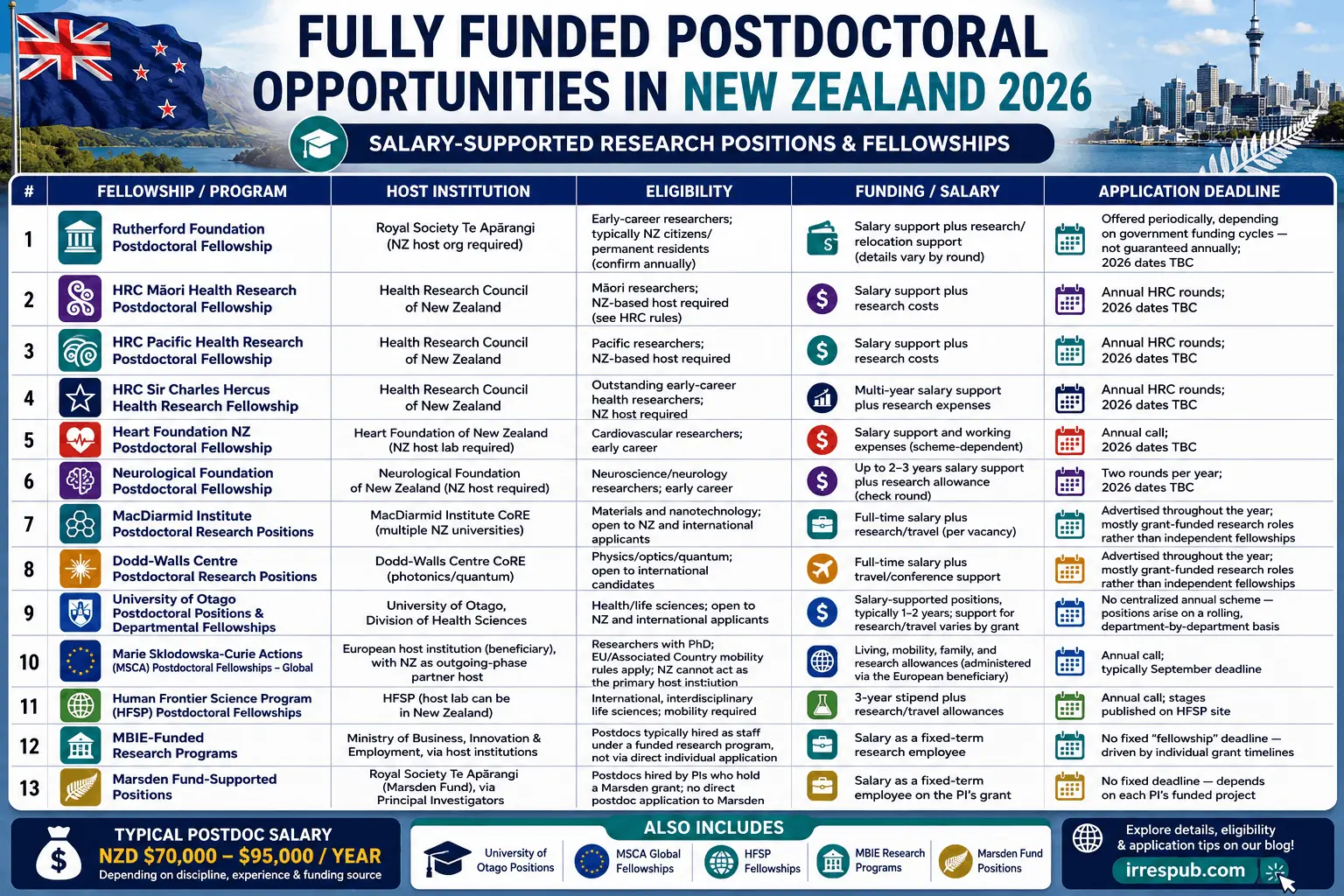
At a Glance: Fully Funded Postdoctoral Fellowships in New Zealand 2026
| Fellowship / Program | Host Institution | Eligibility | Funding / Salary | Application Deadline | Official Link |
|---|---|---|---|---|---|
| Rutherford Foundation Postdoctoral Fellowship | Royal Society Te Apārangi (NZ host org required) | Early-career researchers; typically NZ citizens/permanent residents (confirm annually) | Salary support plus research/relocation support (details vary by round) | Offered periodically, depending on government funding cycles — not guaranteed annually; 2026 dates TBC | Official Website |
| HRC Māori Health Research Postdoctoral Fellowship | Health Research Council of New Zealand | Māori researchers; NZ-based host required (see HRC rules) | Salary support plus research costs | Annual HRC rounds; 2026 dates TBC | Official Website |
| HRC Pacific Health Research Postdoctoral Fellowship | Health Research Council of New Zealand | Pacific researchers; NZ-based host required | Salary support plus research costs | Annual HRC rounds; 2026 dates TBC | Official Website |
| HRC Sir Charles Hercus Health Research Fellowship | Health Research Council of New Zealand | Outstanding early-career health researchers; NZ host required | Multi-year salary support plus research expenses | Annual HRC rounds; 2026 dates TBC | Official Website |
| Heart Foundation NZ Postdoctoral Fellowship | Heart Foundation of New Zealand (NZ host lab required) | Cardiovascular researchers; early career | Salary support and working expenses (scheme-dependent) | Annual call; 2026 dates TBC | Official Website |
| Neurological Foundation Postdoctoral Fellowship | Neurological Foundation of New Zealand (NZ host required) | Neuroscience/neurology researchers; early career | Up to 2–3 years salary support plus research allowance (check round) | Two rounds per year; 2026 dates TBC | Official Website |
| MacDiarmid Institute Postdoctoral Research Positions | MacDiarmid Institute CoRE (multiple NZ universities) | Materials and nanotechnology; open to NZ and international applicants | Full-time salary plus research/travel (per vacancy) | Advertised throughout the year; mostly grant-funded research roles rather than independent fellowships | Official Website |
| Dodd-Walls Centre Postdoctoral Research Positions | Dodd-Walls Centre CoRE (photonics/quantum) | Physics/optics/quantum; open to international candidates | Full-time salary plus travel/conference support | Advertised throughout the year; mostly grant-funded research roles rather than independent fellowships | Official Website |
| University of Otago Postdoctoral Positions & Departmental Fellowships | University of Otago, Division of Health Sciences | Health/life sciences; open to NZ and international applicants | Salary-supported positions, typically 1–2 years; support for research/travel varies by grant | No centralized annual scheme — positions arise on a rolling, department-by-department basis | Official Website |
| Marie Skłodowska-Curie Actions (MSCA) Postdoctoral Fellowships – Global | European host institution (beneficiary), with NZ as outgoing-phase partner host | Researchers with PhD; EU/Associated Country mobility rules apply; NZ cannot act as the primary host institution | Living, mobility, family, and research allowances (administered via the European beneficiary) | Annual call; typically September deadline | Official Website |
| Human Frontier Science Program (HFSP) Postdoctoral Fellowships | HFSP (host lab can be in New Zealand) | International, interdisciplinary life sciences; mobility required | 3-year stipend plus research/travel allowances | Annual call; stages published on HFSP site | Official Website |
| MBIE-Funded Research Programs | Ministry of Business, Innovation & Employment, via host institutions | Postdocs typically hired as staff under a funded research program, not via direct individual application | Salary as a fixed-term research employee | No fixed “fellowship” deadline — driven by individual grant timelines | Official Website |
| Marsden Fund-Supported Positions | Royal Society Te Apārangi (Marsden Fund), via Principal Investigators | Postdocs hired by PIs who hold a Marsden grant; no direct postdoc application to Marsden itself | Salary as a fixed-term employee on the PI’s grant | No fixed deadline — depends on each PI’s funded project | Official Website |
A Quick Reality Check: How Postdoc Funding Actually Works in New Zealand
Before diving into individual programs, it’s worth understanding the broader funding landscape:
- MBIE (Ministry of Business, Innovation & Employment) funds large national research programs. Postdocs are usually hired as employees under these grants rather than through a standalone fellowship application.
- The Marsden Fund (administered by Royal Society Te Apārangi) does not fund postdoctoral fellowships directly. Instead, it funds Principal Investigator-led grants, and PIs use that funding to hire postdoctoral researchers.
- As a result, a large share of “postdoc opportunities” in New Zealand are really grant-funded jobs advertised by individual labs or departments, rather than independent, applicant-led fellowships. Keep this in mind when searching university and CoRE job boards — many of the best opportunities won’t appear under the word “fellowship” at all.
Rutherford Foundation Postdoctoral Fellowship
Overview
Administered by Royal Society Te Apārangi, the Rutherford Foundation Postdoctoral Fellowship supports outstanding early-career researchers to establish independent research in New Zealand. It is one of the best Fully Funded Postdoctoral Fellowships in New Zealand. The Rutherford Foundation’s main focus has historically been PhD scholarships, with postdoctoral support linked to specific strategic funding rounds rather than a guaranteed annual call. Availability depends on government funding cycles and may not run every year — confirm current status directly with Royal Society Te Apārangi before planning around this fellowship.
Funding and Benefits
- Salary support for up to two years.
- Contribution to research costs and, in some rounds, relocation/mentoring support.
- Access to New Zealand’s national research networks.
Eligibility
- Recent PhD graduates (early postdoctoral stage).
- Typically requires New Zealand citizenship or permanent residency; international applicants should verify the current rules.
- Host institution in New Zealand required.
Application Process
- Apply via Royal Society Te Apārangi’s portal through a NZ host institution.
- Competitive, peer-reviewed selection based on excellence and potential.
- Deadlines vary by year and depend on whether a round is open; consult the official page.
HRC Māori Health Research Postdoctoral Fellowship
Overview
The Health Research Council (HRC) Māori Health Research Postdoctoral Fellowship develops Māori health research leadership and capability across New Zealand institutions.
Funding and Benefits
- Salary support for the fellow.
- Research expenses and professional development support.
- Mentoring within a NZ research host environment.
Eligibility
- Māori researchers who have recently completed a PhD or are early-career.
- NZ-based host required; citizenship/residency rules apply per HRC guidelines.
Application Process
- Register and submit through HRC’s online system.
- Annual call; 2026 timelines will be published on HRC’s site.
HRC Pacific Health Research Postdoctoral Fellowship: Fully Funded Postdoctoral Fellowships in New Zealand
Overview
Fully Funded Postdoctoral Fellowships in New Zealand builds Pacific health research capacity and supports impactful projects benefiting Pacific communities in New Zealand.
Funding and Benefits
- Salary support plus research costs.
- Structured mentoring and professional development.
Eligibility
- Pacific researchers in early career stages.
- Hosted by a New Zealand research institution; residency rules per HRC policies.
Application Process
- Submit via HRC’s portal in coordination with a NZ host.
- Annual competitive round; dates vary year-to-year.
HRC Sir Charles Hercus Health Research Fellowship
Overview
A prestigious award supporting exceptional emerging health researchers to accelerate their trajectory toward research independence and leadership. This is one of the most competitive HRC fellowships, and selection panels generally favor researchers who can demonstrate a clear, near-term benefit to the New Zealand health system.
Funding and Benefits
- Multi-year salary support.
- Research expenses and development support.
- Recognition that strengthens future competitiveness for major grants.
Eligibility
- Early-career health researchers with significant potential.
- NZ host required; citizenship/residency conditions typically apply — confirm on the HRC website.
- International applicants are typically only competitive if they are already embedded in a New Zealand institution or have a strong, established collaboration with one.
Application Process
- Institutional endorsement and submission through HRC systems.
- Rigorous external peer review.
Heart Foundation New Zealand Postdoctoral Fellowship
Overview
The Heart Foundation funds promising cardiovascular researchers to continue research after their PhD in New Zealand host labs.
Funding and Benefits
- Salary support for the duration of the fellowship (scheme-dependent).
- Project-related expenses and travel support may be available.
Eligibility
- Early-career researchers in cardiovascular science/medicine.
- New Zealand-based host institution required.
Application Process
- Apply through the Heart Foundation grants portal.
- Annual calls; specifics and close dates vary each year.
Neurological Foundation Postdoctoral Fellowship
Overview
This Fully Funded Postdoctoral Fellowships in New Zealand supports research into neurological conditions, enabling early-career scientists to build independence within NZ labs.
Funding and Benefits
- Salary for up to two or more years (check the current round’s terms).
- Research-related allowances and professional development support.
Eligibility
- PhD in a relevant neuroscience/neurology field.
- Position hosted at a New Zealand research institution.
Application Process
- Two competitive rounds per year.
- Submit via the Foundation’s application system with host endorsement.
MacDiarmid Institute Postdoctoral Research Positions a clear direction to Fully Funded Postdoctoral Fellowships in New Zealand
Overview
The MacDiarmid Institute (a Centre of Research Excellence) supports postdoctoral researchers across partner universities in advanced materials and nanotechnology, often in collaboration with industry. In practice, MacDiarmid rarely runs “fellowships” in the traditional, applicant-led sense — most opportunities are advertised as paid postdoctoral researcher roles tied to specific funded projects within the Institute.
Funding and Benefits
- Full-time salary support.
- Opportunities to work across nodes and with industry partners.
- Travel and conference support depending on the position.
Eligibility
- PhD in materials science, physics, chemistry, engineering, or related fields.
- Open to New Zealand and international candidates.
Application Process
- Positions are advertised on the Institute and university job boards.
- Recruitment is rolling; deadlines vary per vacancy.
Dodd-Walls Centre Postdoctoral Research Positions
Overview
The Dodd-Walls Centre (CoRE) offers postdoctoral research positions in photonics, quantum optics, and precision measurement across several NZ universities. As with MacDiarmid, these are typically grant-funded postdoctoral researcher roles rather than independent, applicant-led fellowships.
Funding and Benefits
- Competitive salary packages.
- Access to cutting-edge facilities and multi-institution collaboration.
- Travel and development support.
Eligibility
- PhD in physics, optics, photonics, or allied disciplines.
- Open to applicants worldwide.
Application Process
- Calls issued on the Centre’s opportunities page and university job sites.
- Rolling recruitment; check specific advertisements.
University of Otago Postdoctoral Positions and Departmental Fellowships
Overview
Otago’s Division of Health Sciences periodically supports postdoctoral researchers to grow capacity in biomedical, clinical, population, and public health research. There isn’t a single, centralized “Health Sciences Postdoctoral Fellowship” scheme that runs every year — most opportunities are grant-funded postdoc positions or occasional department-specific fellowships, advertised individually as funding allows.
Funding and Benefits
- Salary-supported appointments, typically around one to two years depending on the funding source.
- Access to major core facilities and collaborator networks.
Eligibility
- Recently completed PhD in relevant health/life sciences fields.
- Open to New Zealand and international applicants.
Application Process
- Positions and schemes are advertised on the University of Otago website and individual department pages.
- Deadlines vary by department and funding stream — check regularly rather than expecting a single annual call.
Marie Skłodowska-Curie Actions (MSCA) Postdoctoral Fellowships – Global
Overview
MSCA Global Postdoctoral Fellowships (European Commission) fund researchers for an outgoing period outside Europe — which can include New Zealand — followed by a mandatory return phase to Europe. It is one of the most prestigious Fully Funded Postdoctoral Fellowships in New Zealand. It’s important to understand the structure correctly: the fellowship is awarded and administered through a European beneficiary institution, and New Zealand only participates as a partner host during the outgoing phase. New Zealand cannot act as the primary host institution for an MSCA Global Fellowship.
Funding and Benefits
- Generous living, mobility, and family allowances, plus research, training, and management costs.
- International, intersectoral training and secondments encouraged.
Eligibility
- PhD at the call deadline and mobility conditions as specified by MSCA.
- Applicant is recruited by a European beneficiary; a New Zealand host participates as a partner organization for the outgoing phase only.
Application Process
- Coordinate with a European host institution first, then a NZ partner host for the outgoing phase.
- Annual call with a typical September deadline; consult the MSCA site for exact 2026 dates.
Human Frontier Science Program (HFSP) Postdoctoral Fellowships
Overview
HFSP supports frontier, interdisciplinary life science research with strong emphasis on international mobility. Fellows can be hosted in New Zealand labs as part of global collaborations.
Funding and Benefits
- Three-year stipend and research/travel allowances.
- Focus on innovative, high-risk/high-gain projects.
Eligibility
- PhD in life sciences or related quantitative fields.
- Mobility rules apply; host lab must differ from PhD or previous main host country (see HFSP rules).
Application Process
- Two-stage competition (letter of intent followed by full proposal, as announced each year).
- Annual timeline published on HFSP’s official page.
How to Choose the Right Opportunity
- Match your eligibility: some schemes are open globally; others require NZ citizenship/permanent residency or Māori/Pacific affiliation.
- Confirm the actual funding scope: understand what salary, research costs, overheads, and relocation are covered — and whether you’re applying to an independent fellowship or a grant-funded staff position.
- Look beyond the word “fellowship”: many of the best-paying, most flexible postdoc opportunities in New Zealand are advertised as research staff positions tied to MBIE or Marsden-funded projects, not as named fellowships.
- Secure a strong host: identify a supervisor with aligned publications, infrastructure, and funding track record.
- Time your applications: many calls are annual; build in 3–6 months for proposal development and institutional approvals.
Application Tips for 2026
Best ways to the Fully Funded Postdoctoral Fellowships in New Zealand
- Start early and contact potential supervisors 6–9 months before deadlines.
- Align aims with New Zealand’s strengths (e.g., health equity, materials science, climate/Antarctic research, photonics/quantum).
- Demonstrate independence: include your unique methodology, preliminary data, and a clear training plan.
- Plan impact and engagement: outline benefits for NZ communities, industry, or policy where relevant.
- Fact-check all scheme rules on the official websites before submission — terms change between funding rounds.
Internal Resources to Boost Your Application
- How to structure a winning fellowship proposal
- Essential postdoc CV and track-record checklist
- Grant writing mistakes to avoid in 2026
Frequently Asked Questions on Fully Funded Postdoctoral Fellowships in New Zealand
1) Are these fellowships truly “fully funded”?
Most listed programs provide full-time salary support, and some add a separate research allowance — but few qualify as fully self-contained, fully funded fellowships in the strictest sense. Many are better understood as salaried postdoctoral positions within funded projects. Coverage and amounts differ by scheme and year. Always verify salary scales, research consumables, overheads, and travel on the official program pages before applying.
2) Can international applicants apply to New Zealand postdoctoral fellowships?
Yes, many opportunities are open internationally (e.g., MacDiarmid Institute, Dodd-Walls Centre, MSCA Global with a NZ partner host, HFSP with NZ hosts). Some national schemes (e.g., certain HRC or Rutherford Foundation rounds) may require NZ citizenship or permanent residency, and HRC’s most prestigious fellowships in particular tend to favor candidates already embedded in a NZ institution. Check each program’s eligibility notes.
3) When do 2026 deadlines open?
Major schemes run annually, but 2026 dates will be confirmed on official pages. MSCA PF typically closes around September; HRC and health charities publish annual calendars; CoRE and university postdoctoral positions post rolling vacancies rather than fixed annual deadlines.
4) How competitive are these fellowships?
They are competitive and peer-reviewed. A strong publication record, clear independence, strategic training plan, and an aligned NZ host significantly improve success odds.
5) Can I bring my own project, or must I fit a lab’s theme?
Both models exist. Fellowships like MSCA/HFSP emphasize applicant-led projects with host alignment. Institutional and CoRE positions, along with MBIE- and Marsden-funded roles, are usually tied to a funded project’s themes but still value your independent contribution.
6) Do I need IRB/ethics or animal approvals at application?
You typically don’t need final approvals at submission, but you must describe ethics considerations and timelines. Approvals are required before commencing relevant work.
7) What if official information is unclear or not yet published for 2026?
Consult the official website and contact the program manager or research office of your proposed NZ host. Do not rely on third-party summaries for final details.
Conclusion: Fully Funded Postdoctoral Fellowships in New Zealand 2026
New Zealand offers a robust portfolio of fully funded and salary-supported postdoctoral opportunities across health, fundamental science, and technology. From nationally competitive HRC and Royal Society Te Apārangi schemes to CoRE-based research positions and international programs like MSCA and HFSP that involve NZ hosts, you can find a funding pathway that matches your career stage and research vision. Just as importantly, remember that many of the strongest opportunities are grant-funded postdoctoral positions advertised by individual labs under MBIE or Marsden funding, rather than named fellowships — so it pays to search broadly. Verify all eligibility and deadlines on official pages, partner early with a strong NZ host, and craft a compelling, impact-driven proposal.
About IR Research Publication
IR Research Publication is dedicated to empowering researchers worldwide with credible, actionable resources on funding, publishing, and research careers. Our mission is to simplify complex opportunities, curate widely recognized and officially funded programs, and share practical strategies that help scholars secure competitive grants and fellowships, advance open science, and accelerate real-world impact.
Related Articles
- Fully Funded Postdoc Positions in Switzerland for Indian Researchers: 2026 Opportunities and Application Guide
- Fully Funded PhD Programs in Switzerland for Indian Students: 2026 Guide
- Fully Funded PhD Scholarships in Singapore: 2026 Guide for International Students
- Fully Funded Postdoctoral Fellowships in Japan: Stipends, Eligibility, and 2026 Deadlines
- Fully Funded PhD Scholarships in South Korea: Stipends, Eligibility, and 2026 Deadlines