
IRRESPUB BLOG
QS World University Rankings 2027 Released: MIT’s Historic Streak, Asia’s Rise, and the Global Top 20
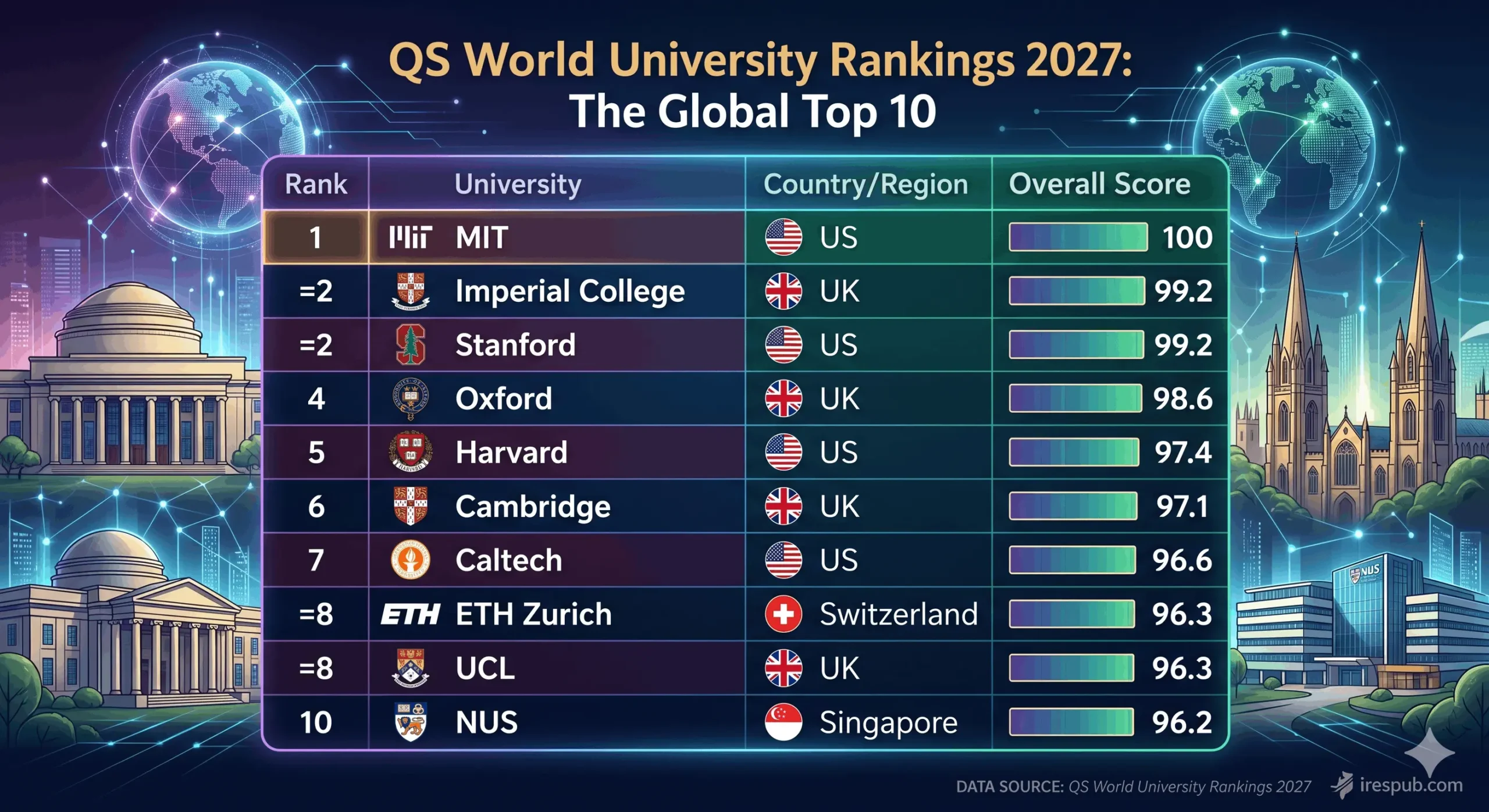
The highly anticipated QS World University Rankings 2027 have officially landed. For students, educators, and institutions worldwide, these rankings serve as the ultimate barometer of academic excellence, research impact, and global reputation.
While the absolute top tier remains defined by stability, a deeper look at the 2027 data reveals massive shifts. Challenger institutions across Asia and the Middle East are surging, while mid-tier universities in traditional powerhouse nations are feeling the squeeze of changing government policies.
Here is your comprehensive breakdown of the 2027 results, key trends, and what they mean for the future of global higher education.
The 2027 Global Top 20: The Elite Tier
The 2027 edition evaluated over 1,500 institutions. While the US and the UK dominate the upper echelons, Switzerland, Singapore, Mainland China, Hong Kong, and Australia all claim spots in the top 20.
Here is how the very best stack up this year:
| Rank | University | Location | Overall Score |
| 1 | Massachusetts Institute of Technology (MIT) | 🇺🇸 United States | 100 |
| =2 | Imperial College London | 🇬🇧 United Kingdom | 99.2 |
| =2 | Stanford University | 🇺🇸 United States | 99.2 |
| 4 | University of Oxford | 🇬🇧 United Kingdom | 98.6 |
| 5 | Harvard University | 🇺🇸 United States | 97.4 |
| 6 | University of Cambridge | 🇬🇧 United Kingdom | 97.1 |
| 7 | California Institute of Technology (Caltech) | 🇺🇸 United States | 96.6 |
| =8 | ETH Zurich | 🇨🇭 Switzerland | 96.3 |
| =8 | UCL (University College London) | 🇬🇧 United Kingdom | 96.3 |
| 10 | National University of Singapore (NUS) | 🇸🇬 Singapore | 96.2 |
| 11 | The University of Hong Kong (HKU) | 🇭🇰 Hong Kong SAR | 95.9 |
| 12 | Nanyang Technological University (NTU) | 🇸🇬 Singapore | 93.6 |
| 13 | Peking University | 🇨🇳 Mainland China | 92.6 |
| 14 | Tsinghua University | 🇨🇳 Mainland China | 92.1 |
| 15 | University of Pennsylvania | 🇺🇸 United States | 91.7 |
| =16 | Cornell University | 🇺🇸 United States | 91.5 |
| =16 | Yale University | 🇺🇸 United States | 91.5 |
| 18 | The Chinese University of Hong Kong (CUHK) | 🇭🇰 Hong Kong SAR | 89.9 |
| 19 | The University of New South Wales (UNSW Sydney) | 🇦🇺 Australia | 89.8 |
| =20 | Johns Hopkins University | 🇺🇸 United States | 89.7 |
| =20 | University of California, Berkeley (UCB) | 🇺🇸 United States | 89.7 |
(Note: “=” indicates a tie in the rankings).
To get a better sense of how tightly packed the scores are at the very top, explore this breakdown of the top 10:
3 Key Takeaways from the 2027 Rankings
1. MIT’s 15-Year Reign
The Massachusetts Institute of Technology has achieved something unprecedented: 15 consecutive years at #1. Dethroning MIT seems nearly impossible right now. The institution scored a perfect 100 across crucial metrics like Academic Reputation, Employer Reputation, Faculty-Student Ratio, and Citations per Faculty. Furthermore, MIT ranked #1 globally in 12 specific subject areas, particularly in Engineering, Technology, and Computer Sciences.
2. The Asian Ascent Accelerates
The most dynamic region in the 2027 rankings is unquestionably Asia. Strategic state investments in R&D and aggressive internationalization are paying off:
- Singapore maintains its elite status, with NUS at #10 and NTU close behind at #12.
- Mainland China continues its steady rise, with Peking University (#13) and Tsinghua University (#14) leading the charge. Chinese institutions recorded the highest number of upward moves overall.
- Hong Kong saw a staggering 78% of its institutions rise in rank, with CUHK leaping 14 places to break into the Top 20.
- India achieved its strongest-ever representation with 52 institutions featured. IIT-Delhi topped the national list, climbing to #118 globally, driven by massive improvements in citations per faculty and employer reputation.
3. The “Big Four” Feel the Squeeze
While elite US, UK, Canadian, and Australian universities remain heavily shielded by their historic reputations, institutions in the upper mid-range (ranks 20–200) are experiencing friction.
According to QS, universities in these “Big Four” nations are seeing noticeable declines in their International Student and International Faculty ratios. Changing government policies regarding visas and international student caps are directly impacting these scores, which combined make up 10% of a university’s total ranking.
Despite this, Australia delivered a historically strong result at the top end, with UNSW Sydney climbing to #19 and all Group of Eight (Go8) universities securing spots in the top 80.
How the Scores are Calculated
If you are using these rankings to build your college list, it helps to know exactly what QS is measuring. The 2027 methodology remains consistent with recent years, focusing heavily on research output and graduate employability:
- Academic Reputation (30%): Based on a massive global survey of academics.
- Citations per Faculty (20%): Measures research quality and impact.
- Employer Reputation (15%): Based on surveys of global employers regarding where they source their most competent graduates.
- Employment Outcomes (5%): Looks at graduate employment rates and alumni impact.
- Faculty-Student Ratio (10%): A proxy for teaching quality and class sizes.
- International Faculty (5%) & International Students (5%): Measures global appeal and diversity.
- International Research Network (5%): Evaluates cross-border research partnerships.
- Sustainability (5%): Assesses environmental and social impact.
What This Means for Future Students
If you are applying to universities for the 2027/2028 academic year, the rankings tell a clear story: world-class education is becoming decentralized.
While the Ivy League and Oxbridge remain incredible destinations, students focused on STEM, research, and innovation have an expanding array of elite options in Asia and Australia that often come with different funding models and closer ties to emerging tech hubs.
About IR Research Publication
IR Research Publication is dedicated to empowering researchers worldwide with credible, actionable resources on funding, publishing, and research careers. Our mission is to simplify complex opportunities, curate widely recognized and officially funded programs, and share practical strategies that help scholars secure competitive grants and fellowships, advance open science, and accelerate real-world impact.
Related Articles
- Fully Funded Postdoctoral Fellowships in New Zealand 2026
- Fully Funded Postdoc Positions in Switzerland for Indian Researchers: 2026 Opportunities and Application Guide
- Fully Funded PhD Programs in Switzerland for Indian Students: 2026 Guide
- Fully Funded PhD Scholarships in Singapore: 2026 Guide for International Students
- Fully Funded Postdoctoral Fellowships in Japan: Stipends, Eligibility, and 2026 Deadlines
- Fully Funded PhD Scholarships in South Korea: Stipends, Eligibility, and 2026 Deadlines