
IRRESPUB BLOG
Fully Funded PhD Scholarships in Singapore: 2026 Guide for International Students
Introduction: Why Pursue a Fully Funded PhD in Singapore?
Singapore has firmly established itself as one of Asia’s premier destinations for doctoral research. Home to world-ranked institutions, cutting-edge laboratories, and a thriving innovation economy, the city-state attracts thousands of international PhD applicants every year — and with good reason.
The best part? A PhD in Singapore is, in most cases, fully funded. For international students, this means tuition fees, a competitive monthly living stipend, and often travel allowances — all covered. Whether you are a STEM researcher, a social scientist, or an engineer with a passion for discovery, Singapore’s universities and research agencies offer some of the most generous doctoral funding packages in the world.
This comprehensive 2026 guide covers 10+ fully funded PhD scholarships in Singapore for international students, including official links, stipend amounts, eligibility criteria, and application deadlines. If you are searching for fully funded PhD positions in Singapore, this is the only guide you need.
Are PhDs in Singapore Fully Funded for International Students?
Yes — in most cases. The majority of PhD programmes at Singapore’s autonomous universities (NUS, NTU, SUTD, SMU, and SIT) come with scholarship packages that cover:
- Full tuition fee waiver
- Monthly stipend (typically SGD 2,000–3,600 depending on scholarship and stage)
- Settling-in allowance (one-time, on arrival)
- Airfare grant (for select scholarships)
- Medical insurance (varies by institution)
The key is to apply for the right scholarship alongside your PhD admission. Most funding is awarded automatically when you are admitted — but competitive fellowships like SINGA and the NUS President’s Graduate Fellowship require a separate application.
Looking for opportunities in other regions? See our guide on Fully Funded PhD Scholarships in Europe for Indian Students (2026) and Fully Funded PhD Scholarships in Canada for Indian Students (2026).
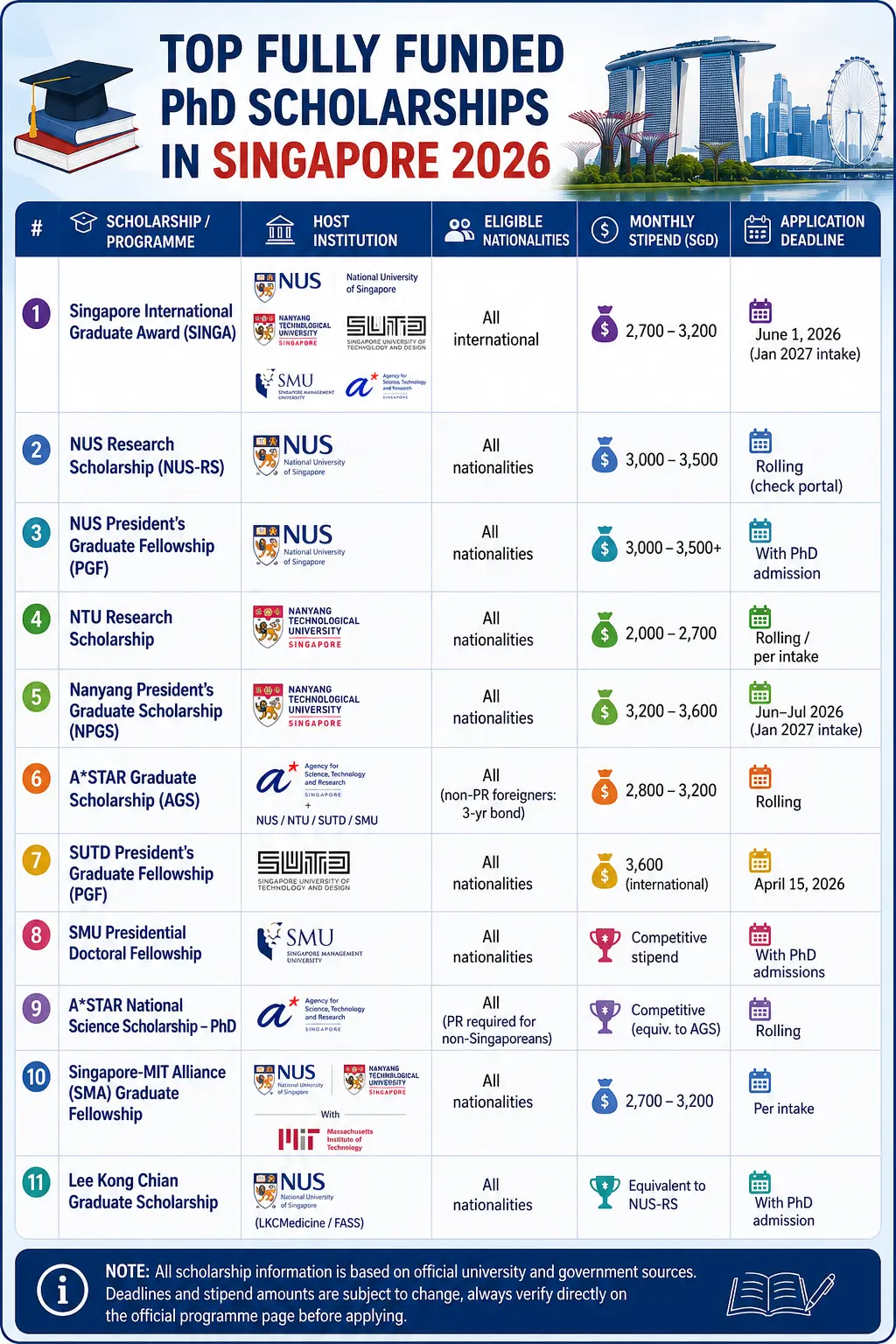
Summary Table: Top Fully Funded PhD Scholarships in Singapore 2026
| # | Scholarship / Programme | Host Institution | Eligible Nationalities | Monthly Stipend | Application Deadline | Official Link |
|---|---|---|---|---|---|---|
| 1 | Singapore International Graduate Award (SINGA) | NUS, NTU, SUTD, SMU, A*STAR | All international | SGD 2,700–3,200 | June 1, 2026 (Jan 2027 intake) | singa.a-star.edu.sg |
| 2 | NUS Research Scholarship (NUS-RS) | National University of Singapore | All nationalities | SGD 3,000–3,500 | Rolling (check portal) | nusgs.nus.edu.sg |
| 3 | NUS President’s Graduate Fellowship (PGF) | National University of Singapore | All nationalities | SGD 3,000–3,500+ | With PhD admission | nusgs.nus.edu.sg/scholarships/pgf |
| 4 | NTU Research Scholarship | Nanyang Technological University | All nationalities | SGD 2,000–2,700 | Rolling / per intake | ntu.edu.sg/admissions/graduate |
| 5 | Nanyang President’s Graduate Scholarship (NPGS) | Nanyang Technological University | All nationalities | SGD 3,200–3,600 | Jun–Jul 2026 (Jan 2027 intake) | ntu.edu.sg/admissions/graduate/financialmatters/scholarships/npgs |
| 6 | A*STAR Graduate Scholarship (AGS) | A*STAR + NUS/NTU/SUTD/SMU | All (non-PR foreigners: 3-yr bond) | SGD 2,800–3,200 | Rolling | a-star.edu.sg/scholarships |
| 7 | SUTD President’s Graduate Fellowship (PGF) | Singapore Univ. of Tech. & Design | All nationalities | SGD 3,600 (international) | April 15, 2026 | sutd.edu.sg/admissions/graduate |
| 8 | SMU Presidential Doctoral Fellowship | Singapore Management University | All nationalities | Competitive stipend | With PhD admission | smu.edu.sg/phd |
| 9 | A*STAR National Science Scholarship – PhD | A*STAR | All (PR required for non-Singaporeans) | Competitive (equiv. to AGS) | Rolling | a-star.edu.sg/scholarships |
| 10 | Singapore-MIT Alliance (SMA) Graduate Fellowship | NUS / NTU (with MIT) | All nationalities | SGD 2,700–3,200 | Per intake | smart.mit.edu |
| 11 | Lee Kong Chian Graduate Scholarship | NUS (LKCMedicine / FASS) | All nationalities | Equivalent to NUS-RS | With PhD admission | nusgs.nus.edu.sg |
Detailed Profiles: Fully Funded PhD Scholarships in Singapore
1. Singapore International Graduate Award (SINGA)
Overview
SINGA is widely regarded as the flagship fully funded PhD scholarship in Singapore for international students. Administered by the Agency for Science, Technology and Research (A*STAR) in collaboration with NUS, NTU, SUTD, SMU, and SIT, SINGA attracts approximately 240 scholars per year across the physical sciences, biomedical sciences, and engineering.
Key Benefits
- Full tuition fee coverage for up to 4 years
- Monthly stipend of SGD 2,700 (rising to SGD 3,200 after passing the PhD Qualifying Examination)
- One-time settling-in allowance of SGD 1,000
- One-time airfare grant of up to SGD 1,500
- Bond-free — no post-graduation work obligation in Singapore
- Access to A*STAR’s world-class research institutes and equipment
Who Should Apply
International graduates (bachelor’s or master’s) with outstanding academic records and a strong passion for research in science and engineering. No specific GRE or IELTS score is mandated at the time of application, making SINGA accessible to strong candidates globally.
Deadline: June 1, 2026 (January 2027 intake)
Official Page: https://singa.a-star.edu.sg
2. NUS Research Scholarship (NUS-RS)
Overview
The NUS Research Scholarship is the most common PhD funding mechanism at the National University of Singapore, one of Asia’s top-ranked institutions. It is offered across all faculties and disciplines, from STEM to arts and social sciences, making it one of the most versatile fully funded PhD scholarships in Singapore.
Key Benefits
- Full tuition fee subsidy for up to 4 years
- Monthly stipend of approximately SGD 3,000 for international students (rising by up to SGD 500 after passing the PhD Qualifying Examination)
- Renewable each semester subject to satisfactory academic performance
- Graduate Assistantship Programme (GAP) requirement: 208 hours of teaching/research assistance duties (non-Singaporeans)
Who Should Apply
Any international graduate with at least a Second Class (Upper) Honours degree or equivalent who has been offered or is seeking PhD admission at NUS. The scholarship is awarded alongside admission in many cases — select “NUS Research Scholarship” in the admissions portal.
Deadline: Rolling deadlines; the August 2026 intake closes approximately April–May 2026. Check the NUS Graduate School portal for exact dates.
Official Page: https://nusgs.nus.edu.sg
3. NUS President’s Graduate Fellowship (PGF)
Overview
The President’s Graduate Fellowship at NUS is a prestigious, merit-based doctoral fellowship awarded to incoming PhD candidates who demonstrate exceptional promise in research. It is the highest PhD-level honour offered by NUS and is funded by institutional donors including the Lee Kong Chian Foundation.
Key Benefits
- Full tuition fee waiver
- Monthly stipend of SGD 3,000–3,500 (higher than the standard NUS-RS rate)
- Up to 4 years of coverage, renewed each semester
- Prestige and networking advantages within Singapore’s academic community
Who Should Apply
Outstanding final-year undergraduates or recent graduates across all disciplines who can demonstrate an exceptional research record — publications, awards, research projects — and are seeking admission to a full-time PhD programme at NUS.
Deadline: Considered simultaneously with PhD admission applications.
Official Page: https://nusgs.nus.edu.sg/scholarships/
4. NTU Research Scholarship
Overview
The NTU Research Scholarship is Nanyang Technological University’s standard funding package for full-time PhD candidates. It is assigned by the relevant NTU school during the PhD application process and is available to both local and international students across NTU’s research-intensive disciplines including engineering, science, business, and humanities.
Key Benefits
- Full tuition fee coverage
- Monthly stipend of SGD 2,000 for international students (increasing by up to SGD 500 after the PhD Qualifying Examination)
- Teaching/lab supervision duties under the Graduate Assistantship Programme (GAP)
- No post-graduation service bond
Who Should Apply
International applicants applying for a full-time PhD by research at NTU in any school. The scholarship is applied for as part of the standard PhD application — no separate form is required.
Deadline: Per intake (August and January). Check the NTU Graduate Admissions portal for current cycle deadlines.
Official Page: https://www.ntu.edu.sg/admissions/graduate/financialmatters/scholarships
5. Nanyang President’s Graduate Scholarship (NPGS)
Overview
The NPGS is NTU’s most prestigious doctoral scholarship, designed to attract the world’s brightest graduates to pursue PhD research at Nanyang. It goes beyond the standard NTU Research Scholarship by offering a substantially higher stipend and additional academic support, positioning recipients as future leaders in research.
Key Benefits
- Full annual tuition fee coverage
- Higher monthly stipend (SGD 3,200–3,600, depending on citizenship status)
- Overseas conference allowance (revised April 2026)
- Priority for campus accommodation
- Maximum award period of 4 years
Who Should Apply
Outstanding final-year undergraduates or recent graduates of any nationality seeking to pursue a PhD at NTU. The scholarship is by nomination only — shortlisted candidates are invited to interview. Applications for Academic Year 2026–2027 (January 2027 intake) open from June 1 to July 31, 2026.
Official Page: https://www.ntu.edu.sg/admissions/graduate/financialmatters/scholarships/npgs
6. A*STAR Graduate Scholarship (AGS)
Overview
The A*STAR Graduate Scholarship (AGS) is offered directly by Singapore’s Agency for Science, Technology and Research. It funds PhD or EngD (Engineering Doctorate) studies at Singapore’s autonomous universities (NUS, NTU, SUTD, SMU), with research conducted at an A*STAR Research Institute — giving scholars direct industry-oriented lab experience alongside their academic degree.
AGS has four focused tracks:
- STEM Track — Broad sciences (biology, chemistry, physics, engineering)
- Semicon Track — Semiconductor chip design and materials science
- Quantum Track — Quantum computing and sensing
- Computing Track — AI, data science, and information systems
Key Benefits
- Full tuition fee coverage for up to 4 years
- Monthly stipend of SGD 2,800–3,200
- Book, computer, conference, and thesis allowances throughout candidature
- Unique opportunity for a 12-month overseas attachment at a top global research institution
- Pathway to A*STAR International Fellowship (AIF) after PhD completion
Who Should Apply
Singapore Citizens, Singapore PRs, and non-PR international students who have completed (or are completing) a degree at a Singapore autonomous university. Non-PR foreigners must commit to a 3-year service obligation in Singapore-based companies after graduation.
Official Page: https://www.a-star.edu.sg/scholarships/home/scholarships/ags–scholarship
7. SUTD President’s Graduate Fellowship (PGF)
Overview
The Singapore University of Technology and Design (SUTD), established in collaboration with MIT, offers the President’s Graduate Fellowship for top-tier PhD candidates. SUTD’s unique design-centric, technology-driven approach makes this scholarship especially attractive for researchers working at the intersection of engineering, architecture, computer science, and social sciences.
Key Benefits
- Full tuition coverage
- Monthly stipend of SGD 3,600 for international PhD students (the highest standard PhD stipend among Singapore’s universities for this scholarship tier)
- Free campus housing, a registration fee waiver, and health insurance coverage
- Award period: 4 years (PhD)
Who Should Apply
Outstanding domestic and international students seeking full-time PhD admission at SUTD. 780 fully funded scholarship spots are available across PhD, Master’s, and Bachelor’s programmes at SUTD for 2026–2027.
Deadline: April 15, 2026 (check SUTD portal for updated cycles)
Official Page: https://www.sutd.edu.sg/Admissions/Graduate/Scholarships
8. SMU Presidential Doctoral Fellowship
Overview
Singapore Management University (SMU), consistently ranked among Asia’s top business and social science universities, offers the Presidential Doctoral Fellowship to exceptionally qualified candidates entering its PhD programmes. SMU’s downtown Singapore location provides unmatched access to the financial, tech, and policy sectors, making it the ideal hub for research in business, economics, law, information systems, and social sciences.
Key Benefits
- Competitive monthly stipend (equivalent to or above standard NUS/NTU PhD levels)
- Full tuition coverage
- Situated in the heart of Singapore’s central business district
- Access to SMU’s extensive corporate research partnerships
Who Should Apply
International and local candidates of any nationality who demonstrate outstanding academic standing and are seeking to enrol in one of SMU’s PhD programmes in business, computing, economics, law, or social sciences.
Official Page: https://www.smu.edu.sg/programmes/phd
9. A*STAR National Science Scholarship – PhD (NSS-PhD)
Overview
The National Science Scholarship (PhD), offered by A*STAR, is targeted at individuals who wish to build a long-term research career in Singapore. Unlike SINGA (which is bond-free), the NSS-PhD requires a post-graduation service commitment in Singapore, but in return offers a premium stipend package and a structured career pathway within A*STAR Research Institutes.
Key Benefits
- Full tuition coverage for the duration of the PhD
- Competitive monthly stipend (aligned with AGS rates)
- Opportunity for overseas PhD training at partner institutions (MIT, Stanford, Cambridge, and others)
- Clear career progression into A*STAR’s research ecosystem
Who Should Apply
All nationalities are welcome to apply. Non-Singaporeans who are not Singapore Permanent Residents must obtain Singapore PR status before starting their studies. Candidates with a strong academic record and a genuine interest in building a research career in Singapore are ideal applicants.
Official Page: https://www.a-star.edu.sg/scholarships/home/scholarships
10. Singapore-MIT Alliance for Research and Technology (SMART) Graduate Fellowship
Overview
The Singapore-MIT Alliance Graduate Fellowship is a prestigious, government-funded fellowship jointly administered by NUS and NTU in partnership with the Massachusetts Institute of Technology (MIT). It is designed to attract exceptional doctoral students in science and technology, offering them the unique advantage of conducting research at the intersection of Singapore’s and MIT’s world-class research environments.
Key Benefits
- Monthly stipend equivalent to the NUS/NTU Research Scholarship (SGD 2,700–3,200)
- Full tuition fee coverage for up to 4 years
- Exposure to a unique bilateral research community with access to MIT faculty and resources
- Strong interdisciplinary research focus across STEM fields
Who Should Apply
Highly talented PhD candidates from Singapore (NUS/NTU) who wish to conduct research with an international dimension and collaborate with one of the world’s top research universities.
Official Page: https://www.smart.mit.edu
11. Lee Kong Chian Graduate Scholarship (LKCGS)
Overview
The Lee Kong Chian Graduate Scholarship is a donor-funded PhD scholarship at NUS, provided through the Lee Kong Chian Foundation. It is primarily available to candidates entering the NUS President’s Graduate Fellowship programme (under the Lee Kong Chian track) and places special emphasis on leadership ability and community service alongside academic excellence.
Key Benefits
- Equivalent financial benefits to the NUS President’s Graduate Fellowship (full tuition + stipend of SGD 3,000–3,500)
- Renewable for up to 4 years
- Strong institutional support and mentorship network
- Leadership development components
Who Should Apply
Outstanding PhD applicants at NUS across all disciplines who can demonstrate a strong track record not only in academic research, but also in community service and leadership. Preference is given to those applying for the PGF.
Official Page: https://nusgs.nus.edu.sg
How to Get a Fully Funded PhD in Singapore: Step-by-Step Guide
Step 1: Identify Your Research Area and Target University
Singapore’s universities each have distinctive research strengths. NUS leads in biomedical sciences, computing, and social sciences. NTU is a global leader in engineering, AI, and sustainability. SUTD excels in design-driven technology. SMU is the go-to for business, law, and information systems.
Step 2: Find a Potential Supervisor
Most Singapore PhD programmes require that you identify and contact a faculty supervisor before applying. Browse faculty profiles on university websites, read their recent publications, and write a concise, personalised email expressing your research interest.
Step 3: Prepare Your Application Documents
Common requirements across all fully funded PhD scholarships in Singapore include:
- Academic transcripts (all degrees, certified)
- CV/resume
- Research proposal or statement of purpose
- Two to three letters of recommendation
- English proficiency certificate (IELTS/TOEFL, if applicable; many scholarships waive this if your degree was taught in English)
- Passport copy and recent passport-size photo
Step 4: Apply Early and Apply to Multiple Scholarships
For competitive awards like SINGA and NPGS, the selection process is rigorous. Submit your application at least two weeks before the deadline, as your referees need time to upload recommendation letters (typically 7 days after receiving their invitation).
Step 5: Prepare for Interviews
Shortlisted candidates for SINGA, NPGS, and the NUS PGF are typically called for an interview within 12 weeks of the application deadline. Prepare to discuss your research interests, prior experience, and career goals.
For tips on strengthening your research profile and application materials, see our guide on Top Fellowships & Funding Opportunities for PhD Students in India in 2026 and explore Fully Funded Postdoctoral Fellowships in Singapore if you are a postdoc-level researcher.
What Is the Stipend for PhD Students in Singapore?
Stipend amounts vary by scholarship and student status. Here is a quick overview of typical PhD stipend ranges for international students in Singapore (as of 2026):
| Scholarship | Monthly Stipend (Pre-QE) | Monthly Stipend (Post-QE) |
|---|---|---|
| SINGA | SGD 2,700 | SGD 3,200 |
| NUS Research Scholarship | SGD 3,000 | SGD 3,500 |
| NUS PGF | SGD 3,000–3,500 | SGD 3,500+ |
| NTU Research Scholarship | SGD 2,000 | SGD 2,500 |
| NPGS (NTU) | SGD 3,200 | SGD 3,600+ |
| A*STAR AGS | SGD 2,800 | SGD 3,200 |
| SUTD PGF | SGD 3,600 | SGD 3,600+ |
QE = PhD Qualifying Examination, typically held 12–18 months after registration.
Singapore’s average cost of living for a PhD student is approximately SGD 1,200–1,800 per month, meaning these stipends comfortably cover living expenses and leave a meaningful monthly surplus — a significant advantage over many equivalent programmes in the US or UK.
Eligibility Criteria for PhD Scholarships in Singapore
While each scholarship has its own specific requirements, the common eligibility criteria for fully funded PhD scholarships in Singapore are:
- A bachelor’s degree (or master’s degree) with strong academic standing — typically a 2nd Class Upper Honours or equivalent (GPA 3.5/4.0 or above)
- Excellent command of written and spoken English (IELTS/TOEFL often waived if prior degree was in English)
- A clearly defined research interest aligned with the host university/lab
- Strong letters of recommendation from academic referees
- For SINGA: open to all international graduates; no age restriction
- For A*STAR AGS: non-PR foreigners must have studied at a Singapore autonomous university
- For NPGS: competitive nomination process; no nationality restriction
FAQ: Fully Funded PhD Scholarships in Singapore
Q1. Is a PhD in Singapore fully funded for international students?
Yes, in the majority of cases. Most PhD programmes at NUS, NTU, SUTD, SMU, and SIT come bundled with a scholarship that covers full tuition fees and a monthly living stipend. The most common funding vehicle is the university’s own research scholarship (e.g., NUS-RS or NTU-RS), which is often offered alongside the admission letter.
Q2. How do I apply for PhD scholarships in Singapore?
For most university-based scholarships (NUS-RS, NTU-RS), you simply tick the scholarship consideration box within the standard PhD admissions application. For competitive independent awards like SINGA and NPGS, you must apply separately through their dedicated portals. Always apply early to allow referees time to submit their letters.
Q3. Which universities in Singapore offer fully funded PhD scholarships?
All five autonomous universities in Singapore offer fully funded PhD scholarships: the National University of Singapore (NUS), Nanyang Technological University (NTU), Singapore University of Technology and Design (SUTD), Singapore Management University (SMU), and the Singapore Institute of Technology (SIT).
Q4. What is the monthly stipend for PhD students in Singapore in 2026?
For international students, monthly PhD stipends range from SGD 2,000 to SGD 3,600 depending on the scholarship and the student’s stage in the programme (before or after the Qualifying Examination). SINGA scholars receive SGD 2,700–3,200, while SUTD PGF recipients receive up to SGD 3,600.
Q5. Do Singapore PhD scholarships require a bond?
It depends on the scholarship. SINGA is notably bond-free. The A*STAR Graduate Scholarship (AGS) requires a 3-year service commitment in Singapore for non-PR international students. The NUS Research Scholarship and NTU Research Scholarship require the completion of Graduate Assistantship Programme (GAP) hours during the PhD — but not a post-graduation bond.
Q6. What is the eligibility for SINGA 2026?
SINGA is open to all international graduates with a passion for research and an excellent academic record. Applicants must have good English communication skills and two academic referee reports. There is no restriction on nationality, age, or country of prior study. Research must be in biomedical sciences, physical sciences, or engineering.
Q7. Can I apply for a PhD in Singapore directly after my bachelor’s degree?
Yes. SINGA and several university scholarships explicitly welcome applicants with only a bachelor’s degree, allowing them to enter a direct PhD programme. If the applicant also holds a master’s degree, they may be eligible to skip some coursework requirements upon enrolment.
About IR Research Publication
IR Research Publication (IRReSPub) is a scientific journal publisher and editorial service provider committed to supporting researchers at every stage of their academic journey. Beyond publishing rigorous peer-reviewed content in the biological sciences and related fields, IRReSPub maintains a rich library of guides on fellowship opportunities, PhD funding, and academic career pathways for international scholars.
Whether you are preparing your first research manuscript, seeking a fully funded doctoral position, or exploring postdoctoral fellowship opportunities across Asia and beyond, IRReSPub’s resources are designed to give you accurate, actionable, and up-to-date information.
Explore IRReSPub’s editorial and profile-building services — from proofreading and manuscript editing to academic CV development — to put your best application forward.
Related Articles from IR Research Publication
Expand your scholarship search with these curated guides:
- Fully Funded Postdoctoral Fellowships in Singapore: Stipends, Benefits, and 2026 Deadlines — If you already hold a PhD and are looking for postdoctoral opportunities in Singapore (LKYPDF, NTU Presidential Fellowship, NRF Fellowship, and more), this is the guide for you.
- Fully Funded PhD Scholarships in Europe for Indian Students (2026) — Explore 20+ verified, fully funded doctoral programmes across Germany, France, Sweden, the Netherlands, Switzerland, and more.
- Fully Funded PhD Scholarships in Canada for Indian Students (2026) — A complete guide covering CGRS-D, Trudeau Foundation, Ontario Trillium, UBC, University of Toronto, and other top Canadian doctoral funding options.
- Top Fellowships & Funding Opportunities for PhD Students in India in 2026 — Discover PMRF, CSIR, UGC NET, DST-INSPIRE, NIPER, and IISER fellowships with stipends, eligibility criteria, and application tips.
- Your Guide to Fully Funded Postdoctoral Fellowships in South Korea: Stipends, Eligibility, and 2026 Application Windows — Comprehensive coverage of Korea’s leading postdoctoral funding schemes for international researchers.
- Fully Funded PhD in Japan in 2026: Top Scholarships for International Students — A detailed look at MEXT, OIST, University of Tokyo, Kyoto, and other fully funded doctoral programmes in Japan.
This article was last reviewed and updated in May 2026. All scholarship information is based on official university and government sources. Deadlines and stipend amounts are subject to change — always verify directly on the official programme page before applying.