
IRRESPUB BLOG
Your Guide to Fully Funded Postdoctoral Fellowships in South Korea: Stipends, Eligibility, and 2026 Application Windows
Introduction: Why South Korea Is a Top Destination for Postdoctoral Researchers
South Korea has rapidly become one of the world’s most competitive research destinations. With government-backed funding programs, world-class universities, and a national commitment to science and technology innovation, the country now offers some of the most generous fully funded postdoctoral fellowships in South Korea — and increasingly, the world.
Whether you are a recent PhD graduate looking for your first postdoc or an established researcher seeking an international collaboration, South Korea postdoc programs can provide you with competitive stipends, relocation support, housing allowances, health insurance, and access to cutting-edge research infrastructure — all while building an internationally competitive CV.
This guide covers the 10 best fully funded postdoctoral fellowships in South Korea for international and Korean researchers alike, including 2026 deadlines, stipend details, and direct links to official program pages.
Explore Top Funded Postdoctoral Fellowships in UK for Indian Students in 2026
And Fully Funded PhD Positions in UK for Indian Students 2026 (Complete Guide + List)
Who should read this guide? International PhD holders, early-career scientists in STEM or humanities and social sciences, Korean researchers based abroad, and anyone exploring South Korea postdoc 2026 opportunities.
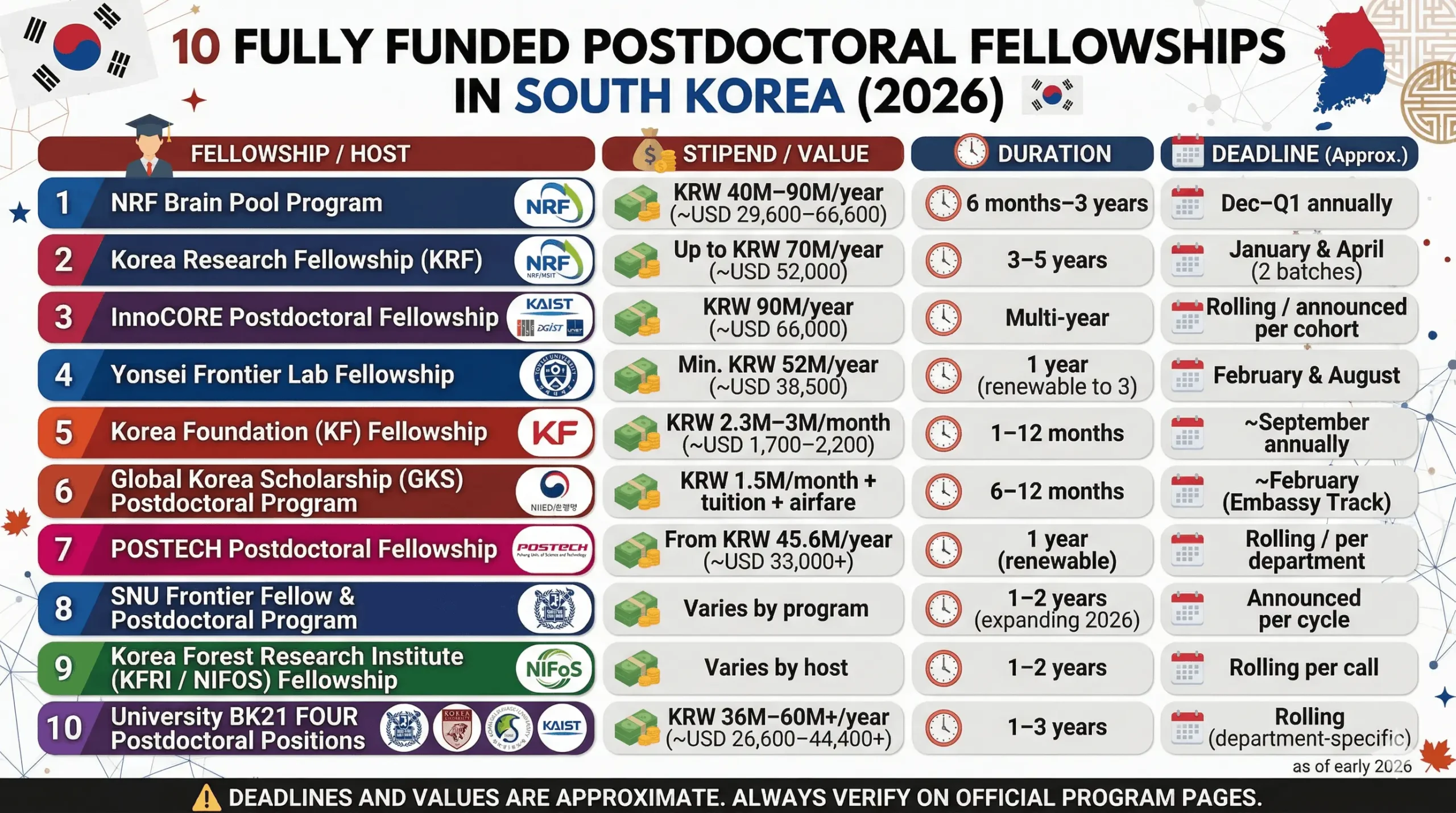
Quick Summary Table: 10 Fully Funded Postdoctoral Fellowships in South Korea (2026)
| # | Program | Host / Organizer | Open To | Stipend / Salary | Duration | 2026 Deadline (Approx.) |
|---|---|---|---|---|---|---|
| 1 | NRF Brain Pool Program | National Research Foundation (NRF) | International researchers (PhD + 5 yrs exp.) | KRW 40M–90M/year (~USD 29,600–66,600) | 6 months–3 years | Dec–Q1 annually |
| 2 | Korea Research Fellowship (KRF) | NRF / MSIT | Foreign nationals & overseas Koreans (PhD ≤5 yrs) | Up to KRW 70M/year (~USD 52,000) | 3–5 years | January & April (2 batches) |
| 3 | InnoCORE Postdoctoral Fellowship | KAIST, GIST, DGIST, UNIST (MSIT) | International PhD holders in STEM | KRW 90M/year (~USD 66,000) | Multi-year | Rolling / announced per cohort |
| 4 | Yonsei Frontier Lab Fellowship | Yonsei University | International & domestic postdocs | Min. KRW 52M/year (~USD 38,500) | 1 year (renewable to 3) | February & August |
| 5 | Korea Foundation (KF) Fellowship | Korea Foundation (KF) | Foreign postdocs in Korean studies | KRW 2.3M–3M/month (~USD 1,700–2,200) | 1–12 months | ~September annually |
| 6 | Global Korea Scholarship (GKS) Postdoctoral Research Program | NIIED / Korean Government | International researchers under 40 | KRW 1.5M/month + tuition + airfare | 6–12 months | ~February (Embassy Track) |
| 7 | POSTECH Postdoctoral Fellowship | Pohang University of Science and Technology | International & domestic PhD holders | From KRW 45.6M/year (~USD 33,000+) | 1 year (renewable) | Rolling / per department |
| 8 | SNU Frontier Fellow & Postdoctoral Program | Seoul National University (SNU) | International researchers | Varies by program | 1–2 years (expanding 2026) | Announced per cycle |
| 9 | Korea Forest Research Institute (KFRI / NIFoS) Fellowship | National Institute of Forest Science | Foreign researchers in forestry & related fields | Varies by host | 1–2 years | Rolling per call |
| 10 | University BK21 FOUR Postdoctoral Positions | SNU, Korea University, SKKU, KAIST, etc. | All nationalities fluent in English | KRW 36M–60M+/year (~USD 26,600–44,400+) | 1–3 years | Rolling (department-specific) |
Note: Deadlines are based on historical cycles. Always verify on official program pages before applying.
The 10 Best Fully Funded Postdoctoral Fellowships in South Korea
1. NRF Brain Pool Program
Overview
The Brain Pool Program is one of South Korea’s flagship international research initiatives, managed by the National Research Foundation of Korea (NRF) and funded by the Ministry of Science and ICT (MSIT). It invites distinguished overseas scientists and engineers to conduct collaborative research at Korean universities, national labs, and corporate research institutes for periods ranging from 6 months to 3 years.
The program operates two tracks: a standard Brain Pool (BP) track and an extended Brain Pool Plus (BP+) track for longer-term engagements.
Check this out- Fully Funded Postdoctoral Fellowships in Canada for Indian Students in 2026 [Complete Guide]
Key Benefits
- Monthly salary: KRW 5M–25M, totalling KRW 40M–90M annually (~USD 29,600–66,600)
- Relocation and initial settlement support
- Housing allowance
- Child education subsidy
- Medical insurance
- Research funding (separate from personal stipend)
- Korean language education support
Who Should Apply
International researchers with a PhD and at least 5 years of research experience who have identified a Korean host institution willing to invite them. Korean nationals residing abroad are also eligible. Note: applications are submitted by the Korean host researcher via the NRF IRIS system — candidates cannot apply independently.
2026 Deadline
Calls are typically announced in December or early Q1 each year. Relocating to Korea within three months of selection is mandatory.
🔗 Official NRF Brain Pool Program | KUSCO Invitation Programs
2. Korea Research Fellowship (KRF)
Overview
The Korea Research Fellowship (KRF) is specifically designed for outstanding early-career postdoctoral researchers — foreign nationals and overseas-based Korean researchers. Administered by NRF, the KRF supports all fields of science and technology, with preferred areas including ICT/software, biotechnology, energy, nano-materials, aerospace, and marine sciences.
The KRF operates via a host researcher application system. NRF also runs a Research Host Matching Service at krf-help.net to connect Type 1 candidates with Korean hosts.
Key Benefits
- Up to KRW 70 million per year (~USD 52,000), comprising:
- Personnel costs: up to KRW 50M
- Living expenses: up to KRW 12M
- Relocation, Korean language training, and other costs
- Duration: 3–5 years
- Full-time research position at a Korean institution
- Annual performance evaluation with renewal possibility
Dont forget to checkout- Top 10 Fully Funded Postdoctoral Fellowships in Australia for Indian Students 2026
Who Should Apply
Postdoctoral researchers from any country with diplomatic relations with Korea who obtained their PhD within the past 5 years. Type 1 is for researchers currently overseas; Type 2 is for foreign nationals already in Korea.
2026 Application Deadlines
The KRF operates in two annual batches — typically in January and April. Check the NRF ERND portal for the latest calls.
🔗 EURAXESS KRF Information | UNIST KRF Overview
3. InnoCORE Postdoctoral Fellowship Program (KAIST, GIST, DGIST, UNIST)
Overview
The InnoCORE (Innovation + Core Researchers) Program is one of the most exciting new developments in Korean research funding. Unveiled by the Ministry of Science and ICT (MSIT) in June 2025, InnoCORE aims to recruit 400 outstanding postdoctoral researchers in AI-convergent science and technology (AI+S&T) across four premier institutes: KAIST, GIST, DGIST, and UNIST.
Eight interdisciplinary research clusters collaborate with Samsung, LG, Naver, Hyundai, and global institutions including MIT, Stanford, Harvard, and Oxford. The government committed KRW 300 billion (~USD 225 million) over five years. The inaugural 2025 cohort attracted 103 foreign nationals, including 26 from India and 18 from China.
Key Benefits
- Base annual salary: KRW 90 million (~USD 66,000) — approximately 1.8× the national postdoc average
- Access to supercomputers, semiconductor cleanrooms, and cutting-edge biomedical facilities
- Multi-layered mentoring (academic + industry + international)
- Additional compensation available through industry partnerships
- Collaboration with global institutions and Korean industry leaders
Who Should Apply
PhD holders in STEM awarded within the past 5 years. Open to international researchers worldwide. Particularly suited to researchers in AI, biomedicine, clean energy, aerospace, and advanced manufacturing.
2026 Deadline
The inaugural cohort was recruited in 2025. The next cycle is expected to be announced via official channels. Monitor innocore.re.kr and msit.go.kr for updates.
🔗 Korea Herald InnoCORE Announcement | Official MSIT Press Release
4. Yonsei University Frontier Fellowship for Postdoctoral Researchers
Overview
Offered by Yonsei University’s Frontier Lab (YFL), this fellowship supports outstanding postdoctoral researchers — international and domestic — across science, engineering, and humanities/social sciences at Yonsei’s Sinchon and International Campuses. It is one of the most accessible university-funded postdoc positions in South Korea for researchers already connected to a Yonsei faculty member.
The program actively encourages simultaneous application to the NRF Brain Pool+ program, with preference given to applicants who have done so.
Key Benefits
- Minimum annual stipend: KRW 52 million (~USD 38,500), with YFL contributing KRW 40M
- Duration: 1 year, renewable for up to 3 years
- Access to Yonsei’s international research network
- Priority given to first-time YFL applicants
Who Should Apply
Postdoctoral researchers with a PhD awarded within the last 7 years. STEM field applicants must have at least 2 publications in JCR Q1 journals within the past 2 years. A sponsoring Yonsei faculty member is required.
2026 Application Deadlines
- 1st round: February (contracts starting March–September)
- 2nd round: August (contracts starting September–March)
Apply via email to: ysfrontierlab@yonsei.ac.kr
🔗 Yonsei Frontier Lab Fellowship Page
5. Korea Foundation (KF) Fellowship for Field Research — Postdoctoral Track
Overview
The Korea Foundation (KF) has been supporting international scholars in Korean studies since 1992. Its Fellowship for Field Research provides on-site research support in South Korea for foreign researchers in the humanities and social sciences. This is the primary research fellowship option for non-STEM researchers exploring South Korea postdoc opportunities.
Key Benefits
- Monthly stipend: KRW 2.3M (Type A) or KRW 3M (Type B) — approximately USD 1,700–2,200/month
- Round-trip airfare (for researchers from ODA-eligible countries)
- Duration: 1 month to 12 months
- Access to Korean academic institutions, archives, and research networks
Who Should Apply
Foreign postdoctoral researchers and advanced doctoral candidates specializing in Korean history, culture, politics, economics, language, or related humanities/social science fields. Applicants must be affiliated with a university or research institute outside Korea.
2026 Application Deadline
The 2025–2026 cycle closed September 12, 2025. The next cycle is expected to open in July 2026. Apply via apply.kf.or.kr.
6. Global Korea Scholarship (GKS) — Postdoctoral Research Program
Overview
The Global Korea Scholarship (GKS), administered by the National Institute for International Education (NIIED), is best known for its master’s and PhD programs. However, it also includes a Postdoctoral Research Program that provides funded research opportunities for foreign PhD holders at Korean universities for 6–12 months.
For 2026, NIIED offered the GKS to students and researchers from 149+ countries across all major academic fields. The postdoctoral research track is available through the Embassy Track.
Key Benefits
- Monthly allowance: KRW 1,500,000 (~USD 1,100/month) for research/postdoctoral track
- Round-trip economy class airfare
- Medical insurance for the full fellowship period
- Settlement allowance upon arrival
- Access to all NIIED-designated Korean universities
Who Should Apply
Foreign nationals under 40 who hold a doctoral degree and have received an invitation from a NIIED-designated Korean university. Applicants and both parents must hold non-Korean citizenship.
2026 Application Deadline
Embassy Track applications for 2026 opened in February 2026 (deadline: February 25, 2026). The 2027 cycle is expected to open in February 2027. Check studyinkorea.go.kr for updates.
🔗 Study in Korea — GKS Portal | NIIED Scholarship Page
7. POSTECH Postdoctoral Fellowship (PIURI & BK21 FOUR)
Overview
POSTECH (Pohang University of Science and Technology) is one of South Korea’s most prestigious science and engineering universities. POSTECH runs two main postdoctoral schemes:
- PIURI (POSTECH Institute for Undergraduate Research Integration) Postdoctoral Fellowship, with intakes in the 1st and 2nd halves of each year
- BK21 FOUR postdoctoral/research professor positions within academic departments, open to all nationalities
Positions are available across mathematics, physics, chemistry, engineering, and life sciences.
Key Benefits
- Annual salary from KRW 45.6M (~USD 33,000+) for postdoctoral fellows
- Initial appointment of 1 year, renewable upon performance
- Access to POSTECH’s world-class research labs and facilities
- Open to all nationalities fluent in English
Who Should Apply
PhD holders in natural sciences, mathematics, engineering, or related fields with a strong research record. Industry or postdoctoral experience required for research professor positions.
2026 Deadlines
PIURI runs two intakes per year. BK21 FOUR positions are posted on a rolling basis by department. Check postech.ac.kr and individual department pages regularly.
🔗 POSTECH Official Website | POSTECH Mathematics Postdoc Positions
8. SNU Frontier Fellow & Postdoctoral Researcher Development Program
Overview
Seoul National University (SNU), South Korea’s most prestigious university, significantly expanded its postdoctoral support in 2025–2026. The SNU Frontier Fellow & Postdoctoral Researcher Development Program formally launches in 2026, integrating talent development with international research collaboration.
Related programs include the Ascending SNU Future Leader Fellowship (for researchers within 2 years of PhD completion) and the SNU OPEN WORLD (SOW) Program for inbound international scholar visits and co-authorship support.
Key Benefits
- Structured postdoctoral support across all major academic fields
- Connection to NRF Brain Pool funding (SNU actively integrates MSIT programs)
- Access to SNU’s network of international partner universities
- Strategic Hub for International Research Collaboration (launched late 2025)
Who Should Apply
Postdoctoral researchers within 2 years of PhD completion for the Ascending Future Leader Fellowship. The broader Frontier Fellow Program (2026 launch) is expected to expand eligibility. Contact SNU’s Office of Research Affairs for current openings.
2026 Deadline
Program details are announced per cycle on SNU’s official job portal.
🔗 SNU Official Website | SNU Job Openings
9. Korea Forest Research Institute (KFRI / NIFoS) Fellowship
Overview
The National Institute of Forest Science (NIFoS), formerly the Korea Forest Research Institute (KFRI), is a government-affiliated research institution under the Korea Forest Service. It supports young foreign researchers in forestry, wood science, biotechnology, ecology, and related fields. Founded in 1922, NIFoS focuses on forest policy, forest genetic resources, and R&D aligned with Korea’s Forest Resources Enhancement Plan.
This is one of the few Korean research fellowships for international researchers specifically targeting environmental and agricultural sciences — a valuable option outside STEM’s mainstream focus areas.
Key Benefits
- Research fellowship salary paid by host institution
- Full-time research at government forestry and biotechnology labs
- Access to Korea National Arboretum (Gwangneung forest) and research facilities
- Duration typically 1–2 years
Who Should Apply
Foreign researchers with a PhD in forestry, wood science, ecology, biotechnology, environmental science, or related fields. Contact NIFoS researchers directly or watch for announcements via NRF and government research portals.
2026 Deadline
Positions are advertised on a rolling basis. Check nifos.go.kr and the Korea Forest Service portal for current calls.
🔗 NIFoS Official Website | Korea Forest Service
10. University-Specific BK21 FOUR Postdoctoral Positions (SNU, Korea University, SKKU, KAIST & Others)
Overview
BK21 FOUR (Brain Korea 21 Fostering Outstanding Universities for Research) is a large-scale national R&D human resources program run by MSIT and NRF. It funds postdoctoral researchers and research professors at Korea’s leading universities — including SNU, Korea University, Sungkyunkwan University (SKKU), KAIST, Yonsei University, and others — across all academic fields.
Each BK21 FOUR project within a department can recruit postdoctoral researchers independently, making these among the most numerous and practically accessible funded postdoc positions in South Korea for foreign researchers. They are regularly listed on university department websites and global academic job boards.
Key Benefits
- Annual salary: KRW 36M–60M+ depending on university, discipline, and seniority (~USD 26,600–44,400+)
- Initial appointment of 1 year, renewable for up to 3 years
- Research funding and conference travel support through the project grant
- Open to all nationalities fluent in English
- Positions available in STEM, humanities, and social sciences
Who Should Apply
PhD holders in the relevant discipline at any career stage. Research professor positions typically require at least 1 year of postdoctoral or equivalent experience.
2026 Deadline
Positions are posted on a rolling basis throughout the year. Monitor KAIST Career, Korea University Hiring, SKKU Employment, and global job boards including AcademicPositions.com and ResearcherJob.com.
🔗 NRF BK21 FOUR Overview | KAIST BK21 Postdoctoral Positions
Stipend Comparison: What Do South Korea Postdocs Actually Earn?
Here is a clear summary of South Korea postdoc stipends across all 10 programs:
| Program | Annual Stipend (KRW) | USD Equivalent (Approx.) |
|---|---|---|
| InnoCORE (KAIST/GIST/DGIST/UNIST) | KRW 90,000,000 | ~USD 66,000 |
| Brain Pool (top tier) | KRW 90,000,000 | ~USD 66,000 |
| Brain Pool (standard) | KRW 40,000,000–60,000,000 | ~USD 29,600–44,400 |
| Korea Research Fellowship (KRF) | Up to KRW 70,000,000 | ~USD 52,000 |
| Yonsei Frontier Lab | Min. KRW 52,000,000 | ~USD 38,500 |
| BK21 FOUR (universities) | KRW 36,000,000–60,000,000+ | ~USD 26,600–44,400+ |
| POSTECH (BK21/PIURI) | From KRW 45,600,000 | ~USD 33,000+ |
| KF Field Research Fellowship | KRW 27,600,000–36,000,000 | ~USD 20,400–26,600 |
| GKS Postdoctoral Research | KRW 18,000,000/year | ~USD 13,300/year |
| NIFoS / KFRI Fellowship | Host institution rate | Varies |
These stipends compare favourably with many destinations in Asia and Europe, particularly when adjusted for South Korea’s relatively affordable cost of living.
Which Universities in South Korea Offer Funded Postdoc Positions?
The following universities are the most active in recruiting international postdoctoral researchers:
- KAIST (Daejeon) — kaist.ac.kr
- Seoul National University (SNU) — snu.ac.kr
- POSTECH (Pohang) — postech.ac.kr
- Yonsei University (Seoul) — yonsei.ac.kr
- Korea University (Seoul) — korea.edu
- GIST (Gwangju) — gist.ac.kr
- DGIST (Daegu) — dgist.ac.kr
- UNIST (Ulsan) — unist.ac.kr
- Sungkyunkwan University (SKKU) — skku.edu
- Hanyang University (Seoul) — hanyang.ac.kr
For more scholarship and fellowship opportunities across Asia, explore related guides on irrespub.com.
How to Apply for Postdoctoral Fellowships in South Korea: Step-by-Step
Read or guide on 15 Best AI Tools to Find Postdoctoral Positions Worldwide in 2026
Step 1: Identify the right program Match your career stage, field, and nationality to the right fellowship. Early-career researchers (PhD ≤5 years) should prioritise KRF, InnoCORE, and BK21. Established researchers (5+ years) should target Brain Pool.
Step 2: Find a Korean host researcher Most programs require a Korean host researcher to submit the application on your behalf. Contact potential hosts via university faculty pages or use the NRF Research Host Matching Service for KRF.
Step 3: Prepare your documents
- PhD diploma/certificate (with conferral date)
- CV with full publication list
- Research proposal
- 2–3 recommendation letters
- Passport copy
- Salary proof (Brain Pool)
- Ethics and integrity pledge
Step 4: Submit through the official system Brain Pool and KRF: host submits via NRF IRIS. Yonsei YFL and KF: candidates submit directly. GKS: use the Study in Korea portal.
Step 5: Evaluation and results Evaluation involves document review and peer assessment. Competitive programs may include interviews. Results typically come 2–3 months after deadline.
Step 6: Relocate and begin research Most programs require relocation to Korea within 3 months of official notification.
For tips on writing research proposals and academic applications, visit irrespub.com.
Frequently Asked Questions (FAQ)
How do I get a postdoctoral fellowship in South Korea?
Identify a Korean host researcher in your field, contact them directly, and have them submit an application to programs like NRF Brain Pool or KRF. You can also apply directly to university fellowships (Yonsei YFL) or government competitive programs (GKS, InnoCORE).
Are postdoctoral fellowships in South Korea fully funded?
Yes. The major programs — Brain Pool, KRF, InnoCORE, and GKS — are fully funded, covering stipend, relocation, health insurance, and often Korean language training.
Can international researchers apply for postdoc positions in South Korea?
Yes. Brain Pool, KRF, InnoCORE, GKS, and BK21 FOUR positions are all explicitly open to international researchers. InnoCORE’s inaugural 2025 cohort alone included 103 foreign nationals.
What is the stipend for a postdoc in South Korea?
Stipends range from KRW 1.5M per month (GKS Research Program) to KRW 90M per year (InnoCORE and top Brain Pool). KRF offers up to KRW 70M annually; Yonsei Frontier Lab guarantees at least KRW 52M per year.
When are South Korea postdoc deadlines for 2026?
Key 2026 deadlines:
- Brain Pool: December–Q1 annually
- KRF: January and April (two batches)
- Yonsei Frontier Lab: February and August
- GKS Research Program: ~February (Embassy Track)
- KF Fellowship: ~September annually
- InnoCORE: Rolling/cohort-based
- BK21 / University positions: Rolling throughout the year
What documents are needed for a South Korea postdoc application?
Standard requirements: PhD diploma with conferral date, full CV, research proposal, 2–3 recommendation letters, passport copy, publication list, and consent/ethics forms. Brain Pool requires salary proof; GKS requires proof of both parents’ nationality.
Which fellowship programs in South Korea support foreign postdocs in humanities?
The Korea Foundation (KF) Fellowship for Field Research is the primary humanities-focused program, supporting Korean studies in history, culture, politics, and economics. The GKS Research Program also accepts humanities researchers at NIIED-designated universities.
Final Thoughts
South Korea’s investment in research talent has never been stronger. Programs like InnoCORE, Brain Pool, KRF, Yonsei’s Frontier Lab, and the growing BK21 FOUR university network represent a serious national commitment to attracting the world’s best scientists — and the stipends are now globally competitive. Whether you are pursuing a funded postdoc in South Korea for the first time or looking to extend a research career into East Asia, 2026 offers more options than ever before.
Start by identifying your target program, contacting a potential Korean host researcher as early as possible, and bookmarking official program pages for deadline updates.
For more guides on international fellowships, academic funding, and research career development, visit irrespub.com.
Last reviewed: April 2026. Program details, stipend amounts, and deadlines are subject to change. Always verify on official program websites before applying.
Further Reads
Top Postdoctoral Fellowships in USA for Indian Students in 2026
Pharma Jobs After PhD in India vs USA (2026): Salary, Growth & Opportunities Compared
Government Jobs After PhD in India: Complete Guide (2026)
Career Options After PhD in India: Industry Roles You Should Know in 2026