
Australia has emerged as one of the most attractive destinations for postdoctoral research, offering world-class research facilities, competitive salaries, and excellent career development opportunities. For Indian students who have recently completed their PhD, fully funded postdoctoral fellowships in Australia present an exceptional opportunity to advance their research careers in a multicultural, innovation-driven environment.
This comprehensive guide covers the best postdoctoral fellowships in Australia that are genuinely open to international applicants, including Indian students. Whether you’re interested in STEM fields, humanities, or social sciences, Australian universities and research institutions offer numerous pathways for early career researchers.
If you’re also exploring opportunities in other countries, check out our guides on postdoctoral fellowships in the USA and fully funded postdoctoral fellowships in Europe.
Why Choose Fully Funded Postdoctoral Fellowships in Australia?
Australia’s research ecosystem offers several compelling advantages for Indian postdoctoral researchers:
- Competitive Salaries: Australian postdoc positions typically offer salaries ranging from AUD $100,000 to $130,000 per year, significantly higher than many other countries – this translates to approximately ₹55-72 lakhs annually, providing excellent financial stability for researchers
- World-Class Research Infrastructure: Australian universities consistently rank among the top 100 globally, with institutions like the University of Melbourne, ANU, and University of Sydney offering cutting-edge facilities
- Work-Life Balance: Australia is known for its excellent quality of life, with a strong emphasis on work-life balance, outdoor lifestyle, and multicultural society
- Pathway to Permanent Residency: Many postdoctoral positions come with visa sponsorship, and Australia’s skilled migration program offers pathways to permanent residency for qualified researchers
- Growing India-Australia Research Collaboration: The Australia-India Strategic Research Fund (AISRF) and other bilateral initiatives are strengthening research partnerships between the two countries
For more strategies on finding postdoctoral opportunities globally, explore our guide on how to find postdoctoral fellowship opportunities around the world.
General Eligibility Criteria for Postdoctoral Fellowships in Australia
While specific requirements vary by fellowship, most fully funded postdoctoral fellowships in Australia share common eligibility criteria:
Academic Requirements
- PhD Completion: Most fellowships require a PhD completed within the last 3-5 years. Some programs accept candidates who have submitted their thesis but are awaiting final award
- Research Output: Strong publication record in peer-reviewed journals, conference presentations, and evidence of research impact
- Research Proposal: A well-defined research project that aligns with the host institution’s research strengths
Application Requirements
- Host Supervisor: Most Australian postdoc fellowships require you to identify and secure agreement from a host supervisor at an Australian university before applying
- English Language Proficiency: IELTS (overall 6.5-7.0) or TOEFL (90-100 iBT) scores, though requirements vary by institution
- Reference Letters: Typically 2-3 academic references from PhD supervisors or senior researchers
Learn more about advancing your research career by exploring postdoctoral fellowships in India or discover AI tools to find postdoctoral positions worldwide.
Complete List of Fully Funded Postdoctoral Fellowships in Australia for Indian Students (2026)
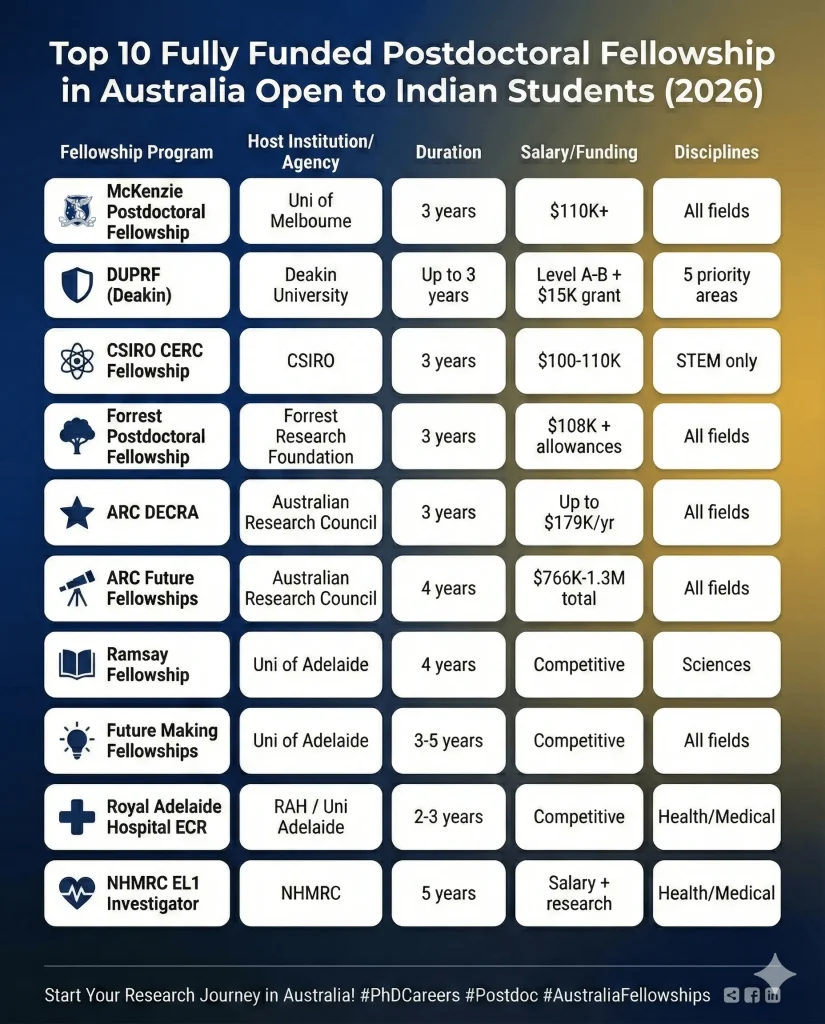
Below is a comprehensive table of postdoctoral opportunities in Australia that are genuinely open to Indian students, followed by detailed descriptions of each fellowship program.
Table 1: Named Top 10 Fully Funded Postdoctoral Fellowship in Australia Open to Indian Students (2026)
| Fellowship Program | Host Institution/Agency | Duration | Salary/Funding | Disciplines |
| McKenzie Postdoctoral Fellowship | University of Melbourne | 3 years | ~$110K+ | All fields |
| DUPRF (Deakin University Postdoctoral Research Fellowship) | Deakin University | Up to 3 years | Level A-B + $15K grant | 5 priority areas |
| CSIRO CERC Fellowship | CSIRO (National Science Agency) | 3 years | $100-110K | STEM only |
| Forrest Postdoctoral Fellowship | Forrest Research Foundation (WA Universities) | 3 years | $108K + allowances | All fields |
| ARC DECRA (Discovery Early Career Researcher Award) | Australian Research Council | 3 years | Up to $179K/yr | All fields |
| ARC Future Fellowships | Australian Research Council | 4 years | $766K-1.3M total | All fields |
| Ramsay Fellowship | University of Adelaide | 4 years | Competitive | Sciences |
| Future Making Fellowships | University of Adelaide | 3-5 years | Competitive | All fields |
| Royal Adelaide Hospital ECR Fellowship | Royal Adelaide Hospital / Uni Adelaide | 2-3 years | Competitive | Health/Medical |
| NHMRC Emerging Leadership Investigator Grant (EL1) | National Health & Medical Research Council | 5 years | Salary + research | Health/Medical |
Note: The table above lists 10 named fellowship programs genuinely open to Indian students. Beyond these named programs, numerous individual postdoctoral positions are advertised year-round by Australian universities.
Detailed Guide to Top Fully Funded Postdoctoral Fellowships in Australia
1. McKenzie Postdoctoral Fellowship – University of Melbourne
The McKenzie Postdoctoral Fellowship is one of the most prestigious early career researcher positions in Australia, offered by the University of Melbourne. This fellowship is explicitly open to all nationalities, making it an excellent opportunity for Indian students seeking postdoctoral opportunities in Australia.
Key Features:
- Number of Positions: Up to 16 fellowships awarded annually
- Duration: 3 years (1.0 FTE, default appointment)
- Salary: Academic Level A6 classification plus on-costs and superannuation (approximately AUD $110,000+ annually)
- Disciplines: All research fields across sciences, humanities, engineering, medicine, and social sciences
- Eligibility: PhD requirements must be completed no earlier than 17 March 2022 (for 2026 commencement). Applicants can be from any university worldwide, including those who completed their PhD at the University of Melbourne
- Application Requirements: Detailed research proposal, CV, publication list, and support from a host supervisor at the University of Melbourne
- Application Period: Typically opens in early calendar year (check university website for exact dates)
- Commencement: By 30 June 2026
Why Choose McKenzie Fellowship:
The University of Melbourne consistently ranks among the top 50 universities globally and is Australia’s leading research institution. The McKenzie Fellowship provides exceptional academic freedom, access to world-class facilities, and strong career development support. Fellows become part of a prestigious cohort of early career researchers and have excellent opportunities for securing permanent academic positions.
Official Website: McKenzie Postdoctoral Fellowship Program
Verdict: Highly Recommended for Indian Students
2. Deakin University Postdoctoral Research Fellowship (DUPRF) 2026
The DUPRF program at Deakin University explicitly welcomes international applicants, including Indian students, with visa sponsorship support. This makes it one of the most accessible fully funded postdoctoral fellowships in Australia for international researchers.
Key Features:
- Duration: Up to 3 years (initially 2 years for international fellows, with 3rd year subject to visa requirements)
- Salary: Academic Level A Step 6 to top of Level B (approximately AUD $95,000-$125,000 depending on experience)
- Research Grant: $15,000 one-time allocation for consumables, equipment, and travel
- Eligibility: PhD awarded or will be awarded by 31 December 2025. Both Australian citizens and non-Australian citizens (international applicants) are welcome
- Disciplines: Must align with Deakin’s five research strengths: Circular Economy and Sustainability Science, Future Materials, Improving Health and Wellbeing, Designing Smarter Technologies, and Building Safe and Secure Communities
- Visa Support: International fellows receive visa sponsorship assistance
- Commencement: By 31 March 2026
- Application: Apply online via Deakin Recruit system
Deakin University is ranked among Australia’s top 1% of universities globally and has strong industry partnerships, making it ideal for researchers interested in applied research and commercialization.
Official Website: Deakin University Postdoctoral Research Fellowship
Verdict: Confirmed Open to Indian Students
3. CSIRO Early Research Career (CERC) Postdoctoral Fellowships
The Commonwealth Scientific and Industrial Research Organisation (CSIRO) is Australia’s premier national science agency. CSIRO CERC fellowships are specifically designed for early career researchers and are open to international applicants with visa sponsorship available.
Key Features:
- Duration: 3 years full-time (or part-time equivalent)
- Salary: Approximately AUD $100,000-110,000 plus 15.4% superannuation (varies by specific role and location)
- Eligibility: Must hold a PhD or have submitted thesis at commencement. Total relevant full-time equivalent experience must not exceed approximately 6 years by fellowship completion (not simply less than 3 years postdoc experience)
- Disciplines: Science, engineering, technology, and digital fields aligned with CSIRO research priorities including agriculture, health, energy, environment, manufacturing, and data science
- Visa Sponsorship: CSIRO confirms that overseas applicants can be sponsored for Australian work visas
- Recruitment: Year-round recruitment with major rounds typically in May and October
- Research Environment: Work at cutting-edge CSIRO facilities across Australia with access to world-class infrastructure
CSIRO CERC fellowships are particularly attractive for Indian students with backgrounds in STEM fields. The program emphasizes practical, impactful research with strong industry connections and offers excellent career progression opportunities in both academia and industry.
Official Website: CSIRO Early Research Career Postdoctoral Fellowships
Verdict: Excellent for STEM Indian Students
4. Forrest Postdoctoral Fellowship – Western Australia
The Forrest Research Foundation Postdoctoral Fellowships are prestigious 3-year positions hosted at Western Australian universities. These fellowships are explicitly open to researchers of any nationality and provide exceptional financial support including relocation assistance for international fellows.
Key Features:
- Duration: 3 years
- Salary: Academic Level A Step 8 (approximately AUD $108,362 in 2025) plus 17% superannuation
- Research/Travel Allowance: Once-off allocation of approximately $12,000
- Accommodation Allowance: Substantial annual accommodation support
- Relocation Support: Relocation allowance available for international fellows
- Eligibility: PhD conferred on or after 1 January 2023 (check official 2026 guidelines for exact cut-off date as it may shift)
- Host Institutions: University of Western Australia (UWA), Curtin University, Murdoch University, Edith Cowan University (ECU), University of Notre Dame Australia
- Application Period: Typically May-June annually
- Commencement: Before September 2026
Western Australia offers a unique research environment with particular strengths in mining, marine science, agriculture, renewable energy, and health. Perth provides an excellent quality of life with lower living costs compared to Sydney or Melbourne, making the Forrest Fellowship particularly attractive when considering the comprehensive benefits package.
Official Website: Forrest Research Foundation Postdoctoral Fellowships
Verdict: Very Strong Option with Excellent Benefits
5. ARC Discovery Early Career Researcher Award (DECRA) 2027
The Australian Research Council’s DECRA scheme is one of the most prestigious early career fellowships in Australia. While highly competitive, it is explicitly open to researchers resident within Australia or overseas, provided they apply through an eligible Australian organization.
Key Features:
- Duration: 3 years
- Total Funding: Up to AUD $179,734 per year comprising:
- • Salary: $129,734 per year (including 30% on-costs for salary loading)
- • Project Costs: Up to $50,000 per annum for research expenses
- Eligibility: PhD awarded on or after 1 March 2021 (by application closing date: 11 March 2026 for DE27 round)
- Disciplines: All research fields including STEM, humanities, and social sciences
- Number of Awards: Up to approximately 200 fellowships per round
- Application Process: Must be nominated by and apply through an eligible Australian university or research organization
- Application Deadline (DE27): 11 March 2026
- Funding Commencement: 1 January 2027
Application Strategy for Indian Students:
Indian students interested in DECRA should first establish contact with potential supervisors at Australian universities who can nominate them. The key is to develop a strong research proposal aligned with Australian research priorities and demonstrate clear evidence of research excellence through publications and impact.
Official Website: ARC Discovery Early Career Researcher Award
Verdict: Prestigious – Apply Through Australian Host
6. ARC Future Fellowships 2026 (FT26)
While not a typical early postdoctoral fellowship, the ARC Future Fellowships program deserves mention as it targets mid-career researchers and is open to international applicants through Australian institutions.
Key Features:
- Duration: 4 years
- Total Funding: AUD $766,904-$1,329,808 over 4 years (salary at 3 levels plus up to $60,000 per year for project funding)
- Eligibility: Mid-career researchers with PhD awarded between 1 March 2011 and 1 March 2021 (with allowances for documented career interruptions)
- Note: This is a mid-career scheme, not an early postdoctoral position. The FT26 round with deadline 5 November 2025 has already closed.
Official Website: ARC Future Fellowships
Verdict: For Mid-Career Researchers Only
7. Ramsay Fellowship – University of Adelaide
Established in 2008 with a bequest from the Ramsay family (founders of Kiwi Polish Company), the Ramsay Fellowship is a prestigious 4-year research position at the University of Adelaide designed to help advance scientific research careers.
Key Features:
- Duration: 4 years
- Salary: Competitive academic salary plus research support
- Disciplines: Sciences (physics, chemistry, biology, mathematics, computer science, engineering)
- Application: Normally opens at the start of each year via University employment website
- Open to International: Yes, including Indian students
The University of Adelaide is a member of Australia’s Group of Eight research-intensive universities and offers excellent research facilities and strong industry connections.
8. Future Making Fellowships – University of Adelaide
The Future Making Fellowships program at the University of Adelaide provides focused support for early-career and mid-career researchers to establish independent research programs.
Key Features:
- Duration: 3-5 years
- Eligibility: Early-career or mid-career researchers with 2-10 years postdoctoral experience (relative to opportunity), who do not hold an Australian Fellowship (other than ARC DECRA or NHMRC EL1) or ongoing appointment at Adelaide
- Disciplines: All research fields
- Open to International: Yes
This fellowship aims to retain and attract talented researchers to Adelaide, providing a pathway to permanent academic positions.
9. Royal Adelaide Hospital Early Career Fellowship
This fellowship program, such as the Mary Overton Early Career Fellowship, supports postdoctoral researchers in health and medical research at the intersection of Royal Adelaide Hospital and the University of Adelaide.
Key Features:
- Duration: Typically 2-3 years
- Focus: Translational health research, clinical research, medical sciences
- Salary: Competitive postdoctoral salary
- Disciplines: Health and medical sciences, particularly diabetes, nutrition, gastroenterology, and related fields
- Open to International: Yes, competitive selection based on research merit
These fellowships provide unique opportunities to work in a leading hospital research environment with direct access to clinical populations and translational research infrastructure.
10. NHMRC Emerging Leadership Investigator Grant (EL1)
The National Health and Medical Research Council (NHMRC) Investigator Grant scheme supports outstanding health and medical researchers. The Emerging Leadership (EL1) level is designed for early career researchers.
Key Features:
- Duration: 5 years
- Funding: Salary support plus research support funding
- Eligibility: 0-10 years post-PhD (adjusted for career disruptions)
- Disciplines: Health and medical research only
- Application: Must apply through an eligible Australian administering institution
- Open to International: Yes, via Australian host institution
NHMRC Investigator Grants are among the most prestigious health and medical research fellowships in Australia, with excellent success rates for international applicants with strong track records.
Official Website: NHMRC Investigator Grants
Verdict: Highly Competitive – Excellent for Health/Medical Researchers
Beyond Named Fellowships: University-Specific Postdoctoral Positions
In addition to the 10 named fellowship programs listed above, Australian universities continuously advertise individual postdoctoral research fellow positions. These are typically funded through competitive research grants (ARC Discovery Projects, NHMRC Project Grants, industry partnerships, etc.) and offer similar benefits to named fellowships.
Top Universities Regularly Advertising Postdoctoral Positions
University of Sydney
- Typical salary: AUD $110,000-130,000 plus 17% superannuation
- Duration: 2-3 years (varies by position)
- Open to International: ✅ YES
- Jobs Portal: University of Sydney Careers
Monash University
- Australia’s largest university by enrollment
- Open to International: ✅ YES
- Jobs Portal: Monash Careers
Australian National University (ANU)
- Australia’s leading research-intensive university in Canberra
- Open to International: ✅ YES
- Jobs Portal: ANU Careers
University of Queensland (UQ)
- Group of Eight member, strong in biomedical sciences
- Open to International: ✅ YES
- Jobs Portal: UQ Careers
UNSW Sydney
- Leading in engineering, business, renewable energy
- Open to International: ✅ YES
- Jobs Portal: UNSW Careers
University of Adelaide
- Strong research output across sciences and health
- Open to International: ✅ YES
- Jobs Portal: Adelaide Careers
La Trobe University
- Multiple postdoctoral positions in Melbourne
- Open to International: ✅ YES
- Jobs Portal: La Trobe Careers
Queensland University of Technology (QUT)
- Strong in technology, engineering, health sciences
- Open to International: ✅ YES
- Jobs Portal: QUT Careers
Strategy: Monitor these university job portals weekly, set up job alerts for ‘postdoctoral research fellow’ positions, and apply even to roles slightly outside your core expertise if you can demonstrate transferable skills.
Application Process for Postdoctoral Fellowships in Australia
Securing a postdoctoral position in Australia requires careful preparation and strategic planning. Here’s a comprehensive guide to the application process:
Step 1: Research and Identify Potential Supervisors
Most Australian postdoctoral fellowships require you to have a host supervisor before applying. Start by:
- Identifying researchers whose work aligns with your expertise and interests
- Reading their recent publications to understand their current research directions
- Checking if they have funding or are open to supervising postdocs
- Sending a concise email (250-300 words) introducing yourself, your research, and why you’re interested in working with them
Step 2: Prepare Application Materials
Essential Documents:
- Research Proposal: 3-5 pages outlining your proposed research, methodology, expected outcomes, and alignment with host institution’s strengths
- Curriculum Vitae: Comprehensive academic CV including education, publications, presentations, grants, awards, and teaching experience
- Publication List: Complete list of peer-reviewed publications with citation metrics where relevant
- Reference Letters: 2-3 strong references from PhD supervisor and/or senior researchers who know your work well
- Academic Transcripts: Official transcripts from PhD and master’s programs
- English Proficiency: IELTS or TOEFL scores (if required)
Writing Tip: To polish the grammar and academic tone of my research papers, I use Paperpal. It’s an AI specifically trained for scientists. You can try it for free to see how it improves your manuscript.

Step 3: Submit Application
Applications are typically submitted through university online portals or directly to fellowship programs. Ensure you:
- Start early – some fellowships have internal university deadlines weeks before the official deadline
- Follow all instructions precisely – incomplete applications are often rejected without review
- Have your host supervisor review materials before submission
Step 4: Interview and Selection
Shortlisted candidates may be invited for interviews (often conducted via video conference for international applicants). Be prepared to discuss your research in detail, future career goals, and why you chose that particular institution and supervisor.
Expert Tips for Indian Students Applying to Australian Postdoc Fellowships
Maximize Your Chances of Success
- Apply Broadly: Don’t limit yourself to one fellowship. Apply to multiple schemes and individual positions to increase your chances
- Network Actively: Attend international conferences, present your work, and connect with Australian researchers. Personal connections can significantly improve application success
- Highlight Impact: Australian research culture values practical impact. Emphasize how your research addresses real-world problems or has commercial potential
- Demonstrate Independence: Show evidence of independent thinking and ability to lead research projects, not just follow supervisor’s directions
- Address Career Interruptions: If you have career breaks (family, health, etc.), many fellowships allow adjustments to eligibility windows – don’t hesitate to apply
- Understand Visa Requirements: Familiarize yourself with Australian visa requirements for researchers. Most postdoc positions qualify for Temporary Skill Shortage (TSS) visa (subclass 482)
- Use AI Tools: Leverage AI tools for finding postdoctoral positions to automate job searches and optimize your applications
Common Mistakes to Avoid
- Generic Applications: Tailor each application to the specific fellowship and institution
- Weak Research Proposals: Avoid vague objectives. Be specific about methodology, timeline, and expected outcomes
- Ignoring Eligibility: Carefully read eligibility criteria – PhD completion dates, nationality restrictions, and experience limits vary
- Poor English: Have native speakers review your documents for language quality
- Missing Deadlines: Note internal university deadlines which may be earlier than fellowship program deadlines
Funding Package and Benefits: What to Expect
Australian postdoctoral fellowships offer comprehensive financial packages that make them among the most attractive globally for early career researchers.
Typical Salary Components
- Base Salary: AUD $95,000-$130,000 per year depending on experience and level
- Superannuation: 15.4-17% additional retirement contributions (similar to provident fund in India)
- Leave Entitlements: 4 weeks annual leave plus additional leave provisions
Research Support
- Research Grants: $10,000-$50,000+ for equipment, consumables, and travel
- Conference Travel: Support for attending and presenting at international conferences
- Professional Development: Training programs, workshops, and mentoring
Cost of Living Considerations
While Australian salaries are high, living costs vary by city:
- Sydney & Melbourne: Higher costs (rent $2,000-3,000/month for 1-bedroom apartment)
- Brisbane & Perth: Moderate costs (rent $1,500-2,200/month)
- Adelaide & Canberra: Lower costs (rent $1,200-1,800/month)
Despite higher costs, Australian postdoc salaries provide comfortable living standards with savings potential, especially compared to postdoc positions in India or many European countries.
How Australian Postdoctoral Fellowships Compare Internationally
For Indian students considering international postdoctoral opportunities, understanding how Australia compares to other popular destinations is crucial:
Australia vs USA
- Salary: Comparable to US postdoc salaries (US: $50,000-70,000 vs AUD $100,000-130,000 = USD $65,000-85,000)
- Healthcare: Australia’s universal healthcare system provides better coverage than typical US postdoc health insurance
- Work-Life Balance: Australian academic culture emphasizes better work-life balance compared to competitive US environment
Learn more: Top Postdoctoral Fellowships in USA for Indian Students
Australia vs Europe
- Salary: Generally higher than most European countries (exceptions: Switzerland, Norway)
- Language: English-speaking advantage; no need to learn a new language unlike Germany, France, or Spain
- Permanent Residency: Australia’s skilled migration pathways are more straightforward than most European countries
Learn more: Fully Funded Postdoctoral Fellowships in Europe
Australia vs India
- Salary: Significantly higher (India: ₹50,000-1,35,000/month vs Australia: ₹5.5-7.2 lakhs/month)
- Infrastructure: Access to cutting-edge research facilities and equipment
- International Collaboration: Greater opportunities for international networking and publications
Compare: Postdoctoral Fellowships in India 2026
Frequently Asked Questions (FAQs)
1. Do I need Australian citizenship or permanent residency to apply for these fellowships?
No, the fellowships listed in this guide (McKenzie, DUPRF, CSIRO CERC, Forrest, ARC DECRA) are all explicitly open to international applicants, including Indian students. However, always verify specific eligibility requirements for each fellowship as policies can change.
2. What is the typical success rate for Indian applicants?
Success rates vary by fellowship (typically 5-20% overall), and specific data for Indian applicants is not publicly available. However, Indian researchers have a strong track record in Australian academia, and nationality is not a selection criterion in competitive fellowships.
3. Can I bring my family on a postdoc fellowship to Australia?
Yes, most Australian work visas for postdocs (TSS subclass 482 or Temporary Skill Shortage) allow you to include your spouse and dependent children. Your spouse may also be eligible for work rights in Australia.
4. How important is it to have publications in high-impact journals?
While high-impact publications strengthen applications, selection committees also value research quality, innovation, and potential for impact. A strong research proposal and clear career trajectory can compensate for a shorter publication record, especially for early career researchers.
5. What happens after my postdoc fellowship ends?
Many postdocs transition to permanent academic positions (lectureships) in Australia or internationally. Australia’s skilled migration program also offers pathways to permanent residency for researchers. Alternatively, some postdocs move to industry research positions or return to their home countries with enhanced credentials.
6. Are there postdoc opportunities in industry research in Australia?
Yes, organizations like CSIRO bridge academic and industry research, and many Australian companies (especially in biotechnology, mining, agriculture, and technology sectors) hire postdocs. However, university-based fellowships remain the primary pathway.
7. How competitive are these fellowships compared to European schemes like Marie Curie?
Australian fellowships like McKenzie and ARC DECRA are similarly competitive to prestigious European schemes. However, Australia’s smaller applicant pool (compared to pan-European programs) can sometimes result in better odds for well-qualified candidates.
Conclusion: Taking the Next Step in Your Research Career
Fully funded postdoctoral fellowships in Australia offer exceptional opportunities for Indian students to advance their research careers in a supportive, well-resourced environment. With competitive salaries, world-class facilities, and pathways to permanent residency, Australia has become an increasingly attractive destination for early career researchers.
The fellowships detailed in this guide—particularly the McKenzie Fellowship, DUPRF, CSIRO CERC, and Forrest Fellowship—represent genuine opportunities that are explicitly open to international applicants. Unlike some programs that claim international eligibility but have citizenship restrictions, these schemes actively welcome and support researchers from around the world.
Action Steps:
- Start Early: Begin identifying potential supervisors and developing research proposals at least 6-8 months before application deadlines
- Build Your Network: Attend conferences, connect with Australian researchers on platforms like ResearchGate and LinkedIn
- Strengthen Your Profile: Focus on publishing, presenting at conferences, and demonstrating research impact
- Apply Strategically: Submit applications to multiple fellowships and individual positions to maximize your chances
- Stay Informed: Bookmark university job portals and fellowship websites; set up email alerts for new opportunities
Remember, securing a postdoctoral position is often a numbers game. Don’t be discouraged by initial rejections—persistence, continuous improvement, and strategic applications will ultimately lead to success.
For more guidance on advancing your academic career, explore our comprehensive resources on finding postdoctoral fellowship opportunities worldwide.
Good luck with your applications! Your research journey in Australia awaits.
Disclaimer: Fellowship details, deadlines, and eligibility criteria are subject to change. Always verify information on official fellowship and university websites before applying. This guide was last updated in February 2026.