
IRRESPUB BLOG
Fully Funded PhD in Japan in 2026: Top Scholarships for International Students
Introduction: Why Pursue a Fully Funded PhD in Japan?
Japan is one of the world’s top destinations for doctoral research. Home to Nobel Prize-winning scientists, cutting-edge laboratories, and globally ranked universities, Japan offers international PhD students a rare combination of academic excellence, cultural richness, and generous financial support.
If you are a student, early-career researcher, or scientist looking to pursue a fully funded PhD in Japan, 2026 presents an outstanding window of opportunity. The Japanese government, universities, and private foundations collectively invest billions of yen each year to attract the world’s brightest doctoral minds — through scholarships and support programs covering tuition, living stipends, travel, health insurance, and research expenses.
Who should read this guide?
- International students seeking PhD programs in Japan with full financial support
- Researchers from India, Africa, Southeast Asia, Europe, and the Americas
- Applicants looking for PhD scholarships in Japan without IELTS, or in English-taught programs
- Anyone searching for tuition-free PhD options in Japan with a monthly stipend
⚠️ Accuracy note: This guide distinguishes between programs by funding type. Programs labeled “Fully Funded PhD” cover tuition AND provide a living stipend for enrolled doctoral students. Programs labeled “Supplementary / Living Support” provide a stipend only and must be combined with a separate tuition source.
This article covers 10 verified programs across these categories, with eligibility details, honest deadline guidance, and official links.
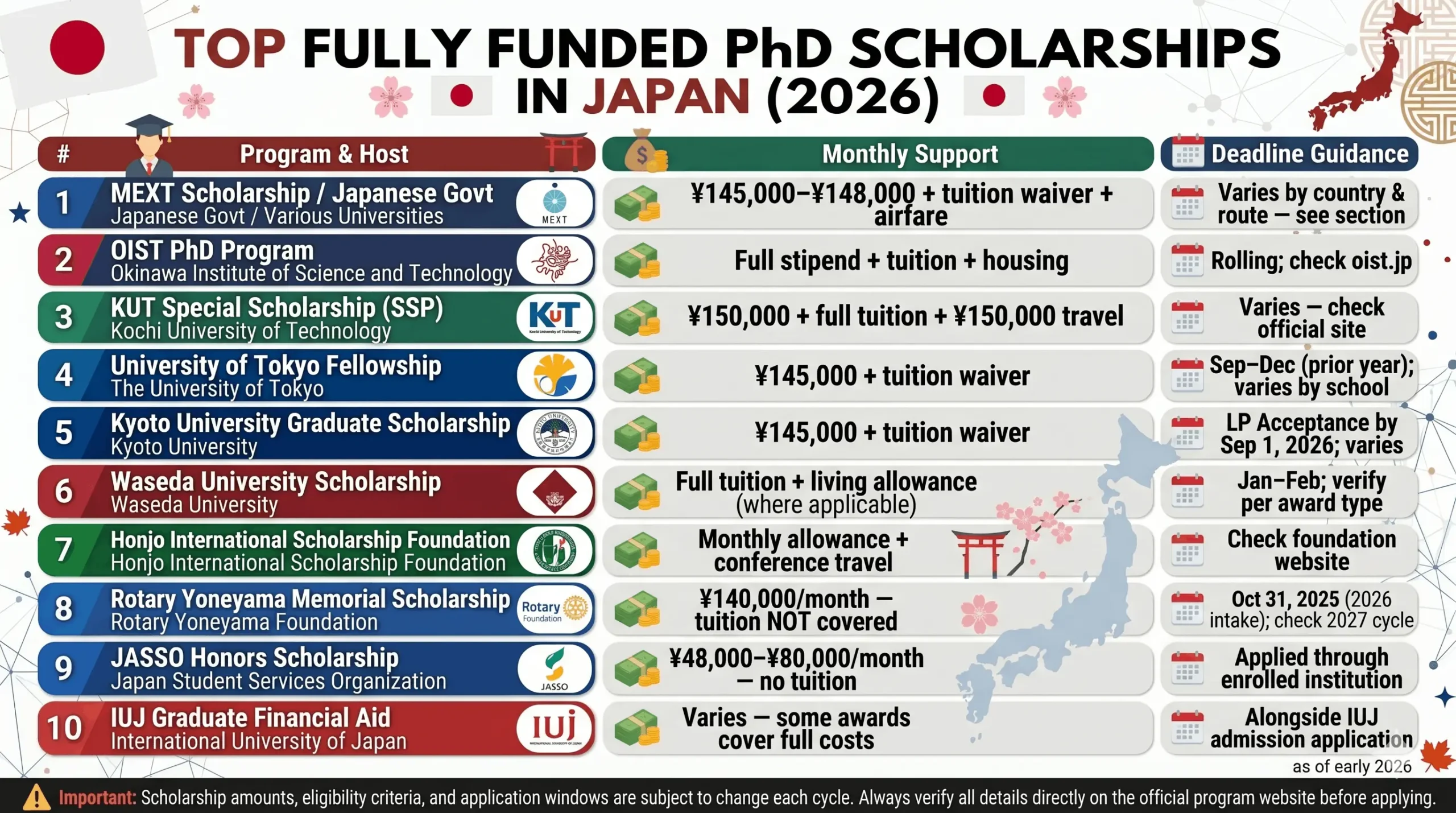
Summary Table: PhD Scholarships and Funding Programs in Japan 2026
| # | Program | Host | Funding Type | For PhD Students? | Monthly Support | Deadline Guidance |
|---|---|---|---|---|---|---|
| 1 | MEXT Scholarship | Japanese Govt / Various Universities | Fully Funded | ✅ Yes | ¥145,000–¥148,000 + tuition waiver + airfare | Varies by country & route — see section |
| 2 | OIST PhD Program | Okinawa Institute of Science and Technology | Fully Funded | ✅ Yes | Full stipend + tuition + housing | Rolling; check oist.jp |
| 3 | KUT Special Scholarship (SSP) | Kochi University of Technology | Fully Funded | ✅ Yes | ¥150,000 + full tuition + ¥150,000 travel | Varies — check official site |
| 4 | University of Tokyo Fellowship | The University of Tokyo | Fully Funded (via MEXT Univ. route) | ✅ Yes | ¥145,000 + tuition waiver | Sep–Dec (prior year); varies by school |
| 5 | Kyoto University Graduate Scholarship | Kyoto University | Fully Funded (via MEXT Univ. route) | ✅ Yes | ¥145,000 + tuition waiver | LP Acceptance by Sep 1, 2026; varies |
| 6 | Waseda University Scholarship | Waseda University | Fully Funded (select awards only) | ✅ Yes | Full tuition + living allowance (where applicable) | Jan–Feb; verify per award type |
| 7 | Honjo International Scholarship Foundation | Honjo International Scholarship Foundation | Fully Funded (enrolled students) | ✅ Yes (enrolled PhD) | Monthly allowance + conference travel | Check foundation website |
| 8 | Rotary Yoneyama Memorial Scholarship | Rotary Yoneyama Foundation | Supplementary — living support only | ✅ Doctoral eligible | ¥140,000/month — tuition NOT covered | Oct 31, 2025 (2026 intake); check 2027 cycle |
| 9 | JASSO Honors Scholarship | Japan Student Services Organization | Supplementary — living support only | ✅ Enrolled PhD students | ¥48,000–¥80,000/month — no tuition | Applied through enrolled institution |
| 10 | IUJ Graduate Financial Aid | International University of Japan | Partial to Full (varies by award) | ✅ PhD students admitted to IUJ | Varies — some awards cover full costs | Alongside IUJ admission application |
Section A: Fully Funded PhD Scholarships in Japan
These programs provide both tuition coverage and a monthly living stipend to enrolled or incoming doctoral students. They represent the true “fully funded PhD” category.
1. MEXT (Monbukagakusho) Scholarship — Japanese Government PhD Fellowship
Overview
The MEXT Scholarship — formally the Japanese Government (Monbukagakusho) Scholarship — is Japan’s most prominent government-funded doctoral program, administered by the Ministry of Education, Culture, Sports, Science and Technology. It supports PhD students across all fields at Japan’s top national and designated private universities and is available through two distinct routes:
- Embassy Recommendation: You apply through the Japanese Embassy or Consulate in your home country. This is the most widely accessible route for students who do not yet have a Japanese university connection.
- University Recommendation: A Japanese university identifies and nominates you directly to MEXT. Requires prior contact with a supervisor or graduate school at a participating Japanese university.
Key Benefits
- Monthly stipend of ¥145,000 for doctoral students at most universities (¥147,000–¥148,000 at Science Tokyo/former Tokyo Tech; an additional ¥2,000–3,000 applies in some designated regional universities)
- Full tuition and enrollment fee waiver covered by MEXT
- Round-trip economy-class airfare from your home country to Japan
- Housing support at international student dormitories
Eligibility
- Must be under 35 years of age and hold a master’s degree (or equivalent 18 years of schooling) for the doctoral program
- Must hold nationality of a country with diplomatic relations with Japan
- No IELTS or TOEFL required at the Embassy route application stage; language ability is assessed through the embassy’s own written test
Application Deadline — Country-Specific, Not Universal
MEXT deadlines differ by country and by application route. There is no single global deadline. Confirmed examples:
- USA (Washington D.C. Embassy): May 21, 2026 for the Research Scholarship
- India: May 15, 2026 (per Embassy of Japan in India for the 2026 cycle)
- University Recommendation route: Typically September–December of the year prior to enrollment; each participating university sets its own internal deadline
✅ Action step: Visit the official website of the Japanese Embassy or Consulate in your specific country, navigate to the Education or Scholarship section, and download the guidelines for your intake year. Do not rely on a deadline listed for another country.
Who Should Apply
Anyone seeking a fully funded PhD in Japan at a national or designated private university, across all academic disciplines. This is the single most widely available fully funded PhD route for international students in Japan.
Official Link: mext.go.jp
2. OIST PhD Program — Okinawa Institute of Science and Technology
Overview
The OIST PhD Program is a fully funded 5-year doctoral program at the Okinawa Institute of Science and Technology Graduate University — one of Asia’s most internationally oriented research institutions. OIST operates without traditional academic departments; all instruction and research is conducted in English. The program begins with rotations across multiple laboratories before students settle into their primary research area and thesis work.
Key Benefits
All admitted students receive comprehensive funding regardless of nationality or field:
- Full tuition coverage
- A generous monthly living stipend (amount confirmed on the official site; sufficient for comfortable living in Okinawa)
- Relocation travel funding to reach Okinawa
- On-campus housing assistance
- Health insurance and student support services
There is no application fee.
Eligibility
Applicants must be in the last two years of a bachelor’s degree, currently enrolled in a master’s program (any year), or hold a completed bachelor’s or master’s degree. No specific undergraduate major is required — OIST explicitly values interdisciplinary research potential. Applicants from non-English-medium universities must provide TOEFL or IELTS scores; there is no stated minimum cutoff, but the score informs any required preparatory course.
Application Deadline
The most recently confirmed deadline for the current cycle was March 31, 2026. OIST reviews applications on a rolling basis at each admissions committee meeting. Always check oist.jp/admissions for the current intake window.
Who Should Apply
Students passionate about interdisciplinary science — spanning biology, physics, chemistry, mathematics, neuroscience, environmental science, and more — who want a 100% English-taught, fully funded PhD in Japan without a conventional departmental structure.
Official Link: oist.jp/admissions
3. KUT Special Scholarship Program (SSP) — Kochi University of Technology
Overview
The Kochi University of Technology (KUT) Special Scholarship Programme (SSP) is a dedicated, fully funded PhD scholarship for international doctoral students. It is one of the few programs outside the major national university system that explicitly guarantees both full tuition coverage and a substantial monthly stipend to PhD candidates, alongside a supervisor-matching model.
Key Benefits
- Full tuition waiver
- Exemption from admission and enrollment fees
- Monthly stipend of ¥150,000 for living expenses
- One-time relocation and settlement allowance of ¥150,000 for students arriving from outside Japan
- Access to specialized research facilities and experienced supervisors
- Academic English and Japanese language support courses
Eligibility
- Must hold (or expect to hold before enrollment) a master’s degree equivalent to 18 years of schooling
- Must be 35 years of age or younger at the time of admission
- Must demonstrate solid academic background and research ability
- Must have English language proficiency (TOEFL, IELTS, or equivalent)
- Must obtain prior approval from a KUT academic supervisor willing to oversee the proposed research
Application Deadline
Deadlines vary by intake cycle. Check the official KUT admissions page for current dates, as they are updated each year.
Who Should Apply
Engineering and applied science researchers seeking a guaranteed fully funded doctoral position with a supervisor-matched placement. Particularly suited for applicants from Asia, the Middle East, and Africa with a clearly identified research area within KUT’s active engineering programs.
Official Link: kochi-tech.ac.jp
4. University of Tokyo Fellowship (Doctoral Program)
Overview
The University of Tokyo (UTokyo) — Japan’s top-ranked university — offers international PhD students access to MEXT University Recommendation scholarships and graduate school-specific fellowships. The Graduate School of Science maintains its own MEXT nomination quota and provides admitted doctoral fellows with housing guarantees on top of the standard MEXT award.
Key Benefits
- Monthly stipend of ¥145,000 for doctoral students
- Full tuition and enrollment fees waived
- Guaranteed housing in an International Lodge for the first year (Kashiwa campus: approximately ¥50,000/month; Komaba campus: approximately ¥60,000/month)
- Access to world-class laboratories and research networks across all disciplines
Eligibility
International students with outstanding academic records — a GPA of 2.30 or higher on UTokyo’s internal scale — seeking entry into a doctoral program. Applicants must pass the entrance examination of the relevant graduate school and apply through UTokyo’s admissions process alongside the scholarship nomination.
Application Deadline
Each graduate school at UTokyo sets its own timeline. For the MEXT University Recommendation route, internal selection and notification typically occurs April–June of the enrollment year. Check the specific graduate school’s admissions page starting from September of the year prior to enrollment.
Who Should Apply
Top-performing researchers targeting Japan’s most prestigious research institution, across all disciplines — physics, chemistry, biology, earth science, astronomy, mathematics, engineering, social sciences, law, and beyond.
Official Link: u-tokyo.ac.jp
5. Kyoto University Graduate Scholarship (MEXT University Route)
Overview
Kyoto University, Japan’s second-oldest imperial university and home to numerous Nobel laureates, accepts international PhD students through the MEXT University Recommendation route and its own international graduate programs. It is particularly renowned in life sciences, physics, engineering, economics, environmental studies, and the humanities.
Key Benefits
- Full tuition and enrollment fee waiver
- Monthly doctoral stipend of approximately ¥145,000 (MEXT rate)
- Round-trip economy-class airfare (under MEXT conditions)
Eligibility
Applicants must pass the entrance examination of the relevant Kyoto University graduate school and secure a Letter of Provisional Acceptance. The MEXT University Recommendation requires a GPA of 2.30 or higher on the relevant scale.
Application Deadline
For students who have passed the first MEXT Embassy screening, Kyoto University must receive a request for a Letter of Provisional Acceptance by Tuesday, September 1, 2026 (JST). For the University Recommendation route, the nomination cycle opens mid-September to early December of the year prior to enrollment. Exact internal deadlines vary by graduate school — check each faculty’s admissions page directly.
Who Should Apply
Researchers in science, engineering, agriculture, economics, environmental studies, and humanities seeking a world-class academic environment in one of Japan’s most culturally significant cities.
Official Link: kyoto-u.ac.jp
6. Waseda University International Scholarships (Doctoral)
Overview
Waseda University — one of Japan’s most prestigious private research universities, located in central Tokyo — offers several scholarship pathways for international doctoral students, including MEXT University Recommendation nominations and university-specific awards such as the Ono Azusa Memorial Scholarship. Waseda has a significant portfolio of English-medium graduate programs across multiple fields.
⚠️ Important accuracy note: Not all Waseda scholarships for doctoral students are fully funded. Coverage varies by award type — some are full scholarships covering tuition and living costs; others are partial tuition reductions only. Review each scholarship individually on the official Waseda page and confirm with the admissions office whether the specific doctoral award you are applying for covers both tuition and living expenses.
Key Benefits (where full awards apply)
- Full tuition fee coverage
- Monthly living allowance
- Travel support
Eligibility
All international students (Japanese nationals are not eligible). A CGPA of 2.7 to 3.0 out of 4.0 is a baseline requirement. Some awards require a research proposal and confirmation of a supervisor.
Application Deadline
Timelines typically run January–February for April enrollment and May–June for September enrollment, but differ by graduate school and award. Always verify on the official Waseda scholarship portal for the specific doctoral award you are targeting.
Who Should Apply
PhD applicants in international relations, business, science and engineering, humanities, and social sciences who want access to a major Tokyo private university with significant English-medium doctoral programs, and who are willing to investigate the specific funding terms of each available award.
Official Link: waseda.jp/scholarship
7. Honjo International Scholarship Foundation (HISF)
Overview
The Honjo International Scholarship Foundation is a well-established Japanese private foundation that supports international graduate students — including doctoral candidates — already enrolled at recognized Japanese universities. It emphasizes academic excellence and commitment to cross-cultural exchange.
Key Benefits
- Monthly living allowance (current amount on official site; check annually as figures are updated)
- Travel grants for attending international academic conferences
- Networking support within Japan’s international academic community
Eligibility
Applicants must be international students enrolled in a master’s or doctoral program at a recognized Japanese university. Recipients generally may not simultaneously hold other major Japanese government scholarships. Applications are submitted through the applicant’s host institution.
Who Should Apply
PhD students already enrolled in a Japanese graduate school who need supplementary financial support, particularly for conference travel and research dissemination, alongside a commitment to academic excellence and international engagement.
Official Link: hisf.or.jp
Section B: Supplementary / Living Support Programs for PhD Students
These programs provide a monthly living stipend only — they do not cover tuition. They are most effective when combined with a tuition waiver from a national university or a parallel scholarship. Treating either of these programs as a standalone “fully funded PhD scholarship” would be inaccurate and could mislead applicants into financial difficulty.
8. Rotary Yoneyama Memorial Scholarship (Doctoral Category)
Overview
The Rotary Yoneyama Memorial Foundation is one of Japan’s longest-running private international scholarship programs. It offers a monthly stipend and arrival travel reimbursement to enrolled international students — including doctoral candidates — at recognized Japanese universities. Crucially, the Yoneyama scholarship covers living expenses only; it does not pay tuition.
This makes it a strong supplementary award. A doctoral student who secures a national university tuition waiver (which many Japanese national universities offer to international students based on financial need) and adds the Yoneyama stipend would effectively cover all study costs — but the Yoneyama award alone is not sufficient.
Key Benefits
- Monthly stipend of ¥140,000 for doctoral students (for up to two years)
- Economy-class airfare reimbursement up to ¥250,000 after arrival in Japan
- Personal mentorship through a local Rotary sponsor club (sewa club)
- Networking through Rotary alumni associations in Japan and abroad
Eligibility and Conditions
- Must not hold Japanese nationality
- Must be residing outside Japan until program commencement
- Must not have resided in Japan for more than 31 days in total (exceptions for family/educational circumstances)
- Must demonstrate Japanese language proficiency at JLPT N4 level or above
- Must attend monthly Rotary club meetings and submit biannual reports in Japanese
- Must not be a previous Yoneyama Scholar
- Age: born on or after April 2, 1981 (under 45 as of April 1, 2026) for the 2026 cycle
- Must also apply to and be accepted by a Japanese university independently — the scholarship does not guarantee admission
Application Deadline
For the 2026 intake, the Rotary Yoneyama online portal was open October 1–31, 2025 (JST). For the 2027 intake, check the official foundation website from September 2026 onwards.
Who Should Apply
Doctoral students who are passionate about cultural exchange and community involvement, have basic Japanese language ability, and are applying for (or already hold) a tuition waiver at a Japanese national university. This should be treated as a supplement to a tuition funding source, not a standalone award.
Official Link: rotary-yoneyama.or.jp
9. JASSO Honors Scholarship for Privately Financed International Students
Overview
The Japan Student Services Organization (JASSO) Honors Scholarship is the most widely accessible living cost support award for international students already enrolled at Japanese universities. It provides a modest monthly stipend toward daily living expenses. It does not cover tuition.
JASSO is best understood as a living cost supplement. Its most powerful use case is layered with a tuition waiver from a national or public university: a PhD student at a national university holding a 100% tuition waiver plus the JASSO stipend effectively covers all study costs from combined sources — but the JASSO stipend alone (¥48,000–¥80,000) is below typical monthly living costs in Japan and cannot be treated as a full scholarship.
Key Benefits
- Monthly stipend of ¥48,000 (standard) or ¥80,000 (select eligible students)
- No separate application to JASSO — awarded and disbursed through the enrolled institution
- No IELTS or TOEFL requirement for the scholarship itself
- Can be combined with most university tuition waivers
Eligibility
- Must be enrolled in a recognized Japanese university or graduate school
- Must demonstrate academic merit and financial need
- Must be a privately financed student — cannot be simultaneously receiving MEXT or certain other government-funded scholarships that prohibit dual funding
- Applications submitted through the student’s institution after enrollment; cannot be applied for before arriving in Japan
Who Should Apply
International PhD students already enrolled at a Japanese university who need modest monthly support and are not covered by MEXT or equivalent government funding. Best used in combination with a national university tuition waiver.
Official Link: jasso.or.jp
10. IUJ Graduate Financial Aid and Scholarships
Overview
The International University of Japan (IUJ) — an English-medium private graduate university in Niigata Prefecture — offers financial aid and merit scholarships to admitted master’s and doctoral students. The funding landscape at IUJ is varied: some high-performing admitted students may receive awards that cover full tuition and living expenses, while others receive partial tuition reductions or no award at all. There is no single guaranteed full scholarship for all PhD admits.
⚠️ Accuracy note: IUJ financial aid is competitive and variable. The level of funding differs by scholarship type, cohort, and academic year. Prospective applicants should contact IUJ’s admissions office directly to confirm which specific doctoral scholarship categories are available for their intended program and what each covers before treating IUJ as a guaranteed fully funded option.
Key Benefits (where full awards apply)
- Tuition exemption (partial or full, depending on award type)
- Monthly living support (for select scholarship recipients)
- Access to an internationally diverse academic environment in international relations, business administration, and governance
Eligibility
International applicants admitted to IUJ’s graduate programs. Must hold a recognized bachelor’s degree for master’s programs or a relevant master’s degree for PhD programs. Award levels are determined as part of the admissions process.
Who Should Apply
Students targeting English-medium graduate programs in international relations, business, and global governance who wish to explore competitive scholarship possibilities alongside their admission application, and who can verify actual coverage terms with IUJ’s admissions office.
Official Link: iuj.ac.jp/admissions/financial-aid
How to Get a Fully Funded PhD in Japan: Step-by-Step Guide
Step 1: Identify your research area and target supervisor
Before applying for any scholarship, identify 2–3 Japanese professors whose research aligns with your interests. Contact them by email with your CV and a brief research proposal. A positive supervisor response significantly strengthens MEXT University Route and KUT SSP applications, and is mandatory for JSPS postdoctoral awards.
Step 2: Choose the right route for your situation
| Your Situation | Recommended Route |
|---|---|
| Pre-admission applicant, any field | MEXT Embassy Recommendation |
| Have supervisor contact at a Japanese university | MEXT University Recommendation |
| Interdisciplinary science, English-only environment | OIST PhD Program |
| Engineering/science, confirmed KUT supervisor | KUT SSP |
| Already enrolled in Japan, need living support | JASSO + national university tuition waiver |
| Already hold a PhD, want to research in Japan | JSPS Standard or PD (postdoctoral) |
Step 3: Prepare your core application documents
- Academic CV
- Research proposal (1,000–2,000 words for most programs)
- Academic transcripts (bachelor’s and master’s level)
- Letters of recommendation (2–3 academic referees)
- Statement of purpose
- Language proficiency certificate (where required)
- Passport copy; medical certificate where required
Step 4: Apply early and through multiple channels
Japan’s best scholarships are highly competitive. Apply to multiple programs where eligible. MEXT, OIST, and KUT deadlines are firm — extensions are almost never granted.
Step 5: Secure your Student Visa
Once admitted and scholarship-confirmed, your university will issue a Certificate of Eligibility. You then apply for a Japanese Student Visa at your local Japanese consulate or embassy.
Also Read: Top Fellowships & Funding Opportunities for PhD Students in India in 2026
How Much Stipend Do PhD Students Get in Japan?
| Scholarship | Monthly Stipend | Covers Tuition? | Category |
|---|---|---|---|
| MEXT Doctoral | ¥145,000–¥148,000 (~$970–$990 USD) | Yes | Fully Funded PhD |
| OIST PhD | Generous (confirmed at oist.jp) | Yes | Fully Funded PhD |
| KUT SSP | ¥150,000 (~$1,000 USD) | Yes | Fully Funded PhD |
| Rotary Yoneyama (Doctoral) | ¥140,000 (~$935 USD) | No | Living Support Only |
| JASSO | ¥48,000–¥80,000 | No | Living Support Only |
| IUJ (select awards) | Varies | Partial to Full | Variable |
| JSPS Standard / PD | ¥362,000 (~$2,400 USD) | N/A | Postdoctoral only |
Living costs in Japan for a PhD student in a mid-sized city typically range from ¥80,000–¥120,000 per month. MEXT, KUT SSP, and OIST stipends are sufficient to cover rent, food, and basic expenses comfortably. The JASSO stipend alone (¥48,000) is below typical monthly living costs and is not designed to be a standalone funding source.
Best Universities in Japan for Fully Funded PhD Programs
Japan has several world-class universities that actively fund international PhD students:
- University of Tokyo (UTokyo) — Japan’s #1 ranked university; strong in sciences, engineering, medicine, and social sciences
- Kyoto University — #2 in Japan; renowned for Nobel Prize-winning research across multiple disciplines
- Osaka University — Top national university; especially strong in life sciences and engineering
- Tohoku University — One of Japan’s oldest imperial universities; strong in materials science and physics
- OIST Graduate University — Fully international; all teaching in English; 100% fully funded for all admitted students regardless of nationality
- Science Tokyo (former Tokyo Tech) — Cutting-edge science and engineering; strong MEXT University Recommendation track
- Waseda University — Premier private university; English-medium doctoral programs with competitive internal scholarships
- Kochi University of Technology (KUT) — Dedicated fully funded SSP program; strong in engineering and applied sciences
Can International Students Get a Fully Funded PhD in Japan Without IELTS?
Yes — several programs do not require IELTS or TOEFL:
- MEXT Scholarship (Embassy route): IELTS/TOEFL is not mandatory at the application stage. Language ability is assessed through the embassy’s own written examination.
- OIST PhD Program: Applicants from universities where the language of instruction was English are not required to provide a TOEFL or IELTS score. Others must provide scores, but there is no minimum cutoff.
- KUT SSP: Accepts a range of English proficiency evidence; check the official site for currently accepted tests.
- JASSO: No English language test required for the stipend award itself.
Note: The Rotary Yoneyama scholarship requires Japanese language proficiency (JLPT N4 or above), not English test scores.
FAQ: Fully Funded PhD in Japan 2026
Q1. Can international students get a fully funded PhD in Japan? Yes. Japan offers several genuinely fully funded PhD scholarships — MEXT, OIST, KUT SSP, and university-specific awards — covering both tuition and living costs for students from almost any country. Additional living support programs (JASSO, Rotary Yoneyama) also exist but cover stipend only and work best when combined with separate tuition waivers.
Q2. What is the MEXT PhD stipend, and is there one universal application deadline? The MEXT doctoral stipend is ¥145,000–¥148,000 per month depending on the host university, plus a full tuition waiver. There is no single global application deadline — it varies by country and by application route. Examples: the USA Embassy deadline is May 21, 2026; the India Embassy deadline is May 15, 2026. Always check the Japanese Embassy website in your specific country for the accurate date.
Q3. How do I apply for the OIST PhD program? Visit oist.jp/admissions, browse the faculty research units, check supervisor availability, and submit your full application online before the stated deadline. There is no application fee. No minimum IELTS/TOEFL score is required.
Q4. Are JSPS fellowships available for students currently pursuing a PhD? No. Both the JSPS Postdoctoral Fellowship (Standard) and the JSPS Research Fellowship for Young Scientists (PD) are designed for researchers who have already completed (or are close to completing) their PhD. They are postdoctoral awards, not funding for current PhD students. Do not apply for these if you are still in a doctoral program.
Q5. Is the Rotary Yoneyama scholarship fully funded? Not on its own. It covers a monthly stipend of ¥140,000 for doctoral students but does not cover tuition. It is a living support award most effectively combined with a national university tuition waiver. It also requires Japanese language proficiency (JLPT N4) and active participation in Rotary activities.
Q6. Can I work part-time while on a PhD scholarship in Japan? Japanese student visa regulations generally allow limited part-time work (up to 28 hours per week during the academic term). However, specific scholarship terms — particularly MEXT — may impose additional restrictions. Always confirm with your scholarship agreement and university international office before taking on part-time employment.
Q7. What is the best scholarship for a fully funded PhD in Japan for Indian students? The MEXT Embassy Recommendation Scholarship is the most accessible gateway. The India application period runs April–May with a written exam in June and interviews in early July. For students in engineering with a confirmed KUT supervisor, the KUT SSP is also an excellent route. OIST accepts rolling applications from Indian students year-round.
About IR Research Publication
IR Research Publication (irrespub.com) is a scientific journal publisher and editorial service provider dedicated to supporting researchers and academics worldwide. Beyond publishing in the biological and applied sciences, IR Research Publication produces rigorously fact-checked, accuracy-first guides on scholarships, fellowships, academic funding, and international research opportunities for students and early-career scientists. Whether you are looking to publish peer-reviewed research, strengthen your academic profile, or find your next fully funded opportunity abroad, IR Research Publication is a trusted resource for the global research community.
Related Blogs from IR Research Publication
Explore more guides on international scholarships, PhD funding, and research fellowships:
- Fully Funded PhD Scholarships in Europe for Indian Students (2026) — Verified, country-wise guide covering Germany, France, Sweden, Netherlands, Switzerland, and more.
- Your Guide to Fully Funded Postdoctoral Fellowships in South Korea: Stipends, Eligibility, and 2026 Application Windows — NRF Brain Pool, Korea Research Fellowship, InnoCORE, and more.
- Fully Funded PhD Scholarships in South Korea: Stipends, Eligibility, and 2026 Deadlines — GKS-G, UST, KAIST, SNU, GIST, POSTECH, and other top programs.
- Top Fellowships & Funding Opportunities for PhD Students in India in 2026 — PMRF, CSIR, UGC NET, DST-INSPIRE, NIPER, and IISER fellowships explained.
- Fully Funded Postdoctoral Fellowships in Canada for Indian Students in 2026 — CPRA, Mitacs, Schmidt AI, and more with deadlines and stipends.
- Top Funded Postdoctoral Fellowships in UK for Indian Students in 2026 — Newton International Fellowship, Leverhulme, British Academy, MSCA, and more.
- Fully Funded Postdoctoral Fellowships in Singapore: Stipends, Benefits, and 2026 Deadlines — LKYPDF, NTU Presidential, SG NRF Fellowships, and others.
Last updated: May 2026. Deadlines, stipend amounts, and program terms are subject to change. Always verify details on the official program or embassy website before applying. This article does not constitute formal admissions or scholarship advice.