
IRRESPUB BLOG
Fully Funded Postdoctoral Fellowships in Japan: Stipends, Eligibility, and 2026 Deadlines
Introduction
Japan is one of the world’s premier destinations for postdoctoral research. Home to Nobel-winning scientists, world-class universities like the University of Tokyo and Kyoto University, and advanced research institutes like RIKEN and OIST, Japan offers international scholars an unmatched environment to accelerate their academic careers.
For early-career researchers wondering how to get a postdoctoral fellowship in Japan, the good news is that numerous fully funded postdoctoral fellowships in Japan are open to international applicants — covering stipends, airfare, health insurance, and research grants. Whether you are a PhD holder from Asia, Africa, Europe, or the Americas, there is a program designed for your background and research focus.
This guide covers more than 10 of the best postdoc programs in Japan for international students, with verified stipend figures, eligibility criteria, deadlines, and direct links to official pages. It is designed to be the most practical and comprehensive resource available — helping you move from “interested” to “applied.”
Looking for postdoc opportunities beyond Japan? Also check out:
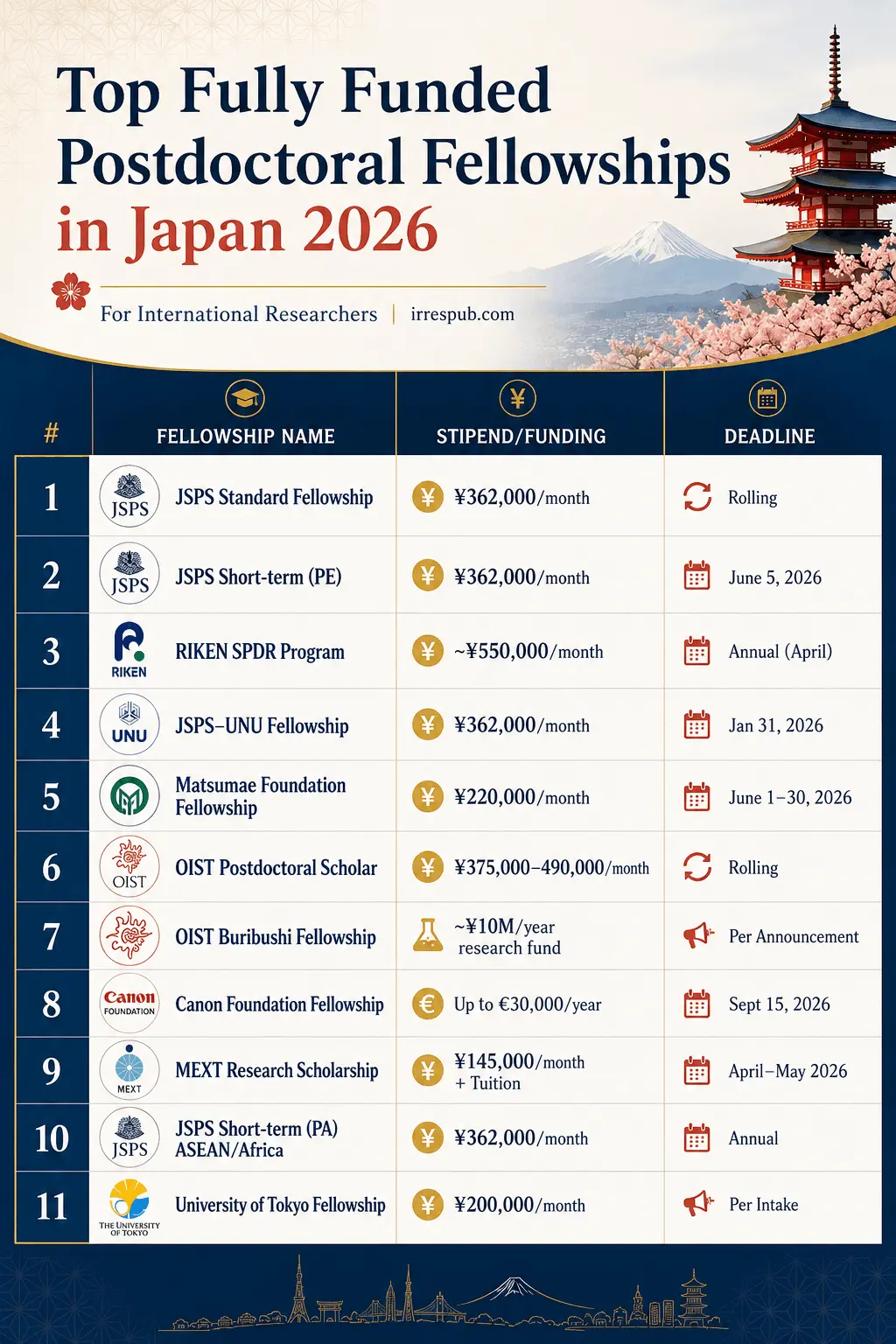
Summary Table: Top Fully Funded Postdoctoral Fellowships in Japan (2026)
| # | Program Name | Host Organization | Eligibility | Funding / Stipend | Application Deadline | Official Link |
|---|---|---|---|---|---|---|
| 1 | JSPS Postdoctoral Fellowship (Standard) | Japan Society for the Promotion of Science | Non-Japanese PhD holders (PhD within 6 years) | ¥362,000/month + airfare + ¥200,000 settling allowance | Rolling (check JSPS site) | jsps.go.jp |
| 2 | JSPS Short-term Fellowship (PE) | JSPS (US, Canada, Europe) | US/Canada/EU citizens, PhD within 6 years | ¥362,000/month + airfare | June 5, 2026 (3rd call) | jsps.go.jp |
| 3 | RIKEN Special Postdoctoral Researcher (SPDR) | RIKEN | All nationalities, PhD within ~5 years | ~¥550,000/month (gross) | Annual (FY2027 call: April 2026) | riken.jp |
| 4 | JSPS–UNU Postdoctoral Fellowship | JSPS + United Nations University | Non-Japanese PhD holders; sustainability focus | ¥362,000/month + airfare + allowances | January 31, 2026 (2026 cycle closed; 2027 opens late 2026) | unu.edu |
| 5 | Matsumae International Foundation Fellowship | Matsumae International Foundation | Non-Japanese PhD holders, ≤45 years, no prior Japan residence | ¥220,000/month + ¥120,000 arrival fund + airfare | June 1–30, 2026 (for 2027 cycle) | mif-japan.org |
| 6 | OIST Postdoctoral Scholar Positions | Okinawa Institute of Science & Technology | PhD in relevant field; all nationalities | ¥4.5M–5.9M/year (~¥375,000–490,000/month) | Rolling (per vacancy) | oist.jp/careers |
| 7 | OIST Buribushi Fellowship | Okinawa Institute of Science & Technology | Theory-focused researchers, PhD between Sept 2018–Sept 2026 | Competitive with Assistant Professor salary + ~¥10M/year research funds | Per announcement | oist.jp |
| 8 | Canon Foundation Research Fellowship | Canon Foundation in Europe | European nationals with Master’s or PhD (within 10 years) | Up to €30,000/year | September 15, 2026 | canonfoundation.org |
| 9 | MEXT Research Scholarship (Research Student Track) | Ministry of Education, Japan | International graduate/post-graduate students | ¥145,000/month (doctoral) + tuition + airfare | April–May 2026 (embassy route) | studyinjapan.go.jp |
| 10 | JSPS Short-term Fellowship (PA) – ASEAN/Africa | JSPS | Pre/postdoc researchers from ASEAN & Africa | ¥362,000/month (PhD holders) + airfare | Annual (check JSPS regional offices) | jsps.go.jp |
| 11 | University of Tokyo Fellowship | University of Tokyo | International graduate research students | ¥200,000/month (up to 1 year) | Per graduate school intake | u-tokyo.ac.jp |
1. JSPS Postdoctoral Fellowship for Research in Japan — Standard Program
Overview
The JSPS Postdoctoral Fellowship (Standard Program) is the flagship international postdoctoral fellowship in Japan, administered by the Japan Society for the Promotion of Science. It is widely regarded as one of the most prestigious and financially generous postdoc programs in Asia. The fellowship supports overseas researchers in conducting collaborative research with leading groups at Japanese universities and national research institutes across all fields — from the natural sciences to the humanities and social sciences.
Applications are submitted through a Japanese host institution, not directly to JSPS. The first step is identifying and confirming a host researcher in Japan whose work aligns with your own.
Key Benefits
- Monthly stipend: ¥362,000 (~USD 2,400–2,500)
- Round-trip economy airfare (based on JSPS regulations)
- Settling-in allowance: ¥200,000 (one-time, upon arrival)
- Overseas travel insurance for the duration of the fellowship
- Access to KAKENHI (Grant-in-Aid for Scientific Research): The host researcher can apply for cooperative research funds on behalf of the fellow
- Duration: 12 to 24 months
- No Japanese language requirement (though it helps; English sufficient for research)
Who Should Apply
Early-career researchers from any country outside Japan who hold a PhD received within the last six years. The program is suitable for researchers in all disciplines — STEM, humanities, social sciences, and interdisciplinary fields.
Application Deadline
The FY2026 cycle has multiple recruitment rounds. The FY2027 Standard call is expected to open later in 2026. Applications must go through a Japanese host institution — institutions may have internal deadlines up to one month before JSPS’s published deadline.
🔗 Official page: https://www.jsps.go.jp/english/e-fellow/
2. JSPS Short-term Fellowship (PE) — For US, Canada & European Researchers
Overview
The JSPS Short-term Fellowship (PE) is a category specifically designed for pre- and postdoctoral researchers from the United States, Canada, and Europe. It provides shorter-term research visits of 1 to 12 months, making it ideal for researchers who want Japan experience without a two-year commitment. The fellowship is administered in partnership with national nominating authorities in each eligible country (e.g., JSPS Washington Office for the US, JSPS London for UK/Ireland, etc.).
The 3rd call for FY2026 is currently open with an application deadline of June 5, 2026 (JST).
Key Benefits
- Monthly stipend: ¥362,000 for PhD holders; ¥200,000 for non-PhD holders
- Round-trip airfare
- Settling-in allowance: ¥200,000 (for fellowships of 3 months or more)
- Duration: 1 to 12 months
- Fellows must start between mid-May 2026 and March 31, 2027
Who Should Apply
Researchers from the US, Canada, or European countries who hold (or will hold before the fellowship starts) a PhD. Researchers who have previously been awarded a JSPS Postdoctoral Fellowship are not eligible.
Application Deadline
June 5, 2026 (3rd call, FY2026). Apply through your country’s JSPS nominating authority.
🔗 Official page: https://www.jspsusa.org/wp/fellowship/shortterm-fy2026/ (US applicants)
3. RIKEN Special Postdoctoral Researcher (SPDR) Program
Overview
RIKEN is Japan’s largest and most prestigious comprehensive research organization for basic and applied science. Its Special Postdoctoral Researcher (SPDR) Program invites young, creative, and independent researchers to conduct self-directed research within RIKEN’s vast network of laboratories — without being tied to a supervisor’s project. Fellows propose their own research topic aligned with RIKEN’s fields and work as independent scientists.
This is a salaried position (not a traditional fellowship), making it one of the most financially competitive postdoc arrangements in Asia. Approximately 70 SPDR positions are available per annual call, and the program is open to all nationalities. English is fully sufficient — many RIKEN labs operate in English.
Key Benefits
- Monthly salary: ~¥550,000 gross (before taxes and social insurance)
- Contract duration: 3 years (beginning April of the relevant fiscal year)
- Discretionary research funds for independent projects
- Eligible to apply for external competitive funding (KAKENHI)
- World-class facilities across multiple RIKEN campuses
- Maternity/childcare leave provisions with possible contract extension
Who Should Apply
Researchers of all nationalities who are creative, independent, and have a strong publication record. Applicants must not have previously participated in the SPDR or the former Foreign Postdoctoral Researcher (FPR) program. The program covers all major RIKEN research domains: mathematics, physics, chemistry, biology, medical science, and engineering.
Application Deadline
FY2027 call: Basic information registration by April 2, 2026; final document submission by April 9, 2026. The FY2027 call is now closed; monitor the RIKEN website for the FY2028 cycle.
🔗 Official page: https://www.riken.jp/en/careers/programs/spdr/
4. JSPS–UNU Postdoctoral Fellowship Programme
Overview
Jointly organized by the United Nations University (UNU) and JSPS, the JSPS–UNU Postdoctoral Fellowship is a fully funded two-year postdoctoral program for researchers focused on sustainability, climate change, biodiversity, and governance. UNU-IAS (Institute for the Advanced Study of Sustainability) in Tokyo serves as the nominating authority. Since 1996, over 250 researchers — 70% from the developing world — have benefited from this program.
Research must be conducted within one of the UNU-IAS thematic areas:
- Governance for Climate Change & Sustainable Development (GCSD)
- Biodiversity & Society
- Sustainability, Innovation & Education (SIE)
- Sustainable Resource Management
All projects must be policy-relevant and incorporate gender considerations.
Key Benefits
- Monthly stipend: ¥362,000 (JSPS rate)
- Round-trip airfare
- Settling-in allowance: ¥200,000
- Overseas travel insurance
- Access to KAKENHI research support through host researcher
- Duration: Up to 24 months (fellowship cannot be extended)
Who Should Apply
Non-Japanese researchers from any country with diplomatic relations with Japan who hold a PhD (received on or after April 2, 2020). Particularly encourages applicants from developing countries. Candidates must secure a confirmed host researcher at a Japanese institution before applying.
Application Deadline
The 2026 cycle closed on January 31, 2026. The 2027 cycle is expected to open in late 2026 — monitor UNU-IAS for announcements.
🔗 Official page: https://unu.edu/ias/postdoctoral-fellowships
5. Matsumae International Foundation (MIF) Research Fellowship
Overview
The Matsumae International Foundation Fellowship is a well-established short-term postdoctoral fellowship that invites overseas researchers to conduct 3 to 6 months of research at Japanese universities and national research institutions. Founded in memory of educator and peace advocate Dr. Shigeyoshi Matsumae, this program has been running for decades and prioritizes researchers in natural science, engineering, and medicine — though all fields are considered.
A key feature of MIF is that applicants choose their own host institution and professor, giving significant flexibility. The program specifically targets researchers who have never previously lived or worked in Japan (short conference visits are acceptable).
Key Benefits
- Monthly allowance: ¥220,000 (for living expenses and research activities)
- Arrival fund: ¥120,000 (one-time, upon arrival)
- Round-trip economy airfare
- Travel insurance (medical treatment and death benefits)
- Access to study tours organized by MIF
- Duration: 3 to 6 months (June 2026 – March 2027 window for the 2026 cycle)
Who Should Apply
Non-Japanese nationals who hold a PhD and are 45 years of age or younger at the time of application. Applicants must have a full-time position in their home country and commit to returning after the fellowship. No prior Japan residence (excluding brief tourist or conference visits). Applicants must have acceptance from a Japanese host institution before applying.
Application Deadline
For the 2027 cycle: June 1–30, 2026
🔗 Official page: https://www.mif-japan.org/en/fellowship/announcement/
6. OIST Postdoctoral Scholar Positions
Overview
The Okinawa Institute of Science and Technology (OIST) is a young, fully international graduate university on the island of Okinawa, consistently ranked among the world’s top research environments. OIST has no academic departments, deliberately fostering interdisciplinary collaboration. English is the official language of the university — making it uniquely accessible for international researchers who do not speak Japanese.
OIST recruits postdoctoral scholars on a rolling basis across dozens of research units covering physics, chemistry, biology, neuroscience, mathematics, computer science, environmental science, and more. Each position is tied to a specific Principal Investigator and lab.
Key Benefits
- Annual salary: ¥4.5M–5.9M (~¥375,000–490,000/month), increasing with years post-PhD
- Full benefits package (health insurance, paid leave)
- Access to world-class core facilities
- Fully international research environment (50+ countries represented)
- Beautiful Okinawa campus with housing support
- Competitive travel and conference funding
Who Should Apply
PhD holders in any relevant natural science or engineering field. All nationalities welcome. Applications are made directly to specific Principal Investigators based on advertised vacancies.
Application Deadline
Rolling — check the OIST careers portal for current openings.
🔗 Official page: https://www.oist.jp/careers
7. OIST Buribushi Fellowship
Overview
The OIST Buribushi Fellowship (“Buribushi” means “a cluster of stars” in the Okinawan language) is a prestigious independent postdoctoral fellowship for theory-focused researchers in the natural sciences and technology. It is designed as a stepping stone to junior faculty positions — offering a salary competitive with an Assistant Professor plus substantial research funds. Up to two Buribushi Fellows are selected per academic year.
“Theory-focused” here means research that does not require dedicated wet laboratory facilities or high-performance computing — such as pure or applied mathematics, theoretical physics, theoretical biology, and statistical learning.
Key Benefits
- Salary: Competitive with Assistant Professor positions
- Research funds: ~¥10 million per year
- Full access to OIST facilities and interdisciplinary community
- Professional development support
- Fully international, English-language environment
Who Should Apply
Researchers with a PhD conferred between September 1, 2018 and September 1, 2026 (adjustable for career interruptions) who conduct theory-focused research in the natural sciences or technology.
Application Deadline
Per announcement cycle. Check OIST careers for the next opening.
🔗 Official page: https://www.oist.jp/careers/okinawa-institute-science-and-technology-buribushi-fellowship-2026
8. Canon Foundation in Europe Research Fellowship (Japan Track)
Overview
The Canon Foundation in Europe grants up to 15 fellowships per year to highly qualified European and Japanese researchers. European Fellows use the grant to conduct research in Japan; Japanese Fellows use it for research in Europe. The fellowship is unique in that it is open to all disciplines and has no requirement for institutional affiliation — members of commercial, industrial, governmental, or professional organizations may also apply.
This is an especially strong option for European researchers looking for a shorter-term, flexible research visit to Japan (3 months to 1 year) without the institutional bureaucracy of larger government programs.
Key Benefits
- Financial support: Up to €30,000 per year (pro-rata for shorter periods; typically ~€22,500–27,500)
- Freedom to choose host institution and host in Japan
- Open to all research fields
- No strict career-stage requirement (Master’s or PhD within the last 10 years, with exceptions)
Who Should Apply
European nationals with at least a Master’s or PhD degree obtained within the previous 10 years (exceptional candidates from earlier may also apply). Researchers who have not previously spent extended time in Japan are given priority. Applications from Japanese nationals going to Europe are also accepted.
Application Deadline
September 15, 2026 (for fellowships starting January–December 2027). Final decisions communicated by mid-December 2026.
🔗 Official page: https://www.canonfoundation.org/programmes/research-fellowships/
9. MEXT Research Scholarship (Research Student Track)
Overview
The Japanese Government (MEXT) Scholarship is one of the most comprehensive government-funded programs for international researchers and students in Japan. The Research Student Track is relevant for postdoctoral-level researchers who wish to conduct advanced research or complete a doctoral degree at a Japanese university. Researchers enter as “research students” under a Japanese professor and may transition to formal degree enrollment.
MEXT scholarships are distributed through two tracks: the Embassy Recommendation (apply through your country’s Japanese embassy) and the University Recommendation (apply through a specific Japanese university that has been approved by MEXT). Both tracks are fully funded.
Key Benefits
- Monthly stipend: ¥145,000 (doctoral level); ¥144,000 (master’s level)
- Full tuition waiver
- Round-trip economy airfare
- Accommodation support through university residences
- No IELTS/TOEFL requirement from MEXT itself (individual universities may require English proficiency)
- Duration: typically 1–2 years as research student; extendable if enrolling in a degree program
Who Should Apply
International researchers and PhD holders looking to extend or deepen their Japan research under a specific professor. The Embassy track (April–May 2026 deadline for most countries) is most accessible for independent applicants. Check your local Japanese Embassy for country-specific deadlines.
Application Deadline
Embassy Recommendation route: April–May 2026 for most countries (e.g., May 21, 2026 for US applicants)
🔗 Official page: https://www.studyinjapan.go.jp/en/planning/scholarships/mext-scholarships/
10. JSPS Short-term Fellowship (PA) — For ASEAN & African Researchers
Overview
The JSPS Short-term Fellowship (PA) is specifically designed for pre- and postdoctoral researchers from ASEAN countries and Africa to conduct cooperative research in Japan for 1 to 12 months under the guidance of Japanese host researchers. This program reflects Japan’s commitment to strengthening academic ties with the Global South and provides a fully funded pathway for researchers who may not be eligible under the main Standard or PE programs.
Applications for African researchers are often submitted through JSPS regional offices (e.g., JSPS Nairobi Research Station) which handle the nomintion process.
Key Benefits
- Monthly stipend: ¥362,000 for PhD holders; ¥200,000 for pre-PhD researchers
- Round-trip airfare
- Travel insurance
- Research guidance from leading Japanese host researchers
- Duration: 1 to 12 months
Who Should Apply
Pre- and postdoctoral researchers who are citizens of ASEAN member states or African nations, and who can confirm a host researcher and institution in Japan. All academic disciplines are eligible.
Application Deadline
Varies by regional JSPS office. For African applicants via JSPS Nairobi, the 2026 cycle closed in October 2025; the 2027 cycle will be announced around August 2026. ASEAN applicants should contact the JSPS office in their country.
🔗 Official page: https://www.jsps.go.jp/english/e-fellow/
11. The University of Tokyo Fellowship
Overview
The University of Tokyo (UTokyo) Fellowship is an internal award specifically for graduate-level international research students enrolled or prospective at UTokyo’s graduate schools. While targeted primarily at graduate students, it is relevant for postdoctoral-level researchers entering as international research students under the MEXT or University Recommendation routes. The fellowship complements the MEXT stipend and is one of the clearest indicators of UTokyo’s commitment to supporting international researchers financially.
In the 2025 academic year, 44 new recipients were selected, and as of March 2026, a total of 952 individuals have received this award since the program’s inception.
Key Benefits
- Monthly research grant: ¥200,000 for up to 1 year
- Access to UTokyo libraries, laboratories, and research networks
- Compatible with MEXT and other funding
Who Should Apply
International students applying to or enrolled in a UTokyo graduate school as research students. Applications are submitted through the relevant Graduate School’s international office.
🔗 Official page: https://www.u-tokyo.ac.jp/en/prospective-students/fellowship.html
How to Apply for Postdoctoral Fellowships in Japan: Step-by-Step
Whether you are targeting JSPS, RIKEN, or OIST, the application process for most Japan postdoc fellowships follows a similar structure. Here is a practical guide:
Step 1 — Identify your target fellowship Shortlist 2–3 programs that match your career stage, field, and nationality. Use this article as your starting point.
Step 2 — Secure a host researcher (for JSPS-based programs) Most JSPS fellowships require a confirmed Japanese host researcher before you can submit any application. Search Japanese university faculty pages, Google Scholar, or ResearchGate to find researchers whose work aligns with yours. Email them a concise, personalized research proposal.
Step 3 — Prepare your documents Standard requirements include: CV/resume, research proposal, list of publications, PhD certificate (or expected graduation letter), and letters of recommendation. JSPS and RIKEN forms are specific — download the official application forms from the program website.
Step 4 — Submit through the correct channel JSPS applications must be submitted through the Japanese host institution using the JSPS Electronic Application System — not directly. RIKEN SPDR applications go through the RIKEN online portal. OIST applications go directly to the PI by email.
Step 5 — Follow up and prepare for interviews RIKEN SPDR involves a document screening followed by an interview (typically June–July for the next fiscal year start). OIST positions may involve video interviews with the PI. JSPS selection is typically document-based.
Pro tip: For JSPS-based fellowships, start contacting potential host researchers at least 6 months before your target start date. Japanese academics are thorough and may take weeks to respond.
Tips for a Strong Application
- Tailor your research proposal to match the host researcher’s current projects. Generic proposals rarely succeed at competitive programs like RIKEN SPDR.
- Build your publication record before applying. A single first-author paper in a quality journal significantly improves your competitiveness for JSPS and RIKEN.
- No Japanese required for most programs — but expressing willingness to learn in your application letter is always viewed positively.
- Apply to multiple programs simultaneously. JSPS Standard, Matsumae, and a specific university position can all be in progress at the same time.
- For more tips on building your research profile ahead of fellowship applications, see IR Research Publication’s guide on profile building.
Frequently Asked Questions (FAQ)
Are there postdoctoral fellowships in Japan for international students?
Yes — Japan has one of the most active international postdoc ecosystems in Asia. Programs like the JSPS Standard Fellowship, RIKEN SPDR, OIST Postdoctoral Scholar, and the Matsumae Foundation Fellowship are specifically designed for non-Japanese researchers. Most programs are open to all nationalities.
How much is a postdoctoral fellowship in Japan?
Stipends vary by program. The JSPS Standard Fellowship pays ¥362,000 per month (~USD 2,400–2,500), the RIKEN SPDR pays ~¥550,000/month gross, OIST postdocs earn ¥375,000–490,000/month, and the Matsumae Foundation provides ¥220,000/month for short stays. Most programs also include airfare, settling-in allowances, and insurance.
Do I need to know Japanese to apply for a postdoc fellowship in Japan?
No. Japanese language proficiency is not required for JSPS, RIKEN, OIST, or most other major international postdoc programs. English is fully sufficient for research activities. However, some language ability significantly improves your day-to-day life in Japan.
How do I apply for the JSPS Postdoctoral Fellowship?
You cannot apply directly to JSPS. You must: (1) identify and contact a suitable host researcher at a Japanese university or research institution, (2) develop a joint research plan with them, (3) prepare the JSPS application forms, and (4) have your host researcher submit the application through their institution’s JSPS Electronic Application System.
Which universities in Japan offer postdoc fellowships?
Leading host institutions include the University of Tokyo, Kyoto University, Osaka University, Tokyo Institute of Science (formerly Tokyo Tech), Tohoku University, Nagoya University, and national research institutes like RIKEN, NIMS (National Institute for Materials Science), and OIST. Any institution eligible for KAKENHI funding can host JSPS fellows.
Can international students apply for postdoc positions in Japan without a Japanese language test (JLPT/JLCT)?
Yes. None of the major fellowship programs — JSPS, RIKEN SPDR, OIST, or the Matsumae Foundation — require a Japanese language test as part of the application. Research is conducted in English. However, living in Japan for 1–2 years is much more comfortable with basic Japanese, and some institutions may recommend a language course during your stay.
What are the eligibility requirements for Japan postdoc fellowships?
Core requirements across most programs:
- PhD degree (received within the last 5–6 years for most JSPS-type programs; OIST and RIKEN are more flexible)
- Non-Japanese nationality (for fellowships like JSPS Standard and Matsumae)
- Confirmed host researcher (for JSPS-based programs)
- Not previously awarded the same fellowship (JSPS rule: prior JSPS fellows are generally ineligible for re-award in the same category)
About IR Research Publication
IR Research Publication is a leading publisher, editorial, and academic profile-building service provider for researchers at every career stage. Whether you are a PhD student seeking your first publication, a postdoctoral fellow preparing a fellowship application portfolio, or an early-career academic building your scholarly identity, IR Research Publication offers expert support tailored to your goals.
Services include manuscript editing and proofreading, journal selection guidance, research profile development (Google Scholar, ResearchGate, ORCID optimization), cover letter and research proposal writing support, and comprehensive fellowship application assistance. The platform is trusted by researchers across Asia, Africa, and beyond who are targeting prestigious international fellowships — including the programs listed in this guide.
If you are preparing your JSPS or RIKEN application and want to strengthen your research profile, publication list, or application documents, IR Research Publication provides the editorial and strategic support you need.
🔗 Visit: https://irrespub.com/
Related Articles from IR Research Publication
Explore these related guides to continue your fellowship search:
- 📌 Your Guide to Fully Funded Postdoctoral Fellowships in South Korea: Stipends, Eligibility, and 2026 Application Windows
- 📌 Fully Funded Postdoctoral Fellowships in Canada for Indian Students in 2026 — Complete Guide
- 📌 Top Funded Postdoctoral Fellowships in the UK for Indian Students in 2026
- 📌 How to Find Postdoctoral Fellowship Opportunities Around the World
- 📌 Top Fellowships & Funding Opportunities for PhD Students in India in 2026
Last updated: May 2026. Fellowship details, stipends, and deadlines are subject to change. Always verify information on official program websites before applying.