
IRRESPUB BLOG
Top Fully Funded Master’s Scholarships in South Korea for International Students in 2026
Introduction: Why Pursue a Master’s Degree in South Korea?
South Korea has become an increasingly attractive destination for graduate education. Home to globally ranked institutions like Seoul National University (SNU), KAIST, POSTECH, and Korea University, South Korea offers a compelling mix of world-class research infrastructure, cutting-edge technology, and generous financial support for international students.
If you’re an international student dreaming of fully funded master’s scholarships in South Korea, 2026 is an excellent year to apply. The Korean government, through programs like the Global Korea Scholarship (GKS), and leading universities through their own funding schemes, have built robust financial support systems for talented graduate students from around the world.
The best South Korea scholarships for master’s degree students typically cover:
- Full tuition (no fees throughout the program)
- Monthly living stipend (ranging from KRW 550,000 to over KRW 1,900,000/month depending on program)
- Round-trip airfare
- Health insurance
- Settlement/arrival allowance
- Korean language training (in many programs)
Whether you’re a science and engineering enthusiast, a social scientist, a policy researcher, or a student from India, Africa, Southeast Asia, or elsewhere, this guide covers everything you need to know about fully funded graduate scholarships in South Korea in 2026.
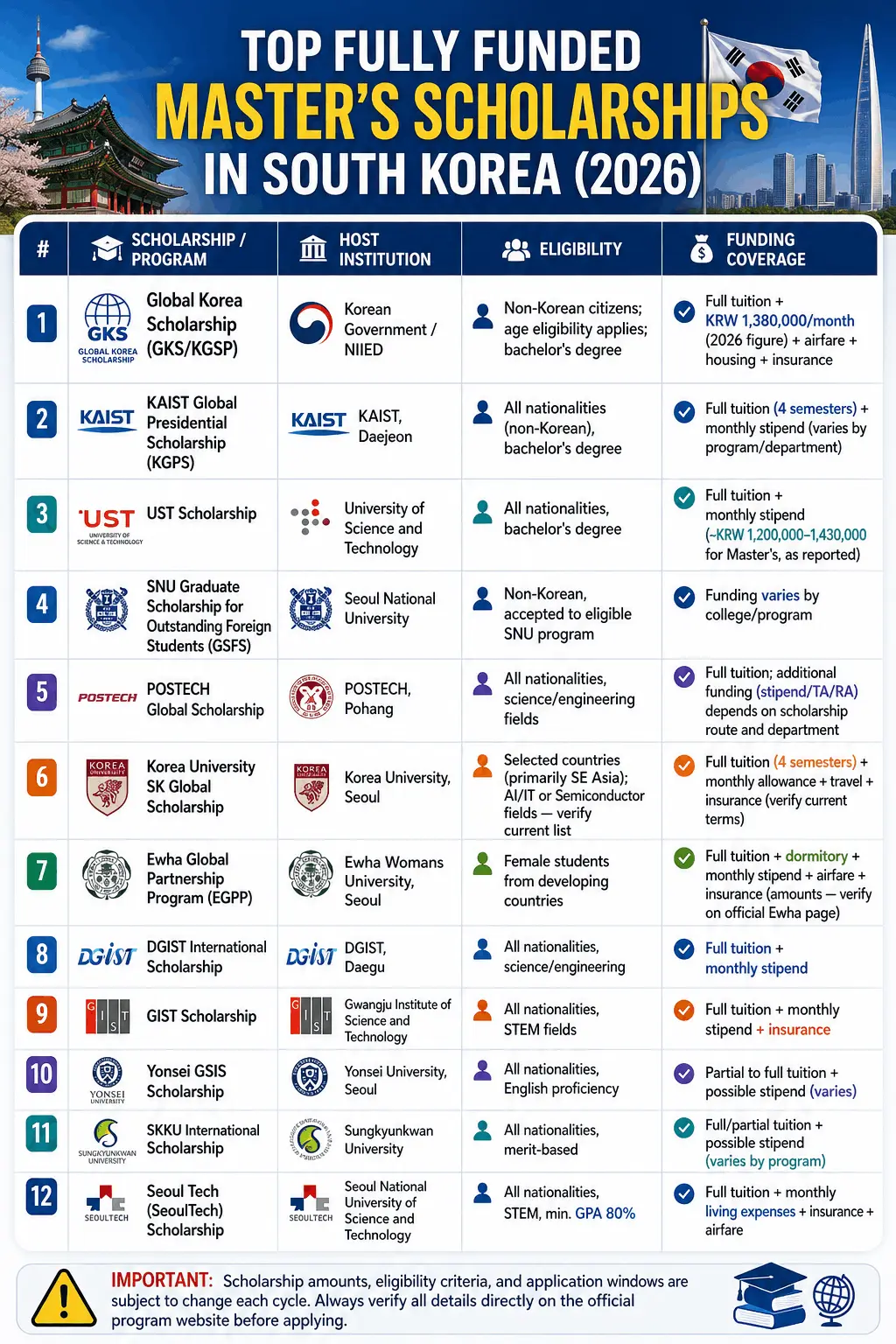
Quick Summary Table: Best Fully Funded Master’s Scholarships in South Korea (2026)
| # | Scholarship / Program | Host Institution | Eligibility | Funding Coverage | Application Window | Official Link |
|---|---|---|---|---|---|---|
| 1 | Global Korea Scholarship (GKS/KGSP) | Korean Government / NIIED | Non-Korean citizens; age eligibility applies; bachelor’s degree | Full tuition + KRW 1,380,000/month (2026 figure) + airfare + housing + insurance | Check current embassy/university track deadlines on NIIED website | niied.go.kr |
| 2 | KAIST Global Presidential Scholarship (KGPS) | KAIST, Daejeon | All nationalities (non-Korean), bachelor’s degree | Full tuition (4 semesters) + monthly stipend (varies by program/department) | Varies by intake — check official KAIST admissions notice | kaist.ac.kr |
| 3 | UST Scholarship | University of Science and Technology | All nationalities, bachelor’s degree | Full tuition + monthly stipend (~KRW 1,200,000–1,430,000 for Master’s, as reported) | Check official UST admissions page for current cycle dates | ust.ac.kr |
| 4 | SNU Graduate Scholarship for Outstanding Foreign Students (GSFS) | Seoul National University | Non-Korean, accepted to eligible SNU program | Funding varies by college/program | Varies by semester — check SNU Office of Global Affairs | snu.ac.kr |
| 5 | POSTECH Global Scholarship | POSTECH, Pohang | All nationalities, science/engineering fields | Full tuition; additional funding (stipend/TA/RA) depends on scholarship route and department | Spring/Fall cycles — check official POSTECH admissions page | postech.ac.kr |
| 6 | Korea University SK Global Scholarship | Korea University, Seoul | Selected countries (primarily SE Asia); AI/IT or Semiconductor fields — verify current list | Full tuition (4 semesters) + monthly allowance + travel + insurance (verify current terms) | Check KU graduate admissions portal for next cycle | korea.ac.kr |
| 7 | Ewha Global Partnership Program (EGPP) | Ewha Womans University, Seoul | Female students from developing countries | Full tuition + dormitory + monthly stipend + airfare + insurance (amounts — verify on official Ewha page) | Rolling, aligned with admissions — check official Ewha page | ewha.ac.kr |
| 8 | DGIST International Scholarship | DGIST, Daegu | All nationalities, science/engineering | Full tuition + monthly stipend | Spring/Fall cycles — check official DGIST admissions page | dgist.ac.kr |
| 9 | GIST Scholarship | Gwangju Institute of Science and Technology | All nationalities, STEM fields | Full tuition + monthly stipend + insurance | Spring/Fall cycles — check official GIST admissions page | gist.ac.kr |
| 10 | Yonsei GSIS Scholarship | Yonsei University, Seoul | All nationalities, English proficiency | Partial to full tuition + possible stipend (varies) | Varies — check GSIS admissions page | yonsei.ac.kr |
| 11 | SKKU International Scholarship | Sungkyunkwan University | All nationalities, merit-based | Full/partial tuition + possible stipend (varies by program) | Spring/Fall cycles — check official SKKU page | skku.edu |
| 12 | Seoul Tech (SeoulTech) Scholarship | Seoul National University of Science and Technology | All nationalities, STEM, min. GPA 80% | Full tuition + monthly living expenses + insurance + airfare | Check official page for next cycle dates | seoultech.ac.kr |
⚠️ Important: Scholarship amounts, eligibility criteria, and application windows are subject to change each cycle. Always verify all details directly on the official program website before applying.
Detailed Guide: Top Fully Funded Master’s Scholarships in South Korea (2026)
1. Global Korea Scholarship (GKS) — Korean Government Scholarship Program (KGSP)
Overview
The Global Korea Scholarship (GKS), formerly known as the Korean Government Scholarship Program (KGSP), is the most prestigious and comprehensive Korean government scholarship for master’s degree students. Administered by the National Institute for International Education (NIIED) under the Korean Ministry of Education, GKS selects over 2,000 international students from more than 155 countries each year.
This is one of the most prestigious fully funded scholarships in South Korea for Indian students, African students, Southeast Asian students, and candidates from all partner nations.
Key Benefits
- ✅ Round-trip economy airfare
- ✅ Settlement allowance upon arrival (KRW 200,000)
- ✅ Full tuition covered by Korean government
- ✅ Monthly living allowance: approximately KRW 1,380,000 (graduate degree program, based on 2026 sources — verify the current figure on the official NIIED page)
- ✅ Korean language training for one year (before degree program)
- ✅ Medical insurance
- ✅ Research fund (KRW 210,000/semester for humanities; KRW 240,000 for science/engineering)
- ✅ Thesis printing fees
- ✅ Returning allowance upon completion
Eligibility
- Must be a non-Korean citizen (age eligibility applies — confirm the current limit on the NIIED official guidelines)
- Hold (or expect to hold) a bachelor’s degree
- GPA of at least 80% (or ranked in top 20% of class)
- Must not have previously received a GKS scholarship
Application Tracks
There are two application tracks:
- Embassy Track — Apply through the Korean Embassy in your home country. Check the current cycle deadline on the official NIIED website or your country’s Korean Embassy.
- University Track — Apply directly to a participating Korean university. Deadlines vary by institution; check each university’s international admissions page.
Who Should Apply?
Any international student with strong academic credentials who wants to pursue a master’s in virtually any field — from engineering and medicine to public policy, humanities, and arts — at one of South Korea’s top universities.
🔗 Official Website: niied.go.kr
2. KAIST Global Presidential Scholarship (KGPS)
Overview
The Korea Advanced Institute of Science and Technology (KAIST) — often called the MIT of Asia — is one of South Korea’s most elite research universities. KAIST offers the KAIST Global Presidential Scholarship (KGPS) to outstanding international students applying for master’s and master’s–PhD integrated programs. There is no separate scholarship application: simply select “KAIST Scholarship” in the financial resources section of your admissions application.
Key Benefits
- ✅ Full tuition coverage for 4 regular semesters (standard 2-year master’s)
- ✅ Monthly stipend — amount varies by program, department, and research involvement; check the current KAIST admissions notice for confirmed figures
- ✅ National health insurance premium support
- ✅ Additional research assistantship funding possible (varies by advisor/department)
Eligibility
- Non-Korean citizen (dual citizens not eligible as international students)
- Hold a bachelor’s degree by the admission deadline of your chosen intake
- English proficiency required — check the current program-specific requirement on the KAIST admissions page (waivers may be available for some programs)
- Strong GPA required; check the current standard on KAIST’s official page
Fields Available
All departments at KAIST (science, engineering, life sciences, business, management, AI, and more) except the Global Technology Innovation Program (GDI-GTIP Track).
Who Should Apply?
Students with a strong background in STEM, AI, business technology, or interdisciplinary sciences who want access to cutting-edge labs and industry connections.
🔗 Official Website: kaist.ac.kr
3. University of Science and Technology (UST) Scholarship
Overview
The University of Science and Technology (UST) offers one of the more generous stipend packages among Korean graduate scholarships. UST is unique: it is a government-funded research institution linked with over 30 national research institutes across South Korea. Students are employed as research staff while earning their degree, giving them both academic credentials and professional research experience simultaneously.
Key Benefits
- ✅ Full tuition waiver
- ✅ Monthly stipend: approximately KRW 1,200,000–1,430,000 for master’s students (as reported in available 2026 sources — confirm the current amount on the official UST admissions page)
- ✅ Employment contract with your host research institute
- ✅ Medical insurance
- ✅ Access to state-of-the-art research facilities
Eligibility
- Open to all nationalities (non-Korean)
- Bachelor’s degree (or expected graduation)
- English or Korean proficiency required; specific exemptions and accepted scores may vary by program — check the official UST admissions guide for current requirements
- Specialized Master’s Program applicants: check current entry requirements on the UST website
Special Categories
- RCA Degree Programme (for IAEA-RCA member countries)
- KOICA Scholarship (for Uzbekistan nationals)
- Overseas Koreans program
Who Should Apply?
Science and technology students who want a generous stipend package and the unique opportunity to be employed as a researcher while studying.
🔗 Official Website: ust.ac.kr
4. Seoul National University — Graduate Scholarship for Outstanding Foreign Students (GSFS)
Overview
Seoul National University (SNU), ranked among the top 30 universities globally, offers the Graduate Scholarship for Outstanding Foreign Students (GSFS) to attract talented international students to its master’s and doctoral programs. SNU is South Korea’s most prestigious university and is located in Seoul.
Key Benefits
- ✅ Funding varies by college/program — check the SNU Office of Global Affairs for the current cycle’s participating colleges and benefit details
- ✅ May include tuition support and monthly allowance depending on program
- ✅ Medical insurance
- ✅ Research funding and thesis printing support
Eligibility
- Non-Korean applicant accepted to an eligible SNU college/school
- Must be from an eligible country (list varies by semester — check the SNU Office of Global Affairs)
- Apply for GSFS simultaneously with admissions application (check “Application for Scholarship” box)
Additional Notes
- IELTS/TOEFL not universally required at SNU — check your specific program
- The list of eligible countries and participating colleges changes each semester
- The GKS University Track is also available through SNU
🔗 Official Website: en.snu.ac.kr/admission/graduate/scholarships
5. POSTECH Global Scholarship
Overview
Pohang University of Science and Technology (POSTECH) is one of Asia’s top science and engineering universities, consistently ranked among the world’s best in its field. POSTECH’s global scholarship program offers full financial support to international students in science, engineering, and technology fields for both master’s and PhD degrees.
Key Benefits
- ✅ Full tuition coverage (via scholarship route — confirm which track applies to you)
- ✅ Funding for living expenses: depends on the scholarship route; TA/RA assistantship support is often available through faculty advisors and may vary by department
- ✅ Comprehensive health insurance
- ✅ On-campus housing and Korean language support
- ✅ Research mentoring from top faculty
Eligibility
- All nationalities (non-Korean)
- Strong academic merit and research potential
- Background in science, engineering, or technology
Application Note
POSTECH also participates in the GKS University Track. Alternatively, students with a strong research background can directly contact professors for Teaching/Research Assistantship (TA/RA) funding, which covers full tuition and often offers higher stipends than standard scholarship programs.
🔗 Official Website: postech.ac.kr
6. Korea University SK Global Scholarship
Overview
Korea University (KU) — one of South Korea’s elite “SKY” universities — offers the SK Global Scholarship for international students in its AI, IT, and Semiconductor programs. This fully funded scholarship is co-sponsored by SK Group, South Korea’s multinational conglomerate.
Key Benefits
- ✅ Full tuition for 2 years (4 semesters) + entrance fee exemption
- ✅ Monthly living allowance
- ✅ Round-trip airfare
- ✅ Medical insurance
- ✅ Optional Korean language training before semester start
Eligibility
- Citizens of selected countries — the eligible country list and field restrictions are highly program-specific and can change each cycle; always verify the current list directly on the KU graduate admissions portal
- Applying for master’s in AI/IT or Semiconductor track (confirm current field options)
- Bachelor’s degree (relevant fields preferred)
- English proficiency proof required
Application Window
The March 31, 2026 deadline applied to a past cycle. Check the KU graduate admissions portal for the current cycle’s opening and closing dates.
🔗 Official Website: gsc.korea.ac.kr
7. Ewha Global Partnership Program (EGPP)
Overview
The Ewha Global Partnership Program (EGPP) at Ewha Womans University — a leading women’s university and one of the largest of its kind in the world, located in the heart of Seoul — is one of the most comprehensive fully funded scholarships available for female international students. Established to empower women from developing countries, EGPP has helped hundreds of women from across Asia, Africa, and Latin America complete their master’s degrees in South Korea.
Key Benefits
- ✅ Full tuition (including admission fees)
- ✅ On-campus dormitory housing
- ✅ Monthly stipend (reported at approximately KRW 550,000 in available sources — verify the current amount on Ewha’s official scholarship page)
- ✅ Round-trip airfare
- ✅ Health insurance
Eligibility
- Female students from developing countries
- Applying through the Special Admissions Process for International Applicants at Ewha
- Demonstrated leadership potential and public service commitment
- Strong academic record
Application Note
Apply for university admission first; then apply for EGPP simultaneously using the Scholarship Application Form (Form 4). There is no fixed annual deadline — applications align with admissions intake.
🔗 Official Website: ewha.ac.kr
8. DGIST International Scholarship
Overview
Daegu Gyeongbuk Institute of Science and Technology (DGIST) is a research-focused government university known for its interdisciplinary approach to STEM education. DGIST offers fully funded scholarships to exceptional international students for master’s and doctoral programs.
Key Benefits
- ✅ Full tuition waiver
- ✅ Monthly living stipend
- ✅ Research funding access
- ✅ On-campus accommodation support
Eligibility
- All nationalities (non-Korean)
- Strong academic background in science, engineering, or technology
- Transcripts, study plan, and recommendation letters required
Who Should Apply?
Students interested in interdisciplinary research in emerging science and technology fields, particularly those who value a smaller, research-intensive campus environment.
🔗 Official Website: dgist.ac.kr
9. GIST (Gwangju Institute of Science and Technology) Scholarship
Overview
GIST is a government-funded research university in Gwangju, South Korea, focused exclusively on science and technology. Its fully funded scholarship program supports international students throughout their master’s and doctoral degrees.
Key Benefits
- ✅ Full tuition coverage
- ✅ Monthly living stipend
- ✅ Medical insurance
- ✅ Access to advanced research facilities
- ✅ English-medium instruction available
Eligibility
- Open to international students in STEM fields
- Bachelor’s or master’s degree depending on program level
- English proficiency required
Who Should Apply?
Students focused on advanced STEM research who want a smaller, highly focused academic environment in South Korea’s Jeolla region.
🔗 Official Website: gist.ac.kr
10. Yonsei University GSIS Scholarship Program
Overview
Yonsei University’s Graduate School of International Studies (GSIS) is one of Korea’s most internationally recognized graduate schools for students in international cooperation, global finance, Korean studies, and related fields. Located in Seoul, GSIS attracts students from around the world with its English-medium programs and scholarship support.
Key Benefits
- ✅ Partial to full tuition waivers (based on merit and program)
- ✅ Possible monthly living stipend
- ✅ Courses taught entirely in English
- ✅ Korean language not required
Eligibility
- All nationalities
- English proficiency required (TOEFL/IELTS)
- Strong academic record and statement of purpose
🔗 Official Website: gsis.yonsei.ac.kr
11. Sungkyunkwan University (SKKU) International Scholarship
Overview
Sungkyunkwan University (SKKU) — one of South Korea’s oldest and most respected universities, with campuses in Seoul and Suwon — offers the SKKU International Scholarship for outstanding international graduate students. SKKU is backed by Samsung and maintains close ties with the technology industry.
Key Benefits
- ✅ Full or partial tuition coverage (varies by program and merit)
- ✅ Monthly living stipend (availability and amount varies — confirm on official SKKU page)
- ✅ Health insurance
- ✅ Access to Samsung-affiliated research programs
- ✅ English-medium programs available
Eligibility
- All nationalities (non-Korean)
- Merit-based selection
- English proficiency required; Korean not mandatory for English-track programs
🔗 Official Website: skku.edu
12. Seoul National University of Science and Technology (SeoulTech) Scholarship
Overview
SeoulTech (Seoul National University of Science and Technology) offers a Korean Government-backed fully funded scholarship for international STEM students. SeoulTech’s scholarship targets students with strong academic performance and a clear interest in science, technology, engineering, and mathematics. Note that the March 2026 application round has passed; check the official page for the next available intake.
Key Benefits
- ✅ Full tuition fees covered
- ✅ Monthly living expenses
- ✅ Health insurance premiums
- ✅ Airfare travel support
Eligibility
- All nationalities (non-Korean)
- Intention to pursue a master’s degree in STEM fields
- Minimum GPA of 80% or 2.64/4.0 (verify current requirement)
- Apply through the Seoul Metropolitan Government Online Application Portal
📌 Check for the next application cycle at the official SeoulTech page.
🔗 Official Website: seoultech.ac.kr
How to Apply for a Master’s Scholarship in South Korea: Step-by-Step
Applying for fully funded master’s scholarships in South Korea requires careful preparation. Here is a general guide:
Step 1: Choose your target scholarship(s) Review the programs above and identify 2–3 that match your academic profile, nationality, and field of interest.
Step 2: Check eligibility Confirm you meet all criteria — nationality, GPA, age, degree level, and language requirements.
Step 3: Prepare your documents Standard required documents include:
- Bachelor’s degree certificate and transcripts
- Statement of purpose / research plan
- Letters of recommendation (usually 2)
- Passport copy
- CV/Resume
- English or Korean proficiency test scores
- Proof of nationality / birth certificate
Step 4: Contact potential supervisors (for research-based programs) For programs like KAIST, POSTECH, and UST, emailing a potential supervisor before applying can significantly strengthen your application. Introduce yourself, attach your CV, and explain your research interest.
Step 5: Submit before the deadline Deadlines vary significantly by program and intake cycle. As a general guide:
- GKS Embassy Track: typically early in the calendar year — check the NIIED official page
- GKS University Track: varies by institution — check individual university admissions portals
- KAIST: varies by intake — check official KAIST admissions notices
- UST: check the UST admissions page for current cycle dates
Always verify deadlines directly on official program pages, as they shift each year.
🔗 Related: Fully Funded PhD Scholarships in Europe for Indian Students (2026)
Is IELTS Required for South Korea Master’s Scholarships?
This is one of the most common questions — and the answer varies by program:
| Program | IELTS / TOEFL Required? |
|---|---|
| GKS (Embassy/University Track) | Yes (TOPIK or English scores accepted; check NIIED guidelines for accepted tests) |
| KAIST KGPS | English proficiency required — check current program-specific score requirements on the KAIST admissions page; waivers may apply |
| UST | May vary by program — check official UST admissions guide for current requirements |
| SNU GSFS | Varies by program/college |
| POSTECH | English proficiency certificate may be accepted in some cases — verify with your target department |
| SeoulTech | Check official program requirements |
Bottom line: Most Korean scholarships accept an official English proficiency test. Some programs allow a letter/certificate from your university confirming English as the medium of instruction as a substitute.
Stipend Comparison: How Much Money Do Master’s Students Get?
| Program | Monthly Stipend (Master’s) |
|---|---|
| UST Scholarship | ~KRW 1,200,000–1,430,000 (~USD 900–1,080) — verify current amount |
| GKS (Korean Government) | ~KRW 1,380,000 (~USD 1,030) — verify current figure on NIIED page |
| KAIST KGPS | Varies by program/department — check official KAIST admissions notice |
| SeoulTech Scholarship | Covered within living expense package — check official page |
| Ewha EGPP | Reported ~KRW 550,000 + dormitory accommodation — verify on Ewha’s page |
| POSTECH | Varies; TA/RA support can be substantially higher — depends on faculty/department |
Note: KRW figures are approximate based on available 2025–2026 sources. Always confirm the current amount on each program’s official page before making financial decisions. Living costs in South Korea are moderate; verified stipends at the levels above are generally sufficient to cover accommodation, food, and transportation.
Frequently Asked Questions (FAQs)
Q1: How competitive are South Korea master’s scholarships?
South Korea’s flagship scholarships like GKS and KAIST KGPS are highly competitive. The GKS program receives tens of thousands of applications annually for roughly 2,000+ spots. However, university-specific scholarships (like POSTECH TA/RA or UST) can be more accessible if you have a strong research profile and make early contact with a supervisor.
Q2: When do South Korea master’s scholarship applications open?
Application window timings vary by program and can change each year. As a general orientation:
- GKS Embassy Track: Applications typically open in the latter part of the preceding calendar year; check the NIIED website and your country’s Korean Embassy for the current cycle
- GKS University Track: Varies widely by institution — check each university’s international admissions portal
- KAIST: Check the official KAIST admissions notice for each Fall and Spring intake
- UST: Fixed deadlines per intake — check the UST admissions page for the current cycle
- SeoulTech: Check the official Seoul Metropolitan Government admissions page
Always verify deadlines directly on official program websites, as they shift each application year.
Q3: What documents are needed for South Korea scholarship applications?
Standard documents include: passport, bachelor’s degree certificate + transcripts, 2 recommendation letters, statement of purpose/research plan, English proficiency test score, CV, and birth certificate. Some programs also require a medical certificate and a personal essay.
Q4: Are there fully funded scholarships for Indian students in South Korea?
Yes. The GKS (Global Korea Scholarship) is open to Indian students and typically includes a dedicated India quota each year. KAIST, UST, POSTECH, and SNU scholarships are also open to Indian nationals. Check the NIIED website and your nearest Korean Embassy for the current GKS India deadline.
Q5: Do I need to know Korean to study in South Korea?
Not for most graduate programs. Many master’s programs — especially in science, technology, engineering, business, and public policy — are offered entirely in English. GKS scholars attend one year of Korean language training before their degree program. Programs at KAIST, POSTECH, UST, Yonsei GSIS, and SNU (many departments) are available in English.
Q6: Can I work part-time while on a scholarship in South Korea?
On a D-2 student visa, international students can work up to 20 hours per week during the semester and full-time during vacations, subject to university regulations. GKS scholars typically need their institution’s permission. Always check your visa conditions and scholarship terms.
Q7: What is the acceptance rate for GKS scholarship applications?
The GKS acceptance rate varies by country and track. Overall, roughly 2,200 out of tens of thousands of applications are accepted globally each year. Country-specific quotas mean competition levels vary — some countries have higher acceptance rates than others. Building a strong application with above-average GPA, relevant experience, and a compelling study plan is critical.
🔗 Related: Top Fellowships & Funding Opportunities for PhD Students in India in 2026
About IR Research Publication
IR Research Publication (irrespub.com) is a trusted scientific journal publisher and editorial service provider. Beyond publishing research, irrespub.com regularly curates verified, high-quality scholarship and fellowship guides for students, early-career researchers, and academics worldwide.
Our scholarship content is:
- Rigorously fact-checked against official university and government sources
- Updated regularly to reflect the latest 2025–2026 deadlines and changes
- Targeted at both emerging and experienced researchers seeking global academic funding
Whether you’re searching for postdoctoral opportunities, PhD scholarships, or master’s funding, irrespub.com is your reliable companion on the journey toward academic excellence.
Related Articles from IR Research Publication
Explore these related guides for more funding opportunities:
- 🔗 Your Guide to Fully Funded Postdoctoral Fellowships in South Korea: Stipends, Eligibility, and 2026 Application Windows
- 🔗 Fully Funded PhD Scholarships in Europe for Indian Students (2026)
- 🔗 Top Fellowships & Funding Opportunities for PhD Students in India in 2026
- 🔗 Fully Funded Postdoctoral Fellowships in Canada for Indian Students in 2026
- 🔗 Fully Funded Postdoctoral Fellowships in Singapore: Stipends, Benefits, and 2026 Deadlines
- 🔗 How to Find Postdoctoral Fellowship Opportunities Around the World
Disclaimer: Scholarship details including stipend amounts, deadlines, and eligibility criteria are based on information available as of April 2026. Always verify the latest details directly on each program’s official website before applying, as terms may change between application cycles.