
IRRESPUB BLOG
Fully Funded PhD Scholarships in South Korea: Stipends, Eligibility, and 2026 Deadlines
Introduction: Why Pursue a PhD in South Korea?
South Korea has become one of Asia’s most sought-after destinations for doctoral research. The country hosts globally ranked institutions — including KAIST, POSTECH, Seoul National University, and GIST — backed by substantial government investment in science, technology, and international academic exchange.
For international students, PhD scholarships in South Korea often go well beyond a simple tuition waiver. Many programs include a monthly living stipend, national health insurance, and a one-way or round-trip airfare contribution. Some — particularly the government-run GKS and KOICA programs — also provide Korean language training and a settlement allowance upon arrival. The exact package differs meaningfully between programs, so it is worth reading each entry carefully rather than assuming a uniform benefit set.
This guide covers 10+ verified, fully funded PhD scholarships in South Korea for the 2026 cycle, with corrected stipend figures, accurate eligibility conditions, and direct links to official pages. Whether you are a STEM researcher or a social sciences professional, there are multiple credible funding routes — provided you meet the specific criteria each program sets.
For academic writing support, publication guidance, and research career resources, visit IrrespPub.
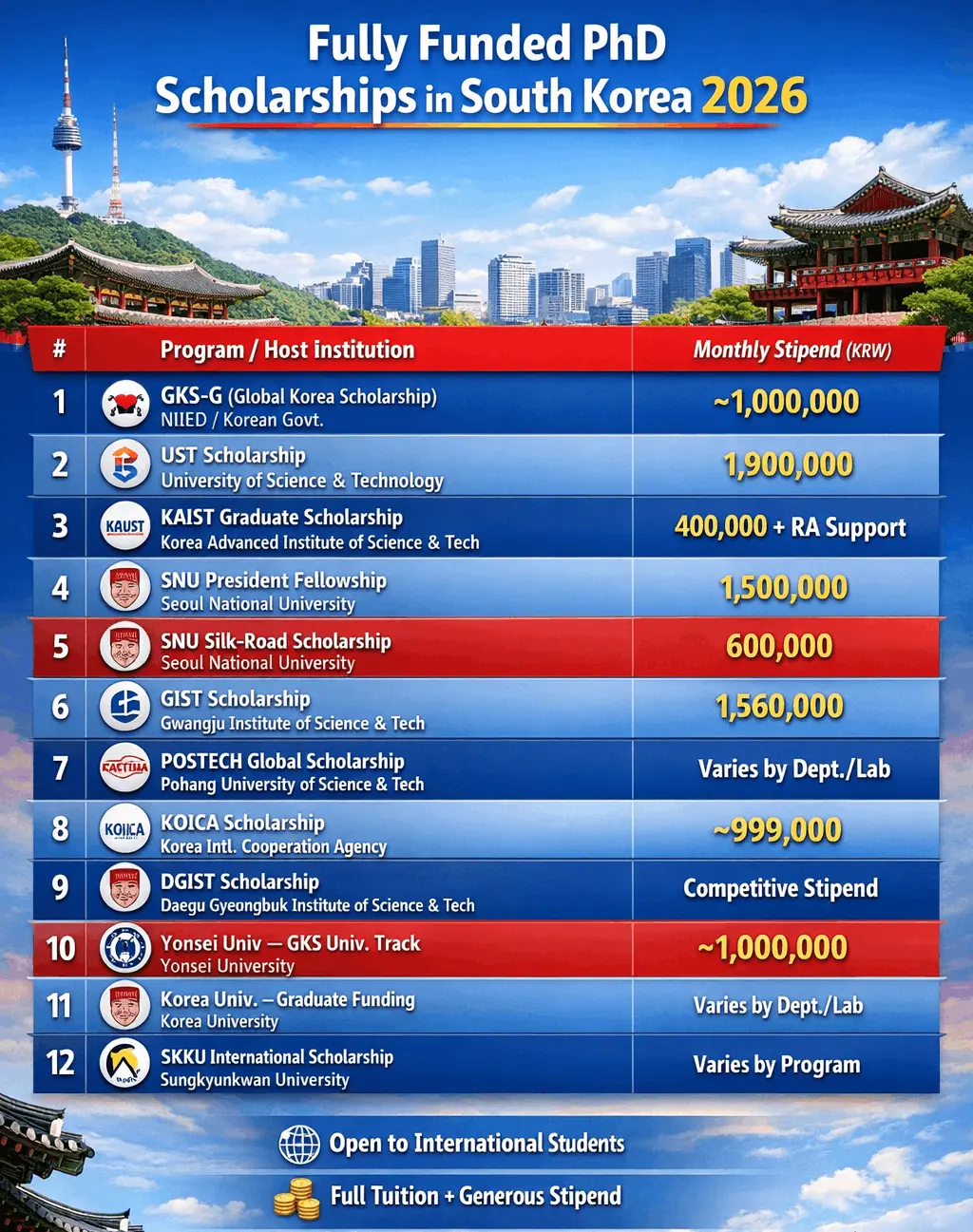
Quick-Reference Summary Table: Fully Funded PhD Scholarships in South Korea 2026
| # | Program | Host Institution | Core Eligibility | PhD Monthly Stipend (KRW) | Deadline (Most Recent Cycle) | Notes |
|---|---|---|---|---|---|---|
| 1 | GKS-G (Global Korea Scholarship — Graduate) | NIIED / Korean Ministry of Education | Citizens of NIIED-designated countries; no Korean citizenship (self or parents); age under cutoff in annual notice; prior degree with ≥ 80% GPA | ~1,000,000 (degree program) | Embassy Track: country-specific, typically Feb–Mar; University Track: varies by institution | Two separate tracks with different university lists and quotas; research scholars receive ~1,500,000 KRW/month |
| 2 | UST Scholarship | University of Science & Technology (32 research institutes) | All non-Korean nationalities; Master’s degree required for PhD entry | 1,900,000 (confirmed Spring 2026 minimum) | Spring 2026: ~Feb 23, 2026; check ust.ac.kr for Fall 2026 | Lab-based; contact target professor before applying |
| 3 | KAIST Graduate Scholarship | Korea Advanced Institute of Science and Technology | All non-Korean nationalities; Master’s degree for PhD entry | 400,000 base university allowance + lab RA (varies by department) | Spring 2026: Sep 2, 2025; Fall 2026: check kaist.ac.kr | Base allowance is modest; most PhD students supplement through research assistantship; competitive fellowships up to 2,500,000 but not guaranteed |
| 4 | SNU President Fellowship (SPF) | Seoul National University | Teaching/instructional staff at a university in a developing country WITHOUT a PhD; Master’s degree or higher; newly admitted to SNU PhD program | 1,500,000 | Spring 2026: Jul 7–10, 2025 (admission); Aug 31, 2025 (SPF documents) | Restricted to faculty from developing countries; ~8 awards per cycle; NOT open to general international PhD applicants |
| 5 | SNU Silk-Road Scholarship | Seoul National University | Exceptional international graduate applicants; merit-based; criteria set per intake | 600,000 | Same as SNU admissions window | Separate from SPF; covers up to 4 semesters tuition + stipend + airfare; open to broader international pool |
| 6 | GIST Scholarship | Gwangju Institute of Science & Technology | All non-Korean nationalities | 295,000 base + ~1,145,000 research assistantship (PhD) | Rolling (Spring and Fall); no application fee | RA is the primary income source; combined effective total ~1,560,000/month; 60% health insurance covered |
| 7 | POSTECH Global Scholarship | Pohang University of Science & Technology | All non-Korean nationalities; strong academic and research profile required | Varies by department and lab | Annual cycle; typically opens autumn for next intake | Contact prospective advisor in advance; no universal fixed stipend published centrally |
| 8 | KOICA Scholarship | Korea International Cooperation Agency | Citizens of KOICA-designated partner developing countries ONLY; must be formally nominated by home government; must be public sector professional | ~999,000 | 1st Batch 2026: Dec 2, 2025; 2nd Batch: check koica.go.kr | NOT open to all nationalities; exclusively for government officials and civil servants from partner developing countries |
| 9 | DGIST Scholarship | Daegu Gyeongbuk Institute of Science & Technology | All non-Korean nationalities | Competitive; varies by program; GKS University Track also available here at ~1,000,000 | Rolling (Spring and Fall) | All programs in English; interdisciplinary focus; Type A GKS university |
| 10 | Yonsei University — GKS University Track | Yonsei University (via NIIED GKS) | Same as GKS-G eligibility | ~1,000,000 (GKS standard rate) | GKS University Track; check Yonsei admissions calendar | GKS government funding via Yonsei — separate from Yonsei internal departmental or lab-level scholarships |
| 11 | Korea University — Graduate Funding | Korea University | All non-Korean nationalities; criteria vary by college and department | Varies by department/lab; GKS University Track also available | Spring: Sep–Nov; Fall: Feb–Mar | No single university-wide PhD stipend; mix of departmental tuition waivers, lab RA, and GKS track |
| 12 | SKKU International Scholarship | Sungkyunkwan University | All non-Korean nationalities; merit-based; criteria vary by college | Varies by program; Samsung-linked labs may carry additional industry funding | Spring 2026: Oct–Nov 2025; verify at skku.edu | Strong STEM and semiconductor focus; Type A GKS university |
How to use this table: Stipend figures are sourced from official or near-official program documentation and reflect the standard base rate for PhD-level students. Where totals vary by department, fellowship layer, or research involvement, this is noted in the Notes column. Deadlines reflect the most recent confirmed cycle; always verify at the official link before applying.
Detailed Program Profiles
1. Global Korea Scholarship — Graduate Degree (GKS-G)
Overview
The Global Korea Scholarship for Graduate Degrees (GKS-G), administered by the National Institute for International Education (NIIED) under Korea’s Ministry of Education, is the largest government-funded scholarship program for international graduate students in South Korea. For the 2026–2027 cycle, NIIED expanded the total graduate quota to 2,000 places across Master’s, doctoral, and research programs.
The GKS-G operates through two distinct application tracks that are independent of each other:
- Embassy Track: Apply through the Korean embassy or consulate in your home country. You may select up to three universities (Type A or Type B), with at least one Type B institution required. Combined quota: 800 seats (General + Overseas Korean/Adoptee).
- University Track: Apply directly to a participating Korean university. Includes General, R-GKS, Research, International Organization, R&D, and Global Network sub-programs. Combined quota: 1,200 seats. Deadlines and selection criteria are set by each university.
These tracks have different university lists, selection processes, and quotas. An applicant may not apply through both tracks for the same intake cycle.
Verified Financial Benefits
- Full tuition coverage (NIIED pays up to 5,000,000 KRW per semester; any excess is typically covered by the host university)
- Monthly stipend: ~1,000,000 KRW for degree-program students (Master’s and PhD); ~1,500,000 KRW for research scholars — confirmed across multiple 2025–2026 official-cycle sources
- Round-trip economy class airfare
- One year of funded Korean language training at a designated institute
- Settlement allowance: 200,000 KRW (one-time, upon arrival)
- Korean proficiency grant: 100,000 KRW/month for TOPIK-qualified scholars
- Degree completion grant: 100,000 KRW (one-time)
- National health insurance (monthly amount per NIIED schedule)
- Research and thesis support grants
Eligibility
- Must be a citizen of an NIIED-designated country (list available on studyinkorea.go.kr; not all nationalities qualify)
- Neither the applicant nor their parents may hold Korean citizenship, including dual citizenship
- Age limit: Defined by a birth-date cutoff published in each year’s official guidelines. For graduate applicants, this has historically corresponded to being under 40 at the time of application — but the exact cutoff date is recalculated annually and must be verified in the current year’s notice
- Prior degree: Bachelor’s for Master’s entry; Master’s degree required for doctoral entry
- Academic record: cumulative GPA of at least 80%, OR ranked in the top 20% of graduating class
- Not currently enrolled in a Korean degree program; not a previous GKS scholar reapplying at the same degree level
Application Deadlines
- Embassy Track: Varies by country. Most embassies open in February–March of the target entry year. Check the Korean embassy website for your specific country.
- University Track: Set by each participating university; many have September–November windows for spring intake. Check the GKS Notice on www.studyinkorea.go.kr and each university’s own admissions calendar.
Official Link: www.studyinkorea.go.kr
For tips on writing a competitive research plan for GKS and other Korean scholarship applications, visit IrrespPub.
2. UST Scholarship (University of Science and Technology)
Overview
The University of Science and Technology (UST) is not a traditional campus. It is a government-supported graduate institution operating across 32 national research institutes throughout South Korea, including KIST, ETRI, KERI, and KIOST. PhD students work directly in active research laboratories — making this one of the most hands-on doctoral programs available in Korea and an unusually strong pathway into Korean government research careers.
The 2026 UST Scholarship covers Master’s, PhD, and integrated MS-PhD programs across 47 specialised majors in AI and robotics, biotechnology, energy science, semiconductors, space and ocean sciences, and more.
Verified Financial Benefits
- Full tuition and admission fee waiver
- PhD monthly stipend: minimum 1,900,000 KRW (confirmed in the Spring 2026 admission cycle). Note: some earlier cycle sources cite 1,600,000 KRW — the 1,900,000 KRW figure reflects the most recently confirmed Spring 2026 minimum and should be verified for future intakes at www.ust.ac.kr.
- Health and accident insurance
- Round-trip airfare
- Korean language course fees covered
- E-library access, counselling, overseas training, and exchange program support
- Research Paper Award and Post-Graduation Excellence Award
Eligibility
- Non-Korean citizens only
- PhD applicants must hold a Master’s degree (or expect to complete one by the program start date)
- Research background must match the target lab’s field
- English proficiency required (IELTS/TOEFL; exemptions for graduates of English-medium institutions)
Application Deadlines
- Spring 2026: ~February 23, 2026 (this window has now closed)
- Fall 2026: Check apply.ust.ac.kr for the updated window
Important: UST requires applicants to identify a specific research institute and professor before applying. Contacting the target professor with your CV and a concise research statement is strongly recommended — and at many institutes, effectively required — before the formal application.
Official Link: www.ust.ac.kr
3. KAIST Graduate Scholarship
Overview
The Korea Advanced Institute of Science and Technology (KAIST) is one of Asia’s most prestigious research universities, consistently ranked in the global top 50 for science and engineering. KAIST automatically considers all international students who select “KAIST Scholarship” as their financial resource during admissions for one of three internal fellowship tiers: KAIST Global PhD Fellowship (KGPS), Korean Presidential Science Fellowship (KPS), or KAIST CoE PhD Fellowship. No separate scholarship application is needed.
Understanding KAIST’s Funding Structure — what the numbers actually mean
KAIST’s funding has two distinct layers that secondary sources often conflate:
- Base university scholarship allowance (guaranteed for all admitted scholars):
- Full tuition exemption for the standard program duration
- 400,000 KRW/month for PhD students; 350,000 KRW/month for Master’s students
- Health insurance premium supported by advisor/department
- Research assistantship (RA) and competitive fellowships (common but not guaranteed at admission):
- Most KAIST PhD students receive substantial additional monthly income from their advisor’s research project budget
- Competitive departmental and named fellowships range from 300,000 to 2,500,000 KRW/month additionally
- The “up to 2,500,000 KRW” figure cited in some sources is the ceiling of named competitive fellowships — not a base amount and not guaranteed at the point of admission
Practical guidance: Plan financially around the verified base of 400,000 KRW/month + full tuition. Treat RA income as likely but not contractually guaranteed before you accept an offer and secure lab placement.
Eligibility
- Non-Korean citizens
- PhD applicants must hold a Master’s degree (or expect to complete one before program start)
- All disciplines: natural sciences, life sciences, bioengineering, engineering, convergence science, business, and related areas
- English proficiency required (test score waiver available for graduates of recognised English-medium institutions)
Confirmed Application Deadlines
- Spring 2026 intake: Application deadline — September 2, 2025 (5 PM KST); recommendation letters — September 9, 2025
- Fall 2026 intake: Typically opens February–March; check kaist.ac.kr for exact dates
Official Link: www.kaist.ac.kr
4. SNU President Fellowship (SPF)
Overview
The SNU President Fellowship (SPF) is one of Seoul National University’s most prestigious PhD funding awards — and also one of the most misrepresented in secondary scholarship guides. It is not a general scholarship open to any international PhD applicant. The SPF is a highly targeted program designed specifically for teaching or instructional staff at universities in developing countries who do not yet hold a PhD. Its purpose is to strengthen academic capacity in developing nations by funding faculty to earn doctorates at SNU before returning to their home institutions.
Approximately 8 fellowships are awarded per intake cycle, making it among the most selective programs on this list.
Verified Eligibility — all conditions must be met simultaneously
- Currently employed as teaching or instructional staff (lecturer, assistant professor, research professor, teaching assistant, or equivalent) at a major university in a developing country
- Holds a Master’s degree or higher from an accredited institution, but does not yet hold a PhD
- Newly admitted to an SNU PhD program for the relevant intake semester
- Home university must provide an official commitment confirming the applicant’s continued employment and return after graduation
Verified Financial Benefits
- Full tuition waiver for up to 6 semesters (3 years), renewable each semester subject to maintaining a cumulative GPA of 3.0/4.5 or higher
- Monthly stipend: 1,500,000 KRW
- Round-trip economy class airfare
- Korean language training support
- National health insurance coverage
- Childcare support (amount varies by individual circumstances)
Application Deadlines (Spring 2026 cycle — confirmed from official SNU OIA notice)
- Online SNU admission application: July 7–10, 2025 (by 17:00 KST) — tick the SPF application checkbox during admissions
- SPF supporting documents submitted to OIA by email + post: August 31, 2025
- First-level screening: September 1–4, 2025
- Final results announced: approximately late January 2026
- Fall 2026 cycle: Will follow a similar August–September window; confirm at oia.snu.ac.kr
Official Links:
- SNU Admissions portal: en.snu.ac.kr/admission
- SNU OIA (SPF page): oia.snu.ac.kr
5. SNU Silk-Road Scholarship
Overview
Separate from the SPF, Seoul National University offers the Silk-Road Scholarship for exceptional incoming international graduate students. Unlike the SPF, this award is not restricted to faculty from developing countries and is open to high-achieving international students across all nationalities and disciplines. It covers a shorter funding window (up to 4 semesters) but provides a meaningful combination of tuition support, stipend, and airfare.
Key Benefits
- Full tuition coverage for up to 4 semesters
- Monthly stipend: 600,000 KRW
- Economy round-trip airfare
- Korean language training funding
Who Should Apply
International graduate students applying to SNU Master’s or PhD programs who have a strong academic record and are not eligible for — or not targeting — the SPF. Applied for during the standard SNU admissions process by selecting the scholarship checkbox on the online portal.
Deadline: Same as SNU admissions windows. Spring intake: typically July; Fall intake: typically February. Verify at en.snu.ac.kr.
Official Link: en.snu.ac.kr
6. GIST Scholarship (Gwangju Institute of Science and Technology)
Overview
The Gwangju Institute of Science and Technology (GIST) is a government-funded public research university operating under South Korea’s Ministry of Science and Technology. All admitted international graduate students at GIST automatically receive a scholarship covering tuition and a base stipend. GIST charges no application fee, making it among the most accessible entry points to Korea’s elite research university system.
Research fields include AI and machine learning, nanotechnology, photonics, robotics, energy systems, biotechnology, and environmental science. Program durations run up to 3 years (MS), 7 years (PhD standalone), or 8 years (integrated MS/PhD).
Verified Financial Benefits
- Full tuition waiver (~3,607,000 KRW per semester)
- PhD base monthly stipend: 295,000 KRW
- Monthly meal allowance: 100,000 KRW
- Monthly international student allowance: 120,000 KRW — requires GPA ≥ 3.0/4.5 and completion of at least 9 credits in the previous semester to maintain
- PhD research assistantship: ~13,740,000 KRW/year (~1,145,000 KRW/month) — this is the primary income for most PhD students and is funded from research project budgets
- Combined effective monthly income (all components): approximately 1,560,000 KRW, subject to GPA and RA participation requirements
- One-way airfare to Korea (reimbursed once)
- 60% of national health insurance premium, including annual medical check-up
- No application fee
Eligibility
- All non-Korean nationalities
- Must hold (or expect to hold) a relevant prior degree
- English proficiency required (IELTS/TOEFL; exemptions for graduates of recognised English-medium programs)
Deadline: Rolling admissions with Spring and Fall intakes. Check www.gist.ac.kr for current windows.
Official Link: www.gist.ac.kr
7. POSTECH Global Scholarship
Overview
Pohang University of Science and Technology (POSTECH) is consistently ranked among the world’s top science and engineering universities. POSTECH’s international PhD program is highly competitive and closely tied to individual laboratory research. The POSTECH Global Scholarship provides full tuition support to admitted international students; monthly stipend is set at the department and lab level, with no single centrally published PhD figure.
Key Benefits
- Full tuition coverage
- Monthly living stipend — set by department and lab; not published as a university-wide figure. Prospective PhD students should ask directly when contacting potential advisors.
- Comprehensive health insurance
- Access to POSTECH’s world-class research facilities and strong links to Korea’s materials, energy, and semiconductor industries
Who Should Apply
Non-Korean international students with strong academic and research records in physics, chemistry, mathematics, mechanical engineering, materials science, computer science, chemical engineering, or related disciplines. Given that PhD positions are tied to individual lab vacancies, contacting potential supervisors before applying is not just recommended — it is effectively how most POSTECH PhD positions are filled.
Deadline: Most lab openings are announced in autumn (September–November) for the following spring intake, with some rolling lab-level admissions throughout the year. Check www.postech.ac.kr.
Official Link: www.postech.ac.kr
8. KOICA Scholarship Program
Overview
The Korea International Cooperation Agency (KOICA) Scholarship is South Korea’s Official Development Assistance (ODA) graduate scholarship. It is specifically designed to support government officials and public sector professionals from KOICA-designated partner developing countries to pursue Master’s or doctoral degrees in South Korea. Its explicit objective is to build human capital in partner nations by training future policy leaders, who are expected to return home after graduation.
This scholarship is not open to applicants from all nationalities. Eligibility is restricted to citizens of countries on KOICA’s partner list, and applicants must be formally nominated by their home government. Private sector employees and citizens of non-partner or high-income countries are ineligible.
Verified Financial Benefits
- Full tuition coverage at partner Korean universities
- Monthly stipend: ~999,000 KRW (~USD 750) for living expenses
- Round-trip economy class airfare
- Free on-campus dormitory accommodation
- Settlement allowance: 1,200,000 KRW for doctoral students; 600,000–900,000 KRW for Master’s students (one-time, upon arrival)
- Completion grant (~USD 750 equivalent, upon graduation)
- National health insurance
- Cultural orientation program upon arrival
Eligibility — all conditions must be met
- Citizen of a KOICA-designated partner developing country (country list at koica.go.kr)
- Currently employed as a professional or civil servant; formally nominated by home government — self-nomination is not accepted
- Strong commitment to returning to home country and contributing to national development
- English proficiency required (programs conducted in English)
- Master’s degree required for doctoral program entry
Deadlines
- 1st Batch 2026: December 2, 2025 at 4:00 PM GMT (now closed)
- 2nd Batch / 2027 Cycle: Check www.koica.go.kr for new announcements
Official Link: www.koica.go.kr
9. DGIST Scholarship
Overview
The Daegu Gyeongbuk Institute of Science and Technology (DGIST) is a government-funded research university in Daegu. Notably, DGIST is also a Type A GKS University Track institution, meaning international PhD applicants have two distinct funding paths available here: DGIST’s own institutional scholarship and the GKS University Track via DGIST (which carries the standardised GKS package). All DGIST programs are taught in English.
DGIST research areas include AI and intelligent systems, energy systems, robotics, ICT convergence, new biology, and emerging materials.
Funding Routes for DGIST PhD Students
- DGIST institutional scholarship — automatically considered for admitted international students; covers tuition and a competitive monthly stipend (amount set at department/lab level)
- GKS University Track via DGIST — apply through DGIST’s GKS University Track for the standardised GKS package: full tuition + ~1,000,000 KRW/month stipend + language training + airfare. These two routes have different application channels and should not be assumed to be the same award.
Eligibility
- All non-Korean nationalities
- Strong academic and research profile; prior degree in a relevant STEM field
Deadline: Rolling admissions (Spring and Fall). Check www.dgist.ac.kr for current windows.
Official Link: www.dgist.ac.kr
10. Yonsei University — PhD Funding Pathways
Overview
Yonsei University is one of South Korea’s most prestigious private research universities, located in Seoul. International PhD students at Yonsei access funding through several distinct channels, which are frequently conflated in secondary scholarship listings. The three main routes operate independently and should not be treated as a single “Yonsei scholarship.”
Route A: GKS University Track (via Yonsei) Yonsei is a Type A GKS university. Applicants applying to Yonsei’s graduate school and selecting the GKS University Track receive the standard GKS-G package: full tuition, airfare, Korean language training, and ~1,000,000 KRW/month. This is NIIED government funding administered through Yonsei — not Yonsei’s own budget.
Route B: POSCO Asia Fellowship (GSIS only) For students applying specifically to Yonsei’s Graduate School of International Studies (GSIS), the POSCO Asia Fellowship is a competitive external award covering full tuition for up to 4 semesters and a monthly living stipend of 1,000,000 KRW plus national health insurance. This fellowship is not available across other Yonsei departments or colleges.
Route C: Departmental and Lab Funding As at most Korean research universities, Yonsei PhD students in STEM and social science departments frequently receive supplementary funding from their supervisor’s research grants. Amounts vary and are negotiated at the lab level — not published centrally.
Deadlines
- GKS University Track via Yonsei: Check Yonsei’s graduate admissions calendar and the GKS Notice on studyinkorea.go.kr
- POSCO Fellowship: Check Yonsei GSIS independently; typically opens annually
Official Link: www.yonsei.ac.kr
11. Korea University & SKKU — Graduate Funding Overview
Both Korea University (KU) and Sungkyunkwan University (SKKU) are Type A GKS universities in Seoul. The key distinction worth making explicit here, because it is often blurred in secondary sources, is that GKS University Track funding and a university’s own internal departmental scholarships are separate programs with separate applications, quotas, and benefit structures.
Korea University
- International PhD students may access GKS University Track funding (~1,000,000 KRW/month standard package) or department-level research assistantship income — these are distinct routes
- There is no single university-wide monthly PhD stipend; all non-GKS amounts depend on department, lab, and research funding
- Spring admissions: typically September–November; Fall admissions: February–March
- Official site: www.korea.ac.kr
Sungkyunkwan University (SKKU)
- Type A GKS university with strong programs in semiconductor engineering, materials science, life sciences, and business
- SKKU has deep research and funding partnerships with Samsung — PhD students in relevant engineering and materials labs may benefit from industry-funded research positions, but this is not a guaranteed component of any central scholarship
- Internal tuition waivers and departmental scholarships exist; stipend amounts vary significantly by department and are not centrally published
- Spring 2026 admissions: typically October–November 2025
- Official site: www.skku.edu
Key Documents Required for PhD Scholarship Applications in South Korea
Requirements vary by program. The following checklist covers documents commonly required across most programs:
- Valid passport copy
- Completed online application form
- Bachelor’s and/or Master’s degree certificate (apostilled or officially certified where required)
- Official academic transcripts
- Two to three academic recommendation letters
- Research proposal or statement of purpose
- English language proficiency score (IELTS/TOEFL) — exemptions apply for graduates of recognised English-medium programs
- CV or résumé
- Master’s thesis abstract (for PhD applications at most research-focused institutions)
- Medical health certificate (required for GKS; check for others)
Program-specific additions:
- GKS: Korean embassy contact, government health check form, passport photos
- KOICA: Formal government nomination letter from home country; proof of public sector employment
- SNU SPF: University employment certificate; official letter of institutional support from employer confirming return post-PhD
Always download the official application guidelines from the program’s own website for the current cycle. For support building a strong publication record and research narrative for your application, see IrrespPub.
Monthly Stipend Comparison: PhD Students in South Korea (2026 Cycle)
| Program | PhD Base Stipend (KRW/month) | Additional Income Possible | Verified Source |
|---|---|---|---|
| GKS-G (degree program) | ~1,000,000 | None built in | Official NIIED guidelines, multiple 2025–2026 sources |
| UST | 1,900,000 (confirmed minimum) | Research project bonuses possible | UST Spring 2026 admission notice |
| KAIST (base only) | 400,000 | Lab RA common; competitive fellowships up to 2,500,000 KRW/month | KAIST scholarship page; Spring 2026 admissions notice |
| SNU SPF | 1,500,000 | None specified | Official SNU OIA announcement, Spring 2026 |
| SNU Silk-Road | 600,000 | None specified | SNU admissions documentation |
| GIST (all components combined) | ~1,560,000 | RA (~1,145,000/month) is the main income | GIST scholarship page; multiple verified sources |
| KOICA | ~999,000 | None | KOICA official program documents |
| POSTECH | Varies by lab | Varies | No central figure published |
Note on cost of living: In most South Korean cities outside central Seoul, a PhD student can manage accommodation, food, and transportation on approximately 900,000–1,200,000 KRW/month. Most stipends above that level allow for modest savings. Central Seoul accommodation runs significantly higher and is worth factoring into program choice.
How to Apply for a Fully Funded PhD in South Korea in 2026
- Map your eligibility first. Each program has distinct nationality, age, degree level, and employment restrictions. KOICA and SNU SPF have targeted criteria that disqualify the majority of international applicants regardless of academic quality. Do not apply to programs you do not meet the eligibility threshold for.
- Identify and contact a supervisor early. For UST, KAIST, POSTECH, and GIST, reaching out to a potential research advisor before submitting a formal application is strongly recommended and, at some institutes, effectively required for PhD entry. A positive response from a faculty member does not guarantee admission but meaningfully strengthens your application.
- Understand GKS track rules before choosing. The Embassy Track and University Track have different university lists, quotas, and deadlines, and cannot be used simultaneously for the same intake. Embassy Track applicants apply through their local Korean embassy; University Track applicants apply directly to participating institutions.
- Prepare documents well in advance. Apostilled transcripts, official certified degree copies, and language test scores typically take several weeks or months to obtain. GKS and KOICA require additional materials that take longer still.
- Write a targeted research proposal. Generic statements of purpose are unlikely to succeed at research-intensive Korean institutions. Tailor your proposal to the specific lab, department, and research context. Visit IrrespPub for academic writing resources.
- Use official portals as your primary source. The authoritative source for GKS dates and guidelines is www.studyinkorea.go.kr. Third-party aggregator deadlines frequently lag or contain errors — always cross-check before relying on them.
- Apply to parallel programs where rules allow. GKS, a direct-admissions institutional scholarship (UST, GIST), and KOICA (if eligible) can in principle be pursued independently, subject to each program’s own rules on concurrent applications.
Frequently Asked Questions (FAQ)
What is the stipend for a PhD scholarship in South Korea?
It depends on the program. The GKS-G provides approximately 1,000,000 KRW/month for degree-program PhD students (research scholars receive ~1,500,000 KRW). UST‘s confirmed Spring 2026 minimum for PhD students is 1,900,000 KRW/month. KAIST‘s base university allowance is 400,000 KRW/month — but most PhD students earn substantially more through lab research assistantships, with competitive fellowships reaching up to 2,500,000 KRW/month for top awardees. The SNU President Fellowship provides 1,500,000 KRW/month. GIST PhD students receive a combined effective income of approximately 1,560,000 KRW/month when base stipend, meal allowance, student allowance, and RA are combined. KOICA provides ~999,000 KRW/month.
Who is eligible for PhD scholarships in South Korea?
Eligibility varies significantly. Most institutional scholarships (KAIST, GIST, UST, POSTECH, DGIST) are open to all non-Korean nationals with appropriate prior degrees. The GKS-G requires citizenship in an NIIED-designated country — not all nationalities qualify. The KOICA Scholarship is exclusively for citizens of KOICA-designated partner developing countries who are nominated by their home government. The SNU President Fellowship is restricted to current faculty members at universities in developing countries who do not yet hold a PhD. Always check the official program notice for the current year’s eligibility conditions.
When do PhD scholarship applications open in South Korea?
- GKS Embassy Track: Country-specific, typically February–March of the entry year
- GKS University Track: Set by each university — often September–November for spring intake
- KAIST Spring 2026: September 2, 2025 (passed); Fall 2026 typically opens February–March
- UST Spring 2026: ~February 23, 2026 (passed); Fall 2026 — check ust.ac.kr
- GIST, POSTECH, DGIST: Rolling admissions; check each institution’s website
Is a South Korea PhD scholarship fully funded?
Many programs on this list are fully funded in the sense that they cover tuition and provide a monthly living allowance. However, “fully funded” means different things across programs. GKS, KOICA, and UST include airfare and settlement allowances. KAIST and GIST cover tuition and provide a base allowance, but PhD students typically supplement this through research assistantship income. POSTECH’s stipend varies by lab. The SNU SPF includes airfare. Always verify what a specific program covers before accepting.
What documents are needed for South Korea PhD scholarship applications?
Core documents typically include: passport copy, prior degree certificates (officially certified or apostilled), academic transcripts, two to three recommendation letters, a research proposal or statement of purpose, English proficiency test scores, and a CV. KOICA additionally requires a government nomination letter and proof of public sector employment. SNU SPF requires institutional employment certification and an employer commitment to re-hire post-PhD. GKS requires a government-issued health check form. Always check each program’s current official guidelines.
Can I apply for more than one South Korea PhD scholarship at the same time?
Rules vary. GKS explicitly prohibits applying via both Embassy Track and University Track for the same intake. Applying to the GKS University Track at one institution while also applying to UST through its own system is generally permitted as these are independent programs. KOICA has its own rules. When in doubt, read the terms in the official program guidelines and disclose parallel applications where asked.
When is the 2026 deadline for South Korea PhD scholarships?
Key confirmed dates from the most recent cycle: KAIST Spring 2026 — September 2, 2025; SNU SPF Spring 2026 — July 7–10, 2025 (admission) / August 31, 2025 (fellowship documents); UST Spring 2026 — approximately February 23, 2026; KOICA 1st Batch 2026 — December 2, 2025. For GKS Embassy Track, check your country’s Korean embassy website. For all programs, verify on the official institutional portal before applying — third-party aggregator dates are frequently outdated.
Final Notes Before You Apply
- Information in this guide reflects the 2025–2026 application cycle. Stipends, deadlines, and eligibility conditions can and do change annually. Always cross-reference with the official program notice for the cycle you are applying to.
- Research-first institutions (UST, KAIST, GIST, POSTECH) evaluate heavily on research fit — your proposed contribution to a specific lab and alignment with a faculty member’s current work matter more than grades alone.
- The authoritative GKS source is www.studyinkorea.go.kr (GKS Notice section). Third-party summaries often contain outdated or inaccurate figures.
- Building a publication record before applying will materially strengthen your candidacy at research-intensive institutions. See IrrespPub for academic publishing resources and research dissemination support.
Last reviewed: April 2026. All stipend figures and deadline information have been cross-checked against official program pages and primary sources for the 2025–2026 cycle. Readers should verify all details at official links before applying.