
Introduction: Why This Guide Matters
Fully funded PhD positions in Europe offer an exceptional route to develop as a researcher without incurring heavy tuition costs. In many European countries, doctoral candidates are contracted employees with social benefits, while in others, scholarships and stipends cover living expenses and fees. This guide is written for master’s students, graduating seniors, industry professionals switching to research, and postgraduates seeking international doctoral training.
Common mistakes include applying to the wrong type of funding, missing mobility rules (e.g., MSCA), sending generic emails to supervisors, and underestimating the time needed to prepare documents. Here you’ll learn how to target the right opportunities, make your profile competitive, and confidently navigate applications, interviews, and relocation.
We provide evidence-based advice, real examples, official resources, and templates you can use immediately to improve your success rate in 2026 application cycles and beyond.
Fully Funded PhD Scholarships in France 2027 | Apply Now
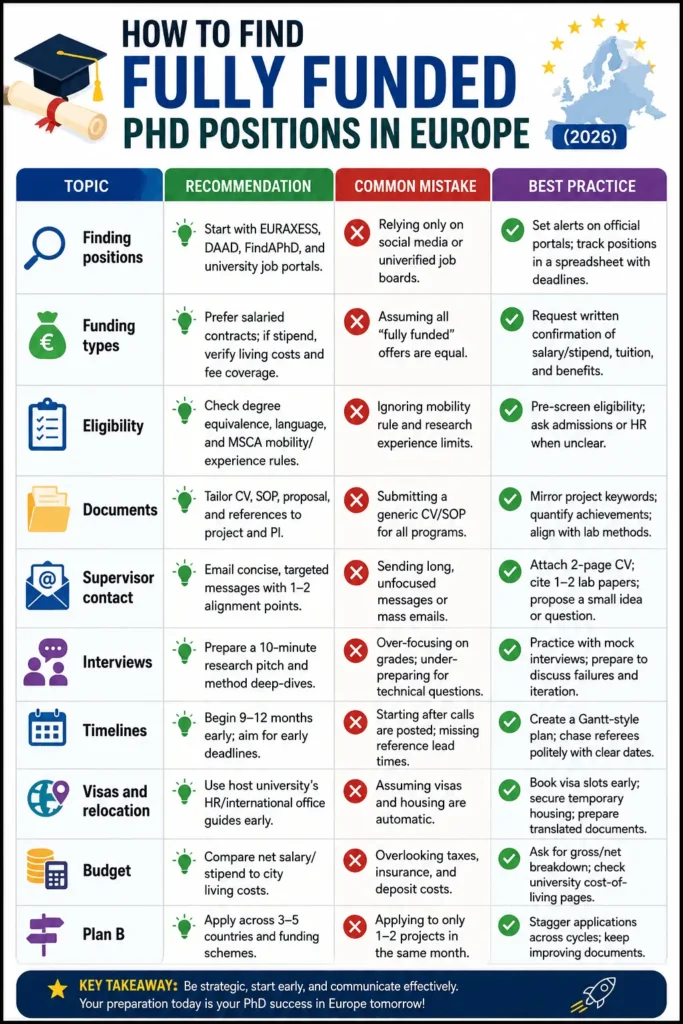
Quick Summary Table: How to Find Fully Funded PhD Positions in Europe (2026)
| Topic | Recommendation | Common Mistake | Best Practice |
|---|---|---|---|
| Finding positions | Start with EURAXESS, DAAD, FindAPhD, and university job portals. | Relying only on social media or unverified job boards. | Set alerts on official portals; track positions in a spreadsheet with deadlines. |
| Funding types | Prefer salaried contracts; if stipend, verify living costs and fee coverage. | Assuming all “fully funded” offers are equal. | Request written confirmation of salary/stipend, tuition, and benefits. |
| Eligibility | Check degree equivalence, language, and MSCA mobility/experience rules. | Ignoring mobility rule and research experience limits. | Pre-screen eligibility; ask admissions or HR when unclear. |
| Documents | Tailor CV, SOP, proposal, and references to project and PI. | Submitting a generic CV/SOP for all programs. | Mirror project keywords; quantify achievements; align with lab methods. |
| Supervisor contact | Email concise, targeted messages with 1–2 alignment points. | Sending long, unfocused messages or mass emails. | Attach 2-page CV; cite 1–2 lab papers; propose a small idea or question. |
| Interviews | Prepare a 10-minute research pitch and method deep-dives. | Over-focusing on grades; under-preparing for technical questions. | Practice with mock interviews; prepare to discuss failures and iteration. |
| Timelines | Begin 9–12 months early; aim for early deadlines. | Starting after calls are posted; missing reference lead times. | Create a Gantt-style plan; chase referees politely with clear dates. |
| Visas and relocation | Use host university’s HR/international office guides early. | Assuming visas and housing are automatic. | Book visa slots early; secure temporary housing; prepare translated documents. |
| Budget | Compare net salary/stipend to city living costs. | Overlooking taxes, insurance, and deposit costs. | Ask for gross/net breakdown; check university cost-of-living pages. |
| Plan B | Apply across 3–5 countries and funding schemes. | Applying to only 1–2 projects in the same month. | Stagger applications across cycles; keep improving documents. |
What “Fully Funded PhD Positions in Europe” Means
In Europe, “fully funded” typically means your tuition/fees are covered and you receive a monthly salary or stipend sufficient to live modestly in the host city. There are two common models:
Australia vs New Zealand for PhD: Costs, Visas, Jobs
- Salaried employment (most common in Northern/Western Europe): You are hired as an employee (e.g., PhD candidate/doctoral researcher) with a contract, salary, and benefits (social insurance, pension, paid leave). Examples: Netherlands, Sweden, Denmark, Norway, Finland, Germany (often 50–100% TV-L E13), Switzerland, Belgium, and many MSCA Doctoral Networks.
- Scholarship or stipend model: You receive a monthly allowance and fee waiver. Common in some programs in France (contrat doctoral is employment; some schools use stipends), Italy, Spain (FPI/FPU contracts are employment; other schemes may be stipends), Portugal (FCT fellowships), Central/Eastern Europe, and certain UK studentships (stipend plus fee coverage).
Always request written details: salary or stipend amount, indexation over years, fee coverage, insurance, parental leave, teaching loads, and contract duration (usually 3–4 years, up to 5–6 in some countries including the Netherlands or part-time arrangements).
Where to Find Fully Funded PhD Positions in Europe (Top Portals)
- EURAXESS Jobs – The EU’s official portal for research jobs and fellowships across Europe. Filter by “PhD Candidate” or “Recognised Researcher,” field, country, and funding.
- FindAPhD – Comprehensive listings of funded and competition-based PhD positions, especially UK, Ireland, Benelux, DACH, Nordics, and EU networks.
- DAAD Scholarship Database – Official funding for studies and research in Germany, including structured doctoral programs, research grants, and graduate schools.
- MSCA Doctoral Networks (DNs) – EU-funded networks recruiting international doctoral candidates. Check network websites or EURAXESS for open positions. Note the mobility rule and early-stage researcher criteria.
- Nature Careers – Research jobs across Europe, including many top labs and institutes.
- Academic Positions – Aggregated research and academic vacancies across Europe; filter by “PhD” level.
- THE UniJobs – Academic jobs including doctoral candidateships, especially in the UK and EU.
- University portals – Always check the “Jobs,” “Doctoral School,” or “Graduate School” pages of target universities and institutes (e.g., Max Planck, EMBL, ETH Domain).
Funding Models by Country (2026 Snapshot)
Funding structures vary significantly. Below is a practical overview (always verify current terms on official pages):
- Germany: Many PhD candidates are employed on TV-L E13 contracts at 50–100% (part-time or full-time), especially in DFG-funded projects and graduate schools. Others hold DAAD or external scholarships. Fees are generally minimal (semester contributions). See DFG funding and DAAD.
- Netherlands: PhD candidates are university employees with salaries following national scales (e.g., UFO Scale P). Typical 4-year contracts with annual progression and no tuition fees. See a typical vacancy on AcademicTransfer.
- Sweden: PhD students are employees with monthly salaries and benefits; tuition fees are generally not charged for doctoral education. See Studera.nu and university HR pages.
- Denmark: PhD fellows are employees under collective agreements, with salary and pension. Check host universities (e.g., University of Copenhagen PhD).
- Norway: PhD candidates are employees with full salaries; doctoral education has no tuition fees for employees. See JobbNorge and university HR portals.
- Finland: Doctoral researchers are often employed, sometimes with mixed funding (projects + grants). Many universities offer salaried Doctoral Researcher posts.
- France: Doctoral candidates often hold a contrat doctoral (employment) or other funded arrangements. Tuition is modest compared to many countries. See Campus France.
- Switzerland: PhD candidates are usually employed by universities or institutes (ETH/EPFL/Universities/CERN affiliations), with competitive salaries. See ETH Doctorate and EPFL Doctorate.
- Belgium: Funding through employment (e.g., doctoral assistant) or scholarships (FWO/FNRS). See FWO and FNRS.
- Austria: Mixture of employment contracts and stipends; most doctoral candidates in funded projects are employees. See FWF.
- Ireland: Funded studentships via SFI Centres, IRC (Irish Research Council), and industry co-funding; often stipend + fee coverage. See Irish Research Council and SFI.
- Spain: Many fully funded via employment contracts (FPI/FPU), others via scholarships. See Agencia Estatal de Investigación.
- Portugal: FCT fellowships and contracts fund many PhDs; verify fee waivers and insurance. See FCT.
- Italy: PhD scholarships are common; amounts and fee waivers vary by university and region. See individual university doctoral schools.
- United Kingdom: UK remains a top destination in Europe with “studentships” (stipend + fee coverage). Check FindAPhD, Jobs.ac.uk, DTP/CDT websites, and university portals.
Step 1: Define Your Fit and Research Direction
Before searching, crystalize your research identity and constraints:
- Field and subfield (e.g., machine learning for healthcare NLP; molecular immunology; sustainable catalysis).
- Methods you bring (e.g., RCT design, single-cell RNA-seq, finite element modeling).
- Outputs that prove readiness (thesis, preprints, code repositories, internships, conference posters).
- Constraints (start date, family, location preferences, language, visa requirements).
Create a one-page “profile brief” to guide your search and outreach.
Step 2: Learn Eligibility and Rules That Can Disqualify You
- Degree requirements: Most programs require a master’s (or 4–5-year integrated degree). Some allow direct PhD entry from bachelor’s in STEM with exceptional records (e.g., Netherlands, UK, select Germany tracks).
- Language: English suffices for most STEM PhDs. For programs taught in local languages, check DSH/TestDaF (Germany), TCF/DELF-DALF (France), etc.
- MSCA Doctoral Networks: You must have less than 4 years of full-time equivalent research experience and not have lived/studied in the host country for more than 12 months in the last 36 months before recruitment.
- Work status: For employee-based PhDs, you must meet employment and visa rules; for scholarship-based, check residency/taxation impacts.
- GRE/GMAT: Rarely required in Europe; verify for specific schools.
Highest-Paying Postdoctoral Fellowships Worldwide (2026)
Step 3: Source Positions Systematically
- Set alerts on EURAXESS, FindAPhD, Academic Positions, and Nature Careers.
- List target universities and institutes; subscribe to their vacancy newsletters.
- Track deadlines in a spreadsheet: portal, project title, PI, requirements, documents, referee status, and submission URL.
- Check MSCA DN consortium pages for each network you’re interested in; positions may be posted on multiple partner sites.
Step 4: Shortlist by Funding Security and Fit
Consider:
- Contract vs stipend: Employment contracts generally offer higher stability and benefits.
- Fee policy: Ensure full fee waiver for international students if not an employee.
- Cost-of-living match: Compare monthly net income to local living expenses using university guides.
- Supervisor track record: Review recent publications, completed PhD supervisions, funding stability, and alumni outcomes.
USA vs Canada for PhD: Best Choice for Indian Students in 2026
Step 5: Prepare Core Documents that Win Interviews
- Academic CV (2–3 pages): Results-focused, with quantifiable outputs.
- Statement of Purpose/Motivation (1–2 pages): Your research trajectory, fit, and why this lab/program now.
- Research Proposal (2–5 pages if requested): For open-topic programs or scholarships; project-defined roles need a targeted idea sketch.
- References: 2–3 academic/industry referees who can attest to your research ability and independence.
- Transcripts and certificates: Official or certified copies with English translations if needed.
- Language proof: IELTS/TOEFL or local tests where required; ask about waivers if you studied in English.
Sample Email to a Potential Supervisor (Cold Outreach)
Subject: Prospective PhD applicant for [Project/Area] — alignment with your recent work on [Keyword]
Dear Dr./Prof. [Surname],
I am a [your degree and institution, graduation year], focusing on [your methods/area]. Your recent paper on [title or keyword, year/journal] aligns closely with my master’s thesis on [topic], where I [1–2 quantified results, e.g., developed a [model/method] that improved [metric] by X%].
I noticed your group is working on [specific project or call; include link/reference ID if applicable]. I would be keen to contribute to [specific aim or method], particularly [concrete idea or question]. I have attached a 2-page CV and a short summary of my thesis.
Would it be possible to schedule a 15-minute call to discuss potential PhD openings or whether my profile would be competitive for [program/grant, e.g., MSCA DN “NAME”]?
Thank you for your time and consideration.
Kind regards,
[Full Name] | [Current role]
[Institution] | [City, Country]
[Email] | [LinkedIn/Website/ORCID/GitHub]
Academic CV Example (Structure)
- Header: Name, email, website/ORCID, location.
- Research Interests: 3–5 bullet points with methods and application domains.
- Education: Degrees with thesis title, advisors, GPA (if strong), dates.
- Publications: Peer-reviewed, preprints, conference abstracts; provide DOIs/links.
- Research Experience: Projects, role, outcomes (data/code/papers), tools used.
- Teaching/Leadership: TA roles, workshops, mentoring.
- Awards/Grants: Scholarships, travel grants, distinctions.
- Skills: Methods, programming, instruments, languages (CEFR levels).
SOP/Motivation Letter Outline
- Opening hook: Your research problem and why it matters.
- Background: 2–3 achievements showing readiness (quantify impact).
- Fit: Why this PI/program/network; cite 1–2 recent papers or facilities.
- Future project: A brief, feasible idea aligned with the call.
- Training plan: Methods you will learn; collaborations/secondments.
- Closing: Career aims and contribution to the host’s mission.
Research Proposal Skeleton (If Requested)
- Title and Keywords
- Problem Statement and Significance
- State of the Art (with 5–10 key references)
- Research Questions/Hypotheses
- Methodology (datasets, instruments, analysis plan; risks and mitigation)
- Work Plan and Timeline (Gantt blocks: WP1–WP4)
- Expected Outcomes (papers, code, prototypes, policy impact)
- Ethics and Data Management (GDPR, open data/code plan)
- References (consistent citation style)
Cover Letter Template for an Advertised PhD Post
Dear Hiring Committee/Dr. [Surname],
I am applying for the PhD position “[Title/Ref]” at [University/Institute]. My background in [methods/field] and my thesis on [topic] position me to contribute immediately to [project objective]. In my recent project, I [key accomplishment with metric].
I am particularly drawn to your lab’s work on [cite 1–2 papers/facilities] and the opportunity to [training/secondment if MSCA/industry link]. I have attached my CV, transcripts, and a brief proposal aligned with [work package or aim].
Thank you for considering my application. I look forward to the possibility of discussing how I can support [group/program] in achieving [goal].
Sincerely,
[Full Name]
Typical Interview Questions
- Explain your thesis contribution in 3–5 minutes. What was novel?
- Walk us through a failed experiment and what you changed.
- Which methods will you need to learn for this project, and how?
- How would you design an experiment to test [project-specific hypothesis]?
- How do you plan your time and manage multiple deadlines?
- What do you expect from supervision, and how do you handle feedback?
Step 6: Apply with Precision
- Match every eligibility criterion and keyword from the advert.
- Upload documents in the requested order and format; name files consistently (Lastname_Firstname_DocType.pdf).
- Get references early. Provide your referees a one-page brief with deadlines, advert link, and your highlights.
- For MSCA DN posts, address mobility rule and early-stage researcher status explicitly in your cover letter.
Fully Funded PhD Scholarships in Germany 2027 | Apply Now
Step 7: Ace the Interview and Mini-Task
- Prepare a 10-minute slide deck: background, 1–2 key results, methods, and fit with the advertised project.
- Practice deep technical questions and quick whiteboard derivations or code pseudo-logic.
- Be ready to discuss data management, reproducibility, and ethics (GDPR, human subjects, animal use, biosafety).
- Ask practical questions: supervision structure, coursework, teaching load, secondments, preliminary milestones.
Step 8: Visas, Residence, and Relocation
Once you receive an offer, coordinate with the host’s HR/international office. In most EU/EEA countries, PhD employees receive a researcher or employee residence permit under national rules aligned with Directive (EU) 2016/801. The UK and Switzerland have separate routes.
- Request official invitation/contract, health insurance details, and enrollment documents for visas.
- Book visa appointments early; some consulates have long waiting times.
- Bring legalized/apostilled diplomas and certified translations.
- Secure short-term housing for arrival; ask for university housing support.
Step 9: Budgeting and Cost of Living
Confirm whether you are on a salary (gross vs net, tax class) or stipend (taxable or not). Compare to city living costs:
- High cost: Zurich, Geneva, Oslo, Copenhagen, Stockholm, Amsterdam, Paris center, Munich.
- Moderate: Berlin, Lyon, Porto, Valencia, Leuven, Utrecht.
- Lower: Smaller university towns (e.g., Uppsala outskirts, Ghent, Jena, Brno, Padua).
Ask HR for an estimated net salary for your family/visa status and check university cost-of-living pages. Consider deposits, initial furniture, residence permit fees, and winter clothing if applicable.
Step 10: Enrollment and Onboarding
- Complete university matriculation and doctoral school requirements (coursework/credits vary by country).
- Confirm supervision agreement, Individual Study Plan (ISP), and probation milestones.
- Attend research integrity and safety trainings early.
- Register with local authorities (residence, tax, health insurance) as required.
Expert Tips
- Target labs before positions open: share a 1-page idea and ask if they plan to recruit in the next 6–12 months.
- Preprint your strongest work. A preprint plus code repository often outweighs an extra course grade.
- For MSCA DNs, highlight your international mobility story and how you meet the 12-in-36 rule in a dedicated paragraph.
- If you lack a method, propose a concrete learning plan with resources, expected timeline, and a mini-project to demonstrate progress.
- Leverage summer schools and short-term RA roles at target institutions to build relationships ahead of calls.
- Ask for a lab rotator call or trial task when possible; it can fast-track mutual fit.
- Keep an achievement log (weekly). It makes CV updates and interviews significantly easier.
- Request a salary ladder and promotion steps (yearly increments) in writing for employment contracts.
- Join departmental seminars and network online; many hires arise from conference or webinar conversations.
- Apply in waves. Use early rejections to refine materials for later deadlines.
Common Mistakes to Avoid
- Ignoring eligibility fine print: Overlooking mobility rules (MSCA), degree equivalence, or language proofs can auto-reject your application.
- Using a generic CV/SOP: Recruiters skim for fit. Tailor keywords, methods, and outcomes to the advert and lab’s publications.
- Underselling outcomes: Listing tasks without results (e.g., “worked on X”) lacks impact. Quantify improvements, datasets built, or citations.
- Late referee requests: References often decide rankings. Give referees at least 3 weeks with your brief and the advert link.
- Overlooking cost of living: A stipend that looks high on paper may be insufficient in cities like Zurich or Paris.
- Assuming “fully funded” means identical benefits: Employment contracts vs stipends differ in taxes, insurance, parental leave, and pensions.
- Weak email outreach: Lengthy, unfocused emails without a clear ask rarely get replies.
- No portfolio: Without a code repo, data story, or preprint, committees struggle to gauge research independence.
- Poor interview structure: Rambling presentations and no concrete method discussion are red flags.
- Not verifying tuition/fee waivers: Some scholarships don’t fully cover international fees—always confirm in writing.
- Applying to too few countries/schemes: Increases risk of a gap year. Diversify (e.g., Germany, Netherlands, Nordics, France, MSCA DNs, UK studentships).
- Neglecting data ethics and reproducibility: Many panels now score this—be ready with a data/code management plan.
Useful Resources (Official)
- EU-level
- Germany
- France
- Netherlands
- Nordics
- Switzerland
- United Kingdom & Ireland
- Spain, Portugal, Italy, Belgium, Austria
Frequently Asked Questions
1) What counts as “fully funded PhD positions in Europe”?
It generally means your tuition is covered and you receive a salary or stipend sufficient for living costs. Many countries hire PhD candidates as employees with contracts, benefits, and no tuition fees. Others offer scholarships with stipends and fee waivers.
2) Do I need a master’s degree to apply?
Usually yes, but some programs (especially in the Netherlands, UK, and select German tracks) admit exceptional candidates directly from a bachelor’s into a long PhD or integrated program. Always check the specific eligibility rules.
3) Is IELTS/TOEFL mandatory?
For English-medium programs, many universities require proof of English proficiency, though waivers are common if prior degrees were taught in English. For local-language programs, you may need tests like DSH/TestDaF (German) or TCF/DELF (French).
4) Are there tuition fees for PhD candidates?
In many European countries, employed PhD candidates do not pay tuition. Where tuition exists, funded studentships typically cover it. Always confirm fee waivers in writing for non-employee scholarships.
5) What are typical salaries/stipends?
They vary widely. Employee contracts in Northern/Western Europe often range roughly from €2,000 to €4,000 gross per month (country- and scale-dependent), with social benefits. Stipends in some regions may be lower; verify local living costs.
6) What is the MSCA mobility rule?
For Marie Skłodowska-Curie Doctoral Networks, you must not have lived or had your main activity in the host country for more than 12 months in the 36 months prior to recruitment, and you must be an early-stage researcher (no PhD, under 4 years of research experience).
7) Can I bring my family?
Many countries allow dependents to accompany you, especially if you are employed. Check your host’s HR guidance and national immigration websites for family reunification rules and timelines.
8) When should I start preparing for 2026 intakes?
Start 9–12 months early. For example, begin in early 2025: shortlist labs, prepare documents, and contact referees so you can apply immediately when calls open.
9) Are application fees common?
Application fees are uncommon for advertised, project-funded PhD jobs. Some structured programs may charge small application fees—verify on the program website.
10) How many applications should I send?
Apply broadly and strategically: 8–15 well-targeted applications across 3–5 countries/funding schemes typically maximize your interview chances without diluting quality.
Conclusion: Your 90-Day Action Plan
Fully funded PhD positions in Europe are attainable with a structured approach. In the next 90 days, do the following:
- Create your one-page profile brief and update a 2–3 page, results-focused CV.
- Set EURAXESS/FindAPhD alerts; track 20–30 leads in a spreadsheet.
- Email 8–12 potential supervisors with targeted notes and a concise ask.
- Draft a reusable SOP and a 2–4 page research idea that you can tailor quickly.
- Line up referees early; provide them your brief and deadlines.
By preparing early and applying precisely, you can secure one of the many competitive, fully funded PhD positions in Europe and start your research career on strong financial and academic footing.
About IR Research Publication
IR Research Publication is dedicated to empowering researchers and students with reliable guidance, tools, and publishing opportunities. We promote rigorous, ethical scholarship and open knowledge-sharing through practical resources, author support, and communities that help you plan studies, write stronger manuscripts, and advance your research career.
Related Articles
- Fully Funded PhD Scholarships in Germany 2027 | Apply Now
- Fully Funded PhD Opportunities in New Zealand 2026
- Fully Funded Postdoctoral Fellowships in New Zealand 2026
- Fully Funded Postdoc Positions in Switzerland for Indian Researchers: 2026 Opportunities and Application Guide
- Fully Funded PhD Programs in Switzerland for Indian Students: 2026 Guide