
Introduction: Why Indian students compare a USA vs Canada PhD
The USA vs Canada PhD for Indian students is a classic comparison because both countries offer world-class research ecosystems, strong academic and industry job markets, and globally recognized universities. Yet they differ in important ways: typical program structure and length, funding models, living costs, immigration rules and PR pathways, and the breadth of labs and grants in specific fields.
This guide is for Indian applicants who want a clear, unbiased, and source-backed comparison before shortlisting supervisors and programs. It’s also helpful for working professionals in India considering a PhD for career pivoting (e.g., R&D, AI/ML, policy, biotech), as well as master’s graduates evaluating direct-entry options.
What matters most? The total cost of attendance (tuition plus living), the odds of a guaranteed funding package, the strength of your intended research area, time-to-completion, visa/work rules during and after the PhD, and how each route aligns with long-term immigration and career goals.
In the next sections, you’ll learn how the USA and Canada compare on funding, tuition, living costs, research opportunities, application processes, language tests, time-to-degree, jobs and salaries, immigration pathways, and student support—so you can decide which path fits your academic ambitions, finances, and life plans.
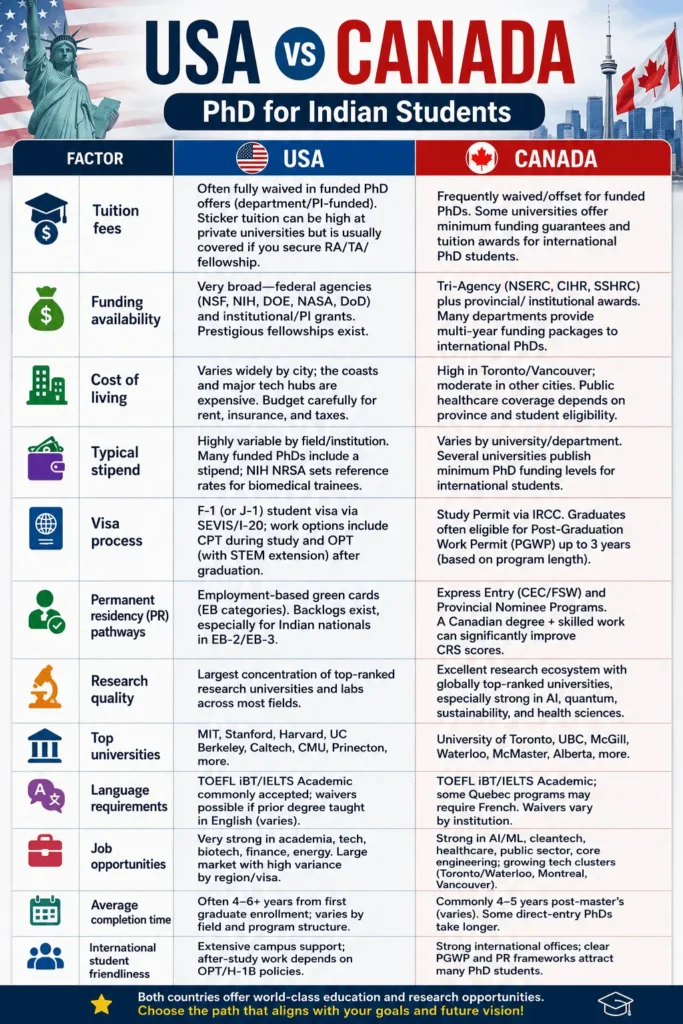
Quick comparison: USA vs Canada PhD for Indian students
| Factor | USA | Canada |
|---|---|---|
| Tuition fees | Often fully waived in funded PhD offers (department/PI-funded). Sticker tuition can be high at private universities but is usually covered if you secure RA/TA/fellowship. | Frequently waived/offset for funded PhDs. Some universities offer minimum funding guarantees and tuition awards for international PhD students. |
| Funding availability | Very broad—federal agencies (NSF, NIH, DOE, NASA, DoD) and institutional/PI grants. Prestigious fellowships exist. | Tri-Agency (NSERC, CIHR, SSHRC) plus provincial/ institutional awards. Many departments provide multi-year funding packages to international PhDs. |
| Cost of living | Varies widely by city; the coasts and major tech hubs are expensive. Budget carefully for rent, insurance, and taxes. | High in Toronto/Vancouver; moderate in other cities. Public healthcare coverage depends on province and student eligibility. |
| Typical stipend | Highly variable by field/institution. Many funded PhDs include a stipend; NIH NRSA sets reference rates for biomedical trainees. | Varies by university/department. Several universities publish minimum PhD funding levels for international students. |
| Visa process | F‑1 (or J‑1) student visa via SEVIS/I‑20; work options include CPT during study and OPT (with STEM extension) after graduation. | Study Permit via IRCC. Graduates often eligible for Post‑Graduation Work Permit (PGWP) up to 3 years (based on program length). |
| Permanent residency (PR) pathways | Employment-based green cards (EB categories). Backlogs exist, especially for Indian nationals in EB‑2/EB‑3. | Express Entry (CEC/FSW) and Provincial Nominee Programs. A Canadian degree + skilled work can significantly improve CRS scores. |
| Research quality | Largest concentration of top-ranked research universities and labs across most fields. | Excellent research ecosystem with globally top-ranked universities, especially strong in AI, quantum, sustainability, and health sciences. |
| Top universities | MIT, Stanford, Harvard, UC Berkeley, Caltech, CMU, Princeton, more. | University of Toronto, UBC, McGill, Waterloo, McMaster, Alberta, more. |
| Language requirements | TOEFL iBT/IELTS Academic commonly accepted; waivers possible if prior degree taught in English (varies). | TOEFL iBT/IELTS Academic; some Quebec programs may require French. Waivers vary by institution. |
| Job opportunities | Very strong in academia, tech, biotech, finance, energy. Large market with high variance by region/visa. | Strong in AI/ML, cleantech, healthcare, public sector, core engineering; growing tech clusters (Toronto/Waterloo, Montreal, Vancouver). |
| Average completion time | Often 4–6+ years from first graduate enrollment; varies by field and program structure. | Commonly 4–5 years post‑master’s (varies). Some direct‑entry PhDs take longer. |
| International student friendliness | Extensive campus support; after-study work depends on OPT/H‑1B policies. | Strong international offices; clear PGWP and PR frameworks attract many PhD students. |
Funding opportunities
Compare: In both countries, the most decisive factor is whether you receive a fully funded offer (tuition + a living stipend via RA/TA/fellowship). Funded offers are common in lab-based STEM fields and many social sciences, but funding levels and guarantees vary by department.
USA advantages:
- Large, diversified funding ecosystem: federal agencies such as the National Science Foundation (NSF), National Institutes of Health (NIH), U.S. Department of Energy (DOE), NASA, and Department of Defense fund many labs and students. See NSF, NIH, DOE Office of Science, and NASA.
- Flagship fellowships: The NSF Graduate Research Fellowship Program (GRFP) provides a competitive multi-year stipend and cost-of-education allowance for eligible fields; see NSF GRFP for current details. NIH NRSA sets official reference stipend levels for trainees in biomedical fields; see NIH NRSA.
- Many departments cover tuition and health insurance in funded offers.
USA disadvantages:
- Funding is competitive and can depend on PI grants, department budgets, and field. Some humanities and professional doctorates may have more limited support.
- Stipend adequacy varies with city costs; high-cost metros may require careful budgeting.
Canada advantages:
- Tri-Agency ecosystem: NSERC (natural sciences/engineering), CIHR (health), SSHRC (social sciences/humanities) support students and research groups; see NSERC, CIHR, SSHRC.
- Many universities provide multi‑year funding packages. For example, the University of British Columbia states a minimum guaranteed PhD funding level for eligible students; see UBC’s policy at UBC Minimum Funding Policy.
- Some institutions reduce international PhD tuition to domestic rates via awards (varies by program/university). At the University of Toronto, see the International Doctoral Student Award (IDSA) for details.
Canada disadvantages:
- Tri‑Agency awards are competitive; amounts and coverage can vary by province and program.
- Funding in some humanities and smaller departments may be tighter; confirm with your supervisor/graduate office.
Which is better? If your priority is maximum breadth of lab funding and federal fellowship options, the USA generally offers more opportunities across fields. If your goal is a predictable multi-year package and clearer post-graduation work/PR steps, Canada’s model can be advantageous. In both cases, the only comparison that truly matters is the written funding guarantee in your offer letter.
Tuition and fees
USA: Many funded PhD offers include full tuition waivers. However, “sticker” tuition at private universities can exceed tens of thousands of USD per year if you are unfunded—so do not assume a waiver unless explicitly stated. Always review department funding pages and your offer letter for tuition coverage, fee waivers, and health insurance details.
Canada: International PhD tuition is typically lower than the US sticker price, and many departments waive or offset tuition for funded international PhDs. Some universities offer institution-wide supports (e.g., UBC’s minimum funding and tuition awards; U of T’s IDSA to reduce tuition to domestic levels for eligible students). Exact policies vary by faculty and year—verify with the graduate program.
Tip: Compare “net cost” not “sticker price.” Net cost = tuition/fees you actually pay out-of-pocket after your offer’s waivers + your expected stipend + local living costs + taxes/insurance.
Cost of living
USA: Living costs vary sharply by location. San Francisco Bay Area, New York, Boston, Seattle, and Los Angeles are among the most expensive. Midwestern and some Southern cities are more affordable. Major expenses include rent, transportation, food, healthcare/insurance, and local/state taxes.
Canada: Vancouver and Toronto are high-cost. Montreal, Edmonton, Calgary, Ottawa, Waterloo, and many other cities can be more moderate. You’ll need to account for rent, transit, food, and health coverage (provincial plans sometimes cover international students; when not, universities provide health insurance options).
Use official university budgeting tools for realistic estimates:
- UBC living cost guidance: UBC Living Costs
- University of Toronto graduate cost information: U of T Graduate Finances
- Check your target US program’s graduate financial aid or cost-of-attendance page for location-specific guidance.
Monthly stipend and budgeting
USA: Many funded PhDs provide a monthly or 9/12‑month stipend via RA/TA or fellowships. Amounts differ by field, department, and location. As a federal reference point in biomedicine, NIH NRSA publishes annual predoctoral stipend levels for trainees and fellows (NIH NRSA). Highly competitive fellowships (e.g., NSF GRFP) set independent stipend amounts for fellows. Your actual stipend will depend on your program and funding source.
Canada: Stipends/funding packages are program-specific. Several universities post minimum PhD funding levels to ensure affordability. For example, UBC outlines a minimum annual funding commitment for eligible PhD students (UBC Minimum Funding). Always confirm components: RA/TA, scholarships, tuition awards, and duration (e.g., first four years).
Budgeting tips:
- Ask for the “12-month equivalent” of any 9‑month stipend and whether summer support is guaranteed.
- Clarify health insurance costs, student fees, and taxes (state/provincial and federal).
- Model rent scenarios with roommates vs studio apartments near campus or along transit lines.
Visa, work during study, and post-study immigration
USA (F‑1/J‑1):
- Student visa pathway and compliance details: Study in the States (DHS).
- During the PhD: On‑campus work allowed within limits; Curricular Practical Training (CPT) may be available if integral to the curriculum (consult your DSO).
- After graduation: Optional Practical Training (OPT) allows up to 12 months of work; STEM graduates may qualify for a 24‑month extension (total up to 36 months). See USCIS: Students and Employment.
- Longer-term: H‑1B specialty occupation visa requires employer sponsorship and is subject to an annual cap/lottery for most employers (USCIS H‑1B). Permanent residency via employment-based categories (e.g., EB‑2 NIW, EB‑1A/B) depends on qualifications and demand; Indian nationals often face backlogs in EB‑2/EB‑3—check the monthly Visa Bulletin (U.S. Visa Bulletin).
Canada (Study Permit/PGWP/PR):
- Study Permit information: IRCC: Study in Canada.
- Work during study: Rules vary; typically, graduate students may work on campus and, under certain conditions, off campus (see IRCC for up‑to‑date limits).
- After graduation: Post‑Graduation Work Permit (PGWP) for up to 3 years depending on program length; see IRCC: Work after graduation.
- Permanent residency: Express Entry (Canadian Experience Class, Federal Skilled Worker) and Provincial Nominee Programs. A Canadian credential plus skilled work can significantly improve your Comprehensive Ranking System (CRS) score (IRCC: Express Entry).
Which is better? For long-term immigration predictability after a PhD, Canada often offers clearer PR pathways for international graduates. For sheer scale of postdoc/industry roles, the USA is unrivaled—but your work authorization after OPT depends on employer sponsorship and policy landscapes. Always check the latest official guidance.
Research quality and ecosystem
USA: The USA has the largest concentration of top-ranked research universities and national labs across disciplines. Global ranking tables (e.g., QS, Times Higher Education, ARWU) consistently feature numerous US institutions at the top; see QS Rankings and THE Rankings. Federal agencies (NSF/NIH/DOE/NASA/DoD) fund expansive research programs, which can translate to more lab openings and cutting-edge equipment in many fields.
Canada: Canada hosts world-leading universities with strong clusters in AI/ML (Toronto, Montreal, Edmonton), quantum (Waterloo, UBC), life sciences (Toronto, McGill), and sustainability/clean energy (UBC, Calgary). The Tri‑Agency framework and national strategies support high-impact research; key universities rank among the global top 50–100 in several subjects (check QS/THE/ARWU subject rankings).
Major funding agencies at a glance:
- USA: NSF, NIH, DOE Office of Science, NASA, defense agencies, and private foundations.
- Canada: NSERC, CIHR, SSHRC, provincial research councils, and industry partnerships.
Which is better? If your subfield depends on large-scale facilities, very large lab groups, or deep federal funding (e.g., certain areas of physics, CS, biomedicine, aerospace), the USA often offers more options. For AI/ML, quantum, sustainability, and health, Canada’s strengths are globally competitive and can provide excellent supervisor fit plus strong industry collaborations.
Best universities
USA highlights: Massachusetts Institute of Technology (MIT Graduate Admissions), Stanford University (Stanford Graduate Admissions), Harvard University (Harvard GSAS), University of California, Berkeley (UC Berkeley Graduate Division), California Institute of Technology (Caltech Graduate Admissions), Carnegie Mellon University (CMU Graduate Studies), Princeton University (Princeton Graduate School), University of Illinois Urbana-Champaign (UIUC Graduate College), University of Michigan (Rackham Graduate School), Georgia Tech (Georgia Tech Graduate Education).
Canada highlights: University of Toronto (U of T SGS), University of British Columbia (UBC Graduate Studies), McGill University (McGill Graduate Admissions), University of Waterloo (Waterloo Graduate Studies), McMaster University (McMaster Graduate Studies), University of Alberta (UAlberta FGSR), University of Montreal (UdeM Doctoral Admissions).
Always shortlist by supervisor fit, recent publications, lab culture, and funding—not just brand-name rank. A strong mentor and a funded project aligned to your interests usually matter more than the overall university rank.
Language and testing requirements
USA: Most universities accept TOEFL iBT or IELTS Academic. Minimum scores vary by department. Some programs waive English tests if you completed a previous degree taught in English (policy varies). GRE requirements have become increasingly optional in many US programs—confirm on your program’s admissions page. See official test sites: TOEFL, IELTS, GRE.
Canada: TOEFL iBT/IELTS Academic are widely accepted; minimums vary by university and faculty. Some Quebec programs may require or favor French proficiency. Waivers may be possible if your prior degree instruction was in English. Verify requirements on your program’s admission page.
Application process and timelines
USA:
- Common to apply directly after a bachelor’s (BS/BE) into a PhD, especially in STEM; many programs include rotations and coursework before full-time dissertation research.
- Typical application timeline: deadlines from November to January for fall intake; decisions from February to April; funding usually included in the offer.
- Materials: statement of purpose, CV, transcripts, English test scores, letters of recommendation, writing sample (for some fields), GRE (if required), and evidence of research potential (papers, projects).
Canada:
- Many programs prefer or require a master’s before PhD; direct-entry PhDs exist but may take longer overall. Supervisor pre‑alignment is often crucial—contact potential supervisors early.
- Deadlines vary by department; fall intake is common. Some programs review applications on a rolling basis subject to funding availability.
- Materials: similar to the USA, but supervisor endorsement or a confirmed funding arrangement can be especially important.
Actionable steps: Email prospective supervisors with a concise research pitch and CV, ask about funded openings and fit, and request a brief call. Send tailored emails (avoid generic templates) and reference their recent papers to demonstrate alignment.
Average time to completion and program structure
USA: Many US PhDs include substantial coursework and qualifying exams before advancing to candidacy. The National Science Foundation’s data show that median time-to-doctorate from first graduate enrollment is often around the 5–6 year mark across fields (varies); see NSF: Survey of Earned Doctorates. Direct‑from‑bachelor’s entrants may take longer than those entering with a master’s.
Canada: Program length varies. Many Canadian PhDs after a research master’s target 4–5 years, with earlier transition to full-time research. Some universities state nominal durations (e.g., 4–6 years) on program pages; check your target department for expected timelines, candidacy exams, publication expectations, and residency rules.
Career opportunities after graduation
Academic jobs: Both countries have competitive tenure‑track markets. Publishing strong first‑author papers, securing teaching experience, and winning competitive fellowships improve prospects. Postdoctoral training is common in STEM and some social sciences/humanities.
Industry jobs:
- USA: Very strong opportunities across tech (AI/ML, data science, systems), biotech/pharma, finance/quant, energy, advanced manufacturing, and national labs. Visa pathways (OPT → H‑1B/O‑1/EB) can affect employer decisions.
- Canada: Growing tech ecosystems in Toronto/Waterloo, Montreal, and Vancouver (AI/ML, fintech, gaming), plus robust public-sector, health, and resource/cleantech industries. PGWP and PR routes can ease hiring for employers.
Salary expectations: Salaries vary by field, region, and role. Official references for the USA include the Bureau of Labor Statistics (BLS). For example, 2023 median pay for Computer and Information Research Scientists and Physicists is among the highest STEM medians; see BLS Occupational Outlook Handbook. For Canada, consult Government of Canada’s Job Bank wage data by occupation and province: Job Bank Wages. Use these official sources to benchmark by occupation and location; PhD holders may earn above occupational medians in specialized roles.
Visa pathways and hiring: In the USA, the H‑1B cap/lottery introduces uncertainty unless the employer is cap‑exempt (e.g., universities, some nonprofits). In Canada, PGWP and Express Entry often make hiring simpler for employers after your PhD, especially once you gain Canadian experience and PR.
International student support and campus life
USA: Large universities typically offer international student offices, teaching centers, counseling, graduate housing, and family support. Student groups for Indian communities are vibrant at many campuses. Explore your target program’s mentorship infrastructure and teaching development resources.
Canada: Strong international student advising, co‑op/internship offices (where offered), and inclusive student associations. Health insurance and coverage vary by province—review whether you’re eligible for provincial plans and what the university plan covers (dental/vision/mental health).
Pros and cons
Pros of a USA PhD
- Unmatched depth and breadth of top research universities, labs, and funding sources.
- High-density tech/biotech ecosystems with strong industry collaboration.
- Prestigious fellowships and extensive seminar/conference networks.
Cons of a USA PhD
- Work authorization after OPT depends on employer sponsorship and policy changes.
- High living costs in many top research hubs; stipends may lag local rents.
- Longer average time-to-degree in some fields/programs.
Pros of a Canada PhD
- Clearer post‑graduation work (PGWP) and PR pathways for many graduates.
- Strong research in AI/ML, quantum, health, and sustainability; collaborative culture.
- Many programs offer multi‑year funding packages and tuition awards to international PhDs.
Cons of a Canada PhD
- Fewer total universities and labs than the USA; choice may be narrower in niche fields.
- High living costs in Toronto/Vancouver; funding can vary by department.
- Some programs expect a master’s before PhD, adding time and cost if you don’t have one.
Which option is best for you?
- Students with a limited budget: Compare guaranteed funding in writing. Canada’s multi‑year packages and tuition awards can produce lower net costs, especially outside the highest-cost cities. In the USA, target departments with strong RA/TA support and consider lower‑cost regions.
- Biomedical researchers: USA often offers larger lab ecosystems and NIH‑funded projects; Canada has excellent options (Toronto, McGill, UBC) with strong hospital/research institute ties. If long-term immigration stability matters, Canada’s PGWP→PR path is attractive.
- Computer science/AI/ML: USA maximizes Big Tech proximity; Canada has top-tier AI hubs (Toronto/Vector, Montreal/Mila, Edmonton/Amii, Vancouver). If you want PR soon after graduating, Canada may offer a smoother path. If your aim is FAANG-scale roles, the USA offers volume but requires navigating OPT/H‑1B.
- Core engineering/energy/quantum: USA provides many national labs and large consortia; Canada’s Waterloo/UBC/Alberta/McMaster ecosystems are notable. Choose based on supervisor fit, lab facilities, and partnerships.
- Long-term immigration goals: Canada generally provides clearer PR options for graduates. The USA offers employment-based green cards but with potential backlogs for Indian nationals in EB‑2/EB‑3—monitor the Visa Bulletin.
- Industry-focused careers: USA has the largest market depth; Canada provides strong opportunities in AI/ML, fintech, gaming, health, and public sector with employer-friendly PGWP/PR frameworks.
- Academic careers: Both are competitive; choose the supervisor and lab that best position you for high‑impact publications, grants, and a strong network.
Expert tips
- Prioritize supervisor fit and guaranteed funding over brand rank. A supportive PI with active grants beats a famous name without funding.
- Email potential supervisors early (Aug–Oct for the following fall), referencing 1–2 of their recent papers with your aligned research idea in 150–200 words.
- Ask programs to detail the funding breakdown: stipend amount, months covered, summer support, tuition/fee waivers, health insurance, and duration.
- Model taxes and healthcare. In the USA, compare student health plan coverage and out-of-pocket costs; in Canada, confirm provincial coverage eligibility and university plan details.
- Use official immigration pages only. Visa/PR rules change—verify with USCIS/DHS or IRCC before final decisions.
- Build employability during your PhD: internships, teaching certificates, method/tool depth (e.g., PyTorch, R, MATLAB, Stata), and cross-disciplinary collaborations.
- Network strategically: conferences, workshops, and lab visits. Ask your PI for targeted introductions in academia and industry.
External resources (official)
- USA student immigration: Study in the States (DHS)
- USCIS Students and Employment (OPT/CPT): USCIS
- USCIS H‑1B: USCIS H‑1B
- US Visa Bulletin (employment-based green cards): U.S. Department of State
- NSF GRFP: NSF GRFP
- NIH NRSA stipends: NIH
- Canada Study Permit: IRCC
- PGWP (work after graduation): IRCC
- Express Entry (PR): IRCC
- Tri‑Agency (Canada): NSERC, CIHR, SSHRC
- US research agencies: NSF, NIH, DOE Office of Science, NASA
- Rankings: QS, THE, ARWU
- USA labor market data: BLS Occupational Outlook Handbook
- Canada wage data: Government of Canada Job Bank
Internal resources from IR Research Publication
Explore more research and publication guidance on IR Research Publication:
- Best Countries for PhD After MSc for Indian Students
- Fully Funded PhD Scholarships in Germany 2027 | Apply Now
- Fully Funded PhD Opportunities in New Zealand 2026
- QS World University Rankings 2027 Released: MIT’s Historic Streak, Asia’s Rise, and the Global Top 20
- Fully Funded PhD Programs in Switzerland for Indian Students: 2026 Guide
Frequently asked questions
1) Is a USA or Canada PhD better for Indian students?
Neither is universally “better.” The right choice depends on your supervisor fit, confirmed funding package, field strengths, living costs, and immigration plans. The USA offers unmatched scale; Canada offers clearer PGWP→PR pathways for many graduates.
2) Which is cheaper for a PhD: USA or Canada?
Both can be affordable if you secure a fully funded offer with tuition waiver and stipend. Canada often yields lower net costs outside Toronto/Vancouver and with tuition awards; in the USA, costs vary heavily by city—compare your written offers line by line.
3) Do PhD students get paid?
Yes, in funded programs. Stipends commonly come from RA/TA roles or fellowships. Amounts vary widely by field and location. Some agencies publish reference stipend levels (e.g., NIH NRSA for biomedical trainees in the USA).
4) What English tests are accepted?
TOEFL iBT and IELTS Academic are widely accepted in both countries. Minimum scores and waiver policies vary by university and department. Always check your program’s official admissions page.
5) How long does a PhD take in the USA vs Canada?
USA programs often run 4–6+ years from first graduate enrollment (varies by field). In Canada, many PhDs after a research master’s target 4–5 years. Direct-entry PhDs can take longer in both countries.
6) Is GRE required?
Many US programs have moved to GRE-optional or GRE-not-required policies, but some still ask for it. In Canada, GRE is less commonly required outside specific departments. Confirm on the program’s website.
7) What are the post-study work options?
USA: OPT (and STEM OPT extension) after F‑1 studies; longer-term H‑1B/O‑1/EB pathways. Canada: PGWP up to 3 years (depending on program length) and PR via Express Entry/PNP. Always verify current rules on official sites.
8) Can my spouse work during my PhD?
Rules differ. In the USA, F‑2 spouses generally cannot work; J‑2 may be eligible with authorization. In Canada, spouses/partners may be eligible for an open work permit under certain conditions. Check DHS/USCIS and IRCC pages for the latest policies.
9) Are there fully funded PhD scholarships for Indian students?
Yes. Many departments offer funded positions. Competitive fellowships (NSF GRFP, agency fellowships in the USA; Tri-Agency and provincial/institutional awards in Canada) can boost funding. Search program and agency sites early.
10) How do I pick a supervisor?
Read 3–5 of their recent papers, verify active grants and lab size, speak with current students, and confirm funding security and mentoring style. Consider co‑supervision if your work is interdisciplinary.
Conclusion: USA vs Canada PhD for Indian students—what should you choose?
Both the USA and Canada offer outstanding PhD training for Indian students. The best choice aligns with your funding security, supervisor fit, research environment, life costs, and immigration priorities.
- Choose the USA if you want the largest choice of labs and funding sources, proximity to top-tier industry hubs, and a program structure that supports broad coursework and rotations. Ensure you’re comfortable navigating OPT→H‑1B or alternative visa strategies and budgeting for potentially high-cost cities.
- Choose Canada if you value a clear PGWP→PR pathway, strong AI/quantum/health/sustainability ecosystems, and multi‑year funding packages with predictable net costs. This is especially attractive if you already hold a research master’s and want a 4–5 year PhD trajectory.
In all cases, compare written offers, talk to potential supervisors and current students, and verify immigration details on official sites before you decide.
About IR Research Publication
IR Research Publication is a platform dedicated to advancing scholarly communication and empowering researchers worldwide. We publish high-quality, peer-reviewed work and share practical guidance on research design, academic writing, and career development. Our mission is to help scholars—from early-stage graduate students to senior academics—disseminate impactful research and navigate academia with confidence.