Tag: Study abroad PhD

  • Germany vs Netherlands for PhD in 2026: Costs, Funding, Language, Jobs

    Germany vs Netherlands for PhD in 2026: Costs, Funding, Language, Jobs

    Introduction: Why compare Germany vs Netherlands for PhD?

    Germany vs Netherlands for PhD is a common comparison for international researchers because both countries are research powerhouses in Europe, offer a large number of English-language doctoral projects, and provide internationally recognized training. Yet their models differ in crucial ways that affect your finances, supervision, and career outcomes.

    This guide is for master’s graduates, early-career researchers, and professionals considering a European doctorate. It is also useful for academic advisors and parents who want a precise, unbiased overview.

    The factors that usually matter most include funding model and salary, tuition and living costs, research culture and supervision, program structure and duration, visa/residence rules, language expectations, and post-PhD job opportunities (both academic and industry).

    In the next sections, you’ll learn how each country handles admissions, the realities of stipends and employment contracts, where each country excels by discipline, how to budget realistically, and what the immigration and career pathways look like after graduation—backed by official sources where possible.

    Key takeaways at a glance

    • Funding model: The Netherlands typically employs PhD candidates as full-time staff with a salary and benefits; Germany mixes salaried researcher contracts, scholarships, and some self-funded paths with very low or no tuition.
    • Tuition: Public universities in Germany usually charge no tuition for PhD (only small semester fees). In the Netherlands, employee-PhDs don’t pay tuition; external/self-funded PhDs may pay substantial tuition depending on the university.
    • Living costs: Expect moderate-to-high costs in both countries, typically higher in Dutch urban centers like Amsterdam, Utrecht, and Delft.
    • Language: Many PhDs run in English in both countries; local language may be essential for clinical or patient-facing research.
    • Post-PhD jobs: Both have strong academic and industry ecosystems; the Netherlands often provides structured development and a clear 4-year timeline, while Germany offers broad institute networks (Max Planck, Helmholtz, Fraunhofer) and an 18-month job-search period for graduates.

    Quick comparison table: Germany vs Netherlands for PhD

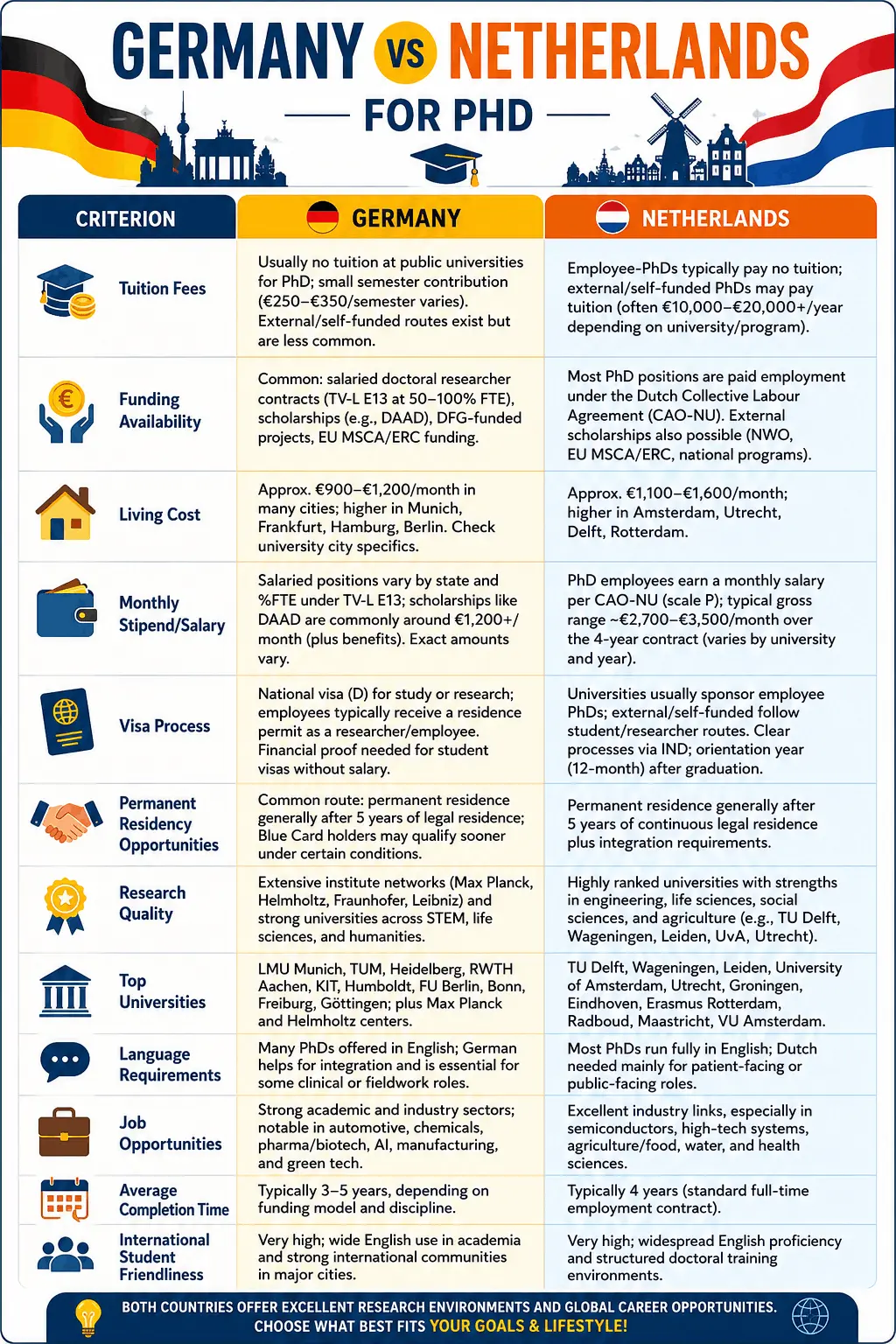
    Criterion Germany Netherlands
    Tuition Fees Usually no tuition at public universities for PhD; small semester contribution (€250–€350/semester varies). External/self-funded routes exist but are less common. Employee-PhDs typically pay no tuition; external/self-funded PhDs may pay tuition (often €10,000–€20,000+/year depending on university/program).
    Funding Availability Common: salaried doctoral researcher contracts (TV-L E13 at 50–100% FTE), scholarships (e.g., DAAD), DFG-funded projects, EU MSCA/ERC funding. Most PhD positions are paid employment under the Dutch Collective Labour Agreement (CAO-NU). External scholarships also possible (NWO, EU MSCA/ERC, national programs).
    Living Cost Approx. €900–€1,200/month in many cities; higher in Munich, Frankfurt, Hamburg, Berlin. Check university city specifics. Approx. €1,100–€1,600/month; higher in Amsterdam, Utrecht, Delft, Rotterdam.
    Monthly Stipend/Salary Salaried positions vary by state and %FTE under TV-L E13; scholarships like DAAD are commonly around €1,200+/month (plus benefits). Exact amounts vary. PhD employees earn a monthly salary per CAO-NU (scale P); typical gross range ~€2,700–€3,500/month over the 4-year contract (varies by university and year).
    Visa Process National visa (D) for study or research; employees typically receive a residence permit as a researcher/employee. Financial proof needed for student visas without salary. Universities usually sponsor employee PhDs; external/self-funded follow student/researcher routes. Clear processes via IND; orientation year (12-month) after graduation.
    Permanent Residency Opportunities Common route: permanent residence generally after 5 years of legal residence; Blue Card holders may qualify sooner under certain conditions. Permanent residence generally after 5 years of continuous legal residence plus integration requirements.
    Research Quality Extensive institute networks (Max Planck, Helmholtz, Fraunhofer, Leibniz) and strong universities across STEM, life sciences, and humanities. Highly ranked universities with strengths in engineering, life sciences, social sciences, and agriculture (e.g., TU Delft, Wageningen, Leiden, UvA, Utrecht).
    Top Universities LMU Munich, TUM, Heidelberg, RWTH Aachen, KIT, Humboldt, FU Berlin, Bonn, Freiburg, Göttingen; plus Max Planck and Helmholtz centers. TU Delft, Wageningen, Leiden, University of Amsterdam, Utrecht, Groningen, Eindhoven, Erasmus Rotterdam, Radboud, Maastricht, VU Amsterdam.
    Language Requirements Many PhDs offered in English; German helps for integration and is essential for some clinical or fieldwork roles. Most PhDs run fully in English; Dutch needed mainly for patient-facing or public-facing roles.
    Job Opportunities Strong academic and industry sectors; notable in automotive, chemicals, pharma/biotech, AI, manufacturing, and green tech. Excellent industry links, especially in semiconductors, high-tech systems, agriculture/food, water, and health sciences.
    Average Completion Time Typically 3–5 years, depending on funding model and discipline. Typically 4 years (standard full-time employment contract).
    International Student Friendliness Very high; wide English use in academia and strong international communities in major cities. Very high; widespread English proficiency and structured doctoral training environments.

    Funding Opportunities

    How funding works in Germany

    Germany offers a mixed system. Many PhD candidates hold paid positions as research staff (Wissenschaftliche Mitarbeitende) funded by externally won grants (often DFG or EU) or institute budgets. These are typically TV-L E13 contracts at 50–100% FTE (hours and pay percentage vary by project and state). Other candidates are funded by competitive scholarships such as DAAD, foundation scholarships (e.g., Konrad Adenauer, Heinrich Böll), or EU Marie Skłodowska-Curie Actions. Tuition at public universities is usually zero for PhDs, with only semester contributions.

    Useful links:

    How funding works in the Netherlands

    The Netherlands often employs PhD candidates as university staff on a 4-year contract with a salary and benefits (pension, paid leave), covered by the Collective Labour Agreement for Dutch Universities (CAO-NU), salary scale P. Some universities also host external/self-funded PhDs who bring their own funding (e.g., national scholarships) and, in those cases, tuition may apply.

    Useful links:

    Advantages

    • Germany: No/low tuition at public universities; many salaried researcher posts; large number of foundations and DFG-funded projects; DAAD is globally recognized.
    • Netherlands: Clear employee status with salary and benefits for most PhDs; structured career development and training; predictable 4-year funding horizon.

    Disadvantages

    • Germany: Funding model varies by supervisor and state; if on a scholarship, social benefits can be limited; contract percentages (e.g., 50–75%) affect take-home pay.
    • Netherlands: Employee-PhD positions are competitive; external/self-funded routes may incur significant tuition; cost of living is relatively high in major Dutch cities.

    Which is better?

    If you prioritize an employee contract with a predictable 4-year salary and benefits, the Netherlands tends to be better. If you value zero tuition, immense institute networks, and diverse funding sources (including scholarships), Germany offers excellent breadth—with the caveat that compensation and contracts vary.

    Research Opportunities and Strengths

    Germany

    Germany hosts some of the world’s strongest non-university research networks and graduate schools. The Max Planck Society focuses on basic science, Helmholtz Centers emphasize large-scale applied research (e.g., energy, health, aerospace), Fraunhofer specializes in industry-facing applied R&D, and Leibniz covers a broad spectrum. Universities such as LMU Munich, TUM, Heidelberg, RWTH Aachen, and KIT are consistently well-regarded. Funding is abundant in STEM, life sciences, and increasingly in AI and sustainability.

    Key agencies and infrastructures:

    Netherlands

    The Netherlands punches above its weight in high-tech systems, microelectronics/semiconductors, photonics, water management, sustainable energy, agriculture and food (WUR), data science/AI, and health sciences. Universities such as TU Delft, Wageningen, Leiden, Amsterdam (UvA & VU), Utrecht, Groningen, Eindhoven, and Erasmus Rotterdam are active in European consortia and industry collaborations.

    Key agencies and infrastructures:

    Advantages

    • Germany: Scale and diversity of research institutes; breadth across disciplines; strong EU project participation; powerful applied research network (Fraunhofer).
    • Netherlands: Tight integration with industry and societal challenges; strong project management culture; high supervisor accessibility; excellent research training frameworks.

    Disadvantages

    • Germany: Heterogeneity—quality of supervision and structure can vary by chair/department; navigation may be more decentralized.
    • Netherlands: Smaller system may have fewer total positions; highly competitive environment for certain fields.

    Which is better?

    For large research infrastructures and extensive institute ecosystems, Germany leads. For structured programs with strong industry links and project clarity, the Netherlands often feels more streamlined.

    Cost of Living and Budgeting

    Living costs depend heavily on city, housing, and lifestyle.

    Germany

    • Typical monthly budget: €900–€1,200 in many cities; expect higher in Munich, Frankfurt, Hamburg, and central Berlin.
    • Semester contributions (for public transport and admin) of ~€250–€350/semester are common.
    • Reference: Study in Germany (official) provides up-to-date guidance on costs.

    Netherlands

    • Typical monthly budget: €1,100–€1,600, with Amsterdam, Utrecht, Delft, and Rotterdam at the higher end.
    • Employee-PhDs earn a salary and may access housing assistance or university housing services; availability is competitive.
    • Reference: Study in NL (official) outlines typical living costs for international students.

    Actionable budgeting tips

    • Apply early for university housing and compare neighborhoods carefully.
    • Leverage student/employee discounts for transport and insurance.
    • In Germany, check whether your semester contribution includes a transport pass.
    • In the Netherlands, calculate net salary using Dutch tax calculators and consider mandatory health insurance costs.

    Language, Culture, and Supervision

    Language requirements

    • Germany: Many PhD projects are fully in English. German helps with administration, community life, and clinical/fieldwork roles. Universities list language requirements per program.
    • Netherlands: English is widely used in research. Dutch is usually not required except for specific clinical, educational, or public-facing roles.

    Supervision culture and training

    • Germany: Supervision structures vary by chair and graduate school. Many institutions now use supervision agreements and graduate program milestones, but practices differ.
    • Netherlands: Generally more standardized, with training and supervision plans (TSP), annual progress evaluations, coursework/professional development, and a clear 4-year schedule.

    Which is better?

    If you prefer a highly structured environment with formal milestones, the Netherlands tends to fit better. If you value flexibility and can self-navigate a more decentralized system, Germany provides that latitude—especially in professor-led chair models.

    Visa and Residence Pathways

    Germany

    • Entry/residence: National visa (D) for study or research via consulates; employees often receive a residence permit as researchers or skilled workers.
    • Financial proof: Required for student visas without employment; typically shows funds for a year of living costs. Requirements update periodically—check official sources.
    • After graduation: Graduates of German universities can generally apply for an 18-month job-seeking residence permit to find qualified employment.
    • Permanent residence: Commonly after 5 years of legal residence; Blue Card holders may be eligible sooner depending on conditions and language level.
    • Official links: Federal Foreign Office – Visa, Make it in Germany.

    Netherlands

    • Entry/residence: Universities typically sponsor permits for employed PhDs. External/self-funded candidates follow student/researcher routes.
    • Orientation year: A 12-month “orientation year for highly educated persons” allows job searching after graduation or doctoral completion.
    • Permanent residence: Generally after 5 years of continuous legal residence plus integration requirements.
    • Official link: Dutch Immigration and Naturalisation Service (IND) and Orientation Year.

    Which is better?

    Both countries offer clear post-PhD pathways. Germany’s 18-month job-search period for graduates is generous, while the Netherlands’ 12-month orientation year is straightforward and aligns with its strong high-tech industry hiring.

    Career Opportunities After Graduation

    Academic jobs

    • Germany: Opportunities in universities and research institutes (Max Planck, Helmholtz, Fraunhofer, Leibniz). Habilitation/postdoc routes vary; many positions are fixed-term and tied to third-party funding.
    • Netherlands: Postdoc and assistant professor tracks are competitive but transparent; institutions emphasize mentoring and professional development.

    Industry jobs

    • Germany: Strong in automotive, chemicals/materials, pharma/biotech, engineering/manufacturing, green tech, and AI. Many R&D roles value German language, but English-only roles exist in multinationals.
    • Netherlands: Leading in semiconductors (e.g., ecosystem around ASML), photonics, life sciences/health, data/AI, water/agritech/sustainability. English is widely used in tech environments.

    Salary expectations and pathways

    • Salaries vary widely by sector and language ability. Both countries have robust tech and research labor markets; check sector-specific salary benchmarks (e.g., Glassdoor, university career services, or official labor statistics).
    • Work authorization: Germany—graduates typically get 18 months to find skilled work; Netherlands—orientation year is 12 months. Both offer routes to highly skilled migrant permits and longer-term residence.

    Which is better?

    If you aim for applied R&D with Europe’s largest economy and broad institute networks, Germany is compelling. For a high-tech, English-friendly environment with strong university-industry pipelines, the Netherlands is excellent.

    Best Universities and Institutes

    Germany (examples)

    Netherlands (examples)

    Application Process: Similarities and Differences

    Germany

    • Two models: individual doctorate (find a supervisor/chair, align a topic, secure funding) and structured doctoral programs (grad schools with cohorts and coursework).
    • Common steps: identify supervisors/projects, email with a focused research pitch, apply through department/university, secure funding (contract/scholarship).
    • Deadlines vary; many positions are advertised year-round via university portals and EURAXESS.

    Netherlands

    • Most positions are posted as job vacancies with a defined project. You apply like for a professional role (CV, motivation letter, research fit, interviews).
    • Contracts typically start for 4 years; a progress review in year 1 may be standard.
    • External/self-funded PhD tracks exist at some universities; check tuition and supervision arrangements carefully.

    Documentation and language

    • Both countries commonly accept IELTS/TOEFL for English-taught PhDs; waivers may apply if prior education was in English. Program pages specify minimum scores and document checklists.

    Actionable advice

    • Germany: Write targeted emails to potential supervisors demonstrating publication awareness and a short, feasible project idea. Ask early about funding (TV-L %FTE, duration, lab resources).
    • Netherlands: Tailor applications to posted projects, echoing key methods and deliverables; prepare for structured interviews and a possible research presentation.

    Pros and Cons

    Pros of Germany

    • No or very low tuition at public universities for PhD; wide availability of scholarships.
    • Vast research ecosystem (Max Planck, Helmholtz, Fraunhofer, Leibniz).
    • Strong industry across multiple sectors; many English-language research environments.
    • 18-month post-study job-search option for graduates.

    Cons of Germany

    • Funding and supervision structures vary widely by supervisor and state.
    • Scholarship holders may have fewer social benefits than employees.
    • German language is advantageous for broader job markets and administration.

    Pros of the Netherlands

    • PhD candidates are often employees with salary, benefits, and a clear 4-year plan.
    • High English proficiency and structured doctoral training/supervision.
    • Strong university–industry links in high-tech, agri-food, and health.
    • Orientation year (12 months) helps transition to the labor market.

    Cons of the Netherlands

    • Fewer total positions compared with Germany; intense competition in some fields.
    • External/self-funded routes can be expensive.
    • Higher living costs in major cities.

    Which Option is Best for You?

    • Students with limited budget: Germany often wins due to zero tuition at public universities and numerous scholarships. Living costs can be lower in many German cities.
    • Those who want a salaried, employee-style PhD: Netherlands—most PhDs are employment contracts with benefits and a well-defined timeline.
    • Biomedical researchers and life sciences: Both countries are strong. Germany offers extensive institute networks and hospitals; the Netherlands provides highly collaborative, translational environments and excellent biostatistics/data resources.
    • Engineering and high-tech (semiconductors, photonics, robotics): The Netherlands is outstanding for tight industry links and high-tech campuses; Germany is excellent for manufacturing, automotive, and industrial R&D.
    • Long-term immigration goals: Both offer routes to permanent residence typically after 5 years. Germany’s 18-month job-search window is generous; the Netherlands offers the orientation year and highly skilled migrant pathways.
    • Academic careers: Both are competitive. If you prefer structured doctoral training and early-career development plans, the Netherlands has an edge; if you value large institute ecosystems and EU project involvement, Germany excels.
    • Industry careers: Netherlands for high-tech ecosystems and English-friendly workplaces; Germany for breadth of sectors and global industrial players.

    Expert Tips

    • Prioritize supervisor and lab fit over country prestige. Your day-to-day mentor quality heavily influences completion time and output.
    • Ask precisely about funding: contract percentage (Germany), gross-to-net salary (Netherlands), teaching loads, and duration guarantees.
    • Compare cities, not just countries. Housing scarcity and costs vary by location; apply early for accommodation.
    • Check IP policies and publication expectations; clarify authorship norms and data management plans.
    • Plan for skills training early (statistics, coding, academic writing); many graduate schools offer free courses.
    • Use EURAXESS and official university portals—avoid unverified listings.
    • For self-funded paths, model a 4–5 year budget including health insurance, tuition (if any), research costs, and inflation.
    • Discuss visa timing with HR/International Office; start paperwork early to avoid delays.

    External Resources (Official)

    Internal Resources from IR Research Publication

    For hands-on application advice, templates, and checklists, explore:

    Frequently Asked Questions

    Is Germany or the Netherlands better for a fully funded PhD?

    Both offer fully funded options. In Germany, many PhDs are salaried research posts or funded by scholarships (DAAD, DFG, EU). In the Netherlands, most PhDs are salaried employee positions. Your best choice depends on the specific project, supervisor, and compensation details.

    Do PhD students pay tuition in Germany?

    At public universities, PhD tuition is typically zero. You usually only pay a semester contribution (administrative and transport). Private institutions and special programs may differ.

    Do PhD candidates pay tuition in the Netherlands?

    Employee-PhDs (the majority) normally do not pay tuition. External or self-funded PhDs may pay tuition, which can be substantial depending on the university. Always verify on the specific program page.

    What is the average PhD salary in the Netherlands?

    Salaries follow the CAO-NU (scale P) and rise over the 4-year contract. Exact gross amounts vary by year and university. Check the latest figures on university vacancy pages or the CAO-NU website.

    How much is a DAAD PhD scholarship?

    DAAD doctoral scholarships commonly provide a monthly rate around €1,200 (plus possible allowances such as insurance and travel). Specific programs vary—see DAAD’s official database.

    How long does a PhD take in Germany vs the Netherlands?

    Germany: typically 3–5 years depending on field and funding model. Netherlands: typically 4 years with a full-time employment contract.

    Are programs offered in English?

    Yes. Many PhDs in both countries are fully in English. Local language may be required for clinical or fieldwork roles and is helpful for daily life and broader job markets.

    What are the post-PhD work options?

    Germany: 18-month job-search residence for graduates; strong academic and industrial R&D sectors. Netherlands: 12-month orientation year; high-tech and life sciences clusters actively hire PhDs.

    How do I find open PhD positions?

    Use EURAXESS, university job portals, and institute websites (e.g., Max Planck, Helmholtz, TU Delft, UvA). In Germany, also contact supervisors directly with a focused research pitch.

    Which is cheaper overall for a PhD: Germany or the Netherlands?

    Germany often has lower total costs due to no tuition and, in many cities, slightly lower living costs. The Netherlands can be more expensive but provides reliable salaries and benefits for employee-PhDs.

    Conclusion: Germany vs Netherlands for PhD

    Choosing between a PhD in Germany vs Netherlands depends on your priorities, not a universal “best.”

    • Choose Germany if you want zero tuition at public universities, access to vast institute networks (Max Planck, Helmholtz, Fraunhofer, Leibniz), and are comfortable navigating variable supervision and funding models (salaried contracts or scholarships). It’s a great fit for those seeking broad research ecosystems and diverse industry sectors.
    • Choose the Netherlands if you prefer a salaried, employee-style PhD with benefits, a clear 4-year structure, and strong university–industry connections—especially in semiconductors, high-tech systems, agrifood, water, and health sciences. The structured training and English-friendly environment are major advantages.

    Define your must-haves—funding certainty, supervision style, city preference, and post-PhD plans—then shortlist programs whose supervisors and projects match your research goals. Use the official resources linked above to validate details and timelines before applying.

    About IR Research Publication

    IR Research Publication empowers students and researchers with practical, peer-reviewed guidance on academic writing, research methods, funding, and careers. Our mission is to make scholarly success accessible through clear tutorials, templates, and expert insights—helping you move from aspiration to publication with confidence.

    Related Articles

  • USA vs Canada for PhD: Best Choice for Indian Students in 2026

    USA vs Canada for PhD: Best Choice for Indian Students in 2026

    Introduction: Why Indian students compare a USA vs Canada PhD

    The USA vs Canada PhD for Indian students is a classic comparison because both countries offer world-class research ecosystems, strong academic and industry job markets, and globally recognized universities. Yet they differ in important ways: typical program structure and length, funding models, living costs, immigration rules and PR pathways, and the breadth of labs and grants in specific fields.

    This guide is for Indian applicants who want a clear, unbiased, and source-backed comparison before shortlisting supervisors and programs. It’s also helpful for working professionals in India considering a PhD for career pivoting (e.g., R&D, AI/ML, policy, biotech), as well as master’s graduates evaluating direct-entry options.

    What matters most? The total cost of attendance (tuition plus living), the odds of a guaranteed funding package, the strength of your intended research area, time-to-completion, visa/work rules during and after the PhD, and how each route aligns with long-term immigration and career goals.

    In the next sections, you’ll learn how the USA and Canada compare on funding, tuition, living costs, research opportunities, application processes, language tests, time-to-degree, jobs and salaries, immigration pathways, and student support—so you can decide which path fits your academic ambitions, finances, and life plans.

    Quick comparison: USA vs Canada PhD for Indian students

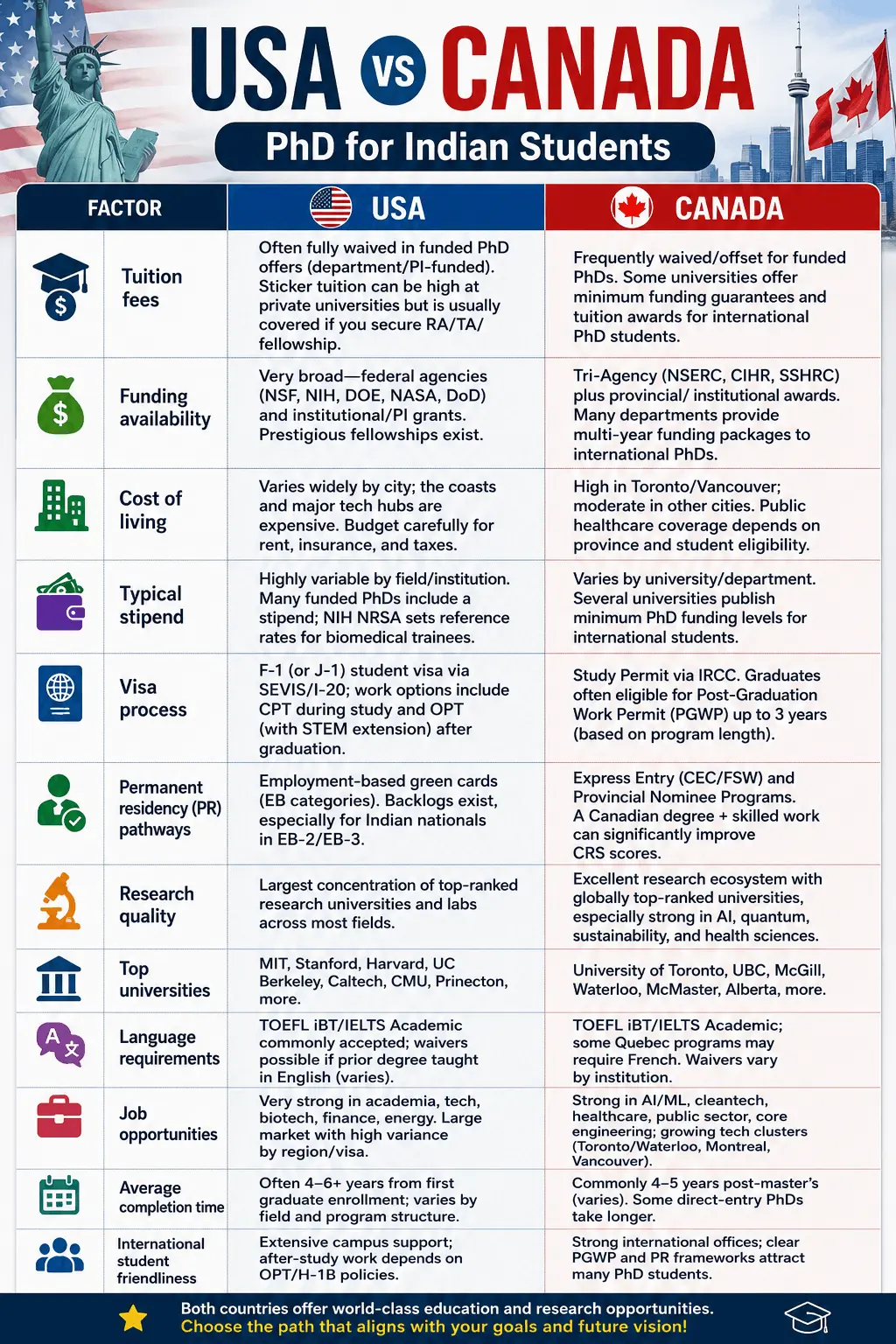
    FactorUSACanada
    Tuition feesOften fully waived in funded PhD offers (department/PI-funded). Sticker tuition can be high at private universities but is usually covered if you secure RA/TA/fellowship.Frequently waived/offset for funded PhDs. Some universities offer minimum funding guarantees and tuition awards for international PhD students.
    Funding availabilityVery broad—federal agencies (NSF, NIH, DOE, NASA, DoD) and institutional/PI grants. Prestigious fellowships exist.Tri-Agency (NSERC, CIHR, SSHRC) plus provincial/ institutional awards. Many departments provide multi-year funding packages to international PhDs.
    Cost of livingVaries widely by city; the coasts and major tech hubs are expensive. Budget carefully for rent, insurance, and taxes.High in Toronto/Vancouver; moderate in other cities. Public healthcare coverage depends on province and student eligibility.
    Typical stipendHighly variable by field/institution. Many funded PhDs include a stipend; NIH NRSA sets reference rates for biomedical trainees.Varies by university/department. Several universities publish minimum PhD funding levels for international students.
    Visa processF‑1 (or J‑1) student visa via SEVIS/I‑20; work options include CPT during study and OPT (with STEM extension) after graduation.Study Permit via IRCC. Graduates often eligible for Post‑Graduation Work Permit (PGWP) up to 3 years (based on program length).
    Permanent residency (PR) pathwaysEmployment-based green cards (EB categories). Backlogs exist, especially for Indian nationals in EB‑2/EB‑3.Express Entry (CEC/FSW) and Provincial Nominee Programs. A Canadian degree + skilled work can significantly improve CRS scores.
    Research qualityLargest concentration of top-ranked research universities and labs across most fields.Excellent research ecosystem with globally top-ranked universities, especially strong in AI, quantum, sustainability, and health sciences.
    Top universitiesMIT, Stanford, Harvard, UC Berkeley, Caltech, CMU, Princeton, more.University of Toronto, UBC, McGill, Waterloo, McMaster, Alberta, more.
    Language requirementsTOEFL iBT/IELTS Academic commonly accepted; waivers possible if prior degree taught in English (varies).TOEFL iBT/IELTS Academic; some Quebec programs may require French. Waivers vary by institution.
    Job opportunitiesVery strong in academia, tech, biotech, finance, energy. Large market with high variance by region/visa.Strong in AI/ML, cleantech, healthcare, public sector, core engineering; growing tech clusters (Toronto/Waterloo, Montreal, Vancouver).
    Average completion timeOften 4–6+ years from first graduate enrollment; varies by field and program structure.Commonly 4–5 years post‑master’s (varies). Some direct‑entry PhDs take longer.
    International student friendlinessExtensive campus support; after-study work depends on OPT/H‑1B policies.Strong international offices; clear PGWP and PR frameworks attract many PhD students.

    Funding opportunities

    Compare: In both countries, the most decisive factor is whether you receive a fully funded offer (tuition + a living stipend via RA/TA/fellowship). Funded offers are common in lab-based STEM fields and many social sciences, but funding levels and guarantees vary by department.

    USA advantages:

    • Large, diversified funding ecosystem: federal agencies such as the National Science Foundation (NSF), National Institutes of Health (NIH), U.S. Department of Energy (DOE), NASA, and Department of Defense fund many labs and students. See NSF, NIH, DOE Office of Science, and NASA.
    • Flagship fellowships: The NSF Graduate Research Fellowship Program (GRFP) provides a competitive multi-year stipend and cost-of-education allowance for eligible fields; see NSF GRFP for current details. NIH NRSA sets official reference stipend levels for trainees in biomedical fields; see NIH NRSA.
    • Many departments cover tuition and health insurance in funded offers.

    USA disadvantages:

    • Funding is competitive and can depend on PI grants, department budgets, and field. Some humanities and professional doctorates may have more limited support.
    • Stipend adequacy varies with city costs; high-cost metros may require careful budgeting.

    Canada advantages:

    • Tri-Agency ecosystem: NSERC (natural sciences/engineering), CIHR (health), SSHRC (social sciences/humanities) support students and research groups; see NSERC, CIHR, SSHRC.
    • Many universities provide multi‑year funding packages. For example, the University of British Columbia states a minimum guaranteed PhD funding level for eligible students; see UBC’s policy at UBC Minimum Funding Policy.
    • Some institutions reduce international PhD tuition to domestic rates via awards (varies by program/university). At the University of Toronto, see the International Doctoral Student Award (IDSA) for details.

    Canada disadvantages:

    • Tri‑Agency awards are competitive; amounts and coverage can vary by province and program.
    • Funding in some humanities and smaller departments may be tighter; confirm with your supervisor/graduate office.

    Which is better? If your priority is maximum breadth of lab funding and federal fellowship options, the USA generally offers more opportunities across fields. If your goal is a predictable multi-year package and clearer post-graduation work/PR steps, Canada’s model can be advantageous. In both cases, the only comparison that truly matters is the written funding guarantee in your offer letter.

    Tuition and fees

    USA: Many funded PhD offers include full tuition waivers. However, “sticker” tuition at private universities can exceed tens of thousands of USD per year if you are unfunded—so do not assume a waiver unless explicitly stated. Always review department funding pages and your offer letter for tuition coverage, fee waivers, and health insurance details.

    Canada: International PhD tuition is typically lower than the US sticker price, and many departments waive or offset tuition for funded international PhDs. Some universities offer institution-wide supports (e.g., UBC’s minimum funding and tuition awards; U of T’s IDSA to reduce tuition to domestic levels for eligible students). Exact policies vary by faculty and year—verify with the graduate program.

    Tip: Compare “net cost” not “sticker price.” Net cost = tuition/fees you actually pay out-of-pocket after your offer’s waivers + your expected stipend + local living costs + taxes/insurance.

    Cost of living

    USA: Living costs vary sharply by location. San Francisco Bay Area, New York, Boston, Seattle, and Los Angeles are among the most expensive. Midwestern and some Southern cities are more affordable. Major expenses include rent, transportation, food, healthcare/insurance, and local/state taxes.

    Canada: Vancouver and Toronto are high-cost. Montreal, Edmonton, Calgary, Ottawa, Waterloo, and many other cities can be more moderate. You’ll need to account for rent, transit, food, and health coverage (provincial plans sometimes cover international students; when not, universities provide health insurance options).

    Use official university budgeting tools for realistic estimates:

    • UBC living cost guidance: UBC Living Costs
    • University of Toronto graduate cost information: U of T Graduate Finances
    • Check your target US program’s graduate financial aid or cost-of-attendance page for location-specific guidance.

    Monthly stipend and budgeting

    USA: Many funded PhDs provide a monthly or 9/12‑month stipend via RA/TA or fellowships. Amounts differ by field, department, and location. As a federal reference point in biomedicine, NIH NRSA publishes annual predoctoral stipend levels for trainees and fellows (NIH NRSA). Highly competitive fellowships (e.g., NSF GRFP) set independent stipend amounts for fellows. Your actual stipend will depend on your program and funding source.

    Canada: Stipends/funding packages are program-specific. Several universities post minimum PhD funding levels to ensure affordability. For example, UBC outlines a minimum annual funding commitment for eligible PhD students (UBC Minimum Funding). Always confirm components: RA/TA, scholarships, tuition awards, and duration (e.g., first four years).

    Budgeting tips:

    • Ask for the “12-month equivalent” of any 9‑month stipend and whether summer support is guaranteed.
    • Clarify health insurance costs, student fees, and taxes (state/provincial and federal).
    • Model rent scenarios with roommates vs studio apartments near campus or along transit lines.

    Visa, work during study, and post-study immigration

    USA (F‑1/J‑1):

    • Student visa pathway and compliance details: Study in the States (DHS).
    • During the PhD: On‑campus work allowed within limits; Curricular Practical Training (CPT) may be available if integral to the curriculum (consult your DSO).
    • After graduation: Optional Practical Training (OPT) allows up to 12 months of work; STEM graduates may qualify for a 24‑month extension (total up to 36 months). See USCIS: Students and Employment.
    • Longer-term: H‑1B specialty occupation visa requires employer sponsorship and is subject to an annual cap/lottery for most employers (USCIS H‑1B). Permanent residency via employment-based categories (e.g., EB‑2 NIW, EB‑1A/B) depends on qualifications and demand; Indian nationals often face backlogs in EB‑2/EB‑3—check the monthly Visa Bulletin (U.S. Visa Bulletin).

    Canada (Study Permit/PGWP/PR):

    • Study Permit information: IRCC: Study in Canada.
    • Work during study: Rules vary; typically, graduate students may work on campus and, under certain conditions, off campus (see IRCC for up‑to‑date limits).
    • After graduation: Post‑Graduation Work Permit (PGWP) for up to 3 years depending on program length; see IRCC: Work after graduation.
    • Permanent residency: Express Entry (Canadian Experience Class, Federal Skilled Worker) and Provincial Nominee Programs. A Canadian credential plus skilled work can significantly improve your Comprehensive Ranking System (CRS) score (IRCC: Express Entry).

    Which is better? For long-term immigration predictability after a PhD, Canada often offers clearer PR pathways for international graduates. For sheer scale of postdoc/industry roles, the USA is unrivaled—but your work authorization after OPT depends on employer sponsorship and policy landscapes. Always check the latest official guidance.

    Research quality and ecosystem

    USA: The USA has the largest concentration of top-ranked research universities and national labs across disciplines. Global ranking tables (e.g., QS, Times Higher Education, ARWU) consistently feature numerous US institutions at the top; see QS Rankings and THE Rankings. Federal agencies (NSF/NIH/DOE/NASA/DoD) fund expansive research programs, which can translate to more lab openings and cutting-edge equipment in many fields.

    Canada: Canada hosts world-leading universities with strong clusters in AI/ML (Toronto, Montreal, Edmonton), quantum (Waterloo, UBC), life sciences (Toronto, McGill), and sustainability/clean energy (UBC, Calgary). The Tri‑Agency framework and national strategies support high-impact research; key universities rank among the global top 50–100 in several subjects (check QS/THE/ARWU subject rankings).

    Major funding agencies at a glance:

    Which is better? If your subfield depends on large-scale facilities, very large lab groups, or deep federal funding (e.g., certain areas of physics, CS, biomedicine, aerospace), the USA often offers more options. For AI/ML, quantum, sustainability, and health, Canada’s strengths are globally competitive and can provide excellent supervisor fit plus strong industry collaborations.

    Best universities

    USA highlights: Massachusetts Institute of Technology (MIT Graduate Admissions), Stanford University (Stanford Graduate Admissions), Harvard University (Harvard GSAS), University of California, Berkeley (UC Berkeley Graduate Division), California Institute of Technology (Caltech Graduate Admissions), Carnegie Mellon University (CMU Graduate Studies), Princeton University (Princeton Graduate School), University of Illinois Urbana-Champaign (UIUC Graduate College), University of Michigan (Rackham Graduate School), Georgia Tech (Georgia Tech Graduate Education).

    Canada highlights: University of Toronto (U of T SGS), University of British Columbia (UBC Graduate Studies), McGill University (McGill Graduate Admissions), University of Waterloo (Waterloo Graduate Studies), McMaster University (McMaster Graduate Studies), University of Alberta (UAlberta FGSR), University of Montreal (UdeM Doctoral Admissions).

    Always shortlist by supervisor fit, recent publications, lab culture, and funding—not just brand-name rank. A strong mentor and a funded project aligned to your interests usually matter more than the overall university rank.

    Language and testing requirements

    USA: Most universities accept TOEFL iBT or IELTS Academic. Minimum scores vary by department. Some programs waive English tests if you completed a previous degree taught in English (policy varies). GRE requirements have become increasingly optional in many US programs—confirm on your program’s admissions page. See official test sites: TOEFL, IELTS, GRE.

    Canada: TOEFL iBT/IELTS Academic are widely accepted; minimums vary by university and faculty. Some Quebec programs may require or favor French proficiency. Waivers may be possible if your prior degree instruction was in English. Verify requirements on your program’s admission page.

    Application process and timelines

    USA:

    • Common to apply directly after a bachelor’s (BS/BE) into a PhD, especially in STEM; many programs include rotations and coursework before full-time dissertation research.
    • Typical application timeline: deadlines from November to January for fall intake; decisions from February to April; funding usually included in the offer.
    • Materials: statement of purpose, CV, transcripts, English test scores, letters of recommendation, writing sample (for some fields), GRE (if required), and evidence of research potential (papers, projects).

    Canada:

    • Many programs prefer or require a master’s before PhD; direct-entry PhDs exist but may take longer overall. Supervisor pre‑alignment is often crucial—contact potential supervisors early.
    • Deadlines vary by department; fall intake is common. Some programs review applications on a rolling basis subject to funding availability.
    • Materials: similar to the USA, but supervisor endorsement or a confirmed funding arrangement can be especially important.

    Actionable steps: Email prospective supervisors with a concise research pitch and CV, ask about funded openings and fit, and request a brief call. Send tailored emails (avoid generic templates) and reference their recent papers to demonstrate alignment.

    Average time to completion and program structure

    USA: Many US PhDs include substantial coursework and qualifying exams before advancing to candidacy. The National Science Foundation’s data show that median time-to-doctorate from first graduate enrollment is often around the 5–6 year mark across fields (varies); see NSF: Survey of Earned Doctorates. Direct‑from‑bachelor’s entrants may take longer than those entering with a master’s.

    Canada: Program length varies. Many Canadian PhDs after a research master’s target 4–5 years, with earlier transition to full-time research. Some universities state nominal durations (e.g., 4–6 years) on program pages; check your target department for expected timelines, candidacy exams, publication expectations, and residency rules.

    Career opportunities after graduation

    Academic jobs: Both countries have competitive tenure‑track markets. Publishing strong first‑author papers, securing teaching experience, and winning competitive fellowships improve prospects. Postdoctoral training is common in STEM and some social sciences/humanities.

    Industry jobs:

    • USA: Very strong opportunities across tech (AI/ML, data science, systems), biotech/pharma, finance/quant, energy, advanced manufacturing, and national labs. Visa pathways (OPT → H‑1B/O‑1/EB) can affect employer decisions.
    • Canada: Growing tech ecosystems in Toronto/Waterloo, Montreal, and Vancouver (AI/ML, fintech, gaming), plus robust public-sector, health, and resource/cleantech industries. PGWP and PR routes can ease hiring for employers.

    Salary expectations: Salaries vary by field, region, and role. Official references for the USA include the Bureau of Labor Statistics (BLS). For example, 2023 median pay for Computer and Information Research Scientists and Physicists is among the highest STEM medians; see BLS Occupational Outlook Handbook. For Canada, consult Government of Canada’s Job Bank wage data by occupation and province: Job Bank Wages. Use these official sources to benchmark by occupation and location; PhD holders may earn above occupational medians in specialized roles.

    Visa pathways and hiring: In the USA, the H‑1B cap/lottery introduces uncertainty unless the employer is cap‑exempt (e.g., universities, some nonprofits). In Canada, PGWP and Express Entry often make hiring simpler for employers after your PhD, especially once you gain Canadian experience and PR.

    International student support and campus life

    USA: Large universities typically offer international student offices, teaching centers, counseling, graduate housing, and family support. Student groups for Indian communities are vibrant at many campuses. Explore your target program’s mentorship infrastructure and teaching development resources.

    Canada: Strong international student advising, co‑op/internship offices (where offered), and inclusive student associations. Health insurance and coverage vary by province—review whether you’re eligible for provincial plans and what the university plan covers (dental/vision/mental health).

    Pros and cons

    Pros of a USA PhD

    • Unmatched depth and breadth of top research universities, labs, and funding sources.
    • High-density tech/biotech ecosystems with strong industry collaboration.
    • Prestigious fellowships and extensive seminar/conference networks.

    Cons of a USA PhD

    • Work authorization after OPT depends on employer sponsorship and policy changes.
    • High living costs in many top research hubs; stipends may lag local rents.
    • Longer average time-to-degree in some fields/programs.

    Pros of a Canada PhD

    • Clearer post‑graduation work (PGWP) and PR pathways for many graduates.
    • Strong research in AI/ML, quantum, health, and sustainability; collaborative culture.
    • Many programs offer multi‑year funding packages and tuition awards to international PhDs.

    Cons of a Canada PhD

    • Fewer total universities and labs than the USA; choice may be narrower in niche fields.
    • High living costs in Toronto/Vancouver; funding can vary by department.
    • Some programs expect a master’s before PhD, adding time and cost if you don’t have one.

    Which option is best for you?

    • Students with a limited budget: Compare guaranteed funding in writing. Canada’s multi‑year packages and tuition awards can produce lower net costs, especially outside the highest-cost cities. In the USA, target departments with strong RA/TA support and consider lower‑cost regions.
    • Biomedical researchers: USA often offers larger lab ecosystems and NIH‑funded projects; Canada has excellent options (Toronto, McGill, UBC) with strong hospital/research institute ties. If long-term immigration stability matters, Canada’s PGWP→PR path is attractive.
    • Computer science/AI/ML: USA maximizes Big Tech proximity; Canada has top-tier AI hubs (Toronto/Vector, Montreal/Mila, Edmonton/Amii, Vancouver). If you want PR soon after graduating, Canada may offer a smoother path. If your aim is FAANG-scale roles, the USA offers volume but requires navigating OPT/H‑1B.
    • Core engineering/energy/quantum: USA provides many national labs and large consortia; Canada’s Waterloo/UBC/Alberta/McMaster ecosystems are notable. Choose based on supervisor fit, lab facilities, and partnerships.
    • Long-term immigration goals: Canada generally provides clearer PR options for graduates. The USA offers employment-based green cards but with potential backlogs for Indian nationals in EB‑2/EB‑3—monitor the Visa Bulletin.
    • Industry-focused careers: USA has the largest market depth; Canada provides strong opportunities in AI/ML, fintech, gaming, health, and public sector with employer-friendly PGWP/PR frameworks.
    • Academic careers: Both are competitive; choose the supervisor and lab that best position you for high‑impact publications, grants, and a strong network.

    Expert tips

    • Prioritize supervisor fit and guaranteed funding over brand rank. A supportive PI with active grants beats a famous name without funding.
    • Email potential supervisors early (Aug–Oct for the following fall), referencing 1–2 of their recent papers with your aligned research idea in 150–200 words.
    • Ask programs to detail the funding breakdown: stipend amount, months covered, summer support, tuition/fee waivers, health insurance, and duration.
    • Model taxes and healthcare. In the USA, compare student health plan coverage and out-of-pocket costs; in Canada, confirm provincial coverage eligibility and university plan details.
    • Use official immigration pages only. Visa/PR rules change—verify with USCIS/DHS or IRCC before final decisions.
    • Build employability during your PhD: internships, teaching certificates, method/tool depth (e.g., PyTorch, R, MATLAB, Stata), and cross-disciplinary collaborations.
    • Network strategically: conferences, workshops, and lab visits. Ask your PI for targeted introductions in academia and industry.

    External resources (official)

    Internal resources from IR Research Publication

    Explore more research and publication guidance on IR Research Publication:

    Frequently asked questions

    1) Is a USA or Canada PhD better for Indian students?

    Neither is universally “better.” The right choice depends on your supervisor fit, confirmed funding package, field strengths, living costs, and immigration plans. The USA offers unmatched scale; Canada offers clearer PGWP→PR pathways for many graduates.

    2) Which is cheaper for a PhD: USA or Canada?

    Both can be affordable if you secure a fully funded offer with tuition waiver and stipend. Canada often yields lower net costs outside Toronto/Vancouver and with tuition awards; in the USA, costs vary heavily by city—compare your written offers line by line.

    3) Do PhD students get paid?

    Yes, in funded programs. Stipends commonly come from RA/TA roles or fellowships. Amounts vary widely by field and location. Some agencies publish reference stipend levels (e.g., NIH NRSA for biomedical trainees in the USA).

    4) What English tests are accepted?

    TOEFL iBT and IELTS Academic are widely accepted in both countries. Minimum scores and waiver policies vary by university and department. Always check your program’s official admissions page.

    5) How long does a PhD take in the USA vs Canada?

    USA programs often run 4–6+ years from first graduate enrollment (varies by field). In Canada, many PhDs after a research master’s target 4–5 years. Direct-entry PhDs can take longer in both countries.

    6) Is GRE required?

    Many US programs have moved to GRE-optional or GRE-not-required policies, but some still ask for it. In Canada, GRE is less commonly required outside specific departments. Confirm on the program’s website.

    7) What are the post-study work options?

    USA: OPT (and STEM OPT extension) after F‑1 studies; longer-term H‑1B/O‑1/EB pathways. Canada: PGWP up to 3 years (depending on program length) and PR via Express Entry/PNP. Always verify current rules on official sites.

    8) Can my spouse work during my PhD?

    Rules differ. In the USA, F‑2 spouses generally cannot work; J‑2 may be eligible with authorization. In Canada, spouses/partners may be eligible for an open work permit under certain conditions. Check DHS/USCIS and IRCC pages for the latest policies.

    9) Are there fully funded PhD scholarships for Indian students?

    Yes. Many departments offer funded positions. Competitive fellowships (NSF GRFP, agency fellowships in the USA; Tri-Agency and provincial/institutional awards in Canada) can boost funding. Search program and agency sites early.

    10) How do I pick a supervisor?

    Read 3–5 of their recent papers, verify active grants and lab size, speak with current students, and confirm funding security and mentoring style. Consider co‑supervision if your work is interdisciplinary.

    Conclusion: USA vs Canada PhD for Indian students—what should you choose?

    Both the USA and Canada offer outstanding PhD training for Indian students. The best choice aligns with your funding security, supervisor fit, research environment, life costs, and immigration priorities.

    • Choose the USA if you want the largest choice of labs and funding sources, proximity to top-tier industry hubs, and a program structure that supports broad coursework and rotations. Ensure you’re comfortable navigating OPT→H‑1B or alternative visa strategies and budgeting for potentially high-cost cities.
    • Choose Canada if you value a clear PGWP→PR pathway, strong AI/quantum/health/sustainability ecosystems, and multi‑year funding packages with predictable net costs. This is especially attractive if you already hold a research master’s and want a 4–5 year PhD trajectory.

    In all cases, compare written offers, talk to potential supervisors and current students, and verify immigration details on official sites before you decide.

    About IR Research Publication

    IR Research Publication is a platform dedicated to advancing scholarly communication and empowering researchers worldwide. We publish high-quality, peer-reviewed work and share practical guidance on research design, academic writing, and career development. Our mission is to help scholars—from early-stage graduate students to senior academics—disseminate impactful research and navigate academia with confidence.