Tag: Fully funded postdoctoral fellowships

  • Fully Funded Postdoctoral Fellowships in Finland 2027: Funding, Salaries, Eligibility & Deadlines

    Fully Funded Postdoctoral Fellowships in Finland 2027: Funding, Salaries, Eligibility & Deadlines


    Introduction

    Are you searching for fully funded postdoctoral fellowships in Finland for 2027? Finland offers competitive opportunities for international researchers across life sciences, medicine, artificial intelligence, engineering, environmental sciences, humanities, and social sciences.

    From independent research grants worth up to โ‚ฌ700,000 to salaried university fellowships and internationally funded research positions, Finland provides multiple pathways for postdoctoral career development.

    However, there is one important distinction applicants should understand:

    Not every postdoctoral funding opportunity in Finland is a traditional fellowship.

    Some schemes provide independent research grants administered by a Finnish research organization. Others offer fixed-term employment contracts with monthly salaries and employee benefits. International programs may provide stipends, salary contributions, relocation support, and additional allowances.

    Understanding these differences is essential when comparing funding and preparing applications.

    This guide covers major opportunities, including:

    • Research Council of Finland โ€“ 2027 Academy Research Fellowships
    • Turku Institute for Advanced Studies (TIAS)
    • TIES2 Marie Skล‚odowska-Curie COFUND Fellowships
    • Helsinki Collegium for Advanced Studies (HCAS)
    • Tampere Institute for Advanced Study
    • Helsinki Institute for Information Technology (HIIT)
    • Marie Skล‚odowska-Curie Postdoctoral Fellowships
    • EMBO Postdoctoral Fellowships
    • Human Frontier Science Program (HFSP)
    • Fulbright U.S. Scholar Awards to Finland
    • Finnish Center for Artificial Intelligence (FCAI)
    • Other university-based postdoctoral research positions

    We also explain salaries, eligibility, immigration considerations, application strategies, and verified deadlines.

    Last verified: October 10, 2026. Deadlines and grant conditions may change, so always consult the official funding announcement before applying.

    For researchers comparing Nordic and European destinations, see our guides to fully funded postdoctoral fellowships in Sweden for 2027 and postdoctoral fellowships in the Netherlands for 2027.


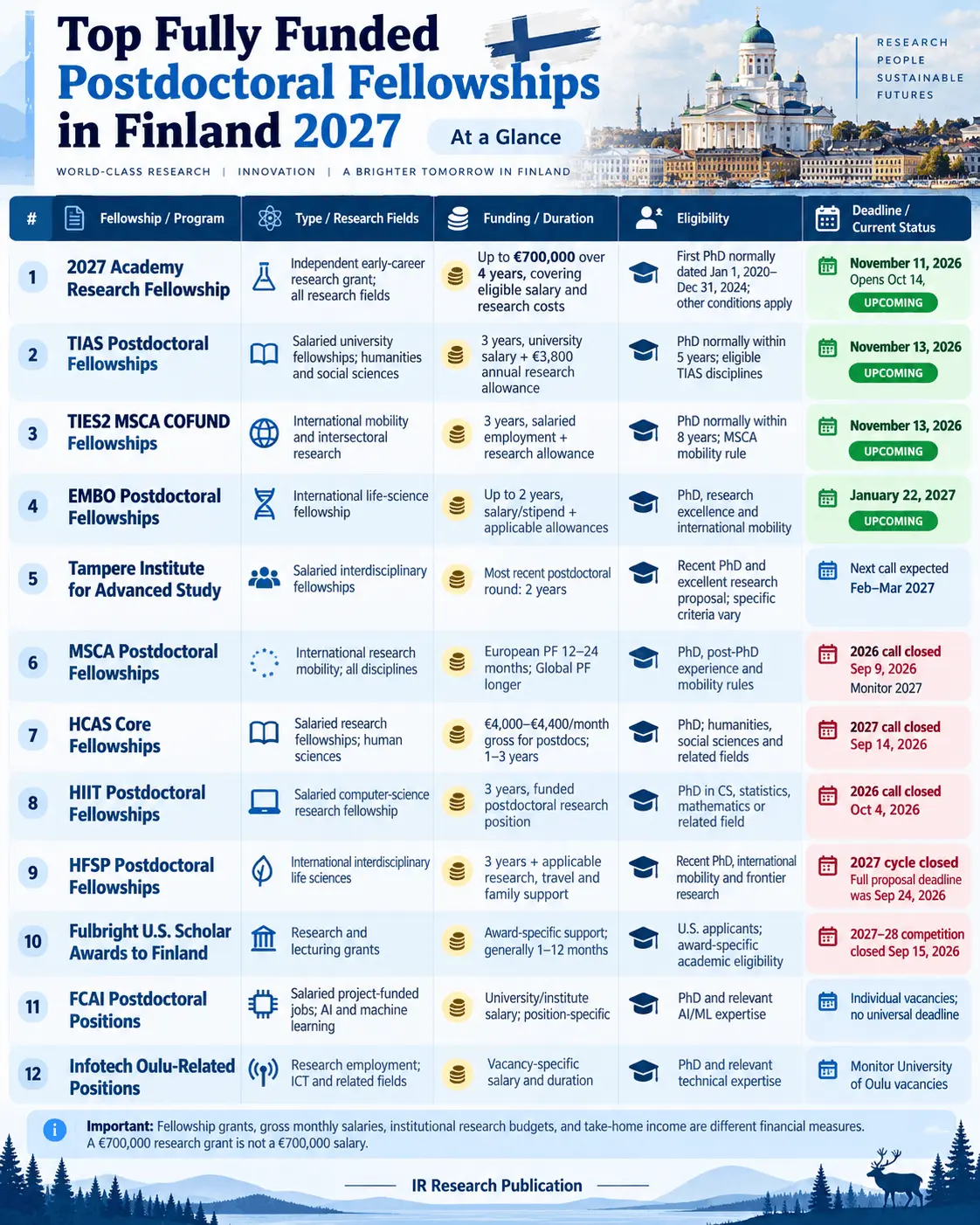
    Top Fully Funded Postdoctoral Fellowships in Finland 2027: At a Glance

    The following comparison table summarizes the major research fellowships, funding mechanisms, and salaried positions relevant to researchers planning a 2027 start.

    Fellowship / ProgramType / Research FieldsFunding / DurationEligibilityDeadline / Current StatusOfficial Link
    2027 Academy Research FellowshipIndependent early-career research grant; all research fieldsUp to โ‚ฌ700,000 over 4 years, covering eligible salary and research costsFirst PhD normally dated Jan 1, 2020โ€“Dec 31, 2024; other conditions applyNovember 11, 2026; opens Oct 14Research Council of Finland
    TIAS Postdoctoral FellowshipsSalaried university fellowships; humanities and social sciences3 years, university salary + โ‚ฌ3,800 annual research allowancePhD normally within 5 years; eligible TIAS disciplinesNovember 13, 2026TIAS Vacancies
    TIES2 MSCA COFUND FellowshipsInternational mobility and intersectoral research3 years, salaried employment + research allowancePhD normally within 8 years; MSCA mobility ruleNovember 13, 2026TIES2 Fellowships
    EMBO Postdoctoral FellowshipsInternational life-science fellowshipUp to 2 years, salary/stipend + applicable allowancesPhD, research excellence and international mobilityNext cutoff: January 22, 2027EMBO
    Tampere Institute for Advanced StudySalaried interdisciplinary fellowshipsMost recent postdoctoral round: 2 yearsRecent PhD and excellent research proposal; specific criteria varyNext call expected Febโ€“Mar 2027Tampere IAS
    MSCA Postdoctoral FellowshipsInternational research mobility; all disciplinesEuropean PF 12โ€“24 months; Global PF longerPhD, post-PhD experience and mobility rules2026 call closed Sep 9; monitor 2027MSCA
    HCAS Core FellowshipsSalaried research fellowships; human sciencesโ‚ฌ4,000โ€“โ‚ฌ4,400/month gross for postdocs; 1โ€“3 yearsPhD; humanities, social sciences and related fields2027 call closed Sep 14, 2026HCAS
    HIIT Postdoctoral FellowshipsSalaried computer-science research fellowship3 years, funded postdoctoral research positionPhD in CS, statistics, mathematics or related field2026 call closed Oct 4, 2026HIIT
    HFSP Postdoctoral FellowshipsInternational interdisciplinary life sciences3 years + applicable research, travel and family supportRecent PhD, international mobility and frontier research2027 cycle closed; full proposal deadline was Sep 24, 2026HFSP
    Fulbright U.S. Scholar Awards to FinlandResearch and lecturing grantsAward-specific support; generally 1โ€“12 monthsU.S. applicants; award-specific academic eligibility2027โ€“28 competition closed Sep 15, 2026Fulbright Finland
    FCAI Postdoctoral PositionsSalaried project-funded jobs; AI and machine learningUniversity/institute salary; position-specificPhD and relevant AI/ML expertiseIndividual vacancies; no universal deadlineFCAI
    Infotech Oulu-Related PositionsResearch employment; ICT and related fieldsVacancy-specific salary and durationPhD and relevant technical expertiseMonitor University of Oulu vacanciesUniversity of Oulu

    Important: Fellowship grants, gross monthly salaries, institutional research budgets, and take-home income are different financial measures. A โ‚ฌ700,000 research grant is not a โ‚ฌ700,000 salary.


    Fellowships with Confirmed 2027 Application Deadlines

    1. Research Council of Finland โ€“ 2027 Academy Research Fellowships

    Application deadline: November 11, 2026

    The Academy Research Fellowship is one of Finland’s leading funding instruments for promising early-career researchers working toward scientific independence.

    The program is administered by the Research Council of Finland, formerly the Academy of Finland.

    Older funding guides may refer to the former Postdoctoral Researcher Funding scheme. That scheme has been discontinued and should not be presented as an active annual fellowship.

    The Academy Research Fellowship is the relevant current early-career funding opportunity.

    Funding and Duration

    The 2027 call offers:

    • Maximum grant of โ‚ฌ700,000
    • Four-year funding period
    • Start date: September 1, 2027
    • End date: August 31, 2031

    The research grant can cover eligible costs including the applicant’s salary, possible research-team salary expenses, and other research costs.

    It is intended to support the researcher’s progression toward an established and independent scientific career.

    The maximum amount is a total research grant, not a personal annual salary or stipend.

    Eligibility

    For the 2027 call, applicants must normally have received their first doctoral degree between:

    January 1, 2020 and December 31, 2024.

    The program targets researchers who have not yet attained a permanent senior research position.

    Other requirements concerning employment status, research organization commitment, career interruptions, application limits, and funding conditions are specified in the official call.

    Application Timeline

    • Call opens: October 14, 2026
    • Deadline: November 11, 2026, at 23:59 Finnish time
    • Funding starts: September 1, 2027

    Applicants submit through the Research Council’s electronic funding system.

    The application typically involves a research plan, budget, CV, publication information, institutional commitment and other materials required by the call.

    Official application page: 2027 Academy Research Fellowships

    Best suited for: Early-career researchers who have established a promising research record and want to develop an independent project at a Finnish research organization.


    2. Turku Institute for Advanced Studies (TIAS) Postdoctoral Fellowships

    Application deadline: November 13, 2026

    The Turku Institute for Advanced Studies (TIAS) at the University of Turku supports innovative and interdisciplinary research.

    For the 2027 recruitment round, TIAS is offering:

    • 4 Postdoctoral Fellow positions
    • 4 Collegium Fellow positions
    • 7 TIES2 MSCA COFUND Fellow positions

    All advertised appointments are scheduled to begin in September 2027.

    The standard TIAS Postdoctoral Fellowship is especially attractive to researchers in the humanities and social sciences who want dedicated time to undertake independent research.

    Research Fields

    Eligible disciplines fall within the institute’s constituent faculties:

    • Economics
    • Education
    • Humanities
    • Law
    • Social Sciences

    Applicants from unrelated fields should not assume eligibility merely because TIAS welcomes interdisciplinary research.

    Funding and Duration

    TIAS Postdoctoral Fellows receive:

    • A three-year salaried appointment
    • University employment benefits
    • An additional โ‚ฌ3,800 annual research allowance
    • Opportunities for interdisciplinary collaboration and academic networking

    The salary is determined through the relevant university employment framework rather than one universal international fellowship stipend.

    Eligibility

    For the regular TIAS Postdoctoral Fellow category, applicants should normally be within five years of completing their PhD, subject to the current call’s detailed provisions.

    Selection emphasizes research excellence and the quality of the proposed project.

    Application Dates

    • Applications opened: September 18, 2026
    • Deadline: November 13, 2026
    • Fellowships begin: September 2027

    TIAS reports that its previous fellowship competitions have typically been extremely competitive, with success rates around 2%.

    Official application page: TIAS Open Vacancies


    3. TIES2 Marie Skล‚odowska-Curie COFUND Fellowships

    Application deadline: November 13, 2026

    The Turku Intersectoral Excellence Scheme 2 (TIES2) is a separate fellowship opportunity operated by the University of Turku and co-funded through the European Union’s MSCA COFUND program.

    For the 2027 recruitment round, seven TIES2 fellowships are available.

    Funding and Duration

    • Three-year salaried fellowship
    • Start date: September 1, 2027
    • Annual research allowance
    • Structured interdisciplinary and intersectoral career development
    • Required secondment of 3โ€“12 months in an organization outside the higher education sector

    The intersectoral secondment is a distinguishing feature of this program.

    Eligibility

    Applicants normally must be within eight years of completing their PhD, subject to the detailed call rules.

    The MSCA mobility rule also applies:

    Applicants must not have resided or carried out their main activity in Finland for more than 12 months during the 36 months immediately before the application deadline.

    Other detailed eligibility and application requirements are provided in the TIES2 call instructions.

    Application Timeline

    • Call opened: September 18, 2026
    • Deadline: November 13, 2026
    • Fellowships begin: September 1, 2027

    Official application page: TIES2 MSCA COFUND Fellowships

    Best suited for: Internationally mobile postdoctoral researchers interested in combining academic research with experience in the non-academic sector.


    4. EMBO Postdoctoral Fellowships โ€“ Finland as a Host Destination

    Next application cutoff: January 22, 2027

    The European Molecular Biology Organization (EMBO) supports internationally mobile postdoctoral researchers in the life sciences.

    Finnish universities and research institutes can serve as eligible host environments when the proposed fellowship satisfies EMBO’s geographic and mobility requirements.

    Research Fields

    Projects can involve areas such as:

    • Molecular biology
    • Cell biology
    • Genetics
    • Biochemistry
    • Neuroscience
    • Developmental biology
    • Molecular microbiology
    • Computational and interdisciplinary life sciences

    Funding and Duration

    EMBO Postdoctoral Fellowships support research for up to two years.

    Benefits include:

    • Salary or stipend depending on host-country arrangements
    • Relocation allowance
    • Applicable support for fellows with children
    • Access to training and networking opportunities

    Eligibility

    Applicants must satisfy the current PhD timing and international mobility requirements.

    The fellowship is designed for researchers moving into a new research environment rather than simply continuing their previous work.

    EMBO also limits host laboratories to supporting one candidate per selection round under its current rules.

    Application Deadline

    Applications are accepted throughout the year, with evaluation rounds.

    The next hard cutoff is:

    January 22, 2027, at 14:00 CET.

    Applicants should also review EMBO’s revised reapplication policy, which applies to later selection rounds.

    Official application page: EMBO Postdoctoral Fellowships

    Best suited for: Recent life-science PhD graduates seeking international mobility and advanced research training.


    Additional Postdoctoral Fellowships to Monitor for 2027

    5. Tampere Institute for Advanced Study Postdoctoral Fellowships

    Next call expected: Februaryโ€“March 2027

    The Tampere Institute for Advanced Study (Tampere IAS) supports outstanding researchers across disciplines represented at Tampere University.

    Its research environment brings together expertise in technology, health and society.

    Funding and Duration

    The most recent 2026 competition offered:

    • 9 Postdoctoral Research Fellowships
    • 2-year appointments for postdoctoral researchers
    • 6 Senior Research Fellowships of 3 years

    Successful postdoctoral applicants receive salaried appointments under university employment conditions.

    Eligibility

    Applicants need a doctoral degree and a research proposal demonstrating originality, scientific quality and feasibility.

    In the 2026 round, postdoctoral eligibility required a doctorate dated between March 2, 2021 and March 2, 2026.

    The 2027 eligibility window must be confirmed from the new announcement.

    Current Status

    Tampere University expects the next call to take place in Februaryโ€“March 2027.

    The exact 2027 deadline, position count and funding terms have not yet been confirmed.

    Official information: Tampere Institute for Advanced Study


    6. Marie Skล‚odowska-Curie Postdoctoral Fellowships (MSCA PF)

    2027 call: Monitor the official EU funding announcement

    The Marie Skล‚odowska-Curie Actions Postdoctoral Fellowships are among Europe’s most competitive international research fellowships.

    Applicants can pursue research at eligible Finnish universities, institutes or other organizations.

    MSCA Postdoctoral Fellowships support researcher mobility, advanced training and career development across disciplines.

    Fellowship Types

    European Postdoctoral Fellowships

    • Typically 12โ€“24 months
    • Hosted in an eligible EU Member State or Horizon Europe Associated Country
    • Finland is an eligible host destination

    Global Postdoctoral Fellowships

    • Include an outgoing research phase in a non-associated third country
    • Include a mandatory return phase to an eligible European host
    • Finland may serve as the European host under applicable conditions

    A Global Fellowship does not necessarily mean conducting the entire fellowship in Finland.

    Funding

    The funding model supports:

    • Living allowance
    • Mobility allowance
    • Family allowance where applicable
    • Research, training and networking costs
    • Management and indirect costs for the host

    The EU’s institutional funding contributions should not be confused with the fellow’s net salary.

    Eligibility

    Applicants normally must:

    • Hold a doctoral degree by the application deadline
    • Have no more than eight years of qualifying postdoctoral research experience, subject to permitted exclusions
    • Satisfy the applicable mobility rule

    For a European Postdoctoral Fellowship hosted in Finland, the applicant generally must not have lived or carried out their main activity in Finland for more than 12 months during the 36 months before the call deadline.

    Application Status

    The 2026 call closed on September 9, 2026.

    Researchers targeting the next competition should monitor the official 2027 call and begin identifying Finnish supervisors and host laboratories early.

    Official application page: MSCA Postdoctoral Fellowships


    7. Helsinki Collegium for Advanced Studies (HCAS) Core Fellowships

    2027 application cycle closed: September 14, 2026

    The Helsinki Collegium for Advanced Studies (HCAS) is an independent institute at the University of Helsinki.

    It provides opportunities for researchers to pursue high-quality independent scholarship in humanities, social sciences and related fields.

    Eligible Research Fields

    The institute welcomes research in:

    • Humanities
    • Social sciences
    • Educational sciences
    • Theology
    • Law
    • Related human-science disciplines

    Researchers in other fields may be eligible where their project substantially engages with human-science questions.

    Funding and Duration

    For the 2027 Core Fellowship competition, the university advertised:

    • โ‚ฌ4,000โ€“โ‚ฌ4,400 per month gross for postdoctoral fellows
    • โ‚ฌ4,000 annual personal research allowance
    • 1โ€“3-year appointments for postdoctoral researchers
    • Access to HCAS research infrastructure and interdisciplinary activities

    These are salaried positions rather than personal tax-free scholarships.

    Application Status

    The 2027 application window ran from August 17 to September 14, 2026.

    Appointments are expected to begin in Augustโ€“September 2027.

    The application window is now closed.

    Applicants interested in later recruitment should monitor future calls.

    Official application page: HCAS Core Fellowship


    8. Helsinki Institute for Information Technology (HIIT) Postdoctoral Fellowships

    Most recent deadline: October 4, 2026 โ€” Closed

    The Helsinki Institute for Information Technology (HIIT) is a joint research institute of Aalto University and the University of Helsinki.

    HIIT supports research in computer science and related fields, combining basic research with applications in society and industry.

    Research Areas

    Relevant areas include:

    • Artificial intelligence
    • Algorithms
    • Computer science
    • Data science
    • Computational methods
    • Statistics
    • Mathematics
    • Human-centered computing

    Funding and Duration

    HIIT’s recent postdoctoral fellowship recruitment offered three-year funded research positions.

    These are salaried employment opportunities with terms determined by the participating university and vacancy.

    Eligibility

    Applicants generally need a PhD, or to be close to completing one, in computer science, statistics, mathematics or a related field.

    Scientific publications, technical expertise, independent research ability and English proficiency are important selection criteria.

    Current Status

    The latest advertised application deadline was October 4, 2026.

    This round is closed. A new 2027 deadline has not been confirmed.

    Official information: HIIT Postdoctoral Fellow Positions


    9. Human Frontier Science Program (HFSP) Postdoctoral Fellowships

    2027 application cycle closed

    The Human Frontier Science Program (HFSP) funds ambitious, high-risk and interdisciplinary research addressing fundamental questions in the life sciences.

    Finnish research laboratories can serve as host institutions when all eligibility conditions are satisfied.

    Fellowship Categories

    HFSP offers two major fellowship routes:

    Long-Term Fellowships (LTF)

    For researchers with doctoral training in the life sciences who want to move into new scientific directions.

    Cross-Disciplinary Fellowships (CDF)

    For researchers trained in non-biological disciplines who want to move into fundamental life-science research.

    Funding

    Fellowships generally last three years, with support that may include:

    • Living allowance
    • Research and travel allowance
    • Relocation support
    • Child-related and family support under applicable rules

    Award amounts depend on the host country and fellowship conditions.

    Eligibility

    HFSP emphasizes:

    • International relocation
    • Research independence
    • Significant changes in research direction
    • Innovative and interdisciplinary scientific questions

    Applicants should carefully review restrictions involving nationality, previous research locations, doctoral institution and host-country residence.

    2027 Application Status

    The 2027 fellowship competition had the following deadlines:

    • Letter-of-intent initiation: May 5, 2026
    • Letter-of-intent submission: May 12, 2026
    • Invited full proposal: September 24, 2026

    All these deadlines have passed.

    Researchers who did not participate in the 2027 competition should monitor the next fellowship cycle.

    Official information: HFSP Postdoctoral Fellowships


    10. Fulbright U.S. Scholar Awards to Finland

    2027โ€“2028 competition closed: September 15, 2026

    The Fulbright Finland Foundation administers research and academic exchange opportunities between Finland and the United States.

    For U.S.-based applicants, Fulbright U.S. Scholar Awards can support temporary research and lecturing visits to Finnish institutions.

    These awards should not be confused with conventional multi-year Finnish university postdoctoral employment.

    Duration and Funding

    Research and lecturing grants generally support visits of 1โ€“12 months, depending on the specific award.

    Benefits may include:

    • Grant-based financial support
    • Travel-related benefits
    • Academic affiliation and networking
    • Orientation and advisory services
    • Additional award-specific benefits

    The exact funding package varies.

    Eligibility

    These awards generally target eligible U.S. scholars, including researchers at different career stages depending on the award.

    Applicants should check whether their selected award permits postdoctoral researchers and requires a host invitation.

    Current Status

    The 2027โ€“2028 U.S. Scholar competition closed on September 15, 2026.

    The earliest grant terms are expected to begin in August 2027.

    Official information: Fulbright Research and Lecturing Grants to Finland

    Important: Fulbright Finland also operates programs supporting researchers moving from Finland to the United States. Those outgoing awards are not equivalent to fellowships for international researchers seeking to relocate to Finland.


    Salaried Postdoctoral Research Positions in Finland

    In addition to competitive individual fellowships, Finland offers salaried postdoctoral jobs supported by institutional, national and international research grants.

    These are often among the most practical routes for researchers who do not meet restrictive fellowship mobility or PhD-age requirements.

    11. Finnish Center for Artificial Intelligence (FCAI)

    The Finnish Center for Artificial Intelligence (FCAI) is a research network involving Aalto University, the University of Helsinki and VTT Technical Research Centre of Finland.

    Researchers work on AI-related topics such as:

    • Machine learning
    • Probabilistic modeling
    • Human-centered artificial intelligence
    • Data-driven science
    • AI applications in healthcare and industry
    • Computational methods

    FCAI-associated research groups may recruit postdoctoral researchers through project-specific vacancies.

    Employment terms, salary, duration and eligibility depend on the actual hiring institution and project.

    FCAI should therefore be described as a source of research opportunities, not as a guaranteed annual individual postdoctoral fellowship.

    Official website: Finnish Center for Artificial Intelligence


    12. Infotech Oulu and University of Oulu Postdoctoral Opportunities

    The University of Oulu provides research opportunities in fields including:

    • Information and communication technology
    • Computer engineering
    • Wireless communications
    • Electronics
    • Biomedical engineering
    • Signal processing
    • Artificial intelligence
    • Multidisciplinary technology research

    Infotech Oulu is associated with the university’s technology-oriented research environment.

    Postdoctoral positions may be supported by individual research projects and institutional funding.

    However, applicants should not assume that an annual Infotech Oulu fellowship competition exists unless a current official call confirms it.

    Where to apply: University of Oulu Careers


    What About the Sigrid Jusรฉlius Foundation?

    The Sigrid Jusรฉlius Foundation supports medical research and researchers connected to the Finnish research system.

    However, its postdoctoral fellowship supporting research abroad should not be advertised as a standard incoming fellowship for international researchers seeking to relocate to Finland.

    That particular mechanism supports eligible researchers undertaking postdoctoral work outside Finland.

    Some research grants administered by the Foundation may indirectly support postdoctoral employment or research projects in Finland, but eligibility must be verified under each specific funding instrument.

    For that reason, it is not included in the main table of incoming Finland-based fellowships.


    How Much Do Postdoctoral Researchers Earn in Finland?

    Postdoctoral salaries in Finland are not determined by one fixed national fellowship amount.

    For salaried researchers, compensation depends on:

    • University or research institution
    • Job requirements
    • Research experience
    • Applicable salary system
    • Individual performance component
    • Contract and funding source
    • Additional responsibilities

    For example, the 2027 HCAS Core Fellowship advertises a postdoctoral gross salary of โ‚ฌ4,000โ€“โ‚ฌ4,400 per month, plus a separate annual research allowance of โ‚ฌ4,000.

    Other universities and projects may offer different salary levels.

    Salary vs. Research Grant vs. Stipend

    Funding TypeWhat It MeansExample
    Gross salaryEmployment income before tax and applicable contributionsHCAS: โ‚ฌ4,000โ€“โ‚ฌ4,400/month gross
    Research grantTotal funding allocated to an approved research projectAcademy Research Fellowship: up to โ‚ฌ700,000 over 4 years
    Research allowanceAdditional funding for approved research-related expensesTIAS: โ‚ฌ3,800/year
    Fellowship stipendPersonal financial support under a grant arrangementDepends on the applicable international or foundation scheme
    University project-funded positionSalary paid through an institution’s funded research projectFCAI or University of Oulu vacancies

    A research grant is not necessarily the fellow’s personal income.

    When comparing opportunities, review gross salary, estimated taxation, pension treatment, employment benefits, relocation costs and living expenses in the destination city.

    For broader comparisons, see Highest-Paying Postdoctoral Fellowships Worldwide.


    Can International Researchers Apply for Postdocs in Finland?

    Yes.

    Many Finnish universities and institutes recruit postdoctoral researchers from around the world.

    Eligibility depends on the program rather than nationality alone.

    Some opportunities welcome researchers of any nationality but impose mobility restrictions. Others prioritize applicants at defined stages of their postdoctoral careers.

    International applicants should pay particular attention to:

    1. PhD completion date: Some programs restrict eligibility to researchers who obtained their doctorate within a defined period.
    2. International mobility: MSCA and TIES2 impose specific residence and activity restrictions.
    3. Research field: TIAS focuses on humanities and social sciences, while EMBO and HFSP focus on life sciences.
    4. Host arrangements: Some funding schemes require a host institution’s formal commitment or joint proposal development.
    5. Employment status: A research fellowship, university job and grant-funded visit may have different legal and immigration implications.

    Researchers from India and other non-EU countries may be eligible for many of these opportunities, provided the relevant program conditions are met.


    Residence Permits, Employment and Taxes in Finland

    Residence Permits

    Non-EU/EEA researchers moving to Finland for extended research appointments generally need appropriate residence authorization.

    The correct permit depends on factors including whether the applicant has an employment contract, a hosting agreement or a grant-supported research arrangement.

    Applicants should consult the Finnish Immigration Service โ€“ Researcher Residence Permit guidance before finalizing relocation plans.

    Employment and Social Benefits

    Salaried university postdoctoral researchers typically receive benefits according to their employment contracts and applicable Finnish legislation.

    These may include:

    • Annual leave
    • Occupational healthcare
    • Pension contributions
    • Employee insurance arrangements
    • Other applicable statutory protections

    Grant-funded fellows may be subject to different rules, particularly regarding social security, taxation and insurance.

    Taxation

    University salaries are generally subject to Finnish income taxation.

    Research grants and scholarships may be treated differently depending on their source, amount and legal classification.

    Applicants should verify their individual situation through the Finnish Tax Administration and the host institution’s HR office.


    How to Find Postdoctoral Jobs at Finnish Universities

    Researchers should not limit themselves to fellowship competitions.

    Many postdoctoral opportunities are advertised as salaried employment positions linked to specific research projects.

    Useful official recruitment destinations include:

    Institution / PortalResearch OpportunitiesOfficial Website
    University of HelsinkiLife sciences, medicine, humanities, social sciences, AI and moreUniversity of Helsinki Jobs
    Aalto UniversityEngineering, AI, design, technology and interdisciplinary researchAalto University
    University of TurkuBiomedical sciences, humanities, social sciences and interdisciplinary researchUniversity of Turku
    Tampere UniversityTechnology, health, medicine and societyTampere University
    University of OuluICT, engineering, health, biosciences and sustainabilityUniversity of Oulu Careers
    University of JyvรคskylรคNatural sciences, psychology, education and interdisciplinary researchUniversity of Jyvรคskylรค
    EURAXESSEuropean research jobs and fellowship vacanciesEURAXESS Jobs

    Search tip: Use both โ€œpostdoctoral researcherโ€ and โ€œpostdoctoral fellowโ€ when searching Finnish university portals, because many fully funded opportunities appear as employment vacancies rather than under scholarship listings.

    You can also explore IR Research Publication’s Research Jobs page and our guide on how to find postdoctoral fellowships worldwide.


    How to Apply Successfully for Postdoctoral Fellowships in Finland

    A successful postdoctoral application requires more than a strong publication record.

    Different programs assess research independence, feasibility, international mobility, career development and the quality of the host environment.

    Step 1: Identify the Right Funding Mechanism

    First, determine whether the opportunity is:

    • An individual research grant
    • A salaried research fellowship
    • A university employment vacancy
    • A mobility fellowship
    • A short-term research exchange

    This affects eligibility, the application process and the required documents.

    Step 2: Find a Suitable Finnish Host

    For fellowships requiring institutional support, identify research groups aligned with your scientific interests.

    Review recent publications, funded projects, laboratory infrastructure and the principal investigator’s expertise.

    A strong application should explain why the Finnish host is essential to the proposed project.

    For independently advertised fellowships, follow the particular program’s host-affiliation rules rather than assuming advance supervisor sponsorship is mandatory.

    Step 3: Prepare a Competitive Research Proposal

    A convincing proposal should address:

    • Scientific background
    • Research gap
    • Central question or hypothesis
    • Specific objectives
    • Research methodology
    • Feasibility and preliminary evidence
    • Timeline and milestones
    • Research risks and alternative approaches
    • Expected scientific impact
    • Career development and training
    • Open science, ethics and data management where applicable

    Step 4: Demonstrate Research Independence

    Reviewers may assess whether your proposed work moves beyond your PhD research and demonstrates intellectual originality.

    Highlight evidence such as:

    • First-author publications
    • Independent research contributions
    • New methodologies
    • Interdisciplinary experience
    • Previous grants and awards
    • International collaborations
    • Scientific leadership

    Step 5: Tailor the Application to the Fellowship

    Different programs emphasize different strengths.

    FellowshipApplication Priority
    Academy Research FellowshipResearch independence and career progression
    TIASAcademic excellence, originality and interdisciplinary research
    TIES2Mobility, intersectoral experience and research impact
    MSCA Postdoctoral FellowshipsExcellence, career development, impact and implementation
    EMBOScientific excellence, mobility and advanced life-science training
    HFSPFrontier research, substantial scientific change and interdisciplinary innovation
    University research positionsTechnical fit, project experience and demonstrated research skills

    Step 6: Prepare Supporting Documents

    Commonly required documents include:

    • Academic CV
    • Publication list
    • Research proposal
    • Cover letter or motivation statement
    • PhD certificate
    • Reference letters or referee information
    • Host commitment where required
    • Research ethics and data-management statements
    • Budget justification for grant applications

    Requirements vary by program.

    Step 7: Apply Before the Deadline

    Do not assume every call closes at midnight in your local time zone.

    Finnish institutional deadlines generally follow Finland’s local time, while European and international programs may use CET, CEST or another specified time zone.

    Verify the exact closing time on the official application page.


    Suggested Application Timeline for a 2027 Postdoc in Finland

    PeriodRecommended Action
    October 2026Prepare Academy Research Fellowship and TIAS/TIES2 applications; review eligibility immediately
    November 2026Submit Academy Research Fellowship by Nov 11 and TIAS/TIES2 by Nov 13
    December 2026โ€“January 2027Prepare EMBO application for Jan 22 cutoff; monitor university vacancies
    Februaryโ€“March 2027Monitor Tampere IAS 2027 recruitment and other newly announced calls
    Springโ€“Summer 2027Prepare next MSCA Postdoctoral Fellowship application and contact Finnish host laboratories
    Throughout 2027Apply for individual project-funded postdoctoral vacancies as advertised

    This schedule does not imply that applications submitted in 2027 necessarily lead to a 2027 start. Fellowship decisions, recruitment dates and start windows depend on each program.


    Frequently Asked Questions

    1. Are postdoctoral fellowships in Finland fully funded?

    Many provide substantial financial support, but the funding structure differs.

    Salaried university postdoctoral fellowships generally provide employment income and applicable benefits.

    Independent research grants fund eligible research costs, including salary where permitted.

    Short-term mobility grants may offer allowances rather than full university employment.

    Always verify what is covered before accepting an award.

    2. What is the best postdoctoral fellowship in Finland for 2027?

    The strongest option depends on your field and career stage.

    The 2027 Academy Research Fellowship is especially relevant for eligible researchers developing independent research careers.

    TIAS and TIES2 are attractive for eligible humanities and social-science researchers.

    EMBO and HFSP are particularly relevant to eligible internationally mobile life scientists.

    MSCA Postdoctoral Fellowships provide opportunities across many disciplines.

    3. How much do postdoctoral researchers earn in Finland?

    There is no universal fixed salary.

    As a verified example, the HCAS 2027 recruitment advertised โ‚ฌ4,000โ€“โ‚ฌ4,400 gross per month for postdoctoral researchers.

    Other universities and fellowships have different financial arrangements.

    4. Can Indian researchers apply for postdocs in Finland?

    Yes. Many Finnish research institutions welcome applications from qualified Indian and other international researchers.

    However, eligibility may depend on the doctoral degree date, nationality, current country of residence, host institution and mobility rules.

    Applicants should also verify the appropriate residence-permit process.

    5. Is Finnish language proficiency required?

    Not usually for many internationally recruited research positions.

    English is widely used in Finnish universities and research groups.

    Some clinical, teaching, public-facing or language-specific research positions may require Finnish or Swedish.

    6. Do I need a Finnish host supervisor?

    For host-dependent programs such as MSCA Postdoctoral Fellowships, advance coordination with the host is generally essential.

    Other fellowships, such as certain institutes for advanced study, allow applicants to propose independent research within a host institution’s research community without requiring a conventional laboratory supervisor.

    Always follow the specific call’s host requirements.

    7. What is the deadline for the 2027 Academy Research Fellowship?

    The application deadline is November 11, 2026, at 23:59 Finnish time.

    The four-year funding period begins September 1, 2027.

    8. What is the TIAS Postdoctoral Fellowship deadline?

    The 2027 TIAS and TIES2 recruitment deadline is November 13, 2026.

    The advertised fellowships begin in September 2027.

    9. When is the next EMBO Postdoctoral Fellowship deadline?

    The next cutoff is January 22, 2027, at 14:00 CET.

    EMBO accepts applications throughout the year, with evaluation rounds.

    10. Is the 2027 HFSP Postdoctoral Fellowship still open?

    No.

    The 2027 competition’s initial submission stage closed in May 2026, and the invited full proposal deadline passed on September 24, 2026.

    New applicants should monitor the next competition.

    11. Are research grants tax-free in Finland?

    Not necessarily.

    Tax treatment depends on the type of payment, its source, the amount and Finnish tax law.

    An employment salary and a research grant may be treated differently.

    Consult the Finnish Tax Administration and the host institution.

    12. Can family members accompany international postdoctoral researchers?

    Family members may qualify to apply for residence permits under Finnish immigration rules, depending on the researcher’s circumstances.

    Some fellowship programs also provide family-related allowances, but eligibility and amounts differ.

    Applicants should check current Finnish Immigration Service guidance.


    Conclusion: Fully Funded Postdoctoral Fellowships in Finland 2027

    Finland offers a strong range of opportunities for researchers seeking fully funded postdoctoral fellowships and salaried research positions in 2027.

    The most important confirmed opportunities include the 2027 Academy Research Fellowships, offering up to โ‚ฌ700,000 over four years, and the TIAS and TIES2 fellowships, with November 2026 deadlines for appointments beginning in September 2027.

    International programs such as EMBO, MSCA and HFSP provide additional pathways for eligible researchers, while Finnish universities and research institutes recruit postdoctoral employees through individual funded projects.

    The best approach is to identify the right funding mechanism, verify eligibility, secure any necessary host support, prepare a strong research proposal and monitor official announcements.

    Researchers should also remember that grant funding, research allowances and personal salaries are not directly comparable.

    Starting early and applying strategically can substantially improve your ability to identify suitable research opportunities and submit competitive applications.

    For more resources, explore the IR Research Publication research jobs page and our practical guide to finding postdoctoral fellowships worldwide.


    Related Articles


    About IR Research Publication

    IR Research Publication is an academic publishing and research-career platform dedicated to supporting scholars, students and researchers through reliable funding information, academic opportunities, research resources and practical career guidance.

    Our fellowship and scholarship guides aim to help international researchers understand eligibility conditions, funding structures, application timelines and official recruitment procedures.

    Last updated: October 10, 2026

    Disclaimer: Fellowship dates, award amounts, university salary scales, immigration requirements and eligibility rules may change. The information in this guide is based on official program announcements available at the time of review. Always consult the relevant funder or university’s latest official announcement before applying.
  • Fully Funded Postdoctoral Fellowships in Sweden 2027: Funding, Eligibility & Deadlines

    Fully Funded Postdoctoral Fellowships in Sweden 2027: Funding, Eligibility & Deadlines


    Fully Funded Postdoctoral Fellowships in Sweden 2027

    Sweden is one of Europe’s strongest destinations for postdoctoral research, with globally recognized universities, major national research programs, advanced research infrastructure, and extensive international collaboration.

    Researchers can pursue postdoctoral opportunities at institutions such as Karolinska Institutet, KTH Royal Institute of Technology, Lund University, Uppsala University, Chalmers University of Technology, Stockholm University, Linkรถping University, and Umeรฅ University, as well as research environments connected to SciLifeLab, MAX IV, WASP, WISE, and other national initiatives.

    However, there is an important distinction applicants should understand.

    Important: This guide includes both individual postdoctoral fellowships and fully funded salaried postdoctoral positions supported by Swedish universities, foundations, European programs, and major research initiatives.

    A program such as MSCA, EMBO, HFSP, or Wenner-Gren functions as a fellowship or fellowship-based funding route. By contrast, many WASP-, WISE-, ERC-, or foundation-supported positions are research projects through which a Swedish university later recruits and employs a postdoctoral researcher.

    Both can provide excellent postdoctoral funding, but the application process is different.

    Researchers comparing Sweden with other European destinations can also explore IR Research Publication’s guides to fully funded postdoctoral fellowships in Germany for 2027, postdoctoral fellowships in France for 2027, and postdoctoral fellowships in the Netherlands for 2027.


    Postdoctoral Fellowships in Sweden Currently Open for 2027 Starts

    Applicants targeting a 2027 start should not wait until 2027. Several major competitions are closing during September and October 2026.

    ProgramCurrent StatusKey DeadlineFunding / Duration2027 Relevance
    MSCA Postdoctoral FellowshipsOpenSeptember 9, 2026European PF: 12โ€“24 months; employment through host plus MSCA allowancesFirst projects expected from May 2027
    HFSP Postdoctoral FellowshipsLOI closed; invited applicants onlySeptember 24, 2026 full proposal3-year fellowshipSuccessful fellowships may begin from April 2027
    Wenner-Gren Incoming Postdoctoral FellowshipCurrent 2026 callOctober 1, 2026Fellowship for international researchers moving to SwedenRelevant for 2027 research stays
    Swedish Cancer Society Postdoctoral PositionOpenOctober 1, 2026, 15:00Up to 3 years; grant funds postdoctoral salaryCurrent competition can support upcoming postdoctoral appointment
    Digital Futures Postdoctoral FellowshipsOpenPre-registration October 2, 2026; full application October 16, 2026SEK 2.4 million toward salary costs over 2 yearsProject start June 1, 2027
    EMBO Postdoctoral FellowshipApplications accepted year-roundNext hard cutoff January 22, 2027, 14:00 CETUp to 2 yearsDirect 2027 application opportunity

    The MSCA 2026 call closes September 9 and expects its first funded projects to start around May 2027. Digital Futures currently has a specifically advertised 2027-start competition, while the Swedish Cancer Society and Wenner-Gren both have October 1, 2026 deadlines.


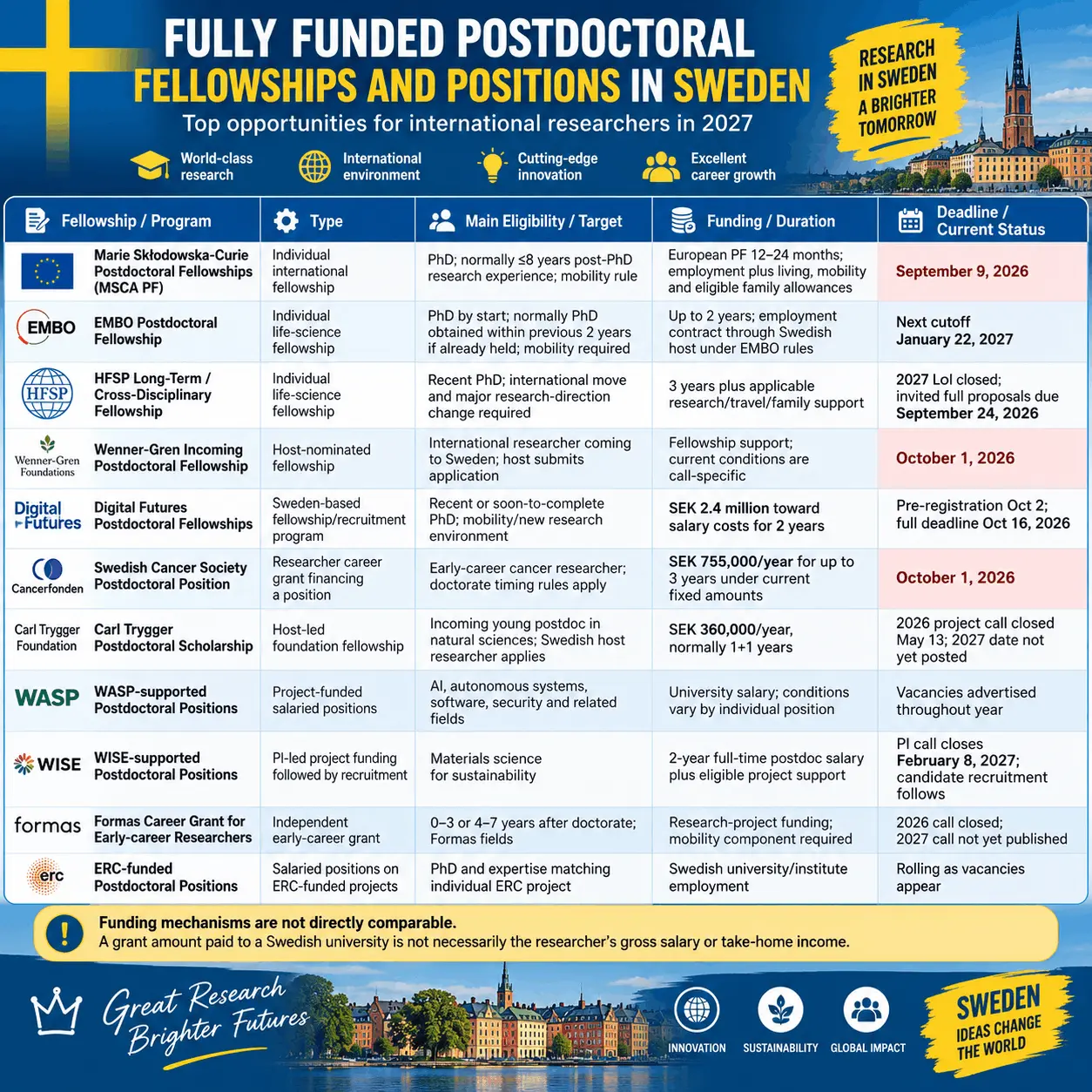
    Summary: Fully Funded Postdoctoral Fellowships and Positions in Sweden

    Fellowship / ProgramTypeMain Eligibility / TargetFunding / DurationDeadline / Current StatusOfficial Information
    Marie Skล‚odowska-Curie Postdoctoral Fellowships (MSCA PF)Individual international fellowshipPhD; normally โ‰ค8 years post-PhD research experience; mobility ruleEuropean PF 12โ€“24 months; employment plus living, mobility and eligible family allowancesSeptember 9, 2026MSCA Postdoctoral Fellowships
    EMBO Postdoctoral FellowshipIndividual life-science fellowshipPhD by start; normally PhD obtained within previous 2 years if already held; mobility requiredUp to 2 years; employment contract through Swedish host under EMBO rulesNext cutoff January 22, 2027EMBO Postdoctoral Fellowships
    HFSP Long-Term / Cross-Disciplinary FellowshipIndividual life-science fellowshipRecent PhD; international move and major research-direction change required3 years plus applicable research/travel/family support2027 LOI closed; invited full proposals due September 24, 2026HFSP Postdoctoral Fellowships
    Wenner-Gren Incoming Postdoctoral FellowshipHost-nominated fellowshipInternational researcher coming to Sweden; host submits applicationFellowship support; current conditions are call-specificOctober 1, 2026Wenner-Gren Foundations
    Digital Futures Postdoctoral FellowshipsSweden-based fellowship/recruitment programRecent or soon-to-complete PhD; mobility/new research environmentSEK 2.4 million toward salary costs for 2 yearsPre-registration Oct 2; full deadline Oct 16, 2026Digital Futures Postdoctoral Fellowship
    Swedish Cancer Society Postdoctoral PositionResearcher career grant financing a positionEarly-career cancer researcher; doctorate timing rules applySEK 755,000/year for up to 3 years under current fixed amountsOctober 1, 2026Cancerfonden Postdoctoral Position
    Carl Trygger Postdoctoral ScholarshipHost-led foundation fellowshipIncoming young postdoc in natural sciences; Swedish host researcher appliesSEK 360,000/year, normally 1+1 years2026 project call closed May 13; 2027 date not yet postedCarl Trygger Foundation
    WASP-supported Postdoctoral PositionsProject-funded salaried positionsAI, autonomous systems, software, security and related fieldsUniversity salary; conditions vary by individual positionVacancies advertised throughout yearWASP Open Positions
    WISE-supported Postdoctoral PositionsPI-led project funding followed by recruitmentMaterials science for sustainability2-year full-time postdoc salary plus eligible project supportPI call closes February 8, 2027; candidate recruitment followsWISE Academic Projects 2026โ€“2027
    Formas Career Grant for Early-career ResearchersIndependent early-career grant0โ€“3 or 4โ€“7 years after doctorate; Formas fieldsResearch-project funding; mobility component required2026 call closed; 2027 call not yet publishedFormas Career Grant
    ERC-funded Postdoctoral PositionsSalaried positions on ERC-funded projectsPhD and expertise matching individual ERC projectSwedish university/institute employmentRolling as vacancies appearEURAXESS Research Jobs

    Funding mechanisms are not directly comparable. A grant amount paid to a Swedish university is not necessarily the researcher’s gross salary or take-home income.


    1. Marie Skล‚odowska-Curie Postdoctoral Fellowships in Sweden

    The Marie Skล‚odowska-Curie Actions Postdoctoral Fellowship (MSCA PF) is one of the strongest options for international researchers who want to conduct postdoctoral research at a Swedish university or research organization.

    European Postdoctoral Fellowships are open across disciplines and can be hosted by eligible academic or non-academic institutions in Sweden.

    Funding and Duration

    European Postdoctoral Fellowships normally last 12โ€“24 months.

    MSCA funding supports the recruited researcher through:

    • living allowance;
    • mobility allowance;
    • family allowance when applicable;
    • long-term-leave and special-needs support where applicable.

    The host also receives funding for research, training, networking, management, and indirect costs.

    The host beneficiary recruits the successful researcher for the fellowship period.

    Eligibility

    Applicants must generally:

    • hold a PhD by the call deadline or have successfully defended the doctoral thesis;
    • have no more than eight years of research experience after the PhD, subject to specified exclusions;
    • satisfy the MSCA mobility rule.

    For an MSCA European Fellowship with a Swedish host, applicants must not have resided or carried out their main activity in Sweden for more than 12 months during the 36 months immediately before the application deadline.

    2026โ€“2027 Timeline

    • Call opened: April 9, 2026
    • Application deadline: September 9, 2026
    • Expected results: February 2027
    • First projects expected to start: approximately May 2027

    Official MSCA Postdoctoral Fellowship information


    2. EMBO Postdoctoral Fellowships in Sweden

    The EMBO Postdoctoral Fellowship is a prestigious option for researchers in molecular biology and related life-science fields who want to move to a Swedish research environment.

    Sweden is part of the European Molecular Biology Conference framework, making Swedish life-science laboratories attractive potential hosts.

    Eligibility

    Important current eligibility requirements include:

    • applicants must hold a doctorate or equivalent by the fellowship start;
    • researchers who already hold a PhD when applying normally must have obtained it within the two years before application;
    • researchers who have already joined the proposed host laboratory generally must have been living in the host country for less than six months at application;
    • the proposed project cannot simply be a direct continuation of the PhD research.

    Funding

    For fellows hosted in EMBC Member States such as Sweden, EMBO provides funding to the host institution so it can issue an employment contract to the fellow.

    Eligible relocation and childcare-related support may also be available under EMBO rules.

    Deadline

    Applications are accepted throughout the year.

    The next current hard cutoff is:

    January 22, 2027 at 14:00 CET.

    EMBO Postdoctoral Fellowships


    3. HFSP Postdoctoral Fellowships

    The Human Frontier Science Program (HFSP) supports highly innovative and potentially transformative basic life-science research.

    It offers:

    • Long-Term Fellowships (LTF) for applicants trained primarily in biological disciplines;
    • Cross-Disciplinary Fellowships (CDF) for researchers trained in areas such as physics, chemistry, mathematics, engineering, or computer science who are moving into life-science research.

    Duration

    HFSP fellowships provide three years of support.

    Funding includes a living allowance and additional support under applicable rules for research, travel, relocation, and family circumstances.

    Strict Eligibility and Mobility Rules

    HFSP is considerably more restrictive than a normal international postdoc vacancy.

    For the 2027 cycle, the doctoral degree generally must not have been conferred more than three years before the September 24, 2026 full-proposal deadline, subject to eligible career-interruption exceptions.

    HFSP also emphasizes:

    • an international move;
    • a significant change in research direction;
    • frontier biological questions;
    • independence from previous supervisors and research environments.

    2027 Application Status

    The Letter of Intent stage for the 2027 cycle has already closed.

    Only applicants invited after the LOI review can submit the full proposal.

    Invited full-proposal deadline: September 24, 2026.

    Successful candidates may begin their fellowship from April 2027.

    HFSP Postdoctoral Fellowships


    4. Wenner-Gren Postdoctoral Fellowships for Researchers Coming to Sweden

    The Wenner-Gren Foundations provide an important Sweden-specific route for bringing international postdoctoral researchers into Swedish research environments.

    The current call is specifically listed by Uppsala University as providing postdoctoral grants for incoming fellows, with a deadline of October 1, 2026.

    How the Application Works

    Unlike MSCA, where the researcher and host develop an application together within an EU funding framework, Wenner-Gren applications for incoming postdoctoral fellows are normally submitted by the Swedish host researcher for a selected international candidate.

    Applicants should therefore identify and contact a Swedish PI well ahead of the foundation deadline.

    Current call information indicates that the scheme is intended to bring researchers from outside Sweden into Swedish research environments.

    Who Should Consider Wenner-Gren?

    It is particularly relevant if you:

    • currently work outside Sweden;
    • want to join a Swedish research group;
    • have recently completed your PhD;
    • have already identified a potential Swedish host;
    • are seeking a fellowship route rather than waiting for an advertised salaried vacancy.

    Wenner-Gren Foundations official website


    5. Digital Futures Postdoctoral Fellowships

    The Digital Futures Postdoctoral Fellowship is one of the best currently open opportunities specifically targeting researchers who can begin a fellowship in Sweden in 2027.

    Digital Futures is a cross-disciplinary research center established by KTH Royal Institute of Technology, Stockholm University, and RISE Research Institutes of Sweden, with additional academic, industry, public-sector, and healthcare partners.

    Research Areas

    Projects can address digital transformation in areas such as:

    • artificial intelligence;
    • trustworthy digital systems;
    • digitalized industry;
    • smart society;
    • health and life;
    • education;
    • cooperation and learning;
    • emerging digital technologies.

    Funding

    The current call offers:

    SEK 2.4 million toward salary costs for two years for each employed postdoctoral fellow.

    This amount is transferred to the main supervisor responsible for employing the fellowโ€”it should not be interpreted as the researcher’s take-home salary.

    The fellowship also provides access to:

    • research infrastructure;
    • academic and industrial networks;
    • mentorship;
    • career development;
    • research-leadership training.

    Eligibility

    Applicants must hold a doctoral degree before starting the fellowship.

    The program emphasizes mobility and researchers moving into a new research group and institution.

    Applications require both a main supervisor and co-supervisor within the eligible Digital Futures environment.

    2026โ€“2027 Dates

    • Call opened: August 18, 2026
    • Mandatory pre-registration: October 2, 2026
    • Full application deadline: October 16, 2026
    • Decision: December 2026
    • Project start: June 1, 2027

    Digital Futures Postdoctoral Fellowship call


    6. Swedish Cancer Society Postdoctoral Position

    Researchers working in cancer biology, oncology, cancer immunology, epidemiology, therapeutics, prevention, or related areas should strongly consider the Swedish Cancer Society (Cancerfonden) Postdoctoral Position.

    Current Eligibility

    For the current 2026 competition, applicants generally must have completed their doctorate on or after July 1, 2023, but no later than December 31, 2026, subject to eligible deductions for circumstances such as parental or qualifying medical leave.

    The Swedish Cancer Society particularly values:

    • mobility;
    • scientific excellence;
    • cancer relevance;
    • development of an independent research direction.

    Duration and Funding

    The grant can support a postdoctoral position for a maximum of three years.

    Current fixed grant amounts list:

    • SEK 755,000 per year
    • SEK 2,265,000 total over three years

    The funding is paid to a Swedish university, and the actual salary is determined by the employer. The grant must be used to finance the postdoctoral position.

    Can the Research Be Done Abroad?

    Yes.

    The fellowship can support a postdoctoral period in Sweden or abroad.

    However, when the postdoctoral period is conducted abroad, the third and final year must be completed at the Swedish host institution in Sweden.

    Deadline

    October 1, 2026 at 15:00.

    Swedish Cancer Society Postdoctoral Position


    7. Carl Trygger Foundation Postdoctoral Scholarships

    The Carl Trygger Foundation for Scientific Research supports research in broad natural-science fields including:

    • physics;
    • chemistry;
    • engineering;
    • biology;
    • ecology;
    • geology;
    • forestry;
    • agricultural sciences.

    Importantly, medical research falls outside the foundation’s scope.

    Postdoctoral Funding

    From 2026, the foundation states that its postdoctoral scholarship normally provides:

    SEK 360,000 per year, usually for two years (1+1 years).

    Who Applies?

    The postdoctoral researcher does not normally submit the grant directly.

    A researcher at the Swedish host institution applies for funding for the incoming postdoc.

    The candidate should normally:

    • hold a doctorate;
    • be an early-career researcher;
    • have obtained the doctorate at an institution different from the host;
    • not already be established at the proposed Swedish host institution.

    The doctorate generally should not be older than six years at admission unless special circumstances apply.

    Deadline

    The foundation states that research-project applications are accepted in May each year.

    The 2026 project deadline was May 13, 2026. The specific 2027 deadline has not yet been posted.

    Carl Trygger Foundation


    8. WASP-Supported Postdoctoral Positions in Sweden

    The Wallenberg AI, Autonomous Systems and Software Program (WASP) is Sweden’s largest individual research program in artificial intelligence, autonomous systems, and software.

    Postdoctoral researchers can join WASP-funded research through salaried university positions across participating Swedish institutions.

    Important Distinction

    There is not one generic โ€œWASP Postdoctoral Fellowship in Swedenโ€ with a single eligibility rule and deadline.

    Instead, WASP supports:

    • specific research projects;
    • individual postdoctoral vacancies;
    • industrial research initiatives;
    • targeted research calls.

    WASP’s positions page currently lists individual salaried postdoctoral vacancies with their own deadlines.

    Fields

    Relevant areas include:

    • artificial intelligence;
    • machine learning;
    • robotics;
    • autonomous systems;
    • cybersecurity;
    • software engineering;
    • mathematical foundations of AI;
    • optimization;
    • computer vision.

    Important Note About the WASP International Postdoctoral Scholarship

    WASP also operates an International Postdoctoral Scholarship, but this is designed specifically for researchers who completed their PhD within WASP and want to undertake postdoctoral study at leading universities outside Sweden.

    It should therefore not be confused with WASP-funded postdoctoral positions based in Sweden.

    Current WASP research positions


    9. WISE-Supported Postdoctoral Positions

    The Wallenberg Initiative Materials Science for Sustainability (WISE) is a major Swedish investment in materials science.

    WISE supports research addressing areas such as:

    • sustainable materials;
    • energy technologies;
    • advanced manufacturing;
    • recycling;
    • resource efficiency;
    • chemistry;
    • physics;
    • engineering;
    • environmentally responsible materials design.

    Current 2026โ€“2027 Call

    WISE’s Academic Projects 3 call will fund:

    • up to 29 academic postdoctoral researcher positions;
    • up to 29 PhD positions.

    However, the researchers applying to this current funding call are principal investigators, not prospective postdoctoral candidates.

    Once projects receive funding, the relevant Swedish universities can recruit the postdocs.

    Postdoctoral Funding

    The current call funds:

    • salary for a postdoc for two years full-time;
    • possible extension to 2.5 years if research is conducted at 80%;
    • mentorship;
    • eligible travel to WISE events;
    • specified consumables and sustainability-expertise contributions.

    Timeline

    • Application portal opens: December 1, 2026
    • PI application deadline: February 8, 2027
    • Funding decisions: approximately May 2027
    • Candidates expected to be ready to start by: August 1, 2028

    Therefore, this particular WISE call should not be advertised as a direct 2027 postdoc application for individual researchers.

    Researchers seeking a 2027 start should instead monitor vacancies arising from already funded WISE projects.

    WISE Academic Projects 2026โ€“2027


    10. Formas Career Grant for Early-Career Researchers

    Formas is the Swedish Research Council for Sustainable Development.

    Its current early-career scheme is called:

    Career Grant for Early-career Researchers

    This replaces older terminology that may still appear online referring to Formas mobility grants.

    The scheme supports researchers who want to develop an independent project within Formas’s areas:

    • environment;
    • agricultural sciences;
    • spatial planning;
    • sustainability-related research.

    Career Tracks

    The current scheme has two tracks:

    • 0โ€“3 years after the doctorate
    • 4โ€“7 years after the doctorate

    A mobility component is built into the funding model.

    Is It a Postdoctoral Fellowship?

    Not exactly.

    This is an independent early-career research grant, so it is better suited to researchers who are transitioning toward scientific independence rather than simply seeking a standard supervised postdoctoral position.

    Current Status

    The 2026 competition ran from January 20 to March 4, 2026.

    The program is recurring and normally opens near the beginning of the year, but the detailed 2027 call has not yet been published.

    Formas Career Grant for Early-career Researchers


    11. ERC-Funded Postdoctoral Positions in Sweden

    The European Research Council (ERC) does not operate a general postdoctoral fellowship for individual candidates.

    Instead, ERC awards major grants to principal investigators.

    Those ERC-funded research groups frequently recruit:

    • postdoctoral researchers;
    • research scientists;
    • research engineers;
    • data scientists;
    • technical specialists.

    A Swedish ERC-funded postdoc is therefore usually a salaried university or institute position, rather than an ERC fellowship awarded directly to the candidate.

    How to Find Them

    Search:

    • individual Swedish university vacancy pages;
    • research-group websites;
    • EURAXESS;
    • academic job portals.

    Search research jobs on EURAXESS

    IR Research Publication also maintains a regularly updated research jobs and postdoctoral opportunities page.


    What About the MIMS โ€œExcellence by Choiceโ€ Postdoctoral Programme?

    Older fellowship lists may include the Excellence by Choice Postdoctoral Programme at Umeรฅ University/MIMS.

    It is an excellent programโ€”but it should not currently be advertised as an open 2027 fellowship.

    The program was designed to fund 17 international postdoctoral fellows during its 2021โ€“2026 cycle. Umeรฅ University’s current information indicates that the fellows have been recruited, and earlier program material identified the later recruitment round as the final call.

    As of this review, no new 2027 Excellence by Choice competition has been confirmed.

    Researchers interested in Umeรฅ should instead monitor Umeรฅ University and MIMS vacancies for new postdoctoral opportunities.


    How Much Do Postdocs Earn in Sweden?

    There is no single national โ€œSweden postdoc salary.โ€

    For ordinary salaried university postdoctoral positions, compensation depends on factors such as:

    • host university;
    • collective and local salary agreements;
    • discipline;
    • relevant experience;
    • funding source;
    • individual salary negotiation.

    For externally funded programs, the amount published by the funder may represent the total employment cost paid to the university, not the researcher’s gross salary.

    For example:

    • Digital Futures provides SEK 2.4 million toward salary costs over two years;
    • Cancerfonden currently allocates SEK 755,000 annually for its postdoctoral-position grant;
    • these figures should not be interpreted as annual take-home salary.

    Researchers comparing fellowship compensation internationally may find IR Research Publication’s guide to the highest-paying postdoctoral fellowships worldwide useful.


    Are Postdocs in Sweden Employees?

    Many ordinary university postdoctoral researchers are employed under fixed-term university contracts and receive Swedish employment benefits.

    Depending on the employer and funding arrangement, these can include:

    • paid annual leave;
    • pension contributions;
    • parental-leave protections;
    • sick-leave provisions;
    • social-security coverage.

    However, this does not apply identically to every fellowship.

    A tax-free scholarship or fellowship can have different legal, pension, insurance, and social-security consequences compared with salaried employment.

    Before accepting an offer, always determine whether you will be:

    1. a university employee;
    2. a scholarship recipient;
    3. employed through an externally financed position; or
    4. funded through another arrangement.

    Can International Researchers Apply for Postdocs in Sweden?

    Yes.

    Swedish universities and many major fellowship programs recruit researchers internationally.

    Programs such as:

    • MSCA;
    • EMBO;
    • HFSP;
    • Wenner-Gren;
    • Digital Futures;

    are specifically designed to support international mobility or strongly welcome international applicants.

    However, each program has its own rules regarding:

    • time since PhD;
    • nationality;
    • residence history;
    • previous time in Sweden;
    • relationship with the host;
    • previous research topic;
    • research mobility.

    Never assume that being an international applicant automatically makes you eligible.


    Do You Need to Speak Swedish?

    For many internationally recruited research postdocsโ€”particularly in STEM, engineering, data science, and biomedical researchโ€”English is commonly the working language.

    Swedish is therefore often not required for research-focused positions.

    However, Swedish proficiency may be necessary or advantageous when a position involves:

    • clinical work;
    • teaching in Swedish;
    • patient communication;
    • Swedish-language interviews or datasets;
    • significant public engagement.

    Always check the individual vacancy.


    How to Find a Postdoctoral Host in Sweden

    For fellowship applications such as MSCA, EMBO, HFSP, and Wenner-Gren, finding the right supervisor is one of the most important steps.

    Major research environments include:

    Life Sciences and Medicine

    • Karolinska Institutet
    • Uppsala University
    • Lund University
    • Umeรฅ University
    • University of Gothenburg
    • SciLifeLab

    Engineering, AI and Technology

    • KTH Royal Institute of Technology
    • Chalmers University of Technology
    • Linkรถping University
    • Lund University
    • Uppsala University
    • Umeรฅ University

    Materials and Sustainability

    • KTH
    • Chalmers
    • Linkรถping
    • Lund
    • Uppsala
    • Stockholm University
    • Luleรฅ University of Technology
    • WISE-associated environments

    Researchers who are not sure where to begin can use our detailed guide on how to find postdoctoral fellowship opportunities around the world.


    How to Contact a Swedish Professor for a Fellowship

    Do not send a generic message saying:

    โ€œI am looking for any postdoctoral position in your laboratory.โ€

    Instead, briefly explain:

    • your current research area;
    • major techniques or expertise;
    • your strongest research accomplishment;
    • why the professor’s work specifically interests you;
    • the fellowship you want to target;
    • a potential research direction;
    • how your expertise complements the host laboratory.

    For host-nominated programs such as Wenner-Gren or Carl Trygger, contacting the PI early is particularly important because the host may need to select one candidate and formally submit the funding application.


    How to Make Your Sweden Postdoc Application Competitive

    1. Check Eligibility Before Writing the Proposal

    Verify:

    • date of PhD;
    • mobility requirements;
    • residence history;
    • nationality restrictions;
    • previous work at the host;
    • previous collaborations;
    • field restrictions.

    HFSP, MSCA, EMBO, Cancerfonden, and Wenner-Gren all contain eligibility rules capable of disqualifying an otherwise excellent application.

    2. Explain Why You Need the Swedish Host

    Do not rely on the university’s reputation alone.

    Explain the specific:

    • expertise;
    • technology;
    • datasets;
    • research infrastructure;
    • patient cohorts;
    • collaborators;
    • computational resources;
    • methodologies;

    that make the host essential to your project.

    3. Demonstrate Scientific Independence

    A strong postdoctoral proposal should show how your project develops beyond your PhD.

    Reviewers should understand:

    • what expertise you already bring;
    • what you will learn;
    • which research questions are yours;
    • how the fellowship advances your independent research identity.

    4. Build a Strong Training Plan

    This is especially important for MSCA.

    Consider:

    • technical training;
    • leadership development;
    • grant writing;
    • teaching;
    • data science;
    • industry exposure;
    • secondments;
    • entrepreneurship;
    • science communication.

    5. Apply to Multiple Funding Routes

    A life-science researcher seeking a Swedish host might simultaneously evaluate:

    MSCA + EMBO + HFSP + Wenner-Gren + discipline-specific foundations + advertised university postdoc positions.

    A computational researcher could consider:

    MSCA + Digital Futures + WASP-funded vacancies + ERC-funded postdocs.

    A materials scientist might consider:

    MSCA + Carl Trygger + WISE-supported vacancies + ERC-funded positions.


    When Should You Apply for a 2027 Postdoc in Sweden?

    A useful planning timeline is:

    Septemberโ€“October 2026

    Apply immediately to relevant active programs such as:

    • MSCA
    • invited HFSP full proposals
    • Wenner-Gren
    • Swedish Cancer Society
    • Digital Futures

    November 2026โ€“January 2027

    • prepare EMBO applications;
    • monitor new Swedish university vacancies;
    • follow WASP positions;
    • identify newly funded research projects;
    • contact potential hosts.

    Early 2027

    Monitor:

    • new university postdoc advertisements;
    • Formas’s next Career Grant competition;
    • foundation funding rounds;
    • ERC-funded laboratories;
    • WISE-related future recruitment.

    Because many salaried postdoc positions are advertised throughout the year, researchers should continue monitoring Swedish university vacancy pages even after fellowship deadlines pass.


    Frequently Asked Questions

    Are postdoctoral fellowships in Sweden fully funded?

    Many are.

    However, โ€œfully fundedโ€ can mean different things.

    Some programs provide:

    • an employment contract and salary;

    while others provide:

    • a fellowship or stipend;
    • a grant to the host university that finances the postdoctoral position.

    Travel, research, relocation, childcare, and family support differ by scheme.


    Which Sweden postdoctoral fellowships are currently open for 2027?

    As of September 5, 2026, major relevant opportunities include:

    • MSCA Postdoctoral Fellowships โ€” deadline September 9, 2026
    • Swedish Cancer Society Postdoctoral Position โ€” October 1, 2026
    • Wenner-Gren incoming postdoc funding โ€” October 1, 2026
    • Digital Futures โ€” pre-registration October 2 and full application October 16, 2026
    • EMBO โ€” next hard cutoff January 22, 2027

    HFSP’s initial 2027 application stage has already closed; only invited applicants can submit a full proposal.


    Can Indian researchers apply for postdocs in Sweden?

    Yes, Indian researchers can apply for many Swedish and European fellowship programs if they satisfy the individual eligibility rules.

    Potential options include:

    • MSCA;
    • EMBO;
    • HFSP;
    • Wenner-Gren;
    • Digital Futures;
    • advertised salaried Swedish university positions.

    Eligibility should still be checked individually because mobility and post-PhD timing rules vary substantially.


    Do I need a Swedish host before applying?

    For many fellowships, yes.

    Programs such as MSCA, HFSP, Wenner-Gren, and host-led Carl Trygger funding require a Swedish research environment to be identified before the application is completed.

    Digital Futures also requires eligible supervisors.

    By contrast, ordinary salaried postdoctoral vacancies involve applying directly to an already defined research position.


    Is EMBO available for postdoctoral research in Sweden?

    Yes.

    Swedish life-science research institutions can host eligible EMBO fellows.

    International mobility and the timing of the applicant’s PhD are particularly important eligibility considerations.


    Is Swedish required for a postdoc?

    Usually not for internationally recruited research-focused positions, but some clinical, teaching, or public-facing roles may require Swedish.


    What is the best fellowship for an international postdoc in Sweden?

    There is no single best option.

    For broad international mobility:

    MSCA is one of the strongest.

    For molecular and life sciences:

    EMBO is highly attractive.

    For frontier interdisciplinary biology:

    HFSP is exceptionally prestigious.

    For international researchers specifically moving into Sweden:

    Wenner-Gren is particularly relevant.

    For digital technologies and AI:

    Digital Futures and WASP-supported positions are strong options.

    For cancer researchers:

    Cancerfonden deserves close consideration.


    Final Application Checklist

    Before applying for a postdoctoral fellowship in Sweden, confirm:

    • I satisfy the PhD-date requirement.
    • I meet the mobility rule.
    • I meet any nationality requirements.
    • My Swedish host is eligible.
    • My previous residence in Sweden does not make me ineligible.
    • My relationship with the proposed supervisor complies with the program rules.
    • My proposal clearly differs from my PhD work where required.
    • I understand whether the funding is salary, stipend, or host-administered grant.
    • I understand the tax and social-security implications of the funding model.
    • My CV is tailored to the fellowship.
    • My research proposal demonstrates independence.
    • My host has reviewed the proposal.
    • Recommendation letters have been requested early.
    • I have checked the exact official deadline and time zone.
    • I have identified at least one alternative funding route.

    Conclusion: Fully Funded Postdoctoral Fellowships in Sweden 2027

    Sweden offers an excellent range of opportunities for researchers seeking fully funded postdoctoral fellowships in Sweden for 2027, but applicants should distinguish carefully between true individual fellowships and project-funded salaried postdoctoral jobs.

    For researchers targeting a 2027 start, several important opportunities are already active in 2026.

    The MSCA Postdoctoral Fellowship closes on September 9, 2026. The Swedish Cancer Society and Wenner-Gren have October 1 deadlines, while Digital Futures has a mandatory October 2 pre-registration followed by an October 16 application deadline. EMBO accepts applications throughout the year, with its next hard cutoff on January 22, 2027.

    HFSP remains one of the world’s most prestigious life-science fellowships, but its initial 2027 application stage has already closed.

    Researchers should also monitor WASP, WISE, ERC-funded laboratories, Carl Trygger-supported projects, Formas, and individual Swedish universities for additional funded postdoctoral positions.

    Start early, verify mobility and PhD-date rules before preparing the application, identify a strong Swedish host, and apply across several suitable funding routes rather than depending on one fellowship.

    For additional guidance, explore IR Research Publication’s global guide to finding postdoctoral fellowships and our latest research jobs and postdoctoral opportunities.


    Related Articles


    About IR Research Publication

    IR Research Publication is a research and academic-career platform supporting students, scientists, and scholars with practical information on research funding, postdoctoral fellowships, PhD opportunities, academic publishing, and career development.

    Our fellowship guides focus on credible opportunities and emphasize verification of eligibility, funding, mobility requirements, deadlines, and host conditions through current official sources.


    Last reviewed: September 5, 2026

    Disclaimer: Fellowship rules, deadlines, grant amounts, employment conditions, and eligibility requirements may change. Applicants should always confirm the latest call documentation on the official funder’s or host institution’s website before applying.

  • Top Fully Funded Postdoctoral Fellowships in the Netherlands for 2027

    Top Fully Funded Postdoctoral Fellowships in the Netherlands for 2027


    Introduction: Fully Funded Postdoctoral Fellowships in the Netherlands 2027

    The Netherlands is one of Europeโ€™s leading destinations for postdoctoral research, offering internationally recognized universities, university medical centers, national research institutes, and a strong culture of interdisciplinary and collaborative science.

    Researchers planning to start a postdoctoral position in the Netherlands in 2027 can access funding through several routes. Some opportunities, such as the Marie Skล‚odowska-Curie Postdoctoral Fellowship, EMBO Fellowship, HFSP Fellowship, ECTRIMS Fellowship, and CRI Irvington Fellowship, are international programs that can potentially be held at an eligible Dutch host institution. Others, particularly the NWO Talent Programme โ€“ Veni, are Netherlands-based early-career research grants.

    Importantly, not every opportunity in this guide is structured in exactly the same way. Some provide an employment contract through the host institution, others provide a fellowship stipend or grant, and some are designed primarily for mobility or specialist research training.

    Important for 2027 applicants: Do not wait until 2027 to begin applying. Several fellowships that can fund research beginning in 2027 have application deadlines during 2026.

    For example, the 2026 MSCA Postdoctoral Fellowship call closes on September 9, 2026, with successful projects expected to begin from May 2027. HFSP’s 2027 fellowship cycle began even earlier, while ECTRIMS has a December 1, 2026 deadline for its 2027 fellowship cycle.

    Researchers still exploring different countries may also find our guides to fully funded postdoctoral fellowships in Germany for 2027 and fully funded postdoctoral fellowships in France for 2027 useful for comparison.


    Top Fully Funded Postdoctoral Fellowships in the Netherlands for 2027

    Fellowship / ProgramPotential Netherlands HostEligibility SnapshotFunding / DurationApplication DeadlineOfficial Link
    Marie Skล‚odowska-Curie Postdoctoral Fellowships (MSCA PF)Eligible Dutch universities, institutes, UMCs and organizationsPhD; normally โ‰ค8 years research experience after PhD; mobility rule appliesEmployment through host; living + mobility + eligible family allowances; European PF: 12โ€“24 monthsSeptember 9, 2026 for current call leading to 2027 startsOfficial Website
    NWO Talent Programme โ€“ VeniEligible Dutch universities, UMCs, NWO/KNAW institutes and recognized organizationsEarly-career PhD researchers; recent calls generally use a 3-year post-PhD window, with extensions possibleEarly-career independent research grant; project up to 3 years2027 round to be confirmedOfficial Website
    EMBO Postdoctoral FellowshipEligible molecular/life-science laboratories in the NetherlandsDoctorate by start; if PhD already held when applying, generally obtained within previous 2 years; mobility requiredUp to 2 years; country-adjusted support plus eligible relocation/childcare benefitsApplications year-round; next hard cutoff January 22, 2027Official Website
    HFSP Postdoctoral Fellowship โ€“ LTF/CDFEligible Dutch life-science institutionInternational move required; research direction must differ substantially from previous work; PhD timing and publication rules apply3 years; living, research/travel and eligible family/relocation allowances2027 LOI closed; invited full proposals due September 24, 2026Official Website
    ECTRIMS Postdoctoral Research FellowshipEligible Dutch MS research laboratory or clinicMD/PhD/ScD or equivalent; any nationality; MS-related research; new host/mentor requirement1โ€“2 years; annual stipend up to โ‚ฌ55,000December 1, 2026Official Website
    ERCIM Alain Bensoussan FellowshipParticipating ERCIM member institute; CWI may participate depending on roundPhD holders worldwide; CS, IT and applied mathematicsTypically 12 monthsCurrent deadline September 30, 2026Official Website
    ESA Research FellowshipESA ESTEC, Noordwijk, when relevant vacancies are offeredRecent PhD; nationality restrictions apply2-year appointment, potentially renewable for a third year; salary and ESA benefitsVacancy-specificOfficial Website
    CRI Irvington Postdoctoral FellowshipEligible Dutch nonprofit university/research institutionEarly-career researchers in immunology/cancer immunology; international hosts possible3 years; $243,000 total current fundingSeptember 1, 2026 / March 1, 2027Official Website
    ERS Long-Term Research FellowshipSuitable respiratory research institution in the NetherlandsEarly-career respiratory researchers/clinicians; mobility outside home country required6โ€“24 months; financial support determined under fellowship rules2026 round closed July 30, 2026; next cycle to be confirmedOfficial Website
    ESMO Research FellowshipEligible Dutch oncology research institutionYoung oncologists; currently generally age โ‰ค40; research proposal and host requiredCurrent standard Research Fellowship: 1 year, โ‚ฌ60,000Scheme-specific; check current fellowship callOfficial Website
    NIAS Individual Fellowship*Netherlands Institute for Advanced Study, AmsterdamEstablished scholars; humanities/social sciences or interdisciplinary work engaging these areas5 or 10 months; eligible applicants may receive โ‚ฌ3,500/month supportAnnual callOfficial Website

    *NIAS is included as an additional funded research opportunity in the Netherlands. It is not a conventional postdoctoral employment fellowship and should not be treated as equivalent to MSCA, EMBO, or other standard postdoctoral schemes.

    Funding and deadlines can change between calls. Always check the official call documentation before applying.


    1. Marie Skล‚odowska-Curie Postdoctoral Fellowships (MSCA PF)

    Overview

    The Marie Skล‚odowska-Curie Postdoctoral Fellowship is one of the most prestigious mobility-based postdoctoral programs available to researchers who want to conduct research in the Netherlands.

    European Postdoctoral Fellowships can be hosted by eligible academic or non-academic organizations in the Netherlands and are open to researchers of any nationality. They support research, advanced training, career development, networking, and international or intersectoral mobility.

    Funding and Benefits

    MSCA funding provides support for:

    • Living allowance
    • Mobility allowance
    • Family allowance when eligible
    • Long-term leave and special-needs support where applicable
    • Research, training and networking costs paid to the host organization
    • Institutional management and indirect costs

    The researcher is normally recruited by the beneficiary organization for the fellowship period.

    Duration

    A European Postdoctoral Fellowship normally lasts 12โ€“24 months. Global Postdoctoral Fellowships have a different structure and include an outgoing phase followed by a mandatory European return phase.

    Eligibility

    Applicants must hold a PhD by the call deadline or have successfully defended their doctoral thesis, subject to the call rules.

    Applicants generally must have no more than eight years of full-time-equivalent research experience after obtaining the PhD, with certain career-break and other exclusions permitted.

    For a researcher applying with a Dutch host under a European Postdoctoral Fellowship, the key mobility rule is particularly important:

    The applicant must not have resided or carried out their main activity in the Netherlands for more than 12 months during the 36 months immediately preceding the call deadline.

    2026โ€“2027 Timeline

    The current MSCA Postdoctoral Fellowship call:

    • Opened: April 9, 2026
    • Deadline: September 9, 2026
    • Expected results: February 2027
    • Earliest projects expected to begin: around May 2027

    Therefore, researchers who want to begin an MSCA-funded postdoc in the Netherlands in 2027 should be preparing their application now, rather than waiting for a 2027 call.

    MSCA Postdoctoral Fellowships โ€“ Official Website


    2. NWO Talent Programme โ€“ Veni

    Overview

    The NWO Talent Programme โ€“ Veni is different from a conventional postdoctoral fellowship.

    Veni is an early-career independent research grant designed to help promising researchers develop their own research line at an eligible institution in the Netherlands.

    This makes Veni particularly attractive to researchers who are beginning to transition from a traditional supervised postdoctoral position toward research independence.

    Eligibility

    Recent Veni calls have generally allowed researchers whose PhD was obtained within approximately three years before the specified reference date, although extensions may be available for eligible circumstances.

    The 2025 Veni call, for example, allowed applications from researchers who had obtained a doctorate within the three years preceding its reference date, with specific extension provisions.

    Because rules are call-specific, researchers planning for 2027 should check the new call once released rather than assuming the same dates will automatically apply.

    Eligible Hosts

    Research can be conducted at participating organizations such as:

    • Dutch universities
    • University medical centers
    • NWO Institutes
    • KNAW institutes
    • Netherlands Cancer Institute
    • Selected nationally recognized research organizations

    The researcher must generally be employed by the host institution during the project.

    Funding

    Veni funding supports an independent research project for up to approximately three years, subject to the budget and conditions specified in the relevant call.

    This is therefore better described as an early-career investigator grant rather than simply a postdoctoral scholarship.

    NWO Talent Programme โ€“ Official Website


    3. EMBO Postdoctoral Fellowships

    Overview

    The EMBO Postdoctoral Fellowship is one of the strongest options for researchers in molecular biology and related life-science disciplines who want to move to a laboratory in the Netherlands.

    Dutch universities, university medical centers, and research institutes contain many laboratories working in areas covered by EMBO.

    Funding and Benefits

    Depending on the host country and administrative arrangement, EMBO provides country-adjusted financial support as well as eligible benefits such as:

    • Relocation support
    • Childcare-related support
    • Access to EMBO networking and professional development
    • International mobility and career development

    Eligibility

    Several eligibility requirements deserve close attention.

    Applicants must hold a doctorate or equivalent by the start of the fellowship.

    If an applicant already holds a PhD at the time of application, the doctorate generally must have been obtained within the two years preceding submission.

    Applicants who have already started working at their proposed host laboratory generally must have been in the host country for less than six months when applying.

    Projects that are simply a direct continuation of the applicantโ€™s doctoral work are not eligible.

    Deadline

    Applications are accepted throughout the year.

    The next currently listed hard cutoff is:

    January 22, 2027 at 14:00 CET.

    Researchers considering EMBO and other global programs can also compare funding structures in our guide to the highest-paying postdoctoral fellowships worldwide.

    EMBO Postdoctoral Fellowships โ€“ Official Website


    4. HFSP Postdoctoral Fellowships

    Overview

    The Human Frontier Science Program (HFSP) supports highly innovative, frontier research addressing fundamental biological questions.

    Two major postdoctoral fellowship tracks are offered:

    • Long-Term Fellowships (LTF) โ€“ primarily for researchers with biological-science doctoral training
    • Cross-Disciplinary Fellowships (CDF) โ€“ for researchers trained in fields such as physics, chemistry, mathematics, engineering, or computer science who are moving into life sciences

    Duration and Funding

    HFSP fellowships are awarded for three years (36 months).

    Funding includes:

    • Living allowance
    • Research and travel allowance
    • Relocation allowance when eligible
    • Child allowance when eligible
    • Parental leave support under applicable circumstances

    The amount depends partly on the host country.

    Major Mobility Requirements

    HFSP has substantially stronger mobility rules than many standard fellowships.

    Applicants must:

    • Propose a change in country
    • Normally conduct the fellowship in a country of which they are not a national
    • Not conduct the fellowship in the country where they obtained their PhD
    • Generally not have studied or worked in the proposed host country for more than 12 months by fellowship activation
    • Propose research that is distinctly different from their PhD or previous postdoctoral research

    Applicants also cannot simply continue working with a former research supervisor or established collaborator under the fellowship.

    2027 Cycle

    For the 2027 fellowship cycle:

    • LOI initiation deadline: May 5, 2026
    • LOI submission deadline: May 12, 2026
    • Invited full proposal deadline: September 24, 2026
    • Fellowship activation: between April 1, 2027 and January 1, 2028

    The LOI stage has already closed, so only candidates invited after the first stage can proceed with the current 2027 competition.

    HFSP Postdoctoral Fellowships โ€“ Official Website


    5. ECTRIMS Postdoctoral Research Fellowship

    Overview

    The European Committee for Treatment and Research in Multiple Sclerosis (ECTRIMS) Postdoctoral Research Fellowship supports scientists and physicians conducting research related to multiple sclerosis.

    A fellowship can potentially be hosted at an appropriate Dutch university medical center, research institute, laboratory, or clinic specializing in MS.

    Eligibility

    Applicants may hold:

    • PhD
    • MD
    • ScD
    • Equivalent doctoral qualification

    Researchers of any nationality can apply.

    The research must be conducted at a European laboratory or clinic and must relate to multiple sclerosis.

    A particularly important eligibility rule is that, at the time of application, the applicant should not already have worked at the proposed host institution and/or under the proposed mentor.

    Funding

    ECTRIMS currently states that its fellowships provide an annual stipend of up to โ‚ฌ55,000.

    Postdoctoral Research Fellowships are offered for one or two years.

    2027 Deadline

    Application deadline: December 1, 2026.

    This makes ECTRIMS one of the clearest currently confirmed opportunities for researchers specifically targeting a fellowship beginning in 2027.

    ECTRIMS Postdoctoral Research Fellowship โ€“ Official Website


    6. ERCIM Alain Bensoussan Fellowship Programme

    Overview

    The ERCIM Alain Bensoussan Fellowship Programme supports postdoctoral researchers in areas including:

    • Computer science
    • Information technology
    • Applied mathematics
    • Data science and related computational disciplines

    Fellows are hosted by participating ERCIM member institutions across Europe.

    In the Netherlands, researchers should check whether CWI in Amsterdam or another appropriate participating ERCIM institution is available during the relevant fellowship round.

    Eligibility

    The programme is open to PhD holders from around the world.

    Applicants should review the list of participating hosts for each specific round because not every ERCIM institution necessarily participates in every competition.

    Duration

    The standard fellowship duration is 12 months at an ERCIM member institute.

    Deadline

    The next currently advertised application deadline is:

    September 30, 2026.

    ERCIM Alain Bensoussan Fellowship โ€“ Official Website


    7. ESA Research Fellowships at ESTEC, Netherlands

    Overview

    The European Space Agency Research Fellowship Programme offers postdoctoral researchers opportunities in space science, engineering, space applications, Earth observation, planetary science, astrophysics, technology, and related fields.

    Some positions are based at ESTEC in Noordwijk, the Netherlands.

    Duration and Benefits

    ESA Research Fellowships typically provide:

    • A two-year appointment
    • Possible renewal for a third year
    • Monthly salary
    • ESA social-security benefits
    • Paid leave
    • Travel reimbursement
    • Potential expatriation and installation allowances

    Critical Nationality Requirement

    ESA Research Fellowships are not open to all nationalities.

    Applicants generally must be citizens of:

    • ESA Member States
    • ESA Associate Members
    • European Cooperating States, where applicable to Internal Research Fellowships
    • Canada as a Cooperating State

    Applicants should always check the eligible nationality list attached to the individual vacancy.

    Therefore, international researchers should not assume that holding a PhD alone makes them eligible.

    Eligibility

    Applicants should have recently completed a relevant PhD. ESA states that preference is generally given to candidates applying within five years of obtaining their doctorate.

    ESA Research Fellowship Programme โ€“ Official Website


    8. CRI Irvington Postdoctoral Fellowship

    Overview

    The Cancer Research Institute Irvington Postdoctoral Fellowship supports early-career scientists working in:

    • Immunology
    • Fundamental immune biology
    • Cancer immunology
    • Cancer immunotherapy-related research

    The fellowship supports researchers at leading research institutions globally, making an eligible Dutch nonprofit university, university medical center, or research institute a potential host.

    Funding

    CRI currently lists total fellowship funding of $243,000 over three years.

    The award provides sustained postdoctoral support and professional development intended to help researchers transition toward independent careers.

    Deadlines

    CRI currently lists two upcoming deadlines:

    • September 1, 2026
    • March 1, 2027

    The program normally operates with March 1 and September 1 deadlines each year, adjusted when these dates fall on holidays or weekends.

    This is therefore one of the few programs in this guide with a confirmed application deadline actually occurring in 2027.

    CRI Irvington Postdoctoral Fellowship โ€“ Official Website


    9. ERS Long-Term Research Fellowships

    Overview

    The European Respiratory Society Long-Term Research Fellowship (LTRF) supports early-career researchers and clinicians conducting basic, translational, or clinical research in respiratory medicine.

    Researchers may potentially choose a suitable host center in the Netherlands provided they comply with the relevant mobility requirements.

    Duration

    ERS Long-Term Research Fellowships now support projects lasting 6โ€“24 months.

    This is an important update because earlier versions of the programme were often described as providing only 6โ€“12 months of support.

    Eligibility and Mobility

    Applicants generally must conduct their fellowship at an institution outside their home country.

    The ERS portfolio includes different routes for:

    • European researchers
    • International researchers
    • Researchers from scientifically developing countries
    • Certain jointly supported fellowship schemes

    The exact conditions depend on the route under which the candidate applies.

    Current Deadline Status

    The 2026 Long-Term Research Fellowship cycle:

    • Opened: May 30, 2026
    • Closed: July 30, 2026
    • Decision expected: mid-December 2026

    The next annual call should be monitored for researchers seeking later 2027 starts.

    ERS Long-Term Research Fellowship โ€“ Official Website


    10. ESMO Research Fellowships

    Overview

    The European Society for Medical Oncology (ESMO) operates several fellowship schemes for oncology professionals.

    The standard ESMO Research Fellowship is particularly relevant to young oncologists who want to conduct clinical or translational research at an international host institution.

    A suitable cancer center or university medical center in the Netherlands may therefore serve as a host.

    Funding and Duration

    Under ESMO’s current general fellowship conditions, the standard Research Fellowship is:

    • 1 year
    • โ‚ฌ60,000

    The fellowship may be carried out at an institution worldwide.

    This replaces older information commonly found online describing the fellowship as โ‚ฌ40,000.

    ESMO also operates other programs with different funding structures, including longer clinician-scientist and specialist fellowship schemes.

    Eligibility

    The standard research fellowship is aimed at young oncologists and currently generally requires applicants to be 40 years old or younger at the time of application, subject to the detailed fellowship rules and any applicable exceptions.

    Candidates need to identify a host institution and develop a research project with that institution.

    Because ESMO operates several different fellowship categories, researchers should always confirm which current scheme best fits their career stage and proposed project.

    ESMO Fellowships โ€“ Official Website


    Additional Funded Research Opportunity: NIAS Individual Fellowships

    NIAS Individual Fellowship

    The Netherlands Institute for Advanced Study (NIAS) offers prestigious residential fellowships primarily to scholars in the humanities and social sciences, as well as researchers from other disciplines whose work strongly engages with those fields.

    However, NIAS should not be considered a conventional postdoctoral fellowship or salaried postdoctoral position.

    Individual fellowships usually provide scholars with five or ten months of dedicated research time in Amsterdam.

    Eligible applicants may apply for financial support. Current NIAS documentation lists personal stipends and Dutch University Grants at โ‚ฌ3,500 per month.

    Researchers considering NIAS should therefore evaluate it as a funded residential research fellowship, rather than a direct alternative to MSCA, EMBO, or HFSP.

    NIAS Fellowships โ€“ Official Website


    Which Fellowship Should You Choose?

    Your strongest option depends heavily on your discipline, post-PhD experience, nationality, mobility history, and career goals.

    Choose MSCA if:

    You want a prestigious European fellowship, strong career-development component, flexibility across disciplines, and an eligible Dutch host.

    Choose EMBO if:

    You are an early-stage postdoctoral researcher in molecular or life sciences and can satisfy the strict PhD timing and international mobility requirements.

    Choose HFSP if:

    You are proposing high-risk, frontier life-science research and are making both a significant international move and a substantial change in research direction.

    Choose NWO Veni if:

    You are ready to begin developing an independent research line in the Netherlands rather than simply continuing in a traditional supervised postdoctoral role.

    Choose ECTRIMS if:

    Your research focuses specifically on multiple sclerosis or related neuroscience and you have identified a new European host and mentor.

    Choose ERCIM if:

    Your expertise lies in computer science, mathematics, artificial intelligence, computational science, or related fields.

    Choose CRI Irvington if:

    Your research focuses on immunology, cancer immunology, or immunotherapy.

    Choose ERS if:

    You are building a career in respiratory science or medicine and need international mobility-based research training.

    Choose ESMO if:

    You are a young oncologist pursuing clinical or translational cancer research.

    Choose ESA if:

    Your research aligns with space science or technology and your nationality meets ESA eligibility rules.

    For a broader international comparison, see our guide to the highest-paying postdoctoral fellowships worldwide.


    How to Find a Postdoctoral Host in the Netherlands

    For fellowships such as MSCA, EMBO, HFSP, CRI, ECTRIMS, ESMO, and ERS, securing the right host laboratory can be as important as selecting the fellowship itself.

    Major Dutch research universities and institutions include:

    • Delft University of Technology
    • University of Amsterdam
    • Utrecht University
    • Leiden University
    • University of Groningen
    • Radboud University
    • Vrije Universiteit Amsterdam
    • Erasmus University Rotterdam
    • Maastricht University
    • Eindhoven University of Technology
    • University of Twente
    • Wageningen University & Research
    • Amsterdam UMC
    • Erasmus MC
    • Leiden University Medical Center
    • University Medical Center Utrecht
    • Radboudumc
    • University Medical Center Groningen

    National and specialist institutes include:

    • CWI
    • AMOLF
    • Nikhef
    • DIFFER
    • NIOZ
    • ARCNL
    • Netherlands Cancer Institute

    Researchers can also use EURAXESS to identify Dutch postdoctoral vacancies and potential host laboratories.

    EURAXESS Netherlands

    You can also review our practical guide on how to find postdoctoral fellowship opportunities around the world, which includes major fellowship portals, job boards, and strategies for identifying potential supervisors.

    IR Research Publication also maintains a weekly research jobs and opportunities page covering PhD, postdoctoral, faculty, and research positions.


    How to Maximize Your Chances of Winning a Fellowship

    1. Start With Eligibility, Not Prestige

    Before spending weeks developing a proposal, verify:

    • PhD-date restriction
    • Mobility requirement
    • Nationality requirement
    • Host-country restrictions
    • Previous time spent at the host
    • Previous relationship with the proposed supervisor
    • Field-specific eligibility

    This is particularly important for HFSP, EMBO, ESA, MSCA, and ECTRIMS, where one eligibility condition can make an otherwise excellent application inadmissible.

    2. Contact Potential Hosts Early

    Strong fellowships are rarely assembled at the last minute.

    When contacting a potential PI:

    • Explain your research background briefly
    • Show why their laboratory is specifically relevant
    • Propose a research direction rather than sending a generic request
    • Mention the fellowship you intend to target
    • Explain what expertise you bring to the host laboratory

    3. Build the Proposal Around the Fellowship Criteria

    Do not use the same proposal unchanged for every fellowship.

    MSCA places significant emphasis on training, impact, mobility, and career development.

    HFSP prioritizes frontier science and a major shift from previous research.

    EMBO emphasizes scientific quality and international postdoctoral training.

    ECTRIMS requires clear relevance to multiple sclerosis.

    CRI focuses on high-quality immunology and cancer immunology.

    4. Demonstrate Independence

    Reviewers should understand what you bring to the proposed project.

    Your proposal should demonstrate:

    • Original ideas
    • Technical expertise
    • Intellectual ownership
    • Clear career progression
    • A logical reason for choosing the new host

    5. Show Why the Host Is Essential

    Avoid simply stating that the university is prestigious.

    Explain:

    • What technique exists there that you need
    • Which mentor expertise complements your background
    • Which datasets, patient cohorts, facilities, or technologies are available
    • What collaborations become possible
    • What new skills you will take away from the fellowship

    6. Apply to More Than One Suitable Program

    Postdoctoral fellowships are highly competitive.

    Instead of relying on one fellowship, build a portfolio of well-matched applications.

    For example, an eligible molecular life-science researcher targeting the Netherlands might consider some combination of:

    MSCA + EMBO + HFSP + discipline-specific fellowship + host-funded postdoc positions.

    Our comparison of Germany vs the Netherlands for PhD and research careers may also help researchers who are still deciding between the two major European research destinations.


    Frequently Asked Questions

    1. Are these Netherlands postdoctoral fellowships truly fully funded?

    Most major programs listed here provide substantial financial support intended to fund the researcher’s fellowship period, but the financial mechanism varies.

    Some involve employment through the host institution, while others provide a stipend, fellowship allowance, or grant.

    You should therefore evaluate the complete package, including salary/stipend, taxes, social security, relocation, research expenses, childcare or family allowances, and institutional supplementation.


    2. Can international researchers apply for postdoctoral fellowships in the Netherlands?

    Yes. Many of the major programs in this guide accept international researchers.

    However, not every fellowship is open to every nationality.

    MSCA European Postdoctoral Fellowships are broadly international, whereas ESA has specific nationality restrictions. HFSP also imposes rules based on nationality, host country, and where the applicant completed their PhD.

    Always check the individual fellowship.


    3. Can Indian researchers apply for postdoctoral fellowships in the Netherlands?

    Yes. Indian researchers can potentially apply for several of the major programs listed here, including MSCA, EMBO, HFSP, ECTRIMS, CRI Irvington, and some ERS opportunities, provided the individual eligibility and mobility conditions are met.

    However, eligibility should never be assumed solely based on nationality.

    For example, ESA Research Fellowships generally do not accept applicants solely on the basis of Indian citizenship, because ESA nationality restrictions apply.


    4. Do I need a Dutch supervisor before applying?

    For most fellowships in this guide, yes.

    Programs such as MSCA, EMBO, HFSP, ECTRIMS, ESMO, and many ERS routes require applicants to identify and coordinate with an appropriate host institution and supervisor.

    In competitive schemes, you should begin contacting hosts several months before the deadline.


    5. Can I apply while finishing my PhD?

    It depends on the fellowship.

    Some programs allow candidates to apply before the formal degree has been awarded provided all doctoral requirements are completed by a specified stage.

    Others impose stricter requirements at submission.

    For example, HFSP does not require the doctoral degree to be completed at the initial application stage, but it must be completed before fellowship activation within the program’s stated deadline. EMBO requires the doctorate or equivalent by fellowship start.

    Always check the current call.


    6. What are the typical fellowship durations?

    They vary considerably:

    • MSCA European PF: 12โ€“24 months
    • EMBO: up to 2 years
    • HFSP: 3 years
    • ECTRIMS: 1โ€“2 years
    • ERCIM: typically 12 months
    • ESA: 2 years, potentially renewable for a third
    • CRI Irvington: 3 years
    • ERS LTRF: 6โ€“24 months
    • ESMO standard Research Fellowship: 1 year
    • NIAS: 5 or 10 months

    7. Which fellowship is best for life-science researchers?

    For broadly defined life sciences, MSCA, EMBO, and HFSP are among the strongest programs.

    Researchers in specialized disciplines should also consider field-specific opportunities such as:

    • ECTRIMS for multiple sclerosis
    • ERS for respiratory research
    • CRI Irvington for immunology/cancer immunology
    • ESMO for oncology

    8. Which Netherlands fellowship is best for becoming an independent investigator?

    The NWO Veni is particularly attractive because it is structured as an early-career research grant intended to help researchers develop their own independent research direction.

    MSCA can also substantially strengthen independence when the proposed research and training plan clearly establishes an individual scientific identity.


    9. When should I start applying for a 2027 postdoc?

    Ideally, 6โ€“12 months before your desired fellowship start date, and sometimes even earlier.

    Several programs funding 2027 positions require applications in 2026.

    For example:

    • MSCA: September 9, 2026
    • HFSP full proposal for invited 2027 candidates: September 24, 2026
    • ERCIM current round: September 30, 2026
    • ECTRIMS: December 1, 2026
    • EMBO next hard cutoff: January 22, 2027
    • CRI Irvington: March 1, 2027

    This is why applicants should plan around the application year, not simply the year they want the fellowship to begin.


    Final Application Checklist

    Before submitting any fellowship application, confirm the following:

    • I meet the PhD-date requirement.
    • I satisfy the mobility rule.
    • My nationality is eligible.
    • My proposed Dutch host is eligible.
    • My previous residence in the Netherlands does not violate the fellowship rules.
    • I meet any restrictions concerning previous work with my host supervisor.
    • My project fits the scientific scope of the fellowship.
    • My CV clearly demonstrates my relevant accomplishments.
    • My research proposal has a clear hypothesis, objectives, methods, risks, and expected outcomes.
    • My proposal explains why the Dutch host is uniquely suited to the project.
    • My training plan supports my long-term career goals.
    • I have requested recommendation letters well before the deadline.
    • I have checked the current official call rather than relying on an older fellowship webpage.
    • I have identified at least one backup fellowship or host-funded postdoctoral position.

    Conclusion

    The Netherlands offers an exceptional research environment for postdoctoral researchers planning their careers in 2027. However, the phrase โ€œfully funded postdoctoral fellowship in the Netherlandsโ€ covers several different funding models.

    For researchers across disciplines, the Marie Skล‚odowska-Curie Postdoctoral Fellowship remains one of the strongest options. Life-science researchers should also closely consider EMBO and HFSP, while specialized researchers can target programs such as ECTRIMS, CRI Irvington, ERS, and ESMO.

    Researchers approaching independence should evaluate the NWO Veni, while computer scientists and mathematicians may consider ERCIM. Space-science researchers can explore ESA Research Fellowships at ESTEC, but must pay close attention to ESA nationality restrictions.

    Most importantly, researchers hoping to start in 2027 should begin applying in 2026. Some of the most important deadlines occur many months before the fellowship actually begins.

    Start by confirming your eligibility, identify the right Dutch host, contact prospective supervisors early, and build a fellowship portfolio rather than relying on a single application.

    For additional opportunities, explore IR Research Publication’s guide on how to find postdoctoral fellowships worldwide and our weekly research jobs and postdoctoral opportunities.


    Related Articles


    About IR Research Publication

    IR Research Publication is a knowledge and publishing platform supporting researchers, academicians, and students with practical guidance on research careers, funding opportunities, scientific publishing, and academic development.

    Our fellowship guides are designed to help researchers identify credible opportunities and understand important eligibility, funding, mobility, and application requirements.

    Because fellowship requirements and deadlines may change between funding cycles, applicants should always verify the latest information on the official funding organization’s website before submitting an application.

    Visit IR Research Publication

  • Fully Funded Postdoctoral Fellowships in New Zealand 2026

    Fully Funded Postdoctoral Fellowships in New Zealand 2026

    Introduction

    New Zealand is a high-impact research destination offering a range of fully funded or salary-supported postdoctoral opportunities across health, materials science, photonics, and interdisciplinary domains. This guide to Fully Funded Postdoctoral Fellowships in New Zealand 2026 highlights nationally competitive fellowships, institutional positions, and international schemes that can be hosted at New Zealand universities and research institutes.

    A note on terminology: In New Zealand, true standalone “fully funded fellowships” โ€” in the sense of independent, fully-costed research grants โ€” are relatively limited. Many of the opportunities below are better described as salary-funded postdoctoral positions (employment contracts tied to funded projects) or fellowships that cover salary plus a partial research allowance, rather than full project funding. Throughout this guide we use “fellowship” where that is the program’s official name, and “postdoctoral position” where the opportunity is more accurately a grant-funded research role. Always check the specific program page for what is actually covered.

    These opportunities are designed for:

    • Recent PhD graduates seeking independent research development.
    • Early-career researchers (ECRs) building track records and leading projects.
    • International scholars planning to relocate to New Zealand with a host lab.
    • Researchers from underrepresented communities (including Mฤori and Pacific researchers) using dedicated fellowship pathways.

    Why New Zealand?

    • Collaborative, mentor-rich labs across globally ranked universities and Crown Research Institutes.
    • Centres of Research Excellence (CoREs) with multi-institutional supervision and industry links.
    • Strong national support for health and fundamental science, plus international fellowships that fund time in New Zealand labs.
    • Excellent quality of life and research culture that supports workโ€“life balance.
    • Indicative postdoctoral salaries in New Zealand typically sit in the range of roughly NZD 70,000โ€“95,000 per year, depending on institution, discipline, and experience โ€” though this varies by funder and should be confirmed on each official posting.

    At a Glance: Fully Funded Postdoctoral Fellowships in New Zealand 2026

    Fellowship / ProgramHost InstitutionEligibilityFunding / SalaryApplication DeadlineOfficial Link
    Rutherford Foundation Postdoctoral FellowshipRoyal Society Te Apฤrangi (NZ host org required)Early-career researchers; typically NZ citizens/permanent residents (confirm annually)Salary support plus research/relocation support (details vary by round)Offered periodically, depending on government funding cycles โ€” not guaranteed annually; 2026 dates TBCOfficial Website
    HRC Mฤori Health Research Postdoctoral FellowshipHealth Research Council of New ZealandMฤori researchers; NZ-based host required (see HRC rules)Salary support plus research costsAnnual HRC rounds; 2026 dates TBCOfficial Website
    HRC Pacific Health Research Postdoctoral FellowshipHealth Research Council of New ZealandPacific researchers; NZ-based host requiredSalary support plus research costsAnnual HRC rounds; 2026 dates TBCOfficial Website
    HRC Sir Charles Hercus Health Research FellowshipHealth Research Council of New ZealandOutstanding early-career health researchers; NZ host requiredMulti-year salary support plus research expensesAnnual HRC rounds; 2026 dates TBCOfficial Website
    Heart Foundation NZ Postdoctoral FellowshipHeart Foundation of New Zealand (NZ host lab required)Cardiovascular researchers; early careerSalary support and working expenses (scheme-dependent)Annual call; 2026 dates TBCOfficial Website
    Neurological Foundation Postdoctoral FellowshipNeurological Foundation of New Zealand (NZ host required)Neuroscience/neurology researchers; early careerUp to 2โ€“3 years salary support plus research allowance (check round)Two rounds per year; 2026 dates TBCOfficial Website
    MacDiarmid Institute Postdoctoral Research PositionsMacDiarmid Institute CoRE (multiple NZ universities)Materials and nanotechnology; open to NZ and international applicantsFull-time salary plus research/travel (per vacancy)Advertised throughout the year; mostly grant-funded research roles rather than independent fellowshipsOfficial Website
    Dodd-Walls Centre Postdoctoral Research PositionsDodd-Walls Centre CoRE (photonics/quantum)Physics/optics/quantum; open to international candidatesFull-time salary plus travel/conference supportAdvertised throughout the year; mostly grant-funded research roles rather than independent fellowshipsOfficial Website
    University of Otago Postdoctoral Positions & Departmental FellowshipsUniversity of Otago, Division of Health SciencesHealth/life sciences; open to NZ and international applicantsSalary-supported positions, typically 1โ€“2 years; support for research/travel varies by grantNo centralized annual scheme โ€” positions arise on a rolling, department-by-department basisOfficial Website
    Marie Skล‚odowska-Curie Actions (MSCA) Postdoctoral Fellowships โ€“ GlobalEuropean host institution (beneficiary), with NZ as outgoing-phase partner hostResearchers with PhD; EU/Associated Country mobility rules apply; NZ cannot act as the primary host institutionLiving, mobility, family, and research allowances (administered via the European beneficiary)Annual call; typically September deadlineOfficial Website
    Human Frontier Science Program (HFSP) Postdoctoral FellowshipsHFSP (host lab can be in New Zealand)International, interdisciplinary life sciences; mobility required3-year stipend plus research/travel allowancesAnnual call; stages published on HFSP siteOfficial Website
    MBIE-Funded Research ProgramsMinistry of Business, Innovation & Employment, via host institutionsPostdocs typically hired as staff under a funded research program, not via direct individual applicationSalary as a fixed-term research employeeNo fixed “fellowship” deadline โ€” driven by individual grant timelinesOfficial Website
    Marsden Fund-Supported PositionsRoyal Society Te Apฤrangi (Marsden Fund), via Principal InvestigatorsPostdocs hired by PIs who hold a Marsden grant; no direct postdoc application to Marsden itselfSalary as a fixed-term employee on the PI’s grantNo fixed deadline โ€” depends on each PI’s funded projectOfficial Website

    A Quick Reality Check: How Postdoc Funding Actually Works in New Zealand

    Before diving into individual programs, it’s worth understanding the broader funding landscape:

    • MBIE (Ministry of Business, Innovation & Employment) funds large national research programs. Postdocs are usually hired as employees under these grants rather than through a standalone fellowship application.
    • The Marsden Fund (administered by Royal Society Te Apฤrangi) does not fund postdoctoral fellowships directly. Instead, it funds Principal Investigator-led grants, and PIs use that funding to hire postdoctoral researchers.
    • As a result, a large share of “postdoc opportunities” in New Zealand are really grant-funded jobs advertised by individual labs or departments, rather than independent, applicant-led fellowships. Keep this in mind when searching university and CoRE job boards โ€” many of the best opportunities won’t appear under the word “fellowship” at all.

    Rutherford Foundation Postdoctoral Fellowship

    Overview

    Administered by Royal Society Te Apฤrangi, the Rutherford Foundation Postdoctoral Fellowship supports outstanding early-career researchers to establish independent research in New Zealand. It is one of the best Fully Funded Postdoctoral Fellowships in New Zealand. The Rutherford Foundation’s main focus has historically been PhD scholarships, with postdoctoral support linked to specific strategic funding rounds rather than a guaranteed annual call. Availability depends on government funding cycles and may not run every year โ€” confirm current status directly with Royal Society Te Apฤrangi before planning around this fellowship.

    Funding and Benefits

    • Salary support for up to two years.
    • Contribution to research costs and, in some rounds, relocation/mentoring support.
    • Access to New Zealand’s national research networks.

    Eligibility

    • Recent PhD graduates (early postdoctoral stage).
    • Typically requires New Zealand citizenship or permanent residency; international applicants should verify the current rules.
    • Host institution in New Zealand required.

    Application Process

    • Apply via Royal Society Te Apฤrangi’s portal through a NZ host institution.
    • Competitive, peer-reviewed selection based on excellence and potential.
    • Deadlines vary by year and depend on whether a round is open; consult the official page.

    Official Website

    HRC Mฤori Health Research Postdoctoral Fellowship

    Overview

    The Health Research Council (HRC) Mฤori Health Research Postdoctoral Fellowship develops Mฤori health research leadership and capability across New Zealand institutions.

    Funding and Benefits

    • Salary support for the fellow.
    • Research expenses and professional development support.
    • Mentoring within a NZ research host environment.

    Eligibility

    • Mฤori researchers who have recently completed a PhD or are early-career.
    • NZ-based host required; citizenship/residency rules apply per HRC guidelines.

    Application Process

    • Register and submit through HRC’s online system.
    • Annual call; 2026 timelines will be published on HRC’s site.

    Official Website

    HRC Pacific Health Research Postdoctoral Fellowship: Fully Funded Postdoctoral Fellowships in New Zealand

    Overview

    Fully Funded Postdoctoral Fellowships in New Zealand builds Pacific health research capacity and supports impactful projects benefiting Pacific communities in New Zealand.

    Funding and Benefits

    • Salary support plus research costs.
    • Structured mentoring and professional development.

    Eligibility

    • Pacific researchers in early career stages.
    • Hosted by a New Zealand research institution; residency rules per HRC policies.

    Application Process

    • Submit via HRC’s portal in coordination with a NZ host.
    • Annual competitive round; dates vary year-to-year.

    Official Website

    HRC Sir Charles Hercus Health Research Fellowship

    Overview

    A prestigious award supporting exceptional emerging health researchers to accelerate their trajectory toward research independence and leadership. This is one of the most competitive HRC fellowships, and selection panels generally favor researchers who can demonstrate a clear, near-term benefit to the New Zealand health system.

    Funding and Benefits

    • Multi-year salary support.
    • Research expenses and development support.
    • Recognition that strengthens future competitiveness for major grants.

    Eligibility

    • Early-career health researchers with significant potential.
    • NZ host required; citizenship/residency conditions typically apply โ€” confirm on the HRC website.
    • International applicants are typically only competitive if they are already embedded in a New Zealand institution or have a strong, established collaboration with one.

    Application Process

    • Institutional endorsement and submission through HRC systems.
    • Rigorous external peer review.

    Official Website

    Heart Foundation New Zealand Postdoctoral Fellowship

    Overview

    The Heart Foundation funds promising cardiovascular researchers to continue research after their PhD in New Zealand host labs.

    Funding and Benefits

    • Salary support for the duration of the fellowship (scheme-dependent).
    • Project-related expenses and travel support may be available.

    Eligibility

    • Early-career researchers in cardiovascular science/medicine.
    • New Zealand-based host institution required.

    Application Process

    • Apply through the Heart Foundation grants portal.
    • Annual calls; specifics and close dates vary each year.

    Official Website

    Neurological Foundation Postdoctoral Fellowship

    Overview

    This Fully Funded Postdoctoral Fellowships in New Zealand supports research into neurological conditions, enabling early-career scientists to build independence within NZ labs.

    Funding and Benefits

    • Salary for up to two or more years (check the current round’s terms).
    • Research-related allowances and professional development support.

    Eligibility

    • PhD in a relevant neuroscience/neurology field.
    • Position hosted at a New Zealand research institution.

    Application Process

    • Two competitive rounds per year.
    • Submit via the Foundation’s application system with host endorsement.

    Official Website

    MacDiarmid Institute Postdoctoral Research Positions a clear direction to Fully Funded Postdoctoral Fellowships in New Zealand

    Overview

    The MacDiarmid Institute (a Centre of Research Excellence) supports postdoctoral researchers across partner universities in advanced materials and nanotechnology, often in collaboration with industry. In practice, MacDiarmid rarely runs “fellowships” in the traditional, applicant-led sense โ€” most opportunities are advertised as paid postdoctoral researcher roles tied to specific funded projects within the Institute.

    Funding and Benefits

    • Full-time salary support.
    • Opportunities to work across nodes and with industry partners.
    • Travel and conference support depending on the position.

    Eligibility

    • PhD in materials science, physics, chemistry, engineering, or related fields.
    • Open to New Zealand and international candidates.

    Application Process

    • Positions are advertised on the Institute and university job boards.
    • Recruitment is rolling; deadlines vary per vacancy.

    Official Website

    Dodd-Walls Centre Postdoctoral Research Positions

    Overview

    The Dodd-Walls Centre (CoRE) offers postdoctoral research positions in photonics, quantum optics, and precision measurement across several NZ universities. As with MacDiarmid, these are typically grant-funded postdoctoral researcher roles rather than independent, applicant-led fellowships.

    Funding and Benefits

    • Competitive salary packages.
    • Access to cutting-edge facilities and multi-institution collaboration.
    • Travel and development support.

    Eligibility

    • PhD in physics, optics, photonics, or allied disciplines.
    • Open to applicants worldwide.

    Application Process

    • Calls issued on the Centre’s opportunities page and university job sites.
    • Rolling recruitment; check specific advertisements.

    Official Website

    University of Otago Postdoctoral Positions and Departmental Fellowships

    Overview

    Otago’s Division of Health Sciences periodically supports postdoctoral researchers to grow capacity in biomedical, clinical, population, and public health research. There isn’t a single, centralized “Health Sciences Postdoctoral Fellowship” scheme that runs every year โ€” most opportunities are grant-funded postdoc positions or occasional department-specific fellowships, advertised individually as funding allows.

    Funding and Benefits

    • Salary-supported appointments, typically around one to two years depending on the funding source.
    • Access to major core facilities and collaborator networks.

    Eligibility

    • Recently completed PhD in relevant health/life sciences fields.
    • Open to New Zealand and international applicants.

    Application Process

    • Positions and schemes are advertised on the University of Otago website and individual department pages.
    • Deadlines vary by department and funding stream โ€” check regularly rather than expecting a single annual call.

    Official Website

    Marie Skล‚odowska-Curie Actions (MSCA) Postdoctoral Fellowships โ€“ Global

    Overview

    MSCA Global Postdoctoral Fellowships (European Commission) fund researchers for an outgoing period outside Europe โ€” which can include New Zealand โ€” followed by a mandatory return phase to Europe. It is one of the most prestigious Fully Funded Postdoctoral Fellowships in New Zealand. It’s important to understand the structure correctly: the fellowship is awarded and administered through a European beneficiary institution, and New Zealand only participates as a partner host during the outgoing phase. New Zealand cannot act as the primary host institution for an MSCA Global Fellowship.

    Funding and Benefits

    • Generous living, mobility, and family allowances, plus research, training, and management costs.
    • International, intersectoral training and secondments encouraged.

    Eligibility

    • PhD at the call deadline and mobility conditions as specified by MSCA.
    • Applicant is recruited by a European beneficiary; a New Zealand host participates as a partner organization for the outgoing phase only.

    Application Process

    • Coordinate with a European host institution first, then a NZ partner host for the outgoing phase.
    • Annual call with a typical September deadline; consult the MSCA site for exact 2026 dates.

    Official Website

    Human Frontier Science Program (HFSP) Postdoctoral Fellowships

    Overview

    HFSP supports frontier, interdisciplinary life science research with strong emphasis on international mobility. Fellows can be hosted in New Zealand labs as part of global collaborations.

    Funding and Benefits

    • Three-year stipend and research/travel allowances.
    • Focus on innovative, high-risk/high-gain projects.

    Eligibility

    • PhD in life sciences or related quantitative fields.
    • Mobility rules apply; host lab must differ from PhD or previous main host country (see HFSP rules).

    Application Process

    • Two-stage competition (letter of intent followed by full proposal, as announced each year).
    • Annual timeline published on HFSP’s official page.

    Official Website

    How to Choose the Right Opportunity

    • Match your eligibility: some schemes are open globally; others require NZ citizenship/permanent residency or Mฤori/Pacific affiliation.
    • Confirm the actual funding scope: understand what salary, research costs, overheads, and relocation are covered โ€” and whether you’re applying to an independent fellowship or a grant-funded staff position.
    • Look beyond the word “fellowship”: many of the best-paying, most flexible postdoc opportunities in New Zealand are advertised as research staff positions tied to MBIE or Marsden-funded projects, not as named fellowships.
    • Secure a strong host: identify a supervisor with aligned publications, infrastructure, and funding track record.
    • Time your applications: many calls are annual; build in 3โ€“6 months for proposal development and institutional approvals.

    Application Tips for 2026

    Best ways to the Fully Funded Postdoctoral Fellowships in New Zealand

    • Start early and contact potential supervisors 6โ€“9 months before deadlines.
    • Align aims with New Zealand’s strengths (e.g., health equity, materials science, climate/Antarctic research, photonics/quantum).
    • Demonstrate independence: include your unique methodology, preliminary data, and a clear training plan.
    • Plan impact and engagement: outline benefits for NZ communities, industry, or policy where relevant.
    • Fact-check all scheme rules on the official websites before submission โ€” terms change between funding rounds.

    Internal Resources to Boost Your Application

    • How to structure a winning fellowship proposal
    • Essential postdoc CV and track-record checklist
    • Grant writing mistakes to avoid in 2026

    Frequently Asked Questions on Fully Funded Postdoctoral Fellowships in New Zealand

    1) Are these fellowships truly “fully funded”?

    Most listed programs provide full-time salary support, and some add a separate research allowance โ€” but few qualify as fully self-contained, fully funded fellowships in the strictest sense. Many are better understood as salaried postdoctoral positions within funded projects. Coverage and amounts differ by scheme and year. Always verify salary scales, research consumables, overheads, and travel on the official program pages before applying.

    2) Can international applicants apply to New Zealand postdoctoral fellowships?

    Yes, many opportunities are open internationally (e.g., MacDiarmid Institute, Dodd-Walls Centre, MSCA Global with a NZ partner host, HFSP with NZ hosts). Some national schemes (e.g., certain HRC or Rutherford Foundation rounds) may require NZ citizenship or permanent residency, and HRC’s most prestigious fellowships in particular tend to favor candidates already embedded in a NZ institution. Check each program’s eligibility notes.

    3) When do 2026 deadlines open?

    Major schemes run annually, but 2026 dates will be confirmed on official pages. MSCA PF typically closes around September; HRC and health charities publish annual calendars; CoRE and university postdoctoral positions post rolling vacancies rather than fixed annual deadlines.

    4) How competitive are these fellowships?

    They are competitive and peer-reviewed. A strong publication record, clear independence, strategic training plan, and an aligned NZ host significantly improve success odds.

    5) Can I bring my own project, or must I fit a lab’s theme?

    Both models exist. Fellowships like MSCA/HFSP emphasize applicant-led projects with host alignment. Institutional and CoRE positions, along with MBIE- and Marsden-funded roles, are usually tied to a funded project’s themes but still value your independent contribution.

    6) Do I need IRB/ethics or animal approvals at application?

    You typically don’t need final approvals at submission, but you must describe ethics considerations and timelines. Approvals are required before commencing relevant work.

    7) What if official information is unclear or not yet published for 2026?

    Consult the official website and contact the program manager or research office of your proposed NZ host. Do not rely on third-party summaries for final details.

    Conclusion: Fully Funded Postdoctoral Fellowships in New Zealand 2026

    New Zealand offers a robust portfolio of fully funded and salary-supported postdoctoral opportunities across health, fundamental science, and technology. From nationally competitive HRC and Royal Society Te Apฤrangi schemes to CoRE-based research positions and international programs like MSCA and HFSP that involve NZ hosts, you can find a funding pathway that matches your career stage and research vision. Just as importantly, remember that many of the strongest opportunities are grant-funded postdoctoral positions advertised by individual labs under MBIE or Marsden funding, rather than named fellowships โ€” so it pays to search broadly. Verify all eligibility and deadlines on official pages, partner early with a strong NZ host, and craft a compelling, impact-driven proposal.

    About IR Research Publication

    IR Research Publication is dedicated to empowering researchers worldwide with credible, actionable resources on funding, publishing, and research careers. Our mission is to simplify complex opportunities, curate widely recognized and officially funded programs, and share practical strategies that help scholars secure competitive grants and fellowships, advance open science, and accelerate real-world impact.

    Related Articles

  • Fully Funded Postdoctoral Fellowships in Singapore: Stipends, Benefits, and 2026 Deadlines

    Fully Funded Postdoctoral Fellowships in Singapore: Stipends, Benefits, and 2026 Deadlines


    Introduction: Why Singapore Is One of the Best Places for Postdoctoral Research

    Singapore has firmly established itself as Asia’s most dynamic research hub, attracting thousands of early-career scientists, engineers, and social scientists every year. With two globally top-ranked universities โ€” the National University of Singapore (NUS) and Nanyang Technological University (NTU) โ€” alongside leading research agencies like the National Research Foundation (NRF), A*STAR, and the Temasek Life Sciences Laboratory (TLL), the city-state offers some of the most competitive fully funded postdoctoral fellowships available anywhere in the world.

    Whether you completed your PhD in STEM, biomedical sciences, humanities, or social sciences, Singapore’s postdoctoral ecosystem offers outstanding benefits: monthly stipends of SGD 4,000 to 12,000+, multi-year research grants worth hundreds of thousands of dollars, housing allowances, health insurance, and clear pathways to tenure-track faculty positions.

    This comprehensive guide covers the top 10 fully funded postdoctoral fellowships in Singapore for 2026 โ€” who can apply, what each program offers, how much you can earn, and how to submit a winning application.

    Looking for postdoc opportunities in other parts of Asia? Explore our guide on Fully Funded Postdoctoral Fellowships in South Korea 2026 for more regional opportunities.


    Who Should Apply for Singapore Postdoctoral Fellowships?

    These programs are designed for:

    • Recent PhD graduates (typically within 3โ€“5 years of conferment)
    • International researchers of all nationalities seeking world-class facilities
    • Early-career scientists in STEM โ€” science, technology, engineering, mathematics, medicine
    • Humanities and social sciences scholars with a focus on Asia
    • ASEAN researchers looking for structured fellowship pathways to Singapore
    • Singaporean citizens and PRs seeking international postdoctoral training support

    Summary Table: Top 10 Fully Funded Postdoctoral Fellowships in Singapore 2026

    #Fellowship NameHost InstitutionOpen ToStipend / SalaryDurationDeadlineOfficial Link
    1Lee Kuan Yew Postdoctoral Fellowship (LKYPDF)NTUAll nationalitiesCompetitive remuneration + SGD 180,000 research grant3 years~Novโ€“Feb (annual)ntu.edu.sg/lkypdf
    2NTU Presidential Postdoctoral Fellowship (PPF)NTUAll nationalitiesSGD 80,000/yr salary + SGD 100,000/yr research grant + SGD 18,000/yr housing2 years~May (annual)ntu.edu.sg/ppf
    3A*STAR International Fellowship (AIF)A*STAR + Overseas LabsSingapore Citizens / PRsMonthly overseas living allowance + travel, research & insurance supportUp to 2 yearsRolling / annuala-star.edu.sg/scholarships
    4Singapore NRF FellowshipNRF / NUS / NTU / A*STARAll nationalitiesSGD 72,000โ€“144,000/yr + up to SGD 3.25M research grant5 yearsAnnual (check IGMS)nrf.gov.sg/grants/nrff
    5Wallenberg-NTU Presidential Postdoctoral FellowshipNTU + WASP SwedenAll nationalitiesSGD 80,000/yr + research grant + housing grant2 yearsDecember 31 (annual)ntu.edu.sg/ppf
    6NUS Postdoctoral Fellowship (ARI / Research Institutes)NUSAll nationalitiesSGD 6,000/month (all-inclusive)2 years~September (annual)ari.nus.edu.sg
    7SG Academies South-East Asia Fellowship (SASEAF)SNAS / NRF Singapore institutionsASEAN nationals (excl. Singapore)SGD 4,000โ€“6,500/month + SGD 4,000 travel support2 years (or 6 months)~August (annual)snas.org.sg/saseaf
    8Temasek Life Sciences Laboratory (TLL) Postdoctoral FellowshipTLL (NUS campus)All nationalitiesSGD 5,000โ€“7,000/month + medical + flexi-benefitsProject-basedRollingtll.org.sg/careers
    9Duke-NUS Medical School โ€“ Khoo Postdoctoral Fellowship Award (KPFA)Duke-NUS Medical SchoolAll nationalitiesSGD 75,000/year + up to SGD 5,000/year travel2 yearsAnnual (check portal)duke-nus.edu.sg
    10SMU Overseas Postdoctoral Fellowship (OPF)Singapore Management UniversitySingapore citizensFinancial support + mentorship; overseas training1 yearAnnual (check portal)smu.edu.sg/opf

    Note: Stipends, deadlines, and terms are subject to change each cycle. Always verify the latest details on official program pages before applying.


    Detailed Profiles: Top 10 Postdoctoral Fellowships in Singapore

    1. Lee Kuan Yew Postdoctoral Fellowship (LKYPDF) โ€” NTU

    Host Institution: Nanyang Technological University (NTU), Singapore

    Overview: The Lee Kuan Yew Postdoctoral Fellowship (LKY PDF) is one of Singapore’s oldest and most prestigious postdoctoral programs, established in 1991 under the Lee Kuan Yew Endowment Fund. It supports and promotes outstanding young researchers in the areas of Engineering, Science, Humanities, and Medicine at NTU. The fellowship is awarded concurrently with the candidate’s appointment as a research staff member at NTU, offering a direct foothold in Singapore’s leading research-intensive university.

    Key Benefits:

    • Tenable for a period of 3 years โ€” one of the longer fellowship tenures in Singapore
    • Research grant of up to SGD 180,000 for consumables and research-related expenditure
    • Attractive remuneration package (confirmed at point of offer)
    • Concurrent appointment as a research staff member at NTU
    • Mentorship, faculty integration, and access to NTU’s global research network
    • Opportunity to co-supervise graduate students and establish a research profile

    Eligibility:

    • Open to all nationalities
    • Recent PhD graduates, or candidates with at most one previous postdoctoral training from a reputable university
    • Excellent academic records and strong research potential
    • Research areas relevant to Engineering, Science, Humanities, or Medicine at NTU

    Who Should Apply: Strong early-career researchers who want a longer fellowship tenure with dedicated research funding and the opportunity to be formally integrated into NTU’s faculty structure. Particularly suited to those targeting an independent research career in Asia.

    2026 Application Window: November 25, 2025 โ€“ February 6, 2026 was the most recent confirmed window. Check the NTU Online Application Portal for the next annual cycle.

    ๐Ÿ”— Official LKYPDF Page โ€“ NTU


    2. NTU Presidential Postdoctoral Fellowship (PPF)

    Host Institution: Nanyang Technological University (NTU), Singapore

    Overview: The NTU Presidential Postdoctoral Fellowship is among the most generous postdoctoral programs in Asia. It provides exceptional early-career researchers from any country with the freedom to pursue independent research in any discipline at NTU. The fellowship is explicitly designed as a pathway to an assistant professorship or another international postdoctoral assignment. Several specialized streams exist under the PPF umbrella, including the Wallenberg-NTU PPF (Sweden-Singapore AI/tech collaboration) and the SP Group-NTU PPF (energy and power systems research).

    Key Benefits:

    • Two-year tenure with an annual salary of SGD 80,000
    • Research grant of up to SGD 100,000 per year
    • Housing grant of SGD 18,000 per year with eligibility for subsidized accommodation
    • Relocation allowance of up to SGD 4,000
    • Mentorship, personal development programs, and integration into NTU’s global research network

    Eligibility:

    • Open to all nationalities
    • Within 5 years of obtaining a PhD or equivalent degree
    • Must submit a thoughtful, realistic 2-page research proposal
    • Available to take up the position no later than December 31, 2026 (current cycle)

    Who Should Apply: Early-career researchers in any field aiming to build an independent research program in Asia, particularly those with ambitions toward a future academic appointment.

    2026 Deadline: Annual cycle โ€” typically closes in May. Monitor the NTU Online Application Portal.

    ๐Ÿ”— Official NTU PPF Page


    3. A*STAR International Fellowship (AIF)

    Host Institution: A*STAR Research Institutes (Singapore), with training conducted overseas

    Overview: The A*STAR International Fellowship (AIF) is designed to support Singapore-based PhD graduates and permanent residents in undertaking world-class postdoctoral training at leading overseas laboratories. After up to two years of overseas training, fellows return to contribute to an A*STAR Research Institute in Singapore. The AIF covers all scientific disciplines aligned with A*STAR’s national research directions and has two tracks: Research Track and Innovation Track.

    Key Benefits:

    • Full support for up to 2 years of overseas postdoctoral research training
    • Monthly overseas living allowance tailored to the host institution’s location
    • Subsidies for conferences, equipment, travel, and health insurance
    • Guaranteed research career placement at an A*STAR Research Institute upon return (3-year contribution period)
    • Strong professional network within Singapore’s national R&D ecosystem

    Eligibility:

    • Singapore Citizens or Permanent Residents (non-SPR may be considered if citizenship is obtained before fellowship commencement)
    • PhD completed within the last 4 years, or final-stage PhD candidates (award confirmed on conferment)
    • Excellent publication record and no existing bonds to any institution
    • Must be applying to or already placed in a top overseas postdoctoral lab

    Who Should Apply: Singaporean researchers who want cutting-edge international exposure at a world-class lab, with a structured, guaranteed career path back to Singapore’s leading national research institutes.

    Deadline: Rolling and annual intakes โ€” confirm current deadlines at the A*STAR Scholarships portal.

    ๐Ÿ”— A*STAR Scholarships Portal

    Tip: If you’re an international PhD graduate seeking fully funded postdoc opportunities globally, also check: How to Find Postdoctoral Fellowship Opportunities Around the World


    4. Singapore NRF Fellowship

    Host Institution: NRF-affiliated institutions โ€” NUS, NTU, A*STAR, Duke-NUS, SUTD, SMU, and Research Centres of Excellence

    Overview: The Singapore National Research Foundation (NRF) Fellowship is the single most prestigious and competitive early-career researcher program in Singapore. It funds outstanding scientists to lead independent research for five years and connects them to tenure-track faculty positions at Singapore’s top universities and research institutes. Open to all areas of science and technology and to researchers of all nationalities, it is Singapore’s equivalent of a European ERC Starting Grant or a US NSF CAREER Award.

    Key Benefits:

    • Annual gross salary pegged to Assistant Professor level: SGD 72,000โ€“144,000
    • Research grant of up to SGD 3.25 million (inclusive of 30% overheads) over five years
    • Three-step competitive selection with final interview in Singapore
    • Appointment to a tenure-track faculty position at NUS, NTU, A*STAR, Duke-NUS, SUTD, SMU, or a Research Centre of Excellence

    Eligibility:

    • Open to all nationalities
    • Under age 40 at the close of the call
    • PhD in any science or technology discipline
    • Research project must not be simultaneously funded by other agencies

    Who Should Apply: Exceptional scientists with a demonstrated track record of independent research who aspire to lead a research group and build a long-term academic career in Singapore.

    Deadline: Once per year via the IGMS (Integrated Grant Management System) portal โ€” check nrf.gov.sg for the current call.

    ๐Ÿ”— Official NRF Fellowship Page


    5. Wallenberg-NTU Presidential Postdoctoral Fellowship

    Host Institution: Nanyang Technological University (NTU) + WASP Partner Institutions, Sweden

    Overview: Supported by the prestigious Knut and Alice Wallenberg Foundation, the Wallenberg-NTU Presidential Postdoctoral Fellowship is a unique bilateral Singapore-Sweden research program. It gives early-career researchers the chance to conduct research at both NTU and a Wallenberg AI, Autonomous Systems and Software Program (WASP) partner institution in Sweden. The program focuses on AI, machine learning, data analytics, autonomous systems, software, and mobility research.

    Key Benefits:

    • Two-year tenure with an annual salary of SGD 80,000
    • Research grant of up to SGD 100,000 per year
    • Housing grant of SGD 18,000 per year
    • Dual-country research experience across Singapore and Sweden’s world-leading AI research ecosystems
    • Access to NTU’s and WASP’s networks for AI and multidisciplinary science

    Eligibility:

    • Open to all nationalities
    • Within 5 years of obtaining a PhD
    • Research background in AI, machine learning, big data, software, or autonomous systems
    • Must submit a realistic research proposal in one of the WASP research areas

    Who Should Apply: AI, data science, and engineering researchers seeking bilateral exposure between Asia and Europe, particularly those working at the intersection of AI and multidisciplinary STEM fields.

    Deadline: Annually on December 31 (Singapore Time). Referees’ reports due January 7.

    ๐Ÿ”— Wallenberg-NTU PPF Official Page


    6. NUS Postdoctoral Fellowship โ€” Asia Research Institute (ARI) and Research Institutes

    Host Institution: National University of Singapore (NUS)

    Overview: NUS offers postdoctoral fellowship positions across its many faculties and research institutes. The flagship open call is through the Asia Research Institute (ARI), which invites early-career scholars in humanities and social sciences to join for two years of research on Asia. ARI fellows are embedded in one of the institute’s thematic research clusters โ€” covering migration, urbanism, religion and globalization, science and society, and population health. Beyond ARI, NUS departments across science, engineering, medicine, and computing regularly post additional postdoctoral positions.

    Key Benefits (ARI Fellowship FY2026/27):

    • Monthly remuneration of SGD 6,000 โ€” all-inclusive (covers housing and living expenses)
    • Travel assistance for eligible candidates
    • Support for fieldwork and conference attendance (on application and subject to approval)
    • CPF contributions for Singapore Citizens and Permanent Residents
    • Active engagement in ARI’s academic community, seminars, and workshops
    • Two-year appointment with potential to contribute to collaborative grant applications

    Eligibility:

    • Must hold a PhD in humanities or social sciences (or near completion with official confirmation)
    • Strong publication record
    • Research proposal aligned with ARI’s research clusters
    • For other NUS departments: eligibility varies by position; check the NUS Careers portal

    Who Should Apply: Humanities and social science scholars focusing on Asia-related research, as well as STEM postdocs applying to departmental or institute-level positions across NUS faculties and research centers.

    2026 Application Window: ARI FY2026/27 โ€” call opened August 2025, closed September 2025. Watch for the FY2027/28 call in mid-2026.

    ๐Ÿ”— NUS ARI Postdoctoral Fellowship ๐Ÿ”— NUS Careers Portal (all disciplines)


    7. SG Academies South-East Asia Fellowship (SASEAF) Programme

    Host Institution: Hosted at NUS, NTU, A*STAR, and other Singapore research institutions; administered by SNAS, AMS, and AES; funded by NRF

    Overview: The SG Academies South-East Asia Fellowship (SASEAF) โ€” previously called the SG Academies ASEAN Fellowship โ€” is a fully funded two-year postdoctoral program specifically designed to attract promising early-career researchers from ASEAN countries to Singapore’s leading research institutions. It is jointly administered by three Singapore academies (SNAS, AMS, AES) and funded by the National Research Foundation. Preferred research areas include infectious diseases, public health, and sustainability, but any discipline is considered.

    Key Benefits:

    • Monthly stipend of SGD 4,000โ€“6,500, based on qualifications and experience
    • Travel support of SGD 4,000 for arrival and departure expenses
    • Access to professional development events and training programs run by SNAS, AMS, and AES
    • Integration into Singapore’s vibrant research community
    • A shorter 6-month option available for dry-lab infectious disease projects

    Eligibility:

    • Citizens of an ASEAN country (excluding Singapore) residing outside Singapore
    • Must hold a PhD from a reputable institution
    • Currently employed by or with a confirmed offer from a public-sector research entity in the home country
    • Maximum age: 40 years at time of application
    • Fluent written and oral English required

    Who Should Apply: ASEAN-based researchers in science, medicine, engineering, or computer science who want structured postdoctoral research experience at a Singapore institution while maintaining ties with their home country.

    2026 Deadline: The previous call closed on August 1, 2025 under the RIE2025 initiative. A new intake is expected; watch snas.org.sg/saseaf for the next announcement.

    ๐Ÿ”— Official SASEAF Programme Page โ€“ SNAS

    Related for ASEAN and Indian researchers: Fully Funded Postdoctoral Fellowships in Australia for Indian Students 2026


    8. Temasek Life Sciences Laboratory (TLL) Postdoctoral Fellowship

    Host Institution: Temasek Life Sciences Laboratory (TLL), located on the NUS campus, affiliated with NUS and NTU

    Overview: Founded in 2002, Temasek Life Sciences Laboratory (TLL) is a non-profit research institute focused on cutting-edge research in molecular biology, genetics, cell biology, developmental biology, plant science, and molecular pathogenesis. With over 220 researchers from 23+ countries and a strong culture of publishing in top-tier journals, TLL actively recruits postdoctoral fellows on a rolling basis directly through its Principal Investigators.

    TLL postdoctoral positions are project-based, meaning they are offered by individual PIs rather than through a central competitive fellowship call. However, they provide excellent training conditions, a genuinely international environment, and direct access to world-class life sciences infrastructure.

    Key Benefits:

    • Competitive monthly salary in line with market rates (typically SGD 5,000โ€“7,000/month)
    • Medical benefits and flexi-benefits package
    • Employer CPF contributions for Singapore Citizens and Permanent Residents
    • State-of-the-art laboratory facilities on the NUS Biopolis campus
    • Strong publication culture โ€” TLL researchers regularly publish in Nature, Cell, and other leading journals
    • International environment with researchers from 23+ countries

    Eligibility:

    • PhD in molecular biology, cell biology, genetics, plant science, or a related life sciences discipline
    • Open to all nationalities
    • Strong research output and publication record preferred
    • Positions vary by PI and research project

    Who Should Apply: Life scientists and molecular biologists who want focused, project-based postdoctoral training at a specialized research institute with excellent publication outcomes and global career prospects.

    Deadline: Rolling โ€” positions posted as they become available. Check the TLL careers page regularly.

    ๐Ÿ”— TLL Careers Page


    9. Duke-NUS Medical School โ€” Khoo Postdoctoral Fellowship Award (KPFA)

    Host Institution: Duke-NUS Medical School, Singapore

    Overview: Established as a strategic partnership between Duke University and NUS, Duke-NUS Medical School is Singapore’s premier graduate medical school and a global leader in translational biomedical research. The Khoo Postdoctoral Fellowship Award (KPFA) supports outstanding early-career researchers to conduct independent biomedical and clinical research at Duke-NUS. Funded for two years, it specifically supports candidates whose primary host institution is Duke-NUS or a Singapore-based affiliated institution.

    Key Benefits:

    • Annual award of SGD 75,000 โ€” allocated for the Fellow’s salary and research support
    • Up to SGD 5,000 per year for research travel
    • Two-year term; second-year funding contingent on satisfactory first-year progress
    • Access to Duke-NUS’s world-class clinical and translational research infrastructure
    • Pathway toward an independent research career in academic medicine in Singapore

    Eligibility:

    • Must have accepted (or be positioned to accept) a postdoctoral research position at Duke-NUS or affiliated Singapore institution
    • Must anticipate receipt of PhD, DSc, MD, MBBS, DDS, DVM, or PharmD degree
    • Open to all nationalities
    • Research proposal should represent a meaningful expansion of the candidate’s existing skills

    Who Should Apply: Biomedical, clinical, and translational scientists who want to build an independent research program within a globally connected, clinically engaged medical school environment in Singapore.

    Deadline: Annual โ€” check the Duke-NUS postdoctoral grants page for the current call status.

    ๐Ÿ”— Duke-NUS Postdoctoral Grants Page


    10. SMU Overseas Postdoctoral Fellowship (OPF)

    Host Institution: Singapore Management University (SMU)

    Overview: The SMU Overseas Postdoctoral Fellowship (OPF) is part of SMU’s MOE START (Singapore Tenure-Track Research Track) initiative. It provides Singaporean doctoral candidates who have recently completed or are about to complete their studies with the opportunity to undertake advanced training and research at a leading overseas university for one year. Upon completing the fellowship and returning to Singapore, awardees are considered for appointment at SMU as an Assistant Professor on the tenure track. It is a unique fellowship in that it funds overseas training as a direct, structured pathway to a faculty career at SMU.

    Key Benefits:

    • Financial support covering the overseas postdoctoral training year
    • Academic mentorship from SMU faculty throughout the fellowship period
    • Direct pathway to consideration for a tenure-track Assistant Professorship at SMU upon return
    • Engagement with SMU’s active research community in business, law, economics, computing, and social sciences
    • Global network-building during the overseas training period

    Eligibility:

    • Singapore Citizens only
    • Doctoral candidates who have recently completed or are about to complete their PhD in a discipline relevant to SMU
    • Excellent academic record and high motivation for an academic career
    • Must have been accepted to or applied for postdoctoral training at a leading overseas university aligned with SMU’s core research areas (business, law, social sciences, economics, finance, computing)

    Who Should Apply: Singaporean PhD graduates in business, economics, law, social sciences, or computing who aspire to an academic faculty career at SMU and want to build their research profile through structured overseas postdoctoral training.

    Deadline: Annual โ€” typically opens mid-year. Check smu.edu.sg/moe-start/overseas-postdoctoral-fellowship for the current intake dates.

    ๐Ÿ”— SMU OPF Official Page


    How Much Stipend Do Postdoctoral Fellows Get in Singapore?

    This is one of the most frequently searched questions by international applicants. Here is a clear breakdown of postdoc stipends and salaries across Singapore’s top programs:

    FellowshipMonthly Equivalent (SGD)Additional Support
    Singapore NRF Fellowship6,000โ€“12,000/monthUp to SGD 3.25M research grant over 5 years
    NTU PPF / Wallenberg-NTU PPF~6,667/monthSGD 100,000/yr research grant + SGD 18,000/yr housing
    Lee Kuan Yew PDF (LKYPDF)Competitive (confirmed at offer)SGD 180,000 research grant over 3 years
    NUS ARI Fellowship6,000/monthFieldwork and conference support
    Duke-NUS KPFA~6,250/month (SGD 75,000/yr)Up to SGD 5,000/yr travel
    SASEAF Programme4,000โ€“6,500/monthSGD 4,000 travel support
    TLL Postdoctoral Fellow5,000โ€“7,000/monthMedical + flexi-benefits
    A*STAR AIFVaries by locationConference, equipment, travel, insurance
    SMU OPFFinancial support (overseas year)Mentorship; faculty career pathway

    For comparison, the average postdoctoral fellow salary in Singapore ranges from SGD 5,000 to SGD 7,400 per month across all institutions, based on current market data. Prestigious programs like the NRF Fellowship offer significantly higher compensation at the Assistant Professor salary scale.


    What Is Included in a Singapore Postdoctoral Fellowship Package?

    Most fully funded Singapore postdoc fellowship packages include several or all of the following components:

    • Monthly stipend or salary (SGD 4,000โ€“12,000+ depending on program)
    • Research grant (ranging from SGD 75,000 to SGD 3.25 million)
    • Housing allowance (up to SGD 18,000/year for flagship programs)
    • Health insurance or medical benefits
    • Relocation or airfare allowance (one-time, typically SGD 1,500โ€“4,000)
    • Conference and fieldwork travel funding
    • CPF contributions for Singapore Citizens and PRs (where applicable)
    • Mentorship and professional development programs

    For a global comparison of what postdoc packages look like in other countries, see: Fully Funded Postdoctoral Fellowships in Canada for Indian Students 2026 and Postdoctoral Fellowships in India 2026: Complete Guide


    2026 Key Deadlines at a Glance

    Program2026 Deadline / Cycle
    Lee Kuan Yew PDF (LKYPDF) โ€” NTUNov 25, 2025 โ€“ Feb 6, 2026 (check NTU for next annual call)
    Wallenberg-NTU Presidential PPFDecember 31 annually; referees by Jan 7
    NTU Presidential PPF (general)~May 2026 (check NTU Careers Portal)
    NUS ARI Fellowship FY2026/27Sep 2025 (closed); Watch for FY2027/28 in mid-2026
    SASEAF ProgrammeAugust 1, 2025 (previous); watch for next call at snas.org.sg
    NRF FellowshipAnnual โ€” check IGMS portal at nrf.gov.sg
    A*STAR AIFRolling / annual โ€” check A*STAR Scholarships portal
    Duke-NUS KPFAAnnual โ€” check Duke-NUS postdoctoral grants page
    SMU OPFAnnual โ€” typically opens mid-year, check SMU portal
    TLL Postdoctoral PositionsRolling โ€” posted as available at tll.org.sg

    Pro tip: Most Singapore fellowship cycles publish calls 3โ€“6 months in advance. Subscribe to NTU, NUS, NRF, and A*STAR institutional email alerts so you never miss an opening.


    How to Apply for Postdoctoral Fellowships in Singapore in 2026

    Here is a step-by-step application guide:

    Step 1 โ€” Identify the right fellowship Match your research field, career stage, and nationality to the best program. STEM researchers should consider NTU PPF, NRF Fellowship, LKYPDF, or TLL positions. Humanities scholars should target NUS ARI. ASEAN nationals should look at SASEAF. Singaporeans aiming for overseas training should consider A*STAR AIF or SMU OPF.

    Step 2 โ€” Contact prospective supervisors early For most fellowships, reaching out to a faculty mentor or PI before submitting is strongly encouraged โ€” and sometimes a prerequisite for the application.

    Step 3 โ€” Write a strong research proposal Most programs require a 2-page proposal. Make it specific, clearly tied to the host institution’s research priorities, and realistic in scope.

    Step 4 โ€” Gather supporting documents Standard requirements include:

    • Cover letter
    • Comprehensive CV with full publication list
    • Official PhD transcript or degree certificate
    • 2-page research proposal
    • Top 3 publications in PDF
    • Contact details for 2โ€“3 referees (at least one being your PhD supervisor)

    Step 5 โ€” Submit via the official portal Most programs use institutional portals (NTU Careers, NUS Careers, Duke-NUS portal) or the government IGMS system (NRF). Late or incomplete applications are not accepted.

    Step 6 โ€” Confirm referee availability Most programs contact referees directly. Alert your referees well in advance and confirm the deadline.

    For broader application strategy tips, read: Top Fellowships & Funding Opportunities for PhD Students in India 2026 โ€” strategies applicable to competitive global fellowship applications everywhere.


    Are Singapore Postdoctoral Fellowships Open to International Applicants?

    Yes โ€” the majority of Singapore postdoctoral fellowships explicitly welcome applicants of all nationalities. Programs like the NTU Presidential PPF, LKYPDF, NRF Fellowship, NUS ARI Fellowship, SASEAF (for ASEAN nationals), Duke-NUS KPFA, and TLL postdoctoral positions are all internationally open.

    The main exceptions are:

    • A*STAR AIF โ€” primarily for Singapore Citizens and Permanent Residents
    • SMU OPF โ€” currently limited to Singapore Citizens

    Singapore actively positions itself as a global research talent hub. International researchers make up a significant share of the academic and research workforce at NUS, NTU, A*STAR, and TLL.


    Living in Singapore as a Postdoctoral Researcher

    Singapore is safe, well-organized, and cosmopolitan. Here is a rough monthly cost-of-living estimate for a postdoctoral researcher:

    ExpenseEstimated Monthly Cost (SGD)
    Rent (1-bedroom apartment near campus)SGD 2,000โ€“3,200
    Food and groceriesSGD 500โ€“900
    Transport (MRT / bus)SGD 100โ€“150
    UtilitiesSGD 100โ€“200
    MiscellaneousSGD 200โ€“400
    Total EstimateSGD 2,900โ€“4,850/month

    With stipends of SGD 5,000โ€“7,000+/month (plus housing grants in top programs), postdoctoral fellows in Singapore typically live comfortably and can save meaningfully. Programs with dedicated housing grants โ€” such as the NTU PPF at SGD 18,000/year โ€” further ease the financial burden for international fellows.


    Frequently Asked Questions (FAQ)

    1. What are the fully funded postdoctoral fellowships in Singapore?

    The top fully funded programs include the LKYPDF, NTU Presidential PPF, NRF Fellowship, A*STAR AIF, Wallenberg-NTU PPF, NUS ARI Fellowship, SASEAF Programme, TLL Postdoctoral Fellowships, Duke-NUS KPFA, and SMU OPF. Each provides a salary or stipend, research grant, and additional allowances covering housing, travel, or equipment.

    2. How much stipend do postdoctoral fellows get in Singapore?

    Stipends range from SGD 4,000 to SGD 12,000+ per month, depending on the program. The NUS ARI Fellowship pays SGD 6,000/month (all-inclusive), the NTU PPF pays SGD 80,000/year (~SGD 6,667/month), the SASEAF Programme pays SGD 4,000โ€“6,500/month, and the NRF Fellowship is pegged to an Assistant Professor salary of SGD 72,000โ€“144,000/year.

    3. What are the deadlines for Singapore postdoctoral fellowships in 2026?

    Key 2026 deadlines include: LKYPDF Novemberโ€“February (annual cycle), Wallenberg-NTU PPF December 31 (annual), NTU PPF ~May (annual), SASEAF ~August (annual). The NRF Fellowship has one call per year via the IGMS portal. TLL and A*STAR AIF accept applications on a rolling basis.

    4. Are there fully funded postdoc positions in Singapore for international applicants?

    Yes. Most flagship programs โ€” including the NTU PPF, LKYPDF, NRF Fellowship, NUS ARI, SASEAF (ASEAN nationals), Duke-NUS KPFA, and TLL positions โ€” are open to all nationalities. Only A*STAR AIF and SMU OPF have significant nationality requirements.

    5. Which universities and institutions in Singapore offer postdoctoral fellowships?

    The main institutions include NUS, NTU, Duke-NUS Medical School, SUTD, SMU, Temasek Life Sciences Laboratory (TLL), and A*STAR’s network of 14+ research institutes across Biopolis and Fusionopolis.

    6. How do I apply for a postdoc fellowship in Singapore?

    The process involves: identifying the right program โ†’ contacting a prospective supervisor โ†’ preparing a 2-page research proposal โ†’ gathering supporting documents (CV, transcripts, publications) โ†’ submitting via the official portal. Most programs require 2โ€“3 reference letters submitted directly by your referees.

    7. Are Singapore postdoctoral fellowships competitive?

    Yes โ€” programs like the NRF Fellowship, NTU PPF, and LKYPDF are highly competitive and attract top researchers globally. However, with a strong publication record, a focused proposal, and early engagement with a faculty mentor, qualified candidates have a genuine chance. The SASEAF Programme, TLL rolling positions, and departmental NUS positions offer additional entry points.


    Final Application Tips

    • Start 3โ€“4 months early โ€” a rushed fellowship application is rarely successful
    • Contact supervisors before the deadline โ€” faculty sponsorship significantly strengthens your case
    • Tailor your proposal โ€” show why your research specifically fits NTU, NUS, A*STAR, or TLL’s priorities
    • Choose referees strategically โ€” references from leading, recognized researchers carry the most weight
    • Apply to multiple fellowships simultaneously โ€” several programs run on overlapping timelines
    • Monitor official portals directly โ€” NTU, NUS, and NRF post calls on official websites first

    Related Guides on Global Postdoctoral Opportunities

    Exploring postdoc opportunities beyond Singapore? These resources from irrespub.com will help:


    Last updated: April 2026. All fellowship information is sourced from official program pages at NTU, NUS, NRF, A*STAR, SNAS, TLL, Duke-NUS, and SMU. Deadlines and funding details are subject to change โ€” always verify the latest information on official websites before applying.