Author: admin

  • Fully Funded Postdoctoral Fellowships in New Zealand 2026

    Fully Funded Postdoctoral Fellowships in New Zealand 2026

    Introduction

    New Zealand is a high-impact research destination offering a range of fully funded or salary-supported postdoctoral opportunities across health, materials science, photonics, and interdisciplinary domains. This guide to Fully Funded Postdoctoral Fellowships in New Zealand 2026 highlights nationally competitive fellowships, institutional positions, and international schemes that can be hosted at New Zealand universities and research institutes.

    A note on terminology: In New Zealand, true standalone “fully funded fellowships” — in the sense of independent, fully-costed research grants — are relatively limited. Many of the opportunities below are better described as salary-funded postdoctoral positions (employment contracts tied to funded projects) or fellowships that cover salary plus a partial research allowance, rather than full project funding. Throughout this guide we use “fellowship” where that is the program’s official name, and “postdoctoral position” where the opportunity is more accurately a grant-funded research role. Always check the specific program page for what is actually covered.

    These opportunities are designed for:

    • Recent PhD graduates seeking independent research development.
    • Early-career researchers (ECRs) building track records and leading projects.
    • International scholars planning to relocate to New Zealand with a host lab.
    • Researchers from underrepresented communities (including Māori and Pacific researchers) using dedicated fellowship pathways.

    Why New Zealand?

    • Collaborative, mentor-rich labs across globally ranked universities and Crown Research Institutes.
    • Centres of Research Excellence (CoREs) with multi-institutional supervision and industry links.
    • Strong national support for health and fundamental science, plus international fellowships that fund time in New Zealand labs.
    • Excellent quality of life and research culture that supports work–life balance.
    • Indicative postdoctoral salaries in New Zealand typically sit in the range of roughly NZD 70,000–95,000 per year, depending on institution, discipline, and experience — though this varies by funder and should be confirmed on each official posting.

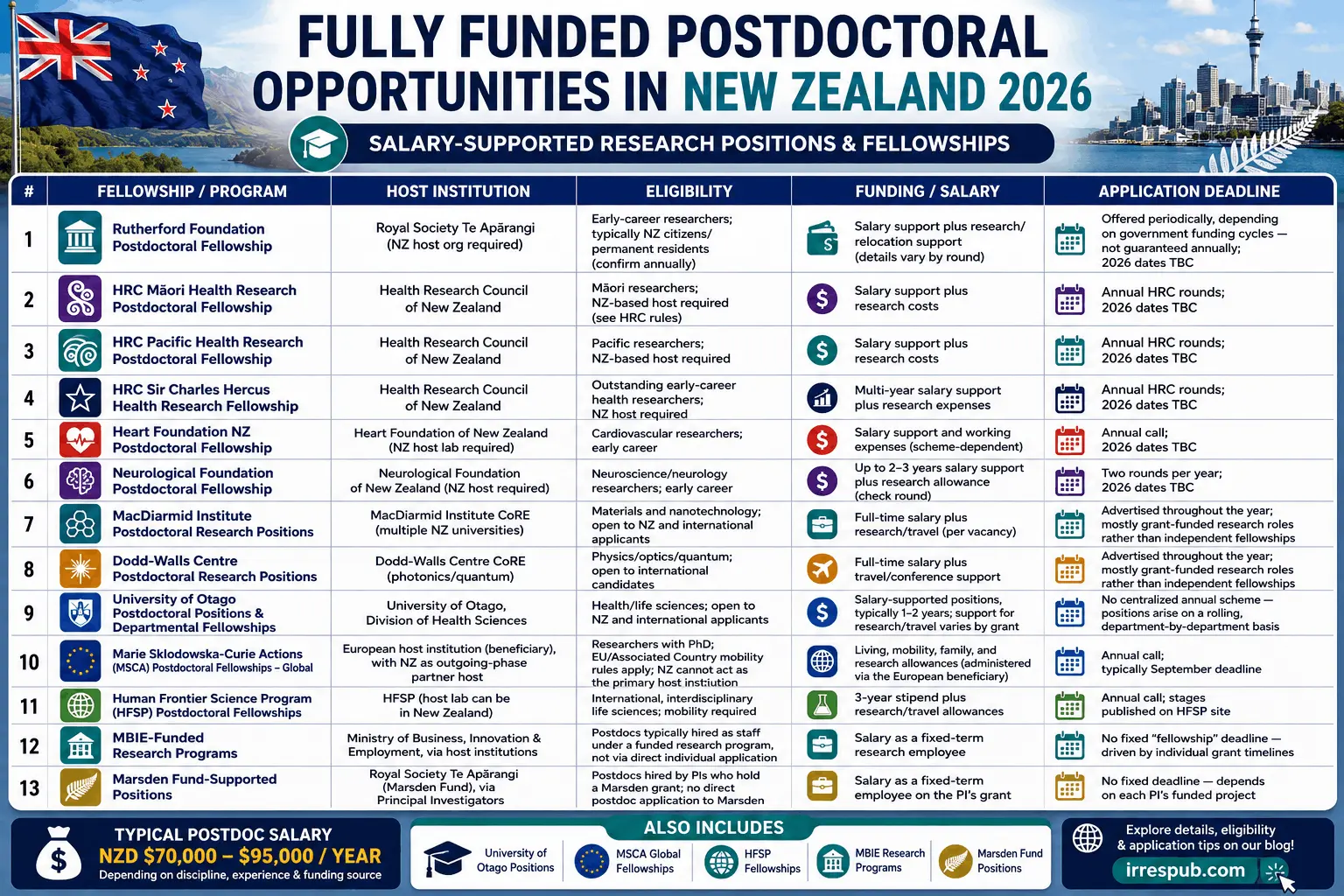
    At a Glance: Fully Funded Postdoctoral Fellowships in New Zealand 2026

    Fellowship / ProgramHost InstitutionEligibilityFunding / SalaryApplication DeadlineOfficial Link
    Rutherford Foundation Postdoctoral FellowshipRoyal Society Te Apārangi (NZ host org required)Early-career researchers; typically NZ citizens/permanent residents (confirm annually)Salary support plus research/relocation support (details vary by round)Offered periodically, depending on government funding cycles — not guaranteed annually; 2026 dates TBCOfficial Website
    HRC Māori Health Research Postdoctoral FellowshipHealth Research Council of New ZealandMāori researchers; NZ-based host required (see HRC rules)Salary support plus research costsAnnual HRC rounds; 2026 dates TBCOfficial Website
    HRC Pacific Health Research Postdoctoral FellowshipHealth Research Council of New ZealandPacific researchers; NZ-based host requiredSalary support plus research costsAnnual HRC rounds; 2026 dates TBCOfficial Website
    HRC Sir Charles Hercus Health Research FellowshipHealth Research Council of New ZealandOutstanding early-career health researchers; NZ host requiredMulti-year salary support plus research expensesAnnual HRC rounds; 2026 dates TBCOfficial Website
    Heart Foundation NZ Postdoctoral FellowshipHeart Foundation of New Zealand (NZ host lab required)Cardiovascular researchers; early careerSalary support and working expenses (scheme-dependent)Annual call; 2026 dates TBCOfficial Website
    Neurological Foundation Postdoctoral FellowshipNeurological Foundation of New Zealand (NZ host required)Neuroscience/neurology researchers; early careerUp to 2–3 years salary support plus research allowance (check round)Two rounds per year; 2026 dates TBCOfficial Website
    MacDiarmid Institute Postdoctoral Research PositionsMacDiarmid Institute CoRE (multiple NZ universities)Materials and nanotechnology; open to NZ and international applicantsFull-time salary plus research/travel (per vacancy)Advertised throughout the year; mostly grant-funded research roles rather than independent fellowshipsOfficial Website
    Dodd-Walls Centre Postdoctoral Research PositionsDodd-Walls Centre CoRE (photonics/quantum)Physics/optics/quantum; open to international candidatesFull-time salary plus travel/conference supportAdvertised throughout the year; mostly grant-funded research roles rather than independent fellowshipsOfficial Website
    University of Otago Postdoctoral Positions & Departmental FellowshipsUniversity of Otago, Division of Health SciencesHealth/life sciences; open to NZ and international applicantsSalary-supported positions, typically 1–2 years; support for research/travel varies by grantNo centralized annual scheme — positions arise on a rolling, department-by-department basisOfficial Website
    Marie Skłodowska-Curie Actions (MSCA) Postdoctoral Fellowships – GlobalEuropean host institution (beneficiary), with NZ as outgoing-phase partner hostResearchers with PhD; EU/Associated Country mobility rules apply; NZ cannot act as the primary host institutionLiving, mobility, family, and research allowances (administered via the European beneficiary)Annual call; typically September deadlineOfficial Website
    Human Frontier Science Program (HFSP) Postdoctoral FellowshipsHFSP (host lab can be in New Zealand)International, interdisciplinary life sciences; mobility required3-year stipend plus research/travel allowancesAnnual call; stages published on HFSP siteOfficial Website
    MBIE-Funded Research ProgramsMinistry of Business, Innovation & Employment, via host institutionsPostdocs typically hired as staff under a funded research program, not via direct individual applicationSalary as a fixed-term research employeeNo fixed “fellowship” deadline — driven by individual grant timelinesOfficial Website
    Marsden Fund-Supported PositionsRoyal Society Te Apārangi (Marsden Fund), via Principal InvestigatorsPostdocs hired by PIs who hold a Marsden grant; no direct postdoc application to Marsden itselfSalary as a fixed-term employee on the PI’s grantNo fixed deadline — depends on each PI’s funded projectOfficial Website

    A Quick Reality Check: How Postdoc Funding Actually Works in New Zealand

    Before diving into individual programs, it’s worth understanding the broader funding landscape:

    • MBIE (Ministry of Business, Innovation & Employment) funds large national research programs. Postdocs are usually hired as employees under these grants rather than through a standalone fellowship application.
    • The Marsden Fund (administered by Royal Society Te Apārangi) does not fund postdoctoral fellowships directly. Instead, it funds Principal Investigator-led grants, and PIs use that funding to hire postdoctoral researchers.
    • As a result, a large share of “postdoc opportunities” in New Zealand are really grant-funded jobs advertised by individual labs or departments, rather than independent, applicant-led fellowships. Keep this in mind when searching university and CoRE job boards — many of the best opportunities won’t appear under the word “fellowship” at all.

    Rutherford Foundation Postdoctoral Fellowship

    Overview

    Administered by Royal Society Te Apārangi, the Rutherford Foundation Postdoctoral Fellowship supports outstanding early-career researchers to establish independent research in New Zealand. It is one of the best Fully Funded Postdoctoral Fellowships in New Zealand. The Rutherford Foundation’s main focus has historically been PhD scholarships, with postdoctoral support linked to specific strategic funding rounds rather than a guaranteed annual call. Availability depends on government funding cycles and may not run every year — confirm current status directly with Royal Society Te Apārangi before planning around this fellowship.

    Funding and Benefits

    • Salary support for up to two years.
    • Contribution to research costs and, in some rounds, relocation/mentoring support.
    • Access to New Zealand’s national research networks.

    Eligibility

    • Recent PhD graduates (early postdoctoral stage).
    • Typically requires New Zealand citizenship or permanent residency; international applicants should verify the current rules.
    • Host institution in New Zealand required.

    Application Process

    • Apply via Royal Society Te Apārangi’s portal through a NZ host institution.
    • Competitive, peer-reviewed selection based on excellence and potential.
    • Deadlines vary by year and depend on whether a round is open; consult the official page.

    Official Website

    HRC Māori Health Research Postdoctoral Fellowship

    Overview

    The Health Research Council (HRC) Māori Health Research Postdoctoral Fellowship develops Māori health research leadership and capability across New Zealand institutions.

    Funding and Benefits

    • Salary support for the fellow.
    • Research expenses and professional development support.
    • Mentoring within a NZ research host environment.

    Eligibility

    • Māori researchers who have recently completed a PhD or are early-career.
    • NZ-based host required; citizenship/residency rules apply per HRC guidelines.

    Application Process

    • Register and submit through HRC’s online system.
    • Annual call; 2026 timelines will be published on HRC’s site.

    Official Website

    HRC Pacific Health Research Postdoctoral Fellowship: Fully Funded Postdoctoral Fellowships in New Zealand

    Overview

    Fully Funded Postdoctoral Fellowships in New Zealand builds Pacific health research capacity and supports impactful projects benefiting Pacific communities in New Zealand.

    Funding and Benefits

    • Salary support plus research costs.
    • Structured mentoring and professional development.

    Eligibility

    • Pacific researchers in early career stages.
    • Hosted by a New Zealand research institution; residency rules per HRC policies.

    Application Process

    • Submit via HRC’s portal in coordination with a NZ host.
    • Annual competitive round; dates vary year-to-year.

    Official Website

    HRC Sir Charles Hercus Health Research Fellowship

    Overview

    A prestigious award supporting exceptional emerging health researchers to accelerate their trajectory toward research independence and leadership. This is one of the most competitive HRC fellowships, and selection panels generally favor researchers who can demonstrate a clear, near-term benefit to the New Zealand health system.

    Funding and Benefits

    • Multi-year salary support.
    • Research expenses and development support.
    • Recognition that strengthens future competitiveness for major grants.

    Eligibility

    • Early-career health researchers with significant potential.
    • NZ host required; citizenship/residency conditions typically apply — confirm on the HRC website.
    • International applicants are typically only competitive if they are already embedded in a New Zealand institution or have a strong, established collaboration with one.

    Application Process

    • Institutional endorsement and submission through HRC systems.
    • Rigorous external peer review.

    Official Website

    Heart Foundation New Zealand Postdoctoral Fellowship

    Overview

    The Heart Foundation funds promising cardiovascular researchers to continue research after their PhD in New Zealand host labs.

    Funding and Benefits

    • Salary support for the duration of the fellowship (scheme-dependent).
    • Project-related expenses and travel support may be available.

    Eligibility

    • Early-career researchers in cardiovascular science/medicine.
    • New Zealand-based host institution required.

    Application Process

    • Apply through the Heart Foundation grants portal.
    • Annual calls; specifics and close dates vary each year.

    Official Website

    Neurological Foundation Postdoctoral Fellowship

    Overview

    This Fully Funded Postdoctoral Fellowships in New Zealand supports research into neurological conditions, enabling early-career scientists to build independence within NZ labs.

    Funding and Benefits

    • Salary for up to two or more years (check the current round’s terms).
    • Research-related allowances and professional development support.

    Eligibility

    • PhD in a relevant neuroscience/neurology field.
    • Position hosted at a New Zealand research institution.

    Application Process

    • Two competitive rounds per year.
    • Submit via the Foundation’s application system with host endorsement.

    Official Website

    MacDiarmid Institute Postdoctoral Research Positions a clear direction to Fully Funded Postdoctoral Fellowships in New Zealand

    Overview

    The MacDiarmid Institute (a Centre of Research Excellence) supports postdoctoral researchers across partner universities in advanced materials and nanotechnology, often in collaboration with industry. In practice, MacDiarmid rarely runs “fellowships” in the traditional, applicant-led sense — most opportunities are advertised as paid postdoctoral researcher roles tied to specific funded projects within the Institute.

    Funding and Benefits

    • Full-time salary support.
    • Opportunities to work across nodes and with industry partners.
    • Travel and conference support depending on the position.

    Eligibility

    • PhD in materials science, physics, chemistry, engineering, or related fields.
    • Open to New Zealand and international candidates.

    Application Process

    • Positions are advertised on the Institute and university job boards.
    • Recruitment is rolling; deadlines vary per vacancy.

    Official Website

    Dodd-Walls Centre Postdoctoral Research Positions

    Overview

    The Dodd-Walls Centre (CoRE) offers postdoctoral research positions in photonics, quantum optics, and precision measurement across several NZ universities. As with MacDiarmid, these are typically grant-funded postdoctoral researcher roles rather than independent, applicant-led fellowships.

    Funding and Benefits

    • Competitive salary packages.
    • Access to cutting-edge facilities and multi-institution collaboration.
    • Travel and development support.

    Eligibility

    • PhD in physics, optics, photonics, or allied disciplines.
    • Open to applicants worldwide.

    Application Process

    • Calls issued on the Centre’s opportunities page and university job sites.
    • Rolling recruitment; check specific advertisements.

    Official Website

    University of Otago Postdoctoral Positions and Departmental Fellowships

    Overview

    Otago’s Division of Health Sciences periodically supports postdoctoral researchers to grow capacity in biomedical, clinical, population, and public health research. There isn’t a single, centralized “Health Sciences Postdoctoral Fellowship” scheme that runs every year — most opportunities are grant-funded postdoc positions or occasional department-specific fellowships, advertised individually as funding allows.

    Funding and Benefits

    • Salary-supported appointments, typically around one to two years depending on the funding source.
    • Access to major core facilities and collaborator networks.

    Eligibility

    • Recently completed PhD in relevant health/life sciences fields.
    • Open to New Zealand and international applicants.

    Application Process

    • Positions and schemes are advertised on the University of Otago website and individual department pages.
    • Deadlines vary by department and funding stream — check regularly rather than expecting a single annual call.

    Official Website

    Marie Skłodowska-Curie Actions (MSCA) Postdoctoral Fellowships – Global

    Overview

    MSCA Global Postdoctoral Fellowships (European Commission) fund researchers for an outgoing period outside Europe — which can include New Zealand — followed by a mandatory return phase to Europe. It is one of the most prestigious Fully Funded Postdoctoral Fellowships in New Zealand. It’s important to understand the structure correctly: the fellowship is awarded and administered through a European beneficiary institution, and New Zealand only participates as a partner host during the outgoing phase. New Zealand cannot act as the primary host institution for an MSCA Global Fellowship.

    Funding and Benefits

    • Generous living, mobility, and family allowances, plus research, training, and management costs.
    • International, intersectoral training and secondments encouraged.

    Eligibility

    • PhD at the call deadline and mobility conditions as specified by MSCA.
    • Applicant is recruited by a European beneficiary; a New Zealand host participates as a partner organization for the outgoing phase only.

    Application Process

    • Coordinate with a European host institution first, then a NZ partner host for the outgoing phase.
    • Annual call with a typical September deadline; consult the MSCA site for exact 2026 dates.

    Official Website

    Human Frontier Science Program (HFSP) Postdoctoral Fellowships

    Overview

    HFSP supports frontier, interdisciplinary life science research with strong emphasis on international mobility. Fellows can be hosted in New Zealand labs as part of global collaborations.

    Funding and Benefits

    • Three-year stipend and research/travel allowances.
    • Focus on innovative, high-risk/high-gain projects.

    Eligibility

    • PhD in life sciences or related quantitative fields.
    • Mobility rules apply; host lab must differ from PhD or previous main host country (see HFSP rules).

    Application Process

    • Two-stage competition (letter of intent followed by full proposal, as announced each year).
    • Annual timeline published on HFSP’s official page.

    Official Website

    How to Choose the Right Opportunity

    • Match your eligibility: some schemes are open globally; others require NZ citizenship/permanent residency or Māori/Pacific affiliation.
    • Confirm the actual funding scope: understand what salary, research costs, overheads, and relocation are covered — and whether you’re applying to an independent fellowship or a grant-funded staff position.
    • Look beyond the word “fellowship”: many of the best-paying, most flexible postdoc opportunities in New Zealand are advertised as research staff positions tied to MBIE or Marsden-funded projects, not as named fellowships.
    • Secure a strong host: identify a supervisor with aligned publications, infrastructure, and funding track record.
    • Time your applications: many calls are annual; build in 3–6 months for proposal development and institutional approvals.

    Application Tips for 2026

    Best ways to the Fully Funded Postdoctoral Fellowships in New Zealand

    • Start early and contact potential supervisors 6–9 months before deadlines.
    • Align aims with New Zealand’s strengths (e.g., health equity, materials science, climate/Antarctic research, photonics/quantum).
    • Demonstrate independence: include your unique methodology, preliminary data, and a clear training plan.
    • Plan impact and engagement: outline benefits for NZ communities, industry, or policy where relevant.
    • Fact-check all scheme rules on the official websites before submission — terms change between funding rounds.

    Internal Resources to Boost Your Application

    • How to structure a winning fellowship proposal
    • Essential postdoc CV and track-record checklist
    • Grant writing mistakes to avoid in 2026

    Frequently Asked Questions on Fully Funded Postdoctoral Fellowships in New Zealand

    1) Are these fellowships truly “fully funded”?

    Most listed programs provide full-time salary support, and some add a separate research allowance — but few qualify as fully self-contained, fully funded fellowships in the strictest sense. Many are better understood as salaried postdoctoral positions within funded projects. Coverage and amounts differ by scheme and year. Always verify salary scales, research consumables, overheads, and travel on the official program pages before applying.

    2) Can international applicants apply to New Zealand postdoctoral fellowships?

    Yes, many opportunities are open internationally (e.g., MacDiarmid Institute, Dodd-Walls Centre, MSCA Global with a NZ partner host, HFSP with NZ hosts). Some national schemes (e.g., certain HRC or Rutherford Foundation rounds) may require NZ citizenship or permanent residency, and HRC’s most prestigious fellowships in particular tend to favor candidates already embedded in a NZ institution. Check each program’s eligibility notes.

    3) When do 2026 deadlines open?

    Major schemes run annually, but 2026 dates will be confirmed on official pages. MSCA PF typically closes around September; HRC and health charities publish annual calendars; CoRE and university postdoctoral positions post rolling vacancies rather than fixed annual deadlines.

    4) How competitive are these fellowships?

    They are competitive and peer-reviewed. A strong publication record, clear independence, strategic training plan, and an aligned NZ host significantly improve success odds.

    5) Can I bring my own project, or must I fit a lab’s theme?

    Both models exist. Fellowships like MSCA/HFSP emphasize applicant-led projects with host alignment. Institutional and CoRE positions, along with MBIE- and Marsden-funded roles, are usually tied to a funded project’s themes but still value your independent contribution.

    6) Do I need IRB/ethics or animal approvals at application?

    You typically don’t need final approvals at submission, but you must describe ethics considerations and timelines. Approvals are required before commencing relevant work.

    7) What if official information is unclear or not yet published for 2026?

    Consult the official website and contact the program manager or research office of your proposed NZ host. Do not rely on third-party summaries for final details.

    Conclusion: Fully Funded Postdoctoral Fellowships in New Zealand 2026

    New Zealand offers a robust portfolio of fully funded and salary-supported postdoctoral opportunities across health, fundamental science, and technology. From nationally competitive HRC and Royal Society Te Apārangi schemes to CoRE-based research positions and international programs like MSCA and HFSP that involve NZ hosts, you can find a funding pathway that matches your career stage and research vision. Just as importantly, remember that many of the strongest opportunities are grant-funded postdoctoral positions advertised by individual labs under MBIE or Marsden funding, rather than named fellowships — so it pays to search broadly. Verify all eligibility and deadlines on official pages, partner early with a strong NZ host, and craft a compelling, impact-driven proposal.

    About IR Research Publication

    IR Research Publication is dedicated to empowering researchers worldwide with credible, actionable resources on funding, publishing, and research careers. Our mission is to simplify complex opportunities, curate widely recognized and officially funded programs, and share practical strategies that help scholars secure competitive grants and fellowships, advance open science, and accelerate real-world impact.

    Related Articles

  • Fully Funded Postdoc Positions in Switzerland for Indian Researchers: 2026 Opportunities and Application Guide

    Fully Funded Postdoc Positions in Switzerland for Indian Researchers: 2026 Opportunities and Application Guide

    Switzerland is one of the world’s leading destinations for postdoctoral research, offering cutting-edge laboratories, internationally recognized universities, competitive research environments, and strong funding support. For Indian researchers who have recently completed their PhD, securing a fully funded postdoc position in Switzerland can significantly accelerate an academic or industry research career.

    This guide covers the best fully funded postdoctoral positions in Switzerland for Indian researchers in 2026, including fellowships, funded research contracts, and university-supported opportunities. It also explains eligibility, funding models, application timelines, and how to apply from India.

    Why Choose Switzerland for a Postdoc?

    Switzerland consistently ranks among the world’s best countries for research and innovation because of:

    1. High research investment and infrastructure
    2. Globally respected universities and institutes
    3. Strong international collaborations
    4. Competitive postdoctoral salaries
    5. Excellent quality of life and work-life balance

    Major research hubs include:

    • ETH Zurich
    • EPFL
    • University of Zurich
    • University of Basel
    • University of Geneva
    • Paul Scherrer Institute (PSI)
    • Empa, Eawag, and WSL

    Types of Postdoctoral Funding in Switzerland

    Indian researchers can secure funding through several pathways:

    1. Independent Fellowships

    These are competitive fellowships awarded directly to researchers.

    Examples:

    • ETH Zurich Postdoctoral Fellowship
    • EMBO Postdoctoral Fellowship
    • HFSP Fellowship

    2. Government-Funded Research Scholarships

    These programs support international researchers working with Swiss host institutions.

    Examples:

    • Swiss Government Excellence Scholarships
    • SNSF-supported funding mechanisms

    3. University-Funded Employment Contracts

    Many Swiss universities hire postdocs as salaried employees on research projects.

    Examples:

    • EPFL
    • University of Zurich
    • University of Basel
    • University of Geneva

    4. Research Institute Positions

    Switzerland’s federal research institutes regularly recruit postdoctoral researchers.

    Examples:

    • Paul Scherrer Institute (PSI)
    • Empa
    • Eawag
    • WSL

    Summary Table: Best Funded Postdoc Opportunities in Switzerland (2026)

    Program / PositionHost InstitutionEligibilityFunding ModelTypical Timeline*
    ETH Zurich Postdoctoral FellowshipETH ZurichRecent PhD graduates worldwideFull salary + research allowanceDeadlines on 1 March and 1 September
    SNSF Postdoctoral FundingSwiss National Science FoundationInternational researchersSalary and research supportVaries by scheme
    Swiss Government Excellence ScholarshipsSwiss ConfederationInternational researchers with Swiss host supportScholarship fundingApplications open Aug 20, 2026 for 2027–2028 cycle
    EPFL Funded Postdoctoral PositionsEPFLPhD holders worldwideSalaried research contractsRolling openings
    CYD Postdoctoral FellowshipEPFL & Swiss partnersCybersecurity researchersSalary + research fundingAnnual call
    HFSP FellowshipMultiple Swiss institutionsLife science researchersSalary + mobility supportAnnual call
    Marie Skłodowska-Curie FellowshipsSwiss host universitiesInternational researchersSalary + allowancesAnnual call
    EMBO Postdoctoral FellowshipSwiss universities & institutesLife science researchersSalary + relocation supportRolling/periodic calls
    University of Zurich Postdoctoral PositionsUniversity of ZurichPhD holdersSalaried research contractsRolling openings
    University of Basel Postdoctoral OpportunitiesUniversity of BaselInternational researchersSalaried research contractsRolling openings
    University of Geneva Research PositionsUniversity of GenevaRecent PhD graduatesSalaried research contractsRolling openings
    ETH Domain Research InstitutesPSI, Empa, Eawag, WSLPhD holdersFully funded employment contractsRolling openings

    *Always verify current deadlines and eligibility on the official website before applying.

    1. ETH Zurich Postdoctoral Fellowship

    The ETH Zurich Postdoctoral Fellowship is one of the most prestigious fully funded postdoc opportunities in Switzerland. It supports outstanding early-career researchers pursuing independent research at ETH Zurich.

    Key benefits

    • Full ETH-standard postdoctoral salary
    • Fellowship duration of up to 2 years
    • CHF 12,000 per year for research expenses
    • Mentorship from ETH faculty and access to world-class facilities

    Who should apply?

    • Indian PhD graduates with strong publication records
    • Researchers aiming for academic independence

    Application timeline

    ETH Zurich currently operates two annual deadlines:

    • 1 March
    • 1 September

    Official program page: https://grantsoffice.ethz.ch/funding-opportunities/internal/eth-fellowships.html

    2. SNSF Postdoctoral Funding

    The Swiss National Science Foundation (SNSF) supports postdoctoral researchers through various funding mechanisms and mobility programs connected to Swiss research institutions.

    Key benefits

    • Salary support
    • Research funding
    • International mobility opportunities

    Important note

    SNSF funding schemes and deadlines change over time. Applicants should consult the official SNSF website for the most current opportunities.

    Official website: https://www.snf.ch

    3. Swiss Government Excellence Scholarships

    The Swiss Government Excellence Scholarships support international researchers conducting research at Swiss universities and research institutions. Applicants typically require support from a Swiss academic host and submit applications through Swiss diplomatic representations in their home country.

    Key benefits

    • Monthly scholarship stipend
    • Health insurance coverage
    • Housing and relocation support in some cases
    • Access to Swiss research institutions

    Who should apply?

    • Indian researchers with a strong research proposal
    • Applicants who already have support from a Swiss supervisor or host institution

    Important update for the 2027–2028 cycle

    According to the official Swiss Government Excellence Scholarships website, applications for the 2027–2028 academic year are scheduled to open on August 20, 2026. Always verify the latest timeline and eligibility requirements on the official page.

    Official website: https://www.sbfi.admin.ch

    4. EPFL Funded Postdoctoral Positions

    The École Polytechnique Fédérale de Lausanne (EPFL) regularly advertises funded postdoctoral positions across engineering, life sciences, AI, robotics, and sustainability.

    Key benefits

    • Competitive Swiss research salary
    • State-of-the-art laboratories
    • Strong industry and international collaborations

    Who should apply?

    Researchers interested in interdisciplinary science and engineering with strong technical or computational skills.

    Official website: https://www.epfl.ch/research/funding/individual/postdocs/at-epfl/

    5. CYD Postdoctoral Fellowship

    The Cyber-Defence (CYD) Fellowship supports postdoctoral research in cybersecurity, AI, and data science through collaboration between EPFL and Swiss government partners.

    Key benefits

    • Full funding and salary support
    • Research budget and infrastructure access
    • Connections with government and industry cybersecurity networks

    Who should apply?

    Researchers specializing in:

    • Cybersecurity
    • Artificial intelligence
    • Data science
    • Information security

    Official website: https://www.epfl.ch/research/funding/epfl-programmes/cyd/cyd-postdoc/

    6. Human Frontier Science Program (HFSP) Fellowship

    The HFSP Fellowship funds innovative interdisciplinary research in the life sciences and is highly respected internationally.

    Key benefits

    • Competitive salary support
    • Relocation and mobility funding
    • International research networking

    Who should apply?

    Life science researchers working in areas such as:

    • Biology
    • Neuroscience
    • Biotechnology
    • Biomedical sciences

    Official website: https://www.hfsp.org/funding/hfsp-funding/postdoctoral-fellowships

    7. Marie Skłodowska-Curie Postdoctoral Fellowships

    These prestigious European fellowships allow researchers to conduct postdoctoral research at Swiss host institutions.

    Key benefits

    • Competitive salary
    • Mobility allowance
    • Research and training support

    Who should apply?

    Researchers with strong international research profiles who want structured career development and mobility opportunities.

    Official website: https://marie-sklodowska-curie-actions.ec.europa.eu/actions/postdoctoral-fellowships

    8. EMBO Postdoctoral Fellowship

    The EMBO Postdoctoral Fellowship is one of the best-funded opportunities for life science researchers seeking postdoctoral research in Switzerland.

    Key benefits

    • Salary support
    • Relocation allowance
    • Access to the EMBO research network

    Who should apply?

    Life science researchers with strong publication records and a clear research plan.

    Official website: https://www.embo.org/funding/fellowships-grants-and-career-support/postdoctoral-fellowships/

    9. University of Zurich Postdoctoral Positions

    The University of Zurich regularly recruits postdoctoral researchers through faculty grants, collaborative projects, and externally funded research programs.

    Key benefits

    • Competitive Swiss salary
    • Comprehensive research support
    • Opportunities across biomedical, social, and natural sciences

    Official website: https://www.research.uzh.ch/en/funding/postdoc.html

    10. University of Basel Postdoctoral Opportunities

    The University of Basel offers funded postdoctoral opportunities in biomedical sciences, molecular biology, public health, chemistry, and clinical research.

    Key benefits

    • Salaried research contracts
    • Access to strong biomedical research networks
    • Collaboration with hospitals and international institutes

    Official website: https://www.unibas.ch/en/Research/Individual-Funding/Postdocs/Find-a-Postdoc-Position.html

    11. University of Geneva Research Positions

    The University of Geneva hosts numerous funded postdoctoral and research positions, often connected to international organizations and collaborative projects.

    Key benefits

    • Competitive salary
    • International research environment
    • Opportunities linked to global policy and scientific institutions

    Official website: https://mocel.unige.ch/education-and-careers/open-positions/open-positions

    12. ETH Domain Research Institutes (PSI, Empa, Eawag, WSL)

    Switzerland’s federal research institutes frequently advertise fully funded postdoc positions in Switzerland through salaried employment contracts.

    Institutes include

    • Paul Scherrer Institute (PSI)
    • Empa
    • Eawag
    • WSL

    Key benefits

    • Full employment contracts with benefits
    • Advanced research infrastructure
    • Strong industry and applied-research collaborations

    Official ETH Domain portal: https://ethrat.ch/en/eth-domain/research-institutes-psi-wsl-empa-eawag/

    Switzerland Postdoc Salary and Funding

    Swiss postdoctoral researchers are typically employed under salaried contracts and generally receive competitive compensation compared with most European countries.

    Funding often includes:

    • Monthly salary
    • Social security benefits
    • Health insurance contributions
    • Pension contributions
    • Research funding for fellowship holders

    Actual salaries vary by institution, funding source, discipline, and years of experience. Universities such as ETH Zurich and EPFL are known for offering particularly competitive compensation packages.

    How to Apply for a Postdoc in Switzerland from India

    1. Identify research groupsFind Swiss professors and laboratories whose work matches your expertise and publications.
    2. Prepare application materialsTypical documents include:
      • Academic CV
      • Cover letter or motivation letter
      • Publication list
      • Research proposal or research statement
      • PhD certificate and transcripts
      • Recommendation letters
    3. Contact potential supervisorsA personalized email explaining your research fit is often essential for Swiss postdoc applications.
    4. Apply for fellowships or positionsYou may apply for independent fellowships (ETH, EMBO, HFSP, Marie Curie), government scholarships, or directly advertised university postdoc positions.
    5. Prepare for interviews and visa stepsShortlisted candidates may be interviewed online, and successful applicants will later complete Swiss visa and residence procedures with their host institution’s support.

    Frequently Asked Questions

    Are postdoc positions in Switzerland fully funded?

    Yes. Most Swiss postdoctoral opportunities are funded either through salaried employment contracts, institutional fellowships, or government-supported research programs.

    How can Indian researchers get a postdoc in Switzerland?

    Indian researchers usually secure a host professor, apply for open postdoctoral positions, or compete for fellowships such as ETH Zurich, EMBO, HFSP, or Marie Skłodowska-Curie fellowships.

    Which Swiss universities offer funded postdoc programs?

    Top institutions include ETH Zurich, EPFL, the University of Zurich, the University of Basel, and the University of Geneva.

    What is the salary for a postdoc in Switzerland?

    Swiss postdocs generally receive competitive salaries with benefits such as social security, pension contributions, and health insurance support. Exact amounts vary by institution and discipline.

    Is the Swiss Government Excellence Scholarship available for postdoc applicants?

    The program supports international researchers working with Swiss host institutions, but eligibility and funding structures can change. The official page indicates that applications for the 2027–2028 cycle open on August 20, 2026.

    What documents are needed for a Swiss postdoc application?

    Common requirements include a CV, research proposal, PhD certificate, transcripts, recommendation letters, publication list, and motivation letter.

    Can international researchers apply for postdoc funding in Switzerland?

    Yes. Most major Swiss fellowships and university-funded postdoctoral positions are open to international applicants, including researchers from India.

    Internal Resources from IR Research Publication

    For more guidance on international research careers and funding, explore these resources from IR Research Publication:

    About IR Research Publication

    IR Research Publication is an international open-access scholarly publishing platform dedicated to disseminating high-quality research across scientific disciplines. The platform publishes peer-reviewed articles, reviews, methods papers, and academic resources while promoting global scientific collaboration and knowledge sharing.

    Website: https://irrespub.com/

    Disclaimer

    Funding programs, eligibility criteria, and application deadlines change regularly. Readers should always verify information through the official fellowship, university, or government website before submitting an application.

  • Fully Funded PhD Programs in Switzerland for Indian Students: 2026 Guide

    Fully Funded PhD Programs in Switzerland for Indian Students: 2026 Guide


    Introduction: Why Pursue a Funded PhD in Switzerland?

    Switzerland is among the most sought-after destinations for doctoral research. Home to globally ranked institutions, including ETH Zurich and EPFL – it offers Indian students not just a prestigious degree, but in many cases a monthly salary, world-class infrastructure, and a genuine launchpad for an international research career.

    Here is why Switzerland stands out:

    • Many PhD positions are employment contracts. Across Switzerland’s grant-funded STEM and science programs, doctoral candidates are typically hired as doctoral assistants or research assistants, receiving a salary with social insurance benefits. This is not universal — it depends on the program, faculty, and funding source — but it is common and well-documented at ETH Zurich, EPFL, and the cantonal universities.
    • Registration fees are low. Swiss public universities charge low semester registration fees rather than standard tuition. However, the amount varies by institution, and scholarship holders may be expected to cover fees out of their own funds.
    • India has been a CERN Associate Member State since 2017. Indian nationals are eligible for CERN’s Doctoral Student Programme, one of the most competitive and respected doctoral opportunities in physics, engineering, and computing.
    • The Swiss Government Excellence Scholarship (ESKAS) explicitly includes India as an eligible country and confirms that self-certified document copies are accepted for Indian applicants.

    Whether you are a fresh Master’s graduate, an early-career researcher, or a scientist looking to transition into European academia, this guide covers every major funded PhD opportunity available to Indian students in Switzerland for 2026 and the upcoming 2027 cycle.

    Looking for funded PhD opportunities across Europe? Read our complete guide to Fully Funded PhD Scholarships in Europe for Indian Students (2026) and Fully Funded PhD Scholarships in Canada for Indian Students (2026).


    Are PhD Positions in Switzerland Funded?

    Many are — and Switzerland’s funding model is among the best in the world. The key distinction is that most funded PhD positions in Switzerland are not “scholarships” in the traditional sense. Instead, they fall into three distinct categories:

    1. Employment-based PhD positions — The most common route, especially in STEM. Doctoral candidates are hired on fixed-term employment contracts by a professor’s research group (funded by SNSF grants, EU projects, or institutional funds). They receive a regular monthly salary, social insurance, and paid leave.
    2. University doctoral fellowships — Structured competitive programs at specific departments or institutes (e.g., Biozentrum Basel PhD Fellowships), which provide full funding for the PhD duration.
    3. Government and external scholarships — Such as the Swiss Government Excellence Scholarship (ESKAS), which provides a monthly payment covering basic living costs, though it is explicitly described as a living allowance, not a salary.

    Understanding this distinction matters. A doctoral assistant at ETH Zurich earns roughly CHF 61,300 gross in year one. A Swiss Government Excellence Scholarship holder receives CHF 2,450/month as a living stipend — a meaningful difference in take-home income and employment status.


    Summary Table: Funded PhD Programs in Switzerland for Indian Students (2026)

    Program / PositionHost InstitutionEligibilityFunding / SalaryApplication DeadlineOfficial Link
    Swiss Government Excellence Scholarships (ESKAS) — PhD TrackAll major Swiss public universitiesMaster’s degree; born after Dec 31, 1991; India eligibleCHF 2,450/month (living allowance, not salary) + health insurance + return flight allowanceCountry-specific; India ~Nov 2025 (2026–27); Aug 2026 opens for 2027–28sbfi.admin.ch
    ETH Zurich Doctoral PositionsETH ZurichMaster’s degree in relevant field; professor acceptance~CHF 61,300–64,200/year gross (doctoral assistant, 2026 rates; varies by project)Rolling / position-specificjobs.ethz.ch
    EPFL Doctoral AssistantshipsEPFL LausanneMaster’s degree; doctoral program admissionCompetitive annual salary (varies by program; EPFL publishes rates on HR pages)Rolling / program deadlinesepfl.ch/education/phd
    CERN Doctoral Student ProgrammeCERN, GenevaEnrolled in PhD program; CERN member/associate state (India eligible)~CHF 3,891/month + travel + health insuranceRolling (multiple cycles)home.cern/students-fellows
    University of Zurich (UZH) Doctoral PositionsUniversity of ZurichMaster’s degree; supervisor acceptanceSalary-based (~CHF 47,000–55,000/year; varies by faculty and grant)Rollinguzh.ch/jobs
    University of Geneva (UNIGE) PhD PositionsUniversity of GenevaMaster’s degree; research proposalSalary-based (~CHF 45,000–50,000/year; varies by faculty)Rollingunige.ch/research/doctoral-studies
    Biozentrum Basel International PhD FellowshipsUniversity of BaselOutstanding academic record; Life SciencesFull PhD funding for entire durationAnnual call; May 2026 cycle — check for next callbiozentrum.unibas.ch/phd
    Graduate Institute Geneva — PhD Financial AidGraduate Institute GenevaMerit/need-based; strong academic profileTuition waiver + monthly stipend (amount varies by award)Integrated with admissiongraduateinstitute.ch/phd
    University of Bern Doctoral PositionsUniversity of BernMaster’s degree; supervisor acceptanceStipend/salary (varies by faculty and funding)Rollingunibe.ch/research
    EPFLglobaLeaders Doctoral FellowshipEPFL LausanneEarly-stage PhD; MSCA mobility rules applyEU contribution of EUR 1,935/month + lab top-up to full EPFL salaryMSCA call-specificepfl.ch/epflglobaleaders
    Swiss National MD-PhD Fellowships (SAMW)Swiss universities + EPFLMedical degree + PhD enrollmentFull salary at SNSF rate + social contributionsMay 15, 2026 (2026 call); watch for 2027samw.ch

    Note: Deadlines and amounts shown reflect the most recently confirmed information at time of writing. Always verify current details on the official program pages before applying.


    Top 11 Funded PhD Programs in Switzerland for Indian Students


    1. Swiss Government Excellence Scholarships (ESKAS / FCS)

    Overview

    The Swiss Government Excellence Scholarships — administered by the Federal Commission for Scholarships for Foreign Students (FCS/ESKAS) — are Switzerland’s flagship government award for international researchers. The Swiss Confederation funds these scholarships to promote academic exchange and research cooperation across over 180 countries, including India.

    The PhD scholarship track supports doctoral research at any of Switzerland’s 12 cantonal universities, ETH Zurich, EPFL, or the Graduate Institute Geneva. Applications are submitted through the Swiss Embassy or consulate in India.

    What the scholarship actually provides (per official ESKAS page, 2027–28 cycle)

    • Monthly payment of CHF 2,450 to cover basic living expenses for one person
    • This is explicitly described by ESKAS as a living allowance, not a salary
    • Health insurance premiums covered by FCS for non-EU/EFTA scholarship holders (India qualifies)
    • One-time CHF 600 rental deposit grant
    • Return flight allowance (lump sum, used within 2 months of scholarship end, for return to India)
    • Half-Fare Swiss public transport card
    • Duration: 12 months, renewable twice for up to 36 months, subject to academic progress
    • Tuition and semester fees are not covered — scholarship holders must pay these separately (typically CHF 600–2,000/semester depending on university)

    Eligibility for Indian Applicants

    • Must hold a Master’s degree completed by 31 July 2027 (ETH Zurich: 30 June 2027) for the 2027–28 cycle
    • Born after December 31, 1991
    • Must not have lived in Switzerland for more than 13 months before the start date
    • A detailed research proposal with timeline is required
    • A mandatory letter of support from a Swiss academic supervisor is required — without this, the application is rejected. Finding this supervisor is the applicant’s responsibility and can take weeks to months

    India-Specific Notes

    • For Indian applicants, self-certified document copies are accepted (confirmed on the official ESKAS application guidance page) — certified translations are only required for documents not in English, French, Italian, or German
    • Applications for 2026–27 closed approximately November 2025 (India deadline). For 2027–28, the online portal opens August 20, 2026 and country-specific deadlines will be published at that time
    • Results announced by end of May of the application year

    Official Page: https://www.sbfi.admin.ch/en/swiss-government-excellence-scholarships-at-a-glance


    2. ETH Zurich — Doctoral Assistant Positions

    Overview

    ETH Zurich consistently ranks among the world’s top universities. Its doctoral model does not operate through a central scholarship program — instead, professors hire doctoral candidates as doctoral assistants on employment contracts funded by research grants (SNSF, EU Horizon, ETH internal). This makes funding highly stable for grant-funded positions.

    Doctoral candidates at ETH Zurich are employees of the university. The ETH salary table (as of January 1, 2026, published on the official ETH HR/Welcome Center page) shows fixed-rate gross salaries for doctoral students increasing from Year 1 to Year 3, with no further automatic increases from Year 4 onward. Multiple consistent sources cite the approximate range as CHF 61,300 (Year 1) to CHF 64,200 (Year 4) for 100% employment, though exact rates require verification via the official ETH salary tables as these are updated annually.

    Key Benefits

    • Competitive gross annual salary (approximately CHF 61,000–64,000 at 100% employment, 2026 rates — verify current figures at ethz.ch/salary)
    • Swiss social insurance contributions (AHV/IV, pension) included
    • Low registration fees — ETH introduced differentiated tuition categories from Autumn 2025; doctoral candidates should check current fee regulations at ethz.ch/students/tuition-fees
    • Paid vacation and standard Swiss employment conditions
    • Access to world-class research infrastructure and international collaborations

    Who Should Apply

    • Indian applicants with a strong Master’s degree in STEM (engineering, computer science, natural sciences, mathematics, environmental sciences, architecture)
    • Applicants with research publications, strong references, or prior lab experience
    • The most effective approach: directly email professors whose current research aligns with your interests, attaching a tailored cover letter, CV, and brief research statement. Professors at ETH have significant autonomy in hiring.

    Job Portal: https://jobs.ethz.ch/


    3. EPFL — Doctoral Assistantships

    Overview

    The École Polytechnique Fédérale de Lausanne (EPFL) in Lausanne is one of Europe’s most innovative research universities. It organizes doctoral training through multiple doctoral programs across engineering, life sciences, basic sciences, computing, environment, and architecture. Like ETH Zurich, EPFL employs doctoral candidates as doctoral assistants on employment contracts.

    EPFL publishes its salary scales for doctoral assistants officially on its HR pages. The starting gross annual salary for doctoral assistants at EPFL is listed on epfl.ch/campus/services/human-resources/salaries and increases annually. Approximately 40% of EPFL doctoral students come from outside Europe, reflecting its highly international character.

    Key Benefits

    • Annual salary and benefits per EPFL doctoral assistant scale (verify current amounts on official EPFL HR page)
    • Full Swiss social security, health insurance contributions, pension
    • Access to EPFL’s Innovation Park, industry partnerships, and extensive research infrastructure
    • Possibility to apply for competitive add-on fellowships: EPFLglobaLeaders, Swiss Government Excellence Scholarship top-ups
    • Duration: typically 4 years

    Who Should Apply

    • Indian students with a strong Master’s degree in STEM, with research publications or strong project work
    • Applicants targeting specific EPFL doctoral programs: Computer and Communication Sciences, Life Sciences Engineering, Materials Science, Electrical Engineering, Mathematics
    • Apply either through EPFL’s doctoral program portals, or directly by emailing a prospective supervisor with your CV and research proposal

    Doctoral Admission: https://www.epfl.ch/education/phd/


    4. CERN Doctoral Student Programme

    Overview

    The CERN Doctoral Student Programme allows PhD candidates to conduct their thesis research at CERN — the European Organization for Nuclear Research in Geneva — for up to 36 months while remaining registered at their home university. CERN is the world’s largest particle physics laboratory and a unique environment for high-energy physics, engineering, and computing research.

    India has been a CERN Associate Member State since 2017, which makes Indian nationals eligible for CERN’s student and fellowship programs, including the Doctoral Student Programme. Doctoral students spend time at CERN in Geneva, but the degree is awarded by the candidate’s enrolled university — the two supervisors (CERN and home university) collaborate on thesis arrangements.

    Key Benefits

    • Monthly stipend of approximately CHF 3,891 (tax-advantaged)
    • Travel expenses to Geneva
    • Health insurance coverage
    • Paid annual leave
    • Hands-on access to CERN’s research facilities, experiments, and global scientific network
    • No IELTS required; good command of English or French is expected

    Eligibility

    • Must be a national of a CERN Member or Associate Member State (India qualifies)
    • Must be enrolled in, or about to start, a doctoral program at a recognized university
    • Research conducted at CERN must form part of, or all of, the doctoral thesis
    • Relevant fields: Applied Physics, Engineering, Computing
    • Multiple application deadlines per year

    Official Page: https://home.cern/students-fellows


    5. University of Zurich (UZH) — Doctoral Positions

    Overview

    The University of Zurich is Switzerland’s largest university, with particular strength in medicine, life sciences, social sciences, law, and humanities. Doctoral candidates at UZH are typically employed as university assistants on fixed-term contracts funded by research grants.

    Key Benefits

    • Annual salary approximately CHF 47,000–55,000 gross depending on faculty, year, and funding source (these are indicative ranges — actual salary is determined by the hiring professor’s grant and university scales)
    • Full Swiss social security contributions
    • Access to UZH’s research hospitals, life science clusters, and collaboration with nearby ETH Zurich
    • Duration: typically 3–4 years

    Who Should Apply

    • Indian students with a Master’s degree targeting areas of UZH strength: medicine, neuroscience, biochemistry, law, economics, social sciences, humanities
    • Monitor the UZH jobs portal regularly and contact professors directly

    Job Portal: https://www.uzh.ch/en/explore/jobs.html


    6. University of Geneva (UNIGE) — PhD Positions

    Overview

    The University of Geneva is particularly renowned for international relations, law, medicine, and natural sciences. Its location — surrounded by UN agencies, WHO, ICRC, WTO, and hundreds of international organizations — makes it uniquely valuable for researchers in policy, global health, and social sciences.

    Key Benefits

    • Annual salary approximately CHF 45,000–50,000 gross (varies by faculty and funding source)
    • Access to Geneva’s international ecosystem for interdisciplinary research
    • Doctoral positions across all faculties; particularly strong in science, medicine, social sciences, and international studies
    • Swiss social insurance and employment benefits

    Who Should Apply

    • Indian students targeting social sciences, international health, environmental sciences, law, or natural sciences
    • Those interested in connecting doctoral research to the Geneva international organization ecosystem

    Doctoral Studies: https://www.unige.ch/research/doctoral-studies/


    7. University of Basel — Biozentrum International PhD Fellowships

    Overview

    The Biozentrum at the University of Basel is internationally recognized for molecular biology and biochemistry. Its International PhD Fellowship Program, supported by the Werner Siemens Foundation since 2007, is one of the few structured, competitive cohort-based PhD fellowship programs in Switzerland with a fixed annual deadline and formal selection process.

    Key Benefits

    • Full funding for the entire PhD (duration typically 3–4 years)
    • Competitive monthly stipend
    • Structured doctoral training: seminars, lab rotations, mentoring, and career development
    • State-of-the-art infrastructure in structural biology, cell biology, neurobiology, and biochemistry
    • Strong international alumni network

    Who Should Apply

    • Indian students with outstanding academic records in molecular biology, biochemistry, structural biology, cell biology, or related life sciences
    • Those with strong research motivation and willingness to work in a highly competitive discovery-driven environment
    • The most recent call deadline was May 8, 2026 — check the official page for the next annual call

    Official Page: https://www.biozentrum.unibas.ch/phd/international-phd-program/phd-fellowships


    8. Graduate Institute Geneva — PhD Financial Aid and Fellowships

    Overview

    The Graduate Institute of International and Development Studies (IHEID) in Geneva is a world-leading institution for international relations, development studies, political science, and international economics. It offers merit and need-based financial aid integrated with PhD admission — applicants do not apply separately for funding; it is assessed alongside the main application.

    Key Benefits

    • For the most competitive packages: tuition waiver + monthly stipend + health insurance contribution
    • Aid amounts vary by award type; some cover the full PhD, others are partial or renewable annually
    • Location advantage: direct proximity to the UN, ICRC, ILO, WTO, WEF, MSF, and 200+ international organizations

    Who Should Apply

    • Indian students with a strong Master’s in social sciences, political science, economics, law, or international relations
    • Those whose research bridges academic rigor and policy relevance in areas like global governance, humanitarian affairs, development economics, or international security

    PhD Programs: https://www.graduateinstitute.ch/study/programmes/phd


    9. University of Bern — Doctoral Positions and Scholarships

    Overview

    The University of Bern, located in Switzerland’s federal capital, covers all major academic disciplines with particular strength in climate science, environmental research, medical research, law, humanities, and theology. Funded doctoral positions exist across all faculties, primarily through professor-led research grants.

    Key Benefits

    • Salary or stipend depending on funding source and faculty (varies widely — confirm with the host department)
    • Access to the Oeschger Centre for Climate Change Research and other interdisciplinary institutes
    • Swiss Government Excellence Scholarships can be used at the University of Bern for eligible applicants

    Who Should Apply

    • Indian students interested in climate science, environmental studies, medicine, humanities, or law
    • Search the University of Bern job portal and contact professors directly

    Research Portal: https://www.unibe.ch/research/index_eng.html


    10. EPFLglobaLeaders Doctoral Fellowship

    Overview

    EPFLglobaLeaders is an MSCA COFUND doctoral fellowship program at EPFL. It funds 48-month (4-year) doctoral positions at EPFL campuses. A distinctive feature is the requirement for non-academic co-supervision, connecting research to industry or NGO partners.

    Key Benefits

    • EU contribution of EUR 1,935/month toward the doctoral candidate’s salary
    • The hosting laboratory must complement this contribution to the full EPFL doctoral assistant salary
    • Research costs, equipment, travel, and conference expenses covered by the hosting lab
    • Integrated leadership training program
    • Open to any nationality, subject to MSCA transnational mobility rules (candidates must not have resided in Switzerland for more than 12 months in the 3 years before the call deadline)

    Who Should Apply

    • Indian students who satisfy the MSCA mobility condition and are targeting EPFL research areas
    • Those interested in combining academic research with non-academic sector impact

    Fellowship Page: https://www.epfl.ch/education/phd/doctoral-studies-structure/customized-curricula/epflglobaleaders/


    11. Swiss National MD-PhD Fellowships (SAMW/ASSM)

    Overview

    The Swiss Academy of Medical Sciences (SAMW/ASSM) funds the Swiss National MD-PhD Fellowship Program, enabling physicians to pursue doctoral research in natural sciences, public health, clinical research, or biomedical ethics. At EPFL, applicants must be enrolled at the School of Life Sciences.

    Key Benefits

    • Salary at the SNSF rate with employer social security contributions covered
    • Duration: 2 to 3 years, with a 4th year possible if guaranteed by the host institution
    • One of the few programs designed specifically for medical doctors pursuing a PhD in Switzerland

    Who Should Apply

    • Indian students holding an MBBS/MD and planning doctoral research in biomedical science
    • Those enrollable at a Swiss medical faculty or EPFL School of Life Sciences
    • The 2026 call deadline was May 15, 2026 — check the official SAMW page for the 2027 call

    Official Page: https://www.samw.ch/en/Funding/MD-PhD-Fellowships.html


    How Can Indian Students Apply for a PhD in Switzerland? Step-by-Step Guide

    Step 1: Identify Your Field and Target Institution

    Start by identifying which Swiss university or institute is strongest in your specific research area:

    • STEM/Engineering/Computing: ETH Zurich, EPFL
    • Life Sciences/Medicine: UZH, University of Basel, EPFL
    • Social Sciences/International Affairs: Graduate Institute Geneva, UNIGE, University of St. Gallen
    • Climate/Environment: University of Bern, EPFL, ETH Zurich
    • Particle Physics/Engineering/Computing: CERN

    Step 2: Find and Contact a Supervisor

    This is the most critical step. In Switzerland, professors largely hire their own doctoral students — especially in employment-based positions. Contact potential supervisors by:

    • Reading their recent publications on Google Scholar
    • Writing a specific, tailored email (not a mass-broadcast email) explaining which paper/project interested you and how your background is relevant
    • Attaching a concise CV and a 1-page research statement
    • Being patient — professors receive many emails and may take weeks to respond

    Step 3: Secure a Supervision Letter

    For the Swiss Government Excellence Scholarship and many structured fellowships, a formal written confirmation from a Swiss professor that they are willing to supervise you is mandatory. Without it, most formal scholarship applications will not be considered.

    Step 4: Apply for Funding

    Once you have a professor’s interest or confirmation, apply through the appropriate funding route:

    • ESKAS — via Swiss Embassy in India (for government scholarship track)
    • University doctoral program portal — for structured PhD programs
    • CERN careers portal — for CERN Doctoral Student Programme
    • Direct hiring — if the professor has grant funds, they may hire you directly without a separate scholarship application

    Step 5: Prepare Your Application Documents

    • Master’s transcripts and degree certificate
    • Research proposal with timeline (the centerpiece for ESKAS)
    • Full CV/resume
    • Two recommendation letters from professors (use ESKAS forms for government scholarships)
    • Language proficiency evidence (if required by the specific program)
    • Passport copy
    • For ESKAS: self-certified copies accepted for Indian applicants (official confirmation)

    Step 6: Submit and Follow Up

    Follow each program’s submission instructions exactly. For ESKAS, the application goes through the Swiss Embassy in New Delhi. For university positions, applications are submitted online. Follow up politely if you don’t hear back within 6–8 weeks.


    What Are the Eligibility Criteria for a PhD in Switzerland?

    General eligibility criteria across most funded doctoral programs:

    • Qualification: Master’s degree (MSc, MTech, MA, MPhil, or equivalent) from a recognized Indian university — Swiss institutions generally recognize Indian postgraduate qualifications, though admission decisions are program- and institution-specific
    • Academic Record: Strong GPA and research experience; publications strengthen applications considerably for competitive programs
    • Research Proposal: Required for ESKAS and structured fellowship programs; important even for cold-email applications
    • Language: Most research programs at ETH, EPFL, and UZH are conducted in English. French proficiency may be needed at UNIGE and UNIL. No blanket IELTS requirement exists — requirements vary by program and institution; always check the specific program’s language policy
    • Age: ESKAS requires applicants born after December 31, 1991 (for the 2027–28 cycle)
    • Residency: ESKAS requires that applicants have not lived in Switzerland for more than 13 months before the scholarship start date
    • Supervisor Confirmation: Required for ESKAS; practically important for all routes

    How to Find PhD Vacancies in Switzerland for Indians

    Use these six channels systematically:

    1. University job portals (most reliable for employment-based positions)
    2. EURAXESS — EU/Swiss research positions: https://euraxess.ec.europa.eu/
    3. SNSF project database — Browse https://p3.snf.ch/ to find professors with active grants, then email them directly
    4. Direct cold email to professors — The most widely used route in Switzerland; professors with SNSF or EU grants typically have funds to hire PhD students and advertise informally or not at all
    5. CERN careers portal: https://jobs.smartrecruiters.com/CERN/
    6. Google Scholar alerts — Set alerts for papers from Swiss research groups in your field; reply-contact the corresponding authors

    Looking for fellowship opportunities that can support your PhD applications globally? See Top Fellowships & Funding Opportunities for PhD Students in India (2026) for domestic funding you can combine with Switzerland applications.


    Do PhD Students in Switzerland Receive a Salary?

    The answer depends on the type of doctoral position.

    Employment-based positions (most STEM/science positions at ETH, EPFL, UZH, UNIGE, Bern) pay a regular monthly salary under Swiss employment law. Based on multiple consistent sources, approximate gross annual salary ranges for doctoral assistants in 2026 are:

    InstitutionApprox. Gross Annual Salary (Year 1)Notes
    ETH Zurich~CHF 61,300Fixed-rate scale; increases annually to Year 3
    EPFLVaries; check EPFL HR pagePublished on EPFL’s remuneration pages
    University of Zurich~CHF 47,000–55,000Faculty and grant dependent
    University of Geneva~CHF 45,000–50,000Faculty dependent
    CERN Doctoral Programme~CHF 46,700/year (CHF 3,891/month)Stipend, not employment salary
    Swiss Govt Excellence ScholarshipCHF 29,400/year (CHF 2,450/month)Living allowance, explicitly not a salary

    Important: These are gross figures. Net take-home after Swiss social contributions (~12–15%) will be lower. Cost of living in Zurich and Geneva is high — candidates should budget carefully.


    FAQ: Frequently Asked Questions

    Q1. Are PhD positions in Switzerland fully funded?

    Many PhD positions in Switzerland — particularly in STEM fields — are funded through employment contracts backed by research grants. The term “fully funded” covers employment-based positions (salary + benefits) and fellowship-based positions (stipend + allowances). Not every PhD route in Switzerland is employment-based; structured fellowships and government scholarships operate differently. The important takeaway: it is common, though not automatic, to receive a salary or substantial living support as a doctoral researcher in Switzerland.


    Q2. Is PhD in Switzerland free for international students?

    “Free” is not quite accurate. Swiss universities charge low semester registration fees rather than full tuition, but the amount varies by institution and residency status. ETH Zurich introduced differentiated tuition categories from Autumn 2025 — doctoral candidates should check current fee regulations directly with their target institution. The Swiss Government Excellence Scholarship does not cover tuition or semester fees; scholarship holders are expected to cover these from their monthly allowance.


    Q3. How can Indian students apply for a PhD in Switzerland?

    The main routes are: (1) applying directly to advertised PhD positions on university job portals by contacting professors; (2) applying for the Swiss Government Excellence Scholarship through the Swiss Embassy in India; or (3) applying to the CERN Doctoral Student Programme (India eligible since 2017). For all routes, securing a supervision letter from a Swiss professor is the most critical preparatory step.


    Q4. Which Swiss universities offer funded PhD positions for Indians?

    All major Swiss public universities have funded doctoral positions that Indian students can apply for: ETH Zurich, EPFL, University of Zurich (UZH), University of Geneva (UNIGE), University of Basel, University of Bern, University of Lausanne (UNIL), University of St. Gallen (HSG), and the Graduate Institute Geneva. CERN in Geneva also accepts Indian doctoral students.


    Q5. What is the PhD stipend or salary in Switzerland?

    It depends on the funding type. Employment-based positions at ETH Zurich pay approximately CHF 61,000+ gross per year. The Swiss Government Excellence Scholarship pays CHF 2,450/month as a living allowance (2027–28 rate, per official ESKAS page). CERN’s Doctoral Student Programme pays approximately CHF 3,891/month. Amounts should always be verified against the official source for the specific program and year.


    Q6. What is the deadline for the Swiss Government Excellence Scholarship for Indian students?

    For the 2026–27 academic year, India’s deadline was approximately November 10, 2025. For the 2027–28 cycle, the online application portal opens August 20, 2026, and country-specific deadlines will be published at that time on the official ESKAS website. Always verify through sbfi.admin.ch or the Swiss Embassy in New Delhi.


    Q7. Do I need IELTS for a PhD in Switzerland?

    There is no single blanket requirement. ETH Zurich and EPFL primarily work in English for their doctoral programs and often do not require a formal IELTS score if previous degrees were in English — but policies vary by department and supervisor. CERN explicitly does not require IELTS proof. French-medium programs at UNIGE or UNIL may require French proficiency. Always check the specific program and department requirements before applying.


    About IR Research Publication

    IR Research Publication (irrespub.com) is a scientific journal publisher and editorial services provider committed to supporting researchers, academics, and students at every stage of their scholarly journey. Beyond publishing peer-reviewed research, IR Research Publication maintains an active knowledge resource hub — covering funded PhD opportunities, fellowship guides, postdoctoral funding databases, and academic career advice for Indian and international researchers.

    Whether you are submitting your first manuscript, navigating peer review, or searching for your next funded research position, IR Research Publication is your trusted partner in academic excellence.


    Related Blog Posts from IR Research Publication

    1. Fully Funded PhD Scholarships in Europe for Indian Students (2026) — 20+ verified opportunities across Germany, France, Sweden, Netherlands, Switzerland, and more.
    2. Top Fellowships & Funding Opportunities for PhD Students in India (2026) — PMRF, CSIR, UGC NET, DST-INSPIRE, NIPER, IISER fellowships with stipends and eligibility.
    3. Fully Funded PhD Scholarships in Canada for Indian Students (2026) — CGRS-D, Trudeau Foundation, Ontario Trillium, UBC, University of Toronto.
    4. Fully Funded PhD Scholarships in Singapore: 2026 Guide — SINGA, NUS, NTU, A*STAR and more.
    5. Fully Funded Postdoctoral Fellowships in South Korea (2026) — Top programs for international postdoctoral researchers.

    Last updated: June 2026. All funding amounts, deadlines, and eligibility criteria should be verified on official program websites before applying, as these are updated annually.

  • Fully Funded PhD Scholarships in Singapore: 2026 Guide for International Students

    Fully Funded PhD Scholarships in Singapore: 2026 Guide for International Students


    Introduction: Why Pursue a Fully Funded PhD in Singapore?

    Singapore has firmly established itself as one of Asia’s premier destinations for doctoral research. Home to world-ranked institutions, cutting-edge laboratories, and a thriving innovation economy, the city-state attracts thousands of international PhD applicants every year — and with good reason.

    The best part? A PhD in Singapore is, in most cases, fully funded. For international students, this means tuition fees, a competitive monthly living stipend, and often travel allowances — all covered. Whether you are a STEM researcher, a social scientist, or an engineer with a passion for discovery, Singapore’s universities and research agencies offer some of the most generous doctoral funding packages in the world.

    This comprehensive 2026 guide covers 10+ fully funded PhD scholarships in Singapore for international students, including official links, stipend amounts, eligibility criteria, and application deadlines. If you are searching for fully funded PhD positions in Singapore, this is the only guide you need.


    Are PhDs in Singapore Fully Funded for International Students?

    Yes — in most cases. The majority of PhD programmes at Singapore’s autonomous universities (NUS, NTU, SUTD, SMU, and SIT) come with scholarship packages that cover:

    • Full tuition fee waiver
    • Monthly stipend (typically SGD 2,000–3,600 depending on scholarship and stage)
    • Settling-in allowance (one-time, on arrival)
    • Airfare grant (for select scholarships)
    • Medical insurance (varies by institution)

    The key is to apply for the right scholarship alongside your PhD admission. Most funding is awarded automatically when you are admitted — but competitive fellowships like SINGA and the NUS President’s Graduate Fellowship require a separate application.

    Looking for opportunities in other regions? See our guide on Fully Funded PhD Scholarships in Europe for Indian Students (2026) and Fully Funded PhD Scholarships in Canada for Indian Students (2026).


    Summary Table: Top Fully Funded PhD Scholarships in Singapore 2026

    #Scholarship / ProgrammeHost InstitutionEligible NationalitiesMonthly StipendApplication DeadlineOfficial Link
    1Singapore International Graduate Award (SINGA)NUS, NTU, SUTD, SMU, A*STARAll internationalSGD 2,700–3,200June 1, 2026 (Jan 2027 intake)singa.a-star.edu.sg
    2NUS Research Scholarship (NUS-RS)National University of SingaporeAll nationalitiesSGD 3,000–3,500Rolling (check portal)nusgs.nus.edu.sg
    3NUS President’s Graduate Fellowship (PGF)National University of SingaporeAll nationalitiesSGD 3,000–3,500+With PhD admissionnusgs.nus.edu.sg/scholarships/pgf
    4NTU Research ScholarshipNanyang Technological UniversityAll nationalitiesSGD 2,000–2,700Rolling / per intakentu.edu.sg/admissions/graduate
    5Nanyang President’s Graduate Scholarship (NPGS)Nanyang Technological UniversityAll nationalitiesSGD 3,200–3,600Jun–Jul 2026 (Jan 2027 intake)ntu.edu.sg/admissions/graduate/financialmatters/scholarships/npgs
    6A*STAR Graduate Scholarship (AGS)A*STAR + NUS/NTU/SUTD/SMUAll (non-PR foreigners: 3-yr bond)SGD 2,800–3,200Rollinga-star.edu.sg/scholarships
    7SUTD President’s Graduate Fellowship (PGF)Singapore Univ. of Tech. & DesignAll nationalitiesSGD 3,600 (international)April 15, 2026sutd.edu.sg/admissions/graduate
    8SMU Presidential Doctoral FellowshipSingapore Management UniversityAll nationalitiesCompetitive stipendWith PhD admissionsmu.edu.sg/phd
    9A*STAR National Science Scholarship – PhDA*STARAll (PR required for non-Singaporeans)Competitive (equiv. to AGS)Rollinga-star.edu.sg/scholarships
    10Singapore-MIT Alliance (SMA) Graduate FellowshipNUS / NTU (with MIT)All nationalitiesSGD 2,700–3,200Per intakesmart.mit.edu
    11Lee Kong Chian Graduate ScholarshipNUS (LKCMedicine / FASS)All nationalitiesEquivalent to NUS-RSWith PhD admissionnusgs.nus.edu.sg

    Detailed Profiles: Fully Funded PhD Scholarships in Singapore

    1. Singapore International Graduate Award (SINGA)

    Overview

    SINGA is widely regarded as the flagship fully funded PhD scholarship in Singapore for international students. Administered by the Agency for Science, Technology and Research (A*STAR) in collaboration with NUS, NTU, SUTD, SMU, and SIT, SINGA attracts approximately 240 scholars per year across the physical sciences, biomedical sciences, and engineering.

    Key Benefits

    • Full tuition fee coverage for up to 4 years
    • Monthly stipend of SGD 2,700 (rising to SGD 3,200 after passing the PhD Qualifying Examination)
    • One-time settling-in allowance of SGD 1,000
    • One-time airfare grant of up to SGD 1,500
    • Bond-free — no post-graduation work obligation in Singapore
    • Access to A*STAR’s world-class research institutes and equipment

    Who Should Apply

    International graduates (bachelor’s or master’s) with outstanding academic records and a strong passion for research in science and engineering. No specific GRE or IELTS score is mandated at the time of application, making SINGA accessible to strong candidates globally.

    Deadline: June 1, 2026 (January 2027 intake)

    Official Page: https://singa.a-star.edu.sg


    2. NUS Research Scholarship (NUS-RS)

    Overview

    The NUS Research Scholarship is the most common PhD funding mechanism at the National University of Singapore, one of Asia’s top-ranked institutions. It is offered across all faculties and disciplines, from STEM to arts and social sciences, making it one of the most versatile fully funded PhD scholarships in Singapore.

    Key Benefits

    • Full tuition fee subsidy for up to 4 years
    • Monthly stipend of approximately SGD 3,000 for international students (rising by up to SGD 500 after passing the PhD Qualifying Examination)
    • Renewable each semester subject to satisfactory academic performance
    • Graduate Assistantship Programme (GAP) requirement: 208 hours of teaching/research assistance duties (non-Singaporeans)

    Who Should Apply

    Any international graduate with at least a Second Class (Upper) Honours degree or equivalent who has been offered or is seeking PhD admission at NUS. The scholarship is awarded alongside admission in many cases — select “NUS Research Scholarship” in the admissions portal.

    Deadline: Rolling deadlines; the August 2026 intake closes approximately April–May 2026. Check the NUS Graduate School portal for exact dates.

    Official Page: https://nusgs.nus.edu.sg


    3. NUS President’s Graduate Fellowship (PGF)

    Overview

    The President’s Graduate Fellowship at NUS is a prestigious, merit-based doctoral fellowship awarded to incoming PhD candidates who demonstrate exceptional promise in research. It is the highest PhD-level honour offered by NUS and is funded by institutional donors including the Lee Kong Chian Foundation.

    Key Benefits

    • Full tuition fee waiver
    • Monthly stipend of SGD 3,000–3,500 (higher than the standard NUS-RS rate)
    • Up to 4 years of coverage, renewed each semester
    • Prestige and networking advantages within Singapore’s academic community

    Who Should Apply

    Outstanding final-year undergraduates or recent graduates across all disciplines who can demonstrate an exceptional research record — publications, awards, research projects — and are seeking admission to a full-time PhD programme at NUS.

    Deadline: Considered simultaneously with PhD admission applications.

    Official Page: https://nusgs.nus.edu.sg/scholarships/


    4. NTU Research Scholarship

    Overview

    The NTU Research Scholarship is Nanyang Technological University’s standard funding package for full-time PhD candidates. It is assigned by the relevant NTU school during the PhD application process and is available to both local and international students across NTU’s research-intensive disciplines including engineering, science, business, and humanities.

    Key Benefits

    • Full tuition fee coverage
    • Monthly stipend of SGD 2,000 for international students (increasing by up to SGD 500 after the PhD Qualifying Examination)
    • Teaching/lab supervision duties under the Graduate Assistantship Programme (GAP)
    • No post-graduation service bond

    Who Should Apply

    International applicants applying for a full-time PhD by research at NTU in any school. The scholarship is applied for as part of the standard PhD application — no separate form is required.

    Deadline: Per intake (August and January). Check the NTU Graduate Admissions portal for current cycle deadlines.

    Official Page: https://www.ntu.edu.sg/admissions/graduate/financialmatters/scholarships


    5. Nanyang President’s Graduate Scholarship (NPGS)

    Overview

    The NPGS is NTU’s most prestigious doctoral scholarship, designed to attract the world’s brightest graduates to pursue PhD research at Nanyang. It goes beyond the standard NTU Research Scholarship by offering a substantially higher stipend and additional academic support, positioning recipients as future leaders in research.

    Key Benefits

    • Full annual tuition fee coverage
    • Higher monthly stipend (SGD 3,200–3,600, depending on citizenship status)
    • Overseas conference allowance (revised April 2026)
    • Priority for campus accommodation
    • Maximum award period of 4 years

    Who Should Apply

    Outstanding final-year undergraduates or recent graduates of any nationality seeking to pursue a PhD at NTU. The scholarship is by nomination only — shortlisted candidates are invited to interview. Applications for Academic Year 2026–2027 (January 2027 intake) open from June 1 to July 31, 2026.

    Official Page: https://www.ntu.edu.sg/admissions/graduate/financialmatters/scholarships/npgs


    6. A*STAR Graduate Scholarship (AGS)

    Overview

    The A*STAR Graduate Scholarship (AGS) is offered directly by Singapore’s Agency for Science, Technology and Research. It funds PhD or EngD (Engineering Doctorate) studies at Singapore’s autonomous universities (NUS, NTU, SUTD, SMU), with research conducted at an A*STAR Research Institute — giving scholars direct industry-oriented lab experience alongside their academic degree.

    AGS has four focused tracks:

    • STEM Track — Broad sciences (biology, chemistry, physics, engineering)
    • Semicon Track — Semiconductor chip design and materials science
    • Quantum Track — Quantum computing and sensing
    • Computing Track — AI, data science, and information systems

    Key Benefits

    • Full tuition fee coverage for up to 4 years
    • Monthly stipend of SGD 2,800–3,200
    • Book, computer, conference, and thesis allowances throughout candidature
    • Unique opportunity for a 12-month overseas attachment at a top global research institution
    • Pathway to A*STAR International Fellowship (AIF) after PhD completion

    Who Should Apply

    Singapore Citizens, Singapore PRs, and non-PR international students who have completed (or are completing) a degree at a Singapore autonomous university. Non-PR foreigners must commit to a 3-year service obligation in Singapore-based companies after graduation.

    Official Page: https://www.a-star.edu.sg/scholarships/home/scholarships/ags–scholarship


    7. SUTD President’s Graduate Fellowship (PGF)

    Overview

    The Singapore University of Technology and Design (SUTD), established in collaboration with MIT, offers the President’s Graduate Fellowship for top-tier PhD candidates. SUTD’s unique design-centric, technology-driven approach makes this scholarship especially attractive for researchers working at the intersection of engineering, architecture, computer science, and social sciences.

    Key Benefits

    • Full tuition coverage
    • Monthly stipend of SGD 3,600 for international PhD students (the highest standard PhD stipend among Singapore’s universities for this scholarship tier)
    • Free campus housing, a registration fee waiver, and health insurance coverage
    • Award period: 4 years (PhD)

    Who Should Apply

    Outstanding domestic and international students seeking full-time PhD admission at SUTD. 780 fully funded scholarship spots are available across PhD, Master’s, and Bachelor’s programmes at SUTD for 2026–2027.

    Deadline: April 15, 2026 (check SUTD portal for updated cycles)

    Official Page: https://www.sutd.edu.sg/Admissions/Graduate/Scholarships


    8. SMU Presidential Doctoral Fellowship

    Overview

    Singapore Management University (SMU), consistently ranked among Asia’s top business and social science universities, offers the Presidential Doctoral Fellowship to exceptionally qualified candidates entering its PhD programmes. SMU’s downtown Singapore location provides unmatched access to the financial, tech, and policy sectors, making it the ideal hub for research in business, economics, law, information systems, and social sciences.

    Key Benefits

    • Competitive monthly stipend (equivalent to or above standard NUS/NTU PhD levels)
    • Full tuition coverage
    • Situated in the heart of Singapore’s central business district
    • Access to SMU’s extensive corporate research partnerships

    Who Should Apply

    International and local candidates of any nationality who demonstrate outstanding academic standing and are seeking to enrol in one of SMU’s PhD programmes in business, computing, economics, law, or social sciences.

    Official Page: https://www.smu.edu.sg/programmes/phd


    9. A*STAR National Science Scholarship – PhD (NSS-PhD)

    Overview

    The National Science Scholarship (PhD), offered by A*STAR, is targeted at individuals who wish to build a long-term research career in Singapore. Unlike SINGA (which is bond-free), the NSS-PhD requires a post-graduation service commitment in Singapore, but in return offers a premium stipend package and a structured career pathway within A*STAR Research Institutes.

    Key Benefits

    • Full tuition coverage for the duration of the PhD
    • Competitive monthly stipend (aligned with AGS rates)
    • Opportunity for overseas PhD training at partner institutions (MIT, Stanford, Cambridge, and others)
    • Clear career progression into A*STAR’s research ecosystem

    Who Should Apply

    All nationalities are welcome to apply. Non-Singaporeans who are not Singapore Permanent Residents must obtain Singapore PR status before starting their studies. Candidates with a strong academic record and a genuine interest in building a research career in Singapore are ideal applicants.

    Official Page: https://www.a-star.edu.sg/scholarships/home/scholarships


    10. Singapore-MIT Alliance for Research and Technology (SMART) Graduate Fellowship

    Overview

    The Singapore-MIT Alliance Graduate Fellowship is a prestigious, government-funded fellowship jointly administered by NUS and NTU in partnership with the Massachusetts Institute of Technology (MIT). It is designed to attract exceptional doctoral students in science and technology, offering them the unique advantage of conducting research at the intersection of Singapore’s and MIT’s world-class research environments.

    Key Benefits

    • Monthly stipend equivalent to the NUS/NTU Research Scholarship (SGD 2,700–3,200)
    • Full tuition fee coverage for up to 4 years
    • Exposure to a unique bilateral research community with access to MIT faculty and resources
    • Strong interdisciplinary research focus across STEM fields

    Who Should Apply

    Highly talented PhD candidates from Singapore (NUS/NTU) who wish to conduct research with an international dimension and collaborate with one of the world’s top research universities.

    Official Page: https://www.smart.mit.edu


    11. Lee Kong Chian Graduate Scholarship (LKCGS)

    Overview

    The Lee Kong Chian Graduate Scholarship is a donor-funded PhD scholarship at NUS, provided through the Lee Kong Chian Foundation. It is primarily available to candidates entering the NUS President’s Graduate Fellowship programme (under the Lee Kong Chian track) and places special emphasis on leadership ability and community service alongside academic excellence.

    Key Benefits

    • Equivalent financial benefits to the NUS President’s Graduate Fellowship (full tuition + stipend of SGD 3,000–3,500)
    • Renewable for up to 4 years
    • Strong institutional support and mentorship network
    • Leadership development components

    Who Should Apply

    Outstanding PhD applicants at NUS across all disciplines who can demonstrate a strong track record not only in academic research, but also in community service and leadership. Preference is given to those applying for the PGF.

    Official Page: https://nusgs.nus.edu.sg


    How to Get a Fully Funded PhD in Singapore: Step-by-Step Guide

    Step 1: Identify Your Research Area and Target University

    Singapore’s universities each have distinctive research strengths. NUS leads in biomedical sciences, computing, and social sciences. NTU is a global leader in engineering, AI, and sustainability. SUTD excels in design-driven technology. SMU is the go-to for business, law, and information systems.

    Step 2: Find a Potential Supervisor

    Most Singapore PhD programmes require that you identify and contact a faculty supervisor before applying. Browse faculty profiles on university websites, read their recent publications, and write a concise, personalised email expressing your research interest.

    Step 3: Prepare Your Application Documents

    Common requirements across all fully funded PhD scholarships in Singapore include:

    • Academic transcripts (all degrees, certified)
    • CV/resume
    • Research proposal or statement of purpose
    • Two to three letters of recommendation
    • English proficiency certificate (IELTS/TOEFL, if applicable; many scholarships waive this if your degree was taught in English)
    • Passport copy and recent passport-size photo

    Step 4: Apply Early and Apply to Multiple Scholarships

    For competitive awards like SINGA and NPGS, the selection process is rigorous. Submit your application at least two weeks before the deadline, as your referees need time to upload recommendation letters (typically 7 days after receiving their invitation).

    Step 5: Prepare for Interviews

    Shortlisted candidates for SINGA, NPGS, and the NUS PGF are typically called for an interview within 12 weeks of the application deadline. Prepare to discuss your research interests, prior experience, and career goals.

    For tips on strengthening your research profile and application materials, see our guide on Top Fellowships & Funding Opportunities for PhD Students in India in 2026 and explore Fully Funded Postdoctoral Fellowships in Singapore if you are a postdoc-level researcher.


    What Is the Stipend for PhD Students in Singapore?

    Stipend amounts vary by scholarship and student status. Here is a quick overview of typical PhD stipend ranges for international students in Singapore (as of 2026):

    ScholarshipMonthly Stipend (Pre-QE)Monthly Stipend (Post-QE)
    SINGASGD 2,700SGD 3,200
    NUS Research ScholarshipSGD 3,000SGD 3,500
    NUS PGFSGD 3,000–3,500SGD 3,500+
    NTU Research ScholarshipSGD 2,000SGD 2,500
    NPGS (NTU)SGD 3,200SGD 3,600+
    A*STAR AGSSGD 2,800SGD 3,200
    SUTD PGFSGD 3,600SGD 3,600+

    QE = PhD Qualifying Examination, typically held 12–18 months after registration.

    Singapore’s average cost of living for a PhD student is approximately SGD 1,200–1,800 per month, meaning these stipends comfortably cover living expenses and leave a meaningful monthly surplus — a significant advantage over many equivalent programmes in the US or UK.


    Eligibility Criteria for PhD Scholarships in Singapore

    While each scholarship has its own specific requirements, the common eligibility criteria for fully funded PhD scholarships in Singapore are:

    • A bachelor’s degree (or master’s degree) with strong academic standing — typically a 2nd Class Upper Honours or equivalent (GPA 3.5/4.0 or above)
    • Excellent command of written and spoken English (IELTS/TOEFL often waived if prior degree was in English)
    • A clearly defined research interest aligned with the host university/lab
    • Strong letters of recommendation from academic referees
    • For SINGA: open to all international graduates; no age restriction
    • For A*STAR AGS: non-PR foreigners must have studied at a Singapore autonomous university
    • For NPGS: competitive nomination process; no nationality restriction

    FAQ: Fully Funded PhD Scholarships in Singapore

    Q1. Is a PhD in Singapore fully funded for international students?

    Yes, in the majority of cases. Most PhD programmes at NUS, NTU, SUTD, SMU, and SIT come bundled with a scholarship that covers full tuition fees and a monthly living stipend. The most common funding vehicle is the university’s own research scholarship (e.g., NUS-RS or NTU-RS), which is often offered alongside the admission letter.

    Q2. How do I apply for PhD scholarships in Singapore?

    For most university-based scholarships (NUS-RS, NTU-RS), you simply tick the scholarship consideration box within the standard PhD admissions application. For competitive independent awards like SINGA and NPGS, you must apply separately through their dedicated portals. Always apply early to allow referees time to submit their letters.

    Q3. Which universities in Singapore offer fully funded PhD scholarships?

    All five autonomous universities in Singapore offer fully funded PhD scholarships: the National University of Singapore (NUS), Nanyang Technological University (NTU), Singapore University of Technology and Design (SUTD), Singapore Management University (SMU), and the Singapore Institute of Technology (SIT).

    Q4. What is the monthly stipend for PhD students in Singapore in 2026?

    For international students, monthly PhD stipends range from SGD 2,000 to SGD 3,600 depending on the scholarship and the student’s stage in the programme (before or after the Qualifying Examination). SINGA scholars receive SGD 2,700–3,200, while SUTD PGF recipients receive up to SGD 3,600.

    Q5. Do Singapore PhD scholarships require a bond?

    It depends on the scholarship. SINGA is notably bond-free. The A*STAR Graduate Scholarship (AGS) requires a 3-year service commitment in Singapore for non-PR international students. The NUS Research Scholarship and NTU Research Scholarship require the completion of Graduate Assistantship Programme (GAP) hours during the PhD — but not a post-graduation bond.

    Q6. What is the eligibility for SINGA 2026?

    SINGA is open to all international graduates with a passion for research and an excellent academic record. Applicants must have good English communication skills and two academic referee reports. There is no restriction on nationality, age, or country of prior study. Research must be in biomedical sciences, physical sciences, or engineering.

    Q7. Can I apply for a PhD in Singapore directly after my bachelor’s degree?

    Yes. SINGA and several university scholarships explicitly welcome applicants with only a bachelor’s degree, allowing them to enter a direct PhD programme. If the applicant also holds a master’s degree, they may be eligible to skip some coursework requirements upon enrolment.


    About IR Research Publication

    IR Research Publication (IRReSPub) is a scientific journal publisher and editorial service provider committed to supporting researchers at every stage of their academic journey. Beyond publishing rigorous peer-reviewed content in the biological sciences and related fields, IRReSPub maintains a rich library of guides on fellowship opportunities, PhD funding, and academic career pathways for international scholars.

    Whether you are preparing your first research manuscript, seeking a fully funded doctoral position, or exploring postdoctoral fellowship opportunities across Asia and beyond, IRReSPub’s resources are designed to give you accurate, actionable, and up-to-date information.

    Explore IRReSPub’s editorial and profile-building services — from proofreading and manuscript editing to academic CV development — to put your best application forward.


    Related Articles from IR Research Publication

    Expand your scholarship search with these curated guides:

    1. Fully Funded Postdoctoral Fellowships in Singapore: Stipends, Benefits, and 2026 Deadlines — If you already hold a PhD and are looking for postdoctoral opportunities in Singapore (LKYPDF, NTU Presidential Fellowship, NRF Fellowship, and more), this is the guide for you.
    2. Fully Funded PhD Scholarships in Europe for Indian Students (2026) — Explore 20+ verified, fully funded doctoral programmes across Germany, France, Sweden, the Netherlands, Switzerland, and more.
    3. Fully Funded PhD Scholarships in Canada for Indian Students (2026) — A complete guide covering CGRS-D, Trudeau Foundation, Ontario Trillium, UBC, University of Toronto, and other top Canadian doctoral funding options.
    4. Top Fellowships & Funding Opportunities for PhD Students in India in 2026 — Discover PMRF, CSIR, UGC NET, DST-INSPIRE, NIPER, and IISER fellowships with stipends, eligibility criteria, and application tips.
    5. Your Guide to Fully Funded Postdoctoral Fellowships in South Korea: Stipends, Eligibility, and 2026 Application Windows — Comprehensive coverage of Korea’s leading postdoctoral funding schemes for international researchers.
    6. Fully Funded PhD in Japan in 2026: Top Scholarships for International Students — A detailed look at MEXT, OIST, University of Tokyo, Kyoto, and other fully funded doctoral programmes in Japan.

    This article was last reviewed and updated in May 2026. All scholarship information is based on official university and government sources. Deadlines and stipend amounts are subject to change — always verify directly on the official programme page before applying.

  • Fully Funded Postdoctoral Fellowships in Japan: Stipends, Eligibility, and 2026 Deadlines

    Fully Funded Postdoctoral Fellowships in Japan: Stipends, Eligibility, and 2026 Deadlines


    Introduction

    Japan is one of the world’s premier destinations for postdoctoral research. Home to Nobel-winning scientists, world-class universities like the University of Tokyo and Kyoto University, and advanced research institutes like RIKEN and OIST, Japan offers international scholars an unmatched environment to accelerate their academic careers.

    For early-career researchers wondering how to get a postdoctoral fellowship in Japan, the good news is that numerous fully funded postdoctoral fellowships in Japan are open to international applicants — covering stipends, airfare, health insurance, and research grants. Whether you are a PhD holder from Asia, Africa, Europe, or the Americas, there is a program designed for your background and research focus.

    This guide covers more than 10 of the best postdoc programs in Japan for international students, with verified stipend figures, eligibility criteria, deadlines, and direct links to official pages. It is designed to be the most practical and comprehensive resource available — helping you move from “interested” to “applied.”


    Looking for postdoc opportunities beyond Japan? Also check out:


    Summary Table: Top Fully Funded Postdoctoral Fellowships in Japan (2026)

    #Program NameHost OrganizationEligibilityFunding / StipendApplication DeadlineOfficial Link
    1JSPS Postdoctoral Fellowship (Standard)Japan Society for the Promotion of ScienceNon-Japanese PhD holders (PhD within 6 years)¥362,000/month + airfare + ¥200,000 settling allowanceRolling (check JSPS site)jsps.go.jp
    2JSPS Short-term Fellowship (PE)JSPS (US, Canada, Europe)US/Canada/EU citizens, PhD within 6 years¥362,000/month + airfareJune 5, 2026 (3rd call)jsps.go.jp
    3RIKEN Special Postdoctoral Researcher (SPDR)RIKENAll nationalities, PhD within ~5 years~¥550,000/month (gross)Annual (FY2027 call: April 2026)riken.jp
    4JSPS–UNU Postdoctoral FellowshipJSPS + United Nations UniversityNon-Japanese PhD holders; sustainability focus¥362,000/month + airfare + allowancesJanuary 31, 2026 (2026 cycle closed; 2027 opens late 2026)unu.edu
    5Matsumae International Foundation FellowshipMatsumae International FoundationNon-Japanese PhD holders, ≤45 years, no prior Japan residence¥220,000/month + ¥120,000 arrival fund + airfareJune 1–30, 2026 (for 2027 cycle)mif-japan.org
    6OIST Postdoctoral Scholar PositionsOkinawa Institute of Science & TechnologyPhD in relevant field; all nationalities¥4.5M–5.9M/year (~¥375,000–490,000/month)Rolling (per vacancy)oist.jp/careers
    7OIST Buribushi FellowshipOkinawa Institute of Science & TechnologyTheory-focused researchers, PhD between Sept 2018–Sept 2026Competitive with Assistant Professor salary + ~¥10M/year research fundsPer announcementoist.jp
    8Canon Foundation Research FellowshipCanon Foundation in EuropeEuropean nationals with Master’s or PhD (within 10 years)Up to €30,000/yearSeptember 15, 2026canonfoundation.org
    9MEXT Research Scholarship (Research Student Track)Ministry of Education, JapanInternational graduate/post-graduate students¥145,000/month (doctoral) + tuition + airfareApril–May 2026 (embassy route)studyinjapan.go.jp
    10JSPS Short-term Fellowship (PA) – ASEAN/AfricaJSPSPre/postdoc researchers from ASEAN & Africa¥362,000/month (PhD holders) + airfareAnnual (check JSPS regional offices)jsps.go.jp
    11University of Tokyo FellowshipUniversity of TokyoInternational graduate research students¥200,000/month (up to 1 year)Per graduate school intakeu-tokyo.ac.jp

    1. JSPS Postdoctoral Fellowship for Research in Japan — Standard Program

    Overview

    The JSPS Postdoctoral Fellowship (Standard Program) is the flagship international postdoctoral fellowship in Japan, administered by the Japan Society for the Promotion of Science. It is widely regarded as one of the most prestigious and financially generous postdoc programs in Asia. The fellowship supports overseas researchers in conducting collaborative research with leading groups at Japanese universities and national research institutes across all fields — from the natural sciences to the humanities and social sciences.

    Applications are submitted through a Japanese host institution, not directly to JSPS. The first step is identifying and confirming a host researcher in Japan whose work aligns with your own.

    Key Benefits

    • Monthly stipend: ¥362,000 (~USD 2,400–2,500)
    • Round-trip economy airfare (based on JSPS regulations)
    • Settling-in allowance: ¥200,000 (one-time, upon arrival)
    • Overseas travel insurance for the duration of the fellowship
    • Access to KAKENHI (Grant-in-Aid for Scientific Research): The host researcher can apply for cooperative research funds on behalf of the fellow
    • Duration: 12 to 24 months
    • No Japanese language requirement (though it helps; English sufficient for research)

    Who Should Apply

    Early-career researchers from any country outside Japan who hold a PhD received within the last six years. The program is suitable for researchers in all disciplines — STEM, humanities, social sciences, and interdisciplinary fields.

    Application Deadline

    The FY2026 cycle has multiple recruitment rounds. The FY2027 Standard call is expected to open later in 2026. Applications must go through a Japanese host institution — institutions may have internal deadlines up to one month before JSPS’s published deadline.

    🔗 Official page: https://www.jsps.go.jp/english/e-fellow/


    2. JSPS Short-term Fellowship (PE) — For US, Canada & European Researchers

    Overview

    The JSPS Short-term Fellowship (PE) is a category specifically designed for pre- and postdoctoral researchers from the United States, Canada, and Europe. It provides shorter-term research visits of 1 to 12 months, making it ideal for researchers who want Japan experience without a two-year commitment. The fellowship is administered in partnership with national nominating authorities in each eligible country (e.g., JSPS Washington Office for the US, JSPS London for UK/Ireland, etc.).

    The 3rd call for FY2026 is currently open with an application deadline of June 5, 2026 (JST).

    Key Benefits

    • Monthly stipend: ¥362,000 for PhD holders; ¥200,000 for non-PhD holders
    • Round-trip airfare
    • Settling-in allowance: ¥200,000 (for fellowships of 3 months or more)
    • Duration: 1 to 12 months
    • Fellows must start between mid-May 2026 and March 31, 2027

    Who Should Apply

    Researchers from the US, Canada, or European countries who hold (or will hold before the fellowship starts) a PhD. Researchers who have previously been awarded a JSPS Postdoctoral Fellowship are not eligible.

    Application Deadline

    June 5, 2026 (3rd call, FY2026). Apply through your country’s JSPS nominating authority.

    🔗 Official page: https://www.jspsusa.org/wp/fellowship/shortterm-fy2026/ (US applicants)


    3. RIKEN Special Postdoctoral Researcher (SPDR) Program

    Overview

    RIKEN is Japan’s largest and most prestigious comprehensive research organization for basic and applied science. Its Special Postdoctoral Researcher (SPDR) Program invites young, creative, and independent researchers to conduct self-directed research within RIKEN’s vast network of laboratories — without being tied to a supervisor’s project. Fellows propose their own research topic aligned with RIKEN’s fields and work as independent scientists.

    This is a salaried position (not a traditional fellowship), making it one of the most financially competitive postdoc arrangements in Asia. Approximately 70 SPDR positions are available per annual call, and the program is open to all nationalities. English is fully sufficient — many RIKEN labs operate in English.

    Key Benefits

    • Monthly salary: ~¥550,000 gross (before taxes and social insurance)
    • Contract duration: 3 years (beginning April of the relevant fiscal year)
    • Discretionary research funds for independent projects
    • Eligible to apply for external competitive funding (KAKENHI)
    • World-class facilities across multiple RIKEN campuses
    • Maternity/childcare leave provisions with possible contract extension

    Who Should Apply

    Researchers of all nationalities who are creative, independent, and have a strong publication record. Applicants must not have previously participated in the SPDR or the former Foreign Postdoctoral Researcher (FPR) program. The program covers all major RIKEN research domains: mathematics, physics, chemistry, biology, medical science, and engineering.

    Application Deadline

    FY2027 call: Basic information registration by April 2, 2026; final document submission by April 9, 2026. The FY2027 call is now closed; monitor the RIKEN website for the FY2028 cycle.

    🔗 Official page: https://www.riken.jp/en/careers/programs/spdr/


    4. JSPS–UNU Postdoctoral Fellowship Programme

    Overview

    Jointly organized by the United Nations University (UNU) and JSPS, the JSPS–UNU Postdoctoral Fellowship is a fully funded two-year postdoctoral program for researchers focused on sustainability, climate change, biodiversity, and governance. UNU-IAS (Institute for the Advanced Study of Sustainability) in Tokyo serves as the nominating authority. Since 1996, over 250 researchers — 70% from the developing world — have benefited from this program.

    Research must be conducted within one of the UNU-IAS thematic areas:

    • Governance for Climate Change & Sustainable Development (GCSD)
    • Biodiversity & Society
    • Sustainability, Innovation & Education (SIE)
    • Sustainable Resource Management

    All projects must be policy-relevant and incorporate gender considerations.

    Key Benefits

    • Monthly stipend: ¥362,000 (JSPS rate)
    • Round-trip airfare
    • Settling-in allowance: ¥200,000
    • Overseas travel insurance
    • Access to KAKENHI research support through host researcher
    • Duration: Up to 24 months (fellowship cannot be extended)

    Who Should Apply

    Non-Japanese researchers from any country with diplomatic relations with Japan who hold a PhD (received on or after April 2, 2020). Particularly encourages applicants from developing countries. Candidates must secure a confirmed host researcher at a Japanese institution before applying.

    Application Deadline

    The 2026 cycle closed on January 31, 2026. The 2027 cycle is expected to open in late 2026 — monitor UNU-IAS for announcements.

    🔗 Official page: https://unu.edu/ias/postdoctoral-fellowships


    5. Matsumae International Foundation (MIF) Research Fellowship

    Overview

    The Matsumae International Foundation Fellowship is a well-established short-term postdoctoral fellowship that invites overseas researchers to conduct 3 to 6 months of research at Japanese universities and national research institutions. Founded in memory of educator and peace advocate Dr. Shigeyoshi Matsumae, this program has been running for decades and prioritizes researchers in natural science, engineering, and medicine — though all fields are considered.

    A key feature of MIF is that applicants choose their own host institution and professor, giving significant flexibility. The program specifically targets researchers who have never previously lived or worked in Japan (short conference visits are acceptable).

    Key Benefits

    • Monthly allowance: ¥220,000 (for living expenses and research activities)
    • Arrival fund: ¥120,000 (one-time, upon arrival)
    • Round-trip economy airfare
    • Travel insurance (medical treatment and death benefits)
    • Access to study tours organized by MIF
    • Duration: 3 to 6 months (June 2026 – March 2027 window for the 2026 cycle)

    Who Should Apply

    Non-Japanese nationals who hold a PhD and are 45 years of age or younger at the time of application. Applicants must have a full-time position in their home country and commit to returning after the fellowship. No prior Japan residence (excluding brief tourist or conference visits). Applicants must have acceptance from a Japanese host institution before applying.

    Application Deadline

    For the 2027 cycle: June 1–30, 2026

    🔗 Official page: https://www.mif-japan.org/en/fellowship/announcement/


    6. OIST Postdoctoral Scholar Positions

    Overview

    The Okinawa Institute of Science and Technology (OIST) is a young, fully international graduate university on the island of Okinawa, consistently ranked among the world’s top research environments. OIST has no academic departments, deliberately fostering interdisciplinary collaboration. English is the official language of the university — making it uniquely accessible for international researchers who do not speak Japanese.

    OIST recruits postdoctoral scholars on a rolling basis across dozens of research units covering physics, chemistry, biology, neuroscience, mathematics, computer science, environmental science, and more. Each position is tied to a specific Principal Investigator and lab.

    Key Benefits

    • Annual salary: ¥4.5M–5.9M (~¥375,000–490,000/month), increasing with years post-PhD
    • Full benefits package (health insurance, paid leave)
    • Access to world-class core facilities
    • Fully international research environment (50+ countries represented)
    • Beautiful Okinawa campus with housing support
    • Competitive travel and conference funding

    Who Should Apply

    PhD holders in any relevant natural science or engineering field. All nationalities welcome. Applications are made directly to specific Principal Investigators based on advertised vacancies.

    Application Deadline

    Rolling — check the OIST careers portal for current openings.

    🔗 Official page: https://www.oist.jp/careers


    7. OIST Buribushi Fellowship

    Overview

    The OIST Buribushi Fellowship (“Buribushi” means “a cluster of stars” in the Okinawan language) is a prestigious independent postdoctoral fellowship for theory-focused researchers in the natural sciences and technology. It is designed as a stepping stone to junior faculty positions — offering a salary competitive with an Assistant Professor plus substantial research funds. Up to two Buribushi Fellows are selected per academic year.

    “Theory-focused” here means research that does not require dedicated wet laboratory facilities or high-performance computing — such as pure or applied mathematics, theoretical physics, theoretical biology, and statistical learning.

    Key Benefits

    • Salary: Competitive with Assistant Professor positions
    • Research funds: ~¥10 million per year
    • Full access to OIST facilities and interdisciplinary community
    • Professional development support
    • Fully international, English-language environment

    Who Should Apply

    Researchers with a PhD conferred between September 1, 2018 and September 1, 2026 (adjustable for career interruptions) who conduct theory-focused research in the natural sciences or technology.

    Application Deadline

    Per announcement cycle. Check OIST careers for the next opening.

    🔗 Official page: https://www.oist.jp/careers/okinawa-institute-science-and-technology-buribushi-fellowship-2026


    8. Canon Foundation in Europe Research Fellowship (Japan Track)

    Overview

    The Canon Foundation in Europe grants up to 15 fellowships per year to highly qualified European and Japanese researchers. European Fellows use the grant to conduct research in Japan; Japanese Fellows use it for research in Europe. The fellowship is unique in that it is open to all disciplines and has no requirement for institutional affiliation — members of commercial, industrial, governmental, or professional organizations may also apply.

    This is an especially strong option for European researchers looking for a shorter-term, flexible research visit to Japan (3 months to 1 year) without the institutional bureaucracy of larger government programs.

    Key Benefits

    • Financial support: Up to €30,000 per year (pro-rata for shorter periods; typically ~€22,500–27,500)
    • Freedom to choose host institution and host in Japan
    • Open to all research fields
    • No strict career-stage requirement (Master’s or PhD within the last 10 years, with exceptions)

    Who Should Apply

    European nationals with at least a Master’s or PhD degree obtained within the previous 10 years (exceptional candidates from earlier may also apply). Researchers who have not previously spent extended time in Japan are given priority. Applications from Japanese nationals going to Europe are also accepted.

    Application Deadline

    September 15, 2026 (for fellowships starting January–December 2027). Final decisions communicated by mid-December 2026.

    🔗 Official page: https://www.canonfoundation.org/programmes/research-fellowships/


    9. MEXT Research Scholarship (Research Student Track)

    Overview

    The Japanese Government (MEXT) Scholarship is one of the most comprehensive government-funded programs for international researchers and students in Japan. The Research Student Track is relevant for postdoctoral-level researchers who wish to conduct advanced research or complete a doctoral degree at a Japanese university. Researchers enter as “research students” under a Japanese professor and may transition to formal degree enrollment.

    MEXT scholarships are distributed through two tracks: the Embassy Recommendation (apply through your country’s Japanese embassy) and the University Recommendation (apply through a specific Japanese university that has been approved by MEXT). Both tracks are fully funded.

    Key Benefits

    • Monthly stipend: ¥145,000 (doctoral level); ¥144,000 (master’s level)
    • Full tuition waiver
    • Round-trip economy airfare
    • Accommodation support through university residences
    • No IELTS/TOEFL requirement from MEXT itself (individual universities may require English proficiency)
    • Duration: typically 1–2 years as research student; extendable if enrolling in a degree program

    Who Should Apply

    International researchers and PhD holders looking to extend or deepen their Japan research under a specific professor. The Embassy track (April–May 2026 deadline for most countries) is most accessible for independent applicants. Check your local Japanese Embassy for country-specific deadlines.

    Application Deadline

    Embassy Recommendation route: April–May 2026 for most countries (e.g., May 21, 2026 for US applicants)

    🔗 Official page: https://www.studyinjapan.go.jp/en/planning/scholarships/mext-scholarships/


    10. JSPS Short-term Fellowship (PA) — For ASEAN & African Researchers

    Overview

    The JSPS Short-term Fellowship (PA) is specifically designed for pre- and postdoctoral researchers from ASEAN countries and Africa to conduct cooperative research in Japan for 1 to 12 months under the guidance of Japanese host researchers. This program reflects Japan’s commitment to strengthening academic ties with the Global South and provides a fully funded pathway for researchers who may not be eligible under the main Standard or PE programs.

    Applications for African researchers are often submitted through JSPS regional offices (e.g., JSPS Nairobi Research Station) which handle the nomintion process.

    Key Benefits

    • Monthly stipend: ¥362,000 for PhD holders; ¥200,000 for pre-PhD researchers
    • Round-trip airfare
    • Travel insurance
    • Research guidance from leading Japanese host researchers
    • Duration: 1 to 12 months

    Who Should Apply

    Pre- and postdoctoral researchers who are citizens of ASEAN member states or African nations, and who can confirm a host researcher and institution in Japan. All academic disciplines are eligible.

    Application Deadline

    Varies by regional JSPS office. For African applicants via JSPS Nairobi, the 2026 cycle closed in October 2025; the 2027 cycle will be announced around August 2026. ASEAN applicants should contact the JSPS office in their country.

    🔗 Official page: https://www.jsps.go.jp/english/e-fellow/


    11. The University of Tokyo Fellowship

    Overview

    The University of Tokyo (UTokyo) Fellowship is an internal award specifically for graduate-level international research students enrolled or prospective at UTokyo’s graduate schools. While targeted primarily at graduate students, it is relevant for postdoctoral-level researchers entering as international research students under the MEXT or University Recommendation routes. The fellowship complements the MEXT stipend and is one of the clearest indicators of UTokyo’s commitment to supporting international researchers financially.

    In the 2025 academic year, 44 new recipients were selected, and as of March 2026, a total of 952 individuals have received this award since the program’s inception.

    Key Benefits

    • Monthly research grant: ¥200,000 for up to 1 year
    • Access to UTokyo libraries, laboratories, and research networks
    • Compatible with MEXT and other funding

    Who Should Apply

    International students applying to or enrolled in a UTokyo graduate school as research students. Applications are submitted through the relevant Graduate School’s international office.

    🔗 Official page: https://www.u-tokyo.ac.jp/en/prospective-students/fellowship.html


    How to Apply for Postdoctoral Fellowships in Japan: Step-by-Step

    Whether you are targeting JSPS, RIKEN, or OIST, the application process for most Japan postdoc fellowships follows a similar structure. Here is a practical guide:

    Step 1 — Identify your target fellowship Shortlist 2–3 programs that match your career stage, field, and nationality. Use this article as your starting point.

    Step 2 — Secure a host researcher (for JSPS-based programs) Most JSPS fellowships require a confirmed Japanese host researcher before you can submit any application. Search Japanese university faculty pages, Google Scholar, or ResearchGate to find researchers whose work aligns with yours. Email them a concise, personalized research proposal.

    Step 3 — Prepare your documents Standard requirements include: CV/resume, research proposal, list of publications, PhD certificate (or expected graduation letter), and letters of recommendation. JSPS and RIKEN forms are specific — download the official application forms from the program website.

    Step 4 — Submit through the correct channel JSPS applications must be submitted through the Japanese host institution using the JSPS Electronic Application System — not directly. RIKEN SPDR applications go through the RIKEN online portal. OIST applications go directly to the PI by email.

    Step 5 — Follow up and prepare for interviews RIKEN SPDR involves a document screening followed by an interview (typically June–July for the next fiscal year start). OIST positions may involve video interviews with the PI. JSPS selection is typically document-based.

    Pro tip: For JSPS-based fellowships, start contacting potential host researchers at least 6 months before your target start date. Japanese academics are thorough and may take weeks to respond.


    Tips for a Strong Application

    • Tailor your research proposal to match the host researcher’s current projects. Generic proposals rarely succeed at competitive programs like RIKEN SPDR.
    • Build your publication record before applying. A single first-author paper in a quality journal significantly improves your competitiveness for JSPS and RIKEN.
    • No Japanese required for most programs — but expressing willingness to learn in your application letter is always viewed positively.
    • Apply to multiple programs simultaneously. JSPS Standard, Matsumae, and a specific university position can all be in progress at the same time.
    • For more tips on building your research profile ahead of fellowship applications, see IR Research Publication’s guide on profile building.

    Frequently Asked Questions (FAQ)

    Are there postdoctoral fellowships in Japan for international students?

    Yes — Japan has one of the most active international postdoc ecosystems in Asia. Programs like the JSPS Standard Fellowship, RIKEN SPDR, OIST Postdoctoral Scholar, and the Matsumae Foundation Fellowship are specifically designed for non-Japanese researchers. Most programs are open to all nationalities.

    How much is a postdoctoral fellowship in Japan?

    Stipends vary by program. The JSPS Standard Fellowship pays ¥362,000 per month (~USD 2,400–2,500), the RIKEN SPDR pays ~¥550,000/month gross, OIST postdocs earn ¥375,000–490,000/month, and the Matsumae Foundation provides ¥220,000/month for short stays. Most programs also include airfare, settling-in allowances, and insurance.

    Do I need to know Japanese to apply for a postdoc fellowship in Japan?

    No. Japanese language proficiency is not required for JSPS, RIKEN, OIST, or most other major international postdoc programs. English is fully sufficient for research activities. However, some language ability significantly improves your day-to-day life in Japan.

    How do I apply for the JSPS Postdoctoral Fellowship?

    You cannot apply directly to JSPS. You must: (1) identify and contact a suitable host researcher at a Japanese university or research institution, (2) develop a joint research plan with them, (3) prepare the JSPS application forms, and (4) have your host researcher submit the application through their institution’s JSPS Electronic Application System.

    Which universities in Japan offer postdoc fellowships?

    Leading host institutions include the University of Tokyo, Kyoto University, Osaka University, Tokyo Institute of Science (formerly Tokyo Tech), Tohoku University, Nagoya University, and national research institutes like RIKEN, NIMS (National Institute for Materials Science), and OIST. Any institution eligible for KAKENHI funding can host JSPS fellows.

    Can international students apply for postdoc positions in Japan without a Japanese language test (JLPT/JLCT)?

    Yes. None of the major fellowship programs — JSPS, RIKEN SPDR, OIST, or the Matsumae Foundation — require a Japanese language test as part of the application. Research is conducted in English. However, living in Japan for 1–2 years is much more comfortable with basic Japanese, and some institutions may recommend a language course during your stay.

    What are the eligibility requirements for Japan postdoc fellowships?

    Core requirements across most programs:

    • PhD degree (received within the last 5–6 years for most JSPS-type programs; OIST and RIKEN are more flexible)
    • Non-Japanese nationality (for fellowships like JSPS Standard and Matsumae)
    • Confirmed host researcher (for JSPS-based programs)
    • Not previously awarded the same fellowship (JSPS rule: prior JSPS fellows are generally ineligible for re-award in the same category)

    About IR Research Publication

    IR Research Publication is a leading publisher, editorial, and academic profile-building service provider for researchers at every career stage. Whether you are a PhD student seeking your first publication, a postdoctoral fellow preparing a fellowship application portfolio, or an early-career academic building your scholarly identity, IR Research Publication offers expert support tailored to your goals.

    Services include manuscript editing and proofreading, journal selection guidance, research profile development (Google Scholar, ResearchGate, ORCID optimization), cover letter and research proposal writing support, and comprehensive fellowship application assistance. The platform is trusted by researchers across Asia, Africa, and beyond who are targeting prestigious international fellowships — including the programs listed in this guide.

    If you are preparing your JSPS or RIKEN application and want to strengthen your research profile, publication list, or application documents, IR Research Publication provides the editorial and strategic support you need.

    🔗 Visit: https://irrespub.com/


    Related Articles from IR Research Publication

    Explore these related guides to continue your fellowship search:


    Last updated: May 2026. Fellowship details, stipends, and deadlines are subject to change. Always verify information on official program websites before applying.

  • Fully Funded PhD in Japan in 2026: Top Scholarships for International Students

    Fully Funded PhD in Japan in 2026: Top Scholarships for International Students


    Introduction: Why Pursue a Fully Funded PhD in Japan?

    Japan is one of the world’s top destinations for doctoral research. Home to Nobel Prize-winning scientists, cutting-edge laboratories, and globally ranked universities, Japan offers international PhD students a rare combination of academic excellence, cultural richness, and generous financial support.

    If you are a student, early-career researcher, or scientist looking to pursue a fully funded PhD in Japan, 2026 presents an outstanding window of opportunity. The Japanese government, universities, and private foundations collectively invest billions of yen each year to attract the world’s brightest doctoral minds — through scholarships and support programs covering tuition, living stipends, travel, health insurance, and research expenses.

    Who should read this guide?

    • International students seeking PhD programs in Japan with full financial support
    • Researchers from India, Africa, Southeast Asia, Europe, and the Americas
    • Applicants looking for PhD scholarships in Japan without IELTS, or in English-taught programs
    • Anyone searching for tuition-free PhD options in Japan with a monthly stipend

    ⚠️ Accuracy note: This guide distinguishes between programs by funding type. Programs labeled “Fully Funded PhD” cover tuition AND provide a living stipend for enrolled doctoral students. Programs labeled “Supplementary / Living Support” provide a stipend only and must be combined with a separate tuition source.

    This article covers 10 verified programs across these categories, with eligibility details, honest deadline guidance, and official links.

    Also Read: Fully Funded Postdoctoral Fellowships in South Korea: Stipends, Eligibility, and 2026 Application Windows


    Summary Table: PhD Scholarships and Funding Programs in Japan 2026

    #ProgramHostFunding TypeFor PhD Students?Monthly SupportDeadline Guidance
    1MEXT ScholarshipJapanese Govt / Various UniversitiesFully Funded✅ Yes¥145,000–¥148,000 + tuition waiver + airfareVaries by country & route — see section
    2OIST PhD ProgramOkinawa Institute of Science and TechnologyFully Funded✅ YesFull stipend + tuition + housingRolling; check oist.jp
    3KUT Special Scholarship (SSP)Kochi University of TechnologyFully Funded✅ Yes¥150,000 + full tuition + ¥150,000 travelVaries — check official site
    4University of Tokyo FellowshipThe University of TokyoFully Funded (via MEXT Univ. route)✅ Yes¥145,000 + tuition waiverSep–Dec (prior year); varies by school
    5Kyoto University Graduate ScholarshipKyoto UniversityFully Funded (via MEXT Univ. route)✅ Yes¥145,000 + tuition waiverLP Acceptance by Sep 1, 2026; varies
    6Waseda University ScholarshipWaseda UniversityFully Funded (select awards only)✅ YesFull tuition + living allowance (where applicable)Jan–Feb; verify per award type
    7Honjo International Scholarship FoundationHonjo International Scholarship FoundationFully Funded (enrolled students)✅ Yes (enrolled PhD)Monthly allowance + conference travelCheck foundation website
    8Rotary Yoneyama Memorial ScholarshipRotary Yoneyama FoundationSupplementary — living support only✅ Doctoral eligible¥140,000/month — tuition NOT coveredOct 31, 2025 (2026 intake); check 2027 cycle
    9JASSO Honors ScholarshipJapan Student Services OrganizationSupplementary — living support only✅ Enrolled PhD students¥48,000–¥80,000/month — no tuitionApplied through enrolled institution
    10IUJ Graduate Financial AidInternational University of JapanPartial to Full (varies by award)✅ PhD students admitted to IUJVaries — some awards cover full costsAlongside IUJ admission application

    Section A: Fully Funded PhD Scholarships in Japan

    These programs provide both tuition coverage and a monthly living stipend to enrolled or incoming doctoral students. They represent the true “fully funded PhD” category.


    1. MEXT (Monbukagakusho) Scholarship — Japanese Government PhD Fellowship

    Overview

    The MEXT Scholarship — formally the Japanese Government (Monbukagakusho) Scholarship — is Japan’s most prominent government-funded doctoral program, administered by the Ministry of Education, Culture, Sports, Science and Technology. It supports PhD students across all fields at Japan’s top national and designated private universities and is available through two distinct routes:

    • Embassy Recommendation: You apply through the Japanese Embassy or Consulate in your home country. This is the most widely accessible route for students who do not yet have a Japanese university connection.
    • University Recommendation: A Japanese university identifies and nominates you directly to MEXT. Requires prior contact with a supervisor or graduate school at a participating Japanese university.

    Key Benefits

    • Monthly stipend of ¥145,000 for doctoral students at most universities (¥147,000–¥148,000 at Science Tokyo/former Tokyo Tech; an additional ¥2,000–3,000 applies in some designated regional universities)
    • Full tuition and enrollment fee waiver covered by MEXT
    • Round-trip economy-class airfare from your home country to Japan
    • Housing support at international student dormitories

    Eligibility

    • Must be under 35 years of age and hold a master’s degree (or equivalent 18 years of schooling) for the doctoral program
    • Must hold nationality of a country with diplomatic relations with Japan
    • No IELTS or TOEFL required at the Embassy route application stage; language ability is assessed through the embassy’s own written test

    Application Deadline — Country-Specific, Not Universal

    MEXT deadlines differ by country and by application route. There is no single global deadline. Confirmed examples:

    • USA (Washington D.C. Embassy): May 21, 2026 for the Research Scholarship
    • India: May 15, 2026 (per Embassy of Japan in India for the 2026 cycle)
    • University Recommendation route: Typically September–December of the year prior to enrollment; each participating university sets its own internal deadline

    ✅ Action step: Visit the official website of the Japanese Embassy or Consulate in your specific country, navigate to the Education or Scholarship section, and download the guidelines for your intake year. Do not rely on a deadline listed for another country.

    Who Should Apply

    Anyone seeking a fully funded PhD in Japan at a national or designated private university, across all academic disciplines. This is the single most widely available fully funded PhD route for international students in Japan.

    Official Link: mext.go.jp


    2. OIST PhD Program — Okinawa Institute of Science and Technology

    Overview

    The OIST PhD Program is a fully funded 5-year doctoral program at the Okinawa Institute of Science and Technology Graduate University — one of Asia’s most internationally oriented research institutions. OIST operates without traditional academic departments; all instruction and research is conducted in English. The program begins with rotations across multiple laboratories before students settle into their primary research area and thesis work.

    Key Benefits

    All admitted students receive comprehensive funding regardless of nationality or field:

    • Full tuition coverage
    • A generous monthly living stipend (amount confirmed on the official site; sufficient for comfortable living in Okinawa)
    • Relocation travel funding to reach Okinawa
    • On-campus housing assistance
    • Health insurance and student support services

    There is no application fee.

    Eligibility

    Applicants must be in the last two years of a bachelor’s degree, currently enrolled in a master’s program (any year), or hold a completed bachelor’s or master’s degree. No specific undergraduate major is required — OIST explicitly values interdisciplinary research potential. Applicants from non-English-medium universities must provide TOEFL or IELTS scores; there is no stated minimum cutoff, but the score informs any required preparatory course.

    Application Deadline

    The most recently confirmed deadline for the current cycle was March 31, 2026. OIST reviews applications on a rolling basis at each admissions committee meeting. Always check oist.jp/admissions for the current intake window.

    Who Should Apply

    Students passionate about interdisciplinary science — spanning biology, physics, chemistry, mathematics, neuroscience, environmental science, and more — who want a 100% English-taught, fully funded PhD in Japan without a conventional departmental structure.

    Official Link: oist.jp/admissions


    3. KUT Special Scholarship Program (SSP) — Kochi University of Technology

    Overview

    The Kochi University of Technology (KUT) Special Scholarship Programme (SSP) is a dedicated, fully funded PhD scholarship for international doctoral students. It is one of the few programs outside the major national university system that explicitly guarantees both full tuition coverage and a substantial monthly stipend to PhD candidates, alongside a supervisor-matching model.

    Key Benefits

    • Full tuition waiver
    • Exemption from admission and enrollment fees
    • Monthly stipend of ¥150,000 for living expenses
    • One-time relocation and settlement allowance of ¥150,000 for students arriving from outside Japan
    • Access to specialized research facilities and experienced supervisors
    • Academic English and Japanese language support courses

    Eligibility

    • Must hold (or expect to hold before enrollment) a master’s degree equivalent to 18 years of schooling
    • Must be 35 years of age or younger at the time of admission
    • Must demonstrate solid academic background and research ability
    • Must have English language proficiency (TOEFL, IELTS, or equivalent)
    • Must obtain prior approval from a KUT academic supervisor willing to oversee the proposed research

    Application Deadline

    Deadlines vary by intake cycle. Check the official KUT admissions page for current dates, as they are updated each year.

    Who Should Apply

    Engineering and applied science researchers seeking a guaranteed fully funded doctoral position with a supervisor-matched placement. Particularly suited for applicants from Asia, the Middle East, and Africa with a clearly identified research area within KUT’s active engineering programs.

    Official Link: kochi-tech.ac.jp


    4. University of Tokyo Fellowship (Doctoral Program)

    Overview

    The University of Tokyo (UTokyo) — Japan’s top-ranked university — offers international PhD students access to MEXT University Recommendation scholarships and graduate school-specific fellowships. The Graduate School of Science maintains its own MEXT nomination quota and provides admitted doctoral fellows with housing guarantees on top of the standard MEXT award.

    Key Benefits

    • Monthly stipend of ¥145,000 for doctoral students
    • Full tuition and enrollment fees waived
    • Guaranteed housing in an International Lodge for the first year (Kashiwa campus: approximately ¥50,000/month; Komaba campus: approximately ¥60,000/month)
    • Access to world-class laboratories and research networks across all disciplines

    Eligibility

    International students with outstanding academic records — a GPA of 2.30 or higher on UTokyo’s internal scale — seeking entry into a doctoral program. Applicants must pass the entrance examination of the relevant graduate school and apply through UTokyo’s admissions process alongside the scholarship nomination.

    Application Deadline

    Each graduate school at UTokyo sets its own timeline. For the MEXT University Recommendation route, internal selection and notification typically occurs April–June of the enrollment year. Check the specific graduate school’s admissions page starting from September of the year prior to enrollment.

    Who Should Apply

    Top-performing researchers targeting Japan’s most prestigious research institution, across all disciplines — physics, chemistry, biology, earth science, astronomy, mathematics, engineering, social sciences, law, and beyond.

    Official Link: u-tokyo.ac.jp


    5. Kyoto University Graduate Scholarship (MEXT University Route)

    Overview

    Kyoto University, Japan’s second-oldest imperial university and home to numerous Nobel laureates, accepts international PhD students through the MEXT University Recommendation route and its own international graduate programs. It is particularly renowned in life sciences, physics, engineering, economics, environmental studies, and the humanities.

    Key Benefits

    • Full tuition and enrollment fee waiver
    • Monthly doctoral stipend of approximately ¥145,000 (MEXT rate)
    • Round-trip economy-class airfare (under MEXT conditions)

    Eligibility

    Applicants must pass the entrance examination of the relevant Kyoto University graduate school and secure a Letter of Provisional Acceptance. The MEXT University Recommendation requires a GPA of 2.30 or higher on the relevant scale.

    Application Deadline

    For students who have passed the first MEXT Embassy screening, Kyoto University must receive a request for a Letter of Provisional Acceptance by Tuesday, September 1, 2026 (JST). For the University Recommendation route, the nomination cycle opens mid-September to early December of the year prior to enrollment. Exact internal deadlines vary by graduate school — check each faculty’s admissions page directly.

    Who Should Apply

    Researchers in science, engineering, agriculture, economics, environmental studies, and humanities seeking a world-class academic environment in one of Japan’s most culturally significant cities.

    Official Link: kyoto-u.ac.jp


    6. Waseda University International Scholarships (Doctoral)

    Overview

    Waseda University — one of Japan’s most prestigious private research universities, located in central Tokyo — offers several scholarship pathways for international doctoral students, including MEXT University Recommendation nominations and university-specific awards such as the Ono Azusa Memorial Scholarship. Waseda has a significant portfolio of English-medium graduate programs across multiple fields.

    ⚠️ Important accuracy note: Not all Waseda scholarships for doctoral students are fully funded. Coverage varies by award type — some are full scholarships covering tuition and living costs; others are partial tuition reductions only. Review each scholarship individually on the official Waseda page and confirm with the admissions office whether the specific doctoral award you are applying for covers both tuition and living expenses.

    Key Benefits (where full awards apply)

    • Full tuition fee coverage
    • Monthly living allowance
    • Travel support

    Eligibility

    All international students (Japanese nationals are not eligible). A CGPA of 2.7 to 3.0 out of 4.0 is a baseline requirement. Some awards require a research proposal and confirmation of a supervisor.

    Application Deadline

    Timelines typically run January–February for April enrollment and May–June for September enrollment, but differ by graduate school and award. Always verify on the official Waseda scholarship portal for the specific doctoral award you are targeting.

    Who Should Apply

    PhD applicants in international relations, business, science and engineering, humanities, and social sciences who want access to a major Tokyo private university with significant English-medium doctoral programs, and who are willing to investigate the specific funding terms of each available award.

    Official Link: waseda.jp/scholarship


    7. Honjo International Scholarship Foundation (HISF)

    Overview

    The Honjo International Scholarship Foundation is a well-established Japanese private foundation that supports international graduate students — including doctoral candidates — already enrolled at recognized Japanese universities. It emphasizes academic excellence and commitment to cross-cultural exchange.

    Key Benefits

    • Monthly living allowance (current amount on official site; check annually as figures are updated)
    • Travel grants for attending international academic conferences
    • Networking support within Japan’s international academic community

    Eligibility

    Applicants must be international students enrolled in a master’s or doctoral program at a recognized Japanese university. Recipients generally may not simultaneously hold other major Japanese government scholarships. Applications are submitted through the applicant’s host institution.

    Who Should Apply

    PhD students already enrolled in a Japanese graduate school who need supplementary financial support, particularly for conference travel and research dissemination, alongside a commitment to academic excellence and international engagement.

    Official Link: hisf.or.jp


    Section B: Supplementary / Living Support Programs for PhD Students

    These programs provide a monthly living stipend only — they do not cover tuition. They are most effective when combined with a tuition waiver from a national university or a parallel scholarship. Treating either of these programs as a standalone “fully funded PhD scholarship” would be inaccurate and could mislead applicants into financial difficulty.


    8. Rotary Yoneyama Memorial Scholarship (Doctoral Category)

    Overview

    The Rotary Yoneyama Memorial Foundation is one of Japan’s longest-running private international scholarship programs. It offers a monthly stipend and arrival travel reimbursement to enrolled international students — including doctoral candidates — at recognized Japanese universities. Crucially, the Yoneyama scholarship covers living expenses only; it does not pay tuition.

    This makes it a strong supplementary award. A doctoral student who secures a national university tuition waiver (which many Japanese national universities offer to international students based on financial need) and adds the Yoneyama stipend would effectively cover all study costs — but the Yoneyama award alone is not sufficient.

    Key Benefits

    • Monthly stipend of ¥140,000 for doctoral students (for up to two years)
    • Economy-class airfare reimbursement up to ¥250,000 after arrival in Japan
    • Personal mentorship through a local Rotary sponsor club (sewa club)
    • Networking through Rotary alumni associations in Japan and abroad

    Eligibility and Conditions

    • Must not hold Japanese nationality
    • Must be residing outside Japan until program commencement
    • Must not have resided in Japan for more than 31 days in total (exceptions for family/educational circumstances)
    • Must demonstrate Japanese language proficiency at JLPT N4 level or above
    • Must attend monthly Rotary club meetings and submit biannual reports in Japanese
    • Must not be a previous Yoneyama Scholar
    • Age: born on or after April 2, 1981 (under 45 as of April 1, 2026) for the 2026 cycle
    • Must also apply to and be accepted by a Japanese university independently — the scholarship does not guarantee admission

    Application Deadline

    For the 2026 intake, the Rotary Yoneyama online portal was open October 1–31, 2025 (JST). For the 2027 intake, check the official foundation website from September 2026 onwards.

    Who Should Apply

    Doctoral students who are passionate about cultural exchange and community involvement, have basic Japanese language ability, and are applying for (or already hold) a tuition waiver at a Japanese national university. This should be treated as a supplement to a tuition funding source, not a standalone award.

    Official Link: rotary-yoneyama.or.jp


    9. JASSO Honors Scholarship for Privately Financed International Students

    Overview

    The Japan Student Services Organization (JASSO) Honors Scholarship is the most widely accessible living cost support award for international students already enrolled at Japanese universities. It provides a modest monthly stipend toward daily living expenses. It does not cover tuition.

    JASSO is best understood as a living cost supplement. Its most powerful use case is layered with a tuition waiver from a national or public university: a PhD student at a national university holding a 100% tuition waiver plus the JASSO stipend effectively covers all study costs from combined sources — but the JASSO stipend alone (¥48,000–¥80,000) is below typical monthly living costs in Japan and cannot be treated as a full scholarship.

    Key Benefits

    • Monthly stipend of ¥48,000 (standard) or ¥80,000 (select eligible students)
    • No separate application to JASSO — awarded and disbursed through the enrolled institution
    • No IELTS or TOEFL requirement for the scholarship itself
    • Can be combined with most university tuition waivers

    Eligibility

    • Must be enrolled in a recognized Japanese university or graduate school
    • Must demonstrate academic merit and financial need
    • Must be a privately financed student — cannot be simultaneously receiving MEXT or certain other government-funded scholarships that prohibit dual funding
    • Applications submitted through the student’s institution after enrollment; cannot be applied for before arriving in Japan

    Who Should Apply

    International PhD students already enrolled at a Japanese university who need modest monthly support and are not covered by MEXT or equivalent government funding. Best used in combination with a national university tuition waiver.

    Official Link: jasso.or.jp


    10. IUJ Graduate Financial Aid and Scholarships

    Overview

    The International University of Japan (IUJ) — an English-medium private graduate university in Niigata Prefecture — offers financial aid and merit scholarships to admitted master’s and doctoral students. The funding landscape at IUJ is varied: some high-performing admitted students may receive awards that cover full tuition and living expenses, while others receive partial tuition reductions or no award at all. There is no single guaranteed full scholarship for all PhD admits.

    ⚠️ Accuracy note: IUJ financial aid is competitive and variable. The level of funding differs by scholarship type, cohort, and academic year. Prospective applicants should contact IUJ’s admissions office directly to confirm which specific doctoral scholarship categories are available for their intended program and what each covers before treating IUJ as a guaranteed fully funded option.

    Key Benefits (where full awards apply)

    • Tuition exemption (partial or full, depending on award type)
    • Monthly living support (for select scholarship recipients)
    • Access to an internationally diverse academic environment in international relations, business administration, and governance

    Eligibility

    International applicants admitted to IUJ’s graduate programs. Must hold a recognized bachelor’s degree for master’s programs or a relevant master’s degree for PhD programs. Award levels are determined as part of the admissions process.

    Who Should Apply

    Students targeting English-medium graduate programs in international relations, business, and global governance who wish to explore competitive scholarship possibilities alongside their admission application, and who can verify actual coverage terms with IUJ’s admissions office.

    Official Link: iuj.ac.jp/admissions/financial-aid


    How to Get a Fully Funded PhD in Japan: Step-by-Step Guide

    Step 1: Identify your research area and target supervisor

    Before applying for any scholarship, identify 2–3 Japanese professors whose research aligns with your interests. Contact them by email with your CV and a brief research proposal. A positive supervisor response significantly strengthens MEXT University Route and KUT SSP applications, and is mandatory for JSPS postdoctoral awards.

    Step 2: Choose the right route for your situation

    Your SituationRecommended Route
    Pre-admission applicant, any fieldMEXT Embassy Recommendation
    Have supervisor contact at a Japanese universityMEXT University Recommendation
    Interdisciplinary science, English-only environmentOIST PhD Program
    Engineering/science, confirmed KUT supervisorKUT SSP
    Already enrolled in Japan, need living supportJASSO + national university tuition waiver
    Already hold a PhD, want to research in JapanJSPS Standard or PD (postdoctoral)

    Step 3: Prepare your core application documents

    • Academic CV
    • Research proposal (1,000–2,000 words for most programs)
    • Academic transcripts (bachelor’s and master’s level)
    • Letters of recommendation (2–3 academic referees)
    • Statement of purpose
    • Language proficiency certificate (where required)
    • Passport copy; medical certificate where required

    Step 4: Apply early and through multiple channels

    Japan’s best scholarships are highly competitive. Apply to multiple programs where eligible. MEXT, OIST, and KUT deadlines are firm — extensions are almost never granted.

    Step 5: Secure your Student Visa

    Once admitted and scholarship-confirmed, your university will issue a Certificate of Eligibility. You then apply for a Japanese Student Visa at your local Japanese consulate or embassy.

    Also Read: Top Fellowships & Funding Opportunities for PhD Students in India in 2026


    How Much Stipend Do PhD Students Get in Japan?

    ScholarshipMonthly StipendCovers Tuition?Category
    MEXT Doctoral¥145,000–¥148,000 (~$970–$990 USD)YesFully Funded PhD
    OIST PhDGenerous (confirmed at oist.jp)YesFully Funded PhD
    KUT SSP¥150,000 (~$1,000 USD)YesFully Funded PhD
    Rotary Yoneyama (Doctoral)¥140,000 (~$935 USD)NoLiving Support Only
    JASSO¥48,000–¥80,000NoLiving Support Only
    IUJ (select awards)VariesPartial to FullVariable
    JSPS Standard / PD¥362,000 (~$2,400 USD)N/APostdoctoral only

    Living costs in Japan for a PhD student in a mid-sized city typically range from ¥80,000–¥120,000 per month. MEXT, KUT SSP, and OIST stipends are sufficient to cover rent, food, and basic expenses comfortably. The JASSO stipend alone (¥48,000) is below typical monthly living costs and is not designed to be a standalone funding source.


    Best Universities in Japan for Fully Funded PhD Programs

    Japan has several world-class universities that actively fund international PhD students:

    • University of Tokyo (UTokyo) — Japan’s #1 ranked university; strong in sciences, engineering, medicine, and social sciences
    • Kyoto University — #2 in Japan; renowned for Nobel Prize-winning research across multiple disciplines
    • Osaka University — Top national university; especially strong in life sciences and engineering
    • Tohoku University — One of Japan’s oldest imperial universities; strong in materials science and physics
    • OIST Graduate University — Fully international; all teaching in English; 100% fully funded for all admitted students regardless of nationality
    • Science Tokyo (former Tokyo Tech) — Cutting-edge science and engineering; strong MEXT University Recommendation track
    • Waseda University — Premier private university; English-medium doctoral programs with competitive internal scholarships
    • Kochi University of Technology (KUT) — Dedicated fully funded SSP program; strong in engineering and applied sciences

    Can International Students Get a Fully Funded PhD in Japan Without IELTS?

    Yes — several programs do not require IELTS or TOEFL:

    • MEXT Scholarship (Embassy route): IELTS/TOEFL is not mandatory at the application stage. Language ability is assessed through the embassy’s own written examination.
    • OIST PhD Program: Applicants from universities where the language of instruction was English are not required to provide a TOEFL or IELTS score. Others must provide scores, but there is no minimum cutoff.
    • KUT SSP: Accepts a range of English proficiency evidence; check the official site for currently accepted tests.
    • JASSO: No English language test required for the stipend award itself.

    Note: The Rotary Yoneyama scholarship requires Japanese language proficiency (JLPT N4 or above), not English test scores.


    FAQ: Fully Funded PhD in Japan 2026

    Q1. Can international students get a fully funded PhD in Japan? Yes. Japan offers several genuinely fully funded PhD scholarships — MEXT, OIST, KUT SSP, and university-specific awards — covering both tuition and living costs for students from almost any country. Additional living support programs (JASSO, Rotary Yoneyama) also exist but cover stipend only and work best when combined with separate tuition waivers.

    Q2. What is the MEXT PhD stipend, and is there one universal application deadline? The MEXT doctoral stipend is ¥145,000–¥148,000 per month depending on the host university, plus a full tuition waiver. There is no single global application deadline — it varies by country and by application route. Examples: the USA Embassy deadline is May 21, 2026; the India Embassy deadline is May 15, 2026. Always check the Japanese Embassy website in your specific country for the accurate date.

    Q3. How do I apply for the OIST PhD program? Visit oist.jp/admissions, browse the faculty research units, check supervisor availability, and submit your full application online before the stated deadline. There is no application fee. No minimum IELTS/TOEFL score is required.

    Q4. Are JSPS fellowships available for students currently pursuing a PhD? No. Both the JSPS Postdoctoral Fellowship (Standard) and the JSPS Research Fellowship for Young Scientists (PD) are designed for researchers who have already completed (or are close to completing) their PhD. They are postdoctoral awards, not funding for current PhD students. Do not apply for these if you are still in a doctoral program.

    Q5. Is the Rotary Yoneyama scholarship fully funded? Not on its own. It covers a monthly stipend of ¥140,000 for doctoral students but does not cover tuition. It is a living support award most effectively combined with a national university tuition waiver. It also requires Japanese language proficiency (JLPT N4) and active participation in Rotary activities.

    Q6. Can I work part-time while on a PhD scholarship in Japan? Japanese student visa regulations generally allow limited part-time work (up to 28 hours per week during the academic term). However, specific scholarship terms — particularly MEXT — may impose additional restrictions. Always confirm with your scholarship agreement and university international office before taking on part-time employment.

    Q7. What is the best scholarship for a fully funded PhD in Japan for Indian students? The MEXT Embassy Recommendation Scholarship is the most accessible gateway. The India application period runs April–May with a written exam in June and interviews in early July. For students in engineering with a confirmed KUT supervisor, the KUT SSP is also an excellent route. OIST accepts rolling applications from Indian students year-round.


    About IR Research Publication

    IR Research Publication (irrespub.com) is a scientific journal publisher and editorial service provider dedicated to supporting researchers and academics worldwide. Beyond publishing in the biological and applied sciences, IR Research Publication produces rigorously fact-checked, accuracy-first guides on scholarships, fellowships, academic funding, and international research opportunities for students and early-career scientists. Whether you are looking to publish peer-reviewed research, strengthen your academic profile, or find your next fully funded opportunity abroad, IR Research Publication is a trusted resource for the global research community.


    Related Blogs from IR Research Publication

    Explore more guides on international scholarships, PhD funding, and research fellowships:

    1. Fully Funded PhD Scholarships in Europe for Indian Students (2026) — Verified, country-wise guide covering Germany, France, Sweden, Netherlands, Switzerland, and more.
    2. Your Guide to Fully Funded Postdoctoral Fellowships in South Korea: Stipends, Eligibility, and 2026 Application Windows — NRF Brain Pool, Korea Research Fellowship, InnoCORE, and more.
    3. Fully Funded PhD Scholarships in South Korea: Stipends, Eligibility, and 2026 Deadlines — GKS-G, UST, KAIST, SNU, GIST, POSTECH, and other top programs.
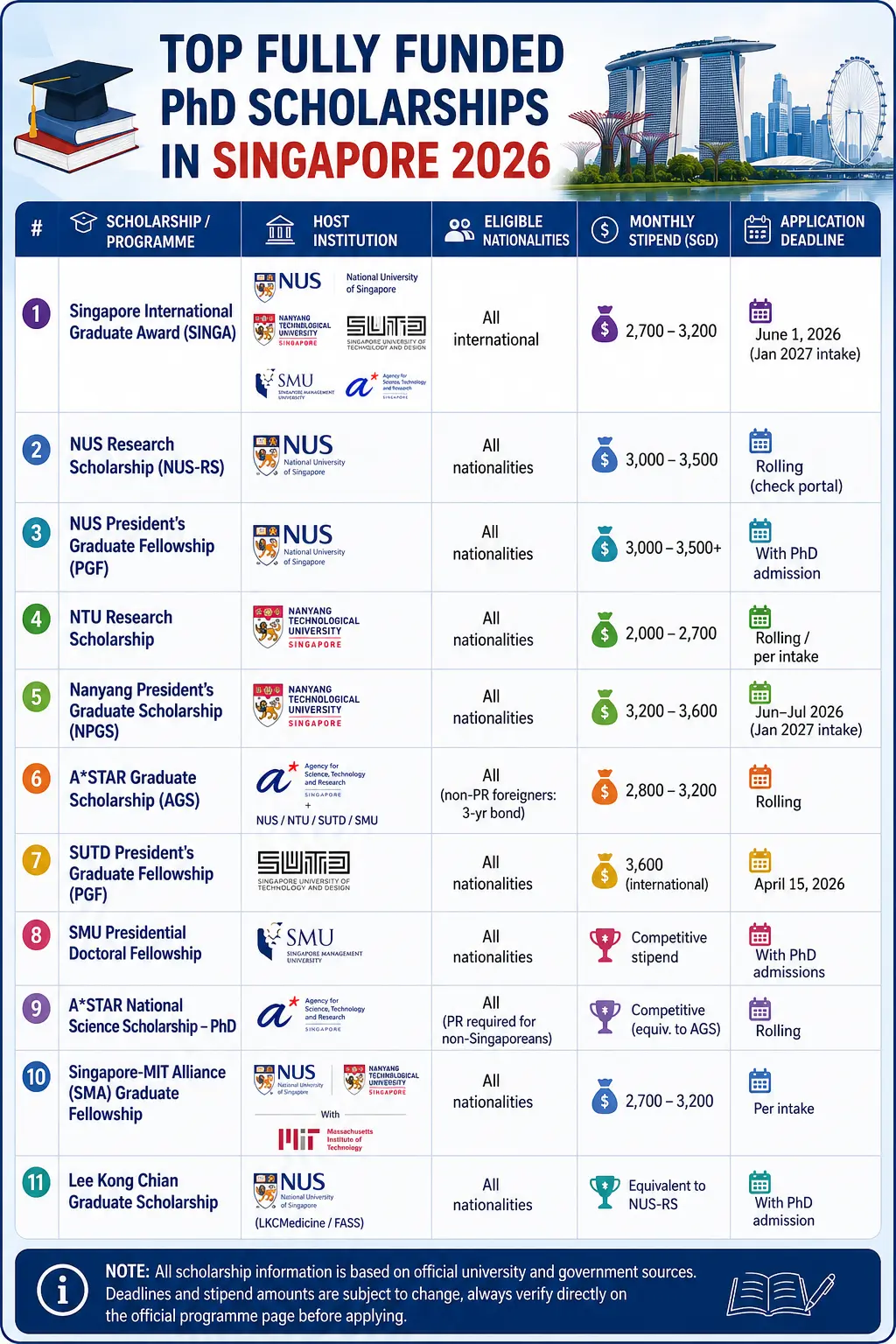
    4. Top Fellowships & Funding Opportunities for PhD Students in India in 2026 — PMRF, CSIR, UGC NET, DST-INSPIRE, NIPER, and IISER fellowships explained.
    5. Fully Funded Postdoctoral Fellowships in Canada for Indian Students in 2026 — CPRA, Mitacs, Schmidt AI, and more with deadlines and stipends.
    6. Top Funded Postdoctoral Fellowships in UK for Indian Students in 2026 — Newton International Fellowship, Leverhulme, British Academy, MSCA, and more.
    7. Fully Funded Postdoctoral Fellowships in Singapore: Stipends, Benefits, and 2026 Deadlines — LKYPDF, NTU Presidential, SG NRF Fellowships, and others.

    Last updated: May 2026. Deadlines, stipend amounts, and program terms are subject to change. Always verify details on the official program or embassy website before applying. This article does not constitute formal admissions or scholarship advice.

  • Top Fully Funded Master’s Scholarships in South Korea for International Students in 2026

    Top Fully Funded Master’s Scholarships in South Korea for International Students in 2026


    Introduction: Why Pursue a Master’s Degree in South Korea?

    South Korea has become an increasingly attractive destination for graduate education. Home to globally ranked institutions like Seoul National University (SNU), KAIST, POSTECH, and Korea University, South Korea offers a compelling mix of world-class research infrastructure, cutting-edge technology, and generous financial support for international students.

    If you’re an international student dreaming of fully funded master’s scholarships in South Korea, 2026 is an excellent year to apply. The Korean government, through programs like the Global Korea Scholarship (GKS), and leading universities through their own funding schemes, have built robust financial support systems for talented graduate students from around the world.

    The best South Korea scholarships for master’s degree students typically cover:

    • Full tuition (no fees throughout the program)
    • Monthly living stipend (ranging from KRW 550,000 to over KRW 1,900,000/month depending on program)
    • Round-trip airfare
    • Health insurance
    • Settlement/arrival allowance
    • Korean language training (in many programs)

    Whether you’re a science and engineering enthusiast, a social scientist, a policy researcher, or a student from India, Africa, Southeast Asia, or elsewhere, this guide covers everything you need to know about fully funded graduate scholarships in South Korea in 2026.

    🔗 Also read: Your Guide to Fully Funded Postdoctoral Fellowships in South Korea: Stipends, Eligibility, and 2026 Application Windows


    Quick Summary Table: Best Fully Funded Master’s Scholarships in South Korea (2026)

    #Scholarship / ProgramHost InstitutionEligibilityFunding CoverageApplication WindowOfficial Link
    1Global Korea Scholarship (GKS/KGSP)Korean Government / NIIEDNon-Korean citizens; age eligibility applies; bachelor’s degreeFull tuition + KRW 1,380,000/month (2026 figure) + airfare + housing + insuranceCheck current embassy/university track deadlines on NIIED websiteniied.go.kr
    2KAIST Global Presidential Scholarship (KGPS)KAIST, DaejeonAll nationalities (non-Korean), bachelor’s degreeFull tuition (4 semesters) + monthly stipend (varies by program/department)Varies by intake — check official KAIST admissions noticekaist.ac.kr
    3UST ScholarshipUniversity of Science and TechnologyAll nationalities, bachelor’s degreeFull tuition + monthly stipend (~KRW 1,200,000–1,430,000 for Master’s, as reported)Check official UST admissions page for current cycle datesust.ac.kr
    4SNU Graduate Scholarship for Outstanding Foreign Students (GSFS)Seoul National UniversityNon-Korean, accepted to eligible SNU programFunding varies by college/programVaries by semester — check SNU Office of Global Affairssnu.ac.kr
    5POSTECH Global ScholarshipPOSTECH, PohangAll nationalities, science/engineering fieldsFull tuition; additional funding (stipend/TA/RA) depends on scholarship route and departmentSpring/Fall cycles — check official POSTECH admissions pagepostech.ac.kr
    6Korea University SK Global ScholarshipKorea University, SeoulSelected countries (primarily SE Asia); AI/IT or Semiconductor fields — verify current listFull tuition (4 semesters) + monthly allowance + travel + insurance (verify current terms)Check KU graduate admissions portal for next cyclekorea.ac.kr
    7Ewha Global Partnership Program (EGPP)Ewha Womans University, SeoulFemale students from developing countriesFull tuition + dormitory + monthly stipend + airfare + insurance (amounts — verify on official Ewha page)Rolling, aligned with admissions — check official Ewha pageewha.ac.kr
    8DGIST International ScholarshipDGIST, DaeguAll nationalities, science/engineeringFull tuition + monthly stipendSpring/Fall cycles — check official DGIST admissions pagedgist.ac.kr
    9GIST ScholarshipGwangju Institute of Science and TechnologyAll nationalities, STEM fieldsFull tuition + monthly stipend + insuranceSpring/Fall cycles — check official GIST admissions pagegist.ac.kr
    10Yonsei GSIS ScholarshipYonsei University, SeoulAll nationalities, English proficiencyPartial to full tuition + possible stipend (varies)Varies — check GSIS admissions pageyonsei.ac.kr
    11SKKU International ScholarshipSungkyunkwan UniversityAll nationalities, merit-basedFull/partial tuition + possible stipend (varies by program)Spring/Fall cycles — check official SKKU pageskku.edu
    12Seoul Tech (SeoulTech) ScholarshipSeoul National University of Science and TechnologyAll nationalities, STEM, min. GPA 80%Full tuition + monthly living expenses + insurance + airfareCheck official page for next cycle datesseoultech.ac.kr

    ⚠️ Important: Scholarship amounts, eligibility criteria, and application windows are subject to change each cycle. Always verify all details directly on the official program website before applying.


    Detailed Guide: Top Fully Funded Master’s Scholarships in South Korea (2026)


    1. Global Korea Scholarship (GKS) — Korean Government Scholarship Program (KGSP)

    Overview

    The Global Korea Scholarship (GKS), formerly known as the Korean Government Scholarship Program (KGSP), is the most prestigious and comprehensive Korean government scholarship for master’s degree students. Administered by the National Institute for International Education (NIIED) under the Korean Ministry of Education, GKS selects over 2,000 international students from more than 155 countries each year.

    This is one of the most prestigious fully funded scholarships in South Korea for Indian students, African students, Southeast Asian students, and candidates from all partner nations.

    Key Benefits

    • ✅ Round-trip economy airfare
    • ✅ Settlement allowance upon arrival (KRW 200,000)
    • ✅ Full tuition covered by Korean government
    • ✅ Monthly living allowance: approximately KRW 1,380,000 (graduate degree program, based on 2026 sources — verify the current figure on the official NIIED page)
    • ✅ Korean language training for one year (before degree program)
    • ✅ Medical insurance
    • ✅ Research fund (KRW 210,000/semester for humanities; KRW 240,000 for science/engineering)
    • ✅ Thesis printing fees
    • ✅ Returning allowance upon completion

    Eligibility

    • Must be a non-Korean citizen (age eligibility applies — confirm the current limit on the NIIED official guidelines)
    • Hold (or expect to hold) a bachelor’s degree
    • GPA of at least 80% (or ranked in top 20% of class)
    • Must not have previously received a GKS scholarship

    Application Tracks

    There are two application tracks:

    1. Embassy Track — Apply through the Korean Embassy in your home country. Check the current cycle deadline on the official NIIED website or your country’s Korean Embassy.
    2. University Track — Apply directly to a participating Korean university. Deadlines vary by institution; check each university’s international admissions page.

    Who Should Apply?

    Any international student with strong academic credentials who wants to pursue a master’s in virtually any field — from engineering and medicine to public policy, humanities, and arts — at one of South Korea’s top universities.

    🔗 Official Website: niied.go.kr


    2. KAIST Global Presidential Scholarship (KGPS)

    Overview

    The Korea Advanced Institute of Science and Technology (KAIST) — often called the MIT of Asia — is one of South Korea’s most elite research universities. KAIST offers the KAIST Global Presidential Scholarship (KGPS) to outstanding international students applying for master’s and master’s–PhD integrated programs. There is no separate scholarship application: simply select “KAIST Scholarship” in the financial resources section of your admissions application.

    Key Benefits

    • ✅ Full tuition coverage for 4 regular semesters (standard 2-year master’s)
    • ✅ Monthly stipend — amount varies by program, department, and research involvement; check the current KAIST admissions notice for confirmed figures
    • ✅ National health insurance premium support
    • ✅ Additional research assistantship funding possible (varies by advisor/department)

    Eligibility

    • Non-Korean citizen (dual citizens not eligible as international students)
    • Hold a bachelor’s degree by the admission deadline of your chosen intake
    • English proficiency required — check the current program-specific requirement on the KAIST admissions page (waivers may be available for some programs)
    • Strong GPA required; check the current standard on KAIST’s official page

    Fields Available

    All departments at KAIST (science, engineering, life sciences, business, management, AI, and more) except the Global Technology Innovation Program (GDI-GTIP Track).

    Who Should Apply?

    Students with a strong background in STEM, AI, business technology, or interdisciplinary sciences who want access to cutting-edge labs and industry connections.

    🔗 Official Website: kaist.ac.kr


    3. University of Science and Technology (UST) Scholarship

    Overview

    The University of Science and Technology (UST) offers one of the more generous stipend packages among Korean graduate scholarships. UST is unique: it is a government-funded research institution linked with over 30 national research institutes across South Korea. Students are employed as research staff while earning their degree, giving them both academic credentials and professional research experience simultaneously.

    Key Benefits

    • ✅ Full tuition waiver
    • ✅ Monthly stipend: approximately KRW 1,200,000–1,430,000 for master’s students (as reported in available 2026 sources — confirm the current amount on the official UST admissions page)
    • ✅ Employment contract with your host research institute
    • ✅ Medical insurance
    • ✅ Access to state-of-the-art research facilities

    Eligibility

    • Open to all nationalities (non-Korean)
    • Bachelor’s degree (or expected graduation)
    • English or Korean proficiency required; specific exemptions and accepted scores may vary by program — check the official UST admissions guide for current requirements
    • Specialized Master’s Program applicants: check current entry requirements on the UST website

    Special Categories

    • RCA Degree Programme (for IAEA-RCA member countries)
    • KOICA Scholarship (for Uzbekistan nationals)
    • Overseas Koreans program

    Who Should Apply?

    Science and technology students who want a generous stipend package and the unique opportunity to be employed as a researcher while studying.

    🔗 Official Website: ust.ac.kr


    4. Seoul National University — Graduate Scholarship for Outstanding Foreign Students (GSFS)

    Overview

    Seoul National University (SNU), ranked among the top 30 universities globally, offers the Graduate Scholarship for Outstanding Foreign Students (GSFS) to attract talented international students to its master’s and doctoral programs. SNU is South Korea’s most prestigious university and is located in Seoul.

    Key Benefits

    • ✅ Funding varies by college/program — check the SNU Office of Global Affairs for the current cycle’s participating colleges and benefit details
    • ✅ May include tuition support and monthly allowance depending on program
    • ✅ Medical insurance
    • ✅ Research funding and thesis printing support

    Eligibility

    • Non-Korean applicant accepted to an eligible SNU college/school
    • Must be from an eligible country (list varies by semester — check the SNU Office of Global Affairs)
    • Apply for GSFS simultaneously with admissions application (check “Application for Scholarship” box)

    Additional Notes

    • IELTS/TOEFL not universally required at SNU — check your specific program
    • The list of eligible countries and participating colleges changes each semester
    • The GKS University Track is also available through SNU

    🔗 Official Website: en.snu.ac.kr/admission/graduate/scholarships


    5. POSTECH Global Scholarship

    Overview

    Pohang University of Science and Technology (POSTECH) is one of Asia’s top science and engineering universities, consistently ranked among the world’s best in its field. POSTECH’s global scholarship program offers full financial support to international students in science, engineering, and technology fields for both master’s and PhD degrees.

    Key Benefits

    • ✅ Full tuition coverage (via scholarship route — confirm which track applies to you)
    • ✅ Funding for living expenses: depends on the scholarship route; TA/RA assistantship support is often available through faculty advisors and may vary by department
    • ✅ Comprehensive health insurance
    • ✅ On-campus housing and Korean language support
    • ✅ Research mentoring from top faculty

    Eligibility

    • All nationalities (non-Korean)
    • Strong academic merit and research potential
    • Background in science, engineering, or technology

    Application Note

    POSTECH also participates in the GKS University Track. Alternatively, students with a strong research background can directly contact professors for Teaching/Research Assistantship (TA/RA) funding, which covers full tuition and often offers higher stipends than standard scholarship programs.

    🔗 Official Website: postech.ac.kr


    6. Korea University SK Global Scholarship

    Overview

    Korea University (KU) — one of South Korea’s elite “SKY” universities — offers the SK Global Scholarship for international students in its AI, IT, and Semiconductor programs. This fully funded scholarship is co-sponsored by SK Group, South Korea’s multinational conglomerate.

    Key Benefits

    • ✅ Full tuition for 2 years (4 semesters) + entrance fee exemption
    • ✅ Monthly living allowance
    • ✅ Round-trip airfare
    • ✅ Medical insurance
    • ✅ Optional Korean language training before semester start

    Eligibility

    • Citizens of selected countries — the eligible country list and field restrictions are highly program-specific and can change each cycle; always verify the current list directly on the KU graduate admissions portal
    • Applying for master’s in AI/IT or Semiconductor track (confirm current field options)
    • Bachelor’s degree (relevant fields preferred)
    • English proficiency proof required

    Application Window

    The March 31, 2026 deadline applied to a past cycle. Check the KU graduate admissions portal for the current cycle’s opening and closing dates.

    🔗 Official Website: gsc.korea.ac.kr


    7. Ewha Global Partnership Program (EGPP)

    Overview

    The Ewha Global Partnership Program (EGPP) at Ewha Womans University — a leading women’s university and one of the largest of its kind in the world, located in the heart of Seoul — is one of the most comprehensive fully funded scholarships available for female international students. Established to empower women from developing countries, EGPP has helped hundreds of women from across Asia, Africa, and Latin America complete their master’s degrees in South Korea.

    Key Benefits

    • ✅ Full tuition (including admission fees)
    • ✅ On-campus dormitory housing
    • ✅ Monthly stipend (reported at approximately KRW 550,000 in available sources — verify the current amount on Ewha’s official scholarship page)
    • ✅ Round-trip airfare
    • ✅ Health insurance

    Eligibility

    • Female students from developing countries
    • Applying through the Special Admissions Process for International Applicants at Ewha
    • Demonstrated leadership potential and public service commitment
    • Strong academic record

    Application Note

    Apply for university admission first; then apply for EGPP simultaneously using the Scholarship Application Form (Form 4). There is no fixed annual deadline — applications align with admissions intake.

    🔗 Official Website: ewha.ac.kr


    8. DGIST International Scholarship

    Overview

    Daegu Gyeongbuk Institute of Science and Technology (DGIST) is a research-focused government university known for its interdisciplinary approach to STEM education. DGIST offers fully funded scholarships to exceptional international students for master’s and doctoral programs.

    Key Benefits

    • ✅ Full tuition waiver
    • ✅ Monthly living stipend
    • ✅ Research funding access
    • ✅ On-campus accommodation support

    Eligibility

    • All nationalities (non-Korean)
    • Strong academic background in science, engineering, or technology
    • Transcripts, study plan, and recommendation letters required

    Who Should Apply?

    Students interested in interdisciplinary research in emerging science and technology fields, particularly those who value a smaller, research-intensive campus environment.

    🔗 Official Website: dgist.ac.kr


    9. GIST (Gwangju Institute of Science and Technology) Scholarship

    Overview

    GIST is a government-funded research university in Gwangju, South Korea, focused exclusively on science and technology. Its fully funded scholarship program supports international students throughout their master’s and doctoral degrees.

    Key Benefits

    • ✅ Full tuition coverage
    • ✅ Monthly living stipend
    • ✅ Medical insurance
    • ✅ Access to advanced research facilities
    • ✅ English-medium instruction available

    Eligibility

    • Open to international students in STEM fields
    • Bachelor’s or master’s degree depending on program level
    • English proficiency required

    Who Should Apply?

    Students focused on advanced STEM research who want a smaller, highly focused academic environment in South Korea’s Jeolla region.

    🔗 Official Website: gist.ac.kr


    10. Yonsei University GSIS Scholarship Program

    Overview

    Yonsei University’s Graduate School of International Studies (GSIS) is one of Korea’s most internationally recognized graduate schools for students in international cooperation, global finance, Korean studies, and related fields. Located in Seoul, GSIS attracts students from around the world with its English-medium programs and scholarship support.

    Key Benefits

    • ✅ Partial to full tuition waivers (based on merit and program)
    • ✅ Possible monthly living stipend
    • ✅ Courses taught entirely in English
    • ✅ Korean language not required

    Eligibility

    • All nationalities
    • English proficiency required (TOEFL/IELTS)
    • Strong academic record and statement of purpose

    🔗 Official Website: gsis.yonsei.ac.kr


    11. Sungkyunkwan University (SKKU) International Scholarship

    Overview

    Sungkyunkwan University (SKKU) — one of South Korea’s oldest and most respected universities, with campuses in Seoul and Suwon — offers the SKKU International Scholarship for outstanding international graduate students. SKKU is backed by Samsung and maintains close ties with the technology industry.

    Key Benefits

    • ✅ Full or partial tuition coverage (varies by program and merit)
    • ✅ Monthly living stipend (availability and amount varies — confirm on official SKKU page)
    • ✅ Health insurance
    • ✅ Access to Samsung-affiliated research programs
    • ✅ English-medium programs available

    Eligibility

    • All nationalities (non-Korean)
    • Merit-based selection
    • English proficiency required; Korean not mandatory for English-track programs

    🔗 Official Website: skku.edu


    12. Seoul National University of Science and Technology (SeoulTech) Scholarship

    Overview

    SeoulTech (Seoul National University of Science and Technology) offers a Korean Government-backed fully funded scholarship for international STEM students. SeoulTech’s scholarship targets students with strong academic performance and a clear interest in science, technology, engineering, and mathematics. Note that the March 2026 application round has passed; check the official page for the next available intake.

    Key Benefits

    • ✅ Full tuition fees covered
    • ✅ Monthly living expenses
    • ✅ Health insurance premiums
    • ✅ Airfare travel support

    Eligibility

    • All nationalities (non-Korean)
    • Intention to pursue a master’s degree in STEM fields
    • Minimum GPA of 80% or 2.64/4.0 (verify current requirement)
    • Apply through the Seoul Metropolitan Government Online Application Portal

    📌 Check for the next application cycle at the official SeoulTech page.

    🔗 Official Website: seoultech.ac.kr


    How to Apply for a Master’s Scholarship in South Korea: Step-by-Step

    Applying for fully funded master’s scholarships in South Korea requires careful preparation. Here is a general guide:

    Step 1: Choose your target scholarship(s) Review the programs above and identify 2–3 that match your academic profile, nationality, and field of interest.

    Step 2: Check eligibility Confirm you meet all criteria — nationality, GPA, age, degree level, and language requirements.

    Step 3: Prepare your documents Standard required documents include:

    • Bachelor’s degree certificate and transcripts
    • Statement of purpose / research plan
    • Letters of recommendation (usually 2)
    • Passport copy
    • CV/Resume
    • English or Korean proficiency test scores
    • Proof of nationality / birth certificate

    Step 4: Contact potential supervisors (for research-based programs) For programs like KAIST, POSTECH, and UST, emailing a potential supervisor before applying can significantly strengthen your application. Introduce yourself, attach your CV, and explain your research interest.

    Step 5: Submit before the deadline Deadlines vary significantly by program and intake cycle. As a general guide:

    • GKS Embassy Track: typically early in the calendar year — check the NIIED official page
    • GKS University Track: varies by institution — check individual university admissions portals
    • KAIST: varies by intake — check official KAIST admissions notices
    • UST: check the UST admissions page for current cycle dates

    Always verify deadlines directly on official program pages, as they shift each year.

    🔗 Related: Fully Funded PhD Scholarships in Europe for Indian Students (2026)


    Is IELTS Required for South Korea Master’s Scholarships?

    This is one of the most common questions — and the answer varies by program:

    ProgramIELTS / TOEFL Required?
    GKS (Embassy/University Track)Yes (TOPIK or English scores accepted; check NIIED guidelines for accepted tests)
    KAIST KGPSEnglish proficiency required — check current program-specific score requirements on the KAIST admissions page; waivers may apply
    USTMay vary by program — check official UST admissions guide for current requirements
    SNU GSFSVaries by program/college
    POSTECHEnglish proficiency certificate may be accepted in some cases — verify with your target department
    SeoulTechCheck official program requirements

    Bottom line: Most Korean scholarships accept an official English proficiency test. Some programs allow a letter/certificate from your university confirming English as the medium of instruction as a substitute.


    Stipend Comparison: How Much Money Do Master’s Students Get?

    ProgramMonthly Stipend (Master’s)
    UST Scholarship~KRW 1,200,000–1,430,000 (~USD 900–1,080) — verify current amount
    GKS (Korean Government)~KRW 1,380,000 (~USD 1,030) — verify current figure on NIIED page
    KAIST KGPSVaries by program/department — check official KAIST admissions notice
    SeoulTech ScholarshipCovered within living expense package — check official page
    Ewha EGPPReported ~KRW 550,000 + dormitory accommodation — verify on Ewha’s page
    POSTECHVaries; TA/RA support can be substantially higher — depends on faculty/department

    Note: KRW figures are approximate based on available 2025–2026 sources. Always confirm the current amount on each program’s official page before making financial decisions. Living costs in South Korea are moderate; verified stipends at the levels above are generally sufficient to cover accommodation, food, and transportation.


    Frequently Asked Questions (FAQs)

    Q1: How competitive are South Korea master’s scholarships?

    South Korea’s flagship scholarships like GKS and KAIST KGPS are highly competitive. The GKS program receives tens of thousands of applications annually for roughly 2,000+ spots. However, university-specific scholarships (like POSTECH TA/RA or UST) can be more accessible if you have a strong research profile and make early contact with a supervisor.


    Q2: When do South Korea master’s scholarship applications open?

    Application window timings vary by program and can change each year. As a general orientation:

    • GKS Embassy Track: Applications typically open in the latter part of the preceding calendar year; check the NIIED website and your country’s Korean Embassy for the current cycle
    • GKS University Track: Varies widely by institution — check each university’s international admissions portal
    • KAIST: Check the official KAIST admissions notice for each Fall and Spring intake
    • UST: Fixed deadlines per intake — check the UST admissions page for the current cycle
    • SeoulTech: Check the official Seoul Metropolitan Government admissions page

    Always verify deadlines directly on official program websites, as they shift each application year.


    Q3: What documents are needed for South Korea scholarship applications?

    Standard documents include: passport, bachelor’s degree certificate + transcripts, 2 recommendation letters, statement of purpose/research plan, English proficiency test score, CV, and birth certificate. Some programs also require a medical certificate and a personal essay.


    Q4: Are there fully funded scholarships for Indian students in South Korea?

    Yes. The GKS (Global Korea Scholarship) is open to Indian students and typically includes a dedicated India quota each year. KAIST, UST, POSTECH, and SNU scholarships are also open to Indian nationals. Check the NIIED website and your nearest Korean Embassy for the current GKS India deadline.


    Q5: Do I need to know Korean to study in South Korea?

    Not for most graduate programs. Many master’s programs — especially in science, technology, engineering, business, and public policy — are offered entirely in English. GKS scholars attend one year of Korean language training before their degree program. Programs at KAIST, POSTECH, UST, Yonsei GSIS, and SNU (many departments) are available in English.


    Q6: Can I work part-time while on a scholarship in South Korea?

    On a D-2 student visa, international students can work up to 20 hours per week during the semester and full-time during vacations, subject to university regulations. GKS scholars typically need their institution’s permission. Always check your visa conditions and scholarship terms.


    Q7: What is the acceptance rate for GKS scholarship applications?

    The GKS acceptance rate varies by country and track. Overall, roughly 2,200 out of tens of thousands of applications are accepted globally each year. Country-specific quotas mean competition levels vary — some countries have higher acceptance rates than others. Building a strong application with above-average GPA, relevant experience, and a compelling study plan is critical.

    🔗 Related: Top Fellowships & Funding Opportunities for PhD Students in India in 2026


    About IR Research Publication

    IR Research Publication (irrespub.com) is a trusted scientific journal publisher and editorial service provider. Beyond publishing research, irrespub.com regularly curates verified, high-quality scholarship and fellowship guides for students, early-career researchers, and academics worldwide.

    Our scholarship content is:

    • Rigorously fact-checked against official university and government sources
    • Updated regularly to reflect the latest 2025–2026 deadlines and changes
    • Targeted at both emerging and experienced researchers seeking global academic funding

    Whether you’re searching for postdoctoral opportunities, PhD scholarships, or master’s funding, irrespub.com is your reliable companion on the journey toward academic excellence.


    Related Articles from IR Research Publication

    Explore these related guides for more funding opportunities:

    1. 🔗 Your Guide to Fully Funded Postdoctoral Fellowships in South Korea: Stipends, Eligibility, and 2026 Application Windows
    2. 🔗 Fully Funded PhD Scholarships in Europe for Indian Students (2026)
    3. 🔗 Top Fellowships & Funding Opportunities for PhD Students in India in 2026
    4. 🔗 Fully Funded Postdoctoral Fellowships in Canada for Indian Students in 2026
    5. 🔗 Fully Funded Postdoctoral Fellowships in Singapore: Stipends, Benefits, and 2026 Deadlines
    6. 🔗 How to Find Postdoctoral Fellowship Opportunities Around the World

    Disclaimer: Scholarship details including stipend amounts, deadlines, and eligibility criteria are based on information available as of April 2026. Always verify the latest details directly on each program’s official website before applying, as terms may change between application cycles.

  • Fully Funded PhD Scholarships in South Korea: Stipends, Eligibility, and 2026 Deadlines
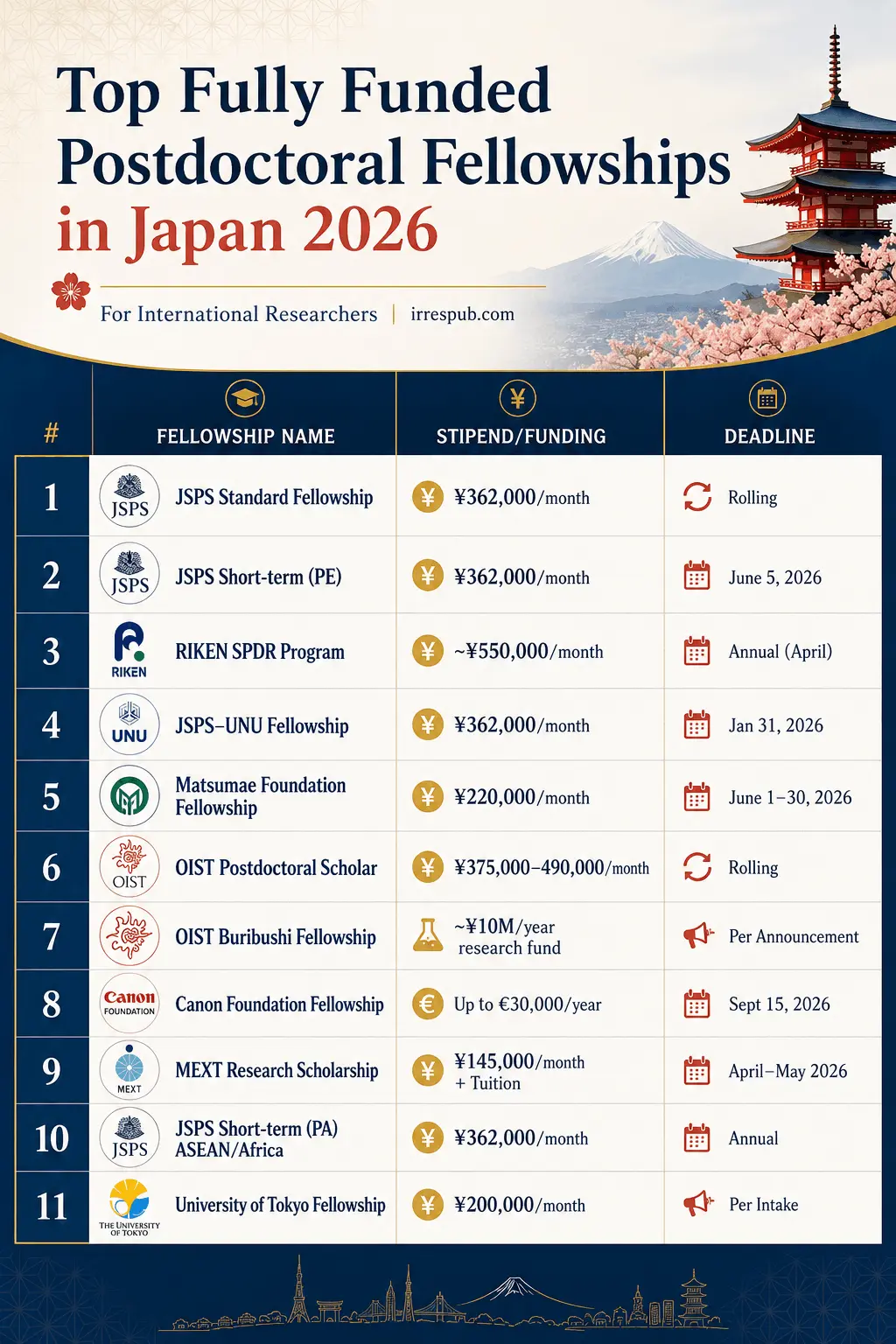
    Fully Funded PhD Scholarships in South Korea: Stipends, Eligibility, and 2026 Deadlines
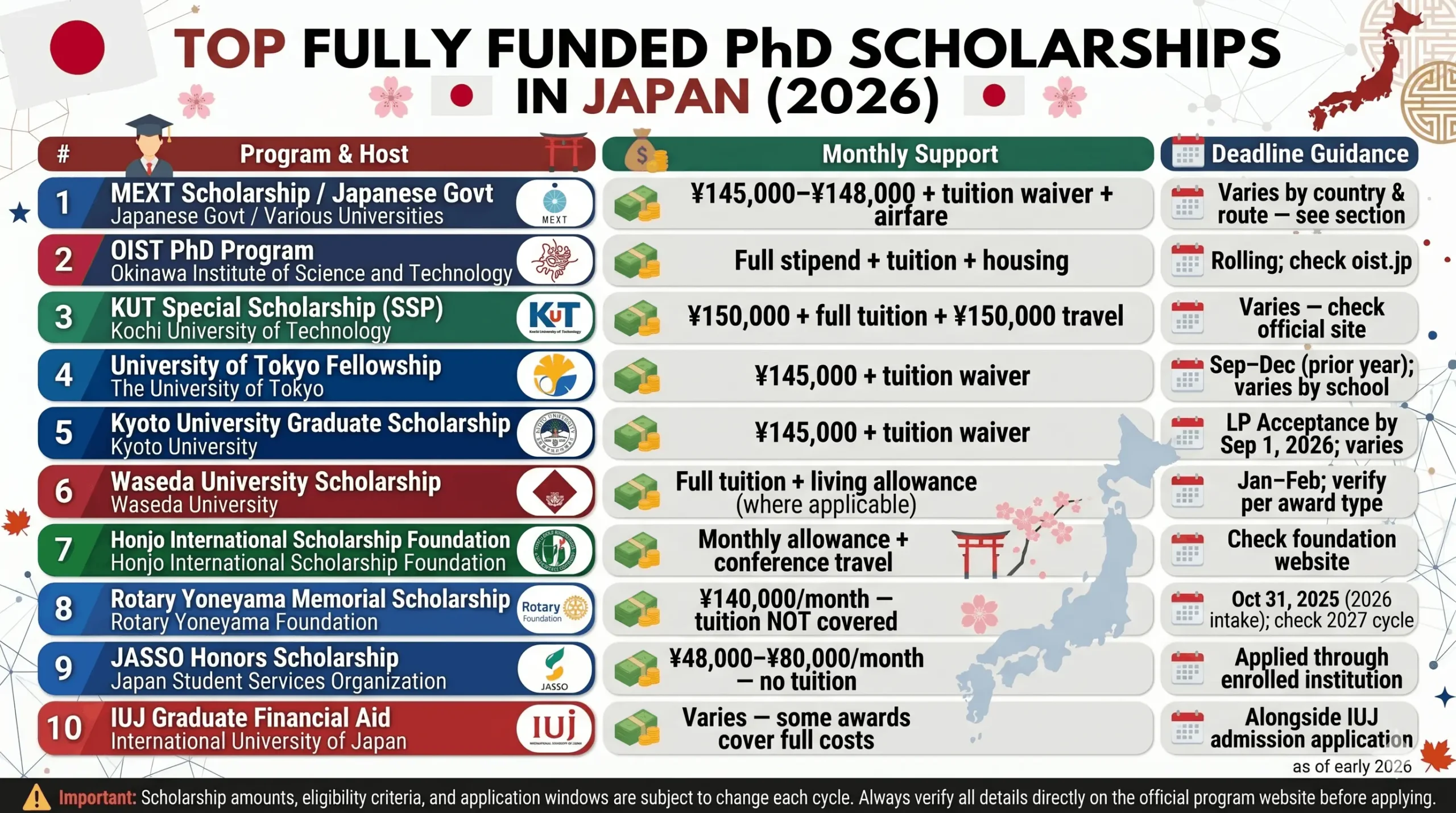

    Introduction: Why Pursue a PhD in South Korea?

    South Korea has become one of Asia’s most sought-after destinations for doctoral research. The country hosts globally ranked institutions — including KAIST, POSTECH, Seoul National University, and GIST — backed by substantial government investment in science, technology, and international academic exchange.

    For international students, PhD scholarships in South Korea often go well beyond a simple tuition waiver. Many programs include a monthly living stipend, national health insurance, and a one-way or round-trip airfare contribution. Some — particularly the government-run GKS and KOICA programs — also provide Korean language training and a settlement allowance upon arrival. The exact package differs meaningfully between programs, so it is worth reading each entry carefully rather than assuming a uniform benefit set.

    This guide covers 10+ verified, fully funded PhD scholarships in South Korea for the 2026 cycle, with corrected stipend figures, accurate eligibility conditions, and direct links to official pages. Whether you are a STEM researcher or a social sciences professional, there are multiple credible funding routes — provided you meet the specific criteria each program sets.

    For academic writing support, publication guidance, and research career resources, visit IrrespPub.


    Quick-Reference Summary Table: Fully Funded PhD Scholarships in South Korea 2026

    #ProgramHost InstitutionCore EligibilityPhD Monthly Stipend (KRW)Deadline (Most Recent Cycle)Notes
    1GKS-G (Global Korea Scholarship — Graduate)NIIED / Korean Ministry of EducationCitizens of NIIED-designated countries; no Korean citizenship (self or parents); age under cutoff in annual notice; prior degree with ≥ 80% GPA~1,000,000 (degree program)Embassy Track: country-specific, typically Feb–Mar; University Track: varies by institutionTwo separate tracks with different university lists and quotas; research scholars receive ~1,500,000 KRW/month
    2UST ScholarshipUniversity of Science & Technology (32 research institutes)All non-Korean nationalities; Master’s degree required for PhD entry1,900,000 (confirmed Spring 2026 minimum)Spring 2026: ~Feb 23, 2026; check ust.ac.kr for Fall 2026Lab-based; contact target professor before applying
    3KAIST Graduate ScholarshipKorea Advanced Institute of Science and TechnologyAll non-Korean nationalities; Master’s degree for PhD entry400,000 base university allowance + lab RA (varies by department)Spring 2026: Sep 2, 2025; Fall 2026: check kaist.ac.krBase allowance is modest; most PhD students supplement through research assistantship; competitive fellowships up to 2,500,000 but not guaranteed
    4SNU President Fellowship (SPF)Seoul National UniversityTeaching/instructional staff at a university in a developing country WITHOUT a PhD; Master’s degree or higher; newly admitted to SNU PhD program1,500,000Spring 2026: Jul 7–10, 2025 (admission); Aug 31, 2025 (SPF documents)Restricted to faculty from developing countries; ~8 awards per cycle; NOT open to general international PhD applicants
    5SNU Silk-Road ScholarshipSeoul National UniversityExceptional international graduate applicants; merit-based; criteria set per intake600,000Same as SNU admissions windowSeparate from SPF; covers up to 4 semesters tuition + stipend + airfare; open to broader international pool
    6GIST ScholarshipGwangju Institute of Science & TechnologyAll non-Korean nationalities295,000 base + ~1,145,000 research assistantship (PhD)Rolling (Spring and Fall); no application feeRA is the primary income source; combined effective total ~1,560,000/month; 60% health insurance covered
    7POSTECH Global ScholarshipPohang University of Science & TechnologyAll non-Korean nationalities; strong academic and research profile requiredVaries by department and labAnnual cycle; typically opens autumn for next intakeContact prospective advisor in advance; no universal fixed stipend published centrally
    8KOICA ScholarshipKorea International Cooperation AgencyCitizens of KOICA-designated partner developing countries ONLY; must be formally nominated by home government; must be public sector professional~999,0001st Batch 2026: Dec 2, 2025; 2nd Batch: check koica.go.krNOT open to all nationalities; exclusively for government officials and civil servants from partner developing countries
    9DGIST ScholarshipDaegu Gyeongbuk Institute of Science & TechnologyAll non-Korean nationalitiesCompetitive; varies by program; GKS University Track also available here at ~1,000,000Rolling (Spring and Fall)All programs in English; interdisciplinary focus; Type A GKS university
    10Yonsei University — GKS University TrackYonsei University (via NIIED GKS)Same as GKS-G eligibility~1,000,000 (GKS standard rate)GKS University Track; check Yonsei admissions calendarGKS government funding via Yonsei — separate from Yonsei internal departmental or lab-level scholarships
    11Korea University — Graduate FundingKorea UniversityAll non-Korean nationalities; criteria vary by college and departmentVaries by department/lab; GKS University Track also availableSpring: Sep–Nov; Fall: Feb–MarNo single university-wide PhD stipend; mix of departmental tuition waivers, lab RA, and GKS track
    12SKKU International ScholarshipSungkyunkwan UniversityAll non-Korean nationalities; merit-based; criteria vary by collegeVaries by program; Samsung-linked labs may carry additional industry fundingSpring 2026: Oct–Nov 2025; verify at skku.eduStrong STEM and semiconductor focus; Type A GKS university

    How to use this table: Stipend figures are sourced from official or near-official program documentation and reflect the standard base rate for PhD-level students. Where totals vary by department, fellowship layer, or research involvement, this is noted in the Notes column. Deadlines reflect the most recent confirmed cycle; always verify at the official link before applying.


    Detailed Program Profiles


    1. Global Korea Scholarship — Graduate Degree (GKS-G)

    Overview

    The Global Korea Scholarship for Graduate Degrees (GKS-G), administered by the National Institute for International Education (NIIED) under Korea’s Ministry of Education, is the largest government-funded scholarship program for international graduate students in South Korea. For the 2026–2027 cycle, NIIED expanded the total graduate quota to 2,000 places across Master’s, doctoral, and research programs.

    The GKS-G operates through two distinct application tracks that are independent of each other:

    • Embassy Track: Apply through the Korean embassy or consulate in your home country. You may select up to three universities (Type A or Type B), with at least one Type B institution required. Combined quota: 800 seats (General + Overseas Korean/Adoptee).
    • University Track: Apply directly to a participating Korean university. Includes General, R-GKS, Research, International Organization, R&D, and Global Network sub-programs. Combined quota: 1,200 seats. Deadlines and selection criteria are set by each university.

    These tracks have different university lists, selection processes, and quotas. An applicant may not apply through both tracks for the same intake cycle.

    Verified Financial Benefits

    • Full tuition coverage (NIIED pays up to 5,000,000 KRW per semester; any excess is typically covered by the host university)
    • Monthly stipend: ~1,000,000 KRW for degree-program students (Master’s and PhD); ~1,500,000 KRW for research scholars — confirmed across multiple 2025–2026 official-cycle sources
    • Round-trip economy class airfare
    • One year of funded Korean language training at a designated institute
    • Settlement allowance: 200,000 KRW (one-time, upon arrival)
    • Korean proficiency grant: 100,000 KRW/month for TOPIK-qualified scholars
    • Degree completion grant: 100,000 KRW (one-time)
    • National health insurance (monthly amount per NIIED schedule)
    • Research and thesis support grants

    Eligibility

    • Must be a citizen of an NIIED-designated country (list available on studyinkorea.go.kr; not all nationalities qualify)
    • Neither the applicant nor their parents may hold Korean citizenship, including dual citizenship
    • Age limit: Defined by a birth-date cutoff published in each year’s official guidelines. For graduate applicants, this has historically corresponded to being under 40 at the time of application — but the exact cutoff date is recalculated annually and must be verified in the current year’s notice
    • Prior degree: Bachelor’s for Master’s entry; Master’s degree required for doctoral entry
    • Academic record: cumulative GPA of at least 80%, OR ranked in the top 20% of graduating class
    • Not currently enrolled in a Korean degree program; not a previous GKS scholar reapplying at the same degree level

    Application Deadlines

    • Embassy Track: Varies by country. Most embassies open in February–March of the target entry year. Check the Korean embassy website for your specific country.
    • University Track: Set by each participating university; many have September–November windows for spring intake. Check the GKS Notice on www.studyinkorea.go.kr and each university’s own admissions calendar.

    Official Link: www.studyinkorea.go.kr

    For tips on writing a competitive research plan for GKS and other Korean scholarship applications, visit IrrespPub.


    2. UST Scholarship (University of Science and Technology)

    Overview

    The University of Science and Technology (UST) is not a traditional campus. It is a government-supported graduate institution operating across 32 national research institutes throughout South Korea, including KIST, ETRI, KERI, and KIOST. PhD students work directly in active research laboratories — making this one of the most hands-on doctoral programs available in Korea and an unusually strong pathway into Korean government research careers.

    The 2026 UST Scholarship covers Master’s, PhD, and integrated MS-PhD programs across 47 specialised majors in AI and robotics, biotechnology, energy science, semiconductors, space and ocean sciences, and more.

    Verified Financial Benefits

    • Full tuition and admission fee waiver
    • PhD monthly stipend: minimum 1,900,000 KRW (confirmed in the Spring 2026 admission cycle). Note: some earlier cycle sources cite 1,600,000 KRW — the 1,900,000 KRW figure reflects the most recently confirmed Spring 2026 minimum and should be verified for future intakes at www.ust.ac.kr.
    • Health and accident insurance
    • Round-trip airfare
    • Korean language course fees covered
    • E-library access, counselling, overseas training, and exchange program support
    • Research Paper Award and Post-Graduation Excellence Award

    Eligibility

    • Non-Korean citizens only
    • PhD applicants must hold a Master’s degree (or expect to complete one by the program start date)
    • Research background must match the target lab’s field
    • English proficiency required (IELTS/TOEFL; exemptions for graduates of English-medium institutions)

    Application Deadlines

    • Spring 2026: ~February 23, 2026 (this window has now closed)
    • Fall 2026: Check apply.ust.ac.kr for the updated window

    Important: UST requires applicants to identify a specific research institute and professor before applying. Contacting the target professor with your CV and a concise research statement is strongly recommended — and at many institutes, effectively required — before the formal application.

    Official Link: www.ust.ac.kr


    3. KAIST Graduate Scholarship

    Overview

    The Korea Advanced Institute of Science and Technology (KAIST) is one of Asia’s most prestigious research universities, consistently ranked in the global top 50 for science and engineering. KAIST automatically considers all international students who select “KAIST Scholarship” as their financial resource during admissions for one of three internal fellowship tiers: KAIST Global PhD Fellowship (KGPS), Korean Presidential Science Fellowship (KPS), or KAIST CoE PhD Fellowship. No separate scholarship application is needed.

    Understanding KAIST’s Funding Structure — what the numbers actually mean

    KAIST’s funding has two distinct layers that secondary sources often conflate:

    1. Base university scholarship allowance (guaranteed for all admitted scholars):
      • Full tuition exemption for the standard program duration
      • 400,000 KRW/month for PhD students; 350,000 KRW/month for Master’s students
      • Health insurance premium supported by advisor/department
    2. Research assistantship (RA) and competitive fellowships (common but not guaranteed at admission):
      • Most KAIST PhD students receive substantial additional monthly income from their advisor’s research project budget
      • Competitive departmental and named fellowships range from 300,000 to 2,500,000 KRW/month additionally
      • The “up to 2,500,000 KRW” figure cited in some sources is the ceiling of named competitive fellowships — not a base amount and not guaranteed at the point of admission

    Practical guidance: Plan financially around the verified base of 400,000 KRW/month + full tuition. Treat RA income as likely but not contractually guaranteed before you accept an offer and secure lab placement.

    Eligibility

    • Non-Korean citizens
    • PhD applicants must hold a Master’s degree (or expect to complete one before program start)
    • All disciplines: natural sciences, life sciences, bioengineering, engineering, convergence science, business, and related areas
    • English proficiency required (test score waiver available for graduates of recognised English-medium institutions)

    Confirmed Application Deadlines

    • Spring 2026 intake: Application deadline — September 2, 2025 (5 PM KST); recommendation letters — September 9, 2025
    • Fall 2026 intake: Typically opens February–March; check kaist.ac.kr for exact dates

    Official Link: www.kaist.ac.kr


    4. SNU President Fellowship (SPF)

    Overview

    The SNU President Fellowship (SPF) is one of Seoul National University’s most prestigious PhD funding awards — and also one of the most misrepresented in secondary scholarship guides. It is not a general scholarship open to any international PhD applicant. The SPF is a highly targeted program designed specifically for teaching or instructional staff at universities in developing countries who do not yet hold a PhD. Its purpose is to strengthen academic capacity in developing nations by funding faculty to earn doctorates at SNU before returning to their home institutions.

    Approximately 8 fellowships are awarded per intake cycle, making it among the most selective programs on this list.

    Verified Eligibility — all conditions must be met simultaneously

    1. Currently employed as teaching or instructional staff (lecturer, assistant professor, research professor, teaching assistant, or equivalent) at a major university in a developing country
    2. Holds a Master’s degree or higher from an accredited institution, but does not yet hold a PhD
    3. Newly admitted to an SNU PhD program for the relevant intake semester
    4. Home university must provide an official commitment confirming the applicant’s continued employment and return after graduation

    Verified Financial Benefits

    • Full tuition waiver for up to 6 semesters (3 years), renewable each semester subject to maintaining a cumulative GPA of 3.0/4.5 or higher
    • Monthly stipend: 1,500,000 KRW
    • Round-trip economy class airfare
    • Korean language training support
    • National health insurance coverage
    • Childcare support (amount varies by individual circumstances)

    Application Deadlines (Spring 2026 cycle — confirmed from official SNU OIA notice)

    • Online SNU admission application: July 7–10, 2025 (by 17:00 KST) — tick the SPF application checkbox during admissions
    • SPF supporting documents submitted to OIA by email + post: August 31, 2025
    • First-level screening: September 1–4, 2025
    • Final results announced: approximately late January 2026
    • Fall 2026 cycle: Will follow a similar August–September window; confirm at oia.snu.ac.kr

    Official Links:


    5. SNU Silk-Road Scholarship

    Overview

    Separate from the SPF, Seoul National University offers the Silk-Road Scholarship for exceptional incoming international graduate students. Unlike the SPF, this award is not restricted to faculty from developing countries and is open to high-achieving international students across all nationalities and disciplines. It covers a shorter funding window (up to 4 semesters) but provides a meaningful combination of tuition support, stipend, and airfare.

    Key Benefits

    • Full tuition coverage for up to 4 semesters
    • Monthly stipend: 600,000 KRW
    • Economy round-trip airfare
    • Korean language training funding

    Who Should Apply

    International graduate students applying to SNU Master’s or PhD programs who have a strong academic record and are not eligible for — or not targeting — the SPF. Applied for during the standard SNU admissions process by selecting the scholarship checkbox on the online portal.

    Deadline: Same as SNU admissions windows. Spring intake: typically July; Fall intake: typically February. Verify at en.snu.ac.kr.

    Official Link: en.snu.ac.kr


    6. GIST Scholarship (Gwangju Institute of Science and Technology)

    Overview

    The Gwangju Institute of Science and Technology (GIST) is a government-funded public research university operating under South Korea’s Ministry of Science and Technology. All admitted international graduate students at GIST automatically receive a scholarship covering tuition and a base stipend. GIST charges no application fee, making it among the most accessible entry points to Korea’s elite research university system.

    Research fields include AI and machine learning, nanotechnology, photonics, robotics, energy systems, biotechnology, and environmental science. Program durations run up to 3 years (MS), 7 years (PhD standalone), or 8 years (integrated MS/PhD).

    Verified Financial Benefits

    • Full tuition waiver (~3,607,000 KRW per semester)
    • PhD base monthly stipend: 295,000 KRW
    • Monthly meal allowance: 100,000 KRW
    • Monthly international student allowance: 120,000 KRW — requires GPA ≥ 3.0/4.5 and completion of at least 9 credits in the previous semester to maintain
    • PhD research assistantship: ~13,740,000 KRW/year (~1,145,000 KRW/month) — this is the primary income for most PhD students and is funded from research project budgets
    • Combined effective monthly income (all components): approximately 1,560,000 KRW, subject to GPA and RA participation requirements
    • One-way airfare to Korea (reimbursed once)
    • 60% of national health insurance premium, including annual medical check-up
    • No application fee

    Eligibility

    • All non-Korean nationalities
    • Must hold (or expect to hold) a relevant prior degree
    • English proficiency required (IELTS/TOEFL; exemptions for graduates of recognised English-medium programs)

    Deadline: Rolling admissions with Spring and Fall intakes. Check www.gist.ac.kr for current windows.

    Official Link: www.gist.ac.kr


    7. POSTECH Global Scholarship

    Overview

    Pohang University of Science and Technology (POSTECH) is consistently ranked among the world’s top science and engineering universities. POSTECH’s international PhD program is highly competitive and closely tied to individual laboratory research. The POSTECH Global Scholarship provides full tuition support to admitted international students; monthly stipend is set at the department and lab level, with no single centrally published PhD figure.

    Key Benefits

    • Full tuition coverage
    • Monthly living stipend — set by department and lab; not published as a university-wide figure. Prospective PhD students should ask directly when contacting potential advisors.
    • Comprehensive health insurance
    • Access to POSTECH’s world-class research facilities and strong links to Korea’s materials, energy, and semiconductor industries

    Who Should Apply

    Non-Korean international students with strong academic and research records in physics, chemistry, mathematics, mechanical engineering, materials science, computer science, chemical engineering, or related disciplines. Given that PhD positions are tied to individual lab vacancies, contacting potential supervisors before applying is not just recommended — it is effectively how most POSTECH PhD positions are filled.

    Deadline: Most lab openings are announced in autumn (September–November) for the following spring intake, with some rolling lab-level admissions throughout the year. Check www.postech.ac.kr.

    Official Link: www.postech.ac.kr


    8. KOICA Scholarship Program

    Overview

    The Korea International Cooperation Agency (KOICA) Scholarship is South Korea’s Official Development Assistance (ODA) graduate scholarship. It is specifically designed to support government officials and public sector professionals from KOICA-designated partner developing countries to pursue Master’s or doctoral degrees in South Korea. Its explicit objective is to build human capital in partner nations by training future policy leaders, who are expected to return home after graduation.

    This scholarship is not open to applicants from all nationalities. Eligibility is restricted to citizens of countries on KOICA’s partner list, and applicants must be formally nominated by their home government. Private sector employees and citizens of non-partner or high-income countries are ineligible.

    Verified Financial Benefits

    • Full tuition coverage at partner Korean universities
    • Monthly stipend: ~999,000 KRW (~USD 750) for living expenses
    • Round-trip economy class airfare
    • Free on-campus dormitory accommodation
    • Settlement allowance: 1,200,000 KRW for doctoral students; 600,000–900,000 KRW for Master’s students (one-time, upon arrival)
    • Completion grant (~USD 750 equivalent, upon graduation)
    • National health insurance
    • Cultural orientation program upon arrival

    Eligibility — all conditions must be met

    • Citizen of a KOICA-designated partner developing country (country list at koica.go.kr)
    • Currently employed as a professional or civil servant; formally nominated by home government — self-nomination is not accepted
    • Strong commitment to returning to home country and contributing to national development
    • English proficiency required (programs conducted in English)
    • Master’s degree required for doctoral program entry

    Deadlines

    • 1st Batch 2026: December 2, 2025 at 4:00 PM GMT (now closed)
    • 2nd Batch / 2027 Cycle: Check www.koica.go.kr for new announcements

    Official Link: www.koica.go.kr


    9. DGIST Scholarship

    Overview

    The Daegu Gyeongbuk Institute of Science and Technology (DGIST) is a government-funded research university in Daegu. Notably, DGIST is also a Type A GKS University Track institution, meaning international PhD applicants have two distinct funding paths available here: DGIST’s own institutional scholarship and the GKS University Track via DGIST (which carries the standardised GKS package). All DGIST programs are taught in English.

    DGIST research areas include AI and intelligent systems, energy systems, robotics, ICT convergence, new biology, and emerging materials.

    Funding Routes for DGIST PhD Students

    1. DGIST institutional scholarship — automatically considered for admitted international students; covers tuition and a competitive monthly stipend (amount set at department/lab level)
    2. GKS University Track via DGIST — apply through DGIST’s GKS University Track for the standardised GKS package: full tuition + ~1,000,000 KRW/month stipend + language training + airfare. These two routes have different application channels and should not be assumed to be the same award.

    Eligibility

    • All non-Korean nationalities
    • Strong academic and research profile; prior degree in a relevant STEM field

    Deadline: Rolling admissions (Spring and Fall). Check www.dgist.ac.kr for current windows.

    Official Link: www.dgist.ac.kr


    10. Yonsei University — PhD Funding Pathways

    Overview

    Yonsei University is one of South Korea’s most prestigious private research universities, located in Seoul. International PhD students at Yonsei access funding through several distinct channels, which are frequently conflated in secondary scholarship listings. The three main routes operate independently and should not be treated as a single “Yonsei scholarship.”

    Route A: GKS University Track (via Yonsei) Yonsei is a Type A GKS university. Applicants applying to Yonsei’s graduate school and selecting the GKS University Track receive the standard GKS-G package: full tuition, airfare, Korean language training, and ~1,000,000 KRW/month. This is NIIED government funding administered through Yonsei — not Yonsei’s own budget.

    Route B: POSCO Asia Fellowship (GSIS only) For students applying specifically to Yonsei’s Graduate School of International Studies (GSIS), the POSCO Asia Fellowship is a competitive external award covering full tuition for up to 4 semesters and a monthly living stipend of 1,000,000 KRW plus national health insurance. This fellowship is not available across other Yonsei departments or colleges.

    Route C: Departmental and Lab Funding As at most Korean research universities, Yonsei PhD students in STEM and social science departments frequently receive supplementary funding from their supervisor’s research grants. Amounts vary and are negotiated at the lab level — not published centrally.

    Deadlines

    • GKS University Track via Yonsei: Check Yonsei’s graduate admissions calendar and the GKS Notice on studyinkorea.go.kr
    • POSCO Fellowship: Check Yonsei GSIS independently; typically opens annually

    Official Link: www.yonsei.ac.kr


    11. Korea University & SKKU — Graduate Funding Overview

    Both Korea University (KU) and Sungkyunkwan University (SKKU) are Type A GKS universities in Seoul. The key distinction worth making explicit here, because it is often blurred in secondary sources, is that GKS University Track funding and a university’s own internal departmental scholarships are separate programs with separate applications, quotas, and benefit structures.

    Korea University

    • International PhD students may access GKS University Track funding (~1,000,000 KRW/month standard package) or department-level research assistantship income — these are distinct routes
    • There is no single university-wide monthly PhD stipend; all non-GKS amounts depend on department, lab, and research funding
    • Spring admissions: typically September–November; Fall admissions: February–March
    • Official site: www.korea.ac.kr

    Sungkyunkwan University (SKKU)

    • Type A GKS university with strong programs in semiconductor engineering, materials science, life sciences, and business
    • SKKU has deep research and funding partnerships with Samsung — PhD students in relevant engineering and materials labs may benefit from industry-funded research positions, but this is not a guaranteed component of any central scholarship
    • Internal tuition waivers and departmental scholarships exist; stipend amounts vary significantly by department and are not centrally published
    • Spring 2026 admissions: typically October–November 2025
    • Official site: www.skku.edu

    Key Documents Required for PhD Scholarship Applications in South Korea

    Requirements vary by program. The following checklist covers documents commonly required across most programs:

    • Valid passport copy
    • Completed online application form
    • Bachelor’s and/or Master’s degree certificate (apostilled or officially certified where required)
    • Official academic transcripts
    • Two to three academic recommendation letters
    • Research proposal or statement of purpose
    • English language proficiency score (IELTS/TOEFL) — exemptions apply for graduates of recognised English-medium programs
    • CV or résumé
    • Master’s thesis abstract (for PhD applications at most research-focused institutions)
    • Medical health certificate (required for GKS; check for others)

    Program-specific additions:

    • GKS: Korean embassy contact, government health check form, passport photos
    • KOICA: Formal government nomination letter from home country; proof of public sector employment
    • SNU SPF: University employment certificate; official letter of institutional support from employer confirming return post-PhD

    Always download the official application guidelines from the program’s own website for the current cycle. For support building a strong publication record and research narrative for your application, see IrrespPub.


    Monthly Stipend Comparison: PhD Students in South Korea (2026 Cycle)

    ProgramPhD Base Stipend (KRW/month)Additional Income PossibleVerified Source
    GKS-G (degree program)~1,000,000None built inOfficial NIIED guidelines, multiple 2025–2026 sources
    UST1,900,000 (confirmed minimum)Research project bonuses possibleUST Spring 2026 admission notice
    KAIST (base only)400,000Lab RA common; competitive fellowships up to 2,500,000 KRW/monthKAIST scholarship page; Spring 2026 admissions notice
    SNU SPF1,500,000None specifiedOfficial SNU OIA announcement, Spring 2026
    SNU Silk-Road600,000None specifiedSNU admissions documentation
    GIST (all components combined)~1,560,000RA (~1,145,000/month) is the main incomeGIST scholarship page; multiple verified sources
    KOICA~999,000NoneKOICA official program documents
    POSTECHVaries by labVariesNo central figure published

    Note on cost of living: In most South Korean cities outside central Seoul, a PhD student can manage accommodation, food, and transportation on approximately 900,000–1,200,000 KRW/month. Most stipends above that level allow for modest savings. Central Seoul accommodation runs significantly higher and is worth factoring into program choice.


    How to Apply for a Fully Funded PhD in South Korea in 2026

    1. Map your eligibility first. Each program has distinct nationality, age, degree level, and employment restrictions. KOICA and SNU SPF have targeted criteria that disqualify the majority of international applicants regardless of academic quality. Do not apply to programs you do not meet the eligibility threshold for.
    2. Identify and contact a supervisor early. For UST, KAIST, POSTECH, and GIST, reaching out to a potential research advisor before submitting a formal application is strongly recommended and, at some institutes, effectively required for PhD entry. A positive response from a faculty member does not guarantee admission but meaningfully strengthens your application.
    3. Understand GKS track rules before choosing. The Embassy Track and University Track have different university lists, quotas, and deadlines, and cannot be used simultaneously for the same intake. Embassy Track applicants apply through their local Korean embassy; University Track applicants apply directly to participating institutions.
    4. Prepare documents well in advance. Apostilled transcripts, official certified degree copies, and language test scores typically take several weeks or months to obtain. GKS and KOICA require additional materials that take longer still.
    5. Write a targeted research proposal. Generic statements of purpose are unlikely to succeed at research-intensive Korean institutions. Tailor your proposal to the specific lab, department, and research context. Visit IrrespPub for academic writing resources.
    6. Use official portals as your primary source. The authoritative source for GKS dates and guidelines is www.studyinkorea.go.kr. Third-party aggregator deadlines frequently lag or contain errors — always cross-check before relying on them.
    7. Apply to parallel programs where rules allow. GKS, a direct-admissions institutional scholarship (UST, GIST), and KOICA (if eligible) can in principle be pursued independently, subject to each program’s own rules on concurrent applications.

    Frequently Asked Questions (FAQ)

    What is the stipend for a PhD scholarship in South Korea?

    It depends on the program. The GKS-G provides approximately 1,000,000 KRW/month for degree-program PhD students (research scholars receive ~1,500,000 KRW). UST‘s confirmed Spring 2026 minimum for PhD students is 1,900,000 KRW/month. KAIST‘s base university allowance is 400,000 KRW/month — but most PhD students earn substantially more through lab research assistantships, with competitive fellowships reaching up to 2,500,000 KRW/month for top awardees. The SNU President Fellowship provides 1,500,000 KRW/month. GIST PhD students receive a combined effective income of approximately 1,560,000 KRW/month when base stipend, meal allowance, student allowance, and RA are combined. KOICA provides ~999,000 KRW/month.

    Who is eligible for PhD scholarships in South Korea?

    Eligibility varies significantly. Most institutional scholarships (KAIST, GIST, UST, POSTECH, DGIST) are open to all non-Korean nationals with appropriate prior degrees. The GKS-G requires citizenship in an NIIED-designated country — not all nationalities qualify. The KOICA Scholarship is exclusively for citizens of KOICA-designated partner developing countries who are nominated by their home government. The SNU President Fellowship is restricted to current faculty members at universities in developing countries who do not yet hold a PhD. Always check the official program notice for the current year’s eligibility conditions.

    When do PhD scholarship applications open in South Korea?

    • GKS Embassy Track: Country-specific, typically February–March of the entry year
    • GKS University Track: Set by each university — often September–November for spring intake
    • KAIST Spring 2026: September 2, 2025 (passed); Fall 2026 typically opens February–March
    • UST Spring 2026: ~February 23, 2026 (passed); Fall 2026 — check ust.ac.kr
    • GIST, POSTECH, DGIST: Rolling admissions; check each institution’s website

    Is a South Korea PhD scholarship fully funded?

    Many programs on this list are fully funded in the sense that they cover tuition and provide a monthly living allowance. However, “fully funded” means different things across programs. GKS, KOICA, and UST include airfare and settlement allowances. KAIST and GIST cover tuition and provide a base allowance, but PhD students typically supplement this through research assistantship income. POSTECH’s stipend varies by lab. The SNU SPF includes airfare. Always verify what a specific program covers before accepting.

    What documents are needed for South Korea PhD scholarship applications?

    Core documents typically include: passport copy, prior degree certificates (officially certified or apostilled), academic transcripts, two to three recommendation letters, a research proposal or statement of purpose, English proficiency test scores, and a CV. KOICA additionally requires a government nomination letter and proof of public sector employment. SNU SPF requires institutional employment certification and an employer commitment to re-hire post-PhD. GKS requires a government-issued health check form. Always check each program’s current official guidelines.

    Can I apply for more than one South Korea PhD scholarship at the same time?

    Rules vary. GKS explicitly prohibits applying via both Embassy Track and University Track for the same intake. Applying to the GKS University Track at one institution while also applying to UST through its own system is generally permitted as these are independent programs. KOICA has its own rules. When in doubt, read the terms in the official program guidelines and disclose parallel applications where asked.

    When is the 2026 deadline for South Korea PhD scholarships?

    Key confirmed dates from the most recent cycle: KAIST Spring 2026 — September 2, 2025; SNU SPF Spring 2026 — July 7–10, 2025 (admission) / August 31, 2025 (fellowship documents); UST Spring 2026 — approximately February 23, 2026; KOICA 1st Batch 2026 — December 2, 2025. For GKS Embassy Track, check your country’s Korean embassy website. For all programs, verify on the official institutional portal before applying — third-party aggregator dates are frequently outdated.


    Final Notes Before You Apply

    • Information in this guide reflects the 2025–2026 application cycle. Stipends, deadlines, and eligibility conditions can and do change annually. Always cross-reference with the official program notice for the cycle you are applying to.
    • Research-first institutions (UST, KAIST, GIST, POSTECH) evaluate heavily on research fit — your proposed contribution to a specific lab and alignment with a faculty member’s current work matter more than grades alone.
    • The authoritative GKS source is www.studyinkorea.go.kr (GKS Notice section). Third-party summaries often contain outdated or inaccurate figures.
    • Building a publication record before applying will materially strengthen your candidacy at research-intensive institutions. See IrrespPub for academic publishing resources and research dissemination support.

    Last reviewed: April 2026. All stipend figures and deadline information have been cross-checked against official program pages and primary sources for the 2025–2026 cycle. Readers should verify all details at official links before applying.

  • Fully Funded Postdoctoral Fellowships in Singapore: Stipends, Benefits, and 2026 Deadlines

    Fully Funded Postdoctoral Fellowships in Singapore: Stipends, Benefits, and 2026 Deadlines


    Introduction: Why Singapore Is One of the Best Places for Postdoctoral Research

    Singapore has firmly established itself as Asia’s most dynamic research hub, attracting thousands of early-career scientists, engineers, and social scientists every year. With two globally top-ranked universities — the National University of Singapore (NUS) and Nanyang Technological University (NTU) — alongside leading research agencies like the National Research Foundation (NRF), A*STAR, and the Temasek Life Sciences Laboratory (TLL), the city-state offers some of the most competitive fully funded postdoctoral fellowships available anywhere in the world.

    Whether you completed your PhD in STEM, biomedical sciences, humanities, or social sciences, Singapore’s postdoctoral ecosystem offers outstanding benefits: monthly stipends of SGD 4,000 to 12,000+, multi-year research grants worth hundreds of thousands of dollars, housing allowances, health insurance, and clear pathways to tenure-track faculty positions.

    This comprehensive guide covers the top 10 fully funded postdoctoral fellowships in Singapore for 2026 — who can apply, what each program offers, how much you can earn, and how to submit a winning application.

    Looking for postdoc opportunities in other parts of Asia? Explore our guide on Fully Funded Postdoctoral Fellowships in South Korea 2026 for more regional opportunities.


    Who Should Apply for Singapore Postdoctoral Fellowships?

    These programs are designed for:

    • Recent PhD graduates (typically within 3–5 years of conferment)
    • International researchers of all nationalities seeking world-class facilities
    • Early-career scientists in STEM — science, technology, engineering, mathematics, medicine
    • Humanities and social sciences scholars with a focus on Asia
    • ASEAN researchers looking for structured fellowship pathways to Singapore
    • Singaporean citizens and PRs seeking international postdoctoral training support

    Summary Table: Top 10 Fully Funded Postdoctoral Fellowships in Singapore 2026

    #Fellowship NameHost InstitutionOpen ToStipend / SalaryDurationDeadlineOfficial Link
    1Lee Kuan Yew Postdoctoral Fellowship (LKYPDF)NTUAll nationalitiesCompetitive remuneration + SGD 180,000 research grant3 years~Nov–Feb (annual)ntu.edu.sg/lkypdf
    2NTU Presidential Postdoctoral Fellowship (PPF)NTUAll nationalitiesSGD 80,000/yr salary + SGD 100,000/yr research grant + SGD 18,000/yr housing2 years~May (annual)ntu.edu.sg/ppf
    3A*STAR International Fellowship (AIF)A*STAR + Overseas LabsSingapore Citizens / PRsMonthly overseas living allowance + travel, research & insurance supportUp to 2 yearsRolling / annuala-star.edu.sg/scholarships
    4Singapore NRF FellowshipNRF / NUS / NTU / A*STARAll nationalitiesSGD 72,000–144,000/yr + up to SGD 3.25M research grant5 yearsAnnual (check IGMS)nrf.gov.sg/grants/nrff
    5Wallenberg-NTU Presidential Postdoctoral FellowshipNTU + WASP SwedenAll nationalitiesSGD 80,000/yr + research grant + housing grant2 yearsDecember 31 (annual)ntu.edu.sg/ppf
    6NUS Postdoctoral Fellowship (ARI / Research Institutes)NUSAll nationalitiesSGD 6,000/month (all-inclusive)2 years~September (annual)ari.nus.edu.sg
    7SG Academies South-East Asia Fellowship (SASEAF)SNAS / NRF Singapore institutionsASEAN nationals (excl. Singapore)SGD 4,000–6,500/month + SGD 4,000 travel support2 years (or 6 months)~August (annual)snas.org.sg/saseaf
    8Temasek Life Sciences Laboratory (TLL) Postdoctoral FellowshipTLL (NUS campus)All nationalitiesSGD 5,000–7,000/month + medical + flexi-benefitsProject-basedRollingtll.org.sg/careers
    9Duke-NUS Medical School – Khoo Postdoctoral Fellowship Award (KPFA)Duke-NUS Medical SchoolAll nationalitiesSGD 75,000/year + up to SGD 5,000/year travel2 yearsAnnual (check portal)duke-nus.edu.sg
    10SMU Overseas Postdoctoral Fellowship (OPF)Singapore Management UniversitySingapore citizensFinancial support + mentorship; overseas training1 yearAnnual (check portal)smu.edu.sg/opf

    Note: Stipends, deadlines, and terms are subject to change each cycle. Always verify the latest details on official program pages before applying.


    Detailed Profiles: Top 10 Postdoctoral Fellowships in Singapore

    1. Lee Kuan Yew Postdoctoral Fellowship (LKYPDF) — NTU

    Host Institution: Nanyang Technological University (NTU), Singapore

    Overview: The Lee Kuan Yew Postdoctoral Fellowship (LKY PDF) is one of Singapore’s oldest and most prestigious postdoctoral programs, established in 1991 under the Lee Kuan Yew Endowment Fund. It supports and promotes outstanding young researchers in the areas of Engineering, Science, Humanities, and Medicine at NTU. The fellowship is awarded concurrently with the candidate’s appointment as a research staff member at NTU, offering a direct foothold in Singapore’s leading research-intensive university.

    Key Benefits:

    • Tenable for a period of 3 years — one of the longer fellowship tenures in Singapore
    • Research grant of up to SGD 180,000 for consumables and research-related expenditure
    • Attractive remuneration package (confirmed at point of offer)
    • Concurrent appointment as a research staff member at NTU
    • Mentorship, faculty integration, and access to NTU’s global research network
    • Opportunity to co-supervise graduate students and establish a research profile

    Eligibility:

    • Open to all nationalities
    • Recent PhD graduates, or candidates with at most one previous postdoctoral training from a reputable university
    • Excellent academic records and strong research potential
    • Research areas relevant to Engineering, Science, Humanities, or Medicine at NTU

    Who Should Apply: Strong early-career researchers who want a longer fellowship tenure with dedicated research funding and the opportunity to be formally integrated into NTU’s faculty structure. Particularly suited to those targeting an independent research career in Asia.

    2026 Application Window: November 25, 2025 – February 6, 2026 was the most recent confirmed window. Check the NTU Online Application Portal for the next annual cycle.

    🔗 Official LKYPDF Page – NTU


    2. NTU Presidential Postdoctoral Fellowship (PPF)

    Host Institution: Nanyang Technological University (NTU), Singapore

    Overview: The NTU Presidential Postdoctoral Fellowship is among the most generous postdoctoral programs in Asia. It provides exceptional early-career researchers from any country with the freedom to pursue independent research in any discipline at NTU. The fellowship is explicitly designed as a pathway to an assistant professorship or another international postdoctoral assignment. Several specialized streams exist under the PPF umbrella, including the Wallenberg-NTU PPF (Sweden-Singapore AI/tech collaboration) and the SP Group-NTU PPF (energy and power systems research).

    Key Benefits:

    • Two-year tenure with an annual salary of SGD 80,000
    • Research grant of up to SGD 100,000 per year
    • Housing grant of SGD 18,000 per year with eligibility for subsidized accommodation
    • Relocation allowance of up to SGD 4,000
    • Mentorship, personal development programs, and integration into NTU’s global research network

    Eligibility:

    • Open to all nationalities
    • Within 5 years of obtaining a PhD or equivalent degree
    • Must submit a thoughtful, realistic 2-page research proposal
    • Available to take up the position no later than December 31, 2026 (current cycle)

    Who Should Apply: Early-career researchers in any field aiming to build an independent research program in Asia, particularly those with ambitions toward a future academic appointment.

    2026 Deadline: Annual cycle — typically closes in May. Monitor the NTU Online Application Portal.

    🔗 Official NTU PPF Page


    3. A*STAR International Fellowship (AIF)

    Host Institution: A*STAR Research Institutes (Singapore), with training conducted overseas

    Overview: The A*STAR International Fellowship (AIF) is designed to support Singapore-based PhD graduates and permanent residents in undertaking world-class postdoctoral training at leading overseas laboratories. After up to two years of overseas training, fellows return to contribute to an A*STAR Research Institute in Singapore. The AIF covers all scientific disciplines aligned with A*STAR’s national research directions and has two tracks: Research Track and Innovation Track.

    Key Benefits:

    • Full support for up to 2 years of overseas postdoctoral research training
    • Monthly overseas living allowance tailored to the host institution’s location
    • Subsidies for conferences, equipment, travel, and health insurance
    • Guaranteed research career placement at an A*STAR Research Institute upon return (3-year contribution period)
    • Strong professional network within Singapore’s national R&D ecosystem

    Eligibility:

    • Singapore Citizens or Permanent Residents (non-SPR may be considered if citizenship is obtained before fellowship commencement)
    • PhD completed within the last 4 years, or final-stage PhD candidates (award confirmed on conferment)
    • Excellent publication record and no existing bonds to any institution
    • Must be applying to or already placed in a top overseas postdoctoral lab

    Who Should Apply: Singaporean researchers who want cutting-edge international exposure at a world-class lab, with a structured, guaranteed career path back to Singapore’s leading national research institutes.

    Deadline: Rolling and annual intakes — confirm current deadlines at the A*STAR Scholarships portal.

    🔗 A*STAR Scholarships Portal

    Tip: If you’re an international PhD graduate seeking fully funded postdoc opportunities globally, also check: How to Find Postdoctoral Fellowship Opportunities Around the World


    4. Singapore NRF Fellowship

    Host Institution: NRF-affiliated institutions — NUS, NTU, A*STAR, Duke-NUS, SUTD, SMU, and Research Centres of Excellence

    Overview: The Singapore National Research Foundation (NRF) Fellowship is the single most prestigious and competitive early-career researcher program in Singapore. It funds outstanding scientists to lead independent research for five years and connects them to tenure-track faculty positions at Singapore’s top universities and research institutes. Open to all areas of science and technology and to researchers of all nationalities, it is Singapore’s equivalent of a European ERC Starting Grant or a US NSF CAREER Award.

    Key Benefits:

    • Annual gross salary pegged to Assistant Professor level: SGD 72,000–144,000
    • Research grant of up to SGD 3.25 million (inclusive of 30% overheads) over five years
    • Three-step competitive selection with final interview in Singapore
    • Appointment to a tenure-track faculty position at NUS, NTU, A*STAR, Duke-NUS, SUTD, SMU, or a Research Centre of Excellence

    Eligibility:

    • Open to all nationalities
    • Under age 40 at the close of the call
    • PhD in any science or technology discipline
    • Research project must not be simultaneously funded by other agencies

    Who Should Apply: Exceptional scientists with a demonstrated track record of independent research who aspire to lead a research group and build a long-term academic career in Singapore.

    Deadline: Once per year via the IGMS (Integrated Grant Management System) portal — check nrf.gov.sg for the current call.

    🔗 Official NRF Fellowship Page


    5. Wallenberg-NTU Presidential Postdoctoral Fellowship

    Host Institution: Nanyang Technological University (NTU) + WASP Partner Institutions, Sweden

    Overview: Supported by the prestigious Knut and Alice Wallenberg Foundation, the Wallenberg-NTU Presidential Postdoctoral Fellowship is a unique bilateral Singapore-Sweden research program. It gives early-career researchers the chance to conduct research at both NTU and a Wallenberg AI, Autonomous Systems and Software Program (WASP) partner institution in Sweden. The program focuses on AI, machine learning, data analytics, autonomous systems, software, and mobility research.

    Key Benefits:

    • Two-year tenure with an annual salary of SGD 80,000
    • Research grant of up to SGD 100,000 per year
    • Housing grant of SGD 18,000 per year
    • Dual-country research experience across Singapore and Sweden’s world-leading AI research ecosystems
    • Access to NTU’s and WASP’s networks for AI and multidisciplinary science

    Eligibility:

    • Open to all nationalities
    • Within 5 years of obtaining a PhD
    • Research background in AI, machine learning, big data, software, or autonomous systems
    • Must submit a realistic research proposal in one of the WASP research areas

    Who Should Apply: AI, data science, and engineering researchers seeking bilateral exposure between Asia and Europe, particularly those working at the intersection of AI and multidisciplinary STEM fields.

    Deadline: Annually on December 31 (Singapore Time). Referees’ reports due January 7.

    🔗 Wallenberg-NTU PPF Official Page


    6. NUS Postdoctoral Fellowship — Asia Research Institute (ARI) and Research Institutes

    Host Institution: National University of Singapore (NUS)

    Overview: NUS offers postdoctoral fellowship positions across its many faculties and research institutes. The flagship open call is through the Asia Research Institute (ARI), which invites early-career scholars in humanities and social sciences to join for two years of research on Asia. ARI fellows are embedded in one of the institute’s thematic research clusters — covering migration, urbanism, religion and globalization, science and society, and population health. Beyond ARI, NUS departments across science, engineering, medicine, and computing regularly post additional postdoctoral positions.

    Key Benefits (ARI Fellowship FY2026/27):

    • Monthly remuneration of SGD 6,000 — all-inclusive (covers housing and living expenses)
    • Travel assistance for eligible candidates
    • Support for fieldwork and conference attendance (on application and subject to approval)
    • CPF contributions for Singapore Citizens and Permanent Residents
    • Active engagement in ARI’s academic community, seminars, and workshops
    • Two-year appointment with potential to contribute to collaborative grant applications

    Eligibility:

    • Must hold a PhD in humanities or social sciences (or near completion with official confirmation)
    • Strong publication record
    • Research proposal aligned with ARI’s research clusters
    • For other NUS departments: eligibility varies by position; check the NUS Careers portal

    Who Should Apply: Humanities and social science scholars focusing on Asia-related research, as well as STEM postdocs applying to departmental or institute-level positions across NUS faculties and research centers.

    2026 Application Window: ARI FY2026/27 — call opened August 2025, closed September 2025. Watch for the FY2027/28 call in mid-2026.

    🔗 NUS ARI Postdoctoral Fellowship 🔗 NUS Careers Portal (all disciplines)


    7. SG Academies South-East Asia Fellowship (SASEAF) Programme

    Host Institution: Hosted at NUS, NTU, A*STAR, and other Singapore research institutions; administered by SNAS, AMS, and AES; funded by NRF

    Overview: The SG Academies South-East Asia Fellowship (SASEAF) — previously called the SG Academies ASEAN Fellowship — is a fully funded two-year postdoctoral program specifically designed to attract promising early-career researchers from ASEAN countries to Singapore’s leading research institutions. It is jointly administered by three Singapore academies (SNAS, AMS, AES) and funded by the National Research Foundation. Preferred research areas include infectious diseases, public health, and sustainability, but any discipline is considered.

    Key Benefits:

    • Monthly stipend of SGD 4,000–6,500, based on qualifications and experience
    • Travel support of SGD 4,000 for arrival and departure expenses
    • Access to professional development events and training programs run by SNAS, AMS, and AES
    • Integration into Singapore’s vibrant research community
    • A shorter 6-month option available for dry-lab infectious disease projects

    Eligibility:

    • Citizens of an ASEAN country (excluding Singapore) residing outside Singapore
    • Must hold a PhD from a reputable institution
    • Currently employed by or with a confirmed offer from a public-sector research entity in the home country
    • Maximum age: 40 years at time of application
    • Fluent written and oral English required

    Who Should Apply: ASEAN-based researchers in science, medicine, engineering, or computer science who want structured postdoctoral research experience at a Singapore institution while maintaining ties with their home country.

    2026 Deadline: The previous call closed on August 1, 2025 under the RIE2025 initiative. A new intake is expected; watch snas.org.sg/saseaf for the next announcement.

    🔗 Official SASEAF Programme Page – SNAS

    Related for ASEAN and Indian researchers: Fully Funded Postdoctoral Fellowships in Australia for Indian Students 2026


    8. Temasek Life Sciences Laboratory (TLL) Postdoctoral Fellowship

    Host Institution: Temasek Life Sciences Laboratory (TLL), located on the NUS campus, affiliated with NUS and NTU

    Overview: Founded in 2002, Temasek Life Sciences Laboratory (TLL) is a non-profit research institute focused on cutting-edge research in molecular biology, genetics, cell biology, developmental biology, plant science, and molecular pathogenesis. With over 220 researchers from 23+ countries and a strong culture of publishing in top-tier journals, TLL actively recruits postdoctoral fellows on a rolling basis directly through its Principal Investigators.

    TLL postdoctoral positions are project-based, meaning they are offered by individual PIs rather than through a central competitive fellowship call. However, they provide excellent training conditions, a genuinely international environment, and direct access to world-class life sciences infrastructure.

    Key Benefits:

    • Competitive monthly salary in line with market rates (typically SGD 5,000–7,000/month)
    • Medical benefits and flexi-benefits package
    • Employer CPF contributions for Singapore Citizens and Permanent Residents
    • State-of-the-art laboratory facilities on the NUS Biopolis campus
    • Strong publication culture — TLL researchers regularly publish in Nature, Cell, and other leading journals
    • International environment with researchers from 23+ countries

    Eligibility:

    • PhD in molecular biology, cell biology, genetics, plant science, or a related life sciences discipline
    • Open to all nationalities
    • Strong research output and publication record preferred
    • Positions vary by PI and research project

    Who Should Apply: Life scientists and molecular biologists who want focused, project-based postdoctoral training at a specialized research institute with excellent publication outcomes and global career prospects.

    Deadline: Rolling — positions posted as they become available. Check the TLL careers page regularly.

    🔗 TLL Careers Page


    9. Duke-NUS Medical School — Khoo Postdoctoral Fellowship Award (KPFA)

    Host Institution: Duke-NUS Medical School, Singapore

    Overview: Established as a strategic partnership between Duke University and NUS, Duke-NUS Medical School is Singapore’s premier graduate medical school and a global leader in translational biomedical research. The Khoo Postdoctoral Fellowship Award (KPFA) supports outstanding early-career researchers to conduct independent biomedical and clinical research at Duke-NUS. Funded for two years, it specifically supports candidates whose primary host institution is Duke-NUS or a Singapore-based affiliated institution.

    Key Benefits:

    • Annual award of SGD 75,000 — allocated for the Fellow’s salary and research support
    • Up to SGD 5,000 per year for research travel
    • Two-year term; second-year funding contingent on satisfactory first-year progress
    • Access to Duke-NUS’s world-class clinical and translational research infrastructure
    • Pathway toward an independent research career in academic medicine in Singapore

    Eligibility:

    • Must have accepted (or be positioned to accept) a postdoctoral research position at Duke-NUS or affiliated Singapore institution
    • Must anticipate receipt of PhD, DSc, MD, MBBS, DDS, DVM, or PharmD degree
    • Open to all nationalities
    • Research proposal should represent a meaningful expansion of the candidate’s existing skills

    Who Should Apply: Biomedical, clinical, and translational scientists who want to build an independent research program within a globally connected, clinically engaged medical school environment in Singapore.

    Deadline: Annual — check the Duke-NUS postdoctoral grants page for the current call status.

    🔗 Duke-NUS Postdoctoral Grants Page


    10. SMU Overseas Postdoctoral Fellowship (OPF)

    Host Institution: Singapore Management University (SMU)

    Overview: The SMU Overseas Postdoctoral Fellowship (OPF) is part of SMU’s MOE START (Singapore Tenure-Track Research Track) initiative. It provides Singaporean doctoral candidates who have recently completed or are about to complete their studies with the opportunity to undertake advanced training and research at a leading overseas university for one year. Upon completing the fellowship and returning to Singapore, awardees are considered for appointment at SMU as an Assistant Professor on the tenure track. It is a unique fellowship in that it funds overseas training as a direct, structured pathway to a faculty career at SMU.

    Key Benefits:

    • Financial support covering the overseas postdoctoral training year
    • Academic mentorship from SMU faculty throughout the fellowship period
    • Direct pathway to consideration for a tenure-track Assistant Professorship at SMU upon return
    • Engagement with SMU’s active research community in business, law, economics, computing, and social sciences
    • Global network-building during the overseas training period

    Eligibility:

    • Singapore Citizens only
    • Doctoral candidates who have recently completed or are about to complete their PhD in a discipline relevant to SMU
    • Excellent academic record and high motivation for an academic career
    • Must have been accepted to or applied for postdoctoral training at a leading overseas university aligned with SMU’s core research areas (business, law, social sciences, economics, finance, computing)

    Who Should Apply: Singaporean PhD graduates in business, economics, law, social sciences, or computing who aspire to an academic faculty career at SMU and want to build their research profile through structured overseas postdoctoral training.

    Deadline: Annual — typically opens mid-year. Check smu.edu.sg/moe-start/overseas-postdoctoral-fellowship for the current intake dates.

    🔗 SMU OPF Official Page


    How Much Stipend Do Postdoctoral Fellows Get in Singapore?

    This is one of the most frequently searched questions by international applicants. Here is a clear breakdown of postdoc stipends and salaries across Singapore’s top programs:

    FellowshipMonthly Equivalent (SGD)Additional Support
    Singapore NRF Fellowship6,000–12,000/monthUp to SGD 3.25M research grant over 5 years
    NTU PPF / Wallenberg-NTU PPF~6,667/monthSGD 100,000/yr research grant + SGD 18,000/yr housing
    Lee Kuan Yew PDF (LKYPDF)Competitive (confirmed at offer)SGD 180,000 research grant over 3 years
    NUS ARI Fellowship6,000/monthFieldwork and conference support
    Duke-NUS KPFA~6,250/month (SGD 75,000/yr)Up to SGD 5,000/yr travel
    SASEAF Programme4,000–6,500/monthSGD 4,000 travel support
    TLL Postdoctoral Fellow5,000–7,000/monthMedical + flexi-benefits
    A*STAR AIFVaries by locationConference, equipment, travel, insurance
    SMU OPFFinancial support (overseas year)Mentorship; faculty career pathway

    For comparison, the average postdoctoral fellow salary in Singapore ranges from SGD 5,000 to SGD 7,400 per month across all institutions, based on current market data. Prestigious programs like the NRF Fellowship offer significantly higher compensation at the Assistant Professor salary scale.


    What Is Included in a Singapore Postdoctoral Fellowship Package?

    Most fully funded Singapore postdoc fellowship packages include several or all of the following components:

    • Monthly stipend or salary (SGD 4,000–12,000+ depending on program)
    • Research grant (ranging from SGD 75,000 to SGD 3.25 million)
    • Housing allowance (up to SGD 18,000/year for flagship programs)
    • Health insurance or medical benefits
    • Relocation or airfare allowance (one-time, typically SGD 1,500–4,000)
    • Conference and fieldwork travel funding
    • CPF contributions for Singapore Citizens and PRs (where applicable)
    • Mentorship and professional development programs

    For a global comparison of what postdoc packages look like in other countries, see: Fully Funded Postdoctoral Fellowships in Canada for Indian Students 2026 and Postdoctoral Fellowships in India 2026: Complete Guide


    2026 Key Deadlines at a Glance

    Program2026 Deadline / Cycle
    Lee Kuan Yew PDF (LKYPDF) — NTUNov 25, 2025 – Feb 6, 2026 (check NTU for next annual call)
    Wallenberg-NTU Presidential PPFDecember 31 annually; referees by Jan 7
    NTU Presidential PPF (general)~May 2026 (check NTU Careers Portal)
    NUS ARI Fellowship FY2026/27Sep 2025 (closed); Watch for FY2027/28 in mid-2026
    SASEAF ProgrammeAugust 1, 2025 (previous); watch for next call at snas.org.sg
    NRF FellowshipAnnual — check IGMS portal at nrf.gov.sg
    A*STAR AIFRolling / annual — check A*STAR Scholarships portal
    Duke-NUS KPFAAnnual — check Duke-NUS postdoctoral grants page
    SMU OPFAnnual — typically opens mid-year, check SMU portal
    TLL Postdoctoral PositionsRolling — posted as available at tll.org.sg

    Pro tip: Most Singapore fellowship cycles publish calls 3–6 months in advance. Subscribe to NTU, NUS, NRF, and A*STAR institutional email alerts so you never miss an opening.


    How to Apply for Postdoctoral Fellowships in Singapore in 2026

    Here is a step-by-step application guide:

    Step 1 — Identify the right fellowship Match your research field, career stage, and nationality to the best program. STEM researchers should consider NTU PPF, NRF Fellowship, LKYPDF, or TLL positions. Humanities scholars should target NUS ARI. ASEAN nationals should look at SASEAF. Singaporeans aiming for overseas training should consider A*STAR AIF or SMU OPF.

    Step 2 — Contact prospective supervisors early For most fellowships, reaching out to a faculty mentor or PI before submitting is strongly encouraged — and sometimes a prerequisite for the application.

    Step 3 — Write a strong research proposal Most programs require a 2-page proposal. Make it specific, clearly tied to the host institution’s research priorities, and realistic in scope.

    Step 4 — Gather supporting documents Standard requirements include:

    • Cover letter
    • Comprehensive CV with full publication list
    • Official PhD transcript or degree certificate
    • 2-page research proposal
    • Top 3 publications in PDF
    • Contact details for 2–3 referees (at least one being your PhD supervisor)

    Step 5 — Submit via the official portal Most programs use institutional portals (NTU Careers, NUS Careers, Duke-NUS portal) or the government IGMS system (NRF). Late or incomplete applications are not accepted.

    Step 6 — Confirm referee availability Most programs contact referees directly. Alert your referees well in advance and confirm the deadline.

    For broader application strategy tips, read: Top Fellowships & Funding Opportunities for PhD Students in India 2026 — strategies applicable to competitive global fellowship applications everywhere.


    Are Singapore Postdoctoral Fellowships Open to International Applicants?

    Yes — the majority of Singapore postdoctoral fellowships explicitly welcome applicants of all nationalities. Programs like the NTU Presidential PPF, LKYPDF, NRF Fellowship, NUS ARI Fellowship, SASEAF (for ASEAN nationals), Duke-NUS KPFA, and TLL postdoctoral positions are all internationally open.

    The main exceptions are:

    • A*STAR AIF — primarily for Singapore Citizens and Permanent Residents
    • SMU OPF — currently limited to Singapore Citizens

    Singapore actively positions itself as a global research talent hub. International researchers make up a significant share of the academic and research workforce at NUS, NTU, A*STAR, and TLL.


    Living in Singapore as a Postdoctoral Researcher

    Singapore is safe, well-organized, and cosmopolitan. Here is a rough monthly cost-of-living estimate for a postdoctoral researcher:

    ExpenseEstimated Monthly Cost (SGD)
    Rent (1-bedroom apartment near campus)SGD 2,000–3,200
    Food and groceriesSGD 500–900
    Transport (MRT / bus)SGD 100–150
    UtilitiesSGD 100–200
    MiscellaneousSGD 200–400
    Total EstimateSGD 2,900–4,850/month

    With stipends of SGD 5,000–7,000+/month (plus housing grants in top programs), postdoctoral fellows in Singapore typically live comfortably and can save meaningfully. Programs with dedicated housing grants — such as the NTU PPF at SGD 18,000/year — further ease the financial burden for international fellows.


    Frequently Asked Questions (FAQ)

    1. What are the fully funded postdoctoral fellowships in Singapore?

    The top fully funded programs include the LKYPDF, NTU Presidential PPF, NRF Fellowship, A*STAR AIF, Wallenberg-NTU PPF, NUS ARI Fellowship, SASEAF Programme, TLL Postdoctoral Fellowships, Duke-NUS KPFA, and SMU OPF. Each provides a salary or stipend, research grant, and additional allowances covering housing, travel, or equipment.

    2. How much stipend do postdoctoral fellows get in Singapore?

    Stipends range from SGD 4,000 to SGD 12,000+ per month, depending on the program. The NUS ARI Fellowship pays SGD 6,000/month (all-inclusive), the NTU PPF pays SGD 80,000/year (~SGD 6,667/month), the SASEAF Programme pays SGD 4,000–6,500/month, and the NRF Fellowship is pegged to an Assistant Professor salary of SGD 72,000–144,000/year.

    3. What are the deadlines for Singapore postdoctoral fellowships in 2026?

    Key 2026 deadlines include: LKYPDF November–February (annual cycle), Wallenberg-NTU PPF December 31 (annual), NTU PPF ~May (annual), SASEAF ~August (annual). The NRF Fellowship has one call per year via the IGMS portal. TLL and A*STAR AIF accept applications on a rolling basis.

    4. Are there fully funded postdoc positions in Singapore for international applicants?

    Yes. Most flagship programs — including the NTU PPF, LKYPDF, NRF Fellowship, NUS ARI, SASEAF (ASEAN nationals), Duke-NUS KPFA, and TLL positions — are open to all nationalities. Only A*STAR AIF and SMU OPF have significant nationality requirements.

    5. Which universities and institutions in Singapore offer postdoctoral fellowships?

    The main institutions include NUS, NTU, Duke-NUS Medical School, SUTD, SMU, Temasek Life Sciences Laboratory (TLL), and A*STAR’s network of 14+ research institutes across Biopolis and Fusionopolis.

    6. How do I apply for a postdoc fellowship in Singapore?

    The process involves: identifying the right program → contacting a prospective supervisor → preparing a 2-page research proposal → gathering supporting documents (CV, transcripts, publications) → submitting via the official portal. Most programs require 2–3 reference letters submitted directly by your referees.

    7. Are Singapore postdoctoral fellowships competitive?

    Yes — programs like the NRF Fellowship, NTU PPF, and LKYPDF are highly competitive and attract top researchers globally. However, with a strong publication record, a focused proposal, and early engagement with a faculty mentor, qualified candidates have a genuine chance. The SASEAF Programme, TLL rolling positions, and departmental NUS positions offer additional entry points.


    Final Application Tips

    • Start 3–4 months early — a rushed fellowship application is rarely successful
    • Contact supervisors before the deadline — faculty sponsorship significantly strengthens your case
    • Tailor your proposal — show why your research specifically fits NTU, NUS, A*STAR, or TLL’s priorities
    • Choose referees strategically — references from leading, recognized researchers carry the most weight
    • Apply to multiple fellowships simultaneously — several programs run on overlapping timelines
    • Monitor official portals directly — NTU, NUS, and NRF post calls on official websites first

    Related Guides on Global Postdoctoral Opportunities

    Exploring postdoc opportunities beyond Singapore? These resources from irrespub.com will help:


    Last updated: April 2026. All fellowship information is sourced from official program pages at NTU, NUS, NRF, A*STAR, SNAS, TLL, Duke-NUS, and SMU. Deadlines and funding details are subject to change — always verify the latest information on official websites before applying.

  • Your Guide to Fully Funded Postdoctoral Fellowships in South Korea: Stipends, Eligibility, and 2026 Application Windows

    Your Guide to Fully Funded Postdoctoral Fellowships in South Korea: Stipends, Eligibility, and 2026 Application Windows

    Introduction: Why South Korea Is a Top Destination for Postdoctoral Researchers

    South Korea has rapidly become one of the world’s most competitive research destinations. With government-backed funding programs, world-class universities, and a national commitment to science and technology innovation, the country now offers some of the most generous fully funded postdoctoral fellowships in South Korea — and increasingly, the world.

    Whether you are a recent PhD graduate looking for your first postdoc or an established researcher seeking an international collaboration, South Korea postdoc programs can provide you with competitive stipends, relocation support, housing allowances, health insurance, and access to cutting-edge research infrastructure — all while building an internationally competitive CV.

    This guide covers the 10 best fully funded postdoctoral fellowships in South Korea for international and Korean researchers alike, including 2026 deadlines, stipend details, and direct links to official program pages.

    Explore Top Funded Postdoctoral Fellowships in UK for Indian Students in 2026

    And Fully Funded PhD Positions in UK for Indian Students 2026 (Complete Guide + List)

    Who should read this guide? International PhD holders, early-career scientists in STEM or humanities and social sciences, Korean researchers based abroad, and anyone exploring South Korea postdoc 2026 opportunities.


    Quick Summary Table: 10 Fully Funded Postdoctoral Fellowships in South Korea (2026)

    #ProgramHost / OrganizerOpen ToStipend / SalaryDuration2026 Deadline (Approx.)
    1NRF Brain Pool ProgramNational Research Foundation (NRF)International researchers (PhD + 5 yrs exp.)KRW 40M–90M/year (~USD 29,600–66,600)6 months–3 yearsDec–Q1 annually
    2Korea Research Fellowship (KRF)NRF / MSITForeign nationals & overseas Koreans (PhD ≤5 yrs)Up to KRW 70M/year (~USD 52,000)3–5 yearsJanuary & April (2 batches)
    3InnoCORE Postdoctoral FellowshipKAIST, GIST, DGIST, UNIST (MSIT)International PhD holders in STEMKRW 90M/year (~USD 66,000)Multi-yearRolling / announced per cohort
    4Yonsei Frontier Lab FellowshipYonsei UniversityInternational & domestic postdocsMin. KRW 52M/year (~USD 38,500)1 year (renewable to 3)February & August
    5Korea Foundation (KF) FellowshipKorea Foundation (KF)Foreign postdocs in Korean studiesKRW 2.3M–3M/month (~USD 1,700–2,200)1–12 months~September annually
    6Global Korea Scholarship (GKS) Postdoctoral Research ProgramNIIED / Korean GovernmentInternational researchers under 40KRW 1.5M/month + tuition + airfare6–12 months~February (Embassy Track)
    7POSTECH Postdoctoral FellowshipPohang University of Science and TechnologyInternational & domestic PhD holdersFrom KRW 45.6M/year (~USD 33,000+)1 year (renewable)Rolling / per department
    8SNU Frontier Fellow & Postdoctoral ProgramSeoul National University (SNU)International researchersVaries by program1–2 years (expanding 2026)Announced per cycle
    9Korea Forest Research Institute (KFRI / NIFoS) FellowshipNational Institute of Forest ScienceForeign researchers in forestry & related fieldsVaries by host1–2 yearsRolling per call
    10University BK21 FOUR Postdoctoral PositionsSNU, Korea University, SKKU, KAIST, etc.All nationalities fluent in EnglishKRW 36M–60M+/year (~USD 26,600–44,400+)1–3 yearsRolling (department-specific)

    Note: Deadlines are based on historical cycles. Always verify on official program pages before applying.


    The 10 Best Fully Funded Postdoctoral Fellowships in South Korea

    1. NRF Brain Pool Program

    Overview

    The Brain Pool Program is one of South Korea’s flagship international research initiatives, managed by the National Research Foundation of Korea (NRF) and funded by the Ministry of Science and ICT (MSIT). It invites distinguished overseas scientists and engineers to conduct collaborative research at Korean universities, national labs, and corporate research institutes for periods ranging from 6 months to 3 years.

    The program operates two tracks: a standard Brain Pool (BP) track and an extended Brain Pool Plus (BP+) track for longer-term engagements.

    Check this out- Fully Funded Postdoctoral Fellowships in Canada for Indian Students in 2026 [Complete Guide]

    Key Benefits

    • Monthly salary: KRW 5M–25M, totalling KRW 40M–90M annually (~USD 29,600–66,600)
    • Relocation and initial settlement support
    • Housing allowance
    • Child education subsidy
    • Medical insurance
    • Research funding (separate from personal stipend)
    • Korean language education support

    Who Should Apply

    International researchers with a PhD and at least 5 years of research experience who have identified a Korean host institution willing to invite them. Korean nationals residing abroad are also eligible. Note: applications are submitted by the Korean host researcher via the NRF IRIS system — candidates cannot apply independently.

    2026 Deadline

    Calls are typically announced in December or early Q1 each year. Relocating to Korea within three months of selection is mandatory.

    🔗 Official NRF Brain Pool Program | KUSCO Invitation Programs


    2. Korea Research Fellowship (KRF)

    Overview

    The Korea Research Fellowship (KRF) is specifically designed for outstanding early-career postdoctoral researchers — foreign nationals and overseas-based Korean researchers. Administered by NRF, the KRF supports all fields of science and technology, with preferred areas including ICT/software, biotechnology, energy, nano-materials, aerospace, and marine sciences.

    The KRF operates via a host researcher application system. NRF also runs a Research Host Matching Service at krf-help.net to connect Type 1 candidates with Korean hosts.

    Key Benefits

    • Up to KRW 70 million per year (~USD 52,000), comprising:
      • Personnel costs: up to KRW 50M
      • Living expenses: up to KRW 12M
      • Relocation, Korean language training, and other costs
    • Duration: 3–5 years
    • Full-time research position at a Korean institution
    • Annual performance evaluation with renewal possibility

    Dont forget to checkout- Top 10 Fully Funded Postdoctoral Fellowships in Australia for Indian Students 2026

    Who Should Apply

    Postdoctoral researchers from any country with diplomatic relations with Korea who obtained their PhD within the past 5 years. Type 1 is for researchers currently overseas; Type 2 is for foreign nationals already in Korea.

    2026 Application Deadlines

    The KRF operates in two annual batches — typically in January and April. Check the NRF ERND portal for the latest calls.

    🔗 EURAXESS KRF Information | UNIST KRF Overview


    3. InnoCORE Postdoctoral Fellowship Program (KAIST, GIST, DGIST, UNIST)

    Overview

    The InnoCORE (Innovation + Core Researchers) Program is one of the most exciting new developments in Korean research funding. Unveiled by the Ministry of Science and ICT (MSIT) in June 2025, InnoCORE aims to recruit 400 outstanding postdoctoral researchers in AI-convergent science and technology (AI+S&T) across four premier institutes: KAIST, GIST, DGIST, and UNIST.

    Eight interdisciplinary research clusters collaborate with Samsung, LG, Naver, Hyundai, and global institutions including MIT, Stanford, Harvard, and Oxford. The government committed KRW 300 billion (~USD 225 million) over five years. The inaugural 2025 cohort attracted 103 foreign nationals, including 26 from India and 18 from China.

    Key Benefits

    • Base annual salary: KRW 90 million (~USD 66,000) — approximately 1.8× the national postdoc average
    • Access to supercomputers, semiconductor cleanrooms, and cutting-edge biomedical facilities
    • Multi-layered mentoring (academic + industry + international)
    • Additional compensation available through industry partnerships
    • Collaboration with global institutions and Korean industry leaders

    Who Should Apply

    PhD holders in STEM awarded within the past 5 years. Open to international researchers worldwide. Particularly suited to researchers in AI, biomedicine, clean energy, aerospace, and advanced manufacturing.

    2026 Deadline

    The inaugural cohort was recruited in 2025. The next cycle is expected to be announced via official channels. Monitor innocore.re.kr and msit.go.kr for updates.

    🔗 Korea Herald InnoCORE Announcement | Official MSIT Press Release


    4. Yonsei University Frontier Fellowship for Postdoctoral Researchers

    Overview

    Offered by Yonsei University’s Frontier Lab (YFL), this fellowship supports outstanding postdoctoral researchers — international and domestic — across science, engineering, and humanities/social sciences at Yonsei’s Sinchon and International Campuses. It is one of the most accessible university-funded postdoc positions in South Korea for researchers already connected to a Yonsei faculty member.

    The program actively encourages simultaneous application to the NRF Brain Pool+ program, with preference given to applicants who have done so.

    Key Benefits

    • Minimum annual stipend: KRW 52 million (~USD 38,500), with YFL contributing KRW 40M
    • Duration: 1 year, renewable for up to 3 years
    • Access to Yonsei’s international research network
    • Priority given to first-time YFL applicants

    Who Should Apply

    Postdoctoral researchers with a PhD awarded within the last 7 years. STEM field applicants must have at least 2 publications in JCR Q1 journals within the past 2 years. A sponsoring Yonsei faculty member is required.

    2026 Application Deadlines

    • 1st round: February (contracts starting March–September)
    • 2nd round: August (contracts starting September–March)

    Apply via email to: ysfrontierlab@yonsei.ac.kr

    🔗 Yonsei Frontier Lab Fellowship Page


    5. Korea Foundation (KF) Fellowship for Field Research — Postdoctoral Track

    Overview

    The Korea Foundation (KF) has been supporting international scholars in Korean studies since 1992. Its Fellowship for Field Research provides on-site research support in South Korea for foreign researchers in the humanities and social sciences. This is the primary research fellowship option for non-STEM researchers exploring South Korea postdoc opportunities.

    Key Benefits

    • Monthly stipend: KRW 2.3M (Type A) or KRW 3M (Type B) — approximately USD 1,700–2,200/month
    • Round-trip airfare (for researchers from ODA-eligible countries)
    • Duration: 1 month to 12 months
    • Access to Korean academic institutions, archives, and research networks

    Who Should Apply

    Foreign postdoctoral researchers and advanced doctoral candidates specializing in Korean history, culture, politics, economics, language, or related humanities/social science fields. Applicants must be affiliated with a university or research institute outside Korea.

    2026 Application Deadline

    The 2025–2026 cycle closed September 12, 2025. The next cycle is expected to open in July 2026. Apply via apply.kf.or.kr.

    🔗 KF Fellowship Official Page


    6. Global Korea Scholarship (GKS) — Postdoctoral Research Program

    Overview

    The Global Korea Scholarship (GKS), administered by the National Institute for International Education (NIIED), is best known for its master’s and PhD programs. However, it also includes a Postdoctoral Research Program that provides funded research opportunities for foreign PhD holders at Korean universities for 6–12 months.

    For 2026, NIIED offered the GKS to students and researchers from 149+ countries across all major academic fields. The postdoctoral research track is available through the Embassy Track.

    Key Benefits

    • Monthly allowance: KRW 1,500,000 (~USD 1,100/month) for research/postdoctoral track
    • Round-trip economy class airfare
    • Medical insurance for the full fellowship period
    • Settlement allowance upon arrival
    • Access to all NIIED-designated Korean universities

    Who Should Apply

    Foreign nationals under 40 who hold a doctoral degree and have received an invitation from a NIIED-designated Korean university. Applicants and both parents must hold non-Korean citizenship.

    2026 Application Deadline

    Embassy Track applications for 2026 opened in February 2026 (deadline: February 25, 2026). The 2027 cycle is expected to open in February 2027. Check studyinkorea.go.kr for updates.

    🔗 Study in Korea — GKS Portal | NIIED Scholarship Page


    7. POSTECH Postdoctoral Fellowship (PIURI & BK21 FOUR)

    Overview

    POSTECH (Pohang University of Science and Technology) is one of South Korea’s most prestigious science and engineering universities. POSTECH runs two main postdoctoral schemes:

    • PIURI (POSTECH Institute for Undergraduate Research Integration) Postdoctoral Fellowship, with intakes in the 1st and 2nd halves of each year
    • BK21 FOUR postdoctoral/research professor positions within academic departments, open to all nationalities

    Positions are available across mathematics, physics, chemistry, engineering, and life sciences.

    Key Benefits

    • Annual salary from KRW 45.6M (~USD 33,000+) for postdoctoral fellows
    • Initial appointment of 1 year, renewable upon performance
    • Access to POSTECH’s world-class research labs and facilities
    • Open to all nationalities fluent in English

    Who Should Apply

    PhD holders in natural sciences, mathematics, engineering, or related fields with a strong research record. Industry or postdoctoral experience required for research professor positions.

    2026 Deadlines

    PIURI runs two intakes per year. BK21 FOUR positions are posted on a rolling basis by department. Check postech.ac.kr and individual department pages regularly.

    🔗 POSTECH Official Website | POSTECH Mathematics Postdoc Positions


    8. SNU Frontier Fellow & Postdoctoral Researcher Development Program

    Overview

    Seoul National University (SNU), South Korea’s most prestigious university, significantly expanded its postdoctoral support in 2025–2026. The SNU Frontier Fellow & Postdoctoral Researcher Development Program formally launches in 2026, integrating talent development with international research collaboration.

    Related programs include the Ascending SNU Future Leader Fellowship (for researchers within 2 years of PhD completion) and the SNU OPEN WORLD (SOW) Program for inbound international scholar visits and co-authorship support.

    Key Benefits

    • Structured postdoctoral support across all major academic fields
    • Connection to NRF Brain Pool funding (SNU actively integrates MSIT programs)
    • Access to SNU’s network of international partner universities
    • Strategic Hub for International Research Collaboration (launched late 2025)

    Who Should Apply

    Postdoctoral researchers within 2 years of PhD completion for the Ascending Future Leader Fellowship. The broader Frontier Fellow Program (2026 launch) is expected to expand eligibility. Contact SNU’s Office of Research Affairs for current openings.

    2026 Deadline

    Program details are announced per cycle on SNU’s official job portal.

    🔗 SNU Official Website | SNU Job Openings


    9. Korea Forest Research Institute (KFRI / NIFoS) Fellowship

    Overview

    The National Institute of Forest Science (NIFoS), formerly the Korea Forest Research Institute (KFRI), is a government-affiliated research institution under the Korea Forest Service. It supports young foreign researchers in forestry, wood science, biotechnology, ecology, and related fields. Founded in 1922, NIFoS focuses on forest policy, forest genetic resources, and R&D aligned with Korea’s Forest Resources Enhancement Plan.

    This is one of the few Korean research fellowships for international researchers specifically targeting environmental and agricultural sciences — a valuable option outside STEM’s mainstream focus areas.

    Key Benefits

    • Research fellowship salary paid by host institution
    • Full-time research at government forestry and biotechnology labs
    • Access to Korea National Arboretum (Gwangneung forest) and research facilities
    • Duration typically 1–2 years

    Who Should Apply

    Foreign researchers with a PhD in forestry, wood science, ecology, biotechnology, environmental science, or related fields. Contact NIFoS researchers directly or watch for announcements via NRF and government research portals.

    2026 Deadline

    Positions are advertised on a rolling basis. Check nifos.go.kr and the Korea Forest Service portal for current calls.

    🔗 NIFoS Official Website | Korea Forest Service


    10. University-Specific BK21 FOUR Postdoctoral Positions (SNU, Korea University, SKKU, KAIST & Others)

    Overview

    BK21 FOUR (Brain Korea 21 Fostering Outstanding Universities for Research) is a large-scale national R&D human resources program run by MSIT and NRF. It funds postdoctoral researchers and research professors at Korea’s leading universities — including SNU, Korea University, Sungkyunkwan University (SKKU), KAIST, Yonsei University, and others — across all academic fields.

    Each BK21 FOUR project within a department can recruit postdoctoral researchers independently, making these among the most numerous and practically accessible funded postdoc positions in South Korea for foreign researchers. They are regularly listed on university department websites and global academic job boards.

    Key Benefits

    • Annual salary: KRW 36M–60M+ depending on university, discipline, and seniority (~USD 26,600–44,400+)
    • Initial appointment of 1 year, renewable for up to 3 years
    • Research funding and conference travel support through the project grant
    • Open to all nationalities fluent in English
    • Positions available in STEM, humanities, and social sciences

    Who Should Apply

    PhD holders in the relevant discipline at any career stage. Research professor positions typically require at least 1 year of postdoctoral or equivalent experience.

    2026 Deadline

    Positions are posted on a rolling basis throughout the year. Monitor KAIST Career, Korea University Hiring, SKKU Employment, and global job boards including AcademicPositions.com and ResearcherJob.com.

    🔗 NRF BK21 FOUR Overview | KAIST BK21 Postdoctoral Positions


    Stipend Comparison: What Do South Korea Postdocs Actually Earn?

    Here is a clear summary of South Korea postdoc stipends across all 10 programs:

    ProgramAnnual Stipend (KRW)USD Equivalent (Approx.)
    InnoCORE (KAIST/GIST/DGIST/UNIST)KRW 90,000,000~USD 66,000
    Brain Pool (top tier)KRW 90,000,000~USD 66,000
    Brain Pool (standard)KRW 40,000,000–60,000,000~USD 29,600–44,400
    Korea Research Fellowship (KRF)Up to KRW 70,000,000~USD 52,000
    Yonsei Frontier LabMin. KRW 52,000,000~USD 38,500
    BK21 FOUR (universities)KRW 36,000,000–60,000,000+~USD 26,600–44,400+
    POSTECH (BK21/PIURI)From KRW 45,600,000~USD 33,000+
    KF Field Research FellowshipKRW 27,600,000–36,000,000~USD 20,400–26,600
    GKS Postdoctoral ResearchKRW 18,000,000/year~USD 13,300/year
    NIFoS / KFRI FellowshipHost institution rateVaries

    These stipends compare favourably with many destinations in Asia and Europe, particularly when adjusted for South Korea’s relatively affordable cost of living.


    Which Universities in South Korea Offer Funded Postdoc Positions?

    The following universities are the most active in recruiting international postdoctoral researchers:

    For more scholarship and fellowship opportunities across Asia, explore related guides on irrespub.com.


    How to Apply for Postdoctoral Fellowships in South Korea: Step-by-Step

    Read or guide on 15 Best AI Tools to Find Postdoctoral Positions Worldwide in 2026

    Step 1: Identify the right program Match your career stage, field, and nationality to the right fellowship. Early-career researchers (PhD ≤5 years) should prioritise KRF, InnoCORE, and BK21. Established researchers (5+ years) should target Brain Pool.

    Step 2: Find a Korean host researcher Most programs require a Korean host researcher to submit the application on your behalf. Contact potential hosts via university faculty pages or use the NRF Research Host Matching Service for KRF.

    Step 3: Prepare your documents

    • PhD diploma/certificate (with conferral date)
    • CV with full publication list
    • Research proposal
    • 2–3 recommendation letters
    • Passport copy
    • Salary proof (Brain Pool)
    • Ethics and integrity pledge

    Step 4: Submit through the official system Brain Pool and KRF: host submits via NRF IRIS. Yonsei YFL and KF: candidates submit directly. GKS: use the Study in Korea portal.

    Step 5: Evaluation and results Evaluation involves document review and peer assessment. Competitive programs may include interviews. Results typically come 2–3 months after deadline.

    Step 6: Relocate and begin research Most programs require relocation to Korea within 3 months of official notification.

    For tips on writing research proposals and academic applications, visit irrespub.com.


    Frequently Asked Questions (FAQ)

    How do I get a postdoctoral fellowship in South Korea?

    Identify a Korean host researcher in your field, contact them directly, and have them submit an application to programs like NRF Brain Pool or KRF. You can also apply directly to university fellowships (Yonsei YFL) or government competitive programs (GKS, InnoCORE).

    Are postdoctoral fellowships in South Korea fully funded?

    Yes. The major programs — Brain Pool, KRF, InnoCORE, and GKS — are fully funded, covering stipend, relocation, health insurance, and often Korean language training.

    Can international researchers apply for postdoc positions in South Korea?

    Yes. Brain Pool, KRF, InnoCORE, GKS, and BK21 FOUR positions are all explicitly open to international researchers. InnoCORE’s inaugural 2025 cohort alone included 103 foreign nationals.

    What is the stipend for a postdoc in South Korea?

    Stipends range from KRW 1.5M per month (GKS Research Program) to KRW 90M per year (InnoCORE and top Brain Pool). KRF offers up to KRW 70M annually; Yonsei Frontier Lab guarantees at least KRW 52M per year.

    When are South Korea postdoc deadlines for 2026?

    Key 2026 deadlines:

    • Brain Pool: December–Q1 annually
    • KRF: January and April (two batches)
    • Yonsei Frontier Lab: February and August
    • GKS Research Program: ~February (Embassy Track)
    • KF Fellowship: ~September annually
    • InnoCORE: Rolling/cohort-based
    • BK21 / University positions: Rolling throughout the year

    What documents are needed for a South Korea postdoc application?

    Standard requirements: PhD diploma with conferral date, full CV, research proposal, 2–3 recommendation letters, passport copy, publication list, and consent/ethics forms. Brain Pool requires salary proof; GKS requires proof of both parents’ nationality.

    Which fellowship programs in South Korea support foreign postdocs in humanities?

    The Korea Foundation (KF) Fellowship for Field Research is the primary humanities-focused program, supporting Korean studies in history, culture, politics, and economics. The GKS Research Program also accepts humanities researchers at NIIED-designated universities.


    Final Thoughts

    South Korea’s investment in research talent has never been stronger. Programs like InnoCORE, Brain Pool, KRF, Yonsei’s Frontier Lab, and the growing BK21 FOUR university network represent a serious national commitment to attracting the world’s best scientists — and the stipends are now globally competitive. Whether you are pursuing a funded postdoc in South Korea for the first time or looking to extend a research career into East Asia, 2026 offers more options than ever before.

    Start by identifying your target program, contacting a potential Korean host researcher as early as possible, and bookmarking official program pages for deadline updates.

    For more guides on international fellowships, academic funding, and research career development, visit irrespub.com.


    Last reviewed: April 2026. Program details, stipend amounts, and deadlines are subject to change. Always verify on official program websites before applying.

    Further Reads

    Top Postdoctoral Fellowships in USA for Indian Students in 2026

    Pharma Jobs After PhD in India vs USA (2026): Salary, Growth & Opportunities Compared

    Government Jobs After PhD in India: Complete Guide (2026)

    Career Options After PhD in India: Industry Roles You Should Know in 2026