Author: admin

  • Australia vs New Zealand for PhD: Costs, Visas, Jobs

    Australia vs New Zealand for PhD: Costs, Visas, Jobs

    Introduction

    Students often compare Australia vs New Zealand for PhD study because both countries are English-speaking, research-driven, highly ranked, and offer strong post-study work and immigration pathways. Yet the two options differ in cost structures, funding mechanisms, research scale, and labor markets.

    This guide is for international master’s graduates, early-career researchers, and industry professionals targeting a research doctorate. It’s especially useful if you’re deciding where to apply, how much funding you’ll need, and which visa and employment pathways fit your long-term goals.

    Key factors to weigh include tuition and stipend funding, cost of living, supervisor and lab fit, national research strengths, visa rules, post-study work, and realistic career prospects. You’ll learn how each system works, the trade-offs, and how to improve your chances of securing scholarships and jobs.

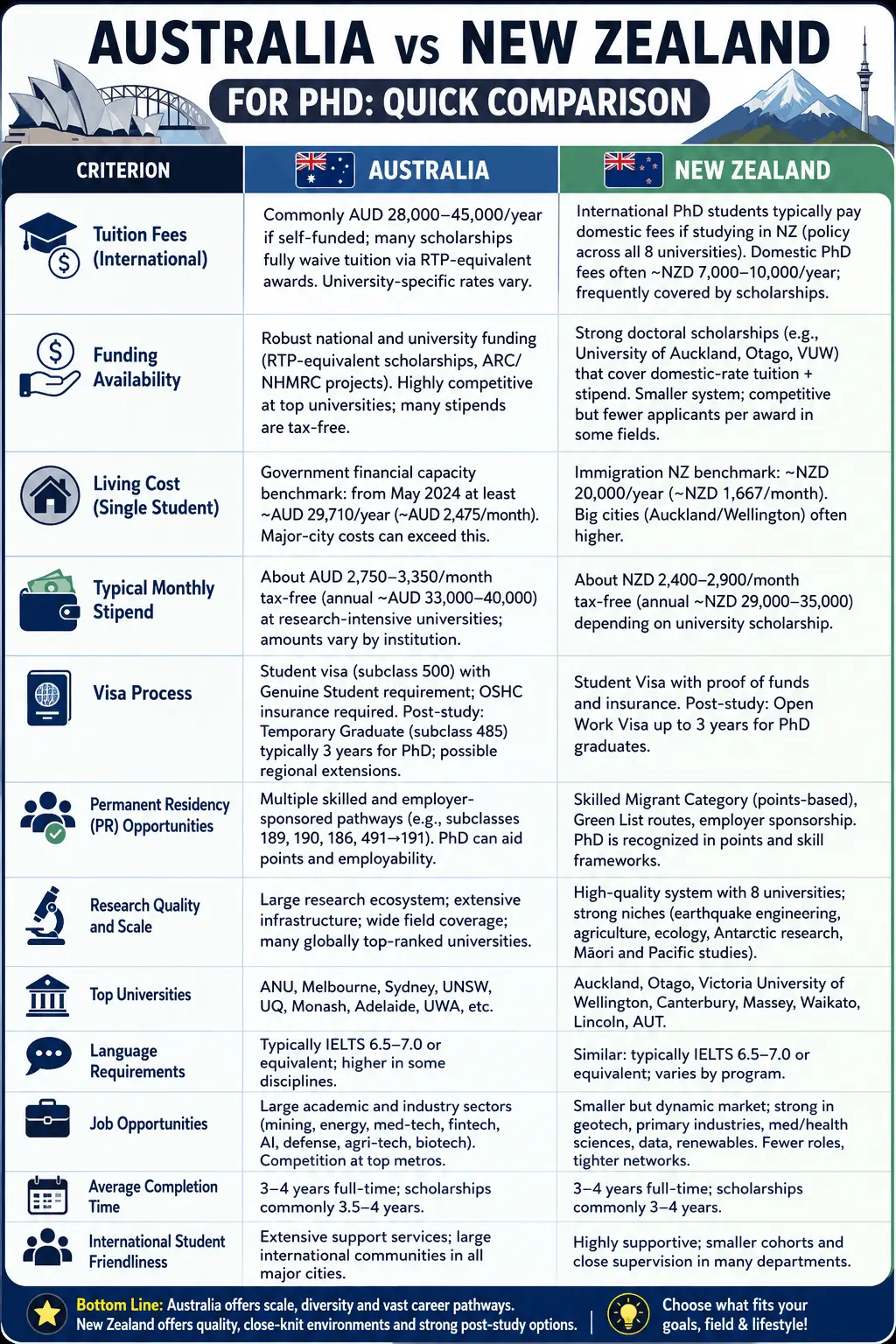
    Australia vs New Zealand for PhD: Quick Comparison

    Criterion Australia New Zealand
    Tuition Fees (International) Commonly AUD 28,000–45,000/year if self-funded; many scholarships fully waive tuition via RTP-equivalent awards. University-specific rates vary. International PhD students typically pay domestic fees if studying in NZ (policy across all 8 universities). Domestic PhD fees often ~NZD 7,000–10,000/year; frequently covered by scholarships.
    Funding Availability Robust national and university funding (RTP-equivalent scholarships, ARC/NHMRC projects). Highly competitive at top universities; many stipends are tax-free. Strong doctoral scholarships (e.g., University of Auckland, Otago, VUW) that cover domestic-rate tuition + stipend. Smaller system; competitive but fewer applicants per award in some fields.
    Living Cost (Single Student) Government financial capacity benchmark: from May 2024 at least ~AUD 29,710/year (~AUD 2,475/month). Major-city costs can exceed this. Immigration NZ benchmark: ~NZD 20,000/year (~NZD 1,667/month). Big cities (Auckland/Wellington) often higher.
    Typical Monthly Stipend About AUD 2,750–3,350/month tax-free (annual ~AUD 33,000–40,000) at research-intensive universities; amounts vary by institution. About NZD 2,400–2,900/month tax-free (annual ~NZD 29,000–35,000) depending on university scholarship.
    Visa Process Student visa (subclass 500) with Genuine Student requirement; OSHC insurance required. Post-study: Temporary Graduate (subclass 485) typically 3 years for PhD; possible regional extensions. Student Visa with proof of funds and insurance. Post-study: Open Work Visa up to 3 years for PhD graduates.
    Permanent Residency (PR) Opportunities Multiple skilled and employer-sponsored pathways (e.g., subclasses 189, 190, 186, 491→191). PhD can aid points and employability. Skilled Migrant Category (points-based), Green List routes, employer sponsorship. PhD is recognized in points and skill frameworks.
    Research Quality and Scale Large research ecosystem; extensive infrastructure; wide field coverage; many globally top-ranked universities. High-quality system with 8 universities; strong niches (earthquake engineering, agriculture, ecology, Antarctic research, Māori and Pacific studies).
    Top Universities ANU, Melbourne, Sydney, UNSW, UQ, Monash, Adelaide, UWA, etc. Auckland, Otago, Victoria University of Wellington, Canterbury, Massey, Waikato, Lincoln, AUT.
    Language Requirements Typically IELTS 6.5–7.0 or equivalent; higher in some disciplines. Similar: typically IELTS 6.5–7.0 or equivalent; varies by program.
    Job Opportunities Large academic and industry sectors (mining, energy, med-tech, fintech, AI, defense, agri-tech, biotech). Competition at top metros. Smaller but dynamic market; strong in geotech, primary industries, med/health sciences, data, renewables. Fewer roles, tighter networks.
    Average Completion Time 3–4 years full-time; scholarships commonly 3.5–4 years. 3–4 years full-time; scholarships commonly 3–4 years.
    International Student Friendliness Extensive support services; large international communities in all major cities. Highly supportive; smaller cohorts and close supervision in many departments.

    Funding Opportunities

    Both countries offer competitive funding, but mechanisms and typical award sizes differ.

    Australia

    Most international PhD candidates target university-administered, government-backed Research Training Program (RTP)-equivalent scholarships. These usually include a tuition fee offset and a living stipend that is generally tax-free. Typical stipends at research-intensive universities range around AUD 33,000–40,000 per year depending on the institution and project.

    • Examples: University of Sydney Research Training Program/University Scholarship lists a stipend in the ~AUD 40,000/year range; University of Melbourne and ANU also offer competitive stipends around ~AUD 36,000–37,000+ per year. Amounts are indexed and vary by year and institution.
    • Project funding often comes via national councils such as the Australian Research Council (ARC) and National Health and Medical Research Council (NHMRC).

    Official resources:

    New Zealand

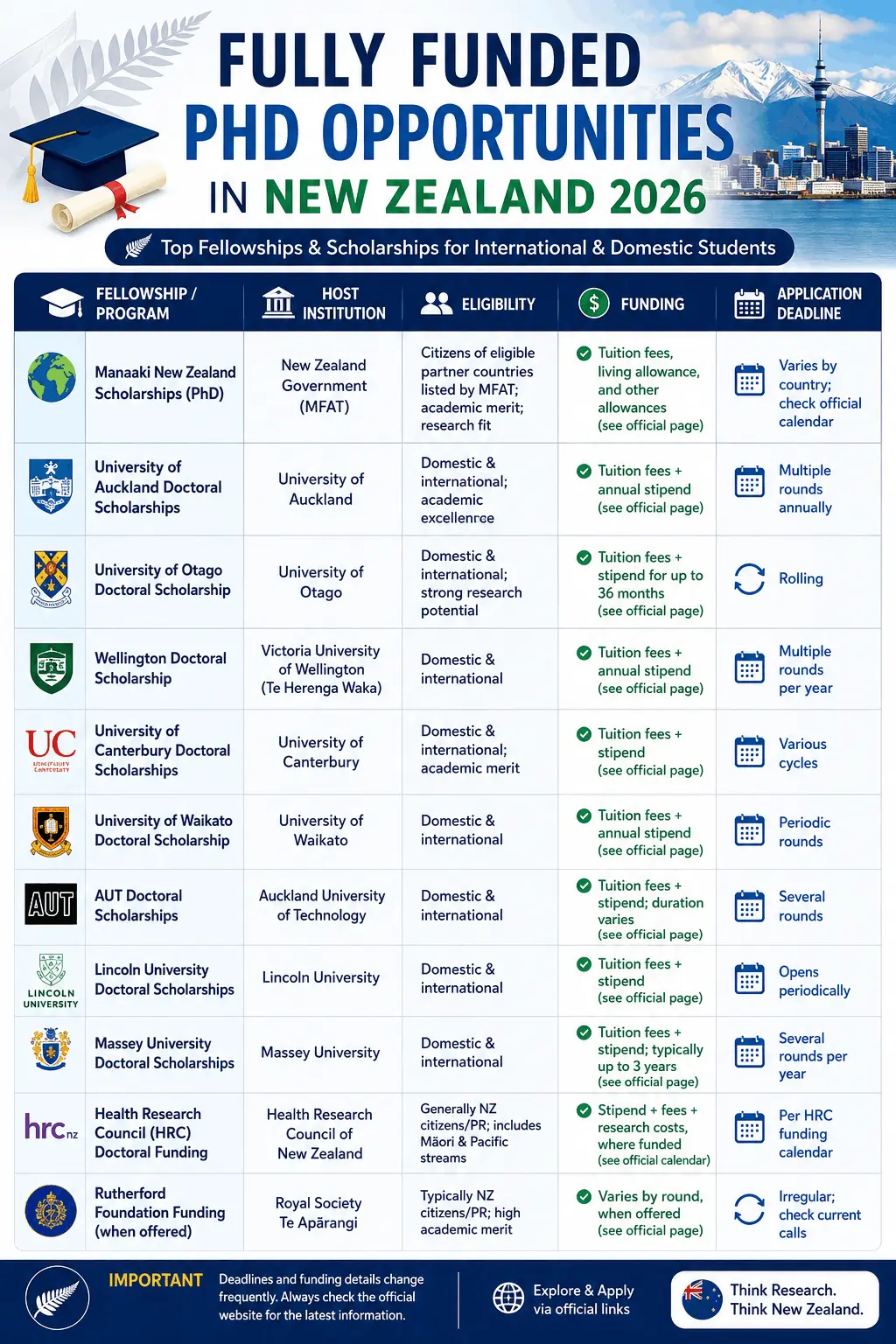
    New Zealand’s standout feature is that international PhD candidates typically pay domestic-rate tuition if they live in New Zealand and their research is primarily conducted there. Most doctoral scholarships cover the domestic tuition fee plus a stipend. Typical annual stipends fall roughly in the NZD 29,000–35,000 range.

    • Examples: University of Auckland Doctoral Scholarship (tuition at domestic rate + stipend ~NZD 30,000); University of Otago Doctoral Scholarship (tuition + stipend, often above NZD 30,000); Victoria University of Wellington Doctoral Scholarship (tuition + stipend around the high-20s to low-30s thousands).

    Official resources:

    Advantages and Disadvantages

    • Australia – Advantages: Larger pool of funded supervisors and major grants; higher top-end stipends at some universities; broad field coverage.
    • Australia – Disadvantages: Tuition can be high if unfunded; scholarship competition is intense at Group of Eight (Go8) universities.
    • New Zealand – Advantages: Domestic-rate tuition for international PhDs; many doctoral scholarships waive tuition entirely; closer supervisory contact in smaller departments.
    • New Zealand – Disadvantages: Fewer total positions and projects; niche fields may have limited capacity.

    Which is better? If you need a guaranteed tuition waiver and prefer a smaller, close-knit research environment, New Zealand is attractive. If you want access to a large research ecosystem, multiple large grants, and potentially higher stipends at top institutions, Australia often wins—provided you secure funding.

    Research Opportunities

    Australia

    Australia’s research landscape is large and internationally connected. You’ll find world-class labs across STEM, medicine, social sciences, and humanities. Strategic strengths include medical and health sciences, data science/AI, energy and minerals, climate and marine science, agriculture and biosecurity, and defense/aerospace. Beyond ARC and NHMRC, collaborative structures like Cooperative Research Centres (CRCs) align academia with industry.

    New Zealand

    New Zealand punches above its weight in specific niches: earthquake engineering and geoscience, agriculture and food science, ecology and conservation biology, Antarctic and Southern Ocean research, renewable energy, and indigenous (Māori and Pacific) studies. The system’s size fosters close collaboration and mentorship, which many doctoral candidates value.

    Major Funding Agencies

    Which is better? For breadth and scale, Australia. For targeted strengths (e.g., seismic engineering, ecology) and a tight mentorship model, New Zealand is compelling.

    Cost of Living

    Australia

    The Australian Government’s student visa financial capacity requirement increased in 2024 to at least AUD 29,710 per year for living costs. Actual spending in Sydney, Melbourne, or Brisbane can exceed this depending on rent and lifestyle.

    • Indicative monthly costs (major cities): AUD 2,200–3,000 for shared housing, transport, food, utilities, and incidentals. Single-student studios or central locations cost more.
    • Health insurance: Overseas Student Health Cover (OSHC) is mandatory for student visa holders.

    Official resources:

    New Zealand

    Immigration New Zealand’s living cost benchmark for tertiary students is generally NZD 20,000 per year. Auckland and Wellington are pricier than smaller cities like Christchurch or Dunedin.

    • Indicative monthly costs (Auckland/Wellington): NZD 1,800–2,600 for shared housing, transport, food, utilities, and incidentals.
    • Insurance: Most universities require approved medical and travel insurance for international students.

    Official resources:

    Which is better? On baseline requirements, New Zealand often looks cheaper. However, stipends also differ by currency and level. Always build a city-specific budget and compare net stipend after likely rent.

    Visa Process and Post-Study Work

    Australia

    • Student visa (subclass 500): Requires Genuine Student (GS) criterion, English proficiency, financial capacity, and OSHC. See official guidance.
    • Post-study work: PhD graduates are typically eligible for the Temporary Graduate visa (subclass 485, Post-Study Work stream) of about 3 years; additional regional extensions of 1–2 years may apply if you studied and lived in eligible regional areas. See official 485 information.

    New Zealand

    • Student Visa: Requires an offer of place, sufficient funds (generally NZD 20,000/year), and approved insurance. See Immigration NZ.
    • Post-study work: PhD graduates can usually obtain a Post-study Work Visa for up to 3 years with open work rights. See official post-study work information.

    Which is better? For PhD holders, both offer around 3 years of post-study work. Australia’s regional incentives may extend stay length; New Zealand’s open work visa simplifies employer changes.

    Permanent Residency Opportunities

    Australia

    PhD graduates pursue skilled or employer-sponsored pathways. Common routes include Skilled Independent (subclass 189), Skilled Nominated (190), Employer Nomination Scheme (186), and regional pathways (491 leading to 191). A completed Australian qualification can help with points and employability, but eligibility depends on occupation lists, skills assessments, English, and current policy settings.

    Official resources:

    New Zealand

    Key routes include the Skilled Migrant Category Resident Visa (points-based) and Green List pathways for designated occupations, along with employer-assisted residence from an Accredited Employer Work Visa (AEWV). A PhD is favorably recognized under qualification frameworks, but eligibility still hinges on occupation, earnings thresholds, and points.

    Official resources:

    Which is better? It depends on your occupation and where you find employment. Both systems favor in-demand skills and higher-earning roles.

    Career Opportunities After Graduation

    Academic Careers

    • Australia: Larger university sector and research institutes mean more total openings for postdocs and teaching/research fellows, especially in major metros. Competition remains strong and often requires publications, grant activity, and teaching experience. Typical academic salary bands vary by institution and level, with superannuation benefits common.
    • New Zealand: Fewer positions but a tight-knit community can accelerate visibility. Strong niches (e.g., geosciences, ecology) may offer targeted roles. Competitive publication and grant records are essential.

    Industry Careers

    • Australia: Substantial demand in mining/resources, med-tech and pharmaceuticals, biotech, agri-tech, fintech, AI/data science, cybersecurity, and defense/aerospace. Large private R&D labs and government agencies (e.g., CSIRO) broaden options.
    • New Zealand: Growing opportunities in agri-food, environmental tech, data and digital, renewable energy, and niche deep-tech startups. Networks matter; internships and industry-linked projects help.

    Visa Pathways and Salaries

    Post-study work periods (~3 years) in both countries give time to build a local track record. Employer sponsorship can be pivotal. Salary levels are generally higher in Australia in absolute terms, but costs are also higher in major cities. Always assess real take-home relative to rent and transport in your specific city.

    Which is better? For sheer breadth of roles and corporate R&D, Australia. For targeted niches aligned with NZ’s strengths and a balanced lifestyle, New Zealand.

    Best Universities

    Australia

    • Australian National University (ANU)
    • University of Melbourne
    • University of Sydney
    • University of New South Wales (UNSW Sydney)
    • University of Queensland (UQ)
    • Monash University
    • University of Adelaide
    • University of Western Australia (UWA)

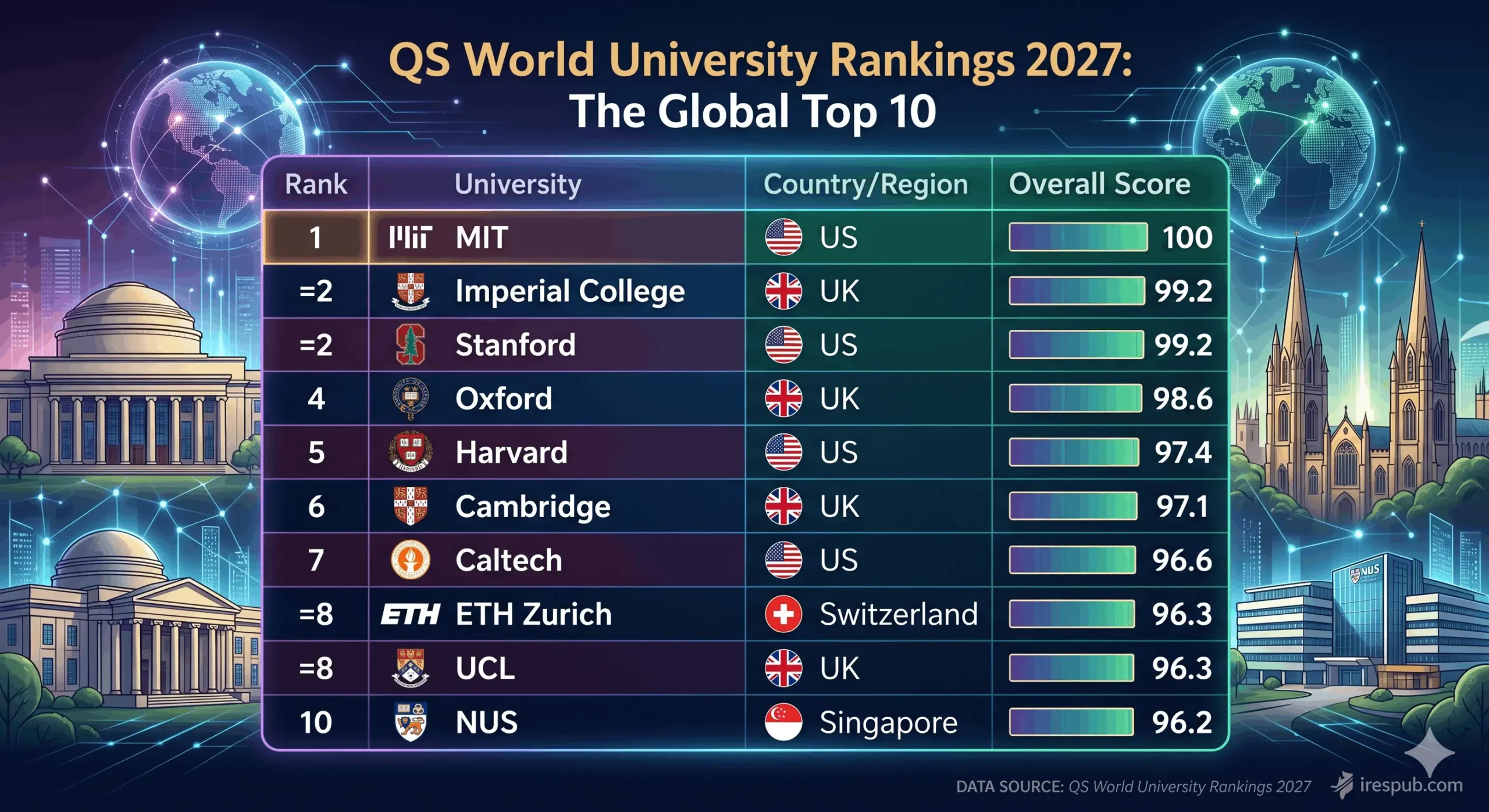
    Rankings vary by discipline, but multiple Australian universities appear high in global rankings (QS, THE). Always check department-level performance, supervisor fit, and lab resources.

    New Zealand

    • University of Auckland
    • University of Otago
    • Victoria University of Wellington
    • University of Canterbury
    • Massey University
    • University of Waikato
    • Lincoln University
    • Auckland University of Technology (AUT)

    New Zealand’s eight public universities are all research-active and internationally ranked; strengths often cluster by field.

    Official ranking resources:

    Application Process

    Similarities

    • Identify potential supervisors and align your proposal with lab and departmental priorities.
    • Prepare a strong research proposal, CV, academic transcripts, publications (if any), and references.
    • Demonstrate English proficiency (IELTS/TOEFL), unless exempted by prior qualifications in English.

    Australia

    • Many programs require supervisor agreement prior to offer; scholarship rounds are typically 1–2 times per year (some rolling intakes exist).
    • For scholarships, competitive metrics include publications, research experience, awards, and fit with funded projects.
    • Check university pages for RTP-equivalent scholarship deadlines and documentary requirements.

    New Zealand

    • Supervisor match is critical; most universities operate centralized doctoral scholarship rounds.
    • Because international PhDs pay domestic fees, universities carefully match candidates to available supervision and research capacity.
    • Funding often includes tuition waiver + stipend; timing and rounds vary by university.

    Actionable tip: Email supervisors first with a concise, evidence-based pitch (one page + CV). Tailor to ongoing grants and published work. Ask about available funding and start dates.

    Language Requirements

    Most universities in both countries set a baseline of IELTS 6.5–7.0 overall (with minimum band scores) or equivalent TOEFL iBT/PTE scores. Some disciplines (e.g., law, education, health) may require higher bands. Exemptions can apply for prior study in English; check institutional policy pages.

    Pros and Cons

    Pros of Australia

    • Large, diversified research ecosystem with substantial national funding.
    • Higher top-end stipends at leading universities in some fields.
    • Broader industry R&D and more total academic openings.
    • Multiple PR pathways and regional incentives.

    Pros of New Zealand

    • International PhDs pay domestic-rate tuition; many scholarships fully cover tuition.
    • Supportive, smaller cohorts and close supervisor engagement.
    • Strong niche strengths (earthquake engineering, ecology, agri-food, Antarctic research).
    • Open 3-year post-study work visa for PhD graduates.

    Cons of Australia

    • High tuition if unfunded; competitive scholarships at top institutions.
    • Higher living costs in major metros.
    • Visa and migration settings change periodically; must monitor occupation lists.

    Cons of New Zealand

    • Smaller job market; fewer total academic and industry roles.
    • Niche capacity can limit options if your field is not a national strength.
    • Fewer large-scale facilities compared with Australia.

    Which Option is Best for You?

    • Students with limited budgets: New Zealand often wins due to domestic-rate tuition for international PhDs and scholarships that cover fees plus stipend.
    • Biomedical researchers: Australia’s scale, hospitals, medical institutes, and NHMRC-backed labs can offer more options; NZ still offers quality training with HRC-backed projects.
    • Engineering students: For mining, energy, defense/aerospace, and large infrastructure, Australia; for earthquake engineering and geotech, New Zealand is globally respected.
    • Long-term immigration goals: Both work; choose the market where your occupation is in demand. Australia offers multiple skilled and employer-sponsored routes; NZ has Skilled Migrant and Green List pathways.
    • Industry careers: Australia’s corporate R&D and sector breadth are advantageous. NZ suits those targeting agri-tech, environmental tech, and select deep-tech niches.
    • Academic careers: Australia has more total openings but higher competition. NZ offers strong mentorship and visibility in smaller systems.

    Bottom line: Choose the ecosystem that best fits your field’s strengths and your funding chances. For many budget-conscious candidates, New Zealand’s domestic-rate PhD is hard to beat; for scale and breadth, Australia shines.

    Expert Tips

    • Start with the supervisor, not the country. A well-matched mentor and funded project often outweigh small cost differences.
    • Apply to multiple universities across both countries to maximize scholarship odds. Tailor your proposal to active grants.
    • Budget in local currency. Compare net stipend after rent and transport in your target city.
    • Check official immigration pages every few months. Policy updates can affect post-study work and PR timing.
    • Use department seminars or online talks to build rapport before applying. Ask about lab resources and project deliverables.
    • Secure strong references that speak to research independence, methods, and publication potential.
    • Demonstrate impact: link your proposal to national research priorities (e.g., health, climate, advanced manufacturing).
    • Plan publications early with your supervisor: set milestones for first-year outputs and conference presentations.

    External Resources (Official)

    Internal Links

    Frequently Asked Questions

    1) Is Australia or New Zealand cheaper for a PhD?

    Often New Zealand, because international PhD students usually pay domestic-rate tuition and many scholarships cover fees plus a stipend. However, costs vary by city and housing. In Australia, scholarships frequently waive tuition and offer competitive stipends; without funding, Australia is usually more expensive.

    2) What are typical PhD stipends in Australia vs New Zealand?

    Australia: commonly around AUD 33,000–40,000/year tax-free at research-intensive universities. New Zealand: commonly around NZD 29,000–35,000/year tax-free. Exact figures depend on the institution, discipline, and year.

    3) How long does a PhD take in each country?

    Typically 3–4 years full-time in both Australia and New Zealand. Many scholarships fund 3.5–4 years in Australia and 3–4 years in New Zealand.

    4) What are the English language requirements?

    Most programs require IELTS 6.5–7.0 (or equivalent TOEFL/PTE), with minimum sub-scores. Some disciplines need higher scores. Exemptions may apply for prior English-medium study.

    5) What post-study work rights do PhD graduates have?

    Australia: generally 3 years via the Temporary Graduate (subclass 485) visa, with possible regional extensions. New Zealand: up to 3 years open Post-study Work Visa for PhD graduates.

    6) Can a PhD help with permanent residency?

    Yes, in both countries, but PR depends on occupation demand, points, earnings thresholds, English, and other requirements. Review Australia’s skilled and employer-sponsored pathways and New Zealand’s Skilled Migrant and Green List routes for current criteria.

    7) Which is better for engineering research?

    Australia offers broad engineering options and industry links (mining, energy, aerospace). New Zealand is world-class in earthquake engineering and geotech. Choose based on project fit and supervisor.

    8) Which is better for life sciences and medicine?

    Australia has a larger biomedical ecosystem with hospitals and NHMRC-backed institutes, creating more lab options. New Zealand provides strong training environments, especially aligned with HRC and niche strengths. Supervisor and facility match should drive your choice.

    9) Do international PhD students in New Zealand really pay domestic fees?

    Yes, provided you reside in New Zealand and your research is primarily conducted there (policy is applied across NZ’s eight universities). Always check the latest university policy for details.

    10) How should I improve my scholarship chances?

    Secure supervisor support early, tailor your proposal to funded projects and national priorities, highlight publications and methods expertise, and apply to multiple institutions across both countries.

    Conclusion: Australia vs New Zealand for PhD

    Both destinations are excellent for doctoral study. Australia offers scale, breadth of labs and grants, and broad industry R&D—ideal if you secure a strong scholarship and want diverse career options. New Zealand offers domestic-rate tuition for international PhDs, scholarships that often cover fees and living costs, and closer supervisory support—ideal for budget-conscious candidates and those targeting NZ’s research niches.

    • Choose Australia if you want a large ecosystem, higher top-end stipends at leading universities, and wider industry pathways across multiple sectors.
    • Choose New Zealand if you value domestic-rate tuition, strong chances of a tuition-waiver scholarship, close mentorship, and strengths in earthquake engineering, ecology, agri-food, or Antarctic research.

    In short, the best choice in the Australia vs New Zealand for PhD decision depends on supervisor fit, funding security, city-level costs, and where your field has the strongest labs and employment demand.

    About IR Research Publication

    IR Research Publication is dedicated to helping scholars, students, and professionals advance their academic and research careers. We share practical guidance on publishing, proposal development, scholarships, and career strategy—bridging research excellence with real-world impact. Explore curated insights, templates, and resources to strengthen every stage of your research journey.

    Related Articles

  • Highest-Paying Postdoctoral Fellowships Worldwide (2026)

    Highest-Paying Postdoctoral Fellowships Worldwide (2026)

    Introduction

    The race for the highest-paying postdoctoral fellowships is more competitive than ever. Beyond prestige, these awards provide real advantages: higher take-home pay, generous research and travel budgets, relocation and family allowances, excellent health coverage, and stronger placement pathways into faculty or industry research roles.

    Who should read this guide? Final-year PhD candidates, current postdocs seeking a better-funded move, PIs advising mentees, and international researchers comparing salary and benefits across countries. Because eligibility, taxes, and benefits differ widely by region and host institution, this article highlights how programs vary in practice and how to choose the best fit.

    Common pitfalls include chasing a single “dream” program, underestimating lead times for letters and visas, misaligning your host’s expertise with your proposal, and presenting budgets or timelines that panels find unrealistic. We help you avoid these pitfalls with a step-by-step plan.

    A note on figures in this guide: all stipend and salary amounts below reflect verified 2026 call data where available. Some are quoted gross (before tax and social contributions), others net (after tax, or tax-free), so we flag this for each program — always confirm the exact figure and tax treatment on the official page before you plan your budget.

    Quick Summary Table

    TopicRecommendationCommon MistakeBest Practice
    Targeting programsApply to 5–8 well-matched, high-paying fellowships across regions.Applying to 1–2 “dream” awards only.Portfolio approach based on fit, pay, and odds; diversify by region and sponsor type.
    Host alignmentChoose hosts with recent, citable outputs directly enabling your project.Picking hosts by brand name alone.Demonstrate unique synergy and concrete co-mentoring/training opportunities.
    Budget and payModel gross vs. net pay, benefits, and cost-of-living by city.Ignoring taxes, social insurance, and currency swings.Use official calculators and include allowances and family benefits in comparisons.
    TimelineStart 6–8 months before the deadline.Last-minute reference requests.Back-schedule deliverables; pre-book letter writers and compliance (ethics/visa).
    Proposal designFocus on training outcomes, independence, and method feasibility.Long literature summaries without a clear plan.Provide milestones, risks, alternatives, and measurable outputs.
    Review criteriaMap each section to published scoring rubrics.Assuming the panel will “get it.”Use headings mirroring criteria; include a one-page review response checklist.
    Letters of supportSecure detailed, specific letters with mentoring and integration plans.Generic letters repeating your CV.Send letter writers bullet prompts and submission reminders early.
    InterviewsPrepare a 60–90 second “fundable idea” pitch and 1–2 slide storyboard.Overloading with technical detail.Lead with problem importance, novelty, impact, and feasibility.
    CompliancePre-clear ethics/IRB/IBC/animal protocols and data agreements.Deferring compliance until award stage.State approvals and data-sharing plans in the application.
    Backup plansLine up host-funded or bridge options.All-or-nothing fellowship dependence.Negotiate host guarantees (lab access, interim pay) contingent on results.

    Which postdoctoral fellowships pay the most? Quick answer

    The following programs are consistently among the highest-paying postdoctoral fellowships worldwide, based on verified 2026 figures (always confirm final call details on official pages):

    • CERN Research Fellowships (Switzerland): CHF 7,004–7,425/month, net and tax-free — approximately CHF 84,000–89,000/year, plus family and travel allowances.
    • Schmidt Science Fellows (global): USD 110,000/year stipend for the 2026 cohort, up to 2 years, plus mentorship and global meetings.
    • Branco Weiss Fellowship – Society in Science (global): up to CHF 600,000 total funding over up to 5 years — a flexible envelope fellows allocate across salary, research, travel, and personnel, not a fixed annual salary.
    • ETH Zurich Postdoctoral Fellowship (Switzerland): CHF 92,500 gross in year 1, rising to CHF 97,200 gross in year 2, plus CHF 12,000/year in research funds.
    • EPFL Fellows (Switzerland): CHF 88,000–92,500/year gross (1st–4th year) plus Swiss social benefits.
    • SNSF Swiss Postdoctoral Fellowships (Switzerland): this transitional scheme has been discontinued now that Switzerland has rejoined MSCA — it used to average CHF 105,000/year gross, but researchers should apply to MSCA-PF directly for a Swiss placement now.
    • HHMI Hanna Gray Fellows (USA): USD 80,000/year salary plus a USD 20,000 expense allowance during the postdoc phase.
    • KAUST Global Fellowship (Saudi Arabia): USD 75,000/year stipend, plus a USD 45,000 research budget, housing, and relocation support.
    • NTU Presidential Postdoctoral Fellowship (Singapore): SGD 80,000/year salary, plus an SGD 100,000/year research grant and SGD 18,000 housing allowance.
    • Marie Skłodowska-Curie Postdoctoral Fellowships (Europe/Global): living allowance €5,080/month + mobility €600 (+ family €660 if eligible), adjusted by country coefficient.
    • NSF Astronomy & Astrophysics Postdoctoral Fellowship (USA): USD 75,000/year stipend plus a USD 35,000 fellowship allowance.
    • Flatiron Research Fellow (Simons Foundation, USA): USD 91,000/year full-time compensation, plus comprehensive benefits.

    Top 20 highest-paying postdoctoral fellowships in 2026 (compare pay, benefits, and fit)

    Amounts reflect verified 2026 call data where confirmed; where not yet published for 2026, the most recent verified figures are used and flagged. “Typical annual pay” indicates whether the amount is gross, net, or a flexible multi-year envelope — always confirm on official pages.

    FellowshipRegionTypical Annual PayKey BenefitsEligibility SnapshotUsual Deadline WindowOfficial Link
    CERN Research FellowshipEurope (Switzerland)CHF 84,000–89,000 (net, tax-free)Health insurance, family allowances, travelPhD holders (0–6 years post-PhD), physics/engineering/computingRolling calls; several cycles per yearcareers.cern
    Schmidt Science FellowsGlobal (host-choice)USD 110,000 (stipend)1–2 years cross-disciplinary pivot, mentorship, global meetingsNominated final-year PhD graduates; cross-discipline projectInstitutional nominations mid-year; finals in Q4schmidtsciencefellows.org
    Flatiron Research Fellow (Simons Foundation)USA (NYC)USD 91,000 (full-time compensation)Comprehensive benefits, travel, computing resourcesPhD in computational sciences (astro, bio, math, physics, data)Varies by center; typically Q3–Q4simonsfoundation.org/flatiron
    Branco Weiss Fellowship – Society in ScienceGlobal (host-choice)Up to CHF 600,000 total over up to 5 years (flexible envelope)Fellow allocates funds across salary, research, travel, personnelPhD within ~5 years; bold, independent projectsCall typically opens Q1; deadline ~Aprilbrancoweissfellowship.org
    KAUST Global FellowshipMiddle East (Saudi Arabia)USD 75,000 (stipend) + USD 45,000 research budgetHousing, relocation, health coverageRecent PhD; STEM fields aligned with KAUSTAnnual calls; often Q3–Q4KAUST Global Fellowship Program
    ETH Zurich Postdoctoral FellowshipEurope (Switzerland)CHF 92,500 gross (Yr 1); CHF 97,200 gross (Yr 2) + CHF 12,000/yr research fundsSwiss benefits, family allowances, mobility supportUp to 8 years after PhD; mobility rules applyTwo rounds/year (spring and fall)ETH Fellows
    EPFL FellowsEurope (Switzerland)CHF 88,000–92,500 gross (1st–4th year)Swiss social benefits, training plan, mobilityEarly-career PhDs; mobility to Switzerland requiredTypically one deadline/year (spring)EPFL Postdocs
    Marie Skłodowska-Curie Postdoctoral Fellowships (MSCA-PF)Europe/global€5,080/mo living + €600 mobility (+€660 family), country coefficient appliedResearch/training; social security via host; secondmentsPhD holders; mobility rule (no long residence in host country)Annual EU call; deadline typically SepMSCA Postdoctoral Fellowships
    Swiss National Science Foundation Postdoctoral FellowshipsEurope (Switzerland)Discontinued — was CHF 105,000 average gross + up to CHF 24,000 project funds over 2 yearsResearch costs, mobility, family allowancesThis transitional scheme has been sunset now that MSCA is available again in Switzerland since 2025; researchers should apply directly to MSCA-PF insteadScheme closedSNSF programme page (status)
    NTU Presidential Postdoctoral FellowshipAsia (Singapore)SGD 80,000 salary + SGD 100,000/yr research grant + SGD 18,000 housingHousing subsidy; sizable research grantRecent PhDs; all disciplines; host mentor requiredUsually Q1–Q2NTU PPF
    NUS Presidential Postdoctoral FellowshipAsia (Singapore)SGD 70,000–90,000 salary + research grantResearch grant; housing supportRecent PhDs; strong host alignmentTypically Q1–Q2NUS Programmes
    HHMI Hanna Gray FellowsUSAUSD 80,000 salary + USD 20,000 expense allowance (postdoc phase)Significant research funds; up to 8 years (postdoc+transition)Biomedical/biological sciences; diversity and independence focus; from the 2028 competition (opening Nov 2026) selection merges with the Freeman Hrabowski Scholars ProgramAnnual; usually Q1 (2028 cycle opens Nov 2026)HHMI Hanna H. Gray Fellows
    NSF Astronomy & Astrophysics Postdoctoral Fellowship (AAPF)USAUSD 75,000 stipend + USD 35,000 fellowship allowanceResearch and education/outreach budgetRecent PhD in astro/related fields; US affiliationAnnual; usually Q4NSF AAPF
    NSF Mathematical Sciences Postdoctoral Research Fellowships (MSPRF)USAUSD ~75,000 salary supportTravel/research allowancesMath PhD; US hostAnnual; typically Q4–Q1NSF MSPRF
    NASA Hubble Fellowship Program (NHFP: Hubble, Einstein, Sagan)USAUSD ~76,000–80,000 stipendResearch funds, relocation, healthPhD in astro/physics; US host instituteAnnual; Sep–NovNHFP
    Canada Postdoctoral Research Award (CPRA) — replaces BantingCanadaCAD 70,000/year (taxable), 24-month termPrestige; part of the harmonized Canada Research Training Awards SuiteThe Banting Postdoctoral Fellowship’s final competition was 2024–25; it has been folded into CPRA, which runs through CIHR, NSERC, or SSHRC depending on field. PhD within eligibility window; host commitment requiredAnnual; check the relevant tri-agency streamCPRA (NSERC)
    EMBL Interdisciplinary Postdocs (EIPOD) / EMBL Postdoc ProgrammeEurope (multi-site)Competitive salary, site-dependent (typically €50k–70k)Employment contracts; cross-disciplinary projectsEarly postdocs; EMBL host labs; mobilityCycles vary by site/programEMBL Postdoctoral Programme
    Human Frontier Science Program (HFSP) Postdoctoral FellowshipsGlobalNo single global stipend — cost-of-living support set per host country, plus research/travel allowanceFamily/childcare allowances; mobility emphasisCross-border, high-risk life science projectsAnnual; typically Aug pre-reg, Sep fullHFSP Postdoctoral Fellowships
    Alexander von Humboldt Postdoctoral FellowshipGermany€2,670/month (~€32,000/year) + supplementsFamily/child allowances; German language coursesAll disciplines; host in GermanyRollingHumboldt Research Fellowship
    JSPS Postdoctoral FellowshipJapan~JPY 362,000/month (~JPY 4.3M/year)Relocation, research, insuranceAll fields; host in JapanMultiple rounds/yearJSPS Fellowships

    A few important clarifications:

    • CERN figures are net and tax-free, while ETH Zurich, EPFL, and SNSF figures are gross — meaning cantonal/federal tax and social contributions come out before you see the money. Don’t compare them at face value.
    • Branco Weiss is not a fixed annual salary. It’s a flexible, multi-year funding envelope of up to CHF 600,000 that fellows can allocate across their own salary, research costs, travel, and personnel over as long as 5 years.
    • HFSP does not publish one global stipend figure. Awards are set relative to the cost of living in the host country, so the “take-home” amount varies significantly depending on where you’re placed.
    • SNSF Swiss Postdoctoral Fellowships was a transitional scheme for researchers who wanted a Switzerland-based MSCA-style fellowship while Switzerland was a non-associated third country in Horizon Europe. Now that Switzerland has rejoined MSCA (since early 2025), the SNSF scheme has been discontinued — apply to MSCA-PF directly for a Switzerland placement instead.
    • Banting Postdoctoral Fellowships ran their final competition in 2024–25 and have been folded into the new harmonized Canada Postdoctoral Research Award (CPRA), part of the Canada Research Training Awards Suite. The pay level (CAD 70,000/year) and duration carry over, but applicants now go through CIHR, NSERC, or SSHRC depending on their field rather than a standalone “Banting” competition.

    How to choose among the highest-paying postdoctoral fellowships

    Beyond headline pay, compare the following:

    • Cost of living and taxes: CHF 90k gross in Zurich, USD 90k in the US, and SGD 90k in Singapore all net out very differently. Use official tax calculators, and factor in whether health insurance and social contributions are employer-covered.
    • Gross vs. net vs. envelope: As shown above, some awards (CERN) are quoted net and tax-free, others (ETH, EPFL, SNSF) are gross, and some (Branco Weiss) are multi-year flexible funding rather than a fixed salary. Normalize before comparing.
    • Benefits: Housing subsidies (common in the Middle East and Singapore), family allowances (CERN, MSCA, SNSF), research budgets (Schmidt, KAUST, NTU/NUS, NSF, NHFP, HHMI), and travel support can outweigh stipend differences.
    • Eligibility windows: Some restrict years since PhD (HFSP, MSCA, CERN), mobility rules (MSCA, SNSF, EPFL/ETH), or host nationality/residency constraints (NSF, NIH).
    • Career outcomes: Programs with strong alumni networks (CERN, MSCA, Schmidt, Flatiron, NHFP) often correlate with strong placement into faculty or high-impact industry roles.

    Step-by-step guide to winning a top-paying postdoc in 9 steps

    Step 1: Build a targeted list (5–8 programs)

    Use a portfolio strategy: 2–3 “reach” awards (e.g., Schmidt, Branco Weiss, Flatiron), 2–3 strong matches (MSCA, ETH/EPFL, NHFP, NSF), and 1–2 safety options (institutional or national schemes with higher success rates). Track pay, benefits, deadlines, eligibility, and document requirements in a simple spreadsheet — and note whether each figure is gross, net, or an envelope.

    Step 2: Validate host fit early

    • Write a 150-word “fit statement” that links your methods to the host’s recent 2–3 papers.
    • Secure a primary mentor and, if allowed, a co-mentor in a complementary area (panels reward cross-training).
    • Confirm lab capacity: bench space, compute/GPU access, datasets, cohorts, field sites.

    Step 3: Pre-flight compliance and logistics

    • Human/animal research: IRB/IACUC or ethics approvals. For data-sharing across borders, add a DUA/GDPR plan.
    • Visa and start date windows: some awards require starting within 6–12 months of the offer.
    • Budget alignment: clarify who pays fringe, tuition-like fees, and overheads (if any).

    Step 4: Design a fundable research and training plan

    Panels want independence and feasibility. Organize your plan as follows:

    • Problem and significance: 1–2 paragraphs with concrete gaps and societal/field impact.
    • Innovation: what is new (algorithm, assay, dataset, theory) and why it matters now.
    • Approach: 2–3 aims with methods, timelines, and objective milestones.
    • Risks and alternatives: 2–3 credible fallbacks per aim.
    • Training gains: new techniques, co-mentorship, coursework, industry/clinical rotations.
    • Outputs: target journals, preprint policy, code/data release, seminars, teaching.

    Step 5: Present a clear calendar and Gantt-like milestones

    • Quarterly milestones, each ending with a tangible output (preprint, dataset, prototype).
    • Reserve 10–15% time for career development: grantwriting, pedagogy, leadership.
    • Include an explicit manuscript and conference plan to demonstrate productivity cadence.

    Step 6: Write for evaluators, not insiders

    • Use short paragraphs, descriptive headings mirroring the scoring rubric, and figures only if allowed.
    • Lead each Aim with 1–2 sentences on hypothesis/goal before technical details.
    • Include a one-paragraph “Why now at this host?” statement.

    Step 7: Optimize letters of support

    Provide letter writers with bullet prompts and a draft of your one-page summary. Ask them to address:

    • Your independence and originality beyond the PhD supervisor’s line.
    • Evidence of project feasibility in 24–36 months.
    • Concrete mentoring and integration plan (lab meetings, co-mentoring, annual reviews).

    Step 8: Mock interviews and chalk talks

    • Prepare a 60–90 second pitch: Problem → Innovation → Feasibility → Impact.
    • Anticipate 6–8 FAQs: novelty, risks, data access, ethical approvals, contingency, independence from PI, timeline realism.
    • Practice with non-specialists to ensure clarity.

    Step 9: Submission quality control

    • Run a final checklist against the sponsor’s scoring criteria.
    • Confirm file names, page limits, margins, and font rules; submit 24–48 hours before deadline.
    • Save a PDF of the submission confirmation.

    Salary, taxes, and benefits: country-by-country considerations

    • Switzerland: High gross pay; excellent social benefits; taxes vary by canton. CERN is the exception — its stipend is net and tax-free, while ETH, EPFL, and SNSF figures are gross.
    • United States: Stipends may be taxable; benefits and health insurance differ by host; NIH NRSA scale sets a floor but many high-end fellowships (HHMI, Flatiron) exceed it.
    • European Union: Many awards are employment contracts with social security; MSCA uses country correction coefficients for cost of living.
    • Middle East (e.g., KAUST): High stipend plus a separate research budget, furnished housing, and relocation; often tax-free personal income; strong research support.
    • Singapore: Competitive salary plus housing support and sizable, separately budgeted research grants; personal taxes relatively low; CPF does not usually apply to foreign postdocs.
    • Japan and Germany: Solid benefits and stability; base stipends may be lower but cost of living and social protection can balance the package.

    Timelines: a month-by-month application planner

    • Months −8 to −7: Identify 5–8 programs; contact hosts; gather eligibility facts.
    • Months −6 to −5: Draft 2-page concept note; secure mentor buy-in; outline training plan.
    • Month −4: Full proposal draft; internal peer reviews; budget alignment.
    • Month −3: Finalize letters; obtain necessary pre-approvals (IRB/IACUC/DUA).
    • Month −2: Polish narrative; prepare lay summary and DEI statements if required.
    • Month −1: Compliance check, formatting, and portal rehearsal submission.
    • Week −2: Submit; confirm references received; archive all files.

    Email templates and document outlines

    Cold email to a potential postdoc host

    Subject: Prospective postdoc and fellowship application (Your Name – Target Award)

    Dear Prof. [Last Name],

    I am a final-year PhD candidate at [University] working on [1-sentence problem]. I plan to apply for the [Fellowship Name] (deadline [Date]) and would value the opportunity to pursue this project in your group, building on your work in [Specific Paper or Method].

    In brief, my proposed project aims to [1–2 sentences on novelty and aims]. I attach a 1-page summary and 2 representative publications. If this aligns with your interests, could we schedule a 20-minute call to discuss fit, training opportunities, and logistics?

    Thank you for considering, and I would be delighted to provide any additional materials.

    Sincerely, [Your Name], PhD Candidate [Website/Google Scholar | ORCID | Contact]

    CV outline for top-paying fellowships

    • Header: Name, degrees, current affiliation, contact, ORCID, website.
    • Research focus: 3–4 bullet statements (methods, domains, key contributions).
    • Publications: separate peer-reviewed articles, preprints, and in-preparation; indicate equal contributions; include DOIs.
    • Awards and funding: fellowships, grants, best-paper awards.
    • Teaching/mentoring: guest lectures, TA roles, mentorship of students.
    • Outreach and leadership: open-source software, datasets, outreach talks, DEI activities.
    • References: 3–4 with emails and roles (PhD advisor, collaborator, external).

    Statement of Purpose (one-page) outline

    • Why this fellowship: fit to mission and criteria.
    • Your trajectory: key results, skills, independence.
    • Project summary: 3–5 sentences: problem → approach → outcomes.
    • Host fit: mentoring, facilities, training, co-mentors.
    • Career plan: specific next steps and how this fellowship accelerates them.

    Research proposal outline (8–12 pages typical)

    1. Title and abstract (200–300 words).
    2. Background and significance (1–1.5 pages).
    3. Innovation and hypotheses (0.5–1 page).
    4. Aim 1 (methods, data, analysis, milestones, risks/alternatives).
    5. Aim 2 (as above).
    6. Aim 3 (optional for 3-year projects).
    7. Training plan and mentoring structure (courses, rotations, industry/clinical exposure).
    8. Open science plan (preprints, code/data sharing, reproducibility).
    9. Timeline and Gantt chart narrative.
    10. Ethics, risk, and safety considerations.
    11. References (consistent style, recent and relevant).

    Interview preparation: common questions

    • What is the single biggest risk in your project and how will you mitigate it?
    • How is this work distinct from your PhD advisor’s research?
    • What preliminary data or proof-of-concept supports feasibility?
    • What will success look like in 12, 24, and 36 months?
    • How will the host’s environment accelerate your progress?
    • What are your plans for data management, sharing, and reproducibility?
    • How will this fellowship position you for your target career (faculty/industry)?

    Cover letter template (for fellowships with employment contracts)

    Dear Members of the Selection Committee,

    I am applying to the [Fellowship Name] to pursue [project title] under the mentorship of [Host PI] at [Institution]. My doctoral work in [Field] produced [1–2 key outcomes], which provide a strong foundation for this proposal’s [methods/innovation].

    This fellowship is the best fit because [alignment with mission/criteria]. The host offers [specific facilities/training], and we have established a clear mentoring and integration plan. Over [duration], I expect to deliver [outputs], share results via [journals/conferences/open data], and undertake training in [skills].

    Thank you for your consideration. I look forward to the opportunity to contribute to the [fellowship community/lab/field].

    Sincerely, [Your Name]

    Expert Tips

    • Use award-specific language: mirror key terms from the call in headings and topic sentences.
    • Quantify ambition and feasibility: “We will benchmark on [dataset] to exceed [metric] by X%” is stronger than “We will evaluate performance.”
    • Attach host commitment: a signed, detailed support letter promising resources and supervision cadence significantly boosts credibility.
    • Leverage dual mentorship: pair a content mentor with a methods mentor (e.g., domain + AI/ML) to show cross-disciplinary training.
    • Pre-register and preprint: panels reward open science and rapid dissemination that do not jeopardize IP.
    • Pilot first: even a small pilot (n=10, prototype script, power analysis) strengthens the feasibility argument.
    • Know the pay components: some fellowships list gross amounts before employer contributions; others are net or tax-free; a few (like Branco Weiss) are multi-year envelopes rather than annual salaries. Clarify this in your comparison sheet before you plan a budget.
    • Use internal reviews: run at least one senior and one junior peer review; incorporate feedback and maintain version control.
    • Show independence: avoid overlapping aims and figures with your PhD advisor’s grants; state clearly what is yours.
    • Back-up submission: where permitted, pursue a national or institutional scheme in parallel to cover timing risk.

    Common Mistakes to Avoid

    • Ignoring mobility rules: programs like MSCA and Swiss fellowships require you not to have resided in the host country beyond specified limits.
    • Overly broad aims: panels prefer two well-defined, feasible aims over four ambitious but vague goals.
    • Missing country corrections: for MSCA, failure to apply country coefficients leads to inaccurate salary expectations.
    • Confusing gross, net, and multi-year envelopes: treating a CHF 600,000 five-year Branco Weiss award as if it were a CHF 600,000/year salary, or comparing CERN’s net stipend directly against ETH’s gross salary, will throw off your planning.
    • Generic letters: references that restate your CV without specifics can sink an application; brief writers early and provide bullets.
    • No contingency plans: absence of risks/alternatives signals lack of realism.
    • Weak host rationale: selecting a prestigious host without a direct methodological link reduces perceived feasibility and training gain.
    • Late compliance: waiting to address IRB/animal/data approvals suggests timeline naivety.
    • Poor formatting: violating page limits, fonts, or margin rules can lead to desk rejections.
    • Underestimating taxes and benefits: a higher gross stipend may net less depending on country and family status.
    • No narrative arc: a cut-and-paste methods section without a compelling problem-impact story rarely scores top marks.

    Useful Resources (official)

    Internal Links and how IR Research Publication can help

    Strengthen your applications with rigorous, citable outputs and visibility:

    Frequently Asked Questions

    Which are the highest-paying postdoctoral fellowships in 2026?

    Programs that consistently top pay scales include Schmidt Science Fellows (USD 110,000/year), Branco Weiss (up to CHF 600,000 over 5 years, flexible), ETH Zurich (CHF 92,500–97,200/year gross), EPFL Fellows (CHF 88,000–92,500/year gross), CERN Research Fellowships (CHF 84,000–89,000/year net, tax-free), and HHMI Hanna Gray Fellows (USD 80,000/year + USD 20,000 allowance). Note that the SNSF Swiss Postdoctoral Fellowships scheme, which used to average CHF 105,000/year, has been discontinued now that MSCA is available again in Switzerland — apply to MSCA-PF for a Swiss placement instead. Verify current 2026 calls, and note whether each figure is gross, net, or a multi-year total.

    How do MSCA Postdoctoral Fellowship salaries work?

    MSCA-PF provides a monthly living allowance (€5,080), mobility allowance (€600), and family allowance (€660 if eligible), all multiplied by a country correction coefficient. Amounts are before taxes and employer contributions; you are typically an employee with social security via the host.

    What is the difference between stipend and salary?

    Salary is employment income with withholdings and benefits; stipend can be tax-free or taxable depending on country and sponsor. CERN, for example, quotes a net, tax-free stipend, while ETH, EPFL, and SNSF use gross salaries. Always compare net-of-tax figures and include benefits.

    Do high-paying fellowships always include research funds?

    No. Some provide primarily salary (e.g., ETH/EPFL base pay), while others bundle a separate research budget on top of the stipend (e.g., KAUST’s USD 45,000 research budget, NTU’s SGD 100,000/year research grant, or ETH’s CHF 12,000/year research funds). Read the call to see which costs are allowed (equipment, travel, page charges) and whether the research budget is separate from your personal pay.

    How many applications should I submit?

    Most successful candidates apply to 5–8 programs across sponsors and regions. Diversification increases your odds and gives negotiation leverage with hosts.

    Can I negotiate salary or benefits?

    Stipends are usually fixed by the sponsor, but benefits and top-ups can sometimes be negotiated with the host (e.g., housing, relocation, supplementary funds, or bridging salary while awaiting results).

    What are acceptance rates like?

    Prestigious programs (Schmidt, Branco Weiss, Flatiron) may fund a small single-digit percentage of applicants. MSCA-PF and NSF postdocs often range roughly 10–15% overall, varying by panel and year. Institutional schemes can be higher. Check statistics in annual reports where available.

    When should I start preparing?

    Start 6–8 months before the deadline. Early preparation is essential for host coordination, ethics approvals, letters, and polished narratives.

    Are industry postdocs higher paying than fellowships?

    Often yes, especially in tech and biotech hubs; however, pure industry roles may trade off academic independence or teaching. This guide focuses on competitive academic or foundation-funded fellowships with strong research autonomy.

    What if I miss a major deadline?

    Line up institutional or national schemes with rolling or later deadlines, and ask your host about short-term contracts or internal bridging funds. Resubmit in the next cycle with improved preliminary data.

    Conclusion: How to act now

    The highest-paying postdoctoral fellowships offer more than salary: they accelerate independence, unlock resources, and expand networks. Start by shortlisting 5–8 awards, matching each to a host with demonstrable synergy, and scoping a focused, feasible, and high-impact project. Use the templates above to contact mentors, structure your CV and proposals, and prepare for interviews. Confirm 2026 stipend and benefits on official pages, model your net-of-tax income by city, watch for the difference between gross, net, and multi-year envelope figures, and submit at least 24–48 hours early. If you aim for the highest-paying postdoctoral fellowships, preparation 6–8 months ahead is the single biggest predictor of success.

    About IR Research Publication

    IR Research Publication is dedicated to advancing global scholarship by connecting researchers with reputable journals, rigorous peer review, and practical publishing resources. From manuscript preparation to dissemination, IR Research Publication supports early-career scientists and postdoctoral researchers in building credible, citable profiles that strengthen fellowship and grant applications. Learn more and get started at IR Research Publication.

    Related Articles

    Note: Stipends, benefits, and policies may change by the 2026 call. Always verify live details, tax treatment, and eligibility on the official fellowship pages and your prospective host’s HR office before committing.

  • Germany vs Netherlands for PhD in 2026: Costs, Funding, Language, Jobs

    Germany vs Netherlands for PhD in 2026: Costs, Funding, Language, Jobs

    Introduction: Why compare Germany vs Netherlands for PhD?

    Germany vs Netherlands for PhD is a common comparison for international researchers because both countries are research powerhouses in Europe, offer a large number of English-language doctoral projects, and provide internationally recognized training. Yet their models differ in crucial ways that affect your finances, supervision, and career outcomes.

    This guide is for master’s graduates, early-career researchers, and professionals considering a European doctorate. It is also useful for academic advisors and parents who want a precise, unbiased overview.

    The factors that usually matter most include funding model and salary, tuition and living costs, research culture and supervision, program structure and duration, visa/residence rules, language expectations, and post-PhD job opportunities (both academic and industry).

    In the next sections, you’ll learn how each country handles admissions, the realities of stipends and employment contracts, where each country excels by discipline, how to budget realistically, and what the immigration and career pathways look like after graduation—backed by official sources where possible.

    Key takeaways at a glance

    • Funding model: The Netherlands typically employs PhD candidates as full-time staff with a salary and benefits; Germany mixes salaried researcher contracts, scholarships, and some self-funded paths with very low or no tuition.
    • Tuition: Public universities in Germany usually charge no tuition for PhD (only small semester fees). In the Netherlands, employee-PhDs don’t pay tuition; external/self-funded PhDs may pay substantial tuition depending on the university.
    • Living costs: Expect moderate-to-high costs in both countries, typically higher in Dutch urban centers like Amsterdam, Utrecht, and Delft.
    • Language: Many PhDs run in English in both countries; local language may be essential for clinical or patient-facing research.
    • Post-PhD jobs: Both have strong academic and industry ecosystems; the Netherlands often provides structured development and a clear 4-year timeline, while Germany offers broad institute networks (Max Planck, Helmholtz, Fraunhofer) and an 18-month job-search period for graduates.

    Quick comparison table: Germany vs Netherlands for PhD

    Criterion Germany Netherlands
    Tuition Fees Usually no tuition at public universities for PhD; small semester contribution (€250–€350/semester varies). External/self-funded routes exist but are less common. Employee-PhDs typically pay no tuition; external/self-funded PhDs may pay tuition (often €10,000–€20,000+/year depending on university/program).
    Funding Availability Common: salaried doctoral researcher contracts (TV-L E13 at 50–100% FTE), scholarships (e.g., DAAD), DFG-funded projects, EU MSCA/ERC funding. Most PhD positions are paid employment under the Dutch Collective Labour Agreement (CAO-NU). External scholarships also possible (NWO, EU MSCA/ERC, national programs).
    Living Cost Approx. €900–€1,200/month in many cities; higher in Munich, Frankfurt, Hamburg, Berlin. Check university city specifics. Approx. €1,100–€1,600/month; higher in Amsterdam, Utrecht, Delft, Rotterdam.
    Monthly Stipend/Salary Salaried positions vary by state and %FTE under TV-L E13; scholarships like DAAD are commonly around €1,200+/month (plus benefits). Exact amounts vary. PhD employees earn a monthly salary per CAO-NU (scale P); typical gross range ~€2,700–€3,500/month over the 4-year contract (varies by university and year).
    Visa Process National visa (D) for study or research; employees typically receive a residence permit as a researcher/employee. Financial proof needed for student visas without salary. Universities usually sponsor employee PhDs; external/self-funded follow student/researcher routes. Clear processes via IND; orientation year (12-month) after graduation.
    Permanent Residency Opportunities Common route: permanent residence generally after 5 years of legal residence; Blue Card holders may qualify sooner under certain conditions. Permanent residence generally after 5 years of continuous legal residence plus integration requirements.
    Research Quality Extensive institute networks (Max Planck, Helmholtz, Fraunhofer, Leibniz) and strong universities across STEM, life sciences, and humanities. Highly ranked universities with strengths in engineering, life sciences, social sciences, and agriculture (e.g., TU Delft, Wageningen, Leiden, UvA, Utrecht).
    Top Universities LMU Munich, TUM, Heidelberg, RWTH Aachen, KIT, Humboldt, FU Berlin, Bonn, Freiburg, Göttingen; plus Max Planck and Helmholtz centers. TU Delft, Wageningen, Leiden, University of Amsterdam, Utrecht, Groningen, Eindhoven, Erasmus Rotterdam, Radboud, Maastricht, VU Amsterdam.
    Language Requirements Many PhDs offered in English; German helps for integration and is essential for some clinical or fieldwork roles. Most PhDs run fully in English; Dutch needed mainly for patient-facing or public-facing roles.
    Job Opportunities Strong academic and industry sectors; notable in automotive, chemicals, pharma/biotech, AI, manufacturing, and green tech. Excellent industry links, especially in semiconductors, high-tech systems, agriculture/food, water, and health sciences.
    Average Completion Time Typically 3–5 years, depending on funding model and discipline. Typically 4 years (standard full-time employment contract).
    International Student Friendliness Very high; wide English use in academia and strong international communities in major cities. Very high; widespread English proficiency and structured doctoral training environments.

    Funding Opportunities

    How funding works in Germany

    Germany offers a mixed system. Many PhD candidates hold paid positions as research staff (Wissenschaftliche Mitarbeitende) funded by externally won grants (often DFG or EU) or institute budgets. These are typically TV-L E13 contracts at 50–100% FTE (hours and pay percentage vary by project and state). Other candidates are funded by competitive scholarships such as DAAD, foundation scholarships (e.g., Konrad Adenauer, Heinrich Böll), or EU Marie Skłodowska-Curie Actions. Tuition at public universities is usually zero for PhDs, with only semester contributions.

    Useful links:

    How funding works in the Netherlands

    The Netherlands often employs PhD candidates as university staff on a 4-year contract with a salary and benefits (pension, paid leave), covered by the Collective Labour Agreement for Dutch Universities (CAO-NU), salary scale P. Some universities also host external/self-funded PhDs who bring their own funding (e.g., national scholarships) and, in those cases, tuition may apply.

    Useful links:

    Advantages

    • Germany: No/low tuition at public universities; many salaried researcher posts; large number of foundations and DFG-funded projects; DAAD is globally recognized.
    • Netherlands: Clear employee status with salary and benefits for most PhDs; structured career development and training; predictable 4-year funding horizon.

    Disadvantages

    • Germany: Funding model varies by supervisor and state; if on a scholarship, social benefits can be limited; contract percentages (e.g., 50–75%) affect take-home pay.
    • Netherlands: Employee-PhD positions are competitive; external/self-funded routes may incur significant tuition; cost of living is relatively high in major Dutch cities.

    Which is better?

    If you prioritize an employee contract with a predictable 4-year salary and benefits, the Netherlands tends to be better. If you value zero tuition, immense institute networks, and diverse funding sources (including scholarships), Germany offers excellent breadth—with the caveat that compensation and contracts vary.

    Research Opportunities and Strengths

    Germany

    Germany hosts some of the world’s strongest non-university research networks and graduate schools. The Max Planck Society focuses on basic science, Helmholtz Centers emphasize large-scale applied research (e.g., energy, health, aerospace), Fraunhofer specializes in industry-facing applied R&D, and Leibniz covers a broad spectrum. Universities such as LMU Munich, TUM, Heidelberg, RWTH Aachen, and KIT are consistently well-regarded. Funding is abundant in STEM, life sciences, and increasingly in AI and sustainability.

    Key agencies and infrastructures:

    Netherlands

    The Netherlands punches above its weight in high-tech systems, microelectronics/semiconductors, photonics, water management, sustainable energy, agriculture and food (WUR), data science/AI, and health sciences. Universities such as TU Delft, Wageningen, Leiden, Amsterdam (UvA & VU), Utrecht, Groningen, Eindhoven, and Erasmus Rotterdam are active in European consortia and industry collaborations.

    Key agencies and infrastructures:

    Advantages

    • Germany: Scale and diversity of research institutes; breadth across disciplines; strong EU project participation; powerful applied research network (Fraunhofer).
    • Netherlands: Tight integration with industry and societal challenges; strong project management culture; high supervisor accessibility; excellent research training frameworks.

    Disadvantages

    • Germany: Heterogeneity—quality of supervision and structure can vary by chair/department; navigation may be more decentralized.
    • Netherlands: Smaller system may have fewer total positions; highly competitive environment for certain fields.

    Which is better?

    For large research infrastructures and extensive institute ecosystems, Germany leads. For structured programs with strong industry links and project clarity, the Netherlands often feels more streamlined.

    Cost of Living and Budgeting

    Living costs depend heavily on city, housing, and lifestyle.

    Germany

    • Typical monthly budget: €900–€1,200 in many cities; expect higher in Munich, Frankfurt, Hamburg, and central Berlin.
    • Semester contributions (for public transport and admin) of ~€250–€350/semester are common.
    • Reference: Study in Germany (official) provides up-to-date guidance on costs.

    Netherlands

    • Typical monthly budget: €1,100–€1,600, with Amsterdam, Utrecht, Delft, and Rotterdam at the higher end.
    • Employee-PhDs earn a salary and may access housing assistance or university housing services; availability is competitive.
    • Reference: Study in NL (official) outlines typical living costs for international students.

    Actionable budgeting tips

    • Apply early for university housing and compare neighborhoods carefully.
    • Leverage student/employee discounts for transport and insurance.
    • In Germany, check whether your semester contribution includes a transport pass.
    • In the Netherlands, calculate net salary using Dutch tax calculators and consider mandatory health insurance costs.

    Language, Culture, and Supervision

    Language requirements

    • Germany: Many PhD projects are fully in English. German helps with administration, community life, and clinical/fieldwork roles. Universities list language requirements per program.
    • Netherlands: English is widely used in research. Dutch is usually not required except for specific clinical, educational, or public-facing roles.

    Supervision culture and training

    • Germany: Supervision structures vary by chair and graduate school. Many institutions now use supervision agreements and graduate program milestones, but practices differ.
    • Netherlands: Generally more standardized, with training and supervision plans (TSP), annual progress evaluations, coursework/professional development, and a clear 4-year schedule.

    Which is better?

    If you prefer a highly structured environment with formal milestones, the Netherlands tends to fit better. If you value flexibility and can self-navigate a more decentralized system, Germany provides that latitude—especially in professor-led chair models.

    Visa and Residence Pathways

    Germany

    • Entry/residence: National visa (D) for study or research via consulates; employees often receive a residence permit as researchers or skilled workers.
    • Financial proof: Required for student visas without employment; typically shows funds for a year of living costs. Requirements update periodically—check official sources.
    • After graduation: Graduates of German universities can generally apply for an 18-month job-seeking residence permit to find qualified employment.
    • Permanent residence: Commonly after 5 years of legal residence; Blue Card holders may be eligible sooner depending on conditions and language level.
    • Official links: Federal Foreign Office – Visa, Make it in Germany.

    Netherlands

    • Entry/residence: Universities typically sponsor permits for employed PhDs. External/self-funded candidates follow student/researcher routes.
    • Orientation year: A 12-month “orientation year for highly educated persons” allows job searching after graduation or doctoral completion.
    • Permanent residence: Generally after 5 years of continuous legal residence plus integration requirements.
    • Official link: Dutch Immigration and Naturalisation Service (IND) and Orientation Year.

    Which is better?

    Both countries offer clear post-PhD pathways. Germany’s 18-month job-search period for graduates is generous, while the Netherlands’ 12-month orientation year is straightforward and aligns with its strong high-tech industry hiring.

    Career Opportunities After Graduation

    Academic jobs

    • Germany: Opportunities in universities and research institutes (Max Planck, Helmholtz, Fraunhofer, Leibniz). Habilitation/postdoc routes vary; many positions are fixed-term and tied to third-party funding.
    • Netherlands: Postdoc and assistant professor tracks are competitive but transparent; institutions emphasize mentoring and professional development.

    Industry jobs

    • Germany: Strong in automotive, chemicals/materials, pharma/biotech, engineering/manufacturing, green tech, and AI. Many R&D roles value German language, but English-only roles exist in multinationals.
    • Netherlands: Leading in semiconductors (e.g., ecosystem around ASML), photonics, life sciences/health, data/AI, water/agritech/sustainability. English is widely used in tech environments.

    Salary expectations and pathways

    • Salaries vary widely by sector and language ability. Both countries have robust tech and research labor markets; check sector-specific salary benchmarks (e.g., Glassdoor, university career services, or official labor statistics).
    • Work authorization: Germany—graduates typically get 18 months to find skilled work; Netherlands—orientation year is 12 months. Both offer routes to highly skilled migrant permits and longer-term residence.

    Which is better?

    If you aim for applied R&D with Europe’s largest economy and broad institute networks, Germany is compelling. For a high-tech, English-friendly environment with strong university-industry pipelines, the Netherlands is excellent.

    Best Universities and Institutes

    Germany (examples)

    Netherlands (examples)

    Application Process: Similarities and Differences

    Germany

    • Two models: individual doctorate (find a supervisor/chair, align a topic, secure funding) and structured doctoral programs (grad schools with cohorts and coursework).
    • Common steps: identify supervisors/projects, email with a focused research pitch, apply through department/university, secure funding (contract/scholarship).
    • Deadlines vary; many positions are advertised year-round via university portals and EURAXESS.

    Netherlands

    • Most positions are posted as job vacancies with a defined project. You apply like for a professional role (CV, motivation letter, research fit, interviews).
    • Contracts typically start for 4 years; a progress review in year 1 may be standard.
    • External/self-funded PhD tracks exist at some universities; check tuition and supervision arrangements carefully.

    Documentation and language

    • Both countries commonly accept IELTS/TOEFL for English-taught PhDs; waivers may apply if prior education was in English. Program pages specify minimum scores and document checklists.

    Actionable advice

    • Germany: Write targeted emails to potential supervisors demonstrating publication awareness and a short, feasible project idea. Ask early about funding (TV-L %FTE, duration, lab resources).
    • Netherlands: Tailor applications to posted projects, echoing key methods and deliverables; prepare for structured interviews and a possible research presentation.

    Pros and Cons

    Pros of Germany

    • No or very low tuition at public universities for PhD; wide availability of scholarships.
    • Vast research ecosystem (Max Planck, Helmholtz, Fraunhofer, Leibniz).
    • Strong industry across multiple sectors; many English-language research environments.
    • 18-month post-study job-search option for graduates.

    Cons of Germany

    • Funding and supervision structures vary widely by supervisor and state.
    • Scholarship holders may have fewer social benefits than employees.
    • German language is advantageous for broader job markets and administration.

    Pros of the Netherlands

    • PhD candidates are often employees with salary, benefits, and a clear 4-year plan.
    • High English proficiency and structured doctoral training/supervision.
    • Strong university–industry links in high-tech, agri-food, and health.
    • Orientation year (12 months) helps transition to the labor market.

    Cons of the Netherlands

    • Fewer total positions compared with Germany; intense competition in some fields.
    • External/self-funded routes can be expensive.
    • Higher living costs in major cities.

    Which Option is Best for You?

    • Students with limited budget: Germany often wins due to zero tuition at public universities and numerous scholarships. Living costs can be lower in many German cities.
    • Those who want a salaried, employee-style PhD: Netherlands—most PhDs are employment contracts with benefits and a well-defined timeline.
    • Biomedical researchers and life sciences: Both countries are strong. Germany offers extensive institute networks and hospitals; the Netherlands provides highly collaborative, translational environments and excellent biostatistics/data resources.
    • Engineering and high-tech (semiconductors, photonics, robotics): The Netherlands is outstanding for tight industry links and high-tech campuses; Germany is excellent for manufacturing, automotive, and industrial R&D.
    • Long-term immigration goals: Both offer routes to permanent residence typically after 5 years. Germany’s 18-month job-search window is generous; the Netherlands offers the orientation year and highly skilled migrant pathways.
    • Academic careers: Both are competitive. If you prefer structured doctoral training and early-career development plans, the Netherlands has an edge; if you value large institute ecosystems and EU project involvement, Germany excels.
    • Industry careers: Netherlands for high-tech ecosystems and English-friendly workplaces; Germany for breadth of sectors and global industrial players.

    Expert Tips

    • Prioritize supervisor and lab fit over country prestige. Your day-to-day mentor quality heavily influences completion time and output.
    • Ask precisely about funding: contract percentage (Germany), gross-to-net salary (Netherlands), teaching loads, and duration guarantees.
    • Compare cities, not just countries. Housing scarcity and costs vary by location; apply early for accommodation.
    • Check IP policies and publication expectations; clarify authorship norms and data management plans.
    • Plan for skills training early (statistics, coding, academic writing); many graduate schools offer free courses.
    • Use EURAXESS and official university portals—avoid unverified listings.
    • For self-funded paths, model a 4–5 year budget including health insurance, tuition (if any), research costs, and inflation.
    • Discuss visa timing with HR/International Office; start paperwork early to avoid delays.

    External Resources (Official)

    Internal Resources from IR Research Publication

    For hands-on application advice, templates, and checklists, explore:

    Frequently Asked Questions

    Is Germany or the Netherlands better for a fully funded PhD?

    Both offer fully funded options. In Germany, many PhDs are salaried research posts or funded by scholarships (DAAD, DFG, EU). In the Netherlands, most PhDs are salaried employee positions. Your best choice depends on the specific project, supervisor, and compensation details.

    Do PhD students pay tuition in Germany?

    At public universities, PhD tuition is typically zero. You usually only pay a semester contribution (administrative and transport). Private institutions and special programs may differ.

    Do PhD candidates pay tuition in the Netherlands?

    Employee-PhDs (the majority) normally do not pay tuition. External or self-funded PhDs may pay tuition, which can be substantial depending on the university. Always verify on the specific program page.

    What is the average PhD salary in the Netherlands?

    Salaries follow the CAO-NU (scale P) and rise over the 4-year contract. Exact gross amounts vary by year and university. Check the latest figures on university vacancy pages or the CAO-NU website.

    How much is a DAAD PhD scholarship?

    DAAD doctoral scholarships commonly provide a monthly rate around €1,200 (plus possible allowances such as insurance and travel). Specific programs vary—see DAAD’s official database.

    How long does a PhD take in Germany vs the Netherlands?

    Germany: typically 3–5 years depending on field and funding model. Netherlands: typically 4 years with a full-time employment contract.

    Are programs offered in English?

    Yes. Many PhDs in both countries are fully in English. Local language may be required for clinical or fieldwork roles and is helpful for daily life and broader job markets.

    What are the post-PhD work options?

    Germany: 18-month job-search residence for graduates; strong academic and industrial R&D sectors. Netherlands: 12-month orientation year; high-tech and life sciences clusters actively hire PhDs.

    How do I find open PhD positions?

    Use EURAXESS, university job portals, and institute websites (e.g., Max Planck, Helmholtz, TU Delft, UvA). In Germany, also contact supervisors directly with a focused research pitch.

    Which is cheaper overall for a PhD: Germany or the Netherlands?

    Germany often has lower total costs due to no tuition and, in many cities, slightly lower living costs. The Netherlands can be more expensive but provides reliable salaries and benefits for employee-PhDs.

    Conclusion: Germany vs Netherlands for PhD

    Choosing between a PhD in Germany vs Netherlands depends on your priorities, not a universal “best.”

    • Choose Germany if you want zero tuition at public universities, access to vast institute networks (Max Planck, Helmholtz, Fraunhofer, Leibniz), and are comfortable navigating variable supervision and funding models (salaried contracts or scholarships). It’s a great fit for those seeking broad research ecosystems and diverse industry sectors.
    • Choose the Netherlands if you prefer a salaried, employee-style PhD with benefits, a clear 4-year structure, and strong university–industry connections—especially in semiconductors, high-tech systems, agrifood, water, and health sciences. The structured training and English-friendly environment are major advantages.

    Define your must-haves—funding certainty, supervision style, city preference, and post-PhD plans—then shortlist programs whose supervisors and projects match your research goals. Use the official resources linked above to validate details and timelines before applying.

    About IR Research Publication

    IR Research Publication empowers students and researchers with practical, peer-reviewed guidance on academic writing, research methods, funding, and careers. Our mission is to make scholarly success accessible through clear tutorials, templates, and expert insights—helping you move from aspiration to publication with confidence.

    Related Articles

  • PhD Scholarship Guide 2026: How to Find, Win, and Fund a Fully Funded PhD

    PhD Scholarship Guide 2026: How to Find, Win, and Fund a Fully Funded PhD

    Introduction

    Winning a competitive PhD scholarship can transform your academic career—freeing you from financial stress and letting you focus on impactful research. Yet, funding systems differ dramatically by country and discipline, deadlines arrive early, and selection panels look for specific evidence of research potential that applicants often overlook.

    This guide is for senior undergraduates, master’s students, PhD applicants, and early-career researchers seeking fully funded doctoral opportunities worldwide. It is especially valuable if you are comparing the US assistantship model, UK/EU doctoral training partnerships, German/Scandinavian employment contracts, and major international fellowships.

    Common mistakes include emailing supervisors with unfocused topics, submitting generic statements of purpose, misunderstanding visa and employment rules, and missing references or proof of English proficiency. Another frequent error is chasing prestige rather than “fit”—a clear alignment between your question, methods, supervisor, and funder priorities.

    By the end, you will know how to identify suitable funding, build a target list, approach supervisors professionally, prepare documents that win interviews, manage budgets and timelines, and navigate country-specific rules. We also include ready-to-use templates and official links for fast, accurate applications.

    Quick Summary Table: PhD Scholarship Guide 2026: How to Find, Win, and Fund a Fully Funded PhD

    TopicRecommendationCommon MistakeBest Practice
    Funding modelsMap country-specific options: assistantships (US), DTP/studentships (UK), MSCA DNs (EU), DAAD/IMPRS (DE), RTP (AU), Vanier (CA), SINGA (SG), CSC (CN), MEXT (JP).Assuming all PhDs are scholarships; in many countries PhD candidates are employees.Confirm whether you’ll be a student with stipend or an employee with salary and benefits.
    TimelineStart 12–18 months ahead of your intended start date.Waiting for program deadlines; funder deadlines are often earlier.Create a backward timeline from the earliest external funder deadline.
    Supervisor contactEmail a concise, tailored note with a 1–2 page research pitch.Mass emails, vague topics, generic CV attachments.Demonstrate alignment with recent papers and available infrastructure.
    ProposalDraft a focused, feasible proposal aligned to funder themes and methods you can execute.Over-ambition, buzzwords, no methodology or risks.Include research question, methods, data, timeline, risks/mitigation, outputs.
    Evidence of potentialShow publications, preprints, code, datasets, conference papers, or a robust master’s thesis.Listing coursework only.Link to repositories; quantify impact (citations, downloads, awards).
    Tests & eligibilityVerify GRE status (often optional) and English requirements per university.Assuming waivers universally apply.Check departmental pages; stash test results early if needed.
    ReferencesSecure 3 referees who can assess research ability.Choosing referees unfamiliar with your work.Provide your draft proposal and bullet points for tailored letters.
    BudgetModel cost of living, fees, and health insurance; confirm stipend indexation.Underestimating housing and relocation costs.Use university calculators; ask current students for realistic figures.
    InterviewsPrepare a 3–5 minute pitch; anticipate methods and feasibility questions.Over-focusing on background story; underselling methods.Lead with the question, contribution, and why you can deliver it now.
    Country differencesAdjust expectations: EU/Scandinavia salaried PhDs; US assistantships cover tuition + stipend.Comparing stipends without taxes/benefits context.Compare net income, benefits, teaching load, and visa conditions.

    Step 1: Understand what a PhD scholarship really covers

    A PhD scholarship usually covers tuition and a stipend for living costs. In some countries, doctoral candidates are employees with a salary (not “scholarships”). Always confirm:

    • What’s covered: tuition, stipend/salary, fees, insurance, visa, relocation, conference travel.
    • Duration: typical funding lasts 3–4 years (UK/EU) or 4–6 years (US).
    • Restrictions: many scholarships cannot be “stacked” with full assistantships; read the terms.
    • Eligibility: citizenship, residency, time-since-degree, field limitations.

    Step 2: Know the major funding models by region

    United States

    • Graduate Assistantships (RA/TA): The main route; includes tuition waiver + stipend. Competitive internal university selection.
    • Fellowships: Examples include NSF GRFP (US citizens/permanent residents), NIH F31 (biomedical), DoD NDSEG, DOE CSGF, Hertz (STEM). Often portable across institutions.
    • Key differences: Many programs admit first, then match to funding. Some require GRE (decreasing trend); check department policy.

    United Kingdom

    • UKRI Studentships: Doctoral Training Partnerships (DTPs) and Centres for Doctoral Training (CDTs) via councils like EPSRC, BBSRC, ESRC, AHRC, MRC, NERC.
    • University Awards: Clarendon (Oxford), Gates Cambridge (Cambridge), President’s Scholarships (Imperial), and departmental studentships.
    • Commonwealth PhD Scholarships: For eligible citizens of Commonwealth countries to study in the UK.

    European Union

    • MSCA Doctoral Networks: Transnational, salaried positions with mobility rules, living/mobility/family allowances.
    • Country-specific: France (doctoral contracts), Netherlands (employee positions), Spain/Italy (mixed; often funded projects).

    Germany and Austria

    • DAAD scholarships: For international doctoral candidates; also short-term research and “sandwich” models.
    • IMPRS (Max Planck): Structured programs with full funding and strong training.
    • Employment model: Many PhD candidates are staff with contracts paid under TV-L wage agreements (Germany).

    Canada

    • Tri-Agency: NSERC/SSHRC/CIHR doctoral awards; Vanier CGS for top candidates.
    • University/Provincial: Ontario Trillium; UBC Four Year Fellowships; many departmental TA/RA packages.

    Australia and New Zealand

    • Australia RTP (Research Training Program): Covers tuition and stipend; universities rank applicants.
    • University schemes: University of Melbourne Graduate Research Scholarships, ANU AGRTP, Monash Graduate Scholarships.
    • New Zealand: Most funding is via university doctoral scholarships; many PhD students pay domestic fees (policy varies; verify current rules).

    Asia and Switzerland

    • Singapore SINGA: Collaborative A*STAR–NUS–NTU funding for international PhDs.
    • China CSC: Chinese Government Scholarship supports PhD study at Chinese or partner universities.
    • Japan MEXT: Government scholarships for doctoral study.
    • Swiss Government Excellence Scholarships: For PhD and research in Switzerland.

    Always read the current call text for allowances, eligibility, and mobility rules.

    Fully Funded Postdoc Positions in Switzerland for Indian Researchers: 2026 Opportunities and Application Guide

    Step 3: Build a target list and timeline (12–18 months ahead)

    1. Define your topic and methods: 3–5 keywords plus 1–2 core methods (e.g., single-cell RNA-seq; Bayesian causal inference; archival legal history).
    2. Identify 6–12 programs/labs: Use departmental pages, FindAPhD, and recent publications. Track in a spreadsheet (deadline, requirements, funding route, supervisor fit).
    3. Backwards plan: If the earliest funder deadline is September, schedule supervisor contact by June, draft proposal by July, referees by August.
    4. Check country documents: Language tests, degree equivalence, notarization, visa timelines.

    Step 4: Make first contact with potential supervisors

    Good supervisor fit is often the single strongest predictor of success. Before writing:

    • Read 2–4 recent papers and the lab’s funding/projects page.
    • Confirm the supervisor is taking students and has compatible methods/equipment.
    • Prepare a 1–2 page concept note: question, novelty, method, data, feasibility, timeline.

    Etiquette varies by country:

    • US: Email before applying is helpful but not always required; departments often admit by committee.
    • UK/EU/DE: For advertised positions, follow the call instructions; for self-proposed topics, early supervisor contact is essential.
    • Scandinavia: Positions are advertised as jobs; apply via HR portals (supervisor contact may follow shortlist).

    Step 5: Prepare an application portfolio that proves research potential

    • Academic CV (2–4 pages): Lead with publications/preprints, then research experience, technical skills, grants/awards, teaching/service. Link to ORCID, Google Scholar, GitHub/OSF/Dataverse.
    • Statement of Purpose (SOP): 750–1,000 words focusing on your research direction, evidence of preparedness, fit with program/supervisor, and career goals.
    • Research Proposal: 3–7 pages if required; UK/EU often mandatory; US varies by program.
    • Writing Sample: In humanities/social sciences; submit your strongest peer-reviewed or thesis chapter.
    • References: Choose referees who can speak to research independence and rigor.

    Where possible, attach evidence: preprints, code, data, posters, awards. For transparency and credibility, consider linking to a profile at IR Research Publication journals or your ORCID.

    Step 6: Write a competitive research proposal

    Panels seek feasibility, significance, and fit with priorities. Make your project “doable” within the funding period.

    • Core question and why it matters: Tie to a gap in recent literature (last 3–5 years).
    • Methods and data: Specify datasets, instruments, sampling plan, or archives. Name labs/infrastructures needed.
    • Timeline and milestones: Break down by semesters/years. Include feasibility buffer.
    • Risks and mitigation: Alternatives if data are delayed or methods underperform.
    • Ethics and reproducibility: IRB/ethics plans, preregistration where appropriate, open data/code.
    • Outputs and impact: Publications, software, datasets, policy briefs, outreach.
    • Fit to funder themes: Explicitly map objectives to call priorities or SDGs where relevant.

    Step 7: Tests, language, and eligibility nuances

    • GRE: Many US programs have dropped or made it optional; check current department policy.
    • English proficiency: TOEFL/IELTS/Duolingo requirements vary. Some waive if prior degree was in English or country-specific rules apply.
    • Degree equivalence: Some universities require credential evaluation (e.g., WES) depending on country.
    • Residency and mobility: EU programs (e.g., MSCA) often have mobility rules (cannot have lived/studied in host country for more than X months in the past Y years).

    QS World University Rankings 2027 Released: MIT’s Historic Streak, Asia’s Rise, and the Global Top 20

    Step 8: Budget realistically and compare offers

    Compare net pay, not just headline stipend/salary. Consider:

    • Taxes and benefits: In many EU/Scandinavian positions you are an employee with paid leave and pensions; taxes will apply.
    • Health insurance: US coverage varies by campus; ask about premiums and dependents.
    • Cost of living: Big-city premiums can erode stipends; check housing waitlists.
    • Conference/travel funds: Essential for visibility; confirm annual amounts.
    • Visa and fees: Budget application fees, visa costs, biometrics, relocation, deposits.

    Step 9: Submit a high-quality, compliant application

    • Follow the portal instructions exactly: File names, formats (PDF), page limits, font/spacing.
    • Consistency: SOP, proposal, and CV should tell one coherent story of why you can deliver this project now.
    • Proofreading: Ask two readers: one for content, one for line edits.
    • Accessibility: Embed fonts, add alt text for figures if requested, ensure PDF text is selectable.

    Where relevant, review writing quality expectations in journals to which your future work might be submitted, for example, browse journal scopes at IR Research Publication journals.

    Step 10: Interviews and research talks

    • Prepare a 3–5 minute pitch: Problem, novelty, approach, feasibility, fit.
    • Expect methods questions: Sample size/power, identification strategy, instrument calibration, archival access.
    • Team fit: Be ready to discuss collaboration, teaching, and mentoring experiences.
    • Ask informed questions: Lab culture, supervision style, project ownership, authorship policy, graduation rates.

    Step 11: Offers, visas, and enrollment

    • Read the award letter: Amounts, duration, renewal conditions, teaching load, IP, outside work rules.
    • Visa timing: Start immediately after acceptance; some countries require financial proof even for funded students.
    • Negotiation: It’s appropriate to ask about top-ups, additional teaching hours, or deferrals where policies allow.

    Step 12: First-year plan to stay funded and productive

    • Milestones: Coursework (if any), candidacy exam plans, ethics approvals, data access.
    • Progress reporting: Some scholarships require annual reports; schedule deliverables ahead.
    • Publication plan: Target 1–2 conference papers/posters; outline a paper pipeline early.

    Examples and Templates

    Sample email to a potential PhD supervisor (concise)

    Subject: Prospective PhD on [Your Topic]: [Method/Approach] fit with your lab

    Dear Dr. [Surname],

    I’m a [current position/degree] at [Institution], working on [1-line topic]. I read your recent paper on [specific finding] and was excited by its [method/dataset/insight].

    I’m applying for 2026 entry and would like to explore a PhD on [your 1–2 sentence question and method]. I believe it aligns with your group’s work on [very specific overlap]. I attach a 1-page concept note and a 2-page CV (links: Google Scholar, GitHub/OSF).

    Would you have 15 minutes for a brief call next week? I’d value your feedback on fit and potential funding routes (e.g., [DTP/MSCA/RAship]).

    Thank you for your time,

    [Name], [Current role] | [Institution] | [Website/ORCID]

    Supervisor email (longer version)

    Subject: Exploring PhD supervision on [specific project] (proposal attached)

    Dear Professor [Surname],

    I’m a [position] specializing in [methods], with publications in [venue/journal/preprint]. Your group’s work on [two recent papers] motivates my proposed project on [question]. Methodologically, I plan to use [methods], leveraging [available datasets/instruments].

    My preliminary results (preprint: [link]) indicate [1–2 findings]. I’d be grateful to discuss alignment with your lab and funding options (e.g., [UKRI DTP call name]/[MSCA DN upcoming call]/[university studentship]).

    Attached: 2-page CV and 2-page proposal outline. Thank you for considering,

    [Name] | [Contact] | [Links]

    Statement of Purpose (SOP) outline

    • Opening: 2–3 sentences on your research theme and why now.
    • Preparation: Key research experiences, methods, outputs (with impact where possible).
    • Proposed direction: 1–2 paragraphs on problems you will tackle; relate to faculty/lab strengths.
    • Fit and resources: Supervisors, centers, datasets, equipment, collaborations.
    • Career goals: Academic/industry pathway and how this program advances them.
    • Closing: Synthesize why you are ready to deliver this project.

    Research proposal outline (compact)

    • Title
    • Abstract (150–250 words)
    • Background and gap (cite 6–10 recent, topically close sources)
    • Research questions/hypotheses
    • Methods (design, data, instruments, analysis plan, power/sample size)
    • Timeline (Gantt-style milestones per semester)
    • Risks/alternatives
    • Ethics and data management (consent, privacy, preregistration, open sharing)
    • Expected contributions (papers, datasets, software, policy)
    • References

    Academic CV section examples

    • Publications: Doe, J. (2024). Title. Journal. DOI.
    • Preprints: Doe, J. (2025). Title. OSF/ArXiv link.
    • Research experience: RA, Lab of X (2023–2025). Built [tool]; co-authored [paper].
    • Technical skills: R (tidyverse, brms), Python (PyTorch), Stata, NVivo, GIS, LaTeX.
    • Awards/funding: Dept Research Prize (2024), Travel Grant (2023).

    Scholarship motivation letter (template)

    Dear Members of the Selection Committee,

    I am applying for the [Scholarship Name] to pursue a PhD in [field] at [University]. My research will address [precise problem], building on my prior work on [experience] where I [impact].

    The scholarship’s focus on [priority theme] aligns directly with my proposed methodology [methods] and intended outcomes [outputs]. With access to [lab/supervisor resources], I will deliver [feasible milestones] within [duration].

    Your support will enable [specific benefits: access to field sites, longitudinal data, collaboration]. I am committed to open, reproducible science and to disseminating findings via [venues] and community outreach.

    Thank you for considering my application.

    Sincerely,

    [Name]

    Interview questions (typical)

    • What is your research question in one sentence, and why is it important now?
    • Walk us through your methods. What are the main risks and your fallback plan?
    • How does your project fit the lab’s strengths and the funder’s priorities?
    • Tell us about a time your analysis failed. What did you change?
    • What outputs will you produce by the end of year one?

    Cover letter for RA/TA/Studentship (template)

    Dear [Hiring Committee/Professor],

    I am writing to apply for the [RA/TA/Studentship] associated with [project/program]. My background in [methods/field], evidenced by [publication/preprint/code], equips me to contribute to [specific project tasks].

    I am particularly motivated by [project aim], and I offer [skills], [software], and [relevant experience]. I look forward to contributing to [lab/course] while advancing my doctoral research on [topic].

    Attached are my CV and [proposal/portfolio]. Thank you for your consideration.

    Sincerely,

    [Name]

    Expert Tips

    • Align to “calls” not just programs: Many awards list yearly priorities; echo their phrasing where genuinely appropriate.
    • Feasibility beats flashiness: Panels prefer realistic scopes with clear methods and backups.
    • Show you can finish: Evidence of completing substantial projects (thesis, publication) reassures assessors.
    • Pre-contact current students: They can signal lab culture, typical graduation times, and hidden costs.
    • Portfolio links matter: Host code/data on GitHub/OSF; use ORCID and Google Scholar for verifiability.
    • Use mock panels: Ask 2–3 academics outside your subfield to “score” your proposal against real rubrics.
    • Mind stacking rules: Check whether external fellowships can top up assistantships; policies vary by country and funder.
    • Rejection strategy: If you miss a competitive fellowship, apply to internal departmental funds and paid RA roles while reapplying next cycle.
    • Stay organized: A master spreadsheet with deadlines, contacts, documents, and status prevents last-minute mistakes.
    • Publish early: Even a short methods note, dataset descriptor, or workshop paper strengthens signals of research readiness.

    Common Mistakes to Avoid

    1. Vague research topic: Panels can’t assess feasibility without a defined question and method.
    2. Mass emails to supervisors: Generic outreach harms your credibility; always tailor to their recent work.
    3. Ignoring country differences: Treating EU salaried posts like scholarships leads to confusion about taxes, benefits, and teaching.
    4. Underestimating timelines: Reference letters and test results can take weeks; start early.
    5. Overly broad SOPs: Narratives without evidence of methods or outputs weaken your case.
    6. No risk plan: Proposals without contingencies look naive.
    7. Unverified claims: Always link to evidence (preprints, datasets) to back skills and results.
    8. Weak referee selection: Choose writers who can discuss research independence, not just coursework grades.
    9. Poor file hygiene: Wrong file names, missing pages, or unselectable PDFs can disqualify applications.
    10. Ignoring fit: Prestige chasing without supervisor alignment leads to rejections even with strong grades.
    11. Budgeting by headline: Comparing stipends without considering local costs or taxes misleads decisions.
    12. Not reading the call text: Many applications fail for eligibility or formatting noncompliance.

    Useful Resources (Official)

    Internal Linking and Further Reading

    To strengthen your scholarly profile and publication strategy as you apply for a PhD scholarship, explore these resources at IR Research Publication:

    Frequently Asked Questions

    What is a PhD scholarship and how is it different from a stipend or salary?

    A PhD scholarship typically waives tuition and provides a living stipend; in some countries (e.g., much of the EU and Scandinavia) PhD candidates are employees on fixed-term contracts with salaries and benefits. Always read the specific terms and local tax rules.

    How do I get a PhD scholarship with average grades?

    Strong research evidence can offset average grades: preprints, code, datasets, a high-quality master’s thesis, or conference papers. Focus your proposal, show feasibility, and get detailed reference letters addressing your research independence and methods.

    Which countries offer fully funded PhD opportunities for international students?

    Common pathways include US assistantships (RA/TA), UKRI studentships (UK), MSCA Doctoral Networks (EU), DAAD/IMPRS (Germany), RTP (Australia), Vanier/tri-agency (Canada), SINGA (Singapore), CSC (China), MEXT (Japan), and Swiss Government Excellence Scholarships.

    Do I need the GRE?

    Many US programs have dropped or made the GRE optional, but some departments still require it. Always verify on the program’s admissions page; humanities and social sciences often do not require it, STEM varies.

    Should I email potential supervisors before applying?

    Generally yes—especially outside the US or when proposing your own topic. Keep it concise, demonstrate fit to their recent work, and attach a short concept note and CV. For advertised job-style PhD posts, follow the call instructions first.

    Can I hold multiple scholarships or combine with an assistantship?

    “Stacking” rules vary widely. Some external fellowships replace your assistantship; others allow top-ups within caps. Ask the graduate office and read the award terms carefully before accepting multiple offers.

    What makes a proposal stand out to panels?

    Clarity, feasibility, and alignment. Define a precise question, specify methods and data, include a realistic timeline, present risk mitigation, and explicitly map aims to funder priorities. Evidence of prior outputs strengthens credibility.

    How early should I start preparing?

    Start 12–18 months before your intended start date. External fellowships often close 10–12 months ahead; references, tests, and visas add lead time.

    How do I compare stipends across cities and countries?

    Use net income (after taxes/fees), benefits (health, leave, pension), teaching load, and local cost of living. Ask current students for typical housing costs and whether stipends are indexed for inflation.

    Is publishing before the PhD necessary?

    Not required everywhere, but any peer-reviewed output, preprint, or demonstrable research product strongly improves your competitiveness, particularly for external fellowships.

    Conclusion

    Securing a PhD scholarship in 2026 requires early planning, precision, and evidence. Start 12–18 months out: define a focused question, map funding by country, contact supervisors with a tailored concept note, and assemble a portfolio that proves research readiness. Align your proposal with funder priorities, budget realistically, and prepare for interviews with a concise pitch. Your next steps: shortlist 8–12 programs, book referee commitments, draft your SOP and proposal, and schedule mock reviews. Begin now—small, consistent progress dramatically increases your odds of a fully funded offer.

    About IR Research Publication

    IR Research Publication is an international publishing platform committed to advancing rigorous, transparent, and accessible research. We support students and scholars with high-standards editorial policies, reputable journals, and practical author resources. Whether you are preparing your first manuscript, refining a research proposal, or planning a publication strategy for your PhD, explore our journals and guidelines at IR Research Publication.

    Related Articles

  • Fully Funded Postdoctoral Fellowships in Germany 2027

    Fully Funded Postdoctoral Fellowships in Germany 2027

    Why Germany for Postdoctoral Research in 2027

    Germany offers a world-class research ecosystem anchored by renowned organizations such as the Max Planck Society, Helmholtz Association, Leibniz Association, Fraunhofer-Gesellschaft, and leading universities. Fully funded postdoctoral fellowships in Germany 2027 support international and domestic researchers with competitive stipends or contracts, excellent infrastructure, and integration into vibrant academic networks.

    • Who should apply: PhD holders or those nearing completion with strong research output and an international outlook.
    • Why Germany: Globally ranked institutes, access to cutting-edge facilities, collaborative culture, competitive funding, and strong industry links.
    • What’s on offer: Taxed employment contracts (e.g., TV-L/TVöD scales) or generous stipends, mobility and family allowances, travel and research budgets, mentoring, and career development.

    Before applying in 2027, always consult official program pages for the most current eligibility rules, stipend levels, and deadlines, as providers periodically update terms.

    Fellowship Summary Table: Fully Funded Postdoctoral Fellowships in Germany 2027

    Fellowship / ProgramHost InstitutionEligibilityFunding / SalaryApplication DeadlineOfficial Link
    Humboldt Research Fellowship (Postdoctoral)Alexander von Humboldt Foundation; host universities/research institutes in GermanyPhD completed within last ~4 years; all nationalitiesMonthly fellowship approx. €3,000 plus allowancesCalls: 15 Mar / 15 Jul / 15 Nov 2026 → starts Feb/May/Sep 2027Official
    Georg Forster Research Fellowship (Postdoctoral)Alexander von Humboldt Foundation; German host institutionsResearchers from developing/transition countries; recent PhDMonthly fellowship approx. €2,700 plus allowancesRolling (year-round)Official
    DAAD PRIME (Postdoctoral Researchers International Mobility Experience)German host university (employer) + research stay abroadDoctorate completed by start; mobility required; all nationalitiesEmployment (TV-L E13 at German host) + mobility allowance~August 2026 (for 2027 start)Official
    Marie Skłodowska-Curie Actions (MSCA) Postdoctoral FellowshipsEU MSCA; German universities/research centers as hostsMax 8 years research experience after PhD; mobility ruleMSCA employment contract (living + mobility + possible family allowances)Annual EU deadline, typically Sept—check EC portalOfficial
    DFG Walter Benjamin ProgrammeGerman host institutions (or abroad); early-career postdocsDoctorate completed; mobility/change of institution expectedOwn position (TV-L E13) + project fundsNo fixed deadline (apply anytime)Official
    EMBO Postdoctoral FellowshipsLife sciences labs in Germany (and Europe)Early-stage postdocs; international mobility requiredCompetitive salary or stipend + research/relocation supportRolling with evaluation cut-offs—see EMBOOfficial
    HFSP Postdoctoral FellowshipsHuman Frontier Science Program; German host eligibleInternational mobility; frontier life science projectsLiving allowance + research/travel + family allowancesAnnual call; LOI in spring—see HFSPOfficial
    EMBL Postdoctoral Programme (EIPOD)European Molecular Biology Laboratory (Heidelberg/Hamburg)PhD by start; interdisciplinary projects; mobility typicalEmployment contract with competitive salary & benefitsPeriodic calls—check EMBLOfficial
    Max Planck Society Postdoctoral PositionsMax Planck Institutes across GermanyPhD in relevant field; strong research track recordTVöD E13 (or similar) contracts + social benefitsYear-round; institute-specificOfficial
    Helmholtz Association Postdoctoral PositionsHelmholtz Centers (e.g., KIT, DESY, GFZ, HZB, DKFZ)PhD; research aligned with center’s missionTVöD/TV-L E13–E14 contracts + benefitsYear-round; center-specificOfficial

    Humboldt Research Fellowship (Postdoctoral)

    Overview

    The Alexander von Humboldt Foundation funds outstanding international postdocs to conduct independent research with a host in Germany. Applications are accepted year-round and across all disciplines.

    Funding and Benefits

    • Monthly fellowship of approximately €3,000 (postdoctoral level), plus family, mobility, and language-course support.
    • Travel costs, conference support, and alumni funding opportunities.
    • 6–24 months of research with flexible start dates.

    Eligibility

    • Doctorate completed generally within the last four years.
    • Strong publication record appropriate to career stage.
    • Host agreement from a German institution.

    Application Process

    • Secure a host and research plan.
    • Submit application online with references; reviews are competitive and merit-based.
    • Timeline: typically 4–7 months from submission to decision.

    Official Website

    Georg Forster Research Fellowship (Postdoctoral)

    Overview

    For researchers from developing and transition countries, this Humboldt Foundation fellowship supports research in Germany that has development relevance.

    Funding and Benefits

    • Monthly fellowship of approximately €2,670, with family/mobility allowances.
    • Language courses, travel, and extensive networking/alumni funding.

    Eligibility

    • Citizenship in an eligible developing/transition country (see official list).
    • Recent PhD and strong academic record.
    • Host invitation and project fit to development-relevant topics.

    Application Process

    • Apply online with project proposal, host’s confirmation, and references.
    • Rolling submissions; allow several months for review.

    Official Website

    DAAD PRIME (Postdoctoral Researchers International Mobility Experience)

    Overview

    DAAD PRIME funds a postdoctoral position at a German university combined with an obligatory research stay abroad, promoting long-term career prospects in Germany.

    Funding and Benefits

    • Employment contract at the German host (TV-L E13) for 18 months.
    • Typically 12 months abroad + 6 months reintegration in Germany.
    • Mobility allowance, travel, and insurance as per DAAD rules.

    Eligibility

    • Doctorate completed by the start date; all nationalities welcome.
    • Mobility requirements apply; check current call text.
    • Host university in Germany must commit to employing the fellow.

    Application Process

    • Annual call (usually spring). Prepare research plan and host confirmations.
    • Submit through DAAD portal; panel evaluation based on excellence and feasibility.

    Official Website

    Marie Skłodowska-Curie Actions (MSCA) Postdoctoral Fellowships

    Overview

    MSCA PF (Horizon Europe) offers prestigious, fully funded postdoctoral training with a German host (European PF) or with an outbound phase followed by a German return (Global PF).

    Funding and Benefits

    • Employment contract with competitive MSCA living, mobility, and family allowances (country correction coefficients apply).
    • Research, training, secondments, and career development budget.

    Eligibility

    • PhD at the call deadline and up to 8 years of research experience after PhD (HE rules).
    • Mobility rule: limited residence in the host country within the prior 36 months.

    Application Process

    • Identify a German supervisor/host and co-develop the proposal in the EU Funding & Tenders Portal.
    • Annual deadline typically in September; evaluation is highly competitive.

    Official Website

    DFG Walter Benjamin Programme

    Overview

    The German Research Foundation (DFG) supports early-career postdocs to conduct independent research in Germany or abroad, often emphasizing a change of academic environment.

    Funding and Benefits

    • Funding for your own position (commonly TV-L E13 at the host institution).
    • Project funds (e.g., travel, consumables) as justified.

    Eligibility

    • Completed doctorate; early career stage; change of institution generally expected.
    • Scientific excellence and a strong, feasible project proposal.

    Application Process

    • Submit a proposal anytime via DFG’s portal with host confirmation and detailed plan.
    • Peer review followed by panel decision; timelines vary.

    Official Website

    EMBO Postdoctoral Fellowships

    Overview

    EMBO supports excellent researchers in the life sciences to carry out postdoctoral work in a different country, including Germany.

    Funding and Benefits

    • Country-specific salary or stipend, dependent on host location.
    • Relocation allowance, childcare support (where applicable), and laboratory/research cost contributions.

    Eligibility

    • PhD completion and early-stage postdoc status; international mobility required.
    • Strong publication record; project fit with host expertise.

    Application Process

    • Rolling applications with periodic evaluation cut-offs (see EMBO).
    • Apply online with project proposal, host support letter, and references.

    Official Website

    HFSP Postdoctoral Fellowships

    Overview

    The Human Frontier Science Program funds frontier, interdisciplinary life science projects, encouraging cross-field training and international mobility to hosts in countries like Germany.

    Funding and Benefits

    • Competitive living allowance, family allowance where eligible, and research/travel support.
    • Up to three years of funding.

    Eligibility

    • PhD by fellowship start; early-career stage; strict international mobility is required.
    • Projects should cross disciplinary boundaries and pursue high-risk/high-gain research.

    Application Process

    • Two-stage annual competition: Letter of Intent (spring) and Full Proposal (late summer/early autumn).
    • Peer review emphasizes novelty and potential impact.

    Official Website

    EMBL Postdoctoral Programme (EIPOD)

    Overview

    EMBL’s postdoctoral programme supports interdisciplinary projects at EMBL sites including Heidelberg and Hamburg, often under the EIPOD scheme.

    Funding and Benefits

    • Employment contract with competitive salary, social security, and staff benefits.
    • Access to core facilities, mentorship, and tailored training.

    Eligibility

    • PhD by the start date; strong interest in interdisciplinary research.
    • Mobility typically expected; confirm specific call criteria.

    Application Process

    • Calls open periodically; applications through EMBL’s portal with project fit and supervisor match.
    • Interviews for shortlisted candidates.

    Official Website

    Max Planck Society Postdoctoral Researcher Positions

    Overview

    Max Planck Institutes (MPIs) offer fully funded postdoctoral positions across basic and applied sciences, social sciences, and humanities.

    Funding and Benefits

    • Employment contracts typically at TVöD E13 (100% FTE) plus social benefits.
    • Cutting-edge facilities, international environment, and internal funding schemes.

    Eligibility

    • PhD in a relevant discipline; strong publications and methods expertise.
    • Project alignment with the hosting MPI’s research groups.

    Application Process

    • Positions advertised year-round by individual MPIs.
    • Apply via the MPI job portal with CV, publications, and research statement.

    Official Website

    Helmholtz Association Postdoctoral Positions

    Overview

    Helmholtz Centers advance large-scale research in energy, earth & environment, health, information, matter, aeronautics/space/transport. Centers regularly hire fully funded postdocs.

    Funding and Benefits

    • Contracts on TVöD/TV-L scales (often E13–E14) with full benefits.
    • Access to large-scale infrastructure and cross-center collaborations.

    Eligibility

    • PhD completed; domain-specific skills; strong motivation for mission-driven research.
    • International candidates welcome; English commonly used.

    Application Process

    • Search and apply via the Helmholtz job portal or center-specific pages (e.g., DESY, DKFZ, KIT).
    • Interviews and reference checks; timelines vary by center.

    Official Website

    How to Choose and Strengthen Your Application

    • Match your research plan to the program’s mission and your host’s expertise.
    • Clarify mobility requirements early (MSCA, EMBO, HFSP, DAAD PRIME).
    • Request reference letters well in advance and align them with your proposal’s narrative.
    • Use clear work packages, realistic Gantt charts, and measurable outcomes.
    • Review successful templates and writing tips. For practical guidance, explore resources at IR Research Publication, including proposal strategies and scholarship roundup posts.

    Frequently Asked Questions

    1. Are the fellowships listed here fully funded?

      Yes. Programs provide either a monthly fellowship (e.g., Humboldt) or an employment contract (e.g., TV-L/TVöD for DAAD PRIME, Max Planck, Helmholtz), often with additional allowances. Always verify current terms on official pages.

    2. When will 2027 deadlines be published?

      Some schemes accept applications year-round (Humboldt, DFG Walter Benjamin, EMBO rolling). Annual calls like MSCA PF, HFSP, and DAAD PRIME typically publish deadlines the preceding year. Check official websites regularly.

    3. What is the typical salary for contracted postdocs in Germany?

      University and institute positions are often aligned with TV-L or TVöD pay scales (commonly E13), which vary by federal state and experience level. Consult your host HR or program pages for current rates.

    4. Do I need German language skills?

      Not usually for research roles; English is widely used. Some programs fund language courses (e.g., Humboldt). Teaching or clinical roles may require German.

    5. Can I bring my family?

      Many programs offer family/spouse allowances (e.g., MSCA, Humboldt) and support with childcare or schooling via host services. Check each program’s family policy.

    6. What are my chances?

      Top programs are competitive. A strong publications record, clear impact, host fit, and compelling training plan substantially improve success.

    7. Where can I get proposal-writing help?

      Consult your host’s research office and explore application tips at IR Research Publication. You may also find guides on MSCA and DAAD strategies useful.

    About IR Research Publication

    IR Research Publication (IRRP) curates credible opportunities and practical resources for scholars worldwide. Our mission is to help researchers find competitive funding, craft stronger proposals, and communicate their science effectively. Explore guides, funding roundups, and writing tips to accelerate your academic career.

    Related Articles

    Additional Resources and Official Portals

    Conclusion

    From Humboldt and DAAD PRIME to MSCA PF, EMBO, HFSP, and institution-based contracts, the ecosystem for fully funded postdoctoral fellowships in Germany 2027 is exceptionally strong. Identify the program that best aligns with your research goals, confirm the latest eligibility and deadlines on official pages, and co-develop a compelling proposal with your host. With early planning, a clear training plan, and strategic mentoring, Germany can be the ideal launchpad for your next breakthrough.

  • USA vs Canada for PhD: Best Choice for Indian Students in 2026
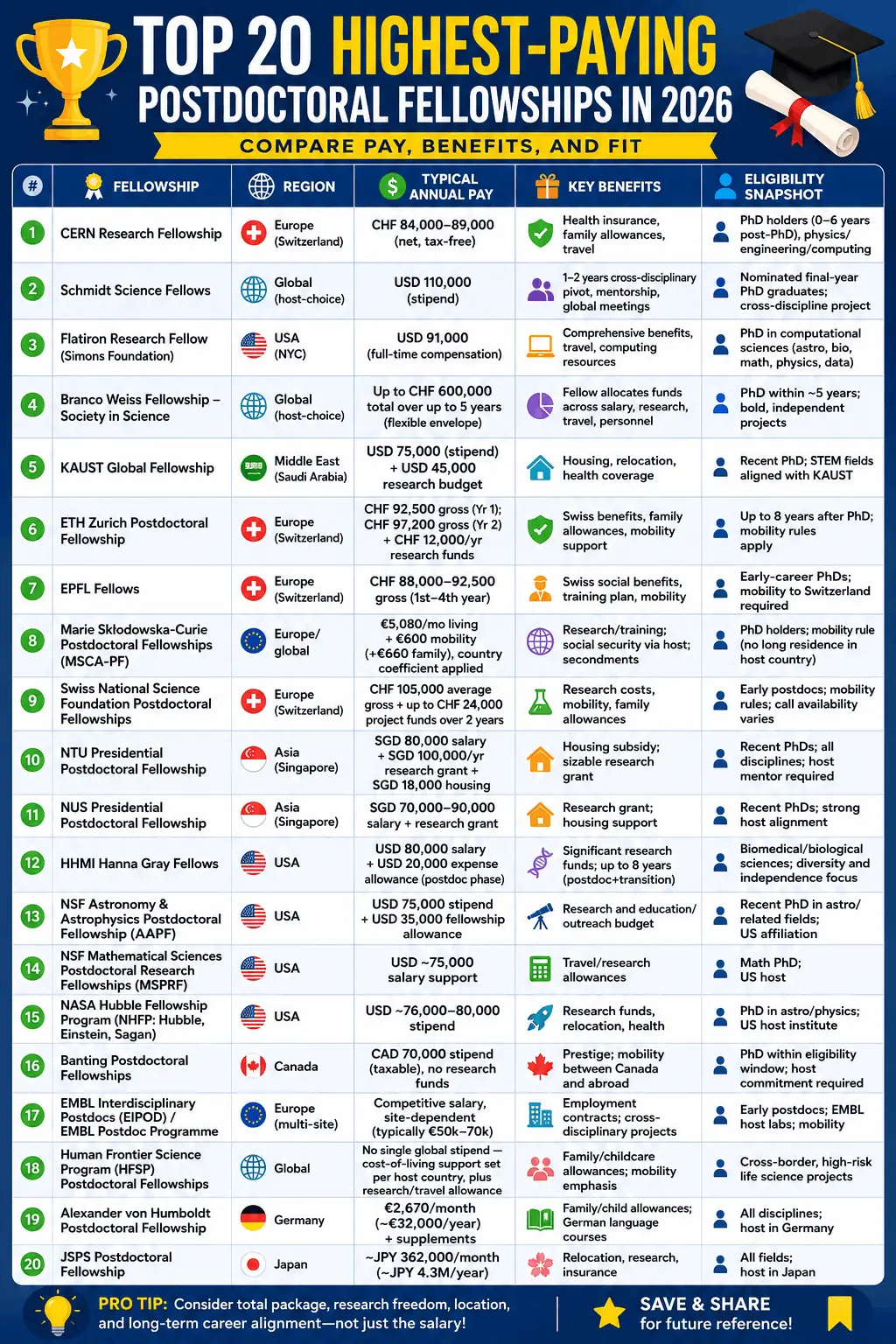
    USA vs Canada for PhD: Best Choice for Indian Students in 2026
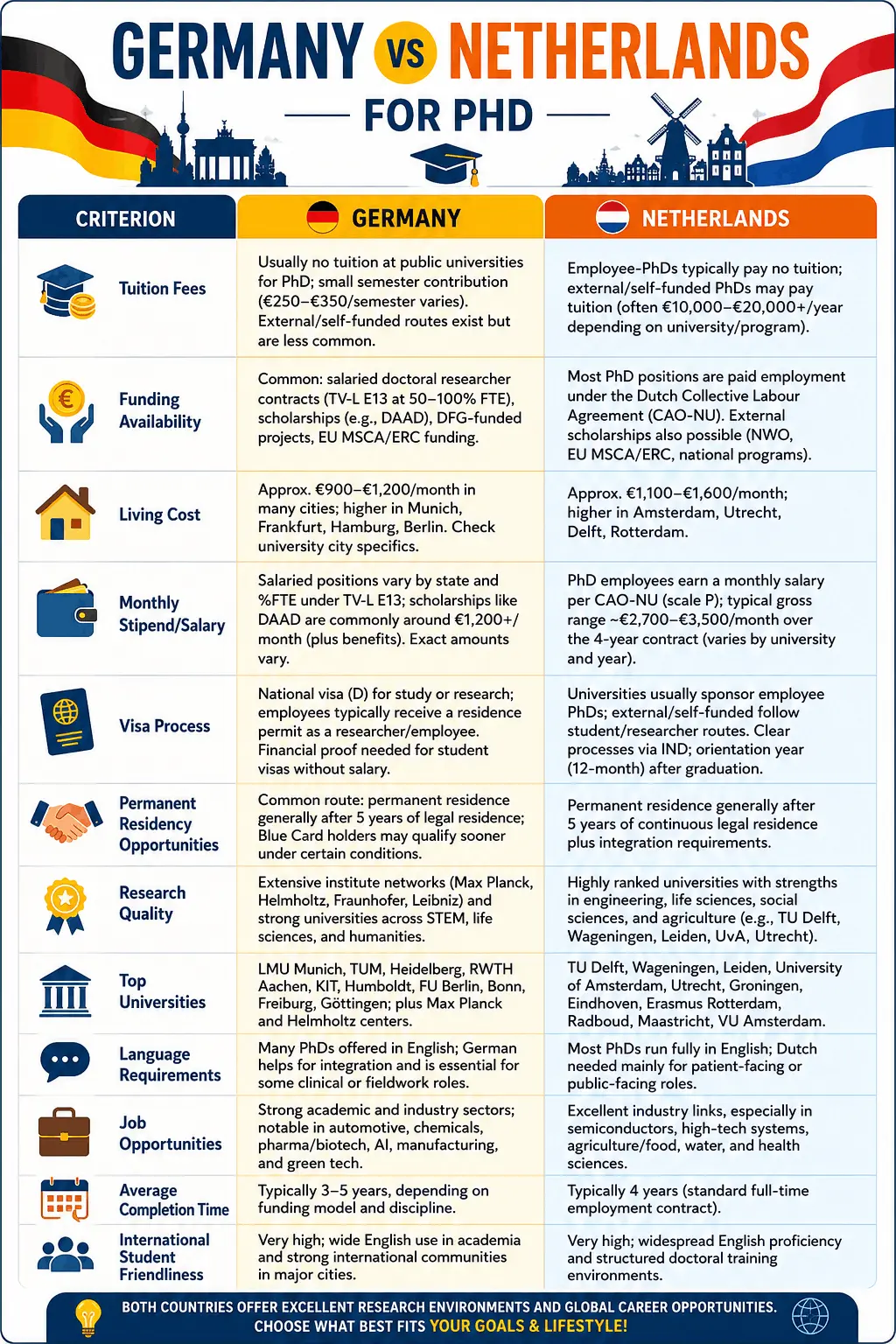
    Introduction: Why Indian students compare a USA vs Canada PhD

    The USA vs Canada PhD for Indian students is a classic comparison because both countries offer world-class research ecosystems, strong academic and industry job markets, and globally recognized universities. Yet they differ in important ways: typical program structure and length, funding models, living costs, immigration rules and PR pathways, and the breadth of labs and grants in specific fields.

    This guide is for Indian applicants who want a clear, unbiased, and source-backed comparison before shortlisting supervisors and programs. It’s also helpful for working professionals in India considering a PhD for career pivoting (e.g., R&D, AI/ML, policy, biotech), as well as master’s graduates evaluating direct-entry options.

    What matters most? The total cost of attendance (tuition plus living), the odds of a guaranteed funding package, the strength of your intended research area, time-to-completion, visa/work rules during and after the PhD, and how each route aligns with long-term immigration and career goals.

    In the next sections, you’ll learn how the USA and Canada compare on funding, tuition, living costs, research opportunities, application processes, language tests, time-to-degree, jobs and salaries, immigration pathways, and student support—so you can decide which path fits your academic ambitions, finances, and life plans.

    Quick comparison: USA vs Canada PhD for Indian students

    FactorUSACanada
    Tuition feesOften fully waived in funded PhD offers (department/PI-funded). Sticker tuition can be high at private universities but is usually covered if you secure RA/TA/fellowship.Frequently waived/offset for funded PhDs. Some universities offer minimum funding guarantees and tuition awards for international PhD students.
    Funding availabilityVery broad—federal agencies (NSF, NIH, DOE, NASA, DoD) and institutional/PI grants. Prestigious fellowships exist.Tri-Agency (NSERC, CIHR, SSHRC) plus provincial/ institutional awards. Many departments provide multi-year funding packages to international PhDs.
    Cost of livingVaries widely by city; the coasts and major tech hubs are expensive. Budget carefully for rent, insurance, and taxes.High in Toronto/Vancouver; moderate in other cities. Public healthcare coverage depends on province and student eligibility.
    Typical stipendHighly variable by field/institution. Many funded PhDs include a stipend; NIH NRSA sets reference rates for biomedical trainees.Varies by university/department. Several universities publish minimum PhD funding levels for international students.
    Visa processF‑1 (or J‑1) student visa via SEVIS/I‑20; work options include CPT during study and OPT (with STEM extension) after graduation.Study Permit via IRCC. Graduates often eligible for Post‑Graduation Work Permit (PGWP) up to 3 years (based on program length).
    Permanent residency (PR) pathwaysEmployment-based green cards (EB categories). Backlogs exist, especially for Indian nationals in EB‑2/EB‑3.Express Entry (CEC/FSW) and Provincial Nominee Programs. A Canadian degree + skilled work can significantly improve CRS scores.
    Research qualityLargest concentration of top-ranked research universities and labs across most fields.Excellent research ecosystem with globally top-ranked universities, especially strong in AI, quantum, sustainability, and health sciences.
    Top universitiesMIT, Stanford, Harvard, UC Berkeley, Caltech, CMU, Princeton, more.University of Toronto, UBC, McGill, Waterloo, McMaster, Alberta, more.
    Language requirementsTOEFL iBT/IELTS Academic commonly accepted; waivers possible if prior degree taught in English (varies).TOEFL iBT/IELTS Academic; some Quebec programs may require French. Waivers vary by institution.
    Job opportunitiesVery strong in academia, tech, biotech, finance, energy. Large market with high variance by region/visa.Strong in AI/ML, cleantech, healthcare, public sector, core engineering; growing tech clusters (Toronto/Waterloo, Montreal, Vancouver).
    Average completion timeOften 4–6+ years from first graduate enrollment; varies by field and program structure.Commonly 4–5 years post‑master’s (varies). Some direct‑entry PhDs take longer.
    International student friendlinessExtensive campus support; after-study work depends on OPT/H‑1B policies.Strong international offices; clear PGWP and PR frameworks attract many PhD students.

    Funding opportunities

    Compare: In both countries, the most decisive factor is whether you receive a fully funded offer (tuition + a living stipend via RA/TA/fellowship). Funded offers are common in lab-based STEM fields and many social sciences, but funding levels and guarantees vary by department.

    USA advantages:

    • Large, diversified funding ecosystem: federal agencies such as the National Science Foundation (NSF), National Institutes of Health (NIH), U.S. Department of Energy (DOE), NASA, and Department of Defense fund many labs and students. See NSF, NIH, DOE Office of Science, and NASA.
    • Flagship fellowships: The NSF Graduate Research Fellowship Program (GRFP) provides a competitive multi-year stipend and cost-of-education allowance for eligible fields; see NSF GRFP for current details. NIH NRSA sets official reference stipend levels for trainees in biomedical fields; see NIH NRSA.
    • Many departments cover tuition and health insurance in funded offers.

    USA disadvantages:

    • Funding is competitive and can depend on PI grants, department budgets, and field. Some humanities and professional doctorates may have more limited support.
    • Stipend adequacy varies with city costs; high-cost metros may require careful budgeting.

    Canada advantages:

    • Tri-Agency ecosystem: NSERC (natural sciences/engineering), CIHR (health), SSHRC (social sciences/humanities) support students and research groups; see NSERC, CIHR, SSHRC.
    • Many universities provide multi‑year funding packages. For example, the University of British Columbia states a minimum guaranteed PhD funding level for eligible students; see UBC’s policy at UBC Minimum Funding Policy.
    • Some institutions reduce international PhD tuition to domestic rates via awards (varies by program/university). At the University of Toronto, see the International Doctoral Student Award (IDSA) for details.

    Canada disadvantages:

    • Tri‑Agency awards are competitive; amounts and coverage can vary by province and program.
    • Funding in some humanities and smaller departments may be tighter; confirm with your supervisor/graduate office.

    Which is better? If your priority is maximum breadth of lab funding and federal fellowship options, the USA generally offers more opportunities across fields. If your goal is a predictable multi-year package and clearer post-graduation work/PR steps, Canada’s model can be advantageous. In both cases, the only comparison that truly matters is the written funding guarantee in your offer letter.

    Tuition and fees

    USA: Many funded PhD offers include full tuition waivers. However, “sticker” tuition at private universities can exceed tens of thousands of USD per year if you are unfunded—so do not assume a waiver unless explicitly stated. Always review department funding pages and your offer letter for tuition coverage, fee waivers, and health insurance details.

    Canada: International PhD tuition is typically lower than the US sticker price, and many departments waive or offset tuition for funded international PhDs. Some universities offer institution-wide supports (e.g., UBC’s minimum funding and tuition awards; U of T’s IDSA to reduce tuition to domestic levels for eligible students). Exact policies vary by faculty and year—verify with the graduate program.

    Tip: Compare “net cost” not “sticker price.” Net cost = tuition/fees you actually pay out-of-pocket after your offer’s waivers + your expected stipend + local living costs + taxes/insurance.

    Cost of living

    USA: Living costs vary sharply by location. San Francisco Bay Area, New York, Boston, Seattle, and Los Angeles are among the most expensive. Midwestern and some Southern cities are more affordable. Major expenses include rent, transportation, food, healthcare/insurance, and local/state taxes.

    Canada: Vancouver and Toronto are high-cost. Montreal, Edmonton, Calgary, Ottawa, Waterloo, and many other cities can be more moderate. You’ll need to account for rent, transit, food, and health coverage (provincial plans sometimes cover international students; when not, universities provide health insurance options).

    Use official university budgeting tools for realistic estimates:

    • UBC living cost guidance: UBC Living Costs
    • University of Toronto graduate cost information: U of T Graduate Finances
    • Check your target US program’s graduate financial aid or cost-of-attendance page for location-specific guidance.

    Monthly stipend and budgeting

    USA: Many funded PhDs provide a monthly or 9/12‑month stipend via RA/TA or fellowships. Amounts differ by field, department, and location. As a federal reference point in biomedicine, NIH NRSA publishes annual predoctoral stipend levels for trainees and fellows (NIH NRSA). Highly competitive fellowships (e.g., NSF GRFP) set independent stipend amounts for fellows. Your actual stipend will depend on your program and funding source.

    Canada: Stipends/funding packages are program-specific. Several universities post minimum PhD funding levels to ensure affordability. For example, UBC outlines a minimum annual funding commitment for eligible PhD students (UBC Minimum Funding). Always confirm components: RA/TA, scholarships, tuition awards, and duration (e.g., first four years).

    Budgeting tips:

    • Ask for the “12-month equivalent” of any 9‑month stipend and whether summer support is guaranteed.
    • Clarify health insurance costs, student fees, and taxes (state/provincial and federal).
    • Model rent scenarios with roommates vs studio apartments near campus or along transit lines.

    Visa, work during study, and post-study immigration

    USA (F‑1/J‑1):

    • Student visa pathway and compliance details: Study in the States (DHS).
    • During the PhD: On‑campus work allowed within limits; Curricular Practical Training (CPT) may be available if integral to the curriculum (consult your DSO).
    • After graduation: Optional Practical Training (OPT) allows up to 12 months of work; STEM graduates may qualify for a 24‑month extension (total up to 36 months). See USCIS: Students and Employment.
    • Longer-term: H‑1B specialty occupation visa requires employer sponsorship and is subject to an annual cap/lottery for most employers (USCIS H‑1B). Permanent residency via employment-based categories (e.g., EB‑2 NIW, EB‑1A/B) depends on qualifications and demand; Indian nationals often face backlogs in EB‑2/EB‑3—check the monthly Visa Bulletin (U.S. Visa Bulletin).

    Canada (Study Permit/PGWP/PR):

    • Study Permit information: IRCC: Study in Canada.
    • Work during study: Rules vary; typically, graduate students may work on campus and, under certain conditions, off campus (see IRCC for up‑to‑date limits).
    • After graduation: Post‑Graduation Work Permit (PGWP) for up to 3 years depending on program length; see IRCC: Work after graduation.
    • Permanent residency: Express Entry (Canadian Experience Class, Federal Skilled Worker) and Provincial Nominee Programs. A Canadian credential plus skilled work can significantly improve your Comprehensive Ranking System (CRS) score (IRCC: Express Entry).

    Which is better? For long-term immigration predictability after a PhD, Canada often offers clearer PR pathways for international graduates. For sheer scale of postdoc/industry roles, the USA is unrivaled—but your work authorization after OPT depends on employer sponsorship and policy landscapes. Always check the latest official guidance.

    Research quality and ecosystem

    USA: The USA has the largest concentration of top-ranked research universities and national labs across disciplines. Global ranking tables (e.g., QS, Times Higher Education, ARWU) consistently feature numerous US institutions at the top; see QS Rankings and THE Rankings. Federal agencies (NSF/NIH/DOE/NASA/DoD) fund expansive research programs, which can translate to more lab openings and cutting-edge equipment in many fields.

    Canada: Canada hosts world-leading universities with strong clusters in AI/ML (Toronto, Montreal, Edmonton), quantum (Waterloo, UBC), life sciences (Toronto, McGill), and sustainability/clean energy (UBC, Calgary). The Tri‑Agency framework and national strategies support high-impact research; key universities rank among the global top 50–100 in several subjects (check QS/THE/ARWU subject rankings).

    Major funding agencies at a glance:

    Which is better? If your subfield depends on large-scale facilities, very large lab groups, or deep federal funding (e.g., certain areas of physics, CS, biomedicine, aerospace), the USA often offers more options. For AI/ML, quantum, sustainability, and health, Canada’s strengths are globally competitive and can provide excellent supervisor fit plus strong industry collaborations.

    Best universities

    USA highlights: Massachusetts Institute of Technology (MIT Graduate Admissions), Stanford University (Stanford Graduate Admissions), Harvard University (Harvard GSAS), University of California, Berkeley (UC Berkeley Graduate Division), California Institute of Technology (Caltech Graduate Admissions), Carnegie Mellon University (CMU Graduate Studies), Princeton University (Princeton Graduate School), University of Illinois Urbana-Champaign (UIUC Graduate College), University of Michigan (Rackham Graduate School), Georgia Tech (Georgia Tech Graduate Education).

    Canada highlights: University of Toronto (U of T SGS), University of British Columbia (UBC Graduate Studies), McGill University (McGill Graduate Admissions), University of Waterloo (Waterloo Graduate Studies), McMaster University (McMaster Graduate Studies), University of Alberta (UAlberta FGSR), University of Montreal (UdeM Doctoral Admissions).

    Always shortlist by supervisor fit, recent publications, lab culture, and funding—not just brand-name rank. A strong mentor and a funded project aligned to your interests usually matter more than the overall university rank.

    Language and testing requirements

    USA: Most universities accept TOEFL iBT or IELTS Academic. Minimum scores vary by department. Some programs waive English tests if you completed a previous degree taught in English (policy varies). GRE requirements have become increasingly optional in many US programs—confirm on your program’s admissions page. See official test sites: TOEFL, IELTS, GRE.

    Canada: TOEFL iBT/IELTS Academic are widely accepted; minimums vary by university and faculty. Some Quebec programs may require or favor French proficiency. Waivers may be possible if your prior degree instruction was in English. Verify requirements on your program’s admission page.

    Application process and timelines

    USA:

    • Common to apply directly after a bachelor’s (BS/BE) into a PhD, especially in STEM; many programs include rotations and coursework before full-time dissertation research.
    • Typical application timeline: deadlines from November to January for fall intake; decisions from February to April; funding usually included in the offer.
    • Materials: statement of purpose, CV, transcripts, English test scores, letters of recommendation, writing sample (for some fields), GRE (if required), and evidence of research potential (papers, projects).

    Canada:

    • Many programs prefer or require a master’s before PhD; direct-entry PhDs exist but may take longer overall. Supervisor pre‑alignment is often crucial—contact potential supervisors early.
    • Deadlines vary by department; fall intake is common. Some programs review applications on a rolling basis subject to funding availability.
    • Materials: similar to the USA, but supervisor endorsement or a confirmed funding arrangement can be especially important.

    Actionable steps: Email prospective supervisors with a concise research pitch and CV, ask about funded openings and fit, and request a brief call. Send tailored emails (avoid generic templates) and reference their recent papers to demonstrate alignment.

    Average time to completion and program structure

    USA: Many US PhDs include substantial coursework and qualifying exams before advancing to candidacy. The National Science Foundation’s data show that median time-to-doctorate from first graduate enrollment is often around the 5–6 year mark across fields (varies); see NSF: Survey of Earned Doctorates. Direct‑from‑bachelor’s entrants may take longer than those entering with a master’s.

    Canada: Program length varies. Many Canadian PhDs after a research master’s target 4–5 years, with earlier transition to full-time research. Some universities state nominal durations (e.g., 4–6 years) on program pages; check your target department for expected timelines, candidacy exams, publication expectations, and residency rules.

    Career opportunities after graduation

    Academic jobs: Both countries have competitive tenure‑track markets. Publishing strong first‑author papers, securing teaching experience, and winning competitive fellowships improve prospects. Postdoctoral training is common in STEM and some social sciences/humanities.

    Industry jobs:

    • USA: Very strong opportunities across tech (AI/ML, data science, systems), biotech/pharma, finance/quant, energy, advanced manufacturing, and national labs. Visa pathways (OPT → H‑1B/O‑1/EB) can affect employer decisions.
    • Canada: Growing tech ecosystems in Toronto/Waterloo, Montreal, and Vancouver (AI/ML, fintech, gaming), plus robust public-sector, health, and resource/cleantech industries. PGWP and PR routes can ease hiring for employers.

    Salary expectations: Salaries vary by field, region, and role. Official references for the USA include the Bureau of Labor Statistics (BLS). For example, 2023 median pay for Computer and Information Research Scientists and Physicists is among the highest STEM medians; see BLS Occupational Outlook Handbook. For Canada, consult Government of Canada’s Job Bank wage data by occupation and province: Job Bank Wages. Use these official sources to benchmark by occupation and location; PhD holders may earn above occupational medians in specialized roles.

    Visa pathways and hiring: In the USA, the H‑1B cap/lottery introduces uncertainty unless the employer is cap‑exempt (e.g., universities, some nonprofits). In Canada, PGWP and Express Entry often make hiring simpler for employers after your PhD, especially once you gain Canadian experience and PR.

    International student support and campus life

    USA: Large universities typically offer international student offices, teaching centers, counseling, graduate housing, and family support. Student groups for Indian communities are vibrant at many campuses. Explore your target program’s mentorship infrastructure and teaching development resources.

    Canada: Strong international student advising, co‑op/internship offices (where offered), and inclusive student associations. Health insurance and coverage vary by province—review whether you’re eligible for provincial plans and what the university plan covers (dental/vision/mental health).

    Pros and cons

    Pros of a USA PhD

    • Unmatched depth and breadth of top research universities, labs, and funding sources.
    • High-density tech/biotech ecosystems with strong industry collaboration.
    • Prestigious fellowships and extensive seminar/conference networks.

    Cons of a USA PhD

    • Work authorization after OPT depends on employer sponsorship and policy changes.
    • High living costs in many top research hubs; stipends may lag local rents.
    • Longer average time-to-degree in some fields/programs.

    Pros of a Canada PhD

    • Clearer post‑graduation work (PGWP) and PR pathways for many graduates.
    • Strong research in AI/ML, quantum, health, and sustainability; collaborative culture.
    • Many programs offer multi‑year funding packages and tuition awards to international PhDs.

    Cons of a Canada PhD

    • Fewer total universities and labs than the USA; choice may be narrower in niche fields.
    • High living costs in Toronto/Vancouver; funding can vary by department.
    • Some programs expect a master’s before PhD, adding time and cost if you don’t have one.

    Which option is best for you?

    • Students with a limited budget: Compare guaranteed funding in writing. Canada’s multi‑year packages and tuition awards can produce lower net costs, especially outside the highest-cost cities. In the USA, target departments with strong RA/TA support and consider lower‑cost regions.
    • Biomedical researchers: USA often offers larger lab ecosystems and NIH‑funded projects; Canada has excellent options (Toronto, McGill, UBC) with strong hospital/research institute ties. If long-term immigration stability matters, Canada’s PGWP→PR path is attractive.
    • Computer science/AI/ML: USA maximizes Big Tech proximity; Canada has top-tier AI hubs (Toronto/Vector, Montreal/Mila, Edmonton/Amii, Vancouver). If you want PR soon after graduating, Canada may offer a smoother path. If your aim is FAANG-scale roles, the USA offers volume but requires navigating OPT/H‑1B.
    • Core engineering/energy/quantum: USA provides many national labs and large consortia; Canada’s Waterloo/UBC/Alberta/McMaster ecosystems are notable. Choose based on supervisor fit, lab facilities, and partnerships.
    • Long-term immigration goals: Canada generally provides clearer PR options for graduates. The USA offers employment-based green cards but with potential backlogs for Indian nationals in EB‑2/EB‑3—monitor the Visa Bulletin.
    • Industry-focused careers: USA has the largest market depth; Canada provides strong opportunities in AI/ML, fintech, gaming, health, and public sector with employer-friendly PGWP/PR frameworks.
    • Academic careers: Both are competitive; choose the supervisor and lab that best position you for high‑impact publications, grants, and a strong network.

    Expert tips

    • Prioritize supervisor fit and guaranteed funding over brand rank. A supportive PI with active grants beats a famous name without funding.
    • Email potential supervisors early (Aug–Oct for the following fall), referencing 1–2 of their recent papers with your aligned research idea in 150–200 words.
    • Ask programs to detail the funding breakdown: stipend amount, months covered, summer support, tuition/fee waivers, health insurance, and duration.
    • Model taxes and healthcare. In the USA, compare student health plan coverage and out-of-pocket costs; in Canada, confirm provincial coverage eligibility and university plan details.
    • Use official immigration pages only. Visa/PR rules change—verify with USCIS/DHS or IRCC before final decisions.
    • Build employability during your PhD: internships, teaching certificates, method/tool depth (e.g., PyTorch, R, MATLAB, Stata), and cross-disciplinary collaborations.
    • Network strategically: conferences, workshops, and lab visits. Ask your PI for targeted introductions in academia and industry.

    External resources (official)

    Internal resources from IR Research Publication

    Explore more research and publication guidance on IR Research Publication:

    Frequently asked questions

    1) Is a USA or Canada PhD better for Indian students?

    Neither is universally “better.” The right choice depends on your supervisor fit, confirmed funding package, field strengths, living costs, and immigration plans. The USA offers unmatched scale; Canada offers clearer PGWP→PR pathways for many graduates.

    2) Which is cheaper for a PhD: USA or Canada?

    Both can be affordable if you secure a fully funded offer with tuition waiver and stipend. Canada often yields lower net costs outside Toronto/Vancouver and with tuition awards; in the USA, costs vary heavily by city—compare your written offers line by line.

    3) Do PhD students get paid?

    Yes, in funded programs. Stipends commonly come from RA/TA roles or fellowships. Amounts vary widely by field and location. Some agencies publish reference stipend levels (e.g., NIH NRSA for biomedical trainees in the USA).

    4) What English tests are accepted?

    TOEFL iBT and IELTS Academic are widely accepted in both countries. Minimum scores and waiver policies vary by university and department. Always check your program’s official admissions page.

    5) How long does a PhD take in the USA vs Canada?

    USA programs often run 4–6+ years from first graduate enrollment (varies by field). In Canada, many PhDs after a research master’s target 4–5 years. Direct-entry PhDs can take longer in both countries.

    6) Is GRE required?

    Many US programs have moved to GRE-optional or GRE-not-required policies, but some still ask for it. In Canada, GRE is less commonly required outside specific departments. Confirm on the program’s website.

    7) What are the post-study work options?

    USA: OPT (and STEM OPT extension) after F‑1 studies; longer-term H‑1B/O‑1/EB pathways. Canada: PGWP up to 3 years (depending on program length) and PR via Express Entry/PNP. Always verify current rules on official sites.

    8) Can my spouse work during my PhD?

    Rules differ. In the USA, F‑2 spouses generally cannot work; J‑2 may be eligible with authorization. In Canada, spouses/partners may be eligible for an open work permit under certain conditions. Check DHS/USCIS and IRCC pages for the latest policies.

    9) Are there fully funded PhD scholarships for Indian students?

    Yes. Many departments offer funded positions. Competitive fellowships (NSF GRFP, agency fellowships in the USA; Tri-Agency and provincial/institutional awards in Canada) can boost funding. Search program and agency sites early.

    10) How do I pick a supervisor?

    Read 3–5 of their recent papers, verify active grants and lab size, speak with current students, and confirm funding security and mentoring style. Consider co‑supervision if your work is interdisciplinary.

    Conclusion: USA vs Canada PhD for Indian students—what should you choose?

    Both the USA and Canada offer outstanding PhD training for Indian students. The best choice aligns with your funding security, supervisor fit, research environment, life costs, and immigration priorities.

    • Choose the USA if you want the largest choice of labs and funding sources, proximity to top-tier industry hubs, and a program structure that supports broad coursework and rotations. Ensure you’re comfortable navigating OPT→H‑1B or alternative visa strategies and budgeting for potentially high-cost cities.
    • Choose Canada if you value a clear PGWP→PR pathway, strong AI/quantum/health/sustainability ecosystems, and multi‑year funding packages with predictable net costs. This is especially attractive if you already hold a research master’s and want a 4–5 year PhD trajectory.

    In all cases, compare written offers, talk to potential supervisors and current students, and verify immigration details on official sites before you decide.

    About IR Research Publication

    IR Research Publication is a platform dedicated to advancing scholarly communication and empowering researchers worldwide. We publish high-quality, peer-reviewed work and share practical guidance on research design, academic writing, and career development. Our mission is to help scholars—from early-stage graduate students to senior academics—disseminate impactful research and navigate academia with confidence.

  • Best Countries for PhD After MSc for Indian Students

    Best Countries for PhD After MSc for Indian Students

    Introduction

    Choosing where to pursue a PhD after MSc for Indian students is one of the most consequential academic decisions you will make. A strong PhD environment can accelerate publications, open global postdoc opportunities, and lead to careers in academia, R&D, data science, policy, or entrepreneurship. Yet applicants often struggle with fragmented information about funding, visas, program length, and how to pitch research ideas to supervisors.

    This guide is for MSc graduates in India (or Indian citizens abroad) across STEM, social sciences, arts, and management who want a step-by-step, evidence-based route to a fully funded PhD. It is also useful for final-year MSc students, research assistants, early-career faculty, and industry professionals considering a return to academia.

    Common mistakes include applying before matching with the right supervisor, ignoring country-specific funding models, overlooking visa or language rules, recycling generic SOPs, and underestimating timelines for tests and references. You will learn how to shortlist countries, find funded projects, write high-impact emails, tailor your SOP and proposal, compare stipends versus living costs, and plan visas without delays.

    Quick Summary Table

    TopicRecommendationCommon MistakeBest Practice
    Country SelectionChoose based on funding model, research fit, visa pathway, and career goals.Picking a country only for rankings or because friends went there.Map top-20 target labs and compare funding/visa policies per country.
    Supervisor MatchPrioritize labs with current grants and recent publications in your niche.Emailing generic CVs to hundreds of professors.Write targeted emails referencing specific papers and proposed experiments.
    FundingSecure institutional studentships or salaried PhD positions where possible.Assuming all countries offer tuition-free PhDs.Track country-specific schemes like DAAD, HKPFS, SINGA, RTP, Vanier.
    Language TestsPlan IELTS/TOEFL early; check waivers for English-medium degrees.Booking tests late or ignoring program-specific minimums.Keep official score reports ready; verify each department’s cutoffs.
    Research ProposalDevelop a feasible 2–6 page plan aligned with lab methods and datasets.Submitting a generic or overly ambitious proposal.Include objectives, methods, timeline, risks, and deliverables.
    TimelineStart 12–18 months in advance with a month-by-month plan.Rushing applications in the final month.Build a calendar for tests, writing, references, and visa steps.
    VisasFollow official immigration guidance; prepare finances and documents early.Relying on social media advice for visa rules.Use government sites (SEVP, UKVI, IRCC, UDI, IND, ICA) for up-to-date info.
    PublicationsQuality over quantity; preprints and strong theses can help.Believing a PhD is impossible without Scopus/SCI papers.Show rigorous methods, clear contributions, and reproducible code/data.
    Cost of LivingConvert stipends to purchasing power; compare net take-home.Ignoring taxes and city-level rent.Create a budget; cross-check with city price indices.
    NetworkingEngage via seminars, GitHub, and conference abstracts.Waiting until after admission to network.Reach out early; discuss synergies with current lab members.

    What “Best Country” Means for a PhD

    “Best” depends on your research area, funding needs, and career goals. Broadly:

    • US and Canada: Coursework + research; high stipends; strong industry pipelines.
    • UK, Ireland: 3–4 year research-intensive PhDs; proposal and supervisor match are crucial.
    • Germany, Netherlands, France, Switzerland, Nordic countries: Many PhDs are salaried employment with social benefits.
    • Singapore, Hong Kong: Prestigious competitive scholarships; fast-growing research ecosystems.
    • Australia, New Zealand: Scholarship-driven with strong lab networks; NZ offers domestic fees for international PhDs studying in-country.
    • Japan, South Korea: Scholarship + lab apprenticeship models; strong in engineering, robotics, materials, and AI.

    Best Countries for PhD After MSc for Indian Students: Snapshot Comparison

    Country/RegionFunding ModelTypical Stipend (Pre-Tax, Indicative)TuitionLanguageNotes
    United StatesRA/TA + institutional fellowshipsUSD 25k–45k/yrUsually waived when fundedEnglish5–6 years; strong industry links; F-1 with OPT/CPT options
    CanadaRA/TA + external awards (Vanier, OGS)CAD 22k–40k/yrVaries; often covered for funded studentsEnglish/French4–5 years; PR-friendly pathways after
    United KingdomUKRI studentships, DTP/CDT, institutionalGBP 19k–23k/yr (stipend)Covered in studentshipsEnglish3–4 years; ATAS for some fields; supervisor prereq often
    GermanySalaried positions (TV-L 65–100%), DAADEUR 25k–45k/yr grossMinimal/noneEnglish/GermanEmployee status common; strong engineering & basic sciences
    NetherlandsSalaried PhDs; some scholarship-based positionsEUR 28k–40k/yr grossN/A for employeesEnglish/Dutch4 years typical; excellent research culture
    FranceDoctoral contracts; CIFRE (industry)EUR 20k–30k/yr grossUsually minimalFrench/EnglishCIFRE funds industry-linked projects; 3-year norm
    SwitzerlandSalaried (e.g., ETH/EPFL)CHF 50k–70k/yrN/A for employeesEnglish/German/French/ItalianHigh cost of living; world-class labs
    Nordics (Sweden, Norway, Denmark, Finland)Mostly salaried PhDsEUR 30k–45k/yr gross (varies)N/A for employeesEnglish/localEmployee benefits; some countries introduced fees for non-EU at taught levels, but PhDs often employed
    SingaporeSINGA, NUS/NTU fellowshipsSGD 2,200–2,700/monthOften subsidized/waivedEnglishGlobal hubs in AI, bioengineering, materials
    Hong KongHKPFS + institutional~HKD 331k/yr stipend + travelWaivers common for fellowsEnglish/CantoneseHighly competitive; fast-track programs
    AustraliaRTP + university scholarshipsAUD 32k–38k/yrOffset by RTPEnglish3–4 years; strong industry partnerships
    New ZealandUniversity doctoral scholarshipsNZD 28k–35k/yrDomestic-rate tuition for internationals onshoreEnglish3–4 years; supportive supervision models
    JapanMEXT/JASSO + RAJPY 145k–200k/month (MEXT)Waivers common with MEXTEnglish/JapaneseStrong lab mentorship; check language needs by lab
    South KoreaGKS + RA/TAKRW 1.1–1.5m/month (varies)Often waived for scholarsEnglish/KoreanExcellent in semiconductors, robotics, biotech
    IrelandIRC/SFI + institutionalEUR 19k–22k/yr stipendFees often coveredEnglishGrowing research in data, pharma, medtech
    Spain/ItalyFPI/FPU (Spain), doctoral scholarships (Italy)EUR 15k–22k/yrTypically lowEnglish/localImproving funding; check program/lab carefully

    Step-by-Step Guide: How to Secure a Funded PhD After MSc

    Step 1: Define your research aim and “why PhD now”

    Clarify your motivation and niche. Shortlist 2–3 subtopics where you can credibly contribute within 3–4 years based on your MSc thesis, skills, datasets, and methods.

    • Deliverables: 1-page research sketch, list of 10–15 target keywords, 5–10 core methods you can execute.
    • Outcome: A focused profile that aligns with funded labs and supervisors.

    Step 2: Choose countries strategically

    Use the snapshot table to match your preferences:

    • Prefer structured coursework? Consider the US/Canada.
    • Prefer research-intensive, 3–4 year models? UK/Ireland/EU.
    • Prefer salaried positions with employee benefits? Germany, Netherlands, Switzerland, Nordics.
    • Prefer competitive, high-visibility fellowships? Singapore (SINGA), Hong Kong (HKPFS).

    Step 3: Build a target list of supervisors and labs

    1. Search top journals/conferences (e.g., Nature/Science/Cell; NeurIPS/ICML; IEEE/ACM; discipline-specific) for authors in your niche.
    2. Check lab websites for current grants and open PhD calls.
    3. Read 2–3 recent publications to identify shared interests.

    Maintain a spreadsheet with fields: Professor, University, Country, Funding type, Application deadline, Publications referenced, Your angle, Status.

    Step 4: Align with funding models

    • US/Canada: Departmental funding via RA/TA; external awards (Vanier in Canada). Many US programs fully fund international students; national fellowships like NSF GRFP are typically limited to US citizens/permanent residents.
    • UK/Ireland: UKRI studentships, doctoral training partnerships (DTP/CDT). Increasing but limited international slots; universities may cover fee differences for top candidates.
    • Germany/Netherlands/France/Switzerland/Nordics: Apply to advertised salaried PhD vacancies; often treated as employees with social insurance.
    • Singapore/Hong Kong: Apply directly to SINGA or HKPFS alongside university admission.
    • Australia/New Zealand: University scholarships (RTP in Australia; domestic-rate tuition in NZ for international PhDs onshore).

    Step 5: Prepare tests and credentials

    • IELTS/TOEFL: Book 9–12 months early; check department cutoffs. Some programs waive English tests if your degree medium was English—verify policy.
    • GRE/GMAT: Often optional in many countries since 2020; still required in some US programs. Check each department.
    • Field-specific prerequisites: ATAS (UK) for sensitive STEM fields, language certificates (e.g., German B1/B2 rarely mandatory for English-track PhDs but beneficial).

    Step 6: Strengthen your research profile

    • Convert your MSc thesis into a manuscript or preprint (e.g., arXiv, OSF), emphasizing methodology and reproducibility.
    • Showcase code/data on GitHub/Zenodo with clean documentation.
    • Submit abstracts to relevant conferences or poster sessions.

    Step 7: Contact potential supervisors (the right way)

    Write a concise, tailored email demonstrating fit, referencing two recent papers from their lab, and proposing a concrete idea. See template below.

    Step 8: Draft a high-impact SOP and research proposal

    Use lab-specific evidence: publications you build upon, datasets you will use, facilities required. Keep it realistic with clear milestones and risk mitigation.

    Step 9: Request strong letters of recommendation

    • Ask supervisors who observed you in research settings and can speak to methods, independence, and integrity.
    • Provide them with your CV, SOP draft, thesis abstract, and bullet points of achievements.

    Step 10: Apply early and completely

    • Track department and graduate school deadlines separately.
    • Upload degree transcripts, grading scale explanations, rank letters (if available), and English-medium certificates where relevant.

    Step 11: Prepare for interviews

    • Know the lab’s pipeline and last 2–3 grant abstracts.
    • Prepare 1–2 whiteboard-ready problems from your area (methods, derivations, experimental design).
    • Formulate questions about mentorship, resources, authorship, and career outcomes.

    Step 12: Secure visa and arrival logistics

    • Use official immigration portals (linked below), arrange financial proof, health insurance, and accommodation.
    • Keep degree legalization/apostille and police clearance if required by employer-style PhDs.

    Country-Specific Guidance

    United States

    • Model: Coursework + qualifying exams + research; 5–6 years typical.
    • Funding: RA/TA packages usually cover tuition + stipend + health insurance; check department guarantees for international students.
    • Exams: GRE optional in many programs; TOEFL/IELTS required unless waived.
    • Visa: F-1 with I-20; SEVIS fee; interview at US Embassy/Consulate; OPT for post-completion work.

    Best for applicants seeking strong industry connections (AI, biotech, energy), large lab ecosystems, and flexibility to pivot research after year 1–2.

    Canada

    • Model: 4–5 years with coursework + candidacy exam + thesis.
    • Funding: RA/TA + scholarships; Vanier Canada Graduate Scholarships are highly competitive but open to internationals through Canadian universities.
    • Visa: Study permit via IRCC; co-op/work authorization embedded for RA/TA; PR pathways post-PhD exist.

    United Kingdom & Ireland

    • Model: 3–4 years; emphasis on early research proposal and supervisor match.
    • Funding: UKRI DTP/CDT studentships, institutional scholarships, and industry co-funded projects.
    • Visa: UK Student route; ATAS for certain STEM; Ireland has separate immigration pathways for researchers.

    Germany, Netherlands, France, Switzerland, Nordics

    • Model: Many PhDs are employees with salaries, pension contributions, and social benefits.
    • Funding: Advertised positions on university sites and national portals (e.g., EURAXESS); DAAD in Germany; Swiss Government Excellence Scholarships in Switzerland; national doctoral contracts in France.
    • Visa: Residence permits for research/employment; blocked account generally not required when you have an employment contract.

    Singapore and Hong Kong

    • Model: Competitive fellowships with global visibility.
    • Funding: SINGA (Singapore) and HKPFS (Hong Kong) provide stipends, fee waivers, and travel/conference allowances.
    • Visa: Streamlined student passes/residence permits for researchers.

    Australia and New Zealand

    • Model: 3–4 year research degrees.
    • Funding: Australia’s Research Training Program (RTP) and university scholarships; New Zealand often charges domestic tuition rates to international PhD students studying in-country, plus university scholarships.
    • Visa: Student visa with evidence of funds/insurance; post-study work options vary by country and program.

    Japan and South Korea

    • Model: Lab-centric mentorship; coursework varies by university.
    • Funding: MEXT (Japan) and GKS (Korea) plus departmental RAs; English-track programs growing, but lab language expectations vary.
    • Visa: Student/research visas processed through university sponsorships.

    Application Timeline (12–18 Months)

    • Months 1–2: Topic focusing, country selection, test planning, initial supervisor mapping.
    • Months 3–5: Email outreach to supervisors; receive feedback; shortlist programs; start SOP and proposal drafts.
    • Months 6–8: Take IELTS/TOEFL; GRE if needed; finalize writing samples; get transcripts and ranking letters.
    • Months 9–11: Submit applications; monitor references; attend interviews; update proposal if invited.
    • Months 12–14: Decide offers; request formal funding letters; prepare visa documents.
    • Months 15–18: Visa application, housing, insurance, travel booking; pre-arrival reading and code/data preparation.

    Examples and Templates

    Cold Email to Potential Supervisor (Template)

    Subject: Prospective PhD Applicant (MSc, [Your Field]) – Research Fit with Your Work on [Specific Topic]

    Dear Prof. [Surname],

    I am an MSc graduate in [Discipline] from [University], where my thesis on “[Title]” achieved [Result/Distinction]. I read your recent papers on [Paper 1, Year] and [Paper 2, Year], and I am particularly interested in extending your method [X] to [Y application] using [method/dataset].

    In my thesis, I implemented [brief method] and achieved [key result]. I am attaching a 1-page sketch proposing [2–3 concrete aims], with a 12–18 month plan and risk mitigation. My skills include [methods, software, instruments], and my code/data portfolio is here: [Git/GitHub/Portfolio link].

    Could I request a short call to discuss openings and alignment with your current grants? I am targeting [intake/term] and can support applications for [studentship/scholarship name if relevant].

    Thank you for your time and consideration.

    Kind regards,
    [Your Name]
    [MSc, University]
    [Phone/WhatsApp] | [Email] | [LinkedIn/Website]

    SOP (Statement of Purpose) Outline

    1. Opening: 2–3 lines on your long-term research vision and practical impact.
    2. Background: MSc thesis summary; core methods; any publications/preprints; key skills.
    3. Research Fit: Why this department/lab; cite 2–3 recent group papers; facilities that matter.
    4. Proposed Direction: 2–3 aims; expected contributions; feasibility and novelty.
    5. Preparation: Evidence you can deliver (datasets, preliminary code, collaborations).
    6. Career Goals: Academia, industry R&D, policy—connect to lab strengths.
    7. Closing: Availability, intake, and enthusiasm grounded in evidence.

    Research Proposal Outline (2–6 pages)

    1. Title and Abstract (150–250 words)
    2. Background and Gap (with 6–12 references)
    3. Objectives/Aims (3–5 specific aims)
    4. Methodology (datasets, instruments, models, experiments, protocols)
    5. Work Plan and Timeline (Gantt-style narrative: months/years)
    6. Expected Outcomes (papers, prototypes, datasets, software)
    7. Risk and Mitigation (plan B/C for each aim)
    8. Ethics and Data Management (if applicable)
    9. References (consistent citation style)

    Academic CV Sections (Example)

    • Education (with thesis title, advisor, GPA/percentage, class rank if available)
    • Research Experience (projects, roles, outcomes, links to code/data)
    • Publications/Preprints (with DOIs/links); Posters/Talks
    • Technical Skills (methods, instruments, software; list proficiency)
    • Awards and Scholarships
    • Teaching/Leadership/Service
    • Professional Experience (if relevant to research)

    Interview Questions You Should Prepare For

    • Explain your thesis to a non-expert in 90 seconds.
    • What is the main limitation of your proposed method and how will you address it?
    • Which paper from our group do you want to extend, and what’s your experimental plan?
    • Describe a failure in your research and what you learned.
    • What does authorship mean to you? How do you handle data/code reproducibility?

    Cover Letter Template (for advertised PhD positions)

    Dear [Hiring Committee/Prof. Surname],

    I am applying for the advertised PhD position “[Title/Ref]” at [University/Institute]. My MSc in [Discipline] from [University] focused on [topic], where I developed [methods] resulting in [outcome]. Your project’s goals on [project summary] align directly with my experience in [skills], as shown in [link to code/data/paper].

    I am confident I can contribute to [specific work package], especially [subtasks]. I value open science and collaborative team culture, and I’m eager to join [lab/group] to deliver high-impact, reproducible research.

    Enclosed: CV, transcripts, research proposal, and references.

    Sincerely,
    [Your Name]

    Funding and Scholarships to Know

    Visas and Compliance (Official Resources)

    Expert Tips

    • Apply where your methods are in short supply. For instance, if you do robust causal inference or clean microfabrication, target labs that cite but don’t implement these techniques yet.
    • Ask about funding stability. Request clarity on source (grant vs. departmental), duration, and what happens if a grant lapses.
    • Check authorship norms in the lab. Look for consistent student-first authorship where appropriate and fair contribution statements.
    • Validate cost of living. Cross-check stipend after tax against city rent using official tax calculators and university cost-of-living pages.
    • Use seminar Q&A for visibility. Attend virtual talks and ask a well-prepared question; mention this in your email later.
    • Negotiate start date. Many labs prefer staggered starts; negotiate for an arrival that lets you wrap up publications or visa steps.
    • Back up data and code with version control. Provide a link in your application; reviewers value reproducibility.
    • For UK/EU, pre-contact supervisors with a 1-page concept note. Many programs expect a named supervisor before application.

    Common Mistakes to Avoid

    1. Choosing a country by brand alone: Overlooking the research fit or funding model leads to poor outcomes and burnout.
    2. Mass emailing professors: Generic emails are ignored. Tailored, evidence-based messages get replies.
    3. Ignoring department-specific rules: Requirements (GRE, ATAS, proposal length) vary widely within the same country.
    4. Underestimating timelines: References and official test score reporting can take weeks.
    5. Overly broad proposals: Ambition without feasibility signals risk; reviewers prefer focused, staged plans.
    6. Not budgeting realistically: Stipends vary; taxes and health insurance matter.
    7. Skipping pre-application chats: A 15-minute call can clarify lab expectations and funding before you invest time.
    8. Misrepresenting publications: Committee checks authenticity; use preprints or thesis links if under review.
    9. Ignoring visa details: Incomplete financial or document proof causes delays or refusals.
    10. Not reading student handbooks: Coursework loads, TA duties, and milestone policies may affect your timeline and workload.

    Useful Official and University Resources

    Internal Links for Research Writing and Publication Support

    Strengthen your profile with high-quality academic writing, peer review best practices, and publication ethics:

    Frequently Asked Questions

    1) Can I do a PhD after MSc for Indian students without publications?

    Yes. Publications help, but strong theses, preprints, robust methods, and clear proposals can secure offers—especially if you align with lab priorities and provide code/data evidence.

    2) Which country is easiest to get a fully funded PhD?

    No single “easiest” country. Many Indian students succeed in Germany/Netherlands/Nordics (salaried positions), UK/Ireland (studentships), Canada (RA/TA + scholarships), and the US (department funding). Focus on research fit and funding model over perceived ease.

    3) Is GRE required?

    Often optional post-2020. Some US departments still require GRE; many waive it. UK/EU/Canada/Australia/NZ typically do not require GRE for PhDs. Always check departmental pages.

    4) What are typical stipends and living costs?

    Indicative annual stipends: US USD 25k–45k; UK GBP 19k–23k; Canada CAD 22k–40k; Germany EUR 25k–45k gross; Switzerland CHF 50k–70k; Australia AUD 32k–38k; Singapore SGD 26k–32k; Hong Kong ~HKD 331k. Net take-home and rent vary by city—budget carefully.

    5) Can I get in without IELTS/TOEFL?

    Possible if the program provides a waiver for English-medium degrees, but policies vary by department and country. Some visas require English proof. Verify with the program and immigration authority.

    6) How long is a PhD after MSc?

    US/Canada: 4–6 years. UK/Ireland/EU: 3–4 years. Australia/NZ: 3–4 years. Singapore/HK: 3–4 years. Duration depends on field, publications, and lab resources.

    7) Do I need to contact supervisors before applying?

    Recommended in UK/EU/Ireland and for advertised PhD posts. In the US/Canada, contacting can still help, but formal matching may occur after admission. Always follow department guidance.

    8) Can spouses/partners accompany me?

    Often yes, with dependent visas (e.g., US F-2, Canada spouse open work permit in many cases, UK dependants subject to policy changes). Check official immigration pages for current rules.

    9) Is there an age limit for PhD?

    Generally no formal age limit. Funding rules may specify early-stage researcher definitions, but most programs welcome qualified applicants with strong research fit.

    10) Can I work part-time during a PhD?

    Varies by visa and institution. RA/TA roles are typical in US/Canada. Many countries cap outside work hours. Always check visa and university policies.

    Conclusion: Your Roadmap to the Best Countries for PhD After MSc for Indian Students

    Securing a funded PhD after MSc for Indian students is absolutely achievable with a research-first approach. Start 12–18 months early, shortlist countries by funding model and visa pathway, and target supervisors with grant-backed projects in your niche. Craft a focused SOP and feasible proposal, demonstrate reproducible skills with code/data, and verify language, test, and visa requirements for each department.

    Next steps:

    • Create a 1-page research sketch and target list of 20 labs across 3–4 countries.
    • Draft tailored emails, SOP, proposal, and request strong references.
    • Apply to a mix of salaried PhD jobs and studentships, and track official visa timelines.

    With evidence-based preparation and smart targeting, you can turn your MSc foundation into a world-class doctoral experience.

    About IR Research Publication

    IR Research Publication is dedicated to advancing scholarly communication by helping researchers disseminate rigorous, high-impact work. We promote ethical publishing, sound peer review, and accessible author guidance so students and early-career scholars can convert strong ideas into citable contributions. Explore resources, calls for papers, and research writing insights at IR Research Publication.

    Related Articles

  • Fully Funded PhD Scholarships in Germany 2027 | Apply Now

    Fully Funded PhD Scholarships in Germany 2027 | Apply Now

    Introduction

    Germany offers a robust ecosystem of fully funded doctoral opportunities across universities, Max Planck Institutes, Helmholtz Centers, Leibniz Institutes, and DFG-funded research schools. If you are seeking fully funded PhD scholarships in Germany 2027, this guide outlines trusted programs that typically provide a monthly stipend or an employment contract (often according to TV-L pay scales), health insurance, and research allowances. These opportunities suit strong master’s graduates (or equivalent) across STEM, life sciences, social sciences, and humanities who aim to conduct original research within cutting-edge teams.

    Why Germany? Public universities generally charge no tuition for doctoral studies, research infrastructure is outstanding, and most structured PhD schools run international cohorts with English as the working language. Prestigious funders like DAAD, DFG, Max Planck, Helmholtz, and leading political foundations ensure competitive support and professional development. Below you will find a quick-apply checklist, a summary table with at least 10 opportunities, and detailed sections for each program with verified official links. Always confirm the latest details and deadlines on the official websites, as 2027 calls may publish in late 2026 or in 2027 depending on the program.

    Quick-Apply Checklist (Featured Snippet)

    • Identify your research area and shortlist suitable programs/universities.
    • Confirm eligibility (degree equivalence, grades, language requirements).
    • Prepare a targeted research proposal aligned with the host’s expertise.
    • Contact potential supervisors with a concise email and CV.
    • Arrange certified transcripts, recommendation letters, and language proofs.
    • Check funding model (stipend vs. contract) and required documents.
    • Apply before the program-specific deadline and follow all instructions.

    Fellowship Summary Table: Fully Funded PhD Scholarships in Germany 2027

    Fellowship / ProgramHost InstitutionEligibilityFunding / SalaryApplication DeadlineOfficial Link
    DAAD Research Grants – Doctoral Programmes in GermanyGerman universities & research institutesGraduates with a master’s equivalent; international applicantsMonthly stipend and allowances per DAAD rulesVaries by country; check 2026–2027 callsOfficial
    DAAD Graduate School Scholarship Programme (GSSP)Participating German graduate schoolsNominated by DAAD-approved graduate schoolsDAAD stipend and benefits per programSet by each school; 2027 calls expectedOfficial
    IMPRS (International Max Planck Research Schools)Max Planck Institutes + partner universitiesOutstanding master’s or equivalentFunded PhD positions (stipend/contract)Program-specific; annual/rollingOfficial
    Helmholtz Association Doctoral PositionsHelmholtz Centers & Graduate SchoolsMaster’s degree; area-specific criteriaEmployment contract or stipend (program-based)Rolling and cohort-basedOfficial
    DFG Research Training Groups (RTG/GRK)Universities funded by DFGMaster’s equivalent; fit to RTG topicResearch positions or stipends via hostSet by each RTGOfficial
    Leibniz Association Doctoral ProgrammesLeibniz Institutes & Leibniz Graduate SchoolsMaster’s; topic alignment requiredContracts/stipends per institute rulesVaries by instituteOfficial
    Boehringer Ingelheim Fonds (BIF) PhD FellowshipsBiomedical PhDs in Germany/abroadOutstanding predoctoral researchers in biomedicineCompetitive stipend and allowancesMultiple annual deadlinesOfficial
    Heinrich Böll Foundation Doctoral ScholarshipsGerman universities (all disciplines)Academic excellence; social engagement; criteria varyMonthly stipend; research allowancesTwo main rounds per yearOfficial
    Konrad-Adenauer-Stiftung (KAS) PhD ScholarshipsGerman universities (many fields)Strong academics; leadership; values fitMonthly stipend; support benefitsSet by KAS; typically multiple roundsOfficial
    Friedrich Ebert Stiftung (FES) Doctoral FundingGerman universities (socially engaged scholars)Academic merit; social commitmentMonthly stipend; family/health benefits per rulesRolling windows & announced callsOfficial
    IMB International PhD Program (Mainz)Institute of Molecular Biology (IMB), MainzLife sciences graduates with research fitFunded positions (contracts/stipends)Calls typically 2x/yearOfficial
    Berlin Mathematical School (BMS) PhD ProgramFreie Universität, Humboldt-Universität, TU BerlinStrong math background; English-taught tracksFunding via scholarships/contractsAnnual deadlines; Phase I/IIOfficial

    DAAD Research Grants – Doctoral Programmes in Germany

    Overview: A flagship DAAD scheme supporting full doctoral studies at German universities and research institutes across disciplines. It is open to international applicants with a strong academic record and a compelling research plan.

    Funding and Benefits: Monthly stipend and additional allowances (e.g., travel, insurance) according to DAAD regulations. Exact rates and durations vary by country and academic profile; consult the official page for current figures.

    Eligibility: A master’s degree or equivalent; adequate language proficiency; acceptance by a host supervisor/program in Germany.

    Application Process: Prepare a research proposal, secure a host supervisor/letter of supervision, compile transcripts, recommendation letters, and language proof, then submit via the DAAD portal for your country.

    Official Website

    DAAD Graduate School Scholarship Programme (GSSP)

    Overview: The GSSP funds doctoral candidates who are nominated by participating German graduate schools. It supports structured PhD training in international cohorts.

    Funding and Benefits: DAAD stipend and program-specific benefits; possible travel, insurance, and research allowances as per DAAD rules.

    Eligibility: Nomination by a DAAD-approved graduate school and fulfillment of DAAD criteria (degree, language, timelines).

    Application Process: First apply to a participating graduate school. If selected, the school nominates you for DAAD funding and you complete the DAAD formalities.

    Official Website

    International Max Planck Research Schools (IMPRS)

    Overview: IMPRS units are elite, topic-focused doctoral schools run by Max Planck Institutes with partner universities. They offer rigorous training in fields like biology, chemistry, physics, computer science, cognitive science, and beyond.

    Funding and Benefits: Fully funded PhD positions via stipend or employment contract; excellent training, mentoring, and access to top-tier facilities.

    Eligibility: Outstanding academic record, research fit, and English proficiency; a master’s degree or equivalent.

    Application Process: Apply directly to the IMPRS of interest. Calls are typically annual or rolling; interviews may include scientific presentations.

    Official Website

    Helmholtz Association Doctoral Positions

    Overview: Germany’s largest research organization offers PhD positions at Helmholtz Centers and international graduate schools, spanning energy, health, environment, AI, and more.

    Funding and Benefits: Typically employment contracts (e.g., TV-L/TVöD based) or stipends with social benefits according to center policies; advanced training and industry links.

    Eligibility: Master’s degree in a relevant field and research alignment with the hosting group.

    Application Process: Apply to doctoral calls on Helmholtz or center websites. Prepare a focused research statement and contact PIs early.

    Official Website

    DFG Research Training Groups (RTG/GRK)

    Overview: The German Research Foundation (DFG) funds Research Training Groups hosted at universities to provide structured doctoral training on a defined theme. Positions are generally paid research posts offered by the host institutions.

    Funding and Benefits: Employment contracts or stipends administered by the university; training modules, workshops, international collaboration.

    Eligibility: Master’s or equivalent aligned with the RTG topic; competitive selection by the RTG admissions committee.

    Application Process: Identify active RTGs in your field and apply directly through their calls; prepare a proposal tailored to the RTG theme.

    Official Website

    Leibniz Association Doctoral Programmes

    Overview: The Leibniz Association comprises research institutes across disciplines offering doctoral positions and running Leibniz Graduate Schools with university partners.

    Funding and Benefits: Funded positions (contracts/stipends), interdisciplinary training, and strong institute-university supervision models.

    Eligibility: Master’s degree; research match with the institute/group; English or German proficiency as required.

    Application Process: Apply to institute-level calls or graduate school cohorts; confirm deadlines and selection steps on the institute’s page.

    Official Website

    Boehringer Ingelheim Fonds (BIF) PhD Fellowships

    Overview: Prestigious fellowships supporting exceptional junior scientists in basic biomedical research in Germany or abroad.

    Funding and Benefits: Competitive monthly stipend and allowances; independent, portable funding with networking and alumni support.

    Eligibility: Outstanding academic record; early-stage doctoral candidates in basic biomedicine; application typically before or at the start of the PhD.

    Application Process: Submit a detailed research plan, CV, references, and host information by the published deadlines (several cycles per year).

    Official Website

    Heinrich Böll Foundation Doctoral Scholarships

    Overview: Scholarships for doctoral candidates from Germany and abroad, focusing on academic excellence, social engagement, and alignment with the foundation’s values.

    Funding and Benefits: Monthly stipend and research allowances; mentoring and events.

    Eligibility: Strong academics, social and civic engagement, and an eligible host university in Germany; specific criteria apply.

    Application Process: Two annual intakes typically; submit academic documents, research outline, and references via the foundation’s portal.

    Official Website

    Konrad-Adenauer-Stiftung (KAS) PhD Scholarships

    Overview: KAS supports international and German doctoral candidates who demonstrate leadership potential and a commitment to civic values.

    Funding and Benefits: Monthly stipend, potential research and family benefits, seminars, and networking.

    Eligibility: Very good academic performance, social/political engagement, and admission to a German university for doctoral studies.

    Application Process: Apply online with project description, academic credentials, and references. Selection involves interviews.

    Official Website

    Friedrich Ebert Stiftung (FES) Doctoral Funding

    Overview: FES supports socially engaged doctoral candidates with strong academic potential across many fields.

    Funding and Benefits: Monthly stipend and benefits as per FES rules; participation in seminars and networks.

    Eligibility: Strong academic performance and evidence of social commitment; admission to a German university required.

    Application Process: Submit via FES portal with project outline, transcripts, references; deadlines announced on the website.

    Official Website

    IMB International PhD Program (Institute of Molecular Biology, Mainz)

    Overview: An internationally renowned life sciences PhD program focusing on gene regulation, epigenetics, genome stability, and DNA repair.

    Funding and Benefits: Fully funded positions with competitive support, state-of-the-art facilities, and structured training.

    Eligibility: Relevant master’s degree; strong research interest in molecular biology; English language proficiency.

    Application Process: Calls typically open twice per year. Submit online application, references, and research interests; shortlisted candidates interview.

    Official Website

    Berlin Mathematical School (BMS) PhD Program

    Overview: BMS is a joint graduate school of FU, HU, and TU Berlin, offering an English-language PhD program in mathematics with two phases (MSc/fast-track and PhD).

    Funding and Benefits: Funding via BMS scholarships or contracts at partner departments; excellent coursework and supervision.

    Eligibility: Strong mathematics background; applicants to Phase II should typically have a master’s-level preparation.

    Application Process: Apply online to Phase I/II within annual deadlines; merit-based scholarships are available.

    Official Website

    How to Choose the Right Program

    • Match your research topic with the host’s active projects and publications.
    • Clarify funding type: stipend vs. employment contract (implications for taxes and social security).
    • Check language requirements: many programs accept English; some require or prefer German.
    • Assess supervision capacity, lab facilities, coursework, and career development support.
    • Verify 2027 call timelines on official pages before preparing your application.

    Application Tips for 2027

    • Start 10–12 months early: contact potential supervisors and refine your proposal with their input.
    • Use institutional email for outreach and keep messages concise with an attached CV and brief summary of your research idea.
    • Secure strong references; guide your referees with bullet points covering your research strengths and achievements.
    • Proofread documents and ensure formatting follows program checklists.
    • If unsure about current stipend figures or exact deadlines, consult official websites or contact program coordinators directly.

    Frequently Asked Questions

    1. Are PhD programs in Germany paid?

      Yes. Many doctoral candidates receive either a monthly stipend or an employment contract (often TV-L/TVöD-based). Exact amounts and benefits vary by program and host; always check the official call.

    2. Do public universities in Germany charge PhD tuition?

      Public universities typically do not charge tuition for doctoral studies. Students may pay a semester contribution (for services/transport). Confirm with your host university.

    3. What are typical deadlines for 2027 entry?

      Deadlines vary widely. DAAD and foundations have multiple annual windows; IMPRS/Helmholtz/RTG cohorts may recruit in late 2026 or early-to-mid 2027. Always verify the current call on the official website.

    4. Is German language required?

      Many structured PhD programs run entirely in English. Some fields and positions may require or prefer German, especially in clinical or humanities contexts. Check program requirements.

    5. What visa do I need?

      Non-EU/EEA students typically apply for a national visa/residence permit for study or research. Requirements depend on whether you hold a stipend or employment contract. Consult the German embassy/consulate in your country.

    6. How competitive are these scholarships?

      Highly competitive. A strong academic record, a clear research proposal, relevant experience, and supervisor alignment significantly improve your chances.

    7. Where can I verify funding amounts?

      On the official pages: DAAD, Max Planck, Helmholtz, DFG RTGs, and foundation websites publish current rates and conditions. If details are unclear, email the program office.

    About IR Research Publication

    IR Research Publication empowers researchers and students with credible, timely, and practical information on scholarships, fellowships, publishing, and academic careers worldwide. Our mission is to make high-quality opportunities more accessible, helping scholars plan, prepare, and succeed with reliable resources and expert guidance across disciplines.

    Related Articles

    Conclusion: Fully Funded PhD Scholarships in Germany 2027

    With DAAD, IMPRS, Helmholtz, DFG RTGs, Leibniz, and leading foundations, fully funded PhD scholarships in Germany 2027 offer world-class training across disciplines. Begin early, align with the right supervisor, and verify current funding terms and deadlines on the official websites before applying. Use the table and program sections above to shortlist opportunities, then tailor your documents to each call. Germany’s combination of excellent research infrastructure, international graduate schools, and comprehensive funding makes it an exceptional destination for your doctoral journey.

  • Fully Funded PhD Opportunities in New Zealand 2026

    Fully Funded PhD Opportunities in New Zealand 2026

    Introduction

    If you’re searching for Fully Funded PhD Opportunities in New Zealand 2026, you’re looking at one of the most diverse doctoral funding ecosystems in the Asia-Pacific region. New Zealand’s universities, its national government, and several national research funding organizations all offer pathways into a funded doctorate, and this guide rounds up the most credible Fully Funded PhD Opportunities in New Zealand 2026 currently on offer, along with what you should verify before applying.

    Coverage typically includes tuition fees, an annual living stipend, and — depending on the scheme — additional allowances for research costs, conference travel, and thesis expenses.

    Who should apply? High-achieving graduates with strong research potential, a clear research proposal or alignment with a supervisor’s project, and excellent academic references. Many university scholarships welcome both domestic and international applicants, though government and national funder schemes often restrict eligibility by citizenship, residency, or country. Always confirm specifics on the official program pages linked throughout this article.

    Why New Zealand? The country is internationally recognized for impactful research in environmental science, renewable energy, health sciences, data science, engineering, agriculture, and indigenous studies. PhD candidates benefit from supportive supervisory frameworks, well-equipped labs, access to national research institutes, and a high quality of life. Funding from universities, government, and national research funding organizations is competitive and merit-based, and many awards include professional development and research networking that set candidates up for long-term success in academia or industry.

    Explore- Fully Funded Postdoctoral Fellowships in New Zealand 2026

    Why Choose New Zealand for a PhD?

    Beyond the funding itself, several structural features make New Zealand an attractive base for doctoral research:

    • Three-year PhD norm: Most New Zealand PhDs are designed to be completed in three to four years, which is shorter than many alternative systems and reduces total cost of candidature.
    • Direct-entry research model: Many programs are largely research-based from day one, with limited coursework, so progress depends heavily on supervisor fit and your own research output.
    • Domestic tuition parity: At most New Zealand public universities, international PhD candidates pay the same tuition rate as domestic doctoral students, subject to university policy — which significantly narrows the cost gap compared with countries that charge international students a premium.
    • Research strength in niche areas: New Zealand punches above its weight in agritech, marine and environmental science, volcanology, indigenous (Māori and Pacific) research methodologies, and renewable energy.
    • Post-study pathways: Many graduates are eligible for post-study work visas, which can support a transition into local academia or industry after completing the doctorate.

    Fully Funded PhD Opportunities in New Zealand 2026: Top Programs to Know

    The table below summarizes the main routes into a funded doctorate. Treat the funding and deadline columns as a starting point — figures and cycles change, so confirm current details directly on each official page before applying.

    Comparison Table: Fully Funded PhD Opportunities in New Zealand 2026

    Fellowship / ProgramHost InstitutionEligibilityFundingApplication DeadlineOfficial URL
    Manaaki New Zealand Scholarships (PhD)New Zealand Government (MFAT)Citizens of eligible partner countries listed by MFAT; academic merit; research fitTuition fees, living allowance, and other allowances (see official page)Varies by country; check official calendarhttps://www.nzscholarships.govt.nz
    University of Auckland Doctoral ScholarshipsUniversity of AucklandDomestic & international; academic excellenceTuition fees + annual stipend (see official page)Multiple rounds annuallyhttps://www.auckland.ac.nz
    University of Otago Doctoral ScholarshipUniversity of OtagoDomestic & international; strong research potentialTuition fees + stipend for up to 36 months (see official page)Rollinghttps://www.otago.ac.nz
    Wellington Doctoral ScholarshipVictoria University of Wellington (Te Herenga Waka)Domestic & internationalTuition fees + annual stipend (see official page)Multiple rounds per yearhttps://www.wgtn.ac.nz
    University of Canterbury Doctoral ScholarshipsUniversity of CanterburyDomestic & international; academic meritTuition fees + stipend (see official page)Various cycleshttps://www.canterbury.ac.nz
    University of Waikato Doctoral ScholarshipUniversity of WaikatoDomestic & internationalTuition fees + annual stipend (see official page)Periodic roundshttps://www.waikato.ac.nz
    AUT Doctoral ScholarshipsAuckland University of TechnologyDomestic & internationalTuition fees + stipend; duration varies (see official page)Several roundshttps://www.aut.ac.nz
    Lincoln University Doctoral ScholarshipsLincoln UniversityDomestic & internationalTuition fees + stipend (see official page)Opens periodicallyhttps://www.lincoln.ac.nz
    Massey University Doctoral ScholarshipsMassey UniversityDomestic & internationalTuition fees + stipend; typically up to 3 years (see official page)Several rounds per yearhttps://www.massey.ac.nz
    Health Research Council (HRC) Doctoral FundingHealth Research Council of New ZealandGenerally NZ citizens/PR; includes Māori & Pacific streamsStipend + fees + research costs, where funded (see official calendar)Per HRC funding calendarhttps://www.hrc.govt.nz
    Rutherford Foundation Funding (when offered)Royal Society Te ApārangiTypically NZ citizens/PR; high academic meritVaries by round, when offered (see official page)Irregular; check current callshttps://www.royalsociety.org.nz

    Manaaki New Zealand Scholarships (PhD)

    Overview: The Manaaki New Zealand Scholarships, funded by the Ministry of Foreign Affairs and Trade (MFAT), support doctoral study in New Zealand. Availability is restricted — these scholarships are not open to all applicants. They are available only to applicants from eligible partner countries listed by MFAT, and aim to build capacity and leadership in priority sectors.

    Funding and Benefits: Often includes tuition fees, a living allowance, an establishment allowance, medical/travel insurance, and travel to/from New Zealand. Exact entitlements and rates vary by country and round — confirm on the official website.

    Eligibility: Open only to applicants from MFAT-listed eligible countries who meet academic, English-language, and development-impact criteria. PhD applicants usually need a confirmed research plan and supervisor.

    Read also- Fully Funded Postdoc Positions in Switzerland for Indian Researchers: 2026 Opportunities and Application Guide

    Application Process:

    • Check whether your country is currently on the eligible list, and note your country-specific application window.
    • Contact prospective supervisors before applying if recommended by your target university — supervisor fit matters for this scheme.
    • Prepare required documents (transcripts, references, research proposal, supervisor support).
    • Submit via the Manaaki online portal during the designated period.

    Official URL: https://www.nzscholarships.govt.nz

    University of Auckland Doctoral Scholarships

    Overview: The University of Auckland offers competitive doctoral scholarships across faculties for high-caliber PhD candidates, including international students.

    Funding and Benefits: Typically covers tuition fees and an annual stipend; some awards include research allowances. International PhD students generally pay the same tuition rate as domestic doctoral students at New Zealand public universities, subject to university policy. Current rates and durations are listed on the official page.

    Eligibility: Academic excellence, research potential, and alignment with a supervisor or department. Open to domestic and international applicants.

    Application Process:

    • Contact potential supervisors before applying — many faculties expect supervisor confirmation as part of the process.
    • Secure supervisor support and submit a PhD application to the relevant faculty or school.
    • Apply for the scholarship during one of the competitive rounds.
    • Provide references, a CV, and a research statement as required.

    Official URL: https://www.auckland.ac.nz

    University of Otago Doctoral Scholarship

    Overview: A flagship award supporting doctoral candidates across disciplines at the University of Otago, including international students.

    Funding and Benefits: Tuition fees plus a stipend for up to 36 months; some disciplines may offer additional support. See the official page for current figures.

    Eligibility: Academic excellence, proven research capacity, and departmental support. Open to domestic and international candidates.

    Application Process:

    • Reach out to a potential supervisor before applying, as recommended by most departments.
    • Apply for admission to the PhD and submit the scholarship application, often integrated into the same online system.
    • Provide a research proposal, academic CV, and references.

    Official URL: https://www.otago.ac.nz

    Wellington Doctoral Scholarship (Victoria University of Wellington)

    Overview: Prestigious doctoral awards supporting outstanding PhD candidates at Victoria University of Wellington (Te Herenga Waka).

    Funding and Benefits: Tuition fees plus an annual stipend; additional research support may be available through schools or supervisors.

    Eligibility: Excellence in prior study, research potential, and fit with the university’s research strengths. Open to domestic and international applicants.

    Application Process:

    • Contact supervisors before applying whenever this is recommended by the school.
    • Apply for PhD admission and the scholarship within the published rounds.
    • Submit a research proposal, academic records, and references.

    Official URL: https://www.wgtn.ac.nz

    University of Canterbury Doctoral Scholarships

    Overview: UC offers a suite of doctoral scholarships across disciplines, supporting high-achieving candidates and strategic research areas.

    Funding and Benefits: Tuition fees and an annual stipend; amounts and durations vary by scholarship type.

    Eligibility: Strong academic record, research fit, and supervisor support. Open to domestic and international students.

    Application Process:

    • Confirm a supervisor before applying — UC generally expects this step first.
    • Submit your PhD admission application.
    • Apply for the relevant UC doctoral scholarship via the scholarships portal.

    Official URL: https://www.canterbury.ac.nz

    University of Waikato Doctoral Scholarship

    Overview: The University of Waikato provides doctoral scholarships to attract researchers across STEM, social sciences, arts, and more.

    Funding and Benefits: Tuition fees plus a stipend; details depend on the award and year.

    Eligibility: Academic excellence and alignment with the university’s research areas. Open to domestic and international candidates.

    Application Process:

    • Contact supervisors before applying, particularly where a research group has limited capacity.
    • Apply for PhD admission and the scholarship during open rounds.
    • Prepare a clear research proposal and secure referee reports.

    Official URL: https://www.waikato.ac.nz

    AUT Doctoral Scholarships (Auckland University of Technology)

    Overview: AUT offers doctoral scholarships and Vice-Chancellor’s awards that support promising researchers across multiple faculties.

    Funding and Benefits: Tuition fees plus an annual stipend; durations and amounts vary. Check the current scholarships page for live calls.

    Eligibility: Strong academic performance and research alignment with AUT supervisors or projects. Open to domestic and international applicants.

    Application Process:

    • Discuss your proposal with potential supervisors before applying.
    • Submit PhD and scholarship applications per the round’s requirements.

    Official URL: https://www.aut.ac.nz

    Lincoln University Doctoral Scholarships

    Overview: Focused on land-based sciences, agribusiness, environmental management, and related fields, Lincoln’s doctoral scholarships support applied, impactful research.

    Funding and Benefits: Tuition fees plus a stipend; some awards include research allowances. Refer to the official site for current terms.

    Eligibility: Academic excellence and alignment with Lincoln’s research strengths. Open to domestic and international applicants.

    Application Process:

    • Identify and contact a supervisor before applying, given Lincoln’s smaller, specialist departments.
    • Apply during scholarship rounds with a proposal, CV, and references.

    Official URL: https://www.lincoln.ac.nz

    Massey University Doctoral Scholarships

    Overview: Massey supports doctoral students across its campuses and disciplines with scholarships that recognize academic excellence and research potential.

    Funding and Benefits: Tuition fees and a stipend, typically for up to three years; specifics are posted on the official scholarships directory.

    Eligibility: Strong academic record and fit with Massey’s research areas. Open to domestic and international applicants.

    Application Process:

    • Contact potential supervisors before submitting your application.
    • Submit your PhD admission application.
    • Apply for doctoral scholarships through the Massey scholarships portal.

    Official URL: https://www.massey.ac.nz

    Health Research Council (HRC) Doctoral Funding

    Overview: The Health Research Council periodically funds doctoral researchers through specific funding rounds and strategic research programmes, including dedicated Māori and Pacific health research pathways. This is not a standing, annually guaranteed PhD scholarship — availability depends on the current funding calendar.

    Funding and Benefits: When a round is open, funding generally includes a stipend, fees, and research support; exact terms vary by scheme and call year. Check the HRC funding opportunities page and calendar for what’s currently active.

    Eligibility: Generally restricted to New Zealand citizens or permanent residents. Applicants should demonstrate strong academic merit and a health research focus.

    Application Process:

    • Monitor the HRC funding calendar regularly, since rounds open and close on their own schedule rather than annually.
    • Contact a potential academic or clinical supervisor before applying.
    • Prepare a research plan, supervisor support, and required documentation.

    Official URL: https://www.hrc.govt.nz

    Rutherford Foundation Funding (When Offered)

    Overview: The Rutherford Foundation no longer offers a regular, standalone PhD scholarship every year. Royal Society Te Apārangi periodically administers Rutherford-related funding schemes, but availability varies considerably from year to year, and some years may have no open PhD-level call at all.

    Funding and Benefits: When a round is offered, funding has typically included a stipend, fees, and research support, but terms differ between rounds. Always check the Royal Society’s current funding page rather than assuming a scheme is open.

    Eligibility: High academic standing; eligibility is commonly limited to New Zealand citizens or permanent residents.

    Application Process:

    • Check the Royal Society Te Apārangi funding page for current and upcoming calls before planning around this scheme.
    • If a round is open, contact a supervisor and prepare a competitive proposal with supervisor endorsement.

    Official URL: https://www.royalsociety.org.nz

    Cost of Living in New Zealand for PhD Students

    Understanding living costs is essential before accepting any offer among the Fully Funded PhD Opportunities in New Zealand 2026 described above, since stipend amounts need to be weighed against real expenses. Costs vary significantly by city:

    • Auckland and Wellington are the most expensive cities for rent and general living costs.
    • Dunedin, Hamilton, Christchurch, and Palmerston North tend to offer comparatively lower rent, which can make a fixed stipend stretch further.
    • Shared accommodation near campus is the most common and cost-effective option for PhD students.
    • Health insurance is typically required for international students unless covered under a specific scholarship’s benefits.
    • Budget for setup costs in your first few weeks — bond/deposit on rental accommodation, basic furnishings, and a phone/internet connection — since these are rarely covered by a stipend’s first payment cycle.

    Because stipend amounts and rates of inflation change, always check current cost-of-living estimates from each university’s international office or Immigration New Zealand rather than relying on older published figures.

    Student Visa Requirements for PhD Candidates

    International candidates accepting any of the funded PhD places above will generally need a Student Visa issued by Immigration New Zealand. Typical requirements include:

    • A valid offer of place from a New Zealand education provider.
    • Evidence of sufficient funds to cover living costs, unless this is explicitly guaranteed by a scholarship.
    • Evidence of, or an offer for, an acceptable level of health and travel insurance.
    • A medical certificate and police clearance certificate in many cases.
    • Proof of an intention to study, and in some cases evidence of ties to your home country.

    Visa rules, income thresholds, and required forms change periodically, so confirm exact current requirements directly on the Immigration New Zealand website before applying, rather than relying on this guide for visa specifics.

    English Language Requirements (IELTS / TOEFL / PTE)

    Most New Zealand universities require evidence of English proficiency unless your prior degree was taught and assessed entirely in English at a recognized institution. Common benchmarks requested for doctoral admission include:

    • IELTS Academic: Often an overall band score in the 6.5–7.0 range, with no individual band below a set minimum (commonly 6.0).
    • TOEFL iBT: Equivalent overall score thresholds, again with minimums per skill area.
    • PTE Academic: Accepted by many universities as an alternative test.

    Exact thresholds differ by university and sometimes by faculty, and test score validity periods are limited (commonly two years), so check the specific requirement listed on your target university’s doctoral admissions page rather than assuming a single nationwide standard.

    Documents Required for Your PhD Application

    While requirements vary by university and scholarship, a typical application package includes:

    • Academic transcripts and degree certificates (often certified copies, sometimes with certified translations).
    • A detailed research proposal or statement of research interests.
    • An academic CV, including any publications, presentations, or research experience.
    • Two or more academic references or referee reports.
    • Evidence of English-language proficiency (see above).
    • A passport copy and, for some scholarships, proof of citizenship or residency status.
    • Evidence of prior supervisor contact or supervisor support, where required.

    Start gathering these documents early — references and certified transcripts in particular can take weeks to arrange.

    Timeline for Applying

    A realistic timeline helps you plan your search for funded PhD places well ahead of any deadline:

    1. 6–12 months before your intended start: Identify supervisors and research areas; request informal expressions of interest from supervisors.
    2. 4–8 months before: Finalize your research proposal, gather references and transcripts, and sit any required English-language test if you haven’t already.
    3. 2–6 months before: Submit your PhD admission application and any associated scholarship application within the relevant round.
    4. After admission/scholarship outcome: Apply for your student visa once you have a confirmed offer and, where relevant, confirmed funding.

    Because university scholarship rounds run on a rolling or multiple-rounds-per-year basis rather than fixed annual dates, build in buffer time and check each university’s current round schedule directly.

    How to Apply Strategically for a Fully Funded PhD in New Zealand 2026

    • Identify your research fit: Shortlist departments, supervisors, and labs aligned with your interests.
    • Contact supervisors early: Share a concise research pitch and CV; request feedback and potential supervision. Contact supervisors before applying whenever this is recommended by the university — for most New Zealand doctoral programs, supervisor fit is treated as a near-essential part of admission, not an optional courtesy.
    • Tailor your proposal: Reflect local relevance, feasibility, and methodological rigor; cite New Zealand-based literature where appropriate.
    • Verify details on official pages: Funding amounts, allowance types, eligibility, and 2026 deadlines can change — always rely on the official sources linked in this article.
    • Strengthen your dossier: Strong references, publications or preprints, and research experience are major differentiators in competitive rounds.

    For application writing tips and research communication resources, you can explore guidance at IR Research Publication, and general guides on literature reviews and methodology design from research publishers and academic outlets.

    How to Contact Supervisors

    Reaching out to a potential supervisor is one of the highest-leverage steps in securing Fully Funded PhD Opportunities in New Zealand 2026. A few practical pointers:

    • Be specific, not generic. Reference the supervisor’s recent papers or projects and explain precisely how your interests connect to their work.
    • Keep the first email short. A two- or three-paragraph email with a one-page research outline attached is more likely to get a reply than a long, unstructured message.
    • Ask a direct question. End with something answerable, such as whether they are taking new doctoral students for the relevant intake.
    • Follow university norms. Some departments prefer you contact the postgraduate office first, which then connects you with potential supervisors — check the department’s own guidance before cold-emailing academic staff.
    • Be patient but persistent. Academic staff often take one to two weeks to respond; a polite follow-up after that window is reasonable.

    Mistakes to Avoid

    Common errors that weaken otherwise strong applications include:

    • Assuming “fully funded” means identical terms everywhere. Coverage, stipend amounts, and durations differ by university and scheme — read the specific scholarship terms rather than assuming a standard package.
    • Skipping supervisor contact. Applying without any supervisor engagement, where it’s expected, is one of the most common reasons strong candidates are not shortlisted.
    • Generic research proposals. Proposals that don’t explain why New Zealand, or why a specific department, tend to score poorly on fit.
    • Missing eligibility restrictions. Applying to government schemes like Manaaki without checking the current eligible-country list, or applying to HRC/Rutherford-related funding without New Zealand citizenship or residency, wastes time on ineligible applications.
    • Leaving visa and document preparation too late. Certified transcripts, translations, and English-test bookings all take time; starting late can cost you an entire intake cycle.
    • Relying on outdated articles for deadlines and figures. Funding amounts and rounds change — always confirm directly on the official page before finalizing your plans.

    Difference Between University Scholarships and Government Scholarships

    It’s worth understanding how these two funding routes differ, since they have different eligibility logic and application paths:

    FeatureUniversity Doctoral ScholarshipsGovernment-Funded Scholarships (e.g., Manaaki)
    Who can applyGenerally open to domestic and international applicantsRestricted to citizens of specific eligible partner countries
    Application routeThrough the university’s own scholarships portal, alongside PhD admissionThrough the national government scholarship portal
    Funding sourceUniversity budget, sometimes combined with faculty or research-group fundingNew Zealand Government (MFAT) funding tied to development and diplomatic priorities
    Typical focusOpen to most research areas, subject to supervisor availabilityOften tied to priority sectors identified by the funding agreement with your country
    FrequencyMultiple rounds per year at most universitiesDetermined by each country’s own application calendar

    In short: university scholarships are the more broadly accessible route for most international applicants, while government schemes like Manaaki offer strong support but only to a defined set of eligible countries.

    Important Notes on Funding Accuracy and Deadlines

    Funding amounts, benefits, and application cycles evolve, and this article deliberately avoids quoting figures that can’t be verified as current for 2026. Before applying, verify directly with the official source:

    • Current stipend rates and tuition coverage.
    • Allowance types (e.g., research, thesis, conference, insurance).
    • Eligibility restrictions (e.g., citizenship, residency, field of study).
    • 2026 application windows and deadlines.
    • Whether a scheme — particularly HRC doctoral funding or Rutherford-related funding — is actually open in the current cycle, since both are periodic rather than guaranteed annual offerings.

    Only rely on the official scholarship pages linked above for final details.

    Frequently Asked Questions

    Here are answers to common questions about Fully Funded PhD Opportunities in New Zealand 2026.

    1) Can international students get a Fully Funded PhD in New Zealand 2026? Yes. Most university doctoral scholarships listed here accept international applicants. Government and national-funder schemes may have citizenship or country-specific rules, so confirm eligibility on the official pages.

    2) What does “fully funded” typically include? It generally covers tuition fees plus an annual stipend for living expenses — international doctoral students usually pay the same tuition fees as domestic candidates at New Zealand public universities, subject to each university’s policy. Some scholarships also add research, conference, or thesis allowances, and government awards may include travel and insurance.

    3) Do I need a confirmed supervisor before applying? Often yes, or at least supervisor interest. Many universities expect supervisor confirmation or departmental endorsement as part of the doctoral scholarship process, so contact supervisors before applying whenever the university recommends it.

    4) When are 2026 deadlines? University scholarships usually run on multiple rounds throughout the year or on a rolling basis. Government and national-funder deadlines are announced via their own official portals. Always consult the official website for the current cycle rather than relying on fixed dates.

    5) Are stipends taxable in New Zealand? Tax treatment depends on the scholarship’s terms and your individual circumstances. Check official guidance from the scholarship provider and consult Inland Revenue (IRD) for current tax rules.

    6) How competitive are NZ doctoral scholarships? They are competitive, especially in high-demand fields. A strong academic record, a clear research proposal, good supervisor fit, and robust references are essential.

    7) Can I work while on a scholarship? Some scholarships permit limited work with supervisor or provider approval, while others restrict employment. Review your specific award’s terms and your student visa conditions.

    Conclusion: Fully Funded PhD Opportunities in New Zealand 2026

    New Zealand hosts a genuinely broad landscape of Fully Funded PhD Opportunities in New Zealand 2026 across its top universities, government-funded scholarships, and funding opportunities administered by national research organizations such as the Health Research Council and Royal Society Te Apārangi. To make the most of these options, align your proposal with a supervisor’s expertise, confirm funding specifics on official pages, and apply within the right round for your target scheme. By targeting the right route — university scholarship, government-funded award, or funding from a national research funding organization — you can secure tuition coverage, a stipend, and the research environment needed to complete a strong doctorate in New Zealand.

    About IR Research Publication

    IR Research Publication is dedicated to advancing global research and scholarship by sharing actionable guidance, editorial insights, and resources that help scholars produce rigorous, high-impact work. From research design to publication strategy, IR Research Publication supports graduate students, early-career researchers, and faculty in communicating science clearly and ethically. Explore more at irrespub.com.

    Related Articles

  • QS World University Rankings 2027 Released: MIT’s Historic Streak, Asia’s Rise, and the Global Top 20

    QS World University Rankings 2027 Released: MIT’s Historic Streak, Asia’s Rise, and the Global Top 20

    The highly anticipated QS World University Rankings 2027 have officially landed. For students, educators, and institutions worldwide, these rankings serve as the ultimate barometer of academic excellence, research impact, and global reputation.

    While the absolute top tier remains defined by stability, a deeper look at the 2027 data reveals massive shifts. Challenger institutions across Asia and the Middle East are surging, while mid-tier universities in traditional powerhouse nations are feeling the squeeze of changing government policies.

    Here is your comprehensive breakdown of the 2027 results, key trends, and what they mean for the future of global higher education.

    The 2027 Global Top 20: The Elite Tier

    The 2027 edition evaluated over 1,500 institutions. While the US and the UK dominate the upper echelons, Switzerland, Singapore, Mainland China, Hong Kong, and Australia all claim spots in the top 20.

    Here is how the very best stack up this year:

    RankUniversityLocationOverall Score
    1Massachusetts Institute of Technology (MIT)🇺🇸 United States100
    =2Imperial College London🇬🇧 United Kingdom99.2
    =2Stanford University🇺🇸 United States99.2
    4University of Oxford🇬🇧 United Kingdom98.6
    5Harvard University🇺🇸 United States97.4
    6University of Cambridge🇬🇧 United Kingdom97.1
    7California Institute of Technology (Caltech)🇺🇸 United States96.6
    =8ETH Zurich🇨🇭 Switzerland96.3
    =8UCL (University College London)🇬🇧 United Kingdom96.3
    10National University of Singapore (NUS)🇸🇬 Singapore96.2
    11The University of Hong Kong (HKU)🇭🇰 Hong Kong SAR95.9
    12Nanyang Technological University (NTU)🇸🇬 Singapore93.6
    13Peking University🇨🇳 Mainland China92.6
    14Tsinghua University🇨🇳 Mainland China92.1
    15University of Pennsylvania🇺🇸 United States91.7
    =16Cornell University🇺🇸 United States91.5
    =16Yale University🇺🇸 United States91.5
    18The Chinese University of Hong Kong (CUHK)🇭🇰 Hong Kong SAR89.9
    19The University of New South Wales (UNSW Sydney)🇦🇺 Australia89.8
    =20Johns Hopkins University🇺🇸 United States89.7
    =20University of California, Berkeley (UCB)🇺🇸 United States89.7

    (Note: “=” indicates a tie in the rankings).

    To get a better sense of how tightly packed the scores are at the very top, explore this breakdown of the top 10:

    3 Key Takeaways from the 2027 Rankings

    1. MIT’s 15-Year Reign

    The Massachusetts Institute of Technology has achieved something unprecedented: 15 consecutive years at #1. Dethroning MIT seems nearly impossible right now. The institution scored a perfect 100 across crucial metrics like Academic Reputation, Employer Reputation, Faculty-Student Ratio, and Citations per Faculty. Furthermore, MIT ranked #1 globally in 12 specific subject areas, particularly in Engineering, Technology, and Computer Sciences.

    2. The Asian Ascent Accelerates

    The most dynamic region in the 2027 rankings is unquestionably Asia. Strategic state investments in R&D and aggressive internationalization are paying off:

    • Singapore maintains its elite status, with NUS at #10 and NTU close behind at #12.
    • Mainland China continues its steady rise, with Peking University (#13) and Tsinghua University (#14) leading the charge. Chinese institutions recorded the highest number of upward moves overall.
    • Hong Kong saw a staggering 78% of its institutions rise in rank, with CUHK leaping 14 places to break into the Top 20.
    • India achieved its strongest-ever representation with 52 institutions featured. IIT-Delhi topped the national list, climbing to #118 globally, driven by massive improvements in citations per faculty and employer reputation.

    3. The “Big Four” Feel the Squeeze

    While elite US, UK, Canadian, and Australian universities remain heavily shielded by their historic reputations, institutions in the upper mid-range (ranks 20–200) are experiencing friction.

    According to QS, universities in these “Big Four” nations are seeing noticeable declines in their International Student and International Faculty ratios. Changing government policies regarding visas and international student caps are directly impacting these scores, which combined make up 10% of a university’s total ranking.

    Despite this, Australia delivered a historically strong result at the top end, with UNSW Sydney climbing to #19 and all Group of Eight (Go8) universities securing spots in the top 80.

    How the Scores are Calculated

    If you are using these rankings to build your college list, it helps to know exactly what QS is measuring. The 2027 methodology remains consistent with recent years, focusing heavily on research output and graduate employability:

    • Academic Reputation (30%): Based on a massive global survey of academics.
    • Citations per Faculty (20%): Measures research quality and impact.
    • Employer Reputation (15%): Based on surveys of global employers regarding where they source their most competent graduates.
    • Employment Outcomes (5%): Looks at graduate employment rates and alumni impact.
    • Faculty-Student Ratio (10%): A proxy for teaching quality and class sizes.
    • International Faculty (5%) & International Students (5%): Measures global appeal and diversity.
    • International Research Network (5%): Evaluates cross-border research partnerships.
    • Sustainability (5%): Assesses environmental and social impact.

    What This Means for Future Students

    If you are applying to universities for the 2027/2028 academic year, the rankings tell a clear story: world-class education is becoming decentralized.

    While the Ivy League and Oxbridge remain incredible destinations, students focused on STEM, research, and innovation have an expanding array of elite options in Asia and Australia that often come with different funding models and closer ties to emerging tech hubs.

    About IR Research Publication

    IR Research Publication is dedicated to empowering researchers worldwide with credible, actionable resources on funding, publishing, and research careers. Our mission is to simplify complex opportunities, curate widely recognized and officially funded programs, and share practical strategies that help scholars secure competitive grants and fellowships, advance open science, and accelerate real-world impact.

    Related Articles