Author: admin

  • Top Funded Postdoctoral Fellowships in UK for Indian Students in 2026

    Top Funded Postdoctoral Fellowships in UK for Indian Students in 2026

    Research Opportunities · 2026

    Top Funded Postdoctoral Fellowships in UK for Indian Students in 2026

    A comprehensive, verified guide to fully funded UK postdoc fellowships open to Indian and international researchers — with stipends, deadlines, and direct application links.

    📅 Updated March 2026 ✍️ IR Research Publication Editorial Team 🎓 Early-Career Researchers

    Introduction: Why Pursue a Postdoc in the UK?

    For Indian PhD holders aiming to build a globally competitive research career, the United Kingdom remains one of the most sought-after destinations. Home to world-ranked universities like Oxford, Cambridge, Imperial College London, and Edinburgh, the UK offers early-career researchers access to cutting-edge laboratories, interdisciplinary networks, and prestigious fellowship programmes that can define an entire academic career.

    The good news: several fully funded postdoctoral fellowships in the UK are explicitly open to international applicants, including Indian researchers. These are not merely stipends — they cover full salaries, research expenses, visa costs, and sometimes even relocation support for dependents.

    This guide is for Indian PhD holders and early-career researchers who want to apply for funded research positions in the UK in 2026. We have compiled only genuine, verified programmes with official sources, current deadlines (where available), and direct application links. No fabricated opportunities — just real funding you can act on.

    💡 Who Should Read This
    This guide is for: PhD holders from Indian universities seeking postdoctoral funding in the UK; researchers in STEM, humanities, and social sciences; early-career academics within 5–8 years of their PhD award; and Indian students currently based at UK institutions exploring domestic fellowship routes.

    For more scholarship opportunities, explore our related guides on Fully Funded PhD Positions in UK for Indian Students 2026 (Complete Guide + List), Fully Funded Postdoctoral Fellowships in Canada for Indian Students in 2026 [Complete Guide], and our Fully Funded PhD in Australia: The Ultimate 2026 Scholarship Guide for Indian Students.

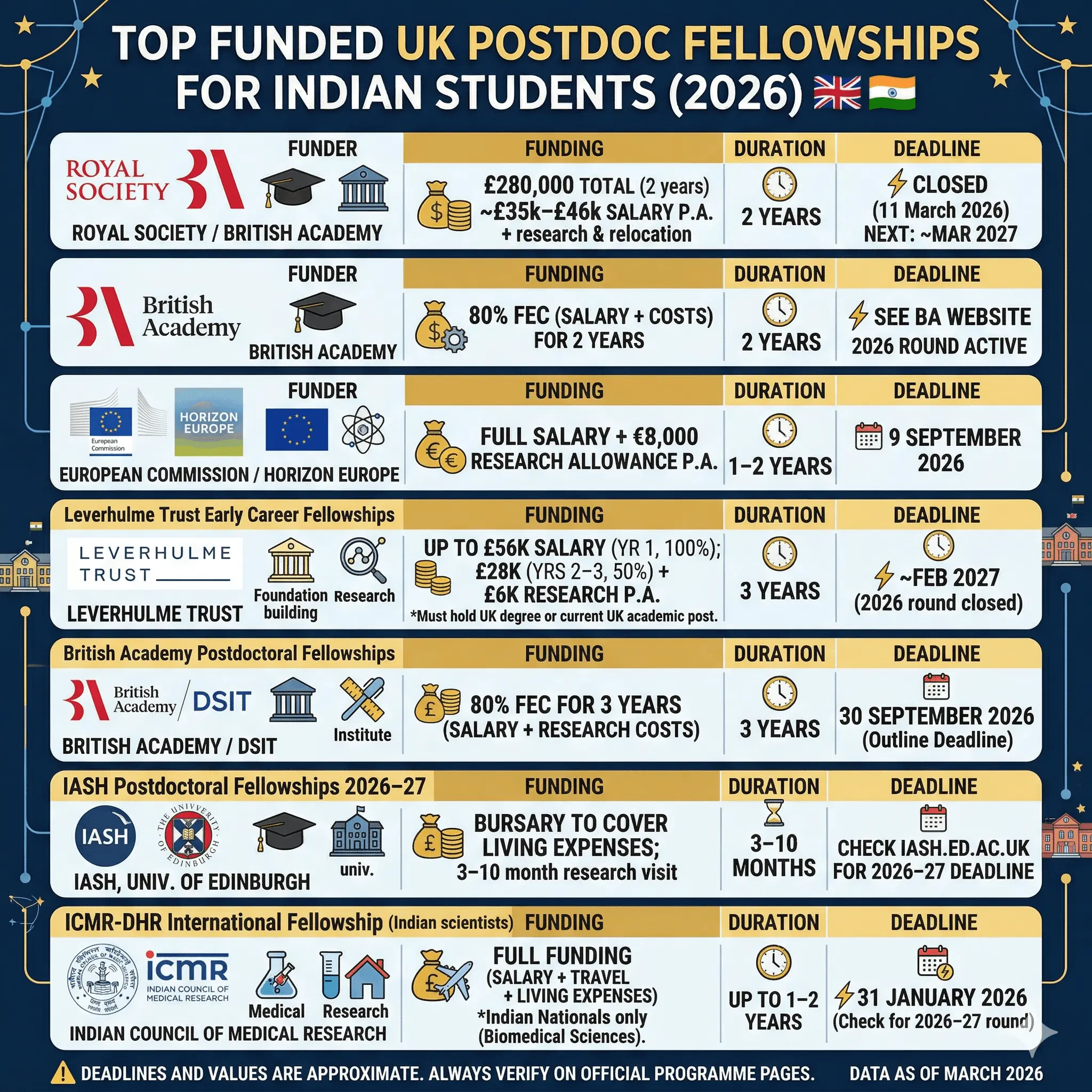
    Summary Table: Top Funded UK Postdoc Fellowships 2026

    Use the table below to quickly compare programmes by funding, eligibility, and deadlines before reading full details.

    Fellowship Host / Funder Eligible for Indians? Funding / Stipend Duration 2026 Deadline Apply
    Newton International Fellowship Royal Society / British Academy ✅ Yes — all non-UK nationals Up to £280,000 total (2 yrs); ~£35k–£46k salary p.a. + research & relocation 2 years 11 March 2026 (closed; next ~Mar 2027) royalsociety.org
    British Academy International Fellowships British Academy ✅ Yes — non-UK nationals (humanities/social sci) 80% FEC (salary + costs) for 2 years 2 years See BA website; 2026 round active thebritishacademy.ac.uk
    MSCA Postdoctoral Fellowships (European PF) European Commission / Horizon Europe ✅ Yes — any nationality (must host at UK institution) Full salary + €8,000 research allowance p.a. 1–2 years 9 September 2026 rea.ec.europa.eu
    Leverhulme Trust Early Career Fellowships Leverhulme Trust ⚠️ Conditional — must hold a UK degree OR current UK academic post (≥4 months before deadline) Up to £56k salary (yr 1, 100%); £28k (yrs 2–3, 50%) + £6k research p.a. 3 years ~Feb 2027 (2026 round closed) leverhulme.ac.uk
    British Academy Postdoctoral Fellowships British Academy / DSIT ⚠️ Must be based at a UK host institution for duration 80% FEC for 3 years (salary + research costs) 3 years 30 September 2026 (outline deadline) thebritishacademy.ac.uk
    IASH Postdoctoral Fellowships 2026–27 Institute for Advanced Studies in the Humanities, Univ. of Edinburgh ✅ Yes — open internationally Bursary to cover living expenses; 3–10 month research visit 3–10 months Check iash.ed.ac.uk for 2026–27 deadline iash.ed.ac.uk
    ICMR-DHR International Fellowship (Indian scientists) Indian Council of Medical Research ✅ Indian nationals only (biomedical sciences) Full funding (salary + travel + living expenses) Up to 1–2 years 31 January 2026 (check for 2026–27 round) icmr.nic.in

    Note: Deadlines are accurate as of March 2026. Always verify on the official programme page before applying, as schemes may update their timelines.

    1. Newton International Fellowships — Royal Society & British Academy

    Fellowship #1 · Fully Funded · STEM + Humanities
    Newton International Fellowships 2026
    ⏱ 2 Years 💷 Up to £280,000 🌍 All non-UK nationals 📅 March 2026 (closed; next ~2027)

    The Newton International Fellowship is arguably the most prestigious early-career postdoctoral fellowship available to international researchers wanting to work in the UK. Jointly administered by the Royal Society (for natural sciences) and the British Academy (for humanities and social sciences), it provides two fully funded years at a UK research institution.

    Key Benefits:

    • Total funding of up to £280,000 over two years (covering salary, research costs, overhead, and visa/relocation expenses)
    • Salary range approximately £35,608–£46,049 per annum (Cambridge IoA scale, as an indicator)
    • Annual research expenses of up to £8,000
    • One-off relocation payment (including support for dependents accompanying the Fellow)
    • Fast-track Global Talent Visa route for successful applicants
    • Access to alumni networking funding after the fellowship ends
    • Approximately 30 fellowships awarded per round, with potential for additional awards

    Eligibility for Indian researchers: Open to all non-UK nationals. Applicants must hold a PhD (or have successfully defended their doctoral thesis) by the application deadline, and must have no more than 5 years of active full-time postdoctoral experience (career breaks excluded). Applicants must not have resided or carried out research in the UK for more than 3 months during the 12 months before the deadline.

    Who should apply: Indian scientists and researchers in natural sciences (STEM) — or humanities/social sciences researchers applying via the British Academy route — who are in the first 5 years of their postdoctoral career and have a strong research proposal developed with a UK-based sponsor.

    Important for 2026: The 2026 round deadline was 11 March 2026. The next round is anticipated around March 2027. Contact info@newtonfellowships.org for eligibility queries.

    Visit Official Page →

    2. British Academy International Fellowships

    Fellowship #2 · Fully Funded · Humanities & Social Sciences
    British Academy International Fellowships 2026
    ⏱ 2 Years 💷 80% FEC 🌍 Non-UK nationals only 📅 2026 round active — check BA website

    The British Academy International Fellowships programme is co-run with the Royal Society and supports outstanding early-career researchers in the humanities and social sciences who wish to conduct research at a UK institution for two years.

    Key Benefits:

    • Two-year fellowship at a UK host institution in humanities or social sciences
    • Award offered at 80% Full Economic Cost (FEC) — covering salary, directly allocated and indirect costs
    • Alumni funding available post-fellowship for continued networking
    • Access to the British Academy’s international research community

    Eligibility: Must hold a PhD (or be completing it), be working outside the UK, not hold UK citizenship, be competent in English, and have no more than 5 years of active postdoctoral experience. Must have a clearly defined research proposal agreed with a UK host researcher.

    Who should apply: Indian researchers in history, sociology, economics, political science, linguistics, philosophy, cultural studies, and related fields who are in the early stages of their postdoctoral career and have secured a UK mentor willing to host them.

    Visit Official Page →

    3. MSCA Postdoctoral Fellowships (European Fellowship — UK Host)

    Fellowship #3 · Fully Funded · All Disciplines · Any Nationality
    Marie Skłodowska-Curie Actions (MSCA) Postdoctoral Fellowships 2026
    ⏱ 1–2 Years 💶 Full salary + €8k research allowance 🌍 Any nationality 📅 9 September 2026

    The MSCA Postdoctoral Fellowships, funded under the EU’s Horizon Europe programme, are among the largest and most competitive international postdoctoral funding schemes in the world. UK universities remain eligible as host institutions, making this a prime option for Indian researchers who wish to work at institutions such as Oxford, Cambridge, UCL, or Imperial College London.

    Key Benefits:

    • Full living allowance (salary) + annual research, training and networking allowance of €8,000
    • Mobility allowance if relocating internationally
    • Family allowance if applicable
    • Open to researchers of any nationality (for European Fellowships hosted at a UK institution)
    • Total budget for the 2026 call: €399.05 million
    • Fellowship duration of 1–2 years; up to 8 years of research experience post-PhD permitted

    Eligibility: Must hold a PhD by the deadline. Maximum 8 years of full-time research experience post-PhD. Must comply with mobility rules: must not have resided or carried out main activity in the country of the host for more than 12 months in the 36 months before the deadline. The 2026 call opens 9 April 2026 with a deadline of 9 September 2026.

    Who should apply: Indian postdoctoral researchers in any discipline — from life sciences and engineering to social sciences and humanities — who can identify a supervisor at a UK institution willing to co-develop and host the application.

    How to find a UK host: Explore hosting offers on EURAXESS, or contact UK research departments directly. Many UK universities publish expressions of interest calls specifically for MSCA candidates.

    Visit Official Page →

    4. Leverhulme Trust Early Career Fellowships

    Fellowship #4 · Highly Competitive · Any Discipline · Conditional Eligibility
    Leverhulme Early Career Fellowships 2026
    ⏱ 3 Years 💷 Up to £56k salary (yr 1) + £6k research ⚠️ UK degree OR active UK post required 📅 ~Feb 2027 (2026 round now closed)

    The Leverhulme Trust Early Career Fellowships are among the most prestigious postdoctoral fellowships available within the UK. Approximately 145 fellowships are awarded per year across all disciplines. Each award is tenable for 3 years, with a significant salary contribution and annual research expenses.

    Key Benefits:

    • Year 1: Trust covers 100% of Fellow’s salary up to £56,000
    • Years 2–3: Trust covers 50% of salary up to £28,000 per year (host institution covers the balance)
    • Up to £6,000 per year in research expenses
    • Non-renewable 3-year award tenable at any eligible UK university or HEI
    • Approximately 145 fellowships available per round

    ⚠️ Eligibility note for Indian researchers: This is a competitive scheme primarily designed for researchers building a UK academic career. Applicants must either hold a degree from a UK higher education institution, or hold an active academic position (fixed-term lectureship or fellowship) in the UK for at least 4 months before the closing date. Indian PhD holders based in India who have never held a UK post or UK degree are not directly eligible. However, Indian researchers who completed their PhD at a UK university or who currently hold a UK postdoctoral position are encouraged to apply.

    Who should apply: Indian researchers who obtained their PhD at a UK university, or who currently hold a postdoctoral appointment in the UK and are within 4 years of PhD thesis submission.

    Visit Official Page →

    5. British Academy Postdoctoral Fellowships

    Fellowship #5 · 3-Year Award · Humanities & Social Sciences
    British Academy Postdoctoral Fellowships 2026
    ⏱ 3 Years 💷 80% FEC for 3 years 📍 Must be at a UK host institution 📅 30 September 2026 (outline deadline)

    The British Academy Postdoctoral Fellowship is a prestigious 3-year award in the humanities and social sciences, funded by the UK’s Department for Science, Innovation and Technology (DSIT). It starts from Autumn 2027 (for the 2026 application round). The primary emphasis is on completing a significant publishable research project.

    Key Benefits:

    • Funds 80% of salary costs, directly allocated and indirect costs under Full Economic Cost
    • 3-year non-renewable fellowship at a UK university or recognised research institution
    • Designed to lead toward a permanent academic post
    • Integrated into the scholarly community at the host institution

    Eligibility: Applicants must be based at an eligible UK university or research organisation for the duration of the fellowship. This is suitable for Indian researchers who are already in the UK (e.g., on a postdoctoral contract) or who can secure affiliation with a UK host institution. The 2026 submission deadline (UK institutional approval) is 30 September 2026 (17:00 GMT).

    Who should apply: Indian researchers currently based at a UK university in humanities or social sciences, within 3 years of their PhD viva, who have a mentor and a significant independent research project to pursue.

    Visit Official Page →

    6. IASH Postdoctoral Fellowships 2026–27 — University of Edinburgh

    Fellowship #6 · Fully Open Internationally · Arts, Humanities & Social Sciences
    IASH Postdoctoral Fellowships 2026–27 (University of Edinburgh)
    ⏱ 3–10 Months 💷 Bursary (living expenses) 🌍 International applicants welcome 📅 Check iash.ed.ac.uk for 2026–27

    The Institute for Advanced Studies in the Humanities (IASH) at the University of Edinburgh offers competitive postdoctoral fellowships for scholars in the arts, humanities, and social sciences. The fellowships provide a research visit of 3 to 10 months in Edinburgh, with no teaching obligation.

    Key Benefits:

    • 3–10 month funded research visit at the University of Edinburgh
    • Bursary to contribute toward living expenses (can top up another fellowship such as British Academy)
    • No mandatory teaching — full focus on independent research
    • Access to Edinburgh’s vibrant international humanities community
    • Specialised targeted fellowships available (Gender Studies, Digital Humanities, Islamic Studies, 18th-Century Scottish Studies)
    • Open to applicants from within and beyond the University of Edinburgh

    Eligibility: Must hold a doctorate at the time of application, normally awarded within the last 3 years (graduates between 2023 and 2026, with flexibility for career breaks). Must not have held a permanent university position or a previous IASH Fellowship.

    Who should apply: Indian scholars in arts, humanities, and social sciences who completed their PhD within the last 3 years and wish to pursue 3–10 months of independent research in Edinburgh. Ideal for those who can combine the IASH bursary with other funding sources.

    Visit Official Page →

    7. ICMR-DHR International Fellowship for Indian Biomedical Scientists

    Fellowship #7 · Indian Nationals Only · Biomedical Sciences
    ICMR-DHR International Fellowship Programme for Indian Biomedical Scientists
    ⏱ Up to 1–2 Years 💷 Fully funded (salary + travel) 🇮🇳 Indian nationals only 📅 Check icmr.nic.in for 2026–27 round

    The ICMR-DHR International Fellowship is a Government of India programme administered by the Indian Council of Medical Research (ICMR) under the Department of Health Research (DHR). Unlike the other fellowships in this list, this one funds Indian scientists to go abroad — including to the UK — for advanced research in biomedical sciences.

    Key Benefits:

    • Fully funded (covers salary/stipend, international travel, accommodation, and living expenses)
    • Allows Indian biomedical scientists to conduct research at international laboratories, including those in the UK
    • No need to independently identify UK fellowship funding — the Government of India supports the placement
    • Strong credibility signal for future Indian academic career

    Eligibility: Open to Indian nationals only working in biomedical sciences. Applicants should be associated with Indian research institutions and meet ICMR’s academic qualification criteria. The 2025 deadline was 31 January 2026 — monitor the ICMR website for the 2026–27 cycle announcement.

    Who should apply: Indian biomedical researchers, medical scientists, and early-career faculty who want to spend time at a world-class UK laboratory without having to independently compete for UK-based funding. Also see our guide on funded research positions for Indian scientists abroad.

    Visit Official Page →

    How to Apply for UK Postdoc Fellowships from India: Key Tips

    Competition for these fellowships is intense. Here are evidence-based strategies to strengthen your application as an Indian researcher:

    1. Identify and Contact a UK Sponsor/Mentor Early

    Almost all UK postdoctoral fellowships — Newton, MSCA, Leverhulme, British Academy — require a named UK-based sponsor or mentor before you can apply. Do not wait until the deadline. Reach out 4–6 months in advance with a concise research proposal email, a CV, and a list of publications.

    2. Craft a Compelling and Independent Research Proposal

    Your proposal should present a new research direction, not merely extend your PhD thesis. Fellowship committees look for originality, feasibility, and clear academic impact. The Newton Fellowship and MSCA in particular emphasise your potential for research independence.

    3. Choose the Right Fellowship for Your Career Stage

    • 0–5 years post-PhD: Newton International Fellowship, British Academy International Fellowship, IASH
    • 0–8 years post-PhD: MSCA Postdoctoral Fellowship
    • Already in UK, 0–4 years post-PhD: Leverhulme ECF, British Academy Postdoctoral Fellowship
    • Biomedical scientists: ICMR-DHR Fellowship (Government of India route)

    4. Is IELTS Required?

    Most UK postdoctoral fellowships do not require a formal IELTS score, as they assess English proficiency through your research proposal and communication with the UK sponsor. However, for visa purposes, you may need to demonstrate English language competence. Check with UK Visas and Immigration for the Global Talent Visa requirements.

    5. Apply for the Global Talent Visa

    Newton International Fellows and many MSCA fellows qualify for a fast-track Global Talent Visa route, which significantly simplifies the UK immigration process. Start this process as soon as your fellowship offer is confirmed.

    Frequently Asked Questions

    Q1. Are there postdoctoral fellowships in the UK open to Indian students?
    Yes. Several major UK fellowships explicitly welcome non-UK nationals, including Indian researchers. The Newton International Fellowship (Royal Society / British Academy), MSCA Postdoctoral Fellowship (Horizon Europe, UK host), and IASH Postdoctoral Fellowships (University of Edinburgh) are all open to applicants of any nationality, including Indian citizens. Some — like the Leverhulme Early Career Fellowship — have conditional eligibility requiring a UK degree or current UK academic position.
    Q2. How much stipend do UK postdoctoral fellowships offer?
    Stipends vary significantly by programme. The Newton International Fellowship covers a full academic salary (approximately £35,000–£46,000 per year based on the Cambridge scale), plus research expenses and relocation support, for a total of up to £280,000 over two years. The MSCA Postdoctoral Fellowship covers the full salary set by the host institution plus an €8,000 annual research allowance. The Leverhulme Fellowship covers up to £56,000 in year one and £28,000 per year in years two and three.
    Q3. Which UK universities offer fully funded postdoc fellowships for international researchers?
    Most research-intensive UK universities can host international postdoctoral fellows through the programmes listed above. Leading host institutions include the University of Oxford, University of Cambridge, University College London (UCL), Imperial College London, University of Edinburgh, King’s College London, and the University of Manchester. The key is to find a named academic sponsor at your chosen institution before applying.
    Q4. What are the eligibility criteria for UK postdoctoral fellowships?
    Common eligibility requirements across most UK postdoctoral fellowships are: (a) Holding a PhD or having successfully defended your doctoral thesis by the application deadline; (b) Being within a set number of years of your PhD award (typically 5 years for Newton/British Academy International, up to 8 years for MSCA, up to 4 years for Leverhulme); (c) Not being a UK citizen (for internationally targeted fellowships like Newton); (d) Proposing high-quality, original, publishable research; and (e) Having secured a named UK academic sponsor or mentor.
    Q5. Do UK postdoc fellowships provide visa sponsorship?
    Yes. Most fully funded UK postdoctoral fellowships include immigration support. Newton International Fellows, for example, qualify for the fast-track Global Talent Visa route. MSCA fellows also receive support through the host institution’s HR departments. Relocation costs — including visa application fees — are often covered by the fellowship award itself.
    Q6. Can PhD holders from India apply for the Newton International Fellowship?
    Yes, absolutely. The Newton International Fellowship is open to all non-UK nationals, and Indian PhD holders are among the eligible applicants. You must hold your PhD (or have successfully defended your thesis) by the application deadline, have no more than 5 years of active full-time postdoctoral experience, and be currently working outside the UK. You must secure a UK-based academic sponsor before applying through the Royal Society or British Academy portals.
    Q7. What is the best fully funded postdoc option in UK for Indian researchers in 2026?
    For researchers in natural sciences (STEM), the Newton International Fellowship (Royal Society) is the gold standard — prestigious, well-funded, and fully open to Indian nationals. For humanities and social sciences researchers, the British Academy International Fellowship is the equivalent. If you are already based in the UK, explore the Leverhulme Trust Early Career Fellowships and the British Academy Postdoctoral Fellowship. For biomedical scientists based in India, the Government of India’s ICMR-DHR International Fellowship is a strong option that funds your placement abroad without requiring you to independently win UK funding.
  • Fully Funded PhD Positions in UK for Indian Students 2026 (Complete Guide + List)

    Fully Funded PhD Positions in UK for Indian Students 2026 (Complete Guide + List)

    Fully Funded PhD Positions in UK for Indian Students 2026 (Complete Guide + List)
    PhD Funding UK Scholarships Indian Students 2026

    Fully Funded PhD Positions in UK for Indian Students 2026 (Complete Guide + List)

    ⚡ Quick Answer: Is a PhD in the UK fully funded for international students?

    Yes — Indian students can access fully funded PhD positions in the UK through several routes: UKRI studentships (covering stipend + fees), prestigious scholarships such as Gates Cambridge and Clarendon (Oxford), Commonwealth Split-site Scholarships, and India-specific awards like the Inlaks Shivdasani Scholarship. The standard 2025–26 UKRI stipend is £20,780/year (tax-free), rising to £22,780 in London. Application deadlines typically fall between October and March each year.

    1. Introduction: Why Pursue a Fully Funded PhD in the UK?

    For Indian researchers and graduates, a funded doctoral position at a UK university represents one of the highest-value academic opportunities in the world. The United Kingdom is home to four of the world’s top ten universities — Oxford, Cambridge, Imperial College London, and UCL — and offers one of the most structured doctoral funding ecosystems globally.

    The good news is that a fully funded PhD in the UK is not just possible for Indian students — it is achievable with the right strategy. This guide is designed for:

    • Recent BTech/BSc/MSc graduates from Indian universities targeting UK research programmes
    • Early-career researchers looking for 2026 PhD entry with a stipend and zero tuition fees
    • Students in STEM, life sciences, social sciences, and humanities
    • Anyone wondering how to navigate UKRI funding, Commonwealth scholarships, and university-specific awards

    Let’s break it all down — clearly, accurately, and with verified information from official sources.

    2. Understanding UK PhD Funding: What “Fully Funded” Actually Means

    When a UK PhD position is labelled “fully funded,” it typically covers:

    • Tuition fees — usually at the UK Home rate (approximately £5,238/year for 2026–27 per UKRI rates). Important: some awards do not cover the international fee difference.
    • Annual stipend (living allowance) — the UKRI minimum for 2025–26 is £20,780/year, rising slightly each year. London-based students receive a minimum of £22,780/year.
    • Research Training Support Grant (RTSG) — approximately £1,500/year for books, conferences, and training.
    ⚠️ Key Warning for Indian Students

    Most UKRI-funded positions only cover fees at the “Home” rate (~£5,238/year). International PhD tuition at UK universities can be £18,000–£28,000/year. If the advertising university does not explicitly waive the international fee difference, you may owe a significant top-up. Always confirm with the department before accepting a funded offer. Universities like Edinburgh (E5 DTP) and UCL have committed to covering this gap for their funded international students — make this part of your shortlisting criteria.

    What UKRI-funded studentships do NOT cover (standard):

    • UK Student Visa fees (~£490+)
    • Immigration Health Surcharge (IHS) — currently £776/year
    • Return flights from India
    • Dependant/family allowances (some elite awards like Gates Cambridge do cover this)

    The exception is the Gates Cambridge Scholarship, which covers visa costs and the Immigration Health Surcharge.

    3. UKRI Funding and the 30% International Quota — What Indian Students Must Know

    UK Research and Innovation (UKRI) is the primary government body funding doctoral research in the UK. It distributes funding through seven Research Councils, each covering a specific academic domain:

    Research CouncilKey Subject Areas
    EPSRCEngineering, Physical Sciences, Mathematics, Computer Science
    BBSRCBiological Sciences, Biotechnology, Agriculture
    MRCMedical Research, Biomedical Sciences
    NERCNatural Environment, Climate, Ecology
    ESRCSocial Sciences, Economics
    AHRCArts, Humanities, Culture
    STFCSpace, Particle Physics, Astronomy

    The 30% International Cap — Critically Important

    UKRI policy limits the proportion of international students (which includes Indian students) to a maximum of 30% of the total cohort per Doctoral Training Partnership (DTP) or Centre for Doctoral Training (CDT). This makes competition for international spots extremely intense — but not impossible.

    ✅ Pro Tip: Contact the Supervisor First

    For most UKRI-funded international positions, especially within DTPs, you must be pre-nominated by a supervisor before submitting a formal application. Email the lead supervisor of a project you find compelling, discuss your fit, and ask if they are willing to nominate you. This dramatically improves your chances and is often a formal requirement (as is the case in the E4/E5 DTP at Edinburgh).

    4. Summary Table: Top Fully Funded PhD Scholarships for Indian Students 2026

    The table below summarises the best fully funded PhD funding routes available to Indian students for 2026 entry. Always verify deadlines on official websites as they can shift year to year.

    Programme / Scholarship Host Institution Indians? Stipend / Value Key Deadline (2026) Official Link
    Gates Cambridge Scholarship University of Cambridge ✅ £21,000/yr
    + full fees + visa
    2026–27: CLOSED.
    Opens Sept 2026 for 2027–28
    gatescambridge.org
    Clarendon Scholarship University of Oxford ✅ Full fees
    + £18,622+/yr
    2026–27: CLOSED.
    Next: Dec 2026 / Jan 2027
    ox.ac.uk/clarendon
    Commonwealth Split-site Scholarship Various UK Universities ✅ Full fees
    + £1,652/month
    + airfare
    2026–27: CLOSED.
    Next: ~Dec 2026
    cscuk.fcdo.gov.uk
    Inlaks Shivdasani Scholarship UK / US / European universities ✅ Up to
    USD $120,000 total
    ⚡ OPEN
    31 Mar 2026, 12pm IST
    inlaksfoundation.org
    UKRI / EPSRC CDT Studentships Multiple UK Universities ✅
    (30% cap)
    £20,780–£31,000/yr
    (varies by CDT)
    Rolling; many closed
    Jan–Mar 2026
    ukri.org
    Dr. Manmohan Singh Scholarship University of Cambridge ✅
    Indian only
    Full fees
    + stipend
    Opens ~Nov 2026
    for 2027 entry
    sid.cam.ac.uk
    Felix Scholarship Oxford, SOAS, Reading ✅
    Indian only
    Full fees
    + living allowance
    2026–27: CLOSED.
    Next: ~Jan 2027
    felixscholarship.org
    Wellcome Trust Doctoral Studentships Multiple UK Universities ✅ Full fees (home rate)
    + annual stipend
    Programme-specific;
    check wellcome.org
    wellcome.org
    GREAT Scholarship (British Council) Select UK Universities ✅ Min. £10,000
    towards fees
    Varies by university;
    check britishcouncil.in
    britishcouncil.in
    University-Specific PhD Studentships Imperial, UCL, Edinburgh, Manchester, etc. ✅ Varies;
    some cover intl. fees
    Rolling — check
    individual university pages
    findaphd.com

    ⚠️ Disclaimer: Deadlines and stipend figures are sourced from official portals as of March 2026. Always verify on the official programme website before applying.

    5. Top Fully Funded PhD Scholarships for Indian Students — Detailed Breakdown

    🎓 Gates Cambridge Scholarship

    Host: University of Cambridge Level: PhD (up to 4 years) Field: All subjects Nationality: All non-UK

    Established in 2000 with a US$210 million donation from the Bill & Melinda Gates Foundation, the Gates Cambridge Scholarship is among the most prestigious and generous international awards available. Around 80 scholarships are awarded each year, with approximately two-thirds going to PhD students. The international round has roughly 55 places available.

    What it covers:

    • Full University Composition Fee (tuition) — all subjects, all levels
    • Annual maintenance stipend of £21,000 (2024–25 rate; up to 4 years for PhD)
    • Economy class airfare to and from Cambridge at the start and end of the course
    • Inbound visa costs and Immigration Health Surcharge (IHS) — a rare and valuable benefit
    • Academic development funding of up to £2,000 for conferences and courses
    • Family allowance of up to £16,548 (for scholars with dependants)
    • Hardship and maternity/paternity funding

    Who should apply:

    Exceptional Indian students with top academic records (typically GPA 3.7+/4.0 or equivalent), demonstrable leadership qualities, and a clear vision to improve lives through their research. Strong prior research experience including publications or conference presentations is a significant advantage for PhD applicants. Ideal fields include global health, AI ethics, climate science, sustainable development, and biomedical research.

    Key Deadlines (2027 entry):

    • Applications for 2026–27 entry are now closed.
    • Applications for 2027–28 entry will open in September 2026.
    • International applicants: expected December 2026 or January 2027 (course-dependent — exact dates to be announced)
    🔗 Check timeline at gatescambridge.org

    🎓 Clarendon Scholarship — University of Oxford

    Host: University of Oxford Level: DPhil / Master’s Field: All subjects Nationality: All (no restriction)

    The Clarendon Fund is one of Oxford’s flagship graduate scholarship programmes, offering around 140–200 new fully funded scholarships every year. It is awarded solely on the basis of academic excellence and potential — no separate application is needed. By simply applying to a DPhil or Master’s course at Oxford by the relevant deadline, you are automatically considered.

    What it covers:

    • Course fees in full (for both Home and Overseas fee-status students)
    • College fees — fully covered
    • Annual living grant of at least £18,622 (2023–24 rate; updated annually at UKRI minimum doctoral stipend levels)
    • Award lasts for the full period of fee liability

    Who should apply:

    Any Indian student applying to a DPhil or Master’s at Oxford — in any subject area — who has an outstanding academic record. There is no nationality restriction, no age limit, and no need for a separate application form. Successful applicants typically hold first-class degrees or equivalent, often with significant research output or recognition.

    Key Deadlines (2027 entry):

    • Applications for 2026–27 entry are now closed (deadlines were 2 December 2025 / 8 January 2026).
    • For 2027–28 entry: apply by December 2026 or January 2027, depending on your specific course page — exact dates confirmed on each Oxford course page.
    • Selection outcomes typically communicated by April–June 2027
    🔗 Apply at ox.ac.uk/clarendon

    🎓 Commonwealth Split-site Scholarship (for Indian Students)

    Host: Various UK Universities Level: PhD (12 months in UK) Field: All (dev. themes priority) Nationality: India eligible

    Managed by the Commonwealth Scholarship Commission (CSC) and funded by the UK’s Foreign, Commonwealth & Development Office (FCDO), this is the most directly accessible fully funded scholarship for Indian PhD students. The Split-site Scholarship allows Indian students already enrolled in a PhD in India to spend up to 12 months at a UK university as part of their doctoral research.

    ℹ️ Note on India Eligibility

    India is classified as a low- and middle-income Commonwealth country, making Indian students eligible for the Split-site Scholarship and the Commonwealth Master’s Scholarship. The standalone Commonwealth PhD Scholarship is reserved for least-developed countries only — Indian students do not qualify for that specific track.

    What it covers:

    • Full tuition fees at the UK host institution for the scholarship period
    • Monthly living allowance: £1,378 (£1,516 in London)
    • Economy class return airfare from India to the UK
    • Study travel grant and thesis/fieldwork grant (as applicable)

    Application Process for Indian Students:

    1. Apply via the CSC’s Electronic Application System (EAS): cscuk.fcdo.gov.uk
    2. Simultaneously apply through India’s Ministry of Education (MoE) SAKSHAT portal
    3. You must be nominated by the MoE before reaching the CSC final selection

    Key Deadlines (2027 entry):

    • Applications for 2026–27 entry are now closed. Note: Cranfield University has announced the Split-site programme is under review and did not run in 2026 — check individual university pages.
    • For 2027 entry: CSC application window historically opens in September–October 2026, with deadline typically around December 2026.
    • India MoE (SAKSHAT) portal nomination: typically November–December 2026
    • Monitor the official CSC page for confirmed 2027 dates.
    🔗 Apply via CSC

    🎓 Inlaks Shivdasani Scholarship

    Host: UK/Europe/US Universities Level: Master’s / MPhil / PhD Field: Most subjects (excl. MBA) Nationality: Indian nationals only

    The Inlaks Shivdasani Scholarship is one of the most prestigious India-exclusive study-abroad awards, established in 1976 by the Inlaks Shivdasani Foundation. It supports exceptional young Indian graduates pursuing doctoral and postgraduate programmes in the UK, Europe, and the US.

    What it covers (up to USD $120,000 total):

    • Full tuition fees at the host institution
    • Living expenses and accommodation support
    • One-way economy class airfare
    • Health insurance support

    Eligibility for Indian PhD applicants:

    • Indian passport holder, resident in India at time of application
    • Born on or after 1 January 1996 (for 2026 scholarships — age limit: 30 years)
    • First-class undergraduate degree from a recognised Indian university
    • Must have a confirmed offer of admission to an eligible PhD programme
    • Not previously hold a postgraduate qualification from abroad

    Excluded subjects:

    MBA and Management Studies are not eligible. Some engineering fields are only eligible at specific institutions (e.g., Imperial College London).

    Key Deadline: 31 March 2026 at 12:00 PM IST — OPEN NOW

    This is one of the only major scholarships with a deadline still ahead of us as of March 2026. Applications opened 15 February 2026 and close 31 March 2026. Shortlisting takes place in April, with online preliminary interviews in May and final in-person interviews in Mumbai in late May 2026.

    🔗 Apply at inlaksfoundation.org

    🎓 Felix Scholarship

    Host: Oxford, SOAS, Reading Level: PhD / Master’s Field: Varies by institution Nationality: Indian nationals

    The Felix Scholarship is a prestigious award specifically for Indian nationals to study at three UK institutions: the University of Oxford, SOAS University of London, and the University of Reading. It is one of the most targeted India-specific UK funding opportunities.

    What it covers:

    • Full tuition fees (including overseas fee rate)
    • Annual living allowance at UKRI minimum doctoral stipend rates
    • Return economy airfare to India

    Key Eligibility:

    • Must be an Indian national residing in India
    • Hold a strong undergraduate or master’s degree from an Indian institution
    • Applying to eligible courses at Oxford, SOAS, or Reading

    Deadline: Applications for 2026–27 entry are now closed. For 2027–28 entry, deadlines will typically fall in January 2027 (course-dependent). Monitor felixscholarship.org for confirmed dates.

    🔗 Visit felixscholarship.org

    🎓 Dr. Manmohan Singh Scholarship (Cambridge)

    Host: University of Cambridge (Sidney Sussex) Level: PhD Field: Economics, Science, Technology, Social Sciences Nationality: Indian citizens only

    This scholarship, named in honour of former Indian Prime Minister Dr. Manmohan Singh, supports exceptional Indian doctoral candidates at the University of Cambridge. Special preference is given to candidates in Aerospace Engineering and Energy Studies. Since its inception in 2009, over 20 Indian scholars have been supported.

    Key Eligibility:

    • Indian citizen residing in India with a valid Indian passport
    • Recognised master’s degree from an Indian university
    • Under 35 years of age as of January 31 of the application year
    • Applying for a full-time PhD at Cambridge

    Deadline: Applications typically open November 2026 for 2027 entry.

    🔗 Visit sid.cam.ac.uk

    6. Fully Funded STEM PhD in UK for Indian Students — CDTs & DTPs

    For Indian students in engineering, computer science, biology, and physical sciences, UKRI Centres for Doctoral Training (CDTs) and Doctoral Training Partnerships (DTPs) are the most common source of funded PhD positions. These are cohort-based programmes where students receive structured research training alongside their doctoral project.

    Relevant article: Explore more research fellowship opportunities at IrresPub

    How CDTs Work

    CDTs are funded by specific UKRI research councils (EPSRC for engineering and physical sciences, BBSRC for biological sciences, MRC for medicine, etc.). Each CDT advertises PhD projects in a specific thematic area. As an Indian (international) student:

    • You can apply and receive the full UKRI stipend
    • You should confirm whether the CDT or hosting university covers the international fee difference
    • You are subject to the 30% international cap within each cohort
    • Pre-contacting the supervisor is strongly advised

    Notable CDTs Open to International Students (2026)

    CDT NameFieldStipend (2026–27)Universities
    UKRI AI CDT in Decision Making for Complex Systems AI, Machine Learning £21,000/yr (intl.) University of Manchester / Cambridge
    EPSRC CDT in AI for Digital Media Inclusion AI, Creative Industries £25,000/yr (intl.) University of Surrey
    EPSRC CDT in Medicines Development Pharmaceuticals, Drug Development UKRI rates Various (find on FindAPhD)
    STOR-i CDT Statistics & Operational Research UKRI rates Lancaster University
    ✅ Where to Find CDT Positions

    Browse all open positions at FindAPhD.com and filter by “Funded PhD Project (Students Worldwide).” This tag indicates the position is explicitly open to international applicants.

    Fully Funded PhD in UK for Indian Students — Life Sciences

    For life sciences PhD applicants specifically, additional key funders beyond UKRI include:

    • Wellcome Trust — funds Doctoral Programmes in Public Health, Social Science & Health, and Biomedical Sciences. All nationalities may apply; stipend plus fees at home rate covered. Deadlines vary by programme (typically autumn). wellcome.org
    • Cancer Research UK (CRUK) — funds DPhil studentships at Oxford and other institutions in cancer biology. cancerresearchuk.org
    • Boehringer Ingelheim Fonds — 2–3 year DPhil fellowships at Oxford for biomedical research, with a monthly stipend.

    Find more curated life sciences opportunities at IrresPub Research Hub.

    7. Fully Funded Humanities PhD in UK for Indian Students

    Humanities PhDs are often overlooked by Indian students who assume STEM is the only fundable route. This is a misconception. The Arts and Humanities Research Council (AHRC) funds doctoral research through DTPs across the UK, and there are several India-specific routes.

    Key funding routes for humanities Indian PhD applicants:

    • AHRC Doctoral Training Partnerships (DTPs): These accept international applications. Consult the relevant DTP for your subject area and region. Up to 30% of places can go to international students. Find your nearest AHRC DTP at ukri.org/ahrc.
    • Clarendon Scholarship (Oxford): Covers humanities fully. Ancient History, Philosophy, English, Modern Languages, Oriental Studies — all eligible. No subject bias.
    • Felix Scholarship at SOAS: Specifically designed for Indian students studying South Asian-related subjects at SOAS (Anthropology, History, Languages, Religion, etc.).
    • Commonwealth Split-site Scholarship: Can be used for humanities research in any subject that aligns with the six CSC development themes.
    • Inlaks Scholarship: Explicitly covers Social Sciences, Humanities, Law, Fine Arts, and Architecture (eligible grade: 65%+).

    Also see: Fellowship and grant opportunities for researchers at IrresPub.

    8. Direct PhD After BTech in UK — Is It Possible?

    This is a common question from Indian engineering graduates. The short answer is: Yes, it is possible, but it depends on the programme and university.

    Key considerations:

    • Most UK PhD programmes — especially UKRI-funded ones — require a 2:1 honours degree or higher in a relevant subject as the minimum academic entry requirement. A strong BTech (typically 7.5 CGPA and above, or 65–75%+ marks) from a recognised Indian institution is generally considered equivalent.
    • Many UKRI-funded positions explicitly note that “relevant work experience and/or a Master’s degree may be taken into account” but it is not a strict requirement for strong BTech candidates.
    • For CDTs and project-funded positions in STEM, a BTech with strong research experience (publications, thesis, internships) can be competitive even without a master’s.
    • For humanities and social science PhDs, most programmes expect a master’s level qualification. A direct BTech-to-PhD path is uncommon outside of STEM.
    ✅ Tip for BTech Graduates

    Look specifically for advertised PhD project positions at UK universities that explicitly state “open to exceptional undergraduate graduates.” Contact supervisors directly, explain your research interests, and enquire about the possibility of joining without a master’s. Some research groups are happy to take exceptional BTech graduates, especially in computer science, AI, and engineering.

    9. How to Email UK Professors for PhD Funding

    For Indian students, a well-crafted cold email to a potential PhD supervisor can be the difference between getting a funded position and being overlooked. Here is a proven structure:

    1. Research first: Read at least 2–3 of the professor’s recent papers before writing. Reference a specific finding or methodology that excites you.
    2. Subject line: Be specific — e.g., “Prospective PhD Inquiry — CRISPR-Cas9 applications in gene silencing (Oct 2026 entry)”
    3. Opening paragraph: Who you are, your current degree/institution in India, and your relevant academic record (CGPA/percentage).
    4. Middle paragraph: Explain why their specific research aligns with your interests, referencing their work. Propose a very brief (2–3 sentence) research idea or question you’d like to explore under their supervision.
    5. Closing paragraph: State that you are actively seeking funded positions (CDT/DTP/university scholarship), mention any external scholarships you are applying for (e.g., Gates Cambridge, Inlaks), and attach your CV. Ask if they have funded positions available or if they would be willing to discuss your fit for an upcoming CDT.
    6. Attach: A concise academic CV (2 pages maximum) and, if relevant, one publication or thesis excerpt.
    ⚠️ What NOT to do

    Do not send generic mass emails. UK professors receive hundreds of cold emails from Indian applicants and can identify template emails instantly. Do not ask “Can you send me an acceptance letter?” in the first email — it is a red flag. Never attach large files without warning.

    For more guidance on research communication and academic writing, visit IrresPub.

    10. UK PhD Funding Without IELTS — What Indian Students Need to Know

    Many Indian students ask whether it is possible to secure a fully funded UK PhD without taking IELTS. The answer is nuanced and depends entirely on the university’s English language policy.

    When IELTS may be waived:

    • If you completed your undergraduate or master’s degree entirely in English medium instruction in India, some UK universities — including Oxford, Cambridge, and many Russell Group institutions — may waive the IELTS requirement upon submission of a language medium certificate from your Indian university.
    • This is discretionary and must be verified with each university’s graduate admissions office directly. There is no universal rule.
    • For Commonwealth Scholarships specifically, IELTS is required for nominated candidates as part of the CSC’s standard process.
    • For Gates Cambridge and Clarendon, an IELTS waiver may be available if your previous degree was conducted entirely in English — but check the specific course requirements on Oxford’s and Cambridge’s portals.
    ℹ️ Typical IELTS Requirements

    Most UK PhD programmes require a minimum IELTS Academic score of 6.5 overall, with no component below 6.0. Competitive programmes at Oxford and Cambridge typically expect 7.0+. The TOEFL iBT (minimum 100) is usually accepted as an alternative.

    11. Step-by-Step: How to Get a Fully Funded PhD in the UK from India

    1. Identify your research area and UKRI research council: Determine which of the 7 UKRI councils aligns with your field. This determines which DTPs and CDTs to target.
    2. ⚡ Apply for Inlaks NOW (deadline: 31 March 2026): This is the only major scholarship with a live deadline right now. If you are an Indian national under 30 with a strong academic record and a university offer in hand, apply immediately at inlaksfoundation.org.
    3. Search for rolling UKRI CDT positions (now – July 2026): Many CDTs advertise positions with rolling or late-spring deadlines. Browse FindAPhD.com and filter for “fully funded” + “Students Worldwide” to catch remaining open positions for September 2026 entry.
    4. Plan ahead for 2027 entry — start supervisor outreach (April–September 2026): Email supervisors at your target institutions well before the October 2026 application windows open. Pre-nomination is often required for UKRI DTP international spots.
    5. Prepare your English language score (May–August 2026): Take IELTS or TOEFL over the summer so scores are ready for October–January deadlines.
    6. Monitor Gates Cambridge and Clarendon timelines (from September 2026): Gates Cambridge applications for 2027–28 entry open in September 2026. Clarendon is automatic when you apply to Oxford by the December 2026 / January 2027 course deadline.
    7. Apply to Commonwealth Split-site Scholarship (September–December 2026): CSC typically opens in September; India MoE SAKSHAT nominations typically close in November–December. Monitor both portals.
    8. Submit formal PhD applications (October 2026 – January 2027): Most competitive funding decisions are made from applications received by January. Applying after February significantly reduces your chances.
    9. Secure your offer and apply for a Student Visa: Once you receive a Confirmation of Acceptance for Studies (CAS), apply for the UK Student visa. Budget for the fee (~£490) and Immigration Health Surcharge (~£776/year).

    12. List of UK Universities with Fully Funded PhD Programs for International Students

    These universities are known for strong funded PhD opportunities open to international and Indian applicants, either through their own scholarship pools or by actively waiving the international fee difference for UKRI-funded students:

    University Notable Funding Route Research Strengths FindAPhD / Official Page
    University of Cambridge Gates Cambridge, Dr. Manmohan Singh, Cambridge Trust, project-funded All subjects; STEM, Medicine, Humanities cam.ac.uk
    University of Oxford Clarendon Fund, Felix, university departmental awards, UKRI CDTs All subjects; Life Sciences, Physics, Humanities, Law ox.ac.uk
    Imperial College London President’s PhD Scholarships, departmental studentships, CDTs Engineering, Life Sciences, AI, Climate imperial.ac.uk
    University College London (UCL) UKRI studentships (UCL commits to waiving intl. fee gap for funded students), Wellcome Medicine, Neuroscience, AI, Engineering ucl.ac.uk
    University of Edinburgh E4/E5 DTP (covers intl. fee gap), Edinburgh Global Scholarships Social Sciences, Informatics, Biology, Medicine ed.ac.uk
    University of Manchester President’s Doctoral Scholar Award, CDTs (AI, Physics), UKRI Physics, Biomedical, Social Sciences, AI manchester.ac.uk
    University of Warwick Chancellor’s International Scholarships, EPSRC DTP Mathematics, Engineering, Economics, Science warwick.ac.uk
    University of Bristol SWDTP (Social Sciences), NERC GW4 DTP, university scholarships Environment, Social Sciences, Engineering bristol.ac.uk
    University of Leeds Leeds Doctoral Scholarships, EPSRC/BBSRC projects Food Science, Engineering, Colour Science phd.leeds.ac.uk
    SOAS University of London Felix Scholarship (India-specific), AHRC DTP South Asian Studies, Development, Law, Languages soas.ac.uk

    Also visit IrresPub Research Hub for curated lists of PhD and postdoc positions updated regularly.

    13. Frequently Asked Questions (FAQ)

    Q1. Is a PhD in the UK fully funded for international students?

    Yes, many PhD positions in the UK are fully funded for international students, including Indian nationals. Funding comes from UKRI research councils, prestigious university scholarships (Gates Cambridge, Clarendon), and India-specific awards (Inlaks, Felix, Commonwealth Split-site). However, not all awards cover the full international tuition fee — some only cover the UK Home rate (~£5,238/year), leaving a fee gap. Always check whether the hosting university explicitly covers the international fee difference before accepting a funded offer.

    Q2. What is the stipend for a fully funded PhD in the UK in 2025–26?

    The UKRI minimum stipend for 2025–26 is £20,780 per year (tax-free), with a London weighting of £22,780 per year. Some CDTs offer enhanced stipends — for example, the UKRI AI CDT at Manchester offers up to £31,000/year for Home fee-status students. The Gates Cambridge Scholarship provides £21,000/year plus full fees and visa costs.

    Q3. Does UKRI fund international PhD students?

    Yes. UKRI explicitly funds international students, but limits this to a maximum of 30% of the total studentships per DTP or CDT cohort. UKRI provides the stipend at the same rate as Home students, but only covers fees at the UK Home rate (~£5,238/year for 2026–27). Many universities cover the remaining international fee difference themselves — always verify this before applying.

    Q4. How can an Indian student get a fully funded PhD in the UK?

    The most reliable paths are: (1) Apply to UKRI-funded CDT/DTP PhD positions listed on FindAPhD.com and universities’ websites; (2) Apply to the Gates Cambridge Scholarship for Cambridge; (3) Apply to Oxford and get automatically considered for the Clarendon Fund; (4) Apply to the Inlaks Shivdasani Scholarship if you are under 30 and a first-class graduate; (5) Apply through the Commonwealth Split-site Scholarship via India’s Ministry of Education. Start planning in April–June for October entry deadlines, and contact supervisors early — pre-nomination is often required for international applicants in UKRI DTPs.

    Q5. Which UK universities offer full scholarships for Indian PhD students?

    The top universities for fully funded PhD opportunities for Indian students are the University of Cambridge (Gates Cambridge, Cambridge Trust), University of Oxford (Clarendon Fund, Felix), Imperial College London (President’s PhD Scholarships), UCL, University of Edinburgh (E5 DTP covering international fees), and SOAS (Felix Scholarship). Most major Russell Group universities have funded positions through UKRI CDTs and DTPs.

    Q6. Can I do a direct PhD in the UK after BTech from India?

    Yes, especially in STEM fields. Many UK PhD programmes and UKRI CDTs accept strong BTech graduates (typically requiring 7.5+ CGPA or equivalent, with no strict master’s requirement in STEM). However, a master’s degree strengthens your application significantly, particularly for competitive funded positions. Humanities and social science PhDs typically require a master’s. Contact potential supervisors directly and ask about your eligibility before investing time in a full application.

    Q7. What is the application deadline for the Commonwealth scholarship for Indian students in 2026?

    For the 2026–27 academic year, the CSC EAS application window closed in December 2024, and the 2025–26 cycle closed around December 2025. Applications for 2027 entry are expected to open in September–October 2026, with a deadline around December 2026. The India MoE SAKSHAT portal nomination typically runs November–December. Monitor the CSC official website and India’s Ministry of Education portal for exact 2027 dates. Note: some host universities (e.g. Cranfield) have indicated the programme is under review — always check the current list of participating UK institutions.

    Conclusion: Your Fully Funded UK PhD is Within Reach

    Securing a fully funded PhD position in the UK as an Indian student in 2026 is absolutely achievable — but it requires strategic planning, early action, and a genuine alignment between your research interests and the available funding routes.

    Here is the condensed action plan:

    • Right now (March 2026): Apply for the Inlaks Scholarship — deadline is 31 March 2026. This is the only major award currently open.
    • April–July 2026: Search for rolling UKRI CDT/DTP positions still advertising for September 2026 entry. Begin building your list of target supervisors for 2027 entry.
    • August–September 2026: Take IELTS if needed. Begin cold-emailing supervisors. Watch for the Gates Cambridge 2027–28 portal to open (expected September 2026).
    • October–December 2026: Submit Commonwealth scholarship applications via the CSC portal and India MoE SAKSHAT. Apply to Gates Cambridge. Apply to Oxford courses to be automatically considered for Clarendon.
    • January 2027: Final Oxford course deadlines for Clarendon consideration. Submit all remaining formal PhD applications.

    The stipend is liveable, the research environment is world-class, and for the right candidate, the UK offers a transformational doctoral experience that opens doors globally.

    📌 Keep Exploring

    For more fellowship guides, research positions, and academic opportunities, visit IR Research Publication — your resource for researchers at every career stage. Also bookmark FindAPhD.com, jobs.ac.uk, and the UKRI website for live opportunities.

  • Fully Funded Postdoctoral Fellowships in Canada for Indian Students in 2026 [Complete Guide]

    Fully Funded Postdoctoral Fellowships in Canada for Indian Students in 2026 [Complete Guide]

    Fully Funded Postdoctoral Fellowships in Canada for Indian Students in 2026 [Complete Guide]
    🍁 Canada Research Guide 2026

    Fully Funded Postdoctoral Fellowships in Canada for Indian Students in 2026 [Complete Guide]

    Everything Indian researchers need to know about finding, applying for, and winning top postdoc funding in Canada — from federal government awards to cutting-edge AI fellowships.

    📅 Updated: March 2026 | ⏱ 18 min read | 🎓 Postdoctoral Level

    Why Canada Is a Top Destination for Indian Postdoctoral Researchers in 2026

    Canada has firmly established itself as one of the most welcoming and research-rich destinations for international postdoctoral scholars. For Indian researchers who have recently completed their PhD, the country offers a powerful combination of world-class universities, generous federal funding, strong India-Canada research partnerships, and a clear pathway to long-term residence.

    In 2025–2026, the Canadian government and major research funding bodies made landmark changes to their postdoctoral funding ecosystem. The Banting, NSERC, CIHR, and SSHRC postdoctoral fellowships were consolidated into a single harmonised program called the Canada Postdoctoral Research Award (CPRA). Simultaneously, Mitacs launched the brand-new Accelerate Global Excellence Award specifically to attract international talent — including Indian researchers — to Canadian industry-academic partnerships.

    This guide covers every major fully funded postdoctoral fellowship opportunity available to Indian students in Canada for 2026, with verified details on stipends, eligibility, deadlines, and official links. Whether you are a scientist in STEM, a health researcher, or a social science scholar, there is a program designed for you.

    🎯 Who This Guide Is For:
    • Indian nationals who have completed a PhD (or expect to within 12 months)
    • Postdoctoral researchers currently in Canada on a work permit
    • Early-career scientists looking to transition to independent research careers
    • Researchers in STEM, health sciences, social sciences, AI, and engineering
    🏛️

    World-Class Universities

    Canada is home to University of Toronto, McGill, UBC, and other globally ranked institutions with cutting-edge research infrastructure.

    💰

    Competitive Stipends

    Most funded fellowships offer CAD $55,000–$110,000 per year — significantly higher than equivalent programs in many other countries.

    🇮🇳🇨🇦

    India–Canada Partnerships

    Mitacs renewed its partnership with India in March 2026, opening more bilateral research collaboration pathways for Indian scholars.

    🌐

    Immigration Pathways

    Postdoctoral experience in Canada can strengthen PR applications through Express Entry and other immigration streams.

    Quick Comparison: Top Postdoctoral Fellowships in Canada for Indian Students 2026

    The table below summarises the most important details for each fellowship. All values are in Canadian Dollars (CAD) unless stated.

    # Fellowship / Program Host Institution Open to Indians? Stipend / Value Duration Deadline (2026) Official Link
    1 Canada Postdoctoral Research Award (CPRA) Any eligible Canadian university / research hospital ✓ Yes (up to 20%) $70,000/year Up to 2 years ~September 2026 Apply →
    2 Mitacs Accelerate Global Excellence Award Canadian universities + industry partners ✓ Yes (targeted) $85,000/year (total $170K over 2 yrs) 2 years May 1, 2026 Apply →
    3 Mitacs Accelerate (Industry Postdoc) Canadian universities + partner organisations ✓ Yes (with work permit) $60,000–$75,000/year Up to 3 years Rolling Apply →
    4 Eric & Wendy Schmidt AI in Science PDF (U of T) University of Toronto ✓ International eligible ~$85,000–$110,000/year + benefits 2 years (3rd year possible) ~October 2026 Apply →
    5 U of T Postdoctoral Competitive Research Award University of Toronto ✓ International eligible Competitive — approx. $70,000+/year 2 years Check U of T SGS Apply →
    6 Schmidt Science Fellows Program Any approved global institution (incl. Canadian) ✓ Open globally US$110,000/year Up to 2 years July 2026 (U of T nominees) Apply →
    7 IVADO Postdoctoral Fellowships (AI/Data Science) IVADO-affiliated institutions, Quebec ✓ International eligible ~$100,000/year Specified in call Check IVADO website Apply →
    8 Canada Government Postdoctoral Research Program Federal govt labs & research institutions ✓ Open (varies) ~$70,000/year 1–3 years Feb–Mar 2026 (next cycle TBA) Apply →

    ⚠️ Deadlines are approximate based on previous cycles. Always verify on official program pages before applying. Some programs run annual competitions; check official sites for 2026–27 cycle openings.

    Detailed Guide to Each Fellowship

    1. Canada Postdoctoral Research Award (CPRA)

    🇨🇦 Federal Government
    Administering Bodies
    CIHR, NSERC, SSHRC
    Annual Stipend
    CAD $70,000 per year
    Duration
    Up to 24 months
    Expected Deadline
    ~September 2026 (annual)
    International Quota
    Up to 20% of all awards

    The Canada Postdoctoral Research Award (CPRA) is the flagship tri-agency postdoctoral program launched in 2025, replacing the former Banting, NSERC, SSHRC, and CIHR fellowship programs. It is administered jointly by Canada’s three major research funding bodies and represents one of the most prestigious and generous postdoctoral awards available in the country.

    For Indian Students: Up to 20% of all CPRA awards are reserved for international applicants, making Indian PhD holders directly eligible to apply. The award must be held at an eligible Canadian university, research hospital, or non-profit research organization.

    Eligibility Highlights:

    • Must hold or expect to hold a doctorate before the award start date
    • PhD must have been completed within the last 3 years (extensions granted for career interruptions, parental leave, etc.)
    • Cannot hold a concurrent tri-agency research training award
    • Cannot have previously received a CIHR, NSERC, or SSHRC postdoctoral award
    • Apply to the agency whose mandate matches your field (CIHR = health; NSERC = natural sciences/engineering; SSHRC = social sciences/humanities)

    Key Benefits:

    • $70,000 CAD per year — among the highest federal postdoc stipends available
    • Freedom to pursue research at any eligible Canadian institution of your choice
    • Strong credential for future faculty and leadership roles
    • Access to supplementary funding through joint initiatives and priority areas
    🔗 Visit Official CPRA Page

    2. Mitacs Accelerate Global Excellence Award

    🌍 New for 2026 — Ideal for Indian Researchers
    Administering Body
    Mitacs (federal non-profit)
    Total Award Value
    CAD $170,000 over 2 years
    Duration
    2 years
    Application Deadline
    May 1, 2026
    Awards Available
    60 (50 + 10 CIFAR)

    The Mitacs Accelerate Global Excellence Award is a brand-new, landmark initiative launched in March 2026, specifically designed to attract outstanding international postdoctoral researchers — including Indian scientists — to Canada. Mitacs also renewed its formal partnership with India in March 2026, signalling a strong commitment to India-Canada research collaboration.

    This award is especially exciting for Indian researchers because it focuses on high-impact commercial sectors — AI, quantum technology, clean energy, advanced manufacturing, defence, cybersecurity, agri-tech, and health/life sciences — that align closely with India’s own research strengths.

    Eligibility Highlights:

    • Open to international postdoctoral researchers currently outside Canada (including Indians)
    • Must be within 5 years of PhD completion at the project start date
    • Must be eligible for postdoctoral fellow status at a Canadian institution
    • Canadians and permanent residents returning from abroad are also eligible
    • Must collaborate with a Canadian industry partner (for-profit, non-profit, hospital, or municipality)

    Key Benefits:

    • CAD $170,000 total funding over 2 years (jointly funded by Mitacs + industry partner)
    • Covers salary, research costs, and relocation expenses from India to Canada
    • Direct industry connection — invaluable for career development
    • If not selected for Global Excellence, may be offered the standard Mitacs Accelerate Postdoc award ($60K/year)
    • Additional 10 fellowships in partnership with CIFAR (Canadian Institute for Advanced Research)
    🔗 Visit Mitacs Global Excellence Page

    3. Mitacs Accelerate (Industry Postdoc)

    🏭 For Postdocs Already in Canada
    Administering Body
    Mitacs
    Annual Funding
    CAD $60,000–$75,000/year
    Duration
    Up to 3 years
    Application Deadline
    Rolling (open throughout year)

    The Mitacs Accelerate Industry Postdoc is the standard postdoctoral track within Mitacs’s flagship Accelerate program. Unlike the Global Excellence Award (targeted at newcomers), this track is ideal for Indian researchers who are already based in Canada on a valid work permit or study visa and wish to pursue applied research with a Canadian partner organization.

    Eligibility Highlights:

    • International postdoctoral fellows with a valid Canadian work permit are eligible
    • PhD completion must be within 5 years of the project start date
    • Must be registered at a Mitacs partner university in Canada
    • Cannot be a full-time employee of the partner organization

    Key Benefits:

    • CAD $60,000–$75,000 per year in combined Mitacs + partner funding
    • Rolling deadline — apply anytime, no fixed annual competition window
    • Flexible across any academic discipline
    • Strong networking with Canadian industry; many fellows convert to permanent employment
    🔗 Explore Mitacs Programs

    4. Eric & Wendy Schmidt AI in Science Postdoctoral Fellowship (University of Toronto)

    🤖 AI + Natural Sciences
    Host Institution
    University of Toronto
    Annual Salary
    CAD ~$85,000–$110,000 + benefits
    Duration
    2 years (3rd year possible)
    Application Deadline
    ~October 2026 (4th cohort)
    Fields
    Natural sciences, engineering, mathematics, computing

    The Eric and Wendy Schmidt AI in Science Postdoctoral Fellowship at the University of Toronto is one of Canada’s most prestigious and well-funded postdoctoral opportunities, backed by a $148 million donation from Schmidt Futures. It is part of a global network of nine elite universities and is co-led by U of T’s Data Sciences Institute and Acceleration Consortium.

    This fellowship is ideal for Indian researchers with a PhD in the natural sciences, engineering, mathematics, or computing who are eager to integrate AI methodologies into their research domain. Prior AI experience is not required — curiosity and willingness to learn are.

    Eligibility Highlights:

    • PhD in natural sciences, engineering, mathematics, or computing
    • International candidates must complete PhD before their fellowship start date
    • PhD completion no earlier than January 2023 (with flexibility for career interruptions)
    • Must secure a primary supervisor with a full-time U of T appointment
    • Cannot concurrently hold another postdoctoral fellowship

    Key Benefits:

    • Among Canada’s highest postdoc salaries, plus full benefits package
    • Access to world-leading AI infrastructure including Vector Institute resources
    • Interdisciplinary community of Schmidt AI Fellows across nine global universities
    • Option for a third year including global research placements or industry internships
    🔗 Visit Schmidt AI Fellows Page

    5. Schmidt Science Fellows Program

    🌍 Global Prestige Award
    Administering Body
    Schmidt Sciences + Rhodes Trust
    Annual Stipend
    US$110,000/year (~CAD $150,000)
    Duration
    Up to 2 years
    Nomination Deadline (U of T)
    July 13, 2026
    Fields
    Natural sciences, engineering, mathematics, computing

    The Schmidt Science Fellows Program is one of the most globally prestigious fellowships for early-career interdisciplinary scientists. Delivered in partnership with the Rhodes Trust, it supports exceptional PhD graduates who commit to a disciplinary pivot — pursuing postdoctoral research in a fundamentally different field from their PhD at any approved institution worldwide, including top Canadian universities.

    Indian nationals who complete their PhD at the University of Toronto can be nominated for this competitive global award. The hallmark is the “pivot” — fellows must demonstrate bold interdisciplinary ambition.

    Eligibility Highlights:

    • PhD in natural sciences, engineering, mathematics, or computing
    • For U of T nominees: PhD thesis accepted between May 2026 and June 2027
    • Must start fellowship in July 2027 or October 2027 (cohort start dates are firm)
    • Must propose a genuine disciplinary pivot from PhD research

    Key Benefits:

    • US$110,000/year — one of the highest postdoctoral stipends in the world
    • Complete freedom to choose placement institution worldwide
    • Exclusive cohort-based Science Leadership Program and global summits
    • Access to a network of 150+ Fellows from 34 nationalities
    🔗 Visit Schmidt Science Fellows

    6. IVADO Postdoctoral Fellowships (AI and Data Science)

    🧠 AI Research — Quebec
    Host Institution
    IVADO-affiliated Quebec institutions
    Annual Value
    ~CAD $100,000/year
    Duration
    Specified per call
    Application Deadline
    Check IVADO website for new calls

    The IVADO Postdoctoral Fellowship is offered through the Institut de valorisation des données (IVADO), a major data science and AI research consortium based in Montreal, Quebec. IVADO seeks outstanding national and international postdoctoral researchers to contribute to its flagship initiative on Robust, Reasoning, and Responsible AI (IAR³).

    Montreal is home to one of the world’s densest AI research ecosystems, making this an exceptional opportunity for Indian AI and data science researchers. Quebec also offers distinct immigration pathways through the PRTQ program.

    Who Should Apply:

    • Researchers with a PhD in machine learning, data science, statistics, operations research, or related fields
    • Those interested in robust, ethical, and explainable AI
    • International researchers willing to be based in Quebec for the duration
    🔗 Visit IVADO Funding Page

    7. National Research Council Canada (NRC) — Postdoctoral Research Program

    🔬 Federal Labs
    Host Institutions
    NRC federal labs & research centres
    Annual Stipend
    ~CAD $70,000/year
    Duration
    1–3 years
    Application Period
    Feb–Mar 2026 (check for new cycle)

    The National Research Council of Canada (NRC) Postdoctoral Research Program places researchers in federal government laboratories and research institutions across Canada. These positions offer the unique experience of working on applied government-funded research with direct relevance to national policy, industry, and societal challenges.

    Note: While international applicants can participate in NRC postdoc programs, the CPRA program (above) specifically cannot be held at Canadian federal government institutions. NRC positions are applied to separately through the NRC careers portal.

    Key Benefits:

    • Access to unique federal research infrastructure not available at universities
    • Research areas including energy, health, agriculture, AI, and manufacturing
    • Competitive compensation with government benefits
    🔗 NRC Postdoc Careers Page

    Top Tips for Indian Researchers Applying for Canadian Postdoc Fellowships

    Competition for funded postdoctoral positions in Canada is intense. Here is what consistently separates successful applicants from the rest:

    🔍 Identify Your Supervisor First

    Most Canadian postdoc fellowships require a confirmed or prospective host supervisor before you apply. Reach out to faculty 6–9 months before application deadlines.

    📝 Tailor Your Research Proposal

    For CPRA and Schmidt AI, the research proposal is the most weighted component. Align your proposed project with the host institution’s strategic priorities.

    🏛️ Choose the Right Tri-Agency Stream

    For CPRA, select NSERC (science/engineering), CIHR (health), or SSHRC (social sciences/humanities) carefully — submitting to the wrong agency disqualifies your application.

    📅 Watch Internal Deadlines

    Universities often have internal review deadlines 2–4 weeks before the agency deadline. Missing the internal deadline means missing the competition entirely.

    🇮🇳 Leverage India-Canada MoUs

    India’s SERB, DST, and ICMR have bilateral agreements with Canadian agencies. Check whether your research area qualifies for co-funded opportunities.

    📄 Register Your CCV Early

    For CPRA applications, you must register a Canadian Common CV (CCV) through the tri-agency portal. Allow at least 2 weeks to complete it properly.

    Eligibility Summary: What Indian Applicants Need to Know

    Indian nationals applying for postdoctoral positions in Canada are generally treated as “international applicants.” Below is a snapshot of the key eligibility requirements that most directly affect Indian researchers:

    General Requirements for International (Indian) Postdoc Applicants in Canada:
    • PhD Completion: Most programs require your PhD to be completed no more than 3–5 years before the fellowship start date.
    • Work Permit: You will need a valid Canadian work permit. Most universities help postdocs obtain this through a Labour Market Impact Assessment (LMIA) exemption under CUSMA/International Agreements.
    • English Proficiency: No formal test required, but all applications, proposals, and references must be in English (or French for Quebec programs).
    • Supervisor Endorsement: All major fellowships require a letter of support from your proposed Canadian supervisor.
    • No Active Tenure-Track Position: You cannot hold a faculty or tenure-track position at the time of application.

    Canadian Immigration for Indian Postdoctoral Researchers

    One of the most compelling reasons for Indian researchers to choose Canada for their postdoc is the country’s progressive immigration pathways. A Canadian postdoctoral appointment can significantly strengthen your long-term immigration prospects:

    • Open Work Permit: Most postdoctoral fellows qualify for an LMIA-exempt Open Work Permit under the International Agreements category.
    • Express Entry: A postdoc in Canada counts as skilled Canadian work experience, increasing your Comprehensive Ranking System (CRS) score.
    • Provincial Nominee Programs (PNP): Provinces like Ontario, British Columbia, and Quebec have streams specifically for international researchers and graduates.
    • Global Skills Strategy: Canada’s fast-track work permit processing (as little as 2 weeks) applies to highly skilled workers, including postdoctoral researchers.

    Frequently Asked Questions (FAQ)

    ❓ Can Indian students apply for postdoctoral fellowships in Canada without being a permanent resident?
    Yes. Most Canadian postdoctoral fellowships explicitly welcome international applicants, including Indian nationals. You will need a valid work permit, which your host institution typically assists in obtaining. Programs like the CPRA reserve up to 20% of awards for international candidates. The Mitacs Global Excellence Award was specifically designed to bring international talent like Indian researchers to Canada.
    ❓ What is the difference between the old Banting Fellowship and the new CPRA program?
    The Banting Postdoctoral Fellowship, along with the NSERC, CIHR, and SSHRC postdoctoral fellowships, were all sunset after the 2024–25 competition cycle. They have been replaced by the Canada Postdoctoral Research Award (CPRA), a new harmonised tri-agency program launched in 2025. The CPRA offers $70,000/year (similar to the old Banting stipend), accepts both Canadian and international applicants, and has three streams managed by CIHR, NSERC, and SSHRC respectively. Up to 20% of awards go to international candidates.
    ❓ How long do I have after my PhD to apply for Canadian postdoc fellowships?
    Most programs allow you to apply within 3 to 5 years of completing your PhD:
    • CPRA: PhD completed within 3 years before the application deadline (extensions for parental leave, illness, etc.)
    • Mitacs (all programs): Within 5 years of PhD completion
    • Schmidt AI (U of T): PhD completed no earlier than January 2023
    • Schmidt Science Fellows: PhD accepted within the cycle’s specified window
    ❓ Do I need a job offer or a supervisor before applying for postdoc fellowships in Canada?
    For most competitive fellowships — yes. The CPRA, Mitacs, and Schmidt AI programs all require a confirmed or proposed host supervisor in Canada. You should identify a supervisor who supports your research goals and can endorse your application. However, university-level positions (advertised as regular postdoc jobs) often do not require pre-arranged funding — the supervisor has independent funding for your salary. Check individual university job boards like Academic Jobs Online and University Affairs Canada.
    ❓ Which Canadian universities have the highest success rates for international postdoc fellowship applications?
    Institutions with the strongest track records for competitive postdoc fellowship placement include:
    • University of Toronto — Hosts Schmidt AI Fellows, strong CPRA record, multiple dedicated postdoc awards
    • University of British Columbia (UBC) — Strong CPRA and Mitacs pipeline; active international postdoc community
    • McGill University — Offers Differential Fee Waivers for international students; strong in health and life sciences
    • University of Waterloo — Particularly strong in AI, quantum, and engineering; active Mitacs partnerships
    • University of Alberta — Growing research budget; strong in energy and environmental sciences
    ❓ Is the Mitacs Accelerate Global Excellence Award only for AI researchers?
    No, but it is focused on specific high-impact commercial sectors. Eligible fields include AI, quantum, clean technology, advanced materials and manufacturing, defence, cybersecurity, agri-tech, and health and life sciences. If your research falls within these areas (broadly defined), you are eligible. The award is not limited to AI researchers — it includes anyone whose work has commercialization potential in these sectors.
    ❓ What is the average postdoctoral salary in Canada for international researchers in 2026?
    Salaries vary significantly by program, institution, and discipline:
    • Minimum (unfunded, university minimum): CAD $40,000–$50,000/year
    • CPRA / Standard funded: CAD $70,000/year
    • Mitacs programs: CAD $55,000–$75,000/year
    • Schmidt AI (U of T): CAD $85,000–$110,000/year + benefits
    • Schmidt Science Fellows: US$110,000/year (~CAD $150,000)
    Note that some provinces (especially Ontario and British Columbia) have minimum postdoc salary floors set by collective agreements.

    Key Official Resources for Indian Postdoc Applicants

    Start Your Canadian Research Journey in 2026

    Canada’s postdoctoral ecosystem in 2026 is more open, better funded, and more internationally connected than ever before. Whether you are drawn by the CPRA’s federal prestige, the Mitacs Global Excellence Award’s industry connections, or the Schmidt AI Fellowship’s cutting-edge research environment, the opportunities for Indian researchers are extraordinary.

    The most important next step is identifying a supervisor who shares your research vision. Once you have that, the rest of the application falls into place.

    🍁 Best of luck with your Canadian postdoctoral journey!

    Disclaimer: All information in this article is accurate as of March 2026 and sourced from official program pages. Fellowship programs, deadlines, and funding amounts are subject to change. Always verify details directly on official government and university websites before applying. This guide does not constitute professional immigration or legal advice.

  • Fully Funded PhD Scholarships in Canada for Indian Students (2026)

    Fully Funded PhD Scholarships in Canada for Indian Students (2026)

    Every year, thousands of bright Indian researchers type “PhD scholarships in Canada for Indian students” into a search bar and drown in outdated lists. This guide is different. Every fellowship below is verified as of March 2026 — we’ve cross-checked official government portals, university pages, and the latest policy changes (including the replacement of the Vanier CGS with the new CGRS-D program).

    Whether you are a biomedical engineer in Hyderabad dreaming about a University of Toronto lab or a humanities scholar in Kolkata targeting McGill, this complete breakdown of PhD scholarships in Canada for Indian students maps every realistic path to a fully funded doctoral seat.

    1. Why Canada for a PhD in 2026?

    Canada consistently ranks among the world’s top 5 research destinations. Its universities hold dozens of spots in QS and Times Higher Education top-200 lists, while the country’s open-door immigration policy makes post-PhD settlement remarkably straightforward for Indian nationals. A few headline reasons stand out:

    • Generous public research investment: The Canadian government has committed hundreds of millions of dollars to graduate research through the CRTAS reform, increasing the annual number of doctoral scholarships by 1,200 awards.
    • Post-Graduation Work Permit (PGWP): PhD graduates can work in Canada for up to three years — a direct runway to Permanent Residency.
    • Supervisor-first culture: Unlike the UK, Canada typically requires you to secure a faculty supervisor before applying, meaning you build a real research relationship from day one.
    • No language barrier: English is the primary instruction language at most universities, and IELTS 6.5–7.0 meets the threshold for most programs.
    • Indian-friendly cities: Toronto, Vancouver, and Montréal have large, welcoming South Asian communities, making cultural adjustment far smoother.

    For Indian researchers seeking to publish in high-impact journals and build global profiles, the resources at IR Research Publication can also help you position your work for international visibility while you pursue your Canadian doctorate.

    2. Real Cost of a PhD in Canada for Indian Students (2026)

    Understanding the cost of a PhD in Canada for Indian students is critical before exploring scholarships — you need to know exactly what you are being funded for. The good news: Canada is meaningfully cheaper than the USA or UK, and most doctoral programs come with built-in tuition waivers or competitive funding packages.

    Annual Tuition (International)
    CAD 6,000–25,000
    ₹3.9 L – ₹16.2 L · many programs waive this
    Living Expenses
    CAD 15,000–25,000
    ₹9.7 L – ₹16.2 L per year
    Typical PhD Stipend
    CAD 20,000–35,000
    From TA/RA packages
    CGRS-D Award (2026)
    CAD 40,000/yr
    ≈ ₹25.9 L · 3-year duration
    Study Permit Funds Req.
    CAD 20,635
    Required by IRCC even if funded
    PhD Duration
    4–6 Years
    Shorter than US, longer than UK
    💡 Key Insight: A typical funding package at a top Canadian university for an Indian PhD student combines a base stipend of CAD 20,000–35,000/year drawn from three sources: a scholarship or fellowship, a Research Assistantship (GRA) paid from your supervisor’s grant, and a Teaching Assistantship (TA). If you additionally win the CGRS-D at CAD 40,000/year, that amount largely covers both tuition and living expenses in most cities outside Vancouver and Toronto.

    Cities like Halifax, Waterloo, Saskatoon, and Montréal offer a substantially lower cost of living than Toronto or Vancouver, making your PhD stipend in Canada 2026 stretch further. Many Indian students pursuing engineering or computer science PhDs report clearing their expenses comfortably while even saving — especially when a supervisor’s grant covers conference travel.

    3. The 10 Best Fully Funded PhD Scholarships in Canada for Indian Students (2026)

    Every scholarship below has been verified against its official source. Programs that have been discontinued (such as the original Vanier CGS and Banting Postdoctoral Fellowship) are accurately noted as replaced, with their successors profiled in full. Indian students — as foreign nationals — are explicitly eligible for all programs listed unless stated otherwise.

    1

    Canada Graduate Research Scholarship – Doctoral (CGRS-D)

    CIHR / NSERC / SSHRC · Government of Canada — Vanier CGS Successor
    Fully Funded Open to Indians All Disciplines New 2025–26 Program
    CAD 40,000
    3 Years
    CAD 120,000
    Up to 15% of awards

    The CGRS-D is the flagship doctoral fellowship of the Canadian government — the direct successor to the legendary Vanier CGS, which concluded its final cycle in 2024–25. Administered jointly by CIHR, NSERC, and SSHRC under the new Canada Research Training Awards Suite (CRTAS), the CGRS-D provides CAD 40,000 per year for three years to outstanding doctoral students across all disciplines. Indian students enrolled in a doctoral program at a Canadian institution are fully eligible. Up to 15% of all doctoral awards are reserved for international students. The annual value represents approximately ₹25.9 Lakhs — a transformative funding level that eliminates the need for any paid work during your PhD. Selection is based on academic excellence (50%) and relevant experience and achievements (50%), placing the CGRS-D firmly within reach of strong Indian applicants with research publications or exceptional projects.

    Official Program Page →
    2

    Pierre Elliott Trudeau Foundation Doctoral Scholarship

    Pierre Elliott Trudeau Foundation · Montreal, Canada
    Fully Funded Open to Indians Humanities & Social Sciences
    Up to CAD 50,000
    Up to CAD 20,000/yr
    3 Years
    Up to CAD 210,000

    The Trudeau Foundation Doctoral Scholarship is arguably the most prestigious social-science doctoral award in Canada. It provides up to CAD 50,000/year in living and tuition support plus an additional CAD 20,000/year for research and travel — totalling up to CAD 210,000 over three years. Only 15 scholars are selected nationally each year, but international students enrolled in a Canadian doctoral program are fully eligible. Research must relate to the Foundation’s four themes: Human Rights & Dignity, Responsible Citizenship, Canada and the World, and People and Their Natural Environment. Each Scholar is paired with a Trudeau Mentor from public life, providing a rare leadership development experience beyond the academic track.

    Official Program Page →
    3

    Canada Impact+ Research Training Awards (CIRTA) – Doctoral

    CIHR / NSERC / SSHRC · One-Time Initiative, 2026
    Fully Funded International Only Priority: AI, Quantum, Clean Energy…
    CAD 40,000
    Up to 36 months
    March 4, 2026
    April 1, 2026

    Launched under Canada’s Budget 2025, the Canada Impact+ Research Training Awards (CIRTA) is a targeted, one-time initiative designed specifically to recruit top international doctoral students to Canada — making it exclusively available to non-residents and returning Canadians. Doctoral awards are valued at CAD 40,000/year for up to three years. Research must align with one of eight national priority areas: advanced digital technologies (including AI and quantum), clean energy, biotechnology and health sciences, advanced materials and manufacturing, agriculture and food security, ocean and environmental research, defence and security, or social and cultural resilience. International students already enrolled at a Canadian institution are eligible for the CGRS-D instead. This is a rare, institutionally-nominated opportunity — Indian researchers abroad applying to Canadian PhD programs should expressly request nomination consideration from their prospective supervisor.

    CRTAS Announcement →
    4

    Ontario Trillium Scholarship (OTS)

    Government of Ontario · Ontario Universities
    Fully Funded International Students Only All Disciplines
    CAD 40,000
    4 Years
    CAD 160,000
    International PhD students

    The Ontario Trillium Scholarship is one of the most prestigious fully funded PhD in Canada awards specifically designed for international students. Funded 2/3 by the Province of Ontario and 1/3 by the host university, OTS provides CAD 40,000 per year for four full years — covering the entirety of most PhD programs. Indian students with outstanding academic records (typically first-class results throughout their master’s) are competitive candidates. The University of Toronto, McMaster, University of Ottawa, Waterloo, and other Ontario universities each receive annual allocations. Candidates cannot apply directly; universities nominate their strongest international PhD admits. Indian applicants should specifically ask admissions departments whether they are being considered for the OTS at the time of acceptance.

    Ontario Official Page →
    5

    UBC Four Year Fellowship (4YF)

    University of British Columbia · Vancouver & Okanagan
    Fully Funded Open to Indians UBC Only
    CAD 22,000 min
    4 Years
    Covered
    All new PhD admits

    UBC’s Four Year Fellowship (4YF) guarantees a minimum funding package to every doctoral student admitted to UBC — making it one of the most accessible institutional fellowships in Canada. The fellowship provides at minimum CAD 22,000 per year plus full tuition coverage for four years. In practice, many departments top up this amount through Research Assistantships and external scholarships, with total packages commonly reaching CAD 28,000–35,000/year. Indian students admitted to UBC’s PhD programs in STEM, social sciences, and professional fields are automatically considered. UBC also separately offers the President’s Academic Excellence Initiative PhD Award for additional merit-based recognition. As one of the world’s top 40 universities, UBC provides an exceptional environment for Indian researchers in AI, environmental sciences, medicine, and interdisciplinary fields.

    UBC Graduate Funding →
    6

    University of Toronto School of Graduate Studies Fellowship

    University of Toronto · Toronto, Ontario
    Fully Funded Open to Indians Multi-Source Package
    CAD 27,000+/yr
    4–5 Years
    Largely offset
    CAD 15,000/yr

    The University of Toronto — Canada’s highest-ranked university — guarantees a minimum funding package to all admitted doctoral students through a combination of U of T Fellowships (UTF), Teaching Assistantships (TA), and Research Assistantships. The total package commonly exceeds CAD 27,000/year. Indian students in competitive programs (Engineering, Medicine, Computer Science, Economics) frequently receive top-ups through departmental funds or external scholarships such as the Ontario Graduate Scholarship (OGS). The Connaught International Scholarship for Doctoral Students is a U of T-specific top-up award for exceptional international PhD students, administered at the department level. With over 5,900 in-course scholarships available annually, U of T provides unparalleled funding diversity.

    U of T Funding Overview →
    7

    Ontario Graduate Scholarship (OGS)

    Province of Ontario · All Ontario Universities
    Partially Funded Open to Indians (Study Permit) All Disciplines
    CAD 15,000
    1 Year (renewable)
    A- average
    December 2025 (approx.)

    The Ontario Graduate Scholarship (OGS) is one of the oldest merit-based PhD funding programs in Canada, running since 1975. Though technically a partial award at CAD 15,000/year, it is frequently combined with base institutional funding to create a near-fully-funded package. Crucially, international students with a valid Canadian study permit are eligible — making OGS one of the rare government scholarships directly accessible to Indian students already enrolled. OGS is distributed across Ontario universities proportional to their doctoral enrolment, and students apply through their university’s graduate office. For Indian PhD students in Toronto, Ottawa, or Waterloo, layering OGS on top of their base funding is a realistic goal in years 2–4 of the program.

    OGS Official Page →
    8

    McGill University – Provost’s Graduate Fellowship + PGSD

    McGill University · Montreal, Quebec
    Fully Funded (Combined) Open to Indians All Disciplines
    CAD 10,000–15,000/yr
    CAD 20,000+/yr
    4 Years
    Montréal (low cost)

    McGill University, ranked consistently among the world’s top 30, offers competitive doctoral funding through its Provost’s Graduate Fellowship and departmental packages under the Post-Graduate Student Differential (PGSD) funding model. McGill also holds one of the largest Trudeau Foundation and CGRS-D quota allocations in the country. Montréal’s significantly lower cost of living compared to Toronto or Vancouver makes McGill a financially attractive destination for Indian PhD students. The city’s bilingual character, strong research culture, and proximity to the US tech corridor (Mila, Element AI) makes it particularly appealing for computer science and AI researchers from India.

    McGill Graduate Funding →
    9

    University of Alberta Doctoral Recruitment Scholarship

    University of Alberta · Edmonton, Alberta
    Fully Funded (Combined) Open to Indians All Disciplines
    Up to CAD 29,000/yr
    4 Years
    CAD 20,000+ base
    Top 150 Global

    The University of Alberta is one of Canada’s leading research universities with a guaranteed minimum funding policy for PhD students. Its Doctoral Recruitment Scholarship awards up to CAD 29,000/year to top international PhD candidates — one of the most competitive institutional awards in western Canada. Edmonton’s low cost of living (among the lowest of major Canadian cities) means a CAD 20,000–29,000 package offers excellent purchasing power. The university also participates in both CGRS-D and Canada Impact+ Research Training Awards (CIRTA), providing layered funding opportunities. For Indian students in petroleum engineering, agricultural sciences, medicine, and AI — U of A is a natural match.

    U of A Graduate Scholarships →
    10

    Simon Fraser University Graduate Fellowship (SFUGF)

    Simon Fraser University · Burnaby, British Columbia
    Fully Funded Open to Indians All Disciplines
    CAD 25,000/yr
    4 Years
    Tuition + Living
    Top 300 Global

    Simon Fraser University’s SFU Graduate Fellowship (SFUGF) provides a competitive CAD 25,000/year stipend for exceptional international PhD students — covering both tuition and living expenses. SFU is particularly well-regarded in computer science, cognitive science, environmental science, and communication studies. The university’s location in Burnaby (part of Metro Vancouver) offers access to one of Canada’s most vibrant tech ecosystems while retaining a more manageable cost of living than central Vancouver. Indian applicants with strong publication records or competitive GRE/GATE scores are frequently nominated for the fellowship upon admission.

    SFU Fellowship Page →
    ⚠️ Important Note on the Vanier CGS: The Vanier Canada Graduate Scholarships (CAD 50,000/year) accepted its final applications in the 2024–25 cycle. It has been officially replaced by the Canada Graduate Research Scholarship – Doctoral (CGRS-D) at CAD 40,000/year. Indian students should disregard any blog post still promoting Vanier applications for 2026, as no new cycle is open.

    4. Quick-Reference: PhD Scholarships in Canada for Indian Students (2026 Summary Table)

    Use this table for a side-by-side comparison of every fully funded PhD in Canada opportunity listed above.

    # Scholarship / Fellowship Offered By Annual Value (CAD) Duration Open to Indians? Coverage Disciplines
    1 CGRS-D (Vanier successor) CIHR / NSERC / SSHRC $40,000 3 yrs Yes (15% quota) Tuition + Living All fields
    2 Trudeau Foundation Scholarship Pierre Elliott Trudeau Foundation Up to $70,000* 3 yrs Yes (enrolled in Canada) Tuition + Living + Research Humanities & Soc. Sci.
    3 Canada Impact+ (CIRTA) CIHR / NSERC / SSHRC $40,000 3 yrs Yes (Int’l only) Tuition + Living 8 priority areas
    4 Ontario Trillium Scholarship Province of Ontario $40,000 4 yrs Yes (Int’l only) Tuition + Living All fields
    5 UBC Four Year Fellowship University of British Columbia $22,000+ 4 yrs Yes Tuition + Stipend All fields
    6 U of T SGS Fellowship + Connaught University of Toronto $27,000+ 4–5 yrs Yes Tuition + Stipend All fields
    7 Ontario Graduate Scholarship (OGS) Province of Ontario $15,000 1 yr (renewable) Yes (study permit) Partial (top-up) All fields
    8 McGill Provost’s Fellowship + PGSD McGill University $10,000–15,000+ 4 yrs Yes Tuition + Stipend All fields
    9 U of Alberta Doctoral Scholarship University of Alberta Up to $29,000 4 yrs Yes Tuition + Living All fields
    10 SFU Graduate Fellowship (SFUGF) Simon Fraser University $25,000 4 yrs Yes Tuition + Living All fields

    *Trudeau: CAD 50,000 stipend + CAD 20,000 research allowance = CAD 70,000 total. All values are approximate and subject to annual revisions. Always verify on official websites before applying.

    5. Step-by-Step: How to Apply for PhD Scholarships in Canada as an Indian Student

    The path to a fully funded PhD in Canada differs from most other countries. Canada operates on a supervisor-first model — your relationship with a faculty member is the foundation of your entire application. Here is the proven sequence used by successful Indian scholars:

    1

    Identify Your Research Niche and Target Supervisors (12–18 months before start)

    Search faculty profiles at your target universities. Read 3–5 recent papers from each potential supervisor. Draft a targeted, research-specific email (not a generic inquiry) explaining how your work connects with theirs. Most Indian applicants skip this step and blast generic emails — don’t be them.

    2

    Secure a Supervisor’s Consent and Informal Offer

    A professor’s agreement to supervise you is the most critical document in your Canadian PhD application. It unlocks not only admission but also internal scholarship nominations (OTS, 4YF, Trudeau, CGRS-D). Express that you are applying for external funding to reduce burden on their lab — supervisors appreciate this.

    3

    Prepare Your Core Application Documents

    You will need: official transcripts (first-class in your master’s is the baseline), a 2–3 page Research Proposal tailored to the supervisor’s lab, a Statement of Purpose (SOP), 2–3 reference letters from research supervisors (not class teachers), and IELTS/TOEFL scores. For CGRS-D, a 2-page research and leadership narrative is required. Having publications — even one peer-reviewed paper — substantially elevates your profile. Consider IR Research Publication for editorial support on your manuscripts before submission.

    4

    Apply to the University by the Internal Deadline (Sep–Jan)

    Most Canadian university doctoral application deadlines fall between November and February for a September 2026 start. Apply to 4–6 universities across provinces to maximize your scholarship portfolio options — some awards are provincial (OTS for Ontario, for example).

    5

    Notify the Graduate Office of Your Scholarship Intentions (Immediately on Admission)

    For CGRS-D, OTS, CIRTA, and the Trudeau Foundation scholarship, your university must nominate you. Inform the graduate studies coordinator the moment you receive an offer that you wish to be considered for all applicable external scholarships. Each university has internal competition deadlines that precede the national deadlines.

    6

    Apply for Your Canadian Study Permit (Student Visa)

    Once you receive a formal offer letter, apply for your study permit immediately through IRCC’s online portal. As of January 2026, Master’s and PhD students are exempt from the federal cap on study permits. Indian students must also submit a medical examination and a police clearance certificate. Keep proof of funds (CAD 20,635 minimum) even if fully funded.

    6. Insider Tips to Win PhD Scholarships in Canada (For Indian Applicants)

    Competition for PhD scholarships in Canada for Indian students is intense — but winnable with the right strategy. These tips are drawn from patterns seen in successful Indian scholarship winners at Canadian universities.

    📝

    Publish Before You Apply

    Even one published paper in a peer-reviewed journal transforms your CGRS-D application. Canada’s tri-agencies explicitly assess research outputs. Consider submitting a review article or short communication to open-access journals like those published by IR Research Publication to build your record.

    🎯

    Align With Strategic Research Areas

    For CIRTA, your research must fall under one of eight national priority areas. For CGRS-D, tailor your research narrative to the agency you apply under — NSERC for engineering/sciences, SSHRC for humanities, CIHR for health. Mismatched applications are disqualified.

    🤝

    Leadership Counts as Much as Grades

    The Trudeau Foundation and CGRS-D both assess leadership and community contribution. Document your roles in student bodies, research groups, NGOs, or community organizations. Indian students often have rich leadership experiences that go unmentioned — include them explicitly.

    🌍

    Choose Your Province Strategically

    Ontario has the Ontario Trillium Scholarship and OGS on top of national awards. British Columbia offers the UBC 4YF. Quebec has lower tuition and strong Trudeau quotas. Alberta has low living costs. Your province choice shapes which provincial scholarships you can access.

    📅

    Apply 18 Months in Advance

    The supervisor outreach → application → scholarship nomination → visa pipeline is 18+ months for a September 2026 PhD. If you haven’t started, begin now. Internal scholarship deadlines at many universities fall 2–3 months before the national deadline.

    💬

    Ask About the Funding Package Explicitly

    When a supervisor expresses interest, ask directly: “What is the typical funding package for doctoral students in your group?” and “Would I be eligible for departmental scholarship nominations?” Supervisors in Canada expect and respect this question.

    For Indian PhD students whose research involves publishing in life sciences, medical, or biological disciplines, having a strong journal publication record is indispensable. The editorial team at IR Research Publication offers manuscript preparation support, including structural editing, language polishing, and journal selection guidance — all services that can sharpen your profile before you apply.

    7. Frequently Asked Questions: PhD Scholarships in Canada for Indian Students

    Is the Vanier Canada Graduate Scholarship still accepting applications in 2026?

    No. The Vanier CGS held its final competition cycle in 2024–25. It has been officially replaced by the Canada Graduate Research Scholarship – Doctoral (CGRS-D), worth CAD 40,000/year for three years. Indian students should apply to CGRS-D going forward. Any blog or YouTube video promoting Vanier applications for 2026 is outdated.

    What is the PhD stipend in Canada 2026 for Indian students?

    A typical PhD stipend in Canada in 2026 for an Indian student ranges from CAD 20,000 to CAD 35,000 per year, combining institutional fellowships, teaching assistantships, and research assistantships. If you additionally win the CGRS-D, Ontario Trillium Scholarship, or OTS, your total annual funding can reach CAD 40,000 — sufficient to cover all expenses in most Canadian cities.

    Can Indian students get fully funded PhD admission in Canada without GATE or GRE?

    Yes. Most Canadian PhD programs do not require GRE or GATE scores. The primary requirements are a strong master’s GPA (70–75% or above), research experience, a compelling research proposal, and IELTS 6.5–7.0. GATE scores can strengthen applications to STEM programs but are not mandatory.

    How competitive is the CGRS-D for international students in 2026?

    Up to 15% of all CGRS-D doctoral awards are reserved for international students, representing hundreds of additional awards compared to the old Vanier (which gave only ~166 total). This makes the CGRS-D meaningfully more accessible than the Vanier was. However, competition is still intense — a first-class master’s record, research publications, and clear leadership experience are expected.

    What are the chances of Indian students getting PR after a PhD in Canada?

    Very high. PhD graduates in Canada are eligible for a Post-Graduation Work Permit (PGWP) of up to three years. They can then apply for PR through Express Entry (Federal Skilled Worker), the Canadian Experience Class, or provincial nominee programs. Ontario, Alberta, and BC all have PhD-specific pathways. Many Indian PhD graduates receive PR within 2–3 years of completing their degree.

    Does the Ontario Trillium Scholarship require a separate application?

    Generally, no. The OTS is an institutional nomination award — Ontario universities nominate their top international PhD admits directly. Indian applicants should notify their admissions contact and express their interest in being considered when accepting an offer. Some universities have an internal expression-of-interest form.

    Conclusion

    The landscape of PhD scholarships in Canada for Indian students has undergone the most significant transformation in a generation with the launch of the Canada Research Training Awards Suite (CRTAS). The Vanier era is over — but the opportunity is larger than ever, with 1,200 more doctoral scholarships added annually and international students now formally included in the CGRS-D for the first time.

    For ambitious Indian researchers, the path is clear: identify your supervisor, build a research profile, publish early through platforms like IR Research Publication, and start your applications 18 months ahead of your intended start date. Canada is not just accepting Indian PhD students — it is actively recruiting them.

    Whether you are drawn by the Trudeau Foundation’s intellectual community, the OTS’s four-year security, or the world-class labs of UBC and University of Toronto, a fully funded PhD in Canada is a realistic and achievable goal for any Indian researcher willing to plan carefully and start early.

    Writing Tip: To polish the grammar and academic tone of my blog, I use Paperpal. It’s an AI specifically trained for scientists. You can try it for free to see how it improves your writing.

  • Fully Funded PhD in Australia: The Ultimate 2026 Scholarship Guide for Indian Students

    Fully Funded PhD in Australia: The Ultimate 2026 Scholarship Guide for Indian Students

    Updated: February 2026 | Reading Time: ~18 minutes | Only Genuinely Verified Scholarships

    ⚠️ Important Disclaimer: Scholarship values, stipend rates, and visa policies change frequently. Always verify all details on official university or government websites before applying. This guide reflects publicly available information as of early 2026.


    Australia has emerged as one of the world’s most competitive PhD destinations for international researchers. With over 1.2–1.4 lakh Indian students enrolled across its universities, the academic ecosystem is rich, well-established, and growing. But here’s the headline: you can pursue a fully funded PhD in Australia — covering tuition, living stipend, health insurance, and often airfare — without bearing the cost yourself.

    This guide covers major verified, fully funded PhD scholarships in Australia available to Indian students for the 2026–27 cycle. Every scholarship listed here is sourced from official government or university portals. No clickbait portals, no fabricated fellowships — only programs with real funding and real outcomes.

    Expert insight: In Australia, most fully funded PhDs are tied to supervisor-supported applications rather than centralized national fellowships. This makes finding the right supervisor one of the most critical — and underrated — steps in the entire process.

    If you’re comparing PhD destinations and want to understand the Indian research funding baseline first, read our guide on Top Fellowships & Funding Opportunities for PhD Students in India 2026 before proceeding.


    Why Pursue a Fully Funded PhD in Australia?

    Australia has consistently ranked among the top destinations for doctoral research. Here’s what makes it particularly compelling for Indian students:

    World-class universities: Eight Australian universities appear in the QS World Top 100. ANU, the University of Melbourne, the University of Sydney, and UQ consistently lead in research output and global collaborations.

    Competitive Australia PhD stipend 2026: The standard Research Training Program (RTP) living stipend for 2026 is approximately AUD 34,000–35,000 per year (tax-free for full-time students), indexed annually. This comfortably covers living expenses in most Australian cities — though it can feel tighter in Sydney and Melbourne where rent is significantly higher.

    Strong research infrastructure: Australia’s significant investment in clean energy, critical minerals, biotechnology, and advanced manufacturing creates a rich pipeline of funded research positions at universities and national institutes.

    Post-study work rights: Australia’s Temporary Graduate Visa (subclass 485) allows PhD graduates to remain and work in Australia, typically for 3–4 years after graduation. Duration is policy-dependent and subject to change — always check current Department of Home Affairs guidelines.

    Indian community and networks: With one of the largest Indian student populations outside India, you’ll find a well-developed support ecosystem in every major Australian city.


    Quick Overview: Australia PhD Stipend 2026

    Stipend TypeAnnual Rate (AUD, approx.)Tax Status
    RTP Standard Stipend (2026 indexed)~AUD 34,000–35,000Tax-free
    ANU University Research Scholarship~AUD 39,000Tax-free
    University of Melbourne Research Scholarship~AUD 39,500Tax-free
    Maitri Scholarship (grant-based, variable)Variable (bilateral grant)Taxable (varies)
    Australia Awards (living allowance component)~AUD 25,000–30,000/yrTaxable

    All figures are approximate. Stipends are indexed annually and subject to change. Verify current rates at official portals.


    Major Fully Funded PhD Scholarships in Australia for Indian Students (2026)


    1. Australian Government Research Training Program (RTP) — The Backbone of Fully Funded PhD in Australia

    Provider: Australian Government (administered through eligible universities) Official Link: education.gov.au/research-training-program Stipend (2026): ~AUD 34,000–35,000/year (tax-free, indexed annually) Duration: Up to 3.5 years (PhD), 2 years (Masters by Research) Deadline: Varies by university — typically August–October for main international rounds

    The Research Training Program (RTP) is the foundation of PhD funding in Australia. Funded by the federal government and distributed to accredited universities, it is awarded to the most meritorious research applicants — both domestic and international, including Indian students.

    What it covers:

    • Full tuition fee offset for the standard duration of the program
    • Annual living stipend of approximately AUD 34,000–35,000, paid fortnightly
    • Overseas Student Health Cover (OSHC) for international students
    • Thesis allowance and relocation grants (university-specific)
    • Paid sick, maternity, and parental leave provisions

    Eligibility for Indian students:

    • Must hold (or be completing) a Bachelor’s degree with First Class Honours, or a research Master’s degree
    • Must apply to an accredited Higher Degree by Research (HDR) program at an eligible Australian university
    • No separate scholarship application is required at most universities — automatically considered upon admission
    • Must not hold another scholarship providing more than 75% of the RTP stipend value

    Pro tip: Each university names this scholarship differently. The University of Sydney calls it the “Sydney Graduate Research Scholarship,” ANU calls it the “AGRTP,” and so on. Don’t let the different names confuse you — it’s the same federal program available at 40+ universities.


    2. Maitri Scholars Program — Exclusively for Indian PhD Students in STEM

    ⚠️ Important framing note: The Maitri program is a highly selective bilateral grant initiative with a limited number of annual slots and variable funding arrangements. It should not be treated as a mainstream scholarship pathway. Think of it as a prestigious, competitive funding opportunity for exceptional candidates in specific priority STEM areas — not a general scholarship you can simply apply to directly.

    Provider: Centre for Australia–India Relations (Australian Government initiative) Official Link: australiaindiacentre.org.au/maitri-scholarships Program Commitment: AUD 11.2 million over 4 years Grant per Scholar: Variable; funds tuition, stipend, and establishment costs Commencement Deadline: Grant activities must commence by 31 December 2026

    The Maitri Scholars Program, launched in 2023, is the most India-specific funding mechanism in Australian higher education. “Maitri” means friendship in Sanskrit, reflecting the deepening bilateral relationship between Australia and India in research and technology.

    What it covers (variable per scholar):

    • Significant contribution toward tuition fees
    • Monthly living stipend component
    • One-time establishment allowance (visa costs, economy airfare, OSHC, temporary accommodation)
    • Professional development and networking opportunities
    • Connection to Australia–India alumni and industry networks

    Eligible STEM priority fields:

    • Advanced manufacturing, critical minerals, clean energy solutions
    • Life sciences and medical technology
    • Defence, aerospace, and space technology
    • Critical technology (including battery and semiconductor technology)
    • Agribusiness and food technology

    Eligibility:

    • Must be a citizen of India (not an Australian permanent resident or citizen)
    • Must be a new enrolment at an Australian university — not currently enrolled
    • Must apply to a Higher Degree by Research (PhD or Masters by Research) in an approved STEM field
    • You cannot apply directly — the Australian university nominates you after reviewing your admission application

    How to apply:

    1. Apply for PhD admission at a participating Australian university in a Maitri-eligible STEM field
    2. Inform the admissions/scholarships office of your interest in the Maitri program
    3. If selected, the university submits your nomination via SmartyGrants to the Centre for Australia–India Relations
    4. Shortlisted scholars may be invited for a selection interview

    3. Australia Awards Scholarships (AAS)

    ⚠️ Realistic note for PhD applicants from India: The Australia Awards in India currently prioritises Master’s-level coursework programs from specified target institutions in 10 identified Indian states. PhD applicants from India face more restricted eligibility compared to applicants from some other participating countries. Check the current India-specific guidelines at australiaawardsindia.org carefully before investing time in this application.

    Provider: Australian Department of Foreign Affairs and Trade (DFAT) Official Link: dfat.gov.au/australia-awards-scholarships Application Deadline (2027 intake): 30 April 2026 (applications opened 1 February 2026) Duration: Full duration of the awarded postgraduate course

    The Australia Awards Scholarships are among the most prestigious Australian government international awards, open to eligible Indian students for postgraduate study including research degrees.

    What it covers:

    • Full tuition fees
    • Return economy-class airfare (India ↔ Australia)
    • Fortnightly living allowance (Contribution to Living Expenses — CLE)
    • One-off establishment allowance upon arrival
    • Overseas Student Health Cover (OSHC)
    • Introductory Academic Program (IAP)
    • Fieldwork allowance for eligible research students

    Eligibility (India-specific):

    • Must be an Indian citizen (not an Australian permanent resident)
    • Minimum age: 18 years
    • For India: applicants typically from target institutions, minimum CGPA 7.5
    • IELTS Academic minimum 6.5 (no band below 6.0), TOEFL iBT 84+, or PTE equivalent
    • Must commit to return to India for a minimum of 2 years after completing the scholarship

    4. Melbourne Research Scholarship — University of Melbourne

    Provider: University of Melbourne Official Link: scholarships.unimelb.edu.au Stipend (2026): ~AUD 39,500/year (full-time, tax-free, subject to indexation) Duration: Up to 3.5 years (PhD), 2 years (Masters by Research) Application: Via the PhD admission application — no separate form required at most faculties

    The University of Melbourne (ranked #33 globally, QS 2025) offers one of the highest PhD stipends in Australia through its standard research scholarship.

    What it covers:

    • Full tuition fee offset (up to 4 years for PhD)
    • Annual living stipend of approximately AUD 39,500 (2026 indexed rate)
    • Relocation grant of up to AUD 3,000 for students relocating from outside Australia
    • OSHC Single Membership for international students on a student visa
    • Paid sick leave, maternity, and parental leave

    Eligibility:

    • Open to domestic and international students including Indians
    • Must be applying for or admitted to a Masters by Research or PhD at the University of Melbourne
    • Ranked primarily on the GPA of the last completed degree; research outputs (publications), referee endorsements, and specialist qualifications are also considered

    Writing Tip: To polish the grammar and academic tone of blogs, I use Paperpal. It’s an AI specifically trained for scientists. You can try it for free to see how it improves your manuscript.


    5. ANU University Research Scholarship (URS) — Australian National University

    Provider: Australian National University (ANU) Official Link: study.anu.edu.au/scholarships Stipend (2026): ~AUD 39,000/year (tax-free, indexed annually) Duration: 3.5 years (6-month extension available) International Deadlines: 31 August (Round 1), 15 April (Round 2)

    ANU (ranked #34 globally, QS 2025) is home to some of the world’s top researchers and offers one of the highest standard PhD stipends in Australia.

    What it covers:

    • Full tuition fee coverage
    • Annual stipend of approximately AUD 39,000, paid fortnightly
    • Travel and removal allowances for students relocating to Canberra
    • Dependent child allowance for international students
    • Paid medical, maternity, and parental leave

    Eligibility:

    • Domestic and international students including Indian applicants
    • Minimum Honours Class 1 (H1) or equivalent in the highest prior degree (typically 75%+)
    • No separate application — automatically considered upon PhD admission application

    Strong research areas: Astronomy, climate science, quantum computing, policy studies, biosciences, physics, economics, and social sciences.


    6. University of Queensland (UQ) Graduate Research Scholarships

    Provider: University of Queensland Official Link: graduate-school.uq.edu.au/scholarships Stipend: ~AUD 34,000–35,000/year (RTP rate) + faculty top-ups in some areas Duration: 3.5 years (PhD)

    UQ is a Group of Eight member consistently ranking in the global top 50 (QS 2025).

    Key scholarships at UQ:

    • UQ Research Training Scholarship (UQRTS): Combines RTP fee offset and living stipend for all international students including Indians.
    • Faculty top-up scholarships: Engineering, Bioscience, and Business faculties sometimes offer supplements of AUD 5,000–15,000/year above the base RTP rate for exceptional candidates.

    Top research areas: Mining and resources, biotechnology, agriculture, sustainability, engineering, global health, and social sciences.

    Eligibility: First Class Honours or equivalent; automatically considered upon PhD admission application.


    7. Monash Research Training Program Scholarship

    Provider: Monash University Official Link: monash.edu/graduate-research/future-students/scholarships Stipend: ~AUD 34,000–35,000/year (indexed RTP rate) Duration: 3.5 years (PhD)

    Monash University, ranked global top 50 (QS 2025), is one of Australia’s largest research universities with strong industry and government partnerships.

    What it covers: Full tuition fee waiver, living stipend at the indexed RTP rate, thesis examination allowance, and OSHC for international students.

    Eligibility: Open to Indian and all international students; First Class Honours or research Master’s required; automatically considered at admission.

    Notable research strengths: Pharmacy, engineering, medicine, law, IT, sustainability, and education.


    8. Sydney Graduate Research Scholarship — University of Sydney

    Provider: University of Sydney Official Link: sydney.edu.au/scholarships Stipend: ~AUD 34,000–35,000/year (indexed RTP rate) Duration: 3.5 years (PhD)

    The University of Sydney’s version of the RTP is branded as the “Sydney Graduate Research Scholarship” or AGRTP depending on the faculty.

    What it covers: Full tuition fee offset, annual living stipend at the indexed RTP rate, thesis allowance, and relocation support for international students.

    Eligibility: Bachelor’s with First Class Honours or research Master’s; IELTS 6.5 minimum; apply via the main HDR admission application.


    9. Griffith University International Postgraduate Research Scholarship (GIPRS)

    Provider: Griffith University Official Link: griffith.edu.au/research-study/scholarships Stipend: ~AUD 34,000–35,000/year (indexed RTP rate) Duration: 3 years + 6-month extension (PhD)

    Griffith University offers particularly strong research programs in health sciences, environment, criminology, and business.

    What it covers: Full tuition fee exemption, living stipend, OSHC for student visa holders, and relocation and thesis allowances.

    Eligibility: First Class Honours or equivalent; open to international students including Indian applicants.


    10. University of Adelaide Graduate Research Scholarships

    Provider: University of Adelaide Official Link: adelaide.edu.au/graduate-research/scholarships Stipend: ~AUD 34,000–35,000/year (RTP rate) Duration: 3.5 years (PhD)

    The University of Adelaide is a member of the prestigious Group of Eight (Go8). It offers RTP-funded PhD scholarships to all international students admitted to its research programs.

    What it covers: Full tuition fee offset, annual living stipend at the indexed RTP rate, OSHC for international students, thesis and relocation allowances.

    Strong research areas: Agricultural science, viticulture, engineering, medicine, physics, and environmental science.


    Master Summary Table: PhD Scholarships in Australia for Indian Students (2026)

    #ScholarshipProviderStipend (AUD/yr, approx.)TuitionDeadline
    1Research Training Program (RTP)Aust. Govt / 40+ Universities~34,000–39,500✅ FullAug–Oct (varies)
    2Maitri Scholars ProgramCentre for Aust–India RelationsVariable (bilateral grant)✅ FullWatch for 2026–27 round
    3Australia Awards ScholarshipsDFAT (Aust. Govt)~25,000–30,000 + costs✅ Full30 April 2026
    4Melbourne Research ScholarshipUniv. of Melbourne~39,500✅ FullRolling (via admission)
    5ANU University Research ScholarshipANU~39,000✅ Full31 Aug / 15 Apr (Intl)
    6UQ Graduate Research ScholarshipUniv. of Queensland~34,000–35,000+✅ FullRolling / multiple rounds
    7Monash RTP ScholarshipMonash University~34,000–35,000✅ FullRolling (via admission)
    8Sydney Graduate Research ScholarshipUniv. of Sydney~34,000–35,000✅ FullRolling (via admission)
    9Griffith Intl Postgrad Research ScholarshipGriffith University~34,000–35,000✅ FullRolling (via admission)
    10Adelaide Graduate Research ScholarshipUniv. of Adelaide~34,000–35,000✅ FullRolling (via admission)

    All stipend values are approximate and indexed annually. Verify current rates at official university portals before applying.


    What Does a Fully Funded PhD in Australia Actually Cover?

    Understanding exactly what “fully funded” means in practice helps with financial planning and realistic expectations:

    Tuition Fee Offset: International PhD tuition in Australia ranges from approximately AUD 28,000 to AUD 50,000+ per year depending on field and university. Fully funded scholarships cover this entirely for 3.5–4 years — a saving of AUD 100,000–180,000 over the degree.

    Living Stipend: The 2026 RTP rate of approximately AUD 34,000–35,000 per year is paid tax-free fortnightly. In smaller cities like Adelaide, Canberra, or Brisbane, this comfortably covers rent, food, and daily expenses. In Sydney and Melbourne, where rent for a shared apartment can reach AUD 1,500–2,000/month, you may need to budget more carefully. The higher stipends at Melbourne (~AUD 39,500) and ANU (~AUD 39,000) partly reflect the higher living costs in those cities.

    Overseas Student Health Cover (OSHC): Mandatory for all international students on a student visa. Typically costs AUD 600–700/year for an individual — covered by all major PhD scholarships in Australia for Indian students listed here.

    Relocation allowance: Most universities offer AUD 2,000–3,000 for students relocating from outside Australia.

    Additional provisions: Thesis allowance (~AUD 420 one-time), dependent child allowance for international students with children, paid sick leave (typically 10 days/year), and maternity/parental leave provisions.


    Eligibility Checklist for Indian Students Applying for PhD Scholarships in Australia

    Before applying for any PhD scholarships in Australia, confirm you meet these baseline requirements:

    ✅ Academic qualification: Bachelor’s degree with First Class Honours (≥75% or equivalent) OR a research-based Master’s degree with strong academic performance

    ✅ English proficiency: IELTS Academic 6.5–7.0 (no band below 6.0) | TOEFL iBT 84+ | PTE Academic equivalent

    ✅ Research proposal: A well-structured 2–5 page document identifying your research problem, methodology, and expected contribution to knowledge

    ✅ Supervisor confirmation: Most Australian universities expect you to identify and informally confirm a supervisor’s support before submitting your formal application — this is the most critical step

    ✅ Publications or research experience: Not always mandatory, but even one peer-reviewed paper or submitted manuscript meaningfully improves your scholarship ranking

    ✅ Documentation: Certified academic transcripts, degree certificates, CV/resume, and 2–3 academic reference letters

    ✅ No conflicting full scholarship: You generally cannot hold another scholarship providing more than 75% of the RTP stipend simultaneously


    How to Find a PhD Supervisor in Australia — The Most Underrated Step

    Given that a fully funded PhD in Australia is largely supervisor-driven, securing the right supervisor often matters more than the scholarship application itself.

    Step 1 — Narrow your research niche. “Renewable energy” is too broad. “Degradation mechanisms in perovskite solar cells under humid conditions” is a viable, specific research topic that will attract the right supervisor.

    Step 2 — Use university supervisor portals. Every major Australian university has a “Find a Supervisor” or “Research Expertise” portal. Search using 3–5 keywords from your specific research area.

    Step 3 — Study their recent work. Identify 2–3 faculty members whose publications in the last 3 years align with your interests. Understand what funded projects they’re currently running.

    Step 4 — Send a targeted cold email. Three to four paragraphs: who you are → your academic background → why their specific work interests you → what you bring to their group. Attach a concise research proposal (1 page) and your CV. Do not mass-email professors.

    Step 5 — One polite follow-up. Most professors respond within 2–3 weeks. A single polite follow-up after three weeks of silence is appropriate.

    Once a supervisor confirms interest, they’ll guide you through the formal admission process — which automatically enters you into scholarship consideration at most universities.


    Build Your Publication Record Before You Apply

    One of the most effective strategies for Indian students competing for PhD scholarships in Australia is arriving with a publication record. Selection committees in Australia rank applicants partly on research outputs, and even a single journal article sets you apart in a competitive pool.

    Here’s how to build that record while still in India:

    Turn your Master’s thesis into a publication. Most Indian research Master’s projects contain genuinely publishable findings. Converting one chapter into a journal manuscript demonstrates precisely the capability Australian supervisors are looking for. If you’re unsure where to start, our editorial and manuscript preparation services at IR Research Publication can help you polish your work to international standards.

    Select journals strategically. Not all journals are equal. Understanding impact factors, indexing databases, and journal ranking is critical — especially when your publication needs to carry weight in a scholarship application. Read our detailed guide on Journal Impact Factor 2025: Who’s Leading the Race in Scientific Publishing to learn how to evaluate and select the right outlet for your research.

    Master the abstract. Your paper’s abstract is what editors, reviewers, and scholarship committees read first. A clear, well-structured abstract can mean the difference between a paper that gets reviewed and one that gets rejected at the desk. Our step-by-step walkthrough on How to Write an Abstract for a Research Paper covers this in detail.

    Use AI tools responsibly. Many researchers now use AI-assisted writing tools to improve clarity and structure. Using them ethically is critical to maintaining your academic integrity, especially when applying to prestigious international programs. Read The Ethical Use of AI in Writing Review Articles: A Guide for Researchers before incorporating any AI tools into your workflow.

    Submit a review article if original data isn’t ready. A well-argued literature review or systematic review in your research niche can be published faster than original experimental work, and still meaningfully strengthens a scholarship application. You might also find it useful to read Why India Needs More High-Quality Scientific Journals for broader context on the Indian research publishing landscape and where Indian researchers typically fit into global academic conversations.


    Comparing Australia vs Other PhD Destinations for Indian Students

    Indian students also consider Europe, Canada, and the UK. Here’s how the fully funded PhD in Australia pathway objectively compares:

    FactorAustraliaUKCanadaGermany
    Standard Stipend~AUD 34,000–39,500/yr~£18,000–20,000/yr~CAD 20,000–25,000/yr~€1,400–1,800/month
    Tuition coverageUsually full offsetVaries widelyUsually fullUsually free
    Post-study visaTypically 3–4 years (policy-dependent)2 years (Graduate Route)3 years (PGWP)18 months
    Duration of PhD3.5–4 years3–4 years4–5 years3–4 years
    India-specific scholarshipsYes (Maitri, AAS)LimitedLimitedDAAD (generic)
    LanguageEnglishEnglishEnglish/FrenchGerman/English
    Living costModerate–high (city-dependent)High (especially London)ModerateLow–moderate

    For Indian students exploring European options in depth, read our guide on Fully Funded PhD Scholarships in Europe for Indian Students (2026), which covers over 20 verified fellowships across Germany, France, Sweden, the Netherlands, Switzerland, and more.


    Step-by-Step Application Timeline for a Fully Funded PhD in Australia (2026–27 Intake)

    The Australian academic year starts in February or July. For a February 2027 start:

    August–September 2026:

    • Finalize your research area and list of 3–5 target universities
    • Begin identifying potential supervisors and sending targeted cold emails
    • Take or retake IELTS/PTE if scores need improvement

    October–November 2026:

    • Confirm supervisor interest (critical before formal application)
    • Write and refine your research proposal with supervisor feedback
    • Collect certified transcripts, reference letters, and updated CV
    • Note: Some universities set August 31 deadlines for February intakes — check early

    December 2026:

    • Submit formal admission applications, ensuring the scholarship consideration checkbox is ticked
    • Monitor application portals for document requests and updates

    January–February 2027:

    • Receive admission offers (typically with automatic scholarship consideration included)
    • Accept scholarship and enrolment offer

    March–April 2027:

    • Apply for Australian Student Visa (Subclass 500)
    • Arrange accommodation, activate OSHC, finalize travel

    July 2027 (or February 2027 depending on intake):

    • Arrive in Australia, complete university orientation, begin your fully funded PhD

    Pro Tips to Win PhD Scholarships in Australia for Indian Students

    Get your supervisor first — always. A strong supervisor endorsement letter is one of the most significant factors in scholarship ranking. Universities prioritise candidates with confirmed supervisor support, and this is a signal to admissions committees that your research project is viable and well-supported.

    Target Group of Eight (Go8) universities. ANU, University of Melbourne, University of Sydney, UQ, Monash, Adelaide, UNSW, and UWA are Australia’s eight research-intensive universities. Their scholarships carry higher stipends, stronger academic branding, and better career outcomes.

    Look for ARC-funded project positions. Many professors run Australian Research Council (ARC) grants that explicitly include PhD student positions with stipend top-ups above the RTP base. Search the ARC’s publicly available grant register to find funded researchers in your field.

    For STEM applicants: raise the Maitri program with your university contact. While competitive and limited in annual slots, it is the only Australia scholarship designed specifically for Indian students. If your research is in clean energy, advanced manufacturing, or critical minerals, it’s worth flagging to prospective universities.

    Apply to 3–5 universities simultaneously. Since the RTP is a federal program, you can receive offers from multiple universities and compare stipend top-ups, supervisor quality, and research environments before committing.

    Invest in your publication profile before applying. Even one peer-reviewed journal article meaningfully improves your scholarship ranking. The team at IR Research Publication supports researchers with manuscript preparation, editorial services, and journal selection guidance — particularly useful when preparing your first international publication. If you haven’t published before, also read Can You Publish Research Without a PhD? for a practical guide to getting started.

    Write a compelling research proposal. Australian scholarship committees weigh research quality heavily. Your proposal should: (a) identify a clear gap in existing literature, (b) outline a feasible methodology, (c) articulate the expected original contribution, and (d) demonstrate familiarity with your prospective supervisor’s work.


    Frequently Asked Questions: Fully Funded PhD in Australia for Indian Students

    Q: Can Indian students get a fully funded PhD in Australia without prior work experience?

    Yes. Academic merit and research potential are the primary selection criteria. Work experience can strengthen an application but is not mandatory. Your academic record, research proposal quality, and publications matter most.

    Q: What is the Australia PhD stipend 2026 for Indian students?

    The standard RTP stipend for 2026 is approximately AUD 34,000–35,000 per year, paid tax-free fortnightly for full-time students. The University of Melbourne and ANU offer slightly higher rates of approximately AUD 39,000–39,500. Some ARC-funded positions carry additional top-ups above these base rates.

    Q: Is the Maitri Scholarship still open for 2026 applications?

    University nominations for the current Maitri round were submitted in late 2025. Successful scholars are expected to be notified by mid-2026 with activities commencing by December 2026. Watch the official Maitri program page for any 2026–27 round announcement.

    Q: Do I need a confirmed supervisor before applying for the scholarship?

    For most Australian universities, having an informally confirmed supervisor before submitting your formal admission application significantly improves your scholarship ranking. It is strongly recommended — and in some competitive faculties, effectively required.

    Q: How competitive are PhD scholarships in Australia for Indian students?

    Extremely competitive. Top universities like ANU, Melbourne, and Sydney receive thousands of HDR applications for limited funded positions. Strong candidates typically hold a First Class Honours average, IELTS 7.0+, at least one publication, and a confirmed supervisor endorsement.

    Q: Can I work part-time while on a fully funded PhD in Australia?

    Yes. International student visa holders can typically work up to 48 hours per fortnight during semesters. However, most scholarship agreements restrict additional income to no more than 75% of the RTP stipend from other sources — check your specific scholarship terms.

    Q: Is the RTP stipend taxable?

    For full-time Australian PhD students, the RTP stipend is generally exempt from Australian income tax. Confirm your specific tax situation with the Australian Taxation Office (ATO) or your university’s student finance team.

    Q: What IELTS score is needed for PhD scholarships in Australia?

    Most universities require a minimum IELTS Academic score of 6.5 (with no band below 6.0). Some programs require 7.0 overall. PTE Academic and TOEFL iBT equivalents are usually accepted — check the specific requirements of each university you’re applying to.


    Conclusion: Your Roadmap to a Fully Funded PhD in Australia

    The pathway to a fully funded PhD in Australia is genuinely achievable for motivated Indian students in 2026. Between the federal RTP scholarship (available at 40+ universities), the India-specific Maitri Scholars Program for STEM, and competitive university awards at ANU, Melbourne, Sydney, UQ, Monash, and Adelaide, Australia offers a strong — though highly competitive — funding landscape for doctoral researchers.

    The factors that consistently differentiate successful applicants are a precise and well-articulated research proposal, a confirmed and enthusiastic supervisor, a strong academic record, and wherever possible, at least one peer-reviewed publication before applying.

    Start now. Identify 3–5 supervisors in your research area, email them specifically and thoughtfully, and begin building those academic relationships today. Once a supervisor commits, the formal scholarship application process becomes significantly more manageable.

    For resources on academic research writing, publishing, and navigating the international scholarship landscape, explore these guides at IR Research Publication:

    Australia is waiting — and so are the supervisors and funding bodies ready to invest in exceptional Indian researchers.


    References & Official Links


    Last verified: February 2026. Scholarship amounts, stipend rates, and visa policies are subject to change. Always confirm current details on official university and government websites before submitting any application.


  • Fully Funded PhD Scholarships in Europe for Indian Students (2026)

    Fully Funded PhD Scholarships in Europe for Indian Students (2026)

    Fully Funded PhD Scholarships in Europe for Indian Students (2026) | Complete Guide

    If you are an Indian student dreaming of a doctoral degree in Europe, 2026 is arguably the best year to make that leap. PhD scholarships in Europe for Indian students have never been more accessible — from Germany’s prestigious DAAD Research Fellowship to the European Union’s Marie Skłodowska-Curie Doctoral Networks, institutions across the continent are actively recruiting talented researchers from India.

    Europe offers something no other region does: a dense cluster of world-ranked universities, multi-country research networks, and government-funded doctoral positions that treat PhD candidates as salaried employees rather than students. That means your doctoral studies can be entirely free — and in many cases, you get paid a generous monthly stipend while doing world-class research.

    This guide covers fully funded PhD Europe Indian students 2026 opportunities across 18+ countries, verified from official university and government scholarship portals. We also include a complete summary table, application tips from IR Research Publication, and insider advice on how to stand out in a competitive pool.

    20+
    Verified Scholarships
    18
    European Nations
    €1,200+
    Avg Monthly Stipend
    100%
    Fully Funded Options

    Why Indian Students Should Choose Europe for PhD (2026)

    Before diving into specific PhD scholarships in Europe for Indian students, it’s worth understanding why Europe has become the top destination for Indian doctoral researchers in 2026. According to UNESCO data, over 1.3 million Indian students are studying abroad, and Europe’s share of that number continues to grow steadily.

    European PhD programs are fundamentally different from those in the US or India. In countries like Germany, Sweden, Norway, and the Netherlands, PhD candidates are typically hired as university research staff — entitled to full employment benefits, social security, and in many cases, healthcare. This means the concept of “Europe PhD funding 2026” goes beyond mere scholarships; it includes formal employment contracts.

    Other reasons Europe is compelling for Indian PhD aspirants in 2026:

    • Low or zero tuition fees — Germany, Norway, Austria, Finland, and Sweden charge no tuition at most public universities, even for non-EU citizens.
    • Rich research ecosystem — European research councils invest billions annually through Horizon Europe, giving PhD students access to cutting-edge labs and global collaborations.
    • English-medium programs — Thousands of PhD projects across Europe are conducted entirely in English, removing the language barrier for Indian applicants.
    • Post-PhD work opportunities — EU Blue Card provisions and national job seeker visas in Germany, France, and the Netherlands make it feasible to build a career in Europe after graduation.
    • Strong India-EU research ties — Bilateral agreements between India and the EU under programs like DBT-EU and DST-IC3 create priority lanes for Indian applicants to European research labs.

    Need help crafting a compelling research proposal or SOP for European universities? IR Research Publication’s Profile Building Services can give your application the professional edge it needs.

    Pan-European Fellowships (Open to All Countries)

    These highly prestigious programs operate across multiple European countries and are fully open to Indian nationals. They represent some of the finest Europe PhD funding 2026 opportunities available anywhere in the world.

    🇪🇺
    Marie Skłodowska-Curie Actions (MSCA) — Doctoral Networks
    European Union — Multiple Countries
    Monthly Stipend
    €2,600–€4,000+
    Duration
    3–4 Years
    Open to Indians
    Yes (Mobility Rule Applies)
    Deadline
    Rolling (per network)

    The MSCA Doctoral Networks under Horizon Europe are the EU’s flagship doctoral training program. Indian students can apply as long as they have not lived in the host country for more than 12 months in the past 3 years. Each PhD position comes with a living allowance, mobility allowance, family allowance (if applicable), and research/training budget. You join a consortium of 5–15 European universities and industry partners, conducting research that spans multiple countries. No IELTS or GRE is required by the program itself (individual positions may vary). Find open positions on EURAXESS.

    Apply / Learn More →
    🇪🇺
    Erasmus Mundus Joint Doctoral (EMJD) Program
    European Union — Multi-Country Programs
    Stipend
    €1,400/month + travel
    Duration
    3 Years
    Open to Indians
    Yes
    Deadline
    Oct–Jan (per program)

    The Erasmus Mundus Joint Doctoral programs require mobility across at least two European universities. Indian students are among the most competitive applicants in technical fields. The scholarship includes full tuition, a monthly living allowance, travel costs, and installation grants. You earn a joint or double PhD degree from multiple European institutions — an extraordinary credential. Check the EACEA Erasmus Mundus Catalogue for open doctoral programs in your discipline.

    Apply / Learn More →
    🇩🇪

    Germany — PhD Scholarships for Indian Students 2026

    Germany remains the single most popular European destination for Indian PhD students in 2026. With no tuition fees at public universities across 15 of 16 federal states, and multiple prestigious scholarship programs, it offers unmatched value for fully funded PhD Europe Indian students 2026 seekers. Need help with your DAAD research proposal? IR Research Publication’s editorial team has helped hundreds of Indian students craft winning applications.

    🏫
    DAAD Research Grants for Doctoral Researchers
    Germany — German Academic Exchange Service
    Monthly Stipend
    €1,200–€1,300
    Duration
    1–4 Years
    Open to Indians
    Yes
    Deadline
    Varies (Oct–Feb)

    The DAAD (Deutscher Akademischer Austauschdienst) offers one of the most well-known PhD scholarships in Europe for Indian students. The doctoral fellowship covers a monthly stipend of €1,200–€1,300, travel allowance, health insurance, and sometimes a family supplement. Applicants need an excellent academic record (typically 85%+ aggregate or 8.5/10 CGPA), a research proposal, two letters of recommendation, and proof of contact with a German supervisor. DAAD distributes over €600 million in funding annually, and Indian students are consistently among the top recipient nationalities. Fields include STEM, social sciences, humanities, and public policy.

    Apply / Learn More →
    🔬
    Helmholtz Research School Fellowships
    Germany — Helmholtz Association of German Research Centers
    Monthly Stipend
    €1,400–€2,000
    Duration
    3 Years
    Open to Indians
    Yes
    Deadline
    Rolling

    The Helmholtz Association runs Germany’s largest network of scientific research centers (DKFZ, DESY, FZJ, GSI, and more). PhD positions are structured like employment contracts with full salary and social benefits. Research areas span climate, energy, health, materials, and information technology. Indian students with strong STEM backgrounds are highly competitive here. Positions are listed directly on individual center websites and on EURAXESS.

    Apply / Learn More →
    🏛️
    Max Planck Society International PhD Program
    Germany — Max Planck Institutes (80+ locations)
    Monthly Stipend
    €1,468–€1,800+
    Duration
    3 Years
    Open to Indians
    Yes
    Deadline
    Rolling by institute

    The Max Planck Society is Germany’s premier independent research organization, running 80+ institutes across Germany in fundamental science, social sciences, and humanities. The International Max Planck Research Schools (IMPRS) specifically welcome global talent including Indian researchers. PhD students are funded through competitive grants or employment contracts and receive stipends above TVöD (German public service pay scale). This is among the most prestigious PhD scholarships in Europe for Indian students in science fields.

    Apply / Learn More →
    🇫🇷

    France — Eiffel Excellence & Doctoral Contracts

    🗼
    Eiffel Excellence Scholarship Programme (PhD Track)
    France — Ministry of Europe and Foreign Affairs
    Monthly Stipend
    €1,700 (PhD)
    Duration
    Up to 3 Years
    Open to Indians
    Yes (under 30)
    Deadline
    ~January annually

    The Eiffel Excellence Scholarship, funded by France’s Ministry of Foreign Affairs, targets top-tier international students for doctoral and master’s programs at French institutions. For the PhD track, monthly allowances of €1,700 are provided, along with health insurance, cultural activities, and transport. Critically, Indian students cannot apply directly — French universities nominate candidates. So your first step is contacting French PhD supervisors and labs and securing their support. Priority fields include engineering, economics, law, and political science.

    Apply / Learn More →
    📚
    French Doctoral Contracts (Contrats Doctoraux)
    France — French Universities & Grandes Écoles
    Monthly Salary
    ~€2,100 (gross)
    Duration
    3 Years
    Open to Indians
    Yes
    Deadline
    Spring (Apr–Jun)

    France funds doctoral research through a formal employment model. A “Contrat Doctoral” is an official work contract that pays doctoral researchers approximately €2,100/month gross (~€1,700 net). Indian students admitted to French PhD programs at universities like Sorbonne, Paris-Saclay, or École Polytechnique can qualify for these contracts by working with a supervising professor on an approved research project. This is one of the most practical fully funded PhD Europe Indian students 2026 pathways in France.

    Apply / Learn More →
    🇸🇪

    Sweden — Salaried PhD Positions & Swedish Institute

    🌲
    Swedish University PhD Employments (Doktorandtjänster)
    Sweden — All Public Swedish Universities
    Monthly Salary
    SEK 30,000–35,000 (~€2,600–€3,000)
    Duration
    4–5 Years
    Open to Indians
    Yes
    Deadline
    Rolling / position-based

    Sweden is one of Europe’s best destinations for fully funded PhD Europe Indian students 2026. By Swedish law, all PhD students at public universities are employed by the university — not merely grant recipients. You receive a monthly salary, full social security coverage, 25 days of paid leave per year, and parental benefits. Positions are advertised at KTH Royal Institute of Technology, Uppsala University, Chalmers, Lund University, and others. English is the working language in virtually all PhD programs. Use EURAXESS and each university’s career portal to find open positions.

    Apply / Learn More →
    🌍
    Swedish Institute Scholarships for Global Professionals (SISGP)
    Sweden — Swedish Institute
    Coverage
    Full tuition + SEK 11,000/month
    Open to Indians
    Yes
    Level
    Master’s (can lead to PhD track)
    Deadline
    ~February annually

    The SISGP is primarily a master’s level scholarship but is the gateway many Indian students use to eventually join Swedish doctoral programs. India is listed as an eligible country. Recipients get full tuition coverage plus a generous monthly grant. Leaders in sustainability, innovation, and technology fields are prioritized. Many SISGP alumni transition directly into funded PhD positions at Swedish universities within a year of completing their master’s.

    Apply / Learn More →
    🇳🇱

    Netherlands — NWO Fellowships & University PhD Positions

    🌷
    NWO (Dutch Research Council) PhD Positions
    Netherlands — Netherlands Organisation for Scientific Research
    Monthly Salary
    €2,770–€3,500 (CAO scales)
    Duration
    4 Years
    Open to Indians
    Yes
    Deadline
    Rolling

    In the Netherlands, PhD candidates at universities like TU Delft, Leiden, Amsterdam, Eindhoven, and Erasmus University Rotterdam are hired as employees under the Dutch Collective Labour Agreement for Universities (CAO NU). NWO-funded projects advertise doctoral positions with full salaries, holiday allowance (8%), and end-of-year bonus (8.3%). Indian students with strong master’s profiles are highly competitive for technical and science-oriented positions. This is some of the most generous Europe PhD funding 2026 available.

    Apply / Learn More →
    🏫
    Holland Scholarship (Combined with University Aid)
    Netherlands — Dutch Ministry of Education
    Award
    €5,000 (first year supplement)
    Open to Indians
    Yes (non-EU students)
    Level
    Master’s / PhD entry
    Deadline
    Feb 1, 2026

    The Holland Scholarship is a €5,000 one-time award for non-EU students enrolling at Dutch universities for the first time. While not a full PhD scholarship on its own, it’s typically combined with university-specific merit awards and institutional PhD employment contracts to deliver a fully funded doctoral package. Indian applicants must check participating universities for combined funding packages.

    Apply / Learn More →
    🇨🇭

    Switzerland — Excellence Scholarships & ETH Zurich

    🏔️
    Swiss Government Excellence Scholarships for Foreign Scholars
    Switzerland — Federal Commission for Scholarships (FCS)
    Monthly Stipend
    CHF 1,920 (~€2,050)
    Duration
    Up to 3 Years
    Open to Indians
    Yes
    Deadline
    ~November annually

    The Swiss Government Excellence Scholarships are offered by the Swiss Federal Commission for Scholarships for PhD and postdoctoral research. For Indian students, the scholarship is administered via the Swiss Embassy in New Delhi. Coverage includes a monthly stipend of CHF 1,920, housing allowance, health insurance, travel allowance, and tuition fee waiver. Universities like ETH Zurich, EPFL, and the University of Basel are part of this program. This is one of the most competitive PhD scholarships in Europe for Indian students in engineering and natural sciences.

    Apply / Learn More →
    ⚙️
    ETH Zurich Excellence Scholarship & Opportunity Programme (ESOP)
    Switzerland — ETH Zurich
    Award
    CHF 12,000/semester + reduced fee
    Duration
    Master’s (PhD track)
    Open to Indians
    Yes
    Deadline
    ~December annually

    ETH Zurich (ranked among the world’s top 10 universities) offers the ESOP for master’s students who can then transition to funded PhD positions. Doctoral candidates at ETH Zurich are employed under Swiss law with monthly salaries of CHF 4,000–5,000. All ETH PhD positions are fully funded. Indian students in engineering, computer science, physics, and chemistry are frequently recruited here.

    Apply / Learn More →
    🇮🇹

    Italy — Italian Government Scholarship & University Grants

    🏛️
    Italian Government Scholarship (Borse di Studio Governative)
    Italy — Ministry of Foreign Affairs (MFA)
    Monthly Stipend
    €900
    Duration
    9–12 Months (Renewable)
    Open to Indians
    Yes
    Deadline
    ~April annually

    The Italian Government Scholarship for Foreign Students is offered through bilateral agreements between Italy and India via the Italian Embassy in New Delhi. It covers master’s and PhD research at top Italian universities including Sapienza Rome, Politecnico di Milano, University of Bologna, and University of Turin. The monthly stipend of €900 is supplemented by free tuition and health insurance. India-specific quota positions are advertised through the Italian Cultural Institute in New Delhi each year.

    Apply / Learn More →
    🇧🇪

    Belgium — ARES Scholarships & KU Leuven

    🍺
    ARES Scholarships (Académie de Recherche et d’Enseignement Supérieur)
    Belgium — ARES / Wallonia-Brussels Federation
    Monthly Stipend
    €745–€1,200+
    Duration
    Master’s + PhD track
    Open to Indians
    Yes (developing country criteria)
    Deadline
    ~January–February

    ARES scholarships target students from developing countries including India for master’s programs leading to doctoral research at Belgian Wallonia-Brussels universities. Applicants must hold a prior Belgian degree or be part of a bilateral agreement. Coverage includes tuition, monthly living allowance, travel, and insurance. Given India’s eligibility status, this offers an excellent pathway toward fully funded PhD Europe Indian students 2026 opportunities in Belgium.

    Apply / Learn More →
    📖
    KU Leuven PhD Fellowship Program
    Belgium — Katholieke Universiteit Leuven
    Monthly Stipend
    ~€2,100 (net)
    Duration
    4 Years
    Open to Indians
    Yes
    Deadline
    Feb 27, 2026 (annual)

    KU Leuven, consistently ranked among Europe’s top research universities, hires PhD candidates as university employees with a competitive net salary. The university’s doctoral school covers health insurance, social security, and research training. Indian students in life sciences, engineering, social sciences, and humanities are strongly encouraged to apply. The university also has active collaborations with IITs and IISc through bilateral research agreements, creating a well-established pipeline for Indian doctoral researchers.

    Apply / Learn More →
    🇳🇴

    Norway — Paid PhD Positions (No Tuition Fees)

    🦅
    Norwegian University PhD Positions (Stipendiat)
    Norway — University of Oslo, NTNU, UiB, UiT & Others
    Annual Salary
    NOK 501,200 (~€43,500)
    Duration
    3–4 Years
    Open to Indians
    Yes
    Deadline
    Rolling

    Norway is among the most financially rewarding destinations for PhD scholarships in Europe for Indian students. Norwegian public universities charge zero tuition fees for all students including non-EEA nationals. All PhD positions are paid as employment with an annual salary around NOK 501,200 as of 2025/2026 wage agreements, plus full social security benefits. Find positions at the University of Oslo, NTNU Trondheim, University of Bergen, and Tromsø. Positions are listed at Jobbnorge.no.

    Apply / Learn More →

    More European Countries with Fully Funded PhD Opportunities for Indian Students

    🇫🇮 Finland — University of Helsinki & Academy of Finland

    Finnish universities offer fully funded PhD positions through the Academy of Finland research projects. PhD candidates are employed under Finnish collective agreements with net salaries of around €2,000–€2,500/month. The University of Helsinki, Aalto University, and University of Turku all welcome Indian applicants. Finland abolished tuition for EU students and simultaneously expanded funded PhD employment for non-EU scholars. Key fields: computer science, ecology, materials science, and education research.

    🇩🇰 Denmark — Danish Research Councils & DTU

    Denmark offers one of Europe’s highest PhD salaries — approximately DKK 32,000/month (€4,300) for doctoral researchers at institutions like the Technical University of Denmark (DTU), University of Copenhagen, and Aarhus University. PhD positions are advertised through Jobbank.dk and individual university career portals. No tuition fees apply. Indian students in engineering, biotechnology, and data science are particularly competitive.

    🇨🇿 Czech Republic — Government Development Scholarships

    The Czech Ministry of Education offers fully funded scholarships for PhD students from developing nations including India under the Czech Government Scholarship Program. Charles University Prague and Czech Technical University are the main host institutions. Coverage includes tuition waiver and a monthly stipend for the duration of the doctoral program.

    🇭🇺 Hungary — Stipendium Hungaricum Scholarship

    The Stipendium Hungaricum Scholarship is a joint program between Hungary and India that includes doctoral programs. Coverage includes full tuition, monthly stipend (HUF 43,700), accommodation contribution, and medical insurance. Applications are submitted through the Indian Ministry of Education.

    🇦🇹 Austria — FWF Doctoral Programs & ISTA

    The Institute of Science and Technology Austria (ISTA) runs a world-class fully funded International PhD Program open to all nationalities. Monthly stipends are competitive (€2,400+), and the institute covers health insurance and relocation. The Austrian Science Fund (FWF) also funds doctoral positions across Austrian universities in sciences and humanities.

    🇵🇱 Poland — Polish National Agency for Academic Exchange (NAWA)

    The Polish National Agency for Academic Exchange (NAWA) offers the Ulam Program and various bilateral exchange grants that include doctoral funding. Polish PhD salaries at national doctoral schools reach PLN 2,371–3,650/month. Warsaw University of Technology, AGH University, and Jagiellonian University are top destinations.

    🇵🇹 Portugal — FCT Doctoral Scholarships

    The Portuguese Foundation for Science and Technology (FCT) funds doctoral research through individual and consortium grants. Monthly stipends are around €1,686 net. The University of Lisbon, Universidade Nova de Lisboa, and University of Porto welcome international applicants including from India, particularly in data science, oceanography, and materials engineering.

    🇪🇸 Spain — FPI Fellowships & La Caixa Foundation

    Spain’s FPI (Formación de Personal Investigador) fellowships fund PhD positions at Spanish research institutions with a monthly gross salary of ~€1,650–€1,900. Additionally, the La Caixa INPhINIT Fellowship is one of Europe’s most prestigious doctoral programs — offering €26,000/year salary for 3 years, open to global applicants including Indians.

    💡 Pro Tip for Indian Applicants

    Before applying to any of these programs, ensure your academic CV and research proposal are publication-ready. IR Research Publication’s editorial and CV-building service specializes in preparing Indian researchers for international doctoral applications — from SOP writing to research proposal structuring.

    Complete Summary Table — All Fully Funded PhD Scholarships in Europe for Indian Students (2026)

    Scholarship / Fellowship Country Funding Level Monthly Amount Duration Open to Indians Deadline
    MSCA Doctoral Networks 🇪🇺 EU / Pan-Europe Fully Funded €2,600–€4,000+ 3–4 years Yes Rolling
    Erasmus Mundus Joint Doctoral (EMJD) 🇪🇺 EU / Multi-country Fully Funded €1,400 + travel 3 years Yes Oct–Jan
    DAAD Research Grants (PhD) 🇩🇪 Germany Fully Funded €1,200–€1,300 1–4 years Yes Oct–Feb
    Helmholtz Research Fellowships 🇩🇪 Germany Fully Funded (Employment) €1,400–€2,000 3 years Yes Rolling
    Max Planck IMPRS 🇩🇪 Germany Fully Funded €1,468–€1,800+ 3 years Yes Rolling by institute
    Eiffel Excellence Scholarship (PhD) 🇫🇷 France Fully Funded €1,700 3 years Yes (under 30) ~January
    French Doctoral Contract 🇫🇷 France Fully Funded (Employment) ~€1,700 net 3 years Yes Apr–Jun
    Swedish PhD Employment (Doktorand) 🇸🇪 Sweden Fully Funded (Employment) €2,600–€3,000 4–5 years Yes Rolling
    NWO PhD Positions 🇳🇱 Netherlands Fully Funded (Employment) €2,770–€3,500 4 years Yes Rolling
    Swiss Govt. Excellence Scholarships 🇨🇭 Switzerland Fully Funded CHF 1,920 (~€2,050) Up to 3 years Yes ~November
    ETH Zurich PhD Employment 🇨🇭 Switzerland Fully Funded (Employment) CHF 4,000–5,000 4–5 years Yes Rolling
    Italian Government Scholarship 🇮🇹 Italy Fully Funded €900 9–12 months (renewable) Yes ~April
    ARES Scholarships 🇧🇪 Belgium Fully Funded €745–€1,200+ Variable Yes Jan–Feb
    KU Leuven PhD Fellowship 🇧🇪 Belgium Fully Funded (Employment) ~€2,100 net 4 years Yes ~Feb 27
    Norwegian Stipendiat (PhD Employment) 🇳🇴 Norway Fully Funded (Employment) ~€3,600/month 3–4 years Yes Rolling
    Academy of Finland PhD Positions 🇫🇮 Finland Fully Funded (Employment) €2,000–€2,500 4 years Yes Rolling
    Danish PhD Employment (DTU, KU) 🇩🇰 Denmark Fully Funded (Employment) ~€4,300 3 years Yes Rolling
    Stipendium Hungaricum (PhD) 🇭🇺 Hungary Fully Funded HUF 43,700 (~€110) 4 years Yes (via India MoE) ~Jan–Feb
    ISTA PhD Program (Austria) 🇦🇹 Austria Fully Funded €2,400+ 4–5 years Yes ~November
    FCT Doctoral Scholarships 🇵🇹 Portugal Fully Funded €1,686 net 4 years Yes Rolling
    La Caixa INPhINIT Fellowship 🇪🇸 Spain Fully Funded €2,166 (€26,000/yr) 3 years Yes ~February
    Czech Government PhD Scholarship 🇨🇿 Czech Republic Fully Funded Monthly stipend + tuition 4 years Yes ~March
    ⚠️ Important Disclaimer

    Scholarship amounts, deadlines, and eligibility are subject to annual updates. Always verify information on the official scholarship or university website before applying. The details provided here reflect the best available information as of early 2026.

    How to Win a Fully Funded PhD in Europe as an Indian Student (Step-by-Step Guide)

    Winning one of these competitive PhD scholarships in Europe for Indian students requires a strategy well beyond academic excellence. Here is a proven step-by-step process based on what successful Indian doctoral scholarship recipients have done:

    Step 1: Build a Research Profile Early (12–18 Months Before Deadline)

    European doctoral committees evaluate your research potential, not just your marks. This means publications, conference presentations, and working experience in research labs matter enormously. If you haven’t published yet, consider submitting a paper or review article in a peer-reviewed journal. IR Research Publication’s Biological Sciences journal and editorial services can support Indian researchers in getting their first manuscripts submission-ready.

    Step 2: Identify and Contact Supervisors

    For most European PhD programs — especially in Germany, France, Netherlands, and Switzerland — you must have a confirmed or at least interested supervisor before you apply. Scan faculty profiles at target universities, read their recent papers, and send a targeted email aligning your research interests with their ongoing projects. Generic cold emails rarely succeed. Be specific, be brief, and attach a 1-page research proposal.

    Step 3: Prepare a World-Class Application Package

    • Academic CV in Europass format (2–3 pages max)
    • Research Proposal (2,000–3,000 words, with clear objectives and methodology)
    • Statement of Purpose / Motivation Letter (tailored to each program)
    • Two strong Letters of Recommendation (at least one from a research supervisor)
    • Official transcripts and degree certificates
    • Language proficiency proof (IELTS/TOEFL or equivalent, if required)
    • Published papers or preprints (optional but powerful)

    Need help with any part of this package? IR Research Publication offers comprehensive profile building including CV, SOP, and research proposal writing services specifically designed for Indian researchers targeting international scholarships.

    Step 4: Leverage EURAXESS

    EURAXESS is the EU’s official jobs portal for researchers. Register your profile and set up job alerts for doctoral positions in your field. Most MSCA, NWO, and national research council-funded positions are posted here. Set location filters to specific countries or search pan-European.

    Step 5: Apply Strategically to 8–12 Programs

    Do not apply to a single scholarship. Diversity your applications across at least 3–4 countries and multiple programs per country. Aim for a mix of competitive (MSCA, Swiss Excellence, DAAD) and relatively accessible (Norwegian/Danish employment positions, French doctoral contracts) programs.

    Step 6: Prepare for Interviews

    Many European PhD programs — especially in Germany and the Netherlands — include a technical interview with the prospective supervisor and a committee. Prepare a 15-minute research talk. Practice explaining your master’s dissertation and connecting it to your proposed PhD research. Show genuine curiosity, not just credential-listing.

    📌 Also Read

    If you are simultaneously preparing for fellowships within India, check out the comprehensive Top Fellowships & Funding Opportunities for PhD Students in India in 2026 on the IR Research Publication blog. It covers PMRF, CSIR-JRF, UGC NET, and DST-INSPIRE — all of which can strengthen your profile before applying to European programs.

    Frequently Asked Questions — PhD Scholarships in Europe for Indian Students (2026)

    Do Indian students need IELTS for European PhD programs?

    It depends on the country and institution. Germany (many programs), Netherlands, and Scandinavian countries often accept proof of English-medium education from Indian universities as a substitute for IELTS. France and Switzerland typically require DELF/DALF for French programs or IELTS/TOEFL for English-medium ones. MSCA and Erasmus Mundus programs generally rely on supervisor confirmation rather than requiring a formal test score.

    Can Indian students apply without a GRE for European PhDs?

    Yes. The GRE is not required for any European PhD program. This is one of the key advantages of European PhD scholarships in Europe for Indian students over those in the United States. European universities assess research potential through academic transcripts, research proposals, and supervisor letters.

    Is it possible to get a fully funded PhD in Europe without prior publications?

    Yes, especially for programs like MSCA Doctoral Networks, DAAD, and Norwegian/Swedish employment positions. However, publications or research experience (internships at research institutes, lab work, conference presentations) significantly strengthen your application. For highly competitive programs like the Swiss Excellence Scholarships or La Caixa INPhINIT, strong research output is often expected.

    How long does it take to complete a PhD in Europe?

    Most European PhD programs last 3–4 years. Germany and France typically run 3-year structured doctoral programs. Sweden and the Netherlands usually offer 4-year positions, including some teaching duties. Switzerland runs 4–5 year programs. Importantly, European PhDs can often be completed without a mandatory coursework phase (unlike the US), meaning you spend more time on original research.

    What is the best European country for Indian PhD students in 2026?

    It depends on your field and priorities. For STEM and engineering, Germany (DAAD, Max Planck, Helmholtz), the Netherlands (TU Delft, NWO positions), and Switzerland (ETH Zurich) are outstanding. For highest stipends and quality of life, Denmark and Norway lead. For cultural exposure and arts/humanities, France and Italy are excellent. Sweden and Finland offer the best work-life balance with the most secure employment terms.

    Can Indian students receive postdoctoral fellowships in Europe after their PhD?

    Absolutely. In fact, a European PhD makes you highly competitive for prestigious postdoctoral fellowships. For those already doing their PhD in India, the guide to Postdoctoral Fellowships in India 2026 by IR Research Publication offers an excellent starting point. European postdoctoral routes include MSCA Postdoctoral Fellowships, Marie Curie Individual Fellowships, and national programs like EMBO, Alexander von Humboldt, and Wenner-Gren.

    Is there any scholarship for studying Indian scholarships to study abroad beyond Europe?

    Yes. For a broader view of all international scholarship options available to Indian students, including Australia, USA, Japan, and beyond, explore the Indian Scholarships to Study Abroad guide on IR Research Publication.

    Conclusion — Your PhD Journey in Europe Starts Now

    The landscape of PhD scholarships in Europe for Indian students in 2026 is rich, diverse, and genuinely accessible to talented researchers willing to invest in a strong application. From the salary-grade positions in Norway and Denmark to the prestigious MSCA Doctoral Networks spanning all of Europe, and from the DAAD’s world-renowned program in Germany to Switzerland’s elite research scholarships — there has never been a better time to pursue doctoral excellence in Europe.

    The key insights from this guide are clear: start early (12–18 months before deadlines), contact supervisors proactively, publish or demonstrate research output, and apply strategically to multiple programs and countries simultaneously. European universities are actively seeking talented Indian researchers, and with the right preparation, your PhD in Europe is well within reach.

    For personalized guidance on building your application profile, polishing your research proposal, or publishing your research before applying, explore the full suite of services at IR Research Publication — India’s trusted academic publisher and editorial services partner for researchers at every career stage.

    Writing Tip: To polish the grammar and academic tone of my research papers, I use Paperpal. It’s an AI specifically trained for scientists. You can try it for free to see how it improves your manuscript.

  • Top 10 Fully Funded Postdoctoral Fellowships in Australia for Indian Students 2026

    Top 10 Fully Funded Postdoctoral Fellowships in Australia for Indian Students 2026

    Australia has emerged as one of the most attractive destinations for postdoctoral research, offering world-class research facilities, competitive salaries, and excellent career development opportunities. For Indian students who have recently completed their PhD, fully funded postdoctoral fellowships in Australia present an exceptional opportunity to advance their research careers in a multicultural, innovation-driven environment.

    This comprehensive guide covers the best postdoctoral fellowships in Australia that are genuinely open to international applicants, including Indian students. Whether you’re interested in STEM fields, humanities, or social sciences, Australian universities and research institutions offer numerous pathways for early career researchers.

    If you’re also exploring opportunities in other countries, check out our guides on postdoctoral fellowships in the USA and fully funded postdoctoral fellowships in Europe.

    Why Choose Fully Funded Postdoctoral Fellowships in Australia?

    Australia’s research ecosystem offers several compelling advantages for Indian postdoctoral researchers:

    • Competitive Salaries: Australian postdoc positions typically offer salaries ranging from AUD $100,000 to $130,000 per year, significantly higher than many other countries – this translates to approximately ₹55-72 lakhs annually, providing excellent financial stability for researchers
    • World-Class Research Infrastructure: Australian universities consistently rank among the top 100 globally, with institutions like the University of Melbourne, ANU, and University of Sydney offering cutting-edge facilities
    • Work-Life Balance: Australia is known for its excellent quality of life, with a strong emphasis on work-life balance, outdoor lifestyle, and multicultural society
    • Pathway to Permanent Residency: Many postdoctoral positions come with visa sponsorship, and Australia’s skilled migration program offers pathways to permanent residency for qualified researchers
    • Growing India-Australia Research Collaboration: The Australia-India Strategic Research Fund (AISRF) and other bilateral initiatives are strengthening research partnerships between the two countries

    For more strategies on finding postdoctoral opportunities globally, explore our guide on how to find postdoctoral fellowship opportunities around the world.

    General Eligibility Criteria for Postdoctoral Fellowships in Australia

    While specific requirements vary by fellowship, most fully funded postdoctoral fellowships in Australia share common eligibility criteria:

    Academic Requirements

    • PhD Completion: Most fellowships require a PhD completed within the last 3-5 years. Some programs accept candidates who have submitted their thesis but are awaiting final award
    • Research Output: Strong publication record in peer-reviewed journals, conference presentations, and evidence of research impact
    • Research Proposal: A well-defined research project that aligns with the host institution’s research strengths

    Application Requirements

    • Host Supervisor: Most Australian postdoc fellowships require you to identify and secure agreement from a host supervisor at an Australian university before applying
    • English Language Proficiency: IELTS (overall 6.5-7.0) or TOEFL (90-100 iBT) scores, though requirements vary by institution
    • Reference Letters: Typically 2-3 academic references from PhD supervisors or senior researchers

    Learn more about advancing your research career by exploring postdoctoral fellowships in India or discover AI tools to find postdoctoral positions worldwide.

    Complete List of Fully Funded Postdoctoral Fellowships in Australia for Indian Students (2026)

    Below is a comprehensive table of postdoctoral opportunities in Australia that are genuinely open to Indian students, followed by detailed descriptions of each fellowship program.

    Table 1: Named Top 10 Fully Funded Postdoctoral Fellowship in Australia Open to Indian Students (2026)

    Fellowship ProgramHost Institution/AgencyDurationSalary/FundingDisciplines
    McKenzie Postdoctoral FellowshipUniversity of Melbourne3 years~$110K+All fields
    DUPRF (Deakin University Postdoctoral Research Fellowship)Deakin UniversityUp to 3 yearsLevel A-B + $15K grant5 priority areas
    CSIRO CERC FellowshipCSIRO (National Science Agency)3 years$100-110KSTEM only
    Forrest Postdoctoral FellowshipForrest Research Foundation (WA Universities)3 years$108K + allowancesAll fields
    ARC DECRA (Discovery Early Career Researcher Award)Australian Research Council3 yearsUp to $179K/yrAll fields
    ARC Future FellowshipsAustralian Research Council4 years$766K-1.3M totalAll fields
    Ramsay FellowshipUniversity of Adelaide4 yearsCompetitiveSciences
    Future Making FellowshipsUniversity of Adelaide3-5 yearsCompetitiveAll fields
    Royal Adelaide Hospital ECR FellowshipRoyal Adelaide Hospital / Uni Adelaide2-3 yearsCompetitiveHealth/Medical
    NHMRC Emerging Leadership Investigator Grant (EL1)National Health & Medical Research Council5 yearsSalary + researchHealth/Medical

    Note: The table above lists 10 named fellowship programs genuinely open to Indian students. Beyond these named programs, numerous individual postdoctoral positions are advertised year-round by Australian universities.

    Detailed Guide to Top Fully Funded Postdoctoral Fellowships in Australia

    1. McKenzie Postdoctoral Fellowship – University of Melbourne

    The McKenzie Postdoctoral Fellowship is one of the most prestigious early career researcher positions in Australia, offered by the University of Melbourne. This fellowship is explicitly open to all nationalities, making it an excellent opportunity for Indian students seeking postdoctoral opportunities in Australia.

    Key Features:

    • Number of Positions: Up to 16 fellowships awarded annually
    • Duration: 3 years (1.0 FTE, default appointment)
    • Salary: Academic Level A6 classification plus on-costs and superannuation (approximately AUD $110,000+ annually)
    • Disciplines: All research fields across sciences, humanities, engineering, medicine, and social sciences
    • Eligibility: PhD requirements must be completed no earlier than 17 March 2022 (for 2026 commencement). Applicants can be from any university worldwide, including those who completed their PhD at the University of Melbourne
    • Application Requirements: Detailed research proposal, CV, publication list, and support from a host supervisor at the University of Melbourne
    • Application Period: Typically opens in early calendar year (check university website for exact dates)
    • Commencement: By 30 June 2026

    Why Choose McKenzie Fellowship:

    The University of Melbourne consistently ranks among the top 50 universities globally and is Australia’s leading research institution. The McKenzie Fellowship provides exceptional academic freedom, access to world-class facilities, and strong career development support. Fellows become part of a prestigious cohort of early career researchers and have excellent opportunities for securing permanent academic positions.

    Official Website: McKenzie Postdoctoral Fellowship Program

    Verdict: Highly Recommended for Indian Students

    2. Deakin University Postdoctoral Research Fellowship (DUPRF) 2026

    The DUPRF program at Deakin University explicitly welcomes international applicants, including Indian students, with visa sponsorship support. This makes it one of the most accessible fully funded postdoctoral fellowships in Australia for international researchers.

    Key Features:

    • Duration: Up to 3 years (initially 2 years for international fellows, with 3rd year subject to visa requirements)
    • Salary: Academic Level A Step 6 to top of Level B (approximately AUD $95,000-$125,000 depending on experience)
    • Research Grant: $15,000 one-time allocation for consumables, equipment, and travel
    • Eligibility: PhD awarded or will be awarded by 31 December 2025. Both Australian citizens and non-Australian citizens (international applicants) are welcome
    • Disciplines: Must align with Deakin’s five research strengths: Circular Economy and Sustainability Science, Future Materials, Improving Health and Wellbeing, Designing Smarter Technologies, and Building Safe and Secure Communities
    • Visa Support: International fellows receive visa sponsorship assistance
    • Commencement: By 31 March 2026
    • Application: Apply online via Deakin Recruit system

    Deakin University is ranked among Australia’s top 1% of universities globally and has strong industry partnerships, making it ideal for researchers interested in applied research and commercialization.

    Official Website: Deakin University Postdoctoral Research Fellowship

    Verdict: Confirmed Open to Indian Students

    3. CSIRO Early Research Career (CERC) Postdoctoral Fellowships

    The Commonwealth Scientific and Industrial Research Organisation (CSIRO) is Australia’s premier national science agency. CSIRO CERC fellowships are specifically designed for early career researchers and are open to international applicants with visa sponsorship available.

    Key Features:

    • Duration: 3 years full-time (or part-time equivalent)
    • Salary: Approximately AUD $100,000-110,000 plus 15.4% superannuation (varies by specific role and location)
    • Eligibility: Must hold a PhD or have submitted thesis at commencement. Total relevant full-time equivalent experience must not exceed approximately 6 years by fellowship completion (not simply less than 3 years postdoc experience)
    • Disciplines: Science, engineering, technology, and digital fields aligned with CSIRO research priorities including agriculture, health, energy, environment, manufacturing, and data science
    • Visa Sponsorship: CSIRO confirms that overseas applicants can be sponsored for Australian work visas
    • Recruitment: Year-round recruitment with major rounds typically in May and October
    • Research Environment: Work at cutting-edge CSIRO facilities across Australia with access to world-class infrastructure

    CSIRO CERC fellowships are particularly attractive for Indian students with backgrounds in STEM fields. The program emphasizes practical, impactful research with strong industry connections and offers excellent career progression opportunities in both academia and industry.

    Official Website: CSIRO Early Research Career Postdoctoral Fellowships

    Verdict: Excellent for STEM Indian Students

    4. Forrest Postdoctoral Fellowship – Western Australia

    The Forrest Research Foundation Postdoctoral Fellowships are prestigious 3-year positions hosted at Western Australian universities. These fellowships are explicitly open to researchers of any nationality and provide exceptional financial support including relocation assistance for international fellows.

    Key Features:

    • Duration: 3 years
    • Salary: Academic Level A Step 8 (approximately AUD $108,362 in 2025) plus 17% superannuation
    • Research/Travel Allowance: Once-off allocation of approximately $12,000
    • Accommodation Allowance: Substantial annual accommodation support
    • Relocation Support: Relocation allowance available for international fellows
    • Eligibility: PhD conferred on or after 1 January 2023 (check official 2026 guidelines for exact cut-off date as it may shift)
    • Host Institutions: University of Western Australia (UWA), Curtin University, Murdoch University, Edith Cowan University (ECU), University of Notre Dame Australia
    • Application Period: Typically May-June annually
    • Commencement: Before September 2026

    Western Australia offers a unique research environment with particular strengths in mining, marine science, agriculture, renewable energy, and health. Perth provides an excellent quality of life with lower living costs compared to Sydney or Melbourne, making the Forrest Fellowship particularly attractive when considering the comprehensive benefits package.

    Official Website: Forrest Research Foundation Postdoctoral Fellowships

    Verdict: Very Strong Option with Excellent Benefits

    5. ARC Discovery Early Career Researcher Award (DECRA) 2027

    The Australian Research Council’s DECRA scheme is one of the most prestigious early career fellowships in Australia. While highly competitive, it is explicitly open to researchers resident within Australia or overseas, provided they apply through an eligible Australian organization.

    Key Features:

    • Duration: 3 years
    • Total Funding: Up to AUD $179,734 per year comprising:
    •   • Salary: $129,734 per year (including 30% on-costs for salary loading)
    •   • Project Costs: Up to $50,000 per annum for research expenses
    • Eligibility: PhD awarded on or after 1 March 2021 (by application closing date: 11 March 2026 for DE27 round)
    • Disciplines: All research fields including STEM, humanities, and social sciences
    • Number of Awards: Up to approximately 200 fellowships per round
    • Application Process: Must be nominated by and apply through an eligible Australian university or research organization
    • Application Deadline (DE27): 11 March 2026
    • Funding Commencement: 1 January 2027

    Application Strategy for Indian Students:

    Indian students interested in DECRA should first establish contact with potential supervisors at Australian universities who can nominate them. The key is to develop a strong research proposal aligned with Australian research priorities and demonstrate clear evidence of research excellence through publications and impact.

    Official Website: ARC Discovery Early Career Researcher Award

    Verdict: Prestigious – Apply Through Australian Host

    6. ARC Future Fellowships 2026 (FT26)

    While not a typical early postdoctoral fellowship, the ARC Future Fellowships program deserves mention as it targets mid-career researchers and is open to international applicants through Australian institutions.

    Key Features:

    • Duration: 4 years
    • Total Funding: AUD $766,904-$1,329,808 over 4 years (salary at 3 levels plus up to $60,000 per year for project funding)
    • Eligibility: Mid-career researchers with PhD awarded between 1 March 2011 and 1 March 2021 (with allowances for documented career interruptions)
    • Note: This is a mid-career scheme, not an early postdoctoral position. The FT26 round with deadline 5 November 2025 has already closed.

    Official Website: ARC Future Fellowships

    Verdict: For Mid-Career Researchers Only

    7. Ramsay Fellowship – University of Adelaide

    Established in 2008 with a bequest from the Ramsay family (founders of Kiwi Polish Company), the Ramsay Fellowship is a prestigious 4-year research position at the University of Adelaide designed to help advance scientific research careers.

    Key Features:

    • Duration: 4 years
    • Salary: Competitive academic salary plus research support
    • Disciplines: Sciences (physics, chemistry, biology, mathematics, computer science, engineering)
    • Application: Normally opens at the start of each year via University employment website
    • Open to International: Yes, including Indian students

    The University of Adelaide is a member of Australia’s Group of Eight research-intensive universities and offers excellent research facilities and strong industry connections.

    8. Future Making Fellowships – University of Adelaide

    The Future Making Fellowships program at the University of Adelaide provides focused support for early-career and mid-career researchers to establish independent research programs.

    Key Features:

    • Duration: 3-5 years
    • Eligibility: Early-career or mid-career researchers with 2-10 years postdoctoral experience (relative to opportunity), who do not hold an Australian Fellowship (other than ARC DECRA or NHMRC EL1) or ongoing appointment at Adelaide
    • Disciplines: All research fields
    • Open to International: Yes

    This fellowship aims to retain and attract talented researchers to Adelaide, providing a pathway to permanent academic positions.

    9. Royal Adelaide Hospital Early Career Fellowship

    This fellowship program, such as the Mary Overton Early Career Fellowship, supports postdoctoral researchers in health and medical research at the intersection of Royal Adelaide Hospital and the University of Adelaide.

    Key Features:

    • Duration: Typically 2-3 years
    • Focus: Translational health research, clinical research, medical sciences
    • Salary: Competitive postdoctoral salary
    • Disciplines: Health and medical sciences, particularly diabetes, nutrition, gastroenterology, and related fields
    • Open to International: Yes, competitive selection based on research merit

    These fellowships provide unique opportunities to work in a leading hospital research environment with direct access to clinical populations and translational research infrastructure.

    10. NHMRC Emerging Leadership Investigator Grant (EL1)

    The National Health and Medical Research Council (NHMRC) Investigator Grant scheme supports outstanding health and medical researchers. The Emerging Leadership (EL1) level is designed for early career researchers.

    Key Features:

    • Duration: 5 years
    • Funding: Salary support plus research support funding
    • Eligibility: 0-10 years post-PhD (adjusted for career disruptions)
    • Disciplines: Health and medical research only
    • Application: Must apply through an eligible Australian administering institution
    • Open to International: Yes, via Australian host institution

    NHMRC Investigator Grants are among the most prestigious health and medical research fellowships in Australia, with excellent success rates for international applicants with strong track records.

    Official Website: NHMRC Investigator Grants

    Verdict: Highly Competitive – Excellent for Health/Medical Researchers

    Beyond Named Fellowships: University-Specific Postdoctoral Positions

    In addition to the 10 named fellowship programs listed above, Australian universities continuously advertise individual postdoctoral research fellow positions. These are typically funded through competitive research grants (ARC Discovery Projects, NHMRC Project Grants, industry partnerships, etc.) and offer similar benefits to named fellowships.

    Top Universities Regularly Advertising Postdoctoral Positions

    University of Sydney

    • Typical salary: AUD $110,000-130,000 plus 17% superannuation
    • Duration: 2-3 years (varies by position)
    • Open to International: ✅ YES
    • Jobs Portal: University of Sydney Careers

    Monash University

    • Australia’s largest university by enrollment
    • Open to International: ✅ YES
    • Jobs Portal: Monash Careers

    Australian National University (ANU)

    • Australia’s leading research-intensive university in Canberra
    • Open to International: ✅ YES
    • Jobs Portal: ANU Careers

    University of Queensland (UQ)

    • Group of Eight member, strong in biomedical sciences
    • Open to International: ✅ YES
    • Jobs Portal: UQ Careers

    UNSW Sydney

    • Leading in engineering, business, renewable energy
    • Open to International: ✅ YES
    • Jobs Portal: UNSW Careers

    University of Adelaide

    • Strong research output across sciences and health
    • Open to International: ✅ YES
    • Jobs Portal: Adelaide Careers

    La Trobe University

    • Multiple postdoctoral positions in Melbourne
    • Open to International: ✅ YES
    • Jobs Portal: La Trobe Careers

    Queensland University of Technology (QUT)

    • Strong in technology, engineering, health sciences
    • Open to International: ✅ YES
    • Jobs Portal: QUT Careers

    Strategy: Monitor these university job portals weekly, set up job alerts for ‘postdoctoral research fellow’ positions, and apply even to roles slightly outside your core expertise if you can demonstrate transferable skills.

    Application Process for Postdoctoral Fellowships in Australia

    Securing a postdoctoral position in Australia requires careful preparation and strategic planning. Here’s a comprehensive guide to the application process:

    Step 1: Research and Identify Potential Supervisors

    Most Australian postdoctoral fellowships require you to have a host supervisor before applying. Start by:

    • Identifying researchers whose work aligns with your expertise and interests
    • Reading their recent publications to understand their current research directions
    • Checking if they have funding or are open to supervising postdocs
    • Sending a concise email (250-300 words) introducing yourself, your research, and why you’re interested in working with them

    Step 2: Prepare Application Materials

    Essential Documents:

    • Research Proposal: 3-5 pages outlining your proposed research, methodology, expected outcomes, and alignment with host institution’s strengths
    • Curriculum Vitae: Comprehensive academic CV including education, publications, presentations, grants, awards, and teaching experience
    • Publication List: Complete list of peer-reviewed publications with citation metrics where relevant
    • Reference Letters: 2-3 strong references from PhD supervisor and/or senior researchers who know your work well
    • Academic Transcripts: Official transcripts from PhD and master’s programs
    • English Proficiency: IELTS or TOEFL scores (if required)

    Writing Tip: To polish the grammar and academic tone of my research papers, I use Paperpal. It’s an AI specifically trained for scientists. You can try it for free to see how it improves your manuscript.

    Step 3: Submit Application

    Applications are typically submitted through university online portals or directly to fellowship programs. Ensure you:

    • Start early – some fellowships have internal university deadlines weeks before the official deadline
    • Follow all instructions precisely – incomplete applications are often rejected without review
    • Have your host supervisor review materials before submission

    Step 4: Interview and Selection

    Shortlisted candidates may be invited for interviews (often conducted via video conference for international applicants). Be prepared to discuss your research in detail, future career goals, and why you chose that particular institution and supervisor.

    Expert Tips for Indian Students Applying to Australian Postdoc Fellowships

    Maximize Your Chances of Success

    • Apply Broadly: Don’t limit yourself to one fellowship. Apply to multiple schemes and individual positions to increase your chances
    • Network Actively: Attend international conferences, present your work, and connect with Australian researchers. Personal connections can significantly improve application success
    • Highlight Impact: Australian research culture values practical impact. Emphasize how your research addresses real-world problems or has commercial potential
    • Demonstrate Independence: Show evidence of independent thinking and ability to lead research projects, not just follow supervisor’s directions
    • Address Career Interruptions: If you have career breaks (family, health, etc.), many fellowships allow adjustments to eligibility windows – don’t hesitate to apply
    • Understand Visa Requirements: Familiarize yourself with Australian visa requirements for researchers. Most postdoc positions qualify for Temporary Skill Shortage (TSS) visa (subclass 482)
    • Use AI Tools: Leverage AI tools for finding postdoctoral positions to automate job searches and optimize your applications

    Common Mistakes to Avoid

    • Generic Applications: Tailor each application to the specific fellowship and institution
    • Weak Research Proposals: Avoid vague objectives. Be specific about methodology, timeline, and expected outcomes
    • Ignoring Eligibility: Carefully read eligibility criteria – PhD completion dates, nationality restrictions, and experience limits vary
    • Poor English: Have native speakers review your documents for language quality
    • Missing Deadlines: Note internal university deadlines which may be earlier than fellowship program deadlines

    Funding Package and Benefits: What to Expect

    Australian postdoctoral fellowships offer comprehensive financial packages that make them among the most attractive globally for early career researchers.

    Typical Salary Components

    • Base Salary: AUD $95,000-$130,000 per year depending on experience and level
    • Superannuation: 15.4-17% additional retirement contributions (similar to provident fund in India)
    • Leave Entitlements: 4 weeks annual leave plus additional leave provisions

    Research Support

    • Research Grants: $10,000-$50,000+ for equipment, consumables, and travel
    • Conference Travel: Support for attending and presenting at international conferences
    • Professional Development: Training programs, workshops, and mentoring

    Cost of Living Considerations

    While Australian salaries are high, living costs vary by city:

    • Sydney & Melbourne: Higher costs (rent $2,000-3,000/month for 1-bedroom apartment)
    • Brisbane & Perth: Moderate costs (rent $1,500-2,200/month)
    • Adelaide & Canberra: Lower costs (rent $1,200-1,800/month)

    Despite higher costs, Australian postdoc salaries provide comfortable living standards with savings potential, especially compared to postdoc positions in India or many European countries.

    How Australian Postdoctoral Fellowships Compare Internationally

    For Indian students considering international postdoctoral opportunities, understanding how Australia compares to other popular destinations is crucial:

    Australia vs USA

    • Salary: Comparable to US postdoc salaries (US: $50,000-70,000 vs AUD $100,000-130,000 = USD $65,000-85,000)
    • Healthcare: Australia’s universal healthcare system provides better coverage than typical US postdoc health insurance
    • Work-Life Balance: Australian academic culture emphasizes better work-life balance compared to competitive US environment

    Learn more: Top Postdoctoral Fellowships in USA for Indian Students

    Australia vs Europe

    • Salary: Generally higher than most European countries (exceptions: Switzerland, Norway)
    • Language: English-speaking advantage; no need to learn a new language unlike Germany, France, or Spain
    • Permanent Residency: Australia’s skilled migration pathways are more straightforward than most European countries

    Learn more: Fully Funded Postdoctoral Fellowships in Europe

    Australia vs India

    • Salary: Significantly higher (India: ₹50,000-1,35,000/month vs Australia: ₹5.5-7.2 lakhs/month)
    • Infrastructure: Access to cutting-edge research facilities and equipment
    • International Collaboration: Greater opportunities for international networking and publications

    Compare: Postdoctoral Fellowships in India 2026

    Frequently Asked Questions (FAQs)

    1. Do I need Australian citizenship or permanent residency to apply for these fellowships?

    No, the fellowships listed in this guide (McKenzie, DUPRF, CSIRO CERC, Forrest, ARC DECRA) are all explicitly open to international applicants, including Indian students. However, always verify specific eligibility requirements for each fellowship as policies can change.

    2. What is the typical success rate for Indian applicants?

    Success rates vary by fellowship (typically 5-20% overall), and specific data for Indian applicants is not publicly available. However, Indian researchers have a strong track record in Australian academia, and nationality is not a selection criterion in competitive fellowships.

    3. Can I bring my family on a postdoc fellowship to Australia?

    Yes, most Australian work visas for postdocs (TSS subclass 482 or Temporary Skill Shortage) allow you to include your spouse and dependent children. Your spouse may also be eligible for work rights in Australia.

    4. How important is it to have publications in high-impact journals?

    While high-impact publications strengthen applications, selection committees also value research quality, innovation, and potential for impact. A strong research proposal and clear career trajectory can compensate for a shorter publication record, especially for early career researchers.

    5. What happens after my postdoc fellowship ends?

    Many postdocs transition to permanent academic positions (lectureships) in Australia or internationally. Australia’s skilled migration program also offers pathways to permanent residency for researchers. Alternatively, some postdocs move to industry research positions or return to their home countries with enhanced credentials.

    6. Are there postdoc opportunities in industry research in Australia?

    Yes, organizations like CSIRO bridge academic and industry research, and many Australian companies (especially in biotechnology, mining, agriculture, and technology sectors) hire postdocs. However, university-based fellowships remain the primary pathway.

    7. How competitive are these fellowships compared to European schemes like Marie Curie?

    Australian fellowships like McKenzie and ARC DECRA are similarly competitive to prestigious European schemes. However, Australia’s smaller applicant pool (compared to pan-European programs) can sometimes result in better odds for well-qualified candidates.

    Conclusion: Taking the Next Step in Your Research Career

    Fully funded postdoctoral fellowships in Australia offer exceptional opportunities for Indian students to advance their research careers in a supportive, well-resourced environment. With competitive salaries, world-class facilities, and pathways to permanent residency, Australia has become an increasingly attractive destination for early career researchers.

    The fellowships detailed in this guide—particularly the McKenzie Fellowship, DUPRF, CSIRO CERC, and Forrest Fellowship—represent genuine opportunities that are explicitly open to international applicants. Unlike some programs that claim international eligibility but have citizenship restrictions, these schemes actively welcome and support researchers from around the world.

    Action Steps:

    • Start Early: Begin identifying potential supervisors and developing research proposals at least 6-8 months before application deadlines
    • Build Your Network: Attend conferences, connect with Australian researchers on platforms like ResearchGate and LinkedIn
    • Strengthen Your Profile: Focus on publishing, presenting at conferences, and demonstrating research impact
    • Apply Strategically: Submit applications to multiple fellowships and individual positions to maximize your chances
    • Stay Informed: Bookmark university job portals and fellowship websites; set up email alerts for new opportunities

    Remember, securing a postdoctoral position is often a numbers game. Don’t be discouraged by initial rejections—persistence, continuous improvement, and strategic applications will ultimately lead to success.

    For more guidance on advancing your academic career, explore our comprehensive resources on finding postdoctoral fellowship opportunities worldwide.

    Good luck with your applications! Your research journey in Australia awaits.

    Disclaimer: Fellowship details, deadlines, and eligibility criteria are subject to change. Always verify information on official fellowship and university websites before applying. This guide was last updated in February 2026.

  • Top 10 High Paying Jobs for Biology PhDs in India in 2026

    Top 10 High Paying Jobs for Biology PhDs in India in 2026

    Finding high paying jobs for Biology PhDs in India can often feel like a struggle against a system designed for low-stipend fellowships. You have spent 5–7 years mastering your field, yet the “Postdoc Pay Gap” remains a harsh reality. While an academic fellowship might offer ₹47,000–₹54,000 per month, the corporate sector is currently offering double or triple that for the same skillset.

    If you are tired of the uncertainty of grant funding, it is time to look beyond the lab bench. In 2026, the Indian biotech and pharmaceutical sectors are booming, creating a massive demand for doctoral experts.

    This guide is your ultimate roadmap. We have analyzed the market to bring you the definitive list of high paying jobs for Biology PhDs in India that offer both intellectual satisfaction and a lucrative paycheck.


    Why Are There More High Paying Jobs for Biology PhDs in India Now?

    Before we dive into the list, it is important to understand why the market has shifted. In 2026, India is no longer just a “manufacturing hub” for generic drugs; it is becoming an “innovation hub.”

    Companies like Biocon, Syngene, and Dr. Reddy’s are competing with global giants. They need Subject Matter Experts (SMEs) to drive this innovation. This shift has created a surge in high paying jobs for Biology PhDs in India, specifically in sectors like AI-driven Drug Discovery, Clinical Research, and Intellectual Property.

    Below is the breakdown of these roles, including salaries, required certifications, and the exact skills you need to land them.


    1. Medical Science Liaison (MSL)

    The “Gold Standard” of Corporate Science Roles

    The Medical Science Liaison (MSL) is widely considered one of the most prestigious and high paying jobs for Biology PhDs in India. It serves as the scientific bridge between a pharmaceutical company and top doctors (Key Opinion Leaders or KOLs).

    What do they actually do?

    You are not a sales representative. You do not carry a bag of samples.

    • Morning: Review new clinical trial data for your company’s blockbuster cancer drug.
    • Afternoon: Meet with a leading Oncologist at AIIMS or Tata Memorial to discuss how the drug’s mechanism of action (MoA) fits their patient needs.
    • Evening: Fly to a conference to present a poster on Phase III trial results.

    Why it pays well:

    You are the “peer” of the doctor. Sales reps cannot answer deep scientific questions; only a PhD can. Your knowledge directly influences the adoption of high-value drugs.

    • Average Salary (2026): ₹12 – ₹18 Lakhs per annum (Entry Level) | ₹25 – ₹40 Lakhs (Senior MSL/Manager)
    • Top Recruiters: Novartis, AstraZeneca, Sanofi, Johnson & Johnson, Pfizer.
    • Required Skills: Excellent communication (English & regional), therapeutic area knowledge (Oncology/Immunology is hot).

    Action Step: To break in, you don’t need a new degree. You need to demonstrate “Scientific Storytelling.” Check out our guide on How to Write a Letter of Intent to perfect your application.


    2. Patent Agent / IP Specialist

    Where Science Meets Law

    India is seeing a surge in biotech startups, and every new molecule needs a patent. This has created a massive shortage of “Patent Agents” who understand complex biology. If you are looking for high paying jobs for Biology PhDs in India that don’t involve wet-lab work, this is a top contender.

    The Role:

    • Drafting: Writing the technical descriptions of inventions (e.g., a new CRISPR vector).
    • Prosecution: Arguing with the Patent Office to prove why your client’s invention is unique.
    • Freedom to Operate (FTO): Researching if a new product infringes on existing patents.

    The “Barrier to Entry” (Your Advantage):

    To sign documents as a Patent Agent, you must pass the Indian Patent Agent Examination (IPAE) conducted by the Government of India. It is a tough exam, but once you clear it, your value skyrockets.

    • Average Salary: ₹10 – ₹20 Lakhs (Law Firms) | ₹30+ Lakhs (In-house Counsel at Biocon/Dr. Reddy’s).
    • Top Recruiters: K&S Partners, Anand and Anand, Biocon, Syngene.
    • Certification: Indian Patent Agent Exam (Usually held once a year).

    3. Computational Biologist / Bioinformatics Scientist

    The “IT” Job of Biology

    With the explosion of AI in Drug Discovery (AIDD), “Dry Lab” roles are outpaying “Wet Lab” roles by a significant margin. If you can code, you are in the top 1% of employable PhDs.

    What do they do?

    • Analyze Next-Generation Sequencing (NGS) data.
    • Use Machine Learning (ML) models to predict how a drug molecule binds to a protein target.
    • Work with “Big Data” sets (Genomics, Proteomics) to find disease biomarkers.

    Why the high pay?

    You are effectively a Data Scientist with a Biology background. Tech companies compete for this talent.

    • Average Salary: ₹15 – ₹25 Lakhs (Entry) | ₹35 – ₹60 Lakhs (Principal Scientist).
    • Top Recruiters: Strand Life Sciences, TCS (Life Sciences), Wadhwani AI, Ceremorphic.
    • Key Skills: Python, R, Linux, AWS/Cloud Computing, Docker.

    Pro Tip: If you are a wet-lab biologist, start learning Python today. Even basic proficiency can boost your salary by 30%.


    4. Regulatory Affairs (RA) Specialist

    The Gatekeepers of Pharma

    No drug, vaccine, or medical device enters the Indian market without approval from the CDSCO (Central Drugs Standard Control Organisation). RA specialists are the experts who navigate this legal maze.

    The Day-to-Day:

    • Compiling massive dossiers (thousands of pages) for drug approval.
    • Liaising with government officials to answer queries about safety data.
    • Ensuring marketing materials comply with the “Drugs and Magic Remedies Act.”

    Why it pays well:

    A delay in regulatory approval can cost a pharma company crores in lost revenue. They pay a premium for experts who can get approvals right the first time.

    • Average Salary: ₹9 – ₹16 Lakhs per annum.
    • Certifications:
      • RAC (Regulatory Affairs Certification): Global standard (expensive but valuable).
      • Indian Courses: PG Diploma in Regulatory Affairs (offered by institutes like Cliniminds or TechnoBridge).
    • Top Recruiters: Dr. Reddy’s, Cipla, Parexel, IQVIA.

    5. Industrial R&D Scientist

    The Corporate Alternative to Academia

    This is the closest role to your PhD work, but with a different goal. In academia, you publish papers. In industry, you launch products.

    The Role:

    • Process Development: Scaling up a vaccine production from a 5mL flask to a 500L bioreactor.
    • Assay Development: Creating robust tests to check if a drug is pure.
    • Formulation: Figuring out how to keep a protein stable in a pill or injection.

    The 2026 Trend:

    “Biosimilars” are huge in India. Companies like Biocon and Reliance Life Sciences are hiring aggressively for scientists who understand protein purification and characterization.

    • Average Salary: ₹10 – ₹15 Lakhs (Scientist I) | ₹18 – ₹28 Lakhs (Senior Scientist).
    • Top Recruiters: Syngene, Biocon Biologics, Reliance Life Sciences, Bharat Biotech.
    • Related Read: For a deeper dive into specific R&D roles, read our detailed breakdown of Career Options After PhD in India: Industry Roles.

    6. Clinical Research Scientist

    Managing Human Trials

    India is a global hub for clinical trials due to its large patient population. PhDs are hired to design these trials and ensure they are ethical and safe.

    What do they do?

    • Protocol Design: Writing the rulebook for how the clinical trial will be conducted.
    • Medical Monitoring: Reviewing patient data to catch adverse events (side effects) early.
    • Site Management: Ensuring hospitals (trial sites) are following the protocol.

    Why it pays well:

    Clinical trials are the most expensive part of drug development. Companies need high-IQ individuals to manage the risk.

    • Average Salary: ₹8 – ₹14 Lakhs per annum.
    • Certifications:
      • Advanced Program in Clinical Research & Management (APCRM) by Clini India.
      • PG Diploma in Clinical Research (ICRI).
    • Top Recruiters: IQVIA, LabCorp, Icon, Syneos Health.

    7. Scientific & Medical Writer

    For the Wordsmiths

    If you enjoyed writing your thesis and papers more than doing the actual experiments, this is your calling.

    The Role:

    • Regulatory Writing: Writing Clinical Study Reports (CSRs) for the FDA/EMA.
    • Med-Comms: Creating slide decks for doctors, conference abstracts, and educational material.
    • Publication Planning: Helping pharma companies publish their trial results in top journals like The Lancet.

    Why it pays well:

    This is not “Content Writing.” It requires the ability to understand complex statistical data and present it accurately. A generic writer cannot do this.

    • Average Salary: ₹7 – ₹12 Lakhs (Entry) | ₹15 – ₹22 Lakhs (Senior Writer).
    • Certifications:
      • Certified Medical Writer (CMW) by AMWA (American Medical Writers Association).
      • Indian Courses: Introduction to Medical Writing (Manipal), Medical Writing Certificate (Cliniminds).
    • Top Recruiters: Cactus Communications (Cactus Life Sciences), Indegene, Novartis (Healthcare Systems).
    • Skill Check: Familiarity with publication standards is key. Review our Guide to Publishing in Scopus Journals to brush up on these skills.

    8. Product Specialist / Application Scientist

    The “Technical Sales” Expert

    Have you ever used a confocal microscope or a flow cytometer? Companies like Thermo Fisher need PhDs to demonstrate these machines to other scientists.

    The Role:

    • Traveling to research institutes (IITs, IISERs) to demo equipment.
    • Troubleshooting customer experiments (e.g., “Why is my PCR not working?”).
    • Training new users on how to use complex software.

    Why it pays well:

    It combines technical expertise with sales. You often get a Base Salary + Commission, meaning your earning potential is uncapped.

    • Average Salary: ₹10 – ₹15 Lakhs (Base) + ₹3–5 Lakhs (Incentives).
    • Top Recruiters: Thermo Fisher Scientific, Agilent, illumina, Beckman Coulter.

    9. Management Consultant (Life Sciences)

    Solving Business Problems

    Top consulting firms (MBB – McKinsey, BCG, Bain) have specialized “Life Science” wings. They hire PhDs to help pharma CEOs make billion-dollar decisions.

    The Day-to-Day:

    • Analyzing market trends (e.g., “Should we invest in Cell Therapy in India?”).
    • Due Diligence: Investigating a startup before a merger.
    • Pricing Strategy: Deciding how much a new drug should cost.

    Why it pays well:

    This is the highest-paying sector globally. However, the work hours are long (60+ hours/week).

    • Average Salary: ₹20 – ₹30 Lakhs per annum (Starting).
    • Top Recruiters: McKinsey, BCG, Deloitte, ZS Associates.

    10. Government Scientist (Grade B/C)

    The Stability Option

    While we focus on “High Paying,” we cannot ignore the value of government perks. A Scientist ‘C’ position might have a lower base cash component than an MSL, but the benefits make it highly lucrative.

    The Package:

    • Job Security: Permanent tenure.
    • Allowances: Housing (HRA), Transport (TA), Medical (CGHS), and Pension.
    • Research Freedom: You set your own agenda (unlike corporate R&D).
    • Salary Scale (7th Pay Commission):
      • Scientist C: Pay Level 11 (Starting Basic ₹67,700 + DA + HRA ≈ ₹1.1 Lakh/month).
      • Scientist E: Pay Level 13 (Starting Basic ₹1,23,100 + Allowances).
    • Where to Apply: DRDO (INMAS, DIPAS), ICMR, CSIR, DBT.

    Summary of High Paying Jobs for Biology PhDs in India (2026)

    To give you a clear comparison, we have summarized the salary potential of these roles below.

    Job RoleAverage Entry Salary (INR)Senior Salary PotentialPrimary Requirement
    Management Consultant₹20 – 30 LPA₹50+ LPAProblem Solving + Aptitude
    Computational Biologist₹15 – 25 LPA₹60+ LPAPython/R + Data Science
    Medical Science Liaison₹12 – 18 LPA₹35+ LPACommunication + Networking
    Patent Agent₹10 – 20 LPA₹30+ LPAIndian Patent Agent Exam
    Application Scientist₹10 – 15 LPA₹25+ LPA (with comms)Technical Device Expertise
    Regulatory Affairs₹9 – 16 LPA₹30+ LPAKnowledge of CDSCO/FDA
    R&D Scientist₹10 – 15 LPA₹28+ LPACore Wet-Lab Skills
    Clinical Research₹8 – 14 LPA₹25+ LPAClinical Trial Management
    Medical Writer₹7 – 12 LPA₹20+ LPAManuscript/Report Writing

    Action Plan: How to Transition?

    You cannot apply to these jobs with your 10-page academic CV. Here is your transition checklist:

    1. The Resume Makeover: Cut your CV to 2 pages. Move your “Skills” to the top. Remove the full list of 15 posters you presented; only keep the most relevant ones.
    2. LinkedIn Optimization: Recruiters search for keywords. Update your headline to: “PhD in Molecular Biology | Aspiring Medical Science Liaison | Expertise in Oncology.”
    3. Network Outside the Lab: Do not just talk to professors. Find alumni from your institute who are working in industry and ask them for a 15-minute virtual coffee chat.
    4. Target Niche Portals: Stop scrolling Instagram. Check these sites weekly:
      • IndiaBioscience Jobs: The best curated list for Indian science jobs.
      • LinkedIn Jobs: Set alerts for “Medical Affairs,” “Scientific Writing,” and “R&D Scientist.”

    Frequently Asked Questions (FAQ)

    1. Is it too late to switch to industry if I am 32+ years old?

    No. In fact, for roles like Medical Science Liaison or Patent Agent, maturity is an asset. Companies value the authority that comes with age and experience. However, for entry-level R&D bench roles, you might face competition from younger candidates, so focus on specialized roles where your deep knowledge is the differentiator.

    2. Will I be “selling out” if I leave academia?

    This is a common “Academic Guilt.” Remember: Science is not just done in a university. In industry, you bring actual medicines to patients. A Regulatory Specialist ensures a vaccine is safe for millions. That is not selling out; that is making an impact (and getting paid fairly for it).

    3. Do I need a Postdoc to get these jobs?

    Strictly NO. In 90% of these cases, a Postdoc is not required and counts as “0 years of industrial experience.” If your goal is industry, start applying immediately after your PhD submission. Do not do a postdoc just to “wait out” the job market.

    4. Can I return to academia later?

    It is difficult, but not impossible. If you work in a high-publishing industrial R&D lab (like at Biocon or Syngene), you can still publish papers. However, if you move to management consulting or sales, returning to a tenure-track professor role is very rare.

    5. Which city in India is best for these jobs?

    Hyderabad and Bangalore are the undisputed capitals for Biotech and Pharma. Mumbai is the hub for Medical Affairs and Head Offices. Pune and Ahmedabad also have significant manufacturing and R&D clusters.


    Ready to make the switch?

    Your PhD gave you resilience, analytical skills, and the ability to learn complex topics quickly. These are exactly what the industry needs. The market for high paying jobs for Biology PhDs in India is wide open—you just need to package your skills correctly to seize the opportunity.

    For more guides on academic writing and career transitions, visit Irrespub.com.

    Additional Reading

    For more scholarship opportunities and academic guidance, visit:

  • 15 Best AI Tools to Find Postdoctoral Positions Worldwide in 2026

    15 Best AI Tools to Find Postdoctoral Positions Worldwide in 2026

    The academic job market is increasingly competitive, and finding the right postdoctoral position can feel overwhelming. Fortunately, AI tools to find for postdoctoal positions are revolutionizing how researchers discover opportunities, optimize their applications, and prepare for interviews. Whether you’re a recent PhD graduate or an experienced researcher looking for your next opportunity, these AI-powered platforms can streamline your postdoc job search and significantly improve your chances of landing your dream position.

    In this comprehensive guide, we’ll explore the 15 best AI tools that can help you find postdoctoral positions worldwide, from resume optimization to interview preparation.

    Why Use AI tools to find for postdoctoal positions?

    Before diving into specific tools, let’s understand why AI academic job search platforms are becoming essential:

    • Time Efficiency: AI algorithms scan thousands of postdoc opportunities worldwide in seconds
    • Personalized Matching: Machine learning analyzes your research profile to suggest relevant positions
    • Application Optimization: AI-powered resume screening helps tailor your CV for specific opportunities
    • Global Reach: Access postdoctoral fellowship search platforms covering institutions across continents
    • Competitive Advantage: Stand out with professionally optimized application materials

    Research shows that candidates using AI tools in their job search process are 40% more likely to receive interview invitations. For academic positions, where presentation and fit are crucial, this advantage can be career-defining.

    The Best AI Tools for Finding Postdoctoral Positions

    1. Rezi – AI Resume Builder for Academia

    Rezi is one of the most powerful AI resume optimization tools available for academic job seekers. This platform uses artificial intelligence to analyze job descriptions and optimize your CV to pass through Applicant Tracking Systems (ATS).

    Key Features:

    • AI-powered content suggestions for academic CVs
    • ATS compatibility checker specifically for research positions
    • Tailored formatting for academic standards
    • Real-time scoring and improvement suggestions

    Best For: PhD graduates creating their first postdoc CV or researchers updating their academic profile.

    Rezi’s AI analyzes over 10,000 successful academic CVs to provide recommendations. When searching for postdoc opportunities worldwide, having an ATS-optimized resume increases your visibility by up to 60%.

    Pricing: Free basic plan; Premium starts at $29/month

    2. Huntr – Comprehensive Job Search Organizer

    Huntr is an AI-enhanced career platform that combines job tracking, resume building, and application management in one interface. For postdoc seekers managing multiple applications across different institutions, Huntr is invaluable.

    Key Features:

    • Visual kanban board for tracking applications
    • AI resume builder with academic templates
    • Chrome extension for one-click job saving
    • Email integration for automatic application tracking
    • AI-powered cover letter generation

    Best For: Researchers applying to multiple postdoctoral fellowship opportunities simultaneously.

    Huntr’s AI can identify global postdoc vacancies and automatically populate application details, saving hours of manual data entry. The platform integrates with major academic job boards including HigherEdJobs and Academic Jobs Online.

    Pricing: Free plan available; Premium at $40/month

    3. Talentprise – AI-Powered Job Matching

    Talentprise uses advanced machine learning algorithms to match researchers with relevant postdoctoral positions based on their research interests, publications, and career goals.

    Key Features:

    • AI-driven job recommendations
    • Profile optimization suggestions
    • Direct employer connections
    • Skills gap analysis
    • International opportunities focus

    Best For: Researchers seeking data-driven recommendations for postdoc positions aligned with their expertise.

    The platform’s AI analyzes your research profile and matches you with opportunities that align with your h-index, publication record, and research interests and therefore it is one of the best AI tools to find for postdoctoal positions. This targeted approach to finding postdoctoral positions eliminates the noise of irrelevant listings.

    Pricing: Free for job seekers

    4. Autojob – Automated Application Process

    Autojob takes automation to the next level by not only finding postdoc opportunities but also helping you apply to them automatically with customized applications.

    Key Features:

    • Automated job discovery across multiple platforms
    • AI-generated customized cover letters
    • One-click application submissions
    • Application tracking and follow-up reminders
    • Integration with LinkedIn and academic networks

    Best For: Researchers who want to maximize their application volume while maintaining quality.

    Autojob’s AI can apply to up to 100 relevant positions per week, each with a customized cover letter. This is particularly useful for international researchers casting a wide net for postdoctoral fellowship search opportunities.

    Pricing: Starts at $49/month

    5. Sonara – AI tools to find for postdoctoal positions

    Sonara functions as your personal AI job search assistant, actively finding and applying to postdoc positions on your behalf while you focus on your research.

    Key Features:

    • Fully automated job searching
    • AI-powered application personalization
    • Weekly reports on applications submitted
    • Filters for location, salary, and research field
    • Continuous learning from your preferences

    Best For: Busy researchers who want a hands-off approach to their job search.

    Sonara’s AI learns from your feedback to refine its search parameters, ensuring increasingly relevant postdoc opportunities over time. The platform claims users receive 3x more interviews compared to manual searching.

    Pricing: $79/month

    6. SkillSyncer – Resume Optimization for Academic Jobs

    SkillSyncer specializes in comparing your CV against specific job descriptions to identify gaps and optimization opportunities.

    Key Features:

    • Job description matching algorithm
    • Keyword optimization for ATS
    • Skills gap identification
    • Resume scoring system
    • Academic template library

    Best For: Tailoring your CV for specific postdoctoral positions at target institutions.

    When applying for competitive positions at institutions like those listed on ResearchGate, SkillSyncer ensures your application includes all relevant keywords and qualifications. The tool is particularly effective for artificial intelligence job hunting in academia and makes it loved AI tools to find for postdoctoal positions.

    Pricing: Free basic version; Pro at $29/month

    7. Wobo – AI Career Assistant

    Wobo is an emerging AI career platform that combines job searching with professional development resources specifically for researchers and academics.

    Key Features:

    • AI-powered job recommendations
    • Career path visualization
    • Networking suggestions
    • Publication impact analysis integration
    • Grant opportunity alerts

    Best For: Early-career researchers planning their postdoc strategy as part of a longer-term career path.

    Wobo’s unique approach connects postdoc opportunities with potential career trajectories, helping you make strategic decisions about which positions will best advance your academic career.

    Pricing: Free beta version currently available

    8. Enhancv – Professional Academic CV Builder

    Enhancv offers AI-powered CV creation with a focus on visual appeal and content optimization, crucial for standing out in academic job searches.

    Key Features:

    • AI content suggestions
    • Academic CV templates
    • Achievement quantification tools
    • Multi-format export (PDF, Word, LaTeX)
    • Collaboration features for advisor feedback

    Best For: Researchers who want a polished, professional CV that stands out visually while maintaining academic standards.

    Enhancv’s AI analyzes successful academic CVs from top institutions to suggest improvements. The platform is particularly useful when applying through Nature Careers or Science Careers, where presentation matters.

    Pricing: Free trial; Premium at $24.99/month

    9. Kickresume – AI Resume Writer

    Kickresume combines AI writing assistance with professionally designed templates, making it easy to create compelling academic CVs and cover letters.

    Key Features:

    • GPT-4 powered content generation
    • 1,500+ resume samples including academic positions
    • Cover letter builder
    • Personal website creation
    • LinkedIn profile optimization

    Best For: International researchers applying to postdoc positions across different countries with varying CV standards.

    Kickresume’s AI understands regional differences in academic CV formatting, essential when applying to positions in Europe (EURAXESS), North America, or Asia.

    Pricing: Free basic plan; Premium at $19/month

    10. ResumeNerd – AI-Powered Application Materials

    ResumeNerd offers comprehensive AI assistance for creating resumes, cover letters, and other application materials tailored to academic positions.

    Key Features:

    • AI writing assistant
    • Step-by-step CV builder
    • Multiple academic format options
    • Downloadable templates
    • Cover letter generator

    Best For: First-time postdoc applicants who need guidance on academic CV structure and content.

    The platform’s AI provides suggestions based on your field of study, ensuring discipline-specific terminology and accomplishments are properly highlighted.

    Pricing: Free trial; Full access at $2.95 for 14 days

    11. Zapier Workflows – Automation for Job Alerts

    Zapier isn’t a dedicated job search tool, but its automation capabilities can supercharge your postdoc search by connecting multiple platforms and creating custom workflows. Therefore, it is the great AI tools to find for postdoctoal positions.

    Example Workflows:

    • Auto-save jobs from LinkedIn to Huntr
    • Get Slack notifications for new postings on Times Higher Education Jobs
    • Automatically add application deadlines to Google Calendar
    • Create spreadsheets of opportunities from RSS feeds
    • Send yourself daily emails of new postdoc listings

    Best For: Tech-savvy researchers who want to create a personalized, automated job search system.

    By connecting platforms like FindAPostDoc, Academic Keys, and your email, you can create a comprehensive alert system that ensures you never miss an opportunity.

    Pricing: Free plan available; Paid plans start at $19.99/month

    12. Interview Warmup from Google

    Interview Warmup is Google’s free AI-powered interview practice tool that helps you prepare for postdoc interviews through realistic practice sessions.

    Key Features:

    • AI-generated interview questions
    • Speech recognition for answer analysis
    • Feedback on pacing and word choice
    • Common question practice
    • Field-specific questions

    Best For: Researchers preparing for their first postdoc interviews or those wanting to improve their interview performance.

    The AI analyzes your verbal responses and provides insights on clarity, confidence, and content relevance—critical for succeeding in competitive postdoctoral interviews.

    Pricing: Free

    13. Interviews by AI

    Interviews by AI offers realistic AI-powered mock interviews specifically tailored to academic and research positions.

    Key Features:

    • AI interviewer with natural conversation flow
    • Field-specific technical questions
    • Real-time performance feedback
    • Unlimited practice sessions
    • Video recording and playback

    Best For: International candidates who want to practice English-language interviews or researchers preparing for specific institutions.

    The platform’s AI can simulate different interview styles, from informal PI meetings to formal committee presentations, preparing you for the diverse interview formats in academic hiring.

    Pricing: Free basic version; Pro features at $19/month

    14. Interviewer.AI

    Interviewer.AI provides asynchronous video interview practice with AI analysis of your performance, body language, and communication style.

    Key Features:

    • Video interview simulations
    • AI analysis of facial expressions and tone
    • Customizable question sets for research positions
    • Detailed performance reports
    • Progress tracking over time

    Best For: Researchers preparing for video interviews, increasingly common for international postdoc positions.

    In the era of remote hiring, many institutions conduct initial screenings via video. Interviewer.AI’s feedback helps you optimize your camera presence and virtual communication skills.

    Pricing: Contact for pricing

    15. Huru – AI Interview Coaching

    Huru offers AI-powered interview coaching with a focus on behavioral questions and research presentation skills relevant to postdoctoral positions.

    Key Features:

    • Unlimited practice interviews
    • AI feedback on communication skills
    • Research talk preparation
    • Question library for academic interviews
    • Mobile app for practice anywhere

    Best For: Researchers who struggle with articulating their research impact or answering behavioral questions.

    Huru’s AI helps you develop compelling narratives about your research contributions, teaching philosophy, and career goals—essential for standing out in postdoc interviews.

    Pricing: Free version available; Premium at $9.99/month

    Bonus Tool: AIApply – Comprehensive Application Assistant

    AIApply deserves a mention as an emerging comprehensive platform that combines resume building, cover letter generation, and application tracking with AI assistance.

    Key Features:

    • AI-generated application materials
    • Job description analysis
    • Multi-platform job search
    • Application status tracking
    • Interview preparation resources

    Best For: Researchers wanting an all-in-one solution for their postdoc search.

    Pricing: Starts at $29/month

    Comprehensive Comparison Table

    ToolPrimary FunctionKey AI FeatureBest ForWebsite
    ReziResume BuildingATS optimizationCV optimizationrezi.ai
    HuntrJob TrackingApplication managementMultiple applicationshuntr.co
    TalentpriseJob MatchingProfile-based matchingTargeted recommendationstalentprise.com
    AutojobAuto-ApplyAutomated applicationsHigh volume applyingautojob.org
    SonaraJob Search AgentAutonomous searchingHands-off approachsonara.ai
    SkillSyncerResume AnalysisJob matching scoreTailored applicationsskillsyncer.com
    WoboCareer PlanningCareer path AIStrategic planningwobo.ai
    EnhancvCV CreationContent suggestionsVisual CVsenhancv.com
    KickresumeResume WritingGPT-4 generationInternational CVskickresume.com
    ResumeNerdApplication MaterialsWriting assistantFirst-time applicantsresumenerd.com
    ZapierAutomationWorkflow creationCustom alertszapier.com
    Interview WarmupInterview PrepSpeech analysisPractice sessionsgrow.google
    Interviews by AIMock InterviewsConversational AIRealistic practiceinterviewsby.ai
    Interviewer.AIVideo InterviewsBody language analysisVideo screening prepinterviewer.ai
    HuruInterview CoachingCommunication feedbackResearch presentationshuru.ai

    How to Maximize These AI Tools for Postdoc Success

    1. Start with Profile Optimization

    Begin by using tools like Rezi or Enhancv to create a strong foundational CV. Ensure your academic profile accurately reflects your publications, grants, and research impact. Many researchers underestimate the importance of keyword optimization even in academic CVs.

    2. Set Up Automated Alerts

    Use Zapier workflows or native alerts from platforms like Huntr to ensure you’re notified immediately when relevant positions appear. In competitive fields, early applications have significantly higher success rates.

    3. Customize for Each Application

    While automation tools like Autojob are tempting, the most successful candidates still customize their applications. Use SkillSyncer to identify which aspects of your experience to emphasize for each specific position.

    4. Practice Your Interview Skills

    Don’t wait until you have an interview invitation. Regular practice with Interview Warmup or Huru builds confidence and helps you articulate your research more effectively.

    5. Track Everything

    Use Huntr or a similar platform to maintain detailed records of your applications, including deadlines, contact information, and follow-up dates. This organization is crucial when managing applications to institutions worldwide.

    Additional Resources for Postdoc Seekers

    Beyond these AI tools, consider these essential platforms for finding postdoctoral positions:

    For more guidance on academic career development, explore resources on www.irrespub.com covering topics from research methodology to publication strategies.

    The Future of AI in Academic Job Searching

    The integration of AI tools in postdoc job searching is still evolving. Emerging trends include:

    • Predictive Matching: AI algorithms that predict your fit with specific research groups based on publication patterns and citation networks
    • Automated Networking: Tools that identify and facilitate connections with potential supervisors
    • Grant Alignment: AI that matches your profile with fellowship opportunities and suggests application strategies
    • Real-time Market Analysis: Platforms that analyze hiring trends in your field to optimize your search timing

    As these technologies mature, researchers who embrace AI-powered tools will have significant advantages in securing competitive postdoctoral positions.

    Common Mistakes to Avoid

    Even with powerful AI tools for postdoc positions, candidates make these common errors:

    1. Over-Automation: Relying entirely on auto-apply features without customization
    2. Neglecting Networking: AI tools complement but don’t replace personal connections
    3. Ignoring ATS: Failing to optimize for Applicant Tracking Systems used by large institutions
    4. One-Size-Fits-All CVs: Not tailoring applications despite having tools that make it easy
    5. Poor Interview Preparation: Having a great CV but underperforming in interviews

    Conclusion: Your AI-Powered Postdoc Search Strategy

    Finding postdoctoral positions worldwide in 2026 requires a multi-faceted approach combining traditional networking with cutting-edge AI tools. By leveraging the 15 tools outlined in this guide, you can:

    • Discover more relevant opportunities through intelligent matching
    • Create compelling, ATS-optimized application materials
    • Manage multiple applications efficiently
    • Prepare thoroughly for interviews
    • Track and follow up systematically

    The key is selecting the right combination of tools for your specific needs and using them strategically rather than relying on any single platform. Most successful postdoc candidates use 3-5 tools simultaneously: one for job discovery, one for application optimization, one for tracking, and one for interview preparation.

    Remember, AI tools to find for postdoctoal positions are designed to enhance your search, not replace the critical human elements of relationship building, research excellence, and authentic passion for your field. Use these technologies to handle the mechanics efficiently, freeing your time to focus on what truly distinguishes you as a candidate: your unique research contributions and potential.

    Start your AI-powered postdoc search today, and position yourself for success in the competitive academic job market of 2026.

    Read more similar topics

    Fully Funded Postdoctoral Fellowships in Europe for Indian Students (2026)

    Top Postdoctoral Fellowships in USA for Indian Students in 2026

    Pharma Jobs After PhD in India vs USA (2026): Salary, Growth & Opportunities Compared

    Best Career Options After B Pharm in India: Industry, Research & Government Jobs

    Government Jobs After PhD in India: Complete Guide (2026)

    Career Options After PhD in India: Industry Roles You Should Know in 2026

    Postdoctoral Fellowships in India 2026: Complete Guide

    Top Fellowships & Funding Opportunities for PhD Students in India in 2026

    PhD Internship Opportunities in Pharma Companies India 2025: Complete Guide

    About Publisher

    IR Research Publication is publisher, editorial, and profile building service provider. It was founded with the mission to support scientists, researchers, academicians, and students in advancing their careers and contributing to global scientific knowledge. IR Research Publication is committed to delivering high-quality, reliable, and professional editorial services alongside a credible and ethical publishing platform.

    If you like this article, then visit our Blog page for more such articles.

  • Fully Funded Postdoctoral Fellowships in Europe for Indian Students (2026)

    Fully Funded Postdoctoral Fellowships in Europe for Indian Students (2026)

    Are you an Indian researcher who has recently completed your PhD and is looking to advance your academic career abroad? Europe offers some of the world’s most prestigious postdoctoral fellowships in Europe for Indian students, providing fully funded opportunities to conduct cutting-edge research at top institutions. This comprehensive guide covers everything you need to know about securing a postdoctoral position in Europe in 2026.

    Why Choose Postdoctoral Fellowships in Europe for Indian Students?

    Europe has emerged as a premier destination for postdoctoral research, offering Indian scholars unparalleled opportunities for career advancement. Here’s why:

    • World-Class Research Infrastructure: Access to state-of-the-art laboratories and research facilities
    • Generous Funding: Competitive salaries ranging from €30,000 to €70,000+ annually
    • International Networking: Collaborate with leading researchers from around the globe
    • Career Development: Enhanced prospects for faculty positions and independent research roles
    • Cultural Experience: Immerse yourself in diverse European cultures while building your academic profile
    • Family Support: Many fellowships include family allowances and relocation assistance

    Top Pan-European Postdoctoral Fellowships in Europe for Indian Students

    1. Marie Skłodowska-Curie Actions (MSCA) Postdoctoral Fellowships 2026

    The MSCA Postdoctoral Fellowships are among the most prestigious opportunities for researchers worldwide, including Indian students.

    Key Features:

    • Duration: 12-24 months (European Fellowships)
    • Funding: €399.05 million overall budget
    • Coverage: Living allowance, mobility allowance, research costs, family allowance
    • Eligibility: PhD holders with maximum 8 years of research experience
    • Application Deadline: September 9, 2026
    • Results Notification: February 2027

    Fellowship Types:

    • European Postdoctoral Fellowships: For researchers moving to or within Europe (all nationalities eligible)
    • Global Postdoctoral Fellowships: For European nationals/residents wishing to work outside Europe

    Mobility Requirement: Must not have resided in the host country for more than 12 months in the 36 months before the deadline.

    Learn more about MSCA Fellowships

    2. EMBO Postdoctoral Fellowships

    The European Molecular Biology Organization offers excellent fellowships for life sciences researchers.

    Key Features:

    • Duration: Up to 2 years
    • Coverage: Salary/stipend, relocation allowance, child support
    • Deadlines:
      • Spring round: Fourth Friday of January (2026 onwards)
      • Autumn round: Available
    • Eligibility: International mobility required
    • Special Note: Accepts first-author preprints as equivalent to publications

    Benefits for Indian Researchers:

    • Access to EMBO Laboratory Leadership courses
    • Integration into global network of EMBO Fellows
    • Support for fellows with children

    Apply for EMBO Fellowships

    3. Human Frontier Science Program (HFSP) Fellowships

    Perfect for life sciences postdocs seeking international experience.

    Fellowship Categories:

    • Long-Term Fellowships (LTF): For PhD holders in biological sciences
    • Cross-Disciplinary Fellowships (CDF): For PhD holders from physics, chemistry, mathematics, engineering transitioning to life sciences

    Key Features:

    • Duration: 2-3 years
    • Indian Advantage: India is an HFSP member country, making Indian nationals eligible to conduct research anywhere in the world
    • Requirement: Must move to a different country than where PhD was obtained
    • Application Process: Letter of Intent (submission opens in 2026) → Full Proposal (September 2026) → Results (March 2027)

    Member Countries Include: All major European nations plus India, USA, Canada, Australia, Japan, South Korea, and more.

    Explore HFSP Opportunities

    Writing Tip: To polish the grammar and academic tone of my research papers, I use Paperpal. It’s an AI specifically trained for scientists. You can try it for free to see how it improves your manuscript.

    Country-Specific Postdoctoral Fellowships in Europe for Indian Students

    Germany: Hub of Scientific Excellence

    Germany offers numerous fully funded postdoctoral opportunities for Indian researchers:

    Alexander von Humboldt Foundation Research Fellowship

    • Duration: 6-24 months
    • Disciplines: All fields
    • Benefits: €2,670-3,170 monthly stipend, travel allowance, language courses
    • Eligibility: PhD completed less than 4 years ago

    Max Planck Society Postdoctoral Positions

    • Types: Multiple programs including Max Planck Research Groups
    • Benefits: Competitive salary based on German standards
    • Focus: Cutting-edge research in natural sciences, humanities, social sciences

    DAAD Research Grants

    • Duration: 1-2 years
    • Coverage: Monthly stipend, travel costs, health insurance
    • Disciplines: All academic fields

    Why Germany?

    • Largest research infrastructure in Europe
    • No tuition fees at universities
    • Strong industry-academia collaboration
    • English widely spoken in academic settings

    Explore German Funding Programs

    United Kingdom: Academic Tradition Meets Innovation

    British Academy Postdoctoral Fellowships

    • Duration: 3 years (starting Autumn 2026)
    • Disciplines: Humanities and Social Sciences
    • Eligibility: Indian nationals who obtained PhD from UK universities are eligible
    • Application Deadline: October 1, 2025 (for 2026 intake)
    • Benefits: Salary support, research costs, integration into UK academic community

    British Academy International Fellowships

    • Duration: 2 years
    • Target: Outstanding early-career researchers from around the world
    • Deadline: March 11, 2026
    • Disciplines: Humanities, Social Sciences

    University-Specific Programs

    • University of Edinburgh IASH Postdoctoral Fellowships: 3-10 months, monthly bursary
    • University of Oxford Research Fellowships: Various colleges offer competitive fellowships

    Apply to British Academy Programs

    Switzerland: Premium Research Environment

    ETH Zurich Postdoctoral Fellowships

    • Duration: 2 years (non-extendable)
    • Salary: CHF 95,000-100,000+ annually (based on ETH standards)
    • Research Budget: CHF 12,000 per year
    • Deadlines: March 1 and September 1 annually
    • Exclusion: Cannot have worked at ETH Zurich/University of Zurich for >6 months in previous 3 years
    • Success Rate: 40-50% of fellows secure professorships within few years

    Swiss National Science Foundation (SNSF) Postdoctoral Fellowships

    • Types:
      • Swiss Postdoctoral Fellowships: 12-24 months in Switzerland
      • Postdoc.Mobility: For research abroad with return to Switzerland
    • Coverage: Salary, travel, research costs, conference expenses
    • Mobility Rule: Cannot have resided in Switzerland for >12 months in previous 36 months

    EPFL Fellowships

    • Multiple funding opportunities at École Polytechnique Fédérale de Lausanne
    • Integration with MSCA and other European programs

    Branco Weiss Fellowship

    • Duration: Up to 5 years
    • Focus: Unconventional projects outside mainstream science
    • Awards: Up to 10 fellowships annually
    • Next Deadline: January 15, 2027
    • Unique Feature: Continues even after promotion to faculty

    Learn about Swiss Opportunities

    France: Research Excellence and Cultural Richness

    CNRS Postdoctoral Positions

    • France’s premier research organization
    • Competitive salaries and benefits
    • All scientific disciplines

    Institut Pasteur Fellowships

    • Life sciences and biomedical research
    • World-renowned infectious disease research

    ITER Postdoctoral Fellowships 2026

    • Positions: 8 fellowships across 17 research topics
    • Types:
      • Monaco/ITER Fellowships: 5 positions
      • Korea-ITER Fellowships: 3 positions (for Korean nationals)
    • Eligibility: Nationals of China, EU, Switzerland, India, Japan, Korea, Russia, USA, Monaco
    • PhD Requirement: Awarded after January 1, 2023
    • Application Deadline: March 1, 2026
    • Interview: April 7-9, 2026
    • Start Date: September 1, 2026

    Explore ITER Opportunities

    Ireland: Growing Research Powerhouse

    Government of Ireland Postdoctoral Fellowship 2026

    • Duration: 1-2 years
    • Funding: Comprehensive package including salary, research costs, equipment
    • Disciplines: All fields under STEM and AHSS (Arts, Humanities, Social Sciences)
    • Success Rate: 12% average
    • Eligibility: PhD awarded between June 1, 2021 – May 31, 2026
    • Benefits:
      • Full salary support
      • Research expenses covered
      • Career development opportunities
      • Access to Ireland’s top universities

    Application Requirements:

    1. Secure an academic mentor at Irish institution
    2. Prepare research proposal and CV
    3. Submit comprehensive documentation

    Apply for Irish Fellowships

    Netherlands: Innovation and Internationalization

    NWO Rubicon Program

    • Duration: Up to 2 years
    • Eligibility: For research outside the Netherlands
    • Coverage: Salary, travel costs, research expenses
    • Target: PhD holders in final year or recently completed

    Amsterdam UMC MSCA Fellowships

    • Particularly attractive for newcomers who joined recently
    • Must not have lived/worked in Netherlands for >12 months in previous 36 months
    • 2-year salary support for postdoctoral researchers

    Explore Dutch Opportunities

    Denmark: High Quality of Life and Research

    Novo Nordisk Foundation Postdoctoral Fellowships

    • Multiple Programs:
      • ETH Zurich Partnership: 3-year fellowship (2 years at ETH + 1 year return to Denmark)
      • Bioscience Fellowships: 4-year duration with conditional fourth year upon return
      • Partnerships with MIT, Oxford, Uppsala

    Key Features:

    • Up to DKK 1.2 million per year (ETH program)
    • Up to DKK 15 million total (Bioscience program)
    • Start dates: After April 1, 2026, no later than April 1, 2027
    • Danish host institution required for entire period

    Learn about Danish Programs

    Norway: Nature Meets Research

    Research Council of Norway Fellowships

    • Competitive funding for international postdocs
    • Focus on climate, energy, health sciences

    Chr. Michelsen Institute (CMI) Positions

    • Location: Bergen, Norway
    • Focus: ERC-funded projects on digital politics, social media, conflict
    • International applicants welcome

    Sweden: Innovation Leadership

    Wallenberg Foundation Fellowships

    • Prestigious funding for exceptional researchers
    • Long-term career development support

    Swedish Research Council Programs

    • Multiple postdoctoral funding schemes
    • Strong focus on sustainability and innovation

    Italy: Heritage and Science Combined

    Human Technopole Fellowships

    • Italy’s newest research powerhouse
    • Life sciences focus
    • Milan-based

    ICGEB Fellowships

    • International Centre for Genetic Engineering and Biotechnology
    • Locations: Trieste (Italy), New Delhi (India), Cape Town (South Africa)
    • PhD programs and postdoctoral opportunities

    CIMPA-ICTP Research in Pairs

    • Support: Mathematicians from developing countries
    • Funding: €10,000
    • Purpose: Collaborative research visits to Europe
    • Deadline: April 25, 2025
    • Locations: France, Germany, Italy, Netherlands, Norway, Spain, Switzerland

    Apply to Italian Programs

    Spain: Vibrant Research Culture

    Juan de la Cierva Fellowship

    • Duration: 2 years
    • Type: Formación (training) and Incorporación (integration)
    • Annual Calls: Typically November-December

    Ramón y Cajal Fellowship

    • Duration: 5 years
    • For: Experienced postdocs seeking permanent positions
    • Highly Competitive: Path to tenure-track positions

    La Caixa Junior Leader Fellowship

    • Duration: 3 years
    • Funding: Generous salary and research budget
    • Disciplines: All fields

    Ikerbasque Research Fellows 2026

    • Positions: 15 fully funded fellowships
    • Type: Long-term academic positions in Basque Country
    • Target: Early-career researchers

    Discover Spanish Fellowships

    Belgium: European Heart, Global Science

    FWO Postdoctoral Fellowships

    • Flanders Research Foundation funding
    • Competitive support for independent research

    F.R.S.-FNRS Postdoctoral Fellowships

    • French-speaking Belgium research funding
    • Multiple career stages supported

    Austria: Alpine Research Excellence

    Lise Meitner Fellowship (FWF)

    • Duration: 12-24 months
    • For: Highly qualified international researchers
    • Disciplines: All fields
    • Named after: Pioneering Austrian-Swedish physicist

    IST Austria Postdoctoral Positions

    • Institute of Science and Technology Austria
    • Competitive salaries
    • State-of-the-art facilities

    Portugal: Emerging Research Destination

    FCT Postdoctoral Fellowships

    • Foundation for Science and Technology funding
    • Growing investment in research infrastructure
    • Competitive stipends

    Finland: Nordic Excellence

    Academy of Finland Postdoctoral Researcher Grants

    • Strong support for early-career researchers
    • Emphasis on quality of life
    • English widely used in academia

    Poland: Rising Research Star

    NCN Fellowships

    • National Science Centre funding
    • POLONEZ BIS program (MSCA co-funding)
    • Increasing internationalization

    Czech Republic, Hungary, Estonia, Lithuania, Slovenia, Slovakia

    Emerging Opportunities:

    • GAČR Postdoc Fellowships (Czech Republic)
    • MTA Postdoctoral Fellowship (Hungary)
    • Mobilitas+ Program (Estonia)
    • Research Council of Lithuania grants
    • Young Researcher Program (Slovenia)
    • SASPRO 2 Program (Slovakia)

    Quick Reference

    ProgramCountry/RegionDurationAnnual FundingApplication DeadlineKey Highlights
    MSCA Postdoctoral Fellowship🇪🇺 Pan-European12-24 months€50,000-€70,000Sept 9, 2026Most prestigious, mobility allowance, family support
    EMBO Postdoctoral Fellowship🇪🇺 Europe + WorldwideUp to 24 months€45,000-€60,000Jan/Autumn 2026Life sciences focus, accepts preprints
    HFSP Fellowship (LTF/CDF)🌍 Member Countries2-3 years$55,000-$65,000Aug 2026Life sciences, Indians eligible worldwide
    Humboldt Research Fellowship🇩🇪 Germany6-24 months€32,000-€38,000RollingAll fields, language courses included
    ETH Zurich Fellowship🇨🇭 Switzerland24 monthsCHF 95,000-100,000Mar 1 & Sept 1Premium funding, CHF 12K research budget
    British Academy Postdoc🇬🇧 United Kingdom36 months£35,000-£40,000Oct 1, 2025Humanities & social sciences
    SNSF Swiss Postdoc🇨🇭 Switzerland12-24 monthsCHF 70,000-90,000Call-specificFull research support
    Branco Weiss Fellowship🇨🇭 Switzerland (ETH)Up to 5 yearsCHF 100,000+Jan 15, 2027Unconventional research, 10 awards/year
    ITER Postdoctoral🇫🇷 France2-3 years€45,000-€55,000Mar 1, 2026Fusion research, 8 positions
    Gov. of Ireland Postdoc🇮🇪 Ireland1-2 years€40,000-€50,000Varies12% success rate, all fields
    NWO Rubicon🇳🇱 NetherlandsUp to 24 months€50,000-€60,000AnnualResearch outside Netherlands
    Novo Nordisk-ETH🇩🇰 Denmark/Switzerland36 monthsDKK 1.2M/yearCall-specific2 yrs ETH + 1 yr Denmark
    Juan de la Cierva🇪🇸 Spain24 months€30,000-€35,000Nov-Dec 2026Training & incorporation tracks
    Ramón y Cajal🇪🇸 Spain60 months€40,000-€50,000Nov-Dec 2026Path to tenure-track
    La Caixa Junior Leader🇪🇸 Spain36 months€50,000+AnnualAll disciplines, generous budget
    Lise Meitner (FWF)🇦🇹 Austria12-24 months€42,000-€50,000RollingAll fields, flexible duration
    FWO Postdoctoral🇧🇪 Belgium (Flanders)2-3 years€45,000-€55,000AnnualIndependent research focus
    Wallenberg Foundation🇸🇪 SwedenVariesSEK 500,000+AnnualPrestigious, exceptional researchers
    Academy of Finland🇫🇮 Finland2-3 years€42,000-€54,000VariesQuality of life + research
    POLONEZ BIS🇵🇱 Poland24 months€40,000-€50,000AnnualMSCA co-funded, high success rate
    FCT Postdoctoral🇵🇹 Portugal24-36 months€18,000-€24,000AnnualGrowing research sector
    IST Austria Postdoc🇦🇹 Austria2-4 years€50,000-€60,000RollingWorld-class facilities
    Human Technopole🇮🇹 Italy2-3 years€35,000-€45,000RollingLife sciences, Milan-based
    Ikerbasque Fellows🇪🇸 Spain (Basque)Long-term€45,000+Annual15 positions, academic career path
    GAČR Postdoc🇨🇿 Czech Republic2-3 years€20,000-€30,000AnnualEmerging opportunities

    Application Strategy for Postdoctoral Fellowships in Europe for Indian Students

    1. Start Early

    • Begin researching opportunities 12-18 months before desired start date
    • Most competitive fellowships have annual deadlines

    2. Identify Your Host

    • Contact potential supervisors 6-12 months before application
    • Develop collaborative research proposal
    • Ensure supervisor commitment to support application

    3. Strengthen Your Profile

    • Publish high-quality research papers
    • Present at international conferences
    • Build international collaborations
    • Develop unique research questions

    4. Prepare Strong Applications

    Essential Components:

    • Research Proposal: Clear objectives, methodology, impact (typically 5-10 pages)
    • CV: Academic achievements, publications, presentations
    • Letters of Recommendation: From PhD supervisor and other established researchers
    • Host Institution Support: Letter from prospective supervisor
    • Career Development Plan: How fellowship advances your goals

    5. Meet Mobility Requirements

    • Most European fellowships require that you haven’t resided in the host country for >12 months in the previous 3 years
    • Document your mobility history clearly

    6. Highlight Broader Impacts

    • Research excellence
    • Training and career development
    • Knowledge transfer
    • Contribution to European research landscape
    • Plans for knowledge dissemination

    Financial Benefits: What to Expect

    Typical Salary Ranges (Annual)

    • Entry-level Postdocs: €30,000-€45,000
    • Competitive Fellowships: €45,000-€60,000
    • Premium Programs (Switzerland, etc.): €65,000-€100,000+

    Additional Benefits

    • Mobility Allowance: €600-€1,000 monthly
    • Family Allowance: €500-€660 monthly (if applicable)
    • Research Costs: €5,000-€15,000 annually
    • Travel Grants: Conference participation, networking events
    • Health Insurance: Usually covered
    • Relocation Support: One-time allowance

    Visa and Immigration for Indian Researchers

    EU Blue Card

    Many postdocs qualify for the EU Blue Card, which offers:

    • Work permission across participating EU countries
    • Path to permanent residence
    • Family reunification rights

    Specific Requirements

    Each country has specific visa processes:

    • Schengen Visa: For stays under 90 days
    • National Research Visa: For longer postdoctoral positions
    • Documentation: Fellowship letter, proof of funding, health insurance

    Timeline

    • Start visa application immediately after fellowship acceptance
    • Processing time: 2-8 weeks typically
    • Apply 3 months before intended travel date

    Living in Europe: What Indian Researchers Should Know

    Cost of Living (Monthly Estimates)

    • Low-cost countries (Portugal, Poland, Czech Republic): €800-€1,200
    • Mid-range (Spain, Italy, France): €1,200-€1,800
    • High-cost (UK, Switzerland, Scandinavia): €1,800-€3,000+

    Cultural Integration

    • Most European universities have international researcher communities
    • English is widely used in academic settings
    • Indian diaspora present in major cities
    • Vegetarian and Indian food increasingly available

    Family Considerations

    • Many fellowships support family relocation
    • Quality international schools available
    • Child allowances often included in fellowship packages
    • Partner work permits vary by country

    Tips from Successful Indian Postdocs in Europe

    1. Network Actively

    “Attend EURAXESS events and connect with Indian researchers already in Europe. Their insights are invaluable.” – Dr. Priya S., MSCA Fellow, Germany

    2. Be Flexible

    “My first choice fellowship didn’t work out, but my second choice in the Netherlands turned out to be perfect for my career.” – Dr. Rajesh K., NWO Rubicon Fellow

    3. Prepare for Cultural Differences

    “Academic culture in Europe values work-life balance differently than in India. Embrace it!” – Dr. Anjali M., ETH Fellow, Switzerland

    4. Build Long-term Relationships

    “The connections I made during my postdoc led to my current faculty position.” – Dr. Vikram T., former EMBO Fellow, now Professor in India

    Resources for Indian Researchers

    Official Portals

    Indian Government Support

    • Department of Science & Technology (DST): Bilateral programs with European countries
    • Department of Biotechnology (DBT): International fellowship schemes
    • SERB International Travel Support: For attending conferences, short visits

    Networking Platforms

    • ResearchGate
    • Academia.edu
    • LinkedIn Academic Groups
    • Field-specific international societies

    Additional Reading

    For more scholarship opportunities and academic guidance, visit:

    Timeline: Your Postdoctoral Application Journey

    18-24 Months Before

    • Research fellowship opportunities
    • Identify potential supervisors
    • Begin networking

    12-18 Months Before

    • Contact supervisors
    • Develop research proposal
    • Strengthen publication record

    6-12 Months Before

    • Finalize host institution
    • Prepare application materials
    • Secure recommendation letters

    3-6 Months Before

    • Submit applications (most deadlines September-November)
    • Prepare for interviews if required

    1-3 Months After Application

    • Results announced (varies by program)
    • Accept offer
    • Begin visa process

    Upon Acceptance

    • Arrange accommodation
    • Plan relocation
    • Complete pre-arrival formalities

    Common Mistakes to Avoid

    1. Generic Applications

    Tailor each application to the specific fellowship and institution. Generic proposals are easily identified and rejected.

    2. Ignoring Eligibility Criteria

    Carefully check PhD completion dates, mobility requirements, nationality restrictions, and research experience limits.

    3. Weak Research Proposals

    • Unrealistic objectives
    • Lack of clear methodology
    • No consideration of host expertise
    • Missing impact statement

    4. Poor Host Match

    Ensure your research interests genuinely align with potential supervisor’s work. Artificial matches are transparent.

    5. Last-Minute Applications

    Rushed applications contain errors and miss optimization opportunities. Start early.

    6. Neglecting Career Development

    Fellowships fund research AND career development. Articulate how the position advances your long-term goals.

    Frequently Asked Questions

    Q: Can I apply to multiple fellowships simultaneously?

    A: Yes! Apply to multiple programs to maximize chances. However, ensure each application is tailored and high-quality.

    Q: Do I need to speak the local language?

    A: For most postdoctoral positions, English is sufficient. However, learning basic local language helps with daily life and integration.

    Q: What if my PhD is from an Indian university?

    A: Absolutely fine! European fellowships welcome international PhDs. Focus on research quality and potential.

    Q: Can I bring my family?

    A: Most fellowships support family relocation through family allowances and relocation support. Check specific program details.

    Q: What’s the success rate?

    A: Highly competitive: 10-25% typically. Strong proposals, good host match, and excellent research record are crucial.

    Q: Do I need publications?

    A: Yes, publications (or high-quality preprints) significantly strengthen applications. Aim for 2-5 quality publications.

    Q: Can I extend my fellowship?

    A: Some programs allow extensions; others have fixed durations. Plan accordingly and explore subsequent funding options early.

    Q: What happens after the fellowship?

    A: Options include:

    • Applying for advanced fellowships (ERC Starting Grants)
    • Seeking permanent positions in Europe
    • Returning to India with enhanced credentials
    • Moving to other international positions

    Conclusion: Your Path to European Research Excellence

    Securing postdoctoral fellowships in Europe for Indian students opens doors to world-class research, international collaboration, and significant career advancement. With careful planning, strong applications, and strategic networking, Indian researchers can successfully navigate the competitive landscape of European postdoctoral funding.

    The opportunities outlined in this guide represent just a fraction of what Europe offers. Whether you’re interested in STEM fields, humanities, social sciences, or interdisciplinary research, European institutions provide welcoming, well-funded environments for postdoctoral research.

    Key Takeaways: ✅ Start early and plan strategically ✅ Build strong relationships with potential supervisors ✅ Tailor applications to each opportunity ✅ Highlight your unique research contributions ✅ Don’t limit yourself to one country or fellowship ✅ Prepare thoroughly for mobility and cultural transition ✅ Leverage resources from EURAXESS and Indian government programs

    The journey from PhD in India to postdoctoral researcher in Europe is challenging but immensely rewarding. Thousands of Indian researchers have successfully made this transition, contributing to cutting-edge science while building international careers.

    Your European postdoctoral adventure awaits. Start planning today, and join the global community of researchers advancing knowledge and innovation across borders.

    Ready to apply? Bookmark this guide, start researching specific programs, and begin reaching out to potential supervisors. Your fully funded postdoctoral fellowship in Europe is within reach!


    For more scholarship opportunities, PhD programs, and research funding information, explore our comprehensive resources at IrresPub.

    Last Updated: January 2026 Deadlines and funding amounts subject to change. Always verify details on official program websites.