
Updated: February 2026 | Reading Time: ~18 minutes | Only Genuinely Verified Scholarships
⚠️ Important Disclaimer: Scholarship values, stipend rates, and visa policies change frequently. Always verify all details on official university or government websites before applying. This guide reflects publicly available information as of early 2026.
Australia has emerged as one of the world’s most competitive PhD destinations for international researchers. With over 1.2–1.4 lakh Indian students enrolled across its universities, the academic ecosystem is rich, well-established, and growing. But here’s the headline: you can pursue a fully funded PhD in Australia — covering tuition, living stipend, health insurance, and often airfare — without bearing the cost yourself.
This guide covers major verified, fully funded PhD scholarships in Australia available to Indian students for the 2026–27 cycle. Every scholarship listed here is sourced from official government or university portals. No clickbait portals, no fabricated fellowships — only programs with real funding and real outcomes.
Expert insight: In Australia, most fully funded PhDs are tied to supervisor-supported applications rather than centralized national fellowships. This makes finding the right supervisor one of the most critical — and underrated — steps in the entire process.
If you’re comparing PhD destinations and want to understand the Indian research funding baseline first, read our guide on Top Fellowships & Funding Opportunities for PhD Students in India 2026 before proceeding.
Why Pursue a Fully Funded PhD in Australia?
Australia has consistently ranked among the top destinations for doctoral research. Here’s what makes it particularly compelling for Indian students:
World-class universities: Eight Australian universities appear in the QS World Top 100. ANU, the University of Melbourne, the University of Sydney, and UQ consistently lead in research output and global collaborations.
Competitive Australia PhD stipend 2026: The standard Research Training Program (RTP) living stipend for 2026 is approximately AUD 34,000–35,000 per year (tax-free for full-time students), indexed annually. This comfortably covers living expenses in most Australian cities — though it can feel tighter in Sydney and Melbourne where rent is significantly higher.
Strong research infrastructure: Australia’s significant investment in clean energy, critical minerals, biotechnology, and advanced manufacturing creates a rich pipeline of funded research positions at universities and national institutes.
Post-study work rights: Australia’s Temporary Graduate Visa (subclass 485) allows PhD graduates to remain and work in Australia, typically for 3–4 years after graduation. Duration is policy-dependent and subject to change — always check current Department of Home Affairs guidelines.
Indian community and networks: With one of the largest Indian student populations outside India, you’ll find a well-developed support ecosystem in every major Australian city.
Quick Overview: Australia PhD Stipend 2026
| Stipend Type | Annual Rate (AUD, approx.) | Tax Status |
|---|---|---|
| RTP Standard Stipend (2026 indexed) | ~AUD 34,000–35,000 | Tax-free |
| ANU University Research Scholarship | ~AUD 39,000 | Tax-free |
| University of Melbourne Research Scholarship | ~AUD 39,500 | Tax-free |
| Maitri Scholarship (grant-based, variable) | Variable (bilateral grant) | Taxable (varies) |
| Australia Awards (living allowance component) | ~AUD 25,000–30,000/yr | Taxable |
All figures are approximate. Stipends are indexed annually and subject to change. Verify current rates at official portals.
Major Fully Funded PhD Scholarships in Australia for Indian Students (2026)
1. Australian Government Research Training Program (RTP) — The Backbone of Fully Funded PhD in Australia
Provider: Australian Government (administered through eligible universities) Official Link: education.gov.au/research-training-program Stipend (2026): ~AUD 34,000–35,000/year (tax-free, indexed annually) Duration: Up to 3.5 years (PhD), 2 years (Masters by Research) Deadline: Varies by university — typically August–October for main international rounds
The Research Training Program (RTP) is the foundation of PhD funding in Australia. Funded by the federal government and distributed to accredited universities, it is awarded to the most meritorious research applicants — both domestic and international, including Indian students.
What it covers:
- Full tuition fee offset for the standard duration of the program
- Annual living stipend of approximately AUD 34,000–35,000, paid fortnightly
- Overseas Student Health Cover (OSHC) for international students
- Thesis allowance and relocation grants (university-specific)
- Paid sick, maternity, and parental leave provisions
Eligibility for Indian students:
- Must hold (or be completing) a Bachelor’s degree with First Class Honours, or a research Master’s degree
- Must apply to an accredited Higher Degree by Research (HDR) program at an eligible Australian university
- No separate scholarship application is required at most universities — automatically considered upon admission
- Must not hold another scholarship providing more than 75% of the RTP stipend value
Pro tip: Each university names this scholarship differently. The University of Sydney calls it the “Sydney Graduate Research Scholarship,” ANU calls it the “AGRTP,” and so on. Don’t let the different names confuse you — it’s the same federal program available at 40+ universities.
2. Maitri Scholars Program — Exclusively for Indian PhD Students in STEM
⚠️ Important framing note: The Maitri program is a highly selective bilateral grant initiative with a limited number of annual slots and variable funding arrangements. It should not be treated as a mainstream scholarship pathway. Think of it as a prestigious, competitive funding opportunity for exceptional candidates in specific priority STEM areas — not a general scholarship you can simply apply to directly.
Provider: Centre for Australia–India Relations (Australian Government initiative) Official Link: australiaindiacentre.org.au/maitri-scholarships Program Commitment: AUD 11.2 million over 4 years Grant per Scholar: Variable; funds tuition, stipend, and establishment costs Commencement Deadline: Grant activities must commence by 31 December 2026
The Maitri Scholars Program, launched in 2023, is the most India-specific funding mechanism in Australian higher education. “Maitri” means friendship in Sanskrit, reflecting the deepening bilateral relationship between Australia and India in research and technology.
What it covers (variable per scholar):
- Significant contribution toward tuition fees
- Monthly living stipend component
- One-time establishment allowance (visa costs, economy airfare, OSHC, temporary accommodation)
- Professional development and networking opportunities
- Connection to Australia–India alumni and industry networks
Eligible STEM priority fields:
- Advanced manufacturing, critical minerals, clean energy solutions
- Life sciences and medical technology
- Defence, aerospace, and space technology
- Critical technology (including battery and semiconductor technology)
- Agribusiness and food technology
Eligibility:
- Must be a citizen of India (not an Australian permanent resident or citizen)
- Must be a new enrolment at an Australian university — not currently enrolled
- Must apply to a Higher Degree by Research (PhD or Masters by Research) in an approved STEM field
- You cannot apply directly — the Australian university nominates you after reviewing your admission application
How to apply:
- Apply for PhD admission at a participating Australian university in a Maitri-eligible STEM field
- Inform the admissions/scholarships office of your interest in the Maitri program
- If selected, the university submits your nomination via SmartyGrants to the Centre for Australia–India Relations
- Shortlisted scholars may be invited for a selection interview
3. Australia Awards Scholarships (AAS)
⚠️ Realistic note for PhD applicants from India: The Australia Awards in India currently prioritises Master’s-level coursework programs from specified target institutions in 10 identified Indian states. PhD applicants from India face more restricted eligibility compared to applicants from some other participating countries. Check the current India-specific guidelines at australiaawardsindia.org carefully before investing time in this application.
Provider: Australian Department of Foreign Affairs and Trade (DFAT) Official Link: dfat.gov.au/australia-awards-scholarships Application Deadline (2027 intake): 30 April 2026 (applications opened 1 February 2026) Duration: Full duration of the awarded postgraduate course
The Australia Awards Scholarships are among the most prestigious Australian government international awards, open to eligible Indian students for postgraduate study including research degrees.
What it covers:
- Full tuition fees
- Return economy-class airfare (India ↔ Australia)
- Fortnightly living allowance (Contribution to Living Expenses — CLE)
- One-off establishment allowance upon arrival
- Overseas Student Health Cover (OSHC)
- Introductory Academic Program (IAP)
- Fieldwork allowance for eligible research students
Eligibility (India-specific):
- Must be an Indian citizen (not an Australian permanent resident)
- Minimum age: 18 years
- For India: applicants typically from target institutions, minimum CGPA 7.5
- IELTS Academic minimum 6.5 (no band below 6.0), TOEFL iBT 84+, or PTE equivalent
- Must commit to return to India for a minimum of 2 years after completing the scholarship
4. Melbourne Research Scholarship — University of Melbourne
Provider: University of Melbourne Official Link: scholarships.unimelb.edu.au Stipend (2026): ~AUD 39,500/year (full-time, tax-free, subject to indexation) Duration: Up to 3.5 years (PhD), 2 years (Masters by Research) Application: Via the PhD admission application — no separate form required at most faculties
The University of Melbourne (ranked #33 globally, QS 2025) offers one of the highest PhD stipends in Australia through its standard research scholarship.
What it covers:
- Full tuition fee offset (up to 4 years for PhD)
- Annual living stipend of approximately AUD 39,500 (2026 indexed rate)
- Relocation grant of up to AUD 3,000 for students relocating from outside Australia
- OSHC Single Membership for international students on a student visa
- Paid sick leave, maternity, and parental leave
Eligibility:
- Open to domestic and international students including Indians
- Must be applying for or admitted to a Masters by Research or PhD at the University of Melbourne
- Ranked primarily on the GPA of the last completed degree; research outputs (publications), referee endorsements, and specialist qualifications are also considered
Writing Tip: To polish the grammar and academic tone of blogs, I use Paperpal. It’s an AI specifically trained for scientists. You can try it for free to see how it improves your manuscript.

5. ANU University Research Scholarship (URS) — Australian National University
Provider: Australian National University (ANU) Official Link: study.anu.edu.au/scholarships Stipend (2026): ~AUD 39,000/year (tax-free, indexed annually) Duration: 3.5 years (6-month extension available) International Deadlines: 31 August (Round 1), 15 April (Round 2)
ANU (ranked #34 globally, QS 2025) is home to some of the world’s top researchers and offers one of the highest standard PhD stipends in Australia.
What it covers:
- Full tuition fee coverage
- Annual stipend of approximately AUD 39,000, paid fortnightly
- Travel and removal allowances for students relocating to Canberra
- Dependent child allowance for international students
- Paid medical, maternity, and parental leave
Eligibility:
- Domestic and international students including Indian applicants
- Minimum Honours Class 1 (H1) or equivalent in the highest prior degree (typically 75%+)
- No separate application — automatically considered upon PhD admission application
Strong research areas: Astronomy, climate science, quantum computing, policy studies, biosciences, physics, economics, and social sciences.
6. University of Queensland (UQ) Graduate Research Scholarships
Provider: University of Queensland Official Link: graduate-school.uq.edu.au/scholarships Stipend: ~AUD 34,000–35,000/year (RTP rate) + faculty top-ups in some areas Duration: 3.5 years (PhD)
UQ is a Group of Eight member consistently ranking in the global top 50 (QS 2025).
Key scholarships at UQ:
- UQ Research Training Scholarship (UQRTS): Combines RTP fee offset and living stipend for all international students including Indians.
- Faculty top-up scholarships: Engineering, Bioscience, and Business faculties sometimes offer supplements of AUD 5,000–15,000/year above the base RTP rate for exceptional candidates.
Top research areas: Mining and resources, biotechnology, agriculture, sustainability, engineering, global health, and social sciences.
Eligibility: First Class Honours or equivalent; automatically considered upon PhD admission application.
7. Monash Research Training Program Scholarship
Provider: Monash University Official Link: monash.edu/graduate-research/future-students/scholarships Stipend: ~AUD 34,000–35,000/year (indexed RTP rate) Duration: 3.5 years (PhD)
Monash University, ranked global top 50 (QS 2025), is one of Australia’s largest research universities with strong industry and government partnerships.
What it covers: Full tuition fee waiver, living stipend at the indexed RTP rate, thesis examination allowance, and OSHC for international students.
Eligibility: Open to Indian and all international students; First Class Honours or research Master’s required; automatically considered at admission.
Notable research strengths: Pharmacy, engineering, medicine, law, IT, sustainability, and education.
8. Sydney Graduate Research Scholarship — University of Sydney
Provider: University of Sydney Official Link: sydney.edu.au/scholarships Stipend: ~AUD 34,000–35,000/year (indexed RTP rate) Duration: 3.5 years (PhD)
The University of Sydney’s version of the RTP is branded as the “Sydney Graduate Research Scholarship” or AGRTP depending on the faculty.
What it covers: Full tuition fee offset, annual living stipend at the indexed RTP rate, thesis allowance, and relocation support for international students.
Eligibility: Bachelor’s with First Class Honours or research Master’s; IELTS 6.5 minimum; apply via the main HDR admission application.
9. Griffith University International Postgraduate Research Scholarship (GIPRS)
Provider: Griffith University Official Link: griffith.edu.au/research-study/scholarships Stipend: ~AUD 34,000–35,000/year (indexed RTP rate) Duration: 3 years + 6-month extension (PhD)
Griffith University offers particularly strong research programs in health sciences, environment, criminology, and business.
What it covers: Full tuition fee exemption, living stipend, OSHC for student visa holders, and relocation and thesis allowances.
Eligibility: First Class Honours or equivalent; open to international students including Indian applicants.
10. University of Adelaide Graduate Research Scholarships
Provider: University of Adelaide Official Link: adelaide.edu.au/graduate-research/scholarships Stipend: ~AUD 34,000–35,000/year (RTP rate) Duration: 3.5 years (PhD)
The University of Adelaide is a member of the prestigious Group of Eight (Go8). It offers RTP-funded PhD scholarships to all international students admitted to its research programs.
What it covers: Full tuition fee offset, annual living stipend at the indexed RTP rate, OSHC for international students, thesis and relocation allowances.
Strong research areas: Agricultural science, viticulture, engineering, medicine, physics, and environmental science.
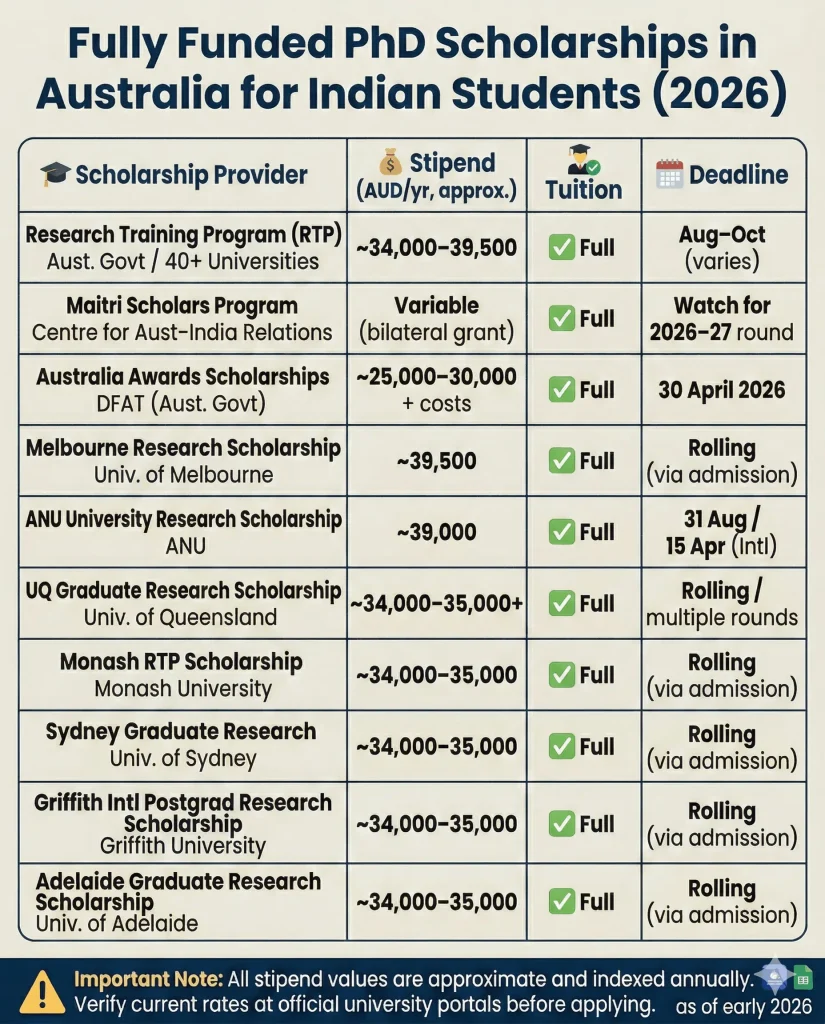
Master Summary Table: PhD Scholarships in Australia for Indian Students (2026)
| # | Scholarship | Provider | Stipend (AUD/yr, approx.) | Tuition | Deadline |
|---|---|---|---|---|---|
| 1 | Research Training Program (RTP) | Aust. Govt / 40+ Universities | ~34,000–39,500 | ✅ Full | Aug–Oct (varies) |
| 2 | Maitri Scholars Program | Centre for Aust–India Relations | Variable (bilateral grant) | ✅ Full | Watch for 2026–27 round |
| 3 | Australia Awards Scholarships | DFAT (Aust. Govt) | ~25,000–30,000 + costs | ✅ Full | 30 April 2026 |
| 4 | Melbourne Research Scholarship | Univ. of Melbourne | ~39,500 | ✅ Full | Rolling (via admission) |
| 5 | ANU University Research Scholarship | ANU | ~39,000 | ✅ Full | 31 Aug / 15 Apr (Intl) |
| 6 | UQ Graduate Research Scholarship | Univ. of Queensland | ~34,000–35,000+ | ✅ Full | Rolling / multiple rounds |
| 7 | Monash RTP Scholarship | Monash University | ~34,000–35,000 | ✅ Full | Rolling (via admission) |
| 8 | Sydney Graduate Research Scholarship | Univ. of Sydney | ~34,000–35,000 | ✅ Full | Rolling (via admission) |
| 9 | Griffith Intl Postgrad Research Scholarship | Griffith University | ~34,000–35,000 | ✅ Full | Rolling (via admission) |
| 10 | Adelaide Graduate Research Scholarship | Univ. of Adelaide | ~34,000–35,000 | ✅ Full | Rolling (via admission) |
All stipend values are approximate and indexed annually. Verify current rates at official university portals before applying.
What Does a Fully Funded PhD in Australia Actually Cover?
Understanding exactly what “fully funded” means in practice helps with financial planning and realistic expectations:
Tuition Fee Offset: International PhD tuition in Australia ranges from approximately AUD 28,000 to AUD 50,000+ per year depending on field and university. Fully funded scholarships cover this entirely for 3.5–4 years — a saving of AUD 100,000–180,000 over the degree.
Living Stipend: The 2026 RTP rate of approximately AUD 34,000–35,000 per year is paid tax-free fortnightly. In smaller cities like Adelaide, Canberra, or Brisbane, this comfortably covers rent, food, and daily expenses. In Sydney and Melbourne, where rent for a shared apartment can reach AUD 1,500–2,000/month, you may need to budget more carefully. The higher stipends at Melbourne (~AUD 39,500) and ANU (~AUD 39,000) partly reflect the higher living costs in those cities.
Overseas Student Health Cover (OSHC): Mandatory for all international students on a student visa. Typically costs AUD 600–700/year for an individual — covered by all major PhD scholarships in Australia for Indian students listed here.
Relocation allowance: Most universities offer AUD 2,000–3,000 for students relocating from outside Australia.
Additional provisions: Thesis allowance (~AUD 420 one-time), dependent child allowance for international students with children, paid sick leave (typically 10 days/year), and maternity/parental leave provisions.
Eligibility Checklist for Indian Students Applying for PhD Scholarships in Australia
Before applying for any PhD scholarships in Australia, confirm you meet these baseline requirements:
✅ Academic qualification: Bachelor’s degree with First Class Honours (≥75% or equivalent) OR a research-based Master’s degree with strong academic performance
✅ English proficiency: IELTS Academic 6.5–7.0 (no band below 6.0) | TOEFL iBT 84+ | PTE Academic equivalent
✅ Research proposal: A well-structured 2–5 page document identifying your research problem, methodology, and expected contribution to knowledge
✅ Supervisor confirmation: Most Australian universities expect you to identify and informally confirm a supervisor’s support before submitting your formal application — this is the most critical step
✅ Publications or research experience: Not always mandatory, but even one peer-reviewed paper or submitted manuscript meaningfully improves your scholarship ranking
✅ Documentation: Certified academic transcripts, degree certificates, CV/resume, and 2–3 academic reference letters
✅ No conflicting full scholarship: You generally cannot hold another scholarship providing more than 75% of the RTP stipend simultaneously
How to Find a PhD Supervisor in Australia — The Most Underrated Step
Given that a fully funded PhD in Australia is largely supervisor-driven, securing the right supervisor often matters more than the scholarship application itself.
Step 1 — Narrow your research niche. “Renewable energy” is too broad. “Degradation mechanisms in perovskite solar cells under humid conditions” is a viable, specific research topic that will attract the right supervisor.
Step 2 — Use university supervisor portals. Every major Australian university has a “Find a Supervisor” or “Research Expertise” portal. Search using 3–5 keywords from your specific research area.
Step 3 — Study their recent work. Identify 2–3 faculty members whose publications in the last 3 years align with your interests. Understand what funded projects they’re currently running.
Step 4 — Send a targeted cold email. Three to four paragraphs: who you are → your academic background → why their specific work interests you → what you bring to their group. Attach a concise research proposal (1 page) and your CV. Do not mass-email professors.
Step 5 — One polite follow-up. Most professors respond within 2–3 weeks. A single polite follow-up after three weeks of silence is appropriate.
Once a supervisor confirms interest, they’ll guide you through the formal admission process — which automatically enters you into scholarship consideration at most universities.
Build Your Publication Record Before You Apply
One of the most effective strategies for Indian students competing for PhD scholarships in Australia is arriving with a publication record. Selection committees in Australia rank applicants partly on research outputs, and even a single journal article sets you apart in a competitive pool.
Here’s how to build that record while still in India:
Turn your Master’s thesis into a publication. Most Indian research Master’s projects contain genuinely publishable findings. Converting one chapter into a journal manuscript demonstrates precisely the capability Australian supervisors are looking for. If you’re unsure where to start, our editorial and manuscript preparation services at IR Research Publication can help you polish your work to international standards.
Select journals strategically. Not all journals are equal. Understanding impact factors, indexing databases, and journal ranking is critical — especially when your publication needs to carry weight in a scholarship application. Read our detailed guide on Journal Impact Factor 2025: Who’s Leading the Race in Scientific Publishing to learn how to evaluate and select the right outlet for your research.
Master the abstract. Your paper’s abstract is what editors, reviewers, and scholarship committees read first. A clear, well-structured abstract can mean the difference between a paper that gets reviewed and one that gets rejected at the desk. Our step-by-step walkthrough on How to Write an Abstract for a Research Paper covers this in detail.
Use AI tools responsibly. Many researchers now use AI-assisted writing tools to improve clarity and structure. Using them ethically is critical to maintaining your academic integrity, especially when applying to prestigious international programs. Read The Ethical Use of AI in Writing Review Articles: A Guide for Researchers before incorporating any AI tools into your workflow.
Submit a review article if original data isn’t ready. A well-argued literature review or systematic review in your research niche can be published faster than original experimental work, and still meaningfully strengthens a scholarship application. You might also find it useful to read Why India Needs More High-Quality Scientific Journals for broader context on the Indian research publishing landscape and where Indian researchers typically fit into global academic conversations.
Comparing Australia vs Other PhD Destinations for Indian Students
Indian students also consider Europe, Canada, and the UK. Here’s how the fully funded PhD in Australia pathway objectively compares:
| Factor | Australia | UK | Canada | Germany |
|---|---|---|---|---|
| Standard Stipend | ~AUD 34,000–39,500/yr | ~£18,000–20,000/yr | ~CAD 20,000–25,000/yr | ~€1,400–1,800/month |
| Tuition coverage | Usually full offset | Varies widely | Usually full | Usually free |
| Post-study visa | Typically 3–4 years (policy-dependent) | 2 years (Graduate Route) | 3 years (PGWP) | 18 months |
| Duration of PhD | 3.5–4 years | 3–4 years | 4–5 years | 3–4 years |
| India-specific scholarships | Yes (Maitri, AAS) | Limited | Limited | DAAD (generic) |
| Language | English | English | English/French | German/English |
| Living cost | Moderate–high (city-dependent) | High (especially London) | Moderate | Low–moderate |
For Indian students exploring European options in depth, read our guide on Fully Funded PhD Scholarships in Europe for Indian Students (2026), which covers over 20 verified fellowships across Germany, France, Sweden, the Netherlands, Switzerland, and more.
Step-by-Step Application Timeline for a Fully Funded PhD in Australia (2026–27 Intake)
The Australian academic year starts in February or July. For a February 2027 start:
August–September 2026:
- Finalize your research area and list of 3–5 target universities
- Begin identifying potential supervisors and sending targeted cold emails
- Take or retake IELTS/PTE if scores need improvement
October–November 2026:
- Confirm supervisor interest (critical before formal application)
- Write and refine your research proposal with supervisor feedback
- Collect certified transcripts, reference letters, and updated CV
- Note: Some universities set August 31 deadlines for February intakes — check early
December 2026:
- Submit formal admission applications, ensuring the scholarship consideration checkbox is ticked
- Monitor application portals for document requests and updates
January–February 2027:
- Receive admission offers (typically with automatic scholarship consideration included)
- Accept scholarship and enrolment offer
March–April 2027:
- Apply for Australian Student Visa (Subclass 500)
- Arrange accommodation, activate OSHC, finalize travel
July 2027 (or February 2027 depending on intake):
- Arrive in Australia, complete university orientation, begin your fully funded PhD
Pro Tips to Win PhD Scholarships in Australia for Indian Students
Get your supervisor first — always. A strong supervisor endorsement letter is one of the most significant factors in scholarship ranking. Universities prioritise candidates with confirmed supervisor support, and this is a signal to admissions committees that your research project is viable and well-supported.
Target Group of Eight (Go8) universities. ANU, University of Melbourne, University of Sydney, UQ, Monash, Adelaide, UNSW, and UWA are Australia’s eight research-intensive universities. Their scholarships carry higher stipends, stronger academic branding, and better career outcomes.
Look for ARC-funded project positions. Many professors run Australian Research Council (ARC) grants that explicitly include PhD student positions with stipend top-ups above the RTP base. Search the ARC’s publicly available grant register to find funded researchers in your field.
For STEM applicants: raise the Maitri program with your university contact. While competitive and limited in annual slots, it is the only Australia scholarship designed specifically for Indian students. If your research is in clean energy, advanced manufacturing, or critical minerals, it’s worth flagging to prospective universities.
Apply to 3–5 universities simultaneously. Since the RTP is a federal program, you can receive offers from multiple universities and compare stipend top-ups, supervisor quality, and research environments before committing.
Invest in your publication profile before applying. Even one peer-reviewed journal article meaningfully improves your scholarship ranking. The team at IR Research Publication supports researchers with manuscript preparation, editorial services, and journal selection guidance — particularly useful when preparing your first international publication. If you haven’t published before, also read Can You Publish Research Without a PhD? for a practical guide to getting started.
Write a compelling research proposal. Australian scholarship committees weigh research quality heavily. Your proposal should: (a) identify a clear gap in existing literature, (b) outline a feasible methodology, (c) articulate the expected original contribution, and (d) demonstrate familiarity with your prospective supervisor’s work.
Frequently Asked Questions: Fully Funded PhD in Australia for Indian Students
Q: Can Indian students get a fully funded PhD in Australia without prior work experience?
Yes. Academic merit and research potential are the primary selection criteria. Work experience can strengthen an application but is not mandatory. Your academic record, research proposal quality, and publications matter most.
Q: What is the Australia PhD stipend 2026 for Indian students?
The standard RTP stipend for 2026 is approximately AUD 34,000–35,000 per year, paid tax-free fortnightly for full-time students. The University of Melbourne and ANU offer slightly higher rates of approximately AUD 39,000–39,500. Some ARC-funded positions carry additional top-ups above these base rates.
Q: Is the Maitri Scholarship still open for 2026 applications?
University nominations for the current Maitri round were submitted in late 2025. Successful scholars are expected to be notified by mid-2026 with activities commencing by December 2026. Watch the official Maitri program page for any 2026–27 round announcement.
Q: Do I need a confirmed supervisor before applying for the scholarship?
For most Australian universities, having an informally confirmed supervisor before submitting your formal admission application significantly improves your scholarship ranking. It is strongly recommended — and in some competitive faculties, effectively required.
Q: How competitive are PhD scholarships in Australia for Indian students?
Extremely competitive. Top universities like ANU, Melbourne, and Sydney receive thousands of HDR applications for limited funded positions. Strong candidates typically hold a First Class Honours average, IELTS 7.0+, at least one publication, and a confirmed supervisor endorsement.
Q: Can I work part-time while on a fully funded PhD in Australia?
Yes. International student visa holders can typically work up to 48 hours per fortnight during semesters. However, most scholarship agreements restrict additional income to no more than 75% of the RTP stipend from other sources — check your specific scholarship terms.
Q: Is the RTP stipend taxable?
For full-time Australian PhD students, the RTP stipend is generally exempt from Australian income tax. Confirm your specific tax situation with the Australian Taxation Office (ATO) or your university’s student finance team.
Q: What IELTS score is needed for PhD scholarships in Australia?
Most universities require a minimum IELTS Academic score of 6.5 (with no band below 6.0). Some programs require 7.0 overall. PTE Academic and TOEFL iBT equivalents are usually accepted — check the specific requirements of each university you’re applying to.
Conclusion: Your Roadmap to a Fully Funded PhD in Australia
The pathway to a fully funded PhD in Australia is genuinely achievable for motivated Indian students in 2026. Between the federal RTP scholarship (available at 40+ universities), the India-specific Maitri Scholars Program for STEM, and competitive university awards at ANU, Melbourne, Sydney, UQ, Monash, and Adelaide, Australia offers a strong — though highly competitive — funding landscape for doctoral researchers.
The factors that consistently differentiate successful applicants are a precise and well-articulated research proposal, a confirmed and enthusiastic supervisor, a strong academic record, and wherever possible, at least one peer-reviewed publication before applying.
Start now. Identify 3–5 supervisors in your research area, email them specifically and thoughtfully, and begin building those academic relationships today. Once a supervisor commits, the formal scholarship application process becomes significantly more manageable.
For resources on academic research writing, publishing, and navigating the international scholarship landscape, explore these guides at IR Research Publication:
- 📄 How to Write an Abstract for a Research Paper: A Step-by-Step Guide
- 📊 Journal Impact Factor 2025: Who’s Leading the Race in Scientific Publishing?
- 🤖 The Ethical Use of AI in Writing Review Articles: A Guide for Researchers
- 🇮🇳 Top PhD Fellowships & Funding Opportunities in India 2026
- 🇪🇺 Fully Funded PhD Scholarships in Europe for Indian Students (2026)
- 🔬 Why India Needs More High-Quality Scientific Journals
- 📝 Can You Publish Research Without a PhD?
- 🏛️ Explore our open-access journal Biological Sciences — for researchers ready to publish
Australia is waiting — and so are the supervisors and funding bodies ready to invest in exceptional Indian researchers.
References & Official Links
- Australian Government Research Training Program — education.gov.au
- Maitri Scholars Program — australiaindiacentre.org.au
- Australia Awards Scholarships — dfat.gov.au
- Australia Awards India — australiaawardsindia.org
- Melbourne Research Scholarship — unimelb.edu.au
- ANU University Research Scholarship — anu.edu.au
- UQ Graduate Research Scholarships — uq.edu.au
- Monash Research Training Program — monash.edu
- University of Sydney — Scholarships for Indian students
- Study Australia — Australian Government Official Portal
- Department of Home Affairs — Graduate Visa
Last verified: February 2026. Scholarship amounts, stipend rates, and visa policies are subject to change. Always confirm current details on official university and government websites before submitting any application.