
Finding high paying jobs for Biology PhDs in India can often feel like a struggle against a system designed for low-stipend fellowships. You have spent 5–7 years mastering your field, yet the “Postdoc Pay Gap” remains a harsh reality. While an academic fellowship might offer ₹47,000–₹54,000 per month, the corporate sector is currently offering double or triple that for the same skillset.
If you are tired of the uncertainty of grant funding, it is time to look beyond the lab bench. In 2026, the Indian biotech and pharmaceutical sectors are booming, creating a massive demand for doctoral experts.
This guide is your ultimate roadmap. We have analyzed the market to bring you the definitive list of high paying jobs for Biology PhDs in India that offer both intellectual satisfaction and a lucrative paycheck.
Why Are There More High Paying Jobs for Biology PhDs in India Now?
Before we dive into the list, it is important to understand why the market has shifted. In 2026, India is no longer just a “manufacturing hub” for generic drugs; it is becoming an “innovation hub.”
Companies like Biocon, Syngene, and Dr. Reddy’s are competing with global giants. They need Subject Matter Experts (SMEs) to drive this innovation. This shift has created a surge in high paying jobs for Biology PhDs in India, specifically in sectors like AI-driven Drug Discovery, Clinical Research, and Intellectual Property.
Below is the breakdown of these roles, including salaries, required certifications, and the exact skills you need to land them.
1. Medical Science Liaison (MSL)
The “Gold Standard” of Corporate Science Roles
The Medical Science Liaison (MSL) is widely considered one of the most prestigious and high paying jobs for Biology PhDs in India. It serves as the scientific bridge between a pharmaceutical company and top doctors (Key Opinion Leaders or KOLs).
What do they actually do?
You are not a sales representative. You do not carry a bag of samples.
- Morning: Review new clinical trial data for your company’s blockbuster cancer drug.
- Afternoon: Meet with a leading Oncologist at AIIMS or Tata Memorial to discuss how the drug’s mechanism of action (MoA) fits their patient needs.
- Evening: Fly to a conference to present a poster on Phase III trial results.
Why it pays well:
You are the “peer” of the doctor. Sales reps cannot answer deep scientific questions; only a PhD can. Your knowledge directly influences the adoption of high-value drugs.
- Average Salary (2026): ₹12 – ₹18 Lakhs per annum (Entry Level) | ₹25 – ₹40 Lakhs (Senior MSL/Manager)
- Top Recruiters: Novartis, AstraZeneca, Sanofi, Johnson & Johnson, Pfizer.
- Required Skills: Excellent communication (English & regional), therapeutic area knowledge (Oncology/Immunology is hot).
Action Step: To break in, you don’t need a new degree. You need to demonstrate “Scientific Storytelling.” Check out our guide on How to Write a Letter of Intent to perfect your application.
2. Patent Agent / IP Specialist
Where Science Meets Law
India is seeing a surge in biotech startups, and every new molecule needs a patent. This has created a massive shortage of “Patent Agents” who understand complex biology. If you are looking for high paying jobs for Biology PhDs in India that don’t involve wet-lab work, this is a top contender.
The Role:
- Drafting: Writing the technical descriptions of inventions (e.g., a new CRISPR vector).
- Prosecution: Arguing with the Patent Office to prove why your client’s invention is unique.
- Freedom to Operate (FTO): Researching if a new product infringes on existing patents.
The “Barrier to Entry” (Your Advantage):
To sign documents as a Patent Agent, you must pass the Indian Patent Agent Examination (IPAE) conducted by the Government of India. It is a tough exam, but once you clear it, your value skyrockets.
- Average Salary: ₹10 – ₹20 Lakhs (Law Firms) | ₹30+ Lakhs (In-house Counsel at Biocon/Dr. Reddy’s).
- Top Recruiters: K&S Partners, Anand and Anand, Biocon, Syngene.
- Certification: Indian Patent Agent Exam (Usually held once a year).
3. Computational Biologist / Bioinformatics Scientist
The “IT” Job of Biology
With the explosion of AI in Drug Discovery (AIDD), “Dry Lab” roles are outpaying “Wet Lab” roles by a significant margin. If you can code, you are in the top 1% of employable PhDs.
What do they do?
- Analyze Next-Generation Sequencing (NGS) data.
- Use Machine Learning (ML) models to predict how a drug molecule binds to a protein target.
- Work with “Big Data” sets (Genomics, Proteomics) to find disease biomarkers.
Why the high pay?
You are effectively a Data Scientist with a Biology background. Tech companies compete for this talent.
- Average Salary: ₹15 – ₹25 Lakhs (Entry) | ₹35 – ₹60 Lakhs (Principal Scientist).
- Top Recruiters: Strand Life Sciences, TCS (Life Sciences), Wadhwani AI, Ceremorphic.
- Key Skills: Python, R, Linux, AWS/Cloud Computing, Docker.
Pro Tip: If you are a wet-lab biologist, start learning Python today. Even basic proficiency can boost your salary by 30%.
4. Regulatory Affairs (RA) Specialist
The Gatekeepers of Pharma
No drug, vaccine, or medical device enters the Indian market without approval from the CDSCO (Central Drugs Standard Control Organisation). RA specialists are the experts who navigate this legal maze.
The Day-to-Day:
- Compiling massive dossiers (thousands of pages) for drug approval.
- Liaising with government officials to answer queries about safety data.
- Ensuring marketing materials comply with the “Drugs and Magic Remedies Act.”
Why it pays well:
A delay in regulatory approval can cost a pharma company crores in lost revenue. They pay a premium for experts who can get approvals right the first time.
- Average Salary: ₹9 – ₹16 Lakhs per annum.
- Certifications:
- RAC (Regulatory Affairs Certification): Global standard (expensive but valuable).
- Indian Courses: PG Diploma in Regulatory Affairs (offered by institutes like Cliniminds or TechnoBridge).
- Top Recruiters: Dr. Reddy’s, Cipla, Parexel, IQVIA.
5. Industrial R&D Scientist
The Corporate Alternative to Academia
This is the closest role to your PhD work, but with a different goal. In academia, you publish papers. In industry, you launch products.
The Role:
- Process Development: Scaling up a vaccine production from a 5mL flask to a 500L bioreactor.
- Assay Development: Creating robust tests to check if a drug is pure.
- Formulation: Figuring out how to keep a protein stable in a pill or injection.
The 2026 Trend:
“Biosimilars” are huge in India. Companies like Biocon and Reliance Life Sciences are hiring aggressively for scientists who understand protein purification and characterization.
- Average Salary: ₹10 – ₹15 Lakhs (Scientist I) | ₹18 – ₹28 Lakhs (Senior Scientist).
- Top Recruiters: Syngene, Biocon Biologics, Reliance Life Sciences, Bharat Biotech.
- Related Read: For a deeper dive into specific R&D roles, read our detailed breakdown of Career Options After PhD in India: Industry Roles.
6. Clinical Research Scientist
Managing Human Trials
India is a global hub for clinical trials due to its large patient population. PhDs are hired to design these trials and ensure they are ethical and safe.
What do they do?
- Protocol Design: Writing the rulebook for how the clinical trial will be conducted.
- Medical Monitoring: Reviewing patient data to catch adverse events (side effects) early.
- Site Management: Ensuring hospitals (trial sites) are following the protocol.
Why it pays well:
Clinical trials are the most expensive part of drug development. Companies need high-IQ individuals to manage the risk.
- Average Salary: ₹8 – ₹14 Lakhs per annum.
- Certifications:
- Advanced Program in Clinical Research & Management (APCRM) by Clini India.
- PG Diploma in Clinical Research (ICRI).
- Top Recruiters: IQVIA, LabCorp, Icon, Syneos Health.
7. Scientific & Medical Writer
For the Wordsmiths
If you enjoyed writing your thesis and papers more than doing the actual experiments, this is your calling.
The Role:
- Regulatory Writing: Writing Clinical Study Reports (CSRs) for the FDA/EMA.
- Med-Comms: Creating slide decks for doctors, conference abstracts, and educational material.
- Publication Planning: Helping pharma companies publish their trial results in top journals like The Lancet.
Why it pays well:
This is not “Content Writing.” It requires the ability to understand complex statistical data and present it accurately. A generic writer cannot do this.
- Average Salary: ₹7 – ₹12 Lakhs (Entry) | ₹15 – ₹22 Lakhs (Senior Writer).
- Certifications:
- Certified Medical Writer (CMW) by AMWA (American Medical Writers Association).
- Indian Courses: Introduction to Medical Writing (Manipal), Medical Writing Certificate (Cliniminds).
- Top Recruiters: Cactus Communications (Cactus Life Sciences), Indegene, Novartis (Healthcare Systems).
- Skill Check: Familiarity with publication standards is key. Review our Guide to Publishing in Scopus Journals to brush up on these skills.
8. Product Specialist / Application Scientist
The “Technical Sales” Expert
Have you ever used a confocal microscope or a flow cytometer? Companies like Thermo Fisher need PhDs to demonstrate these machines to other scientists.
The Role:
- Traveling to research institutes (IITs, IISERs) to demo equipment.
- Troubleshooting customer experiments (e.g., “Why is my PCR not working?”).
- Training new users on how to use complex software.
Why it pays well:
It combines technical expertise with sales. You often get a Base Salary + Commission, meaning your earning potential is uncapped.
- Average Salary: ₹10 – ₹15 Lakhs (Base) + ₹3–5 Lakhs (Incentives).
- Top Recruiters: Thermo Fisher Scientific, Agilent, illumina, Beckman Coulter.
9. Management Consultant (Life Sciences)
Solving Business Problems
Top consulting firms (MBB – McKinsey, BCG, Bain) have specialized “Life Science” wings. They hire PhDs to help pharma CEOs make billion-dollar decisions.
The Day-to-Day:
- Analyzing market trends (e.g., “Should we invest in Cell Therapy in India?”).
- Due Diligence: Investigating a startup before a merger.
- Pricing Strategy: Deciding how much a new drug should cost.
Why it pays well:
This is the highest-paying sector globally. However, the work hours are long (60+ hours/week).
- Average Salary: ₹20 – ₹30 Lakhs per annum (Starting).
- Top Recruiters: McKinsey, BCG, Deloitte, ZS Associates.
10. Government Scientist (Grade B/C)
The Stability Option
While we focus on “High Paying,” we cannot ignore the value of government perks. A Scientist ‘C’ position might have a lower base cash component than an MSL, but the benefits make it highly lucrative.
The Package:
- Job Security: Permanent tenure.
- Allowances: Housing (HRA), Transport (TA), Medical (CGHS), and Pension.
- Research Freedom: You set your own agenda (unlike corporate R&D).
- Salary Scale (7th Pay Commission):
- Scientist C: Pay Level 11 (Starting Basic ₹67,700 + DA + HRA ≈ ₹1.1 Lakh/month).
- Scientist E: Pay Level 13 (Starting Basic ₹1,23,100 + Allowances).
- Where to Apply: DRDO (INMAS, DIPAS), ICMR, CSIR, DBT.
Summary of High Paying Jobs for Biology PhDs in India (2026)
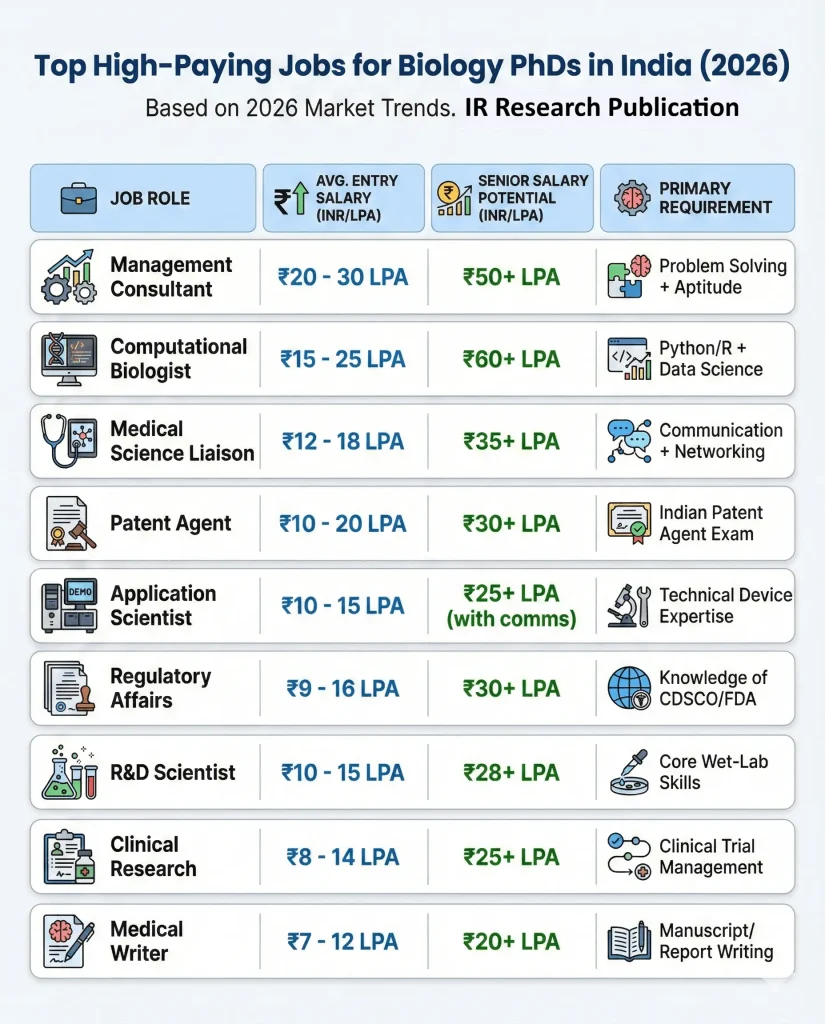
To give you a clear comparison, we have summarized the salary potential of these roles below.
| Job Role | Average Entry Salary (INR) | Senior Salary Potential | Primary Requirement |
| Management Consultant | ₹20 – 30 LPA | ₹50+ LPA | Problem Solving + Aptitude |
| Computational Biologist | ₹15 – 25 LPA | ₹60+ LPA | Python/R + Data Science |
| Medical Science Liaison | ₹12 – 18 LPA | ₹35+ LPA | Communication + Networking |
| Patent Agent | ₹10 – 20 LPA | ₹30+ LPA | Indian Patent Agent Exam |
| Application Scientist | ₹10 – 15 LPA | ₹25+ LPA (with comms) | Technical Device Expertise |
| Regulatory Affairs | ₹9 – 16 LPA | ₹30+ LPA | Knowledge of CDSCO/FDA |
| R&D Scientist | ₹10 – 15 LPA | ₹28+ LPA | Core Wet-Lab Skills |
| Clinical Research | ₹8 – 14 LPA | ₹25+ LPA | Clinical Trial Management |
| Medical Writer | ₹7 – 12 LPA | ₹20+ LPA | Manuscript/Report Writing |
Action Plan: How to Transition?
You cannot apply to these jobs with your 10-page academic CV. Here is your transition checklist:
- The Resume Makeover: Cut your CV to 2 pages. Move your “Skills” to the top. Remove the full list of 15 posters you presented; only keep the most relevant ones.
- LinkedIn Optimization: Recruiters search for keywords. Update your headline to: “PhD in Molecular Biology | Aspiring Medical Science Liaison | Expertise in Oncology.”
- Network Outside the Lab: Do not just talk to professors. Find alumni from your institute who are working in industry and ask them for a 15-minute virtual coffee chat.
- Target Niche Portals: Stop scrolling Instagram. Check these sites weekly:
- IndiaBioscience Jobs: The best curated list for Indian science jobs.
- LinkedIn Jobs: Set alerts for “Medical Affairs,” “Scientific Writing,” and “R&D Scientist.”
Frequently Asked Questions (FAQ)
1. Is it too late to switch to industry if I am 32+ years old?
No. In fact, for roles like Medical Science Liaison or Patent Agent, maturity is an asset. Companies value the authority that comes with age and experience. However, for entry-level R&D bench roles, you might face competition from younger candidates, so focus on specialized roles where your deep knowledge is the differentiator.
2. Will I be “selling out” if I leave academia?
This is a common “Academic Guilt.” Remember: Science is not just done in a university. In industry, you bring actual medicines to patients. A Regulatory Specialist ensures a vaccine is safe for millions. That is not selling out; that is making an impact (and getting paid fairly for it).
3. Do I need a Postdoc to get these jobs?
Strictly NO. In 90% of these cases, a Postdoc is not required and counts as “0 years of industrial experience.” If your goal is industry, start applying immediately after your PhD submission. Do not do a postdoc just to “wait out” the job market.
4. Can I return to academia later?
It is difficult, but not impossible. If you work in a high-publishing industrial R&D lab (like at Biocon or Syngene), you can still publish papers. However, if you move to management consulting or sales, returning to a tenure-track professor role is very rare.
5. Which city in India is best for these jobs?
Hyderabad and Bangalore are the undisputed capitals for Biotech and Pharma. Mumbai is the hub for Medical Affairs and Head Offices. Pune and Ahmedabad also have significant manufacturing and R&D clusters.
Ready to make the switch?
Your PhD gave you resilience, analytical skills, and the ability to learn complex topics quickly. These are exactly what the industry needs. The market for high paying jobs for Biology PhDs in India is wide open—you just need to package your skills correctly to seize the opportunity.
For more guides on academic writing and career transitions, visit Irrespub.com.
Additional Reading
For more scholarship opportunities and academic guidance, visit:
- Top Postdoctoral Fellowships in USA for Indian Students in 2026
- Pharma Jobs After PhD in India vs USA (2026): Salary, Growth & Opportunities Compared
- Government Jobs After PhD in India: Complete Guide (2026)
- Career Options After PhD in India: Industry Roles You Should Know in 2026
- Postdoctoral Fellowships in India 2026: Complete Guide
- Top Fellowships & Funding Opportunities for PhD Students in India in 2026
- PhD Internship Opportunities in Pharma Companies India 2025: Complete Guide
- Top 10 Pharma Companies in India Hiring PhDs in 2025