Introduction: AI Healthcare Startups in India-Redefining the Future
India’s healthcare sector is being transformed by innovative AI-powered startups tackling diagnostics, patient monitoring, telemedicine, and genomics at scale. These “Indian AI healthcare startups” are making quality care affordable, accessible, and timely for millions. This blog identifies the top 10 disruptors, with their missions, innovations, and impact, helping you stay ahead in healthtech trends for 2025.
Why AI Healthcare Startups Matter in India
India faces vast challenges: rural healthcare gaps, overloaded hospitals, rising chronic diseases, and a shortage of medical specialists. These startups harness artificial intelligence for early diagnosis, scalable solutions, and remote care—delivering real-world results nationwide.
Primary Keyword (used throughout): Indian AI healthcare startups Secondary Keywords: AI in Indian healthcare, healthtech startups India Tertiary Keywords: medical AI innovation, best Indian healthtech companies
Selection Criteria for the Top Indian AI Healthcare Startups
These startups have been chosen for:
Cutting-edge AI technologies (medical imaging, predictive analytics, smart diagnostics)
Scale and impact: Adoption by top hospitals, regulatory approvals, national reach
Recognition: Funding rounds, industry awards, and user testimonials
Top 10 Indian AI Healthcare Startups for 2025
Here’s a table summarizing the best Indian AI healthcare startups, their founders, locations, and core innovations.
Qure.ai develops deep learning algorithms that read chest X-rays, CT scans, and ultrasound images in seconds, boosting diagnostic speed and quality. Their FDA-cleared and CE-marked products run in over 3,000 facilities globally.
Based in Bengaluru, Niramai’s AI technology enables affordable and painless breast cancer screening. Their Thermalytix platform uses machine learning with thermal imagery, making it suitable for low-resource settings.
SigTuple automates microscopy reviews, blood cell counting, and urine analysis with AI, helping labs scale diagnostics in minutes instead of hours. The platform is used nationwide.
DeepTek provides AI-powered radiology workflow solutions for faster, smarter diagnosis. Its cloud deployment offers instant access and analysis for hospitals and remote clinics.
5. Tricog Health: Rapid Cardiac Care
Tricog Health saves lives across India by offering instant AI cardiac diagnosis—even for remote patients; over 5 million ECG readings have been analyzed.
6. Dozee: AI-Powered Remote Monitoring
Dozee’s contactless sensor and AI dashboard deliver real-time vital monitoring in hospitals and homes, addressing the shortage of ICU beds and trained staff.
7. 5C Network: AI Cloud for Medical Scans
5C Network provides tele-radiology access and AI-based reporting for any hospital in India. Their system cuts scan turnaround from days to hours, vital for tier-2 and tier-3 cities.
AarogyaAI’s algorithms predict drug resistance patterns for tuberculosis patients, guiding treatment plans far faster than current lab tests. Essential for India, given its high TB burden.
9. Predible Health: Oncology Diagnostics for All
Predible bridges gaps in cancer diagnosis by rapidly analyzing medical images through AI, reaching underserved clinics and rural hospitals.
10. Orange Health: Home Lab Diagnostics with AI
Orange Health brings home sample collection and lab reporting powered by AI to consumers in major Indian cities, improving convenience and speed.
Industry Impact and Future Trends
Indian AI healthcare startups are driving:
Faster, more accurate diagnostics
Rural healthcare access via telemedicine
Cost-effective solutions for public health crises
Scalable platforms for India’s immense population
These startups not only redefine medicine in India—they are inspiring global AI innovation.
Challenges and Opportunities Ahead
Challenges: Data privacy, regulatory hurdles, scaling for rural outreach, talent management
Opportunities: Ayushman Bharat expansion, international partnerships, new AI use-cases (personalized genomics, mental health)
Conclusion: The Future of Indian AI Healthcare Startups
With constant innovation, strong government support, and tech-savvy entrepreneurs, Indian AI healthcare startups are on track to transform care nationwide. Follow “IR Research Publication” for deeper dives into medical AI, healthtech trends, and startup success stories.
IR Research Publication is publisher, editorial, and profile building service provider. It was founded with the mission to support scientists, researchers, academicians, and students in advancing their careers and contributing to global scientific knowledge. IR Research Publication is committed to delivering high-quality, reliable, and professional editorial services alongside a credible and ethical publishing platform.
If you like this article, then visit our Blog page for more such articles.
Stargames – Die perfekte Kombination aus Spaß und Sicherheit
Vielleicht kennt man das Gefühl, wenn man spätabends auf der Couch sitzt, das Handy in der Hand, und überlegt, ob man noch ein paar Runden an einem Online-Slot drehen sollte. Es soll Spaß machen, aber sicher sein. Genau an dieser Stelle betritt Stargames die Bühne. Dieses Online-Casino hat sich in den letzten Jahren nicht nur einen Namen durch sein vielfältiges Spielangebot gemacht, sondern auch durch konsequente Sicherheitsstandards, die man wirklich spüren kann. Und nach allem, was ich ausprobiert habe, kann ich sagen: hier wirkt vieles erstaunlich durchdacht und unkompliziert. Eine der besten Zusammenfassungen dazu findet man übrigens unter Stargames erfahrung, wo Spieler ihre Eindrücke schildern, oft mit erstaunlich viel Übereinstimmung, was Fairness und Bedienbarkeit betrifft.
Ich persönlich war zunächst skeptisch. Viele Online-Casinos werben mit Sicherheit und schneller Auszahlung, halten aber oft wenig davon. Stargames scheint hier tatsächlich eine andere Richtung einzuschlagen. Man merkt, dass hier schon seit der Anfangszeit im Jahr 2002 ein klarer Fokus auf Seriosität lag. Heute, unter neuer Lizenz und moderner Technologie, gelingt es ihnen, den klassischen Spielspaß mit zeitgemäßer Nutzererfahrung zu kombinieren. Diese Balance, finde ich, ist selten gut getroffen. Aber hier passt es wirklich.
Registrierung und Benutzerfreundlichkeit
Die Registrierung bei Stargames wirkt zunächst einfach – und ist es auch. Man öffnet die Startseite, klickt auf „Anmelden“, gibt ein paar Daten ein und kann, sofern man über 18 Jahre alt ist, direkt loslegen. Was mir auffiel: Der gesamte Prozess wird transparent und freundlich erklärt. Es gibt keine versteckten Hinweise, keine verwirrenden Formulare, und das Design ist schlicht, fast schon beruhigend.
Das Interface wurde so gestaltet, dass auch Einsteiger nach wenigen Minuten wissen, wohin sie klicken müssen.
Nach der erfolgreichen Anmeldung bekommt man Zugang zu einem übersichtlichen Dashboard. Hier sieht man sofort, welche Spiele gerade besonders beliebt sind, wie viel Bonusguthaben zur Verfügung steht oder ob man an einem Turnier teilnehmen kann. Ich finde, das ist ein Punkt, der zeigt, dass Benutzerfreundlichkeit nicht nur ein Schlagwort ist.
Bonuswelt und Promotionen
Viele Online-Casinos buhlen um neue Kunden mit Bonusprogrammen. Stargames geht hier einen fast klassischen, aber ausgewogenen Weg. Es gibt den typischen Willkommensbonus – im Normalfall besteht dieser aus einem Einzahlungsbonus und gelegentlichen Freispiele-Angeboten. Das System ist fair und transparent dargestellt, ohne komplizierte Bedingungen, hinter denen man lange suchen muss.
Wenn man mich fragt, sind diese Bonusbedingungen einer der größten Pluspunkte. Die Mindesteinzahlung ist moderat, und die Umsatzbedingungen bewegen sich im fairen Rahmen. Das ist nicht selbstverständlich, wenn man sich den Markt ansieht. Ich erinnere mich an Anbieter, bei denen man praktisch nie den Bonus freispielen konnte, weil die Anforderungen absurd waren.
Stargames beweist, dass es auch anders geht, mit realistischen Anforderungen und einem durchdachten Belohnungssystem.
Besonders interessant finde ich auch die langfristigen Aktionen. Treue Spieler bekommen regelmäßig angepasste Angebote, manchmal Cashback, manchmal Freispiele, und gelegentlich sogar exklusive Einladungen zu Turnieren. Und das ist kein Marketinggag – ich habe so eine Einladung tatsächlich bekommen. Das fühlt sich dann fast persönlich an.
Spielauswahl und Softwarequalität
Wer Stargames schon einmal genutzt hat, weiß, dass diese Plattform besonders für Book of Ra und andere Klassiker von Novomatic bekannt wurde. Doch mittlerweile hat sich das Portfolio deutlich erweitert. Über 500 Spiele aus verschiedenen Genres warten darauf, entdeckt zu werden. Von Slots über Tischspiele bis hin zu Live-Angeboten ist so ziemlich alles vorhanden, was man erwarten darf.
Manchmal sitze ich ewig da und kann mich kaum entscheiden, womit ich anfangen soll. Slot oder Roulette? Oder doch lieber Blackjack mit Live-Dealer? Je nach Stimmung entdecke ich immer wieder neue Favoriten. Besonders lobenswert: die Ladegeschwindigkeit. Kaum ein Spiel startet mit Verzögerung, was man bei vielen Mitbewerbern leider anders erlebt.
Spielkategorie
Anzahl der Spiele
Besonderheit
Slots
über 300
Bekannte Klassiker & neue Releases
Tischspiele
50+
Variation von Blackjack & Roulette
Live-Casino
ca. 30
Echte Dealer mit HD-Streaming
Zahlungsmethoden und Sicherheit
Ein großer Punkt, wenn man über Casinos spricht, ist natürlich: Wie sicher ist mein Geld? Hier hat Stargames aus meiner Sicht alles richtig gemacht. Die Seite arbeitet mit moderner SSL-Verschlüsselung, alle Transaktionen laufen geschützt. Darauf legt man hier offensichtlich großen Wert. Man merkt, dass die Betreiber keine Experimente eingehen. Zahlungsdienste wie VISA, MasterCard, PayPal und Trustly sind integriert, sodass man frei wählen kann, wie man einzahlt oder auszahlt.
Zudem gelten alle Vorgänge nach EU-Standards. Ich hatte nie das Gefühl, bei einer Auszahlung hingehalten zu werden. Natürlich hängt die Dauer von der Methode ab, aber innerhalb weniger Stunden war das Geld meistens auf meinem Konto. Andere Anbieter können sich davon ruhig eine Scheibe abschneiden.
Zahlungsmethode
Bearbeitungszeit
Gebühren
Kreditkarte
1–2 Tage
Keine
PayPal
Sofort
Keine
Banküberweisung
2–5 Tage
Keine
Mobile Nutzung
Wer heute noch am PC spielt, ist fast schon Oldschool. Die meisten drehen die Slots unterwegs – während der Zugfahrt, beim Warten, irgendwo zwischen Alltag und Freizeit. Stargames hat darauf reagiert. Die mobile Version läuft direkt im Browser, ohne dass man eine App herunterladen muss. Das Design ist flüssig, und alle wichtigen Funktionen sind dort abrufbar.
Ich habe mehrmals über mein Smartphone eingezahlt, gespielt und ausgezahlt – alles funktionierte reibungslos.
Das zeigt, wie viel Wert auf Konsistenz gelegt wurde. Egal, ob man auf Android oder iOS spielt, alles wirkt gleich vertraut. Sogar Live-Spiele sind über mobile Geräte gut zugänglich, was mich ehrlich überrascht hat. Früher hatte ich oft das Problem, dass Streaming ruckelte oder der Chat nicht reagierte, das passiert hier nicht.
Kundendienst und Support-Erfahrung
Es gibt diesen Moment, wo man sich fragt: „Und wenn mal etwas nicht klappt?“ Ich hatte diese Situation einmal, als eine Auszahlung etwas länger dauerte. Statt dass ich warten musste, bekam ich nach kurzer Nachfrage beim Live-Chat eine freundliche, kompetente Antwort. Ohne Standardtexte, ohne umständliche Formulierungen. Es wirkte menschlich. Ich glaube, das macht viel aus, wenn man Vertrauen zu einem Casino aufbauen will.
Der Support ist 7 Tage die Woche erreichbar, wahlweise über Chat oder E-Mail. Telefonisch ist es (noch) nicht möglich, aber ehrlich gesagt stört mich das nicht besonders. Die Qualität zählt, nicht die Anzahl der Kanäle. Insgesamt ein rundes Bild.
Echte Spielerlebnisse
Was mich an Online-Spielplattformen interessiert, sind die Erfahrungen anderer. Bei Stargames fällt besonders auf, wie konstant positiv die Rückmeldungen sind. Natürlich gibt es immer wieder kleinere Kritikpunkte, meist bei individuellen Bonusfragen, aber im Großen und Ganzen scheint hier vieles stabil zu laufen. Viele Spieler berichten, dass sie seit Jahren dabei sind und nie Probleme hatten – das ist in dieser Branche schon bemerkenswert selten.
Ein Spieler lobt die Transparenz beim Einzahlen und Auszahlen.
Ein anderer hebt die Vielfalt der Novomatic-Spiele hervor, weil sie nostalgisch an echte Automaten erinnern.
Wieder ein anderer schwärmt vom Support und dem Gefühl, ernst genommen zu werden.
Das liest sich gut, aber es spiegelt sich auch in meinem eigenen Erlebnis wider. Es hat etwas Beruhigendes, wenn man merkt, dass man sich auf die Plattform verlassen kann.
Vergleich verschiedener Anbieter
Ich wollte wissen, wie Stargames im direkten Vergleich zu anderen Online-Casinos abschneidet. Deshalb habe ich verschiedene Accounts ausprobiert, um mir ein realistisches Bild zu machen. Interessanterweise liegt Stargames in Punkten wie Sicherheit, Transparenzerlebnis und Ladegeschwindigkeit weit voran. Beim Bonusangebot sind andere Anbieter manchmal großzügiger, aber oft auch komplizierter in den Bedingungen.
Sicherheit und Datenschutz erhalten Spitzenbewertungen im Vergleich.
Die Spiele laufen stabiler, besonders auf mobilen Geräten.
Das Bonusniveau ist solide, aber fairer als bei manchen Konkurrenten.
Was für mich besonders den Unterschied macht, ist die Verbindung aus Seriosität und Spaß. Viele Plattformen schaffen das nicht, sie kippen schnell in eine zu werbliche Richtung. Stargames bleibt da angenehm neutral – man spürt, dass sie den Spieler nicht als bloßen Umsatzfaktor sehen, sondern als Nutzer, dessen Vertrauen sie gewinnen wollen.
Die Zukunft von Stargames
Wie könnte Stargames in Zukunft aussehen? Ich glaube, sie werden ihren Weg weitergehen – Schritt für Schritt, aber konsequent. Wenn man sich anschaut, was in den letzten zwei Jahren passiert ist, von der Modernisierung der Oberfläche bis zur Ausweitung der Spielangebote, dann zeichnen sich klare Ambitionen ab. Es ist nicht auszuschließen, dass bald noch engere Kooperationen mit großen Spieleentwicklern entstehen.
Ein paar Bereiche sehe ich noch mit Potenzial: Zum Beispiel eine noch größere Diversität im Live-Casino-Teil, mehr Vernetzung von Spielerprofilen für Wochenevents und eventuell ein stärkerer Community-Bereich. Aber das ist fast schon Luxusdenken. Das Grundgerüst – faire Bedingungen, einfacher Zugang, sicheres Spielen – steht und trägt.
Technologische Weiterentwicklung, vermutlich mit neuen Streaming-Funktionen.
Mehr personalisierte Bonusmodelle.
Erweiterung des internationalen Angebots über die aktuellen Grenzen hinaus.
Es ist eine interessante Perspektive. Vielleicht wird Stargames langfristig zu einem der zentralen Knotenpunkte des europäischen Casinospiels. Mir gefällt dieser Gedanke, weil die Basis stimmt: Spaß und Sicherheit, beides in einer harmonischen Mischung. Das fühlt sich vertraut, aber nicht langweilig an – und genau darum geht es doch beim Glücksspiel, oder?
The intersection of artificial intelligence and biomedical research has transformed how scientists approach complex problems in healthcare and life sciences. As we navigate 2025, AI tools for biomedical research have become indispensable for accelerating drug discovery, analyzing genetic data, and predicting disease outcomes. This comprehensive guide explores the essential AI tools that every biomedical researcher should integrate into their workflow.
Why AI Tools Are Essential for Biomedical Researchers
Biomedical research generates massive datasets that traditional analysis methods struggle to process efficiently. AI and machine learning in biomedical research offer unprecedented capabilities to:
Analyze complex genomic sequences in minutes rather than weeks
Predict protein structures with remarkable accuracy
Identify potential drug candidates from millions of compounds
Detect patterns in medical imaging that human eyes might miss
Accelerate clinical trial design and patient recruitment
According to recent studies, researchers using AI-powered biomedical tools report up to 70% faster data analysis and significantly improved accuracy in predictions.
Top AI Tools for Protein Structure Prediction
AlphaFold 3
AlphaFold, developed by DeepMind, revolutionized structural biology by solving the protein folding problem. AlphaFold 3, released in 2024, offers:
Near-atomic accuracy for protein structure prediction
Modeling of protein-protein interactions and complexes
Integration with experimental data for validation
Free access through the AlphaFold Protein Structure Database
Best for: Structural biologists, drug designers, and researchers studying protein function
RoseTTAFold
Developed by the Baker Lab at the University of Washington, RoseTTAFold provides an alternative approach to protein structure prediction with unique capabilities for modeling protein complexes and analyzing conformational changes.
AI Tools for Drug Discovery and Development
DeepChem
DeepChem is an open-source library that democratizes deep learning for drug discovery. This Python-based platform enables researchers to:
Predict molecular properties and drug-target interactions
Screen virtual compound libraries
Optimize lead compounds
Assess drug toxicity and ADMET properties
Atomwise
Atomwise’s AtomNet platform uses convolutional neural networks for structure-based drug design, helping pharmaceutical researchers identify promising drug candidates faster and more cost-effectively.
Machine Learning Tools for Genomics and Sequencing
DeepVariant
Google’s DeepVariant uses deep learning to accurately call genetic variants from sequencing data, significantly reducing false positives compared to traditional variant callers.
DRAGEN
Illumina’s DRAGEN (Dynamic Read Analysis for GENomics) platform accelerates secondary analysis of genomic sequencing data, providing comprehensive variant calling and RNA analysis.
AI-Powered Medical Imaging Analysis Tools
PathAI
PathAI employs machine learning algorithms to assist pathologists in diagnosing diseases from tissue samples, improving accuracy and consistency in pathology workflows.
Aidoc
Aidoc specializes in AI-powered radiology solutions that flag critical findings in medical imaging, enabling faster clinical decision-making for time-sensitive conditions.
Google Health AI
Google Health AI Google’s medical imaging AI tools help detect diabetic retinopathy, lung cancer, and breast cancer with accuracy comparable to or exceeding human specialists.
Natural Language Processing Tools for Literature Review
PubMed GPT and BioGPT
PubMed GPT and BioGPT these specialized large language models are trained on biomedical literature and can:
Summarize research papers quickly
Extract key findings from thousands of publications
Generate hypotheses based on existing literature
Identify research gaps in specific domains
Consensus
Consensus uses AI to search and synthesize findings from peer-reviewed research, providing evidence-based answers with proper citations—crucial for literature reviews.
AI Tools for Clinical Trial Design
Deep 6 AI
Deep 6 AI accelerates patient recruitment for clinical trials by using natural language processing to search electronic health records and identify eligible participants.
Unlearn.AI
Unlearn.AI platform creates digital twins of patients to serve as controls in clinical trials, potentially reducing the need for large placebo groups and accelerating drug approval timelines.
Data Analysis and Visualization AI Tools
JADBio
JADBio (Just Add Data Bio) automates machine learning workflows for biomedical researchers without requiring programming expertise. It handles:
Feature selection from high-dimensional datasets
Automated model selection and validation
Biomarker discovery
Predictive modeling for disease outcomes
Orange Data Mining
Orange offers a visual programming interface for data analysis, making machine learning accessible to researchers with limited coding experience.
AI-Assisted Laboratory Management
Benchling
While primarily a laboratory information management system, Benchling incorporates AI features for protocol optimization, inventory management, and collaborative research workflows.
Synthace
Synthace’s Antha platform uses AI to design, optimize, and automate complex biological experiments, reducing human error and accelerating experimental iteration.
Predictive AI Tools for Disease Modeling
GNS Healthcare
GNS Healthcare’s REFS™ (Reverse Engineering and Forward Simulation) platform builds causal models of disease progression and treatment response, helping researchers understand complex disease mechanisms.
IBM Watson for Drug Discovery
IBM Watson applies natural language processing and machine learning to extract insights from biomedical literature, clinical data, and molecular databases for drug repurposing and discovery.
Open-Source AI Frameworks for Custom Solutions
TensorFlow and PyTorch
For researchers building custom AI models, TensorFlow and PyTorch remain the gold standards. Both frameworks offer extensive libraries for:
Neural network architecture design
Model training and optimization
Deployment of production-ready models
scikit-learn
scikit-learn provides accessible machine learning algorithms perfect for biomedical data analysis, including classification, regression, clustering, and dimensionality reduction.
AI Ethics and Data Privacy Tools
Federated Learning Platforms
As biomedical research increasingly involves sensitive patient data, federated learning platforms allow AI model training on distributed datasets without centralizing private information—crucial for maintaining HIPAA compliance and patient privacy.
OpenDP
OpenDP provides differential privacy tools that enable researchers to analyze sensitive datasets while mathematically guaranteeing individual privacy protection.
How to Choose the Right AI Tools for Your Research
Selecting appropriate AI tools for biomedical research depends on several factors:
Research Question Specificity: Match tools to your specific domain (genomics, imaging, drug discovery)
Technical Expertise: Consider your team’s programming skills and choose tools accordingly
Data Availability: Ensure you have adequate training data for machine learning models
Computational Resources: Some tools require significant computing power or cloud infrastructure
Budget Constraints: Balance open-source solutions with commercial platforms
Regulatory Requirements: Ensure tools comply with data privacy and clinical validation standards
Getting Started with AI in Biomedical Research
For researchers new to AI tools, here’s a practical roadmap:
Step 1: Build Foundational Knowledge
Start with online courses in machine learning fundamentals and biomedical applications. Coursera and MIT OpenCourseWare offer excellent introductory materials.
Step 2: Start with User-Friendly Tools
Begin with platforms like Orange, JADBio, or Benchling that don’t require extensive programming knowledge.
Step 3: Join Research Communities
Engage with communities like Biostars, attend conferences like NeurIPS or ISMB, and participate in workshops focused on AI in biomedicine.
Step 4: Collaborate with Computational Scientists
Partner with bioinformaticians and data scientists to bridge the gap between biological questions and computational solutions.
Step 5: Start Small and Scale
Begin with pilot projects using AI tools on well-defined problems before tackling more complex research questions.
The Future of AI in Biomedical Research
As we progress through 2025, several trends are shaping the future of AI tools in biomedical research:
Multimodal AI Integration: Tools that combine genomic, proteomic, imaging, and clinical data for holistic disease understanding
Explainable AI (XAI): Increased focus on interpretable models that provide biological insights, not just predictions
Foundation Models for Biology: Large-scale pre-trained models similar to GPT but trained on biological sequences and structures
Automated Hypothesis Generation: AI systems that not only analyze data but propose novel research directions
AI-Driven Personalized Medicine: Tools that predict individual patient responses to treatments based on comprehensive molecular profiles
Conclusion: Embracing AI Tools in Biomedical Research
AI tools have transitioned from experimental technologies to essential components of modern biomedical research. Whether you’re analyzing genomic sequences, discovering new drugs, or diagnosing diseases from medical images, the right AI-powered biomedical tools can dramatically accelerate your research timeline and improve outcomes.
The key to success lies not in adopting every available tool, but in strategically selecting and mastering those most relevant to your research questions. As these technologies continue to evolve, biomedical researchers who embrace AI tools while maintaining rigorous scientific standards will be best positioned to make breakthrough discoveries that advance human health.
Start exploring these AI tools for biomedical research today, and join the revolution that’s transforming life sciences and healthcare for the better.
Keywords: AI tools for biomedical research, machine learning in biomedical research, AI-powered biomedical tools, protein structure prediction AI, drug discovery AI tools, genomics AI tools, medical imaging AI, biomedical data analysis, clinical trial AI, AI in healthcare research
IR Research Publication is publisher, editorial, and profile building service provider. It was founded with the mission to support scientists, researchers, academicians, and students in advancing their careers and contributing to global scientific knowledge. IR Research Publication is committed to delivering high-quality, reliable, and professional editorial services alongside a credible and ethical publishing platform.
If you like this article, then visit our Blog page for more such articles.
Academic integrity is the cornerstone of credible research. Whether you’re preparing a manuscript for a high-impact journal or submitting your thesis, ensuring originality is non-negotiable. Plagiarism, intentional or accidental can derail your academic career, lead to manuscript rejection, and damage your professional reputation.
With the rise of digital publishing and stringent journal requirements, plagiarism detection tools have become essential for researchers worldwide. But with dozens of options available, which plagiarism checker should you trust with your hard work?
In this comprehensive guide, we’ll explore the best plagiarism checkers for researchers in 2025, covering both free and paid options, their features, accuracy, and which one is right for your specific needs.
Why Plagiarism Checkers Are Essential for Researchers
Before diving into specific tools, let’s understand why plagiarism detection is crucial in academic publishing:
1. Journal Submission Requirements
Most reputable journals, including those indexed in Scopus and Web of Science, require similarity reports before peer review. High similarity percentages (typically above 15-20%) often lead to immediate desk rejection.
2. Protecting Your Reputation
Plagiarism allegations can permanently damage your academic credibility. Even unintentional plagiarism—such as poor paraphrasing or missing citations—can have serious consequences.
3. Self-Plagiarism Detection
Many researchers unknowingly commit self-plagiarism by reusing their own previously published work. Plagiarism checkers help identify these overlaps before submission.
4. Quality Assurance
Beyond detecting copied content, these tools help improve writing quality by identifying areas that need better paraphrasing or additional citations.
What Makes a Good Plagiarism Checker for Academic Research?
Not all plagiarism checkers are created equal. Academic researchers need tools with specific features:
Extensive database coverage: Access to academic journals, conference papers, dissertations, and preprint servers
Accurate algorithms: Advanced text-matching technology that distinguishes between proper citations and plagiarism
Detailed reports: Clear visualization of matched content with source links
Citation identification: Ability to recognize properly cited sources
Self-plagiarism detection: Comparison against your own published work
Privacy protection: Secure handling of unpublished research data
Multiple file format support: PDF, DOCX, LaTeX, and plain text compatibility
Cost: Free Database Size: Billions of academic papers Best For: Quick checks of specific sentences
Yes, you read it right! While not a traditional plagiarism checker, Google Scholar is a powerful free resource for researchers. By searching suspicious phrases in quotation marks, you can quickly identify if text appears elsewhere in academic literature.
Pros:
Completely free with no word limits
Comprehensive academic database
No registration required
Direct links to source materials
Cons:
Manual and time-consuming
No automated similarity reports
Cannot check entire documents efficiently
No percentage similarity scores
How to Use: Copy suspicious text, place it in quotation marks, and search on Google Scholar. If exact matches appear, investigate further.
Cost: Free plan available (500 words), Paid plans from $9.99/month Word Limit: 500 words (free), unlimited (paid) Best For: Budget-conscious researchers needing occasional checks
Quetext uses advanced algorithms with DeepSearch technology to provide more comprehensive plagiarism detection than basic free tools.
Pros:
Intuitive plagiarism report with color-coding
Contextual analysis of matched content
Citation assistance features
Reasonable paid plan pricing
Good accuracy for general content
Cons:
Free version severely limited (500 words)
Smaller academic database than premium tools
Not widely accepted by journals
Limited batch processing
Verdict: Good for preliminary checks and learning proper citation practices, but consider upgrading to paid plans for full manuscripts.
Cost: Free (with daily limits) Word Limit: 1,000 words per check, limited daily checks Best For: Quick, informal checks
This web-based tool offers free plagiarism checking without registration, though with significant limitations.
Pros:
No registration required
Instant results
Simple interface
Multiple language support
Cons:
Very basic detection algorithms
Limited academic database
Frequent captcha requirements
Ads can be intrusive
Not suitable for scholarly work
Daily check limitations
Verdict: Only appropriate for very preliminary reviews or non-academic content.
Best Paid Plagiarism Checkers for Serious Researchers
For researchers serious about publishing in high-impact journals, investing in a premium plagiarism checker is essential. Here are the top paid options:
Cost: Varies by institution; iThenticate starts at $100 for 20,000 words Database Size: 70+ billion web pages, 190+ million academic articles Best For: Journal submissions and institutional use
Turnitin, through its iThenticate service, is the gold standard in academic plagiarism detection. It’s the tool that most journals use internally, making it invaluable for pre-submission checks.
Pros:
Largest academic database including scholarly journals and books
Recognized and trusted by publishers worldwide
Excellent detection of paraphrased content
Comprehensive similarity reports with source links
Excludes properly cited material from similarity scores
Checks against subscription-only databases
Self-plagiarism detection
Cons:
Expensive for individual researchers
Requires institutional access or per-document payment
Reports can be overwhelming for beginners
No monthly subscription for individuals
Why It’s #1: If you’re preparing a manuscript for submission to a reputable journal, running it through iThenticate provides the closest approximation to what journal editors will see. Many journals specifically request iThenticate reports.
Pricing: Pay-per-document ($100 for 20,000 words) or through institutional licenses.
Verdict: Excellent all-in-one tool for researchers who need both writing help and plagiarism checking. Especially valuable when combined with professional editing services for manuscript preparation.
Cost: Starting at $19.95 for up to 7,500 words Database Size: Same as Turnitin (through Turnitin partnership) Best For: Students and researchers needing affordable Turnitin access
Scribbr offers access to Turnitin’s database at more affordable prices for individuals, along with helpful interpretation guidance.
Pros:
Uses Turnitin’s powerful database
More affordable than direct iThenticate access
Detailed guidance on interpreting results
Privacy protection (documents not stored)
Self-plagiarism detection
Student-friendly pricing tiers
Cons:
More expensive per check than monthly subscriptions
Limited to individual use (no institutional features)
Cannot be used as official iThenticate report for some journals
Word count limitations per tier
Verdict: Excellent middle-ground option for researchers who need Turnitin’s accuracy without institutional access or high per-document fees.
Cost: $5 per 20 pages, institutional plans available Database Size: 99+ billion web pages, academic databases Best For: Institutions and collaborative research teams
Unicheck offers competitive pricing with good academic database coverage.
Pros:
Affordable pricing structure
Learning Management System integration
Good similarity detection algorithms
Collaborative review features
Real-time checking capabilities
Document storage and comparison
Cons:
Less comprehensive than Turnitin
Fewer journal partnerships
Limited brand recognition
Interface learning curve
Verdict: Cost-effective option for research teams and departments.
Cost: Through publisher/institution Best For: Publishers and institutional research offices
This is the backend system many journal publishers use, powered by iThenticate. Individual researchers typically cannot access this directly but can request reports from their institutions.
Note that properly cited quotes and common methodological phrases don’t count as plagiarism even if flagged.
3. Review Matches Manually
Don’t just look at the percentage—examine each flagged section:
Is it properly cited?
Is it common knowledge or standard terminology?
Does it need better paraphrasing?
Is it your own previously published work?
4. Exclude References and Quotes
Most premium tools let you exclude:
Reference lists
Direct quotes with citations
Small matches (under 3-5 words)
Common phrases
5. Protect Your Unpublished Work
Ensure your checker:
Doesn’t add your document to its database
Uses secure, encrypted connections
Offers document deletion after checking
Complies with privacy regulations
6. Use Before and After Revisions
Track your similarity score improvements:
Initial check identifies problem areas
Revise and paraphrase
Re-check to confirm improvements
Keep reports as documentation
Common Plagiarism Checker Myths Debunked
Myth 1: “Free Tools Are Just as Good as Paid Ones”
Reality: Free tools typically access only publicly available web content, missing subscription-based academic journals where most research plagiarism occurs.
Myth 2: “0% Similarity Is the Goal”
Reality: Some similarity is expected and acceptable. Methodology descriptions, standard terminology, and proper citations will show matches. Aim for under 15% with proper citations.
Myth 3: “Plagiarism Checkers Catch Everything”
Reality: No tool is perfect. Sophisticated paraphrasing, translated content, or image-based text might not be detected. Manual review remains essential.
Myth 4: “One Check Is Enough”
Reality: Check at multiple stages as your manuscript evolves. Revisions might inadvertently introduce new similarities.
Myth 5: “My Institution’s Tool Is Always the Best Choice”
Reality: While institutional tools are convenient, they may not match what target journals use. Consider an iThenticate check before submission to high-impact journals.
Handling High Similarity Scores: Action Steps
If your similarity score is higher than acceptable:
Immediate Actions:
Identify the sources: Review each matched section
Assess legitimacy: Determine if matches are proper citations, common phrases, or actual problems
Prioritize fixes: Focus on longest matches and direct copying first
Revision Strategies:
Improve paraphrasing: Rewrite in your own words while maintaining meaning
Add citations: Ensure all sources are properly credited
Restructure sentences: Change sentence structure and word order
Use synonyms strategically: Replace words while maintaining technical accuracy
Expand analysis: Add your own interpretation and analysis
For Self-Plagiarism:
Cite your previous work: Reference your own publications
Reframe content: Present information from new angles
Reduce overlap: Summarize rather than repeat
Get permission: If reusing substantial portions, request copyright permission
Integration with the Publishing Workflow
Plagiarism checking should be integrated into your research publication timeline:
✅ Final plagiarism check with journal-accepted tool
✅ Journal formatting and submission
✅ Keep plagiarism reports for records
During Peer Review:
Keep your reports if questions arise
Be prepared to explain legitimate similarities
Address reviewer concerns about originality promptly
Future of Plagiarism Detection in Academic Publishing
The landscape of plagiarism detection is evolving rapidly:
AI-Generated Content Detection:
With ChatGPT and similar tools, publishers are developing detection for AI-written content. Tools like GPTZero and Originality.AI are emerging to complement traditional plagiarism checkers.
Real-Time Checking:
Expect more integration of plagiarism checking directly into writing software, catching issues as you write rather than after completion.
Blockchain Verification:
Some platforms are exploring blockchain technology to create immutable records of manuscript originality and submission dates.
Enhanced Paraphrase Detection:
Machine learning algorithms are getting better at detecting sophisticated paraphrasing that changes words but not meaning.
Conclusion: Choosing Your Plagiarism Checking Strategy
In 2025, researchers have more plagiarism detection options than ever, but choosing wisely is crucial. Here’s the bottom line:
For optimal protection: Use iThenticate (directly or through Scribbr) before submitting to prestigious journals. The investment protects your reputation and increases acceptance chances.
For regular checking: Grammarly Premium offers the best combination of writing assistance and plagiarism detection for everyday use.
For budget constraints: Combine Quetext’s paid plan with Google Scholar manual checks and free tool rotations.
For comprehensive manuscript preparation: Pair any plagiarism checker with professional editing services to ensure both originality and quality.
Remember, plagiarism checkers are tools, not substitutes for academic integrity. Use them to verify and improve your work, not as your only defense against plagiarism. Develop good citation habits, learn proper paraphrasing techniques, and always give credit where it’s due.
Your research represents years of hard work—protect it with the right plagiarism detection strategy. Whether you choose free or paid tools, make plagiarism checking an integral part of your writing process, not an afterthought before submission.
Frequently Asked Questions
Q: Can free plagiarism checkers detect plagiarism accurately? A: Free tools can detect obvious copying from public websites but miss academic journals and paywalled content where most research plagiarism occurs. For serious academic work, paid tools are essential.
Q: What is an acceptable similarity percentage for research papers? A: Most journals accept 15-20% similarity, including references and properly cited content. The actual threshold varies by journal and discipline. Check your target journal’s guidelines.
Q: How do I reduce my similarity score? A: Improve paraphrasing, ensure all sources are cited, restructure sentences, add original analysis, and properly format quotes. Review each flagged section individually rather than just trying to lower the overall percentage.
Q: Is self-plagiarism a serious issue? A: Yes. Reusing your own previously published work without citation is considered self-plagiarism and can lead to manuscript rejection. Always cite your previous publications and avoid substantial text overlap.
Q: Do plagiarism checkers store my document? A: It depends on the tool. Premium services like iThenticate and Scribbr offer privacy options that don’t store your document. Free tools often add submissions to their databases. Always check privacy policies.
Q: Can plagiarism checkers detect paraphrasing? A: Advanced paid tools like Turnitin can detect sophisticated paraphrasing through semantic analysis. However, good paraphrasing that genuinely transforms the text and adds your own interpretation is harder to detect—and isn’t plagiarism.
Q: Should I check plagiarism before or after editing? A: Both. Check after your first complete draft to identify issues, after revisions to confirm improvements, and as a final check after professional editing before submission.
Q: Can I use the same plagiarism checker my journal uses? A: Most journals use Turnitin/iThenticate. While you can access this through Scribbr or institutional licenses, some journals may not accept third-party reports. Check with your target journal’s editorial office.
Need help preparing your research manuscript for submission? IR Research Publication offers comprehensive editorial services including proofreading, editing, and formatting to ensure your work meets the highest standards. Combined with proper plagiarism checking, our services help researchers publish in top-tier journals with confidence.
IR Research Publication is publisher, editorial, and profile building service provider. It was founded with the mission to support scientists, researchers, academicians, and students in advancing their careers and contributing to global scientific knowledge. IR Research Publication is committed to delivering high-quality, reliable, and professional editorial services alongside a credible and ethical publishing platform.
If you like this article, then visit our Blog page for more such articles.
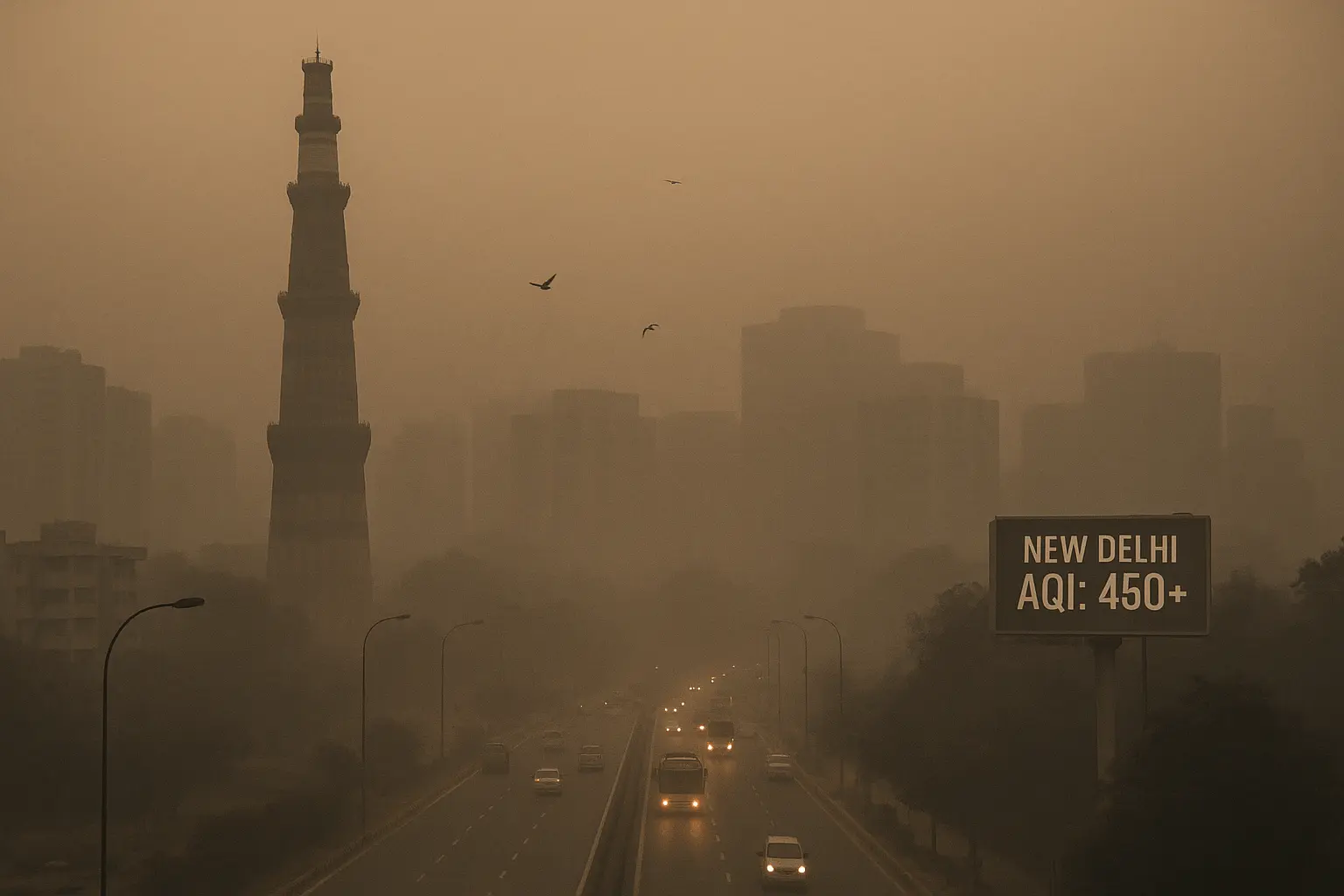
It’s 6:30 AM in Delhi, and Priya Sharma does what millions of Indian parents now do before their children wake up—she checks her phone. Not for messages or news, but for the Air Quality Index (AQI). The number glows ominously on her screen: 387. “Severe,” the app warns in red. She sighs, knowing her 7-year-old daughter will spend another recess indoors, breathing recycled air through makeshift purifiers the school installed last year.
This isn’t just a bad day. This is the new normal. And it’s killing us- slowly, invisibly, but measurably.
What if I told you that your address is determining how long you’ll live? That the air you breathe daily is systematically stealing years from your life expectancy? According to the latest Air Quality Life Index report from 2025, every single one of India’s 1.4 billion residents lives in areas where air quality exceeds WHO safety guidelines. For Delhi residents like Priya and her daughter, the cost is staggering: 8.2 years of life expectancy, simply erased by the air they have no choice but to breathe.
This isn’t a future threat. It’s happening right now, with every breath.
The Numbers Don’t Lie: Understanding the Air Quality Crisis
The ~8-Year Gap: What the Air Quality Index Reveals About Our Lives
The statistics are nothing short of alarming. India’s air pollution has reached a tipping point where it’s become the country’s greatest external threat to human health. The 2025 Air Quality Life Index, produced by the Energy Policy Institute at the University of Chicago, provides the most comprehensive analysis of how particulate matter affects longevity across the country.
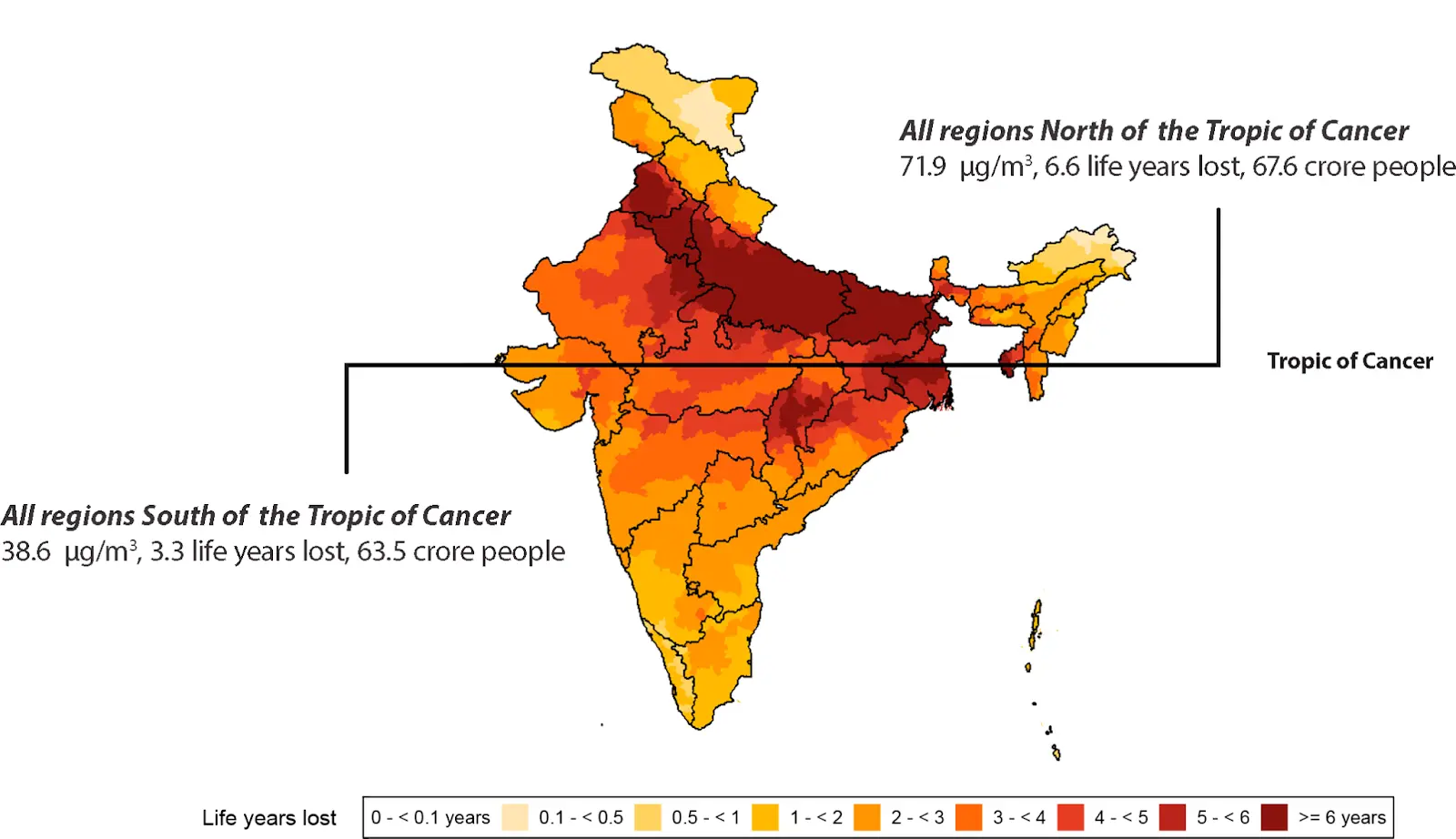
The national average is sobering enough—air pollution reduces the life expectancy of the average Indian by 3.5 years. But this figure masks dramatic regional variations that reveal a country divided by invisible borders of breathable versus toxic air.
Delhi residents face the worst reality: 8.2 years of potential life lost. Ten years that could have been spent watching grandchildren grow up, pursuing dreams, or simply enjoying retirement. The Indo-Gangetic plains, which includes Uttar Pradesh, Bihar, West Bengal, and parts of Haryana and Punjab, sees residents losing 5 to 8 years on average. In Bihar specifically, the figure reaches 5.6 years. Even Mumbai, with its coastal advantages, sees residents losing 3.5 years.
To put this in perspective, air pollution is more damaging to Indian life expectancy than unsafe water and sanitation (which reduces life expectancy by 1.6 years), alcohol and drug use (0.9 years), and even conflict and terrorism (negligible impact). Globally, only tobacco use rivals air pollution in its deadly impact.
The Air Quality Index, or AQI, has become India’s most watched daily metric, surpassing even stock market indices for many health-conscious citizens. When the AQI air quality readings cross 300, entering “severe” territory, schools close, construction stops, and emergency health advisories flood smartphones across northern India. But here’s the terrifying reality: in Delhi during winter months, AQI readings regularly exceed 400 and have spiked above 500—levels considered hazardous to all populations.
Who’s Being Hit Hardest? Regional Breakdown of Air Degradation
The geography of India’s air quality crisis tells a story of unequal suffering. While all Indians breathe unsafe air according to WHO standards, the intensity of exposure varies dramatically across regions, creating what researchers call “pollution inequality.”
The Indo-Gangetic Belt bears the heaviest burden. This densely populated region, home to over 500 million people, functions as a natural trap for air contaminants. The Himalayan mountain range to the north blocks wind patterns, while atmospheric conditions during winter create thermal inversions that lock pollutants close to the ground. Delhi, positioned at the heart of this belt, experiences the worst effects.
In 2024, thirteen of the world’s twenty most polluted cities were in India, with Bynirhat in Meghalaya ranking as the most polluted city globally. Cities like Lucknow, Kanpur, Patna, and Ghaziabad regularly feature in the top ten most polluted urban areas worldwide. These cities have become ground zero for understanding how extreme air pollution impacts human health.
Urban versus rural disparities also paint an interesting picture. While cities generally show higher AQI readings due to concentrated vehicular emissions and industrial activity, rural areas aren’t immune. Agricultural burning, biomass fuel use for cooking, and dust from unpaved roads contribute significantly to rural air pollution. In fact, some rural areas in Punjab and Haryana see seasonal spikes that rival urban pollution during harvest burning seasons.
The economic divide matters too. Wealthier Indians can afford air quality monitors, home purification systems, and the ability to relocate during severe pollution episodes. Middle-class and poor families have no such options. They breathe the same toxic air without protective barriers, making air pollution one of India’s most democratizing yet devastating equalizers.
Children and the elderly suffer disproportionately. A child’s developing lungs are particularly vulnerable to particulate matter, potentially leading to lifelong respiratory complications, reduced lung capacity, and cognitive impacts. The elderly, often with compromised cardiovascular systems, face increased risk of heart attacks and strokes during high pollution days.
Understanding the Enemy: What Makes Air Quality Dangerous?
The Invisible Killer in Every Breath: Particulate Matter Explained
When we talk about air pollution in India, we’re primarily discussing particulate matter—tiny particles suspended in the air that you can’t see individually but that collectively create the hazy, grey skies that have become synonymous with Delhi winters.
Particulate matter comes in two main varieties based on size: PM10 (particles with diameter less than 10 micrometers) and PM2.5 (particles smaller than 2.5 micrometers). To understand just how small these are, consider that a human hair is about 70 micrometers in diameter. PM2.5 particles are thirty times smaller than that.
Size matters immensely when it comes to health impacts. PM10 particles can be filtered by your nose and throat, though they still cause respiratory irritation. PM2.5 particles, however, are small enough to bypass your body’s natural defenses entirely. They travel deep into your lungs, cross into your bloodstream, and circulate throughout your body. These microscopic invaders don’t just affect your lungs—they impact every organ system.
The composition of these particles makes them particularly dangerous. Particulate matter contains a toxic cocktail of substances: black carbon from diesel exhaust, heavy metals like lead and mercury from industrial emissions, sulfates and nitrates from coal burning, and organic compounds from biomass burning. Each particle is essentially a microscopic poison pill.
Current WHO guidelines recommend annual average PM2.5 concentrations should not exceed 5 micrograms per cubic meter (µg/m³). India’s national ambient air quality standard is set at 40 µg/m³—already eight times higher. Delhi’s annual average typically hovers around 100-110 µg/m³, exceeding WHO guidelines by 20-fold. During winter, daily readings frequently exceed 300 µg/m³, representing pollution levels equivalent to smoking 25-30 cigarettes per day.
Why PM2.5 is More Dangerous Than You Think: Health Impacts Explained
The health impacts of sustained exposure to particulate matter read like a medical encyclopedia of chronic diseases. PM2.5 particles trigger inflammation throughout the body, creating a cascade of health problems that extend far beyond coughing and wheezing.
Respiratory impacts are the most obvious. Chronic exposure leads to reduced lung function, chronic obstructive pulmonary disease (COPD), asthma development and exacerbation, and increased susceptibility to respiratory infections. In Indian cities with severe air pollution, hospital admissions for respiratory emergencies spike whenever the AQI crosses hazardous thresholds.
Cardiovascular effects are equally concerning and often underestimated. PM2.5 particles cause arterial inflammation, promote blood clotting, increase blood pressure, and contribute to atherosclerosis—the hardening and narrowing of arteries. Studies have linked air pollution exposure to increased rates of heart attacks, strokes, and arrhythmias. For someone with existing heart disease, a severe pollution day can be life-threatening.
Emerging research reveals even more disturbing connections. Neurological studies show associations between air pollution and cognitive decline, increased dementia risk, and potentially developmental delays in children. Oncological research has established PM2.5 as a Group 1 carcinogen—definitively cancer-causing—particularly for lung cancer. Metabolic research suggests links to diabetes development. Reproductive health studies show connections to low birth weight, premature births, and fertility issues.
Children face unique vulnerabilities because their bodies are still developing. A child growing up in Delhi breathes toxic air during crucial years of lung development, potentially permanently reducing lung capacity and setting them up for lifelong respiratory problems. Studies suggest cognitive impacts too, with some research linking air pollution exposure to reduced academic performance.
The elderly, with already compromised immune systems and often existing health conditions, face amplified risks. For someone with heart disease or diabetes, severe pollution days can be the trigger that turns chronic illness into acute emergency.
What makes air pollution particularly insidious is its invisibility and unavoidability. Unlike smoking—a voluntary risk—or unsafe water that can be filtered, air pollution affects everyone regardless of personal choices. You can’t stop breathing, and most Indians can’t simply move to cleaner air zones.
The Perfect Storm: Understanding the Causes of Air Pollution in India
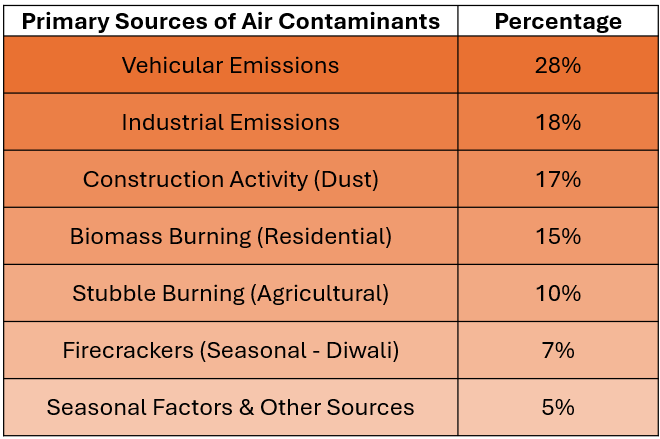
Sources: Ministry of Earth Sciences (2018), DPCC (2023), SAFAR (2024), Recent Diwali Studies (2024-2025). Note: Percentages represent PM2.5 contribution. Firecracker contribution spikes to 40% on Diwali night specifically but represents smaller annual average.
A Lethal Combination: Primary Sources of Air Contaminants
India’s air quality crisis isn’t the result of a single cause but rather a perfect storm of multiple pollution sources converging in densely populated areas with unfavorable geography. Understanding these causes is crucial to appreciating both the complexity of the problem and the challenge of solving it.
Since 1998, particulate pollution in India has increased by a staggering 61.4%. Even more remarkably, since 2013, India has contributed 44% of the world’s total increase in pollution—a figure that underscores both the speed of India’s development and the environmental cost of that growth.
Vehicular Emissions: Vehicular emissions represent one of the most visible and rapidly growing sources. India’s vehicle fleet has quadrupled over the past two decades. Delhi alone has over 12 million registered vehicles crammed into a space roughly one-sixth the size of New York City. Each vehicle contributes nitrogen oxides, carbon monoxide, and particulate matter to the air. During rush hours, traffic-clogged arteries become mobile pollution factories, with millions of idling engines pumping exhaust into stagnant air.
Industrial Emissions: Industrial emissions form another critical component. Thermal power plants burning coal, brick kilns operating without pollution controls, and manufacturing facilities lacking adequate scrubbers all contribute massive amounts of particulate matter and sulfur dioxide. The Indo-Gangetic belt hosts thousands of small and medium industries, many operating with minimal environmental oversight.
Construction Activity: Construction activity generates enormous amounts of dust, particularly problematic in rapidly urbanizing areas. Delhi’s perpetual construction boom—from metro expansions to real estate development—creates clouds of fine dust that settle over the city. Inadequate dust suppression measures mean this construction-related pollution continues unchecked.
Stubble Burning: Agricultural stubble burning represents a dramatic seasonal contributor. After rice harvesting in October-November, farmers in Punjab and Haryana burn crop residue to quickly clear fields for wheat planting. This practice, driven by tight agricultural calendars and lack of affordable alternatives, creates massive pollution plumes that blow into Delhi and surrounding regions. Satellite imagery during burning season shows thousands of fires across the region, and the AQI typically spikes into hazardous territory.
Firecrackers: Diwali firecrackers add another explosive layer to the air quality crisis, quite literally. The festival of lights, celebrated across India typically in October or November, coincides with the worst air quality period. The tradition of bursting firecrackers—from small sparklers to large aerial bombs—releases enormous quantities of particulate matter, sulfur dioxide, and heavy metals into already polluted air. A single night of Diwali celebrations can push AQI levels from “very poor” to “severe” or even “hazardous.” Delhi regularly records its worst air quality readings of the year in the days following Diwali. The chemical composition of firecracker smoke is particularly toxic, containing compounds like barium, aluminum, and copper that pose serious health risks. Despite Supreme Court restrictions and public awareness campaigns about the health impacts, firecracker use remains widespread, creating a cultural versus health debate. Post-Diwali, hospitals report sharp increases in respiratory emergencies, asthma attacks, and cardiovascular incidents. The combination of stubble burning smoke drifting into cities precisely during Diwali creates a perfect storm—agricultural pollution meets cultural celebration, resulting in air quality that becomes genuinely life-threatening for vulnerable populations including children, elderly, and those with pre-existing conditions.
Biomass Burning: Biomass burning for cooking and heating remains widespread, particularly in rural areas and urban slums. Millions of households burn wood, dung cakes, and agricultural waste for fuel, creating substantial particulate matter. While cleaner LPG cooking gas has expanded significantly, biomass burning persists among poorer populations. Coal dependence for power generation represents a structural cause. India still derives over 70% of its electricity from coal-fired power plants. While the country is rapidly expanding renewable energy capacity, coal consumption continues to grow in absolute terms to meet rising energy demands.
Seasonal Factors: Seasonal factors amplify these sources. Winter in northern India creates atmospheric conditions that trap pollutants. Temperature inversions—where warmer air sits above cooler air—act like a lid, preventing pollutants from dispersing upward. Low wind speeds during winter mean pollutants accumulate rather than disperse. Combined with increased biomass burning for heating, these conditions create the toxic smog that blankets northern India from October through February.
From Economic Miracle to Public Health Emergency: The Development Dilemma
India’s air pollution crisis reflects a broader tension between economic development and environmental sustainability—a challenge many developing nations face but that India exemplifies at an unprecedented scale.
The country’s economic transformation since liberalization in 1991 has been remarkable. GDP has grown roughly sevenfold, hundreds of millions have escaped poverty, and India has become the world’s fourth-largest economy. This growth required massive industrialization, urbanization, infrastructure development, and energy expansion—all pollution-intensive activities.
The problem isn’t growth itself but the particular pathway India has taken. Reliance on coal for energy, diesel for transport, and construction practices that prioritize speed over environmental standards created a development model with environmental externalities now manifesting as a public health emergency.
China’s experience offers both warning and hope. China’s air quality deteriorated severely during its rapid industrialization from 1990-2010. Beijing’s pollution became legendary. However, facing mounting public pressure and recognition of the economic costs, China implemented aggressive controls starting around 2013. Within seven years, China reduced its particulate pollution by roughly 40%, adding two years to average life expectancy. China’s success proves that even severe air pollution can be reversed with political will and resources.
India stands at a similar crossroads. The question isn’t whether India should develop—that’s both necessary and inevitable—but whether it can pursue a development pathway that doesn’t sacrifice the health of its citizens. Renewable energy expansion, electric vehicle adoption, and industrial modernization offer possibilities for continuing economic growth while bending the air quality curve downward.
The demographic dimension adds urgency. India is young, with a median age around 28 years. Today’s children and young adults will bear the lifetime health consequences of decisions made now about air quality. Conversely, they’ll reap the benefits of successful pollution control—potentially decades of healthier life.
Political economy factors complicate solutions. Powerful interests benefit from the status quo: coal mining and power generation employ millions; automobile manufacturers want diesel sales; construction firms oppose dust control costs; farmers lack alternatives to stubble burning. Each pollution source has stakeholders who resist change, making comprehensive action politically challenging.
Climate change intersects with air quality in complex ways. Many air pollutants are also greenhouse gases or are co-emitted with them. Actions to address climate change—like transitioning away from coal—also improve air quality. However, some climate actions have air quality tradeoffs. For instance, promoting biomass energy might be carbon-neutral but worsens local air quality if combustion isn’t clean.
Ground Zero: The Most Affected Cities and the National Air Quality Index
The Indo-Gangetic Belt: India’s Pollution Corridor
The Indo-Gangetic plains, stretching from Punjab through Haryana, Delhi, Uttar Pradesh, Bihar, and into West Bengal, represents the epicenter of India’s air quality crisis. This region, home to roughly 500 million people, experiences some of the worst sustained air pollution anywhere on Earth.
Geography conspires against this region. The Himalayas form a natural barrier to the north, blocking wind patterns that would otherwise disperse pollutants. The plains themselves are relatively flat with few elevation changes to disrupt air flow. During winter, stable atmospheric conditions create a “pollution dome” that traps contaminants close to ground level.
Delhi occupies the center of this corridor and represents the extreme case. The capital’s air quality has become globally infamous, regularly making international headlines during severe pollution episodes. Delhi’s winter air pollution stems from a combination of local sources—10 million vehicles, construction sites, waste burning—and regional influences like stubble burning from surrounding agricultural states.
The National Air Quality Index, launched by India’s Central Pollution Control Board, provides standardized measurements across Indian cities. The index converts complex pollution measurements into a simple 0-500 scale with six categories: Good (0-50), Satisfactory (51-100), Moderate (101-200), Poor (201-300), Very Poor (301-400), and Severe (401-500). During peak winter pollution, Delhi regularly registers readings in the “severe” category, with occasional spikes beyond the index’s upper limit.
Uttar Pradesh cities like Lucknow, Kanpur, and Ghaziabad consistently rank among India’s most polluted. These cities combine industrial emissions, dense traffic, construction dust, and proximity to agricultural burning zones. Lucknow’s life expectancy reduction matches Delhi’s, with residents losing approximately 7-8 years due to sustained exposure to dangerous air quality levels.
Bihar’s cities present a particularly concerning case. While less internationally visible than Delhi, cities like Patna and Muzaffarpur experience comparable pollution levels with far less public attention or resources for mitigation. Residents face the same health consequences without the air purifiers, pollution monitoring, or emergency response systems available in wealthier cities.
Punjab and Haryana occupy a unique position as both victims and contributors. These agriculturally productive states generate significant pollution through stubble burning but also suffer from poor air quality. Cities like Chandigarh, despite its planned design and green spaces, regularly experiences hazardous air quality during stubble burning season.
Source: Energy Policy Institute, University of Chicago (EPIC) – Air Quality Life Index 2023
City Spotlight: Where the Air Quality Monitor Shows Red
A closer examination of India’s most polluted cities reveals patterns in how air degradation manifests differently across urban landscapes.
Delhi’s pollution profile is multifaceted. The city experiences severe pollution from October through February, moderate-to-poor levels during transition months, and relatively better (though still unhealthy by WHO standards) air during monsoon season. The worst days typically occur in November when stubble burning peaks, Diwali firecracker emissions add to the burden, and meteorological conditions trap everything in place. During these episodes, visibility drops to a few hundred meters, the sun appears as a dim orange disc through grey haze, and hospitals report surges in respiratory emergencies.
Mumbai presents an interesting contrast. Coastal location and sea breezes give Mumbai better air circulation than inland cities. However, the city still exceeds WHO guidelines substantially. Mumbai’s pollution stems more from vehicular emissions and industrial activity than agricultural burning. The megacity’s sheer density—20 million people in limited space—means even moderate per-capita emissions translate to poor overall air quality.
Bangalore, often considered one of India’s more liveable cities, has seen deteriorating air quality alongside rapid growth. Once known for pleasant weather and greenery, the city now experiences increasingly frequent “poor” air quality days. Vehicular growth, construction dust, and declining tree cover have transformed Bangalore’s air quality over two decades.
Kolkata faces unique challenges from a combination of vehicular emissions, industrial activity, and seasonal agricultural burning. The city’s aging vehicle fleet and heavy truck traffic contribute substantially. During winter, Kolkata’s air quality regularly enters “very poor” territory.
Smaller cities often face worse pollution with fewer resources to address it. Cities like Gaya, Muzaffarpur, and Meerut appear near the top of pollution rankings but lack the infrastructure, resources, or public attention that larger metros receive. Residents of these cities face health consequences without access to air quality monitoring, pollution forecasts, or emergency healthcare capacity.
The seasonal nature of Indian air pollution means that annual averages, while useful for life expectancy calculations, mask dramatic swings. A Delhi resident might breathe relatively clean air in August (though still above WHO guidelines) and breathe air equivalent to smoking two packs of cigarettes daily in November. This variability makes pollution feel less urgent during clear months but doesn’t reduce the cumulative health impact.
Rural areas, while receiving less attention, face substantial pollution challenges. Biomass burning for cooking, dust from unpaved roads, agricultural activities, and increasingly, industrial facilities locating in rural areas with less oversight all contribute. The notion that “village air” is automatically clean is increasingly outdated across much of India.
The Economic Toll: Quantifying the Cost of Air Pollution
The $90 Billion Question: Calculating Lost Potential
Air pollution isn’t just a health crisis—it’s an economic catastrophe. The economic costs manifest through multiple channels: direct healthcare expenses, lost productivity from illness and premature death, and reduced quality of life. Recent analyses have attempted to quantify these costs, revealing staggering figures.
Air pollution costs the Indian economy an estimated $95 billion per year, which is approximately 3% of the country’s GDP. A 2017 analysis calculated that premature deaths attributable to PM2.5 pollution resulted in lost labor income between $30 billion and $78 billion. This calculation considers only the economic value of lives lost and doesn’t account for healthcare costs, reduced productivity from illness, or broader economic impacts.
Healthcare system burden represents another substantial cost. India’s public health system, already stretched thin, faces massive additional pressure from pollution-related illnesses. Respiratory and cardiovascular conditions attributable to air pollution require hospitalization, medication, and long-term management. Private expenditure on healthcare related to pollution—from hospital bills to air purifiers—drains household savings, particularly impacting middle and lower-income families.
Lost work days due to pollution-related illness reduce economic productivity across sectors. When severe pollution forces school closures, working parents must stay home, reducing productivity. Chronic health conditions reduce workforce participation rates. Workers in outdoor occupations—construction, agriculture, traffic police—face particular risks, with higher exposure leading to more frequent illness.
The cognitive impacts of air pollution may represent the most concerning long-term economic effect. Emerging research suggests sustained exposure to particulate matter affects cognitive function, potentially reducing educational achievement in children and cognitive performance in adults. If air pollution systematically reduces human capital formation—the development of skills, knowledge, and capabilities—the long-term economic consequences could dwarf current estimates.
Tourism and international perception represent softer but real economic impacts. India’s tourism industry, worth billions annually, faces challenges from air quality concerns. International travelers, business visitors, and potential expatriate workers factor air quality into decisions about visiting or relocating to India. Delhi’s reputation as one of the world’s most polluted cities affects its positioning as an international hub.
Real estate markets have begun pricing in air quality. Property values in less polluted areas command premiums, while areas with consistently poor air quality see reduced demand. This emerging “pollution inequality” means wealthier Indians can increasingly pay for cleaner air through residential choices, while poorer populations remain trapped in heavily polluted areas.
Investment decisions increasingly consider environmental factors, including air quality. International firms evaluating where to locate operations factor in air quality’s impact on employee health, productivity, and willingness to relocate. India’s pollution challenges create competitive disadvantages versus cleaner Asian cities.
The opportunity cost framework provides another perspective. Resources devoted to treating pollution-related illnesses, installing air purification systems, and managing pollution crises represent resources unavailable for productive investments in education, infrastructure, or innovation. India is, in effect, running faster just to stay in place—spending billions to mitigate a self-inflicted problem rather than investing in growth-enhancing activities.
Agricultural impacts add another dimension. While agriculture contributes to air pollution through stubble burning, it also suffers from it. Studies show reduced crop yields under high pollution conditions due to decreased solar radiation reaching plants and direct plant damage from pollutants. This creates a perverse cycle where agricultural practices degrade air quality, which in turn reduces agricultural productivity.
When Pollution Kills Productivity: The Hidden Economic Burden
Beyond the dramatic figures of tens of billions in lost income, air pollution imposes countless smaller economic burdens that collectively reshape how Indians live and work.
The air quality monitor has become an essential tool for daily planning. Families check AQI readings before deciding whether children can play outdoors. Athletes and joggers plan workouts around pollution levels. Outdoor workers—from construction laborers to street vendors—face impossible choices between earning income and protecting health. This constant need to adjust plans and routines represents a subtle economic friction that reduces quality of life and economic efficiency.
The “pollution tax” on daily life manifests in numerous ways. Middle-class families invest in air purifiers, creating a market now worth hundreds of millions of dollars. Schools install air filtration systems. Hospitals expand respiratory departments. These represent defensive expenditures—money spent not to improve quality of life but merely to partially mitigate deteriorating conditions.
Corporate impacts are increasingly recognized. Companies face higher healthcare insurance costs as employee health claims rise. Absenteeism increases during severe pollution episodes. Some companies, particularly in the technology sector, have begun offering “pollution breaks” allowing employees to temporarily relocate during peak pollution months—an expensive accommodation that reduces productivity.
Educational impacts carry long-term economic consequences. School closures during severe pollution disrupt learning. Children studying in polluted environments may have reduced concentration and cognitive function. If air pollution systematically reduces educational outcomes, the impact on India’s future workforce productivity could be profound.
The inequality dimension has economic implications. Wealthier Indians can afford protection—air purifiers, cars instead of walking, homes in less polluted areas, ability to leave during peak pollution. Poorer Indians lack these options, meaning pollution deepens existing inequalities. The economic consequences of poor health fall disproportionately on those least able to bear them.
Environmental migration represents an emerging phenomenon. Some families, particularly urban professionals, consider relocating from severely polluted cities to cleaner locations when possible. Brain drain within India—movement of educated talent from polluted to cleaner cities—could reshape regional economic development patterns.
Hope on the Horizon: Solutions to Improve Air Quality
The National Clean Air Programme: India’s Battle Plan
Facing mounting evidence of air pollution’s devastating impacts, India has launched the National Clean Air Programme (NCAP), representing the country’s most comprehensive effort yet to address air quality systematically.
Launched in 2019, NCAP initially targeted a 20-30% reduction in PM2.5 and PM10 concentrations across 102 cities by 2024, using 2017 as the baseline. The program was subsequently revised with more ambitious goals: a 40% reduction by 2026, expanded coverage to 131 cities, and increased funding.
The program takes a multi-pronged approach addressing various pollution sources. For vehicular emissions, measures include promoting cleaner fuels, accelerating vehicle emission standards (Bharat Stage VI), expanding public transportation, and incentivizing electric vehicle adoption. Delhi has implemented an odd-even vehicle rationing scheme during severe pollution episodes and has begun transitioning its bus fleet to electric vehicles.
For industrial emissions, NCAP mandates stricter emission controls, continuous emission monitoring systems, and closure of non-compliant facilities. Coal-fired power plants must install flue gas desulfurization systems. Industries in heavily polluted areas face additional scrutiny and requirements.
Construction dust control measures include mandatory barriers around construction sites, water spraying systems, mechanized sweeping of roads, and penalties for non-compliance. However, enforcement remains inconsistent, particularly for smaller construction projects.
Agricultural stubble burning represents one of the most challenging areas. The government has promoted alternatives including in-situ crop residue management, subsidies for machinery that can incorporate stubble into soil, and development of uses for crop residue as raw material. However, adoption remains limited due to costs and logistical challenges.
The expansion of air quality monitoring networks represents important progress. India now has hundreds of continuous ambient air quality monitoring stations, providing real-time data accessible through apps and websites. This transparency allows citizens to make informed decisions and creates pressure for action during severe pollution episodes.
State-level action plans complement national efforts. Delhi’s Winter Action Plan involves multiple measures activated based on pollution levels, including restrictions on construction, increased mechanical road sweeping, and deployment of water sprinklers. However, critics note that these actions amount to crisis management rather than addressing root causes.
What’s Working and What Isn’t: Evaluating Progress
Five years after NCAP’s launch, evidence of impact is emerging, though the picture is complex.
The encouraging news is that progress is possible. From 2022 to 2023, India achieved a 19.3% reduction in particulate pollution in NCAP-covered districts—the largest single-year improvement recorded. This reduction translated to 51 additional days of life expectancy for residents of these areas. Cities implementing NCAP measures saw 19% reductions compared to 16% in non-NCAP cities, suggesting the program is having measurable impact.
Delhi has achieved notable improvements in PM2.5 concentrations during some years, though severe pollution episodes still occur. The transition to cleaner fuels—near-universal access to BS-VI fuel—has helped. Stricter industrial controls and closure of coal power plants near the city contributed to reductions.
Electric vehicle adoption is accelerating, though from a low base. India’s electric vehicle market is growing rapidly, with electric two-wheelers and three-wheelers becoming common in some cities. Government incentives and falling battery costs are driving this transition.
The expansion of metro rail systems in multiple cities provides cleaner transportation alternatives. Delhi, Bangalore, Mumbai, and other cities have substantially expanded metro networks, reducing dependence on private vehicles for some trips.
However, significant challenges remain. Stubble burning continues at scale despite alternatives. Farmers face economic pressures, tight planting schedules, and insufficient support for alternatives. Until these structural issues are addressed, this major pollution source will persist.
Industrial and construction sector compliance remains inconsistent. While large, visible facilities face scrutiny, thousands of smaller operations continue with minimal pollution controls. Enforcement capacity is limited, corruption undermines regulations, and political connections protect some violators.
The fundamental challenge is that pollution sources—vehicles, industry, construction—continue growing even as per-unit emissions decline. India’s economy and urban population are expanding rapidly. Unless per-unit pollution reductions outpace overall growth, absolute pollution levels may not decline despite efficiency improvements.
Seasonal nature of pollution means that some improvements represent meteorological variation rather than sustainable progress. A year with better weather patterns may show lower pollution, creating false optimism that reverses when weather patterns shift.
International examples offer lessons. China’s success in reducing pollution followed massive investment, strict enforcement including criminal penalties for violators, and political prioritization at the highest levels. India’s approach, while well-designed on paper, lacks the resources and political commitment that characterized China’s campaign.
Technological solutions are proliferating. Startups are developing innovations from smog towers that filter air to drone-based pollution mapping to apps that provide hyperlocal air quality data. While valuable, technology alone cannot substitute for addressing pollution sources directly.
The Supreme Court’s 2024 ruling that clean air is a fundamental right represents a legal milestone. This decision empowers citizens to challenge governmental inaction and could reshape how air quality is addressed through litigation. However, judicial declarations require implementation, where India often falters.
Personal Action Plan: What You Can Do to Protect Your Family
While systemic solutions are necessary, individuals can take steps to protect themselves and their families from air pollution’s worst effects.
Monitoring air quality daily is the foundation of personal protection. Apps like AQI India, CPCB’s Sameer app, and private services provide real-time air quality data. Check AQI levels before planning outdoor activities, especially for children and elderly family members. On days when AQI exceeds 200, limit outdoor exposure, particularly strenuous activity.
Indoor air quality improvements offer significant protection since most people spend majority of time indoors. Air purifiers with HEPA filters remove particulate matter effectively. Position them in bedrooms and main living spaces. Change filters regularly according to manufacturer recommendations. While expensive, air purifiers demonstrably reduce indoor pollution exposure.
Improve indoor ventilation strategically. During times of day when outdoor AQI is better (often late morning before traffic builds), open windows to refresh indoor air. Keep windows closed during peak pollution hours—typically morning and evening rush hours.
Masks offer protection during unavoidable outdoor exposure. N95 or N99 masks filter particulate matter effectively. Ensure proper fit—gaps render masks much less effective. While uncomfortable, masks demonstrably reduce exposure during high pollution days.
Lifestyle modifications reduce exposure. Exercise indoors or during lower pollution times. Children’s outdoor play should be limited when AQI is poor. Walking or cycling on roads with heavy traffic increases exposure; use parks or less-trafficked routes when possible.
Reduce personal pollution contributions. Use public transport, carpool, or walk when practical. Avoid burning leaves, trash, or other materials. Support cleaner businesses and practices. While individual impact is small, collective action matters.
Political engagement and advocacy create pressure for systemic solutions. Contact elected representatives about air quality priorities. Support organizations working on environmental issues. Vote for candidates who prioritize air quality. Attend public hearings on environmental regulations. Systemic change requires political will, which comes from public pressure.
Home environment adjustments help. Indoor plants can improve air quality modestly, though effect is limited. Avoid indoor pollutants like smoking, toxic cleaning products, and synthetic fragrances. Use exhaust fans when cooking. Choose low-VOC paints and materials during renovations.
Health monitoring becomes important for high-risk individuals. Those with respiratory or cardiovascular conditions should work with doctors to adjust medications or treatments during high pollution seasons. Emergency action plans for severe pollution days can prevent health crises.
Creating community awareness amplifies impact. Share information about air quality with neighbors and social networks. Coordinate community action like school advocacy for air purification systems or neighborhood vehicle pooling arrangements. Collective action has more influence than individual efforts.
Prepare for severe pollution episodes. Keep masks, air purifiers, and medications stocked. Have work-from-home arrangements when possible during severe pollution. Plan indoor activities for children. Having plans in place reduces stress and exposure during inevitable severe pollution periods.
Stay informed about pollution science and solutions. Understanding air quality issues empowers better decision-making and advocacy. Follow credible sources of air quality information and avoid misinformation common in social media.
The Road Ahead: India’s Air Quality Future
A Choice Between Growth and Breath: Navigating the Development Pathway
India stands at a crossroads. The next decade will determine whether the country can break the historical pattern of development-driven environmental degradation or whether pollution will continue stealing years from lives and billions from the economy.
The pessimistic scenario is stark. If current trends continue—vehicle fleet growth, coal dependence, inadequate enforcement—India’s air quality could worsen despite incremental improvements. More cities could see Delhi-level pollution. Life expectancy losses could extend beyond the current 3.5-year national average. Health impacts could create a generation with reduced lung capacity, increased chronic disease burden, and diminished cognitive function.
Climate change adds an ominous wildcard. Rising temperatures may increase ground-level ozone formation. Changing precipitation patterns could affect pollution dispersion. More frequent temperature inversions could trap pollutants more effectively. The interaction between climate change and air quality is complex and potentially reinforcing.
However, the optimistic scenario is equally plausible. China’s experience proves that severe air pollution can be reversed within a decade with sustained commitment. India’s recent improvements show that progress is possible. Falling costs of clean technology—renewable energy, electric vehicles, industrial pollution controls—make the clean development pathway increasingly economically viable.
India’s renewable energy expansion is genuinely impressive. The country has become a global leader in solar energy deployment and has ambitious targets for renewable capacity. As renewable energy replaces coal, air quality co-benefits will be substantial. Electric vehicle adoption, while still in early stages, is accelerating rapidly with government support and falling costs.
The demographic dividend offers opportunity. India’s young population, increasingly aware of pollution’s impacts, creates political constituency for action. Digital connectivity enables rapid awareness spreading and mobilization. Younger generations may demand environmental quality in ways previous generations, focused on economic survival, did not.
Technological innovation provides tools previous generations lacked. Real-time air quality monitoring, satellite tracking of pollution sources, advanced filtration technologies, and clean energy alternatives offer solutions that didn’t exist when developed countries industrialized. India can potentially leapfrog the dirty development phase that other countries endured.
International pressure and cooperation could accelerate progress. As climate change and air pollution become global priorities, international finance and technology transfer may support India’s transition. Global supply chains increasingly demand environmental standards, creating economic incentives for cleaner production.
The pathway forward requires threading a needle—continuing economic development while decoupling growth from pollution. This demands massive investment in clean infrastructure, strict enforcement of environmental regulations, political will to confront powerful interests, and social acceptance of necessary changes.
What 2030 Could Look Like: Two Scenarios for India’s Air
Imagine two versions of India in 2030, just five years from now, based on the choices made today.
Scenario One: Business as Usual
In this timeline, incremental improvements fail to keep pace with overall growth. Delhi’s air quality remains among the world’s worst, with annual average PM2.5 hovering around 100 µg/m³—twenty times WHO guidelines. Winter pollution episodes regularly push AQI above 500. Other northern cities follow Delhi’s trajectory.
Vehicle fleet has grown to 450 million, overwhelming modest improvements in emission standards. Coal continues providing the majority of electricity despite renewable energy growth. Stubble burning persists due to lack of economically viable alternatives. Construction booms continue with inadequate dust controls.
Health impacts intensify. Life expectancy losses increase to 4-5 years nationally, with Delhi residents losing 12 years. Respiratory diseases become endemic. Children growing up in heavily polluted areas show systematically reduced lung capacity. Healthcare system strain from pollution-related illness worsens.
Economic costs mount. Direct healthcare expenses and lost productivity exceed $100 billion annually. Brain drain accelerates as educated Indians increasingly relocate abroad, citing air quality as a primary factor. International businesses hesitate to locate operations in heavily polluted cities. Tourism suffers.
Public frustration grows but lacks channels for effective action. Protests during severe pollution episodes become routine but don’t translate to systematic change. Inequality deepens as wealthy Indians increasingly live in filtered bubbles while poor populations bear full exposure.
Scenario Two: Sustained Progress
In this alternative timeline, India treats air quality as the national priority it deserves. Political leadership across parties recognizes that public health and economic development depend on breathable air.
Vehicle electrification accelerates dramatically. By 2030, 30% of new vehicle sales are electric. Public transportation expands substantially. High-speed rail reduces short-haul flights. Cycling infrastructure makes active transportation viable in cities.
Renewable energy reaches 60% of electricity generation. Remaining coal plants have state-of-the-art pollution controls. Industrial emissions face strict monitoring with real penalties for violations. Construction standards mandate effective dust control, with genuine enforcement.
Stubble burning reduces dramatically through combination of subsidized alternatives, agricultural calendar adjustments, and development of markets for crop residue. Biomass burning for cooking becomes rare as clean cooking fuel reaches virtually all households.
Delhi’s annual average PM2.5 drops to 50 µg/m³—still above WHO guidelines but a dramatic improvement. Winter severe pollution episodes become occasional rather than routine. Other cities see proportional improvements. National average life expectancy loss from pollution drops to 1.5 years—still concerning but no longer catastrophic.
Health impacts stabilize and begin declining. Children born in 2030 breathe notably cleaner air than their parents did. Chronic respiratory disease rates peak and begin declining. Healthcare system capacity shifts from crisis management to prevention and treatment.
Economic benefits manifest. Healthcare costs decline. Productivity increases. India’s reputation improves, facilitating tourism and business development. The country becomes a showcase for how developing nations can achieve clean air alongside economic growth.
Which scenario materializes depends on choices made in the next few years. The technology and knowledge exist. The question is political will and social commitment.
Taking Action: From Awareness to Change
Individual Actions That Create Collective Impact
While systemic change requires governmental action, individual choices collectively create the social and political environment that enables policy change. Every person can contribute to solutions while protecting themselves and their families.
Immediate Personal Protection Measures:
Install air quality monitors or use reliable air quality apps to track pollution levels near you. Knowledge enables better decision-making about when to stay indoors, when outdoor activities are safer, and when to use protective measures.
Invest in proper air purification for your home. A single good HEPA purifier for the bedroom where you sleep 6-8 hours nightly provides substantial protection. Additional purifiers for main living spaces increase benefits. This isn’t a luxury for the wealthy—it’s a health necessity comparable to clean water filters.
Use N95 or N99 masks during high pollution days when outdoor exposure is unavoidable. Proper fit matters—gaps render masks ineffective. While uncomfortable, masks demonstrably reduce particulate matter exposure.
Transportation Choices:
Whenever practical, use public transportation, carpool, walk, or bicycle. Each personal vehicle on the road contributes to traffic congestion and pollution. Electric two-wheelers are becoming affordable and eliminate tailpipe emissions entirely.
Maintain your vehicle properly. Well-maintained engines produce fewer emissions. Get regular pollution checks. Don’t idle unnecessarily—turn off the engine during extended waits.
Support expansion of public transportation. Vote for politicians who prioritize metro expansion, bus rapid transit, and cycling infrastructure. Use public transport even when personal vehicles are convenient, creating demand that justifies further expansion.
Home and Lifestyle Adjustments:
Eliminate indoor pollution sources. Don’t burn trash, leaves, or other materials. Avoid indoor smoking. Use exhaust fans when cooking. Choose low-emission products, paints, and cleaning supplies.
Strategic ventilation improves indoor air. Open windows during times when outdoor air quality is better—often mid-morning before traffic builds or after rains. Keep windows closed during peak pollution hours.
Plant trees if you have space. While individual impact is modest, collective greening of neighborhoods improves air quality and quality of life. Trees absorb pollutants, provide shade that reduces urban heat island effects, and create more liveable spaces.
Advocacy and Political Engagement:
Contact elected representatives about air quality. Politicians respond to constituent pressure. Express that air quality is a voting priority. Demand action plans with measurable targets and accountability.
Support environmental organizations working on air quality issues. Groups like the Centre for Science and Environment, Clean Air Asia, and others conduct research, advocacy, and litigation. They need public support—both financial contributions and participation in campaigns.
Attend public hearings on environmental regulations. Comment periods for industrial permits, transportation plans, and building projects offer opportunities for citizen input. Participate to ensure environmental concerns are heard.
Vote for candidates who prioritize environmental issues. Make air quality a determining factor in voting decisions. Politicians will prioritize issues that affect election outcomes.
Community Building:
Share air quality information with neighbors, friends, and family. Many people remain unaware of pollution’s severity or personal protection measures. Sharing knowledge expands impact.
Organize community action. Neighborhood groups can advocate for local improvements—better bus service, cycling lanes, tree planting, school air filtration. Collective voices have more influence than individual complaints.
Engage with schools about air quality protection for children. Advocate for air purifiers in classrooms, outdoor activity policies based on AQI, and air quality education. Children’s developing lungs are particularly vulnerable and deserve protection.
Support businesses that prioritize environmental responsibility. Choose companies with clean practices. Avoid businesses that flagrantly violate environmental regulations. Consumer choices create economic incentives for cleaner operations.
Professional and Workplace Actions:
If you have workplace influence, advocate for air quality measures—purifiers for offices, work-from-home options during severe pollution, company shuttle services reducing individual vehicle use.
Professionals in relevant fields—urban planning, engineering, medicine, policy, journalism—can integrate air quality into their work. Engineers can design cleaner systems, doctors can educate patients, journalists can cover the issue persistently, policymakers can craft better regulations.
Business leaders can implement clean practices even beyond regulatory requirements. Corporate leadership on environmental issues influences broader norms and creates competitive pressure for others to follow.
Education and Awareness:
Educate yourself about air pollution causes, impacts, and solutions. Informed citizens make better decisions and more effective advocates. Follow credible sources and scientific research, not misinformation.
Teach children about air quality. Age-appropriate education about environmental issues creates a generation that grows up prioritizing clean air. Schools should integrate environmental science that includes air quality.
Combat misinformation. Air quality discussions sometimes attract false claims—about solutions that don’t work, conspiracy theories, or downplaying legitimate concerns. Promoting scientific literacy helps.
Building a Movement for Clean Air
Systemic change requires not just individual actions but social movements that create irresistible political pressure for action. India needs a clean air movement comparable to movements that have driven transformative change on other issues.
The right to breathe clean air must become a non-negotiable political demand. When air quality becomes a definitive voting issue—where politicians lose elections over inaction—change will accelerate dramatically. Building this political salience requires persistent advocacy, strategic communications, and broad coalition building.
Success stories from other countries offer inspiration. South Korea’s clean air movement mobilized millions, forcing governmental action that substantially improved Seoul’s air quality. China’s public pressure helped drive the aggressive pollution control policies implemented after 2013. These movements succeeded by making air quality impossible for politicians to ignore.
India’s democratic system provides tools for citizens to drive change. Unlike autocratic systems where top-down action is necessary, democracies enable bottom-up pressure. Elections, courts, media, and civil society can all amplify demands for clean air.
The legal pathway offers promise. The Supreme Court’s recognition of clean air as a fundamental right creates opportunities for litigation compelling governmental action. Public interest litigation has driven progress on other environmental issues and can do so for air quality.
Media coverage matters enormously. Sustained, prominent coverage of air quality—not just during crisis episodes but year-round—keeps the issue visible. Investigative journalism exposing pollution sources, non-compliance, and regulatory failures creates accountability.
Coalition building across diverse constituencies strengthens movements. Air quality affects everyone—urban and rural, wealthy and poor, young and old. Building coalitions that transcend typical political divisions creates broader pressure for action.
Conclusion: The Choice is Ours
It’s 6:30 AM in Delhi, and Priya Sharma checks her phone. Today, the AQI reads 387—severe. She sighs, but this time, something is different. She opens another app and reports the construction site near her home that’s operating without dust controls. She shares the AQI reading on her community group, where neighbors are organizing to demand air purifiers for the local school. She’s volunteering this weekend for an environmental organization’s awareness campaign.
Small actions, but multiplied across millions of Indians, they create unstoppable momentum for change.
The statistics are stark— 8 years of life lost in Delhi, 3.5 years nationally, $90 billion in economic costs annually. These numbers represent real people—children with asthma, elderly relatives with heart disease, dreams cut short, potential unrealized. Behind every statistic is a human story of suffering that could be prevented.
But the statistics also prove that change is possible. China reduced pollution 40% in seven years. India achieved 19% reduction in a single year in NCAP cities. Every percentage point of pollution reduction translates to days and months of life expectancy gained, billions in economic benefits, and improved quality of life.
The air quality crisis isn’t a natural disaster beyond human control. It’s the consequence of specific choices—about energy sources, transportation systems, industrial practices, agricultural methods, and enforcement priorities. Different choices will produce different outcomes.
The question isn’t whether India can afford to address air pollution. The country cannot afford not to. The economic costs of inaction exceed the investment costs of solutions. The health burden of poisoned air undermines the human capital necessary for development. The years of life stolen from 1.4 billion people represent an existential national loss.
India stands at a defining moment. The country has achieved remarkable economic progress, lifted hundreds of millions from poverty, and established itself as a rising global power. But what does that success mean if it comes at the cost of citizens’ health and years of life?
The children being born today will inherit the consequences of choices made now. Will they look back at 2025 as the turning point when India decisively addressed its air quality crisis? Or will they wonder why their parents’ generation knew the problem but failed to act with necessary urgency?
The technology exists. The solutions are known. China, South Korea, and other countries have demonstrated that severe air pollution can be reversed. What’s needed now is political will, sustained commitment, and social mobilization.
Every Indian has a role to play. Protect your family through personal measures. Use your voice for political advocacy. Make consumer choices that reduce pollution. Build community action. Support organizations driving change. Vote for clean air.
Priya’s daughter deserves to play outside without checking an AQI app first. She deserves to breathe without surrendering 10 years of life. Every child across India deserves the same.
The silent killer has been exposed. Its mechanisms are understood. Its costs are quantified. Now comes the hard part—building the political will and social commitment to choose breathable air over business as usual.
The choice is ours. The time is now. Every breath depends on what we do next.
About Air Quality Monitoring
To check real-time air quality near you, download the official CPCB Sameer app or visit reputable air quality monitoring websites. Know your AQI, protect your health, and join the movement for clean air.
Take Action Today:
Check your city’s Air Quality Index right now
Share this article with three people who need to know
Contact your elected representative about air quality
Join an environmental organization working on clean air
Make one change in your life that reduces pollution
The air we breathe connects us all. Together, we can reclaim it.
IR Research Publication is publisher, editorial, and profile building service provider. It was founded with the mission to support scientists, researchers, academicians, and students in advancing their careers and contributing to global scientific knowledge. IR Research Publication is committed to delivering high-quality, reliable, and professional editorial services alongside a credible and ethical publishing platform.
If you like this article, then visit our Blog page for more such articles.
While news coverage of the October 2025 government shutdown focuses on closed national parks and delayed TSA services, a critical casualty is being overlooked: America’s biomedical research enterprise. Behind laboratory doors across the nation, groundbreaking cancer studies are being paused, clinical trials are halting patient enrollment, and promising medical discoveries are being put on ice. The government shutdown isn’t just an inconvenience for researchers—it’s a potential setback that could delay lifesaving treatments by months or even years.
As federal agencies like the National Institutes of Health (NIH) face funding lapses, the ripple effects extend far beyond Washington, D.C. They reach into every research hospital, university lab, and biotech startup that depends on federal grants to fuel medical innovation. Let’s examine the hidden costs of this government shutdown on biomedical research and why the consequences extend far beyond the shutdown itself.
How the Government Shutdown Immediately Affects Biomedical Research
When a government shutdown begins, its impact on the National Institutes of Health (NIH) is immediate. Most NIH operations, including new grant reviews, funding awards, and many research activities are paused, while essential services such as patient care at the NIH Clinical Center and maintenance of ongoing projects continue in a limited capacity.
For researchers, this creates immediate operational chaos. Laboratory experiments that require continuous monitoring cannot simply be paused and resumed. Cell cultures die. Animal studies are disrupted or must be terminated. Expensive equipment sits idle. Research assistants and postdoctoral fellows face uncertain paychecks.
The National Institutes of Health (NIH) reviews roughly 80,000 to 90,000 grant applications annually, following a highly regimented funding cycle. During the 2018–2019 federal government shutdown, thousands of these applications—estimated at nearly 2,000 to 3,000—were delayed in peer review or award processing. Each week of delay can ripple across research institutions, disrupting schedules, increasing administrative inefficiencies, and raising costs (Reference).
Federal researchers experience more direct consequences. Approximately 6,000 intramural NIH employees—including many laboratory scientists—are typically furloughed during a shutdown, leaving them unable to access their offices, laboratories, or federally maintained datasets. Collaborative research projects with universities and hospitals stall due to the absence of key federal partners, while international conference submissions and collaborative research timelines frequently miss critical deadlines.
The federal research funding shutdown also affects facilities management. Animal care facilities at NIH campuses must maintain skeleton crews to feed and care for research animals, but routine experiments stop. Biosafety level-3 and level-4 labs—which study dangerous pathogens—face complex decisions about maintaining secure operations with reduced staff.
Government Shutdown’s Impact on Clinical Trials and Patient Access
Perhaps nowhere is the human cost of a government shutdown more visible than in clinical trials. When federal funding freezes, the government shutdown clinical trials pipeline suffers immediate disruption. The NIH Clinical Center in Bethesda, Maryland—the nation’s largest hospital devoted entirely to clinical research—stops accepting new patients during shutdowns.
For patients with rare diseases or advanced cancers who have exhausted standard treatment options, clinical trials often represent their last hope. A government shutdown can mean the difference between accessing a potentially lifesaving experimental therapy or waiting months for the next enrollment window.
Clinical trial protocols are rigorous and time-sensitive. Patients are often evaluated on specific schedules—blood draws every two weeks, imaging scans at precise intervals, dose adjustments based on real-time monitoring. When a shutdown interrupts these schedules, researchers face difficult choices. Some trials can safely pause, but others cannot be resumed without compromising data integrity or patient safety.
The FDA also experiences significant slowdowns during government shutdowns. While the agency keeps essential functions operating, the review and approval of new drug applications slows dramatically. Industry-funded trials may continue, but the regulatory pathway becomes congested. This affects not just individual patients in trials, but the millions who will eventually benefit from approved therapies.
Beyond NIH-sponsored trials, thousands of university and hospital-based studies rely on NIH funding. When biomedical research grants shutdown, principal investigators must decide whether to continue trials using institutional funds (if available) or pause enrollment and risk losing participants who find alternative treatments.
How Graduate Students and Early-Career Researchers Bear the Brunt
While senior researchers may have some financial cushion and job security, early-career scientists bear a disproportionate burden during a government shutdown. Graduate students and postdoctoral fellows often live paycheck to paycheck, and grant-funded stipends may be delayed or interrupted.
A Ph.D. student whose dissertation depends on a continuous 6-month experiment cannot simply pause their work for two weeks without consequences. Cell lines, animal models, and longitudinal data collection don’t accommodate political gridlock. For students already facing a 4-7 year path to their degree, even a two-week shutdown can cascade into months of delay.
Postdoctoral researchers face even more precarious situations. These early-career scientists typically work on 1-3 year renewable contracts funded by NIH grants. When the government shutdown affects scientists in this position, they may lose critical weeks or months from already short-term positions. Some may need to seek alternative employment, representing a brain drain from biomedical research.
Fellowship and training grant awards are also frozen during shutdowns. Young researchers awaiting notification about prestigious NIH fellowships (F31, F32, K awards) face uncertainty about their career trajectories. Job offers at federal research institutions are delayed. Early-career faculty awaiting notification about their first R01 grant—the gold standard for independent research funding—see their lab startup plans disrupted.
The psychological toll is significant. Early-career researchers already face long odds in a competitive field. A government shutdown adds another layer of instability to an already uncertain career path, pushing some talented scientists toward more stable careers outside academia.
The Lasting Damage: Why a Short Shutdown Means Years of Delays
The most insidious aspect of a government shutdown isn’t what happens during the shutdown itself—it’s the compounding delays that follow. When research stops for two weeks, the recovery period extends far longer because of how scientific research actually works.
Consider a typical NIH-funded research project. It might involve multiple collaborating institutions, shared equipment facilities, and precisely timed experiments. When a government shutdown disrupts this coordination, getting everyone back on the same schedule takes additional weeks or months. Experiments that were interrupted must often be restarted entirely, not resumed from where they stopped.
Data from the 35-day government shutdown between December 2018 and January 2019 show how deeply such events disrupt research. During that period, NIH operations—including grant reviews and funding approvals—were effectively frozen, delaying thousands of applications and pushing back multiple grant review cycles. Agency leaders later reported that the shutdown’s ripple effects lasted for weeks after government funding resumed, with productivity losses estimated at well beyond the shutdown period itself.
Research momentum matters immensely in competitive fields. When American researchers are sidelined by a shutdown, international competitors continue working. China, the European Union, and other nations have dramatically increased their biomedical research investments. Each day of American research delay represents an opportunity for others to make discoveries first, file patents, and establish scientific leadership.
The economic costs extend beyond delayed discoveries. Universities and research institutions often must use discretionary funds to bridge gaps during shutdowns, diverting money from other priorities. Some institutions take out loans to meet payroll during extended shutdowns. Small biotech companies that depend on NIH Small Business Innovation Research (SBIR) grants face cash flow crises.
Perhaps most concerning is the chilling effect on research careers. When talented young scientists see their colleagues struggling with shutdown-related disruptions, some choose more stable careers in industry or other fields. The long-term cost to America’s scientific workforce may be the most damaging legacy of repeated government shutdowns.
Real-World Examples: How Past Shutdowns Disrupted Research
History provides sobering lessons about government shutdowns and their impact on biomedical research. The patterns are consistent: even brief shutdowns create disproportionately long recovery periods.
The 2013 Government Shutdown (16 Days)
The 16-day government shutdown in October 2013 had significant, lingering effects on NIH operations. NIH Director Francis Collins described the situation as “heartbreaking” in media interviews, highlighting the disruption to patients, especially vulnerable children with cancer, whose families had traveled to Bethesda seeking experimental treatments. During the shutdown, the NIH Clinical Center had to turn away more than 700 patients, including approximately 30 children, who were otherwise eligible to enroll in clinical trials. Only protocols deemed medically necessary—those life-saving in nature—were allowed to proceed. Research that had taken years to develop, including drug candidate identification, clinical trial design, and patient recruitment, was abruptly interrupted due to the shutdown.
The Centers for Disease Control and Prevention (CDC) was also severely affected, with many scientists furloughed and crucial disease surveillance programs dramatically scaled back. For instance, a salmonella outbreak investigation was suspended during the shutdown, potentially prolonging public exposure to contaminated products.
When the shutdown ended, NIH faced a substantial backlog in grant processing. Researchers who had planned to begin projects in October 2013 often did not receive funding until early 2014, effectively losing an entire academic year’s progress and creating cascading delays across subsequent funding cycles.
The 2018-2019 Government Shutdown (35 Days)
The longest government shutdown in U.S. history, lasting 35 days from December 22, 2018, to January 25, 2019, severely disrupted research activities. Taking place during the holiday season, it compounded challenges as many researchers already anticipated a natural slowdown. During the shutdown, the FDA furloughed approximately 40% of its workforce, preventing the agency from accepting new drug applications or conducting routine drug reviews, which created significant bottlenecks that took months afterward to clear.
The NIH furloughed roughly 7,800 employees, including many intramural scientists. The NIH Clinical Center halted accepting new patients, turning away an estimated 1,000 people seeking experimental treatments, confirming substantial disruption to patient care and clinical research. Research projects like those at the NIH’s National Institute of Allergy and Infectious Diseases (NIAID), including universal flu vaccine candidate trials, were particularly harmed. Because the shutdown coincided with peak flu season, these time-sensitive trials lost critical enrollment opportunities that could not be recouped for another year.
Dr. Anthony Fauci, then director of NIAID, estimated that the shutdown resulted in a loss of at least a month to six weeks of productivity, despite the shutdown lasting 35 days, reflecting the extended impact on ongoing projects. Graduate students and postdocs working at NIH were hit hard, with many forced to seek emergency financial aid or loans due to interrupted salaries.
Universities faced difficulties as well, scrambling to cover funding gaps. Institutions often used discretionary funds or incurred short-term debts to continue paying researchers. Smaller organizations without such financial buffers confronted difficult choices about whether to continue or pause research projects.
Shorter Shutdowns and Their Accumulated Impact
Even brief shutdowns create disruption. There have been more than 20 funding gaps since 1976, ranging from a few hours to 35 days. While the shortest shutdowns may seem trivial, they create administrative chaos and uncertainty that diverts attention from research.
Each shutdown requires NIH staff to prepare shutdown plans, notify grantees, pause processes, and then restart them. For researchers, each shutdown—however brief—introduces uncertainty. Should they order supplies that might arrive during a shutdown? Should they schedule experiments? The psychological and operational costs of repeated disruptions accumulate over time.
Solutions and Advocacy: Protecting Research from Future Shutdowns
The recurring nature of government shutdowns has prompted calls for systemic solutions to protect biomedical research from political dysfunction. Several proposals have gained traction among research advocates and policymakers.
The most direct solution would be to exempt NIH and other research agencies from shutdown provisions. Some members of Congress have proposed legislation that would provide automatic continuing resolutions for scientific agencies, ensuring that research funding continues even when broader appropriations bills stall. While such proposals have bipartisan support, they haven’t yet become law.
Professional organizations like the Federation of American Societies for Experimental Biology (FASEB) and the American Association for the Advancement of Science (AAAS) have become increasingly vocal about protecting research funding. These groups mobilize researchers to contact their representatives and provide testimony about shutdown impacts.
Some universities have established contingency funds specifically to bridge gaps during shutdowns, though this solution is only available to well-resourced institutions. Smaller colleges and research centers lack such financial cushions.
Individual researchers and concerned citizens can take action by:
Contacting elected representatives to express concern about shutdown impacts on research
Sharing stories about how shutdowns affect specific research projects or patients
Supporting advocacy organizations that lobby for stable research funding
Educating the public about the broader consequences of research disruptions beyond immediate headlines
The scientific community has also discussed whether diversifying funding sources could provide more resilience. However, the NIH represents such a dominant force in biomedical research that no realistic alternative funding ecosystem exists. Private foundations, state governments, and industry cannot fill the gap that a prolonged NIH shutdown would create.
Frequently Asked Questions About Government Shutdowns and Research
Does NIH funding stop completely during a government shutdown?
During a government shutdown, the NIH cannot issue new grants or continuation awards. However, funds that were already distributed to institutions before the shutdown can typically continue to be spent. The key issue is that new money cannot flow, which particularly affects researchers who were expecting to receive new awards or continuation funding during the shutdown period.
Existing grants with multi-year funding often have some cushion, but researchers working on grants that were scheduled to renew during a shutdown face immediate uncertainty. Some institutions can bridge gaps temporarily, but others cannot.
Are clinical trials cancelled during government shutdown?
Clinical trials are not automatically cancelled, but NIH-sponsored trials face significant disruptions. The NIH Clinical Center stops accepting new patients during shutdowns, which halts enrollment in trials conducted there. For trials at universities and hospitals, continuation depends on whether the institution can temporarily cover costs.
Trials funded by pharmaceutical companies or other non-federal sources generally continue uninterrupted. However, FDA reviews and approvals slow dramatically during shutdowns, which can affect trial timelines even if the research itself continues.
How long does it take research to recover from a government shutdown?
The recovery period is typically 2-4 times longer than the shutdown itself. A two-week shutdown might result in 4-8 weeks of lost productivity once you factor in resuming interrupted experiments, processing backlogs of grant applications, and re-coordinating multi-institutional projects.
Some types of research suffer permanent setbacks. Seasonal studies (like flu research), time-sensitive clinical work, and longitudinal studies that require continuous data collection cannot always be resumed where they left off.
What happened to biomedical research during the longest government shutdown?
The 35-day shutdown from December 2018 to January 2019 resulted in an estimated 1-2 months of lost research productivity at NIH. Approximately 1,000 patients were turned away from the NIH Clinical Center. Grant application processing was delayed by several months, creating cascading effects on research timelines throughout 2019.
Many early-career researchers faced financial hardship, and some left academic research for more stable careers. The exact number of researchers lost to the field is difficult to quantify, but survey data suggested increased career uncertainty and stress among graduate students and postdocs.
Can states or private foundations fill the gap during federal research shutdowns?
Unfortunately, no. The NIH alone provides over $40 billion in annual research funding. No combination of state governments and private foundations could replicate this support even temporarily. Some states have small grant programs that can help individual researchers, and some private foundations (like the Howard Hughes Medical Institute or the Bill & Melinda Gates Foundation) support biomedical research, but these resources are a fraction of federal funding.
The scale of NIH investment is essential to supporting the full ecosystem of biomedical research, from basic discovery science to translational work to clinical trials. Without it, American research leadership is fundamentally at risk.
How does the government shutdown affect international research collaborations?
International collaborations often involve coordinated efforts between American researchers and colleagues abroad. When a government shutdown prevents NIH scientists from communicating or accessing data, international partners are left waiting. Some collaborative grants involve funding that flows through NIH to international institutions, and these payments freeze during shutdowns.
Time zone differences and planned research visits are also disrupted. An international collaborator who planned to spend a month at an NIH lab might arrive to find the facility closed and their host furloughed. These disruptions damage America’s reputation as a reliable research partner.
Conclusion: The Hidden Price of Political Dysfunction
While the October 2025 government shutdown dominates headlines with images of closed monuments and stranded travelers, the impact on biomedical research represents a less visible but potentially more costly consequence. Every day that NIH grants are frozen, clinical trials are paused, and federal researchers are furloughed represents a small step backward in humanity’s fight against cancer, Alzheimer’s disease, rare genetic disorders, and countless other health challenges.
The true cost of a government shutdown cannot be measured simply in days or dollars. It’s measured in delayed discoveries, discouraged young scientists, and patients who don’t receive experimental treatments that might have saved their lives. A two-week shutdown creates months of recovery time. Repeated shutdowns create cumulative damage to America’s scientific infrastructure and erode the nation’s position as the global leader in biomedical research.
As citizens and policymakers debate budget priorities, the biomedical research community deserves more consideration in these discussions. These aren’t abstract debates about bureaucracy—they’re decisions that directly affect whether your child’s cancer has a treatment option five years from now, whether your aging parents have effective Alzheimer’s therapies, or whether the next pandemic finds us prepared or paralyzed.
If you care about medical progress and scientific leadership, contact your representatives and let them know that government shutdowns harm biomedical research in ways that ripple far beyond Washington’s political battles. Share this information with others who might not realize the connection between political dysfunction and medical progress. The discoveries that could save lives tomorrow are being delayed by the shutdowns of today.
The research community isn’t asking for special treatment—just the stability to do the work that benefits us all.
IR Research Publication is publisher, editorial, and profile building service provider. It was founded with the mission to support scientists, researchers, academicians, and students in advancing their careers and contributing to global scientific knowledge. IR Research Publication is committed to delivering high-quality, reliable, and professional editorial services alongside a credible and ethical publishing platform.
If you like this article, then visit our Blog page for more such articles.
In 2025, AI tools like ChatGPT, Jasper, and Gemini have changed how people write. But with this convenience comes a new challenge, distinguishing AI-generated text from human writing. Whether you’re a researcher, student, or publisher, using an AI detector free tool is essential to ensure originality and credibility.
This blog explores the best free AI detectors and AI content detection tools that help identify whether your content is written by humans or AI. We’ve tested and compared each for accuracy, usability, and free access.
Why You Should Use an AI Detector Free Tool in 2025
With the rise of ChatGPT and other AI writers, text detection has become crucial. Traditional plagiarism checkers only find copied material, but AI content detection free tools identify whether the text was generated by artificial intelligence.
Key benefits of using an AI text detector free:
Ensures academic and research originality
Protects against AI plagiarism
Supports ethical publishing and authorship transparency
Helps editors and reviewers evaluate AI-assisted writing
When choosing an AI content detector free, here’s what to look for:
Accuracy: Detects AI-generated and paraphrased text.
Free access: Allows multiple checks without credit card or registration.
Speed: Instant text scanning and result generation.
Reports: Provides AI probability or “human score.”
Multi-tool capability: Detects both plagiarism and AI content.
Top 10 Free AI Detectors and AI Content Detection Tools (2025)
Below are the most accurate and popular free AI content detector tools tested and compared.
1. Originality.ai
Originality.ai is recognized as one of the most accurate AI detectors in the market. It works by deeply analyzing text patterns, structure, and writing style to identify AI-generated content, plagiarism, and readability issues with high precision. Its strong market position comes from fast results, consistent accuracy, and features that help users maintain trust and authenticity in their content. People like it because it is simple, reliable, and built for real-world content workflows.
Features:
AI Checker
Plagiarism Checker
Fact Checker
Readability Checker
Grammar Checker
Content Optimizer
Best for: Content creators, students, agencies, and SEO professionals needing fast and accurate content verification.
Grammarly AI Detector is a trusted AI content detector free tool integrated with Grammarly’s grammar and plagiarism checks. It highlights sentences that may be AI-written and provides a confidence score.
Features:
Detects ChatGPT-style writing
Combines grammar, plagiarism, and AI checks
Easy browser access
Detailed AI writing analysis
Best for: Researchers and professionals ensuring originality in reports.
Use Scribbr or GPTZero to check academic writing for AI-generated sentences.
🧪 For Researchers
Choose Copyleaks or Grammarly AI Detector for robust AI + plagiarism checking.
💼 For Professionals
Writer.com and Sapling integrate into email and document workflows.
✍️ For Bloggers
Content at Scale Free AI Content Detector or QuillBot AI Detector Free are best for SEO content originality.
How AI Content Detection Free Tools Work
AI detectors analyze language patterns, sentence randomness, and statistical variation. The main components include:
Perplexity Analysis: Identifies predictability typical of AI text.
Burstiness Measurement: Assesses sentence variation and creativity.
Semantic Scoring: Matches patterns used by GPT and other models.
These insights help differentiate between human and AI writing.
Real-World Test: Using a Sample Paragraph
To illustrate differences, imagine this sample paragraph (written by AI or partly plagiarized):
“Recent advances in artificial intelligence have transformed how researchers approach literature review. AI models can summarize, rephrase, and even generate novel hypotheses by mining large text corpora. However, ensuring originality and avoiding unintentional plagiarism remains a major challenge.”
I ran this through CopyFind.ai and Copyleaks (in their free modes).
CopyFind.ai flagged a small amount (common phrases) but did not mark AI style strongly.
Copyleaks suggested a moderate similarity to a few web articles, and flagged AI-style pattern risk.
This demonstrates that free tools can catch obvious overlaps, but deeper paraphrases or disguised AI content may evade detection.
Limitations of Free AI Detectors
Even advanced tools can misclassify text.
False positives on well-written human content
Difficulty detecting mixed (human + AI) text
Word count limits in free versions
Using multiple detectors ensures better reliability.
Expert Tips to Avoid AI Plagiarism
Edit AI drafts in your own words.
Always cite and reference AI-assisted content.
Use at least two AI detector tools for verification.
Disclose AI use if submitting to academic journals.
Originality.ai, Copyleaks, Scribbr, and Grammarly currently lead in accuracy for detecting AI-generated content.
2. Can a free AI content detector identify ChatGPT text?
Yes, tools like ZeroGPT, GPTZero, and QuillBot AI Detector are specifically trained on ChatGPT-like writing styles.
3. Is an AI content detection tool free as reliable as paid ones?
Free tools offer basic detection. For complete plagiarism + AI analysis, premium plans like Copyleaks Pro or Grammarly Premium are more precise.
4. Which free chat gpt detector works for research papers?
Scribbr and Turnitin AI Detector are ideal for academic manuscripts.
5. How can I ensure my writing passes AI detection?
Add human-style creativity, variation in tone, examples, and references — and use multiple AI text detector free tools before submission.
Conclusion
AI detection is now a must-have for writers, researchers, and educators. The best AI detector free tools — such as Originality.ai,Grammarly, QuillBot, Copyleaks, and Scribbr — help maintain authenticity in the AI era.
Regularly checking your work with a free AI content detector not only protects your credibility but also ensures compliance with modern publication ethics.
My pick for most balanced free tool:Grammarly — it offers good coverage plus AI detection in its free tier. For shorter texts or abstracts, CopyFind.ai is very handy.
Stay transparent, stay original — and use the right AI content detection tool free before you publish.
About Publisher
IR Research Publication is publisher, editorial, and profile building service provider. It was founded with the mission to support scientists, researchers, academicians, and students in advancing their careers and contributing to global scientific knowledge. IR Research Publication is committed to delivering high-quality, reliable, and professional editorial services alongside a credible and ethical publishing platform.
If you like this article, then visit our Blog page for more such articles.
The Nobel Prize in Physiology or Medicine 2025 was awarded to Mary E. Brunkow, Fred Ramsdell, and Shimon Sakaguchi for their pioneering discoveries concerning peripheral immune tolerance, a fundamental process that helps the immune system distinguish between harmful invaders and the body’s own tissues.
Groundbreaking Discoveries
The Nobel Prize in Physiology or Medicine 2025 laureates fundamentally advanced understanding of how the immune system avoids attacking the body’s own cells—a failure that can lead to autoimmune diseases. Their work identified specialized “regulatory T cells” and highlighted the central role of the FOXP3 gene in developing these cells, revealing how the body keeps immune responses in check beyond early development in the thymus.
About the Laureates
Mary E. Brunkow: Her genetic research led to the identification of FOXP3 as a key regulatory gene in immune tolerance.
Fred Ramsdell: His work uncovered how mutations in FOXP3 gene disrupt regulatory T cell development.
Shimon Sakaguchi: Since the 1990s, Sakaguchi has pioneered studies identifying regulatory T cells and their central role in preventing autoimmune diseases.
Impact and Applications
Research by Brunkow, Ramsdell, and Sakaguchi has laid the foundation for a new branch in immunology and sparked the development of innovative therapies, including new treatments for cancer, autoimmune conditions, and improved outcomes for organ transplantation. Over 200 clinical trials are already exploring therapies based on these mechanisms.
Global Recognition
Awarded jointly by the Karolinska Institute, the prize includes 11 million Swedish crowns (about $1.2 million) and honors scientific breakthroughs with a profound impact on human health. The laureates’ discoveries have not only deepened the understanding of immune system regulation but also paved the way for medical innovations changing lives worldwide.
Frequently Asked Questions (FAQs)
What is peripheral immune tolerance? Peripheral immune tolerance is the mechanism by which the immune system avoids attacking self-tissue after the initial training in the thymus, helping maintain long-term health.
Why are regulatory T cells important? Regulatory T cells help suppress inappropriate immune responses, preventing autoimmune diseases and enabling safer transplantation.
How will this research shape the future? These discoveries have triggered new therapies and will continue to influence the treatment of chronic diseases worldwide, changing countless lives.
About Publisher
IR Research Publication is publisher, editorial, and profile building service provider. It was founded with the mission to support scientists, researchers, academicians, and students in advancing their careers and contributing to global scientific knowledge. IR Research Publication is committed to delivering high-quality, reliable, and professional editorial services alongside a credible and ethical publishing platform.
If you like this article, then visit our Blog page for more such articles.
The release of the QS Global MBA Rankings 2026 has set the stage for another year of intense debate and celebration across business education landscapes worldwide. With the University of Pennsylvania’s Wharton School claiming the global throne, and IIM Bangalore reasserting its dominance in India, prospective MBA students, recruiters, and academic leaders are turning a keen eye to these results as a blueprint for tomorrow’s business leadership.
QS Global MBA Rankings 2026: Methodology and Significance
Every year, the QS business school rankings serve as the gold standard in evaluating top business schools in the world. The 2026 edition continues to use a thorough mix of metrics—employability, entrepreneurship & alumni outcomes, return on investment, thought leadership, and diversity—to paint a multidimensional picture of what makes an MBA program world-class. This holistic approach ensures that both global icons and rising stars across regions are recognized for their unique strengths.
The QS MBA rankings 2026 India section received particular attention, thanks to India’s meteoric rise in management education. Not only are several Indian schools featured, but IIM Bangalore’s presence amongst Asia’s finest solidifies its reputation as one of the best MBA colleges in India 2026. These rankings are relied on by students for trust, transparency, and direction as they plot their next academic move.
Top Business Schools in the World 2026
The top 10 global institutions in the QS Global MBA Rankings 2026 represent the pinnacle of management education. With five schools from the United States dominating the list, international icons from France and the UK underscore the diversity and dynamism of global business education.
Top 10 MBA Colleges Worldwide (2026)
Rank
Institution
Country
Overall Score
1
Penn Wharton
USA
100
2
Harvard Business School
USA
99.6
3
MIT Sloan
USA
99.4
4
Stanford GSB
USA
99
5
HEC Paris
France
98.8
6
London Business School
UK
97.6
7
Cambridge Judge
UK
97
8
INSEAD
France
96.9
9
Northwestern Kellogg
USA
96.7
10
Columbia Business School
USA
96.1
The Wharton School renews its reputation for excellence by topping the table, closely chased by Harvard Business School, MIT Sloan, and Stanford GSB. This combination of academic rigor, entrepreneurial output, return on investment (ROI), and global influence creates the “Ivy League effect” felt across continents.
HEC Paris, London Business School, Cambridge Judge, and INSEAD highlight Europe’s status as a major player, promising access to transnational business hubs and networks. These elite colleges combine tradition with innovation, equipping graduates to lead in an interconnected world.
QS MBA Rankings 2026 India: Rising Stature of Indian Management
It’s the era of Indian management institutes, and the 2026 QS rankings showcase how IIM Bangalore leads India while globally recognized Indian Institutes of Management (IIMs) continue their upward trajectory.
The QS MBA rankings 2026 India shine a spotlight on the nation’s ability to produce global leaders through an intersection of rigorous academics, robust industry connections, and impactful research.
Top 10 MBA Colleges in India (2026)
India Rank
Institution
Global Rank
1
Indian Institute of Management Bangalore
52
2
IIM Ahmedabad
58
3
IIM Calcutta
64
4
Indian Institute of Management Indore
151-200
5
Indian Institute of Management (IIM) – Kozhikode
201-250
6
Indian Institute of Management Lucknow
201-250
7
Woxsen School of Business
201-250
8
Indian Institute of Management Udaipur
251-300
9
XLRI- Xavier School of Management
251-300
10
IIFT Delhi
301+
IIM Bangalore retains its place as the national leader, followed by IIM Ahmedabad and IIM Calcutta—an expected but still noteworthy achievement given India’s competitive academic landscape. XLRI, Woxsen, and IIFT Delhi make a mark by representing a broadening of India’s management education ecosystem.
Wharton’s Winning Edge in QS Global MBA Rankings 2026
What sets Wharton apart? The institution’s legacy combines formidable employability, powerful ROI, and a dynamic alumni network. Wharton’s influence extends from boardrooms to start-up launches, both in Silicon Valley and Wall Street.
The meticulous QS business school rankings 2026 formulae show Wharton leading not just in scores, but in producing graduates with real-world impact. Its focus on teamwork, leadership development, and innovation propels it atop the international MBA ladder.
Powerhouse Performers: Harvard, MIT, Stanford
While Wharton leads, Harvard, MIT Sloan, and Stanford round out the “big four” with strengths in entrepreneurship, thought leadership, and diverse career outcomes.
Harvard wins on alumni achievements and a culture of case-based learning that produces agile problem solvers.
MIT Sloan spearheads technological and data-driven leadership, keeping up with the demands of Industry 4.0.
Stanford fosters a creative, risk-taking environment championing transformative ventures and social enterprises.
These institutions embody what top business schools in the world 2026 are all about: relentless pursuit of knowledge, expansive global networks, and commitment to leadership.
QS MBA Rankings 2026 India: Deep Dive into IIMs
The IIMs continue to anchor Indian management education in the QS Global MBA Rankings 2026, with IIM Bangalore leading the way. The institution’s high scores in employability and ROI prove its graduates’ readiness for global challenges.
IIM Ahmedabad and IIM Calcutta remain top choices, delivering strong returns for students and recruiters alike. The diversity of Indian B-schools in the rankings signals a shift in the academic landscape, with new entrants challenging established powerhouses.
Indian B-schools, especially IIMs, are now plotted alongside Ivy League and European stalwarts in global talent maps. Their climb in the QS MBA rankings 2026 India cohort demonstrates improved infrastructure, better faculty-student ratio, and strong internationalization strategies.
Emerging Stars in Indian MBA Education
While the IIMs continue to dominate, institutions like XLRI and Woxsen prove that other Indian B-schools can compete on global parameters. XLRI’s industry relevance and Woxsen’s modern campus make them sought-after destinations for ambitious professionals.
This diversity within the best MBA colleges in India 2026 reflects the sector’s growing maturity—a blend of legacy and innovation.
Europe’s Best MBA Colleges: Parity and Prestige
Europe’s representation in the QS Global MBA Rankings 2026 includes HEC Paris, London Business School, Cambridge Judge, and INSEAD—all ranked among the world’s top 10. These colleges attract global cohorts, offering unique multi-country options and deep corporate connections.
Candidates should consider these institutions not just for academics, but for their location advantages—Paris, London, Cambridge, and Fontainebleau offer unparalleled access to consulting, finance, tech, and luxury sectors.
Asia-Pacific’s Growing Management Clout
Asia-Pacific saw strong representation in the broader list, with National University of Singapore (NUS), Tsinghua University, and Nanyang NTU among regional leaders. IIM Bangalore remains India’s torchbearer in this group, showing how Indian MBAs compete globally.
For those seeking an international learning experience, top B-schools in Singapore and China offer robust curricula and strategic industry partnerships.
The QS MBA Rankings 2026 Landscape: Global Trends & Insights
A few key insights emerge from the QS Global MBA Rankings 2026:
US continues its dominance: American business schools lead both volume and prestige, with Ivy Leagues setting global benchmarks.
Europe’s depth and diversity: Continental schools shine in thought leadership, value-added research, and internationalization.
India’s climbing trajectory: The strong showing of multiple IIMs and private schools proves that India has become a global management education destination.
Asia-Pacific’s innovation: Singaporean and Chinese universities are redefining business school experiences, blending tradition with cutting-edge business practices.
Why the QS Global MBA Rankings Matter
The QS MBA rankings 2026 India and global tables help students identify programs best suited for their ambitions. From Wharton’s financial finesse to IIM Bangalore’s strategic acumen, the rankings spotlight MBA colleges leveraging data, networks, and agility to create business leaders for tomorrow.
The rankings are also used by employers hunting for talent with proven skills, adaptability, and global perspectives. For colleges, appearing in the QS MBA rankings 2026 is a mark of excellence and global visibility.
Choosing Your MBA Program: Key Considerations
Prospective candidates should use the rankings as a starting point—considering curriculum, faculty, networking opportunities, and campus life. The QS business school rankings 2026 reveal much, but personal fit still matters in the search for the ideal MBA journey.
Bear in mind:
Global mobility: Top-ranked schools tend to have extensive exchange programs and international exposure.
Employability: High-ranked B-schools are well-linked to industry and recruiters, ensuring better placement outcomes.
Diversity: Select institutions with diverse cohorts, which enrich classroom discussions and cultural intelligence.
How Indian B-Schools are Shaping Business Education
The rise of IIM Bangalore and other IIMs in the QS Global MBA Rankings 2026 demonstrates India’s emergence as a talent hub. These institutions offer value-for-money, global recognition, and access to India’s vibrant business ecosystem.
Indian business schools investing in infrastructure, foreign faculty, and global alliances reinforce India’s position in the QS MBA rankings 2026 India segment.
FAQs: QS Global MBA Rankings 2026
Q1: What criteria are used in the QS business school rankings 2026?
Employability, entrepreneurship, ROI, thought leadership, diversity.
Q2: Why is Wharton ranked highest in 2026?
Unmatched scores across all five criteria; outstanding career outcomes.
Q3: Which is the best MBA college in India for 2026?
IIM Bangalore leads, followed by IIM Ahmedabad and IIM Calcutta.
Q4: Are Indian IIMs globally recognized?
Yes, several IIMs appear in the global top 100, reinforcing international reputation.
Q5: How should students use the QS MBA rankings 2026 India data?
As a guide for research; deeper due diligence recommended on program features.
Conclusion: The Landscape Ahead
The QS Global MBA Rankings 2026 reaffirm the dominance of US and European schools, while highlighting the charge led by India’s IIMs in Asia. Students, recruiters, and communities benefit from the transparency and rigor of these rankings.
Whether it’s Wharton’s century-old legacy or IIM Bangalore’s rise, the 2026 rankings prove that business education’s future is bright—and undeniably global. With the continued inclusion of “QS MBA rankings 2026 India,” “top business schools in the world 2026,” and “best MBA colleges in India 2026” in searches, B-school hopefuls can chart informed, ambitious paths.
For India, the coming years will see its management institutions setting new benchmarks, giving competition to elite schools worldwide and moulding tomorrow’s global business leaders.
Complete QS Global MBA Rankings 2026 List
For readers and prospective applicants who want a comprehensive view, we have included the full list of ranked MBA programs as per the official QS Global MBA Rankings 2026. This appendix features all institutions evaluated in this year’s analysis, allowing a detailed comparison across continents and regions.
Explore the complete rankings below to discover where each business school stands internationally and within its country. Use this resource for in-depth research and to inform your decisions about MBA destinations and opportunities worldwide.
IR Research Publication is publisher, editorial, and profile building service provider. It was founded with the mission to support scientists, researchers, academicians, and students in advancing their careers and contributing to global scientific knowledge. IR Research Publication is committed to delivering high-quality, reliable, and professional editorial services alongside a credible and ethical publishing platform.
If you like this article, then visit our Blog page for more such articles.
Publishing in prestigious academic journals is often the ultimate goal for researchers, PhD candidates, and faculty members worldwide. Among the countless journals available today, those indexed in Scopus and the Web of Science (WoS) stand out as the gold standard for credibility, impact, and visibility. How to publish in Scopus journals has become one of the most searched queries among academics globally, and for good reason. These publications not only enhance your research profile but also open doors to career advancement, funding opportunities, and international recognition.
This comprehensive 2025 guide explains step-by-step how to publish in Scopus journals and how to publish in Web of Science journals. We will cover why indexing matters, the exact publishing process, advanced strategies to increase your chances of acceptance, detailed quality metrics analysis, and common mistakes that could derail your publication journey.
Whether you are a graduate student preparing your first article or an experienced researcher aiming to boost your academic profile, this guide to publishing in indexed journals will serve as an evergreen roadmap to successful publication in today’s competitive academic landscape.
What Are Scopus and Web of Science? Essential Guide to Publishing in Indexed Journals
Scopus: The World’s Largest Abstract and Citation Database
Scopus is an abstract and citation database owned by Elsevier, launched in 2004 as a comprehensive alternative to Web of Science. Here’s what makes Scopus unique:
Coverage: Indexes over 28,000 peer-reviewed journals covering science, technology, medicine, social sciences, and arts and humanities
Global reach: Includes journals from over 7,000 international publishers
Content types: Journal articles, conference papers, book chapters, and trade publications
Languages: Supports multiple languages beyond English
Metrics: Provides CiteScore, h-index, and Field-Weighted Citation Impact (FWCI)
Author profiles: Comprehensive author identification and tracking system
Web of Science: The Premier Citation Index
Web of Science (WoS) is maintained by Clarivate Analytics and represents the oldest and most prestigious academic database:
Heritage: Originally created by Eugene Garfield in 1964 as the Science Citation Index (SCI), later evolving into Web of Science.
Selectivity: Focuses on high-impact journals across disciplines with stricter selection criteria
Impact Factor: The Journal Citation Reports (JCR) and Impact Factors are directly tied to WoS
Core databases: Science Citation Index Expanded, Social Sciences Citation Index, Arts & Humanities Citation Index
Quality control: Rigorous editorial standards and continuous journal evaluation
The Academic Hierarchy: Understanding Journal Prestige
When learning how to publish in Scopus journals, it’s crucial to understand the academic hierarchy:
Tier 4: Emerging and niche journals – More accessible
Why Indexing Matters: The Academic Currency
Publishing in indexed journals ensures:
Academic Recognition and Credibility
Peer validation: Rigorous peer-review processes validate your research quality
International visibility: Your work becomes discoverable by researchers worldwide
Citation potential: Indexed papers receive significantly more citations than non-indexed ones
Career Advancement Opportunities
PhD requirements: Many universities mandate Scopus/WoS publications for PhD completion
Faculty positions: Publication records in indexed journals are crucial for academic hiring
Promotion criteria: Universities often require specific numbers of indexed publications for tenure and promotion
Funding and Grant Eligibility
Research grants: Funding agencies prioritize applicants with strong publication records
International collaborations: Indexed publications facilitate global research partnerships
Industry connections: High-quality publications attract industry attention and partnerships
Why Publish in Scopus & Web of Science Journals?
Global Visibility and Impact
Your research becomes accessible to institutions worldwide, increasing the likelihood of citations, collaborations, and real-world applications. Publishing in indexed journals ensures your work reaches the right audience at the right time.
Citation Advantage and Research Impact
Studies show that Scopus and WoS indexed papers receive 3-5 times more citations than non-indexed publications. This citation advantage compounds over time, building your academic reputation.
Academic and Professional Requirements
Many institutions now require:
PhD students: 1-3 Scopus/WoS publications before thesis defense
Faculty hiring: Minimum publication thresholds in indexed journals
Promotion decisions: Quantified research output in quality journals
Grant applications: Track record of publishing in reputable venues
Quality Assurance and Peer Recognition
Indexed journals follow rigorous peer-review processes, ensuring your research meets international standards and contributes meaningfully to your field.
Career Growth and Networking
Publications in these journals strengthen:
Grant applications and funding success rates
Tenure and promotion cases
Job opportunities in academia and industry
International collaboration possibilities
Speaking engagements and conference invitations
Complete Steps to how to Publish in Scopus Journals
Learning how to publish in Scopus journals requires a systematic approach. Here’s the comprehensive process:
Step 1: How to Select Scopus Journals: Strategic Research and Selection Process
Understanding Journal Metrics Before selecting a journal, analyze these key metrics:
Strengthen weak areas: Address methodological or analytical gaps
Consider alternative journals: Find better-fitting venues
Seek mentorship: Get experienced researcher guidance
Reframe the narrative: Present findings from different angles
Advanced Tips to Increase Your Chances of Acceptance
Pre-submission Tips for Scopus and WoS Journal Success
1. Market Research Approach
Recent publication analysis: Study what the journal published recently
Editorial preferences: Understand current editorial priorities
Special issues: Target themed issues aligned with your research
Reviewer networks: Identify potential reviewers in your field
2. Quality Enhancement Strategies
Professional editing: Invest in language editing services
Statistical consultation: Ensure analytical approaches are sound
Graphic design: Create publication-quality figures and tables
Data presentation: Optimize for clarity and impact
3. Strategic Networking
Conference participation: Present work and gather feedback
Social media engagement: Build academic presence online
Collaboration development: Partner with established researchers
Mentor relationships: Seek guidance from successful publishers
During Review Process
4. Professional Communication
Responsive correspondence: Reply promptly to editorial requests
Constructive engagement: Treat reviewers as collaborative partners
Evidence-based responses: Support all claims with data or citations
Professional courtesy: Maintain respectful tone throughout
5. Revision Excellence
Comprehensive addressing: Respond to every reviewer comment
Clear documentation: Track all changes systematically
Improved presentation: Use revisions to enhance overall quality
Additional evidence: Strengthen weak areas identified by reviewers
Comprehensive Guide to How to publish in Scopus journals: Advanced Strategies
Building Your Scopus Publishing Pipeline: Long-term Success Strategies
Strategic Portfolio Development Successful academics maintain a publication pipeline with:
Multiple projects: 3-5 studies in different stages
Various journal targets: Mix of high-impact and accessible venues
Diverse collaborations: Different co-author networks
Regular submission schedule: Consistent output over time
Long-term Career Planning
Early career: Focus on building publication record (2-3 papers/year)
Mid-career: Target higher-impact journals and special issues
Senior career: Editorial board service and journal leadership
Mentorship role: Guide junior researchers in publication strategies
📚 Essential Resource: Master the art of securing research funding with our detailed guide A Beginner’s Guide to Grants and Fundings for Early Career Researchers. This resource covers everything from identifying funding opportunities to writing winning proposals, directly supporting your ability to conduct high-quality research suitable for Scopus and Web of Science journals.
2025 Trends in Scopus and Web of Science Journal Publishing: How to publish in Scopus journals
Virtual collaboration: Remote research partnerships
Digital dissemination: Social media and online promotion
For researchers writing literature reviews or systematic reviews for indexed journals, understanding ethical AI use is essential. Our guide The Ethical Use of AI in Writing Review Articles: A Guide for Researchers provides comprehensive guidelines that ensure your publications meet the highest ethical standards expected by Scopus and Web of Science journals.
Scopus vs Web of Science: Journal Quality Metrics Assessment Guide
Beyond Impact Factor Modern journal assessment considers:
Altmetrics: Social media mentions and online engagement
Download statistics: Article access and usage patterns
Citation diversity: Breadth of citing disciplines
Editorial diversity: International and demographic representation
Personal Metric Development Track your academic impact through:
Citation tracking: Google Scholar, Scopus, WoS profiles
H-index monitoring: Balanced productivity and impact measure
Field positioning: Relative standing in your discipline
Frequently Asked Questions: How to publish in Scopus journals and Web of Science Journals
Q1. How long does it take to publish in Scopus journals?
Answer: The timeline varies significantly:
Fast-track journals: 2-4 months for straightforward manuscripts
Standard process: 4-8 months including revisions
Competitive journals: 6-12 months with multiple revision rounds
Special issues: Often longer due to coordinated publication schedules
Factors affecting timeline:
Reviewer availability and responsiveness
Number of revision rounds required
Editorial workload and journal efficiency
Manuscript complexity and novelty
Q2. Is it free to publish in Web of Science journals?
Answer: Publication costs vary by journal model:
Subscription journals: No author fees for most
Open access journals: Article Processing Charges (APCs) range from $1,000-$5,000
Hybrid journals: Optional open access with fees
Society journals: Often reduced fees for members
Cost considerations:
Institutional agreements may cover APCs
Grant funding often includes publication costs
Some journals offer waivers for developing countries
Color figure charges may apply in print journals
Q3. Can Master’s students publish in Scopus/WoS journals?
Answer: Absolutely! Success strategies include:
Strong mentorship: Work with experienced faculty advisors
Collaborative projects: Join ongoing research initiatives
Review articles: Synthesize existing literature with fresh perspectives
Methodology papers: Describe novel techniques or approaches
Case studies: Present unique or interesting cases in applied fields
Common pathways for students:
Thesis-based publications with advisor co-authorship
Course project extensions into full research papers
Research assistantship contributions to faculty projects
Independent research with institutional support
💰 Funding Tip: Early career researchers can significantly improve their publication prospects by securing research funding. Learn how to find and apply for grants in our comprehensive guide: A Beginner’s Guide to Grants and Fundings for Early Career Researchers, which includes specific funding opportunities for publication costs and research projects.
Q4. How to verify if a journal is genuinely Scopus-indexed?
Journal websites: Check for official indexing badges
Recent indexing: Verify current status, not just historical
Warning signs of predatory journals:
Aggressive email solicitation
Immediate acceptance promises
Fake impact metrics
Poor website quality
Lack of proper peer review
Q5. What are the most common reasons for rejection in indexed journals?
Answer: Top rejection reasons include:
Insufficient novelty: Incremental contributions without clear advancement
Methodological flaws: Inappropriate design or analytical approaches
Poor presentation: Unclear writing or inadequate figure quality
Scope mismatch: Research doesn’t fit journal’s focus
Ethical concerns: Missing approvals or potential misconduct
Literature gaps: Inadequate engagement with existing research
Statistical errors: Incorrect analysis or interpretation
Q6. How many revisions are typical before acceptance?
Answer: Most accepted papers undergo:
Minor revisions: 1-2 rounds for technical corrections
Major revisions: 2-3 rounds for substantial improvements
Multiple cycles: 3-4 rounds for complex or interdisciplinary work
Resubmission: Starting over with significant changes
Success factors:
Address all reviewer comments thoroughly
Provide point-by-point responses
Show genuine improvement between versions
Maintain professional communication
Q7. Should I target high-impact or moderate-impact journals first?
Answer: Strategic approach depends on:
Career stage: Early career benefits from building publication record
Research quality: Match ambition to manuscript strength
Time constraints: Higher-impact journals take longer
Career goals: Consider immediate vs. long-term objectives
Balanced portfolio approach:
Mix of high-reach and accessible venues
Strategic timing of different quality papers
Learning from rejection feedback
Building reputation gradually
Advanced Publication Strategies for 2025 and Beyond
Leveraging Technology and AI
Ethical AI Integration
Writing assistance: Grammar and clarity tools
Literature discovery: AI-powered research assistants
Data analysis: Advanced statistical software
Translation services: Non-native speaker support
⚖️ AI Ethics: When using AI tools in your research and writing process, it’s crucial to maintain ethical standards. Our comprehensive guide The Ethical Use of AI in Writing Review Articles: A Guide for Researchers provides essential guidelines that apply to all types of academic writing, ensuring your Scopus and WoS submissions meet ethical publication standards and helps you master how to publish in Scopus journals.
Digital Presence Building
Academic social networks: ResearchGate, Academia.edu optimization
Social media strategy: Twitter/X threads summarizing research
Personal website: Professional online presence
Global Collaboration Strategies
International Partnerships
Cultural competency: Understanding diverse research contexts
Time zone management: Efficient global collaboration
Language considerations: Multi-lingual publication strategies
Resource sharing: Equipment and expertise access
Cross-disciplinary Integration
Methodological diversity: Combining quantitative and qualitative approaches
Theoretical synthesis: Bridging different academic traditions
Applied relevance: Connecting research to real-world problems
Innovation potential: Novel combinations of existing knowledge
Conclusion: Your Path to Publishing Success
Publishing in Scopus and Web of Science journals is not just about prestige—it represents a commitment to contributing meaningful knowledge to the global research community. The journey from initial research idea to published article requires patience, persistence, and strategic thinking.
Key success principles for learning how to publish in Scopus journals and publish in Web of Science journals:
Quality over quantity: Focus on producing excellent research rather than maximizing publication numbers
Strategic journal selection: Match your research quality and scope to appropriate venues
Professional development: Continuously improve writing, methodology, and analytical skills
Collaboration cultivation: Build networks that enhance research quality and impact
Persistence and learning: View rejections as learning opportunities rather than failures
The steps to publish in Scopus WoS journals outlined in this comprehensive guide to publishing in indexed journals provide a roadmap, but success ultimately depends on your commitment to excellence, willingness to learn from feedback, and persistence in the face of challenges.
The academic publishing landscape continues evolving with new technologies, changing policies, and shifting expectations. Stay informed about trends in your field, maintain high ethical standards, and remember that each publication contributes to the global knowledge base that drives human progress.
Your research has the potential to make a difference. By following these guidelines and maintaining dedication to quality, you can successfully navigate the path to publication in the world’s most prestigious academic journals.
Ready to begin your publishing journey? Visit IR Research Publication for additional resources, personalized guidance, and comprehensive support throughout your academic publishing career. Our expert team is committed to helping researchers worldwide achieve their publication goals and maximize their research impact.
Remember: Every accomplished researcher started with their first publication. Your journey to publishing success in Scopus and Web of Science journals begins with the next manuscript you write. Start today, stay persistent, and let your research contribute to advancing human knowledge.
IR Research Publication is publisher, editorial, and profile building service provider. It was founded with the mission to support scientists, researchers, academicians, and students in advancing their careers and contributing to global scientific knowledge. IR Research Publication is committed to delivering high-quality, reliable, and professional editorial services alongside a credible and ethical publishing platform.
If you like this article, then visit our Blog page for more such articles.