
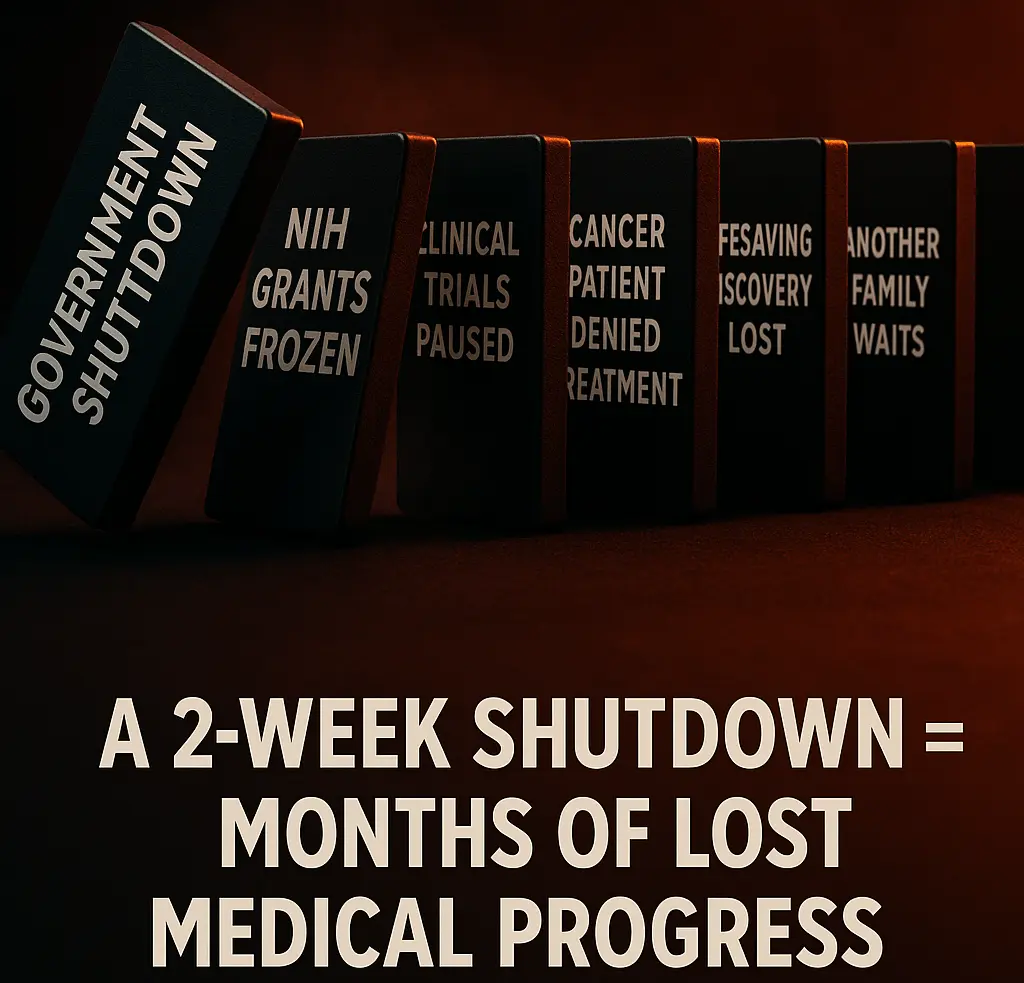

While news coverage of the October 2025 government shutdown focuses on closed national parks and delayed TSA services, a critical casualty is being overlooked: America’s biomedical research enterprise. Behind laboratory doors across the nation, groundbreaking cancer studies are being paused, clinical trials are halting patient enrollment, and promising medical discoveries are being put on ice. The government shutdown isn’t just an inconvenience for researchers—it’s a potential setback that could delay lifesaving treatments by months or even years.
As federal agencies like the National Institutes of Health (NIH) face funding lapses, the ripple effects extend far beyond Washington, D.C. They reach into every research hospital, university lab, and biotech startup that depends on federal grants to fuel medical innovation. Let’s examine the hidden costs of this government shutdown on biomedical research and why the consequences extend far beyond the shutdown itself.
How the Government Shutdown Immediately Affects Biomedical Research
When a government shutdown begins, its impact on the National Institutes of Health (NIH) is immediate. Most NIH operations, including new grant reviews, funding awards, and many research activities are paused, while essential services such as patient care at the NIH Clinical Center and maintenance of ongoing projects continue in a limited capacity.
For researchers, this creates immediate operational chaos. Laboratory experiments that require continuous monitoring cannot simply be paused and resumed. Cell cultures die. Animal studies are disrupted or must be terminated. Expensive equipment sits idle. Research assistants and postdoctoral fellows face uncertain paychecks.
The National Institutes of Health (NIH) reviews roughly 80,000 to 90,000 grant applications annually, following a highly regimented funding cycle. During the 2018–2019 federal government shutdown, thousands of these applications—estimated at nearly 2,000 to 3,000—were delayed in peer review or award processing. Each week of delay can ripple across research institutions, disrupting schedules, increasing administrative inefficiencies, and raising costs (Reference).
Federal researchers experience more direct consequences. Approximately 6,000 intramural NIH employees—including many laboratory scientists—are typically furloughed during a shutdown, leaving them unable to access their offices, laboratories, or federally maintained datasets. Collaborative research projects with universities and hospitals stall due to the absence of key federal partners, while international conference submissions and collaborative research timelines frequently miss critical deadlines.
The federal research funding shutdown also affects facilities management. Animal care facilities at NIH campuses must maintain skeleton crews to feed and care for research animals, but routine experiments stop. Biosafety level-3 and level-4 labs—which study dangerous pathogens—face complex decisions about maintaining secure operations with reduced staff.
Government Shutdown’s Impact on Clinical Trials and Patient Access
Perhaps nowhere is the human cost of a government shutdown more visible than in clinical trials. When federal funding freezes, the government shutdown clinical trials pipeline suffers immediate disruption. The NIH Clinical Center in Bethesda, Maryland—the nation’s largest hospital devoted entirely to clinical research—stops accepting new patients during shutdowns.
For patients with rare diseases or advanced cancers who have exhausted standard treatment options, clinical trials often represent their last hope. A government shutdown can mean the difference between accessing a potentially lifesaving experimental therapy or waiting months for the next enrollment window.
Clinical trial protocols are rigorous and time-sensitive. Patients are often evaluated on specific schedules—blood draws every two weeks, imaging scans at precise intervals, dose adjustments based on real-time monitoring. When a shutdown interrupts these schedules, researchers face difficult choices. Some trials can safely pause, but others cannot be resumed without compromising data integrity or patient safety.
The FDA also experiences significant slowdowns during government shutdowns. While the agency keeps essential functions operating, the review and approval of new drug applications slows dramatically. Industry-funded trials may continue, but the regulatory pathway becomes congested. This affects not just individual patients in trials, but the millions who will eventually benefit from approved therapies.
Beyond NIH-sponsored trials, thousands of university and hospital-based studies rely on NIH funding. When biomedical research grants shutdown, principal investigators must decide whether to continue trials using institutional funds (if available) or pause enrollment and risk losing participants who find alternative treatments.
How Graduate Students and Early-Career Researchers Bear the Brunt
While senior researchers may have some financial cushion and job security, early-career scientists bear a disproportionate burden during a government shutdown. Graduate students and postdoctoral fellows often live paycheck to paycheck, and grant-funded stipends may be delayed or interrupted.
A Ph.D. student whose dissertation depends on a continuous 6-month experiment cannot simply pause their work for two weeks without consequences. Cell lines, animal models, and longitudinal data collection don’t accommodate political gridlock. For students already facing a 4-7 year path to their degree, even a two-week shutdown can cascade into months of delay.
Postdoctoral researchers face even more precarious situations. These early-career scientists typically work on 1-3 year renewable contracts funded by NIH grants. When the government shutdown affects scientists in this position, they may lose critical weeks or months from already short-term positions. Some may need to seek alternative employment, representing a brain drain from biomedical research.
Fellowship and training grant awards are also frozen during shutdowns. Young researchers awaiting notification about prestigious NIH fellowships (F31, F32, K awards) face uncertainty about their career trajectories. Job offers at federal research institutions are delayed. Early-career faculty awaiting notification about their first R01 grant—the gold standard for independent research funding—see their lab startup plans disrupted.
The psychological toll is significant. Early-career researchers already face long odds in a competitive field. A government shutdown adds another layer of instability to an already uncertain career path, pushing some talented scientists toward more stable careers outside academia.
The Lasting Damage: Why a Short Shutdown Means Years of Delays
The most insidious aspect of a government shutdown isn’t what happens during the shutdown itself—it’s the compounding delays that follow. When research stops for two weeks, the recovery period extends far longer because of how scientific research actually works.
Consider a typical NIH-funded research project. It might involve multiple collaborating institutions, shared equipment facilities, and precisely timed experiments. When a government shutdown disrupts this coordination, getting everyone back on the same schedule takes additional weeks or months. Experiments that were interrupted must often be restarted entirely, not resumed from where they stopped.
Data from the 35-day government shutdown between December 2018 and January 2019 show how deeply such events disrupt research. During that period, NIH operations—including grant reviews and funding approvals—were effectively frozen, delaying thousands of applications and pushing back multiple grant review cycles. Agency leaders later reported that the shutdown’s ripple effects lasted for weeks after government funding resumed, with productivity losses estimated at well beyond the shutdown period itself.
Research momentum matters immensely in competitive fields. When American researchers are sidelined by a shutdown, international competitors continue working. China, the European Union, and other nations have dramatically increased their biomedical research investments. Each day of American research delay represents an opportunity for others to make discoveries first, file patents, and establish scientific leadership.
The economic costs extend beyond delayed discoveries. Universities and research institutions often must use discretionary funds to bridge gaps during shutdowns, diverting money from other priorities. Some institutions take out loans to meet payroll during extended shutdowns. Small biotech companies that depend on NIH Small Business Innovation Research (SBIR) grants face cash flow crises.
Perhaps most concerning is the chilling effect on research careers. When talented young scientists see their colleagues struggling with shutdown-related disruptions, some choose more stable careers in industry or other fields. The long-term cost to America’s scientific workforce may be the most damaging legacy of repeated government shutdowns.
Real-World Examples: How Past Shutdowns Disrupted Research
History provides sobering lessons about government shutdowns and their impact on biomedical research. The patterns are consistent: even brief shutdowns create disproportionately long recovery periods.
The 2013 Government Shutdown (16 Days)
The 16-day government shutdown in October 2013 had significant, lingering effects on NIH operations. NIH Director Francis Collins described the situation as “heartbreaking” in media interviews, highlighting the disruption to patients, especially vulnerable children with cancer, whose families had traveled to Bethesda seeking experimental treatments. During the shutdown, the NIH Clinical Center had to turn away more than 700 patients, including approximately 30 children, who were otherwise eligible to enroll in clinical trials. Only protocols deemed medically necessary—those life-saving in nature—were allowed to proceed. Research that had taken years to develop, including drug candidate identification, clinical trial design, and patient recruitment, was abruptly interrupted due to the shutdown.
The Centers for Disease Control and Prevention (CDC) was also severely affected, with many scientists furloughed and crucial disease surveillance programs dramatically scaled back. For instance, a salmonella outbreak investigation was suspended during the shutdown, potentially prolonging public exposure to contaminated products.
When the shutdown ended, NIH faced a substantial backlog in grant processing. Researchers who had planned to begin projects in October 2013 often did not receive funding until early 2014, effectively losing an entire academic year’s progress and creating cascading delays across subsequent funding cycles.
The 2018-2019 Government Shutdown (35 Days)
The longest government shutdown in U.S. history, lasting 35 days from December 22, 2018, to January 25, 2019, severely disrupted research activities. Taking place during the holiday season, it compounded challenges as many researchers already anticipated a natural slowdown. During the shutdown, the FDA furloughed approximately 40% of its workforce, preventing the agency from accepting new drug applications or conducting routine drug reviews, which created significant bottlenecks that took months afterward to clear.
The NIH furloughed roughly 7,800 employees, including many intramural scientists. The NIH Clinical Center halted accepting new patients, turning away an estimated 1,000 people seeking experimental treatments, confirming substantial disruption to patient care and clinical research. Research projects like those at the NIH’s National Institute of Allergy and Infectious Diseases (NIAID), including universal flu vaccine candidate trials, were particularly harmed. Because the shutdown coincided with peak flu season, these time-sensitive trials lost critical enrollment opportunities that could not be recouped for another year.
Dr. Anthony Fauci, then director of NIAID, estimated that the shutdown resulted in a loss of at least a month to six weeks of productivity, despite the shutdown lasting 35 days, reflecting the extended impact on ongoing projects. Graduate students and postdocs working at NIH were hit hard, with many forced to seek emergency financial aid or loans due to interrupted salaries.
Universities faced difficulties as well, scrambling to cover funding gaps. Institutions often used discretionary funds or incurred short-term debts to continue paying researchers. Smaller organizations without such financial buffers confronted difficult choices about whether to continue or pause research projects.
Shorter Shutdowns and Their Accumulated Impact
Even brief shutdowns create disruption. There have been more than 20 funding gaps since 1976, ranging from a few hours to 35 days. While the shortest shutdowns may seem trivial, they create administrative chaos and uncertainty that diverts attention from research.
Each shutdown requires NIH staff to prepare shutdown plans, notify grantees, pause processes, and then restart them. For researchers, each shutdown—however brief—introduces uncertainty. Should they order supplies that might arrive during a shutdown? Should they schedule experiments? The psychological and operational costs of repeated disruptions accumulate over time.
Solutions and Advocacy: Protecting Research from Future Shutdowns
The recurring nature of government shutdowns has prompted calls for systemic solutions to protect biomedical research from political dysfunction. Several proposals have gained traction among research advocates and policymakers.
The most direct solution would be to exempt NIH and other research agencies from shutdown provisions. Some members of Congress have proposed legislation that would provide automatic continuing resolutions for scientific agencies, ensuring that research funding continues even when broader appropriations bills stall. While such proposals have bipartisan support, they haven’t yet become law.
Professional organizations like the Federation of American Societies for Experimental Biology (FASEB) and the American Association for the Advancement of Science (AAAS) have become increasingly vocal about protecting research funding. These groups mobilize researchers to contact their representatives and provide testimony about shutdown impacts.
Some universities have established contingency funds specifically to bridge gaps during shutdowns, though this solution is only available to well-resourced institutions. Smaller colleges and research centers lack such financial cushions.
Individual researchers and concerned citizens can take action by:
- Contacting elected representatives to express concern about shutdown impacts on research
- Sharing stories about how shutdowns affect specific research projects or patients
- Supporting advocacy organizations that lobby for stable research funding
- Educating the public about the broader consequences of research disruptions beyond immediate headlines
The scientific community has also discussed whether diversifying funding sources could provide more resilience. However, the NIH represents such a dominant force in biomedical research that no realistic alternative funding ecosystem exists. Private foundations, state governments, and industry cannot fill the gap that a prolonged NIH shutdown would create.
Frequently Asked Questions About Government Shutdowns and Research
Does NIH funding stop completely during a government shutdown?
During a government shutdown, the NIH cannot issue new grants or continuation awards. However, funds that were already distributed to institutions before the shutdown can typically continue to be spent. The key issue is that new money cannot flow, which particularly affects researchers who were expecting to receive new awards or continuation funding during the shutdown period.
Existing grants with multi-year funding often have some cushion, but researchers working on grants that were scheduled to renew during a shutdown face immediate uncertainty. Some institutions can bridge gaps temporarily, but others cannot.
Are clinical trials cancelled during government shutdown?
Clinical trials are not automatically cancelled, but NIH-sponsored trials face significant disruptions. The NIH Clinical Center stops accepting new patients during shutdowns, which halts enrollment in trials conducted there. For trials at universities and hospitals, continuation depends on whether the institution can temporarily cover costs.
Trials funded by pharmaceutical companies or other non-federal sources generally continue uninterrupted. However, FDA reviews and approvals slow dramatically during shutdowns, which can affect trial timelines even if the research itself continues.
How long does it take research to recover from a government shutdown?
The recovery period is typically 2-4 times longer than the shutdown itself. A two-week shutdown might result in 4-8 weeks of lost productivity once you factor in resuming interrupted experiments, processing backlogs of grant applications, and re-coordinating multi-institutional projects.
Some types of research suffer permanent setbacks. Seasonal studies (like flu research), time-sensitive clinical work, and longitudinal studies that require continuous data collection cannot always be resumed where they left off.
What happened to biomedical research during the longest government shutdown?
The 35-day shutdown from December 2018 to January 2019 resulted in an estimated 1-2 months of lost research productivity at NIH. Approximately 1,000 patients were turned away from the NIH Clinical Center. Grant application processing was delayed by several months, creating cascading effects on research timelines throughout 2019.
Many early-career researchers faced financial hardship, and some left academic research for more stable careers. The exact number of researchers lost to the field is difficult to quantify, but survey data suggested increased career uncertainty and stress among graduate students and postdocs.
Can states or private foundations fill the gap during federal research shutdowns?
Unfortunately, no. The NIH alone provides over $40 billion in annual research funding. No combination of state governments and private foundations could replicate this support even temporarily. Some states have small grant programs that can help individual researchers, and some private foundations (like the Howard Hughes Medical Institute or the Bill & Melinda Gates Foundation) support biomedical research, but these resources are a fraction of federal funding.
The scale of NIH investment is essential to supporting the full ecosystem of biomedical research, from basic discovery science to translational work to clinical trials. Without it, American research leadership is fundamentally at risk.
How does the government shutdown affect international research collaborations?
International collaborations often involve coordinated efforts between American researchers and colleagues abroad. When a government shutdown prevents NIH scientists from communicating or accessing data, international partners are left waiting. Some collaborative grants involve funding that flows through NIH to international institutions, and these payments freeze during shutdowns.
Time zone differences and planned research visits are also disrupted. An international collaborator who planned to spend a month at an NIH lab might arrive to find the facility closed and their host furloughed. These disruptions damage America’s reputation as a reliable research partner.
Conclusion: The Hidden Price of Political Dysfunction
While the October 2025 government shutdown dominates headlines with images of closed monuments and stranded travelers, the impact on biomedical research represents a less visible but potentially more costly consequence. Every day that NIH grants are frozen, clinical trials are paused, and federal researchers are furloughed represents a small step backward in humanity’s fight against cancer, Alzheimer’s disease, rare genetic disorders, and countless other health challenges.
The true cost of a government shutdown cannot be measured simply in days or dollars. It’s measured in delayed discoveries, discouraged young scientists, and patients who don’t receive experimental treatments that might have saved their lives. A two-week shutdown creates months of recovery time. Repeated shutdowns create cumulative damage to America’s scientific infrastructure and erode the nation’s position as the global leader in biomedical research.
As citizens and policymakers debate budget priorities, the biomedical research community deserves more consideration in these discussions. These aren’t abstract debates about bureaucracy—they’re decisions that directly affect whether your child’s cancer has a treatment option five years from now, whether your aging parents have effective Alzheimer’s therapies, or whether the next pandemic finds us prepared or paralyzed.
If you care about medical progress and scientific leadership, contact your representatives and let them know that government shutdowns harm biomedical research in ways that ripple far beyond Washington’s political battles. Share this information with others who might not realize the connection between political dysfunction and medical progress. The discoveries that could save lives tomorrow are being delayed by the shutdowns of today.
The research community isn’t asking for special treatment—just the stability to do the work that benefits us all.
Sources & Further Reading
- The NIH Catalyst – The Shutdown Its Impact on Extramural and Intramural
- National Institutes of Health – Participants’ Experiences of the 2018–2019 Government Shutdown and Subsequent Supplemental Nutrition Assistance Program (SNAP) Benefit Disruption Can Inform Future Policy
- Association of American Universities – Government Shutdown Hampers Nation’s Scientific Research and Education Enterprise
- Inside Higher Ed – Already Battered by Cuts, Researchers and Colleges Face Federal Shutdown Impacts
- University of Minnesota – HHS to furlough 41% of workforce during federal government shutdown
- Fierce Biotech – NIH research grinds to a halt as government shuts down
- Applied Clinical Trials – NIH Implements Contingency Plan as Government Shutdown Impacts Research Funding
- American Oversight – In the Documents: How the 2018-2019 Government Shutdown Affected Federal Science Agencies
- Nature – US science agencies hit by government shutdown
- The Washington Post – The shutdown could prevent kids with cancer from getting treatment
- NPR – From Therapy Dogs To New Patients, Federal Shutdown Hits NIH
- KTOO – The Shutdown’s Squeeze On Science And Health
- CBS News – NIH, CDC feeling government shutdown’s effects
- Holland & Knight – The Government Shutdown and Its Effects on the FDA
- JHOP – Government Shutdown Impacts FDA Drug Approvals
- Clinical Leader – How Government Shutdowns Set Back Clinical Trials
- Statistica – The Timeline of U.S. Government Shutdowns
About Publisher
IR Research Publication is publisher, editorial, and profile building service provider. It was founded with the mission to support scientists, researchers, academicians, and students in advancing their careers and contributing to global scientific knowledge. IR Research Publication is committed to delivering high-quality, reliable, and professional editorial services alongside a credible and ethical publishing platform.
If you like this article, then visit our Blog page for more such articles.


