
Fully Funded Postdoctoral Fellowships in Canada for Indian Students in 2026 [Complete Guide]
Everything Indian researchers need to know about finding, applying for, and winning top postdoc funding in Canada — from federal government awards to cutting-edge AI fellowships.
Why Canada Is a Top Destination for Indian Postdoctoral Researchers in 2026
Canada has firmly established itself as one of the most welcoming and research-rich destinations for international postdoctoral scholars. For Indian researchers who have recently completed their PhD, the country offers a powerful combination of world-class universities, generous federal funding, strong India-Canada research partnerships, and a clear pathway to long-term residence.
In 2025–2026, the Canadian government and major research funding bodies made landmark changes to their postdoctoral funding ecosystem. The Banting, NSERC, CIHR, and SSHRC postdoctoral fellowships were consolidated into a single harmonised program called the Canada Postdoctoral Research Award (CPRA). Simultaneously, Mitacs launched the brand-new Accelerate Global Excellence Award specifically to attract international talent — including Indian researchers — to Canadian industry-academic partnerships.
This guide covers every major fully funded postdoctoral fellowship opportunity available to Indian students in Canada for 2026, with verified details on stipends, eligibility, deadlines, and official links. Whether you are a scientist in STEM, a health researcher, or a social science scholar, there is a program designed for you.
- Indian nationals who have completed a PhD (or expect to within 12 months)
- Postdoctoral researchers currently in Canada on a work permit
- Early-career scientists looking to transition to independent research careers
- Researchers in STEM, health sciences, social sciences, AI, and engineering
World-Class Universities
Canada is home to University of Toronto, McGill, UBC, and other globally ranked institutions with cutting-edge research infrastructure.
Competitive Stipends
Most funded fellowships offer CAD $55,000–$110,000 per year — significantly higher than equivalent programs in many other countries.
India–Canada Partnerships
Mitacs renewed its partnership with India in March 2026, opening more bilateral research collaboration pathways for Indian scholars.
Immigration Pathways
Postdoctoral experience in Canada can strengthen PR applications through Express Entry and other immigration streams.
📖 Also Read on IRResPub
- Fully Funded PhD Scholarships in Canada for Indian Students 2026
- Postdoctoral Fellowships in India 2026: Complete Guide
- Fully Funded Postdoctoral Fellowships in Australia for Indian Students 2026
- Top Postdoctoral Fellowships in USA for Indian Students 2026
- How to Find Postdoctoral Fellowship Opportunities Around the World
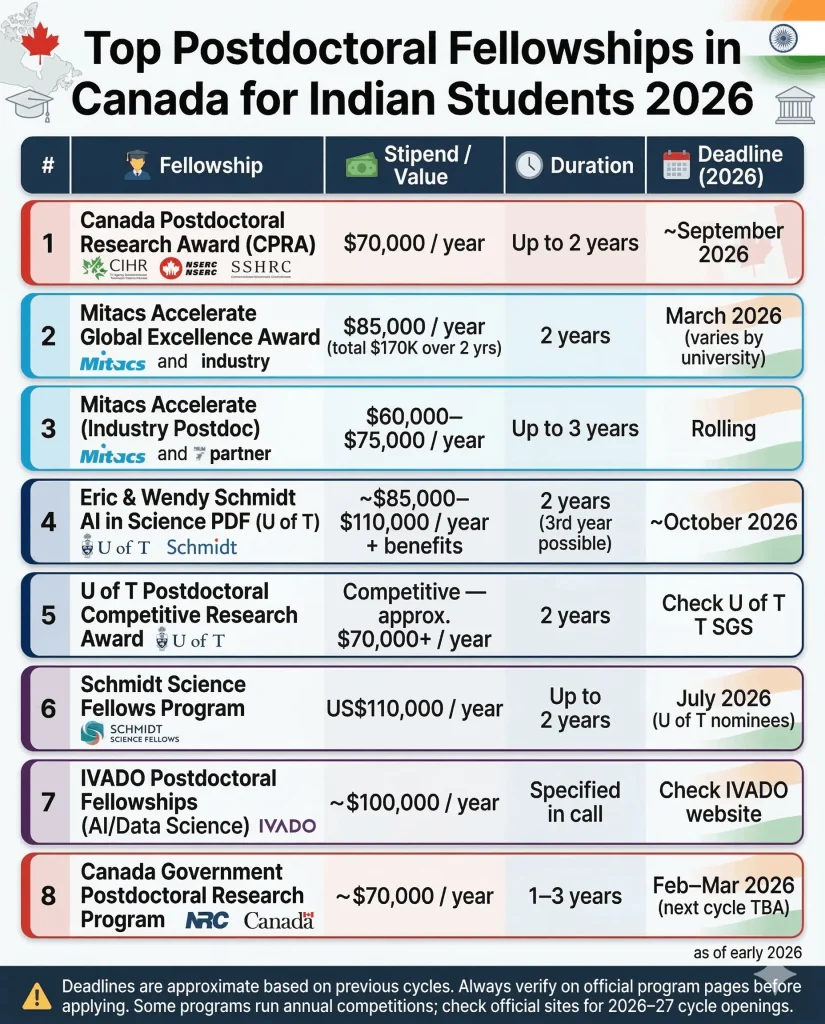
Quick Comparison: Top Postdoctoral Fellowships in Canada for Indian Students 2026
The table below summarises the most important details for each fellowship. All values are in Canadian Dollars (CAD) unless stated.
| # | Fellowship / Program | Host Institution | Open to Indians? | Stipend / Value | Duration | Deadline (2026) | Official Link |
|---|---|---|---|---|---|---|---|
| 1 | Canada Postdoctoral Research Award (CPRA) | Any eligible Canadian university / research hospital | ✓ Yes (up to 20%) | $70,000/year | Up to 2 years | ~September 2026 | Apply → |
| 2 | Mitacs Accelerate Global Excellence Award | Canadian universities + industry partners | ✓ Yes (targeted) | $85,000/year (total $170K over 2 yrs) | 2 years | May 1, 2026 | Apply → |
| 3 | Mitacs Accelerate (Industry Postdoc) | Canadian universities + partner organisations | ✓ Yes (with work permit) | $60,000–$75,000/year | Up to 3 years | Rolling | Apply → |
| 4 | Eric & Wendy Schmidt AI in Science PDF (U of T) | University of Toronto | ✓ International eligible | ~$85,000–$110,000/year + benefits | 2 years (3rd year possible) | ~October 2026 | Apply → |
| 5 | U of T Postdoctoral Competitive Research Award | University of Toronto | ✓ International eligible | Competitive — approx. $70,000+/year | 2 years | Check U of T SGS | Apply → |
| 6 | Schmidt Science Fellows Program | Any approved global institution (incl. Canadian) | ✓ Open globally | US$110,000/year | Up to 2 years | July 2026 (U of T nominees) | Apply → |
| 7 | IVADO Postdoctoral Fellowships (AI/Data Science) | IVADO-affiliated institutions, Quebec | ✓ International eligible | ~$100,000/year | Specified in call | Check IVADO website | Apply → |
| 8 | Canada Government Postdoctoral Research Program | Federal govt labs & research institutions | ✓ Open (varies) | ~$70,000/year | 1–3 years | Feb–Mar 2026 (next cycle TBA) | Apply → |
⚠️ Deadlines are approximate based on previous cycles. Always verify on official program pages before applying. Some programs run annual competitions; check official sites for 2026–27 cycle openings.
Detailed Guide to Each Fellowship
1. Canada Postdoctoral Research Award (CPRA)
🇨🇦 Federal GovernmentThe Canada Postdoctoral Research Award (CPRA) is the flagship tri-agency postdoctoral program launched in 2025, replacing the former Banting, NSERC, SSHRC, and CIHR fellowship programs. It is administered jointly by Canada’s three major research funding bodies and represents one of the most prestigious and generous postdoctoral awards available in the country.
For Indian Students: Up to 20% of all CPRA awards are reserved for international applicants, making Indian PhD holders directly eligible to apply. The award must be held at an eligible Canadian university, research hospital, or non-profit research organization.
Eligibility Highlights:
- Must hold or expect to hold a doctorate before the award start date
- PhD must have been completed within the last 3 years (extensions granted for career interruptions, parental leave, etc.)
- Cannot hold a concurrent tri-agency research training award
- Cannot have previously received a CIHR, NSERC, or SSHRC postdoctoral award
- Apply to the agency whose mandate matches your field (CIHR = health; NSERC = natural sciences/engineering; SSHRC = social sciences/humanities)
Key Benefits:
- $70,000 CAD per year — among the highest federal postdoc stipends available
- Freedom to pursue research at any eligible Canadian institution of your choice
- Strong credential for future faculty and leadership roles
- Access to supplementary funding through joint initiatives and priority areas
2. Mitacs Accelerate Global Excellence Award
🌍 New for 2026 — Ideal for Indian ResearchersThe Mitacs Accelerate Global Excellence Award is a brand-new, landmark initiative launched in March 2026, specifically designed to attract outstanding international postdoctoral researchers — including Indian scientists — to Canada. Mitacs also renewed its formal partnership with India in March 2026, signalling a strong commitment to India-Canada research collaboration.
This award is especially exciting for Indian researchers because it focuses on high-impact commercial sectors — AI, quantum technology, clean energy, advanced manufacturing, defence, cybersecurity, agri-tech, and health/life sciences — that align closely with India’s own research strengths.
Eligibility Highlights:
- Open to international postdoctoral researchers currently outside Canada (including Indians)
- Must be within 5 years of PhD completion at the project start date
- Must be eligible for postdoctoral fellow status at a Canadian institution
- Canadians and permanent residents returning from abroad are also eligible
- Must collaborate with a Canadian industry partner (for-profit, non-profit, hospital, or municipality)
Key Benefits:
- CAD $170,000 total funding over 2 years (jointly funded by Mitacs + industry partner)
- Covers salary, research costs, and relocation expenses from India to Canada
- Direct industry connection — invaluable for career development
- If not selected for Global Excellence, may be offered the standard Mitacs Accelerate Postdoc award ($60K/year)
- Additional 10 fellowships in partnership with CIFAR (Canadian Institute for Advanced Research)
3. Mitacs Accelerate (Industry Postdoc)
🏭 For Postdocs Already in CanadaThe Mitacs Accelerate Industry Postdoc is the standard postdoctoral track within Mitacs’s flagship Accelerate program. Unlike the Global Excellence Award (targeted at newcomers), this track is ideal for Indian researchers who are already based in Canada on a valid work permit or study visa and wish to pursue applied research with a Canadian partner organization.
Eligibility Highlights:
- International postdoctoral fellows with a valid Canadian work permit are eligible
- PhD completion must be within 5 years of the project start date
- Must be registered at a Mitacs partner university in Canada
- Cannot be a full-time employee of the partner organization
Key Benefits:
- CAD $60,000–$75,000 per year in combined Mitacs + partner funding
- Rolling deadline — apply anytime, no fixed annual competition window
- Flexible across any academic discipline
- Strong networking with Canadian industry; many fellows convert to permanent employment
4. Eric & Wendy Schmidt AI in Science Postdoctoral Fellowship (University of Toronto)
🤖 AI + Natural SciencesThe Eric and Wendy Schmidt AI in Science Postdoctoral Fellowship at the University of Toronto is one of Canada’s most prestigious and well-funded postdoctoral opportunities, backed by a $148 million donation from Schmidt Futures. It is part of a global network of nine elite universities and is co-led by U of T’s Data Sciences Institute and Acceleration Consortium.
This fellowship is ideal for Indian researchers with a PhD in the natural sciences, engineering, mathematics, or computing who are eager to integrate AI methodologies into their research domain. Prior AI experience is not required — curiosity and willingness to learn are.
Eligibility Highlights:
- PhD in natural sciences, engineering, mathematics, or computing
- International candidates must complete PhD before their fellowship start date
- PhD completion no earlier than January 2023 (with flexibility for career interruptions)
- Must secure a primary supervisor with a full-time U of T appointment
- Cannot concurrently hold another postdoctoral fellowship
Key Benefits:
- Among Canada’s highest postdoc salaries, plus full benefits package
- Access to world-leading AI infrastructure including Vector Institute resources
- Interdisciplinary community of Schmidt AI Fellows across nine global universities
- Option for a third year including global research placements or industry internships
5. Schmidt Science Fellows Program
🌍 Global Prestige AwardThe Schmidt Science Fellows Program is one of the most globally prestigious fellowships for early-career interdisciplinary scientists. Delivered in partnership with the Rhodes Trust, it supports exceptional PhD graduates who commit to a disciplinary pivot — pursuing postdoctoral research in a fundamentally different field from their PhD at any approved institution worldwide, including top Canadian universities.
Indian nationals who complete their PhD at the University of Toronto can be nominated for this competitive global award. The hallmark is the “pivot” — fellows must demonstrate bold interdisciplinary ambition.
Eligibility Highlights:
- PhD in natural sciences, engineering, mathematics, or computing
- For U of T nominees: PhD thesis accepted between May 2026 and June 2027
- Must start fellowship in July 2027 or October 2027 (cohort start dates are firm)
- Must propose a genuine disciplinary pivot from PhD research
Key Benefits:
- US$110,000/year — one of the highest postdoctoral stipends in the world
- Complete freedom to choose placement institution worldwide
- Exclusive cohort-based Science Leadership Program and global summits
- Access to a network of 150+ Fellows from 34 nationalities
6. IVADO Postdoctoral Fellowships (AI and Data Science)
🧠 AI Research — QuebecThe IVADO Postdoctoral Fellowship is offered through the Institut de valorisation des données (IVADO), a major data science and AI research consortium based in Montreal, Quebec. IVADO seeks outstanding national and international postdoctoral researchers to contribute to its flagship initiative on Robust, Reasoning, and Responsible AI (IAR³).
Montreal is home to one of the world’s densest AI research ecosystems, making this an exceptional opportunity for Indian AI and data science researchers. Quebec also offers distinct immigration pathways through the PRTQ program.
Who Should Apply:
- Researchers with a PhD in machine learning, data science, statistics, operations research, or related fields
- Those interested in robust, ethical, and explainable AI
- International researchers willing to be based in Quebec for the duration
7. National Research Council Canada (NRC) — Postdoctoral Research Program
🔬 Federal LabsThe National Research Council of Canada (NRC) Postdoctoral Research Program places researchers in federal government laboratories and research institutions across Canada. These positions offer the unique experience of working on applied government-funded research with direct relevance to national policy, industry, and societal challenges.
Note: While international applicants can participate in NRC postdoc programs, the CPRA program (above) specifically cannot be held at Canadian federal government institutions. NRC positions are applied to separately through the NRC careers portal.
Key Benefits:
- Access to unique federal research infrastructure not available at universities
- Research areas including energy, health, agriculture, AI, and manufacturing
- Competitive compensation with government benefits
Top Tips for Indian Researchers Applying for Canadian Postdoc Fellowships
Competition for funded postdoctoral positions in Canada is intense. Here is what consistently separates successful applicants from the rest:
🔍 Identify Your Supervisor First
Most Canadian postdoc fellowships require a confirmed or prospective host supervisor before you apply. Reach out to faculty 6–9 months before application deadlines.
📝 Tailor Your Research Proposal
For CPRA and Schmidt AI, the research proposal is the most weighted component. Align your proposed project with the host institution’s strategic priorities.
🏛️ Choose the Right Tri-Agency Stream
For CPRA, select NSERC (science/engineering), CIHR (health), or SSHRC (social sciences/humanities) carefully — submitting to the wrong agency disqualifies your application.
📅 Watch Internal Deadlines
Universities often have internal review deadlines 2–4 weeks before the agency deadline. Missing the internal deadline means missing the competition entirely.
🇮🇳 Leverage India-Canada MoUs
India’s SERB, DST, and ICMR have bilateral agreements with Canadian agencies. Check whether your research area qualifies for co-funded opportunities.
📄 Register Your CCV Early
For CPRA applications, you must register a Canadian Common CV (CCV) through the tri-agency portal. Allow at least 2 weeks to complete it properly.
Eligibility Summary: What Indian Applicants Need to Know
Indian nationals applying for postdoctoral positions in Canada are generally treated as “international applicants.” Below is a snapshot of the key eligibility requirements that most directly affect Indian researchers:
- PhD Completion: Most programs require your PhD to be completed no more than 3–5 years before the fellowship start date.
- Work Permit: You will need a valid Canadian work permit. Most universities help postdocs obtain this through a Labour Market Impact Assessment (LMIA) exemption under CUSMA/International Agreements.
- English Proficiency: No formal test required, but all applications, proposals, and references must be in English (or French for Quebec programs).
- Supervisor Endorsement: All major fellowships require a letter of support from your proposed Canadian supervisor.
- No Active Tenure-Track Position: You cannot hold a faculty or tenure-track position at the time of application.
📖 Related Reading
Canadian Immigration for Indian Postdoctoral Researchers
One of the most compelling reasons for Indian researchers to choose Canada for their postdoc is the country’s progressive immigration pathways. A Canadian postdoctoral appointment can significantly strengthen your long-term immigration prospects:
- Open Work Permit: Most postdoctoral fellows qualify for an LMIA-exempt Open Work Permit under the International Agreements category.
- Express Entry: A postdoc in Canada counts as skilled Canadian work experience, increasing your Comprehensive Ranking System (CRS) score.
- Provincial Nominee Programs (PNP): Provinces like Ontario, British Columbia, and Quebec have streams specifically for international researchers and graduates.
- Global Skills Strategy: Canada’s fast-track work permit processing (as little as 2 weeks) applies to highly skilled workers, including postdoctoral researchers.
Frequently Asked Questions (FAQ)
- CPRA: PhD completed within 3 years before the application deadline (extensions for parental leave, illness, etc.)
- Mitacs (all programs): Within 5 years of PhD completion
- Schmidt AI (U of T): PhD completed no earlier than January 2023
- Schmidt Science Fellows: PhD accepted within the cycle’s specified window
- University of Toronto — Hosts Schmidt AI Fellows, strong CPRA record, multiple dedicated postdoc awards
- University of British Columbia (UBC) — Strong CPRA and Mitacs pipeline; active international postdoc community
- McGill University — Offers Differential Fee Waivers for international students; strong in health and life sciences
- University of Waterloo — Particularly strong in AI, quantum, and engineering; active Mitacs partnerships
- University of Alberta — Growing research budget; strong in energy and environmental sciences
- Minimum (unfunded, university minimum): CAD $40,000–$50,000/year
- CPRA / Standard funded: CAD $70,000/year
- Mitacs programs: CAD $55,000–$75,000/year
- Schmidt AI (U of T): CAD $85,000–$110,000/year + benefits
- Schmidt Science Fellows: US$110,000/year (~CAD $150,000)
Key Official Resources for Indian Postdoc Applicants
- 🔗 CPRA Program — Official Government of Canada Page
- 🔗 Mitacs Accelerate Global Excellence Award — Official Page
- 🔗 Mitacs Programs Overview
- 🔗 Schmidt AI in Science Fellowship — University of Toronto
- 🔗 Schmidt Science Fellows — Global Program
- 🔗 IVADO Research Funding — Montreal
- 🔗 NRC Canada Postdoctoral Research Program
- 🔗 Canada Postdoctoral Fellowship Database — ScholarshipCa
Start Your Canadian Research Journey in 2026
Canada’s postdoctoral ecosystem in 2026 is more open, better funded, and more internationally connected than ever before. Whether you are drawn by the CPRA’s federal prestige, the Mitacs Global Excellence Award’s industry connections, or the Schmidt AI Fellowship’s cutting-edge research environment, the opportunities for Indian researchers are extraordinary.
The most important next step is identifying a supervisor who shares your research vision. Once you have that, the rest of the application falls into place.
🍁 Best of luck with your Canadian postdoctoral journey!
📖 More Guides on IRResPub
Disclaimer: All information in this article is accurate as of March 2026 and sourced from official program pages. Fellowship programs, deadlines, and funding amounts are subject to change. Always verify details directly on official government and university websites before applying. This guide does not constitute professional immigration or legal advice.