
Introduction: Why Pursue a Funded PhD in Switzerland?
Switzerland is among the most sought-after destinations for doctoral research. Home to globally ranked institutions, including ETH Zurich and EPFL – it offers Indian students not just a prestigious degree, but in many cases a monthly salary, world-class infrastructure, and a genuine launchpad for an international research career.
Here is why Switzerland stands out:
- Many PhD positions are employment contracts. Across Switzerland’s grant-funded STEM and science programs, doctoral candidates are typically hired as doctoral assistants or research assistants, receiving a salary with social insurance benefits. This is not universal — it depends on the program, faculty, and funding source — but it is common and well-documented at ETH Zurich, EPFL, and the cantonal universities.
- Registration fees are low. Swiss public universities charge low semester registration fees rather than standard tuition. However, the amount varies by institution, and scholarship holders may be expected to cover fees out of their own funds.
- India has been a CERN Associate Member State since 2017. Indian nationals are eligible for CERN’s Doctoral Student Programme, one of the most competitive and respected doctoral opportunities in physics, engineering, and computing.
- The Swiss Government Excellence Scholarship (ESKAS) explicitly includes India as an eligible country and confirms that self-certified document copies are accepted for Indian applicants.
Whether you are a fresh Master’s graduate, an early-career researcher, or a scientist looking to transition into European academia, this guide covers every major funded PhD opportunity available to Indian students in Switzerland for 2026 and the upcoming 2027 cycle.
Looking for funded PhD opportunities across Europe? Read our complete guide to Fully Funded PhD Scholarships in Europe for Indian Students (2026) and Fully Funded PhD Scholarships in Canada for Indian Students (2026).
Are PhD Positions in Switzerland Funded?
Many are — and Switzerland’s funding model is among the best in the world. The key distinction is that most funded PhD positions in Switzerland are not “scholarships” in the traditional sense. Instead, they fall into three distinct categories:
- Employment-based PhD positions — The most common route, especially in STEM. Doctoral candidates are hired on fixed-term employment contracts by a professor’s research group (funded by SNSF grants, EU projects, or institutional funds). They receive a regular monthly salary, social insurance, and paid leave.
- University doctoral fellowships — Structured competitive programs at specific departments or institutes (e.g., Biozentrum Basel PhD Fellowships), which provide full funding for the PhD duration.
- Government and external scholarships — Such as the Swiss Government Excellence Scholarship (ESKAS), which provides a monthly payment covering basic living costs, though it is explicitly described as a living allowance, not a salary.
Understanding this distinction matters. A doctoral assistant at ETH Zurich earns roughly CHF 61,300 gross in year one. A Swiss Government Excellence Scholarship holder receives CHF 2,450/month as a living stipend — a meaningful difference in take-home income and employment status.
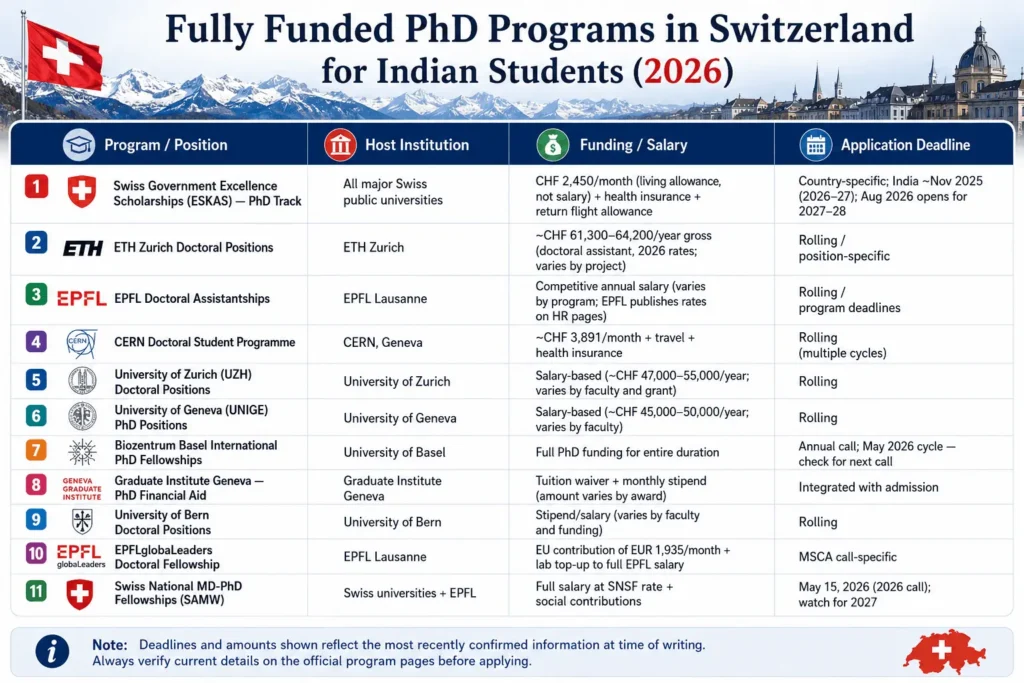
Summary Table: Funded PhD Programs in Switzerland for Indian Students (2026)
| Program / Position | Host Institution | Eligibility | Funding / Salary | Application Deadline | Official Link |
|---|---|---|---|---|---|
| Swiss Government Excellence Scholarships (ESKAS) — PhD Track | All major Swiss public universities | Master’s degree; born after Dec 31, 1991; India eligible | CHF 2,450/month (living allowance, not salary) + health insurance + return flight allowance | Country-specific; India ~Nov 2025 (2026–27); Aug 2026 opens for 2027–28 | sbfi.admin.ch |
| ETH Zurich Doctoral Positions | ETH Zurich | Master’s degree in relevant field; professor acceptance | ~CHF 61,300–64,200/year gross (doctoral assistant, 2026 rates; varies by project) | Rolling / position-specific | jobs.ethz.ch |
| EPFL Doctoral Assistantships | EPFL Lausanne | Master’s degree; doctoral program admission | Competitive annual salary (varies by program; EPFL publishes rates on HR pages) | Rolling / program deadlines | epfl.ch/education/phd |
| CERN Doctoral Student Programme | CERN, Geneva | Enrolled in PhD program; CERN member/associate state (India eligible) | ~CHF 3,891/month + travel + health insurance | Rolling (multiple cycles) | home.cern/students-fellows |
| University of Zurich (UZH) Doctoral Positions | University of Zurich | Master’s degree; supervisor acceptance | Salary-based (~CHF 47,000–55,000/year; varies by faculty and grant) | Rolling | uzh.ch/jobs |
| University of Geneva (UNIGE) PhD Positions | University of Geneva | Master’s degree; research proposal | Salary-based (~CHF 45,000–50,000/year; varies by faculty) | Rolling | unige.ch/research/doctoral-studies |
| Biozentrum Basel International PhD Fellowships | University of Basel | Outstanding academic record; Life Sciences | Full PhD funding for entire duration | Annual call; May 2026 cycle — check for next call | biozentrum.unibas.ch/phd |
| Graduate Institute Geneva — PhD Financial Aid | Graduate Institute Geneva | Merit/need-based; strong academic profile | Tuition waiver + monthly stipend (amount varies by award) | Integrated with admission | graduateinstitute.ch/phd |
| University of Bern Doctoral Positions | University of Bern | Master’s degree; supervisor acceptance | Stipend/salary (varies by faculty and funding) | Rolling | unibe.ch/research |
| EPFLglobaLeaders Doctoral Fellowship | EPFL Lausanne | Early-stage PhD; MSCA mobility rules apply | EU contribution of EUR 1,935/month + lab top-up to full EPFL salary | MSCA call-specific | epfl.ch/epflglobaleaders |
| Swiss National MD-PhD Fellowships (SAMW) | Swiss universities + EPFL | Medical degree + PhD enrollment | Full salary at SNSF rate + social contributions | May 15, 2026 (2026 call); watch for 2027 | samw.ch |
Note: Deadlines and amounts shown reflect the most recently confirmed information at time of writing. Always verify current details on the official program pages before applying.
Top 11 Funded PhD Programs in Switzerland for Indian Students
1. Swiss Government Excellence Scholarships (ESKAS / FCS)
Overview
The Swiss Government Excellence Scholarships — administered by the Federal Commission for Scholarships for Foreign Students (FCS/ESKAS) — are Switzerland’s flagship government award for international researchers. The Swiss Confederation funds these scholarships to promote academic exchange and research cooperation across over 180 countries, including India.
The PhD scholarship track supports doctoral research at any of Switzerland’s 12 cantonal universities, ETH Zurich, EPFL, or the Graduate Institute Geneva. Applications are submitted through the Swiss Embassy or consulate in India.
What the scholarship actually provides (per official ESKAS page, 2027–28 cycle)
- Monthly payment of CHF 2,450 to cover basic living expenses for one person
- This is explicitly described by ESKAS as a living allowance, not a salary
- Health insurance premiums covered by FCS for non-EU/EFTA scholarship holders (India qualifies)
- One-time CHF 600 rental deposit grant
- Return flight allowance (lump sum, used within 2 months of scholarship end, for return to India)
- Half-Fare Swiss public transport card
- Duration: 12 months, renewable twice for up to 36 months, subject to academic progress
- Tuition and semester fees are not covered — scholarship holders must pay these separately (typically CHF 600–2,000/semester depending on university)
Eligibility for Indian Applicants
- Must hold a Master’s degree completed by 31 July 2027 (ETH Zurich: 30 June 2027) for the 2027–28 cycle
- Born after December 31, 1991
- Must not have lived in Switzerland for more than 13 months before the start date
- A detailed research proposal with timeline is required
- A mandatory letter of support from a Swiss academic supervisor is required — without this, the application is rejected. Finding this supervisor is the applicant’s responsibility and can take weeks to months
India-Specific Notes
- For Indian applicants, self-certified document copies are accepted (confirmed on the official ESKAS application guidance page) — certified translations are only required for documents not in English, French, Italian, or German
- Applications for 2026–27 closed approximately November 2025 (India deadline). For 2027–28, the online portal opens August 20, 2026 and country-specific deadlines will be published at that time
- Results announced by end of May of the application year
Official Page: https://www.sbfi.admin.ch/en/swiss-government-excellence-scholarships-at-a-glance
2. ETH Zurich — Doctoral Assistant Positions
Overview
ETH Zurich consistently ranks among the world’s top universities. Its doctoral model does not operate through a central scholarship program — instead, professors hire doctoral candidates as doctoral assistants on employment contracts funded by research grants (SNSF, EU Horizon, ETH internal). This makes funding highly stable for grant-funded positions.
Doctoral candidates at ETH Zurich are employees of the university. The ETH salary table (as of January 1, 2026, published on the official ETH HR/Welcome Center page) shows fixed-rate gross salaries for doctoral students increasing from Year 1 to Year 3, with no further automatic increases from Year 4 onward. Multiple consistent sources cite the approximate range as CHF 61,300 (Year 1) to CHF 64,200 (Year 4) for 100% employment, though exact rates require verification via the official ETH salary tables as these are updated annually.
Key Benefits
- Competitive gross annual salary (approximately CHF 61,000–64,000 at 100% employment, 2026 rates — verify current figures at ethz.ch/salary)
- Swiss social insurance contributions (AHV/IV, pension) included
- Low registration fees — ETH introduced differentiated tuition categories from Autumn 2025; doctoral candidates should check current fee regulations at ethz.ch/students/tuition-fees
- Paid vacation and standard Swiss employment conditions
- Access to world-class research infrastructure and international collaborations
Who Should Apply
- Indian applicants with a strong Master’s degree in STEM (engineering, computer science, natural sciences, mathematics, environmental sciences, architecture)
- Applicants with research publications, strong references, or prior lab experience
- The most effective approach: directly email professors whose current research aligns with your interests, attaching a tailored cover letter, CV, and brief research statement. Professors at ETH have significant autonomy in hiring.
Job Portal: https://jobs.ethz.ch/
3. EPFL — Doctoral Assistantships
Overview
The École Polytechnique Fédérale de Lausanne (EPFL) in Lausanne is one of Europe’s most innovative research universities. It organizes doctoral training through multiple doctoral programs across engineering, life sciences, basic sciences, computing, environment, and architecture. Like ETH Zurich, EPFL employs doctoral candidates as doctoral assistants on employment contracts.
EPFL publishes its salary scales for doctoral assistants officially on its HR pages. The starting gross annual salary for doctoral assistants at EPFL is listed on epfl.ch/campus/services/human-resources/salaries and increases annually. Approximately 40% of EPFL doctoral students come from outside Europe, reflecting its highly international character.
Key Benefits
- Annual salary and benefits per EPFL doctoral assistant scale (verify current amounts on official EPFL HR page)
- Full Swiss social security, health insurance contributions, pension
- Access to EPFL’s Innovation Park, industry partnerships, and extensive research infrastructure
- Possibility to apply for competitive add-on fellowships: EPFLglobaLeaders, Swiss Government Excellence Scholarship top-ups
- Duration: typically 4 years
Who Should Apply
- Indian students with a strong Master’s degree in STEM, with research publications or strong project work
- Applicants targeting specific EPFL doctoral programs: Computer and Communication Sciences, Life Sciences Engineering, Materials Science, Electrical Engineering, Mathematics
- Apply either through EPFL’s doctoral program portals, or directly by emailing a prospective supervisor with your CV and research proposal
Doctoral Admission: https://www.epfl.ch/education/phd/
4. CERN Doctoral Student Programme
Overview
The CERN Doctoral Student Programme allows PhD candidates to conduct their thesis research at CERN — the European Organization for Nuclear Research in Geneva — for up to 36 months while remaining registered at their home university. CERN is the world’s largest particle physics laboratory and a unique environment for high-energy physics, engineering, and computing research.
India has been a CERN Associate Member State since 2017, which makes Indian nationals eligible for CERN’s student and fellowship programs, including the Doctoral Student Programme. Doctoral students spend time at CERN in Geneva, but the degree is awarded by the candidate’s enrolled university — the two supervisors (CERN and home university) collaborate on thesis arrangements.
Key Benefits
- Monthly stipend of approximately CHF 3,891 (tax-advantaged)
- Travel expenses to Geneva
- Health insurance coverage
- Paid annual leave
- Hands-on access to CERN’s research facilities, experiments, and global scientific network
- No IELTS required; good command of English or French is expected
Eligibility
- Must be a national of a CERN Member or Associate Member State (India qualifies)
- Must be enrolled in, or about to start, a doctoral program at a recognized university
- Research conducted at CERN must form part of, or all of, the doctoral thesis
- Relevant fields: Applied Physics, Engineering, Computing
- Multiple application deadlines per year
Official Page: https://home.cern/students-fellows
5. University of Zurich (UZH) — Doctoral Positions
Overview
The University of Zurich is Switzerland’s largest university, with particular strength in medicine, life sciences, social sciences, law, and humanities. Doctoral candidates at UZH are typically employed as university assistants on fixed-term contracts funded by research grants.
Key Benefits
- Annual salary approximately CHF 47,000–55,000 gross depending on faculty, year, and funding source (these are indicative ranges — actual salary is determined by the hiring professor’s grant and university scales)
- Full Swiss social security contributions
- Access to UZH’s research hospitals, life science clusters, and collaboration with nearby ETH Zurich
- Duration: typically 3–4 years
Who Should Apply
- Indian students with a Master’s degree targeting areas of UZH strength: medicine, neuroscience, biochemistry, law, economics, social sciences, humanities
- Monitor the UZH jobs portal regularly and contact professors directly
Job Portal: https://www.uzh.ch/en/explore/jobs.html
6. University of Geneva (UNIGE) — PhD Positions
Overview
The University of Geneva is particularly renowned for international relations, law, medicine, and natural sciences. Its location — surrounded by UN agencies, WHO, ICRC, WTO, and hundreds of international organizations — makes it uniquely valuable for researchers in policy, global health, and social sciences.
Key Benefits
- Annual salary approximately CHF 45,000–50,000 gross (varies by faculty and funding source)
- Access to Geneva’s international ecosystem for interdisciplinary research
- Doctoral positions across all faculties; particularly strong in science, medicine, social sciences, and international studies
- Swiss social insurance and employment benefits
Who Should Apply
- Indian students targeting social sciences, international health, environmental sciences, law, or natural sciences
- Those interested in connecting doctoral research to the Geneva international organization ecosystem
Doctoral Studies: https://www.unige.ch/research/doctoral-studies/
7. University of Basel — Biozentrum International PhD Fellowships
Overview
The Biozentrum at the University of Basel is internationally recognized for molecular biology and biochemistry. Its International PhD Fellowship Program, supported by the Werner Siemens Foundation since 2007, is one of the few structured, competitive cohort-based PhD fellowship programs in Switzerland with a fixed annual deadline and formal selection process.
Key Benefits
- Full funding for the entire PhD (duration typically 3–4 years)
- Competitive monthly stipend
- Structured doctoral training: seminars, lab rotations, mentoring, and career development
- State-of-the-art infrastructure in structural biology, cell biology, neurobiology, and biochemistry
- Strong international alumni network
Who Should Apply
- Indian students with outstanding academic records in molecular biology, biochemistry, structural biology, cell biology, or related life sciences
- Those with strong research motivation and willingness to work in a highly competitive discovery-driven environment
- The most recent call deadline was May 8, 2026 — check the official page for the next annual call
Official Page: https://www.biozentrum.unibas.ch/phd/international-phd-program/phd-fellowships
8. Graduate Institute Geneva — PhD Financial Aid and Fellowships
Overview
The Graduate Institute of International and Development Studies (IHEID) in Geneva is a world-leading institution for international relations, development studies, political science, and international economics. It offers merit and need-based financial aid integrated with PhD admission — applicants do not apply separately for funding; it is assessed alongside the main application.
Key Benefits
- For the most competitive packages: tuition waiver + monthly stipend + health insurance contribution
- Aid amounts vary by award type; some cover the full PhD, others are partial or renewable annually
- Location advantage: direct proximity to the UN, ICRC, ILO, WTO, WEF, MSF, and 200+ international organizations
Who Should Apply
- Indian students with a strong Master’s in social sciences, political science, economics, law, or international relations
- Those whose research bridges academic rigor and policy relevance in areas like global governance, humanitarian affairs, development economics, or international security
PhD Programs: https://www.graduateinstitute.ch/study/programmes/phd
9. University of Bern — Doctoral Positions and Scholarships
Overview
The University of Bern, located in Switzerland’s federal capital, covers all major academic disciplines with particular strength in climate science, environmental research, medical research, law, humanities, and theology. Funded doctoral positions exist across all faculties, primarily through professor-led research grants.
Key Benefits
- Salary or stipend depending on funding source and faculty (varies widely — confirm with the host department)
- Access to the Oeschger Centre for Climate Change Research and other interdisciplinary institutes
- Swiss Government Excellence Scholarships can be used at the University of Bern for eligible applicants
Who Should Apply
- Indian students interested in climate science, environmental studies, medicine, humanities, or law
- Search the University of Bern job portal and contact professors directly
Research Portal: https://www.unibe.ch/research/index_eng.html
10. EPFLglobaLeaders Doctoral Fellowship
Overview
EPFLglobaLeaders is an MSCA COFUND doctoral fellowship program at EPFL. It funds 48-month (4-year) doctoral positions at EPFL campuses. A distinctive feature is the requirement for non-academic co-supervision, connecting research to industry or NGO partners.
Key Benefits
- EU contribution of EUR 1,935/month toward the doctoral candidate’s salary
- The hosting laboratory must complement this contribution to the full EPFL doctoral assistant salary
- Research costs, equipment, travel, and conference expenses covered by the hosting lab
- Integrated leadership training program
- Open to any nationality, subject to MSCA transnational mobility rules (candidates must not have resided in Switzerland for more than 12 months in the 3 years before the call deadline)
Who Should Apply
- Indian students who satisfy the MSCA mobility condition and are targeting EPFL research areas
- Those interested in combining academic research with non-academic sector impact
Fellowship Page: https://www.epfl.ch/education/phd/doctoral-studies-structure/customized-curricula/epflglobaleaders/
11. Swiss National MD-PhD Fellowships (SAMW/ASSM)
Overview
The Swiss Academy of Medical Sciences (SAMW/ASSM) funds the Swiss National MD-PhD Fellowship Program, enabling physicians to pursue doctoral research in natural sciences, public health, clinical research, or biomedical ethics. At EPFL, applicants must be enrolled at the School of Life Sciences.
Key Benefits
- Salary at the SNSF rate with employer social security contributions covered
- Duration: 2 to 3 years, with a 4th year possible if guaranteed by the host institution
- One of the few programs designed specifically for medical doctors pursuing a PhD in Switzerland
Who Should Apply
- Indian students holding an MBBS/MD and planning doctoral research in biomedical science
- Those enrollable at a Swiss medical faculty or EPFL School of Life Sciences
- The 2026 call deadline was May 15, 2026 — check the official SAMW page for the 2027 call
Official Page: https://www.samw.ch/en/Funding/MD-PhD-Fellowships.html
How Can Indian Students Apply for a PhD in Switzerland? Step-by-Step Guide
Step 1: Identify Your Field and Target Institution
Start by identifying which Swiss university or institute is strongest in your specific research area:
- STEM/Engineering/Computing: ETH Zurich, EPFL
- Life Sciences/Medicine: UZH, University of Basel, EPFL
- Social Sciences/International Affairs: Graduate Institute Geneva, UNIGE, University of St. Gallen
- Climate/Environment: University of Bern, EPFL, ETH Zurich
- Particle Physics/Engineering/Computing: CERN
Step 2: Find and Contact a Supervisor
This is the most critical step. In Switzerland, professors largely hire their own doctoral students — especially in employment-based positions. Contact potential supervisors by:
- Reading their recent publications on Google Scholar
- Writing a specific, tailored email (not a mass-broadcast email) explaining which paper/project interested you and how your background is relevant
- Attaching a concise CV and a 1-page research statement
- Being patient — professors receive many emails and may take weeks to respond
Step 3: Secure a Supervision Letter
For the Swiss Government Excellence Scholarship and many structured fellowships, a formal written confirmation from a Swiss professor that they are willing to supervise you is mandatory. Without it, most formal scholarship applications will not be considered.
Step 4: Apply for Funding
Once you have a professor’s interest or confirmation, apply through the appropriate funding route:
- ESKAS — via Swiss Embassy in India (for government scholarship track)
- University doctoral program portal — for structured PhD programs
- CERN careers portal — for CERN Doctoral Student Programme
- Direct hiring — if the professor has grant funds, they may hire you directly without a separate scholarship application
Step 5: Prepare Your Application Documents
- Master’s transcripts and degree certificate
- Research proposal with timeline (the centerpiece for ESKAS)
- Full CV/resume
- Two recommendation letters from professors (use ESKAS forms for government scholarships)
- Language proficiency evidence (if required by the specific program)
- Passport copy
- For ESKAS: self-certified copies accepted for Indian applicants (official confirmation)
Step 6: Submit and Follow Up
Follow each program’s submission instructions exactly. For ESKAS, the application goes through the Swiss Embassy in New Delhi. For university positions, applications are submitted online. Follow up politely if you don’t hear back within 6–8 weeks.
What Are the Eligibility Criteria for a PhD in Switzerland?
General eligibility criteria across most funded doctoral programs:
- Qualification: Master’s degree (MSc, MTech, MA, MPhil, or equivalent) from a recognized Indian university — Swiss institutions generally recognize Indian postgraduate qualifications, though admission decisions are program- and institution-specific
- Academic Record: Strong GPA and research experience; publications strengthen applications considerably for competitive programs
- Research Proposal: Required for ESKAS and structured fellowship programs; important even for cold-email applications
- Language: Most research programs at ETH, EPFL, and UZH are conducted in English. French proficiency may be needed at UNIGE and UNIL. No blanket IELTS requirement exists — requirements vary by program and institution; always check the specific program’s language policy
- Age: ESKAS requires applicants born after December 31, 1991 (for the 2027–28 cycle)
- Residency: ESKAS requires that applicants have not lived in Switzerland for more than 13 months before the scholarship start date
- Supervisor Confirmation: Required for ESKAS; practically important for all routes
How to Find PhD Vacancies in Switzerland for Indians
Use these six channels systematically:
- University job portals (most reliable for employment-based positions)
- ETH Zurich: https://jobs.ethz.ch/
- EPFL: https://actu.epfl.ch/jobs/
- UZH: https://www.uzh.ch/en/explore/jobs.html
- EURAXESS — EU/Swiss research positions: https://euraxess.ec.europa.eu/
- SNSF project database — Browse https://p3.snf.ch/ to find professors with active grants, then email them directly
- Direct cold email to professors — The most widely used route in Switzerland; professors with SNSF or EU grants typically have funds to hire PhD students and advertise informally or not at all
- CERN careers portal: https://jobs.smartrecruiters.com/CERN/
- Google Scholar alerts — Set alerts for papers from Swiss research groups in your field; reply-contact the corresponding authors
Looking for fellowship opportunities that can support your PhD applications globally? See Top Fellowships & Funding Opportunities for PhD Students in India (2026) for domestic funding you can combine with Switzerland applications.
Do PhD Students in Switzerland Receive a Salary?
The answer depends on the type of doctoral position.
Employment-based positions (most STEM/science positions at ETH, EPFL, UZH, UNIGE, Bern) pay a regular monthly salary under Swiss employment law. Based on multiple consistent sources, approximate gross annual salary ranges for doctoral assistants in 2026 are:
| Institution | Approx. Gross Annual Salary (Year 1) | Notes |
|---|---|---|
| ETH Zurich | ~CHF 61,300 | Fixed-rate scale; increases annually to Year 3 |
| EPFL | Varies; check EPFL HR page | Published on EPFL’s remuneration pages |
| University of Zurich | ~CHF 47,000–55,000 | Faculty and grant dependent |
| University of Geneva | ~CHF 45,000–50,000 | Faculty dependent |
| CERN Doctoral Programme | ~CHF 46,700/year (CHF 3,891/month) | Stipend, not employment salary |
| Swiss Govt Excellence Scholarship | CHF 29,400/year (CHF 2,450/month) | Living allowance, explicitly not a salary |
Important: These are gross figures. Net take-home after Swiss social contributions (~12–15%) will be lower. Cost of living in Zurich and Geneva is high — candidates should budget carefully.
FAQ: Frequently Asked Questions
Q1. Are PhD positions in Switzerland fully funded?
Many PhD positions in Switzerland — particularly in STEM fields — are funded through employment contracts backed by research grants. The term “fully funded” covers employment-based positions (salary + benefits) and fellowship-based positions (stipend + allowances). Not every PhD route in Switzerland is employment-based; structured fellowships and government scholarships operate differently. The important takeaway: it is common, though not automatic, to receive a salary or substantial living support as a doctoral researcher in Switzerland.
Q2. Is PhD in Switzerland free for international students?
“Free” is not quite accurate. Swiss universities charge low semester registration fees rather than full tuition, but the amount varies by institution and residency status. ETH Zurich introduced differentiated tuition categories from Autumn 2025 — doctoral candidates should check current fee regulations directly with their target institution. The Swiss Government Excellence Scholarship does not cover tuition or semester fees; scholarship holders are expected to cover these from their monthly allowance.
Q3. How can Indian students apply for a PhD in Switzerland?
The main routes are: (1) applying directly to advertised PhD positions on university job portals by contacting professors; (2) applying for the Swiss Government Excellence Scholarship through the Swiss Embassy in India; or (3) applying to the CERN Doctoral Student Programme (India eligible since 2017). For all routes, securing a supervision letter from a Swiss professor is the most critical preparatory step.
Q4. Which Swiss universities offer funded PhD positions for Indians?
All major Swiss public universities have funded doctoral positions that Indian students can apply for: ETH Zurich, EPFL, University of Zurich (UZH), University of Geneva (UNIGE), University of Basel, University of Bern, University of Lausanne (UNIL), University of St. Gallen (HSG), and the Graduate Institute Geneva. CERN in Geneva also accepts Indian doctoral students.
Q5. What is the PhD stipend or salary in Switzerland?
It depends on the funding type. Employment-based positions at ETH Zurich pay approximately CHF 61,000+ gross per year. The Swiss Government Excellence Scholarship pays CHF 2,450/month as a living allowance (2027–28 rate, per official ESKAS page). CERN’s Doctoral Student Programme pays approximately CHF 3,891/month. Amounts should always be verified against the official source for the specific program and year.
Q6. What is the deadline for the Swiss Government Excellence Scholarship for Indian students?
For the 2026–27 academic year, India’s deadline was approximately November 10, 2025. For the 2027–28 cycle, the online application portal opens August 20, 2026, and country-specific deadlines will be published at that time on the official ESKAS website. Always verify through sbfi.admin.ch or the Swiss Embassy in New Delhi.
Q7. Do I need IELTS for a PhD in Switzerland?
There is no single blanket requirement. ETH Zurich and EPFL primarily work in English for their doctoral programs and often do not require a formal IELTS score if previous degrees were in English — but policies vary by department and supervisor. CERN explicitly does not require IELTS proof. French-medium programs at UNIGE or UNIL may require French proficiency. Always check the specific program and department requirements before applying.
About IR Research Publication
IR Research Publication (irrespub.com) is a scientific journal publisher and editorial services provider committed to supporting researchers, academics, and students at every stage of their scholarly journey. Beyond publishing peer-reviewed research, IR Research Publication maintains an active knowledge resource hub — covering funded PhD opportunities, fellowship guides, postdoctoral funding databases, and academic career advice for Indian and international researchers.
Whether you are submitting your first manuscript, navigating peer review, or searching for your next funded research position, IR Research Publication is your trusted partner in academic excellence.
Related Blog Posts from IR Research Publication
- Fully Funded PhD Scholarships in Europe for Indian Students (2026) — 20+ verified opportunities across Germany, France, Sweden, Netherlands, Switzerland, and more.
- Top Fellowships & Funding Opportunities for PhD Students in India (2026) — PMRF, CSIR, UGC NET, DST-INSPIRE, NIPER, IISER fellowships with stipends and eligibility.
- Fully Funded PhD Scholarships in Canada for Indian Students (2026) — CGRS-D, Trudeau Foundation, Ontario Trillium, UBC, University of Toronto.
- Fully Funded PhD Scholarships in Singapore: 2026 Guide — SINGA, NUS, NTU, A*STAR and more.
- Fully Funded Postdoctoral Fellowships in South Korea (2026) — Top programs for international postdoctoral researchers.
Last updated: June 2026. All funding amounts, deadlines, and eligibility criteria should be verified on official program websites before applying, as these are updated annually.