
Introduction: Why compare Germany vs Netherlands for PhD?
Germany vs Netherlands for PhD is a common comparison for international researchers because both countries are research powerhouses in Europe, offer a large number of English-language doctoral projects, and provide internationally recognized training. Yet their models differ in crucial ways that affect your finances, supervision, and career outcomes.
This guide is for master’s graduates, early-career researchers, and professionals considering a European doctorate. It is also useful for academic advisors and parents who want a precise, unbiased overview.
The factors that usually matter most include funding model and salary, tuition and living costs, research culture and supervision, program structure and duration, visa/residence rules, language expectations, and post-PhD job opportunities (both academic and industry).
In the next sections, you’ll learn how each country handles admissions, the realities of stipends and employment contracts, where each country excels by discipline, how to budget realistically, and what the immigration and career pathways look like after graduation—backed by official sources where possible.
Key takeaways at a glance
- Funding model: The Netherlands typically employs PhD candidates as full-time staff with a salary and benefits; Germany mixes salaried researcher contracts, scholarships, and some self-funded paths with very low or no tuition.
- Tuition: Public universities in Germany usually charge no tuition for PhD (only small semester fees). In the Netherlands, employee-PhDs don’t pay tuition; external/self-funded PhDs may pay substantial tuition depending on the university.
- Living costs: Expect moderate-to-high costs in both countries, typically higher in Dutch urban centers like Amsterdam, Utrecht, and Delft.
- Language: Many PhDs run in English in both countries; local language may be essential for clinical or patient-facing research.
- Post-PhD jobs: Both have strong academic and industry ecosystems; the Netherlands often provides structured development and a clear 4-year timeline, while Germany offers broad institute networks (Max Planck, Helmholtz, Fraunhofer) and an 18-month job-search period for graduates.
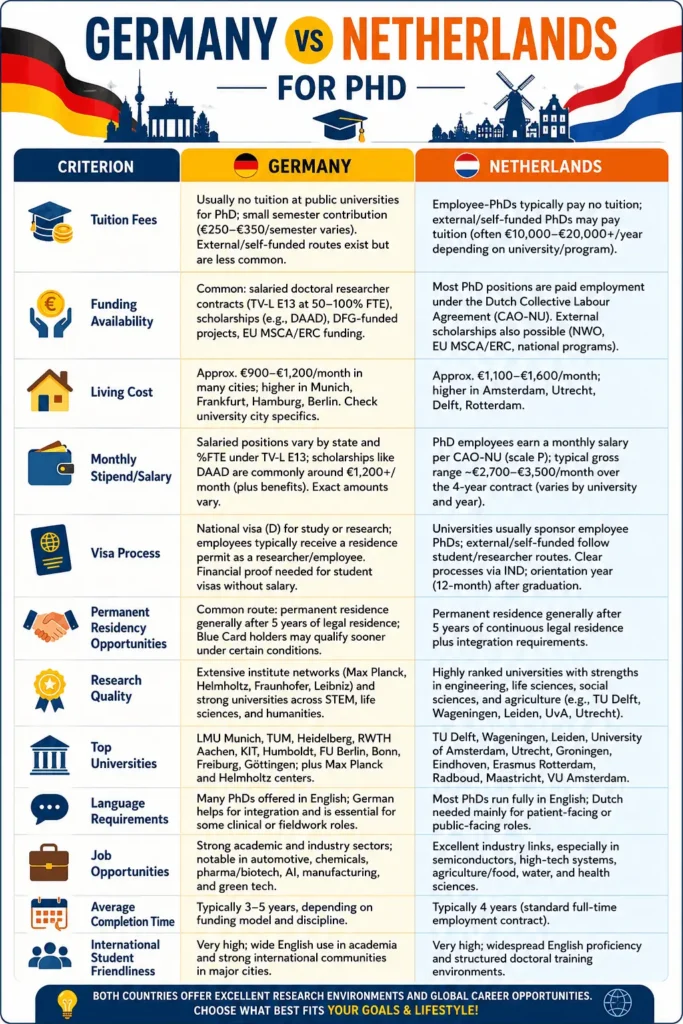
Quick comparison table: Germany vs Netherlands for PhD
| Criterion | Germany | Netherlands |
|---|---|---|
| Tuition Fees | Usually no tuition at public universities for PhD; small semester contribution (€250–€350/semester varies). External/self-funded routes exist but are less common. | Employee-PhDs typically pay no tuition; external/self-funded PhDs may pay tuition (often €10,000–€20,000+/year depending on university/program). |
| Funding Availability | Common: salaried doctoral researcher contracts (TV-L E13 at 50–100% FTE), scholarships (e.g., DAAD), DFG-funded projects, EU MSCA/ERC funding. | Most PhD positions are paid employment under the Dutch Collective Labour Agreement (CAO-NU). External scholarships also possible (NWO, EU MSCA/ERC, national programs). |
| Living Cost | Approx. €900–€1,200/month in many cities; higher in Munich, Frankfurt, Hamburg, Berlin. Check university city specifics. | Approx. €1,100–€1,600/month; higher in Amsterdam, Utrecht, Delft, Rotterdam. |
| Monthly Stipend/Salary | Salaried positions vary by state and %FTE under TV-L E13; scholarships like DAAD are commonly around €1,200+/month (plus benefits). Exact amounts vary. | PhD employees earn a monthly salary per CAO-NU (scale P); typical gross range ~€2,700–€3,500/month over the 4-year contract (varies by university and year). |
| Visa Process | National visa (D) for study or research; employees typically receive a residence permit as a researcher/employee. Financial proof needed for student visas without salary. | Universities usually sponsor employee PhDs; external/self-funded follow student/researcher routes. Clear processes via IND; orientation year (12-month) after graduation. |
| Permanent Residency Opportunities | Common route: permanent residence generally after 5 years of legal residence; Blue Card holders may qualify sooner under certain conditions. | Permanent residence generally after 5 years of continuous legal residence plus integration requirements. |
| Research Quality | Extensive institute networks (Max Planck, Helmholtz, Fraunhofer, Leibniz) and strong universities across STEM, life sciences, and humanities. | Highly ranked universities with strengths in engineering, life sciences, social sciences, and agriculture (e.g., TU Delft, Wageningen, Leiden, UvA, Utrecht). |
| Top Universities | LMU Munich, TUM, Heidelberg, RWTH Aachen, KIT, Humboldt, FU Berlin, Bonn, Freiburg, Göttingen; plus Max Planck and Helmholtz centers. | TU Delft, Wageningen, Leiden, University of Amsterdam, Utrecht, Groningen, Eindhoven, Erasmus Rotterdam, Radboud, Maastricht, VU Amsterdam. |
| Language Requirements | Many PhDs offered in English; German helps for integration and is essential for some clinical or fieldwork roles. | Most PhDs run fully in English; Dutch needed mainly for patient-facing or public-facing roles. |
| Job Opportunities | Strong academic and industry sectors; notable in automotive, chemicals, pharma/biotech, AI, manufacturing, and green tech. | Excellent industry links, especially in semiconductors, high-tech systems, agriculture/food, water, and health sciences. |
| Average Completion Time | Typically 3–5 years, depending on funding model and discipline. | Typically 4 years (standard full-time employment contract). |
| International Student Friendliness | Very high; wide English use in academia and strong international communities in major cities. | Very high; widespread English proficiency and structured doctoral training environments. |
Funding Opportunities
How funding works in Germany
Germany offers a mixed system. Many PhD candidates hold paid positions as research staff (Wissenschaftliche Mitarbeitende) funded by externally won grants (often DFG or EU) or institute budgets. These are typically TV-L E13 contracts at 50–100% FTE (hours and pay percentage vary by project and state). Other candidates are funded by competitive scholarships such as DAAD, foundation scholarships (e.g., Konrad Adenauer, Heinrich Böll), or EU Marie Skłodowska-Curie Actions. Tuition at public universities is usually zero for PhDs, with only semester contributions.
Useful links:
- DAAD – scholarships and program database
- DFG – German Research Foundation
- EURAXESS – Jobs & Funding
- Max Planck Society
How funding works in the Netherlands
The Netherlands often employs PhD candidates as university staff on a 4-year contract with a salary and benefits (pension, paid leave), covered by the Collective Labour Agreement for Dutch Universities (CAO-NU), salary scale P. Some universities also host external/self-funded PhDs who bring their own funding (e.g., national scholarships) and, in those cases, tuition may apply.
Useful links:
- Universities of the Netherlands – CAO-NU
- NWO – Dutch Research Council
- Marie Skłodowska-Curie Actions (EU)
Advantages
- Germany: No/low tuition at public universities; many salaried researcher posts; large number of foundations and DFG-funded projects; DAAD is globally recognized.
- Netherlands: Clear employee status with salary and benefits for most PhDs; structured career development and training; predictable 4-year funding horizon.
Disadvantages
- Germany: Funding model varies by supervisor and state; if on a scholarship, social benefits can be limited; contract percentages (e.g., 50–75%) affect take-home pay.
- Netherlands: Employee-PhD positions are competitive; external/self-funded routes may incur significant tuition; cost of living is relatively high in major Dutch cities.
Which is better?
If you prioritize an employee contract with a predictable 4-year salary and benefits, the Netherlands tends to be better. If you value zero tuition, immense institute networks, and diverse funding sources (including scholarships), Germany offers excellent breadth—with the caveat that compensation and contracts vary.
Research Opportunities and Strengths
Germany
Germany hosts some of the world’s strongest non-university research networks and graduate schools. The Max Planck Society focuses on basic science, Helmholtz Centers emphasize large-scale applied research (e.g., energy, health, aerospace), Fraunhofer specializes in industry-facing applied R&D, and Leibniz covers a broad spectrum. Universities such as LMU Munich, TUM, Heidelberg, RWTH Aachen, and KIT are consistently well-regarded. Funding is abundant in STEM, life sciences, and increasingly in AI and sustainability.
Key agencies and infrastructures:
- Helmholtz Association
- Fraunhofer-Gesellschaft
- Leibniz Association
- Study in Germany (official portal)
Netherlands
The Netherlands punches above its weight in high-tech systems, microelectronics/semiconductors, photonics, water management, sustainable energy, agriculture and food (WUR), data science/AI, and health sciences. Universities such as TU Delft, Wageningen, Leiden, Amsterdam (UvA & VU), Utrecht, Groningen, Eindhoven, and Erasmus Rotterdam are active in European consortia and industry collaborations.
Key agencies and infrastructures:
Advantages
- Germany: Scale and diversity of research institutes; breadth across disciplines; strong EU project participation; powerful applied research network (Fraunhofer).
- Netherlands: Tight integration with industry and societal challenges; strong project management culture; high supervisor accessibility; excellent research training frameworks.
Disadvantages
- Germany: Heterogeneity—quality of supervision and structure can vary by chair/department; navigation may be more decentralized.
- Netherlands: Smaller system may have fewer total positions; highly competitive environment for certain fields.
Which is better?
For large research infrastructures and extensive institute ecosystems, Germany leads. For structured programs with strong industry links and project clarity, the Netherlands often feels more streamlined.
Cost of Living and Budgeting
Living costs depend heavily on city, housing, and lifestyle.
Germany
- Typical monthly budget: €900–€1,200 in many cities; expect higher in Munich, Frankfurt, Hamburg, and central Berlin.
- Semester contributions (for public transport and admin) of ~€250–€350/semester are common.
- Reference: Study in Germany (official) provides up-to-date guidance on costs.
Netherlands
- Typical monthly budget: €1,100–€1,600, with Amsterdam, Utrecht, Delft, and Rotterdam at the higher end.
- Employee-PhDs earn a salary and may access housing assistance or university housing services; availability is competitive.
- Reference: Study in NL (official) outlines typical living costs for international students.
Actionable budgeting tips
- Apply early for university housing and compare neighborhoods carefully.
- Leverage student/employee discounts for transport and insurance.
- In Germany, check whether your semester contribution includes a transport pass.
- In the Netherlands, calculate net salary using Dutch tax calculators and consider mandatory health insurance costs.
Language, Culture, and Supervision
Language requirements
- Germany: Many PhD projects are fully in English. German helps with administration, community life, and clinical/fieldwork roles. Universities list language requirements per program.
- Netherlands: English is widely used in research. Dutch is usually not required except for specific clinical, educational, or public-facing roles.
Supervision culture and training
- Germany: Supervision structures vary by chair and graduate school. Many institutions now use supervision agreements and graduate program milestones, but practices differ.
- Netherlands: Generally more standardized, with training and supervision plans (TSP), annual progress evaluations, coursework/professional development, and a clear 4-year schedule.
Which is better?
If you prefer a highly structured environment with formal milestones, the Netherlands tends to fit better. If you value flexibility and can self-navigate a more decentralized system, Germany provides that latitude—especially in professor-led chair models.
Visa and Residence Pathways
Germany
- Entry/residence: National visa (D) for study or research via consulates; employees often receive a residence permit as researchers or skilled workers.
- Financial proof: Required for student visas without employment; typically shows funds for a year of living costs. Requirements update periodically—check official sources.
- After graduation: Graduates of German universities can generally apply for an 18-month job-seeking residence permit to find qualified employment.
- Permanent residence: Commonly after 5 years of legal residence; Blue Card holders may be eligible sooner depending on conditions and language level.
- Official links: Federal Foreign Office – Visa, Make it in Germany.
Netherlands
- Entry/residence: Universities typically sponsor permits for employed PhDs. External/self-funded candidates follow student/researcher routes.
- Orientation year: A 12-month “orientation year for highly educated persons” allows job searching after graduation or doctoral completion.
- Permanent residence: Generally after 5 years of continuous legal residence plus integration requirements.
- Official link: Dutch Immigration and Naturalisation Service (IND) and Orientation Year.
Which is better?
Both countries offer clear post-PhD pathways. Germany’s 18-month job-search period for graduates is generous, while the Netherlands’ 12-month orientation year is straightforward and aligns with its strong high-tech industry hiring.
Career Opportunities After Graduation
Academic jobs
- Germany: Opportunities in universities and research institutes (Max Planck, Helmholtz, Fraunhofer, Leibniz). Habilitation/postdoc routes vary; many positions are fixed-term and tied to third-party funding.
- Netherlands: Postdoc and assistant professor tracks are competitive but transparent; institutions emphasize mentoring and professional development.
Industry jobs
- Germany: Strong in automotive, chemicals/materials, pharma/biotech, engineering/manufacturing, green tech, and AI. Many R&D roles value German language, but English-only roles exist in multinationals.
- Netherlands: Leading in semiconductors (e.g., ecosystem around ASML), photonics, life sciences/health, data/AI, water/agritech/sustainability. English is widely used in tech environments.
Salary expectations and pathways
- Salaries vary widely by sector and language ability. Both countries have robust tech and research labor markets; check sector-specific salary benchmarks (e.g., Glassdoor, university career services, or official labor statistics).
- Work authorization: Germany—graduates typically get 18 months to find skilled work; Netherlands—orientation year is 12 months. Both offer routes to highly skilled migrant permits and longer-term residence.
Which is better?
If you aim for applied R&D with Europe’s largest economy and broad institute networks, Germany is compelling. For a high-tech, English-friendly environment with strong university-industry pipelines, the Netherlands is excellent.
Best Universities and Institutes
Germany (examples)
- LMU Munich, Technical University of Munich (TUM), Heidelberg University, RWTH Aachen, KIT, Humboldt University, Free University of Berlin, University of Bonn, University of Freiburg, University of Göttingen
- Non-university research: Max Planck Society, Helmholtz, Fraunhofer, Leibniz
Netherlands (examples)
- TU Delft, Wageningen University & Research, Leiden University, University of Amsterdam (UvA), Utrecht University, University of Groningen, Eindhoven University of Technology, Erasmus University Rotterdam, Radboud University, Vrije Universiteit Amsterdam, Maastricht University
Application Process: Similarities and Differences
Germany
- Two models: individual doctorate (find a supervisor/chair, align a topic, secure funding) and structured doctoral programs (grad schools with cohorts and coursework).
- Common steps: identify supervisors/projects, email with a focused research pitch, apply through department/university, secure funding (contract/scholarship).
- Deadlines vary; many positions are advertised year-round via university portals and EURAXESS.
Netherlands
- Most positions are posted as job vacancies with a defined project. You apply like for a professional role (CV, motivation letter, research fit, interviews).
- Contracts typically start for 4 years; a progress review in year 1 may be standard.
- External/self-funded PhD tracks exist at some universities; check tuition and supervision arrangements carefully.
Documentation and language
- Both countries commonly accept IELTS/TOEFL for English-taught PhDs; waivers may apply if prior education was in English. Program pages specify minimum scores and document checklists.
Actionable advice
- Germany: Write targeted emails to potential supervisors demonstrating publication awareness and a short, feasible project idea. Ask early about funding (TV-L %FTE, duration, lab resources).
- Netherlands: Tailor applications to posted projects, echoing key methods and deliverables; prepare for structured interviews and a possible research presentation.
Pros and Cons
Pros of Germany
- No or very low tuition at public universities for PhD; wide availability of scholarships.
- Vast research ecosystem (Max Planck, Helmholtz, Fraunhofer, Leibniz).
- Strong industry across multiple sectors; many English-language research environments.
- 18-month post-study job-search option for graduates.
Cons of Germany
- Funding and supervision structures vary widely by supervisor and state.
- Scholarship holders may have fewer social benefits than employees.
- German language is advantageous for broader job markets and administration.
Pros of the Netherlands
- PhD candidates are often employees with salary, benefits, and a clear 4-year plan.
- High English proficiency and structured doctoral training/supervision.
- Strong university–industry links in high-tech, agri-food, and health.
- Orientation year (12 months) helps transition to the labor market.
Cons of the Netherlands
- Fewer total positions compared with Germany; intense competition in some fields.
- External/self-funded routes can be expensive.
- Higher living costs in major cities.
Which Option is Best for You?
- Students with limited budget: Germany often wins due to zero tuition at public universities and numerous scholarships. Living costs can be lower in many German cities.
- Those who want a salaried, employee-style PhD: Netherlands—most PhDs are employment contracts with benefits and a well-defined timeline.
- Biomedical researchers and life sciences: Both countries are strong. Germany offers extensive institute networks and hospitals; the Netherlands provides highly collaborative, translational environments and excellent biostatistics/data resources.
- Engineering and high-tech (semiconductors, photonics, robotics): The Netherlands is outstanding for tight industry links and high-tech campuses; Germany is excellent for manufacturing, automotive, and industrial R&D.
- Long-term immigration goals: Both offer routes to permanent residence typically after 5 years. Germany’s 18-month job-search window is generous; the Netherlands offers the orientation year and highly skilled migrant pathways.
- Academic careers: Both are competitive. If you prefer structured doctoral training and early-career development plans, the Netherlands has an edge; if you value large institute ecosystems and EU project involvement, Germany excels.
- Industry careers: Netherlands for high-tech ecosystems and English-friendly workplaces; Germany for breadth of sectors and global industrial players.
Expert Tips
- Prioritize supervisor and lab fit over country prestige. Your day-to-day mentor quality heavily influences completion time and output.
- Ask precisely about funding: contract percentage (Germany), gross-to-net salary (Netherlands), teaching loads, and duration guarantees.
- Compare cities, not just countries. Housing scarcity and costs vary by location; apply early for accommodation.
- Check IP policies and publication expectations; clarify authorship norms and data management plans.
- Plan for skills training early (statistics, coding, academic writing); many graduate schools offer free courses.
- Use EURAXESS and official university portals—avoid unverified listings.
- For self-funded paths, model a 4–5 year budget including health insurance, tuition (if any), research costs, and inflation.
- Discuss visa timing with HR/International Office; start paperwork early to avoid delays.
External Resources (Official)
- Study in Germany (official portal)
- DAAD – Scholarships and information for PhD in Germany
- DFG – German Research Foundation
- Federal Foreign Office – Visa information
- Make it in Germany – Working and residence
- Max Planck Society, Helmholtz Association, Fraunhofer, Leibniz
- Study in NL (official portal)
- IND – Dutch Immigration and Naturalisation Service and Orientation Year (zoekjaar)
- CAO-NU – Collective Labour Agreement for Dutch Universities
- NWO – Dutch Research Council
- EURAXESS – Jobs & Funding in Europe
- European Research Council (ERC)
- Marie Skłodowska-Curie Actions (MSCA)
Internal Resources from IR Research Publication
For hands-on application advice, templates, and checklists, explore:
- IR Research Publication – Home
- DAAD scholarship application tips (search)
- Statement of Purpose examples and guidance (search)
- Finding and comparing PhD funding options (search)
Frequently Asked Questions
Is Germany or the Netherlands better for a fully funded PhD?
Both offer fully funded options. In Germany, many PhDs are salaried research posts or funded by scholarships (DAAD, DFG, EU). In the Netherlands, most PhDs are salaried employee positions. Your best choice depends on the specific project, supervisor, and compensation details.
Do PhD students pay tuition in Germany?
At public universities, PhD tuition is typically zero. You usually only pay a semester contribution (administrative and transport). Private institutions and special programs may differ.
Do PhD candidates pay tuition in the Netherlands?
Employee-PhDs (the majority) normally do not pay tuition. External or self-funded PhDs may pay tuition, which can be substantial depending on the university. Always verify on the specific program page.
What is the average PhD salary in the Netherlands?
Salaries follow the CAO-NU (scale P) and rise over the 4-year contract. Exact gross amounts vary by year and university. Check the latest figures on university vacancy pages or the CAO-NU website.
How much is a DAAD PhD scholarship?
DAAD doctoral scholarships commonly provide a monthly rate around €1,200 (plus possible allowances such as insurance and travel). Specific programs vary—see DAAD’s official database.
How long does a PhD take in Germany vs the Netherlands?
Germany: typically 3–5 years depending on field and funding model. Netherlands: typically 4 years with a full-time employment contract.
Are programs offered in English?
Yes. Many PhDs in both countries are fully in English. Local language may be required for clinical or fieldwork roles and is helpful for daily life and broader job markets.
What are the post-PhD work options?
Germany: 18-month job-search residence for graduates; strong academic and industrial R&D sectors. Netherlands: 12-month orientation year; high-tech and life sciences clusters actively hire PhDs.
How do I find open PhD positions?
Use EURAXESS, university job portals, and institute websites (e.g., Max Planck, Helmholtz, TU Delft, UvA). In Germany, also contact supervisors directly with a focused research pitch.
Which is cheaper overall for a PhD: Germany or the Netherlands?
Germany often has lower total costs due to no tuition and, in many cities, slightly lower living costs. The Netherlands can be more expensive but provides reliable salaries and benefits for employee-PhDs.
Conclusion: Germany vs Netherlands for PhD
Choosing between a PhD in Germany vs Netherlands depends on your priorities, not a universal “best.”
- Choose Germany if you want zero tuition at public universities, access to vast institute networks (Max Planck, Helmholtz, Fraunhofer, Leibniz), and are comfortable navigating variable supervision and funding models (salaried contracts or scholarships). It’s a great fit for those seeking broad research ecosystems and diverse industry sectors.
- Choose the Netherlands if you prefer a salaried, employee-style PhD with benefits, a clear 4-year structure, and strong university–industry connections—especially in semiconductors, high-tech systems, agrifood, water, and health sciences. The structured training and English-friendly environment are major advantages.
Define your must-haves—funding certainty, supervision style, city preference, and post-PhD plans—then shortlist programs whose supervisors and projects match your research goals. Use the official resources linked above to validate details and timelines before applying.
About IR Research Publication
IR Research Publication empowers students and researchers with practical, peer-reviewed guidance on academic writing, research methods, funding, and careers. Our mission is to make scholarly success accessible through clear tutorials, templates, and expert insights—helping you move from aspiration to publication with confidence.
Related Articles
- Fully Funded Postdoctoral Fellowships in Germany 2027
- USA vs Canada for PhD: Best Choice for Indian Students in 2026
- Fully Funded PhD Scholarships in Germany 2027 | Apply Now
- Fully Funded PhD Opportunities in New Zealand 2026
- QS World University Rankings 2027 Released: MIT’s Historic Streak, Asia’s Rise, and the Global Top 20
- Fully Funded Postdoc Positions in Switzerland for Indian Researchers: 2026 Opportunities and Application Guide