
Introduction
Choosing between the UK vs Ireland for PhD is a common dilemma for international applicants who want world-class research, English-language programs, and strong post-study work options. Both countries offer excellent supervision, global research networks, and clear pathways into academia or industry. Yet they differ in important ways: costs, funding structures, visa rules, and how research is organized and funded across disciplines.
Who should read this guide? Prospective PhD applicants weighing the UK against Ireland; master’s students seeking fully funded doctoral places; professionals returning to academia; and anyone prioritizing post-PhD employability, immigration pathways, or specific research strengths (for example, AI, biotech, materials, fintech, or medtech).
What matters most? Realistic total costs (tuition + fees + living + healthcare), the likelihood of securing full funding, program length, supervisor fit, visa timelines, and post-PhD career routes (Graduate Route vs Stamp 1G, Skilled Worker vs Critical Skills). In this guide you will learn how these variables compare, where each country excels, and how to choose the best fit for your goals.
How to Find Fully Funded PhD Positions in Europe (2026)
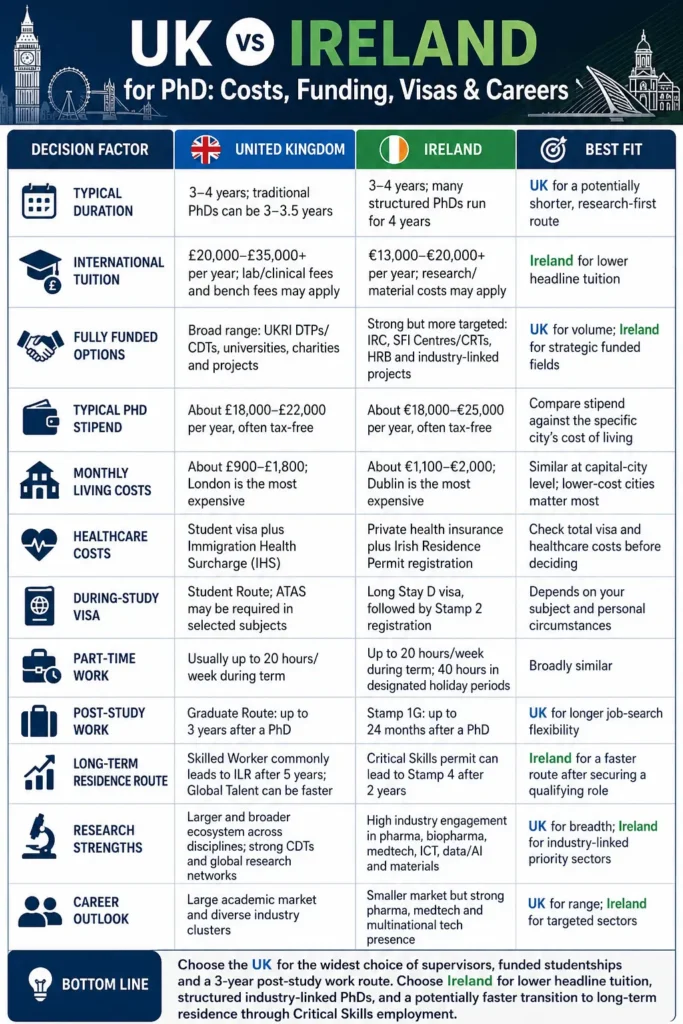
UK vs Ireland for PhD: Quick Comparison
| Decision factor | United Kingdom | Ireland | Best fit |
|---|---|---|---|
| Typical duration | 3–4 years; traditional PhDs can be 3–3.5 years | 3–4 years; many structured PhDs run for 4 years | UK for a potentially shorter, research-first route |
| International tuition | £20,000–£35,000+ per year; lab/clinical fees and bench fees may apply | €13,000–€20,000+ per year; research/material costs may apply | Ireland for lower headline tuition |
| Fully funded options | Broad range: UKRI DTPs/CDTs, universities, charities and projects | Strong but more targeted: IRC, SFI Centres/CRTs, HRB and industry-linked projects | UK for volume; Ireland for strategic funded fields |
| Typical PhD stipend | About £18,000–£22,000 per year, often tax-free | About €18,000–€25,000 per year, often tax-free | Compare stipend against the specific city’s cost of living |
| Monthly living costs | About £900–£1,800; London is the most expensive | About €1,100–€2,000; Dublin is the most expensive | Similar at capital-city level; lower-cost cities matter most |
| Healthcare costs | Student visa plus Immigration Health Surcharge (IHS) | Private health insurance plus Irish Residence Permit registration | Check total visa and healthcare costs before deciding |
| During-study visa | Student Route; ATAS may be required in selected subjects | Long Stay D visa, followed by Stamp 2 registration | Depends on your subject and personal circumstances |
| Part-time work | Usually up to 20 hours/week during term | Up to 20 hours/week during term; 40 hours in designated holiday periods | Broadly similar |
| Post-study work | Graduate Route: up to 3 years after a PhD | Stamp 1G: up to 24 months after a PhD | UK for longer job-search flexibility |
| Long-term residence route | Skilled Worker commonly leads to ILR after 5 years; Global Talent can be faster | Critical Skills permit can lead to Stamp 4 after 2 years | Ireland for a faster route after securing a qualifying role |
| Research strengths | Larger and broader ecosystem across disciplines; strong CDTs and global research networks | High industry engagement in pharma, biopharma, medtech, ICT, data/AI and materials | UK for breadth; Ireland for industry-linked priority sectors |
| Career outlook | Large academic market and diverse industry clusters | Smaller market but strong pharma, medtech and multinational tech presence | UK for range; Ireland for targeted sectors |
Bottom line: Choose the UK for the widest choice of supervisors, funded studentships and a 3-year post-study work route. Choose Ireland for lower headline tuition, structured industry-linked PhDs, and a potentially faster transition to long-term residence through Critical Skills employment.
Important: Figures vary by university, field, and year. Always verify tuition, stipend amounts, fees, and visa rules on official websites before applying.
Tuition Fees and Total Cost of Study
United Kingdom
- International PhD tuition typically ranges from about £20,000 to £35,000+ per year. Laboratory-intensive or clinical programs can be higher.
- Some departments charge additional bench fees for lab consumables, equipment, or fieldwork. These can add several thousand pounds annually; always confirm with your department.
- Home (UK) fees are much lower but only apply to eligible students (settled/pre-settled status, or other specific categories).
- You must also budget for the UK’s Immigration Health Surcharge (IHS) at the discounted student rate (payable per year of visa), plus the visa application fee and potential ATAS clearance for certain sensitive subjects.
Australia vs New Zealand for PhD: Costs, Visas, Jobs
Ireland
- International PhD tuition generally ranges from about €13,000 to €20,000+ per year, with some variation by institution and discipline. Laboratory/clinical fields can be higher.
- Structured PhDs may include research training modules; check for any additional research costs, materials, or travel.
- Non-EEA students typically must purchase private medical insurance and pay a registration fee to obtain the Irish Residence Permit (IRP).
Which is more affordable? Ireland’s headline international tuition can be lower on average, but Dublin’s living costs and private health insurance can offset savings. The UK’s tuition often runs higher, especially at prestigious institutions; however, if you secure a funded studentship covering fees+stipend, your out-of-pocket cost may be minimal in either country. The decisive factor is whether you win full funding.
Funding Opportunities
United Kingdom
- UKRI Studentships: Doctoral Training Partnerships (DTPs) and Centres for Doctoral Training (CDTs) funded by UKRI councils (e.g., EPSRC, MRC, BBSRC, NERC, ESRC, AHRC, STFC). Many now accept international applicants, though competition is strong and quotas may apply.
- University/Departmental Scholarships: Examples include Clarendon (Oxford), Gates Cambridge (University of Cambridge), and numerous institutional or faculty awards.
- Charitable/Trust Funding: Cancer Research UK, Wellcome-funded PhD programmes (in participating universities), Leverhulme Trust co-funding, and others.
- EU and International: Horizon Europe projects and Marie Skłodowska-Curie Doctoral Networks (the UK is associated from 2024), plus country-specific scholarships.
- Stipends: UKRI minimum stipends change annually; typical stipends are around £18,000–£22,000 per year, with possible London weighting. Stipends are generally tax-free.
Ireland
- Irish Research Council (IRC) – Government of Ireland Postgraduate Scholarship: Competitive national award that typically covers fees (often at EU rate; check institutional policy for non-EU fee coverage) plus a stipend. Stipend levels have been increasing in recent budgets; check current IRC call documentation.
- Science Foundation Ireland (SFI): PhD funding through SFI Centres, Centres for Research Training (CRTs), and investigator-led grants; strong industry-linked themes in ICT, data/AI, materials, and medtech.
- Health Research Board (HRB), Teagasc, Marine Institute, and other agencies fund domain-specific doctorates.
- EU and International: Horizon Europe and Marie Skłodowska-Curie Actions (MSCA) remain significant sources; Ireland is an EU member state with full access.
- Stipends: Commonly ~€18,000–€25,000, depending on funder and discipline. Many awards are tax-free scholarships.
Which is better? The UK offers a larger volume of studentships across many disciplines, but they are highly competitive. Ireland has fewer positions overall, yet many are fully funded within strategic research areas and can be attractive if your interests align with SFI/IRC priorities. For applicants in AI/data, medtech, and pharma, Ireland’s industry-connected funding can be especially compelling.
Cost of Living
United Kingdom
- London: Typically the most expensive; a single student might budget ~£1,400–£1,800 per month for housing, food, local transport, and incidentals. University accommodations can ease planning but may cost more.
- Other cities (e.g., Manchester, Glasgow, Leeds, Nottingham): Often ~£900–£1,400 per month, strongly dependent on rent and lifestyle.
- Official financial requirement for visas (subject to change): Generally around £1,334/month in London and £1,023/month outside London (for up to 9 months of the course) to demonstrate maintenance funds. Verify current figures on gov.uk before applying.
Ireland
- Dublin: High rents and living costs. A single student commonly budgets ~€1,500–€2,000 per month inclusive of rent, food, and transport.
- Other cities (e.g., Cork, Galway, Limerick): Often ~€1,100–€1,600 per month, depending on accommodation and lifestyle.
- Official financial requirement for visas (subject to change): Non-EEA students are generally asked to show at least €10,000 in living expenses for one academic year, along with proof of paid tuition and private health insurance. Verify current guidance on Irish Immigration Service Delivery (ISD) pages.
Bottom line: Dublin vs London costs are broadly comparable at the high end; many UK and Irish cities outside the capitals are more affordable. Securing university housing, sharing accommodation, and choosing lower-cost areas can substantially reduce expenses.
Visa and Immigration Pathways
United Kingdom
- Student Route Visa: Requires a Confirmation of Acceptance for Studies (CAS), meeting English and financial requirements, paying the visa fee and the discounted student-rate Immigration Health Surcharge (IHS). Some STEM/dual-use subjects require ATAS clearance before the visa.
- Dependants: Postgraduate research students (PhD) can generally bring dependants if eligibility criteria are met; check the latest gov.uk rules.
- Post-Study Work: The Graduate Route provides up to 3 years’ permission after PhD completion; it does not require a sponsoring employer and is not extendable. Time on the Graduate Route typically does not count towards settlement.
- Long-Term Options: Skilled Worker visa (sponsorship + salary threshold; time counts towards settlement, typically 5 years). Global Talent for outstanding researchers can lead to settlement more quickly (often 3 years). Rules and thresholds change periodically; always consult the latest gov.uk guidance.
Ireland
- Long Stay D Visa + Stamp 2: Apply for a long stay study visa, then register in Ireland for Stamp 2 permission (non-EEA). Requires acceptance to a program on the Interim List of Eligible Programmes (ILEP), proof of funds, health insurance, and fee payment.
- Dependants: Study visas generally do not allow immediate family reunification; dependants typically follow through employment routes. Confirm current policy on Department of Justice/ISD pages.
- Post-Study Work: The Third Level Graduate Programme (Stamp 1G) allows up to 24 months after a PhD (NFQ Level 10) to seek work.
- Long-Term Options: Critical Skills Employment Permit (CSEP) offers a fast track to Stamp 4 after 2 years. The General Employment Permit is another route (usually longer to Stamp 4). Student and Stamp 1G periods are generally not reckonable for long-term residence; check exact reckonable residence rules on official sites.
Which is better? For post-PhD job search time, the UK offers 3 years on the Graduate Route vs Ireland’s 24 months on Stamp 1G. For quicker settlement once employed, Ireland’s Critical Skills route can be faster to Stamp 4 (after 2 years), whereas the UK’s Skilled Worker usually requires 5 years to ILR (unless you qualify for Global Talent).
Program Structure and Duration
United Kingdom
- Many PhDs are 3–4 years, with a strong focus on independent research under a supervisor’s guidance.
- Some areas use Centres for Doctoral Training (CDTs) or Doctoral Training Partnerships (DTPs) with a 1-year taught or cohort-based training phase followed by 3 years of research (4-year total).
- Progress reviews, transferable-skills training, and optional teaching duties vary by institution.
Ireland
- Structured PhDs (often 4 years) combine research with formal modules in methods, professional skills, and sometimes industry placements.
- Supervision teams and Graduate Schools are common, with progression reviews and research training plans.
- Teaching assistantships may be part of the training (varies by discipline and school).
Which is better? If you prefer a cohort model with explicit training components, Ireland’s structured programs and UK CDTs/DTPs are attractive. If you want to dive directly into independent research, a traditional 3–3.5-year UK PhD may be ideal.
Research Quality and Opportunities
United Kingdom
- Major global research hub with comprehensive disciplinary strength, tracked by national assessments such as the Research Excellence Framework (REF).
- Strong international collaboration and high publication impact; excellent research infrastructure across leading universities and institutes.
- Re-associated to Horizon Europe from 2024, restoring access to large EU research consortia and doctoral networks.
Fully Funded Postdoctoral Fellowships in Germany 2027
Ireland
- High-impact in selected strategic domains: ICT/data/AI, pharmaceuticals and bioprocessing, medtech, materials, marine/agri-food, and sustainability.
- Science Foundation Ireland (SFI) Centres create deep academia–industry ties; many PhDs are embedded in multidisciplinary, applied research contexts.
- Full participant in Horizon Europe and MSCA Doctoral Networks, offering international mobility and cross-sector training.
Which is better? For breadth and scale, the UK is hard to beat. For targeted, industry-engaged research with strong EU connectivity, Ireland offers compelling opportunities—especially if your topic aligns with national priority areas.
Language and Entry Requirements
United Kingdom
- English is the language of instruction. Common minimums: IELTS 6.5–7.0 overall (with subscore requirements), TOEFL iBT and PTE equivalents accepted at many universities.
- Entry usually requires a strong bachelor’s (and/or master’s) degree with research experience and a viable research proposal.
Ireland
- English-language instruction across universities. Typical minimums similar to the UK (e.g., IELTS 6.5–7.0 or equivalent), with some program-specific variations.
- Admission often requires a relevant bachelor’s/master’s and a research proposal aligned with supervisor expertise or a funded project’s scope.
Tip: Always check department-level requirements, which can be higher than university minima, particularly for competitive programs.
Application Process and Timelines
United Kingdom
- Find a supervisor whose work matches your interests. Many universities expect you to contact potential supervisors with a concise proposal and CV before submitting a formal application.
- Funding cycles: DTP/CDT deadlines often fall between October and February for entry the following academic year. Self-funded applications can be accepted on a rolling basis.
- Documents: Research proposal, academic CV, transcripts, references, English test scores (if required), and possibly a personal statement. Some programs may interview.
- ATAS: Required for certain sensitive subjects for non-UK nationals; must be obtained before the visa stage.
Ireland
- Structured calls: Many funded PhD positions are advertised by departments or SFI/IRC projects with specific calls and deadlines.
- Supervisor-led: It’s common to secure supervisor support first, then apply via the Graduate School or department portal.
- Documents: Similar to the UK—proposal, CV, references, transcripts, and English proficiency. Interviews are common for funded roles.
- Visa timing: Non-EEA students should apply for a long stay D visa and plan early for registration on arrival.
Which is better? Both systems value supervisor fit. If you prefer cohort-based recruitment with clear funding attached to specific topics, Ireland’s structured advertisements (and UK CDTs) are ideal. If you want to pitch your own project to a PI or apply year-round, the UK has more rolling opportunities.
Fully Funded PhD Scholarships in Germany 2027 | Apply Now
Career Opportunities After Graduation
Academic Careers
- UK: Large ecosystem of postdoctoral and research fellow roles; typical starting salaries for postdocs are often ~£35,000–£45,000 (higher in London or for senior roles), varying by institution and field.
- Ireland: Postdoc roles follow nationally informed salary scales; many positions start around ~€39,000–€50,000+, depending on level and experience. Availability is concentrated in research-active universities and SFI centres.
Industry Careers
- UK: Strong markets in AI/data, fintech, aerospace, automotive, biotech, pharmaceuticals, energy, and consulting. Research-intensive clusters exist around London, the “Golden Triangle” (Oxford–Cambridge–London), and major regional hubs (e.g., Manchester, Edinburgh, Bristol).
- Ireland: Global leaders in pharma/biopharma (Pfizer, MSD, Janssen, Novartis), medtech (Medtronic, Boston Scientific, Stryker), and ICT (Google, Apple, Intel, Microsoft, Meta). Strong R&D links via SFI centres, often facilitating industry placements and collaborations.
Visa Pathways
- UK: PhD graduates use the 3-year Graduate Route to job-hunt, then switch to Skilled Worker (sponsored) or Global Talent (for recognized researchers). Skilled Worker time typically counts towards settlement.
- Ireland: PhD graduates use Stamp 1G (up to 24 months) to secure employment. The Critical Skills Employment Permit is a fast track to Stamp 4 after 2 years; General Employment Permit usually takes longer for long-term residence eligibility.
Which is better? If you want maximum time to job-hunt post-PhD, the UK’s 3-year Graduate Route is advantageous. If you’re targeting pharma/medtech or big tech with a goal of earlier long-term residence, Ireland’s Critical Skills pathway can be very attractive once you have a qualifying job offer.
Fully Funded PhD Opportunities in New Zealand 2026
Best Universities and Research Institutes
United Kingdom (examples)
- University of Oxford; University of Cambridge; Imperial College London; University College London; University of Edinburgh; University of Manchester; King’s College London; University of Bristol; University of Warwick; University of Glasgow.
- Specialist research organizations and national labs also contribute to doctoral training in partnership with universities.
Ireland (examples)
- Trinity College Dublin; University College Dublin; University of Galway; University College Cork; Dublin City University; University of Limerick; Maynooth University.
- Research institutes and SFI Centres: Tyndall National Institute; ADAPT; Insight (data/AI); CONNECT (communications); SSPC (pharma); I-Form (materials manufacturing); VistaMilk; INFANT; and others.
Always check the department-level research groups and your prospective supervisor’s recent publications to evaluate lab fit, facilities, and ongoing grants.
Pros and Cons
Pros of the UK
- Large volume of funded studentships across a wide spectrum of fields.
- 3-year Graduate Route gives more time to find skilled employment.
- Global research scale and breadth; re-associated to Horizon Europe.
- Many cities and universities to match budget and research interests.
Cons of the UK
- International tuition can be high; bench fees may add costs.
- Healthcare surcharge (IHS) increases total budget.
- Graduate Route time typically does not count toward settlement; Skilled Worker thresholds and sponsorship requirements apply.
Pros of Ireland
- Strong industry-linked research via SFI Centres; excellent in pharma/medtech/ICT.
- Many funded PhDs provide fees+stipend; structured training and placements.
- Critical Skills Employment Permit can lead to Stamp 4 after 2 years.
- Full participant in Horizon Europe and MSCA Doctoral Networks.
Cons of Ireland
- Fewer total PhD positions overall; competition concentrated in priority areas.
- Dublin living costs are high; private health insurance required.
- Post-study work permission (Stamp 1G) is up to 24 months, shorter than UK’s 3 years.
Which Option is Best for You?
- Students with a limited budget: Prioritize fully funded positions in either country. Ireland may have lower headline tuition, but a funded UK studentship can eliminate fees. Compare total stipends vs city costs.
- Biomedical/Pharma/Medtech researchers: Ireland’s ecosystem (SFI centres, pharma/medtech clusters) is exceptionally strong. The UK also has excellent biomedical hubs; focus on supervisor fit and lab resources.
- Engineering and Materials: Both are strong. The UK offers broad options and CDTs; Ireland’s I-Form (materials) and other centres can be ideal for industry-aligned projects.
- Computer Science/Data/AI: Both countries are excellent. Ireland’s ADAPT/Insight and major tech companies provide strong applied pathways; the UK’s AI hubs and CDTs offer scale and breadth.
- Long-term immigration goals: UK offers Global Talent and Skilled Worker (5 years to ILR); Ireland’s Critical Skills route can lead to Stamp 4 after 2 years. Choose based on your likelihood of landing a qualifying job and personal circumstances.
- Academic careers: UK has a larger volume of postdoc and lecturer opportunities. Ireland has strong roles but a smaller market—network early and leverage EU collaborations.
- Industry careers: UK provides breadth across many sectors; Ireland shines in pharma/biopharma, medtech, and ICT with close industry ties.
Expert Tips
- Anchor your decision in supervisor fit: Email potential supervisors with a concise, tailored message and a 1–2 page proposal linked to their recent papers.
- Apply where funding is strongest: Target DTP/CDTs (UK) and SFI/IRC-funded positions (Ireland). Many projects are pre-funded—apply early.
- Budget carefully: Add bench fees, visa costs, IHS (UK), private health insurance (Ireland), and moving costs to your spreadsheet.
- Use official visa guidance: Rules and thresholds change. Confirm maintenance funds, dependants policy, and timelines on gov.uk (UK) and ISD/Department of Justice (Ireland).
- Leverage EU funding: Look for MSCA Doctoral Networks and Horizon Europe projects in both countries.
- Plan your post-PhD pathway now: Map Graduate Route vs Stamp 1G, and shortlist employers who sponsor Skilled Worker (UK) or Critical Skills (Ireland).
- Consider city-level costs: A slightly lower stipend in a cheaper city may stretch further than a higher stipend in a capital.
- Network: Attend virtual open days, Graduate School webinars, and research group seminars. Ask current PhD students candid questions about workload, culture, and outcomes.
- Publish and present: Strong research outputs and conference networking improve both academic and industry prospects. For dissemination and visibility, consider reputable platforms like IR Research Publication.
External Resources (Official)
- UK Visas and Immigration – Student route: https://www.gov.uk/student-visa
- UK Graduate Route (post-study work): https://www.gov.uk/graduate-visa
- Academic Technology Approval Scheme (ATAS): https://www.gov.uk/guidance/academic-technology-approval-scheme
- UK Research and Innovation (UKRI) – Studentships/funding: https://www.ukri.org/councils/
- Horizon Europe association (UK Government): https://www.gov.uk/government/collections/horizon-europe
- Ireland – Immigration Service (ISD) Study in Ireland: https://www.irishimmigration.ie/coming-to-study-in-ireland/
- Ireland – Third Level Graduate Programme (Stamp 1G): https://www.irishimmigration.ie/third-level-graduate-programme/
- Irish Research Council (IRC): https://research.ie/
- Science Foundation Ireland (SFI): https://www.sfi.ie/
- Health Research Board (HRB): https://www.hrb.ie/
- Euraxess UK: https://www.euraxess.org.uk/
- Euraxess Ireland: https://www.euraxess.ie/
- Interim List of Eligible Programmes (ILEP): https://www.irishimmigration.ie/immigration-requirements-for-students-from-outside-eea/
- National Framework of Qualifications (Ireland): https://www.qqi.ie/what-we-do/the-qualifications-system/national-framework-of-qualifications
Internal Links
For publishing and sharing your doctoral research, visit IR Research Publication.
Explore calls for papers, editorial policies, and author services with IR Research Publication.
Stay updated with research best practices and dissemination tips at IR Research Publication.
Frequently Asked Questions
Is the UK or Ireland cheaper for a PhD?
Ireland often lists lower international tuition on average, but Dublin’s living costs and private health insurance can offset savings. UK tuition is frequently higher, yet funded studentships can cover full fees and stipend. The cheapest option is the one where you secure full funding aligned with an affordable city.
What is the typical PhD stipend in the UK vs Ireland?
UK stipends commonly range around £18,000–£22,000 per year (often tax-free; London can be higher). In Ireland, many stipends fall around €18,000–€25,000 per year (often tax-free scholarships). Exact amounts depend on funder, discipline, and year.
How long does a PhD take in the UK vs Ireland?
Both typically take 3–4 years. Ireland’s structured programs and UK CDTs are often 4 years; traditional UK PhDs can be 3–3.5 years, sometimes with a writing-up period.
What post-study work rights do I get?
UK PhD graduates can usually stay up to 3 years on the Graduate Route. Ireland offers up to 24 months on the Third Level Graduate Programme (Stamp 1G) after PhD completion.
Which country is better for permanent residency?
It depends on your job path. In the UK, Skilled Worker typically leads to settlement after 5 years; Global Talent can be faster. In Ireland, the Critical Skills Employment Permit can lead to Stamp 4 after 2 years. Student/graduate periods generally don’t count—verify reckonable residence rules on official sites.
Are dependants allowed for PhD students?
In the UK, eligible postgraduate research students (PhD) can generally bring dependants subject to current rules. In Ireland, study visas usually do not allow immediate family reunification; dependants typically follow via employment-based routes. Always check the latest immigration guidance.
Do I need ATAS clearance?
ATAS applies to certain subjects in the UK involving advanced technologies with potential military applications. If your course is on the controlled list and you are a non-exempt nationality, you must secure ATAS before your visa. Ireland does not use ATAS.
Are English tests required?
Usually yes for non-native speakers. Typical requirements are IELTS 6.5–7.0 or equivalent (TOEFL, PTE). Some universities waive tests for prior degrees taught in English—check departmental policies.
Can I work during my PhD?
In both countries, students can usually work part-time up to 20 hours per week during term and more during holidays (Ireland specifies 40 hours in designated periods). Your stipend or visa may include additional conditions—confirm locally.
Which is better for industry careers: UK or Ireland?
Both are excellent. The UK has breadth across many sectors. Ireland has particularly strong ecosystems in pharma/biopharma, medtech, and ICT with close industry ties and pathways to Critical Skills permits.
Conclusion: UK vs Ireland for PhD
There is no universal “best” choice in the UK vs Ireland for PhD debate—only the best match for your goals and funding prospects.
- Choose the UK if you value a very large and diverse research ecosystem, want up to 3 years of post-study work time, and can secure a strong studentship (DTP/CDT or institutional award). The UK is ideal if you prioritize breadth of supervisors, centers, and cities.
- Choose Ireland if your interests align with SFI/IRC priority areas, you prefer structured training with industry links, and you plan to transition quickly into a Critical Skills role that can lead to Stamp 4 after 2 years. Ireland is especially compelling for pharma/biopharma, medtech, and ICT.
Whichever you select, prioritize supervisor fit, funded positions, and a city you can afford. Confirm visa and financial requirements on official sites and plan early for a smooth start.
About IR Research Publication
IR Research Publication is dedicated to advancing global scholarship by helping researchers disseminate high-quality work to the academic community and industry stakeholders. Through accessible publishing, editorial support, and outreach, IR Research Publication empowers doctoral candidates and early-career researchers to increase the visibility, impact, and credibility of their findings. Learn more at irrespub.com.