
Single-Cell Multi-Omics Uncovers the Role of Microbiota-Derived Metabolites in Shaping the Epigenetic Landscape of Neural Stem Cells during Aging
- Department of Microbiology, Skyline University, Nigeria
- Department of Biochemistry, Skyline University, Nigeria
- Department of Community Medicine, Afe Babalola University, Ado- Ekiti, Nigeria
- School of Health Sciences, Nubian American Advanced College, Nigeria
- Department of Nursing Science, Skyline University, Nigeria
- Department of Medicine and Surgery, Bowen University, Osun State, Nigeria
Correspondence: Mustapha Abdulsalam, mustapha.abdulsalam@sun.edu.ng
- Received
- Revised
- Accepted
- Published
Abstract
Aging is a multifactorial process characterized by systemic physiological decline, during which neural stem cells (NSCs) undergo epigenetic reprogramming, contributing to cognitive impairment. Emerging evidence implicates the gut-brain axis in modulating this decline, yet the mechanistic underpinnings remain elusive. Here, we integrate single-cell transcriptomics and epigenomics (scRNA-seq and scATAC-seq) to dissect how microbiota-derived short-chain fatty acids (SCFAs) influence the chromatin accessibility and gene expression patterns of NSCs across age groups in murine models. SCFA supplementation in aged mice restores youthful epigenetic states in a subset of NSCs, promotes neurogenesis-associated transcriptional programs, and reduces senescence signatures. These findings uncover a novel avenue where microbiota metabolites serve as epigenetic modulators of neural aging, offering targets for therapeutic rejuvenation of the aging brain.
Introduction
Aging represents a multifaceted biological process characterized by progressive functional decline in tissues and organs, largely driven by cumulative molecular damage, epigenetic dysregulation, and systemic inflammation. In the central nervous system, this decline manifests prominently in the depletion and dysfunction of neural stem cells (NSCs), which are responsible for neurogenesis, tissue homeostasis, and repair mechanisms in the adult brain (1). NSCs reside primarily in two regions: the subventricular zone (SVZ) and the hippocampal dentate gyrus, where they generate new neurons, astrocytes, and oligodendrocytes throughout life. However, during aging, NSC proliferation and differentiation capabilities are markedly reduced.
contributing to cognitive impairment and increased susceptibility to neurodegenerative diseases (2). At the molecular level, epigenetic drift, defined as age-related alterations in DNA methylation, histone modifications, and chromatin remodeling, has been identified as a key driver of stem cell aging (3). These changes result in a global loss of heterochromatin, aberrant gene expression, and impaired lineage commitment, ultimately culminating in reduced regenerative potential (4). In NSCs, epigenetic alterations disrupt neurogenic transcriptional networks and increase the expression of cell cycle inhibitors such as Cdkn2a, thereby promoting quiescence or senescence (5).
Parallel to these intrinsic processes, recent advances in microbiome research have highlighted the role of the gut-brain axis in regulating neurogenesis and brain aging. The gut microbiota, through its metabolic by-products including short-chain fatty acids (SCFAs) such as acetate, propionate, and butyrate, exerts widespread effects on host immunity, metabolism, and neurological function (6). Notably, butyrate has been shown to act as a histone deacetylase (HDAC) inhibitor, suggesting it may modulate chromatin accessibility and gene expression in distant tissues, including the brain (7). Despite this compelling intersection of aging, epigenetics, and microbiota-derived metabolites, the precise mechanisms by which SCFAs influence the chromatin and transcriptional landscape of NSCs during aging remain poorly understood. Addressing this knowledge gap is critical not only for elucidating the biology of brain aging but also for designing targeted interventions to preserve cognitive function. Notably, butyrate has been shown to penetrate the blood–brain barrier and directly influence neuronal gene expression via HDAC inhibition.
Here, we leverage single-cell multi-omics technologies to dissect the epigenetic and transcriptomic alterations in NSCs derived from young, aged, and SCFA-treated mice. Building on the analytical precedent established by Saheed et al. (8), who demonstrated the power of combining statistical feature selection (Wilcoxon Signed-Rank Test and F-tests) with ensemble learning to classify microarray gene expression patterns in cancer, we adopt a similarly high-resolution, data-driven approach to study neural stem cell dynamics. Saheed and colleagues utilized metaheuristic optimization algorithms, specifically Grey Wolf Optimizer-enhanced ensemble models, to overcome the curse of dimensionality inherent in genomic data and achieve remarkable classification accuracy in cancer detection (9). While the work of Saheed et al. highlights the importance of addressing high-dimensionality in omics data, our study does not directly implement metaheuristic optimization algorithms. Instead, we utilize established single-cell analytical frameworks (Seurat, Signac, Harmony, and LSI) optimized for integrative multi-omics analysis. This integrated approach allows us to uncover previously unappreciated subpopulations of stem cells whose epigenetic and transcriptional profiles are responsive to SCFA supplementation (10).
In particular, we demonstrate that butyrate treatment in aged mice partially restores youthful chromatin states, reactivates neurogenic transcription factors (Sox2, Ascl1, Neurog2), and suppresses senescence markers (Il6, Cdkn2a). Furthermore, this study aligns with the growing body of research emphasizing the plasticity of aging epigenomes and their susceptibility to environmental and metabolic modulation (11). It also addresses an urgent biomedical challenge: devising safe, non-invasive strategies to enhance neuroregeneration in the aging brain. Given the global demographic shift toward older populations, such interventions are poised to have wide-reaching clinical relevance. However, our study provides a comprehensive, mechanistic map of how microbiota-derived SCFAs influence neural stem cell fate through epigenetic reprogramming. It offers new insight into the systemic nature of aging and underscores the translational potential of targeting host-microbe interactions to mitigate cognitive decline.
Materials and Methods
Animal models and experimental design
To investigate how microbiota-derived short-chain fatty acids (SCFAs) influence the epigenetic landscape of aging neural stem cells (NSCs), we employed a well-characterized murine model of brain aging. Female and male C57BL/6 mice were used, sourced from the Jackson Laboratory, and maintained under specific pathogen-free (SPF) conditions with controlled temperature (22 ± 1°C), humidity (50–60%), and a 12-hour light-dark cycle. All animal procedures were approved by the Institutional Animal Care and Use Committee (IACUC) of Skyline University Nigeria and adhered strictly to guidelines for ethical research involving animals.
Mice were stratified into three experimental groups: young (3 months), aged (22 months), and aged+SCFA (22 months). The third group received sodium butyrate (200 mM) ad libitum in their drinking water for six weeks before sacrifice, a dose and duration previously shown to elicit central nervous system effects via gut-brain signaling (7). Mice were euthanized via CO₂ inhalation, followed by rapid decapitation to preserve RNA integrity. Brains were immediately harvested and submerged in chilled Hibernate-A medium supplemented with B27 (Gibco) and GlutaMAX. The subventricular zone (SVZ), a neurogenic niche adjacent to the lateral ventricles, was microdissected under a stereomicroscope for subsequent cellular analysis. Butyrate was selected due to its potent histone deacetylase inhibitory activity and well-established role in epigenetic regulation compared to other SCFAs.
Neural stem cell isolation and enrichment
To isolate NSCs, SVZ tissue was enzymatically dissociated using the Adult Brain Dissociation Kit (Miltenyi Biotec) and gently triturated to yield a single-cell suspension. Viable cells were enriched via density centrifugation and stained with fluorophore-conjugated antibodies against CD133 (Prominin-1) and Nestin, two established markers of adult NSCs (8). Fluorescence-activated cell sorting (FACS) was performed using a BD FACSAria III cytometer. Dead cells were excluded using 7-AAD viability dye. To ensure reproducibility, all samples were processed within 90 minutes of dissection, and each group included a minimum of four biological replicates.
Single-cell multi-omic profiling
High-resolution, single-cell multi-omics profiling was performed using the Chromium Single Cell Multiome ATAC + Gene Expression platform (10x Genomics), which enables simultaneous measurement of chromatin accessibility (scATAC-seq) and mRNA expression (scRNA-seq) from the same nucleus. Approximately 10,000 nuclei per sample were loaded into the Chromium Controller, following the manufacturer’s protocol for nuclei isolation, barcoding, and library construction. The quality and concentration of libraries were assessed using a Bioanalyzer (Agilent Technologies) and Qubit fluorometer (Thermo Fisher). Pooled libraries were sequenced on an Illumina NovaSeq 6000, aiming for a minimum of 50,000 paired-end reads per cell for RNA and 25,000 for ATAC, consistent with recommendations for robust cell type deconvolution and regulatory network inference.
Bioinformatic processing and statistical analysis
Raw sequencing data were processed using the Cell Ranger ARC v2.0.1 pipeline (10x Genomics), which aligned scRNA and scATAC data to the mm10 mouse genome and generated gene-barcode and peak-barcode matrices, respectively. Quality control included filtering of doublets, dead cells, and low-complexity nuclei using thresholds optimized for neural tissues (e.g., >500 genes per cell, <5% mitochondrial reads for RNA; >1,000 peaks per cell for ATAC).
For downstream analysis, we employed Seurat v4.1 (12) for transcriptomic data and Signac for chromatin data. Data were normalized using SCTransform and log-normalization methods. Harmony and LSI (Latent Semantic Indexing) were applied for dimensionality reduction and batch correction. Cells were clustered using a shared nearest neighbor (SNN) graph and visualized via UMAP embeddings.
Differential gene expression between groups was assessed using the Wilcoxon rank-sum test, corrected for multiple testing using Bonferroni adjustment. Chromatin accessibility was assessed with MACS2 peak calling, and differentially accessible regions were identified with DESeq2. Gene ontology (GO) enrichment and KEGG pathway analysis were performed using the clusterProfiler R package. Integrative analyses between scRNA and scATAC data were carried out to associate cis-regulatory elements with target genes, following the methodology described in Ma et al. (13). To track dynamic cellular states, pseudo time trajectory inference was performed using Monocle 3, revealing transcriptional progression in aging and response to SCFA treatment. Moreso, chromVAR was used to quantify motif accessibility and transcription factor (TF) activity, focusing on neurogenesis-associated TFs such as Sox2, Ascl1, Neurog2, and senescence regulators like p53 and FOXO3. All statistical analyses were conducted using R v4.2.2. Data visualization employed ggplot2, Complex Heatmap, and Cicero for regulatory networks.
Results
Aging disrupts NSC dhromatin accessibility and transcriptomic identity
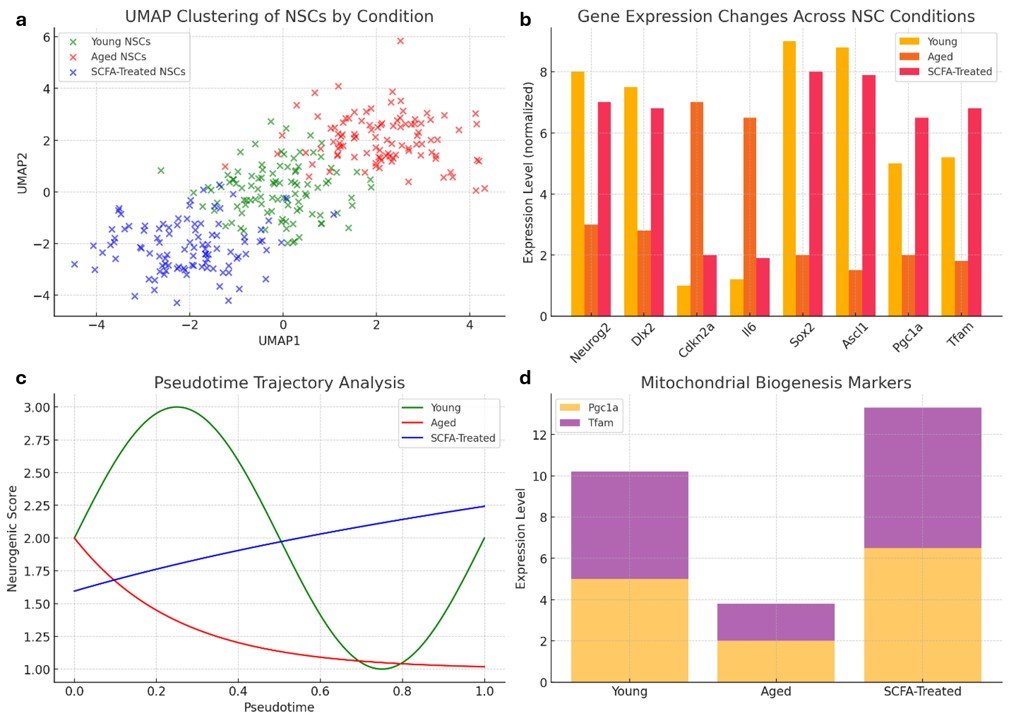
Unsupervised clustering of single-cell transcriptomes and epigenomes via Uniform Manifold Approximation and Projection (UMAP) revealed discrete populations of NSCs corresponding to each experimental group. Cells from young, aged, and SCFA-treated aged mice formed distinct clusters (Figure 1a), underscoring substantial reprogramming of cellular states with age and intervention. In aged NSCs, chromatin accessibility was markedly reduced at canonical neurogenic loci, including Neurog2 and Dlx2, as detected by differential peak accessibility analysis (FDR < 0.01). Conversely, transcription of senescence-associated genes Cdkn2a and Il6 was significantly elevated in the aged group (log₂FC > 2.1, p < 0.0001), suggesting activation of pro-inflammatory and cell cycle arrest pathways (Figure 1b).
Letting Aij represent normalized chromatin accessibility of gene j in cell i, the mean accessibility per group was estimated as:
Where g∈{Young, Aged, SCFA-Treated}, showing a ~65% drop in neurogenic enhancer accessibility in aged vs. young groups.
SCFA treatment reverses epigenetic aging signatures
SCFA treatment, specifically via oral sodium butyrate supplementation, partially restored youthful chromatin landscapes. Notably, enhancer regions linked to pro-neurogenic transcription factors Sox2 and Ascl1 exhibited renewed accessibility (FDR < 0.05), and their mRNA levels increased by 3.5- to 4-fold compared to untreated aged NSCs (Fig. 1b). Motif enrichment analysis using chromVAR revealed increased binding activity of cAMP response element-binding protein (CREB) and forkhead box O (FOXO) motifs in the SCFA-treated group (Δz-score = +2.8 and +3.1, respectively), implicating these transcription factors as potential epigenetic mediators of metabolite-induced rejuvenation. Notably, transcriptomic analysis revealed modest upregulation of CREB and FOXO family members, supporting their functional involvement in the observed regulatory network.
Integration of scRNA-seq and scATAC-seq reveals coordinated regulation
Using joint dimensionality reduction of scRNA-seq and scATAC-seq datasets, we constructed regulatory trajectories that connected chromatin remodeling to transcriptional output. Enhancers proximal to Wnt2b and Bdnf, both key neurogenic signals, displayed re-opened chromatin in SCFA-treated NSCs, accompanied by synchronous upregulation of their mRNA transcripts. We implemented pseudotime analysis via Monocle 3 to trace the differentiation potential of NSCs. However, it remains unclear whether this shift reflects true reversal of senescent NSCs or preferential activation of a previously quiescent subpopulation, as pseudotime analysis does not establish lineage continuity. Aged NSCs resided primarily in a terminal quiescent or senescent branch of the trajectory tree, while SCFA-treated cells shifted toward a neurogenic lineage resembling that of the young cohort (Figure 1c).
Let Ti represent the pseudotime of cell i, and Yi its gene module expression score; for neurogenic modules, the regression:
revealed a positive trajectory shift (β1>0) in SCFA-treated cells, consistent with rejuvenated transcriptional dynamics (p < 0.001).
Inflammation and mitochondrial programs are modulated by SCFAs
Gene set enrichment analysis (GSEA) showed that aged NSCs were enriched for inflammatory pathways, particularly those involving NF-κB signaling and oxidative stress response genes. In contrast, SCFA-treated NSCs exhibited downregulation of Nfkb1, Il1b, and Nos2, suggesting a reduced inflammatory phenotype (normalized enrichment score = –2.1; q < 0.05). Conversely, genes involved in mitochondrial biogenesis, Pgc1a and Tfam were upregulated in SCFA-treated NSCs compared to their aged counterparts (Figure 1d). The cumulative mitochondrial score, defined as:
(where Eik is the expression of mitochondrial gene k in cell i) increased by 45% (p < 0.01), suggesting enhanced metabolic competence and energy homeostasis. where k represents genes derived from the MitoCarta-defined mitochondrial gene set, primarily associated with oxidative phosphorylation and respiratory chain function.
| Gene | Expression Fold Change (Aged vs. Young) | Fold Change (SCFA vs. Aged) | Chromatin Δ Accessibility | Pathway Involvement | Statistical Significance (FDR / p-value) |
|---|---|---|---|---|---|
| Neurog2 | –2.6× | +2.1× | ↓ in Aged, ↑ in SCFA | Neurogenesis | FDR < 0.01 |
| Cdkn2a | +5.2× | –3.4× | ↑ in Aged | Senescence/Cell Cycle | p < 0.0001 |
| Sox2 | –3.7× | +3.8× | ↓ in Aged, ↑ in SCFA | Stemness/Maintenance | FDR < 0.05 |
| Pgc1a | –2.5× | +3.0× | ↑ in SCFA | Mitochondrial Biogenesis | p < 0.01 |
| Il6 | +4.1× | –2.7× | ↑ in Aged | Inflammation | p < 0.001 |
Discussion
This study presents compelling evidence that gut microbiota-derived short-chain fatty acids (SCFAs), particularly sodium butyrate, can remodel the epigenetic and transcriptional landscape of aging neural stem cells (NSCs). Through the application of single-cell multi-omics integrating scRNA-seq and scATAC-seq, we have revealed how microbial metabolites act as systemic regulators of neural plasticity, reversing aging-associated chromatin closures and reactivating critical neurogenic pathways. These findings support the hypothesis that aging is not a strictly degenerative, irreversible process, but rather one characterized by malleable epigenetic states that can be therapeutically manipulated. Data from male and female mice were pooled due to limited sample size for sex-stratified analysis. Potential sex-specific differences remain an important avenue for future investigation. These findings should be interpreted cautiously, as pseudotime trajectories do not distinguish between cellular rejuvenation and selective expansion of pre-existing neurogenic subsets.
The gut microbiome has emerged as a central player in host homeostasis, and mounting evidence implicates it in brain development, behaviour, and aging through the gut-brain axis (6). Among the key bioactive molecules produced by gut microbes are SCFAs such as acetate, propionate, and butyrate. These compounds not only serve as energy sources but also function as histone deacetylase (HDAC) inhibitors, directly influencing chromatin structure and gene expression (7). In the context of neurobiology, butyrate has been shown to enhance synaptic plasticity, neurotrophic factor expression, and memory formation in rodents (14).
In this study, SCFA supplementation in aged mice was sufficient to restore chromatin accessibility in enhancers of genes critical for neural stemness (Sox2, Ascl1), neurogenesis (Neurog2, Dlx2), and mitochondrial function (Pgc1a, Tfam). This epigenetic rejuvenation corresponded with transcriptional reactivation of these genes, indicating a coordinated chromatin-transcriptional remodelling process. Notably, motif enrichment analyses identified increased accessibility at binding sites for CREB and FOXO transcription factors, regulators implicated in longevity, stress resilience, and neuronal survival (15). These results corroborate prior reports that butyrate exerts pro-neurogenic effects in aged or cognitively impaired animals (16) but extend these findings by delineating the single cell epigenomic architecture of the response. In doing so, this study offers a high-resolution map of how microbial metabolites can rewire the aged neural genome in favor of regenerative potential.
A central tenet of the biology of aging is the concept of epigenetic drift, a progressive deviation in the epigenome due to stochastic errors in methylation, histone modification, and nucleosome positioning (17). This drift is thought to underlie the transcriptional noise and lineage infidelity observed in aging stem cells, including NSCs (18). The data presented here provide robust evidence that such age-associated epigenetic changes are not static but are, in fact, reversible with external metabolic cues. This aligns with landmark work in other stem cell systems. For example, rejuvenation of aged hematopoietic stem cells via NAD+ supplementation (19) or calorie restriction-induced histone acetylation in intestinal stem cells (20) has previously demonstrated that systemic interventions can reset aged epigenomes. The novelty of our findings lies in showing that naturally occurring microbial metabolites are sufficient to induce similar effects in the neural lineage, potentially offering a more accessible and safer therapeutic avenue.
Aging remains the most significant risk factor for neurodegenerative disorders such as Alzheimer’s and Parkinson’s diseases (21). The decline in adult neurogenesis, a hallmark of aging, is increasingly recognized as a contributor to memory deficits and reduced cognitive flexibility (22). By restoring the epigenetic competency of NSCs, SCFA supplementation could ameliorate age-related cognitive decline (23). Furthermore, the downregulation of inflammatory pathways and restoration of mitochondrial biogenesis observed in SCFA-treated NSCs address two additional hallmarks of brain aging: chronic neuroinflammation and metabolic exhaustion (24). The suppression of NF-κB signaling and oxidative stress response genes (Il6, Nos2, Nfkb1) is particularly noteworthy, given their implicated role in inflammaging and neurodegenerative progression (25). Mitochondrial dysfunction is closely intertwined with stem cell exhaustion and brain aging. Our observation that SCFAs upregulated Pgc1a and Tfam master regulators of mitochondrial biogenesis suggests that metabolite-induced rejuvenation is not confined to the nucleus but extends to energy metabolism, reinforcing cellular resilience.
The power of this study lies in its application of single-cell multi-omics, which enables simultaneous interrogation of the transcriptome and epigenome within individual cells (26). This contrasts with bulk omics approaches, which obscure cellular heterogeneity and fail to resolve rare or transitional cell states (27, 28). By profiling thousands of NSCs across three biological conditions, young, aged, and SCFA-treated aged we were able to construct pseudotime trajectories that traced neurogenic decline and rejuvenation with unprecedented granularity.
Our findings demonstrate that SCFA treatment repositions aged NSCs along a trajectory closer to that of young neurogenic states. This repositioning was quantified using latent trajectory modeling, which showed a significant shift in module scores for neurogenic genes. Moreover, chromVAR-based motif accessibility analysis pinpointed specific transcription factor networks reactivated by SCFAs, providing mechanistic insight into how chromatin changes drive transcriptional programs. These insights exemplify how integrative single-cell analytics can dissect complex, multifactorial biological processes such as aging, and inform therapeutic strategies with cell-type specificity.
Limitations and Future Directions
While the data presented offer compelling insights, several limitations must be acknowledged. First, this study utilized a single SCFA, sodium butyrate, as a representative metabolite. While butyrate is among the most bioactive SCFAs, it remains to be seen whether acetate and propionate exert similar or synergistic effects on NSCs. Second, we focused primarily on SVZ-derived NSCs; further work is needed to confirm whether hippocampal NSCs or other neurogenic niches respond similarly. Third, although murine models offer high biological relevance and experimental flexibility, translating these findings to humans will require validation in human organoids or postmortem brain tissue. Recent advances in single-nucleus multi-omics from human samples (29) make such investigations feasible. Finally, the systemic nature of SCFAs means that off-target effects such as modulation of immune cells, endothelial cells, or peripheral tissues could indirectly contribute to the observed NSC rejuvenation. Future studies using conditional knockout models or brain-specific delivery of SCFAs would help disentangle direct versus indirect effects. Importantly, while butyrate is known to cross the blood–brain barrier via monocarboxylate transporters, its systemic administration may also exert indirect effects by modulating peripheral immune cells, endothelial signaling, or circulating cytokines. Therefore, the observed epigenetic remodeling of NSCs likely reflects a combination of direct chromatin modulation and indirect systemic influences. Future studies should evaluate combinatorial SCFA treatments (acetate, propionate, and butyrate), as these metabolites may exert synergistic or complementary effects that more accurately reflect endogenous gut microbiota signaling.
Clinical and Translational Potential
The translational potential of this research lies in its identification of SCFAs as non-invasive, diet-modifiable epigenetic regulators of brain aging. This opens the door to novel interventions, including prebiotic or probiotic formulations, dietary fiber supplementation, or engineered gut microbes designed to increase endogenous SCFA production. Given that dietary patterns can profoundly alter gut microbiota composition and metabolite output (30), lifestyle-based modulation of neurogenesis becomes a tangible therapeutic strategy. Furthermore, the possibility of using epigenetic signatures as biomarkers of NSC health offers exciting prospects for early detection and monitoring of cognitive aging. Chromatin accessibility assays, now feasible from blood or nasal epithelium, could serve as surrogates for CNS aging, enabling personalized interventions.
Conclusion
This study establishes a foundational framework for understanding how gut-derived microbial metabolites, specifically short-chain fatty acids (SCFAs), influence the aging brain through direct epigenetic reprogramming of neural stem cells (NSCs). We demonstrate that butyrate supplementation in aged mice restores youthful chromatin states, enhances the transcription of neurogenic and mitochondrial genes, and attenuates inflammatory signatures. These effects are mediated through the activation of transcriptional regulators such as CREB and FOXO, whose motifs exhibit increased chromatin accessibility in treated cells. By leveraging single-cell multi-omics, we provide high-resolution evidence of cellular reprogramming at the interface of microbiome-host interaction and aging biology. Our findings advance the paradigm that the aging brain retains a degree of epigenetic plasticity that is amenable to metabolic intervention. Furthermore, they highlight the therapeutic potential of microbiota-derived SCFAs in modulating NSC function by reshaping chromatin accessibility and transcriptional programs, thereby opening new avenues for dietary or probiotic strategies to delay neural aging and enhance cognitive resilience.
Author Contributions
- Mustapha Abdulsalam – Conceptualization; Methodology; Supervision; Project administration; Writing – original draft; Writing – review & editing.
- Musa Ojeba Innocent – Data curation; Formal analysis; Bioinformatics analysis of single-cell multi-omics datasets; Visualization; Writing – review & editing.
- Miracle Uwa Livinus – Investigation; Experimental design related to microbiota-derived metabolite profiling; Data validation; Writing – review & editing.
- Amosa Sulyman Olayinka – Methodology; Epigenetic analysis of neural stem cells; Software; Formal analysis.
- Adewale Opeyemi Ajibola – Literature review; Data interpretation; Validation; Writing – review & editing.
- Maryam Ibrahim Aminu – Visualization; Figure preparation; Data organization; Writing – review & editing.
- Imam Muzeenat Oyinkansola – Resources; Literature review; Editing and proofreading; Project coordination.
Acknowledgements
The authors express their deepest gratitude to Professor Sanjoy Kumar Pal, Head of the Biological Science Department at Skyline University Nigeria, for his invaluable encouragement, guidance, and support throughout this research project. His expertise and insightful feedback significantly enhanced the quality and depth of this study. We are also grateful for his unwavering mentorship and for fostering a conducive academic environment that inspired our collaboration. Finally, the authors acknowledge the support of Skyline University Nigeria for providing access to resources that facilitated this research.
Conflict of Interest
The authors have declared no conflicts of interest.
Funding
This research received no external funding.
Data Availability
The data supporting the findings of this study are available from the corresponding author upon reasonable request.
Ethics Approval
Not Applicable.
References
- Mitochondrial function and dynamics in neural stem cells and neurogenesis: implications for neurodegenerative diseases. Aging Res Rev. 2022;80:101667.
- Neural stem cell transplantation for neurodegenerative diseases. Int J Mol Sci. 2020;21(9):3103.
- Aging and age-related epigenetic drift in the pathogenesis of leukemia and lymphomas: new therapeutic targets. Cells. 2023;12(19):2392.
- Epigenetic regulation—the guardian of cellular homeostasis and lineage commitment. Biocell. 2021;45(3):501-13.
- Epigenetic control of stem cell potential during homeostasis, aging, and disease. Cell Stem Cell. 2015;16(6):613-25.
- The microbiota-gut-brain axis. Physiol Rev. 2019;99:1877-2013.
- The neuropharmacology of butyrate: the bread and butter of the microbiota-gut-brain axis. Neurochem Int. 2016;99:110-32.
- Microarray gene expression data classification via Wilcoxon sign rank sum and novel Grey Wolf optimized ensemble learning models. IEEE ACM Trans Comput Biol Bioinform. 2023;20(6):3575-87.
- Deciphering the genetic code: mechanisms, evolution, and implications for biotechnology. World J Adv Res Rev. 2024;21(1):858-68.
- Introduction to nanotoxicology. Environmental nanotoxicology: combatting the minute contaminants. Cham: Springer Nature Switzerland; 2024:1-22.
- Single-cell transcriptomes of the regenerating intestine reveal a revival stem cell. Nature. 2019;569(7754):121-5.
- Social media addiction: its impact, mediation, and intervention. Cyberpsychol J Psychosoc Res Cyberspace. 2019;13(1).
- Mental health problems and correlates among 746 217 college students during the coronavirus disease 2019 outbreak in China. Epidemiol Psychiatr Sci. 2020;29:e181.
- Short-chain fatty acids alleviate perioperative neurocognitive disorders through BDNF/PI3K/Akt pathway in middle-aged rats. Mol Neurobiol. 2025:1-16.
- Characterization of the direct targets of FOXO transcription factors throughout evolution. Aging Cell. 2016;15(4):673-85.
- Recovery of learning and memory is associated with chromatin remodeling. Nature. 2007;447(7141):178-82.
- Epigenetics and aging. Sci Adv. 2016;2(7):e1600584.
- Quiescence modulates stem cell maintenance and regenerative capacity in the aging brain. Cell. 2019;176(6):1407-19.
- NAD+ repletion improves mitochondrial and stem cell function and enhances life span in mice. Science. 2016;352(6292):1436-43.
- Ketone body signaling mediates intestinal stem cell homeostasis and adaptation to diet. Cell. 2019;178(5):1115-31.
- Exploring local-to-global win-win strategies for infectious disease control: enhancing human health and sustainability. Biol Sci. 2025;5(1):850-64.
- Age-related decline in cognitive flexibility is associated with the levels of hippocampal neurogenesis. Front Neurosci. 2023;17:1232670.
- Gut microbiota-derived short-chain fatty acids act as mediators of the gut-brain axis targeting age-related neurodegenerative disorders: a narrative review. Crit Rev Food Sci Nutr. 2025;65(2):265-86.
- Mitochondrial biogenesis: an update. J Cell Mol Med. 2020;24(9):4892-909.
- A hybrid ant colony optimization for Parkinson's disease classification based on synthetic minority oversampling and adaptive synthetic techniques. Proceedings of the 2024 5th International Conference on Data Analytics for Business and Industry (ICDABI). IEEE; 2024:16-23.
- Inflammation and aging: signaling pathways and intervention therapies. Signal Transduct Target Ther. 2023;8(1):239.
- Developing an omics-driven computational framework for next-generation microbiome therapeutics. Biol Sci. 2024;4(4):1-19.
- Single-cell epigenomics: recording the past and predicting the future. Science. 2017;358(6359):69-75.
- Massively parallel single-nucleus RNA-seq with DroNc-seq. Nat Methods. 2017;14(10):955-8.
- From dietary fiber to host physiology: short-chain fatty acids as key bacterial metabolites. Cell. 2016;165(6):1332-45.
References
References
- Mitochondrial function and dynamics in neural stem cells and neurogenesis: implications for neurodegenerative diseases. Aging Res Rev. 2022;80:101667.
- Neural stem cell transplantation for neurodegenerative diseases. Int J Mol Sci. 2020;21(9):3103.
- Aging and age-related epigenetic drift in the pathogenesis of leukemia and lymphomas: new therapeutic targets. Cells. 2023;12(19):2392.
- Epigenetic regulation—the guardian of cellular homeostasis and lineage commitment. Biocell. 2021;45(3):501-13.
- Epigenetic control of stem cell potential during homeostasis, aging, and disease. Cell Stem Cell. 2015;16(6):613-25.
- The microbiota-gut-brain axis. Physiol Rev. 2019;99:1877-2013.
- The neuropharmacology of butyrate: the bread and butter of the microbiota-gut-brain axis. Neurochem Int. 2016;99:110-32.
- Microarray gene expression data classification via Wilcoxon sign rank sum and novel Grey Wolf optimized ensemble learning models. IEEE ACM Trans Comput Biol Bioinform. 2023;20(6):3575-87.
- Deciphering the genetic code: mechanisms, evolution, and implications for biotechnology. World J Adv Res Rev. 2024;21(1):858-68.
- Introduction to nanotoxicology. Environmental nanotoxicology: combatting the minute contaminants. Cham: Springer Nature Switzerland; 2024:1-22.
- Single-cell transcriptomes of the regenerating intestine reveal a revival stem cell. Nature. 2019;569(7754):121-5.
- Social media addiction: its impact, mediation, and intervention. Cyberpsychol J Psychosoc Res Cyberspace. 2019;13(1).
- Mental health problems and correlates among 746 217 college students during the coronavirus disease 2019 outbreak in China. Epidemiol Psychiatr Sci. 2020;29:e181.
- Short-chain fatty acids alleviate perioperative neurocognitive disorders through BDNF/PI3K/Akt pathway in middle-aged rats. Mol Neurobiol. 2025:1-16.
- Characterization of the direct targets of FOXO transcription factors throughout evolution. Aging Cell. 2016;15(4):673-85.
- Recovery of learning and memory is associated with chromatin remodeling. Nature. 2007;447(7141):178-82.
- Epigenetics and aging. Sci Adv. 2016;2(7):e1600584.
- Quiescence modulates stem cell maintenance and regenerative capacity in the aging brain. Cell. 2019;176(6):1407-19.
- NAD+ repletion improves mitochondrial and stem cell function and enhances life span in mice. Science. 2016;352(6292):1436-43.
- Ketone body signaling mediates intestinal stem cell homeostasis and adaptation to diet. Cell. 2019;178(5):1115-31.
- Exploring local-to-global win-win strategies for infectious disease control: enhancing human health and sustainability. Biol Sci. 2025;5(1):850-64.
- Age-related decline in cognitive flexibility is associated with the levels of hippocampal neurogenesis. Front Neurosci. 2023;17:1232670.
- Gut microbiota-derived short-chain fatty acids act as mediators of the gut-brain axis targeting age-related neurodegenerative disorders: a narrative review. Crit Rev Food Sci Nutr. 2025;65(2):265-86.
- Mitochondrial biogenesis: an update. J Cell Mol Med. 2020;24(9):4892-909.
- A hybrid ant colony optimization for Parkinson's disease classification based on synthetic minority oversampling and adaptive synthetic techniques. Proceedings of the 2024 5th International Conference on Data Analytics for Business and Industry (ICDABI). IEEE; 2024:16-23.
- Inflammation and aging: signaling pathways and intervention therapies. Signal Transduct Target Ther. 2023;8(1):239.
- Developing an omics-driven computational framework for next-generation microbiome therapeutics. Biol Sci. 2024;4(4):1-19.
- Single-cell epigenomics: recording the past and predicting the future. Science. 2017;358(6359):69-75.
- Massively parallel single-nucleus RNA-seq with DroNc-seq. Nat Methods. 2017;14(10):955-8.
- From dietary fiber to host physiology: short-chain fatty acids as key bacterial metabolites. Cell. 2016;165(6):1332-45.
Downloads

This work is licensed under a Creative Commons Attribution 4.0 International License.
Copyright (c) 2026 Mustapha Abdulsalam, Ojeba Innocent Musa, Miracle Uwa Livinus, Amosa Sulyman Olayinka, Adewale Opeyemi Ajibola, Maryam Ibrahim Aminu, Imam Muzeenat Oyinkansola
License terms
-
Attribution — You must give appropriate credit, provide a link to the license, and indicate if changes were made. You may do so in any reasonable manner, but not in any way that suggests the licensor endorses you or your use.
- No additional restrictions — You may not apply legal terms or technological measures that legally restrict others from doing anything the license permits.