
Introduction: Why Singapore Is One of the Best Places for Postdoctoral Research
Singapore has firmly established itself as Asia’s most dynamic research hub, attracting thousands of early-career scientists, engineers, and social scientists every year. With two globally top-ranked universities — the National University of Singapore (NUS) and Nanyang Technological University (NTU) — alongside leading research agencies like the National Research Foundation (NRF), A*STAR, and the Temasek Life Sciences Laboratory (TLL), the city-state offers some of the most competitive fully funded postdoctoral fellowships available anywhere in the world.
Whether you completed your PhD in STEM, biomedical sciences, humanities, or social sciences, Singapore’s postdoctoral ecosystem offers outstanding benefits: monthly stipends of SGD 4,000 to 12,000+, multi-year research grants worth hundreds of thousands of dollars, housing allowances, health insurance, and clear pathways to tenure-track faculty positions.
This comprehensive guide covers the top 10 fully funded postdoctoral fellowships in Singapore for 2026 — who can apply, what each program offers, how much you can earn, and how to submit a winning application.
Looking for postdoc opportunities in other parts of Asia? Explore our guide on Fully Funded Postdoctoral Fellowships in South Korea 2026 for more regional opportunities.
Who Should Apply for Singapore Postdoctoral Fellowships?
These programs are designed for:
- Recent PhD graduates (typically within 3–5 years of conferment)
- International researchers of all nationalities seeking world-class facilities
- Early-career scientists in STEM — science, technology, engineering, mathematics, medicine
- Humanities and social sciences scholars with a focus on Asia
- ASEAN researchers looking for structured fellowship pathways to Singapore
- Singaporean citizens and PRs seeking international postdoctoral training support
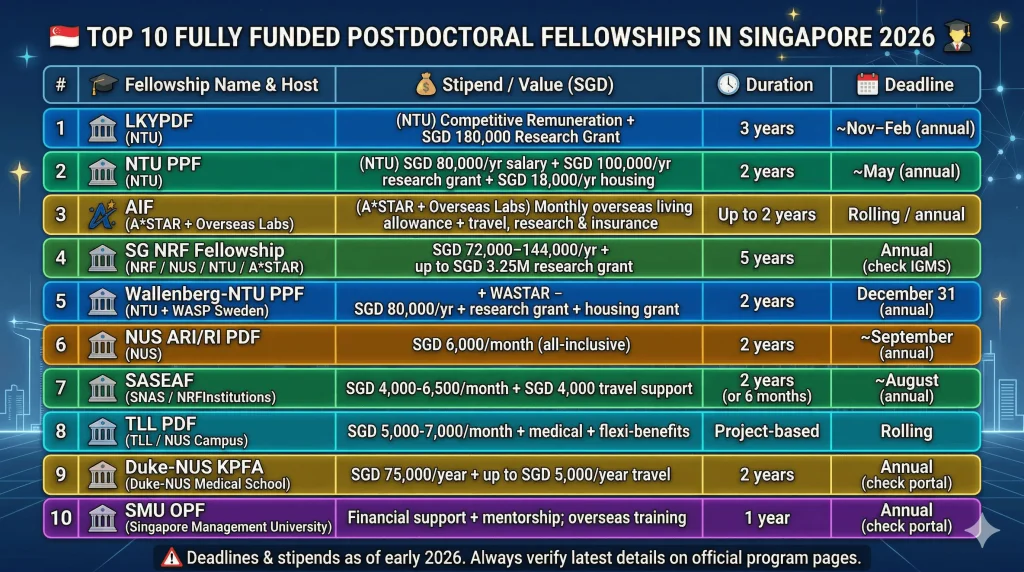
Summary Table: Top 10 Fully Funded Postdoctoral Fellowships in Singapore 2026
| # | Fellowship Name | Host Institution | Open To | Stipend / Salary | Duration | Deadline | Official Link |
|---|---|---|---|---|---|---|---|
| 1 | Lee Kuan Yew Postdoctoral Fellowship (LKYPDF) | NTU | All nationalities | Competitive remuneration + SGD 180,000 research grant | 3 years | ~Nov–Feb (annual) | ntu.edu.sg/lkypdf |
| 2 | NTU Presidential Postdoctoral Fellowship (PPF) | NTU | All nationalities | SGD 80,000/yr salary + SGD 100,000/yr research grant + SGD 18,000/yr housing | 2 years | ~May (annual) | ntu.edu.sg/ppf |
| 3 | A*STAR International Fellowship (AIF) | A*STAR + Overseas Labs | Singapore Citizens / PRs | Monthly overseas living allowance + travel, research & insurance support | Up to 2 years | Rolling / annual | a-star.edu.sg/scholarships |
| 4 | Singapore NRF Fellowship | NRF / NUS / NTU / A*STAR | All nationalities | SGD 72,000–144,000/yr + up to SGD 3.25M research grant | 5 years | Annual (check IGMS) | nrf.gov.sg/grants/nrff |
| 5 | Wallenberg-NTU Presidential Postdoctoral Fellowship | NTU + WASP Sweden | All nationalities | SGD 80,000/yr + research grant + housing grant | 2 years | December 31 (annual) | ntu.edu.sg/ppf |
| 6 | NUS Postdoctoral Fellowship (ARI / Research Institutes) | NUS | All nationalities | SGD 6,000/month (all-inclusive) | 2 years | ~September (annual) | ari.nus.edu.sg |
| 7 | SG Academies South-East Asia Fellowship (SASEAF) | SNAS / NRF Singapore institutions | ASEAN nationals (excl. Singapore) | SGD 4,000–6,500/month + SGD 4,000 travel support | 2 years (or 6 months) | ~August (annual) | snas.org.sg/saseaf |
| 8 | Temasek Life Sciences Laboratory (TLL) Postdoctoral Fellowship | TLL (NUS campus) | All nationalities | SGD 5,000–7,000/month + medical + flexi-benefits | Project-based | Rolling | tll.org.sg/careers |
| 9 | Duke-NUS Medical School – Khoo Postdoctoral Fellowship Award (KPFA) | Duke-NUS Medical School | All nationalities | SGD 75,000/year + up to SGD 5,000/year travel | 2 years | Annual (check portal) | duke-nus.edu.sg |
| 10 | SMU Overseas Postdoctoral Fellowship (OPF) | Singapore Management University | Singapore citizens | Financial support + mentorship; overseas training | 1 year | Annual (check portal) | smu.edu.sg/opf |
Note: Stipends, deadlines, and terms are subject to change each cycle. Always verify the latest details on official program pages before applying.
Detailed Profiles: Top 10 Postdoctoral Fellowships in Singapore
1. Lee Kuan Yew Postdoctoral Fellowship (LKYPDF) — NTU
Host Institution: Nanyang Technological University (NTU), Singapore
Overview: The Lee Kuan Yew Postdoctoral Fellowship (LKY PDF) is one of Singapore’s oldest and most prestigious postdoctoral programs, established in 1991 under the Lee Kuan Yew Endowment Fund. It supports and promotes outstanding young researchers in the areas of Engineering, Science, Humanities, and Medicine at NTU. The fellowship is awarded concurrently with the candidate’s appointment as a research staff member at NTU, offering a direct foothold in Singapore’s leading research-intensive university.
Key Benefits:
- Tenable for a period of 3 years — one of the longer fellowship tenures in Singapore
- Research grant of up to SGD 180,000 for consumables and research-related expenditure
- Attractive remuneration package (confirmed at point of offer)
- Concurrent appointment as a research staff member at NTU
- Mentorship, faculty integration, and access to NTU’s global research network
- Opportunity to co-supervise graduate students and establish a research profile
Eligibility:
- Open to all nationalities
- Recent PhD graduates, or candidates with at most one previous postdoctoral training from a reputable university
- Excellent academic records and strong research potential
- Research areas relevant to Engineering, Science, Humanities, or Medicine at NTU
Who Should Apply: Strong early-career researchers who want a longer fellowship tenure with dedicated research funding and the opportunity to be formally integrated into NTU’s faculty structure. Particularly suited to those targeting an independent research career in Asia.
2026 Application Window: November 25, 2025 – February 6, 2026 was the most recent confirmed window. Check the NTU Online Application Portal for the next annual cycle.
2. NTU Presidential Postdoctoral Fellowship (PPF)
Host Institution: Nanyang Technological University (NTU), Singapore
Overview: The NTU Presidential Postdoctoral Fellowship is among the most generous postdoctoral programs in Asia. It provides exceptional early-career researchers from any country with the freedom to pursue independent research in any discipline at NTU. The fellowship is explicitly designed as a pathway to an assistant professorship or another international postdoctoral assignment. Several specialized streams exist under the PPF umbrella, including the Wallenberg-NTU PPF (Sweden-Singapore AI/tech collaboration) and the SP Group-NTU PPF (energy and power systems research).
Key Benefits:
- Two-year tenure with an annual salary of SGD 80,000
- Research grant of up to SGD 100,000 per year
- Housing grant of SGD 18,000 per year with eligibility for subsidized accommodation
- Relocation allowance of up to SGD 4,000
- Mentorship, personal development programs, and integration into NTU’s global research network
Eligibility:
- Open to all nationalities
- Within 5 years of obtaining a PhD or equivalent degree
- Must submit a thoughtful, realistic 2-page research proposal
- Available to take up the position no later than December 31, 2026 (current cycle)
Who Should Apply: Early-career researchers in any field aiming to build an independent research program in Asia, particularly those with ambitions toward a future academic appointment.
2026 Deadline: Annual cycle — typically closes in May. Monitor the NTU Online Application Portal.
3. A*STAR International Fellowship (AIF)
Host Institution: A*STAR Research Institutes (Singapore), with training conducted overseas
Overview: The A*STAR International Fellowship (AIF) is designed to support Singapore-based PhD graduates and permanent residents in undertaking world-class postdoctoral training at leading overseas laboratories. After up to two years of overseas training, fellows return to contribute to an A*STAR Research Institute in Singapore. The AIF covers all scientific disciplines aligned with A*STAR’s national research directions and has two tracks: Research Track and Innovation Track.
Key Benefits:
- Full support for up to 2 years of overseas postdoctoral research training
- Monthly overseas living allowance tailored to the host institution’s location
- Subsidies for conferences, equipment, travel, and health insurance
- Guaranteed research career placement at an A*STAR Research Institute upon return (3-year contribution period)
- Strong professional network within Singapore’s national R&D ecosystem
Eligibility:
- Singapore Citizens or Permanent Residents (non-SPR may be considered if citizenship is obtained before fellowship commencement)
- PhD completed within the last 4 years, or final-stage PhD candidates (award confirmed on conferment)
- Excellent publication record and no existing bonds to any institution
- Must be applying to or already placed in a top overseas postdoctoral lab
Who Should Apply: Singaporean researchers who want cutting-edge international exposure at a world-class lab, with a structured, guaranteed career path back to Singapore’s leading national research institutes.
Deadline: Rolling and annual intakes — confirm current deadlines at the A*STAR Scholarships portal.
Tip: If you’re an international PhD graduate seeking fully funded postdoc opportunities globally, also check: How to Find Postdoctoral Fellowship Opportunities Around the World
4. Singapore NRF Fellowship
Host Institution: NRF-affiliated institutions — NUS, NTU, A*STAR, Duke-NUS, SUTD, SMU, and Research Centres of Excellence
Overview: The Singapore National Research Foundation (NRF) Fellowship is the single most prestigious and competitive early-career researcher program in Singapore. It funds outstanding scientists to lead independent research for five years and connects them to tenure-track faculty positions at Singapore’s top universities and research institutes. Open to all areas of science and technology and to researchers of all nationalities, it is Singapore’s equivalent of a European ERC Starting Grant or a US NSF CAREER Award.
Key Benefits:
- Annual gross salary pegged to Assistant Professor level: SGD 72,000–144,000
- Research grant of up to SGD 3.25 million (inclusive of 30% overheads) over five years
- Three-step competitive selection with final interview in Singapore
- Appointment to a tenure-track faculty position at NUS, NTU, A*STAR, Duke-NUS, SUTD, SMU, or a Research Centre of Excellence
Eligibility:
- Open to all nationalities
- Under age 40 at the close of the call
- PhD in any science or technology discipline
- Research project must not be simultaneously funded by other agencies
Who Should Apply: Exceptional scientists with a demonstrated track record of independent research who aspire to lead a research group and build a long-term academic career in Singapore.
Deadline: Once per year via the IGMS (Integrated Grant Management System) portal — check nrf.gov.sg for the current call.
🔗 Official NRF Fellowship Page
5. Wallenberg-NTU Presidential Postdoctoral Fellowship
Host Institution: Nanyang Technological University (NTU) + WASP Partner Institutions, Sweden
Overview: Supported by the prestigious Knut and Alice Wallenberg Foundation, the Wallenberg-NTU Presidential Postdoctoral Fellowship is a unique bilateral Singapore-Sweden research program. It gives early-career researchers the chance to conduct research at both NTU and a Wallenberg AI, Autonomous Systems and Software Program (WASP) partner institution in Sweden. The program focuses on AI, machine learning, data analytics, autonomous systems, software, and mobility research.
Key Benefits:
- Two-year tenure with an annual salary of SGD 80,000
- Research grant of up to SGD 100,000 per year
- Housing grant of SGD 18,000 per year
- Dual-country research experience across Singapore and Sweden’s world-leading AI research ecosystems
- Access to NTU’s and WASP’s networks for AI and multidisciplinary science
Eligibility:
- Open to all nationalities
- Within 5 years of obtaining a PhD
- Research background in AI, machine learning, big data, software, or autonomous systems
- Must submit a realistic research proposal in one of the WASP research areas
Who Should Apply: AI, data science, and engineering researchers seeking bilateral exposure between Asia and Europe, particularly those working at the intersection of AI and multidisciplinary STEM fields.
Deadline: Annually on December 31 (Singapore Time). Referees’ reports due January 7.
🔗 Wallenberg-NTU PPF Official Page
6. NUS Postdoctoral Fellowship — Asia Research Institute (ARI) and Research Institutes
Host Institution: National University of Singapore (NUS)
Overview: NUS offers postdoctoral fellowship positions across its many faculties and research institutes. The flagship open call is through the Asia Research Institute (ARI), which invites early-career scholars in humanities and social sciences to join for two years of research on Asia. ARI fellows are embedded in one of the institute’s thematic research clusters — covering migration, urbanism, religion and globalization, science and society, and population health. Beyond ARI, NUS departments across science, engineering, medicine, and computing regularly post additional postdoctoral positions.
Key Benefits (ARI Fellowship FY2026/27):
- Monthly remuneration of SGD 6,000 — all-inclusive (covers housing and living expenses)
- Travel assistance for eligible candidates
- Support for fieldwork and conference attendance (on application and subject to approval)
- CPF contributions for Singapore Citizens and Permanent Residents
- Active engagement in ARI’s academic community, seminars, and workshops
- Two-year appointment with potential to contribute to collaborative grant applications
Eligibility:
- Must hold a PhD in humanities or social sciences (or near completion with official confirmation)
- Strong publication record
- Research proposal aligned with ARI’s research clusters
- For other NUS departments: eligibility varies by position; check the NUS Careers portal
Who Should Apply: Humanities and social science scholars focusing on Asia-related research, as well as STEM postdocs applying to departmental or institute-level positions across NUS faculties and research centers.
2026 Application Window: ARI FY2026/27 — call opened August 2025, closed September 2025. Watch for the FY2027/28 call in mid-2026.
🔗 NUS ARI Postdoctoral Fellowship 🔗 NUS Careers Portal (all disciplines)
7. SG Academies South-East Asia Fellowship (SASEAF) Programme
Host Institution: Hosted at NUS, NTU, A*STAR, and other Singapore research institutions; administered by SNAS, AMS, and AES; funded by NRF
Overview: The SG Academies South-East Asia Fellowship (SASEAF) — previously called the SG Academies ASEAN Fellowship — is a fully funded two-year postdoctoral program specifically designed to attract promising early-career researchers from ASEAN countries to Singapore’s leading research institutions. It is jointly administered by three Singapore academies (SNAS, AMS, AES) and funded by the National Research Foundation. Preferred research areas include infectious diseases, public health, and sustainability, but any discipline is considered.
Key Benefits:
- Monthly stipend of SGD 4,000–6,500, based on qualifications and experience
- Travel support of SGD 4,000 for arrival and departure expenses
- Access to professional development events and training programs run by SNAS, AMS, and AES
- Integration into Singapore’s vibrant research community
- A shorter 6-month option available for dry-lab infectious disease projects
Eligibility:
- Citizens of an ASEAN country (excluding Singapore) residing outside Singapore
- Must hold a PhD from a reputable institution
- Currently employed by or with a confirmed offer from a public-sector research entity in the home country
- Maximum age: 40 years at time of application
- Fluent written and oral English required
Who Should Apply: ASEAN-based researchers in science, medicine, engineering, or computer science who want structured postdoctoral research experience at a Singapore institution while maintaining ties with their home country.
2026 Deadline: The previous call closed on August 1, 2025 under the RIE2025 initiative. A new intake is expected; watch snas.org.sg/saseaf for the next announcement.
🔗 Official SASEAF Programme Page – SNAS
Related for ASEAN and Indian researchers: Fully Funded Postdoctoral Fellowships in Australia for Indian Students 2026
8. Temasek Life Sciences Laboratory (TLL) Postdoctoral Fellowship
Host Institution: Temasek Life Sciences Laboratory (TLL), located on the NUS campus, affiliated with NUS and NTU
Overview: Founded in 2002, Temasek Life Sciences Laboratory (TLL) is a non-profit research institute focused on cutting-edge research in molecular biology, genetics, cell biology, developmental biology, plant science, and molecular pathogenesis. With over 220 researchers from 23+ countries and a strong culture of publishing in top-tier journals, TLL actively recruits postdoctoral fellows on a rolling basis directly through its Principal Investigators.
TLL postdoctoral positions are project-based, meaning they are offered by individual PIs rather than through a central competitive fellowship call. However, they provide excellent training conditions, a genuinely international environment, and direct access to world-class life sciences infrastructure.
Key Benefits:
- Competitive monthly salary in line with market rates (typically SGD 5,000–7,000/month)
- Medical benefits and flexi-benefits package
- Employer CPF contributions for Singapore Citizens and Permanent Residents
- State-of-the-art laboratory facilities on the NUS Biopolis campus
- Strong publication culture — TLL researchers regularly publish in Nature, Cell, and other leading journals
- International environment with researchers from 23+ countries
Eligibility:
- PhD in molecular biology, cell biology, genetics, plant science, or a related life sciences discipline
- Open to all nationalities
- Strong research output and publication record preferred
- Positions vary by PI and research project
Who Should Apply: Life scientists and molecular biologists who want focused, project-based postdoctoral training at a specialized research institute with excellent publication outcomes and global career prospects.
Deadline: Rolling — positions posted as they become available. Check the TLL careers page regularly.
9. Duke-NUS Medical School — Khoo Postdoctoral Fellowship Award (KPFA)
Host Institution: Duke-NUS Medical School, Singapore
Overview: Established as a strategic partnership between Duke University and NUS, Duke-NUS Medical School is Singapore’s premier graduate medical school and a global leader in translational biomedical research. The Khoo Postdoctoral Fellowship Award (KPFA) supports outstanding early-career researchers to conduct independent biomedical and clinical research at Duke-NUS. Funded for two years, it specifically supports candidates whose primary host institution is Duke-NUS or a Singapore-based affiliated institution.
Key Benefits:
- Annual award of SGD 75,000 — allocated for the Fellow’s salary and research support
- Up to SGD 5,000 per year for research travel
- Two-year term; second-year funding contingent on satisfactory first-year progress
- Access to Duke-NUS’s world-class clinical and translational research infrastructure
- Pathway toward an independent research career in academic medicine in Singapore
Eligibility:
- Must have accepted (or be positioned to accept) a postdoctoral research position at Duke-NUS or affiliated Singapore institution
- Must anticipate receipt of PhD, DSc, MD, MBBS, DDS, DVM, or PharmD degree
- Open to all nationalities
- Research proposal should represent a meaningful expansion of the candidate’s existing skills
Who Should Apply: Biomedical, clinical, and translational scientists who want to build an independent research program within a globally connected, clinically engaged medical school environment in Singapore.
Deadline: Annual — check the Duke-NUS postdoctoral grants page for the current call status.
🔗 Duke-NUS Postdoctoral Grants Page
10. SMU Overseas Postdoctoral Fellowship (OPF)
Host Institution: Singapore Management University (SMU)
Overview: The SMU Overseas Postdoctoral Fellowship (OPF) is part of SMU’s MOE START (Singapore Tenure-Track Research Track) initiative. It provides Singaporean doctoral candidates who have recently completed or are about to complete their studies with the opportunity to undertake advanced training and research at a leading overseas university for one year. Upon completing the fellowship and returning to Singapore, awardees are considered for appointment at SMU as an Assistant Professor on the tenure track. It is a unique fellowship in that it funds overseas training as a direct, structured pathway to a faculty career at SMU.
Key Benefits:
- Financial support covering the overseas postdoctoral training year
- Academic mentorship from SMU faculty throughout the fellowship period
- Direct pathway to consideration for a tenure-track Assistant Professorship at SMU upon return
- Engagement with SMU’s active research community in business, law, economics, computing, and social sciences
- Global network-building during the overseas training period
Eligibility:
- Singapore Citizens only
- Doctoral candidates who have recently completed or are about to complete their PhD in a discipline relevant to SMU
- Excellent academic record and high motivation for an academic career
- Must have been accepted to or applied for postdoctoral training at a leading overseas university aligned with SMU’s core research areas (business, law, social sciences, economics, finance, computing)
Who Should Apply: Singaporean PhD graduates in business, economics, law, social sciences, or computing who aspire to an academic faculty career at SMU and want to build their research profile through structured overseas postdoctoral training.
Deadline: Annual — typically opens mid-year. Check smu.edu.sg/moe-start/overseas-postdoctoral-fellowship for the current intake dates.
How Much Stipend Do Postdoctoral Fellows Get in Singapore?
This is one of the most frequently searched questions by international applicants. Here is a clear breakdown of postdoc stipends and salaries across Singapore’s top programs:
| Fellowship | Monthly Equivalent (SGD) | Additional Support |
|---|---|---|
| Singapore NRF Fellowship | 6,000–12,000/month | Up to SGD 3.25M research grant over 5 years |
| NTU PPF / Wallenberg-NTU PPF | ~6,667/month | SGD 100,000/yr research grant + SGD 18,000/yr housing |
| Lee Kuan Yew PDF (LKYPDF) | Competitive (confirmed at offer) | SGD 180,000 research grant over 3 years |
| NUS ARI Fellowship | 6,000/month | Fieldwork and conference support |
| Duke-NUS KPFA | ~6,250/month (SGD 75,000/yr) | Up to SGD 5,000/yr travel |
| SASEAF Programme | 4,000–6,500/month | SGD 4,000 travel support |
| TLL Postdoctoral Fellow | 5,000–7,000/month | Medical + flexi-benefits |
| A*STAR AIF | Varies by location | Conference, equipment, travel, insurance |
| SMU OPF | Financial support (overseas year) | Mentorship; faculty career pathway |
For comparison, the average postdoctoral fellow salary in Singapore ranges from SGD 5,000 to SGD 7,400 per month across all institutions, based on current market data. Prestigious programs like the NRF Fellowship offer significantly higher compensation at the Assistant Professor salary scale.
What Is Included in a Singapore Postdoctoral Fellowship Package?
Most fully funded Singapore postdoc fellowship packages include several or all of the following components:
- Monthly stipend or salary (SGD 4,000–12,000+ depending on program)
- Research grant (ranging from SGD 75,000 to SGD 3.25 million)
- Housing allowance (up to SGD 18,000/year for flagship programs)
- Health insurance or medical benefits
- Relocation or airfare allowance (one-time, typically SGD 1,500–4,000)
- Conference and fieldwork travel funding
- CPF contributions for Singapore Citizens and PRs (where applicable)
- Mentorship and professional development programs
For a global comparison of what postdoc packages look like in other countries, see: Fully Funded Postdoctoral Fellowships in Canada for Indian Students 2026 and Postdoctoral Fellowships in India 2026: Complete Guide
2026 Key Deadlines at a Glance
| Program | 2026 Deadline / Cycle |
|---|---|
| Lee Kuan Yew PDF (LKYPDF) — NTU | Nov 25, 2025 – Feb 6, 2026 (check NTU for next annual call) |
| Wallenberg-NTU Presidential PPF | December 31 annually; referees by Jan 7 |
| NTU Presidential PPF (general) | ~May 2026 (check NTU Careers Portal) |
| NUS ARI Fellowship FY2026/27 | Sep 2025 (closed); Watch for FY2027/28 in mid-2026 |
| SASEAF Programme | August 1, 2025 (previous); watch for next call at snas.org.sg |
| NRF Fellowship | Annual — check IGMS portal at nrf.gov.sg |
| A*STAR AIF | Rolling / annual — check A*STAR Scholarships portal |
| Duke-NUS KPFA | Annual — check Duke-NUS postdoctoral grants page |
| SMU OPF | Annual — typically opens mid-year, check SMU portal |
| TLL Postdoctoral Positions | Rolling — posted as available at tll.org.sg |
Pro tip: Most Singapore fellowship cycles publish calls 3–6 months in advance. Subscribe to NTU, NUS, NRF, and A*STAR institutional email alerts so you never miss an opening.
How to Apply for Postdoctoral Fellowships in Singapore in 2026
Here is a step-by-step application guide:
Step 1 — Identify the right fellowship Match your research field, career stage, and nationality to the best program. STEM researchers should consider NTU PPF, NRF Fellowship, LKYPDF, or TLL positions. Humanities scholars should target NUS ARI. ASEAN nationals should look at SASEAF. Singaporeans aiming for overseas training should consider A*STAR AIF or SMU OPF.
Step 2 — Contact prospective supervisors early For most fellowships, reaching out to a faculty mentor or PI before submitting is strongly encouraged — and sometimes a prerequisite for the application.
Step 3 — Write a strong research proposal Most programs require a 2-page proposal. Make it specific, clearly tied to the host institution’s research priorities, and realistic in scope.
Step 4 — Gather supporting documents Standard requirements include:
- Cover letter
- Comprehensive CV with full publication list
- Official PhD transcript or degree certificate
- 2-page research proposal
- Top 3 publications in PDF
- Contact details for 2–3 referees (at least one being your PhD supervisor)
Step 5 — Submit via the official portal Most programs use institutional portals (NTU Careers, NUS Careers, Duke-NUS portal) or the government IGMS system (NRF). Late or incomplete applications are not accepted.
Step 6 — Confirm referee availability Most programs contact referees directly. Alert your referees well in advance and confirm the deadline.
For broader application strategy tips, read: Top Fellowships & Funding Opportunities for PhD Students in India 2026 — strategies applicable to competitive global fellowship applications everywhere.
Are Singapore Postdoctoral Fellowships Open to International Applicants?
Yes — the majority of Singapore postdoctoral fellowships explicitly welcome applicants of all nationalities. Programs like the NTU Presidential PPF, LKYPDF, NRF Fellowship, NUS ARI Fellowship, SASEAF (for ASEAN nationals), Duke-NUS KPFA, and TLL postdoctoral positions are all internationally open.
The main exceptions are:
- A*STAR AIF — primarily for Singapore Citizens and Permanent Residents
- SMU OPF — currently limited to Singapore Citizens
Singapore actively positions itself as a global research talent hub. International researchers make up a significant share of the academic and research workforce at NUS, NTU, A*STAR, and TLL.
Living in Singapore as a Postdoctoral Researcher
Singapore is safe, well-organized, and cosmopolitan. Here is a rough monthly cost-of-living estimate for a postdoctoral researcher:
| Expense | Estimated Monthly Cost (SGD) |
|---|---|
| Rent (1-bedroom apartment near campus) | SGD 2,000–3,200 |
| Food and groceries | SGD 500–900 |
| Transport (MRT / bus) | SGD 100–150 |
| Utilities | SGD 100–200 |
| Miscellaneous | SGD 200–400 |
| Total Estimate | SGD 2,900–4,850/month |
With stipends of SGD 5,000–7,000+/month (plus housing grants in top programs), postdoctoral fellows in Singapore typically live comfortably and can save meaningfully. Programs with dedicated housing grants — such as the NTU PPF at SGD 18,000/year — further ease the financial burden for international fellows.
Frequently Asked Questions (FAQ)
1. What are the fully funded postdoctoral fellowships in Singapore?
The top fully funded programs include the LKYPDF, NTU Presidential PPF, NRF Fellowship, A*STAR AIF, Wallenberg-NTU PPF, NUS ARI Fellowship, SASEAF Programme, TLL Postdoctoral Fellowships, Duke-NUS KPFA, and SMU OPF. Each provides a salary or stipend, research grant, and additional allowances covering housing, travel, or equipment.
2. How much stipend do postdoctoral fellows get in Singapore?
Stipends range from SGD 4,000 to SGD 12,000+ per month, depending on the program. The NUS ARI Fellowship pays SGD 6,000/month (all-inclusive), the NTU PPF pays SGD 80,000/year (~SGD 6,667/month), the SASEAF Programme pays SGD 4,000–6,500/month, and the NRF Fellowship is pegged to an Assistant Professor salary of SGD 72,000–144,000/year.
3. What are the deadlines for Singapore postdoctoral fellowships in 2026?
Key 2026 deadlines include: LKYPDF November–February (annual cycle), Wallenberg-NTU PPF December 31 (annual), NTU PPF ~May (annual), SASEAF ~August (annual). The NRF Fellowship has one call per year via the IGMS portal. TLL and A*STAR AIF accept applications on a rolling basis.
4. Are there fully funded postdoc positions in Singapore for international applicants?
Yes. Most flagship programs — including the NTU PPF, LKYPDF, NRF Fellowship, NUS ARI, SASEAF (ASEAN nationals), Duke-NUS KPFA, and TLL positions — are open to all nationalities. Only A*STAR AIF and SMU OPF have significant nationality requirements.
5. Which universities and institutions in Singapore offer postdoctoral fellowships?
The main institutions include NUS, NTU, Duke-NUS Medical School, SUTD, SMU, Temasek Life Sciences Laboratory (TLL), and A*STAR’s network of 14+ research institutes across Biopolis and Fusionopolis.
6. How do I apply for a postdoc fellowship in Singapore?
The process involves: identifying the right program → contacting a prospective supervisor → preparing a 2-page research proposal → gathering supporting documents (CV, transcripts, publications) → submitting via the official portal. Most programs require 2–3 reference letters submitted directly by your referees.
7. Are Singapore postdoctoral fellowships competitive?
Yes — programs like the NRF Fellowship, NTU PPF, and LKYPDF are highly competitive and attract top researchers globally. However, with a strong publication record, a focused proposal, and early engagement with a faculty mentor, qualified candidates have a genuine chance. The SASEAF Programme, TLL rolling positions, and departmental NUS positions offer additional entry points.
Final Application Tips
- Start 3–4 months early — a rushed fellowship application is rarely successful
- Contact supervisors before the deadline — faculty sponsorship significantly strengthens your case
- Tailor your proposal — show why your research specifically fits NTU, NUS, A*STAR, or TLL’s priorities
- Choose referees strategically — references from leading, recognized researchers carry the most weight
- Apply to multiple fellowships simultaneously — several programs run on overlapping timelines
- Monitor official portals directly — NTU, NUS, and NRF post calls on official websites first
Related Guides on Global Postdoctoral Opportunities
Exploring postdoc opportunities beyond Singapore? These resources from irrespub.com will help:
- 📌 Fully Funded Postdoctoral Fellowships in South Korea 2026
- 📌 Fully Funded Postdoctoral Fellowships in Australia for Indian Students 2026
- 📌 Fully Funded Postdoctoral Fellowships in Canada for Indian Students 2026
- 📌 Postdoctoral Fellowships in India 2026: Complete Guide
- 📌 How to Find Postdoctoral Fellowship Opportunities Around the World
- 📌 Top Fellowships & Funding Opportunities for PhD Students in India 2026
Last updated: April 2026. All fellowship information is sourced from official program pages at NTU, NUS, NRF, A*STAR, SNAS, TLL, Duke-NUS, and SMU. Deadlines and funding details are subject to change — always verify the latest information on official websites before applying.