
Introduction
Winning a competitive PhD scholarship can transform your academic career—freeing you from financial stress and letting you focus on impactful research. Yet, funding systems differ dramatically by country and discipline, deadlines arrive early, and selection panels look for specific evidence of research potential that applicants often overlook.
This guide is for senior undergraduates, master’s students, PhD applicants, and early-career researchers seeking fully funded doctoral opportunities worldwide. It is especially valuable if you are comparing the US assistantship model, UK/EU doctoral training partnerships, German/Scandinavian employment contracts, and major international fellowships.
Common mistakes include emailing supervisors with unfocused topics, submitting generic statements of purpose, misunderstanding visa and employment rules, and missing references or proof of English proficiency. Another frequent error is chasing prestige rather than “fit”—a clear alignment between your question, methods, supervisor, and funder priorities.
By the end, you will know how to identify suitable funding, build a target list, approach supervisors professionally, prepare documents that win interviews, manage budgets and timelines, and navigate country-specific rules. We also include ready-to-use templates and official links for fast, accurate applications.
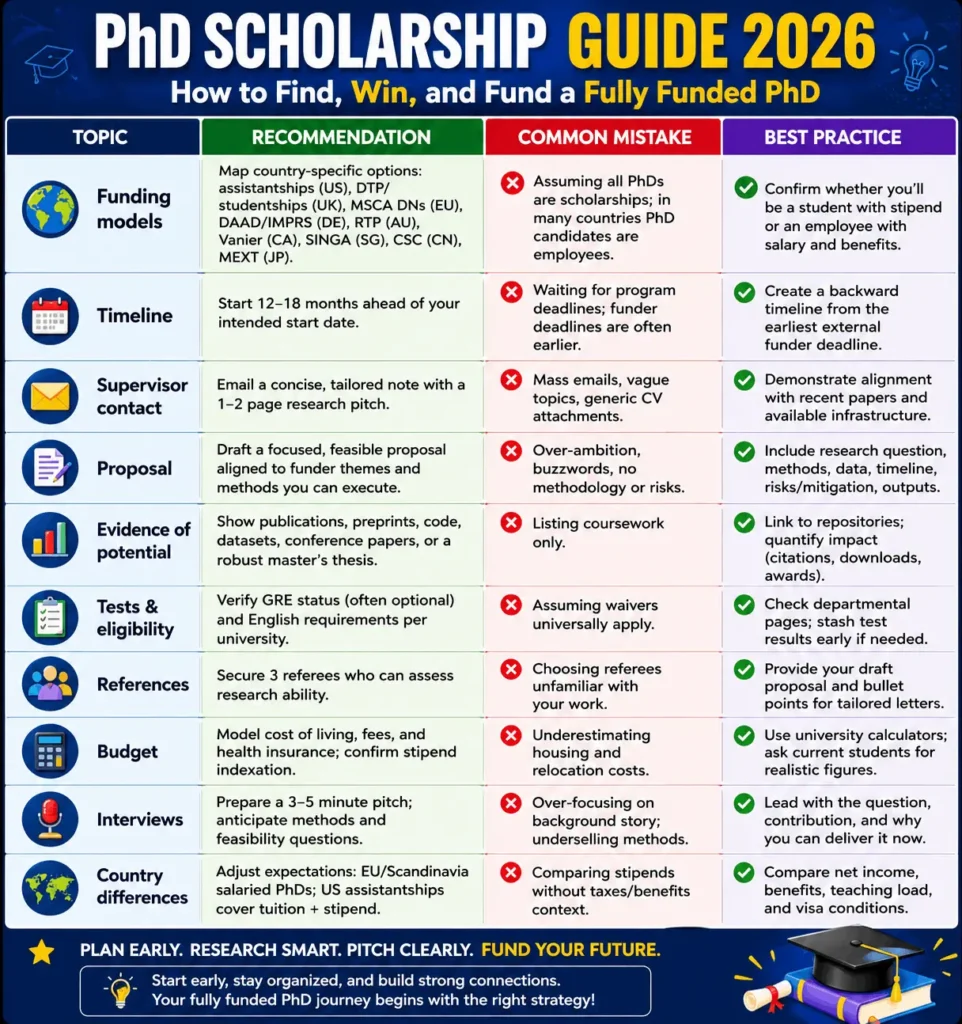
Quick Summary Table: PhD Scholarship Guide 2026: How to Find, Win, and Fund a Fully Funded PhD
| Topic | Recommendation | Common Mistake | Best Practice |
|---|---|---|---|
| Funding models | Map country-specific options: assistantships (US), DTP/studentships (UK), MSCA DNs (EU), DAAD/IMPRS (DE), RTP (AU), Vanier (CA), SINGA (SG), CSC (CN), MEXT (JP). | Assuming all PhDs are scholarships; in many countries PhD candidates are employees. | Confirm whether you’ll be a student with stipend or an employee with salary and benefits. |
| Timeline | Start 12–18 months ahead of your intended start date. | Waiting for program deadlines; funder deadlines are often earlier. | Create a backward timeline from the earliest external funder deadline. |
| Supervisor contact | Email a concise, tailored note with a 1–2 page research pitch. | Mass emails, vague topics, generic CV attachments. | Demonstrate alignment with recent papers and available infrastructure. |
| Proposal | Draft a focused, feasible proposal aligned to funder themes and methods you can execute. | Over-ambition, buzzwords, no methodology or risks. | Include research question, methods, data, timeline, risks/mitigation, outputs. |
| Evidence of potential | Show publications, preprints, code, datasets, conference papers, or a robust master’s thesis. | Listing coursework only. | Link to repositories; quantify impact (citations, downloads, awards). |
| Tests & eligibility | Verify GRE status (often optional) and English requirements per university. | Assuming waivers universally apply. | Check departmental pages; stash test results early if needed. |
| References | Secure 3 referees who can assess research ability. | Choosing referees unfamiliar with your work. | Provide your draft proposal and bullet points for tailored letters. |
| Budget | Model cost of living, fees, and health insurance; confirm stipend indexation. | Underestimating housing and relocation costs. | Use university calculators; ask current students for realistic figures. |
| Interviews | Prepare a 3–5 minute pitch; anticipate methods and feasibility questions. | Over-focusing on background story; underselling methods. | Lead with the question, contribution, and why you can deliver it now. |
| Country differences | Adjust expectations: EU/Scandinavia salaried PhDs; US assistantships cover tuition + stipend. | Comparing stipends without taxes/benefits context. | Compare net income, benefits, teaching load, and visa conditions. |
Step 1: Understand what a PhD scholarship really covers
A PhD scholarship usually covers tuition and a stipend for living costs. In some countries, doctoral candidates are employees with a salary (not “scholarships”). Always confirm:
- What’s covered: tuition, stipend/salary, fees, insurance, visa, relocation, conference travel.
- Duration: typical funding lasts 3–4 years (UK/EU) or 4–6 years (US).
- Restrictions: many scholarships cannot be “stacked” with full assistantships; read the terms.
- Eligibility: citizenship, residency, time-since-degree, field limitations.
Step 2: Know the major funding models by region
United States
- Graduate Assistantships (RA/TA): The main route; includes tuition waiver + stipend. Competitive internal university selection.
- Fellowships: Examples include NSF GRFP (US citizens/permanent residents), NIH F31 (biomedical), DoD NDSEG, DOE CSGF, Hertz (STEM). Often portable across institutions.
- Key differences: Many programs admit first, then match to funding. Some require GRE (decreasing trend); check department policy.
United Kingdom
- UKRI Studentships: Doctoral Training Partnerships (DTPs) and Centres for Doctoral Training (CDTs) via councils like EPSRC, BBSRC, ESRC, AHRC, MRC, NERC.
- University Awards: Clarendon (Oxford), Gates Cambridge (Cambridge), President’s Scholarships (Imperial), and departmental studentships.
- Commonwealth PhD Scholarships: For eligible citizens of Commonwealth countries to study in the UK.
European Union
- MSCA Doctoral Networks: Transnational, salaried positions with mobility rules, living/mobility/family allowances.
- Country-specific: France (doctoral contracts), Netherlands (employee positions), Spain/Italy (mixed; often funded projects).
Germany and Austria
- DAAD scholarships: For international doctoral candidates; also short-term research and “sandwich” models.
- IMPRS (Max Planck): Structured programs with full funding and strong training.
- Employment model: Many PhD candidates are staff with contracts paid under TV-L wage agreements (Germany).
Canada
- Tri-Agency: NSERC/SSHRC/CIHR doctoral awards; Vanier CGS for top candidates.
- University/Provincial: Ontario Trillium; UBC Four Year Fellowships; many departmental TA/RA packages.
Australia and New Zealand
- Australia RTP (Research Training Program): Covers tuition and stipend; universities rank applicants.
- University schemes: University of Melbourne Graduate Research Scholarships, ANU AGRTP, Monash Graduate Scholarships.
- New Zealand: Most funding is via university doctoral scholarships; many PhD students pay domestic fees (policy varies; verify current rules).
Asia and Switzerland
- Singapore SINGA: Collaborative A*STAR–NUS–NTU funding for international PhDs.
- China CSC: Chinese Government Scholarship supports PhD study at Chinese or partner universities.
- Japan MEXT: Government scholarships for doctoral study.
- Swiss Government Excellence Scholarships: For PhD and research in Switzerland.
Always read the current call text for allowances, eligibility, and mobility rules.
Step 3: Build a target list and timeline (12–18 months ahead)
- Define your topic and methods: 3–5 keywords plus 1–2 core methods (e.g., single-cell RNA-seq; Bayesian causal inference; archival legal history).
- Identify 6–12 programs/labs: Use departmental pages, FindAPhD, and recent publications. Track in a spreadsheet (deadline, requirements, funding route, supervisor fit).
- Backwards plan: If the earliest funder deadline is September, schedule supervisor contact by June, draft proposal by July, referees by August.
- Check country documents: Language tests, degree equivalence, notarization, visa timelines.
Step 4: Make first contact with potential supervisors
Good supervisor fit is often the single strongest predictor of success. Before writing:
- Read 2–4 recent papers and the lab’s funding/projects page.
- Confirm the supervisor is taking students and has compatible methods/equipment.
- Prepare a 1–2 page concept note: question, novelty, method, data, feasibility, timeline.
Etiquette varies by country:
- US: Email before applying is helpful but not always required; departments often admit by committee.
- UK/EU/DE: For advertised positions, follow the call instructions; for self-proposed topics, early supervisor contact is essential.
- Scandinavia: Positions are advertised as jobs; apply via HR portals (supervisor contact may follow shortlist).
Step 5: Prepare an application portfolio that proves research potential
- Academic CV (2–4 pages): Lead with publications/preprints, then research experience, technical skills, grants/awards, teaching/service. Link to ORCID, Google Scholar, GitHub/OSF/Dataverse.
- Statement of Purpose (SOP): 750–1,000 words focusing on your research direction, evidence of preparedness, fit with program/supervisor, and career goals.
- Research Proposal: 3–7 pages if required; UK/EU often mandatory; US varies by program.
- Writing Sample: In humanities/social sciences; submit your strongest peer-reviewed or thesis chapter.
- References: Choose referees who can speak to research independence and rigor.
Where possible, attach evidence: preprints, code, data, posters, awards. For transparency and credibility, consider linking to a profile at IR Research Publication journals or your ORCID.
Step 6: Write a competitive research proposal
Panels seek feasibility, significance, and fit with priorities. Make your project “doable” within the funding period.
- Core question and why it matters: Tie to a gap in recent literature (last 3–5 years).
- Methods and data: Specify datasets, instruments, sampling plan, or archives. Name labs/infrastructures needed.
- Timeline and milestones: Break down by semesters/years. Include feasibility buffer.
- Risks and mitigation: Alternatives if data are delayed or methods underperform.
- Ethics and reproducibility: IRB/ethics plans, preregistration where appropriate, open data/code.
- Outputs and impact: Publications, software, datasets, policy briefs, outreach.
- Fit to funder themes: Explicitly map objectives to call priorities or SDGs where relevant.
Step 7: Tests, language, and eligibility nuances
- GRE: Many US programs have dropped or made it optional; check current department policy.
- English proficiency: TOEFL/IELTS/Duolingo requirements vary. Some waive if prior degree was in English or country-specific rules apply.
- Degree equivalence: Some universities require credential evaluation (e.g., WES) depending on country.
- Residency and mobility: EU programs (e.g., MSCA) often have mobility rules (cannot have lived/studied in host country for more than X months in the past Y years).
Step 8: Budget realistically and compare offers
Compare net pay, not just headline stipend/salary. Consider:
- Taxes and benefits: In many EU/Scandinavian positions you are an employee with paid leave and pensions; taxes will apply.
- Health insurance: US coverage varies by campus; ask about premiums and dependents.
- Cost of living: Big-city premiums can erode stipends; check housing waitlists.
- Conference/travel funds: Essential for visibility; confirm annual amounts.
- Visa and fees: Budget application fees, visa costs, biometrics, relocation, deposits.
Step 9: Submit a high-quality, compliant application
- Follow the portal instructions exactly: File names, formats (PDF), page limits, font/spacing.
- Consistency: SOP, proposal, and CV should tell one coherent story of why you can deliver this project now.
- Proofreading: Ask two readers: one for content, one for line edits.
- Accessibility: Embed fonts, add alt text for figures if requested, ensure PDF text is selectable.
Where relevant, review writing quality expectations in journals to which your future work might be submitted, for example, browse journal scopes at IR Research Publication journals.
Step 10: Interviews and research talks
- Prepare a 3–5 minute pitch: Problem, novelty, approach, feasibility, fit.
- Expect methods questions: Sample size/power, identification strategy, instrument calibration, archival access.
- Team fit: Be ready to discuss collaboration, teaching, and mentoring experiences.
- Ask informed questions: Lab culture, supervision style, project ownership, authorship policy, graduation rates.
Step 11: Offers, visas, and enrollment
- Read the award letter: Amounts, duration, renewal conditions, teaching load, IP, outside work rules.
- Visa timing: Start immediately after acceptance; some countries require financial proof even for funded students.
- Negotiation: It’s appropriate to ask about top-ups, additional teaching hours, or deferrals where policies allow.
Step 12: First-year plan to stay funded and productive
- Milestones: Coursework (if any), candidacy exam plans, ethics approvals, data access.
- Progress reporting: Some scholarships require annual reports; schedule deliverables ahead.
- Publication plan: Target 1–2 conference papers/posters; outline a paper pipeline early.
Examples and Templates
Sample email to a potential PhD supervisor (concise)
Subject: Prospective PhD on [Your Topic]: [Method/Approach] fit with your lab
Dear Dr. [Surname],
I’m a [current position/degree] at [Institution], working on [1-line topic]. I read your recent paper on [specific finding] and was excited by its [method/dataset/insight].
I’m applying for 2026 entry and would like to explore a PhD on [your 1–2 sentence question and method]. I believe it aligns with your group’s work on [very specific overlap]. I attach a 1-page concept note and a 2-page CV (links: Google Scholar, GitHub/OSF).
Would you have 15 minutes for a brief call next week? I’d value your feedback on fit and potential funding routes (e.g., [DTP/MSCA/RAship]).
Thank you for your time,
[Name], [Current role] | [Institution] | [Website/ORCID]
Supervisor email (longer version)
Subject: Exploring PhD supervision on [specific project] (proposal attached)
Dear Professor [Surname],
I’m a [position] specializing in [methods], with publications in [venue/journal/preprint]. Your group’s work on [two recent papers] motivates my proposed project on [question]. Methodologically, I plan to use [methods], leveraging [available datasets/instruments].
My preliminary results (preprint: [link]) indicate [1–2 findings]. I’d be grateful to discuss alignment with your lab and funding options (e.g., [UKRI DTP call name]/[MSCA DN upcoming call]/[university studentship]).
Attached: 2-page CV and 2-page proposal outline. Thank you for considering,
[Name] | [Contact] | [Links]
Statement of Purpose (SOP) outline
- Opening: 2–3 sentences on your research theme and why now.
- Preparation: Key research experiences, methods, outputs (with impact where possible).
- Proposed direction: 1–2 paragraphs on problems you will tackle; relate to faculty/lab strengths.
- Fit and resources: Supervisors, centers, datasets, equipment, collaborations.
- Career goals: Academic/industry pathway and how this program advances them.
- Closing: Synthesize why you are ready to deliver this project.
Research proposal outline (compact)
- Title
- Abstract (150–250 words)
- Background and gap (cite 6–10 recent, topically close sources)
- Research questions/hypotheses
- Methods (design, data, instruments, analysis plan, power/sample size)
- Timeline (Gantt-style milestones per semester)
- Risks/alternatives
- Ethics and data management (consent, privacy, preregistration, open sharing)
- Expected contributions (papers, datasets, software, policy)
- References
Academic CV section examples
- Publications: Doe, J. (2024). Title. Journal. DOI.
- Preprints: Doe, J. (2025). Title. OSF/ArXiv link.
- Research experience: RA, Lab of X (2023–2025). Built [tool]; co-authored [paper].
- Technical skills: R (tidyverse, brms), Python (PyTorch), Stata, NVivo, GIS, LaTeX.
- Awards/funding: Dept Research Prize (2024), Travel Grant (2023).
Scholarship motivation letter (template)
Dear Members of the Selection Committee,
I am applying for the [Scholarship Name] to pursue a PhD in [field] at [University]. My research will address [precise problem], building on my prior work on [experience] where I [impact].
The scholarship’s focus on [priority theme] aligns directly with my proposed methodology [methods] and intended outcomes [outputs]. With access to [lab/supervisor resources], I will deliver [feasible milestones] within [duration].
Your support will enable [specific benefits: access to field sites, longitudinal data, collaboration]. I am committed to open, reproducible science and to disseminating findings via [venues] and community outreach.
Thank you for considering my application.
Sincerely,
[Name]
Interview questions (typical)
- What is your research question in one sentence, and why is it important now?
- Walk us through your methods. What are the main risks and your fallback plan?
- How does your project fit the lab’s strengths and the funder’s priorities?
- Tell us about a time your analysis failed. What did you change?
- What outputs will you produce by the end of year one?
Cover letter for RA/TA/Studentship (template)
Dear [Hiring Committee/Professor],
I am writing to apply for the [RA/TA/Studentship] associated with [project/program]. My background in [methods/field], evidenced by [publication/preprint/code], equips me to contribute to [specific project tasks].
I am particularly motivated by [project aim], and I offer [skills], [software], and [relevant experience]. I look forward to contributing to [lab/course] while advancing my doctoral research on [topic].
Attached are my CV and [proposal/portfolio]. Thank you for your consideration.
Sincerely,
[Name]
Expert Tips
- Align to “calls” not just programs: Many awards list yearly priorities; echo their phrasing where genuinely appropriate.
- Feasibility beats flashiness: Panels prefer realistic scopes with clear methods and backups.
- Show you can finish: Evidence of completing substantial projects (thesis, publication) reassures assessors.
- Pre-contact current students: They can signal lab culture, typical graduation times, and hidden costs.
- Portfolio links matter: Host code/data on GitHub/OSF; use ORCID and Google Scholar for verifiability.
- Use mock panels: Ask 2–3 academics outside your subfield to “score” your proposal against real rubrics.
- Mind stacking rules: Check whether external fellowships can top up assistantships; policies vary by country and funder.
- Rejection strategy: If you miss a competitive fellowship, apply to internal departmental funds and paid RA roles while reapplying next cycle.
- Stay organized: A master spreadsheet with deadlines, contacts, documents, and status prevents last-minute mistakes.
- Publish early: Even a short methods note, dataset descriptor, or workshop paper strengthens signals of research readiness.
Common Mistakes to Avoid
- Vague research topic: Panels can’t assess feasibility without a defined question and method.
- Mass emails to supervisors: Generic outreach harms your credibility; always tailor to their recent work.
- Ignoring country differences: Treating EU salaried posts like scholarships leads to confusion about taxes, benefits, and teaching.
- Underestimating timelines: Reference letters and test results can take weeks; start early.
- Overly broad SOPs: Narratives without evidence of methods or outputs weaken your case.
- No risk plan: Proposals without contingencies look naive.
- Unverified claims: Always link to evidence (preprints, datasets) to back skills and results.
- Weak referee selection: Choose writers who can discuss research independence, not just coursework grades.
- Poor file hygiene: Wrong file names, missing pages, or unselectable PDFs can disqualify applications.
- Ignoring fit: Prestige chasing without supervisor alignment leads to rejections even with strong grades.
- Budgeting by headline: Comparing stipends without considering local costs or taxes misleads decisions.
- Not reading the call text: Many applications fail for eligibility or formatting noncompliance.
Useful Resources (Official)
- United States
- United Kingdom
- European Union
- Germany and Austria
- Canada
- Vanier Canada Graduate Scholarships
- NSERC, SSHRC, CIHR Doctoral Scholarships
- Australia and New Zealand
- Asia and Switzerland
- Search portals
Internal Linking and Further Reading
To strengthen your scholarly profile and publication strategy as you apply for a PhD scholarship, explore these resources at IR Research Publication:
- IR Research Publication – Browse journals and author resources.
- IRRP Journals – Match your future outputs to suitable journals early.
- Submit a Paper – Consider publishing your thesis work or a methods note.
- Editorial Policies – Understand ethics, authorship, and transparency standards.
Frequently Asked Questions
What is a PhD scholarship and how is it different from a stipend or salary?
A PhD scholarship typically waives tuition and provides a living stipend; in some countries (e.g., much of the EU and Scandinavia) PhD candidates are employees on fixed-term contracts with salaries and benefits. Always read the specific terms and local tax rules.
How do I get a PhD scholarship with average grades?
Strong research evidence can offset average grades: preprints, code, datasets, a high-quality master’s thesis, or conference papers. Focus your proposal, show feasibility, and get detailed reference letters addressing your research independence and methods.
Which countries offer fully funded PhD opportunities for international students?
Common pathways include US assistantships (RA/TA), UKRI studentships (UK), MSCA Doctoral Networks (EU), DAAD/IMPRS (Germany), RTP (Australia), Vanier/tri-agency (Canada), SINGA (Singapore), CSC (China), MEXT (Japan), and Swiss Government Excellence Scholarships.
Do I need the GRE?
Many US programs have dropped or made the GRE optional, but some departments still require it. Always verify on the program’s admissions page; humanities and social sciences often do not require it, STEM varies.
Should I email potential supervisors before applying?
Generally yes—especially outside the US or when proposing your own topic. Keep it concise, demonstrate fit to their recent work, and attach a short concept note and CV. For advertised job-style PhD posts, follow the call instructions first.
Can I hold multiple scholarships or combine with an assistantship?
“Stacking” rules vary widely. Some external fellowships replace your assistantship; others allow top-ups within caps. Ask the graduate office and read the award terms carefully before accepting multiple offers.
What makes a proposal stand out to panels?
Clarity, feasibility, and alignment. Define a precise question, specify methods and data, include a realistic timeline, present risk mitigation, and explicitly map aims to funder priorities. Evidence of prior outputs strengthens credibility.
How early should I start preparing?
Start 12–18 months before your intended start date. External fellowships often close 10–12 months ahead; references, tests, and visas add lead time.
How do I compare stipends across cities and countries?
Use net income (after taxes/fees), benefits (health, leave, pension), teaching load, and local cost of living. Ask current students for typical housing costs and whether stipends are indexed for inflation.
Is publishing before the PhD necessary?
Not required everywhere, but any peer-reviewed output, preprint, or demonstrable research product strongly improves your competitiveness, particularly for external fellowships.
Conclusion
Securing a PhD scholarship in 2026 requires early planning, precision, and evidence. Start 12–18 months out: define a focused question, map funding by country, contact supervisors with a tailored concept note, and assemble a portfolio that proves research readiness. Align your proposal with funder priorities, budget realistically, and prepare for interviews with a concise pitch. Your next steps: shortlist 8–12 programs, book referee commitments, draft your SOP and proposal, and schedule mock reviews. Begin now—small, consistent progress dramatically increases your odds of a fully funded offer.
About IR Research Publication
IR Research Publication is an international publishing platform committed to advancing rigorous, transparent, and accessible research. We support students and scholars with high-standards editorial policies, reputable journals, and practical author resources. Whether you are preparing your first manuscript, refining a research proposal, or planning a publication strategy for your PhD, explore our journals and guidelines at IR Research Publication.