
Introduction
The race for the highest-paying postdoctoral fellowships is more competitive than ever. Beyond prestige, these awards provide real advantages: higher take-home pay, generous research and travel budgets, relocation and family allowances, excellent health coverage, and stronger placement pathways into faculty or industry research roles.
Who should read this guide? Final-year PhD candidates, current postdocs seeking a better-funded move, PIs advising mentees, and international researchers comparing salary and benefits across countries. Because eligibility, taxes, and benefits differ widely by region and host institution, this article highlights how programs vary in practice and how to choose the best fit.
Common pitfalls include chasing a single “dream” program, underestimating lead times for letters and visas, misaligning your host’s expertise with your proposal, and presenting budgets or timelines that panels find unrealistic. We help you avoid these pitfalls with a step-by-step plan.
A note on figures in this guide: all stipend and salary amounts below reflect verified 2026 call data where available. Some are quoted gross (before tax and social contributions), others net (after tax, or tax-free), so we flag this for each program — always confirm the exact figure and tax treatment on the official page before you plan your budget.
Quick Summary Table
| Topic | Recommendation | Common Mistake | Best Practice |
|---|---|---|---|
| Targeting programs | Apply to 5–8 well-matched, high-paying fellowships across regions. | Applying to 1–2 “dream” awards only. | Portfolio approach based on fit, pay, and odds; diversify by region and sponsor type. |
| Host alignment | Choose hosts with recent, citable outputs directly enabling your project. | Picking hosts by brand name alone. | Demonstrate unique synergy and concrete co-mentoring/training opportunities. |
| Budget and pay | Model gross vs. net pay, benefits, and cost-of-living by city. | Ignoring taxes, social insurance, and currency swings. | Use official calculators and include allowances and family benefits in comparisons. |
| Timeline | Start 6–8 months before the deadline. | Last-minute reference requests. | Back-schedule deliverables; pre-book letter writers and compliance (ethics/visa). |
| Proposal design | Focus on training outcomes, independence, and method feasibility. | Long literature summaries without a clear plan. | Provide milestones, risks, alternatives, and measurable outputs. |
| Review criteria | Map each section to published scoring rubrics. | Assuming the panel will “get it.” | Use headings mirroring criteria; include a one-page review response checklist. |
| Letters of support | Secure detailed, specific letters with mentoring and integration plans. | Generic letters repeating your CV. | Send letter writers bullet prompts and submission reminders early. |
| Interviews | Prepare a 60–90 second “fundable idea” pitch and 1–2 slide storyboard. | Overloading with technical detail. | Lead with problem importance, novelty, impact, and feasibility. |
| Compliance | Pre-clear ethics/IRB/IBC/animal protocols and data agreements. | Deferring compliance until award stage. | State approvals and data-sharing plans in the application. |
| Backup plans | Line up host-funded or bridge options. | All-or-nothing fellowship dependence. | Negotiate host guarantees (lab access, interim pay) contingent on results. |
Which postdoctoral fellowships pay the most? Quick answer
The following programs are consistently among the highest-paying postdoctoral fellowships worldwide, based on verified 2026 figures (always confirm final call details on official pages):
- CERN Research Fellowships (Switzerland): CHF 7,004–7,425/month, net and tax-free — approximately CHF 84,000–89,000/year, plus family and travel allowances.
- Schmidt Science Fellows (global): USD 110,000/year stipend for the 2026 cohort, up to 2 years, plus mentorship and global meetings.
- Branco Weiss Fellowship – Society in Science (global): up to CHF 600,000 total funding over up to 5 years — a flexible envelope fellows allocate across salary, research, travel, and personnel, not a fixed annual salary.
- ETH Zurich Postdoctoral Fellowship (Switzerland): CHF 92,500 gross in year 1, rising to CHF 97,200 gross in year 2, plus CHF 12,000/year in research funds.
- EPFL Fellows (Switzerland): CHF 88,000–92,500/year gross (1st–4th year) plus Swiss social benefits.
- SNSF Swiss Postdoctoral Fellowships (Switzerland): this transitional scheme has been discontinued now that Switzerland has rejoined MSCA — it used to average CHF 105,000/year gross, but researchers should apply to MSCA-PF directly for a Swiss placement now.
- HHMI Hanna Gray Fellows (USA): USD 80,000/year salary plus a USD 20,000 expense allowance during the postdoc phase.
- KAUST Global Fellowship (Saudi Arabia): USD 75,000/year stipend, plus a USD 45,000 research budget, housing, and relocation support.
- NTU Presidential Postdoctoral Fellowship (Singapore): SGD 80,000/year salary, plus an SGD 100,000/year research grant and SGD 18,000 housing allowance.
- Marie Skłodowska-Curie Postdoctoral Fellowships (Europe/Global): living allowance €5,080/month + mobility €600 (+ family €660 if eligible), adjusted by country coefficient.
- NSF Astronomy & Astrophysics Postdoctoral Fellowship (USA): USD 75,000/year stipend plus a USD 35,000 fellowship allowance.
- Flatiron Research Fellow (Simons Foundation, USA): USD 91,000/year full-time compensation, plus comprehensive benefits.
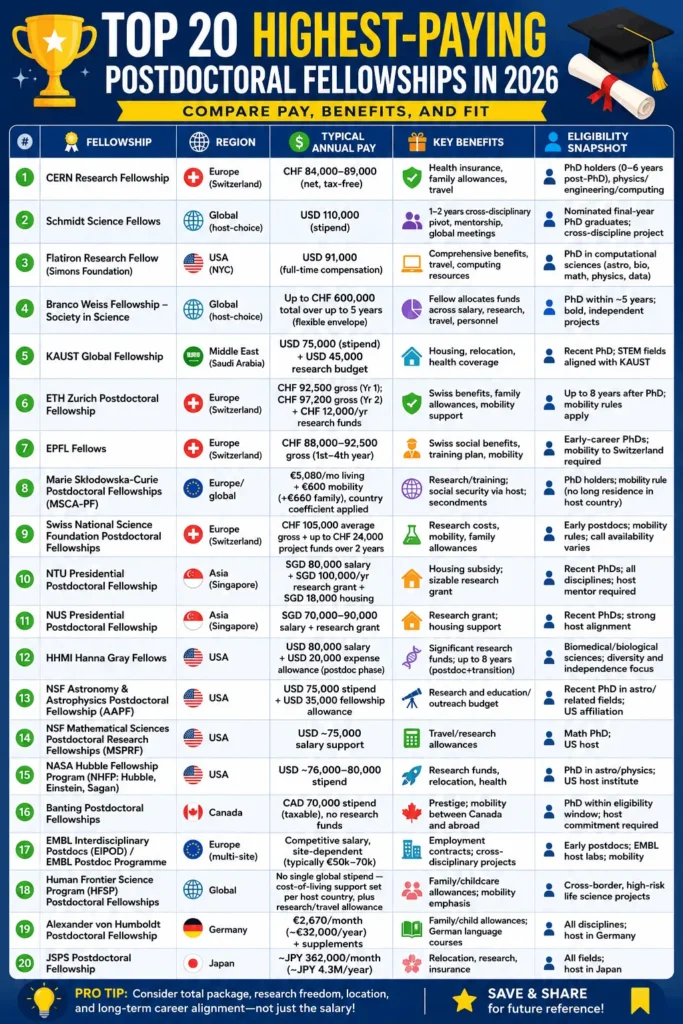
Top 20 highest-paying postdoctoral fellowships in 2026 (compare pay, benefits, and fit)
Amounts reflect verified 2026 call data where confirmed; where not yet published for 2026, the most recent verified figures are used and flagged. “Typical annual pay” indicates whether the amount is gross, net, or a flexible multi-year envelope — always confirm on official pages.
| Fellowship | Region | Typical Annual Pay | Key Benefits | Eligibility Snapshot | Usual Deadline Window | Official Link |
|---|---|---|---|---|---|---|
| CERN Research Fellowship | Europe (Switzerland) | CHF 84,000–89,000 (net, tax-free) | Health insurance, family allowances, travel | PhD holders (0–6 years post-PhD), physics/engineering/computing | Rolling calls; several cycles per year | careers.cern |
| Schmidt Science Fellows | Global (host-choice) | USD 110,000 (stipend) | 1–2 years cross-disciplinary pivot, mentorship, global meetings | Nominated final-year PhD graduates; cross-discipline project | Institutional nominations mid-year; finals in Q4 | schmidtsciencefellows.org |
| Flatiron Research Fellow (Simons Foundation) | USA (NYC) | USD 91,000 (full-time compensation) | Comprehensive benefits, travel, computing resources | PhD in computational sciences (astro, bio, math, physics, data) | Varies by center; typically Q3–Q4 | simonsfoundation.org/flatiron |
| Branco Weiss Fellowship – Society in Science | Global (host-choice) | Up to CHF 600,000 total over up to 5 years (flexible envelope) | Fellow allocates funds across salary, research, travel, personnel | PhD within ~5 years; bold, independent projects | Call typically opens Q1; deadline ~April | brancoweissfellowship.org |
| KAUST Global Fellowship | Middle East (Saudi Arabia) | USD 75,000 (stipend) + USD 45,000 research budget | Housing, relocation, health coverage | Recent PhD; STEM fields aligned with KAUST | Annual calls; often Q3–Q4 | KAUST Global Fellowship Program |
| ETH Zurich Postdoctoral Fellowship | Europe (Switzerland) | CHF 92,500 gross (Yr 1); CHF 97,200 gross (Yr 2) + CHF 12,000/yr research funds | Swiss benefits, family allowances, mobility support | Up to 8 years after PhD; mobility rules apply | Two rounds/year (spring and fall) | ETH Fellows |
| EPFL Fellows | Europe (Switzerland) | CHF 88,000–92,500 gross (1st–4th year) | Swiss social benefits, training plan, mobility | Early-career PhDs; mobility to Switzerland required | Typically one deadline/year (spring) | EPFL Postdocs |
| Marie Skłodowska-Curie Postdoctoral Fellowships (MSCA-PF) | Europe/global | €5,080/mo living + €600 mobility (+€660 family), country coefficient applied | Research/training; social security via host; secondments | PhD holders; mobility rule (no long residence in host country) | Annual EU call; deadline typically Sep | MSCA Postdoctoral Fellowships |
| Swiss National Science Foundation Postdoctoral Fellowships | Europe (Switzerland) | Discontinued — was CHF 105,000 average gross + up to CHF 24,000 project funds over 2 years | Research costs, mobility, family allowances | This transitional scheme has been sunset now that MSCA is available again in Switzerland since 2025; researchers should apply directly to MSCA-PF instead | Scheme closed | SNSF programme page (status) |
| NTU Presidential Postdoctoral Fellowship | Asia (Singapore) | SGD 80,000 salary + SGD 100,000/yr research grant + SGD 18,000 housing | Housing subsidy; sizable research grant | Recent PhDs; all disciplines; host mentor required | Usually Q1–Q2 | NTU PPF |
| NUS Presidential Postdoctoral Fellowship | Asia (Singapore) | SGD 70,000–90,000 salary + research grant | Research grant; housing support | Recent PhDs; strong host alignment | Typically Q1–Q2 | NUS Programmes |
| HHMI Hanna Gray Fellows | USA | USD 80,000 salary + USD 20,000 expense allowance (postdoc phase) | Significant research funds; up to 8 years (postdoc+transition) | Biomedical/biological sciences; diversity and independence focus; from the 2028 competition (opening Nov 2026) selection merges with the Freeman Hrabowski Scholars Program | Annual; usually Q1 (2028 cycle opens Nov 2026) | HHMI Hanna H. Gray Fellows |
| NSF Astronomy & Astrophysics Postdoctoral Fellowship (AAPF) | USA | USD 75,000 stipend + USD 35,000 fellowship allowance | Research and education/outreach budget | Recent PhD in astro/related fields; US affiliation | Annual; usually Q4 | NSF AAPF |
| NSF Mathematical Sciences Postdoctoral Research Fellowships (MSPRF) | USA | USD ~75,000 salary support | Travel/research allowances | Math PhD; US host | Annual; typically Q4–Q1 | NSF MSPRF |
| NASA Hubble Fellowship Program (NHFP: Hubble, Einstein, Sagan) | USA | USD ~76,000–80,000 stipend | Research funds, relocation, health | PhD in astro/physics; US host institute | Annual; Sep–Nov | NHFP |
| Canada Postdoctoral Research Award (CPRA) — replaces Banting | Canada | CAD 70,000/year (taxable), 24-month term | Prestige; part of the harmonized Canada Research Training Awards Suite | The Banting Postdoctoral Fellowship’s final competition was 2024–25; it has been folded into CPRA, which runs through CIHR, NSERC, or SSHRC depending on field. PhD within eligibility window; host commitment required | Annual; check the relevant tri-agency stream | CPRA (NSERC) |
| EMBL Interdisciplinary Postdocs (EIPOD) / EMBL Postdoc Programme | Europe (multi-site) | Competitive salary, site-dependent (typically €50k–70k) | Employment contracts; cross-disciplinary projects | Early postdocs; EMBL host labs; mobility | Cycles vary by site/program | EMBL Postdoctoral Programme |
| Human Frontier Science Program (HFSP) Postdoctoral Fellowships | Global | No single global stipend — cost-of-living support set per host country, plus research/travel allowance | Family/childcare allowances; mobility emphasis | Cross-border, high-risk life science projects | Annual; typically Aug pre-reg, Sep full | HFSP Postdoctoral Fellowships |
| Alexander von Humboldt Postdoctoral Fellowship | Germany | €2,670/month (~€32,000/year) + supplements | Family/child allowances; German language courses | All disciplines; host in Germany | Rolling | Humboldt Research Fellowship |
| JSPS Postdoctoral Fellowship | Japan | ~JPY 362,000/month (~JPY 4.3M/year) | Relocation, research, insurance | All fields; host in Japan | Multiple rounds/year | JSPS Fellowships |
A few important clarifications:
- CERN figures are net and tax-free, while ETH Zurich, EPFL, and SNSF figures are gross — meaning cantonal/federal tax and social contributions come out before you see the money. Don’t compare them at face value.
- Branco Weiss is not a fixed annual salary. It’s a flexible, multi-year funding envelope of up to CHF 600,000 that fellows can allocate across their own salary, research costs, travel, and personnel over as long as 5 years.
- HFSP does not publish one global stipend figure. Awards are set relative to the cost of living in the host country, so the “take-home” amount varies significantly depending on where you’re placed.
- SNSF Swiss Postdoctoral Fellowships was a transitional scheme for researchers who wanted a Switzerland-based MSCA-style fellowship while Switzerland was a non-associated third country in Horizon Europe. Now that Switzerland has rejoined MSCA (since early 2025), the SNSF scheme has been discontinued — apply to MSCA-PF directly for a Switzerland placement instead.
- Banting Postdoctoral Fellowships ran their final competition in 2024–25 and have been folded into the new harmonized Canada Postdoctoral Research Award (CPRA), part of the Canada Research Training Awards Suite. The pay level (CAD 70,000/year) and duration carry over, but applicants now go through CIHR, NSERC, or SSHRC depending on their field rather than a standalone “Banting” competition.
How to choose among the highest-paying postdoctoral fellowships
Beyond headline pay, compare the following:
- Cost of living and taxes: CHF 90k gross in Zurich, USD 90k in the US, and SGD 90k in Singapore all net out very differently. Use official tax calculators, and factor in whether health insurance and social contributions are employer-covered.
- Gross vs. net vs. envelope: As shown above, some awards (CERN) are quoted net and tax-free, others (ETH, EPFL, SNSF) are gross, and some (Branco Weiss) are multi-year flexible funding rather than a fixed salary. Normalize before comparing.
- Benefits: Housing subsidies (common in the Middle East and Singapore), family allowances (CERN, MSCA, SNSF), research budgets (Schmidt, KAUST, NTU/NUS, NSF, NHFP, HHMI), and travel support can outweigh stipend differences.
- Eligibility windows: Some restrict years since PhD (HFSP, MSCA, CERN), mobility rules (MSCA, SNSF, EPFL/ETH), or host nationality/residency constraints (NSF, NIH).
- Career outcomes: Programs with strong alumni networks (CERN, MSCA, Schmidt, Flatiron, NHFP) often correlate with strong placement into faculty or high-impact industry roles.
Step-by-step guide to winning a top-paying postdoc in 9 steps
Step 1: Build a targeted list (5–8 programs)
Use a portfolio strategy: 2–3 “reach” awards (e.g., Schmidt, Branco Weiss, Flatiron), 2–3 strong matches (MSCA, ETH/EPFL, NHFP, NSF), and 1–2 safety options (institutional or national schemes with higher success rates). Track pay, benefits, deadlines, eligibility, and document requirements in a simple spreadsheet — and note whether each figure is gross, net, or an envelope.
Step 2: Validate host fit early
- Write a 150-word “fit statement” that links your methods to the host’s recent 2–3 papers.
- Secure a primary mentor and, if allowed, a co-mentor in a complementary area (panels reward cross-training).
- Confirm lab capacity: bench space, compute/GPU access, datasets, cohorts, field sites.
Step 3: Pre-flight compliance and logistics
- Human/animal research: IRB/IACUC or ethics approvals. For data-sharing across borders, add a DUA/GDPR plan.
- Visa and start date windows: some awards require starting within 6–12 months of the offer.
- Budget alignment: clarify who pays fringe, tuition-like fees, and overheads (if any).
Step 4: Design a fundable research and training plan
Panels want independence and feasibility. Organize your plan as follows:
- Problem and significance: 1–2 paragraphs with concrete gaps and societal/field impact.
- Innovation: what is new (algorithm, assay, dataset, theory) and why it matters now.
- Approach: 2–3 aims with methods, timelines, and objective milestones.
- Risks and alternatives: 2–3 credible fallbacks per aim.
- Training gains: new techniques, co-mentorship, coursework, industry/clinical rotations.
- Outputs: target journals, preprint policy, code/data release, seminars, teaching.
Step 5: Present a clear calendar and Gantt-like milestones
- Quarterly milestones, each ending with a tangible output (preprint, dataset, prototype).
- Reserve 10–15% time for career development: grantwriting, pedagogy, leadership.
- Include an explicit manuscript and conference plan to demonstrate productivity cadence.
Step 6: Write for evaluators, not insiders
- Use short paragraphs, descriptive headings mirroring the scoring rubric, and figures only if allowed.
- Lead each Aim with 1–2 sentences on hypothesis/goal before technical details.
- Include a one-paragraph “Why now at this host?” statement.
Step 7: Optimize letters of support
Provide letter writers with bullet prompts and a draft of your one-page summary. Ask them to address:
- Your independence and originality beyond the PhD supervisor’s line.
- Evidence of project feasibility in 24–36 months.
- Concrete mentoring and integration plan (lab meetings, co-mentoring, annual reviews).
Step 8: Mock interviews and chalk talks
- Prepare a 60–90 second pitch: Problem → Innovation → Feasibility → Impact.
- Anticipate 6–8 FAQs: novelty, risks, data access, ethical approvals, contingency, independence from PI, timeline realism.
- Practice with non-specialists to ensure clarity.
Step 9: Submission quality control
- Run a final checklist against the sponsor’s scoring criteria.
- Confirm file names, page limits, margins, and font rules; submit 24–48 hours before deadline.
- Save a PDF of the submission confirmation.
Salary, taxes, and benefits: country-by-country considerations
- Switzerland: High gross pay; excellent social benefits; taxes vary by canton. CERN is the exception — its stipend is net and tax-free, while ETH, EPFL, and SNSF figures are gross.
- United States: Stipends may be taxable; benefits and health insurance differ by host; NIH NRSA scale sets a floor but many high-end fellowships (HHMI, Flatiron) exceed it.
- European Union: Many awards are employment contracts with social security; MSCA uses country correction coefficients for cost of living.
- Middle East (e.g., KAUST): High stipend plus a separate research budget, furnished housing, and relocation; often tax-free personal income; strong research support.
- Singapore: Competitive salary plus housing support and sizable, separately budgeted research grants; personal taxes relatively low; CPF does not usually apply to foreign postdocs.
- Japan and Germany: Solid benefits and stability; base stipends may be lower but cost of living and social protection can balance the package.
Timelines: a month-by-month application planner
- Months −8 to −7: Identify 5–8 programs; contact hosts; gather eligibility facts.
- Months −6 to −5: Draft 2-page concept note; secure mentor buy-in; outline training plan.
- Month −4: Full proposal draft; internal peer reviews; budget alignment.
- Month −3: Finalize letters; obtain necessary pre-approvals (IRB/IACUC/DUA).
- Month −2: Polish narrative; prepare lay summary and DEI statements if required.
- Month −1: Compliance check, formatting, and portal rehearsal submission.
- Week −2: Submit; confirm references received; archive all files.
Email templates and document outlines
Cold email to a potential postdoc host
Subject: Prospective postdoc and fellowship application (Your Name – Target Award)
Dear Prof. [Last Name],
I am a final-year PhD candidate at [University] working on [1-sentence problem]. I plan to apply for the [Fellowship Name] (deadline [Date]) and would value the opportunity to pursue this project in your group, building on your work in [Specific Paper or Method].
In brief, my proposed project aims to [1–2 sentences on novelty and aims]. I attach a 1-page summary and 2 representative publications. If this aligns with your interests, could we schedule a 20-minute call to discuss fit, training opportunities, and logistics?
Thank you for considering, and I would be delighted to provide any additional materials.
Sincerely, [Your Name], PhD Candidate [Website/Google Scholar | ORCID | Contact]
CV outline for top-paying fellowships
- Header: Name, degrees, current affiliation, contact, ORCID, website.
- Research focus: 3–4 bullet statements (methods, domains, key contributions).
- Publications: separate peer-reviewed articles, preprints, and in-preparation; indicate equal contributions; include DOIs.
- Awards and funding: fellowships, grants, best-paper awards.
- Teaching/mentoring: guest lectures, TA roles, mentorship of students.
- Outreach and leadership: open-source software, datasets, outreach talks, DEI activities.
- References: 3–4 with emails and roles (PhD advisor, collaborator, external).
Statement of Purpose (one-page) outline
- Why this fellowship: fit to mission and criteria.
- Your trajectory: key results, skills, independence.
- Project summary: 3–5 sentences: problem → approach → outcomes.
- Host fit: mentoring, facilities, training, co-mentors.
- Career plan: specific next steps and how this fellowship accelerates them.
Research proposal outline (8–12 pages typical)
- Title and abstract (200–300 words).
- Background and significance (1–1.5 pages).
- Innovation and hypotheses (0.5–1 page).
- Aim 1 (methods, data, analysis, milestones, risks/alternatives).
- Aim 2 (as above).
- Aim 3 (optional for 3-year projects).
- Training plan and mentoring structure (courses, rotations, industry/clinical exposure).
- Open science plan (preprints, code/data sharing, reproducibility).
- Timeline and Gantt chart narrative.
- Ethics, risk, and safety considerations.
- References (consistent style, recent and relevant).
Interview preparation: common questions
- What is the single biggest risk in your project and how will you mitigate it?
- How is this work distinct from your PhD advisor’s research?
- What preliminary data or proof-of-concept supports feasibility?
- What will success look like in 12, 24, and 36 months?
- How will the host’s environment accelerate your progress?
- What are your plans for data management, sharing, and reproducibility?
- How will this fellowship position you for your target career (faculty/industry)?
Cover letter template (for fellowships with employment contracts)
Dear Members of the Selection Committee,
I am applying to the [Fellowship Name] to pursue [project title] under the mentorship of [Host PI] at [Institution]. My doctoral work in [Field] produced [1–2 key outcomes], which provide a strong foundation for this proposal’s [methods/innovation].
This fellowship is the best fit because [alignment with mission/criteria]. The host offers [specific facilities/training], and we have established a clear mentoring and integration plan. Over [duration], I expect to deliver [outputs], share results via [journals/conferences/open data], and undertake training in [skills].
Thank you for your consideration. I look forward to the opportunity to contribute to the [fellowship community/lab/field].
Sincerely, [Your Name]
Expert Tips
- Use award-specific language: mirror key terms from the call in headings and topic sentences.
- Quantify ambition and feasibility: “We will benchmark on [dataset] to exceed [metric] by X%” is stronger than “We will evaluate performance.”
- Attach host commitment: a signed, detailed support letter promising resources and supervision cadence significantly boosts credibility.
- Leverage dual mentorship: pair a content mentor with a methods mentor (e.g., domain + AI/ML) to show cross-disciplinary training.
- Pre-register and preprint: panels reward open science and rapid dissemination that do not jeopardize IP.
- Pilot first: even a small pilot (n=10, prototype script, power analysis) strengthens the feasibility argument.
- Know the pay components: some fellowships list gross amounts before employer contributions; others are net or tax-free; a few (like Branco Weiss) are multi-year envelopes rather than annual salaries. Clarify this in your comparison sheet before you plan a budget.
- Use internal reviews: run at least one senior and one junior peer review; incorporate feedback and maintain version control.
- Show independence: avoid overlapping aims and figures with your PhD advisor’s grants; state clearly what is yours.
- Back-up submission: where permitted, pursue a national or institutional scheme in parallel to cover timing risk.
Common Mistakes to Avoid
- Ignoring mobility rules: programs like MSCA and Swiss fellowships require you not to have resided in the host country beyond specified limits.
- Overly broad aims: panels prefer two well-defined, feasible aims over four ambitious but vague goals.
- Missing country corrections: for MSCA, failure to apply country coefficients leads to inaccurate salary expectations.
- Confusing gross, net, and multi-year envelopes: treating a CHF 600,000 five-year Branco Weiss award as if it were a CHF 600,000/year salary, or comparing CERN’s net stipend directly against ETH’s gross salary, will throw off your planning.
- Generic letters: references that restate your CV without specifics can sink an application; brief writers early and provide bullets.
- No contingency plans: absence of risks/alternatives signals lack of realism.
- Weak host rationale: selecting a prestigious host without a direct methodological link reduces perceived feasibility and training gain.
- Late compliance: waiting to address IRB/animal/data approvals suggests timeline naivety.
- Poor formatting: violating page limits, fonts, or margin rules can lead to desk rejections.
- Underestimating taxes and benefits: a higher gross stipend may net less depending on country and family status.
- No narrative arc: a cut-and-paste methods section without a compelling problem-impact story rarely scores top marks.
Useful Resources (official)
- MSCA Postdoctoral Fellowships portal
- CERN Careers and Fellowships
- Schmidt Science Fellows
- Flatiron Research Fellow (Simons Foundation)
- Branco Weiss – Society in Science
- KAUST Global Fellowship
- ETH Zurich Fellowships
- EPFL Postdocs
- NASA Hubble Fellowship Program
- NSF Astronomy & Astrophysics Postdoctoral Fellowships (AAPF)
- NSF Mathematical Sciences Postdoctoral Research Fellowships (MSPRF)
- Canada Postdoctoral Research Award — successor to Banting
- EMBL Postdoctoral Programme
- HFSP Postdoctoral Fellowships
- HHMI Hanna Gray Fellows
- Alexander von Humboldt Foundation — Humboldt Research Fellowship
- JSPS Postdoctoral Fellowships for Research in Japan
Internal Links and how IR Research Publication can help
Strengthen your applications with rigorous, citable outputs and visibility:
- Publish and disseminate your latest results via IR Research Publication’s journals to demonstrate momentum before deadlines.
- Explore author guidelines and journal selection support at IR Research Publication to align your manuscript strategy with fellowship timelines.
- Stay updated on calls, research writing tips, and peer review insights from IR Research Publication.
- Learn more about IR Research Publication and its editorial and profile-building services while preparing your fellowship dossier.
Frequently Asked Questions
Which are the highest-paying postdoctoral fellowships in 2026?
Programs that consistently top pay scales include Schmidt Science Fellows (USD 110,000/year), Branco Weiss (up to CHF 600,000 over 5 years, flexible), ETH Zurich (CHF 92,500–97,200/year gross), EPFL Fellows (CHF 88,000–92,500/year gross), CERN Research Fellowships (CHF 84,000–89,000/year net, tax-free), and HHMI Hanna Gray Fellows (USD 80,000/year + USD 20,000 allowance). Note that the SNSF Swiss Postdoctoral Fellowships scheme, which used to average CHF 105,000/year, has been discontinued now that MSCA is available again in Switzerland — apply to MSCA-PF for a Swiss placement instead. Verify current 2026 calls, and note whether each figure is gross, net, or a multi-year total.
How do MSCA Postdoctoral Fellowship salaries work?
MSCA-PF provides a monthly living allowance (€5,080), mobility allowance (€600), and family allowance (€660 if eligible), all multiplied by a country correction coefficient. Amounts are before taxes and employer contributions; you are typically an employee with social security via the host.
What is the difference between stipend and salary?
Salary is employment income with withholdings and benefits; stipend can be tax-free or taxable depending on country and sponsor. CERN, for example, quotes a net, tax-free stipend, while ETH, EPFL, and SNSF use gross salaries. Always compare net-of-tax figures and include benefits.
Do high-paying fellowships always include research funds?
No. Some provide primarily salary (e.g., ETH/EPFL base pay), while others bundle a separate research budget on top of the stipend (e.g., KAUST’s USD 45,000 research budget, NTU’s SGD 100,000/year research grant, or ETH’s CHF 12,000/year research funds). Read the call to see which costs are allowed (equipment, travel, page charges) and whether the research budget is separate from your personal pay.
How many applications should I submit?
Most successful candidates apply to 5–8 programs across sponsors and regions. Diversification increases your odds and gives negotiation leverage with hosts.
Can I negotiate salary or benefits?
Stipends are usually fixed by the sponsor, but benefits and top-ups can sometimes be negotiated with the host (e.g., housing, relocation, supplementary funds, or bridging salary while awaiting results).
What are acceptance rates like?
Prestigious programs (Schmidt, Branco Weiss, Flatiron) may fund a small single-digit percentage of applicants. MSCA-PF and NSF postdocs often range roughly 10–15% overall, varying by panel and year. Institutional schemes can be higher. Check statistics in annual reports where available.
When should I start preparing?
Start 6–8 months before the deadline. Early preparation is essential for host coordination, ethics approvals, letters, and polished narratives.
Are industry postdocs higher paying than fellowships?
Often yes, especially in tech and biotech hubs; however, pure industry roles may trade off academic independence or teaching. This guide focuses on competitive academic or foundation-funded fellowships with strong research autonomy.
What if I miss a major deadline?
Line up institutional or national schemes with rolling or later deadlines, and ask your host about short-term contracts or internal bridging funds. Resubmit in the next cycle with improved preliminary data.
Conclusion: How to act now
The highest-paying postdoctoral fellowships offer more than salary: they accelerate independence, unlock resources, and expand networks. Start by shortlisting 5–8 awards, matching each to a host with demonstrable synergy, and scoping a focused, feasible, and high-impact project. Use the templates above to contact mentors, structure your CV and proposals, and prepare for interviews. Confirm 2026 stipend and benefits on official pages, model your net-of-tax income by city, watch for the difference between gross, net, and multi-year envelope figures, and submit at least 24–48 hours early. If you aim for the highest-paying postdoctoral fellowships, preparation 6–8 months ahead is the single biggest predictor of success.
About IR Research Publication
IR Research Publication is dedicated to advancing global scholarship by connecting researchers with reputable journals, rigorous peer review, and practical publishing resources. From manuscript preparation to dissemination, IR Research Publication supports early-career scientists and postdoctoral researchers in building credible, citable profiles that strengthen fellowship and grant applications. Learn more and get started at IR Research Publication.
Related Articles
- Germany vs Netherlands for PhD in 2026: Costs, Funding, Language, Jobs
- PhD Scholarship Guide 2026: How to Find, Win, and Fund a Fully Funded PhD
- USA vs Canada for PhD: Best Choice for Indian Students in 2026
- Fully Funded PhD Scholarships in Germany 2027 | Apply Now
- QS World University Rankings 2027 Released: MIT’s Historic Streak, Asia’s Rise, and the Global Top 20
Note: Stipends, benefits, and policies may change by the 2026 call. Always verify live details, tax treatment, and eligibility on the official fellowship pages and your prospective host’s HR office before committing.