Finding high paying jobs for Biology PhDs in India can often feel like a struggle against a system designed for low-stipend fellowships. You have spent 5–7 years mastering your field, yet the “Postdoc Pay Gap” remains a harsh reality. While an academic fellowship might offer ₹47,000–₹54,000 per month, the corporate sector is currently offering double or triple that for the same skillset.
If you are tired of the uncertainty of grant funding, it is time to look beyond the lab bench. In 2026, the Indian biotech and pharmaceutical sectors are booming, creating a massive demand for doctoral experts.
This guide is your ultimate roadmap. We have analyzed the market to bring you the definitive list of high paying jobs for Biology PhDs in India that offer both intellectual satisfaction and a lucrative paycheck.
Why Are There More High Paying Jobs for Biology PhDs in India Now?
Before we dive into the list, it is important to understand why the market has shifted. In 2026, India is no longer just a “manufacturing hub” for generic drugs; it is becoming an “innovation hub.”
Companies like Biocon, Syngene, and Dr. Reddy’s are competing with global giants. They need Subject Matter Experts (SMEs) to drive this innovation. This shift has created a surge in high paying jobs for Biology PhDs in India, specifically in sectors like AI-driven Drug Discovery, Clinical Research, and Intellectual Property.
Below is the breakdown of these roles, including salaries, required certifications, and the exact skills you need to land them.
1. Medical Science Liaison (MSL)
The “Gold Standard” of Corporate Science Roles
The Medical Science Liaison (MSL) is widely considered one of the most prestigious and high paying jobs for Biology PhDs in India. It serves as the scientific bridge between a pharmaceutical company and top doctors (Key Opinion Leaders or KOLs).
What do they actually do?
You are not a sales representative. You do not carry a bag of samples.
Morning: Review new clinical trial data for your company’s blockbuster cancer drug.
Afternoon: Meet with a leading Oncologist at AIIMS or Tata Memorial to discuss how the drug’s mechanism of action (MoA) fits their patient needs.
Evening: Fly to a conference to present a poster on Phase III trial results.
Why it pays well:
You are the “peer” of the doctor. Sales reps cannot answer deep scientific questions; only a PhD can. Your knowledge directly influences the adoption of high-value drugs.
Average Salary (2026): ₹12 – ₹18 Lakhs per annum (Entry Level) | ₹25 – ₹40 Lakhs (Senior MSL/Manager)
Top Recruiters: Novartis, AstraZeneca, Sanofi, Johnson & Johnson, Pfizer.
Required Skills: Excellent communication (English & regional), therapeutic area knowledge (Oncology/Immunology is hot).
Action Step: To break in, you don’t need a new degree. You need to demonstrate “Scientific Storytelling.” Check out our guide on How to Write a Letter of Intent to perfect your application.
2. Patent Agent / IP Specialist
Where Science Meets Law
India is seeing a surge in biotech startups, and every new molecule needs a patent. This has created a massive shortage of “Patent Agents” who understand complex biology. If you are looking for high paying jobs for Biology PhDs in India that don’t involve wet-lab work, this is a top contender.
The Role:
Drafting: Writing the technical descriptions of inventions (e.g., a new CRISPR vector).
Prosecution: Arguing with the Patent Office to prove why your client’s invention is unique.
Freedom to Operate (FTO): Researching if a new product infringes on existing patents.
The “Barrier to Entry” (Your Advantage):
To sign documents as a Patent Agent, you must pass the Indian Patent Agent Examination (IPAE) conducted by the Government of India. It is a tough exam, but once you clear it, your value skyrockets.
Average Salary: ₹10 – ₹20 Lakhs (Law Firms) | ₹30+ Lakhs (In-house Counsel at Biocon/Dr. Reddy’s).
Top Recruiters: K&S Partners, Anand and Anand, Biocon, Syngene.
With the explosion of AI in Drug Discovery (AIDD), “Dry Lab” roles are outpaying “Wet Lab” roles by a significant margin. If you can code, you are in the top 1% of employable PhDs.
What do they do?
Analyze Next-Generation Sequencing (NGS) data.
Use Machine Learning (ML) models to predict how a drug molecule binds to a protein target.
Work with “Big Data” sets (Genomics, Proteomics) to find disease biomarkers.
Why the high pay?
You are effectively a Data Scientist with a Biology background. Tech companies compete for this talent.
Pro Tip: If you are a wet-lab biologist, start learning Python today. Even basic proficiency can boost your salary by 30%.
4. Regulatory Affairs (RA) Specialist
The Gatekeepers of Pharma
No drug, vaccine, or medical device enters the Indian market without approval from the CDSCO (Central Drugs Standard Control Organisation). RA specialists are the experts who navigate this legal maze.
The Day-to-Day:
Compiling massive dossiers (thousands of pages) for drug approval.
Liaising with government officials to answer queries about safety data.
Ensuring marketing materials comply with the “Drugs and Magic Remedies Act.”
Why it pays well:
A delay in regulatory approval can cost a pharma company crores in lost revenue. They pay a premium for experts who can get approvals right the first time.
Average Salary: ₹9 – ₹16 Lakhs per annum.
Certifications:
RAC (Regulatory Affairs Certification): Global standard (expensive but valuable).
Indian Courses: PG Diploma in Regulatory Affairs (offered by institutes like Cliniminds or TechnoBridge).
Top Recruiters: Dr. Reddy’s, Cipla, Parexel, IQVIA.
5. Industrial R&D Scientist
The Corporate Alternative to Academia
This is the closest role to your PhD work, but with a different goal. In academia, you publish papers. In industry, you launch products.
The Role:
Process Development: Scaling up a vaccine production from a 5mL flask to a 500L bioreactor.
Assay Development: Creating robust tests to check if a drug is pure.
Formulation: Figuring out how to keep a protein stable in a pill or injection.
The 2026 Trend:
“Biosimilars” are huge in India. Companies like Biocon and Reliance Life Sciences are hiring aggressively for scientists who understand protein purification and characterization.
India is a global hub for clinical trials due to its large patient population. PhDs are hired to design these trials and ensure they are ethical and safe.
What do they do?
Protocol Design: Writing the rulebook for how the clinical trial will be conducted.
Medical Monitoring: Reviewing patient data to catch adverse events (side effects) early.
Site Management: Ensuring hospitals (trial sites) are following the protocol.
Why it pays well:
Clinical trials are the most expensive part of drug development. Companies need high-IQ individuals to manage the risk.
Average Salary: ₹8 – ₹14 Lakhs per annum.
Certifications:
Advanced Program in Clinical Research & Management (APCRM) by Clini India.
PG Diploma in Clinical Research (ICRI).
Top Recruiters: IQVIA, LabCorp, Icon, Syneos Health.
7. Scientific & Medical Writer
For the Wordsmiths
If you enjoyed writing your thesis and papers more than doing the actual experiments, this is your calling.
The Role:
Regulatory Writing: Writing Clinical Study Reports (CSRs) for the FDA/EMA.
Med-Comms: Creating slide decks for doctors, conference abstracts, and educational material.
Publication Planning: Helping pharma companies publish their trial results in top journals like The Lancet.
Why it pays well:
This is not “Content Writing.” It requires the ability to understand complex statistical data and present it accurately. A generic writer cannot do this.
Have you ever used a confocal microscope or a flow cytometer? Companies like Thermo Fisher need PhDs to demonstrate these machines to other scientists.
The Role:
Traveling to research institutes (IITs, IISERs) to demo equipment.
Troubleshooting customer experiments (e.g., “Why is my PCR not working?”).
Training new users on how to use complex software.
Why it pays well:
It combines technical expertise with sales. You often get a Base Salary + Commission, meaning your earning potential is uncapped.
Top Recruiters: Thermo Fisher Scientific, Agilent, illumina, Beckman Coulter.
9. Management Consultant (Life Sciences)
Solving Business Problems
Top consulting firms (MBB – McKinsey, BCG, Bain) have specialized “Life Science” wings. They hire PhDs to help pharma CEOs make billion-dollar decisions.
The Day-to-Day:
Analyzing market trends (e.g., “Should we invest in Cell Therapy in India?”).
Due Diligence: Investigating a startup before a merger.
Pricing Strategy: Deciding how much a new drug should cost.
Why it pays well:
This is the highest-paying sector globally. However, the work hours are long (60+ hours/week).
Average Salary: ₹20 – ₹30 Lakhs per annum (Starting).
Top Recruiters: McKinsey, BCG, Deloitte, ZS Associates.
10. Government Scientist (Grade B/C)
The Stability Option
While we focus on “High Paying,” we cannot ignore the value of government perks. A Scientist ‘C’ position might have a lower base cash component than an MSL, but the benefits make it highly lucrative.
The Package:
Job Security: Permanent tenure.
Allowances: Housing (HRA), Transport (TA), Medical (CGHS), and Pension.
Research Freedom: You set your own agenda (unlike corporate R&D).
Salary Scale (7th Pay Commission):
Scientist C: Pay Level 11 (Starting Basic ₹67,700 + DA + HRA ≈ ₹1.1 Lakh/month).
Where to Apply: DRDO (INMAS, DIPAS), ICMR, CSIR, DBT.
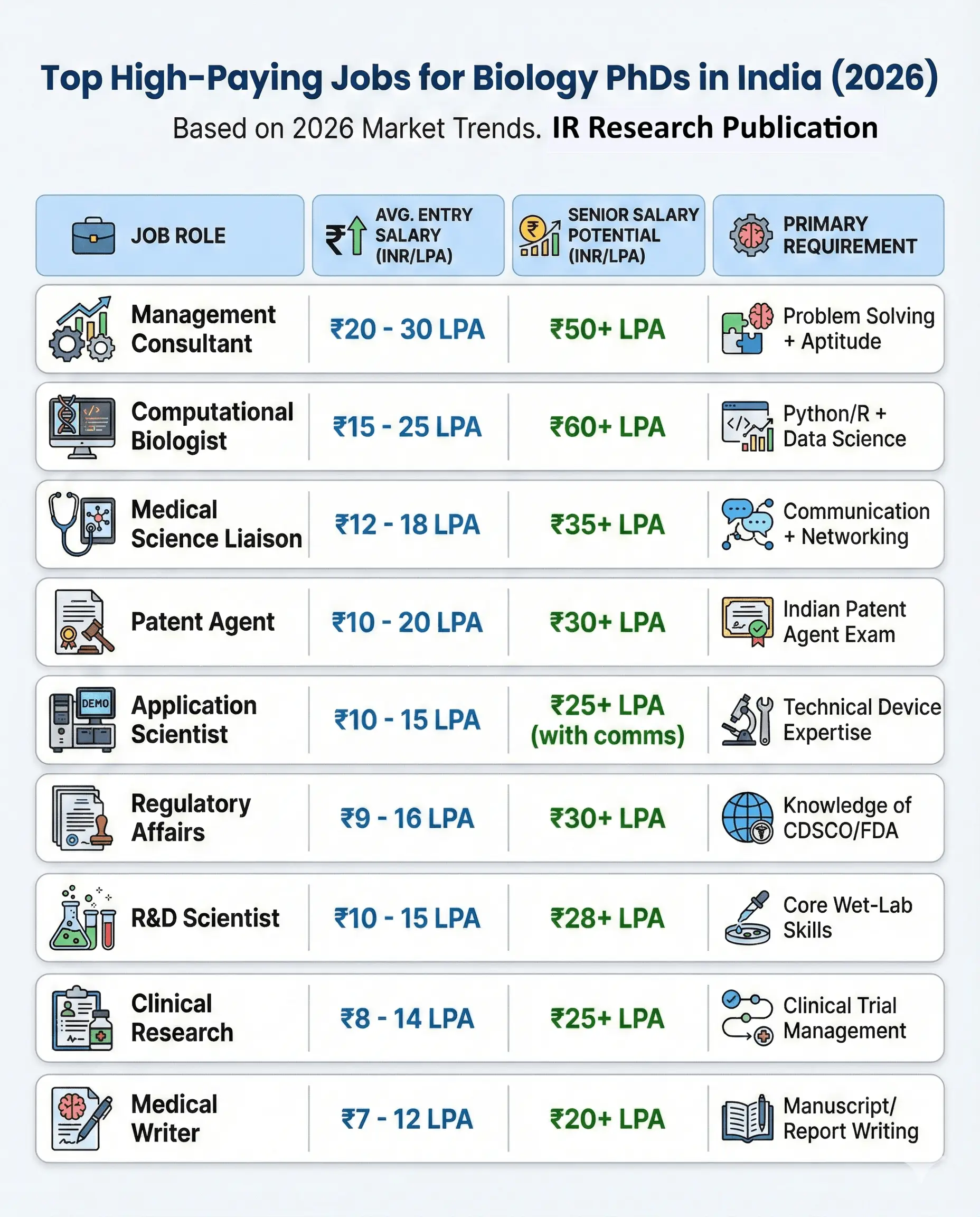
Summary of High Paying Jobs for Biology PhDs in India (2026)
To give you a clear comparison, we have summarized the salary potential of these roles below.
Job Role
Average Entry Salary (INR)
Senior Salary Potential
Primary Requirement
Management Consultant
₹20 – 30 LPA
₹50+ LPA
Problem Solving + Aptitude
Computational Biologist
₹15 – 25 LPA
₹60+ LPA
Python/R + Data Science
Medical Science Liaison
₹12 – 18 LPA
₹35+ LPA
Communication + Networking
Patent Agent
₹10 – 20 LPA
₹30+ LPA
Indian Patent Agent Exam
Application Scientist
₹10 – 15 LPA
₹25+ LPA (with comms)
Technical Device Expertise
Regulatory Affairs
₹9 – 16 LPA
₹30+ LPA
Knowledge of CDSCO/FDA
R&D Scientist
₹10 – 15 LPA
₹28+ LPA
Core Wet-Lab Skills
Clinical Research
₹8 – 14 LPA
₹25+ LPA
Clinical Trial Management
Medical Writer
₹7 – 12 LPA
₹20+ LPA
Manuscript/Report Writing
Action Plan: How to Transition?
You cannot apply to these jobs with your 10-page academic CV. Here is your transition checklist:
The Resume Makeover: Cut your CV to 2 pages. Move your “Skills” to the top. Remove the full list of 15 posters you presented; only keep the most relevant ones.
LinkedIn Optimization: Recruiters search for keywords. Update your headline to: “PhD in Molecular Biology | Aspiring Medical Science Liaison | Expertise in Oncology.”
Network Outside the Lab: Do not just talk to professors. Find alumni from your institute who are working in industry and ask them for a 15-minute virtual coffee chat.
Target Niche Portals: Stop scrolling Instagram. Check these sites weekly:
LinkedIn Jobs: Set alerts for “Medical Affairs,” “Scientific Writing,” and “R&D Scientist.”
Frequently Asked Questions (FAQ)
1. Is it too late to switch to industry if I am 32+ years old?
No. In fact, for roles like Medical Science Liaison or Patent Agent, maturity is an asset. Companies value the authority that comes with age and experience. However, for entry-level R&D bench roles, you might face competition from younger candidates, so focus on specialized roles where your deep knowledge is the differentiator.
2. Will I be “selling out” if I leave academia?
This is a common “Academic Guilt.” Remember: Science is not just done in a university. In industry, you bring actual medicines to patients. A Regulatory Specialist ensures a vaccine is safe for millions. That is not selling out; that is making an impact (and getting paid fairly for it).
3. Do I need a Postdoc to get these jobs?
Strictly NO. In 90% of these cases, a Postdoc is not required and counts as “0 years of industrial experience.” If your goal is industry, start applying immediately after your PhD submission. Do not do a postdoc just to “wait out” the job market.
4. Can I return to academia later?
It is difficult, but not impossible. If you work in a high-publishing industrial R&D lab (like at Biocon or Syngene), you can still publish papers. However, if you move to management consulting or sales, returning to a tenure-track professor role is very rare.
5. Which city in India is best for these jobs?
Hyderabad and Bangalore are the undisputed capitals for Biotech and Pharma. Mumbai is the hub for Medical Affairs and Head Offices. Pune and Ahmedabad also have significant manufacturing and R&D clusters.
Ready to make the switch?
Your PhD gave you resilience, analytical skills, and the ability to learn complex topics quickly. These are exactly what the industry needs. The market for high paying jobs for Biology PhDs in India is wide open—you just need to package your skills correctly to seize the opportunity.
For more guides on academic writing and career transitions, visit Irrespub.com.
Additional Reading
For more scholarship opportunities and academic guidance, visit:
Completing a PhD in pharmaceutical sciences is a significant achievement that opens doors to exciting career opportunities worldwide. As you stand at this career crossroads in 2026, one crucial decision looms: should you pursue pharma jobs after PhD in India vs USA?
This comprehensive guide examines both markets in detail, comparing salary structures, career growth trajectories, research opportunities, and quality of life factors to help you make the most informed career choice for your future in the pharmaceutical industry.
Understanding Pharma Jobs After PhD: The Global Landscape
The pharmaceutical industry has evolved dramatically over the past decade, with both India and the USA playing pivotal yet distinct roles in the global healthcare ecosystem. Understanding these differences is essential when evaluating pharma jobs after PhD in India vs USA.
The United States maintains its position as the world’s leading pharmaceutical innovation hub, with companies investing over $100 billion annually in research and development. American pharmaceutical giants and biotech startups continue pioneering breakthrough therapies in oncology, gene therapy, immunology, and precision medicine.
India has transformed from primarily a manufacturing powerhouse into an increasingly research-oriented pharmaceutical nation. Known as the “pharmacy of the world,” India produces approximately 60% of global vaccines and 20% of generic medicines. However, Indian pharmaceutical companies are now investing heavily in research infrastructure, biosimilar development, and novel drug discovery.
For PhD holders, this creates two distinct career pathways: one focused on cutting-edge innovation and premium compensation, the other offering rapid growth in an emerging market with strong cultural connections and lower living costs.
Pharmacovigilance Scientists monitoring post-market drug safety
Strategic and Commercial Roles:
Medical Affairs Directors shaping therapeutic area strategies
Health Economics and Outcomes Research Scientists demonstrating drug value
Business Development Scientists evaluating licensing opportunities
The American pharmaceutical job market benefits from a robust biotech sector, with major hubs in Boston/Cambridge, San Francisco Bay Area, San Diego, Research Triangle Park (North Carolina), and the greater Philadelphia area hosting hundreds of companies ranging from early-stage startups to multinational corporations.
Compensation is often a deciding factor when comparing pharma jobs after PhD in India vs USA. American pharmaceutical salaries are among the highest globally, with comprehensive benefits packages.
2026 Salary Ranges by Experience Level:
Entry-Level PhD Positions (0-2 years):
Scientist I: $95,000 – $120,000 annually
Location adjustments: +15-25% in high-cost areas (San Francisco, Boston)
The American pharmaceutical industry offers well-defined career progression pathways with clear advancement criteria. Understanding growth potential is crucial when evaluating pharma jobs after PhD in India vs USA.
Typical Career Trajectory:
Years 0-3: Entry as Scientist I, focusing on specific projects, publishing research, and developing expertise. Promotion to Scientist II based on performance.
Years 4-7: Senior Scientist role, leading projects, mentoring junior staff, and contributing to strategic planning. Potential lateral moves to explore different therapeutic areas or functional roles.
Years 8-12: Principal Scientist or Associate Director, managing teams, overseeing multiple projects, and representing the company at scientific conferences. Leadership development programs become available.
Years 13+: Director and above, setting research strategy, managing large departments, influencing corporate direction, and potentially transitioning to C-suite positions.
Alternative Career Paths:
Entrepreneurship: Founding biotech startups (significant in Boston and Bay Area)
Consulting: Pharmaceutical and healthcare strategy consulting firms
Venture Capital: Scientific expertise valuable for investment decisions
Academia: Industry experience increasingly valued in academic positions
Regulatory Agencies: FDA and other regulatory bodies actively recruit from industry
The American market values merit-based advancement and provides extensive professional development resources including leadership training, cross-functional rotations, and international assignment opportunities.
Innovation and Research Infrastructure
Access to cutting-edge technology significantly impacts research productivity. Pharma jobs after PhD in India vs USA differ dramatically in research infrastructure.
USA Research Advantages:
State-of-the-art laboratories with latest analytical instruments (mass spectrometry, NMR, cryo-EM)
Advanced computational platforms for molecular modeling and AI-driven drug discovery
Access to extensive biobanks and patient databases
Collaborative environments with leading academic medical centers
Robust intellectual property protection and commercialization support
Proximity to venture capital funding for translational research
Major research institutions like the National Institutes of Health (NIH), academic medical centers, and industry-academic partnerships create ecosystems where groundbreaking discoveries regularly become marketed therapies.
The USA leads globally in FDA approvals for novel drugs, with approximately 40-60 new molecular entities approved annually, demonstrating the vibrant innovation environment.
Challenges and Considerations
Despite significant advantages, pursuing pharma jobs after PhD in the USA involves navigating several challenges:
Immigration Complexities:
H-1B visa lottery system creates uncertainty (annual cap of 85,000 visas)
Green card backlogs particularly long for Indian citizens (often 10-15+ years)
Visa restrictions limit job mobility during initial years
Family members may face work authorization limitations
Cost of Living Pressures:
Median home prices in Boston: $700,000+
San Francisco Bay Area: $1.2 million+
High healthcare costs even with insurance (deductibles, co-pays)
Expensive childcare ($2,000-$3,000 monthly per child)
Student loan burdens from American PhD programs
Competitive Job Market:
Thousands of qualified PhD candidates compete for positions
Requires extensive networking and multiple applications
Postdoctoral experience often expected for research-focused roles
Work-Life Balance:
Demanding project timelines and delivery pressures
Limited vacation time compared to other developed countries
Distance from family in India creates emotional challenges
Time zone differences complicate maintaining relationships
Pharma Jobs After PhD in India: Detailed Overview
Emerging Career Landscape
India’s pharmaceutical sector has matured significantly, creating diverse pharma jobs after PhD opportunities. When comparing pharma jobs after PhD in India vs USA, it’s important to recognize India’s unique positioning.
Available Positions Include:
Research and Development:
Formulation Development Scientists optimizing generic drug delivery
Biosimilar Research Scientists developing biological therapeutics
Process Development Scientists scaling manufacturing processes
Analytical Development Scientists validating quality control methods
New Chemical Entity (NCE) Discovery Scientists (emerging area)
Major Indian pharmaceutical companies including Sun Pharmaceutical, Dr. Reddy’s Laboratories, Cipla, Lupin, Biocon, Aurobindo Pharma, and Cadila Healthcare have established dedicated research centers primarily in Hyderabad, Bangalore, Mumbai, Ahmedabad, and Gurgaon.
Additionally, multinational corporations like Pfizer, Novartis, GlaxoSmithKline, AstraZeneca, and Sanofi operate research facilities in India, creating opportunities combining global standards with Indian operations.
Salary Structure and Financial Considerations
Understanding compensation is central to comparing pharma jobs after PhD in India vs USA. While absolute numbers are lower in India, purchasing power and savings potential tell a different story.
2026 Salary Ranges (in Lakhs and USD equivalent):
Entry-Level Positions (0-2 years):
Research Scientist: ₹8-12 lakhs ($9,600-$14,400)
Senior Research Scientist: ₹12-18 lakhs ($14,400-$21,600)
Vice President and above: ₹1.5-3 crore+ ($180,000-$360,000+)
Additional Benefits:
Performance bonuses: 10-15% of annual salary
Provident Fund (PF) contributions
Health insurance for employee and family
Education allowances for children
Transportation allowances
Retention bonuses for critical positions
Cost of Living Advantages:
Renting a 2-3 bedroom apartment: ₹25,000-60,000 monthly ($300-$720)
Home ownership: ₹50 lakhs – 1.5 crore for quality housing ($60,000-$180,000)
Domestic help: ₹8,000-15,000 monthly ($95-$180)
Healthcare costs: Significantly lower even for quality private care
Education: Quality private schools at ₹1-3 lakhs annually ($1,200-$3,600)
Real Purchasing Power Analysis:
An entry-level scientist earning ₹12 lakhs ($14,400) in Hyderabad has comparable or superior lifestyle to someone earning $95,000 in Boston when accounting for:
Housing costs (5-6x lower in India)
Daily expenses (3-4x lower)
Healthcare (4-5x lower)
Childcare (10x lower with domestic help)
Quality private education (3-4x lower)
Many professionals find they can save 30-40% of their salary in India versus 10-20% in high-cost US cities, despite lower absolute earnings.
Career Growth in India’s Evolving Market
Career advancement opportunities are expanding as India’s pharmaceutical sector matures. When evaluating pharma jobs after PhD in India vs USA, growth trajectories differ but each offers unique advantages.
Indian Career Progression:
Years 0-3: Research Scientist or Senior Research Scientist, establishing technical credibility, building networks within Indian pharmaceutical community, and contributing to regulatory filings.
Years 4-7: Lead Scientist or Manager, overseeing teams, managing budgets, and interfacing with senior leadership. Opportunities to shape emerging research programs.
Years 8-12: Senior Manager or General Manager, leading departments, making strategic decisions, and potentially managing multi-site operations. Many professionals reach significant leadership roles faster than in the USA due to rapid industry expansion.
Years 13+: Director and above, setting organizational direction, representing companies externally, and potentially joining boards. Some transition to entrepreneurship, leveraging industry experience to launch pharmaceutical ventures or consulting practices.
Unique Growth Opportunities:
Faster advancement in growing organizations
Earlier access to P&L responsibilities
Opportunities to build departments from scratch
Government advisory roles and policy influence
Cross-functional mobility (R&D to operations to commercial)
The Indian pharmaceutical industry’s growth rate (8-10% annually) creates leadership vacancies faster than in mature markets, potentially accelerating career progression for high performers.
Government Support and Industry Initiatives
India’s government actively supports pharmaceutical development, creating favorable conditions for pharma jobs after PhD:
Key Initiatives:
Production Linked Incentive (PLI) Scheme: ₹15,000 crore ($1.8 billion) for pharmaceutical manufacturing
National Biopharma Mission: Supporting biotech research and infrastructure
₹25-50 lakhs ($30,000-$60,000) as Manager/Senior Manager. Faster advancement to leadership roles due to industry growth. High savings rate possible despite lower absolute income.
₹90 lakhs – 3 crore+ ($108,000-$360,000+) as Director/VP level. Competitive for India market, rapid advancement opportunities in growing sector.
Career Growth Speed
15-20 years to Director level typically. Well-defined progression with merit-based advancement. Larger teams and budgets at senior levels. Clear paths to C-suite at global pharmaceutical giants.
12-15 years to Director level often possible. Faster advancement in rapidly growing organizations. Earlier P&L responsibilities. Opportunity to build departments from scratch.
Innovation & Research Infrastructure
State-of-the-art labs with latest equipment (cryo-EM, advanced mass spec, NMR). AI/ML platforms for drug discovery. Extensive biobanks and patient databases. $100+ billion annual R&D investment. Strong IP protection. Academic-industry partnerships with top medical centers. Leader in novel therapeutics.
Improving infrastructure but gaps remain. Focus on applied research and development. Strengths in process chemistry, formulation science, biosimilars. Growing investment in R&D. Collaboration with global companies. Cost-effective discovery platforms.
Work-Life Balance
Demanding project timelines, high-pressure environments. 15-25 days vacation typically. Long working hours common in biotech. Competitive, fast-paced culture.
Generally better work-life balance. More sustainable work hours. Less intense workplace pressure. Cultural emphasis on family time. More reasonable deadlines.
Immigration/Work Authorization
Complex H-1B visa process (annual cap, lottery system). Green card backlogs of 10-15+ years for Indian nationals. Visa restrictions limit job mobility initially.
No visa requirements for Indian citizens. Complete job mobility. No immigration-related stress or uncertainty. Immediate work eligibility.
Professional Development
Extensive leadership training programs. Cross-functional rotation opportunities. Access to global pharmaceutical conferences. Formal mentorship programs. International assignment possibilities.
Growing but less structured development programs. Improving access to international conferences. Mentorship available but less formalized. Increasing investment in training.
Cost of Living
Very high in pharma hubs. Boston median home: $700k+. San Francisco: $1.2M+. Childcare: $2-3k monthly. Healthcare costs significant despite insurance.
Distance from family in India. Time zone challenges. Expensive childcare. Cultural adjustment required. Limited family support system.
Proximity to extended family. Cultural familiarity. Affordable childcare with domestic help. Strong family support for childcare and elder care. No cultural adjustment needed.
Generic drug development, biosimilars, formulation optimization, process development, accessible medicines, tropical diseases. Application-driven.
Long-term Wealth Building
Dollar-denominated savings, US real estate appreciation, strong 401(k) growth, stock options appreciation. Higher absolute wealth accumulation potential.
Rupee-based investments, Indian real estate, mutual funds, EPF/NPS. Strong returns possible. High savings rate relative to income. Family property considerations.
Healthcare & Benefits
Comprehensive health insurance (medical, dental, vision). High deductibles and co-pays possible. Premium healthcare access. Expensive without insurance.
Company health insurance for family. Lower overall healthcare costs. Quality private hospitals affordable. Government healthcare improving.
Job Market Competitiveness
Highly competitive. Thousands of qualified candidates. Often requires postdoc experience. Extensive networking essential. Multiple applications needed.
Growing opportunities, less saturated. Industry expansion creating positions. PhD directly competitive without postdoc often. Networking important but less critical.
Salary and Financial Outcomes
Absolute Salary Comparison: USA clearly offers higher absolute salaries. An entry-level scientist in the USA earns $95,000-$120,000 versus ₹8-12 lakhs ($9,600-$14,400) in India—nearly 8-10x difference.
Purchasing Power Comparison: When adjusted for cost of living, the gap narrows significantly. The Indian salary provides comparable lifestyle quality in tier-1 Indian cities due to dramatically lower expenses.
Savings Potential: Many professionals save more absolute money in the USA due to higher salaries, despite higher expenses. However, savings rates (percentage of income) can be higher in India due to lower discretionary spending.
Long-term Wealth Building: Dollar-denominated savings and US real estate appreciation provide stronger long-term wealth building in the USA. However, Indian real estate and investments can also generate substantial returns.
Verdict: USA wins on absolute compensation; India offers competitive purchasing power and potentially higher savings rates.
Research Scope and Innovation
Novel Drug Discovery: USA dramatically leads in first-in-class therapeutics, biologics innovation, gene therapy, and precision medicine. If groundbreaking molecular innovation drives your passion, the USA offers unmatched opportunities.
Applied Research: India excels in formulation development, process optimization, biosimilar development, and making medicines accessible. This applied research has massive global health impact.
Technology Access: American pharmaceutical companies provide access to cutting-edge equipment, computational platforms, and AI tools. Indian companies are catching up but gaps remain.
Intellectual Property: USA offers stronger IP protection and clearer commercialization pathways for discoveries. India’s IP environment has improved but remains more complex.
Verdict: USA leads decisively in innovation infrastructure and novel research; India offers meaningful applied research opportunities.
Career Advancement Speed
Time to Senior Roles: Indian pharmaceutical sector’s rapid growth often enables faster advancement to management positions. Professionals can reach Director-level roles in 12-15 years versus 15-20 years in the USA.
Leadership Scope: American companies offer larger teams and bigger budgets at senior levels, but Indian companies provide earlier P&L responsibilities.
Career Ceiling: USA provides clearer paths to C-suite positions at global pharmaceutical giants. India offers opportunities to build organizations but with potentially lower compensation at the very top.
International Mobility: American experience is globally valued and facilitates international career moves. Indian experience is increasingly respected but may require additional positioning.
Verdict: India may offer faster advancement in growing organizations; USA provides access to larger-scale leadership roles.
Work-Life Balance and Stability
Work Hours and Pressure: Indian pharmaceutical companies generally maintain more sustainable work hours and lower stress compared to demanding American environments, though this varies by company.
Job Security: Both markets offer reasonable stability for high performers. American at-will employment provides less protection, but pharmaceutical sector layoffs affect both markets.
Immigration Stress: India eliminates visa complications entirely for Indian citizens. USA requires navigating complex immigration processes with significant uncertainty.
Family Considerations: India enables living near family, crucial for childcare, elder care, and emotional support. USA requires accepting distance from Indian family.
Verdict: India wins decisively on work-life balance and stability for Indian citizens; USA requires accepting immigration stress and family separation.
Professional Development
Training Programs: American pharmaceutical companies invest heavily in leadership development, technical training, and cross-functional experiences. Indian companies are improving but often offer less structured development.
Networking Opportunities: USA provides access to global pharmaceutical leaders, prestigious conferences, and influential professional networks. India offers growing but more limited networks.
Publication and Recognition: Research published from American institutions often receives greater international visibility. India-based research may require more effort for global recognition.
Mentorship: Both markets offer mentorship, though American pharmaceutical companies often have more formal programs connecting junior scientists with senior leaders.
Verdict: USA offers superior professional development infrastructure; India is improving but gaps remain.
Sector-Specific Analysis: Pharma Jobs After PhD in India vs USA
Clinical Research Opportunities
USA Clinical Research:
Conducts 40%+ of global clinical trials
Focus on novel therapeutics across all phases
Strong collaboration with academic medical centers
Large, diverse patient populations ideal for trials
Cost advantages for clinical studies
Growing CRO sector (Quintiles, IQVIA, Parexel have major operations)
Increasing focus on India-specific diseases and populations
Regulatory environment improving but still complex
Career Choice Consideration: If you’re passionate about cutting-edge clinical trial design for novel therapeutics, USA offers more opportunities. If you want to conduct clinical research serving India’s specific health needs, India provides meaningful work.
Drug Discovery and Development
USA Drug Discovery:
Leading global position in novel small molecules and biologics
Extensive use of AI/ML for target identification
Well-funded research programs ($1+ billion budgets common)
Clear translation from discovery to clinical development
Academic-industry partnerships strong
India Drug Discovery:
Increasing investment in NCE programs (still limited)
Strong focus on biosimilar development
Excellence in process chemistry and formulation
Cost-effective discovery for specific therapeutic areas
Collaboration with global companies for India-specific projects
Career Choice Consideration: For breakthrough discovery science, USA is superior. For biosimilars and pharmaceutical development, India offers competitive opportunities.
Regulatory Affairs
USA Regulatory:
FDA experience considered global gold standard
Complex regulatory pathways for novel therapies
High demand for regulatory strategists
Premium compensation (often 20-30% above research roles)
Opportunities to shape India’s evolving regulatory framework
Career Choice Consideration: FDA expertise from USA is globally valuable and well-compensated. India offers multi-regional expertise and influence on emerging regulatory policy.
Quality excellence critical for international markets
Abundant opportunities across companies
Technology transfer expertise highly valued
Career Choice Consideration: For manufacturing science and quality roles, India offers more abundant opportunities due to its manufacturing focus. USA provides more strategic, lower-volume specialized manufacturing roles.
Making Your Decision: Pharma Jobs After PhD in India vs USA
Decision Framework
When evaluating pharma jobs after PhD in India vs USA, consider these critical factors:
Choose USA if:
Maximizing absolute lifetime earnings is your top priority
You’re passionate about first-in-class drug discovery and cutting-edge science
You’re comfortable navigating immigration complexity and uncertainty
Living far from Indian family is acceptable for career advancement
You seek exposure to global pharmaceutical leadership and networks
You value geographic mobility within a large, diverse country
You’re willing to accept high-pressure work environments for premium compensation
Choose India if:
Family proximity and cultural familiarity are essential
Work-life balance and sustainable career pace are priorities
You want to contribute directly to improving Indian healthcare
Immigration complications and visa uncertainties are unacceptable
Quality of life per rupee earned matters more than absolute salary
You see opportunity in India’s rapidly growing pharmaceutical sector
You’re interested in biosimilars, generics, or pharmaceutical manufacturing
You want faster advancement in expanding organizations
Consider a Hybrid Strategy if:
You want international experience before establishing roots in India
You wish to build cutting-edge skills in USA, then return to India for leadership
You’re interested in multinational companies offering cross-geography rotations
You want to maximize earning potential early-career, then leverage that for India positions
You’re open to 5-10 years in USA followed by return to India with global expertise
Many successful pharmaceutical professionals pursue this hybrid approach, spending their early-to-mid career in the USA developing expertise and networks, then returning to India for senior leadership positions that highly value international experience. This strategy combines advantages of both markets.
Industry Trends Shaping Pharma Jobs After PhD (2026)
Understanding emerging trends helps inform your decision about pharma jobs after PhD in India vs USA:
Artificial Intelligence and Digital Health
Both markets are rapidly integrating AI/ML for drug discovery, but USA currently leads in implementation. Companies like Recursion Pharmaceuticals, Insilico Medicine, and Atomwise are pioneering AI-driven discovery. Indian companies are partnering with these firms and building internal capabilities.
Career Impact: PhDs with computational skills, bioinformatics expertise, and data science backgrounds increasingly valuable in both markets.
Biologics and Biosimilars Expansion
USA continues leading novel biologics development (antibody therapeutics, cell therapies, gene therapies). India is becoming a biosimilar powerhouse, with Biocon, Dr. Reddy’s, and others launching products globally.
Career Impact: Biologics expertise opens doors in both markets; novel biologics opportunities concentrate in USA, biosimilar opportunities abundant in India.
Personalized Medicine
USA leads precision medicine initiatives leveraging genomics and biomarkers. India’s genetic diversity creates unique opportunities for pharmacogenomics research addressing diverse populations.
Career Impact: Genomics and precision medicine expertise valuable in USA; population genetics and diverse patient populations create India-specific opportunities.
Regulatory Harmonization
Increasing alignment between FDA, EMA, and CDSCO simplifies global development but raises regulatory standards everywhere.
Career Impact: Regulatory affairs professionals with multi-regional expertise increasingly valuable; Indian regulatory experience becoming globally recognized.
Sustainability and Green Chemistry
Both markets emphasizing sustainable manufacturing, creating opportunities for environmental scientists and process chemists.
Career Impact: Sustainability expertise increasingly differentiating for pharmaceutical professionals in both markets.
Contract Research and Manufacturing (CRAMS)
India becoming preferred destination for contract research and manufacturing services for global pharmaceutical companies.
Career Impact: Growing opportunities in Indian CROs and CMOs serving global clients; combines Indian cost advantages with international quality standards.
Resources for Finding Pharma Jobs After PhD
For USA Opportunities
Job Boards:
BioSpace – Premier biotechnology and pharmaceutical job listings
Science Careers – Academic and industry scientific positions
LinkedIn – Extensive pharmaceutical company presence and networking
Indeed and Glassdoor – Broad job coverage with salary information
Professional Organizations:
American Association of Pharmaceutical Scientists (AAPS)
American Chemical Society (ACS)
American Association for Cancer Research (AACR)
Society for Clinical Research Sites (SCRS)
Networking Strategies:
Attend major conferences (AAPS Annual Meeting, BIO International Convention)
Maximize 401(k) contributions to capture employer match
Pay down high-interest student loans aggressively
Build emergency fund (6 months expenses = $30,000-$40,000)
Consider housing carefully (rent vs. buy in expensive markets)
Mid-Career (Years 6-15):
Increase retirement contributions to 15-20% of salary
Invest in diversified portfolio (stocks, bonds, real estate)
Build college savings if planning family (529 plans)
Consider tax-advantaged investment accounts
Long-Term Considerations:
Social Security benefits (requires 40 quarters/10 years work)
Healthcare costs in retirement (Medicare eligibility at 65)
International tax implications if returning to India
Estate planning for cross-border assets
India Financial Planning
Early Career (Years 1-5):
Maximize EPF contributions
Invest in diversified mutual funds (SIP approach)
Consider real estate opportunities in growing cities
Build insurance coverage (term life, health)
Mid-Career (Years 6-15):
Continue systematic investments
Explore real estate investments
Plan for children’s education (domestic vs. international)
Build retirement corpus
Long-Term Considerations:
NPS (National Pension System) for retirement
Tax planning under Indian tax codes
Family support considerations (aging parents)
Investment diversification across asset classes
Real Stories: Career Paths of PhD Graduates
Case Study 1: USA Career Path
Dr. Priya completed her PhD in medicinal chemistry from NIPER in 2014. She joined Novartis in Boston as a medicinal chemist at $98,000. By 2020, she advanced to Senior Scientist at $145,000. In 2024, she became Principal Scientist at Moderna at $195,000 plus equity.
Outcomes: High absolute savings, strong professional network, cutting-edge research experience. Challenges included H-1B lottery stress (took two years), living away from aging parents, and difficulty finding time to visit India.
Case Study 2: India Career Path
Dr. Rahul earned his PhD in pharmaceutical technology from ICT Mumbai in 2013. He joined Dr. Reddy’s Laboratories as Senior Research Scientist at ₹10 lakhs. By 2018, he became Manager at ₹24 lakhs. In 2023, he was promoted to General Manager, leading biosimilar formulation development at ₹75 lakhs.
Outcomes: Rapid advancement, proximity to family, comfortable lifestyle in Hyderabad, meaningful work on affordable medicines. He purchased a 3BHK apartment and maintains work-life balance. Challenges included lower international visibility and limited exposure to novel biologics research.
Case Study 3: Hybrid Approach
Dr. Anjali completed her PhD in pharmacology from Jadavpur University in 2012. She worked at Pfizer in New York (2012-2019) as clinical scientist, reaching Senior Scientist at $155,000. In 2020, she returned to India as Associate Director at Biocon at ₹85 lakhs, leading clinical development. By 2025, she became VP Clinical Development at ₹1.4 crore.
Outcomes: Combined international experience with Indian leadership opportunity. Her USA experience was highly valued in India. She now lives near family in Bangalore with comprehensive compensation, drawing from both markets’ advantages.
Conclusion: Which Path is Right for You?
There is no universal answer to whether pharma jobs after PhD in India vs USA are superior—the optimal career choice depends entirely on your personal priorities, professional aspirations, and life circumstances.
The USA offers:
Substantially higher absolute salaries ($95,000-$600,000+ career trajectory)
Access to cutting-edge pharmaceutical innovation and novel drug discovery
Work at global headquarters of pharmaceutical giants
Extensive professional networks and development opportunities
Strong long-term wealth building potential
International prestige and career mobility
However, it requires:
Navigating complex immigration processes with significant uncertainty
Accepting 3-5x higher cost of living in pharmaceutical hubs
Living far from family and cultural roots
High-pressure work environments with demanding timelines
Potential sacrifice of work-life balance
India offers:
Rapidly expanding pharmaceutical research opportunities
Competitive purchasing power relative to cost of living
Proximity to family and cultural familiarity
Better work-life balance and sustainable career pace
Limited opportunities for groundbreaking novel drug discovery
Less access to cutting-edge research infrastructure
Potentially slower career progression to global C-suite roles
Infrastructure and bureaucracy challenges
Making Your Decision:
Evaluate your authentic priorities:
Financial goals: Maximize absolute earnings (USA) or maximize quality of life per rupee (India)?
Research passion: Novel innovation (USA) or applied research improving access (India)?
Family priorities: Career advancement (USA) or proximity to family (India)?
Risk tolerance: Immigration uncertainty (USA) or familiar environment (India)?
Career timeline: Long-term international career (USA) or India-focused leadership (India)?
Many professionals successfully combine both markets’ advantages through hybrid career strategies—building expertise and earning power in the USA, then returning to India for senior leadership positions that value international experience.
As you complete your PhD in 2026, both the American and Indian pharmaceutical industries need talented scientists. The question isn’t which market is objectively better, but rather which aligns with your unique combination of professional goals, personal values, and life circumstances.
Whichever path you choose—whether Boston or Bangalore, San Francisco or Hyderabad, New York or Mumbai—your pharmaceutical expertise will contribute meaningfully to global health. Make your decision based on honest self-assessment rather than external pressures, and commit fully to your chosen path.
The pharmaceutical industry in both nations will benefit from your dedication and expertise.
About IR Research Publication: IR Research Publication is a leading scientific journal publisher providing editorial services and career guidance for pharmaceutical and life sciences professionals. Explore more career resources and pharmaceutical industry insights on IR Research Publication.
Completing a Bachelor of Pharmacy (B Pharm) degree opens doors to numerous rewarding career paths in India’s rapidly growing pharmaceutical and healthcare sectors. With the pharmaceutical industry expanding at an unprecedented rate and India emerging as the world’s largest supplier of generic medicines, the demand for skilled B Pharm professionals has never been higher.
This comprehensive guide explores the best career options after B Pharm in India for freshers, covering industry roles, research positions, government jobs, and entrepreneurial opportunities, complete with salary insights, growth prospects, and practical guidance for recent graduates.
Table of Contents
Overview of B Pharm Career Landscape
Top Industry Career Options After B Pharm in India
Research and Development Careers
Government Jobs After B Pharm
Clinical and Hospital Pharmacy Careers
Higher Education and Academic Paths
Entrepreneurship Opportunities
Salary Expectations Across Different Roles
Essential Skills for Career Growth
How to Choose Your Career Path
1. Overview of B Pharm Career Landscape in 2026
The career options after B Pharm in India for fresh B Pharm graduates have evolved significantly in recent years. According to current industry reports, starting salaries range from ₹2.5 to ₹6 lakhs per annum, with specialized roles commanding even higher packages. The pharmaceutical sector’s projected growth rate of 12-15% annually ensures consistent job opportunities across multiple domains.
Sources: IBEF, Pharmexcil, Naukri Salary Insights
Why B Pharm is a Promising Career Choice
Wide Career Spectrum: From hospital pharmacies to multinational pharmaceutical companies
Growing Industry: India is known as the largest supplier of generic medicines globally
Global Opportunities: International career prospects in developed countries
Job Security: Consistent demand in both government and private sectors
Entrepreneurial Potential: Options to start your own pharmacy or distribution business
2. Top Industry Career Options After B Pharm in India
2.1 Hospital Pharmacist
Job Description: Hospital pharmacists dispense medications, manage prescriptions, counsel patients on drug usage, and collaborate with doctors and nurses on treatment protocols.
Work Environment: Government hospitals, private multi-specialty hospitals, community health centers, and defense healthcare facilities.
Salary Range: Starting salary ranges from ₹2.5 to ₹4.5 lakh per annum, with experienced pharmacists earning ₹5-7 lakhs annually.
Career Growth: Progress to senior pharmacist, pharmacy manager, or chief pharmacist positions.
Key Skills Required:
Strong knowledge of pharmacology and drug interactions
Patient counseling abilities
Attention to detail
Communication skills
2.2 Medical Representative (MR)
Job Description: Medical representatives promote pharmaceutical products to doctors, clinics, and hospitals, educate healthcare professionals about new medications, and achieve sales targets.
Work Environment: Field-based role covering assigned territories, visiting hospitals and clinics.
Salary Range: Starting salary averages ₹3 to ₹4 lakh per annum with performance-based incentives and bonuses that can significantly increase overall earnings.
Career Growth: Territory Manager → Regional Manager → National Sales Manager positions with packages reaching ₹6-10 lakhs per annum.
Key Skills Required:
Excellent communication and presentation skills
Product knowledge
Relationship building
Target-oriented mindset
2.3 Quality Control (QC) / Quality Assurance (QA) Analyst
Job Description: QC/QA professionals ensure pharmaceutical products meet quality, safety, and efficacy standards through rigorous testing and documentation.
Work Environment: Manufacturing facilities, testing laboratories, and quality departments in pharmaceutical companies.
Salary Range: Starting salary ranges between ₹2.5 to ₹4 LPA, with senior analysts earning ₹6-8 lakhs annually.
Career Growth: QC Analyst → Senior QC Analyst → QC Manager → Head of Quality Assurance.
Key Skills Required:
Analytical laboratory techniques
Knowledge of GMP and regulatory guidelines
Documentation skills
Attention to detail
2.4 Production Manager
Job Description: Production managers oversee pharmaceutical manufacturing processes, ensure compliance with safety protocols, manage teams, and optimize production efficiency.
Work Environment: Manufacturing units of pharmaceutical companies.
Salary Range: Starting salaries range from ₹4 to ₹6 lakh per annum, increasing with experience and responsibility.
Career Growth: Production Executive → Production Manager → Plant Manager → Operations Head.
Job Description: These professionals ensure pharmaceutical products meet all legal and regulatory requirements for approval and marketing.
Work Environment: Pharmaceutical companies, CROs, and regulatory consultancies.
Salary Range: Starting salaries range from ₹4-7 lakhs per annum at entry-level, with multinational companies offering higher packages.
Career Growth: With 3+ years experience, professionals can work as Regulatory Affairs Managers earning ₹7-9 LPA.
Key Skills Required:
Knowledge of drug approval processes
Understanding of regulatory guidelines (CDSCO, FDA, EMA)
Documentation and communication skills
Writing Tip: To polish the grammar and academic tone of my research papers, I use Paperpal. It’s an AI specifically trained for scientists. You can try it for free to see how it improves your manuscript.
2.6 Pharmacovigilance Officer
Job Description: Monitor and report adverse drug reactions, ensure drug safety, and maintain pharmacovigilance databases.
Work Environment: Pharmaceutical companies, CROs, and drug safety departments.
Salary Range: Starting salary ranges from ₹3.5 to ₹6.5 lakh per annum, with experienced professionals earning ₹8-12 lakh per annum or higher.
Career Growth: Drug Safety Associate → Senior Associate → Team Leader → Manager roles in global drug safety monitoring.
3. Research and Development Career Options After B Pharm in India
3.1 Research Scientist
Job Description: Conduct pharmaceutical research, develop new drug formulations, and contribute to scientific innovation.
Salary Range: Entry-level research scientists can expect to earn between ₹4 to ₹8 lakh per annum, with potential for significantly higher earnings with advanced degrees.
4. Government Jobs After B Pharm: Career Options After B Pharm in India
Government jobs offer job security, fixed working hours, pension benefits, and opportunities to serve public healthcare. Here are the most sought-after government jobs for B Pharm graduates:
4.1 Drug Inspector
Job Description: Inspect pharmaceutical manufacturing units, ensure compliance with drug regulations, monitor drug quality throughout production and distribution, and enforce the Drugs and Cosmetics Act.
Recruitment Authority: UPSC, State Public Service Commissions (PSCs).
Major Update: UPSC announced 419 Drug Inspector vacancies for 2026 under the new recruitment rules.
Eligibility: B Pharm degree with experience (requirements vary by state).
Salary Package: Pay scale is Level-8 in the Pay Matrix (₹47,600 – ₹1,51,100) under the 7th CPC.
Preparation Strategy:
Study Drugs & Cosmetics Act and Pharmacy Act thoroughly
Focus on pharmaceutical sciences and general awareness
Career Scope: Graduates perform brand management, production management, pharmaceutical marketing, sales management, branding, and financial planning.
Salary Range: ₹6-15 lakhs per annum (higher in MNCs).
6.4 Postgraduate Diploma Programs
Popular Options:
PG Diploma in Clinical Research
PG Diploma in Pharmacovigilance
PG Diploma in Medical Writing
PG Diploma in Drug Store Management
Duration: 1 year
Career Impact: Clinical research diploma holders work as clinical research associates, lecturers, research physicians, biostatisticians, and coordinators with starting packages ranging from ₹2,50,000-5,00,000 lakhs.
7. Entrepreneurship Opportunities: Career Options After B Pharm in India
7.1 Retail Pharmacy (Medical Store)
Requirements:
Pharmacy license from Pharmacy Council of India
Capital investment (₹5-15 lakhs)
Strategic location
Registration with state drug control department
Potential Earnings: ₹30,000-1,00,000+ per month depending on location and scale.
Key Success Factors:
Good location with high footfall
Maintaining proper inventory
Building doctor relationships
Customer service excellence
7.2 Wholesale Pharmaceutical Distribution
Business Model: Purchase medicines from manufacturers and supply to retailers and hospitals.
Investment Required: ₹10-50 lakhs
Profit Margins: 8-15% on generic medicines, higher on specialized products.
7.3 Pharmaceutical Manufacturing Company
Investment Required: High (several crores)
Opportunity: B Pharm graduates with favorable circumstances can register their own pharmaceutical company and develop new medications or supply existing ones.
Location: Metro cities offer 20-30% higher salaries than tier-2/3 cities
Company Type: MNCs like Sun Pharma, Cipla, and Dr. Reddy’s offer competitive packages starting from ₹4-6 lakhs per annum with faster growth and additional perks
Educational Institution: Graduates from top-tier institutes often secure higher-paying positions through campus placements
Track emerging trends like personalized medicine, biologics, and digital health
Conclusion
The career options after B Pharm in India are more diverse and promising than ever before. Whether you choose industry roles with competitive salaries, research positions driving innovation, secure government jobs, or entrepreneurial ventures, your B Pharm degree provides a solid foundation for success.
Key takeaways:
Industry roles offer immediate employment with good growth prospects
Government jobs provide stability and social impact opportunities
Research careers suit those passionate about innovation
Higher education significantly enhances career prospects
Entrepreneurship offers unlimited potential for the ambitious
The pharmaceutical industry’s continuous growth, coupled with India’s expanding healthcare infrastructure, ensures that skilled B Pharm professionals will remain in high demand. Your success will depend on choosing a path aligned with your interests, continuously upgrading your skills, and staying adaptable in this dynamic field.
Ready to start your career journey? Register with the Pharmacy Council of India, explore job opportunities on leading portals, and consider connecting with career counselors who specialize in pharmaceutical careers.
Frequently Asked Questions (FAQs)
Q1. What is the average starting salary for B Pharm graduates in 2026?
Starting salaries for B Pharm graduates range between ₹2.5 to 4.5 lakhs per annum, varying by job role, location, and company type.
Q2. Which government exam should I prepare for after B Pharm?
The UPSC Drug Inspector Exam, SSC Pharmacist Exam, and State PSC exams are popular choices. GPAT is essential for higher studies and research positions.
Q3. Is M Pharm necessary for a good career after B Pharm?
Not necessarily. Many lucrative roles are available immediately after B Pharm. However, M Pharm opens doors to specialized positions, academia, and advanced research roles with higher salaries.
Q4. Can I work abroad with a B Pharm degree from India?
Yes, though you may need additional qualifications or licensing exams depending on the country (FPGEE for USA, PEBC for Canada, etc.).
Q5. What is the career growth timeline in pharmaceutical companies?
Q6. Are there good opportunities in clinical research for B Pharm graduates?
Absolutely! With India becoming a hub for clinical trials, clinical research roles offer attractive salaries starting from ₹4-6 lakhs per annum.
About IR Research Publication: IR Research Publication is a leading scientific journal publisher providing editorial services and career guidance for pharmaceutical and life sciences professionals. Explore more career resources and pharmaceutical industry insights on IR Research Publication.
Keywords: Career options after B Pharm in India, B Pharm jobs, government jobs after B Pharm, pharmaceutical career, pharmacy jobs in India, B Pharm salary, clinical research jobs, drug inspector, hospital pharmacist, medical representative, regulatory affairs, quality control analyst, M Pharm, Pharm D, GPAT 2026
Completing a PhD opens doors to some of the most prestigious and secure career opportunities in India’s government sector. While many doctoral graduates explore industry roles, government jobs after PhD in India offer unmatched job security, excellent benefits, pension schemes, and the opportunity to contribute to national development. This comprehensive guide explores various government positions available to PhD holders, salary structures, application processes, and career advancement opportunities.
Why Choose Government Jobs After PhD in India?
Government jobs after PhD in India provide unique advantages that make them highly attractive to doctoral graduates:
Job Security and Stability: Government positions offer permanent employment with protection against arbitrary dismissal, providing long-term career stability that’s increasingly rare in the private sector.
Competitive Compensation: Starting salaries for PhD holders in government positions typically begin at Pay Level-10 (approximately ₹56,100 per month) as per the 7th Pay Commission, with significant growth potential reaching Level-13A and beyond.
Comprehensive Benefits Package: Government employees enjoy medical insurance for themselves and their families, housing allowances or subsidized accommodation, pension schemes, leave travel concessions, and various other allowances including dearness allowance (DA) and house rent allowance (HRA).
Research Opportunities: Many government research organizations provide state-of-the-art facilities, funding for projects, opportunities to publish in international journals, and freedom to pursue meaningful research that impacts society.
Work-Life Balance: Fixed working hours, generous leave policies including casual leave, earned leave, and medical leave, and a structured work environment contribute to better work-life balance compared to many private sector roles.
According to recent data, around 2,500–3,000 annual vacancies across central and state sectors typically call for PhD qualifications, spanning across scientific research, policy analysis, teaching, and specialized technical roles.
Scientific Research Organizations: Premier Government Jobs After PhD
CSIR (Council of Scientific & Industrial Research) Laboratories
CSIR operates 37 national laboratories across India, making it one of the largest employers offering government jobs after PhD. These labs span diverse research domains including chemistry, biology, engineering, materials science, and environmental sciences.
Key Positions:
Scientist ‘B’: Entry-level position for fresh PhD graduates, Pay Level-10 (₹56,100-₹1,77,500)
Scientist ‘C’: For candidates with postdoctoral experience, Pay Level-11 (₹67,700-₹2,08,700)
Scientist ‘D’: Senior research positions, Pay Level-12 (₹78,800-₹2,09,200)
Eligibility: PhD degree in relevant discipline with NET/GATE qualification or published research papers in peer-reviewed journals
Application Process: CSIR conducts recruitment through online applications followed by interview and seminar presentations. Visit CSIR Recruitment Portal for current openings.
Major CSIR laboratories include:
CSIR-National Chemical Laboratory (NCL), Pune
CSIR-Indian Institute of Chemical Technology (IICT), Hyderabad
CSIR-Central Drug Research Institute (CDRI), Lucknow
CSIR-Centre for Cellular and Molecular Biology (CCMB), Hyderabad
CSIR-National Physical Laboratory (NPL), New Delhi
DRDO (Defence Research & Development Organisation)
DRDO offers exciting government jobs after PhD in defense technology development, with positions focused on missile systems, aeronautics, naval systems, life sciences, and materials research.
Positions Available:
Scientist ‘C’: For PhD holders, Pay Level-11 (₹67,700 per month)
Scientist ‘D’: Senior positions, Pay Level-12 (₹78,800 per month)
Key Benefits: Research grants for projects, publication support, patent filing assistance, housing in defense colonies, and opportunities to work on cutting-edge defense technologies.
Recruitment: DRDO conducts direct recruitment and also through GATE scores. Regular notifications appear on DRDO Careers Portal.
ISRO (Indian Space Research Organisation)
ISRO represents one of the most prestigious government jobs after PhD, particularly for candidates in aerospace, mechanical, electrical, electronics, computer science, and physics.
Positions:
Scientist/Engineer ‘SD’: For PhD holders, starting at ₹56,100 per month (Pay Level-10)
Scientist/Engineer ‘SE’: With experience, Pay Level-11 (₹67,700 per month)
Scientist/Engineer ‘SF’ and above: Senior positions with salaries exceeding ₹1 lakh per month
In-Hand Salary: Fresh PhD graduates at ISRO can expect an in-hand salary of approximately ₹72,000-₹78,000 per month after deductions, with gross salary around ₹84,000-₹85,000 including allowances.
Additional Perks: Mission allowance for project work, subsidized accommodation, canteen facilities, medical benefits for entire family, and the prestige of working on India’s space missions including Chandrayaan, Gaganyaan, and Aditya programs.
ICMR (Indian Council of Medical Research) and DBT Institutes
For those with PhDs in life sciences, medical research, and biotechnology, ICMR and Department of Biotechnology (DBT) institutes offer excellent government jobs after PhD.
Positions:
Scientist-C: Entry for PhD holders, Pay Level-11 (₹67,700 per month)
Scientist-D: Senior researcher positions, Pay Level-12 (₹78,800 per month)
Scientist-E: Established researchers, Pay Level-13 (₹1,18,500 per month)
Research Areas: Communicable diseases, non-communicable diseases, reproductive health, nutrition, stem cell research, genomics, and drug development.
Major ICMR Institutes: National Institute of Immunology (NII), National Institute of Virology (NIV), National Institute of Nutrition (NIN), and ICMR regional centers across India.
These positions often require publications in high-impact journals. Understanding journal impact factors can help you target the right publications for strengthening your application.
Other Premier Research Organizations
DAE (Department of Atomic Energy) Institutes:
Bhabha Atomic Research Centre (BARC)
Tata Institute of Fundamental Research (TIFR)
Institute of Mathematical Sciences (IMSc)
Indian Statistical Institute (ISI): Offers positions for PhDs in statistics, mathematics, and computer science.
National Brain Research Centre (NBRC): Positions in neuroscience research.
Academic Positions: Teaching-Focused Government Jobs After PhD
Central Universities and IITs
Academic positions in central universities and Indian Institutes of Technology (IITs) represent highly sought-after government jobs after PhD in India.
Assistant Professor Positions:
Pay Scale: Academic Level-10 as per 7th CPC (₹57,700-₹1,82,400)
Starting Basic Pay: ₹57,700 per month
Additional Benefits: Academic Grade Pay, research grants, housing on campus or HRA, medical facilities, and opportunities to supervise doctoral students
Eligibility Criteria:
PhD degree from recognized university
NET/SLET qualification (exempted for PhD holders in many central universities)
Minimum publications in peer-reviewed journals
Some institutions require postdoctoral experience
Recruitment Process: Central universities conduct recruitment through UPSC or their own selection committees. The UPSC Assistant Professor Recruitment typically announces vacancies across multiple central universities annually.
Major Central Universities:
University of Delhi
Jawaharlal Nehru University (JNU)
Banaras Hindu University (BHU)
Aligarh Muslim University (AMU)
University of Hyderabad
Jamia Millia Islamia
IISERs and National Institutes
Indian Institutes of Science Education and Research (IISERs) and specialized national institutes offer excellent government jobs after PhD focused on teaching and research.
Positions Available:
Assistant Professor: Starting at Academic Level-10
IISERs:
IISER Pune, Kolkata, Mohali, Bhopal, Thiruvananthapuram, Tirupati, and Berhampur
National Institutes:
National Institutes of Technology (NITs)
Indian Institute of Science (IISc), Bangalore
Indian Institutes of Information Technology (IIITs)
These positions often require strong publication records and teaching experience. Having well-prepared research manuscripts can significantly strengthen your application.
Postdoctoral Fellowships: Transitional Government Jobs After PhD
While not permanent positions, postdoctoral fellowships funded by government agencies serve as excellent stepping stones toward permanent government jobs after PhD in India.
DST-INSPIRE Faculty Fellowship
Duration: 5 years (extendable) Stipend: ₹1,25,000 per month (consolidated) Research Grant: ₹35 lakhs over 5 years Eligibility: PhD with excellent publication record, age below 32 years
This fellowship provides financial independence to conduct research while also gaining teaching experience, making candidates highly competitive for permanent faculty positions.
SERB National Post-Doctoral Fellowship (N-PDF)
Duration: 2 years Fellowship: ₹80,000 per month Contingency Grant: ₹2,00,000 per year Eligibility: PhD degree with first-class or 60% marks
The SERB N-PDF allows researchers to work with mentors at premier institutes, building networks crucial for securing permanent government jobs after PhD.
Other Government-Funded Fellowships
Ramanujan Fellowship: For returning Indian scientists, ₹135,000 per month plus research grant of ₹7 lakhs per year
Ramalingaswami Re-entry Fellowship: For biomedical scientists returning to India, ₹135,000 per month plus research grant
Wellcome Trust/DBT India Alliance Fellowships: Competitive fellowships for early and intermediate career researchers
Policy and Advisory Roles: Strategic Government Jobs After PhD
NITI Aayog and Planning Commission Positions
NITI Aayog (National Institution for Transforming India) recruits PhD holders for policy research and analysis positions.
Positions:
Young Professional: ₹50,000-₹75,000 per month (consolidated)
Consultant: ₹1,00,000-₹1,50,000 per month
Adviser/Director: Senior positions with government pay scales
Work Profile: Economic policy research, sector-specific analysis, data-driven policy recommendations, and strategy formulation for national development.
Application: Positions advertised on NITI Aayog Careers Page and through lateral entry schemes.
Writing Tip: To polish the grammar and academic tone of my research papers, I use Paperpal. It’s an AI specifically trained for scientists. You can try it for free to see how it improves your manuscript.
Reserve Bank of India (RBI)
RBI offers specialized government jobs after PhD in economics, statistics, and related disciplines.
Positions:
Research Officer Grade ‘B’: Pay Level-10 (₹56,100 per month)
Assistant Adviser (Grade ‘A’): Pay Level-11 (₹67,700 per month)
Economist/Economic Analyst: Senior positions with higher pay scales
Recruitment: Through direct recruitment drives and RBI Grade B exam. Check RBI Careers Portal for notifications.
Ministry-Level Positions
Various ministries recruit PhD holders for specialized roles:
Ministry of Health and Family Welfare: Public health specialists, epidemiologists, health policy analysts
Ministry of Environment, Forest and Climate Change: Environmental scientists, climate policy experts, conservation biologists
Ministry of External Affairs: Area studies experts, strategic analysts, diplomatic researchers
Ministry of Commerce and Industry: Trade policy analysts, industrial economists
Think Tanks and Research Organizations
Institute for Defence Studies and Analyses (IDSA): Strategic and security studies research
Observer Research Foundation (ORF): Policy research across multiple domains
Centre for Policy Research (CPR): Urban planning, governance, and development research
Public Sector Undertakings (PSUs): Corporate Government Jobs After PhD
Maharatna and Navratna PSUs
Major PSUs actively recruit PhD holders for research and development divisions.
Key PSUs Hiring PhDs:
ONGC (Oil and Natural Gas Corporation): Geosciences, petroleum engineering research
NTPC (National Thermal Power Corporation): Energy research, environmental engineering
BHEL (Bharat Heavy Electricals Limited): Mechanical and electrical engineering R&D
GAIL (Gas Authority of India Limited): Chemical engineering, materials science
Indian Oil Corporation: Petrochemical research, fuel technology
Positions:
Research Officer: ₹60,000-₹1,00,000 per month
Chief Research Officer: ₹1,50,000-₹2,50,000 per month
General Manager (R&D): Executive-level positions
Recruitment: Through GATE scores, direct recruitment, or lateral entry. Visit respective PSU websites and PSU Recruitment Portal for updates.
Banking Sector: Financial Government Jobs After PhD
Specialized Banking Positions
Public sector banks recruit PhD holders for research and specialized positions.
Recruitment: Through IBPS Specialist Officer exam or direct recruitment for specific positions.
Union Public Service Commission (UPSC): Diverse Government Jobs After PhD
UPSC Recruitment for PhD Holders
UPSC conducts recruitment for various government jobs after PhD across multiple departments and ministries.
Common Positions:
Scientist ‘B’ and ‘C’: In various government departments
Assistant Director: In intelligence and security agencies
Economic Officer/Statistical Officer: In planning and statistics departments
Scientific Officer: In agricultural research, forestry, and environmental departments
Engineering Services Examination: While primarily for MTech/BE graduates, PhD holders can appear and are often posted in senior research divisions of departments like Indian Railways, Central Water Commission, and Central PWD.
Combined Medical Services: For PhDs in medical sciences, positions in ESI hospitals, railways hospitals, and other government medical institutions.
Application Process: Register on UPSC Online Portal and monitor notifications for relevant positions.
State Public Service Commissions: Regional Government Jobs After PhD
State-Level Opportunities
Each state conducts recruitment through State Public Service Commissions (PSCs) for government jobs after PhD.
Common Positions Across States:
Assistant Professor in State Universities: State-specific pay scales similar to central universities
Scientist in State Agricultural Universities: Research positions in agriculture, horticulture, veterinary sciences
Research Officer in State Planning Departments: Policy research and analysis
Technical Officer in State Pollution Control Boards: Environmental monitoring and compliance
Major State PSCs:
UPPSC (Uttar Pradesh PSC): Largest recruiter among state PSCs
MPSC (Maharashtra PSC): Positions in various state departments
BPSC (Bihar PSC): Teaching and research positions
RPSC (Rajasthan PSC): Scientific and technical posts
WBPSC (West Bengal PSC): Educational and research institutions
TNPSC (Tamil Nadu PSC): University and research positions
Application: Visit respective state PSC websites for notifications and application procedures.
Specialized Government Departments: Niche Jobs After PhD
Agricultural Research Institutes
ICAR (Indian Council of Agricultural Research) operates numerous institutes offering government jobs after PhD in agricultural sciences.
Positions:
Scientist (Agricultural Research Service): Pay Level-10 to Level-14
Technical Officer: Supporting research activities
Subject Matter Specialist: Extension and outreach roles
Major ICAR Institutes:
IARI (Indian Agricultural Research Institute), New Delhi
IISR (Indian Institute of Spices Research), Kozhikode
NBPGR (National Bureau of Plant Genetic Resources), New Delhi
IASRI (Indian Agricultural Statistics Research Institute), New Delhi
Forensic Science Laboratories
Central Forensic Science Laboratory (CFSL) and State Forensic Science Laboratories recruit PhDs in forensic science, chemistry, biology, and related fields.
Positions:
Scientific Officer: Pay Level-10 (₹56,100 per month)
Senior Scientific Officer: Pay Level-11 (₹67,700 per month)
Assistant Director (Forensic Science): Pay Level-12
Work Areas: DNA analysis, toxicology, ballistics, cyber forensics, document examination.
Survey of India and Geological Survey of India
Survey of India: Geomatics, remote sensing, cartography specialists
Geological Survey of India (GSI):
Geoscientist: Pay Level-10 to Level-13
Research areas: Mineral exploration, geophysics, geochemistry, paleontology
Indian Meteorological Department (IMD)
Positions:
Scientist ‘B’, ‘C’, ‘D’: Meteorology, atmospheric sciences, climate research
Pay Scale: Starting at Level-10 (₹56,100 per month)
Space Applications Centre and National Remote Sensing Centre
Healthcare and Medical Research: Clinical Government Jobs After PhD
AIIMS and Other Institutes of National Importance
All India Institutes of Medical Sciences (AIIMS) across India recruit PhD holders for both clinical and research positions.
Positions:
Scientist ‘C’, ‘D’, ‘E’: Biomedical research positions
Research Associate: Project-based positions (₹47,000-₹54,000 per month)
Assistant Professor (Non-Clinical): For PhDs in basic medical sciences
AIIMS Locations: New Delhi, Bhopal, Bhubaneswar, Jodhpur, Patna, Raipur, Rishikesh, and several new AIIMS under development.
National Institutes of Health and Medical Education
NIMHANS (National Institute of Mental Health and Neurosciences), Bangalore PGIMER (Postgraduate Institute of Medical Education and Research), Chandipur JIPMER (Jawaharlal Institute of Postgraduate Medical Education and Research), Puducherry
These institutes offer research and teaching positions for PhDs in medical and paramedical sciences.
Application Strategies for Government Jobs After PhD
Building a Competitive Profile
Publications: Government research organizations highly value publication records. Focus on:
NET/GATE Qualification: Many positions prefer or require NET/GATE qualification even for PhD holders. Maintaining a valid NET/GATE score increases eligibility for multiple positions.
Teaching Experience: For academic positions, teaching experience as a Teaching Assistant during PhD or as a guest lecturer significantly strengthens applications.
Research Grants: If you’ve secured independent research grants or fellowships during your PhD, highlight these achievements as they demonstrate research independence.
Preparing Application Documents
Curriculum Vitae: Government applications often require detailed CVs including:
Complete academic history with percentage/CGPA
Publication list with journal impact factors
Conference presentations and workshops attended
Research projects and funding received
Awards and recognitions
For professional CV preparation, consider using CV writing services that understand academic requirements.
Statement of Purpose/Research Plan: Many positions require detailed research proposals or statements of purpose outlining:
Past research achievements
Future research plans
How your expertise aligns with the institute’s focus areas
Reference Letters: Government applications typically require 2-3 reference letters from senior academics or researchers. For guidance on requesting and formatting these, refer to reference letter writing tips.
Interview Preparation
Technical Seminar: Most scientific positions require candidates to present their doctoral research through a seminar, followed by questions from the selection committee.
Interview Questions: Be prepared to discuss:
Your research methodology and findings
Future research directions
Teaching philosophy (for academic positions)
Current developments in your field
How you’ll contribute to the institute
Dress Code and Etiquette: Government interviews typically expect formal business attire and professional demeanor.
Salary Comparison: Government Jobs After PhD Across Sectors
Position
Pay Level
Starting Basic (₹)
Gross Salary (₹/month)
In-Hand (₹/month)
Scientific Research Organizations
Scientist ‘B’ (CSIR/DRDO/ICMR/DBT/IMD/CFSL)
Level-10
56,100
85,000-90,000
70,000-75,000
Scientist ‘C’ (CSIR/DRDO/ICMR/DBT/IMD/CFSL)
Level-11
67,700
1,02,000-1,08,000
85,000-90,000
ISRO Scientist/Engineer ‘SD’
Level-10
56,100
90,000-95,000
75,000-80,000
ISRO Scientist/Engineer ‘SE’
Level-11
67,700
1,08,000-1,15,000
90,000-95,000
DAE Scientific Officer (BARC/TIFR)
Level-10
56,100
85,000-90,000
70,000-75,000
ICAR Scientist (ARS)
Level-10
56,100
85,000-90,000
70,000-75,000
GSI Geoscientist
Level-10
56,100
85,000-90,000
70,000-75,000
Academic Institutions
Assistant Professor (Central Universities, IIT/NIT/IISERs/NIPERs/AIIMS)
Academic Level-10
57,700
88,000-95,000
73,000-80,000
Assistant Professor (State Universities)
State Scale
45,000-65,000
65,000-90,000
55,000-75,000
Postdoctoral Fellowships
DST-INSPIRE Faculty Fellow
Consolidated
1,25,000
1,25,000
1,15,000-1,20,000
SERB N-PDF Fellow
Consolidated
80,000
80,000
75,000-78,000
Ramanujan Fellow
Consolidated
1,35,000
1,35,000
1,25,000-1,30,000
Ramalingaswami Re-entry Fellow
Consolidated
1,35,000
1,35,000
1,25,000-1,30,000
Research Associate (AIIMS/Institutes)
Consolidated
47,000-54,000
47,000-54,000
44,000-51,000
Policy & Advisory Roles
NITI Aayog Young Professional
Consolidated
50,000-75,000
50,000-75,000
48,000-72,000
NITI Aayog Consultant
Consolidated
1,00,000-1,50,000
1,00,000-1,50,000
95,000-1,45,000
RBI Research Officer Grade ‘B’
Level-10
78,450
1,20,000-1,30,000
1,00,000-1,10,000
Public Sector Undertakings
PSU Research Officer (ONGC/NTPC/IOC/GAIL/BHEL)
Company Scale
60,000-80,000
90,000-1,20,000
75,000-1,00,000
Banking & Financial Sector
Public Sector Banks Manager (Research)
Scale-II
50,000-70,000
75,000-1,00,000
65,000-85,000
Banks Specialist Officer (Economics/Stats)
Scale-II/III
50,000-70,000
75,000-1,00,000
65,000-85,000
NABARD Assistant Manager Grade ‘A’
Grade A
35,000-70,000
55,000-1,00,000
48,000-85,000
NABARD Manager Grade ‘B’
Grade B
48,000-90,000
75,000-1,30,000
65,000-1,10,000
Specialized Departments
Forensic Science Lab Scientific Officer
Level-10
56,100
85,000-90,000
70,000-75,000
Survey of India Geomatics Officer
Level-10
56,100
85,000-90,000
70,000-75,000
Space Applications Centre Scientist
Level-10
56,100
85,000-92,000
70,000-77,000
National Remote Sensing Centre Scientist
Level-10
56,100
85,000-92,000
70,000-77,000
Think Tank Researcher (IDSA/ORF/CPR)
Consolidated
60,000-1,00,000
60,000-1,00,000
55,000-95,000
Pollution Control Board Technical Officer
Level-10
56,100
80,000-88,000
68,000-73,000
UPSC Recruited Positions
Scientific Officer (Various Depts)
Level-10/11
56,100-67,700
85,000-1,08,000
70,000-90,000
Economic/Statistical Officer
Level-10
56,100
85,000-90,000
70,000-75,000
Assistant Director (Intelligence/Security)
Level-10/11
56,100-67,700
85,000-1,08,000
70,000-90,000
Notes:
Pay Levels follow 7th Central Pay Commission
Gross salary = Basic + DA (~50-52%) + HRA (8-24% based on city classification) + Transport Allowance + other allowances
In-hand salary is approximate after deductions (PF 10-12%, Professional Tax, Income Tax, Insurance)
Consolidated positions show total compensation without separate DA/HRA components
State positions vary by respective state pay commissions
DA percentage is updated periodically (currently ~53% as of 2025)
ISRO includes Mission Allowance in gross calculations
RBI figures reflect updated Grade B scales effective from 2024
Note: Gross salary includes basic pay, DA (currently ~50% of basic), HRA (based on city classification), and other allowances. In-hand salary is after PF, tax, and other deductions.
Additional Financial Benefits
Beyond base salary, government jobs after PhD offer:
Research Grants: ₹5-15 lakhs per year for ongoing research projects
Conference Funding: Full or partial support for attending national and international conferences
Housing: On-campus accommodation or HRA ranging from 8-24% of basic pay depending on city classification
Medical Benefits: Comprehensive health insurance for self and dependents, often through CGHS (Central Government Health Scheme)
Pension: Defined benefit pension schemes ensuring financial security post-retirement
Leave Benefits: 30 days earned leave, 8 days casual leave, and 20 days half-pay leave annually
Assistant Professor (Entry) → Associate Professor (typically after 3-5 years with API scores) → Professor (typically after 5-7 years as Associate Professor)
Time-Bound Promotions: Government positions offer structured career progression with promotions based on:
Years of service
Performance assessment
Publications and research output
Teaching or project contributions
Higher Administrative Roles: Senior scientists and professors can move into administrative positions like:
Director of Research Institutes
Dean/Vice-Chancellor in universities
Adviser to government departments
Mission Directors for national programs
Challenges and Considerations
Understanding Limitations
Slower Initial Growth: Compared to private industry, government positions may have slower initial salary growth, though they catch up significantly over time with systematic promotions.
Bureaucratic Processes: Government organizations involve more procedural requirements for procurement, hiring, and decision-making.
Geographic Transfers: Some positions (particularly CSIR labs, DRDO centers) may require transfers to different cities based on organizational requirements.
Publication Pressure: Research positions still require consistent publications and research output for promotions and recognition.
Comparing with Industry Alternatives
Government jobs after PhD should be evaluated against industry alternatives based on individual priorities:
Choose Government If You Value:
Job security and work-life balance
Freedom to pursue fundamental research
Contributing to public welfare and national development
Pension and retirement benefits
Academic environment and teaching opportunities
Consider Industry If You Prioritize:
Higher initial salaries
Faster career progression
Applied research with immediate commercial impact
International exposure and opportunities
Performance-based compensation
For comprehensive guidance on all career options available after PhD, refer to our detailed article on career options after PhD in India.
How to Stay Updated on Government Jobs After PhD
Official Resources
Primary Portals:
Employment News: Weekly government publication listing all central government vacancies
UPSC Website: For positions recruited through UPSC
Follow official Twitter/X accounts of CSIR, DRDO, ISRO, and UPSC
Subscribe to email alerts from job portals
Join Telegram groups focused on government job notifications
Networking Strategies
Academic Conferences: Attend national and international conferences in your field to network with faculty and researchers from government institutions.
Alumni Networks: Connect with seniors from your university who have secured government positions for advice and referrals.
Professional Associations: Join field-specific professional bodies like:
Indian National Science Academy (INSA)
Indian Academy of Sciences (IASc)
Society for Scientific Values
Discipline-specific societies
LinkedIn: Maintain an updated LinkedIn profile and connect with researchers in government organizations you’re targeting.
Success Stories: Transitioning to Government Jobs After PhD
Common Pathways
Direct Entry: Many PhD holders successfully secure entry-level scientist or assistant professor positions immediately after completing their doctorate, particularly those with strong publication records from premier institutes.
Postdoc to Permanent: A significant number of researchers join government institutes as postdoctoral fellows through programs like DST-INSPIRE or SERB fellowships and later secure permanent positions through regular recruitment or direct selection.
Industry to Government: Some PhD holders start their careers in industry and later transition to government research organizations, bringing valuable industry experience that’s increasingly valued in applied research roles.
International Return: Scientists returning from postdoctoral positions abroad often secure senior positions through schemes like Ramanujan Fellowship, eventually joining permanent government positions.
Special Schemes and Lateral Entry
Lateral Entry Scheme
The Government of India’s lateral entry scheme allows domain experts to join government at senior positions without going through traditional competitive exams.
Positions: Joint Secretary, Director, and Deputy Secretary levels across various ministries
Eligibility: PhD with extensive research/industry experience in relevant domains
Application: Through UPSC advertisements for specific positions
Visiting Scientist Programs
Many government research institutes offer visiting scientist positions allowing PhD holders to:
Work on short-term projects (6 months to 2 years)
Collaborate with permanent scientists
Gain experience in government research environment
Build networks for future permanent positions
Major Programs:
CSIR Emeritus Scientist Scheme
DRDO Visiting Research Associate Program
ICAR Visiting Scientists Program
Conclusion: Making Informed Decisions About Government Jobs After PhD
Government jobs after PhD in India offer an attractive career pathway combining job security, competitive compensation, research freedom, and the opportunity to contribute to national development. With over 2,800 positions specifically for PhD holders across scientific research organizations, academic institutions, policy think tanks, and specialized government departments, doctoral graduates have diverse options to explore.
The key to successfully securing these positions lies in:
Building a strong publication record during your PhD
Maintaining valid NET/GATE qualifications
Networking within academic and research communities
Staying updated on recruitment notifications
Preparing thorough application materials
Performing well in technical presentations and interviews
Whether you’re passionate about fundamental research at premier institutes like CSIR or ISRO, interested in teaching at central universities and IITs, or drawn to policy work at organizations like NITI Aayog, government positions offer meaningful career opportunities that combine intellectual satisfaction with financial stability.
As you plan your post-PhD career, consider your research interests, preferred work environment, geographic preferences, and long-term career goals. Government jobs after PhD in India represent not just employment but a commitment to advancing knowledge and contributing to India’s scientific and social development.
For support with your academic publications, manuscript preparation, and career documentation, IR Research Publication offers comprehensive services to help PhD researchers advance their careers through high-quality scholarly outputs.
Frequently Asked Questions About Government Jobs After PhD in India
Q1: Do I need NET qualification even after completing a PhD for government jobs?
For assistant professor positions in central universities, PhD holders are typically exempted from NET requirements. However, many other government positions and state universities may still require valid NET/GATE scores. It’s advisable to maintain a valid NET/GATE qualification as it broadens your eligibility across multiple positions.
Q2: What is the typical hiring timeline for government research positions?
The hiring process for government jobs after PhD typically takes 3-6 months from application to joining. This includes application submission (1-2 months), shortlisting (2-4 weeks), interviews and presentations (1-2 months), and final selection and documentation (1-2 months). Some positions may have faster or slower timelines.
Q3: Can I apply for multiple government positions simultaneously?
Yes, you can and should apply for multiple government positions simultaneously. There are no restrictions on applying to different organizations like CSIR, DRDO, universities, etc. at the same time. However, if selected for multiple positions, you’ll need to choose one and join within the specified timeframe.
Q4: Is postdoctoral experience necessary for government scientist positions?
While not mandatory for entry-level positions like Scientist ‘B’ in CSIR or DRDO, postdoctoral experience significantly strengthens your application. For senior positions (Scientist ‘C’ and above) and competitive institutes like TIFR or IISc, postdoctoral experience is highly valued and sometimes preferred.
Q5: How important are publications for securing government research positions?
Publications are extremely important, particularly for research positions in premier institutes. Entry-level positions typically expect 3-5 publications in peer-reviewed journals, while senior positions may require 10+ publications with significant impact. Quality journals with good impact factors are valued more than quantity. For guidance on targeting the right journals, check resources on journal selection and impact factors.
Q6: What are the age limits for government jobs after PhD?
Age limits vary by position and organization. Generally:
Central Government Scientific Positions: Maximum 35 years for unreserved category (relaxable up to 40 years with PhD)
Assistant Professor: No age limit for central universities (as per UGC guidelines)
UPSC Positions: Typically 30-40 years depending on the position, with relaxations for reserved categories
PSUs: Usually 30-35 years, with age relaxations for PhD holders
Age relaxations are provided for SC/ST/OBC/PwD candidates as per government rules. Many positions offer 3-5 years age relaxation specifically for PhD holders.
Q7: Can PhD holders from private universities apply for government jobs?
Yes, PhD holders from UGC-recognized private universities can apply for government jobs after PhD. However, ensure your university and program are recognized by UGC and your degree is awarded by a proper statutory university. Some competitive positions may prefer candidates from central universities, IITs, or premier research institutes, but eligibility is open to all recognized universities.
Q8: What is the job security in government research organizations?
Government research positions offer excellent job security. Once confirmed (usually after a probation period of 1-2 years), the position is permanent until retirement (at age 60-65 depending on the organization). Termination is possible only through disciplinary proceedings with proper procedures. This security is one of the primary attractions of government jobs after PhD compared to industry positions.
Q9: Are there opportunities for international collaborations in government research jobs?
Yes, most premier government research organizations actively encourage international collaborations. Scientists can:
Collaborate with foreign researchers through MoUs between institutes
Apply for international exchange programs (Royal Society, DAAD, etc.)
Attend and present at international conferences with institutional support
Host visiting scientists from abroad
Participate in joint research projects funded by bilateral agreements
Q10: How does the salary of government jobs after PhD compare with industry positions?
Initial salaries in government (₹56,000-70,000 per month) are typically lower than industry R&D positions (₹60,000-1,00,000 per month). However, government positions offer:
Guaranteed annual increments and promotions
Additional allowances (HRA, DA, TA)
Pension benefits
Job security
Research grants and publication support
Over a 20-30 year career, total compensation including benefits often equals or exceeds industry positions, especially considering pension and post-retirement benefits.
External Resources for Government Job Applications
About IR Research Publication: We support researchers and PhD scholars throughout their academic journey with comprehensive services including manuscript preparation, editing, journal selection guidance, and career documentation support. Visit irrespub.com to learn more about how we can help advance your research career.
Keywords: Government Jobs After PhD in India, PhD government positions, CSIR recruitment, DRDO careers, ISRO scientist jobs, assistant professor recruitment, postdoc fellowships India, research scientist positions, PhD career options, government research jobs, central university jobs, PhD job opportunities India, scientist recruitment 2025
Completing a PhD is a major milestone, but for many researchers today, the most pressing question is about career options after PhD in India, particularly within the industry sector. With rapid growth in pharmaceuticals, biotechnology, health tech, data science, and consulting, industry has become a strong and rewarding destination for PhD holders.
This blog focuses exclusively on industry careers after PhD in India in 2026, highlighting key roles, emerging sectors, expected salaries, and practical guidance to help you make informed career decisions.
Why Consider Industry Career Options After PhD in India?
Industry careers are no longer viewed as alternatives to academia—they are primary, strategic career choices for many PhD graduates. Key advantages include:
Higher and faster-growing salaries than early academic positions
Opportunities to apply research to real-world problems
Collaboration with global teams working across disciplines
Better stability and upward mobility across industries
Industries value PhD holders for their analytical thinking, independence, and ability to solve complex problems, not just for technical expertise.
Top Career Options After PhD in India: Industry Roles
1. R&D Scientist (Pharma, Biotech & Life Sciences)
Role Overview: R&D scientists work on drug discovery, biologics, vaccines, diagnostics, and translational research in industrial settings.
Role Overview: Includes roles such as Clinical Scientist, Clinical Research Associate (CRA), Clinical Project Manager, and Medical Monitor, focusing on clinical trials and compliance.
Industries Hiring: Pharmaceutical companies, CROs, clinical research organizations
3. Medical Affairs & Medical Science Liaison (MSL)
Role Overview: Medical Affairs professionals act as a scientific interface between pharmaceutical companies and healthcare professionals, handling scientific communication and evidence dissemination.
Industries Hiring: Pharma, biotech, medical device companies
Expected Salary in India: 💰 ₹10–18 LPA (MSL / Medical Advisor) 💰 ₹20–35 LPA (Senior Medical Affairs roles)
Emerging & High-Growth Industry Roles After PhD in India
7. AI & Health Tech Product Development
Role Overview: PhD scientists with expertise in AI, machine learning, genomics, or biomedical data are increasingly hired for product R&D, algorithm validation, and innovation leadership roles in health tech startups.
Industries Hiring: Health tech startups, AI-driven biotech companies, digital health platforms
Expected Salary in India: 💰 ₹12–35 LPA (depending on project scope, funding, and experience)
Role Overview: PhDs contribute evidence-based insights to policy research organizations, think tanks, and consulting firms working at the science–policy interface.
Industries Hiring: Policy consultancies, international NGOs, research advisory firms
11. Intellectual Property (Patent Analyst / IP Specialist)
Role Overview: Patent drafting, prior-art searches, and IP strategy for technology-driven organizations.
Industries Hiring: IP law firms, pharma companies, R&D organizations
Expected Salary in India: 💰 ₹6–12 LPA (Patent Analyst) 💰 ₹15–30 LPA (Patent Agent / IP Strategist)
Summary Table: Career Options After PhD in India (Industry Roles)
Career Option
Industry Sector
Expected Salary (India)
R&D Scientist
Pharma / Biotech
₹8–30+ LPA
Clinical Research & Drug Development
Pharma / CROs
₹6–25 LPA
Medical Affairs / MSL
Pharma / Biotech
₹10–35 LPA
Regulatory Affairs
Pharma / Devices
₹6–25 LPA
Pharmacovigilance & Drug Safety
Pharma / CROs
₹5–22 LPA
Data Scientist / Bioinformatics
Tech / Biotech
₹10–40 LPA
AI & Health Tech Product Roles
Health Tech / AI
₹12–35 LPA
Environmental Analytics
Sustainability
₹8–20 LPA
Policy Research & Consulting
Think Tanks / Consulting
₹8–30 LPA
Scientific Writing
Publishing / Pharma
₹6–20 LPA
Intellectual Property
IP / R&D
₹6–30 LPA
Note on Salary Estimates: Salary estimates are based on aggregated data from AmbitionBox, LinkedIn Jobs, and Payscale (2024–2025). Actual figures vary by city, experience level, employer, and funding environment.
Writing Tip: To polish the grammar and academic tone of my research papers, I use Paperpal. It’s an AI specifically trained for scientists. You can try it for free to see how it improves your manuscript.
Frequently Asked Questions (FAQ)
Q1. Are industry jobs after PhD in India better than postdocs?
In many cases, yes. Industry roles often offer higher starting salaries, clearer career progression, and better long-term stability compared to short-term postdoctoral positions.
Q2. Can life science and pharmacy PhDs transition easily into industry?
Yes. Pharma, biotech, clinical research, regulatory affairs, and medical affairs actively recruit PhD graduates from life sciences and pharmacy backgrounds.
Q3. Do I need additional certifications to move into industry after PhD?
Not always, but certifications in clinical research, regulatory affairs, data science, or medical writing can significantly improve employability.
Q4. Is industry only suitable for applied research PhDs?
No. Even highly fundamental or basic science PhDs transition successfully by highlighting transferable skills such as data analysis, experimental design, and problem-solving.
Q5. Which cities in India offer the best industry opportunities after PhD?
Major hubs include Bengaluru, Hyderabad, Mumbai, Pune, Delhi-NCR, and Chennai, particularly for pharma, biotech, health tech, and consulting roles.
Final Thoughts
The landscape of career options after PhD in India has expanded far beyond traditional academic paths. Industry now offers diverse roles, competitive salaries, and meaningful impact, making it a compelling choice for PhD graduates across disciplines.
Your PhD is not a limitation—it is a powerful qualification when aligned with the right industry role.
About Publisher
IR Research Publication is publisher, editorial, and profile building service provider. It was founded with the mission to support scientists, researchers, academicians, and students in advancing their careers and contributing to global scientific knowledge. IR Research Publication is committed to delivering high-quality, reliable, and professional editorial services alongside a credible and ethical publishing platform.
If you like this article, then visit our Blog page for more such articles.
The Indian pharmaceutical industry continues to expand as a global powerhouse in 2025, creating growing opportunities for PhD scholars seeking internships in pharma companies across India. As the world’s third-largest pharmaceutical producer by volume and a critical supplier of generic medicines and vaccines globally, India’s pharma sector increasingly seeks highly qualified researchers with doctoral degrees. This comprehensive guide explores the realistic landscape of PhD internship opportunities in pharma companies India 2025, providing accurate information on programs, research positions, and career pathways.
Understanding PhD Opportunities in Indian Pharma: Internships vs. Research Positions
Before diving into specific companies, it’s important to understand that PhD internship opportunities in pharma companies India often differ from traditional undergraduate or MBA internship programs. Many pharmaceutical companies hire PhD candidates through:
Research Scientist/Research Associate positions – Short-term or project-based roles
Postdoctoral fellowships – For recent PhD graduates
Project-based internships – Typically 3-12 months duration
Pre-doctoral research collaborations – For PhD scholars still completing their degrees
Walk-in drives – For immediate research and quality control positions
Unlike structured management trainee programs, PhD opportunities in Indian pharma are typically more research-focused and may be advertised as scientist positions rather than “internships” per se.
Why PhD Scholars Should Pursue Pharma Research Opportunities in 2025
PhD-level positions in pharma companies India offer a strategic bridge between academic research and industrial applications. These opportunities provide:
Exposure to state-of-the-art research facilities and industrial-scale operations
Experience with regulatory frameworks (CDSCO, FDA, EMA guidelines)
Opportunity to work on projects with direct clinical and commercial impact
Competitive compensation significantly higher than academic fellowships
Networking with industry professionals and potential full-time employment pathways
Experience in drug discovery, development, formulation, quality control, and regulatory affairs
The hands-on experience gained is invaluable for careers in pharmaceutical R&D, biotechnology, clinical research, regulatory affairs, pharmacovigilance, or quality assurance.
Major Pharma Companies Hiring PhD Scholars in India 2025
Abbott
Abbott offers internship programs primarily targeting undergraduate and graduate students in STEM fields.
University Internship Program: Abbott’s internship program accepts candidates pursuing degrees in Science, IT, Engineering, Math, Operations, Manufacturing, Quality, Regulatory Affairs, Supply Chain, Research & Development, and other fields. The program duration is typically 10-12 weeks during summer.
Academic Levels: Abbott accepts applications from college freshmen through graduate students, including Master’s and business school students. While PhD students aren’t explicitly excluded, the program primarily targets Master’s-level candidates.
Dr. Reddy’s Laboratories, headquartered in Hyderabad, actively recruits PhD scholars for research and development positions.
Career Expo and Walk-In Drives: Dr. Reddy’s conducts career expos where BSc, BTech, BE, MSc, and PhD candidates in life sciences are eligible to apply. These drives focus on manufacturing, research & development, and quality control positions.
Research Positions: Dr. Reddy’s hires candidates ranging from 10+2 to PhD levels and offers internship and trainee programs customized according to qualifications and experience across business units and functions. PhD scholars can find opportunities in:
Drug discovery and development
Pharmaceutical product development
Analytical research
Biologics development
Process chemistry
Application Process: Check Dr. Reddy’s careers portal regularly for research scientist openings. The company evaluates applicants on technical skills and their ASPIRE Framework.
Note: The Young Leaders’ Program mentioned in many articles is specifically for MBA and B.Tech (Chemical/Mechanical Engineering) graduates, not PhD candidates.
GSK (GlaxoSmithKline) India
GSK India maintains a strong focus on early careers and research positions.
PhD and Postdoc Programs: GSK offers development programs for PhDs and postdocs who want to make a difference, and at their global capability centre in India, they provide apprenticeships, internships, and graduate programs, including opportunities in the pharma sector.
GSK India focuses on:
Clinical research and development
Pharmaceutical sciences research
Medical affairs
Regulatory sciences
Pharmacovigilance
Application: Visit GSK’s early careers page for opportunities specifically targeting PhD and postdoctoral candidates.
Biocon
Biocon, a leading global biopharmaceutical company, actively recruits PhD scholars for research positions.
Research Internship Programs: Biocon offers internship opportunities in core areas of research and development, quality assurance, and regulatory sciences, with positions available for graduates and postgraduates focusing on pharmacy, microbiology, organic chemistry, and life sciences, with over 500 students currently participating.
Walk-In Drives: Biocon conducts apprenticeship programs for freshers from 2023, 2024, and 2025 batches, offering hands-on training in production, quality control, and engineering at global biopharmaceutical facilities.
Cipla, a global pharmaceutical company, provides research opportunities for PhD candidates.
Summer Internship Program: Cipla offers summer programs providing real-world exposure to pharmaceutical operations, R&D, supply chain, and marketing. While traditionally targeting Master’s students, PhD scholars with relevant research backgrounds may find opportunities in:
Drug discovery and development
Formulation sciences
Analytical chemistry
Respiratory research
Oncology research
IQVIA India
IQVIA stands out for clinical research and healthcare analytics opportunities.
Internship Programs: IQVIA India recruits approximately 200 interns annually across clinical research, advanced analytics, technology, and finance. The program duration ranges from six to twelve months.
Several other companies regularly hire PhD scholars for research positions:
Hetero Drugs: Conducts walk-in drives for M.Pharm, B.Pharm, and MSc candidates in quality control and analytical R&D departments.
Aurobindo Pharma: Offers research positions in formulation development, process chemistry, and analytical sciences.
Sun Pharma: Research opportunities in specialty formulations, dermatology, and oncology.
Lupin: Focus on respiratory, cardiovascular, and diabetes research.
Zydus Lifesciences: Research positions in biologics, vaccines, and novel drug delivery systems.
Syngene International: Contract research organization offering extensive research scientist positions for PhD holders.
Research Institutions and Government Programs
Indian Pharmacopoeia Commission (IPC)
Pharmacovigilance Internship: IPC’s National Coordination Centre for Pharmacovigilance Programme of India (NCC-PVPI) invites applications from students pursuing or who have completed graduation/post-graduation in pharmaceutical sciences, medical sciences, dental sciences, nursing, and allied health sciences for internship in pharmacovigilance, with durations of 3, 6, or 12 months.
This program offers:
No fees for participants
Training in adverse drug reaction reporting
Signal detection and analysis
Postings at NCC-PVPI or associated medical centers across India
National Institutes (NIPER, CDRI, CSIR Labs)
Research institutes regularly offer project positions for PhD scholars:
NIPER (National Institute of Pharmaceutical Education and Research)
CDRI (Central Drug Research Institute)
CSIR-IIIM (Indian Institute of Integrative Medicine)
CSIR-IMTECH (Institute of Microbial Technology)
These positions typically include:
Project Associate/Research Associate roles
1-3 year contract positions
Monthly compensation: ₹35,000 – ₹78,000 plus HRA
Opportunity to publish research and attend conferences
Prime Minister’s Internship Scheme
While primarily targeting younger graduates aged 21-24 with bachelor’s degrees, this government initiative represents India’s push toward becoming the “Skill Capital of the World.”
Program Details:
12-month internship duration
Monthly stipend of ₹5,000 (₹4,500 from government + ₹500 from company)
One-time joining grant of ₹6,000
Insurance coverage
Note for PhD Scholars: This program currently targets bachelor’s degree holders, not PhD candidates. However, monitoring its evolution is worthwhile as it may expand in future iterations.
Key Research Areas for PhD Opportunities
Drug Discovery and Development
PhD scholars in medicinal chemistry, pharmacology, and organic chemistry find opportunities in:
Target identification and validation
Lead compound optimization
Structure-activity relationship (SAR) studies
Preclinical development
Formulation Development
Pharmaceutical scientists work on:
Novel drug delivery systems
Formulation optimization
Stability studies
Scale-up and technology transfer
Biologics and Biosimilars
High-demand area for PhD scholars with expertise in:
Molecular biology and genetic engineering
Cell culture and fermentation technology
Protein purification and characterization
Analytical method development for biologics
Analytical Chemistry
Critical role in:
Method development and validation
Impurity profiling
Stability indicating methods
Regulatory analytical support
Clinical Research
Opportunities for life sciences PhDs in:
Clinical trial design and statistics
Biomarker discovery
Pharmacokinetics/pharmacodynamics
Medical writing and publications
Regulatory Affairs
PhD scholars support:
Regulatory submissions (IND, NDA, ANDA)
Regulatory intelligence
Quality by Design (QbD) documentation
Interaction with regulatory authorities
Pharmacovigilance
Safety monitoring roles involving:
Adverse event reporting and analysis
Literature surveillance
Signal detection and risk management
Safety database management
Eligibility and Requirements
Most pharmaceutical companies seeking PhD-level talent look for:
Educational Qualifications:
Completed or near-completion PhD in pharmaceutical sciences, chemistry, biotechnology, biochemistry, microbiology, pharmacology, or related fields
Strong academic record (typically 60% or higher throughout)
Peer-reviewed publications demonstrating research capability
Technical Skills:
Expertise with modern analytical techniques (HPLC, LC-MS, NMR, GC-MS, etc.)
Experience with molecular biology techniques (PCR, cloning, cell culture)
Proficiency in statistical software (R, SAS, GraphPad Prism)
Understanding of GLP, GMP, and regulatory guidelines
Professional Skills:
Strong written and oral communication
Scientific presentation abilities
Team collaboration experience
Project management capabilities
Adaptability to industry timelines and deliverables
How to Find PhD Research Opportunities
Company Career Portals
Regularly monitor these portals for research scientist openings:
Pro Tip: Search for “Research Scientist,” “Scientist – R&D,” “Research Associate,” or “Sr. Research Associate” rather than “internship” for PhD-level positions.
Job Aggregator Platforms
Specialized Platforms:
Biotecnika – Specialized life sciences job portal with PhD positions
PharmaTutor – Pharmaceutical industry jobs including research positions
Consider industry internships: Even short stints add value
Learn industry software: Statistical packages, databases
Follow pharmaceutical news: Understand market and trends
During Job Search
Be patient but persistent: Industry hiring is slower than academia
Apply broadly: Don’t limit to “perfect” matches
Follow up appropriately: Professional persistence shows interest
Prepare for different interview styles: Technical presentations, behavioral questions, case studies
Research companies thoroughly: Understand products, pipeline, culture
Be realistic about first role: Entry point may not be dream position
During Transition
Embrace learning curve: Industry processes differ from academic labs
Build relationships: Cross-functional collaboration is key
Demonstrate value quickly: Show impact within first 6-12 months
Seek mentors: Learn from experienced industry scientists
Be flexible: Initial projects may differ from PhD research
Think commercially: Understand business implications of research
Conclusion
PhD internship opportunities and research positions in pharma companies India 2025 represent exciting pathways for doctoral scholars seeking industry careers. While the landscape differs from structured MBA or undergraduate internship programs, numerous opportunities exist for qualified PhD researchers across drug discovery, development, analytics, biologics, regulatory affairs, and quality functions.
Key Takeaways:
Look beyond “internship” titles: Search for Research Scientist, Research Associate, and Scientist positions
Target the right companies: Dr. Reddy’s, Biocon, IQVIA, GSK India, and contract research organizations actively hire PhDs
Network strategically: LinkedIn, conferences, and alumni connections are crucial
Be adaptable: First role may be stepping stone to ideal position
Understand the transition: Academic-to-industry shift requires mindset change
The Indian pharmaceutical industry’s growth trajectory, emphasis on innovation, and increasing R&D investments create a favorable environment for PhD scholars. Success requires proactive career planning, skill development beyond research, strategic networking, and flexibility in navigating initial career steps.
Start your journey by:
Updating your resume for industry
Monitoring company career portals weekly
Connecting with pharmaceutical professionals on LinkedIn
Attending at least one industry conference
Applying to positions even if not “perfect” matches
Your PhD training in rigorous scientific methodology, critical thinking, and problem-solving is valuable to pharmaceutical companies. The key is translating academic achievements into industry language and demonstrating readiness for commercial research environments.
The pathway from PhD researcher to pharmaceutical industry professional is achievable and rewarding, offering opportunities to contribute to medicines that improve lives while building a fulfilling, well-compensated career in one of the world’s most dynamic industries.
FDA guidance documents – Learn regulatory requirements
ICH guidelines – International harmonization documents
Online courses on Coursera, edX for GMP, regulatory affairs
Networking Platforms:
LinkedIn pharmaceutical groups
Twitter: Follow #pharma, #drugdiscovery, #biotech
ResearchGate: Connect with industry scientists
Conference attendance: CPhI India, BioAsia, Indian Pharmaceutical Congress
News and Trends:
Pharmaceutical Technology magazine
Drug Discovery Today
Nature Reviews Drug Discovery
Scrip Pharma Intelligence
Remember: The pharmaceutical industry values PhD-trained scientists. Your expertise is an asset – the challenge is positioning it effectively and being patient through the transition process. Good luck with your career journey!
About Publisher
IR Research Publication is publisher, editorial, and profile building service provider. It was founded with the mission to support scientists, researchers, academicians, and students in advancing their careers and contributing to global scientific knowledge. IR Research Publication is committed to delivering high-quality, reliable, and professional editorial services alongside a credible and ethical publishing platform.
If you like this article, then visit our Blog page for more such articles.
Are you a PhD researcher exploring opportunities with pharma companies hiring PhDs in India in 2025? You’ve landed in the right place. The pharmaceutical industry in India is experiencing unprecedented growth, and pharma companies are actively hiring PhDs for cutting-edge research positions across drug discovery, biologics development, and innovative therapeutics.
India’s pharmaceutical market, currently valued at approximately $55-66 billion in 2025, is projected to reach $120-130 billion by 2030. This explosive growth has created an urgent demand for highly skilled PhD researchers in pharmaceutical companies across India. The industry recorded a growth rate of 8.4-8.7% in 2025, with companies ramping up their research and development investments to stay competitive in the global market.
In this comprehensive guide, we’ll explore the top 10 pharmaceutical companies in India hiring PhDs in 2025, along with detailed insights into their research focus areas, salary ranges (₹9-25 lakhs per annum), application processes, and career growth opportunities for PhD holders.
Why Pharma Companies in India Are Hiring More PhDs in 2025
The surge in PhD recruitment across Indian pharmaceutical companies isn’t accidental—it’s driven by several converging factors that are reshaping the industry landscape.
Growing R&D Investment in Indian Pharma Companies
Indian pharmaceutical companies are significantly increasing their research budgets to develop innovative therapies and stay competitive. The National Biopharma Mission, with a budget of Rs. 2,142 crore ($250 million) co-funded by the World Bank, supports over 101 projects involving 150 organizations and 30 MSMEs, creating over 1,000 jobs, including 304 scientists and researchers. This massive investment creates a fertile ground for PhD researchers to pursue meaningful work at leading pharma companies in India.
Innovation in Biosimilars and Biologics
India’s biosimilars market is estimated to grow at a CAGR of 22%, reaching $12 billion by 2025, representing nearly 20% of India’s total pharmaceutical market. This explosive growth in biologics requires specialized expertise that only PhD-level scientists can provide, particularly in areas like protein engineering, cell culture development, and analytical characterization. Pharmaceutical companies hiring PhDs are specifically seeking expertise in these cutting-edge domains.
Government Initiatives Supporting Research in Indian Pharma
The Indian government’s Production Linked Incentive (PLI) schemes and support for domestic manufacturing of critical pharmaceutical ingredients are creating new research positions. These initiatives aim to reduce import dependency and strengthen India’s position as a global pharmaceutical hub, leading to increased hiring of PhDs by pharma companies.
Expansion into Global Markets
India supplies 40% of the U.S. generic drug market and 25% of all medicines in the UK, with Indian companies holding over 650 FDA-approved manufacturing facilities. This global presence demands world-class research talent to meet international regulatory standards and develop complex formulations, making pharma companies in India attractive destinations for PhD researchers.
What Pharma Companies in India Look For When Hiring PhDs
Before diving into the top companies, it’s crucial to understand what makes a competitive candidate when pharma companies are hiring PhDs in India:
Essential Qualifications:
PhD in Pharmaceutical Sciences, Chemistry, Biotechnology, Biochemistry, Life Sciences, or related disciplines
Strong publication record in peer-reviewed journals (preferably in high-impact journals)
Research experience in relevant therapeutic areas or drug development
Knowledge of Good Manufacturing Practice (GMP) and regulatory guidelines (ICH, FDA, CDSCO)
Expertise in modern analytical techniques and instrumentation
Strong data analysis and interpretation skills
Highly Valued Skills:
Experience with drug discovery platforms and screening technologies
Computational chemistry and molecular modeling capabilities
Understanding of pharmacokinetics and pharmacodynamics
Project management and cross-functional collaboration abilities
Excellent scientific communication and presentation skills
Top 10 Pharma Companies Hiring PhDs in India 2025
#1. Sun Pharmaceutical Industries – Leading Indian Pharma Company Hiring PhDs
Headquarters: Mumbai, India Market Position: India’s largest pharmaceutical company by market capitalization Global Presence: 43,000+ employees across 50+ countries
Why PhDs Should Join This Pharma Company
Sun Pharma operates with a culture centered on humility, integrity, passion, and innovation, offering high growth opportunities through challenging roles with clear responsibilities. As India’s pharmaceutical giant hiring PhDs extensively, Sun Pharma invests heavily in research and development, with multiple state-of-the-art research facilities across India.
The company’s multi-dimensional work environment provides full training, development, and career guidance programs, empowering every team member to excel. Sun Pharma’s scale and global footprint serve as a springboard for a long and fulfilling career for PhD researchers, powered by continuous learning and a meritocratic culture.
#2. Dr. Reddy’s Laboratories – Top Pharma Company for PhD Researchers
Headquarters: Hyderabad, India Mission: “Good Health Can’t Wait” Global Presence: 24,000+ employees across 66 countries
Why This Pharmaceutical Company Is Hiring PhDs
Dr. Reddy’s is a strong believer in cadre building and hires a large population of talent from entry level routes, ranging from 10+2 to PhD, with year-round processes for talent movement including expat and bubble assignments to provide global exposure. The company provides higher education support for courses from reputed institutes and ensures internal talent has opportunities to gain new in-demand experiences and skills.
Dr. Reddy’s evaluates applicants against technical skills and their ASPIRE Framework (Aspirational Growth Mindset, Speed and Rigour in Execution, People Leadership, Innovation, Results Driven, Excellence Focus), creating a culture that values both scientific excellence and personal development for PhD holders.
PhD Research Roles Available
Research Scientist – Biotechnology
Principal Scientist – Active Pharmaceutical Ingredients (APIs)
Medical Science Liaison (MSL)
Clinical Research Scientist
Biosimilars Development Specialist
Regulatory Affairs Scientist
Research Focus Areas
Biosimilars and biologics development
Generic pharmaceuticals and complex formulations
Active Pharmaceutical Ingredients (APIs)
Gastroenterology and cardiovascular health
Central nervous system disorders
Specialty therapeutics
Salary Range for PhD Researchers
₹10-22 lakhs per annum
How to Apply
Check opportunities at the Dr. Reddy’s Careers Portal or contact the recruitment team at careers@drreddys.com for PhD-specific positions.
Writing Tip: To polish the grammar and academic tone of my research papers, I use Paperpal. It’s an AI specifically trained for scientists. You can try it for free to see how it improves your manuscript.
#3. Cipla Limited – Pharmaceutical Company Hiring PhDs for Respiratory Research
Headquarters: Mumbai, India Established: 1935 Legacy: 90 years of affordable healthcare innovation
Why PhD Candidates Should Join Cipla
Cipla has built a reputation as a pioneer in making healthcare affordable and accessible. With presence in over 80 countries and a strong respiratory care research division, Cipla offers PhD researchers the opportunity to work on medicines that genuinely impact millions of lives globally.
The company is investing significantly in emerging technologies, including mRNA vaccine platforms and digital therapeutics, positioning itself at the forefront of pharmaceutical innovation. Cipla’s research facilities are equipped with cutting-edge technology and maintain the highest standards of scientific rigor, making it an excellent pharma company for hiring PhDs in India.
Explore current openings at Cipla Careers and apply directly through their recruitment portal.
#4. Biocon Limited – Leading Biosimilars Company Hiring PhDs
Headquarters: Bangalore, India Specialty: Asia’s largest biosimilars company Recognition: Ranked 6th on the prestigious list of Global Biotech Employers
Why This Pharma Company Is Best for PhD Researchers
Biocon is recognized as a globally respected organization, validated by the U.S.-based Science magazine for six consecutive years, and is the only Asian company to feature among the Top 20 in the annual Science Careers Top Employers Survey. This recognition reflects Biocon’s commitment to creating an exceptional research environment for PhD scientists.
Biocon has invested several hundred million dollars in Research and Development to develop portfolio assets and create commercial scale manufacturing capacities to address global volume requirements across multiple manufacturing platforms. The company’s strength in R&D, with a clearly defined vision, diverse talent pool, and innovative platform technologies, has resulted in affordable and quality therapies for patients across the globe.
#5. Zydus Lifesciences – Vaccine Development Company Hiring PhDs
Headquarters: Ahmedabad, Gujarat Innovation: Pioneer of India’s first DNA vaccine (ZyCoV-D) Therapeutic Reach: Over 50 therapy areas
Why Zydus Is Hiring PhDs in India
Zydus Lifesciences stands out for its pioneering work in vaccine development and innovative drug delivery systems. The company developed India’s first DNA vaccine for COVID-19, showcasing its cutting-edge capabilities in novel vaccine platforms. Zydus operates multiple research centers in Ahmedabad and Bangalore, equipped with world-class facilities for drug discovery, development, and testing.
The company’s focus on biologics, biosimilars, and novel delivery mechanisms creates diverse opportunities for PhD researchers to work on groundbreaking projects with real-world impact at this leading pharma company in India.
PhD Scientist Positions Available
Principal Scientist – Vaccine Development
Research Scientist – Drug Discovery
Formulation Development Specialist
Biologics Research Scientist
Analytical Chemistry Researcher
Clinical Development Scientist
Research Areas for PhD Holders
Vaccine development (DNA vaccines, subunit vaccines)
Biosimilars and complex biologics
Novel drug formulations and delivery systems
Women’s healthcare products
Gastrointestinal disorders
Respiratory diseases
Chronic disease management
PhD Salary Range
₹12-23 lakhs per annum
How to Apply
Check career opportunities at Zydus Lifesciences’ official career portal or reach out to their HR department for research positions.
#6. Lupin Limited – CNS Research Company Hiring PhDs in India
Headquarters: Mumbai, India Established: 1968 Strength: Strong presence in specialty pharmaceuticals
Why This Pharmaceutical Company Hires PhDs
Lupin has established itself as a leader in complex generics and specialty pharmaceuticals, particularly in CNS disorders, respiratory diseases, and cardiovascular therapeutics. The company’s research facilities in Pune and Aurangabad are equipped with state-of-the-art infrastructure for drug discovery and development.
Lupin’s global R&D collaborations provide researchers with exposure to international best practices and cutting-edge technologies. The company’s commitment to innovation is reflected in its robust pipeline of complex formulations and novel drug candidates, making it an attractive pharma company for PhD job seekers in India.
PhD Research Scientist Roles
Senior Research Scientist – CNS Therapeutics
Principal Scientist – Respiratory Disorders
Analytical Research Scientist
Process Chemistry Specialist
Pharmaceutical Development Scientist
Regulatory Affairs Expert
Research Focus for PhDs
Central Nervous System disorders (epilepsy, depression, anxiety)
Cardiovascular diseases
Respiratory disorders (asthma, COPD)
Diabetes management
Anti-infectives
Women’s health
Complex generic formulations
Salary for PhD Researchers
₹11-21 lakhs per annum
How to Apply for PhD Jobs
Browse opportunities on Lupin’s career website and apply for positions matching your expertise and research interests.
#7. Glenmark Pharmaceuticals – Innovation-Focused Company Hiring PhDs
Headquarters: Mumbai, India Established: 1977 Innovation Focus: Novel biologics and peptide-based drugs
Why Glenmark Is Among Top Pharma Companies Hiring PhDs in India
Glenmark has built a strong reputation for its innovation-driven approach, with a robust pipeline in novel biologics and specialty therapeutics. The company’s research division focuses on developing first-in-class and best-in-class molecules, offering PhD researchers the opportunity to work on truly innovative projects.
Glenmark’s expertise in peptide chemistry and immunology creates unique opportunities for researchers interested in cutting-edge drug discovery. The company also has initiatives in digital health and artificial intelligence for drug development.
PhD Positions at Glenmark
Research Scientist – Immunology
Principal Scientist – Respiratory Therapeutics
Senior Scientist – Peptide Chemistry
Biologics Development Specialist
Drug Discovery Researcher
Formulation Development Expert
Research Areas for PhD Scientists
Oncology (novel cancer therapeutics)
Respiratory diseases
Dermatology
Pain management
Novel biologics
Immunology and inflammation
Peptide-based drug development
PhD Salary Range
₹10-20 lakhs per annum
How to Apply
Visit Glenmark’s careers portal to explore research scientist positions and submit your application online.
#8. Alkem Laboratories – Fast-Growing Pharma Company Hiring PhDs
Headquarters: Mumbai, India Growth: One of India’s fastest-growing pharmaceutical companies Focus: Specialty formulations and complex generics
Why Alkem Is Hiring PhD Researchers in India
Alkem Laboratories has experienced rapid growth over the past decade, establishing itself as a significant player in both domestic and international markets. The company’s focus on specialty formulations and complex generics creates opportunities for researchers to work on technically challenging projects.
Alkem’s investment in research infrastructure and its expansion into new therapeutic areas make it an exciting destination for PhD researchers looking to grow with a dynamic organization.
PhD Research Roles
Research Scientist – Formulation Development
Analytical Development Scientist
Process Development Specialist
Regulatory Affairs Scientist
Quality Control Researcher
Pharmaceutical Development Expert
Research Focus Areas
Cardiology and cardiovascular drugs
Neurology and neuropsychiatry
Gastroenterology
Anti-infectives
Probiotics and nutraceuticals
Dermatology
Pain management
Salary for PhDs
₹9-18 lakhs per annum
How to Apply for PhD Positions
Check Alkem’s official website for career opportunities in research and development positions.
#9. Torrent Pharmaceuticals – Chronic Care Company Hiring PhDs in India
Headquarters: Ahmedabad, Gujarat Established: 1959 Strength: Strong international presence with focus on chronic therapies
Why Torrent Pharma Is Hiring PhD Scientists
Torrent Pharmaceuticals has built a strong portfolio in chronic disease management, with significant presence in international markets including the United States and Europe. The company’s focus on developing patent-protected products provides researchers with opportunities to work on innovative formulations.
Torrent’s robust R&D infrastructure and commitment to quality research create an environment where PhD scientists can thrive and contribute to meaningful drug development programs in this leading Indian pharma company.
PhD Scientist Roles
Senior Scientist – Drug Development
Research Associate – CNS Disorders
Principal Scientist – Cardiovascular Research
Formulation Development Expert
Analytical Chemistry Specialist
Process Research Scientist
Research Areas for PhDs
Cardiovascular diseases
Central Nervous System disorders
Gastrointestinal disorders
Pain management
Diabetes care
Women’s health
Oncology supportive care
PhD Salary Range
₹10-19 lakhs per annum
How to Apply
Visit Torrent Pharmaceuticals’ career portal to explore research positions and apply online.
#10. Aurobindo Pharma – API Development Company Hiring PhDs in India
Headquarters: Hyderabad, India Established: 1986 Strength: Vertical integration and strong API manufacturing
Why This Pharma Company Hires PhD Researchers
Aurobindo Pharma’s vertical integration capabilities, from API manufacturing to finished dosage formulations, provide researchers with a comprehensive understanding of the entire pharmaceutical value chain. The company’s growing biosimilars division and global research collaborations offer diverse opportunities for PhD scientists.
Aurobindo’s commitment to quality and its numerous FDA-approved facilities demonstrate its adherence to the highest scientific and regulatory standards, making it a reliable pharma company hiring PhDs in India.
PhD Research Positions
Senior Research Scientist – API Development
Principal Scientist – Formulation Development
Analytical Methods Development Scientist
Process Chemistry Researcher
Quality Assurance Scientist
Regulatory Affairs Specialist
Research Focus for PhD Candidates
Active Pharmaceutical Ingredients (APIs)
Generic formulations across therapeutic areas
Biosimilars development
Antibiotics and anti-infectives
Oncology therapeutics
Complex generics
Process chemistry and optimization
Salary for PhD Scientists
₹10-20 lakhs per annum
How to Apply for PhD Jobs
Browse current openings on Aurobindo Pharma’s official careers website and submit applications for research positions.
Comparison of Pharma Companies Hiring PhDs in India 2025
Company
R&D Focus
Approx. PhD Roles
Avg. Salary Range (₹ LPA)
Key Locations
Sun Pharma
Specialty drugs, Complex generics
50+
12-25
Mumbai, Vadodara, Gurgaon
Dr. Reddy’s
Biosimilars, APIs
40+
10-22
Hyderabad
Cipla
Respiratory care, Oncology
35+
11-20
Mumbai, Bangalore
Biocon
Biologics, Biosimilars
45+
13-24
Bangalore
Zydus
Vaccines, Novel delivery
30+
12-23
Ahmedabad, Bangalore
Lupin
CNS drugs, Complex generics
25+
11-21
Mumbai, Pune
Glenmark
Novel biologics, Immunology
30+
10-20
Mumbai
Alkem
Specialty formulations
20+
9-18
Mumbai
Torrent
Chronic care therapeutics
25+
10-19
Ahmedabad
Aurobindo
APIs, Biosimilars
35+
10-20
Hyderabad
Career Paths for PhDs at Pharma Companies in India
A PhD in pharmaceutical sciences opens doors to diverse career trajectories within the industry. Here are the primary paths researchers typically pursue when joining pharma companies hiring PhDs in India:
Research & Development Scientist Roles
This is the most direct path for PhD graduates, involving hands-on laboratory work, experimental design, data analysis, and scientific publication. Scientists in R&D work on drug discovery, formulation development, analytical method development, or process optimization at pharmaceutical companies.
Medical Science Liaison (MSL) Positions
MSLs serve as scientific experts who bridge the gap between pharmaceutical companies and healthcare professionals. This role requires strong communication skills along with deep scientific knowledge, making it ideal for PhDs who enjoy translating complex science for diverse audiences.
Regulatory Affairs Specialist in Pharma Companies
Regulatory affairs professionals ensure that pharmaceutical products meet all regulatory requirements for approval and commercialization. This career path suits PhDs who are detail-oriented and interested in the regulatory landscape of drug development at Indian pharma companies.
Clinical Research Positions for PhD Holders
Clinical research roles involve designing and overseeing clinical trials, analyzing clinical data, and ensuring patient safety. PhDs in this area work at the intersection of science and medicine, directly contributing to bringing new therapies to patients.
Pharmacovigilance Expert Roles
Pharmacovigilance specialists monitor drug safety, analyze adverse event reports, and assess benefit-risk profiles of medications. This critical role ensures patient safety throughout a drug’s lifecycle at pharmaceutical companies.
Academic-Industry Collaborations
Many researchers maintain one foot in academia while collaborating with industry on specific projects. This hybrid model allows for publishing research while contributing to practical drug development at pharma companies in India.
How to Prepare Your Application for Pharma Companies Hiring PhDs
Landing a PhD position at top pharmaceutical companies in India requires strategic preparation. Here’s how to make your application stand out when pharma companies are hiring PhDs:
Tailor Your CV for the Pharma Industry
Highlight research experiences directly relevant to the position at pharma companies
Emphasize technical skills and methodologies you’ve mastered
Include any industry internships or collaborative projects
Showcase your understanding of GMP, regulatory guidelines, and quality standards
Build a Strong Research Portfolio for PhD Applications
Publications: Maintain an up-to-date list of peer-reviewed publications, conference presentations, and posters
Patents: Include any patent applications or granted patents
Technical Skills: Create a comprehensive list of analytical techniques, instrumentation, and software proficiencies
Collaborative Projects: Highlight interdisciplinary work and team-based research
Prepare for Technical Interviews at Pharma Companies
Review fundamental concepts in your specialization
Be ready to discuss your research in detail, including challenges and how you overcame them
Prepare to explain complex scientific concepts in accessible language
Research the company’s pipeline and recent publications
Network Strategically with Pharma Companies Hiring PhDs
Attend scientific conferences where company representatives are present
Connect with current employees on LinkedIn
Join pharmaceutical industry associations and their events
Participate in webinars and workshops hosted by pharma companies
Emerging Trends in Pharma R&D for PhD Researchers in 2025
Staying ahead of industry trends is crucial for PhD researchers applying to pharma companies hiring in India. Here are the key developments shaping pharmaceutical research:
AI-Driven Drug Discovery at Indian Pharma Companies
79% of pharma leaders highlight AI/ML adoption for improving efficiency in drug discovery and clinical development. Artificial intelligence and machine learning are revolutionizing how new drug candidates are identified and optimized at pharmaceutical companies, creating demand for researchers with computational skills.
Personalized Medicine at Pharma Companies
Precision medicine approaches that tailor treatments to individual genetic profiles are becoming mainstream at Indian pharma companies, requiring researchers skilled in genomics, proteomics, and biomarker development.
mRNA Vaccine Platforms
Following the success of COVID-19 vaccines, companies are investing heavily in mRNA technology for various therapeutic applications beyond infectious diseases, including cancer immunotherapy. Pharma companies hiring PhDs are particularly interested in candidates with mRNA expertise.
Digital Therapeutics
The convergence of pharmaceuticals and digital health technologies is creating new therapeutic modalities at Indian pharma companies, requiring interdisciplinary expertise combining traditional pharmaceutical sciences with digital health.
Sustainable Pharma Practices
Green chemistry, sustainable manufacturing processes, and reducing environmental impact are becoming priorities at pharma companies in India, opening opportunities for researchers focused on sustainable pharmaceutical development.
Additional Pharma Companies in India Hiring PhDs Beyond Top 10
While we’ve focused on the top 10 pharma companies hiring PhDs in India, several other excellent organizations are also recruiting PhD researchers:
Honorable Mentions:
Mankind Pharma: Rapidly growing company with focus on affordable medicines
Ajanta Pharma: Specialty in ophthalmology and dermatology
Divi’s Laboratories: Leader in API and custom synthesis
Pfizer India: Global pharma giant with strong Indian presence
Abbott India: Focus on nutritionals and established pharmaceuticals
Sanofi India: Vaccines and specialty care
Novartis India: Oncology and rare diseases
Frequently Asked Questions About Pharma Companies Hiring PhDs in India
Q1: What is the average salary for PhD holders at pharma companies in India?
A: PhD holders at pharmaceutical companies in India typically earn between ₹9-25 lakhs per annum, depending on experience, specialization, and the company’s size. Entry-level PhD positions start around ₹9-12 lakhs, while experienced principal scientists at top pharma companies can earn ₹18-25 lakhs or more.
Q2: Which pharma company in India offers the best R&D opportunities for PhDs?
A: Biocon stands out, being recognized as the only Asian company among the Top 20 in the annual Science Careers Top Employers Survey and validated by Science magazine for six consecutive years. However, Sun Pharma, Dr. Reddy’s, and Cipla also offer exceptional R&D opportunities for PhD researchers with state-of-the-art facilities.
Q3: Do pharma companies in India sponsor PhD candidates?
A: Yes, several pharmaceutical companies including Biocon, Dr. Reddy’s, and Sun Pharma offer industrial PhD programs with full or partial sponsorship. These programs allow candidates to pursue doctoral research on industry-relevant projects while receiving a stipend.
Q4: What skills are most valued by pharma companies hiring PhDs?
A: Companies prioritize analytical thinking, expertise in modern research techniques (such as spectroscopy, chromatography, molecular biology), knowledge of regulatory guidelines (ICH, FDA, CDSCO), strong publication records, project management abilities, and excellent communication skills.
Q5: Can international PhD holders apply to pharma companies in India?
A: Absolutely. Most top pharmaceutical companies hiring PhDs in India welcome applications from international PhD holders, especially those with specialized expertise in high-demand areas like biologics, computational drug design, or regulatory affairs.
Q6: What’s the work-life balance like for research scientists at pharma companies?
A: Most top pharmaceutical companies in India offer reasonable work-life balance with standard working hours, though project deadlines may occasionally require extended hours. Companies like Sun Pharma, Biocon, and Dr. Reddy’s are recognized for employee-friendly policies, wellness programs, and flexible working arrangements.
Q7: How long does the recruitment process take at pharma companies hiring PhDs?
A: The recruitment process for PhD positions at Indian pharmaceutical companies usually takes 4-8 weeks and typically involves multiple rounds: initial screening, technical interviews with R&D heads, HR discussions, and sometimes a presentation of your research work.
Q8: Are there opportunities for career advancement at pharma companies in India?
A: Yes, pharmaceutical companies offer clear career progression paths from Research Scientist to Senior Scientist, Principal Scientist, and eventually leadership roles such as Group Leader, Associate Director, and Vice President of R&D.
Conclusion: Your Career at Pharma Companies Hiring PhDs in India 2025
India’s pharmaceutical industry, valued at $55-66 billion in 2025 and projected to reach $120-130 billion by 2030, represents one of the most exciting career destinations for PhD researchers globally. The combination of rapid industry growth, increasing R&D investments, government support, and the emergence of new therapeutic modalities creates an unprecedented opportunity landscape for pharma companies hiring PhDs in India.
Whether you’re passionate about biologics development at Biocon, interested in complex generics at Sun Pharma, or drawn to vaccine innovation at Zydus, there’s a place for your expertise in India’s pharmaceutical sector. The pharma companies featured in this guide represent the cream of India’s pharma industry, offering not just competitive salaries but also the chance to work on research that impacts millions of lives globally.
The key to success when applying to pharma companies hiring PhDs in India lies in strategic preparation: building a strong publication record, developing relevant technical skills, understanding regulatory frameworks, and networking within the industry. As you embark on your job search, remember that these pharmaceutical companies are looking for passionate researchers who can contribute to their mission of making healthcare affordable and accessible worldwide.
Ready to launch your career at top pharma companies hiring PhDs in India? Start by exploring the career portals of these companies, tailoring your applications to highlight relevant experience, and preparing thoroughly for technical interviews. The Indian pharmaceutical industry is waiting for talented PhD researchers like you to drive the next wave of innovation.
For more career guidance, industry insights, and regular updates on pharma companies hiring PhDs in India, visit www.irrespub.com and subscribe to our newsletter.
Disclaimer: Salary ranges provided are approximate estimates based on industry reports, job portals, and publicly available data as of November 2025. Actual compensation may vary significantly based on:
Years of post-PhD experience
Specific role and seniority level
Location and cost of living
Individual qualifications and skills
Company size and profitability
Negotiation outcomes
Job availability and specific openings change frequently. Please verify current positions directly through company career portals. Information is for guidance purposes only.
About Publisher
IR Research Publication is publisher, editorial, and profile building service provider. It was founded with the mission to support scientists, researchers, academicians, and students in advancing their careers and contributing to global scientific knowledge. IR Research Publication is committed to delivering high-quality, reliable, and professional editorial services alongside a credible and ethical publishing platform.
If you like this article, then visit our Blog page for more such articles.
Introduction: AI Healthcare Startups in India-Redefining the Future
India’s healthcare sector is being transformed by innovative AI-powered startups tackling diagnostics, patient monitoring, telemedicine, and genomics at scale. These “Indian AI healthcare startups” are making quality care affordable, accessible, and timely for millions. This blog identifies the top 10 disruptors, with their missions, innovations, and impact, helping you stay ahead in healthtech trends for 2025.
Why AI Healthcare Startups Matter in India
India faces vast challenges: rural healthcare gaps, overloaded hospitals, rising chronic diseases, and a shortage of medical specialists. These startups harness artificial intelligence for early diagnosis, scalable solutions, and remote care—delivering real-world results nationwide.
Primary Keyword (used throughout): Indian AI healthcare startups Secondary Keywords: AI in Indian healthcare, healthtech startups India Tertiary Keywords: medical AI innovation, best Indian healthtech companies
Selection Criteria for the Top Indian AI Healthcare Startups
These startups have been chosen for:
Cutting-edge AI technologies (medical imaging, predictive analytics, smart diagnostics)
Scale and impact: Adoption by top hospitals, regulatory approvals, national reach
Recognition: Funding rounds, industry awards, and user testimonials
Top 10 Indian AI Healthcare Startups for 2025
Here’s a table summarizing the best Indian AI healthcare startups, their founders, locations, and core innovations.
Qure.ai develops deep learning algorithms that read chest X-rays, CT scans, and ultrasound images in seconds, boosting diagnostic speed and quality. Their FDA-cleared and CE-marked products run in over 3,000 facilities globally.
Based in Bengaluru, Niramai’s AI technology enables affordable and painless breast cancer screening. Their Thermalytix platform uses machine learning with thermal imagery, making it suitable for low-resource settings.
SigTuple automates microscopy reviews, blood cell counting, and urine analysis with AI, helping labs scale diagnostics in minutes instead of hours. The platform is used nationwide.
DeepTek provides AI-powered radiology workflow solutions for faster, smarter diagnosis. Its cloud deployment offers instant access and analysis for hospitals and remote clinics.
5. Tricog Health: Rapid Cardiac Care
Tricog Health saves lives across India by offering instant AI cardiac diagnosis—even for remote patients; over 5 million ECG readings have been analyzed.
6. Dozee: AI-Powered Remote Monitoring
Dozee’s contactless sensor and AI dashboard deliver real-time vital monitoring in hospitals and homes, addressing the shortage of ICU beds and trained staff.
7. 5C Network: AI Cloud for Medical Scans
5C Network provides tele-radiology access and AI-based reporting for any hospital in India. Their system cuts scan turnaround from days to hours, vital for tier-2 and tier-3 cities.
AarogyaAI’s algorithms predict drug resistance patterns for tuberculosis patients, guiding treatment plans far faster than current lab tests. Essential for India, given its high TB burden.
9. Predible Health: Oncology Diagnostics for All
Predible bridges gaps in cancer diagnosis by rapidly analyzing medical images through AI, reaching underserved clinics and rural hospitals.
10. Orange Health: Home Lab Diagnostics with AI
Orange Health brings home sample collection and lab reporting powered by AI to consumers in major Indian cities, improving convenience and speed.
Industry Impact and Future Trends
Indian AI healthcare startups are driving:
Faster, more accurate diagnostics
Rural healthcare access via telemedicine
Cost-effective solutions for public health crises
Scalable platforms for India’s immense population
These startups not only redefine medicine in India—they are inspiring global AI innovation.
Challenges and Opportunities Ahead
Challenges: Data privacy, regulatory hurdles, scaling for rural outreach, talent management
Opportunities: Ayushman Bharat expansion, international partnerships, new AI use-cases (personalized genomics, mental health)
Conclusion: The Future of Indian AI Healthcare Startups
With constant innovation, strong government support, and tech-savvy entrepreneurs, Indian AI healthcare startups are on track to transform care nationwide. Follow “IR Research Publication” for deeper dives into medical AI, healthtech trends, and startup success stories.
IR Research Publication is publisher, editorial, and profile building service provider. It was founded with the mission to support scientists, researchers, academicians, and students in advancing their careers and contributing to global scientific knowledge. IR Research Publication is committed to delivering high-quality, reliable, and professional editorial services alongside a credible and ethical publishing platform.
If you like this article, then visit our Blog page for more such articles.
The intersection of artificial intelligence and biomedical research has transformed how scientists approach complex problems in healthcare and life sciences. As we navigate 2025, AI tools for biomedical research have become indispensable for accelerating drug discovery, analyzing genetic data, and predicting disease outcomes. This comprehensive guide explores the essential AI tools that every biomedical researcher should integrate into their workflow.
Why AI Tools Are Essential for Biomedical Researchers
Biomedical research generates massive datasets that traditional analysis methods struggle to process efficiently. AI and machine learning in biomedical research offer unprecedented capabilities to:
Analyze complex genomic sequences in minutes rather than weeks
Predict protein structures with remarkable accuracy
Identify potential drug candidates from millions of compounds
Detect patterns in medical imaging that human eyes might miss
Accelerate clinical trial design and patient recruitment
According to recent studies, researchers using AI-powered biomedical tools report up to 70% faster data analysis and significantly improved accuracy in predictions.
Top AI Tools for Protein Structure Prediction
AlphaFold 3
AlphaFold, developed by DeepMind, revolutionized structural biology by solving the protein folding problem. AlphaFold 3, released in 2024, offers:
Near-atomic accuracy for protein structure prediction
Modeling of protein-protein interactions and complexes
Integration with experimental data for validation
Free access through the AlphaFold Protein Structure Database
Best for: Structural biologists, drug designers, and researchers studying protein function
RoseTTAFold
Developed by the Baker Lab at the University of Washington, RoseTTAFold provides an alternative approach to protein structure prediction with unique capabilities for modeling protein complexes and analyzing conformational changes.
AI Tools for Drug Discovery and Development
DeepChem
DeepChem is an open-source library that democratizes deep learning for drug discovery. This Python-based platform enables researchers to:
Predict molecular properties and drug-target interactions
Screen virtual compound libraries
Optimize lead compounds
Assess drug toxicity and ADMET properties
Atomwise
Atomwise’s AtomNet platform uses convolutional neural networks for structure-based drug design, helping pharmaceutical researchers identify promising drug candidates faster and more cost-effectively.
Machine Learning Tools for Genomics and Sequencing
DeepVariant
Google’s DeepVariant uses deep learning to accurately call genetic variants from sequencing data, significantly reducing false positives compared to traditional variant callers.
DRAGEN
Illumina’s DRAGEN (Dynamic Read Analysis for GENomics) platform accelerates secondary analysis of genomic sequencing data, providing comprehensive variant calling and RNA analysis.
AI-Powered Medical Imaging Analysis Tools
PathAI
PathAI employs machine learning algorithms to assist pathologists in diagnosing diseases from tissue samples, improving accuracy and consistency in pathology workflows.
Aidoc
Aidoc specializes in AI-powered radiology solutions that flag critical findings in medical imaging, enabling faster clinical decision-making for time-sensitive conditions.
Google Health AI
Google Health AI Google’s medical imaging AI tools help detect diabetic retinopathy, lung cancer, and breast cancer with accuracy comparable to or exceeding human specialists.
Natural Language Processing Tools for Literature Review
PubMed GPT and BioGPT
PubMed GPT and BioGPT these specialized large language models are trained on biomedical literature and can:
Summarize research papers quickly
Extract key findings from thousands of publications
Generate hypotheses based on existing literature
Identify research gaps in specific domains
Consensus
Consensus uses AI to search and synthesize findings from peer-reviewed research, providing evidence-based answers with proper citations—crucial for literature reviews.
AI Tools for Clinical Trial Design
Deep 6 AI
Deep 6 AI accelerates patient recruitment for clinical trials by using natural language processing to search electronic health records and identify eligible participants.
Unlearn.AI
Unlearn.AI platform creates digital twins of patients to serve as controls in clinical trials, potentially reducing the need for large placebo groups and accelerating drug approval timelines.
Data Analysis and Visualization AI Tools
JADBio
JADBio (Just Add Data Bio) automates machine learning workflows for biomedical researchers without requiring programming expertise. It handles:
Feature selection from high-dimensional datasets
Automated model selection and validation
Biomarker discovery
Predictive modeling for disease outcomes
Orange Data Mining
Orange offers a visual programming interface for data analysis, making machine learning accessible to researchers with limited coding experience.
AI-Assisted Laboratory Management
Benchling
While primarily a laboratory information management system, Benchling incorporates AI features for protocol optimization, inventory management, and collaborative research workflows.
Synthace
Synthace’s Antha platform uses AI to design, optimize, and automate complex biological experiments, reducing human error and accelerating experimental iteration.
Predictive AI Tools for Disease Modeling
GNS Healthcare
GNS Healthcare’s REFS™ (Reverse Engineering and Forward Simulation) platform builds causal models of disease progression and treatment response, helping researchers understand complex disease mechanisms.
IBM Watson for Drug Discovery
IBM Watson applies natural language processing and machine learning to extract insights from biomedical literature, clinical data, and molecular databases for drug repurposing and discovery.
Open-Source AI Frameworks for Custom Solutions
TensorFlow and PyTorch
For researchers building custom AI models, TensorFlow and PyTorch remain the gold standards. Both frameworks offer extensive libraries for:
Neural network architecture design
Model training and optimization
Deployment of production-ready models
scikit-learn
scikit-learn provides accessible machine learning algorithms perfect for biomedical data analysis, including classification, regression, clustering, and dimensionality reduction.
AI Ethics and Data Privacy Tools
Federated Learning Platforms
As biomedical research increasingly involves sensitive patient data, federated learning platforms allow AI model training on distributed datasets without centralizing private information—crucial for maintaining HIPAA compliance and patient privacy.
OpenDP
OpenDP provides differential privacy tools that enable researchers to analyze sensitive datasets while mathematically guaranteeing individual privacy protection.
How to Choose the Right AI Tools for Your Research
Selecting appropriate AI tools for biomedical research depends on several factors:
Research Question Specificity: Match tools to your specific domain (genomics, imaging, drug discovery)
Technical Expertise: Consider your team’s programming skills and choose tools accordingly
Data Availability: Ensure you have adequate training data for machine learning models
Computational Resources: Some tools require significant computing power or cloud infrastructure
Budget Constraints: Balance open-source solutions with commercial platforms
Regulatory Requirements: Ensure tools comply with data privacy and clinical validation standards
Getting Started with AI in Biomedical Research
For researchers new to AI tools, here’s a practical roadmap:
Step 1: Build Foundational Knowledge
Start with online courses in machine learning fundamentals and biomedical applications. Coursera and MIT OpenCourseWare offer excellent introductory materials.
Step 2: Start with User-Friendly Tools
Begin with platforms like Orange, JADBio, or Benchling that don’t require extensive programming knowledge.
Step 3: Join Research Communities
Engage with communities like Biostars, attend conferences like NeurIPS or ISMB, and participate in workshops focused on AI in biomedicine.
Step 4: Collaborate with Computational Scientists
Partner with bioinformaticians and data scientists to bridge the gap between biological questions and computational solutions.
Step 5: Start Small and Scale
Begin with pilot projects using AI tools on well-defined problems before tackling more complex research questions.
The Future of AI in Biomedical Research
As we progress through 2025, several trends are shaping the future of AI tools in biomedical research:
Multimodal AI Integration: Tools that combine genomic, proteomic, imaging, and clinical data for holistic disease understanding
Explainable AI (XAI): Increased focus on interpretable models that provide biological insights, not just predictions
Foundation Models for Biology: Large-scale pre-trained models similar to GPT but trained on biological sequences and structures
Automated Hypothesis Generation: AI systems that not only analyze data but propose novel research directions
AI-Driven Personalized Medicine: Tools that predict individual patient responses to treatments based on comprehensive molecular profiles
Conclusion: Embracing AI Tools in Biomedical Research
AI tools have transitioned from experimental technologies to essential components of modern biomedical research. Whether you’re analyzing genomic sequences, discovering new drugs, or diagnosing diseases from medical images, the right AI-powered biomedical tools can dramatically accelerate your research timeline and improve outcomes.
The key to success lies not in adopting every available tool, but in strategically selecting and mastering those most relevant to your research questions. As these technologies continue to evolve, biomedical researchers who embrace AI tools while maintaining rigorous scientific standards will be best positioned to make breakthrough discoveries that advance human health.
Start exploring these AI tools for biomedical research today, and join the revolution that’s transforming life sciences and healthcare for the better.
Keywords: AI tools for biomedical research, machine learning in biomedical research, AI-powered biomedical tools, protein structure prediction AI, drug discovery AI tools, genomics AI tools, medical imaging AI, biomedical data analysis, clinical trial AI, AI in healthcare research
IR Research Publication is publisher, editorial, and profile building service provider. It was founded with the mission to support scientists, researchers, academicians, and students in advancing their careers and contributing to global scientific knowledge. IR Research Publication is committed to delivering high-quality, reliable, and professional editorial services alongside a credible and ethical publishing platform.
If you like this article, then visit our Blog page for more such articles.
Ask IRWebsite AI assistant
Hello! Ask about IR Editorial, Biological Sciences, editing services or our website resources.
AI answers may be inaccurate. Verify linked information. Messages go to OpenAI when you send. Don’t share manuscripts, passwords or sensitive details. Privacy