Tag: EMBO Fellowship

  • Fully Funded Postdoctoral Fellowships in Sweden 2027: Funding, Eligibility & Deadlines

    Fully Funded Postdoctoral Fellowships in Sweden 2027: Funding, Eligibility & Deadlines


    Fully Funded Postdoctoral Fellowships in Sweden 2027

    Sweden is one of Europe’s strongest destinations for postdoctoral research, with globally recognized universities, major national research programs, advanced research infrastructure, and extensive international collaboration.

    Researchers can pursue postdoctoral opportunities at institutions such as Karolinska Institutet, KTH Royal Institute of Technology, Lund University, Uppsala University, Chalmers University of Technology, Stockholm University, Linköping University, and Umeå University, as well as research environments connected to SciLifeLab, MAX IV, WASP, WISE, and other national initiatives.

    However, there is an important distinction applicants should understand.

    Important: This guide includes both individual postdoctoral fellowships and fully funded salaried postdoctoral positions supported by Swedish universities, foundations, European programs, and major research initiatives.

    A program such as MSCA, EMBO, HFSP, or Wenner-Gren functions as a fellowship or fellowship-based funding route. By contrast, many WASP-, WISE-, ERC-, or foundation-supported positions are research projects through which a Swedish university later recruits and employs a postdoctoral researcher.

    Both can provide excellent postdoctoral funding, but the application process is different.

    Researchers comparing Sweden with other European destinations can also explore IR Research Publication’s guides to fully funded postdoctoral fellowships in Germany for 2027, postdoctoral fellowships in France for 2027, and postdoctoral fellowships in the Netherlands for 2027.


    Postdoctoral Fellowships in Sweden Currently Open for 2027 Starts

    Applicants targeting a 2027 start should not wait until 2027. Several major competitions are closing during September and October 2026.

    ProgramCurrent StatusKey DeadlineFunding / Duration2027 Relevance
    MSCA Postdoctoral FellowshipsOpenSeptember 9, 2026European PF: 12–24 months; employment through host plus MSCA allowancesFirst projects expected from May 2027
    HFSP Postdoctoral FellowshipsLOI closed; invited applicants onlySeptember 24, 2026 full proposal3-year fellowshipSuccessful fellowships may begin from April 2027
    Wenner-Gren Incoming Postdoctoral FellowshipCurrent 2026 callOctober 1, 2026Fellowship for international researchers moving to SwedenRelevant for 2027 research stays
    Swedish Cancer Society Postdoctoral PositionOpenOctober 1, 2026, 15:00Up to 3 years; grant funds postdoctoral salaryCurrent competition can support upcoming postdoctoral appointment
    Digital Futures Postdoctoral FellowshipsOpenPre-registration October 2, 2026; full application October 16, 2026SEK 2.4 million toward salary costs over 2 yearsProject start June 1, 2027
    EMBO Postdoctoral FellowshipApplications accepted year-roundNext hard cutoff January 22, 2027, 14:00 CETUp to 2 yearsDirect 2027 application opportunity

    The MSCA 2026 call closes September 9 and expects its first funded projects to start around May 2027. Digital Futures currently has a specifically advertised 2027-start competition, while the Swedish Cancer Society and Wenner-Gren both have October 1, 2026 deadlines.


    Summary: Fully Funded Postdoctoral Fellowships and Positions in Sweden

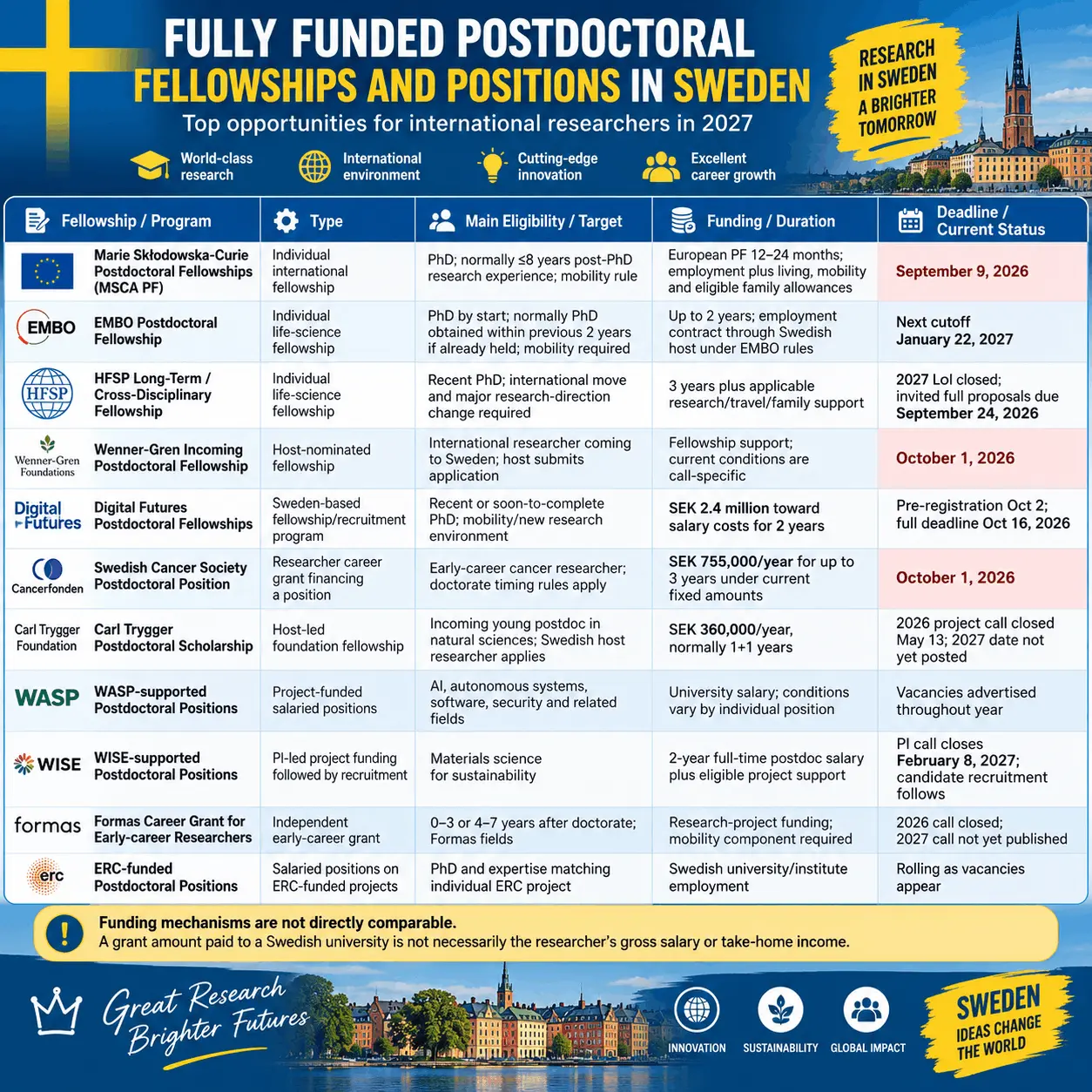
    Fellowship / ProgramTypeMain Eligibility / TargetFunding / DurationDeadline / Current StatusOfficial Information
    Marie Skłodowska-Curie Postdoctoral Fellowships (MSCA PF)Individual international fellowshipPhD; normally ≤8 years post-PhD research experience; mobility ruleEuropean PF 12–24 months; employment plus living, mobility and eligible family allowancesSeptember 9, 2026MSCA Postdoctoral Fellowships
    EMBO Postdoctoral FellowshipIndividual life-science fellowshipPhD by start; normally PhD obtained within previous 2 years if already held; mobility requiredUp to 2 years; employment contract through Swedish host under EMBO rulesNext cutoff January 22, 2027EMBO Postdoctoral Fellowships
    HFSP Long-Term / Cross-Disciplinary FellowshipIndividual life-science fellowshipRecent PhD; international move and major research-direction change required3 years plus applicable research/travel/family support2027 LOI closed; invited full proposals due September 24, 2026HFSP Postdoctoral Fellowships
    Wenner-Gren Incoming Postdoctoral FellowshipHost-nominated fellowshipInternational researcher coming to Sweden; host submits applicationFellowship support; current conditions are call-specificOctober 1, 2026Wenner-Gren Foundations
    Digital Futures Postdoctoral FellowshipsSweden-based fellowship/recruitment programRecent or soon-to-complete PhD; mobility/new research environmentSEK 2.4 million toward salary costs for 2 yearsPre-registration Oct 2; full deadline Oct 16, 2026Digital Futures Postdoctoral Fellowship
    Swedish Cancer Society Postdoctoral PositionResearcher career grant financing a positionEarly-career cancer researcher; doctorate timing rules applySEK 755,000/year for up to 3 years under current fixed amountsOctober 1, 2026Cancerfonden Postdoctoral Position
    Carl Trygger Postdoctoral ScholarshipHost-led foundation fellowshipIncoming young postdoc in natural sciences; Swedish host researcher appliesSEK 360,000/year, normally 1+1 years2026 project call closed May 13; 2027 date not yet postedCarl Trygger Foundation
    WASP-supported Postdoctoral PositionsProject-funded salaried positionsAI, autonomous systems, software, security and related fieldsUniversity salary; conditions vary by individual positionVacancies advertised throughout yearWASP Open Positions
    WISE-supported Postdoctoral PositionsPI-led project funding followed by recruitmentMaterials science for sustainability2-year full-time postdoc salary plus eligible project supportPI call closes February 8, 2027; candidate recruitment followsWISE Academic Projects 2026–2027
    Formas Career Grant for Early-career ResearchersIndependent early-career grant0–3 or 4–7 years after doctorate; Formas fieldsResearch-project funding; mobility component required2026 call closed; 2027 call not yet publishedFormas Career Grant
    ERC-funded Postdoctoral PositionsSalaried positions on ERC-funded projectsPhD and expertise matching individual ERC projectSwedish university/institute employmentRolling as vacancies appearEURAXESS Research Jobs

    Funding mechanisms are not directly comparable. A grant amount paid to a Swedish university is not necessarily the researcher’s gross salary or take-home income.


    1. Marie Skłodowska-Curie Postdoctoral Fellowships in Sweden

    The Marie Skłodowska-Curie Actions Postdoctoral Fellowship (MSCA PF) is one of the strongest options for international researchers who want to conduct postdoctoral research at a Swedish university or research organization.

    European Postdoctoral Fellowships are open across disciplines and can be hosted by eligible academic or non-academic institutions in Sweden.

    Funding and Duration

    European Postdoctoral Fellowships normally last 12–24 months.

    MSCA funding supports the recruited researcher through:

    • living allowance;
    • mobility allowance;
    • family allowance when applicable;
    • long-term-leave and special-needs support where applicable.

    The host also receives funding for research, training, networking, management, and indirect costs.

    The host beneficiary recruits the successful researcher for the fellowship period.

    Eligibility

    Applicants must generally:

    • hold a PhD by the call deadline or have successfully defended the doctoral thesis;
    • have no more than eight years of research experience after the PhD, subject to specified exclusions;
    • satisfy the MSCA mobility rule.

    For an MSCA European Fellowship with a Swedish host, applicants must not have resided or carried out their main activity in Sweden for more than 12 months during the 36 months immediately before the application deadline.

    2026–2027 Timeline

    • Call opened: April 9, 2026
    • Application deadline: September 9, 2026
    • Expected results: February 2027
    • First projects expected to start: approximately May 2027

    Official MSCA Postdoctoral Fellowship information


    2. EMBO Postdoctoral Fellowships in Sweden

    The EMBO Postdoctoral Fellowship is a prestigious option for researchers in molecular biology and related life-science fields who want to move to a Swedish research environment.

    Sweden is part of the European Molecular Biology Conference framework, making Swedish life-science laboratories attractive potential hosts.

    Eligibility

    Important current eligibility requirements include:

    • applicants must hold a doctorate or equivalent by the fellowship start;
    • researchers who already hold a PhD when applying normally must have obtained it within the two years before application;
    • researchers who have already joined the proposed host laboratory generally must have been living in the host country for less than six months at application;
    • the proposed project cannot simply be a direct continuation of the PhD research.

    Funding

    For fellows hosted in EMBC Member States such as Sweden, EMBO provides funding to the host institution so it can issue an employment contract to the fellow.

    Eligible relocation and childcare-related support may also be available under EMBO rules.

    Deadline

    Applications are accepted throughout the year.

    The next current hard cutoff is:

    January 22, 2027 at 14:00 CET.

    EMBO Postdoctoral Fellowships


    3. HFSP Postdoctoral Fellowships

    The Human Frontier Science Program (HFSP) supports highly innovative and potentially transformative basic life-science research.

    It offers:

    • Long-Term Fellowships (LTF) for applicants trained primarily in biological disciplines;
    • Cross-Disciplinary Fellowships (CDF) for researchers trained in areas such as physics, chemistry, mathematics, engineering, or computer science who are moving into life-science research.

    Duration

    HFSP fellowships provide three years of support.

    Funding includes a living allowance and additional support under applicable rules for research, travel, relocation, and family circumstances.

    Strict Eligibility and Mobility Rules

    HFSP is considerably more restrictive than a normal international postdoc vacancy.

    For the 2027 cycle, the doctoral degree generally must not have been conferred more than three years before the September 24, 2026 full-proposal deadline, subject to eligible career-interruption exceptions.

    HFSP also emphasizes:

    • an international move;
    • a significant change in research direction;
    • frontier biological questions;
    • independence from previous supervisors and research environments.

    2027 Application Status

    The Letter of Intent stage for the 2027 cycle has already closed.

    Only applicants invited after the LOI review can submit the full proposal.

    Invited full-proposal deadline: September 24, 2026.

    Successful candidates may begin their fellowship from April 2027.

    HFSP Postdoctoral Fellowships


    4. Wenner-Gren Postdoctoral Fellowships for Researchers Coming to Sweden

    The Wenner-Gren Foundations provide an important Sweden-specific route for bringing international postdoctoral researchers into Swedish research environments.

    The current call is specifically listed by Uppsala University as providing postdoctoral grants for incoming fellows, with a deadline of October 1, 2026.

    How the Application Works

    Unlike MSCA, where the researcher and host develop an application together within an EU funding framework, Wenner-Gren applications for incoming postdoctoral fellows are normally submitted by the Swedish host researcher for a selected international candidate.

    Applicants should therefore identify and contact a Swedish PI well ahead of the foundation deadline.

    Current call information indicates that the scheme is intended to bring researchers from outside Sweden into Swedish research environments.

    Who Should Consider Wenner-Gren?

    It is particularly relevant if you:

    • currently work outside Sweden;
    • want to join a Swedish research group;
    • have recently completed your PhD;
    • have already identified a potential Swedish host;
    • are seeking a fellowship route rather than waiting for an advertised salaried vacancy.

    Wenner-Gren Foundations official website


    5. Digital Futures Postdoctoral Fellowships

    The Digital Futures Postdoctoral Fellowship is one of the best currently open opportunities specifically targeting researchers who can begin a fellowship in Sweden in 2027.

    Digital Futures is a cross-disciplinary research center established by KTH Royal Institute of Technology, Stockholm University, and RISE Research Institutes of Sweden, with additional academic, industry, public-sector, and healthcare partners.

    Research Areas

    Projects can address digital transformation in areas such as:

    • artificial intelligence;
    • trustworthy digital systems;
    • digitalized industry;
    • smart society;
    • health and life;
    • education;
    • cooperation and learning;
    • emerging digital technologies.

    Funding

    The current call offers:

    SEK 2.4 million toward salary costs for two years for each employed postdoctoral fellow.

    This amount is transferred to the main supervisor responsible for employing the fellow—it should not be interpreted as the researcher’s take-home salary.

    The fellowship also provides access to:

    • research infrastructure;
    • academic and industrial networks;
    • mentorship;
    • career development;
    • research-leadership training.

    Eligibility

    Applicants must hold a doctoral degree before starting the fellowship.

    The program emphasizes mobility and researchers moving into a new research group and institution.

    Applications require both a main supervisor and co-supervisor within the eligible Digital Futures environment.

    2026–2027 Dates

    • Call opened: August 18, 2026
    • Mandatory pre-registration: October 2, 2026
    • Full application deadline: October 16, 2026
    • Decision: December 2026
    • Project start: June 1, 2027

    Digital Futures Postdoctoral Fellowship call


    6. Swedish Cancer Society Postdoctoral Position

    Researchers working in cancer biology, oncology, cancer immunology, epidemiology, therapeutics, prevention, or related areas should strongly consider the Swedish Cancer Society (Cancerfonden) Postdoctoral Position.

    Current Eligibility

    For the current 2026 competition, applicants generally must have completed their doctorate on or after July 1, 2023, but no later than December 31, 2026, subject to eligible deductions for circumstances such as parental or qualifying medical leave.

    The Swedish Cancer Society particularly values:

    • mobility;
    • scientific excellence;
    • cancer relevance;
    • development of an independent research direction.

    Duration and Funding

    The grant can support a postdoctoral position for a maximum of three years.

    Current fixed grant amounts list:

    • SEK 755,000 per year
    • SEK 2,265,000 total over three years

    The funding is paid to a Swedish university, and the actual salary is determined by the employer. The grant must be used to finance the postdoctoral position.

    Can the Research Be Done Abroad?

    Yes.

    The fellowship can support a postdoctoral period in Sweden or abroad.

    However, when the postdoctoral period is conducted abroad, the third and final year must be completed at the Swedish host institution in Sweden.

    Deadline

    October 1, 2026 at 15:00.

    Swedish Cancer Society Postdoctoral Position


    7. Carl Trygger Foundation Postdoctoral Scholarships

    The Carl Trygger Foundation for Scientific Research supports research in broad natural-science fields including:

    • physics;
    • chemistry;
    • engineering;
    • biology;
    • ecology;
    • geology;
    • forestry;
    • agricultural sciences.

    Importantly, medical research falls outside the foundation’s scope.

    Postdoctoral Funding

    From 2026, the foundation states that its postdoctoral scholarship normally provides:

    SEK 360,000 per year, usually for two years (1+1 years).

    Who Applies?

    The postdoctoral researcher does not normally submit the grant directly.

    A researcher at the Swedish host institution applies for funding for the incoming postdoc.

    The candidate should normally:

    • hold a doctorate;
    • be an early-career researcher;
    • have obtained the doctorate at an institution different from the host;
    • not already be established at the proposed Swedish host institution.

    The doctorate generally should not be older than six years at admission unless special circumstances apply.

    Deadline

    The foundation states that research-project applications are accepted in May each year.

    The 2026 project deadline was May 13, 2026. The specific 2027 deadline has not yet been posted.

    Carl Trygger Foundation


    8. WASP-Supported Postdoctoral Positions in Sweden

    The Wallenberg AI, Autonomous Systems and Software Program (WASP) is Sweden’s largest individual research program in artificial intelligence, autonomous systems, and software.

    Postdoctoral researchers can join WASP-funded research through salaried university positions across participating Swedish institutions.

    Important Distinction

    There is not one generic “WASP Postdoctoral Fellowship in Sweden” with a single eligibility rule and deadline.

    Instead, WASP supports:

    • specific research projects;
    • individual postdoctoral vacancies;
    • industrial research initiatives;
    • targeted research calls.

    WASP’s positions page currently lists individual salaried postdoctoral vacancies with their own deadlines.

    Fields

    Relevant areas include:

    • artificial intelligence;
    • machine learning;
    • robotics;
    • autonomous systems;
    • cybersecurity;
    • software engineering;
    • mathematical foundations of AI;
    • optimization;
    • computer vision.

    Important Note About the WASP International Postdoctoral Scholarship

    WASP also operates an International Postdoctoral Scholarship, but this is designed specifically for researchers who completed their PhD within WASP and want to undertake postdoctoral study at leading universities outside Sweden.

    It should therefore not be confused with WASP-funded postdoctoral positions based in Sweden.

    Current WASP research positions


    9. WISE-Supported Postdoctoral Positions

    The Wallenberg Initiative Materials Science for Sustainability (WISE) is a major Swedish investment in materials science.

    WISE supports research addressing areas such as:

    • sustainable materials;
    • energy technologies;
    • advanced manufacturing;
    • recycling;
    • resource efficiency;
    • chemistry;
    • physics;
    • engineering;
    • environmentally responsible materials design.

    Current 2026–2027 Call

    WISE’s Academic Projects 3 call will fund:

    • up to 29 academic postdoctoral researcher positions;
    • up to 29 PhD positions.

    However, the researchers applying to this current funding call are principal investigators, not prospective postdoctoral candidates.

    Once projects receive funding, the relevant Swedish universities can recruit the postdocs.

    Postdoctoral Funding

    The current call funds:

    • salary for a postdoc for two years full-time;
    • possible extension to 2.5 years if research is conducted at 80%;
    • mentorship;
    • eligible travel to WISE events;
    • specified consumables and sustainability-expertise contributions.

    Timeline

    • Application portal opens: December 1, 2026
    • PI application deadline: February 8, 2027
    • Funding decisions: approximately May 2027
    • Candidates expected to be ready to start by: August 1, 2028

    Therefore, this particular WISE call should not be advertised as a direct 2027 postdoc application for individual researchers.

    Researchers seeking a 2027 start should instead monitor vacancies arising from already funded WISE projects.

    WISE Academic Projects 2026–2027


    10. Formas Career Grant for Early-Career Researchers

    Formas is the Swedish Research Council for Sustainable Development.

    Its current early-career scheme is called:

    Career Grant for Early-career Researchers

    This replaces older terminology that may still appear online referring to Formas mobility grants.

    The scheme supports researchers who want to develop an independent project within Formas’s areas:

    • environment;
    • agricultural sciences;
    • spatial planning;
    • sustainability-related research.

    Career Tracks

    The current scheme has two tracks:

    • 0–3 years after the doctorate
    • 4–7 years after the doctorate

    A mobility component is built into the funding model.

    Is It a Postdoctoral Fellowship?

    Not exactly.

    This is an independent early-career research grant, so it is better suited to researchers who are transitioning toward scientific independence rather than simply seeking a standard supervised postdoctoral position.

    Current Status

    The 2026 competition ran from January 20 to March 4, 2026.

    The program is recurring and normally opens near the beginning of the year, but the detailed 2027 call has not yet been published.

    Formas Career Grant for Early-career Researchers


    11. ERC-Funded Postdoctoral Positions in Sweden

    The European Research Council (ERC) does not operate a general postdoctoral fellowship for individual candidates.

    Instead, ERC awards major grants to principal investigators.

    Those ERC-funded research groups frequently recruit:

    • postdoctoral researchers;
    • research scientists;
    • research engineers;
    • data scientists;
    • technical specialists.

    A Swedish ERC-funded postdoc is therefore usually a salaried university or institute position, rather than an ERC fellowship awarded directly to the candidate.

    How to Find Them

    Search:

    • individual Swedish university vacancy pages;
    • research-group websites;
    • EURAXESS;
    • academic job portals.

    Search research jobs on EURAXESS

    IR Research Publication also maintains a regularly updated research jobs and postdoctoral opportunities page.


    What About the MIMS “Excellence by Choice” Postdoctoral Programme?

    Older fellowship lists may include the Excellence by Choice Postdoctoral Programme at Umeå University/MIMS.

    It is an excellent program—but it should not currently be advertised as an open 2027 fellowship.

    The program was designed to fund 17 international postdoctoral fellows during its 2021–2026 cycle. Umeå University’s current information indicates that the fellows have been recruited, and earlier program material identified the later recruitment round as the final call.

    As of this review, no new 2027 Excellence by Choice competition has been confirmed.

    Researchers interested in Umeå should instead monitor Umeå University and MIMS vacancies for new postdoctoral opportunities.


    How Much Do Postdocs Earn in Sweden?

    There is no single national “Sweden postdoc salary.”

    For ordinary salaried university postdoctoral positions, compensation depends on factors such as:

    • host university;
    • collective and local salary agreements;
    • discipline;
    • relevant experience;
    • funding source;
    • individual salary negotiation.

    For externally funded programs, the amount published by the funder may represent the total employment cost paid to the university, not the researcher’s gross salary.

    For example:

    • Digital Futures provides SEK 2.4 million toward salary costs over two years;
    • Cancerfonden currently allocates SEK 755,000 annually for its postdoctoral-position grant;
    • these figures should not be interpreted as annual take-home salary.

    Researchers comparing fellowship compensation internationally may find IR Research Publication’s guide to the highest-paying postdoctoral fellowships worldwide useful.


    Are Postdocs in Sweden Employees?

    Many ordinary university postdoctoral researchers are employed under fixed-term university contracts and receive Swedish employment benefits.

    Depending on the employer and funding arrangement, these can include:

    • paid annual leave;
    • pension contributions;
    • parental-leave protections;
    • sick-leave provisions;
    • social-security coverage.

    However, this does not apply identically to every fellowship.

    A tax-free scholarship or fellowship can have different legal, pension, insurance, and social-security consequences compared with salaried employment.

    Before accepting an offer, always determine whether you will be:

    1. a university employee;
    2. a scholarship recipient;
    3. employed through an externally financed position; or
    4. funded through another arrangement.

    Can International Researchers Apply for Postdocs in Sweden?

    Yes.

    Swedish universities and many major fellowship programs recruit researchers internationally.

    Programs such as:

    • MSCA;
    • EMBO;
    • HFSP;
    • Wenner-Gren;
    • Digital Futures;

    are specifically designed to support international mobility or strongly welcome international applicants.

    However, each program has its own rules regarding:

    • time since PhD;
    • nationality;
    • residence history;
    • previous time in Sweden;
    • relationship with the host;
    • previous research topic;
    • research mobility.

    Never assume that being an international applicant automatically makes you eligible.


    Do You Need to Speak Swedish?

    For many internationally recruited research postdocs—particularly in STEM, engineering, data science, and biomedical research—English is commonly the working language.

    Swedish is therefore often not required for research-focused positions.

    However, Swedish proficiency may be necessary or advantageous when a position involves:

    • clinical work;
    • teaching in Swedish;
    • patient communication;
    • Swedish-language interviews or datasets;
    • significant public engagement.

    Always check the individual vacancy.


    How to Find a Postdoctoral Host in Sweden

    For fellowship applications such as MSCA, EMBO, HFSP, and Wenner-Gren, finding the right supervisor is one of the most important steps.

    Major research environments include:

    Life Sciences and Medicine

    • Karolinska Institutet
    • Uppsala University
    • Lund University
    • Umeå University
    • University of Gothenburg
    • SciLifeLab

    Engineering, AI and Technology

    • KTH Royal Institute of Technology
    • Chalmers University of Technology
    • Linköping University
    • Lund University
    • Uppsala University
    • Umeå University

    Materials and Sustainability

    • KTH
    • Chalmers
    • Linköping
    • Lund
    • Uppsala
    • Stockholm University
    • Luleå University of Technology
    • WISE-associated environments

    Researchers who are not sure where to begin can use our detailed guide on how to find postdoctoral fellowship opportunities around the world.


    How to Contact a Swedish Professor for a Fellowship

    Do not send a generic message saying:

    “I am looking for any postdoctoral position in your laboratory.”

    Instead, briefly explain:

    • your current research area;
    • major techniques or expertise;
    • your strongest research accomplishment;
    • why the professor’s work specifically interests you;
    • the fellowship you want to target;
    • a potential research direction;
    • how your expertise complements the host laboratory.

    For host-nominated programs such as Wenner-Gren or Carl Trygger, contacting the PI early is particularly important because the host may need to select one candidate and formally submit the funding application.


    How to Make Your Sweden Postdoc Application Competitive

    1. Check Eligibility Before Writing the Proposal

    Verify:

    • date of PhD;
    • mobility requirements;
    • residence history;
    • nationality restrictions;
    • previous work at the host;
    • previous collaborations;
    • field restrictions.

    HFSP, MSCA, EMBO, Cancerfonden, and Wenner-Gren all contain eligibility rules capable of disqualifying an otherwise excellent application.

    2. Explain Why You Need the Swedish Host

    Do not rely on the university’s reputation alone.

    Explain the specific:

    • expertise;
    • technology;
    • datasets;
    • research infrastructure;
    • patient cohorts;
    • collaborators;
    • computational resources;
    • methodologies;

    that make the host essential to your project.

    3. Demonstrate Scientific Independence

    A strong postdoctoral proposal should show how your project develops beyond your PhD.

    Reviewers should understand:

    • what expertise you already bring;
    • what you will learn;
    • which research questions are yours;
    • how the fellowship advances your independent research identity.

    4. Build a Strong Training Plan

    This is especially important for MSCA.

    Consider:

    • technical training;
    • leadership development;
    • grant writing;
    • teaching;
    • data science;
    • industry exposure;
    • secondments;
    • entrepreneurship;
    • science communication.

    5. Apply to Multiple Funding Routes

    A life-science researcher seeking a Swedish host might simultaneously evaluate:

    MSCA + EMBO + HFSP + Wenner-Gren + discipline-specific foundations + advertised university postdoc positions.

    A computational researcher could consider:

    MSCA + Digital Futures + WASP-funded vacancies + ERC-funded postdocs.

    A materials scientist might consider:

    MSCA + Carl Trygger + WISE-supported vacancies + ERC-funded positions.


    When Should You Apply for a 2027 Postdoc in Sweden?

    A useful planning timeline is:

    September–October 2026

    Apply immediately to relevant active programs such as:

    • MSCA
    • invited HFSP full proposals
    • Wenner-Gren
    • Swedish Cancer Society
    • Digital Futures

    November 2026–January 2027

    • prepare EMBO applications;
    • monitor new Swedish university vacancies;
    • follow WASP positions;
    • identify newly funded research projects;
    • contact potential hosts.

    Early 2027

    Monitor:

    • new university postdoc advertisements;
    • Formas’s next Career Grant competition;
    • foundation funding rounds;
    • ERC-funded laboratories;
    • WISE-related future recruitment.

    Because many salaried postdoc positions are advertised throughout the year, researchers should continue monitoring Swedish university vacancy pages even after fellowship deadlines pass.


    Frequently Asked Questions

    Are postdoctoral fellowships in Sweden fully funded?

    Many are.

    However, “fully funded” can mean different things.

    Some programs provide:

    • an employment contract and salary;

    while others provide:

    • a fellowship or stipend;
    • a grant to the host university that finances the postdoctoral position.

    Travel, research, relocation, childcare, and family support differ by scheme.


    Which Sweden postdoctoral fellowships are currently open for 2027?

    As of September 5, 2026, major relevant opportunities include:

    • MSCA Postdoctoral Fellowships — deadline September 9, 2026
    • Swedish Cancer Society Postdoctoral Position — October 1, 2026
    • Wenner-Gren incoming postdoc funding — October 1, 2026
    • Digital Futures — pre-registration October 2 and full application October 16, 2026
    • EMBO — next hard cutoff January 22, 2027

    HFSP’s initial 2027 application stage has already closed; only invited applicants can submit a full proposal.


    Can Indian researchers apply for postdocs in Sweden?

    Yes, Indian researchers can apply for many Swedish and European fellowship programs if they satisfy the individual eligibility rules.

    Potential options include:

    • MSCA;
    • EMBO;
    • HFSP;
    • Wenner-Gren;
    • Digital Futures;
    • advertised salaried Swedish university positions.

    Eligibility should still be checked individually because mobility and post-PhD timing rules vary substantially.


    Do I need a Swedish host before applying?

    For many fellowships, yes.

    Programs such as MSCA, HFSP, Wenner-Gren, and host-led Carl Trygger funding require a Swedish research environment to be identified before the application is completed.

    Digital Futures also requires eligible supervisors.

    By contrast, ordinary salaried postdoctoral vacancies involve applying directly to an already defined research position.


    Is EMBO available for postdoctoral research in Sweden?

    Yes.

    Swedish life-science research institutions can host eligible EMBO fellows.

    International mobility and the timing of the applicant’s PhD are particularly important eligibility considerations.


    Is Swedish required for a postdoc?

    Usually not for internationally recruited research-focused positions, but some clinical, teaching, or public-facing roles may require Swedish.


    What is the best fellowship for an international postdoc in Sweden?

    There is no single best option.

    For broad international mobility:

    MSCA is one of the strongest.

    For molecular and life sciences:

    EMBO is highly attractive.

    For frontier interdisciplinary biology:

    HFSP is exceptionally prestigious.

    For international researchers specifically moving into Sweden:

    Wenner-Gren is particularly relevant.

    For digital technologies and AI:

    Digital Futures and WASP-supported positions are strong options.

    For cancer researchers:

    Cancerfonden deserves close consideration.


    Final Application Checklist

    Before applying for a postdoctoral fellowship in Sweden, confirm:

    • I satisfy the PhD-date requirement.
    • I meet the mobility rule.
    • I meet any nationality requirements.
    • My Swedish host is eligible.
    • My previous residence in Sweden does not make me ineligible.
    • My relationship with the proposed supervisor complies with the program rules.
    • My proposal clearly differs from my PhD work where required.
    • I understand whether the funding is salary, stipend, or host-administered grant.
    • I understand the tax and social-security implications of the funding model.
    • My CV is tailored to the fellowship.
    • My research proposal demonstrates independence.
    • My host has reviewed the proposal.
    • Recommendation letters have been requested early.
    • I have checked the exact official deadline and time zone.
    • I have identified at least one alternative funding route.

    Conclusion: Fully Funded Postdoctoral Fellowships in Sweden 2027

    Sweden offers an excellent range of opportunities for researchers seeking fully funded postdoctoral fellowships in Sweden for 2027, but applicants should distinguish carefully between true individual fellowships and project-funded salaried postdoctoral jobs.

    For researchers targeting a 2027 start, several important opportunities are already active in 2026.

    The MSCA Postdoctoral Fellowship closes on September 9, 2026. The Swedish Cancer Society and Wenner-Gren have October 1 deadlines, while Digital Futures has a mandatory October 2 pre-registration followed by an October 16 application deadline. EMBO accepts applications throughout the year, with its next hard cutoff on January 22, 2027.

    HFSP remains one of the world’s most prestigious life-science fellowships, but its initial 2027 application stage has already closed.

    Researchers should also monitor WASP, WISE, ERC-funded laboratories, Carl Trygger-supported projects, Formas, and individual Swedish universities for additional funded postdoctoral positions.

    Start early, verify mobility and PhD-date rules before preparing the application, identify a strong Swedish host, and apply across several suitable funding routes rather than depending on one fellowship.

    For additional guidance, explore IR Research Publication’s global guide to finding postdoctoral fellowships and our latest research jobs and postdoctoral opportunities.


    Related Articles


    About IR Research Publication

    IR Research Publication is a research and academic-career platform supporting students, scientists, and scholars with practical information on research funding, postdoctoral fellowships, PhD opportunities, academic publishing, and career development.

    Our fellowship guides focus on credible opportunities and emphasize verification of eligibility, funding, mobility requirements, deadlines, and host conditions through current official sources.


    Last reviewed: September 5, 2026

    Disclaimer: Fellowship rules, deadlines, grant amounts, employment conditions, and eligibility requirements may change. Applicants should always confirm the latest call documentation on the official funder’s or host institution’s website before applying.
  • Top Fully Funded Postdoctoral Fellowships in the Netherlands for 2027

    Top Fully Funded Postdoctoral Fellowships in the Netherlands for 2027


    Introduction: Fully Funded Postdoctoral Fellowships in the Netherlands 2027

    The Netherlands is one of Europe’s leading destinations for postdoctoral research, offering internationally recognized universities, university medical centers, national research institutes, and a strong culture of interdisciplinary and collaborative science.

    Researchers planning to start a postdoctoral position in the Netherlands in 2027 can access funding through several routes. Some opportunities, such as the Marie Skłodowska-Curie Postdoctoral Fellowship, EMBO Fellowship, HFSP Fellowship, ECTRIMS Fellowship, and CRI Irvington Fellowship, are international programs that can potentially be held at an eligible Dutch host institution. Others, particularly the NWO Talent Programme – Veni, are Netherlands-based early-career research grants.

    Importantly, not every opportunity in this guide is structured in exactly the same way. Some provide an employment contract through the host institution, others provide a fellowship stipend or grant, and some are designed primarily for mobility or specialist research training.

    Important for 2027 applicants: Do not wait until 2027 to begin applying. Several fellowships that can fund research beginning in 2027 have application deadlines during 2026.

    For example, the 2026 MSCA Postdoctoral Fellowship call closes on September 9, 2026, with successful projects expected to begin from May 2027. HFSP’s 2027 fellowship cycle began even earlier, while ECTRIMS has a December 1, 2026 deadline for its 2027 fellowship cycle.

    Researchers still exploring different countries may also find our guides to fully funded postdoctoral fellowships in Germany for 2027 and fully funded postdoctoral fellowships in France for 2027 useful for comparison.


    Top Fully Funded Postdoctoral Fellowships in the Netherlands for 2027

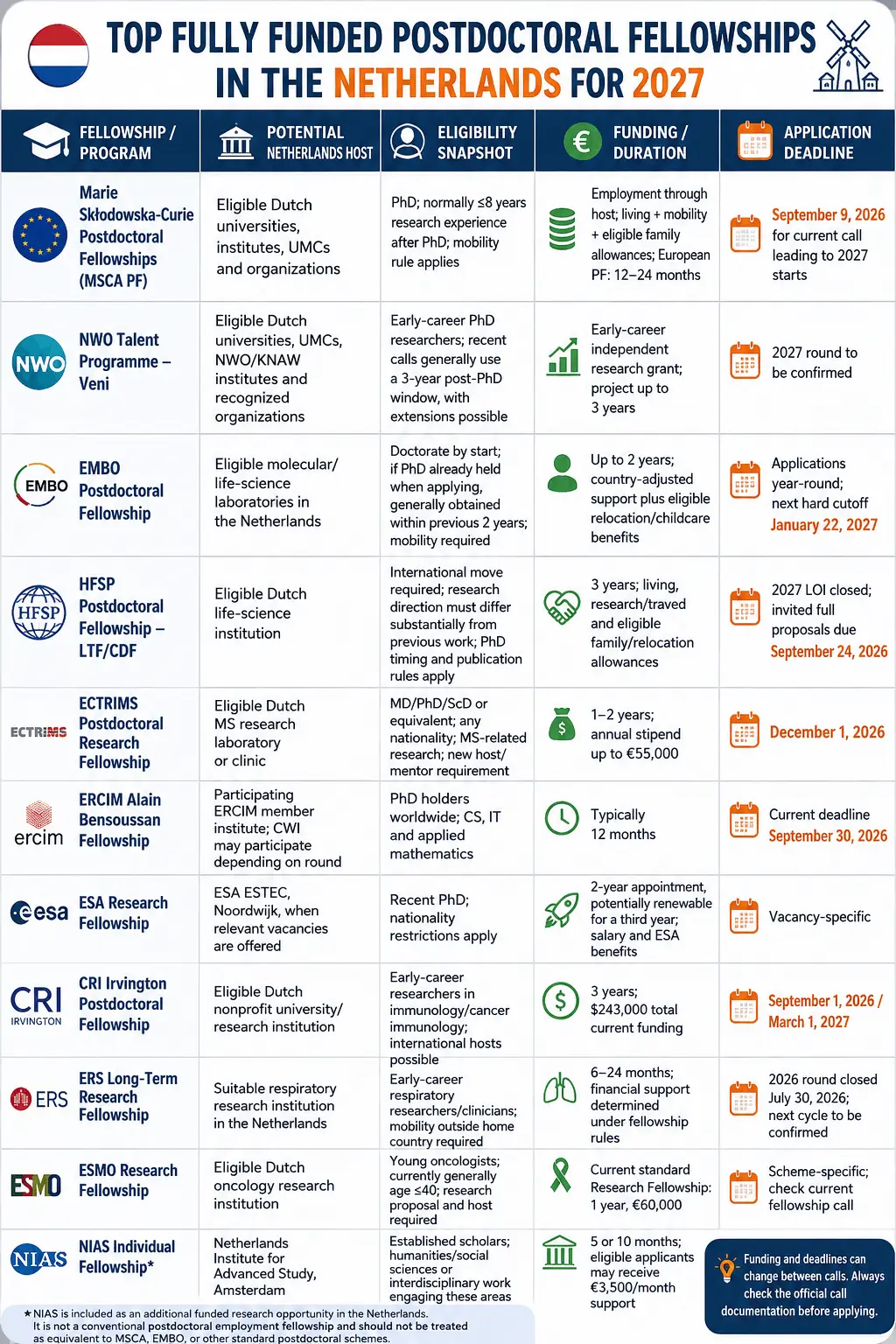
    Fellowship / ProgramPotential Netherlands HostEligibility SnapshotFunding / DurationApplication DeadlineOfficial Link
    Marie Skłodowska-Curie Postdoctoral Fellowships (MSCA PF)Eligible Dutch universities, institutes, UMCs and organizationsPhD; normally ≤8 years research experience after PhD; mobility rule appliesEmployment through host; living + mobility + eligible family allowances; European PF: 12–24 monthsSeptember 9, 2026 for current call leading to 2027 startsOfficial Website
    NWO Talent Programme – VeniEligible Dutch universities, UMCs, NWO/KNAW institutes and recognized organizationsEarly-career PhD researchers; recent calls generally use a 3-year post-PhD window, with extensions possibleEarly-career independent research grant; project up to 3 years2027 round to be confirmedOfficial Website
    EMBO Postdoctoral FellowshipEligible molecular/life-science laboratories in the NetherlandsDoctorate by start; if PhD already held when applying, generally obtained within previous 2 years; mobility requiredUp to 2 years; country-adjusted support plus eligible relocation/childcare benefitsApplications year-round; next hard cutoff January 22, 2027Official Website
    HFSP Postdoctoral Fellowship – LTF/CDFEligible Dutch life-science institutionInternational move required; research direction must differ substantially from previous work; PhD timing and publication rules apply3 years; living, research/travel and eligible family/relocation allowances2027 LOI closed; invited full proposals due September 24, 2026Official Website
    ECTRIMS Postdoctoral Research FellowshipEligible Dutch MS research laboratory or clinicMD/PhD/ScD or equivalent; any nationality; MS-related research; new host/mentor requirement1–2 years; annual stipend up to €55,000December 1, 2026Official Website
    ERCIM Alain Bensoussan FellowshipParticipating ERCIM member institute; CWI may participate depending on roundPhD holders worldwide; CS, IT and applied mathematicsTypically 12 monthsCurrent deadline September 30, 2026Official Website
    ESA Research FellowshipESA ESTEC, Noordwijk, when relevant vacancies are offeredRecent PhD; nationality restrictions apply2-year appointment, potentially renewable for a third year; salary and ESA benefitsVacancy-specificOfficial Website
    CRI Irvington Postdoctoral FellowshipEligible Dutch nonprofit university/research institutionEarly-career researchers in immunology/cancer immunology; international hosts possible3 years; $243,000 total current fundingSeptember 1, 2026 / March 1, 2027Official Website
    ERS Long-Term Research FellowshipSuitable respiratory research institution in the NetherlandsEarly-career respiratory researchers/clinicians; mobility outside home country required6–24 months; financial support determined under fellowship rules2026 round closed July 30, 2026; next cycle to be confirmedOfficial Website
    ESMO Research FellowshipEligible Dutch oncology research institutionYoung oncologists; currently generally age ≤40; research proposal and host requiredCurrent standard Research Fellowship: 1 year, €60,000Scheme-specific; check current fellowship callOfficial Website
    NIAS Individual Fellowship*Netherlands Institute for Advanced Study, AmsterdamEstablished scholars; humanities/social sciences or interdisciplinary work engaging these areas5 or 10 months; eligible applicants may receive €3,500/month supportAnnual callOfficial Website

    *NIAS is included as an additional funded research opportunity in the Netherlands. It is not a conventional postdoctoral employment fellowship and should not be treated as equivalent to MSCA, EMBO, or other standard postdoctoral schemes.

    Funding and deadlines can change between calls. Always check the official call documentation before applying.


    1. Marie Skłodowska-Curie Postdoctoral Fellowships (MSCA PF)

    Overview

    The Marie Skłodowska-Curie Postdoctoral Fellowship is one of the most prestigious mobility-based postdoctoral programs available to researchers who want to conduct research in the Netherlands.

    European Postdoctoral Fellowships can be hosted by eligible academic or non-academic organizations in the Netherlands and are open to researchers of any nationality. They support research, advanced training, career development, networking, and international or intersectoral mobility.

    Funding and Benefits

    MSCA funding provides support for:

    • Living allowance
    • Mobility allowance
    • Family allowance when eligible
    • Long-term leave and special-needs support where applicable
    • Research, training and networking costs paid to the host organization
    • Institutional management and indirect costs

    The researcher is normally recruited by the beneficiary organization for the fellowship period.

    Duration

    A European Postdoctoral Fellowship normally lasts 12–24 months. Global Postdoctoral Fellowships have a different structure and include an outgoing phase followed by a mandatory European return phase.

    Eligibility

    Applicants must hold a PhD by the call deadline or have successfully defended their doctoral thesis, subject to the call rules.

    Applicants generally must have no more than eight years of full-time-equivalent research experience after obtaining the PhD, with certain career-break and other exclusions permitted.

    For a researcher applying with a Dutch host under a European Postdoctoral Fellowship, the key mobility rule is particularly important:

    The applicant must not have resided or carried out their main activity in the Netherlands for more than 12 months during the 36 months immediately preceding the call deadline.

    2026–2027 Timeline

    The current MSCA Postdoctoral Fellowship call:

    • Opened: April 9, 2026
    • Deadline: September 9, 2026
    • Expected results: February 2027
    • Earliest projects expected to begin: around May 2027

    Therefore, researchers who want to begin an MSCA-funded postdoc in the Netherlands in 2027 should be preparing their application now, rather than waiting for a 2027 call.

    MSCA Postdoctoral Fellowships – Official Website


    2. NWO Talent Programme – Veni

    Overview

    The NWO Talent Programme – Veni is different from a conventional postdoctoral fellowship.

    Veni is an early-career independent research grant designed to help promising researchers develop their own research line at an eligible institution in the Netherlands.

    This makes Veni particularly attractive to researchers who are beginning to transition from a traditional supervised postdoctoral position toward research independence.

    Eligibility

    Recent Veni calls have generally allowed researchers whose PhD was obtained within approximately three years before the specified reference date, although extensions may be available for eligible circumstances.

    The 2025 Veni call, for example, allowed applications from researchers who had obtained a doctorate within the three years preceding its reference date, with specific extension provisions.

    Because rules are call-specific, researchers planning for 2027 should check the new call once released rather than assuming the same dates will automatically apply.

    Eligible Hosts

    Research can be conducted at participating organizations such as:

    • Dutch universities
    • University medical centers
    • NWO Institutes
    • KNAW institutes
    • Netherlands Cancer Institute
    • Selected nationally recognized research organizations

    The researcher must generally be employed by the host institution during the project.

    Funding

    Veni funding supports an independent research project for up to approximately three years, subject to the budget and conditions specified in the relevant call.

    This is therefore better described as an early-career investigator grant rather than simply a postdoctoral scholarship.

    NWO Talent Programme – Official Website


    3. EMBO Postdoctoral Fellowships

    Overview

    The EMBO Postdoctoral Fellowship is one of the strongest options for researchers in molecular biology and related life-science disciplines who want to move to a laboratory in the Netherlands.

    Dutch universities, university medical centers, and research institutes contain many laboratories working in areas covered by EMBO.

    Funding and Benefits

    Depending on the host country and administrative arrangement, EMBO provides country-adjusted financial support as well as eligible benefits such as:

    • Relocation support
    • Childcare-related support
    • Access to EMBO networking and professional development
    • International mobility and career development

    Eligibility

    Several eligibility requirements deserve close attention.

    Applicants must hold a doctorate or equivalent by the start of the fellowship.

    If an applicant already holds a PhD at the time of application, the doctorate generally must have been obtained within the two years preceding submission.

    Applicants who have already started working at their proposed host laboratory generally must have been in the host country for less than six months when applying.

    Projects that are simply a direct continuation of the applicant’s doctoral work are not eligible.

    Deadline

    Applications are accepted throughout the year.

    The next currently listed hard cutoff is:

    January 22, 2027 at 14:00 CET.

    Researchers considering EMBO and other global programs can also compare funding structures in our guide to the highest-paying postdoctoral fellowships worldwide.

    EMBO Postdoctoral Fellowships – Official Website


    4. HFSP Postdoctoral Fellowships

    Overview

    The Human Frontier Science Program (HFSP) supports highly innovative, frontier research addressing fundamental biological questions.

    Two major postdoctoral fellowship tracks are offered:

    • Long-Term Fellowships (LTF) – primarily for researchers with biological-science doctoral training
    • Cross-Disciplinary Fellowships (CDF) – for researchers trained in fields such as physics, chemistry, mathematics, engineering, or computer science who are moving into life sciences

    Duration and Funding

    HFSP fellowships are awarded for three years (36 months).

    Funding includes:

    • Living allowance
    • Research and travel allowance
    • Relocation allowance when eligible
    • Child allowance when eligible
    • Parental leave support under applicable circumstances

    The amount depends partly on the host country.

    Major Mobility Requirements

    HFSP has substantially stronger mobility rules than many standard fellowships.

    Applicants must:

    • Propose a change in country
    • Normally conduct the fellowship in a country of which they are not a national
    • Not conduct the fellowship in the country where they obtained their PhD
    • Generally not have studied or worked in the proposed host country for more than 12 months by fellowship activation
    • Propose research that is distinctly different from their PhD or previous postdoctoral research

    Applicants also cannot simply continue working with a former research supervisor or established collaborator under the fellowship.

    2027 Cycle

    For the 2027 fellowship cycle:

    • LOI initiation deadline: May 5, 2026
    • LOI submission deadline: May 12, 2026
    • Invited full proposal deadline: September 24, 2026
    • Fellowship activation: between April 1, 2027 and January 1, 2028

    The LOI stage has already closed, so only candidates invited after the first stage can proceed with the current 2027 competition.

    HFSP Postdoctoral Fellowships – Official Website


    5. ECTRIMS Postdoctoral Research Fellowship

    Overview

    The European Committee for Treatment and Research in Multiple Sclerosis (ECTRIMS) Postdoctoral Research Fellowship supports scientists and physicians conducting research related to multiple sclerosis.

    A fellowship can potentially be hosted at an appropriate Dutch university medical center, research institute, laboratory, or clinic specializing in MS.

    Eligibility

    Applicants may hold:

    • PhD
    • MD
    • ScD
    • Equivalent doctoral qualification

    Researchers of any nationality can apply.

    The research must be conducted at a European laboratory or clinic and must relate to multiple sclerosis.

    A particularly important eligibility rule is that, at the time of application, the applicant should not already have worked at the proposed host institution and/or under the proposed mentor.

    Funding

    ECTRIMS currently states that its fellowships provide an annual stipend of up to €55,000.

    Postdoctoral Research Fellowships are offered for one or two years.

    2027 Deadline

    Application deadline: December 1, 2026.

    This makes ECTRIMS one of the clearest currently confirmed opportunities for researchers specifically targeting a fellowship beginning in 2027.

    ECTRIMS Postdoctoral Research Fellowship – Official Website


    6. ERCIM Alain Bensoussan Fellowship Programme

    Overview

    The ERCIM Alain Bensoussan Fellowship Programme supports postdoctoral researchers in areas including:

    • Computer science
    • Information technology
    • Applied mathematics
    • Data science and related computational disciplines

    Fellows are hosted by participating ERCIM member institutions across Europe.

    In the Netherlands, researchers should check whether CWI in Amsterdam or another appropriate participating ERCIM institution is available during the relevant fellowship round.

    Eligibility

    The programme is open to PhD holders from around the world.

    Applicants should review the list of participating hosts for each specific round because not every ERCIM institution necessarily participates in every competition.

    Duration

    The standard fellowship duration is 12 months at an ERCIM member institute.

    Deadline

    The next currently advertised application deadline is:

    September 30, 2026.

    ERCIM Alain Bensoussan Fellowship – Official Website


    7. ESA Research Fellowships at ESTEC, Netherlands

    Overview

    The European Space Agency Research Fellowship Programme offers postdoctoral researchers opportunities in space science, engineering, space applications, Earth observation, planetary science, astrophysics, technology, and related fields.

    Some positions are based at ESTEC in Noordwijk, the Netherlands.

    Duration and Benefits

    ESA Research Fellowships typically provide:

    • A two-year appointment
    • Possible renewal for a third year
    • Monthly salary
    • ESA social-security benefits
    • Paid leave
    • Travel reimbursement
    • Potential expatriation and installation allowances

    Critical Nationality Requirement

    ESA Research Fellowships are not open to all nationalities.

    Applicants generally must be citizens of:

    • ESA Member States
    • ESA Associate Members
    • European Cooperating States, where applicable to Internal Research Fellowships
    • Canada as a Cooperating State

    Applicants should always check the eligible nationality list attached to the individual vacancy.

    Therefore, international researchers should not assume that holding a PhD alone makes them eligible.

    Eligibility

    Applicants should have recently completed a relevant PhD. ESA states that preference is generally given to candidates applying within five years of obtaining their doctorate.

    ESA Research Fellowship Programme – Official Website


    8. CRI Irvington Postdoctoral Fellowship

    Overview

    The Cancer Research Institute Irvington Postdoctoral Fellowship supports early-career scientists working in:

    • Immunology
    • Fundamental immune biology
    • Cancer immunology
    • Cancer immunotherapy-related research

    The fellowship supports researchers at leading research institutions globally, making an eligible Dutch nonprofit university, university medical center, or research institute a potential host.

    Funding

    CRI currently lists total fellowship funding of $243,000 over three years.

    The award provides sustained postdoctoral support and professional development intended to help researchers transition toward independent careers.

    Deadlines

    CRI currently lists two upcoming deadlines:

    • September 1, 2026
    • March 1, 2027

    The program normally operates with March 1 and September 1 deadlines each year, adjusted when these dates fall on holidays or weekends.

    This is therefore one of the few programs in this guide with a confirmed application deadline actually occurring in 2027.

    CRI Irvington Postdoctoral Fellowship – Official Website


    9. ERS Long-Term Research Fellowships

    Overview

    The European Respiratory Society Long-Term Research Fellowship (LTRF) supports early-career researchers and clinicians conducting basic, translational, or clinical research in respiratory medicine.

    Researchers may potentially choose a suitable host center in the Netherlands provided they comply with the relevant mobility requirements.

    Duration

    ERS Long-Term Research Fellowships now support projects lasting 6–24 months.

    This is an important update because earlier versions of the programme were often described as providing only 6–12 months of support.

    Eligibility and Mobility

    Applicants generally must conduct their fellowship at an institution outside their home country.

    The ERS portfolio includes different routes for:

    • European researchers
    • International researchers
    • Researchers from scientifically developing countries
    • Certain jointly supported fellowship schemes

    The exact conditions depend on the route under which the candidate applies.

    Current Deadline Status

    The 2026 Long-Term Research Fellowship cycle:

    • Opened: May 30, 2026
    • Closed: July 30, 2026
    • Decision expected: mid-December 2026

    The next annual call should be monitored for researchers seeking later 2027 starts.

    ERS Long-Term Research Fellowship – Official Website


    10. ESMO Research Fellowships

    Overview

    The European Society for Medical Oncology (ESMO) operates several fellowship schemes for oncology professionals.

    The standard ESMO Research Fellowship is particularly relevant to young oncologists who want to conduct clinical or translational research at an international host institution.

    A suitable cancer center or university medical center in the Netherlands may therefore serve as a host.

    Funding and Duration

    Under ESMO’s current general fellowship conditions, the standard Research Fellowship is:

    • 1 year
    • €60,000

    The fellowship may be carried out at an institution worldwide.

    This replaces older information commonly found online describing the fellowship as €40,000.

    ESMO also operates other programs with different funding structures, including longer clinician-scientist and specialist fellowship schemes.

    Eligibility

    The standard research fellowship is aimed at young oncologists and currently generally requires applicants to be 40 years old or younger at the time of application, subject to the detailed fellowship rules and any applicable exceptions.

    Candidates need to identify a host institution and develop a research project with that institution.

    Because ESMO operates several different fellowship categories, researchers should always confirm which current scheme best fits their career stage and proposed project.

    ESMO Fellowships – Official Website


    Additional Funded Research Opportunity: NIAS Individual Fellowships

    NIAS Individual Fellowship

    The Netherlands Institute for Advanced Study (NIAS) offers prestigious residential fellowships primarily to scholars in the humanities and social sciences, as well as researchers from other disciplines whose work strongly engages with those fields.

    However, NIAS should not be considered a conventional postdoctoral fellowship or salaried postdoctoral position.

    Individual fellowships usually provide scholars with five or ten months of dedicated research time in Amsterdam.

    Eligible applicants may apply for financial support. Current NIAS documentation lists personal stipends and Dutch University Grants at €3,500 per month.

    Researchers considering NIAS should therefore evaluate it as a funded residential research fellowship, rather than a direct alternative to MSCA, EMBO, or HFSP.

    NIAS Fellowships – Official Website


    Which Fellowship Should You Choose?

    Your strongest option depends heavily on your discipline, post-PhD experience, nationality, mobility history, and career goals.

    Choose MSCA if:

    You want a prestigious European fellowship, strong career-development component, flexibility across disciplines, and an eligible Dutch host.

    Choose EMBO if:

    You are an early-stage postdoctoral researcher in molecular or life sciences and can satisfy the strict PhD timing and international mobility requirements.

    Choose HFSP if:

    You are proposing high-risk, frontier life-science research and are making both a significant international move and a substantial change in research direction.

    Choose NWO Veni if:

    You are ready to begin developing an independent research line in the Netherlands rather than simply continuing in a traditional supervised postdoctoral role.

    Choose ECTRIMS if:

    Your research focuses specifically on multiple sclerosis or related neuroscience and you have identified a new European host and mentor.

    Choose ERCIM if:

    Your expertise lies in computer science, mathematics, artificial intelligence, computational science, or related fields.

    Choose CRI Irvington if:

    Your research focuses on immunology, cancer immunology, or immunotherapy.

    Choose ERS if:

    You are building a career in respiratory science or medicine and need international mobility-based research training.

    Choose ESMO if:

    You are a young oncologist pursuing clinical or translational cancer research.

    Choose ESA if:

    Your research aligns with space science or technology and your nationality meets ESA eligibility rules.

    For a broader international comparison, see our guide to the highest-paying postdoctoral fellowships worldwide.


    How to Find a Postdoctoral Host in the Netherlands

    For fellowships such as MSCA, EMBO, HFSP, CRI, ECTRIMS, ESMO, and ERS, securing the right host laboratory can be as important as selecting the fellowship itself.

    Major Dutch research universities and institutions include:

    • Delft University of Technology
    • University of Amsterdam
    • Utrecht University
    • Leiden University
    • University of Groningen
    • Radboud University
    • Vrije Universiteit Amsterdam
    • Erasmus University Rotterdam
    • Maastricht University
    • Eindhoven University of Technology
    • University of Twente
    • Wageningen University & Research
    • Amsterdam UMC
    • Erasmus MC
    • Leiden University Medical Center
    • University Medical Center Utrecht
    • Radboudumc
    • University Medical Center Groningen

    National and specialist institutes include:

    • CWI
    • AMOLF
    • Nikhef
    • DIFFER
    • NIOZ
    • ARCNL
    • Netherlands Cancer Institute

    Researchers can also use EURAXESS to identify Dutch postdoctoral vacancies and potential host laboratories.

    EURAXESS Netherlands

    You can also review our practical guide on how to find postdoctoral fellowship opportunities around the world, which includes major fellowship portals, job boards, and strategies for identifying potential supervisors.

    IR Research Publication also maintains a weekly research jobs and opportunities page covering PhD, postdoctoral, faculty, and research positions.


    How to Maximize Your Chances of Winning a Fellowship

    1. Start With Eligibility, Not Prestige

    Before spending weeks developing a proposal, verify:

    • PhD-date restriction
    • Mobility requirement
    • Nationality requirement
    • Host-country restrictions
    • Previous time spent at the host
    • Previous relationship with the proposed supervisor
    • Field-specific eligibility

    This is particularly important for HFSP, EMBO, ESA, MSCA, and ECTRIMS, where one eligibility condition can make an otherwise excellent application inadmissible.

    2. Contact Potential Hosts Early

    Strong fellowships are rarely assembled at the last minute.

    When contacting a potential PI:

    • Explain your research background briefly
    • Show why their laboratory is specifically relevant
    • Propose a research direction rather than sending a generic request
    • Mention the fellowship you intend to target
    • Explain what expertise you bring to the host laboratory

    3. Build the Proposal Around the Fellowship Criteria

    Do not use the same proposal unchanged for every fellowship.

    MSCA places significant emphasis on training, impact, mobility, and career development.

    HFSP prioritizes frontier science and a major shift from previous research.

    EMBO emphasizes scientific quality and international postdoctoral training.

    ECTRIMS requires clear relevance to multiple sclerosis.

    CRI focuses on high-quality immunology and cancer immunology.

    4. Demonstrate Independence

    Reviewers should understand what you bring to the proposed project.

    Your proposal should demonstrate:

    • Original ideas
    • Technical expertise
    • Intellectual ownership
    • Clear career progression
    • A logical reason for choosing the new host

    5. Show Why the Host Is Essential

    Avoid simply stating that the university is prestigious.

    Explain:

    • What technique exists there that you need
    • Which mentor expertise complements your background
    • Which datasets, patient cohorts, facilities, or technologies are available
    • What collaborations become possible
    • What new skills you will take away from the fellowship

    6. Apply to More Than One Suitable Program

    Postdoctoral fellowships are highly competitive.

    Instead of relying on one fellowship, build a portfolio of well-matched applications.

    For example, an eligible molecular life-science researcher targeting the Netherlands might consider some combination of:

    MSCA + EMBO + HFSP + discipline-specific fellowship + host-funded postdoc positions.

    Our comparison of Germany vs the Netherlands for PhD and research careers may also help researchers who are still deciding between the two major European research destinations.


    Frequently Asked Questions

    1. Are these Netherlands postdoctoral fellowships truly fully funded?

    Most major programs listed here provide substantial financial support intended to fund the researcher’s fellowship period, but the financial mechanism varies.

    Some involve employment through the host institution, while others provide a stipend, fellowship allowance, or grant.

    You should therefore evaluate the complete package, including salary/stipend, taxes, social security, relocation, research expenses, childcare or family allowances, and institutional supplementation.


    2. Can international researchers apply for postdoctoral fellowships in the Netherlands?

    Yes. Many of the major programs in this guide accept international researchers.

    However, not every fellowship is open to every nationality.

    MSCA European Postdoctoral Fellowships are broadly international, whereas ESA has specific nationality restrictions. HFSP also imposes rules based on nationality, host country, and where the applicant completed their PhD.

    Always check the individual fellowship.


    3. Can Indian researchers apply for postdoctoral fellowships in the Netherlands?

    Yes. Indian researchers can potentially apply for several of the major programs listed here, including MSCA, EMBO, HFSP, ECTRIMS, CRI Irvington, and some ERS opportunities, provided the individual eligibility and mobility conditions are met.

    However, eligibility should never be assumed solely based on nationality.

    For example, ESA Research Fellowships generally do not accept applicants solely on the basis of Indian citizenship, because ESA nationality restrictions apply.


    4. Do I need a Dutch supervisor before applying?

    For most fellowships in this guide, yes.

    Programs such as MSCA, EMBO, HFSP, ECTRIMS, ESMO, and many ERS routes require applicants to identify and coordinate with an appropriate host institution and supervisor.

    In competitive schemes, you should begin contacting hosts several months before the deadline.


    5. Can I apply while finishing my PhD?

    It depends on the fellowship.

    Some programs allow candidates to apply before the formal degree has been awarded provided all doctoral requirements are completed by a specified stage.

    Others impose stricter requirements at submission.

    For example, HFSP does not require the doctoral degree to be completed at the initial application stage, but it must be completed before fellowship activation within the program’s stated deadline. EMBO requires the doctorate or equivalent by fellowship start.

    Always check the current call.


    6. What are the typical fellowship durations?

    They vary considerably:

    • MSCA European PF: 12–24 months
    • EMBO: up to 2 years
    • HFSP: 3 years
    • ECTRIMS: 1–2 years
    • ERCIM: typically 12 months
    • ESA: 2 years, potentially renewable for a third
    • CRI Irvington: 3 years
    • ERS LTRF: 6–24 months
    • ESMO standard Research Fellowship: 1 year
    • NIAS: 5 or 10 months

    7. Which fellowship is best for life-science researchers?

    For broadly defined life sciences, MSCA, EMBO, and HFSP are among the strongest programs.

    Researchers in specialized disciplines should also consider field-specific opportunities such as:

    • ECTRIMS for multiple sclerosis
    • ERS for respiratory research
    • CRI Irvington for immunology/cancer immunology
    • ESMO for oncology

    8. Which Netherlands fellowship is best for becoming an independent investigator?

    The NWO Veni is particularly attractive because it is structured as an early-career research grant intended to help researchers develop their own independent research direction.

    MSCA can also substantially strengthen independence when the proposed research and training plan clearly establishes an individual scientific identity.


    9. When should I start applying for a 2027 postdoc?

    Ideally, 6–12 months before your desired fellowship start date, and sometimes even earlier.

    Several programs funding 2027 positions require applications in 2026.

    For example:

    • MSCA: September 9, 2026
    • HFSP full proposal for invited 2027 candidates: September 24, 2026
    • ERCIM current round: September 30, 2026
    • ECTRIMS: December 1, 2026
    • EMBO next hard cutoff: January 22, 2027
    • CRI Irvington: March 1, 2027

    This is why applicants should plan around the application year, not simply the year they want the fellowship to begin.


    Final Application Checklist

    Before submitting any fellowship application, confirm the following:

    • I meet the PhD-date requirement.
    • I satisfy the mobility rule.
    • My nationality is eligible.
    • My proposed Dutch host is eligible.
    • My previous residence in the Netherlands does not violate the fellowship rules.
    • I meet any restrictions concerning previous work with my host supervisor.
    • My project fits the scientific scope of the fellowship.
    • My CV clearly demonstrates my relevant accomplishments.
    • My research proposal has a clear hypothesis, objectives, methods, risks, and expected outcomes.
    • My proposal explains why the Dutch host is uniquely suited to the project.
    • My training plan supports my long-term career goals.
    • I have requested recommendation letters well before the deadline.
    • I have checked the current official call rather than relying on an older fellowship webpage.
    • I have identified at least one backup fellowship or host-funded postdoctoral position.

    Conclusion

    The Netherlands offers an exceptional research environment for postdoctoral researchers planning their careers in 2027. However, the phrase “fully funded postdoctoral fellowship in the Netherlands” covers several different funding models.

    For researchers across disciplines, the Marie Skłodowska-Curie Postdoctoral Fellowship remains one of the strongest options. Life-science researchers should also closely consider EMBO and HFSP, while specialized researchers can target programs such as ECTRIMS, CRI Irvington, ERS, and ESMO.

    Researchers approaching independence should evaluate the NWO Veni, while computer scientists and mathematicians may consider ERCIM. Space-science researchers can explore ESA Research Fellowships at ESTEC, but must pay close attention to ESA nationality restrictions.

    Most importantly, researchers hoping to start in 2027 should begin applying in 2026. Some of the most important deadlines occur many months before the fellowship actually begins.

    Start by confirming your eligibility, identify the right Dutch host, contact prospective supervisors early, and build a fellowship portfolio rather than relying on a single application.

    For additional opportunities, explore IR Research Publication’s guide on how to find postdoctoral fellowships worldwide and our weekly research jobs and postdoctoral opportunities.


    Related Articles


    About IR Research Publication

    IR Research Publication is a knowledge and publishing platform supporting researchers, academicians, and students with practical guidance on research careers, funding opportunities, scientific publishing, and academic development.

    Our fellowship guides are designed to help researchers identify credible opportunities and understand important eligibility, funding, mobility, and application requirements.

    Because fellowship requirements and deadlines may change between funding cycles, applicants should always verify the latest information on the official funding organization’s website before submitting an application.

    Visit IR Research Publication

  • Fully Funded Postdoctoral Fellowships in Europe for Indian Students (2026)

    Fully Funded Postdoctoral Fellowships in Europe for Indian Students (2026)

    Are you an Indian researcher who has recently completed your PhD and is looking to advance your academic career abroad? Europe offers some of the world’s most prestigious postdoctoral fellowships in Europe for Indian students, providing fully funded opportunities to conduct cutting-edge research at top institutions. This comprehensive guide covers everything you need to know about securing a postdoctoral position in Europe in 2026.

    Why Choose Postdoctoral Fellowships in Europe for Indian Students?

    Europe has emerged as a premier destination for postdoctoral research, offering Indian scholars unparalleled opportunities for career advancement. Here’s why:

    • World-Class Research Infrastructure: Access to state-of-the-art laboratories and research facilities
    • Generous Funding: Competitive salaries ranging from €30,000 to €70,000+ annually
    • International Networking: Collaborate with leading researchers from around the globe
    • Career Development: Enhanced prospects for faculty positions and independent research roles
    • Cultural Experience: Immerse yourself in diverse European cultures while building your academic profile
    • Family Support: Many fellowships include family allowances and relocation assistance

    Top Pan-European Postdoctoral Fellowships in Europe for Indian Students

    1. Marie Skłodowska-Curie Actions (MSCA) Postdoctoral Fellowships 2026

    The MSCA Postdoctoral Fellowships are among the most prestigious opportunities for researchers worldwide, including Indian students.

    Key Features:

    • Duration: 12-24 months (European Fellowships)
    • Funding: €399.05 million overall budget
    • Coverage: Living allowance, mobility allowance, research costs, family allowance
    • Eligibility: PhD holders with maximum 8 years of research experience
    • Application Deadline: September 9, 2026
    • Results Notification: February 2027

    Fellowship Types:

    • European Postdoctoral Fellowships: For researchers moving to or within Europe (all nationalities eligible)
    • Global Postdoctoral Fellowships: For European nationals/residents wishing to work outside Europe

    Mobility Requirement: Must not have resided in the host country for more than 12 months in the 36 months before the deadline.

    Learn more about MSCA Fellowships

    2. EMBO Postdoctoral Fellowships

    The European Molecular Biology Organization offers excellent fellowships for life sciences researchers.

    Key Features:

    • Duration: Up to 2 years
    • Coverage: Salary/stipend, relocation allowance, child support
    • Deadlines:
      • Spring round: Fourth Friday of January (2026 onwards)
      • Autumn round: Available
    • Eligibility: International mobility required
    • Special Note: Accepts first-author preprints as equivalent to publications

    Benefits for Indian Researchers:

    • Access to EMBO Laboratory Leadership courses
    • Integration into global network of EMBO Fellows
    • Support for fellows with children

    Apply for EMBO Fellowships

    3. Human Frontier Science Program (HFSP) Fellowships

    Perfect for life sciences postdocs seeking international experience.

    Fellowship Categories:

    • Long-Term Fellowships (LTF): For PhD holders in biological sciences
    • Cross-Disciplinary Fellowships (CDF): For PhD holders from physics, chemistry, mathematics, engineering transitioning to life sciences

    Key Features:

    • Duration: 2-3 years
    • Indian Advantage: India is an HFSP member country, making Indian nationals eligible to conduct research anywhere in the world
    • Requirement: Must move to a different country than where PhD was obtained
    • Application Process: Letter of Intent (submission opens in 2026) → Full Proposal (September 2026) → Results (March 2027)

    Member Countries Include: All major European nations plus India, USA, Canada, Australia, Japan, South Korea, and more.

    Explore HFSP Opportunities

    Writing Tip: To polish the grammar and academic tone of my research papers, I use Paperpal. It’s an AI specifically trained for scientists. You can try it for free to see how it improves your manuscript.

    Country-Specific Postdoctoral Fellowships in Europe for Indian Students

    Germany: Hub of Scientific Excellence

    Germany offers numerous fully funded postdoctoral opportunities for Indian researchers:

    Alexander von Humboldt Foundation Research Fellowship

    • Duration: 6-24 months
    • Disciplines: All fields
    • Benefits: €2,670-3,170 monthly stipend, travel allowance, language courses
    • Eligibility: PhD completed less than 4 years ago

    Max Planck Society Postdoctoral Positions

    • Types: Multiple programs including Max Planck Research Groups
    • Benefits: Competitive salary based on German standards
    • Focus: Cutting-edge research in natural sciences, humanities, social sciences

    DAAD Research Grants

    • Duration: 1-2 years
    • Coverage: Monthly stipend, travel costs, health insurance
    • Disciplines: All academic fields

    Why Germany?

    • Largest research infrastructure in Europe
    • No tuition fees at universities
    • Strong industry-academia collaboration
    • English widely spoken in academic settings

    Explore German Funding Programs

    United Kingdom: Academic Tradition Meets Innovation

    British Academy Postdoctoral Fellowships

    • Duration: 3 years (starting Autumn 2026)
    • Disciplines: Humanities and Social Sciences
    • Eligibility: Indian nationals who obtained PhD from UK universities are eligible
    • Application Deadline: October 1, 2025 (for 2026 intake)
    • Benefits: Salary support, research costs, integration into UK academic community

    British Academy International Fellowships

    • Duration: 2 years
    • Target: Outstanding early-career researchers from around the world
    • Deadline: March 11, 2026
    • Disciplines: Humanities, Social Sciences

    University-Specific Programs

    • University of Edinburgh IASH Postdoctoral Fellowships: 3-10 months, monthly bursary
    • University of Oxford Research Fellowships: Various colleges offer competitive fellowships

    Apply to British Academy Programs

    Switzerland: Premium Research Environment

    ETH Zurich Postdoctoral Fellowships

    • Duration: 2 years (non-extendable)
    • Salary: CHF 95,000-100,000+ annually (based on ETH standards)
    • Research Budget: CHF 12,000 per year
    • Deadlines: March 1 and September 1 annually
    • Exclusion: Cannot have worked at ETH Zurich/University of Zurich for >6 months in previous 3 years
    • Success Rate: 40-50% of fellows secure professorships within few years

    Swiss National Science Foundation (SNSF) Postdoctoral Fellowships

    • Types:
      • Swiss Postdoctoral Fellowships: 12-24 months in Switzerland
      • Postdoc.Mobility: For research abroad with return to Switzerland
    • Coverage: Salary, travel, research costs, conference expenses
    • Mobility Rule: Cannot have resided in Switzerland for >12 months in previous 36 months

    EPFL Fellowships

    • Multiple funding opportunities at École Polytechnique Fédérale de Lausanne
    • Integration with MSCA and other European programs

    Branco Weiss Fellowship

    • Duration: Up to 5 years
    • Focus: Unconventional projects outside mainstream science
    • Awards: Up to 10 fellowships annually
    • Next Deadline: January 15, 2027
    • Unique Feature: Continues even after promotion to faculty

    Learn about Swiss Opportunities

    France: Research Excellence and Cultural Richness

    CNRS Postdoctoral Positions

    • France’s premier research organization
    • Competitive salaries and benefits
    • All scientific disciplines

    Institut Pasteur Fellowships

    • Life sciences and biomedical research
    • World-renowned infectious disease research

    ITER Postdoctoral Fellowships 2026

    • Positions: 8 fellowships across 17 research topics
    • Types:
      • Monaco/ITER Fellowships: 5 positions
      • Korea-ITER Fellowships: 3 positions (for Korean nationals)
    • Eligibility: Nationals of China, EU, Switzerland, India, Japan, Korea, Russia, USA, Monaco
    • PhD Requirement: Awarded after January 1, 2023
    • Application Deadline: March 1, 2026
    • Interview: April 7-9, 2026
    • Start Date: September 1, 2026

    Explore ITER Opportunities

    Ireland: Growing Research Powerhouse

    Government of Ireland Postdoctoral Fellowship 2026

    • Duration: 1-2 years
    • Funding: Comprehensive package including salary, research costs, equipment
    • Disciplines: All fields under STEM and AHSS (Arts, Humanities, Social Sciences)
    • Success Rate: 12% average
    • Eligibility: PhD awarded between June 1, 2021 – May 31, 2026
    • Benefits:
      • Full salary support
      • Research expenses covered
      • Career development opportunities
      • Access to Ireland’s top universities

    Application Requirements:

    1. Secure an academic mentor at Irish institution
    2. Prepare research proposal and CV
    3. Submit comprehensive documentation

    Apply for Irish Fellowships

    Netherlands: Innovation and Internationalization

    NWO Rubicon Program

    • Duration: Up to 2 years
    • Eligibility: For research outside the Netherlands
    • Coverage: Salary, travel costs, research expenses
    • Target: PhD holders in final year or recently completed

    Amsterdam UMC MSCA Fellowships

    • Particularly attractive for newcomers who joined recently
    • Must not have lived/worked in Netherlands for >12 months in previous 36 months
    • 2-year salary support for postdoctoral researchers

    Explore Dutch Opportunities

    Denmark: High Quality of Life and Research

    Novo Nordisk Foundation Postdoctoral Fellowships

    • Multiple Programs:
      • ETH Zurich Partnership: 3-year fellowship (2 years at ETH + 1 year return to Denmark)
      • Bioscience Fellowships: 4-year duration with conditional fourth year upon return
      • Partnerships with MIT, Oxford, Uppsala

    Key Features:

    • Up to DKK 1.2 million per year (ETH program)
    • Up to DKK 15 million total (Bioscience program)
    • Start dates: After April 1, 2026, no later than April 1, 2027
    • Danish host institution required for entire period

    Learn about Danish Programs

    Norway: Nature Meets Research

    Research Council of Norway Fellowships

    • Competitive funding for international postdocs
    • Focus on climate, energy, health sciences

    Chr. Michelsen Institute (CMI) Positions

    • Location: Bergen, Norway
    • Focus: ERC-funded projects on digital politics, social media, conflict
    • International applicants welcome

    Sweden: Innovation Leadership

    Wallenberg Foundation Fellowships

    • Prestigious funding for exceptional researchers
    • Long-term career development support

    Swedish Research Council Programs

    • Multiple postdoctoral funding schemes
    • Strong focus on sustainability and innovation

    Italy: Heritage and Science Combined

    Human Technopole Fellowships

    • Italy’s newest research powerhouse
    • Life sciences focus
    • Milan-based

    ICGEB Fellowships

    • International Centre for Genetic Engineering and Biotechnology
    • Locations: Trieste (Italy), New Delhi (India), Cape Town (South Africa)
    • PhD programs and postdoctoral opportunities

    CIMPA-ICTP Research in Pairs

    • Support: Mathematicians from developing countries
    • Funding: €10,000
    • Purpose: Collaborative research visits to Europe
    • Deadline: April 25, 2025
    • Locations: France, Germany, Italy, Netherlands, Norway, Spain, Switzerland

    Apply to Italian Programs

    Spain: Vibrant Research Culture

    Juan de la Cierva Fellowship

    • Duration: 2 years
    • Type: Formación (training) and Incorporación (integration)
    • Annual Calls: Typically November-December

    Ramón y Cajal Fellowship

    • Duration: 5 years
    • For: Experienced postdocs seeking permanent positions
    • Highly Competitive: Path to tenure-track positions

    La Caixa Junior Leader Fellowship

    • Duration: 3 years
    • Funding: Generous salary and research budget
    • Disciplines: All fields

    Ikerbasque Research Fellows 2026

    • Positions: 15 fully funded fellowships
    • Type: Long-term academic positions in Basque Country
    • Target: Early-career researchers

    Discover Spanish Fellowships

    Belgium: European Heart, Global Science

    FWO Postdoctoral Fellowships

    • Flanders Research Foundation funding
    • Competitive support for independent research

    F.R.S.-FNRS Postdoctoral Fellowships

    • French-speaking Belgium research funding
    • Multiple career stages supported

    Austria: Alpine Research Excellence

    Lise Meitner Fellowship (FWF)

    • Duration: 12-24 months
    • For: Highly qualified international researchers
    • Disciplines: All fields
    • Named after: Pioneering Austrian-Swedish physicist

    IST Austria Postdoctoral Positions

    • Institute of Science and Technology Austria
    • Competitive salaries
    • State-of-the-art facilities

    Portugal: Emerging Research Destination

    FCT Postdoctoral Fellowships

    • Foundation for Science and Technology funding
    • Growing investment in research infrastructure
    • Competitive stipends

    Finland: Nordic Excellence

    Academy of Finland Postdoctoral Researcher Grants

    • Strong support for early-career researchers
    • Emphasis on quality of life
    • English widely used in academia

    Poland: Rising Research Star

    NCN Fellowships

    • National Science Centre funding
    • POLONEZ BIS program (MSCA co-funding)
    • Increasing internationalization

    Czech Republic, Hungary, Estonia, Lithuania, Slovenia, Slovakia

    Emerging Opportunities:

    • GAČR Postdoc Fellowships (Czech Republic)
    • MTA Postdoctoral Fellowship (Hungary)
    • Mobilitas+ Program (Estonia)
    • Research Council of Lithuania grants
    • Young Researcher Program (Slovenia)
    • SASPRO 2 Program (Slovakia)

    Quick Reference

    ProgramCountry/RegionDurationAnnual FundingApplication DeadlineKey Highlights
    MSCA Postdoctoral Fellowship🇪🇺 Pan-European12-24 months€50,000-€70,000Sept 9, 2026Most prestigious, mobility allowance, family support
    EMBO Postdoctoral Fellowship🇪🇺 Europe + WorldwideUp to 24 months€45,000-€60,000Jan/Autumn 2026Life sciences focus, accepts preprints
    HFSP Fellowship (LTF/CDF)🌍 Member Countries2-3 years$55,000-$65,000Aug 2026Life sciences, Indians eligible worldwide
    Humboldt Research Fellowship🇩🇪 Germany6-24 months€32,000-€38,000RollingAll fields, language courses included
    ETH Zurich Fellowship🇨🇭 Switzerland24 monthsCHF 95,000-100,000Mar 1 & Sept 1Premium funding, CHF 12K research budget
    British Academy Postdoc🇬🇧 United Kingdom36 months£35,000-£40,000Oct 1, 2025Humanities & social sciences
    SNSF Swiss Postdoc🇨🇭 Switzerland12-24 monthsCHF 70,000-90,000Call-specificFull research support
    Branco Weiss Fellowship🇨🇭 Switzerland (ETH)Up to 5 yearsCHF 100,000+Jan 15, 2027Unconventional research, 10 awards/year
    ITER Postdoctoral🇫🇷 France2-3 years€45,000-€55,000Mar 1, 2026Fusion research, 8 positions
    Gov. of Ireland Postdoc🇮🇪 Ireland1-2 years€40,000-€50,000Varies12% success rate, all fields
    NWO Rubicon🇳🇱 NetherlandsUp to 24 months€50,000-€60,000AnnualResearch outside Netherlands
    Novo Nordisk-ETH🇩🇰 Denmark/Switzerland36 monthsDKK 1.2M/yearCall-specific2 yrs ETH + 1 yr Denmark
    Juan de la Cierva🇪🇸 Spain24 months€30,000-€35,000Nov-Dec 2026Training & incorporation tracks
    Ramón y Cajal🇪🇸 Spain60 months€40,000-€50,000Nov-Dec 2026Path to tenure-track
    La Caixa Junior Leader🇪🇸 Spain36 months€50,000+AnnualAll disciplines, generous budget
    Lise Meitner (FWF)🇦🇹 Austria12-24 months€42,000-€50,000RollingAll fields, flexible duration
    FWO Postdoctoral🇧🇪 Belgium (Flanders)2-3 years€45,000-€55,000AnnualIndependent research focus
    Wallenberg Foundation🇸🇪 SwedenVariesSEK 500,000+AnnualPrestigious, exceptional researchers
    Academy of Finland🇫🇮 Finland2-3 years€42,000-€54,000VariesQuality of life + research
    POLONEZ BIS🇵🇱 Poland24 months€40,000-€50,000AnnualMSCA co-funded, high success rate
    FCT Postdoctoral🇵🇹 Portugal24-36 months€18,000-€24,000AnnualGrowing research sector
    IST Austria Postdoc🇦🇹 Austria2-4 years€50,000-€60,000RollingWorld-class facilities
    Human Technopole🇮🇹 Italy2-3 years€35,000-€45,000RollingLife sciences, Milan-based
    Ikerbasque Fellows🇪🇸 Spain (Basque)Long-term€45,000+Annual15 positions, academic career path
    GAČR Postdoc🇨🇿 Czech Republic2-3 years€20,000-€30,000AnnualEmerging opportunities

    Application Strategy for Postdoctoral Fellowships in Europe for Indian Students

    1. Start Early

    • Begin researching opportunities 12-18 months before desired start date
    • Most competitive fellowships have annual deadlines

    2. Identify Your Host

    • Contact potential supervisors 6-12 months before application
    • Develop collaborative research proposal
    • Ensure supervisor commitment to support application

    3. Strengthen Your Profile

    • Publish high-quality research papers
    • Present at international conferences
    • Build international collaborations
    • Develop unique research questions

    4. Prepare Strong Applications

    Essential Components:

    • Research Proposal: Clear objectives, methodology, impact (typically 5-10 pages)
    • CV: Academic achievements, publications, presentations
    • Letters of Recommendation: From PhD supervisor and other established researchers
    • Host Institution Support: Letter from prospective supervisor
    • Career Development Plan: How fellowship advances your goals

    5. Meet Mobility Requirements

    • Most European fellowships require that you haven’t resided in the host country for >12 months in the previous 3 years
    • Document your mobility history clearly

    6. Highlight Broader Impacts

    • Research excellence
    • Training and career development
    • Knowledge transfer
    • Contribution to European research landscape
    • Plans for knowledge dissemination

    Financial Benefits: What to Expect

    Typical Salary Ranges (Annual)

    • Entry-level Postdocs: €30,000-€45,000
    • Competitive Fellowships: €45,000-€60,000
    • Premium Programs (Switzerland, etc.): €65,000-€100,000+

    Additional Benefits

    • Mobility Allowance: €600-€1,000 monthly
    • Family Allowance: €500-€660 monthly (if applicable)
    • Research Costs: €5,000-€15,000 annually
    • Travel Grants: Conference participation, networking events
    • Health Insurance: Usually covered
    • Relocation Support: One-time allowance

    Visa and Immigration for Indian Researchers

    EU Blue Card

    Many postdocs qualify for the EU Blue Card, which offers:

    • Work permission across participating EU countries
    • Path to permanent residence
    • Family reunification rights

    Specific Requirements

    Each country has specific visa processes:

    • Schengen Visa: For stays under 90 days
    • National Research Visa: For longer postdoctoral positions
    • Documentation: Fellowship letter, proof of funding, health insurance

    Timeline

    • Start visa application immediately after fellowship acceptance
    • Processing time: 2-8 weeks typically
    • Apply 3 months before intended travel date

    Living in Europe: What Indian Researchers Should Know

    Cost of Living (Monthly Estimates)

    • Low-cost countries (Portugal, Poland, Czech Republic): €800-€1,200
    • Mid-range (Spain, Italy, France): €1,200-€1,800
    • High-cost (UK, Switzerland, Scandinavia): €1,800-€3,000+

    Cultural Integration

    • Most European universities have international researcher communities
    • English is widely used in academic settings
    • Indian diaspora present in major cities
    • Vegetarian and Indian food increasingly available

    Family Considerations

    • Many fellowships support family relocation
    • Quality international schools available
    • Child allowances often included in fellowship packages
    • Partner work permits vary by country

    Tips from Successful Indian Postdocs in Europe

    1. Network Actively

    “Attend EURAXESS events and connect with Indian researchers already in Europe. Their insights are invaluable.” – Dr. Priya S., MSCA Fellow, Germany

    2. Be Flexible

    “My first choice fellowship didn’t work out, but my second choice in the Netherlands turned out to be perfect for my career.” – Dr. Rajesh K., NWO Rubicon Fellow

    3. Prepare for Cultural Differences

    “Academic culture in Europe values work-life balance differently than in India. Embrace it!” – Dr. Anjali M., ETH Fellow, Switzerland

    4. Build Long-term Relationships

    “The connections I made during my postdoc led to my current faculty position.” – Dr. Vikram T., former EMBO Fellow, now Professor in India

    Resources for Indian Researchers

    Official Portals

    Indian Government Support

    • Department of Science & Technology (DST): Bilateral programs with European countries
    • Department of Biotechnology (DBT): International fellowship schemes
    • SERB International Travel Support: For attending conferences, short visits

    Networking Platforms

    • ResearchGate
    • Academia.edu
    • LinkedIn Academic Groups
    • Field-specific international societies

    Additional Reading

    For more scholarship opportunities and academic guidance, visit:

    Timeline: Your Postdoctoral Application Journey

    18-24 Months Before

    • Research fellowship opportunities
    • Identify potential supervisors
    • Begin networking

    12-18 Months Before

    • Contact supervisors
    • Develop research proposal
    • Strengthen publication record

    6-12 Months Before

    • Finalize host institution
    • Prepare application materials
    • Secure recommendation letters

    3-6 Months Before

    • Submit applications (most deadlines September-November)
    • Prepare for interviews if required

    1-3 Months After Application

    • Results announced (varies by program)
    • Accept offer
    • Begin visa process

    Upon Acceptance

    • Arrange accommodation
    • Plan relocation
    • Complete pre-arrival formalities

    Common Mistakes to Avoid

    1. Generic Applications

    Tailor each application to the specific fellowship and institution. Generic proposals are easily identified and rejected.

    2. Ignoring Eligibility Criteria

    Carefully check PhD completion dates, mobility requirements, nationality restrictions, and research experience limits.

    3. Weak Research Proposals

    • Unrealistic objectives
    • Lack of clear methodology
    • No consideration of host expertise
    • Missing impact statement

    4. Poor Host Match

    Ensure your research interests genuinely align with potential supervisor’s work. Artificial matches are transparent.

    5. Last-Minute Applications

    Rushed applications contain errors and miss optimization opportunities. Start early.

    6. Neglecting Career Development

    Fellowships fund research AND career development. Articulate how the position advances your long-term goals.

    Frequently Asked Questions

    Q: Can I apply to multiple fellowships simultaneously?

    A: Yes! Apply to multiple programs to maximize chances. However, ensure each application is tailored and high-quality.

    Q: Do I need to speak the local language?

    A: For most postdoctoral positions, English is sufficient. However, learning basic local language helps with daily life and integration.

    Q: What if my PhD is from an Indian university?

    A: Absolutely fine! European fellowships welcome international PhDs. Focus on research quality and potential.

    Q: Can I bring my family?

    A: Most fellowships support family relocation through family allowances and relocation support. Check specific program details.

    Q: What’s the success rate?

    A: Highly competitive: 10-25% typically. Strong proposals, good host match, and excellent research record are crucial.

    Q: Do I need publications?

    A: Yes, publications (or high-quality preprints) significantly strengthen applications. Aim for 2-5 quality publications.

    Q: Can I extend my fellowship?

    A: Some programs allow extensions; others have fixed durations. Plan accordingly and explore subsequent funding options early.

    Q: What happens after the fellowship?

    A: Options include:

    • Applying for advanced fellowships (ERC Starting Grants)
    • Seeking permanent positions in Europe
    • Returning to India with enhanced credentials
    • Moving to other international positions

    Conclusion: Your Path to European Research Excellence

    Securing postdoctoral fellowships in Europe for Indian students opens doors to world-class research, international collaboration, and significant career advancement. With careful planning, strong applications, and strategic networking, Indian researchers can successfully navigate the competitive landscape of European postdoctoral funding.

    The opportunities outlined in this guide represent just a fraction of what Europe offers. Whether you’re interested in STEM fields, humanities, social sciences, or interdisciplinary research, European institutions provide welcoming, well-funded environments for postdoctoral research.

    Key Takeaways: ✅ Start early and plan strategically ✅ Build strong relationships with potential supervisors ✅ Tailor applications to each opportunity ✅ Highlight your unique research contributions ✅ Don’t limit yourself to one country or fellowship ✅ Prepare thoroughly for mobility and cultural transition ✅ Leverage resources from EURAXESS and Indian government programs

    The journey from PhD in India to postdoctoral researcher in Europe is challenging but immensely rewarding. Thousands of Indian researchers have successfully made this transition, contributing to cutting-edge science while building international careers.

    Your European postdoctoral adventure awaits. Start planning today, and join the global community of researchers advancing knowledge and innovation across borders.

    Ready to apply? Bookmark this guide, start researching specific programs, and begin reaching out to potential supervisors. Your fully funded postdoctoral fellowship in Europe is within reach!


    For more scholarship opportunities, PhD programs, and research funding information, explore our comprehensive resources at IrresPub.

    Last Updated: January 2026 Deadlines and funding amounts subject to change. Always verify details on official program websites.