Switzerland is one of the world’s leading destinations for postdoctoral research, offering cutting-edge laboratories, internationally recognized universities, competitive research environments, and strong funding support. For Indian researchers who have recently completed their PhD, securing a fully funded postdoc position in Switzerland can significantly accelerate an academic or industry research career.
This guide covers the best fully funded postdoctoral positions in Switzerland for Indian researchers in 2026, including fellowships, funded research contracts, and university-supported opportunities. It also explains eligibility, funding models, application timelines, and how to apply from India.
Why Choose Switzerland for a Postdoc?
Switzerland consistently ranks among the world’s best countries for research and innovation because of:
High research investment and infrastructure
Globally respected universities and institutes
Strong international collaborations
Competitive postdoctoral salaries
Excellent quality of life and work-life balance
Major research hubs include:
ETH Zurich
EPFL
University of Zurich
University of Basel
University of Geneva
Paul Scherrer Institute (PSI)
Empa, Eawag, and WSL
Types of Postdoctoral Funding in Switzerland
Indian researchers can secure funding through several pathways:
1. Independent Fellowships
These are competitive fellowships awarded directly to researchers.
Examples:
ETH Zurich Postdoctoral Fellowship
EMBO Postdoctoral Fellowship
HFSP Fellowship
2. Government-Funded Research Scholarships
These programs support international researchers working with Swiss host institutions.
Examples:
Swiss Government Excellence Scholarships
SNSF-supported funding mechanisms
3. University-Funded Employment Contracts
Many Swiss universities hire postdocs as salaried employees on research projects.
Examples:
EPFL
University of Zurich
University of Basel
University of Geneva
4. Research Institute Positions
Switzerland’s federal research institutes regularly recruit postdoctoral researchers.
Examples:
Paul Scherrer Institute (PSI)
Empa
Eawag
WSL
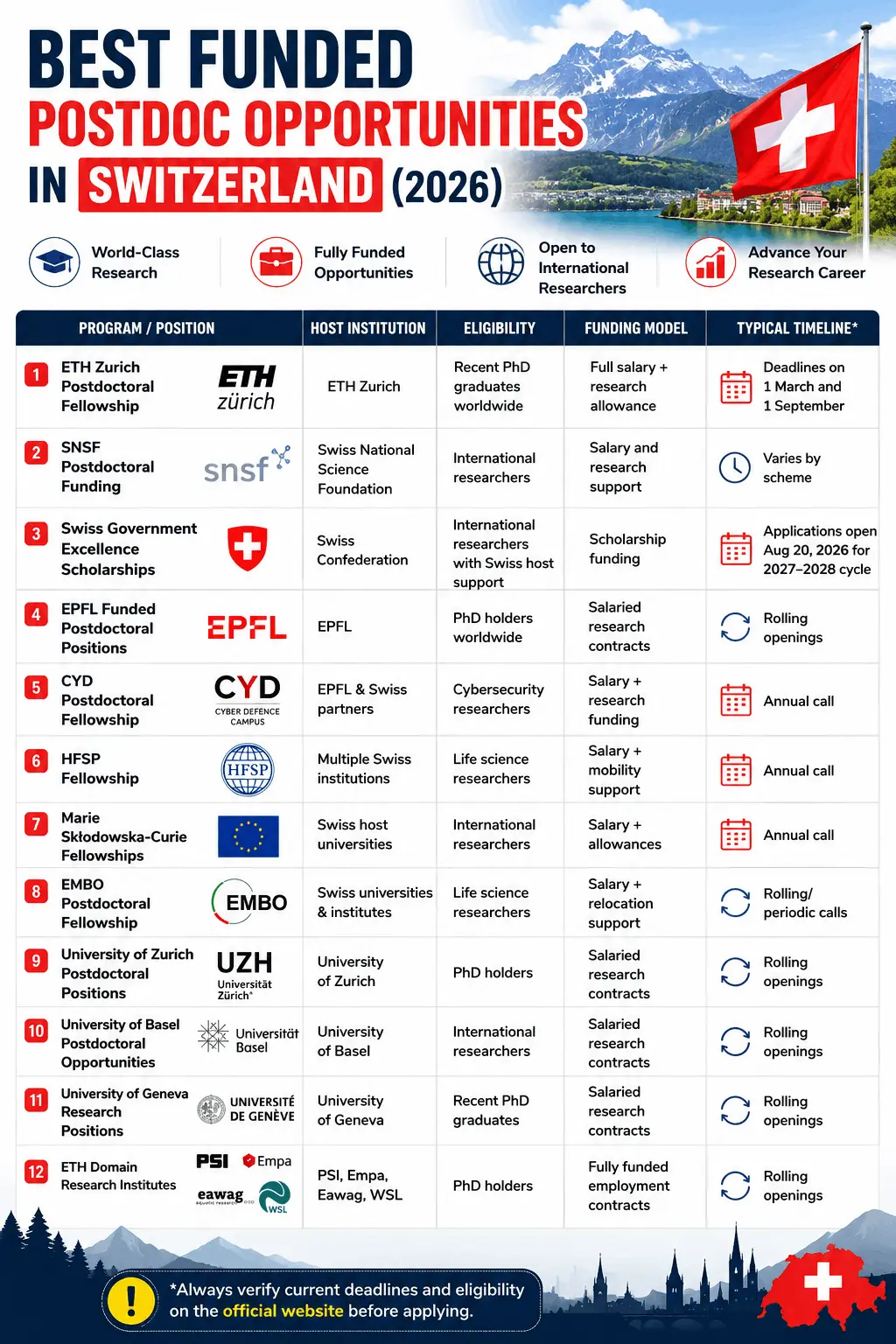
Summary Table: Best Funded Postdoc Opportunities in Switzerland (2026)
Program / Position
Host Institution
Eligibility
Funding Model
Typical Timeline*
ETH Zurich Postdoctoral Fellowship
ETH Zurich
Recent PhD graduates worldwide
Full salary + research allowance
Deadlines on 1 March and 1 September
SNSF Postdoctoral Funding
Swiss National Science Foundation
International researchers
Salary and research support
Varies by scheme
Swiss Government Excellence Scholarships
Swiss Confederation
International researchers with Swiss host support
Scholarship funding
Applications open Aug 20, 2026 for 2027–2028 cycle
EPFL Funded Postdoctoral Positions
EPFL
PhD holders worldwide
Salaried research contracts
Rolling openings
CYD Postdoctoral Fellowship
EPFL & Swiss partners
Cybersecurity researchers
Salary + research funding
Annual call
HFSP Fellowship
Multiple Swiss institutions
Life science researchers
Salary + mobility support
Annual call
Marie Skłodowska-Curie Fellowships
Swiss host universities
International researchers
Salary + allowances
Annual call
EMBO Postdoctoral Fellowship
Swiss universities & institutes
Life science researchers
Salary + relocation support
Rolling/periodic calls
University of Zurich Postdoctoral Positions
University of Zurich
PhD holders
Salaried research contracts
Rolling openings
University of Basel Postdoctoral Opportunities
University of Basel
International researchers
Salaried research contracts
Rolling openings
University of Geneva Research Positions
University of Geneva
Recent PhD graduates
Salaried research contracts
Rolling openings
ETH Domain Research Institutes
PSI, Empa, Eawag, WSL
PhD holders
Fully funded employment contracts
Rolling openings
*Always verify current deadlines and eligibility on the official website before applying.
1. ETH Zurich Postdoctoral Fellowship
The ETH Zurich Postdoctoral Fellowship is one of the most prestigious fully funded postdoc opportunities in Switzerland. It supports outstanding early-career researchers pursuing independent research at ETH Zurich.
Key benefits
Full ETH-standard postdoctoral salary
Fellowship duration of up to 2 years
CHF 12,000 per year for research expenses
Mentorship from ETH faculty and access to world-class facilities
Who should apply?
Indian PhD graduates with strong publication records
Researchers aiming for academic independence
Application timeline
ETH Zurich currently operates two annual deadlines:
The Swiss National Science Foundation (SNSF) supports postdoctoral researchers through various funding mechanisms and mobility programs connected to Swiss research institutions.
Key benefits
Salary support
Research funding
International mobility opportunities
Important note
SNSF funding schemes and deadlines change over time. Applicants should consult the official SNSF website for the most current opportunities.
The Swiss Government Excellence Scholarships support international researchers conducting research at Swiss universities and research institutions. Applicants typically require support from a Swiss academic host and submit applications through Swiss diplomatic representations in their home country.
Key benefits
Monthly scholarship stipend
Health insurance coverage
Housing and relocation support in some cases
Access to Swiss research institutions
Who should apply?
Indian researchers with a strong research proposal
Applicants who already have support from a Swiss supervisor or host institution
Important update for the 2027–2028 cycle
According to the official Swiss Government Excellence Scholarships website, applications for the 2027–2028 academic year are scheduled to open on August 20, 2026. Always verify the latest timeline and eligibility requirements on the official page.
The École Polytechnique Fédérale de Lausanne (EPFL) regularly advertises funded postdoctoral positions across engineering, life sciences, AI, robotics, and sustainability.
Key benefits
Competitive Swiss research salary
State-of-the-art laboratories
Strong industry and international collaborations
Who should apply?
Researchers interested in interdisciplinary science and engineering with strong technical or computational skills.
The Cyber-Defence (CYD) Fellowship supports postdoctoral research in cybersecurity, AI, and data science through collaboration between EPFL and Swiss government partners.
Key benefits
Full funding and salary support
Research budget and infrastructure access
Connections with government and industry cybersecurity networks
The University of Zurich regularly recruits postdoctoral researchers through faculty grants, collaborative projects, and externally funded research programs.
Key benefits
Competitive Swiss salary
Comprehensive research support
Opportunities across biomedical, social, and natural sciences
10. University of Basel Postdoctoral Opportunities
The University of Basel offers funded postdoctoral opportunities in biomedical sciences, molecular biology, public health, chemistry, and clinical research.
Key benefits
Salaried research contracts
Access to strong biomedical research networks
Collaboration with hospitals and international institutes
The University of Geneva hosts numerous funded postdoctoral and research positions, often connected to international organizations and collaborative projects.
Key benefits
Competitive salary
International research environment
Opportunities linked to global policy and scientific institutions
Swiss postdoctoral researchers are typically employed under salaried contracts and generally receive competitive compensation compared with most European countries.
Funding often includes:
Monthly salary
Social security benefits
Health insurance contributions
Pension contributions
Research funding for fellowship holders
Actual salaries vary by institution, funding source, discipline, and years of experience. Universities such as ETH Zurich and EPFL are known for offering particularly competitive compensation packages.
How to Apply for a Postdoc in Switzerland from India
Identify research groupsFind Swiss professors and laboratories whose work matches your expertise and publications.
Contact potential supervisorsA personalized email explaining your research fit is often essential for Swiss postdoc applications.
Apply for fellowships or positionsYou may apply for independent fellowships (ETH, EMBO, HFSP, Marie Curie), government scholarships, or directly advertised university postdoc positions.
Prepare for interviews and visa stepsShortlisted candidates may be interviewed online, and successful applicants will later complete Swiss visa and residence procedures with their host institution’s support.
Frequently Asked Questions
Are postdoc positions in Switzerland fully funded?
Yes. Most Swiss postdoctoral opportunities are funded either through salaried employment contracts, institutional fellowships, or government-supported research programs.
How can Indian researchers get a postdoc in Switzerland?
Indian researchers usually secure a host professor, apply for open postdoctoral positions, or compete for fellowships such as ETH Zurich, EMBO, HFSP, or Marie Skłodowska-Curie fellowships.
Which Swiss universities offer funded postdoc programs?
Top institutions include ETH Zurich, EPFL, the University of Zurich, the University of Basel, and the University of Geneva.
What is the salary for a postdoc in Switzerland?
Swiss postdocs generally receive competitive salaries with benefits such as social security, pension contributions, and health insurance support. Exact amounts vary by institution and discipline.
Is the Swiss Government Excellence Scholarship available for postdoc applicants?
The program supports international researchers working with Swiss host institutions, but eligibility and funding structures can change. The official page indicates that applications for the 2027–2028 cycle open on August 20, 2026.
What documents are needed for a Swiss postdoc application?
Common requirements include a CV, research proposal, PhD certificate, transcripts, recommendation letters, publication list, and motivation letter.
Can international researchers apply for postdoc funding in Switzerland?
Yes. Most major Swiss fellowships and university-funded postdoctoral positions are open to international applicants, including researchers from India.
Internal Resources from IR Research Publication
For more guidance on international research careers and funding, explore these resources from IR Research Publication:
IR Research Publication is an international open-access scholarly publishing platform dedicated to disseminating high-quality research across scientific disciplines. The platform publishes peer-reviewed articles, reviews, methods papers, and academic resources while promoting global scientific collaboration and knowledge sharing.
Funding programs, eligibility criteria, and application deadlines change regularly. Readers should always verify information through the official fellowship, university, or government website before submitting an application.
Introduction: Why Pursue a Funded PhD in Switzerland?
Switzerland is among the most sought-after destinations for doctoral research. Home to globally ranked institutions, including ETH Zurich and EPFL – it offers Indian students not just a prestigious degree, but in many cases a monthly salary, world-class infrastructure, and a genuine launchpad for an international research career.
Here is why Switzerland stands out:
Many PhD positions are employment contracts. Across Switzerland’s grant-funded STEM and science programs, doctoral candidates are typically hired as doctoral assistants or research assistants, receiving a salary with social insurance benefits. This is not universal — it depends on the program, faculty, and funding source — but it is common and well-documented at ETH Zurich, EPFL, and the cantonal universities.
Registration fees are low. Swiss public universities charge low semester registration fees rather than standard tuition. However, the amount varies by institution, and scholarship holders may be expected to cover fees out of their own funds.
India has been a CERN Associate Member State since 2017. Indian nationals are eligible for CERN’s Doctoral Student Programme, one of the most competitive and respected doctoral opportunities in physics, engineering, and computing.
The Swiss Government Excellence Scholarship (ESKAS) explicitly includes India as an eligible country and confirms that self-certified document copies are accepted for Indian applicants.
Whether you are a fresh Master’s graduate, an early-career researcher, or a scientist looking to transition into European academia, this guide covers every major funded PhD opportunity available to Indian students in Switzerland for 2026 and the upcoming 2027 cycle.
Many are — and Switzerland’s funding model is among the best in the world. The key distinction is that most funded PhD positions in Switzerland are not “scholarships” in the traditional sense. Instead, they fall into three distinct categories:
Employment-based PhD positions — The most common route, especially in STEM. Doctoral candidates are hired on fixed-term employment contracts by a professor’s research group (funded by SNSF grants, EU projects, or institutional funds). They receive a regular monthly salary, social insurance, and paid leave.
University doctoral fellowships — Structured competitive programs at specific departments or institutes (e.g., Biozentrum Basel PhD Fellowships), which provide full funding for the PhD duration.
Government and external scholarships — Such as the Swiss Government Excellence Scholarship (ESKAS), which provides a monthly payment covering basic living costs, though it is explicitly described as a living allowance, not a salary.
Understanding this distinction matters. A doctoral assistant at ETH Zurich earns roughly CHF 61,300 gross in year one. A Swiss Government Excellence Scholarship holder receives CHF 2,450/month as a living stipend — a meaningful difference in take-home income and employment status.
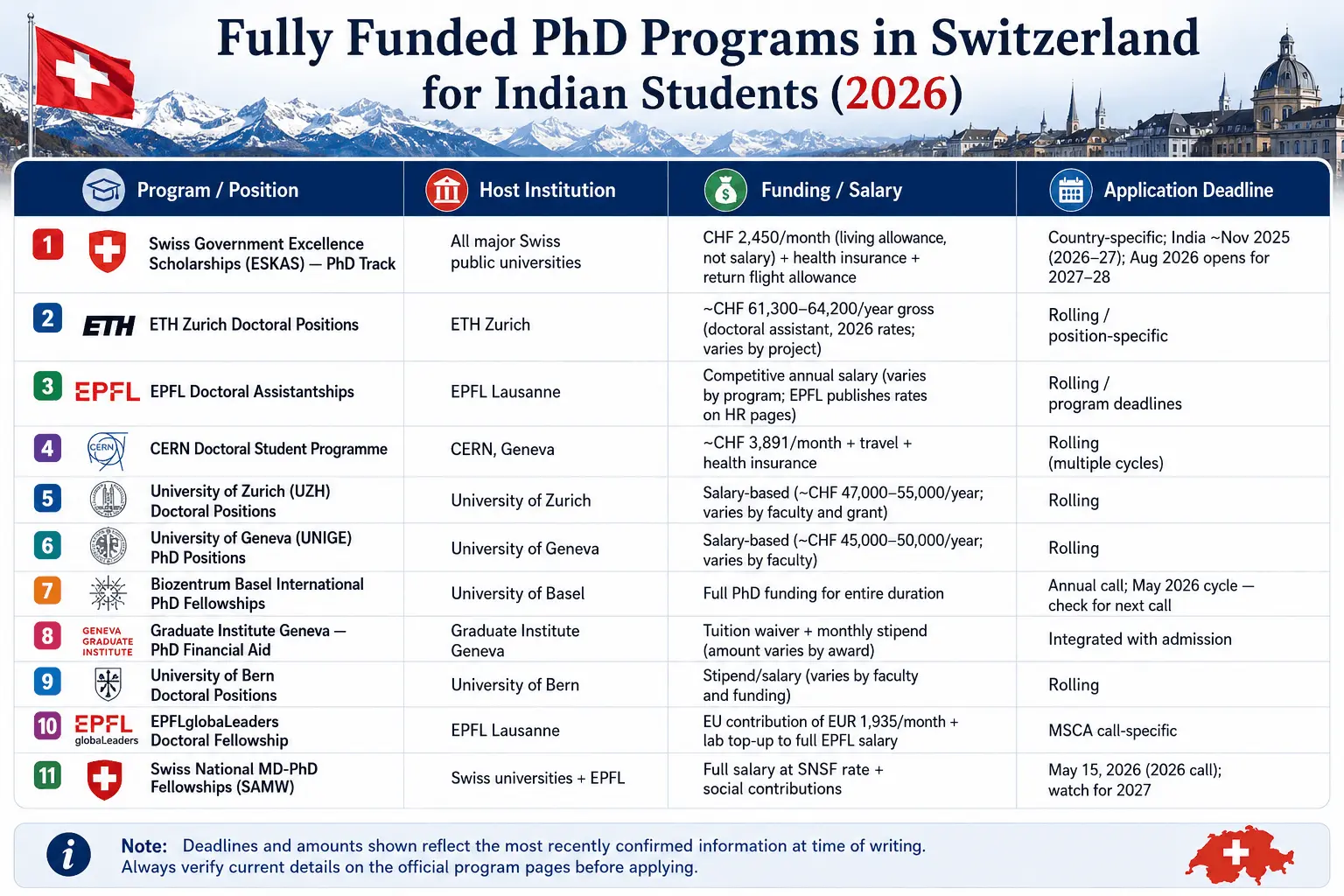
Summary Table: Funded PhD Programs in Switzerland for Indian Students (2026)
Program / Position
Host Institution
Eligibility
Funding / Salary
Application Deadline
Official Link
Swiss Government Excellence Scholarships (ESKAS) — PhD Track
All major Swiss public universities
Master’s degree; born after Dec 31, 1991; India eligible
CHF 2,450/month (living allowance, not salary) + health insurance + return flight allowance
Country-specific; India ~Nov 2025 (2026–27); Aug 2026 opens for 2027–28
Note: Deadlines and amounts shown reflect the most recently confirmed information at time of writing. Always verify current details on the official program pages before applying.
Top 11 Funded PhD Programs in Switzerland for Indian Students
1. Swiss Government Excellence Scholarships (ESKAS / FCS)
Overview
The Swiss Government Excellence Scholarships — administered by the Federal Commission for Scholarships for Foreign Students (FCS/ESKAS) — are Switzerland’s flagship government award for international researchers. The Swiss Confederation funds these scholarships to promote academic exchange and research cooperation across over 180 countries, including India.
The PhD scholarship track supports doctoral research at any of Switzerland’s 12 cantonal universities, ETH Zurich, EPFL, or the Graduate Institute Geneva. Applications are submitted through the Swiss Embassy or consulate in India.
What the scholarship actually provides (per official ESKAS page, 2027–28 cycle)
Monthly payment of CHF 2,450 to cover basic living expenses for one person
This is explicitly described by ESKAS as a living allowance, not a salary
Health insurance premiums covered by FCS for non-EU/EFTA scholarship holders (India qualifies)
One-time CHF 600 rental deposit grant
Return flight allowance (lump sum, used within 2 months of scholarship end, for return to India)
Half-Fare Swiss public transport card
Duration: 12 months, renewable twice for up to 36 months, subject to academic progress
Tuition and semester fees are not covered — scholarship holders must pay these separately (typically CHF 600–2,000/semester depending on university)
Eligibility for Indian Applicants
Must hold a Master’s degree completed by 31 July 2027 (ETH Zurich: 30 June 2027) for the 2027–28 cycle
Born after December 31, 1991
Must not have lived in Switzerland for more than 13 months before the start date
A detailed research proposal with timeline is required
A mandatory letter of support from a Swiss academic supervisor is required — without this, the application is rejected. Finding this supervisor is the applicant’s responsibility and can take weeks to months
India-Specific Notes
For Indian applicants, self-certified document copies are accepted (confirmed on the official ESKAS application guidance page) — certified translations are only required for documents not in English, French, Italian, or German
Applications for 2026–27 closed approximately November 2025 (India deadline). For 2027–28, the online portal opens August 20, 2026 and country-specific deadlines will be published at that time
Results announced by end of May of the application year
ETH Zurich consistently ranks among the world’s top universities. Its doctoral model does not operate through a central scholarship program — instead, professors hire doctoral candidates as doctoral assistants on employment contracts funded by research grants (SNSF, EU Horizon, ETH internal). This makes funding highly stable for grant-funded positions.
Doctoral candidates at ETH Zurich are employees of the university. The ETH salary table (as of January 1, 2026, published on the official ETH HR/Welcome Center page) shows fixed-rate gross salaries for doctoral students increasing from Year 1 to Year 3, with no further automatic increases from Year 4 onward. Multiple consistent sources cite the approximate range as CHF 61,300 (Year 1) to CHF 64,200 (Year 4) for 100% employment, though exact rates require verification via the official ETH salary tables as these are updated annually.
Key Benefits
Competitive gross annual salary (approximately CHF 61,000–64,000 at 100% employment, 2026 rates — verify current figures at ethz.ch/salary)
Swiss social insurance contributions (AHV/IV, pension) included
Low registration fees — ETH introduced differentiated tuition categories from Autumn 2025; doctoral candidates should check current fee regulations at ethz.ch/students/tuition-fees
Paid vacation and standard Swiss employment conditions
Access to world-class research infrastructure and international collaborations
Who Should Apply
Indian applicants with a strong Master’s degree in STEM (engineering, computer science, natural sciences, mathematics, environmental sciences, architecture)
Applicants with research publications, strong references, or prior lab experience
The most effective approach: directly email professors whose current research aligns with your interests, attaching a tailored cover letter, CV, and brief research statement. Professors at ETH have significant autonomy in hiring.
The École Polytechnique Fédérale de Lausanne (EPFL) in Lausanne is one of Europe’s most innovative research universities. It organizes doctoral training through multiple doctoral programs across engineering, life sciences, basic sciences, computing, environment, and architecture. Like ETH Zurich, EPFL employs doctoral candidates as doctoral assistants on employment contracts.
EPFL publishes its salary scales for doctoral assistants officially on its HR pages. The starting gross annual salary for doctoral assistants at EPFL is listed on epfl.ch/campus/services/human-resources/salaries and increases annually. Approximately 40% of EPFL doctoral students come from outside Europe, reflecting its highly international character.
Key Benefits
Annual salary and benefits per EPFL doctoral assistant scale (verify current amounts on official EPFL HR page)
Full Swiss social security, health insurance contributions, pension
Access to EPFL’s Innovation Park, industry partnerships, and extensive research infrastructure
Possibility to apply for competitive add-on fellowships: EPFLglobaLeaders, Swiss Government Excellence Scholarship top-ups
Duration: typically 4 years
Who Should Apply
Indian students with a strong Master’s degree in STEM, with research publications or strong project work
Applicants targeting specific EPFL doctoral programs: Computer and Communication Sciences, Life Sciences Engineering, Materials Science, Electrical Engineering, Mathematics
Apply either through EPFL’s doctoral program portals, or directly by emailing a prospective supervisor with your CV and research proposal
The CERN Doctoral Student Programme allows PhD candidates to conduct their thesis research at CERN — the European Organization for Nuclear Research in Geneva — for up to 36 months while remaining registered at their home university. CERN is the world’s largest particle physics laboratory and a unique environment for high-energy physics, engineering, and computing research.
India has been a CERN Associate Member State since 2017, which makes Indian nationals eligible for CERN’s student and fellowship programs, including the Doctoral Student Programme. Doctoral students spend time at CERN in Geneva, but the degree is awarded by the candidate’s enrolled university — the two supervisors (CERN and home university) collaborate on thesis arrangements.
Key Benefits
Monthly stipend of approximately CHF 3,891 (tax-advantaged)
Travel expenses to Geneva
Health insurance coverage
Paid annual leave
Hands-on access to CERN’s research facilities, experiments, and global scientific network
No IELTS required; good command of English or French is expected
Eligibility
Must be a national of a CERN Member or Associate Member State (India qualifies)
Must be enrolled in, or about to start, a doctoral program at a recognized university
Research conducted at CERN must form part of, or all of, the doctoral thesis
5. University of Zurich (UZH) — Doctoral Positions
Overview
The University of Zurich is Switzerland’s largest university, with particular strength in medicine, life sciences, social sciences, law, and humanities. Doctoral candidates at UZH are typically employed as university assistants on fixed-term contracts funded by research grants.
Key Benefits
Annual salary approximately CHF 47,000–55,000 gross depending on faculty, year, and funding source (these are indicative ranges — actual salary is determined by the hiring professor’s grant and university scales)
Full Swiss social security contributions
Access to UZH’s research hospitals, life science clusters, and collaboration with nearby ETH Zurich
Duration: typically 3–4 years
Who Should Apply
Indian students with a Master’s degree targeting areas of UZH strength: medicine, neuroscience, biochemistry, law, economics, social sciences, humanities
Monitor the UZH jobs portal regularly and contact professors directly
The University of Geneva is particularly renowned for international relations, law, medicine, and natural sciences. Its location — surrounded by UN agencies, WHO, ICRC, WTO, and hundreds of international organizations — makes it uniquely valuable for researchers in policy, global health, and social sciences.
Key Benefits
Annual salary approximately CHF 45,000–50,000 gross (varies by faculty and funding source)
Access to Geneva’s international ecosystem for interdisciplinary research
Doctoral positions across all faculties; particularly strong in science, medicine, social sciences, and international studies
Swiss social insurance and employment benefits
Who Should Apply
Indian students targeting social sciences, international health, environmental sciences, law, or natural sciences
Those interested in connecting doctoral research to the Geneva international organization ecosystem
7. University of Basel — Biozentrum International PhD Fellowships
Overview
The Biozentrum at the University of Basel is internationally recognized for molecular biology and biochemistry. Its International PhD Fellowship Program, supported by the Werner Siemens Foundation since 2007, is one of the few structured, competitive cohort-based PhD fellowship programs in Switzerland with a fixed annual deadline and formal selection process.
Key Benefits
Full funding for the entire PhD (duration typically 3–4 years)
Competitive monthly stipend
Structured doctoral training: seminars, lab rotations, mentoring, and career development
State-of-the-art infrastructure in structural biology, cell biology, neurobiology, and biochemistry
Strong international alumni network
Who Should Apply
Indian students with outstanding academic records in molecular biology, biochemistry, structural biology, cell biology, or related life sciences
Those with strong research motivation and willingness to work in a highly competitive discovery-driven environment
The most recent call deadline was May 8, 2026 — check the official page for the next annual call
8. Graduate Institute Geneva — PhD Financial Aid and Fellowships
Overview
The Graduate Institute of International and Development Studies (IHEID) in Geneva is a world-leading institution for international relations, development studies, political science, and international economics. It offers merit and need-based financial aid integrated with PhD admission — applicants do not apply separately for funding; it is assessed alongside the main application.
Key Benefits
For the most competitive packages: tuition waiver + monthly stipend + health insurance contribution
Aid amounts vary by award type; some cover the full PhD, others are partial or renewable annually
Location advantage: direct proximity to the UN, ICRC, ILO, WTO, WEF, MSF, and 200+ international organizations
Who Should Apply
Indian students with a strong Master’s in social sciences, political science, economics, law, or international relations
Those whose research bridges academic rigor and policy relevance in areas like global governance, humanitarian affairs, development economics, or international security
9. University of Bern — Doctoral Positions and Scholarships
Overview
The University of Bern, located in Switzerland’s federal capital, covers all major academic disciplines with particular strength in climate science, environmental research, medical research, law, humanities, and theology. Funded doctoral positions exist across all faculties, primarily through professor-led research grants.
Key Benefits
Salary or stipend depending on funding source and faculty (varies widely — confirm with the host department)
Access to the Oeschger Centre for Climate Change Research and other interdisciplinary institutes
Swiss Government Excellence Scholarships can be used at the University of Bern for eligible applicants
Who Should Apply
Indian students interested in climate science, environmental studies, medicine, humanities, or law
Search the University of Bern job portal and contact professors directly
EPFLglobaLeaders is an MSCA COFUND doctoral fellowship program at EPFL. It funds 48-month (4-year) doctoral positions at EPFL campuses. A distinctive feature is the requirement for non-academic co-supervision, connecting research to industry or NGO partners.
Key Benefits
EU contribution of EUR 1,935/month toward the doctoral candidate’s salary
The hosting laboratory must complement this contribution to the full EPFL doctoral assistant salary
Research costs, equipment, travel, and conference expenses covered by the hosting lab
Integrated leadership training program
Open to any nationality, subject to MSCA transnational mobility rules (candidates must not have resided in Switzerland for more than 12 months in the 3 years before the call deadline)
Who Should Apply
Indian students who satisfy the MSCA mobility condition and are targeting EPFL research areas
Those interested in combining academic research with non-academic sector impact
The Swiss Academy of Medical Sciences (SAMW/ASSM) funds the Swiss National MD-PhD Fellowship Program, enabling physicians to pursue doctoral research in natural sciences, public health, clinical research, or biomedical ethics. At EPFL, applicants must be enrolled at the School of Life Sciences.
Key Benefits
Salary at the SNSF rate with employer social security contributions covered
Duration: 2 to 3 years, with a 4th year possible if guaranteed by the host institution
One of the few programs designed specifically for medical doctors pursuing a PhD in Switzerland
Who Should Apply
Indian students holding an MBBS/MD and planning doctoral research in biomedical science
Those enrollable at a Swiss medical faculty or EPFL School of Life Sciences
The 2026 call deadline was May 15, 2026 — check the official SAMW page for the 2027 call
How Can Indian Students Apply for a PhD in Switzerland? Step-by-Step Guide
Step 1: Identify Your Field and Target Institution
Start by identifying which Swiss university or institute is strongest in your specific research area:
STEM/Engineering/Computing: ETH Zurich, EPFL
Life Sciences/Medicine: UZH, University of Basel, EPFL
Social Sciences/International Affairs: Graduate Institute Geneva, UNIGE, University of St. Gallen
Climate/Environment: University of Bern, EPFL, ETH Zurich
Particle Physics/Engineering/Computing: CERN
Step 2: Find and Contact a Supervisor
This is the most critical step. In Switzerland, professors largely hire their own doctoral students — especially in employment-based positions. Contact potential supervisors by:
Reading their recent publications on Google Scholar
Writing a specific, tailored email (not a mass-broadcast email) explaining which paper/project interested you and how your background is relevant
Attaching a concise CV and a 1-page research statement
Being patient — professors receive many emails and may take weeks to respond
Step 3: Secure a Supervision Letter
For the Swiss Government Excellence Scholarship and many structured fellowships, a formal written confirmation from a Swiss professor that they are willing to supervise you is mandatory. Without it, most formal scholarship applications will not be considered.
Step 4: Apply for Funding
Once you have a professor’s interest or confirmation, apply through the appropriate funding route:
ESKAS — via Swiss Embassy in India (for government scholarship track)
University doctoral program portal — for structured PhD programs
CERN careers portal — for CERN Doctoral Student Programme
Direct hiring — if the professor has grant funds, they may hire you directly without a separate scholarship application
Step 5: Prepare Your Application Documents
Master’s transcripts and degree certificate
Research proposal with timeline (the centerpiece for ESKAS)
Full CV/resume
Two recommendation letters from professors (use ESKAS forms for government scholarships)
Language proficiency evidence (if required by the specific program)
Passport copy
For ESKAS: self-certified copies accepted for Indian applicants (official confirmation)
Step 6: Submit and Follow Up
Follow each program’s submission instructions exactly. For ESKAS, the application goes through the Swiss Embassy in New Delhi. For university positions, applications are submitted online. Follow up politely if you don’t hear back within 6–8 weeks.
What Are the Eligibility Criteria for a PhD in Switzerland?
General eligibility criteria across most funded doctoral programs:
Qualification: Master’s degree (MSc, MTech, MA, MPhil, or equivalent) from a recognized Indian university — Swiss institutions generally recognize Indian postgraduate qualifications, though admission decisions are program- and institution-specific
Academic Record: Strong GPA and research experience; publications strengthen applications considerably for competitive programs
Research Proposal: Required for ESKAS and structured fellowship programs; important even for cold-email applications
Language: Most research programs at ETH, EPFL, and UZH are conducted in English. French proficiency may be needed at UNIGE and UNIL. No blanket IELTS requirement exists — requirements vary by program and institution; always check the specific program’s language policy
Age: ESKAS requires applicants born after December 31, 1991 (for the 2027–28 cycle)
Residency: ESKAS requires that applicants have not lived in Switzerland for more than 13 months before the scholarship start date
Supervisor Confirmation: Required for ESKAS; practically important for all routes
How to Find PhD Vacancies in Switzerland for Indians
Use these six channels systematically:
University job portals (most reliable for employment-based positions)
SNSF project database — Browse https://p3.snf.ch/ to find professors with active grants, then email them directly
Direct cold email to professors — The most widely used route in Switzerland; professors with SNSF or EU grants typically have funds to hire PhD students and advertise informally or not at all
The answer depends on the type of doctoral position.
Employment-based positions (most STEM/science positions at ETH, EPFL, UZH, UNIGE, Bern) pay a regular monthly salary under Swiss employment law. Based on multiple consistent sources, approximate gross annual salary ranges for doctoral assistants in 2026 are:
Institution
Approx. Gross Annual Salary (Year 1)
Notes
ETH Zurich
~CHF 61,300
Fixed-rate scale; increases annually to Year 3
EPFL
Varies; check EPFL HR page
Published on EPFL’s remuneration pages
University of Zurich
~CHF 47,000–55,000
Faculty and grant dependent
University of Geneva
~CHF 45,000–50,000
Faculty dependent
CERN Doctoral Programme
~CHF 46,700/year (CHF 3,891/month)
Stipend, not employment salary
Swiss Govt Excellence Scholarship
CHF 29,400/year (CHF 2,450/month)
Living allowance, explicitly not a salary
Important: These are gross figures. Net take-home after Swiss social contributions (~12–15%) will be lower. Cost of living in Zurich and Geneva is high — candidates should budget carefully.
FAQ: Frequently Asked Questions
Q1. Are PhD positions in Switzerland fully funded?
Many PhD positions in Switzerland — particularly in STEM fields — are funded through employment contracts backed by research grants. The term “fully funded” covers employment-based positions (salary + benefits) and fellowship-based positions (stipend + allowances). Not every PhD route in Switzerland is employment-based; structured fellowships and government scholarships operate differently. The important takeaway: it is common, though not automatic, to receive a salary or substantial living support as a doctoral researcher in Switzerland.
Q2. Is PhD in Switzerland free for international students?
“Free” is not quite accurate. Swiss universities charge low semester registration fees rather than full tuition, but the amount varies by institution and residency status. ETH Zurich introduced differentiated tuition categories from Autumn 2025 — doctoral candidates should check current fee regulations directly with their target institution. The Swiss Government Excellence Scholarship does not cover tuition or semester fees; scholarship holders are expected to cover these from their monthly allowance.
Q3. How can Indian students apply for a PhD in Switzerland?
The main routes are: (1) applying directly to advertised PhD positions on university job portals by contacting professors; (2) applying for the Swiss Government Excellence Scholarship through the Swiss Embassy in India; or (3) applying to the CERN Doctoral Student Programme (India eligible since 2017). For all routes, securing a supervision letter from a Swiss professor is the most critical preparatory step.
Q4. Which Swiss universities offer funded PhD positions for Indians?
All major Swiss public universities have funded doctoral positions that Indian students can apply for: ETH Zurich, EPFL, University of Zurich (UZH), University of Geneva (UNIGE), University of Basel, University of Bern, University of Lausanne (UNIL), University of St. Gallen (HSG), and the Graduate Institute Geneva. CERN in Geneva also accepts Indian doctoral students.
Q5. What is the PhD stipend or salary in Switzerland?
It depends on the funding type. Employment-based positions at ETH Zurich pay approximately CHF 61,000+ gross per year. The Swiss Government Excellence Scholarship pays CHF 2,450/month as a living allowance (2027–28 rate, per official ESKAS page). CERN’s Doctoral Student Programme pays approximately CHF 3,891/month. Amounts should always be verified against the official source for the specific program and year.
Q6. What is the deadline for the Swiss Government Excellence Scholarship for Indian students?
For the 2026–27 academic year, India’s deadline was approximately November 10, 2025. For the 2027–28 cycle, the online application portal opens August 20, 2026, and country-specific deadlines will be published at that time on the official ESKAS website. Always verify through sbfi.admin.ch or the Swiss Embassy in New Delhi.
Q7. Do I need IELTS for a PhD in Switzerland?
There is no single blanket requirement. ETH Zurich and EPFL primarily work in English for their doctoral programs and often do not require a formal IELTS score if previous degrees were in English — but policies vary by department and supervisor. CERN explicitly does not require IELTS proof. French-medium programs at UNIGE or UNIL may require French proficiency. Always check the specific program and department requirements before applying.
About IR Research Publication
IR Research Publication (irrespub.com) is a scientific journal publisher and editorial services provider committed to supporting researchers, academics, and students at every stage of their scholarly journey. Beyond publishing peer-reviewed research, IR Research Publication maintains an active knowledge resource hub — covering funded PhD opportunities, fellowship guides, postdoctoral funding databases, and academic career advice for Indian and international researchers.
Whether you are submitting your first manuscript, navigating peer review, or searching for your next funded research position, IR Research Publication is your trusted partner in academic excellence.
Last updated: June 2026. All funding amounts, deadlines, and eligibility criteria should be verified on official program websites before applying, as these are updated annually.
Fully Funded PhD Scholarships in Europe for Indian Students (2026) | Complete Guide
If you are an Indian student dreaming of a doctoral degree in Europe, 2026 is arguably the best year to make that leap. PhD scholarships in Europe for Indian students have never been more accessible — from Germany’s prestigious DAAD Research Fellowship to the European Union’s Marie Skłodowska-Curie Doctoral Networks, institutions across the continent are actively recruiting talented researchers from India.
Europe offers something no other region does: a dense cluster of world-ranked universities, multi-country research networks, and government-funded doctoral positions that treat PhD candidates as salaried employees rather than students. That means your doctoral studies can be entirely free — and in many cases, you get paid a generous monthly stipend while doing world-class research.
This guide covers fully funded PhD Europe Indian students 2026 opportunities across 18+ countries, verified from official university and government scholarship portals. We also include a complete summary table, application tips from IR Research Publication, and insider advice on how to stand out in a competitive pool.
Why Indian Students Should Choose Europe for PhD (2026)
Before diving into specific PhD scholarships in Europe for Indian students, it’s worth understanding why Europe has become the top destination for Indian doctoral researchers in 2026. According to UNESCO data, over 1.3 million Indian students are studying abroad, and Europe’s share of that number continues to grow steadily.
European PhD programs are fundamentally different from those in the US or India. In countries like Germany, Sweden, Norway, and the Netherlands, PhD candidates are typically hired as university research staff — entitled to full employment benefits, social security, and in many cases, healthcare. This means the concept of “Europe PhD funding 2026” goes beyond mere scholarships; it includes formal employment contracts.
Other reasons Europe is compelling for Indian PhD aspirants in 2026:
Low or zero tuition fees — Germany, Norway, Austria, Finland, and Sweden charge no tuition at most public universities, even for non-EU citizens.
Rich research ecosystem — European research councils invest billions annually through Horizon Europe, giving PhD students access to cutting-edge labs and global collaborations.
English-medium programs — Thousands of PhD projects across Europe are conducted entirely in English, removing the language barrier for Indian applicants.
Post-PhD work opportunities — EU Blue Card provisions and national job seeker visas in Germany, France, and the Netherlands make it feasible to build a career in Europe after graduation.
Strong India-EU research ties — Bilateral agreements between India and the EU under programs like DBT-EU and DST-IC3 create priority lanes for Indian applicants to European research labs.
These highly prestigious programs operate across multiple European countries and are fully open to Indian nationals. They represent some of the finest Europe PhD funding 2026 opportunities available anywhere in the world.
🇪🇺
Marie Skłodowska-Curie Actions (MSCA) — Doctoral Networks
European Union — Multiple Countries
Monthly Stipend
€2,600–€4,000+
Duration
3–4 Years
Open to Indians
Yes (Mobility Rule Applies)
Deadline
Rolling (per network)
The MSCA Doctoral Networks under Horizon Europe are the EU’s flagship doctoral training program. Indian students can apply as long as they have not lived in the host country for more than 12 months in the past 3 years. Each PhD position comes with a living allowance, mobility allowance, family allowance (if applicable), and research/training budget. You join a consortium of 5–15 European universities and industry partners, conducting research that spans multiple countries. No IELTS or GRE is required by the program itself (individual positions may vary). Find open positions on EURAXESS.
The Erasmus Mundus Joint Doctoral programs require mobility across at least two European universities. Indian students are among the most competitive applicants in technical fields. The scholarship includes full tuition, a monthly living allowance, travel costs, and installation grants. You earn a joint or double PhD degree from multiple European institutions — an extraordinary credential. Check the EACEA Erasmus Mundus Catalogue for open doctoral programs in your discipline.
Germany — PhD Scholarships for Indian Students 2026
Germany remains the single most popular European destination for Indian PhD students in 2026. With no tuition fees at public universities across 15 of 16 federal states, and multiple prestigious scholarship programs, it offers unmatched value for fully funded PhD Europe Indian students 2026 seekers. Need help with your DAAD research proposal? IR Research Publication’s editorial team has helped hundreds of Indian students craft winning applications.
🏫
DAAD Research Grants for Doctoral Researchers
Germany — German Academic Exchange Service
Monthly Stipend
€1,200–€1,300
Duration
1–4 Years
Open to Indians
Yes
Deadline
Varies (Oct–Feb)
The DAAD (Deutscher Akademischer Austauschdienst) offers one of the most well-known PhD scholarships in Europe for Indian students. The doctoral fellowship covers a monthly stipend of €1,200–€1,300, travel allowance, health insurance, and sometimes a family supplement. Applicants need an excellent academic record (typically 85%+ aggregate or 8.5/10 CGPA), a research proposal, two letters of recommendation, and proof of contact with a German supervisor. DAAD distributes over €600 million in funding annually, and Indian students are consistently among the top recipient nationalities. Fields include STEM, social sciences, humanities, and public policy.
Germany — Helmholtz Association of German Research Centers
Monthly Stipend
€1,400–€2,000
Duration
3 Years
Open to Indians
Yes
Deadline
Rolling
The Helmholtz Association runs Germany’s largest network of scientific research centers (DKFZ, DESY, FZJ, GSI, and more). PhD positions are structured like employment contracts with full salary and social benefits. Research areas span climate, energy, health, materials, and information technology. Indian students with strong STEM backgrounds are highly competitive here. Positions are listed directly on individual center websites and on EURAXESS.
The Max Planck Society is Germany’s premier independent research organization, running 80+ institutes across Germany in fundamental science, social sciences, and humanities. The International Max Planck Research Schools (IMPRS) specifically welcome global talent including Indian researchers. PhD students are funded through competitive grants or employment contracts and receive stipends above TVöD (German public service pay scale). This is among the most prestigious PhD scholarships in Europe for Indian students in science fields.
The Eiffel Excellence Scholarship, funded by France’s Ministry of Foreign Affairs, targets top-tier international students for doctoral and master’s programs at French institutions. For the PhD track, monthly allowances of €1,700 are provided, along with health insurance, cultural activities, and transport. Critically, Indian students cannot apply directly — French universities nominate candidates. So your first step is contacting French PhD supervisors and labs and securing their support. Priority fields include engineering, economics, law, and political science.
France funds doctoral research through a formal employment model. A “Contrat Doctoral” is an official work contract that pays doctoral researchers approximately €2,100/month gross (~€1,700 net). Indian students admitted to French PhD programs at universities like Sorbonne, Paris-Saclay, or École Polytechnique can qualify for these contracts by working with a supervising professor on an approved research project. This is one of the most practical fully funded PhD Europe Indian students 2026 pathways in France.
Sweden — Salaried PhD Positions & Swedish Institute
🌲
Swedish University PhD Employments (Doktorandtjänster)
Sweden — All Public Swedish Universities
Monthly Salary
SEK 30,000–35,000 (~€2,600–€3,000)
Duration
4–5 Years
Open to Indians
Yes
Deadline
Rolling / position-based
Sweden is one of Europe’s best destinations for fully funded PhD Europe Indian students 2026. By Swedish law, all PhD students at public universities are employed by the university — not merely grant recipients. You receive a monthly salary, full social security coverage, 25 days of paid leave per year, and parental benefits. Positions are advertised at KTH Royal Institute of Technology, Uppsala University, Chalmers, Lund University, and others. English is the working language in virtually all PhD programs. Use EURAXESS and each university’s career portal to find open positions.
Swedish Institute Scholarships for Global Professionals (SISGP)
Sweden — Swedish Institute
Coverage
Full tuition + SEK 11,000/month
Open to Indians
Yes
Level
Master’s (can lead to PhD track)
Deadline
~February annually
The SISGP is primarily a master’s level scholarship but is the gateway many Indian students use to eventually join Swedish doctoral programs. India is listed as an eligible country. Recipients get full tuition coverage plus a generous monthly grant. Leaders in sustainability, innovation, and technology fields are prioritized. Many SISGP alumni transition directly into funded PhD positions at Swedish universities within a year of completing their master’s.
Netherlands — NWO Fellowships & University PhD Positions
🌷
NWO (Dutch Research Council) PhD Positions
Netherlands — Netherlands Organisation for Scientific Research
Monthly Salary
€2,770–€3,500 (CAO scales)
Duration
4 Years
Open to Indians
Yes
Deadline
Rolling
In the Netherlands, PhD candidates at universities like TU Delft, Leiden, Amsterdam, Eindhoven, and Erasmus University Rotterdam are hired as employees under the Dutch Collective Labour Agreement for Universities (CAO NU). NWO-funded projects advertise doctoral positions with full salaries, holiday allowance (8%), and end-of-year bonus (8.3%). Indian students with strong master’s profiles are highly competitive for technical and science-oriented positions. This is some of the most generous Europe PhD funding 2026 available.
Holland Scholarship (Combined with University Aid)
Netherlands — Dutch Ministry of Education
Award
€5,000 (first year supplement)
Open to Indians
Yes (non-EU students)
Level
Master’s / PhD entry
Deadline
Feb 1, 2026
The Holland Scholarship is a €5,000 one-time award for non-EU students enrolling at Dutch universities for the first time. While not a full PhD scholarship on its own, it’s typically combined with university-specific merit awards and institutional PhD employment contracts to deliver a fully funded doctoral package. Indian applicants must check participating universities for combined funding packages.
Switzerland — Excellence Scholarships & ETH Zurich
🏔️
Swiss Government Excellence Scholarships for Foreign Scholars
Switzerland — Federal Commission for Scholarships (FCS)
Monthly Stipend
CHF 1,920 (~€2,050)
Duration
Up to 3 Years
Open to Indians
Yes
Deadline
~November annually
The Swiss Government Excellence Scholarships are offered by the Swiss Federal Commission for Scholarships for PhD and postdoctoral research. For Indian students, the scholarship is administered via the Swiss Embassy in New Delhi. Coverage includes a monthly stipend of CHF 1,920, housing allowance, health insurance, travel allowance, and tuition fee waiver. Universities like ETH Zurich, EPFL, and the University of Basel are part of this program. This is one of the most competitive PhD scholarships in Europe for Indian students in engineering and natural sciences.
ETH Zurich Excellence Scholarship & Opportunity Programme (ESOP)
Switzerland — ETH Zurich
Award
CHF 12,000/semester + reduced fee
Duration
Master’s (PhD track)
Open to Indians
Yes
Deadline
~December annually
ETH Zurich (ranked among the world’s top 10 universities) offers the ESOP for master’s students who can then transition to funded PhD positions. Doctoral candidates at ETH Zurich are employed under Swiss law with monthly salaries of CHF 4,000–5,000. All ETH PhD positions are fully funded. Indian students in engineering, computer science, physics, and chemistry are frequently recruited here.
Italy — Italian Government Scholarship & University Grants
🏛️
Italian Government Scholarship (Borse di Studio Governative)
Italy — Ministry of Foreign Affairs (MFA)
Monthly Stipend
€900
Duration
9–12 Months (Renewable)
Open to Indians
Yes
Deadline
~April annually
The Italian Government Scholarship for Foreign Students is offered through bilateral agreements between Italy and India via the Italian Embassy in New Delhi. It covers master’s and PhD research at top Italian universities including Sapienza Rome, Politecnico di Milano, University of Bologna, and University of Turin. The monthly stipend of €900 is supplemented by free tuition and health insurance. India-specific quota positions are advertised through the Italian Cultural Institute in New Delhi each year.
ARES Scholarships (Académie de Recherche et d’Enseignement Supérieur)
Belgium — ARES / Wallonia-Brussels Federation
Monthly Stipend
€745–€1,200+
Duration
Master’s + PhD track
Open to Indians
Yes (developing country criteria)
Deadline
~January–February
ARES scholarships target students from developing countries including India for master’s programs leading to doctoral research at Belgian Wallonia-Brussels universities. Applicants must hold a prior Belgian degree or be part of a bilateral agreement. Coverage includes tuition, monthly living allowance, travel, and insurance. Given India’s eligibility status, this offers an excellent pathway toward fully funded PhD Europe Indian students 2026 opportunities in Belgium.
KU Leuven, consistently ranked among Europe’s top research universities, hires PhD candidates as university employees with a competitive net salary. The university’s doctoral school covers health insurance, social security, and research training. Indian students in life sciences, engineering, social sciences, and humanities are strongly encouraged to apply. The university also has active collaborations with IITs and IISc through bilateral research agreements, creating a well-established pipeline for Indian doctoral researchers.
Norway — University of Oslo, NTNU, UiB, UiT & Others
Annual Salary
NOK 501,200 (~€43,500)
Duration
3–4 Years
Open to Indians
Yes
Deadline
Rolling
Norway is among the most financially rewarding destinations for PhD scholarships in Europe for Indian students. Norwegian public universities charge zero tuition fees for all students including non-EEA nationals. All PhD positions are paid as employment with an annual salary around NOK 501,200 as of 2025/2026 wage agreements, plus full social security benefits. Find positions at the University of Oslo, NTNU Trondheim, University of Bergen, and Tromsø. Positions are listed at Jobbnorge.no.
More European Countries with Fully Funded PhD Opportunities for Indian Students
🇫🇮 Finland — University of Helsinki & Academy of Finland
Finnish universities offer fully funded PhD positions through the Academy of Finland research projects. PhD candidates are employed under Finnish collective agreements with net salaries of around €2,000–€2,500/month. The University of Helsinki, Aalto University, and University of Turku all welcome Indian applicants. Finland abolished tuition for EU students and simultaneously expanded funded PhD employment for non-EU scholars. Key fields: computer science, ecology, materials science, and education research.
🇩🇰 Denmark — Danish Research Councils & DTU
Denmark offers one of Europe’s highest PhD salaries — approximately DKK 32,000/month (€4,300) for doctoral researchers at institutions like the Technical University of Denmark (DTU), University of Copenhagen, and Aarhus University. PhD positions are advertised through Jobbank.dk and individual university career portals. No tuition fees apply. Indian students in engineering, biotechnology, and data science are particularly competitive.
🇨🇿 Czech Republic — Government Development Scholarships
The Czech Ministry of Education offers fully funded scholarships for PhD students from developing nations including India under the Czech Government Scholarship Program. Charles University Prague and Czech Technical University are the main host institutions. Coverage includes tuition waiver and a monthly stipend for the duration of the doctoral program.
🇭🇺 Hungary — Stipendium Hungaricum Scholarship
The Stipendium Hungaricum Scholarship is a joint program between Hungary and India that includes doctoral programs. Coverage includes full tuition, monthly stipend (HUF 43,700), accommodation contribution, and medical insurance. Applications are submitted through the Indian Ministry of Education.
🇦🇹 Austria — FWF Doctoral Programs & ISTA
The Institute of Science and Technology Austria (ISTA) runs a world-class fully funded International PhD Program open to all nationalities. Monthly stipends are competitive (€2,400+), and the institute covers health insurance and relocation. The Austrian Science Fund (FWF) also funds doctoral positions across Austrian universities in sciences and humanities.
🇵🇱 Poland — Polish National Agency for Academic Exchange (NAWA)
The Polish National Agency for Academic Exchange (NAWA) offers the Ulam Program and various bilateral exchange grants that include doctoral funding. Polish PhD salaries at national doctoral schools reach PLN 2,371–3,650/month. Warsaw University of Technology, AGH University, and Jagiellonian University are top destinations.
🇵🇹 Portugal — FCT Doctoral Scholarships
The Portuguese Foundation for Science and Technology (FCT) funds doctoral research through individual and consortium grants. Monthly stipends are around €1,686 net. The University of Lisbon, Universidade Nova de Lisboa, and University of Porto welcome international applicants including from India, particularly in data science, oceanography, and materials engineering.
🇪🇸 Spain — FPI Fellowships & La Caixa Foundation
Spain’s FPI (Formación de Personal Investigador) fellowships fund PhD positions at Spanish research institutions with a monthly gross salary of ~€1,650–€1,900. Additionally, the La Caixa INPhINIT Fellowship is one of Europe’s most prestigious doctoral programs — offering €26,000/year salary for 3 years, open to global applicants including Indians.
💡 Pro Tip for Indian Applicants
Before applying to any of these programs, ensure your academic CV and research proposal are publication-ready. IR Research Publication’s editorial and CV-building service specializes in preparing Indian researchers for international doctoral applications — from SOP writing to research proposal structuring.
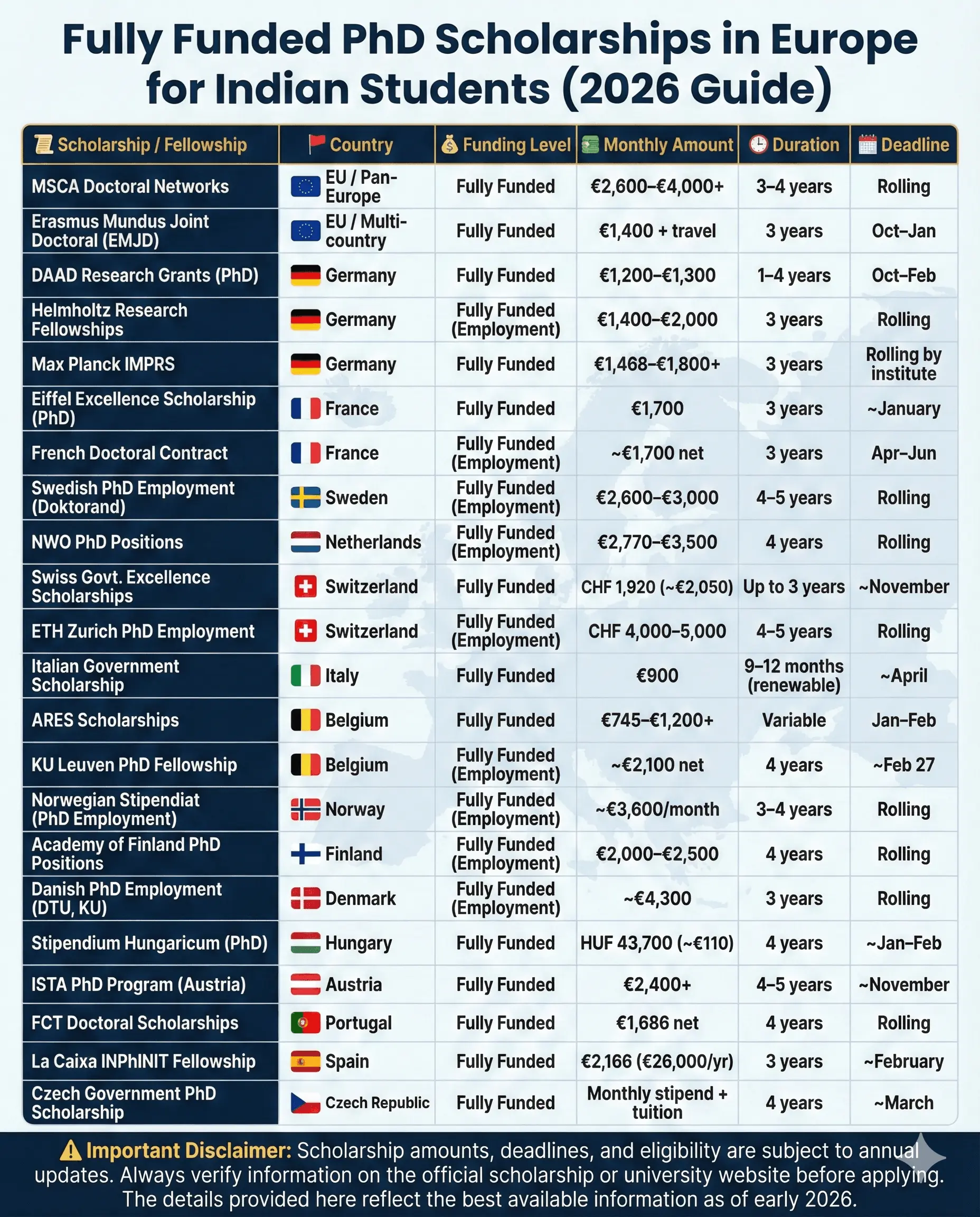
Complete Summary Table — All Fully Funded PhD Scholarships in Europe for Indian Students (2026)
Scholarship / Fellowship
Country
Funding Level
Monthly Amount
Duration
Open to Indians
Deadline
MSCA Doctoral Networks
🇪🇺 EU / Pan-Europe
Fully Funded
€2,600–€4,000+
3–4 years
Yes
Rolling
Erasmus Mundus Joint Doctoral (EMJD)
🇪🇺 EU / Multi-country
Fully Funded
€1,400 + travel
3 years
Yes
Oct–Jan
DAAD Research Grants (PhD)
🇩🇪 Germany
Fully Funded
€1,200–€1,300
1–4 years
Yes
Oct–Feb
Helmholtz Research Fellowships
🇩🇪 Germany
Fully Funded (Employment)
€1,400–€2,000
3 years
Yes
Rolling
Max Planck IMPRS
🇩🇪 Germany
Fully Funded
€1,468–€1,800+
3 years
Yes
Rolling by institute
Eiffel Excellence Scholarship (PhD)
🇫🇷 France
Fully Funded
€1,700
3 years
Yes (under 30)
~January
French Doctoral Contract
🇫🇷 France
Fully Funded (Employment)
~€1,700 net
3 years
Yes
Apr–Jun
Swedish PhD Employment (Doktorand)
🇸🇪 Sweden
Fully Funded (Employment)
€2,600–€3,000
4–5 years
Yes
Rolling
NWO PhD Positions
🇳🇱 Netherlands
Fully Funded (Employment)
€2,770–€3,500
4 years
Yes
Rolling
Swiss Govt. Excellence Scholarships
🇨🇭 Switzerland
Fully Funded
CHF 1,920 (~€2,050)
Up to 3 years
Yes
~November
ETH Zurich PhD Employment
🇨🇭 Switzerland
Fully Funded (Employment)
CHF 4,000–5,000
4–5 years
Yes
Rolling
Italian Government Scholarship
🇮🇹 Italy
Fully Funded
€900
9–12 months (renewable)
Yes
~April
ARES Scholarships
🇧🇪 Belgium
Fully Funded
€745–€1,200+
Variable
Yes
Jan–Feb
KU Leuven PhD Fellowship
🇧🇪 Belgium
Fully Funded (Employment)
~€2,100 net
4 years
Yes
~Feb 27
Norwegian Stipendiat (PhD Employment)
🇳🇴 Norway
Fully Funded (Employment)
~€3,600/month
3–4 years
Yes
Rolling
Academy of Finland PhD Positions
🇫🇮 Finland
Fully Funded (Employment)
€2,000–€2,500
4 years
Yes
Rolling
Danish PhD Employment (DTU, KU)
🇩🇰 Denmark
Fully Funded (Employment)
~€4,300
3 years
Yes
Rolling
Stipendium Hungaricum (PhD)
🇭🇺 Hungary
Fully Funded
HUF 43,700 (~€110)
4 years
Yes (via India MoE)
~Jan–Feb
ISTA PhD Program (Austria)
🇦🇹 Austria
Fully Funded
€2,400+
4–5 years
Yes
~November
FCT Doctoral Scholarships
🇵🇹 Portugal
Fully Funded
€1,686 net
4 years
Yes
Rolling
La Caixa INPhINIT Fellowship
🇪🇸 Spain
Fully Funded
€2,166 (€26,000/yr)
3 years
Yes
~February
Czech Government PhD Scholarship
🇨🇿 Czech Republic
Fully Funded
Monthly stipend + tuition
4 years
Yes
~March
⚠️ Important Disclaimer
Scholarship amounts, deadlines, and eligibility are subject to annual updates. Always verify information on the official scholarship or university website before applying. The details provided here reflect the best available information as of early 2026.
How to Win a Fully Funded PhD in Europe as an Indian Student (Step-by-Step Guide)
Winning one of these competitive PhD scholarships in Europe for Indian students requires a strategy well beyond academic excellence. Here is a proven step-by-step process based on what successful Indian doctoral scholarship recipients have done:
Step 1: Build a Research Profile Early (12–18 Months Before Deadline)
European doctoral committees evaluate your research potential, not just your marks. This means publications, conference presentations, and working experience in research labs matter enormously. If you haven’t published yet, consider submitting a paper or review article in a peer-reviewed journal. IR Research Publication’s Biological Sciences journal and editorial services can support Indian researchers in getting their first manuscripts submission-ready.
Step 2: Identify and Contact Supervisors
For most European PhD programs — especially in Germany, France, Netherlands, and Switzerland — you must have a confirmed or at least interested supervisor before you apply. Scan faculty profiles at target universities, read their recent papers, and send a targeted email aligning your research interests with their ongoing projects. Generic cold emails rarely succeed. Be specific, be brief, and attach a 1-page research proposal.
Step 3: Prepare a World-Class Application Package
Academic CV in Europass format (2–3 pages max)
Research Proposal (2,000–3,000 words, with clear objectives and methodology)
Statement of Purpose / Motivation Letter (tailored to each program)
Two strong Letters of Recommendation (at least one from a research supervisor)
Official transcripts and degree certificates
Language proficiency proof (IELTS/TOEFL or equivalent, if required)
Published papers or preprints (optional but powerful)
EURAXESS is the EU’s official jobs portal for researchers. Register your profile and set up job alerts for doctoral positions in your field. Most MSCA, NWO, and national research council-funded positions are posted here. Set location filters to specific countries or search pan-European.
Step 5: Apply Strategically to 8–12 Programs
Do not apply to a single scholarship. Diversity your applications across at least 3–4 countries and multiple programs per country. Aim for a mix of competitive (MSCA, Swiss Excellence, DAAD) and relatively accessible (Norwegian/Danish employment positions, French doctoral contracts) programs.
Step 6: Prepare for Interviews
Many European PhD programs — especially in Germany and the Netherlands — include a technical interview with the prospective supervisor and a committee. Prepare a 15-minute research talk. Practice explaining your master’s dissertation and connecting it to your proposed PhD research. Show genuine curiosity, not just credential-listing.
📌 Also Read
If you are simultaneously preparing for fellowships within India, check out the comprehensive Top Fellowships & Funding Opportunities for PhD Students in India in 2026 on the IR Research Publication blog. It covers PMRF, CSIR-JRF, UGC NET, and DST-INSPIRE — all of which can strengthen your profile before applying to European programs.
Frequently Asked Questions — PhD Scholarships in Europe for Indian Students (2026)
Do Indian students need IELTS for European PhD programs?
It depends on the country and institution. Germany (many programs), Netherlands, and Scandinavian countries often accept proof of English-medium education from Indian universities as a substitute for IELTS. France and Switzerland typically require DELF/DALF for French programs or IELTS/TOEFL for English-medium ones. MSCA and Erasmus Mundus programs generally rely on supervisor confirmation rather than requiring a formal test score.
Can Indian students apply without a GRE for European PhDs?
Yes. The GRE is not required for any European PhD program. This is one of the key advantages of European PhD scholarships in Europe for Indian students over those in the United States. European universities assess research potential through academic transcripts, research proposals, and supervisor letters.
Is it possible to get a fully funded PhD in Europe without prior publications?
Yes, especially for programs like MSCA Doctoral Networks, DAAD, and Norwegian/Swedish employment positions. However, publications or research experience (internships at research institutes, lab work, conference presentations) significantly strengthen your application. For highly competitive programs like the Swiss Excellence Scholarships or La Caixa INPhINIT, strong research output is often expected.
How long does it take to complete a PhD in Europe?
Most European PhD programs last 3–4 years. Germany and France typically run 3-year structured doctoral programs. Sweden and the Netherlands usually offer 4-year positions, including some teaching duties. Switzerland runs 4–5 year programs. Importantly, European PhDs can often be completed without a mandatory coursework phase (unlike the US), meaning you spend more time on original research.
What is the best European country for Indian PhD students in 2026?
It depends on your field and priorities. For STEM and engineering, Germany (DAAD, Max Planck, Helmholtz), the Netherlands (TU Delft, NWO positions), and Switzerland (ETH Zurich) are outstanding. For highest stipends and quality of life, Denmark and Norway lead. For cultural exposure and arts/humanities, France and Italy are excellent. Sweden and Finland offer the best work-life balance with the most secure employment terms.
Can Indian students receive postdoctoral fellowships in Europe after their PhD?
Absolutely. In fact, a European PhD makes you highly competitive for prestigious postdoctoral fellowships. For those already doing their PhD in India, the guide to Postdoctoral Fellowships in India 2026 by IR Research Publication offers an excellent starting point. European postdoctoral routes include MSCA Postdoctoral Fellowships, Marie Curie Individual Fellowships, and national programs like EMBO, Alexander von Humboldt, and Wenner-Gren.
Is there any scholarship for studying Indian scholarships to study abroad beyond Europe?
Yes. For a broader view of all international scholarship options available to Indian students, including Australia, USA, Japan, and beyond, explore the Indian Scholarships to Study Abroad guide on IR Research Publication.
Conclusion — Your PhD Journey in Europe Starts Now
The landscape of PhD scholarships in Europe for Indian students in 2026 is rich, diverse, and genuinely accessible to talented researchers willing to invest in a strong application. From the salary-grade positions in Norway and Denmark to the prestigious MSCA Doctoral Networks spanning all of Europe, and from the DAAD’s world-renowned program in Germany to Switzerland’s elite research scholarships — there has never been a better time to pursue doctoral excellence in Europe.
The key insights from this guide are clear: start early (12–18 months before deadlines), contact supervisors proactively, publish or demonstrate research output, and apply strategically to multiple programs and countries simultaneously. European universities are actively seeking talented Indian researchers, and with the right preparation, your PhD in Europe is well within reach.
For personalized guidance on building your application profile, polishing your research proposal, or publishing your research before applying, explore the full suite of services at IR Research Publication — India’s trusted academic publisher and editorial services partner for researchers at every career stage.
Writing Tip: To polish the grammar and academic tone of my research papers, I use Paperpal. It’s an AI specifically trained for scientists. You can try it for free to see how it improves your manuscript.