
Why Germany for Postdoctoral Research in 2027
Germany offers a world-class research ecosystem anchored by renowned organizations such as the Max Planck Society, Helmholtz Association, Leibniz Association, Fraunhofer-Gesellschaft, and leading universities. Fully funded postdoctoral fellowships in Germany 2027 support international and domestic researchers with competitive stipends or contracts, excellent infrastructure, and integration into vibrant academic networks.
- Who should apply: PhD holders or those nearing completion with strong research output and an international outlook.
- Why Germany: Globally ranked institutes, access to cutting-edge facilities, collaborative culture, competitive funding, and strong industry links.
- What’s on offer: Taxed employment contracts (e.g., TV-L/TVöD scales) or generous stipends, mobility and family allowances, travel and research budgets, mentoring, and career development.
Before applying in 2027, always consult official program pages for the most current eligibility rules, stipend levels, and deadlines, as providers periodically update terms.
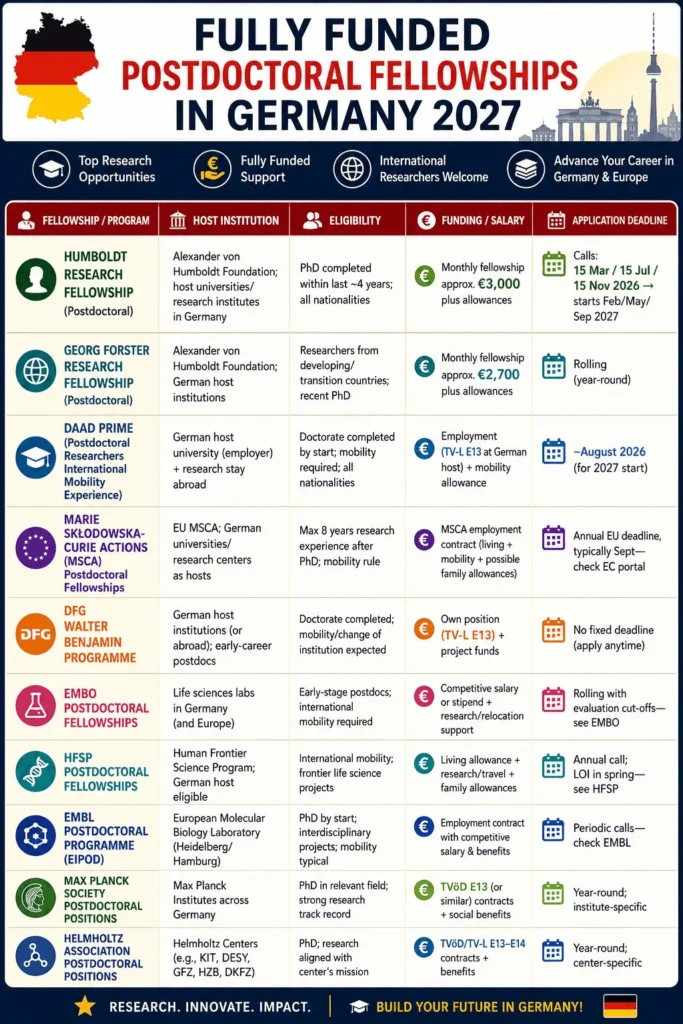
Fellowship Summary Table: Fully Funded Postdoctoral Fellowships in Germany 2027
| Fellowship / Program | Host Institution | Eligibility | Funding / Salary | Application Deadline | Official Link |
|---|---|---|---|---|---|
| Humboldt Research Fellowship (Postdoctoral) | Alexander von Humboldt Foundation; host universities/research institutes in Germany | PhD completed within last ~4 years; all nationalities | Monthly fellowship approx. €3,000 plus allowances | Calls: 15 Mar / 15 Jul / 15 Nov 2026 → starts Feb/May/Sep 2027 | Official |
| Georg Forster Research Fellowship (Postdoctoral) | Alexander von Humboldt Foundation; German host institutions | Researchers from developing/transition countries; recent PhD | Monthly fellowship approx. €2,700 plus allowances | Rolling (year-round) | Official |
| DAAD PRIME (Postdoctoral Researchers International Mobility Experience) | German host university (employer) + research stay abroad | Doctorate completed by start; mobility required; all nationalities | Employment (TV-L E13 at German host) + mobility allowance | ~August 2026 (for 2027 start) | Official |
| Marie Skłodowska-Curie Actions (MSCA) Postdoctoral Fellowships | EU MSCA; German universities/research centers as hosts | Max 8 years research experience after PhD; mobility rule | MSCA employment contract (living + mobility + possible family allowances) | Annual EU deadline, typically Sept—check EC portal | Official |
| DFG Walter Benjamin Programme | German host institutions (or abroad); early-career postdocs | Doctorate completed; mobility/change of institution expected | Own position (TV-L E13) + project funds | No fixed deadline (apply anytime) | Official |
| EMBO Postdoctoral Fellowships | Life sciences labs in Germany (and Europe) | Early-stage postdocs; international mobility required | Competitive salary or stipend + research/relocation support | Rolling with evaluation cut-offs—see EMBO | Official |
| HFSP Postdoctoral Fellowships | Human Frontier Science Program; German host eligible | International mobility; frontier life science projects | Living allowance + research/travel + family allowances | Annual call; LOI in spring—see HFSP | Official |
| EMBL Postdoctoral Programme (EIPOD) | European Molecular Biology Laboratory (Heidelberg/Hamburg) | PhD by start; interdisciplinary projects; mobility typical | Employment contract with competitive salary & benefits | Periodic calls—check EMBL | Official |
| Max Planck Society Postdoctoral Positions | Max Planck Institutes across Germany | PhD in relevant field; strong research track record | TVöD E13 (or similar) contracts + social benefits | Year-round; institute-specific | Official |
| Helmholtz Association Postdoctoral Positions | Helmholtz Centers (e.g., KIT, DESY, GFZ, HZB, DKFZ) | PhD; research aligned with center’s mission | TVöD/TV-L E13–E14 contracts + benefits | Year-round; center-specific | Official |
Humboldt Research Fellowship (Postdoctoral)
Overview
The Alexander von Humboldt Foundation funds outstanding international postdocs to conduct independent research with a host in Germany. Applications are accepted year-round and across all disciplines.
Funding and Benefits
- Monthly fellowship of approximately €3,000 (postdoctoral level), plus family, mobility, and language-course support.
- Travel costs, conference support, and alumni funding opportunities.
- 6–24 months of research with flexible start dates.
Eligibility
- Doctorate completed generally within the last four years.
- Strong publication record appropriate to career stage.
- Host agreement from a German institution.
Application Process
- Secure a host and research plan.
- Submit application online with references; reviews are competitive and merit-based.
- Timeline: typically 4–7 months from submission to decision.
Georg Forster Research Fellowship (Postdoctoral)
Overview
For researchers from developing and transition countries, this Humboldt Foundation fellowship supports research in Germany that has development relevance.
Funding and Benefits
- Monthly fellowship of approximately €2,670, with family/mobility allowances.
- Language courses, travel, and extensive networking/alumni funding.
Eligibility
- Citizenship in an eligible developing/transition country (see official list).
- Recent PhD and strong academic record.
- Host invitation and project fit to development-relevant topics.
Application Process
- Apply online with project proposal, host’s confirmation, and references.
- Rolling submissions; allow several months for review.
DAAD PRIME (Postdoctoral Researchers International Mobility Experience)
Overview
DAAD PRIME funds a postdoctoral position at a German university combined with an obligatory research stay abroad, promoting long-term career prospects in Germany.
Funding and Benefits
- Employment contract at the German host (TV-L E13) for 18 months.
- Typically 12 months abroad + 6 months reintegration in Germany.
- Mobility allowance, travel, and insurance as per DAAD rules.
Eligibility
- Doctorate completed by the start date; all nationalities welcome.
- Mobility requirements apply; check current call text.
- Host university in Germany must commit to employing the fellow.
Application Process
- Annual call (usually spring). Prepare research plan and host confirmations.
- Submit through DAAD portal; panel evaluation based on excellence and feasibility.
Marie Skłodowska-Curie Actions (MSCA) Postdoctoral Fellowships
Overview
MSCA PF (Horizon Europe) offers prestigious, fully funded postdoctoral training with a German host (European PF) or with an outbound phase followed by a German return (Global PF).
Funding and Benefits
- Employment contract with competitive MSCA living, mobility, and family allowances (country correction coefficients apply).
- Research, training, secondments, and career development budget.
Eligibility
- PhD at the call deadline and up to 8 years of research experience after PhD (HE rules).
- Mobility rule: limited residence in the host country within the prior 36 months.
Application Process
- Identify a German supervisor/host and co-develop the proposal in the EU Funding & Tenders Portal.
- Annual deadline typically in September; evaluation is highly competitive.
DFG Walter Benjamin Programme
Overview
The German Research Foundation (DFG) supports early-career postdocs to conduct independent research in Germany or abroad, often emphasizing a change of academic environment.
Funding and Benefits
- Funding for your own position (commonly TV-L E13 at the host institution).
- Project funds (e.g., travel, consumables) as justified.
Eligibility
- Completed doctorate; early career stage; change of institution generally expected.
- Scientific excellence and a strong, feasible project proposal.
Application Process
- Submit a proposal anytime via DFG’s portal with host confirmation and detailed plan.
- Peer review followed by panel decision; timelines vary.
EMBO Postdoctoral Fellowships
Overview
EMBO supports excellent researchers in the life sciences to carry out postdoctoral work in a different country, including Germany.
Funding and Benefits
- Country-specific salary or stipend, dependent on host location.
- Relocation allowance, childcare support (where applicable), and laboratory/research cost contributions.
Eligibility
- PhD completion and early-stage postdoc status; international mobility required.
- Strong publication record; project fit with host expertise.
Application Process
- Rolling applications with periodic evaluation cut-offs (see EMBO).
- Apply online with project proposal, host support letter, and references.
HFSP Postdoctoral Fellowships
Overview
The Human Frontier Science Program funds frontier, interdisciplinary life science projects, encouraging cross-field training and international mobility to hosts in countries like Germany.
Funding and Benefits
- Competitive living allowance, family allowance where eligible, and research/travel support.
- Up to three years of funding.
Eligibility
- PhD by fellowship start; early-career stage; strict international mobility is required.
- Projects should cross disciplinary boundaries and pursue high-risk/high-gain research.
Application Process
- Two-stage annual competition: Letter of Intent (spring) and Full Proposal (late summer/early autumn).
- Peer review emphasizes novelty and potential impact.
EMBL Postdoctoral Programme (EIPOD)
Overview
EMBL’s postdoctoral programme supports interdisciplinary projects at EMBL sites including Heidelberg and Hamburg, often under the EIPOD scheme.
Funding and Benefits
- Employment contract with competitive salary, social security, and staff benefits.
- Access to core facilities, mentorship, and tailored training.
Eligibility
- PhD by the start date; strong interest in interdisciplinary research.
- Mobility typically expected; confirm specific call criteria.
Application Process
- Calls open periodically; applications through EMBL’s portal with project fit and supervisor match.
- Interviews for shortlisted candidates.
Max Planck Society Postdoctoral Researcher Positions
Overview
Max Planck Institutes (MPIs) offer fully funded postdoctoral positions across basic and applied sciences, social sciences, and humanities.
Funding and Benefits
- Employment contracts typically at TVöD E13 (100% FTE) plus social benefits.
- Cutting-edge facilities, international environment, and internal funding schemes.
Eligibility
- PhD in a relevant discipline; strong publications and methods expertise.
- Project alignment with the hosting MPI’s research groups.
Application Process
- Positions advertised year-round by individual MPIs.
- Apply via the MPI job portal with CV, publications, and research statement.
Helmholtz Association Postdoctoral Positions
Overview
Helmholtz Centers advance large-scale research in energy, earth & environment, health, information, matter, aeronautics/space/transport. Centers regularly hire fully funded postdocs.
Funding and Benefits
- Contracts on TVöD/TV-L scales (often E13–E14) with full benefits.
- Access to large-scale infrastructure and cross-center collaborations.
Eligibility
- PhD completed; domain-specific skills; strong motivation for mission-driven research.
- International candidates welcome; English commonly used.
Application Process
- Search and apply via the Helmholtz job portal or center-specific pages (e.g., DESY, DKFZ, KIT).
- Interviews and reference checks; timelines vary by center.
How to Choose and Strengthen Your Application
- Match your research plan to the program’s mission and your host’s expertise.
- Clarify mobility requirements early (MSCA, EMBO, HFSP, DAAD PRIME).
- Request reference letters well in advance and align them with your proposal’s narrative.
- Use clear work packages, realistic Gantt charts, and measurable outcomes.
- Review successful templates and writing tips. For practical guidance, explore resources at IR Research Publication, including proposal strategies and scholarship roundup posts.
Frequently Asked Questions
- Are the fellowships listed here fully funded?
Yes. Programs provide either a monthly fellowship (e.g., Humboldt) or an employment contract (e.g., TV-L/TVöD for DAAD PRIME, Max Planck, Helmholtz), often with additional allowances. Always verify current terms on official pages.
- When will 2027 deadlines be published?
Some schemes accept applications year-round (Humboldt, DFG Walter Benjamin, EMBO rolling). Annual calls like MSCA PF, HFSP, and DAAD PRIME typically publish deadlines the preceding year. Check official websites regularly.
- What is the typical salary for contracted postdocs in Germany?
University and institute positions are often aligned with TV-L or TVöD pay scales (commonly E13), which vary by federal state and experience level. Consult your host HR or program pages for current rates.
- Do I need German language skills?
Not usually for research roles; English is widely used. Some programs fund language courses (e.g., Humboldt). Teaching or clinical roles may require German.
- Can I bring my family?
Many programs offer family/spouse allowances (e.g., MSCA, Humboldt) and support with childcare or schooling via host services. Check each program’s family policy.
- What are my chances?
Top programs are competitive. A strong publications record, clear impact, host fit, and compelling training plan substantially improve success.
- Where can I get proposal-writing help?
Consult your host’s research office and explore application tips at IR Research Publication. You may also find guides on MSCA and DAAD strategies useful.
About IR Research Publication
IR Research Publication (IRRP) curates credible opportunities and practical resources for scholars worldwide. Our mission is to help researchers find competitive funding, craft stronger proposals, and communicate their science effectively. Explore guides, funding roundups, and writing tips to accelerate your academic career.
Related Articles
- Fully Funded PhD Scholarships in Germany 2027 | Apply Now
- USA vs Canada for PhD: Best Choice for Indian Students in 2026
- Fully Funded PhD Opportunities in New Zealand 2026
- QS World University Rankings 2027 Released: MIT’s Historic Streak, Asia’s Rise, and the Global Top 20
- Fully Funded Postdoctoral Fellowships in New Zealand 2026
Additional Resources and Official Portals
- Research in Germany (DAAD): Overview of Funding
- EU Funding & Tenders Portal (MSCA Calls)
- DFG – Deutsche Forschungsgemeinschaft
- EMBO
- HFSP
Conclusion
From Humboldt and DAAD PRIME to MSCA PF, EMBO, HFSP, and institution-based contracts, the ecosystem for fully funded postdoctoral fellowships in Germany 2027 is exceptionally strong. Identify the program that best aligns with your research goals, confirm the latest eligibility and deadlines on official pages, and co-develop a compelling proposal with your host. With early planning, a clear training plan, and strategic mentoring, Germany can be the ideal launchpad for your next breakthrough.