
Introduction
Are you searching for fully funded postdoctoral fellowships in Finland for 2027? Finland offers competitive opportunities for international researchers across life sciences, medicine, artificial intelligence, engineering, environmental sciences, humanities, and social sciences.
From independent research grants worth up to €700,000 to salaried university fellowships and internationally funded research positions, Finland provides multiple pathways for postdoctoral career development.
However, there is one important distinction applicants should understand:
Not every postdoctoral funding opportunity in Finland is a traditional fellowship.
Some schemes provide independent research grants administered by a Finnish research organization. Others offer fixed-term employment contracts with monthly salaries and employee benefits. International programs may provide stipends, salary contributions, relocation support, and additional allowances.
Understanding these differences is essential when comparing funding and preparing applications.
This guide covers major opportunities, including:
- Research Council of Finland – 2027 Academy Research Fellowships
- Turku Institute for Advanced Studies (TIAS)
- TIES2 Marie Skłodowska-Curie COFUND Fellowships
- Helsinki Collegium for Advanced Studies (HCAS)
- Tampere Institute for Advanced Study
- Helsinki Institute for Information Technology (HIIT)
- Marie Skłodowska-Curie Postdoctoral Fellowships
- EMBO Postdoctoral Fellowships
- Human Frontier Science Program (HFSP)
- Fulbright U.S. Scholar Awards to Finland
- Finnish Center for Artificial Intelligence (FCAI)
- Other university-based postdoctoral research positions
We also explain salaries, eligibility, immigration considerations, application strategies, and verified deadlines.
Last verified: October 10, 2026. Deadlines and grant conditions may change, so always consult the official funding announcement before applying.
For researchers comparing Nordic and European destinations, see our guides to fully funded postdoctoral fellowships in Sweden for 2027 and postdoctoral fellowships in the Netherlands for 2027.
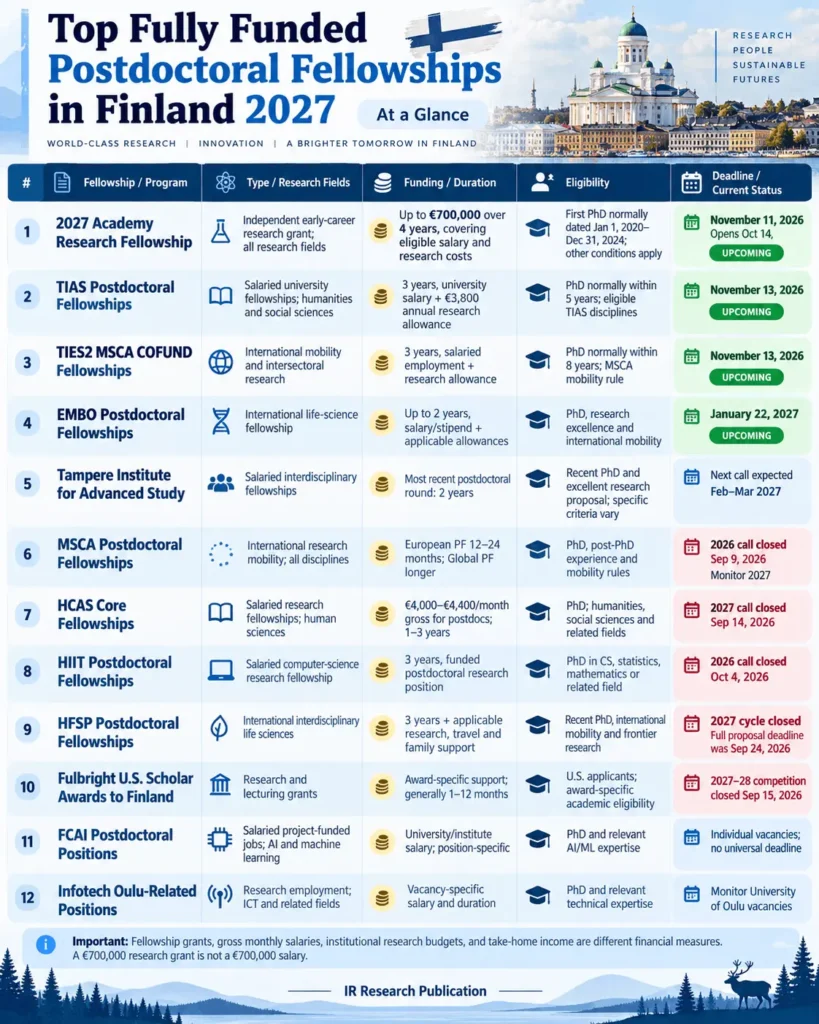
Top Fully Funded Postdoctoral Fellowships in Finland 2027: At a Glance
The following comparison table summarizes the major research fellowships, funding mechanisms, and salaried positions relevant to researchers planning a 2027 start.
| Fellowship / Program | Type / Research Fields | Funding / Duration | Eligibility | Deadline / Current Status | Official Link |
|---|---|---|---|---|---|
| 2027 Academy Research Fellowship | Independent early-career research grant; all research fields | Up to €700,000 over 4 years, covering eligible salary and research costs | First PhD normally dated Jan 1, 2020–Dec 31, 2024; other conditions apply | November 11, 2026; opens Oct 14 | Research Council of Finland |
| TIAS Postdoctoral Fellowships | Salaried university fellowships; humanities and social sciences | 3 years, university salary + €3,800 annual research allowance | PhD normally within 5 years; eligible TIAS disciplines | November 13, 2026 | TIAS Vacancies |
| TIES2 MSCA COFUND Fellowships | International mobility and intersectoral research | 3 years, salaried employment + research allowance | PhD normally within 8 years; MSCA mobility rule | November 13, 2026 | TIES2 Fellowships |
| EMBO Postdoctoral Fellowships | International life-science fellowship | Up to 2 years, salary/stipend + applicable allowances | PhD, research excellence and international mobility | Next cutoff: January 22, 2027 | EMBO |
| Tampere Institute for Advanced Study | Salaried interdisciplinary fellowships | Most recent postdoctoral round: 2 years | Recent PhD and excellent research proposal; specific criteria vary | Next call expected Feb–Mar 2027 | Tampere IAS |
| MSCA Postdoctoral Fellowships | International research mobility; all disciplines | European PF 12–24 months; Global PF longer | PhD, post-PhD experience and mobility rules | 2026 call closed Sep 9; monitor 2027 | MSCA |
| HCAS Core Fellowships | Salaried research fellowships; human sciences | €4,000–€4,400/month gross for postdocs; 1–3 years | PhD; humanities, social sciences and related fields | 2027 call closed Sep 14, 2026 | HCAS |
| HIIT Postdoctoral Fellowships | Salaried computer-science research fellowship | 3 years, funded postdoctoral research position | PhD in CS, statistics, mathematics or related field | 2026 call closed Oct 4, 2026 | HIIT |
| HFSP Postdoctoral Fellowships | International interdisciplinary life sciences | 3 years + applicable research, travel and family support | Recent PhD, international mobility and frontier research | 2027 cycle closed; full proposal deadline was Sep 24, 2026 | HFSP |
| Fulbright U.S. Scholar Awards to Finland | Research and lecturing grants | Award-specific support; generally 1–12 months | U.S. applicants; award-specific academic eligibility | 2027–28 competition closed Sep 15, 2026 | Fulbright Finland |
| FCAI Postdoctoral Positions | Salaried project-funded jobs; AI and machine learning | University/institute salary; position-specific | PhD and relevant AI/ML expertise | Individual vacancies; no universal deadline | FCAI |
| Infotech Oulu-Related Positions | Research employment; ICT and related fields | Vacancy-specific salary and duration | PhD and relevant technical expertise | Monitor University of Oulu vacancies | University of Oulu |
Important: Fellowship grants, gross monthly salaries, institutional research budgets, and take-home income are different financial measures. A €700,000 research grant is not a €700,000 salary.
Fellowships with Confirmed 2027 Application Deadlines
1. Research Council of Finland – 2027 Academy Research Fellowships
Application deadline: November 11, 2026
The Academy Research Fellowship is one of Finland’s leading funding instruments for promising early-career researchers working toward scientific independence.
The program is administered by the Research Council of Finland, formerly the Academy of Finland.
Older funding guides may refer to the former Postdoctoral Researcher Funding scheme. That scheme has been discontinued and should not be presented as an active annual fellowship.
The Academy Research Fellowship is the relevant current early-career funding opportunity.
Funding and Duration
The 2027 call offers:
- Maximum grant of €700,000
- Four-year funding period
- Start date: September 1, 2027
- End date: August 31, 2031
The research grant can cover eligible costs including the applicant’s salary, possible research-team salary expenses, and other research costs.
It is intended to support the researcher’s progression toward an established and independent scientific career.
The maximum amount is a total research grant, not a personal annual salary or stipend.
Eligibility
For the 2027 call, applicants must normally have received their first doctoral degree between:
January 1, 2020 and December 31, 2024.
The program targets researchers who have not yet attained a permanent senior research position.
Other requirements concerning employment status, research organization commitment, career interruptions, application limits, and funding conditions are specified in the official call.
Application Timeline
- Call opens: October 14, 2026
- Deadline: November 11, 2026, at 23:59 Finnish time
- Funding starts: September 1, 2027
Applicants submit through the Research Council’s electronic funding system.
The application typically involves a research plan, budget, CV, publication information, institutional commitment and other materials required by the call.
Official application page: 2027 Academy Research Fellowships
Best suited for: Early-career researchers who have established a promising research record and want to develop an independent project at a Finnish research organization.
2. Turku Institute for Advanced Studies (TIAS) Postdoctoral Fellowships
Application deadline: November 13, 2026
The Turku Institute for Advanced Studies (TIAS) at the University of Turku supports innovative and interdisciplinary research.
For the 2027 recruitment round, TIAS is offering:
- 4 Postdoctoral Fellow positions
- 4 Collegium Fellow positions
- 7 TIES2 MSCA COFUND Fellow positions
All advertised appointments are scheduled to begin in September 2027.
The standard TIAS Postdoctoral Fellowship is especially attractive to researchers in the humanities and social sciences who want dedicated time to undertake independent research.
Research Fields
Eligible disciplines fall within the institute’s constituent faculties:
- Economics
- Education
- Humanities
- Law
- Social Sciences
Applicants from unrelated fields should not assume eligibility merely because TIAS welcomes interdisciplinary research.
Funding and Duration
TIAS Postdoctoral Fellows receive:
- A three-year salaried appointment
- University employment benefits
- An additional €3,800 annual research allowance
- Opportunities for interdisciplinary collaboration and academic networking
The salary is determined through the relevant university employment framework rather than one universal international fellowship stipend.
Eligibility
For the regular TIAS Postdoctoral Fellow category, applicants should normally be within five years of completing their PhD, subject to the current call’s detailed provisions.
Selection emphasizes research excellence and the quality of the proposed project.
Application Dates
- Applications opened: September 18, 2026
- Deadline: November 13, 2026
- Fellowships begin: September 2027
TIAS reports that its previous fellowship competitions have typically been extremely competitive, with success rates around 2%.
Official application page: TIAS Open Vacancies
3. TIES2 Marie Skłodowska-Curie COFUND Fellowships
Application deadline: November 13, 2026
The Turku Intersectoral Excellence Scheme 2 (TIES2) is a separate fellowship opportunity operated by the University of Turku and co-funded through the European Union’s MSCA COFUND program.
For the 2027 recruitment round, seven TIES2 fellowships are available.
Funding and Duration
- Three-year salaried fellowship
- Start date: September 1, 2027
- Annual research allowance
- Structured interdisciplinary and intersectoral career development
- Required secondment of 3–12 months in an organization outside the higher education sector
The intersectoral secondment is a distinguishing feature of this program.
Eligibility
Applicants normally must be within eight years of completing their PhD, subject to the detailed call rules.
The MSCA mobility rule also applies:
Applicants must not have resided or carried out their main activity in Finland for more than 12 months during the 36 months immediately before the application deadline.
Other detailed eligibility and application requirements are provided in the TIES2 call instructions.
Application Timeline
- Call opened: September 18, 2026
- Deadline: November 13, 2026
- Fellowships begin: September 1, 2027
Official application page: TIES2 MSCA COFUND Fellowships
Best suited for: Internationally mobile postdoctoral researchers interested in combining academic research with experience in the non-academic sector.
4. EMBO Postdoctoral Fellowships – Finland as a Host Destination
Next application cutoff: January 22, 2027
The European Molecular Biology Organization (EMBO) supports internationally mobile postdoctoral researchers in the life sciences.
Finnish universities and research institutes can serve as eligible host environments when the proposed fellowship satisfies EMBO’s geographic and mobility requirements.
Research Fields
Projects can involve areas such as:
- Molecular biology
- Cell biology
- Genetics
- Biochemistry
- Neuroscience
- Developmental biology
- Molecular microbiology
- Computational and interdisciplinary life sciences
Funding and Duration
EMBO Postdoctoral Fellowships support research for up to two years.
Benefits include:
- Salary or stipend depending on host-country arrangements
- Relocation allowance
- Applicable support for fellows with children
- Access to training and networking opportunities
Eligibility
Applicants must satisfy the current PhD timing and international mobility requirements.
The fellowship is designed for researchers moving into a new research environment rather than simply continuing their previous work.
EMBO also limits host laboratories to supporting one candidate per selection round under its current rules.
Application Deadline
Applications are accepted throughout the year, with evaluation rounds.
The next hard cutoff is:
January 22, 2027, at 14:00 CET.
Applicants should also review EMBO’s revised reapplication policy, which applies to later selection rounds.
Official application page: EMBO Postdoctoral Fellowships
Best suited for: Recent life-science PhD graduates seeking international mobility and advanced research training.
Additional Postdoctoral Fellowships to Monitor for 2027
5. Tampere Institute for Advanced Study Postdoctoral Fellowships
Next call expected: February–March 2027
The Tampere Institute for Advanced Study (Tampere IAS) supports outstanding researchers across disciplines represented at Tampere University.
Its research environment brings together expertise in technology, health and society.
Funding and Duration
The most recent 2026 competition offered:
- 9 Postdoctoral Research Fellowships
- 2-year appointments for postdoctoral researchers
- 6 Senior Research Fellowships of 3 years
Successful postdoctoral applicants receive salaried appointments under university employment conditions.
Eligibility
Applicants need a doctoral degree and a research proposal demonstrating originality, scientific quality and feasibility.
In the 2026 round, postdoctoral eligibility required a doctorate dated between March 2, 2021 and March 2, 2026.
The 2027 eligibility window must be confirmed from the new announcement.
Current Status
Tampere University expects the next call to take place in February–March 2027.
The exact 2027 deadline, position count and funding terms have not yet been confirmed.
Official information: Tampere Institute for Advanced Study
6. Marie Skłodowska-Curie Postdoctoral Fellowships (MSCA PF)
2027 call: Monitor the official EU funding announcement
The Marie Skłodowska-Curie Actions Postdoctoral Fellowships are among Europe’s most competitive international research fellowships.
Applicants can pursue research at eligible Finnish universities, institutes or other organizations.
MSCA Postdoctoral Fellowships support researcher mobility, advanced training and career development across disciplines.
Fellowship Types
European Postdoctoral Fellowships
- Typically 12–24 months
- Hosted in an eligible EU Member State or Horizon Europe Associated Country
- Finland is an eligible host destination
Global Postdoctoral Fellowships
- Include an outgoing research phase in a non-associated third country
- Include a mandatory return phase to an eligible European host
- Finland may serve as the European host under applicable conditions
A Global Fellowship does not necessarily mean conducting the entire fellowship in Finland.
Funding
The funding model supports:
- Living allowance
- Mobility allowance
- Family allowance where applicable
- Research, training and networking costs
- Management and indirect costs for the host
The EU’s institutional funding contributions should not be confused with the fellow’s net salary.
Eligibility
Applicants normally must:
- Hold a doctoral degree by the application deadline
- Have no more than eight years of qualifying postdoctoral research experience, subject to permitted exclusions
- Satisfy the applicable mobility rule
For a European Postdoctoral Fellowship hosted in Finland, the applicant generally must not have lived or carried out their main activity in Finland for more than 12 months during the 36 months before the call deadline.
Application Status
The 2026 call closed on September 9, 2026.
Researchers targeting the next competition should monitor the official 2027 call and begin identifying Finnish supervisors and host laboratories early.
Official application page: MSCA Postdoctoral Fellowships
7. Helsinki Collegium for Advanced Studies (HCAS) Core Fellowships
2027 application cycle closed: September 14, 2026
The Helsinki Collegium for Advanced Studies (HCAS) is an independent institute at the University of Helsinki.
It provides opportunities for researchers to pursue high-quality independent scholarship in humanities, social sciences and related fields.
Eligible Research Fields
The institute welcomes research in:
- Humanities
- Social sciences
- Educational sciences
- Theology
- Law
- Related human-science disciplines
Researchers in other fields may be eligible where their project substantially engages with human-science questions.
Funding and Duration
For the 2027 Core Fellowship competition, the university advertised:
- €4,000–€4,400 per month gross for postdoctoral fellows
- €4,000 annual personal research allowance
- 1–3-year appointments for postdoctoral researchers
- Access to HCAS research infrastructure and interdisciplinary activities
These are salaried positions rather than personal tax-free scholarships.
Application Status
The 2027 application window ran from August 17 to September 14, 2026.
Appointments are expected to begin in August–September 2027.
The application window is now closed.
Applicants interested in later recruitment should monitor future calls.
Official application page: HCAS Core Fellowship
8. Helsinki Institute for Information Technology (HIIT) Postdoctoral Fellowships
Most recent deadline: October 4, 2026 — Closed
The Helsinki Institute for Information Technology (HIIT) is a joint research institute of Aalto University and the University of Helsinki.
HIIT supports research in computer science and related fields, combining basic research with applications in society and industry.
Research Areas
Relevant areas include:
- Artificial intelligence
- Algorithms
- Computer science
- Data science
- Computational methods
- Statistics
- Mathematics
- Human-centered computing
Funding and Duration
HIIT’s recent postdoctoral fellowship recruitment offered three-year funded research positions.
These are salaried employment opportunities with terms determined by the participating university and vacancy.
Eligibility
Applicants generally need a PhD, or to be close to completing one, in computer science, statistics, mathematics or a related field.
Scientific publications, technical expertise, independent research ability and English proficiency are important selection criteria.
Current Status
The latest advertised application deadline was October 4, 2026.
This round is closed. A new 2027 deadline has not been confirmed.
Official information: HIIT Postdoctoral Fellow Positions
9. Human Frontier Science Program (HFSP) Postdoctoral Fellowships
2027 application cycle closed
The Human Frontier Science Program (HFSP) funds ambitious, high-risk and interdisciplinary research addressing fundamental questions in the life sciences.
Finnish research laboratories can serve as host institutions when all eligibility conditions are satisfied.
Fellowship Categories
HFSP offers two major fellowship routes:
Long-Term Fellowships (LTF)
For researchers with doctoral training in the life sciences who want to move into new scientific directions.
Cross-Disciplinary Fellowships (CDF)
For researchers trained in non-biological disciplines who want to move into fundamental life-science research.
Funding
Fellowships generally last three years, with support that may include:
- Living allowance
- Research and travel allowance
- Relocation support
- Child-related and family support under applicable rules
Award amounts depend on the host country and fellowship conditions.
Eligibility
HFSP emphasizes:
- International relocation
- Research independence
- Significant changes in research direction
- Innovative and interdisciplinary scientific questions
Applicants should carefully review restrictions involving nationality, previous research locations, doctoral institution and host-country residence.
2027 Application Status
The 2027 fellowship competition had the following deadlines:
- Letter-of-intent initiation: May 5, 2026
- Letter-of-intent submission: May 12, 2026
- Invited full proposal: September 24, 2026
All these deadlines have passed.
Researchers who did not participate in the 2027 competition should monitor the next fellowship cycle.
Official information: HFSP Postdoctoral Fellowships
10. Fulbright U.S. Scholar Awards to Finland
2027–2028 competition closed: September 15, 2026
The Fulbright Finland Foundation administers research and academic exchange opportunities between Finland and the United States.
For U.S.-based applicants, Fulbright U.S. Scholar Awards can support temporary research and lecturing visits to Finnish institutions.
These awards should not be confused with conventional multi-year Finnish university postdoctoral employment.
Duration and Funding
Research and lecturing grants generally support visits of 1–12 months, depending on the specific award.
Benefits may include:
- Grant-based financial support
- Travel-related benefits
- Academic affiliation and networking
- Orientation and advisory services
- Additional award-specific benefits
The exact funding package varies.
Eligibility
These awards generally target eligible U.S. scholars, including researchers at different career stages depending on the award.
Applicants should check whether their selected award permits postdoctoral researchers and requires a host invitation.
Current Status
The 2027–2028 U.S. Scholar competition closed on September 15, 2026.
The earliest grant terms are expected to begin in August 2027.
Official information: Fulbright Research and Lecturing Grants to Finland
Important: Fulbright Finland also operates programs supporting researchers moving from Finland to the United States. Those outgoing awards are not equivalent to fellowships for international researchers seeking to relocate to Finland.
Salaried Postdoctoral Research Positions in Finland
In addition to competitive individual fellowships, Finland offers salaried postdoctoral jobs supported by institutional, national and international research grants.
These are often among the most practical routes for researchers who do not meet restrictive fellowship mobility or PhD-age requirements.
11. Finnish Center for Artificial Intelligence (FCAI)
The Finnish Center for Artificial Intelligence (FCAI) is a research network involving Aalto University, the University of Helsinki and VTT Technical Research Centre of Finland.
Researchers work on AI-related topics such as:
- Machine learning
- Probabilistic modeling
- Human-centered artificial intelligence
- Data-driven science
- AI applications in healthcare and industry
- Computational methods
FCAI-associated research groups may recruit postdoctoral researchers through project-specific vacancies.
Employment terms, salary, duration and eligibility depend on the actual hiring institution and project.
FCAI should therefore be described as a source of research opportunities, not as a guaranteed annual individual postdoctoral fellowship.
Official website: Finnish Center for Artificial Intelligence
12. Infotech Oulu and University of Oulu Postdoctoral Opportunities
The University of Oulu provides research opportunities in fields including:
- Information and communication technology
- Computer engineering
- Wireless communications
- Electronics
- Biomedical engineering
- Signal processing
- Artificial intelligence
- Multidisciplinary technology research
Infotech Oulu is associated with the university’s technology-oriented research environment.
Postdoctoral positions may be supported by individual research projects and institutional funding.
However, applicants should not assume that an annual Infotech Oulu fellowship competition exists unless a current official call confirms it.
Where to apply: University of Oulu Careers
What About the Sigrid Jusélius Foundation?
The Sigrid Jusélius Foundation supports medical research and researchers connected to the Finnish research system.
However, its postdoctoral fellowship supporting research abroad should not be advertised as a standard incoming fellowship for international researchers seeking to relocate to Finland.
That particular mechanism supports eligible researchers undertaking postdoctoral work outside Finland.
Some research grants administered by the Foundation may indirectly support postdoctoral employment or research projects in Finland, but eligibility must be verified under each specific funding instrument.
For that reason, it is not included in the main table of incoming Finland-based fellowships.
How Much Do Postdoctoral Researchers Earn in Finland?
Postdoctoral salaries in Finland are not determined by one fixed national fellowship amount.
For salaried researchers, compensation depends on:
- University or research institution
- Job requirements
- Research experience
- Applicable salary system
- Individual performance component
- Contract and funding source
- Additional responsibilities
For example, the 2027 HCAS Core Fellowship advertises a postdoctoral gross salary of €4,000–€4,400 per month, plus a separate annual research allowance of €4,000.
Other universities and projects may offer different salary levels.
Salary vs. Research Grant vs. Stipend
| Funding Type | What It Means | Example |
|---|---|---|
| Gross salary | Employment income before tax and applicable contributions | HCAS: €4,000–€4,400/month gross |
| Research grant | Total funding allocated to an approved research project | Academy Research Fellowship: up to €700,000 over 4 years |
| Research allowance | Additional funding for approved research-related expenses | TIAS: €3,800/year |
| Fellowship stipend | Personal financial support under a grant arrangement | Depends on the applicable international or foundation scheme |
| University project-funded position | Salary paid through an institution’s funded research project | FCAI or University of Oulu vacancies |
A research grant is not necessarily the fellow’s personal income.
When comparing opportunities, review gross salary, estimated taxation, pension treatment, employment benefits, relocation costs and living expenses in the destination city.
For broader comparisons, see Highest-Paying Postdoctoral Fellowships Worldwide.
Can International Researchers Apply for Postdocs in Finland?
Yes.
Many Finnish universities and institutes recruit postdoctoral researchers from around the world.
Eligibility depends on the program rather than nationality alone.
Some opportunities welcome researchers of any nationality but impose mobility restrictions. Others prioritize applicants at defined stages of their postdoctoral careers.
International applicants should pay particular attention to:
- PhD completion date: Some programs restrict eligibility to researchers who obtained their doctorate within a defined period.
- International mobility: MSCA and TIES2 impose specific residence and activity restrictions.
- Research field: TIAS focuses on humanities and social sciences, while EMBO and HFSP focus on life sciences.
- Host arrangements: Some funding schemes require a host institution’s formal commitment or joint proposal development.
- Employment status: A research fellowship, university job and grant-funded visit may have different legal and immigration implications.
Researchers from India and other non-EU countries may be eligible for many of these opportunities, provided the relevant program conditions are met.
Residence Permits, Employment and Taxes in Finland
Residence Permits
Non-EU/EEA researchers moving to Finland for extended research appointments generally need appropriate residence authorization.
The correct permit depends on factors including whether the applicant has an employment contract, a hosting agreement or a grant-supported research arrangement.
Applicants should consult the Finnish Immigration Service – Researcher Residence Permit guidance before finalizing relocation plans.
Employment and Social Benefits
Salaried university postdoctoral researchers typically receive benefits according to their employment contracts and applicable Finnish legislation.
These may include:
- Annual leave
- Occupational healthcare
- Pension contributions
- Employee insurance arrangements
- Other applicable statutory protections
Grant-funded fellows may be subject to different rules, particularly regarding social security, taxation and insurance.
Taxation
University salaries are generally subject to Finnish income taxation.
Research grants and scholarships may be treated differently depending on their source, amount and legal classification.
Applicants should verify their individual situation through the Finnish Tax Administration and the host institution’s HR office.
How to Find Postdoctoral Jobs at Finnish Universities
Researchers should not limit themselves to fellowship competitions.
Many postdoctoral opportunities are advertised as salaried employment positions linked to specific research projects.
Useful official recruitment destinations include:
| Institution / Portal | Research Opportunities | Official Website |
|---|---|---|
| University of Helsinki | Life sciences, medicine, humanities, social sciences, AI and more | University of Helsinki Jobs |
| Aalto University | Engineering, AI, design, technology and interdisciplinary research | Aalto University |
| University of Turku | Biomedical sciences, humanities, social sciences and interdisciplinary research | University of Turku |
| Tampere University | Technology, health, medicine and society | Tampere University |
| University of Oulu | ICT, engineering, health, biosciences and sustainability | University of Oulu Careers |
| University of Jyväskylä | Natural sciences, psychology, education and interdisciplinary research | University of Jyväskylä |
| EURAXESS | European research jobs and fellowship vacancies | EURAXESS Jobs |
Search tip: Use both “postdoctoral researcher” and “postdoctoral fellow” when searching Finnish university portals, because many fully funded opportunities appear as employment vacancies rather than under scholarship listings.
You can also explore IR Research Publication’s Research Jobs page and our guide on how to find postdoctoral fellowships worldwide.
How to Apply Successfully for Postdoctoral Fellowships in Finland
A successful postdoctoral application requires more than a strong publication record.
Different programs assess research independence, feasibility, international mobility, career development and the quality of the host environment.
Step 1: Identify the Right Funding Mechanism
First, determine whether the opportunity is:
- An individual research grant
- A salaried research fellowship
- A university employment vacancy
- A mobility fellowship
- A short-term research exchange
This affects eligibility, the application process and the required documents.
Step 2: Find a Suitable Finnish Host
For fellowships requiring institutional support, identify research groups aligned with your scientific interests.
Review recent publications, funded projects, laboratory infrastructure and the principal investigator’s expertise.
A strong application should explain why the Finnish host is essential to the proposed project.
For independently advertised fellowships, follow the particular program’s host-affiliation rules rather than assuming advance supervisor sponsorship is mandatory.
Step 3: Prepare a Competitive Research Proposal
A convincing proposal should address:
- Scientific background
- Research gap
- Central question or hypothesis
- Specific objectives
- Research methodology
- Feasibility and preliminary evidence
- Timeline and milestones
- Research risks and alternative approaches
- Expected scientific impact
- Career development and training
- Open science, ethics and data management where applicable
Step 4: Demonstrate Research Independence
Reviewers may assess whether your proposed work moves beyond your PhD research and demonstrates intellectual originality.
Highlight evidence such as:
- First-author publications
- Independent research contributions
- New methodologies
- Interdisciplinary experience
- Previous grants and awards
- International collaborations
- Scientific leadership
Step 5: Tailor the Application to the Fellowship
Different programs emphasize different strengths.
| Fellowship | Application Priority |
|---|---|
| Academy Research Fellowship | Research independence and career progression |
| TIAS | Academic excellence, originality and interdisciplinary research |
| TIES2 | Mobility, intersectoral experience and research impact |
| MSCA Postdoctoral Fellowships | Excellence, career development, impact and implementation |
| EMBO | Scientific excellence, mobility and advanced life-science training |
| HFSP | Frontier research, substantial scientific change and interdisciplinary innovation |
| University research positions | Technical fit, project experience and demonstrated research skills |
Step 6: Prepare Supporting Documents
Commonly required documents include:
- Academic CV
- Publication list
- Research proposal
- Cover letter or motivation statement
- PhD certificate
- Reference letters or referee information
- Host commitment where required
- Research ethics and data-management statements
- Budget justification for grant applications
Requirements vary by program.
Step 7: Apply Before the Deadline
Do not assume every call closes at midnight in your local time zone.
Finnish institutional deadlines generally follow Finland’s local time, while European and international programs may use CET, CEST or another specified time zone.
Verify the exact closing time on the official application page.
Suggested Application Timeline for a 2027 Postdoc in Finland
| Period | Recommended Action |
|---|---|
| October 2026 | Prepare Academy Research Fellowship and TIAS/TIES2 applications; review eligibility immediately |
| November 2026 | Submit Academy Research Fellowship by Nov 11 and TIAS/TIES2 by Nov 13 |
| December 2026–January 2027 | Prepare EMBO application for Jan 22 cutoff; monitor university vacancies |
| February–March 2027 | Monitor Tampere IAS 2027 recruitment and other newly announced calls |
| Spring–Summer 2027 | Prepare next MSCA Postdoctoral Fellowship application and contact Finnish host laboratories |
| Throughout 2027 | Apply for individual project-funded postdoctoral vacancies as advertised |
This schedule does not imply that applications submitted in 2027 necessarily lead to a 2027 start. Fellowship decisions, recruitment dates and start windows depend on each program.
Frequently Asked Questions
1. Are postdoctoral fellowships in Finland fully funded?
Many provide substantial financial support, but the funding structure differs.
Salaried university postdoctoral fellowships generally provide employment income and applicable benefits.
Independent research grants fund eligible research costs, including salary where permitted.
Short-term mobility grants may offer allowances rather than full university employment.
Always verify what is covered before accepting an award.
2. What is the best postdoctoral fellowship in Finland for 2027?
The strongest option depends on your field and career stage.
The 2027 Academy Research Fellowship is especially relevant for eligible researchers developing independent research careers.
TIAS and TIES2 are attractive for eligible humanities and social-science researchers.
EMBO and HFSP are particularly relevant to eligible internationally mobile life scientists.
MSCA Postdoctoral Fellowships provide opportunities across many disciplines.
3. How much do postdoctoral researchers earn in Finland?
There is no universal fixed salary.
As a verified example, the HCAS 2027 recruitment advertised €4,000–€4,400 gross per month for postdoctoral researchers.
Other universities and fellowships have different financial arrangements.
4. Can Indian researchers apply for postdocs in Finland?
Yes. Many Finnish research institutions welcome applications from qualified Indian and other international researchers.
However, eligibility may depend on the doctoral degree date, nationality, current country of residence, host institution and mobility rules.
Applicants should also verify the appropriate residence-permit process.
5. Is Finnish language proficiency required?
Not usually for many internationally recruited research positions.
English is widely used in Finnish universities and research groups.
Some clinical, teaching, public-facing or language-specific research positions may require Finnish or Swedish.
6. Do I need a Finnish host supervisor?
For host-dependent programs such as MSCA Postdoctoral Fellowships, advance coordination with the host is generally essential.
Other fellowships, such as certain institutes for advanced study, allow applicants to propose independent research within a host institution’s research community without requiring a conventional laboratory supervisor.
Always follow the specific call’s host requirements.
7. What is the deadline for the 2027 Academy Research Fellowship?
The application deadline is November 11, 2026, at 23:59 Finnish time.
The four-year funding period begins September 1, 2027.
8. What is the TIAS Postdoctoral Fellowship deadline?
The 2027 TIAS and TIES2 recruitment deadline is November 13, 2026.
The advertised fellowships begin in September 2027.
9. When is the next EMBO Postdoctoral Fellowship deadline?
The next cutoff is January 22, 2027, at 14:00 CET.
EMBO accepts applications throughout the year, with evaluation rounds.
10. Is the 2027 HFSP Postdoctoral Fellowship still open?
No.
The 2027 competition’s initial submission stage closed in May 2026, and the invited full proposal deadline passed on September 24, 2026.
New applicants should monitor the next competition.
11. Are research grants tax-free in Finland?
Not necessarily.
Tax treatment depends on the type of payment, its source, the amount and Finnish tax law.
An employment salary and a research grant may be treated differently.
Consult the Finnish Tax Administration and the host institution.
12. Can family members accompany international postdoctoral researchers?
Family members may qualify to apply for residence permits under Finnish immigration rules, depending on the researcher’s circumstances.
Some fellowship programs also provide family-related allowances, but eligibility and amounts differ.
Applicants should check current Finnish Immigration Service guidance.
Conclusion: Fully Funded Postdoctoral Fellowships in Finland 2027
Finland offers a strong range of opportunities for researchers seeking fully funded postdoctoral fellowships and salaried research positions in 2027.
The most important confirmed opportunities include the 2027 Academy Research Fellowships, offering up to €700,000 over four years, and the TIAS and TIES2 fellowships, with November 2026 deadlines for appointments beginning in September 2027.
International programs such as EMBO, MSCA and HFSP provide additional pathways for eligible researchers, while Finnish universities and research institutes recruit postdoctoral employees through individual funded projects.
The best approach is to identify the right funding mechanism, verify eligibility, secure any necessary host support, prepare a strong research proposal and monitor official announcements.
Researchers should also remember that grant funding, research allowances and personal salaries are not directly comparable.
Starting early and applying strategically can substantially improve your ability to identify suitable research opportunities and submit competitive applications.
For more resources, explore the IR Research Publication research jobs page and our practical guide to finding postdoctoral fellowships worldwide.
Related Articles
- Fully Funded Postdoctoral Fellowships in Sweden 2027
- Fully Funded Postdoctoral Fellowships in the Netherlands 2027
- Fully Funded Postdoctoral Fellowships in France 2027
- Highest-Paying Postdoctoral Fellowships Worldwide
- How to Find Postdoctoral Fellowship Opportunities Around the World
- Latest PhD, Postdoctoral and Faculty Research Jobs
About IR Research Publication
IR Research Publication is an academic publishing and research-career platform dedicated to supporting scholars, students and researchers through reliable funding information, academic opportunities, research resources and practical career guidance.
Our fellowship and scholarship guides aim to help international researchers understand eligibility conditions, funding structures, application timelines and official recruitment procedures.
Last updated: October 10, 2026
Disclaimer: Fellowship dates, award amounts, university salary scales, immigration requirements and eligibility rules may change. The information in this guide is based on official program announcements available at the time of review. Always consult the relevant funder or university’s latest official announcement before applying.