
Introduction
Choosing where to pursue a PhD after MSc for Indian students is one of the most consequential academic decisions you will make. A strong PhD environment can accelerate publications, open global postdoc opportunities, and lead to careers in academia, R&D, data science, policy, or entrepreneurship. Yet applicants often struggle with fragmented information about funding, visas, program length, and how to pitch research ideas to supervisors.
This guide is for MSc graduates in India (or Indian citizens abroad) across STEM, social sciences, arts, and management who want a step-by-step, evidence-based route to a fully funded PhD. It is also useful for final-year MSc students, research assistants, early-career faculty, and industry professionals considering a return to academia.
Common mistakes include applying before matching with the right supervisor, ignoring country-specific funding models, overlooking visa or language rules, recycling generic SOPs, and underestimating timelines for tests and references. You will learn how to shortlist countries, find funded projects, write high-impact emails, tailor your SOP and proposal, compare stipends versus living costs, and plan visas without delays.
Quick Summary Table
| Topic | Recommendation | Common Mistake | Best Practice |
|---|---|---|---|
| Country Selection | Choose based on funding model, research fit, visa pathway, and career goals. | Picking a country only for rankings or because friends went there. | Map top-20 target labs and compare funding/visa policies per country. |
| Supervisor Match | Prioritize labs with current grants and recent publications in your niche. | Emailing generic CVs to hundreds of professors. | Write targeted emails referencing specific papers and proposed experiments. |
| Funding | Secure institutional studentships or salaried PhD positions where possible. | Assuming all countries offer tuition-free PhDs. | Track country-specific schemes like DAAD, HKPFS, SINGA, RTP, Vanier. |
| Language Tests | Plan IELTS/TOEFL early; check waivers for English-medium degrees. | Booking tests late or ignoring program-specific minimums. | Keep official score reports ready; verify each department’s cutoffs. |
| Research Proposal | Develop a feasible 2–6 page plan aligned with lab methods and datasets. | Submitting a generic or overly ambitious proposal. | Include objectives, methods, timeline, risks, and deliverables. |
| Timeline | Start 12–18 months in advance with a month-by-month plan. | Rushing applications in the final month. | Build a calendar for tests, writing, references, and visa steps. |
| Visas | Follow official immigration guidance; prepare finances and documents early. | Relying on social media advice for visa rules. | Use government sites (SEVP, UKVI, IRCC, UDI, IND, ICA) for up-to-date info. |
| Publications | Quality over quantity; preprints and strong theses can help. | Believing a PhD is impossible without Scopus/SCI papers. | Show rigorous methods, clear contributions, and reproducible code/data. |
| Cost of Living | Convert stipends to purchasing power; compare net take-home. | Ignoring taxes and city-level rent. | Create a budget; cross-check with city price indices. |
| Networking | Engage via seminars, GitHub, and conference abstracts. | Waiting until after admission to network. | Reach out early; discuss synergies with current lab members. |
What “Best Country” Means for a PhD
“Best” depends on your research area, funding needs, and career goals. Broadly:
- US and Canada: Coursework + research; high stipends; strong industry pipelines.
- UK, Ireland: 3–4 year research-intensive PhDs; proposal and supervisor match are crucial.
- Germany, Netherlands, France, Switzerland, Nordic countries: Many PhDs are salaried employment with social benefits.
- Singapore, Hong Kong: Prestigious competitive scholarships; fast-growing research ecosystems.
- Australia, New Zealand: Scholarship-driven with strong lab networks; NZ offers domestic fees for international PhDs studying in-country.
- Japan, South Korea: Scholarship + lab apprenticeship models; strong in engineering, robotics, materials, and AI.
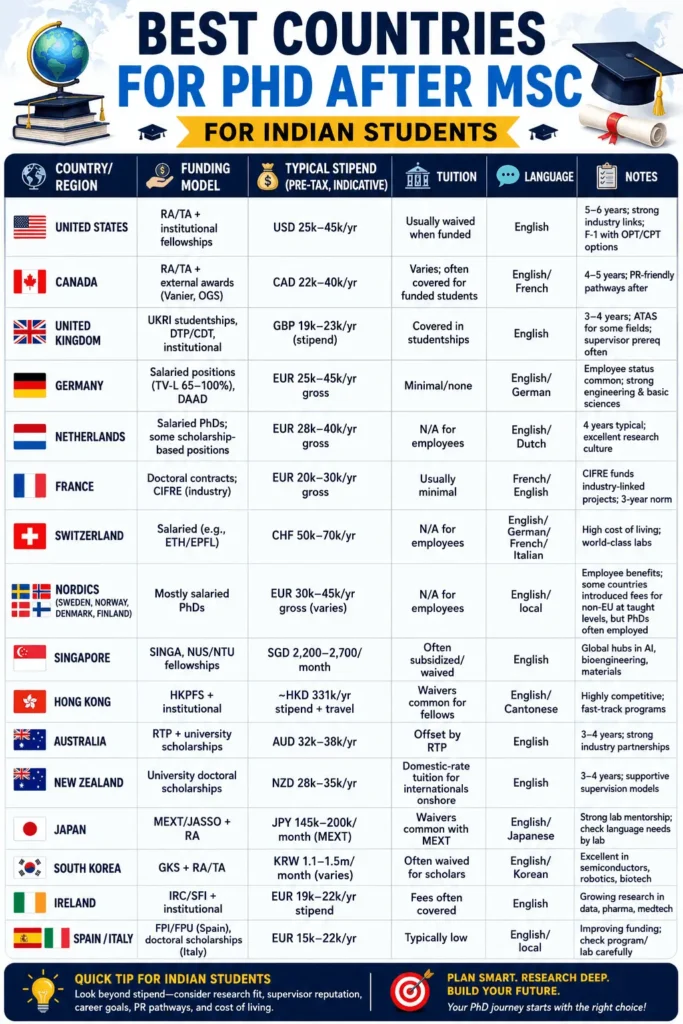
Best Countries for PhD After MSc for Indian Students: Snapshot Comparison
| Country/Region | Funding Model | Typical Stipend (Pre-Tax, Indicative) | Tuition | Language | Notes |
|---|---|---|---|---|---|
| United States | RA/TA + institutional fellowships | USD 25k–45k/yr | Usually waived when funded | English | 5–6 years; strong industry links; F-1 with OPT/CPT options |
| Canada | RA/TA + external awards (Vanier, OGS) | CAD 22k–40k/yr | Varies; often covered for funded students | English/French | 4–5 years; PR-friendly pathways after |
| United Kingdom | UKRI studentships, DTP/CDT, institutional | GBP 19k–23k/yr (stipend) | Covered in studentships | English | 3–4 years; ATAS for some fields; supervisor prereq often |
| Germany | Salaried positions (TV-L 65–100%), DAAD | EUR 25k–45k/yr gross | Minimal/none | English/German | Employee status common; strong engineering & basic sciences |
| Netherlands | Salaried PhDs; some scholarship-based positions | EUR 28k–40k/yr gross | N/A for employees | English/Dutch | 4 years typical; excellent research culture |
| France | Doctoral contracts; CIFRE (industry) | EUR 20k–30k/yr gross | Usually minimal | French/English | CIFRE funds industry-linked projects; 3-year norm |
| Switzerland | Salaried (e.g., ETH/EPFL) | CHF 50k–70k/yr | N/A for employees | English/German/French/Italian | High cost of living; world-class labs |
| Nordics (Sweden, Norway, Denmark, Finland) | Mostly salaried PhDs | EUR 30k–45k/yr gross (varies) | N/A for employees | English/local | Employee benefits; some countries introduced fees for non-EU at taught levels, but PhDs often employed |
| Singapore | SINGA, NUS/NTU fellowships | SGD 2,200–2,700/month | Often subsidized/waived | English | Global hubs in AI, bioengineering, materials |
| Hong Kong | HKPFS + institutional | ~HKD 331k/yr stipend + travel | Waivers common for fellows | English/Cantonese | Highly competitive; fast-track programs |
| Australia | RTP + university scholarships | AUD 32k–38k/yr | Offset by RTP | English | 3–4 years; strong industry partnerships |
| New Zealand | University doctoral scholarships | NZD 28k–35k/yr | Domestic-rate tuition for internationals onshore | English | 3–4 years; supportive supervision models |
| Japan | MEXT/JASSO + RA | JPY 145k–200k/month (MEXT) | Waivers common with MEXT | English/Japanese | Strong lab mentorship; check language needs by lab |
| South Korea | GKS + RA/TA | KRW 1.1–1.5m/month (varies) | Often waived for scholars | English/Korean | Excellent in semiconductors, robotics, biotech |
| Ireland | IRC/SFI + institutional | EUR 19k–22k/yr stipend | Fees often covered | English | Growing research in data, pharma, medtech |
| Spain/Italy | FPI/FPU (Spain), doctoral scholarships (Italy) | EUR 15k–22k/yr | Typically low | English/local | Improving funding; check program/lab carefully |
Step-by-Step Guide: How to Secure a Funded PhD After MSc
Step 1: Define your research aim and “why PhD now”
Clarify your motivation and niche. Shortlist 2–3 subtopics where you can credibly contribute within 3–4 years based on your MSc thesis, skills, datasets, and methods.
- Deliverables: 1-page research sketch, list of 10–15 target keywords, 5–10 core methods you can execute.
- Outcome: A focused profile that aligns with funded labs and supervisors.
Step 2: Choose countries strategically
Use the snapshot table to match your preferences:
- Prefer structured coursework? Consider the US/Canada.
- Prefer research-intensive, 3–4 year models? UK/Ireland/EU.
- Prefer salaried positions with employee benefits? Germany, Netherlands, Switzerland, Nordics.
- Prefer competitive, high-visibility fellowships? Singapore (SINGA), Hong Kong (HKPFS).
Step 3: Build a target list of supervisors and labs
- Search top journals/conferences (e.g., Nature/Science/Cell; NeurIPS/ICML; IEEE/ACM; discipline-specific) for authors in your niche.
- Check lab websites for current grants and open PhD calls.
- Read 2–3 recent publications to identify shared interests.
Maintain a spreadsheet with fields: Professor, University, Country, Funding type, Application deadline, Publications referenced, Your angle, Status.
Step 4: Align with funding models
- US/Canada: Departmental funding via RA/TA; external awards (Vanier in Canada). Many US programs fully fund international students; national fellowships like NSF GRFP are typically limited to US citizens/permanent residents.
- UK/Ireland: UKRI studentships, doctoral training partnerships (DTP/CDT). Increasing but limited international slots; universities may cover fee differences for top candidates.
- Germany/Netherlands/France/Switzerland/Nordics: Apply to advertised salaried PhD vacancies; often treated as employees with social insurance.
- Singapore/Hong Kong: Apply directly to SINGA or HKPFS alongside university admission.
- Australia/New Zealand: University scholarships (RTP in Australia; domestic-rate tuition in NZ for international PhDs onshore).
Step 5: Prepare tests and credentials
- IELTS/TOEFL: Book 9–12 months early; check department cutoffs. Some programs waive English tests if your degree medium was English—verify policy.
- GRE/GMAT: Often optional in many countries since 2020; still required in some US programs. Check each department.
- Field-specific prerequisites: ATAS (UK) for sensitive STEM fields, language certificates (e.g., German B1/B2 rarely mandatory for English-track PhDs but beneficial).
Step 6: Strengthen your research profile
- Convert your MSc thesis into a manuscript or preprint (e.g., arXiv, OSF), emphasizing methodology and reproducibility.
- Showcase code/data on GitHub/Zenodo with clean documentation.
- Submit abstracts to relevant conferences or poster sessions.
Step 7: Contact potential supervisors (the right way)
Write a concise, tailored email demonstrating fit, referencing two recent papers from their lab, and proposing a concrete idea. See template below.
Step 8: Draft a high-impact SOP and research proposal
Use lab-specific evidence: publications you build upon, datasets you will use, facilities required. Keep it realistic with clear milestones and risk mitigation.
Step 9: Request strong letters of recommendation
- Ask supervisors who observed you in research settings and can speak to methods, independence, and integrity.
- Provide them with your CV, SOP draft, thesis abstract, and bullet points of achievements.
Step 10: Apply early and completely
- Track department and graduate school deadlines separately.
- Upload degree transcripts, grading scale explanations, rank letters (if available), and English-medium certificates where relevant.
Step 11: Prepare for interviews
- Know the lab’s pipeline and last 2–3 grant abstracts.
- Prepare 1–2 whiteboard-ready problems from your area (methods, derivations, experimental design).
- Formulate questions about mentorship, resources, authorship, and career outcomes.
Step 12: Secure visa and arrival logistics
- Use official immigration portals (linked below), arrange financial proof, health insurance, and accommodation.
- Keep degree legalization/apostille and police clearance if required by employer-style PhDs.
Country-Specific Guidance
United States
- Model: Coursework + qualifying exams + research; 5–6 years typical.
- Funding: RA/TA packages usually cover tuition + stipend + health insurance; check department guarantees for international students.
- Exams: GRE optional in many programs; TOEFL/IELTS required unless waived.
- Visa: F-1 with I-20; SEVIS fee; interview at US Embassy/Consulate; OPT for post-completion work.
Best for applicants seeking strong industry connections (AI, biotech, energy), large lab ecosystems, and flexibility to pivot research after year 1–2.
Canada
- Model: 4–5 years with coursework + candidacy exam + thesis.
- Funding: RA/TA + scholarships; Vanier Canada Graduate Scholarships are highly competitive but open to internationals through Canadian universities.
- Visa: Study permit via IRCC; co-op/work authorization embedded for RA/TA; PR pathways post-PhD exist.
United Kingdom & Ireland
- Model: 3–4 years; emphasis on early research proposal and supervisor match.
- Funding: UKRI DTP/CDT studentships, institutional scholarships, and industry co-funded projects.
- Visa: UK Student route; ATAS for certain STEM; Ireland has separate immigration pathways for researchers.
Germany, Netherlands, France, Switzerland, Nordics
- Model: Many PhDs are employees with salaries, pension contributions, and social benefits.
- Funding: Advertised positions on university sites and national portals (e.g., EURAXESS); DAAD in Germany; Swiss Government Excellence Scholarships in Switzerland; national doctoral contracts in France.
- Visa: Residence permits for research/employment; blocked account generally not required when you have an employment contract.
Singapore and Hong Kong
- Model: Competitive fellowships with global visibility.
- Funding: SINGA (Singapore) and HKPFS (Hong Kong) provide stipends, fee waivers, and travel/conference allowances.
- Visa: Streamlined student passes/residence permits for researchers.
Australia and New Zealand
- Model: 3–4 year research degrees.
- Funding: Australia’s Research Training Program (RTP) and university scholarships; New Zealand often charges domestic tuition rates to international PhD students studying in-country, plus university scholarships.
- Visa: Student visa with evidence of funds/insurance; post-study work options vary by country and program.
Japan and South Korea
- Model: Lab-centric mentorship; coursework varies by university.
- Funding: MEXT (Japan) and GKS (Korea) plus departmental RAs; English-track programs growing, but lab language expectations vary.
- Visa: Student/research visas processed through university sponsorships.
Application Timeline (12–18 Months)
- Months 1–2: Topic focusing, country selection, test planning, initial supervisor mapping.
- Months 3–5: Email outreach to supervisors; receive feedback; shortlist programs; start SOP and proposal drafts.
- Months 6–8: Take IELTS/TOEFL; GRE if needed; finalize writing samples; get transcripts and ranking letters.
- Months 9–11: Submit applications; monitor references; attend interviews; update proposal if invited.
- Months 12–14: Decide offers; request formal funding letters; prepare visa documents.
- Months 15–18: Visa application, housing, insurance, travel booking; pre-arrival reading and code/data preparation.
Examples and Templates
Cold Email to Potential Supervisor (Template)
Subject: Prospective PhD Applicant (MSc, [Your Field]) – Research Fit with Your Work on [Specific Topic]
Dear Prof. [Surname],
I am an MSc graduate in [Discipline] from [University], where my thesis on “[Title]” achieved [Result/Distinction]. I read your recent papers on [Paper 1, Year] and [Paper 2, Year], and I am particularly interested in extending your method [X] to [Y application] using [method/dataset].
In my thesis, I implemented [brief method] and achieved [key result]. I am attaching a 1-page sketch proposing [2–3 concrete aims], with a 12–18 month plan and risk mitigation. My skills include [methods, software, instruments], and my code/data portfolio is here: [Git/GitHub/Portfolio link].
Could I request a short call to discuss openings and alignment with your current grants? I am targeting [intake/term] and can support applications for [studentship/scholarship name if relevant].
Thank you for your time and consideration.
Kind regards,
[Your Name]
[MSc, University]
[Phone/WhatsApp] | [Email] | [LinkedIn/Website]
SOP (Statement of Purpose) Outline
- Opening: 2–3 lines on your long-term research vision and practical impact.
- Background: MSc thesis summary; core methods; any publications/preprints; key skills.
- Research Fit: Why this department/lab; cite 2–3 recent group papers; facilities that matter.
- Proposed Direction: 2–3 aims; expected contributions; feasibility and novelty.
- Preparation: Evidence you can deliver (datasets, preliminary code, collaborations).
- Career Goals: Academia, industry R&D, policy—connect to lab strengths.
- Closing: Availability, intake, and enthusiasm grounded in evidence.
Research Proposal Outline (2–6 pages)
- Title and Abstract (150–250 words)
- Background and Gap (with 6–12 references)
- Objectives/Aims (3–5 specific aims)
- Methodology (datasets, instruments, models, experiments, protocols)
- Work Plan and Timeline (Gantt-style narrative: months/years)
- Expected Outcomes (papers, prototypes, datasets, software)
- Risk and Mitigation (plan B/C for each aim)
- Ethics and Data Management (if applicable)
- References (consistent citation style)
Academic CV Sections (Example)
- Education (with thesis title, advisor, GPA/percentage, class rank if available)
- Research Experience (projects, roles, outcomes, links to code/data)
- Publications/Preprints (with DOIs/links); Posters/Talks
- Technical Skills (methods, instruments, software; list proficiency)
- Awards and Scholarships
- Teaching/Leadership/Service
- Professional Experience (if relevant to research)
Interview Questions You Should Prepare For
- Explain your thesis to a non-expert in 90 seconds.
- What is the main limitation of your proposed method and how will you address it?
- Which paper from our group do you want to extend, and what’s your experimental plan?
- Describe a failure in your research and what you learned.
- What does authorship mean to you? How do you handle data/code reproducibility?
Cover Letter Template (for advertised PhD positions)
Dear [Hiring Committee/Prof. Surname],
I am applying for the advertised PhD position “[Title/Ref]” at [University/Institute]. My MSc in [Discipline] from [University] focused on [topic], where I developed [methods] resulting in [outcome]. Your project’s goals on [project summary] align directly with my experience in [skills], as shown in [link to code/data/paper].
I am confident I can contribute to [specific work package], especially [subtasks]. I value open science and collaborative team culture, and I’m eager to join [lab/group] to deliver high-impact, reproducible research.
Enclosed: CV, transcripts, research proposal, and references.
Sincerely,
[Your Name]
Funding and Scholarships to Know
- Canada: Vanier Canada Graduate Scholarships, provincial scholarships (e.g., Ontario Graduate Scholarship), university fellowships.
- UK: UKRI Studentships and DTP/CDT, university studentships, Commonwealth PhD Scholarships.
- Germany: DAAD, Research in Germany, advertised TV-L salaried posts.
- France: Campus France, Doctoral contracts, CIFRE Industrial PhDs.
- Switzerland: Swiss Government Excellence Scholarships, ETH/EPFL doctoral positions.
- EU (general): EURAXESS Jobs, Marie Skłodowska-Curie Actions (MSCA) doctoral networks.
- Singapore: SINGA Scholarship; universities: NUS, NTU.
- Hong Kong: Hong Kong PhD Fellowship Scheme (HKPFS).
- Australia: Research Training Program (RTP) and university scholarships.
- New Zealand: University doctoral scholarships (e.g., University of Auckland Doctoral Scholarships), domestic-fee policy for international PhDs in NZ.
- Japan: MEXT, JASSO.
- South Korea: Global Korea Scholarship (GKS), university RA/TA.
- Ireland: Irish Research Council (IRC), Science Foundation Ireland (SFI).
Visas and Compliance (Official Resources)
- United States: SEVIS I-901, Study in the States
- United Kingdom: UK Student visa, ATAS
- Canada: IRCC Study in Canada
- Germany: German National Visa (D), Make it in Germany
- Netherlands: IND (Immigration and Naturalisation Service)
- France: France-Visas
- Switzerland: State Secretariat for Migration (SEM)
- Sweden: Swedish Migration Agency
- Norway: Norwegian Directorate of Immigration (UDI)
- Denmark: SIRI
- Finland: Migri
- Singapore: ICA Student’s Pass
- Hong Kong: Immigration Department
- Australia: Student visa (subclass 500)
- New Zealand: Immigration New Zealand
- Japan: MOFA Visa
- South Korea: HiKorea
- Ireland: Irish Immigration Service
Expert Tips
- Apply where your methods are in short supply. For instance, if you do robust causal inference or clean microfabrication, target labs that cite but don’t implement these techniques yet.
- Ask about funding stability. Request clarity on source (grant vs. departmental), duration, and what happens if a grant lapses.
- Check authorship norms in the lab. Look for consistent student-first authorship where appropriate and fair contribution statements.
- Validate cost of living. Cross-check stipend after tax against city rent using official tax calculators and university cost-of-living pages.
- Use seminar Q&A for visibility. Attend virtual talks and ask a well-prepared question; mention this in your email later.
- Negotiate start date. Many labs prefer staggered starts; negotiate for an arrival that lets you wrap up publications or visa steps.
- Back up data and code with version control. Provide a link in your application; reviewers value reproducibility.
- For UK/EU, pre-contact supervisors with a 1-page concept note. Many programs expect a named supervisor before application.
Common Mistakes to Avoid
- Choosing a country by brand alone: Overlooking the research fit or funding model leads to poor outcomes and burnout.
- Mass emailing professors: Generic emails are ignored. Tailored, evidence-based messages get replies.
- Ignoring department-specific rules: Requirements (GRE, ATAS, proposal length) vary widely within the same country.
- Underestimating timelines: References and official test score reporting can take weeks.
- Overly broad proposals: Ambition without feasibility signals risk; reviewers prefer focused, staged plans.
- Not budgeting realistically: Stipends vary; taxes and health insurance matter.
- Skipping pre-application chats: A 15-minute call can clarify lab expectations and funding before you invest time.
- Misrepresenting publications: Committee checks authenticity; use preprints or thesis links if under review.
- Ignoring visa details: Incomplete financial or document proof causes delays or refusals.
- Not reading student handbooks: Coursework loads, TA duties, and milestone policies may affect your timeline and workload.
Useful Official and University Resources
- US Networks: EducationUSA; example funding pages: MIT Graduate Education, UC Berkeley Graduate Funding.
- UK/IE: UKCISA for international students; FindAPhD (aggregator); Irish Research Council.
- EU: EURAXESS jobs and relocation; institutional doctoral schools on each university website.
- Germany: DAAD; Research in Germany.
- France: Campus France.
- Switzerland: ETH/EPFL doctoral portals: ETH Zurich Doctorate, EPFL PhD.
- Singapore: SINGA; NUS/NTU graduate schools.
- Hong Kong: HKPFS.
- Australia/NZ: RTP; NauMai NZ/Study in NZ (information for international students).
- Japan/Korea: MEXT; Study in Korea.
Internal Links for Research Writing and Publication Support
Strengthen your profile with high-quality academic writing, peer review best practices, and publication ethics:
- IR Research Publication: Editorial and Proofreading Services
- Guides on structuring research articles and theses
- Peer review and editorial standards explained
- Calls for papers and special issues
Frequently Asked Questions
1) Can I do a PhD after MSc for Indian students without publications?
Yes. Publications help, but strong theses, preprints, robust methods, and clear proposals can secure offers—especially if you align with lab priorities and provide code/data evidence.
2) Which country is easiest to get a fully funded PhD?
No single “easiest” country. Many Indian students succeed in Germany/Netherlands/Nordics (salaried positions), UK/Ireland (studentships), Canada (RA/TA + scholarships), and the US (department funding). Focus on research fit and funding model over perceived ease.
3) Is GRE required?
Often optional post-2020. Some US departments still require GRE; many waive it. UK/EU/Canada/Australia/NZ typically do not require GRE for PhDs. Always check departmental pages.
4) What are typical stipends and living costs?
Indicative annual stipends: US USD 25k–45k; UK GBP 19k–23k; Canada CAD 22k–40k; Germany EUR 25k–45k gross; Switzerland CHF 50k–70k; Australia AUD 32k–38k; Singapore SGD 26k–32k; Hong Kong ~HKD 331k. Net take-home and rent vary by city—budget carefully.
5) Can I get in without IELTS/TOEFL?
Possible if the program provides a waiver for English-medium degrees, but policies vary by department and country. Some visas require English proof. Verify with the program and immigration authority.
6) How long is a PhD after MSc?
US/Canada: 4–6 years. UK/Ireland/EU: 3–4 years. Australia/NZ: 3–4 years. Singapore/HK: 3–4 years. Duration depends on field, publications, and lab resources.
7) Do I need to contact supervisors before applying?
Recommended in UK/EU/Ireland and for advertised PhD posts. In the US/Canada, contacting can still help, but formal matching may occur after admission. Always follow department guidance.
8) Can spouses/partners accompany me?
Often yes, with dependent visas (e.g., US F-2, Canada spouse open work permit in many cases, UK dependants subject to policy changes). Check official immigration pages for current rules.
9) Is there an age limit for PhD?
Generally no formal age limit. Funding rules may specify early-stage researcher definitions, but most programs welcome qualified applicants with strong research fit.
10) Can I work part-time during a PhD?
Varies by visa and institution. RA/TA roles are typical in US/Canada. Many countries cap outside work hours. Always check visa and university policies.
Conclusion: Your Roadmap to the Best Countries for PhD After MSc for Indian Students
Securing a funded PhD after MSc for Indian students is absolutely achievable with a research-first approach. Start 12–18 months early, shortlist countries by funding model and visa pathway, and target supervisors with grant-backed projects in your niche. Craft a focused SOP and feasible proposal, demonstrate reproducible skills with code/data, and verify language, test, and visa requirements for each department.
Next steps:
- Create a 1-page research sketch and target list of 20 labs across 3–4 countries.
- Draft tailored emails, SOP, proposal, and request strong references.
- Apply to a mix of salaried PhD jobs and studentships, and track official visa timelines.
With evidence-based preparation and smart targeting, you can turn your MSc foundation into a world-class doctoral experience.
About IR Research Publication
IR Research Publication is dedicated to advancing scholarly communication by helping researchers disseminate rigorous, high-impact work. We promote ethical publishing, sound peer review, and accessible author guidance so students and early-career scholars can convert strong ideas into citable contributions. Explore resources, calls for papers, and research writing insights at IR Research Publication.
Related Articles
- Fully Funded PhD Scholarships in Germany 2027 | Apply Now
- QS World University Rankings 2027 Released: MIT’s Historic Streak, Asia’s Rise, and the Global Top 20
- Fully Funded Postdoc Positions in Switzerland for Indian Researchers: 2026 Opportunities and Application Guide
- Fully Funded PhD Programs in Switzerland for Indian Students: 2026 Guide