
Introduction
Students often compare Australia vs New Zealand for PhD study because both countries are English-speaking, research-driven, highly ranked, and offer strong post-study work and immigration pathways. Yet the two options differ in cost structures, funding mechanisms, research scale, and labor markets.
This guide is for international master’s graduates, early-career researchers, and industry professionals targeting a research doctorate. It’s especially useful if you’re deciding where to apply, how much funding you’ll need, and which visa and employment pathways fit your long-term goals.
Key factors to weigh include tuition and stipend funding, cost of living, supervisor and lab fit, national research strengths, visa rules, post-study work, and realistic career prospects. You’ll learn how each system works, the trade-offs, and how to improve your chances of securing scholarships and jobs.
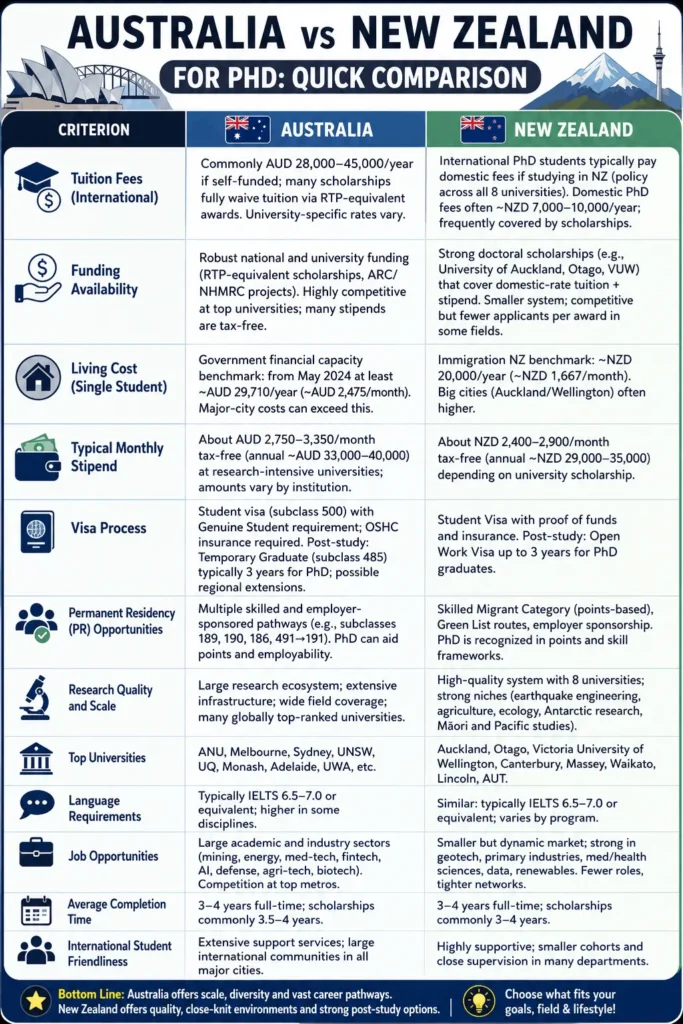
Australia vs New Zealand for PhD: Quick Comparison
| Criterion | Australia | New Zealand |
|---|---|---|
| Tuition Fees (International) | Commonly AUD 28,000–45,000/year if self-funded; many scholarships fully waive tuition via RTP-equivalent awards. University-specific rates vary. | International PhD students typically pay domestic fees if studying in NZ (policy across all 8 universities). Domestic PhD fees often ~NZD 7,000–10,000/year; frequently covered by scholarships. |
| Funding Availability | Robust national and university funding (RTP-equivalent scholarships, ARC/NHMRC projects). Highly competitive at top universities; many stipends are tax-free. | Strong doctoral scholarships (e.g., University of Auckland, Otago, VUW) that cover domestic-rate tuition + stipend. Smaller system; competitive but fewer applicants per award in some fields. |
| Living Cost (Single Student) | Government financial capacity benchmark: from May 2024 at least ~AUD 29,710/year (~AUD 2,475/month). Major-city costs can exceed this. | Immigration NZ benchmark: ~NZD 20,000/year (~NZD 1,667/month). Big cities (Auckland/Wellington) often higher. |
| Typical Monthly Stipend | About AUD 2,750–3,350/month tax-free (annual ~AUD 33,000–40,000) at research-intensive universities; amounts vary by institution. | About NZD 2,400–2,900/month tax-free (annual ~NZD 29,000–35,000) depending on university scholarship. |
| Visa Process | Student visa (subclass 500) with Genuine Student requirement; OSHC insurance required. Post-study: Temporary Graduate (subclass 485) typically 3 years for PhD; possible regional extensions. | Student Visa with proof of funds and insurance. Post-study: Open Work Visa up to 3 years for PhD graduates. |
| Permanent Residency (PR) Opportunities | Multiple skilled and employer-sponsored pathways (e.g., subclasses 189, 190, 186, 491→191). PhD can aid points and employability. | Skilled Migrant Category (points-based), Green List routes, employer sponsorship. PhD is recognized in points and skill frameworks. |
| Research Quality and Scale | Large research ecosystem; extensive infrastructure; wide field coverage; many globally top-ranked universities. | High-quality system with 8 universities; strong niches (earthquake engineering, agriculture, ecology, Antarctic research, Māori and Pacific studies). |
| Top Universities | ANU, Melbourne, Sydney, UNSW, UQ, Monash, Adelaide, UWA, etc. | Auckland, Otago, Victoria University of Wellington, Canterbury, Massey, Waikato, Lincoln, AUT. |
| Language Requirements | Typically IELTS 6.5–7.0 or equivalent; higher in some disciplines. | Similar: typically IELTS 6.5–7.0 or equivalent; varies by program. |
| Job Opportunities | Large academic and industry sectors (mining, energy, med-tech, fintech, AI, defense, agri-tech, biotech). Competition at top metros. | Smaller but dynamic market; strong in geotech, primary industries, med/health sciences, data, renewables. Fewer roles, tighter networks. |
| Average Completion Time | 3–4 years full-time; scholarships commonly 3.5–4 years. | 3–4 years full-time; scholarships commonly 3–4 years. |
| International Student Friendliness | Extensive support services; large international communities in all major cities. | Highly supportive; smaller cohorts and close supervision in many departments. |
Funding Opportunities
Both countries offer competitive funding, but mechanisms and typical award sizes differ.
Australia
Most international PhD candidates target university-administered, government-backed Research Training Program (RTP)-equivalent scholarships. These usually include a tuition fee offset and a living stipend that is generally tax-free. Typical stipends at research-intensive universities range around AUD 33,000–40,000 per year depending on the institution and project.
- Examples: University of Sydney Research Training Program/University Scholarship lists a stipend in the ~AUD 40,000/year range; University of Melbourne and ANU also offer competitive stipends around ~AUD 36,000–37,000+ per year. Amounts are indexed and vary by year and institution.
- Project funding often comes via national councils such as the Australian Research Council (ARC) and National Health and Medical Research Council (NHMRC).
Official resources:
- Australian Government – Research Training Program
- Australian Research Council (ARC)
- National Health and Medical Research Council (NHMRC)
- University of Sydney – PhD scholarships
- University of Melbourne – Scholarships
- Australian National University – Scholarships
New Zealand
New Zealand’s standout feature is that international PhD candidates typically pay domestic-rate tuition if they live in New Zealand and their research is primarily conducted there. Most doctoral scholarships cover the domestic tuition fee plus a stipend. Typical annual stipends fall roughly in the NZD 29,000–35,000 range.
- Examples: University of Auckland Doctoral Scholarship (tuition at domestic rate + stipend ~NZD 30,000); University of Otago Doctoral Scholarship (tuition + stipend, often above NZD 30,000); Victoria University of Wellington Doctoral Scholarship (tuition + stipend around the high-20s to low-30s thousands).
Official resources:
- Universities New Zealand
- University of Auckland – Scholarships
- University of Otago – Scholarships
- Victoria University of Wellington – Scholarships
Advantages and Disadvantages
- Australia – Advantages: Larger pool of funded supervisors and major grants; higher top-end stipends at some universities; broad field coverage.
- Australia – Disadvantages: Tuition can be high if unfunded; scholarship competition is intense at Group of Eight (Go8) universities.
- New Zealand – Advantages: Domestic-rate tuition for international PhDs; many doctoral scholarships waive tuition entirely; closer supervisory contact in smaller departments.
- New Zealand – Disadvantages: Fewer total positions and projects; niche fields may have limited capacity.
Which is better? If you need a guaranteed tuition waiver and prefer a smaller, close-knit research environment, New Zealand is attractive. If you want access to a large research ecosystem, multiple large grants, and potentially higher stipends at top institutions, Australia often wins—provided you secure funding.
Research Opportunities
Australia
Australia’s research landscape is large and internationally connected. You’ll find world-class labs across STEM, medicine, social sciences, and humanities. Strategic strengths include medical and health sciences, data science/AI, energy and minerals, climate and marine science, agriculture and biosecurity, and defense/aerospace. Beyond ARC and NHMRC, collaborative structures like Cooperative Research Centres (CRCs) align academia with industry.
New Zealand
New Zealand punches above its weight in specific niches: earthquake engineering and geoscience, agriculture and food science, ecology and conservation biology, Antarctic and Southern Ocean research, renewable energy, and indigenous (Māori and Pacific) studies. The system’s size fosters close collaboration and mentorship, which many doctoral candidates value.
Major Funding Agencies
- Australia: ARC, NHMRC, state-based medical research institutes, CSIRO, and CRC partnerships.
- New Zealand: Marsden Fund (Royal Society Te Apārangi), Health Research Council of New Zealand (HRC), and MBIE research programs.
Which is better? For breadth and scale, Australia. For targeted strengths (e.g., seismic engineering, ecology) and a tight mentorship model, New Zealand is compelling.
Cost of Living
Australia
The Australian Government’s student visa financial capacity requirement increased in 2024 to at least AUD 29,710 per year for living costs. Actual spending in Sydney, Melbourne, or Brisbane can exceed this depending on rent and lifestyle.
- Indicative monthly costs (major cities): AUD 2,200–3,000 for shared housing, transport, food, utilities, and incidentals. Single-student studios or central locations cost more.
- Health insurance: Overseas Student Health Cover (OSHC) is mandatory for student visa holders.
Official resources:
- Australia Student Visa (subclass 500) – Department of Home Affairs
- Living cost and financial capacity – Department of Home Affairs
New Zealand
Immigration New Zealand’s living cost benchmark for tertiary students is generally NZD 20,000 per year. Auckland and Wellington are pricier than smaller cities like Christchurch or Dunedin.
- Indicative monthly costs (Auckland/Wellington): NZD 1,800–2,600 for shared housing, transport, food, utilities, and incidentals.
- Insurance: Most universities require approved medical and travel insurance for international students.
Official resources:
Which is better? On baseline requirements, New Zealand often looks cheaper. However, stipends also differ by currency and level. Always build a city-specific budget and compare net stipend after likely rent.
Visa Process and Post-Study Work
Australia
- Student visa (subclass 500): Requires Genuine Student (GS) criterion, English proficiency, financial capacity, and OSHC. See official guidance.
- Post-study work: PhD graduates are typically eligible for the Temporary Graduate visa (subclass 485, Post-Study Work stream) of about 3 years; additional regional extensions of 1–2 years may apply if you studied and lived in eligible regional areas. See official 485 information.
New Zealand
- Student Visa: Requires an offer of place, sufficient funds (generally NZD 20,000/year), and approved insurance. See Immigration NZ.
- Post-study work: PhD graduates can usually obtain a Post-study Work Visa for up to 3 years with open work rights. See official post-study work information.
Which is better? For PhD holders, both offer around 3 years of post-study work. Australia’s regional incentives may extend stay length; New Zealand’s open work visa simplifies employer changes.
Permanent Residency Opportunities
Australia
PhD graduates pursue skilled or employer-sponsored pathways. Common routes include Skilled Independent (subclass 189), Skilled Nominated (190), Employer Nomination Scheme (186), and regional pathways (491 leading to 191). A completed Australian qualification can help with points and employability, but eligibility depends on occupation lists, skills assessments, English, and current policy settings.
Official resources:
New Zealand
Key routes include the Skilled Migrant Category Resident Visa (points-based) and Green List pathways for designated occupations, along with employer-assisted residence from an Accredited Employer Work Visa (AEWV). A PhD is favorably recognized under qualification frameworks, but eligibility still hinges on occupation, earnings thresholds, and points.
Official resources:
Which is better? It depends on your occupation and where you find employment. Both systems favor in-demand skills and higher-earning roles.
Career Opportunities After Graduation
Academic Careers
- Australia: Larger university sector and research institutes mean more total openings for postdocs and teaching/research fellows, especially in major metros. Competition remains strong and often requires publications, grant activity, and teaching experience. Typical academic salary bands vary by institution and level, with superannuation benefits common.
- New Zealand: Fewer positions but a tight-knit community can accelerate visibility. Strong niches (e.g., geosciences, ecology) may offer targeted roles. Competitive publication and grant records are essential.
Industry Careers
- Australia: Substantial demand in mining/resources, med-tech and pharmaceuticals, biotech, agri-tech, fintech, AI/data science, cybersecurity, and defense/aerospace. Large private R&D labs and government agencies (e.g., CSIRO) broaden options.
- New Zealand: Growing opportunities in agri-food, environmental tech, data and digital, renewable energy, and niche deep-tech startups. Networks matter; internships and industry-linked projects help.
Visa Pathways and Salaries
Post-study work periods (~3 years) in both countries give time to build a local track record. Employer sponsorship can be pivotal. Salary levels are generally higher in Australia in absolute terms, but costs are also higher in major cities. Always assess real take-home relative to rent and transport in your specific city.
Which is better? For sheer breadth of roles and corporate R&D, Australia. For targeted niches aligned with NZ’s strengths and a balanced lifestyle, New Zealand.
Best Universities
Australia
- Australian National University (ANU)
- University of Melbourne
- University of Sydney
- University of New South Wales (UNSW Sydney)
- University of Queensland (UQ)
- Monash University
- University of Adelaide
- University of Western Australia (UWA)
Rankings vary by discipline, but multiple Australian universities appear high in global rankings (QS, THE). Always check department-level performance, supervisor fit, and lab resources.
New Zealand
- University of Auckland
- University of Otago
- Victoria University of Wellington
- University of Canterbury
- Massey University
- University of Waikato
- Lincoln University
- Auckland University of Technology (AUT)
New Zealand’s eight public universities are all research-active and internationally ranked; strengths often cluster by field.
Official ranking resources:
Application Process
Similarities
- Identify potential supervisors and align your proposal with lab and departmental priorities.
- Prepare a strong research proposal, CV, academic transcripts, publications (if any), and references.
- Demonstrate English proficiency (IELTS/TOEFL), unless exempted by prior qualifications in English.
Australia
- Many programs require supervisor agreement prior to offer; scholarship rounds are typically 1–2 times per year (some rolling intakes exist).
- For scholarships, competitive metrics include publications, research experience, awards, and fit with funded projects.
- Check university pages for RTP-equivalent scholarship deadlines and documentary requirements.
New Zealand
- Supervisor match is critical; most universities operate centralized doctoral scholarship rounds.
- Because international PhDs pay domestic fees, universities carefully match candidates to available supervision and research capacity.
- Funding often includes tuition waiver + stipend; timing and rounds vary by university.
Actionable tip: Email supervisors first with a concise, evidence-based pitch (one page + CV). Tailor to ongoing grants and published work. Ask about available funding and start dates.
Language Requirements
Most universities in both countries set a baseline of IELTS 6.5–7.0 overall (with minimum band scores) or equivalent TOEFL iBT/PTE scores. Some disciplines (e.g., law, education, health) may require higher bands. Exemptions can apply for prior study in English; check institutional policy pages.
Pros and Cons
Pros of Australia
- Large, diversified research ecosystem with substantial national funding.
- Higher top-end stipends at leading universities in some fields.
- Broader industry R&D and more total academic openings.
- Multiple PR pathways and regional incentives.
Pros of New Zealand
- International PhDs pay domestic-rate tuition; many scholarships fully cover tuition.
- Supportive, smaller cohorts and close supervisor engagement.
- Strong niche strengths (earthquake engineering, ecology, agri-food, Antarctic research).
- Open 3-year post-study work visa for PhD graduates.
Cons of Australia
- High tuition if unfunded; competitive scholarships at top institutions.
- Higher living costs in major metros.
- Visa and migration settings change periodically; must monitor occupation lists.
Cons of New Zealand
- Smaller job market; fewer total academic and industry roles.
- Niche capacity can limit options if your field is not a national strength.
- Fewer large-scale facilities compared with Australia.
Which Option is Best for You?
- Students with limited budgets: New Zealand often wins due to domestic-rate tuition for international PhDs and scholarships that cover fees plus stipend.
- Biomedical researchers: Australia’s scale, hospitals, medical institutes, and NHMRC-backed labs can offer more options; NZ still offers quality training with HRC-backed projects.
- Engineering students: For mining, energy, defense/aerospace, and large infrastructure, Australia; for earthquake engineering and geotech, New Zealand is globally respected.
- Long-term immigration goals: Both work; choose the market where your occupation is in demand. Australia offers multiple skilled and employer-sponsored routes; NZ has Skilled Migrant and Green List pathways.
- Industry careers: Australia’s corporate R&D and sector breadth are advantageous. NZ suits those targeting agri-tech, environmental tech, and select deep-tech niches.
- Academic careers: Australia has more total openings but higher competition. NZ offers strong mentorship and visibility in smaller systems.
Bottom line: Choose the ecosystem that best fits your field’s strengths and your funding chances. For many budget-conscious candidates, New Zealand’s domestic-rate PhD is hard to beat; for scale and breadth, Australia shines.
Expert Tips
- Start with the supervisor, not the country. A well-matched mentor and funded project often outweigh small cost differences.
- Apply to multiple universities across both countries to maximize scholarship odds. Tailor your proposal to active grants.
- Budget in local currency. Compare net stipend after rent and transport in your target city.
- Check official immigration pages every few months. Policy updates can affect post-study work and PR timing.
- Use department seminars or online talks to build rapport before applying. Ask about lab resources and project deliverables.
- Secure strong references that speak to research independence, methods, and publication potential.
- Demonstrate impact: link your proposal to national research priorities (e.g., health, climate, advanced manufacturing).
- Plan publications early with your supervisor: set milestones for first-year outputs and conference presentations.
External Resources (Official)
- Australia – Research Training Program (Department of Education)
- Australia – Student Visa (subclass 500)
- Australia – Temporary Graduate Visa (subclass 485) Post-Study Work
- Australia – Living costs and financial capacity
- Australian Research Council
- National Health and Medical Research Council
- CSIRO
- Immigration New Zealand – Visa options
- Immigration New Zealand – Post-study Work Visa
- Education New Zealand – Living Costs
- Royal Society Te Apārangi – Marsden Fund
- Health Research Council of New Zealand
- MBIE – New Zealand Ministry of Business, Innovation and Employment
- QS World University Rankings
- Times Higher Education Rankings
Internal Links
- IR Research Publication – Home
- IR Research Publication – Editorial Service
- IR Research Publication – Journal
- IR Research Publication – Career
Frequently Asked Questions
1) Is Australia or New Zealand cheaper for a PhD?
Often New Zealand, because international PhD students usually pay domestic-rate tuition and many scholarships cover fees plus a stipend. However, costs vary by city and housing. In Australia, scholarships frequently waive tuition and offer competitive stipends; without funding, Australia is usually more expensive.
2) What are typical PhD stipends in Australia vs New Zealand?
Australia: commonly around AUD 33,000–40,000/year tax-free at research-intensive universities. New Zealand: commonly around NZD 29,000–35,000/year tax-free. Exact figures depend on the institution, discipline, and year.
3) How long does a PhD take in each country?
Typically 3–4 years full-time in both Australia and New Zealand. Many scholarships fund 3.5–4 years in Australia and 3–4 years in New Zealand.
4) What are the English language requirements?
Most programs require IELTS 6.5–7.0 (or equivalent TOEFL/PTE), with minimum sub-scores. Some disciplines need higher scores. Exemptions may apply for prior English-medium study.
5) What post-study work rights do PhD graduates have?
Australia: generally 3 years via the Temporary Graduate (subclass 485) visa, with possible regional extensions. New Zealand: up to 3 years open Post-study Work Visa for PhD graduates.
6) Can a PhD help with permanent residency?
Yes, in both countries, but PR depends on occupation demand, points, earnings thresholds, English, and other requirements. Review Australia’s skilled and employer-sponsored pathways and New Zealand’s Skilled Migrant and Green List routes for current criteria.
7) Which is better for engineering research?
Australia offers broad engineering options and industry links (mining, energy, aerospace). New Zealand is world-class in earthquake engineering and geotech. Choose based on project fit and supervisor.
8) Which is better for life sciences and medicine?
Australia has a larger biomedical ecosystem with hospitals and NHMRC-backed institutes, creating more lab options. New Zealand provides strong training environments, especially aligned with HRC and niche strengths. Supervisor and facility match should drive your choice.
9) Do international PhD students in New Zealand really pay domestic fees?
Yes, provided you reside in New Zealand and your research is primarily conducted there (policy is applied across NZ’s eight universities). Always check the latest university policy for details.
10) How should I improve my scholarship chances?
Secure supervisor support early, tailor your proposal to funded projects and national priorities, highlight publications and methods expertise, and apply to multiple institutions across both countries.
Conclusion: Australia vs New Zealand for PhD
Both destinations are excellent for doctoral study. Australia offers scale, breadth of labs and grants, and broad industry R&D—ideal if you secure a strong scholarship and want diverse career options. New Zealand offers domestic-rate tuition for international PhDs, scholarships that often cover fees and living costs, and closer supervisory support—ideal for budget-conscious candidates and those targeting NZ’s research niches.
- Choose Australia if you want a large ecosystem, higher top-end stipends at leading universities, and wider industry pathways across multiple sectors.
- Choose New Zealand if you value domestic-rate tuition, strong chances of a tuition-waiver scholarship, close mentorship, and strengths in earthquake engineering, ecology, agri-food, or Antarctic research.
In short, the best choice in the Australia vs New Zealand for PhD decision depends on supervisor fit, funding security, city-level costs, and where your field has the strongest labs and employment demand.
About IR Research Publication
IR Research Publication is dedicated to helping scholars, students, and professionals advance their academic and research careers. We share practical guidance on publishing, proposal development, scholarships, and career strategy—bridging research excellence with real-world impact. Explore curated insights, templates, and resources to strengthen every stage of your research journey.
Related Articles
- Highest-Paying Postdoctoral Fellowships Worldwide (2026)
- Germany vs Netherlands for PhD in 2026: Costs, Funding, Language, Jobs
- PhD Scholarship Guide 2026: How to Find, Win, and Fund a Fully Funded PhD
- Fully Funded Postdoctoral Fellowships in Germany 2027
- USA vs Canada for PhD: Best Choice for Indian Students in 2026