
Introduction
France offers a mix of European schemes, national initiatives, and institution-run programs for postdoctoral researchers. Most provide a salary or stipend plus specified allowances (for relocation, family, or training, depending on the scheme) — but exact take-home funding depends on the call terms, applicable taxes, the host city’s cost of living, and personal circumstances, so always check the current call before assuming a figure covers your full living costs.
Who should apply? Highly motivated researchers with a completed PhD (or equivalent) by the call deadline, a strong publication record for their career stage, and a project aligned with a French host team’s strengths. Why France? The country combines leading public research bodies (CNRS, Inserm, Inria, INRAE, CEA), top-ranked universities and institutes, and competitive European frameworks built around international mobility and training.
Fully Funded PhD Scholarships in France 2027 | Apply Now
A note on accuracy: fellowship programs change their calls, deadlines, and even whether they’re running at all from year to year. Some of the programs long associated with France — including a few in earlier versions of lists like this one — do not currently have a confirmed 2027 call. We’ve flagged those clearly below. Always confirm eligibility, funding, and deadlines directly on the official page before applying.
For application strategy and proposal development, see resources on IR Research Publication, including guides on proposal writing and funding strategies: IR Research Publication, MSCA Postdoctoral Fellowships Guide, and Research Funding in France.
UK vs Ireland for PhD: Costs, Funding, Visas & Careers
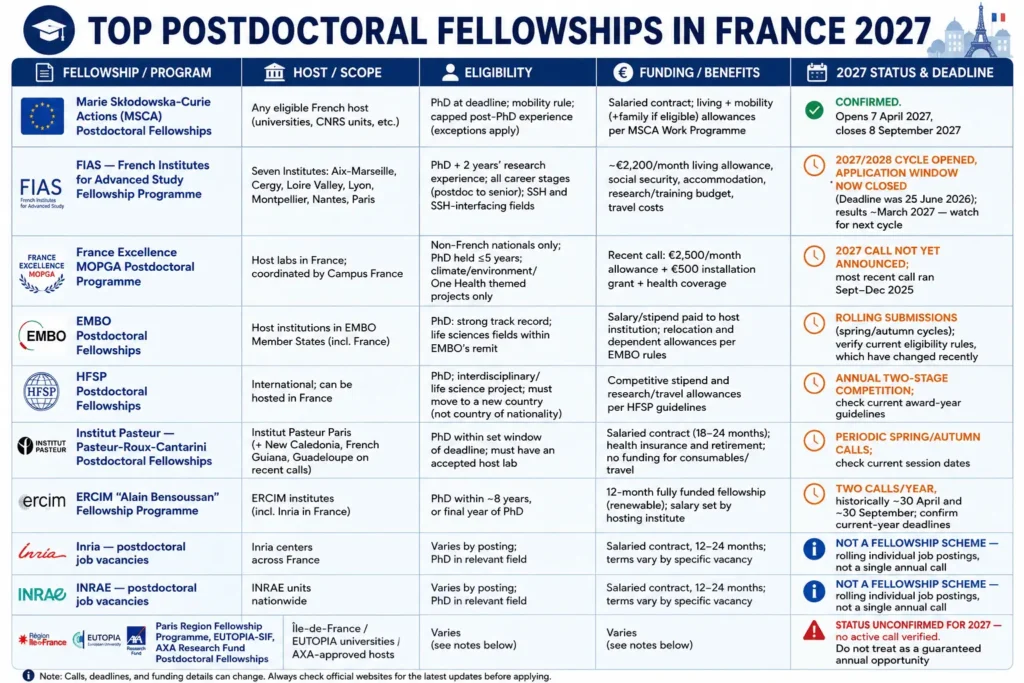
Top Postdoctoral Fellowships in France 2027: Summary
| Fellowship / Program | Host / Scope | Eligibility | Funding / Benefits | 2027 Status & Deadline | Official Link |
|---|---|---|---|---|---|
| Marie Skłodowska-Curie Actions (MSCA) Postdoctoral Fellowships | Any eligible French host (universities, CNRS units, etc.) | PhD at deadline; mobility rule; capped post-PhD experience (exceptions apply) | Salaried contract; living + mobility (+family if eligible) allowances per MSCA Work Programme | Confirmed. Opens 7 April 2027, closes 8 September 2027 | Horizon Europe France |
| FIAS — French Institutes for Advanced Study Fellowship Programme | Seven Institutes: Aix-Marseille, Cergy, Loire Valley, Lyon, Montpellier, Nantes, Paris | PhD + 2 years’ research experience; all career stages (postdoc to senior); SSH and SSH-interfacing fields | ~€2,200/month living allowance, social security, accommodation, research/training budget, travel costs | 2027/2028 cycle opened, application window now closed (deadline was 25 June 2026); results ~March 2027 — watch for next cycle | fias-fp.eu |
| France Excellence MOPGA Postdoctoral Programme | Host labs in France; coordinated by Campus France | Non-French nationals only; PhD held ≤5 years; climate/environment/One Health themed projects only | Recent call: €2,500/month allowance + €500 installation grant + health coverage | 2027 call not yet announced; most recent call ran Sept–Dec 2025 | Campus France / Institut Français |
| EMBO Postdoctoral Fellowships | Host institutions in EMBO Member States (incl. France) | PhD; strong track record; life sciences fields within EMBO’s remit | Salary/stipend paid to host institution; relocation and dependent allowances per EMBO rules | Rolling submissions (spring/autumn cycles); verify current eligibility rules, which have changed recently | EMBO |
| HFSP Postdoctoral Fellowships | International; can be hosted in France | PhD; interdisciplinary/life science project; must move to a new country (not country of nationality) | Competitive stipend and research/travel allowances per HFSP guidelines | Annual two-stage competition; check current award-year guidelines | HFSP |
| Institut Pasteur — Pasteur-Roux-Cantarini Postdoctoral Fellowships | Institut Pasteur Paris (+ New Caledonia, French Guiana, Guadeloupe on recent calls) | PhD within set window of deadline; must have an accepted host lab | Salaried contract (18–24 months); health insurance and retirement; no funding for consumables/travel | Periodic spring/autumn calls; check current session dates | research.pasteur.fr |
| ERCIM “Alain Bensoussan” Fellowship Programme | ERCIM institutes (incl. Inria in France) | PhD within ~8 years, or final year of PhD | 12-month fully funded fellowship (renewable); salary set by hosting institute | Two calls/year, historically ~30 April and ~30 September; confirm current-year deadlines | fellowship.ercim.eu |
| Inria — postdoctoral job vacancies | Inria centers across France | Varies by posting; PhD in relevant field | Salaried contract, 12–24 months; terms vary by specific vacancy | Not a fellowship scheme — rolling individual job postings, not a single annual call | Inria job offers |
| INRAE — postdoctoral job vacancies | INRAE units nationwide | Varies by posting; PhD in relevant field | Salaried contract, 12–24 months; terms vary by specific vacancy | Not a fellowship scheme — rolling individual job postings, not a single annual call | INRAE Jobs |
| Paris Region Fellowship Programme, EUTOPIA-SIF, AXA Research Fund Postdoctoral Fellowships | Île-de-France / EUTOPIA universities / AXA-approved hosts | Varies (see notes below) | Varies (see notes below) | Status unconfirmed for 2027 — no active call verified. Do not treat as a guaranteed annual opportunity | See “Programs With Unconfirmed or Outdated Status” below |
Institut Curie’s EuReCa programme has been removed from this table: it was a PhD-level (not postdoctoral) MSCA COFUND scheme, and its final call has already closed.
How to Find Fully Funded PhD Positions in Europe (2026)
Confirmed and Active Programs for 2027
Marie Skłodowska-Curie Actions (MSCA) Postdoctoral Fellowships
Status: Confirmed for 2027. This is the clearest confirmed 2027 opportunity on this list. The call opens on 7 April 2027 and closes on 8 September 2027.
Overview: MSCA Postdoctoral Fellowships are the EU’s flagship scheme for training and international mobility of postdoctoral researchers. Candidates propose a research project with a host institution in an EU Member State or Associated Country — France is an eligible and popular host destination across all disciplines.
Funding and benefits: A fully salaried employment contract with a living allowance, mobility allowance, and, where applicable, a family allowance, set by the MSCA Work Programme and adjusted by a country correction coefficient for France.
Eligibility: Applicants must hold a PhD by the call deadline. There’s typically a cap on years of post-PhD research experience (with allowable deductions for circumstances like parental leave), and a mobility rule requiring that candidates have not resided or carried out their main activity in France for more than 12 months in the 36 months before the deadline. Final eligibility rules are set by the official 2027 call text.
Application process: Develop a joint proposal with a French host team and submit via the EU Funding & Tenders portal.
Official link: MSCA Postdoctoral Fellowships 2027 — Horizon Europe France
FIAS — French Institutes for Advanced Study Fellowship Programme
Status: 2027/2028 cycle already opened (application window has since closed — watch for the next round).
Overview: FIAS offers 10-month fellowships across seven French Institutes for Advanced Study: Aix-Marseille, Cergy, Loire Valley (Orléans-Tours), Lyon, Montpellier, Nantes, and Paris. For the 2027/2028 academic year, FIAS made 29 positions available across these seven sites. The programme is open to all disciplines in the Social Sciences and Humanities (SSH) and to other research fields that meaningfully interface with the SSH.
Funding and benefits: A living allowance (recent cycle: €2,200/month), social security coverage, accommodation, a research and training budget, and travel expense coverage — common standards agreed across all seven institutes.
Eligibility: FIAS welcomes researchers at all career stages, from postdoctoral to senior, with a minimum of a PhD plus 2 years of research experience at the time of application. Applicants from any country are eligible, provided they have spent no more than 12 months in France during the three years before the application deadline.
Application process: The 2027/2028 call had a deadline of 25 June 2026, with results expected around March 2027. If you’re reading this after that window, check the official site for the next call cycle rather than assuming this round is still open.
Official link: FIAS Fellowship Programme
Programs to Verify Against the Current Official Call
The following are well-established, reputable programs that have supported postdocs in France in past years. Their general structure is unlikely to disappear, but their 2027 terms, funding amounts, and deadlines are not yet confirmed (or, in MOPGA’s case, apply to a specific applicant profile). Treat the details below as indicative of how each programme has typically run, and check the official page before you build an application timeline around them.
France Excellence MOPGA Postdoctoral Programme
Important: MOPGA is not a general postdoctoral fellowship open to all applicants. It is specifically for non-French, early-career researchers who have held a PhD for five years or less, proposing a project in one of MOPGA’s designated themes (Earth system sciences, climate change and sustainability, energy transition, environment-related societal challenges, or One Health). If your project or career stage doesn’t fit that profile, this program isn’t for you.
Funding and benefits (based on the most recent call): A monthly allowance of €2,500, a one-time €500 installation grant, and health coverage. These figures apply to the most recent completed call and should be reconfirmed for any future round.
Timeline: Coordinated by Campus France on behalf of the French Ministry for Europe and Foreign Affairs. The most recent call ran from September to December 2025; a 2027 call has not yet been announced, so treat past timing as indicative only.
Official link: MOPGA Visiting Fellowship Programme — Campus France / Institut Français
EMBO Postdoctoral Fellowships
Overview: EMBO supports postdoctoral researchers in the life sciences working in EMBO Member States and cooperating countries, France included.
Australia vs New Zealand for PhD: Costs, Visas, Jobs
Funding and benefits: A salary or stipend paid to the host institution to cover the awardee’s employment costs, plus relocation support and additional allowances for fellows with children where applicable. Fellowships run up to two years.
Eligibility: A doctorate (or equivalent) in a life sciences field, generally within a set number of years of the PhD, and a strong publication record for career stage. Confirm the current eligibility window and any recent rule changes (EMBO has adjusted re-application and host-lab rules for recent selection rounds) on the official page.
Application process: Rolling submissions that feed into two evaluation cycles per year (spring and autumn).
Official link: EMBO Postdoctoral Fellowships
HFSP Postdoctoral Fellowships
Overview: The Human Frontier Science Program funds frontier, interdisciplinary research in the life sciences, generally requiring a move to a new country and often a new field. France is a regular host destination.
Funding and benefits: A competitive stipend plus research and travel allowances, with exact terms set for each award year.
Eligibility: A PhD and an internationally mobile, interdisciplinary project; applicants cannot hold the fellowship in their country of nationality.
Application process: A two-stage competition — a letter of intent followed by a full proposal for those shortlisted.
Official link: HFSP Postdoctoral Fellowships
Institut Pasteur — Pasteur-Roux-Cantarini Postdoctoral Fellowships
Overview: Competitive fellowships for postdocs joining Institut Pasteur laboratories — historically the Paris campus, with recent calls extended to Institut Pasteur New Caledonia, French Guiana, and Guadeloupe.
Funding and benefits: A salaried contract (typically 18–24 months) covering health insurance and retirement contributions. No funding is provided for consumables, equipment, or travel costs.
Eligibility: A completed PhD (or a scheduled defense) within a set number of years before the deadline, and acceptance by a host laboratory — the program does not consider unsolicited applications.
Application process: Calls have historically run in spring and/or autumn sessions; check the current cycle’s dates before applying.
Official link: Institut Pasteur — Research Calls
ERCIM “Alain Bensoussan” Fellowship Programme
Overview: Postdoctoral fellowships in computer science and applied mathematics, hosted across ERCIM member institutes — including Inria in France.
Funding and benefits: A 12-month, salaried fellowship (renewable, with fellows able to apply for a second year at a different institute), with the salary set by the hosting institute.
Eligibility: A PhD obtained within roughly the last 8 years before the deadline, or being in the final year of doctoral work.
Application process: Two calls per year, historically with deadlines around 30 April and 30 September.
Official link: ERCIM Alain Bensoussan Fellowship Programme
Programs With Unconfirmed or Outdated Status — Don’t Rely on These Without a Current Call
A few programs that circulate in older “postdoc in France” round-ups are no longer accurate to include as active, recurring 2027 opportunities:
- Institut Curie — EuReCa Programme: This has been removed from this guide. EuReCa was a PhD-level (not postdoctoral) MSCA COFUND programme, and its final call has already closed.
- Paris Region Fellowship Programme (ParisRegionFP): Past cycles ran through the MSCA COFUND framework into 2025–2026. No new call has been confirmed for 2027. Check the program’s official page directly before assuming it’s currently open — do not treat it as an active annual fellowship.
- EUTOPIA-SIF Postdoctoral Fellowships: Also an MSCA COFUND scheme, hosted in France through CY Cergy Paris University. No confirmed 2027 call as of this writing; verify current status on the EUTOPIA alliance site before including it in your application plan.
- AXA Research Fund Post-Doctoral Fellowships: This program depends on host-institution nomination rather than a standard open annual call, and recent activity has been inconsistent. Don’t treat it as a guaranteed yearly opportunity — check the AXA Research Fund site for any current call before pursuing it.
Salaried Postdoctoral Job Vacancies (Not Named Fellowship Schemes)
Inria and INRAE are sometimes listed alongside named fellowship programs, but they’re better understood as major French research institutes that regularly post individually funded, project-specific postdoctoral job vacancies — not standing fellowship schemes with a single unified call, deadline, or funding structure. If you want to work with either institute, the right approach is to monitor their job boards and, ideally, contact a specific research team directly.
- Inria (computer science, mathematics, AI, robotics) posts postdoctoral vacancies on a rolling basis, typically salaried 12–24 month contracts tied to a specific team and project. Browse current postdoc listings: Inria job offers
- INRAE (agriculture, food, environment, biodiversity, data sciences) similarly posts individual postdoctoral vacancies tied to specific units and projects, generally 12–24 months. Browse current listings: INRAE Jobs
Because these are individual job postings rather than a fellowship “round,” funding amounts, contract lengths, and eligibility vary by posting — there’s no single figure to quote here.
Germany vs Netherlands for PhD in 2026: Costs, Funding, Language, Jobs
How to Choose and Apply Strategically
- Match your project to the host’s expertise and infrastructure; contact potential supervisors early to co-develop a compelling proposal.
- Check mobility rules carefully — this is especially critical for MSCA and any COFUND-style scheme.
- Confirm you actually meet each program’s specific applicant profile (MOPGA’s climate/environment and non-French-national requirements are a good example of criteria that are easy to overlook).
- Don’t assume a stipend or salary figure covers all your living costs in a given host city — verify net amounts, tax treatment, and any allowances in the current official call.
- Start early on letters, host-lab acceptance, and ethics approvals; small administrative delays can derail competitive calls.
For detailed proposal tips, see How to Write a Competitive Research Proposal.
Frequently Asked Questions
Are the postdoctoral fellowships in France 2027 already open? Only some are. The MSCA Postdoctoral Fellowship 2027 call has confirmed dates (opening 7 April 2027, closing 8 September 2027), and FIAS opened its 2027/2028 cycle earlier in 2026. Other programs listed here have not yet announced 2027 terms — always check the official page for the current status before planning around a specific date.
Do these fellowships cover full salary and living costs? Most provide a salaried contract or stipend intended for full-time research in France, along with specified allowances (for example, relocation or family support, depending on the program). Whether that fully covers your living costs depends on the call’s exact terms, applicable taxes, your host city, and your personal circumstances — confirm net, take-home figures with each program rather than assuming the headline amount is what you’ll receive.
Can non-EU citizens apply? Generally yes. MSCA, FIAS, EMBO, HFSP, and the institutional fellowships listed here are open to international candidates, though a few (like MOPGA) exclude French nationals specifically because the program targets inbound international researchers.
What is the typical duration? It varies by program — MOPGA and ERCIM fellowships run around 12 months, FIAS runs 10 months, Pasteur-Roux-Cantarini runs 18–24 months, and MSCA and HFSP fellowships can run up to 2–3 years. Always confirm the duration in the specific call.
How competitive are these fellowships? Highly competitive. Strong publications, an original and feasible project, a strong host team, and a clear training plan matter across the board. Consider applying to more than one program or cycle.
What about language requirements in France? English is commonly used in research labs, especially in STEM and life sciences. Basic French can help with daily life and integration but generally isn’t required for the research itself.
Conclusion
If you plan ahead and confirm details directly against each program’s current official call, there are several credible pathways to postdoctoral funding in France for 2027 — starting with the confirmed MSCA 2027 call and the newly opened FIAS cycle, alongside established programs like MOPGA (for eligible non-French, early-career climate and environment researchers), EMBO, HFSP, Institut Pasteur, and ERCIM. Treat older program names you may have seen elsewhere — including Institut Curie’s EuReCa, ParisRegionFP, EUTOPIA-SIF, and AXA’s postdoctoral fellowships — with caution unless you can find a live, current call, and consider Inria and INRAE as job-board destinations rather than named fellowship schemes.
About IR Research Publication
IR Research Publication is an independent platform dedicated to advancing researchers’ careers through practical funding intelligence, proposal-writing resources, and curated opportunities. Explore our latest funding guides and how-to articles at irrespub.com.
Related Articles
- Germany vs Netherlands for PhD in 2026: Costs, Funding, Language, Jobs
- PhD Scholarship Guide 2026: How to Find, Win, and Fund a Fully Funded PhD
- Fully Funded Postdoctoral Fellowships in Germany 2027
- Fully Funded PhD Scholarships in Germany 2027 | Apply Now
- Fully Funded Postdoctoral Fellowships in New Zealand 2026