

Introduction: Why The Lancet Matters in Global Healthcare
In the vast world of medical publishing, only a few journals can truly claim to have shaped the course of modern medicine. Among them, The Lancet stands as one of the most respected and impactful. Founded in 1823 by English surgeon Thomas Wakley, The Lancet has grown into a global platform that consistently publishes groundbreaking studies, clinical trial results, and policy-shaping reports.
Over the decades, The Lancet has not only informed clinicians and researchers but has also influenced governments, global health organizations, and even the general public. When a study appears in The Lancet, it often sparks international discussion and sometimes even changes the way healthcare is delivered. From cardiovascular medicine to infectious diseases, from maternal health to climate change, the journal has continuously been at the forefront of medical progress.
In this article, we will explore the top breakthrough studies published in The Lancet that changed healthcare forever. These milestones highlight the journal’s unique ability to bridge research and real-world policy, making it one of the most powerful voices in global health.
The Lancet and Its Legacy in Medical Research
To understand the importance of these landmark studies, it’s worth reflecting on the legacy of The Lancet. Unlike many academic journals that focus narrowly on a single specialty, The Lancet covers a broad spectrum of medicine and global health. This makes it a central hub for cross-disciplinary knowledge, enabling breakthroughs in one area to influence others.
The journal’s peer-review process is stringent, and its high impact factor consistently places it among the top-ranked medical publications worldwide. With major offices in London, New York, Amsterdam, and Beijing, and partnerships with researchers across the globe, The Lancet has positioned itself as a truly international voice in medicine.
Importantly, The Lancet has always aimed to go beyond academic audiences. Its studies are often picked up by policymakers, health ministries, and organizations such as the World Health Organization (WHO). As a result, its research has the power to influence not only hospitals and clinics but also national and international strategies.
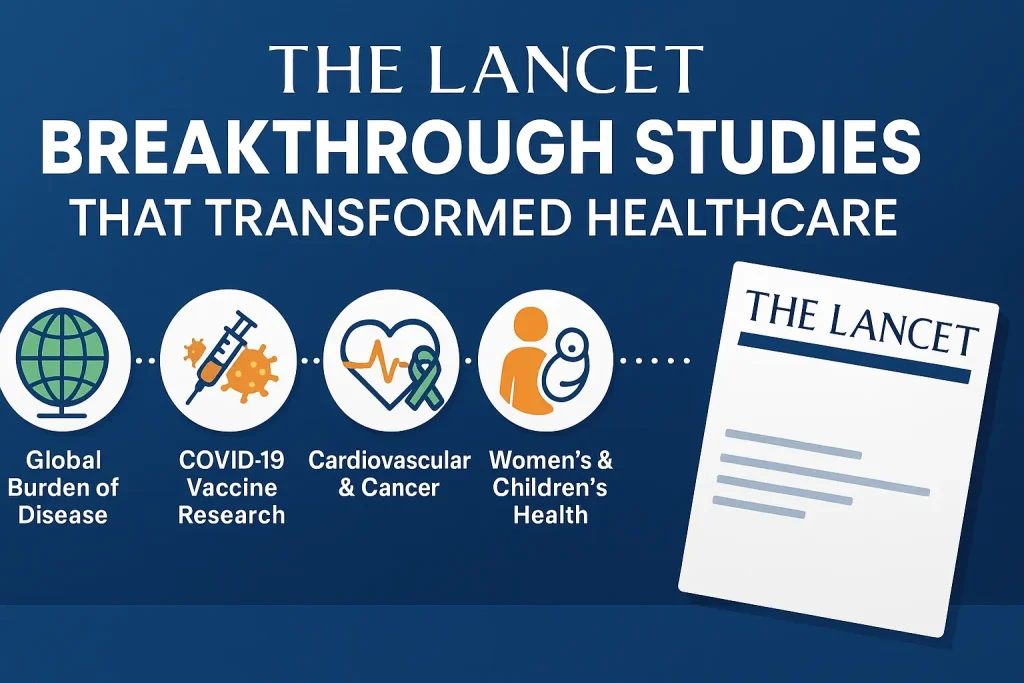
Breakthrough Study 1: Global Burden of Disease Reports
One of the most influential contributions from The Lancet has been the Global Burden of Disease (GBD) studies. First published in 1990, and regularly updated since, the GBD reports represent the most comprehensive effort to measure the world’s health challenges.
The GBD evaluates diseases, injuries, and risk factors across countries and over time. Instead of focusing only on mortality, it introduced the concept of Disability-Adjusted Life Years (DALYs)—a measure that accounts for both premature death and years lived with disability. This metric fundamentally changed the way health systems prioritize conditions.
For example, earlier global health strategies often emphasized infectious diseases. But the GBD highlighted the growing burden of non-communicable diseases (NCDs) like diabetes, cardiovascular disorders, and mental health conditions. This shifted attention and resources toward chronic diseases, leading to policy changes worldwide.
The Lancet’s GBD reports remain a cornerstone for governments, NGOs, and institutions like the Bill & Melinda Gates Foundation in setting funding priorities. Without this groundbreaking series, global health would likely still underestimate the enormous impact of chronic illness.
Breakthrough Study 2: The Lancet’s Role in COVID-19 Research
The COVID-19 pandemic demonstrated the vital role medical journals play in times of crisis, and The Lancet was at the center of the global response.
In February 2020, The Lancet published some of the earliest peer-reviewed studies on the novel coronavirus from Wuhan, China such as “A novel coronavirus outbreak of global health concern” and “Clinical features of patients infected with 2019 novel coronavirus in Wuhan, China“. These papers provided critical data on transmission, symptoms, and case fatality rates at a time when misinformation was rampant. As the pandemic progressed, The Lancet became a go-to source for reliable, evidence-based insights.
It also published pivotal studies on COVID-19 vaccines, including trials of the Oxford–AstraZeneca vaccine, which later became one of the most widely used vaccines worldwide. These publications shaped not only scientific understanding but also public health decision-making at national and international levels.
Of course, The Lancet was also at the center of controversy during COVID-19. A major study on hydroxychloroquine and COVID-19, published in 2020, was later retracted after questions arose about data integrity. While this sparked debate, it also highlighted the importance of transparency and accountability in medical publishing.
Despite controversies, The Lancet’s COVID-19 studies remain some of the most cited and influential works of the pandemic, guiding healthcare providers, policymakers, and vaccine developers alike.
Breakthrough Study 3: Landmark Cardiovascular and Cancer Trials
Another area where The Lancet has left an indelible mark is in cardiovascular medicine and cancer research.
In cardiology, The Lancet has published numerous landmark clinical trials that have shaped the treatment of hypertension, coronary artery disease, and heart failure. For example, major studies on the benefits of statins in lowering cholesterol and reducing cardiovascular risk have fundamentally altered prescribing practices around the world. Research on aspirin use in secondary prevention of heart attacks and strokes also found its way into global treatment guidelines thanks to The Lancet.
In oncology, The Lancet has featured pivotal trials in chemotherapy, targeted therapy, and immunotherapy. By disseminating results from large, multicenter clinical trials, the journal has accelerated the adoption of life-saving treatments. These studies often represent the cutting edge of medical science, offering hope for patients facing some of the most difficult diseases.
Breakthrough Study 4: Women’s and Children’s Health Initiatives
Few areas of research have been as influenced by The Lancet as women’s and children’s health.
The journal has published groundbreaking studies on maternal mortality, child malnutrition, and reproductive health. Its 2006 series on maternal, newborn, and child survival is often credited with influencing the United Nations Millennium Development Goals (MDGs). This research emphasized cost-effective interventions such as skilled birth attendance, breastfeeding promotion, and basic vaccination programs.
Later series on child nutrition brought global attention to the issue of stunting and the long-term impact of early malnutrition on physical and cognitive development. These findings shaped not only health policies but also educational and social development strategies.
By prioritizing these topics, The Lancet ensured that women’s and children’s health remained central to global health agendas.
Breakthrough Study 5: Climate Change and Health Reports
In recent years, The Lancet has emerged as a powerful voice linking climate change and human health.
The Lancet Countdown on Health and Climate Change, published annually, tracks how environmental changes—rising temperatures, air pollution, extreme weather events—affect human well-being. These reports argue that climate change is not only an environmental crisis but also a public health emergency.
The Countdown series has provided evidence that climate change exacerbates heat-related illness, worsens air quality, spreads infectious diseases, and threatens food security. By framing climate change in terms of health, The Lancet has successfully expanded the urgency of the debate, influencing policymakers to view it not only as an ecological issue but also as a human survival issue.
The Lancet’s Role in Shaping Public Policy
Beyond individual studies, The Lancet is unique in how often its findings translate directly into policy. Governments and international bodies frequently cite The Lancet when shaping health laws, vaccination programs, and funding strategies.
For instance, The Lancet’s tobacco control series provided evidence that fueled stricter anti-smoking legislation across many countries. Similarly, its nutrition and obesity studies have guided policies on sugar taxes and food labeling.
The journal’s ability to influence both the scientific community and political decision-makers underscores its exceptional role in global healthcare.
Criticism and Controversies Around The Lancet
While The Lancet has a long record of excellence, it has not been free from criticism.
The most infamous case was the 1998 study linking the MMR vaccine to autism, which was later fully retracted and widely condemned as fraudulent. This single paper caused a massive drop in vaccination rates and fueled the anti-vaccine movement—demonstrating how even a prestigious journal can make mistakes with devastating consequences.
During COVID-19, the hydroxychloroquine retraction raised questions about peer-review standards and the rush to publish during crises. Critics argue that The Lancet, like all journals, must balance speed with rigor, especially when the stakes are high.
Nevertheless, by acknowledging and correcting these errors, The Lancet demonstrates the self-correcting nature of science. Transparency in handling controversies has helped it maintain trust and authority in the long term.
Conclusion: Why The Lancet Remains the Gold Standard of Medical Research
From the Global Burden of Disease studies to COVID-19 vaccine trials, from maternal health initiatives to climate change reports, The Lancet has repeatedly demonstrated its power to influence both science and society.
Its publications not only provide cutting-edge medical insights but also drive policy decisions that affect millions of lives. While controversies remind us of the challenges of scientific publishing, they do not diminish the journal’s legacy as a cornerstone of global health.
As new challenges emerge—from antimicrobial resistance to future pandemics—The Lancet will undoubtedly continue to serve as a beacon for evidence-based medicine. For healthcare professionals, policymakers, and the general public, following The Lancet means staying at the forefront of the medical advances that shape our future.
About Publisher
IR Research Publication is publisher, editorial, and profile building service provider. It was founded with the mission to support scientists, researchers, academicians, and students in advancing their careers and contributing to global scientific knowledge. IR Research Publication is committed to delivering high-quality, reliable, and professional editorial services alongside a credible and ethical publishing platform.
If you like this article, then visit our Blog page for more such articles.


