
Every year, thousands of bright Indian researchers type “PhD scholarships in Canada for Indian students” into a search bar and drown in outdated lists. This guide is different. Every fellowship below is verified as of March 2026 — we’ve cross-checked official government portals, university pages, and the latest policy changes (including the replacement of the Vanier CGS with the new CGRS-D program).
Whether you are a biomedical engineer in Hyderabad dreaming about a University of Toronto lab or a humanities scholar in Kolkata targeting McGill, this complete breakdown of PhD scholarships in Canada for Indian students maps every realistic path to a fully funded doctoral seat.
1. Why Canada for a PhD in 2026?
Canada consistently ranks among the world’s top 5 research destinations. Its universities hold dozens of spots in QS and Times Higher Education top-200 lists, while the country’s open-door immigration policy makes post-PhD settlement remarkably straightforward for Indian nationals. A few headline reasons stand out:
- Generous public research investment: The Canadian government has committed hundreds of millions of dollars to graduate research through the CRTAS reform, increasing the annual number of doctoral scholarships by 1,200 awards.
- Post-Graduation Work Permit (PGWP): PhD graduates can work in Canada for up to three years — a direct runway to Permanent Residency.
- Supervisor-first culture: Unlike the UK, Canada typically requires you to secure a faculty supervisor before applying, meaning you build a real research relationship from day one.
- No language barrier: English is the primary instruction language at most universities, and IELTS 6.5–7.0 meets the threshold for most programs.
- Indian-friendly cities: Toronto, Vancouver, and Montréal have large, welcoming South Asian communities, making cultural adjustment far smoother.
For Indian researchers seeking to publish in high-impact journals and build global profiles, the resources at IR Research Publication can also help you position your work for international visibility while you pursue your Canadian doctorate.
2. Real Cost of a PhD in Canada for Indian Students (2026)
Understanding the cost of a PhD in Canada for Indian students is critical before exploring scholarships — you need to know exactly what you are being funded for. The good news: Canada is meaningfully cheaper than the USA or UK, and most doctoral programs come with built-in tuition waivers or competitive funding packages.
Cities like Halifax, Waterloo, Saskatoon, and Montréal offer a substantially lower cost of living than Toronto or Vancouver, making your PhD stipend in Canada 2026 stretch further. Many Indian students pursuing engineering or computer science PhDs report clearing their expenses comfortably while even saving — especially when a supervisor’s grant covers conference travel.
3. The 10 Best Fully Funded PhD Scholarships in Canada for Indian Students (2026)
Every scholarship below has been verified against its official source. Programs that have been discontinued (such as the original Vanier CGS and Banting Postdoctoral Fellowship) are accurately noted as replaced, with their successors profiled in full. Indian students — as foreign nationals — are explicitly eligible for all programs listed unless stated otherwise.
Canada Graduate Research Scholarship – Doctoral (CGRS-D)
The CGRS-D is the flagship doctoral fellowship of the Canadian government — the direct successor to the legendary Vanier CGS, which concluded its final cycle in 2024–25. Administered jointly by CIHR, NSERC, and SSHRC under the new Canada Research Training Awards Suite (CRTAS), the CGRS-D provides CAD 40,000 per year for three years to outstanding doctoral students across all disciplines. Indian students enrolled in a doctoral program at a Canadian institution are fully eligible. Up to 15% of all doctoral awards are reserved for international students. The annual value represents approximately ₹25.9 Lakhs — a transformative funding level that eliminates the need for any paid work during your PhD. Selection is based on academic excellence (50%) and relevant experience and achievements (50%), placing the CGRS-D firmly within reach of strong Indian applicants with research publications or exceptional projects.
Official Program Page →Pierre Elliott Trudeau Foundation Doctoral Scholarship
The Trudeau Foundation Doctoral Scholarship is arguably the most prestigious social-science doctoral award in Canada. It provides up to CAD 50,000/year in living and tuition support plus an additional CAD 20,000/year for research and travel — totalling up to CAD 210,000 over three years. Only 15 scholars are selected nationally each year, but international students enrolled in a Canadian doctoral program are fully eligible. Research must relate to the Foundation’s four themes: Human Rights & Dignity, Responsible Citizenship, Canada and the World, and People and Their Natural Environment. Each Scholar is paired with a Trudeau Mentor from public life, providing a rare leadership development experience beyond the academic track.
Official Program Page →Canada Impact+ Research Training Awards (CIRTA) – Doctoral
Launched under Canada’s Budget 2025, the Canada Impact+ Research Training Awards (CIRTA) is a targeted, one-time initiative designed specifically to recruit top international doctoral students to Canada — making it exclusively available to non-residents and returning Canadians. Doctoral awards are valued at CAD 40,000/year for up to three years. Research must align with one of eight national priority areas: advanced digital technologies (including AI and quantum), clean energy, biotechnology and health sciences, advanced materials and manufacturing, agriculture and food security, ocean and environmental research, defence and security, or social and cultural resilience. International students already enrolled at a Canadian institution are eligible for the CGRS-D instead. This is a rare, institutionally-nominated opportunity — Indian researchers abroad applying to Canadian PhD programs should expressly request nomination consideration from their prospective supervisor.
CRTAS Announcement →Ontario Trillium Scholarship (OTS)
The Ontario Trillium Scholarship is one of the most prestigious fully funded PhD in Canada awards specifically designed for international students. Funded 2/3 by the Province of Ontario and 1/3 by the host university, OTS provides CAD 40,000 per year for four full years — covering the entirety of most PhD programs. Indian students with outstanding academic records (typically first-class results throughout their master’s) are competitive candidates. The University of Toronto, McMaster, University of Ottawa, Waterloo, and other Ontario universities each receive annual allocations. Candidates cannot apply directly; universities nominate their strongest international PhD admits. Indian applicants should specifically ask admissions departments whether they are being considered for the OTS at the time of acceptance.
Ontario Official Page →UBC Four Year Fellowship (4YF)
UBC’s Four Year Fellowship (4YF) guarantees a minimum funding package to every doctoral student admitted to UBC — making it one of the most accessible institutional fellowships in Canada. The fellowship provides at minimum CAD 22,000 per year plus full tuition coverage for four years. In practice, many departments top up this amount through Research Assistantships and external scholarships, with total packages commonly reaching CAD 28,000–35,000/year. Indian students admitted to UBC’s PhD programs in STEM, social sciences, and professional fields are automatically considered. UBC also separately offers the President’s Academic Excellence Initiative PhD Award for additional merit-based recognition. As one of the world’s top 40 universities, UBC provides an exceptional environment for Indian researchers in AI, environmental sciences, medicine, and interdisciplinary fields.
UBC Graduate Funding →University of Toronto School of Graduate Studies Fellowship
The University of Toronto — Canada’s highest-ranked university — guarantees a minimum funding package to all admitted doctoral students through a combination of U of T Fellowships (UTF), Teaching Assistantships (TA), and Research Assistantships. The total package commonly exceeds CAD 27,000/year. Indian students in competitive programs (Engineering, Medicine, Computer Science, Economics) frequently receive top-ups through departmental funds or external scholarships such as the Ontario Graduate Scholarship (OGS). The Connaught International Scholarship for Doctoral Students is a U of T-specific top-up award for exceptional international PhD students, administered at the department level. With over 5,900 in-course scholarships available annually, U of T provides unparalleled funding diversity.
U of T Funding Overview →Ontario Graduate Scholarship (OGS)
The Ontario Graduate Scholarship (OGS) is one of the oldest merit-based PhD funding programs in Canada, running since 1975. Though technically a partial award at CAD 15,000/year, it is frequently combined with base institutional funding to create a near-fully-funded package. Crucially, international students with a valid Canadian study permit are eligible — making OGS one of the rare government scholarships directly accessible to Indian students already enrolled. OGS is distributed across Ontario universities proportional to their doctoral enrolment, and students apply through their university’s graduate office. For Indian PhD students in Toronto, Ottawa, or Waterloo, layering OGS on top of their base funding is a realistic goal in years 2–4 of the program.
OGS Official Page →McGill University – Provost’s Graduate Fellowship + PGSD
McGill University, ranked consistently among the world’s top 30, offers competitive doctoral funding through its Provost’s Graduate Fellowship and departmental packages under the Post-Graduate Student Differential (PGSD) funding model. McGill also holds one of the largest Trudeau Foundation and CGRS-D quota allocations in the country. Montréal’s significantly lower cost of living compared to Toronto or Vancouver makes McGill a financially attractive destination for Indian PhD students. The city’s bilingual character, strong research culture, and proximity to the US tech corridor (Mila, Element AI) makes it particularly appealing for computer science and AI researchers from India.
McGill Graduate Funding →University of Alberta Doctoral Recruitment Scholarship
The University of Alberta is one of Canada’s leading research universities with a guaranteed minimum funding policy for PhD students. Its Doctoral Recruitment Scholarship awards up to CAD 29,000/year to top international PhD candidates — one of the most competitive institutional awards in western Canada. Edmonton’s low cost of living (among the lowest of major Canadian cities) means a CAD 20,000–29,000 package offers excellent purchasing power. The university also participates in both CGRS-D and Canada Impact+ Research Training Awards (CIRTA), providing layered funding opportunities. For Indian students in petroleum engineering, agricultural sciences, medicine, and AI — U of A is a natural match.
U of A Graduate Scholarships →Simon Fraser University Graduate Fellowship (SFUGF)
Simon Fraser University’s SFU Graduate Fellowship (SFUGF) provides a competitive CAD 25,000/year stipend for exceptional international PhD students — covering both tuition and living expenses. SFU is particularly well-regarded in computer science, cognitive science, environmental science, and communication studies. The university’s location in Burnaby (part of Metro Vancouver) offers access to one of Canada’s most vibrant tech ecosystems while retaining a more manageable cost of living than central Vancouver. Indian applicants with strong publication records or competitive GRE/GATE scores are frequently nominated for the fellowship upon admission.
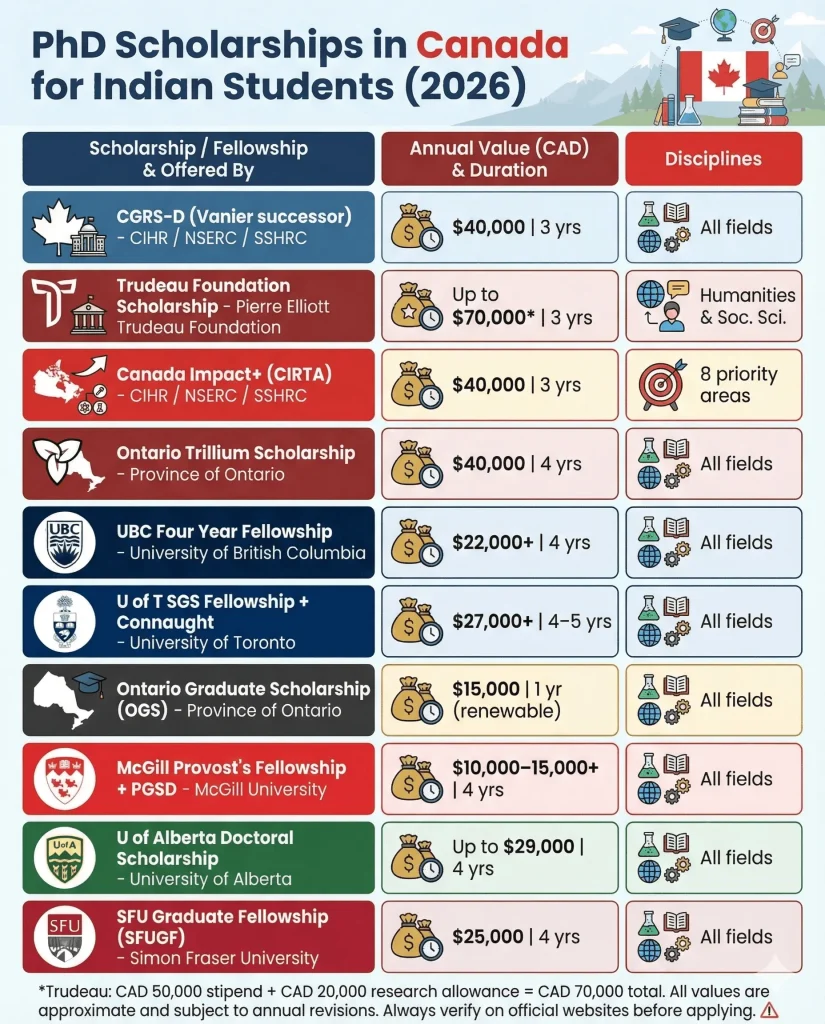
SFU Fellowship Page →4. Quick-Reference: PhD Scholarships in Canada for Indian Students (2026 Summary Table)
Use this table for a side-by-side comparison of every fully funded PhD in Canada opportunity listed above.
| # | Scholarship / Fellowship | Offered By | Annual Value (CAD) | Duration | Open to Indians? | Coverage | Disciplines |
|---|---|---|---|---|---|---|---|
| 1 | CGRS-D (Vanier successor) | CIHR / NSERC / SSHRC | $40,000 | 3 yrs | Yes (15% quota) | Tuition + Living | All fields |
| 2 | Trudeau Foundation Scholarship | Pierre Elliott Trudeau Foundation | Up to $70,000* | 3 yrs | Yes (enrolled in Canada) | Tuition + Living + Research | Humanities & Soc. Sci. |
| 3 | Canada Impact+ (CIRTA) | CIHR / NSERC / SSHRC | $40,000 | 3 yrs | Yes (Int’l only) | Tuition + Living | 8 priority areas |
| 4 | Ontario Trillium Scholarship | Province of Ontario | $40,000 | 4 yrs | Yes (Int’l only) | Tuition + Living | All fields |
| 5 | UBC Four Year Fellowship | University of British Columbia | $22,000+ | 4 yrs | Yes | Tuition + Stipend | All fields |
| 6 | U of T SGS Fellowship + Connaught | University of Toronto | $27,000+ | 4–5 yrs | Yes | Tuition + Stipend | All fields |
| 7 | Ontario Graduate Scholarship (OGS) | Province of Ontario | $15,000 | 1 yr (renewable) | Yes (study permit) | Partial (top-up) | All fields |
| 8 | McGill Provost’s Fellowship + PGSD | McGill University | $10,000–15,000+ | 4 yrs | Yes | Tuition + Stipend | All fields |
| 9 | U of Alberta Doctoral Scholarship | University of Alberta | Up to $29,000 | 4 yrs | Yes | Tuition + Living | All fields |
| 10 | SFU Graduate Fellowship (SFUGF) | Simon Fraser University | $25,000 | 4 yrs | Yes | Tuition + Living | All fields |
*Trudeau: CAD 50,000 stipend + CAD 20,000 research allowance = CAD 70,000 total. All values are approximate and subject to annual revisions. Always verify on official websites before applying.
5. Step-by-Step: How to Apply for PhD Scholarships in Canada as an Indian Student
The path to a fully funded PhD in Canada differs from most other countries. Canada operates on a supervisor-first model — your relationship with a faculty member is the foundation of your entire application. Here is the proven sequence used by successful Indian scholars:
Identify Your Research Niche and Target Supervisors (12–18 months before start)
Search faculty profiles at your target universities. Read 3–5 recent papers from each potential supervisor. Draft a targeted, research-specific email (not a generic inquiry) explaining how your work connects with theirs. Most Indian applicants skip this step and blast generic emails — don’t be them.
Secure a Supervisor’s Consent and Informal Offer
A professor’s agreement to supervise you is the most critical document in your Canadian PhD application. It unlocks not only admission but also internal scholarship nominations (OTS, 4YF, Trudeau, CGRS-D). Express that you are applying for external funding to reduce burden on their lab — supervisors appreciate this.
Prepare Your Core Application Documents
You will need: official transcripts (first-class in your master’s is the baseline), a 2–3 page Research Proposal tailored to the supervisor’s lab, a Statement of Purpose (SOP), 2–3 reference letters from research supervisors (not class teachers), and IELTS/TOEFL scores. For CGRS-D, a 2-page research and leadership narrative is required. Having publications — even one peer-reviewed paper — substantially elevates your profile. Consider IR Research Publication for editorial support on your manuscripts before submission.
Apply to the University by the Internal Deadline (Sep–Jan)
Most Canadian university doctoral application deadlines fall between November and February for a September 2026 start. Apply to 4–6 universities across provinces to maximize your scholarship portfolio options — some awards are provincial (OTS for Ontario, for example).
Notify the Graduate Office of Your Scholarship Intentions (Immediately on Admission)
For CGRS-D, OTS, CIRTA, and the Trudeau Foundation scholarship, your university must nominate you. Inform the graduate studies coordinator the moment you receive an offer that you wish to be considered for all applicable external scholarships. Each university has internal competition deadlines that precede the national deadlines.
Apply for Your Canadian Study Permit (Student Visa)
Once you receive a formal offer letter, apply for your study permit immediately through IRCC’s online portal. As of January 2026, Master’s and PhD students are exempt from the federal cap on study permits. Indian students must also submit a medical examination and a police clearance certificate. Keep proof of funds (CAD 20,635 minimum) even if fully funded.
6. Insider Tips to Win PhD Scholarships in Canada (For Indian Applicants)
Competition for PhD scholarships in Canada for Indian students is intense — but winnable with the right strategy. These tips are drawn from patterns seen in successful Indian scholarship winners at Canadian universities.
Publish Before You Apply
Even one published paper in a peer-reviewed journal transforms your CGRS-D application. Canada’s tri-agencies explicitly assess research outputs. Consider submitting a review article or short communication to open-access journals like those published by IR Research Publication to build your record.
Align With Strategic Research Areas
For CIRTA, your research must fall under one of eight national priority areas. For CGRS-D, tailor your research narrative to the agency you apply under — NSERC for engineering/sciences, SSHRC for humanities, CIHR for health. Mismatched applications are disqualified.
Leadership Counts as Much as Grades
The Trudeau Foundation and CGRS-D both assess leadership and community contribution. Document your roles in student bodies, research groups, NGOs, or community organizations. Indian students often have rich leadership experiences that go unmentioned — include them explicitly.
Choose Your Province Strategically
Ontario has the Ontario Trillium Scholarship and OGS on top of national awards. British Columbia offers the UBC 4YF. Quebec has lower tuition and strong Trudeau quotas. Alberta has low living costs. Your province choice shapes which provincial scholarships you can access.
Apply 18 Months in Advance
The supervisor outreach → application → scholarship nomination → visa pipeline is 18+ months for a September 2026 PhD. If you haven’t started, begin now. Internal scholarship deadlines at many universities fall 2–3 months before the national deadline.
Ask About the Funding Package Explicitly
When a supervisor expresses interest, ask directly: “What is the typical funding package for doctoral students in your group?” and “Would I be eligible for departmental scholarship nominations?” Supervisors in Canada expect and respect this question.
For Indian PhD students whose research involves publishing in life sciences, medical, or biological disciplines, having a strong journal publication record is indispensable. The editorial team at IR Research Publication offers manuscript preparation support, including structural editing, language polishing, and journal selection guidance — all services that can sharpen your profile before you apply.
7. Frequently Asked Questions: PhD Scholarships in Canada for Indian Students
Is the Vanier Canada Graduate Scholarship still accepting applications in 2026?
No. The Vanier CGS held its final competition cycle in 2024–25. It has been officially replaced by the Canada Graduate Research Scholarship – Doctoral (CGRS-D), worth CAD 40,000/year for three years. Indian students should apply to CGRS-D going forward. Any blog or YouTube video promoting Vanier applications for 2026 is outdated.
What is the PhD stipend in Canada 2026 for Indian students?
A typical PhD stipend in Canada in 2026 for an Indian student ranges from CAD 20,000 to CAD 35,000 per year, combining institutional fellowships, teaching assistantships, and research assistantships. If you additionally win the CGRS-D, Ontario Trillium Scholarship, or OTS, your total annual funding can reach CAD 40,000 — sufficient to cover all expenses in most Canadian cities.
Can Indian students get fully funded PhD admission in Canada without GATE or GRE?
Yes. Most Canadian PhD programs do not require GRE or GATE scores. The primary requirements are a strong master’s GPA (70–75% or above), research experience, a compelling research proposal, and IELTS 6.5–7.0. GATE scores can strengthen applications to STEM programs but are not mandatory.
How competitive is the CGRS-D for international students in 2026?
Up to 15% of all CGRS-D doctoral awards are reserved for international students, representing hundreds of additional awards compared to the old Vanier (which gave only ~166 total). This makes the CGRS-D meaningfully more accessible than the Vanier was. However, competition is still intense — a first-class master’s record, research publications, and clear leadership experience are expected.
What are the chances of Indian students getting PR after a PhD in Canada?
Very high. PhD graduates in Canada are eligible for a Post-Graduation Work Permit (PGWP) of up to three years. They can then apply for PR through Express Entry (Federal Skilled Worker), the Canadian Experience Class, or provincial nominee programs. Ontario, Alberta, and BC all have PhD-specific pathways. Many Indian PhD graduates receive PR within 2–3 years of completing their degree.
Does the Ontario Trillium Scholarship require a separate application?
Generally, no. The OTS is an institutional nomination award — Ontario universities nominate their top international PhD admits directly. Indian applicants should notify their admissions contact and express their interest in being considered when accepting an offer. Some universities have an internal expression-of-interest form.
Conclusion
The landscape of PhD scholarships in Canada for Indian students has undergone the most significant transformation in a generation with the launch of the Canada Research Training Awards Suite (CRTAS). The Vanier era is over — but the opportunity is larger than ever, with 1,200 more doctoral scholarships added annually and international students now formally included in the CGRS-D for the first time.
For ambitious Indian researchers, the path is clear: identify your supervisor, build a research profile, publish early through platforms like IR Research Publication, and start your applications 18 months ahead of your intended start date. Canada is not just accepting Indian PhD students — it is actively recruiting them.
Whether you are drawn by the Trudeau Foundation’s intellectual community, the OTS’s four-year security, or the world-class labs of UBC and University of Toronto, a fully funded PhD in Canada is a realistic and achievable goal for any Indian researcher willing to plan carefully and start early.
Writing Tip: To polish the grammar and academic tone of my blog, I use Paperpal. It’s an AI specifically trained for scientists. You can try it for free to see how it improves your writing.