
IRRESPUB BLOG
Fully Funded PhD Opportunities in New Zealand 2026
Introduction
If you’re searching for Fully Funded PhD Opportunities in New Zealand 2026, you’re looking at one of the most diverse doctoral funding ecosystems in the Asia-Pacific region. New Zealand’s universities, its national government, and several national research funding organizations all offer pathways into a funded doctorate, and this guide rounds up the most credible Fully Funded PhD Opportunities in New Zealand 2026 currently on offer, along with what you should verify before applying.
Coverage typically includes tuition fees, an annual living stipend, and — depending on the scheme — additional allowances for research costs, conference travel, and thesis expenses.
Who should apply? High-achieving graduates with strong research potential, a clear research proposal or alignment with a supervisor’s project, and excellent academic references. Many university scholarships welcome both domestic and international applicants, though government and national funder schemes often restrict eligibility by citizenship, residency, or country. Always confirm specifics on the official program pages linked throughout this article.
Why New Zealand? The country is internationally recognized for impactful research in environmental science, renewable energy, health sciences, data science, engineering, agriculture, and indigenous studies. PhD candidates benefit from supportive supervisory frameworks, well-equipped labs, access to national research institutes, and a high quality of life. Funding from universities, government, and national research funding organizations is competitive and merit-based, and many awards include professional development and research networking that set candidates up for long-term success in academia or industry.
Explore- Fully Funded Postdoctoral Fellowships in New Zealand 2026
Why Choose New Zealand for a PhD?
Beyond the funding itself, several structural features make New Zealand an attractive base for doctoral research:
- Three-year PhD norm: Most New Zealand PhDs are designed to be completed in three to four years, which is shorter than many alternative systems and reduces total cost of candidature.
- Direct-entry research model: Many programs are largely research-based from day one, with limited coursework, so progress depends heavily on supervisor fit and your own research output.
- Domestic tuition parity: At most New Zealand public universities, international PhD candidates pay the same tuition rate as domestic doctoral students, subject to university policy — which significantly narrows the cost gap compared with countries that charge international students a premium.
- Research strength in niche areas: New Zealand punches above its weight in agritech, marine and environmental science, volcanology, indigenous (Māori and Pacific) research methodologies, and renewable energy.
- Post-study pathways: Many graduates are eligible for post-study work visas, which can support a transition into local academia or industry after completing the doctorate.
Fully Funded PhD Opportunities in New Zealand 2026: Top Programs to Know
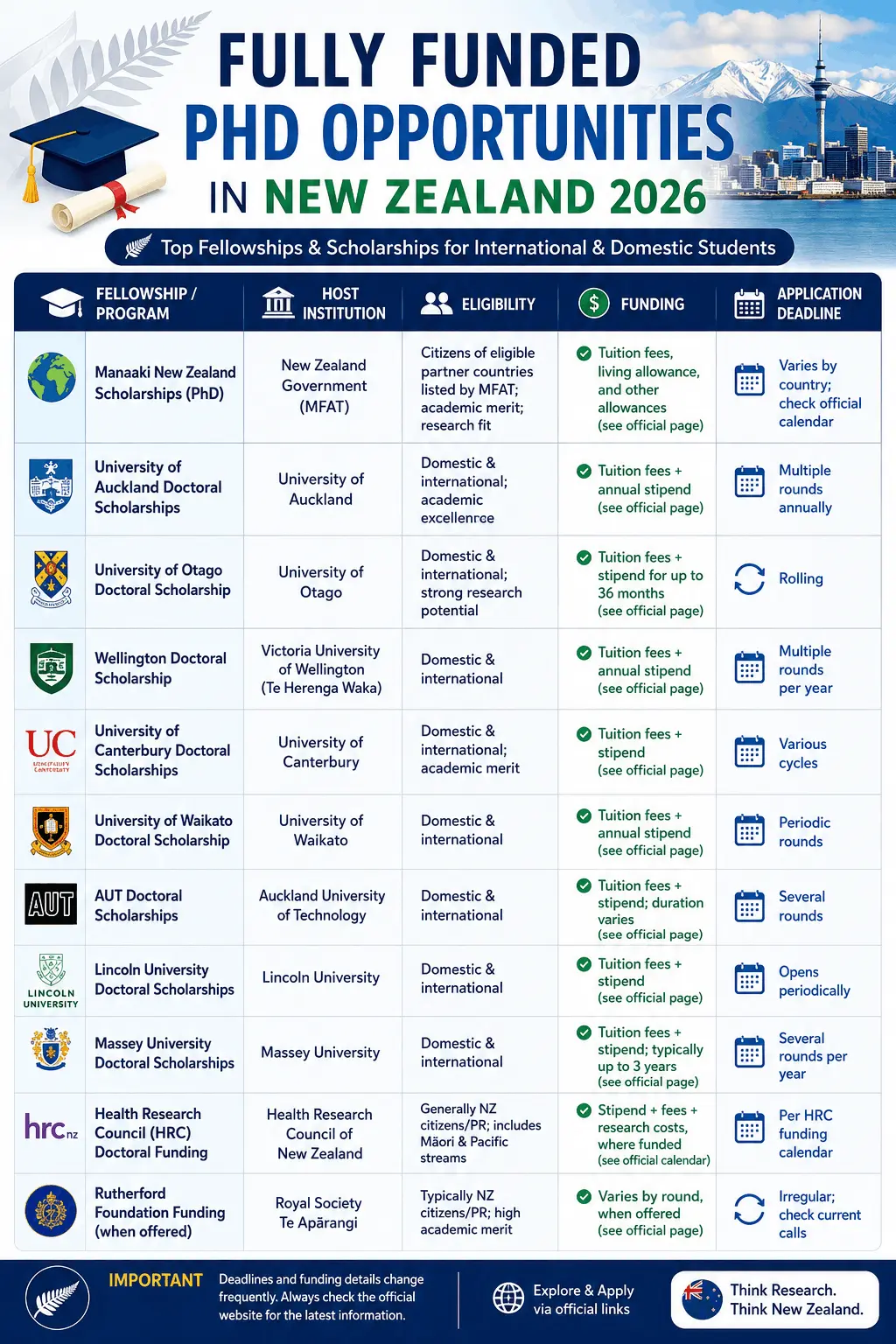
The table below summarizes the main routes into a funded doctorate. Treat the funding and deadline columns as a starting point — figures and cycles change, so confirm current details directly on each official page before applying.
Comparison Table: Fully Funded PhD Opportunities in New Zealand 2026
| Fellowship / Program | Host Institution | Eligibility | Funding | Application Deadline | Official URL |
|---|---|---|---|---|---|
| Manaaki New Zealand Scholarships (PhD) | New Zealand Government (MFAT) | Citizens of eligible partner countries listed by MFAT; academic merit; research fit | Tuition fees, living allowance, and other allowances (see official page) | Varies by country; check official calendar | https://www.nzscholarships.govt.nz |
| University of Auckland Doctoral Scholarships | University of Auckland | Domestic & international; academic excellence | Tuition fees + annual stipend (see official page) | Multiple rounds annually | https://www.auckland.ac.nz |
| University of Otago Doctoral Scholarship | University of Otago | Domestic & international; strong research potential | Tuition fees + stipend for up to 36 months (see official page) | Rolling | https://www.otago.ac.nz |
| Wellington Doctoral Scholarship | Victoria University of Wellington (Te Herenga Waka) | Domestic & international | Tuition fees + annual stipend (see official page) | Multiple rounds per year | https://www.wgtn.ac.nz |
| University of Canterbury Doctoral Scholarships | University of Canterbury | Domestic & international; academic merit | Tuition fees + stipend (see official page) | Various cycles | https://www.canterbury.ac.nz |
| University of Waikato Doctoral Scholarship | University of Waikato | Domestic & international | Tuition fees + annual stipend (see official page) | Periodic rounds | https://www.waikato.ac.nz |
| AUT Doctoral Scholarships | Auckland University of Technology | Domestic & international | Tuition fees + stipend; duration varies (see official page) | Several rounds | https://www.aut.ac.nz |
| Lincoln University Doctoral Scholarships | Lincoln University | Domestic & international | Tuition fees + stipend (see official page) | Opens periodically | https://www.lincoln.ac.nz |
| Massey University Doctoral Scholarships | Massey University | Domestic & international | Tuition fees + stipend; typically up to 3 years (see official page) | Several rounds per year | https://www.massey.ac.nz |
| Health Research Council (HRC) Doctoral Funding | Health Research Council of New Zealand | Generally NZ citizens/PR; includes Māori & Pacific streams | Stipend + fees + research costs, where funded (see official calendar) | Per HRC funding calendar | https://www.hrc.govt.nz |
| Rutherford Foundation Funding (when offered) | Royal Society Te Apārangi | Typically NZ citizens/PR; high academic merit | Varies by round, when offered (see official page) | Irregular; check current calls | https://www.royalsociety.org.nz |
Manaaki New Zealand Scholarships (PhD)
Overview: The Manaaki New Zealand Scholarships, funded by the Ministry of Foreign Affairs and Trade (MFAT), support doctoral study in New Zealand. Availability is restricted — these scholarships are not open to all applicants. They are available only to applicants from eligible partner countries listed by MFAT, and aim to build capacity and leadership in priority sectors.
Funding and Benefits: Often includes tuition fees, a living allowance, an establishment allowance, medical/travel insurance, and travel to/from New Zealand. Exact entitlements and rates vary by country and round — confirm on the official website.
Eligibility: Open only to applicants from MFAT-listed eligible countries who meet academic, English-language, and development-impact criteria. PhD applicants usually need a confirmed research plan and supervisor.
Application Process:
- Check whether your country is currently on the eligible list, and note your country-specific application window.
- Contact prospective supervisors before applying if recommended by your target university — supervisor fit matters for this scheme.
- Prepare required documents (transcripts, references, research proposal, supervisor support).
- Submit via the Manaaki online portal during the designated period.
Official URL: https://www.nzscholarships.govt.nz
University of Auckland Doctoral Scholarships
Overview: The University of Auckland offers competitive doctoral scholarships across faculties for high-caliber PhD candidates, including international students.
Funding and Benefits: Typically covers tuition fees and an annual stipend; some awards include research allowances. International PhD students generally pay the same tuition rate as domestic doctoral students at New Zealand public universities, subject to university policy. Current rates and durations are listed on the official page.
Eligibility: Academic excellence, research potential, and alignment with a supervisor or department. Open to domestic and international applicants.
Application Process:
- Contact potential supervisors before applying — many faculties expect supervisor confirmation as part of the process.
- Secure supervisor support and submit a PhD application to the relevant faculty or school.
- Apply for the scholarship during one of the competitive rounds.
- Provide references, a CV, and a research statement as required.
Official URL: https://www.auckland.ac.nz
University of Otago Doctoral Scholarship
Overview: A flagship award supporting doctoral candidates across disciplines at the University of Otago, including international students.
Funding and Benefits: Tuition fees plus a stipend for up to 36 months; some disciplines may offer additional support. See the official page for current figures.
Eligibility: Academic excellence, proven research capacity, and departmental support. Open to domestic and international candidates.
Application Process:
- Reach out to a potential supervisor before applying, as recommended by most departments.
- Apply for admission to the PhD and submit the scholarship application, often integrated into the same online system.
- Provide a research proposal, academic CV, and references.
Official URL: https://www.otago.ac.nz
Wellington Doctoral Scholarship (Victoria University of Wellington)
Overview: Prestigious doctoral awards supporting outstanding PhD candidates at Victoria University of Wellington (Te Herenga Waka).
Funding and Benefits: Tuition fees plus an annual stipend; additional research support may be available through schools or supervisors.
Eligibility: Excellence in prior study, research potential, and fit with the university’s research strengths. Open to domestic and international applicants.
Application Process:
- Contact supervisors before applying whenever this is recommended by the school.
- Apply for PhD admission and the scholarship within the published rounds.
- Submit a research proposal, academic records, and references.
Official URL: https://www.wgtn.ac.nz
University of Canterbury Doctoral Scholarships
Overview: UC offers a suite of doctoral scholarships across disciplines, supporting high-achieving candidates and strategic research areas.
Funding and Benefits: Tuition fees and an annual stipend; amounts and durations vary by scholarship type.
Eligibility: Strong academic record, research fit, and supervisor support. Open to domestic and international students.
Application Process:
- Confirm a supervisor before applying — UC generally expects this step first.
- Submit your PhD admission application.
- Apply for the relevant UC doctoral scholarship via the scholarships portal.
Official URL: https://www.canterbury.ac.nz
University of Waikato Doctoral Scholarship
Overview: The University of Waikato provides doctoral scholarships to attract researchers across STEM, social sciences, arts, and more.
Funding and Benefits: Tuition fees plus a stipend; details depend on the award and year.
Eligibility: Academic excellence and alignment with the university’s research areas. Open to domestic and international candidates.
Application Process:
- Contact supervisors before applying, particularly where a research group has limited capacity.
- Apply for PhD admission and the scholarship during open rounds.
- Prepare a clear research proposal and secure referee reports.
Official URL: https://www.waikato.ac.nz
AUT Doctoral Scholarships (Auckland University of Technology)
Overview: AUT offers doctoral scholarships and Vice-Chancellor’s awards that support promising researchers across multiple faculties.
Funding and Benefits: Tuition fees plus an annual stipend; durations and amounts vary. Check the current scholarships page for live calls.
Eligibility: Strong academic performance and research alignment with AUT supervisors or projects. Open to domestic and international applicants.
Application Process:
- Discuss your proposal with potential supervisors before applying.
- Submit PhD and scholarship applications per the round’s requirements.
Official URL: https://www.aut.ac.nz
Lincoln University Doctoral Scholarships
Overview: Focused on land-based sciences, agribusiness, environmental management, and related fields, Lincoln’s doctoral scholarships support applied, impactful research.
Funding and Benefits: Tuition fees plus a stipend; some awards include research allowances. Refer to the official site for current terms.
Eligibility: Academic excellence and alignment with Lincoln’s research strengths. Open to domestic and international applicants.
Application Process:
- Identify and contact a supervisor before applying, given Lincoln’s smaller, specialist departments.
- Apply during scholarship rounds with a proposal, CV, and references.
Official URL: https://www.lincoln.ac.nz
Massey University Doctoral Scholarships
Overview: Massey supports doctoral students across its campuses and disciplines with scholarships that recognize academic excellence and research potential.
Funding and Benefits: Tuition fees and a stipend, typically for up to three years; specifics are posted on the official scholarships directory.
Eligibility: Strong academic record and fit with Massey’s research areas. Open to domestic and international applicants.
Application Process:
- Contact potential supervisors before submitting your application.
- Submit your PhD admission application.
- Apply for doctoral scholarships through the Massey scholarships portal.
Official URL: https://www.massey.ac.nz
Health Research Council (HRC) Doctoral Funding
Overview: The Health Research Council periodically funds doctoral researchers through specific funding rounds and strategic research programmes, including dedicated Māori and Pacific health research pathways. This is not a standing, annually guaranteed PhD scholarship — availability depends on the current funding calendar.
Funding and Benefits: When a round is open, funding generally includes a stipend, fees, and research support; exact terms vary by scheme and call year. Check the HRC funding opportunities page and calendar for what’s currently active.
Eligibility: Generally restricted to New Zealand citizens or permanent residents. Applicants should demonstrate strong academic merit and a health research focus.
Application Process:
- Monitor the HRC funding calendar regularly, since rounds open and close on their own schedule rather than annually.
- Contact a potential academic or clinical supervisor before applying.
- Prepare a research plan, supervisor support, and required documentation.
Official URL: https://www.hrc.govt.nz
Rutherford Foundation Funding (When Offered)
Overview: The Rutherford Foundation no longer offers a regular, standalone PhD scholarship every year. Royal Society Te Apārangi periodically administers Rutherford-related funding schemes, but availability varies considerably from year to year, and some years may have no open PhD-level call at all.
Funding and Benefits: When a round is offered, funding has typically included a stipend, fees, and research support, but terms differ between rounds. Always check the Royal Society’s current funding page rather than assuming a scheme is open.
Eligibility: High academic standing; eligibility is commonly limited to New Zealand citizens or permanent residents.
Application Process:
- Check the Royal Society Te Apārangi funding page for current and upcoming calls before planning around this scheme.
- If a round is open, contact a supervisor and prepare a competitive proposal with supervisor endorsement.
Official URL: https://www.royalsociety.org.nz
Cost of Living in New Zealand for PhD Students
Understanding living costs is essential before accepting any offer among the Fully Funded PhD Opportunities in New Zealand 2026 described above, since stipend amounts need to be weighed against real expenses. Costs vary significantly by city:
- Auckland and Wellington are the most expensive cities for rent and general living costs.
- Dunedin, Hamilton, Christchurch, and Palmerston North tend to offer comparatively lower rent, which can make a fixed stipend stretch further.
- Shared accommodation near campus is the most common and cost-effective option for PhD students.
- Health insurance is typically required for international students unless covered under a specific scholarship’s benefits.
- Budget for setup costs in your first few weeks — bond/deposit on rental accommodation, basic furnishings, and a phone/internet connection — since these are rarely covered by a stipend’s first payment cycle.
Because stipend amounts and rates of inflation change, always check current cost-of-living estimates from each university’s international office or Immigration New Zealand rather than relying on older published figures.
Student Visa Requirements for PhD Candidates
International candidates accepting any of the funded PhD places above will generally need a Student Visa issued by Immigration New Zealand. Typical requirements include:
- A valid offer of place from a New Zealand education provider.
- Evidence of sufficient funds to cover living costs, unless this is explicitly guaranteed by a scholarship.
- Evidence of, or an offer for, an acceptable level of health and travel insurance.
- A medical certificate and police clearance certificate in many cases.
- Proof of an intention to study, and in some cases evidence of ties to your home country.
Visa rules, income thresholds, and required forms change periodically, so confirm exact current requirements directly on the Immigration New Zealand website before applying, rather than relying on this guide for visa specifics.
English Language Requirements (IELTS / TOEFL / PTE)
Most New Zealand universities require evidence of English proficiency unless your prior degree was taught and assessed entirely in English at a recognized institution. Common benchmarks requested for doctoral admission include:
- IELTS Academic: Often an overall band score in the 6.5–7.0 range, with no individual band below a set minimum (commonly 6.0).
- TOEFL iBT: Equivalent overall score thresholds, again with minimums per skill area.
- PTE Academic: Accepted by many universities as an alternative test.
Exact thresholds differ by university and sometimes by faculty, and test score validity periods are limited (commonly two years), so check the specific requirement listed on your target university’s doctoral admissions page rather than assuming a single nationwide standard.
Documents Required for Your PhD Application
While requirements vary by university and scholarship, a typical application package includes:
- Academic transcripts and degree certificates (often certified copies, sometimes with certified translations).
- A detailed research proposal or statement of research interests.
- An academic CV, including any publications, presentations, or research experience.
- Two or more academic references or referee reports.
- Evidence of English-language proficiency (see above).
- A passport copy and, for some scholarships, proof of citizenship or residency status.
- Evidence of prior supervisor contact or supervisor support, where required.
Start gathering these documents early — references and certified transcripts in particular can take weeks to arrange.
Timeline for Applying
A realistic timeline helps you plan your search for funded PhD places well ahead of any deadline:
- 6–12 months before your intended start: Identify supervisors and research areas; request informal expressions of interest from supervisors.
- 4–8 months before: Finalize your research proposal, gather references and transcripts, and sit any required English-language test if you haven’t already.
- 2–6 months before: Submit your PhD admission application and any associated scholarship application within the relevant round.
- After admission/scholarship outcome: Apply for your student visa once you have a confirmed offer and, where relevant, confirmed funding.
Because university scholarship rounds run on a rolling or multiple-rounds-per-year basis rather than fixed annual dates, build in buffer time and check each university’s current round schedule directly.
How to Apply Strategically for a Fully Funded PhD in New Zealand 2026
- Identify your research fit: Shortlist departments, supervisors, and labs aligned with your interests.
- Contact supervisors early: Share a concise research pitch and CV; request feedback and potential supervision. Contact supervisors before applying whenever this is recommended by the university — for most New Zealand doctoral programs, supervisor fit is treated as a near-essential part of admission, not an optional courtesy.
- Tailor your proposal: Reflect local relevance, feasibility, and methodological rigor; cite New Zealand-based literature where appropriate.
- Verify details on official pages: Funding amounts, allowance types, eligibility, and 2026 deadlines can change — always rely on the official sources linked in this article.
- Strengthen your dossier: Strong references, publications or preprints, and research experience are major differentiators in competitive rounds.
For application writing tips and research communication resources, you can explore guidance at IR Research Publication, and general guides on literature reviews and methodology design from research publishers and academic outlets.
How to Contact Supervisors
Reaching out to a potential supervisor is one of the highest-leverage steps in securing Fully Funded PhD Opportunities in New Zealand 2026. A few practical pointers:
- Be specific, not generic. Reference the supervisor’s recent papers or projects and explain precisely how your interests connect to their work.
- Keep the first email short. A two- or three-paragraph email with a one-page research outline attached is more likely to get a reply than a long, unstructured message.
- Ask a direct question. End with something answerable, such as whether they are taking new doctoral students for the relevant intake.
- Follow university norms. Some departments prefer you contact the postgraduate office first, which then connects you with potential supervisors — check the department’s own guidance before cold-emailing academic staff.
- Be patient but persistent. Academic staff often take one to two weeks to respond; a polite follow-up after that window is reasonable.
Mistakes to Avoid
Common errors that weaken otherwise strong applications include:
- Assuming “fully funded” means identical terms everywhere. Coverage, stipend amounts, and durations differ by university and scheme — read the specific scholarship terms rather than assuming a standard package.
- Skipping supervisor contact. Applying without any supervisor engagement, where it’s expected, is one of the most common reasons strong candidates are not shortlisted.
- Generic research proposals. Proposals that don’t explain why New Zealand, or why a specific department, tend to score poorly on fit.
- Missing eligibility restrictions. Applying to government schemes like Manaaki without checking the current eligible-country list, or applying to HRC/Rutherford-related funding without New Zealand citizenship or residency, wastes time on ineligible applications.
- Leaving visa and document preparation too late. Certified transcripts, translations, and English-test bookings all take time; starting late can cost you an entire intake cycle.
- Relying on outdated articles for deadlines and figures. Funding amounts and rounds change — always confirm directly on the official page before finalizing your plans.
Difference Between University Scholarships and Government Scholarships
It’s worth understanding how these two funding routes differ, since they have different eligibility logic and application paths:
| Feature | University Doctoral Scholarships | Government-Funded Scholarships (e.g., Manaaki) |
|---|---|---|
| Who can apply | Generally open to domestic and international applicants | Restricted to citizens of specific eligible partner countries |
| Application route | Through the university’s own scholarships portal, alongside PhD admission | Through the national government scholarship portal |
| Funding source | University budget, sometimes combined with faculty or research-group funding | New Zealand Government (MFAT) funding tied to development and diplomatic priorities |
| Typical focus | Open to most research areas, subject to supervisor availability | Often tied to priority sectors identified by the funding agreement with your country |
| Frequency | Multiple rounds per year at most universities | Determined by each country’s own application calendar |
In short: university scholarships are the more broadly accessible route for most international applicants, while government schemes like Manaaki offer strong support but only to a defined set of eligible countries.
Important Notes on Funding Accuracy and Deadlines
Funding amounts, benefits, and application cycles evolve, and this article deliberately avoids quoting figures that can’t be verified as current for 2026. Before applying, verify directly with the official source:
- Current stipend rates and tuition coverage.
- Allowance types (e.g., research, thesis, conference, insurance).
- Eligibility restrictions (e.g., citizenship, residency, field of study).
- 2026 application windows and deadlines.
- Whether a scheme — particularly HRC doctoral funding or Rutherford-related funding — is actually open in the current cycle, since both are periodic rather than guaranteed annual offerings.
Only rely on the official scholarship pages linked above for final details.
Frequently Asked Questions
Here are answers to common questions about Fully Funded PhD Opportunities in New Zealand 2026.
1) Can international students get a Fully Funded PhD in New Zealand 2026? Yes. Most university doctoral scholarships listed here accept international applicants. Government and national-funder schemes may have citizenship or country-specific rules, so confirm eligibility on the official pages.
2) What does “fully funded” typically include? It generally covers tuition fees plus an annual stipend for living expenses — international doctoral students usually pay the same tuition fees as domestic candidates at New Zealand public universities, subject to each university’s policy. Some scholarships also add research, conference, or thesis allowances, and government awards may include travel and insurance.
3) Do I need a confirmed supervisor before applying? Often yes, or at least supervisor interest. Many universities expect supervisor confirmation or departmental endorsement as part of the doctoral scholarship process, so contact supervisors before applying whenever the university recommends it.
4) When are 2026 deadlines? University scholarships usually run on multiple rounds throughout the year or on a rolling basis. Government and national-funder deadlines are announced via their own official portals. Always consult the official website for the current cycle rather than relying on fixed dates.
5) Are stipends taxable in New Zealand? Tax treatment depends on the scholarship’s terms and your individual circumstances. Check official guidance from the scholarship provider and consult Inland Revenue (IRD) for current tax rules.
6) How competitive are NZ doctoral scholarships? They are competitive, especially in high-demand fields. A strong academic record, a clear research proposal, good supervisor fit, and robust references are essential.
7) Can I work while on a scholarship? Some scholarships permit limited work with supervisor or provider approval, while others restrict employment. Review your specific award’s terms and your student visa conditions.
Conclusion: Fully Funded PhD Opportunities in New Zealand 2026
New Zealand hosts a genuinely broad landscape of Fully Funded PhD Opportunities in New Zealand 2026 across its top universities, government-funded scholarships, and funding opportunities administered by national research organizations such as the Health Research Council and Royal Society Te Apārangi. To make the most of these options, align your proposal with a supervisor’s expertise, confirm funding specifics on official pages, and apply within the right round for your target scheme. By targeting the right route — university scholarship, government-funded award, or funding from a national research funding organization — you can secure tuition coverage, a stipend, and the research environment needed to complete a strong doctorate in New Zealand.
About IR Research Publication
IR Research Publication is dedicated to advancing global research and scholarship by sharing actionable guidance, editorial insights, and resources that help scholars produce rigorous, high-impact work. From research design to publication strategy, IR Research Publication supports graduate students, early-career researchers, and faculty in communicating science clearly and ethically. Explore more at irrespub.com.
Related Articles
- Fully Funded PhD Programs in Switzerland for Indian Students: 2026 Guide
- Fully Funded PhD Scholarships in Singapore: 2026 Guide for International Students
- Fully Funded PhD in Japan in 2026: Top Scholarships for International Students
- Fully Funded PhD Scholarships in South Korea: Stipends, Eligibility, and 2026 Deadlines
- Fully Funded PhD Positions in UK for Indian Students 2026 (Complete Guide + List)