Category: PhD Fellowships Overseas

  • Fully Funded PhD Scholarships in Denmark 2027: Salaries, Universities & Deadlines

    Fully Funded PhD Scholarships in Denmark 2027: Salaries, Universities & Deadlines


    Fully Funded PhD Scholarships in Denmark 2027

    Denmark is one of Europe’s most attractive destinations for doctoral researchers. Its universities combine high-quality research infrastructure, internationally recognized supervisors, close collaboration with industry, and strong employment protections.

    For international applicants, one feature is particularly important:

    What applicants often search for as a “fully funded PhD scholarship in Denmark” is frequently a salaried employment position rather than a traditional student scholarship.

    Many advertised Danish PhD fellows are employed on fixed-term university contracts, receive a monthly salary, and participate in pension and employment-benefit systems governed by applicable collective agreements.

    At the University of Copenhagen, for example, current 2026 PhD vacancies typically describe employment under Danish academic collective agreements and include employer-paid pension contributions.

    Funding models can nevertheless vary. A candidate may be:

    • directly employed by a university;
    • employed by a company through an Industrial PhD;
    • supported by an external fellowship administered through a Danish university;
    • recruited through an EU-funded Doctoral Network;
    • enrolled through an integrated master’s/PhD structure.

    Applicants should therefore check the exact funding and employment arrangement specified in each vacancy.

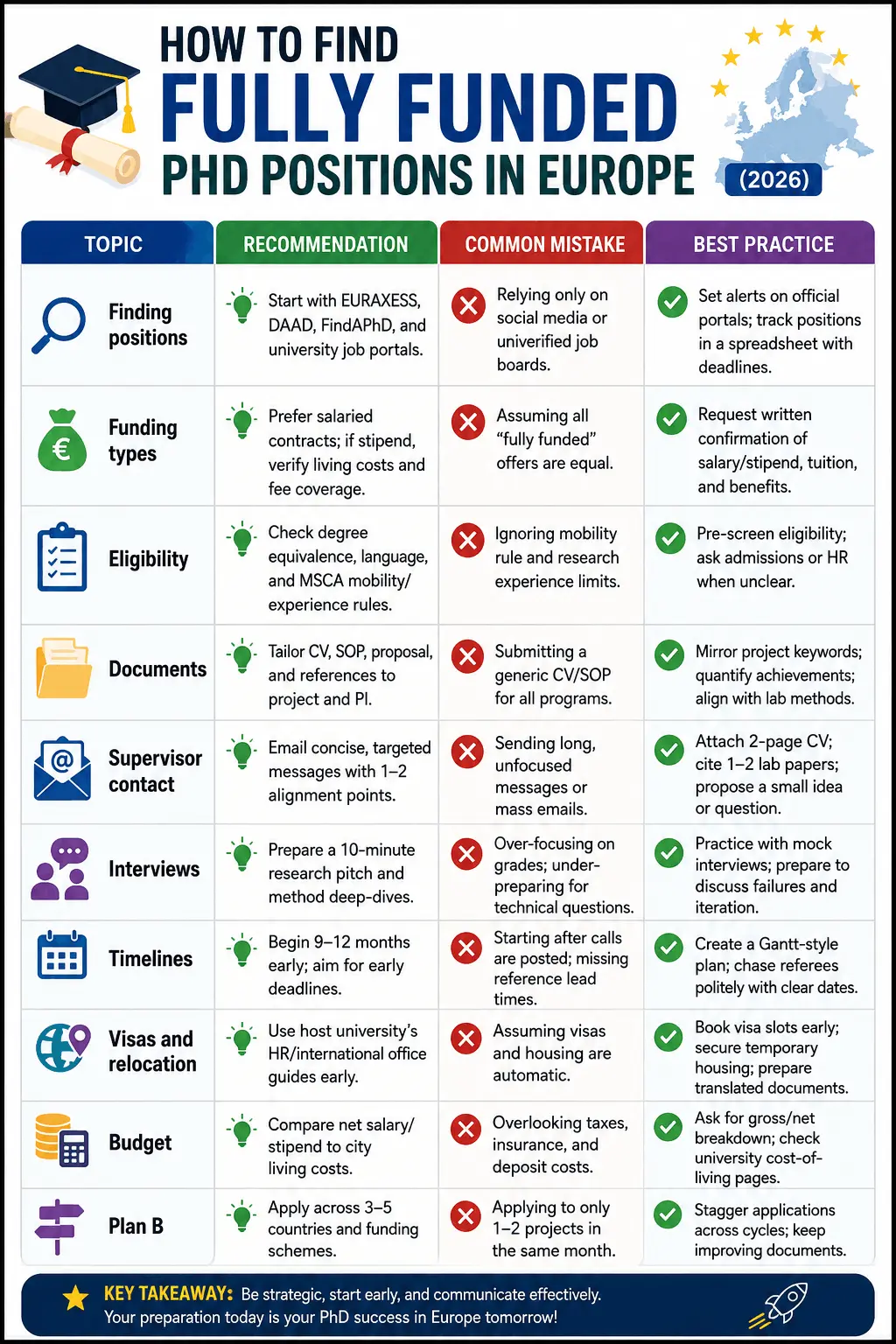
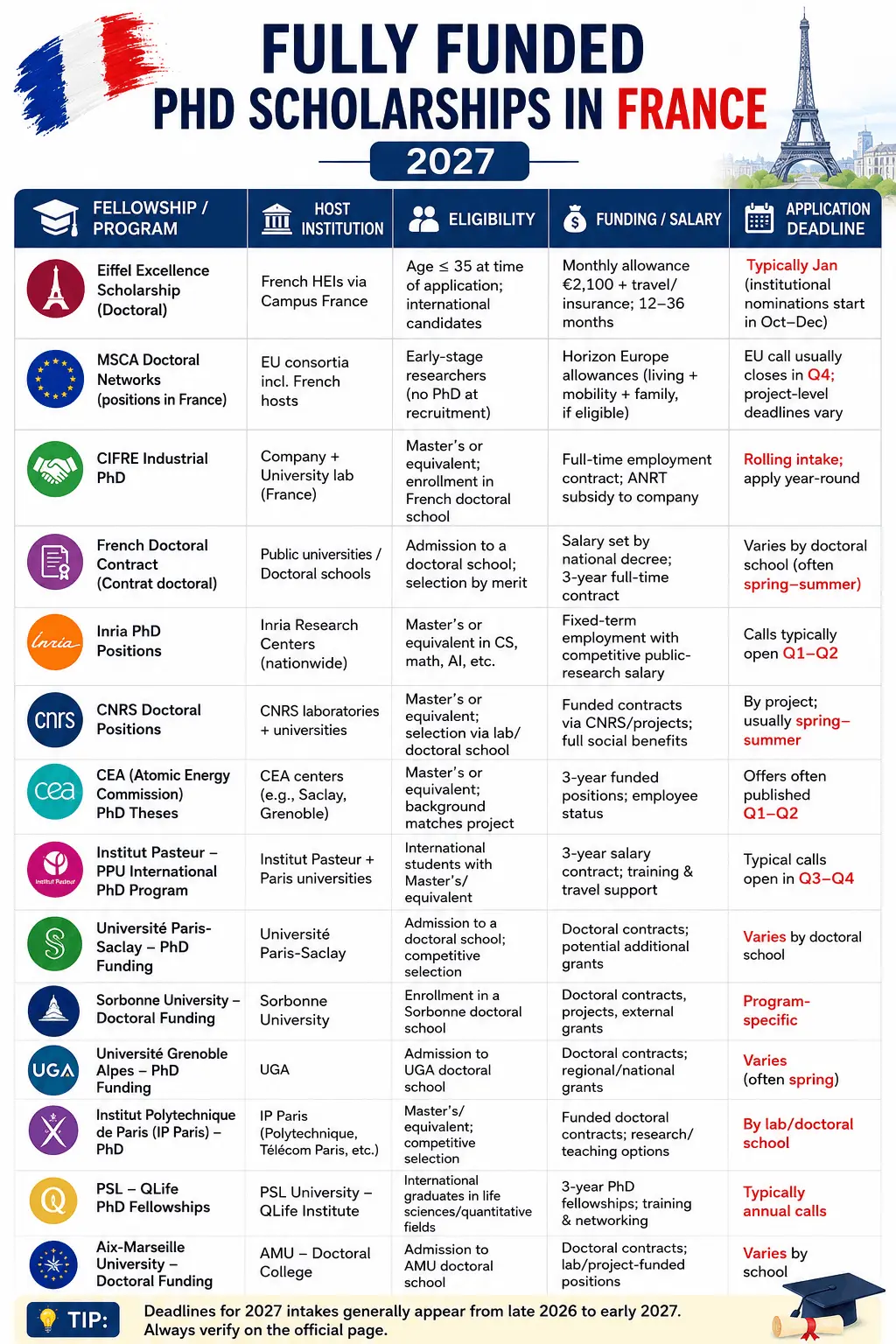
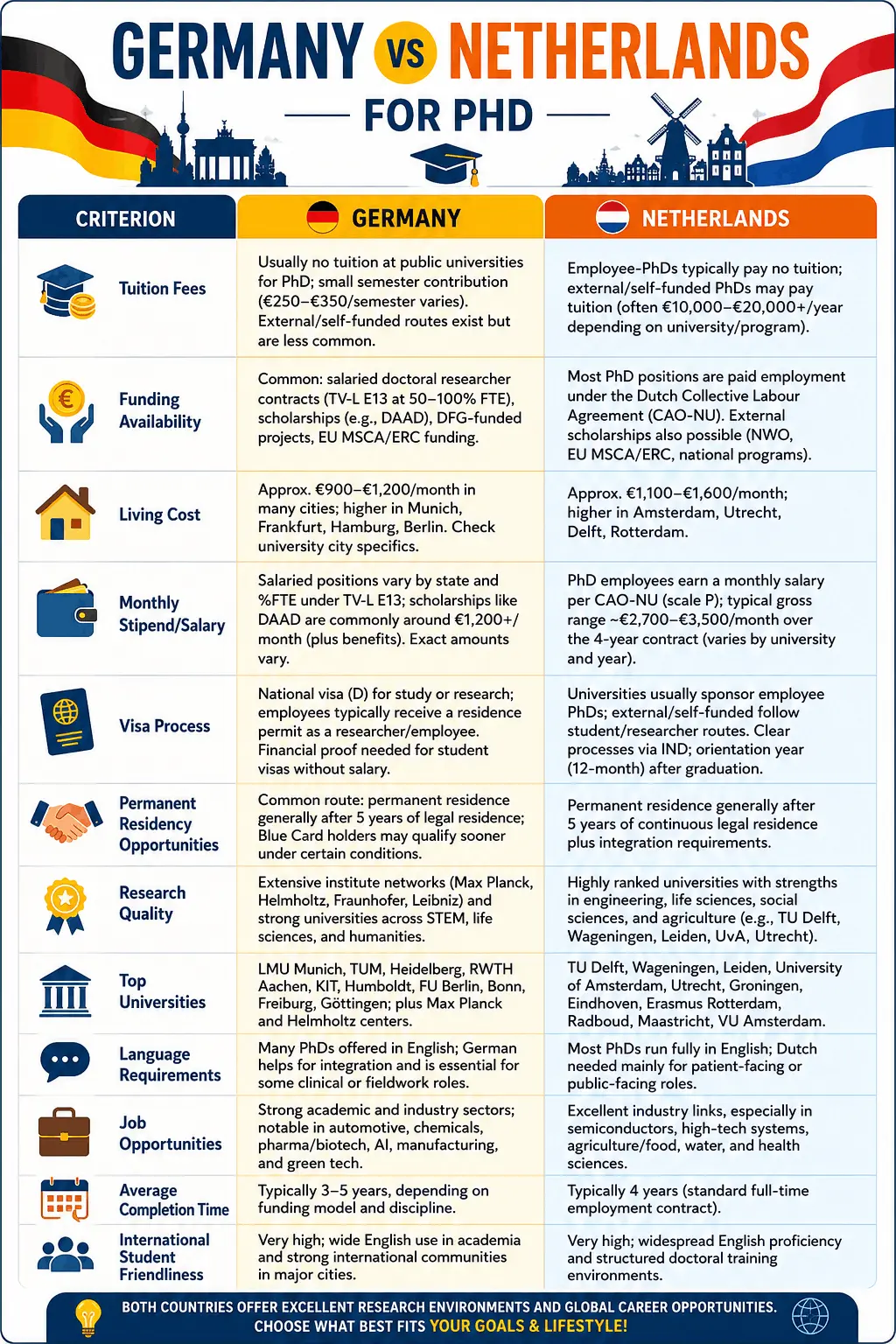
    Researchers comparing European destinations may also find our guides to fully funded PhD scholarships in Sweden for 2027, fully funded PhD scholarships in the Netherlands for 2027, fully funded PhD scholarships in France for 2027, and fully funded PhD scholarships in Germany for 2027 useful.


    Are These Really “2027 PhD Scholarships”?

    There is no single national 2027 PhD scholarship deadline in Denmark.

    Danish universities recruit doctoral fellows throughout the year as funded projects, faculty competitions, graduate-school calls, and external grants become available.

    Therefore, most university entries in this guide are best understood as major sources of fully funded and salaried PhD positions for applicants targeting a 2027 start, rather than already-confirmed annual “2027 scholarships.”

    Some 2027-start positions will be advertised during late 2026, while others will appear throughout 2027.

    2027 application tip: Start monitoring vacancies during the second half of 2026 rather than waiting until 2027.


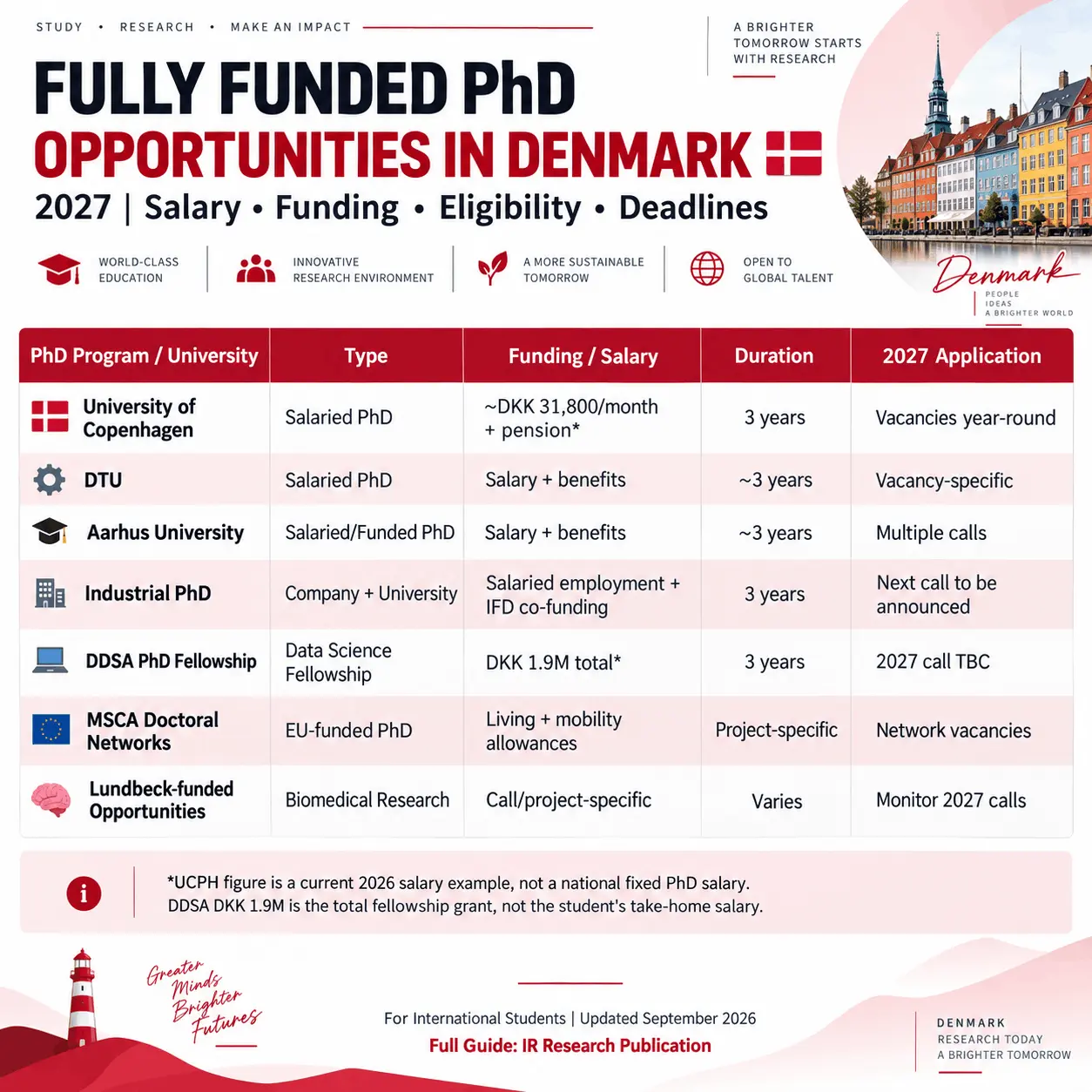
    At-a-Glance: Salaried PhD Positions at Danish Universities

    University / ProgramTypical EligibilityFunding ModelApplication TimelineOfficial Link
    University of Copenhagen PhD PositionsRelevant master’s or equivalent; project/faculty-specific requirementsSalaried PhD employment; pension and benefits under applicable agreementVacancies throughout the yearUCPH PhD Vacancies
    DTU PhD PositionsRelevant master’s; strong fit with technical/research projectPhD employment with salary and benefits according to applicable termsVacancy-specificDTU PhD
    Aarhus University PhD PositionsMaster’s or applicable integrated route; graduate-school-specific requirementsFunded PhD employment or fellowship depending on faculty/callGraduate-school rounds and individual vacanciesAarhus University PhD
    University of Southern Denmark PhD PositionsRelevant master’s/equivalent; faculty-specific eligibilitySalaried PhD positions where advertisedThroughout the yearSDU PhD
    Aalborg University PhD PositionsRelevant master’s and research/project fitSalaried doctoral employment for funded positionsVacancy-specificAAU PhD
    Copenhagen Business School PhD PositionsRelevant master’s; strong academic record; proposal where requiredSalaried PhD scholarship/employmentFaculty and project-specific callsCBS PhD
    Roskilde University PhD PositionsMaster’s/equivalent; project and interdisciplinary fitFunded PhD employment depending on vacancyCalls throughout yearRUC PhD
    IT University of Copenhagen PhD PositionsRelevant master’s; computing, digital, design or information-related fitSalaried PhD employment where advertisedVacancy/call-specificITU PhD Programme

    Competitive National and International PhD Funding Routes

    ProgramMain Eligibility / ModelCurrent Verified Funding2027 StatusOfficial Link
    Innovation Fund Denmark – Industrial PhDMaster’s; company/public organization + university + candidate partnership; current grade requirements applyUp to DKK 17,000/month salary subsidy + up to DKK 100,000 travel/course costs + DKK 360,000 to universityAutumn 2026 round closed September 8; monitor next callsIndustrial Researcher Programme
    Danish Data Science Academy PhD FellowshipCandidate eligible for Danish PhD; own data-science project + Danish supervisor/host2026 call: DKK 1.9M over 3 years + 5% administrative costs2026 call closed March 4; 2027 call not yet confirmedDDSA Fellowship
    MSCA Doctoral NetworksMust not already hold PhD; any nationality; mobility rule; recruited by funded networkEU living + mobility + eligible family/leave/special-needs allowances2026 consortium call closes Nov. 24; individual PhD vacancies appear laterMSCA Doctoral Networks
    Lundbeck Foundation-supported PhD OpportunitiesDepends on specific biomedical/neuroscience funding callCall-specificNo single generic 2027 PhD fellowship should be assumed; monitor current grant portfolioLundbeck Foundation Grants

    Important: Grant totals, university funding and salary subsidies are not necessarily equivalent to the researcher’s gross salary or take-home pay.


    How Much Do PhD Students Earn in Denmark?

    There is no single fixed national PhD salary that applies identically to every researcher.

    Salary depends on factors including:

    • university;
    • applicable collective agreement;
    • prior relevant experience;
    • faculty or department;
    • type of appointment;
    • supplements;
    • funding arrangement.

    University of Copenhagen Salary Example

    As a current reference point, a University of Copenhagen PhD vacancy at the Faculty of Science in August 2026 listed a starting salary of approximately:

    DKK 31,800 per month before tax

    plus an additional:

    18.07% employer-paid pension contribution

    Depending on qualifications and the specific employment agreement, supplements may also apply.

    This should be treated as a University of Copenhagen example, not as a fixed nationwide Danish PhD salary.

    Other UCPH faculties and Danish universities may use somewhat different salary steps or arrangements.


    Current Verified Funding Examples

    OpportunityCurrent Verified Funding Example
    University of Copenhagen PhDApproximately DKK 31,800/month before tax in a current SCIENCE vacancy + 18.07% employer-paid pension
    DDSA PhD Fellowship 2026DKK 1.9 million over 3 years + 5% administrative costs
    Industrial PhDUp to DKK 17,000/month salary subsidy + up to DKK 100,000 travel/course support + DKK 360,000 to university
    MSCA Doctoral NetworksLiving allowance + mobility allowance + eligible family, long-term-leave and special-needs allowances

    These amounts use different funding models and should not be compared as if they were personal annual salaries.


    1. University of Copenhagen PhD Fellowships

    Overview

    The University of Copenhagen (UCPH) is Denmark’s largest university and offers doctoral research across:

    • health and medical sciences;
    • natural and life sciences;
    • humanities;
    • law;
    • social sciences;
    • theology.

    The university advertises numerous PhD fellowships throughout the year.

    Employment and Funding

    Standard funded positions are commonly offered as fixed-term employment.

    Current university vacancies state that salary, pension and employment conditions are governed by agreements between the relevant Danish authorities and academic professional organizations.

    Depending on the faculty and position, PhD fellows may receive:

    • monthly salary;
    • employer-paid pension;
    • paid annual leave;
    • employee protections;
    • research training;
    • PhD coursework;
    • international research stays;
    • access to university research infrastructure.

    Eligibility

    Requirements vary by faculty, but applicants generally need a qualification equivalent to a relevant Danish master’s degree for a standard three-year PhD route.

    Some faculties also operate integrated master’s/PhD structures.

    Application

    There is no single UCPH annual PhD deadline.

    Candidates apply directly to advertised vacancies.

    View University of Copenhagen PhD positions


    2. Technical University of Denmark (DTU) PhD Positions

    Overview

    The Technical University of Denmark (DTU) is a major European technical university with PhD opportunities in areas such as:

    • engineering;
    • biotechnology;
    • computer science;
    • artificial intelligence;
    • chemistry;
    • physics;
    • energy;
    • sustainability;
    • transport;
    • food science;
    • environmental engineering;
    • space research;
    • life science.

    Funding

    Funded DTU doctoral positions generally involve employment under the terms specified in the vacancy and relevant Danish employment framework.

    Eligibility

    Applicants normally need a relevant master’s-level qualification or equivalent academic preparation.

    Technical knowledge, research experience and specific methodological skills are determined by the project.

    Application

    PhD positions are advertised individually.

    DTU PhD Education


    3. Aarhus University PhD Fellowships

    Overview

    Aarhus University (AU) offers PhD education across several graduate-school environments spanning:

    • Arts;
    • Health;
    • Natural Sciences;
    • Technical Sciences;
    • Aarhus BSS.

    Recruitment structures differ across faculties.

    Some opportunities are tied to predefined funded projects, while others are offered through graduate-school application rounds.

    Funding and Employment

    Funding arrangements depend on the specific call, but fully funded doctoral appointments commonly provide salary and employment benefits.

    Application

    Always apply through the relevant AU graduate school or vacancy portal rather than assuming a university-wide deadline.

    Aarhus University PhD Studies


    4. University of Southern Denmark PhD Positions

    The University of Southern Denmark (SDU) offers doctoral research across:

    • engineering;
    • health sciences;
    • science;
    • humanities;
    • business;
    • social sciences.

    Many positions are linked to research grants and individual projects.

    Requirements and deadlines therefore differ considerably between faculties.

    SDU PhD Programmes


    5. Aalborg University PhD Positions

    Aalborg University (AAU) is well known for interdisciplinary and problem-oriented research and for collaboration with industry and public-sector organizations.

    Research strengths include:

    • engineering;
    • energy;
    • digital technologies;
    • health;
    • social sciences;
    • sustainability;
    • communication and IT.

    Funded positions are advertised individually, with eligibility and employment terms stated in each vacancy.

    Aalborg University PhD Studies


    6. Copenhagen Business School PhD Scholarships

    The term “PhD scholarship” is commonly used at Copenhagen Business School (CBS), but funded positions are typically structured within Denmark’s doctoral employment and training system rather than functioning like a conventional tuition scholarship.

    Research areas include:

    • economics;
    • finance;
    • management;
    • organization;
    • strategy;
    • marketing;
    • entrepreneurship;
    • digitalization;
    • business and society.

    Applicants may need a detailed research proposal depending on the call.

    CBS PhD


    7. Roskilde University PhD Positions

    Roskilde University (RUC) emphasizes interdisciplinary and problem-oriented research.

    Doctoral opportunities span areas such as:

    • social sciences;
    • humanities;
    • communication;
    • environmental science;
    • natural science.

    PhD opportunities are advertised according to available funded projects and institutional calls.

    Roskilde University PhD


    8. IT University of Copenhagen PhD Programme

    The IT University of Copenhagen (ITU) specializes in digital research, including:

    • computer science;
    • artificial intelligence;
    • software;
    • algorithms;
    • data science;
    • human-computer interaction;
    • digital design;
    • information studies;
    • digital society.

    Funded PhD positions are normally advertised around defined research areas or projects.

    ITU PhD Programme


    9. Innovation Fund Denmark Industrial PhD

    The Industrial PhD is one of Denmark’s most distinctive doctoral funding routes.

    It combines doctoral research with employment in a private company or public organization.

    A typical Industrial PhD involves:

    1. an Industrial PhD candidate;
    2. a company or public organization;
    3. a university.

    The project normally lasts three years.

    Who Employs the PhD Candidate?

    The company or public organization employs the PhD candidate.

    Innovation Fund Denmark provides co-financing—it does not simply replace the employer or pay the candidate’s entire salary directly.

    Current Funding

    Under the current Industrial Researcher framework, Innovation Fund Denmark can contribute:

    • up to DKK 17,000 per month toward the candidate’s salary;
    • up to DKK 100,000 toward travel and course participation;
    • a fixed DKK 360,000 including overhead to the university.

    The employer remains responsible for the employment relationship and salary.

    Important Eligibility Requirements

    The candidate normally needs a master’s degree or equivalent.

    Current 2026 Industrial PhD requirements for Danish-equivalent grading include:

    • at least 10 for the master’s thesis/final project; and
    • either a weighted average of at least 8.2 across bachelor’s and master’s studies;
    • or at least 9.5 for a two-year master’s degree alone.

    These figures use the Danish 7-point grading scale.

    Rules exist for foreign qualifications and possible exemptions, so international applicants should consult the current Industrial PhD guidelines rather than trying to convert grades themselves.

    Current Application Status

    The autumn 2026 round:

    • opened August 4, 2026;
    • closed September 8, 2026 at 12:00.

    Applicants targeting a 2027 project should monitor Innovation Fund Denmark for the next Industrial Researcher calls.

    Innovation Fund Denmark – Industrial Researcher


    10. Danish Data Science Academy PhD Fellowships

    The Danish Data Science Academy (DDSA) is particularly attractive for researchers interested in:

    • data science;
    • machine learning;
    • artificial intelligence;
    • statistics;
    • computational science;
    • bioinformatics;
    • data-driven research applications.

    2026 Fellowship Funding

    The latest DDSA PhD Fellowship Call offered:

    10 three-year PhD fellowships

    worth:

    DKK 1.9 million each

    plus:

    5% administrative costs

    The total fellowship is intended to contribute to expenses such as salary, tuition, external research stays, travel and relevant operational costs.

    The DKK 1.9 million therefore should not be interpreted as the student’s personal salary.

    If the total PhD project cost exceeds the fellowship amount, the host institution is expected to cover the additional costs.

    Eligibility

    Applicants must be eligible for admission to a Danish PhD programme.

    The 2026 call accepted candidates under Danish structures including:

    • 3+5;
    • 4+4;
    • 5+3 models.

    Applicants needed:

    • their own defined research project;
    • an agreement with a principal supervisor at a Danish university;
    • a project within theoretical or applied data science aligned with the DDSA funding scope.

    Current Status

    The 2026 call closed:

    March 4, 2026 at 23:59 CET.

    A 2027 fellowship call has not yet been confirmed, so applicants should monitor DDSA rather than assuming the same deadline or amount will automatically apply next year.

    DDSA PhD Fellowship Call


    11. Marie Skłodowska-Curie Doctoral Networks in Denmark

    Marie Skłodowska-Curie Actions (MSCA) Doctoral Networks fund international doctoral-training consortia across Europe.

    Danish universities, research institutes, companies and other organizations can participate as recruiting hosts.

    Important Eligibility Rules for PhD Candidates

    Candidates recruited by an MSCA Doctoral Network:

    • must not already hold a doctoral degree at the date of recruitment;
    • can be of any nationality;
    • must be enrolled in a doctoral programme during the project;
    • must comply with the MSCA mobility rule.

    The standard mobility rule means that the candidate normally must not have resided or carried out their main activity in Denmark for more than 12 months during the 36 months immediately before recruitment if the recruiting organization is in Denmark.

    Funding

    MSCA support for recruited doctoral candidates can include:

    • living allowance;
    • mobility allowance;
    • family allowance where applicable;
    • long-term-leave support where applicable;
    • special-needs allowance where applicable.

    Funding is also provided to the participating institutions for research, training, networking, management and indirect costs.

    Important: Candidates Do Not Apply to the Consortium Call

    The 2026 MSCA Doctoral Networks call closes November 24, 2026, but that deadline is for universities, research institutions, companies and other organizations creating the Doctoral Networks.

    It is not a direct PhD-student application deadline.

    After networks receive funding, the individual doctoral vacancies are advertised internationally, including through EURAXESS and participating institutions.

    Candidates then apply to the individual PhD vacancies.

    MSCA Doctoral Networks

    EURAXESS Research Jobs


    12. Lundbeck Foundation-Supported PhD Opportunities

    The Lundbeck Foundation is a major Danish research funder, particularly in biomedical and health-related research.

    However, applicants should be cautious with generic online lists describing a permanent annual “Lundbeck Foundation PhD Fellowship.”

    The Foundation operates multiple funding programs, and the availability, eligibility and structure of PhD support depend on the specific current grant call.

    Therefore, rather than assuming a standard annual 2027 PhD fellowship, applicants should monitor the Foundation’s official grants portfolio for relevant:

    • biomedical research grants;
    • neuroscience opportunities;
    • investigator-led projects that may recruit PhD students;
    • call-specific early-career or education funding.

    Lundbeck Foundation Grants


    How Long Is a PhD in Denmark?

    A standard Danish PhD following a completed master’s degree typically corresponds to approximately three years of full-time doctoral study.

    However, Denmark also has integrated pathways in which students begin doctoral training before completing the master’s degree.

    Terms such as:

    • 5+3
    • 4+4
    • 3+5

    refer to different points at which the researcher enters the overall university/doctoral education pathway.

    The exact structure varies by university and graduate school.


    Do PhD Students Pay Tuition in Denmark?

    For standard fully funded doctoral positions, the candidate generally does not personally pay conventional tuition in the same way as an unfunded bachelor’s or master’s student.

    There are nevertheless real tuition and institutional education costs associated with doctoral enrollment.

    Depending on the funding model, these costs may be paid by:

    • the host university;
    • the research grant;
    • an external fellowship;
    • the company/university arrangement;
    • the doctoral network.

    This is why “tuition covered” is more accurate than claiming doctoral training has no institutional costs at all.


    Can International Students Apply for PhDs in Denmark?

    Yes.

    Danish universities regularly recruit researchers internationally, and many PhD vacancies are advertised in English.

    Selection normally focuses on:

    • academic qualifications;
    • research experience;
    • project fit;
    • technical or methodological expertise;
    • master’s thesis quality;
    • language requirements;
    • the specific eligibility criteria of the position.

    Non-EU/EEA applicants will also need the appropriate Danish residence and work authorization after receiving an eligible offer.


    Is Danish Language Required?

    For many laboratory, engineering, data-science and internationally oriented research positions, English is sufficient.

    However, Danish may be required or strongly preferred for projects involving:

    • clinical patient interaction;
    • Danish schools;
    • public-sector research;
    • qualitative interviews conducted in Danish;
    • Danish-language archives or datasets;
    • teaching or outreach requiring Danish.

    Always check the individual vacancy.


    Where to Find PhD Positions in Denmark

    Because many Danish doctoral opportunities are advertised like jobs, candidates should monitor university vacancy pages regularly rather than waiting for one annual scholarship cycle.

    Strong starting points include:

    • University of Copenhagen
    • DTU
    • Aarhus University
    • SDU
    • Aalborg University
    • Copenhagen Business School
    • Roskilde University
    • IT University of Copenhagen
    • EURAXESS

    IR Research Publication also maintains a regularly updated research jobs page covering PhD, postdoc and faculty opportunities.

    For a broader funding strategy, see our PhD Scholarship Guide: How to Find, Win, and Fund a Fully Funded PhD.


    How to Make Your Denmark PhD Application Competitive

    1. Treat the Application Like a Research Job Application

    For project-specific vacancies, your application should explain exactly how your background fits the proposed research.

    Avoid sending the same generic statement to every university.

    2. Match Your Skills to the Project

    Highlight relevant:

    • research methods;
    • laboratory techniques;
    • statistical expertise;
    • programming languages;
    • datasets;
    • master’s-thesis experience;
    • publications;
    • internships;
    • industry experience.

    3. Read the Research Group’s Recent Work

    Before applying, review recent publications from:

    • the principal investigator;
    • the department;
    • the specific research center.

    This will strengthen both your motivation letter and interview preparation.

    4. Prepare a Strong Research Proposal When Required

    Some opportunities—particularly candidate-driven fellowships and Industrial PhD applications—require a substantial proposal.

    A strong research plan should explain:

    • the research problem;
    • knowledge gap;
    • hypothesis or research question;
    • methodology;
    • feasibility;
    • timeline;
    • expected outcomes;
    • risks and alternatives;
    • scientific or societal significance.

    5. Contact Supervisors Early for Candidate-Driven Funding

    Supervisor contact is particularly important for:

    • DDSA;
    • Industrial PhD;
    • candidate-driven graduate-school applications;
    • external foundation opportunities.

    By contrast, for an advertised project-defined PhD job, follow the vacancy instructions before sending unsolicited materials.

    6. Check Funding Before Accepting an Offer

    Determine whether the position provides:

    • an employment contract;
    • pension;
    • salary;
    • tuition coverage;
    • relocation support;
    • travel support;
    • health/social benefits;
    • teaching obligations.

    Do not assume every “scholarship” has the same legal or financial structure.


    Documents Commonly Required for a Denmark PhD Application

    Depending on the university and program, applicants may need:

    • academic CV;
    • motivation or cover letter;
    • bachelor’s transcript;
    • master’s transcript;
    • degree certificates;
    • master’s thesis;
    • research proposal;
    • publication list;
    • writing samples;
    • recommendation letters or referee details;
    • proof of English proficiency;
    • documentation of relevant technical skills.

    Industrial PhD and candidate-driven fellowship applications can require additional project, supervisor and host-organization documentation.


    When Should You Apply for a 2027 PhD in Denmark?

    September–December 2026

    This is an excellent period to:

    • monitor Danish university vacancy portals;
    • apply to project-funded positions with 2027 start dates;
    • identify prospective supervisors;
    • prepare transcripts and references;
    • monitor new national funding calls;
    • follow MSCA Doctoral Network projects and future recruitment.

    January–June 2027

    Continue checking:

    • university job portals;
    • Innovation Fund Denmark;
    • DDSA;
    • EURAXESS;
    • Danish foundations;
    • newly funded EU networks.

    Throughout 2027

    New vacancies can appear at any time because Danish PhD recruitment is often tied to the start of individual funded projects rather than one national admission cycle.


    Frequently Asked Questions

    Are PhD positions in Denmark fully funded?

    Many advertised Danish PhD positions are fully funded through salaried university employment.

    Other doctoral routes may use external fellowships, company employment, EU funding or other grant structures.

    Always confirm the funding model in the individual call.


    Is a PhD in Denmark a job?

    Many standard Danish PhD positions function as fixed-term employment combined with doctoral education.

    The researcher carries out an original research project while completing doctoral training requirements.


    What is the PhD salary in Denmark?

    There is no single national figure that applies identically to every appointment.

    As one current example, a 2026 University of Copenhagen PhD vacancy lists a starting salary of approximately DKK 31,800 per month before tax, with an additional 18.07% employer-paid pension contribution.

    Exact salary varies by employer, experience, agreement and appointment.


    How long is a PhD in Denmark?

    A standard PhD following a completed master’s degree is normally approximately three years full-time.

    Integrated master’s/PhD pathways can have longer overall structures.


    Do I need a master’s degree?

    For a standard 5+3-style doctoral route, applicants generally need a relevant master’s-level qualification.

    Some universities also offer integrated structures allowing researchers to begin PhD training earlier in their master’s education.


    Can Indian students apply for fully funded PhDs in Denmark?

    Yes.

    Indian and other international applicants can apply to many Danish university PhD vacancies provided they meet the academic and project-specific requirements.

    Industrial PhD, DDSA and MSCA opportunities have additional scheme-specific eligibility conditions.


    Can I apply for MSCA Doctoral Networks if I already have a PhD?

    No.

    Researchers recruited as doctoral candidates under MSCA Doctoral Networks must not already hold a doctoral degree at the date of recruitment.


    How does the MSCA mobility rule work?

    For a Danish host, applicants generally must not have lived, worked or carried out their main activity in Denmark for more than 12 months during the 36 months immediately before recruitment.

    Specific exceptions in MSCA rules should always be checked.


    Is the November 24, 2026 MSCA Doctoral Networks deadline for PhD students?

    No.

    That is the deadline for consortia submitting proposals to establish Doctoral Networks.

    Prospective PhD candidates apply later to individual positions advertised by funded networks.


    How much does the Industrial PhD pay?

    The student’s actual salary is paid by the employing company or public organization.

    Innovation Fund Denmark currently provides co-financing, including up to DKK 17,000 per month toward salary costs, rather than setting the candidate’s total salary at DKK 17,000.


    Is the DDSA DKK 1.9 million fellowship the student’s salary?

    No.

    The DKK 1.9 million is the three-year fellowship grant amount, intended to cover several project costs including salary, tuition, research stay, travel and operational expenses.

    It is not equivalent to personal take-home income.


    Do I need Danish?

    Usually not for many internationally recruited STEM and research positions, but specific clinical, educational, public-facing or Danish-language projects may require it.


    Final Application Checklist

    Before submitting a Denmark PhD application, confirm:

    • I meet the degree requirements.
    • I meet the project’s specific academic criteria.
    • My CV is tailored to the vacancy.
    • My motivation letter explains research fit.
    • I understand whether a research proposal is required.
    • I have checked the funding model.
    • I know whether I will be an employee or fellowship recipient.
    • I have confirmed salary and pension arrangements.
    • Tuition or enrollment costs are covered.
    • My transcripts and degree certificates are ready.
    • My referees are prepared.
    • I meet the English-language requirements.
    • I meet any mobility rules.
    • I have verified the exact deadline and time zone.
    • I have checked the official webpage immediately before submission.

    Conclusion: Fully Funded PhD Scholarships in Denmark 2027

    Denmark offers an excellent environment for international researchers seeking fully funded PhD scholarships in Denmark for 2027, but the Danish funding model is different from the traditional scholarship systems used in many countries.

    At major universities such as the University of Copenhagen, DTU, Aarhus University, SDU, Aalborg University, CBS, Roskilde University and IT University of Copenhagen, many doctoral opportunities are advertised as salaried research positions.

    Additional competitive routes include the Innovation Fund Denmark Industrial PhD, the Danish Data Science Academy PhD Fellowship, and Marie Skłodowska-Curie Doctoral Networks involving Danish research institutions.

    Applicants should remember that there is no single national 2027 deadline. Positions will continue to appear from late 2026 throughout 2027.

    The strongest strategy is to begin monitoring vacancies early, understand the difference between salary and grant funding, tailor every application to the specific research project, and verify eligibility directly from the official call before applying.

    For additional opportunities and application guidance, explore the IR Research Publication PhD Scholarship Guide and our latest PhD, postdoctoral and faculty research opportunities.


    Related Articles


    About IR Research Publication

    IR Research Publication is a research and academic-career platform supporting students, researchers and scholars with practical guidance on PhD funding, postdoctoral fellowships, academic careers, scientific publishing and research development.

    Our funding guides are designed to help researchers identify credible opportunities while emphasizing the importance of confirming eligibility, salaries, funding structures and deadlines directly from official sources.

    Visit IR Research Publication


    Last reviewed: September 12, 2026

    Disclaimer: Salary levels, pension rates, funding amounts, eligibility requirements and deadlines may change between calls. Always verify the latest information on the official university or funder’s website before applying.

  • Fully Funded PhD Scholarships in Sweden 2027: Salaried PhD Positions at Top Universities

    Fully Funded PhD Scholarships in Sweden 2027: Salaried PhD Positions at Top Universities


    Fully Funded PhD Scholarships in Sweden 2027: What Applicants Need to Know

    Sweden is one of Europe’s most attractive destinations for international PhD applicants. Its doctoral education model differs significantly from countries where students pay tuition and depend mainly on scholarships.

    In Sweden, most funded PhD candidates are employed as doctoral students by their university. Instead of receiving only a scholarship or stipend, they typically receive a monthly salary, paid leave, pension contributions, parental benefits, and other employment-related benefits according to Swedish law and applicable university agreements.

    That makes Sweden particularly attractive for international researchers looking for financially secure doctoral training.

    However, there is one important terminology issue.

    Important: What international applicants often search for as a “fully funded PhD scholarship in Sweden” is usually a salaried doctoral student position rather than a conventional scholarship.

    Some doctoral candidates may instead be externally employed, industry-funded, or supported through approved scholarship arrangements, so applicants should always check the funding model specified in each vacancy.

    KTH, for example, states that most of its doctoral students are salaried employees, although industrial doctoral students and scholarship-funded doctoral students also exist.

    Why Choose Sweden for a PhD?

    Sweden offers:

    • Salaried doctoral positions at many universities
    • No tuition fees for doctoral education
    • International and English-friendly research environments
    • Strong employee protections
    • Excellent research infrastructure
    • Generous parental and annual-leave systems
    • Strong collaboration between academia and industry
    • Major national investments in AI, sustainability, materials science, life sciences, and data-driven research
    • Globally recognized universities and research institutes

    Researchers comparing European destinations may also find our guide on how to find fully funded PhD positions in Europe useful.


    Are These Really “2027 PhD Scholarships”?

    Most Swedish universities do not operate a single annual competition called a “2027 PhD scholarship.”

    Instead, funded doctoral vacancies are usually advertised individually throughout the year when departments, supervisors, research programs, or external grants have funding available.

    Therefore, the universities and initiatives below should be viewed primarily as major sources of salaried and fully funded PhD opportunities for applicants targeting a 2027 start.

    Some positions beginning in 2027 may be advertised during late 2026, while others may appear throughout 2027.

    Tip: Do not wait until 2027 to begin searching. Applicants targeting a 2027 PhD should start monitoring vacancies during late 2026.


    Top Fully Funded PhD Scholarships and Salaried PhD Positions in Sweden 2027

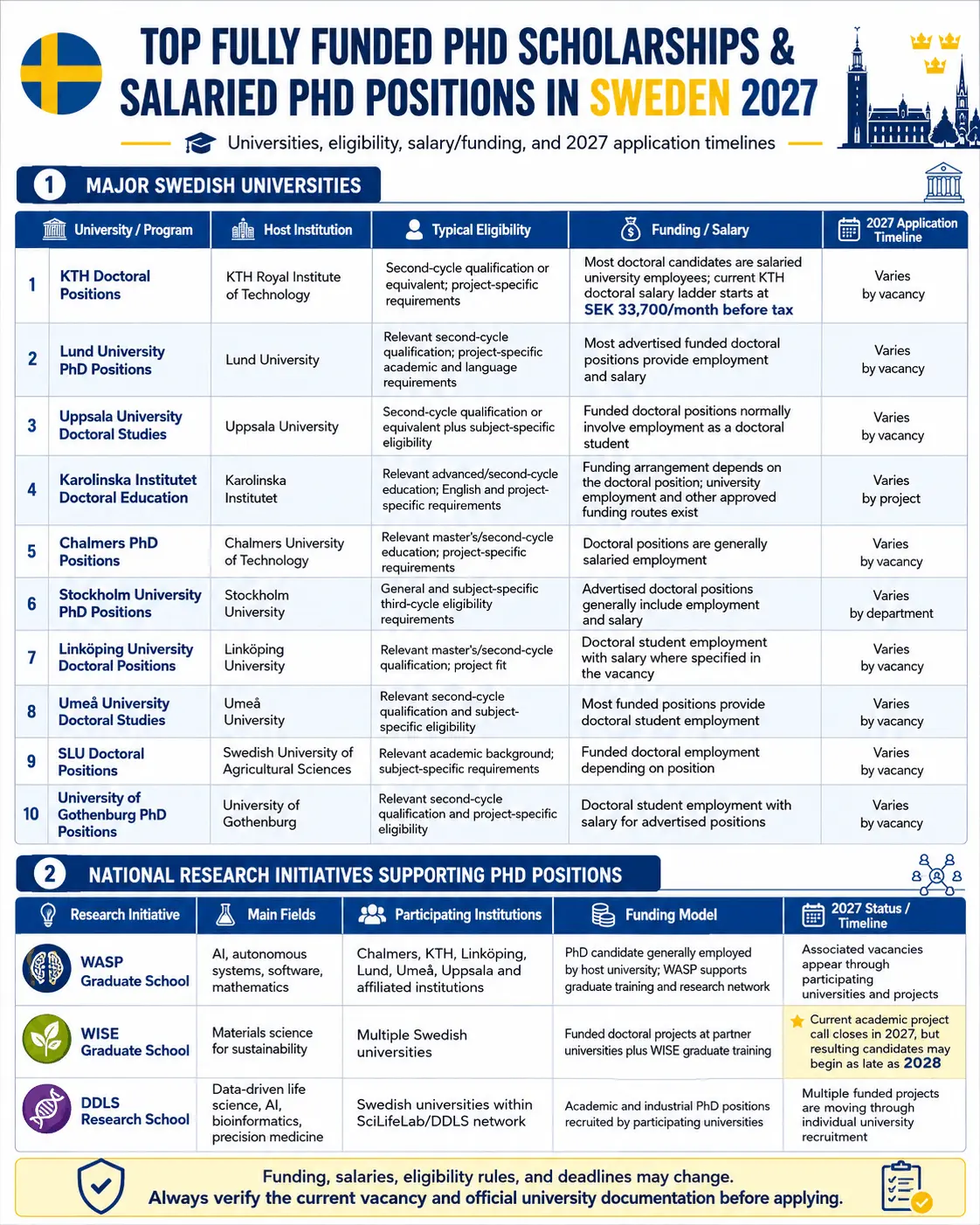
    Major Swedish Universities

    University / ProgramHost InstitutionTypical EligibilityFunding / Salary2027 Application TimelineOfficial Link
    KTH Doctoral PositionsKTH Royal Institute of TechnologySecond-cycle qualification or equivalent; project-specific requirementsMost doctoral candidates are salaried university employees; current KTH doctoral salary ladder starts at SEK 33,700/month before taxVaries by vacancyOfficial Website
    Lund University PhD PositionsLund UniversityRelevant second-cycle qualification; project-specific academic and language requirementsMost advertised funded doctoral positions provide employment and salaryVaries by vacancyOfficial Vacancies
    Uppsala University Doctoral StudiesUppsala UniversitySecond-cycle qualification or equivalent plus subject-specific eligibilityFunded doctoral positions normally involve employment as a doctoral studentVaries by vacancyOfficial Website
    Karolinska Institutet Doctoral EducationKarolinska InstitutetRelevant advanced/second-cycle education; English and project-specific requirementsFunding arrangement depends on the doctoral position; university employment and other approved funding routes existVaries by projectOfficial Website
    Chalmers PhD PositionsChalmers University of TechnologyRelevant master’s/second-cycle education; project-specific requirementsDoctoral positions are generally salaried employmentVaries by vacancyOfficial Vacancies
    Stockholm University PhD PositionsStockholm UniversityGeneral and subject-specific third-cycle eligibility requirementsAdvertised doctoral positions generally include employment and salaryVaries by departmentOfficial Website
    Linköping University Doctoral PositionsLinköping UniversityRelevant master’s/second-cycle qualification; project fitDoctoral student employment with salary where specified in the vacancyVaries by vacancyOfficial Vacancies
    Umeå University Doctoral StudiesUmeå UniversityRelevant second-cycle qualification and subject-specific eligibilityMost funded positions provide doctoral student employmentVaries by vacancyOfficial Website
    SLU Doctoral PositionsSwedish University of Agricultural SciencesRelevant academic background; subject-specific requirementsFunded doctoral employment depending on positionVaries by vacancyOfficial Doctoral Studies
    University of Gothenburg PhD PositionsUniversity of GothenburgRelevant second-cycle qualification and project-specific eligibilityDoctoral student employment with salary for advertised positionsVaries by vacancyOfficial Vacancies

    National Research Initiatives Supporting PhD Positions

    Research InitiativeMain FieldsParticipating InstitutionsFunding Model2027 Status / TimelineOfficial Link
    WASP Graduate SchoolAI, autonomous systems, software, mathematicsChalmers, KTH, Linköping, Lund, Umeå, Uppsala and affiliated institutionsPhD candidate generally employed by host university; WASP supports graduate training and research networkAssociated vacancies appear through participating universities and projectsOfficial Website
    WISE Graduate SchoolMaterials science for sustainabilityMultiple Swedish universitiesFunded doctoral projects at partner universities plus WISE graduate trainingCurrent academic project call closes in 2027, but resulting candidates may begin as late as 2028Official Website
    DDLS Research SchoolData-driven life science, AI, bioinformatics, precision medicineSwedish universities within SciLifeLab/DDLS networkAcademic and industrial PhD positions recruited by participating universitiesMultiple funded projects are moving through individual university recruitmentOfficial PhD Projects

    Funding, salaries, eligibility rules, and deadlines may change. Always verify the current vacancy and official university documentation before applying.


    Eligibility for a PhD in Sweden

    Applicants often assume that every Swedish PhD strictly requires a master’s degree. A master’s degree is indeed the most common route, but Sweden’s official national rules are slightly broader.

    Under the Swedish Higher Education Ordinance, a person generally meets the entry requirements for third-cycle doctoral education if they have:

    1. been awarded a second-cycle qualification, or
    2. completed at least 240 higher-education credits, including at least 60 credits at second-cycle level, or
    3. acquired substantially equivalent knowledge in another way in Sweden or abroad.

    Individual universities and doctoral subjects can impose additional specific eligibility requirements.

    These may include:

    • particular master’s-level courses;
    • subject-specific credits;
    • laboratory or research experience;
    • programming or statistical skills;
    • thesis experience;
    • English proficiency;
    • professional qualifications;
    • project-specific technical skills.

    International applicants should therefore evaluate both general eligibility and the specific requirements stated in the PhD vacancy.


    How Much Do PhD Students Earn in Sweden?

    One of the most searched questions about doctoral study in Sweden is the PhD salary.

    There is no single national salary that applies identically to every Swedish university. Salary structures are negotiated under applicable agreements and may differ between universities.

    Many institutions use a progression-based doctoral salary system where salary increases as the researcher completes milestones toward the PhD.

    KTH PhD Salary Example

    At KTH Royal Institute of Technology, the doctoral student salary ladder effective from October 1, 2025 is:

    Doctoral ProgressMonthly Salary Before Tax
    Initial salarySEK 33,700
    30% progressSEK 34,700
    50% progressSEK 36,700
    80% progressSEK 38,500

    These are KTH-specific figures, not a universal Swedish PhD salary.

    Applicants should check the individual university’s doctoral salary agreement before accepting an offer.

    PhD salaries are generally taxable in Sweden.


    1. KTH Royal Institute of Technology Doctoral Positions

    Overview

    KTH Royal Institute of Technology in Stockholm is one of Sweden’s leading universities for engineering, technology, computer science, energy, materials, sustainability, and applied sciences.

    Doctoral positions are normally connected to specific research projects or research groups and are advertised as job vacancies.

    Funding and Benefits

    KTH states that most doctoral students are salaried university employees.

    Employment can provide access to benefits such as:

    • Monthly salary
    • Occupational pension
    • Paid annual leave
    • Parental benefits
    • Sickness-related benefits
    • Swedish social-security protections
    • Research and training resources

    Some doctoral candidates may instead be industrial doctoral students or receive other approved forms of funding.

    Eligibility

    General Swedish third-cycle eligibility applies, together with specific requirements for the advertised doctoral position.

    Applicants may need expertise in areas such as:

    • Engineering
    • Computer science
    • Mathematics
    • AI
    • Physics
    • Chemistry
    • Biotechnology
    • Energy
    • Materials science

    Application

    Candidates apply directly to advertised doctoral positions rather than submitting one general annual PhD application.

    KTH Doctoral Studies


    2. Lund University PhD Positions

    Overview

    Lund University is one of Scandinavia’s major comprehensive research universities, with strengths in:

    • Life sciences
    • Medicine
    • Engineering
    • Physics
    • Chemistry
    • Environmental sciences
    • Humanities
    • Social sciences

    The university also benefits from proximity to major research infrastructures such as MAX IV and the European Spallation Source (ESS).

    Funding

    Funded doctoral opportunities are typically advertised as positions with employment conditions stated in the individual vacancy.

    Eligibility

    Candidates generally need a relevant second-cycle qualification or equivalent and must meet subject-specific eligibility requirements.

    Application

    Search Lund University’s official vacancies portal and apply to each relevant doctoral position individually.

    Lund University Vacancies


    3. Uppsala University Doctoral Studies

    Overview

    Founded in 1477, Uppsala University is one of Europe’s oldest universities and a major Swedish research institution.

    Its strengths include:

    • Medicine
    • Pharmacy
    • Biology
    • Chemistry
    • Physics
    • Technology
    • Humanities
    • Social sciences
    • Data science

    Funding

    Doctoral positions are commonly advertised as paid employment opportunities.

    Eligibility

    Applicants need to satisfy general Swedish doctoral entry requirements together with the requirements of the relevant faculty or research subject.

    Important WASP Update

    In February 2026, Uppsala University became a full partner university in the Wallenberg AI, Autonomous Systems and Software Program (WASP), strengthening opportunities in AI, machine learning, mathematics, autonomous systems, and software research.

    Uppsala University PhD Studies


    4. Karolinska Institutet Doctoral Education

    Overview

    Karolinska Institutet is one of Europe’s leading medical research universities and an excellent destination for doctoral candidates interested in:

    • Molecular medicine
    • Cancer
    • Neuroscience
    • Pharmacology
    • Epidemiology
    • Public health
    • Immunology
    • Translational medicine
    • Clinical sciences

    Funding

    Applicants should pay particular attention to the funding arrangement specified for each project.

    Doctoral financing can involve doctoral student employment or other approved arrangements depending on the project and employer.

    Therefore, applicants should not automatically assume every KI doctoral candidate has an identical KI employment contract.

    Application

    Doctoral projects and positions are advertised through KI and individual research environments.

    Karolinska Institutet Doctoral Education

    Researchers in biomedical science may also want to monitor IR Research Publication’s research jobs page for regularly curated PhD, postdoctoral, and research opportunities.


    5. Chalmers University of Technology PhD Positions

    Overview

    Chalmers University of Technology in Gothenburg is particularly strong in:

    • Engineering
    • Materials
    • Nanoscience
    • AI
    • Energy
    • Sustainability
    • Chemistry
    • Mobility and transportation
    • Maritime research

    Doctoral students frequently work in interdisciplinary academic-industrial collaborations.

    Funding

    PhD candidates recruited to funded doctoral positions are generally employed and receive salary according to relevant employment arrangements.

    Application

    Candidates apply directly to advertised doctoral vacancies.

    Chalmers Vacancies


    6. Stockholm University PhD Studies

    Overview

    Stockholm University offers doctoral education across a broad range of fields, including:

    • Environmental science
    • Biology
    • Chemistry
    • Physics
    • Mathematics
    • Computer science
    • Economics
    • Social sciences
    • Humanities

    Funding

    Doctoral positions are typically advertised through departments and the university recruitment system.

    Eligibility

    Candidates must meet general Swedish third-cycle eligibility requirements and any additional subject-specific criteria.

    Stockholm University PhD Studies


    7. Linköping University Doctoral Positions

    Overview

    Linköping University is particularly known for interdisciplinary research in:

    • Artificial intelligence
    • Computer vision
    • Autonomous systems
    • Biomedical engineering
    • Materials science
    • Visualization
    • Medicine
    • Engineering

    LiU is also a major participant in national research initiatives such as WASP.

    Funding

    Funded doctoral candidates are commonly employed as doctoral students.

    Application

    Search and apply through the official LiU vacancies portal.

    Linköping University Vacancies


    8. Umeå University Doctoral Positions

    Overview

    Umeå University has strong research environments in:

    • Molecular biology
    • Medicine
    • Plant sciences
    • Ecology
    • Artificial intelligence
    • Computing
    • Arctic research
    • Public health

    Umeå University is also a full partner in WASP.

    Funding

    Funded doctoral vacancies commonly offer employment as doctoral students.

    Application

    Positions are advertised individually.

    Umeå University Doctoral Studies


    9. Swedish University of Agricultural Sciences (SLU) PhD Positions

    Overview

    SLU is an excellent destination for researchers interested in:

    • Agriculture
    • Veterinary medicine
    • Forestry
    • Ecology
    • Biodiversity
    • Climate change
    • Food systems
    • Environmental sciences
    • Sustainable development

    Funding

    Most publicly advertised funded doctoral positions specify the relevant employment and funding terms.

    Application

    Applicants should monitor SLU’s doctoral education and vacancies pages for relevant positions.

    SLU Doctoral Studies


    10. University of Gothenburg PhD Positions

    Overview

    The University of Gothenburg offers doctoral training across a wide range of fields, including:

    • Medicine
    • Marine science
    • Biology
    • Environmental science
    • Social sciences
    • Business
    • Education
    • Humanities

    The university collaborates extensively with healthcare institutions, Chalmers, industry, and national research infrastructures.

    Application

    PhD vacancies are advertised through the university recruitment system.

    University of Gothenburg Vacancies


    11. WASP Graduate School: AI PhD Opportunities in Sweden

    What Is WASP?

    The Wallenberg AI, Autonomous Systems and Software Program (WASP) is Sweden’s major research initiative in artificial intelligence, autonomous systems, software, and related mathematics.

    WASP-associated doctoral candidates benefit from a national graduate-school environment that may include:

    • Advanced courses
    • International study trips
    • Networking
    • Research exchanges
    • Conferences
    • Collaboration across Swedish universities
    • Connections with international research environments

    WASP Partner Universities

    As of 2026, WASP’s full partner universities include:

    • Chalmers University of Technology
    • KTH Royal Institute of Technology
    • Linköping University
    • Lund University
    • Umeå University
    • Uppsala University

    Uppsala became a full WASP partner in February 2026.

    WASP also has affiliated research groups at additional Swedish institutions.

    How Funding Works

    International applicants should understand that WASP is not simply one annual scholarship application for students.

    Funding can be awarded through research projects and supervisors, after which doctoral candidates are recruited through the relevant host university.

    There are also affiliated PhD routes where salary and research costs may be provided by another institution or employer while the candidate participates in WASP’s graduate-school activities.

    Therefore, applicants should monitor both the WASP website and vacancies at participating universities.

    WASP Graduate School


    12. WISE Graduate School: Materials Science for Sustainability

    What Is WISE?

    The Wallenberg Initiative Materials Science for Sustainability (WISE) is a major Swedish research initiative focused on developing sustainable materials and technologies.

    Relevant disciplines include:

    • Materials science
    • Chemistry
    • Physics
    • Engineering
    • Energy
    • Nanoscience
    • Sustainable manufacturing

    Important 2027 Timing

    WISE project calls and actual student vacancies should not be confused.

    The current WISE Academic Project Call 2026–2027 is primarily a funding competition for research projects and investigators.

    The application portal is scheduled to open on December 1, 2026, with the call closing in February 2027.

    This does not mean that applicants can necessarily apply for those PhD positions during that same period.

    Projects must first receive funding, after which universities recruit doctoral candidates.

    For the current call, resulting recruitment can extend later, with candidates expected to be ready to start by August 1, 2028.

    Therefore, applicants specifically seeking a 2027 PhD start should monitor existing WISE-funded vacancies rather than assuming the 2026–2027 project call itself is a student scholarship.

    WISE Graduate School

    WISE Project Calls


    13. DDLS Research School: Data-Driven Life Science PhD Positions

    What Is DDLS?

    The SciLifeLab and Wallenberg National Program for Data-Driven Life Science (DDLS) is a major Swedish initiative combining data science, artificial intelligence, computational biology, and life sciences.

    The DDLS Research School covers areas including:

    • Cell and molecular biology
    • Precision medicine and diagnostics
    • Epidemiology and biology of infection
    • Evolution and biodiversity
    • AI and machine learning for biology
    • Bioinformatics
    • Computational biology

    Current PhD Opportunities

    In March 2026, DDLS announced that 25 academic and 7 industrial PhD projects from its 2025 call had been selected for funding.

    These projects are being translated into individual PhD recruitment processes across participating Swedish universities and industry collaborations.

    How to Apply

    Applicants do not generally submit one universal application to SciLifeLab for all DDLS PhD positions.

    Instead:

    1. A DDLS-supported project is approved.
    2. The host university conducts recruitment according to its own rules.
    3. Candidates apply to the specific doctoral vacancy.
    4. The selected candidate joins the DDLS Research School after approval.

    SciLifeLab maintains a dedicated page listing DDLS Research School PhD projects and opportunities.

    DDLS Research School PhD Projects


    How Long Is a PhD in Sweden?

    A Swedish doctoral degree normally corresponds to four years of full-time doctoral education, equivalent to 240 ECTS credits.

    However, four years of doctoral education does not always mean exactly four calendar years of employment.

    The appointment may be extended when the doctoral candidate undertakes approved activities such as:

    • Teaching
    • Departmental administration
    • Parental leave
    • Sick leave
    • Student-representative duties
    • Other permitted responsibilities

    At some universities, doctoral students may spend up to approximately 20% of their time on departmental duties, potentially extending the calendar duration of the appointment.


    Do PhD Students Pay Tuition Fees in Sweden?

    Doctoral education in Sweden generally does not charge tuition fees.

    This applies differently from bachelor’s and master’s study, where non-EU/EEA students may be liable for tuition fees.

    For funded doctoral candidates, the major financial consideration is therefore normally salary, taxation, living costs, and employment conditions—not tuition.


    Can International Students Apply for PhDs in Sweden?

    Yes.

    Swedish universities recruit international doctoral researchers across many disciplines.

    Eligibility is usually based on:

    • Academic qualifications
    • Research experience
    • Project fit
    • Technical expertise
    • English proficiency
    • Subject-specific requirements

    Citizenship is generally not the primary selection criterion for ordinary university PhD vacancies, although immigration and residence-permit requirements apply to researchers from outside the EU/EEA.

    Applicants considering multiple European destinations can compare Sweden with other options through our guides to fully funded PhD scholarships in the Netherlands 2027, fully funded PhD scholarships in France 2027, and fully funded PhD scholarships in Germany 2027.


    English Requirements for a PhD in Sweden

    English-language requirements vary by university, doctoral subject, and individual vacancy.

    Applicants should not assume that IELTS or TOEFL is universally required.

    Depending on the institution, evidence of English proficiency may include:

    • Previous university education completed in English
    • Formal qualifications equivalent to the required Swedish English level
    • IELTS
    • TOEFL
    • Other accepted documentation

    Always follow the requirements listed in the specific doctoral vacancy.


    How to Find Fully Funded PhD Positions in Sweden for 2027

    Because Sweden mainly recruits PhD candidates through individual job advertisements, a systematic search strategy is essential.

    1. Monitor University Vacancy Pages

    Create a shortlist of universities that match your discipline and check their job portals regularly.

    Good starting points include:

    • KTH
    • Lund
    • Uppsala
    • Karolinska Institutet
    • Chalmers
    • Stockholm University
    • Linköping University
    • Umeå University
    • SLU
    • University of Gothenburg

    2. Monitor National Research Programs

    Applicants in specialized fields should also follow:

    • WASP for AI, software, autonomous systems and mathematics
    • WISE for sustainable materials
    • DDLS for data-driven life sciences

    3. Use European Research Portals

    Many Swedish doctoral vacancies also appear on EURAXESS, the European Commission’s research-career portal.

    EURAXESS Jobs

    For a broader strategy, see our detailed guide on how to find fully funded PhD positions in Europe.

    4. Follow Research Groups Before Vacancies Open

    Identify professors and research groups whose work closely matches your background.

    Review:

    • Recent publications
    • Research grants
    • Laboratory websites
    • Current PhD students
    • New projects
    • National research initiatives

    A newly awarded grant often precedes new doctoral recruitment.


    How to Make Your Swedish PhD Application Competitive

    Swedish PhD recruitment often resembles applying for a research job more than applying for a traditional university course.

    Your application should demonstrate that you can contribute to the advertised research project.

    1. Tailor Your CV to the Position

    Highlight:

    • Master’s thesis
    • Research projects
    • Publications
    • Conference presentations
    • Laboratory techniques
    • Programming languages
    • Statistical skills
    • Relevant internships
    • Research assistant experience

    Do not send exactly the same generic CV to every position.

    2. Demonstrate Research Fit

    Explain why your background is relevant to the specific project.

    Instead of writing:

    “I am passionate about research and interested in your university.”

    show concrete alignment:

    • techniques you already know;
    • research questions you have studied;
    • datasets you have analyzed;
    • instruments you have used;
    • programming languages you know;
    • publications or thesis work relevant to the advertised project.

    3. Read the Supervisor’s Recent Publications

    Before applying, read several recent papers from the group.

    This will help you:

    • understand the laboratory’s direction;
    • write a stronger motivation letter;
    • prepare for the interview;
    • demonstrate genuine research interest.

    4. Prepare Strong References

    Contact potential referees early.

    Strong referees should be able to comment on your:

    • research ability;
    • independence;
    • technical competence;
    • analytical skills;
    • writing;
    • reliability;
    • potential for doctoral research.

    5. Apply to Multiple Suitable Positions

    Swedish PhD positions can be highly competitive.

    Do not depend on a single application.

    A stronger approach is to build a portfolio of carefully targeted applications across several universities and related research programs.

    For a broader funding strategy, see our PhD Scholarship Guide: How to Find, Win, and Fund a Fully Funded PhD.


    Documents Commonly Required for Swedish PhD Applications

    Requirements vary, but applicants may be asked to provide:

    • Academic CV
    • Cover letter or motivation letter
    • Bachelor’s transcripts
    • Master’s transcripts
    • Degree certificates
    • Master’s thesis
    • Research statement
    • Publications or manuscripts
    • References or referee details
    • Proof of English proficiency
    • Research proposal, where requested
    • Portfolio or GitHub repository for relevant technical positions

    Always follow the individual vacancy instructions precisely.


    When Should You Apply for a 2027 PhD in Sweden?

    There is no single national deadline.

    A practical timeline for candidates targeting 2027 is:

    August–October 2026

    • Identify target universities
    • Update academic CV
    • Organize transcripts and certificates
    • Contact referees
    • Identify research groups
    • Set vacancy alerts

    October–December 2026

    • Monitor positions for early 2027 starts
    • Begin submitting targeted applications
    • Follow WASP, WISE, DDLS, and university recruitment announcements

    January–June 2027

    • Continue monitoring university vacancies
    • Apply to newly advertised positions
    • Attend interviews
    • Complete additional tests or assignments if requested

    Throughout 2027

    New doctoral positions can continue appearing because recruitment follows research funding and project schedules rather than a single national intake.


    Frequently Asked Questions

    Are PhD programs in Sweden fully funded?

    Many Swedish PhD opportunities are fully funded through salaried doctoral employment. Most doctoral candidates recruited to ordinary funded university positions receive a monthly salary rather than paying tuition.

    However, funding arrangements can vary, and some doctoral candidates may be externally employed or supported through other approved funding routes.

    Always verify the vacancy.


    Is a PhD in Sweden a job?

    For many doctoral candidates, yes.

    Most funded PhD candidates at major Swedish universities are employed as doctoral students, making the arrangement closer to a research job combined with doctoral education than to a conventional scholarship.


    Do PhD students receive a salary in Sweden?

    Most employed doctoral students receive a monthly salary.

    The amount differs between universities and may increase as the candidate progresses through the PhD.

    At KTH, for example, the doctoral salary ladder effective October 2025 ranges from SEK 33,700 to SEK 38,500 per month before tax, depending on progress.


    Is a master’s degree required for a PhD in Sweden?

    A master’s or other second-cycle qualification is the most common route, but Sweden’s national general eligibility rule is broader.

    Applicants may meet general eligibility through:

    • a second-cycle qualification;
    • at least 240 higher-education credits, including 60 credits at second-cycle level; or
    • substantially equivalent knowledge obtained in Sweden or abroad.

    Individual doctoral programs can impose additional requirements.


    Can international students apply for Swedish PhD positions?

    Yes.

    Swedish universities recruit international doctoral candidates extensively. Applicants must satisfy academic, language, project-specific, and immigration requirements.


    Do international PhD students pay tuition in Sweden?

    Doctoral education generally does not charge tuition fees.

    This is one reason Sweden is particularly attractive for international PhD researchers.


    Is IELTS mandatory for a PhD in Sweden?

    Not necessarily.

    English-language requirements vary between universities and vacancies. Some candidates can demonstrate proficiency through previous English-medium education or other approved documentation.

    Follow the specific vacancy requirements.


    How long does a PhD take in Sweden?

    A doctoral degree corresponds to approximately four years of full-time doctoral study (240 ECTS).

    The employment period may extend beyond four calendar years when teaching, parental leave, departmental work, illness, or other approved activities are included.


    Are WASP PhD positions fully funded?

    WASP-associated doctoral positions are typically linked to participating universities or externally funded arrangements.

    Candidates should apply to the specific doctoral vacancy and verify its salary and funding structure.

    WASP itself provides a major graduate-school and research environment rather than functioning simply as one universal student scholarship competition.


    Are WISE PhD positions available for 2027?

    WISE supports funded PhD projects, but project-funding calls should not be confused with open student vacancies.

    The current 2026–2027 academic project call will award project funding first, after which universities recruit candidates. Some resulting positions may therefore begin later than 2027.

    Applicants wanting a 2027 start should monitor existing WISE-funded vacancies.


    How do I apply for a DDLS PhD?

    DDLS-supported PhD candidates are generally recruited by participating Swedish universities or approved industry-linked projects.

    Candidates apply to individual advertised positions rather than submitting one universal DDLS student application.


    Which Swedish universities are best for PhD research?

    The best university depends on your field.

    Strong options include:

    • KTH — engineering, AI, technology, energy
    • Karolinska Institutet — medicine and biomedical research
    • Lund University — broad multidisciplinary research
    • Uppsala University — medicine, science, humanities, technology
    • Chalmers — engineering, materials, sustainability
    • Stockholm University — science, environment, humanities, social sciences
    • Linköping University — AI, engineering, visualization, medicine
    • Umeå University — life science, computing, Arctic research
    • SLU — agriculture, forestry, environment, veterinary sciences
    • University of Gothenburg — medicine, marine science, social sciences and humanities

    Final Application Checklist for Sweden PhD Positions

    Before applying, confirm:

    • I meet Sweden’s general third-cycle entry requirements.
    • I meet the specific academic requirements of the vacancy.
    • My CV is tailored to the project.
    • My motivation letter explains specific research fit.
    • I have reviewed the supervisor’s recent research.
    • My transcripts and degree certificates are ready.
    • My master’s thesis or research samples are available if requested.
    • My referees have agreed to provide references.
    • I understand whether the position is salaried employment, external employment, or another funding arrangement.
    • I have checked the monthly salary or funding amount.
    • I understand any teaching or departmental responsibilities.
    • I have checked the expected starting date.
    • I meet the English-language requirements.
    • I have checked residence-permit requirements if applicable.
    • I have applied to multiple suitable positions rather than relying on one opportunity.

    Conclusion: Fully Funded PhD Scholarships in Sweden 2027

    Sweden offers one of the most attractive doctoral funding models in Europe.

    For most applicants, the key point is that fully funded PhD scholarships in Sweden for 2027 will primarily appear as salaried doctoral job vacancies rather than conventional scholarships.

    Leading destinations include KTH Royal Institute of Technology, Lund University, Uppsala University, Karolinska Institutet, Chalmers University of Technology, Stockholm University, Linköping University, Umeå University, SLU, and the University of Gothenburg.

    National initiatives such as WASP, WISE, and DDLS create additional opportunities in high-priority research areas including artificial intelligence, autonomous systems, sustainable materials, bioinformatics, and data-driven life science.

    Applicants targeting a 2027 start should begin monitoring vacancies in late 2026, but continue searching throughout 2027 because Sweden does not operate one national PhD application cycle.

    Focus on research fit, tailor every application, prepare strong references, and verify salary, eligibility, funding, and immigration requirements directly on the official vacancy page before applying.

    For additional opportunities, explore IR Research Publication’s research jobs and PhD opportunities and our comprehensive guide on how to find fully funded PhD positions in Europe.


    Related Articles


    About IR Research Publication

    IR Research Publication is a research and academic career platform supporting students, researchers, and scholars with practical information on research funding, doctoral opportunities, postdoctoral fellowships, scientific publishing, academic careers, and research development.

    Our scholarship and fellowship guides aim to help researchers identify credible opportunities while emphasizing the importance of verifying eligibility, funding, salaries, deadlines, and application requirements directly from official sources.

    Explore more guides and research opportunities at IR Research Publication.


    Last reviewed: August 2026

    Disclaimer: Funding amounts, salary agreements, eligibility requirements, university policies, and recruitment timelines can change. Always verify the latest information on the official university or program website before applying.

  • Fully Funded PhD Scholarships in the Netherlands 2027

    Fully Funded PhD Scholarships in the Netherlands 2027

    Why the Netherlands is a top destination for fully funded PhDs

    The Netherlands combines world-class research, modern laboratories, and an English-friendly research culture with a unique funding model: many PhD candidates are hired as employees on a full-time contract. That means a monthly salary, employee benefits, and waived tuition, making Dutch doctoral training among the most accessible in Europe.

    Who should apply:

    • Master’s graduates (or equivalent) seeking a research-intensive PhD with stable funding.
    • STEM, social sciences, arts & humanities, and interdisciplinary scholars ready to join funded projects.
    • International applicants looking for English-taught supervision and vibrant, multicultural campuses.

    Why it stands out:

    • Most positions are fully funded employment (CAO-NU), with a gross salary that typically increases annually, plus an 8% holiday allowance and an 8.3% year-end bonus (amounts are periodically updated; check each vacancy).
    • State-of-the-art research infrastructure and strong industry partnerships.
    • Internationally oriented doctoral schools and excellent career development support.
    • Potential eligibility for the Dutch 30% ruling for scientific researchers recruited from abroad (subject to the Dutch Tax and Customs Administration’s approval).

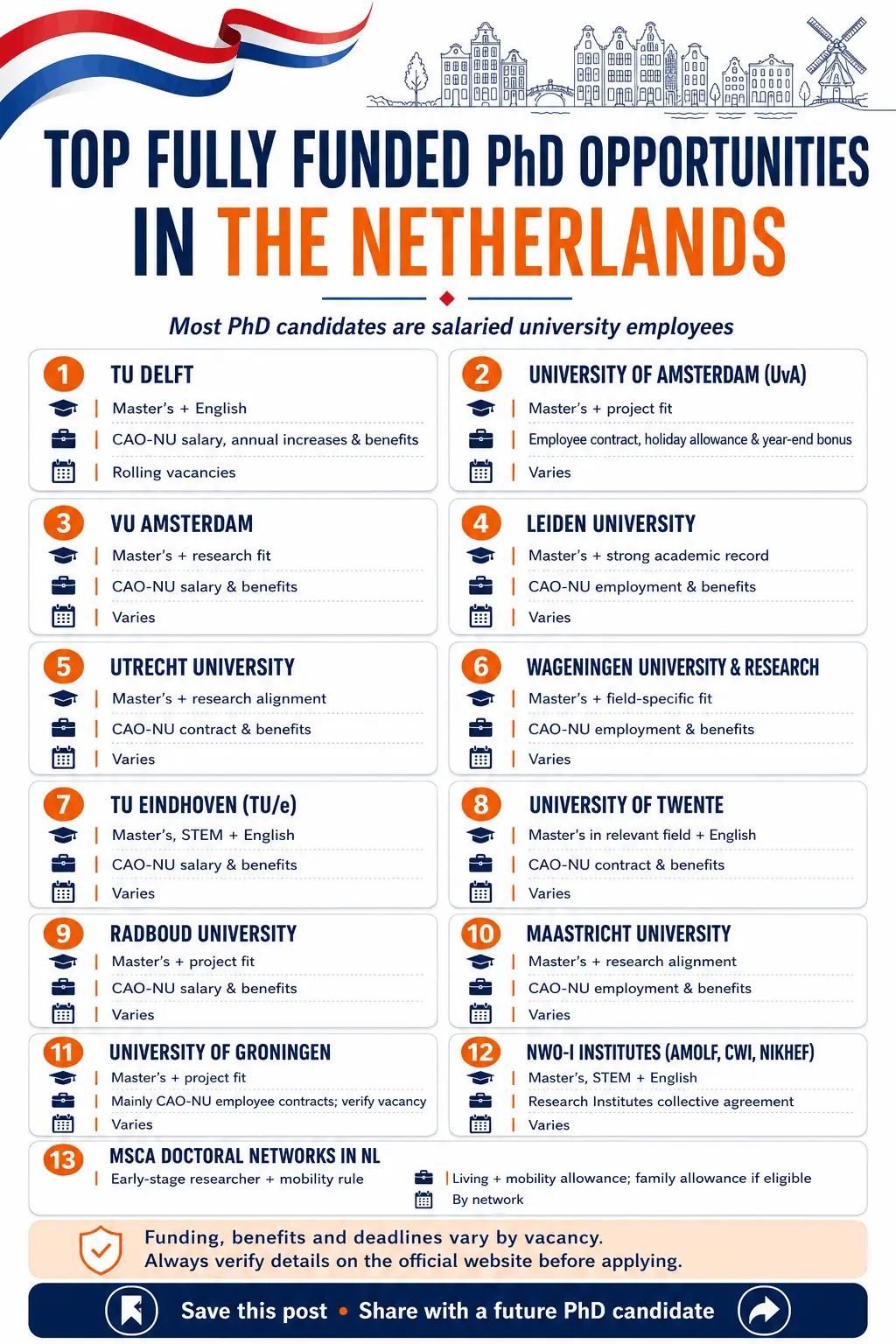
    Top Fully Funded PhD Scholarships in the Netherlands 2027 — Summary Table

    Important: Funding amounts, benefits, and deadlines vary by vacancy and are updated regularly. Always verify details on the official website before applying.

    Fellowship / ProgramHost InstitutionEligibilityFunding / SalaryApplication DeadlineOfficial Link
    PhD Positions (Paid Employment)Delft University of Technology (TU Delft)Master’s in relevant field; English proficiencyFull-time employment per CAO-NU; salary increases annually; benefits + tuition waivedVaries by vacancy (rolling)Official Link
    PhD VacanciesUniversity of Amsterdam (UvA)Master’s/equivalent; project-fit; English proficiencyEmployee contract (CAO-NU); holiday allowance + year-end bonus; tuition waivedVaries by vacancyOfficial Link
    PhD PositionsVrije Universiteit Amsterdam (VU Amsterdam)Master’s; research fit; EnglishCAO-NU salary & benefits; tuition waivedVariesOfficial Link
    PhD VacanciesLeiden UniversityMaster’s; strong academic record; EnglishEmployment per CAO-NU; benefits; tuition waivedVariesOfficial Link
    PhD PositionsUtrecht UniversityMaster’s; research alignment; EnglishCAO-NU contract; benefits; tuition waivedVariesOfficial Link
    PhD VacanciesWageningen University & Research (WUR)Master’s; domain-specific requirements; EnglishCAO-NU employment; benefits; tuition waivedVariesOfficial Link
    PhD PositionsEindhoven University of Technology (TU/e)Master’s; STEM focus; EnglishCAO-NU salary & benefits; tuition waivedVariesOfficial Link
    PhD VacanciesUniversity of TwenteMaster’s; engineering/science/social science; EnglishCAO-NU contract; benefits; tuition waivedVariesOfficial Link
    PhD PositionsRadboud UniversityMaster’s; project fit; EnglishCAO-NU salary & benefits; tuition waivedVariesOfficial Link
    PhD VacanciesMaastricht UniversityMaster’s; English; research alignmentCAO-NU employment; benefits; tuition waivedVariesOfficial Link
    PhD PositionsUniversity of Groningen (UG)Master’s; project fit; EnglishPrimarily employee contracts (CAO-NU) for project-funded PhDs; verify per vacancyVariesOfficial Link
    PhD at NWO Institutes (AMOLF, CWI, Nikhef, etc.)Dutch Research Council (NWO-I) InstitutesMaster’s; STEM; EnglishCollective Labour Agreement for Research InstitutionsVariesOfficial Link
    Marie Skłodowska-Curie Doctoral Networks (Hosted in NL)Various Dutch universities & institutesEarly-stage researchers (0–4 years research exp.); mobility ruleMSCA monthly living + mobility (and family, if eligible); tuition/fees coveredVaries per network; check each callOfficial Link

    Delft University of Technology (TU Delft) — PhD Positions (Paid Employment)

    Overview: TU Delft is a global leader in engineering, architecture, AI, and sustainability. PhD candidates are typically hired on fully funded contracts attached to funded projects or open calls within faculties.

    Funding and Benefits:

    • Full-time employment per CAO-NU with a gross monthly salary that increases annually (exact figures are updated periodically; check each vacancy).
    • 8% holiday allowance, 8.3% year-end bonus, pension, and professional development.
    • Tuition waived; conference/training budgets per project.

    Fully Funded Postdoctoral Fellowships in France 2027

    Eligibility: Master’s degree in a relevant field; strong research fit; English proficiency (institutional or faculty requirements apply).

    Application Process: Apply through the official vacancy; upload CV, motivation, transcripts, references, and, if requested, a brief research statement or portfolio.

    Official Website

    University of Amsterdam (UvA) — PhD Vacancies

    Overview: UvA hosts cutting-edge programs in data science, humanities, law, and social sciences. Most PhDs are employed on research grants or faculty funds.

    Funding and Benefits: CAO-NU salary with annual steps; holiday and year-end bonuses; tuition waived; staff training.

    Eligibility: Master’s degree; English proficiency; project-specific skills.

    Application Process: Submit via the vacancies portal; follow faculty instructions for writing samples and research ideas.

    Official Website

    Vrije Universiteit Amsterdam (VU Amsterdam) — PhD Positions

    Overview: VU offers interdisciplinary research across business, life sciences, computer science, and social impact, with fully funded PhD contracts tied to projects.

    How to Find Fully Funded PhD Positions in Europe (2026)

    Funding and Benefits: Employment per CAO-NU; benefits; travel/conference funding as per project.

    Eligibility: Master’s; English proficiency; alignment with the research group.

    Application Process: Apply through VU’s portal; prepare a tailored motivation letter and referee contacts.

    Official Website

    Leiden University — PhD Vacancies

    Overview: Leiden excels in law, humanities, life sciences, and security studies. Doctoral candidates are commonly contracted employees.

    Funding and Benefits: CAO-NU salary and benefits; tuition waived; faculty-specific training.

    Eligibility: Master’s/equivalent; English proficiency; research match.

    Application Process: Online application per vacancy; some programs may request a research proposal.

    Official Website

    Utrecht University — PhD Positions

    Overview: Known for interdisciplinary strengths in climate, sustainability, and open science, Utrecht regularly advertises fully funded PhD roles.

    Funding and Benefits: CAO-NU contract; salary progression; allowances; tuition waived.

    Eligibility: Master’s; excellent fit to project and group; English requirements apply.

    Application Process: Use the vacancy portal; include CV, motivation, research experience, and references.

    Official Website

    Wageningen University & Research (WUR) — PhD Vacancies

    Overview: WUR leads in agriculture, food sciences, ecology, and environmental research. Most PhDs are funded employment positions within research projects.

    Funding and Benefits: CAO-NU salary and benefits; training via the Wageningen Graduate Schools; tuition waived.

    Australia vs New Zealand for PhD: Costs, Visas, Jobs

    Eligibility: Master’s in a related discipline; English proficiency; lab/field readiness where applicable.

    Application Process: Apply to posted positions or contact supervisors with a focused proposal if a group invites expressions of interest.

    Official Website

    Eindhoven University of Technology (TU/e) — PhD Positions

    Overview: TU/e specializes in engineering, photonics, nano, AI, and high-tech systems. PhD candidates are employees engaged in industry-connected labs.

    Funding and Benefits: CAO-NU employment; benefits; career development; tuition waived.

    Eligibility: Master’s in relevant field; programming/experimental skills as required; English proficiency.

    Application Process: Submit via TU/e portal; prepare a motivation letter targeting the research group.

    Official Website

    University of Twente — PhD Vacancies

    Overview: A hub for mechatronics, materials, ICT, and public policy, Twente offers funded PhD employment with entrepreneurial links.

    Funding and Benefits: CAO-NU salary and allowances; 4-year contracts are common; tuition waived.

    Eligibility: Master’s; strong technical or methodological profile; English proficiency.

    Application Process: Online application; some calls request a short research plan.

    Official Website

    Radboud University — PhD Positions

    Overview: Radboud hosts high-impact research in neuroscience, linguistics, philosophy, and natural sciences, with funded PhD roles across faculties.

    Germany vs Netherlands for PhD in 2026: Costs, Funding, Language, Jobs

    Funding and Benefits: CAO-NU contract; salary progression; benefits; tuition waived.

    Eligibility: Master’s; fit with advertised project; English proficiency.

    Application Process: Apply via vacancies; include CV, letter, transcripts, and references.

    Official Website

    Maastricht University — PhD Vacancies

    Overview: UM is known for problem-based learning and strengths in data science, health, law, and European studies. PhD candidates are employed on projects.

    Funding and Benefits: CAO-NU employment; benefits; tuition waived; international office support.

    Eligibility: Master’s; English; topic alignment.

    Application Process: Use UM Job Board; prepare tailored documents and references.

    Official Website

    University of Groningen (UG) — PhD Positions

    Overview: UG offers funded PhD employment across sciences, engineering, and social sciences. Note: UG also has a separate PhD scholarship track in certain units; verify the funding model in each vacancy.

    Funding and Benefits: For employed PhDs: CAO-NU salary and benefits; tuition waived.

    Eligibility: Master’s; English; research fit.

    Application Process: Apply through the UG portal; follow faculty instructions for proposals or writing samples.

    Official Website

    Dutch Research Council (NWO-I) Institutes — PhD Positions (AMOLF, CWI, Nikhef, etc.)

    Overview: National research institutes offer fully funded PhD employment in physics, photonics (AMOLF), mathematics and computer science (CWI), and particle physics (Nikhef), among others.

    Fully Funded Postdoctoral Fellowships in Germany 2027

    Funding and Benefits: Employment under NWO-I/CAO terms comparable to CAO-NU; salary progression, benefits; tuition/fees covered via partner universities.

    Eligibility: Master’s in a relevant STEM field; strong quantitative skills; English proficiency.

    Application Process: Apply directly to the institute’s vacancy; shortlisted candidates may be matched with university supervisors for enrollment.

    Official Website

    Marie Skłodowska-Curie Doctoral Networks (MSCA-DN) — Hosted in the Netherlands

    Overview: MSCA Doctoral Networks fund international, multi-institution PhD cohorts. Many networks include Dutch universities and institutes as beneficiaries or partners.

    Funding and Benefits:

    • Monthly living allowance plus mobility allowance (and family allowance when applicable), per MSCA rules.
    • Enrollment at host universities; training schools, secondments, and network-wide development.

    Eligibility: Early-stage researchers (0–4 years of research experience at recruitment), not holding a doctoral degree; mobility rule applies (you must not have resided or carried out your main activity in the host country for more than 12 months in the 36 months before recruitment).

    Application Process: Apply to individual network vacancies advertised on EURAXESS or institutional sites; follow project-specific instructions.

    Official Website | MSCA Information

    How to prepare a competitive application

    • Target fit: Tailor your CV and motivation letter to the project’s methods and aims.
    • Evidence of readiness: Highlight publications, theses, code repos, datasets, posters, or lab skills.
    • Contact potential supervisors: If appropriate, email with a concise research pitch and CV.
    • References: Choose referees who can speak to your research independence and technical rigor.
    • Language: Provide IELTS/TOEFL only when explicitly required by the faculty or graduate school.

    Best Countries for PhD After MSc for Indian Students

    Key notes on funding, salaries, and visas

    • Employment and salary: Most Dutch PhD candidates are employees. Salary scales and benefits are set by the Collective Labour Agreement for Dutch Universities (CAO-NU) and are periodically updated. Always check the specific vacancy for current gross monthly salary.
    • Tuition/fees: For employed PhD candidates, tuition is typically waived by the host university.
    • 30% ruling: International scientific researchers recruited from abroad may be eligible for the Dutch 30% tax ruling, subject to conditions and approval by the Dutch Tax and Customs Administration. Consult your HR department.
    • Visas/residence permits: Universities provide immigration support for non-EU candidates. Requirements vary by nationality and employment type; follow official university HR guidance.

    Frequently Asked Questions

    1. Are PhD programs in the Netherlands really fully funded?

      Yes—most PhD candidates are hired as employees on a salary with benefits, and tuition is typically waived. Always verify the specific funding model in each vacancy.

    2. What are typical salaries for PhD candidates?

      Salaries are set by CAO-NU scales and generally increase each year of the contract. Exact gross amounts change over time; consult the vacancy and university HR pages for current figures.

    3. Do I need to contact a supervisor before applying?

      For project-funded positions, you usually apply directly to the posted vacancy. Some open-topic calls or scholarship tracks may encourage contacting a prospective supervisor first.

    4. Is IELTS/TOEFL required?

      Requirements differ by faculty and program. Many positions accept prior degrees taught in English as proof; check the vacancy page.

    5. Can I bring my family?

      Yes, many employed PhD candidates can bring dependents. The university’s HR and immigration teams can advise on procedures and documents.

    6. When do applications open for 2027?

      Vacancies are advertised year-round. Some projects follow grant timelines (spring–autumn). Set alerts on each university’s vacancy portal and EURAXESS.

    7. Are there tuition-based PhD options?

      The Dutch model is predominantly funded employment. If you see scholarship-track or external fellowship-based options, verify funding, social benefits, and supervision structure on the official page.

    Conclusion: Fully Funded PhD Scholarships in the Netherlands 2027

    The opportunities above show why fully funded PhD scholarships in the Netherlands 2027 remain an exceptional path for ambitious researchers. With salaried positions, comprehensive benefits, and internationally recognized research groups, Dutch doctoral training offers both financial stability and academic excellence. Monitor official vacancy portals, tailor your materials to each project, and apply early to maximize your chances.

    About IR Research Publication

    IR Research Publication is a global education and research platform dedicated to helping students, scholars, and professionals discover credible funding opportunities and evidence-based application guidance. We curate up-to-date scholarships, fellowships, and research resources, and share practical writing tips for proposals, SOPs, and academic CVs—so you can focus on advancing impactful research and building your career.

    Related Articles

    Disclaimer: Funding amounts, benefits, eligibility, and deadlines can change. Always verify details on the official university or program website before applying.

  • UK vs Ireland for PhD: Costs, Funding, Visas & Careers

    UK vs Ireland for PhD: Costs, Funding, Visas & Careers

    Introduction

    Choosing between the UK vs Ireland for PhD is a common dilemma for international applicants who want world-class research, English-language programs, and strong post-study work options. Both countries offer excellent supervision, global research networks, and clear pathways into academia or industry. Yet they differ in important ways: costs, funding structures, visa rules, and how research is organized and funded across disciplines.

    Who should read this guide? Prospective PhD applicants weighing the UK against Ireland; master’s students seeking fully funded doctoral places; professionals returning to academia; and anyone prioritizing post-PhD employability, immigration pathways, or specific research strengths (for example, AI, biotech, materials, fintech, or medtech).

    What matters most? Realistic total costs (tuition + fees + living + healthcare), the likelihood of securing full funding, program length, supervisor fit, visa timelines, and post-PhD career routes (Graduate Route vs Stamp 1G, Skilled Worker vs Critical Skills). In this guide you will learn how these variables compare, where each country excels, and how to choose the best fit for your goals.

    How to Find Fully Funded PhD Positions in Europe (2026)

    UK vs Ireland for PhD: Quick Comparison

    Decision factorUnited KingdomIrelandBest fit
    Typical duration3–4 years; traditional PhDs can be 3–3.5 years3–4 years; many structured PhDs run for 4 yearsUK for a potentially shorter, research-first route
    International tuition£20,000–£35,000+ per year; lab/clinical fees and bench fees may apply€13,000–€20,000+ per year; research/material costs may applyIreland for lower headline tuition
    Fully funded optionsBroad range: UKRI DTPs/CDTs, universities, charities and projectsStrong but more targeted: IRC, SFI Centres/CRTs, HRB and industry-linked projectsUK for volume; Ireland for strategic funded fields
    Typical PhD stipendAbout £18,000–£22,000 per year, often tax-freeAbout €18,000–€25,000 per year, often tax-freeCompare stipend against the specific city’s cost of living
    Monthly living costsAbout £900–£1,800; London is the most expensiveAbout €1,100–€2,000; Dublin is the most expensiveSimilar at capital-city level; lower-cost cities matter most
    Healthcare costsStudent visa plus Immigration Health Surcharge (IHS)Private health insurance plus Irish Residence Permit registrationCheck total visa and healthcare costs before deciding
    During-study visaStudent Route; ATAS may be required in selected subjectsLong Stay D visa, followed by Stamp 2 registrationDepends on your subject and personal circumstances
    Part-time workUsually up to 20 hours/week during termUp to 20 hours/week during term; 40 hours in designated holiday periodsBroadly similar
    Post-study workGraduate Route: up to 3 years after a PhDStamp 1G: up to 24 months after a PhDUK for longer job-search flexibility
    Long-term residence routeSkilled Worker commonly leads to ILR after 5 years; Global Talent can be fasterCritical Skills permit can lead to Stamp 4 after 2 yearsIreland for a faster route after securing a qualifying role
    Research strengthsLarger and broader ecosystem across disciplines; strong CDTs and global research networksHigh industry engagement in pharma, biopharma, medtech, ICT, data/AI and materialsUK for breadth; Ireland for industry-linked priority sectors
    Career outlookLarge academic market and diverse industry clustersSmaller market but strong pharma, medtech and multinational tech presenceUK for range; Ireland for targeted sectors

    Bottom line: Choose the UK for the widest choice of supervisors, funded studentships and a 3-year post-study work route. Choose Ireland for lower headline tuition, structured industry-linked PhDs, and a potentially faster transition to long-term residence through Critical Skills employment.

    Important: Figures vary by university, field, and year. Always verify tuition, stipend amounts, fees, and visa rules on official websites before applying.

    Tuition Fees and Total Cost of Study

    United Kingdom

    • International PhD tuition typically ranges from about £20,000 to £35,000+ per year. Laboratory-intensive or clinical programs can be higher.
    • Some departments charge additional bench fees for lab consumables, equipment, or fieldwork. These can add several thousand pounds annually; always confirm with your department.
    • Home (UK) fees are much lower but only apply to eligible students (settled/pre-settled status, or other specific categories).
    • You must also budget for the UK’s Immigration Health Surcharge (IHS) at the discounted student rate (payable per year of visa), plus the visa application fee and potential ATAS clearance for certain sensitive subjects.

    Australia vs New Zealand for PhD: Costs, Visas, Jobs

    Ireland

    • International PhD tuition generally ranges from about €13,000 to €20,000+ per year, with some variation by institution and discipline. Laboratory/clinical fields can be higher.
    • Structured PhDs may include research training modules; check for any additional research costs, materials, or travel.
    • Non-EEA students typically must purchase private medical insurance and pay a registration fee to obtain the Irish Residence Permit (IRP).

    Which is more affordable? Ireland’s headline international tuition can be lower on average, but Dublin’s living costs and private health insurance can offset savings. The UK’s tuition often runs higher, especially at prestigious institutions; however, if you secure a funded studentship covering fees+stipend, your out-of-pocket cost may be minimal in either country. The decisive factor is whether you win full funding.

    Funding Opportunities

    United Kingdom

    • UKRI Studentships: Doctoral Training Partnerships (DTPs) and Centres for Doctoral Training (CDTs) funded by UKRI councils (e.g., EPSRC, MRC, BBSRC, NERC, ESRC, AHRC, STFC). Many now accept international applicants, though competition is strong and quotas may apply.
    • University/Departmental Scholarships: Examples include Clarendon (Oxford), Gates Cambridge (University of Cambridge), and numerous institutional or faculty awards.
    • Charitable/Trust Funding: Cancer Research UK, Wellcome-funded PhD programmes (in participating universities), Leverhulme Trust co-funding, and others.
    • EU and International: Horizon Europe projects and Marie Skłodowska-Curie Doctoral Networks (the UK is associated from 2024), plus country-specific scholarships.
    • Stipends: UKRI minimum stipends change annually; typical stipends are around £18,000–£22,000 per year, with possible London weighting. Stipends are generally tax-free.

    Ireland

    • Irish Research Council (IRC) – Government of Ireland Postgraduate Scholarship: Competitive national award that typically covers fees (often at EU rate; check institutional policy for non-EU fee coverage) plus a stipend. Stipend levels have been increasing in recent budgets; check current IRC call documentation.
    • Science Foundation Ireland (SFI): PhD funding through SFI Centres, Centres for Research Training (CRTs), and investigator-led grants; strong industry-linked themes in ICT, data/AI, materials, and medtech.
    • Health Research Board (HRB), Teagasc, Marine Institute, and other agencies fund domain-specific doctorates.
    • EU and International: Horizon Europe and Marie Skłodowska-Curie Actions (MSCA) remain significant sources; Ireland is an EU member state with full access.
    • Stipends: Commonly ~€18,000–€25,000, depending on funder and discipline. Many awards are tax-free scholarships.

    Which is better? The UK offers a larger volume of studentships across many disciplines, but they are highly competitive. Ireland has fewer positions overall, yet many are fully funded within strategic research areas and can be attractive if your interests align with SFI/IRC priorities. For applicants in AI/data, medtech, and pharma, Ireland’s industry-connected funding can be especially compelling.

    Cost of Living

    United Kingdom

    • London: Typically the most expensive; a single student might budget ~£1,400–£1,800 per month for housing, food, local transport, and incidentals. University accommodations can ease planning but may cost more.
    • Other cities (e.g., Manchester, Glasgow, Leeds, Nottingham): Often ~£900–£1,400 per month, strongly dependent on rent and lifestyle.
    • Official financial requirement for visas (subject to change): Generally around £1,334/month in London and £1,023/month outside London (for up to 9 months of the course) to demonstrate maintenance funds. Verify current figures on gov.uk before applying.

    Ireland

    • Dublin: High rents and living costs. A single student commonly budgets ~€1,500–€2,000 per month inclusive of rent, food, and transport.
    • Other cities (e.g., Cork, Galway, Limerick): Often ~€1,100–€1,600 per month, depending on accommodation and lifestyle.
    • Official financial requirement for visas (subject to change): Non-EEA students are generally asked to show at least €10,000 in living expenses for one academic year, along with proof of paid tuition and private health insurance. Verify current guidance on Irish Immigration Service Delivery (ISD) pages.

    Bottom line: Dublin vs London costs are broadly comparable at the high end; many UK and Irish cities outside the capitals are more affordable. Securing university housing, sharing accommodation, and choosing lower-cost areas can substantially reduce expenses.

    Visa and Immigration Pathways

    United Kingdom

    • Student Route Visa: Requires a Confirmation of Acceptance for Studies (CAS), meeting English and financial requirements, paying the visa fee and the discounted student-rate Immigration Health Surcharge (IHS). Some STEM/dual-use subjects require ATAS clearance before the visa.
    • Dependants: Postgraduate research students (PhD) can generally bring dependants if eligibility criteria are met; check the latest gov.uk rules.
    • Post-Study Work: The Graduate Route provides up to 3 years’ permission after PhD completion; it does not require a sponsoring employer and is not extendable. Time on the Graduate Route typically does not count towards settlement.
    • Long-Term Options: Skilled Worker visa (sponsorship + salary threshold; time counts towards settlement, typically 5 years). Global Talent for outstanding researchers can lead to settlement more quickly (often 3 years). Rules and thresholds change periodically; always consult the latest gov.uk guidance.

    Ireland

    • Long Stay D Visa + Stamp 2: Apply for a long stay study visa, then register in Ireland for Stamp 2 permission (non-EEA). Requires acceptance to a program on the Interim List of Eligible Programmes (ILEP), proof of funds, health insurance, and fee payment.
    • Dependants: Study visas generally do not allow immediate family reunification; dependants typically follow through employment routes. Confirm current policy on Department of Justice/ISD pages.
    • Post-Study Work: The Third Level Graduate Programme (Stamp 1G) allows up to 24 months after a PhD (NFQ Level 10) to seek work.
    • Long-Term Options: Critical Skills Employment Permit (CSEP) offers a fast track to Stamp 4 after 2 years. The General Employment Permit is another route (usually longer to Stamp 4). Student and Stamp 1G periods are generally not reckonable for long-term residence; check exact reckonable residence rules on official sites.

    Which is better? For post-PhD job search time, the UK offers 3 years on the Graduate Route vs Ireland’s 24 months on Stamp 1G. For quicker settlement once employed, Ireland’s Critical Skills route can be faster to Stamp 4 (after 2 years), whereas the UK’s Skilled Worker usually requires 5 years to ILR (unless you qualify for Global Talent).

    Program Structure and Duration

    United Kingdom

    • Many PhDs are 3–4 years, with a strong focus on independent research under a supervisor’s guidance.
    • Some areas use Centres for Doctoral Training (CDTs) or Doctoral Training Partnerships (DTPs) with a 1-year taught or cohort-based training phase followed by 3 years of research (4-year total).
    • Progress reviews, transferable-skills training, and optional teaching duties vary by institution.

    Ireland

    • Structured PhDs (often 4 years) combine research with formal modules in methods, professional skills, and sometimes industry placements.
    • Supervision teams and Graduate Schools are common, with progression reviews and research training plans.
    • Teaching assistantships may be part of the training (varies by discipline and school).

    Which is better? If you prefer a cohort model with explicit training components, Ireland’s structured programs and UK CDTs/DTPs are attractive. If you want to dive directly into independent research, a traditional 3–3.5-year UK PhD may be ideal.

    Research Quality and Opportunities

    United Kingdom

    • Major global research hub with comprehensive disciplinary strength, tracked by national assessments such as the Research Excellence Framework (REF).
    • Strong international collaboration and high publication impact; excellent research infrastructure across leading universities and institutes.
    • Re-associated to Horizon Europe from 2024, restoring access to large EU research consortia and doctoral networks.

    Fully Funded Postdoctoral Fellowships in Germany 2027

    Ireland

    • High-impact in selected strategic domains: ICT/data/AI, pharmaceuticals and bioprocessing, medtech, materials, marine/agri-food, and sustainability.
    • Science Foundation Ireland (SFI) Centres create deep academia–industry ties; many PhDs are embedded in multidisciplinary, applied research contexts.
    • Full participant in Horizon Europe and MSCA Doctoral Networks, offering international mobility and cross-sector training.

    Which is better? For breadth and scale, the UK is hard to beat. For targeted, industry-engaged research with strong EU connectivity, Ireland offers compelling opportunities—especially if your topic aligns with national priority areas.

    Language and Entry Requirements

    United Kingdom

    • English is the language of instruction. Common minimums: IELTS 6.5–7.0 overall (with subscore requirements), TOEFL iBT and PTE equivalents accepted at many universities.
    • Entry usually requires a strong bachelor’s (and/or master’s) degree with research experience and a viable research proposal.

    Ireland

    • English-language instruction across universities. Typical minimums similar to the UK (e.g., IELTS 6.5–7.0 or equivalent), with some program-specific variations.
    • Admission often requires a relevant bachelor’s/master’s and a research proposal aligned with supervisor expertise or a funded project’s scope.

    Tip: Always check department-level requirements, which can be higher than university minima, particularly for competitive programs.

    Application Process and Timelines

    United Kingdom

    • Find a supervisor whose work matches your interests. Many universities expect you to contact potential supervisors with a concise proposal and CV before submitting a formal application.
    • Funding cycles: DTP/CDT deadlines often fall between October and February for entry the following academic year. Self-funded applications can be accepted on a rolling basis.
    • Documents: Research proposal, academic CV, transcripts, references, English test scores (if required), and possibly a personal statement. Some programs may interview.
    • ATAS: Required for certain sensitive subjects for non-UK nationals; must be obtained before the visa stage.

    Ireland

    • Structured calls: Many funded PhD positions are advertised by departments or SFI/IRC projects with specific calls and deadlines.
    • Supervisor-led: It’s common to secure supervisor support first, then apply via the Graduate School or department portal.
    • Documents: Similar to the UK—proposal, CV, references, transcripts, and English proficiency. Interviews are common for funded roles.
    • Visa timing: Non-EEA students should apply for a long stay D visa and plan early for registration on arrival.

    Which is better? Both systems value supervisor fit. If you prefer cohort-based recruitment with clear funding attached to specific topics, Ireland’s structured advertisements (and UK CDTs) are ideal. If you want to pitch your own project to a PI or apply year-round, the UK has more rolling opportunities.

    Fully Funded PhD Scholarships in Germany 2027 | Apply Now

    Career Opportunities After Graduation

    Academic Careers

    • UK: Large ecosystem of postdoctoral and research fellow roles; typical starting salaries for postdocs are often ~£35,000–£45,000 (higher in London or for senior roles), varying by institution and field.
    • Ireland: Postdoc roles follow nationally informed salary scales; many positions start around ~€39,000–€50,000+, depending on level and experience. Availability is concentrated in research-active universities and SFI centres.

    Industry Careers

    • UK: Strong markets in AI/data, fintech, aerospace, automotive, biotech, pharmaceuticals, energy, and consulting. Research-intensive clusters exist around London, the “Golden Triangle” (Oxford–Cambridge–London), and major regional hubs (e.g., Manchester, Edinburgh, Bristol).
    • Ireland: Global leaders in pharma/biopharma (Pfizer, MSD, Janssen, Novartis), medtech (Medtronic, Boston Scientific, Stryker), and ICT (Google, Apple, Intel, Microsoft, Meta). Strong R&D links via SFI centres, often facilitating industry placements and collaborations.

    Visa Pathways

    • UK: PhD graduates use the 3-year Graduate Route to job-hunt, then switch to Skilled Worker (sponsored) or Global Talent (for recognized researchers). Skilled Worker time typically counts towards settlement.
    • Ireland: PhD graduates use Stamp 1G (up to 24 months) to secure employment. The Critical Skills Employment Permit is a fast track to Stamp 4 after 2 years; General Employment Permit usually takes longer for long-term residence eligibility.

    Which is better? If you want maximum time to job-hunt post-PhD, the UK’s 3-year Graduate Route is advantageous. If you’re targeting pharma/medtech or big tech with a goal of earlier long-term residence, Ireland’s Critical Skills pathway can be very attractive once you have a qualifying job offer.

    Fully Funded PhD Opportunities in New Zealand 2026

    Best Universities and Research Institutes

    United Kingdom (examples)

    • University of Oxford; University of Cambridge; Imperial College London; University College London; University of Edinburgh; University of Manchester; King’s College London; University of Bristol; University of Warwick; University of Glasgow.
    • Specialist research organizations and national labs also contribute to doctoral training in partnership with universities.

    Ireland (examples)

    • Trinity College Dublin; University College Dublin; University of Galway; University College Cork; Dublin City University; University of Limerick; Maynooth University.
    • Research institutes and SFI Centres: Tyndall National Institute; ADAPT; Insight (data/AI); CONNECT (communications); SSPC (pharma); I-Form (materials manufacturing); VistaMilk; INFANT; and others.

    Always check the department-level research groups and your prospective supervisor’s recent publications to evaluate lab fit, facilities, and ongoing grants.

    Pros and Cons

    Pros of the UK

    • Large volume of funded studentships across a wide spectrum of fields.
    • 3-year Graduate Route gives more time to find skilled employment.
    • Global research scale and breadth; re-associated to Horizon Europe.
    • Many cities and universities to match budget and research interests.

    Cons of the UK

    • International tuition can be high; bench fees may add costs.
    • Healthcare surcharge (IHS) increases total budget.
    • Graduate Route time typically does not count toward settlement; Skilled Worker thresholds and sponsorship requirements apply.

    Pros of Ireland

    • Strong industry-linked research via SFI Centres; excellent in pharma/medtech/ICT.
    • Many funded PhDs provide fees+stipend; structured training and placements.
    • Critical Skills Employment Permit can lead to Stamp 4 after 2 years.
    • Full participant in Horizon Europe and MSCA Doctoral Networks.

    Cons of Ireland

    • Fewer total PhD positions overall; competition concentrated in priority areas.
    • Dublin living costs are high; private health insurance required.
    • Post-study work permission (Stamp 1G) is up to 24 months, shorter than UK’s 3 years.

    Which Option is Best for You?

    • Students with a limited budget: Prioritize fully funded positions in either country. Ireland may have lower headline tuition, but a funded UK studentship can eliminate fees. Compare total stipends vs city costs.
    • Biomedical/Pharma/Medtech researchers: Ireland’s ecosystem (SFI centres, pharma/medtech clusters) is exceptionally strong. The UK also has excellent biomedical hubs; focus on supervisor fit and lab resources.
    • Engineering and Materials: Both are strong. The UK offers broad options and CDTs; Ireland’s I-Form (materials) and other centres can be ideal for industry-aligned projects.
    • Computer Science/Data/AI: Both countries are excellent. Ireland’s ADAPT/Insight and major tech companies provide strong applied pathways; the UK’s AI hubs and CDTs offer scale and breadth.
    • Long-term immigration goals: UK offers Global Talent and Skilled Worker (5 years to ILR); Ireland’s Critical Skills route can lead to Stamp 4 after 2 years. Choose based on your likelihood of landing a qualifying job and personal circumstances.
    • Academic careers: UK has a larger volume of postdoc and lecturer opportunities. Ireland has strong roles but a smaller market—network early and leverage EU collaborations.
    • Industry careers: UK provides breadth across many sectors; Ireland shines in pharma/biopharma, medtech, and ICT with close industry ties.

    Expert Tips

    • Anchor your decision in supervisor fit: Email potential supervisors with a concise, tailored message and a 1–2 page proposal linked to their recent papers.
    • Apply where funding is strongest: Target DTP/CDTs (UK) and SFI/IRC-funded positions (Ireland). Many projects are pre-funded—apply early.
    • Budget carefully: Add bench fees, visa costs, IHS (UK), private health insurance (Ireland), and moving costs to your spreadsheet.
    • Use official visa guidance: Rules and thresholds change. Confirm maintenance funds, dependants policy, and timelines on gov.uk (UK) and ISD/Department of Justice (Ireland).
    • Leverage EU funding: Look for MSCA Doctoral Networks and Horizon Europe projects in both countries.
    • Plan your post-PhD pathway now: Map Graduate Route vs Stamp 1G, and shortlist employers who sponsor Skilled Worker (UK) or Critical Skills (Ireland).
    • Consider city-level costs: A slightly lower stipend in a cheaper city may stretch further than a higher stipend in a capital.
    • Network: Attend virtual open days, Graduate School webinars, and research group seminars. Ask current PhD students candid questions about workload, culture, and outcomes.
    • Publish and present: Strong research outputs and conference networking improve both academic and industry prospects. For dissemination and visibility, consider reputable platforms like IR Research Publication.

    External Resources (Official)

    Internal Links

    For publishing and sharing your doctoral research, visit IR Research Publication.

    Explore calls for papers, editorial policies, and author services with IR Research Publication.

    Stay updated with research best practices and dissemination tips at IR Research Publication.

    Frequently Asked Questions

    Is the UK or Ireland cheaper for a PhD?

    Ireland often lists lower international tuition on average, but Dublin’s living costs and private health insurance can offset savings. UK tuition is frequently higher, yet funded studentships can cover full fees and stipend. The cheapest option is the one where you secure full funding aligned with an affordable city.

    What is the typical PhD stipend in the UK vs Ireland?

    UK stipends commonly range around £18,000–£22,000 per year (often tax-free; London can be higher). In Ireland, many stipends fall around €18,000–€25,000 per year (often tax-free scholarships). Exact amounts depend on funder, discipline, and year.

    How long does a PhD take in the UK vs Ireland?

    Both typically take 3–4 years. Ireland’s structured programs and UK CDTs are often 4 years; traditional UK PhDs can be 3–3.5 years, sometimes with a writing-up period.

    What post-study work rights do I get?

    UK PhD graduates can usually stay up to 3 years on the Graduate Route. Ireland offers up to 24 months on the Third Level Graduate Programme (Stamp 1G) after PhD completion.

    Which country is better for permanent residency?

    It depends on your job path. In the UK, Skilled Worker typically leads to settlement after 5 years; Global Talent can be faster. In Ireland, the Critical Skills Employment Permit can lead to Stamp 4 after 2 years. Student/graduate periods generally don’t count—verify reckonable residence rules on official sites.

    Are dependants allowed for PhD students?

    In the UK, eligible postgraduate research students (PhD) can generally bring dependants subject to current rules. In Ireland, study visas usually do not allow immediate family reunification; dependants typically follow via employment-based routes. Always check the latest immigration guidance.

    Do I need ATAS clearance?

    ATAS applies to certain subjects in the UK involving advanced technologies with potential military applications. If your course is on the controlled list and you are a non-exempt nationality, you must secure ATAS before your visa. Ireland does not use ATAS.

    Are English tests required?

    Usually yes for non-native speakers. Typical requirements are IELTS 6.5–7.0 or equivalent (TOEFL, PTE). Some universities waive tests for prior degrees taught in English—check departmental policies.

    Can I work during my PhD?

    In both countries, students can usually work part-time up to 20 hours per week during term and more during holidays (Ireland specifies 40 hours in designated periods). Your stipend or visa may include additional conditions—confirm locally.

    Which is better for industry careers: UK or Ireland?

    Both are excellent. The UK has breadth across many sectors. Ireland has particularly strong ecosystems in pharma/biopharma, medtech, and ICT with close industry ties and pathways to Critical Skills permits.

    Conclusion: UK vs Ireland for PhD

    There is no universal “best” choice in the UK vs Ireland for PhD debate—only the best match for your goals and funding prospects.

    • Choose the UK if you value a very large and diverse research ecosystem, want up to 3 years of post-study work time, and can secure a strong studentship (DTP/CDT or institutional award). The UK is ideal if you prioritize breadth of supervisors, centers, and cities.
    • Choose Ireland if your interests align with SFI/IRC priority areas, you prefer structured training with industry links, and you plan to transition quickly into a Critical Skills role that can lead to Stamp 4 after 2 years. Ireland is especially compelling for pharma/biopharma, medtech, and ICT.

    Whichever you select, prioritize supervisor fit, funded positions, and a city you can afford. Confirm visa and financial requirements on official sites and plan early for a smooth start.

    About IR Research Publication

    IR Research Publication is dedicated to advancing global scholarship by helping researchers disseminate high-quality work to the academic community and industry stakeholders. Through accessible publishing, editorial support, and outreach, IR Research Publication empowers doctoral candidates and early-career researchers to increase the visibility, impact, and credibility of their findings. Learn more at irrespub.com.

    Related Articles

  • How to Find Fully Funded PhD Positions in Europe (2026)

    How to Find Fully Funded PhD Positions in Europe (2026)

    Introduction: Why This Guide Matters

    Fully funded PhD positions in Europe offer an exceptional route to develop as a researcher without incurring heavy tuition costs. In many European countries, doctoral candidates are contracted employees with social benefits, while in others, scholarships and stipends cover living expenses and fees. This guide is written for master’s students, graduating seniors, industry professionals switching to research, and postgraduates seeking international doctoral training.

    Common mistakes include applying to the wrong type of funding, missing mobility rules (e.g., MSCA), sending generic emails to supervisors, and underestimating the time needed to prepare documents. Here you’ll learn how to target the right opportunities, make your profile competitive, and confidently navigate applications, interviews, and relocation.

    We provide evidence-based advice, real examples, official resources, and templates you can use immediately to improve your success rate in 2026 application cycles and beyond.

    Fully Funded PhD Scholarships in France 2027 | Apply Now

    Quick Summary Table: How to Find Fully Funded PhD Positions in Europe (2026)

    TopicRecommendationCommon MistakeBest Practice
    Finding positionsStart with EURAXESS, DAAD, FindAPhD, and university job portals.Relying only on social media or unverified job boards.Set alerts on official portals; track positions in a spreadsheet with deadlines.
    Funding typesPrefer salaried contracts; if stipend, verify living costs and fee coverage.Assuming all “fully funded” offers are equal.Request written confirmation of salary/stipend, tuition, and benefits.
    EligibilityCheck degree equivalence, language, and MSCA mobility/experience rules.Ignoring mobility rule and research experience limits.Pre-screen eligibility; ask admissions or HR when unclear.
    DocumentsTailor CV, SOP, proposal, and references to project and PI.Submitting a generic CV/SOP for all programs.Mirror project keywords; quantify achievements; align with lab methods.
    Supervisor contactEmail concise, targeted messages with 1–2 alignment points.Sending long, unfocused messages or mass emails.Attach 2-page CV; cite 1–2 lab papers; propose a small idea or question.
    InterviewsPrepare a 10-minute research pitch and method deep-dives.Over-focusing on grades; under-preparing for technical questions.Practice with mock interviews; prepare to discuss failures and iteration.
    TimelinesBegin 9–12 months early; aim for early deadlines.Starting after calls are posted; missing reference lead times.Create a Gantt-style plan; chase referees politely with clear dates.
    Visas and relocationUse host university’s HR/international office guides early.Assuming visas and housing are automatic.Book visa slots early; secure temporary housing; prepare translated documents.
    BudgetCompare net salary/stipend to city living costs.Overlooking taxes, insurance, and deposit costs.Ask for gross/net breakdown; check university cost-of-living pages.
    Plan BApply across 3–5 countries and funding schemes.Applying to only 1–2 projects in the same month.Stagger applications across cycles; keep improving documents.

    What “Fully Funded PhD Positions in Europe” Means

    In Europe, “fully funded” typically means your tuition/fees are covered and you receive a monthly salary or stipend sufficient to live modestly in the host city. There are two common models:

    Australia vs New Zealand for PhD: Costs, Visas, Jobs

    • Salaried employment (most common in Northern/Western Europe): You are hired as an employee (e.g., PhD candidate/doctoral researcher) with a contract, salary, and benefits (social insurance, pension, paid leave). Examples: Netherlands, Sweden, Denmark, Norway, Finland, Germany (often 50–100% TV-L E13), Switzerland, Belgium, and many MSCA Doctoral Networks.
    • Scholarship or stipend model: You receive a monthly allowance and fee waiver. Common in some programs in France (contrat doctoral is employment; some schools use stipends), Italy, Spain (FPI/FPU contracts are employment; other schemes may be stipends), Portugal (FCT fellowships), Central/Eastern Europe, and certain UK studentships (stipend plus fee coverage).

    Always request written details: salary or stipend amount, indexation over years, fee coverage, insurance, parental leave, teaching loads, and contract duration (usually 3–4 years, up to 5–6 in some countries including the Netherlands or part-time arrangements).

    Where to Find Fully Funded PhD Positions in Europe (Top Portals)

    • EURAXESS Jobs – The EU’s official portal for research jobs and fellowships across Europe. Filter by “PhD Candidate” or “Recognised Researcher,” field, country, and funding.
    • FindAPhD – Comprehensive listings of funded and competition-based PhD positions, especially UK, Ireland, Benelux, DACH, Nordics, and EU networks.
    • DAAD Scholarship Database – Official funding for studies and research in Germany, including structured doctoral programs, research grants, and graduate schools.
    • MSCA Doctoral Networks (DNs) – EU-funded networks recruiting international doctoral candidates. Check network websites or EURAXESS for open positions. Note the mobility rule and early-stage researcher criteria.
    • Nature Careers – Research jobs across Europe, including many top labs and institutes.
    • Academic Positions – Aggregated research and academic vacancies across Europe; filter by “PhD” level.
    • THE UniJobs – Academic jobs including doctoral candidateships, especially in the UK and EU.
    • University portals – Always check the “Jobs,” “Doctoral School,” or “Graduate School” pages of target universities and institutes (e.g., Max Planck, EMBL, ETH Domain).

    Funding Models by Country (2026 Snapshot)

    Funding structures vary significantly. Below is a practical overview (always verify current terms on official pages):

    • Germany: Many PhD candidates are employed on TV-L E13 contracts at 50–100% (part-time or full-time), especially in DFG-funded projects and graduate schools. Others hold DAAD or external scholarships. Fees are generally minimal (semester contributions). See DFG funding and DAAD.
    • Netherlands: PhD candidates are university employees with salaries following national scales (e.g., UFO Scale P). Typical 4-year contracts with annual progression and no tuition fees. See a typical vacancy on AcademicTransfer.
    • Sweden: PhD students are employees with monthly salaries and benefits; tuition fees are generally not charged for doctoral education. See Studera.nu and university HR pages.
    • Denmark: PhD fellows are employees under collective agreements, with salary and pension. Check host universities (e.g., University of Copenhagen PhD).
    • Norway: PhD candidates are employees with full salaries; doctoral education has no tuition fees for employees. See JobbNorge and university HR portals.
    • Finland: Doctoral researchers are often employed, sometimes with mixed funding (projects + grants). Many universities offer salaried Doctoral Researcher posts.
    • France: Doctoral candidates often hold a contrat doctoral (employment) or other funded arrangements. Tuition is modest compared to many countries. See Campus France.
    • Switzerland: PhD candidates are usually employed by universities or institutes (ETH/EPFL/Universities/CERN affiliations), with competitive salaries. See ETH Doctorate and EPFL Doctorate.
    • Belgium: Funding through employment (e.g., doctoral assistant) or scholarships (FWO/FNRS). See FWO and FNRS.
    • Austria: Mixture of employment contracts and stipends; most doctoral candidates in funded projects are employees. See FWF.
    • Ireland: Funded studentships via SFI Centres, IRC (Irish Research Council), and industry co-funding; often stipend + fee coverage. See Irish Research Council and SFI.
    • Spain: Many fully funded via employment contracts (FPI/FPU), others via scholarships. See Agencia Estatal de Investigación.
    • Portugal: FCT fellowships and contracts fund many PhDs; verify fee waivers and insurance. See FCT.
    • Italy: PhD scholarships are common; amounts and fee waivers vary by university and region. See individual university doctoral schools.
    • United Kingdom: UK remains a top destination in Europe with “studentships” (stipend + fee coverage). Check FindAPhD, Jobs.ac.uk, DTP/CDT websites, and university portals.

    Step 1: Define Your Fit and Research Direction

    Before searching, crystalize your research identity and constraints:

    • Field and subfield (e.g., machine learning for healthcare NLP; molecular immunology; sustainable catalysis).
    • Methods you bring (e.g., RCT design, single-cell RNA-seq, finite element modeling).
    • Outputs that prove readiness (thesis, preprints, code repositories, internships, conference posters).
    • Constraints (start date, family, location preferences, language, visa requirements).

    Create a one-page “profile brief” to guide your search and outreach.

    Step 2: Learn Eligibility and Rules That Can Disqualify You

    • Degree requirements: Most programs require a master’s (or 4–5-year integrated degree). Some allow direct PhD entry from bachelor’s in STEM with exceptional records (e.g., Netherlands, UK, select Germany tracks).
    • Language: English suffices for most STEM PhDs. For programs taught in local languages, check DSH/TestDaF (Germany), TCF/DELF-DALF (France), etc.
    • MSCA Doctoral Networks: You must have less than 4 years of full-time equivalent research experience and not have lived/studied in the host country for more than 12 months in the last 36 months before recruitment.
    • Work status: For employee-based PhDs, you must meet employment and visa rules; for scholarship-based, check residency/taxation impacts.
    • GRE/GMAT: Rarely required in Europe; verify for specific schools.

    Highest-Paying Postdoctoral Fellowships Worldwide (2026)

    Step 3: Source Positions Systematically

    1. Set alerts on EURAXESS, FindAPhD, Academic Positions, and Nature Careers.
    2. List target universities and institutes; subscribe to their vacancy newsletters.
    3. Track deadlines in a spreadsheet: portal, project title, PI, requirements, documents, referee status, and submission URL.
    4. Check MSCA DN consortium pages for each network you’re interested in; positions may be posted on multiple partner sites.

    Step 4: Shortlist by Funding Security and Fit

    Consider:

    • Contract vs stipend: Employment contracts generally offer higher stability and benefits.
    • Fee policy: Ensure full fee waiver for international students if not an employee.
    • Cost-of-living match: Compare monthly net income to local living expenses using university guides.
    • Supervisor track record: Review recent publications, completed PhD supervisions, funding stability, and alumni outcomes.

    USA vs Canada for PhD: Best Choice for Indian Students in 2026

    Step 5: Prepare Core Documents that Win Interviews

    • Academic CV (2–3 pages): Results-focused, with quantifiable outputs.
    • Statement of Purpose/Motivation (1–2 pages): Your research trajectory, fit, and why this lab/program now.
    • Research Proposal (2–5 pages if requested): For open-topic programs or scholarships; project-defined roles need a targeted idea sketch.
    • References: 2–3 academic/industry referees who can attest to your research ability and independence.
    • Transcripts and certificates: Official or certified copies with English translations if needed.
    • Language proof: IELTS/TOEFL or local tests where required; ask about waivers if you studied in English.

    Sample Email to a Potential Supervisor (Cold Outreach)

    Subject: Prospective PhD applicant for [Project/Area] — alignment with your recent work on [Keyword]

    Dear Dr./Prof. [Surname],

    I am a [your degree and institution, graduation year], focusing on [your methods/area]. Your recent paper on [title or keyword, year/journal] aligns closely with my master’s thesis on [topic], where I [1–2 quantified results, e.g., developed a [model/method] that improved [metric] by X%].

    I noticed your group is working on [specific project or call; include link/reference ID if applicable]. I would be keen to contribute to [specific aim or method], particularly [concrete idea or question]. I have attached a 2-page CV and a short summary of my thesis.

    Would it be possible to schedule a 15-minute call to discuss potential PhD openings or whether my profile would be competitive for [program/grant, e.g., MSCA DN “NAME”]?

    Thank you for your time and consideration.

    Kind regards,
    [Full Name] | [Current role]
    [Institution] | [City, Country]
    [Email] | [LinkedIn/Website/ORCID/GitHub]

    Academic CV Example (Structure)

    • Header: Name, email, website/ORCID, location.
    • Research Interests: 3–5 bullet points with methods and application domains.
    • Education: Degrees with thesis title, advisors, GPA (if strong), dates.
    • Publications: Peer-reviewed, preprints, conference abstracts; provide DOIs/links.
    • Research Experience: Projects, role, outcomes (data/code/papers), tools used.
    • Teaching/Leadership: TA roles, workshops, mentoring.
    • Awards/Grants: Scholarships, travel grants, distinctions.
    • Skills: Methods, programming, instruments, languages (CEFR levels).

    SOP/Motivation Letter Outline

    1. Opening hook: Your research problem and why it matters.
    2. Background: 2–3 achievements showing readiness (quantify impact).
    3. Fit: Why this PI/program/network; cite 1–2 recent papers or facilities.
    4. Future project: A brief, feasible idea aligned with the call.
    5. Training plan: Methods you will learn; collaborations/secondments.
    6. Closing: Career aims and contribution to the host’s mission.

    Research Proposal Skeleton (If Requested)

    1. Title and Keywords
    2. Problem Statement and Significance
    3. State of the Art (with 5–10 key references)
    4. Research Questions/Hypotheses
    5. Methodology (datasets, instruments, analysis plan; risks and mitigation)
    6. Work Plan and Timeline (Gantt blocks: WP1–WP4)
    7. Expected Outcomes (papers, code, prototypes, policy impact)
    8. Ethics and Data Management (GDPR, open data/code plan)
    9. References (consistent citation style)

    Cover Letter Template for an Advertised PhD Post

    Dear Hiring Committee/Dr. [Surname],

    I am applying for the PhD position “[Title/Ref]” at [University/Institute]. My background in [methods/field] and my thesis on [topic] position me to contribute immediately to [project objective]. In my recent project, I [key accomplishment with metric].

    I am particularly drawn to your lab’s work on [cite 1–2 papers/facilities] and the opportunity to [training/secondment if MSCA/industry link]. I have attached my CV, transcripts, and a brief proposal aligned with [work package or aim].

    Thank you for considering my application. I look forward to the possibility of discussing how I can support [group/program] in achieving [goal].

    Sincerely,
    [Full Name]

    Typical Interview Questions

    • Explain your thesis contribution in 3–5 minutes. What was novel?
    • Walk us through a failed experiment and what you changed.
    • Which methods will you need to learn for this project, and how?
    • How would you design an experiment to test [project-specific hypothesis]?
    • How do you plan your time and manage multiple deadlines?
    • What do you expect from supervision, and how do you handle feedback?

    Step 6: Apply with Precision

    • Match every eligibility criterion and keyword from the advert.
    • Upload documents in the requested order and format; name files consistently (Lastname_Firstname_DocType.pdf).
    • Get references early. Provide your referees a one-page brief with deadlines, advert link, and your highlights.
    • For MSCA DN posts, address mobility rule and early-stage researcher status explicitly in your cover letter.

    Fully Funded PhD Scholarships in Germany 2027 | Apply Now

    Step 7: Ace the Interview and Mini-Task

    • Prepare a 10-minute slide deck: background, 1–2 key results, methods, and fit with the advertised project.
    • Practice deep technical questions and quick whiteboard derivations or code pseudo-logic.
    • Be ready to discuss data management, reproducibility, and ethics (GDPR, human subjects, animal use, biosafety).
    • Ask practical questions: supervision structure, coursework, teaching load, secondments, preliminary milestones.

    Step 8: Visas, Residence, and Relocation

    Once you receive an offer, coordinate with the host’s HR/international office. In most EU/EEA countries, PhD employees receive a researcher or employee residence permit under national rules aligned with Directive (EU) 2016/801. The UK and Switzerland have separate routes.

    • Request official invitation/contract, health insurance details, and enrollment documents for visas.
    • Book visa appointments early; some consulates have long waiting times.
    • Bring legalized/apostilled diplomas and certified translations.
    • Secure short-term housing for arrival; ask for university housing support.

    Step 9: Budgeting and Cost of Living

    Confirm whether you are on a salary (gross vs net, tax class) or stipend (taxable or not). Compare to city living costs:

    • High cost: Zurich, Geneva, Oslo, Copenhagen, Stockholm, Amsterdam, Paris center, Munich.
    • Moderate: Berlin, Lyon, Porto, Valencia, Leuven, Utrecht.
    • Lower: Smaller university towns (e.g., Uppsala outskirts, Ghent, Jena, Brno, Padua).

    Ask HR for an estimated net salary for your family/visa status and check university cost-of-living pages. Consider deposits, initial furniture, residence permit fees, and winter clothing if applicable.

    Step 10: Enrollment and Onboarding

    • Complete university matriculation and doctoral school requirements (coursework/credits vary by country).
    • Confirm supervision agreement, Individual Study Plan (ISP), and probation milestones.
    • Attend research integrity and safety trainings early.
    • Register with local authorities (residence, tax, health insurance) as required.

    Expert Tips

    • Target labs before positions open: share a 1-page idea and ask if they plan to recruit in the next 6–12 months.
    • Preprint your strongest work. A preprint plus code repository often outweighs an extra course grade.
    • For MSCA DNs, highlight your international mobility story and how you meet the 12-in-36 rule in a dedicated paragraph.
    • If you lack a method, propose a concrete learning plan with resources, expected timeline, and a mini-project to demonstrate progress.
    • Leverage summer schools and short-term RA roles at target institutions to build relationships ahead of calls.
    • Ask for a lab rotator call or trial task when possible; it can fast-track mutual fit.
    • Keep an achievement log (weekly). It makes CV updates and interviews significantly easier.
    • Request a salary ladder and promotion steps (yearly increments) in writing for employment contracts.
    • Join departmental seminars and network online; many hires arise from conference or webinar conversations.
    • Apply in waves. Use early rejections to refine materials for later deadlines.

    Common Mistakes to Avoid

    1. Ignoring eligibility fine print: Overlooking mobility rules (MSCA), degree equivalence, or language proofs can auto-reject your application.
    2. Using a generic CV/SOP: Recruiters skim for fit. Tailor keywords, methods, and outcomes to the advert and lab’s publications.
    3. Underselling outcomes: Listing tasks without results (e.g., “worked on X”) lacks impact. Quantify improvements, datasets built, or citations.
    4. Late referee requests: References often decide rankings. Give referees at least 3 weeks with your brief and the advert link.
    5. Overlooking cost of living: A stipend that looks high on paper may be insufficient in cities like Zurich or Paris.
    6. Assuming “fully funded” means identical benefits: Employment contracts vs stipends differ in taxes, insurance, parental leave, and pensions.
    7. Weak email outreach: Lengthy, unfocused emails without a clear ask rarely get replies.
    8. No portfolio: Without a code repo, data story, or preprint, committees struggle to gauge research independence.
    9. Poor interview structure: Rambling presentations and no concrete method discussion are red flags.
    10. Not verifying tuition/fee waivers: Some scholarships don’t fully cover international fees—always confirm in writing.
    11. Applying to too few countries/schemes: Increases risk of a gap year. Diversify (e.g., Germany, Netherlands, Nordics, France, MSCA DNs, UK studentships).
    12. Neglecting data ethics and reproducibility: Many panels now score this—be ready with a data/code management plan.

    Useful Resources (Official)

    Frequently Asked Questions

    1) What counts as “fully funded PhD positions in Europe”?

    It generally means your tuition is covered and you receive a salary or stipend sufficient for living costs. Many countries hire PhD candidates as employees with contracts, benefits, and no tuition fees. Others offer scholarships with stipends and fee waivers.

    2) Do I need a master’s degree to apply?

    Usually yes, but some programs (especially in the Netherlands, UK, and select German tracks) admit exceptional candidates directly from a bachelor’s into a long PhD or integrated program. Always check the specific eligibility rules.

    3) Is IELTS/TOEFL mandatory?

    For English-medium programs, many universities require proof of English proficiency, though waivers are common if prior degrees were taught in English. For local-language programs, you may need tests like DSH/TestDaF (German) or TCF/DELF (French).

    4) Are there tuition fees for PhD candidates?

    In many European countries, employed PhD candidates do not pay tuition. Where tuition exists, funded studentships typically cover it. Always confirm fee waivers in writing for non-employee scholarships.

    5) What are typical salaries/stipends?

    They vary widely. Employee contracts in Northern/Western Europe often range roughly from €2,000 to €4,000 gross per month (country- and scale-dependent), with social benefits. Stipends in some regions may be lower; verify local living costs.

    6) What is the MSCA mobility rule?

    For Marie Skłodowska-Curie Doctoral Networks, you must not have lived or had your main activity in the host country for more than 12 months in the 36 months prior to recruitment, and you must be an early-stage researcher (no PhD, under 4 years of research experience).

    7) Can I bring my family?

    Many countries allow dependents to accompany you, especially if you are employed. Check your host’s HR guidance and national immigration websites for family reunification rules and timelines.

    8) When should I start preparing for 2026 intakes?

    Start 9–12 months early. For example, begin in early 2025: shortlist labs, prepare documents, and contact referees so you can apply immediately when calls open.

    9) Are application fees common?

    Application fees are uncommon for advertised, project-funded PhD jobs. Some structured programs may charge small application fees—verify on the program website.

    10) How many applications should I send?

    Apply broadly and strategically: 8–15 well-targeted applications across 3–5 countries/funding schemes typically maximize your interview chances without diluting quality.

    Conclusion: Your 90-Day Action Plan

    Fully funded PhD positions in Europe are attainable with a structured approach. In the next 90 days, do the following:

    1. Create your one-page profile brief and update a 2–3 page, results-focused CV.
    2. Set EURAXESS/FindAPhD alerts; track 20–30 leads in a spreadsheet.
    3. Email 8–12 potential supervisors with targeted notes and a concise ask.
    4. Draft a reusable SOP and a 2–4 page research idea that you can tailor quickly.
    5. Line up referees early; provide them your brief and deadlines.

    By preparing early and applying precisely, you can secure one of the many competitive, fully funded PhD positions in Europe and start your research career on strong financial and academic footing.

    About IR Research Publication

    IR Research Publication is dedicated to empowering researchers and students with reliable guidance, tools, and publishing opportunities. We promote rigorous, ethical scholarship and open knowledge-sharing through practical resources, author support, and communities that help you plan studies, write stronger manuscripts, and advance your research career.

    Related Articles

  • Fully Funded PhD Scholarships in France 2027 | Apply Now

    Fully Funded PhD Scholarships in France 2027 | Apply Now

    Introduction: Fully Funded PhD Scholarships in France 2027

    France offers a rich ecosystem of fully funded PhD scholarships and doctoral employment contracts for 2027 across STEM, social sciences, arts, and humanities. The opportunities below are designed for high-potential researchers (both EU and non-EU) who hold a Master’s degree (or equivalent) and want to pursue cutting-edge research within world-class laboratories and industry partners.

    Applicants should consider France if they value:

    • Internationally competitive funding with social benefits under employment contracts.
    • Access to top research infrastructures at universities, Grandes Écoles, and national labs (CNRS, Inria, CEA, Institut Pasteur, etc.).
    • Cross-sector pathways, including industry-embedded doctorates (CIFRE) and EU-funded networks (MSCA).
    • Vibrant scientific communities in Paris, Grenoble, Bordeaux, Lyon, Lille, Marseille, and beyond.

    Below you’ll find a verified list of programs, expected funding features, typical timelines, and official links to confirm each 2027 call. Where exact amounts or dates are not yet published for 2027, we indicate the usual cycles and advise checking the official websites.

    Quick Summary Table: Fully Funded PhD Scholarships in France 2027

    Tip: Deadlines for 2027 intakes generally appear from late 2026 to early 2027. Always verify on the official page.

    Fellowship / ProgramHost InstitutionEligibilityFunding / SalaryApplication DeadlineOfficial Link
    Eiffel Excellence Scholarship (Doctoral)French HEIs via Campus FranceAge ≤ 35 at time of application; international candidatesMonthly allowance €2,100 + travel/insurance; 12–36 monthsTypically Jan (institutional nominations start in Oct–Dec)Campus France
    MSCA Doctoral Networks (positions in France)EU consortia incl. French hostsEarly-stage researchers (no PhD at recruitment)Horizon Europe allowances (living + mobility + family, if eligible)EU call usually closes in Q4; project-level deadlines varyEuropean Commission
    CIFRE Industrial PhDCompany + University lab (France)Master’s or equivalent; enrollment in French doctoral schoolFull-time employment contract; ANRT subsidy to companyRolling intake; apply year-roundANRT CIFRE
    French Doctoral Contract (Contrat doctoral)Public universities / Doctoral schoolsAdmission to a doctoral school; selection by meritSalary set by national decree; 3-year full-time contractVaries by doctoral school (often spring–summer)Campus France – PhD Funding
    Inria PhD PositionsInria Research Centers (nationwide)Master’s or equivalent in CS, math, AI, etc.Fixed-term employment with competitive public-research salaryCalls typically open Q1–Q2Inria
    CNRS Doctoral PositionsCNRS laboratories + universitiesMaster’s or equivalent; selection via lab/doctoral schoolFunded contracts via CNRS/projects; full social benefitsBy project; usually spring–summerCNRS
    CEA (Atomic Energy Commission) PhD ThesesCEA centers (e.g., Saclay, Grenoble)Master’s or equivalent; background matches project3-year funded positions; employee statusOffers often published Q1–Q2CEA
    Institut Pasteur – PPU International PhD ProgramInstitut Pasteur + Paris universitiesInternational students with Master’s/equivalent3-year salary contract; training & travel supportTypical calls open in Q3–Q4Institut Pasteur
    Université Paris-Saclay – PhD FundingUniversité Paris-SaclayAdmission to a doctoral school; competitive selectionDoctoral contracts; potential additional grantsVaries by doctoral schoolParis-Saclay
    Sorbonne University – Doctoral FundingSorbonne UniversityEnrollment in a Sorbonne doctoral schoolDoctoral contracts, projects, external grantsProgram-specificSorbonne University
    Université Grenoble Alpes – PhD FundingUGAAdmission to UGA doctoral schoolDoctoral contracts; regional/national grantsVaries (often spring)UGA Doctorate
    Institut Polytechnique de Paris (IP Paris) – PhDIP Paris (Polytechnique, Télécom Paris, etc.)Master’s/equivalent; competitive selectionFunded doctoral contracts; research/teaching optionsBy lab/doctoral schoolIP Paris
    PSL – QLife PhD FellowshipsPSL University – QLife InstituteInternational graduates in life sciences/quantitative fields3-year PhD fellowships; training & networkingTypically annual callsQLife (PSL)
    Aix-Marseille University – Doctoral FundingAMU – Doctoral CollegeAdmission to AMU doctoral schoolDoctoral contracts; lab/project-funded positionsVaries by schoolAMU Doctoral College

    Eiffel Excellence Scholarship (Doctoral Component)

    Overview: The Eiffel Program, administered by Campus France on behalf of the French Ministry for Europe and Foreign Affairs, funds top international candidates to pursue doctoral research in France under co-supervision or joint supervision (cotutelle). French higher education institutions (HEIs) submit nominations.

    Funding and Benefits:

    • Monthly allowance of €2,100 for PhD candidates.
    • International travel, health insurance, and cultural activities.
    • Funding duration typically 12 to 36 months depending on the doctoral plan.

    Eligibility:

    • Non-French nationality (exceptions possible for binational applicants under conditions).
    • Age limit: generally up to 35 years for the doctoral track (verify the current call).
    • Candidates cannot apply directly; they must be nominated by a French HEI.

    USA vs Canada for PhD: Best Choice for Indian Students in 2026

    Application Process:

    1. Identify a French host lab/supervisor and agree on a research project.
    2. Request nomination from the French institution (internal deadlines typically in Oct–Dec).
    3. Institution submits to Campus France; national deadline is typically in January.

    Official Website

    MSCA Doctoral Networks (Positions Hosted in France)

    Overview: Marie Skłodowska-Curie Actions (MSCA) fund international doctoral training consortia across Europe. Many networks include French universities, Grandes Écoles, and national labs, offering fully funded positions for early-stage researchers.

    Funding and Benefits:

    • Horizon Europe allowances: a living allowance (base €3,400/month), mobility allowance (€600/month), and a family allowance (€660/month if eligible), subject to country correction coefficients and employer costs per MSCA rules.
    • Full social security coverage through employment contracts.
    • Secondments, advanced training, and strong career development.

    Best Countries for PhD After MSc for Indian Students

    Eligibility:

    • No prior PhD at the time of recruitment.
    • Mobility rule: must not have resided or carried out main activity in the host country for more than 12 months in the 36 months before recruitment (check project-specific conditions).

    Application Process:

    1. Search active DN vacancies listing French hosts.
    2. Apply directly to the project with required documents (CV, transcripts, research statement, references).
    3. Interviews and selection by the consortium.

    Official Website

    CIFRE Industrial PhD (ANRT)

    Overview: The CIFRE scheme funds tri-partite PhDs between a company in France, a public research lab, and a doctoral school. The doctoral candidate is employed by the company while conducting research leading to a PhD.

    Funding and Benefits:

    • Full-time employment contract with the company (typically 36 months).
    • Company receives an annual ANRT subsidy (indicatively €14,000/year for three years under recent frameworks); salary is paid by the employer.
    • Industrial experience and strong career outcomes.

    Eligibility:

    • Master’s degree or equivalent.
    • Agreement between company, academic lab, and doctoral school.
    • Open to all nationalities; visa/residence permits apply for non-EU candidates.

    Fully Funded PhD Scholarships in Germany 2027 | Apply Now

    Application Process:

    1. Secure a host company and an academic lab willing to co-supervise.
    2. Assemble the CIFRE dossier (project, supervision, funding plan) and submit to ANRT.
    3. Upon approval, sign the employment contract and enroll in the doctoral school.

    Official Website

    French Doctoral Contract (Contrat doctoral)

    Overview: The standard French doctoral funding mechanism is a 3-year full-time employment contract issued by a doctoral school/university or via project funding. It is open across disciplines and available at most public institutions.

    Funding and Benefits:

    • Salary determined by ministerial decree and institutional scales; includes social security.
    • Optional teaching/transfer activities may add remuneration.
    • Typical duration: 36 months.

    Eligibility:

    • Admission to a French doctoral school and selection for a funded position.
    • Master’s degree or equivalent; strong research proposal.

    Application Process:

    1. Identify a doctoral school and prospective supervisor.
    2. Apply for a thesis topic and funding line (university, regional, national, EU, industry).
    3. Complete institutional recruitment steps (interview, committee evaluation).

    Official Information

    Inria PhD Positions

    Overview: Inria is France’s national institute for research in digital science and technology. It offers fully funded PhD positions across AI, machine learning, robotics, security, formal methods, computational biology, and more.

    Funding and Benefits:

    • Fixed-term employment with competitive public-research salary scales.
    • Access to state-of-the-art computing facilities and interdisciplinary teams.
    • Professional development and mobility options.

    Fully Funded PhD Opportunities in New Zealand 2026

    Eligibility: Master’s (or equivalent) in a relevant field; selection based on academic merit and fit with the project/team.

    Application Process:

    1. Browse advertised PhD topics on Inria’s portal.
    2. Apply online with CV, transcripts, references, and motivation/research statement.
    3. Interviews and selection by the research team and doctoral school.

    Official Website

    CNRS Doctoral Positions

    Overview: The CNRS is France’s largest public research organization, co-hosting PhD candidates within joint research units with universities. Many positions are funded through national/international projects.

    Funding and Benefits:

    • Employment contracts in accordance with public-research salary scales.
    • World-class infrastructure and collaborations.
    • Training via doctoral schools and CNRS platforms.

    Eligibility: Master’s or equivalent; selection by the hosting lab and doctoral school.

    Application Process:

    1. Identify labs and projects aligned with your interests.
    2. Contact potential supervisors and monitor lab/university postings.
    3. Complete application via the host institution’s process.

    Official Website

    CEA PhD Theses (French Alternative Energies & Atomic Energy Commission)

    Overview: The CEA conducts research in energy, climate, defense, materials, health technologies, and digital systems. It offers fully funded PhD theses across its centers.

    Funding and Benefits:

    • Three-year funded PhD positions with employee status and social benefits.
    • Access to large-scale scientific facilities and industry partnerships.

    Eligibility: Master’s degree/equivalent; alignment with the advertised topic; security clearance may apply in specific domains.

    QS World University Rankings 2027 Released: MIT’s Historic Streak, Asia’s Rise, and the Global Top 20

    Application Process:

    1. Search CEA’s thesis offers by site and discipline.
    2. Apply online; shortlisted candidates are interviewed by the hosting unit.
    3. Enroll in a partner university’s doctoral school.

    Official Website

    Institut Pasteur – Pasteur-Paris University (PPU) International Doctoral Program

    Overview: The PPU program trains outstanding international PhD students in biomedical sciences within Institut Pasteur’s laboratories and partner universities in Paris.

    Funding and Benefits:

    • Three-year salaried PhD contract.
    • Advanced coursework, lab rotations (as applicable), and conference/travel support.

    Eligibility: Strong academic record in life sciences or related fields; English proficiency; selection by international committee.

    Application Process:

    1. Review PPU call and available host labs.
    2. Submit online application with CV, transcripts, references, and project preferences.
    3. Interviews with selection panels and labs.

    Official Website

    Université Paris-Saclay – Funding Your PhD

    Overview: Paris-Saclay hosts multiple doctoral schools across science and engineering, life sciences, social sciences, and humanities. Funding is typically offered through doctoral contracts and research projects.

    Funding and Benefits:

    • Doctoral contracts (3 years), possible co-funding (ANR, EU, industry).
    • Research training, transferable skills, and innovation programs.

    Fully Funded Postdoctoral Fellowships in New Zealand 2026

    Eligibility: Admission to a Paris-Saclay doctoral school; selection on research merit and funding availability.

    Application Process:

    1. Identify a doctoral school and thesis subject.
    2. Apply for funding via the doctoral school or project calls.
    3. Formal recruitment and enrollment.

    Official Website

    Sorbonne University – Doctoral College Funding

    Overview: Sorbonne University’s Doctoral College coordinates dozens of doctoral schools, with funding through university contracts, labs, national agencies, and international programs.

    Funding and Benefits:

    • Fully funded doctoral contracts and project-based positions.
    • Training seminars, career development, and mobility opportunities.

    Eligibility: Master’s degree/equivalent; acceptance by a doctoral school and supervisor.

    Application Process:

    1. Identify a doctoral school and potential supervisor.
    2. Apply to open thesis topics and funding streams.
    3. Complete recruitment and enrollment procedures.

    Official Website

    Université Grenoble Alpes – Financing a PhD

    Overview: UGA provides comprehensive information on doctoral funding sources: university contracts, regional/national grants, EU projects, and industry partnerships.

    Funding and Benefits:

    • Standard doctoral contracts with full social coverage.
    • Access to top-tier labs in the Grenoble innovation ecosystem.

    Eligibility: Acceptance by a UGA doctoral school; strong academic profile.

    Fully Funded Postdoc Positions in Switzerland for Indian Researchers: 2026 Opportunities and Application Guide

    Application Process:

    1. Explore doctoral school calls and lab topics.
    2. Apply with research proposal and references.
    3. Interview and enrollment upon selection.

    Official Website

    Institut Polytechnique de Paris (IP Paris) – PhD

    Overview: IP Paris (École Polytechnique, Télécom Paris, Télécom SudParis, ENSTA Paris, ENSAE Paris) recruits funded PhD candidates across engineering, computer science, physics, economics, and more.

    Funding and Benefits:

    • Three-year funded doctoral contracts; teaching options may be available.
    • International environment with strong industry links.

    Eligibility: Master’s or equivalent; competitive selection by labs/doctoral schools.

    Application Process:

    1. Search PhD topics and contact supervisors.
    2. Submit application via IP Paris or host lab portal.
    3. Selection and enrollment in the doctoral school.

    Official Website

    PSL – QLife PhD Fellowships

    Overview: QLife (PSL University) supports interdisciplinary PhDs at the interface of quantitative sciences and life sciences, hosted in PSL labs.

    Funding and Benefits:

    • Fully funded, three-year fellowships.
    • Training in quantitative biology, seminars, and network activities.

    Eligibility: Strong background in life sciences, physics, computer science, mathematics, or related fields.

    Application Process:

    1. Review annual call and eligible host teams.
    2. Apply online with CV, transcripts, references, and research interests.
    3. Interview and final selection by committee.

    Official Website

    Aix-Marseille University – Doctoral Funding

    Overview: AMU’s Doctoral College centralizes information on doctoral contracts and other funding sources across multiple disciplines.

    Funding and Benefits:

    • Three-year doctoral contracts; potential co-funding via projects.
    • Interdisciplinary training and career services.

    Eligibility: Admission to an AMU doctoral school; selection through competitive calls.

    Application Process:

    1. Contact potential supervisors and explore doctoral school calls.
    2. Submit application materials as requested by the program.
    3. Undergo interviews/committee review and enroll upon selection.

    Official Website

    How to Apply: Step-by-Step Guide for 2027

    • Define your topic: Draft a concise research statement (1–2 pages) and identify 3–5 prospective supervisors/labs in France.
    • Contact supervisors early: Email a tailored message with your CV, transcripts, and research pitch. Ask about 2027 funding lines (Eiffel, doctoral contracts, MSCA, CIFRE, CEA, etc.).
    • Choose the right scheme: If you’re targeting the Eiffel doctoral track, you must be nominated by a French institution. For MSCA, apply directly to advertised network positions. For CIFRE, secure a company partner.
    • Prepare documents: CV, degree certificates, transcripts, publications, English/French proficiency proof (if requested), and letters of recommendation. A solid research proposal is often decisive.
    • Respect timelines: Many 2027 positions will be advertised from late 2026 to mid-2027. Eiffel nominations typically start Oct–Dec, with a national deadline around January (verify the official call).
    • Polish your writing: A clear, hypothesis-driven proposal and a strong personal statement help your file stand out. For tips on research writing and dissemination, see resources from IR Research Publication.

    Key Notes on Funding and Stipends

    • Eiffel (Doctoral): €2,100 monthly allowance + travel/insurance; 12–36 months. Verify the latest call for any updates.
    • MSCA Doctoral Networks: Horizon Europe allowances include living, mobility, and (if eligible) family components; amounts follow EU rules and country coefficients.
    • French Doctoral Contracts: Salary levels are set by national decree and institutional policies; confirm the current gross/month with the host doctoral school.
    • CIFRE: You are an employee of the partner company; ANRT provides a subsidy to the employer. Actual salary is set by the company and the employment contract.

    If a program has not yet published the 2027 call or exact amounts, consult the official website linked above for the most current information before applying.

    Frequently Asked Questions

    • Are these PhD scholarships in France fully funded?
      Yes. The listed programs offer either scholarships (e.g., Eiffel) or full employment contracts (doctoral contracts, MSCA DN, CIFRE, Inria, CEA, CNRS), which cover your living costs and provide social benefits. Always verify the specific offer.
    • Do I need French language proficiency?
      Many PhD programs in France operate in English, particularly in STEM. However, individual labs or doctoral schools may require French or recommend it for integration and teaching duties. Check each call.
    • What is the typical duration of a PhD in France?
      Most doctoral contracts are for 36 months (3 years). Extensions may occur depending on the project, funding, and institutional rules.
    • Can I apply directly to the Eiffel Excellence Scholarship?
      No. You must be nominated by a French higher education institution. Contact potential supervisors early so the institution can consider your nomination.
    • When do 2027 calls open?
      Many positions will be posted from late 2026 through mid-2027. The Eiffel call usually opens in autumn with a deadline around January. MSCA DN vacancies appear after EU project awards, often in the first half of the following year.
    • Is IELTS/TOEFL required?
      Language requirements vary. Many programs accept IELTS/TOEFL for English-taught research. Provide whatever language proof your host doctoral school requests.
    • Can I work in industry during my PhD?
      Yes. The CIFRE scheme is specifically designed for industry-embedded PhDs. Some academic contracts also allow collaborations and secondments with companies.

    Conclusion: Fully Funded PhD Scholarships in France 2027

    Fully Funded PhD Scholarships in France 2027 span government-backed schemes (Eiffel, CIFRE), EU-funded networks (MSCA), and salaried doctoral contracts at France’s premier universities and research organizations. Use the official links above to verify current amounts, eligibility, and deadlines, and begin contacting supervisors well ahead of the calls. With careful planning and a strong proposal, you can secure an excellent, fully funded research pathway in France’s world-class scientific ecosystem.

    About IR Research Publication

    IR Research Publication is a scholarly platform dedicated to advancing high-impact research across disciplines. We support researchers with credible resources, peer-reviewed outlets, and practical guidance for publishing, disseminating, and communicating science. Explore calls, journals, and author guides to strengthen your academic profile and research visibility.

    Internal Resources and Application Support

    Related Articles

  • Australia vs New Zealand for PhD: Costs, Visas, Jobs

    Australia vs New Zealand for PhD: Costs, Visas, Jobs

    Introduction

    Students often compare Australia vs New Zealand for PhD study because both countries are English-speaking, research-driven, highly ranked, and offer strong post-study work and immigration pathways. Yet the two options differ in cost structures, funding mechanisms, research scale, and labor markets.

    This guide is for international master’s graduates, early-career researchers, and industry professionals targeting a research doctorate. It’s especially useful if you’re deciding where to apply, how much funding you’ll need, and which visa and employment pathways fit your long-term goals.

    Key factors to weigh include tuition and stipend funding, cost of living, supervisor and lab fit, national research strengths, visa rules, post-study work, and realistic career prospects. You’ll learn how each system works, the trade-offs, and how to improve your chances of securing scholarships and jobs.

    Australia vs New Zealand for PhD: Quick Comparison

    Criterion Australia New Zealand
    Tuition Fees (International) Commonly AUD 28,000–45,000/year if self-funded; many scholarships fully waive tuition via RTP-equivalent awards. University-specific rates vary. International PhD students typically pay domestic fees if studying in NZ (policy across all 8 universities). Domestic PhD fees often ~NZD 7,000–10,000/year; frequently covered by scholarships.
    Funding Availability Robust national and university funding (RTP-equivalent scholarships, ARC/NHMRC projects). Highly competitive at top universities; many stipends are tax-free. Strong doctoral scholarships (e.g., University of Auckland, Otago, VUW) that cover domestic-rate tuition + stipend. Smaller system; competitive but fewer applicants per award in some fields.
    Living Cost (Single Student) Government financial capacity benchmark: from May 2024 at least ~AUD 29,710/year (~AUD 2,475/month). Major-city costs can exceed this. Immigration NZ benchmark: ~NZD 20,000/year (~NZD 1,667/month). Big cities (Auckland/Wellington) often higher.
    Typical Monthly Stipend About AUD 2,750–3,350/month tax-free (annual ~AUD 33,000–40,000) at research-intensive universities; amounts vary by institution. About NZD 2,400–2,900/month tax-free (annual ~NZD 29,000–35,000) depending on university scholarship.
    Visa Process Student visa (subclass 500) with Genuine Student requirement; OSHC insurance required. Post-study: Temporary Graduate (subclass 485) typically 3 years for PhD; possible regional extensions. Student Visa with proof of funds and insurance. Post-study: Open Work Visa up to 3 years for PhD graduates.
    Permanent Residency (PR) Opportunities Multiple skilled and employer-sponsored pathways (e.g., subclasses 189, 190, 186, 491→191). PhD can aid points and employability. Skilled Migrant Category (points-based), Green List routes, employer sponsorship. PhD is recognized in points and skill frameworks.
    Research Quality and Scale Large research ecosystem; extensive infrastructure; wide field coverage; many globally top-ranked universities. High-quality system with 8 universities; strong niches (earthquake engineering, agriculture, ecology, Antarctic research, Māori and Pacific studies).
    Top Universities ANU, Melbourne, Sydney, UNSW, UQ, Monash, Adelaide, UWA, etc. Auckland, Otago, Victoria University of Wellington, Canterbury, Massey, Waikato, Lincoln, AUT.
    Language Requirements Typically IELTS 6.5–7.0 or equivalent; higher in some disciplines. Similar: typically IELTS 6.5–7.0 or equivalent; varies by program.
    Job Opportunities Large academic and industry sectors (mining, energy, med-tech, fintech, AI, defense, agri-tech, biotech). Competition at top metros. Smaller but dynamic market; strong in geotech, primary industries, med/health sciences, data, renewables. Fewer roles, tighter networks.
    Average Completion Time 3–4 years full-time; scholarships commonly 3.5–4 years. 3–4 years full-time; scholarships commonly 3–4 years.
    International Student Friendliness Extensive support services; large international communities in all major cities. Highly supportive; smaller cohorts and close supervision in many departments.

    Funding Opportunities

    Both countries offer competitive funding, but mechanisms and typical award sizes differ.

    Australia

    Most international PhD candidates target university-administered, government-backed Research Training Program (RTP)-equivalent scholarships. These usually include a tuition fee offset and a living stipend that is generally tax-free. Typical stipends at research-intensive universities range around AUD 33,000–40,000 per year depending on the institution and project.

    • Examples: University of Sydney Research Training Program/University Scholarship lists a stipend in the ~AUD 40,000/year range; University of Melbourne and ANU also offer competitive stipends around ~AUD 36,000–37,000+ per year. Amounts are indexed and vary by year and institution.
    • Project funding often comes via national councils such as the Australian Research Council (ARC) and National Health and Medical Research Council (NHMRC).

    Official resources:

    New Zealand

    New Zealand’s standout feature is that international PhD candidates typically pay domestic-rate tuition if they live in New Zealand and their research is primarily conducted there. Most doctoral scholarships cover the domestic tuition fee plus a stipend. Typical annual stipends fall roughly in the NZD 29,000–35,000 range.

    • Examples: University of Auckland Doctoral Scholarship (tuition at domestic rate + stipend ~NZD 30,000); University of Otago Doctoral Scholarship (tuition + stipend, often above NZD 30,000); Victoria University of Wellington Doctoral Scholarship (tuition + stipend around the high-20s to low-30s thousands).

    Official resources:

    Advantages and Disadvantages

    • Australia – Advantages: Larger pool of funded supervisors and major grants; higher top-end stipends at some universities; broad field coverage.
    • Australia – Disadvantages: Tuition can be high if unfunded; scholarship competition is intense at Group of Eight (Go8) universities.
    • New Zealand – Advantages: Domestic-rate tuition for international PhDs; many doctoral scholarships waive tuition entirely; closer supervisory contact in smaller departments.
    • New Zealand – Disadvantages: Fewer total positions and projects; niche fields may have limited capacity.

    Which is better? If you need a guaranteed tuition waiver and prefer a smaller, close-knit research environment, New Zealand is attractive. If you want access to a large research ecosystem, multiple large grants, and potentially higher stipends at top institutions, Australia often wins—provided you secure funding.

    Research Opportunities

    Australia

    Australia’s research landscape is large and internationally connected. You’ll find world-class labs across STEM, medicine, social sciences, and humanities. Strategic strengths include medical and health sciences, data science/AI, energy and minerals, climate and marine science, agriculture and biosecurity, and defense/aerospace. Beyond ARC and NHMRC, collaborative structures like Cooperative Research Centres (CRCs) align academia with industry.

    New Zealand

    New Zealand punches above its weight in specific niches: earthquake engineering and geoscience, agriculture and food science, ecology and conservation biology, Antarctic and Southern Ocean research, renewable energy, and indigenous (Māori and Pacific) studies. The system’s size fosters close collaboration and mentorship, which many doctoral candidates value.

    Major Funding Agencies

    Which is better? For breadth and scale, Australia. For targeted strengths (e.g., seismic engineering, ecology) and a tight mentorship model, New Zealand is compelling.

    Cost of Living

    Australia

    The Australian Government’s student visa financial capacity requirement increased in 2024 to at least AUD 29,710 per year for living costs. Actual spending in Sydney, Melbourne, or Brisbane can exceed this depending on rent and lifestyle.

    • Indicative monthly costs (major cities): AUD 2,200–3,000 for shared housing, transport, food, utilities, and incidentals. Single-student studios or central locations cost more.
    • Health insurance: Overseas Student Health Cover (OSHC) is mandatory for student visa holders.

    Official resources:

    New Zealand

    Immigration New Zealand’s living cost benchmark for tertiary students is generally NZD 20,000 per year. Auckland and Wellington are pricier than smaller cities like Christchurch or Dunedin.

    • Indicative monthly costs (Auckland/Wellington): NZD 1,800–2,600 for shared housing, transport, food, utilities, and incidentals.
    • Insurance: Most universities require approved medical and travel insurance for international students.

    Official resources:

    Which is better? On baseline requirements, New Zealand often looks cheaper. However, stipends also differ by currency and level. Always build a city-specific budget and compare net stipend after likely rent.

    Visa Process and Post-Study Work

    Australia

    • Student visa (subclass 500): Requires Genuine Student (GS) criterion, English proficiency, financial capacity, and OSHC. See official guidance.
    • Post-study work: PhD graduates are typically eligible for the Temporary Graduate visa (subclass 485, Post-Study Work stream) of about 3 years; additional regional extensions of 1–2 years may apply if you studied and lived in eligible regional areas. See official 485 information.

    New Zealand

    • Student Visa: Requires an offer of place, sufficient funds (generally NZD 20,000/year), and approved insurance. See Immigration NZ.
    • Post-study work: PhD graduates can usually obtain a Post-study Work Visa for up to 3 years with open work rights. See official post-study work information.

    Which is better? For PhD holders, both offer around 3 years of post-study work. Australia’s regional incentives may extend stay length; New Zealand’s open work visa simplifies employer changes.

    Permanent Residency Opportunities

    Australia

    PhD graduates pursue skilled or employer-sponsored pathways. Common routes include Skilled Independent (subclass 189), Skilled Nominated (190), Employer Nomination Scheme (186), and regional pathways (491 leading to 191). A completed Australian qualification can help with points and employability, but eligibility depends on occupation lists, skills assessments, English, and current policy settings.

    Official resources:

    New Zealand

    Key routes include the Skilled Migrant Category Resident Visa (points-based) and Green List pathways for designated occupations, along with employer-assisted residence from an Accredited Employer Work Visa (AEWV). A PhD is favorably recognized under qualification frameworks, but eligibility still hinges on occupation, earnings thresholds, and points.

    Official resources:

    Which is better? It depends on your occupation and where you find employment. Both systems favor in-demand skills and higher-earning roles.

    Career Opportunities After Graduation

    Academic Careers

    • Australia: Larger university sector and research institutes mean more total openings for postdocs and teaching/research fellows, especially in major metros. Competition remains strong and often requires publications, grant activity, and teaching experience. Typical academic salary bands vary by institution and level, with superannuation benefits common.
    • New Zealand: Fewer positions but a tight-knit community can accelerate visibility. Strong niches (e.g., geosciences, ecology) may offer targeted roles. Competitive publication and grant records are essential.

    Industry Careers

    • Australia: Substantial demand in mining/resources, med-tech and pharmaceuticals, biotech, agri-tech, fintech, AI/data science, cybersecurity, and defense/aerospace. Large private R&D labs and government agencies (e.g., CSIRO) broaden options.
    • New Zealand: Growing opportunities in agri-food, environmental tech, data and digital, renewable energy, and niche deep-tech startups. Networks matter; internships and industry-linked projects help.

    Visa Pathways and Salaries

    Post-study work periods (~3 years) in both countries give time to build a local track record. Employer sponsorship can be pivotal. Salary levels are generally higher in Australia in absolute terms, but costs are also higher in major cities. Always assess real take-home relative to rent and transport in your specific city.

    Which is better? For sheer breadth of roles and corporate R&D, Australia. For targeted niches aligned with NZ’s strengths and a balanced lifestyle, New Zealand.

    Best Universities

    Australia

    • Australian National University (ANU)
    • University of Melbourne
    • University of Sydney
    • University of New South Wales (UNSW Sydney)
    • University of Queensland (UQ)
    • Monash University
    • University of Adelaide
    • University of Western Australia (UWA)

    Rankings vary by discipline, but multiple Australian universities appear high in global rankings (QS, THE). Always check department-level performance, supervisor fit, and lab resources.

    New Zealand

    • University of Auckland
    • University of Otago
    • Victoria University of Wellington
    • University of Canterbury
    • Massey University
    • University of Waikato
    • Lincoln University
    • Auckland University of Technology (AUT)

    New Zealand’s eight public universities are all research-active and internationally ranked; strengths often cluster by field.

    Official ranking resources:

    Application Process

    Similarities

    • Identify potential supervisors and align your proposal with lab and departmental priorities.
    • Prepare a strong research proposal, CV, academic transcripts, publications (if any), and references.
    • Demonstrate English proficiency (IELTS/TOEFL), unless exempted by prior qualifications in English.

    Australia

    • Many programs require supervisor agreement prior to offer; scholarship rounds are typically 1–2 times per year (some rolling intakes exist).
    • For scholarships, competitive metrics include publications, research experience, awards, and fit with funded projects.
    • Check university pages for RTP-equivalent scholarship deadlines and documentary requirements.

    New Zealand

    • Supervisor match is critical; most universities operate centralized doctoral scholarship rounds.
    • Because international PhDs pay domestic fees, universities carefully match candidates to available supervision and research capacity.
    • Funding often includes tuition waiver + stipend; timing and rounds vary by university.

    Actionable tip: Email supervisors first with a concise, evidence-based pitch (one page + CV). Tailor to ongoing grants and published work. Ask about available funding and start dates.

    Language Requirements

    Most universities in both countries set a baseline of IELTS 6.5–7.0 overall (with minimum band scores) or equivalent TOEFL iBT/PTE scores. Some disciplines (e.g., law, education, health) may require higher bands. Exemptions can apply for prior study in English; check institutional policy pages.

    Pros and Cons

    Pros of Australia

    • Large, diversified research ecosystem with substantial national funding.
    • Higher top-end stipends at leading universities in some fields.
    • Broader industry R&D and more total academic openings.
    • Multiple PR pathways and regional incentives.

    Pros of New Zealand

    • International PhDs pay domestic-rate tuition; many scholarships fully cover tuition.
    • Supportive, smaller cohorts and close supervisor engagement.
    • Strong niche strengths (earthquake engineering, ecology, agri-food, Antarctic research).
    • Open 3-year post-study work visa for PhD graduates.

    Cons of Australia

    • High tuition if unfunded; competitive scholarships at top institutions.
    • Higher living costs in major metros.
    • Visa and migration settings change periodically; must monitor occupation lists.

    Cons of New Zealand

    • Smaller job market; fewer total academic and industry roles.
    • Niche capacity can limit options if your field is not a national strength.
    • Fewer large-scale facilities compared with Australia.

    Which Option is Best for You?

    • Students with limited budgets: New Zealand often wins due to domestic-rate tuition for international PhDs and scholarships that cover fees plus stipend.
    • Biomedical researchers: Australia’s scale, hospitals, medical institutes, and NHMRC-backed labs can offer more options; NZ still offers quality training with HRC-backed projects.
    • Engineering students: For mining, energy, defense/aerospace, and large infrastructure, Australia; for earthquake engineering and geotech, New Zealand is globally respected.
    • Long-term immigration goals: Both work; choose the market where your occupation is in demand. Australia offers multiple skilled and employer-sponsored routes; NZ has Skilled Migrant and Green List pathways.
    • Industry careers: Australia’s corporate R&D and sector breadth are advantageous. NZ suits those targeting agri-tech, environmental tech, and select deep-tech niches.
    • Academic careers: Australia has more total openings but higher competition. NZ offers strong mentorship and visibility in smaller systems.

    Bottom line: Choose the ecosystem that best fits your field’s strengths and your funding chances. For many budget-conscious candidates, New Zealand’s domestic-rate PhD is hard to beat; for scale and breadth, Australia shines.

    Expert Tips

    • Start with the supervisor, not the country. A well-matched mentor and funded project often outweigh small cost differences.
    • Apply to multiple universities across both countries to maximize scholarship odds. Tailor your proposal to active grants.
    • Budget in local currency. Compare net stipend after rent and transport in your target city.
    • Check official immigration pages every few months. Policy updates can affect post-study work and PR timing.
    • Use department seminars or online talks to build rapport before applying. Ask about lab resources and project deliverables.
    • Secure strong references that speak to research independence, methods, and publication potential.
    • Demonstrate impact: link your proposal to national research priorities (e.g., health, climate, advanced manufacturing).
    • Plan publications early with your supervisor: set milestones for first-year outputs and conference presentations.

    External Resources (Official)

    Internal Links

    Frequently Asked Questions

    1) Is Australia or New Zealand cheaper for a PhD?

    Often New Zealand, because international PhD students usually pay domestic-rate tuition and many scholarships cover fees plus a stipend. However, costs vary by city and housing. In Australia, scholarships frequently waive tuition and offer competitive stipends; without funding, Australia is usually more expensive.

    2) What are typical PhD stipends in Australia vs New Zealand?

    Australia: commonly around AUD 33,000–40,000/year tax-free at research-intensive universities. New Zealand: commonly around NZD 29,000–35,000/year tax-free. Exact figures depend on the institution, discipline, and year.

    3) How long does a PhD take in each country?

    Typically 3–4 years full-time in both Australia and New Zealand. Many scholarships fund 3.5–4 years in Australia and 3–4 years in New Zealand.

    4) What are the English language requirements?

    Most programs require IELTS 6.5–7.0 (or equivalent TOEFL/PTE), with minimum sub-scores. Some disciplines need higher scores. Exemptions may apply for prior English-medium study.

    5) What post-study work rights do PhD graduates have?

    Australia: generally 3 years via the Temporary Graduate (subclass 485) visa, with possible regional extensions. New Zealand: up to 3 years open Post-study Work Visa for PhD graduates.

    6) Can a PhD help with permanent residency?

    Yes, in both countries, but PR depends on occupation demand, points, earnings thresholds, English, and other requirements. Review Australia’s skilled and employer-sponsored pathways and New Zealand’s Skilled Migrant and Green List routes for current criteria.

    7) Which is better for engineering research?

    Australia offers broad engineering options and industry links (mining, energy, aerospace). New Zealand is world-class in earthquake engineering and geotech. Choose based on project fit and supervisor.

    8) Which is better for life sciences and medicine?

    Australia has a larger biomedical ecosystem with hospitals and NHMRC-backed institutes, creating more lab options. New Zealand provides strong training environments, especially aligned with HRC and niche strengths. Supervisor and facility match should drive your choice.

    9) Do international PhD students in New Zealand really pay domestic fees?

    Yes, provided you reside in New Zealand and your research is primarily conducted there (policy is applied across NZ’s eight universities). Always check the latest university policy for details.

    10) How should I improve my scholarship chances?

    Secure supervisor support early, tailor your proposal to funded projects and national priorities, highlight publications and methods expertise, and apply to multiple institutions across both countries.

    Conclusion: Australia vs New Zealand for PhD

    Both destinations are excellent for doctoral study. Australia offers scale, breadth of labs and grants, and broad industry R&D—ideal if you secure a strong scholarship and want diverse career options. New Zealand offers domestic-rate tuition for international PhDs, scholarships that often cover fees and living costs, and closer supervisory support—ideal for budget-conscious candidates and those targeting NZ’s research niches.

    • Choose Australia if you want a large ecosystem, higher top-end stipends at leading universities, and wider industry pathways across multiple sectors.
    • Choose New Zealand if you value domestic-rate tuition, strong chances of a tuition-waiver scholarship, close mentorship, and strengths in earthquake engineering, ecology, agri-food, or Antarctic research.

    In short, the best choice in the Australia vs New Zealand for PhD decision depends on supervisor fit, funding security, city-level costs, and where your field has the strongest labs and employment demand.

    About IR Research Publication

    IR Research Publication is dedicated to helping scholars, students, and professionals advance their academic and research careers. We share practical guidance on publishing, proposal development, scholarships, and career strategy—bridging research excellence with real-world impact. Explore curated insights, templates, and resources to strengthen every stage of your research journey.

    Related Articles

  • Germany vs Netherlands for PhD in 2026: Costs, Funding, Language, Jobs

    Germany vs Netherlands for PhD in 2026: Costs, Funding, Language, Jobs

    Introduction: Why compare Germany vs Netherlands for PhD?

    Germany vs Netherlands for PhD is a common comparison for international researchers because both countries are research powerhouses in Europe, offer a large number of English-language doctoral projects, and provide internationally recognized training. Yet their models differ in crucial ways that affect your finances, supervision, and career outcomes.

    This guide is for master’s graduates, early-career researchers, and professionals considering a European doctorate. It is also useful for academic advisors and parents who want a precise, unbiased overview.

    The factors that usually matter most include funding model and salary, tuition and living costs, research culture and supervision, program structure and duration, visa/residence rules, language expectations, and post-PhD job opportunities (both academic and industry).

    In the next sections, you’ll learn how each country handles admissions, the realities of stipends and employment contracts, where each country excels by discipline, how to budget realistically, and what the immigration and career pathways look like after graduation—backed by official sources where possible.

    Key takeaways at a glance

    • Funding model: The Netherlands typically employs PhD candidates as full-time staff with a salary and benefits; Germany mixes salaried researcher contracts, scholarships, and some self-funded paths with very low or no tuition.
    • Tuition: Public universities in Germany usually charge no tuition for PhD (only small semester fees). In the Netherlands, employee-PhDs don’t pay tuition; external/self-funded PhDs may pay substantial tuition depending on the university.
    • Living costs: Expect moderate-to-high costs in both countries, typically higher in Dutch urban centers like Amsterdam, Utrecht, and Delft.
    • Language: Many PhDs run in English in both countries; local language may be essential for clinical or patient-facing research.
    • Post-PhD jobs: Both have strong academic and industry ecosystems; the Netherlands often provides structured development and a clear 4-year timeline, while Germany offers broad institute networks (Max Planck, Helmholtz, Fraunhofer) and an 18-month job-search period for graduates.

    Quick comparison table: Germany vs Netherlands for PhD

    Criterion Germany Netherlands
    Tuition Fees Usually no tuition at public universities for PhD; small semester contribution (€250–€350/semester varies). External/self-funded routes exist but are less common. Employee-PhDs typically pay no tuition; external/self-funded PhDs may pay tuition (often €10,000–€20,000+/year depending on university/program).
    Funding Availability Common: salaried doctoral researcher contracts (TV-L E13 at 50–100% FTE), scholarships (e.g., DAAD), DFG-funded projects, EU MSCA/ERC funding. Most PhD positions are paid employment under the Dutch Collective Labour Agreement (CAO-NU). External scholarships also possible (NWO, EU MSCA/ERC, national programs).
    Living Cost Approx. €900–€1,200/month in many cities; higher in Munich, Frankfurt, Hamburg, Berlin. Check university city specifics. Approx. €1,100–€1,600/month; higher in Amsterdam, Utrecht, Delft, Rotterdam.
    Monthly Stipend/Salary Salaried positions vary by state and %FTE under TV-L E13; scholarships like DAAD are commonly around €1,200+/month (plus benefits). Exact amounts vary. PhD employees earn a monthly salary per CAO-NU (scale P); typical gross range ~€2,700–€3,500/month over the 4-year contract (varies by university and year).
    Visa Process National visa (D) for study or research; employees typically receive a residence permit as a researcher/employee. Financial proof needed for student visas without salary. Universities usually sponsor employee PhDs; external/self-funded follow student/researcher routes. Clear processes via IND; orientation year (12-month) after graduation.
    Permanent Residency Opportunities Common route: permanent residence generally after 5 years of legal residence; Blue Card holders may qualify sooner under certain conditions. Permanent residence generally after 5 years of continuous legal residence plus integration requirements.
    Research Quality Extensive institute networks (Max Planck, Helmholtz, Fraunhofer, Leibniz) and strong universities across STEM, life sciences, and humanities. Highly ranked universities with strengths in engineering, life sciences, social sciences, and agriculture (e.g., TU Delft, Wageningen, Leiden, UvA, Utrecht).
    Top Universities LMU Munich, TUM, Heidelberg, RWTH Aachen, KIT, Humboldt, FU Berlin, Bonn, Freiburg, Göttingen; plus Max Planck and Helmholtz centers. TU Delft, Wageningen, Leiden, University of Amsterdam, Utrecht, Groningen, Eindhoven, Erasmus Rotterdam, Radboud, Maastricht, VU Amsterdam.
    Language Requirements Many PhDs offered in English; German helps for integration and is essential for some clinical or fieldwork roles. Most PhDs run fully in English; Dutch needed mainly for patient-facing or public-facing roles.
    Job Opportunities Strong academic and industry sectors; notable in automotive, chemicals, pharma/biotech, AI, manufacturing, and green tech. Excellent industry links, especially in semiconductors, high-tech systems, agriculture/food, water, and health sciences.
    Average Completion Time Typically 3–5 years, depending on funding model and discipline. Typically 4 years (standard full-time employment contract).
    International Student Friendliness Very high; wide English use in academia and strong international communities in major cities. Very high; widespread English proficiency and structured doctoral training environments.

    Funding Opportunities

    How funding works in Germany

    Germany offers a mixed system. Many PhD candidates hold paid positions as research staff (Wissenschaftliche Mitarbeitende) funded by externally won grants (often DFG or EU) or institute budgets. These are typically TV-L E13 contracts at 50–100% FTE (hours and pay percentage vary by project and state). Other candidates are funded by competitive scholarships such as DAAD, foundation scholarships (e.g., Konrad Adenauer, Heinrich Böll), or EU Marie Skłodowska-Curie Actions. Tuition at public universities is usually zero for PhDs, with only semester contributions.

    Useful links:

    How funding works in the Netherlands

    The Netherlands often employs PhD candidates as university staff on a 4-year contract with a salary and benefits (pension, paid leave), covered by the Collective Labour Agreement for Dutch Universities (CAO-NU), salary scale P. Some universities also host external/self-funded PhDs who bring their own funding (e.g., national scholarships) and, in those cases, tuition may apply.

    Useful links:

    Advantages

    • Germany: No/low tuition at public universities; many salaried researcher posts; large number of foundations and DFG-funded projects; DAAD is globally recognized.
    • Netherlands: Clear employee status with salary and benefits for most PhDs; structured career development and training; predictable 4-year funding horizon.

    Disadvantages

    • Germany: Funding model varies by supervisor and state; if on a scholarship, social benefits can be limited; contract percentages (e.g., 50–75%) affect take-home pay.
    • Netherlands: Employee-PhD positions are competitive; external/self-funded routes may incur significant tuition; cost of living is relatively high in major Dutch cities.

    Which is better?

    If you prioritize an employee contract with a predictable 4-year salary and benefits, the Netherlands tends to be better. If you value zero tuition, immense institute networks, and diverse funding sources (including scholarships), Germany offers excellent breadth—with the caveat that compensation and contracts vary.

    Research Opportunities and Strengths

    Germany

    Germany hosts some of the world’s strongest non-university research networks and graduate schools. The Max Planck Society focuses on basic science, Helmholtz Centers emphasize large-scale applied research (e.g., energy, health, aerospace), Fraunhofer specializes in industry-facing applied R&D, and Leibniz covers a broad spectrum. Universities such as LMU Munich, TUM, Heidelberg, RWTH Aachen, and KIT are consistently well-regarded. Funding is abundant in STEM, life sciences, and increasingly in AI and sustainability.

    Key agencies and infrastructures:

    Netherlands

    The Netherlands punches above its weight in high-tech systems, microelectronics/semiconductors, photonics, water management, sustainable energy, agriculture and food (WUR), data science/AI, and health sciences. Universities such as TU Delft, Wageningen, Leiden, Amsterdam (UvA & VU), Utrecht, Groningen, Eindhoven, and Erasmus Rotterdam are active in European consortia and industry collaborations.

    Key agencies and infrastructures:

    Advantages

    • Germany: Scale and diversity of research institutes; breadth across disciplines; strong EU project participation; powerful applied research network (Fraunhofer).
    • Netherlands: Tight integration with industry and societal challenges; strong project management culture; high supervisor accessibility; excellent research training frameworks.

    Disadvantages

    • Germany: Heterogeneity—quality of supervision and structure can vary by chair/department; navigation may be more decentralized.
    • Netherlands: Smaller system may have fewer total positions; highly competitive environment for certain fields.

    Which is better?

    For large research infrastructures and extensive institute ecosystems, Germany leads. For structured programs with strong industry links and project clarity, the Netherlands often feels more streamlined.

    Cost of Living and Budgeting

    Living costs depend heavily on city, housing, and lifestyle.

    Germany

    • Typical monthly budget: €900–€1,200 in many cities; expect higher in Munich, Frankfurt, Hamburg, and central Berlin.
    • Semester contributions (for public transport and admin) of ~€250–€350/semester are common.
    • Reference: Study in Germany (official) provides up-to-date guidance on costs.

    Netherlands

    • Typical monthly budget: €1,100–€1,600, with Amsterdam, Utrecht, Delft, and Rotterdam at the higher end.
    • Employee-PhDs earn a salary and may access housing assistance or university housing services; availability is competitive.
    • Reference: Study in NL (official) outlines typical living costs for international students.

    Actionable budgeting tips

    • Apply early for university housing and compare neighborhoods carefully.
    • Leverage student/employee discounts for transport and insurance.
    • In Germany, check whether your semester contribution includes a transport pass.
    • In the Netherlands, calculate net salary using Dutch tax calculators and consider mandatory health insurance costs.

    Language, Culture, and Supervision

    Language requirements

    • Germany: Many PhD projects are fully in English. German helps with administration, community life, and clinical/fieldwork roles. Universities list language requirements per program.
    • Netherlands: English is widely used in research. Dutch is usually not required except for specific clinical, educational, or public-facing roles.

    Supervision culture and training

    • Germany: Supervision structures vary by chair and graduate school. Many institutions now use supervision agreements and graduate program milestones, but practices differ.
    • Netherlands: Generally more standardized, with training and supervision plans (TSP), annual progress evaluations, coursework/professional development, and a clear 4-year schedule.

    Which is better?

    If you prefer a highly structured environment with formal milestones, the Netherlands tends to fit better. If you value flexibility and can self-navigate a more decentralized system, Germany provides that latitude—especially in professor-led chair models.

    Visa and Residence Pathways

    Germany

    • Entry/residence: National visa (D) for study or research via consulates; employees often receive a residence permit as researchers or skilled workers.
    • Financial proof: Required for student visas without employment; typically shows funds for a year of living costs. Requirements update periodically—check official sources.
    • After graduation: Graduates of German universities can generally apply for an 18-month job-seeking residence permit to find qualified employment.
    • Permanent residence: Commonly after 5 years of legal residence; Blue Card holders may be eligible sooner depending on conditions and language level.
    • Official links: Federal Foreign Office – Visa, Make it in Germany.

    Netherlands

    • Entry/residence: Universities typically sponsor permits for employed PhDs. External/self-funded candidates follow student/researcher routes.
    • Orientation year: A 12-month “orientation year for highly educated persons” allows job searching after graduation or doctoral completion.
    • Permanent residence: Generally after 5 years of continuous legal residence plus integration requirements.
    • Official link: Dutch Immigration and Naturalisation Service (IND) and Orientation Year.

    Which is better?

    Both countries offer clear post-PhD pathways. Germany’s 18-month job-search period for graduates is generous, while the Netherlands’ 12-month orientation year is straightforward and aligns with its strong high-tech industry hiring.

    Career Opportunities After Graduation

    Academic jobs

    • Germany: Opportunities in universities and research institutes (Max Planck, Helmholtz, Fraunhofer, Leibniz). Habilitation/postdoc routes vary; many positions are fixed-term and tied to third-party funding.
    • Netherlands: Postdoc and assistant professor tracks are competitive but transparent; institutions emphasize mentoring and professional development.

    Industry jobs

    • Germany: Strong in automotive, chemicals/materials, pharma/biotech, engineering/manufacturing, green tech, and AI. Many R&D roles value German language, but English-only roles exist in multinationals.
    • Netherlands: Leading in semiconductors (e.g., ecosystem around ASML), photonics, life sciences/health, data/AI, water/agritech/sustainability. English is widely used in tech environments.

    Salary expectations and pathways

    • Salaries vary widely by sector and language ability. Both countries have robust tech and research labor markets; check sector-specific salary benchmarks (e.g., Glassdoor, university career services, or official labor statistics).
    • Work authorization: Germany—graduates typically get 18 months to find skilled work; Netherlands—orientation year is 12 months. Both offer routes to highly skilled migrant permits and longer-term residence.

    Which is better?

    If you aim for applied R&D with Europe’s largest economy and broad institute networks, Germany is compelling. For a high-tech, English-friendly environment with strong university-industry pipelines, the Netherlands is excellent.

    Best Universities and Institutes

    Germany (examples)

    Netherlands (examples)

    Application Process: Similarities and Differences

    Germany

    • Two models: individual doctorate (find a supervisor/chair, align a topic, secure funding) and structured doctoral programs (grad schools with cohorts and coursework).
    • Common steps: identify supervisors/projects, email with a focused research pitch, apply through department/university, secure funding (contract/scholarship).
    • Deadlines vary; many positions are advertised year-round via university portals and EURAXESS.

    Netherlands

    • Most positions are posted as job vacancies with a defined project. You apply like for a professional role (CV, motivation letter, research fit, interviews).
    • Contracts typically start for 4 years; a progress review in year 1 may be standard.
    • External/self-funded PhD tracks exist at some universities; check tuition and supervision arrangements carefully.

    Documentation and language

    • Both countries commonly accept IELTS/TOEFL for English-taught PhDs; waivers may apply if prior education was in English. Program pages specify minimum scores and document checklists.

    Actionable advice

    • Germany: Write targeted emails to potential supervisors demonstrating publication awareness and a short, feasible project idea. Ask early about funding (TV-L %FTE, duration, lab resources).
    • Netherlands: Tailor applications to posted projects, echoing key methods and deliverables; prepare for structured interviews and a possible research presentation.

    Pros and Cons

    Pros of Germany

    • No or very low tuition at public universities for PhD; wide availability of scholarships.
    • Vast research ecosystem (Max Planck, Helmholtz, Fraunhofer, Leibniz).
    • Strong industry across multiple sectors; many English-language research environments.
    • 18-month post-study job-search option for graduates.

    Cons of Germany

    • Funding and supervision structures vary widely by supervisor and state.
    • Scholarship holders may have fewer social benefits than employees.
    • German language is advantageous for broader job markets and administration.

    Pros of the Netherlands

    • PhD candidates are often employees with salary, benefits, and a clear 4-year plan.
    • High English proficiency and structured doctoral training/supervision.
    • Strong university–industry links in high-tech, agri-food, and health.
    • Orientation year (12 months) helps transition to the labor market.

    Cons of the Netherlands

    • Fewer total positions compared with Germany; intense competition in some fields.
    • External/self-funded routes can be expensive.
    • Higher living costs in major cities.

    Which Option is Best for You?

    • Students with limited budget: Germany often wins due to zero tuition at public universities and numerous scholarships. Living costs can be lower in many German cities.
    • Those who want a salaried, employee-style PhD: Netherlands—most PhDs are employment contracts with benefits and a well-defined timeline.
    • Biomedical researchers and life sciences: Both countries are strong. Germany offers extensive institute networks and hospitals; the Netherlands provides highly collaborative, translational environments and excellent biostatistics/data resources.
    • Engineering and high-tech (semiconductors, photonics, robotics): The Netherlands is outstanding for tight industry links and high-tech campuses; Germany is excellent for manufacturing, automotive, and industrial R&D.
    • Long-term immigration goals: Both offer routes to permanent residence typically after 5 years. Germany’s 18-month job-search window is generous; the Netherlands offers the orientation year and highly skilled migrant pathways.
    • Academic careers: Both are competitive. If you prefer structured doctoral training and early-career development plans, the Netherlands has an edge; if you value large institute ecosystems and EU project involvement, Germany excels.
    • Industry careers: Netherlands for high-tech ecosystems and English-friendly workplaces; Germany for breadth of sectors and global industrial players.

    Expert Tips

    • Prioritize supervisor and lab fit over country prestige. Your day-to-day mentor quality heavily influences completion time and output.
    • Ask precisely about funding: contract percentage (Germany), gross-to-net salary (Netherlands), teaching loads, and duration guarantees.
    • Compare cities, not just countries. Housing scarcity and costs vary by location; apply early for accommodation.
    • Check IP policies and publication expectations; clarify authorship norms and data management plans.
    • Plan for skills training early (statistics, coding, academic writing); many graduate schools offer free courses.
    • Use EURAXESS and official university portals—avoid unverified listings.
    • For self-funded paths, model a 4–5 year budget including health insurance, tuition (if any), research costs, and inflation.
    • Discuss visa timing with HR/International Office; start paperwork early to avoid delays.

    External Resources (Official)

    Internal Resources from IR Research Publication

    For hands-on application advice, templates, and checklists, explore:

    Frequently Asked Questions

    Is Germany or the Netherlands better for a fully funded PhD?

    Both offer fully funded options. In Germany, many PhDs are salaried research posts or funded by scholarships (DAAD, DFG, EU). In the Netherlands, most PhDs are salaried employee positions. Your best choice depends on the specific project, supervisor, and compensation details.

    Do PhD students pay tuition in Germany?

    At public universities, PhD tuition is typically zero. You usually only pay a semester contribution (administrative and transport). Private institutions and special programs may differ.

    Do PhD candidates pay tuition in the Netherlands?

    Employee-PhDs (the majority) normally do not pay tuition. External or self-funded PhDs may pay tuition, which can be substantial depending on the university. Always verify on the specific program page.

    What is the average PhD salary in the Netherlands?

    Salaries follow the CAO-NU (scale P) and rise over the 4-year contract. Exact gross amounts vary by year and university. Check the latest figures on university vacancy pages or the CAO-NU website.

    How much is a DAAD PhD scholarship?

    DAAD doctoral scholarships commonly provide a monthly rate around €1,200 (plus possible allowances such as insurance and travel). Specific programs vary—see DAAD’s official database.

    How long does a PhD take in Germany vs the Netherlands?

    Germany: typically 3–5 years depending on field and funding model. Netherlands: typically 4 years with a full-time employment contract.

    Are programs offered in English?

    Yes. Many PhDs in both countries are fully in English. Local language may be required for clinical or fieldwork roles and is helpful for daily life and broader job markets.

    What are the post-PhD work options?

    Germany: 18-month job-search residence for graduates; strong academic and industrial R&D sectors. Netherlands: 12-month orientation year; high-tech and life sciences clusters actively hire PhDs.

    How do I find open PhD positions?

    Use EURAXESS, university job portals, and institute websites (e.g., Max Planck, Helmholtz, TU Delft, UvA). In Germany, also contact supervisors directly with a focused research pitch.

    Which is cheaper overall for a PhD: Germany or the Netherlands?

    Germany often has lower total costs due to no tuition and, in many cities, slightly lower living costs. The Netherlands can be more expensive but provides reliable salaries and benefits for employee-PhDs.

    Conclusion: Germany vs Netherlands for PhD

    Choosing between a PhD in Germany vs Netherlands depends on your priorities, not a universal “best.”

    • Choose Germany if you want zero tuition at public universities, access to vast institute networks (Max Planck, Helmholtz, Fraunhofer, Leibniz), and are comfortable navigating variable supervision and funding models (salaried contracts or scholarships). It’s a great fit for those seeking broad research ecosystems and diverse industry sectors.
    • Choose the Netherlands if you prefer a salaried, employee-style PhD with benefits, a clear 4-year structure, and strong university–industry connections—especially in semiconductors, high-tech systems, agrifood, water, and health sciences. The structured training and English-friendly environment are major advantages.

    Define your must-haves—funding certainty, supervision style, city preference, and post-PhD plans—then shortlist programs whose supervisors and projects match your research goals. Use the official resources linked above to validate details and timelines before applying.

    About IR Research Publication

    IR Research Publication empowers students and researchers with practical, peer-reviewed guidance on academic writing, research methods, funding, and careers. Our mission is to make scholarly success accessible through clear tutorials, templates, and expert insights—helping you move from aspiration to publication with confidence.

    Related Articles

  • USA vs Canada for PhD: Best Choice for Indian Students in 2026

    USA vs Canada for PhD: Best Choice for Indian Students in 2026

    Introduction: Why Indian students compare a USA vs Canada PhD

    The USA vs Canada PhD for Indian students is a classic comparison because both countries offer world-class research ecosystems, strong academic and industry job markets, and globally recognized universities. Yet they differ in important ways: typical program structure and length, funding models, living costs, immigration rules and PR pathways, and the breadth of labs and grants in specific fields.

    This guide is for Indian applicants who want a clear, unbiased, and source-backed comparison before shortlisting supervisors and programs. It’s also helpful for working professionals in India considering a PhD for career pivoting (e.g., R&D, AI/ML, policy, biotech), as well as master’s graduates evaluating direct-entry options.

    What matters most? The total cost of attendance (tuition plus living), the odds of a guaranteed funding package, the strength of your intended research area, time-to-completion, visa/work rules during and after the PhD, and how each route aligns with long-term immigration and career goals.

    In the next sections, you’ll learn how the USA and Canada compare on funding, tuition, living costs, research opportunities, application processes, language tests, time-to-degree, jobs and salaries, immigration pathways, and student support—so you can decide which path fits your academic ambitions, finances, and life plans.

    Quick comparison: USA vs Canada PhD for Indian students

    FactorUSACanada
    Tuition feesOften fully waived in funded PhD offers (department/PI-funded). Sticker tuition can be high at private universities but is usually covered if you secure RA/TA/fellowship.Frequently waived/offset for funded PhDs. Some universities offer minimum funding guarantees and tuition awards for international PhD students.
    Funding availabilityVery broad—federal agencies (NSF, NIH, DOE, NASA, DoD) and institutional/PI grants. Prestigious fellowships exist.Tri-Agency (NSERC, CIHR, SSHRC) plus provincial/ institutional awards. Many departments provide multi-year funding packages to international PhDs.
    Cost of livingVaries widely by city; the coasts and major tech hubs are expensive. Budget carefully for rent, insurance, and taxes.High in Toronto/Vancouver; moderate in other cities. Public healthcare coverage depends on province and student eligibility.
    Typical stipendHighly variable by field/institution. Many funded PhDs include a stipend; NIH NRSA sets reference rates for biomedical trainees.Varies by university/department. Several universities publish minimum PhD funding levels for international students.
    Visa processF‑1 (or J‑1) student visa via SEVIS/I‑20; work options include CPT during study and OPT (with STEM extension) after graduation.Study Permit via IRCC. Graduates often eligible for Post‑Graduation Work Permit (PGWP) up to 3 years (based on program length).
    Permanent residency (PR) pathwaysEmployment-based green cards (EB categories). Backlogs exist, especially for Indian nationals in EB‑2/EB‑3.Express Entry (CEC/FSW) and Provincial Nominee Programs. A Canadian degree + skilled work can significantly improve CRS scores.
    Research qualityLargest concentration of top-ranked research universities and labs across most fields.Excellent research ecosystem with globally top-ranked universities, especially strong in AI, quantum, sustainability, and health sciences.
    Top universitiesMIT, Stanford, Harvard, UC Berkeley, Caltech, CMU, Princeton, more.University of Toronto, UBC, McGill, Waterloo, McMaster, Alberta, more.
    Language requirementsTOEFL iBT/IELTS Academic commonly accepted; waivers possible if prior degree taught in English (varies).TOEFL iBT/IELTS Academic; some Quebec programs may require French. Waivers vary by institution.
    Job opportunitiesVery strong in academia, tech, biotech, finance, energy. Large market with high variance by region/visa.Strong in AI/ML, cleantech, healthcare, public sector, core engineering; growing tech clusters (Toronto/Waterloo, Montreal, Vancouver).
    Average completion timeOften 4–6+ years from first graduate enrollment; varies by field and program structure.Commonly 4–5 years post‑master’s (varies). Some direct‑entry PhDs take longer.
    International student friendlinessExtensive campus support; after-study work depends on OPT/H‑1B policies.Strong international offices; clear PGWP and PR frameworks attract many PhD students.

    Funding opportunities

    Compare: In both countries, the most decisive factor is whether you receive a fully funded offer (tuition + a living stipend via RA/TA/fellowship). Funded offers are common in lab-based STEM fields and many social sciences, but funding levels and guarantees vary by department.

    USA advantages:

    • Large, diversified funding ecosystem: federal agencies such as the National Science Foundation (NSF), National Institutes of Health (NIH), U.S. Department of Energy (DOE), NASA, and Department of Defense fund many labs and students. See NSF, NIH, DOE Office of Science, and NASA.
    • Flagship fellowships: The NSF Graduate Research Fellowship Program (GRFP) provides a competitive multi-year stipend and cost-of-education allowance for eligible fields; see NSF GRFP for current details. NIH NRSA sets official reference stipend levels for trainees in biomedical fields; see NIH NRSA.
    • Many departments cover tuition and health insurance in funded offers.

    USA disadvantages:

    • Funding is competitive and can depend on PI grants, department budgets, and field. Some humanities and professional doctorates may have more limited support.
    • Stipend adequacy varies with city costs; high-cost metros may require careful budgeting.

    Canada advantages:

    • Tri-Agency ecosystem: NSERC (natural sciences/engineering), CIHR (health), SSHRC (social sciences/humanities) support students and research groups; see NSERC, CIHR, SSHRC.
    • Many universities provide multi‑year funding packages. For example, the University of British Columbia states a minimum guaranteed PhD funding level for eligible students; see UBC’s policy at UBC Minimum Funding Policy.
    • Some institutions reduce international PhD tuition to domestic rates via awards (varies by program/university). At the University of Toronto, see the International Doctoral Student Award (IDSA) for details.

    Canada disadvantages:

    • Tri‑Agency awards are competitive; amounts and coverage can vary by province and program.
    • Funding in some humanities and smaller departments may be tighter; confirm with your supervisor/graduate office.

    Which is better? If your priority is maximum breadth of lab funding and federal fellowship options, the USA generally offers more opportunities across fields. If your goal is a predictable multi-year package and clearer post-graduation work/PR steps, Canada’s model can be advantageous. In both cases, the only comparison that truly matters is the written funding guarantee in your offer letter.

    Tuition and fees

    USA: Many funded PhD offers include full tuition waivers. However, “sticker” tuition at private universities can exceed tens of thousands of USD per year if you are unfunded—so do not assume a waiver unless explicitly stated. Always review department funding pages and your offer letter for tuition coverage, fee waivers, and health insurance details.

    Canada: International PhD tuition is typically lower than the US sticker price, and many departments waive or offset tuition for funded international PhDs. Some universities offer institution-wide supports (e.g., UBC’s minimum funding and tuition awards; U of T’s IDSA to reduce tuition to domestic levels for eligible students). Exact policies vary by faculty and year—verify with the graduate program.

    Tip: Compare “net cost” not “sticker price.” Net cost = tuition/fees you actually pay out-of-pocket after your offer’s waivers + your expected stipend + local living costs + taxes/insurance.

    Cost of living

    USA: Living costs vary sharply by location. San Francisco Bay Area, New York, Boston, Seattle, and Los Angeles are among the most expensive. Midwestern and some Southern cities are more affordable. Major expenses include rent, transportation, food, healthcare/insurance, and local/state taxes.

    Canada: Vancouver and Toronto are high-cost. Montreal, Edmonton, Calgary, Ottawa, Waterloo, and many other cities can be more moderate. You’ll need to account for rent, transit, food, and health coverage (provincial plans sometimes cover international students; when not, universities provide health insurance options).

    Use official university budgeting tools for realistic estimates:

    • UBC living cost guidance: UBC Living Costs
    • University of Toronto graduate cost information: U of T Graduate Finances
    • Check your target US program’s graduate financial aid or cost-of-attendance page for location-specific guidance.

    Monthly stipend and budgeting

    USA: Many funded PhDs provide a monthly or 9/12‑month stipend via RA/TA or fellowships. Amounts differ by field, department, and location. As a federal reference point in biomedicine, NIH NRSA publishes annual predoctoral stipend levels for trainees and fellows (NIH NRSA). Highly competitive fellowships (e.g., NSF GRFP) set independent stipend amounts for fellows. Your actual stipend will depend on your program and funding source.

    Canada: Stipends/funding packages are program-specific. Several universities post minimum PhD funding levels to ensure affordability. For example, UBC outlines a minimum annual funding commitment for eligible PhD students (UBC Minimum Funding). Always confirm components: RA/TA, scholarships, tuition awards, and duration (e.g., first four years).

    Budgeting tips:

    • Ask for the “12-month equivalent” of any 9‑month stipend and whether summer support is guaranteed.
    • Clarify health insurance costs, student fees, and taxes (state/provincial and federal).
    • Model rent scenarios with roommates vs studio apartments near campus or along transit lines.

    Visa, work during study, and post-study immigration

    USA (F‑1/J‑1):

    • Student visa pathway and compliance details: Study in the States (DHS).
    • During the PhD: On‑campus work allowed within limits; Curricular Practical Training (CPT) may be available if integral to the curriculum (consult your DSO).
    • After graduation: Optional Practical Training (OPT) allows up to 12 months of work; STEM graduates may qualify for a 24‑month extension (total up to 36 months). See USCIS: Students and Employment.
    • Longer-term: H‑1B specialty occupation visa requires employer sponsorship and is subject to an annual cap/lottery for most employers (USCIS H‑1B). Permanent residency via employment-based categories (e.g., EB‑2 NIW, EB‑1A/B) depends on qualifications and demand; Indian nationals often face backlogs in EB‑2/EB‑3—check the monthly Visa Bulletin (U.S. Visa Bulletin).

    Canada (Study Permit/PGWP/PR):

    • Study Permit information: IRCC: Study in Canada.
    • Work during study: Rules vary; typically, graduate students may work on campus and, under certain conditions, off campus (see IRCC for up‑to‑date limits).
    • After graduation: Post‑Graduation Work Permit (PGWP) for up to 3 years depending on program length; see IRCC: Work after graduation.
    • Permanent residency: Express Entry (Canadian Experience Class, Federal Skilled Worker) and Provincial Nominee Programs. A Canadian credential plus skilled work can significantly improve your Comprehensive Ranking System (CRS) score (IRCC: Express Entry).

    Which is better? For long-term immigration predictability after a PhD, Canada often offers clearer PR pathways for international graduates. For sheer scale of postdoc/industry roles, the USA is unrivaled—but your work authorization after OPT depends on employer sponsorship and policy landscapes. Always check the latest official guidance.

    Research quality and ecosystem

    USA: The USA has the largest concentration of top-ranked research universities and national labs across disciplines. Global ranking tables (e.g., QS, Times Higher Education, ARWU) consistently feature numerous US institutions at the top; see QS Rankings and THE Rankings. Federal agencies (NSF/NIH/DOE/NASA/DoD) fund expansive research programs, which can translate to more lab openings and cutting-edge equipment in many fields.

    Canada: Canada hosts world-leading universities with strong clusters in AI/ML (Toronto, Montreal, Edmonton), quantum (Waterloo, UBC), life sciences (Toronto, McGill), and sustainability/clean energy (UBC, Calgary). The Tri‑Agency framework and national strategies support high-impact research; key universities rank among the global top 50–100 in several subjects (check QS/THE/ARWU subject rankings).

    Major funding agencies at a glance:

    Which is better? If your subfield depends on large-scale facilities, very large lab groups, or deep federal funding (e.g., certain areas of physics, CS, biomedicine, aerospace), the USA often offers more options. For AI/ML, quantum, sustainability, and health, Canada’s strengths are globally competitive and can provide excellent supervisor fit plus strong industry collaborations.

    Best universities

    USA highlights: Massachusetts Institute of Technology (MIT Graduate Admissions), Stanford University (Stanford Graduate Admissions), Harvard University (Harvard GSAS), University of California, Berkeley (UC Berkeley Graduate Division), California Institute of Technology (Caltech Graduate Admissions), Carnegie Mellon University (CMU Graduate Studies), Princeton University (Princeton Graduate School), University of Illinois Urbana-Champaign (UIUC Graduate College), University of Michigan (Rackham Graduate School), Georgia Tech (Georgia Tech Graduate Education).

    Canada highlights: University of Toronto (U of T SGS), University of British Columbia (UBC Graduate Studies), McGill University (McGill Graduate Admissions), University of Waterloo (Waterloo Graduate Studies), McMaster University (McMaster Graduate Studies), University of Alberta (UAlberta FGSR), University of Montreal (UdeM Doctoral Admissions).

    Always shortlist by supervisor fit, recent publications, lab culture, and funding—not just brand-name rank. A strong mentor and a funded project aligned to your interests usually matter more than the overall university rank.

    Language and testing requirements

    USA: Most universities accept TOEFL iBT or IELTS Academic. Minimum scores vary by department. Some programs waive English tests if you completed a previous degree taught in English (policy varies). GRE requirements have become increasingly optional in many US programs—confirm on your program’s admissions page. See official test sites: TOEFL, IELTS, GRE.

    Canada: TOEFL iBT/IELTS Academic are widely accepted; minimums vary by university and faculty. Some Quebec programs may require or favor French proficiency. Waivers may be possible if your prior degree instruction was in English. Verify requirements on your program’s admission page.

    Application process and timelines

    USA:

    • Common to apply directly after a bachelor’s (BS/BE) into a PhD, especially in STEM; many programs include rotations and coursework before full-time dissertation research.
    • Typical application timeline: deadlines from November to January for fall intake; decisions from February to April; funding usually included in the offer.
    • Materials: statement of purpose, CV, transcripts, English test scores, letters of recommendation, writing sample (for some fields), GRE (if required), and evidence of research potential (papers, projects).

    Canada:

    • Many programs prefer or require a master’s before PhD; direct-entry PhDs exist but may take longer overall. Supervisor pre‑alignment is often crucial—contact potential supervisors early.
    • Deadlines vary by department; fall intake is common. Some programs review applications on a rolling basis subject to funding availability.
    • Materials: similar to the USA, but supervisor endorsement or a confirmed funding arrangement can be especially important.

    Actionable steps: Email prospective supervisors with a concise research pitch and CV, ask about funded openings and fit, and request a brief call. Send tailored emails (avoid generic templates) and reference their recent papers to demonstrate alignment.

    Average time to completion and program structure

    USA: Many US PhDs include substantial coursework and qualifying exams before advancing to candidacy. The National Science Foundation’s data show that median time-to-doctorate from first graduate enrollment is often around the 5–6 year mark across fields (varies); see NSF: Survey of Earned Doctorates. Direct‑from‑bachelor’s entrants may take longer than those entering with a master’s.

    Canada: Program length varies. Many Canadian PhDs after a research master’s target 4–5 years, with earlier transition to full-time research. Some universities state nominal durations (e.g., 4–6 years) on program pages; check your target department for expected timelines, candidacy exams, publication expectations, and residency rules.

    Career opportunities after graduation

    Academic jobs: Both countries have competitive tenure‑track markets. Publishing strong first‑author papers, securing teaching experience, and winning competitive fellowships improve prospects. Postdoctoral training is common in STEM and some social sciences/humanities.

    Industry jobs:

    • USA: Very strong opportunities across tech (AI/ML, data science, systems), biotech/pharma, finance/quant, energy, advanced manufacturing, and national labs. Visa pathways (OPT → H‑1B/O‑1/EB) can affect employer decisions.
    • Canada: Growing tech ecosystems in Toronto/Waterloo, Montreal, and Vancouver (AI/ML, fintech, gaming), plus robust public-sector, health, and resource/cleantech industries. PGWP and PR routes can ease hiring for employers.

    Salary expectations: Salaries vary by field, region, and role. Official references for the USA include the Bureau of Labor Statistics (BLS). For example, 2023 median pay for Computer and Information Research Scientists and Physicists is among the highest STEM medians; see BLS Occupational Outlook Handbook. For Canada, consult Government of Canada’s Job Bank wage data by occupation and province: Job Bank Wages. Use these official sources to benchmark by occupation and location; PhD holders may earn above occupational medians in specialized roles.

    Visa pathways and hiring: In the USA, the H‑1B cap/lottery introduces uncertainty unless the employer is cap‑exempt (e.g., universities, some nonprofits). In Canada, PGWP and Express Entry often make hiring simpler for employers after your PhD, especially once you gain Canadian experience and PR.

    International student support and campus life

    USA: Large universities typically offer international student offices, teaching centers, counseling, graduate housing, and family support. Student groups for Indian communities are vibrant at many campuses. Explore your target program’s mentorship infrastructure and teaching development resources.

    Canada: Strong international student advising, co‑op/internship offices (where offered), and inclusive student associations. Health insurance and coverage vary by province—review whether you’re eligible for provincial plans and what the university plan covers (dental/vision/mental health).

    Pros and cons

    Pros of a USA PhD

    • Unmatched depth and breadth of top research universities, labs, and funding sources.
    • High-density tech/biotech ecosystems with strong industry collaboration.
    • Prestigious fellowships and extensive seminar/conference networks.

    Cons of a USA PhD

    • Work authorization after OPT depends on employer sponsorship and policy changes.
    • High living costs in many top research hubs; stipends may lag local rents.
    • Longer average time-to-degree in some fields/programs.

    Pros of a Canada PhD

    • Clearer post‑graduation work (PGWP) and PR pathways for many graduates.
    • Strong research in AI/ML, quantum, health, and sustainability; collaborative culture.
    • Many programs offer multi‑year funding packages and tuition awards to international PhDs.

    Cons of a Canada PhD

    • Fewer total universities and labs than the USA; choice may be narrower in niche fields.
    • High living costs in Toronto/Vancouver; funding can vary by department.
    • Some programs expect a master’s before PhD, adding time and cost if you don’t have one.

    Which option is best for you?

    • Students with a limited budget: Compare guaranteed funding in writing. Canada’s multi‑year packages and tuition awards can produce lower net costs, especially outside the highest-cost cities. In the USA, target departments with strong RA/TA support and consider lower‑cost regions.
    • Biomedical researchers: USA often offers larger lab ecosystems and NIH‑funded projects; Canada has excellent options (Toronto, McGill, UBC) with strong hospital/research institute ties. If long-term immigration stability matters, Canada’s PGWP→PR path is attractive.
    • Computer science/AI/ML: USA maximizes Big Tech proximity; Canada has top-tier AI hubs (Toronto/Vector, Montreal/Mila, Edmonton/Amii, Vancouver). If you want PR soon after graduating, Canada may offer a smoother path. If your aim is FAANG-scale roles, the USA offers volume but requires navigating OPT/H‑1B.
    • Core engineering/energy/quantum: USA provides many national labs and large consortia; Canada’s Waterloo/UBC/Alberta/McMaster ecosystems are notable. Choose based on supervisor fit, lab facilities, and partnerships.
    • Long-term immigration goals: Canada generally provides clearer PR options for graduates. The USA offers employment-based green cards but with potential backlogs for Indian nationals in EB‑2/EB‑3—monitor the Visa Bulletin.
    • Industry-focused careers: USA has the largest market depth; Canada provides strong opportunities in AI/ML, fintech, gaming, health, and public sector with employer-friendly PGWP/PR frameworks.
    • Academic careers: Both are competitive; choose the supervisor and lab that best position you for high‑impact publications, grants, and a strong network.

    Expert tips

    • Prioritize supervisor fit and guaranteed funding over brand rank. A supportive PI with active grants beats a famous name without funding.
    • Email potential supervisors early (Aug–Oct for the following fall), referencing 1–2 of their recent papers with your aligned research idea in 150–200 words.
    • Ask programs to detail the funding breakdown: stipend amount, months covered, summer support, tuition/fee waivers, health insurance, and duration.
    • Model taxes and healthcare. In the USA, compare student health plan coverage and out-of-pocket costs; in Canada, confirm provincial coverage eligibility and university plan details.
    • Use official immigration pages only. Visa/PR rules change—verify with USCIS/DHS or IRCC before final decisions.
    • Build employability during your PhD: internships, teaching certificates, method/tool depth (e.g., PyTorch, R, MATLAB, Stata), and cross-disciplinary collaborations.
    • Network strategically: conferences, workshops, and lab visits. Ask your PI for targeted introductions in academia and industry.

    External resources (official)

    Internal resources from IR Research Publication

    Explore more research and publication guidance on IR Research Publication:

    Frequently asked questions

    1) Is a USA or Canada PhD better for Indian students?

    Neither is universally “better.” The right choice depends on your supervisor fit, confirmed funding package, field strengths, living costs, and immigration plans. The USA offers unmatched scale; Canada offers clearer PGWP→PR pathways for many graduates.

    2) Which is cheaper for a PhD: USA or Canada?

    Both can be affordable if you secure a fully funded offer with tuition waiver and stipend. Canada often yields lower net costs outside Toronto/Vancouver and with tuition awards; in the USA, costs vary heavily by city—compare your written offers line by line.

    3) Do PhD students get paid?

    Yes, in funded programs. Stipends commonly come from RA/TA roles or fellowships. Amounts vary widely by field and location. Some agencies publish reference stipend levels (e.g., NIH NRSA for biomedical trainees in the USA).

    4) What English tests are accepted?

    TOEFL iBT and IELTS Academic are widely accepted in both countries. Minimum scores and waiver policies vary by university and department. Always check your program’s official admissions page.

    5) How long does a PhD take in the USA vs Canada?

    USA programs often run 4–6+ years from first graduate enrollment (varies by field). In Canada, many PhDs after a research master’s target 4–5 years. Direct-entry PhDs can take longer in both countries.

    6) Is GRE required?

    Many US programs have moved to GRE-optional or GRE-not-required policies, but some still ask for it. In Canada, GRE is less commonly required outside specific departments. Confirm on the program’s website.

    7) What are the post-study work options?

    USA: OPT (and STEM OPT extension) after F‑1 studies; longer-term H‑1B/O‑1/EB pathways. Canada: PGWP up to 3 years (depending on program length) and PR via Express Entry/PNP. Always verify current rules on official sites.

    8) Can my spouse work during my PhD?

    Rules differ. In the USA, F‑2 spouses generally cannot work; J‑2 may be eligible with authorization. In Canada, spouses/partners may be eligible for an open work permit under certain conditions. Check DHS/USCIS and IRCC pages for the latest policies.

    9) Are there fully funded PhD scholarships for Indian students?

    Yes. Many departments offer funded positions. Competitive fellowships (NSF GRFP, agency fellowships in the USA; Tri-Agency and provincial/institutional awards in Canada) can boost funding. Search program and agency sites early.

    10) How do I pick a supervisor?

    Read 3–5 of their recent papers, verify active grants and lab size, speak with current students, and confirm funding security and mentoring style. Consider co‑supervision if your work is interdisciplinary.

    Conclusion: USA vs Canada PhD for Indian students—what should you choose?

    Both the USA and Canada offer outstanding PhD training for Indian students. The best choice aligns with your funding security, supervisor fit, research environment, life costs, and immigration priorities.

    • Choose the USA if you want the largest choice of labs and funding sources, proximity to top-tier industry hubs, and a program structure that supports broad coursework and rotations. Ensure you’re comfortable navigating OPT→H‑1B or alternative visa strategies and budgeting for potentially high-cost cities.
    • Choose Canada if you value a clear PGWP→PR pathway, strong AI/quantum/health/sustainability ecosystems, and multi‑year funding packages with predictable net costs. This is especially attractive if you already hold a research master’s and want a 4–5 year PhD trajectory.

    In all cases, compare written offers, talk to potential supervisors and current students, and verify immigration details on official sites before you decide.

    About IR Research Publication

    IR Research Publication is a platform dedicated to advancing scholarly communication and empowering researchers worldwide. We publish high-quality, peer-reviewed work and share practical guidance on research design, academic writing, and career development. Our mission is to help scholars—from early-stage graduate students to senior academics—disseminate impactful research and navigate academia with confidence.