Category: PhD Fellowships Overseas

  • Fully Funded PhD Scholarships in Germany 2027 | Apply Now

    Fully Funded PhD Scholarships in Germany 2027 | Apply Now

    Introduction

    Germany offers a robust ecosystem of fully funded doctoral opportunities across universities, Max Planck Institutes, Helmholtz Centers, Leibniz Institutes, and DFG-funded research schools. If you are seeking fully funded PhD scholarships in Germany 2027, this guide outlines trusted programs that typically provide a monthly stipend or an employment contract (often according to TV-L pay scales), health insurance, and research allowances. These opportunities suit strong masterโ€™s graduates (or equivalent) across STEM, life sciences, social sciences, and humanities who aim to conduct original research within cutting-edge teams.

    Why Germany? Public universities generally charge no tuition for doctoral studies, research infrastructure is outstanding, and most structured PhD schools run international cohorts with English as the working language. Prestigious funders like DAAD, DFG, Max Planck, Helmholtz, and leading political foundations ensure competitive support and professional development. Below you will find a quick-apply checklist, a summary table with at least 10 opportunities, and detailed sections for each program with verified official links. Always confirm the latest details and deadlines on the official websites, as 2027 calls may publish in late 2026 or in 2027 depending on the program.

    Quick-Apply Checklist (Featured Snippet)

    • Identify your research area and shortlist suitable programs/universities.
    • Confirm eligibility (degree equivalence, grades, language requirements).
    • Prepare a targeted research proposal aligned with the hostโ€™s expertise.
    • Contact potential supervisors with a concise email and CV.
    • Arrange certified transcripts, recommendation letters, and language proofs.
    • Check funding model (stipend vs. contract) and required documents.
    • Apply before the program-specific deadline and follow all instructions.

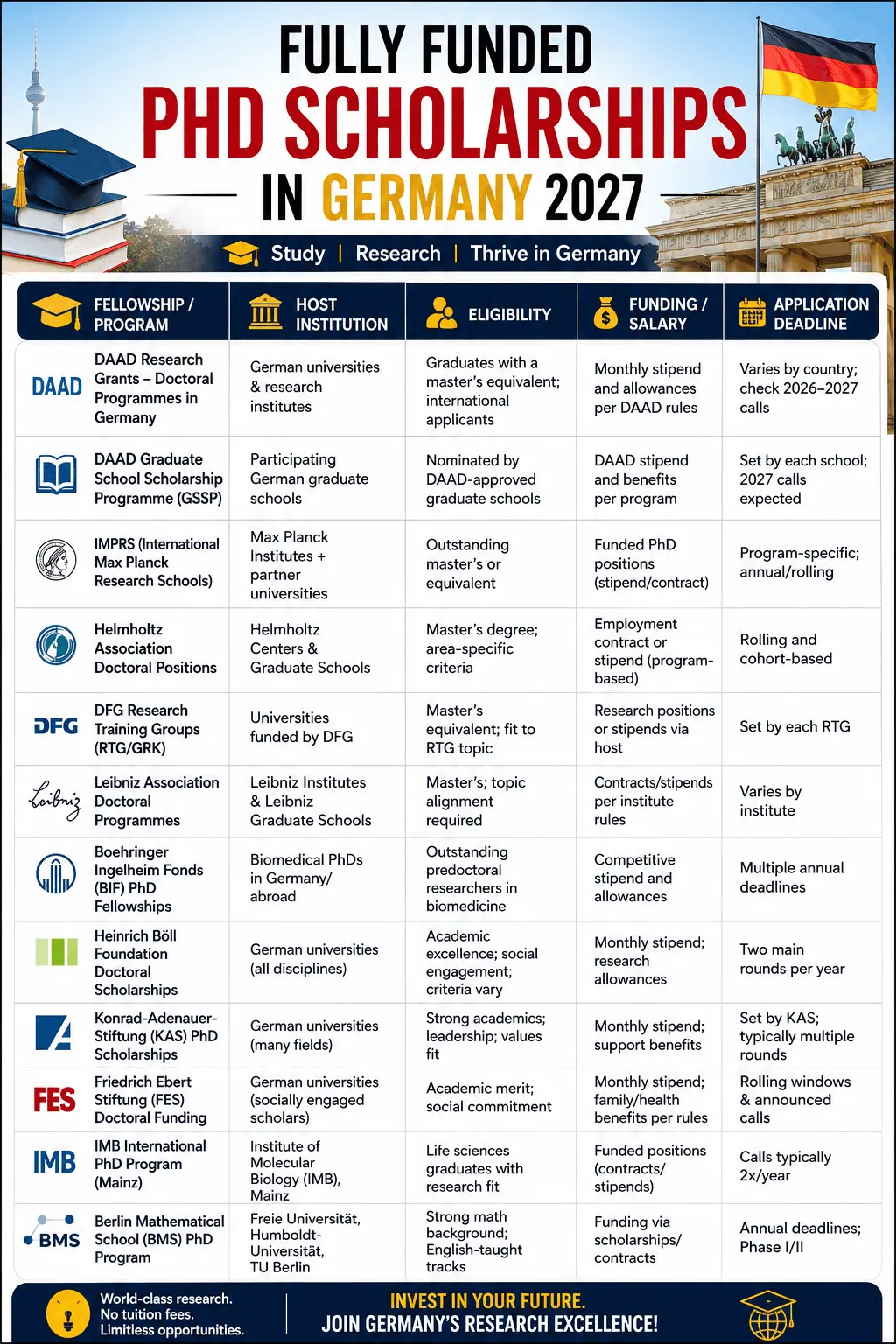
    Fellowship Summary Table: Fully Funded PhD Scholarships in Germany 2027

    Fellowship / ProgramHost InstitutionEligibilityFunding / SalaryApplication DeadlineOfficial Link
    DAAD Research Grants โ€“ Doctoral Programmes in GermanyGerman universities & research institutesGraduates with a masterโ€™s equivalent; international applicantsMonthly stipend and allowances per DAAD rulesVaries by country; check 2026โ€“2027 callsOfficial
    DAAD Graduate School Scholarship Programme (GSSP)Participating German graduate schoolsNominated by DAAD-approved graduate schoolsDAAD stipend and benefits per programSet by each school; 2027 calls expectedOfficial
    IMPRS (International Max Planck Research Schools)Max Planck Institutes + partner universitiesOutstanding masterโ€™s or equivalentFunded PhD positions (stipend/contract)Program-specific; annual/rollingOfficial
    Helmholtz Association Doctoral PositionsHelmholtz Centers & Graduate SchoolsMasterโ€™s degree; area-specific criteriaEmployment contract or stipend (program-based)Rolling and cohort-basedOfficial
    DFG Research Training Groups (RTG/GRK)Universities funded by DFGMasterโ€™s equivalent; fit to RTG topicResearch positions or stipends via hostSet by each RTGOfficial
    Leibniz Association Doctoral ProgrammesLeibniz Institutes & Leibniz Graduate SchoolsMasterโ€™s; topic alignment requiredContracts/stipends per institute rulesVaries by instituteOfficial
    Boehringer Ingelheim Fonds (BIF) PhD FellowshipsBiomedical PhDs in Germany/abroadOutstanding predoctoral researchers in biomedicineCompetitive stipend and allowancesMultiple annual deadlinesOfficial
    Heinrich Bรถll Foundation Doctoral ScholarshipsGerman universities (all disciplines)Academic excellence; social engagement; criteria varyMonthly stipend; research allowancesTwo main rounds per yearOfficial
    Konrad-Adenauer-Stiftung (KAS) PhD ScholarshipsGerman universities (many fields)Strong academics; leadership; values fitMonthly stipend; support benefitsSet by KAS; typically multiple roundsOfficial
    Friedrich Ebert Stiftung (FES) Doctoral FundingGerman universities (socially engaged scholars)Academic merit; social commitmentMonthly stipend; family/health benefits per rulesRolling windows & announced callsOfficial
    IMB International PhD Program (Mainz)Institute of Molecular Biology (IMB), MainzLife sciences graduates with research fitFunded positions (contracts/stipends)Calls typically 2x/yearOfficial
    Berlin Mathematical School (BMS) PhD ProgramFreie Universitรคt, Humboldt-Universitรคt, TU BerlinStrong math background; English-taught tracksFunding via scholarships/contractsAnnual deadlines; Phase I/IIOfficial

    DAAD Research Grants โ€“ Doctoral Programmes in Germany

    Overview: A flagship DAAD scheme supporting full doctoral studies at German universities and research institutes across disciplines. It is open to international applicants with a strong academic record and a compelling research plan.

    Funding and Benefits: Monthly stipend and additional allowances (e.g., travel, insurance) according to DAAD regulations. Exact rates and durations vary by country and academic profile; consult the official page for current figures.

    Eligibility: A masterโ€™s degree or equivalent; adequate language proficiency; acceptance by a host supervisor/program in Germany.

    Application Process: Prepare a research proposal, secure a host supervisor/letter of supervision, compile transcripts, recommendation letters, and language proof, then submit via the DAAD portal for your country.

    Official Website

    DAAD Graduate School Scholarship Programme (GSSP)

    Overview: The GSSP funds doctoral candidates who are nominated by participating German graduate schools. It supports structured PhD training in international cohorts.

    Funding and Benefits: DAAD stipend and program-specific benefits; possible travel, insurance, and research allowances as per DAAD rules.

    Eligibility: Nomination by a DAAD-approved graduate school and fulfillment of DAAD criteria (degree, language, timelines).

    Application Process: First apply to a participating graduate school. If selected, the school nominates you for DAAD funding and you complete the DAAD formalities.

    Official Website

    International Max Planck Research Schools (IMPRS)

    Overview: IMPRS units are elite, topic-focused doctoral schools run by Max Planck Institutes with partner universities. They offer rigorous training in fields like biology, chemistry, physics, computer science, cognitive science, and beyond.

    Funding and Benefits: Fully funded PhD positions via stipend or employment contract; excellent training, mentoring, and access to top-tier facilities.

    Eligibility: Outstanding academic record, research fit, and English proficiency; a masterโ€™s degree or equivalent.

    Application Process: Apply directly to the IMPRS of interest. Calls are typically annual or rolling; interviews may include scientific presentations.

    Official Website

    Helmholtz Association Doctoral Positions

    Overview: Germanyโ€™s largest research organization offers PhD positions at Helmholtz Centers and international graduate schools, spanning energy, health, environment, AI, and more.

    Funding and Benefits: Typically employment contracts (e.g., TV-L/TVรถD based) or stipends with social benefits according to center policies; advanced training and industry links.

    Eligibility: Masterโ€™s degree in a relevant field and research alignment with the hosting group.

    Application Process: Apply to doctoral calls on Helmholtz or center websites. Prepare a focused research statement and contact PIs early.

    Official Website

    DFG Research Training Groups (RTG/GRK)

    Overview: The German Research Foundation (DFG) funds Research Training Groups hosted at universities to provide structured doctoral training on a defined theme. Positions are generally paid research posts offered by the host institutions.

    Funding and Benefits: Employment contracts or stipends administered by the university; training modules, workshops, international collaboration.

    Eligibility: Masterโ€™s or equivalent aligned with the RTG topic; competitive selection by the RTG admissions committee.

    Application Process: Identify active RTGs in your field and apply directly through their calls; prepare a proposal tailored to the RTG theme.

    Official Website

    Leibniz Association Doctoral Programmes

    Overview: The Leibniz Association comprises research institutes across disciplines offering doctoral positions and running Leibniz Graduate Schools with university partners.

    Funding and Benefits: Funded positions (contracts/stipends), interdisciplinary training, and strong institute-university supervision models.

    Eligibility: Masterโ€™s degree; research match with the institute/group; English or German proficiency as required.

    Application Process: Apply to institute-level calls or graduate school cohorts; confirm deadlines and selection steps on the instituteโ€™s page.

    Official Website

    Boehringer Ingelheim Fonds (BIF) PhD Fellowships

    Overview: Prestigious fellowships supporting exceptional junior scientists in basic biomedical research in Germany or abroad.

    Funding and Benefits: Competitive monthly stipend and allowances; independent, portable funding with networking and alumni support.

    Eligibility: Outstanding academic record; early-stage doctoral candidates in basic biomedicine; application typically before or at the start of the PhD.

    Application Process: Submit a detailed research plan, CV, references, and host information by the published deadlines (several cycles per year).

    Official Website

    Heinrich Bรถll Foundation Doctoral Scholarships

    Overview: Scholarships for doctoral candidates from Germany and abroad, focusing on academic excellence, social engagement, and alignment with the foundationโ€™s values.

    Funding and Benefits: Monthly stipend and research allowances; mentoring and events.

    Eligibility: Strong academics, social and civic engagement, and an eligible host university in Germany; specific criteria apply.

    Application Process: Two annual intakes typically; submit academic documents, research outline, and references via the foundationโ€™s portal.

    Official Website

    Konrad-Adenauer-Stiftung (KAS) PhD Scholarships

    Overview: KAS supports international and German doctoral candidates who demonstrate leadership potential and a commitment to civic values.

    Funding and Benefits: Monthly stipend, potential research and family benefits, seminars, and networking.

    Eligibility: Very good academic performance, social/political engagement, and admission to a German university for doctoral studies.

    Application Process: Apply online with project description, academic credentials, and references. Selection involves interviews.

    Official Website

    Friedrich Ebert Stiftung (FES) Doctoral Funding

    Overview: FES supports socially engaged doctoral candidates with strong academic potential across many fields.

    Funding and Benefits: Monthly stipend and benefits as per FES rules; participation in seminars and networks.

    Eligibility: Strong academic performance and evidence of social commitment; admission to a German university required.

    Application Process: Submit via FES portal with project outline, transcripts, references; deadlines announced on the website.

    Official Website

    IMB International PhD Program (Institute of Molecular Biology, Mainz)

    Overview: An internationally renowned life sciences PhD program focusing on gene regulation, epigenetics, genome stability, and DNA repair.

    Funding and Benefits: Fully funded positions with competitive support, state-of-the-art facilities, and structured training.

    Eligibility: Relevant masterโ€™s degree; strong research interest in molecular biology; English language proficiency.

    Application Process: Calls typically open twice per year. Submit online application, references, and research interests; shortlisted candidates interview.

    Official Website

    Berlin Mathematical School (BMS) PhD Program

    Overview: BMS is a joint graduate school of FU, HU, and TU Berlin, offering an English-language PhD program in mathematics with two phases (MSc/fast-track and PhD).

    Funding and Benefits: Funding via BMS scholarships or contracts at partner departments; excellent coursework and supervision.

    Eligibility: Strong mathematics background; applicants to Phase II should typically have a masterโ€™s-level preparation.

    Application Process: Apply online to Phase I/II within annual deadlines; merit-based scholarships are available.

    Official Website

    How to Choose the Right Program

    • Match your research topic with the hostโ€™s active projects and publications.
    • Clarify funding type: stipend vs. employment contract (implications for taxes and social security).
    • Check language requirements: many programs accept English; some require or prefer German.
    • Assess supervision capacity, lab facilities, coursework, and career development support.
    • Verify 2027 call timelines on official pages before preparing your application.

    Application Tips for 2027

    • Start 10โ€“12 months early: contact potential supervisors and refine your proposal with their input.
    • Use institutional email for outreach and keep messages concise with an attached CV and brief summary of your research idea.
    • Secure strong references; guide your referees with bullet points covering your research strengths and achievements.
    • Proofread documents and ensure formatting follows program checklists.
    • If unsure about current stipend figures or exact deadlines, consult official websites or contact program coordinators directly.

    Frequently Asked Questions

    1. Are PhD programs in Germany paid?

      Yes. Many doctoral candidates receive either a monthly stipend or an employment contract (often TV-L/TVรถD-based). Exact amounts and benefits vary by program and host; always check the official call.

    2. Do public universities in Germany charge PhD tuition?

      Public universities typically do not charge tuition for doctoral studies. Students may pay a semester contribution (for services/transport). Confirm with your host university.

    3. What are typical deadlines for 2027 entry?

      Deadlines vary widely. DAAD and foundations have multiple annual windows; IMPRS/Helmholtz/RTG cohorts may recruit in late 2026 or early-to-mid 2027. Always verify the current call on the official website.

    4. Is German language required?

      Many structured PhD programs run entirely in English. Some fields and positions may require or prefer German, especially in clinical or humanities contexts. Check program requirements.

    5. What visa do I need?

      Non-EU/EEA students typically apply for a national visa/residence permit for study or research. Requirements depend on whether you hold a stipend or employment contract. Consult the German embassy/consulate in your country.

    6. How competitive are these scholarships?

      Highly competitive. A strong academic record, a clear research proposal, relevant experience, and supervisor alignment significantly improve your chances.

    7. Where can I verify funding amounts?

      On the official pages: DAAD, Max Planck, Helmholtz, DFG RTGs, and foundation websites publish current rates and conditions. If details are unclear, email the program office.

    About IR Research Publication

    IR Research Publication empowers researchers and students with credible, timely, and practical information on scholarships, fellowships, publishing, and academic careers worldwide. Our mission is to make high-quality opportunities more accessible, helping scholars plan, prepare, and succeed with reliable resources and expert guidance across disciplines.

    Related Articles

    Conclusion: Fully Funded PhD Scholarships in Germany 2027

    With DAAD, IMPRS, Helmholtz, DFG RTGs, Leibniz, and leading foundations, fully funded PhD scholarships in Germany 2027 offer world-class training across disciplines. Begin early, align with the right supervisor, and verify current funding terms and deadlines on the official websites before applying. Use the table and program sections above to shortlist opportunities, then tailor your documents to each call. Germanyโ€™s combination of excellent research infrastructure, international graduate schools, and comprehensive funding makes it an exceptional destination for your doctoral journey.
  • Fully Funded PhD Opportunities in New Zealand 2026

    Fully Funded PhD Opportunities in New Zealand 2026

    Introduction

    If you’re searching for Fully Funded PhD Opportunities in New Zealand 2026, you’re looking at one of the most diverse doctoral funding ecosystems in the Asia-Pacific region. New Zealand’s universities, its national government, and several national research funding organizations all offer pathways into a funded doctorate, and this guide rounds up the most credible Fully Funded PhD Opportunities in New Zealand 2026 currently on offer, along with what you should verify before applying.

    Coverage typically includes tuition fees, an annual living stipend, and โ€” depending on the scheme โ€” additional allowances for research costs, conference travel, and thesis expenses.

    Who should apply? High-achieving graduates with strong research potential, a clear research proposal or alignment with a supervisor’s project, and excellent academic references. Many university scholarships welcome both domestic and international applicants, though government and national funder schemes often restrict eligibility by citizenship, residency, or country. Always confirm specifics on the official program pages linked throughout this article.

    Why New Zealand? The country is internationally recognized for impactful research in environmental science, renewable energy, health sciences, data science, engineering, agriculture, and indigenous studies. PhD candidates benefit from supportive supervisory frameworks, well-equipped labs, access to national research institutes, and a high quality of life. Funding from universities, government, and national research funding organizations is competitive and merit-based, and many awards include professional development and research networking that set candidates up for long-term success in academia or industry.

    Explore- Fully Funded Postdoctoral Fellowships in New Zealand 2026

    Why Choose New Zealand for a PhD?

    Beyond the funding itself, several structural features make New Zealand an attractive base for doctoral research:

    • Three-year PhD norm: Most New Zealand PhDs are designed to be completed in three to four years, which is shorter than many alternative systems and reduces total cost of candidature.
    • Direct-entry research model: Many programs are largely research-based from day one, with limited coursework, so progress depends heavily on supervisor fit and your own research output.
    • Domestic tuition parity: At most New Zealand public universities, international PhD candidates pay the same tuition rate as domestic doctoral students, subject to university policy โ€” which significantly narrows the cost gap compared with countries that charge international students a premium.
    • Research strength in niche areas: New Zealand punches above its weight in agritech, marine and environmental science, volcanology, indigenous (Mฤori and Pacific) research methodologies, and renewable energy.
    • Post-study pathways: Many graduates are eligible for post-study work visas, which can support a transition into local academia or industry after completing the doctorate.

    Fully Funded PhD Opportunities in New Zealand 2026: Top Programs to Know

    The table below summarizes the main routes into a funded doctorate. Treat the funding and deadline columns as a starting point โ€” figures and cycles change, so confirm current details directly on each official page before applying.

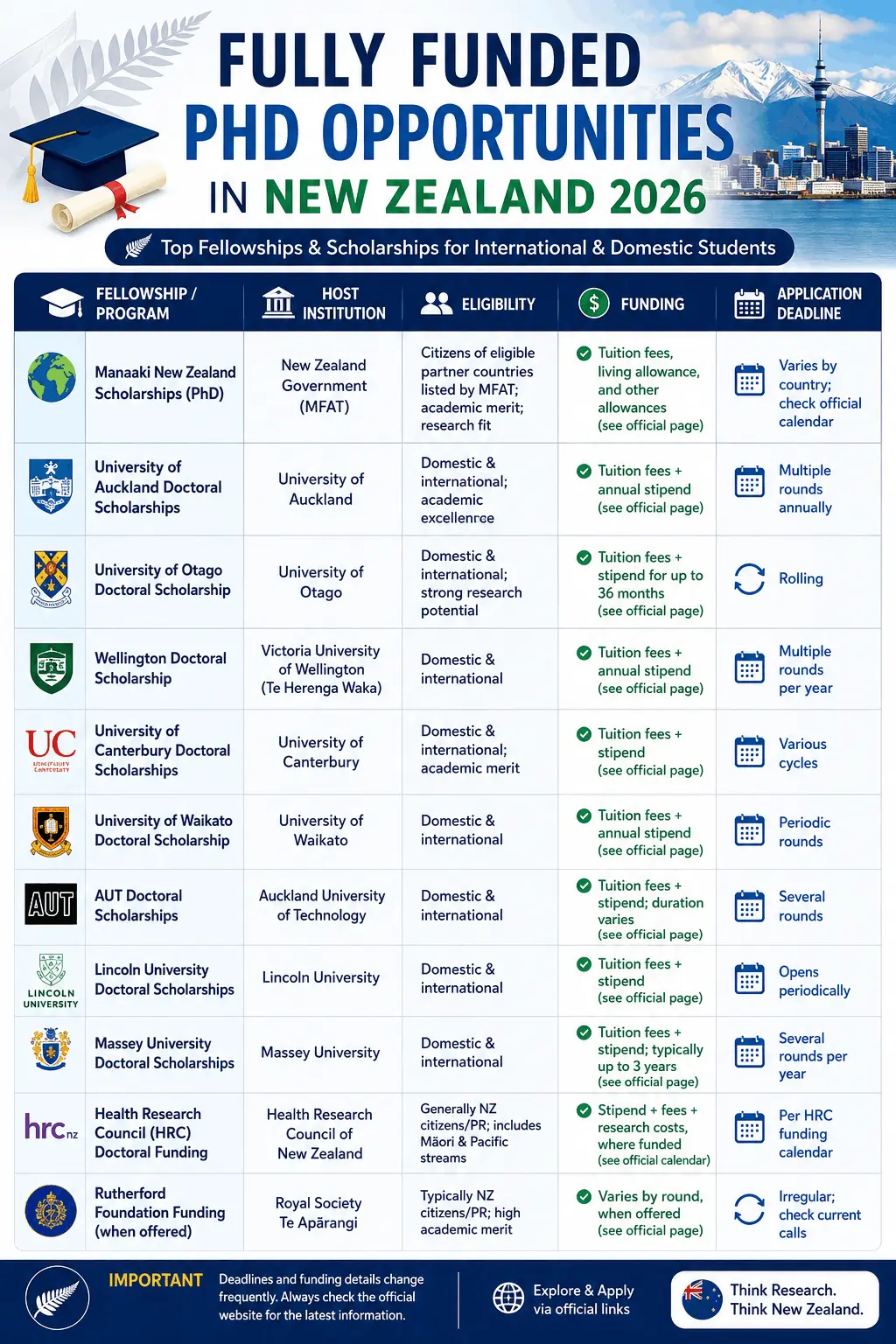
    Comparison Table: Fully Funded PhD Opportunities in New Zealand 2026

    Fellowship / ProgramHost InstitutionEligibilityFundingApplication DeadlineOfficial URL
    Manaaki New Zealand Scholarships (PhD)New Zealand Government (MFAT)Citizens of eligible partner countries listed by MFAT; academic merit; research fitTuition fees, living allowance, and other allowances (see official page)Varies by country; check official calendarhttps://www.nzscholarships.govt.nz
    University of Auckland Doctoral ScholarshipsUniversity of AucklandDomestic & international; academic excellenceTuition fees + annual stipend (see official page)Multiple rounds annuallyhttps://www.auckland.ac.nz
    University of Otago Doctoral ScholarshipUniversity of OtagoDomestic & international; strong research potentialTuition fees + stipend for up to 36 months (see official page)Rollinghttps://www.otago.ac.nz
    Wellington Doctoral ScholarshipVictoria University of Wellington (Te Herenga Waka)Domestic & internationalTuition fees + annual stipend (see official page)Multiple rounds per yearhttps://www.wgtn.ac.nz
    University of Canterbury Doctoral ScholarshipsUniversity of CanterburyDomestic & international; academic meritTuition fees + stipend (see official page)Various cycleshttps://www.canterbury.ac.nz
    University of Waikato Doctoral ScholarshipUniversity of WaikatoDomestic & internationalTuition fees + annual stipend (see official page)Periodic roundshttps://www.waikato.ac.nz
    AUT Doctoral ScholarshipsAuckland University of TechnologyDomestic & internationalTuition fees + stipend; duration varies (see official page)Several roundshttps://www.aut.ac.nz
    Lincoln University Doctoral ScholarshipsLincoln UniversityDomestic & internationalTuition fees + stipend (see official page)Opens periodicallyhttps://www.lincoln.ac.nz
    Massey University Doctoral ScholarshipsMassey UniversityDomestic & internationalTuition fees + stipend; typically up to 3 years (see official page)Several rounds per yearhttps://www.massey.ac.nz
    Health Research Council (HRC) Doctoral FundingHealth Research Council of New ZealandGenerally NZ citizens/PR; includes Mฤori & Pacific streamsStipend + fees + research costs, where funded (see official calendar)Per HRC funding calendarhttps://www.hrc.govt.nz
    Rutherford Foundation Funding (when offered)Royal Society Te ApฤrangiTypically NZ citizens/PR; high academic meritVaries by round, when offered (see official page)Irregular; check current callshttps://www.royalsociety.org.nz

    Manaaki New Zealand Scholarships (PhD)

    Overview: The Manaaki New Zealand Scholarships, funded by the Ministry of Foreign Affairs and Trade (MFAT), support doctoral study in New Zealand. Availability is restricted โ€” these scholarships are not open to all applicants. They are available only to applicants from eligible partner countries listed by MFAT, and aim to build capacity and leadership in priority sectors.

    Funding and Benefits: Often includes tuition fees, a living allowance, an establishment allowance, medical/travel insurance, and travel to/from New Zealand. Exact entitlements and rates vary by country and round โ€” confirm on the official website.

    Eligibility: Open only to applicants from MFAT-listed eligible countries who meet academic, English-language, and development-impact criteria. PhD applicants usually need a confirmed research plan and supervisor.

    Read also- Fully Funded Postdoc Positions in Switzerland for Indian Researchers: 2026 Opportunities and Application Guide

    Application Process:

    • Check whether your country is currently on the eligible list, and note your country-specific application window.
    • Contact prospective supervisors before applying if recommended by your target university โ€” supervisor fit matters for this scheme.
    • Prepare required documents (transcripts, references, research proposal, supervisor support).
    • Submit via the Manaaki online portal during the designated period.

    Official URL: https://www.nzscholarships.govt.nz

    University of Auckland Doctoral Scholarships

    Overview: The University of Auckland offers competitive doctoral scholarships across faculties for high-caliber PhD candidates, including international students.

    Funding and Benefits: Typically covers tuition fees and an annual stipend; some awards include research allowances. International PhD students generally pay the same tuition rate as domestic doctoral students at New Zealand public universities, subject to university policy. Current rates and durations are listed on the official page.

    Eligibility: Academic excellence, research potential, and alignment with a supervisor or department. Open to domestic and international applicants.

    Application Process:

    • Contact potential supervisors before applying โ€” many faculties expect supervisor confirmation as part of the process.
    • Secure supervisor support and submit a PhD application to the relevant faculty or school.
    • Apply for the scholarship during one of the competitive rounds.
    • Provide references, a CV, and a research statement as required.

    Official URL: https://www.auckland.ac.nz

    University of Otago Doctoral Scholarship

    Overview: A flagship award supporting doctoral candidates across disciplines at the University of Otago, including international students.

    Funding and Benefits: Tuition fees plus a stipend for up to 36 months; some disciplines may offer additional support. See the official page for current figures.

    Eligibility: Academic excellence, proven research capacity, and departmental support. Open to domestic and international candidates.

    Application Process:

    • Reach out to a potential supervisor before applying, as recommended by most departments.
    • Apply for admission to the PhD and submit the scholarship application, often integrated into the same online system.
    • Provide a research proposal, academic CV, and references.

    Official URL: https://www.otago.ac.nz

    Wellington Doctoral Scholarship (Victoria University of Wellington)

    Overview: Prestigious doctoral awards supporting outstanding PhD candidates at Victoria University of Wellington (Te Herenga Waka).

    Funding and Benefits: Tuition fees plus an annual stipend; additional research support may be available through schools or supervisors.

    Eligibility: Excellence in prior study, research potential, and fit with the university’s research strengths. Open to domestic and international applicants.

    Application Process:

    • Contact supervisors before applying whenever this is recommended by the school.
    • Apply for PhD admission and the scholarship within the published rounds.
    • Submit a research proposal, academic records, and references.

    Official URL: https://www.wgtn.ac.nz

    University of Canterbury Doctoral Scholarships

    Overview: UC offers a suite of doctoral scholarships across disciplines, supporting high-achieving candidates and strategic research areas.

    Funding and Benefits: Tuition fees and an annual stipend; amounts and durations vary by scholarship type.

    Eligibility: Strong academic record, research fit, and supervisor support. Open to domestic and international students.

    Application Process:

    • Confirm a supervisor before applying โ€” UC generally expects this step first.
    • Submit your PhD admission application.
    • Apply for the relevant UC doctoral scholarship via the scholarships portal.

    Official URL: https://www.canterbury.ac.nz

    University of Waikato Doctoral Scholarship

    Overview: The University of Waikato provides doctoral scholarships to attract researchers across STEM, social sciences, arts, and more.

    Funding and Benefits: Tuition fees plus a stipend; details depend on the award and year.

    Eligibility: Academic excellence and alignment with the university’s research areas. Open to domestic and international candidates.

    Application Process:

    • Contact supervisors before applying, particularly where a research group has limited capacity.
    • Apply for PhD admission and the scholarship during open rounds.
    • Prepare a clear research proposal and secure referee reports.

    Official URL: https://www.waikato.ac.nz

    AUT Doctoral Scholarships (Auckland University of Technology)

    Overview: AUT offers doctoral scholarships and Vice-Chancellor’s awards that support promising researchers across multiple faculties.

    Funding and Benefits: Tuition fees plus an annual stipend; durations and amounts vary. Check the current scholarships page for live calls.

    Eligibility: Strong academic performance and research alignment with AUT supervisors or projects. Open to domestic and international applicants.

    Application Process:

    • Discuss your proposal with potential supervisors before applying.
    • Submit PhD and scholarship applications per the round’s requirements.

    Official URL: https://www.aut.ac.nz

    Lincoln University Doctoral Scholarships

    Overview: Focused on land-based sciences, agribusiness, environmental management, and related fields, Lincoln’s doctoral scholarships support applied, impactful research.

    Funding and Benefits: Tuition fees plus a stipend; some awards include research allowances. Refer to the official site for current terms.

    Eligibility: Academic excellence and alignment with Lincoln’s research strengths. Open to domestic and international applicants.

    Application Process:

    • Identify and contact a supervisor before applying, given Lincoln’s smaller, specialist departments.
    • Apply during scholarship rounds with a proposal, CV, and references.

    Official URL: https://www.lincoln.ac.nz

    Massey University Doctoral Scholarships

    Overview: Massey supports doctoral students across its campuses and disciplines with scholarships that recognize academic excellence and research potential.

    Funding and Benefits: Tuition fees and a stipend, typically for up to three years; specifics are posted on the official scholarships directory.

    Eligibility: Strong academic record and fit with Massey’s research areas. Open to domestic and international applicants.

    Application Process:

    • Contact potential supervisors before submitting your application.
    • Submit your PhD admission application.
    • Apply for doctoral scholarships through the Massey scholarships portal.

    Official URL: https://www.massey.ac.nz

    Health Research Council (HRC) Doctoral Funding

    Overview: The Health Research Council periodically funds doctoral researchers through specific funding rounds and strategic research programmes, including dedicated Mฤori and Pacific health research pathways. This is not a standing, annually guaranteed PhD scholarship โ€” availability depends on the current funding calendar.

    Funding and Benefits: When a round is open, funding generally includes a stipend, fees, and research support; exact terms vary by scheme and call year. Check the HRC funding opportunities page and calendar for what’s currently active.

    Eligibility: Generally restricted to New Zealand citizens or permanent residents. Applicants should demonstrate strong academic merit and a health research focus.

    Application Process:

    • Monitor the HRC funding calendar regularly, since rounds open and close on their own schedule rather than annually.
    • Contact a potential academic or clinical supervisor before applying.
    • Prepare a research plan, supervisor support, and required documentation.

    Official URL: https://www.hrc.govt.nz

    Rutherford Foundation Funding (When Offered)

    Overview: The Rutherford Foundation no longer offers a regular, standalone PhD scholarship every year. Royal Society Te Apฤrangi periodically administers Rutherford-related funding schemes, but availability varies considerably from year to year, and some years may have no open PhD-level call at all.

    Funding and Benefits: When a round is offered, funding has typically included a stipend, fees, and research support, but terms differ between rounds. Always check the Royal Society’s current funding page rather than assuming a scheme is open.

    Eligibility: High academic standing; eligibility is commonly limited to New Zealand citizens or permanent residents.

    Application Process:

    • Check the Royal Society Te Apฤrangi funding page for current and upcoming calls before planning around this scheme.
    • If a round is open, contact a supervisor and prepare a competitive proposal with supervisor endorsement.

    Official URL: https://www.royalsociety.org.nz

    Cost of Living in New Zealand for PhD Students

    Understanding living costs is essential before accepting any offer among the Fully Funded PhD Opportunities in New Zealand 2026 described above, since stipend amounts need to be weighed against real expenses. Costs vary significantly by city:

    • Auckland and Wellington are the most expensive cities for rent and general living costs.
    • Dunedin, Hamilton, Christchurch, and Palmerston North tend to offer comparatively lower rent, which can make a fixed stipend stretch further.
    • Shared accommodation near campus is the most common and cost-effective option for PhD students.
    • Health insurance is typically required for international students unless covered under a specific scholarship’s benefits.
    • Budget for setup costs in your first few weeks โ€” bond/deposit on rental accommodation, basic furnishings, and a phone/internet connection โ€” since these are rarely covered by a stipend’s first payment cycle.

    Because stipend amounts and rates of inflation change, always check current cost-of-living estimates from each university’s international office or Immigration New Zealand rather than relying on older published figures.

    Student Visa Requirements for PhD Candidates

    International candidates accepting any of the funded PhD places above will generally need a Student Visa issued by Immigration New Zealand. Typical requirements include:

    • A valid offer of place from a New Zealand education provider.
    • Evidence of sufficient funds to cover living costs, unless this is explicitly guaranteed by a scholarship.
    • Evidence of, or an offer for, an acceptable level of health and travel insurance.
    • A medical certificate and police clearance certificate in many cases.
    • Proof of an intention to study, and in some cases evidence of ties to your home country.

    Visa rules, income thresholds, and required forms change periodically, so confirm exact current requirements directly on the Immigration New Zealand website before applying, rather than relying on this guide for visa specifics.

    English Language Requirements (IELTS / TOEFL / PTE)

    Most New Zealand universities require evidence of English proficiency unless your prior degree was taught and assessed entirely in English at a recognized institution. Common benchmarks requested for doctoral admission include:

    • IELTS Academic: Often an overall band score in the 6.5โ€“7.0 range, with no individual band below a set minimum (commonly 6.0).
    • TOEFL iBT: Equivalent overall score thresholds, again with minimums per skill area.
    • PTE Academic: Accepted by many universities as an alternative test.

    Exact thresholds differ by university and sometimes by faculty, and test score validity periods are limited (commonly two years), so check the specific requirement listed on your target university’s doctoral admissions page rather than assuming a single nationwide standard.

    Documents Required for Your PhD Application

    While requirements vary by university and scholarship, a typical application package includes:

    • Academic transcripts and degree certificates (often certified copies, sometimes with certified translations).
    • A detailed research proposal or statement of research interests.
    • An academic CV, including any publications, presentations, or research experience.
    • Two or more academic references or referee reports.
    • Evidence of English-language proficiency (see above).
    • A passport copy and, for some scholarships, proof of citizenship or residency status.
    • Evidence of prior supervisor contact or supervisor support, where required.

    Start gathering these documents early โ€” references and certified transcripts in particular can take weeks to arrange.

    Timeline for Applying

    A realistic timeline helps you plan your search for funded PhD places well ahead of any deadline:

    1. 6โ€“12 months before your intended start: Identify supervisors and research areas; request informal expressions of interest from supervisors.
    2. 4โ€“8 months before: Finalize your research proposal, gather references and transcripts, and sit any required English-language test if you haven’t already.
    3. 2โ€“6 months before: Submit your PhD admission application and any associated scholarship application within the relevant round.
    4. After admission/scholarship outcome: Apply for your student visa once you have a confirmed offer and, where relevant, confirmed funding.

    Because university scholarship rounds run on a rolling or multiple-rounds-per-year basis rather than fixed annual dates, build in buffer time and check each university’s current round schedule directly.

    How to Apply Strategically for a Fully Funded PhD in New Zealand 2026

    • Identify your research fit: Shortlist departments, supervisors, and labs aligned with your interests.
    • Contact supervisors early: Share a concise research pitch and CV; request feedback and potential supervision. Contact supervisors before applying whenever this is recommended by the university โ€” for most New Zealand doctoral programs, supervisor fit is treated as a near-essential part of admission, not an optional courtesy.
    • Tailor your proposal: Reflect local relevance, feasibility, and methodological rigor; cite New Zealand-based literature where appropriate.
    • Verify details on official pages: Funding amounts, allowance types, eligibility, and 2026 deadlines can change โ€” always rely on the official sources linked in this article.
    • Strengthen your dossier: Strong references, publications or preprints, and research experience are major differentiators in competitive rounds.

    For application writing tips and research communication resources, you can explore guidance at IR Research Publication, and general guides on literature reviews and methodology design from research publishers and academic outlets.

    How to Contact Supervisors

    Reaching out to a potential supervisor is one of the highest-leverage steps in securing Fully Funded PhD Opportunities in New Zealand 2026. A few practical pointers:

    • Be specific, not generic. Reference the supervisor’s recent papers or projects and explain precisely how your interests connect to their work.
    • Keep the first email short. A two- or three-paragraph email with a one-page research outline attached is more likely to get a reply than a long, unstructured message.
    • Ask a direct question. End with something answerable, such as whether they are taking new doctoral students for the relevant intake.
    • Follow university norms. Some departments prefer you contact the postgraduate office first, which then connects you with potential supervisors โ€” check the department’s own guidance before cold-emailing academic staff.
    • Be patient but persistent. Academic staff often take one to two weeks to respond; a polite follow-up after that window is reasonable.

    Mistakes to Avoid

    Common errors that weaken otherwise strong applications include:

    • Assuming “fully funded” means identical terms everywhere. Coverage, stipend amounts, and durations differ by university and scheme โ€” read the specific scholarship terms rather than assuming a standard package.
    • Skipping supervisor contact. Applying without any supervisor engagement, where it’s expected, is one of the most common reasons strong candidates are not shortlisted.
    • Generic research proposals. Proposals that don’t explain why New Zealand, or why a specific department, tend to score poorly on fit.
    • Missing eligibility restrictions. Applying to government schemes like Manaaki without checking the current eligible-country list, or applying to HRC/Rutherford-related funding without New Zealand citizenship or residency, wastes time on ineligible applications.
    • Leaving visa and document preparation too late. Certified transcripts, translations, and English-test bookings all take time; starting late can cost you an entire intake cycle.
    • Relying on outdated articles for deadlines and figures. Funding amounts and rounds change โ€” always confirm directly on the official page before finalizing your plans.

    Difference Between University Scholarships and Government Scholarships

    It’s worth understanding how these two funding routes differ, since they have different eligibility logic and application paths:

    FeatureUniversity Doctoral ScholarshipsGovernment-Funded Scholarships (e.g., Manaaki)
    Who can applyGenerally open to domestic and international applicantsRestricted to citizens of specific eligible partner countries
    Application routeThrough the university’s own scholarships portal, alongside PhD admissionThrough the national government scholarship portal
    Funding sourceUniversity budget, sometimes combined with faculty or research-group fundingNew Zealand Government (MFAT) funding tied to development and diplomatic priorities
    Typical focusOpen to most research areas, subject to supervisor availabilityOften tied to priority sectors identified by the funding agreement with your country
    FrequencyMultiple rounds per year at most universitiesDetermined by each country’s own application calendar

    In short: university scholarships are the more broadly accessible route for most international applicants, while government schemes like Manaaki offer strong support but only to a defined set of eligible countries.

    Important Notes on Funding Accuracy and Deadlines

    Funding amounts, benefits, and application cycles evolve, and this article deliberately avoids quoting figures that can’t be verified as current for 2026. Before applying, verify directly with the official source:

    • Current stipend rates and tuition coverage.
    • Allowance types (e.g., research, thesis, conference, insurance).
    • Eligibility restrictions (e.g., citizenship, residency, field of study).
    • 2026 application windows and deadlines.
    • Whether a scheme โ€” particularly HRC doctoral funding or Rutherford-related funding โ€” is actually open in the current cycle, since both are periodic rather than guaranteed annual offerings.

    Only rely on the official scholarship pages linked above for final details.

    Frequently Asked Questions

    Here are answers to common questions about Fully Funded PhD Opportunities in New Zealand 2026.

    1) Can international students get a Fully Funded PhD in New Zealand 2026? Yes. Most university doctoral scholarships listed here accept international applicants. Government and national-funder schemes may have citizenship or country-specific rules, so confirm eligibility on the official pages.

    2) What does “fully funded” typically include? It generally covers tuition fees plus an annual stipend for living expenses โ€” international doctoral students usually pay the same tuition fees as domestic candidates at New Zealand public universities, subject to each university’s policy. Some scholarships also add research, conference, or thesis allowances, and government awards may include travel and insurance.

    3) Do I need a confirmed supervisor before applying? Often yes, or at least supervisor interest. Many universities expect supervisor confirmation or departmental endorsement as part of the doctoral scholarship process, so contact supervisors before applying whenever the university recommends it.

    4) When are 2026 deadlines? University scholarships usually run on multiple rounds throughout the year or on a rolling basis. Government and national-funder deadlines are announced via their own official portals. Always consult the official website for the current cycle rather than relying on fixed dates.

    5) Are stipends taxable in New Zealand? Tax treatment depends on the scholarship’s terms and your individual circumstances. Check official guidance from the scholarship provider and consult Inland Revenue (IRD) for current tax rules.

    6) How competitive are NZ doctoral scholarships? They are competitive, especially in high-demand fields. A strong academic record, a clear research proposal, good supervisor fit, and robust references are essential.

    7) Can I work while on a scholarship? Some scholarships permit limited work with supervisor or provider approval, while others restrict employment. Review your specific award’s terms and your student visa conditions.

    Conclusion: Fully Funded PhD Opportunities in New Zealand 2026

    New Zealand hosts a genuinely broad landscape of Fully Funded PhD Opportunities in New Zealand 2026 across its top universities, government-funded scholarships, and funding opportunities administered by national research organizations such as the Health Research Council and Royal Society Te Apฤrangi. To make the most of these options, align your proposal with a supervisor’s expertise, confirm funding specifics on official pages, and apply within the right round for your target scheme. By targeting the right route โ€” university scholarship, government-funded award, or funding from a national research funding organization โ€” you can secure tuition coverage, a stipend, and the research environment needed to complete a strong doctorate in New Zealand.

    About IR Research Publication

    IR Research Publication is dedicated to advancing global research and scholarship by sharing actionable guidance, editorial insights, and resources that help scholars produce rigorous, high-impact work. From research design to publication strategy, IR Research Publication supports graduate students, early-career researchers, and faculty in communicating science clearly and ethically. Explore more at irrespub.com.

    Related Articles

  • Fully Funded PhD Programs in Switzerland for Indian Students: 2026 Guide

    Fully Funded PhD Programs in Switzerland for Indian Students: 2026 Guide


    Introduction: Why Pursue a Funded PhD in Switzerland?

    Switzerland is among the most sought-after destinations for doctoral research. Home to globally ranked institutions, including ETH Zurich and EPFL – it offers Indian students not just a prestigious degree, but in many cases a monthly salary, world-class infrastructure, and a genuine launchpad for an international research career.

    Here is why Switzerland stands out:

    • Many PhD positions are employment contracts. Across Switzerland’s grant-funded STEM and science programs, doctoral candidates are typically hired as doctoral assistants or research assistants, receiving a salary with social insurance benefits. This is not universal โ€” it depends on the program, faculty, and funding source โ€” but it is common and well-documented at ETH Zurich, EPFL, and the cantonal universities.
    • Registration fees are low. Swiss public universities charge low semester registration fees rather than standard tuition. However, the amount varies by institution, and scholarship holders may be expected to cover fees out of their own funds.
    • India has been a CERN Associate Member State since 2017. Indian nationals are eligible for CERN’s Doctoral Student Programme, one of the most competitive and respected doctoral opportunities in physics, engineering, and computing.
    • The Swiss Government Excellence Scholarship (ESKAS) explicitly includes India as an eligible country and confirms that self-certified document copies are accepted for Indian applicants.

    Whether you are a fresh Master’s graduate, an early-career researcher, or a scientist looking to transition into European academia, this guide covers every major funded PhD opportunity available to Indian students in Switzerland for 2026 and the upcoming 2027 cycle.

    Looking for funded PhD opportunities across Europe? Read our complete guide to Fully Funded PhD Scholarships in Europe for Indian Students (2026) and Fully Funded PhD Scholarships in Canada for Indian Students (2026).


    Are PhD Positions in Switzerland Funded?

    Many are โ€” and Switzerland’s funding model is among the best in the world. The key distinction is that most funded PhD positions in Switzerland are not “scholarships” in the traditional sense. Instead, they fall into three distinct categories:

    1. Employment-based PhD positions โ€” The most common route, especially in STEM. Doctoral candidates are hired on fixed-term employment contracts by a professor’s research group (funded by SNSF grants, EU projects, or institutional funds). They receive a regular monthly salary, social insurance, and paid leave.
    2. University doctoral fellowships โ€” Structured competitive programs at specific departments or institutes (e.g., Biozentrum Basel PhD Fellowships), which provide full funding for the PhD duration.
    3. Government and external scholarships โ€” Such as the Swiss Government Excellence Scholarship (ESKAS), which provides a monthly payment covering basic living costs, though it is explicitly described as a living allowance, not a salary.

    Understanding this distinction matters. A doctoral assistant at ETH Zurich earns roughly CHF 61,300 gross in year one. A Swiss Government Excellence Scholarship holder receives CHF 2,450/month as a living stipend โ€” a meaningful difference in take-home income and employment status.


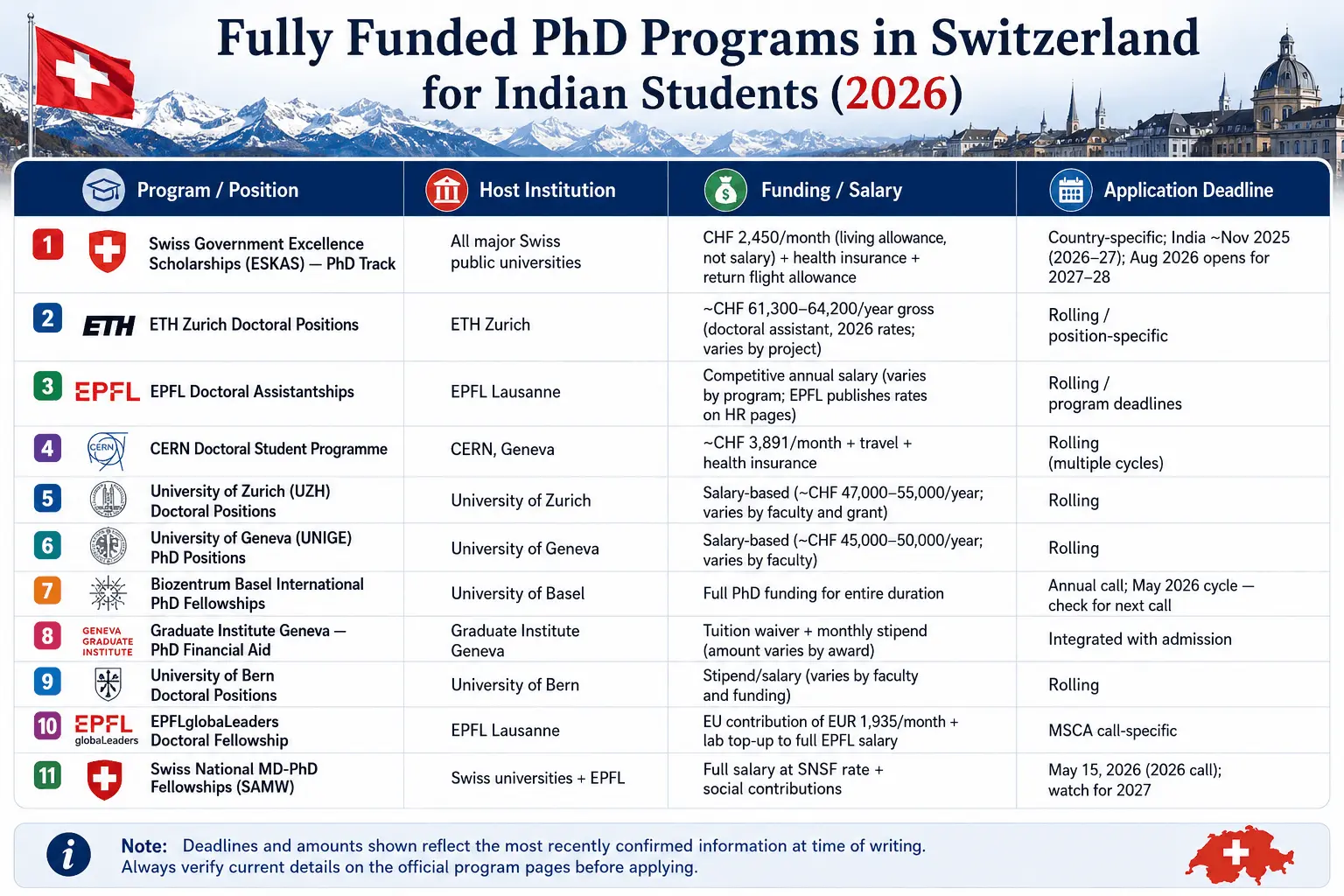
    Summary Table: Funded PhD Programs in Switzerland for Indian Students (2026)

    Program / PositionHost InstitutionEligibilityFunding / SalaryApplication DeadlineOfficial Link
    Swiss Government Excellence Scholarships (ESKAS) โ€” PhD TrackAll major Swiss public universitiesMaster’s degree; born after Dec 31, 1991; India eligibleCHF 2,450/month (living allowance, not salary) + health insurance + return flight allowanceCountry-specific; India ~Nov 2025 (2026โ€“27); Aug 2026 opens for 2027โ€“28sbfi.admin.ch
    ETH Zurich Doctoral PositionsETH ZurichMaster’s degree in relevant field; professor acceptance~CHF 61,300โ€“64,200/year gross (doctoral assistant, 2026 rates; varies by project)Rolling / position-specificjobs.ethz.ch
    EPFL Doctoral AssistantshipsEPFL LausanneMaster’s degree; doctoral program admissionCompetitive annual salary (varies by program; EPFL publishes rates on HR pages)Rolling / program deadlinesepfl.ch/education/phd
    CERN Doctoral Student ProgrammeCERN, GenevaEnrolled in PhD program; CERN member/associate state (India eligible)~CHF 3,891/month + travel + health insuranceRolling (multiple cycles)home.cern/students-fellows
    University of Zurich (UZH) Doctoral PositionsUniversity of ZurichMaster’s degree; supervisor acceptanceSalary-based (~CHF 47,000โ€“55,000/year; varies by faculty and grant)Rollinguzh.ch/jobs
    University of Geneva (UNIGE) PhD PositionsUniversity of GenevaMaster’s degree; research proposalSalary-based (~CHF 45,000โ€“50,000/year; varies by faculty)Rollingunige.ch/research/doctoral-studies
    Biozentrum Basel International PhD FellowshipsUniversity of BaselOutstanding academic record; Life SciencesFull PhD funding for entire durationAnnual call; May 2026 cycle โ€” check for next callbiozentrum.unibas.ch/phd
    Graduate Institute Geneva โ€” PhD Financial AidGraduate Institute GenevaMerit/need-based; strong academic profileTuition waiver + monthly stipend (amount varies by award)Integrated with admissiongraduateinstitute.ch/phd
    University of Bern Doctoral PositionsUniversity of BernMaster’s degree; supervisor acceptanceStipend/salary (varies by faculty and funding)Rollingunibe.ch/research
    EPFLglobaLeaders Doctoral FellowshipEPFL LausanneEarly-stage PhD; MSCA mobility rules applyEU contribution of EUR 1,935/month + lab top-up to full EPFL salaryMSCA call-specificepfl.ch/epflglobaleaders
    Swiss National MD-PhD Fellowships (SAMW)Swiss universities + EPFLMedical degree + PhD enrollmentFull salary at SNSF rate + social contributionsMay 15, 2026 (2026 call); watch for 2027samw.ch

    Note: Deadlines and amounts shown reflect the most recently confirmed information at time of writing. Always verify current details on the official program pages before applying.


    Top 11 Funded PhD Programs in Switzerland for Indian Students


    1. Swiss Government Excellence Scholarships (ESKAS / FCS)

    Overview

    The Swiss Government Excellence Scholarships โ€” administered by the Federal Commission for Scholarships for Foreign Students (FCS/ESKAS) โ€” are Switzerland’s flagship government award for international researchers. The Swiss Confederation funds these scholarships to promote academic exchange and research cooperation across over 180 countries, including India.

    The PhD scholarship track supports doctoral research at any of Switzerland’s 12 cantonal universities, ETH Zurich, EPFL, or the Graduate Institute Geneva. Applications are submitted through the Swiss Embassy or consulate in India.

    What the scholarship actually provides (per official ESKAS page, 2027โ€“28 cycle)

    • Monthly payment of CHF 2,450 to cover basic living expenses for one person
    • This is explicitly described by ESKAS as a living allowance, not a salary
    • Health insurance premiums covered by FCS for non-EU/EFTA scholarship holders (India qualifies)
    • One-time CHF 600 rental deposit grant
    • Return flight allowance (lump sum, used within 2 months of scholarship end, for return to India)
    • Half-Fare Swiss public transport card
    • Duration: 12 months, renewable twice for up to 36 months, subject to academic progress
    • Tuition and semester fees are not covered โ€” scholarship holders must pay these separately (typically CHF 600โ€“2,000/semester depending on university)

    Eligibility for Indian Applicants

    • Must hold a Master’s degree completed by 31 July 2027 (ETH Zurich: 30 June 2027) for the 2027โ€“28 cycle
    • Born after December 31, 1991
    • Must not have lived in Switzerland for more than 13 months before the start date
    • A detailed research proposal with timeline is required
    • A mandatory letter of support from a Swiss academic supervisor is required โ€” without this, the application is rejected. Finding this supervisor is the applicant’s responsibility and can take weeks to months

    India-Specific Notes

    • For Indian applicants, self-certified document copies are accepted (confirmed on the official ESKAS application guidance page) โ€” certified translations are only required for documents not in English, French, Italian, or German
    • Applications for 2026โ€“27 closed approximately November 2025 (India deadline). For 2027โ€“28, the online portal opens August 20, 2026 and country-specific deadlines will be published at that time
    • Results announced by end of May of the application year

    Official Page: https://www.sbfi.admin.ch/en/swiss-government-excellence-scholarships-at-a-glance


    2. ETH Zurich โ€” Doctoral Assistant Positions

    Overview

    ETH Zurich consistently ranks among the world’s top universities. Its doctoral model does not operate through a central scholarship program โ€” instead, professors hire doctoral candidates as doctoral assistants on employment contracts funded by research grants (SNSF, EU Horizon, ETH internal). This makes funding highly stable for grant-funded positions.

    Doctoral candidates at ETH Zurich are employees of the university. The ETH salary table (as of January 1, 2026, published on the official ETH HR/Welcome Center page) shows fixed-rate gross salaries for doctoral students increasing from Year 1 to Year 3, with no further automatic increases from Year 4 onward. Multiple consistent sources cite the approximate range as CHF 61,300 (Year 1) to CHF 64,200 (Year 4) for 100% employment, though exact rates require verification via the official ETH salary tables as these are updated annually.

    Key Benefits

    • Competitive gross annual salary (approximately CHF 61,000โ€“64,000 at 100% employment, 2026 rates โ€” verify current figures at ethz.ch/salary)
    • Swiss social insurance contributions (AHV/IV, pension) included
    • Low registration fees โ€” ETH introduced differentiated tuition categories from Autumn 2025; doctoral candidates should check current fee regulations at ethz.ch/students/tuition-fees
    • Paid vacation and standard Swiss employment conditions
    • Access to world-class research infrastructure and international collaborations

    Who Should Apply

    • Indian applicants with a strong Master’s degree in STEM (engineering, computer science, natural sciences, mathematics, environmental sciences, architecture)
    • Applicants with research publications, strong references, or prior lab experience
    • The most effective approach: directly email professors whose current research aligns with your interests, attaching a tailored cover letter, CV, and brief research statement. Professors at ETH have significant autonomy in hiring.

    Job Portal: https://jobs.ethz.ch/


    3. EPFL โ€” Doctoral Assistantships

    Overview

    The ร‰cole Polytechnique Fรฉdรฉrale de Lausanne (EPFL) in Lausanne is one of Europe’s most innovative research universities. It organizes doctoral training through multiple doctoral programs across engineering, life sciences, basic sciences, computing, environment, and architecture. Like ETH Zurich, EPFL employs doctoral candidates as doctoral assistants on employment contracts.

    EPFL publishes its salary scales for doctoral assistants officially on its HR pages. The starting gross annual salary for doctoral assistants at EPFL is listed on epfl.ch/campus/services/human-resources/salaries and increases annually. Approximately 40% of EPFL doctoral students come from outside Europe, reflecting its highly international character.

    Key Benefits

    • Annual salary and benefits per EPFL doctoral assistant scale (verify current amounts on official EPFL HR page)
    • Full Swiss social security, health insurance contributions, pension
    • Access to EPFL’s Innovation Park, industry partnerships, and extensive research infrastructure
    • Possibility to apply for competitive add-on fellowships: EPFLglobaLeaders, Swiss Government Excellence Scholarship top-ups
    • Duration: typically 4 years

    Who Should Apply

    • Indian students with a strong Master’s degree in STEM, with research publications or strong project work
    • Applicants targeting specific EPFL doctoral programs: Computer and Communication Sciences, Life Sciences Engineering, Materials Science, Electrical Engineering, Mathematics
    • Apply either through EPFL’s doctoral program portals, or directly by emailing a prospective supervisor with your CV and research proposal

    Doctoral Admission: https://www.epfl.ch/education/phd/


    4. CERN Doctoral Student Programme

    Overview

    The CERN Doctoral Student Programme allows PhD candidates to conduct their thesis research at CERN โ€” the European Organization for Nuclear Research in Geneva โ€” for up to 36 months while remaining registered at their home university. CERN is the world’s largest particle physics laboratory and a unique environment for high-energy physics, engineering, and computing research.

    India has been a CERN Associate Member State since 2017, which makes Indian nationals eligible for CERN’s student and fellowship programs, including the Doctoral Student Programme. Doctoral students spend time at CERN in Geneva, but the degree is awarded by the candidate’s enrolled university โ€” the two supervisors (CERN and home university) collaborate on thesis arrangements.

    Key Benefits

    • Monthly stipend of approximately CHF 3,891 (tax-advantaged)
    • Travel expenses to Geneva
    • Health insurance coverage
    • Paid annual leave
    • Hands-on access to CERN’s research facilities, experiments, and global scientific network
    • No IELTS required; good command of English or French is expected

    Eligibility

    • Must be a national of a CERN Member or Associate Member State (India qualifies)
    • Must be enrolled in, or about to start, a doctoral program at a recognized university
    • Research conducted at CERN must form part of, or all of, the doctoral thesis
    • Relevant fields: Applied Physics, Engineering, Computing
    • Multiple application deadlines per year

    Official Page: https://home.cern/students-fellows


    5. University of Zurich (UZH) โ€” Doctoral Positions

    Overview

    The University of Zurich is Switzerland’s largest university, with particular strength in medicine, life sciences, social sciences, law, and humanities. Doctoral candidates at UZH are typically employed as university assistants on fixed-term contracts funded by research grants.

    Key Benefits

    • Annual salary approximately CHF 47,000โ€“55,000 gross depending on faculty, year, and funding source (these are indicative ranges โ€” actual salary is determined by the hiring professor’s grant and university scales)
    • Full Swiss social security contributions
    • Access to UZH’s research hospitals, life science clusters, and collaboration with nearby ETH Zurich
    • Duration: typically 3โ€“4 years

    Who Should Apply

    • Indian students with a Master’s degree targeting areas of UZH strength: medicine, neuroscience, biochemistry, law, economics, social sciences, humanities
    • Monitor the UZH jobs portal regularly and contact professors directly

    Job Portal: https://www.uzh.ch/en/explore/jobs.html


    6. University of Geneva (UNIGE) โ€” PhD Positions

    Overview

    The University of Geneva is particularly renowned for international relations, law, medicine, and natural sciences. Its location โ€” surrounded by UN agencies, WHO, ICRC, WTO, and hundreds of international organizations โ€” makes it uniquely valuable for researchers in policy, global health, and social sciences.

    Key Benefits

    • Annual salary approximately CHF 45,000โ€“50,000 gross (varies by faculty and funding source)
    • Access to Geneva’s international ecosystem for interdisciplinary research
    • Doctoral positions across all faculties; particularly strong in science, medicine, social sciences, and international studies
    • Swiss social insurance and employment benefits

    Who Should Apply

    • Indian students targeting social sciences, international health, environmental sciences, law, or natural sciences
    • Those interested in connecting doctoral research to the Geneva international organization ecosystem

    Doctoral Studies: https://www.unige.ch/research/doctoral-studies/


    7. University of Basel โ€” Biozentrum International PhD Fellowships

    Overview

    The Biozentrum at the University of Basel is internationally recognized for molecular biology and biochemistry. Its International PhD Fellowship Program, supported by the Werner Siemens Foundation since 2007, is one of the few structured, competitive cohort-based PhD fellowship programs in Switzerland with a fixed annual deadline and formal selection process.

    Key Benefits

    • Full funding for the entire PhD (duration typically 3โ€“4 years)
    • Competitive monthly stipend
    • Structured doctoral training: seminars, lab rotations, mentoring, and career development
    • State-of-the-art infrastructure in structural biology, cell biology, neurobiology, and biochemistry
    • Strong international alumni network

    Who Should Apply

    • Indian students with outstanding academic records in molecular biology, biochemistry, structural biology, cell biology, or related life sciences
    • Those with strong research motivation and willingness to work in a highly competitive discovery-driven environment
    • The most recent call deadline was May 8, 2026 โ€” check the official page for the next annual call

    Official Page: https://www.biozentrum.unibas.ch/phd/international-phd-program/phd-fellowships


    8. Graduate Institute Geneva โ€” PhD Financial Aid and Fellowships

    Overview

    The Graduate Institute of International and Development Studies (IHEID) in Geneva is a world-leading institution for international relations, development studies, political science, and international economics. It offers merit and need-based financial aid integrated with PhD admission โ€” applicants do not apply separately for funding; it is assessed alongside the main application.

    Key Benefits

    • For the most competitive packages: tuition waiver + monthly stipend + health insurance contribution
    • Aid amounts vary by award type; some cover the full PhD, others are partial or renewable annually
    • Location advantage: direct proximity to the UN, ICRC, ILO, WTO, WEF, MSF, and 200+ international organizations

    Who Should Apply

    • Indian students with a strong Master’s in social sciences, political science, economics, law, or international relations
    • Those whose research bridges academic rigor and policy relevance in areas like global governance, humanitarian affairs, development economics, or international security

    PhD Programs: https://www.graduateinstitute.ch/study/programmes/phd


    9. University of Bern โ€” Doctoral Positions and Scholarships

    Overview

    The University of Bern, located in Switzerland’s federal capital, covers all major academic disciplines with particular strength in climate science, environmental research, medical research, law, humanities, and theology. Funded doctoral positions exist across all faculties, primarily through professor-led research grants.

    Key Benefits

    • Salary or stipend depending on funding source and faculty (varies widely โ€” confirm with the host department)
    • Access to the Oeschger Centre for Climate Change Research and other interdisciplinary institutes
    • Swiss Government Excellence Scholarships can be used at the University of Bern for eligible applicants

    Who Should Apply

    • Indian students interested in climate science, environmental studies, medicine, humanities, or law
    • Search the University of Bern job portal and contact professors directly

    Research Portal: https://www.unibe.ch/research/index_eng.html


    10. EPFLglobaLeaders Doctoral Fellowship

    Overview

    EPFLglobaLeaders is an MSCA COFUND doctoral fellowship program at EPFL. It funds 48-month (4-year) doctoral positions at EPFL campuses. A distinctive feature is the requirement for non-academic co-supervision, connecting research to industry or NGO partners.

    Key Benefits

    • EU contribution of EUR 1,935/month toward the doctoral candidate’s salary
    • The hosting laboratory must complement this contribution to the full EPFL doctoral assistant salary
    • Research costs, equipment, travel, and conference expenses covered by the hosting lab
    • Integrated leadership training program
    • Open to any nationality, subject to MSCA transnational mobility rules (candidates must not have resided in Switzerland for more than 12 months in the 3 years before the call deadline)

    Who Should Apply

    • Indian students who satisfy the MSCA mobility condition and are targeting EPFL research areas
    • Those interested in combining academic research with non-academic sector impact

    Fellowship Page: https://www.epfl.ch/education/phd/doctoral-studies-structure/customized-curricula/epflglobaleaders/


    11. Swiss National MD-PhD Fellowships (SAMW/ASSM)

    Overview

    The Swiss Academy of Medical Sciences (SAMW/ASSM) funds the Swiss National MD-PhD Fellowship Program, enabling physicians to pursue doctoral research in natural sciences, public health, clinical research, or biomedical ethics. At EPFL, applicants must be enrolled at the School of Life Sciences.

    Key Benefits

    • Salary at the SNSF rate with employer social security contributions covered
    • Duration: 2 to 3 years, with a 4th year possible if guaranteed by the host institution
    • One of the few programs designed specifically for medical doctors pursuing a PhD in Switzerland

    Who Should Apply

    • Indian students holding an MBBS/MD and planning doctoral research in biomedical science
    • Those enrollable at a Swiss medical faculty or EPFL School of Life Sciences
    • The 2026 call deadline was May 15, 2026 โ€” check the official SAMW page for the 2027 call

    Official Page: https://www.samw.ch/en/Funding/MD-PhD-Fellowships.html


    How Can Indian Students Apply for a PhD in Switzerland? Step-by-Step Guide

    Step 1: Identify Your Field and Target Institution

    Start by identifying which Swiss university or institute is strongest in your specific research area:

    • STEM/Engineering/Computing: ETH Zurich, EPFL
    • Life Sciences/Medicine: UZH, University of Basel, EPFL
    • Social Sciences/International Affairs: Graduate Institute Geneva, UNIGE, University of St. Gallen
    • Climate/Environment: University of Bern, EPFL, ETH Zurich
    • Particle Physics/Engineering/Computing: CERN

    Step 2: Find and Contact a Supervisor

    This is the most critical step. In Switzerland, professors largely hire their own doctoral students โ€” especially in employment-based positions. Contact potential supervisors by:

    • Reading their recent publications on Google Scholar
    • Writing a specific, tailored email (not a mass-broadcast email) explaining which paper/project interested you and how your background is relevant
    • Attaching a concise CV and a 1-page research statement
    • Being patient โ€” professors receive many emails and may take weeks to respond

    Step 3: Secure a Supervision Letter

    For the Swiss Government Excellence Scholarship and many structured fellowships, a formal written confirmation from a Swiss professor that they are willing to supervise you is mandatory. Without it, most formal scholarship applications will not be considered.

    Step 4: Apply for Funding

    Once you have a professor’s interest or confirmation, apply through the appropriate funding route:

    • ESKAS โ€” via Swiss Embassy in India (for government scholarship track)
    • University doctoral program portal โ€” for structured PhD programs
    • CERN careers portal โ€” for CERN Doctoral Student Programme
    • Direct hiring โ€” if the professor has grant funds, they may hire you directly without a separate scholarship application

    Step 5: Prepare Your Application Documents

    • Master’s transcripts and degree certificate
    • Research proposal with timeline (the centerpiece for ESKAS)
    • Full CV/resume
    • Two recommendation letters from professors (use ESKAS forms for government scholarships)
    • Language proficiency evidence (if required by the specific program)
    • Passport copy
    • For ESKAS: self-certified copies accepted for Indian applicants (official confirmation)

    Step 6: Submit and Follow Up

    Follow each program’s submission instructions exactly. For ESKAS, the application goes through the Swiss Embassy in New Delhi. For university positions, applications are submitted online. Follow up politely if you don’t hear back within 6โ€“8 weeks.


    What Are the Eligibility Criteria for a PhD in Switzerland?

    General eligibility criteria across most funded doctoral programs:

    • Qualification: Master’s degree (MSc, MTech, MA, MPhil, or equivalent) from a recognized Indian university โ€” Swiss institutions generally recognize Indian postgraduate qualifications, though admission decisions are program- and institution-specific
    • Academic Record: Strong GPA and research experience; publications strengthen applications considerably for competitive programs
    • Research Proposal: Required for ESKAS and structured fellowship programs; important even for cold-email applications
    • Language: Most research programs at ETH, EPFL, and UZH are conducted in English. French proficiency may be needed at UNIGE and UNIL. No blanket IELTS requirement exists โ€” requirements vary by program and institution; always check the specific program’s language policy
    • Age: ESKAS requires applicants born after December 31, 1991 (for the 2027โ€“28 cycle)
    • Residency: ESKAS requires that applicants have not lived in Switzerland for more than 13 months before the scholarship start date
    • Supervisor Confirmation: Required for ESKAS; practically important for all routes

    How to Find PhD Vacancies in Switzerland for Indians

    Use these six channels systematically:

    1. University job portals (most reliable for employment-based positions)
    2. EURAXESS โ€” EU/Swiss research positions: https://euraxess.ec.europa.eu/
    3. SNSF project database โ€” Browse https://p3.snf.ch/ to find professors with active grants, then email them directly
    4. Direct cold email to professors โ€” The most widely used route in Switzerland; professors with SNSF or EU grants typically have funds to hire PhD students and advertise informally or not at all
    5. CERN careers portal: https://jobs.smartrecruiters.com/CERN/
    6. Google Scholar alerts โ€” Set alerts for papers from Swiss research groups in your field; reply-contact the corresponding authors

    Looking for fellowship opportunities that can support your PhD applications globally? See Top Fellowships & Funding Opportunities for PhD Students in India (2026) for domestic funding you can combine with Switzerland applications.


    Do PhD Students in Switzerland Receive a Salary?

    The answer depends on the type of doctoral position.

    Employment-based positions (most STEM/science positions at ETH, EPFL, UZH, UNIGE, Bern) pay a regular monthly salary under Swiss employment law. Based on multiple consistent sources, approximate gross annual salary ranges for doctoral assistants in 2026 are:

    InstitutionApprox. Gross Annual Salary (Year 1)Notes
    ETH Zurich~CHF 61,300Fixed-rate scale; increases annually to Year 3
    EPFLVaries; check EPFL HR pagePublished on EPFL’s remuneration pages
    University of Zurich~CHF 47,000โ€“55,000Faculty and grant dependent
    University of Geneva~CHF 45,000โ€“50,000Faculty dependent
    CERN Doctoral Programme~CHF 46,700/year (CHF 3,891/month)Stipend, not employment salary
    Swiss Govt Excellence ScholarshipCHF 29,400/year (CHF 2,450/month)Living allowance, explicitly not a salary

    Important: These are gross figures. Net take-home after Swiss social contributions (~12โ€“15%) will be lower. Cost of living in Zurich and Geneva is high โ€” candidates should budget carefully.


    FAQ: Frequently Asked Questions

    Q1. Are PhD positions in Switzerland fully funded?

    Many PhD positions in Switzerland โ€” particularly in STEM fields โ€” are funded through employment contracts backed by research grants. The term “fully funded” covers employment-based positions (salary + benefits) and fellowship-based positions (stipend + allowances). Not every PhD route in Switzerland is employment-based; structured fellowships and government scholarships operate differently. The important takeaway: it is common, though not automatic, to receive a salary or substantial living support as a doctoral researcher in Switzerland.


    Q2. Is PhD in Switzerland free for international students?

    “Free” is not quite accurate. Swiss universities charge low semester registration fees rather than full tuition, but the amount varies by institution and residency status. ETH Zurich introduced differentiated tuition categories from Autumn 2025 โ€” doctoral candidates should check current fee regulations directly with their target institution. The Swiss Government Excellence Scholarship does not cover tuition or semester fees; scholarship holders are expected to cover these from their monthly allowance.


    Q3. How can Indian students apply for a PhD in Switzerland?

    The main routes are: (1) applying directly to advertised PhD positions on university job portals by contacting professors; (2) applying for the Swiss Government Excellence Scholarship through the Swiss Embassy in India; or (3) applying to the CERN Doctoral Student Programme (India eligible since 2017). For all routes, securing a supervision letter from a Swiss professor is the most critical preparatory step.


    Q4. Which Swiss universities offer funded PhD positions for Indians?

    All major Swiss public universities have funded doctoral positions that Indian students can apply for: ETH Zurich, EPFL, University of Zurich (UZH), University of Geneva (UNIGE), University of Basel, University of Bern, University of Lausanne (UNIL), University of St. Gallen (HSG), and the Graduate Institute Geneva. CERN in Geneva also accepts Indian doctoral students.


    Q5. What is the PhD stipend or salary in Switzerland?

    It depends on the funding type. Employment-based positions at ETH Zurich pay approximately CHF 61,000+ gross per year. The Swiss Government Excellence Scholarship pays CHF 2,450/month as a living allowance (2027โ€“28 rate, per official ESKAS page). CERN’s Doctoral Student Programme pays approximately CHF 3,891/month. Amounts should always be verified against the official source for the specific program and year.


    Q6. What is the deadline for the Swiss Government Excellence Scholarship for Indian students?

    For the 2026โ€“27 academic year, India’s deadline was approximately November 10, 2025. For the 2027โ€“28 cycle, the online application portal opens August 20, 2026, and country-specific deadlines will be published at that time on the official ESKAS website. Always verify through sbfi.admin.ch or the Swiss Embassy in New Delhi.


    Q7. Do I need IELTS for a PhD in Switzerland?

    There is no single blanket requirement. ETH Zurich and EPFL primarily work in English for their doctoral programs and often do not require a formal IELTS score if previous degrees were in English โ€” but policies vary by department and supervisor. CERN explicitly does not require IELTS proof. French-medium programs at UNIGE or UNIL may require French proficiency. Always check the specific program and department requirements before applying.


    About IR Research Publication

    IR Research Publication (irrespub.com) is a scientific journal publisher and editorial services provider committed to supporting researchers, academics, and students at every stage of their scholarly journey. Beyond publishing peer-reviewed research, IR Research Publication maintains an active knowledge resource hub โ€” covering funded PhD opportunities, fellowship guides, postdoctoral funding databases, and academic career advice for Indian and international researchers.

    Whether you are submitting your first manuscript, navigating peer review, or searching for your next funded research position, IR Research Publication is your trusted partner in academic excellence.


    Related Blog Posts from IR Research Publication

    1. Fully Funded PhD Scholarships in Europe for Indian Students (2026) โ€” 20+ verified opportunities across Germany, France, Sweden, Netherlands, Switzerland, and more.
    2. Top Fellowships & Funding Opportunities for PhD Students in India (2026) โ€” PMRF, CSIR, UGC NET, DST-INSPIRE, NIPER, IISER fellowships with stipends and eligibility.
    3. Fully Funded PhD Scholarships in Canada for Indian Students (2026) โ€” CGRS-D, Trudeau Foundation, Ontario Trillium, UBC, University of Toronto.
    4. Fully Funded PhD Scholarships in Singapore: 2026 Guide โ€” SINGA, NUS, NTU, A*STAR and more.
    5. Fully Funded Postdoctoral Fellowships in South Korea (2026) โ€” Top programs for international postdoctoral researchers.

    Last updated: June 2026. All funding amounts, deadlines, and eligibility criteria should be verified on official program websites before applying, as these are updated annually.

  • Fully Funded PhD Scholarships in Singapore: 2026 Guide for International Students

    Fully Funded PhD Scholarships in Singapore: 2026 Guide for International Students


    Introduction: Why Pursue a Fully Funded PhD in Singapore?

    Singapore has firmly established itself as one of Asia’s premier destinations for doctoral research. Home to world-ranked institutions, cutting-edge laboratories, and a thriving innovation economy, the city-state attracts thousands of international PhD applicants every year โ€” and with good reason.

    The best part? A PhD in Singapore is, in most cases, fully funded. For international students, this means tuition fees, a competitive monthly living stipend, and often travel allowances โ€” all covered. Whether you are a STEM researcher, a social scientist, or an engineer with a passion for discovery, Singapore’s universities and research agencies offer some of the most generous doctoral funding packages in the world.

    This comprehensive 2026 guide covers 10+ fully funded PhD scholarships in Singapore for international students, including official links, stipend amounts, eligibility criteria, and application deadlines. If you are searching for fully funded PhD positions in Singapore, this is the only guide you need.


    Are PhDs in Singapore Fully Funded for International Students?

    Yes โ€” in most cases. The majority of PhD programmes at Singapore’s autonomous universities (NUS, NTU, SUTD, SMU, and SIT) come with scholarship packages that cover:

    • Full tuition fee waiver
    • Monthly stipend (typically SGD 2,000โ€“3,600 depending on scholarship and stage)
    • Settling-in allowance (one-time, on arrival)
    • Airfare grant (for select scholarships)
    • Medical insurance (varies by institution)

    The key is to apply for the right scholarship alongside your PhD admission. Most funding is awarded automatically when you are admitted โ€” but competitive fellowships like SINGA and the NUS President’s Graduate Fellowship require a separate application.

    Looking for opportunities in other regions? See our guide on Fully Funded PhD Scholarships in Europe for Indian Students (2026) and Fully Funded PhD Scholarships in Canada for Indian Students (2026).


    Summary Table: Top Fully Funded PhD Scholarships in Singapore 2026

    #Scholarship / ProgrammeHost InstitutionEligible NationalitiesMonthly StipendApplication DeadlineOfficial Link
    1Singapore International Graduate Award (SINGA)NUS, NTU, SUTD, SMU, A*STARAll internationalSGD 2,700โ€“3,200June 1, 2026 (Jan 2027 intake)singa.a-star.edu.sg
    2NUS Research Scholarship (NUS-RS)National University of SingaporeAll nationalitiesSGD 3,000โ€“3,500Rolling (check portal)nusgs.nus.edu.sg
    3NUS President’s Graduate Fellowship (PGF)National University of SingaporeAll nationalitiesSGD 3,000โ€“3,500+With PhD admissionnusgs.nus.edu.sg/scholarships/pgf
    4NTU Research ScholarshipNanyang Technological UniversityAll nationalitiesSGD 2,000โ€“2,700Rolling / per intakentu.edu.sg/admissions/graduate
    5Nanyang President’s Graduate Scholarship (NPGS)Nanyang Technological UniversityAll nationalitiesSGD 3,200โ€“3,600Junโ€“Jul 2026 (Jan 2027 intake)ntu.edu.sg/admissions/graduate/financialmatters/scholarships/npgs
    6A*STAR Graduate Scholarship (AGS)A*STAR + NUS/NTU/SUTD/SMUAll (non-PR foreigners: 3-yr bond)SGD 2,800โ€“3,200Rollinga-star.edu.sg/scholarships
    7SUTD President’s Graduate Fellowship (PGF)Singapore Univ. of Tech. & DesignAll nationalitiesSGD 3,600 (international)April 15, 2026sutd.edu.sg/admissions/graduate
    8SMU Presidential Doctoral FellowshipSingapore Management UniversityAll nationalitiesCompetitive stipendWith PhD admissionsmu.edu.sg/phd
    9A*STAR National Science Scholarship โ€“ PhDA*STARAll (PR required for non-Singaporeans)Competitive (equiv. to AGS)Rollinga-star.edu.sg/scholarships
    10Singapore-MIT Alliance (SMA) Graduate FellowshipNUS / NTU (with MIT)All nationalitiesSGD 2,700โ€“3,200Per intakesmart.mit.edu
    11Lee Kong Chian Graduate ScholarshipNUS (LKCMedicine / FASS)All nationalitiesEquivalent to NUS-RSWith PhD admissionnusgs.nus.edu.sg

    Detailed Profiles: Fully Funded PhD Scholarships in Singapore

    1. Singapore International Graduate Award (SINGA)

    Overview

    SINGA is widely regarded as the flagship fully funded PhD scholarship in Singapore for international students. Administered by the Agency for Science, Technology and Research (A*STAR) in collaboration with NUS, NTU, SUTD, SMU, and SIT, SINGA attracts approximately 240 scholars per year across the physical sciences, biomedical sciences, and engineering.

    Key Benefits

    • Full tuition fee coverage for up to 4 years
    • Monthly stipend of SGD 2,700 (rising to SGD 3,200 after passing the PhD Qualifying Examination)
    • One-time settling-in allowance of SGD 1,000
    • One-time airfare grant of up to SGD 1,500
    • Bond-free โ€” no post-graduation work obligation in Singapore
    • Access to A*STAR’s world-class research institutes and equipment

    Who Should Apply

    International graduates (bachelor’s or master’s) with outstanding academic records and a strong passion for research in science and engineering. No specific GRE or IELTS score is mandated at the time of application, making SINGA accessible to strong candidates globally.

    Deadline: June 1, 2026 (January 2027 intake)

    Official Page: https://singa.a-star.edu.sg


    2. NUS Research Scholarship (NUS-RS)

    Overview

    The NUS Research Scholarship is the most common PhD funding mechanism at the National University of Singapore, one of Asia’s top-ranked institutions. It is offered across all faculties and disciplines, from STEM to arts and social sciences, making it one of the most versatile fully funded PhD scholarships in Singapore.

    Key Benefits

    • Full tuition fee subsidy for up to 4 years
    • Monthly stipend of approximately SGD 3,000 for international students (rising by up to SGD 500 after passing the PhD Qualifying Examination)
    • Renewable each semester subject to satisfactory academic performance
    • Graduate Assistantship Programme (GAP) requirement: 208 hours of teaching/research assistance duties (non-Singaporeans)

    Who Should Apply

    Any international graduate with at least a Second Class (Upper) Honours degree or equivalent who has been offered or is seeking PhD admission at NUS. The scholarship is awarded alongside admission in many cases โ€” select “NUS Research Scholarship” in the admissions portal.

    Deadline: Rolling deadlines; the August 2026 intake closes approximately Aprilโ€“May 2026. Check the NUS Graduate School portal for exact dates.

    Official Page: https://nusgs.nus.edu.sg


    3. NUS President’s Graduate Fellowship (PGF)

    Overview

    The President’s Graduate Fellowship at NUS is a prestigious, merit-based doctoral fellowship awarded to incoming PhD candidates who demonstrate exceptional promise in research. It is the highest PhD-level honour offered by NUS and is funded by institutional donors including the Lee Kong Chian Foundation.

    Key Benefits

    • Full tuition fee waiver
    • Monthly stipend of SGD 3,000โ€“3,500 (higher than the standard NUS-RS rate)
    • Up to 4 years of coverage, renewed each semester
    • Prestige and networking advantages within Singapore’s academic community

    Who Should Apply

    Outstanding final-year undergraduates or recent graduates across all disciplines who can demonstrate an exceptional research record โ€” publications, awards, research projects โ€” and are seeking admission to a full-time PhD programme at NUS.

    Deadline: Considered simultaneously with PhD admission applications.

    Official Page: https://nusgs.nus.edu.sg/scholarships/


    4. NTU Research Scholarship

    Overview

    The NTU Research Scholarship is Nanyang Technological University’s standard funding package for full-time PhD candidates. It is assigned by the relevant NTU school during the PhD application process and is available to both local and international students across NTU’s research-intensive disciplines including engineering, science, business, and humanities.

    Key Benefits

    • Full tuition fee coverage
    • Monthly stipend of SGD 2,000 for international students (increasing by up to SGD 500 after the PhD Qualifying Examination)
    • Teaching/lab supervision duties under the Graduate Assistantship Programme (GAP)
    • No post-graduation service bond

    Who Should Apply

    International applicants applying for a full-time PhD by research at NTU in any school. The scholarship is applied for as part of the standard PhD application โ€” no separate form is required.

    Deadline: Per intake (August and January). Check the NTU Graduate Admissions portal for current cycle deadlines.

    Official Page: https://www.ntu.edu.sg/admissions/graduate/financialmatters/scholarships


    5. Nanyang President’s Graduate Scholarship (NPGS)

    Overview

    The NPGS is NTU’s most prestigious doctoral scholarship, designed to attract the world’s brightest graduates to pursue PhD research at Nanyang. It goes beyond the standard NTU Research Scholarship by offering a substantially higher stipend and additional academic support, positioning recipients as future leaders in research.

    Key Benefits

    • Full annual tuition fee coverage
    • Higher monthly stipend (SGD 3,200โ€“3,600, depending on citizenship status)
    • Overseas conference allowance (revised April 2026)
    • Priority for campus accommodation
    • Maximum award period of 4 years

    Who Should Apply

    Outstanding final-year undergraduates or recent graduates of any nationality seeking to pursue a PhD at NTU. The scholarship is by nomination only โ€” shortlisted candidates are invited to interview. Applications for Academic Year 2026โ€“2027 (January 2027 intake) open from June 1 to July 31, 2026.

    Official Page: https://www.ntu.edu.sg/admissions/graduate/financialmatters/scholarships/npgs


    6. A*STAR Graduate Scholarship (AGS)

    Overview

    The A*STAR Graduate Scholarship (AGS) is offered directly by Singapore’s Agency for Science, Technology and Research. It funds PhD or EngD (Engineering Doctorate) studies at Singapore’s autonomous universities (NUS, NTU, SUTD, SMU), with research conducted at an A*STAR Research Institute โ€” giving scholars direct industry-oriented lab experience alongside their academic degree.

    AGS has four focused tracks:

    • STEM Track โ€” Broad sciences (biology, chemistry, physics, engineering)
    • Semicon Track โ€” Semiconductor chip design and materials science
    • Quantum Track โ€” Quantum computing and sensing
    • Computing Track โ€” AI, data science, and information systems

    Key Benefits

    • Full tuition fee coverage for up to 4 years
    • Monthly stipend of SGD 2,800โ€“3,200
    • Book, computer, conference, and thesis allowances throughout candidature
    • Unique opportunity for a 12-month overseas attachment at a top global research institution
    • Pathway to A*STAR International Fellowship (AIF) after PhD completion

    Who Should Apply

    Singapore Citizens, Singapore PRs, and non-PR international students who have completed (or are completing) a degree at a Singapore autonomous university. Non-PR foreigners must commit to a 3-year service obligation in Singapore-based companies after graduation.

    Official Page: https://www.a-star.edu.sg/scholarships/home/scholarships/ags–scholarship


    7. SUTD President’s Graduate Fellowship (PGF)

    Overview

    The Singapore University of Technology and Design (SUTD), established in collaboration with MIT, offers the President’s Graduate Fellowship for top-tier PhD candidates. SUTD’s unique design-centric, technology-driven approach makes this scholarship especially attractive for researchers working at the intersection of engineering, architecture, computer science, and social sciences.

    Key Benefits

    • Full tuition coverage
    • Monthly stipend of SGD 3,600 for international PhD students (the highest standard PhD stipend among Singapore’s universities for this scholarship tier)
    • Free campus housing, a registration fee waiver, and health insurance coverage
    • Award period: 4 years (PhD)

    Who Should Apply

    Outstanding domestic and international students seeking full-time PhD admission at SUTD. 780 fully funded scholarship spots are available across PhD, Master’s, and Bachelor’s programmes at SUTD for 2026โ€“2027.

    Deadline: April 15, 2026 (check SUTD portal for updated cycles)

    Official Page: https://www.sutd.edu.sg/Admissions/Graduate/Scholarships


    8. SMU Presidential Doctoral Fellowship

    Overview

    Singapore Management University (SMU), consistently ranked among Asia’s top business and social science universities, offers the Presidential Doctoral Fellowship to exceptionally qualified candidates entering its PhD programmes. SMU’s downtown Singapore location provides unmatched access to the financial, tech, and policy sectors, making it the ideal hub for research in business, economics, law, information systems, and social sciences.

    Key Benefits

    • Competitive monthly stipend (equivalent to or above standard NUS/NTU PhD levels)
    • Full tuition coverage
    • Situated in the heart of Singapore’s central business district
    • Access to SMU’s extensive corporate research partnerships

    Who Should Apply

    International and local candidates of any nationality who demonstrate outstanding academic standing and are seeking to enrol in one of SMU’s PhD programmes in business, computing, economics, law, or social sciences.

    Official Page: https://www.smu.edu.sg/programmes/phd


    9. A*STAR National Science Scholarship โ€“ PhD (NSS-PhD)

    Overview

    The National Science Scholarship (PhD), offered by A*STAR, is targeted at individuals who wish to build a long-term research career in Singapore. Unlike SINGA (which is bond-free), the NSS-PhD requires a post-graduation service commitment in Singapore, but in return offers a premium stipend package and a structured career pathway within A*STAR Research Institutes.

    Key Benefits

    • Full tuition coverage for the duration of the PhD
    • Competitive monthly stipend (aligned with AGS rates)
    • Opportunity for overseas PhD training at partner institutions (MIT, Stanford, Cambridge, and others)
    • Clear career progression into A*STAR’s research ecosystem

    Who Should Apply

    All nationalities are welcome to apply. Non-Singaporeans who are not Singapore Permanent Residents must obtain Singapore PR status before starting their studies. Candidates with a strong academic record and a genuine interest in building a research career in Singapore are ideal applicants.

    Official Page: https://www.a-star.edu.sg/scholarships/home/scholarships


    10. Singapore-MIT Alliance for Research and Technology (SMART) Graduate Fellowship

    Overview

    The Singapore-MIT Alliance Graduate Fellowship is a prestigious, government-funded fellowship jointly administered by NUS and NTU in partnership with the Massachusetts Institute of Technology (MIT). It is designed to attract exceptional doctoral students in science and technology, offering them the unique advantage of conducting research at the intersection of Singapore’s and MIT’s world-class research environments.

    Key Benefits

    • Monthly stipend equivalent to the NUS/NTU Research Scholarship (SGD 2,700โ€“3,200)
    • Full tuition fee coverage for up to 4 years
    • Exposure to a unique bilateral research community with access to MIT faculty and resources
    • Strong interdisciplinary research focus across STEM fields

    Who Should Apply

    Highly talented PhD candidates from Singapore (NUS/NTU) who wish to conduct research with an international dimension and collaborate with one of the world’s top research universities.

    Official Page: https://www.smart.mit.edu


    11. Lee Kong Chian Graduate Scholarship (LKCGS)

    Overview

    The Lee Kong Chian Graduate Scholarship is a donor-funded PhD scholarship at NUS, provided through the Lee Kong Chian Foundation. It is primarily available to candidates entering the NUS President’s Graduate Fellowship programme (under the Lee Kong Chian track) and places special emphasis on leadership ability and community service alongside academic excellence.

    Key Benefits

    • Equivalent financial benefits to the NUS President’s Graduate Fellowship (full tuition + stipend of SGD 3,000โ€“3,500)
    • Renewable for up to 4 years
    • Strong institutional support and mentorship network
    • Leadership development components

    Who Should Apply

    Outstanding PhD applicants at NUS across all disciplines who can demonstrate a strong track record not only in academic research, but also in community service and leadership. Preference is given to those applying for the PGF.

    Official Page: https://nusgs.nus.edu.sg


    How to Get a Fully Funded PhD in Singapore: Step-by-Step Guide

    Step 1: Identify Your Research Area and Target University

    Singapore’s universities each have distinctive research strengths. NUS leads in biomedical sciences, computing, and social sciences. NTU is a global leader in engineering, AI, and sustainability. SUTD excels in design-driven technology. SMU is the go-to for business, law, and information systems.

    Step 2: Find a Potential Supervisor

    Most Singapore PhD programmes require that you identify and contact a faculty supervisor before applying. Browse faculty profiles on university websites, read their recent publications, and write a concise, personalised email expressing your research interest.

    Step 3: Prepare Your Application Documents

    Common requirements across all fully funded PhD scholarships in Singapore include:

    • Academic transcripts (all degrees, certified)
    • CV/resume
    • Research proposal or statement of purpose
    • Two to three letters of recommendation
    • English proficiency certificate (IELTS/TOEFL, if applicable; many scholarships waive this if your degree was taught in English)
    • Passport copy and recent passport-size photo

    Step 4: Apply Early and Apply to Multiple Scholarships

    For competitive awards like SINGA and NPGS, the selection process is rigorous. Submit your application at least two weeks before the deadline, as your referees need time to upload recommendation letters (typically 7 days after receiving their invitation).

    Step 5: Prepare for Interviews

    Shortlisted candidates for SINGA, NPGS, and the NUS PGF are typically called for an interview within 12 weeks of the application deadline. Prepare to discuss your research interests, prior experience, and career goals.

    For tips on strengthening your research profile and application materials, see our guide on Top Fellowships & Funding Opportunities for PhD Students in India in 2026 and explore Fully Funded Postdoctoral Fellowships in Singapore if you are a postdoc-level researcher.


    What Is the Stipend for PhD Students in Singapore?

    Stipend amounts vary by scholarship and student status. Here is a quick overview of typical PhD stipend ranges for international students in Singapore (as of 2026):

    ScholarshipMonthly Stipend (Pre-QE)Monthly Stipend (Post-QE)
    SINGASGD 2,700SGD 3,200
    NUS Research ScholarshipSGD 3,000SGD 3,500
    NUS PGFSGD 3,000โ€“3,500SGD 3,500+
    NTU Research ScholarshipSGD 2,000SGD 2,500
    NPGS (NTU)SGD 3,200SGD 3,600+
    A*STAR AGSSGD 2,800SGD 3,200
    SUTD PGFSGD 3,600SGD 3,600+

    QE = PhD Qualifying Examination, typically held 12โ€“18 months after registration.

    Singapore’s average cost of living for a PhD student is approximately SGD 1,200โ€“1,800 per month, meaning these stipends comfortably cover living expenses and leave a meaningful monthly surplus โ€” a significant advantage over many equivalent programmes in the US or UK.


    Eligibility Criteria for PhD Scholarships in Singapore

    While each scholarship has its own specific requirements, the common eligibility criteria for fully funded PhD scholarships in Singapore are:

    • A bachelor’s degree (or master’s degree) with strong academic standing โ€” typically a 2nd Class Upper Honours or equivalent (GPA 3.5/4.0 or above)
    • Excellent command of written and spoken English (IELTS/TOEFL often waived if prior degree was in English)
    • A clearly defined research interest aligned with the host university/lab
    • Strong letters of recommendation from academic referees
    • For SINGA: open to all international graduates; no age restriction
    • For A*STAR AGS: non-PR foreigners must have studied at a Singapore autonomous university
    • For NPGS: competitive nomination process; no nationality restriction

    FAQ: Fully Funded PhD Scholarships in Singapore

    Q1. Is a PhD in Singapore fully funded for international students?

    Yes, in the majority of cases. Most PhD programmes at NUS, NTU, SUTD, SMU, and SIT come bundled with a scholarship that covers full tuition fees and a monthly living stipend. The most common funding vehicle is the university’s own research scholarship (e.g., NUS-RS or NTU-RS), which is often offered alongside the admission letter.

    Q2. How do I apply for PhD scholarships in Singapore?

    For most university-based scholarships (NUS-RS, NTU-RS), you simply tick the scholarship consideration box within the standard PhD admissions application. For competitive independent awards like SINGA and NPGS, you must apply separately through their dedicated portals. Always apply early to allow referees time to submit their letters.

    Q3. Which universities in Singapore offer fully funded PhD scholarships?

    All five autonomous universities in Singapore offer fully funded PhD scholarships: the National University of Singapore (NUS), Nanyang Technological University (NTU), Singapore University of Technology and Design (SUTD), Singapore Management University (SMU), and the Singapore Institute of Technology (SIT).

    Q4. What is the monthly stipend for PhD students in Singapore in 2026?

    For international students, monthly PhD stipends range from SGD 2,000 to SGD 3,600 depending on the scholarship and the student’s stage in the programme (before or after the Qualifying Examination). SINGA scholars receive SGD 2,700โ€“3,200, while SUTD PGF recipients receive up to SGD 3,600.

    Q5. Do Singapore PhD scholarships require a bond?

    It depends on the scholarship. SINGA is notably bond-free. The A*STAR Graduate Scholarship (AGS) requires a 3-year service commitment in Singapore for non-PR international students. The NUS Research Scholarship and NTU Research Scholarship require the completion of Graduate Assistantship Programme (GAP) hours during the PhD โ€” but not a post-graduation bond.

    Q6. What is the eligibility for SINGA 2026?

    SINGA is open to all international graduates with a passion for research and an excellent academic record. Applicants must have good English communication skills and two academic referee reports. There is no restriction on nationality, age, or country of prior study. Research must be in biomedical sciences, physical sciences, or engineering.

    Q7. Can I apply for a PhD in Singapore directly after my bachelor’s degree?

    Yes. SINGA and several university scholarships explicitly welcome applicants with only a bachelor’s degree, allowing them to enter a direct PhD programme. If the applicant also holds a master’s degree, they may be eligible to skip some coursework requirements upon enrolment.


    About IR Research Publication

    IR Research Publication (IRReSPub) is a scientific journal publisher and editorial service provider committed to supporting researchers at every stage of their academic journey. Beyond publishing rigorous peer-reviewed content in the biological sciences and related fields, IRReSPub maintains a rich library of guides on fellowship opportunities, PhD funding, and academic career pathways for international scholars.

    Whether you are preparing your first research manuscript, seeking a fully funded doctoral position, or exploring postdoctoral fellowship opportunities across Asia and beyond, IRReSPub’s resources are designed to give you accurate, actionable, and up-to-date information.

    Explore IRReSPub’s editorial and profile-building services โ€” from proofreading and manuscript editing to academic CV development โ€” to put your best application forward.


    Related Articles from IR Research Publication

    Expand your scholarship search with these curated guides:

    1. Fully Funded Postdoctoral Fellowships in Singapore: Stipends, Benefits, and 2026 Deadlines โ€” If you already hold a PhD and are looking for postdoctoral opportunities in Singapore (LKYPDF, NTU Presidential Fellowship, NRF Fellowship, and more), this is the guide for you.
    2. Fully Funded PhD Scholarships in Europe for Indian Students (2026) โ€” Explore 20+ verified, fully funded doctoral programmes across Germany, France, Sweden, the Netherlands, Switzerland, and more.
    3. Fully Funded PhD Scholarships in Canada for Indian Students (2026) โ€” A complete guide covering CGRS-D, Trudeau Foundation, Ontario Trillium, UBC, University of Toronto, and other top Canadian doctoral funding options.
    4. Top Fellowships & Funding Opportunities for PhD Students in India in 2026 โ€” Discover PMRF, CSIR, UGC NET, DST-INSPIRE, NIPER, and IISER fellowships with stipends, eligibility criteria, and application tips.
    5. Your Guide to Fully Funded Postdoctoral Fellowships in South Korea: Stipends, Eligibility, and 2026 Application Windows โ€” Comprehensive coverage of Korea’s leading postdoctoral funding schemes for international researchers.
    6. Fully Funded PhD in Japan in 2026: Top Scholarships for International Students โ€” A detailed look at MEXT, OIST, University of Tokyo, Kyoto, and other fully funded doctoral programmes in Japan.

    This article was last reviewed and updated in May 2026. All scholarship information is based on official university and government sources. Deadlines and stipend amounts are subject to change โ€” always verify directly on the official programme page before applying.

  • Fully Funded PhD in Japan in 2026: Top Scholarships for International Students

    Fully Funded PhD in Japan in 2026: Top Scholarships for International Students


    Introduction: Why Pursue a Fully Funded PhD in Japan?

    Japan is one of the world’s top destinations for doctoral research. Home to Nobel Prize-winning scientists, cutting-edge laboratories, and globally ranked universities, Japan offers international PhD students a rare combination of academic excellence, cultural richness, and generous financial support.

    If you are a student, early-career researcher, or scientist looking to pursue a fully funded PhD in Japan, 2026 presents an outstanding window of opportunity. The Japanese government, universities, and private foundations collectively invest billions of yen each year to attract the world’s brightest doctoral minds โ€” through scholarships and support programs covering tuition, living stipends, travel, health insurance, and research expenses.

    Who should read this guide?

    • International students seeking PhD programs in Japan with full financial support
    • Researchers from India, Africa, Southeast Asia, Europe, and the Americas
    • Applicants looking for PhD scholarships in Japan without IELTS, or in English-taught programs
    • Anyone searching for tuition-free PhD options in Japan with a monthly stipend

    โš ๏ธ Accuracy note: This guide distinguishes between programs by funding type. Programs labeled “Fully Funded PhD” cover tuition AND provide a living stipend for enrolled doctoral students. Programs labeled “Supplementary / Living Support” provide a stipend only and must be combined with a separate tuition source.

    This article covers 10 verified programs across these categories, with eligibility details, honest deadline guidance, and official links.

    Also Read: Fully Funded Postdoctoral Fellowships in South Korea: Stipends, Eligibility, and 2026 Application Windows


    Summary Table: PhD Scholarships and Funding Programs in Japan 2026

    #ProgramHostFunding TypeFor PhD Students?Monthly SupportDeadline Guidance
    1MEXT ScholarshipJapanese Govt / Various UniversitiesFully Fundedโœ… Yesยฅ145,000โ€“ยฅ148,000 + tuition waiver + airfareVaries by country & route โ€” see section
    2OIST PhD ProgramOkinawa Institute of Science and TechnologyFully Fundedโœ… YesFull stipend + tuition + housingRolling; check oist.jp
    3KUT Special Scholarship (SSP)Kochi University of TechnologyFully Fundedโœ… Yesยฅ150,000 + full tuition + ยฅ150,000 travelVaries โ€” check official site
    4University of Tokyo FellowshipThe University of TokyoFully Funded (via MEXT Univ. route)โœ… Yesยฅ145,000 + tuition waiverSepโ€“Dec (prior year); varies by school
    5Kyoto University Graduate ScholarshipKyoto UniversityFully Funded (via MEXT Univ. route)โœ… Yesยฅ145,000 + tuition waiverLP Acceptance by Sep 1, 2026; varies
    6Waseda University ScholarshipWaseda UniversityFully Funded (select awards only)โœ… YesFull tuition + living allowance (where applicable)Janโ€“Feb; verify per award type
    7Honjo International Scholarship FoundationHonjo International Scholarship FoundationFully Funded (enrolled students)โœ… Yes (enrolled PhD)Monthly allowance + conference travelCheck foundation website
    8Rotary Yoneyama Memorial ScholarshipRotary Yoneyama FoundationSupplementary โ€” living support onlyโœ… Doctoral eligibleยฅ140,000/month โ€” tuition NOT coveredOct 31, 2025 (2026 intake); check 2027 cycle
    9JASSO Honors ScholarshipJapan Student Services OrganizationSupplementary โ€” living support onlyโœ… Enrolled PhD studentsยฅ48,000โ€“ยฅ80,000/month โ€” no tuitionApplied through enrolled institution
    10IUJ Graduate Financial AidInternational University of JapanPartial to Full (varies by award)โœ… PhD students admitted to IUJVaries โ€” some awards cover full costsAlongside IUJ admission application

    Section A: Fully Funded PhD Scholarships in Japan

    These programs provide both tuition coverage and a monthly living stipend to enrolled or incoming doctoral students. They represent the true “fully funded PhD” category.


    1. MEXT (Monbukagakusho) Scholarship โ€” Japanese Government PhD Fellowship

    Overview

    The MEXT Scholarship โ€” formally the Japanese Government (Monbukagakusho) Scholarship โ€” is Japan’s most prominent government-funded doctoral program, administered by the Ministry of Education, Culture, Sports, Science and Technology. It supports PhD students across all fields at Japan’s top national and designated private universities and is available through two distinct routes:

    • Embassy Recommendation: You apply through the Japanese Embassy or Consulate in your home country. This is the most widely accessible route for students who do not yet have a Japanese university connection.
    • University Recommendation: A Japanese university identifies and nominates you directly to MEXT. Requires prior contact with a supervisor or graduate school at a participating Japanese university.

    Key Benefits

    • Monthly stipend of ยฅ145,000 for doctoral students at most universities (ยฅ147,000โ€“ยฅ148,000 at Science Tokyo/former Tokyo Tech; an additional ยฅ2,000โ€“3,000 applies in some designated regional universities)
    • Full tuition and enrollment fee waiver covered by MEXT
    • Round-trip economy-class airfare from your home country to Japan
    • Housing support at international student dormitories

    Eligibility

    • Must be under 35 years of age and hold a master’s degree (or equivalent 18 years of schooling) for the doctoral program
    • Must hold nationality of a country with diplomatic relations with Japan
    • No IELTS or TOEFL required at the Embassy route application stage; language ability is assessed through the embassy’s own written test

    Application Deadline โ€” Country-Specific, Not Universal

    MEXT deadlines differ by country and by application route. There is no single global deadline. Confirmed examples:

    • USA (Washington D.C. Embassy): May 21, 2026 for the Research Scholarship
    • India: May 15, 2026 (per Embassy of Japan in India for the 2026 cycle)
    • University Recommendation route: Typically Septemberโ€“December of the year prior to enrollment; each participating university sets its own internal deadline

    โœ… Action step: Visit the official website of the Japanese Embassy or Consulate in your specific country, navigate to the Education or Scholarship section, and download the guidelines for your intake year. Do not rely on a deadline listed for another country.

    Who Should Apply

    Anyone seeking a fully funded PhD in Japan at a national or designated private university, across all academic disciplines. This is the single most widely available fully funded PhD route for international students in Japan.

    Official Link: mext.go.jp


    2. OIST PhD Program โ€” Okinawa Institute of Science and Technology

    Overview

    The OIST PhD Program is a fully funded 5-year doctoral program at the Okinawa Institute of Science and Technology Graduate University โ€” one of Asia’s most internationally oriented research institutions. OIST operates without traditional academic departments; all instruction and research is conducted in English. The program begins with rotations across multiple laboratories before students settle into their primary research area and thesis work.

    Key Benefits

    All admitted students receive comprehensive funding regardless of nationality or field:

    • Full tuition coverage
    • A generous monthly living stipend (amount confirmed on the official site; sufficient for comfortable living in Okinawa)
    • Relocation travel funding to reach Okinawa
    • On-campus housing assistance
    • Health insurance and student support services

    There is no application fee.

    Eligibility

    Applicants must be in the last two years of a bachelor’s degree, currently enrolled in a master’s program (any year), or hold a completed bachelor’s or master’s degree. No specific undergraduate major is required โ€” OIST explicitly values interdisciplinary research potential. Applicants from non-English-medium universities must provide TOEFL or IELTS scores; there is no stated minimum cutoff, but the score informs any required preparatory course.

    Application Deadline

    The most recently confirmed deadline for the current cycle was March 31, 2026. OIST reviews applications on a rolling basis at each admissions committee meeting. Always check oist.jp/admissions for the current intake window.

    Who Should Apply

    Students passionate about interdisciplinary science โ€” spanning biology, physics, chemistry, mathematics, neuroscience, environmental science, and more โ€” who want a 100% English-taught, fully funded PhD in Japan without a conventional departmental structure.

    Official Link: oist.jp/admissions


    3. KUT Special Scholarship Program (SSP) โ€” Kochi University of Technology

    Overview

    The Kochi University of Technology (KUT) Special Scholarship Programme (SSP) is a dedicated, fully funded PhD scholarship for international doctoral students. It is one of the few programs outside the major national university system that explicitly guarantees both full tuition coverage and a substantial monthly stipend to PhD candidates, alongside a supervisor-matching model.

    Key Benefits

    • Full tuition waiver
    • Exemption from admission and enrollment fees
    • Monthly stipend of ยฅ150,000 for living expenses
    • One-time relocation and settlement allowance of ยฅ150,000 for students arriving from outside Japan
    • Access to specialized research facilities and experienced supervisors
    • Academic English and Japanese language support courses

    Eligibility

    • Must hold (or expect to hold before enrollment) a master’s degree equivalent to 18 years of schooling
    • Must be 35 years of age or younger at the time of admission
    • Must demonstrate solid academic background and research ability
    • Must have English language proficiency (TOEFL, IELTS, or equivalent)
    • Must obtain prior approval from a KUT academic supervisor willing to oversee the proposed research

    Application Deadline

    Deadlines vary by intake cycle. Check the official KUT admissions page for current dates, as they are updated each year.

    Who Should Apply

    Engineering and applied science researchers seeking a guaranteed fully funded doctoral position with a supervisor-matched placement. Particularly suited for applicants from Asia, the Middle East, and Africa with a clearly identified research area within KUT’s active engineering programs.

    Official Link: kochi-tech.ac.jp


    4. University of Tokyo Fellowship (Doctoral Program)

    Overview

    The University of Tokyo (UTokyo) โ€” Japan’s top-ranked university โ€” offers international PhD students access to MEXT University Recommendation scholarships and graduate school-specific fellowships. The Graduate School of Science maintains its own MEXT nomination quota and provides admitted doctoral fellows with housing guarantees on top of the standard MEXT award.

    Key Benefits

    • Monthly stipend of ยฅ145,000 for doctoral students
    • Full tuition and enrollment fees waived
    • Guaranteed housing in an International Lodge for the first year (Kashiwa campus: approximately ยฅ50,000/month; Komaba campus: approximately ยฅ60,000/month)
    • Access to world-class laboratories and research networks across all disciplines

    Eligibility

    International students with outstanding academic records โ€” a GPA of 2.30 or higher on UTokyo’s internal scale โ€” seeking entry into a doctoral program. Applicants must pass the entrance examination of the relevant graduate school and apply through UTokyo’s admissions process alongside the scholarship nomination.

    Application Deadline

    Each graduate school at UTokyo sets its own timeline. For the MEXT University Recommendation route, internal selection and notification typically occurs Aprilโ€“June of the enrollment year. Check the specific graduate school’s admissions page starting from September of the year prior to enrollment.

    Who Should Apply

    Top-performing researchers targeting Japan’s most prestigious research institution, across all disciplines โ€” physics, chemistry, biology, earth science, astronomy, mathematics, engineering, social sciences, law, and beyond.

    Official Link: u-tokyo.ac.jp


    5. Kyoto University Graduate Scholarship (MEXT University Route)

    Overview

    Kyoto University, Japan’s second-oldest imperial university and home to numerous Nobel laureates, accepts international PhD students through the MEXT University Recommendation route and its own international graduate programs. It is particularly renowned in life sciences, physics, engineering, economics, environmental studies, and the humanities.

    Key Benefits

    • Full tuition and enrollment fee waiver
    • Monthly doctoral stipend of approximately ยฅ145,000 (MEXT rate)
    • Round-trip economy-class airfare (under MEXT conditions)

    Eligibility

    Applicants must pass the entrance examination of the relevant Kyoto University graduate school and secure a Letter of Provisional Acceptance. The MEXT University Recommendation requires a GPA of 2.30 or higher on the relevant scale.

    Application Deadline

    For students who have passed the first MEXT Embassy screening, Kyoto University must receive a request for a Letter of Provisional Acceptance by Tuesday, September 1, 2026 (JST). For the University Recommendation route, the nomination cycle opens mid-September to early December of the year prior to enrollment. Exact internal deadlines vary by graduate school โ€” check each faculty’s admissions page directly.

    Who Should Apply

    Researchers in science, engineering, agriculture, economics, environmental studies, and humanities seeking a world-class academic environment in one of Japan’s most culturally significant cities.

    Official Link: kyoto-u.ac.jp


    6. Waseda University International Scholarships (Doctoral)

    Overview

    Waseda University โ€” one of Japan’s most prestigious private research universities, located in central Tokyo โ€” offers several scholarship pathways for international doctoral students, including MEXT University Recommendation nominations and university-specific awards such as the Ono Azusa Memorial Scholarship. Waseda has a significant portfolio of English-medium graduate programs across multiple fields.

    โš ๏ธ Important accuracy note: Not all Waseda scholarships for doctoral students are fully funded. Coverage varies by award type โ€” some are full scholarships covering tuition and living costs; others are partial tuition reductions only. Review each scholarship individually on the official Waseda page and confirm with the admissions office whether the specific doctoral award you are applying for covers both tuition and living expenses.

    Key Benefits (where full awards apply)

    • Full tuition fee coverage
    • Monthly living allowance
    • Travel support

    Eligibility

    All international students (Japanese nationals are not eligible). A CGPA of 2.7 to 3.0 out of 4.0 is a baseline requirement. Some awards require a research proposal and confirmation of a supervisor.

    Application Deadline

    Timelines typically run Januaryโ€“February for April enrollment and Mayโ€“June for September enrollment, but differ by graduate school and award. Always verify on the official Waseda scholarship portal for the specific doctoral award you are targeting.

    Who Should Apply

    PhD applicants in international relations, business, science and engineering, humanities, and social sciences who want access to a major Tokyo private university with significant English-medium doctoral programs, and who are willing to investigate the specific funding terms of each available award.

    Official Link: waseda.jp/scholarship


    7. Honjo International Scholarship Foundation (HISF)

    Overview

    The Honjo International Scholarship Foundation is a well-established Japanese private foundation that supports international graduate students โ€” including doctoral candidates โ€” already enrolled at recognized Japanese universities. It emphasizes academic excellence and commitment to cross-cultural exchange.

    Key Benefits

    • Monthly living allowance (current amount on official site; check annually as figures are updated)
    • Travel grants for attending international academic conferences
    • Networking support within Japan’s international academic community

    Eligibility

    Applicants must be international students enrolled in a master’s or doctoral program at a recognized Japanese university. Recipients generally may not simultaneously hold other major Japanese government scholarships. Applications are submitted through the applicant’s host institution.

    Who Should Apply

    PhD students already enrolled in a Japanese graduate school who need supplementary financial support, particularly for conference travel and research dissemination, alongside a commitment to academic excellence and international engagement.

    Official Link: hisf.or.jp


    Section B: Supplementary / Living Support Programs for PhD Students

    These programs provide a monthly living stipend only โ€” they do not cover tuition. They are most effective when combined with a tuition waiver from a national university or a parallel scholarship. Treating either of these programs as a standalone “fully funded PhD scholarship” would be inaccurate and could mislead applicants into financial difficulty.


    8. Rotary Yoneyama Memorial Scholarship (Doctoral Category)

    Overview

    The Rotary Yoneyama Memorial Foundation is one of Japan’s longest-running private international scholarship programs. It offers a monthly stipend and arrival travel reimbursement to enrolled international students โ€” including doctoral candidates โ€” at recognized Japanese universities. Crucially, the Yoneyama scholarship covers living expenses only; it does not pay tuition.

    This makes it a strong supplementary award. A doctoral student who secures a national university tuition waiver (which many Japanese national universities offer to international students based on financial need) and adds the Yoneyama stipend would effectively cover all study costs โ€” but the Yoneyama award alone is not sufficient.

    Key Benefits

    • Monthly stipend of ยฅ140,000 for doctoral students (for up to two years)
    • Economy-class airfare reimbursement up to ยฅ250,000 after arrival in Japan
    • Personal mentorship through a local Rotary sponsor club (sewa club)
    • Networking through Rotary alumni associations in Japan and abroad

    Eligibility and Conditions

    • Must not hold Japanese nationality
    • Must be residing outside Japan until program commencement
    • Must not have resided in Japan for more than 31 days in total (exceptions for family/educational circumstances)
    • Must demonstrate Japanese language proficiency at JLPT N4 level or above
    • Must attend monthly Rotary club meetings and submit biannual reports in Japanese
    • Must not be a previous Yoneyama Scholar
    • Age: born on or after April 2, 1981 (under 45 as of April 1, 2026) for the 2026 cycle
    • Must also apply to and be accepted by a Japanese university independently โ€” the scholarship does not guarantee admission

    Application Deadline

    For the 2026 intake, the Rotary Yoneyama online portal was open October 1โ€“31, 2025 (JST). For the 2027 intake, check the official foundation website from September 2026 onwards.

    Who Should Apply

    Doctoral students who are passionate about cultural exchange and community involvement, have basic Japanese language ability, and are applying for (or already hold) a tuition waiver at a Japanese national university. This should be treated as a supplement to a tuition funding source, not a standalone award.

    Official Link: rotary-yoneyama.or.jp


    9. JASSO Honors Scholarship for Privately Financed International Students

    Overview

    The Japan Student Services Organization (JASSO) Honors Scholarship is the most widely accessible living cost support award for international students already enrolled at Japanese universities. It provides a modest monthly stipend toward daily living expenses. It does not cover tuition.

    JASSO is best understood as a living cost supplement. Its most powerful use case is layered with a tuition waiver from a national or public university: a PhD student at a national university holding a 100% tuition waiver plus the JASSO stipend effectively covers all study costs from combined sources โ€” but the JASSO stipend alone (ยฅ48,000โ€“ยฅ80,000) is below typical monthly living costs in Japan and cannot be treated as a full scholarship.

    Key Benefits

    • Monthly stipend of ยฅ48,000 (standard) or ยฅ80,000 (select eligible students)
    • No separate application to JASSO โ€” awarded and disbursed through the enrolled institution
    • No IELTS or TOEFL requirement for the scholarship itself
    • Can be combined with most university tuition waivers

    Eligibility

    • Must be enrolled in a recognized Japanese university or graduate school
    • Must demonstrate academic merit and financial need
    • Must be a privately financed student โ€” cannot be simultaneously receiving MEXT or certain other government-funded scholarships that prohibit dual funding
    • Applications submitted through the student’s institution after enrollment; cannot be applied for before arriving in Japan

    Who Should Apply

    International PhD students already enrolled at a Japanese university who need modest monthly support and are not covered by MEXT or equivalent government funding. Best used in combination with a national university tuition waiver.

    Official Link: jasso.or.jp


    10. IUJ Graduate Financial Aid and Scholarships

    Overview

    The International University of Japan (IUJ) โ€” an English-medium private graduate university in Niigata Prefecture โ€” offers financial aid and merit scholarships to admitted master’s and doctoral students. The funding landscape at IUJ is varied: some high-performing admitted students may receive awards that cover full tuition and living expenses, while others receive partial tuition reductions or no award at all. There is no single guaranteed full scholarship for all PhD admits.

    โš ๏ธ Accuracy note: IUJ financial aid is competitive and variable. The level of funding differs by scholarship type, cohort, and academic year. Prospective applicants should contact IUJ’s admissions office directly to confirm which specific doctoral scholarship categories are available for their intended program and what each covers before treating IUJ as a guaranteed fully funded option.

    Key Benefits (where full awards apply)

    • Tuition exemption (partial or full, depending on award type)
    • Monthly living support (for select scholarship recipients)
    • Access to an internationally diverse academic environment in international relations, business administration, and governance

    Eligibility

    International applicants admitted to IUJ’s graduate programs. Must hold a recognized bachelor’s degree for master’s programs or a relevant master’s degree for PhD programs. Award levels are determined as part of the admissions process.

    Who Should Apply

    Students targeting English-medium graduate programs in international relations, business, and global governance who wish to explore competitive scholarship possibilities alongside their admission application, and who can verify actual coverage terms with IUJ’s admissions office.

    Official Link: iuj.ac.jp/admissions/financial-aid


    How to Get a Fully Funded PhD in Japan: Step-by-Step Guide

    Step 1: Identify your research area and target supervisor

    Before applying for any scholarship, identify 2โ€“3 Japanese professors whose research aligns with your interests. Contact them by email with your CV and a brief research proposal. A positive supervisor response significantly strengthens MEXT University Route and KUT SSP applications, and is mandatory for JSPS postdoctoral awards.

    Step 2: Choose the right route for your situation

    Your SituationRecommended Route
    Pre-admission applicant, any fieldMEXT Embassy Recommendation
    Have supervisor contact at a Japanese universityMEXT University Recommendation
    Interdisciplinary science, English-only environmentOIST PhD Program
    Engineering/science, confirmed KUT supervisorKUT SSP
    Already enrolled in Japan, need living supportJASSO + national university tuition waiver
    Already hold a PhD, want to research in JapanJSPS Standard or PD (postdoctoral)

    Step 3: Prepare your core application documents

    • Academic CV
    • Research proposal (1,000โ€“2,000 words for most programs)
    • Academic transcripts (bachelor’s and master’s level)
    • Letters of recommendation (2โ€“3 academic referees)
    • Statement of purpose
    • Language proficiency certificate (where required)
    • Passport copy; medical certificate where required

    Step 4: Apply early and through multiple channels

    Japan’s best scholarships are highly competitive. Apply to multiple programs where eligible. MEXT, OIST, and KUT deadlines are firm โ€” extensions are almost never granted.

    Step 5: Secure your Student Visa

    Once admitted and scholarship-confirmed, your university will issue a Certificate of Eligibility. You then apply for a Japanese Student Visa at your local Japanese consulate or embassy.

    Also Read: Top Fellowships & Funding Opportunities for PhD Students in India in 2026


    How Much Stipend Do PhD Students Get in Japan?

    ScholarshipMonthly StipendCovers Tuition?Category
    MEXT Doctoralยฅ145,000โ€“ยฅ148,000 (~$970โ€“$990 USD)YesFully Funded PhD
    OIST PhDGenerous (confirmed at oist.jp)YesFully Funded PhD
    KUT SSPยฅ150,000 (~$1,000 USD)YesFully Funded PhD
    Rotary Yoneyama (Doctoral)ยฅ140,000 (~$935 USD)NoLiving Support Only
    JASSOยฅ48,000โ€“ยฅ80,000NoLiving Support Only
    IUJ (select awards)VariesPartial to FullVariable
    JSPS Standard / PDยฅ362,000 (~$2,400 USD)N/APostdoctoral only

    Living costs in Japan for a PhD student in a mid-sized city typically range from ยฅ80,000โ€“ยฅ120,000 per month. MEXT, KUT SSP, and OIST stipends are sufficient to cover rent, food, and basic expenses comfortably. The JASSO stipend alone (ยฅ48,000) is below typical monthly living costs and is not designed to be a standalone funding source.


    Best Universities in Japan for Fully Funded PhD Programs

    Japan has several world-class universities that actively fund international PhD students:

    • University of Tokyo (UTokyo) โ€” Japan’s #1 ranked university; strong in sciences, engineering, medicine, and social sciences
    • Kyoto University โ€” #2 in Japan; renowned for Nobel Prize-winning research across multiple disciplines
    • Osaka University โ€” Top national university; especially strong in life sciences and engineering
    • Tohoku University โ€” One of Japan’s oldest imperial universities; strong in materials science and physics
    • OIST Graduate University โ€” Fully international; all teaching in English; 100% fully funded for all admitted students regardless of nationality
    • Science Tokyo (former Tokyo Tech) โ€” Cutting-edge science and engineering; strong MEXT University Recommendation track
    • Waseda University โ€” Premier private university; English-medium doctoral programs with competitive internal scholarships
    • Kochi University of Technology (KUT) โ€” Dedicated fully funded SSP program; strong in engineering and applied sciences

    Can International Students Get a Fully Funded PhD in Japan Without IELTS?

    Yes โ€” several programs do not require IELTS or TOEFL:

    • MEXT Scholarship (Embassy route): IELTS/TOEFL is not mandatory at the application stage. Language ability is assessed through the embassy’s own written examination.
    • OIST PhD Program: Applicants from universities where the language of instruction was English are not required to provide a TOEFL or IELTS score. Others must provide scores, but there is no minimum cutoff.
    • KUT SSP: Accepts a range of English proficiency evidence; check the official site for currently accepted tests.
    • JASSO: No English language test required for the stipend award itself.

    Note: The Rotary Yoneyama scholarship requires Japanese language proficiency (JLPT N4 or above), not English test scores.


    FAQ: Fully Funded PhD in Japan 2026

    Q1. Can international students get a fully funded PhD in Japan? Yes. Japan offers several genuinely fully funded PhD scholarships โ€” MEXT, OIST, KUT SSP, and university-specific awards โ€” covering both tuition and living costs for students from almost any country. Additional living support programs (JASSO, Rotary Yoneyama) also exist but cover stipend only and work best when combined with separate tuition waivers.

    Q2. What is the MEXT PhD stipend, and is there one universal application deadline? The MEXT doctoral stipend is ยฅ145,000โ€“ยฅ148,000 per month depending on the host university, plus a full tuition waiver. There is no single global application deadline โ€” it varies by country and by application route. Examples: the USA Embassy deadline is May 21, 2026; the India Embassy deadline is May 15, 2026. Always check the Japanese Embassy website in your specific country for the accurate date.

    Q3. How do I apply for the OIST PhD program? Visit oist.jp/admissions, browse the faculty research units, check supervisor availability, and submit your full application online before the stated deadline. There is no application fee. No minimum IELTS/TOEFL score is required.

    Q4. Are JSPS fellowships available for students currently pursuing a PhD? No. Both the JSPS Postdoctoral Fellowship (Standard) and the JSPS Research Fellowship for Young Scientists (PD) are designed for researchers who have already completed (or are close to completing) their PhD. They are postdoctoral awards, not funding for current PhD students. Do not apply for these if you are still in a doctoral program.

    Q5. Is the Rotary Yoneyama scholarship fully funded? Not on its own. It covers a monthly stipend of ยฅ140,000 for doctoral students but does not cover tuition. It is a living support award most effectively combined with a national university tuition waiver. It also requires Japanese language proficiency (JLPT N4) and active participation in Rotary activities.

    Q6. Can I work part-time while on a PhD scholarship in Japan? Japanese student visa regulations generally allow limited part-time work (up to 28 hours per week during the academic term). However, specific scholarship terms โ€” particularly MEXT โ€” may impose additional restrictions. Always confirm with your scholarship agreement and university international office before taking on part-time employment.

    Q7. What is the best scholarship for a fully funded PhD in Japan for Indian students? The MEXT Embassy Recommendation Scholarship is the most accessible gateway. The India application period runs Aprilโ€“May with a written exam in June and interviews in early July. For students in engineering with a confirmed KUT supervisor, the KUT SSP is also an excellent route. OIST accepts rolling applications from Indian students year-round.


    About IR Research Publication

    IR Research Publication (irrespub.com) is a scientific journal publisher and editorial service provider dedicated to supporting researchers and academics worldwide. Beyond publishing in the biological and applied sciences, IR Research Publication produces rigorously fact-checked, accuracy-first guides on scholarships, fellowships, academic funding, and international research opportunities for students and early-career scientists. Whether you are looking to publish peer-reviewed research, strengthen your academic profile, or find your next fully funded opportunity abroad, IR Research Publication is a trusted resource for the global research community.


    Related Blogs from IR Research Publication

    Explore more guides on international scholarships, PhD funding, and research fellowships:

    1. Fully Funded PhD Scholarships in Europe for Indian Students (2026) โ€” Verified, country-wise guide covering Germany, France, Sweden, Netherlands, Switzerland, and more.
    2. Your Guide to Fully Funded Postdoctoral Fellowships in South Korea: Stipends, Eligibility, and 2026 Application Windows โ€” NRF Brain Pool, Korea Research Fellowship, InnoCORE, and more.
    3. Fully Funded PhD Scholarships in South Korea: Stipends, Eligibility, and 2026 Deadlines โ€” GKS-G, UST, KAIST, SNU, GIST, POSTECH, and other top programs.
    4. Top Fellowships & Funding Opportunities for PhD Students in India in 2026 โ€” PMRF, CSIR, UGC NET, DST-INSPIRE, NIPER, and IISER fellowships explained.
    5. Fully Funded Postdoctoral Fellowships in Canada for Indian Students in 2026 โ€” CPRA, Mitacs, Schmidt AI, and more with deadlines and stipends.
    6. Top Funded Postdoctoral Fellowships in UK for Indian Students in 2026 โ€” Newton International Fellowship, Leverhulme, British Academy, MSCA, and more.
    7. Fully Funded Postdoctoral Fellowships in Singapore: Stipends, Benefits, and 2026 Deadlines โ€” LKYPDF, NTU Presidential, SG NRF Fellowships, and others.

    Last updated: May 2026. Deadlines, stipend amounts, and program terms are subject to change. Always verify details on the official program or embassy website before applying. This article does not constitute formal admissions or scholarship advice.

  • Fully Funded PhD Scholarships in South Korea: Stipends, Eligibility, and 2026 Deadlines

    Fully Funded PhD Scholarships in South Korea: Stipends, Eligibility, and 2026 Deadlines


    Introduction: Why Pursue a PhD in South Korea?

    South Korea has become one of Asia’s most sought-after destinations for doctoral research. The country hosts globally ranked institutions โ€” including KAIST, POSTECH, Seoul National University, and GIST โ€” backed by substantial government investment in science, technology, and international academic exchange.

    For international students, PhD scholarships in South Korea often go well beyond a simple tuition waiver. Many programs include a monthly living stipend, national health insurance, and a one-way or round-trip airfare contribution. Some โ€” particularly the government-run GKS and KOICA programs โ€” also provide Korean language training and a settlement allowance upon arrival. The exact package differs meaningfully between programs, so it is worth reading each entry carefully rather than assuming a uniform benefit set.

    This guide covers 10+ verified, fully funded PhD scholarships in South Korea for the 2026 cycle, with corrected stipend figures, accurate eligibility conditions, and direct links to official pages. Whether you are a STEM researcher or a social sciences professional, there are multiple credible funding routes โ€” provided you meet the specific criteria each program sets.

    For academic writing support, publication guidance, and research career resources, visit IrrespPub.


    Quick-Reference Summary Table: Fully Funded PhD Scholarships in South Korea 2026

    #ProgramHost InstitutionCore EligibilityPhD Monthly Stipend (KRW)Deadline (Most Recent Cycle)Notes
    1GKS-G (Global Korea Scholarship โ€” Graduate)NIIED / Korean Ministry of EducationCitizens of NIIED-designated countries; no Korean citizenship (self or parents); age under cutoff in annual notice; prior degree with โ‰ฅ 80% GPA~1,000,000 (degree program)Embassy Track: country-specific, typically Febโ€“Mar; University Track: varies by institutionTwo separate tracks with different university lists and quotas; research scholars receive ~1,500,000 KRW/month
    2UST ScholarshipUniversity of Science & Technology (32 research institutes)All non-Korean nationalities; Master’s degree required for PhD entry1,900,000 (confirmed Spring 2026 minimum)Spring 2026: ~Feb 23, 2026; check ust.ac.kr for Fall 2026Lab-based; contact target professor before applying
    3KAIST Graduate ScholarshipKorea Advanced Institute of Science and TechnologyAll non-Korean nationalities; Master’s degree for PhD entry400,000 base university allowance + lab RA (varies by department)Spring 2026: Sep 2, 2025; Fall 2026: check kaist.ac.krBase allowance is modest; most PhD students supplement through research assistantship; competitive fellowships up to 2,500,000 but not guaranteed
    4SNU President Fellowship (SPF)Seoul National UniversityTeaching/instructional staff at a university in a developing country WITHOUT a PhD; Master’s degree or higher; newly admitted to SNU PhD program1,500,000Spring 2026: Jul 7โ€“10, 2025 (admission); Aug 31, 2025 (SPF documents)Restricted to faculty from developing countries; ~8 awards per cycle; NOT open to general international PhD applicants
    5SNU Silk-Road ScholarshipSeoul National UniversityExceptional international graduate applicants; merit-based; criteria set per intake600,000Same as SNU admissions windowSeparate from SPF; covers up to 4 semesters tuition + stipend + airfare; open to broader international pool
    6GIST ScholarshipGwangju Institute of Science & TechnologyAll non-Korean nationalities295,000 base + ~1,145,000 research assistantship (PhD)Rolling (Spring and Fall); no application feeRA is the primary income source; combined effective total ~1,560,000/month; 60% health insurance covered
    7POSTECH Global ScholarshipPohang University of Science & TechnologyAll non-Korean nationalities; strong academic and research profile requiredVaries by department and labAnnual cycle; typically opens autumn for next intakeContact prospective advisor in advance; no universal fixed stipend published centrally
    8KOICA ScholarshipKorea International Cooperation AgencyCitizens of KOICA-designated partner developing countries ONLY; must be formally nominated by home government; must be public sector professional~999,0001st Batch 2026: Dec 2, 2025; 2nd Batch: check koica.go.krNOT open to all nationalities; exclusively for government officials and civil servants from partner developing countries
    9DGIST ScholarshipDaegu Gyeongbuk Institute of Science & TechnologyAll non-Korean nationalitiesCompetitive; varies by program; GKS University Track also available here at ~1,000,000Rolling (Spring and Fall)All programs in English; interdisciplinary focus; Type A GKS university
    10Yonsei University โ€” GKS University TrackYonsei University (via NIIED GKS)Same as GKS-G eligibility~1,000,000 (GKS standard rate)GKS University Track; check Yonsei admissions calendarGKS government funding via Yonsei โ€” separate from Yonsei internal departmental or lab-level scholarships
    11Korea University โ€” Graduate FundingKorea UniversityAll non-Korean nationalities; criteria vary by college and departmentVaries by department/lab; GKS University Track also availableSpring: Sepโ€“Nov; Fall: Febโ€“MarNo single university-wide PhD stipend; mix of departmental tuition waivers, lab RA, and GKS track
    12SKKU International ScholarshipSungkyunkwan UniversityAll non-Korean nationalities; merit-based; criteria vary by collegeVaries by program; Samsung-linked labs may carry additional industry fundingSpring 2026: Octโ€“Nov 2025; verify at skku.eduStrong STEM and semiconductor focus; Type A GKS university

    How to use this table: Stipend figures are sourced from official or near-official program documentation and reflect the standard base rate for PhD-level students. Where totals vary by department, fellowship layer, or research involvement, this is noted in the Notes column. Deadlines reflect the most recent confirmed cycle; always verify at the official link before applying.


    Detailed Program Profiles


    1. Global Korea Scholarship โ€” Graduate Degree (GKS-G)

    Overview

    The Global Korea Scholarship for Graduate Degrees (GKS-G), administered by the National Institute for International Education (NIIED) under Korea’s Ministry of Education, is the largest government-funded scholarship program for international graduate students in South Korea. For the 2026โ€“2027 cycle, NIIED expanded the total graduate quota to 2,000 places across Master’s, doctoral, and research programs.

    The GKS-G operates through two distinct application tracks that are independent of each other:

    • Embassy Track: Apply through the Korean embassy or consulate in your home country. You may select up to three universities (Type A or Type B), with at least one Type B institution required. Combined quota: 800 seats (General + Overseas Korean/Adoptee).
    • University Track: Apply directly to a participating Korean university. Includes General, R-GKS, Research, International Organization, R&D, and Global Network sub-programs. Combined quota: 1,200 seats. Deadlines and selection criteria are set by each university.

    These tracks have different university lists, selection processes, and quotas. An applicant may not apply through both tracks for the same intake cycle.

    Verified Financial Benefits

    • Full tuition coverage (NIIED pays up to 5,000,000 KRW per semester; any excess is typically covered by the host university)
    • Monthly stipend: ~1,000,000 KRW for degree-program students (Master’s and PhD); ~1,500,000 KRW for research scholars โ€” confirmed across multiple 2025โ€“2026 official-cycle sources
    • Round-trip economy class airfare
    • One year of funded Korean language training at a designated institute
    • Settlement allowance: 200,000 KRW (one-time, upon arrival)
    • Korean proficiency grant: 100,000 KRW/month for TOPIK-qualified scholars
    • Degree completion grant: 100,000 KRW (one-time)
    • National health insurance (monthly amount per NIIED schedule)
    • Research and thesis support grants

    Eligibility

    • Must be a citizen of an NIIED-designated country (list available on studyinkorea.go.kr; not all nationalities qualify)
    • Neither the applicant nor their parents may hold Korean citizenship, including dual citizenship
    • Age limit: Defined by a birth-date cutoff published in each year’s official guidelines. For graduate applicants, this has historically corresponded to being under 40 at the time of application โ€” but the exact cutoff date is recalculated annually and must be verified in the current year’s notice
    • Prior degree: Bachelor’s for Master’s entry; Master’s degree required for doctoral entry
    • Academic record: cumulative GPA of at least 80%, OR ranked in the top 20% of graduating class
    • Not currently enrolled in a Korean degree program; not a previous GKS scholar reapplying at the same degree level

    Application Deadlines

    • Embassy Track: Varies by country. Most embassies open in Februaryโ€“March of the target entry year. Check the Korean embassy website for your specific country.
    • University Track: Set by each participating university; many have Septemberโ€“November windows for spring intake. Check the GKS Notice on www.studyinkorea.go.kr and each university’s own admissions calendar.

    Official Link: www.studyinkorea.go.kr

    For tips on writing a competitive research plan for GKS and other Korean scholarship applications, visit IrrespPub.


    2. UST Scholarship (University of Science and Technology)

    Overview

    The University of Science and Technology (UST) is not a traditional campus. It is a government-supported graduate institution operating across 32 national research institutes throughout South Korea, including KIST, ETRI, KERI, and KIOST. PhD students work directly in active research laboratories โ€” making this one of the most hands-on doctoral programs available in Korea and an unusually strong pathway into Korean government research careers.

    The 2026 UST Scholarship covers Master’s, PhD, and integrated MS-PhD programs across 47 specialised majors in AI and robotics, biotechnology, energy science, semiconductors, space and ocean sciences, and more.

    Verified Financial Benefits

    • Full tuition and admission fee waiver
    • PhD monthly stipend: minimum 1,900,000 KRW (confirmed in the Spring 2026 admission cycle). Note: some earlier cycle sources cite 1,600,000 KRW โ€” the 1,900,000 KRW figure reflects the most recently confirmed Spring 2026 minimum and should be verified for future intakes at www.ust.ac.kr.
    • Health and accident insurance
    • Round-trip airfare
    • Korean language course fees covered
    • E-library access, counselling, overseas training, and exchange program support
    • Research Paper Award and Post-Graduation Excellence Award

    Eligibility

    • Non-Korean citizens only
    • PhD applicants must hold a Master’s degree (or expect to complete one by the program start date)
    • Research background must match the target lab’s field
    • English proficiency required (IELTS/TOEFL; exemptions for graduates of English-medium institutions)

    Application Deadlines

    • Spring 2026: ~February 23, 2026 (this window has now closed)
    • Fall 2026: Check apply.ust.ac.kr for the updated window

    Important: UST requires applicants to identify a specific research institute and professor before applying. Contacting the target professor with your CV and a concise research statement is strongly recommended โ€” and at many institutes, effectively required โ€” before the formal application.

    Official Link: www.ust.ac.kr


    3. KAIST Graduate Scholarship

    Overview

    The Korea Advanced Institute of Science and Technology (KAIST) is one of Asia’s most prestigious research universities, consistently ranked in the global top 50 for science and engineering. KAIST automatically considers all international students who select “KAIST Scholarship” as their financial resource during admissions for one of three internal fellowship tiers: KAIST Global PhD Fellowship (KGPS), Korean Presidential Science Fellowship (KPS), or KAIST CoE PhD Fellowship. No separate scholarship application is needed.

    Understanding KAIST’s Funding Structure โ€” what the numbers actually mean

    KAIST’s funding has two distinct layers that secondary sources often conflate:

    1. Base university scholarship allowance (guaranteed for all admitted scholars):
      • Full tuition exemption for the standard program duration
      • 400,000 KRW/month for PhD students; 350,000 KRW/month for Master’s students
      • Health insurance premium supported by advisor/department
    2. Research assistantship (RA) and competitive fellowships (common but not guaranteed at admission):
      • Most KAIST PhD students receive substantial additional monthly income from their advisor’s research project budget
      • Competitive departmental and named fellowships range from 300,000 to 2,500,000 KRW/month additionally
      • The “up to 2,500,000 KRW” figure cited in some sources is the ceiling of named competitive fellowships โ€” not a base amount and not guaranteed at the point of admission

    Practical guidance: Plan financially around the verified base of 400,000 KRW/month + full tuition. Treat RA income as likely but not contractually guaranteed before you accept an offer and secure lab placement.

    Eligibility

    • Non-Korean citizens
    • PhD applicants must hold a Master’s degree (or expect to complete one before program start)
    • All disciplines: natural sciences, life sciences, bioengineering, engineering, convergence science, business, and related areas
    • English proficiency required (test score waiver available for graduates of recognised English-medium institutions)

    Confirmed Application Deadlines

    • Spring 2026 intake: Application deadline โ€” September 2, 2025 (5 PM KST); recommendation letters โ€” September 9, 2025
    • Fall 2026 intake: Typically opens Februaryโ€“March; check kaist.ac.kr for exact dates

    Official Link: www.kaist.ac.kr


    4. SNU President Fellowship (SPF)

    Overview

    The SNU President Fellowship (SPF) is one of Seoul National University’s most prestigious PhD funding awards โ€” and also one of the most misrepresented in secondary scholarship guides. It is not a general scholarship open to any international PhD applicant. The SPF is a highly targeted program designed specifically for teaching or instructional staff at universities in developing countries who do not yet hold a PhD. Its purpose is to strengthen academic capacity in developing nations by funding faculty to earn doctorates at SNU before returning to their home institutions.

    Approximately 8 fellowships are awarded per intake cycle, making it among the most selective programs on this list.

    Verified Eligibility โ€” all conditions must be met simultaneously

    1. Currently employed as teaching or instructional staff (lecturer, assistant professor, research professor, teaching assistant, or equivalent) at a major university in a developing country
    2. Holds a Master’s degree or higher from an accredited institution, but does not yet hold a PhD
    3. Newly admitted to an SNU PhD program for the relevant intake semester
    4. Home university must provide an official commitment confirming the applicant’s continued employment and return after graduation

    Verified Financial Benefits

    • Full tuition waiver for up to 6 semesters (3 years), renewable each semester subject to maintaining a cumulative GPA of 3.0/4.5 or higher
    • Monthly stipend: 1,500,000 KRW
    • Round-trip economy class airfare
    • Korean language training support
    • National health insurance coverage
    • Childcare support (amount varies by individual circumstances)

    Application Deadlines (Spring 2026 cycle โ€” confirmed from official SNU OIA notice)

    • Online SNU admission application: July 7โ€“10, 2025 (by 17:00 KST) โ€” tick the SPF application checkbox during admissions
    • SPF supporting documents submitted to OIA by email + post: August 31, 2025
    • First-level screening: September 1โ€“4, 2025
    • Final results announced: approximately late January 2026
    • Fall 2026 cycle: Will follow a similar Augustโ€“September window; confirm at oia.snu.ac.kr

    Official Links:


    5. SNU Silk-Road Scholarship

    Overview

    Separate from the SPF, Seoul National University offers the Silk-Road Scholarship for exceptional incoming international graduate students. Unlike the SPF, this award is not restricted to faculty from developing countries and is open to high-achieving international students across all nationalities and disciplines. It covers a shorter funding window (up to 4 semesters) but provides a meaningful combination of tuition support, stipend, and airfare.

    Key Benefits

    • Full tuition coverage for up to 4 semesters
    • Monthly stipend: 600,000 KRW
    • Economy round-trip airfare
    • Korean language training funding

    Who Should Apply

    International graduate students applying to SNU Master’s or PhD programs who have a strong academic record and are not eligible for โ€” or not targeting โ€” the SPF. Applied for during the standard SNU admissions process by selecting the scholarship checkbox on the online portal.

    Deadline: Same as SNU admissions windows. Spring intake: typically July; Fall intake: typically February. Verify at en.snu.ac.kr.

    Official Link: en.snu.ac.kr


    6. GIST Scholarship (Gwangju Institute of Science and Technology)

    Overview

    The Gwangju Institute of Science and Technology (GIST) is a government-funded public research university operating under South Korea’s Ministry of Science and Technology. All admitted international graduate students at GIST automatically receive a scholarship covering tuition and a base stipend. GIST charges no application fee, making it among the most accessible entry points to Korea’s elite research university system.

    Research fields include AI and machine learning, nanotechnology, photonics, robotics, energy systems, biotechnology, and environmental science. Program durations run up to 3 years (MS), 7 years (PhD standalone), or 8 years (integrated MS/PhD).

    Verified Financial Benefits

    • Full tuition waiver (~3,607,000 KRW per semester)
    • PhD base monthly stipend: 295,000 KRW
    • Monthly meal allowance: 100,000 KRW
    • Monthly international student allowance: 120,000 KRW โ€” requires GPA โ‰ฅ 3.0/4.5 and completion of at least 9 credits in the previous semester to maintain
    • PhD research assistantship: ~13,740,000 KRW/year (~1,145,000 KRW/month) โ€” this is the primary income for most PhD students and is funded from research project budgets
    • Combined effective monthly income (all components): approximately 1,560,000 KRW, subject to GPA and RA participation requirements
    • One-way airfare to Korea (reimbursed once)
    • 60% of national health insurance premium, including annual medical check-up
    • No application fee

    Eligibility

    • All non-Korean nationalities
    • Must hold (or expect to hold) a relevant prior degree
    • English proficiency required (IELTS/TOEFL; exemptions for graduates of recognised English-medium programs)

    Deadline: Rolling admissions with Spring and Fall intakes. Check www.gist.ac.kr for current windows.

    Official Link: www.gist.ac.kr


    7. POSTECH Global Scholarship

    Overview

    Pohang University of Science and Technology (POSTECH) is consistently ranked among the world’s top science and engineering universities. POSTECH’s international PhD program is highly competitive and closely tied to individual laboratory research. The POSTECH Global Scholarship provides full tuition support to admitted international students; monthly stipend is set at the department and lab level, with no single centrally published PhD figure.

    Key Benefits

    • Full tuition coverage
    • Monthly living stipend โ€” set by department and lab; not published as a university-wide figure. Prospective PhD students should ask directly when contacting potential advisors.
    • Comprehensive health insurance
    • Access to POSTECH’s world-class research facilities and strong links to Korea’s materials, energy, and semiconductor industries

    Who Should Apply

    Non-Korean international students with strong academic and research records in physics, chemistry, mathematics, mechanical engineering, materials science, computer science, chemical engineering, or related disciplines. Given that PhD positions are tied to individual lab vacancies, contacting potential supervisors before applying is not just recommended โ€” it is effectively how most POSTECH PhD positions are filled.

    Deadline: Most lab openings are announced in autumn (Septemberโ€“November) for the following spring intake, with some rolling lab-level admissions throughout the year. Check www.postech.ac.kr.

    Official Link: www.postech.ac.kr


    8. KOICA Scholarship Program

    Overview

    The Korea International Cooperation Agency (KOICA) Scholarship is South Korea’s Official Development Assistance (ODA) graduate scholarship. It is specifically designed to support government officials and public sector professionals from KOICA-designated partner developing countries to pursue Master’s or doctoral degrees in South Korea. Its explicit objective is to build human capital in partner nations by training future policy leaders, who are expected to return home after graduation.

    This scholarship is not open to applicants from all nationalities. Eligibility is restricted to citizens of countries on KOICA’s partner list, and applicants must be formally nominated by their home government. Private sector employees and citizens of non-partner or high-income countries are ineligible.

    Verified Financial Benefits

    • Full tuition coverage at partner Korean universities
    • Monthly stipend: ~999,000 KRW (~USD 750) for living expenses
    • Round-trip economy class airfare
    • Free on-campus dormitory accommodation
    • Settlement allowance: 1,200,000 KRW for doctoral students; 600,000โ€“900,000 KRW for Master’s students (one-time, upon arrival)
    • Completion grant (~USD 750 equivalent, upon graduation)
    • National health insurance
    • Cultural orientation program upon arrival

    Eligibility โ€” all conditions must be met

    • Citizen of a KOICA-designated partner developing country (country list at koica.go.kr)
    • Currently employed as a professional or civil servant; formally nominated by home government โ€” self-nomination is not accepted
    • Strong commitment to returning to home country and contributing to national development
    • English proficiency required (programs conducted in English)
    • Master’s degree required for doctoral program entry

    Deadlines

    • 1st Batch 2026: December 2, 2025 at 4:00 PM GMT (now closed)
    • 2nd Batch / 2027 Cycle: Check www.koica.go.kr for new announcements

    Official Link: www.koica.go.kr


    9. DGIST Scholarship

    Overview

    The Daegu Gyeongbuk Institute of Science and Technology (DGIST) is a government-funded research university in Daegu. Notably, DGIST is also a Type A GKS University Track institution, meaning international PhD applicants have two distinct funding paths available here: DGIST’s own institutional scholarship and the GKS University Track via DGIST (which carries the standardised GKS package). All DGIST programs are taught in English.

    DGIST research areas include AI and intelligent systems, energy systems, robotics, ICT convergence, new biology, and emerging materials.

    Funding Routes for DGIST PhD Students

    1. DGIST institutional scholarship โ€” automatically considered for admitted international students; covers tuition and a competitive monthly stipend (amount set at department/lab level)
    2. GKS University Track via DGIST โ€” apply through DGIST’s GKS University Track for the standardised GKS package: full tuition + ~1,000,000 KRW/month stipend + language training + airfare. These two routes have different application channels and should not be assumed to be the same award.

    Eligibility

    • All non-Korean nationalities
    • Strong academic and research profile; prior degree in a relevant STEM field

    Deadline: Rolling admissions (Spring and Fall). Check www.dgist.ac.kr for current windows.

    Official Link: www.dgist.ac.kr


    10. Yonsei University โ€” PhD Funding Pathways

    Overview

    Yonsei University is one of South Korea’s most prestigious private research universities, located in Seoul. International PhD students at Yonsei access funding through several distinct channels, which are frequently conflated in secondary scholarship listings. The three main routes operate independently and should not be treated as a single “Yonsei scholarship.”

    Route A: GKS University Track (via Yonsei) Yonsei is a Type A GKS university. Applicants applying to Yonsei’s graduate school and selecting the GKS University Track receive the standard GKS-G package: full tuition, airfare, Korean language training, and ~1,000,000 KRW/month. This is NIIED government funding administered through Yonsei โ€” not Yonsei’s own budget.

    Route B: POSCO Asia Fellowship (GSIS only) For students applying specifically to Yonsei’s Graduate School of International Studies (GSIS), the POSCO Asia Fellowship is a competitive external award covering full tuition for up to 4 semesters and a monthly living stipend of 1,000,000 KRW plus national health insurance. This fellowship is not available across other Yonsei departments or colleges.

    Route C: Departmental and Lab Funding As at most Korean research universities, Yonsei PhD students in STEM and social science departments frequently receive supplementary funding from their supervisor’s research grants. Amounts vary and are negotiated at the lab level โ€” not published centrally.

    Deadlines

    • GKS University Track via Yonsei: Check Yonsei’s graduate admissions calendar and the GKS Notice on studyinkorea.go.kr
    • POSCO Fellowship: Check Yonsei GSIS independently; typically opens annually

    Official Link: www.yonsei.ac.kr


    11. Korea University & SKKU โ€” Graduate Funding Overview

    Both Korea University (KU) and Sungkyunkwan University (SKKU) are Type A GKS universities in Seoul. The key distinction worth making explicit here, because it is often blurred in secondary sources, is that GKS University Track funding and a university’s own internal departmental scholarships are separate programs with separate applications, quotas, and benefit structures.

    Korea University

    • International PhD students may access GKS University Track funding (~1,000,000 KRW/month standard package) or department-level research assistantship income โ€” these are distinct routes
    • There is no single university-wide monthly PhD stipend; all non-GKS amounts depend on department, lab, and research funding
    • Spring admissions: typically Septemberโ€“November; Fall admissions: Februaryโ€“March
    • Official site: www.korea.ac.kr

    Sungkyunkwan University (SKKU)

    • Type A GKS university with strong programs in semiconductor engineering, materials science, life sciences, and business
    • SKKU has deep research and funding partnerships with Samsung โ€” PhD students in relevant engineering and materials labs may benefit from industry-funded research positions, but this is not a guaranteed component of any central scholarship
    • Internal tuition waivers and departmental scholarships exist; stipend amounts vary significantly by department and are not centrally published
    • Spring 2026 admissions: typically Octoberโ€“November 2025
    • Official site: www.skku.edu

    Key Documents Required for PhD Scholarship Applications in South Korea

    Requirements vary by program. The following checklist covers documents commonly required across most programs:

    • Valid passport copy
    • Completed online application form
    • Bachelor’s and/or Master’s degree certificate (apostilled or officially certified where required)
    • Official academic transcripts
    • Two to three academic recommendation letters
    • Research proposal or statement of purpose
    • English language proficiency score (IELTS/TOEFL) โ€” exemptions apply for graduates of recognised English-medium programs
    • CV or rรฉsumรฉ
    • Master’s thesis abstract (for PhD applications at most research-focused institutions)
    • Medical health certificate (required for GKS; check for others)

    Program-specific additions:

    • GKS: Korean embassy contact, government health check form, passport photos
    • KOICA: Formal government nomination letter from home country; proof of public sector employment
    • SNU SPF: University employment certificate; official letter of institutional support from employer confirming return post-PhD

    Always download the official application guidelines from the program’s own website for the current cycle. For support building a strong publication record and research narrative for your application, see IrrespPub.


    Monthly Stipend Comparison: PhD Students in South Korea (2026 Cycle)

    ProgramPhD Base Stipend (KRW/month)Additional Income PossibleVerified Source
    GKS-G (degree program)~1,000,000None built inOfficial NIIED guidelines, multiple 2025โ€“2026 sources
    UST1,900,000 (confirmed minimum)Research project bonuses possibleUST Spring 2026 admission notice
    KAIST (base only)400,000Lab RA common; competitive fellowships up to 2,500,000 KRW/monthKAIST scholarship page; Spring 2026 admissions notice
    SNU SPF1,500,000None specifiedOfficial SNU OIA announcement, Spring 2026
    SNU Silk-Road600,000None specifiedSNU admissions documentation
    GIST (all components combined)~1,560,000RA (~1,145,000/month) is the main incomeGIST scholarship page; multiple verified sources
    KOICA~999,000NoneKOICA official program documents
    POSTECHVaries by labVariesNo central figure published

    Note on cost of living: In most South Korean cities outside central Seoul, a PhD student can manage accommodation, food, and transportation on approximately 900,000โ€“1,200,000 KRW/month. Most stipends above that level allow for modest savings. Central Seoul accommodation runs significantly higher and is worth factoring into program choice.


    How to Apply for a Fully Funded PhD in South Korea in 2026

    1. Map your eligibility first. Each program has distinct nationality, age, degree level, and employment restrictions. KOICA and SNU SPF have targeted criteria that disqualify the majority of international applicants regardless of academic quality. Do not apply to programs you do not meet the eligibility threshold for.
    2. Identify and contact a supervisor early. For UST, KAIST, POSTECH, and GIST, reaching out to a potential research advisor before submitting a formal application is strongly recommended and, at some institutes, effectively required for PhD entry. A positive response from a faculty member does not guarantee admission but meaningfully strengthens your application.
    3. Understand GKS track rules before choosing. The Embassy Track and University Track have different university lists, quotas, and deadlines, and cannot be used simultaneously for the same intake. Embassy Track applicants apply through their local Korean embassy; University Track applicants apply directly to participating institutions.
    4. Prepare documents well in advance. Apostilled transcripts, official certified degree copies, and language test scores typically take several weeks or months to obtain. GKS and KOICA require additional materials that take longer still.
    5. Write a targeted research proposal. Generic statements of purpose are unlikely to succeed at research-intensive Korean institutions. Tailor your proposal to the specific lab, department, and research context. Visit IrrespPub for academic writing resources.
    6. Use official portals as your primary source. The authoritative source for GKS dates and guidelines is www.studyinkorea.go.kr. Third-party aggregator deadlines frequently lag or contain errors โ€” always cross-check before relying on them.
    7. Apply to parallel programs where rules allow. GKS, a direct-admissions institutional scholarship (UST, GIST), and KOICA (if eligible) can in principle be pursued independently, subject to each program’s own rules on concurrent applications.

    Frequently Asked Questions (FAQ)

    What is the stipend for a PhD scholarship in South Korea?

    It depends on the program. The GKS-G provides approximately 1,000,000 KRW/month for degree-program PhD students (research scholars receive ~1,500,000 KRW). UST‘s confirmed Spring 2026 minimum for PhD students is 1,900,000 KRW/month. KAIST‘s base university allowance is 400,000 KRW/month โ€” but most PhD students earn substantially more through lab research assistantships, with competitive fellowships reaching up to 2,500,000 KRW/month for top awardees. The SNU President Fellowship provides 1,500,000 KRW/month. GIST PhD students receive a combined effective income of approximately 1,560,000 KRW/month when base stipend, meal allowance, student allowance, and RA are combined. KOICA provides ~999,000 KRW/month.

    Who is eligible for PhD scholarships in South Korea?

    Eligibility varies significantly. Most institutional scholarships (KAIST, GIST, UST, POSTECH, DGIST) are open to all non-Korean nationals with appropriate prior degrees. The GKS-G requires citizenship in an NIIED-designated country โ€” not all nationalities qualify. The KOICA Scholarship is exclusively for citizens of KOICA-designated partner developing countries who are nominated by their home government. The SNU President Fellowship is restricted to current faculty members at universities in developing countries who do not yet hold a PhD. Always check the official program notice for the current year’s eligibility conditions.

    When do PhD scholarship applications open in South Korea?

    • GKS Embassy Track: Country-specific, typically Februaryโ€“March of the entry year
    • GKS University Track: Set by each university โ€” often Septemberโ€“November for spring intake
    • KAIST Spring 2026: September 2, 2025 (passed); Fall 2026 typically opens Februaryโ€“March
    • UST Spring 2026: ~February 23, 2026 (passed); Fall 2026 โ€” check ust.ac.kr
    • GIST, POSTECH, DGIST: Rolling admissions; check each institution’s website

    Is a South Korea PhD scholarship fully funded?

    Many programs on this list are fully funded in the sense that they cover tuition and provide a monthly living allowance. However, “fully funded” means different things across programs. GKS, KOICA, and UST include airfare and settlement allowances. KAIST and GIST cover tuition and provide a base allowance, but PhD students typically supplement this through research assistantship income. POSTECH’s stipend varies by lab. The SNU SPF includes airfare. Always verify what a specific program covers before accepting.

    What documents are needed for South Korea PhD scholarship applications?

    Core documents typically include: passport copy, prior degree certificates (officially certified or apostilled), academic transcripts, two to three recommendation letters, a research proposal or statement of purpose, English proficiency test scores, and a CV. KOICA additionally requires a government nomination letter and proof of public sector employment. SNU SPF requires institutional employment certification and an employer commitment to re-hire post-PhD. GKS requires a government-issued health check form. Always check each program’s current official guidelines.

    Can I apply for more than one South Korea PhD scholarship at the same time?

    Rules vary. GKS explicitly prohibits applying via both Embassy Track and University Track for the same intake. Applying to the GKS University Track at one institution while also applying to UST through its own system is generally permitted as these are independent programs. KOICA has its own rules. When in doubt, read the terms in the official program guidelines and disclose parallel applications where asked.

    When is the 2026 deadline for South Korea PhD scholarships?

    Key confirmed dates from the most recent cycle: KAIST Spring 2026 โ€” September 2, 2025; SNU SPF Spring 2026 โ€” July 7โ€“10, 2025 (admission) / August 31, 2025 (fellowship documents); UST Spring 2026 โ€” approximately February 23, 2026; KOICA 1st Batch 2026 โ€” December 2, 2025. For GKS Embassy Track, check your country’s Korean embassy website. For all programs, verify on the official institutional portal before applying โ€” third-party aggregator dates are frequently outdated.


    Final Notes Before You Apply

    • Information in this guide reflects the 2025โ€“2026 application cycle. Stipends, deadlines, and eligibility conditions can and do change annually. Always cross-reference with the official program notice for the cycle you are applying to.
    • Research-first institutions (UST, KAIST, GIST, POSTECH) evaluate heavily on research fit โ€” your proposed contribution to a specific lab and alignment with a faculty member’s current work matter more than grades alone.
    • The authoritative GKS source is www.studyinkorea.go.kr (GKS Notice section). Third-party summaries often contain outdated or inaccurate figures.
    • Building a publication record before applying will materially strengthen your candidacy at research-intensive institutions. See IrrespPub for academic publishing resources and research dissemination support.

    Last reviewed: April 2026. All stipend figures and deadline information have been cross-checked against official program pages and primary sources for the 2025โ€“2026 cycle. Readers should verify all details at official links before applying.

  • Fully Funded PhD Positions in UK for Indian Students 2026 (Complete Guide + List)

    Fully Funded PhD Positions in UK for Indian Students 2026 (Complete Guide + List)

    Fully Funded PhD Positions in UK for Indian Students 2026 (Complete Guide + List)
    PhD Funding UK Scholarships Indian Students 2026

    Fully Funded PhD Positions in UK for Indian Students 2026 (Complete Guide + List)

    โšก Quick Answer: Is a PhD in the UK fully funded for international students?

    Yes โ€” Indian students can access fully funded PhD positions in the UK through several routes: UKRI studentships (covering stipend + fees), prestigious scholarships such as Gates Cambridge and Clarendon (Oxford), Commonwealth Split-site Scholarships, and India-specific awards like the Inlaks Shivdasani Scholarship. The standard 2025โ€“26 UKRI stipend is ยฃ20,780/year (tax-free), rising to ยฃ22,780 in London. Application deadlines typically fall between October and March each year.

    1. Introduction: Why Pursue a Fully Funded PhD in the UK?

    For Indian researchers and graduates, a funded doctoral position at a UK university represents one of the highest-value academic opportunities in the world. The United Kingdom is home to four of the world’s top ten universities โ€” Oxford, Cambridge, Imperial College London, and UCL โ€” and offers one of the most structured doctoral funding ecosystems globally.

    The good news is that a fully funded PhD in the UK is not just possible for Indian students โ€” it is achievable with the right strategy. This guide is designed for:

    • Recent BTech/BSc/MSc graduates from Indian universities targeting UK research programmes
    • Early-career researchers looking for 2026 PhD entry with a stipend and zero tuition fees
    • Students in STEM, life sciences, social sciences, and humanities
    • Anyone wondering how to navigate UKRI funding, Commonwealth scholarships, and university-specific awards

    Let’s break it all down โ€” clearly, accurately, and with verified information from official sources.

    2. Understanding UK PhD Funding: What “Fully Funded” Actually Means

    When a UK PhD position is labelled “fully funded,” it typically covers:

    • Tuition fees โ€” usually at the UK Home rate (approximately ยฃ5,238/year for 2026โ€“27 per UKRI rates). Important: some awards do not cover the international fee difference.
    • Annual stipend (living allowance) โ€” the UKRI minimum for 2025โ€“26 is ยฃ20,780/year, rising slightly each year. London-based students receive a minimum of ยฃ22,780/year.
    • Research Training Support Grant (RTSG) โ€” approximately ยฃ1,500/year for books, conferences, and training.
    โš ๏ธ Key Warning for Indian Students

    Most UKRI-funded positions only cover fees at the “Home” rate (~ยฃ5,238/year). International PhD tuition at UK universities can be ยฃ18,000โ€“ยฃ28,000/year. If the advertising university does not explicitly waive the international fee difference, you may owe a significant top-up. Always confirm with the department before accepting a funded offer. Universities like Edinburgh (E5 DTP) and UCL have committed to covering this gap for their funded international students โ€” make this part of your shortlisting criteria.

    What UKRI-funded studentships do NOT cover (standard):

    • UK Student Visa fees (~ยฃ490+)
    • Immigration Health Surcharge (IHS) โ€” currently ยฃ776/year
    • Return flights from India
    • Dependant/family allowances (some elite awards like Gates Cambridge do cover this)

    The exception is the Gates Cambridge Scholarship, which covers visa costs and the Immigration Health Surcharge.

    3. UKRI Funding and the 30% International Quota โ€” What Indian Students Must Know

    UK Research and Innovation (UKRI) is the primary government body funding doctoral research in the UK. It distributes funding through seven Research Councils, each covering a specific academic domain:

    Research CouncilKey Subject Areas
    EPSRCEngineering, Physical Sciences, Mathematics, Computer Science
    BBSRCBiological Sciences, Biotechnology, Agriculture
    MRCMedical Research, Biomedical Sciences
    NERCNatural Environment, Climate, Ecology
    ESRCSocial Sciences, Economics
    AHRCArts, Humanities, Culture
    STFCSpace, Particle Physics, Astronomy

    The 30% International Cap โ€” Critically Important

    UKRI policy limits the proportion of international students (which includes Indian students) to a maximum of 30% of the total cohort per Doctoral Training Partnership (DTP) or Centre for Doctoral Training (CDT). This makes competition for international spots extremely intense โ€” but not impossible.

    โœ… Pro Tip: Contact the Supervisor First

    For most UKRI-funded international positions, especially within DTPs, you must be pre-nominated by a supervisor before submitting a formal application. Email the lead supervisor of a project you find compelling, discuss your fit, and ask if they are willing to nominate you. This dramatically improves your chances and is often a formal requirement (as is the case in the E4/E5 DTP at Edinburgh).

    4. Summary Table: Top Fully Funded PhD Scholarships for Indian Students 2026

    The table below summarises the best fully funded PhD funding routes available to Indian students for 2026 entry. Always verify deadlines on official websites as they can shift year to year.

    Programme / Scholarship Host Institution Indians? Stipend / Value Key Deadline (2026) Official Link
    Gates Cambridge Scholarship University of Cambridge โœ… ยฃ21,000/yr
    + full fees + visa
    2026โ€“27: CLOSED.
    Opens Sept 2026 for 2027โ€“28
    gatescambridge.org
    Clarendon Scholarship University of Oxford โœ… Full fees
    + ยฃ18,622+/yr
    2026โ€“27: CLOSED.
    Next: Dec 2026 / Jan 2027
    ox.ac.uk/clarendon
    Commonwealth Split-site Scholarship Various UK Universities โœ… Full fees
    + ยฃ1,652/month
    + airfare
    2026โ€“27: CLOSED.
    Next: ~Dec 2026
    cscuk.fcdo.gov.uk
    Inlaks Shivdasani Scholarship UK / US / European universities โœ… Up to
    USD $120,000 total
    โšก OPEN
    31 Mar 2026, 12pm IST
    inlaksfoundation.org
    UKRI / EPSRC CDT Studentships Multiple UK Universities โœ…
    (30% cap)
    ยฃ20,780โ€“ยฃ31,000/yr
    (varies by CDT)
    Rolling; many closed
    Janโ€“Mar 2026
    ukri.org
    Dr. Manmohan Singh Scholarship University of Cambridge โœ…
    Indian only
    Full fees
    + stipend
    Opens ~Nov 2026
    for 2027 entry
    sid.cam.ac.uk
    Felix Scholarship Oxford, SOAS, Reading โœ…
    Indian only
    Full fees
    + living allowance
    2026โ€“27: CLOSED.
    Next: ~Jan 2027
    felixscholarship.org
    Wellcome Trust Doctoral Studentships Multiple UK Universities โœ… Full fees (home rate)
    + annual stipend
    Programme-specific;
    check wellcome.org
    wellcome.org
    GREAT Scholarship (British Council) Select UK Universities โœ… Min. ยฃ10,000
    towards fees
    Varies by university;
    check britishcouncil.in
    britishcouncil.in
    University-Specific PhD Studentships Imperial, UCL, Edinburgh, Manchester, etc. โœ… Varies;
    some cover intl. fees
    Rolling โ€” check
    individual university pages
    findaphd.com

    โš ๏ธ Disclaimer: Deadlines and stipend figures are sourced from official portals as of March 2026. Always verify on the official programme website before applying.

    5. Top Fully Funded PhD Scholarships for Indian Students โ€” Detailed Breakdown

    ๐ŸŽ“ Gates Cambridge Scholarship

    Host: University of Cambridge Level: PhD (up to 4 years) Field: All subjects Nationality: All non-UK

    Established in 2000 with a US$210 million donation from the Bill & Melinda Gates Foundation, the Gates Cambridge Scholarship is among the most prestigious and generous international awards available. Around 80 scholarships are awarded each year, with approximately two-thirds going to PhD students. The international round has roughly 55 places available.

    What it covers:

    • Full University Composition Fee (tuition) โ€” all subjects, all levels
    • Annual maintenance stipend of ยฃ21,000 (2024โ€“25 rate; up to 4 years for PhD)
    • Economy class airfare to and from Cambridge at the start and end of the course
    • Inbound visa costs and Immigration Health Surcharge (IHS) โ€” a rare and valuable benefit
    • Academic development funding of up to ยฃ2,000 for conferences and courses
    • Family allowance of up to ยฃ16,548 (for scholars with dependants)
    • Hardship and maternity/paternity funding

    Who should apply:

    Exceptional Indian students with top academic records (typically GPA 3.7+/4.0 or equivalent), demonstrable leadership qualities, and a clear vision to improve lives through their research. Strong prior research experience including publications or conference presentations is a significant advantage for PhD applicants. Ideal fields include global health, AI ethics, climate science, sustainable development, and biomedical research.

    Key Deadlines (2027 entry):

    • Applications for 2026โ€“27 entry are now closed.
    • Applications for 2027โ€“28 entry will open in September 2026.
    • International applicants: expected December 2026 or January 2027 (course-dependent โ€” exact dates to be announced)
    ๐Ÿ”— Check timeline at gatescambridge.org

    ๐ŸŽ“ Clarendon Scholarship โ€” University of Oxford

    Host: University of Oxford Level: DPhil / Master’s Field: All subjects Nationality: All (no restriction)

    The Clarendon Fund is one of Oxford’s flagship graduate scholarship programmes, offering around 140โ€“200 new fully funded scholarships every year. It is awarded solely on the basis of academic excellence and potential โ€” no separate application is needed. By simply applying to a DPhil or Master’s course at Oxford by the relevant deadline, you are automatically considered.

    What it covers:

    • Course fees in full (for both Home and Overseas fee-status students)
    • College fees โ€” fully covered
    • Annual living grant of at least ยฃ18,622 (2023โ€“24 rate; updated annually at UKRI minimum doctoral stipend levels)
    • Award lasts for the full period of fee liability

    Who should apply:

    Any Indian student applying to a DPhil or Master’s at Oxford โ€” in any subject area โ€” who has an outstanding academic record. There is no nationality restriction, no age limit, and no need for a separate application form. Successful applicants typically hold first-class degrees or equivalent, often with significant research output or recognition.

    Key Deadlines (2027 entry):

    • Applications for 2026โ€“27 entry are now closed (deadlines were 2 December 2025 / 8 January 2026).
    • For 2027โ€“28 entry: apply by December 2026 or January 2027, depending on your specific course page โ€” exact dates confirmed on each Oxford course page.
    • Selection outcomes typically communicated by Aprilโ€“June 2027
    ๐Ÿ”— Apply at ox.ac.uk/clarendon

    ๐ŸŽ“ Commonwealth Split-site Scholarship (for Indian Students)

    Host: Various UK Universities Level: PhD (12 months in UK) Field: All (dev. themes priority) Nationality: India eligible

    Managed by the Commonwealth Scholarship Commission (CSC) and funded by the UK’s Foreign, Commonwealth & Development Office (FCDO), this is the most directly accessible fully funded scholarship for Indian PhD students. The Split-site Scholarship allows Indian students already enrolled in a PhD in India to spend up to 12 months at a UK university as part of their doctoral research.

    โ„น๏ธ Note on India Eligibility

    India is classified as a low- and middle-income Commonwealth country, making Indian students eligible for the Split-site Scholarship and the Commonwealth Master’s Scholarship. The standalone Commonwealth PhD Scholarship is reserved for least-developed countries only โ€” Indian students do not qualify for that specific track.

    What it covers:

    • Full tuition fees at the UK host institution for the scholarship period
    • Monthly living allowance: ยฃ1,378 (ยฃ1,516 in London)
    • Economy class return airfare from India to the UK
    • Study travel grant and thesis/fieldwork grant (as applicable)

    Application Process for Indian Students:

    1. Apply via the CSC’s Electronic Application System (EAS): cscuk.fcdo.gov.uk
    2. Simultaneously apply through India’s Ministry of Education (MoE) SAKSHAT portal
    3. You must be nominated by the MoE before reaching the CSC final selection

    Key Deadlines (2027 entry):

    • Applications for 2026โ€“27 entry are now closed. Note: Cranfield University has announced the Split-site programme is under review and did not run in 2026 โ€” check individual university pages.
    • For 2027 entry: CSC application window historically opens in Septemberโ€“October 2026, with deadline typically around December 2026.
    • India MoE (SAKSHAT) portal nomination: typically Novemberโ€“December 2026
    • Monitor the official CSC page for confirmed 2027 dates.
    ๐Ÿ”— Apply via CSC

    ๐ŸŽ“ Inlaks Shivdasani Scholarship

    Host: UK/Europe/US Universities Level: Master’s / MPhil / PhD Field: Most subjects (excl. MBA) Nationality: Indian nationals only

    The Inlaks Shivdasani Scholarship is one of the most prestigious India-exclusive study-abroad awards, established in 1976 by the Inlaks Shivdasani Foundation. It supports exceptional young Indian graduates pursuing doctoral and postgraduate programmes in the UK, Europe, and the US.

    What it covers (up to USD $120,000 total):

    • Full tuition fees at the host institution
    • Living expenses and accommodation support
    • One-way economy class airfare
    • Health insurance support

    Eligibility for Indian PhD applicants:

    • Indian passport holder, resident in India at time of application
    • Born on or after 1 January 1996 (for 2026 scholarships โ€” age limit: 30 years)
    • First-class undergraduate degree from a recognised Indian university
    • Must have a confirmed offer of admission to an eligible PhD programme
    • Not previously hold a postgraduate qualification from abroad

    Excluded subjects:

    MBA and Management Studies are not eligible. Some engineering fields are only eligible at specific institutions (e.g., Imperial College London).

    Key Deadline: 31 March 2026 at 12:00 PM IST โ€” OPEN NOW

    This is one of the only major scholarships with a deadline still ahead of us as of March 2026. Applications opened 15 February 2026 and close 31 March 2026. Shortlisting takes place in April, with online preliminary interviews in May and final in-person interviews in Mumbai in late May 2026.

    ๐Ÿ”— Apply at inlaksfoundation.org

    ๐ŸŽ“ Felix Scholarship

    Host: Oxford, SOAS, Reading Level: PhD / Master’s Field: Varies by institution Nationality: Indian nationals

    The Felix Scholarship is a prestigious award specifically for Indian nationals to study at three UK institutions: the University of Oxford, SOAS University of London, and the University of Reading. It is one of the most targeted India-specific UK funding opportunities.

    What it covers:

    • Full tuition fees (including overseas fee rate)
    • Annual living allowance at UKRI minimum doctoral stipend rates
    • Return economy airfare to India

    Key Eligibility:

    • Must be an Indian national residing in India
    • Hold a strong undergraduate or master’s degree from an Indian institution
    • Applying to eligible courses at Oxford, SOAS, or Reading

    Deadline: Applications for 2026โ€“27 entry are now closed. For 2027โ€“28 entry, deadlines will typically fall in January 2027 (course-dependent). Monitor felixscholarship.org for confirmed dates.

    ๐Ÿ”— Visit felixscholarship.org

    ๐ŸŽ“ Dr. Manmohan Singh Scholarship (Cambridge)

    Host: University of Cambridge (Sidney Sussex) Level: PhD Field: Economics, Science, Technology, Social Sciences Nationality: Indian citizens only

    This scholarship, named in honour of former Indian Prime Minister Dr. Manmohan Singh, supports exceptional Indian doctoral candidates at the University of Cambridge. Special preference is given to candidates in Aerospace Engineering and Energy Studies. Since its inception in 2009, over 20 Indian scholars have been supported.

    Key Eligibility:

    • Indian citizen residing in India with a valid Indian passport
    • Recognised master’s degree from an Indian university
    • Under 35 years of age as of January 31 of the application year
    • Applying for a full-time PhD at Cambridge

    Deadline: Applications typically open November 2026 for 2027 entry.

    ๐Ÿ”— Visit sid.cam.ac.uk

    6. Fully Funded STEM PhD in UK for Indian Students โ€” CDTs & DTPs

    For Indian students in engineering, computer science, biology, and physical sciences, UKRI Centres for Doctoral Training (CDTs) and Doctoral Training Partnerships (DTPs) are the most common source of funded PhD positions. These are cohort-based programmes where students receive structured research training alongside their doctoral project.

    Relevant article: Explore more research fellowship opportunities at IrresPub

    How CDTs Work

    CDTs are funded by specific UKRI research councils (EPSRC for engineering and physical sciences, BBSRC for biological sciences, MRC for medicine, etc.). Each CDT advertises PhD projects in a specific thematic area. As an Indian (international) student:

    • You can apply and receive the full UKRI stipend
    • You should confirm whether the CDT or hosting university covers the international fee difference
    • You are subject to the 30% international cap within each cohort
    • Pre-contacting the supervisor is strongly advised

    Notable CDTs Open to International Students (2026)

    CDT NameFieldStipend (2026โ€“27)Universities
    UKRI AI CDT in Decision Making for Complex Systems AI, Machine Learning ยฃ21,000/yr (intl.) University of Manchester / Cambridge
    EPSRC CDT in AI for Digital Media Inclusion AI, Creative Industries ยฃ25,000/yr (intl.) University of Surrey
    EPSRC CDT in Medicines Development Pharmaceuticals, Drug Development UKRI rates Various (find on FindAPhD)
    STOR-i CDT Statistics & Operational Research UKRI rates Lancaster University
    โœ… Where to Find CDT Positions

    Browse all open positions at FindAPhD.com and filter by “Funded PhD Project (Students Worldwide).” This tag indicates the position is explicitly open to international applicants.

    Fully Funded PhD in UK for Indian Students โ€” Life Sciences

    For life sciences PhD applicants specifically, additional key funders beyond UKRI include:

    • Wellcome Trust โ€” funds Doctoral Programmes in Public Health, Social Science & Health, and Biomedical Sciences. All nationalities may apply; stipend plus fees at home rate covered. Deadlines vary by programme (typically autumn). wellcome.org
    • Cancer Research UK (CRUK) โ€” funds DPhil studentships at Oxford and other institutions in cancer biology. cancerresearchuk.org
    • Boehringer Ingelheim Fonds โ€” 2โ€“3 year DPhil fellowships at Oxford for biomedical research, with a monthly stipend.

    Find more curated life sciences opportunities at IrresPub Research Hub.

    7. Fully Funded Humanities PhD in UK for Indian Students

    Humanities PhDs are often overlooked by Indian students who assume STEM is the only fundable route. This is a misconception. The Arts and Humanities Research Council (AHRC) funds doctoral research through DTPs across the UK, and there are several India-specific routes.

    Key funding routes for humanities Indian PhD applicants:

    • AHRC Doctoral Training Partnerships (DTPs): These accept international applications. Consult the relevant DTP for your subject area and region. Up to 30% of places can go to international students. Find your nearest AHRC DTP at ukri.org/ahrc.
    • Clarendon Scholarship (Oxford): Covers humanities fully. Ancient History, Philosophy, English, Modern Languages, Oriental Studies โ€” all eligible. No subject bias.
    • Felix Scholarship at SOAS: Specifically designed for Indian students studying South Asian-related subjects at SOAS (Anthropology, History, Languages, Religion, etc.).
    • Commonwealth Split-site Scholarship: Can be used for humanities research in any subject that aligns with the six CSC development themes.
    • Inlaks Scholarship: Explicitly covers Social Sciences, Humanities, Law, Fine Arts, and Architecture (eligible grade: 65%+).

    Also see: Fellowship and grant opportunities for researchers at IrresPub.

    8. Direct PhD After BTech in UK โ€” Is It Possible?

    This is a common question from Indian engineering graduates. The short answer is: Yes, it is possible, but it depends on the programme and university.

    Key considerations:

    • Most UK PhD programmes โ€” especially UKRI-funded ones โ€” require a 2:1 honours degree or higher in a relevant subject as the minimum academic entry requirement. A strong BTech (typically 7.5 CGPA and above, or 65โ€“75%+ marks) from a recognised Indian institution is generally considered equivalent.
    • Many UKRI-funded positions explicitly note that “relevant work experience and/or a Master’s degree may be taken into account” but it is not a strict requirement for strong BTech candidates.
    • For CDTs and project-funded positions in STEM, a BTech with strong research experience (publications, thesis, internships) can be competitive even without a master’s.
    • For humanities and social science PhDs, most programmes expect a master’s level qualification. A direct BTech-to-PhD path is uncommon outside of STEM.
    โœ… Tip for BTech Graduates

    Look specifically for advertised PhD project positions at UK universities that explicitly state “open to exceptional undergraduate graduates.” Contact supervisors directly, explain your research interests, and enquire about the possibility of joining without a master’s. Some research groups are happy to take exceptional BTech graduates, especially in computer science, AI, and engineering.

    9. How to Email UK Professors for PhD Funding

    For Indian students, a well-crafted cold email to a potential PhD supervisor can be the difference between getting a funded position and being overlooked. Here is a proven structure:

    1. Research first: Read at least 2โ€“3 of the professor’s recent papers before writing. Reference a specific finding or methodology that excites you.
    2. Subject line: Be specific โ€” e.g., “Prospective PhD Inquiry โ€” CRISPR-Cas9 applications in gene silencing (Oct 2026 entry)”
    3. Opening paragraph: Who you are, your current degree/institution in India, and your relevant academic record (CGPA/percentage).
    4. Middle paragraph: Explain why their specific research aligns with your interests, referencing their work. Propose a very brief (2โ€“3 sentence) research idea or question you’d like to explore under their supervision.
    5. Closing paragraph: State that you are actively seeking funded positions (CDT/DTP/university scholarship), mention any external scholarships you are applying for (e.g., Gates Cambridge, Inlaks), and attach your CV. Ask if they have funded positions available or if they would be willing to discuss your fit for an upcoming CDT.
    6. Attach: A concise academic CV (2 pages maximum) and, if relevant, one publication or thesis excerpt.
    โš ๏ธ What NOT to do

    Do not send generic mass emails. UK professors receive hundreds of cold emails from Indian applicants and can identify template emails instantly. Do not ask “Can you send me an acceptance letter?” in the first email โ€” it is a red flag. Never attach large files without warning.

    For more guidance on research communication and academic writing, visit IrresPub.

    10. UK PhD Funding Without IELTS โ€” What Indian Students Need to Know

    Many Indian students ask whether it is possible to secure a fully funded UK PhD without taking IELTS. The answer is nuanced and depends entirely on the university’s English language policy.

    When IELTS may be waived:

    • If you completed your undergraduate or master’s degree entirely in English medium instruction in India, some UK universities โ€” including Oxford, Cambridge, and many Russell Group institutions โ€” may waive the IELTS requirement upon submission of a language medium certificate from your Indian university.
    • This is discretionary and must be verified with each university’s graduate admissions office directly. There is no universal rule.
    • For Commonwealth Scholarships specifically, IELTS is required for nominated candidates as part of the CSC’s standard process.
    • For Gates Cambridge and Clarendon, an IELTS waiver may be available if your previous degree was conducted entirely in English โ€” but check the specific course requirements on Oxford’s and Cambridge’s portals.
    โ„น๏ธ Typical IELTS Requirements

    Most UK PhD programmes require a minimum IELTS Academic score of 6.5 overall, with no component below 6.0. Competitive programmes at Oxford and Cambridge typically expect 7.0+. The TOEFL iBT (minimum 100) is usually accepted as an alternative.

    11. Step-by-Step: How to Get a Fully Funded PhD in the UK from India

    1. Identify your research area and UKRI research council: Determine which of the 7 UKRI councils aligns with your field. This determines which DTPs and CDTs to target.
    2. โšก Apply for Inlaks NOW (deadline: 31 March 2026): This is the only major scholarship with a live deadline right now. If you are an Indian national under 30 with a strong academic record and a university offer in hand, apply immediately at inlaksfoundation.org.
    3. Search for rolling UKRI CDT positions (now โ€“ July 2026): Many CDTs advertise positions with rolling or late-spring deadlines. Browse FindAPhD.com and filter for “fully funded” + “Students Worldwide” to catch remaining open positions for September 2026 entry.
    4. Plan ahead for 2027 entry โ€” start supervisor outreach (Aprilโ€“September 2026): Email supervisors at your target institutions well before the October 2026 application windows open. Pre-nomination is often required for UKRI DTP international spots.
    5. Prepare your English language score (Mayโ€“August 2026): Take IELTS or TOEFL over the summer so scores are ready for Octoberโ€“January deadlines.
    6. Monitor Gates Cambridge and Clarendon timelines (from September 2026): Gates Cambridge applications for 2027โ€“28 entry open in September 2026. Clarendon is automatic when you apply to Oxford by the December 2026 / January 2027 course deadline.
    7. Apply to Commonwealth Split-site Scholarship (Septemberโ€“December 2026): CSC typically opens in September; India MoE SAKSHAT nominations typically close in Novemberโ€“December. Monitor both portals.
    8. Submit formal PhD applications (October 2026 โ€“ January 2027): Most competitive funding decisions are made from applications received by January. Applying after February significantly reduces your chances.
    9. Secure your offer and apply for a Student Visa: Once you receive a Confirmation of Acceptance for Studies (CAS), apply for the UK Student visa. Budget for the fee (~ยฃ490) and Immigration Health Surcharge (~ยฃ776/year).

    12. List of UK Universities with Fully Funded PhD Programs for International Students

    These universities are known for strong funded PhD opportunities open to international and Indian applicants, either through their own scholarship pools or by actively waiving the international fee difference for UKRI-funded students:

    University Notable Funding Route Research Strengths FindAPhD / Official Page
    University of Cambridge Gates Cambridge, Dr. Manmohan Singh, Cambridge Trust, project-funded All subjects; STEM, Medicine, Humanities cam.ac.uk
    University of Oxford Clarendon Fund, Felix, university departmental awards, UKRI CDTs All subjects; Life Sciences, Physics, Humanities, Law ox.ac.uk
    Imperial College London President’s PhD Scholarships, departmental studentships, CDTs Engineering, Life Sciences, AI, Climate imperial.ac.uk
    University College London (UCL) UKRI studentships (UCL commits to waiving intl. fee gap for funded students), Wellcome Medicine, Neuroscience, AI, Engineering ucl.ac.uk
    University of Edinburgh E4/E5 DTP (covers intl. fee gap), Edinburgh Global Scholarships Social Sciences, Informatics, Biology, Medicine ed.ac.uk
    University of Manchester President’s Doctoral Scholar Award, CDTs (AI, Physics), UKRI Physics, Biomedical, Social Sciences, AI manchester.ac.uk
    University of Warwick Chancellor’s International Scholarships, EPSRC DTP Mathematics, Engineering, Economics, Science warwick.ac.uk
    University of Bristol SWDTP (Social Sciences), NERC GW4 DTP, university scholarships Environment, Social Sciences, Engineering bristol.ac.uk
    University of Leeds Leeds Doctoral Scholarships, EPSRC/BBSRC projects Food Science, Engineering, Colour Science phd.leeds.ac.uk
    SOAS University of London Felix Scholarship (India-specific), AHRC DTP South Asian Studies, Development, Law, Languages soas.ac.uk

    Also visit IrresPub Research Hub for curated lists of PhD and postdoc positions updated regularly.

    13. Frequently Asked Questions (FAQ)

    Q1. Is a PhD in the UK fully funded for international students?

    Yes, many PhD positions in the UK are fully funded for international students, including Indian nationals. Funding comes from UKRI research councils, prestigious university scholarships (Gates Cambridge, Clarendon), and India-specific awards (Inlaks, Felix, Commonwealth Split-site). However, not all awards cover the full international tuition fee โ€” some only cover the UK Home rate (~ยฃ5,238/year), leaving a fee gap. Always check whether the hosting university explicitly covers the international fee difference before accepting a funded offer.

    Q2. What is the stipend for a fully funded PhD in the UK in 2025โ€“26?

    The UKRI minimum stipend for 2025โ€“26 is ยฃ20,780 per year (tax-free), with a London weighting of ยฃ22,780 per year. Some CDTs offer enhanced stipends โ€” for example, the UKRI AI CDT at Manchester offers up to ยฃ31,000/year for Home fee-status students. The Gates Cambridge Scholarship provides ยฃ21,000/year plus full fees and visa costs.

    Q3. Does UKRI fund international PhD students?

    Yes. UKRI explicitly funds international students, but limits this to a maximum of 30% of the total studentships per DTP or CDT cohort. UKRI provides the stipend at the same rate as Home students, but only covers fees at the UK Home rate (~ยฃ5,238/year for 2026โ€“27). Many universities cover the remaining international fee difference themselves โ€” always verify this before applying.

    Q4. How can an Indian student get a fully funded PhD in the UK?

    The most reliable paths are: (1) Apply to UKRI-funded CDT/DTP PhD positions listed on FindAPhD.com and universities’ websites; (2) Apply to the Gates Cambridge Scholarship for Cambridge; (3) Apply to Oxford and get automatically considered for the Clarendon Fund; (4) Apply to the Inlaks Shivdasani Scholarship if you are under 30 and a first-class graduate; (5) Apply through the Commonwealth Split-site Scholarship via India’s Ministry of Education. Start planning in Aprilโ€“June for October entry deadlines, and contact supervisors early โ€” pre-nomination is often required for international applicants in UKRI DTPs.

    Q5. Which UK universities offer full scholarships for Indian PhD students?

    The top universities for fully funded PhD opportunities for Indian students are the University of Cambridge (Gates Cambridge, Cambridge Trust), University of Oxford (Clarendon Fund, Felix), Imperial College London (President’s PhD Scholarships), UCL, University of Edinburgh (E5 DTP covering international fees), and SOAS (Felix Scholarship). Most major Russell Group universities have funded positions through UKRI CDTs and DTPs.

    Q6. Can I do a direct PhD in the UK after BTech from India?

    Yes, especially in STEM fields. Many UK PhD programmes and UKRI CDTs accept strong BTech graduates (typically requiring 7.5+ CGPA or equivalent, with no strict master’s requirement in STEM). However, a master’s degree strengthens your application significantly, particularly for competitive funded positions. Humanities and social science PhDs typically require a master’s. Contact potential supervisors directly and ask about your eligibility before investing time in a full application.

    Q7. What is the application deadline for the Commonwealth scholarship for Indian students in 2026?

    For the 2026โ€“27 academic year, the CSC EAS application window closed in December 2024, and the 2025โ€“26 cycle closed around December 2025. Applications for 2027 entry are expected to open in Septemberโ€“October 2026, with a deadline around December 2026. The India MoE SAKSHAT portal nomination typically runs Novemberโ€“December. Monitor the CSC official website and India’s Ministry of Education portal for exact 2027 dates. Note: some host universities (e.g. Cranfield) have indicated the programme is under review โ€” always check the current list of participating UK institutions.

    Conclusion: Your Fully Funded UK PhD is Within Reach

    Securing a fully funded PhD position in the UK as an Indian student in 2026 is absolutely achievable โ€” but it requires strategic planning, early action, and a genuine alignment between your research interests and the available funding routes.

    Here is the condensed action plan:

    • Right now (March 2026): Apply for the Inlaks Scholarship โ€” deadline is 31 March 2026. This is the only major award currently open.
    • Aprilโ€“July 2026: Search for rolling UKRI CDT/DTP positions still advertising for September 2026 entry. Begin building your list of target supervisors for 2027 entry.
    • Augustโ€“September 2026: Take IELTS if needed. Begin cold-emailing supervisors. Watch for the Gates Cambridge 2027โ€“28 portal to open (expected September 2026).
    • Octoberโ€“December 2026: Submit Commonwealth scholarship applications via the CSC portal and India MoE SAKSHAT. Apply to Gates Cambridge. Apply to Oxford courses to be automatically considered for Clarendon.
    • January 2027: Final Oxford course deadlines for Clarendon consideration. Submit all remaining formal PhD applications.

    The stipend is liveable, the research environment is world-class, and for the right candidate, the UK offers a transformational doctoral experience that opens doors globally.

    ๐Ÿ“Œ Keep Exploring

    For more fellowship guides, research positions, and academic opportunities, visit IR Research Publication โ€” your resource for researchers at every career stage. Also bookmark FindAPhD.com, jobs.ac.uk, and the UKRI website for live opportunities.

  • Fully Fundedย PhD Scholarshipsย in Canada for Indian Students (2026)

    Fully Fundedย PhD Scholarshipsย in Canada for Indian Students (2026)

    Every year, thousands of bright Indian researchers type “PhD scholarships in Canada for Indian students” into a search bar and drown in outdated lists. This guide is different. Every fellowship below is verified as of March 2026 โ€” we’ve cross-checked official government portals, university pages, and the latest policy changes (including the replacement of the Vanier CGS with the new CGRS-D program).

    Whether you are a biomedical engineer in Hyderabad dreaming about a University of Toronto lab or a humanities scholar in Kolkata targeting McGill, this complete breakdown of PhD scholarships in Canada for Indian students maps every realistic path to a fully funded doctoral seat.

    1. Why Canada for a PhD in 2026?

    Canada consistently ranks among the world’s top 5 research destinations. Its universities hold dozens of spots in QS and Times Higher Education top-200 lists, while the country’s open-door immigration policy makes post-PhD settlement remarkably straightforward for Indian nationals. A few headline reasons stand out:

    • Generous public research investment: The Canadian government has committed hundreds of millions of dollars to graduate research through the CRTAS reform, increasing the annual number of doctoral scholarships by 1,200 awards.
    • Post-Graduation Work Permit (PGWP): PhD graduates can work in Canada for up to three years โ€” a direct runway to Permanent Residency.
    • Supervisor-first culture: Unlike the UK, Canada typically requires you to secure a faculty supervisor before applying, meaning you build a real research relationship from day one.
    • No language barrier: English is the primary instruction language at most universities, and IELTS 6.5โ€“7.0 meets the threshold for most programs.
    • Indian-friendly cities: Toronto, Vancouver, and Montrรฉal have large, welcoming South Asian communities, making cultural adjustment far smoother.

    For Indian researchers seeking to publish in high-impact journals and build global profiles, the resources at IR Research Publication can also help you position your work for international visibility while you pursue your Canadian doctorate.

    2. Real Cost of a PhD in Canada for Indian Students (2026)

    Understanding the cost of a PhD in Canada for Indian students is critical before exploring scholarships โ€” you need to know exactly what you are being funded for. The good news: Canada is meaningfully cheaper than the USA or UK, and most doctoral programs come with built-in tuition waivers or competitive funding packages.

    Annual Tuition (International)
    CAD 6,000โ€“25,000
    โ‚น3.9 L โ€“ โ‚น16.2 L ยท many programs waive this
    Living Expenses
    CAD 15,000โ€“25,000
    โ‚น9.7 L โ€“ โ‚น16.2 L per year
    Typical PhD Stipend
    CAD 20,000โ€“35,000
    From TA/RA packages
    CGRS-D Award (2026)
    CAD 40,000/yr
    โ‰ˆ โ‚น25.9 L ยท 3-year duration
    Study Permit Funds Req.
    CAD 20,635
    Required by IRCC even if funded
    PhD Duration
    4โ€“6 Years
    Shorter than US, longer than UK
    ๐Ÿ’ก Key Insight: A typical funding package at a top Canadian university for an Indian PhD student combines a base stipend of CAD 20,000โ€“35,000/year drawn from three sources: a scholarship or fellowship, a Research Assistantship (GRA) paid from your supervisor’s grant, and a Teaching Assistantship (TA). If you additionally win the CGRS-D at CAD 40,000/year, that amount largely covers both tuition and living expenses in most cities outside Vancouver and Toronto.

    Cities like Halifax, Waterloo, Saskatoon, and Montrรฉal offer a substantially lower cost of living than Toronto or Vancouver, making your PhD stipend in Canada 2026 stretch further. Many Indian students pursuing engineering or computer science PhDs report clearing their expenses comfortably while even saving โ€” especially when a supervisor’s grant covers conference travel.

    3. The 10 Best Fully Funded PhD Scholarships in Canada for Indian Students (2026)

    Every scholarship below has been verified against its official source. Programs that have been discontinued (such as the original Vanier CGS and Banting Postdoctoral Fellowship) are accurately noted as replaced, with their successors profiled in full. Indian students โ€” as foreign nationals โ€” are explicitly eligible for all programs listed unless stated otherwise.

    1

    Canada Graduate Research Scholarship โ€“ Doctoral (CGRS-D)

    CIHR / NSERC / SSHRC ยท Government of Canada โ€” Vanier CGS Successor
    Fully Funded Open to Indians All Disciplines New 2025โ€“26 Program
    CAD 40,000
    3 Years
    CAD 120,000
    Up to 15% of awards

    The CGRS-D is the flagship doctoral fellowship of the Canadian government โ€” the direct successor to the legendary Vanier CGS, which concluded its final cycle in 2024โ€“25. Administered jointly by CIHR, NSERC, and SSHRC under the new Canada Research Training Awards Suite (CRTAS), the CGRS-D provides CAD 40,000 per year for three years to outstanding doctoral students across all disciplines. Indian students enrolled in a doctoral program at a Canadian institution are fully eligible. Up to 15% of all doctoral awards are reserved for international students. The annual value represents approximately โ‚น25.9 Lakhs โ€” a transformative funding level that eliminates the need for any paid work during your PhD. Selection is based on academic excellence (50%) and relevant experience and achievements (50%), placing the CGRS-D firmly within reach of strong Indian applicants with research publications or exceptional projects.

    Official Program Page โ†’
    2

    Pierre Elliott Trudeau Foundation Doctoral Scholarship

    Pierre Elliott Trudeau Foundation ยท Montreal, Canada
    Fully Funded Open to Indians Humanities & Social Sciences
    Up to CAD 50,000
    Up to CAD 20,000/yr
    3 Years
    Up to CAD 210,000

    The Trudeau Foundation Doctoral Scholarship is arguably the most prestigious social-science doctoral award in Canada. It provides up to CAD 50,000/year in living and tuition support plus an additional CAD 20,000/year for research and travel โ€” totalling up to CAD 210,000 over three years. Only 15 scholars are selected nationally each year, but international students enrolled in a Canadian doctoral program are fully eligible. Research must relate to the Foundation’s four themes: Human Rights & Dignity, Responsible Citizenship, Canada and the World, and People and Their Natural Environment. Each Scholar is paired with a Trudeau Mentor from public life, providing a rare leadership development experience beyond the academic track.

    Official Program Page โ†’
    3

    Canada Impact+ Research Training Awards (CIRTA) โ€“ Doctoral

    CIHR / NSERC / SSHRC ยท One-Time Initiative, 2026
    Fully Funded International Only Priority: AI, Quantum, Clean Energyโ€ฆ
    CAD 40,000
    Up to 36 months
    March 4, 2026
    April 1, 2026

    Launched under Canada’s Budget 2025, the Canada Impact+ Research Training Awards (CIRTA) is a targeted, one-time initiative designed specifically to recruit top international doctoral students to Canada โ€” making it exclusively available to non-residents and returning Canadians. Doctoral awards are valued at CAD 40,000/year for up to three years. Research must align with one of eight national priority areas: advanced digital technologies (including AI and quantum), clean energy, biotechnology and health sciences, advanced materials and manufacturing, agriculture and food security, ocean and environmental research, defence and security, or social and cultural resilience. International students already enrolled at a Canadian institution are eligible for the CGRS-D instead. This is a rare, institutionally-nominated opportunity โ€” Indian researchers abroad applying to Canadian PhD programs should expressly request nomination consideration from their prospective supervisor.

    CRTAS Announcement โ†’
    4

    Ontario Trillium Scholarship (OTS)

    Government of Ontario ยท Ontario Universities
    Fully Funded International Students Only All Disciplines
    CAD 40,000
    4 Years
    CAD 160,000
    International PhD students

    The Ontario Trillium Scholarship is one of the most prestigious fully funded PhD in Canada awards specifically designed for international students. Funded 2/3 by the Province of Ontario and 1/3 by the host university, OTS provides CAD 40,000 per year for four full years โ€” covering the entirety of most PhD programs. Indian students with outstanding academic records (typically first-class results throughout their master’s) are competitive candidates. The University of Toronto, McMaster, University of Ottawa, Waterloo, and other Ontario universities each receive annual allocations. Candidates cannot apply directly; universities nominate their strongest international PhD admits. Indian applicants should specifically ask admissions departments whether they are being considered for the OTS at the time of acceptance.

    Ontario Official Page โ†’
    5

    UBC Four Year Fellowship (4YF)

    University of British Columbia ยท Vancouver & Okanagan
    Fully Funded Open to Indians UBC Only
    CAD 22,000 min
    4 Years
    Covered
    All new PhD admits

    UBC’s Four Year Fellowship (4YF) guarantees a minimum funding package to every doctoral student admitted to UBC โ€” making it one of the most accessible institutional fellowships in Canada. The fellowship provides at minimum CAD 22,000 per year plus full tuition coverage for four years. In practice, many departments top up this amount through Research Assistantships and external scholarships, with total packages commonly reaching CAD 28,000โ€“35,000/year. Indian students admitted to UBC’s PhD programs in STEM, social sciences, and professional fields are automatically considered. UBC also separately offers the President’s Academic Excellence Initiative PhD Award for additional merit-based recognition. As one of the world’s top 40 universities, UBC provides an exceptional environment for Indian researchers in AI, environmental sciences, medicine, and interdisciplinary fields.

    UBC Graduate Funding โ†’
    6

    University of Toronto School of Graduate Studies Fellowship

    University of Toronto ยท Toronto, Ontario
    Fully Funded Open to Indians Multi-Source Package
    CAD 27,000+/yr
    4โ€“5 Years
    Largely offset
    CAD 15,000/yr

    The University of Toronto โ€” Canada’s highest-ranked university โ€” guarantees a minimum funding package to all admitted doctoral students through a combination of U of T Fellowships (UTF), Teaching Assistantships (TA), and Research Assistantships. The total package commonly exceeds CAD 27,000/year. Indian students in competitive programs (Engineering, Medicine, Computer Science, Economics) frequently receive top-ups through departmental funds or external scholarships such as the Ontario Graduate Scholarship (OGS). The Connaught International Scholarship for Doctoral Students is a U of T-specific top-up award for exceptional international PhD students, administered at the department level. With over 5,900 in-course scholarships available annually, U of T provides unparalleled funding diversity.

    U of T Funding Overview โ†’
    7

    Ontario Graduate Scholarship (OGS)

    Province of Ontario ยท All Ontario Universities
    Partially Funded Open to Indians (Study Permit) All Disciplines
    CAD 15,000
    1 Year (renewable)
    A- average
    December 2025 (approx.)

    The Ontario Graduate Scholarship (OGS) is one of the oldest merit-based PhD funding programs in Canada, running since 1975. Though technically a partial award at CAD 15,000/year, it is frequently combined with base institutional funding to create a near-fully-funded package. Crucially, international students with a valid Canadian study permit are eligible โ€” making OGS one of the rare government scholarships directly accessible to Indian students already enrolled. OGS is distributed across Ontario universities proportional to their doctoral enrolment, and students apply through their university’s graduate office. For Indian PhD students in Toronto, Ottawa, or Waterloo, layering OGS on top of their base funding is a realistic goal in years 2โ€“4 of the program.

    OGS Official Page โ†’
    8

    McGill University โ€“ Provost’s Graduate Fellowship + PGSD

    McGill University ยท Montreal, Quebec
    Fully Funded (Combined) Open to Indians All Disciplines
    CAD 10,000โ€“15,000/yr
    CAD 20,000+/yr
    4 Years
    Montrรฉal (low cost)

    McGill University, ranked consistently among the world’s top 30, offers competitive doctoral funding through its Provost’s Graduate Fellowship and departmental packages under the Post-Graduate Student Differential (PGSD) funding model. McGill also holds one of the largest Trudeau Foundation and CGRS-D quota allocations in the country. Montrรฉal’s significantly lower cost of living compared to Toronto or Vancouver makes McGill a financially attractive destination for Indian PhD students. The city’s bilingual character, strong research culture, and proximity to the US tech corridor (Mila, Element AI) makes it particularly appealing for computer science and AI researchers from India.

    McGill Graduate Funding โ†’
    9

    University of Alberta Doctoral Recruitment Scholarship

    University of Alberta ยท Edmonton, Alberta
    Fully Funded (Combined) Open to Indians All Disciplines
    Up to CAD 29,000/yr
    4 Years
    CAD 20,000+ base
    Top 150 Global

    The University of Alberta is one of Canada’s leading research universities with a guaranteed minimum funding policy for PhD students. Its Doctoral Recruitment Scholarship awards up to CAD 29,000/year to top international PhD candidates โ€” one of the most competitive institutional awards in western Canada. Edmonton’s low cost of living (among the lowest of major Canadian cities) means a CAD 20,000โ€“29,000 package offers excellent purchasing power. The university also participates in both CGRS-D and Canada Impact+ Research Training Awards (CIRTA), providing layered funding opportunities. For Indian students in petroleum engineering, agricultural sciences, medicine, and AI โ€” U of A is a natural match.

    U of A Graduate Scholarships โ†’
    10

    Simon Fraser University Graduate Fellowship (SFUGF)

    Simon Fraser University ยท Burnaby, British Columbia
    Fully Funded Open to Indians All Disciplines
    CAD 25,000/yr
    4 Years
    Tuition + Living
    Top 300 Global

    Simon Fraser University’s SFU Graduate Fellowship (SFUGF) provides a competitive CAD 25,000/year stipend for exceptional international PhD students โ€” covering both tuition and living expenses. SFU is particularly well-regarded in computer science, cognitive science, environmental science, and communication studies. The university’s location in Burnaby (part of Metro Vancouver) offers access to one of Canada’s most vibrant tech ecosystems while retaining a more manageable cost of living than central Vancouver. Indian applicants with strong publication records or competitive GRE/GATE scores are frequently nominated for the fellowship upon admission.

    SFU Fellowship Page โ†’
    โš ๏ธ Important Note on the Vanier CGS: The Vanier Canada Graduate Scholarships (CAD 50,000/year) accepted its final applications in the 2024โ€“25 cycle. It has been officially replaced by the Canada Graduate Research Scholarship โ€“ Doctoral (CGRS-D) at CAD 40,000/year. Indian students should disregard any blog post still promoting Vanier applications for 2026, as no new cycle is open.

    4. Quick-Reference: PhD Scholarships in Canada for Indian Students (2026 Summary Table)

    Use this table for a side-by-side comparison of every fully funded PhD in Canada opportunity listed above.

    # Scholarship / Fellowship Offered By Annual Value (CAD) Duration Open to Indians? Coverage Disciplines
    1 CGRS-D (Vanier successor) CIHR / NSERC / SSHRC $40,000 3 yrs Yes (15% quota) Tuition + Living All fields
    2 Trudeau Foundation Scholarship Pierre Elliott Trudeau Foundation Up to $70,000* 3 yrs Yes (enrolled in Canada) Tuition + Living + Research Humanities & Soc. Sci.
    3 Canada Impact+ (CIRTA) CIHR / NSERC / SSHRC $40,000 3 yrs Yes (Int’l only) Tuition + Living 8 priority areas
    4 Ontario Trillium Scholarship Province of Ontario $40,000 4 yrs Yes (Int’l only) Tuition + Living All fields
    5 UBC Four Year Fellowship University of British Columbia $22,000+ 4 yrs Yes Tuition + Stipend All fields
    6 U of T SGS Fellowship + Connaught University of Toronto $27,000+ 4โ€“5 yrs Yes Tuition + Stipend All fields
    7 Ontario Graduate Scholarship (OGS) Province of Ontario $15,000 1 yr (renewable) Yes (study permit) Partial (top-up) All fields
    8 McGill Provost’s Fellowship + PGSD McGill University $10,000โ€“15,000+ 4 yrs Yes Tuition + Stipend All fields
    9 U of Alberta Doctoral Scholarship University of Alberta Up to $29,000 4 yrs Yes Tuition + Living All fields
    10 SFU Graduate Fellowship (SFUGF) Simon Fraser University $25,000 4 yrs Yes Tuition + Living All fields

    *Trudeau: CAD 50,000 stipend + CAD 20,000 research allowance = CAD 70,000 total. All values are approximate and subject to annual revisions. Always verify on official websites before applying.

    5. Step-by-Step: How to Apply for PhD Scholarships in Canada as an Indian Student

    The path to a fully funded PhD in Canada differs from most other countries. Canada operates on a supervisor-first model โ€” your relationship with a faculty member is the foundation of your entire application. Here is the proven sequence used by successful Indian scholars:

    1

    Identify Your Research Niche and Target Supervisors (12โ€“18 months before start)

    Search faculty profiles at your target universities. Read 3โ€“5 recent papers from each potential supervisor. Draft a targeted, research-specific email (not a generic inquiry) explaining how your work connects with theirs. Most Indian applicants skip this step and blast generic emails โ€” don’t be them.

    2

    Secure a Supervisor’s Consent and Informal Offer

    A professor’s agreement to supervise you is the most critical document in your Canadian PhD application. It unlocks not only admission but also internal scholarship nominations (OTS, 4YF, Trudeau, CGRS-D). Express that you are applying for external funding to reduce burden on their lab โ€” supervisors appreciate this.

    3

    Prepare Your Core Application Documents

    You will need: official transcripts (first-class in your master’s is the baseline), a 2โ€“3 page Research Proposal tailored to the supervisor’s lab, a Statement of Purpose (SOP), 2โ€“3 reference letters from research supervisors (not class teachers), and IELTS/TOEFL scores. For CGRS-D, a 2-page research and leadership narrative is required. Having publications โ€” even one peer-reviewed paper โ€” substantially elevates your profile. Consider IR Research Publication for editorial support on your manuscripts before submission.

    4

    Apply to the University by the Internal Deadline (Sepโ€“Jan)

    Most Canadian university doctoral application deadlines fall between November and February for a September 2026 start. Apply to 4โ€“6 universities across provinces to maximize your scholarship portfolio options โ€” some awards are provincial (OTS for Ontario, for example).

    5

    Notify the Graduate Office of Your Scholarship Intentions (Immediately on Admission)

    For CGRS-D, OTS, CIRTA, and the Trudeau Foundation scholarship, your university must nominate you. Inform the graduate studies coordinator the moment you receive an offer that you wish to be considered for all applicable external scholarships. Each university has internal competition deadlines that precede the national deadlines.

    6

    Apply for Your Canadian Study Permit (Student Visa)

    Once you receive a formal offer letter, apply for your study permit immediately through IRCC’s online portal. As of January 2026, Master’s and PhD students are exempt from the federal cap on study permits. Indian students must also submit a medical examination and a police clearance certificate. Keep proof of funds (CAD 20,635 minimum) even if fully funded.

    6. Insider Tips to Win PhD Scholarships in Canada (For Indian Applicants)

    Competition for PhD scholarships in Canada for Indian students is intense โ€” but winnable with the right strategy. These tips are drawn from patterns seen in successful Indian scholarship winners at Canadian universities.

    ๐Ÿ“

    Publish Before You Apply

    Even one published paper in a peer-reviewed journal transforms your CGRS-D application. Canada’s tri-agencies explicitly assess research outputs. Consider submitting a review article or short communication to open-access journals like those published by IR Research Publication to build your record.

    ๐ŸŽฏ

    Align With Strategic Research Areas

    For CIRTA, your research must fall under one of eight national priority areas. For CGRS-D, tailor your research narrative to the agency you apply under โ€” NSERC for engineering/sciences, SSHRC for humanities, CIHR for health. Mismatched applications are disqualified.

    ๐Ÿค

    Leadership Counts as Much as Grades

    The Trudeau Foundation and CGRS-D both assess leadership and community contribution. Document your roles in student bodies, research groups, NGOs, or community organizations. Indian students often have rich leadership experiences that go unmentioned โ€” include them explicitly.

    ๐ŸŒ

    Choose Your Province Strategically

    Ontario has the Ontario Trillium Scholarship and OGS on top of national awards. British Columbia offers the UBC 4YF. Quebec has lower tuition and strong Trudeau quotas. Alberta has low living costs. Your province choice shapes which provincial scholarships you can access.

    ๐Ÿ“…

    Apply 18 Months in Advance

    The supervisor outreach โ†’ application โ†’ scholarship nomination โ†’ visa pipeline is 18+ months for a September 2026 PhD. If you haven’t started, begin now. Internal scholarship deadlines at many universities fall 2โ€“3 months before the national deadline.

    ๐Ÿ’ฌ

    Ask About the Funding Package Explicitly

    When a supervisor expresses interest, ask directly: “What is the typical funding package for doctoral students in your group?” and “Would I be eligible for departmental scholarship nominations?” Supervisors in Canada expect and respect this question.

    For Indian PhD students whose research involves publishing in life sciences, medical, or biological disciplines, having a strong journal publication record is indispensable. The editorial team at IR Research Publication offers manuscript preparation support, including structural editing, language polishing, and journal selection guidance โ€” all services that can sharpen your profile before you apply.

    7. Frequently Asked Questions: PhD Scholarships in Canada for Indian Students

    Is the Vanier Canada Graduate Scholarship still accepting applications in 2026?

    No. The Vanier CGS held its final competition cycle in 2024โ€“25. It has been officially replaced by the Canada Graduate Research Scholarship โ€“ Doctoral (CGRS-D), worth CAD 40,000/year for three years. Indian students should apply to CGRS-D going forward. Any blog or YouTube video promoting Vanier applications for 2026 is outdated.

    What is the PhD stipend in Canada 2026 for Indian students?

    A typical PhD stipend in Canada in 2026 for an Indian student ranges from CAD 20,000 to CAD 35,000 per year, combining institutional fellowships, teaching assistantships, and research assistantships. If you additionally win the CGRS-D, Ontario Trillium Scholarship, or OTS, your total annual funding can reach CAD 40,000 โ€” sufficient to cover all expenses in most Canadian cities.

    Can Indian students get fully funded PhD admission in Canada without GATE or GRE?

    Yes. Most Canadian PhD programs do not require GRE or GATE scores. The primary requirements are a strong master’s GPA (70โ€“75% or above), research experience, a compelling research proposal, and IELTS 6.5โ€“7.0. GATE scores can strengthen applications to STEM programs but are not mandatory.

    How competitive is the CGRS-D for international students in 2026?

    Up to 15% of all CGRS-D doctoral awards are reserved for international students, representing hundreds of additional awards compared to the old Vanier (which gave only ~166 total). This makes the CGRS-D meaningfully more accessible than the Vanier was. However, competition is still intense โ€” a first-class master’s record, research publications, and clear leadership experience are expected.

    What are the chances of Indian students getting PR after a PhD in Canada?

    Very high. PhD graduates in Canada are eligible for a Post-Graduation Work Permit (PGWP) of up to three years. They can then apply for PR through Express Entry (Federal Skilled Worker), the Canadian Experience Class, or provincial nominee programs. Ontario, Alberta, and BC all have PhD-specific pathways. Many Indian PhD graduates receive PR within 2โ€“3 years of completing their degree.

    Does the Ontario Trillium Scholarship require a separate application?

    Generally, no. The OTS is an institutional nomination award โ€” Ontario universities nominate their top international PhD admits directly. Indian applicants should notify their admissions contact and express their interest in being considered when accepting an offer. Some universities have an internal expression-of-interest form.

    Conclusion

    The landscape of PhD scholarships in Canada for Indian students has undergone the most significant transformation in a generation with the launch of the Canada Research Training Awards Suite (CRTAS). The Vanier era is over โ€” but the opportunity is larger than ever, with 1,200 more doctoral scholarships added annually and international students now formally included in the CGRS-D for the first time.

    For ambitious Indian researchers, the path is clear: identify your supervisor, build a research profile, publish early through platforms like IR Research Publication, and start your applications 18 months ahead of your intended start date. Canada is not just accepting Indian PhD students โ€” it is actively recruiting them.

    Whether you are drawn by the Trudeau Foundation’s intellectual community, the OTS’s four-year security, or the world-class labs of UBC and University of Toronto, a fully funded PhD in Canada is a realistic and achievable goal for any Indian researcher willing to plan carefully and start early.

    Writing Tip: To polish the grammar and academic tone of my blog, I use Paperpal. It’s an AI specifically trained for scientists. You can try it for free to see how it improves your writing.

  • Fully Funded PhD in Australia: The Ultimate 2026 Scholarship Guide for Indian Students

    Fully Funded PhD in Australia: The Ultimate 2026 Scholarship Guide for Indian Students

    Updated: February 2026 | Reading Time: ~18 minutes | Only Genuinely Verified Scholarships

    โš ๏ธ Important Disclaimer: Scholarship values, stipend rates, and visa policies change frequently. Always verify all details on official university or government websites before applying. This guide reflects publicly available information as of early 2026.


    Australia has emerged as one of the world’s most competitive PhD destinations for international researchers. With over 1.2โ€“1.4 lakh Indian students enrolled across its universities, the academic ecosystem is rich, well-established, and growing. But here’s the headline: you can pursue a fully funded PhD in Australia โ€” covering tuition, living stipend, health insurance, and often airfare โ€” without bearing the cost yourself.

    This guide covers major verified, fully funded PhD scholarships in Australia available to Indian students for the 2026โ€“27 cycle. Every scholarship listed here is sourced from official government or university portals. No clickbait portals, no fabricated fellowships โ€” only programs with real funding and real outcomes.

    Expert insight: In Australia, most fully funded PhDs are tied to supervisor-supported applications rather than centralized national fellowships. This makes finding the right supervisor one of the most critical โ€” and underrated โ€” steps in the entire process.

    If you’re comparing PhD destinations and want to understand the Indian research funding baseline first, read our guide on Top Fellowships & Funding Opportunities for PhD Students in India 2026 before proceeding.


    Why Pursue a Fully Funded PhD in Australia?

    Australia has consistently ranked among the top destinations for doctoral research. Here’s what makes it particularly compelling for Indian students:

    World-class universities: Eight Australian universities appear in the QS World Top 100. ANU, the University of Melbourne, the University of Sydney, and UQ consistently lead in research output and global collaborations.

    Competitive Australia PhD stipend 2026: The standard Research Training Program (RTP) living stipend for 2026 is approximately AUD 34,000โ€“35,000 per year (tax-free for full-time students), indexed annually. This comfortably covers living expenses in most Australian cities โ€” though it can feel tighter in Sydney and Melbourne where rent is significantly higher.

    Strong research infrastructure: Australia’s significant investment in clean energy, critical minerals, biotechnology, and advanced manufacturing creates a rich pipeline of funded research positions at universities and national institutes.

    Post-study work rights: Australia’s Temporary Graduate Visa (subclass 485) allows PhD graduates to remain and work in Australia, typically for 3โ€“4 years after graduation. Duration is policy-dependent and subject to change โ€” always check current Department of Home Affairs guidelines.

    Indian community and networks: With one of the largest Indian student populations outside India, you’ll find a well-developed support ecosystem in every major Australian city.


    Quick Overview: Australia PhD Stipend 2026

    Stipend TypeAnnual Rate (AUD, approx.)Tax Status
    RTP Standard Stipend (2026 indexed)~AUD 34,000โ€“35,000Tax-free
    ANU University Research Scholarship~AUD 39,000Tax-free
    University of Melbourne Research Scholarship~AUD 39,500Tax-free
    Maitri Scholarship (grant-based, variable)Variable (bilateral grant)Taxable (varies)
    Australia Awards (living allowance component)~AUD 25,000โ€“30,000/yrTaxable

    All figures are approximate. Stipends are indexed annually and subject to change. Verify current rates at official portals.


    Major Fully Funded PhD Scholarships in Australia for Indian Students (2026)


    1. Australian Government Research Training Program (RTP) โ€” The Backbone of Fully Funded PhD in Australia

    Provider: Australian Government (administered through eligible universities) Official Link: education.gov.au/research-training-program Stipend (2026): ~AUD 34,000โ€“35,000/year (tax-free, indexed annually) Duration: Up to 3.5 years (PhD), 2 years (Masters by Research) Deadline: Varies by university โ€” typically Augustโ€“October for main international rounds

    The Research Training Program (RTP) is the foundation of PhD funding in Australia. Funded by the federal government and distributed to accredited universities, it is awarded to the most meritorious research applicants โ€” both domestic and international, including Indian students.

    What it covers:

    • Full tuition fee offset for the standard duration of the program
    • Annual living stipend of approximately AUD 34,000โ€“35,000, paid fortnightly
    • Overseas Student Health Cover (OSHC) for international students
    • Thesis allowance and relocation grants (university-specific)
    • Paid sick, maternity, and parental leave provisions

    Eligibility for Indian students:

    • Must hold (or be completing) a Bachelor’s degree with First Class Honours, or a research Master’s degree
    • Must apply to an accredited Higher Degree by Research (HDR) program at an eligible Australian university
    • No separate scholarship application is required at most universities โ€” automatically considered upon admission
    • Must not hold another scholarship providing more than 75% of the RTP stipend value

    Pro tip: Each university names this scholarship differently. The University of Sydney calls it the “Sydney Graduate Research Scholarship,” ANU calls it the “AGRTP,” and so on. Don’t let the different names confuse you โ€” it’s the same federal program available at 40+ universities.


    2. Maitri Scholars Program โ€” Exclusively for Indian PhD Students in STEM

    โš ๏ธ Important framing note: The Maitri program is a highly selective bilateral grant initiative with a limited number of annual slots and variable funding arrangements. It should not be treated as a mainstream scholarship pathway. Think of it as a prestigious, competitive funding opportunity for exceptional candidates in specific priority STEM areas โ€” not a general scholarship you can simply apply to directly.

    Provider: Centre for Australiaโ€“India Relations (Australian Government initiative) Official Link: australiaindiacentre.org.au/maitri-scholarships Program Commitment: AUD 11.2 million over 4 years Grant per Scholar: Variable; funds tuition, stipend, and establishment costs Commencement Deadline: Grant activities must commence by 31 December 2026

    The Maitri Scholars Program, launched in 2023, is the most India-specific funding mechanism in Australian higher education. “Maitri” means friendship in Sanskrit, reflecting the deepening bilateral relationship between Australia and India in research and technology.

    What it covers (variable per scholar):

    • Significant contribution toward tuition fees
    • Monthly living stipend component
    • One-time establishment allowance (visa costs, economy airfare, OSHC, temporary accommodation)
    • Professional development and networking opportunities
    • Connection to Australiaโ€“India alumni and industry networks

    Eligible STEM priority fields:

    • Advanced manufacturing, critical minerals, clean energy solutions
    • Life sciences and medical technology
    • Defence, aerospace, and space technology
    • Critical technology (including battery and semiconductor technology)
    • Agribusiness and food technology

    Eligibility:

    • Must be a citizen of India (not an Australian permanent resident or citizen)
    • Must be a new enrolment at an Australian university โ€” not currently enrolled
    • Must apply to a Higher Degree by Research (PhD or Masters by Research) in an approved STEM field
    • You cannot apply directly โ€” the Australian university nominates you after reviewing your admission application

    How to apply:

    1. Apply for PhD admission at a participating Australian university in a Maitri-eligible STEM field
    2. Inform the admissions/scholarships office of your interest in the Maitri program
    3. If selected, the university submits your nomination via SmartyGrants to the Centre for Australiaโ€“India Relations
    4. Shortlisted scholars may be invited for a selection interview

    3. Australia Awards Scholarships (AAS)

    โš ๏ธ Realistic note for PhD applicants from India: The Australia Awards in India currently prioritises Master’s-level coursework programs from specified target institutions in 10 identified Indian states. PhD applicants from India face more restricted eligibility compared to applicants from some other participating countries. Check the current India-specific guidelines at australiaawardsindia.org carefully before investing time in this application.

    Provider: Australian Department of Foreign Affairs and Trade (DFAT) Official Link: dfat.gov.au/australia-awards-scholarships Application Deadline (2027 intake): 30 April 2026 (applications opened 1 February 2026) Duration: Full duration of the awarded postgraduate course

    The Australia Awards Scholarships are among the most prestigious Australian government international awards, open to eligible Indian students for postgraduate study including research degrees.

    What it covers:

    • Full tuition fees
    • Return economy-class airfare (India โ†” Australia)
    • Fortnightly living allowance (Contribution to Living Expenses โ€” CLE)
    • One-off establishment allowance upon arrival
    • Overseas Student Health Cover (OSHC)
    • Introductory Academic Program (IAP)
    • Fieldwork allowance for eligible research students

    Eligibility (India-specific):

    • Must be an Indian citizen (not an Australian permanent resident)
    • Minimum age: 18 years
    • For India: applicants typically from target institutions, minimum CGPA 7.5
    • IELTS Academic minimum 6.5 (no band below 6.0), TOEFL iBT 84+, or PTE equivalent
    • Must commit to return to India for a minimum of 2 years after completing the scholarship

    4. Melbourne Research Scholarship โ€” University of Melbourne

    Provider: University of Melbourne Official Link: scholarships.unimelb.edu.au Stipend (2026): ~AUD 39,500/year (full-time, tax-free, subject to indexation) Duration: Up to 3.5 years (PhD), 2 years (Masters by Research) Application: Via the PhD admission application โ€” no separate form required at most faculties

    The University of Melbourne (ranked #33 globally, QS 2025) offers one of the highest PhD stipends in Australia through its standard research scholarship.

    What it covers:

    • Full tuition fee offset (up to 4 years for PhD)
    • Annual living stipend of approximately AUD 39,500 (2026 indexed rate)
    • Relocation grant of up to AUD 3,000 for students relocating from outside Australia
    • OSHC Single Membership for international students on a student visa
    • Paid sick leave, maternity, and parental leave

    Eligibility:

    • Open to domestic and international students including Indians
    • Must be applying for or admitted to a Masters by Research or PhD at the University of Melbourne
    • Ranked primarily on the GPA of the last completed degree; research outputs (publications), referee endorsements, and specialist qualifications are also considered

    Writing Tip:ย To polish the grammar and academic tone of blogs, I useย Paperpal. Itโ€™s an AI specifically trained for scientists. You can try it for free to see how it improves your manuscript.


    5. ANU University Research Scholarship (URS) โ€” Australian National University

    Provider: Australian National University (ANU) Official Link: study.anu.edu.au/scholarships Stipend (2026): ~AUD 39,000/year (tax-free, indexed annually) Duration: 3.5 years (6-month extension available) International Deadlines: 31 August (Round 1), 15 April (Round 2)

    ANU (ranked #34 globally, QS 2025) is home to some of the world’s top researchers and offers one of the highest standard PhD stipends in Australia.

    What it covers:

    • Full tuition fee coverage
    • Annual stipend of approximately AUD 39,000, paid fortnightly
    • Travel and removal allowances for students relocating to Canberra
    • Dependent child allowance for international students
    • Paid medical, maternity, and parental leave

    Eligibility:

    • Domestic and international students including Indian applicants
    • Minimum Honours Class 1 (H1) or equivalent in the highest prior degree (typically 75%+)
    • No separate application โ€” automatically considered upon PhD admission application

    Strong research areas: Astronomy, climate science, quantum computing, policy studies, biosciences, physics, economics, and social sciences.


    6. University of Queensland (UQ) Graduate Research Scholarships

    Provider: University of Queensland Official Link: graduate-school.uq.edu.au/scholarships Stipend: ~AUD 34,000โ€“35,000/year (RTP rate) + faculty top-ups in some areas Duration: 3.5 years (PhD)

    UQ is a Group of Eight member consistently ranking in the global top 50 (QS 2025).

    Key scholarships at UQ:

    • UQ Research Training Scholarship (UQRTS): Combines RTP fee offset and living stipend for all international students including Indians.
    • Faculty top-up scholarships: Engineering, Bioscience, and Business faculties sometimes offer supplements of AUD 5,000โ€“15,000/year above the base RTP rate for exceptional candidates.

    Top research areas: Mining and resources, biotechnology, agriculture, sustainability, engineering, global health, and social sciences.

    Eligibility: First Class Honours or equivalent; automatically considered upon PhD admission application.


    7. Monash Research Training Program Scholarship

    Provider: Monash University Official Link: monash.edu/graduate-research/future-students/scholarships Stipend: ~AUD 34,000โ€“35,000/year (indexed RTP rate) Duration: 3.5 years (PhD)

    Monash University, ranked global top 50 (QS 2025), is one of Australia’s largest research universities with strong industry and government partnerships.

    What it covers: Full tuition fee waiver, living stipend at the indexed RTP rate, thesis examination allowance, and OSHC for international students.

    Eligibility: Open to Indian and all international students; First Class Honours or research Master’s required; automatically considered at admission.

    Notable research strengths: Pharmacy, engineering, medicine, law, IT, sustainability, and education.


    8. Sydney Graduate Research Scholarship โ€” University of Sydney

    Provider: University of Sydney Official Link: sydney.edu.au/scholarships Stipend: ~AUD 34,000โ€“35,000/year (indexed RTP rate) Duration: 3.5 years (PhD)

    The University of Sydney’s version of the RTP is branded as the “Sydney Graduate Research Scholarship” or AGRTP depending on the faculty.

    What it covers: Full tuition fee offset, annual living stipend at the indexed RTP rate, thesis allowance, and relocation support for international students.

    Eligibility: Bachelor’s with First Class Honours or research Master’s; IELTS 6.5 minimum; apply via the main HDR admission application.


    9. Griffith University International Postgraduate Research Scholarship (GIPRS)

    Provider: Griffith University Official Link: griffith.edu.au/research-study/scholarships Stipend: ~AUD 34,000โ€“35,000/year (indexed RTP rate) Duration: 3 years + 6-month extension (PhD)

    Griffith University offers particularly strong research programs in health sciences, environment, criminology, and business.

    What it covers: Full tuition fee exemption, living stipend, OSHC for student visa holders, and relocation and thesis allowances.

    Eligibility: First Class Honours or equivalent; open to international students including Indian applicants.


    10. University of Adelaide Graduate Research Scholarships

    Provider: University of Adelaide Official Link: adelaide.edu.au/graduate-research/scholarships Stipend: ~AUD 34,000โ€“35,000/year (RTP rate) Duration: 3.5 years (PhD)

    The University of Adelaide is a member of the prestigious Group of Eight (Go8). It offers RTP-funded PhD scholarships to all international students admitted to its research programs.

    What it covers: Full tuition fee offset, annual living stipend at the indexed RTP rate, OSHC for international students, thesis and relocation allowances.

    Strong research areas: Agricultural science, viticulture, engineering, medicine, physics, and environmental science.


    Master Summary Table: PhD Scholarships in Australia for Indian Students (2026)

    #ScholarshipProviderStipend (AUD/yr, approx.)TuitionDeadline
    1Research Training Program (RTP)Aust. Govt / 40+ Universities~34,000โ€“39,500โœ… FullAugโ€“Oct (varies)
    2Maitri Scholars ProgramCentre for Austโ€“India RelationsVariable (bilateral grant)โœ… FullWatch for 2026โ€“27 round
    3Australia Awards ScholarshipsDFAT (Aust. Govt)~25,000โ€“30,000 + costsโœ… Full30 April 2026
    4Melbourne Research ScholarshipUniv. of Melbourne~39,500โœ… FullRolling (via admission)
    5ANU University Research ScholarshipANU~39,000โœ… Full31 Aug / 15 Apr (Intl)
    6UQ Graduate Research ScholarshipUniv. of Queensland~34,000โ€“35,000+โœ… FullRolling / multiple rounds
    7Monash RTP ScholarshipMonash University~34,000โ€“35,000โœ… FullRolling (via admission)
    8Sydney Graduate Research ScholarshipUniv. of Sydney~34,000โ€“35,000โœ… FullRolling (via admission)
    9Griffith Intl Postgrad Research ScholarshipGriffith University~34,000โ€“35,000โœ… FullRolling (via admission)
    10Adelaide Graduate Research ScholarshipUniv. of Adelaide~34,000โ€“35,000โœ… FullRolling (via admission)

    All stipend values are approximate and indexed annually. Verify current rates at official university portals before applying.


    What Does a Fully Funded PhD in Australia Actually Cover?

    Understanding exactly what “fully funded” means in practice helps with financial planning and realistic expectations:

    Tuition Fee Offset: International PhD tuition in Australia ranges from approximately AUD 28,000 to AUD 50,000+ per year depending on field and university. Fully funded scholarships cover this entirely for 3.5โ€“4 years โ€” a saving of AUD 100,000โ€“180,000 over the degree.

    Living Stipend: The 2026 RTP rate of approximately AUD 34,000โ€“35,000 per year is paid tax-free fortnightly. In smaller cities like Adelaide, Canberra, or Brisbane, this comfortably covers rent, food, and daily expenses. In Sydney and Melbourne, where rent for a shared apartment can reach AUD 1,500โ€“2,000/month, you may need to budget more carefully. The higher stipends at Melbourne (~AUD 39,500) and ANU (~AUD 39,000) partly reflect the higher living costs in those cities.

    Overseas Student Health Cover (OSHC): Mandatory for all international students on a student visa. Typically costs AUD 600โ€“700/year for an individual โ€” covered by all major PhD scholarships in Australia for Indian students listed here.

    Relocation allowance: Most universities offer AUD 2,000โ€“3,000 for students relocating from outside Australia.

    Additional provisions: Thesis allowance (~AUD 420 one-time), dependent child allowance for international students with children, paid sick leave (typically 10 days/year), and maternity/parental leave provisions.


    Eligibility Checklist for Indian Students Applying for PhD Scholarships in Australia

    Before applying for any PhD scholarships in Australia, confirm you meet these baseline requirements:

    โœ… Academic qualification: Bachelor’s degree with First Class Honours (โ‰ฅ75% or equivalent) OR a research-based Master’s degree with strong academic performance

    โœ… English proficiency: IELTS Academic 6.5โ€“7.0 (no band below 6.0) | TOEFL iBT 84+ | PTE Academic equivalent

    โœ… Research proposal: A well-structured 2โ€“5 page document identifying your research problem, methodology, and expected contribution to knowledge

    โœ… Supervisor confirmation: Most Australian universities expect you to identify and informally confirm a supervisor’s support before submitting your formal application โ€” this is the most critical step

    โœ… Publications or research experience: Not always mandatory, but even one peer-reviewed paper or submitted manuscript meaningfully improves your scholarship ranking

    โœ… Documentation: Certified academic transcripts, degree certificates, CV/resume, and 2โ€“3 academic reference letters

    โœ… No conflicting full scholarship: You generally cannot hold another scholarship providing more than 75% of the RTP stipend simultaneously


    How to Find a PhD Supervisor in Australia โ€” The Most Underrated Step

    Given that a fully funded PhD in Australia is largely supervisor-driven, securing the right supervisor often matters more than the scholarship application itself.

    Step 1 โ€” Narrow your research niche. “Renewable energy” is too broad. “Degradation mechanisms in perovskite solar cells under humid conditions” is a viable, specific research topic that will attract the right supervisor.

    Step 2 โ€” Use university supervisor portals. Every major Australian university has a “Find a Supervisor” or “Research Expertise” portal. Search using 3โ€“5 keywords from your specific research area.

    Step 3 โ€” Study their recent work. Identify 2โ€“3 faculty members whose publications in the last 3 years align with your interests. Understand what funded projects they’re currently running.

    Step 4 โ€” Send a targeted cold email. Three to four paragraphs: who you are โ†’ your academic background โ†’ why their specific work interests you โ†’ what you bring to their group. Attach a concise research proposal (1 page) and your CV. Do not mass-email professors.

    Step 5 โ€” One polite follow-up. Most professors respond within 2โ€“3 weeks. A single polite follow-up after three weeks of silence is appropriate.

    Once a supervisor confirms interest, they’ll guide you through the formal admission process โ€” which automatically enters you into scholarship consideration at most universities.


    Build Your Publication Record Before You Apply

    One of the most effective strategies for Indian students competing for PhD scholarships in Australia is arriving with a publication record. Selection committees in Australia rank applicants partly on research outputs, and even a single journal article sets you apart in a competitive pool.

    Here’s how to build that record while still in India:

    Turn your Master’s thesis into a publication. Most Indian research Master’s projects contain genuinely publishable findings. Converting one chapter into a journal manuscript demonstrates precisely the capability Australian supervisors are looking for. If you’re unsure where to start, our editorial and manuscript preparation services at IR Research Publication can help you polish your work to international standards.

    Select journals strategically. Not all journals are equal. Understanding impact factors, indexing databases, and journal ranking is critical โ€” especially when your publication needs to carry weight in a scholarship application. Read our detailed guide on Journal Impact Factor 2025: Who’s Leading the Race in Scientific Publishing to learn how to evaluate and select the right outlet for your research.

    Master the abstract. Your paper’s abstract is what editors, reviewers, and scholarship committees read first. A clear, well-structured abstract can mean the difference between a paper that gets reviewed and one that gets rejected at the desk. Our step-by-step walkthrough on How to Write an Abstract for a Research Paper covers this in detail.

    Use AI tools responsibly. Many researchers now use AI-assisted writing tools to improve clarity and structure. Using them ethically is critical to maintaining your academic integrity, especially when applying to prestigious international programs. Read The Ethical Use of AI in Writing Review Articles: A Guide for Researchers before incorporating any AI tools into your workflow.

    Submit a review article if original data isn’t ready. A well-argued literature review or systematic review in your research niche can be published faster than original experimental work, and still meaningfully strengthens a scholarship application. You might also find it useful to read Why India Needs More High-Quality Scientific Journals for broader context on the Indian research publishing landscape and where Indian researchers typically fit into global academic conversations.


    Comparing Australia vs Other PhD Destinations for Indian Students

    Indian students also consider Europe, Canada, and the UK. Here’s how the fully funded PhD in Australia pathway objectively compares:

    FactorAustraliaUKCanadaGermany
    Standard Stipend~AUD 34,000โ€“39,500/yr~ยฃ18,000โ€“20,000/yr~CAD 20,000โ€“25,000/yr~โ‚ฌ1,400โ€“1,800/month
    Tuition coverageUsually full offsetVaries widelyUsually fullUsually free
    Post-study visaTypically 3โ€“4 years (policy-dependent)2 years (Graduate Route)3 years (PGWP)18 months
    Duration of PhD3.5โ€“4 years3โ€“4 years4โ€“5 years3โ€“4 years
    India-specific scholarshipsYes (Maitri, AAS)LimitedLimitedDAAD (generic)
    LanguageEnglishEnglishEnglish/FrenchGerman/English
    Living costModerateโ€“high (city-dependent)High (especially London)ModerateLowโ€“moderate

    For Indian students exploring European options in depth, read our guide on Fully Funded PhD Scholarships in Europe for Indian Students (2026), which covers over 20 verified fellowships across Germany, France, Sweden, the Netherlands, Switzerland, and more.


    Step-by-Step Application Timeline for a Fully Funded PhD in Australia (2026โ€“27 Intake)

    The Australian academic year starts in February or July. For a February 2027 start:

    Augustโ€“September 2026:

    • Finalize your research area and list of 3โ€“5 target universities
    • Begin identifying potential supervisors and sending targeted cold emails
    • Take or retake IELTS/PTE if scores need improvement

    Octoberโ€“November 2026:

    • Confirm supervisor interest (critical before formal application)
    • Write and refine your research proposal with supervisor feedback
    • Collect certified transcripts, reference letters, and updated CV
    • Note: Some universities set August 31 deadlines for February intakes โ€” check early

    December 2026:

    • Submit formal admission applications, ensuring the scholarship consideration checkbox is ticked
    • Monitor application portals for document requests and updates

    Januaryโ€“February 2027:

    • Receive admission offers (typically with automatic scholarship consideration included)
    • Accept scholarship and enrolment offer

    Marchโ€“April 2027:

    • Apply for Australian Student Visa (Subclass 500)
    • Arrange accommodation, activate OSHC, finalize travel

    July 2027 (or February 2027 depending on intake):

    • Arrive in Australia, complete university orientation, begin your fully funded PhD

    Pro Tips to Win PhD Scholarships in Australia for Indian Students

    Get your supervisor first โ€” always. A strong supervisor endorsement letter is one of the most significant factors in scholarship ranking. Universities prioritise candidates with confirmed supervisor support, and this is a signal to admissions committees that your research project is viable and well-supported.

    Target Group of Eight (Go8) universities. ANU, University of Melbourne, University of Sydney, UQ, Monash, Adelaide, UNSW, and UWA are Australia’s eight research-intensive universities. Their scholarships carry higher stipends, stronger academic branding, and better career outcomes.

    Look for ARC-funded project positions. Many professors run Australian Research Council (ARC) grants that explicitly include PhD student positions with stipend top-ups above the RTP base. Search the ARC’s publicly available grant register to find funded researchers in your field.

    For STEM applicants: raise the Maitri program with your university contact. While competitive and limited in annual slots, it is the only Australia scholarship designed specifically for Indian students. If your research is in clean energy, advanced manufacturing, or critical minerals, it’s worth flagging to prospective universities.

    Apply to 3โ€“5 universities simultaneously. Since the RTP is a federal program, you can receive offers from multiple universities and compare stipend top-ups, supervisor quality, and research environments before committing.

    Invest in your publication profile before applying. Even one peer-reviewed journal article meaningfully improves your scholarship ranking. The team at IR Research Publication supports researchers with manuscript preparation, editorial services, and journal selection guidance โ€” particularly useful when preparing your first international publication. If you haven’t published before, also read Can You Publish Research Without a PhD? for a practical guide to getting started.

    Write a compelling research proposal. Australian scholarship committees weigh research quality heavily. Your proposal should: (a) identify a clear gap in existing literature, (b) outline a feasible methodology, (c) articulate the expected original contribution, and (d) demonstrate familiarity with your prospective supervisor’s work.


    Frequently Asked Questions: Fully Funded PhD in Australia for Indian Students

    Q: Can Indian students get a fully funded PhD in Australia without prior work experience?

    Yes. Academic merit and research potential are the primary selection criteria. Work experience can strengthen an application but is not mandatory. Your academic record, research proposal quality, and publications matter most.

    Q: What is the Australia PhD stipend 2026 for Indian students?

    The standard RTP stipend for 2026 is approximately AUD 34,000โ€“35,000 per year, paid tax-free fortnightly for full-time students. The University of Melbourne and ANU offer slightly higher rates of approximately AUD 39,000โ€“39,500. Some ARC-funded positions carry additional top-ups above these base rates.

    Q: Is the Maitri Scholarship still open for 2026 applications?

    University nominations for the current Maitri round were submitted in late 2025. Successful scholars are expected to be notified by mid-2026 with activities commencing by December 2026. Watch the official Maitri program page for any 2026โ€“27 round announcement.

    Q: Do I need a confirmed supervisor before applying for the scholarship?

    For most Australian universities, having an informally confirmed supervisor before submitting your formal admission application significantly improves your scholarship ranking. It is strongly recommended โ€” and in some competitive faculties, effectively required.

    Q: How competitive are PhD scholarships in Australia for Indian students?

    Extremely competitive. Top universities like ANU, Melbourne, and Sydney receive thousands of HDR applications for limited funded positions. Strong candidates typically hold a First Class Honours average, IELTS 7.0+, at least one publication, and a confirmed supervisor endorsement.

    Q: Can I work part-time while on a fully funded PhD in Australia?

    Yes. International student visa holders can typically work up to 48 hours per fortnight during semesters. However, most scholarship agreements restrict additional income to no more than 75% of the RTP stipend from other sources โ€” check your specific scholarship terms.

    Q: Is the RTP stipend taxable?

    For full-time Australian PhD students, the RTP stipend is generally exempt from Australian income tax. Confirm your specific tax situation with the Australian Taxation Office (ATO) or your university’s student finance team.

    Q: What IELTS score is needed for PhD scholarships in Australia?

    Most universities require a minimum IELTS Academic score of 6.5 (with no band below 6.0). Some programs require 7.0 overall. PTE Academic and TOEFL iBT equivalents are usually accepted โ€” check the specific requirements of each university you’re applying to.


    Conclusion: Your Roadmap to a Fully Funded PhD in Australia

    The pathway to a fully funded PhD in Australia is genuinely achievable for motivated Indian students in 2026. Between the federal RTP scholarship (available at 40+ universities), the India-specific Maitri Scholars Program for STEM, and competitive university awards at ANU, Melbourne, Sydney, UQ, Monash, and Adelaide, Australia offers a strong โ€” though highly competitive โ€” funding landscape for doctoral researchers.

    The factors that consistently differentiate successful applicants are a precise and well-articulated research proposal, a confirmed and enthusiastic supervisor, a strong academic record, and wherever possible, at least one peer-reviewed publication before applying.

    Start now. Identify 3โ€“5 supervisors in your research area, email them specifically and thoughtfully, and begin building those academic relationships today. Once a supervisor commits, the formal scholarship application process becomes significantly more manageable.

    For resources on academic research writing, publishing, and navigating the international scholarship landscape, explore these guides at IR Research Publication:

    Australia is waiting โ€” and so are the supervisors and funding bodies ready to invest in exceptional Indian researchers.


    References & Official Links


    Last verified: February 2026. Scholarship amounts, stipend rates, and visa policies are subject to change. Always confirm current details on official university and government websites before submitting any application.


  • Fully Funded PhD Scholarships in Europe for Indian Students (2026)

    Fully Funded PhD Scholarships in Europe for Indian Students (2026)

    Fully Funded PhD Scholarships in Europe for Indian Students (2026) | Complete Guide

    If you are an Indian student dreaming of a doctoral degree in Europe, 2026 is arguably the best year to make that leap. PhD scholarships in Europe for Indian students have never been more accessible โ€” from Germany’s prestigious DAAD Research Fellowship to the European Union’s Marie Skล‚odowska-Curie Doctoral Networks, institutions across the continent are actively recruiting talented researchers from India.

    Europe offers something no other region does: a dense cluster of world-ranked universities, multi-country research networks, and government-funded doctoral positions that treat PhD candidates as salaried employees rather than students. That means your doctoral studies can be entirely free โ€” and in many cases, you get paid a generous monthly stipend while doing world-class research.

    This guide covers fully funded PhD Europe Indian students 2026 opportunities across 18+ countries, verified from official university and government scholarship portals. We also include a complete summary table, application tips from IR Research Publication, and insider advice on how to stand out in a competitive pool.

    20+
    Verified Scholarships
    18
    European Nations
    โ‚ฌ1,200+
    Avg Monthly Stipend
    100%
    Fully Funded Options

    Why Indian Students Should Choose Europe for PhD (2026)

    Before diving into specific PhD scholarships in Europe for Indian students, it’s worth understanding why Europe has become the top destination for Indian doctoral researchers in 2026. According to UNESCO data, over 1.3 million Indian students are studying abroad, and Europe’s share of that number continues to grow steadily.

    European PhD programs are fundamentally different from those in the US or India. In countries like Germany, Sweden, Norway, and the Netherlands, PhD candidates are typically hired as university research staff โ€” entitled to full employment benefits, social security, and in many cases, healthcare. This means the concept of “Europe PhD funding 2026” goes beyond mere scholarships; it includes formal employment contracts.

    Other reasons Europe is compelling for Indian PhD aspirants in 2026:

    • Low or zero tuition fees โ€” Germany, Norway, Austria, Finland, and Sweden charge no tuition at most public universities, even for non-EU citizens.
    • Rich research ecosystem โ€” European research councils invest billions annually through Horizon Europe, giving PhD students access to cutting-edge labs and global collaborations.
    • English-medium programs โ€” Thousands of PhD projects across Europe are conducted entirely in English, removing the language barrier for Indian applicants.
    • Post-PhD work opportunities โ€” EU Blue Card provisions and national job seeker visas in Germany, France, and the Netherlands make it feasible to build a career in Europe after graduation.
    • Strong India-EU research ties โ€” Bilateral agreements between India and the EU under programs like DBT-EU and DST-IC3 create priority lanes for Indian applicants to European research labs.

    Need help crafting a compelling research proposal or SOP for European universities? IR Research Publication’s Profile Building Services can give your application the professional edge it needs.

    Pan-European Fellowships (Open to All Countries)

    These highly prestigious programs operate across multiple European countries and are fully open to Indian nationals. They represent some of the finest Europe PhD funding 2026 opportunities available anywhere in the world.

    ๐Ÿ‡ช๐Ÿ‡บ
    Marie Skล‚odowska-Curie Actions (MSCA) โ€” Doctoral Networks
    European Union โ€” Multiple Countries
    Monthly Stipend
    โ‚ฌ2,600โ€“โ‚ฌ4,000+
    Duration
    3โ€“4 Years
    Open to Indians
    Yes (Mobility Rule Applies)
    Deadline
    Rolling (per network)

    The MSCA Doctoral Networks under Horizon Europe are the EU’s flagship doctoral training program. Indian students can apply as long as they have not lived in the host country for more than 12 months in the past 3 years. Each PhD position comes with a living allowance, mobility allowance, family allowance (if applicable), and research/training budget. You join a consortium of 5โ€“15 European universities and industry partners, conducting research that spans multiple countries. No IELTS or GRE is required by the program itself (individual positions may vary). Find open positions on EURAXESS.

    Apply / Learn More โ†’
    ๐Ÿ‡ช๐Ÿ‡บ
    Erasmus Mundus Joint Doctoral (EMJD) Program
    European Union โ€” Multi-Country Programs
    Stipend
    โ‚ฌ1,400/month + travel
    Duration
    3 Years
    Open to Indians
    Yes
    Deadline
    Octโ€“Jan (per program)

    The Erasmus Mundus Joint Doctoral programs require mobility across at least two European universities. Indian students are among the most competitive applicants in technical fields. The scholarship includes full tuition, a monthly living allowance, travel costs, and installation grants. You earn a joint or double PhD degree from multiple European institutions โ€” an extraordinary credential. Check the EACEA Erasmus Mundus Catalogue for open doctoral programs in your discipline.

    Apply / Learn More โ†’
    ๐Ÿ‡ฉ๐Ÿ‡ช

    Germany โ€” PhD Scholarships for Indian Students 2026

    Germany remains the single most popular European destination for Indian PhD students in 2026. With no tuition fees at public universities across 15 of 16 federal states, and multiple prestigious scholarship programs, it offers unmatched value for fully funded PhD Europe Indian students 2026 seekers. Need help with your DAAD research proposal? IR Research Publication’s editorial team has helped hundreds of Indian students craft winning applications.

    ๐Ÿซ
    DAAD Research Grants for Doctoral Researchers
    Germany โ€” German Academic Exchange Service
    Monthly Stipend
    โ‚ฌ1,200โ€“โ‚ฌ1,300
    Duration
    1โ€“4 Years
    Open to Indians
    Yes
    Deadline
    Varies (Octโ€“Feb)

    The DAAD (Deutscher Akademischer Austauschdienst) offers one of the most well-known PhD scholarships in Europe for Indian students. The doctoral fellowship covers a monthly stipend of โ‚ฌ1,200โ€“โ‚ฌ1,300, travel allowance, health insurance, and sometimes a family supplement. Applicants need an excellent academic record (typically 85%+ aggregate or 8.5/10 CGPA), a research proposal, two letters of recommendation, and proof of contact with a German supervisor. DAAD distributes over โ‚ฌ600 million in funding annually, and Indian students are consistently among the top recipient nationalities. Fields include STEM, social sciences, humanities, and public policy.

    Apply / Learn More โ†’
    ๐Ÿ”ฌ
    Helmholtz Research School Fellowships
    Germany โ€” Helmholtz Association of German Research Centers
    Monthly Stipend
    โ‚ฌ1,400โ€“โ‚ฌ2,000
    Duration
    3 Years
    Open to Indians
    Yes
    Deadline
    Rolling

    The Helmholtz Association runs Germany’s largest network of scientific research centers (DKFZ, DESY, FZJ, GSI, and more). PhD positions are structured like employment contracts with full salary and social benefits. Research areas span climate, energy, health, materials, and information technology. Indian students with strong STEM backgrounds are highly competitive here. Positions are listed directly on individual center websites and on EURAXESS.

    Apply / Learn More โ†’
    ๐Ÿ›๏ธ
    Max Planck Society International PhD Program
    Germany โ€” Max Planck Institutes (80+ locations)
    Monthly Stipend
    โ‚ฌ1,468โ€“โ‚ฌ1,800+
    Duration
    3 Years
    Open to Indians
    Yes
    Deadline
    Rolling by institute

    The Max Planck Society is Germany’s premier independent research organization, running 80+ institutes across Germany in fundamental science, social sciences, and humanities. The International Max Planck Research Schools (IMPRS) specifically welcome global talent including Indian researchers. PhD students are funded through competitive grants or employment contracts and receive stipends above TVรถD (German public service pay scale). This is among the most prestigious PhD scholarships in Europe for Indian students in science fields.

    Apply / Learn More โ†’
    ๐Ÿ‡ซ๐Ÿ‡ท

    France โ€” Eiffel Excellence & Doctoral Contracts

    ๐Ÿ—ผ
    Eiffel Excellence Scholarship Programme (PhD Track)
    France โ€” Ministry of Europe and Foreign Affairs
    Monthly Stipend
    โ‚ฌ1,700 (PhD)
    Duration
    Up to 3 Years
    Open to Indians
    Yes (under 30)
    Deadline
    ~January annually

    The Eiffel Excellence Scholarship, funded by France’s Ministry of Foreign Affairs, targets top-tier international students for doctoral and master’s programs at French institutions. For the PhD track, monthly allowances of โ‚ฌ1,700 are provided, along with health insurance, cultural activities, and transport. Critically, Indian students cannot apply directly โ€” French universities nominate candidates. So your first step is contacting French PhD supervisors and labs and securing their support. Priority fields include engineering, economics, law, and political science.

    Apply / Learn More โ†’
    ๐Ÿ“š
    French Doctoral Contracts (Contrats Doctoraux)
    France โ€” French Universities & Grandes ร‰coles
    Monthly Salary
    ~โ‚ฌ2,100 (gross)
    Duration
    3 Years
    Open to Indians
    Yes
    Deadline
    Spring (Aprโ€“Jun)

    France funds doctoral research through a formal employment model. A “Contrat Doctoral” is an official work contract that pays doctoral researchers approximately โ‚ฌ2,100/month gross (~โ‚ฌ1,700 net). Indian students admitted to French PhD programs at universities like Sorbonne, Paris-Saclay, or ร‰cole Polytechnique can qualify for these contracts by working with a supervising professor on an approved research project. This is one of the most practical fully funded PhD Europe Indian students 2026 pathways in France.

    Apply / Learn More โ†’
    ๐Ÿ‡ธ๐Ÿ‡ช

    Sweden โ€” Salaried PhD Positions & Swedish Institute

    ๐ŸŒฒ
    Swedish University PhD Employments (Doktorandtjรคnster)
    Sweden โ€” All Public Swedish Universities
    Monthly Salary
    SEK 30,000โ€“35,000 (~โ‚ฌ2,600โ€“โ‚ฌ3,000)
    Duration
    4โ€“5 Years
    Open to Indians
    Yes
    Deadline
    Rolling / position-based

    Sweden is one of Europe’s best destinations for fully funded PhD Europe Indian students 2026. By Swedish law, all PhD students at public universities are employed by the university โ€” not merely grant recipients. You receive a monthly salary, full social security coverage, 25 days of paid leave per year, and parental benefits. Positions are advertised at KTH Royal Institute of Technology, Uppsala University, Chalmers, Lund University, and others. English is the working language in virtually all PhD programs. Use EURAXESS and each university’s career portal to find open positions.

    Apply / Learn More โ†’
    ๐ŸŒ
    Swedish Institute Scholarships for Global Professionals (SISGP)
    Sweden โ€” Swedish Institute
    Coverage
    Full tuition + SEK 11,000/month
    Open to Indians
    Yes
    Level
    Master’s (can lead to PhD track)
    Deadline
    ~February annually

    The SISGP is primarily a master’s level scholarship but is the gateway many Indian students use to eventually join Swedish doctoral programs. India is listed as an eligible country. Recipients get full tuition coverage plus a generous monthly grant. Leaders in sustainability, innovation, and technology fields are prioritized. Many SISGP alumni transition directly into funded PhD positions at Swedish universities within a year of completing their master’s.

    Apply / Learn More โ†’
    ๐Ÿ‡ณ๐Ÿ‡ฑ

    Netherlands โ€” NWO Fellowships & University PhD Positions

    ๐ŸŒท
    NWO (Dutch Research Council) PhD Positions
    Netherlands โ€” Netherlands Organisation for Scientific Research
    Monthly Salary
    โ‚ฌ2,770โ€“โ‚ฌ3,500 (CAO scales)
    Duration
    4 Years
    Open to Indians
    Yes
    Deadline
    Rolling

    In the Netherlands, PhD candidates at universities like TU Delft, Leiden, Amsterdam, Eindhoven, and Erasmus University Rotterdam are hired as employees under the Dutch Collective Labour Agreement for Universities (CAO NU). NWO-funded projects advertise doctoral positions with full salaries, holiday allowance (8%), and end-of-year bonus (8.3%). Indian students with strong master’s profiles are highly competitive for technical and science-oriented positions. This is some of the most generous Europe PhD funding 2026 available.

    Apply / Learn More โ†’
    ๐Ÿซ
    Holland Scholarship (Combined with University Aid)
    Netherlands โ€” Dutch Ministry of Education
    Award
    โ‚ฌ5,000 (first year supplement)
    Open to Indians
    Yes (non-EU students)
    Level
    Master’s / PhD entry
    Deadline
    Feb 1, 2026

    The Holland Scholarship is a โ‚ฌ5,000 one-time award for non-EU students enrolling at Dutch universities for the first time. While not a full PhD scholarship on its own, it’s typically combined with university-specific merit awards and institutional PhD employment contracts to deliver a fully funded doctoral package. Indian applicants must check participating universities for combined funding packages.

    Apply / Learn More โ†’
    ๐Ÿ‡จ๐Ÿ‡ญ

    Switzerland โ€” Excellence Scholarships & ETH Zurich

    ๐Ÿ”๏ธ
    Swiss Government Excellence Scholarships for Foreign Scholars
    Switzerland โ€” Federal Commission for Scholarships (FCS)
    Monthly Stipend
    CHF 1,920 (~โ‚ฌ2,050)
    Duration
    Up to 3 Years
    Open to Indians
    Yes
    Deadline
    ~November annually

    The Swiss Government Excellence Scholarships are offered by the Swiss Federal Commission for Scholarships for PhD and postdoctoral research. For Indian students, the scholarship is administered via the Swiss Embassy in New Delhi. Coverage includes a monthly stipend of CHF 1,920, housing allowance, health insurance, travel allowance, and tuition fee waiver. Universities like ETH Zurich, EPFL, and the University of Basel are part of this program. This is one of the most competitive PhD scholarships in Europe for Indian students in engineering and natural sciences.

    Apply / Learn More โ†’
    โš™๏ธ
    ETH Zurich Excellence Scholarship & Opportunity Programme (ESOP)
    Switzerland โ€” ETH Zurich
    Award
    CHF 12,000/semester + reduced fee
    Duration
    Master’s (PhD track)
    Open to Indians
    Yes
    Deadline
    ~December annually

    ETH Zurich (ranked among the world’s top 10 universities) offers the ESOP for master’s students who can then transition to funded PhD positions. Doctoral candidates at ETH Zurich are employed under Swiss law with monthly salaries of CHF 4,000โ€“5,000. All ETH PhD positions are fully funded. Indian students in engineering, computer science, physics, and chemistry are frequently recruited here.

    Apply / Learn More โ†’
    ๐Ÿ‡ฎ๐Ÿ‡น

    Italy โ€” Italian Government Scholarship & University Grants

    ๐Ÿ›๏ธ
    Italian Government Scholarship (Borse di Studio Governative)
    Italy โ€” Ministry of Foreign Affairs (MFA)
    Monthly Stipend
    โ‚ฌ900
    Duration
    9โ€“12 Months (Renewable)
    Open to Indians
    Yes
    Deadline
    ~April annually

    The Italian Government Scholarship for Foreign Students is offered through bilateral agreements between Italy and India via the Italian Embassy in New Delhi. It covers master’s and PhD research at top Italian universities including Sapienza Rome, Politecnico di Milano, University of Bologna, and University of Turin. The monthly stipend of โ‚ฌ900 is supplemented by free tuition and health insurance. India-specific quota positions are advertised through the Italian Cultural Institute in New Delhi each year.

    Apply / Learn More โ†’
    ๐Ÿ‡ง๐Ÿ‡ช

    Belgium โ€” ARES Scholarships & KU Leuven

    ๐Ÿบ
    ARES Scholarships (Acadรฉmie de Recherche et d’Enseignement Supรฉrieur)
    Belgium โ€” ARES / Wallonia-Brussels Federation
    Monthly Stipend
    โ‚ฌ745โ€“โ‚ฌ1,200+
    Duration
    Master’s + PhD track
    Open to Indians
    Yes (developing country criteria)
    Deadline
    ~Januaryโ€“February

    ARES scholarships target students from developing countries including India for master’s programs leading to doctoral research at Belgian Wallonia-Brussels universities. Applicants must hold a prior Belgian degree or be part of a bilateral agreement. Coverage includes tuition, monthly living allowance, travel, and insurance. Given India’s eligibility status, this offers an excellent pathway toward fully funded PhD Europe Indian students 2026 opportunities in Belgium.

    Apply / Learn More โ†’
    ๐Ÿ“–
    KU Leuven PhD Fellowship Program
    Belgium โ€” Katholieke Universiteit Leuven
    Monthly Stipend
    ~โ‚ฌ2,100 (net)
    Duration
    4 Years
    Open to Indians
    Yes
    Deadline
    Feb 27, 2026 (annual)

    KU Leuven, consistently ranked among Europe’s top research universities, hires PhD candidates as university employees with a competitive net salary. The university’s doctoral school covers health insurance, social security, and research training. Indian students in life sciences, engineering, social sciences, and humanities are strongly encouraged to apply. The university also has active collaborations with IITs and IISc through bilateral research agreements, creating a well-established pipeline for Indian doctoral researchers.

    Apply / Learn More โ†’
    ๐Ÿ‡ณ๐Ÿ‡ด

    Norway โ€” Paid PhD Positions (No Tuition Fees)

    ๐Ÿฆ…
    Norwegian University PhD Positions (Stipendiat)
    Norway โ€” University of Oslo, NTNU, UiB, UiT & Others
    Annual Salary
    NOK 501,200 (~โ‚ฌ43,500)
    Duration
    3โ€“4 Years
    Open to Indians
    Yes
    Deadline
    Rolling

    Norway is among the most financially rewarding destinations for PhD scholarships in Europe for Indian students. Norwegian public universities charge zero tuition fees for all students including non-EEA nationals. All PhD positions are paid as employment with an annual salary around NOK 501,200 as of 2025/2026 wage agreements, plus full social security benefits. Find positions at the University of Oslo, NTNU Trondheim, University of Bergen, and Tromsรธ. Positions are listed at Jobbnorge.no.

    Apply / Learn More โ†’

    More European Countries with Fully Funded PhD Opportunities for Indian Students

    ๐Ÿ‡ซ๐Ÿ‡ฎ Finland โ€” University of Helsinki & Academy of Finland

    Finnish universities offer fully funded PhD positions through the Academy of Finland research projects. PhD candidates are employed under Finnish collective agreements with net salaries of around โ‚ฌ2,000โ€“โ‚ฌ2,500/month. The University of Helsinki, Aalto University, and University of Turku all welcome Indian applicants. Finland abolished tuition for EU students and simultaneously expanded funded PhD employment for non-EU scholars. Key fields: computer science, ecology, materials science, and education research.

    ๐Ÿ‡ฉ๐Ÿ‡ฐ Denmark โ€” Danish Research Councils & DTU

    Denmark offers one of Europe’s highest PhD salaries โ€” approximately DKK 32,000/month (โ‚ฌ4,300) for doctoral researchers at institutions like the Technical University of Denmark (DTU), University of Copenhagen, and Aarhus University. PhD positions are advertised through Jobbank.dk and individual university career portals. No tuition fees apply. Indian students in engineering, biotechnology, and data science are particularly competitive.

    ๐Ÿ‡จ๐Ÿ‡ฟ Czech Republic โ€” Government Development Scholarships

    The Czech Ministry of Education offers fully funded scholarships for PhD students from developing nations including India under the Czech Government Scholarship Program. Charles University Prague and Czech Technical University are the main host institutions. Coverage includes tuition waiver and a monthly stipend for the duration of the doctoral program.

    ๐Ÿ‡ญ๐Ÿ‡บ Hungary โ€” Stipendium Hungaricum Scholarship

    The Stipendium Hungaricum Scholarship is a joint program between Hungary and India that includes doctoral programs. Coverage includes full tuition, monthly stipend (HUF 43,700), accommodation contribution, and medical insurance. Applications are submitted through the Indian Ministry of Education.

    ๐Ÿ‡ฆ๐Ÿ‡น Austria โ€” FWF Doctoral Programs & ISTA

    The Institute of Science and Technology Austria (ISTA) runs a world-class fully funded International PhD Program open to all nationalities. Monthly stipends are competitive (โ‚ฌ2,400+), and the institute covers health insurance and relocation. The Austrian Science Fund (FWF) also funds doctoral positions across Austrian universities in sciences and humanities.

    ๐Ÿ‡ต๐Ÿ‡ฑ Poland โ€” Polish National Agency for Academic Exchange (NAWA)

    The Polish National Agency for Academic Exchange (NAWA) offers the Ulam Program and various bilateral exchange grants that include doctoral funding. Polish PhD salaries at national doctoral schools reach PLN 2,371โ€“3,650/month. Warsaw University of Technology, AGH University, and Jagiellonian University are top destinations.

    ๐Ÿ‡ต๐Ÿ‡น Portugal โ€” FCT Doctoral Scholarships

    The Portuguese Foundation for Science and Technology (FCT) funds doctoral research through individual and consortium grants. Monthly stipends are around โ‚ฌ1,686 net. The University of Lisbon, Universidade Nova de Lisboa, and University of Porto welcome international applicants including from India, particularly in data science, oceanography, and materials engineering.

    ๐Ÿ‡ช๐Ÿ‡ธ Spain โ€” FPI Fellowships & La Caixa Foundation

    Spain’s FPI (Formaciรณn de Personal Investigador) fellowships fund PhD positions at Spanish research institutions with a monthly gross salary of ~โ‚ฌ1,650โ€“โ‚ฌ1,900. Additionally, the La Caixa INPhINIT Fellowship is one of Europe’s most prestigious doctoral programs โ€” offering โ‚ฌ26,000/year salary for 3 years, open to global applicants including Indians.

    ๐Ÿ’ก Pro Tip for Indian Applicants

    Before applying to any of these programs, ensure your academic CV and research proposal are publication-ready. IR Research Publication’s editorial and CV-building service specializes in preparing Indian researchers for international doctoral applications โ€” from SOP writing to research proposal structuring.

    Complete Summary Table โ€” All Fully Funded PhD Scholarships in Europe for Indian Students (2026)

    Scholarship / Fellowship Country Funding Level Monthly Amount Duration Open to Indians Deadline
    MSCA Doctoral Networks ๐Ÿ‡ช๐Ÿ‡บ EU / Pan-Europe Fully Funded โ‚ฌ2,600โ€“โ‚ฌ4,000+ 3โ€“4 years Yes Rolling
    Erasmus Mundus Joint Doctoral (EMJD) ๐Ÿ‡ช๐Ÿ‡บ EU / Multi-country Fully Funded โ‚ฌ1,400 + travel 3 years Yes Octโ€“Jan
    DAAD Research Grants (PhD) ๐Ÿ‡ฉ๐Ÿ‡ช Germany Fully Funded โ‚ฌ1,200โ€“โ‚ฌ1,300 1โ€“4 years Yes Octโ€“Feb
    Helmholtz Research Fellowships ๐Ÿ‡ฉ๐Ÿ‡ช Germany Fully Funded (Employment) โ‚ฌ1,400โ€“โ‚ฌ2,000 3 years Yes Rolling
    Max Planck IMPRS ๐Ÿ‡ฉ๐Ÿ‡ช Germany Fully Funded โ‚ฌ1,468โ€“โ‚ฌ1,800+ 3 years Yes Rolling by institute
    Eiffel Excellence Scholarship (PhD) ๐Ÿ‡ซ๐Ÿ‡ท France Fully Funded โ‚ฌ1,700 3 years Yes (under 30) ~January
    French Doctoral Contract ๐Ÿ‡ซ๐Ÿ‡ท France Fully Funded (Employment) ~โ‚ฌ1,700 net 3 years Yes Aprโ€“Jun
    Swedish PhD Employment (Doktorand) ๐Ÿ‡ธ๐Ÿ‡ช Sweden Fully Funded (Employment) โ‚ฌ2,600โ€“โ‚ฌ3,000 4โ€“5 years Yes Rolling
    NWO PhD Positions ๐Ÿ‡ณ๐Ÿ‡ฑ Netherlands Fully Funded (Employment) โ‚ฌ2,770โ€“โ‚ฌ3,500 4 years Yes Rolling
    Swiss Govt. Excellence Scholarships ๐Ÿ‡จ๐Ÿ‡ญ Switzerland Fully Funded CHF 1,920 (~โ‚ฌ2,050) Up to 3 years Yes ~November
    ETH Zurich PhD Employment ๐Ÿ‡จ๐Ÿ‡ญ Switzerland Fully Funded (Employment) CHF 4,000โ€“5,000 4โ€“5 years Yes Rolling
    Italian Government Scholarship ๐Ÿ‡ฎ๐Ÿ‡น Italy Fully Funded โ‚ฌ900 9โ€“12 months (renewable) Yes ~April
    ARES Scholarships ๐Ÿ‡ง๐Ÿ‡ช Belgium Fully Funded โ‚ฌ745โ€“โ‚ฌ1,200+ Variable Yes Janโ€“Feb
    KU Leuven PhD Fellowship ๐Ÿ‡ง๐Ÿ‡ช Belgium Fully Funded (Employment) ~โ‚ฌ2,100 net 4 years Yes ~Feb 27
    Norwegian Stipendiat (PhD Employment) ๐Ÿ‡ณ๐Ÿ‡ด Norway Fully Funded (Employment) ~โ‚ฌ3,600/month 3โ€“4 years Yes Rolling
    Academy of Finland PhD Positions ๐Ÿ‡ซ๐Ÿ‡ฎ Finland Fully Funded (Employment) โ‚ฌ2,000โ€“โ‚ฌ2,500 4 years Yes Rolling
    Danish PhD Employment (DTU, KU) ๐Ÿ‡ฉ๐Ÿ‡ฐ Denmark Fully Funded (Employment) ~โ‚ฌ4,300 3 years Yes Rolling
    Stipendium Hungaricum (PhD) ๐Ÿ‡ญ๐Ÿ‡บ Hungary Fully Funded HUF 43,700 (~โ‚ฌ110) 4 years Yes (via India MoE) ~Janโ€“Feb
    ISTA PhD Program (Austria) ๐Ÿ‡ฆ๐Ÿ‡น Austria Fully Funded โ‚ฌ2,400+ 4โ€“5 years Yes ~November
    FCT Doctoral Scholarships ๐Ÿ‡ต๐Ÿ‡น Portugal Fully Funded โ‚ฌ1,686 net 4 years Yes Rolling
    La Caixa INPhINIT Fellowship ๐Ÿ‡ช๐Ÿ‡ธ Spain Fully Funded โ‚ฌ2,166 (โ‚ฌ26,000/yr) 3 years Yes ~February
    Czech Government PhD Scholarship ๐Ÿ‡จ๐Ÿ‡ฟ Czech Republic Fully Funded Monthly stipend + tuition 4 years Yes ~March
    โš ๏ธ Important Disclaimer

    Scholarship amounts, deadlines, and eligibility are subject to annual updates. Always verify information on the official scholarship or university website before applying. The details provided here reflect the best available information as of early 2026.

    How to Win a Fully Funded PhD in Europe as an Indian Student (Step-by-Step Guide)

    Winning one of these competitive PhD scholarships in Europe for Indian students requires a strategy well beyond academic excellence. Here is a proven step-by-step process based on what successful Indian doctoral scholarship recipients have done:

    Step 1: Build a Research Profile Early (12โ€“18 Months Before Deadline)

    European doctoral committees evaluate your research potential, not just your marks. This means publications, conference presentations, and working experience in research labs matter enormously. If you haven’t published yet, consider submitting a paper or review article in a peer-reviewed journal. IR Research Publication’s Biological Sciences journal and editorial services can support Indian researchers in getting their first manuscripts submission-ready.

    Step 2: Identify and Contact Supervisors

    For most European PhD programs โ€” especially in Germany, France, Netherlands, and Switzerland โ€” you must have a confirmed or at least interested supervisor before you apply. Scan faculty profiles at target universities, read their recent papers, and send a targeted email aligning your research interests with their ongoing projects. Generic cold emails rarely succeed. Be specific, be brief, and attach a 1-page research proposal.

    Step 3: Prepare a World-Class Application Package

    • Academic CV in Europass format (2โ€“3 pages max)
    • Research Proposal (2,000โ€“3,000 words, with clear objectives and methodology)
    • Statement of Purpose / Motivation Letter (tailored to each program)
    • Two strong Letters of Recommendation (at least one from a research supervisor)
    • Official transcripts and degree certificates
    • Language proficiency proof (IELTS/TOEFL or equivalent, if required)
    • Published papers or preprints (optional but powerful)

    Need help with any part of this package? IR Research Publication offers comprehensive profile building including CV, SOP, and research proposal writing services specifically designed for Indian researchers targeting international scholarships.

    Step 4: Leverage EURAXESS

    EURAXESS is the EU’s official jobs portal for researchers. Register your profile and set up job alerts for doctoral positions in your field. Most MSCA, NWO, and national research council-funded positions are posted here. Set location filters to specific countries or search pan-European.

    Step 5: Apply Strategically to 8โ€“12 Programs

    Do not apply to a single scholarship. Diversity your applications across at least 3โ€“4 countries and multiple programs per country. Aim for a mix of competitive (MSCA, Swiss Excellence, DAAD) and relatively accessible (Norwegian/Danish employment positions, French doctoral contracts) programs.

    Step 6: Prepare for Interviews

    Many European PhD programs โ€” especially in Germany and the Netherlands โ€” include a technical interview with the prospective supervisor and a committee. Prepare a 15-minute research talk. Practice explaining your master’s dissertation and connecting it to your proposed PhD research. Show genuine curiosity, not just credential-listing.

    ๐Ÿ“Œ Also Read

    If you are simultaneously preparing for fellowships within India, check out the comprehensive Top Fellowships & Funding Opportunities for PhD Students in India in 2026 on the IR Research Publication blog. It covers PMRF, CSIR-JRF, UGC NET, and DST-INSPIRE โ€” all of which can strengthen your profile before applying to European programs.

    Frequently Asked Questions โ€” PhD Scholarships in Europe for Indian Students (2026)

    Do Indian students need IELTS for European PhD programs?

    It depends on the country and institution. Germany (many programs), Netherlands, and Scandinavian countries often accept proof of English-medium education from Indian universities as a substitute for IELTS. France and Switzerland typically require DELF/DALF for French programs or IELTS/TOEFL for English-medium ones. MSCA and Erasmus Mundus programs generally rely on supervisor confirmation rather than requiring a formal test score.

    Can Indian students apply without a GRE for European PhDs?

    Yes. The GRE is not required for any European PhD program. This is one of the key advantages of European PhD scholarships in Europe for Indian students over those in the United States. European universities assess research potential through academic transcripts, research proposals, and supervisor letters.

    Is it possible to get a fully funded PhD in Europe without prior publications?

    Yes, especially for programs like MSCA Doctoral Networks, DAAD, and Norwegian/Swedish employment positions. However, publications or research experience (internships at research institutes, lab work, conference presentations) significantly strengthen your application. For highly competitive programs like the Swiss Excellence Scholarships or La Caixa INPhINIT, strong research output is often expected.

    How long does it take to complete a PhD in Europe?

    Most European PhD programs last 3โ€“4 years. Germany and France typically run 3-year structured doctoral programs. Sweden and the Netherlands usually offer 4-year positions, including some teaching duties. Switzerland runs 4โ€“5 year programs. Importantly, European PhDs can often be completed without a mandatory coursework phase (unlike the US), meaning you spend more time on original research.

    What is the best European country for Indian PhD students in 2026?

    It depends on your field and priorities. For STEM and engineering, Germany (DAAD, Max Planck, Helmholtz), the Netherlands (TU Delft, NWO positions), and Switzerland (ETH Zurich) are outstanding. For highest stipends and quality of life, Denmark and Norway lead. For cultural exposure and arts/humanities, France and Italy are excellent. Sweden and Finland offer the best work-life balance with the most secure employment terms.

    Can Indian students receive postdoctoral fellowships in Europe after their PhD?

    Absolutely. In fact, a European PhD makes you highly competitive for prestigious postdoctoral fellowships. For those already doing their PhD in India, the guide to Postdoctoral Fellowships in India 2026 by IR Research Publication offers an excellent starting point. European postdoctoral routes include MSCA Postdoctoral Fellowships, Marie Curie Individual Fellowships, and national programs like EMBO, Alexander von Humboldt, and Wenner-Gren.

    Is there any scholarship for studying Indian scholarships to study abroad beyond Europe?

    Yes. For a broader view of all international scholarship options available to Indian students, including Australia, USA, Japan, and beyond, explore the Indian Scholarships to Study Abroad guide on IR Research Publication.

    Conclusion โ€” Your PhD Journey in Europe Starts Now

    The landscape of PhD scholarships in Europe for Indian students in 2026 is rich, diverse, and genuinely accessible to talented researchers willing to invest in a strong application. From the salary-grade positions in Norway and Denmark to the prestigious MSCA Doctoral Networks spanning all of Europe, and from the DAAD’s world-renowned program in Germany to Switzerland’s elite research scholarships โ€” there has never been a better time to pursue doctoral excellence in Europe.

    The key insights from this guide are clear: start early (12โ€“18 months before deadlines), contact supervisors proactively, publish or demonstrate research output, and apply strategically to multiple programs and countries simultaneously. European universities are actively seeking talented Indian researchers, and with the right preparation, your PhD in Europe is well within reach.

    For personalized guidance on building your application profile, polishing your research proposal, or publishing your research before applying, explore the full suite of services at IR Research Publication โ€” India’s trusted academic publisher and editorial services partner for researchers at every career stage.

    Writing Tip: To polish the grammar and academic tone of my research papers, I use Paperpal. It’s an AI specifically trained for scientists. You can try it for free to see how it improves your manuscript.