Category: Postdoc Fellowships Overseas

  • Fully Funded Postdoctoral Fellowships in Singapore: Stipends, Benefits, and 2026 Deadlines

    Fully Funded Postdoctoral Fellowships in Singapore: Stipends, Benefits, and 2026 Deadlines


    Introduction: Why Singapore Is One of the Best Places for Postdoctoral Research

    Singapore has firmly established itself as Asia’s most dynamic research hub, attracting thousands of early-career scientists, engineers, and social scientists every year. With two globally top-ranked universities — the National University of Singapore (NUS) and Nanyang Technological University (NTU) — alongside leading research agencies like the National Research Foundation (NRF), A*STAR, and the Temasek Life Sciences Laboratory (TLL), the city-state offers some of the most competitive fully funded postdoctoral fellowships available anywhere in the world.

    Whether you completed your PhD in STEM, biomedical sciences, humanities, or social sciences, Singapore’s postdoctoral ecosystem offers outstanding benefits: monthly stipends of SGD 4,000 to 12,000+, multi-year research grants worth hundreds of thousands of dollars, housing allowances, health insurance, and clear pathways to tenure-track faculty positions.

    This comprehensive guide covers the top 10 fully funded postdoctoral fellowships in Singapore for 2026 — who can apply, what each program offers, how much you can earn, and how to submit a winning application.

    Looking for postdoc opportunities in other parts of Asia? Explore our guide on Fully Funded Postdoctoral Fellowships in South Korea 2026 for more regional opportunities.


    Who Should Apply for Singapore Postdoctoral Fellowships?

    These programs are designed for:

    • Recent PhD graduates (typically within 3–5 years of conferment)
    • International researchers of all nationalities seeking world-class facilities
    • Early-career scientists in STEM — science, technology, engineering, mathematics, medicine
    • Humanities and social sciences scholars with a focus on Asia
    • ASEAN researchers looking for structured fellowship pathways to Singapore
    • Singaporean citizens and PRs seeking international postdoctoral training support

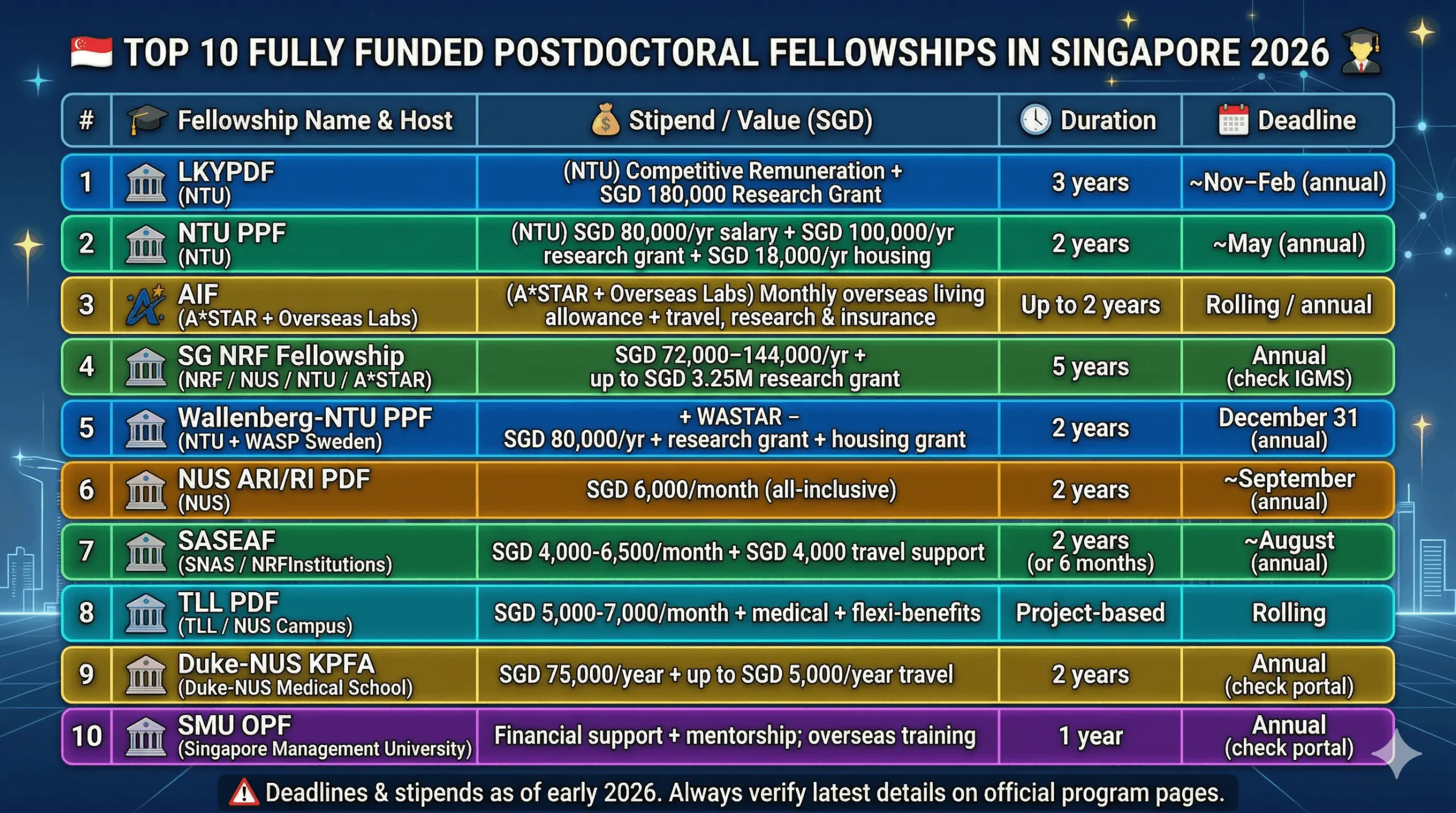
    Summary Table: Top 10 Fully Funded Postdoctoral Fellowships in Singapore 2026

    #Fellowship NameHost InstitutionOpen ToStipend / SalaryDurationDeadlineOfficial Link
    1Lee Kuan Yew Postdoctoral Fellowship (LKYPDF)NTUAll nationalitiesCompetitive remuneration + SGD 180,000 research grant3 years~Nov–Feb (annual)ntu.edu.sg/lkypdf
    2NTU Presidential Postdoctoral Fellowship (PPF)NTUAll nationalitiesSGD 80,000/yr salary + SGD 100,000/yr research grant + SGD 18,000/yr housing2 years~May (annual)ntu.edu.sg/ppf
    3A*STAR International Fellowship (AIF)A*STAR + Overseas LabsSingapore Citizens / PRsMonthly overseas living allowance + travel, research & insurance supportUp to 2 yearsRolling / annuala-star.edu.sg/scholarships
    4Singapore NRF FellowshipNRF / NUS / NTU / A*STARAll nationalitiesSGD 72,000–144,000/yr + up to SGD 3.25M research grant5 yearsAnnual (check IGMS)nrf.gov.sg/grants/nrff
    5Wallenberg-NTU Presidential Postdoctoral FellowshipNTU + WASP SwedenAll nationalitiesSGD 80,000/yr + research grant + housing grant2 yearsDecember 31 (annual)ntu.edu.sg/ppf
    6NUS Postdoctoral Fellowship (ARI / Research Institutes)NUSAll nationalitiesSGD 6,000/month (all-inclusive)2 years~September (annual)ari.nus.edu.sg
    7SG Academies South-East Asia Fellowship (SASEAF)SNAS / NRF Singapore institutionsASEAN nationals (excl. Singapore)SGD 4,000–6,500/month + SGD 4,000 travel support2 years (or 6 months)~August (annual)snas.org.sg/saseaf
    8Temasek Life Sciences Laboratory (TLL) Postdoctoral FellowshipTLL (NUS campus)All nationalitiesSGD 5,000–7,000/month + medical + flexi-benefitsProject-basedRollingtll.org.sg/careers
    9Duke-NUS Medical School – Khoo Postdoctoral Fellowship Award (KPFA)Duke-NUS Medical SchoolAll nationalitiesSGD 75,000/year + up to SGD 5,000/year travel2 yearsAnnual (check portal)duke-nus.edu.sg
    10SMU Overseas Postdoctoral Fellowship (OPF)Singapore Management UniversitySingapore citizensFinancial support + mentorship; overseas training1 yearAnnual (check portal)smu.edu.sg/opf

    Note: Stipends, deadlines, and terms are subject to change each cycle. Always verify the latest details on official program pages before applying.


    Detailed Profiles: Top 10 Postdoctoral Fellowships in Singapore

    1. Lee Kuan Yew Postdoctoral Fellowship (LKYPDF) — NTU

    Host Institution: Nanyang Technological University (NTU), Singapore

    Overview: The Lee Kuan Yew Postdoctoral Fellowship (LKY PDF) is one of Singapore’s oldest and most prestigious postdoctoral programs, established in 1991 under the Lee Kuan Yew Endowment Fund. It supports and promotes outstanding young researchers in the areas of Engineering, Science, Humanities, and Medicine at NTU. The fellowship is awarded concurrently with the candidate’s appointment as a research staff member at NTU, offering a direct foothold in Singapore’s leading research-intensive university.

    Key Benefits:

    • Tenable for a period of 3 years — one of the longer fellowship tenures in Singapore
    • Research grant of up to SGD 180,000 for consumables and research-related expenditure
    • Attractive remuneration package (confirmed at point of offer)
    • Concurrent appointment as a research staff member at NTU
    • Mentorship, faculty integration, and access to NTU’s global research network
    • Opportunity to co-supervise graduate students and establish a research profile

    Eligibility:

    • Open to all nationalities
    • Recent PhD graduates, or candidates with at most one previous postdoctoral training from a reputable university
    • Excellent academic records and strong research potential
    • Research areas relevant to Engineering, Science, Humanities, or Medicine at NTU

    Who Should Apply: Strong early-career researchers who want a longer fellowship tenure with dedicated research funding and the opportunity to be formally integrated into NTU’s faculty structure. Particularly suited to those targeting an independent research career in Asia.

    2026 Application Window: November 25, 2025 – February 6, 2026 was the most recent confirmed window. Check the NTU Online Application Portal for the next annual cycle.

    🔗 Official LKYPDF Page – NTU


    2. NTU Presidential Postdoctoral Fellowship (PPF)

    Host Institution: Nanyang Technological University (NTU), Singapore

    Overview: The NTU Presidential Postdoctoral Fellowship is among the most generous postdoctoral programs in Asia. It provides exceptional early-career researchers from any country with the freedom to pursue independent research in any discipline at NTU. The fellowship is explicitly designed as a pathway to an assistant professorship or another international postdoctoral assignment. Several specialized streams exist under the PPF umbrella, including the Wallenberg-NTU PPF (Sweden-Singapore AI/tech collaboration) and the SP Group-NTU PPF (energy and power systems research).

    Key Benefits:

    • Two-year tenure with an annual salary of SGD 80,000
    • Research grant of up to SGD 100,000 per year
    • Housing grant of SGD 18,000 per year with eligibility for subsidized accommodation
    • Relocation allowance of up to SGD 4,000
    • Mentorship, personal development programs, and integration into NTU’s global research network

    Eligibility:

    • Open to all nationalities
    • Within 5 years of obtaining a PhD or equivalent degree
    • Must submit a thoughtful, realistic 2-page research proposal
    • Available to take up the position no later than December 31, 2026 (current cycle)

    Who Should Apply: Early-career researchers in any field aiming to build an independent research program in Asia, particularly those with ambitions toward a future academic appointment.

    2026 Deadline: Annual cycle — typically closes in May. Monitor the NTU Online Application Portal.

    🔗 Official NTU PPF Page


    3. A*STAR International Fellowship (AIF)

    Host Institution: A*STAR Research Institutes (Singapore), with training conducted overseas

    Overview: The A*STAR International Fellowship (AIF) is designed to support Singapore-based PhD graduates and permanent residents in undertaking world-class postdoctoral training at leading overseas laboratories. After up to two years of overseas training, fellows return to contribute to an A*STAR Research Institute in Singapore. The AIF covers all scientific disciplines aligned with A*STAR’s national research directions and has two tracks: Research Track and Innovation Track.

    Key Benefits:

    • Full support for up to 2 years of overseas postdoctoral research training
    • Monthly overseas living allowance tailored to the host institution’s location
    • Subsidies for conferences, equipment, travel, and health insurance
    • Guaranteed research career placement at an A*STAR Research Institute upon return (3-year contribution period)
    • Strong professional network within Singapore’s national R&D ecosystem

    Eligibility:

    • Singapore Citizens or Permanent Residents (non-SPR may be considered if citizenship is obtained before fellowship commencement)
    • PhD completed within the last 4 years, or final-stage PhD candidates (award confirmed on conferment)
    • Excellent publication record and no existing bonds to any institution
    • Must be applying to or already placed in a top overseas postdoctoral lab

    Who Should Apply: Singaporean researchers who want cutting-edge international exposure at a world-class lab, with a structured, guaranteed career path back to Singapore’s leading national research institutes.

    Deadline: Rolling and annual intakes — confirm current deadlines at the A*STAR Scholarships portal.

    🔗 A*STAR Scholarships Portal

    Tip: If you’re an international PhD graduate seeking fully funded postdoc opportunities globally, also check: How to Find Postdoctoral Fellowship Opportunities Around the World


    4. Singapore NRF Fellowship

    Host Institution: NRF-affiliated institutions — NUS, NTU, A*STAR, Duke-NUS, SUTD, SMU, and Research Centres of Excellence

    Overview: The Singapore National Research Foundation (NRF) Fellowship is the single most prestigious and competitive early-career researcher program in Singapore. It funds outstanding scientists to lead independent research for five years and connects them to tenure-track faculty positions at Singapore’s top universities and research institutes. Open to all areas of science and technology and to researchers of all nationalities, it is Singapore’s equivalent of a European ERC Starting Grant or a US NSF CAREER Award.

    Key Benefits:

    • Annual gross salary pegged to Assistant Professor level: SGD 72,000–144,000
    • Research grant of up to SGD 3.25 million (inclusive of 30% overheads) over five years
    • Three-step competitive selection with final interview in Singapore
    • Appointment to a tenure-track faculty position at NUS, NTU, A*STAR, Duke-NUS, SUTD, SMU, or a Research Centre of Excellence

    Eligibility:

    • Open to all nationalities
    • Under age 40 at the close of the call
    • PhD in any science or technology discipline
    • Research project must not be simultaneously funded by other agencies

    Who Should Apply: Exceptional scientists with a demonstrated track record of independent research who aspire to lead a research group and build a long-term academic career in Singapore.

    Deadline: Once per year via the IGMS (Integrated Grant Management System) portal — check nrf.gov.sg for the current call.

    🔗 Official NRF Fellowship Page


    5. Wallenberg-NTU Presidential Postdoctoral Fellowship

    Host Institution: Nanyang Technological University (NTU) + WASP Partner Institutions, Sweden

    Overview: Supported by the prestigious Knut and Alice Wallenberg Foundation, the Wallenberg-NTU Presidential Postdoctoral Fellowship is a unique bilateral Singapore-Sweden research program. It gives early-career researchers the chance to conduct research at both NTU and a Wallenberg AI, Autonomous Systems and Software Program (WASP) partner institution in Sweden. The program focuses on AI, machine learning, data analytics, autonomous systems, software, and mobility research.

    Key Benefits:

    • Two-year tenure with an annual salary of SGD 80,000
    • Research grant of up to SGD 100,000 per year
    • Housing grant of SGD 18,000 per year
    • Dual-country research experience across Singapore and Sweden’s world-leading AI research ecosystems
    • Access to NTU’s and WASP’s networks for AI and multidisciplinary science

    Eligibility:

    • Open to all nationalities
    • Within 5 years of obtaining a PhD
    • Research background in AI, machine learning, big data, software, or autonomous systems
    • Must submit a realistic research proposal in one of the WASP research areas

    Who Should Apply: AI, data science, and engineering researchers seeking bilateral exposure between Asia and Europe, particularly those working at the intersection of AI and multidisciplinary STEM fields.

    Deadline: Annually on December 31 (Singapore Time). Referees’ reports due January 7.

    🔗 Wallenberg-NTU PPF Official Page


    6. NUS Postdoctoral Fellowship — Asia Research Institute (ARI) and Research Institutes

    Host Institution: National University of Singapore (NUS)

    Overview: NUS offers postdoctoral fellowship positions across its many faculties and research institutes. The flagship open call is through the Asia Research Institute (ARI), which invites early-career scholars in humanities and social sciences to join for two years of research on Asia. ARI fellows are embedded in one of the institute’s thematic research clusters — covering migration, urbanism, religion and globalization, science and society, and population health. Beyond ARI, NUS departments across science, engineering, medicine, and computing regularly post additional postdoctoral positions.

    Key Benefits (ARI Fellowship FY2026/27):

    • Monthly remuneration of SGD 6,000 — all-inclusive (covers housing and living expenses)
    • Travel assistance for eligible candidates
    • Support for fieldwork and conference attendance (on application and subject to approval)
    • CPF contributions for Singapore Citizens and Permanent Residents
    • Active engagement in ARI’s academic community, seminars, and workshops
    • Two-year appointment with potential to contribute to collaborative grant applications

    Eligibility:

    • Must hold a PhD in humanities or social sciences (or near completion with official confirmation)
    • Strong publication record
    • Research proposal aligned with ARI’s research clusters
    • For other NUS departments: eligibility varies by position; check the NUS Careers portal

    Who Should Apply: Humanities and social science scholars focusing on Asia-related research, as well as STEM postdocs applying to departmental or institute-level positions across NUS faculties and research centers.

    2026 Application Window: ARI FY2026/27 — call opened August 2025, closed September 2025. Watch for the FY2027/28 call in mid-2026.

    🔗 NUS ARI Postdoctoral Fellowship 🔗 NUS Careers Portal (all disciplines)


    7. SG Academies South-East Asia Fellowship (SASEAF) Programme

    Host Institution: Hosted at NUS, NTU, A*STAR, and other Singapore research institutions; administered by SNAS, AMS, and AES; funded by NRF

    Overview: The SG Academies South-East Asia Fellowship (SASEAF) — previously called the SG Academies ASEAN Fellowship — is a fully funded two-year postdoctoral program specifically designed to attract promising early-career researchers from ASEAN countries to Singapore’s leading research institutions. It is jointly administered by three Singapore academies (SNAS, AMS, AES) and funded by the National Research Foundation. Preferred research areas include infectious diseases, public health, and sustainability, but any discipline is considered.

    Key Benefits:

    • Monthly stipend of SGD 4,000–6,500, based on qualifications and experience
    • Travel support of SGD 4,000 for arrival and departure expenses
    • Access to professional development events and training programs run by SNAS, AMS, and AES
    • Integration into Singapore’s vibrant research community
    • A shorter 6-month option available for dry-lab infectious disease projects

    Eligibility:

    • Citizens of an ASEAN country (excluding Singapore) residing outside Singapore
    • Must hold a PhD from a reputable institution
    • Currently employed by or with a confirmed offer from a public-sector research entity in the home country
    • Maximum age: 40 years at time of application
    • Fluent written and oral English required

    Who Should Apply: ASEAN-based researchers in science, medicine, engineering, or computer science who want structured postdoctoral research experience at a Singapore institution while maintaining ties with their home country.

    2026 Deadline: The previous call closed on August 1, 2025 under the RIE2025 initiative. A new intake is expected; watch snas.org.sg/saseaf for the next announcement.

    🔗 Official SASEAF Programme Page – SNAS

    Related for ASEAN and Indian researchers: Fully Funded Postdoctoral Fellowships in Australia for Indian Students 2026


    8. Temasek Life Sciences Laboratory (TLL) Postdoctoral Fellowship

    Host Institution: Temasek Life Sciences Laboratory (TLL), located on the NUS campus, affiliated with NUS and NTU

    Overview: Founded in 2002, Temasek Life Sciences Laboratory (TLL) is a non-profit research institute focused on cutting-edge research in molecular biology, genetics, cell biology, developmental biology, plant science, and molecular pathogenesis. With over 220 researchers from 23+ countries and a strong culture of publishing in top-tier journals, TLL actively recruits postdoctoral fellows on a rolling basis directly through its Principal Investigators.

    TLL postdoctoral positions are project-based, meaning they are offered by individual PIs rather than through a central competitive fellowship call. However, they provide excellent training conditions, a genuinely international environment, and direct access to world-class life sciences infrastructure.

    Key Benefits:

    • Competitive monthly salary in line with market rates (typically SGD 5,000–7,000/month)
    • Medical benefits and flexi-benefits package
    • Employer CPF contributions for Singapore Citizens and Permanent Residents
    • State-of-the-art laboratory facilities on the NUS Biopolis campus
    • Strong publication culture — TLL researchers regularly publish in Nature, Cell, and other leading journals
    • International environment with researchers from 23+ countries

    Eligibility:

    • PhD in molecular biology, cell biology, genetics, plant science, or a related life sciences discipline
    • Open to all nationalities
    • Strong research output and publication record preferred
    • Positions vary by PI and research project

    Who Should Apply: Life scientists and molecular biologists who want focused, project-based postdoctoral training at a specialized research institute with excellent publication outcomes and global career prospects.

    Deadline: Rolling — positions posted as they become available. Check the TLL careers page regularly.

    🔗 TLL Careers Page


    9. Duke-NUS Medical School — Khoo Postdoctoral Fellowship Award (KPFA)

    Host Institution: Duke-NUS Medical School, Singapore

    Overview: Established as a strategic partnership between Duke University and NUS, Duke-NUS Medical School is Singapore’s premier graduate medical school and a global leader in translational biomedical research. The Khoo Postdoctoral Fellowship Award (KPFA) supports outstanding early-career researchers to conduct independent biomedical and clinical research at Duke-NUS. Funded for two years, it specifically supports candidates whose primary host institution is Duke-NUS or a Singapore-based affiliated institution.

    Key Benefits:

    • Annual award of SGD 75,000 — allocated for the Fellow’s salary and research support
    • Up to SGD 5,000 per year for research travel
    • Two-year term; second-year funding contingent on satisfactory first-year progress
    • Access to Duke-NUS’s world-class clinical and translational research infrastructure
    • Pathway toward an independent research career in academic medicine in Singapore

    Eligibility:

    • Must have accepted (or be positioned to accept) a postdoctoral research position at Duke-NUS or affiliated Singapore institution
    • Must anticipate receipt of PhD, DSc, MD, MBBS, DDS, DVM, or PharmD degree
    • Open to all nationalities
    • Research proposal should represent a meaningful expansion of the candidate’s existing skills

    Who Should Apply: Biomedical, clinical, and translational scientists who want to build an independent research program within a globally connected, clinically engaged medical school environment in Singapore.

    Deadline: Annual — check the Duke-NUS postdoctoral grants page for the current call status.

    🔗 Duke-NUS Postdoctoral Grants Page


    10. SMU Overseas Postdoctoral Fellowship (OPF)

    Host Institution: Singapore Management University (SMU)

    Overview: The SMU Overseas Postdoctoral Fellowship (OPF) is part of SMU’s MOE START (Singapore Tenure-Track Research Track) initiative. It provides Singaporean doctoral candidates who have recently completed or are about to complete their studies with the opportunity to undertake advanced training and research at a leading overseas university for one year. Upon completing the fellowship and returning to Singapore, awardees are considered for appointment at SMU as an Assistant Professor on the tenure track. It is a unique fellowship in that it funds overseas training as a direct, structured pathway to a faculty career at SMU.

    Key Benefits:

    • Financial support covering the overseas postdoctoral training year
    • Academic mentorship from SMU faculty throughout the fellowship period
    • Direct pathway to consideration for a tenure-track Assistant Professorship at SMU upon return
    • Engagement with SMU’s active research community in business, law, economics, computing, and social sciences
    • Global network-building during the overseas training period

    Eligibility:

    • Singapore Citizens only
    • Doctoral candidates who have recently completed or are about to complete their PhD in a discipline relevant to SMU
    • Excellent academic record and high motivation for an academic career
    • Must have been accepted to or applied for postdoctoral training at a leading overseas university aligned with SMU’s core research areas (business, law, social sciences, economics, finance, computing)

    Who Should Apply: Singaporean PhD graduates in business, economics, law, social sciences, or computing who aspire to an academic faculty career at SMU and want to build their research profile through structured overseas postdoctoral training.

    Deadline: Annual — typically opens mid-year. Check smu.edu.sg/moe-start/overseas-postdoctoral-fellowship for the current intake dates.

    🔗 SMU OPF Official Page


    How Much Stipend Do Postdoctoral Fellows Get in Singapore?

    This is one of the most frequently searched questions by international applicants. Here is a clear breakdown of postdoc stipends and salaries across Singapore’s top programs:

    FellowshipMonthly Equivalent (SGD)Additional Support
    Singapore NRF Fellowship6,000–12,000/monthUp to SGD 3.25M research grant over 5 years
    NTU PPF / Wallenberg-NTU PPF~6,667/monthSGD 100,000/yr research grant + SGD 18,000/yr housing
    Lee Kuan Yew PDF (LKYPDF)Competitive (confirmed at offer)SGD 180,000 research grant over 3 years
    NUS ARI Fellowship6,000/monthFieldwork and conference support
    Duke-NUS KPFA~6,250/month (SGD 75,000/yr)Up to SGD 5,000/yr travel
    SASEAF Programme4,000–6,500/monthSGD 4,000 travel support
    TLL Postdoctoral Fellow5,000–7,000/monthMedical + flexi-benefits
    A*STAR AIFVaries by locationConference, equipment, travel, insurance
    SMU OPFFinancial support (overseas year)Mentorship; faculty career pathway

    For comparison, the average postdoctoral fellow salary in Singapore ranges from SGD 5,000 to SGD 7,400 per month across all institutions, based on current market data. Prestigious programs like the NRF Fellowship offer significantly higher compensation at the Assistant Professor salary scale.


    What Is Included in a Singapore Postdoctoral Fellowship Package?

    Most fully funded Singapore postdoc fellowship packages include several or all of the following components:

    • Monthly stipend or salary (SGD 4,000–12,000+ depending on program)
    • Research grant (ranging from SGD 75,000 to SGD 3.25 million)
    • Housing allowance (up to SGD 18,000/year for flagship programs)
    • Health insurance or medical benefits
    • Relocation or airfare allowance (one-time, typically SGD 1,500–4,000)
    • Conference and fieldwork travel funding
    • CPF contributions for Singapore Citizens and PRs (where applicable)
    • Mentorship and professional development programs

    For a global comparison of what postdoc packages look like in other countries, see: Fully Funded Postdoctoral Fellowships in Canada for Indian Students 2026 and Postdoctoral Fellowships in India 2026: Complete Guide


    2026 Key Deadlines at a Glance

    Program2026 Deadline / Cycle
    Lee Kuan Yew PDF (LKYPDF) — NTUNov 25, 2025 – Feb 6, 2026 (check NTU for next annual call)
    Wallenberg-NTU Presidential PPFDecember 31 annually; referees by Jan 7
    NTU Presidential PPF (general)~May 2026 (check NTU Careers Portal)
    NUS ARI Fellowship FY2026/27Sep 2025 (closed); Watch for FY2027/28 in mid-2026
    SASEAF ProgrammeAugust 1, 2025 (previous); watch for next call at snas.org.sg
    NRF FellowshipAnnual — check IGMS portal at nrf.gov.sg
    A*STAR AIFRolling / annual — check A*STAR Scholarships portal
    Duke-NUS KPFAAnnual — check Duke-NUS postdoctoral grants page
    SMU OPFAnnual — typically opens mid-year, check SMU portal
    TLL Postdoctoral PositionsRolling — posted as available at tll.org.sg

    Pro tip: Most Singapore fellowship cycles publish calls 3–6 months in advance. Subscribe to NTU, NUS, NRF, and A*STAR institutional email alerts so you never miss an opening.


    How to Apply for Postdoctoral Fellowships in Singapore in 2026

    Here is a step-by-step application guide:

    Step 1 — Identify the right fellowship Match your research field, career stage, and nationality to the best program. STEM researchers should consider NTU PPF, NRF Fellowship, LKYPDF, or TLL positions. Humanities scholars should target NUS ARI. ASEAN nationals should look at SASEAF. Singaporeans aiming for overseas training should consider A*STAR AIF or SMU OPF.

    Step 2 — Contact prospective supervisors early For most fellowships, reaching out to a faculty mentor or PI before submitting is strongly encouraged — and sometimes a prerequisite for the application.

    Step 3 — Write a strong research proposal Most programs require a 2-page proposal. Make it specific, clearly tied to the host institution’s research priorities, and realistic in scope.

    Step 4 — Gather supporting documents Standard requirements include:

    • Cover letter
    • Comprehensive CV with full publication list
    • Official PhD transcript or degree certificate
    • 2-page research proposal
    • Top 3 publications in PDF
    • Contact details for 2–3 referees (at least one being your PhD supervisor)

    Step 5 — Submit via the official portal Most programs use institutional portals (NTU Careers, NUS Careers, Duke-NUS portal) or the government IGMS system (NRF). Late or incomplete applications are not accepted.

    Step 6 — Confirm referee availability Most programs contact referees directly. Alert your referees well in advance and confirm the deadline.

    For broader application strategy tips, read: Top Fellowships & Funding Opportunities for PhD Students in India 2026 — strategies applicable to competitive global fellowship applications everywhere.


    Are Singapore Postdoctoral Fellowships Open to International Applicants?

    Yes — the majority of Singapore postdoctoral fellowships explicitly welcome applicants of all nationalities. Programs like the NTU Presidential PPF, LKYPDF, NRF Fellowship, NUS ARI Fellowship, SASEAF (for ASEAN nationals), Duke-NUS KPFA, and TLL postdoctoral positions are all internationally open.

    The main exceptions are:

    • A*STAR AIF — primarily for Singapore Citizens and Permanent Residents
    • SMU OPF — currently limited to Singapore Citizens

    Singapore actively positions itself as a global research talent hub. International researchers make up a significant share of the academic and research workforce at NUS, NTU, A*STAR, and TLL.


    Living in Singapore as a Postdoctoral Researcher

    Singapore is safe, well-organized, and cosmopolitan. Here is a rough monthly cost-of-living estimate for a postdoctoral researcher:

    ExpenseEstimated Monthly Cost (SGD)
    Rent (1-bedroom apartment near campus)SGD 2,000–3,200
    Food and groceriesSGD 500–900
    Transport (MRT / bus)SGD 100–150
    UtilitiesSGD 100–200
    MiscellaneousSGD 200–400
    Total EstimateSGD 2,900–4,850/month

    With stipends of SGD 5,000–7,000+/month (plus housing grants in top programs), postdoctoral fellows in Singapore typically live comfortably and can save meaningfully. Programs with dedicated housing grants — such as the NTU PPF at SGD 18,000/year — further ease the financial burden for international fellows.


    Frequently Asked Questions (FAQ)

    1. What are the fully funded postdoctoral fellowships in Singapore?

    The top fully funded programs include the LKYPDF, NTU Presidential PPF, NRF Fellowship, A*STAR AIF, Wallenberg-NTU PPF, NUS ARI Fellowship, SASEAF Programme, TLL Postdoctoral Fellowships, Duke-NUS KPFA, and SMU OPF. Each provides a salary or stipend, research grant, and additional allowances covering housing, travel, or equipment.

    2. How much stipend do postdoctoral fellows get in Singapore?

    Stipends range from SGD 4,000 to SGD 12,000+ per month, depending on the program. The NUS ARI Fellowship pays SGD 6,000/month (all-inclusive), the NTU PPF pays SGD 80,000/year (~SGD 6,667/month), the SASEAF Programme pays SGD 4,000–6,500/month, and the NRF Fellowship is pegged to an Assistant Professor salary of SGD 72,000–144,000/year.

    3. What are the deadlines for Singapore postdoctoral fellowships in 2026?

    Key 2026 deadlines include: LKYPDF November–February (annual cycle), Wallenberg-NTU PPF December 31 (annual), NTU PPF ~May (annual), SASEAF ~August (annual). The NRF Fellowship has one call per year via the IGMS portal. TLL and A*STAR AIF accept applications on a rolling basis.

    4. Are there fully funded postdoc positions in Singapore for international applicants?

    Yes. Most flagship programs — including the NTU PPF, LKYPDF, NRF Fellowship, NUS ARI, SASEAF (ASEAN nationals), Duke-NUS KPFA, and TLL positions — are open to all nationalities. Only A*STAR AIF and SMU OPF have significant nationality requirements.

    5. Which universities and institutions in Singapore offer postdoctoral fellowships?

    The main institutions include NUS, NTU, Duke-NUS Medical School, SUTD, SMU, Temasek Life Sciences Laboratory (TLL), and A*STAR’s network of 14+ research institutes across Biopolis and Fusionopolis.

    6. How do I apply for a postdoc fellowship in Singapore?

    The process involves: identifying the right program → contacting a prospective supervisor → preparing a 2-page research proposal → gathering supporting documents (CV, transcripts, publications) → submitting via the official portal. Most programs require 2–3 reference letters submitted directly by your referees.

    7. Are Singapore postdoctoral fellowships competitive?

    Yes — programs like the NRF Fellowship, NTU PPF, and LKYPDF are highly competitive and attract top researchers globally. However, with a strong publication record, a focused proposal, and early engagement with a faculty mentor, qualified candidates have a genuine chance. The SASEAF Programme, TLL rolling positions, and departmental NUS positions offer additional entry points.


    Final Application Tips

    • Start 3–4 months early — a rushed fellowship application is rarely successful
    • Contact supervisors before the deadline — faculty sponsorship significantly strengthens your case
    • Tailor your proposal — show why your research specifically fits NTU, NUS, A*STAR, or TLL’s priorities
    • Choose referees strategically — references from leading, recognized researchers carry the most weight
    • Apply to multiple fellowships simultaneously — several programs run on overlapping timelines
    • Monitor official portals directly — NTU, NUS, and NRF post calls on official websites first

    Related Guides on Global Postdoctoral Opportunities

    Exploring postdoc opportunities beyond Singapore? These resources from irrespub.com will help:


    Last updated: April 2026. All fellowship information is sourced from official program pages at NTU, NUS, NRF, A*STAR, SNAS, TLL, Duke-NUS, and SMU. Deadlines and funding details are subject to change — always verify the latest information on official websites before applying.
  • Your Guide to Fully Funded Postdoctoral Fellowships in South Korea: Stipends, Eligibility, and 2026 Application Windows

    Your Guide to Fully Funded Postdoctoral Fellowships in South Korea: Stipends, Eligibility, and 2026 Application Windows

    Introduction: Why South Korea Is a Top Destination for Postdoctoral Researchers

    South Korea has rapidly become one of the world’s most competitive research destinations. With government-backed funding programs, world-class universities, and a national commitment to science and technology innovation, the country now offers some of the most generous fully funded postdoctoral fellowships in South Korea — and increasingly, the world.

    Whether you are a recent PhD graduate looking for your first postdoc or an established researcher seeking an international collaboration, South Korea postdoc programs can provide you with competitive stipends, relocation support, housing allowances, health insurance, and access to cutting-edge research infrastructure — all while building an internationally competitive CV.

    This guide covers the 10 best fully funded postdoctoral fellowships in South Korea for international and Korean researchers alike, including 2026 deadlines, stipend details, and direct links to official program pages.

    Explore Top Funded Postdoctoral Fellowships in UK for Indian Students in 2026

    And Fully Funded PhD Positions in UK for Indian Students 2026 (Complete Guide + List)

    Who should read this guide? International PhD holders, early-career scientists in STEM or humanities and social sciences, Korean researchers based abroad, and anyone exploring South Korea postdoc 2026 opportunities.


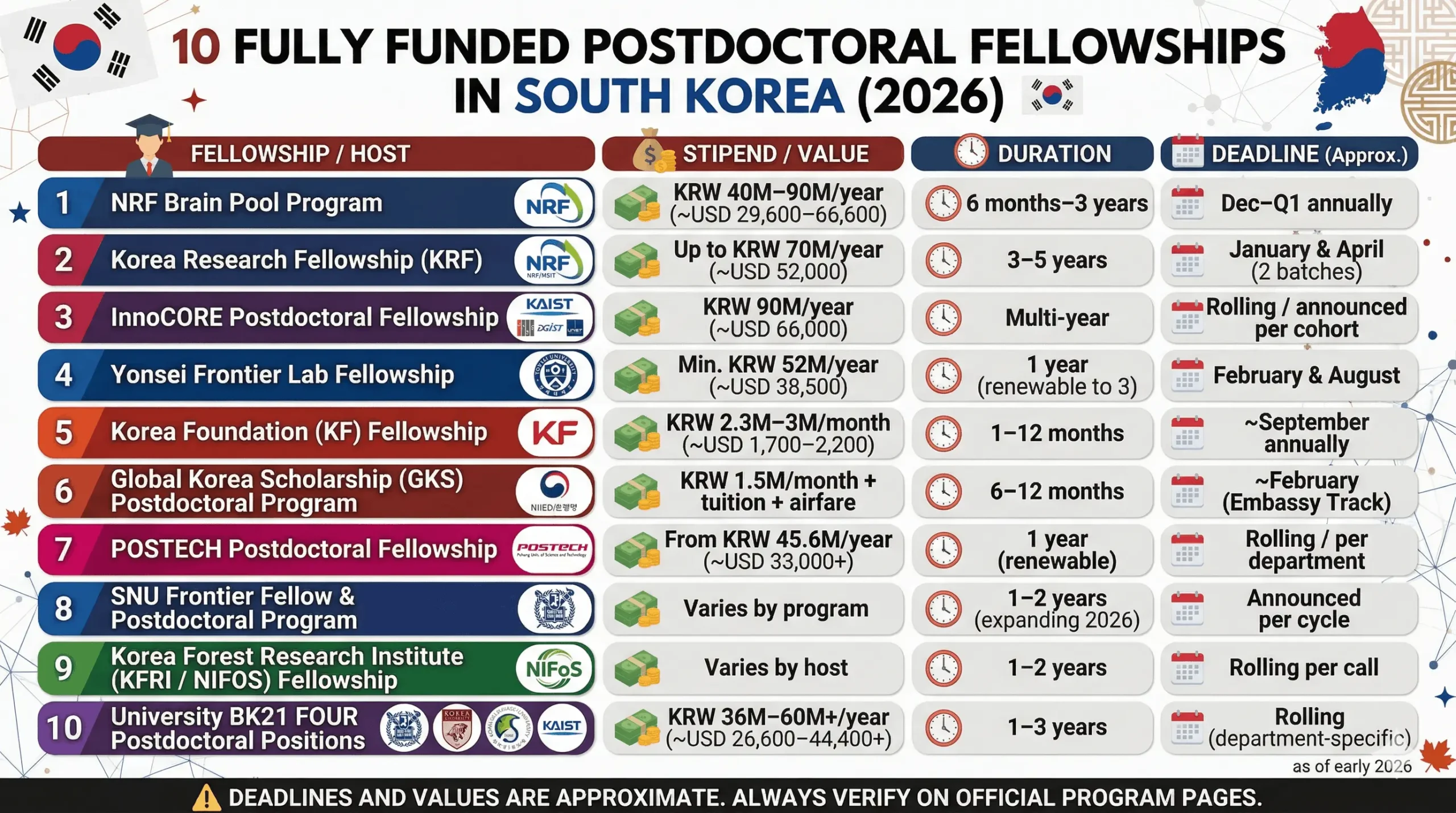
    Quick Summary Table: 10 Fully Funded Postdoctoral Fellowships in South Korea (2026)

    #ProgramHost / OrganizerOpen ToStipend / SalaryDuration2026 Deadline (Approx.)
    1NRF Brain Pool ProgramNational Research Foundation (NRF)International researchers (PhD + 5 yrs exp.)KRW 40M–90M/year (~USD 29,600–66,600)6 months–3 yearsDec–Q1 annually
    2Korea Research Fellowship (KRF)NRF / MSITForeign nationals & overseas Koreans (PhD ≤5 yrs)Up to KRW 70M/year (~USD 52,000)3–5 yearsJanuary & April (2 batches)
    3InnoCORE Postdoctoral FellowshipKAIST, GIST, DGIST, UNIST (MSIT)International PhD holders in STEMKRW 90M/year (~USD 66,000)Multi-yearRolling / announced per cohort
    4Yonsei Frontier Lab FellowshipYonsei UniversityInternational & domestic postdocsMin. KRW 52M/year (~USD 38,500)1 year (renewable to 3)February & August
    5Korea Foundation (KF) FellowshipKorea Foundation (KF)Foreign postdocs in Korean studiesKRW 2.3M–3M/month (~USD 1,700–2,200)1–12 months~September annually
    6Global Korea Scholarship (GKS) Postdoctoral Research ProgramNIIED / Korean GovernmentInternational researchers under 40KRW 1.5M/month + tuition + airfare6–12 months~February (Embassy Track)
    7POSTECH Postdoctoral FellowshipPohang University of Science and TechnologyInternational & domestic PhD holdersFrom KRW 45.6M/year (~USD 33,000+)1 year (renewable)Rolling / per department
    8SNU Frontier Fellow & Postdoctoral ProgramSeoul National University (SNU)International researchersVaries by program1–2 years (expanding 2026)Announced per cycle
    9Korea Forest Research Institute (KFRI / NIFoS) FellowshipNational Institute of Forest ScienceForeign researchers in forestry & related fieldsVaries by host1–2 yearsRolling per call
    10University BK21 FOUR Postdoctoral PositionsSNU, Korea University, SKKU, KAIST, etc.All nationalities fluent in EnglishKRW 36M–60M+/year (~USD 26,600–44,400+)1–3 yearsRolling (department-specific)

    Note: Deadlines are based on historical cycles. Always verify on official program pages before applying.


    The 10 Best Fully Funded Postdoctoral Fellowships in South Korea

    1. NRF Brain Pool Program

    Overview

    The Brain Pool Program is one of South Korea’s flagship international research initiatives, managed by the National Research Foundation of Korea (NRF) and funded by the Ministry of Science and ICT (MSIT). It invites distinguished overseas scientists and engineers to conduct collaborative research at Korean universities, national labs, and corporate research institutes for periods ranging from 6 months to 3 years.

    The program operates two tracks: a standard Brain Pool (BP) track and an extended Brain Pool Plus (BP+) track for longer-term engagements.

    Check this out- Fully Funded Postdoctoral Fellowships in Canada for Indian Students in 2026 [Complete Guide]

    Key Benefits

    • Monthly salary: KRW 5M–25M, totalling KRW 40M–90M annually (~USD 29,600–66,600)
    • Relocation and initial settlement support
    • Housing allowance
    • Child education subsidy
    • Medical insurance
    • Research funding (separate from personal stipend)
    • Korean language education support

    Who Should Apply

    International researchers with a PhD and at least 5 years of research experience who have identified a Korean host institution willing to invite them. Korean nationals residing abroad are also eligible. Note: applications are submitted by the Korean host researcher via the NRF IRIS system — candidates cannot apply independently.

    2026 Deadline

    Calls are typically announced in December or early Q1 each year. Relocating to Korea within three months of selection is mandatory.

    🔗 Official NRF Brain Pool Program | KUSCO Invitation Programs


    2. Korea Research Fellowship (KRF)

    Overview

    The Korea Research Fellowship (KRF) is specifically designed for outstanding early-career postdoctoral researchers — foreign nationals and overseas-based Korean researchers. Administered by NRF, the KRF supports all fields of science and technology, with preferred areas including ICT/software, biotechnology, energy, nano-materials, aerospace, and marine sciences.

    The KRF operates via a host researcher application system. NRF also runs a Research Host Matching Service at krf-help.net to connect Type 1 candidates with Korean hosts.

    Key Benefits

    • Up to KRW 70 million per year (~USD 52,000), comprising:
      • Personnel costs: up to KRW 50M
      • Living expenses: up to KRW 12M
      • Relocation, Korean language training, and other costs
    • Duration: 3–5 years
    • Full-time research position at a Korean institution
    • Annual performance evaluation with renewal possibility

    Dont forget to checkout- Top 10 Fully Funded Postdoctoral Fellowships in Australia for Indian Students 2026

    Who Should Apply

    Postdoctoral researchers from any country with diplomatic relations with Korea who obtained their PhD within the past 5 years. Type 1 is for researchers currently overseas; Type 2 is for foreign nationals already in Korea.

    2026 Application Deadlines

    The KRF operates in two annual batches — typically in January and April. Check the NRF ERND portal for the latest calls.

    🔗 EURAXESS KRF Information | UNIST KRF Overview


    3. InnoCORE Postdoctoral Fellowship Program (KAIST, GIST, DGIST, UNIST)

    Overview

    The InnoCORE (Innovation + Core Researchers) Program is one of the most exciting new developments in Korean research funding. Unveiled by the Ministry of Science and ICT (MSIT) in June 2025, InnoCORE aims to recruit 400 outstanding postdoctoral researchers in AI-convergent science and technology (AI+S&T) across four premier institutes: KAIST, GIST, DGIST, and UNIST.

    Eight interdisciplinary research clusters collaborate with Samsung, LG, Naver, Hyundai, and global institutions including MIT, Stanford, Harvard, and Oxford. The government committed KRW 300 billion (~USD 225 million) over five years. The inaugural 2025 cohort attracted 103 foreign nationals, including 26 from India and 18 from China.

    Key Benefits

    • Base annual salary: KRW 90 million (~USD 66,000) — approximately 1.8× the national postdoc average
    • Access to supercomputers, semiconductor cleanrooms, and cutting-edge biomedical facilities
    • Multi-layered mentoring (academic + industry + international)
    • Additional compensation available through industry partnerships
    • Collaboration with global institutions and Korean industry leaders

    Who Should Apply

    PhD holders in STEM awarded within the past 5 years. Open to international researchers worldwide. Particularly suited to researchers in AI, biomedicine, clean energy, aerospace, and advanced manufacturing.

    2026 Deadline

    The inaugural cohort was recruited in 2025. The next cycle is expected to be announced via official channels. Monitor innocore.re.kr and msit.go.kr for updates.

    🔗 Korea Herald InnoCORE Announcement | Official MSIT Press Release


    4. Yonsei University Frontier Fellowship for Postdoctoral Researchers

    Overview

    Offered by Yonsei University’s Frontier Lab (YFL), this fellowship supports outstanding postdoctoral researchers — international and domestic — across science, engineering, and humanities/social sciences at Yonsei’s Sinchon and International Campuses. It is one of the most accessible university-funded postdoc positions in South Korea for researchers already connected to a Yonsei faculty member.

    The program actively encourages simultaneous application to the NRF Brain Pool+ program, with preference given to applicants who have done so.

    Key Benefits

    • Minimum annual stipend: KRW 52 million (~USD 38,500), with YFL contributing KRW 40M
    • Duration: 1 year, renewable for up to 3 years
    • Access to Yonsei’s international research network
    • Priority given to first-time YFL applicants

    Who Should Apply

    Postdoctoral researchers with a PhD awarded within the last 7 years. STEM field applicants must have at least 2 publications in JCR Q1 journals within the past 2 years. A sponsoring Yonsei faculty member is required.

    2026 Application Deadlines

    • 1st round: February (contracts starting March–September)
    • 2nd round: August (contracts starting September–March)

    Apply via email to: ysfrontierlab@yonsei.ac.kr

    🔗 Yonsei Frontier Lab Fellowship Page


    5. Korea Foundation (KF) Fellowship for Field Research — Postdoctoral Track

    Overview

    The Korea Foundation (KF) has been supporting international scholars in Korean studies since 1992. Its Fellowship for Field Research provides on-site research support in South Korea for foreign researchers in the humanities and social sciences. This is the primary research fellowship option for non-STEM researchers exploring South Korea postdoc opportunities.

    Key Benefits

    • Monthly stipend: KRW 2.3M (Type A) or KRW 3M (Type B) — approximately USD 1,700–2,200/month
    • Round-trip airfare (for researchers from ODA-eligible countries)
    • Duration: 1 month to 12 months
    • Access to Korean academic institutions, archives, and research networks

    Who Should Apply

    Foreign postdoctoral researchers and advanced doctoral candidates specializing in Korean history, culture, politics, economics, language, or related humanities/social science fields. Applicants must be affiliated with a university or research institute outside Korea.

    2026 Application Deadline

    The 2025–2026 cycle closed September 12, 2025. The next cycle is expected to open in July 2026. Apply via apply.kf.or.kr.

    🔗 KF Fellowship Official Page


    6. Global Korea Scholarship (GKS) — Postdoctoral Research Program

    Overview

    The Global Korea Scholarship (GKS), administered by the National Institute for International Education (NIIED), is best known for its master’s and PhD programs. However, it also includes a Postdoctoral Research Program that provides funded research opportunities for foreign PhD holders at Korean universities for 6–12 months.

    For 2026, NIIED offered the GKS to students and researchers from 149+ countries across all major academic fields. The postdoctoral research track is available through the Embassy Track.

    Key Benefits

    • Monthly allowance: KRW 1,500,000 (~USD 1,100/month) for research/postdoctoral track
    • Round-trip economy class airfare
    • Medical insurance for the full fellowship period
    • Settlement allowance upon arrival
    • Access to all NIIED-designated Korean universities

    Who Should Apply

    Foreign nationals under 40 who hold a doctoral degree and have received an invitation from a NIIED-designated Korean university. Applicants and both parents must hold non-Korean citizenship.

    2026 Application Deadline

    Embassy Track applications for 2026 opened in February 2026 (deadline: February 25, 2026). The 2027 cycle is expected to open in February 2027. Check studyinkorea.go.kr for updates.

    🔗 Study in Korea — GKS Portal | NIIED Scholarship Page


    7. POSTECH Postdoctoral Fellowship (PIURI & BK21 FOUR)

    Overview

    POSTECH (Pohang University of Science and Technology) is one of South Korea’s most prestigious science and engineering universities. POSTECH runs two main postdoctoral schemes:

    • PIURI (POSTECH Institute for Undergraduate Research Integration) Postdoctoral Fellowship, with intakes in the 1st and 2nd halves of each year
    • BK21 FOUR postdoctoral/research professor positions within academic departments, open to all nationalities

    Positions are available across mathematics, physics, chemistry, engineering, and life sciences.

    Key Benefits

    • Annual salary from KRW 45.6M (~USD 33,000+) for postdoctoral fellows
    • Initial appointment of 1 year, renewable upon performance
    • Access to POSTECH’s world-class research labs and facilities
    • Open to all nationalities fluent in English

    Who Should Apply

    PhD holders in natural sciences, mathematics, engineering, or related fields with a strong research record. Industry or postdoctoral experience required for research professor positions.

    2026 Deadlines

    PIURI runs two intakes per year. BK21 FOUR positions are posted on a rolling basis by department. Check postech.ac.kr and individual department pages regularly.

    🔗 POSTECH Official Website | POSTECH Mathematics Postdoc Positions


    8. SNU Frontier Fellow & Postdoctoral Researcher Development Program

    Overview

    Seoul National University (SNU), South Korea’s most prestigious university, significantly expanded its postdoctoral support in 2025–2026. The SNU Frontier Fellow & Postdoctoral Researcher Development Program formally launches in 2026, integrating talent development with international research collaboration.

    Related programs include the Ascending SNU Future Leader Fellowship (for researchers within 2 years of PhD completion) and the SNU OPEN WORLD (SOW) Program for inbound international scholar visits and co-authorship support.

    Key Benefits

    • Structured postdoctoral support across all major academic fields
    • Connection to NRF Brain Pool funding (SNU actively integrates MSIT programs)
    • Access to SNU’s network of international partner universities
    • Strategic Hub for International Research Collaboration (launched late 2025)

    Who Should Apply

    Postdoctoral researchers within 2 years of PhD completion for the Ascending Future Leader Fellowship. The broader Frontier Fellow Program (2026 launch) is expected to expand eligibility. Contact SNU’s Office of Research Affairs for current openings.

    2026 Deadline

    Program details are announced per cycle on SNU’s official job portal.

    🔗 SNU Official Website | SNU Job Openings


    9. Korea Forest Research Institute (KFRI / NIFoS) Fellowship

    Overview

    The National Institute of Forest Science (NIFoS), formerly the Korea Forest Research Institute (KFRI), is a government-affiliated research institution under the Korea Forest Service. It supports young foreign researchers in forestry, wood science, biotechnology, ecology, and related fields. Founded in 1922, NIFoS focuses on forest policy, forest genetic resources, and R&D aligned with Korea’s Forest Resources Enhancement Plan.

    This is one of the few Korean research fellowships for international researchers specifically targeting environmental and agricultural sciences — a valuable option outside STEM’s mainstream focus areas.

    Key Benefits

    • Research fellowship salary paid by host institution
    • Full-time research at government forestry and biotechnology labs
    • Access to Korea National Arboretum (Gwangneung forest) and research facilities
    • Duration typically 1–2 years

    Who Should Apply

    Foreign researchers with a PhD in forestry, wood science, ecology, biotechnology, environmental science, or related fields. Contact NIFoS researchers directly or watch for announcements via NRF and government research portals.

    2026 Deadline

    Positions are advertised on a rolling basis. Check nifos.go.kr and the Korea Forest Service portal for current calls.

    🔗 NIFoS Official Website | Korea Forest Service


    10. University-Specific BK21 FOUR Postdoctoral Positions (SNU, Korea University, SKKU, KAIST & Others)

    Overview

    BK21 FOUR (Brain Korea 21 Fostering Outstanding Universities for Research) is a large-scale national R&D human resources program run by MSIT and NRF. It funds postdoctoral researchers and research professors at Korea’s leading universities — including SNU, Korea University, Sungkyunkwan University (SKKU), KAIST, Yonsei University, and others — across all academic fields.

    Each BK21 FOUR project within a department can recruit postdoctoral researchers independently, making these among the most numerous and practically accessible funded postdoc positions in South Korea for foreign researchers. They are regularly listed on university department websites and global academic job boards.

    Key Benefits

    • Annual salary: KRW 36M–60M+ depending on university, discipline, and seniority (~USD 26,600–44,400+)
    • Initial appointment of 1 year, renewable for up to 3 years
    • Research funding and conference travel support through the project grant
    • Open to all nationalities fluent in English
    • Positions available in STEM, humanities, and social sciences

    Who Should Apply

    PhD holders in the relevant discipline at any career stage. Research professor positions typically require at least 1 year of postdoctoral or equivalent experience.

    2026 Deadline

    Positions are posted on a rolling basis throughout the year. Monitor KAIST Career, Korea University Hiring, SKKU Employment, and global job boards including AcademicPositions.com and ResearcherJob.com.

    🔗 NRF BK21 FOUR Overview | KAIST BK21 Postdoctoral Positions


    Stipend Comparison: What Do South Korea Postdocs Actually Earn?

    Here is a clear summary of South Korea postdoc stipends across all 10 programs:

    ProgramAnnual Stipend (KRW)USD Equivalent (Approx.)
    InnoCORE (KAIST/GIST/DGIST/UNIST)KRW 90,000,000~USD 66,000
    Brain Pool (top tier)KRW 90,000,000~USD 66,000
    Brain Pool (standard)KRW 40,000,000–60,000,000~USD 29,600–44,400
    Korea Research Fellowship (KRF)Up to KRW 70,000,000~USD 52,000
    Yonsei Frontier LabMin. KRW 52,000,000~USD 38,500
    BK21 FOUR (universities)KRW 36,000,000–60,000,000+~USD 26,600–44,400+
    POSTECH (BK21/PIURI)From KRW 45,600,000~USD 33,000+
    KF Field Research FellowshipKRW 27,600,000–36,000,000~USD 20,400–26,600
    GKS Postdoctoral ResearchKRW 18,000,000/year~USD 13,300/year
    NIFoS / KFRI FellowshipHost institution rateVaries

    These stipends compare favourably with many destinations in Asia and Europe, particularly when adjusted for South Korea’s relatively affordable cost of living.


    Which Universities in South Korea Offer Funded Postdoc Positions?

    The following universities are the most active in recruiting international postdoctoral researchers:

    For more scholarship and fellowship opportunities across Asia, explore related guides on irrespub.com.


    How to Apply for Postdoctoral Fellowships in South Korea: Step-by-Step

    Read or guide on 15 Best AI Tools to Find Postdoctoral Positions Worldwide in 2026

    Step 1: Identify the right program Match your career stage, field, and nationality to the right fellowship. Early-career researchers (PhD ≤5 years) should prioritise KRF, InnoCORE, and BK21. Established researchers (5+ years) should target Brain Pool.

    Step 2: Find a Korean host researcher Most programs require a Korean host researcher to submit the application on your behalf. Contact potential hosts via university faculty pages or use the NRF Research Host Matching Service for KRF.

    Step 3: Prepare your documents

    • PhD diploma/certificate (with conferral date)
    • CV with full publication list
    • Research proposal
    • 2–3 recommendation letters
    • Passport copy
    • Salary proof (Brain Pool)
    • Ethics and integrity pledge

    Step 4: Submit through the official system Brain Pool and KRF: host submits via NRF IRIS. Yonsei YFL and KF: candidates submit directly. GKS: use the Study in Korea portal.

    Step 5: Evaluation and results Evaluation involves document review and peer assessment. Competitive programs may include interviews. Results typically come 2–3 months after deadline.

    Step 6: Relocate and begin research Most programs require relocation to Korea within 3 months of official notification.

    For tips on writing research proposals and academic applications, visit irrespub.com.


    Frequently Asked Questions (FAQ)

    How do I get a postdoctoral fellowship in South Korea?

    Identify a Korean host researcher in your field, contact them directly, and have them submit an application to programs like NRF Brain Pool or KRF. You can also apply directly to university fellowships (Yonsei YFL) or government competitive programs (GKS, InnoCORE).

    Are postdoctoral fellowships in South Korea fully funded?

    Yes. The major programs — Brain Pool, KRF, InnoCORE, and GKS — are fully funded, covering stipend, relocation, health insurance, and often Korean language training.

    Can international researchers apply for postdoc positions in South Korea?

    Yes. Brain Pool, KRF, InnoCORE, GKS, and BK21 FOUR positions are all explicitly open to international researchers. InnoCORE’s inaugural 2025 cohort alone included 103 foreign nationals.

    What is the stipend for a postdoc in South Korea?

    Stipends range from KRW 1.5M per month (GKS Research Program) to KRW 90M per year (InnoCORE and top Brain Pool). KRF offers up to KRW 70M annually; Yonsei Frontier Lab guarantees at least KRW 52M per year.

    When are South Korea postdoc deadlines for 2026?

    Key 2026 deadlines:

    • Brain Pool: December–Q1 annually
    • KRF: January and April (two batches)
    • Yonsei Frontier Lab: February and August
    • GKS Research Program: ~February (Embassy Track)
    • KF Fellowship: ~September annually
    • InnoCORE: Rolling/cohort-based
    • BK21 / University positions: Rolling throughout the year

    What documents are needed for a South Korea postdoc application?

    Standard requirements: PhD diploma with conferral date, full CV, research proposal, 2–3 recommendation letters, passport copy, publication list, and consent/ethics forms. Brain Pool requires salary proof; GKS requires proof of both parents’ nationality.

    Which fellowship programs in South Korea support foreign postdocs in humanities?

    The Korea Foundation (KF) Fellowship for Field Research is the primary humanities-focused program, supporting Korean studies in history, culture, politics, and economics. The GKS Research Program also accepts humanities researchers at NIIED-designated universities.


    Final Thoughts

    South Korea’s investment in research talent has never been stronger. Programs like InnoCORE, Brain Pool, KRF, Yonsei’s Frontier Lab, and the growing BK21 FOUR university network represent a serious national commitment to attracting the world’s best scientists — and the stipends are now globally competitive. Whether you are pursuing a funded postdoc in South Korea for the first time or looking to extend a research career into East Asia, 2026 offers more options than ever before.

    Start by identifying your target program, contacting a potential Korean host researcher as early as possible, and bookmarking official program pages for deadline updates.

    For more guides on international fellowships, academic funding, and research career development, visit irrespub.com.


    Last reviewed: April 2026. Program details, stipend amounts, and deadlines are subject to change. Always verify on official program websites before applying.

    Further Reads

    Top Postdoctoral Fellowships in USA for Indian Students in 2026

    Pharma Jobs After PhD in India vs USA (2026): Salary, Growth & Opportunities Compared

    Government Jobs After PhD in India: Complete Guide (2026)

    Career Options After PhD in India: Industry Roles You Should Know in 2026

  • Top Funded Postdoctoral Fellowships in UK for Indian Students in 2026

    Top Funded Postdoctoral Fellowships in UK for Indian Students in 2026

    Research Opportunities · 2026

    Top Funded Postdoctoral Fellowships in UK for Indian Students in 2026

    A comprehensive, verified guide to fully funded UK postdoc fellowships open to Indian and international researchers — with stipends, deadlines, and direct application links.

    📅 Updated March 2026 ✍️ IR Research Publication Editorial Team 🎓 Early-Career Researchers

    Introduction: Why Pursue a Postdoc in the UK?

    For Indian PhD holders aiming to build a globally competitive research career, the United Kingdom remains one of the most sought-after destinations. Home to world-ranked universities like Oxford, Cambridge, Imperial College London, and Edinburgh, the UK offers early-career researchers access to cutting-edge laboratories, interdisciplinary networks, and prestigious fellowship programmes that can define an entire academic career.

    The good news: several fully funded postdoctoral fellowships in the UK are explicitly open to international applicants, including Indian researchers. These are not merely stipends — they cover full salaries, research expenses, visa costs, and sometimes even relocation support for dependents.

    This guide is for Indian PhD holders and early-career researchers who want to apply for funded research positions in the UK in 2026. We have compiled only genuine, verified programmes with official sources, current deadlines (where available), and direct application links. No fabricated opportunities — just real funding you can act on.

    💡 Who Should Read This
    This guide is for: PhD holders from Indian universities seeking postdoctoral funding in the UK; researchers in STEM, humanities, and social sciences; early-career academics within 5–8 years of their PhD award; and Indian students currently based at UK institutions exploring domestic fellowship routes.

    For more scholarship opportunities, explore our related guides on Fully Funded PhD Positions in UK for Indian Students 2026 (Complete Guide + List), Fully Funded Postdoctoral Fellowships in Canada for Indian Students in 2026 [Complete Guide], and our Fully Funded PhD in Australia: The Ultimate 2026 Scholarship Guide for Indian Students.

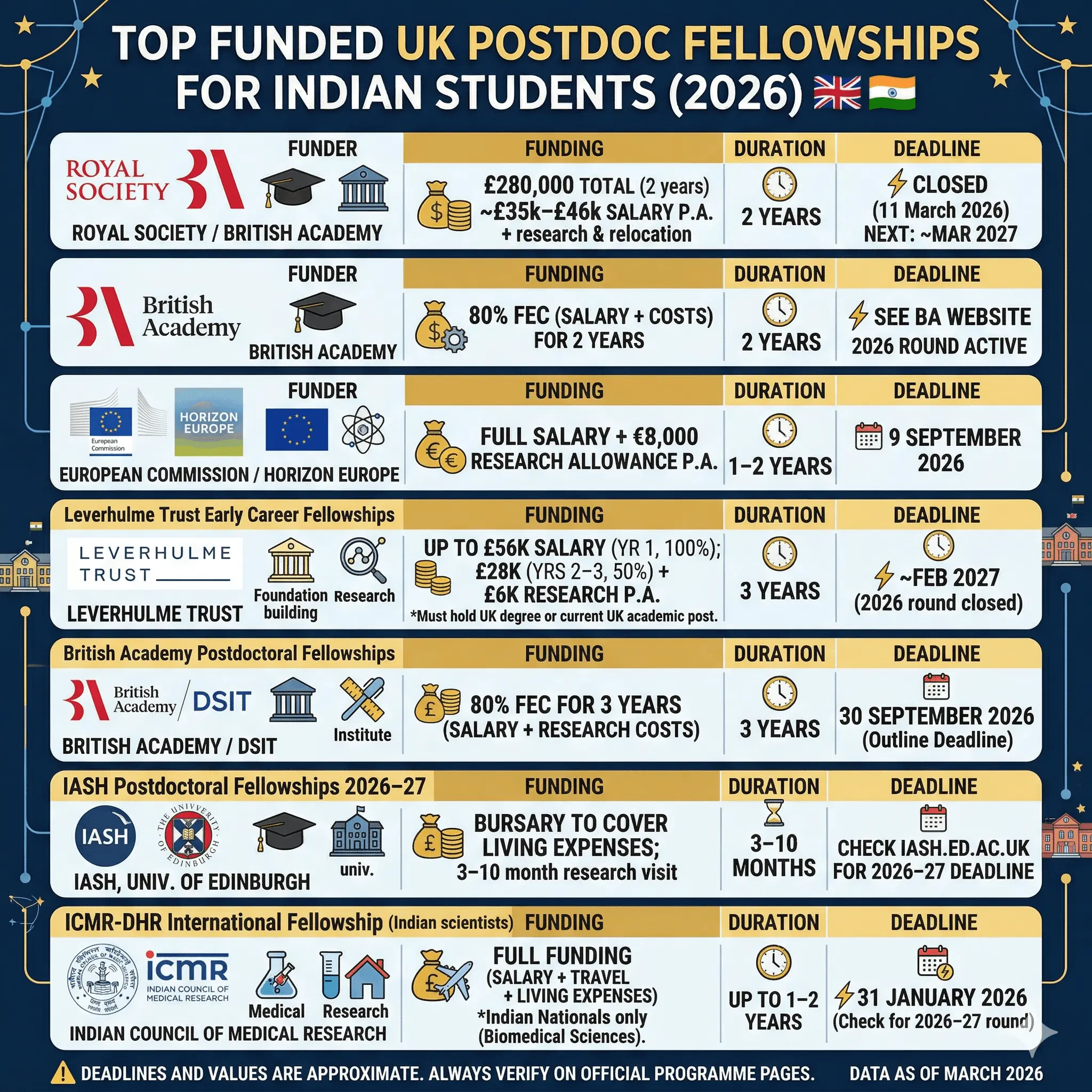
    Summary Table: Top Funded UK Postdoc Fellowships 2026

    Use the table below to quickly compare programmes by funding, eligibility, and deadlines before reading full details.

    Fellowship Host / Funder Eligible for Indians? Funding / Stipend Duration 2026 Deadline Apply
    Newton International Fellowship Royal Society / British Academy ✅ Yes — all non-UK nationals Up to £280,000 total (2 yrs); ~£35k–£46k salary p.a. + research & relocation 2 years 11 March 2026 (closed; next ~Mar 2027) royalsociety.org
    British Academy International Fellowships British Academy ✅ Yes — non-UK nationals (humanities/social sci) 80% FEC (salary + costs) for 2 years 2 years See BA website; 2026 round active thebritishacademy.ac.uk
    MSCA Postdoctoral Fellowships (European PF) European Commission / Horizon Europe ✅ Yes — any nationality (must host at UK institution) Full salary + €8,000 research allowance p.a. 1–2 years 9 September 2026 rea.ec.europa.eu
    Leverhulme Trust Early Career Fellowships Leverhulme Trust ⚠️ Conditional — must hold a UK degree OR current UK academic post (≥4 months before deadline) Up to £56k salary (yr 1, 100%); £28k (yrs 2–3, 50%) + £6k research p.a. 3 years ~Feb 2027 (2026 round closed) leverhulme.ac.uk
    British Academy Postdoctoral Fellowships British Academy / DSIT ⚠️ Must be based at a UK host institution for duration 80% FEC for 3 years (salary + research costs) 3 years 30 September 2026 (outline deadline) thebritishacademy.ac.uk
    IASH Postdoctoral Fellowships 2026–27 Institute for Advanced Studies in the Humanities, Univ. of Edinburgh ✅ Yes — open internationally Bursary to cover living expenses; 3–10 month research visit 3–10 months Check iash.ed.ac.uk for 2026–27 deadline iash.ed.ac.uk
    ICMR-DHR International Fellowship (Indian scientists) Indian Council of Medical Research ✅ Indian nationals only (biomedical sciences) Full funding (salary + travel + living expenses) Up to 1–2 years 31 January 2026 (check for 2026–27 round) icmr.nic.in

    Note: Deadlines are accurate as of March 2026. Always verify on the official programme page before applying, as schemes may update their timelines.

    1. Newton International Fellowships — Royal Society & British Academy

    Fellowship #1 · Fully Funded · STEM + Humanities
    Newton International Fellowships 2026
    ⏱ 2 Years 💷 Up to £280,000 🌍 All non-UK nationals 📅 March 2026 (closed; next ~2027)

    The Newton International Fellowship is arguably the most prestigious early-career postdoctoral fellowship available to international researchers wanting to work in the UK. Jointly administered by the Royal Society (for natural sciences) and the British Academy (for humanities and social sciences), it provides two fully funded years at a UK research institution.

    Key Benefits:

    • Total funding of up to £280,000 over two years (covering salary, research costs, overhead, and visa/relocation expenses)
    • Salary range approximately £35,608–£46,049 per annum (Cambridge IoA scale, as an indicator)
    • Annual research expenses of up to £8,000
    • One-off relocation payment (including support for dependents accompanying the Fellow)
    • Fast-track Global Talent Visa route for successful applicants
    • Access to alumni networking funding after the fellowship ends
    • Approximately 30 fellowships awarded per round, with potential for additional awards

    Eligibility for Indian researchers: Open to all non-UK nationals. Applicants must hold a PhD (or have successfully defended their doctoral thesis) by the application deadline, and must have no more than 5 years of active full-time postdoctoral experience (career breaks excluded). Applicants must not have resided or carried out research in the UK for more than 3 months during the 12 months before the deadline.

    Who should apply: Indian scientists and researchers in natural sciences (STEM) — or humanities/social sciences researchers applying via the British Academy route — who are in the first 5 years of their postdoctoral career and have a strong research proposal developed with a UK-based sponsor.

    Important for 2026: The 2026 round deadline was 11 March 2026. The next round is anticipated around March 2027. Contact info@newtonfellowships.org for eligibility queries.

    Visit Official Page →

    2. British Academy International Fellowships

    Fellowship #2 · Fully Funded · Humanities & Social Sciences
    British Academy International Fellowships 2026
    ⏱ 2 Years 💷 80% FEC 🌍 Non-UK nationals only 📅 2026 round active — check BA website

    The British Academy International Fellowships programme is co-run with the Royal Society and supports outstanding early-career researchers in the humanities and social sciences who wish to conduct research at a UK institution for two years.

    Key Benefits:

    • Two-year fellowship at a UK host institution in humanities or social sciences
    • Award offered at 80% Full Economic Cost (FEC) — covering salary, directly allocated and indirect costs
    • Alumni funding available post-fellowship for continued networking
    • Access to the British Academy’s international research community

    Eligibility: Must hold a PhD (or be completing it), be working outside the UK, not hold UK citizenship, be competent in English, and have no more than 5 years of active postdoctoral experience. Must have a clearly defined research proposal agreed with a UK host researcher.

    Who should apply: Indian researchers in history, sociology, economics, political science, linguistics, philosophy, cultural studies, and related fields who are in the early stages of their postdoctoral career and have secured a UK mentor willing to host them.

    Visit Official Page →

    3. MSCA Postdoctoral Fellowships (European Fellowship — UK Host)

    Fellowship #3 · Fully Funded · All Disciplines · Any Nationality
    Marie Skłodowska-Curie Actions (MSCA) Postdoctoral Fellowships 2026
    ⏱ 1–2 Years 💶 Full salary + €8k research allowance 🌍 Any nationality 📅 9 September 2026

    The MSCA Postdoctoral Fellowships, funded under the EU’s Horizon Europe programme, are among the largest and most competitive international postdoctoral funding schemes in the world. UK universities remain eligible as host institutions, making this a prime option for Indian researchers who wish to work at institutions such as Oxford, Cambridge, UCL, or Imperial College London.

    Key Benefits:

    • Full living allowance (salary) + annual research, training and networking allowance of €8,000
    • Mobility allowance if relocating internationally
    • Family allowance if applicable
    • Open to researchers of any nationality (for European Fellowships hosted at a UK institution)
    • Total budget for the 2026 call: €399.05 million
    • Fellowship duration of 1–2 years; up to 8 years of research experience post-PhD permitted

    Eligibility: Must hold a PhD by the deadline. Maximum 8 years of full-time research experience post-PhD. Must comply with mobility rules: must not have resided or carried out main activity in the country of the host for more than 12 months in the 36 months before the deadline. The 2026 call opens 9 April 2026 with a deadline of 9 September 2026.

    Who should apply: Indian postdoctoral researchers in any discipline — from life sciences and engineering to social sciences and humanities — who can identify a supervisor at a UK institution willing to co-develop and host the application.

    How to find a UK host: Explore hosting offers on EURAXESS, or contact UK research departments directly. Many UK universities publish expressions of interest calls specifically for MSCA candidates.

    Visit Official Page →

    4. Leverhulme Trust Early Career Fellowships

    Fellowship #4 · Highly Competitive · Any Discipline · Conditional Eligibility
    Leverhulme Early Career Fellowships 2026
    ⏱ 3 Years 💷 Up to £56k salary (yr 1) + £6k research ⚠️ UK degree OR active UK post required 📅 ~Feb 2027 (2026 round now closed)

    The Leverhulme Trust Early Career Fellowships are among the most prestigious postdoctoral fellowships available within the UK. Approximately 145 fellowships are awarded per year across all disciplines. Each award is tenable for 3 years, with a significant salary contribution and annual research expenses.

    Key Benefits:

    • Year 1: Trust covers 100% of Fellow’s salary up to £56,000
    • Years 2–3: Trust covers 50% of salary up to £28,000 per year (host institution covers the balance)
    • Up to £6,000 per year in research expenses
    • Non-renewable 3-year award tenable at any eligible UK university or HEI
    • Approximately 145 fellowships available per round

    ⚠️ Eligibility note for Indian researchers: This is a competitive scheme primarily designed for researchers building a UK academic career. Applicants must either hold a degree from a UK higher education institution, or hold an active academic position (fixed-term lectureship or fellowship) in the UK for at least 4 months before the closing date. Indian PhD holders based in India who have never held a UK post or UK degree are not directly eligible. However, Indian researchers who completed their PhD at a UK university or who currently hold a UK postdoctoral position are encouraged to apply.

    Who should apply: Indian researchers who obtained their PhD at a UK university, or who currently hold a postdoctoral appointment in the UK and are within 4 years of PhD thesis submission.

    Visit Official Page →

    5. British Academy Postdoctoral Fellowships

    Fellowship #5 · 3-Year Award · Humanities & Social Sciences
    British Academy Postdoctoral Fellowships 2026
    ⏱ 3 Years 💷 80% FEC for 3 years 📍 Must be at a UK host institution 📅 30 September 2026 (outline deadline)

    The British Academy Postdoctoral Fellowship is a prestigious 3-year award in the humanities and social sciences, funded by the UK’s Department for Science, Innovation and Technology (DSIT). It starts from Autumn 2027 (for the 2026 application round). The primary emphasis is on completing a significant publishable research project.

    Key Benefits:

    • Funds 80% of salary costs, directly allocated and indirect costs under Full Economic Cost
    • 3-year non-renewable fellowship at a UK university or recognised research institution
    • Designed to lead toward a permanent academic post
    • Integrated into the scholarly community at the host institution

    Eligibility: Applicants must be based at an eligible UK university or research organisation for the duration of the fellowship. This is suitable for Indian researchers who are already in the UK (e.g., on a postdoctoral contract) or who can secure affiliation with a UK host institution. The 2026 submission deadline (UK institutional approval) is 30 September 2026 (17:00 GMT).

    Who should apply: Indian researchers currently based at a UK university in humanities or social sciences, within 3 years of their PhD viva, who have a mentor and a significant independent research project to pursue.

    Visit Official Page →

    6. IASH Postdoctoral Fellowships 2026–27 — University of Edinburgh

    Fellowship #6 · Fully Open Internationally · Arts, Humanities & Social Sciences
    IASH Postdoctoral Fellowships 2026–27 (University of Edinburgh)
    ⏱ 3–10 Months 💷 Bursary (living expenses) 🌍 International applicants welcome 📅 Check iash.ed.ac.uk for 2026–27

    The Institute for Advanced Studies in the Humanities (IASH) at the University of Edinburgh offers competitive postdoctoral fellowships for scholars in the arts, humanities, and social sciences. The fellowships provide a research visit of 3 to 10 months in Edinburgh, with no teaching obligation.

    Key Benefits:

    • 3–10 month funded research visit at the University of Edinburgh
    • Bursary to contribute toward living expenses (can top up another fellowship such as British Academy)
    • No mandatory teaching — full focus on independent research
    • Access to Edinburgh’s vibrant international humanities community
    • Specialised targeted fellowships available (Gender Studies, Digital Humanities, Islamic Studies, 18th-Century Scottish Studies)
    • Open to applicants from within and beyond the University of Edinburgh

    Eligibility: Must hold a doctorate at the time of application, normally awarded within the last 3 years (graduates between 2023 and 2026, with flexibility for career breaks). Must not have held a permanent university position or a previous IASH Fellowship.

    Who should apply: Indian scholars in arts, humanities, and social sciences who completed their PhD within the last 3 years and wish to pursue 3–10 months of independent research in Edinburgh. Ideal for those who can combine the IASH bursary with other funding sources.

    Visit Official Page →

    7. ICMR-DHR International Fellowship for Indian Biomedical Scientists

    Fellowship #7 · Indian Nationals Only · Biomedical Sciences
    ICMR-DHR International Fellowship Programme for Indian Biomedical Scientists
    ⏱ Up to 1–2 Years 💷 Fully funded (salary + travel) 🇮🇳 Indian nationals only 📅 Check icmr.nic.in for 2026–27 round

    The ICMR-DHR International Fellowship is a Government of India programme administered by the Indian Council of Medical Research (ICMR) under the Department of Health Research (DHR). Unlike the other fellowships in this list, this one funds Indian scientists to go abroad — including to the UK — for advanced research in biomedical sciences.

    Key Benefits:

    • Fully funded (covers salary/stipend, international travel, accommodation, and living expenses)
    • Allows Indian biomedical scientists to conduct research at international laboratories, including those in the UK
    • No need to independently identify UK fellowship funding — the Government of India supports the placement
    • Strong credibility signal for future Indian academic career

    Eligibility: Open to Indian nationals only working in biomedical sciences. Applicants should be associated with Indian research institutions and meet ICMR’s academic qualification criteria. The 2025 deadline was 31 January 2026 — monitor the ICMR website for the 2026–27 cycle announcement.

    Who should apply: Indian biomedical researchers, medical scientists, and early-career faculty who want to spend time at a world-class UK laboratory without having to independently compete for UK-based funding. Also see our guide on funded research positions for Indian scientists abroad.

    Visit Official Page →

    How to Apply for UK Postdoc Fellowships from India: Key Tips

    Competition for these fellowships is intense. Here are evidence-based strategies to strengthen your application as an Indian researcher:

    1. Identify and Contact a UK Sponsor/Mentor Early

    Almost all UK postdoctoral fellowships — Newton, MSCA, Leverhulme, British Academy — require a named UK-based sponsor or mentor before you can apply. Do not wait until the deadline. Reach out 4–6 months in advance with a concise research proposal email, a CV, and a list of publications.

    2. Craft a Compelling and Independent Research Proposal

    Your proposal should present a new research direction, not merely extend your PhD thesis. Fellowship committees look for originality, feasibility, and clear academic impact. The Newton Fellowship and MSCA in particular emphasise your potential for research independence.

    3. Choose the Right Fellowship for Your Career Stage

    • 0–5 years post-PhD: Newton International Fellowship, British Academy International Fellowship, IASH
    • 0–8 years post-PhD: MSCA Postdoctoral Fellowship
    • Already in UK, 0–4 years post-PhD: Leverhulme ECF, British Academy Postdoctoral Fellowship
    • Biomedical scientists: ICMR-DHR Fellowship (Government of India route)

    4. Is IELTS Required?

    Most UK postdoctoral fellowships do not require a formal IELTS score, as they assess English proficiency through your research proposal and communication with the UK sponsor. However, for visa purposes, you may need to demonstrate English language competence. Check with UK Visas and Immigration for the Global Talent Visa requirements.

    5. Apply for the Global Talent Visa

    Newton International Fellows and many MSCA fellows qualify for a fast-track Global Talent Visa route, which significantly simplifies the UK immigration process. Start this process as soon as your fellowship offer is confirmed.

    Frequently Asked Questions

    Q1. Are there postdoctoral fellowships in the UK open to Indian students?
    Yes. Several major UK fellowships explicitly welcome non-UK nationals, including Indian researchers. The Newton International Fellowship (Royal Society / British Academy), MSCA Postdoctoral Fellowship (Horizon Europe, UK host), and IASH Postdoctoral Fellowships (University of Edinburgh) are all open to applicants of any nationality, including Indian citizens. Some — like the Leverhulme Early Career Fellowship — have conditional eligibility requiring a UK degree or current UK academic position.
    Q2. How much stipend do UK postdoctoral fellowships offer?
    Stipends vary significantly by programme. The Newton International Fellowship covers a full academic salary (approximately £35,000–£46,000 per year based on the Cambridge scale), plus research expenses and relocation support, for a total of up to £280,000 over two years. The MSCA Postdoctoral Fellowship covers the full salary set by the host institution plus an €8,000 annual research allowance. The Leverhulme Fellowship covers up to £56,000 in year one and £28,000 per year in years two and three.
    Q3. Which UK universities offer fully funded postdoc fellowships for international researchers?
    Most research-intensive UK universities can host international postdoctoral fellows through the programmes listed above. Leading host institutions include the University of Oxford, University of Cambridge, University College London (UCL), Imperial College London, University of Edinburgh, King’s College London, and the University of Manchester. The key is to find a named academic sponsor at your chosen institution before applying.
    Q4. What are the eligibility criteria for UK postdoctoral fellowships?
    Common eligibility requirements across most UK postdoctoral fellowships are: (a) Holding a PhD or having successfully defended your doctoral thesis by the application deadline; (b) Being within a set number of years of your PhD award (typically 5 years for Newton/British Academy International, up to 8 years for MSCA, up to 4 years for Leverhulme); (c) Not being a UK citizen (for internationally targeted fellowships like Newton); (d) Proposing high-quality, original, publishable research; and (e) Having secured a named UK academic sponsor or mentor.
    Q5. Do UK postdoc fellowships provide visa sponsorship?
    Yes. Most fully funded UK postdoctoral fellowships include immigration support. Newton International Fellows, for example, qualify for the fast-track Global Talent Visa route. MSCA fellows also receive support through the host institution’s HR departments. Relocation costs — including visa application fees — are often covered by the fellowship award itself.
    Q6. Can PhD holders from India apply for the Newton International Fellowship?
    Yes, absolutely. The Newton International Fellowship is open to all non-UK nationals, and Indian PhD holders are among the eligible applicants. You must hold your PhD (or have successfully defended your thesis) by the application deadline, have no more than 5 years of active full-time postdoctoral experience, and be currently working outside the UK. You must secure a UK-based academic sponsor before applying through the Royal Society or British Academy portals.
    Q7. What is the best fully funded postdoc option in UK for Indian researchers in 2026?
    For researchers in natural sciences (STEM), the Newton International Fellowship (Royal Society) is the gold standard — prestigious, well-funded, and fully open to Indian nationals. For humanities and social sciences researchers, the British Academy International Fellowship is the equivalent. If you are already based in the UK, explore the Leverhulme Trust Early Career Fellowships and the British Academy Postdoctoral Fellowship. For biomedical scientists based in India, the Government of India’s ICMR-DHR International Fellowship is a strong option that funds your placement abroad without requiring you to independently win UK funding.
  • Fully Funded Postdoctoral Fellowships in Canada for Indian Students in 2026 [Complete Guide]

    Fully Funded Postdoctoral Fellowships in Canada for Indian Students in 2026 [Complete Guide]

    Fully Funded Postdoctoral Fellowships in Canada for Indian Students in 2026 [Complete Guide]
    🍁 Canada Research Guide 2026

    Fully Funded Postdoctoral Fellowships in Canada for Indian Students in 2026 [Complete Guide]

    Everything Indian researchers need to know about finding, applying for, and winning top postdoc funding in Canada — from federal government awards to cutting-edge AI fellowships.

    📅 Updated: March 2026 | ⏱ 18 min read | 🎓 Postdoctoral Level

    Why Canada Is a Top Destination for Indian Postdoctoral Researchers in 2026

    Canada has firmly established itself as one of the most welcoming and research-rich destinations for international postdoctoral scholars. For Indian researchers who have recently completed their PhD, the country offers a powerful combination of world-class universities, generous federal funding, strong India-Canada research partnerships, and a clear pathway to long-term residence.

    In 2025–2026, the Canadian government and major research funding bodies made landmark changes to their postdoctoral funding ecosystem. The Banting, NSERC, CIHR, and SSHRC postdoctoral fellowships were consolidated into a single harmonised program called the Canada Postdoctoral Research Award (CPRA). Simultaneously, Mitacs launched the brand-new Accelerate Global Excellence Award specifically to attract international talent — including Indian researchers — to Canadian industry-academic partnerships.

    This guide covers every major fully funded postdoctoral fellowship opportunity available to Indian students in Canada for 2026, with verified details on stipends, eligibility, deadlines, and official links. Whether you are a scientist in STEM, a health researcher, or a social science scholar, there is a program designed for you.

    🎯 Who This Guide Is For:
    • Indian nationals who have completed a PhD (or expect to within 12 months)
    • Postdoctoral researchers currently in Canada on a work permit
    • Early-career scientists looking to transition to independent research careers
    • Researchers in STEM, health sciences, social sciences, AI, and engineering
    🏛️

    World-Class Universities

    Canada is home to University of Toronto, McGill, UBC, and other globally ranked institutions with cutting-edge research infrastructure.

    💰

    Competitive Stipends

    Most funded fellowships offer CAD $55,000–$110,000 per year — significantly higher than equivalent programs in many other countries.

    🇮🇳🇨🇦

    India–Canada Partnerships

    Mitacs renewed its partnership with India in March 2026, opening more bilateral research collaboration pathways for Indian scholars.

    🌐

    Immigration Pathways

    Postdoctoral experience in Canada can strengthen PR applications through Express Entry and other immigration streams.

    Quick Comparison: Top Postdoctoral Fellowships in Canada for Indian Students 2026

    The table below summarises the most important details for each fellowship. All values are in Canadian Dollars (CAD) unless stated.

    # Fellowship / Program Host Institution Open to Indians? Stipend / Value Duration Deadline (2026) Official Link
    1 Canada Postdoctoral Research Award (CPRA) Any eligible Canadian university / research hospital ✓ Yes (up to 20%) $70,000/year Up to 2 years ~September 2026 Apply →
    2 Mitacs Accelerate Global Excellence Award Canadian universities + industry partners ✓ Yes (targeted) $85,000/year (total $170K over 2 yrs) 2 years May 1, 2026 Apply →
    3 Mitacs Accelerate (Industry Postdoc) Canadian universities + partner organisations ✓ Yes (with work permit) $60,000–$75,000/year Up to 3 years Rolling Apply →
    4 Eric & Wendy Schmidt AI in Science PDF (U of T) University of Toronto ✓ International eligible ~$85,000–$110,000/year + benefits 2 years (3rd year possible) ~October 2026 Apply →
    5 U of T Postdoctoral Competitive Research Award University of Toronto ✓ International eligible Competitive — approx. $70,000+/year 2 years Check U of T SGS Apply →
    6 Schmidt Science Fellows Program Any approved global institution (incl. Canadian) ✓ Open globally US$110,000/year Up to 2 years July 2026 (U of T nominees) Apply →
    7 IVADO Postdoctoral Fellowships (AI/Data Science) IVADO-affiliated institutions, Quebec ✓ International eligible ~$100,000/year Specified in call Check IVADO website Apply →
    8 Canada Government Postdoctoral Research Program Federal govt labs & research institutions ✓ Open (varies) ~$70,000/year 1–3 years Feb–Mar 2026 (next cycle TBA) Apply →

    ⚠️ Deadlines are approximate based on previous cycles. Always verify on official program pages before applying. Some programs run annual competitions; check official sites for 2026–27 cycle openings.

    Detailed Guide to Each Fellowship

    1. Canada Postdoctoral Research Award (CPRA)

    🇨🇦 Federal Government
    Administering Bodies
    CIHR, NSERC, SSHRC
    Annual Stipend
    CAD $70,000 per year
    Duration
    Up to 24 months
    Expected Deadline
    ~September 2026 (annual)
    International Quota
    Up to 20% of all awards

    The Canada Postdoctoral Research Award (CPRA) is the flagship tri-agency postdoctoral program launched in 2025, replacing the former Banting, NSERC, SSHRC, and CIHR fellowship programs. It is administered jointly by Canada’s three major research funding bodies and represents one of the most prestigious and generous postdoctoral awards available in the country.

    For Indian Students: Up to 20% of all CPRA awards are reserved for international applicants, making Indian PhD holders directly eligible to apply. The award must be held at an eligible Canadian university, research hospital, or non-profit research organization.

    Eligibility Highlights:

    • Must hold or expect to hold a doctorate before the award start date
    • PhD must have been completed within the last 3 years (extensions granted for career interruptions, parental leave, etc.)
    • Cannot hold a concurrent tri-agency research training award
    • Cannot have previously received a CIHR, NSERC, or SSHRC postdoctoral award
    • Apply to the agency whose mandate matches your field (CIHR = health; NSERC = natural sciences/engineering; SSHRC = social sciences/humanities)

    Key Benefits:

    • $70,000 CAD per year — among the highest federal postdoc stipends available
    • Freedom to pursue research at any eligible Canadian institution of your choice
    • Strong credential for future faculty and leadership roles
    • Access to supplementary funding through joint initiatives and priority areas
    🔗 Visit Official CPRA Page

    2. Mitacs Accelerate Global Excellence Award

    🌍 New for 2026 — Ideal for Indian Researchers
    Administering Body
    Mitacs (federal non-profit)
    Total Award Value
    CAD $170,000 over 2 years
    Duration
    2 years
    Application Deadline
    May 1, 2026
    Awards Available
    60 (50 + 10 CIFAR)

    The Mitacs Accelerate Global Excellence Award is a brand-new, landmark initiative launched in March 2026, specifically designed to attract outstanding international postdoctoral researchers — including Indian scientists — to Canada. Mitacs also renewed its formal partnership with India in March 2026, signalling a strong commitment to India-Canada research collaboration.

    This award is especially exciting for Indian researchers because it focuses on high-impact commercial sectors — AI, quantum technology, clean energy, advanced manufacturing, defence, cybersecurity, agri-tech, and health/life sciences — that align closely with India’s own research strengths.

    Eligibility Highlights:

    • Open to international postdoctoral researchers currently outside Canada (including Indians)
    • Must be within 5 years of PhD completion at the project start date
    • Must be eligible for postdoctoral fellow status at a Canadian institution
    • Canadians and permanent residents returning from abroad are also eligible
    • Must collaborate with a Canadian industry partner (for-profit, non-profit, hospital, or municipality)

    Key Benefits:

    • CAD $170,000 total funding over 2 years (jointly funded by Mitacs + industry partner)
    • Covers salary, research costs, and relocation expenses from India to Canada
    • Direct industry connection — invaluable for career development
    • If not selected for Global Excellence, may be offered the standard Mitacs Accelerate Postdoc award ($60K/year)
    • Additional 10 fellowships in partnership with CIFAR (Canadian Institute for Advanced Research)
    🔗 Visit Mitacs Global Excellence Page

    3. Mitacs Accelerate (Industry Postdoc)

    🏭 For Postdocs Already in Canada
    Administering Body
    Mitacs
    Annual Funding
    CAD $60,000–$75,000/year
    Duration
    Up to 3 years
    Application Deadline
    Rolling (open throughout year)

    The Mitacs Accelerate Industry Postdoc is the standard postdoctoral track within Mitacs’s flagship Accelerate program. Unlike the Global Excellence Award (targeted at newcomers), this track is ideal for Indian researchers who are already based in Canada on a valid work permit or study visa and wish to pursue applied research with a Canadian partner organization.

    Eligibility Highlights:

    • International postdoctoral fellows with a valid Canadian work permit are eligible
    • PhD completion must be within 5 years of the project start date
    • Must be registered at a Mitacs partner university in Canada
    • Cannot be a full-time employee of the partner organization

    Key Benefits:

    • CAD $60,000–$75,000 per year in combined Mitacs + partner funding
    • Rolling deadline — apply anytime, no fixed annual competition window
    • Flexible across any academic discipline
    • Strong networking with Canadian industry; many fellows convert to permanent employment
    🔗 Explore Mitacs Programs

    4. Eric & Wendy Schmidt AI in Science Postdoctoral Fellowship (University of Toronto)

    🤖 AI + Natural Sciences
    Host Institution
    University of Toronto
    Annual Salary
    CAD ~$85,000–$110,000 + benefits
    Duration
    2 years (3rd year possible)
    Application Deadline
    ~October 2026 (4th cohort)
    Fields
    Natural sciences, engineering, mathematics, computing

    The Eric and Wendy Schmidt AI in Science Postdoctoral Fellowship at the University of Toronto is one of Canada’s most prestigious and well-funded postdoctoral opportunities, backed by a $148 million donation from Schmidt Futures. It is part of a global network of nine elite universities and is co-led by U of T’s Data Sciences Institute and Acceleration Consortium.

    This fellowship is ideal for Indian researchers with a PhD in the natural sciences, engineering, mathematics, or computing who are eager to integrate AI methodologies into their research domain. Prior AI experience is not required — curiosity and willingness to learn are.

    Eligibility Highlights:

    • PhD in natural sciences, engineering, mathematics, or computing
    • International candidates must complete PhD before their fellowship start date
    • PhD completion no earlier than January 2023 (with flexibility for career interruptions)
    • Must secure a primary supervisor with a full-time U of T appointment
    • Cannot concurrently hold another postdoctoral fellowship

    Key Benefits:

    • Among Canada’s highest postdoc salaries, plus full benefits package
    • Access to world-leading AI infrastructure including Vector Institute resources
    • Interdisciplinary community of Schmidt AI Fellows across nine global universities
    • Option for a third year including global research placements or industry internships
    🔗 Visit Schmidt AI Fellows Page

    5. Schmidt Science Fellows Program

    🌍 Global Prestige Award
    Administering Body
    Schmidt Sciences + Rhodes Trust
    Annual Stipend
    US$110,000/year (~CAD $150,000)
    Duration
    Up to 2 years
    Nomination Deadline (U of T)
    July 13, 2026
    Fields
    Natural sciences, engineering, mathematics, computing

    The Schmidt Science Fellows Program is one of the most globally prestigious fellowships for early-career interdisciplinary scientists. Delivered in partnership with the Rhodes Trust, it supports exceptional PhD graduates who commit to a disciplinary pivot — pursuing postdoctoral research in a fundamentally different field from their PhD at any approved institution worldwide, including top Canadian universities.

    Indian nationals who complete their PhD at the University of Toronto can be nominated for this competitive global award. The hallmark is the “pivot” — fellows must demonstrate bold interdisciplinary ambition.

    Eligibility Highlights:

    • PhD in natural sciences, engineering, mathematics, or computing
    • For U of T nominees: PhD thesis accepted between May 2026 and June 2027
    • Must start fellowship in July 2027 or October 2027 (cohort start dates are firm)
    • Must propose a genuine disciplinary pivot from PhD research

    Key Benefits:

    • US$110,000/year — one of the highest postdoctoral stipends in the world
    • Complete freedom to choose placement institution worldwide
    • Exclusive cohort-based Science Leadership Program and global summits
    • Access to a network of 150+ Fellows from 34 nationalities
    🔗 Visit Schmidt Science Fellows

    6. IVADO Postdoctoral Fellowships (AI and Data Science)

    🧠 AI Research — Quebec
    Host Institution
    IVADO-affiliated Quebec institutions
    Annual Value
    ~CAD $100,000/year
    Duration
    Specified per call
    Application Deadline
    Check IVADO website for new calls

    The IVADO Postdoctoral Fellowship is offered through the Institut de valorisation des données (IVADO), a major data science and AI research consortium based in Montreal, Quebec. IVADO seeks outstanding national and international postdoctoral researchers to contribute to its flagship initiative on Robust, Reasoning, and Responsible AI (IAR³).

    Montreal is home to one of the world’s densest AI research ecosystems, making this an exceptional opportunity for Indian AI and data science researchers. Quebec also offers distinct immigration pathways through the PRTQ program.

    Who Should Apply:

    • Researchers with a PhD in machine learning, data science, statistics, operations research, or related fields
    • Those interested in robust, ethical, and explainable AI
    • International researchers willing to be based in Quebec for the duration
    🔗 Visit IVADO Funding Page

    7. National Research Council Canada (NRC) — Postdoctoral Research Program

    🔬 Federal Labs
    Host Institutions
    NRC federal labs & research centres
    Annual Stipend
    ~CAD $70,000/year
    Duration
    1–3 years
    Application Period
    Feb–Mar 2026 (check for new cycle)

    The National Research Council of Canada (NRC) Postdoctoral Research Program places researchers in federal government laboratories and research institutions across Canada. These positions offer the unique experience of working on applied government-funded research with direct relevance to national policy, industry, and societal challenges.

    Note: While international applicants can participate in NRC postdoc programs, the CPRA program (above) specifically cannot be held at Canadian federal government institutions. NRC positions are applied to separately through the NRC careers portal.

    Key Benefits:

    • Access to unique federal research infrastructure not available at universities
    • Research areas including energy, health, agriculture, AI, and manufacturing
    • Competitive compensation with government benefits
    🔗 NRC Postdoc Careers Page

    Top Tips for Indian Researchers Applying for Canadian Postdoc Fellowships

    Competition for funded postdoctoral positions in Canada is intense. Here is what consistently separates successful applicants from the rest:

    🔍 Identify Your Supervisor First

    Most Canadian postdoc fellowships require a confirmed or prospective host supervisor before you apply. Reach out to faculty 6–9 months before application deadlines.

    📝 Tailor Your Research Proposal

    For CPRA and Schmidt AI, the research proposal is the most weighted component. Align your proposed project with the host institution’s strategic priorities.

    🏛️ Choose the Right Tri-Agency Stream

    For CPRA, select NSERC (science/engineering), CIHR (health), or SSHRC (social sciences/humanities) carefully — submitting to the wrong agency disqualifies your application.

    📅 Watch Internal Deadlines

    Universities often have internal review deadlines 2–4 weeks before the agency deadline. Missing the internal deadline means missing the competition entirely.

    🇮🇳 Leverage India-Canada MoUs

    India’s SERB, DST, and ICMR have bilateral agreements with Canadian agencies. Check whether your research area qualifies for co-funded opportunities.

    📄 Register Your CCV Early

    For CPRA applications, you must register a Canadian Common CV (CCV) through the tri-agency portal. Allow at least 2 weeks to complete it properly.

    Eligibility Summary: What Indian Applicants Need to Know

    Indian nationals applying for postdoctoral positions in Canada are generally treated as “international applicants.” Below is a snapshot of the key eligibility requirements that most directly affect Indian researchers:

    General Requirements for International (Indian) Postdoc Applicants in Canada:
    • PhD Completion: Most programs require your PhD to be completed no more than 3–5 years before the fellowship start date.
    • Work Permit: You will need a valid Canadian work permit. Most universities help postdocs obtain this through a Labour Market Impact Assessment (LMIA) exemption under CUSMA/International Agreements.
    • English Proficiency: No formal test required, but all applications, proposals, and references must be in English (or French for Quebec programs).
    • Supervisor Endorsement: All major fellowships require a letter of support from your proposed Canadian supervisor.
    • No Active Tenure-Track Position: You cannot hold a faculty or tenure-track position at the time of application.

    Canadian Immigration for Indian Postdoctoral Researchers

    One of the most compelling reasons for Indian researchers to choose Canada for their postdoc is the country’s progressive immigration pathways. A Canadian postdoctoral appointment can significantly strengthen your long-term immigration prospects:

    • Open Work Permit: Most postdoctoral fellows qualify for an LMIA-exempt Open Work Permit under the International Agreements category.
    • Express Entry: A postdoc in Canada counts as skilled Canadian work experience, increasing your Comprehensive Ranking System (CRS) score.
    • Provincial Nominee Programs (PNP): Provinces like Ontario, British Columbia, and Quebec have streams specifically for international researchers and graduates.
    • Global Skills Strategy: Canada’s fast-track work permit processing (as little as 2 weeks) applies to highly skilled workers, including postdoctoral researchers.

    Frequently Asked Questions (FAQ)

    ❓ Can Indian students apply for postdoctoral fellowships in Canada without being a permanent resident?
    Yes. Most Canadian postdoctoral fellowships explicitly welcome international applicants, including Indian nationals. You will need a valid work permit, which your host institution typically assists in obtaining. Programs like the CPRA reserve up to 20% of awards for international candidates. The Mitacs Global Excellence Award was specifically designed to bring international talent like Indian researchers to Canada.
    ❓ What is the difference between the old Banting Fellowship and the new CPRA program?
    The Banting Postdoctoral Fellowship, along with the NSERC, CIHR, and SSHRC postdoctoral fellowships, were all sunset after the 2024–25 competition cycle. They have been replaced by the Canada Postdoctoral Research Award (CPRA), a new harmonised tri-agency program launched in 2025. The CPRA offers $70,000/year (similar to the old Banting stipend), accepts both Canadian and international applicants, and has three streams managed by CIHR, NSERC, and SSHRC respectively. Up to 20% of awards go to international candidates.
    ❓ How long do I have after my PhD to apply for Canadian postdoc fellowships?
    Most programs allow you to apply within 3 to 5 years of completing your PhD:
    • CPRA: PhD completed within 3 years before the application deadline (extensions for parental leave, illness, etc.)
    • Mitacs (all programs): Within 5 years of PhD completion
    • Schmidt AI (U of T): PhD completed no earlier than January 2023
    • Schmidt Science Fellows: PhD accepted within the cycle’s specified window
    ❓ Do I need a job offer or a supervisor before applying for postdoc fellowships in Canada?
    For most competitive fellowships — yes. The CPRA, Mitacs, and Schmidt AI programs all require a confirmed or proposed host supervisor in Canada. You should identify a supervisor who supports your research goals and can endorse your application. However, university-level positions (advertised as regular postdoc jobs) often do not require pre-arranged funding — the supervisor has independent funding for your salary. Check individual university job boards like Academic Jobs Online and University Affairs Canada.
    ❓ Which Canadian universities have the highest success rates for international postdoc fellowship applications?
    Institutions with the strongest track records for competitive postdoc fellowship placement include:
    • University of Toronto — Hosts Schmidt AI Fellows, strong CPRA record, multiple dedicated postdoc awards
    • University of British Columbia (UBC) — Strong CPRA and Mitacs pipeline; active international postdoc community
    • McGill University — Offers Differential Fee Waivers for international students; strong in health and life sciences
    • University of Waterloo — Particularly strong in AI, quantum, and engineering; active Mitacs partnerships
    • University of Alberta — Growing research budget; strong in energy and environmental sciences
    ❓ Is the Mitacs Accelerate Global Excellence Award only for AI researchers?
    No, but it is focused on specific high-impact commercial sectors. Eligible fields include AI, quantum, clean technology, advanced materials and manufacturing, defence, cybersecurity, agri-tech, and health and life sciences. If your research falls within these areas (broadly defined), you are eligible. The award is not limited to AI researchers — it includes anyone whose work has commercialization potential in these sectors.
    ❓ What is the average postdoctoral salary in Canada for international researchers in 2026?
    Salaries vary significantly by program, institution, and discipline:
    • Minimum (unfunded, university minimum): CAD $40,000–$50,000/year
    • CPRA / Standard funded: CAD $70,000/year
    • Mitacs programs: CAD $55,000–$75,000/year
    • Schmidt AI (U of T): CAD $85,000–$110,000/year + benefits
    • Schmidt Science Fellows: US$110,000/year (~CAD $150,000)
    Note that some provinces (especially Ontario and British Columbia) have minimum postdoc salary floors set by collective agreements.

    Key Official Resources for Indian Postdoc Applicants

    Start Your Canadian Research Journey in 2026

    Canada’s postdoctoral ecosystem in 2026 is more open, better funded, and more internationally connected than ever before. Whether you are drawn by the CPRA’s federal prestige, the Mitacs Global Excellence Award’s industry connections, or the Schmidt AI Fellowship’s cutting-edge research environment, the opportunities for Indian researchers are extraordinary.

    The most important next step is identifying a supervisor who shares your research vision. Once you have that, the rest of the application falls into place.

    🍁 Best of luck with your Canadian postdoctoral journey!

    Disclaimer: All information in this article is accurate as of March 2026 and sourced from official program pages. Fellowship programs, deadlines, and funding amounts are subject to change. Always verify details directly on official government and university websites before applying. This guide does not constitute professional immigration or legal advice.

  • Top 10 Fully Funded Postdoctoral Fellowships in Australia for Indian Students 2026

    Top 10 Fully Funded Postdoctoral Fellowships in Australia for Indian Students 2026

    Australia has emerged as one of the most attractive destinations for postdoctoral research, offering world-class research facilities, competitive salaries, and excellent career development opportunities. For Indian students who have recently completed their PhD, fully funded postdoctoral fellowships in Australia present an exceptional opportunity to advance their research careers in a multicultural, innovation-driven environment.

    This comprehensive guide covers the best postdoctoral fellowships in Australia that are genuinely open to international applicants, including Indian students. Whether you’re interested in STEM fields, humanities, or social sciences, Australian universities and research institutions offer numerous pathways for early career researchers.

    If you’re also exploring opportunities in other countries, check out our guides on postdoctoral fellowships in the USA and fully funded postdoctoral fellowships in Europe.

    Why Choose Fully Funded Postdoctoral Fellowships in Australia?

    Australia’s research ecosystem offers several compelling advantages for Indian postdoctoral researchers:

    • Competitive Salaries: Australian postdoc positions typically offer salaries ranging from AUD $100,000 to $130,000 per year, significantly higher than many other countries – this translates to approximately ₹55-72 lakhs annually, providing excellent financial stability for researchers
    • World-Class Research Infrastructure: Australian universities consistently rank among the top 100 globally, with institutions like the University of Melbourne, ANU, and University of Sydney offering cutting-edge facilities
    • Work-Life Balance: Australia is known for its excellent quality of life, with a strong emphasis on work-life balance, outdoor lifestyle, and multicultural society
    • Pathway to Permanent Residency: Many postdoctoral positions come with visa sponsorship, and Australia’s skilled migration program offers pathways to permanent residency for qualified researchers
    • Growing India-Australia Research Collaboration: The Australia-India Strategic Research Fund (AISRF) and other bilateral initiatives are strengthening research partnerships between the two countries

    For more strategies on finding postdoctoral opportunities globally, explore our guide on how to find postdoctoral fellowship opportunities around the world.

    General Eligibility Criteria for Postdoctoral Fellowships in Australia

    While specific requirements vary by fellowship, most fully funded postdoctoral fellowships in Australia share common eligibility criteria:

    Academic Requirements

    • PhD Completion: Most fellowships require a PhD completed within the last 3-5 years. Some programs accept candidates who have submitted their thesis but are awaiting final award
    • Research Output: Strong publication record in peer-reviewed journals, conference presentations, and evidence of research impact
    • Research Proposal: A well-defined research project that aligns with the host institution’s research strengths

    Application Requirements

    • Host Supervisor: Most Australian postdoc fellowships require you to identify and secure agreement from a host supervisor at an Australian university before applying
    • English Language Proficiency: IELTS (overall 6.5-7.0) or TOEFL (90-100 iBT) scores, though requirements vary by institution
    • Reference Letters: Typically 2-3 academic references from PhD supervisors or senior researchers

    Learn more about advancing your research career by exploring postdoctoral fellowships in India or discover AI tools to find postdoctoral positions worldwide.

    Complete List of Fully Funded Postdoctoral Fellowships in Australia for Indian Students (2026)

    Below is a comprehensive table of postdoctoral opportunities in Australia that are genuinely open to Indian students, followed by detailed descriptions of each fellowship program.

    Table 1: Named Top 10 Fully Funded Postdoctoral Fellowship in Australia Open to Indian Students (2026)

    Fellowship ProgramHost Institution/AgencyDurationSalary/FundingDisciplines
    McKenzie Postdoctoral FellowshipUniversity of Melbourne3 years~$110K+All fields
    DUPRF (Deakin University Postdoctoral Research Fellowship)Deakin UniversityUp to 3 yearsLevel A-B + $15K grant5 priority areas
    CSIRO CERC FellowshipCSIRO (National Science Agency)3 years$100-110KSTEM only
    Forrest Postdoctoral FellowshipForrest Research Foundation (WA Universities)3 years$108K + allowancesAll fields
    ARC DECRA (Discovery Early Career Researcher Award)Australian Research Council3 yearsUp to $179K/yrAll fields
    ARC Future FellowshipsAustralian Research Council4 years$766K-1.3M totalAll fields
    Ramsay FellowshipUniversity of Adelaide4 yearsCompetitiveSciences
    Future Making FellowshipsUniversity of Adelaide3-5 yearsCompetitiveAll fields
    Royal Adelaide Hospital ECR FellowshipRoyal Adelaide Hospital / Uni Adelaide2-3 yearsCompetitiveHealth/Medical
    NHMRC Emerging Leadership Investigator Grant (EL1)National Health & Medical Research Council5 yearsSalary + researchHealth/Medical

    Note: The table above lists 10 named fellowship programs genuinely open to Indian students. Beyond these named programs, numerous individual postdoctoral positions are advertised year-round by Australian universities.

    Detailed Guide to Top Fully Funded Postdoctoral Fellowships in Australia

    1. McKenzie Postdoctoral Fellowship – University of Melbourne

    The McKenzie Postdoctoral Fellowship is one of the most prestigious early career researcher positions in Australia, offered by the University of Melbourne. This fellowship is explicitly open to all nationalities, making it an excellent opportunity for Indian students seeking postdoctoral opportunities in Australia.

    Key Features:

    • Number of Positions: Up to 16 fellowships awarded annually
    • Duration: 3 years (1.0 FTE, default appointment)
    • Salary: Academic Level A6 classification plus on-costs and superannuation (approximately AUD $110,000+ annually)
    • Disciplines: All research fields across sciences, humanities, engineering, medicine, and social sciences
    • Eligibility: PhD requirements must be completed no earlier than 17 March 2022 (for 2026 commencement). Applicants can be from any university worldwide, including those who completed their PhD at the University of Melbourne
    • Application Requirements: Detailed research proposal, CV, publication list, and support from a host supervisor at the University of Melbourne
    • Application Period: Typically opens in early calendar year (check university website for exact dates)
    • Commencement: By 30 June 2026

    Why Choose McKenzie Fellowship:

    The University of Melbourne consistently ranks among the top 50 universities globally and is Australia’s leading research institution. The McKenzie Fellowship provides exceptional academic freedom, access to world-class facilities, and strong career development support. Fellows become part of a prestigious cohort of early career researchers and have excellent opportunities for securing permanent academic positions.

    Official Website: McKenzie Postdoctoral Fellowship Program

    Verdict: Highly Recommended for Indian Students

    2. Deakin University Postdoctoral Research Fellowship (DUPRF) 2026

    The DUPRF program at Deakin University explicitly welcomes international applicants, including Indian students, with visa sponsorship support. This makes it one of the most accessible fully funded postdoctoral fellowships in Australia for international researchers.

    Key Features:

    • Duration: Up to 3 years (initially 2 years for international fellows, with 3rd year subject to visa requirements)
    • Salary: Academic Level A Step 6 to top of Level B (approximately AUD $95,000-$125,000 depending on experience)
    • Research Grant: $15,000 one-time allocation for consumables, equipment, and travel
    • Eligibility: PhD awarded or will be awarded by 31 December 2025. Both Australian citizens and non-Australian citizens (international applicants) are welcome
    • Disciplines: Must align with Deakin’s five research strengths: Circular Economy and Sustainability Science, Future Materials, Improving Health and Wellbeing, Designing Smarter Technologies, and Building Safe and Secure Communities
    • Visa Support: International fellows receive visa sponsorship assistance
    • Commencement: By 31 March 2026
    • Application: Apply online via Deakin Recruit system

    Deakin University is ranked among Australia’s top 1% of universities globally and has strong industry partnerships, making it ideal for researchers interested in applied research and commercialization.

    Official Website: Deakin University Postdoctoral Research Fellowship

    Verdict: Confirmed Open to Indian Students

    3. CSIRO Early Research Career (CERC) Postdoctoral Fellowships

    The Commonwealth Scientific and Industrial Research Organisation (CSIRO) is Australia’s premier national science agency. CSIRO CERC fellowships are specifically designed for early career researchers and are open to international applicants with visa sponsorship available.

    Key Features:

    • Duration: 3 years full-time (or part-time equivalent)
    • Salary: Approximately AUD $100,000-110,000 plus 15.4% superannuation (varies by specific role and location)
    • Eligibility: Must hold a PhD or have submitted thesis at commencement. Total relevant full-time equivalent experience must not exceed approximately 6 years by fellowship completion (not simply less than 3 years postdoc experience)
    • Disciplines: Science, engineering, technology, and digital fields aligned with CSIRO research priorities including agriculture, health, energy, environment, manufacturing, and data science
    • Visa Sponsorship: CSIRO confirms that overseas applicants can be sponsored for Australian work visas
    • Recruitment: Year-round recruitment with major rounds typically in May and October
    • Research Environment: Work at cutting-edge CSIRO facilities across Australia with access to world-class infrastructure

    CSIRO CERC fellowships are particularly attractive for Indian students with backgrounds in STEM fields. The program emphasizes practical, impactful research with strong industry connections and offers excellent career progression opportunities in both academia and industry.

    Official Website: CSIRO Early Research Career Postdoctoral Fellowships

    Verdict: Excellent for STEM Indian Students

    4. Forrest Postdoctoral Fellowship – Western Australia

    The Forrest Research Foundation Postdoctoral Fellowships are prestigious 3-year positions hosted at Western Australian universities. These fellowships are explicitly open to researchers of any nationality and provide exceptional financial support including relocation assistance for international fellows.

    Key Features:

    • Duration: 3 years
    • Salary: Academic Level A Step 8 (approximately AUD $108,362 in 2025) plus 17% superannuation
    • Research/Travel Allowance: Once-off allocation of approximately $12,000
    • Accommodation Allowance: Substantial annual accommodation support
    • Relocation Support: Relocation allowance available for international fellows
    • Eligibility: PhD conferred on or after 1 January 2023 (check official 2026 guidelines for exact cut-off date as it may shift)
    • Host Institutions: University of Western Australia (UWA), Curtin University, Murdoch University, Edith Cowan University (ECU), University of Notre Dame Australia
    • Application Period: Typically May-June annually
    • Commencement: Before September 2026

    Western Australia offers a unique research environment with particular strengths in mining, marine science, agriculture, renewable energy, and health. Perth provides an excellent quality of life with lower living costs compared to Sydney or Melbourne, making the Forrest Fellowship particularly attractive when considering the comprehensive benefits package.

    Official Website: Forrest Research Foundation Postdoctoral Fellowships

    Verdict: Very Strong Option with Excellent Benefits

    5. ARC Discovery Early Career Researcher Award (DECRA) 2027

    The Australian Research Council’s DECRA scheme is one of the most prestigious early career fellowships in Australia. While highly competitive, it is explicitly open to researchers resident within Australia or overseas, provided they apply through an eligible Australian organization.

    Key Features:

    • Duration: 3 years
    • Total Funding: Up to AUD $179,734 per year comprising:
    •   • Salary: $129,734 per year (including 30% on-costs for salary loading)
    •   • Project Costs: Up to $50,000 per annum for research expenses
    • Eligibility: PhD awarded on or after 1 March 2021 (by application closing date: 11 March 2026 for DE27 round)
    • Disciplines: All research fields including STEM, humanities, and social sciences
    • Number of Awards: Up to approximately 200 fellowships per round
    • Application Process: Must be nominated by and apply through an eligible Australian university or research organization
    • Application Deadline (DE27): 11 March 2026
    • Funding Commencement: 1 January 2027

    Application Strategy for Indian Students:

    Indian students interested in DECRA should first establish contact with potential supervisors at Australian universities who can nominate them. The key is to develop a strong research proposal aligned with Australian research priorities and demonstrate clear evidence of research excellence through publications and impact.

    Official Website: ARC Discovery Early Career Researcher Award

    Verdict: Prestigious – Apply Through Australian Host

    6. ARC Future Fellowships 2026 (FT26)

    While not a typical early postdoctoral fellowship, the ARC Future Fellowships program deserves mention as it targets mid-career researchers and is open to international applicants through Australian institutions.

    Key Features:

    • Duration: 4 years
    • Total Funding: AUD $766,904-$1,329,808 over 4 years (salary at 3 levels plus up to $60,000 per year for project funding)
    • Eligibility: Mid-career researchers with PhD awarded between 1 March 2011 and 1 March 2021 (with allowances for documented career interruptions)
    • Note: This is a mid-career scheme, not an early postdoctoral position. The FT26 round with deadline 5 November 2025 has already closed.

    Official Website: ARC Future Fellowships

    Verdict: For Mid-Career Researchers Only

    7. Ramsay Fellowship – University of Adelaide

    Established in 2008 with a bequest from the Ramsay family (founders of Kiwi Polish Company), the Ramsay Fellowship is a prestigious 4-year research position at the University of Adelaide designed to help advance scientific research careers.

    Key Features:

    • Duration: 4 years
    • Salary: Competitive academic salary plus research support
    • Disciplines: Sciences (physics, chemistry, biology, mathematics, computer science, engineering)
    • Application: Normally opens at the start of each year via University employment website
    • Open to International: Yes, including Indian students

    The University of Adelaide is a member of Australia’s Group of Eight research-intensive universities and offers excellent research facilities and strong industry connections.

    8. Future Making Fellowships – University of Adelaide

    The Future Making Fellowships program at the University of Adelaide provides focused support for early-career and mid-career researchers to establish independent research programs.

    Key Features:

    • Duration: 3-5 years
    • Eligibility: Early-career or mid-career researchers with 2-10 years postdoctoral experience (relative to opportunity), who do not hold an Australian Fellowship (other than ARC DECRA or NHMRC EL1) or ongoing appointment at Adelaide
    • Disciplines: All research fields
    • Open to International: Yes

    This fellowship aims to retain and attract talented researchers to Adelaide, providing a pathway to permanent academic positions.

    9. Royal Adelaide Hospital Early Career Fellowship

    This fellowship program, such as the Mary Overton Early Career Fellowship, supports postdoctoral researchers in health and medical research at the intersection of Royal Adelaide Hospital and the University of Adelaide.

    Key Features:

    • Duration: Typically 2-3 years
    • Focus: Translational health research, clinical research, medical sciences
    • Salary: Competitive postdoctoral salary
    • Disciplines: Health and medical sciences, particularly diabetes, nutrition, gastroenterology, and related fields
    • Open to International: Yes, competitive selection based on research merit

    These fellowships provide unique opportunities to work in a leading hospital research environment with direct access to clinical populations and translational research infrastructure.

    10. NHMRC Emerging Leadership Investigator Grant (EL1)

    The National Health and Medical Research Council (NHMRC) Investigator Grant scheme supports outstanding health and medical researchers. The Emerging Leadership (EL1) level is designed for early career researchers.

    Key Features:

    • Duration: 5 years
    • Funding: Salary support plus research support funding
    • Eligibility: 0-10 years post-PhD (adjusted for career disruptions)
    • Disciplines: Health and medical research only
    • Application: Must apply through an eligible Australian administering institution
    • Open to International: Yes, via Australian host institution

    NHMRC Investigator Grants are among the most prestigious health and medical research fellowships in Australia, with excellent success rates for international applicants with strong track records.

    Official Website: NHMRC Investigator Grants

    Verdict: Highly Competitive – Excellent for Health/Medical Researchers

    Beyond Named Fellowships: University-Specific Postdoctoral Positions

    In addition to the 10 named fellowship programs listed above, Australian universities continuously advertise individual postdoctoral research fellow positions. These are typically funded through competitive research grants (ARC Discovery Projects, NHMRC Project Grants, industry partnerships, etc.) and offer similar benefits to named fellowships.

    Top Universities Regularly Advertising Postdoctoral Positions

    University of Sydney

    • Typical salary: AUD $110,000-130,000 plus 17% superannuation
    • Duration: 2-3 years (varies by position)
    • Open to International: ✅ YES
    • Jobs Portal: University of Sydney Careers

    Monash University

    • Australia’s largest university by enrollment
    • Open to International: ✅ YES
    • Jobs Portal: Monash Careers

    Australian National University (ANU)

    • Australia’s leading research-intensive university in Canberra
    • Open to International: ✅ YES
    • Jobs Portal: ANU Careers

    University of Queensland (UQ)

    • Group of Eight member, strong in biomedical sciences
    • Open to International: ✅ YES
    • Jobs Portal: UQ Careers

    UNSW Sydney

    • Leading in engineering, business, renewable energy
    • Open to International: ✅ YES
    • Jobs Portal: UNSW Careers

    University of Adelaide

    • Strong research output across sciences and health
    • Open to International: ✅ YES
    • Jobs Portal: Adelaide Careers

    La Trobe University

    • Multiple postdoctoral positions in Melbourne
    • Open to International: ✅ YES
    • Jobs Portal: La Trobe Careers

    Queensland University of Technology (QUT)

    • Strong in technology, engineering, health sciences
    • Open to International: ✅ YES
    • Jobs Portal: QUT Careers

    Strategy: Monitor these university job portals weekly, set up job alerts for ‘postdoctoral research fellow’ positions, and apply even to roles slightly outside your core expertise if you can demonstrate transferable skills.

    Application Process for Postdoctoral Fellowships in Australia

    Securing a postdoctoral position in Australia requires careful preparation and strategic planning. Here’s a comprehensive guide to the application process:

    Step 1: Research and Identify Potential Supervisors

    Most Australian postdoctoral fellowships require you to have a host supervisor before applying. Start by:

    • Identifying researchers whose work aligns with your expertise and interests
    • Reading their recent publications to understand their current research directions
    • Checking if they have funding or are open to supervising postdocs
    • Sending a concise email (250-300 words) introducing yourself, your research, and why you’re interested in working with them

    Step 2: Prepare Application Materials

    Essential Documents:

    • Research Proposal: 3-5 pages outlining your proposed research, methodology, expected outcomes, and alignment with host institution’s strengths
    • Curriculum Vitae: Comprehensive academic CV including education, publications, presentations, grants, awards, and teaching experience
    • Publication List: Complete list of peer-reviewed publications with citation metrics where relevant
    • Reference Letters: 2-3 strong references from PhD supervisor and/or senior researchers who know your work well
    • Academic Transcripts: Official transcripts from PhD and master’s programs
    • English Proficiency: IELTS or TOEFL scores (if required)

    Writing Tip: To polish the grammar and academic tone of my research papers, I use Paperpal. It’s an AI specifically trained for scientists. You can try it for free to see how it improves your manuscript.

    Step 3: Submit Application

    Applications are typically submitted through university online portals or directly to fellowship programs. Ensure you:

    • Start early – some fellowships have internal university deadlines weeks before the official deadline
    • Follow all instructions precisely – incomplete applications are often rejected without review
    • Have your host supervisor review materials before submission

    Step 4: Interview and Selection

    Shortlisted candidates may be invited for interviews (often conducted via video conference for international applicants). Be prepared to discuss your research in detail, future career goals, and why you chose that particular institution and supervisor.

    Expert Tips for Indian Students Applying to Australian Postdoc Fellowships

    Maximize Your Chances of Success

    • Apply Broadly: Don’t limit yourself to one fellowship. Apply to multiple schemes and individual positions to increase your chances
    • Network Actively: Attend international conferences, present your work, and connect with Australian researchers. Personal connections can significantly improve application success
    • Highlight Impact: Australian research culture values practical impact. Emphasize how your research addresses real-world problems or has commercial potential
    • Demonstrate Independence: Show evidence of independent thinking and ability to lead research projects, not just follow supervisor’s directions
    • Address Career Interruptions: If you have career breaks (family, health, etc.), many fellowships allow adjustments to eligibility windows – don’t hesitate to apply
    • Understand Visa Requirements: Familiarize yourself with Australian visa requirements for researchers. Most postdoc positions qualify for Temporary Skill Shortage (TSS) visa (subclass 482)
    • Use AI Tools: Leverage AI tools for finding postdoctoral positions to automate job searches and optimize your applications

    Common Mistakes to Avoid

    • Generic Applications: Tailor each application to the specific fellowship and institution
    • Weak Research Proposals: Avoid vague objectives. Be specific about methodology, timeline, and expected outcomes
    • Ignoring Eligibility: Carefully read eligibility criteria – PhD completion dates, nationality restrictions, and experience limits vary
    • Poor English: Have native speakers review your documents for language quality
    • Missing Deadlines: Note internal university deadlines which may be earlier than fellowship program deadlines

    Funding Package and Benefits: What to Expect

    Australian postdoctoral fellowships offer comprehensive financial packages that make them among the most attractive globally for early career researchers.

    Typical Salary Components

    • Base Salary: AUD $95,000-$130,000 per year depending on experience and level
    • Superannuation: 15.4-17% additional retirement contributions (similar to provident fund in India)
    • Leave Entitlements: 4 weeks annual leave plus additional leave provisions

    Research Support

    • Research Grants: $10,000-$50,000+ for equipment, consumables, and travel
    • Conference Travel: Support for attending and presenting at international conferences
    • Professional Development: Training programs, workshops, and mentoring

    Cost of Living Considerations

    While Australian salaries are high, living costs vary by city:

    • Sydney & Melbourne: Higher costs (rent $2,000-3,000/month for 1-bedroom apartment)
    • Brisbane & Perth: Moderate costs (rent $1,500-2,200/month)
    • Adelaide & Canberra: Lower costs (rent $1,200-1,800/month)

    Despite higher costs, Australian postdoc salaries provide comfortable living standards with savings potential, especially compared to postdoc positions in India or many European countries.

    How Australian Postdoctoral Fellowships Compare Internationally

    For Indian students considering international postdoctoral opportunities, understanding how Australia compares to other popular destinations is crucial:

    Australia vs USA

    • Salary: Comparable to US postdoc salaries (US: $50,000-70,000 vs AUD $100,000-130,000 = USD $65,000-85,000)
    • Healthcare: Australia’s universal healthcare system provides better coverage than typical US postdoc health insurance
    • Work-Life Balance: Australian academic culture emphasizes better work-life balance compared to competitive US environment

    Learn more: Top Postdoctoral Fellowships in USA for Indian Students

    Australia vs Europe

    • Salary: Generally higher than most European countries (exceptions: Switzerland, Norway)
    • Language: English-speaking advantage; no need to learn a new language unlike Germany, France, or Spain
    • Permanent Residency: Australia’s skilled migration pathways are more straightforward than most European countries

    Learn more: Fully Funded Postdoctoral Fellowships in Europe

    Australia vs India

    • Salary: Significantly higher (India: ₹50,000-1,35,000/month vs Australia: ₹5.5-7.2 lakhs/month)
    • Infrastructure: Access to cutting-edge research facilities and equipment
    • International Collaboration: Greater opportunities for international networking and publications

    Compare: Postdoctoral Fellowships in India 2026

    Frequently Asked Questions (FAQs)

    1. Do I need Australian citizenship or permanent residency to apply for these fellowships?

    No, the fellowships listed in this guide (McKenzie, DUPRF, CSIRO CERC, Forrest, ARC DECRA) are all explicitly open to international applicants, including Indian students. However, always verify specific eligibility requirements for each fellowship as policies can change.

    2. What is the typical success rate for Indian applicants?

    Success rates vary by fellowship (typically 5-20% overall), and specific data for Indian applicants is not publicly available. However, Indian researchers have a strong track record in Australian academia, and nationality is not a selection criterion in competitive fellowships.

    3. Can I bring my family on a postdoc fellowship to Australia?

    Yes, most Australian work visas for postdocs (TSS subclass 482 or Temporary Skill Shortage) allow you to include your spouse and dependent children. Your spouse may also be eligible for work rights in Australia.

    4. How important is it to have publications in high-impact journals?

    While high-impact publications strengthen applications, selection committees also value research quality, innovation, and potential for impact. A strong research proposal and clear career trajectory can compensate for a shorter publication record, especially for early career researchers.

    5. What happens after my postdoc fellowship ends?

    Many postdocs transition to permanent academic positions (lectureships) in Australia or internationally. Australia’s skilled migration program also offers pathways to permanent residency for researchers. Alternatively, some postdocs move to industry research positions or return to their home countries with enhanced credentials.

    6. Are there postdoc opportunities in industry research in Australia?

    Yes, organizations like CSIRO bridge academic and industry research, and many Australian companies (especially in biotechnology, mining, agriculture, and technology sectors) hire postdocs. However, university-based fellowships remain the primary pathway.

    7. How competitive are these fellowships compared to European schemes like Marie Curie?

    Australian fellowships like McKenzie and ARC DECRA are similarly competitive to prestigious European schemes. However, Australia’s smaller applicant pool (compared to pan-European programs) can sometimes result in better odds for well-qualified candidates.

    Conclusion: Taking the Next Step in Your Research Career

    Fully funded postdoctoral fellowships in Australia offer exceptional opportunities for Indian students to advance their research careers in a supportive, well-resourced environment. With competitive salaries, world-class facilities, and pathways to permanent residency, Australia has become an increasingly attractive destination for early career researchers.

    The fellowships detailed in this guide—particularly the McKenzie Fellowship, DUPRF, CSIRO CERC, and Forrest Fellowship—represent genuine opportunities that are explicitly open to international applicants. Unlike some programs that claim international eligibility but have citizenship restrictions, these schemes actively welcome and support researchers from around the world.

    Action Steps:

    • Start Early: Begin identifying potential supervisors and developing research proposals at least 6-8 months before application deadlines
    • Build Your Network: Attend conferences, connect with Australian researchers on platforms like ResearchGate and LinkedIn
    • Strengthen Your Profile: Focus on publishing, presenting at conferences, and demonstrating research impact
    • Apply Strategically: Submit applications to multiple fellowships and individual positions to maximize your chances
    • Stay Informed: Bookmark university job portals and fellowship websites; set up email alerts for new opportunities

    Remember, securing a postdoctoral position is often a numbers game. Don’t be discouraged by initial rejections—persistence, continuous improvement, and strategic applications will ultimately lead to success.

    For more guidance on advancing your academic career, explore our comprehensive resources on finding postdoctoral fellowship opportunities worldwide.

    Good luck with your applications! Your research journey in Australia awaits.

    Disclaimer: Fellowship details, deadlines, and eligibility criteria are subject to change. Always verify information on official fellowship and university websites before applying. This guide was last updated in February 2026.

  • 15 Best AI Tools to Find Postdoctoral Positions Worldwide in 2026

    15 Best AI Tools to Find Postdoctoral Positions Worldwide in 2026

    The academic job market is increasingly competitive, and finding the right postdoctoral position can feel overwhelming. Fortunately, AI tools to find for postdoctoal positions are revolutionizing how researchers discover opportunities, optimize their applications, and prepare for interviews. Whether you’re a recent PhD graduate or an experienced researcher looking for your next opportunity, these AI-powered platforms can streamline your postdoc job search and significantly improve your chances of landing your dream position.

    In this comprehensive guide, we’ll explore the 15 best AI tools that can help you find postdoctoral positions worldwide, from resume optimization to interview preparation.

    Why Use AI tools to find for postdoctoal positions?

    Before diving into specific tools, let’s understand why AI academic job search platforms are becoming essential:

    • Time Efficiency: AI algorithms scan thousands of postdoc opportunities worldwide in seconds
    • Personalized Matching: Machine learning analyzes your research profile to suggest relevant positions
    • Application Optimization: AI-powered resume screening helps tailor your CV for specific opportunities
    • Global Reach: Access postdoctoral fellowship search platforms covering institutions across continents
    • Competitive Advantage: Stand out with professionally optimized application materials

    Research shows that candidates using AI tools in their job search process are 40% more likely to receive interview invitations. For academic positions, where presentation and fit are crucial, this advantage can be career-defining.

    The Best AI Tools for Finding Postdoctoral Positions

    1. Rezi – AI Resume Builder for Academia

    Rezi is one of the most powerful AI resume optimization tools available for academic job seekers. This platform uses artificial intelligence to analyze job descriptions and optimize your CV to pass through Applicant Tracking Systems (ATS).

    Key Features:

    • AI-powered content suggestions for academic CVs
    • ATS compatibility checker specifically for research positions
    • Tailored formatting for academic standards
    • Real-time scoring and improvement suggestions

    Best For: PhD graduates creating their first postdoc CV or researchers updating their academic profile.

    Rezi’s AI analyzes over 10,000 successful academic CVs to provide recommendations. When searching for postdoc opportunities worldwide, having an ATS-optimized resume increases your visibility by up to 60%.

    Pricing: Free basic plan; Premium starts at $29/month

    2. Huntr – Comprehensive Job Search Organizer

    Huntr is an AI-enhanced career platform that combines job tracking, resume building, and application management in one interface. For postdoc seekers managing multiple applications across different institutions, Huntr is invaluable.

    Key Features:

    • Visual kanban board for tracking applications
    • AI resume builder with academic templates
    • Chrome extension for one-click job saving
    • Email integration for automatic application tracking
    • AI-powered cover letter generation

    Best For: Researchers applying to multiple postdoctoral fellowship opportunities simultaneously.

    Huntr’s AI can identify global postdoc vacancies and automatically populate application details, saving hours of manual data entry. The platform integrates with major academic job boards including HigherEdJobs and Academic Jobs Online.

    Pricing: Free plan available; Premium at $40/month

    3. Talentprise – AI-Powered Job Matching

    Talentprise uses advanced machine learning algorithms to match researchers with relevant postdoctoral positions based on their research interests, publications, and career goals.

    Key Features:

    • AI-driven job recommendations
    • Profile optimization suggestions
    • Direct employer connections
    • Skills gap analysis
    • International opportunities focus

    Best For: Researchers seeking data-driven recommendations for postdoc positions aligned with their expertise.

    The platform’s AI analyzes your research profile and matches you with opportunities that align with your h-index, publication record, and research interests and therefore it is one of the best AI tools to find for postdoctoal positions. This targeted approach to finding postdoctoral positions eliminates the noise of irrelevant listings.

    Pricing: Free for job seekers

    4. Autojob – Automated Application Process

    Autojob takes automation to the next level by not only finding postdoc opportunities but also helping you apply to them automatically with customized applications.

    Key Features:

    • Automated job discovery across multiple platforms
    • AI-generated customized cover letters
    • One-click application submissions
    • Application tracking and follow-up reminders
    • Integration with LinkedIn and academic networks

    Best For: Researchers who want to maximize their application volume while maintaining quality.

    Autojob’s AI can apply to up to 100 relevant positions per week, each with a customized cover letter. This is particularly useful for international researchers casting a wide net for postdoctoral fellowship search opportunities.

    Pricing: Starts at $49/month

    5. Sonara – AI tools to find for postdoctoal positions

    Sonara functions as your personal AI job search assistant, actively finding and applying to postdoc positions on your behalf while you focus on your research.

    Key Features:

    • Fully automated job searching
    • AI-powered application personalization
    • Weekly reports on applications submitted
    • Filters for location, salary, and research field
    • Continuous learning from your preferences

    Best For: Busy researchers who want a hands-off approach to their job search.

    Sonara’s AI learns from your feedback to refine its search parameters, ensuring increasingly relevant postdoc opportunities over time. The platform claims users receive 3x more interviews compared to manual searching.

    Pricing: $79/month

    6. SkillSyncer – Resume Optimization for Academic Jobs

    SkillSyncer specializes in comparing your CV against specific job descriptions to identify gaps and optimization opportunities.

    Key Features:

    • Job description matching algorithm
    • Keyword optimization for ATS
    • Skills gap identification
    • Resume scoring system
    • Academic template library

    Best For: Tailoring your CV for specific postdoctoral positions at target institutions.

    When applying for competitive positions at institutions like those listed on ResearchGate, SkillSyncer ensures your application includes all relevant keywords and qualifications. The tool is particularly effective for artificial intelligence job hunting in academia and makes it loved AI tools to find for postdoctoal positions.

    Pricing: Free basic version; Pro at $29/month

    7. Wobo – AI Career Assistant

    Wobo is an emerging AI career platform that combines job searching with professional development resources specifically for researchers and academics.

    Key Features:

    • AI-powered job recommendations
    • Career path visualization
    • Networking suggestions
    • Publication impact analysis integration
    • Grant opportunity alerts

    Best For: Early-career researchers planning their postdoc strategy as part of a longer-term career path.

    Wobo’s unique approach connects postdoc opportunities with potential career trajectories, helping you make strategic decisions about which positions will best advance your academic career.

    Pricing: Free beta version currently available

    8. Enhancv – Professional Academic CV Builder

    Enhancv offers AI-powered CV creation with a focus on visual appeal and content optimization, crucial for standing out in academic job searches.

    Key Features:

    • AI content suggestions
    • Academic CV templates
    • Achievement quantification tools
    • Multi-format export (PDF, Word, LaTeX)
    • Collaboration features for advisor feedback

    Best For: Researchers who want a polished, professional CV that stands out visually while maintaining academic standards.

    Enhancv’s AI analyzes successful academic CVs from top institutions to suggest improvements. The platform is particularly useful when applying through Nature Careers or Science Careers, where presentation matters.

    Pricing: Free trial; Premium at $24.99/month

    9. Kickresume – AI Resume Writer

    Kickresume combines AI writing assistance with professionally designed templates, making it easy to create compelling academic CVs and cover letters.

    Key Features:

    • GPT-4 powered content generation
    • 1,500+ resume samples including academic positions
    • Cover letter builder
    • Personal website creation
    • LinkedIn profile optimization

    Best For: International researchers applying to postdoc positions across different countries with varying CV standards.

    Kickresume’s AI understands regional differences in academic CV formatting, essential when applying to positions in Europe (EURAXESS), North America, or Asia.

    Pricing: Free basic plan; Premium at $19/month

    10. ResumeNerd – AI-Powered Application Materials

    ResumeNerd offers comprehensive AI assistance for creating resumes, cover letters, and other application materials tailored to academic positions.

    Key Features:

    • AI writing assistant
    • Step-by-step CV builder
    • Multiple academic format options
    • Downloadable templates
    • Cover letter generator

    Best For: First-time postdoc applicants who need guidance on academic CV structure and content.

    The platform’s AI provides suggestions based on your field of study, ensuring discipline-specific terminology and accomplishments are properly highlighted.

    Pricing: Free trial; Full access at $2.95 for 14 days

    11. Zapier Workflows – Automation for Job Alerts

    Zapier isn’t a dedicated job search tool, but its automation capabilities can supercharge your postdoc search by connecting multiple platforms and creating custom workflows. Therefore, it is the great AI tools to find for postdoctoal positions.

    Example Workflows:

    • Auto-save jobs from LinkedIn to Huntr
    • Get Slack notifications for new postings on Times Higher Education Jobs
    • Automatically add application deadlines to Google Calendar
    • Create spreadsheets of opportunities from RSS feeds
    • Send yourself daily emails of new postdoc listings

    Best For: Tech-savvy researchers who want to create a personalized, automated job search system.

    By connecting platforms like FindAPostDoc, Academic Keys, and your email, you can create a comprehensive alert system that ensures you never miss an opportunity.

    Pricing: Free plan available; Paid plans start at $19.99/month

    12. Interview Warmup from Google

    Interview Warmup is Google’s free AI-powered interview practice tool that helps you prepare for postdoc interviews through realistic practice sessions.

    Key Features:

    • AI-generated interview questions
    • Speech recognition for answer analysis
    • Feedback on pacing and word choice
    • Common question practice
    • Field-specific questions

    Best For: Researchers preparing for their first postdoc interviews or those wanting to improve their interview performance.

    The AI analyzes your verbal responses and provides insights on clarity, confidence, and content relevance—critical for succeeding in competitive postdoctoral interviews.

    Pricing: Free

    13. Interviews by AI

    Interviews by AI offers realistic AI-powered mock interviews specifically tailored to academic and research positions.

    Key Features:

    • AI interviewer with natural conversation flow
    • Field-specific technical questions
    • Real-time performance feedback
    • Unlimited practice sessions
    • Video recording and playback

    Best For: International candidates who want to practice English-language interviews or researchers preparing for specific institutions.

    The platform’s AI can simulate different interview styles, from informal PI meetings to formal committee presentations, preparing you for the diverse interview formats in academic hiring.

    Pricing: Free basic version; Pro features at $19/month

    14. Interviewer.AI

    Interviewer.AI provides asynchronous video interview practice with AI analysis of your performance, body language, and communication style.

    Key Features:

    • Video interview simulations
    • AI analysis of facial expressions and tone
    • Customizable question sets for research positions
    • Detailed performance reports
    • Progress tracking over time

    Best For: Researchers preparing for video interviews, increasingly common for international postdoc positions.

    In the era of remote hiring, many institutions conduct initial screenings via video. Interviewer.AI’s feedback helps you optimize your camera presence and virtual communication skills.

    Pricing: Contact for pricing

    15. Huru – AI Interview Coaching

    Huru offers AI-powered interview coaching with a focus on behavioral questions and research presentation skills relevant to postdoctoral positions.

    Key Features:

    • Unlimited practice interviews
    • AI feedback on communication skills
    • Research talk preparation
    • Question library for academic interviews
    • Mobile app for practice anywhere

    Best For: Researchers who struggle with articulating their research impact or answering behavioral questions.

    Huru’s AI helps you develop compelling narratives about your research contributions, teaching philosophy, and career goals—essential for standing out in postdoc interviews.

    Pricing: Free version available; Premium at $9.99/month

    Bonus Tool: AIApply – Comprehensive Application Assistant

    AIApply deserves a mention as an emerging comprehensive platform that combines resume building, cover letter generation, and application tracking with AI assistance.

    Key Features:

    • AI-generated application materials
    • Job description analysis
    • Multi-platform job search
    • Application status tracking
    • Interview preparation resources

    Best For: Researchers wanting an all-in-one solution for their postdoc search.

    Pricing: Starts at $29/month

    Comprehensive Comparison Table

    ToolPrimary FunctionKey AI FeatureBest ForWebsite
    ReziResume BuildingATS optimizationCV optimizationrezi.ai
    HuntrJob TrackingApplication managementMultiple applicationshuntr.co
    TalentpriseJob MatchingProfile-based matchingTargeted recommendationstalentprise.com
    AutojobAuto-ApplyAutomated applicationsHigh volume applyingautojob.org
    SonaraJob Search AgentAutonomous searchingHands-off approachsonara.ai
    SkillSyncerResume AnalysisJob matching scoreTailored applicationsskillsyncer.com
    WoboCareer PlanningCareer path AIStrategic planningwobo.ai
    EnhancvCV CreationContent suggestionsVisual CVsenhancv.com
    KickresumeResume WritingGPT-4 generationInternational CVskickresume.com
    ResumeNerdApplication MaterialsWriting assistantFirst-time applicantsresumenerd.com
    ZapierAutomationWorkflow creationCustom alertszapier.com
    Interview WarmupInterview PrepSpeech analysisPractice sessionsgrow.google
    Interviews by AIMock InterviewsConversational AIRealistic practiceinterviewsby.ai
    Interviewer.AIVideo InterviewsBody language analysisVideo screening prepinterviewer.ai
    HuruInterview CoachingCommunication feedbackResearch presentationshuru.ai

    How to Maximize These AI Tools for Postdoc Success

    1. Start with Profile Optimization

    Begin by using tools like Rezi or Enhancv to create a strong foundational CV. Ensure your academic profile accurately reflects your publications, grants, and research impact. Many researchers underestimate the importance of keyword optimization even in academic CVs.

    2. Set Up Automated Alerts

    Use Zapier workflows or native alerts from platforms like Huntr to ensure you’re notified immediately when relevant positions appear. In competitive fields, early applications have significantly higher success rates.

    3. Customize for Each Application

    While automation tools like Autojob are tempting, the most successful candidates still customize their applications. Use SkillSyncer to identify which aspects of your experience to emphasize for each specific position.

    4. Practice Your Interview Skills

    Don’t wait until you have an interview invitation. Regular practice with Interview Warmup or Huru builds confidence and helps you articulate your research more effectively.

    5. Track Everything

    Use Huntr or a similar platform to maintain detailed records of your applications, including deadlines, contact information, and follow-up dates. This organization is crucial when managing applications to institutions worldwide.

    Additional Resources for Postdoc Seekers

    Beyond these AI tools, consider these essential platforms for finding postdoctoral positions:

    For more guidance on academic career development, explore resources on www.irrespub.com covering topics from research methodology to publication strategies.

    The Future of AI in Academic Job Searching

    The integration of AI tools in postdoc job searching is still evolving. Emerging trends include:

    • Predictive Matching: AI algorithms that predict your fit with specific research groups based on publication patterns and citation networks
    • Automated Networking: Tools that identify and facilitate connections with potential supervisors
    • Grant Alignment: AI that matches your profile with fellowship opportunities and suggests application strategies
    • Real-time Market Analysis: Platforms that analyze hiring trends in your field to optimize your search timing

    As these technologies mature, researchers who embrace AI-powered tools will have significant advantages in securing competitive postdoctoral positions.

    Common Mistakes to Avoid

    Even with powerful AI tools for postdoc positions, candidates make these common errors:

    1. Over-Automation: Relying entirely on auto-apply features without customization
    2. Neglecting Networking: AI tools complement but don’t replace personal connections
    3. Ignoring ATS: Failing to optimize for Applicant Tracking Systems used by large institutions
    4. One-Size-Fits-All CVs: Not tailoring applications despite having tools that make it easy
    5. Poor Interview Preparation: Having a great CV but underperforming in interviews

    Conclusion: Your AI-Powered Postdoc Search Strategy

    Finding postdoctoral positions worldwide in 2026 requires a multi-faceted approach combining traditional networking with cutting-edge AI tools. By leveraging the 15 tools outlined in this guide, you can:

    • Discover more relevant opportunities through intelligent matching
    • Create compelling, ATS-optimized application materials
    • Manage multiple applications efficiently
    • Prepare thoroughly for interviews
    • Track and follow up systematically

    The key is selecting the right combination of tools for your specific needs and using them strategically rather than relying on any single platform. Most successful postdoc candidates use 3-5 tools simultaneously: one for job discovery, one for application optimization, one for tracking, and one for interview preparation.

    Remember, AI tools to find for postdoctoal positions are designed to enhance your search, not replace the critical human elements of relationship building, research excellence, and authentic passion for your field. Use these technologies to handle the mechanics efficiently, freeing your time to focus on what truly distinguishes you as a candidate: your unique research contributions and potential.

    Start your AI-powered postdoc search today, and position yourself for success in the competitive academic job market of 2026.

    Read more similar topics

    Fully Funded Postdoctoral Fellowships in Europe for Indian Students (2026)

    Top Postdoctoral Fellowships in USA for Indian Students in 2026

    Pharma Jobs After PhD in India vs USA (2026): Salary, Growth & Opportunities Compared

    Best Career Options After B Pharm in India: Industry, Research & Government Jobs

    Government Jobs After PhD in India: Complete Guide (2026)

    Career Options After PhD in India: Industry Roles You Should Know in 2026

    Postdoctoral Fellowships in India 2026: Complete Guide

    Top Fellowships & Funding Opportunities for PhD Students in India in 2026

    PhD Internship Opportunities in Pharma Companies India 2025: Complete Guide

    About Publisher

    IR Research Publication is publisher, editorial, and profile building service provider. It was founded with the mission to support scientists, researchers, academicians, and students in advancing their careers and contributing to global scientific knowledge. IR Research Publication is committed to delivering high-quality, reliable, and professional editorial services alongside a credible and ethical publishing platform.

    If you like this article, then visit our Blog page for more such articles.

  • Fully Funded Postdoctoral Fellowships in Europe for Indian Students (2026)

    Fully Funded Postdoctoral Fellowships in Europe for Indian Students (2026)

    Are you an Indian researcher who has recently completed your PhD and is looking to advance your academic career abroad? Europe offers some of the world’s most prestigious postdoctoral fellowships in Europe for Indian students, providing fully funded opportunities to conduct cutting-edge research at top institutions. This comprehensive guide covers everything you need to know about securing a postdoctoral position in Europe in 2026.

    Why Choose Postdoctoral Fellowships in Europe for Indian Students?

    Europe has emerged as a premier destination for postdoctoral research, offering Indian scholars unparalleled opportunities for career advancement. Here’s why:

    • World-Class Research Infrastructure: Access to state-of-the-art laboratories and research facilities
    • Generous Funding: Competitive salaries ranging from €30,000 to €70,000+ annually
    • International Networking: Collaborate with leading researchers from around the globe
    • Career Development: Enhanced prospects for faculty positions and independent research roles
    • Cultural Experience: Immerse yourself in diverse European cultures while building your academic profile
    • Family Support: Many fellowships include family allowances and relocation assistance

    Top Pan-European Postdoctoral Fellowships in Europe for Indian Students

    1. Marie Skłodowska-Curie Actions (MSCA) Postdoctoral Fellowships 2026

    The MSCA Postdoctoral Fellowships are among the most prestigious opportunities for researchers worldwide, including Indian students.

    Key Features:

    • Duration: 12-24 months (European Fellowships)
    • Funding: €399.05 million overall budget
    • Coverage: Living allowance, mobility allowance, research costs, family allowance
    • Eligibility: PhD holders with maximum 8 years of research experience
    • Application Deadline: September 9, 2026
    • Results Notification: February 2027

    Fellowship Types:

    • European Postdoctoral Fellowships: For researchers moving to or within Europe (all nationalities eligible)
    • Global Postdoctoral Fellowships: For European nationals/residents wishing to work outside Europe

    Mobility Requirement: Must not have resided in the host country for more than 12 months in the 36 months before the deadline.

    Learn more about MSCA Fellowships

    2. EMBO Postdoctoral Fellowships

    The European Molecular Biology Organization offers excellent fellowships for life sciences researchers.

    Key Features:

    • Duration: Up to 2 years
    • Coverage: Salary/stipend, relocation allowance, child support
    • Deadlines:
      • Spring round: Fourth Friday of January (2026 onwards)
      • Autumn round: Available
    • Eligibility: International mobility required
    • Special Note: Accepts first-author preprints as equivalent to publications

    Benefits for Indian Researchers:

    • Access to EMBO Laboratory Leadership courses
    • Integration into global network of EMBO Fellows
    • Support for fellows with children

    Apply for EMBO Fellowships

    3. Human Frontier Science Program (HFSP) Fellowships

    Perfect for life sciences postdocs seeking international experience.

    Fellowship Categories:

    • Long-Term Fellowships (LTF): For PhD holders in biological sciences
    • Cross-Disciplinary Fellowships (CDF): For PhD holders from physics, chemistry, mathematics, engineering transitioning to life sciences

    Key Features:

    • Duration: 2-3 years
    • Indian Advantage: India is an HFSP member country, making Indian nationals eligible to conduct research anywhere in the world
    • Requirement: Must move to a different country than where PhD was obtained
    • Application Process: Letter of Intent (submission opens in 2026) → Full Proposal (September 2026) → Results (March 2027)

    Member Countries Include: All major European nations plus India, USA, Canada, Australia, Japan, South Korea, and more.

    Explore HFSP Opportunities

    Writing Tip: To polish the grammar and academic tone of my research papers, I use Paperpal. It’s an AI specifically trained for scientists. You can try it for free to see how it improves your manuscript.

    Country-Specific Postdoctoral Fellowships in Europe for Indian Students

    Germany: Hub of Scientific Excellence

    Germany offers numerous fully funded postdoctoral opportunities for Indian researchers:

    Alexander von Humboldt Foundation Research Fellowship

    • Duration: 6-24 months
    • Disciplines: All fields
    • Benefits: €2,670-3,170 monthly stipend, travel allowance, language courses
    • Eligibility: PhD completed less than 4 years ago

    Max Planck Society Postdoctoral Positions

    • Types: Multiple programs including Max Planck Research Groups
    • Benefits: Competitive salary based on German standards
    • Focus: Cutting-edge research in natural sciences, humanities, social sciences

    DAAD Research Grants

    • Duration: 1-2 years
    • Coverage: Monthly stipend, travel costs, health insurance
    • Disciplines: All academic fields

    Why Germany?

    • Largest research infrastructure in Europe
    • No tuition fees at universities
    • Strong industry-academia collaboration
    • English widely spoken in academic settings

    Explore German Funding Programs

    United Kingdom: Academic Tradition Meets Innovation

    British Academy Postdoctoral Fellowships

    • Duration: 3 years (starting Autumn 2026)
    • Disciplines: Humanities and Social Sciences
    • Eligibility: Indian nationals who obtained PhD from UK universities are eligible
    • Application Deadline: October 1, 2025 (for 2026 intake)
    • Benefits: Salary support, research costs, integration into UK academic community

    British Academy International Fellowships

    • Duration: 2 years
    • Target: Outstanding early-career researchers from around the world
    • Deadline: March 11, 2026
    • Disciplines: Humanities, Social Sciences

    University-Specific Programs

    • University of Edinburgh IASH Postdoctoral Fellowships: 3-10 months, monthly bursary
    • University of Oxford Research Fellowships: Various colleges offer competitive fellowships

    Apply to British Academy Programs

    Switzerland: Premium Research Environment

    ETH Zurich Postdoctoral Fellowships

    • Duration: 2 years (non-extendable)
    • Salary: CHF 95,000-100,000+ annually (based on ETH standards)
    • Research Budget: CHF 12,000 per year
    • Deadlines: March 1 and September 1 annually
    • Exclusion: Cannot have worked at ETH Zurich/University of Zurich for >6 months in previous 3 years
    • Success Rate: 40-50% of fellows secure professorships within few years

    Swiss National Science Foundation (SNSF) Postdoctoral Fellowships

    • Types:
      • Swiss Postdoctoral Fellowships: 12-24 months in Switzerland
      • Postdoc.Mobility: For research abroad with return to Switzerland
    • Coverage: Salary, travel, research costs, conference expenses
    • Mobility Rule: Cannot have resided in Switzerland for >12 months in previous 36 months

    EPFL Fellowships

    • Multiple funding opportunities at École Polytechnique Fédérale de Lausanne
    • Integration with MSCA and other European programs

    Branco Weiss Fellowship

    • Duration: Up to 5 years
    • Focus: Unconventional projects outside mainstream science
    • Awards: Up to 10 fellowships annually
    • Next Deadline: January 15, 2027
    • Unique Feature: Continues even after promotion to faculty

    Learn about Swiss Opportunities

    France: Research Excellence and Cultural Richness

    CNRS Postdoctoral Positions

    • France’s premier research organization
    • Competitive salaries and benefits
    • All scientific disciplines

    Institut Pasteur Fellowships

    • Life sciences and biomedical research
    • World-renowned infectious disease research

    ITER Postdoctoral Fellowships 2026

    • Positions: 8 fellowships across 17 research topics
    • Types:
      • Monaco/ITER Fellowships: 5 positions
      • Korea-ITER Fellowships: 3 positions (for Korean nationals)
    • Eligibility: Nationals of China, EU, Switzerland, India, Japan, Korea, Russia, USA, Monaco
    • PhD Requirement: Awarded after January 1, 2023
    • Application Deadline: March 1, 2026
    • Interview: April 7-9, 2026
    • Start Date: September 1, 2026

    Explore ITER Opportunities

    Ireland: Growing Research Powerhouse

    Government of Ireland Postdoctoral Fellowship 2026

    • Duration: 1-2 years
    • Funding: Comprehensive package including salary, research costs, equipment
    • Disciplines: All fields under STEM and AHSS (Arts, Humanities, Social Sciences)
    • Success Rate: 12% average
    • Eligibility: PhD awarded between June 1, 2021 – May 31, 2026
    • Benefits:
      • Full salary support
      • Research expenses covered
      • Career development opportunities
      • Access to Ireland’s top universities

    Application Requirements:

    1. Secure an academic mentor at Irish institution
    2. Prepare research proposal and CV
    3. Submit comprehensive documentation

    Apply for Irish Fellowships

    Netherlands: Innovation and Internationalization

    NWO Rubicon Program

    • Duration: Up to 2 years
    • Eligibility: For research outside the Netherlands
    • Coverage: Salary, travel costs, research expenses
    • Target: PhD holders in final year or recently completed

    Amsterdam UMC MSCA Fellowships

    • Particularly attractive for newcomers who joined recently
    • Must not have lived/worked in Netherlands for >12 months in previous 36 months
    • 2-year salary support for postdoctoral researchers

    Explore Dutch Opportunities

    Denmark: High Quality of Life and Research

    Novo Nordisk Foundation Postdoctoral Fellowships

    • Multiple Programs:
      • ETH Zurich Partnership: 3-year fellowship (2 years at ETH + 1 year return to Denmark)
      • Bioscience Fellowships: 4-year duration with conditional fourth year upon return
      • Partnerships with MIT, Oxford, Uppsala

    Key Features:

    • Up to DKK 1.2 million per year (ETH program)
    • Up to DKK 15 million total (Bioscience program)
    • Start dates: After April 1, 2026, no later than April 1, 2027
    • Danish host institution required for entire period

    Learn about Danish Programs

    Norway: Nature Meets Research

    Research Council of Norway Fellowships

    • Competitive funding for international postdocs
    • Focus on climate, energy, health sciences

    Chr. Michelsen Institute (CMI) Positions

    • Location: Bergen, Norway
    • Focus: ERC-funded projects on digital politics, social media, conflict
    • International applicants welcome

    Sweden: Innovation Leadership

    Wallenberg Foundation Fellowships

    • Prestigious funding for exceptional researchers
    • Long-term career development support

    Swedish Research Council Programs

    • Multiple postdoctoral funding schemes
    • Strong focus on sustainability and innovation

    Italy: Heritage and Science Combined

    Human Technopole Fellowships

    • Italy’s newest research powerhouse
    • Life sciences focus
    • Milan-based

    ICGEB Fellowships

    • International Centre for Genetic Engineering and Biotechnology
    • Locations: Trieste (Italy), New Delhi (India), Cape Town (South Africa)
    • PhD programs and postdoctoral opportunities

    CIMPA-ICTP Research in Pairs

    • Support: Mathematicians from developing countries
    • Funding: €10,000
    • Purpose: Collaborative research visits to Europe
    • Deadline: April 25, 2025
    • Locations: France, Germany, Italy, Netherlands, Norway, Spain, Switzerland

    Apply to Italian Programs

    Spain: Vibrant Research Culture

    Juan de la Cierva Fellowship

    • Duration: 2 years
    • Type: Formación (training) and Incorporación (integration)
    • Annual Calls: Typically November-December

    Ramón y Cajal Fellowship

    • Duration: 5 years
    • For: Experienced postdocs seeking permanent positions
    • Highly Competitive: Path to tenure-track positions

    La Caixa Junior Leader Fellowship

    • Duration: 3 years
    • Funding: Generous salary and research budget
    • Disciplines: All fields

    Ikerbasque Research Fellows 2026

    • Positions: 15 fully funded fellowships
    • Type: Long-term academic positions in Basque Country
    • Target: Early-career researchers

    Discover Spanish Fellowships

    Belgium: European Heart, Global Science

    FWO Postdoctoral Fellowships

    • Flanders Research Foundation funding
    • Competitive support for independent research

    F.R.S.-FNRS Postdoctoral Fellowships

    • French-speaking Belgium research funding
    • Multiple career stages supported

    Austria: Alpine Research Excellence

    Lise Meitner Fellowship (FWF)

    • Duration: 12-24 months
    • For: Highly qualified international researchers
    • Disciplines: All fields
    • Named after: Pioneering Austrian-Swedish physicist

    IST Austria Postdoctoral Positions

    • Institute of Science and Technology Austria
    • Competitive salaries
    • State-of-the-art facilities

    Portugal: Emerging Research Destination

    FCT Postdoctoral Fellowships

    • Foundation for Science and Technology funding
    • Growing investment in research infrastructure
    • Competitive stipends

    Finland: Nordic Excellence

    Academy of Finland Postdoctoral Researcher Grants

    • Strong support for early-career researchers
    • Emphasis on quality of life
    • English widely used in academia

    Poland: Rising Research Star

    NCN Fellowships

    • National Science Centre funding
    • POLONEZ BIS program (MSCA co-funding)
    • Increasing internationalization

    Czech Republic, Hungary, Estonia, Lithuania, Slovenia, Slovakia

    Emerging Opportunities:

    • GAČR Postdoc Fellowships (Czech Republic)
    • MTA Postdoctoral Fellowship (Hungary)
    • Mobilitas+ Program (Estonia)
    • Research Council of Lithuania grants
    • Young Researcher Program (Slovenia)
    • SASPRO 2 Program (Slovakia)

    Quick Reference

    ProgramCountry/RegionDurationAnnual FundingApplication DeadlineKey Highlights
    MSCA Postdoctoral Fellowship🇪🇺 Pan-European12-24 months€50,000-€70,000Sept 9, 2026Most prestigious, mobility allowance, family support
    EMBO Postdoctoral Fellowship🇪🇺 Europe + WorldwideUp to 24 months€45,000-€60,000Jan/Autumn 2026Life sciences focus, accepts preprints
    HFSP Fellowship (LTF/CDF)🌍 Member Countries2-3 years$55,000-$65,000Aug 2026Life sciences, Indians eligible worldwide
    Humboldt Research Fellowship🇩🇪 Germany6-24 months€32,000-€38,000RollingAll fields, language courses included
    ETH Zurich Fellowship🇨🇭 Switzerland24 monthsCHF 95,000-100,000Mar 1 & Sept 1Premium funding, CHF 12K research budget
    British Academy Postdoc🇬🇧 United Kingdom36 months£35,000-£40,000Oct 1, 2025Humanities & social sciences
    SNSF Swiss Postdoc🇨🇭 Switzerland12-24 monthsCHF 70,000-90,000Call-specificFull research support
    Branco Weiss Fellowship🇨🇭 Switzerland (ETH)Up to 5 yearsCHF 100,000+Jan 15, 2027Unconventional research, 10 awards/year
    ITER Postdoctoral🇫🇷 France2-3 years€45,000-€55,000Mar 1, 2026Fusion research, 8 positions
    Gov. of Ireland Postdoc🇮🇪 Ireland1-2 years€40,000-€50,000Varies12% success rate, all fields
    NWO Rubicon🇳🇱 NetherlandsUp to 24 months€50,000-€60,000AnnualResearch outside Netherlands
    Novo Nordisk-ETH🇩🇰 Denmark/Switzerland36 monthsDKK 1.2M/yearCall-specific2 yrs ETH + 1 yr Denmark
    Juan de la Cierva🇪🇸 Spain24 months€30,000-€35,000Nov-Dec 2026Training & incorporation tracks
    Ramón y Cajal🇪🇸 Spain60 months€40,000-€50,000Nov-Dec 2026Path to tenure-track
    La Caixa Junior Leader🇪🇸 Spain36 months€50,000+AnnualAll disciplines, generous budget
    Lise Meitner (FWF)🇦🇹 Austria12-24 months€42,000-€50,000RollingAll fields, flexible duration
    FWO Postdoctoral🇧🇪 Belgium (Flanders)2-3 years€45,000-€55,000AnnualIndependent research focus
    Wallenberg Foundation🇸🇪 SwedenVariesSEK 500,000+AnnualPrestigious, exceptional researchers
    Academy of Finland🇫🇮 Finland2-3 years€42,000-€54,000VariesQuality of life + research
    POLONEZ BIS🇵🇱 Poland24 months€40,000-€50,000AnnualMSCA co-funded, high success rate
    FCT Postdoctoral🇵🇹 Portugal24-36 months€18,000-€24,000AnnualGrowing research sector
    IST Austria Postdoc🇦🇹 Austria2-4 years€50,000-€60,000RollingWorld-class facilities
    Human Technopole🇮🇹 Italy2-3 years€35,000-€45,000RollingLife sciences, Milan-based
    Ikerbasque Fellows🇪🇸 Spain (Basque)Long-term€45,000+Annual15 positions, academic career path
    GAČR Postdoc🇨🇿 Czech Republic2-3 years€20,000-€30,000AnnualEmerging opportunities

    Application Strategy for Postdoctoral Fellowships in Europe for Indian Students

    1. Start Early

    • Begin researching opportunities 12-18 months before desired start date
    • Most competitive fellowships have annual deadlines

    2. Identify Your Host

    • Contact potential supervisors 6-12 months before application
    • Develop collaborative research proposal
    • Ensure supervisor commitment to support application

    3. Strengthen Your Profile

    • Publish high-quality research papers
    • Present at international conferences
    • Build international collaborations
    • Develop unique research questions

    4. Prepare Strong Applications

    Essential Components:

    • Research Proposal: Clear objectives, methodology, impact (typically 5-10 pages)
    • CV: Academic achievements, publications, presentations
    • Letters of Recommendation: From PhD supervisor and other established researchers
    • Host Institution Support: Letter from prospective supervisor
    • Career Development Plan: How fellowship advances your goals

    5. Meet Mobility Requirements

    • Most European fellowships require that you haven’t resided in the host country for >12 months in the previous 3 years
    • Document your mobility history clearly

    6. Highlight Broader Impacts

    • Research excellence
    • Training and career development
    • Knowledge transfer
    • Contribution to European research landscape
    • Plans for knowledge dissemination

    Financial Benefits: What to Expect

    Typical Salary Ranges (Annual)

    • Entry-level Postdocs: €30,000-€45,000
    • Competitive Fellowships: €45,000-€60,000
    • Premium Programs (Switzerland, etc.): €65,000-€100,000+

    Additional Benefits

    • Mobility Allowance: €600-€1,000 monthly
    • Family Allowance: €500-€660 monthly (if applicable)
    • Research Costs: €5,000-€15,000 annually
    • Travel Grants: Conference participation, networking events
    • Health Insurance: Usually covered
    • Relocation Support: One-time allowance

    Visa and Immigration for Indian Researchers

    EU Blue Card

    Many postdocs qualify for the EU Blue Card, which offers:

    • Work permission across participating EU countries
    • Path to permanent residence
    • Family reunification rights

    Specific Requirements

    Each country has specific visa processes:

    • Schengen Visa: For stays under 90 days
    • National Research Visa: For longer postdoctoral positions
    • Documentation: Fellowship letter, proof of funding, health insurance

    Timeline

    • Start visa application immediately after fellowship acceptance
    • Processing time: 2-8 weeks typically
    • Apply 3 months before intended travel date

    Living in Europe: What Indian Researchers Should Know

    Cost of Living (Monthly Estimates)

    • Low-cost countries (Portugal, Poland, Czech Republic): €800-€1,200
    • Mid-range (Spain, Italy, France): €1,200-€1,800
    • High-cost (UK, Switzerland, Scandinavia): €1,800-€3,000+

    Cultural Integration

    • Most European universities have international researcher communities
    • English is widely used in academic settings
    • Indian diaspora present in major cities
    • Vegetarian and Indian food increasingly available

    Family Considerations

    • Many fellowships support family relocation
    • Quality international schools available
    • Child allowances often included in fellowship packages
    • Partner work permits vary by country

    Tips from Successful Indian Postdocs in Europe

    1. Network Actively

    “Attend EURAXESS events and connect with Indian researchers already in Europe. Their insights are invaluable.” – Dr. Priya S., MSCA Fellow, Germany

    2. Be Flexible

    “My first choice fellowship didn’t work out, but my second choice in the Netherlands turned out to be perfect for my career.” – Dr. Rajesh K., NWO Rubicon Fellow

    3. Prepare for Cultural Differences

    “Academic culture in Europe values work-life balance differently than in India. Embrace it!” – Dr. Anjali M., ETH Fellow, Switzerland

    4. Build Long-term Relationships

    “The connections I made during my postdoc led to my current faculty position.” – Dr. Vikram T., former EMBO Fellow, now Professor in India

    Resources for Indian Researchers

    Official Portals

    Indian Government Support

    • Department of Science & Technology (DST): Bilateral programs with European countries
    • Department of Biotechnology (DBT): International fellowship schemes
    • SERB International Travel Support: For attending conferences, short visits

    Networking Platforms

    • ResearchGate
    • Academia.edu
    • LinkedIn Academic Groups
    • Field-specific international societies

    Additional Reading

    For more scholarship opportunities and academic guidance, visit:

    Timeline: Your Postdoctoral Application Journey

    18-24 Months Before

    • Research fellowship opportunities
    • Identify potential supervisors
    • Begin networking

    12-18 Months Before

    • Contact supervisors
    • Develop research proposal
    • Strengthen publication record

    6-12 Months Before

    • Finalize host institution
    • Prepare application materials
    • Secure recommendation letters

    3-6 Months Before

    • Submit applications (most deadlines September-November)
    • Prepare for interviews if required

    1-3 Months After Application

    • Results announced (varies by program)
    • Accept offer
    • Begin visa process

    Upon Acceptance

    • Arrange accommodation
    • Plan relocation
    • Complete pre-arrival formalities

    Common Mistakes to Avoid

    1. Generic Applications

    Tailor each application to the specific fellowship and institution. Generic proposals are easily identified and rejected.

    2. Ignoring Eligibility Criteria

    Carefully check PhD completion dates, mobility requirements, nationality restrictions, and research experience limits.

    3. Weak Research Proposals

    • Unrealistic objectives
    • Lack of clear methodology
    • No consideration of host expertise
    • Missing impact statement

    4. Poor Host Match

    Ensure your research interests genuinely align with potential supervisor’s work. Artificial matches are transparent.

    5. Last-Minute Applications

    Rushed applications contain errors and miss optimization opportunities. Start early.

    6. Neglecting Career Development

    Fellowships fund research AND career development. Articulate how the position advances your long-term goals.

    Frequently Asked Questions

    Q: Can I apply to multiple fellowships simultaneously?

    A: Yes! Apply to multiple programs to maximize chances. However, ensure each application is tailored and high-quality.

    Q: Do I need to speak the local language?

    A: For most postdoctoral positions, English is sufficient. However, learning basic local language helps with daily life and integration.

    Q: What if my PhD is from an Indian university?

    A: Absolutely fine! European fellowships welcome international PhDs. Focus on research quality and potential.

    Q: Can I bring my family?

    A: Most fellowships support family relocation through family allowances and relocation support. Check specific program details.

    Q: What’s the success rate?

    A: Highly competitive: 10-25% typically. Strong proposals, good host match, and excellent research record are crucial.

    Q: Do I need publications?

    A: Yes, publications (or high-quality preprints) significantly strengthen applications. Aim for 2-5 quality publications.

    Q: Can I extend my fellowship?

    A: Some programs allow extensions; others have fixed durations. Plan accordingly and explore subsequent funding options early.

    Q: What happens after the fellowship?

    A: Options include:

    • Applying for advanced fellowships (ERC Starting Grants)
    • Seeking permanent positions in Europe
    • Returning to India with enhanced credentials
    • Moving to other international positions

    Conclusion: Your Path to European Research Excellence

    Securing postdoctoral fellowships in Europe for Indian students opens doors to world-class research, international collaboration, and significant career advancement. With careful planning, strong applications, and strategic networking, Indian researchers can successfully navigate the competitive landscape of European postdoctoral funding.

    The opportunities outlined in this guide represent just a fraction of what Europe offers. Whether you’re interested in STEM fields, humanities, social sciences, or interdisciplinary research, European institutions provide welcoming, well-funded environments for postdoctoral research.

    Key Takeaways: ✅ Start early and plan strategically ✅ Build strong relationships with potential supervisors ✅ Tailor applications to each opportunity ✅ Highlight your unique research contributions ✅ Don’t limit yourself to one country or fellowship ✅ Prepare thoroughly for mobility and cultural transition ✅ Leverage resources from EURAXESS and Indian government programs

    The journey from PhD in India to postdoctoral researcher in Europe is challenging but immensely rewarding. Thousands of Indian researchers have successfully made this transition, contributing to cutting-edge science while building international careers.

    Your European postdoctoral adventure awaits. Start planning today, and join the global community of researchers advancing knowledge and innovation across borders.

    Ready to apply? Bookmark this guide, start researching specific programs, and begin reaching out to potential supervisors. Your fully funded postdoctoral fellowship in Europe is within reach!


    For more scholarship opportunities, PhD programs, and research funding information, explore our comprehensive resources at IrresPub.

    Last Updated: January 2026 Deadlines and funding amounts subject to change. Always verify details on official program websites.

  • Top Postdoctoral Fellowships in USA for Indian Students in 2026

    Top Postdoctoral Fellowships in USA for Indian Students in 2026


    Pursuing top postdoctoral fellowships in USA for Indian students in 2026 represents a transformative opportunity for recent PhD graduates seeking to advance their academic research careers in USA. The United States hosts some of the world’s most prestigious fully funded postdoctoral fellowships in USA, offering Indian scholars access to cutting-edge laboratories, renowned mentors, and substantial research funding. With competitive stipends, comprehensive benefits, and pathways to independent research careers, postdoctoral fellowships in USA for Indian students provide an unparalleled platform for scientific excellence and professional development in the American research ecosystem.

    Are you interested in postdoctoral fellowship in india, explore Postdoctoral Fellowships in India 2026: Complete Guide

    Understanding Postdoctoral Fellowships in USA for International Students

    Postdoctoral fellowships in USA for international students are structured research positions designed for individuals who have recently completed their doctoral degrees. These US postdoc fellowships for Indian PhDs typically last between two to five years and provide comprehensive funding packages that include competitive salaries, health insurance, travel allowances, and research support.

    The postdoctoral fellowship salary in USA 2026 varies by institution and funding source, but typically ranges from $54,000 to $70,000 annually for biomedical and life sciences positions, with some independent postdoctoral fellowships in USA offering significantly higher compensation. Most positions also include additional benefits such as professional development funds, conference travel support, and access to world-class research facilities.

    Explore our recent blog on Pharma Jobs After PhD in India vs USA (2026): Salary, Growth & Opportunities Compared

    Why Indian Students Should Consider US Postdoc Fellowships

    Indian PhDs bring exceptional talent to American research institutions, with strong technical skills, rigorous training, and diverse perspectives that enrich the scientific community. The best postdoc fellowships in USA actively recruit international candidates and provide comprehensive support including visa sponsorship, relocation assistance, and cultural integration programs.

    Fully Funded Postdoctoral Fellowships in USA: Government-Sponsored Programs

    NIH Postdoctoral Fellowships for International Students

    The National Institutes of Health (NIH) offers several pathways for biomedical postdoctoral fellowships in USA, making it one of the premier destinations for life sciences postdoc fellowships USA.

    NIH Intramural Research Training Award (IRTA)

    The NIH IRTA program provides fully funded postdoc in USA for Indian students working within NIH’s own laboratories in Bethesda, Maryland, and other locations. This program offers:

    • Competitive stipends based on experience level
    • Comprehensive health insurance
    • Professional development opportunities
    • Access to state-of-the-art NIH facilities
    • Potential for independent research projects

    Indian scholars can work alongside leading scientists in fields ranging from cancer biology to neuroscience, gaining invaluable experience in one of the world’s premier biomedical research institutions.

    NIH Visiting Fellows Program

    This program specifically welcomes postdoctoral fellowships in USA for international students, offering positions across all 27 NIH institutes and centers. The program provides postdoc funding options for Indian PhDs without requiring prior US residency, making it an accessible entry point into American research.

    Applications are accepted year-round through the NIH’s online portal. For more information about navigating US academic systems, explore resources on research opportunities in American universities.

    NSF Postdoctoral Fellowships USA

    The National Science Foundation offers prestigious NSF postdoctoral fellowships USA across multiple disciplines, though eligibility requirements vary by program.

    NSF Mathematical Sciences Postdoctoral Research Fellowships (MSPRF)

    While primarily for US citizens and permanent residents, understanding NSF’s fellowship structures can help Indian scholars identify host institutions and potential collaborators for alternative funding pathways.

    NSF SBE Postdoctoral Research Fellowships

    These fellowships in social, behavioral, and economic sciences occasionally support international scholars through host institution sponsorship models.

    For Indian candidates, the key strategy is partnering with US-based principal investigators who can provide institutional funding while following NSF fellowship models for training and research development.

    Are you struggling to get industry jobs after PhD? Visit here Career Options After PhD in India: Industry Roles You Should Know in 2026

    Writing Tip: To polish the grammar and academic tone of my research papers, I use Paperpal. It’s an AI specifically trained for scientists. You can try it for free to see how it improves your manuscript.

    Quick Reference: Top Postdoctoral Fellowships Comparison Table

    Fellowship NameField / DisciplineDurationAnnual Stipend (2026, typical)Application Deadline (typical)Key Benefits
    NIH IRTABiomedical sciences1–5 years~$62,000–$75,000RollingNIH facilities access, comprehensive benefits
    Helen Hay Whitney FoundationBiomedical research3 years~$73,000–$77,000JuneResearch allowance, relocation support
    Jane Coffin Childs Memorial FundCancer / developmental biology3 years~$63,000–$70,000Early FebruaryFlexible host selection, strong mentorship
    Damon Runyon FellowshipCancer research3–4 years~$65,000–$80,000March & AugustAlumni network, additional research funds
    HFSP Postdoctoral FellowshipLife sciences3 years~$60,000–$70,000AugustInternational mobility, frontier research focus
    Harvard Society of FellowsAll disciplines3 years~$95,000+SeptemberHigh stipend, complete research independence, minimal teaching
    Stanford Science FellowsInterdisciplinary sciences3 years (often 3–4 total postdoc years)~$90,000 + research funds​July–FallDedicated research funds, multiple mentors, leadership programs
    Princeton Presidential FellowsAll disciplines2 years (with possible extension)~$70,000–$80,000OctoberFaculty pathway, teaching opportunities, mentoring
    IBM Research FellowshipCS / AI / quantum1–2 yearsOften $90,000+VariesIndustry compensation, advanced infrastructure, potential H‑1B sponsorship
    Cold Spring Harbor LabBiology / genomics / neuroscience2–5 years~$60,000–$70,000RollingWorld‑class facilities, renowned scientific meetings
    Salk InstituteMolecular / cellular biology2–5 years~$60,000–$72,000RollingHighly collaborative environment, cutting‑edge technology
    Whitehead Institute (MIT)Biomedical research3–5 years~$65,000–$75,000RollingMIT affiliation, excellent resources and training
    Caltech Prize FellowshipComputing / mathematical sciencesUp to 5 years~$75,000–$85,000 FallLong‑term support, high independence, strong prestige
    SERB‑OPDF (Indian Govt.)All sciencesUp to 2 yearsIndian fellowship + host US stipendVariesOverseas research + return fellowship component
    Fulbright‑Nehru PostdocAll disciplines~9 monthsTypically ~US $3,000–$5,000 per month (varies by city; ~$30,000–$45,000 total)​July (varies by cycle)Cultural exchange, placement support, travel & health benefits

    Legend:

    • 💰 High Stipend: $75,000+
    • 🔬 Research Focus: Biomedical/Life Sciences dominant
    • 🌍 Visa Support: Most provide J-1, some offer H-1B
    • ⏱️ Application Timing: Plan 12-18 months ahead

    Quick Selection Guide:

    • For Biomedical Research: NIH IRTA, Helen Hay Whitney, Damon Runyon
    • For Maximum Independence: Harvard Society of Fellows, Caltech Prize Fellowship
    • For Industry Experience: IBM Research Fellowship
    • For Guaranteed Return to India: SERB-OPDF
    • For Interdisciplinary Work: Stanford Science Fellows, Princeton Presidential Fellows

    Top Independent Postdoctoral Fellowships Open to Indian Students

    Helen Hay Whitney Foundation Fellowship

    The Helen Hay Whitney Foundation offers some of the most prestigious biomedical postdoctoral fellowships in USA, supporting basic biomedical research across disciplines. Key features include:

    • Three-year funding commitment
    • Annual stipend of $73,000-$77,000 (2026 rates)
    • $1,500 annual research allowance
    • Travel and relocation support
    • Open to international candidates including Indian PhDs

    Applications are due in June each year, with awards announced in January. The fellowship emphasizes independent research projects and provides mentoring support throughout the postdoctoral period.

    Jane Coffin Childs Memorial Fund for Medical Research

    This fellowship supports fundamental biomedical research with particular emphasis on cancer biology, developmental biology, and related fields. Indian students can apply for this fully funded postdoctoral fellowships in USA opportunity, which provides:

    • Three-year funding period
    • Competitive annual stipends
    • Research and travel allowances
    • Flexibility to choose host institutions
    • Strong emphasis on mentorship

    The application deadline typically falls in early February, with selections announced in May.

    Looking for government job after PhD in India, walk through this blog Government Jobs After PhD in India: Complete Guide (2026)

    Damon Runyon Cancer Research Foundation Fellowship

    Focusing specifically on cancer research, this fellowship represents one of the best postdoc fellowships in USA for those interested in oncology and related fields. Benefits include:

    • Three to four years of support
    • Substantial annual stipends ($64,000+ base)
    • Additional funds for research and professional development
    • Access to extensive alumni network
    • Open to postdoctoral fellowships in USA for international students

    The foundation particularly values innovative approaches and breakthrough research potential, making it ideal for ambitious Indian scholars with novel research proposals.

    Human Frontier Science Program (HFSP) Postdoctoral Fellowships

    HFSP provides unique international postdoctoral funding for cross-border research in life sciences. Indian citizens can apply for postdoc fellowships in USA 2026 through this program, which requires:

    • International mobility (moving to a different country than PhD training)
    • Collaborative research proposals
    • Focus on frontier areas in life sciences
    • Three-year funding commitment

    This program particularly suits Indian PhDs seeking to establish international research networks while conducting cutting-edge biological research.

    University-Specific Postdoctoral Fellowships with Visa Sponsorship

    Harvard University Society of Fellows

    The Harvard Society of Fellows offers postdoctoral fellowships in USA with visa sponsorship across all academic disciplines. This prestigious three-year fellowship provides:

    • Generous annual stipends exceeding $95,000
    • Research funds and travel support
    • Full health benefits
    • Minimal teaching requirements
    • Complete research independence

    While highly competitive, Indian scholars with exceptional research records and innovative proposals should definitely apply. The interdisciplinary nature of the fellowship encourages boundary-crossing research.

    Stanford Science Fellows Program

    Stanford’s interdisciplinary program supports early-career scientists across fields, offering comprehensive postdoc funding options for Indian PhDs:

    • Four to five-year appointment
    • Competitive salary and benefits
    • Dedicated research funds
    • Mentorship from multiple faculty
    • Career development programming

    Applications typically open in July with deadlines in early fall.

    Are you a PhD student and looking for fellowships? explore this- Top Fellowships & Funding Opportunities for PhD Students in India in 2026

    Princeton Presidential Postdoctoral Research Fellows

    This program specifically aims to increase diversity in academia, including international representation. Features include:

    • Two-year appointment with potential extension
    • Competitive compensation
    • Teaching opportunities
    • Professional development support
    • Clear pathway to faculty positions

    Indian candidates pursuing academic research careers in USA will find this program particularly valuable for transitioning to faculty roles.

    University of Michigan LSA Collegiate Fellows

    Focusing on humanities and social sciences, this fellowship provides postdoctoral fellowships in USA for international students with:

    • Three-year appointments
    • Teaching and research balance
    • Faculty mentorship
    • Comprehensive benefits
    • Academic community integration

    Applications are typically due in October each year.

    Discipline-Specific Opportunities for Indian Postdocs

    Life Sciences Postdoc Fellowships USA

    Cold Spring Harbor Laboratory Postdoctoral Program

    Located in New York, CSHL offers exceptional biomedical postdoctoral fellowships in USA focusing on:

    • Cancer biology
    • Neuroscience
    • Plant biology
    • Quantitative biology
    • Genomics and bioinformatics

    The laboratory provides competitive postdoctoral fellowship salary in USA 2026 rates along with outstanding research facilities and regular scientific interactions.

    Salk Institute for Biological Studies

    The Salk Institute in California provides fully funded postdoc in USA for Indian students in:

    • Molecular and cellular biology
    • Neuroscience
    • Plant molecular biology
    • Computational biology

    Fellows benefit from collaborative research environments and state-of-the-art facilities.

    Whitehead Institute for Biomedical Research (MIT)

    Affiliated with MIT, Whitehead offers prestigious positions in fundamental biomedical research with excellent funding and career development support.

    Engineering and Physical Sciences

    IBM Research Postdoctoral Fellowship

    IBM offers competitive postdoctoral fellowships in USA for international students in computer science, artificial intelligence, quantum computing, and related fields. Benefits include:

    • Industry-leading compensation
    • Access to advanced research infrastructure
    • Collaboration with leading scientists
    • Potential transition to permanent positions
    • H-1B visa sponsorship support

    Caltech Prize Postdoctoral Fellowship in Computing and Mathematical Sciences

    This five-year fellowship provides exceptional support for computational and mathematical research with full funding and research independence.

    Humanities and Social Sciences

    American Council of Learned Societies (ACLS) Fellowships

    While ACLS programs primarily support US citizens, many universities offer ACLS-style fellowships open to international scholars, providing US postdoc fellowships for Indian PhDs in humanities disciplines.

    Mellon Foundation Postdoctoral Fellowships

    Various universities administer Mellon-funded positions in humanities and interpretive social sciences, often welcoming international applications.

    How to Get Postdoc Fellowship in USA from India: Step-by-Step Application Guide

    Step 1: Identify Research Interests and Potential Mentors

    Begin by clarifying your research direction and identifying US-based scientists whose work aligns with your interests. Use resources like:

    • PubMed and Google Scholar for recent publications
    • University department websites
    • Professional conference proceedings
    • Research networking platforms

    Understanding the US academic landscape is crucial; explore guides on pursuing higher education in America for comprehensive insights.

    Step 2: Research Fellowship Opportunities

    Compile a list of relevant postdoc fellowships in USA 2026 by:

    • Exploring fellowship databases (e.g., grants.gov, foundation websites)
    • Checking professional society postdoc listings
    • Reviewing university postdoctoral affairs office websites
    • Networking with current postdocs from India

    Create a spreadsheet tracking deadlines, eligibility requirements, and application components.

    Step 3: Prepare Application Materials

    Strong applications for postdoctoral fellowships in USA for Indian students require:

    Research Proposal

    • Clear statement of research questions
    • Detailed methodology
    • Expected outcomes and significance
    • Timeline and feasibility assessment
    • Alignment with mentor’s expertise and institutional resources

    Curriculum Vitae

    • Comprehensive publication list
    • Conference presentations
    • Research experience and technical skills
    • Teaching experience (if applicable)
    • Awards and honors

    Letters of Recommendation

    • Typically 3-4 letters required
    • Include PhD advisor and other senior researchers
    • Allow recommenders ample time (6-8 weeks minimum)
    • Provide them with your research statement and CV

    Personal Statement

    • Career goals and research vision
    • Why this specific fellowship and institution
    • How your background contributes unique perspectives
    • Long-term impact objectives

    Step 4: Contact Potential Mentors

    Before applying to institution-specific positions, reach out to potential mentors:

    • Send concise, professional emails expressing interest
    • Attach your CV and brief research summary
    • Mention specific aspects of their work that interest you
    • Indicate your fellowship funding status or plans
    • Request a virtual meeting to discuss opportunities

    Most successful postdoc placements involve prior mentor contact and agreement.

    Step 5: Submit Applications

    Follow application instructions meticulously:

    • Submit well before deadlines
    • Ensure all documents meet formatting requirements
    • Proofread extensively
    • Request confirmation of receipt
    • Follow up appropriately if you don’t receive acknowledgment

    Step 6: Prepare for Interviews

    Many best postdoc fellowships in USA include interview stages:

    • Prepare a research presentation
    • Practice discussing your dissertation work
    • Prepare thoughtful questions about the lab and institution
    • Research the interview panel members
    • Be ready to discuss future research directions
    • Demonstrate cultural adaptability and communication skills

    Step 7: Navigate Visa Processes

    Upon receiving an offer, begin visa procedures immediately:

    J-1 Visa (Exchange Visitor)

    • Most common for postdoctoral fellowships in USA with visa sponsorship
    • Requires DS-2019 form from host institution
    • Subject to two-year home country requirement in some cases
    • Generally straightforward processing

    H-1B Visa (Specialty Worker)

    • Available for some positions, particularly industry postdocs
    • Does not have home country requirement
    • More complex application process
    • Annual cap limitations (academic/nonprofit institutions often cap-exempt)

    Understand postdoc in USA for Indian students without J-1 issues by consulting immigration attorneys if you have concerns about the two-year requirement.

    Postdoc Funding Options for Indian PhDs: Alternative Pathways

    Institution-Sponsored Positions

    Many postdoctoral positions don’t require external fellowships. Instead, principal investigators (PIs) hire postdocs using their research grants. These positions:

    • Often provide similar compensation to fellowships
    • May offer more immediate start dates
    • Typically require less competitive application processes
    • Provide valuable research experience and publications

    Contact PIs directly with your CV and research interests to explore these opportunities.

    International Mobility Programs

    Marie Skłodowska-Curie Actions (MSCA) Global Fellowships

    While EU-based, these fellowships support outgoing phases to the USA, potentially funding postdoctoral fellowships in USA for international students from India:

    • Two-year outgoing phase in USA
    • One-year return phase in Europe
    • Excellent compensation and benefits
    • Career development emphasis

    EMBO Long-Term Fellowships

    Similar to MSCA, EMBO fellowships can support research periods in the USA as part of broader international mobility.

    Country-Specific Indian Government Support

    SERB-Overseas Postdoctoral Fellowship (SERB-OPDF)

    The Science and Engineering Research Board provides funding for Indians pursuing post-PhD research opportunities abroad:

    • Supports Indian nationals with PhDs from Indian institutions
    • Provides stipend and contingency grants
    • Typically two-year support
    • Requires return to India afterward

    This can supplement US-based funding or provide independent support.

    Department of Biotechnology (DBT) Overseas Associateship

    For biomedical and life sciences researchers, DBT offers:

    • Fellowship support for overseas research
    • Return fellowship options
    • Network building opportunities

    Combining these with US institutional support can create comprehensive funding packages.

    Private Foundation Support

    Fulbright-Nehru Postdoctoral Research Fellowships

    The Fulbright program offers US postdoc fellowships for Indian PhDs through:

    • Nine-month research grants
    • Placement at US universities
    • Cultural exchange components
    • Networking opportunities
    • Comprehensive support services

    While not as long-term as traditional postdoctoral fellowships in USA for Indian students, Fulbright positions can serve as entry points to longer appointments.

    Research Foundation Grants

    Consider applying for research grants from foundations like:

    • American Heart Association
    • American Cancer Society
    • Alzheimer’s Association
    • National Multiple Sclerosis Society

    These often support postdoctoral research and welcome international applicants.

    Maximizing Your Success: Tips from Successful Indian Postdocs in USA

    Build Your Publication Record

    Strong publication records significantly enhance fellowship competitiveness:

    • Aim for first-author publications in reputable journals
    • Consider preprint servers for recent work
    • Highlight collaborative work demonstrating teamwork
    • Include manuscripts in preparation with realistic submission timelines

    Learn more about academic publishing strategies to strengthen your profile.

    Develop Interdisciplinary Skills

    Many top independent postdoctoral fellowships in USA value interdisciplinary approaches:

    • Learn computational methods if experimentally focused
    • Gain experimental skills if computationally oriented
    • Collaborate across departmental boundaries
    • Attend diverse seminars and workshops

    Network Strategically

    Professional connections open doors to hidden opportunities:

    • Attend international conferences
    • Join professional societies in your field
    • Connect with Indian alumni at target institutions
    • Participate in virtual seminars and webinars
    • Maintain active research social media presence (Twitter/X, LinkedIn, ResearchGate)

    Tailor Each Application

    Generic applications rarely succeed for competitive fully funded postdoctoral fellowships in USA:

    • Customize research proposals for each opportunity
    • Reference specific institutional resources and facilities
    • Align with mentor’s current research directions
    • Demonstrate genuine interest and fit
    • Show how you uniquely contribute to the research environment

    Seek Mentorship and Feedback

    Before submitting applications:

    • Have advisors review your materials
    • Get feedback from successful fellowship recipients
    • Participate in grant writing workshops
    • Join peer review groups
    • Consider professional editing services for final polishing

    Understanding the Timeline: When to Apply for Postdoc Fellowships in USA 2026

    Planning your postdoctoral fellowship search requires understanding typical timelines:

    Final PhD Year (12-18 months before graduation)

    • Begin researching fellowship opportunities
    • Identify potential mentors and institutions
    • Attend conferences to network
    • Start drafting research proposals
    • Request letters of recommendation

    6-12 Months Before Intended Start Date

    • Submit fellowship applications (many have fall deadlines for following academic year)
    • Contact potential mentors at target institutions
    • Prepare for interviews
    • Begin visa research if not yet familiar with processes

    3-6 Months Before Start Date

    • Finalize position acceptances
    • Begin visa application processes
    • Arrange housing and logistics
    • Complete any required training or certifications
    • Plan relocation

    Application Deadlines by Fellowship Type

    Government Fellowships (NIH, NSF)

    • Typically continuous recruitment or specific cycles
    • NIH IRTA: rolling applications
    • NSF programs: often fall deadlines (September-November)

    Private Foundations

    • Helen Hay Whitney: June deadline
    • Jane Coffin Childs: February deadline
    • Damon Runyon: March and August deadlines
    • HFSP: August deadline

    University Programs

    • Vary widely by institution
    • Generally fall deadlines (September-December)
    • Some have spring cycles for following academic year

    Financial Considerations: Living Costs and Compensation

    Understanding the complete financial picture helps in evaluating postdoctoral fellowship salary in USA 2026 offers:

    Cost of Living Variations

    Postdoc salaries go further in some locations:

    Lower Cost Areas

    • Midwest universities (e.g., Michigan, Wisconsin, Illinois)
    • Southern institutions (e.g., North Carolina, Texas)
    • Small university towns

    Higher Cost Areas

    • California (San Francisco, Los Angeles, San Diego)
    • Northeast corridor (Boston, New York)
    • Major metropolitan areas (Seattle, Washington DC)

    A $60,000 salary in Ann Arbor, Michigan provides significantly more purchasing power than the same salary in San Francisco. Consider total compensation including health insurance, retirement contributions, and research funds when comparing offers.

    Additional Financial Support

    Many institutions provide supplementary support:

    • Moving/relocation allowances ($1,000-$5,000)
    • Conference travel funds ($1,500-$3,000 annually)
    • Professional development budgets
    • Childcare subsidies
    • Housing assistance programs
    • Access to university facilities (gym, library, etc.)

    Tax Considerations for Indian Postdocs

    Understanding US taxation helps financial planning:

    • J-1 visa holders typically exempt from FICA taxes
    • Income tax obligations depend on residency status
    • India-US tax treaty provisions may apply
    • State tax obligations vary significantly
    • Consult tax professionals familiar with international scholar issues

    Resources like the India-US tax treaty provide official guidance.

    Career Development Beyond Research: Making the Most of Your Postdoc

    Successful postdoctoral fellowships in USA for Indian students extend beyond laboratory research:

    Teaching and Mentoring

    Develop pedagogical skills through:

    • Guest lecturing opportunities
    • Undergraduate research mentorship
    • Teaching assistant positions
    • Workshop facilitation
    • Science communication activities

    Grant Writing Experience

    Prepare for independent research careers by:

    • Writing fellowship renewals or supplements
    • Collaborating on mentor’s grant applications
    • Applying for small independent grants
    • Participating in grant review processes
    • Attending grant writing workshops

    Professional Development Programs

    Most institutions offer postdoctoral professional development:

    • Individual Development Plans (IDPs)
    • Career exploration programming
    • Communication skills workshops
    • Leadership development
    • Industry career preparation (if interested)

    The National Postdoctoral Association provides extensive career development resources for postdocs nationwide.

    Building Your Independent Research Program

    Position yourself for faculty positions or research scientist roles by:

    • Developing independent research questions
    • Securing small grants in your name
    • Establishing collaborations beyond your primary lab
    • Publishing as corresponding author when possible
    • Presenting at national and international conferences

    Common Challenges and How to Overcome Them

    Challenge 1: Cultural Adjustment

    Moving from India to the USA involves significant cultural transitions:

    Solutions:

    • Connect with Indian student/postdoc associations
    • Participate in international scholar programs
    • Seek cultural mentoring from senior Indian researchers
    • Maintain connections with home while embracing new experiences
    • Give yourself time to adjust (typically 6-12 months)

    Challenge 2: Work-Life Balance

    American academic culture can be demanding:

    Solutions:

    • Set clear boundaries with work hours
    • Utilize all vacation time
    • Build social connections outside the lab
    • Maintain hobbies and personal interests
    • Seek support when feeling overwhelmed

    Challenge 3: Communication Differences

    Professional communication styles may differ from Indian academic contexts:

    Solutions:

    • Observe and learn local communication norms
    • Ask for feedback on your communication style
    • Participate in presentation skills workshops
    • Practice assertiveness while maintaining professionalism
    • Seek mentoring on navigating difficult conversations

    Challenge 4: Long-Term Career Uncertainty

    Postdoctoral positions are inherently temporary:

    Solutions:

    • Start career planning from day one
    • Regularly assess progress and goals
    • Build diverse skill sets
    • Network broadly across sectors
    • Consider multiple career pathways (academia, industry, government, nonprofit)

    Conclusion: Your Pathway to Research Excellence

    Securing one of the top postdoctoral fellowships in USA for Indian students in 2026 represents a significant career milestone that can shape your entire professional trajectory. Whether you pursue biomedical postdoctoral fellowships in USA through NIH programs, compete for prestigious independent fellowships like Helen Hay Whitney, or find institution-sponsored positions at world-class universities, the opportunities for growth and discovery are immense.

    The key to success lies in strategic planning, meticulous preparation, and authentic engagement with the research community. Start early, cast a wide net, tailor your applications carefully, and don’t be discouraged by initial setbacks. Most successful postdocs apply to multiple opportunities before securing their ideal positions.

    Remember that postdoctoral fellowships in USA for international students offer more than just research experience—they provide platforms for building international collaborations, developing independence as a scientist, and establishing yourself in the global research community. The investments you make during your postdoctoral years will pay dividends throughout your career.

    As you embark on this journey, leverage all available resources, seek guidance from mentors and successful peers, and maintain confidence in your unique contributions to science. The American research ecosystem values the perspectives and talents that Indian scholars bring, and numerous fully funded postdoctoral fellowships in USA await exceptional candidates like you.

    Begin your search today, and take the first step toward joining the vibrant community of Indian researchers making breakthrough discoveries across America’s leading institutions.


    Frequently Asked Questions

    Q: Can Indian students apply for NIH postdoctoral fellowships?

    Yes, Indian students can apply for NIH Intramural Research Training Awards (IRTA) and Visiting Fellows positions. While some NIH NRSA fellowships require US citizenship, many NIH opportunities welcome international applicants.

    Q: What is the average postdoctoral fellowship salary in USA for 2026?

    Postdoctoral salaries typically range from $54,000 to $70,000 annually for biomedical sciences, following NIH NRSA stipend levels. Some prestigious fellowships offer $65,000-$80,000+, while industry postdocs may exceed $90,000.

    Q: Do I need to secure funding before contacting potential postdoc mentors?

    Not necessarily. Many mentors hire postdocs using their research grants. However, having fellowship funding or strong applications pending makes you a more attractive candidate and provides greater research independence.

    Q: How long does the visa process take for postdoctoral positions?

    J-1 visa processing typically takes 2-4 weeks once you receive your DS-2019 from the host institution, though you should allow 2-3 months total for the entire process. Start immediately upon accepting an offer.

    Q: Can I transition from a J-1 to H-1B visa during my postdoc?

    Yes, though this depends on institutional policy and your specific circumstances. Many universities sponsor H-1B visas for postdocs transitioning to longer-term positions. Consult your institution’s international scholar office.

    Q: Are there specific postdoctoral fellowships for women in science from India?

    While most fellowships don’t restrict by gender or nationality combined, several organizations like the American Association of University Women and L’Oréal USA For Women in Science support women researchers, including international scholars.

    Q: What if I don’t have a first-author publication yet?

    While publications strengthen applications, many postdoctoral positions value potential and research promise. Focus on articulating your contributions to existing work, manuscripts in preparation, and the strength of your research proposal.

    Q: Can I apply for multiple fellowships simultaneously?

    Absolutely—this is encouraged. Most successful candidates apply to 5-15 opportunities. Just ensure you can commit to any offer you accept and notify programs promptly if you accept elsewhere.


    Additional Resources:

    For more such related genuine contents keep visiting IR Research Publication

    About IR Research Publication: IR Research Publication is a leading scientific journal publisher providing editorial services and career guidance for pharmaceutical and life sciences professionals. Explore more career resources and pharmaceutical industry insights on IR Research Publication.

    Last Updated: January 2026