IR Research PublicationOfficial sources checked 2026-11-07
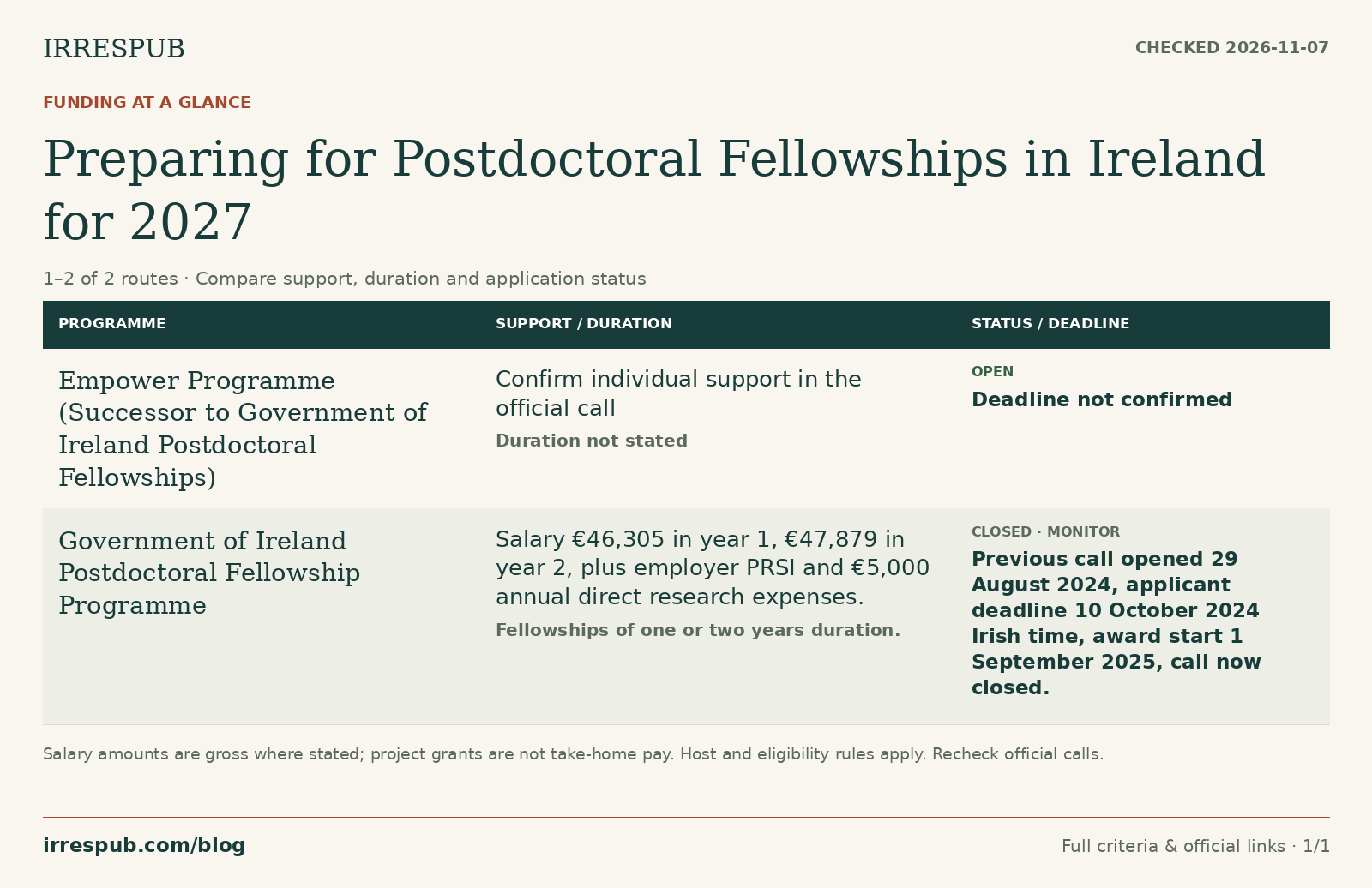
If you are planning postdoctoral funding in Ireland for 2027, treat Empower as the primary policy direction: institutions receive the awards and will decide how to recruit or host fellows. The previous individual Government of Ireland Postdoctoral Fellowship call is closed and its specific salary and expense terms remain historical evidence of the level of support once offered.2, 1
Empower: institutional awards; individual applicants should engage potential host institutions to learn local recruitment plans.2
Government of Ireland Postdoctoral Fellowship: historical terms included explicit salary and research expense amounts but the 2024–25 call is closed.1
At a glance
Empower replaces the Government of Ireland Postdoctoral Fellowships and awards funding to institutions rather than to individual applicants.2
The older Government of Ireland Postdoctoral Fellowship offered salaries of €46,305 (year 1) and €47,879 (year 2) plus employer PRSI and €5,000/year research expenses, but that call is closed.1
Science Foundation Ireland runs a separate postdoc placement fellowship (up to 2 years) focused on placements inside SFI; its archived page does not confirm a current open call.3
THE SHORTLIST
Compare the opportunities
Check research fit and the full official conditions before choosing where to apply. Funding totals, salaries and stipends describe different kinds of support.
Accepting applications according to the evidence checked 2026-11-07
Salary €46,305 in year 1, €47,879 in year 2, plus employer PRSI and €5,000 annual direct research expenses.Fellowships of one or two years duration.
Check the official call
ClosedPrevious call opened 29 August 2024, applicant deadline 10 October 2024 Irish time, award start 1 September 2025, call now closed.
A project-grant budget is not a personal stipend. Salary figures are gross where stated. Previous-call terms do not confirm the next cycle.
01
Empower Programme (successor) — what we know
Empower is documented as the successor to the Government of Ireland Postdoctoral Fellowships and changes the route of funding from individual awards to institutional allocations. The official materials describe institutional invitations and one application per eligible higher-education institution.2
Sources indicate the Empower call is open at the time this pack was checked; however, specific details such as individual-level stipend amounts, how institutions will distribute any fellowships, and final deadlines must be confirmed in the official call documents.2
Access route: institutional — funding awarded to institutions from an invited call; no direct route for individuals to apply for funding under this programme.2
Practical implication: successful applicants will likely be appointed through an institutional recruitment process or seconded to a role funded by the institution's Empower award.
02
Government of Ireland Postdoctoral Fellowship — historical terms to inform planning
The Government of Ireland Postdoctoral Fellowship was a national initiative supporting 1- or 2‑year postdoctoral research positions across disciplines, selected by international peer review and administered through eligible Irish higher-education institutions.1
Documented compensation for that fellowship was salary of €46,305 in year 1 and €47,879 in year 2, plus employer PRSI and €5,000 per year for direct research expenses. Those figures are from the previous call and should be treated as historical reference only.1
The last recorded call opened 29 August 2024 with an application deadline of 10 October 2024 (Irish time) and intended award start 1 September 2025; that call is closed as of the pack check date.1
Use the historical salary and expense levels to discuss realistic resourcing with prospective hosts, but do not assume identical terms for future institutional distributions under Empower.1
03
Science Foundation Ireland placement fellowships — contextual option
Separately, Science Foundation Ireland (SFI) has offered a placement fellowship that places postdoctoral researchers within SFI for up to two years to gain experience in funding, administration and policy. This is aimed at career development beyond a conventional academic postdoc.3
The archived SFI page documents application mechanics (single PDF submission via an Occupop system) and mentoring/training components, but the archived content does not confirm an active current call; treat it as a possible model and check SFI directly for up-to-date offerings.3
Route: individual application to SFI for an internal placement fellowship when SFI opens the call.3
04
How these routes compare (summary)
Empower: institutional awards; individual applicants depend on host institutions' recruitment. Government of Ireland Postdoctoral Fellowship: historical individual awards with specified salary and research expenses (closed). SFI placement: individual application for up to two-year placements inside SFI, focused on transferable skills and policy experience (archived, status not stated).2, 1, 3
When you compare options, distinguish: who receives the award (institution vs individual), what costs are covered (salary, employer PRSI, research expenses), and whether the award focuses on research time or placement/skills development.
05
Practical next steps — preparing for 2027
Start conversations now with potential Irish host groups and research offices so they can tell you whether their institution received Empower funding and how they plan to use it to recruit fellows. Ask about expected stipend levels, contract terms, start windows and whether they will advertise positions openly.2
Use the historical Government of Ireland Postdoctoral Fellowship figures when budgeting and negotiating, but confirm whether institutional posts will match or differ from those amounts.1
Monitor SFI for placement fellowship announcements if you seek a career-development placement rather than a traditional research postdoc.3
Immediate actions: (1) contact prospective supervisors and research offices at Irish HEIs; (2) request any institutional recruitment plans tied to Empower awards; (3) prepare an up-to-date CV, research summary and tailored cover letter for institution-level recruitment.
Documentation to have ready: PhD completion date, publications list, references, and a concise research proposal or plan aligned to host group strengths.
06
Programme decision notes and application guidance
Empower decision notes: institutions apply once to an invited call; individual recruitment timing and terms will vary by institution. Confirm whether advertised institutional posts are permanent, fixed-term or fellowship-style secondments.2
Government of Ireland Postdoctoral Fellowship (previous call) guidance: historical selection used international peer review and required applications via eligible Irish institutions. Treat published salary and expense figures as a benchmark, not a guarantee for 2027.1
SFI placement guidance: if you apply for an SFI placement fellowship in future calls, emphasise transferable skills and interest in research funding and policy. Check SFI for current process details before applying.3
Application sequence for prospective fellows under Empower: (1) confirm institution funding status; (2) ask host for job/ad text and eligibility criteria; (3) tailor materials to the advertised role; (4) check visa and relocation timelines if applicable.
07
Acknowledging uncertainty
Empower is the confirmed successor programme in documented sources, but details about individual-level recruitment and funding levels are controlled by recipient institutions and will be set in their local processes. The historical Government of Ireland Fellowship figures are accurate for the previous call but do not imply identical future levels.2, 1
Always verify current calls and institutional adverts; archived pages and historical call details are useful for planning but not definitive for 2027 offers.3
Are you searching for fully funded postdoctoral fellowships in Finland for 2027? Finland offers competitive opportunities for international researchers across life sciences, medicine, artificial intelligence, engineering, environmental sciences, humanities, and social sciences.
From independent research grants worth up to €700,000 to salaried university fellowships and internationally funded research positions, Finland provides multiple pathways for postdoctoral career development.
However, there is one important distinction applicants should understand:
Not every postdoctoral funding opportunity in Finland is a traditional fellowship.
Some schemes provide independent research grants administered by a Finnish research organization. Others offer fixed-term employment contracts with monthly salaries and employee benefits. International programs may provide stipends, salary contributions, relocation support, and additional allowances.
Understanding these differences is essential when comparing funding and preparing applications.
This guide covers major opportunities, including:
Research Council of Finland – 2027 Academy Research Fellowships
Turku Institute for Advanced Studies (TIAS)
TIES2 Marie Skłodowska-Curie COFUND Fellowships
Helsinki Collegium for Advanced Studies (HCAS)
Tampere Institute for Advanced Study
Helsinki Institute for Information Technology (HIIT)
Marie Skłodowska-Curie Postdoctoral Fellowships
EMBO Postdoctoral Fellowships
Human Frontier Science Program (HFSP)
Fulbright U.S. Scholar Awards to Finland
Finnish Center for Artificial Intelligence (FCAI)
Other university-based postdoctoral research positions
We also explain salaries, eligibility, immigration considerations, application strategies, and verified deadlines.
Last verified: October 10, 2026. Deadlines and grant conditions may change, so always consult the official funding announcement before applying.
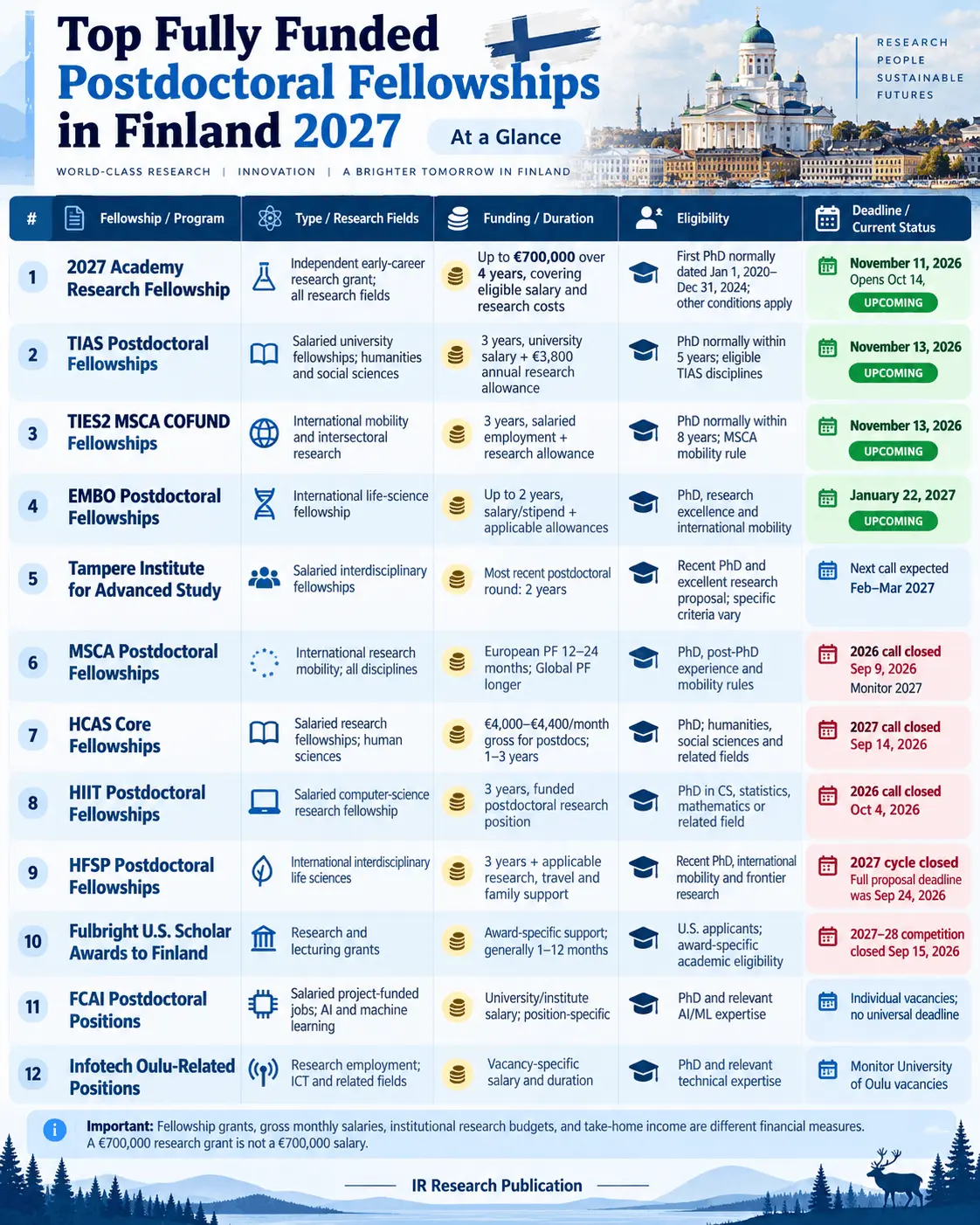
Top Fully Funded Postdoctoral Fellowships in Finland 2027: At a Glance
The following comparison table summarizes the major research fellowships, funding mechanisms, and salaried positions relevant to researchers planning a 2027 start.
Fellowship / Program
Type / Research Fields
Funding / Duration
Eligibility
Deadline / Current Status
Official Link
2027 Academy Research Fellowship
Independent early-career research grant; all research fields
Up to €700,000 over 4 years, covering eligible salary and research costs
First PhD normally dated Jan 1, 2020–Dec 31, 2024; other conditions apply
Important: Fellowship grants, gross monthly salaries, institutional research budgets, and take-home income are different financial measures. A €700,000 research grant is not a €700,000 salary.
Fellowships with Confirmed 2027 Application Deadlines
1. Research Council of Finland – 2027 Academy Research Fellowships
Application deadline: November 11, 2026
The Academy Research Fellowship is one of Finland’s leading funding instruments for promising early-career researchers working toward scientific independence.
The program is administered by the Research Council of Finland, formerly the Academy of Finland.
Older funding guides may refer to the former Postdoctoral Researcher Funding scheme. That scheme has been discontinued and should not be presented as an active annual fellowship.
The Academy Research Fellowship is the relevant current early-career funding opportunity.
Funding and Duration
The 2027 call offers:
Maximum grant of €700,000
Four-year funding period
Start date: September 1, 2027
End date: August 31, 2031
The research grant can cover eligible costs including the applicant’s salary, possible research-team salary expenses, and other research costs.
It is intended to support the researcher’s progression toward an established and independent scientific career.
The maximum amount is a total research grant, not a personal annual salary or stipend.
Eligibility
For the 2027 call, applicants must normally have received their first doctoral degree between:
January 1, 2020 and December 31, 2024.
The program targets researchers who have not yet attained a permanent senior research position.
Other requirements concerning employment status, research organization commitment, career interruptions, application limits, and funding conditions are specified in the official call.
Application Timeline
Call opens: October 14, 2026
Deadline: November 11, 2026, at 23:59 Finnish time
Funding starts: September 1, 2027
Applicants submit through the Research Council’s electronic funding system.
The application typically involves a research plan, budget, CV, publication information, institutional commitment and other materials required by the call.
Best suited for: Early-career researchers who have established a promising research record and want to develop an independent project at a Finnish research organization.
2. Turku Institute for Advanced Studies (TIAS) Postdoctoral Fellowships
Application deadline: November 13, 2026
The Turku Institute for Advanced Studies (TIAS) at the University of Turku supports innovative and interdisciplinary research.
For the 2027 recruitment round, TIAS is offering:
4 Postdoctoral Fellow positions
4 Collegium Fellow positions
7 TIES2 MSCA COFUND Fellow positions
All advertised appointments are scheduled to begin in September 2027.
The standard TIAS Postdoctoral Fellowship is especially attractive to researchers in the humanities and social sciences who want dedicated time to undertake independent research.
Research Fields
Eligible disciplines fall within the institute’s constituent faculties:
Economics
Education
Humanities
Law
Social Sciences
Applicants from unrelated fields should not assume eligibility merely because TIAS welcomes interdisciplinary research.
Funding and Duration
TIAS Postdoctoral Fellows receive:
A three-year salaried appointment
University employment benefits
An additional €3,800 annual research allowance
Opportunities for interdisciplinary collaboration and academic networking
The salary is determined through the relevant university employment framework rather than one universal international fellowship stipend.
Eligibility
For the regular TIAS Postdoctoral Fellow category, applicants should normally be within five years of completing their PhD, subject to the current call’s detailed provisions.
Selection emphasizes research excellence and the quality of the proposed project.
Application Dates
Applications opened: September 18, 2026
Deadline: November 13, 2026
Fellowships begin: September 2027
TIAS reports that its previous fellowship competitions have typically been extremely competitive, with success rates around 2%.
3. TIES2 Marie Skłodowska-Curie COFUND Fellowships
Application deadline: November 13, 2026
The Turku Intersectoral Excellence Scheme 2 (TIES2) is a separate fellowship opportunity operated by the University of Turku and co-funded through the European Union’s MSCA COFUND program.
For the 2027 recruitment round, seven TIES2 fellowships are available.
Funding and Duration
Three-year salaried fellowship
Start date: September 1, 2027
Annual research allowance
Structured interdisciplinary and intersectoral career development
Required secondment of 3–12 months in an organization outside the higher education sector
The intersectoral secondment is a distinguishing feature of this program.
Eligibility
Applicants normally must be within eight years of completing their PhD, subject to the detailed call rules.
The MSCA mobility rule also applies:
Applicants must not have resided or carried out their main activity in Finland for more than 12 months during the 36 months immediately before the application deadline.
Other detailed eligibility and application requirements are provided in the TIES2 call instructions.
Best suited for: Internationally mobile postdoctoral researchers interested in combining academic research with experience in the non-academic sector.
4. EMBO Postdoctoral Fellowships – Finland as a Host Destination
Next application cutoff: January 22, 2027
The European Molecular Biology Organization (EMBO) supports internationally mobile postdoctoral researchers in the life sciences.
Finnish universities and research institutes can serve as eligible host environments when the proposed fellowship satisfies EMBO’s geographic and mobility requirements.
Research Fields
Projects can involve areas such as:
Molecular biology
Cell biology
Genetics
Biochemistry
Neuroscience
Developmental biology
Molecular microbiology
Computational and interdisciplinary life sciences
Funding and Duration
EMBO Postdoctoral Fellowships support research for up to two years.
Benefits include:
Salary or stipend depending on host-country arrangements
Relocation allowance
Applicable support for fellows with children
Access to training and networking opportunities
Eligibility
Applicants must satisfy the current PhD timing and international mobility requirements.
The fellowship is designed for researchers moving into a new research environment rather than simply continuing their previous work.
EMBO also limits host laboratories to supporting one candidate per selection round under its current rules.
Application Deadline
Applications are accepted throughout the year, with evaluation rounds.
The next hard cutoff is:
January 22, 2027, at 14:00 CET.
Applicants should also review EMBO’s revised reapplication policy, which applies to later selection rounds.
6. Marie Skłodowska-Curie Postdoctoral Fellowships (MSCA PF)
2027 call: Monitor the official EU funding announcement
The Marie Skłodowska-Curie Actions Postdoctoral Fellowships are among Europe’s most competitive international research fellowships.
Applicants can pursue research at eligible Finnish universities, institutes or other organizations.
MSCA Postdoctoral Fellowships support researcher mobility, advanced training and career development across disciplines.
Fellowship Types
European Postdoctoral Fellowships
Typically 12–24 months
Hosted in an eligible EU Member State or Horizon Europe Associated Country
Finland is an eligible host destination
Global Postdoctoral Fellowships
Include an outgoing research phase in a non-associated third country
Include a mandatory return phase to an eligible European host
Finland may serve as the European host under applicable conditions
A Global Fellowship does not necessarily mean conducting the entire fellowship in Finland.
Funding
The funding model supports:
Living allowance
Mobility allowance
Family allowance where applicable
Research, training and networking costs
Management and indirect costs for the host
The EU’s institutional funding contributions should not be confused with the fellow’s net salary.
Eligibility
Applicants normally must:
Hold a doctoral degree by the application deadline
Have no more than eight years of qualifying postdoctoral research experience, subject to permitted exclusions
Satisfy the applicable mobility rule
For a European Postdoctoral Fellowship hosted in Finland, the applicant generally must not have lived or carried out their main activity in Finland for more than 12 months during the 36 months before the call deadline.
Application Status
The 2026 call closed on September 9, 2026.
Researchers targeting the next competition should monitor the official 2027 call and begin identifying Finnish supervisors and host laboratories early.
9. Human Frontier Science Program (HFSP) Postdoctoral Fellowships
2027 application cycle closed
The Human Frontier Science Program (HFSP) funds ambitious, high-risk and interdisciplinary research addressing fundamental questions in the life sciences.
Finnish research laboratories can serve as host institutions when all eligibility conditions are satisfied.
Fellowship Categories
HFSP offers two major fellowship routes:
Long-Term Fellowships (LTF)
For researchers with doctoral training in the life sciences who want to move into new scientific directions.
Cross-Disciplinary Fellowships (CDF)
For researchers trained in non-biological disciplines who want to move into fundamental life-science research.
Funding
Fellowships generally last three years, with support that may include:
Living allowance
Research and travel allowance
Relocation support
Child-related and family support under applicable rules
Award amounts depend on the host country and fellowship conditions.
Eligibility
HFSP emphasizes:
International relocation
Research independence
Significant changes in research direction
Innovative and interdisciplinary scientific questions
Applicants should carefully review restrictions involving nationality, previous research locations, doctoral institution and host-country residence.
2027 Application Status
The 2027 fellowship competition had the following deadlines:
Letter-of-intent initiation: May 5, 2026
Letter-of-intent submission: May 12, 2026
Invited full proposal: September 24, 2026
All these deadlines have passed.
Researchers who did not participate in the 2027 competition should monitor the next fellowship cycle.
Important: Fulbright Finland also operates programs supporting researchers moving from Finland to the United States. Those outgoing awards are not equivalent to fellowships for international researchers seeking to relocate to Finland.
Salaried Postdoctoral Research Positions in Finland
In addition to competitive individual fellowships, Finland offers salaried postdoctoral jobs supported by institutional, national and international research grants.
These are often among the most practical routes for researchers who do not meet restrictive fellowship mobility or PhD-age requirements.
11. Finnish Center for Artificial Intelligence (FCAI)
The Finnish Center for Artificial Intelligence (FCAI) is a research network involving Aalto University, the University of Helsinki and VTT Technical Research Centre of Finland.
Researchers work on AI-related topics such as:
Machine learning
Probabilistic modeling
Human-centered artificial intelligence
Data-driven science
AI applications in healthcare and industry
Computational methods
FCAI-associated research groups may recruit postdoctoral researchers through project-specific vacancies.
Employment terms, salary, duration and eligibility depend on the actual hiring institution and project.
FCAI should therefore be described as a source of research opportunities, not as a guaranteed annual individual postdoctoral fellowship.
The Sigrid Jusélius Foundation supports medical research and researchers connected to the Finnish research system.
However, its postdoctoral fellowship supporting research abroad should not be advertised as a standard incoming fellowship for international researchers seeking to relocate to Finland.
That particular mechanism supports eligible researchers undertaking postdoctoral work outside Finland.
Some research grants administered by the Foundation may indirectly support postdoctoral employment or research projects in Finland, but eligibility must be verified under each specific funding instrument.
For that reason, it is not included in the main table of incoming Finland-based fellowships.
How Much Do Postdoctoral Researchers Earn in Finland?
Postdoctoral salaries in Finland are not determined by one fixed national fellowship amount.
For salaried researchers, compensation depends on:
University or research institution
Job requirements
Research experience
Applicable salary system
Individual performance component
Contract and funding source
Additional responsibilities
For example, the 2027 HCAS Core Fellowship advertises a postdoctoral gross salary of €4,000–€4,400 per month, plus a separate annual research allowance of €4,000.
Other universities and projects may offer different salary levels.
Salary vs. Research Grant vs. Stipend
Funding Type
What It Means
Example
Gross salary
Employment income before tax and applicable contributions
HCAS: €4,000–€4,400/month gross
Research grant
Total funding allocated to an approved research project
Academy Research Fellowship: up to €700,000 over 4 years
Research allowance
Additional funding for approved research-related expenses
TIAS: €3,800/year
Fellowship stipend
Personal financial support under a grant arrangement
Depends on the applicable international or foundation scheme
University project-funded position
Salary paid through an institution’s funded research project
FCAI or University of Oulu vacancies
A research grant is not necessarily the fellow’s personal income.
When comparing opportunities, review gross salary, estimated taxation, pension treatment, employment benefits, relocation costs and living expenses in the destination city.
Can International Researchers Apply for Postdocs in Finland?
Yes.
Many Finnish universities and institutes recruit postdoctoral researchers from around the world.
Eligibility depends on the program rather than nationality alone.
Some opportunities welcome researchers of any nationality but impose mobility restrictions. Others prioritize applicants at defined stages of their postdoctoral careers.
International applicants should pay particular attention to:
PhD completion date: Some programs restrict eligibility to researchers who obtained their doctorate within a defined period.
International mobility: MSCA and TIES2 impose specific residence and activity restrictions.
Research field: TIAS focuses on humanities and social sciences, while EMBO and HFSP focus on life sciences.
Host arrangements: Some funding schemes require a host institution’s formal commitment or joint proposal development.
Employment status: A research fellowship, university job and grant-funded visit may have different legal and immigration implications.
Researchers from India and other non-EU countries may be eligible for many of these opportunities, provided the relevant program conditions are met.
Residence Permits, Employment and Taxes in Finland
Residence Permits
Non-EU/EEA researchers moving to Finland for extended research appointments generally need appropriate residence authorization.
The correct permit depends on factors including whether the applicant has an employment contract, a hosting agreement or a grant-supported research arrangement.
Search tip: Use both “postdoctoral researcher” and “postdoctoral fellow” when searching Finnish university portals, because many fully funded opportunities appear as employment vacancies rather than under scholarship listings.
How to Apply Successfully for Postdoctoral Fellowships in Finland
A successful postdoctoral application requires more than a strong publication record.
Different programs assess research independence, feasibility, international mobility, career development and the quality of the host environment.
Step 1: Identify the Right Funding Mechanism
First, determine whether the opportunity is:
An individual research grant
A salaried research fellowship
A university employment vacancy
A mobility fellowship
A short-term research exchange
This affects eligibility, the application process and the required documents.
Step 2: Find a Suitable Finnish Host
For fellowships requiring institutional support, identify research groups aligned with your scientific interests.
Review recent publications, funded projects, laboratory infrastructure and the principal investigator’s expertise.
A strong application should explain why the Finnish host is essential to the proposed project.
For independently advertised fellowships, follow the particular program’s host-affiliation rules rather than assuming advance supervisor sponsorship is mandatory.
Step 3: Prepare a Competitive Research Proposal
A convincing proposal should address:
Scientific background
Research gap
Central question or hypothesis
Specific objectives
Research methodology
Feasibility and preliminary evidence
Timeline and milestones
Research risks and alternative approaches
Expected scientific impact
Career development and training
Open science, ethics and data management where applicable
Step 4: Demonstrate Research Independence
Reviewers may assess whether your proposed work moves beyond your PhD research and demonstrates intellectual originality.
Highlight evidence such as:
First-author publications
Independent research contributions
New methodologies
Interdisciplinary experience
Previous grants and awards
International collaborations
Scientific leadership
Step 5: Tailor the Application to the Fellowship
Different programs emphasize different strengths.
Fellowship
Application Priority
Academy Research Fellowship
Research independence and career progression
TIAS
Academic excellence, originality and interdisciplinary research
TIES2
Mobility, intersectoral experience and research impact
MSCA Postdoctoral Fellowships
Excellence, career development, impact and implementation
EMBO
Scientific excellence, mobility and advanced life-science training
HFSP
Frontier research, substantial scientific change and interdisciplinary innovation
University research positions
Technical fit, project experience and demonstrated research skills
Step 6: Prepare Supporting Documents
Commonly required documents include:
Academic CV
Publication list
Research proposal
Cover letter or motivation statement
PhD certificate
Reference letters or referee information
Host commitment where required
Research ethics and data-management statements
Budget justification for grant applications
Requirements vary by program.
Step 7: Apply Before the Deadline
Do not assume every call closes at midnight in your local time zone.
Finnish institutional deadlines generally follow Finland’s local time, while European and international programs may use CET, CEST or another specified time zone.
Verify the exact closing time on the official application page.
Suggested Application Timeline for a 2027 Postdoc in Finland
Period
Recommended Action
October 2026
Prepare Academy Research Fellowship and TIAS/TIES2 applications; review eligibility immediately
November 2026
Submit Academy Research Fellowship by Nov 11 and TIAS/TIES2 by Nov 13
December 2026–January 2027
Prepare EMBO application for Jan 22 cutoff; monitor university vacancies
February–March 2027
Monitor Tampere IAS 2027 recruitment and other newly announced calls
Spring–Summer 2027
Prepare next MSCA Postdoctoral Fellowship application and contact Finnish host laboratories
Throughout 2027
Apply for individual project-funded postdoctoral vacancies as advertised
This schedule does not imply that applications submitted in 2027 necessarily lead to a 2027 start. Fellowship decisions, recruitment dates and start windows depend on each program.
Frequently Asked Questions
1. Are postdoctoral fellowships in Finland fully funded?
Many provide substantial financial support, but the funding structure differs.
Salaried university postdoctoral fellowships generally provide employment income and applicable benefits.
Independent research grants fund eligible research costs, including salary where permitted.
Short-term mobility grants may offer allowances rather than full university employment.
Always verify what is covered before accepting an award.
2. What is the best postdoctoral fellowship in Finland for 2027?
The strongest option depends on your field and career stage.
The 2027 Academy Research Fellowship is especially relevant for eligible researchers developing independent research careers.
TIAS and TIES2 are attractive for eligible humanities and social-science researchers.
EMBO and HFSP are particularly relevant to eligible internationally mobile life scientists.
MSCA Postdoctoral Fellowships provide opportunities across many disciplines.
3. How much do postdoctoral researchers earn in Finland?
There is no universal fixed salary.
As a verified example, the HCAS 2027 recruitment advertised €4,000–€4,400 gross per month for postdoctoral researchers.
Other universities and fellowships have different financial arrangements.
4. Can Indian researchers apply for postdocs in Finland?
Yes. Many Finnish research institutions welcome applications from qualified Indian and other international researchers.
However, eligibility may depend on the doctoral degree date, nationality, current country of residence, host institution and mobility rules.
Applicants should also verify the appropriate residence-permit process.
5. Is Finnish language proficiency required?
Not usually for many internationally recruited research positions.
English is widely used in Finnish universities and research groups.
Some clinical, teaching, public-facing or language-specific research positions may require Finnish or Swedish.
6. Do I need a Finnish host supervisor?
For host-dependent programs such as MSCA Postdoctoral Fellowships, advance coordination with the host is generally essential.
Other fellowships, such as certain institutes for advanced study, allow applicants to propose independent research within a host institution’s research community without requiring a conventional laboratory supervisor.
Always follow the specific call’s host requirements.
7. What is the deadline for the 2027 Academy Research Fellowship?
The application deadline is November 11, 2026, at 23:59 Finnish time.
The four-year funding period begins September 1, 2027.
8. What is the TIAS Postdoctoral Fellowship deadline?
The 2027 TIAS and TIES2 recruitment deadline is November 13, 2026.
The advertised fellowships begin in September 2027.
9. When is the next EMBO Postdoctoral Fellowship deadline?
The next cutoff is January 22, 2027, at 14:00 CET.
EMBO accepts applications throughout the year, with evaluation rounds.
10. Is the 2027 HFSP Postdoctoral Fellowship still open?
No.
The 2027 competition’s initial submission stage closed in May 2026, and the invited full proposal deadline passed on September 24, 2026.
New applicants should monitor the next competition.
11. Are research grants tax-free in Finland?
Not necessarily.
Tax treatment depends on the type of payment, its source, the amount and Finnish tax law.
An employment salary and a research grant may be treated differently.
Consult the Finnish Tax Administration and the host institution.
12. Can family members accompany international postdoctoral researchers?
Family members may qualify to apply for residence permits under Finnish immigration rules, depending on the researcher’s circumstances.
Some fellowship programs also provide family-related allowances, but eligibility and amounts differ.
Applicants should check current Finnish Immigration Service guidance.
Conclusion: Fully Funded Postdoctoral Fellowships in Finland 2027
Finland offers a strong range of opportunities for researchers seeking fully funded postdoctoral fellowships and salaried research positions in 2027.
The most important confirmed opportunities include the 2027 Academy Research Fellowships, offering up to €700,000 over four years, and the TIAS and TIES2 fellowships, with November 2026 deadlines for appointments beginning in September 2027.
International programs such as EMBO, MSCA and HFSP provide additional pathways for eligible researchers, while Finnish universities and research institutes recruit postdoctoral employees through individual funded projects.
The best approach is to identify the right funding mechanism, verify eligibility, secure any necessary host support, prepare a strong research proposal and monitor official announcements.
Researchers should also remember that grant funding, research allowances and personal salaries are not directly comparable.
Starting early and applying strategically can substantially improve your ability to identify suitable research opportunities and submit competitive applications.
IR Research Publication is an academic publishing and research-career platform dedicated to supporting scholars, students and researchers through reliable funding information, academic opportunities, research resources and practical career guidance.
Our fellowship and scholarship guides aim to help international researchers understand eligibility conditions, funding structures, application timelines and official recruitment procedures.
Last updated: October 10, 2026
Disclaimer: Fellowship dates, award amounts, university salary scales, immigration requirements and eligibility rules may change. The information in this guide is based on official program announcements available at the time of review. Always consult the relevant funder or university’s latest official announcement before applying.
Fully Funded Postdoctoral Fellowships in Sweden 2027
Sweden is one of Europe’s strongest destinations for postdoctoral research, with globally recognized universities, major national research programs, advanced research infrastructure, and extensive international collaboration.
Researchers can pursue postdoctoral opportunities at institutions such as Karolinska Institutet, KTH Royal Institute of Technology, Lund University, Uppsala University, Chalmers University of Technology, Stockholm University, Linköping University, and Umeå University, as well as research environments connected to SciLifeLab, MAX IV, WASP, WISE, and other national initiatives.
However, there is an important distinction applicants should understand.
Important: This guide includes both individual postdoctoral fellowships and fully funded salaried postdoctoral positions supported by Swedish universities, foundations, European programs, and major research initiatives.
A program such as MSCA, EMBO, HFSP, or Wenner-Gren functions as a fellowship or fellowship-based funding route. By contrast, many WASP-, WISE-, ERC-, or foundation-supported positions are research projects through which a Swedish university later recruits and employs a postdoctoral researcher.
Both can provide excellent postdoctoral funding, but the application process is different.
Postdoctoral Fellowships in Sweden Currently Open for 2027 Starts
Applicants targeting a 2027 start should not wait until 2027. Several major competitions are closing during September and October 2026.
Program
Current Status
Key Deadline
Funding / Duration
2027 Relevance
MSCA Postdoctoral Fellowships
Open
September 9, 2026
European PF: 12–24 months; employment through host plus MSCA allowances
First projects expected from May 2027
HFSP Postdoctoral Fellowships
LOI closed; invited applicants only
September 24, 2026 full proposal
3-year fellowship
Successful fellowships may begin from April 2027
Wenner-Gren Incoming Postdoctoral Fellowship
Current 2026 call
October 1, 2026
Fellowship for international researchers moving to Sweden
Relevant for 2027 research stays
Swedish Cancer Society Postdoctoral Position
Open
October 1, 2026, 15:00
Up to 3 years; grant funds postdoctoral salary
Current competition can support upcoming postdoctoral appointment
Digital Futures Postdoctoral Fellowships
Open
Pre-registration October 2, 2026; full application October 16, 2026
SEK 2.4 million toward salary costs over 2 years
Project start June 1, 2027
EMBO Postdoctoral Fellowship
Applications accepted year-round
Next hard cutoff January 22, 2027, 14:00 CET
Up to 2 years
Direct 2027 application opportunity
The MSCA 2026 call closes September 9 and expects its first funded projects to start around May 2027. Digital Futures currently has a specifically advertised 2027-start competition, while the Swedish Cancer Society and Wenner-Gren both have October 1, 2026 deadlines.
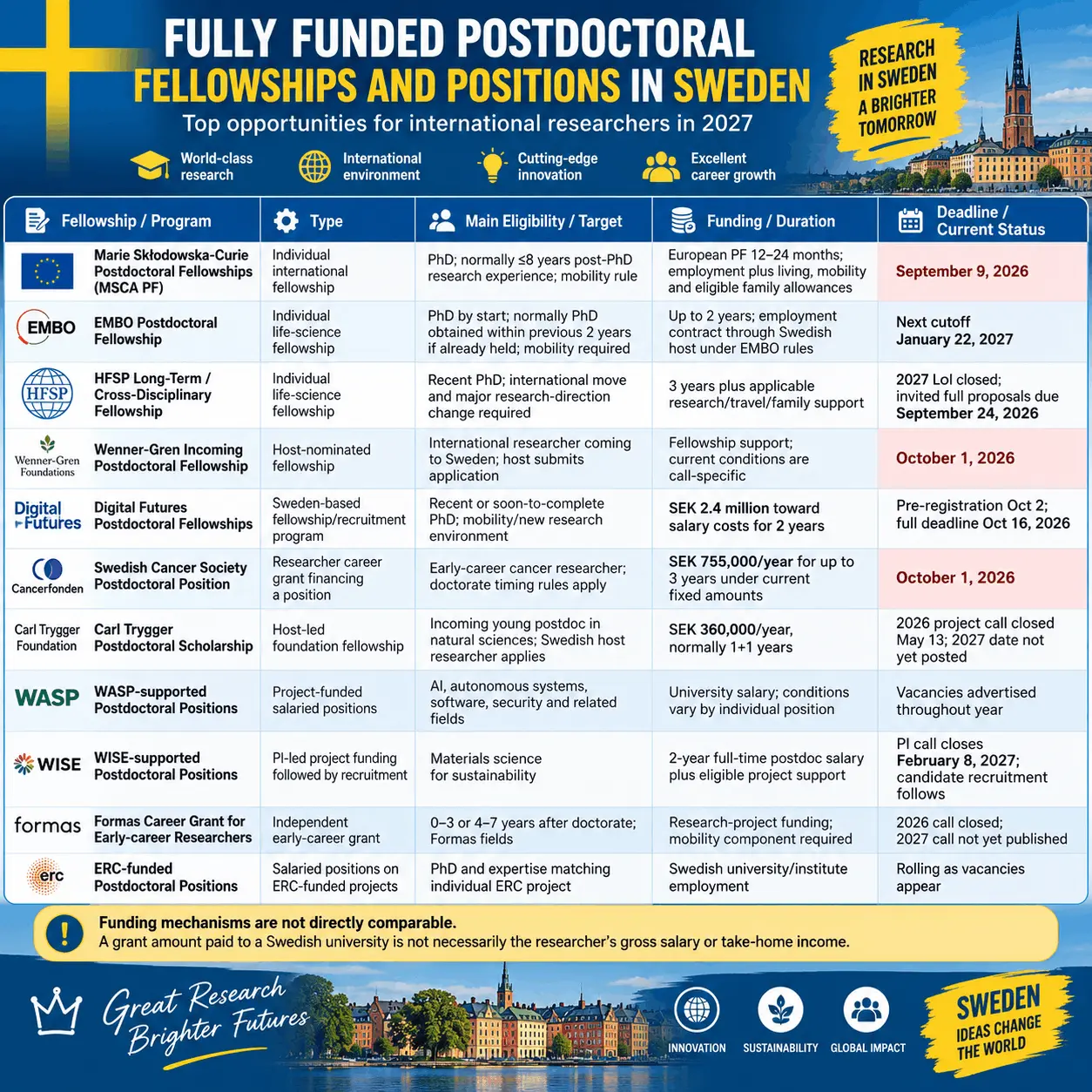
Summary: Fully Funded Postdoctoral Fellowships and Positions in Sweden
Fellowship / Program
Type
Main Eligibility / Target
Funding / Duration
Deadline / Current Status
Official Information
Marie Skłodowska-Curie Postdoctoral Fellowships (MSCA PF)
Individual international fellowship
PhD; normally ≤8 years post-PhD research experience; mobility rule
European PF 12–24 months; employment plus living, mobility and eligible family allowances
Funding mechanisms are not directly comparable. A grant amount paid to a Swedish university is not necessarily the researcher’s gross salary or take-home income.
1. Marie Skłodowska-Curie Postdoctoral Fellowships in Sweden
The Marie Skłodowska-Curie Actions Postdoctoral Fellowship (MSCA PF) is one of the strongest options for international researchers who want to conduct postdoctoral research at a Swedish university or research organization.
European Postdoctoral Fellowships are open across disciplines and can be hosted by eligible academic or non-academic institutions in Sweden.
Funding and Duration
European Postdoctoral Fellowships normally last 12–24 months.
MSCA funding supports the recruited researcher through:
living allowance;
mobility allowance;
family allowance when applicable;
long-term-leave and special-needs support where applicable.
The host also receives funding for research, training, networking, management, and indirect costs.
The host beneficiary recruits the successful researcher for the fellowship period.
Eligibility
Applicants must generally:
hold a PhD by the call deadline or have successfully defended the doctoral thesis;
have no more than eight years of research experience after the PhD, subject to specified exclusions;
satisfy the MSCA mobility rule.
For an MSCA European Fellowship with a Swedish host, applicants must not have resided or carried out their main activity in Sweden for more than 12 months during the 36 months immediately before the application deadline.
2026–2027 Timeline
Call opened: April 9, 2026
Application deadline: September 9, 2026
Expected results: February 2027
First projects expected to start: approximately May 2027
The EMBO Postdoctoral Fellowship is a prestigious option for researchers in molecular biology and related life-science fields who want to move to a Swedish research environment.
Sweden is part of the European Molecular Biology Conference framework, making Swedish life-science laboratories attractive potential hosts.
Eligibility
Important current eligibility requirements include:
applicants must hold a doctorate or equivalent by the fellowship start;
researchers who already hold a PhD when applying normally must have obtained it within the two years before application;
researchers who have already joined the proposed host laboratory generally must have been living in the host country for less than six months at application;
the proposed project cannot simply be a direct continuation of the PhD research.
Funding
For fellows hosted in EMBC Member States such as Sweden, EMBO provides funding to the host institution so it can issue an employment contract to the fellow.
Eligible relocation and childcare-related support may also be available under EMBO rules.
The Human Frontier Science Program (HFSP) supports highly innovative and potentially transformative basic life-science research.
It offers:
Long-Term Fellowships (LTF) for applicants trained primarily in biological disciplines;
Cross-Disciplinary Fellowships (CDF) for researchers trained in areas such as physics, chemistry, mathematics, engineering, or computer science who are moving into life-science research.
Duration
HFSP fellowships provide three years of support.
Funding includes a living allowance and additional support under applicable rules for research, travel, relocation, and family circumstances.
Strict Eligibility and Mobility Rules
HFSP is considerably more restrictive than a normal international postdoc vacancy.
For the 2027 cycle, the doctoral degree generally must not have been conferred more than three years before the September 24, 2026 full-proposal deadline, subject to eligible career-interruption exceptions.
HFSP also emphasizes:
an international move;
a significant change in research direction;
frontier biological questions;
independence from previous supervisors and research environments.
2027 Application Status
The Letter of Intent stage for the 2027 cycle has already closed.
Only applicants invited after the LOI review can submit the full proposal.
Invited full-proposal deadline: September 24, 2026.
Successful candidates may begin their fellowship from April 2027.
4. Wenner-Gren Postdoctoral Fellowships for Researchers Coming to Sweden
The Wenner-Gren Foundations provide an important Sweden-specific route for bringing international postdoctoral researchers into Swedish research environments.
The current call is specifically listed by Uppsala University as providing postdoctoral grants for incoming fellows, with a deadline of October 1, 2026.
How the Application Works
Unlike MSCA, where the researcher and host develop an application together within an EU funding framework, Wenner-Gren applications for incoming postdoctoral fellows are normally submitted by the Swedish host researcher for a selected international candidate.
Applicants should therefore identify and contact a Swedish PI well ahead of the foundation deadline.
Current call information indicates that the scheme is intended to bring researchers from outside Sweden into Swedish research environments.
Who Should Consider Wenner-Gren?
It is particularly relevant if you:
currently work outside Sweden;
want to join a Swedish research group;
have recently completed your PhD;
have already identified a potential Swedish host;
are seeking a fellowship route rather than waiting for an advertised salaried vacancy.
The Digital Futures Postdoctoral Fellowship is one of the best currently open opportunities specifically targeting researchers who can begin a fellowship in Sweden in 2027.
Digital Futures is a cross-disciplinary research center established by KTH Royal Institute of Technology, Stockholm University, and RISE Research Institutes of Sweden, with additional academic, industry, public-sector, and healthcare partners.
Research Areas
Projects can address digital transformation in areas such as:
artificial intelligence;
trustworthy digital systems;
digitalized industry;
smart society;
health and life;
education;
cooperation and learning;
emerging digital technologies.
Funding
The current call offers:
SEK 2.4 million toward salary costs for two years for each employed postdoctoral fellow.
This amount is transferred to the main supervisor responsible for employing the fellow—it should not be interpreted as the researcher’s take-home salary.
The fellowship also provides access to:
research infrastructure;
academic and industrial networks;
mentorship;
career development;
research-leadership training.
Eligibility
Applicants must hold a doctoral degree before starting the fellowship.
The program emphasizes mobility and researchers moving into a new research group and institution.
Applications require both a main supervisor and co-supervisor within the eligible Digital Futures environment.
Researchers working in cancer biology, oncology, cancer immunology, epidemiology, therapeutics, prevention, or related areas should strongly consider the Swedish Cancer Society (Cancerfonden) Postdoctoral Position.
Current Eligibility
For the current 2026 competition, applicants generally must have completed their doctorate on or after July 1, 2023, but no later than December 31, 2026, subject to eligible deductions for circumstances such as parental or qualifying medical leave.
The Swedish Cancer Society particularly values:
mobility;
scientific excellence;
cancer relevance;
development of an independent research direction.
Duration and Funding
The grant can support a postdoctoral position for a maximum of three years.
Current fixed grant amounts list:
SEK 755,000 per year
SEK 2,265,000 total over three years
The funding is paid to a Swedish university, and the actual salary is determined by the employer. The grant must be used to finance the postdoctoral position.
Can the Research Be Done Abroad?
Yes.
The fellowship can support a postdoctoral period in Sweden or abroad.
However, when the postdoctoral period is conducted abroad, the third and final year must be completed at the Swedish host institution in Sweden.
8. WASP-Supported Postdoctoral Positions in Sweden
The Wallenberg AI, Autonomous Systems and Software Program (WASP) is Sweden’s largest individual research program in artificial intelligence, autonomous systems, and software.
Postdoctoral researchers can join WASP-funded research through salaried university positions across participating Swedish institutions.
Important Distinction
There is not one generic “WASP Postdoctoral Fellowship in Sweden” with a single eligibility rule and deadline.
Instead, WASP supports:
specific research projects;
individual postdoctoral vacancies;
industrial research initiatives;
targeted research calls.
WASP’s positions page currently lists individual salaried postdoctoral vacancies with their own deadlines.
Fields
Relevant areas include:
artificial intelligence;
machine learning;
robotics;
autonomous systems;
cybersecurity;
software engineering;
mathematical foundations of AI;
optimization;
computer vision.
Important Note About the WASP International Postdoctoral Scholarship
WASP also operates an International Postdoctoral Scholarship, but this is designed specifically for researchers who completed their PhD within WASP and want to undertake postdoctoral study at leading universities outside Sweden.
It should therefore not be confused with WASP-funded postdoctoral positions based in Sweden.
10. Formas Career Grant for Early-Career Researchers
Formas is the Swedish Research Council for Sustainable Development.
Its current early-career scheme is called:
Career Grant for Early-career Researchers
This replaces older terminology that may still appear online referring to Formas mobility grants.
The scheme supports researchers who want to develop an independent project within Formas’s areas:
environment;
agricultural sciences;
spatial planning;
sustainability-related research.
Career Tracks
The current scheme has two tracks:
0–3 years after the doctorate
4–7 years after the doctorate
A mobility component is built into the funding model.
Is It a Postdoctoral Fellowship?
Not exactly.
This is an independent early-career research grant, so it is better suited to researchers who are transitioning toward scientific independence rather than simply seeking a standard supervised postdoctoral position.
Current Status
The 2026 competition ran from January 20 to March 4, 2026.
The program is recurring and normally opens near the beginning of the year, but the detailed 2027 call has not yet been published.
The European Research Council (ERC) does not operate a general postdoctoral fellowship for individual candidates.
Instead, ERC awards major grants to principal investigators.
Those ERC-funded research groups frequently recruit:
postdoctoral researchers;
research scientists;
research engineers;
data scientists;
technical specialists.
A Swedish ERC-funded postdoc is therefore usually a salaried university or institute position, rather than an ERC fellowship awarded directly to the candidate.
What About the MIMS “Excellence by Choice” Postdoctoral Programme?
Older fellowship lists may include the Excellence by Choice Postdoctoral Programme at Umeå University/MIMS.
It is an excellent program—but it should not currently be advertised as an open 2027 fellowship.
The program was designed to fund 17 international postdoctoral fellows during its 2021–2026 cycle. Umeå University’s current information indicates that the fellows have been recruited, and earlier program material identified the later recruitment round as the final call.
As of this review, no new 2027 Excellence by Choice competition has been confirmed.
Researchers interested in Umeå should instead monitor Umeå University and MIMS vacancies for new postdoctoral opportunities.
How Much Do Postdocs Earn in Sweden?
There is no single national “Sweden postdoc salary.”
For ordinary salaried university postdoctoral positions, compensation depends on factors such as:
host university;
collective and local salary agreements;
discipline;
relevant experience;
funding source;
individual salary negotiation.
For externally funded programs, the amount published by the funder may represent the total employment cost paid to the university, not the researcher’s gross salary.
For example:
Digital Futures provides SEK 2.4 million toward salary costs over two years;
Cancerfonden currently allocates SEK 755,000 annually for its postdoctoral-position grant;
these figures should not be interpreted as annual take-home salary.
Many ordinary university postdoctoral researchers are employed under fixed-term university contracts and receive Swedish employment benefits.
Depending on the employer and funding arrangement, these can include:
paid annual leave;
pension contributions;
parental-leave protections;
sick-leave provisions;
social-security coverage.
However, this does not apply identically to every fellowship.
A tax-free scholarship or fellowship can have different legal, pension, insurance, and social-security consequences compared with salaried employment.
Before accepting an offer, always determine whether you will be:
a university employee;
a scholarship recipient;
employed through an externally financed position; or
funded through another arrangement.
Can International Researchers Apply for Postdocs in Sweden?
Yes.
Swedish universities and many major fellowship programs recruit researchers internationally.
Programs such as:
MSCA;
EMBO;
HFSP;
Wenner-Gren;
Digital Futures;
are specifically designed to support international mobility or strongly welcome international applicants.
However, each program has its own rules regarding:
time since PhD;
nationality;
residence history;
previous time in Sweden;
relationship with the host;
previous research topic;
research mobility.
Never assume that being an international applicant automatically makes you eligible.
Do You Need to Speak Swedish?
For many internationally recruited research postdocs—particularly in STEM, engineering, data science, and biomedical research—English is commonly the working language.
Swedish is therefore often not required for research-focused positions.
However, Swedish proficiency may be necessary or advantageous when a position involves:
clinical work;
teaching in Swedish;
patient communication;
Swedish-language interviews or datasets;
significant public engagement.
Always check the individual vacancy.
How to Find a Postdoctoral Host in Sweden
For fellowship applications such as MSCA, EMBO, HFSP, and Wenner-Gren, finding the right supervisor is one of the most important steps.
How to Contact a Swedish Professor for a Fellowship
Do not send a generic message saying:
“I am looking for any postdoctoral position in your laboratory.”
Instead, briefly explain:
your current research area;
major techniques or expertise;
your strongest research accomplishment;
why the professor’s work specifically interests you;
the fellowship you want to target;
a potential research direction;
how your expertise complements the host laboratory.
For host-nominated programs such as Wenner-Gren or Carl Trygger, contacting the PI early is particularly important because the host may need to select one candidate and formally submit the funding application.
How to Make Your Sweden Postdoc Application Competitive
1. Check Eligibility Before Writing the Proposal
Verify:
date of PhD;
mobility requirements;
residence history;
nationality restrictions;
previous work at the host;
previous collaborations;
field restrictions.
HFSP, MSCA, EMBO, Cancerfonden, and Wenner-Gren all contain eligibility rules capable of disqualifying an otherwise excellent application.
2. Explain Why You Need the Swedish Host
Do not rely on the university’s reputation alone.
Explain the specific:
expertise;
technology;
datasets;
research infrastructure;
patient cohorts;
collaborators;
computational resources;
methodologies;
that make the host essential to your project.
3. Demonstrate Scientific Independence
A strong postdoctoral proposal should show how your project develops beyond your PhD.
Reviewers should understand:
what expertise you already bring;
what you will learn;
which research questions are yours;
how the fellowship advances your independent research identity.
4. Build a Strong Training Plan
This is especially important for MSCA.
Consider:
technical training;
leadership development;
grant writing;
teaching;
data science;
industry exposure;
secondments;
entrepreneurship;
science communication.
5. Apply to Multiple Funding Routes
A life-science researcher seeking a Swedish host might simultaneously evaluate:
MSCA + Digital Futures + WASP-funded vacancies + ERC-funded postdocs.
A materials scientist might consider:
MSCA + Carl Trygger + WISE-supported vacancies + ERC-funded positions.
When Should You Apply for a 2027 Postdoc in Sweden?
A useful planning timeline is:
September–October 2026
Apply immediately to relevant active programs such as:
MSCA
invited HFSP full proposals
Wenner-Gren
Swedish Cancer Society
Digital Futures
November 2026–January 2027
prepare EMBO applications;
monitor new Swedish university vacancies;
follow WASP positions;
identify newly funded research projects;
contact potential hosts.
Early 2027
Monitor:
new university postdoc advertisements;
Formas’s next Career Grant competition;
foundation funding rounds;
ERC-funded laboratories;
WISE-related future recruitment.
Because many salaried postdoc positions are advertised throughout the year, researchers should continue monitoring Swedish university vacancy pages even after fellowship deadlines pass.
Frequently Asked Questions
Are postdoctoral fellowships in Sweden fully funded?
Many are.
However, “fully funded” can mean different things.
Some programs provide:
an employment contract and salary;
while others provide:
a fellowship or stipend;
a grant to the host university that finances the postdoctoral position.
Travel, research, relocation, childcare, and family support differ by scheme.
Which Sweden postdoctoral fellowships are currently open for 2027?
As of September 5, 2026, major relevant opportunities include:
MSCA Postdoctoral Fellowships — deadline September 9, 2026
Swedish Cancer Society Postdoctoral Position — October 1, 2026
Wenner-Gren incoming postdoc funding — October 1, 2026
Digital Futures — pre-registration October 2 and full application October 16, 2026
EMBO — next hard cutoff January 22, 2027
HFSP’s initial 2027 application stage has already closed; only invited applicants can submit a full proposal.
Can Indian researchers apply for postdocs in Sweden?
Yes, Indian researchers can apply for many Swedish and European fellowship programs if they satisfy the individual eligibility rules.
Potential options include:
MSCA;
EMBO;
HFSP;
Wenner-Gren;
Digital Futures;
advertised salaried Swedish university positions.
Eligibility should still be checked individually because mobility and post-PhD timing rules vary substantially.
Do I need a Swedish host before applying?
For many fellowships, yes.
Programs such as MSCA, HFSP, Wenner-Gren, and host-led Carl Trygger funding require a Swedish research environment to be identified before the application is completed.
Digital Futures also requires eligible supervisors.
By contrast, ordinary salaried postdoctoral vacancies involve applying directly to an already defined research position.
Is EMBO available for postdoctoral research in Sweden?
Yes.
Swedish life-science research institutions can host eligible EMBO fellows.
International mobility and the timing of the applicant’s PhD are particularly important eligibility considerations.
Is Swedish required for a postdoc?
Usually not for internationally recruited research-focused positions, but some clinical, teaching, or public-facing roles may require Swedish.
What is the best fellowship for an international postdoc in Sweden?
There is no single best option.
For broad international mobility:
MSCA is one of the strongest.
For molecular and life sciences:
EMBO is highly attractive.
For frontier interdisciplinary biology:
HFSP is exceptionally prestigious.
For international researchers specifically moving into Sweden:
Wenner-Gren is particularly relevant.
For digital technologies and AI:
Digital Futures and WASP-supported positions are strong options.
For cancer researchers:
Cancerfonden deserves close consideration.
Final Application Checklist
Before applying for a postdoctoral fellowship in Sweden, confirm:
I satisfy the PhD-date requirement.
I meet the mobility rule.
I meet any nationality requirements.
My Swedish host is eligible.
My previous residence in Sweden does not make me ineligible.
My relationship with the proposed supervisor complies with the program rules.
My proposal clearly differs from my PhD work where required.
I understand whether the funding is salary, stipend, or host-administered grant.
I understand the tax and social-security implications of the funding model.
My CV is tailored to the fellowship.
My research proposal demonstrates independence.
My host has reviewed the proposal.
Recommendation letters have been requested early.
I have checked the exact official deadline and time zone.
I have identified at least one alternative funding route.
Conclusion: Fully Funded Postdoctoral Fellowships in Sweden 2027
Sweden offers an excellent range of opportunities for researchers seeking fully funded postdoctoral fellowships in Sweden for 2027, but applicants should distinguish carefully between true individual fellowships and project-funded salaried postdoctoral jobs.
For researchers targeting a 2027 start, several important opportunities are already active in 2026.
The MSCA Postdoctoral Fellowship closes on September 9, 2026. The Swedish Cancer Society and Wenner-Gren have October 1 deadlines, while Digital Futures has a mandatory October 2 pre-registration followed by an October 16 application deadline. EMBO accepts applications throughout the year, with its next hard cutoff on January 22, 2027.
HFSP remains one of the world’s most prestigious life-science fellowships, but its initial 2027 application stage has already closed.
Researchers should also monitor WASP, WISE, ERC-funded laboratories, Carl Trygger-supported projects, Formas, and individual Swedish universities for additional funded postdoctoral positions.
Start early, verify mobility and PhD-date rules before preparing the application, identify a strong Swedish host, and apply across several suitable funding routes rather than depending on one fellowship.
IR Research Publication is a research and academic-career platform supporting students, scientists, and scholars with practical information on research funding, postdoctoral fellowships, PhD opportunities, academic publishing, and career development.
Our fellowship guides focus on credible opportunities and emphasize verification of eligibility, funding, mobility requirements, deadlines, and host conditions through current official sources.
Last reviewed: September 5, 2026
Disclaimer: Fellowship rules, deadlines, grant amounts, employment conditions, and eligibility requirements may change. Applicants should always confirm the latest call documentation on the official funder’s or host institution’s website before applying.
Introduction: Fully Funded Postdoctoral Fellowships in the Netherlands 2027
The Netherlands is one of Europe’s leading destinations for postdoctoral research, offering internationally recognized universities, university medical centers, national research institutes, and a strong culture of interdisciplinary and collaborative science.
Researchers planning to start a postdoctoral position in the Netherlands in 2027 can access funding through several routes. Some opportunities, such as the Marie Skłodowska-Curie Postdoctoral Fellowship, EMBO Fellowship, HFSP Fellowship, ECTRIMS Fellowship, and CRI Irvington Fellowship, are international programs that can potentially be held at an eligible Dutch host institution. Others, particularly the NWO Talent Programme – Veni, are Netherlands-based early-career research grants.
Importantly, not every opportunity in this guide is structured in exactly the same way. Some provide an employment contract through the host institution, others provide a fellowship stipend or grant, and some are designed primarily for mobility or specialist research training.
Important for 2027 applicants: Do not wait until 2027 to begin applying. Several fellowships that can fund research beginning in 2027 have application deadlines during 2026.
For example, the 2026 MSCA Postdoctoral Fellowship call closes on September 9, 2026, with successful projects expected to begin from May 2027. HFSP’s 2027 fellowship cycle began even earlier, while ECTRIMS has a December 1, 2026 deadline for its 2027 fellowship cycle.
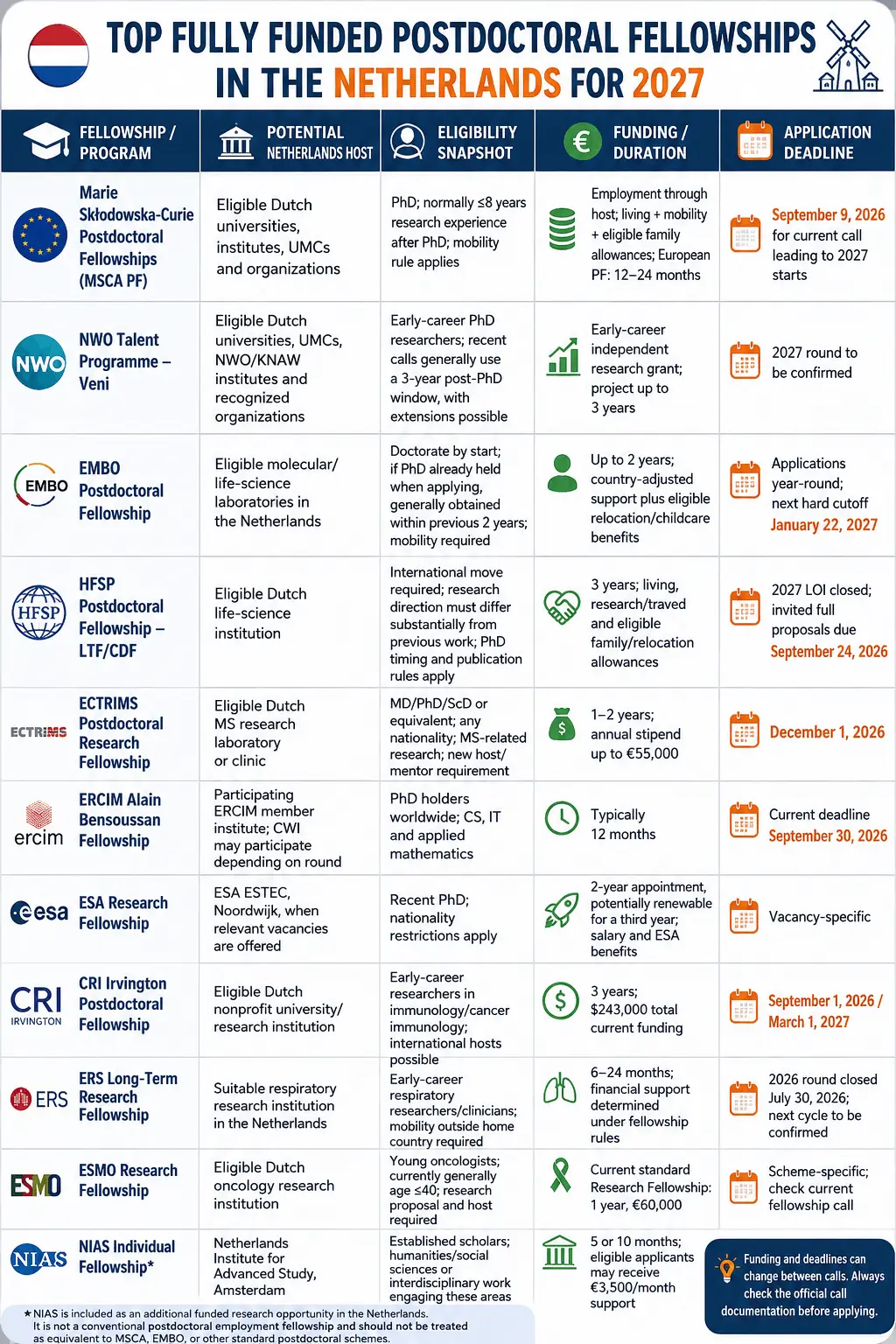
*NIAS is included as an additional funded research opportunity in the Netherlands. It is not a conventional postdoctoral employment fellowship and should not be treated as equivalent to MSCA, EMBO, or other standard postdoctoral schemes.
Funding and deadlines can change between calls. Always check the official call documentation before applying.
1. Marie Skłodowska-Curie Postdoctoral Fellowships (MSCA PF)
Overview
The Marie Skłodowska-Curie Postdoctoral Fellowship is one of the most prestigious mobility-based postdoctoral programs available to researchers who want to conduct research in the Netherlands.
European Postdoctoral Fellowships can be hosted by eligible academic or non-academic organizations in the Netherlands and are open to researchers of any nationality. They support research, advanced training, career development, networking, and international or intersectoral mobility.
Funding and Benefits
MSCA funding provides support for:
Living allowance
Mobility allowance
Family allowance when eligible
Long-term leave and special-needs support where applicable
Research, training and networking costs paid to the host organization
Institutional management and indirect costs
The researcher is normally recruited by the beneficiary organization for the fellowship period.
Duration
A European Postdoctoral Fellowship normally lasts 12–24 months. Global Postdoctoral Fellowships have a different structure and include an outgoing phase followed by a mandatory European return phase.
Eligibility
Applicants must hold a PhD by the call deadline or have successfully defended their doctoral thesis, subject to the call rules.
Applicants generally must have no more than eight years of full-time-equivalent research experience after obtaining the PhD, with certain career-break and other exclusions permitted.
For a researcher applying with a Dutch host under a European Postdoctoral Fellowship, the key mobility rule is particularly important:
The applicant must not have resided or carried out their main activity in the Netherlands for more than 12 months during the 36 months immediately preceding the call deadline.
2026–2027 Timeline
The current MSCA Postdoctoral Fellowship call:
Opened: April 9, 2026
Deadline: September 9, 2026
Expected results: February 2027
Earliest projects expected to begin: around May 2027
Therefore, researchers who want to begin an MSCA-funded postdoc in the Netherlands in 2027 should be preparing their application now, rather than waiting for a 2027 call.
The NWO Talent Programme – Veni is different from a conventional postdoctoral fellowship.
Veni is an early-career independent research grant designed to help promising researchers develop their own research line at an eligible institution in the Netherlands.
This makes Veni particularly attractive to researchers who are beginning to transition from a traditional supervised postdoctoral position toward research independence.
Eligibility
Recent Veni calls have generally allowed researchers whose PhD was obtained within approximately three years before the specified reference date, although extensions may be available for eligible circumstances.
The 2025 Veni call, for example, allowed applications from researchers who had obtained a doctorate within the three years preceding its reference date, with specific extension provisions.
Because rules are call-specific, researchers planning for 2027 should check the new call once released rather than assuming the same dates will automatically apply.
Eligible Hosts
Research can be conducted at participating organizations such as:
Dutch universities
University medical centers
NWO Institutes
KNAW institutes
Netherlands Cancer Institute
Selected nationally recognized research organizations
The researcher must generally be employed by the host institution during the project.
Funding
Veni funding supports an independent research project for up to approximately three years, subject to the budget and conditions specified in the relevant call.
This is therefore better described as an early-career investigator grant rather than simply a postdoctoral scholarship.
The EMBO Postdoctoral Fellowship is one of the strongest options for researchers in molecular biology and related life-science disciplines who want to move to a laboratory in the Netherlands.
Dutch universities, university medical centers, and research institutes contain many laboratories working in areas covered by EMBO.
Funding and Benefits
Depending on the host country and administrative arrangement, EMBO provides country-adjusted financial support as well as eligible benefits such as:
Relocation support
Childcare-related support
Access to EMBO networking and professional development
International mobility and career development
Eligibility
Several eligibility requirements deserve close attention.
Applicants must hold a doctorate or equivalent by the start of the fellowship.
If an applicant already holds a PhD at the time of application, the doctorate generally must have been obtained within the two years preceding submission.
Applicants who have already started working at their proposed host laboratory generally must have been in the host country for less than six months when applying.
Projects that are simply a direct continuation of the applicant’s doctoral work are not eligible.
The Human Frontier Science Program (HFSP) supports highly innovative, frontier research addressing fundamental biological questions.
Two major postdoctoral fellowship tracks are offered:
Long-Term Fellowships (LTF) – primarily for researchers with biological-science doctoral training
Cross-Disciplinary Fellowships (CDF) – for researchers trained in fields such as physics, chemistry, mathematics, engineering, or computer science who are moving into life sciences
Duration and Funding
HFSP fellowships are awarded for three years (36 months).
Funding includes:
Living allowance
Research and travel allowance
Relocation allowance when eligible
Child allowance when eligible
Parental leave support under applicable circumstances
The amount depends partly on the host country.
Major Mobility Requirements
HFSP has substantially stronger mobility rules than many standard fellowships.
Applicants must:
Propose a change in country
Normally conduct the fellowship in a country of which they are not a national
Not conduct the fellowship in the country where they obtained their PhD
Generally not have studied or worked in the proposed host country for more than 12 months by fellowship activation
Propose research that is distinctly different from their PhD or previous postdoctoral research
Applicants also cannot simply continue working with a former research supervisor or established collaborator under the fellowship.
2027 Cycle
For the 2027 fellowship cycle:
LOI initiation deadline: May 5, 2026
LOI submission deadline: May 12, 2026
Invited full proposal deadline: September 24, 2026
Fellowship activation: between April 1, 2027 and January 1, 2028
The LOI stage has already closed, so only candidates invited after the first stage can proceed with the current 2027 competition.
The European Committee for Treatment and Research in Multiple Sclerosis (ECTRIMS) Postdoctoral Research Fellowship supports scientists and physicians conducting research related to multiple sclerosis.
A fellowship can potentially be hosted at an appropriate Dutch university medical center, research institute, laboratory, or clinic specializing in MS.
Eligibility
Applicants may hold:
PhD
MD
ScD
Equivalent doctoral qualification
Researchers of any nationality can apply.
The research must be conducted at a European laboratory or clinic and must relate to multiple sclerosis.
A particularly important eligibility rule is that, at the time of application, the applicant should not already have worked at the proposed host institution and/or under the proposed mentor.
Funding
ECTRIMS currently states that its fellowships provide an annual stipend of up to €55,000.
Postdoctoral Research Fellowships are offered for one or two years.
2027 Deadline
Application deadline: December 1, 2026.
This makes ECTRIMS one of the clearest currently confirmed opportunities for researchers specifically targeting a fellowship beginning in 2027.
The ERCIM Alain Bensoussan Fellowship Programme supports postdoctoral researchers in areas including:
Computer science
Information technology
Applied mathematics
Data science and related computational disciplines
Fellows are hosted by participating ERCIM member institutions across Europe.
In the Netherlands, researchers should check whether CWI in Amsterdam or another appropriate participating ERCIM institution is available during the relevant fellowship round.
Eligibility
The programme is open to PhD holders from around the world.
Applicants should review the list of participating hosts for each specific round because not every ERCIM institution necessarily participates in every competition.
Duration
The standard fellowship duration is 12 months at an ERCIM member institute.
Deadline
The next currently advertised application deadline is:
The European Space Agency Research Fellowship Programme offers postdoctoral researchers opportunities in space science, engineering, space applications, Earth observation, planetary science, astrophysics, technology, and related fields.
Some positions are based at ESTEC in Noordwijk, the Netherlands.
Duration and Benefits
ESA Research Fellowships typically provide:
A two-year appointment
Possible renewal for a third year
Monthly salary
ESA social-security benefits
Paid leave
Travel reimbursement
Potential expatriation and installation allowances
Critical Nationality Requirement
ESA Research Fellowships are not open to all nationalities.
Applicants generally must be citizens of:
ESA Member States
ESA Associate Members
European Cooperating States, where applicable to Internal Research Fellowships
Canada as a Cooperating State
Applicants should always check the eligible nationality list attached to the individual vacancy.
Therefore, international researchers should not assume that holding a PhD alone makes them eligible.
Eligibility
Applicants should have recently completed a relevant PhD. ESA states that preference is generally given to candidates applying within five years of obtaining their doctorate.
The Cancer Research Institute Irvington Postdoctoral Fellowship supports early-career scientists working in:
Immunology
Fundamental immune biology
Cancer immunology
Cancer immunotherapy-related research
The fellowship supports researchers at leading research institutions globally, making an eligible Dutch nonprofit university, university medical center, or research institute a potential host.
Funding
CRI currently lists total fellowship funding of $243,000 over three years.
The award provides sustained postdoctoral support and professional development intended to help researchers transition toward independent careers.
Deadlines
CRI currently lists two upcoming deadlines:
September 1, 2026
March 1, 2027
The program normally operates with March 1 and September 1 deadlines each year, adjusted when these dates fall on holidays or weekends.
This is therefore one of the few programs in this guide with a confirmed application deadline actually occurring in 2027.
The European Respiratory Society Long-Term Research Fellowship (LTRF) supports early-career researchers and clinicians conducting basic, translational, or clinical research in respiratory medicine.
Researchers may potentially choose a suitable host center in the Netherlands provided they comply with the relevant mobility requirements.
Duration
ERS Long-Term Research Fellowships now support projects lasting 6–24 months.
This is an important update because earlier versions of the programme were often described as providing only 6–12 months of support.
Eligibility and Mobility
Applicants generally must conduct their fellowship at an institution outside their home country.
The ERS portfolio includes different routes for:
European researchers
International researchers
Researchers from scientifically developing countries
Certain jointly supported fellowship schemes
The exact conditions depend on the route under which the candidate applies.
Current Deadline Status
The 2026 Long-Term Research Fellowship cycle:
Opened: May 30, 2026
Closed: July 30, 2026
Decision expected: mid-December 2026
The next annual call should be monitored for researchers seeking later 2027 starts.
The European Society for Medical Oncology (ESMO) operates several fellowship schemes for oncology professionals.
The standard ESMO Research Fellowship is particularly relevant to young oncologists who want to conduct clinical or translational research at an international host institution.
A suitable cancer center or university medical center in the Netherlands may therefore serve as a host.
Funding and Duration
Under ESMO’s current general fellowship conditions, the standard Research Fellowship is:
1 year
€60,000
The fellowship may be carried out at an institution worldwide.
This replaces older information commonly found online describing the fellowship as €40,000.
ESMO also operates other programs with different funding structures, including longer clinician-scientist and specialist fellowship schemes.
Eligibility
The standard research fellowship is aimed at young oncologists and currently generally requires applicants to be 40 years old or younger at the time of application, subject to the detailed fellowship rules and any applicable exceptions.
Candidates need to identify a host institution and develop a research project with that institution.
Because ESMO operates several different fellowship categories, researchers should always confirm which current scheme best fits their career stage and proposed project.
Additional Funded Research Opportunity: NIAS Individual Fellowships
NIAS Individual Fellowship
The Netherlands Institute for Advanced Study (NIAS) offers prestigious residential fellowships primarily to scholars in the humanities and social sciences, as well as researchers from other disciplines whose work strongly engages with those fields.
However, NIAS should not be considered a conventional postdoctoral fellowship or salaried postdoctoral position.
Individual fellowships usually provide scholars with five or ten months of dedicated research time in Amsterdam.
Eligible applicants may apply for financial support. Current NIAS documentation lists personal stipends and Dutch University Grants at €3,500 per month.
Researchers considering NIAS should therefore evaluate it as a funded residential research fellowship, rather than a direct alternative to MSCA, EMBO, or HFSP.
Your strongest option depends heavily on your discipline, post-PhD experience, nationality, mobility history, and career goals.
Choose MSCA if:
You want a prestigious European fellowship, strong career-development component, flexibility across disciplines, and an eligible Dutch host.
Choose EMBO if:
You are an early-stage postdoctoral researcher in molecular or life sciences and can satisfy the strict PhD timing and international mobility requirements.
Choose HFSP if:
You are proposing high-risk, frontier life-science research and are making both a significant international move and a substantial change in research direction.
Choose NWO Veni if:
You are ready to begin developing an independent research line in the Netherlands rather than simply continuing in a traditional supervised postdoctoral role.
Choose ECTRIMS if:
Your research focuses specifically on multiple sclerosis or related neuroscience and you have identified a new European host and mentor.
Choose ERCIM if:
Your expertise lies in computer science, mathematics, artificial intelligence, computational science, or related fields.
Choose CRI Irvington if:
Your research focuses on immunology, cancer immunology, or immunotherapy.
Choose ERS if:
You are building a career in respiratory science or medicine and need international mobility-based research training.
Choose ESMO if:
You are a young oncologist pursuing clinical or translational cancer research.
Choose ESA if:
Your research aligns with space science or technology and your nationality meets ESA eligibility rules.
How to Find a Postdoctoral Host in the Netherlands
For fellowships such as MSCA, EMBO, HFSP, CRI, ECTRIMS, ESMO, and ERS, securing the right host laboratory can be as important as selecting the fellowship itself.
Major Dutch research universities and institutions include:
Delft University of Technology
University of Amsterdam
Utrecht University
Leiden University
University of Groningen
Radboud University
Vrije Universiteit Amsterdam
Erasmus University Rotterdam
Maastricht University
Eindhoven University of Technology
University of Twente
Wageningen University & Research
Amsterdam UMC
Erasmus MC
Leiden University Medical Center
University Medical Center Utrecht
Radboudumc
University Medical Center Groningen
National and specialist institutes include:
CWI
AMOLF
Nikhef
DIFFER
NIOZ
ARCNL
Netherlands Cancer Institute
Researchers can also use EURAXESS to identify Dutch postdoctoral vacancies and potential host laboratories.
How to Maximize Your Chances of Winning a Fellowship
1. Start With Eligibility, Not Prestige
Before spending weeks developing a proposal, verify:
PhD-date restriction
Mobility requirement
Nationality requirement
Host-country restrictions
Previous time spent at the host
Previous relationship with the proposed supervisor
Field-specific eligibility
This is particularly important for HFSP, EMBO, ESA, MSCA, and ECTRIMS, where one eligibility condition can make an otherwise excellent application inadmissible.
2. Contact Potential Hosts Early
Strong fellowships are rarely assembled at the last minute.
When contacting a potential PI:
Explain your research background briefly
Show why their laboratory is specifically relevant
Propose a research direction rather than sending a generic request
Mention the fellowship you intend to target
Explain what expertise you bring to the host laboratory
3. Build the Proposal Around the Fellowship Criteria
Do not use the same proposal unchanged for every fellowship.
MSCA places significant emphasis on training, impact, mobility, and career development.
HFSP prioritizes frontier science and a major shift from previous research.
EMBO emphasizes scientific quality and international postdoctoral training.
ECTRIMS requires clear relevance to multiple sclerosis.
CRI focuses on high-quality immunology and cancer immunology.
4. Demonstrate Independence
Reviewers should understand what you bring to the proposed project.
Your proposal should demonstrate:
Original ideas
Technical expertise
Intellectual ownership
Clear career progression
A logical reason for choosing the new host
5. Show Why the Host Is Essential
Avoid simply stating that the university is prestigious.
Explain:
What technique exists there that you need
Which mentor expertise complements your background
Which datasets, patient cohorts, facilities, or technologies are available
What collaborations become possible
What new skills you will take away from the fellowship
6. Apply to More Than One Suitable Program
Postdoctoral fellowships are highly competitive.
Instead of relying on one fellowship, build a portfolio of well-matched applications.
For example, an eligible molecular life-science researcher targeting the Netherlands might consider some combination of:
1. Are these Netherlands postdoctoral fellowships truly fully funded?
Most major programs listed here provide substantial financial support intended to fund the researcher’s fellowship period, but the financial mechanism varies.
Some involve employment through the host institution, while others provide a stipend, fellowship allowance, or grant.
You should therefore evaluate the complete package, including salary/stipend, taxes, social security, relocation, research expenses, childcare or family allowances, and institutional supplementation.
2. Can international researchers apply for postdoctoral fellowships in the Netherlands?
Yes. Many of the major programs in this guide accept international researchers.
However, not every fellowship is open to every nationality.
MSCA European Postdoctoral Fellowships are broadly international, whereas ESA has specific nationality restrictions. HFSP also imposes rules based on nationality, host country, and where the applicant completed their PhD.
Always check the individual fellowship.
3. Can Indian researchers apply for postdoctoral fellowships in the Netherlands?
Yes. Indian researchers can potentially apply for several of the major programs listed here, including MSCA, EMBO, HFSP, ECTRIMS, CRI Irvington, and some ERS opportunities, provided the individual eligibility and mobility conditions are met.
However, eligibility should never be assumed solely based on nationality.
For example, ESA Research Fellowships generally do not accept applicants solely on the basis of Indian citizenship, because ESA nationality restrictions apply.
4. Do I need a Dutch supervisor before applying?
For most fellowships in this guide, yes.
Programs such as MSCA, EMBO, HFSP, ECTRIMS, ESMO, and many ERS routes require applicants to identify and coordinate with an appropriate host institution and supervisor.
In competitive schemes, you should begin contacting hosts several months before the deadline.
5. Can I apply while finishing my PhD?
It depends on the fellowship.
Some programs allow candidates to apply before the formal degree has been awarded provided all doctoral requirements are completed by a specified stage.
Others impose stricter requirements at submission.
For example, HFSP does not require the doctoral degree to be completed at the initial application stage, but it must be completed before fellowship activation within the program’s stated deadline. EMBO requires the doctorate or equivalent by fellowship start.
Always check the current call.
6. What are the typical fellowship durations?
They vary considerably:
MSCA European PF: 12–24 months
EMBO: up to 2 years
HFSP: 3 years
ECTRIMS: 1–2 years
ERCIM: typically 12 months
ESA: 2 years, potentially renewable for a third
CRI Irvington: 3 years
ERS LTRF: 6–24 months
ESMO standard Research Fellowship: 1 year
NIAS: 5 or 10 months
7. Which fellowship is best for life-science researchers?
For broadly defined life sciences, MSCA, EMBO, and HFSP are among the strongest programs.
Researchers in specialized disciplines should also consider field-specific opportunities such as:
ECTRIMS for multiple sclerosis
ERS for respiratory research
CRI Irvington for immunology/cancer immunology
ESMO for oncology
8. Which Netherlands fellowship is best for becoming an independent investigator?
The NWO Veni is particularly attractive because it is structured as an early-career research grant intended to help researchers develop their own independent research direction.
MSCA can also substantially strengthen independence when the proposed research and training plan clearly establishes an individual scientific identity.
9. When should I start applying for a 2027 postdoc?
Ideally, 6–12 months before your desired fellowship start date, and sometimes even earlier.
Several programs funding 2027 positions require applications in 2026.
For example:
MSCA: September 9, 2026
HFSP full proposal for invited 2027 candidates: September 24, 2026
ERCIM current round: September 30, 2026
ECTRIMS: December 1, 2026
EMBO next hard cutoff: January 22, 2027
CRI Irvington: March 1, 2027
This is why applicants should plan around the application year, not simply the year they want the fellowship to begin.
Final Application Checklist
Before submitting any fellowship application, confirm the following:
I meet the PhD-date requirement.
I satisfy the mobility rule.
My nationality is eligible.
My proposed Dutch host is eligible.
My previous residence in the Netherlands does not violate the fellowship rules.
I meet any restrictions concerning previous work with my host supervisor.
My project fits the scientific scope of the fellowship.
My CV clearly demonstrates my relevant accomplishments.
My research proposal has a clear hypothesis, objectives, methods, risks, and expected outcomes.
My proposal explains why the Dutch host is uniquely suited to the project.
My training plan supports my long-term career goals.
I have requested recommendation letters well before the deadline.
I have checked the current official call rather than relying on an older fellowship webpage.
I have identified at least one backup fellowship or host-funded postdoctoral position.
Conclusion
The Netherlands offers an exceptional research environment for postdoctoral researchers planning their careers in 2027. However, the phrase “fully funded postdoctoral fellowship in the Netherlands” covers several different funding models.
For researchers across disciplines, the Marie Skłodowska-Curie Postdoctoral Fellowship remains one of the strongest options. Life-science researchers should also closely consider EMBO and HFSP, while specialized researchers can target programs such as ECTRIMS, CRI Irvington, ERS, and ESMO.
Researchers approaching independence should evaluate the NWO Veni, while computer scientists and mathematicians may consider ERCIM. Space-science researchers can explore ESA Research Fellowships at ESTEC, but must pay close attention to ESA nationality restrictions.
Most importantly, researchers hoping to start in 2027 should begin applying in 2026. Some of the most important deadlines occur many months before the fellowship actually begins.
Start by confirming your eligibility, identify the right Dutch host, contact prospective supervisors early, and build a fellowship portfolio rather than relying on a single application.
IR Research Publication is a knowledge and publishing platform supporting researchers, academicians, and students with practical guidance on research careers, funding opportunities, scientific publishing, and academic development.
Our fellowship guides are designed to help researchers identify credible opportunities and understand important eligibility, funding, mobility, and application requirements.
Because fellowship requirements and deadlines may change between funding cycles, applicants should always verify the latest information on the official funding organization’s website before submitting an application.
France offers a mix of European schemes, national initiatives, and institution-run programs for postdoctoral researchers. Most provide a salary or stipend plus specified allowances (for relocation, family, or training, depending on the scheme) — but exact take-home funding depends on the call terms, applicable taxes, the host city’s cost of living, and personal circumstances, so always check the current call before assuming a figure covers your full living costs.
Who should apply? Highly motivated researchers with a completed PhD (or equivalent) by the call deadline, a strong publication record for their career stage, and a project aligned with a French host team’s strengths. Why France? The country combines leading public research bodies (CNRS, Inserm, Inria, INRAE, CEA), top-ranked universities and institutes, and competitive European frameworks built around international mobility and training.
A note on accuracy: fellowship programs change their calls, deadlines, and even whether they’re running at all from year to year. Some of the programs long associated with France — including a few in earlier versions of lists like this one — do not currently have a confirmed 2027 call. We’ve flagged those clearly below. Always confirm eligibility, funding, and deadlines directly on the official page before applying.
Status unconfirmed for 2027 — no active call verified. Do not treat as a guaranteed annual opportunity
See “Programs With Unconfirmed or Outdated Status” below
Institut Curie’s EuReCa programme has been removed from this table: it was a PhD-level (not postdoctoral) MSCA COFUND scheme, and its final call has already closed.
Marie Skłodowska-Curie Actions (MSCA) Postdoctoral Fellowships
Status: Confirmed for 2027. This is the clearest confirmed 2027 opportunity on this list. The call opens on 7 April 2027 and closes on 8 September 2027.
Overview: MSCA Postdoctoral Fellowships are the EU’s flagship scheme for training and international mobility of postdoctoral researchers. Candidates propose a research project with a host institution in an EU Member State or Associated Country — France is an eligible and popular host destination across all disciplines.
Funding and benefits: A fully salaried employment contract with a living allowance, mobility allowance, and, where applicable, a family allowance, set by the MSCA Work Programme and adjusted by a country correction coefficient for France.
Eligibility: Applicants must hold a PhD by the call deadline. There’s typically a cap on years of post-PhD research experience (with allowable deductions for circumstances like parental leave), and a mobility rule requiring that candidates have not resided or carried out their main activity in France for more than 12 months in the 36 months before the deadline. Final eligibility rules are set by the official 2027 call text.
Application process: Develop a joint proposal with a French host team and submit via the EU Funding & Tenders portal.
FIAS — French Institutes for Advanced Study Fellowship Programme
Status: 2027/2028 cycle already opened (application window has since closed — watch for the next round).
Overview: FIAS offers 10-month fellowships across seven French Institutes for Advanced Study: Aix-Marseille, Cergy, Loire Valley (Orléans-Tours), Lyon, Montpellier, Nantes, and Paris. For the 2027/2028 academic year, FIAS made 29 positions available across these seven sites. The programme is open to all disciplines in the Social Sciences and Humanities (SSH) and to other research fields that meaningfully interface with the SSH.
Funding and benefits: A living allowance (recent cycle: €2,200/month), social security coverage, accommodation, a research and training budget, and travel expense coverage — common standards agreed across all seven institutes.
Eligibility: FIAS welcomes researchers at all career stages, from postdoctoral to senior, with a minimum of a PhD plus 2 years of research experience at the time of application. Applicants from any country are eligible, provided they have spent no more than 12 months in France during the three years before the application deadline.
Application process: The 2027/2028 call had a deadline of 25 June 2026, with results expected around March 2027. If you’re reading this after that window, check the official site for the next call cycle rather than assuming this round is still open.
Programs to Verify Against the Current Official Call
The following are well-established, reputable programs that have supported postdocs in France in past years. Their general structure is unlikely to disappear, but their 2027 terms, funding amounts, and deadlines are not yet confirmed (or, in MOPGA’s case, apply to a specific applicant profile). Treat the details below as indicative of how each programme has typically run, and check the official page before you build an application timeline around them.
France Excellence MOPGA Postdoctoral Programme
Important: MOPGA is not a general postdoctoral fellowship open to all applicants. It is specifically for non-French, early-career researchers who have held a PhD for five years or less, proposing a project in one of MOPGA’s designated themes (Earth system sciences, climate change and sustainability, energy transition, environment-related societal challenges, or One Health). If your project or career stage doesn’t fit that profile, this program isn’t for you.
Funding and benefits (based on the most recent call): A monthly allowance of €2,500, a one-time €500 installation grant, and health coverage. These figures apply to the most recent completed call and should be reconfirmed for any future round.
Timeline: Coordinated by Campus France on behalf of the French Ministry for Europe and Foreign Affairs. The most recent call ran from September to December 2025; a 2027 call has not yet been announced, so treat past timing as indicative only.
Funding and benefits: A salary or stipend paid to the host institution to cover the awardee’s employment costs, plus relocation support and additional allowances for fellows with children where applicable. Fellowships run up to two years.
Eligibility: A doctorate (or equivalent) in a life sciences field, generally within a set number of years of the PhD, and a strong publication record for career stage. Confirm the current eligibility window and any recent rule changes (EMBO has adjusted re-application and host-lab rules for recent selection rounds) on the official page.
Application process: Rolling submissions that feed into two evaluation cycles per year (spring and autumn).
Overview: The Human Frontier Science Program funds frontier, interdisciplinary research in the life sciences, generally requiring a move to a new country and often a new field. France is a regular host destination.
Funding and benefits: A competitive stipend plus research and travel allowances, with exact terms set for each award year.
Eligibility: A PhD and an internationally mobile, interdisciplinary project; applicants cannot hold the fellowship in their country of nationality.
Application process: A two-stage competition — a letter of intent followed by a full proposal for those shortlisted.
Overview: Competitive fellowships for postdocs joining Institut Pasteur laboratories — historically the Paris campus, with recent calls extended to Institut Pasteur New Caledonia, French Guiana, and Guadeloupe.
Funding and benefits: A salaried contract (typically 18–24 months) covering health insurance and retirement contributions. No funding is provided for consumables, equipment, or travel costs.
Eligibility: A completed PhD (or a scheduled defense) within a set number of years before the deadline, and acceptance by a host laboratory — the program does not consider unsolicited applications.
Application process: Calls have historically run in spring and/or autumn sessions; check the current cycle’s dates before applying.
Overview: Postdoctoral fellowships in computer science and applied mathematics, hosted across ERCIM member institutes — including Inria in France.
Funding and benefits: A 12-month, salaried fellowship (renewable, with fellows able to apply for a second year at a different institute), with the salary set by the hosting institute.
Eligibility: A PhD obtained within roughly the last 8 years before the deadline, or being in the final year of doctoral work.
Application process: Two calls per year, historically with deadlines around 30 April and 30 September.
Programs With Unconfirmed or Outdated Status — Don’t Rely on These Without a Current Call
A few programs that circulate in older “postdoc in France” round-ups are no longer accurate to include as active, recurring 2027 opportunities:
Institut Curie — EuReCa Programme: This has been removed from this guide. EuReCa was a PhD-level (not postdoctoral) MSCA COFUND programme, and its final call has already closed.
Paris Region Fellowship Programme (ParisRegionFP): Past cycles ran through the MSCA COFUND framework into 2025–2026. No new call has been confirmed for 2027. Check the program’s official page directly before assuming it’s currently open — do not treat it as an active annual fellowship.
EUTOPIA-SIF Postdoctoral Fellowships: Also an MSCA COFUND scheme, hosted in France through CY Cergy Paris University. No confirmed 2027 call as of this writing; verify current status on the EUTOPIA alliance site before including it in your application plan.
AXA Research Fund Post-Doctoral Fellowships: This program depends on host-institution nomination rather than a standard open annual call, and recent activity has been inconsistent. Don’t treat it as a guaranteed yearly opportunity — check the AXA Research Fund site for any current call before pursuing it.
Salaried Postdoctoral Job Vacancies (Not Named Fellowship Schemes)
Inria and INRAE are sometimes listed alongside named fellowship programs, but they’re better understood as major French research institutes that regularly post individually funded, project-specific postdoctoral job vacancies — not standing fellowship schemes with a single unified call, deadline, or funding structure. If you want to work with either institute, the right approach is to monitor their job boards and, ideally, contact a specific research team directly.
Inria (computer science, mathematics, AI, robotics) posts postdoctoral vacancies on a rolling basis, typically salaried 12–24 month contracts tied to a specific team and project. Browse current postdoc listings: Inria job offers
INRAE (agriculture, food, environment, biodiversity, data sciences) similarly posts individual postdoctoral vacancies tied to specific units and projects, generally 12–24 months. Browse current listings: INRAE Jobs
Because these are individual job postings rather than a fellowship “round,” funding amounts, contract lengths, and eligibility vary by posting — there’s no single figure to quote here.
Match your project to the host’s expertise and infrastructure; contact potential supervisors early to co-develop a compelling proposal.
Check mobility rules carefully — this is especially critical for MSCA and any COFUND-style scheme.
Confirm you actually meet each program’s specific applicant profile (MOPGA’s climate/environment and non-French-national requirements are a good example of criteria that are easy to overlook).
Don’t assume a stipend or salary figure covers all your living costs in a given host city — verify net amounts, tax treatment, and any allowances in the current official call.
Start early on letters, host-lab acceptance, and ethics approvals; small administrative delays can derail competitive calls.
Are the postdoctoral fellowships in France 2027 already open? Only some are. The MSCA Postdoctoral Fellowship 2027 call has confirmed dates (opening 7 April 2027, closing 8 September 2027), and FIAS opened its 2027/2028 cycle earlier in 2026. Other programs listed here have not yet announced 2027 terms — always check the official page for the current status before planning around a specific date.
Do these fellowships cover full salary and living costs? Most provide a salaried contract or stipend intended for full-time research in France, along with specified allowances (for example, relocation or family support, depending on the program). Whether that fully covers your living costs depends on the call’s exact terms, applicable taxes, your host city, and your personal circumstances — confirm net, take-home figures with each program rather than assuming the headline amount is what you’ll receive.
Can non-EU citizens apply? Generally yes. MSCA, FIAS, EMBO, HFSP, and the institutional fellowships listed here are open to international candidates, though a few (like MOPGA) exclude French nationals specifically because the program targets inbound international researchers.
What is the typical duration? It varies by program — MOPGA and ERCIM fellowships run around 12 months, FIAS runs 10 months, Pasteur-Roux-Cantarini runs 18–24 months, and MSCA and HFSP fellowships can run up to 2–3 years. Always confirm the duration in the specific call.
How competitive are these fellowships? Highly competitive. Strong publications, an original and feasible project, a strong host team, and a clear training plan matter across the board. Consider applying to more than one program or cycle.
What about language requirements in France? English is commonly used in research labs, especially in STEM and life sciences. Basic French can help with daily life and integration but generally isn’t required for the research itself.
Conclusion
If you plan ahead and confirm details directly against each program’s current official call, there are several credible pathways to postdoctoral funding in France for 2027 — starting with the confirmed MSCA 2027 call and the newly opened FIAS cycle, alongside established programs like MOPGA (for eligible non-French, early-career climate and environment researchers), EMBO, HFSP, Institut Pasteur, and ERCIM. Treat older program names you may have seen elsewhere — including Institut Curie’s EuReCa, ParisRegionFP, EUTOPIA-SIF, and AXA’s postdoctoral fellowships — with caution unless you can find a live, current call, and consider Inria and INRAE as job-board destinations rather than named fellowship schemes.
About IR Research Publication
IR Research Publication is an independent platform dedicated to advancing researchers’ careers through practical funding intelligence, proposal-writing resources, and curated opportunities. Explore our latest funding guides and how-to articles at irrespub.com.
The race for the highest-paying postdoctoral fellowships is more competitive than ever. Beyond prestige, these awards provide real advantages: higher take-home pay, generous research and travel budgets, relocation and family allowances, excellent health coverage, and stronger placement pathways into faculty or industry research roles.
Who should read this guide? Final-year PhD candidates, current postdocs seeking a better-funded move, PIs advising mentees, and international researchers comparing salary and benefits across countries. Because eligibility, taxes, and benefits differ widely by region and host institution, this article highlights how programs vary in practice and how to choose the best fit.
Common pitfalls include chasing a single “dream” program, underestimating lead times for letters and visas, misaligning your host’s expertise with your proposal, and presenting budgets or timelines that panels find unrealistic. We help you avoid these pitfalls with a step-by-step plan.
A note on figures in this guide: all stipend and salary amounts below reflect verified 2026 call data where available. Some are quoted gross (before tax and social contributions), others net (after tax, or tax-free), so we flag this for each program — always confirm the exact figure and tax treatment on the official page before you plan your budget.
Quick Summary Table
Topic
Recommendation
Common Mistake
Best Practice
Targeting programs
Apply to 5–8 well-matched, high-paying fellowships across regions.
Applying to 1–2 “dream” awards only.
Portfolio approach based on fit, pay, and odds; diversify by region and sponsor type.
Host alignment
Choose hosts with recent, citable outputs directly enabling your project.
Picking hosts by brand name alone.
Demonstrate unique synergy and concrete co-mentoring/training opportunities.
Budget and pay
Model gross vs. net pay, benefits, and cost-of-living by city.
Ignoring taxes, social insurance, and currency swings.
Use official calculators and include allowances and family benefits in comparisons.
Timeline
Start 6–8 months before the deadline.
Last-minute reference requests.
Back-schedule deliverables; pre-book letter writers and compliance (ethics/visa).
Proposal design
Focus on training outcomes, independence, and method feasibility.
Long literature summaries without a clear plan.
Provide milestones, risks, alternatives, and measurable outputs.
Review criteria
Map each section to published scoring rubrics.
Assuming the panel will “get it.”
Use headings mirroring criteria; include a one-page review response checklist.
Letters of support
Secure detailed, specific letters with mentoring and integration plans.
Generic letters repeating your CV.
Send letter writers bullet prompts and submission reminders early.
Interviews
Prepare a 60–90 second “fundable idea” pitch and 1–2 slide storyboard.
Overloading with technical detail.
Lead with problem importance, novelty, impact, and feasibility.
Compliance
Pre-clear ethics/IRB/IBC/animal protocols and data agreements.
Deferring compliance until award stage.
State approvals and data-sharing plans in the application.
Backup plans
Line up host-funded or bridge options.
All-or-nothing fellowship dependence.
Negotiate host guarantees (lab access, interim pay) contingent on results.
Which postdoctoral fellowships pay the most? Quick answer
The following programs are consistently among the highest-paying postdoctoral fellowships worldwide, based on verified 2026 figures (always confirm final call details on official pages):
CERN Research Fellowships (Switzerland): CHF 7,004–7,425/month, net and tax-free — approximately CHF 84,000–89,000/year, plus family and travel allowances.
Schmidt Science Fellows (global):USD 110,000/year stipend for the 2026 cohort, up to 2 years, plus mentorship and global meetings.
Branco Weiss Fellowship – Society in Science (global): up to CHF 600,000 total funding over up to 5 years — a flexible envelope fellows allocate across salary, research, travel, and personnel, not a fixed annual salary.
ETH Zurich Postdoctoral Fellowship (Switzerland):CHF 92,500 gross in year 1, rising to CHF 97,200 gross in year 2, plus CHF 12,000/year in research funds.
EPFL Fellows (Switzerland):CHF 88,000–92,500/year gross (1st–4th year) plus Swiss social benefits.
SNSF Swiss Postdoctoral Fellowships (Switzerland): this transitional scheme has been discontinued now that Switzerland has rejoined MSCA — it used to average CHF 105,000/year gross, but researchers should apply to MSCA-PF directly for a Swiss placement now.
HHMI Hanna Gray Fellows (USA):USD 80,000/year salary plus a USD 20,000 expense allowance during the postdoc phase.
KAUST Global Fellowship (Saudi Arabia):USD 75,000/year stipend, plus a USD 45,000 research budget, housing, and relocation support.
Flatiron Research Fellow (Simons Foundation, USA):USD 91,000/year full-time compensation, plus comprehensive benefits.
Top 20 highest-paying postdoctoral fellowships in 2026 (compare pay, benefits, and fit)
Amounts reflect verified 2026 call data where confirmed; where not yet published for 2026, the most recent verified figures are used and flagged. “Typical annual pay” indicates whether the amount is gross, net, or a flexible multi-year envelope — always confirm on official pages.
Fellowship
Region
Typical Annual Pay
Key Benefits
Eligibility Snapshot
Usual Deadline Window
Official Link
CERN Research Fellowship
Europe (Switzerland)
CHF 84,000–89,000 (net, tax-free)
Health insurance, family allowances, travel
PhD holders (0–6 years post-PhD), physics/engineering/computing
Swiss National Science Foundation Postdoctoral Fellowships
Europe (Switzerland)
Discontinued — was CHF 105,000 average gross + up to CHF 24,000 project funds over 2 years
Research costs, mobility, family allowances
This transitional scheme has been sunset now that MSCA is available again in Switzerland since 2025; researchers should apply directly to MSCA-PF instead
Significant research funds; up to 8 years (postdoc+transition)
Biomedical/biological sciences; diversity and independence focus; from the 2028 competition (opening Nov 2026) selection merges with the Freeman Hrabowski Scholars Program
Canada Postdoctoral Research Award (CPRA) — replaces Banting
Canada
CAD 70,000/year (taxable), 24-month term
Prestige; part of the harmonized Canada Research Training Awards Suite
The Banting Postdoctoral Fellowship’s final competition was 2024–25; it has been folded into CPRA, which runs through CIHR, NSERC, or SSHRC depending on field. PhD within eligibility window; host commitment required
CERN figures are net and tax-free, while ETH Zurich, EPFL, and SNSF figures are gross — meaning cantonal/federal tax and social contributions come out before you see the money. Don’t compare them at face value.
Branco Weiss is not a fixed annual salary. It’s a flexible, multi-year funding envelope of up to CHF 600,000 that fellows can allocate across their own salary, research costs, travel, and personnel over as long as 5 years.
HFSP does not publish one global stipend figure. Awards are set relative to the cost of living in the host country, so the “take-home” amount varies significantly depending on where you’re placed.
SNSF Swiss Postdoctoral Fellowships was a transitional scheme for researchers who wanted a Switzerland-based MSCA-style fellowship while Switzerland was a non-associated third country in Horizon Europe. Now that Switzerland has rejoined MSCA (since early 2025), the SNSF scheme has been discontinued — apply to MSCA-PF directly for a Switzerland placement instead.
Banting Postdoctoral Fellowships ran their final competition in 2024–25 and have been folded into the new harmonized Canada Postdoctoral Research Award (CPRA), part of the Canada Research Training Awards Suite. The pay level (CAD 70,000/year) and duration carry over, but applicants now go through CIHR, NSERC, or SSHRC depending on their field rather than a standalone “Banting” competition.
How to choose among the highest-paying postdoctoral fellowships
Beyond headline pay, compare the following:
Cost of living and taxes: CHF 90k gross in Zurich, USD 90k in the US, and SGD 90k in Singapore all net out very differently. Use official tax calculators, and factor in whether health insurance and social contributions are employer-covered.
Gross vs. net vs. envelope: As shown above, some awards (CERN) are quoted net and tax-free, others (ETH, EPFL, SNSF) are gross, and some (Branco Weiss) are multi-year flexible funding rather than a fixed salary. Normalize before comparing.
Benefits: Housing subsidies (common in the Middle East and Singapore), family allowances (CERN, MSCA, SNSF), research budgets (Schmidt, KAUST, NTU/NUS, NSF, NHFP, HHMI), and travel support can outweigh stipend differences.
Eligibility windows: Some restrict years since PhD (HFSP, MSCA, CERN), mobility rules (MSCA, SNSF, EPFL/ETH), or host nationality/residency constraints (NSF, NIH).
Career outcomes: Programs with strong alumni networks (CERN, MSCA, Schmidt, Flatiron, NHFP) often correlate with strong placement into faculty or high-impact industry roles.
Step-by-step guide to winning a top-paying postdoc in 9 steps
Step 1: Build a targeted list (5–8 programs)
Use a portfolio strategy: 2–3 “reach” awards (e.g., Schmidt, Branco Weiss, Flatiron), 2–3 strong matches (MSCA, ETH/EPFL, NHFP, NSF), and 1–2 safety options (institutional or national schemes with higher success rates). Track pay, benefits, deadlines, eligibility, and document requirements in a simple spreadsheet — and note whether each figure is gross, net, or an envelope.
Step 2: Validate host fit early
Write a 150-word “fit statement” that links your methods to the host’s recent 2–3 papers.
Secure a primary mentor and, if allowed, a co-mentor in a complementary area (panels reward cross-training).
Step 5: Present a clear calendar and Gantt-like milestones
Quarterly milestones, each ending with a tangible output (preprint, dataset, prototype).
Reserve 10–15% time for career development: grantwriting, pedagogy, leadership.
Include an explicit manuscript and conference plan to demonstrate productivity cadence.
Step 6: Write for evaluators, not insiders
Use short paragraphs, descriptive headings mirroring the scoring rubric, and figures only if allowed.
Lead each Aim with 1–2 sentences on hypothesis/goal before technical details.
Include a one-paragraph “Why now at this host?” statement.
Step 7: Optimize letters of support
Provide letter writers with bullet prompts and a draft of your one-page summary. Ask them to address:
Your independence and originality beyond the PhD supervisor’s line.
Evidence of project feasibility in 24–36 months.
Concrete mentoring and integration plan (lab meetings, co-mentoring, annual reviews).
Step 8: Mock interviews and chalk talks
Prepare a 60–90 second pitch: Problem → Innovation → Feasibility → Impact.
Anticipate 6–8 FAQs: novelty, risks, data access, ethical approvals, contingency, independence from PI, timeline realism.
Practice with non-specialists to ensure clarity.
Step 9: Submission quality control
Run a final checklist against the sponsor’s scoring criteria.
Confirm file names, page limits, margins, and font rules; submit 24–48 hours before deadline.
Save a PDF of the submission confirmation.
Salary, taxes, and benefits: country-by-country considerations
Switzerland: High gross pay; excellent social benefits; taxes vary by canton. CERN is the exception — its stipend is net and tax-free, while ETH, EPFL, and SNSF figures are gross.
United States: Stipends may be taxable; benefits and health insurance differ by host; NIH NRSA scale sets a floor but many high-end fellowships (HHMI, Flatiron) exceed it.
European Union: Many awards are employment contracts with social security; MSCA uses country correction coefficients for cost of living.
Middle East (e.g., KAUST): High stipend plus a separate research budget, furnished housing, and relocation; often tax-free personal income; strong research support.
Singapore: Competitive salary plus housing support and sizable, separately budgeted research grants; personal taxes relatively low; CPF does not usually apply to foreign postdocs.
Japan and Germany: Solid benefits and stability; base stipends may be lower but cost of living and social protection can balance the package.
Month −2: Polish narrative; prepare lay summary and DEI statements if required.
Month −1: Compliance check, formatting, and portal rehearsal submission.
Week −2: Submit; confirm references received; archive all files.
Email templates and document outlines
Cold email to a potential postdoc host
Subject: Prospective postdoc and fellowship application (Your Name – Target Award)
Dear Prof. [Last Name],
I am a final-year PhD candidate at [University] working on [1-sentence problem]. I plan to apply for the [Fellowship Name] (deadline [Date]) and would value the opportunity to pursue this project in your group, building on your work in [Specific Paper or Method].
In brief, my proposed project aims to [1–2 sentences on novelty and aims]. I attach a 1-page summary and 2 representative publications. If this aligns with your interests, could we schedule a 20-minute call to discuss fit, training opportunities, and logistics?
Thank you for considering, and I would be delighted to provide any additional materials.
Training plan and mentoring structure (courses, rotations, industry/clinical exposure).
Open science plan (preprints, code/data sharing, reproducibility).
Timeline and Gantt chart narrative.
Ethics, risk, and safety considerations.
References (consistent style, recent and relevant).
Interview preparation: common questions
What is the single biggest risk in your project and how will you mitigate it?
How is this work distinct from your PhD advisor’s research?
What preliminary data or proof-of-concept supports feasibility?
What will success look like in 12, 24, and 36 months?
How will the host’s environment accelerate your progress?
What are your plans for data management, sharing, and reproducibility?
How will this fellowship position you for your target career (faculty/industry)?
Cover letter template (for fellowships with employment contracts)
Dear Members of the Selection Committee,
I am applying to the [Fellowship Name] to pursue [project title] under the mentorship of [Host PI] at [Institution]. My doctoral work in [Field] produced [1–2 key outcomes], which provide a strong foundation for this proposal’s [methods/innovation].
This fellowship is the best fit because [alignment with mission/criteria]. The host offers [specific facilities/training], and we have established a clear mentoring and integration plan. Over [duration], I expect to deliver [outputs], share results via [journals/conferences/open data], and undertake training in [skills].
Thank you for your consideration. I look forward to the opportunity to contribute to the [fellowship community/lab/field].
Sincerely, [Your Name]
Expert Tips
Use award-specific language: mirror key terms from the call in headings and topic sentences.
Quantify ambition and feasibility: “We will benchmark on [dataset] to exceed [metric] by X%” is stronger than “We will evaluate performance.”
Attach host commitment: a signed, detailed support letter promising resources and supervision cadence significantly boosts credibility.
Leverage dual mentorship: pair a content mentor with a methods mentor (e.g., domain + AI/ML) to show cross-disciplinary training.
Pre-register and preprint: panels reward open science and rapid dissemination that do not jeopardize IP.
Pilot first: even a small pilot (n=10, prototype script, power analysis) strengthens the feasibility argument.
Know the pay components: some fellowships list gross amounts before employer contributions; others are net or tax-free; a few (like Branco Weiss) are multi-year envelopes rather than annual salaries. Clarify this in your comparison sheet before you plan a budget.
Use internal reviews: run at least one senior and one junior peer review; incorporate feedback and maintain version control.
Show independence: avoid overlapping aims and figures with your PhD advisor’s grants; state clearly what is yours.
Back-up submission: where permitted, pursue a national or institutional scheme in parallel to cover timing risk.
Common Mistakes to Avoid
Ignoring mobility rules: programs like MSCA and Swiss fellowships require you not to have resided in the host country beyond specified limits.
Overly broad aims: panels prefer two well-defined, feasible aims over four ambitious but vague goals.
Missing country corrections: for MSCA, failure to apply country coefficients leads to inaccurate salary expectations.
Confusing gross, net, and multi-year envelopes: treating a CHF 600,000 five-year Branco Weiss award as if it were a CHF 600,000/year salary, or comparing CERN’s net stipend directly against ETH’s gross salary, will throw off your planning.
Generic letters: references that restate your CV without specifics can sink an application; brief writers early and provide bullets.
No contingency plans: absence of risks/alternatives signals lack of realism.
Weak host rationale: selecting a prestigious host without a direct methodological link reduces perceived feasibility and training gain.
Late compliance: waiting to address IRB/animal/data approvals suggests timeline naivety.
Poor formatting: violating page limits, fonts, or margin rules can lead to desk rejections.
Underestimating taxes and benefits: a higher gross stipend may net less depending on country and family status.
No narrative arc: a cut-and-paste methods section without a compelling problem-impact story rarely scores top marks.
Stay updated on calls, research writing tips, and peer review insights from IR Research Publication.
Learn more about IR Research Publication and its editorial and profile-building services while preparing your fellowship dossier.
Frequently Asked Questions
Which are the highest-paying postdoctoral fellowships in 2026?
Programs that consistently top pay scales include Schmidt Science Fellows (USD 110,000/year), Branco Weiss (up to CHF 600,000 over 5 years, flexible), ETH Zurich (CHF 92,500–97,200/year gross), EPFL Fellows (CHF 88,000–92,500/year gross), CERN Research Fellowships (CHF 84,000–89,000/year net, tax-free), and HHMI Hanna Gray Fellows (USD 80,000/year + USD 20,000 allowance). Note that the SNSF Swiss Postdoctoral Fellowships scheme, which used to average CHF 105,000/year, has been discontinued now that MSCA is available again in Switzerland — apply to MSCA-PF for a Swiss placement instead. Verify current 2026 calls, and note whether each figure is gross, net, or a multi-year total.
How do MSCA Postdoctoral Fellowship salaries work?
MSCA-PF provides a monthly living allowance (€5,080), mobility allowance (€600), and family allowance (€660 if eligible), all multiplied by a country correction coefficient. Amounts are before taxes and employer contributions; you are typically an employee with social security via the host.
What is the difference between stipend and salary?
Salary is employment income with withholdings and benefits; stipend can be tax-free or taxable depending on country and sponsor. CERN, for example, quotes a net, tax-free stipend, while ETH, EPFL, and SNSF use gross salaries. Always compare net-of-tax figures and include benefits.
Do high-paying fellowships always include research funds?
No. Some provide primarily salary (e.g., ETH/EPFL base pay), while others bundle a separate research budget on top of the stipend (e.g., KAUST’s USD 45,000 research budget, NTU’s SGD 100,000/year research grant, or ETH’s CHF 12,000/year research funds). Read the call to see which costs are allowed (equipment, travel, page charges) and whether the research budget is separate from your personal pay.
How many applications should I submit?
Most successful candidates apply to 5–8 programs across sponsors and regions. Diversification increases your odds and gives negotiation leverage with hosts.
Can I negotiate salary or benefits?
Stipends are usually fixed by the sponsor, but benefits and top-ups can sometimes be negotiated with the host (e.g., housing, relocation, supplementary funds, or bridging salary while awaiting results).
What are acceptance rates like?
Prestigious programs (Schmidt, Branco Weiss, Flatiron) may fund a small single-digit percentage of applicants. MSCA-PF and NSF postdocs often range roughly 10–15% overall, varying by panel and year. Institutional schemes can be higher. Check statistics in annual reports where available.
When should I start preparing?
Start 6–8 months before the deadline. Early preparation is essential for host coordination, ethics approvals, letters, and polished narratives.
Are industry postdocs higher paying than fellowships?
Often yes, especially in tech and biotech hubs; however, pure industry roles may trade off academic independence or teaching. This guide focuses on competitive academic or foundation-funded fellowships with strong research autonomy.
What if I miss a major deadline?
Line up institutional or national schemes with rolling or later deadlines, and ask your host about short-term contracts or internal bridging funds. Resubmit in the next cycle with improved preliminary data.
Conclusion: How to act now
The highest-paying postdoctoral fellowships offer more than salary: they accelerate independence, unlock resources, and expand networks. Start by shortlisting 5–8 awards, matching each to a host with demonstrable synergy, and scoping a focused, feasible, and high-impact project. Use the templates above to contact mentors, structure your CV and proposals, and prepare for interviews. Confirm 2026 stipend and benefits on official pages, model your net-of-tax income by city, watch for the difference between gross, net, and multi-year envelope figures, and submit at least 24–48 hours early. If you aim for the highest-paying postdoctoral fellowships, preparation 6–8 months ahead is the single biggest predictor of success.
About IR Research Publication
IR Research Publication is dedicated to advancing global scholarship by connecting researchers with reputable journals, rigorous peer review, and practical publishing resources. From manuscript preparation to dissemination, IR Research Publication supports early-career scientists and postdoctoral researchers in building credible, citable profiles that strengthen fellowship and grant applications. Learn more and get started at IR Research Publication.
Note: Stipends, benefits, and policies may change by the 2026 call. Always verify live details, tax treatment, and eligibility on the official fellowship pages and your prospective host’s HR office before committing.
Germany offers a world-class research ecosystem anchored by renowned organizations such as the Max Planck Society, Helmholtz Association, Leibniz Association, Fraunhofer-Gesellschaft, and leading universities. Fully funded postdoctoral fellowships in Germany 2027 support international and domestic researchers with competitive stipends or contracts, excellent infrastructure, and integration into vibrant academic networks.
Who should apply: PhD holders or those nearing completion with strong research output and an international outlook.
Why Germany: Globally ranked institutes, access to cutting-edge facilities, collaborative culture, competitive funding, and strong industry links.
What’s on offer: Taxed employment contracts (e.g., TV-L/TVöD scales) or generous stipends, mobility and family allowances, travel and research budgets, mentoring, and career development.
Before applying in 2027, always consult official program pages for the most current eligibility rules, stipend levels, and deadlines, as providers periodically update terms.
Fellowship Summary Table: Fully Funded Postdoctoral Fellowships in Germany 2027
Fellowship / Program
Host Institution
Eligibility
Funding / Salary
Application Deadline
Official Link
Humboldt Research Fellowship (Postdoctoral)
Alexander von Humboldt Foundation; host universities/research institutes in Germany
PhD completed within last ~4 years; all nationalities
Monthly fellowship approx. €3,000 plus allowances
Calls: 15 Mar / 15 Jul / 15 Nov 2026 → starts Feb/May/Sep 2027
The Alexander von Humboldt Foundation funds outstanding international postdocs to conduct independent research with a host in Germany. Applications are accepted year-round and across all disciplines.
Funding and Benefits
Monthly fellowship of approximately €3,000 (postdoctoral level), plus family, mobility, and language-course support.
Travel costs, conference support, and alumni funding opportunities.
6–24 months of research with flexible start dates.
Eligibility
Doctorate completed generally within the last four years.
Strong publication record appropriate to career stage.
Host agreement from a German institution.
Application Process
Secure a host and research plan.
Submit application online with references; reviews are competitive and merit-based.
Timeline: typically 4–7 months from submission to decision.
For researchers from developing and transition countries, this Humboldt Foundation fellowship supports research in Germany that has development relevance.
Funding and Benefits
Monthly fellowship of approximately €2,670, with family/mobility allowances.
Language courses, travel, and extensive networking/alumni funding.
Eligibility
Citizenship in an eligible developing/transition country (see official list).
Recent PhD and strong academic record.
Host invitation and project fit to development-relevant topics.
Application Process
Apply online with project proposal, host’s confirmation, and references.
Rolling submissions; allow several months for review.
DAAD PRIME (Postdoctoral Researchers International Mobility Experience)
Overview
DAAD PRIME funds a postdoctoral position at a German university combined with an obligatory research stay abroad, promoting long-term career prospects in Germany.
Funding and Benefits
Employment contract at the German host (TV-L E13) for 18 months.
Typically 12 months abroad + 6 months reintegration in Germany.
Mobility allowance, travel, and insurance as per DAAD rules.
Eligibility
Doctorate completed by the start date; all nationalities welcome.
Mobility requirements apply; check current call text.
Host university in Germany must commit to employing the fellow.
Application Process
Annual call (usually spring). Prepare research plan and host confirmations.
Submit through DAAD portal; panel evaluation based on excellence and feasibility.
Marie Skłodowska-Curie Actions (MSCA) Postdoctoral Fellowships
Overview
MSCA PF (Horizon Europe) offers prestigious, fully funded postdoctoral training with a German host (European PF) or with an outbound phase followed by a German return (Global PF).
Funding and Benefits
Employment contract with competitive MSCA living, mobility, and family allowances (country correction coefficients apply).
Research, training, secondments, and career development budget.
Eligibility
PhD at the call deadline and up to 8 years of research experience after PhD (HE rules).
Mobility rule: limited residence in the host country within the prior 36 months.
Application Process
Identify a German supervisor/host and co-develop the proposal in the EU Funding & Tenders Portal.
Annual deadline typically in September; evaluation is highly competitive.
The German Research Foundation (DFG) supports early-career postdocs to conduct independent research in Germany or abroad, often emphasizing a change of academic environment.
Funding and Benefits
Funding for your own position (commonly TV-L E13 at the host institution).
Project funds (e.g., travel, consumables) as justified.
Eligibility
Completed doctorate; early career stage; change of institution generally expected.
Scientific excellence and a strong, feasible project proposal.
Application Process
Submit a proposal anytime via DFG’s portal with host confirmation and detailed plan.
Peer review followed by panel decision; timelines vary.
The Human Frontier Science Program funds frontier, interdisciplinary life science projects, encouraging cross-field training and international mobility to hosts in countries like Germany.
Funding and Benefits
Competitive living allowance, family allowance where eligible, and research/travel support.
Up to three years of funding.
Eligibility
PhD by fellowship start; early-career stage; strict international mobility is required.
Projects should cross disciplinary boundaries and pursue high-risk/high-gain research.
Application Process
Two-stage annual competition: Letter of Intent (spring) and Full Proposal (late summer/early autumn).
Peer review emphasizes novelty and potential impact.
Match your research plan to the program’s mission and your host’s expertise.
Clarify mobility requirements early (MSCA, EMBO, HFSP, DAAD PRIME).
Request reference letters well in advance and align them with your proposal’s narrative.
Use clear work packages, realistic Gantt charts, and measurable outcomes.
Review successful templates and writing tips. For practical guidance, explore resources at IR Research Publication, including proposal strategies and scholarship roundup posts.
Frequently Asked Questions
Are the fellowships listed here fully funded?
Yes. Programs provide either a monthly fellowship (e.g., Humboldt) or an employment contract (e.g., TV-L/TVöD for DAAD PRIME, Max Planck, Helmholtz), often with additional allowances. Always verify current terms on official pages.
When will 2027 deadlines be published?
Some schemes accept applications year-round (Humboldt, DFG Walter Benjamin, EMBO rolling). Annual calls like MSCA PF, HFSP, and DAAD PRIME typically publish deadlines the preceding year. Check official websites regularly.
What is the typical salary for contracted postdocs in Germany?
University and institute positions are often aligned with TV-L or TVöD pay scales (commonly E13), which vary by federal state and experience level. Consult your host HR or program pages for current rates.
Do I need German language skills?
Not usually for research roles; English is widely used. Some programs fund language courses (e.g., Humboldt). Teaching or clinical roles may require German.
Can I bring my family?
Many programs offer family/spouse allowances (e.g., MSCA, Humboldt) and support with childcare or schooling via host services. Check each program’s family policy.
What are my chances?
Top programs are competitive. A strong publications record, clear impact, host fit, and compelling training plan substantially improve success.
Where can I get proposal-writing help?
Consult your host’s research office and explore application tips at IR Research Publication. You may also find guides on MSCA and DAAD strategies useful.
About IR Research Publication
IR Research Publication (IRRP) curates credible opportunities and practical resources for scholars worldwide. Our mission is to help researchers find competitive funding, craft stronger proposals, and communicate their science effectively. Explore guides, funding roundups, and writing tips to accelerate your academic career.
From Humboldt and DAAD PRIME to MSCA PF, EMBO, HFSP, and institution-based contracts, the ecosystem for fully funded postdoctoral fellowships in Germany 2027 is exceptionally strong. Identify the program that best aligns with your research goals, confirm the latest eligibility and deadlines on official pages, and co-develop a compelling proposal with your host. With early planning, a clear training plan, and strategic mentoring, Germany can be the ideal launchpad for your next breakthrough.
New Zealand is a high-impact research destination offering a range of fully funded or salary-supported postdoctoral opportunities across health, materials science, photonics, and interdisciplinary domains. This guide to Fully Funded Postdoctoral Fellowships in New Zealand 2026 highlights nationally competitive fellowships, institutional positions, and international schemes that can be hosted at New Zealand universities and research institutes.
A note on terminology: In New Zealand, true standalone “fully funded fellowships” — in the sense of independent, fully-costed research grants — are relatively limited. Many of the opportunities below are better described as salary-funded postdoctoral positions (employment contracts tied to funded projects) or fellowships that cover salary plus a partial research allowance, rather than full project funding. Throughout this guide we use “fellowship” where that is the program’s official name, and “postdoctoral position” where the opportunity is more accurately a grant-funded research role. Always check the specific program page for what is actually covered.
These opportunities are designed for:
Recent PhD graduates seeking independent research development.
Early-career researchers (ECRs) building track records and leading projects.
International scholars planning to relocate to New Zealand with a host lab.
Researchers from underrepresented communities (including Māori and Pacific researchers) using dedicated fellowship pathways.
Why New Zealand?
Collaborative, mentor-rich labs across globally ranked universities and Crown Research Institutes.
Centres of Research Excellence (CoREs) with multi-institutional supervision and industry links.
Strong national support for health and fundamental science, plus international fellowships that fund time in New Zealand labs.
Excellent quality of life and research culture that supports work–life balance.
Indicative postdoctoral salaries in New Zealand typically sit in the range of roughly NZD 70,000–95,000 per year, depending on institution, discipline, and experience — though this varies by funder and should be confirmed on each official posting.
At a Glance: Fully Funded Postdoctoral Fellowships in New Zealand 2026
Fellowship / Program
Host Institution
Eligibility
Funding / Salary
Application Deadline
Official Link
Rutherford Foundation Postdoctoral Fellowship
Royal Society Te Apārangi (NZ host org required)
Early-career researchers; typically NZ citizens/permanent residents (confirm annually)
Salary support plus research/relocation support (details vary by round)
Offered periodically, depending on government funding cycles — not guaranteed annually; 2026 dates TBC
A Quick Reality Check: How Postdoc Funding Actually Works in New Zealand
Before diving into individual programs, it’s worth understanding the broader funding landscape:
MBIE (Ministry of Business, Innovation & Employment) funds large national research programs. Postdocs are usually hired as employees under these grants rather than through a standalone fellowship application.
The Marsden Fund (administered by Royal Society Te Apārangi) does not fund postdoctoral fellowships directly. Instead, it funds Principal Investigator-led grants, and PIs use that funding to hire postdoctoral researchers.
As a result, a large share of “postdoc opportunities” in New Zealand are really grant-funded jobs advertised by individual labs or departments, rather than independent, applicant-led fellowships. Keep this in mind when searching university and CoRE job boards — many of the best opportunities won’t appear under the word “fellowship” at all.
Rutherford Foundation Postdoctoral Fellowship
Overview
Administered by Royal Society Te Apārangi, the Rutherford Foundation Postdoctoral Fellowship supports outstanding early-career researchers to establish independent research in New Zealand. It is one of the best Fully Funded Postdoctoral Fellowships in New Zealand. The Rutherford Foundation’s main focus has historically been PhD scholarships, with postdoctoral support linked to specific strategic funding rounds rather than a guaranteed annual call. Availability depends on government funding cycles and may not run every year — confirm current status directly with Royal Society Te Apārangi before planning around this fellowship.
Funding and Benefits
Salary support for up to two years.
Contribution to research costs and, in some rounds, relocation/mentoring support.
Access to New Zealand’s national research networks.
Eligibility
Recent PhD graduates (early postdoctoral stage).
Typically requires New Zealand citizenship or permanent residency; international applicants should verify the current rules.
Host institution in New Zealand required.
Application Process
Apply via Royal Society Te Apārangi’s portal through a NZ host institution.
Competitive, peer-reviewed selection based on excellence and potential.
Deadlines vary by year and depend on whether a round is open; consult the official page.
The Health Research Council (HRC) Māori Health Research Postdoctoral Fellowship develops Māori health research leadership and capability across New Zealand institutions.
Funding and Benefits
Salary support for the fellow.
Research expenses and professional development support.
Mentoring within a NZ research host environment.
Eligibility
Māori researchers who have recently completed a PhD or are early-career.
NZ-based host required; citizenship/residency rules apply per HRC guidelines.
Application Process
Register and submit through HRC’s online system.
Annual call; 2026 timelines will be published on HRC’s site.
HRC Pacific Health Research Postdoctoral Fellowship: Fully Funded Postdoctoral Fellowships in New Zealand
Overview
Fully Funded Postdoctoral Fellowships in New Zealand builds Pacific health research capacity and supports impactful projects benefiting Pacific communities in New Zealand.
Funding and Benefits
Salary support plus research costs.
Structured mentoring and professional development.
Eligibility
Pacific researchers in early career stages.
Hosted by a New Zealand research institution; residency rules per HRC policies.
Application Process
Submit via HRC’s portal in coordination with a NZ host.
A prestigious award supporting exceptional emerging health researchers to accelerate their trajectory toward research independence and leadership. This is one of the most competitive HRC fellowships, and selection panels generally favor researchers who can demonstrate a clear, near-term benefit to the New Zealand health system.
Funding and Benefits
Multi-year salary support.
Research expenses and development support.
Recognition that strengthens future competitiveness for major grants.
Eligibility
Early-career health researchers with significant potential.
NZ host required; citizenship/residency conditions typically apply — confirm on the HRC website.
International applicants are typically only competitive if they are already embedded in a New Zealand institution or have a strong, established collaboration with one.
Application Process
Institutional endorsement and submission through HRC systems.
This Fully Funded Postdoctoral Fellowships in New Zealand supports research into neurological conditions, enabling early-career scientists to build independence within NZ labs.
Funding and Benefits
Salary for up to two or more years (check the current round’s terms).
Research-related allowances and professional development support.
Eligibility
PhD in a relevant neuroscience/neurology field.
Position hosted at a New Zealand research institution.
Application Process
Two competitive rounds per year.
Submit via the Foundation’s application system with host endorsement.
MacDiarmid Institute Postdoctoral Research Positions a clear direction to Fully Funded Postdoctoral Fellowships in New Zealand
Overview
The MacDiarmid Institute (a Centre of Research Excellence) supports postdoctoral researchers across partner universities in advanced materials and nanotechnology, often in collaboration with industry. In practice, MacDiarmid rarely runs “fellowships” in the traditional, applicant-led sense — most opportunities are advertised as paid postdoctoral researcher roles tied to specific funded projects within the Institute.
Funding and Benefits
Full-time salary support.
Opportunities to work across nodes and with industry partners.
Travel and conference support depending on the position.
Eligibility
PhD in materials science, physics, chemistry, engineering, or related fields.
Open to New Zealand and international candidates.
Application Process
Positions are advertised on the Institute and university job boards.
Recruitment is rolling; deadlines vary per vacancy.
The Dodd-Walls Centre (CoRE) offers postdoctoral research positions in photonics, quantum optics, and precision measurement across several NZ universities. As with MacDiarmid, these are typically grant-funded postdoctoral researcher roles rather than independent, applicant-led fellowships.
Funding and Benefits
Competitive salary packages.
Access to cutting-edge facilities and multi-institution collaboration.
Travel and development support.
Eligibility
PhD in physics, optics, photonics, or allied disciplines.
Open to applicants worldwide.
Application Process
Calls issued on the Centre’s opportunities page and university job sites.
Rolling recruitment; check specific advertisements.
University of Otago Postdoctoral Positions and Departmental Fellowships
Overview
Otago’s Division of Health Sciences periodically supports postdoctoral researchers to grow capacity in biomedical, clinical, population, and public health research. There isn’t a single, centralized “Health Sciences Postdoctoral Fellowship” scheme that runs every year — most opportunities are grant-funded postdoc positions or occasional department-specific fellowships, advertised individually as funding allows.
Funding and Benefits
Salary-supported appointments, typically around one to two years depending on the funding source.
Access to major core facilities and collaborator networks.
Eligibility
Recently completed PhD in relevant health/life sciences fields.
Open to New Zealand and international applicants.
Application Process
Positions and schemes are advertised on the University of Otago website and individual department pages.
Deadlines vary by department and funding stream — check regularly rather than expecting a single annual call.
Marie Skłodowska-Curie Actions (MSCA) Postdoctoral Fellowships – Global
Overview
MSCA Global Postdoctoral Fellowships (European Commission) fund researchers for an outgoing period outside Europe — which can include New Zealand — followed by a mandatory return phase to Europe. It is one of the most prestigious Fully Funded Postdoctoral Fellowships in New Zealand. It’s important to understand the structure correctly: the fellowship is awarded and administered through a European beneficiary institution, and New Zealand only participates as a partner host during the outgoing phase. New Zealand cannot act as the primary host institution for an MSCA Global Fellowship.
Funding and Benefits
Generous living, mobility, and family allowances, plus research, training, and management costs.
International, intersectoral training and secondments encouraged.
Eligibility
PhD at the call deadline and mobility conditions as specified by MSCA.
Applicant is recruited by a European beneficiary; a New Zealand host participates as a partner organization for the outgoing phase only.
Application Process
Coordinate with a European host institution first, then a NZ partner host for the outgoing phase.
Annual call with a typical September deadline; consult the MSCA site for exact 2026 dates.
Human Frontier Science Program (HFSP) Postdoctoral Fellowships
Overview
HFSP supports frontier, interdisciplinary life science research with strong emphasis on international mobility. Fellows can be hosted in New Zealand labs as part of global collaborations.
Funding and Benefits
Three-year stipend and research/travel allowances.
Focus on innovative, high-risk/high-gain projects.
Eligibility
PhD in life sciences or related quantitative fields.
Mobility rules apply; host lab must differ from PhD or previous main host country (see HFSP rules).
Application Process
Two-stage competition (letter of intent followed by full proposal, as announced each year).
Annual timeline published on HFSP’s official page.
Match your eligibility: some schemes are open globally; others require NZ citizenship/permanent residency or Māori/Pacific affiliation.
Confirm the actual funding scope: understand what salary, research costs, overheads, and relocation are covered — and whether you’re applying to an independent fellowship or a grant-funded staff position.
Look beyond the word “fellowship”: many of the best-paying, most flexible postdoc opportunities in New Zealand are advertised as research staff positions tied to MBIE or Marsden-funded projects, not as named fellowships.
Secure a strong host: identify a supervisor with aligned publications, infrastructure, and funding track record.
Time your applications: many calls are annual; build in 3–6 months for proposal development and institutional approvals.
Application Tips for 2026
Best ways to the Fully Funded Postdoctoral Fellowships in New Zealand
Start early and contact potential supervisors 6–9 months before deadlines.
Align aims with New Zealand’s strengths (e.g., health equity, materials science, climate/Antarctic research, photonics/quantum).
Demonstrate independence: include your unique methodology, preliminary data, and a clear training plan.
Plan impact and engagement: outline benefits for NZ communities, industry, or policy where relevant.
Fact-check all scheme rules on the official websites before submission — terms change between funding rounds.
Internal Resources to Boost Your Application
How to structure a winning fellowship proposal
Essential postdoc CV and track-record checklist
Grant writing mistakes to avoid in 2026
Frequently Asked Questions on Fully Funded Postdoctoral Fellowships in New Zealand
1) Are these fellowships truly “fully funded”?
Most listed programs provide full-time salary support, and some add a separate research allowance — but few qualify as fully self-contained, fully funded fellowships in the strictest sense. Many are better understood as salaried postdoctoral positions within funded projects. Coverage and amounts differ by scheme and year. Always verify salary scales, research consumables, overheads, and travel on the official program pages before applying.
2) Can international applicants apply to New Zealand postdoctoral fellowships?
Yes, many opportunities are open internationally (e.g., MacDiarmid Institute, Dodd-Walls Centre, MSCA Global with a NZ partner host, HFSP with NZ hosts). Some national schemes (e.g., certain HRC or Rutherford Foundation rounds) may require NZ citizenship or permanent residency, and HRC’s most prestigious fellowships in particular tend to favor candidates already embedded in a NZ institution. Check each program’s eligibility notes.
3) When do 2026 deadlines open?
Major schemes run annually, but 2026 dates will be confirmed on official pages. MSCA PF typically closes around September; HRC and health charities publish annual calendars; CoRE and university postdoctoral positions post rolling vacancies rather than fixed annual deadlines.
4) How competitive are these fellowships?
They are competitive and peer-reviewed. A strong publication record, clear independence, strategic training plan, and an aligned NZ host significantly improve success odds.
5) Can I bring my own project, or must I fit a lab’s theme?
Both models exist. Fellowships like MSCA/HFSP emphasize applicant-led projects with host alignment. Institutional and CoRE positions, along with MBIE- and Marsden-funded roles, are usually tied to a funded project’s themes but still value your independent contribution.
6) Do I need IRB/ethics or animal approvals at application?
You typically don’t need final approvals at submission, but you must describe ethics considerations and timelines. Approvals are required before commencing relevant work.
7) What if official information is unclear or not yet published for 2026?
Consult the official website and contact the program manager or research office of your proposed NZ host. Do not rely on third-party summaries for final details.
Conclusion: Fully Funded Postdoctoral Fellowships in New Zealand 2026
New Zealand offers a robust portfolio of fully funded and salary-supported postdoctoral opportunities across health, fundamental science, and technology. From nationally competitive HRC and Royal Society Te Apārangi schemes to CoRE-based research positions and international programs like MSCA and HFSP that involve NZ hosts, you can find a funding pathway that matches your career stage and research vision. Just as importantly, remember that many of the strongest opportunities are grant-funded postdoctoral positions advertised by individual labs under MBIE or Marsden funding, rather than named fellowships — so it pays to search broadly. Verify all eligibility and deadlines on official pages, partner early with a strong NZ host, and craft a compelling, impact-driven proposal.
About IR Research Publication
IR Research Publication is dedicated to empowering researchers worldwide with credible, actionable resources on funding, publishing, and research careers. Our mission is to simplify complex opportunities, curate widely recognized and officially funded programs, and share practical strategies that help scholars secure competitive grants and fellowships, advance open science, and accelerate real-world impact.
Switzerland is one of the world’s leading destinations for postdoctoral research, offering cutting-edge laboratories, internationally recognized universities, competitive research environments, and strong funding support. For Indian researchers who have recently completed their PhD, securing a fully funded postdoc position in Switzerland can significantly accelerate an academic or industry research career.
This guide covers the best fully funded postdoctoral positions in Switzerland for Indian researchers in 2026, including fellowships, funded research contracts, and university-supported opportunities. It also explains eligibility, funding models, application timelines, and how to apply from India.
Why Choose Switzerland for a Postdoc?
Switzerland consistently ranks among the world’s best countries for research and innovation because of:
High research investment and infrastructure
Globally respected universities and institutes
Strong international collaborations
Competitive postdoctoral salaries
Excellent quality of life and work-life balance
Major research hubs include:
ETH Zurich
EPFL
University of Zurich
University of Basel
University of Geneva
Paul Scherrer Institute (PSI)
Empa, Eawag, and WSL
Types of Postdoctoral Funding in Switzerland
Indian researchers can secure funding through several pathways:
1. Independent Fellowships
These are competitive fellowships awarded directly to researchers.
Examples:
ETH Zurich Postdoctoral Fellowship
EMBO Postdoctoral Fellowship
HFSP Fellowship
2. Government-Funded Research Scholarships
These programs support international researchers working with Swiss host institutions.
Examples:
Swiss Government Excellence Scholarships
SNSF-supported funding mechanisms
3. University-Funded Employment Contracts
Many Swiss universities hire postdocs as salaried employees on research projects.
Examples:
EPFL
University of Zurich
University of Basel
University of Geneva
4. Research Institute Positions
Switzerland’s federal research institutes regularly recruit postdoctoral researchers.
Examples:
Paul Scherrer Institute (PSI)
Empa
Eawag
WSL
Summary Table: Best Funded Postdoc Opportunities in Switzerland (2026)
Program / Position
Host Institution
Eligibility
Funding Model
Typical Timeline*
ETH Zurich Postdoctoral Fellowship
ETH Zurich
Recent PhD graduates worldwide
Full salary + research allowance
Deadlines on 1 March and 1 September
SNSF Postdoctoral Funding
Swiss National Science Foundation
International researchers
Salary and research support
Varies by scheme
Swiss Government Excellence Scholarships
Swiss Confederation
International researchers with Swiss host support
Scholarship funding
Applications open Aug 20, 2026 for 2027–2028 cycle
EPFL Funded Postdoctoral Positions
EPFL
PhD holders worldwide
Salaried research contracts
Rolling openings
CYD Postdoctoral Fellowship
EPFL & Swiss partners
Cybersecurity researchers
Salary + research funding
Annual call
HFSP Fellowship
Multiple Swiss institutions
Life science researchers
Salary + mobility support
Annual call
Marie Skłodowska-Curie Fellowships
Swiss host universities
International researchers
Salary + allowances
Annual call
EMBO Postdoctoral Fellowship
Swiss universities & institutes
Life science researchers
Salary + relocation support
Rolling/periodic calls
University of Zurich Postdoctoral Positions
University of Zurich
PhD holders
Salaried research contracts
Rolling openings
University of Basel Postdoctoral Opportunities
University of Basel
International researchers
Salaried research contracts
Rolling openings
University of Geneva Research Positions
University of Geneva
Recent PhD graduates
Salaried research contracts
Rolling openings
ETH Domain Research Institutes
PSI, Empa, Eawag, WSL
PhD holders
Fully funded employment contracts
Rolling openings
*Always verify current deadlines and eligibility on the official website before applying.
1. ETH Zurich Postdoctoral Fellowship
The ETH Zurich Postdoctoral Fellowship is one of the most prestigious fully funded postdoc opportunities in Switzerland. It supports outstanding early-career researchers pursuing independent research at ETH Zurich.
Key benefits
Full ETH-standard postdoctoral salary
Fellowship duration of up to 2 years
CHF 12,000 per year for research expenses
Mentorship from ETH faculty and access to world-class facilities
Who should apply?
Indian PhD graduates with strong publication records
Researchers aiming for academic independence
Application timeline
ETH Zurich currently operates two annual deadlines:
The Swiss National Science Foundation (SNSF) supports postdoctoral researchers through various funding mechanisms and mobility programs connected to Swiss research institutions.
Key benefits
Salary support
Research funding
International mobility opportunities
Important note
SNSF funding schemes and deadlines change over time. Applicants should consult the official SNSF website for the most current opportunities.
The Swiss Government Excellence Scholarships support international researchers conducting research at Swiss universities and research institutions. Applicants typically require support from a Swiss academic host and submit applications through Swiss diplomatic representations in their home country.
Key benefits
Monthly scholarship stipend
Health insurance coverage
Housing and relocation support in some cases
Access to Swiss research institutions
Who should apply?
Indian researchers with a strong research proposal
Applicants who already have support from a Swiss supervisor or host institution
Important update for the 2027–2028 cycle
According to the official Swiss Government Excellence Scholarships website, applications for the 2027–2028 academic year are scheduled to open on August 20, 2026. Always verify the latest timeline and eligibility requirements on the official page.
The École Polytechnique Fédérale de Lausanne (EPFL) regularly advertises funded postdoctoral positions across engineering, life sciences, AI, robotics, and sustainability.
Key benefits
Competitive Swiss research salary
State-of-the-art laboratories
Strong industry and international collaborations
Who should apply?
Researchers interested in interdisciplinary science and engineering with strong technical or computational skills.
The Cyber-Defence (CYD) Fellowship supports postdoctoral research in cybersecurity, AI, and data science through collaboration between EPFL and Swiss government partners.
Key benefits
Full funding and salary support
Research budget and infrastructure access
Connections with government and industry cybersecurity networks
The University of Zurich regularly recruits postdoctoral researchers through faculty grants, collaborative projects, and externally funded research programs.
Key benefits
Competitive Swiss salary
Comprehensive research support
Opportunities across biomedical, social, and natural sciences
10. University of Basel Postdoctoral Opportunities
The University of Basel offers funded postdoctoral opportunities in biomedical sciences, molecular biology, public health, chemistry, and clinical research.
Key benefits
Salaried research contracts
Access to strong biomedical research networks
Collaboration with hospitals and international institutes
The University of Geneva hosts numerous funded postdoctoral and research positions, often connected to international organizations and collaborative projects.
Key benefits
Competitive salary
International research environment
Opportunities linked to global policy and scientific institutions
Swiss postdoctoral researchers are typically employed under salaried contracts and generally receive competitive compensation compared with most European countries.
Funding often includes:
Monthly salary
Social security benefits
Health insurance contributions
Pension contributions
Research funding for fellowship holders
Actual salaries vary by institution, funding source, discipline, and years of experience. Universities such as ETH Zurich and EPFL are known for offering particularly competitive compensation packages.
How to Apply for a Postdoc in Switzerland from India
Identify research groupsFind Swiss professors and laboratories whose work matches your expertise and publications.
Contact potential supervisorsA personalized email explaining your research fit is often essential for Swiss postdoc applications.
Apply for fellowships or positionsYou may apply for independent fellowships (ETH, EMBO, HFSP, Marie Curie), government scholarships, or directly advertised university postdoc positions.
Prepare for interviews and visa stepsShortlisted candidates may be interviewed online, and successful applicants will later complete Swiss visa and residence procedures with their host institution’s support.
Frequently Asked Questions
Are postdoc positions in Switzerland fully funded?
Yes. Most Swiss postdoctoral opportunities are funded either through salaried employment contracts, institutional fellowships, or government-supported research programs.
How can Indian researchers get a postdoc in Switzerland?
Indian researchers usually secure a host professor, apply for open postdoctoral positions, or compete for fellowships such as ETH Zurich, EMBO, HFSP, or Marie Skłodowska-Curie fellowships.
Which Swiss universities offer funded postdoc programs?
Top institutions include ETH Zurich, EPFL, the University of Zurich, the University of Basel, and the University of Geneva.
What is the salary for a postdoc in Switzerland?
Swiss postdocs generally receive competitive salaries with benefits such as social security, pension contributions, and health insurance support. Exact amounts vary by institution and discipline.
Is the Swiss Government Excellence Scholarship available for postdoc applicants?
The program supports international researchers working with Swiss host institutions, but eligibility and funding structures can change. The official page indicates that applications for the 2027–2028 cycle open on August 20, 2026.
What documents are needed for a Swiss postdoc application?
Common requirements include a CV, research proposal, PhD certificate, transcripts, recommendation letters, publication list, and motivation letter.
Can international researchers apply for postdoc funding in Switzerland?
Yes. Most major Swiss fellowships and university-funded postdoctoral positions are open to international applicants, including researchers from India.
Internal Resources from IR Research Publication
For more guidance on international research careers and funding, explore these resources from IR Research Publication:
IR Research Publication is an international open-access scholarly publishing platform dedicated to disseminating high-quality research across scientific disciplines. The platform publishes peer-reviewed articles, reviews, methods papers, and academic resources while promoting global scientific collaboration and knowledge sharing.
Funding programs, eligibility criteria, and application deadlines change regularly. Readers should always verify information through the official fellowship, university, or government website before submitting an application.
Japan is one of the world’s premier destinations for postdoctoral research. Home to Nobel-winning scientists, world-class universities like the University of Tokyo and Kyoto University, and advanced research institutes like RIKEN and OIST, Japan offers international scholars an unmatched environment to accelerate their academic careers.
For early-career researchers wondering how to get a postdoctoral fellowship in Japan, the good news is that numerous fully funded postdoctoral fellowships in Japan are open to international applicants — covering stipends, airfare, health insurance, and research grants. Whether you are a PhD holder from Asia, Africa, Europe, or the Americas, there is a program designed for your background and research focus.
This guide covers more than 10 of the best postdoc programs in Japan for international students, with verified stipend figures, eligibility criteria, deadlines, and direct links to official pages. It is designed to be the most practical and comprehensive resource available — helping you move from “interested” to “applied.”
Looking for postdoc opportunities beyond Japan? Also check out:
1. JSPS Postdoctoral Fellowship for Research in Japan — Standard Program
Overview
The JSPS Postdoctoral Fellowship (Standard Program) is the flagship international postdoctoral fellowship in Japan, administered by the Japan Society for the Promotion of Science. It is widely regarded as one of the most prestigious and financially generous postdoc programs in Asia. The fellowship supports overseas researchers in conducting collaborative research with leading groups at Japanese universities and national research institutes across all fields — from the natural sciences to the humanities and social sciences.
Applications are submitted through a Japanese host institution, not directly to JSPS. The first step is identifying and confirming a host researcher in Japan whose work aligns with your own.
Key Benefits
Monthly stipend: ¥362,000 (~USD 2,400–2,500)
Round-trip economy airfare (based on JSPS regulations)
Settling-in allowance: ¥200,000 (one-time, upon arrival)
Overseas travel insurance for the duration of the fellowship
Access to KAKENHI (Grant-in-Aid for Scientific Research): The host researcher can apply for cooperative research funds on behalf of the fellow
Duration: 12 to 24 months
No Japanese language requirement (though it helps; English sufficient for research)
Who Should Apply
Early-career researchers from any country outside Japan who hold a PhD received within the last six years. The program is suitable for researchers in all disciplines — STEM, humanities, social sciences, and interdisciplinary fields.
Application Deadline
The FY2026 cycle has multiple recruitment rounds. The FY2027 Standard call is expected to open later in 2026. Applications must go through a Japanese host institution — institutions may have internal deadlines up to one month before JSPS’s published deadline.
2. JSPS Short-term Fellowship (PE) — For US, Canada & European Researchers
Overview
The JSPS Short-term Fellowship (PE) is a category specifically designed for pre- and postdoctoral researchers from the United States, Canada, and Europe. It provides shorter-term research visits of 1 to 12 months, making it ideal for researchers who want Japan experience without a two-year commitment. The fellowship is administered in partnership with national nominating authorities in each eligible country (e.g., JSPS Washington Office for the US, JSPS London for UK/Ireland, etc.).
The 3rd call for FY2026 is currently open with an application deadline of June 5, 2026 (JST).
Key Benefits
Monthly stipend: ¥362,000 for PhD holders; ¥200,000 for non-PhD holders
Round-trip airfare
Settling-in allowance: ¥200,000 (for fellowships of 3 months or more)
Duration: 1 to 12 months
Fellows must start between mid-May 2026 and March 31, 2027
Who Should Apply
Researchers from the US, Canada, or European countries who hold (or will hold before the fellowship starts) a PhD. Researchers who have previously been awarded a JSPS Postdoctoral Fellowship are not eligible.
Application Deadline
June 5, 2026 (3rd call, FY2026). Apply through your country’s JSPS nominating authority.
3. RIKEN Special Postdoctoral Researcher (SPDR) Program
Overview
RIKEN is Japan’s largest and most prestigious comprehensive research organization for basic and applied science. Its Special Postdoctoral Researcher (SPDR) Program invites young, creative, and independent researchers to conduct self-directed research within RIKEN’s vast network of laboratories — without being tied to a supervisor’s project. Fellows propose their own research topic aligned with RIKEN’s fields and work as independent scientists.
This is a salaried position (not a traditional fellowship), making it one of the most financially competitive postdoc arrangements in Asia. Approximately 70 SPDR positions are available per annual call, and the program is open to all nationalities. English is fully sufficient — many RIKEN labs operate in English.
Key Benefits
Monthly salary: ~¥550,000 gross (before taxes and social insurance)
Contract duration: 3 years (beginning April of the relevant fiscal year)
Discretionary research funds for independent projects
Eligible to apply for external competitive funding (KAKENHI)
World-class facilities across multiple RIKEN campuses
Maternity/childcare leave provisions with possible contract extension
Who Should Apply
Researchers of all nationalities who are creative, independent, and have a strong publication record. Applicants must not have previously participated in the SPDR or the former Foreign Postdoctoral Researcher (FPR) program. The program covers all major RIKEN research domains: mathematics, physics, chemistry, biology, medical science, and engineering.
Application Deadline
FY2027 call: Basic information registration by April 2, 2026; final document submission by April 9, 2026. The FY2027 call is now closed; monitor the RIKEN website for the FY2028 cycle.
Jointly organized by the United Nations University (UNU) and JSPS, the JSPS–UNU Postdoctoral Fellowship is a fully funded two-year postdoctoral program for researchers focused on sustainability, climate change, biodiversity, and governance. UNU-IAS (Institute for the Advanced Study of Sustainability) in Tokyo serves as the nominating authority. Since 1996, over 250 researchers — 70% from the developing world — have benefited from this program.
Research must be conducted within one of the UNU-IAS thematic areas:
Governance for Climate Change & Sustainable Development (GCSD)
Biodiversity & Society
Sustainability, Innovation & Education (SIE)
Sustainable Resource Management
All projects must be policy-relevant and incorporate gender considerations.
Key Benefits
Monthly stipend: ¥362,000 (JSPS rate)
Round-trip airfare
Settling-in allowance: ¥200,000
Overseas travel insurance
Access to KAKENHI research support through host researcher
Duration: Up to 24 months (fellowship cannot be extended)
Who Should Apply
Non-Japanese researchers from any country with diplomatic relations with Japan who hold a PhD (received on or after April 2, 2020). Particularly encourages applicants from developing countries. Candidates must secure a confirmed host researcher at a Japanese institution before applying.
Application Deadline
The 2026 cycle closed on January 31, 2026. The 2027 cycle is expected to open in late 2026 — monitor UNU-IAS for announcements.
5. Matsumae International Foundation (MIF) Research Fellowship
Overview
The Matsumae International Foundation Fellowship is a well-established short-term postdoctoral fellowship that invites overseas researchers to conduct 3 to 6 months of research at Japanese universities and national research institutions. Founded in memory of educator and peace advocate Dr. Shigeyoshi Matsumae, this program has been running for decades and prioritizes researchers in natural science, engineering, and medicine — though all fields are considered.
A key feature of MIF is that applicants choose their own host institution and professor, giving significant flexibility. The program specifically targets researchers who have never previously lived or worked in Japan (short conference visits are acceptable).
Key Benefits
Monthly allowance: ¥220,000 (for living expenses and research activities)
Arrival fund: ¥120,000 (one-time, upon arrival)
Round-trip economy airfare
Travel insurance (medical treatment and death benefits)
Access to study tours organized by MIF
Duration: 3 to 6 months (June 2026 – March 2027 window for the 2026 cycle)
Who Should Apply
Non-Japanese nationals who hold a PhD and are 45 years of age or younger at the time of application. Applicants must have a full-time position in their home country and commit to returning after the fellowship. No prior Japan residence (excluding brief tourist or conference visits). Applicants must have acceptance from a Japanese host institution before applying.
The Okinawa Institute of Science and Technology (OIST) is a young, fully international graduate university on the island of Okinawa, consistently ranked among the world’s top research environments. OIST has no academic departments, deliberately fostering interdisciplinary collaboration. English is the official language of the university — making it uniquely accessible for international researchers who do not speak Japanese.
OIST recruits postdoctoral scholars on a rolling basis across dozens of research units covering physics, chemistry, biology, neuroscience, mathematics, computer science, environmental science, and more. Each position is tied to a specific Principal Investigator and lab.
Key Benefits
Annual salary: ¥4.5M–5.9M (~¥375,000–490,000/month), increasing with years post-PhD
Full benefits package (health insurance, paid leave)
Access to world-class core facilities
Fully international research environment (50+ countries represented)
Beautiful Okinawa campus with housing support
Competitive travel and conference funding
Who Should Apply
PhD holders in any relevant natural science or engineering field. All nationalities welcome. Applications are made directly to specific Principal Investigators based on advertised vacancies.
Application Deadline
Rolling — check the OIST careers portal for current openings.
The OIST Buribushi Fellowship (“Buribushi” means “a cluster of stars” in the Okinawan language) is a prestigious independent postdoctoral fellowship for theory-focused researchers in the natural sciences and technology. It is designed as a stepping stone to junior faculty positions — offering a salary competitive with an Assistant Professor plus substantial research funds. Up to two Buribushi Fellows are selected per academic year.
“Theory-focused” here means research that does not require dedicated wet laboratory facilities or high-performance computing — such as pure or applied mathematics, theoretical physics, theoretical biology, and statistical learning.
Key Benefits
Salary: Competitive with Assistant Professor positions
Research funds: ~¥10 million per year
Full access to OIST facilities and interdisciplinary community
Professional development support
Fully international, English-language environment
Who Should Apply
Researchers with a PhD conferred between September 1, 2018 and September 1, 2026 (adjustable for career interruptions) who conduct theory-focused research in the natural sciences or technology.
Application Deadline
Per announcement cycle. Check OIST careers for the next opening.
8. Canon Foundation in Europe Research Fellowship (Japan Track)
Overview
The Canon Foundation in Europe grants up to 15 fellowships per year to highly qualified European and Japanese researchers. European Fellows use the grant to conduct research in Japan; Japanese Fellows use it for research in Europe. The fellowship is unique in that it is open to all disciplines and has no requirement for institutional affiliation — members of commercial, industrial, governmental, or professional organizations may also apply.
This is an especially strong option for European researchers looking for a shorter-term, flexible research visit to Japan (3 months to 1 year) without the institutional bureaucracy of larger government programs.
Key Benefits
Financial support: Up to €30,000 per year (pro-rata for shorter periods; typically ~€22,500–27,500)
Freedom to choose host institution and host in Japan
Open to all research fields
No strict career-stage requirement (Master’s or PhD within the last 10 years, with exceptions)
Who Should Apply
European nationals with at least a Master’s or PhD degree obtained within the previous 10 years (exceptional candidates from earlier may also apply). Researchers who have not previously spent extended time in Japan are given priority. Applications from Japanese nationals going to Europe are also accepted.
Application Deadline
September 15, 2026 (for fellowships starting January–December 2027). Final decisions communicated by mid-December 2026.
9. MEXT Research Scholarship (Research Student Track)
Overview
The Japanese Government (MEXT) Scholarship is one of the most comprehensive government-funded programs for international researchers and students in Japan. The Research Student Track is relevant for postdoctoral-level researchers who wish to conduct advanced research or complete a doctoral degree at a Japanese university. Researchers enter as “research students” under a Japanese professor and may transition to formal degree enrollment.
MEXT scholarships are distributed through two tracks: the Embassy Recommendation (apply through your country’s Japanese embassy) and the University Recommendation (apply through a specific Japanese university that has been approved by MEXT). Both tracks are fully funded.
Accommodation support through university residences
No IELTS/TOEFL requirement from MEXT itself (individual universities may require English proficiency)
Duration: typically 1–2 years as research student; extendable if enrolling in a degree program
Who Should Apply
International researchers and PhD holders looking to extend or deepen their Japan research under a specific professor. The Embassy track (April–May 2026 deadline for most countries) is most accessible for independent applicants. Check your local Japanese Embassy for country-specific deadlines.
Application Deadline
Embassy Recommendation route: April–May 2026 for most countries (e.g., May 21, 2026 for US applicants)
The JSPS Short-term Fellowship (PA) is specifically designed for pre- and postdoctoral researchers from ASEAN countries and Africa to conduct cooperative research in Japan for 1 to 12 months under the guidance of Japanese host researchers. This program reflects Japan’s commitment to strengthening academic ties with the Global South and provides a fully funded pathway for researchers who may not be eligible under the main Standard or PE programs.
Applications for African researchers are often submitted through JSPS regional offices (e.g., JSPS Nairobi Research Station) which handle the nomintion process.
Key Benefits
Monthly stipend: ¥362,000 for PhD holders; ¥200,000 for pre-PhD researchers
Round-trip airfare
Travel insurance
Research guidance from leading Japanese host researchers
Duration: 1 to 12 months
Who Should Apply
Pre- and postdoctoral researchers who are citizens of ASEAN member states or African nations, and who can confirm a host researcher and institution in Japan. All academic disciplines are eligible.
Application Deadline
Varies by regional JSPS office. For African applicants via JSPS Nairobi, the 2026 cycle closed in October 2025; the 2027 cycle will be announced around August 2026. ASEAN applicants should contact the JSPS office in their country.
The University of Tokyo (UTokyo) Fellowship is an internal award specifically for graduate-level international research students enrolled or prospective at UTokyo’s graduate schools. While targeted primarily at graduate students, it is relevant for postdoctoral-level researchers entering as international research students under the MEXT or University Recommendation routes. The fellowship complements the MEXT stipend and is one of the clearest indicators of UTokyo’s commitment to supporting international researchers financially.
In the 2025 academic year, 44 new recipients were selected, and as of March 2026, a total of 952 individuals have received this award since the program’s inception.
Key Benefits
Monthly research grant: ¥200,000 for up to 1 year
Access to UTokyo libraries, laboratories, and research networks
Compatible with MEXT and other funding
Who Should Apply
International students applying to or enrolled in a UTokyo graduate school as research students. Applications are submitted through the relevant Graduate School’s international office.
How to Apply for Postdoctoral Fellowships in Japan: Step-by-Step
Whether you are targeting JSPS, RIKEN, or OIST, the application process for most Japan postdoc fellowships follows a similar structure. Here is a practical guide:
Step 1 — Identify your target fellowship Shortlist 2–3 programs that match your career stage, field, and nationality. Use this article as your starting point.
Step 2 — Secure a host researcher (for JSPS-based programs) Most JSPS fellowships require a confirmed Japanese host researcher before you can submit any application. Search Japanese university faculty pages, Google Scholar, or ResearchGate to find researchers whose work aligns with yours. Email them a concise, personalized research proposal.
Step 3 — Prepare your documents Standard requirements include: CV/resume, research proposal, list of publications, PhD certificate (or expected graduation letter), and letters of recommendation. JSPS and RIKEN forms are specific — download the official application forms from the program website.
Step 4 — Submit through the correct channel JSPS applications must be submitted through the Japanese host institution using the JSPS Electronic Application System — not directly. RIKEN SPDR applications go through the RIKEN online portal. OIST applications go directly to the PI by email.
Step 5 — Follow up and prepare for interviews RIKEN SPDR involves a document screening followed by an interview (typically June–July for the next fiscal year start). OIST positions may involve video interviews with the PI. JSPS selection is typically document-based.
Pro tip: For JSPS-based fellowships, start contacting potential host researchers at least 6 months before your target start date. Japanese academics are thorough and may take weeks to respond.
Tips for a Strong Application
Tailor your research proposal to match the host researcher’s current projects. Generic proposals rarely succeed at competitive programs like RIKEN SPDR.
Build your publication record before applying. A single first-author paper in a quality journal significantly improves your competitiveness for JSPS and RIKEN.
No Japanese required for most programs — but expressing willingness to learn in your application letter is always viewed positively.
Apply to multiple programs simultaneously. JSPS Standard, Matsumae, and a specific university position can all be in progress at the same time.
Are there postdoctoral fellowships in Japan for international students?
Yes — Japan has one of the most active international postdoc ecosystems in Asia. Programs like the JSPS Standard Fellowship, RIKEN SPDR, OIST Postdoctoral Scholar, and the Matsumae Foundation Fellowship are specifically designed for non-Japanese researchers. Most programs are open to all nationalities.
How much is a postdoctoral fellowship in Japan?
Stipends vary by program. The JSPS Standard Fellowship pays ¥362,000 per month (~USD 2,400–2,500), the RIKEN SPDR pays ~¥550,000/month gross, OIST postdocs earn ¥375,000–490,000/month, and the Matsumae Foundation provides ¥220,000/month for short stays. Most programs also include airfare, settling-in allowances, and insurance.
Do I need to know Japanese to apply for a postdoc fellowship in Japan?
No. Japanese language proficiency is not required for JSPS, RIKEN, OIST, or most other major international postdoc programs. English is fully sufficient for research activities. However, some language ability significantly improves your day-to-day life in Japan.
How do I apply for the JSPS Postdoctoral Fellowship?
You cannot apply directly to JSPS. You must: (1) identify and contact a suitable host researcher at a Japanese university or research institution, (2) develop a joint research plan with them, (3) prepare the JSPS application forms, and (4) have your host researcher submit the application through their institution’s JSPS Electronic Application System.
Which universities in Japan offer postdoc fellowships?
Leading host institutions include the University of Tokyo, Kyoto University, Osaka University, Tokyo Institute of Science (formerly Tokyo Tech), Tohoku University, Nagoya University, and national research institutes like RIKEN, NIMS (National Institute for Materials Science), and OIST. Any institution eligible for KAKENHI funding can host JSPS fellows.
Can international students apply for postdoc positions in Japan without a Japanese language test (JLPT/JLCT)?
Yes. None of the major fellowship programs — JSPS, RIKEN SPDR, OIST, or the Matsumae Foundation — require a Japanese language test as part of the application. Research is conducted in English. However, living in Japan for 1–2 years is much more comfortable with basic Japanese, and some institutions may recommend a language course during your stay.
What are the eligibility requirements for Japan postdoc fellowships?
Core requirements across most programs:
PhD degree (received within the last 5–6 years for most JSPS-type programs; OIST and RIKEN are more flexible)
Non-Japanese nationality (for fellowships like JSPS Standard and Matsumae)
Not previously awarded the same fellowship (JSPS rule: prior JSPS fellows are generally ineligible for re-award in the same category)
About IR Research Publication
IR Research Publication is a leading publisher, editorial, and academic profile-building service provider for researchers at every career stage. Whether you are a PhD student seeking your first publication, a postdoctoral fellow preparing a fellowship application portfolio, or an early-career academic building your scholarly identity, IR Research Publication offers expert support tailored to your goals.
Services include manuscript editing and proofreading, journal selection guidance, research profile development (Google Scholar, ResearchGate, ORCID optimization), cover letter and research proposal writing support, and comprehensive fellowship application assistance. The platform is trusted by researchers across Asia, Africa, and beyond who are targeting prestigious international fellowships — including the programs listed in this guide.
If you are preparing your JSPS or RIKEN application and want to strengthen your research profile, publication list, or application documents, IR Research Publication provides the editorial and strategic support you need.
Last updated: May 2026. Fellowship details, stipends, and deadlines are subject to change. Always verify information on official program websites before applying.
Ask IRWebsite AI assistant
Hello! Ask about IR Editorial, Biological Sciences, editing services or our website resources.
AI answers may be inaccurate. Verify linked information. Messages go to OpenAI when you send. Don’t share manuscripts, passwords or sensitive details. Privacy